Arquivo da categoria: Uncategorized

Education is key to climate adaptation (Science Daily)

Date: November 27, 2014

Source: International Institute for Applied Systems Analysis

Summary: According to new research, education makes people less vulnerable to natural disasters such as floods, landslides, and storms that are expected to intensify with climate change.


Given that some climate change is already unavoidable–as just confirmed by the new IPCC report–investing in empowerment through universal education should be an essential element in climate change adaptation efforts, which so far focus mostly in engineering projects, according to a new study from the International Institute for Applied Systems Analysis (IIASA) published in the journal Science.

The article draws upon extensive analysis of natural disaster data for 167 countries over the past four decades as well as a number of studies carried out in individual countries and regions, published last year in a special issue of the journal Ecology and Society.

The research shows that in many cases–particularly where the exact consequences of climate change are still unclear–educational expansion could be a better investment in protecting people from the impacts than conventional investments such as building sea walls, dams, irrigation systems, and other infrastructure.

“Education is key in reducing disaster fatalities and enhancing adaptive capacity,” says Wolfgang Lutz, Director of IIASA’s World Population Program and Founding Director of the Wittgenstein Centre for Demography and Global Human Capital, a collaboration of IIASA, the Austrian Academy of Sciences, and the Vienna University of Economics, who wrote the article together with IIASA researchers Raya Muttarak and Erich Striessnig, who have dual affiliations with the Vienna Institute of Demography and the Vienna University of Economics and Business, respectively.

“Our research shows that education is more important than GDP in reducing mortality from natural disasters. We also demonstrated that under rapid development and educational expansion across the globe, disaster fatalities will be reduced substantially,” says Muttarak.

Climate models project that extreme weather events such as hurricanes are likely to increase with climate change. And with rising sea levels, floods will become a greater danger in low-lying coastal areas. So researchers from IIASA’s World Population Program launched a major research project to explore the connections between fatality rates in such disasters, education levels, and other potential factors that could contribute to resilience such as wealth and health.

Previous research had shown that education plays a major role in development, including poverty alleviation and economic growth. In regard to climate change adaption, “Education directly improves knowledge, the ability to understand and process information, and risk perception. It also indirectly enhances socioeconomic status and social capital. These are qualities and skills useful for surviving and coping with disasters,” says Muttarak.

The new study shows that education is the key factor in enhancing adaptive capacity to already unavoidable climate change. This insight is also reflected in the new generation of IPCC-related scenarios, the Shared Socioeconomic Pathways (SSPs) which were developed by IIASA researchers in collaboration with other leading global change research institutes to jointly capture different future socioeconomic challenges for climate change mitigation and adaptation. Using these SSPs, the new study illustrates how alternative future trajectories in education lead to greatly differing numbers of expected deaths due to climate change. Therefore, says Striessnig, “Investment in human capital not only empowers people to achieve desirable socioeconomic outcomes, but it also has a protective function against diverse impacts climate change may have over the coming decades.”

With 100 billion dollars currently pledged per year for climate funding through the Green Climate Fund, the researchers say it is vital to examine where the money would have the greatest impact.

Striessnig says, “We need to think about how to best allocate the funds raised for the adaptation to future climate change. Currently many of these funds are destined to support less flexible engineering projects or agricultural strategies. Such efforts are also vitally important, but in light of the major uncertainties about climate change impacts, it makes sense to invest some of the funds in mechanisms that will empower people to flexibly adapt to whatever changes might occur.”


Journal Reference:

  1. Lutz W, Muttarak R, Striessnig E. Universal education is key to enhanced climate adaptationScience, 28 November 2014 %u2022 Vol. 346 no. 6213 DOI: 10.1126/science.1257975

Fundo contra o aquecimento atinge US$ 9,7 bi (Folha de S.Paulo)

Este valor quase bateu a meta de US$ 10 bilhões sugerida pela convenção do clima da ONU

Um fator que também contribuiu para o clima de otimismo com que começa a COP 20 foram as últimas contribuições ao Fundo Verde do Clima, principal mecanismo de financiamento previsto para o acordo a ser firmado.

Veja o texto na íntegra em: http://www1.folha.uol.com.br/fsp/cienciasaude/198000-fundo-contra-o-aquecimento-atinge-us-97-bi.shtml

(Rafael Garcia/ Folha de S.Paulo)

*   *   *

Reunião do clima começa otimista e aflita

China e EUA injetam ânimo na negociação de acordo contra aquecimento, mas promessas ainda são insuficientes

A 20ª conferência do clima da ONU, COP 20, começa hoje em Lima, no Peru, num ambiente que mescla otimismo e aflição. Apesar de um recente acordo entre China e EUA ter dado ao planeta a perspectiva de avançar na redução de emissões de gases do efeito estufa, promessas ainda estão aquém daquilo que a ciência diz ser necessário para evitar um aquecimento “perigoso” do planeta.

Veja o texto na íntegra em: http://www1.folha.uol.com.br/fsp/cienciasaude/197998-reuniao-do-clima-comeca-otimista-e-aflita.shtm

(Rafael Garcia/ Folha de S.Paulo)

Outra matéria sobre o assunto em:

O Globo

Em Lima, as bases de um acordo climático em jogo a partir desta segunda
http://oglobo.globo.com/sociedade/sustentabilidade/em-lima-as-bases-de-um-acordo-climatico-em-jogo-partir-desta-segunda-14703871#ixzz3Kecr4CSb

Optimism Faces Grave Realities at Climate Talks (New York Times)

WASHINGTON — After more than two decades of trying but failing to forge a global pact to halt climate change, United Nations negotiators gathering in South America this week are expressing a new optimism that they may finally achieve the elusive deal.

Even with a deal to stop the current rate of greenhouse gas emissions, scientists warn, the world will become increasingly unpleasant. Without a deal, they say, the world could eventually become uninhabitable for humans.

For the next two weeks, thousands of diplomats from around the globe will gather in Lima, Peru, for a United Nations summit meeting to draft an agreement intended to stop the global rise of planet-warming greenhouse gases.

The meeting comes just weeks after a landmark announcement by President Obama and President Xi Jinping of China committing the world’s two largest carbon polluters to cuts in their emissions. United Nations negotiators say they believe that advancement could end a longstanding impasse in the climate talks, spurring other countries to sign similar commitments.

Photo

A child walking near her home with a coal-fired power plant in the background in Beijing, China. CreditKevin Frayer/Getty Images 

But while scientists and climate-policy experts welcome the new momentum ahead of the Lima talks, they warn that it now may be impossible to prevent the temperature of the planet’s atmosphere from rising by 3.6 degrees Fahrenheit. According to a large body of scientific research, that is the tipping point at which the world will be locked into a near-term future of drought, food and water shortages, melting ice sheets, shrinking glaciers, rising sea levels and widespread flooding — events that could harm the world’s population and economy.

Recent reports show that there may be no way to prevent the planet’s temperature from rising, given the current level of greenhouse gases already in the atmosphere and the projected rate of emissions expected to continue before any new deal is carried out.

That fact is driving the urgency of the Lima talks, which are expected to produce a draft document, to be made final over the next year and signed by world leaders in Paris in December 2015.

While a breach of the 3.6 degree threshold appears inevitable, scientists say that United Nations negotiators should not give up on their efforts to cut emissions. At stake now, they say, is the difference between a newly unpleasant world and an uninhabitable one.

“I was encouraged by the U.S.-China agreement,” said Michael Oppenheimer, a professor of geosciences and international affairs at Princeton University and a member of the United Nations Intergovernmental Panel on Climate Change, a global body of scientists that produces regular reports on the state of climate science. But he expressed doubts that the threshold rise in global temperature could be prevented.

“What’s already baked in are substantial changes to ecosystems, large-scale transformations,” Mr. Oppenheimer said. He cited losses of coral reef systems and ice sheets, and lowering crop yields.

Still, absent a deal, “Things could get a lot worse,” Mr. Oppenheimer added. Beyond the 3.6 degree threshold, he said, the aggregate cost “to the global economy — rich countries as well as poor countries — rises rapidly.”

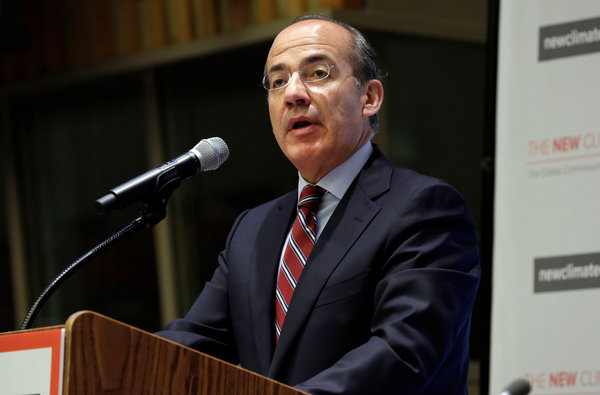
Felipe Calderón, the chairman of the Global Commission on the Economy and Climate and former president of Mexico. CreditRichard Drew/Associated Press 

The objective now, negotiators say, is to stave off atmospheric temperature increases of 4 to 10 degrees by the end of the century; at that point, they say, the planet could become increasingly uninhabitable.

Officials at the National Oceanic and Atmospheric Administration are already reporting that 2014 appears likely to be the warmest year on record.

Since 1992, the United Nations has convened an annual climate change summit meeting aimed at forging a deal to curb greenhouse gases, which are produced chiefly by burning coal for electricity and gasoline for transportation. But previous agreements, such as the 1997 Kyoto Protocol, included no requirements that developing nations, such as India and China, cut their emissions. And until now, the United States has never headed into those summit meetings with a domestic climate change policy in place.

This spring, a report by 13 federal agencies concluded that climate change would harm the American economy by increasing food prices, insurance rates and financial volatility. In China, the central government has sought to quell citizen protests related to coal pollution.

In June, Mr. Obama announced a new Environmental Protection Agency rule forcing major emissions cuts from coal-fired power plants. State Department negotiators took the decision to China, hoping to broker a deal for a similar offer of domestic action. That led to November’s joint announcement in Beijing: The United States will cut its emissions up to 28 percent by 2025, while China will decrease its emissions by or before 2030.

“Our sense is that this will resonate in the broader climate community, give momentum to the negotiations and spur countries to come forward with their own targets,” said Todd Stern, Mr. Obama’s lead climate change negotiator. “The two historic antagonists, the biggest players, announcing they’ll work together.”

Other negotiators agree. “The prospects are so much better than they’ve ever been,” said Felipe Calderón, the former president of Mexico and chairman of the Global Commission on the Economy and Climate, a research organization.

The aim of negotiators in Lima is, for the first time, to produce an agreement in which every nation commits to a domestic plan to reduce greenhouse gas emissions, along the model of the United States-China agreement. Negotiators expect that by next March, governments will make announcements similar to those made by the United States and China.

The idea is for each country to cut emissions at a level that it can realistically achieve, but in keeping with domestic political and economic constraints. World leaders would sign a deal in Paris next year committing all those nations to their cuts, including a provision that the nations regularly reconvene to further reduce their emissions.

The problem is that climate experts say it almost certainly will not happen fast enough. A November report by the United Nations Environment Program concluded that in order to avoid the 3.6 degree increase, global emissions must peak within the next 10 years, going down to half of current levels by midcentury.

But the deal being drafted in Lima will not even be enacted until 2020. And the structure of the emerging deal — allowing each country to commit to what it can realistically achieve, given each nation’s domestic politics — means that the initial cuts by countries will not be as stringent as what scientists say is required.

China’s plan calls for its emissions to peak in 2030. Government officials in India, the world’s third-largest carbon polluter, have said they do not expect to see their emissions decline until at least 2040.

While Mr. Obama has committed to United Nations emissions cuts through 2025, there is no way to know if his successor will continue on that path.

That reality is already setting in among low-lying island nations, like the Marshall Islands, where rising seas are soaking coastal soil, killing crops and contaminating fresh water supplies.

“The groundwater that supports our food crops is becoming inundated with salt,” said Tony A. deBrum, foreign minister of the Marshall Islands. “The green is becoming brown.”

Many island nations are looking into buying farmland in other countries to grow food and, eventually, to relocate their populations.

In Lima, those countries are expected to demand that a final deal include aid to help them adapt to the climate impacts that have already arrived.

Plantas se comunicam e ‘brigam’ usando ‘internet de fungos’ (BBC)

Nic Fleming

Filamentos de fungos chamados micélios formam uma rede conhecida como micorriza

Uma via superrápida para tráfego de dados, que coloca em contato uma grande população de indivíduos diversos e dispersos. Essa via facilita a comunicação e colaboração entre os indivíduos, mas também abre caminho para que crimes sejam cometidos.

Parece uma descrição da internet, mas estamos falando de fungos. Os fungos – sejam eles cogumelos ou não – são formados de um emaranhado de pequenos filamentos conhecidos como micélio. O solo está cheio desta rede de micélios, que ajuda a “conectar” diferentes plantas no mesmo solo.

Muitos cientistas estudam a forma como as plantas usam essa rede de micélios para trocar nutrientes e até mesmo para “se comunicar”. Em alguns casos, as plantas formam até mesmo uma união para “sabotar” outras espécies invasoras de plantas, liberando toxinas na rede.

Cerca de 90% das plantas terrestres têm uma relação simbiótica com fungos, que é batizada de micorriza. Com a simbiose, as plantas recebem carboidratos, fósforo e nitrogênio dos fungos, que também as ajudam a extrair água do solo. Esse processo é importante no desenvolvimento das plantas.

‘Internet natural’

Filme de ficção ‘Avatar’ tinha uma ideia parecida com a ‘internet natural’ que existe na Terra

Para o especialista em fungos Paul Stamets, essa rede é uma “internet natural” do planeta Terra. Sua tese é que ela coloca em contato plantas que estão muito distantes de si e não apenas as que estão próximas. Ele traça um paralelo com o filme Avatar, de 2009, em que vários organismos em uma lua conseguem se comunicar e dividir recursos graças a uma espécie de ligação eletroquímica entre as raízes das árvores.

Só em 1997 é que foi possível comprovar concretamente algumas dessas comunicaçõeos via “internet natural”. Suzanne Simard, da Universidade de British Columbia, no Canadá, mostrou que havia uma transferência de carbono por micélio entre o abeto de Douglas (uma árvore conífera) e uma bétula. Desde então, também ficou provado que algumas plantas trocam fósforo e nitrogênio da mesma forma.

Simard acredita que árvores de grande porte usam o micélio para alimentar outras em nascimento. Sem essa ajuda, a cientista argumenta, muitas das novas árvores não conseguiriam sobreviver.

Simard conta que as plantas parecem trabalhar no sentido contrário ao observado por Charles Darwin, de competição por recursos entre espécies. Em muitos casos, espécies diferentes de plantas estão usando a rede para trocar nutrientes e se ajudarem na sobrevivência.

Os cientistas estão convencidos de que as trocas de nutrientes realmente acontece pelo fungo no solo, mas eles ainda não entendem exatamente como isso ocorre.

‘Conluio’

Uma pesquisa recente foi além. Em 2010, Ren Sem Zeng, da faculdade de agronomia da Universidade de Guangzhou, na China, conseguiu observar que algumas plantas “se comunicam entre si” para formar uma espécie de sabotagem a espécies invasoras.

A experiência foi feita com tomates plantados em vários vasos e ligados entre si por micorriza. Um dos tomates foi borrifado com o fungo Alternaria solani, que provoca doenças na planta.

Depois de 65 horas, os cientistas borrifaram outro vaso e descobriram que a resistência deste tomate era muito superior.

“Acreditamos que os tomates conseguem ‘espiar’ o que está acontecendo em outros lugares e aumentar sua resposta à doença contra uma potencial patogenia”, escreveu Zeng no artigo científico.

Ou seja, as plantas não só usam a “internet natural” para compartilhar nutrientes, mas também para formar um “conluio” contra doenças.

Esse tipo de comportamento não foi observado apenas em tomates. Em 2013, o pesquisador David Johnson, da Universidade de Aberdeen, na Escócia, também detectou isso em favas, que se protegem contra insetos mínusculos conhecidos com afídios.

Lado negro

Experiência mostrou que tomates se ‘comunicam’ pela micorriza sobre doenças

Mas assim como a internet humana, a internet natural também possui seu lado negro. A nossa internet reduz a privacidade e facilita crimes e a disseminação de vírus.

O mesmo acontece com as plantas na micorriza, segundo os cientistas. Algumas plantas não possuem clorofila e não conseguem produzir sua própria energia por fotossíntese.

Algumas plantas, como a orquídea Cephalanthera austiniae, “roubam” o carbono que necessitam de árvores das proximidades, usando a rede de micélio. Outras orquídeas que são capazes de fotossíntese roubam carbono, mesmo sem necessitar.

Esse tipo de comportamento faz com que algumas árvores soltem toxinas na rede para combater plantas que roubam recursos. Isso é comum em acácias. No entanto, cientistas duvidam da eficácia desta técnica, já que muitas toxinas acabam sendo absorvidas pelo solo ou por micróbios antes de atingir o alvo desejado.

Para vários cientistas, a internet dos fungos é um exemplo de uma grande lição do mundo natural: organismos aparentemente isolados podem estar, na verdade, conectados de alguma forma, e até depender uns do outros.

Leia a versão original em inglês desta reportagem no site BBC Earth.

Record Drought Reveals Stunning Changes Along Colorado River (National Geographic)

A boat traces the curves of Reflection Canyon, part of Glen Canyon.

A boat wends its way around the curves of Reflection Canyon, part of Lake Powell in Glen Canyon. The “bathtub rings” on the walls show past water levels.

PHOTOGRAPH BY MICHAEL MELFORD, NATIONAL GEOGRAPHIC CREATIVE

Jonathan Waterman

for National Geographic

PUBLISHED NOVEMBER 23, 2014

LAKE POWELL, Utah—In early September, at the abandoned Piute Farms marina on a remote edge of southern Utah’s Navajo reservation, we watched a ten-foot (three-meter) waterfall plunging off what used to be the end of the San Juan River.

Until 1990, this point marked the smooth confluence of the river with Lake Powell, one of the largest reservoirs in the U.S. But the lake has shrunk so much due to the recent drought that this waterfall has emerged, with sandy water as thick as a milkshake.

My partner DeEdda McLean and I had come to this area west of Mexican Hat, Utah, to kayak acrossLake Powell, a reservoir formed by the confluence of the San Juan and the Colorado Rivers and the holding power of Glen Canyon Dam, which lies just over the border in Arizona. Yet in place of a majestic reservoir, we saw only the thin ribbon of a reemergent river channel, which had been inundated for most of the past three decades by the lake. We called this new channel the San Powell, combining the name of the river and the lake.

Map of the Lake Mead and Lake Powell regions.

VIRGINIA W. MASON, NG STAFF SOURCE: BUREAU OF RECLAMATION, NATIONAL PARK SERVICE

We had also come to see firsthand how drought is changing the landscapes of the desert Southwest. Here, judging by the lack of conservation reform, water has seemed to be largely taken for granted. But our recent float suggests that profound changes may be in store for the region. (See “The American Nile.”)

Sweating in the desert heat, we loaded our 15-foot (5-meter) kayaks with two weeks’ worth of food and ten gallons of water—enough to last us two days. Drinking from the silty river or fecal-contaminated areas of Lake Powell frequented by houseboats was not an option (Glen Canyon Recreation Area, which includes the reservoir, is visited by more than two million people a year). The contours of our journey—where we camped, our hiking destinations, and how far we paddled each day—would be defined by the need to find potable springs.

Like bicyclists shunning the interstate, many kayakers have avoided Lake Powell ever since the builders of Glen Canyon Dam finished flooding 186 miles (300 kilometers) of the Colorado River Valley in 1980. The reservoir was named after John Wesley Powell, the National Geographic Society co-founder who first paddled most of the Colorado River and who later, in public office, tried to limit population growth in the arid Southwest. The dams and the enormous reservoirs that were later built in the desert would have horrified him.

Motorboaters call Powell’s lake the “Jewel of the Colorado” because of its unnatural emerald hue—Glen Canyon Dam now captures the silt that used to make the Colorado, after its confluence with the San Juan, the most colorful river in the West. Paddlers call it “Lake Foul” for the noise and stench of outboard engines.

Photo of Lake Powell in 2011.

In 2011, Lake Powell contained plenty of water.
PHOTOGRAPH BY JON WATERMAN

“Extreme” Drought

According to the U.S. Drought Monitor, 11 of the past 14 years have been drought years in the Southwest, with the drought ranging from “severe” to “extreme” to “exceptional,” depending on the year and the area.

At “full pool,” Lake Powell spans 254 square miles (660 square kilometers)—a quarter the size of Rhode Island. The lightning bolt-shaped canyon shore stretches 1,960 miles (3,150 kilometers), 667 miles (1,073 kilometers) longer than the West Coast of the continental United States.

The reservoir serves multiple purposes. It stores water from the Upper Basin states of Wyoming, Utah, New Mexico, and Colorado so that the Lower Basin states of California, Nevada, and Arizona can receive their allotted half of the Colorado River; it creates electricity through hydro-generators at Glen Canyon Dam; and it helps prevent flooding below Hoover Dam (240 miles or 390 kilometers downstream), the site of North America’s largest reservoir, Lake Mead.

11 of the past 14 years have been drought years in the Southwest.

The irony, as most students of this river’s history now know, is that the U.S. Bureau of Reclamation created these enormous reservoirs during the wettest period of the past millennium. According to modern tree-ring data (unavailable during the dam-building epoch), the previous millennium experienced droughts much more severe than those in the first 14 years of the 21st century. Many climate scientists think the Southwest is again due for a megadrought. The Bureau of Reclamation’s analysis of over a hundred climate projections suggests the Colorado River Basin will be much drier by the end of this century than it was in the past one, with the median projection showing 45 percent less runoff into the river.

Last winter was snowy in the Rockies, and runoff was at 96 percent of the historical average. Because of the previous years of drought, however, Lake Powell had risen to only half full by fall.

But Lake Mead was in even worse shape. This year it plunged to 39 percent of capacity, a low that has not been matched since Hoover Dam began backing up the Colorado River in 1935. In August, the Bureau of Reclamation announced that Lake Powell would release an additional 10 percent of its waters, or 2.5 trillion gallons, to Lake Mead. That release will lower the water in Lake Powell by about three feet (one meter).

Photo of Lake Powell in 2014.

By 2014, Lake Powell was full of plant life and silt.
PHOTOGRAPH BY JON WATERMAN

Rise of Ancient Ruins?

Fifty miles (80 kilometers) up from the Colorado River confluence, on what is commonly known as the San Juan River Arm of Lake Powell, we kept poking our paddles-cum-measuring sticks toward the shallow river bottom, shouting: “Good-bye, reservoir! Hello, San Powell River!” In a four-mile-per-hour, opaque current, always hunting for the deepest river braids, we breezed past fields of still-viscous, former lake-bottom silt deposits. Stepping out of the boat here would have been an invitation to disappear in quicksand.

We paddled downstream, looking for the edge of the reservoir. We passed caterwauling great blue herons, a yipping coyote, and squawking conspiracies of ravens. By late afternoon, dehydrated by the desert sun, we stopped at one of the few quicksand-free tent sites above the newly emerged river: a sandy yet dry creek bed draining the sacred Navajo Mountain.

We slept in the perfume of blooming nightshades; wild burros brayed throughout the night. Here, more than a dozen miles below our put-in at a marina that once served the reservoir, the swirling “San Powell” River continued to sigh 15 feet (5 meters) below our tent.

In October 2011, when the reservoir was at 70 percent of its capacity, I had stood on a rocky shore above where our tent now stood and photographed Lake Powell’s Zahn Bay here in the San Juan River Valley. It’s dry now, and the lake bottom is a cracked series of chocolate-colored hummocks, surrounded by the invasive Russian thistle and tamarisk, native willows and sunflowers, and pockmarked by burro hooves.

For five days, we wouldn’t see a human footprint or hear the ubiquitous whine of Lake Powell boat traffic.

Half full, the amazing vessel that is Lake Powell has lost 4.4 trillion gallons of water in the recent drought.

By day three, desperate to refill our water bottles, we found a newly created marsh where the river thinned before dropping into the deeper reservoir. Unlike anything I’d experienced elsewhere on the sterile Lake Powell, abundant small fish and aquatic life supported American pelicans, mallards, coots, mergansers, green herons, hawks, and kingfishers. The silty river is also sheltering endangered razorback suckers and pikeminnows that are preyed upon by non-native fish in the clearer waters of the lake.

Within a decade or two at the most, if the drought persists, we can expect to see hundreds of inundated ancient Anasazi ruins rising above the drying reservoir. Archaeologists will be delighted, just as kayakers like us delight at the reemergence of a river. But more than 36 million people in and around the Colorado River Basin depend on this vanishing water.

As we finally reached a body of water wide enough to be properly called the reservoir, many miles below where we had expected to find it, we continued paddling in a chocolate pudding of ground-up river debris. Some 94 feet (29 meters) above our craned heads, on the red sandstone walls of the reservoir, we saw the “bathtub rings”—the stains left by river minerals in wetter times.

That night we did a quick calculation: Half full, the amazing vessel that is Lake Powell has lost 4.4 trillion gallons of water in the recent drought; the deeper vessel of Lake Mead at 39 percent capacity has lost 5.6 trillion gallons of water.

Aerial view looking down on Lake Powell and the Glen Canyon dam.

This aerial view of Lake Powell and Glen Canyon Dam was taken in 2009.
PHOTOGRAPH BY PETER MCBRIDE, NATIONAL GEOGRAPHIC CREATIVE

Big Impact

As central California (beyond the reach of Colorado River water) has already been hamstrung by an even more exceptional drought, many farms and dairy operations have shut down, rationing has begun, homeowners are being fined for watering their lawns, and the state has begun relying on finite groundwater supplies. And as extensive farm networks are served by the Colorado River, it is likely that nationwide produce prices will soon begin to rise.

What’s next? As Lakes Powell and Mead continue to plummet, officials are now predicting rationing by 2017 for the junior Colorado River water-rights holders of Nevada and Arizona.

In the decades that follow, invasive flora and fauna will colonize dried-out reservoir bottoms. River running and reservoir boating may end. Those will seem like minor issues compared with the survival of cities like Los Angeles, Denver, Phoenix, and Las Vegas, all of which depend on the Colorado River. There is talk of diverting more water to the Colorado Basin users from places such as the Missouri River. A massive desalination plant is being built on the California coast. But such solutions won’t come cheap.

Officials are now predicting rationing by 2017 for the junior Colorado River water-rights holders of Nevada and Arizona.

We can hope for agricultural reform, such as irrigation changes, more aggressive crop rotation and fallowing, reverting to less water-intensive produce, or dismantling of the water-intensive southwestern dairy industry. And the exponential population growth of the region—as Powell warned at the end of the 19th century—will have to be addressed. (See “Arizona Irrigators Share Water With Desert River.”)

By mid-September, we reached the speedboat-accessible region of Lake Powell. Motorboaters often stopped to ask if we needed help. Many of these boaters offered us iced beer or bottled water imported from distant regions of the country.

Each day, for 14 days, except during two violent but brief rainstorms, the temperature climbed into the 90s. Often dizzy, and even exhausted from the heat, we parceled out our water, cup by cup, consuming over four gallons daily. And every other day, we walked or paddled miles out of our way so that we could enact a time-honored practice of desert cultures like the Anasazi’s, which vanished in the 13th-century megadrought.

Every other day, we uncapped our empty bottles while honoring this ritual of aridity: Bowing under shaded cliffs at moss-covered seeps, we pressed our lips onto cold sandstone walls and drank those precious drops until our bellies were full.

Jonathan Waterman is a writer and photographer based in Colorado. In 2010 National Geographic published his book Running Dry: A Journey From Source to Sea Down the Colorado River. He is also the co-author, with Pete McBride, of The Colorado River: Flowing Through Conflict.See his previous work “The American Nile.”

Get involved with the effort to restore the Colorado River throughChange the Course, a partnership of National Geographic and other organizations.

O Brasil secou (Super Interessante)

A falta d’água se alastrou pelo país, sintoma das mudanças climáticas e do desmatamento na Amazônia, cada vez mais debilitada. Nos aproximamos de um futuro desértico — e a culpa é toda nossa

por Camila Almeida

Novembro 2014

Em 2014, não choveu. Pelo menos não quanto deveria. Os índices de chuvas apresentam déficit, os reservatórios minguaram a percentuais críticos, a nascente do Rio São Francisco secou pela primeira vez na história. Esses eventos extremos estavam previstos pelos estudiosos das mudanças climáticas, causadas quase exclusivamente pela atividade humana, especialmente pela queima de combustíveis fósseis. Mas outro fator está agravando esse quadro: o desmatamento. A Amazônia é a responsável por manter úmido todo o continente, e sua depredação influencia diretamente no clima.

A floresta funciona como uma fábrica de chuvas. Por cima das nossas cabeças, há imensos rios seguindo seu curso, levando nuvens carregadas por onde passam. São os rios voadores, que começaram a ser estudados em 2006, numa parceria entre o aviador francês Gérard Moss e o engenheiro agrônomo Antonio Donato Nobre, do Instituto Nacional de Pesquisas Espaciais (INPE). Sobrevoando a Amazônia, eles descobriram todo o seu potencial de bombeamento de água e traçaram o curso que os rios voadores seguem pelo País. Esta capacidade da floresta de exportar umidade é um dos cinco segredos da floresta, poeticamente explicados no relatório O Futuro Climático da Amazônia, publicado recentemente por Nobre.

Nossa água vem da Amazônia
Entenda o processo de transpiração da floresta e a formação das nuvens sobre ela. Ao lado, conheça o percurso dos rios voadores e como eles levam chuvas por todo o continente.

O fluxo dos rios voadores é mais intenso no verão, estação em que chove na maior parte do País. Isso acontece graças à inclinação da Terra nesta época do ano, que favorece a entrada dos ventos marítimos na América do Sul. Mas há mais uma vantagem geográfica que garante esse circuito: a Cordilheira dos Andes, localizada a oeste da floresta. O imenso paredão faz com que os ventos não passem direto e deixem o resto do Brasil sem umidade. De acordo
com o físico Philip Fearnside, do Instituto Nacional de Pesquisas da Amazônia (INPA), é no
começo do ano que os rios voadores reabastecem as fontes de água e reservatórios brasileiros. Ao se chocarem contra a Serra da Mantiqueira e da Canastra, no Sudeste, enchem a nascente de vários rios importantes, como o São Francisco. “Esta região é a caixa d’água do Brasil”, avalia Fearnside. “Se não chover na época em que tem que chover, os reservatórios
não serão recarregados ao longo do ano”, completa. Esse tem sido o drama em 2014.

Desmatamento que vai, volta 

Poder contar com a maior floresta tropical do mundo, inclusive em relação aos recursos hídricos, é um privilégio. Pouquíssimo valorizado. Nos últimos 40 anos, derrubamos 42 bilhões de árvores. Além disso, devido às queimadas, existe mais de 1 milhão de km² de floresta morta, degradada. O que não se imaginava é que uma revanche em forma de seca chegaria tão rápido. “Hoje, estamos vivendo a reciprocidade da inconsequência”, atesta Nobre. Há mais de 20 anos, estudos alertavam para esse perigo. Em 1991, o climatologista Carlos Nobre, irmão de Antonio e também do INPE, comandou uma simulação para avaliar os impactos no clima da mudança do uso da terra. Constataram que, se a floresta fosse substituída por plantações ou pastagens, a temperatura média da superfície aumentaria cerca de 2,5 ºC, a evapotranspiração das plantas diminuiria 30% e as chuvas cairiam 20%. Também se previa uma ampliação das estações secas na área amazônica. Hoje, com quase metade da floresta original danificada, tais efeitos parecem ter vindo à tona.
“O desmatamento zero é para ontem. Chegamos a níveis climáticos críticos. Precisamos começar a replantar o que já perdemos”, aponta Antonio Nobre. Apesar da urgência, as perspectivas não são animadoras. Só na região amazônica, há mais de 40 projetos do Programa de Aceleração do Crescimento do Governo Federal só no quesito geração de energia. São usinas, barragens e outras medidas que causam inundações e corte de árvores e que afetam diretamente populações indígenas. Os projetos de estradas também são preocupantes. A recuperação da Rodovia Manaus-Porto Velho (BR-319), abandonada desde a década de 1980 por falta de manuntenção, também consta no PAC. De acordo com Philip Fearnside, o projeto é um risco para a Amazônia. “Uma estrada valoriza demais a terra, e especulação gera desmatamento e favorece a grilagem”, explica. O mesmo acontece com a Rodovia Santarém-Cuiabá (BR-163), com mais de 1.700 km de extensão.

“A estrada vai ser recuperada para facilitar o transporte da soja produzida no Mato Grosso”, aponta Fearnside, sobre uma das áreas amazônicas que mais sofrem com o agronegócio. “A terra valoriza tanto que pecuaristas estão vendendo suas terras para produtores de soja do Sul. Por sua vez, isso tem aumentado muito o desmatamento no Pará, com a liberação de terrenos para a criação de gado desses pecuaristas”, critica o especialista. Ele também destaca o fortalecimento da bancada ruralista no Congresso, após as eleições deste ano.

Desmatamento e degradação:

Clima em crise

Neste verão, os rios voadores não avançaram sobre o Sudeste; tampouco as frentes frias. A ilha de calor instalada sobre a região, característica de uma urbanização extrema, cria bloqueios que afastam as chuvas. Por isso, a água esborrou na borda dessa bolha quente, gerando chuvas acima da média no Sul e países vizinhos. Hoje, há registros de seca em todos os Estados brasileiros. Em alguns deles, a seca é “excepcional”, ainda mais grave do que a “extrema”. O quadro já era grave no ano passado, quando o Nordeste viveu a pior seca dos últimos 50 anos, inserindo o Brasil no mapa de eventos climáticos extremos, da Organização Mundial de Meteorologia.

De acordo com o físico especialista em ciências atmosféricas Alexandre Araújo Costa, da Universidade Estadual do Ceará, o agravamento de secas e das cheias está relacionado ao aumento da temperatura na atmosfera. Aquecida, ela se expande, fazendo com que seja necessário reunir mais vapor d’água para formar nuvens. “Esse processo demanda mais tempo, portanto tende a prolongar os períodos de estiagem. Por outro lado, as nuvens se formam a partir de uma quantidade maior de vapor d’água, fazendo com que os eventos de precipitações se tornem mais intensos. Um planeta mais quente é um planeta de extremos”, explica.

Para a filósofa e ecologista Déborah Danowski, que lançou recentemente o livro Há mundo por vir? Ensaio sobre os medos e os fins, com seu marido e antropólogo Eduardo Viveiros de Castro, entramos num caminho sem volta. “A crise climática não pode mais ser evitada. Se cortássemos agora as emissões de CO₂, a Terra ainda iria se aquecer aproximadamente 1 ºC. Isso porque já jogamos no ar uma quantidade tão grande, que muito dele ainda nem foi absorvido”, aponta. O que não quer dizer que não haja muito o que fazer. Para ela, o primeiro passo é repensar os modelos econômicos de crescimento e consumo. “O que nos cabe é tentar mitigar as causas que levam ao aprofundamento das mudanças climáticas e, ao mesmo tempo, nos adaptar à vida em um mundo mais difícil ecologicamente.”

Estamos todos ilhados
Seja pelo excesso de calor ou pelas enchentes. Mais filosoficamente: não temos saída para o clima. Os eventos extremos parecem estar se tornando uma realidade no Brasil.

Cidade submarina projetada no Japão pode abrigar 5 mil moradores (Portal do Meio Ambiente)

PUBLICADO  21 NOVEMBRO 2014

9730
Projeto arquitetônico de cidade submarina: alternativa para 2030 (Foto: AFP)

Uma empresa de construção japonesa diz que, no futuro, os seres humanos podem viver em grandes complexos habitacionais submarinos.

Pelo projeto, cerca de 5 mil pessoas poderiam viver e trabalhar em modernas vesões da cidade perdida da Atlântida.

As construções teriam hotéis, espaços residenciais e conjuntos comerciais, informou o site Busines Insider.

A grande globo que flutua na superfície do mar, mas pode ser submerso em mau tempo, seria o centro de uma estrutura espiral gigantesca que mergulha a profundidades de até 4 mil metros.

A espiral formaria um caminho 15 quilômetros de um edifício até o fundo do oceano, o que poderia servir como uma fábrica para aproveitar recursos como metais e terras raras.

Os visionários da construtora Shimizu dizem que seria possível usar micro-organismos para converter dióxido de carbono capturado na superfície em metano.

9730b
Projeto arquitetônico de cidade submarina: alternativa para 2030 (Foto: AFP)

Energia. O conceito foi desenvolvido em conjunto com várias organizações, incluindo a Universidade de Tóquio e a agência japonesa de ciência e tecnologia.

A grande diferença de temperaturas da água entre o topo e o fundo do mar poderia ser usada para gerar energia.

A construtora Shimizu diz que a cidade submarina custaria cerca de três trilhões de ienes (ou US$ 25 bilhões), e toda a tecnologia poderia estar disponível em 2030.

A empresa já projetou uma metrópole flutuante e um anel de energia solar ao redor da lua.

Fonte: Estadão.

Projeto proíbe criação de animais em confinamento (Portal do Meio Ambiente)

PUBLICADO  28 NOVEMBRO 2014. EM ANIMAIS

9753 9753b

A Comissão de Meio Ambiente da Assembleia Legislativa do Estado de São Paulo (ALESP) aprovou o projeto de lei 714/12, de autoria do deputado Feliciano Filho (PEN), que proíbe a criação de animais em sistema de confinamento.

Confinamento é o sistema de criação em que lotes de animais são colocados em piquetes ou locais com área restrita, impossibilitando-os de expressar seu comportamento natural e o pleno atendimento de suas necessidades físicas e mentais. Esse sistema de criação visa acelerar a engorda, aumentando a produtividade e diminuindo os custos do negócio.

“Esse sistema vem se intensificando em nome do ganho de produtividade. Mas ele é perverso com os animais, provocando lesões e estresse. Muitos passam a vida sem ver o sol ou a natureza. Apenas nascem, sofrem e morrem”, explica Feliciano.

Relatório da Humane Society International aponta que “o confinamento intensivo desses sistemas de produção prejudica severamente o bem-estar dos animais, pois são incapazes de se exercitar, de esticar completamente seus membros, ou de se envolver em muitos comportamentos naturais importantes. Como resultado da restrição severa desses sistemas de alojamento monótonos, os animais podem experimentar significativa e prolongadas agressões físicas e psicológicas. Além disso, extensiva evidência científica mostra que os animais confinados intensamente são frustrados, angustiados e sofredores.”

Segundo o texto, “produtividade não é sinônimo de bem-estar, igualar um ao outro não tem respaldo científico. A produtividade é muitas vezes medida em nível de grupo, o que não reflete com exatidão o bem-estar individual.”

No Brasil, as práticas mais comuns de confinamento são as gaiolas em bateria, celas de gestação e gaiolas para bezerros, utilizados, respectivamente, para galinhas poedeiras, porcas prenhes e bezerros criados para vitela.

A União Europeia, através de processos graduais, eliminou tais práticas até 2013. Nos Estados Unidos, os estados do Colorado, Arizona, Flórida, Oregon e Califórnia também têm coibido o confinamento.

Gaiolas em Bateria – As gaiolas em bateria são pequenas enclausuras de arame, que portam de 5 a 10 aves. Cada animal se restringe a um espaço médio de 430 a 550 centímetros quadrados, algo similar a uma folha de papel carta. Dessa forma, ficam impedidas de realizar seus comportamentos naturais, tornando-se inativas, em um chão estéril de gaiola. Tais restrições severas causam, além de estresse, a má condição do pé e distúrbios metabólicos como osteoporose e danos hepáticos.

Celas de Gestação – As porcas reprodutoras passam os quatro meses de prenhez nas chamadas celas de gestação, jaulas individuais com piso de concreto que medem, em geral, 0,6 x 2,1 metros. Pouco maior que o próprio animal, é tão severamente restritiva que a impede até mesmo de se virar. Os riscos desse tipo de confinamento são infecção do trato urinário, ossos enfraquecidos, claudicação e alterações comportamentais.

Gaiolas para bezerros – O confinamento intensivo de bezerros é realizado para a produção de vitela (corte de animal jovem). O animal de raça de leite é criado até 16 a 18 semanas de idade, período em que chegam a pesar cerca de 200 quilos, e destinados à indústria de carne. Somente uma pequena porcentagem é criada até a maturidade e utilizada para reprodução. Os vitelos são mantidos em gaiolas individuais com cerca de 70 centímetros de largura, amarrados na parte da frente da gaiola com uma coleira curta. Ficam com os movimentos restritos e impedidos de se deitar da maneira mais confortável às suas necessidades. A falta de exercícios regulares leva ao comprometimento do desenvolvimento ósseo e muscular, assim como à doenças nas articulações.

Cães e gatos – Em muitos canis e gatis, oficiais e clandestinos, as matrizes são mantidas confinadas em gaiolas, por toda a vida, sem receber luz do Sol e podadas da possibilidade de se mover de acordo com as necessidades anatômicas, fisiológicas, biológicas e etológicas. Muitas desenvolvem transtornos comportamentais irreversíveis.

Penalidades – O projeto de lei determina que o descumprimento das disposições será punido com pagamento de multa de 2.000 UFESP – Unidade Fiscal do Estado de São Paulo por animal (R$ 40.280,00), valor que dobrará em caso de reincidência. Poderá ainda ser realizada a apreensão do animal ou do lote, a suspensão temporária do alvará de funcionamento, assim como sua suspensão definitiva de acordo com a progressão do caso.

O projeto autoriza o Estado a reverter os valores recolhidos para custeio das ações, publicações e conscientização da população sobre guarda responsável e direitos dos animais, para instituições, abrigos ou santuários de animais, ou para programas estaduais de controle populacional ou que visem à proteção e bem-estar dos animais.

Fonte: Proteção Animal.

Leaked: The Oil Lobby’s Conspiracy to Kill Off California’s Climate Law (Bloomberg Business Week)

November 25, 2014


Looking south over Los Angeles and the 101 Freeway, with the morning haze and smog on Jan. 28

Photograph by David Bro/Zuma Press

Looking south over Los Angeles and the 101 Freeway, with the morning haze and smog on Jan. 28

You remember Fillmore. He’s the resident hippie of Radiator Springs in the Pixar blockbuster Cars. Much to the chagrin of his neighbor, Sarge the Army Jeep, Fillmore greets each new day with Jimi Hendrix’s Woodstock rendition of A Star Spangled Banner—“respect the classics, man”—and is quick with a conspiracy theory about why biofuels never stood a chance at America’s gas pumps. Perfectly voiced by the late, great George Carlin, Fillmore has a slight paranoiac edge, as if his intake of marijuana may exceed what’s medically indicated.

Well, as they say, it’s not paranoia if they really are out to delay, rewrite, or kill off a meaningful effort to reduce the build-up of carbon in the Earth’s atmosphere. A Powerpoint (MSFT) deck now being circulated by climate activists—a copy of which was sent to Bloomberg Businessweek—suggests that there is a conspiracy. Or, if you prefer, a highly coordinated, multistate coalition that does not want California to succeed at moving off fossil fuels because that might set a nasty precedent for everyone else.

Created by the Western States Petroleum Association (WSPA), one of the most powerful oil and gas lobbies in the U.S., the slides and talking points comes from a Nov. 11 presentation to the Washington Research Council. The Powerpoint deck details a plan to throttle AB 32 (also known as the California Global Warming Solutions Act of 2006) and steps to thwart low carbon fuel standards (known as LCFS) in California, Oregon, and Washington State. Northwest Public Radio appears to have been the first to confirm the authenticity of the deck, which Bloomberg Businessweek did as well, with WSPA spokesman Tupper Hull.

Specifically, the deck from a presentation by WSPA President Catherine Reheis-Boyd lays out the construction of what environmentalists contend is an elaborate “astroturf campaign.” Groups with names such as Oregon Climate Change Campaign, Washington Consumers for Sound Fuel Policy, and AB 32 Implementation Group are made to look and sound like grassroots citizen-activists while promoting oil industry priorities and actually working against the implementation of AB 32.

The deck also reveals how WSPA seized on a line from a California Air Resources Board memo that the cap-and-trade program for gas and diesel that goes into effect on Jan. 1, 2015, may affect gas prices in order to launch an ad campaign warning of a “hidden” gas tax that devious Sacramento pols are sneaking through.

“The environmental community is used to sky-is-falling analysis from fossil fuel interests in response to clean energy initiatives, so that part isn’t surprising,” says Tim O’Connor, a senior attorney at the Environmental Defense Fund, to whom I sent the deck for comment. “But it’s eye-opening to see the lengths [the WSPA] has gone to push back rather than move forward. I don’t think anybody knew how cross-jurisdictional, cross-border, and extensive their investment is in creating a false consumer backlash against [climate legislation].”

In California, O’Connor points out, “we have 70 percent voter approval on clean energy alternatives, so it’s offensive and atrocious they’re using these supposed everyday citizens—who are really paid advertisers—to change the public discourse.”

Reheis-Boyd’s Powerpoint deck, entitled “WSPA Priority Issues,” starts by announcing that these are the “the best of times.” Crude oil production in the U.S. is higher than it has been since 1997, with imports subsequently reduced to a 20-year low, according to the American Petroleum Institute. The next six slides describe why these are also “the worst of times” and include images of demonstrators protesting the Keystone XL oil pipeline, demanding government action on climate change, and pictures of professor-cum-activist Bill McKibben and billionaire Tom Steyer, with the latter quoted as saying he wants to “destroy these people”—i.e., people like the members of WSPA.

Then there’s a slide with all the different groups that WSPA has funded to make it seem as if there’s a broad group in three states opposing a series of initiatives to reduce carbon pollution from fossil fuels. The most clever of these is the “Stop the Hidden Gas Tax!” campaign. Who, after all, wants that?

“Let me be clear,” says Hull, the WSPA spokesman. “We did not oppose AB 32 when it passed. We believe it’s good to have the reduction of greenhouse gases as a goal. We support that goal.” In the years since, he says, “hundreds of pages of regulations have been added to what had been a page-and-a-half document, and we do object to many of the additions.” What’s more, Hull says, “we have a legitimate concern over what will happen when the cap-and-trade program goes into effect for gas and diesel.”

Terry Eagleton reviews Trouble in Paradise and Absolute Recoil by Slavoj Žižek (Guardian)

Like Socrates on steroids: Žižek is both breathtakingly perceptive and outrageously irresponsible. Is he just out to scandalise?

zizek

 A curious mixture of illusion and reality … Slavoj Žižek. Photograph: David Levene

It is said that Jean-Paul Sartre turned white-faced with excitement when a colleague arrived hotfoot from Germany with the news that one could make philosophy out of the ashtray. In these two new books, Slavoj Žižek philosophises in much the same spirit about sex, swearing, decaffeinated coffee, vampires, Henry KissingerThe Sound of Music, the Muslim Brotherhood, the South Korean suicide rate and a good deal more. If there seems no end to his intellectual promiscuity, it is because he suffers from a rare affliction known as being interested in everything. In Britain, philosophers tend to divide between academics who write for each other and meaning-of-life merchants who beam their reflections at the general public. Part of Žižek’s secret is that he is both at once: a formidably erudite scholar well-versed in Kant and Heidegger who also has a consuming passion for the everyday. He is equally at home with Hegel and Hitchcock, the Fall from Eden and the fall of Mubarak. If he knows about Wagnerand Schoenberg, he is also an avid consumer of vampire movies and detective fiction. A lot of his readers have learned to understand Freud or Nietzsche by viewing them through the lens of Jaws or Mary Poppins.

Academic philosophers can be obscure, whereas popularisers aim to be clear. With his urge to dismantle oppositions, Žižek has it both ways here. If some of his ideas can be hard to digest, his style is a model of lucidity. Absolute Recoil is full of intractable stuff, but Trouble in Paradise reports on the political situation in Egypt, China, Korea, Ukraine and the world in general in a crisp, well-crafted prose that any newspaper should be proud to publish. Not that, given Žižek’s provocatively political opinions, many of them would. He sees the world as divided between liberal capitalism and fundamentalism – in other words, between those who believe too little and those who believe too much. Instead of taking sides, however, he stresses the secret complicity between the two camps. Fundamentalism is the ugly creed of those who feel washed up and humiliated by a west that has too often ridden roughshod over their interests. One lesson of the Egyptian revolt, Žižek argues in Trouble in Paradise, is that if moderate liberal forces continue to ignore the radical left, “they will generate an unsurmountable fundamentalist wave”. Toppling tyrants, which all good liberals applaud, is simply a prelude to the hard work of radical social transformation, without which fundamentalism will return. In a world everywhere under the heel of capital, only radical politics can retrieve what is worth saving in the liberal legacy. It is no wonder that Žižek is as unpopular with Channel 4 as he is on Wall Street.

In any case, market freedom and religious fundamentalism are far from mutually exclusive. “Spiritual” values have been enlisted by Asian nations for capitalist ends. The easy opposition between liberal permissiveness and fundamentalist repression must be rethought. The rise of Islamo-fascism, Žižek points out, went hand in hand with the disappearance of the secular left in Muslim countries, a disappearance the west itself did much to promote. Who now recalls that, 40 years ago, Afghanistan was a strong secular state with a powerful Communist party which took power there independently of the Soviet Union? Every emergence of fascism, Walter Benjamin wrote, bears witness to a failed revolution. In the Muslim world, the west has played a major role in stamping on such movements, creating a political vacuum into which fundamentalism was then able to move. It cannot now feign innocence of its predatory past in the face of the Islamist backlash it has helped to unleash. Those who are reluctant to criticise liberal democracy, Žižek suggests, should also keep quiet about fundamentalism.

Stentorian, faintly manic and almost impossible to shut up, Žižek is a man who gets out of bed talking about psychoanalysis and steps back into it holding forth on Zionism. As a frenetic intellectual activist, he always seems to be in six places on the planet at once, like Socrates on steroids. His day may begin with a visit to Julian Assange in the Ecuadorian embassy and end with writing supportive letters to one of the imprisoned Pussy Riot performers. In between, he passes his time antagonising a sizeable chunk of the world’s population. If he is a scourge of neo-capitalism, he is also a sworn foe of liberal pluralism and political correctness. He tells the story of how at an impeccably enlightened US seminar he attended, the chairperson began by asking each participant to state their name along with their sexual preference. Žižek throttled back the urge to announce that he enjoyed bedding young boys and drinking their blood. He also points out how much less forthcoming the participants would have been if asked to state their salaries.

All this may be because he comes from Slovenia. Small nations tend to have a perverse relation to more powerful ones, as anyone acquainted with the Irish can attest. There is a dash of the Dubliner Oscar Wilde in Žižek, a man who couldn’t hear a pious English sentiment without feeling an irresistible itch to reverse its terms, rip it inside out or stand it on its head. Žižek, who has the grim appearance of a hired assassin in a Jacobean tragedy, lacks Wilde’s stylishness and elegance. He also lacks his distinctive brand of humour. Žižek is funny but not witty. He tells some excellent jokes and has a well-honed sense of the absurd, but one couldn’t extract a book of epigrams from his writing, as one can from Wilde’s. Both men, however, are natural-born debunkers and deconstructors, allergic to high moral tones and good clean fun. That Žižek should be a skilled exponent of Jewish black humour, the Woody Allen of Ljubljana, comes as no surprise. Even so, his urge to deface and deflate is a long way from cynicism. Remarkably, he combines the tragic vision of Freud with a Marxist faith in the future.

Like the rest of his work, these two latest volumes are postmodern in form but anti-postmodern in content. Žižek has the eclecticism of the postmodern, along with its mixing of high and low genres. His books are broken-backed affairs which leap erratically from topic to topic. Absolute Recoil, which lurches from ideas of hysteria, art and absolute knowledge to God, death and the Fall, is grandly subtitled “Towards a New Foundation of Dialectical Materialism”, but this is a barefaced deception. There are only a handful of references to dialectical materialism in its 400 pages. Žižek’s books and chapters are rarely about what they say they are about, since he can’t help saying 50 things at once. He is postmodern, too, in his suspicion of originality. A good deal of what he says has been said before, not by others but by himself. He is one of the great self-plagiarisers of our time, constantly thieving stuff from his own publications. Whole chunks of Absolute Recoil reappear in Trouble in Paradise, and whole chunks of Trouble in Paradise appear twice over. He has now told the same jokes, recycled the same insights and recounted the same anecdotes dozens of times over.

Another postmodern aspect of his work is its merging of illusion and reality. For Žižek’s mentor Jacques Lacan, nobody is more self-deceived than the cynic who claims to have seen through it all, ignorant of the Freudian claim that illusion (or fantasy) is built into reality itself. The same applies to Žižek’s own writing. Are his books genuine arguments or public performances? How sincere is he intending to be? If he can be breathtakingly perceptive, he can also be outrageously irresponsible. Can he really be serious when he claims in Trouble in Paradise that “the worst of Stalinism (is better) than the best of the liberal-capitalist welfare state”, or is he just out to scandalise the suburbs? Does he really think that the sexual misconduct Assange is accused of is “minor”? Or take the fact that he has repeatedly argued for the radical potential of Christianity, and does so again in Absolute Recoil, despite the fact that he is a self-proclaimed atheist. It isn’t quite a question, however, of being a Christian in appearance but an unbeliever in reality. Instead, one might claim that he believes and disbelieves in Christianity at the same time. Or what if he thinks he is an atheist but actually isn’t? What if the God he doesn’t believe in knows he is a believer?

Žižek himself is a curious mixture of illusion and reality. In Trouble in Paradise, he speaks of Hamlet as a clown, and he himself is both intellectual and jester. Shakespeare’s jesters are conscious of their own unreality, and Žižek seems to be, too. As a man for whom the adjective “colourful” could have been specially invented, he is a cult figure who sends up his own cult status, a man in deadly earnest who is also an accomplished self-parodist. There is something fictional, larger-than-life, about his constant globe-trotting and flamboyant antics, as though he has strayed out of a David Lodge novel. His gargantuan appetite for ideas is admirable but also faintly alarming. One would not be altogether surprised to hear that he was put together by a committee and consumer-tested on various student focus groups.

When it comes to content, however, nothing could be further from postmodern pluralism than Žižek’s uncompromising revolutionary politics. It is a strange sign of the times that perhaps the most popular intellectual in the world is a dedicated communist. The lesson of Trouble in Paradise, subtitled From the End of History to the End of Capitalism, is plain: “a new Dark Age is looming, with ethnic and religious passions exploding, and Enlightenment values receding”. Žižek’s style is notable for its hardboiled refusal to be emotionally intense, another postmodern feature; but even he can scarcely contain his disgust at the vision of thieving bankers being subsidised by their ruined victims. As Bertolt Brecht inquired: what’s robbing a bank compared to founding one?

Trouble in Paradise, with its unerring ear for political cant, is a book that everyone, not least the Masters of the Universe, would profit from reading. Absolute Recoil, with its intricate reflections on materialism and dialectics, is likely to have fewer takers. There is less on cant and more on Kant. Even so, it contains some fascinating stuff on Kabbala, slave narratives, espionage, atonal music and God as the supreme criminal. No doubt we shall have a chance to read some of this again in his next few books.

Aquecimento global pode minar luta contra a pobreza, alerta Banco Mundial (Carta Capital)

7/11/2014 – 11h38

por Redação da Deutsche Welle

agricola Aquecimento global pode minar luta contra a pobreza, alerta Banco Mundial

Em novo relatório sobre mudanças climáticas, instituição prevê grave impacto na agricultura. No Brasil, a produção de soja pode ser reduzida em 70% até 2050

As mudanças climáticas podem levar a retrocessos nos esforços para derrotar a pobreza extrema em todo o mundo, advertiu o Banco Mundial neste domingo 23, ao divulgar um relatório sobre os impactos do aquecimento global.

No documento, intitulado Reduzam o calor: enfrentando a nova normalidade climática (em tradução livre), o banco afirma que elevações bruscas de temperatura devem reduzir profundamente a produtividade nas lavouras e o abastecimento de água em muitas áreas.

O relatório, que foca em impactos regionais específicos do aquecimento global, prevê efeitos no Brasil. Um aumento de até 2 °C na temperatura média em relação aos tempos pré-industriais levaria a uma redução da produção agrícola do país – de até 70% para a soja e 50% para o trigo em 2050, diz o documento.

O Banco Mundial estima que, em 2050, a temperatura média seja 1,5 °C mais alta do que a registrada na era pré-industrial, com base no impacto das emissões de gases de efeito estufa do passado e atualmente.

“Sem uma ação forte e rápida, o aquecimento poderia exceder 1,5 °C ou 2 °C, e o impacto decorrente poderia piorar significativamente a pobreza intra e intergeracional em várias regiões do mundo”, diz o relatório.

Quanto ao nível do mar, o documento afirma que este continuará subindo por séculos, visto que as grandes capas de gelo da Groenlândia e da Antártica vêm derretendo lentamente. Se as temperaturas se mantiverem nos níveis atuais, os mares subirão 2,3 metros nos próximos 2 mil anos, aponta o estudo.

Entre outros efeitos citados, cidades andinas estariam ameaçadas pelo derretimento de geleiras, e comunidades do Caribe e da costa ocidental da Índia poderiam ver diminuir seus suprimentos de peixes. Na Macedônia, o cultivo de milho, trigo e uva seria reduzido em 50 %.

Ações urgentes

Sem ações coordenadas, o perigo é que o aumento da temperatura média global chegue a 4 °C até o fim do século, um cenário descrito pelo Banco Mundial como “um mundo assustador de aumento de riscos e instabilidade global”.

“Acabar com a pobreza, aumentar a prosperidade global e reduzir a desigualdade no mundo, o que já é difícil, vai ser muito mais difícil com um aquecimento de 2 °C, disse o presidente do Banco Mundial, Jim Yong Kim. “Mas com [um aumento de] 4 °C, há sérias dúvidas de que essas metas possam ser alcançadas.”

Os piores efeitos do aquecimento global poderiam ser evitados através da redução das emissões de gases de efeito estufa, reitera o relatório.

Representantes de quase 200 países se reunirão em breve para a próxima Conferência Mundial do Clima. Realizado no Peru entre os dias 1º e 12 de dezembro, o evento tem como objetivo a definição das bases de um acordo global de limitações de emissões de gases do efeito estufa. Espera-se que o acordo seja firmado em Paris em 2015.

NM/afp/rtr

* Publicado originalmente pela Deutsche Welle e retirado do site Carta Capital.

(Carta Capital)

SBPC envia carta a deputados contra o ensino do criacionismo em escolas (Ascom SBPC)

A entidade quer que permaneça no ensino o princípio da laicidade e liberdade de crença garantidos pela Constituição federal 

A Sociedade Brasileira para o Progresso da Ciência (SBPC) enviou aos deputados federais uma carta solicitando que o Projeto de Lei 8099/2014, de deputado Marco Feliciano (PSC/SP), que propõe a inserção de conteúdos sobre criacionismo na grade curricular das Redes Pública e Privada de Ensino, e seu apensado ao PL 309/2011, de autoria do mesmo deputado, que “altera o Art. 33 da Lei nº 9.394, de 20 de dezembro de 1996, para dispor sobre a obrigatoriedade do ensino religioso nas redes públicas de ensino do país”, sejam rejeitados e arquivados. Segundo a SBPC, isso é necessário para se manter o princípio da laicidade e liberdade de crença garantidos pela Constituição federal, bem como o não comprometimento do ensino das Ciências aos alunos.

Veja a carta na íntegra em:

http://jcnoticias.jornaldaciencia.org.br/wp-content/uploads/2014/12/Ofício122PLcriacionismo.pdf

(Ascom SBPC)

*   *   *

Em defesa da Ciência

O leitor Clécio Fernando Klitzke.  envia carta à SBPC onde comenta as ameaças e os retrocessos sobre o que é a Ciência, e o que são dogmas como o criacionismo e o “design inteligente”

Li a matéria no sítio de internet da SBPC a respeito da posição da ABRAPEC e SBEnBIO sobre o projeto de lei que tenta obrigar o ensino de criacionismo nas escolas brasileiras.

Não bastasse o desserviço de alguns políticos evangélicos a respeito do que é ciência e conhecimento científico, nos deparamos também com movimentos organizados no próprio meio acadêmico, visando a deturpação do que seja ciência e teoria científica.

Recentemente tivemos no país um evento neo criacionista onde foi fundada a sociedade brasileira do design inteligente. Mais triste é constatar que páginas que divulgam ciência também divulgam eventos criacionistas.

Por exemplo:

http://www.visaociencia.com.br/1-congresso-brasileiro-de-design-inteligente-promove-debate-historico/

Não bastasse isso, a própria universidade pública abre espaço para essas ideias medievais, como exemplo:

http://www.ufal.edu.br/noticias/2014/11/teoria-do-design-inteligente-e-tema-de-debate-sobre-a-origem-da-vida

Esses profissionais esqueceram o que é ciência e objeto de pesquisa científica e se deixaram levar pela fé religiosa e seus dogmas. Agora apresentam o criacionismo travestido de teoria científica, com novo nome e roupagem, a tal da teoria do design inteligente, quem nem teoria é.

Não bastassem os políticos, temos professores e pesquisadores que também sonham com o ensino de criacionismo nas escolas e universidades.

Seria muito útil se a SBPC também divulgasse um manifesto em defesa da ciência e do conhecimento científico, se opondo a essas tentativas de incluir criacionismo como conhecimento científico.

Em 2012 a Sociedade Brasileira de Genética publicou um manifesto em seu sítio de internet.

http://sbg.org.br/2012/08/manifesto-da-sbg-sobre-ciencia-e-criacionismo/

Seria interessante reforçar para a sociedade que criacionismo é crença, não é ciência e que cientistas que se deixam levar por suas crenças prestam um desserviço ao conhecimento. O mais apavorante é que temos até mesmo membro da Academia Brasileira de Ciências defendendo o criacionismo como conhecimento científico e liderando esse movimento no Brasil.

Clécio Fernando Klitzke é Bacharel em Ciências Biológicas, Mestre em Ecologia, Doutor em Ciências (Química Orgânica).

West Antarctic melt rate has tripled in last decade (Science Daily)

Date: December 2, 2014

Source: University of California – Irvine

Summary: A comprehensive, 21-year analysis of the fastest-melting region of Antarctica has found that the melt rate of glaciers there has tripled during the last decade.

UCI and NASA glaciologists, including Isabella Velicogna and Tyler Sutterley, have discovered that the melt rate of glaciers in West Antarctica has tripled, with the loss of a Mt. Everest’s worth of water weight every two years. Credit: Michael Studinger / NASA

A comprehensive, 21-year analysis of the fastest-melting region of Antarctica has found that the melt rate of glaciers there has tripled during the last decade.

The glaciers in the Amundsen Sea Embayment in West Antarctica are hemorrhaging ice faster than any other part of Antarctica and are the most significant Antarctic contributors to sea level rise. This study is the first to evaluate and reconcile observations from four different measurement techniques to produce an authoritative estimate of the amount and the rate of loss over the last two decades.

“The mass loss of these glaciers is increasing at an amazing rate,” said scientist Isabella Velicogna, jointly of the UC Irvine and NASA’s Jet Propulsion Laboratory. Velicogna is a coauthor of a paper on the results, which has been accepted for Dec. 5 publication in the journal Geophysical Research Letters.

Lead author Tyler Sutterley, a UCI doctoral candidate, and his team did the analysis to verify that the melting in this part of Antarctica is shifting into high gear. “Previous studies had suggested that this region is starting to change very dramatically since the 1990s, and we wanted to see how all the different techniques compared,” Sutterley said. “The remarkable agreement among the techniques gave us confidence that we are getting this right.”

The researchers reconciled measurements of the mass balance of glaciers flowing into the Amundsen Sea Embayment. Mass balance is a measure of how much ice the glaciers gain and lose over time from accumulating or melting snow, discharges of ice as icebergs, and other causes. Measurements from all four techniques were available from 2003 to 2009. Combined, the four data sets span the years 1992 to 2013.

The glaciers in the embayment lost mass throughout the entire period. The researchers calculated two separate quantities: the total amount of loss, and the changes in the rate of loss.

The total amount of loss averaged 83 gigatons per year (91.5 billion U.S. tons). By comparison, Mt. Everest weighs about 161 gigatons, meaning the Antarctic glaciers lost a Mt.-Everest’s-worth amount of water weight every two years over the last 21 years.

The rate of loss accelerated an average of 6.1 gigatons (6.7 billion U.S. tons) per year since 1992.

From 2003 to 2009, when all four observational techniques overlapped, the melt rate increased an average of 16.3 gigatons per year — almost three times the rate of increase for the full 21-year period. The total amount of loss was close to the average at 84 gigatons.

The four sets of observations include NASA’s Gravity Recovery and Climate Experiment (GRACE) satellites, laser altimetry from NASA’s Operation IceBridge airborne campaign and earlier ICESat satellite, radar altimetry from the European Space Agency’s Envisat satellite, and mass budget analyses using radars and the University of Utrecht’s Regional Atmospheric Climate Model.

The scientists noted that glacier and ice sheet behavior worldwide is by far the greatest uncertainty in predicting future sea level. “We have an excellent observing network now. It’s critical that we maintain this network to continue monitoring the changes,” Velicogna said, “because the changes are proceeding very fast.”


Journal Reference:

  1. Tyler C. Sutterley, Isabella Velicogna, Eric Rignot, Jeremie Mouginot, Thomas Flament, Michiel R. van den Broeke, Jan M. van Wessem, Carleen H. Reijmer. Mass loss of the Amundsen Sea Embayment of West Antarctica from four independent techniquesGeophysical Research Letters, 2014; DOI: 10.1002/2014GL061940

The legacy of Climategate: 5 years later (Climate Etc.)

Posted on 

by Judith Curry

UPDATE: new email from student that motivated “An open letter . .”

Every year at Thanksgiving, I am reminded of Climategate.

Over the Thanksgiving holiday in 2009, in the midst of extensive email discussions with Andy Revkin and Joe Romm (!), I penned my essay An open letter to graduate students and young scientists in fields related to climate research.  Which followed my essay (published at Climate Audit) On the credibility of climate research. In February 2010, I wrote an article Towards rebuilding trust.  The main themes of my writings were concerns about:

  • lack of transparency – need to make data and documentation publicly available
  • tribalism among scientists and circling the wagons strategy: attacking skeptics with ad hominem attacks, appeal to motive attacks, isolating skeptics through lack of access to data, manipulation of the peer review process to reject skeptic papers
  • the need for improved analysis and communication of uncertainty

Seems like motherhood and apple pie issues?  Well maybe from the perspective of 2014.  But in 2009/2010, this was heresy. One of the story lines from Climategate became me, and my engagement with skeptics:

So, what are we to make of all this 5 years later?  The ‘establishment’ has maintained that Climategate was overhyped and irrelevant, and that the various enquiries have exonerated the scientists and the science.  On the other hand, skeptics find Climategate to have been highly significant (found the inquiries to be bogus), and still discuss it.

There have been several interesting scholarly articles written on Climategate, including:

5 years later – meta issues

So, what has changed in the past 5 years and can any of it be attributed to Climategate?

Transparency has improved substantially.  Journals and funding agencies now expect data to be made publicly available, along with metadata.  The code for most climate models is now publicly available.  As far as I know, there are no outstanding FOIA requests for data (other than possibly some of Mann’s HS data and documentation).  Climategate shed a public light on the lack of transparency in climate science, which was deemed intolerable by pretty much everyone (except for some people who ‘owned’ climate data sets).

Understanding, documenting and communicating uncertainty has continued to grow in importance, and is the focus of much more scholarly attention.  With regards to the IPCC, I feel that WG2 in AR5 did a substantially better job with uncertainty and confidence levels (I was not impressed with what WG1 did).

Improved understanding of the deep uncertainty surrounding climate change has stimulated more sophisticated decision making analyses, beyond the simple linear model of predict then act.

The IAC review of the IPCC (instigated by Climategate) highlighted a number of problems with the IPCC.  The IPCC has made a token response to some of them, A number of serious scholarly critiques of the IPCC have been made (for a summary see Grundman article), with suggestions for reform. The problems with the IPCC remain endemic and serious, in my opinion (Kill the IPCC).

The IPCC AR5 arguably had a much smaller public impact than did the AR4.  Climategate has probably contributed to some people not paying attention to the AR5.  However, I think it was the failure of the AR5 to deal with the surface temperature hiatus in a significant way that resulted in this lessening impact.

Climategate illuminated a serious lack of leadership from the scientific and environmental communities.  Has this improved any?  Well IMO there remains a serious lack of leadership from the establishment communities (e.g. institutions). I regard the death of Steve Schneider perhaps to be significant in this regard.  On the plus side, in this leadership vacuum there has been a growing number of diverse voices entering into the public discussion on climate change.

The sociology of climate science received a substantial impetus from Climategate.   There have been a number of insightful analyses, which I’ve highlighted at CE, related to the politicization of science, and the social psychology of consensus building and groupthink.  There have also been a number of dubious to nonsensical studies on deniers, etc.

Hulme’s article remarks that Climategate has triggered a new interest in studying and understanding the various manifestations of climate change skepticism. The populist notion that all climate sceptics are either in the pay of oil barons or are right-wing ideologues, as is suggested for example by studies such as Oreskes and Conway (2011), cannot be sustained.

There has been a huge growth in attention to climate science communication, within academic circles and NGO/advocacy groups.  Climategate was a turning point: pronouncements from the IPCC were no longer sufficient.  Apparently as a result of the IPCC pronouncements no longer being sufficient, we’ve also seen  a substantial increase in the number of scientists acting as advocates for mitigation policies.

Institutionally, Climategate triggered the formation of the Global Warming Policy Foundation (GWPF), which has become quite influential in UK climate policy and to some extent internationally.

Climategate also motivated the formation of the Berkeley Earth Surface Temperature group.  The significance of this group includes being private sector, transparency in data and methods, extensive website and prepublication press releases, and publication of their papers in a brand new online journal.

As a result of Climategate, there is little tolerance for the editorial gatekeeping ways of trying to keep skeptical papers from being published.   I recall discussion in Climategate emails about a paper by Pat Michaels that found a climate sensitivity of 1.6C, that the Climategaters were trying to keep from being published.  Hmmm . . . 1.6C sensitivity . . .  seems pretty mainstream these days.  The BEST publications in new online journals  illustrate the waning stranglehold of the traditional high impact journal publications. We are even seeing skeptical papers being published in mainstream high impact journals (this is probably mostly attributable to the hiatus in warming).

The skeptical climate blogosphere has thrived and expanded, largely triggered by Climategate (Climate Etc. was triggered largely by Climategate).  Whereas the ‘warm’ blogosphere for the most part has waned (notably RealClimate), with the exception of Skeptical Science.  It seems that most of the ‘action’ on the warm side has switched to twitter, whereas skeptics prefer the blogosphere.

The growth of the technical skeptical blogosphere (pioneered by Steve McIntyre) has challenged traditional notions of expertise, i.e. credentials and sanctity of journal publications, through Climate Audit’s blogospheric deconstruction of many publications, particularly related to paleo proxies.  While the technical skeptical blogosphere seems to have provided the motive for the Climategate ‘hack’, the technical skeptical blogosphere has thrived, and many of these sites are followed by the media and decision makers of various stripes.

And finally, what about climate policy and politics?  Following the 2007 publication of the AR4 and through summer 2009, it seemed that climate (CO2 mitigation) policy was on an unstoppable juggernaut and that the COP in Copenhagen (Dec 2009) and U.S. carbon cap and trade legislation was on track.  By summer 2010, all of that had fallen apart.  Regarding the UN negotiations, most analysts have stated that Climategate played little role; it was all about raw politics and economics.  But I suspect that as a result of Climategate, climate science/scientists had lost the moral high ground, allowing raw politics and economics to take over.  But in the U.S., it seems that Climategate had a more palpable impact on climate legislation.  Senator James Inhofe stated that Climategate was the death knell of carbon cap and trade legislation.  More significantly, I saw somewhere that John Kerry said essentially the same thing (tho I can’t find the link).

Engaging with skeptics

5 years ago, my engagement with skeptics was sufficiently unusual and surprising to be picked up by the mainstream media.  Particularly in the UK, Netherlands and Germany, post-Climategate there are welcome efforts by climate scientists to engage with skeptics (academic, blogosphere, policy foundations) and skeptics are taken seriously in the media.  The Dutch effort ClimateDialogue is particularly notable in this regard.

In the U.S. (and Australia and Canada), the situation remains much more polarized.  A recent exchange illustrates the differences in the UK versus the US.  You may recall that several months ago, Nic Lewis hosted a dinner that included some skeptics (incl. Anthony Watts) as well as some climate scientists (including Richard Betts and Tamsin Edwards).  Well Tim Ball recently wrote an article at WUWT People starting to ask about motive for massive IPCC deception, with a lengthy quote from Mein Kampf,   Building on their engagement with Watts, Tamsin Edwards and Richard Betts responded over at WUWT with a post A big (goose) step backwards, where they criticize Ball’s post for the Mein Kampf quote and for snide remarks about the IPCC, without actually engaging with the real content of the post.  Anthony responds in a conciliatory way, stating that Ball’s article was posted at a time when he was unavailable to exercise any editorial control.

Seems like a rather small deal, no?  Well the 1100 comments at WUWT were absolutely vitriolic against Betts and Edwards.  On twitter, the vitriolic comments were coming from the warm side, i.e. how stupid they were to post at WUWT.  There is some relatively sane discussion of this over at ATTP, including comments from Betts and Edwards.   The most interesting comment IMO is from Eli Rabett:

They had invested effort and taken stick for their let’s break bread position without it ever being clear what the other side was offering them for making the effort. Having done the early Judy trick they found themselves at a fork in the road, and either had to cash in some of their winnings, fold, or go the way of Curry.

They chose a straddle, trying to play nice with Watts while condemning Ball. At the same time Tamsin is tweeting like crazy to defend the other flank. This may have slightly moved their Overton window, or not.

Well, it seems Betts and Edwards are trying to promote civility, something that the UK does pretty well.  Presumably they thought that posting at WUWT would be like posting at BishopHill.  NOT.  Climate change and social media is mostly blood sport over in the US (and Australia and Canada), where the situation remains very polarized and polarizing.

Regarding scientists that are skeptical of AGW or critical of the IPCC, they seem to be better off post-Climategate (in terms of getting journal articles published and interviews from mainstream media) and a larger population of such scientists have emerged.  This can partly be attributed to Climategate, but again I think the hiatus is a bigger factor.  Life for a scientist that is skeptical of ‘consensus’ climate science or critical of the IPCC is definitely easier post-Climategate.

Mann vs et al.

Climategate lives on in the lawsuits than Michael Mann has filed against CEI, National Review Online, Rand Simberg, and Mark Steyn.  For background, see these previous posts:

The lawsuit is related to the ‘fraudulent hockey stick’ that was illuminated by the Climategate emails.  Climategate considerably broadened public awareness of the hockey stick and the associated controversies, making it an icon for concerns about climate science and scientists.   This post is getting too long, so I don’t want to get into this subject any more here, but with these lawsuits there is no denying that the impacts of Climategate are still playing out.

Personal impact

My own saga, after the three essays I wrote immediately following Climategate (referenced above), was set in place with these three essays:

Particularly with the last two essays, I established myself as an ‘outsider’ to the climate ‘establishment’ and incurred the wrath of many of climate scientists (the feedback loop article is particularly hard hitting, read it if you missed it the first time).  The Scientific American article played no small role in my ‘radicalization’ at this time; it set me on a path where I no longer judged anything that I did in context of my academic peers in the climate science community.

Intellectually, I embarked on my ‘uncertainty odyssey’ following the March 2010 Royal Society Workshop on Scientific Uncertainty, which stimulated the publication of these two papers in 2011 that seeded the uncertainty series in the early days of Climate Etc:

This uncertainty odyssey spilled over into decision making under uncertainty, a topic I had been exploring since 2004 with the preparation of a major NSF STC proposal Environmental Predictions and Decisions, which made the semi-finals but was not funded.  I explored the issue of decision making under deep uncertainty in numerous blog posts, plus these papers published in 2012:

By the time 2011 rolled around, my ostracization by the climate establishment was pretty complete, so I redefined  (broadened) my academic peer group to include physicists, social scientists and philosophers (not to mention the extended peer community developed on my blog).  I found this much more stimulating and interesting than the circled wagons of the climate community.

To assess the personal impact of Climategate, I’m trying to figure out exactly where my head was at prior to Climategate in 2009. Wherever; I’m not sure it matters anymore.  In 2014, I no longer feel the major ostracism by my peers in the climate establishment; after all, many of the issues I’ve been raising that seemed so controversial have now become mainstream.  And the hiatus has helped open some minds.

The net effect of all this is that my ‘academic career advancement’ in terms of professional recognition, climbing the administrative ladder, etc. has been pretty much halted.  I’ve exchanged academic advancement that now seems to be of dubious advantage to me for a much more interesting and influential existence that that feels right in terms of my personal and scientific integrity.

Bottom line:  Climategate was career changing for me; I’ll let history decide if this was for better or worse (if history even cares).

Conclusion

In conclusion, I will quote this statement from Reiner Grundman:

We need much more reflection on this case which should not be closed off because of political expediency. The debate has only just begun.

UPDATE:  I just received this email from the student whose email, following my ClimateAudit essay, motivated my post “An open letter . . .”

Hi Judy,

I hope all is well. It is amazing that climategate was five years ago. I just successfully defended my dissertation in September and have started the xxxx Fellowship. It is going to be an exciting year learning about policy making. 🙂

I just wanted to send you a short note regarding your latest post – The legacy of climategate: 5 years later.

I still stand by my statements in the email all those years ago and although, months and years may turn into decades, you continue to inspire me.

History will decide. And it will care and what has happend was for the better.

All the best,

Climate change in the media (DISCCRS)

DISCCRSnews Digest, Vol 85, Issue 1

NEWS

U.S., British data show 2014 could be hottest year on record – Reuters – November 27, 2014 – http://www.reuters.com/article/2014/11/27/us-climatechange-heat-idUSKCN0JB1EM20141127

Unmanned underwater vehicle provides first 3-D images of underside of Antarctic sea ice – NSF Press Release 14-158 – November 24, 2014 – http://www.nsf.gov/news/news_summ.jsp?cntn_id=133444&WT.mc_id=USNSF_51&WT.mc_ev=click

Climate change adaptation comes of age in UN talks – Thomson Reuters Foundation – December 1, 2014 – http://www.trust.org/item/20141130235939-temvr/?source=fiOtherNews2

UN climate talks open with hopes for deal, warning time short – Reuters – December 1, 2014 – http://www.reuters.com/article/2014/12/01/us-climatechange-lima-idUSKCN0JF37320141201

Climate change impacts heat up UN talks in Lima – Associated Press – December 1, 2014 – http://bigstory.ap.org/article/6f53a4cb473649dcadd34a53d932df23/clock-ticking-un-climate-talks-resume-lima

US and China’s emission cuts may not be enough – New Scientist – November 19, 2014 – http://www.newscientist.com/article/mg22429965.000-us-and-chinas-emission-cuts-may-not-be-enough.html#.VH0Eayiv1sQ

US and China Pledge New Goals On Climate Change (+Audio) – Think Out Loud – Oregon Public Broadcasting – November 12, 2014 – Guest Ron Mitchell – http://www.opb.org/radio/programs/thinkoutloud/segment/us-and-china-pledge-new-goals-on-climate-change/

Politics, not severe weather, drive global-warming views – Michigan State University Press Release – December 1, 2014 – http://msutoday.msu.edu/news/2014/politics-not-severe-weather-drive-global-warming-views/

Geoengineering the planet: first experiments take shape – New Scientist – November 27, 2014 – http://www.newscientist.com/article/mg22429974.000-geoengineering-the-planet-first-experiments-take-shape.html#.VH0EWSiv1sQ
Related: Resorting to geoengineering to tackle climate change would be an admission of failure, UK scientists say. – Climate News Network – November 29, 2014 – http://www.climatenewsnetwork.net/geoengineering-could-worsen-climate-change/

Warming world spells trouble for growing and ageing populations – Climate News Network – November 28, 2014 – http://www.climatenewsnetwork.net/12084/

Most of Earth’s carbon may be hidden in the planet’s inner core, new model suggests – University of Michigan Press Release (via AAAS EurekAlert)- December 1, 2014 – http://www.eurekalert.org/pub_releases/2014-12/uom-moe120114.php

Weather satellite data hack and outage: Why this matters for forecasting – Washington Post – November 12, 2014 – http://www.washingtonpost.com/blogs/capital-weather-gang/wp/2014/11/12/weather-satellite-data-hack-and-outage-why-this-matters-for-forecasting/

Robot subs find Antarctic sea ice thicker than expected – New Scientist – November 24, 2014 – http://www.newscientist.com/article/dn26606-robot-subs-find-antarctic-sea-ice-thicker-than-expected.html#.VH0EYSiv1sQ

Researchers crack the ice to study the Arctic marine food web – NSF Science Nation – November 17, 2014 – http://www.nsf.gov/news/special_reports/science_nation/seaicealgae.jsp?WT.mc_id=USNSF_51

The emergence of modern sea ice cover in the Arctic Ocean, 2.6 million years ago – Centre for Arctic Gas Hydrate, Environment and Climate Press Release – November 28, 2014 – https://cage.uit.no/news/emergence-modern-sea-ice-arctic-ocean-26-million-years-ago/

Loss of Arctic sea ice to doom polar bears by 2075 – New Scientist – November 26, 2014 – http://www.newscientist.com/article/dn26620-loss-of-arctic-sea-ice-to-doom-polar-bears-by-2075.html#.VH0EXSiv1sQ

FORUM

The Chinese scientific revolution aims to tackle climate change – Climate Consensus – the 97% blog (Guardian) – November 28, 2014 – By John Abraham – http://www.theguardian.com/environment/climate-consensus-97-per-cent/2014/nov/28/chinese-scientific-revolution-tackle-climate-change

China, America and Our Warming Planet – New York Times – November 11, 2014 – By John Kerry – http://www.nytimes.com/2014/11/12/opinion/john-kerry-our-historic-agreement-with-china-on-climate-change.html?_r=0

Behind the Numbers: China-U.S. Climate Announcement’s Implications for China?s Development Pathway – World Bank Blog – November 25, 2014 – By Xueman Wang – http://blogs.worldbank.org/climatechange/behind-numbers-china-us-climate-announcements-implications-china-s-development-pathway

Brazil’s epic water crisis a global wake-up call – Thomson Reuters Foundation – November 24, 2014 – By Kevin Allison and Antony Currie – http://www.trust.org/item/20141124162353-nw9xm/?utm_medium=email&utm_campaign=AlertNet%20Expresso%20Nov%2025%202014&utm_content=

Extreme El Nino weather stunted growth of Peruvian children – Thomson Reuters Foundation – November 25, 2014 – http://www.trust.org/item/20141125005848-67bs9/?utm_medium=email&utm_campaign=AlertNet%20Expresso%20Nov%2025%202014&utm_content=

Atmospheric Trust Litigation — Can We Sue Ourselves Over Climate Change? – Forbes – November 23, 2014 – By James Conca – http://www.forbes.com/sites/jamesconca/2014/11/23/atmospheric-trust-litigation-can-we-sue-ourselves-over-climate-change/

The Battle in Philosophy: Time, Substance, and the Void – Slavoj Zizek vs. Graham Harman (Dark Ecologies)

03 Wednesday Dec 2014

In my pursuit to understand poetry and philosophy in our time I’ve found that “time” is the key: there is a great battle that has up till now been perpetrated under the auspices of subtantialist versus process philosophers – as in the recent battle over Graham Harman and Object Oriented Philosophy (a reversion to a substantive formalism, although non-Aristotelian in intent), and the Process philosophers who seem to come out of Whitehead and others. Part of the wars of speculative realism…

In Harman the object is split between a sensual (phenomenal) appendage and a real (noumenal) withdrawn core, etc. For him this real can never be described, or even known directly, but must be teased out or allured from its “volcanic” hiding place, etc. While for those like Zizek there is nothing there, even less than nothing: a void that is the negation of negation: a self-reflecting nothingness. No core, no substance, no big Other.

Graham Harman will tells us that at the heart of our era there lurks a philosophical dogma, an idealism purporting to mask itself under the rubric of deflationary realism. Under the banner of deflationary realism he will align deconstruction (Jaques Derrida), Lacanian/Hegelian dialectics (Slavoj Zizek), and every dialectical philosophy “which tries to undercut any subterranean power of the things by calling this power an “essence,” then claiming that essence is a naive abstraction unless it finds its proper place in the drama of human knowledge about the world.”1 The point he makes is that at the center of this view of the world is the notion of singular gap between the human and its world. (p. 123)

As one reads Harman’s works which on the surface seem a revisionary turn in phenomenological thinking and philosophy – especially as to its central reading of Heidegger’s concept of readiness-to-hand (Zuhandenheit), which “refers to objects insofar as they withdraw from human view into a dark subterranean reality that never becomes present to practical action any more than it does to theoretical awareness” (ibid. 1). This notion of a non-utilitarian realism beyond the human with its attendant swerve from the linguistic turn, dialectical materialism, and the naturalism of scientific physicalism and scientisms sets the tone: an enframing of the withdrawal of objects from the human/world bifurcation or gap ontology of deflationary realism, and a decentering of the anthropocentric world-view that pervades humanistic philosophy and literature, art and aesthetics offers the base approach of Harman’s philosophical outlay.

Objects for Harman are first of all entities as formal cause, as well as the converse notion that “every set of relations is also an entity” (p. 260). Harman will argue against all naïve materialisms and naturalisms, saying: “

What separates this model from all materialism is that I am not pampering one level of reality (that of infinitesimal particles) at the expense of all others. What is real in the cosmos are forms wrapped inside of forms, not durable specks of material that reduce everything else to derivative status. If this is “materialism,” then it is the first materialism in history to deny the existence of matter.(p. 293)

This notion that there is no physical matter, but that everything from the smallest quantum events to the largest structures in the universe are forms within forms: structured entities immersed in relations and the engines of reality. Yet, these very entities can unplug from these relations and enter into new and different engagements. The point here takes up the notion of intervention and the revisionary process of entities in their actual ongoing movements across the tiers or levels of reality. As he will tell it instead of materialism, this is perhaps a new sort of “formalism,” one that sides with Francis Bacon “who lampoons efficient causation as ridiculous.” (p. 293).

Anyone who has read the early works of Harman finds Zizek everywhere in the pages. Harman fights with Zizek from the opposite end, holding to an new or revised substantial formalism. Zizek starts with lack (Void, Gap, Den: Democritus) at the heart of things, while for Harman there is no lack – everything is fully deployed in an almost copy of the Platonic notion of time as vessel (our universe on a flat plane with multilevel tiers or scales). Zizek sticks with the whirlwind of nothings that Democritus termed “Den”: his less than nothing that gives birth to nothing and from there our universe ( a quantum theory of subjectivity as process and emergence out of the void). This is the basic battle between opposing conceptual frameworks of reality.

Harman will openly tell us he likes Zizek, yet he totally disagrees with almost everything he’s written, saying of one of Zizek’s key concepts: “

Among the most central of these ideas is Zizek’s concept of retroactive causation—a theme in one respect very close to the present book, and in another respect diametrically opposed. (p. 205)

He will tell us that Zizek’s retroactive causation brings with it the notion that the Real is not a “real world” outside of the human sphere, but the very gap between appearance and the non-appearing that is first posited by the fantasy of the human subject.(p. 207) Even a cursory reading of Zizek’s latest two magnum opus’s will attest to this continued drift (see Less Than Nothing, and Absolute Recoil). Zizek against all substantial formalisms will tell us:

This last claim should be qualified, or, rather, corrected: what is retroactively called into existence is not the “hitherto formless matter” but, precisely, matter which was well articulated before the rise of the new, and whose contours were only blurred, or became invisible , from the horizon of the new historical form— with the rise of the new form, the previous form is (mis) perceived as “hitherto formless matter,” that is, the “formlessness” itself is a retroactive effect , a violent erasure of the previous form. If one misses the retroactivity of such positing of presuppositions, one finds oneself in the ideological universe of evolutionary teleology: an ideological narrative thus emerges in which previous epochs are conceived as progressive stages or steps towards the present “civilized” epoch . This is why the retroactive positing of presuppositions is the materialist “substitute for that ‘teleology’ for which [Hegel] is ordinarily indicted.”3

The point Zizek makes is that in a dialectical process, the thing becomes “what it always already was”; that is, the “eternal essence” (or, rather, concept) of a thing is not given in advance, it emerges, forms itself in an open contingent process— the eternally past essence is a retroactive result of the dialectical process. This retroactivity is what Kant was not able to think , and Hegel himself had to work long and hard to conceptualize it. Here is how the early Hegel, still struggling to differentiate himself from the legacy of the other German Idealists, qualifies Kant’s great philosophical breakthrough: in the Kantian transcendental synthesis, “the determinateness of form is nothing but the identity of opposites.(ibid.)

As you can see at the heart of the conflict between Harman and Zizek is a notion of causation, a view of time and the implication of time’s determinations in reality. For Zizek the concept or essence does not precede its history or processual movement in time, but is rather a creation of its contingent interactions in the dialectical process of this time itself. For Harman the “essence” is that core depth of every entity. In his discussion of Zubiri on essence he will tell us: “

Zubiri allows common sense to pull off a bloodless coup d’état at the precise moment when he had begun to open our eyes to a zone of incomparable strangeness—- that of the essence withdrawn from all relation, even from brute causal relation (as overlooked by Heidegger, Levinas, and Whitehead alike).(p. 258)

This is a core notion of Harman’s that real objects (essences) can withdraw from all relations. As he will tell us further on “It is not only the case that every entity has a deeper essence—rather, every essence has a deeper essence as well” (p. 258). Realizing this leads to an infinite regress Harman will instead term it an “indefinite regress, and move on to other problems that arise from the emerging concept of substance” (p. 259). Succinctly Harman’s position is stated as follows:

I have offered the model of reality as a reversal between tool and broken tool, with the tool-being receding not just behind human awareness, but behind all relation whatsoever. This duality has been crossed by another opposition of equal power: the difference between the specific quality of a thing and its systematic union. Furthermore, the world is not split up evenly with a nation of pure tool-being on one side and a land of sheer relations on the other—every point in the cosmos is both a concealed reality and one that enters into explicit contact with others. Finally, in the strict sense, there is no such thing as a sheer “relation”; every relation turns out to be an entity in its own right. As a result, there is no cleared transcendent space that gains a distance from entities to reveal them “as” what they are. There is no exit from the density of being, no way to stand outside the brutal play of forces and vacuum-packed entities that crowd the world.(pp. 288-289).

In the above tool-being and the concept of “essence” are interchangeable. So for Harman the essence of real objects precedes its sensual appendages, and in fact for him withdraws not only from human awareness but from all relation whatsoever.

We are here back at the notion of den in Democritus: a “something cheaper than nothing,” a weird pre-ontological “something” which is less than nothing.

– Slavoj Zizek

(Badiou and Zizek from a materialist perspective also opt for a event based, non-substantive notion of time, a time of rupture and newness: an event.

Zizek recounting an Agatha Christie Jane Marple mystery in which a woman sees a murder on another passing train in which the police find no evidence, and only Mrs. Marple believes her and follows up:

This is an event at its purest and most minimal : something shocking, out of joint that appears to happen all of a sudden and interrupts the usual flow of things; something that emerges seemingly out of nowhere, without discernible causes, an appearance without solid being as its foundation.

It is a manifestation of a circular structure in which the evental effect retroactively determines its causes or reasons.1

As Zizek further qualifies  an event is thus the effect that seems to exceed its causes – and the space of an event is that which opens up by the gap that separates an effect from its causes. Already with this approximate definition, we find ourselves at the very heart of philosophy, since causality is one of the basic problems philosophy deals with: are all things connected with causal links? Does everything that exists have to be grounded in sufficient reasons? Or are there things that somehow happen out of nowhere? How, then, can philosophy help us to determine what an event – an occurrence not grounded in sufficient reasons – is and how it is possible? (Zizek, 5)

Zizek will see this as two approaches or opposing views of reality: the transcendental and the ontological or ontic. The first concerns the universal structure of how reality appears to us. Which conditions must be met for us to perceive something as really existing? ‘Transcendental’ is the philosopher’s technical term for such a frame, which defines the co-ordinates of reality – for example, the transcendental approach makes us aware that, for a scientific naturalist, only spatio-temporal material phenomena regulated by natural laws really exist, while for a premodern traditionalist, spirits and meanings are also part of reality, not only our human projections. The ontic approach, on the other hand, is concerned with reality itself, in its emergence and deployment: how did the universe come to be? Does it have a beginning and an end? What is our place in it?(Zizek, 5-6)

I’ve begun a long arduous process of tracing down this ancient battle between substantial formalists (object oriented) and non-substantive event (process) based philosophers, and have begun organizing a philosophical work around the great theme of Time that will tease out the current climate of Continental thought against this background.

In some ways I want to take up Zizek’s philosophical materialism of non-substantial self-relating nothingness vs. Harman’s substantial formalism where they intersect in the notions of Time and Causality. We’ve seen work on both of these philosophers, but have yet to see the drama they are enacting from the two world perspectives of transcendental vs. ontology and ontic, substance vs. void or gap. I think this would be a worthwhile battle to bring to light what is laying there in fragments.

Stay tuned.

1. Harman, Graham (2011-08-31). Tool-Being: Heidegger and the Metaphysics of Objects (p. 1). Open Court. Kindle Edition
2. Zizek, Slavoj (2014-08-26). Event: A Philosophical Journey Through A Concept (p. 4). Melville House. Kindle Edition.
3. Zizek, Slavoj (2012-04-30). Less Than Nothing: Hegel and the Shadow of Dialectical Materialism (Kindle Locations 6322-6330). Norton. Kindle Edition.

Monbiot: Breaking the Silence

December 2, 2014

It’s time to bring the Highland Spring south, and, like Scotland, introduce democracy to this quasi-feudal nation.

By George Monbiot, published in the Guardian 3rd December 2014

Bring out the violins. The land reform programme announced by the Scottish government is the end of civilised life on earth, if you believe the corporate press. In a country where 432 people own half the private rural land(1), all change is Stalinism. The Telegraph has published a string of dire warnings, insisting, for example, that deer stalking and grouse shooting could come to an end if business rates are introduced for sporting estates(2). Moved to tears yet?

Yes, sporting estates – where the richest people in Britain, or oil sheikhs and oligarchs from elsewhere, shoot grouse and stags – are exempt from business rates: a present from John Major’s government in 1994(3). David Cameron has been just as generous with our money: as he cuts essential services for the poor, he has almost doubled the public subsidy for English grouse moors(4), and frozen the price of shotgun licences(5), at a public cost of £17m a year.

But this is small change. Let’s talk about the real money. The Westminster government claims to champion an entrepreneurial society, of wealth creators and hard-working families, but the real rewards and incentives are for rent. The power and majesty of the state protects the patrimonial class. A looped and windowed democratic cloak barely covers the corrupt old body of the nation. Here peaceful protestors can still be arrested under the 1361 Justices of the Peace Act. Here, the Royal Mines Act 1424 gives the Crown the right to all the gold and silver in Scotland(6). Here the Remembrancer of the City of London sits behind the Speaker’s chair in the House of Commons(7), to protect the entitlements of a Corporation that pre-dates the Norman conquest. This is an essentially feudal nation.

It’s no coincidence that the two most regressive forms of taxation in the UK – council tax banding and the payment of farm subsidies – both favour major owners of property. The capping of council tax bands ensures that the owners of £100 million flats in London pay less than the owners of £200,000 houses in Blackburn(8,9). Farm subsidies, which remain limitless as a result of the Westminster government’s lobbying(10), ensure that every household in Britain hands £245 a year to the richest people in the land(11). The single farm payment system – under which landowners are paid by the hectare – is a reinstatement of a mediaeval levy called feudal aid(12): a tax the vassals had to pay to their lords.

If this is the government of enterprise, not rent, ask yourself why capital gains tax (at 28%) is lower than the top rate of income tax. Ask yourself why principal residences, though their value may rise by millions, are altogether exempt(13). Ask yourself why rural landowners are typically excused capital gains tax, inheritance tax and the first five years of income tax(14). The enterprise society? It’s a con, designed to create an illusion of social mobility.

The Scottish programme for government(15) is the first serious attempt to address the nature of landholding in Britain since David Lloyd George’s budget of 1909. Some of its aims hardly sound radical until you understand the context. For example it will seek to discover who owns the land. Big deal. Yes, in fact, it is. At the moment the owners of only 26% of the land in Scotland have been identified(16).

Walk into any mairie in France or ayuntamiento in Spain and you will be shown the cadastral registers on request, on which all the land and its owners are named. When The Land magazine tried to do the same in Britain(17), it found that there was a full cadastral map available at the local library, which could be photocopied for 70p. But it was made in 1840. Even with expert help, it took the magazine several weeks of fighting official obstruction and obfuscation and cost nearly £1000(18) to find out who owns the 1.4 km2 around its offices in Dorset. It discovered that the old registers had been closed and removed from public view, at the behest of a landed class that wishes to remain as exempt from public scrutiny as it is from taxes. (The landowners are rather more forthcoming when applying for subsidies from the rural payments agency, which possesses a full, though unobtainable, register of their agricultural holdings). What sort of nation is this, in which you cannot discover who owns the ground beneath your feet?

The Scottish government will consider breaking up large land holdings when they impede the prospects of local people(19). It will provide further help to communities to buy the land that surrounds them. Compare its promise of “a fairer, wider and more equitable distribution of land” to the Westminster government’s vision of “greater competitiveness, including by consolidation”(20): which means a continued increase in the size of land holdings. The number of holdings in England is now falling by 2% a year(21), which is possibly the fastest concentration of ownership since the acts of enclosure.

Consider Scotland’s determination to open up the question of property taxes, which might lead to the only system that is fair and comprehensive: land value taxation(22). Compare it to the fleabite of a mansion tax proposed by Ed Miliband, which, though it recoups only a tiny percentage of the unearned income of the richest owners, has so outraged the proprietorial class that some of them (yes Griff Rhys Jones, I’m thinking of you(23)) have threatened to leave the country. Good riddance.

The Scottish government might address the speculative chaos which mangles the countryside while failing to build the houses people need. It might challenge a system in which terrible homes are built at great expense, partly because the price of land has risen from 2% of the cost of a house in the 1930s to 70% today(24). It might take land into public ownership to ensure that new developments are built by and for those who will live there, rather than for the benefit of volume housebuilders. It might prevent mountains from being burnt and overgrazed(25) by a landowning class that cares only about the numbers of deer and grouse it can bag and the bragging rights this earns in London clubs. As Scotland, where feudalism was not legally abolished until 2000(26), becomes a progressive, modern nation, it leaves England stuck in the pre-democratic past.

Scotland is rudely interrupting the constructed silences that stifle political thought in the United Kingdom. This is why the oligarchs who own the media hate everything that is happening there: their interests are being exposed in a way that is currently impossible south of the border.

For centuries, Britain has been a welfare state for patrimonial capital. It’s time we broke it open, and broke the culture of deference that keeps us in our place. Let’s bring the Highland Spring south, and start discussing some dangerous subjects.

http://www.monbiot.com

References:

1. http://bit.ly/1vi0kuK

2. http://www.telegraph.co.uk/news/uknews/scotland/11262856/Future-bleak-for-grouse-shooting-and-deer-stalking.html

3. http://www.andywightman.com/?p=3975

4. Defra has tried to pass this off as payments for “moorland farmers”, but all owners of grazed or managed moorlands, of which grouse moors are a major component, are eligible. https://www.gov.uk/government/news/cap-boost-for-moorland

5. http://www.theguardian.com/uk-news/2014/apr/22/cameron-blasted-battle-shotgun-licence-fees

6. The Land Reform Review Group, 2014. The Land of Scotland and the Common Good.
http://www.scotland.gov.uk/About/Review/land-reform/events/FinalReport23May2014

7. http://www.monbiot.com/2011/10/31/wealth-destroyers/

8. http://www.theguardian.com/commentisfree/2014/mar/29/why-do-we-pay-more-council-tax-than-knightsbridge-oligarchs

9. This assumes that a house in Blackburn valued at £69,000 in 1991 would cost around £200,000 today. http://www.blackburn.gov.uk/Pages/Council-tax-charges.aspx

10. http://www.monbiot.com/2014/03/03/the-benefits-claimants-the-goverment-loves/

11. Defra, 31st August 2011, by email.

12. http://en.wikipedia.org/wiki/Feudal_aid

13. http://www.theguardian.com/business/2014/sep/22/charge-capital-gains-tax-main-residencies-says-housing-expert

14. http://www.ft.com/cms/s/2/99ae5756-1d89-11df-a893-00144feab49a.html#ixzz3Kexs2dL2

15. http://www.scotland.gov.uk/Publications/2014/11/6336

16. http://www.andywightman.com/?p=3816

17. http://www.thelandmagazine.org.uk/issue/land-issue-14-summer-2013

18. http://www.thelandmagazine.org.uk/issue/land-issue-14-summer-2013

19. http://www.scotland.gov.uk/Publications/2014/11/6336

20. http://archive.defra.gov.uk/foodfarm/policy/capreform/documents/110128-uk-cap-response.pdf

21. Compare the figures, Agriculture in the United Kingdom 2013: http://bit.ly/1vLQSi4
to the figures in the 2011 version: https://www.gov.uk/government/statistics/agriculture-in-the-united-kingdom-2011

22. http://www.theguardian.com/commentisfree/2013/jan/21/i-agree-with-churchill-shirkers-tax

23. http://www.theguardian.com/commentisfree/2014/nov/04/griff-rhys-jones-mansion-tax-soft-option

24. The Land Reform Review Group, 2014. The Land of Scotland and the Common Good. http://www.scotland.gov.uk/About/Review/land-reform/events/FinalReport23May2014

25. http://www.theguardian.com/commentisfree/2014/may/19/vote-yes-rid-scotland-of-feudal-landowners-highlands

26. http://www.scotland.gov.uk/Topics/Justice/law/17975/Abolition

It’s time to bring the Highland Spring south, and, like Scotland, introduce democracy to this quasi-feudal nation.

By George Monbiot, published in the Guardian 3rd December 2014

Bring out the violins. The land reform programme announced by the Scottish government is the end of civilised life on earth, if you believe the corporate press. In a country where 432 people own half the private rural land(1), all change is Stalinism. The Telegraph has published a string of dire warnings, insisting, for example, that deer stalking and grouse shooting could come to an end if business rates are introduced for sporting estates(2). Moved to tears yet?

Yes, sporting estates – where the richest people in Britain, or oil sheikhs and oligarchs from elsewhere, shoot grouse and stags – are exempt from business rates: a present from John Major’s government in 1994(3). David Cameron has been just as generous with our money: as he cuts essential services for the poor, he has almost doubled the public subsidy for English grouse moors(4), and frozen the price of shotgun licences(5), at a public cost of £17m a year.

But this is small change. Let’s talk about the real money. The Westminster government claims to champion an entrepreneurial society, of wealth creators and hard-working families, but the real rewards and incentives are for rent. The power and majesty of the state protects the patrimonial class. A looped and windowed democratic cloak barely covers the corrupt old body of the nation. Here peaceful protestors can still be arrested under the 1361 Justices of the Peace Act. Here, the Royal Mines Act 1424 gives the Crown the right to all the gold and silver in Scotland(6). Here the Remembrancer of the City of London sits behind the Speaker’s chair in the House of Commons(7), to protect the entitlements of a Corporation that pre-dates the Norman conquest. This is an essentially feudal nation.

It’s no coincidence that the two most regressive forms of taxation in the UK – council tax banding and the payment of farm subsidies – both favour major owners of property. The capping of council tax bands ensures that the owners of £100 million flats in London pay less than the owners of £200,000 houses in Blackburn(8,9). Farm subsidies, which remain limitless as a result of the Westminster government’s lobbying(10), ensure that every household in Britain hands £245 a year to the richest people in the land(11). The single farm payment system – under which landowners are paid by the hectare – is a reinstatement of a mediaeval levy called feudal aid(12): a tax the vassals had to pay to their lords.

If this is the government of enterprise, not rent, ask yourself why capital gains tax (at 28%) is lower than the top rate of income tax. Ask yourself why principal residences, though their value may rise by millions, are altogether exempt(13). Ask yourself why rural landowners are typically excused capital gains tax, inheritance tax and the first five years of income tax(14). The enterprise society? It’s a con, designed to create an illusion of social mobility.

The Scottish programme for government(15) is the first serious attempt to address the nature of landholding in Britain since David Lloyd George’s budget of 1909. Some of its aims hardly sound radical until you understand the context. For example it will seek to discover who owns the land. Big deal. Yes, in fact, it is. At the moment the owners of only 26% of the land in Scotland have been identified(16).

Walk into any mairie in France or ayuntamiento in Spain and you will be shown the cadastral registers on request, on which all the land and its owners are named. When The Land magazine tried to do the same in Britain(17), it found that there was a full cadastral map available at the local library, which could be photocopied for 70p. But it was made in 1840. Even with expert help, it took the magazine several weeks of fighting official obstruction and obfuscation and cost nearly £1000(18) to find out who owns the 1.4 km2 around its offices in Dorset. It discovered that the old registers had been closed and removed from public view, at the behest of a landed class that wishes to remain as exempt from public scrutiny as it is from taxes. (The landowners are rather more forthcoming when applying for subsidies from the rural payments agency, which possesses a full, though unobtainable, register of their agricultural holdings). What sort of nation is this, in which you cannot discover who owns the ground beneath your feet?

The Scottish government will consider breaking up large land holdings when they impede the prospects of local people(19). It will provide further help to communities to buy the land that surrounds them. Compare its promise of “a fairer, wider and more equitable distribution of land” to the Westminster government’s vision of “greater competitiveness, including by consolidation”(20): which means a continued increase in the size of land holdings. The number of holdings in England is now falling by 2% a year(21), which is possibly the fastest concentration of ownership since the acts of enclosure.

Consider Scotland’s determination to open up the question of property taxes, which might lead to the only system that is fair and comprehensive: land value taxation(22). Compare it to the fleabite of a mansion tax proposed by Ed Miliband, which, though it recoups only a tiny percentage of the unearned income of the richest owners, has so outraged the proprietorial class that some of them (yes Griff Rhys Jones, I’m thinking of you(23)) have threatened to leave the country. Good riddance.

The Scottish government might address the speculative chaos which mangles the countryside while failing to build the houses people need. It might challenge a system in which terrible homes are built at great expense, partly because the price of land has risen from 2% of the cost of a house in the 1930s to 70% today(24). It might take land into public ownership to ensure that new developments are built by and for those who will live there, rather than for the benefit of volume housebuilders. It might prevent mountains from being burnt and overgrazed(25) by a landowning class that cares only about the numbers of deer and grouse it can bag and the bragging rights this earns in London clubs. As Scotland, where feudalism was not legally abolished until 2000(26), becomes a progressive, modern nation, it leaves England stuck in the pre-democratic past.

Scotland is rudely interrupting the constructed silences that stifle political thought in the United Kingdom. This is why the oligarchs who own the media hate everything that is happening there: their interests are being exposed in a way that is currently impossible south of the border.

For centuries, Britain has been a welfare state for patrimonial capital. It’s time we broke it open, and broke the culture of deference that keeps us in our place. Let’s bring the Highland Spring south, and start discussing some dangerous subjects.

http://www.monbiot.com

References:

1. http://bit.ly/1vi0kuK

2. http://www.telegraph.co.uk/news/uknews/scotland/11262856/Future-bleak-for-grouse-shooting-and-deer-stalking.html

3. http://www.andywightman.com/?p=3975

4. Defra has tried to pass this off as payments for “moorland farmers”, but all owners of grazed or managed moorlands, of which grouse moors are a major component, are eligible. https://www.gov.uk/government/news/cap-boost-for-moorland

5. http://www.theguardian.com/uk-news/2014/apr/22/cameron-blasted-battle-shotgun-licence-fees

6. The Land Reform Review Group, 2014. The Land of Scotland and the Common Good.
http://www.scotland.gov.uk/About/Review/land-reform/events/FinalReport23May2014

7. http://www.monbiot.com/2011/10/31/wealth-destroyers/

8. http://www.theguardian.com/commentisfree/2014/mar/29/why-do-we-pay-more-council-tax-than-knightsbridge-oligarchs

9. This assumes that a house in Blackburn valued at £69,000 in 1991 would cost around £200,000 today. http://www.blackburn.gov.uk/Pages/Council-tax-charges.aspx

10. http://www.monbiot.com/2014/03/03/the-benefits-claimants-the-goverment-loves/

11. Defra, 31st August 2011, by email.

12. http://en.wikipedia.org/wiki/Feudal_aid

13. http://www.theguardian.com/business/2014/sep/22/charge-capital-gains-tax-main-residencies-says-housing-expert

14. http://www.ft.com/cms/s/2/99ae5756-1d89-11df-a893-00144feab49a.html#ixzz3Kexs2dL2

15. http://www.scotland.gov.uk/Publications/2014/11/6336

16. http://www.andywightman.com/?p=3816

17. http://www.thelandmagazine.org.uk/issue/land-issue-14-summer-2013

18. http://www.thelandmagazine.org.uk/issue/land-issue-14-summer-2013

19. http://www.scotland.gov.uk/Publications/2014/11/6336

20. http://archive.defra.gov.uk/foodfarm/policy/capreform/documents/110128-uk-cap-response.pdf

21. Compare the figures, Agriculture in the United Kingdom 2013: http://bit.ly/1vLQSi4
to the figures in the 2011 version: https://www.gov.uk/government/statistics/agriculture-in-the-united-kingdom-2011

22. http://www.theguardian.com/commentisfree/2013/jan/21/i-agree-with-churchill-shirkers-tax

23. http://www.theguardian.com/commentisfree/2014/nov/04/griff-rhys-jones-mansion-tax-soft-option

24. The Land Reform Review Group, 2014. The Land of Scotland and the Common Good. http://www.scotland.gov.uk/About/Review/land-reform/events/FinalReport23May2014

25. http://www.theguardian.com/commentisfree/2014/may/19/vote-yes-rid-scotland-of-feudal-landowners-highlands

26. http://www.scotland.gov.uk/Topics/Justice/law/17975/Abolition

Índios pedem apoio da Comissão de Direitos Humanos contra PEC 215 (Agência Câmara Notícias)

Proposta é sobre a demarcação de áreas indígenas

A Comissão de Direitos Humanos e Minorias recebeu nesta terça-feira um grupo de 50 índios do estado do Tocantins mobilizados em Brasília contra a possível votação da Proposta de Emenda à Constituição 215/00, que submete ao Congresso a decisão final sobre a demarcação de áreas indígenas. A PEC pode ser votada nesta quarta-feira (3) em comissão especial da Câmara dos Deputados.

O indígena Wagner Krahô Kanela pediu o apoio dos parlamentares para evitar a aprovação da PEC. “A PEC 215 não interessa ao índio”, afirmou.

Também na reunião, Ash Ashaninka, da aldeia Maracanã, do Rio de Janeiro, afirmou que os povos indígenas pretendem enviar um emissário à Organização das Nações Unidas (ONU) para denunciar que os direitos constitucionais indígenas estão prestes a serem violados.

Os índios foram recebidos pelo vice-presidente da comissão, deputado Nilmário Miranda (PT-MG). Para o deputado Ivan Valente (Psol-SP), a PEC 215 dificilmente será votada na comissão especial, em razão da possibilidade de um pedido de vista do relatório do deputado Osmar Serraglio (PMDB-PR).

Para o deputado Chico Alencar (Psol-RJ), seria “uma possibilidade trágica” aprovar a PEC na abertura da Semana Nacional dos Direitos Humanos. Alencar pediu mobilização dos que defendem os interesses indígenas para impedir a votação da proposta. Já o deputado Ságuas Moraes (PT-MT) afirmou estar comprometido com a defesa dos interesses indígenas.

Denúncia
No encontro, uma denúncia foi apresentada à comissão pelo secretário-executivo do Conselho Indigenista Missionário (Cimi), Cleber Buzato. Ele divulgou áudio de uma suposta interceptação telefônica feita pela Polícia Federal de Mato Grosso de uma conversa entre um líder ruralista e um fazendeiro, cujo teor comprovaria a participação de uma entidade patronal da agricultura na elaboração do relatório sobre a PEC 215.

Também durante o encontro foi apresentado à Câmara o livro “A Ditadura Militar e o Genocídio do povo Waimiri-Atroari”, pelo representante do Cimi e do Comitê da Verdade, Memória e Justiça do Amazonas, Egídio Schuaden. O livro denuncia o massacre de cerca de 2 mil indígenas entre 1969 e 1979, durante a construção da BR-174, rodovia que liga Manaus (AM) a Boa Vista (RR).

Íntegra da proposta:

(Agência Câmara Notícias)

http://www2.camara.leg.br/camaranoticias/noticias/DIREITOS-HUMANOS/478696-INDIOS-PEDEM-APOIO-DA-COMISSAO-DE-DIREITOS-HUMANOS-CONTRA-PEC-215.html

Em site, indígenas ensinam sua história e derrubam preconceitos (Estadão)

Índio Educa publica material didático multimídia sobre histórias, tradições e lutas de povos do Brasil

Sempre que o índio xucuru Casé Angatu deixa Ilhéus, na Bahia, para oferecer em São Paulo um curso sobre culturas indígenas, ele ouve de algum participante: “Vocês comem pessoas?”. De tão acostumado a ser lembrado pelos estereótipos, Casé ri, disfarça e aproveita a oportunidade para apresentar ao grupo, na frente do Pátio do Colégio, o projeto Índio Educa. No site, indígenas de todo o Brasil produzem material didático multimídia sobre suas histórias, tradições e lutas.

Veja o texto na íntegra em: http://educacao.estadao.com.br/noticias/geral,em-site-indigenas-ensinam-sua-historia,1601271

(Estado S.Paulo)

Manifestações neozapatistas (Fapesp)

24.11.2014 

Para além das reivindicações contra os gastos públicos na organização da Copa do Mundo e por melhorias no transporte, na saúde e educação, as manifestações de junho de 2013 no Brasil ressaltaram uma expressão simbólica das articulações do chamado “net-ativismo”, expressão-chave de um estudo financiado pela FAPESP. No vídeo produzido pela equipe de Pesquisa FAPESP, o sociólogo Massimo Di Felice, do Centro de Pesquisa Atopos da Escola de Comunicações e Artes da Universidade de São Paulo (ECA-USP) e coordenador do estudo, fala sobre a qualidade e o lugar das ações net-ativistas e como as redes digitais e os novos dispositivos móveis de conectividade estão mudando práticas de participação social no Brasil e no mundo.

Eliane Brum: “Belo Monte: a anatomia de um etnocídio” (El País)

A procuradora da República Thais Santi conta como a terceira maior hidrelétrica do mundo vai se tornando fato consumado numa operação de suspensão da ordem jurídica, misturando o público e o privado e causando uma catástrofe indígena e ambiental de proporções amazônicas

 1 DIC 2014 – 10:40 BRST

Quando alguém passa num concurso do Ministério Público Federal, costuma estrear no que se considera os piores postos, aqueles para onde os procuradores em geral não levam a família e saem na primeira oportunidade. Um destes que são descritos como um “inferno na Terra” nos corredores da instituição é Altamira, no Pará, uma coleção de conflitos amazônicos à beira do monumental rio Xingu. Em 2012, Thais Santi – nascida em São Bernardo do Campo e criada em Curitiba, com breve passagem por Brasília nos primeiros anos de vida – foi despachada para Altamira. Ao ver o nome da cidade, ela sorriu. Estava tão encantada com a possibilidade de atuar na região que, no meio do curso de formação, pegou um avião e foi garantir apartamento, já que as obras da hidrelétrica de Belo Monte tinham inflacionado o mercado e sumido com as poucas opções existentes. Thais iniciava ali a sua inscrição na tradição dos grandes procuradores da República que atuaram na Amazônia e fizeram História.

Ela já teve a oportunidade de deixar Altamira três vezes, a primeira antes mesmo de chegar lá. Recusou todas. Junto com outros procuradores do MPF, Thais Santi está escrevendo a narrativa de Belo Monte. Ou melhor: a narrativa de como a mais controversa obra do PAC, o Programa de Aceleração do Crescimento dos governos Lula-Dilma, um empreendimento com custo em torno de R$ 30 bilhões, poderá ser julgada pela História como uma operação em que a Lei foi suspensa. E também como o símbolo da mistura explosiva entre o público e o privado, dada pela confusão sobre o que é o Estado e o que é a Norte Energia S.A., a empresa que ganhou o polêmico leilão da hidrelétrica. Fascinante do ponto de vista teórico, uma catástrofe na concretude da vida humana e de um dos patrimônios estratégicos para o futuro do planeta, a floresta amazônica.

A jovem procuradora, hoje com 36 anos, conta que levou quase um ano para ver e compreender o que viu – e outro ano para saber o que fazer diante da enormidade do que viu e compreendeu. Ela se prepara agora para entrar com uma ação denunciando que Belo Monte, antes mesmo de sua conclusão, já causou o pior: um etnocídio indígena.

Nesta entrevista, Thais Santi revela a anatomia de Belo Monte. Desvelamos o ovo da serpente junto com ela. Ao acompanhar seu olhar e suas descobertas, roçamos as franjas de uma obra que ainda precisa ser desnudada em todo o seu significado, uma operação que talvez seja o símbolo do momento histórico vivido pelo Brasil. Compreendemos também por que a maioria dos brasileiros prefere se omitir do debate sobre a intervenção nos rios da Amazônia, assumindo como natural a destruição da floresta e a morte cultural de povos inteiros, apenas porque são diferentes. O testemunho da procuradora ganha ainda uma outra dimensão no momento em que o atual governo, reeleito para mais um mandato, já viola os direitos indígenas previstos na Constituição para implantar usinas em mais uma bacia hidrográfica da Amazônia, desta vez a do Tapajós.

Thais Santi, que antes de se tornar procuradora da República era professora universitária de filosofia do Direito, descobriu em Belo Monte a expressão concreta, prática, do que estudou na obra da filósofa alemã Hannah Arendt sobre os totalitarismos. O que ela chama de “um mundo em que tudo é possível”. Um mundo aterrorizante em que, à margem da legalidade, Belo Monte vai se tornando um fato consumado. E a morte cultural dos indígenas é naturalizada por parte dos brasileiros como foi o genocídio judeu por parte da sociedade alemã.

A entrevista a seguir foi feita em duas etapas. As primeiras três horas no gabinete da procuradora no prédio do Ministério Público Federal de Altamira. Sua sala é decorada com peças de artesanato trazidas de suas andanças por aldeias indígenas e reservas extrativistas. Na mesa, vários livros sobre a temática de sua atuação: índios e populações tradicionais. Entre eles, autores como os antropólogos Eduardo Viveiros de Castro e Manuela Carneiro da Cunha. A sala é cheirosa, porque as funcionárias do MPF costumam tratar Thais com mimos. Carismática, ela costuma produzir esse efeito nas pessoas ao redor. Dias antes da entrevista, participou da comemoração dos 10 anos da Reserva Extrativista Riozinho do Anfrísio, na Terra do Meio. Thais dormiu numa rede na porta do posto de saúde que sua ação ajudou a implantar, a alguns metros de onde acontecia um forró que durou a noite inteira. O sono era interrompido ora por casais mais animados em sua ênfase amorosa, ora por um atendimento de emergência no posto de saúde. Impassível, Thais acordou no dia seguinte parecendo tão encantada com todos, como todos com ela. “Noite interessante”, limitou-se a comentar.

A entrevista é interrompida pela chegada afetuosa de uma funcionária trazendo primeiro café e água, depois peras. É bastante notável, nas respostas de Thais, o conhecimento teórico e a consistência de seus argumentos jurídicos. Embora visivelmente apaixonada pelo que faz, em sua atuação ela se destaca por ser conceitualmente rigorosa e cerebral. Mas, na medida em que Thais vai explicando Belo Monte, sua voz vai ganhando um tom indignado. “Como ousam?”, ela às vezes esboça, referindo-se ou à Norte Energia ou ao governo. Como ao contar que, ao votar na última eleição, deparou-se com uma escola com paredes de contêiner, piso de chão batido, as janelas de ferro enferrujado, as pontas para fora, a porta sem pintura, nenhum espaço de recreação e nem sequer uma árvore em plena Amazônia. Uma escola construída para não durar, quando o que deveria ter sido feito era ampliar o acesso à educação na região de impacto da hidrelétrica.

A segunda parte da entrevista, outras três horas, foi feita por Skype. Reservada na sua vida pessoal, quando Thais deixa escapar alguma informação sobre seu cotidiano, suas relações e seus gostos, de imediato pede off. “Não tenho nem Facebook”, justifica-se. Dela me limito a dizer que acorda por volta das 5h30 da manhã, que faz yoga e que todo dia vai admirar o Xingu. Em seu celular, há uma sequência de fotos do rio. Uma a cada dia.

A procuradora Thais Santi, em sua sala no Ministério Público Federal de Altamira, no Pará / LILO CLARETO (DIVULGAÇÃO)

A senhora chegou em Altamira no processo de implantação de Belo Monte. O que encontrou?

Thais Santi – Encontrei aqui a continuação do que eu estudei no meu mestrado a partir da (filósofa alemã) Hannah Arendt. Belo Monte é o caso perfeito para se estudar o mundo em que tudo é possível. A Hannah Arendt lia os estados totalitários. Ela lia o mundo do genocídio judeu. E eu acho que é possível ler Belo Monte da mesma maneira.

O que significa um mundo em que tudo é possível?

Santi – Existem duas compreensões de Belo Monte. De um lado você tem uma opção governamental, uma opção política do governo por construir grandes empreendimentos, enormes, brutais, na Amazônia. Uma opção do governo por usar os rios amazônicos, o recurso mais precioso, aquele que estará escasso no futuro, para produzir energia. Essa opção pode ser questionada pela academia, pela população, pelos movimentos sociais. Mas é uma opção que se sustenta na legitimidade do governo. Podemos discutir longamente sobre se essa legitimidade se constrói a partir do medo, a partir de um falso debate. Quanto a esta escolha, existe um espaço político de discussão. Mas, de qualquer maneira, ela se sustenta na legitimidade. Pelo apoio popular, pelo suposto apoio democrático que esse governo tem, embora tenha sido reeleito com uma diferença muito pequena de votos. Agora, uma vez adotada essa política, feita essa escolha governamental, o respeito à Lei não é mais uma opção do governo. O que aconteceu e está acontecendo em Belo Monte é que, feita a escolha governamental, que já é questionável, o caminho para se implementar essa opção é trilhado pelo governo como se também fosse uma escolha, como se o governo pudesse optar entre respeitar ou não as regras do licenciamento. Isso é brutal.

O Ministério Público Federal já entrou com 22 ações nesse sentido. Por que a Justiça Federal não barra essa sequência de ilegalidades?

O Governo pode escolher fazer Belo Monte, mas não pode escolher desrespeitar a Lei no processo de implantação da hidrelétrica

Santi – Lembro que, quando eu trabalhava com meus alunos, discutíamos que há um conflito entre dois discursos. De um lado, há um discurso fundado na Lei, preso à Lei, e do outro lado o discurso de um Direito mais flexível, mais volátil, em que o operador tem a possibilidade de às vezes não aplicar a Lei. Eu dizia a eles que esses discursos têm de estar equilibrados, nem para o extremo de um legalismo completo, nem para o outro, a ponto de o Direito perder a função, de a Lei perder a função. Hoje, se eu desse aula, Belo Monte é o exemplo perfeito. Perfeito. Eu nunca imaginei que eu viria para o Pará, para Altamira, e encontraria aqui o exemplo perfeito. Por quê? Quando eu peço para o juiz aplicar regra, digo a ele que essa regra sustenta a anuência e a autorização para a obra e que, se a regra não foi cumprida, o empreendimento não tem sustentação jurídica. E o juiz me diz: “Eu não posso interferir nas opções governamentais” ou “Eu não posso interferir nas escolhas políticas”. É isso o que os juízes têm dito. Portanto, ele está falando da Belo Monte da legitimidade e não da Belo Monte que se sustenta na legalidade. Assim, Belo Monte é o extremo de um Direito flexível. É o mundo em que a obra se sustenta nela mesma. Porque a defesa do empreendedor é: o quanto já foi gasto, o tanto de trabalhadores que não podem perder o emprego. Mas, isso tudo não é Direito, isso tudo é Fato. A gente se depara com a realidade de uma obra que caminha, a cada dia com mais força, se autoalimentando. A sustentação de Belo Monte não é jurídica. É no Fato, que a cada dia se consuma mais. O mundo do tudo é possível é um mundo aterrorizante, em que o Direito não põe limite. O mundo do tudo possível é Belo Monte.

O mundo do tudo é possível é um mundo aterrorizante, onde o Direito não põe limites

E como a senhora chegou a essa conclusão?

Santi – Eu levei quase um ano para entender o que estava acontecendo com os indígenas no processo de Belo Monte. Só fui entender quando compreendi o que era o Plano Emergencial de Belo Monte. Eu cheguei em Altamira em julho de 2012 e fui para uma aldeia dos Arara em março, quase abril, de 2013. Eu sabia que lideranças indígenas pegavam a gasolina que ganhavam aqui e vendiam ali, trocavam por bebida, isso eu já sabia. Mas só fui sentir o impacto de Belo Monte numa aldeia que fica a quase 300 quilômetros daqui. Brutal. Só compreendi quando fui até as aldeias, porque isso não se compreende recebendo as lideranças indígenas no gabinete. Eu vi.

O que a senhora viu?

Santi – O Plano Emergencial tinha como objetivo criar programas específicos para cada etnia, para que os indígenas estivessem fortalecidos na relação com Belo Monte. A ideia é que os índios se empoderassem, para não ficar vulneráveis diante do empreendimento. E posso falar com toda a tranquilidade: houve um desvio de recursos nesse Plano Emergencial. Eu vi os índios fazendo fila num balcão da Norte Energia, um balcão imaginário, quando no plano estava dito que eles deveriam permanecer nas aldeias. Comecei a perceber o que estava acontecendo quando fiz essa visita à terra indígena de Cachoeira Seca e conheci os Arara, um grupo de recente contato. E foi um choque. Eu vi a quantidade de lixo que tinha naquela aldeia, eu vi as casas destruídas, com os telhados furados, chovendo dentro. E eles dormiam ali. As índias, na beira do rio, as crianças, as meninas, totalmente vulneráveis diante do pescador que passava. Quando Belo Monte começou, esse povo de recente contato ficou sem chefe do posto. Então, os índios não só se depararam com Belo Monte, como eles estavam sem a Funai dentro da aldeia. De um dia para o outro ficaram sozinhos. Os Arara estavam revoltados, porque eles tinham pedido 60 bolas de futebol, e só tinham recebido uma. Eles tinham pedido colchão boxe para colocar naquelas casas que estavam com telhado furado e eles não conseguiram. Esse grupo de recente contato estava comendo bolachas e tomando refrigerantes, estava com problemas de diabetes e hipertensão. Mas o meu impacto mais brutal foi quando eu estava tentando fazer uma reunião com os Arara, e uma senhora, talvez das mais antigas, me trouxe uma batata-doce para eu comer. Na verdade, era uma mini batata-doce. Parecia um feijão. Eu a peguei, olhei para a menina da Funai, e ela falou: “É só isso que eles têm plantado. Eles não têm nada além disso”. Esse era o grau de atropelo e de desestruturação que aquele plano tinha gerado. Era estarrecedor.

Qual era a cena?

Santi – Era como se fosse um pós-guerra, um holocausto. Os índios não se mexiam. Ficavam parados, esperando, querendo bolacha, pedindo comida, pedindo para construir as casas. Não existia mais medicina tradicional. Eles ficavam pedindo. E eles não conversavam mais entre si, não se reuniam. O único momento em que eles se reuniam era à noite para assistir à novela numa TV de plasma. Então foi brutal. E o lixo na aldeia, a quantidade de lixo era impressionante. Era cabeça de boneca, carrinho de brinquedo jogado, pacote de bolacha, garrafa pet de refrigerante.

A cena na aldeia dos Arara de Cachoeira Seca, índios de recente contato, era a de um pós-guerra, um holocausto, com lixo para todo lado

Isso foi o que eles ganharam da Norte Energia?

Santi – Tudo o que eles tinham recebido do Plano Emergencial.

Era esse o Plano Emergencial, o que deveria fortalecer os indígenas para que pudessem resistir ao impacto de Belo Monte?

Santi – Tudo o que eles tinham recebido do Plano Emergencial. O Plano Emergencial gerou uma dependência absoluta do empreendedor. Absoluta. E o empreendedor se posicionou nesse processo como provedor universal de bens infinitos, o que só seria tolhido se a Funai dissesse não. A Norte Energia criou essa dependência, e isso foi proposital. E se somou à incapacidade da Funai de estar presente, porque o órgão deveria ter sido fortalecido para esse processo e, em vez disso, se enfraqueceu cada vez mais. Os índios desacreditavam da Funai e criavam uma dependência do empreendedor. Virou um assistencialismo.

Como a senhora voltou dessa experiência?

Santi – Eu dizia: “Gente, o que é isso? E o que fazer?”. Eu estava com a perspectiva de ir embora de Altamira, mas me dei conta que, se fosse, o próximo procurador ia demorar mais um ano para entender o que acontecia. Então fiquei.

O Plano Emergencial foi usado para silenciar os indígenas, únicos agentes que ainda tinham voz e visibilidade na resistência à hidrelétrica

E o que a senhora fez?

Santi – Eu não sabia entender o que estava acontecendo. Pedi apoio na 6ª Câmara (do Ministério Público Federal, que atua com povos indígenas e populações tradicionais), e fizemos uma reunião em Brasília. Chamamos os antropólogos que tinham participado do processo de Belo Monte na época de elaboração do EIA (Estudo de Impacto Ambiental), para que pudessem falar sobre como esses índios viviam antes, porque eu só sei como eles vivem hoje. Um antropólogo que trabalha com os Araweté contou como esse grupo via Belo Monte e não teve ninguém sem nó na garganta. Os Araweté receberam muitos barcos, mas muitos mesmo. O Plano Emergencial foi isso. Ganharam um monte de voadeiras (o barco a motor mais rápido da Amazônia), e eles continuavam fazendo canoas. Para os Araweté eles teriam de sobreviver naqueles barcos, esta era a sua visão do fim do mundo. E até agora eles não sabem o que é Belo Monte, ainda acham que vai alagar suas aldeias. A Norte Energia é um provedor de bens que eles não sabem para que serve. Outra antropóloga contou que estava nos Araweté quando o Plano Emergencial chegou. Todas as aldeias mandavam suas listas, pedindo o que elas queriam, e os Araweté não tinham feito isso, porque não havia coisas que eles quisessem. Eles ficavam confusos, porque podiam querer tudo, mas não sabiam o que querer. E aí as coisas começaram a chegar. Houve até um cacique Xikrin que contou para mim como foi. Ligaram para ele de Altamira dizendo: “Pode pedir tudo o que você quiser”. Ele respondeu: “Como assim? Tudo o que me der na telha?”. E a resposta foi: “Tudo”. O cacique contou que pediram tudo, mas não estavam acreditando que iriam receber. De repente, chegou. Ele fazia gestos largos ao contar: “Chegou aquele mooonte de quinquilharias”. Tonéis de refrigerante, açúcar em quantidade. Foi assim que aconteceu. Este era o Plano Emergencial.

E o que aconteceu com os índios depois dessa intervenção?

Santi – As aldeias se fragmentaram. Primeiro, você coloca na mão de uma liderança, que não foi preparada para isso, o poder de dividir recursos com a comunidade. A casa do cacique com uma TV de plasma, as lideranças se deslegitimando perante a comunidade. Ganhava uma voadeira que valia 30, vendia por oito. Fora o mercado negro que se criou em Altamira com as próprias empresas. O índio ficou com dinheiro na mão e trocou por bebida. O alcoolismo, que já era um problema em muitas aldeias, que era algo para se precaver, aumentou muito. Acabou iniciando um conflito de índios com índios, e aumentando o preconceito na cidade entre os não índios. O pescador, para conseguir uma voadeira, precisa trabalhar muito. E a comunidade passou a ver o índio andando de carro zero, de caminhonetes caríssimas, bebendo, houve casos de acidentes de trânsito e atropelamento. Então, como é possível? Acho que nem se a gente se sentasse para fazer exatamente isso conseguiria obter um efeito tão contrário. Os índios se enfraqueceram, se fragmentaram socialmente, a capacidade produtiva deles chegou a zero, os conflitos e o preconceito aumentaram.

Belo Monte é um etnocídio indígena

A senhora acha que essa condução do processo, por parte da Norte Energia, com a omissão do governo, foi proposital?

Santi – Um dos antropólogos da 6ª Câmara tem uma conclusão muito interessante. No contexto de Belo Monte, o Plano Emergencial foi estratégico para silenciar os únicos que tinham voz e visibilidade: os indígenas. Porque houve um processo de silenciamento da sociedade civil. Tenho muito respeito pelos movimentos sociais de Altamira. Eles são uma marca que faz Altamira única e Belo Monte um caso paradigmático. Mas hoje os movimentos sociais não podem nem se aproximar do canteiro de Belo Monte. Há uma ordem judicial para não chegar perto. Naquele momento, os indígenas surgiram como talvez a única voz que ainda tinha condição de ser ouvida e que tinha alguma possibilidade de interferência, já que qualquer não índio receberia ordem de prisão. E o Plano Emergencial foi uma maneira de silenciar essa voz. A cada momento que os indígenas vinham se manifestar contra Belo Monte, com ocupação de canteiro, essa organização era, de maneira muito rápida, desconstituída pela prática de oferecer para as lideranças uma série de benefícios e de bens de consumo. Porque os indígenas têm uma visibilidade que a sociedade civil não consegue ter. Vou dar um exemplo. Houve uma ocupação em que os pescadores ficaram 40 dias no rio, na frente do canteiro, debaixo de chuva, e não tiveram uma resposta. Aquele sofrimento passava despercebido. E de repente os indígenas resolvem apoiar a reivindicação dos pescadores, trazendo as suas demandas também. E, de um dia para o outro, a imprensa apareceu. Os indígenas eram a voz que ainda poderia ser ouvida e foram silenciados.

Com as listas de voadeiras, TV de plasma, bolachas, Coca-Cola?

Santi – No caso das ocupações de canteiro não eram nem as listas. No caso da ocupação que aconteceu em 2012, até hoje eu não entendo qual é o lastro legal que justificou o acordo feito. As lideranças saíram da ocupação e vieram para Altamira, onde negociaram a portas fechadas com a Norte Energia. Cada uma voltou com um carro, com uma caminhonete. E isso também para aldeias que sequer têm acesso por via terrestre. Então eu acho que não tem como entender o Plano Emergencial sem dizer que foi um empreendimento estratégico no sentido de afastar o agente que tinha capacidade de organização e condições de ser ouvido. É preciso deixar clara essa marca do Plano Emergencial de silenciar os indígenas.

A mistura entre o empreendedor e o Estado é uma das marcas de Belo Monte

O que é Belo Monte para os povos indígenas do Xingu?

Santi – Um etnocício. Essa é a conclusão a que cheguei com o Inquérito Civil que investigou o Plano Emergencial. Belo Monte é um etnocídio num mundo em que tudo é possível.

E o Ministério Público Federal vai levar à Justiça o etnocídio indígena perpetrado por Belo Monte?

Santi – Certamente. É necessário reavaliar a viabilidade da usina no contexto gerado pelo Plano Emergencial e pelas condicionantes não cumpridas.

A ditadura militar massacrou vários povos indígenas, na década de 70 do século 20, para tirá-los do caminho de obras megalômanas, como a Transamazônica. Aquilo que a História chama de “os elefantes brancos da ditadura”. Agora, como é possível acontecer um etnocídio em pleno século 21 e na democracia? Por que não se consegue fazer com que a lei se aplique em Belo Monte?

Thais – Eu virei uma leitora dos Estudos de Impacto Ambiental (EIAs). E os estudos mostraram uma região historicamente negligenciada pelo Estado, com povos indígenas extremamente vulneráveis por conta de abertura de estradas e de povoamentos. Então, Belo Monte não iria se instalar num mundo perfeito, mas num mundo de conflitos agrários, na região em que foi assassinada a Irmã Dorothy Stang, com povos indígenas violentados pela política estatal e com diagnóstico de vulnerabilidade crescente. É isso o que os estudos dizem. O diagnóstico, então, mostra que Belo Monte seria um acelerador, Belo Monte aceleraria esse processo a um ritmo insuportável e os indígenas não poderiam mais se adaptar. Ou seja, Belo Monte foi diagnosticado para os indígenas como uma obra de altíssimo risco. Isso no EIA. Não é de alto impacto, é de altíssimo risco à sua sobrevivência étnica. Com base nesse diagnóstico, os estudos indicam uma série de medidas mitigatórias indispensáveis para a viabilidade de Belo Monte. A Funai avaliou esses estudos, fez um parecer e falou a mesma coisa: Belo Monte é viável desde que aquelas condições sejam implementadas.

E o que aconteceu?

Santi – Para explicar, precisamos falar daquela que talvez seja a questão mais grave de Belo Monte. Para Belo Monte se instalar numa região dessas, o Estado teve que assumir um compromisso. Você não pode transferir para o empreendedor toda a responsabilidade de um empreendimento que vai se instalar numa região em que está constatada a ausência histórica do Estado. Existe um parecer do Tribunal de Contas dizendo que a obra só seria viável se, no mínimo, a Funai, os órgãos de controle ambiental, o Estado, se fizessem presentes na região. Belo Monte é uma obra prioritária do governo federal. Se o Ministério Público Federal entra com ações para cobrar a implementação de alguma condicionante ou para questionar o processo, mesmo que seja contra a Norte Energia, a União participa ao lado do empreendedor. A Advocacia Geral da União defende Belo Monte como uma obra governamental. Só que Belo Monte se apresentou como uma empresa com formação de S.A., como empresa privada. E na hora de cobrar a aplicação de políticas públicas que surgem como condicionantes do licenciamento? De quem é a responsabilidade? Então, na hora de desapropriar, a Norte Energia se apresenta como uma empresa concessionária, que tem essa autorização, e litiga na Justiça Federal. Na hora de implementar uma condicionante, ela se apresenta como uma empresa privada e transfere a responsabilidade para o Estado. Essa mistura entre o empreendedor e o Estado é uma das marcas mais interessantes de Belo Monte. E não só isso. Há as instâncias de decisão. O Ministério do Meio Ambiente define a presidência do Ibama. A presidência da República define o Ministério do Meio Ambiente. Da Funai, a mesma coisa. Então é muito difícil entender Belo Monte, porque a gente tem um empreendimento que é prioritário e ao mesmo tempo a empresa é privada. Ser privada significa contratar o Consórcio Construtor Belo Monte (Andrade Gutierrez, Odebrecht, Camargo Corrêa, Queiroz Galvão, OAS e outras construtoras com participações menores) sem licitar. Ela diz que não vai fazer, que não cabe a ela fazer. E ninguém manda fazer. Então, a gente tem uma situação em que o empreendedor se coloca como soberano, reescrevendo a sua obrigação. Por exemplo: entre as condicionantes, estava a compra de terra, pela Norte Energia, para ampliação da área dos Juruna do KM 17, porque eles ficariam muito expostos com a obra. A Norte Energia fez a escolha da área. Mas quando a Funai disse para a Norte Energia que comprasse a área, a empresa respondeu: “Não, já cumpri a condicionante. Já fiz a escolha da área, é responsabilidade do governo comprar a área”. E a Funai silenciou. E o Ibama nem tomou conhecimento. Houve uma reunião, e eu perguntei à Funai: “Vocês não cobraram a Norte Energia para que cumprisse a condicionante? Quem tem que dizer o que está escrito é a Funai e não a Norte Energia”. E se a Norte Energia diz “não”, a Funai tem que dizer “faça”, porque existem regras. Conseguimos que a Norte Energia comprasse a área por ação judicial. Mas este é um exemplo do processo de Belo Monte, marcado por uma inversão de papéis. A Norte Energia reescreve as obrigações se eximindo do que está previsto no licenciamento. Quem dá as regras em Belo Monte? O empreendedor tem poder para dizer “não faço”? Veja, até tem. Todo mundo pode se negar a cumprir uma obrigação, desde que use os mecanismos legais para isso. Se você não quer pagar pelo aluguel, porque o considera indevido, e eu quero que você pague, o que você faz? Você vai conseguir lá em juízo, você vai recorrer da decisão. Mas não aqui. Aqui a Norte Energia diz: “Não faço”.

As empreiteiras que fizeram os estudos de viabilidade são hoje meras contratadas da Norte Energia, sem nenhuma responsabilidade socioambiental

E o governo se omite por quê?

Santi – Não cabe a mim dizer. Há em Belo Monte questões difíceis de entender. O que justifica uma prioridade tão grande do governo para uma obra com impacto gigantesco e com um potencial de gerar energia nada extraordinário, já que o rio não tem vazão em parte do ano? O que que justifica Belo Monte? É inegável que há uma zona nebulosa. Veja o Estudo de Impacto Ambiental (EIA) de Belo Monte, veja quem assina. (Aponta os nomes das empresas: Andrade Gutierrez, Camargo Corrêa, Odebrecht…). E, na hora do leilão, eles não participaram do leilão. Surge uma empresa criada às pressas para disputar o leilão. Essa empresa, a Norte Energia, constituída como S.A., portanto uma empresa privada, é que ganha o leilão, que ganha a concessão. E as empreiteiras que participaram dos estudos de viabilidade? Formaram o Consórcio Construtor Belo Monte (CCBM), que é um contratado da Norte Energia. E a Norte Energia, por sua vez, mudou totalmente a composição que ela tinha na época do leilão. Hoje, com muito mais aporte de capital público. Então, as empreiteiras que fizeram os estudos de viabilidade e de impacto ambiental hoje são meras contratadas, sem nenhuma responsabilidade socioambiental no licenciamento. Os ofícios que enviamos para a CCBM nunca são para cobrar nada, porque não há nenhuma condicionante para elas, nenhuma responsabilidade socioambiental. Com essa estrutura, os recursos de Belo Monte não passam por licitação. O que é Belo Monte? Eu realmente não sei. Não é fácil entender Belo Monte. É a História que vai nos mostrar. E, quem sabe, as operações já em curso (da “Lava Jato”, pela Polícia Federal, que investigam a atuação das empreiteiras no escândalo de corrupção da Petrobrás) tragam algo para esclarecer essa nebulosidade.

No caso dos indígenas, estava previsto o fortalecimento da Funai, para que o órgão pudesse acompanhar o processo. Em vez disso, a Funai passou por um processo de enfraquecimento, articulado também no Congresso, pela bancada ruralista, que continua até hoje….

O Plano Emergencial foi transformado num balcão de negócios em que os indígenas foram jogados no consumismo dos piores bens

Santi – Eu visitei a aldeia Parakanã, na terra indígena Apyterewa. Quando eu cheguei lá, eu não acreditei nas casas que estavam sendo construídas. Meia-água, de telha de Brasilit. Uma do lado da outra, naquele calor. Eu perguntei para o funcionário da Funai como eles permitiram, porque os Parakanã também são índios de recente contato. E eles não ficavam nas casas, ficavam num canto da aldeia. Aí a gente foi para os Araweté, também construindo. A aldeia estava cheio de trabalhadores. Aquelas meninas andando nuas. Os pedreiros ouvindo música naqueles radinhos de celular. Eu perguntei à Funai: “Como que vocês permitem?”. A Funai não estava acompanhando as obras, não sabia quem estava na aldeia nem de onde tinha vindo aquele projeto de casa. A Funai tinha que acompanhar os programas e ela não está acompanhando. Estava previsto o fortalecimento da Funai e aconteceu o contrário. No Plano de Proteção Territorial estava prevista uma espécie de orquestra para proteger as terras indígenas. Haveria 32 bases, se não me engano, em locais estratégicos, já que proteger o território é condição para proteger os indígenas. Esse plano é uma das condicionantes mais importantes de Belo Monte. Na verdade, Belo Monte seria impensável sem a proteção dos territórios indígenas. E protegeria também as unidades de conservação, freando o desmatamento, porque teria ali Polícia Federal, Ibama, ICMBio, Funai, todos juntos. E isso com previsão de contratação de 120 funcionários para atuar nessa proteção. E isso tinha que anteceder a obra. Daí, em 2011 vem o pedido de Licença de Instalação, já, e o plano não tinha começado. A Funai anuiu com a Licença de Instalação desde que o plano fosse implementado em 40 dias. E diz: “Enfatizamos que o descumprimento das condicionantes expressas nesse ofício implicará a suspensão compulsória da anuência da Funai para o licenciamento ambiental do empreendimento”. É com isso que eu me deparo. No final de 2012, os indígenas cobraram a implementação desse plano em uma ocupação dos canteiros de obra, e ficou claro que sequer havia iniciado a construção das bases. A partir daí, a Norte Energia passou a simplificar e reescrever o plano. A Funai não tinha força para cobrar a implantação da condicionante, mas não anui com o que a Norte Energia passa a fazer. Propusemos uma ação no dia 19 de abril de 2013, que era Dia do Índio, para que cumprissem a condicionante. E que se aplicasse o que estava escrito: que o não cumprimento implicará a suspensão compulsória da anuência da Funai para o licenciamento. O juiz deferiu a liminar quase um ano depois, já em 2014. Mas qual a resposta do Judiciário? Que suspender a anuência da Funai ao licenciamento seria interferir nas opções políticas do governo. Resultado: hoje a gente está virando 2014 para 2015 e a Proteção Territorial não está em execução. Foi a última informação que eu recebi da Funai. O plano ainda não iniciou.

Essa é a situação hoje?

Santi – O Plano Emergencial era um conjunto de medidas antecipatórias indispensáveis à viabilidade de Belo Monte. Envolvia o fortalecimento da Funai, um plano robusto de proteção territorial e o programa de etnodesenvolvimento. O fortalecimento da Funai não foi feito. O plano de proteção não iniciou. E o plano de etnodesenvolvimento? Foi substituído por ações do empreendedor à margem do licenciamento, por meio das quais os indígenas foram atraídos para Altamira, para disputar nos balcões da Norte Energia toda a sorte de mercadoria, com os recursos destinados aos programas de fortalecimento.

Como é possível?

Santi – Eu realmente acho que existe uma tragédia acontecendo aqui, que é a invasão das terras indígenas, é a desproteção. A gente vê a madeira saindo. As denúncias que recebemos aqui de extração de madeira na terra indígena Cachoeira Seca, na terra indígena Trincheira Bacajá, elas são assustadoras. E eu realmente me pergunto: como? A pergunta que eu tinha feito para o juiz nesse processo era isso: “Belo Monte se sustenta no quê, se essa condicionante, que era a primeira, não foi implementada?”. Belo Monte se sustenta no fato consumado. E numa visão equivocada de que, em política, não se interfere. Como se aquela opção política fosse também uma opção por desrespeitar a Lei. O fato é que Belo Monte, hoje, às vésperas da Licença de Operação, caminha sem a primeira condicionante indígena. Eu te digo: é estarrecedor.

Belo Monte caminha, portanto, à margem da Lei?

Santi – Essa ação da Norte Energia se deu à margem do licenciamento. Se os estudos previram que Belo Monte seria de altíssimo risco, e trouxeram uma série de medidas necessárias, e o que o empreendedor fez foi isso… A que conclusão podemos chegar? Se existiam medidas para mitigar o altíssimo risco que Belo Monte trazia para os indígenas, e essas políticas não foram feitas, e em substituição a elas o que foi feito foi uma política marginal de instigação de consumo, de ruptura de vínculo social, de desprezo à tradição, de forma que os indígenas fossem atraídos para o núcleo urbano pelo empreendedor e jogados no pior da nossa cultura, que é o consumismo. E no consumismo dos piores bens, que é a Coca-Cola, que é o óleo… Ou seja: todos os estudos foram feitos para quê? Tanto antropólogo participando para, na hora de implementar a política, o empreendedor criar um balcão direto com o indígena, fornecendo o que lhe der na telha? O que aconteceu em Belo Monte: o impacto do Plano Emergencial, que ainda não foi avaliado, até esse momento, foi maior do que o próprio impacto do empreendimento. A ação do empreendedor foi avassaladora. Então, de novo, qual é o impacto de Belo Monte? O etnocídio indígena.

E o que fazer agora?

A Defensoria Pública da União não estava presente em Altamira, enquanto milhares de atingidos eram reassentados sem nenhuma assistência jurídica

Santi – Hoje Belo Monte é uma catástrofe. Eu demorei um ano para ver, um ano para conseguir compreender e agora eu vou te dizer o que eu acho. Se a Lei se aplicasse em Belo Monte, teria que ser suspensa qualquer anuência de viabilidade desse empreendimento até que se realizasse um novo estudo e fosse feito um novo atestado de viabilidade, com novas ações mitigatórias, para um novo contexto, em que aconteceu tudo o que não podia acontecer.

É possível afirmar que a Norte Energia agiu e age como se estivesse acima do Estado?

Santi – A empresa se comporta como se ela fosse soberana. E é por isso que eu acho que a ideia aqui é como se a Lei estivesse suspensa. É uma prioridade tão grande do governo, uma obra que tem que ser feita a qualquer custo, que a ordem jurídica foi suspensa. E você não consegue frear isso no poder judiciário, porque o Judiciário já tem essa interpretação de que não cabe a ele interferir nas políticas governamentais. Só que o poder judiciário está confundindo legitimidade com legalidade. Política se sustenta na legitimidade e, feita uma opção, o respeito à Lei não é mais uma escolha, não é opcional. E aqui virou. E quem vai dizer para o empreendedor o que ele tem que fazer?

Além da questão indígena, há também a questão dos reassentamentos. Em novembro, o Ministério Público Federal de Altamira fez uma audiência pública para discutir o reassentamento de moradores da cidade, que foi muito impactante. Qual é a situação dessa população urbana com relação à Belo Monte?

Santi – De novo, como no caso dos indígenas, nós temos uma obra de um impacto enorme, numa região historicamente negligenciada, e o Estado tinha que estar instrumentalizado para que Belo Monte acontecesse. E quando nós nos demos conta, a obra está no seu pico – e sem a presença de Defensoria Pública em Altamira. Até 2013, havia uma pessoa na Defensoria Pública do Estado, que acompanhava a questão agrária, uma defensora atuante com relação à Belo Monte, mas que precisava construir uma teoria jurídica para atuar, porque ela era uma defensora pública do Estado e as ações de Belo Monte eram na Justiça Federal. Depois, todos foram removidos e não veio ninguém substituir.

Isso na Defensoria Pública Estadual. Mas e a federal?

Santi – A Defensoria Pública da União nunca esteve presente em Altamira.

Nunca? Em nenhum momento?

Santi – Não. E a Defensoria Pública do Estado também não estava mais.

A população estava sendo removida por Belo Monte sem nenhuma assistência jurídica? As pessoas estavam sozinhas?

Estamos assistindo diariamente ao impacto brutal de Belo Monte no Xingu, e o governo já se lança numa nova empreitada no Tapajós

Santi – Sim. É incompreensível que, em uma obra que cause um impacto socioambiental como Belo Monte, a população esteja desassistida. Num mundo responsável, isso é impensável. E acho que para qualquer pessoa com um raciocínio médio isso é impensável. Então fizemos uma audiência pública para que todos pudessem realmente ser escutados. Porque um dia chegou na minha sala uma senhora muito humilde. Poucas vezes eu tinha me deparado com uma pessoa assim, por que ela veio sozinha e já era uma senhora de idade. E eu não conseguia entender o que ela falava. Eu não conseguia. Ela estava desacompanhada, desesperada, e eu falei pra ela assim: “A senhora espera lá fora, que eu vou resolver algumas coisas aqui, e eu vou com a senhora pessoalmente na empresa”. Porque o reassentamento, como ele é feito? A Norte Energia contratou uma empresa que faz o papel de intermediária entre a Norte Energia e as pessoas. Chama-se Diagonal. Então cheguei na empresa com ela. É uma casa, as pessoas ficam do lado de fora, naquele calor de 40 graus, esperando para entrar. E, uma a uma, vão sendo chamada para negociar. Essa senhora foi lá negociar a situação dela. E ofereceram para ela uma indenização. E ela não queria uma indenização, ela queria uma casa. E ela diz: “Eu não quero a indenização, eu quero uma casa!”. Neste momento, ela está falando com um assistente social da empresa. E aí, se ela não concorda com o que está sendo oferecido, o advogado da empresa vai explicar a ela por que ela não tem direito a uma casa. E se ela continuar não concordando, esse processo vai para a Norte Energia. Para mim, isso já foi uma coisa completamente estranha. A palavra não é estranha… Eu diria, foi uma coisa interessante. Porque a Norte Energia funciona como uma instância recursal, da indignação da pessoa contra uma empresa que é uma empresa contratada por ela. Então a revolta das pessoas é contra a empresa Diagonal. Aí o caso da pessoa vai para a Norte Energia, e a Norte Energia vai com seu corpo de advogados – 26 advogados contratados só para esse programa – fazer uma avaliação e explicar para a pessoa as regras que são aplicadas. E que, se essa pessoa não aceitar, ela tem um prazo para se manifestar. E, se ela não se manifestar nesse prazo, ou se ela não concordar, o processo vai ser levado para a Justiça, e a Norte Energia vai pedir a emissão da posse. A senhora vai ter que sair de qualquer jeito e discutir em juízo esses valores. Veja a situação com que eu me deparei. Primeiro: a senhora não tinha nenhuma condição nem de explicar a história dela, ela tinha dificuldades de falar. Porque o tempo deles é outro, a compreensão de tudo é outra. A gente está falando de pessoas desse mundo aqui, que não é o mundo de lá, é o mundo de cá. E que eu mesma não tinha capacidade de entender. Então, essa pessoa, que tem dificuldade para se expressar, como ela vai dialogar sozinha, na mesa do empreendedor, com advogados e pessoas que estão do lado de lá? Naquele momento eu tive a compreensão de que, primeiro, existia uma confusão de papéis ali, porque a Norte Energia se apresentava como instância recursal, mas fazia o papel dela. A outra empresa também fazia o papel dela. Quem estava ausente era o Estado. Quem estava ausente era quem tinha que acompanhar essa pessoa. Então, quem estava se omitindo ali era o Estado. Para mim era inadmissível que aquela senhora estivesse sozinha negociando na mesa do empreendedor. Na audiência pública apareceu outra senhora que assinou, mas contou chorando que não sabia ler. Assinou com o dedo. Assinou uma indenização, mas queria uma casa. Isso resume a violência desse processo. Há muitos casos. Muitos. E tudo isso estava acontecendo porque a Defensoria Pública da União não estava aqui. Uma das funções da audiência pública foi chamar o Estado. A Defensoria Pública é uma instituição que está crescendo, que se fortalece, e eu acho que ela não pode deixar à margem uma realidade com risco de grande violação de direitos humanos, como é Belo Monte.

Como se explica um empreendimento desse tamanho, com milhares de remoções, sem a presença da Defensoria Pública da União?

Santi – Como você imagina uma obra com o impacto de Belo Monte sobre 11 terras indígenas, com o impacto que já ficou claro, com alto risco de destruição cultural, sem a Funai estruturada? Como a Funai está em Altamira com o mesmo número de servidores que ela tinha em 2009? Como não foi feita uma nova sede da Funai? Como não foi contratado um servidor para a Funai? E o ICMBio? Temos aqui seis unidades de conservação na área de impacto do empreendimento. Entre essas unidades, só a Estação Ecológica da Terra do Meio tem três milhões de hectares. Se você me perguntar hoje quantos gestores o ICMBio tem nessas unidades eu vou te dizer: a unidade da (Reserva Extrativista) Verde para Sempre está sem gestor. A unidade do Iriri está sem gestor, foi contratado um cargo em comissão. Ou seja, não existe servidor do ICMBio pra cuidar dessa unidade do Iriri. Para a resex Riozinho do Anfrísio também foi contratado um servidor extraquadro. Para o Parque Nacional da Serra do Padre também. A gente tem Belo Monte com um impacto no seu ápice, no momento da maior pressão antrópica já prevista, com as unidades de conservação sem gestor. E o impacto, o desmatamento, é uma prova disso. Na Resex Riozinho do Anfrísio a extração ilegal de madeira já atravessou a unidade e chegou nos ribeirinhos. É uma região que está numa efervescência de impacto. E o concurso público realizado para o ICMBio só previu a contratação de analistas para o Tapajós, onde o ICMBio precisa hoje fazer uma avaliação positiva para que sejam autorizados os empreendimentos das hidrelétricas lá. Eu não consigo entender como o Estado se lança a outro empreendimento sem responder pelo que está acontecendo aqui. Eu te falo isso porque você me pergunta como é possível a Defensoria Pública não estar aqui. Para mim, isso não é um susto, porque eu estou acompanhando outras instituições absolutamente indispensáveis no licenciamento de Belo Monte e totalmente defasadas. E o ICMBio é uma prova disso. E os gestores que têm aqui do ICMBio são extremamente atuantes. Mas, sozinhos, eles não dão conta. Como é possível uma pessoa responder pelos três milhões de hectares da estação ecológica? E sem nenhum apoio? O que eu posso dizer é que, nas investigações que fizemos aqui com relação à Belo Monte, a realidade é a ausência do Estado. Num mundo em que tudo é possível, a gente consegue viver com uma realidade em que 8 mil famílias vão ser reassentadas sem que a Defensoria Pública da União tivesse sido acionada para vir para Altamira. Belo Monte é o mundo em que o inacreditável é possível.

Voltando ao início dessa entrevista, qual é a analogia que a senhora faz entre os estudos de Hannah Arendt sobre os totalitarismos e essa descrição que a senhora fez até aqui sobre o processo de Belo Monte?

A mineradora canadense Belo Sun prenuncia um ciclo de exploração dos recursos naturais da Amazônia em escala industrial, sobrepondo impactos na região

Santi – Vai ficando mais claro, né? Quando eu coloquei para você que a Lei está suspensa, ou seja, as regras, os compromissos assumidos, as obrigações do licenciamento, na verdade eu pensava no Estado de Exceção. Eu entendo que essa realidade que eu descrevo é a realidade de um Estado de Exceção.

Mas, como é possível que tudo seja possível?

Santi – Quando você assiste ao governo se lançar a um novo empreendimento, desta vez no Tapajós, com outro impacto brutal, sem responder pelo passivo de Belo Monte, o que vem à mente? E a gente, nesse dia a dia de Belo Monte, assistindo a esse impacto, assistindo ao desmatamento, assistindo à questão dos indígenas, ao sofrimento da população local, assistindo às pessoas morrendo porque o hospital está superlotado, assistindo aos indígenas completamente perdidos… E então a gente vê o governo se lançar a um novo empreendimento. A pergunta que vem é essa: como é possível? Belo Monte não acabou. Quando, um ano atrás, a então presidente da Funai (Maria Augusta Assirati) deu uma entrevista (à BBC Brasil) falando de Belo Monte, ela disse a seguinte frase: “Nenhum dos atores envolvidos estava preparado para a complexidade social, étnica e de relações públicas que foi Belo Monte”. Quando eu leio uma frase como essa, e a gente assiste ao governo brasileiro usar Belo Monte como campanha política na época das eleições, e se lançar a um novo empreendimento, eu me pergunto: o que dizer a um governo que diz que não estava preparado para Belo Monte? Belo Monte não acabou. Se você tem responsabilidade, a sua responsabilidade não acaba porque a tragédia aconteceu. Ou seja, o passivo de Belo Monte, no Xingu, fica, e o governo vai começar uma nova empreitada no Tapajós? E qual é a prova de que essa nova empreitada não vai causar um passivo como este? A prova tem que ser feita aqui em Belo Monte. A Funai tem que estar estruturada aqui. As terras têm que estar protegidas aqui. A população tem que ter sido removida com dignidade aqui. Então, quando você me pergunta de Hannah Arendt, eu lembro dessa frase da presidente da Funai. Quando Arendt conclui o julgamento do nazista (em seu livro “Eichmann em Jerusalém”), ela diz o seguinte: “Política não é um jardim de infância”. E ela estava analisando o genocídio. Eu não tenho dúvida de dizer que aqui a gente está analisando um etnocídio, e política não é um jardim de infância. Então, a ação do Ministério Público aqui é a de responsabilizar, até onde for possível. Um dia essas ações vão ser julgadas. Belo Monte um dia será julgada.

A maioria das ações que o Ministério Público Federal está propondo, há anos, esbarram nos presidentes dos tribunais. Por quê? Qual é a sua hipótese?

Santi – Belo Monte é uma obra “sub judice”. Vai ser julgada pelo Supremo Tribunal Federal. São 22 ações, com conteúdos extremamente diversificados. A postura do Poder Judiciário de que o fundamento jurídico, o mérito da ação, fique suspenso de análise com base na decisão política, que é a suspensão de segurança, é uma decisão que não precisa de respaldo na Lei, ela busca respaldo nos fatos. A suspensão de segurança é um mecanismo extremamente complicado, porque ele abre o Direito.

Acho que é importante aqui fazer um parêntese para explicar aos leitores que o mecanismo jurídico de “suspensão de segurança” é um resquício da ditadura. Ele impede qualquer julgamento antecipado de uma ação, que poderia ser pedido por conta da urgência, da relevância e da qualidade das provas apresentadas. É concedido pela presidência de um tribunal, que não analisa o mérito da questão, apenas se limita a mencionar razões como “segurança nacional”. Assim, quando o mérito da ação é finalmente julgado, o que em geral leva anos, uma obra como Belo Monte já se tornou fato consumado. Quais são as justificativas para o uso de suspensão de segurança em Belo Monte?

Numa sociedade de consumo, desde que se preserve o eu hegemônico de cada um, a morte cultural de um povo não dói

Santi – Em Belo Monte as justificativas são a necessidade da obra, o prazo, o cronograma, os valores, o quanto custa um dia de obra parada ou a quantidade de trabalhadores que dependem do empreendimento. Com esses fundamentos muito mais fáticos, empíricos e políticos, o mecanismo da suspensão de segurança permite a suspensão da decisão jurídica liminar que se obtém nas ações judiciais. E, com isso, as decisões acabam perdendo a capacidade de transformação. Com uma ressalva com relação à Belo Monte: as pessoas de direito privado não podem requerer a suspensão de segurança. A Norte Energia não poderia pedir. Quem faz isso, então, é a Advocacia Geral da União, que atua ao lado da Norte Energia nas ações judiciais. Ainda, a interpretação desse mecanismo vem permitindo que ele se sobreponha a todas as decisões – e não apenas as liminares – até o julgamento pela instância final. É um mecanismo que tem previsão legal, mas é um mecanismo extremamente complicado, porque pode se sustentar em fatos. E o Direito que se sustenta em fatos é o Direito que se abre ao mundo em que tudo é possível. O Ministério Público Federal não questiona a opção política do governo por Belo Monte, mas questiona o devido processo de licenciamento. A gente questiona a legalidade, não a legitimidade dessa opção. Mas o fato é que essa legitimidade é obtida sem o espaço de diálogo. E hoje eu realmente acho que a sociedade deveria refletir e discutir essa opção de interferência nos rios da Amazônia. Nós já sabemos o impacto que o desmatamento vem causando, a gente sabe o valor da água, a gente sabe o valor da Amazônia. Por isso, entendo que essas decisões que podem se sustentar em fatos são perigosas para o Estado democrático de Direito, já que os fatos nem sempre têm respaldo democrático.

Na sua opinião, com tudo o que a senhora tem testemunhado, qual será o julgamento de Belo Monte no futuro?

Santi – Ah, eu acho que essa pergunta é um pouco complicada. Sinceramente, eu acho que essa questão da legitimidade de Belo Monte tem que ser discutida num debate público. Eu me coloco como procuradora da República. Estou falando da minha leitura jurídica desse processo. Agora, se perguntar para a Thais, pessoa, o que ela acha que vai acontecer com Belo Monte, eu te diria que há perguntas que precisam ser feitas. Será que o modo de vida dessa região poderia ser suportado por outras fontes de energia? Eu não tenho dúvida que sim. Na região, quem precisa de Belo Monte são as indústrias siderúrgicas, e uma mineradora canadense (Belo Sun) que vai se instalar e extrair ouro em escala industrial, na região de maior impacto de Belo Monte. Então, quem depende dessa energia é essa empresa e outras que virão. E isso é uma coisa que tem me assustado muito com relação à Belo Monte. Uma das consequências de Belo Monte é essa possibilidade de extração de recursos minerais em escala industrial na Amazônia. E a disputa por esses recursos já começou. Fico extremamente preocupada com a possibilidade de instalação de um empreendimento minerário desse porte na região do epicentro de impacto de Belo Monte, sem que tenha sido feito o estudo do componente indígena e sem a avaliação do Ibama. Vai haver ali uma sobreposição de impactos.

É bem séria e controversa, para dizer o mínimo, a instalação dessa grande mineradora canadense, Belo Sun. Qual é a situação hoje?

Santi – Esse projeto minerário prenuncia um ciclo de exploração dos recursos naturais da Amazônia em escala industrial, que se tornará viável com Belo Monte. É também o prenúncio de um grave risco. De que grandes empreendimentos venham sobrepor seus impactos aos da hidrelétrica, sem a devida e competente avaliação. Com isso, os impactos de Belo Monte acabam por se potencializar a uma dimensão extraordinária. E o pior, as ações mitigatórias indispensáveis ao atestado de viabilidade da hidrelétrica perigam perder a eficácia, caso não haja um cauteloso controle de sobreposição de impactos. Se a geração de energia por Belo Monte depende do desvio do curso do rio Xingu, e a viabilidade da hidrelétrica para os povos indígenas da região depende de um robusto monitoramento para que se garanta a reprodução da vida no local, como um projeto de alto impacto localizado no coração do trecho de vazão reduzida do rio Xingu pode obter atestado de viabilidade sem estudos de impacto sobre os povos indígenas? E, se quem licencia Belo Monte é o Ibama, que é o órgão federal, e quem tem atribuição constitucional de proteger os povos indígenas é a União, como esse licenciamento poderia tramitar perante o órgão estadual? São essas questões que o Ministério Público Federal levou ao Poder Judiciário, sendo que hoje há uma sentença anulando a licença emitida, até que se concluam os estudos sobre os indígenas. Decisão que está suspensa até que seja julgado o recurso da Belo Sun pelo Tribunal Regional Federal em Brasília. Há também uma decisão recente impondo ao Ibama que participe de todos os atos desse licenciamento perante o órgão estadual. Mas, quando você me pergunta o que vai ser Belo Monte no futuro, acho que a grande questão de Belo Monte vai ser: para quem Belo Monte? Por que Belo Monte?

Há uma caixa preta em Belo Monte?

Hannah Arendt lia os estados totalitários. Ela lia o mundo do genocídio judeu. É possível ler Belo Monte da mesma maneira

Santi – As questões nebulosas de Belo Monte, o fato de a obra ser uma prioridade absoluta, são questões que a História vai contar, e eu espero que conte rápido.

Como é viver em Altamira, no meio de todos esses superlativos?

Santi – Na verdade, a realidade me encanta. Mesmo trágica. Entende? Por mais que a gente tenha vontade de chorar, ela é impressionante. Eu me surpreendo a cada dia com as coisas que acontecem aqui, seja pelo tamanho das áreas, já que estamos falando de milhões de hectares, de grilagem de terra de 200 mil hectares, de desmatamento de 1 mil hectares. Tudo é da ordem do inimaginável. Então eu acabo tendo muito essa posição de uma intérprete da realidade. Quando eu decidi ficar em Altamira, algumas pessoas falaram: “Nossa, parabéns pelo ato de desprendimento!”. Mas, para mim, ficar em Altamira é um privilégio. Conhecer as populações tradicionais é um privilégio. Poder receber um cacique, aqui, é um privilégio. Então, a minha relação com Altamira é de que cada dia eu me curvo mais. Quando eu falo “eu me curvo mais” é no sentido de ficar mais humilde diante das pessoas daqui. Há um momento do dia em que o sol provoca uma espécie de aura dourada na Volta Grande do Xingu. Eu vou ao rio porque eu quero ver isso. E cada dia é diferente. Ele nunca está igual. Quando eu vejo o rio, eu só tenho a agradecer a possibilidade de ele existir. É como esses índios, como esses ribeirinhos. Obrigada por serem diferentes, por me mostrar um mundo diferente do que eu estava acostumada em Curitiba. Eu acho tão bonito o menino que toma banho no barril, aí a mãe penteia o cabelinho dele pro lado, coloca ele na garupa da bicicleta, e leva ele na bicicleta. Eu adoro ver… Eu adoro observar. No meu dia a dia eu vivo esse encantamento pela região, sabendo que daqui pra lá a gente tem uma floresta que atravessa a fronteira do Brasil e que é maravilhosa. E que é o que, no futuro, vai ser a coisa mais valiosa. Como eu trabalho com a questão de Belo Monte, me vem no fundo esse sentimento de tristeza por conhecer a audácia do homem de mexer naquilo, de desviar esse rio.

Quando a encontrei numa reserva extrativista, dias atrás, a senhora brincou que sentia um pouco de inveja dos ribeirinhos. Como é isso?

Santi – É que eu acho que o trabalho deles é mais importante do que o meu. Eu realmente acho. Se você tem um olhar para o outro como se ele fosse um pobre, como se fosse um desprovido, a nossa atuação é muito limitada. Hoje eu tenho um olhar para eles de que eu tenho o direito de que eles continuem vivendo assim. Porque eles conhecem uma alternativa. Então, eu hoje sinto que é um direito nosso, do mundo de cá, e não só deles. É essa a dimensão que eu te falo. Eu agora reescrevo e recompreendo o meu trabalho, porque ele ganha uma outra dimensão sob essa perspectiva. Ou seja: o Ministério Público protege as populações indígenas e tradicionais não só porque elas têm direitos, mas também porque é importante para o conjunto da sociedade que o modo de vida delas continue existindo. Elas têm o direito de se desenvolver a partir delas mesmas, e não segundo o que a gente acha que é bonito. E nós, nossos filhos, precisamos desse outro modo de vida, precisamos que vivam assim. Por isso, também, o processo de Belo Monte com relação aos indígenas é tão doloroso.

A senhora mencionou que seria importante que a sociedade fizesse um debate público sobre a interferência do Estado nos rios da Amazônia. Por que a senhora acha que a sociedade não está fazendo? Ou, dito de outro modo: por que as pessoas não se importam?

Santi – Essa é a pergunta mais difícil. Acho que a Amazônia não interessa só ao Brasil, interessa para o mundo todo. E esse impacto tem que ser discutido até a última possibilidade das fontes alternativas. O que eu quero dizer é: se a política do governo se sustenta numa legitimidade que depende da aceitação popular com relação à utilização dos rios da Amazônia como fonte geradora de energia, esse debate tem que ser feito. E hoje eu acredito que é um momento importante, porque o Brasil está vivendo a falta de água. E essa falta de água está sendo relacionada ao desmatamento da Amazônia. E o desmatamento da Amazônia aumentou, a gente sabe disso. As pessoas vêm aqui relatar o que está saindo de caminhão com madeira. É um relato que já é público, e o Brasil tem hoje, talvez, o bem mais precioso do mundo, que é a Amazônia. É por isso que esse debate é importante, porque tem que ser dada à população o espaço mais livre possível de debate, de diálogo, sobre o que se pretende fazer com seu bem mais precioso. Com o risco, inclusive, de que seja tirado dela. Por isso que é realmente importante que se discuta isso. Acho que quando eu não vivia aqui, eu não tinha a dimensão. A gente sabe de longe, mas eu não tinha a dimensão do que estava acontecendo. É muito grande. Primeiro tira a madeira mais nobre, aí desmata, aí vem o gado. Inclusive a carne… Eu não como carne há muitos anos. Eu já tinha uma opção por ser vegetariana. Mas, agora, depois que eu vejo o que precisa para criar um boi, e o quanto isso interfere na região amazônica, eu não tenho coragem de comer carne. Carne, para mim, vem com a imagem daquele tronco que está saindo daqui. Eu sofro por ver o tamanho das toras de madeira que saem daqui. Sofro. Dói ver. Eu sofro de deixar o meu lixo aqui. Porque eu sei que Altamira não tem reciclagem. Eu levo meu lixo embora, eu não deixo o meu lixo aqui.

Leva de avião?

Santi – Eu levo meu lixo para ser reciclado em Curitiba. Porque a gente vive na fronteira da Amazônia, numa região em que a questão do lixo é extremamente complicada, e realmente tem que ter coragem para jogar, eu não consigo. Uma vez eu li um livro que se chama “Os Cidadãos Servos”, de Juan Ramón Capella. E eu lembro que esse livro falava o seguinte: que as pessoas apertam a descarga do banheiro e têm a sensação de que estão limpando a sua casa. E, quando você aperta a descarga, na verdade você está sujando o mundo. Então, eu tenho essa sensação muito forte de que, quando eu coloco o meu saco de lixo na rua, em vez de fazer uma composteira, eu estou sujando o mundo, eu estou sujando a minha casa, porque a minha casa é o mundo. Acho que o debate em torno da Amazônia passa por isso. Por um debate em torno desse individualismo, da forma como as pessoas vivem centradas no consumismo, no que as pessoas buscam, que está desconectado do outro e está desconectado do mundo. Para mim é muito claro que a minha casa não acaba na porta da minha casa, a minha responsabilidade pelo mundo não acaba na porta do meu universo individual. Não é razão, é um sentimento de que a casa das pessoas está aqui, também. Nesse contexto em que a gente vive, as pessoas têm uma preocupação com o eu, com a beleza, com a estética, com o consumo. Então é muito difícil ter um debate público em torno das questões ambientais. É uma marca de uma época, mesmo. E há outra questão que eu acho mais forte ainda, e que me assusta mais em Belo Monte. Daí eu vou te explicar com um pouquinho de calma… Não vai acabar nunca a entrevista!

Fica tranquila…

Santi – Eu acho o seguinte. Eu já falei que vejo Belo Monte como um etnocídio. Quando a Hannah Arendt estuda os regimes totalitários, ela faz uma descrição do nazismo, ela faz uma descrição da política de Hitler que é muito interessante. O Hitler afirmava que tinha descoberto uma lei natural, e que essa lei natural era uma lei da sobreposição de uma raça, de um povo sobre o outro. Os judeus seriam um obstáculo que naturalmente seria superado por essa lei natural. Quando eu digo que os estudos de Belo Monte identificaram um processo de desestruturação dos povos indígenas da região, que já tinha começado com a Transamazônica, e que Belo Monte só acelera esse processo, me vem essa imagem de Hannah Arendt dizendo que Hitler apenas descobriu uma forma de acelerar o processo de uma lei natural que ele afirmava ter descoberto. E aqui, o que Belo Monte faz a esse processo de desestruturação iniciado com a Transamazônica é acelerá-lo a um ritmo insustentável para os indígenas. E talvez seja essa a justificativa para as suspensões das decisões judiciais, e de a Lei não se aplicar aqui. O que me assusta é a forma como a sociedade naturaliza esse processo com uma visão de que é inevitável que os indígenas venham a ser assimilados pela sociedade circundante, pela sociedade hegemônica. E aceitar que Belo Monte vai gerar a perda de referências e conhecimentos tradicionais com relação à Amazônia, a perda de outras formas de ver o mundo que poderiam ser formas de salvação, mesmo, do futuro. Então, esse processo de etnocídio é naturalizado e, por ser naturalizado, não dói para as pessoas. Não dói o fato de os índios estarem morrendo. Numa sociedade de consumo, desde que não se perca o eu hegemônico de cada um, a morte cultural de um povo não dói. Então, o que eu sinto é isso: é extremamente assustador a forma como a sociedade aceita esse processo.

É por isso, afinal, porque a maioria da população brasileira não se importa com a morte cultural dos povos indígenas, e mesmo com a morte física, nem se importa com a morte da floresta, que Belo Monte é possível apesar de atropelar a Lei?

Santi – Em última instância, as decisões judiciais também têm o respaldo da sociedade. Se essas suspensões de segurança causassem uma reação muito forte, elas não teriam legitimidade. Por que o silêncio? Como a sociedade aceita a não garantia dos direitos dos povos indígenas? Aceita porque naturaliza esse processo, que é um processo totalitário. É um processo em que o eu único, o todo, prevalece sobre o diferente. E que você não é capaz de olhar o diferente com respeito, como algo que é diferente de você, do seu eu. Isso é uma realidade, mesmo, que a gente está vivendo, de dificuldade para os povos indígenas, para as populações tradicionais, para essas culturas diferentes se manterem. Mesmo que hoje exista uma série de garantias fundamentais, de ordem internacional, na Constituição Federal, é muito difícil. E é por isso que aqui, no Brasil, quem dá a palavra sobre isso é o Supremo Tribunal Federal. E o Supremo tem que fazer isso, pela leitura da Constituição. Então um dia isso vai ser julgado. Um dia o Plano Emergencial vai ser julgado pelo Supremo. Um dia a forma como os índios não foram ouvidos nesse processo vai ser julgada pelo Supremo.

Mas aí o fato já está consumado.

Santi – É, esse é o problema. É o fato que a cada dia se consuma.

A senhora se sente impotente diante de Belo Monte, desse fato que se consuma apesar de todo o esforço, de todas as ações, e sem o apoio da sociedade, que se omite?

Santi – Acho que o Ministério Público Federal não é impotente. Mas eu penso que hoje, sozinho, apenas pela via do poder judiciário, o Ministério Público Federal não consegue fazer com que a Lei se aplique aqui. Belo Monte é um desafio ao Estado de Direito. Acima de tudo, acredito que a história tem que ser contada. E o que o Ministério Público Federal vem fazendo aqui em Altamira é a história viva de Belo Monte. E aí, eu diria: o Ministério Público não silencia. Não sei o que a História vai dizer de Belo Monte. Mas, o que eu posso dizer é que o Ministério Público Federal não silenciou.

Eliane Brum é escritora, repórter e documentarista. Autora dos livros de não ficção Coluna Prestes – o Avesso da Lenda, A Vida Que Ninguém vê, O Olho da RuaA Menina Quebrada, Meus Desacontecimentos e do romance Uma Duas. Site: elianebrum.com  Email: elianebrum.coluna@gmail.com Twitter: @brumelianebrum

As previsões de Isaac Asimov para 2014, 50 anos atrás (Pragmatismo Político)

03/JAN/2014 ÀS 18:42

Escritor e professor Isaac Asimov fez, há 50 anos, surpreendentes previsões de como seria o mundo em 2014

isaac asimov previsões 2014

Professor Isaac Asimov fez impressionantes previsões para 2014… há 50 anos (Reprodução)

Em 1964, durante a Feira Mundial de Nova York, o New York Times convidou o escritor de ficção científica e professor de bioquímica Isaac Asimov a fazer previsões de como seria o mundo 50 anos depois, ou seja, este ano. Asimov escreveu mais de 500 trabalhos, entre romances, contos, teses e artigos e sempre se caracterizou por fazer projeções acuradas sobre o futuro. As previsões do escritor, que morreu em 1991, são surpreendentes.

Cozinha

Asimov prevê que os equipamentos de culinária pouparão a humanidade de fazer trabalhos tediosos. “As cozinhas estão equipadas para fazer “auto-refeições”. “Almoços e jantares serão feitos com comidas semi-preparadas, que poderão ser conservadas em freezer. Em 2014, as cozinhas terão equipamentos capazes de preparar uma refeição individual em alguns poucos segundos”. Só faltou mesmo ele usar a palavra “microondas”.

Computadores

O escritor previu um mundo repleto de computadores capazes de fazer as mais complexas tarefas. “Em 2014, haverá mini computadores instalados em robôs”, escreve ele, no que parece ser uma alusão aos chips. E garantiu que será possível fazer traduções com uma dessas máquinas, como se previsse a existência do Google Translator.

Comunicação

As ligações telefônicas terão imagem e voz, garantiu Asimov em seu texto. “As telas serão usadas não apenas para ver pessoas, mas também para estudar documentos e fotos e ler livros”. E prevê que satélites em órbita tornarão possível fazer conexões telefônicas para qualquer lugar da Terra e até mesmo “saber o clima na Antártica”. Mas em Terra haverá outras soluções. “A conexão terá que ser feita em tubos de plástico, para evitar a interferência atmosférica”, escreve ele, como se já conhecesse a fibra ótica.

Cinema

Asimov previu que em 2014 o cinema seria apresentando em 3-D, mas garantiu que algumas coisas nunca mudariam: “Continuarão a existir filas de três horas para ver o filme”.

Energia

Ele previu que já existiriam algumas usinas experimentais produzindo energia com a fusão nuclear. Errou. Mas acertou quando vaticinou a existência de baterias recarregáveis para alimentar muitos aparelhos elétricos de nossa vida cotidiana. Mais ainda: “Uma vez usadas, as baterias só poderão ser recolhidas por agentes autorizados pelos fabricantes” — o que deveria acontecer, mas nem sempre acontece.

Veículos

Asimov erra feio nas suas previsões relacionadas ao transporte.

Ele acreditou que carros e caminhões pudessem circular sem encostar no chão ou água, deslizando a uma altura de “um ou dois metros”. E que não haveria mais necessidade de construir pontes, “já que os carros seriam capazes de circular sobre as águas, mas serão desencorajados a fazer isso pelas autoridades”.

Marte

Para o escritor, em 2014 o homem já terá chegado a Marte com espaçonaves não tripuladas, embora “já estivesse sendo planejada uma expedição com pessoas e até a formação de uma colônia marciana”. O que nos faz lembrar da proposta pública de uma viagem a Marte só de ida, feita recentemente, para formar a primeira colônia no planeta.

Televisão

Asimov cita a provável existência de “televisões de parede”, como se pudesse prever as telas planas, mas acredita que os aparelhos serão substituídos por cubos capazes de fazer transmissões em 3-D, visíveis de qualquer ângulo.

População

O escritor previu que a população mundial seria de 6,5 bilhões em 2014 (já passou dos 7 bilhões) e que áreas desérticas e geladas seriam ocupadas por cidades — o que não é exatamente errado. Mas preconizou, também, a má divisão de renda: “Uma grande parte da humanidade não terá acesso à tecnologia existente e, embora melhor do que hoje, estará muito defasada em relação às populações mais privilegiados do mundo. Nesse sentido, andaremos para trás”, escreve ele.

Comida

“Em 2014 será comum a ‘carne falsa’, feita com vegetais, e que não será exatamente ruim, mas haverá muita resistência a essa inovação”, escreve Asimov, referindo-se provavelmente aos hambúrgueres de soja.

Expectativa de vida

O escritor preconizou problemas devido à super população do planeta, atribuindo-a aos avanços da medicina: “O uso de aparelhos capazes de substituir o coração e outros órgãos vai elevar a expectativa de vida, em algumas partes do planeta, a 85 anos de idade”. A média mundial subiu de 52 anos em 1964 para 70 anos em 2012. Em alguns países, como Japão, Suíça e Austrália, já está em 82 anos.

Escola

“As escolas do futuro”, escreve Asimov, “apresentarão aulas em circuitos fechados de TV e todos os alunos aprenderão os fundamentos da tecnologia dos computadores”. O que ele não previu foi a possibilidade de os alunos ensinarem os professores quando se trata de uso de computadores — como, aliás, ocorre em algumas escolas públicas brasileiras.

Trabalho

Asimov previu uma população entediada, como sinal de uma doença que “se alastra a cada ano, aumentando de intensidade, o que terá consequência mentais, emocionais e sociais”. Depressão? “Ouso dizer”, prossegue ele, “que a psiquiatria será a especialidade médica mais importante em 2014. Aqueles poucos que puderem se envolver em trabalhos mais criativos formarão a elite da humanidade”.

Gut bacteria from a worm can degrade plastic (Science Daily)

Date: December 3, 2014

Source: American Chemical Society

Summary: Plastic is well-known for sticking around in the environment for years without breaking down, contributing significantly to litter and landfills. But scientists have now discovered that bacteria from the guts of a worm known to munch on food packaging can degrade polyethylene, the most common plastic.The finding could lead to new ways to help get rid of the otherwise persistent waste, the scientists say.

Some bacteria from the guts of waxworms could help us eliminate plastic trash. Credit: ACS

Plastic is well-known for sticking around in the environment for years without breaking down, contributing significantly to litter and landfills. But scientists have now discovered that bacteria from the guts of a worm known to munch on food packaging can degrade polyethylene, the most common plastic. Reported in the ACS journal Environmental Science & Technology, the finding could lead to new ways to help get rid of the otherwise persistent waste, the scientists say.

Jun Yang and colleagues point out that the global plastics industry churns out about 140 million tons of polyethylene every year. Much of it goes into the bags, bottles and boxes that many of us use regularly — and then throw out. Scientists have been trying to figure out for years how to make this plastic trash go away. Some of the most recent studies have tried siccing bacteria on plastic to degrade it, but these required first exposing the plastic to light or heat. Yang’s team wanted to find bacteria that could degrade polyethylene in one step.

The researchers turned to a plastic-eating moth larva, known as a waxworm. They found that at least two strains of the waxworm’s gut microbes could degrade polyethylene without a pretreatment step. They say the results point toward a new, more direct way to biodegrade plastic.

The authors acknowledge funding from the National Natural Science Foundation of China, the National Basic Research Program of China and the Shenzhen Key Laboratory of Bioenergy.

Journal Reference:

  1. Jun Yang, Yu Yang, Wei-Min Wu, Jiao Zhao, Lei Jiang. Evidence of Polyethylene Biodegradation by Bacterial Strains from the Guts of Plastic-Eating WaxwormsEnvironmental Science & Technology, 2014; 48 (23): 13776 DOI: 10.1021/es504038a