Arquivo da tag: Desastre

Sea level rise accelerating faster than thought (Science)

High tides swamp a playground in coastal Wales.

DIMITRIS LEGAKIS/SPLASH NEWS/NEWSCOM. High tides swamp a playground in coastal Wales.

If you’re still thinking about buying that beach house, think again. A new study suggests that sea levels aren’t just rising; they’re gaining ground faster than ever. That’s contrary to earlier work that suggested rising seas had slowed in recent years.

The result won’t come as a shock to most climate scientists. Long-term records from coastal tide gauges have shown that sea level rise accelerated throughout the 20th century. Models predict the trend will continue. However, previous studies based on satellite measurements—which began in 1993 and provide the most robust estimates of sea level—revealed that the rate of rise had slowed in the past decade compared with the one before.

That recent slowdown puzzled researchers, because sea level contributions from melting ice in Antarctica and Greenland are actually increasing, says Christopher Watson, a geodesist at the University of Tasmania in Australia. So he and colleagues took a closer look at the available satellite and tide gauge data, and tried to correct for other factors that might skew sea level measurements, like small changes in coastal elevation.

The results, published today in Nature Climate Change, show that global mean sea level rose slightly slower than previously thought between 1993 and 2014, but that sea level rise is indeed accelerating. The new findings agree more closely with other records of changing sea levels, like those produced by tide gauges and bottom-up accounting of the contributions from ocean warming and melting ice.

In the past, researchers have used tide gauges to keep tabs on the performance of satellite altimeters, which use radar to measure the height of the sea surface. The comparison allowed them to sniff out and cope with any issues that cropped up with the satellite sensors. Tide gauges themselves are not immune to problems, however; the land on which they rest can shift during earthquakes, or subside because of groundwater withdrawal or sediment settling. These processes can produce apparent changes in sea level that have nothing to do with the oceans.

So Watson’s team tried to correct for the rise and fall of tide gauge sites by using nearby GPS stations, which measure land motions. If no GPS stations were present, they used computer models to estimate known changes, such as how some regions continue to rebound from the last glaciation, when heavy ice sheets caused land to sink.

The newly recalibrated numbers show that the earliest part of the satellite record, collected between 1993 and 1999 by the first altimetry mission, known as TOPEX/Poseidon, appears to have overstated sea level rise. That’s probably because a sensor deteriorated, ultimately forcing engineers to turn on a backup instrument. When combined with data from subsequent satellite missions, those inflated TOPEX/Poseidon numbers gave the appearance that sea level rise was decelerating, even as the global climate warmed.

Also contributing to the apparent slowdown was a hiccup caused by natural climate variation, says John Church, a climate scientist at the Commonwealth Scientific and Industrial Research Organisation in Hobart, Australia, and a co-author of the new study. Around 2011, “there was a major dip in sea level associated with major flooding events in Australia and elsewhere,” he says. Intense rainfall transferred water from the oceans to the continents, temporarily overriding the long-term sea level trend.

The corrected record now shows that sea level rose 2.6 millimeters to 2.9 millimeters per year since 1993, compared with prior estimates of 3.2 millimeters per year. Despite the slower rates, the study found that sea level rise accelerated by an additional 0.04 millimeters per year, although the acceleration is not statistically significant. Watson says he expects that trend to grow stronger as researchers collect more data.

The acceleration falls in line with predictions from the Intergovernmental Panel on Climate Change (IPCC), Watson notes. “We’re tracking at that upper bound” of the IPCC’s business-as-usual scenario for greenhouse gas emissions, he says, which could bring up to one meter of sea level rise by 2100.

Others say it’s too early to tell. “The IPCC is looking way out in time,” says geodesist Steve Nerem of the University of Colorado, Boulder, who was not involved in the study. “This is only 20 years of data.”

In the meantime, Nerem says, the altimetry community needs to focus on continuing to improve the satellite data. He thinks Watson’s team “addressed it in the best way we can right now,” but it would be even better “to have a GPS receiver at every tide gauge, and right now that’s not the case.”

Regardless, the underlying message is clear, Church says: Sea levels are rising at ever increasing rates, and society needs to take notice.

The Anthropocene as Fetishism (Mediations)

Daniel Cunha

“A society that is always sicker, but always stronger, has everywhere concretely re-created the world as the environment and decor of its illness, a sick planet.”1

The “Anthropocene” has become a fashionable concept in the natural and social sciences.2 It is defined as the “human-dominated geologic epoch,” because in this period of natural history it is Man who is in control of the biogeochemical cycles of the planet.3The result, though, is catastrophic: the disruption of the carbon cycle, for example, leads to a global warming that approaches tipping points that might be irreversible.4 The exponential growth of our freedom and power, that is, of our ability to transform nature, is now translated into a limitation to our freedom, including the destabilization of the very framework of life. It reaches its highest degree with the problem of global warming.5 In this context, it becomes clear that the Anthropocene is a contradictory concept. If the “human-dominated geologic epoch” is leading to a situation in which the existence of humans might be at stake, there is something very problematic with this sort of domination of Nature that reduces it to a “substrate of domination” that should be investigated.6 Its very basic premise, that it is human-dominated, should be challenged — after all there should be something inhuman or objectified in a sort of domination whose outcome might be human extinction.

What is claimed here is that, exactly as for freedom, the Anthropocene is an unfulfilled promise. The same way that freedom in capitalism is constrained by fetishism and class relations — capitalist dynamics are law-bound and beyond the control of individuals; the workers are “free” in the sense that they are not “owned” as slaves, but also in the sense that they are “free” from the means of production, they are deprived of their conditions of existence; the capitalists are “free” insofar as they follow the objectified rules of capital accumulation, otherwise they go bankrupt — so is the social metabolism with Nature. Therefore, I claim that the Anthropocene is the fetishized form of interchange between Man and Nature historically specific to capitalism, the same way as the “invisible hand” is the fetishized form of “freedom” of interchange between men.

Since primitive accumulation, capital caused a metabolic rift between Man and Nature. It was empirically observable at least since the impoverishment of soils caused by the separation between city and countryside in nineteenth-century Great Britain.7 In the twenty-first century, though, this rift is globalized, including critical disruptions of the carbon cycle (global warming), the nitrogen cycle, and the rate of biodiversity loss that implies that humanity is already outside of a “safe operating space” of global environmental conditions.8 The Anthropocene, appears, then, as the globalized disruption of global natural cycles — and, most importantly, not as a (for whatever reason) planned, intentional, and controlled disruption, but as an unintended side effect of social metabolism with Nature that seems to be progressively out of control. It can easily be illustrated with examples. In the case of the carbon cycle, the burning of fossil fuels is carried out as an energy source for industrial and transport systems. Massive coal extraction began in England during the Industrial Revolution so that, with this new mobile energy source, industries could move from near dams to the cities where cheap labor was.9

There was no intention to manipulate the carbon cycle or to cause global warming, or any consciousness of it. The result, though, is that, in the twenty-first century, atmospheric carbon dioxide concentration is already beyond the safe boundary of 350 ppm for long-term human development. As for the nitrogen cycle, it was disrupted by the industrialization of agriculture and fertilizer production, including the fixation of atmospheric nitrogen with the Haber-Bosch process. Again, there was no intention or plan to control the nitrogen cycle, to cause eutrophication of lakes, or to induce the collapse of ecosystems. Once again, the boundary of sixty-two million tons of nitrogen removed from the atmosphere per year is by far already surpassed, with 150 million tons in 2014.10 A similar story could be told about the rate of biodiversity loss, and the phosphorous cycle and ocean acidification are following the same pattern. The “human-dominated” geologic epoch, in this regard, seems much more a product of chance and unconsciousness than of a proper control of the global material cycles, in spite of Crutzen’s reference to Vernadsky’s and Chardin’s “increasing consciousness and thought” and “world of thought” (noösphere). “They do not know it, but they do it” — this is what Marx said about the fetishized social activity mediated by commodities, and this is the key to a critical understanding of the Anthropocene.11

In fact, Crutzen locates the beginning of the Anthropocene in the design of the steam engine during the Industrial Revolution.12 However, instead of seeing it as a mere empirical observation, the determinants of the “human-dominated” geologic epoch should be conceptually investigated in the capitalist form of social relations. With his analysis of fetishism, Marx showed that capitalism is a social formation in which there is a prevalence of “material relations between persons and social relations between things,” in which “the circulation of money as capital is an end in itself.”13 Capital is the inversion where exchange value directs use, abstract labor directs concrete labor: a social formation in which the process of production has mastery over man, instead of the opposite,” and its circulation as money and commodities for the sake of accumulation constitutes the “automatic subject,” “self-valorizing value.”14 Locating the Anthropocene in capitalism, therefore, implies an investigation into the relation between the Anthropocene and alienation, or, as further developed by the late Marx, fetishism.15 This is the core of the contradictions of the “human-dominated” geologic epoch. According to Marx, the labor-mediated form of social relations of capitalism acquires a life of its own, independent of the individuals that participate in its constitution, developing into a sort of objective system over and against individuals, and increasingly determines the goals and means of human activity. Alienated labor constitutes a social structure of abstract domination that alienates social ties, in which “starting out as the condottiere of use value, exchange value ended up waging a war that was entirely its own.”16 This structure, though, does not appear to be socially constituted, but natural.17 Value, whose phenomenic form of appearance is money, becomes in itself a form of social organization, a perverted community. This is the opposite of what could be called “social control.”18 A system that becomes quasi-automatic, beyond the conscious control of those involved, and is driven by the compulsion of limitless accumulation as an end-in-itself, necessarily has as a consequence the disruption of the material cycles of the Earth. Calling this “Anthropocene,” though, is clearly imprecise, on one hand, because it is the outcome of a historically specific form of metabolism with Nature, and not of a generic ontological being (antropo), and, on the other hand, because capitalism constitutes a “domination without subject,” that is, in which the subject is not Man (not even a ruling class), but capital.19

It is important to note that fetishism is not a mere illusion that should be deciphered, so that the “real” class and environmental exploitation could be grasped. As Marx himself pointed out, “to the producers…the social relations between their private labors appear as what they are, i.e., as material relations between persons and social relations between things”; “commodity fetishism…is not located in our minds, in the way we (mis)perceive reality, but in our social reality itself.”20 That is why not even all scientific evidence of the ecological disruption, always collected post festum, is able to stop the destructive dynamic of capital, showing to a caricatural degree the uselessness of knowledge without use.21The fact that now “they know very well what they are doing, yet they are doing it” does not refute, but rather confirms that the form of social relations is beyond social control, and merely changing the name of the “Anthropocene” (to “Capitolocene” or whatever) would not solve the underlying social and material contradictions.22 Value-directed social production, that is, production determined by the minimization of socially necessary labor time, results in an objectified mode of material production and social life that can be described by “objective” laws. Time, space, and technology are objectified by the law of value. Of course the agents of the “valorization of value” are human beings, but they perform their social activity as “character [masks],” “personifications of economic relations”: the capitalist is personified capital and the worker is personified labor.23 The fetishistic, self-referential valorization of value through the exploitation of labor (M-C-M’) with its characteristics of limitless expansion and abstraction of material content implies the ecologically disruptive character of capitalism, that is, that in capitalism “the development of productive forces is simultaneously the development of destructive forces.”24 Self-expanding value creates an “industrial snowball system” that is not consciously controlled, “a force independent of any human volition.”25 In this context, it is not a surprise that the disruption of global ecological cycles is presented as the “Anthropocene,” that is, as a concept allusive to a natural process. That Man is presented as a blind geologic force, such as volcanic eruptions or variations in solar radiation, is an expression of the naturalized or fetishized form of social relations that is prevalent in capitalism.

Therefore, the technical structures with which Man carries out its metabolism with Nature is logically marked by fetishism. As Marx noted, “technology reveals the active relation of man to nature, the direct process of the production of his life, and thereby it also lays bare the process of the production of the social relations of his life, and of the mental conceptions that flow from those relations.”29 In capitalism, production processes are not designed according to the desires and needs of the producers, ecological or social considerations, but according to the law of value. Taking as an example the world energy systems, it has been demonstrated that there is no technical constraint to a complete solar transition in two or three decades if we consider the use-value of fossil and renewable energies (their energy return and material requirements), that is, it is technically feasible to use fossil energy to build a solar infrastructure to provide world energy in a quantity and quality sufficient for human development.27 This transition, which from the point of view of use-value or material wealth is desirable, necessary, and urgent (due to global warming) is not being carried out, though, because fossil energy is still more prone to capital accumulation, to the valorization of value: capital went to China to exploit cheap labor and cheap coal, causing a strong spike in carbon emissions on the eve of a climate emergency, in a clear display of fetishistic irrationality.28 More generally, the American ecologist Barry Commoner showed that in the twentieth century many synthetic products were developed (such as plastics and fertilizers) that took the place of natural and biodegradable products. However, the new products were not better than the old ones; the transition was only carried out because it was more lucrative to produce them, although they were much more polluting and environmentally harmful — in fact it is shown that these new technologies were the main factor for the increase of pollution in the United States, more than the increase in population or consumption.26

Of course the law of value does not determine only the final products, but also the production processes, which must be constantly intensified both in terms of rhythms and material efficiency, if not in terms of the extension of the working day. Already, in his day, Marx highlighted the “fanaticism that the capitalist shows for economizing on means of production” as they seek the “refuse of production” for reuse and recycling.30 However, under the capitalist form of social production, productivity gains result in a smaller amount of value created per material unit, so that it fosters enlarged material consumption.31 This general tendency is empirically observable in the so-called Jevons Paradox, when efficiency gains eventually result in a rebound effect, increased material production.32 It was first shown by William Stanley Jevons, who presented data that demonstrate that the economy of coal in steam engines during the Industrial Revolution resulted in increased coal consumption.33 What in a conscious social production would be ecologically beneficial (increased efficiency in resource use), in capitalism increases relative surplus-value, and therefore reinforces the destructive limitless accumulation of capital and a technological system that is inappropriate in the first place. It is astonishing that many environmentalists still preach efficiency as an ecological fix, without noticing that the capitalist social form of wealth (value) turns productivity into a destructive force.

Even the way capitalism deals with the problem of pollution is configured by alienation: everything can be discussed, but the mode of production based on commodification and maximization of profits. As production is carried out in competing isolated private production units, socio-technical control is limited to external control, through state regulations that enforce end-of-pipe technologies and market mechanisms. The Kyoto Protocol is the best example of market mechanism. It represents the commodification of the carbon cycle, establishing the equivalence principle, the very form of commodity fetishism, in a sort of stock exchange of carbon. Therefore, it implies a whole process of abstraction of ecological, social, and material qualities to make possible the equivalence of carbon emissions, offsets, and carbon sinks located in very different ecological and social contexts. The abstraction process includes the equalization of emission reductions in different social and ecological contexts, of emissions reductions carried out with different technologies, of carbon of fossil origin and biotic origin, the equalization of different molecules through the concept of “carbon equivalent” and a definition of “forest” that does not include any requirement of biodiversity.34

However, as with any commodity in capitalism, use-value (carbon emissions reductions) is governed by exchange-value. The fetishistic inversion of use-value and exchange-value that characterizes capitalism implies that the effective goal of the whole process of emissions trading comes to be money, not emissions reduction. Empirical examples abound. The trading scheme does not present any incentive for long-term technology transition, but only for short-term financial earnings (time is money). Offsets in practice allow polluters to postpone a technological transition, while the corresponding Clean Development Mechanism (CDM) project probably generates a rebound effect that will foster fossil fuel deployment in developing countries.35 Easy technological reductions, such as burning methane in landfills, allow the continuation of carbon emissions by big corporations. Some industries earned more profits mitigating emissions of HFC-23 than with the commodities they produced, while generating huge amounts of offsets that again allow polluters to keep up with their emissions.36 And the comparison of projects with baseline “would be” scenarios even tragically allows the direct increase of emissions, for example, by financing coal mines that mitigate methane emissions. And more examples could be cited. The fact that global warming is determined by cumulative emissions in any meaningful human time-scale reveals the perverse effects of this exchange-value−driven scheme: delays in emissions reductions today constrain the possibilities of the future.37Again, as could be grasped beforehand with a simple theoretical Marxian critique, exchange-value becomes dominant over use-value, as the allocation of carbon emissions is determined not by socio-ecological criteria, but according to the valorization requirements or by “the optimized allocation of resources” — when the global carbon market hit the record market value of 176 billion dollars in 2011, the World Bank said that “a considerable portion of the trades is primarily motivated by hedging, portfolio adjustments, profit taking, and arbitrage,” typical jargon of financial speculators.38 Kyoto, with its quantitative approach, does not address, and hampers, the qualitative transition that is necessary to avoid a catastrophic climate change, that is, the solar transition. Even though substantial amounts of capital are mobilized with the trading schemes, global carbon emissions continue to increase.

In this scenario, it is increasingly likely that the application of an end-of-pipe technology might be necessary. With the rise of the Welfare State and ecological regulation, a myriad of such technologies were used to mitigate industrial emissions to water, air, and soil — air filters, wastewater treatment plants, etc. The problem is that these technologies can only be applied in particular corporate units if it is feasible in the context of value-driven production, that is, only if it does not jeopardize the profitability of corporations. It happens, though, that carbon capture and storage (CCS) is still too expensive to be used in production units or transport systems. Therefore, what comes to the fore is geoengineering, the ultimate end-of-pipe technology, the technological mitigation of the effects of carbon emissions on a planetary scale, the direct manipulation of world climate itself — with the use of processes such as the emission of aerosols to the stratosphere to reflect solar radiation, or the fertilization of oceans with iron to induce the growth of carbon-sequestering algae.39 Its origins can be traced back to the Vietnam War and Stalinist projects, and one of its first proponents was Edward Teller, the father of the atomic bomb.40 There are huge risks involved in this approach, as the climate system and its subsystems are not fully understood and are subject to non-linearities, tipping points, sudden transitions, and chaos. Besides, climate system inertia implies that global warming is irreversible in the time scale of a millennium, so that such geoengineering techniques would have to be applied for an equal amount of time, what would be a burden for dozens of future generations.41 In case of technological failure of the application of geoengineering, the outcome could be catastrophic, with a sudden climate change.42

Considering its relatively low cost, though, it is likely that capitalism assumes the risk of business as usual in order to preserve its fetishistic quest for profits, keeping geoengineering as a sort of silver bullet of global warming.43 Of course there is the frightening possibility of combining geoengineering and trading schemes, so that geoengineering projects could generate carbon credits in a competitive market. That was the idea of Planktos Inc. in a controversial experiment of ocean fertilization, that alludes to a dystopian future in which world climate is manipulated according to the interests of corporate profits.44 It is clear that capitalist control of pollution, either through market mechanisms or state regulations, resembles the Hegelian Minerva’s Owl: it only (re)acts after the alienated process of production and the general process of social alienation. However, if the core of destructiveness is the fetishistic process itself that is reproduced by trading schemes, and end-of-pipe technologies are subject to failure and complex dynamics that are not rationally accessible to the time scales of human institutions (at least in their current forms), both market and state mechanisms might fail in avoiding a catastrophic climate change.

Future projections of global warming by neoclassical economists reveal the alienated core of the Anthropocene in its very essence. In integrated climate-economic models such as the ones developed by William Nordhaus and Nicholas Stern, the interest rate ultimately determines what is acceptable in terms of atmospheric concentration of greenhouse gases and its related impacts (coastal inundations, biodiversity loss, agricultural disruption, epidemic outbreaks, etc.), as “cost-benefit analyses” discount future impacts and compound present earnings.45 But as shown by Marx, the interest is the part of the profit that the industrial capitalist pays to the financial capitalist that lent him money-capital in the first place, after the successful valorization process.46 Interest-bearing capital is value that possesses the use-value of creating surplus-value or profit. Therefore, “in interest-bearing capital the capital relationship reaches its most superficial and fetishized form,” “money that produces money,” “self-valorizing value.”47 Interest-bearing capital is the perfect fetishistic representation of capital, as the automatic geometric progression of surplus-value production, a “pure automaton.”48Correspondingly, the determination of future social metabolism with Nature by the interest rate is the ultimate expression of the fetishistic character of this historical form of social metabolism with Nature, that is, of the fetishistic core of the so-called Anthropocene, no matter the magnitude of the interest rate. In capitalism the interest rate is determinant of investments and allocation of resources, and overcoming this is not a matter of moralistically (and irrealistically) using a lower magnitude for the interest rate as Stern does, but of overcoming the capitalist mode of production itself.49

Future scenarios determined by the interest rate ultimately negate history, since only in capitalism the interest rate is socially determining, as it is capital in its purest form. While in capitalism interest-bearing capital becomes totally adapted to the conditions of capitalist production, and fosters it with the development of the credit system, in pre-capitalist social formations, “usury impoverishes the mode of production, cripples the productive forces.”50This is so because in capitalism credit is given in the expectation that it will function as capital, that the borrowed capital will be used to valorize value, to appropriate unpaid “free” labor, while in the Middle Ages the usurer exploited petty producers and peasants working for themselves.51 The determination of future social metabolic relation with Nature by the interest rate is thus an extrapolation of the capitalist mode of production and all of its categories (value, surplus-value, abstract labor, etc.) into the future, the fetishization of history — again, this is in line with the term Anthropocene, that makes reference to an ahistorical Man.

Besides, the sort of cost-benefit analysis that Nordhaus and Stern carry out tends to negate not only history, but matter itself, as the trade-off of the degradation of material resources with the abstract growth implies the absolute exchangeability between different material resources, and hence between abstract wealth (capital) and material wealth, which in practice is a false assumption. For example, the most basic natural synthetic process necessary for life as we know on Earth, photosynthesis, is not technologically substitutable, that is, no amount of exchange-value could replace it.52 Besides, synthesizing the complex interactions and material and energy fluxes that constitute ecosystems of different characteristics and scales, with their own path-dependent natural histories, is not at all a trivial task — material interactions and specificity are exactly what exchange-value abstracts from. What this sort of analysis takes for granted is commodity-form itself, with its common substance (value) that allows the exchange between different material resources in definite amounts, detached from their material and ecological contexts. But it is this very detachment or abstraction that leads to destructiveness. “The dream implied by the capital form is one of utter boundlessness, a fantasy of freedom as the complete liberation from matter, from nature. This ‘dream of capital’ is becoming the nightmare of that from which it strives to free itself — the planet and its inhabitants.”53

Last but not least, capital is also trying to increase its profits exploiting the very anxiety caused by the prospect of the ecological catastrophe, as an extension of the production of subjectivity by the culture industry.54 For example, Starbucks cafés offer their customers a coffee that is a bit more expensive, but claim that part of the money goes to the forest of Congo, poor children in Guatemala, etc. This way, political consciousness is depoliticized in what is called the “Starbucks effect.”55 It can also be seen in commercial advertisements. In one of them, after scenes depicting some kind of undefined natural catastrophe intercalated with scenes of a carpenter building an undefined wooden structure and women in what seems to be a fashion show, the real context is revealed: the models are going to a sort of Noah’s Arc built by the carpenter, so that they can survive the ecological catastrophe. The purpose of the advertisement is finally disclosed: to sell deodorant — “the final fragrance.” The slogan — “Happy end of the world!” — explicitly exploits the ecological collapse to sell commodities.56 Opposition and political will themselves are being seduced to fit into the commodity form, even pervading climate science itself. Some scientists seem to notice this pervasive pressure of economic fetishism over science when they state: “liberate the science from the economics, finance, and astrology, stand by the conclusions however uncomfortable” or “geoengineering is like a heroin addict finding a new way of cheating his children out of money.”57Decarbonization is always challenged to be “economically feasible.” What is necessary, though, is that a more radical critique come to the fore in the public debate, an explicitly anticapitalist stance that refuses the requirements of capital accumulation in the definition of socio-environmental policies — not the least because it seems it is already impossible to reconcile the limitation of global warming to two degrees Celsius and simultaneously keep “economic growth.”58

It must be highlighted that the fetishization here described and its ecological destructiveness are a historical development, specific to capitalism, and that is why it can be overcome: the social metabolism with nature is not necessarily destructive. Commodity fetishism and labor as the social-mediating category (abstract labor) are historically specific to capitalism, and began with primitive accumulation.59 The Anthropocene as the globalized disruption of Nature is the externalization of alienated labor, its logical material conclusion.60 Overcoming it requires the reappropriation of what has been constituted in alienated form, that is, the decommodification of human social activity or the overcoming of capitalism.61 Technology so reconfigured and socialized would no longer be determined by profitability, but would be the technical translation of new values, and would tend to become art.62 Instead of being determined by the unidimensional valorization of value, social production would be the outcome of a multiplicity of commonly discussed criteria, ranging from social, ecological, aesthetic, and ethical considerations, and beyond — in other words, material wealth should be freed from the value-form. Technologies such as solar energy, microelectronics, and agroecology, for example, could be used to shape a world of abundant material wealth and a conscious social metabolism with Nature — a world with abundant clean renewable energy, abundant free social time due to the highly automated productive forces, and abundant food ecologically produced, under social control.63

Then and only then Man could be in conscious control of planetary material cycles and could use this control for human ends (even if deciding to keep them in their “natural” state). In fact, this means taking the promise of the Anthropocene very seriously, that is, Man should take conscious control of planetary material cycles, extend the terrain of the political hitherto left to the blind mechanics of nature and, in capitalism, to commodity fetishism.64 And this not only because the productive forces developed by capitalism allow it — although up to now we do it without conscious social control — but also because it might be necessary. Civilization is adapted to the Holocenic conditions that prevailed in the last ten thousand years, and we should be prepared to act to preserve these conditions that allow human development, or mitigate sudden changes, because they could be challenged not only by human (fetishized) activity, but also by natural causes, what already occurred many times in natural history (such as in the case of glacial-interglacial cycles triggered by perturbations in Earth’s orbit, or the catastrophic extinction of dinosaurs due to a meteor impact).65 The (fetishized) “invisible hand” and the (fetishized) “Anthropocene” are two faces of the same coin, of the same unconscious socialization, and should both be overcome with the communalization of social activity, that is, the real control of planetary material cycles depends on conscious social control of world production.

It should be emphasized that what is here criticized as “fetishism” is not merely the imprecise naming of the “Anthropocene,” but the form of material interchange itself. And yet what emerges here is a truly utopian perspective, the promise of the realization of the Anthropocene, not as an anthropological constant or a “natural” force, but as a fully historical species-being that consciously controls and gives form to the material conditions of the planet. If, as put by the young Marx, alienated labor alienates Man’s species-being, the liberatory reorganization of social-material interchange would unleash the species potential that is embedded, though socially negated, in the “Anthropocene.”66Geoengineering and advanced technology in general freed from value-form and instrumental reason could be used not only to solve the climate problem, but also, as Adorno wrote, to “help nature to open its eyes,” to help it “on the poor earth to become what perhaps it would like to be.”67 Advanced forces of production imply that Fourier’s poetic utopian vision recalled by Walter Benjamin could be materialized:

cooperative labor would increase efficiency to such an extent that four moons would illuminate the sky at night, the polar ice caps would recede, seawater would no longer taste salty, and beasts of prey would do man’s bidding. All this illustrates a kind of labor which, far from exploiting nature, would help her give birth to the creations that lie dormant in her womb.68

Even the elimination of brutality in nature (predation) and the abolition of slaughterhouses through the production of synthetic meat nowadays seem within theoretical reach with “genetic reprogramming” and stem-cell technology. That goes beyond the wildest Marcusean utopian dreams.69 Of course, this requires a social struggle that subverts the production determined by the valorization of value and frees, first of all, human potential. On the other hand, with business as usual, we are likely to see our material future on Earth being determined by the interest rate, emergency geoengineering, and chance.

  1. Guy Debord, The Sick Planet, trans. Not Bored (2006 [1971]) http://www.notbored.org/the-sick-planet.htmlBACK
  2. I would like to thank Cláudio R. Duarte, Raphael F. Alvarenga, Salvatore Engel-Di Mauro, and the anonymous reviewers for the valuable suggestions.BACK
  3. Paul Crutzen, “Geology of Mankind,” Nature 415 (2002) 23.BACK
  4. David Archer, The Global Carbon Cycle (Princeton: Princeton UP, 2010), and James Hansen, Storms of My Grandchildren: The Truth about the Coming Climate Catastrophe and Our Last Chance to Save Humanity (New York: Bloomsbury, 2009). BACK
  5. Slavoj Žižek, Living in the End Times (New York: Verso, 2010) 333.BACK
  6. Max Horkheimer and Theodor Adorno, Dialectic of Enlightenment: PhilosophicalFragments. Trans. Edmund Jephcott (Stanford: Stanford UP, 2002 [1947]) 6.BACK
  7. Karl Marx, Capital: A Critique of Political Economy, Volume III, trans. David Fernbach (London: Penguin, 1991 [1894]) 949, and John Bellamy-Foster, Marx’s Ecology: Materialism and Nature (New York: Monthly Review, 2000). BACK
  8. Johan Rockström et al., “A Safe Operating Space for Humanity,” Nature 461 (2009): 472-75, and Will Steffen et al. (2015), “Planetary Boundaries: Guiding Human Development on a Changing Planet,” Science 347: 6223 (13 February 2015).BACK
  9. Andreas Malm, “The Origins of Fossil Capital: From Water to Steam in the British Cotton Industry,” Historical Materialism 21:1 (2013): 15-68. BACK
  10. Steffen et al., “Planetary Boundaries.”BACK
  11. Karl Marx, Capital: A Critique of Political Economy, as per first German edition, trans. Albert Dragstedt (n. d. [1867]).BACK
  12. Crutzen, “Geology.” BACK
  13. Karl Marx, Capital: A Critique of Political Economy, Volume I. Trans. Ben Fowkes. (London: Penguin, 1990 [1867]) 166, 253. BACK
  14. Marx, Capital, Vol. 1, 175, 255.BACK
  15. For a discussion of the continuity between the Marxian concepts of alienation and fetishism, see Lucio Colletti’s introduction in Karl Marx, Marx’s Early Writings, trans. Rodney Livingstone and Gregor Benton (London: Penguin, 1992 [1844]).BACK
  16. Guy Debord, Society of the Spectacle, trans. D. Nicholson-Smith (New York: Zone, 1994 [1967]) 46. See also Moishe Postone, Time, Labor, and Social Domination: A Reinterpretation of Marx’s Critical Theory (Cambridge: Cambridge UP, 1993), and Anselm Jappe, Les aventures de la marchandise: Pour une nouvelle critique de la valeur (Paris: Denoël, 2003): 25-86.BACK
  17. Postone, Time 158-60. BACK
  18. Jappe, Les aventures 25-86. BACK
  19. Robert Kurz, Subjektlose Herrschaft: zur Aufhebung einer verkürzten Gesellschaftskritik, EXIT! (1993).BACK
  20. Capital, Volume I 166 (emphasis added), and Žižek, End Times 190. BACK
  21. Debord, Sick PlanetBACK
  22. Slavoj Žižek, Mapping Ideology (New York: Verso, 1994) 8.BACK
  23. Capital, Volume I 179, 989. BACK
  24. Paul Burkett, Marx and Nature: A Red and Green Perspective (New York: St. Martin’s, 1999) 79-98, and Robert Kurz, Schwarzbuch Kapitalismus (Frankfurt am Main: Eichborn, 2009 [1999]) 10. BACK
  25. Kurz, Schwarzbuch 218, and John Holloway, Crack Capitalism (New York: Pluto, 2010) 146.BACK
  26. Capital, Volume I 493n4. BACK
  27. Peter D. Schwartzman and David W. Schwartzman, A Solar Transition Is Possible(London: IPRD, 2011), and Mark Jacobson and Mark Delucchi, “A Path to Sustainable Energy by 2030,” Scientific American (Nov. 2009): 58-65BACK
  28. Andreas Malm, “China as Chimney of the World: The Fossil Capital Hypothesis,” Organization and Environment 25:2 (2012): 146-77, and Daniel Cunha, “A todo vapor rumo à catástrofe?” Sinal de Menos 9 (2013): 109-33. BACK
  29. Barry Commoner, “Chapter 8: Population and Affluence” and “Chapter 9: The Technological Flaw,” The Closing Circle: Nature, Man, and Technology (New York: Knopf, 1971).  BACK
  30. Capital, Volume III 176.BACK
  31. Claus Peter Ortlieb, “A Contradiction between Matter and Form,” Marxism and the Critique of Value, ed. Neil Larsen, Mathias Nilges, Josh Robinson, and Nicholas Brown (Chicago: MCM’, 2014 [2008]) 77-121.BACK
  32. John Bellamy-Foster, Brett Clark, and Richard York, The Ecological Rift: Capitalism’s War on the Earth (New York: Monthly Review, 2010): 169-182. BACK
  33. William Stanley Jevons, The Coal Question: An Inquiry Concerning the Progress of the Nation, and the Probable Exhaustion of Our Coal Mines (n. d. [1865]) http://www.econlib.org/library/YPDBooks/Jevons/jvnCQ.htmlBACK
  34. Larry Lohmann, “The Endless Algebra of Climate Markets,” Capitalism Nature Socialism22:4 (2011): 93-116, and Maria Gutiérrez, “Making Markets Out of Thin Air: A Case of Capital Involution,” Antipode 43:3 (2011): 639-61.BACK
  35. Kevin Anderson, “The Inconvenient Truth of Carbon Offsets,” Nature 484 (2012) 7. BACK
  36. Lohmann, “Endless Algebra.”BACK
  37. Damon Matthews, Nathan Gillet, Peter Stott, and Kirsten Zickfeld, “The Proportionality of Global Warming to Cumulative Carbon Emissions,” Nature 459 (2009): 829-33.BACK
  38. Jeff Coelho, “Global Carbon Market Value Hits Record $176 Billion,” Reuters (30 May 2012).BACK
  39. ETC Group, Geopiracy: The Case Against Geoengineering (Manila: ETC Group, 2010).BACK
  40. Eli Kintisch, Hack the Planet: Science’s Best Hope—or Worst Nightmare—for Averting Climate Catastrophe (Hoboken: John Wiley & Sons, 2010): 77-102. BACK
  41. Susan Solomon, Gian-Kasper Plattner, Reto Knutti, and Pierre Friedglinstein, “Irreversible Climate Change Due to Carbon Dioxide Emissions,” PNAS 106:6 (2009): 1704-9. BACK
  42. Victor Brovkin, Vladimir Petoukhov, Martin Claussen, Eva Bauer, David Archer, and Carlo Jaeger, “Geoengineering Climate by Stratospheric Sulfur Injections: Earth System Vulnerability to Technological Failure,” Climatic Change 92 (2009): 243-59. BACK
  43. Scott Barrett, “The Incredible Economics of Geoengineering,” Environmental and Resource Economics 39:1 (2007): 45-54.BACK
  44. Martin Lukacs, “World’s Biggest Geoengineering Experiment ‘Violates’ UN Rules,” The Guardian (15 October 2012).BACK
  45. William Nordhaus, A Question of Balance: Weighing the Options on Global Warming Policies (New Haven: Yale UP, 2008), and Nicholas Stern, The Economics of Climate Change: The Stern Review (London: HM Treasury, 2007). BACK
  46. Capital, Volume III 459-524. BACK
  47. Capital, Volume III 515. BACK
  48. Capital, Volume III 523. BACK
  49. Stern, Economics.BACK
  50. Capital, Volume III 731-32.BACK
  51. Capital, Volume III 736.BACK
  52. Robert Ayres, “On the Practical Limits to Substitution,” Ecological Economics 61 (2007): 115-28.BACK
  53. Postone, Time 383. BACK
  54. Horkheimer and Adorno, Dialectic. BACK
  55. Slavoj Žižek, Catastrophic But Not Serious. Lecture video (2011).BACK
  56. Axe, “Happy End of the World!” Advertisement video (2012).BACK
  57. Kevin Anderson and Alice Bows, “A New Paradigm for Climate Change: How Climate Change Science Is Conducted, Communicated and Translated into Policy Must Be Radically Transformed If ‘Dangerous’ Climate Change Is to Be Averted,” Nature Climate Change 2 (Sept. 2012): 639-40, and Kintisch, Hack 57. BACK
  58. Kevin Anderson and Alice Bows, “Beyond ‘Dangerous’ Climate Change: Emission Scenarios for a New World,” Philosophical Transactions of the Royal Society 369 (2011): 20-44.BACK
  59. Postone, Time; Holloway, Crack Capitalism; Krisis Group, Manifesto Against Labour(1999).BACK
  60. Sick Planet.BACK
  61. Time.BACK
  62. Commoner, Closing Circle; Herbert Marcuse, One-Dimensional Man: Studies in the Ideology of Advanced Industrial Society (Boston: Beacon, 1964); Herbert Marcuse, An Essay on Liberation (Boston: Beacon, 1969). BACK
  63. Robert Kurz, Antiökonomie und Antipolitik. Zur Reformulierung der sozialen Emanzipation nach dem Ende des “Marxismus” (1997); Schwartzman and Schartzman, Solar Transition;Miguel Altieri, Agroecology: The Science of Sustainable Agriculture (Boulder: Westview, 1995).BACK
  64. Eric Swyngedouw, “Apocalypse now! Fear and Doomsday Pleasures,” Capitalism NatureSocialism 24:1 (2013): 9-17. BACK
  65. Hansen, Storms, and Rockström et al., “Safe Operating Space.”BACK
  66. Marx, Marx’s Early Writings. BACK
  67. Cited in Herbert Marcuse, Counterrevolution and Revolt (Boston: Beacon, 1972) 66.BACK
  68. Walter Benjamin, “On the Concept of History” in Walter Benjamin, Selected Writings, Volume 4, 1938-1940, ed. Howard Eiland and Michael W. Jennings (Cambridge: Belknap, 2003) 394.BACK
  69. See David Pierce, Reprogramming Predators (2009), and BBC, World’s First Lab-Grown Burger Is Eaten in London (5 Aug. 2013). Marcuse’s skepticism about the “pacification of nature” is expressed in Counterrevolution and Revolt 68.BACK

Slamming the Anthropocene: Performing climate change in museums (reCollections)

reCollections / Issues / Volume 10 number 1 / Papers / Slamming the Anthropocene

by Libby Robin and Cameron Muir – April 2015

The Anthropocene

Today’s museums are generally expected to use their objects and collections in ways that extend beyond exhibitions. Theatrical events, for example, can provide important complementary activities. This particularly applies to public issues such as climate change and nature conservation, which are often framed in scientific and technical terms. An exhibition is expensive to mount and demands long lead times, but a public program is ‘light on its feet’; it can respond to a topical moment such as a sudden disaster, and it can incorporate new scientific findings where relevant.

One way to make such debates inclusive and non-technical is to explore through performance the cultural and emotional dimensions of living with environmental change. Violent Ends: The Arts of Environmental Anxiety, staged at the National Museum of Australia in 2011,is an example of a one-day event that used art, film and performance to explore anxieties and public concerns about climate change. The event opened with the Chorus of Women, who sang a ‘Lament for Gaia’, and it concluded with ‘Reconciliation’, both works excerpted from The Gifts of the Furies(composed by Glenda Cloughly, 2009).[1] The performance presented  issues that are often rendered as ‘dry science’ in a way that enabled emotional responses to be included in discussions about global warming. A legacy of this event is a ‘web exhibition’ that includes podcasts, recordings and some of the art, including that of a leading Australian environmental artist, Mandy Martin, whose more recent work we discuss further below.[2] The curators of the event, Carolyn Strange (Australian National University), Libby Robin (National Museum of Australia and Australian National University), William L Fox (Director of the Center for Art+Environment, Nevada Museum of Art, Reno) and Tom Griffiths (Director of the Centre for Environmental History, Australian National University), are all scholars  with active partnerships in the arts and the museum sector. Violent Ends explored climate change through a variety of environmental arts. Since 2011, we have seen many comparable programs, in Australia and beyond.
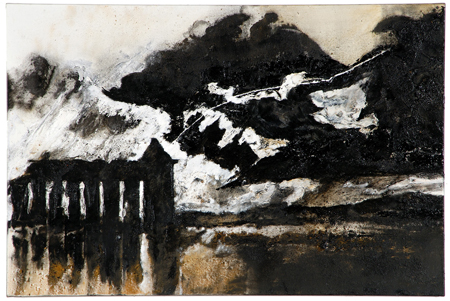
banner image for the Violent Ends website

Thunderstorm over Paestum, after Turner, Wanderers in the Desert of the Real, 2008, used in the banner for the Violent Ends website ©Mandy Martin

In this paper, we review some recent international museum and events-based ideas emerging around the concept of the Anthropocene, the proposition that the Earth has now left the Holocene and entered a new epoch: The Anthropocene (or Age of Humans). The Anthropocene is defined by changes in natural systems that have occurred because of the activities of humans. It is an idea that emerges from earth sciences, but it is also cultural: indeed the geological epoch of the Holocene (the last 11,700 years) marks the period in which most of the world’s major civilisations and cultures have emerged; it includes both the Agricultural and Industrial revolutions. To assert that the planet has moved ‘beyond the Holocene’ is to assert that humanity (indeed all life) has entered a new cultural and physical space that has not been previously experienced. Questions of how humans live in a planet with changed atmosphere, oceans, land systems, cities and climates are moral as well as physical. Archbishop Desmond Tutu has described climate change as the greatest human rights issue of our times.[3]

The Anthropocene epoch is defined by material evidence of human activities that have affected the way biophysical systems work. The stratigraphers (geologists) who decide if the new epoch should be formalised are seeking evidence of human activities in the crust of the earth, in rock strata, as this is the way boundaries between geological eras, epochs and ages have been traditionally defined.[4] Paul Crutzen, a Nobel-Prize-winning atmospheric chemist and the author of the original proposal to name the new epoch the ‘Anthropocene’, has focused on global systems, particularly evidence such as CO2 levels in the atmosphere (showing the burning of fossil fuels) and pH factors in the oceans (showing acidification caused by agricultural outfalls).[5]

Perhaps the most important question is not whether the Holocene has ended but, if it has, how are people (and the cultural systems that have evolved in the Holocene years) to live with such change? The idea of an uncharted new Age of Humans has attracted considerable attention from creative artists, museum curators and scholars in the environmental humanities.[6] Even as the stratigraphers debate the end of the Holocene, global change is upon us, and the creative sector has tackled these questions in its own way. One art and ethnographic museum, the Haus der Kulturen der Welt (HKW), Berlin, hosted the most recent scientific meeting of the International Commission on Stratigraphy in October 2014.[7] HKW, with its mission to represent ‘all the cultures of the world’, recognises that the ‘people’ focus of the Anthropocene demands debate that is both cultural and scientific, and that is concerned with more than just the people of the West. The HKW Anthropocene Project and Anthropocene Curriculum have a strong artistic and museum sector focus, which we discuss further below.[8]

Haus der Kulturen der Welt (HKW)

Haus der Kulturen der Welt (HKW), Berlin, October 2014 – photograph by Libby Robin

Environmental humanities scholars of the Anthropocene emphasise the questions of justice (and injustice) embedded in planetary changes. Changes to climate, air quality and oceans, and loss of biodiversity are caused by subsets of humans (not all humanity) and their effects are felt by different people, and of course ultimately all life on Earth. The challenge for the humanities is to enable the voices of the people who suffer from the changes, or advocate on behalf of other creatures, to be part of the conversations that contribute to adapting cultural practices in response. People are already living with rapid change: the so-called ‘Great Acceleration’ of changes since the 1950s includes sharp growths in population, wealth and global financial systems, as well as biodiversity loss, ocean acidification, atmospheric carbon dioxide and inequalities between rich and poor.[9] All these changes together are unsettling, yet people are seeking positive, resilient futures in the face of ‘strange change’. This is a debate where the creative sector – design, architecture, museums and humanistic scholarship – is well-poised to make contributions to ideas for living in a changed world of the future. Artists and scientists alike want a broad-based future, not just one that simply ‘reduces the future to climate’, in the apt phrase of Mike Hulme, one of the world’s leading climate scientists.[10]

The Anthropocene is defined by its materiality. The fossil systems that trace its onset and evolution may be buried under layers of rock, lava or sea, as were the traces of earlier epochs. Stratigraphers seeking ‘markers’ for this epoch look for material that might survive the end of an age of Earth. For example, in the case of the mass extinction of dinosaurs 65 million years ago, footprints in the mud and bones remain, even after the collision of the Earth with a huge meteorite. The ‘markers of the era’ are material, and particularly well preserved if the disaster is sudden and buries them (rather than slow and eroding).  University of Leicester geologist Jan Zalasiewicz and his Anthropocene stratigraphy committee are looking for things that might become ‘buried treasure’, surviving as markers of humanity, after humanity is long gone. They are considering various forms of ‘artificial rock’ – bricks and concrete, for example, are long lasting, human-made and in vast quantities. The group is also considering plastics (manufactured polymers) as ideal for forming fossils that would date this epoch as different from all before it.[11]

The materiality of the Anthropocene makes it of interest to museums, but on a very different scale from that considered by the stratigraphers. One of the alternatives to looking for material change in rock strata is to create cabinets of curiosities in our museums, spaces where objects enable conversations about what is strange change. People now have more ‘stuff’ than ever before and there is ever more waste – what does a gyre of plastic the size of a continent floating in the Pacific ocean (‘the Great Pacific Garbage Patch’), say about the Age of Humans?[12] How could it be embodied as an object or set of objects in a Museum? What are the material objects that complement abstract representations of strata, atmospheric chemical analysis, and graphs trending upwards? The challenge for museums and cultural institutions with a stake in valuing objects is to tell their stories well, and to give them rich context. If we are interested in how objects can entertain, inform and inspire, we need to present them as more than mere ‘stuff’.

The slam

In November 2014, the University of Wisconsin hosted an Anthropocene slam, an object-inspired event that brought together artists, filmmakers, scholars and performers at its campus in the state capital, Madison. The university has, since its inception, avowed a commitment to public intellectual life and the community of Wisconsin state. ‘The Wisconsin Idea’, as expressed by the university’s president, Charles Van Hise, in 1904, is quoted today in the words on the wall of the Wisconsin Seminar Room and on a centenary public memorial on the highest hill on the Madison campus: ‘I shall never be content until the beneficent influence of the university reaches every home in the state’.

‘The Wisconsin Idea’ centenary public memorial

‘The Wisconsin Idea’ centenary public memorial – photograph by Libby Robin

The Wisconsin Idea expresses an aspiration that university work can inform and enrich the ‘public good’ including cultural institutions. The University of Wisconsin takes as its brief to benefit all the citizens of Wisconsin, not just those who have the privilege to be its students. As well as repaying the investment of the state in its university, the public good aspiration has come to hold strong appeal for the state’s benefactors and donors. The Chazen Art Museum in the University of Wisconsin at Madison combines an outstanding collection of modern art and a strong teaching program in art history, including curatorial education, research and leadership programs.

The Nelson Institute’s Center for Culture, History, and Environment (CHE) initiative at the university has also used the support of private donors to develop a range of ambitious programs under the banner ‘Environmental futures’. The film festival Tales from Planet Earth, which has since 2007 successfully screened all over Madison and beyond in a range of venues, including Centro Hispano, a community centre serving Madison’s Latino population, has drawn new local audiences to the university’s programs and has helped to increase diversity within the Nelson Institute for Environmental Studies. In November 2014, the CHE team, Gregg Mitman, William Cronon and Rob Nixon, among others, hosted a new venture, a very different sort of public event, The Anthropocene Slam: A Cabinet of Curiosities.

The ‘slam’ is a concept that originated with poetry, performance and a competitive spirit. The first poetry slam in 1984 was a poetry reading in the Get Me High lounge in Chicago. Poets performed their words and audiences voted with acclamation for the winners. The community audience was essential. The slams were noisy, theatrical and democratic – very different from ‘high art’ poetry recitation. The Anthropocene Slam borrowed the performance and entertainment idea, asking contributors to ‘pitch in a public fishbowl setting’ an object that might represent the Anthropocene in a cabinet of curiosities. From a large field of applicants, 25 objects appeared in five sessions, involving a total of 32 presenters (several objects were presented by teams). The sessions (held across three days from 8-10 November 2014) were grouped into intriguing themes:

  1. nightmares/dreams
  2. Anthropocene fossils
  3. tales and projections
  4. trespass
  5. resistance/persistence.

The aim was to find objects that might help humanity rethink ‘its relationship to time, place, and the agency of things that shape planetary change’.[13] This innovative scholarly method was designed from the start to be inclusive of scientific, artistic and practical ideas, extending what is usually possible in academic settings. One of its public outcomes was the performance event in Madison.

The slam presentations were complemented by a major public lecture from journalist Elizabeth Kolbert, drawing on her bestselling book, The Sixth Extinction.[14] An audience of more than 500 people from all over Wisconsin came out on a chilly night to hear this fluent and well-known communicator of big ideas explain the thesis that the loss of biodiversity today is on a scale equivalent to the mass extinctions evident in geological strata. The last (fifth) mass extinction ended the era of dinosaurs. The slam created a context for this important lecture.[15]

Another aspect of the slam was the building of a travelling cabinet of curiosities,to exhibit the most popular objects and stories, and to take them to local communities. Like the original Wunderkammer from the 16th and 17th centuries, the cabinet created out of the slam is as much a cabinet of conversations and global connections as one of objects.[16] The purpose of the slam was to discover objects that might travel to a cabinet in another context: the Deutsches Museum in Munich, Germany, the largest science and technology museum in the world. One item from the cabinet even made it to opening night on 4 December 2014 of Willkommen im Anthropozän, the world’s first gallery exhibition of the Anthropocene.[17]

There will be a more formal reception for the cabinet and its objects in July 2015, in an Anthropocene Objects and Environmental Futures workshop, a collaboration between the University of Wisconsin, the Rachel Carson Center at Ludwig Maximilian University of Munich (LMU), the Deutsches Museum and the Royal Institute of Technology (KTH), Stockholm.[18] The cabinet will also be available to travel elsewhere, including to Sweden, where the KTH Environmental Humanities Laboratory hosted an international variation on the Tales from Planet Earth film festival in 2014.[19]

The ‘call for objects’ drafted by Gregg Mitman and Rob Nixon was rather different from a standard conference or workshop ‘call’:

We are in the midst of a great reawakening to questions of time – across the spans of geological, ecological, evolutionary, and human history. It is a reawakening precipitated, not by a nostalgia for the past, but by a sense of urgency about the future. The Anthropocene, coined in 2000 by ecologist Eugene Stoermer and popularized by Nobel Prize-winning atmospheric chemist, Paul Crutzen, is one of the most resonant examples of how the urgency of the future has prompted scientists, artists, humanities scholars and social scientists to engage creatively with the emerging legacy of our geomorphic and biomorphic powers. The advent of this new scientific object – the Anthropocene – is altering how we conceptualize, imagine and inhabit time. The Anthropocene encourages us to re-envisage (in Nigel Clark’s phrase) future and past relations between ‘earthly volatility and bodily vulnerability’. What images and stories can we create that speak with conceptual richness and emotional energy to our rapidly changing visions of future possibility? For in a world deluged with data, arresting stories and images matter immeasurably, playing a critical role in the making of environmental publics and the shaping of environmental policy.

The Anthropocene is just one among many moments in time when new scientific objects have altered humanity’s relationship to the past, present, and future. The coming-into-being of scientific objects such as fossils, radioactivity, genetic mutations, toxic pesticides, and ice cores, to name a few, have precipitated different narratives and imaginings of the human past and the human future. What might a cabinet of curiosities for the age of the Anthropocene look like? What objects might jolt us into reimagining environmental time across diverse scales, from the recent past to deep history? How might certain kinds of objects make visible the differential impacts – past, present, and future – that have come to shape the relationships among human and non-human beings, living in an era of extreme hydrocarbon extraction, extreme weather events, and extreme economic disparity?

… How is the appearance and impact of homo sapiensas a geomorphic force registered in the sediments of history, the objects around us, and the things yet to be? What emotionally layered Anthropocene objects can surprise, disturb, startle or delight us into new ways of thinking and feeling? What objects speak to resilience or adaptation, to vanishing biota or emerging morphologies?[20]

The cabinet also explored ‘future imaginaries’, both ‘utopian and apocalyptic’, considering the ideas of art and science, literature and film, history and policy. This wider Environmental Futures project opened a transnational and interdisciplinary conversation, with a focus on material objects and on the emotional responses (for example, hopes and fears) that they invoked. The challenge for the objects and their presenters was to:

… comprehend and portray environmental change that occurs imperceptibly and over eons of time – and that inflicts slow violence upon future generations – when media, corporate, and political cultures thrive on the short-term.[21]

Cabinets of curiosities

The Wunderkammer started life in German as a ‘room of wonder’, rather than the English ‘curiosity’. The cabinet of curiosities evoked awe. Rather than evoking rational curiosity, a cabinet should enable enchantment, according to political ecologist Jane Bennett:

Thirteenth-century writer Albertus Magnus described wonder as, like fear, ‘shocked surprise’ … but fear cannot dominate if enchantment is to be … it is a state of interactive fascination, not fall to your knees awe.’[22]

‘Awe’ was a word laden with moral and religious overtones in pre-Enlightenment times. In the 21st century, the objects of a cabinet stir questions about the ‘ethical relevance of human affect’.[23]

The rarity of objects in the era of the Wunderkammer added much to their value. In 1500, the average Middle European household had just 30 objects. By 1900, such households contained 400 objects. The proliferation of objects continued throughout the 20th century, rising to 12,000 objects per household in 2010.[24] The sheer number of objects in modern life changes them: they are no longer precious but rather just ‘stuff’, too many to count or care about. An Anthropocene-era cabinet of curiosities rediscovers objects that can stir wonder, curiosity and care, even for a jaded 21st-century viewer, whose home is burdened with an excess of objects. Each object’s story needs to be evocative, remarkable, perhaps even luminous. Even a prosaic object can carry a big story. This can be assisted by a great ‘pitch’ or performance that breathes life into the story.

When objects have lost their stories and their place in the lives of their owners, they are just stuff. When the stories are remembered and embraced with the object, they stimulate memories and reflection. These can even have clinical value for those suffering from memory loss. Keeping the context of the object simple and clear is often better for stimulating memory than cluttering it with high-tech apps.[25]

Restoring enchantment to objects demands retelling their stories, making individual objects special and important to identity again. The slam was a deliberate strategy to foster engagement and to enliven and reinvigorate objects, to sponsor a ‘sense of play’. It was a technique that could ‘hone sensory receptivity to the marvellous specificity of things’ and, above all, that could ‘resist the story of the disenchantment of modernity’, in Jane Bennett’s words.[26] The challenge of the Anthropocene is its scale. It may seem so large and frightening that it makes people feel they can do nothing about it. The performance event is a strategy for keeping open possibilities for adaptive strategies in the face of rapid change, allowing objects to explore facets of a bigger story in smaller, playful ways.

Neil MacGregor’s History of the World in 100 Objects is one attempt to tell human history ‘from out of Africa to the credit card’. He argues for the levelling power of objects: not all societies have text to tell their stories, but objects may survive to speak from cultures beyond the written word. A history created from objects can include the 95 per cent of human history that is only told in stone. [27] While organic objects cannot survive indefinitely, and fragile objects are more likely to be lost than robust ones, the survival of an object is not just physical: it is also testimony to a cultural context where someone cared enough to protect this object – perhaps in a grave, perhaps in a pocket. Small objects may survive better than large. Edmund de Waal’s imaginative memoir The Hare with Amber Eyes, told through his global family’s netsuke collection, shows just how powerful a small and special object can become. Netsuke are tiny Japanese ceramic, wood and ivory carvings (originally merely a functional addendum that enabled men to carry a tobacco pouch on a kimono). The de Waal collection of netsuke moved through generations and over a century of extraordinary international events, holding the family memories across time and space, and encapsulating his family’s history.[28]

If we follow Neil MacGregor’s notion of a museum as a place that enables ‘the study of things [which] can lead to a truer understanding of the world’[29], then we have a particular new challenge to find the poignancy of objects in a time when there are too many of them. Which objects might enchant audiences and museum visitors in a world marked by the proliferation of things? How can we learn to wonder or be curious about ‘stuff’? The answer, in Mitman’s vision, is that we select and perform or present just a few objects, juxtaposed with others that can carry the Anthropocene story in quirky ways. When the idea of global change is too big and abstract for human comprehension, a small cabinet can act as a microcosm to enable an imaginative and active response. Each object is there for its own story. Together in a cabinet they become a chorus of stories.

The object

One of the 25 objects ‘performed’ at the Anthropene Slam and subsequently selected for the Deutsches Museum’s Anthropocene Wunderkammer was a domestic pesticide applicator. The familiar bike-pump-sized pesticide sprayer was a popular household item from the 1920s to the 1950s. In the United States the Standard Oil Company’s ‘Flit’ brand of insecticide became synonymous with the spray pump. Other countries had their own brands: in Australia it was Mortein.

‘Flit’ branded handheld pesticide spray pump

‘Flit’ branded handheld pesticide spray pump, 1928 – Hamburg Museum

The pesticide pump sprayer speaks of a faith in science to improve lifestyles, and the hubris of humanity’s desire to control nature. The sprayer’s genealogy links to both the Agricultural and Industrial revolutions, each a break in time that has been argued to mark the Anthropocene.[30] It is an object born of the demographic shift towards large urban populations, and the demands for greater intensification and efficiencies in food growing that make that shift possible. Until the mid-20th century (the likely date stratigraphers will use for the dawn of the Anthropocene[31]), most older-generation pesticides had been available for hundreds of years. Soaps, oils, salt, sulphur, and more toxic substances, such as those derived from arsenic, lead and mercury, were applied in all manner of ways. It was the social and economic changes of the 19th century, however, that drove sprayer development, as growers sought to cover plants and trees on a larger scale, with more efficiency.

Bellows syringe sprayer

Bellows syringe sprayer, 1874 – The Sydney Mail and New South Wales Advertiser

As early as the 1870s, American Agriculturalist reported a French horticulturalist using bellows across a nozzle to disperse insecticide. The article explains that the device and its production of ‘liquid dust’ use the same principles of fluid dynamics as a perfume sprinkler or medical atomiser.[32] A fine spray could cover all of a tree more easily, quickly and without wasting pouring liquid or dusting. By the 1890s the use of portable and horsedrawn pesticide sprayers was so common that the New South Wales Minister for Mines and Agriculture held a field competition in December 1890 at Parramatta to determine the best and most efficient commercial insecticide sprayer. The Australian-made ‘Farrington’ machine was fitted on a cart and could spray 500 gallons per day. Some needed two operators but others could be used by a single person, pumping with one hand and holding the sprayer with the other. The Lowe’s machine had a three-in-one action: it could spray, fumigate and expel a hot vapour of sulphur and steam near its nozzle. Observers noted that cross-winds often wasted the fumigant, so some orchardists proposed enveloping trees in tents that could ensure the expensive fumes were trapped where they were needed. On the day, the most impressive sprayer was a new machine from the United States. It was compact and used compressed air rather than a hand pump to create the hydraulic pressure, so ‘all that the orchardist has to do is stand at the nozzle and blaze away at pest and disease’.[33] It was the fastest of the sprayers in the competition, dressing a tree in just two-and-a-half minutes.

At the same time that chemical companies were advertising pesticide formulas to landholders in the late 19th century, they were adapting agricultural sprayers to deliver chemicals for domestic gardens and inside the home.[34] From the 1920s, when better sprayer design and pervasive chemical industry advertising combined with higher household incomes and campaigns for improved domestic hygiene and ‘mothercraft’, the familiar home pump sprayer became widely used. After the Second World War, the sprayer formulas became longer lasting and more effective, with new synthetic chemicals. Less than two decades later, the public began to discover that the miracle chemicals were not as safe as they had been led to believe.

Performing the object

A ten-minute ‘slam’ format presents a challenge to historians in particular, who by their nature and training, are dedicated to providing context. How much story, information and reflection is possible in ten minutes? The format shaped the form and selection of story – the performance had to provoke and begin a conversation. It would not be possible to explain everything. The invited presenters, Michelle Mart and Cameron Muir, opened their performance by playing characters, two archetypes associated with the use of chemicals in different contexts – domestic, urban, wealthy on the one hand, and industrial, rural and poor on the other.[35]

An immaculate housewife waits at the door to greet her husband

An immaculate housewife waits at the door to greet her husband, 1953 – H Armstrong Roberts/ClassicStock/Corbis

Michelle Mart appeared as a 1950s housewife, a stereotype from the period’s advertising posters come to life, complete with lipstick, pearls and twin-set. She advocated the convenience and virtues of a bug-free household, as images projected in the background showed advertising and stylised scenes of the suburban ideal. Successful domestic management, or orderliness, cleanliness, and wholesomeness: perfect weed-free lawns, insect-free kitchens, and unblemished fruit and vegetables. Mart was the woman who stood on the veranda of a neat, architecturally designed house to welcome her husband home from work. Her home was managed with a pump spray that dispersed DDT through the kitchen cupboards, just like in the military, where officers were photographed spraying DDT down a fellow serviceman’s shirt. Some of the men came home from being sprayed in wartime service to the new peacetime spraying on the suburban frontier.

A US soldier is demonstrating DDT hand-spraying equipment while applying the insecticide

A US soldier is demonstrating DDT hand-spraying equipment while applying the insecticide – Centres for Disease Control Public Health Image Library

Advertising urged homeowners to use chemicals for the sake of the family’s health (some thought polio was spread by the housefly), while another has fruit and vegetables singing, ‘DDT is good for me-e-e!’ Mart’s 1950s character proclaimed she is ‘lucky to live at a time when the wonders of modern technology and chemistry have transformed our lives’, and best of all, the new chemicals are ‘safe for everybody’.[36]

‘DDT is good for m-e-e’ advertisement, Penn Salt Chemicals

‘DDT is good for m-e-e’ advertisement, Penn Salt Chemicals, 1947 – Collector’s Weekly

At this point the second character entered: Cameron Muir was an agricultural worker in a white, full-body chemical hazmat suit, including hood, gloves, goggles and face mask, and carrying a large knapsack pump sprayer adorned with lurid red-and-black warnings about its toxicity. We have moved beyond the innocence of postwar hubris in scientific and industrial expertise, but users are exposed to more chemicals than ever. The agricultural worker character speaks of his brother, who blames the pesticides for illnesses and behavioural problems in his children. He wants to leave the job of spraying but he can’t find work elsewhere. The worker fears local complaints about the chemicals will endanger their relationship with the company employing them.

Woman in Metema community, Ethiopia, using knapsack sprayer

Woman in Metema community, Ethiopia, using knapsack sprayer, 2010 – International Livestock Research Institute

The images projected in the background show the faces of individual agricultural works in developing countries, some of them disfigured by pesticide exposure and light aircraft spraying vast fields. Amidst health concerns and well-informed anxiety about spraying pesticides, industrial agriculture has scaled up again in the 21st century.

Crop duster plane flying over Imperial Valley farms

Crop duster plane flying over Imperial Valley farms, May 1972 – Charles O’Rear/The US National Archives

The object and performance as provocateur

Who owns the story of pesticides? The narrative of triumphant technological progress and control of nature continues to hold influence even in the face of startling costs and unintended consequences. Social and political commentators still attempt to discredit Rachel Carson’s Silent Spring 50 years later, while the chemical and seed industries sell promises of control, simplicity and safety to farmers wracked by the reality of an unpredictable nature and markets. More powerful than earnestness and statistics, Mart and Muir’s performance gave the voice to the Flit spray can and used it to retell the stereotypical narrative of technological progress. Humour, irony and juxtaposition can be more effective than numbers in exposing hubris in the failed narrative. The presentation made its point not just by telling, but by showing. It is a human story. The archetypal characters, images and objects spoke for themselves; each member of the audience actively made their own interpretations and connections.

Towards the end of the presentation, Mart and Muir stepped out of character and spoke to the audience directly, personally. The ‘pitch’ or telling mode was reserved until the object story and its historical frames had been performed beforehand. The background or hypertext for the performance included the bigger scale, Anthropocene stories: since the Second World War humans have released more than 80,000 chemical compounds that no organism had previously encountered in the 3.5-billion-year history of life on earth.[37] This profound change will persist in the geological record and in our genetic legacies. Everyone is still exposed to this chemical soup. Researchers in the Lancet Neurology have declared we are in the midst of a ‘global, silent pandemic of neurodevelopmental toxicity’.[38] It’s even worse for those who farm or who live in the world’s most polluted places. The presentation ended with a provocative set of images. In the 1990s anthropologist Elizabeth Guillette asked children from the Yaqui Valley in Mexico to draw simple pictures – one group was from the agricultural lowlands, the other from the pesticide-free highlands. The children from the agricultural region could barely form shapes.[39] The difference in the drawings was a striking visualisation of what is largely an invisible agent of harm. It was also an illustration of the geographic inequality of toxic burdens.

The chorus

The domestic pesticide applicator object was one of 25 performed in the Madison Chorus. It has now been chosen to travel on to the Deutsches Museum, where a new cabinet of curiosities will be re-assembled in July 2015 with some of the Madison objects and some new, locally chosen Anthropocene objects. Global changes are everywhere, but human responses are personal, local, and the slam was an event for Madison. Munich is another context: another language, a science and technology museum, and the juxtaposition of the cabinet with a whole gallery of ideas and objects for the Anthropocene.[40] What the Madison cabinet brings is an event and a set of objects that can interrogate the gallery project for the Deutsches Museum and its university partner, the Rachel Carson Center. It also invites local content – objects that have resonance in Munich. The slam-style event works to collect together the object stories and to draw out patterns and sympathies between them.

The Anthropocene Slam created a chorus of objects that worked together in Madison, juxtaposed with each other and the performances of their presenters. In fact, the audience was reluctant to vote for ‘best object’ in each section; these were not solo objects or voices, but rather notes that together created chords of global change stories, stories that were layered together with others. It didn’t make sense to pick out the ‘tenor’ or ‘soprano’ line for special attention. The poetry slam is usually a competition with a cash prize. The Anthropocene Slam resisted the competitive framework. Rather, it invited scholarly collaboration in a playful context. The shift from competition to chorus was its great success, enabling collaboration and partnerships and the reflections arising from some very different objects.

The global and the local

The Anthropocene Slam suggested one way to scale the abstract and global through personal objects. It created an object-conversation that worked for all ages and in intergenerational contexts. Educating citizens about living with global change is not a task for schools alone. This story affects every generation. As the Deutsches Museum has already realised, museums can be partners in this global education, and are ideally suited to intergenerational conversations: grandchildren and grandparents already often visit a museum together.

HKW took the scholarly mission to educate people about the Anthropocene as its focus, as part of a two-year Anthropocene Project. For 11 days in November 2014, HKW created an international ‘Anthropocene Campus’, where its galleries showcased the exhibitions, video documentaries and artworks developed through its Anthropocene Project. Campus participants worked to develop a ‘curriculum’, including textbook and online teaching materials, through seminars and workshops on approaches to the ideas of the Anthropocene. Nearly 30 presenters worked with more than 100 interested participants, doctoral and postdoctoral scholars and practising artists.[41] Most of the presenters came from scientific disciplines leading Anthropocene discussions (especially earth, atmospheric and ocean sciences). Participants included a significant number of designers, museum specialists and visual artists, as well as scholars of earth sciences and environmental humanities. The boundaries between science and humanities dissolved in the intense program; the need to communicate and to teach and learn demanded clear, non-technical language and strong images. The overwhelming thrust of the curriculum materials was to develop human and emotional responses to the Anthropocene, as well as ways to converse beyond disciplinary silos to work together to solve problems and engage audiences.

Thinking with museums

How can we slow down the future to enable a sense of control? What is globally curious? What will we ‘wonder’ at in future? What sort of objects should we collect now for museums of the future? These are all urgent present problems as we imagine how museums will work in the changing circumstances of the Anthropocene. For Collecting the Future, a museum event at the American Museum of Natural History in October 2013, Jennifer Newell, Libby Robin and Kirsten Wehner specifically investigated what communities might collect for community museums of the future in local places that are changing fastest. What objects and stories can travel from depopulating Pacific Islands (where people are confronted with salinising ground water and rising seas) to their new communities in New Zealand or New York? These practical questions about living with climate change can bring communities into museums to use their collections in new ways. Community museums, national museums, science museums and art museums are all members of the Museums and Climate Change network of exchange that emerged from this event.[42]

In Australia, as elsewhere, the arts have been engaging with ideas for imaginative futures through local museums and events. Climarte is one such group that ‘harnesses the creative power of the Arts to inform, engage and inspire action on climate change’.[43] It is an arts-led partnership including prominent artists, Nobel-Prize-winning scientist Peter Doherty and directors of key galleries, Maudie Palmer (founding director of Heide Museum of Modern Art and TarraWarra Museum of Art) and Stuart Purves (director of Australian Galleries, Australia’s longest and most established commercial art gallery). Australian Galleries will host the 2015 Climarte Festival’s opening exhibition, The Warming, curated by Mandy Martin, who was one of the international artists attending the Wisconsin Anthropocene Slam. The exhibition brings together eight artists from Australian Galleries with 17 additional artists who have been invited to contribute an ‘Anthropocene cabinet of curiosities’, a plinth of objects at the heart of the show. Some of the artists will also pitch their ‘curious object’ briefly at a special event on 3 May 2015, and there will be responses from moderators, Peter Christoff (from the University of Melbourne and formerly Victorian Commissioner for the Future), William L Fox and Libby Robin. The aim is to create an event to inspire new thinking about what the arts can do in a future beyond the Holocene.

The future is often constructed through the lens of economic expertise. For example, the Australian Treasury has issued a 2015 Intergenerational Report that focuses exclusively on the economic burdens that the present generation places on those living in 2055.[44] Sometimes it is earth system scientists, or climate modellers who describe futures – for example, under the Intergovernmental Panel on Climate Change (IPCC) scenarios of 2 or 4 or 6 degrees of warming. Yet the future is also about cultural and moral choices, not just economics and environment. The worlds of 2055 and beyond will be more than just climate spaces and economies. The museum sector is poised to treat the future as a ‘cultural fact’, in Arjun Appadurai’s terms. Appadurai writes of a future that includes ‘imagination, anticipation and aspiration’.[45] The future is not just about imagining nature or anticipating economic conditions, it is also about aspiration. While ‘probable’ futures are generated by mathematical models of nature and economics, such models often offer little hope. An alternative is to look to museums, to objects and to the creative dialogues of personal visits and performance events to foster qualitative possible futures. The future is not just a technical or neutral space: it is ‘shot through with affect and sensation’.[46] Science and scholarship alone often lack important sensations for imagining the future: ‘awe, vertigo, excitement, disorientation’. Rather than just measuring change in our world – or denying that there is any – we can take a third way that acknowledges change, including, but not only, climate change. Cultural institutions have an important role in enabling communities to get on with living positively with the changes of the Anthropocene. Culture works through ‘the traction of the imagination’, expanding the possibilities for ways to live with the future as it unfolds.[47]

This paper has been independently peer-reviewed.

Endnotes

1 www.chorusofwomen.org.

2 Violent Ends: The Arts of Environmental Anxiety.

3 www.theguardian.com/commentisfree/2014/sep/21/desmond-tutu-climate-change-is-the-global-enemy.

4 Jan Zalasiewicz, Colin N Waters, Mark Williams et al., ‘When did the Anthropocene begin? A mid-twentieth century boundary level is stratigraphically optimal’, Quaternary International, 12 January 2015, http://dx.doi.org/10.1016/j.quaint.2014.11.045.

5 PJ Crutzen, ‘Geology of mankind’, Nature, vol. 415, no. 6867, 2002, 23.

6 Christian Schwägerl, The Anthropocene: The Human Era and How it Shapes the Planet, Synergetic Press, Santa Fe/London, 2014; Luke Keogh & Nina Möllers, ‘Pushing the boundaries: Curating the Anthropocene at the Deutsches Museum’, in Fiona Cameron & Brett Neilson (eds), Climate Change, Museum Futures: The Roles and Agencies of Museums and Science Centers, Routledge, London, 2014, pp. 78–89.

7 Currently chaired by Jan Zalasiewicz, who has worked extensively with humanities scholars (at the University of Chicago and the University of Sydney), and has supervised art projects such as the French artist Yesenia Thibault-Picazo’s Cabinet of Future Geology, currently showing at the Deutsches Museum, Munich, until 2016. In 2015 another version of Thibault-Picazo’s work will be part of the Globale Festival in the New Media Museum, Karlsruhe, Germany.

8 Bernd Scherer (ed.), The Anthropocene Project: A Report, HKW, Berlin, 2014; Libby Robin, Dag Avango, Luke Keogh, Nina Möllers, Bernd Scherer & Helmuth Trischler, ‘Three galleries of the Anthropocene’, Anthropocene Review, vol. 1, no. 3,  207–24.

9 W Steffen, J Grinevald, P Crutzen & J McNeill, ‘The Anthropocene: Conceptual and historical perspectives’, Philosophical Transactions of the Royal Society A,vol. 369, 2011, 842–67.

10 Mike Hulme, ‘Reducing the future to climate: A story of climate determinism and reductionism’, Osiris, vol. 26, 2011, 245–66, p. 245.

11 Jan Zalasiewicz, ‘Buried treasure’, in Geoff Manaugh (ed.), Landscape Futures: Instruments, Devices and Architectural Inventions, Nevada Museum of Art and Actar, Reno, 2013, pp. 258–61.

12 Susan L Dautel, ‘Transoceanic trash: International and United States strategies for the Great Pacific Garbage Patch’, Golden Gate University Environmental Law Journal, vol. 3, no. 1, 2009, 181–208. This sort of global phenomenon (which grew and changed shape dramatically after the tsunami that struck Japan in 2011) has been very effectively illustrated in museums through ‘Science on a Sphere’ technology created by National Oceanic and Atmospheric Administration (NOAA) Alaska State Museum, Juneau, http://juneauempire.com/stories/050109/ent_435381904.shtml#.VRTsEfmUeCc.

13 From the ‘Call for objects’ (distributed through H-Net online 2013), www.carsoncenter.uni-muenchen.de/download/events/cfps/cfp_cabinet-of-curiosities.pdf.

14 Elizabeth Kolbert, The Sixth Extinction: An Unnatural History, Henry Holt and Company, New York, 2014.

15 Crutzen, ‘Geology of mankind’ (p. 23).

16 Oliver Impey & Arthur MacGregor (eds) The Origins of Museums: The Cabinet of Curiosities in Sixteenth and Seventeenth Century Europe, Clarendon Press, Oxford, 1985.

17 Welcome to the Anthropocene: The Earth in Our Hands (in English). The exhibition gallery opened 4 December 2014, and will run till 2016; Nina Möllers, Christian Schwägerl & Helmuth Trischler (eds) Willkommen im Anthropozän: Unsere Verantwortung für die Zukunft der Erde, Deutsches Museum, Munich, 2014; see also Libby Robin, Dag Avango, Luke Keogh, Nina Möllers, Bernd Scherer & Helmuth Trischler, ‘Three galleries of the Anthropocene’, Anthropocene Review, vol. 1, no. 3, 2014, 207–24, doi:10.1177/2053019614550533.

18 Munich, 5–7 July 2015, www.carsoncenter.uni-muenchen.de/events_conf_seminars/calendar/ws_anthropocene-objects/index.html.

19 www.kth.se/en/abe/inst/philhist/historia/2.45962/2.60531/tales.

20 nelson.wisc.edu/che/anthroslam/about/index.php.

21 From Environmental Futures unpublished prospectus (‘Call for papers’), 2013; see also Rob Nixon, Slow Violence and the Environmentalism of the Poor, Harvard University Press, Cambridge, Mass., 2011.

22 Jane Bennett, The Enchantment of Modern Life: Attachments, Crossings, and Ethics, Princeton University Press, New Jersey, 2001, p. 5, emphasis added.

23 Jane Bennett, Vibrant Matter: A Political Ecology of Things, Duke UP, Durham, 2010, p. xi.

24 Christof Mauch, ‘The Great Acceleration of Objects’, Plenary panel, Anthropocene Slam, UW Madison, 10 November 2014.

25 Charles Leadbeater, ‘The disremembered’, Aeon Magazine, March 2015, http://aeon.co/magazine/psychology/where-does-identity-go-once-memory-falters-in-dementia.

26 Bennett, Enchantment,p. 4.

27 Neil MacGregor, A History of the World in 100 Objects, Penguin, London, 2012 (1st edn 2010), p. xix.

28 Edmund de Waal, The Hare with Amber Eyes: A Hidden Inheritance, Vintage, London, 2011.

29 MacGregor, History of the World, p. xxv.

30 William F Ruddiman, ‘The Anthropogenic Greenhouse Era began thousands of years ago’, Climatic Change, vol. 61, no. 3, 2003; Crutzen, ‘Geology of mankind’.

31 Zalasiewicz, Waters, Williams et al., ‘When did the Anthropocene begin?’.

32 ‘Destroying insects – Bellows-Syringe’, Sydney Mail and New South Wales Advertiser, 28 March 1874.

33 ‘Death to fruit pests and diseases: Experiments with appliances’, Cumberland Argus and Fruitgrowers Advocate (Parramatta, NSW), 13 December 1890.

34 Will Allen, The War on Bugs, Chelsea Green, White River Junction, Vt, 2008.

35 Michelle Mart (Pennsylvania State University) and Cameron Muir (Australian National University), both former fellows of the Rachel Carson Center, Munich, independently suggested the sprayer. They were both among the group selected to present at the slam, and since they had the same object, they were asked to work together on it.

36 Michelle Mart & Cameron Muir, ‘Flit sprayer’, Anthropocene Slam presentation, 8 November 2014, University of Wisconsin, Madison, USA.

37 Mariann Lloyd-Smith & Bro Sheffield-Brotherton, ‘Children’s environmental health: Intergenerational equity in action – a civil society perspective’, Annals of the New York Academy of Sciences, vol. 11, no. 1140, 2008, 190–200.

38 Philippe Grandjean & Philip J Landrigan, ‘Neurobehavioural effects of developmental toxicity’, Lancet Neurology, vol. 13, no. 3, 2014, 330–8.

39 Elizabeth A Guillette, Maria Mercedes Meza, Maria Guadalupe Aquilar, Alma Delia Soto & Idalia Enedina Garcia, ‘An anthropological approach to the evaluation of preschool children exposed to pesticides in Mexico’, Environmental Health Perspectives, vol. 106, 1998, 347–53.

40 Robin et al., ‘Three galleries’.

41 Scherer et al., The Anthropocene Project; see also Robin et al., ‘Three galleries’, esp. p. 215, doi:10.1177/2053019614550533.

42 Museums and Climate Change Networkwww.amnh.org/our-research/anthropology/projects/museums-and-climate-change-network; Collecting the Future event, www.amnh.org/our-research/anthropology/news-events/collecting-the-future; Jennifer Newell, Libby Robin & Kirsten Wehner (eds), Curating the Future,University of Hawaii Press, Hawaii, forthcoming.

43 http://climarte.org/category/climarte-archive.

44 www.treasury.gov.au/PublicationsAndMedia/Publications/2015/2015-Intergenerational-Report.

45 Arjun Appadurai, The Future as a Cultural Fact: Essays on the Global Condition, Verso, London, 2013, p. 286.

46 ibid.

47 ibid.

Possibilidade de caos social por falta de água em SP mobiliza comando do Exército (Opera Mundi)

Lúcia Rodrigues | São Paulo – 30/04/2015 – 12h43

‘Painel sobre defesa’ organizado pelo Comando Militar do Sudeste tratou possibilidade de capital paulista ficar sem água a partir de julho deste ano como assunto de segurança nacional

Volume morto na represa Jaguari-Jacareí, no Sistema Cantareira, em janeiro desse ano (Mídia Ninja)

Por que o Comando Militar do Sudeste (CMSE) está interessado na crise da falta de água em São Paulo?

A resposta veio na tarde da última terça-feira, 28 de abril, durante o painel organizado pelo Exército, que ocorreu dentro de seu quartel-general no Ibirapuera, zona sul da capital paulista.

Durante mais de três horas de debate, destinado a oficiais, soldados e alguns professores universitários e simpatizantes dos militares que lotaram o auditório da sede do comando em São Paulo, foi se delineando o real motivo do alto generalato brasileiro estar preocupado com um assunto que aparentemente está fora dos padrões de atuação militar.

A senha foi dada pelo diretor da Sabesp, Paulo Massato, que ao lado de Anicia Pio, da Fiesp (Federação das Indústrias do Estado de São Paulo), e do professor de engenharia da Unicamp, Antonio Carlos Zuffo, traçaram um panorama sobre como a crise hídrica está impactando o Estado paulista.

Massato foi claro. Se as obras emergenciais que estão sendo feitas pela companhia não derem resultado e se chover pouco, São Paulo ficará sem água a partir de julho deste ano. O cenário descrito pelo dirigente da Sabesp é catastrófico e digno de roteiro de filme de terror.

“Vai ser o terror. Não vai ter alimentação, não vai ter energia elétrica… Será um cenário de fim de mundo. São milhares de pessoas e o caos social pode se deflagrar. Não será só um problema de desabastecimento de água. Vai ser bem mais sério do que isso…”, enfatiza durante sua intervenção, para na sequência lançar uma súplica de esperança: “Mas espero que isso não aconteça”.

Ele destaca que na região metropolitana de São Paulo vivem 20 milhões de pessoas, quando o ideal seriam quatro milhões. Destas, segundo Massato, três milhões seriam faveladas que furtariam água. “Furtam água ou pegam sem pagar”, conta, arrancando risos da platéia.

Blindagem

Nenhuma crítica, no entanto, foi dirigida ao governador Geraldo Alckmin (PSDB) pelos presentes durante todo o evento. Apenas uma pessoa se manifestou durante a fala de Massato, afirmando que faltou planejamento estatal. Mas foi interrompido por uma espécie de mestre de cerimônias do comando militar  que ciceroneava o evento,  pedindo que ele deixasse a questão para as perguntas a serem dirigidas aos debatedores. A pergunta não voltou a ser apresentada.

Mas o resultado pela falta de investimento e planejamento do governo paulista já provoca calafrios na cervical do establishment do Estado. As cenas de Itu podem se reproduzir em escala exponencial na região metropolitana de São Paulo. E é contra isso que o Exército quer se precaver.

O dirigente da Sabesp citou um caso que ocorreu na região do Butantã, zona oeste da capital. De acordo com ele, houve uma reação violenta porque a água não chegou em pontos mais altos do bairro. “Não chegou na casa do ‘chefe’, e aí ele mandou incendiar três ônibus. Aqui o pessoal é mais organizado…”

Em sua intervenção, a dirigente da Fiesp, Anícia Pio, frisa que muito se tem falado sobre a crise de abastecimento da população, mas que não se pode desconsiderar o impacto sobre a indústria paulista. “A crise só não foi maior, porque a crise econômica chegou (para desacelerar a produção).”

De acordo com ela, o emprego de milhares de pessoas que trabalham no setor está em risco se houver o agravamento da crise hídrica.

Se depender das projeções apresentadas pelo professor Zuffo, da Unicamp, a situação vai se complicar.  Segundo ele, o ciclo de escassez de água pode durar 20, 30 anos.

Moradores do Jardim Umuarama, em rodízio não oficializado pelo governo de SP (Sarah Pabst)

A empresária destaca ainda que não se produz água em fábricas e que, por isso, é preciso investir no reuso e em novas tecnologias de sustentabilidade. E critica o excesso de leis para o setor, que de acordo com ela é superior a mil.

O comandante militar do Sudeste, general João Camilo Pires de Campos, anfitrião do evento, se sensibilizou com as criticas da representante da Fiesp e prometeu conversar pessoalmente com o presidente da Assembléia Legislativa de São Paulo, deputado Fernando Capez (PSDB),  sobre o excesso de legislação que atrapalha o empresariado.

Ele também enfatiza que é preciso conscientizar a população sobre a falta de água e lamenta a grande concentração populacional na região. “Era preciso quatro milhões e temos 20 milhões…”, afirma se referindo aos números apresentados por Massato.

O general Campos destaca a importância da realização de obras, mas adverte que “não se faz engenharia para amanhã”. E cita para a plateia uma expressão do ex-presidente, e também general do Exército, Ernesto Geisel, para definir o que precisa ser feito. “O presidente Geisel dizia que na época de vacas magras é preciso amarrar o bezerro.”

“Não há solução fácil, o problema é sério”, conclui o comandante.

Sério e, por isso, tratado como assunto de segurança nacional pelo Exército. O crachá distribuído aos presentes pelo Comando Militar do Sudeste trazia a inscrição: Painel sobre defesa.

Experts Warn of “Cataclysmic” Changes as Planetary Temperatures Rise (Truthout)

Monday, 27 April 2015 00:00 By Dahr Jamail, Truthout | Report 

Two unprecedentedly high temperatures were recorded in Antarctica, providing an ominous sign of accelerating ACD as one of the readings came in at just over 63 degrees Fahrenheit. (Photo: Iceberg via Shutterstock)

Two unprecedentedly high temperatures were recorded in Antarctica, providing an ominous sign of accelerating climate change as one of the readings came in at just more than 63 degrees Fahrenheit. (Photo: Iceberg via Shutterstock)

Climate Disruption DispatchesThis month’s anthropogenic climate disruption (ACD) dispatch begins with the fact that recently released National Oceanic and Atmospheric Administration data show that this March was, by far, the hottest planetary March ever recorded, and the hottest January to March period on record as well.

We are watching unprecedented melting of glaciers across the planet, increasingly high temperature records and epic-level droughts that are now becoming the new normal: Planetary distress signals are increasing in volume.

One of these took place recently in Antarctica, of all places, where two unprecedentedly high temperatures were recorded, providing an ominous sign of accelerating ACD as one of the readings came in at just over 63 degrees Fahrenheit.

“We’re going to be out of water.”

A fascinating recent report shows that approximately 12 million people living in coastal areas will be displaced during the next 85 years, with areas along the Eastern Seaboard of the United States seeing some of the most dramatic impacts.

In the US, another report shows that the Navajo Nation is literally dying of thirst, with one of the nation’s leaders flatly sounding the alarm by stating, “We’re going to be out of water.”

A study just published in Geophysical Research Lettersbolsters the case that a period of much faster ACD is imminent, if it hasn’t already begun.

On that note, leading climate researchers recently saidthere is a possibility that the world will see a 6-degree Celsius temperature increase by 2100, which would lead to “cataclysmic changes” and “unimaginable consequences for human civilization.”

With these developments in mind, let us take a look at recent developments across the planet since the last dispatch.

Earth

Signs of ACD’s impact across this sector of the planet are once again plentiful, and the fact that the Amazon is suffering is always a very loud alarm buzzer, given that every year the world’s largest rainforest cycles through 18 billion tons of carbon when its 6 million square kilometers of trees breathe in carbon dioxide and then release it back into the atmosphere when they die. This is twice the amount of carbon that fossil fuel burning emits in an entire year. A recent report shows that while the Amazon is continuing to absorb more carbon than it is releasing, a tipping point is coming, and likely soon, as deforestation, drought and fires there continue to remove precious trees at a frightful rate. With 1.5 acres of rainforest lost every single second, somewhere around the world, the situation in the Amazon does not bode well for our future.

In the United States, in Harvard Forest, located 70 miles west of the university’s campus in Cambridge, Massachusetts, hemlock trees are dying at an alarming rate. Harvard Forest is a case study, as it is part of a network of 60 forests around the world called the Center for Tropical Forest Science-Forest Global Earth Observatories, where they are being studied for their response to ACD and other anthropogenic issues. Kristina Anderson-Teixeira, an ecologist with the network, said its forests are “being impacted by a number of different global change factors. We do expect more of this, be it pests or pathogens or droughts or heat waves or thawing permafrost.”

Another report from April revealed that Russia has been losing an amount of forest the size of Switzerland (16,600 square miles of tree cover) every year, for three years running.

Without ice in the summer, polar bears will starve and die off.

Terrestrial animals continue to struggle to survive in many areas. It should come as no surprise that in the Arctic, a recent studyshows that the theory that polar bears will be able to adapt to ice-free seas in the summer by eating on land has been debunked. Without ice in the summer, polar bears will starve and die off.

Another study shows that ACD is threatening mountain goats, due to the warming that is occurring even at the higher elevations where the goats live, as the rate of warming there is two to three times faster than the rest of the planet. According to the study, due to the warming, the goats’ future is now uncertain.

In California, sea lion strandings have already reached more than 2,250 for this year alone, which is a record. The worsening phenomenon is being blamed on warming seas that are disrupting the food supply of marine mammals.

Across the United States, hunters are seeing their traditions being changed by ACD. “I could point you to a million different forums online where hunters are complaining about the season and how hunting is terrible,” said one hunter in a recent report. “At the end of the day, it’s changing weather patterns. Winters around here are not as cold as they used to be.”

March report from a researcher in Rhode Island showed that the growth and molting rates of juvenile lobsters are decreasing “significantly” due to oceans becoming increasingly acidic from ACD. This makes the animals more vulnerable to predations, thus leading to fewer adult lobsters and an overall rapidly declining population.

Air

There have been a few major developments recently in this sector of our analysis.

Interestingly, some of the more commonly used anesthetics are apparently accumulating in the planet’s atmosphere, thus contributing to warming of the climate, according to a report in April. It is a small amount, mind you, but the volume is increasing.

US greenhouse gas pollution increased 2 percent over the previous year in 2013.

Bad news on the mitigation front comes in the form of a study that revealed that ongoing urban sprawl and auto exhaust is hampering cities’ best efforts toward lowering carbon dioxide emissions. If people continue to drive as much as they are, and development continues apace, the push to build more dense housing, better transit systems and more bike lanes in urban centers will be for naught.

Speaking of lack of mitigation, the US Environmental Protection Agency recently announced that US greenhouse gas pollution increased 2 percent over the previous year in 2013.

Drought plagued California gets more bad news in this sector, as recently released data shows that the state continues to have its warmest year ever recorded, with statewide temperatures coming in nearly 2 degrees Fahrenheit warmer than the previous record, which was set in 2014. The state is quite literally baking.

Another study showed that the frozen soil (permafrost) of the planets’ northern polar regions that holds billions of tons of organic carbon is melting and that melting is being sped up by ACD, hence releasing even more carbon into our already carbon dioxide-supersaturated atmosphere.

Lastly in this section, those who believe in technological fixes for our predicament received some bad news in April, which came in the form of a report that shows that any attempts to geoengineer the climate are likely to result in “different” climate disruption, rather than an elimination of the problem. The most popular proposed idea of solar radiation management that would utilize stratospheric sulfate aerosols to dim the sun has been proven to be, well, destructive. Using a variety of climate models, Ken Caldeira from the Carnegie Institution for Science in Stanford, California, has investigated the likely consequences of such geoengineering on agriculture across the globe.

According to a report on the matter:

His research showed that while dimming could rapidly decrease global temperatures, high carbon dioxide levels would be expected to persist, and it is the balance between temperature, carbon dioxide, and sunlight that affects plant growth and agriculture. Exploring the regional effects, he finds that a stratospherically dimmed world would show increased plant productivity in the tropics, but lessened plant growth across the northerly latitudes of America, Europe and Asia. It is easy to see how there might be geopolitical shifts associated with changes in regional food production across the globe. “It’s probably the poor tropics that stand to benefit and the rich north that stands to lose,” said Prof Caldeira.

Hence, given that the results would be detrimental to the “rich north,” which by far and away has pumped more carbon dioxide into the atmosphere than the “poor tropics,” the results of geoengineering would indeed be karmic.

Water

In the United States, California’s epic drought continues to lead in the water sector of analysis.

For the first time in California’s history, mandatory water use reductions have been imposed on residents after a winter of record-low snowfalls, and hence a record-low snowpack. “People should realize we are in a new era,” Gov. Jerry Brown said at a news conference there in April, standing on a patch of brown and green grass that would normally be thick with snow that time of year. “The idea of your nice little green lawn getting watered every day, those days are past.”

Climate scientists also recently announced, disconcertingly, that California’s record-breaking drought is merely a preview of future ACD-generated megadroughts.

Shortly after Brown announced the mandatory water restrictions for his state, another study was released showing that California will also be facing more extreme heat waves, along with rising seas, caused by increasingly intense impacts from ACD. According to the study, the average number of days with temperatures reaching 95 degrees will double or even triple by the end of this century. Simultaneously, at least $19 billion worth of coastal property will literally disappear as sea levels continue to rise.

Experts also announced in April that in “drought-era” California, “every day” should now be considered “fire season.” NASA Jet Propulsion Laboratory climatologist Bill Patzert said of California, “We are in an incendiary situation.”

California’s state climatologist, Michael Anderson, issued a very stark warning in April when he said the state faces dust bowl-like conditions, as he compared the water crisis in California to the legendary US dustbowl. “You’re looking on numbers that are right on par with what was the Dust Bowl,” he said.

Forty out of the 50 US states will face a water shortage within the next 10 years.

As aforementioned, this year’s dry, warm winter has left the entire western United States snowpack at record-low levels. Given that this is a critical source of fresh surface water for the entire region, this will only exacerbate the already critical water shortages that are plaguing the region.

One ramification of this is exampled by how the once-powerful Rio Grande River has been reduced to a mere trickle still hundreds of miles from its destination at the end of its 1,900-mile journey to the Gulf of Mexico, thanks to the increasing impacts of ACD. Farmers and residents who rely on it for water are in deep trouble.

And it’s not just California and the US Southwest that are dealing with major water shortages. The Government Accountability Office recently released a report showing that 40 out of the 50 US states will face a water shortage within the next 10 years.

Meanwhile, up in Alaska, that state’s iconic Iditarod sled dog race has been reduced to having mushers have their dogs drag their sleds across large swaths of mud that spanned over 100 miles in some areas, due to warmer temperatures there melting snow and ice that used to cover the course. “I love the challenge, being able to overcome anything on the trail,” said four-time winner Martin Buser of the new conditions. “But if this is a new normal, I’m not sure I can sustain it.”

In this writer’s backyard, glaciers are melting away at dramatic rates in Olympic National Park. Pictures tell the story, which was also addressed in detail recently at a talk given at the park by University of Washington research professor Michelle Koutnik, who was part of a team monitoring the park’s Blue Glacier. By way of example, an entire section of the lower Blue Glacier that existed in 1989 was completely gone by 2008, and melt rates are increasing. A sobering “before and after” look at the photographic evidence should not be missed.

A recent study gave another grim report on glaciers, this one focusing on Canada where glaciers in British Columbia and Alberta are projected to shrink by at least 70 percent by the end of this century, and of course ACD was noted as the main driving force behind the change. “Most of that is going to go,” one of the researchers said of Canada’s glaciers. “And most seems to be on its way out.”

study recently published in the Proceedings of the National Academy of Sciences has found that as the Arctic Ocean warms and loses its sea ice cover, phytoplankton populations will explode. This creates another positive feedback loop for ACD, as it further amplifies warming in a region that is already heating up twice as fast as the rest of the globe.

On the other end of the water spectrum, rising seas continue to afflict Venice, where the city is seeing dramatic changes. According to a recent report: “In the 1920s, there were about 400 incidents of acqua alta, or high water, when the right mix of tides and winds drives the liquid streets up into homes and shops in the lowers parts of the city. By the 1990s, there were 2,400 incidents – and new records are set every year.”

Fire

An April report shows that ACD is predicted to bring more fires and less snow to the iconic Yellowstone National Park. These changes will likely fuel catastrophic wildfires, cause declines in mountain snows and threaten the survival of animals and plants, according to the scientists who authored the report. It shows that expected warming over the US West over the next three decades will transform the land in and around Yellowstone from a wetter, mostly forested Rocky Mountain ecosystem into a more open landscape, more akin to the arid US Southwest.

“Ecological Implications of Climate Change on the Greater Yellowstone Ecosystem,” compiled by more than 20 university and government scientists, said that such dry conditions in that area have not been seen for the last 10,000 years, and extremely destructive wildfires like the one in 1988 that burned thousands of acres of the park are going to become more common, while years without major fires will become rare.

Denial and Reality

The climate disruption deniers have been barking loudly over the last month, which should be expected as irrefutable evidence of ACD continues in an avalanche.

Following Florida’s lead, Wisconsin officially became the next state to censor its employees’ work regarding climate disruption. Wisconsin has banned its employees from working on ACD, after Florida banned the use of the terms “climate change” and “global warming.”

Perhaps this is what played a role in inspiring acclaimed astrophysicist Neil deGrasse Tyson to proclaim that politicians denying science is “the beginning of the end of an informed democracy.”

Facing a loss of high-profile corporate sponsors, the American Legislative Exchange Council (ALEC), now tired of being accused of ACD denial, has threatened actionagainst activist groups that accuse it of denying ACD. This “action” could come in the form of lawsuits.

The Yale Project on Climate Change Communication released very interesting county-by-county maps of the United States, which show the various levels of ACD denial across the country and are worth examining.

Over the last four years, extreme weather events in the US caused 1,286 fatalities and $227 billion in economic losses.

Not to be outdone by fellow Republican ACD-denying presidential candidates, Marco Rubio voluntarily donned the dunce cap by stating that scientists have not determined what percentage of ACD is due to human activities compared to natural climate variability, and added brilliantly, “climate is always changing.”

This year has seen us cross yet another milestone in the Arctic – this one being that sea ice covering the top of the world reached the lowest maximum extent yet observed during the winter. This means, ominously, that in just the last four years Arctic sea ice has seen a new low both for its seasonal winter peak (2015) and for its summer minimum (2012). While most sane people would see this as a gut-wrenching fact to have to process emotionally, Robert Molnar, the CEO of the Sailing the Arctic Race, is busily planning an “extreme yacht race” for the summer and fall of 2017 there. “The more ice that’s being melted, the more free water is there for us to be sailing,” he said.

In stark contrast, US Secretary of State John Kerry is visiting the Arctic amid concerns over the melting ice, and some of the mainstream media, in this case The Washington Post, are running op-eds claiming that ACD deniers are actually now in retreat due to their own outlandish comments.

In a historic move, even oil giant BP’s shareholders voted overwhelmingly to support a resolution that would force the company to disclose some of its ACD-related risks.

Also on the reality front, recently released analysis shows that densely populated Asian islands and countries like Hong Kong, Japan, Taiwan and the Philippines are likely to face even more intense climatic events in the future.

Another report, this one titled “An Era of Extreme Weather” by the Center for American Progress, shows that major weather events across the United States in 2014 cost an estimated $19 billion and caused at least 65 human fatalities. The report also shows that over the last four years, extreme weather events in the US caused 1,286 fatalities and $227 billion in economic losses spanning 44 states.

US President Barack Obama formally submitted to the UN a commitment to reduce US greenhouse gas emissions by up to 28 percent below 2005 levels by 2025. Critics believe this is far too little, too late, but at least it is a move in the right direction.

In an interesting twist of fate, while many Florida Republican lawmakers are busily denying ACD, other Florida Republicans are busy working to protect their state’s coastal areas from rising seas resulting from advancing ACD.

Lastly in this month’s dispatch, a recently published study shows that acidic oceans helped fuel the largest mass extinction event in the history of the planet, which wiped out approximately 90 percent of all life on earth.

The carbon released that was one of the primary drivers of that extinction event was found to have been released at a similar rate to modern emissions. Dr. Matthew Clarkson, one of the authors of the study, commented: “Scientists have long suspected that an ocean acidification event occurred during the greatest mass extinction of all time, but direct evidence has been lacking until now. This is a worrying finding, considering that we can already see an increase in ocean acidity today that is the result of human carbon emissions.”

Copyright, Truthout. May not be reprinted without permission

Drought Frames Economic Divide of Californians (New York Times)

COMPTON, Calif. — Alysia Thomas, a stay-at-home mother in this working-class city, tells her children to skip a bath on days when they do not play outside; that holds down the water bill. Lillian Barrera, a housekeeper who travels 25 miles to clean homes in Beverly Hills, serves dinner to her family on paper plates for much the same reason. In the fourth year of a severe drought, conservation is a fine thing, but in this Southern California community, saving water means saving money.

The challenge of California’s drought is starkly different in Cowan Heights, a lush oasis of wealth and comfort 30 miles east of here. That is where Peter L. Himber, a pediatric neurologist, has decided to stop watering the gently sloping hillside that he spent $100,000 to turn into a green California paradise, seeding it with a carpet of rich native grass and installing a sprinkler system fit for a golf course. But that is also where homeowners like John Sears, a retired food-company executive, bristle with defiance at the prospect of mandatory cuts in water use.

“This is a high fire-risk area,” Mr. Sears said. “If we cut back 35 percent and all these homes just let everything go, what’s green will turn brown. Tell me how the fire risk will increase.”

The fierce drought that is gripping the West — and the imminent prospect of rationing and steep water price increases in California — is sharpening the deep economic divide in this state, illustrating parallel worlds in which wealthy communities guzzle water as poorer neighbors conserve by necessity. The daily water consumption rate was 572.4 gallons per person in Cowan Heights from July through September 2014, the hot and dry summer months California used to calculate community-by-community water rationing orders; it was 63.6 gallons per person in Compton during that same period.

Now, California is trying to turn that dynamic on its head, forcing the state’s biggest water users, which include some of the wealthiest communities, to bear the brunt of the statewide 25 percent cut in urban water consumption ordered by Gov. Jerry Brown. Cowan Heights is facing a 36 percent cut in its water use, compared with 8 percent for Compton.

Other wealthy communities that must cut 36 percent include Beverly Hills and Hillsborough, a luxury town in Silicon Valley. Along with Compton, other less wealthy communities facing more modest cuts include Inglewood, which has been told to reduce its water consumption by 12 percent over what it was in 2013.

The looming question now, with drought regulations set to be adopted next month, is whether conservation tools being championed by this state — $10,000-a-day fines for water agencies, higher prices for bigger water users or even, in the most extreme cases, a reduction in water supplies — will be effective with wealthy homeowners. Since their lawns are more often than not tended to by gardeners, they may have little idea just how much water they use.

Gail Lord in her garden in Cowan Heights, which is facing a 36 percent cut in its water use.CreditMonica Almeida/The New York Times 

As it is, the legality of conservation — the practice of charging higher water rates to people who consume more for big water use — came under question when a court ruled that a tiered-pricing system used by an Orange County city ran afoul of the State Constitution and sent it back to allow the city to try to bring it into compliance.

“The wealthy use more water, electricity and natural gas than anyone else,” said Stephanie Pincetl, the director of the California Center for Sustainable Communities at the University of California, Los Angeles. “They have bigger properties. They are less price sensitive. So if you can afford it, you use it.”

“Then it becomes a moral question,” she said. “But lots of wealthy people don’t pay their own bills, so they don’t know what the water costs.”

Brown Lawns vs. Lush Ones

In Compton, where residents often pay their bills in cash or installments, lawns are brown and backyard pools are few or empty. In Cowan Heights, where residents are involved in a rancorous dispute with a water company over rate increases, water is a luxury worth paying for as homeowners shower their lush lawns and top off pools and koi ponds.

IN THEIR OWN WORDS

The Times asked Californians for their thoughts on the drought and how it affects them.

John Montgomery, Oak Park : “It doesn’t matter whether you are conservative or liberal, a religious fundamentalist or a raging athiest, rich or poor, we all need drinking water, and we all eat things that need water to grow to be very simple about it.”

Stephen Babatsias, Los Angeles: “Rich neighborhoods with lush gardens, like Hancock Park, are still as rich and lush looking as before, filled with oxygen and opulent foliage. Everything looks and feels the same so far.”

Edie Marshall, Davis: “Call it fatalistic, but why should I try even harder when so many have done little or nothing? I’m not going to cut back on my showers while rich people in southern California have nice lawns”

Kathleen Naples, Avalon: “Catalina Island has a desal plant with old diesel generators which could be updated and co-generation could be used. Edison runs it very poorly. This is a tourist economy, so tourists waste water and residents are fined and suffer shut-offs.”

Cheryl Trout, Palm Desert: “We are in a 5,000 home golf course community, which has recycled it’s waste water since it was built for watering golf courses and community landscaping. It would be nice if that water could also be used for individual yards. More communities need to switch to this model.”

Daniel Sawyer, San Bernardino: “I am pretty conscientious about water, energy, and waste, so I appreciate this official acknowledgement of the problem. I foresee a lot of Californians paying fines and fees because they will recklessly continue to waste water despite Governor Brown’s orders.”

“Just because you can afford to use something doesn’t mean you should,” said Aja Brown, the mayor of Compton, as she sat in her second-floor office with windows overlooking the light-rail Blue Line tracks that cut through town. “We’re all in this together. We all have to make sure we consume less.”

Hints of class resentment can be heard on the streets of Compton.

“I have a garden — it’s dying,” said Ms. Barrera, the housekeeper, as she left the water department at Compton City Hall, where she had just paid a $253 two-month water bill. “My grass is drying. I try to save water. In Beverly Hills, they have a big garden and run laundry all the time. It doesn’t matter.”

Rod Lopez, a contractor from Compton who tends to homes here and along the wealthy Newport Beach coast, said he was startled at the different attitudes he found toward water consumption in communities just 30 miles apart.

“I work in Newport Beach: I see water running all day long,” he said. “We’ve gotten so tight over here. Everything is irrigated over there. They may get fined for it — they don’t care. They have the money to pay the fines.”

Compton and Cowan Heights, which is 10 miles from Disneyland, could hardly be more different, and it is not only a matter of water. The median household income in Compton is $42,953, and 26 percent of the population lives below the poverty line; 67 percent of the population is Hispanic. In North Tustin, the census-designated community that includes Cowan Heights, the median household income is $122,662, and less than 3 percent of the population lives below the poverty line; 84 percent of the population is white.

Since the first homes sprang up in Cowan Heights in the 1950s in what had been hilly horse pastures, water and money have made this neighborhood of doctors, lawyers and wealthy retirees bloom. Even as the drought has worsened and water rates have climbed, residents have continued consuming hundreds of gallons a day and paying — albeit with more than a little grousing — water bills that have soared to $400 or $500 a month.

Many people say they are trying to use less: They are capping their sprinkler systems, installing expensive new drip-watering systems or replacing their thirsty lawns with starkly beautiful desert landscapes. But they can also afford to buy their way out of the drought, assuming that fines will be the primary punishment for those who do not conserve, and that the water will keep flowing for those who can pay.

Some Cowan Heights residents say their neighbors have enough money not to pay heed to rising prices, and are content to let their landscapers use as much water as necessary to keep their homes in bloom. Landscapers’ trucks are parked around nearly every twisting road, tending to avocado and lemon trees, plush lawns, and riots of purple hibiscus and scarlet bougainvillea.

“They don’t even think about it,” said Gail Lord, a resident who keeps a blog cataloging the gardens around Cowan Heights.

Salvador Garcia, a gardener, mowed a lawn in Compton, where 26 percent of the population lives below the poverty line and which is already using less water by financial necessity.Credit Monica Almeida/The New York Times 

On Deerhaven Drive, Craig Beam and his wife saw their water-scarce future after a landscaper stomped at the base of their Chinese elm and declared the roots hollow and parched. “Nobody’s going to go broke around here paying their water bills,” Mr. Beam said.

Still, in a sign that even the wealthy have their limits, the drought is exacerbating a dispute between Cowan Heights residents and their for-profit water provider, the Golden State Water Company, offering a glimpse of fights to come as local water agencies impose higher prices to meet California’s new conservation mandates. The neighborhood is bristling with lawn signs reading, “Stop the Water Ripoff!”

Calculating Costs

Residents complain their water bills have soared as Golden State Water imposed a three-tier pricing system that charges more for higher water use, the kind of conservation pricing that state water regulators are championing. The company is now seeking to add a fourth, even higher price tier. “Golden State Water’s rates reflect the true cost to operate and maintain the water system,” said Denise Kruger, a senior vice president of the company.

That has not appeased water users.

Ms. Lord and her husband, Alan Bartky, outside their home in Cowan Heights, where the median household income is $122,662. CreditMonica Almeida/The New York Times 

“Water is a necessity of life,” said Mr. Sears, the retired food-company executive, whose bimonthly water bills regularly run $400 or $500 but went as high as $756 last September. “It should not be sold as a commodity.”

Thirty miles away, the economy in Compton is on the upswing as this region comes out of the recession. Still, Compton Boulevard, the axis around which the 127-year-old community was settled, is filled with reminders of the poverty and crime that are still here: Check-cashing stores and bail bondsmen. Many homes have gates over their windows.

Compton has a storied history of gang wars and has produced some of the bigger names in rap music, including Kendrick Lamar and Ice Cube. The unemployment rate in Compton was 11.8 percent in February, compared with 6.7 percent statewide. (There are no comparable numbers for Cowan Heights, since it is an unincorporated region.)

This city is a neat grid of postage-stamp-size front lawns, many of them brown or choked with weeds. There are few pools or ornamental fountains in this part of the county; the fountains in front of City Hall have been turned off.

After not budging for 25 years, water prices began rising in 2005 and have increased about 93 percent since then. The city, which has 81,963 water consumers, has also set up a two-tiered system to charge heavier users more, though it remains to be seen if that and other tiered systems will be challenged in the wake of the court ruling in Orange County last week. A typical water bill here is $70 a month.

Alysia Thomas with her daughter Raven and son Darian outside their home in Compton, where a typical water bill is $70 a month. Credit Monica Almeida/The New York Times 

“To me the issue is keeping down the cost,” said Ms. Thomas, 41, the stay-at-home mother. “Conservation is a cost-saving thing for me.” She leaned over the fence of her home that she shares with her husband and children, looking over her compact patch of lawn that surrounds her home and another small cottage, where her mother lives.

Chad Blais, the deputy director of public works at Compton, said people often paid their water bill in cash or pleaded for an extension. “We do have a large community that is month-to-month on their pay,” he said. “They don’t have a high water usage mainly because they can’t afford it. They’ll call and tell us they’re choosing to pay for food or medicine.”

Under Governor Brown’s 25 percent statewide reduction order, about 400 local water agencies are responsible for cuts ranging from 4 percent to 36 percent. Water companies are limiting how often people can water their yards — twice a week for Golden State customers — and barring them from washing down pavement or using drinking water to wash a car.

If water providers cannot get customers to conserve enough voluntarily, they can resort to financial penalties: Golden State said it would fine offenders in Cowan Heights and other communities it serves $500 a day.

California’s water-control board has zeroed in on Cowan Heights and its 5,399 water customers as some of the most spendthrift water users. The benchmark measurement from last summer put it high on the list of 94 water districts that must cut their water use by 36 percent under the proposed new rules.

Compton residents often pay their water bills in cash or installments at City Hall.Credit Monica Almeida/The New York Times 

“It is somewhat of an outlier,” Toby Moore, the chief hydrogeologist for Golden State Water, said of Cowan Heights. “There’s been a lot of investment into those properties, so water use is higher to address the landscaping of those properties.”

Some people in Cowan Heights are planning to let their lawns go brown, though more out of a spirit of conservation than economic necessity.

“We’ll replace that with rocks,” said Dr. Himber, the neurologist, as he and his landscaper walked the grounds.

Ms. Lord, the blogger, walked around her home, tucked amid flower-splashed hillsides behind a stately automated gate, and surveyed her roses with a fatalistic eye. “Doomed,” she said, nodding at the flowers, blooming wedding-white and dance-hall pink. “Doomed.”

‘A Bad Message’

About 80 percent of the water in this state is used by agriculture, so the amount of water that might be saved by cuts in wealthy and relatively sparsely populated areas will not be large.

But the disparity in behavior is a matter of concern among state water regulators, as is the worry that high prices will not have the same kind of impact on water use in, say, Cowan Heights as they might in Compton.

“That is the challenge,” said Jeffrey Kightlinger, the general manager of the Metropolitan Water District of Southern California, which provides water for about 19 million people. “We are finding it works with 90 percent of the public. You still have certain wealthy communities that won’t bother. And the price penalty doesn’t impact them. It sends a bad message.”

David L. Feldman, who studies water policy at the University of California, Irvine, said a big risk for state water regulators would be if the public concluded that water-conservation policies were “falling disproportionately on those who are less able to meet those goals.”

Ms. Barrera, the housekeeper, said she had thought she was doing her part, and she spoke of the lush gardens and sweeping pools she sees in Beverly Hills.

“I’m using a lot less,” Ms. Barrera said. At that, she glanced down at the just-paid water bill she was still holding in her hand. “But I guess it’s not enough.”

Earthquake Devastates Nepal, Killing More Than 1,900 (New York Times)

NEW DELHI — A powerful earthquake shook Nepal on Saturday near its capital, Katmandu, killing more than 1,900 people, flattening sections of the city’s historic center, and trapping dozens of sightseers in a 200-foot watchtower that came crashing down into a pile of bricks.

As officials in Nepal faced the devastation on Sunday morning, they said that most of the 1,931 deaths occurred in Katmandu and the surrounding valley, and that more than 4,700 people had been injured. But the quake touched a vast expanse of the subcontinent. It set off avalanches around Mount Everest, where at least 17 climbers died. At least 34 deaths occurred in northern India. Buildings swayed in Tibet and Bangladesh.

The earthquake, with a magnitude of 7.8, struck shortly before noon, and residents of Katmandu ran into the streets and other open spaces as buildings fell, throwing up clouds of dust. Wide cracks opened on paved streets and in the walls of city buildings. Motorcycles tipped over and slid off the edge of a highway.

Devastation in Katmandu. A deadly earthquake shook Nepal on Saturday near its capital, Katmandu, and set off avalanches around Mount Everest. By Rajneesh Bhandari and Colin Archdeacon on  Publish Date April 25, 2015. 

By midafternoon, the United States Geological Survey had counted 12 aftershocks, one of which measured 6.6.

Seismologists have expected a major earthquake in western Nepal, where there is pent-up pressure from the grinding between tectonic plates, the northern Eurasian plate and the up-thrusting Indian plate. Still, witnesses described a chaotic rescue effort during the first hours after the quake as emergency workers and volunteers grabbed tools and bulldozers from construction sites, and dug with hacksaws, mangled reinforcing bars and their hands.

Though many have worried about the stability of the concrete high-rises that have been hastily erected in Katmandu, the most terrible damage on Saturday was to the oldest part of the city, which is studded with temples and palaces made of wood and unmortared brick.

Four of the area’s seven Unesco World Heritage sites were severely damaged in the earthquake: Bhaktapur Durbar Square, a temple complex built in the shape of a conch shell; Patan Durbar Square, which dates to the third century; Basantapur Durbar Square, which was the residence of Nepal’s royal family until the 19th century; and the Boudhanath Stupa, one of the oldest Buddhist monuments in the Himalayas.

For many, the most breathtaking architectural loss was the nine-story Dharahara Tower, which was built in 1832 on the orders of the queen. The tower had recently reopened to the public, and visitors could ascend a spiral staircase to a viewing platform around 200 feet above the city.

The walls were brick, around one and a half feet thick, and when the earthquake struck, they came crashing down.

The police said on Saturday that they had pulled about 60 bodies from the rubble of the tower. Kashish Das Shrestha, a photographer and writer, spent much of the day in the old city, but said he still had trouble grasping that the tower was gone.

“I was here yesterday, I was here the day before yesterday, and it was there,” he said. “Today it’s just gone. Last night, from my terrace, I was looking at the tower. And today I was at the tower — and there is no tower.”

Kanak Mani Dixit, a Nepalese political commentator, said he had been having lunch with his parents when the quake struck. The rolling was so intense and sustained that he had trouble getting to his feet, he said. He helped his father and an elderly neighbor to safety in the garden outside and then had to carry his elderly mother.

“And I had time to do all that while the quake was still going on,” Mr. Dixit said. “It was like being on a boat in heavy seas.”

Nepal’s Landmarks, Before and After the Earthquake: The earthquake that struck Nepal on April 25 flattened sections of Katmandu’s historic center, where many structures were made with bricks.

Roger Bilham, a professor of geological sciences at the University of Colorado, said the shaking lasted about one minute, although it continued for another minute in some places.

For years, people have worried about an earthquake of this magnitude in western Nepal. Many feared that an immense death toll would result, in part because construction has been largely unregulated in recent years, said Ganesh K. Bhattari, a Nepalese expert on earthquakes, now living in Denmark.

He said the government had made some buildings more robust and reinforced vulnerable ones, but many larger buildings, like hospitals and old-age homes, remained extremely vulnerable. “There is a little bit of improvement,” he said. “But it is really difficult for people to implement the rules and the regulations.”

Kunda Dixit, the editor of The Nepali Times, said that Nepal was still emerging from many years of turmoil — a decade-long war with Maoist insurgents, followed by chronic political uncertainty — and that contingency planning for events like earthquakes had often taken a back seat to “present disasters.”

“The government hasn’t been able to get around to a lot of things, not just disaster preparedness,” Mr. Dixit said.

Earthquake in Nepal Kills Hundreds. An earthquake with an estimated magnitude of 7.8 shook Nepal on Saturday near its capital, Katmandu, flattening sections of the city’s historic center. By Reuters on  Publish Date April 25, 2015. 

Saturday’s earthquake struck when schools were not in session, which may have reduced the death toll. But there was not yet a full picture of the damage to villages on the mountain ridges around Katmandu, where families live in houses made of mud and thatch.

As night fell, aftershocks were still hitting, prompting waves of screaming. Many residents sat on roads for much of the day, afraid to go back indoors, and many insisted that they would spend the night outside despite the cold. Thousands camped out at the city’s parade ground. The city’s shops were running short of bottled water, dry food and telephone charge cards.

Toward evening, hospitals were trying to accommodate a huge influx of patients, some with amputated limbs, and were running short of supplies like bandages and trauma kits, said Jamie McGoldrick, resident coordinator with the United Nations Development Program in Nepal. Water supplies, a problem under normal circumstances in this fast-growing city, will almost certainly run short, he said.

Search and rescue personnel will face the challenge of reaching villages nearer the quake’s epicenter, about 50 miles northwest of Katmandu, where damage may be catastrophic.

Secretary of State John Kerry said the American ambassador to Nepal, Peter W. Bodde, had issued a disaster declaration that would allow $1 million in humanitarian assistance to be available immediately. A disaster response team and an urban search-and-rescue team from the United States Agency for International Development will also be deployed, he said in a statement,

China and India, which jockey for influence in the region, have pledged disaster assistance.

On Mount Everest, several hundred trekkers were attempting an ascent when the earthquake struck, setting off avalanches, according to climbers there. Alex Gavan, a hiker at base camp, called it a “huge disaster” on Twitter and described “running for life from my tent.” Nima Namgyal Sherpa, a tour guide at base camp, said in a Facebook post that many camps had been destroyed.

Tremors from the quake were felt across northern India, rattling bookcases and light fixtures as far away as New Delhi. Electricity was switched off for safety reasons in the Indian state of Bihar, where three deaths were reported in one district, Rajiv Pratap Rudy, India’s minister of skill development, told reporters in New Delhi. Two deaths were reported in another district.

The region has been the site of the largest earthquakes in the Himalayas, including a 2005 quake in the Kashmir region and a 1905 earthquake in Kangra, India.

Alteração comportamental de animais sinaliza, dias antes, a ocorrência de terremotos (Pesquisa Fapesp)

27 de abril de 2015

Estudo realizado no Parque Nacional Yanachaga, no Peru, correlacionou mudanças de comportamento de aves e pequenos mamíferos com a ionização da atmosfera causada pelo atrito subterrâneo das rochas (roedor paca [Cuniculus paca] filmado por uma camera tipo ‘motion-triggered’ / foto TEAM Network; teamnetwork.org)

José Tadeu Arantes | Agência FAPESP – O dado de que alterações no comportamento dos animais sinalizam, com horas ou dias de antecedência, eventos como os terremotos já era conhecido. Especialmente noticiada foi a disparada dos elefantes asiáticos para terras altas por ocasião do terremoto seguido de tsunami de 26 de dezembro de 2004. Muitas vidas humanas foram salvas graças a isso. Mas tais eventos ainda não haviam sido documentados de maneira rigorosa e conclusiva. Nem fora estabelecida uma correlação de causa e efeito entre essa modificação do comportamento animal e fenômenos físicos mensuráveis.

Isso ocorreu agora em pesquisa realizada por Rachel Grant, da Anglia Ruskin University (Reino Unido), Friedemann Freund, da agência espacial Nasa (Estados Unidos), e Jean-Pierre Raulin, do Centro de Radioastronomia e Astrofísica Mackenzie (Brasil). Artigo relatando o estudo, “Changes in Animal Activity Prior to a Major (M=7) Earthquake in the Peruvian Andes”, foi publicado na revista Physics and Chemistry of the Earth.

O físico Jean-Pierre Raulin, professor da Universidade Presbiteriana Mackenzie, participou do estudo no contexto do projeto de pesquisa “Monitoramento da atividade solar e da Anomalia Magnética do Atlântico Sul (AMAS) utilizando uma rede de receptores de ondas de muita baixa frequência (VLF) – SAVNET – South América VLF network”, apoiado pela FAPESP.

“Nosso estudo correlacionou alterações no comportamento de aves e pequenos mamíferos do Parque Nacional Yanachaga, no Peru, com distúrbios na ionosfera terrestre, ambos os fenômenos verificados vários dias antes do terremoto Contamana, de 7,0 graus de magnitude na escala Richter, que ocorreu nos Andes peruanos em 2011”, disse Raulin à Agência FAPESP.

Os animais foram monitorados por um conjunto de câmeras. “Para não interferir em seu comportamento, essas câmeras eram acionadas de forma automática no momento em que o animal passava na sua frente, registrando a passagem por meio de flash de luz infravermelha”, detalhou o pesquisador. Em um dia comum, cada animal era avistado de cinco a 15 vezes. Porém, no intervalo de 23 dias que antecedeu o terremoto, o número de avistamentos por animal caiu para cinco ou menos. E, em cinco dos sete dias imediatamente anteriores ao evento sísmico, nenhum movimento de animal foi registrado.

Nessa mesma época, por meio do monitoramento das propriedades de propagação de ondas de rádio de muito baixa frequência (VLF), os pesquisadores detectaram, duas semanas antes do terremoto, perturbações na ionosfera sobre a área ao redor do epicentro. Um distúrbio especialmente grande da ionosfera foi registrado oito dias antes do terremoto, coincidindo com o segundo decréscimo no avistamento dos animais.

Os pesquisadores propuseram uma explicação capaz de correlacionar os dois fenômenos. Segundo eles, a formação maciça de íons positivos, devido à fricção subterrânea das rochas durante o período anterior ao terremoto, teria provocado tanto as perturbações medidas na ionosfera quanto a alteração comportamental dos animais. A fricção é resultado da subducção ou deslizamento da placa tectônica de Nazca sob a placa tectônica continental.

É sabido que a maior concentração de íons positivos na atmosfera provoca, seja em animais, seja em humanos, um aumento dos níveis de serotonina na corrente sanguínea. Isso leva à chamada “síndrome da serotonina”, caracterizada por maior agitação, hiperatividade e confusão. O fenômeno é semelhante à inquietação, facilmente perceptível em humanos, que ocorre antes das tempestades, quando a concentração de elétrons nas bases das nuvens também provoca um acúmulo de íons positivos na camada da atmosfera próxima ao solo, gerando um intenso campo elétrico no espaço intermediário.

“No caso dos terremotos, cargas positivas formadas no subsolo devido ao estresse das rochas migram rapidamente para a superfície, resultando na ionização maciça de moléculas do ar. Em algumas horas, os íons positivos assim formados alcançam a base da ionosfera, localizada cerca de 70 quilômetros acima do solo. Esse aporte maciço de íons teria provocado as flutuações da densidade eletrônica na baixa ionosfera que detectamos. Por outro lado, durante o trânsito subterrâneo das cargas positivas, devido a uma espécie de ‘efeito de ponta’, a ionização tende a se acumular perto das elevações topográficas locais – exatamente onde estavam localizadas as câmeras. Nossa hipótese foi que, para se livrar dos sintomas indesejáveis da síndrome da serotonina, os animais fugiram para áreas mais baixas, onde a ionização não é tão expressiva”, explicou Raulin.

“Acreditamos que ambas as anomalias surgiram a partir de uma única causa: a atividade sísmica causando estresse na crosta terrestre e levando, entre outras coisas, à enorme ionização na interface solo-ar. Esperamos que nosso trabalho possa estimular ainda mais a investigação na área, que tem o potencial de auxiliar as previsões de curto prazo de riscos sísmicos”, declarou Rachel Grant, principal autora do artigo.

Independentemente da observação do comportamento animal, os resultados obtidos mostram que a previsão de terremotos poderia ser feita também mediante a detecção da ionização do ar, com o monitoramento do campo elétrico atmosférico. “Já temos detectores instalados no Brasil, no Peru e na Argentina. E pretendemos, em breve, instalar sensores de campo elétrico atmosférico nos lugares propícios a atividades sísmicas importantes. Isso daria uma previsibilidade da ordem de duas semanas ou até mais. Por ocasião do terremoto do Haiti, em janeiro de 2010, a rede SAVNET já tinha detectado flutuações na ionosfera com 12 dias de antecedência, com resultados publicados na revista NHESS – Natural Hazards and Earth System Sciences”, afirmou Raulin.

Tornado de Xanxerê (SC), 20 de abril de 2015

Tornado deixa dois mortos e ao menos 100 feridos no oeste de SC (Estadão)

Aline Torres – ESPECIAL PARA O ESTADO20 Abril 2015 | 20h 40

Forte tempestade atingiu sete bairros da cidade de Xanxerê; 12 feridos estão em estado grave e cerca de 500 famílias, desabrigadas

Atualizada às 11h30 do dia 21.

FLORIANÓPOLIS – Duas pessoas morreram e pelo menos cem ficaram feridas – 12 delas em estado grave – após a passagem de um tornado nesta segunda-feira, 20, na cidade de Xanxerê, no oeste de Santa Catarina. O vento atingiu outras 12 cidades com menor impacto.

O fenômeno aconteceu por volta das 15h30 de segunda-feira e afetou principalmente a parte central de Xanxerê, que tem cerca de 47 mil habitantes, segundo o IBGE. Os mortos foram identificados como o casal Deomir e Alcimar Sutir, que morreu quando tentava socorrer os filhos.

Segundo o engenheiro agrônomo Ronaldo Coutinho, do Climaterra, os ventos do tornado chegaram a 200 km/h. O temporal destelhou e partiu residências, arrancou árvores e fios elétricos e deixou as ruas repletas de destroços.

Tornado atingiu a cidade de Xanxerê na tarde desta segunda-feira, 20

Tornado atingiu a cidade de Xanxerê na tarde desta segunda-feira, 20

De uma das igrejas mais antigas não sobrou nem o telhado. O ginásio de esportes Ivo Sguissardi, o principal da cidade, desmoronou. Crianças faziam atividade física no local quando a ventania chegou, mas elas conseguiram fugir. Dezenas de veículos ficaram destruídos.

Segundo informações da Defesa Civil, sete bairros estavam no caminho do tornado, que deixou um rastro de destruição. Os ventos derrubaram cinco torres de transmissão que saem da subestação de Xanxerê, deixando 14 cidades próximas sem luz.

A cidade ainda tem problemas sérios com falta de energia, já que algumas torres da Eletrosul foram derrubadas. Também há problemas de comunicação, com a rede de telefonia operando parcialmente

Socorro. O Estado encaminhou para a região equipes do Corpo de Bombeiros e da Defesa Civil. A prefeitura organizou abrigos para mais de 500 famílias. Os feridos estão sendo atendidos no Hospital São Paulo e parte foi transferida para cidades vizinhas. Há uma força-tarefa para levantar lonas, agasalhos e geradores de energia para as unidades de saúde.

*   *   *

Governo envia exército à cidade de SC atingida por tornado e deve liberar saque do FGTS (Estadão)

Ayr Aliski – 21 de abril de 2015

Um grupo de cem homens e vários caminhões do Exército estão sendo enviados nesta terça para Xanxerê, no oeste de Santa Catarina. A cidade foi atingida por um tornado na tarde dessa segunda, 20. O grupo de militares está sendo deslocado após solicitação do Ministério da Integração Nacional e vai ajudar na remoção dos escombros e limpeza da cidade. Novas ações de apoio à cidade poderão ser anunciadas no decorrer desta terça-feira, 21, pelo governo federal.

A Defesa Civil catarinense está trabalhando para dimensionar os estragos causados pelo tornado. Amanhã, serão tomadas decisões em conjunto com a Defesa Civil federal. Os ministros da Integração, Gilberto Occhi; do Trabalho, Manoel Dias; e da Secretaria-Geral da Presidência, Miguel Rossetto, já conversaram sobre o assunto e estão acompanhando a situação enfrentada pela cidade catarinense.Para a liberação de parcela do FGTS para ações emergenciais como essa, em primeiro lugar a prefeitura ou o governo estadual precisa decretar situação de emergência ou estado de calamidade pública. Em seguida, o Ministério da Integração Nacional publica ato com o reconhecimento da decretação da emergência ou calamidade pública.

O ministro Manoel Dias – que é catarinense – já fez contato com o prefeito de Xanxerê, Ademir José Gasparino (PSD), para obter informações sobre a situação na cidade e prestar solidariedade. Eles conversaram, também, sobre os trâmites necessários para a liberação desses recursos do FGTS, de forma que o repasse ocorra de forma rápida. Segundo o ministro, os procedimentos junto ao fundo terão início nesta quarta-feira para que as famílias tenham condições de dispor de algum recurso para reconstruírem o que foi destruído o mais rápido possível. “O FGTS já foi liberado em outros casos. Vamos tomar todas as providências para que os recursos cheguem até as pessoas que tiveram suas casas destruídas”, argumentou Dias.

Pelo menos sete bairros de Xanxerê foram atingidos pela tempestade de ontem. A informações mais recentes relatam duas mortes e pelo menos cem feridos, além de 500 famílias desabrigadas. Uma igreja foi destruída e o ginásio de esportes da cidade desmoronou. Torres de transmissão de energia foram derrubadas e casas foram arrastadas.

*   *   *

21/04/2015 18h47 – Atualizado em 21/04/2015 19h34

Ministro da Integração visita cidade atingida por tornado e confirma ajuda (G1)

‘Papel é fazer emergencialmente ações necessárias’, diz Gilberto Occhi.
Tornado deixou 2 mortos, 120 feridos e mil desabrigados em Xanxerê.

Do G1 SC

Dia 21: imagem área mostra residências destelhadas em Xanxerê (Foto: Corpo de Bombeiros/Divulgação)

Dia 21: imagem área mostra residências destelhadas em Xanxerê (Foto: Corpo de Bombeiros/Divulgação)

O ministro da Integração Nacional, Gilberto Magalhães Occhi, chegou a Xanxerê, no Oeste catarinense, um dia após um tornado ter deixado um rastro de destruição na cidade. Nesta terça-feira (21), ele garantiu apoio do governo federal para reconstrução do município.

Occhi também anunciou o envio de mais 100 militares do Exército, que irão auxiliar na reconstrução da cidade. Ao todo, serão 200 soldados. Os primeiros 100 chegaram no município, por volta das 17h30 desta terça-feira, e o outro grupo deve chegar na manhã desta quarta (22).

Na cidade, dois homens morreram e cerca de 120 pessoas foram levadas para hospitais, segundo a Polícia Militar, na segunda-feira (20). Ao menos 2,6 mil residências foram atingidas e cerca de mil pessoas ficaram desabrigadas. 

Como se forma um tornado corrigido (Foto: G1)

Ochhi chegou à cidade por volta das 18h, onde anunciou a liberação de recursos emergenciais para contratação de empresas que ajudarão na reconstrução dos estragos.”O papel agora é de apoiar o prefeito e fazer emergencialmente as ações necessárias”, declarou o ministro. Segundo Occhi, dois técnicos do Ministério da Integração Nacional estão em Xanxerê, onde permanecerão para auxiliar nas medidas de apoio.”Vamos construir caminhos alternativos para o restabelecimento da cidade”, destacou o ministro. Occhi afirmou que há três fases importantes para a reconstrução da cidade: a primeira é a de ajuda humanitária com o Exército, para suprir as necessidades básicas dos atingidos. Depois, será necessário restabelecer a cidade e, por último, fazer a reconstrução.

No início da noite desta terça, o ministro se reuniu com o prefeito da cidade, para discutir ações de apoio à cidade. Depois, fará uma visita aos locais atingidos. Ele permanecerá na região Oeste do estado, para fazer um sobrevoo sobre Xanxerê na manhã desta quarta-feira (21).

A cidade de Xanxerê se mobilizou para atender às vitimas do tornado. Muitos moradores estão distribuindo alimentos e auxiliando parentes e amigos a retirar objetos de escombros. Padarias da cidade também estão distribuindo comida.

Liberação do FGTS

O ministro do Trabalho, Manoel Dias, anunciou nesta terça-feira (21) a liberação do Fundo de Garantia por Tempo de Serviço (FGTS) para as famílias atingidas por um tornado em Xanxerê. A liberação iniciará nesta quarta (22).

Dias afirmou ao portal do Palácio do Planalto que a iniciativa do governo federal é para que as famílias atingidas tenham condições de dispor de algum recurso para reconstruírem o que foi destruído pelo tornado.

Tornado

Conforme o Instituto Nacional de Meteorologia (Inmet), os ventos que formaram o tornado podem ter variado de 100 km/h até 330 km/h por volta das 15h, horário do fenômeno (veja imagens aéreas no vídeo acima).A escala de classificação de tornados começa em 65 km/h e chega a mais de 500 km/h. O F0 é o mais fraco e o F5 é considerado o mais forte. “Pelas características dos estragos e pela intensidade dos ventos, este deve ficar entre F2 e F3”, disse Mamedes Luiz Melo, meteorologista do Inmet Brasília.

Feridos

No Hospital Regional do Oeste, em Chapecó, duas crianças, de 5 e 7 anos, e um jovem de 18, estavam em Unidade de Terapia Intensiva (UTI).

Dia 21: ministro Gilberto Occhi chegou à cidade (Foto: Laion Espíndula/G1)

Dia 21: ministro Gilberto Occhi chegou à cidade (Foto: Laion Espíndula/G1)

A Sociedade Hospitalar Beneficente São Cristóvão, em Faxinal dos Guedes, informou que seis feridos foram encaminhados à unidade. Todos receberam alta, sendo cinco na segunda e uma mulher, com lesões mais graves, na manhã desta terça. Eles tinham escoriações.O Hospital Nossa Aparecida, em Abelardo Luz, afirmou que não recebeu feridos pelo tornado. O G1 não conseguiu contato com o Hospital Frei Bruno, em Xaxim.

Ponte Serrada

Além de Xanxerê, o Inmet confirmou que outro tornado atingiu Ponte Serrada, que fica a 45 km de Xanxerê, na tarde de segunda (20).Três pessoas ficaram feridas e pelo menos 200 residências foram atingidas na cidade. De acordo com o Corpo de Bombeiros Militar, algumas casas foram completamente destruídas. O município também ficou sem abastecimento de água e energia elétrica.

Dia 21: soldados do Exército chegaram a Xanxerê na tarde desta terça-feira (Foto: SDR/Divulgação)

Dia 21: soldados do Exército chegaram a Xanxerê na tarde desta terça-feira (Foto: SDR/Divulgação)

*   *   *

22/04/2015 17h38 – Atualizado em 22/04/2015 17h44

Abastecimento de água em Xanxerê deve normalizar em 72h, diz Casan (G1)

Situação já é normal em bairros da parte baixa da cidade do Oeste de SC.

Tornado de segunda-feira (20) danificou cerca de 650 ligações das casas.

Joana Caldas – Do G1 SC

Dia 21: Xanxerê um dia após tornado (Foto: BOA/Divulgação)

Dia 21: Xanxerê um dia após tornado (Foto: BOA/Divulgação)

O abastecimento de água em Xanxerê, no Oeste catarinense, deve normalizar em toda a cidade em até três dias. A Companhia de Águas e Saneamento (Casan) informou na tarde desta quarta-feira (22), que algumas áreas da parte baixa da cidade já estão com o recebimento normalizado.Com o tornado, aproximadamente 650 ligações de água nas casas foram danificadas, segundo o chefe da Casan em Xanxerê, Paulo Baldi. Não houve rompimento de adutoras, mas o abastecimento foi comprometido desde a última segunda-feira (20), quando um tornado causou prejuízos ao município.

Com ventos de até 330 km/h – segundo estimado pelo Instituto Nacional de Meteorologia (Inmet) -, o fenômeno deixou 2 mortos, 120 feridos e cerca de mil desabrigados. A cidade de Xanxerê decretou estado de calamidade pública na terça-feira (22) por causa dos estragos. Com isso, deve receber ajuda do estado e do governo federal.

O rompimento dessas ligações causou vazamentos e prejudicou o abastecimento. É preciso fazer a reinstalação.Em torno de 25 técnicos da Casan de Xanxerê e de municípios vizinhos trabalham nos consertos. Na parte baixa da cidade, moradores já recebem água.Porém, o abastecimento na parte alta, a mais atingida pelo tornado, deve demorar até 72 horas para ser regularizado.

Apoio do governo federal

O ministro da Integração Nacional, Gilberto Occhi, chegou a Xanxerê no final da tarde desta terça e garantiu apoio do governo federal para reconstrução do município.Occhi também anunciou o envio de mais 100 militares do Exército. Ao todo, 200 devem auxiliar nas ações de reconstrução. Os primeiros 100 desembarcaram no final da tarde desta terça.O ministro do Trabalho, Manoel Dias, anunciou nesta terça-feira (21) a liberação do Fundo de Garantia por Tempo de Serviço (FGTS) para as famílias atingidas pelo tornado.

Como se forma um tornado corrigido (Foto: G1)

Feridos

Dois homens morreram e cerca de 120 pessoas foram levadas para hospitais, segundo a Polícia Militar. Ao menos 2,6 mil residências foram atingidas, segundo último balanço da PM e cerca de mil pessoas ficaram desabrigadas.  Outro tornado também atingiu a cidade de Ponte Serrada, a 45 km de Xanxerê.Parte dos pacientes que ficaram feridos durante o tornado, recebeu alta na terça (21). Pelo menos 12 pessoas feridas durante seguem internadas em hospitais de Xanxerê e Chapecó nesta quarta (22).

Tornado

A passagem do fenômeno deixou dois mortos, 120 feridos e um rastro de destruição na cidade. Os ventos que formaram o tornado podem ter chegado a 330 km/h por volta das 15h, horário do fenômeno, conforme o Inmet.A escala de classificação de tornados começa em 65 km/h e chega a mais de 500 km/h. O F0 é o mais fraco e o F5 é considerado o mais forte. “Pelas características dos estragos e pela intensidade dos ventos, este deve ficar entre F2 e F3”, disse Mamedes Luiz Melo, meteorologista do Inmet Brasília.

Media files on the Anthropocene

Confronting the ‘Anthropocene’ (Dot Earth, New York Times)

London from orbit

NASA Donald R. Pettit, an astronaut, took this photograph of London while living in the International Space Station.

LONDON — I’m participating in a one-day meeting at the Geological Society of London exploring the evidence for, and meaning of, the Anthropocene. This is the proposed epoch of Earth history that, proponents say, has begun with the rise of the human species as a globally potent biogeophysical force, capable of leaving a durable imprint in the geological record.

This recent TEDx video presentation by Will Steffen, the executive director of the Australian National University’s Climate Change Institute, lays out the basic idea:

There’s more on the basic concept in National Geographic and from the BBC. Paul Crutzen, the Nobel laureate in chemistry who, with others, proposed the term in 2000, and Christian Schwägerl, the author of “The Age of Man” (German), described the value of this new framing for current Earth history in January in Yale Environment 360:

Students in school are still taught that we are living in the Holocence, an era that began roughly 12,000 years ago at the end of the last Ice Age. But teaching students that we are living in the Anthropocene, the Age of Men, could be of great help. Rather than representing yet another sign of human hubris, this name change would stress the enormity of humanity’s responsibility as stewards of the Earth. It would highlight the immense power of our intellect and our creativity, and the opportunities they offer for shaping the future. [Read the rest.]

I’m attending because of a quirky role I played almost 20 years ago in laying the groundwork for this concept of humans as a geological force. A new paper from Steffen and three coauthors reviewing the conceptual and historic basis for the Anthropocene includes an appropriately amusing description of my role:

Biologist Eugene F. Stoermer wrote: ‘I began using the term “anthropocene” in the 1980s, but never formalized it until Paul [Crutzen] contacted me’. About this time other authors were exploring the concept of the Anthropocene, although not using the term. More curiously, a popular book about Global Warming, published in 1992 by Andrew C. Revkin, contained the following prophetic words: ‘Perhaps earth scientists of the future will name this new post-Holocene period for its causative element—for us. We are entering an age that might someday be referred to as, say, the Anthrocene [sic]. After all, it is a geological age of our own making’. Perhaps many readers ignored the minor linguistic difference and have read the new term as Anthro(po)cene!

If you’ve been tracking my work for a while, you’re aware of my focus on the extraordinary nature of this moment in both Earth and human history. As far as science can tell, there’s never, until now, been a point when a species became a planetary powerhouse and also became aware of that situation.

As I first wrote in 1992, cyanobacteria are credited with oxygenating the atmosphere some 2 billion years ago. That was clearly a more profound influence on a central component of the planetary system than humans raising the concentration of carbon dioxide 40 percent since the start of the industrial revolution. But, as far as we know, cyanobacteria (let alone any other life form from that period) were neither bemoaning nor celebrating that achievement.

It was easier to be in a teen-style resource binge before science began to delineate an edge to our petri dish.

We no longer have the luxury of ignorance.

We’re essentially in a race between our potency, our awareness of the expressed and potential ramifications of our actions and our growing awareness of the deeply embedded perceptual and behavioral traits that shape how we do, or don’t, address certain kinds of risks. (Explore “Boombustology” and “Disasters by Design” to be reminded how this habit is not restricted to environmental risks.)

This meeting in London is two-pronged. It is in part focused on deepening basic inquiry into stratigraphy and other branches of earth science and clarifying how this human era could qualify as a formal chapter in Earth’s physical biography. As Erle C. Ellis, an ecologist at the University of Maryland, Baltimore County, put it in his talk, it’s unclear for the moment whether humanity’s impact will be long enough to represent an epoch, or will more resemble “an event.” Ellis’s presentation was a mesmerizing tour of the planet’s profoundly humanized ecosystems, which he said would be better described as “anthromes” than “biomes.”

Ellis said it was important to approach this reality not as a woeful situation, but an opportunity to foster a new appreciation of the lack of separation of people and their planet and a bright prospect for enriching that relationship. In this his views resonate powerfully with those of Rene Dubos, someone I’ll be writing about here again soon.

Through the talks by Ellis and others, it was clear that the scientific effort to define a new geological epoch, while important, paled beside the broader significance of this juncture in human history.

In my opening comments at the meeting, I stressed the need to expand the discussion from the physical and environmental sciences into disciplines ranging from sociology to history, philosophy to the arts.

I noted that while the “great acceleration” described by Steffen and others is already well under way, it’s entirely possible for humans to design their future, at least in a soft way, boosting odds that the geological record will have two phases — perhaps a “lesser” and “greater” Anthropocene, as someone in the audience for my recent talk with Brad Allenby at Arizona State University put it.

I also noted that the term “Anthropocene,” like phrases such as “global warming,” is sufficiently vague to guarantee it will be interpreted in profoundly different ways by people with different world views. (As I explained, this is as true for Nobel laureates in physics as it is for the rest of us.)

Some will see this period as a “shame on us” moment. Others will deride this effort as a hubristic overstatement of human powers. Some will argue for the importance of living smaller and leaving no scars. Others will revel in human dominion as a normal and natural part of our journey as a species.

A useful trait will be to get comfortable with that diversity.

Before the day is done I also plan on pushing Randy Olson’s notion of moving beyond the “nerd loop” and making sure this conversation spills across all disciplinary and cultural boundaries from the get-go.

There’s much more to explore of course, and I’ll post updates as time allows. You might track the meeting hash tag, #anthrop11, on Twitter.

*   *   *

8/16/2014 @ 1:05PM – James Conca

The Anthropocene Part 1: Tracking Human-Induced Catastrophe On A Planetary Scale (Forbes)

For almost 30 years, we geologists have been having a debate about what Geologic Epoch we find ourselves in right now. It is presently called the Holocene, but some want to add another epoch and call it the Anthropocene.

Anthropocene combines the Greek words for humanand recent time period, to denote the period of time since human activity went global and we became an important geologic process in our own right (In These Times; see also UN video http://vimeo.com/39048998).

In other words, what should we call this period of time when we started trashing the planet? And when did it begin?

You might know some of the big Geologic Ages, Epochs, Periods, Eras and Eons. The dinosaurs died out 66 million years ago in the Maastrichtian Age in the Late Epoch of the Cretaceous Period in the Mesozoic Era of the Phanerozoic Eon.

The sum of Earth’s history, divided up into these different sections, is called the Geologic Time Scale and geologists have been defining and refining it for about 150 years (Geologic Society of America). The latest deliberation concerns the epoch from the present stretching back to about 12,000 years.  The term Anthropocene was popularized fourteen years ago by atmospheric scientists Paul Crutzen and Eugene Stoermer, to more decisively focus discussion on human global effects to the whole planet.

The Geologic Time Scale - the sectioning up of 4.6 billion years of Earth’s history into manageable time periods bounded by significant geological events. The present debate is - do we want to call the present epoch we are in the Anthropocene to reflect humanity’s global effect on the planet? Click on the link in the text for the full image. Source: The Geological Society of America

To Judith Wright, a chemostratigrapher, this is not just an academic exercise for the Ivory Tower (Ocean Redox Variations Through Time). There are obvious political and social implications, not the least being the role of human activities in climate change, wholesale extinctions of species unlike anytime in history, and the accelerating environmental destruction on a planetary scale that could spell our own doom.

What we call something matters. It sets the scale of importance and pushes the discussion in the direction that we need these debates to go.

The scientific decision on whether to incorporate the term Anthropocene into the geologic lexicon falls to a carefully deliberative group called the International Commission on Stratigraphy, particularly its Subcommission on Quaternary Stratigraphy which has formed an Anthropocene Working Group. There is a rumor they may arrive at a decision after only several years of debate, making this deliberation downright hasty.

This discussion concerns not just what to name it, but when it started. There is always some defining characteristic to one of these epochs or periods. Often a huge extinction event marks the end of an epoch, like the end of the Triassic Period 200 million years ago when half of all life perished. Or the appearance of something new in evolution, like the beginning of the Cambrian Period when organisms learned how to grow shells, bones, teeth and other hard parts from the increased dissolved minerals in seawater, providing huge survival advantages.

Sometimes there is a chemical marker, or layer, that is unique to that time or process, like the iridium layer that is one of the singular markers of the huge meteorite impact that finally stressed the dinosaurs’ environment to the point of extinction.

But why do stratigraphers get to decide this question? In the geologic sciences, stratigraphy is the study of rock layers on the Earth – how they relate to each other and to relative and absolute time, how they got there, and what they tell us about Earth history. Stratigraphy can be traced to the beginnings of modern geology in the 17th century with Nicholas Steno and his three stratigraphic rules:

–   the law of superposition (younger rocks lay on top of older ones)

–   the principle of original horizontality (all sedimentary and volcanic layers are originally laid down horizontally, or normal to the Earth’s gravitational field)

–   the principle of lateral continuity (sedimentary layers generally continue for a long distance as most were laid down in the ocean, and an abrupt edge indicates that something happened to break it off, like a fault or surface erosion).

These were profound observations and fundamentally changed how we understood time and geologic processes like flooding and earthquakes. In fact, the unique perspective that geology brings to humans is the understanding of time at all levels.

According to Patricia Corcoran and co-workers (GSA), material being laid down across the Earth in our present time is the most bizarre mix of chemicals and materials the Earth has ever seen, some compounds of which have never occurred in nature. Maybe compounds that could not have been produced naturally would make a good marker for the Anthropocene.

But defining a geologic time period requires a sufficiently large, clear and distinctive set of geologic characteristics to be useful as a global geologic boundary and that will also survive throughout geologic time.

We presently find ourselves in the Holocene Epoch of the Quaternary Period in the Cenozoic Era of the Phanerozoic Eon, defined as starting from the end of the last glacial retreat, an obvious event that led to our present global range in climate and other characteristics we define as the Earth today. The problem is, humans have dominated this entire epoch in many ways, from the dawn of agriculture, to smelting of iron and lead, burning of forests and finally the effects of the industrial revolution.

As in all environmental issues, it’s the number of people on Earth that’s the problem. For over 100,000 years, the global human population was steady at about 10 million. Then civilization appeared, fueled by the many significant developments that humans had begun to apply en masse including agriculture, domesticated animals, tools, serious engineering, and various uses of fire, fibers and the wheel.

Our population began to increase about 2000 years ago, at the beginning of the Common Era, rising to 300 million during the Middle Ages and to a billion at the beginning of the Industrial Age. Then 2 billion in 1927, 3 billion in 1960, 4 billion in 1974, 5 billion in 1987, 6 billion in 1999 and 7 billion in 2011. This exponential rise is textbook for a bacterial colony in a petri dish, right before it dies from outpacing its food sources and generating too much waste. It’s also eerily analogous for people on the petri dish of Earth.

Humans now comprise the largest mass of vertebrate matter on land on the entire Earth. The rest is almost all our food and friends, mainly the animals we domesticated over the last 50,000 years, plus a bunch of xenobiotics we’ve transported far from their habitats (Cornell University). Only a small percentage of all vertebrate mass on land is wild or natural (In These Times).

Let that sink in for a minute. Most of what people see in National Geographic or on the Discovery Channel or in movies about animals, IS ALMOST ALL GONE. Humans have dammed a third of the world’s rivers, have covered, destroyed or altered almost half of the world’s land surface. We use up most of the fresh water faster than it can be replenished. And we extinct about 30,000 species every year.

Whether from deforestation, agriculture, urbanization, roads, mining activities, aquatic farming, moving xenobiotic species around the world that destroy native species, dumping huge amounts of waste on land, in the ocean and in the atmosphere, and all other human activities, we have decimated the natural environment without thinking about what effect it has on global ecosystems and what it takes for our own species to survive.

There is a point where humans, our pets, our food animals and our food crops cannot survive without some aspects of a wild nature. Much of our crops need pollinators. The oxygen on this planet comes mainly from organisms in the top 300 feet of the ocean. Biodiversity is not just an environmental catch-phrase, it’s a necessity for survival.

So when did the Anthropocene begin?

Was it when agriculture began, when we started burning forests to clear land? Was it during the Iron Age when we clear-cut the northern forests to smelt iron ore?

Was it the advent of civilization, particularly the rise in agriculture and mining activities around the Mediterranean by the Phoenicians, Greeks and Romans, signified by a rise in environmental Pb levels (Shotyk et al, 1998) that continued until just recently?

Was it the 19th century when our population passed a billion and we began burning fossil fuels that has made carbon itself a global marker? Was it the 20thcentury when humans passed plate tectonics as the primary mechanism for moving rock and dirt on this planet?

Access to huge amounts of chemical energy trapped in fossil fuels allowed human populations to explode and allowed human effects to really go global. This is why most researchers point to the mid-19th century as the obvious time to start the Anthropocene.

One popular idea for the start of the Anthropocene is the beginning of the atomic age. Above-ground nuclear tests spread unique radionuclides like Pu around the world, elements that have not been seen in our solar nebula for six billion years, but now show up in surface sediments and ice cores, albeit in minute concentrations.

Crutzen recently gave his support for this point in time. However, the atomic age is just another aspect of the modern age of humans not associated with a particular change in a global characteristic. It cannot be seen in the field and marks no special geologic event, and would be more of a political or sociological marker than a geological one.

Perhaps we should wait until the end of this century when the worst effects will be upon us and the world will barely be recognizable to anyone living today. We might be able to just point to the time “when there used to be forests.”

In the end, this debate might be shear hubris since when we are gone, future geologists, of whatever species, will decide for themselves where they want to place the beginning of this particular catastrophe.

So…what’s your vote for when we start the Anthropocene?

*   *   *

2/29/2012 @ 11:55PM 487 views – Jayne Jung

On The Anthropocene Age (Forbes)

Original caption from NASA: "S103-E-5037 ...

Image via Wikipedia

The term, the Anthropocene Age, is now common. It represents the time since the early 1800s when man began to have an impact on the Earth’s climate. There is still some debate about its use though. Scientists have traditionally called the current period the Holocene Age, meaning entirely new. The Holocene Age started around 10,000 BC, after the last glacial period when there was significant glacier movement.

From the German newspaper Spiegel Online, interview with British geologist Jan Zalasiewicz:

SPIEGEL ONLINE: The idea of mankind as the owner of Earth — is that not disconcerting?

Zalasiewicz: While we now may be said to “own” the planet, that is not the same as controlling it. Our global experiment with CO2 is something that virtually every government would like to see brought under control, and yet collectively we are, at present, unable to do so. That seems to call for feelings of something other than hubris.

SPIEGEL ONLINE: Do you see more to Anthropocene than just a geological term? Is it a new way of thinking about mankind’s role on Earth?

Zalasiewicz: That is almost certainly part of the attraction of the term for the wider public. The term does encapsulate and integrate a wide range of phenomena that are often considered separately. It also provides a sense of the scale and significance of anthropogenic global change. It emphasizes the importance of the Earth’s long geological history as a context within which to better understand what is happening today.

Interview conducted by Christian Schwägerl

From the New York Times‘ editorial “The Anthropocene”:

Other species are embedded in the fossil record of the epochs they belong to. Some species, like ammonites and brachiopods, even serve as guides — or index fossils — to the age of the rocks they’re embedded in. But we are the only species to have defined a geological period by our activity — something usually performed by major glaciations, mass extinction and the colossal impact of objects from outer space, like the one that defines the upper boundary of the Cretaceous.

Humans were inevitably going to be part of the fossil record. But the true meaning of the Anthropocene is that we have affected nearly every aspect of our environment — from a warming atmosphere to the bottom of an acidifying ocean.

From Yale’s website “The Anthropocene Debate: Marking Humanity’s Impact” by Elizabeth Kobert:

One argument against the idea that a new human-dominated epoch has recently begun is that humans have been changing the planet for a long time already, indeed practically since the start of the Holocene. People have been farming for 8,000 or 9,000 years, and some scientists — most notably William Ruddiman, of the University of Virginia — have proposed that this development already represents an impact on a geological scale. Alternatively, it could be argued that the Anthropocene has not yet arrived because human impacts on the planet are destined to be even greater 50 or a hundred years from now.

“We’re still now debating whether we’ve actually got to the event horizon, because potentially what’s going to happen in the 21st century could be even more significant,” observed Mark Williams, a member of the Anthropocene Working Group who is also a geologist at the University of Leicester.

I personally do not want to know what that “event horizon” is.

*   *   *

The Dawning of the Age of Anthropocene (In These Times)

By altering the earth, have humans ushered in a new epoch?

BY JESSICA STITES

By inviting awe rather than—or along with—terror, the Anthropocene may offer a way to grapple with climate change rather than deny it.

Scientists have been clanging the alarm about human-caused climate change, trying to bring around the 33 percent of Americans who don’t believe the earth is warming and the 18 percent of believers in global warming who think the process is “natural.” But as climate scientists race against time to convince the resisters, another branch of science, geology, is taking the tortoise approach. For more than a decade, geologists have been debating whether to officially declare the existence of a new epoch, the “Anthropocene,”to acknowledge that humans are radically reshaping the earth’s surface. Some geologists see the Anthropocene model as a way to widen the lens on human impact on the earth and cut through both the alarmism and the resistance to spur concrete policy solutions.

Geologists divide the earth’s 4.5 billion-year history into eons, which are subdivided into eras, periods and epochs. Each division is marked by a discernable change in the earth’s strata, such as a new type of fossil representing a major evolutionary shift. On this global scale, humans are relative infants, just 200,000 years old. Civilization has sprung up only during the most recent epoch, the relatively warm interglacial Holocene, spanning the past 11,700 years.

But the Holocene’s days may be numbered. In 2000, the late biologist Eugene F. Stoermer and Nobel Prize-winning atmospheric chemist Paul Crutzen made a radical proposal in the International Geosphere-Biosphere Programme newsletter: that the Industrial Revolution’s explosion of carbon emissions had ushered in a new epoch, the Anthropocene, marked by human impact. In 2009, the International Commission on Stratigraphy’s Subcommission of Quaternary Stratigraphy assembled an Anthropocene Working Group, which in 2016 will issue a recommendation on whether to formally adopt the term.

For stratigraphers, this is “breakneck speed,” says University of Leicester paleobiologist Jan Zalasiewicz, the head of the working group. The geological time scale is as fundamental to the discipline as the periodic table is to chemistry. The last official change, when the Ediacaran Period supplanted the Vendian in 2004, came after 20 years of debate and shook up a scale that had been static for 120 years.

Whether or not the term is formalized, Zalasiewicz believes in the Anthropocene’s potential to alter perception, for geologists and non-geologists alike. “ ‘Anthropocene’ places our environmental situation in a different perspective,” he says. “You look at it sideways, as it were.”

Certainly, you look at it from a broader perspective. Zooming out to an aeonic scale is a sober way to assess the significance of climate change. Overall, human emissions have driven up global temperatures about 0.85 degrees Celsius since the 19th century, according to the UN’s Intergovernmental Panel on Climate Change. Deniers are fond of noting that Earth’s current temperatures are not the highest they’ve been, and that the earth cyclically warms and cools. That’s true. There have been several “hyperthermal” events when carbon dioxide has been released by the ton from the ground or the ocean, and the earth’s temperature has spiked. However, as Zalasiewicz and colleague Mark Williams note in a recent paper in the Italian journal Rendiconti Lincei, carbon is being released today more than 10 times faster than during any of these events. And when the other hyperthermal events began, the earth was already relatively warm, without today’s ice-capped poles that threaten to melt and pump up sea levels. Already, warming has eroded Arctic sea ice and altered the territory of climate-sensitive species—effects potentially stark enough by themselves to declare an Anthropocene.

But even if we set aside climate change, there are still plenty of arguments for an Anthropocene, says Zalasiewicz. Take mineral traces: He calculates that humans have purified a half-billion tons of aluminum, enough to cover the United States in tinfoil. We’ve also made never-before-seen alloys, like the boron carbide used in bullet-proof vests and the tungsten carbide that forms the balls in ballpoint pens. And then there are plastics—more than 250 million tons are now produced annually. Zalasiewicz and his colleagues term these various human-made objects “technofossils.”

Technofossils aren’t the only things that humans scatter; we’ve also spread germs, seaweed, strawberries, sparrows, rats, jicama, cholera … the list goes on. You might see us as bees pollinating the earth or, less flatteringly, dung beetles scuttling our shit around. Today, according to a 1999 Cornell study, 98 percent of U.S. food—both animal-and plant-derived—is non-native.

Then there’s the population explosion. Humans now make up nearly one-fourth of total land vertebrate biomass, and most of the rest is our food animals, with wild animals—the lions, tigers and bears—making up a mere 3 percent. Those proliferating people suck up resources: According to calculations by Stanford geology PhD student Miles Traer, humans use the equivalent of 13 barrels of oil per person every year, and the United States consumes 345 billion gallons of fresh water a day, enough to drain all of Lake Michigan every 10 years.

In the face of all this, few geologists deny that stratigraphers a billion years from now (either human or alien, depending on your level of optimism) will see our current period as a major shift in the geological record. So the main question facing the Anthropocene Working Group is when the Anthropocene began, or in geological parlance, where to plant “the golden spike.” Four possibilities are under consideration.

One camp favors the 1800s, when megacities began to emerge and form unique strata of compressed rubble and trash heaps. London was the first, with a population of 3 million in 1850. With megacities came industrialization and a sudden escalation in CO2 emissions that began to push up global temperatures.

A second group, including many archeologists, argues for an earlier date. University of Virginia paleoclimatology professor William F. Ruddiman calculates that the first Agricultural Revolution, which began some 12,000 years ago, caused greater climate effects than have yet to be seen from the Industrial Revolution. Due to the widespread preindustrial use of fire to clear forests, Ruddiman believes that emissions of greenhouse gases, coupled with the loss of forests’ cooling effect, caused the earth’s temperature to be 1.3 to 1.4 degrees Celsius higher than if humans had never existed, warding off an overdue Ice Age.

However, where to plant the golden spike in this model isn’t entirely clear, since the changes happened over thousands of years. One option would be the mass extinction of large animals in the Americas some 12,500 years ago, believed to be caused by humans. In that case, the Anthropocene would supplant the Holocene.

A third school believes the Anthropocene should be dated to the mid-20th century, when the “Great Acceleration” began and population, urbanization, globalization and CO2 emissions took off. The past 60-odd years have seen a doubling of the human population and the release of three-quarters of all human-caused CO2 emissions. Zalasiewicz favors this hypothesis because of the sharpness of the acceleration and the synchronicity of the changes. The automobile, for instance, proliferated worldwide in less than a century, the blink of a geologic eye. This time period contains a dramatic option for the “golden spike”: the first A-bomb tests of the 1940s, which left radionuclidic traces across the earth that are readily detectable in ice core samples pulled from the poles. Astrobiologist David Grinspoon, a proponent of the nuclear-testing golden spike, writes, “The symbolism is so potent—the moment we grasped that terrible Promethean fire that, uncontrolled, could consume the world.”

The fourth and final camp is made up of the “not yets,” who point out that everything is still accelerating—population, technofossil production, CO2 emissions—with no reason to believe things will stabilize and some reason to expect dramatic upheavals. Many geologists predict that the next two centuries will bring a mass extinction event of a magnitude seen only five times before (e.g., the dinosaur die-off ). A number of drastic changes triggered by climate change may lie in store, according to an IPCC report released March 31—not only extinctions, but also food and water shortages, irreversible loss of coral reefs and Arctic ice, and “abrupt or drastic changes” like Greenland melting or the Amazon rainforest drying.

It’s here that the conversation veers from the scientific into the panicked, which does not sit well with Mike Osborne, a Stanford Ph.D student in earth sciences and the creator of the “Generation Anthropocene” podcast. More comfortable with data and description than prediction, Osborne eschews apocalyptic thinking, and he doesn’t like the vitriol and politicization of the climate-change debate.

But of course, the issue is political, because it’s inseparable from human choices. A forthcoming peer-reviewed study funded by NASA’s Goddard Space Flight Center warns of the potential for “irreversible” collapse of civilization in the next few decades and stresses that the key factors are both environmental and social. The study says that the enormous consumption of resources is dangerous specifically because it is paired with “the economic stratification of society into Elites [rich] and Masses (or “Commoners”) [poor]”—noting that these two features were common to the toppling of numerous empires, from Han to Roman, over the last 5,000 years.

The issue is also emotional. One side calls the other “alarmist” and “hysterical,” which may be code for “I can’t handle hearing this.” Even for believers, there seems to be a gap between apprehending the problem and believing in a solution. Pew found that 62 percent of Americans understand that climate change is happening and 44 percent believe it’s human-caused, but when Pew asked Americans in another survey what our government’s top priority should be, climate change ranked 19th of 20 issues, just above global trade.

Osborne says he “hesitate[s] to be overly optimistic or pessimistic,” even though, with his first child just born, the earth’s future weighs on his mind. “The Anthropocene’s great utility for me in terms of imagination,” he says, “is that at its best, it comes with a sense of awe: Holy cow, the world is freaking huge and amazing and beautiful and scary.”

By inviting awe rather than—or along with—terror, the Anthropocene may offer a way to grapple with climate change rather than deny it.“The pace of change seems to be ever accelerating, but so does the response. I am loathe to underestimate human ingenuity,” says Osborne. Zalasiewicz and Osborne both think that certain effects of the Anthropocene, like warming and biodiversity loss, warrant environmentalist solutions, such as measures to curb CO2 emissions, and wildlife preserves on both land and sea.

Whatever the working group proposes in 2016—which must then be affirmed by three higher bodies—Zalasiewicz believes the concept of the Anthropocene is here to stay. “If it wasn’t useful, if it was a catchphrase, it would have quite quickly fallen by the wayside,” he says. “It packages up a whole range of different isolated phenomena—ocean acidification, landscape change, biodiversity loss—and integrates them into a common signal or trend or pattern.”

Perhaps the data-driven, methodical approach of geology is what this debate needs. To Osborne, the Anthropocene is exciting because it forces us to look closely at what’s really happening and challenges our tendency to think in a nature/human divide. In the Anthropocene model, the earth’s workings and fate are intertwined with our own. Indeed, science theorist Bruno Latour goes so far as to say that the Anthropocene could mark “the final rejection of the separation between Nature and Human that has paralyzed science and politics since the dawn of modernism.”

*   *   *

Nasa-funded study: industrial civilisation headed for ‘irreversible collapse’? (The Guardian)

Natural and social scientists develop new model of how ‘perfect storm’ of crises could unravel global system

This NASA Earth Observatory released on

This Nasa Earth Observatory image shows a storm system circling around an area of extreme low pressure in 2010, which many scientists attribute to climate change. Photograph: AFP/Getty Images

A new study partly-sponsored by Nasa’s Goddard Space Flight Center has highlighted the prospect that global industrial civilisation could collapse in coming decades due to unsustainable resource exploitation and increasingly unequal wealth distribution.

Noting that warnings of ‘collapse’ are often seen to be fringe or controversial, the study attempts to make sense of compelling historical data showing that “the process of rise-and-collapse is actually a recurrent cycle found throughout history.” Cases of severe civilisational disruption due to “precipitous collapse – often lasting centuries – have been quite common.”

The independent research project is based on a new cross-disciplinary ‘Human And Nature DYnamical’ (HANDY) model, led by applied mathematician Safa Motesharrei of the US National Science Foundation-supported National Socio-Environmental Synthesis Center, in association with a team of natural and social scientists. The HANDY model was created using a minor Nasa grant, but the study based on it was conducted independently. The study based on the HANDY model has been accepted for publication in the peer-reviewed Elsevier journal, Ecological Economics.

It finds that according to the historical record even advanced, complex civilisations are susceptible to collapse, raising questions about the sustainability of modern civilisation:

“The fall of the Roman Empire, and the equally (if not more) advanced Han, Mauryan, and Gupta Empires, as well as so many advanced Mesopotamian Empires, are all testimony to the fact that advanced, sophisticated, complex, and creative civilizations can be both fragile and impermanent.”

By investigating the human-nature dynamics of these past cases of collapse, the project identifies the most salient interrelated factors which explain civilisational decline, and which may help determine the risk of collapse today: namely, Population, Climate, Water, Agriculture, and Energy.

These factors can lead to collapse when they converge to generate two crucial social features: “the stretching of resources due to the strain placed on the ecological carrying capacity”; and “the economic stratification of society into Elites [rich] and Masses (or “Commoners”) [poor]” These social phenomena have played “a central role in the character or in the process of the collapse,” in all such cases over “the last five thousand years.”

Currently, high levels of economic stratification are linked directly to overconsumption of resources, with “Elites” based largely in industrialised countries responsible for both:

“… accumulated surplus is not evenly distributed throughout society, but rather has been controlled by an elite. The mass of the population, while producing the wealth, is only allocated a small portion of it by elites, usually at or just above subsistence levels.”

The study challenges those who argue that technology will resolve these challenges by increasing efficiency:

“Technological change can raise the efficiency of resource use, but it also tends to raise both per capita resource consumption and the scale of resource extraction, so that, absent policy effects, the increases in consumption often compensate for the increased efficiency of resource use.”

Productivity increases in agriculture and industry over the last two centuries has come from “increased (rather than decreased) resource throughput,” despite dramatic efficiency gains over the same period.

Modelling a range of different scenarios, Motesharrei and his colleagues conclude that under conditions “closely reflecting the reality of the world today… we find that collapse is difficult to avoid.” In the first of these scenarios, civilisation:

“…. appears to be on a sustainable path for quite a long time, but even using an optimal depletion rate and starting with a very small number of Elites, the Elites eventually consume too much, resulting in a famine among Commoners that eventually causes the collapse of society. It is important to note that this Type-L collapse is due to an inequality-induced famine that causes a loss of workers, rather than a collapse of Nature.”

Another scenario focuses on the role of continued resource exploitation, finding that “with a larger depletion rate, the decline of the Commoners occurs faster, while the Elites are still thriving, but eventually the Commoners collapse completely, followed by the Elites.”

In both scenarios, Elite wealth monopolies mean that they are buffered from the most “detrimental effects of the environmental collapse until much later than the Commoners”, allowing them to “continue ‘business as usual’ despite the impending catastrophe.” The same mechanism, they argue, could explain how “historical collapses were allowed to occur by elites who appear to be oblivious to the catastrophic trajectory (most clearly apparent in the Roman and Mayan cases).”

Applying this lesson to our contemporary predicament, the study warns that:

“While some members of society might raise the alarm that the system is moving towards an impending collapse and therefore advocate structural changes to society in order to avoid it, Elites and their supporters, who opposed making these changes, could point to the long sustainable trajectory ‘so far’ in support of doing nothing.”

However, the scientists point out that the worst-case scenarios are by no means inevitable, and suggest that appropriate policy and structural changes could avoid collapse, if not pave the way toward a more stable civilisation.

The two key solutions are to reduce economic inequality so as to ensure fairer distribution of resources, and to dramatically reduce resource consumption by relying on less intensive renewable resources and reducing population growth:

“Collapse can be avoided and population can reach equilibrium if the per capita rate of depletion of nature is reduced to a sustainable level, and if resources are distributed in a reasonably equitable fashion.”

The NASA-funded HANDY model offers a highly credible wake-up call to governments, corporations and business – and consumers – to recognise that ‘business as usual’ cannot be sustained, and that policy and structural changes are required immediately.

Although the study based on HANDY is largely theoretical – a ‘thought-experiment’ – a number of other more empirically-focused studies – by KPMG and the UK Government Office of Science for instance – have warned that the convergence of food, water and energy crises could create a ‘perfect storm’ within about fifteen years. But these ‘business as usual’ forecasts could be very conservative.

Dr Nafeez Ahmed is executive director of the Institute for Policy Research & Development and author of A User’s Guide to the Crisis of Civilisation: And How to Save It among other books. Follow him on Twitter @nafeezahmed

  • This article was amended on 26 March 2014 to reflect the nature of the study and Nasa’s relationship to it more clearly.

Imagining the Anthropocene (AEON)

The Anthropocene idea has been embraced by Earth scientists and English professors alike. But how useful is it?

Jedediah Purdy is Professor of Law at Duke University in North Carolina. His forthcoming book is After Nature: A Politics for the Anthropocene.

Edited by Ross Andersen

Officially, for the past 11,700 years we have been living in the Holocene epoch. From the Greek for ‘totally new’, the Holocene is an eyeblink in geological time. In its nearly 12,000 years, plate tectonics has driven the continents a little more than half a mile: a reasonably fit person could cover the scale of planetary change in a brisk eight-minute walk. It has been a warm time, when temperature has mattered as much as tectonics. Sea levels rose 115 feet from ice melt, and northern landscapes rose almost 600 feet, as they shrugged off the weight of their glaciers.

But the real news in the Holocene has been people. Estimates put the global human population between 1 million and 10 million at the start of the Holocene, and keep it in that range until after the agricultural revolution, some 5,000 years ago. Since then, we have made the world our anthill: the geological layers we are now laying down on the Earth’s surface are marked by our chemicals and industrial waste, the pollens of our crops, and the absence of the many species we have driven to extinction. Rising sea levels are now our doing. As a driver of global change, humanity has outstripped geology.

This is why, from the earth sciences to English departments, there’s a veritable academic stampede to declare that we live in a new era, the Anthropocene – the age of humans. Coined by the ecologist Eugene Stoermer in the 1980s and brought to public attention in 2000 by the Nobel Prize-winning atmospheric scientist Paul Crutzen, the term remains officially under consideration at the Stratigraphy Commission of the Geological Society of London.

The lack of an official decision has set up the Anthropocene as a Rorschach blot for discerning what commentators think is the epochal change in the human/nature relationship. The rise of agriculture in China and the Middle East? The industrial revolution and worldwide spread of farming in the Age of Empire? The Atomic bomb? From methane levels to carbon concentration, from pollen residue to fallout, each of these changes leaves its mark in the Earth’s geological record. Each is also a symbol of a new set of human powers and a new way of living on Earth.

The most radical thought identified with the Anthropocene is this: the familiar contrast between people and the natural world no longer holds. There is no more nature that stands apart from human beings. There is no place or living thing that we haven’t changed. Our mark is on the cycle of weather and seasons, the global map of bioregions, and the DNA that organises matter into life. The question is no longer how to preserve a wild world from human intrusion; it is what shape we will give to a world we can’t help changing.

The discovery that nature is henceforth partly a human creation makes the Anthropocene the latest of three great revolutions: three kinds of order once thought to be given and self-sustaining have proved instead to be fragile human creations. The first to fall was politics. Long seen as part of divine design, with kings serving as the human equivalents of eagles in the sky and oaks in the forest, politics proved instead a dangerous but inescapable form of architecture – a blueprint for peaceful co‑existence, built with crooked materials. Second came economics. Once presented as a gift of providence or an outgrowth of human nature, economic life, like politics, turned out to be a deliberate and artificial achievement. (We are still debating the range of shapes it can take, from Washington to Greece to China.) Now, in the Anthropocene, nature itself has joined the list of those things that are not natural. The world we inhabit will henceforth be the world we have made.

The revolution in ideas that the Anthropocene represents is rooted in hundreds of eminently practical problems. The conversation about climate change has shifted from whether we can keep greenhouse-gas concentrations below key thresholds to how we are going to adapt when they cross those thresholds. Geo‑engineering, deliberately intervening in planetary systems, used to be the unspeakable proposal in climate policy. Now it is in the mix and almost sure to grow more prominent. As climate change shifts ecological boundaries, issues such as habitat preservation come to resemble landscape architecture. We can’t just pen in animals to save them; they need landscape-scale corridors and other help in migrating as their habitats move. There is open talk in law-and-policy circles about triage in species preservation – asking what we can save, and what we most want to save.

What work is this idea of the Anthropocene doing in culture and politics? As much as a scientific concept, the Anthropocene is a political and ethical gambit. Saying that we live in the Anthropocene is a way of saying that we cannot avoid responsibility for the world we are making. So far so good. The trouble starts when this charismatic, all-encompassing idea of the Anthropocene becomes an all-purpose projection screen and amplifier for one’s preferred version of ‘taking responsibility for the planet’.

Peter Kareiva, the controversial chief scientist of the Nature Conservancy, uses the theme ‘Conservation in the Anthropocene’ to trash environmentalism as philosophically naïve and politically backward. Kareiva urges conservationists to give up on wilderness and embrace what the writer Emma Marris calls the ‘rambunctious garden’. Specifically, Kareiva wants to rank ecosystems by the quality of ‘ecosystem services’ they provide for human beings instead of ‘pursuing the protection of biodiversity for biodiversity’s sake’. He wants a pro‑development stance that assumes that ‘nature is resilient rather than fragile’. He insists that: ‘Instead of scolding capitalism, conservationists should partner with corporations in a science-based effort to integrate the value of nature’s benefits into their operations and cultures.’ In other words, the end of nature is the signal to carry on with green-branded business as usual, and the business of business is business, as the Nature Conservancy’s partnerships with Dow, Monsanto, Coca-Cola, Pepsi, J P Morgan, Goldman Sachs and the mining giant Rio Tinto remind us.

Kareiva is a favourite of Andrew Revkin, the roving environmental maven of The New York Times Magazine, who touts him as a paragon of responsibility-taking, a leader among ‘scholars and doers who see that new models for thinking and acting are required in this time of the Anthropocene’. This pair and their friends at the Breakthrough Institute in California can be read as making a persistent effort to ‘rebrand’ environmentalism as humanitarian and development-friendly (and capture speaking and consultancy fees, which often seem to be the major ecosystem services of the Anthropocene). This is itself a branding strategy, an opportunity to slosh around old plonk in an ostentatiously shiny bottle.

Elsewhere in The New York Times Magazine, you can enjoy the other end of the Anthropocene projection screen, from business-as-usual to this-changes-everything. In his essay ‘Learning How to Die in the Anthropocene’ (2013), the Princeton scholar and former soldier Roy Scranton writes: ‘this civilisation is already dead’ (emphasis original) and insists that the only way forward is ‘to realise there’s nothing we can do to save ourselves’ and therefore ‘get down to the hard work … without attachment or fear’. He concludes: ‘If we want to learn to live in the Anthropocene, we must first learn how to die.’

Other humanists bring their own preoccupations to a sense of gathering apocalypse. In his influential essay ‘The Climate of History’ (2008), Dipesh Chakrabarty, a theory-minded historian at the University of Chicago, proposes that the Anthropocene throws into question all received accounts of human history, from Whiggish optimism to his own post-colonial postmodernism. He asks anxiously: ‘Has the period from 1750 to the present been one of freedom or that of the Anthropocene?’ and concludes that the age requires a new paradigm of thought, a ‘negative universal history’.

In their introduction to Ecocriticism (2012), a special issue of American Literature, the English scholars Monique Allewaert of the University of Wisconsin-Madison and Michael Ziser of the University of California Davis describe the Anthropocene as best captured in ‘a snapshot of the anxious affect of the modern world as it destroys itself – and denies even its own traces’.

The Anthropocene does not seem to change many minds. But it does turn them up to 11

All of these people (except for the branding opportunists) are trying, with more or less success, to ask how the Anthropocene changes the projects to which they’ve given chunks of their lives. Some far-ranging speculation and sweeping summaries are to be expected, and forgiven. Nonetheless, something in the Anthropocene idea seems to provoke heroic thinking, a mood and rhetoric of high stakes, of the human mind pressed up against the wall of apocalypse or arrived at the end of nature and history.

In this provocative defect, Anthropocene talk is a discourse of responsibility, to borrow a term from Mark Greif’s study of mid-20th-century American thought, The Age of the Crisis of Man (2015). Greif argues that a high-minded (but often middle-brow) strain of rhetoric responded to the horrors of the world wars and the global struggles thereafter with a blend of urgent language and sweeping concepts (or pseudo-concepts): responsibility, the fate of man, the urgency of now. Greif describes discourses of responsibility as attempts to turn words and thoughts, uttered in tones of utmost seriousness, into a high form of action. All of this is recognisable in Anthropocene talk. The Anthropocene does not seem to change many minds, strictly speaking, on point of their cherished convictions. But it does turn them up to 11.

On the whole, this is the inevitable and often productive messiness that accompanies a new way of seeing, one that unites many disparate events into a single pattern. As an offer to unify what might seem unrelated, ‘the Anthropocene’ is an attempt to do the same work that ‘the environment’ did in the 1960s and early ’70s: meld problems as far-flung as extinction, sprawl, litter, national parks policy, and the atom bomb into a single phenomenon called ‘the ecological crisis’. Such a classification is always somewhat arbitrary, though often only in the trivial sense that there are many ways to carve up the world. However arbitrary, it becomes real if people treat it as real, by forming movements, proposing changes, and passing laws aimed at ‘the environment’.

We know what the concept ‘the environment’ has wrought but what will the Anthropocene be like? To put this over-dramatised idea in the least heroic garb possible, what will the weather be like in the Anthropocene? And how will we talk about the weather there?

For all the talk of crisis that swirls around the Anthropocene, it is unlikely that a changing Earth will feel catastrophic or apocalyptic. Some environmentalists still warn of apocalypse to motivate could-be, should-be activists; but geologic time remains far slower than political time, even when human powers add a wobble to the planet. Instead, the Anthropocene will be like today, only more so: many systems, from weather to soil to your local ecosystem, will be in a slow-perennial crisis. And where apocalyptic change is a rupture in time, a slow crisis feels normal. It feels, in fact, natural.

So the Anthropocene will feel natural. I say this not so much because of the controversial empirics-cum-mathematics of the climate-forecasting models as because of a basic insight of modernity that goes back to Rousseau: humanity is the adaptable species. What would have been unimaginable or seemed all but unintelligible 100 years ago, let alone 500 (a sliver of time in the evolutionary life of a species), can become ordinary in a generation. That is how long it took to produce ‘digital natives’, to accustom people to electricity and television, and so on for each revolution in our material and technological world. It takes a great deal of change to break through this kind of adaptability.

This is all the more so because rich-country humanity already lives in a constant technological wrestling match with exogenous shocks, which are going to get more frequent and more intense in the Anthropocene. Large parts of North America regularly experience droughts and heat waves that would devastate a simpler society than today’s US. Because the continent is thoroughly engineered, from the water canals of the West to the irrigation systems of the Great Plains to air conditioning nearly everywhere, these are experienced as inconvenience, as mere ‘news’. The same events, in poorer places, are catastrophes.

Planetary changes will amplify the inequalities that sort out those who get news from those who get catastrophes; but these inequalities, arising as they do from a post-natural nature, will feel as if they were built into the world itself. Indeed, nature has always served to launder the inequalities that humans produce. Are enslaved people kept illiterate and punished brutally when they are not servile? Then ignorance and servility must be in their nature, an idea that goes back in a continuous line to Aristotle. The same goes for women, with some edits to their nature: docile, nurturing, delicate, hysterical, etc. It was not until Harriet Taylor and John Stuart Mill worked together on The Subjection of Women (published under his name alone in 1869), that English-language philosophy produced a basic challenge to millennia of nature-talk about sexual difference.

The expulsion of Native Americans was ‘justified’ on several versions of nature. Maybe they were racially different. Maybe their climate made them weak and irrational, unable to cultivate the land or resist European settlement. (Colonists briefly embraced this idea, then grew uneasy when they realised that the North American climate was now theirs; by the time of American independence, they raced to reject climatic theories of racial character.) Maybe Native Americans had simply failed to fulfil the natural duty of all mankind, to clear and plant the wilderness and make it bloom like an English garden, an idea that many theorists of natural law advanced in the 17th and 18th centuries. One way or another, nature was a kind of ontological insurance policy for human injustice.

And now? Well, it’s common wisdom that rising sea levels will first affect some of the world’s poorest people, notably in Bangladesh and coastal India. But it’s much worse than that grim geographic coincidence. Wealth has always meant some protection from nature’s cruel measures. In fact, that is the first spur to technology and development of all kinds: not to be killed. Tropical diseases with changing range will find some populations well-equipped with vaccination and medicine, others struggling with bad government and derelict health systems. When seas rise fast, even the feckless but rich US will begin adapting fast, and coastal flooding will be classified in the rich-world mind as a catastrophe of the poor.

So will starvation. A legal regime of unequal Anthropocene vulnerability is well underway. Take the vast, long-term leases that Chinese companies have entered into for some of Africa’s richest farmland. When drought, soil exhaustion or crop crisis puts a pinch on global food supply, contracts and commerce will pull trillions of calories to fat-and-happy Beijing. This is, of course, only the latest chapter in centuries of imperialism and post-imperial, officially voluntary global inequality. But it is the chapter that we the living are writing.

Neoliberal environmentalism aims to bring nature fully into the market, merging ecology and economy

For the moment, Anthropocene inequality has a special affinity with neoliberalism, the global extension of a dogmatic market logic and increasingly homogenous market forms, along with an accompanying ideology insisting that, if the market is not beyond reproach, it is at least beyond reform: there is no alternative. Where previous episodes of global ecological inequality took place under direct imperial administration – witness the Indian famines of the late 19th century, suffered under British rule – ours is emerging under the sign of free contract. Anthropocene inequality is thus being doubly laundered: first as natural, second as the voluntary (and presumptively efficient) product of markets. Because human activity now shapes the ‘natural’ world at every point, it is especially convenient for that world-shaping activity to proceed in its own pseudo-natural market.

But Anthropocene problems also put pressure on the authority of economics. Much of environmental economics has been built on the concept of the externality, economist-speak for a side-effect, a harm or benefit that has no price tag, and so is ignored in market decisions. Air pollution – free to the polluter – is the classic bad side-effect, or ‘negative externality’. Wetlands – not valued on the real-estate market, but great sources of filtration, purification and fertility, which would otherwise cost a lot to replicate – are the model positive externality. So neoliberal environmentalism, which Kareiva’s Nature Conservancy has been cultivating, aims to bring nature fully into the market, finding a place in the bottom line for all former side-effects, and fully merging ecology and economy.

In a climate-changed Anthropocene, the side-effects overwhelm the ‘regular’ market in scale and consequence. And there is no ‘neutral’, purely market-based way to put a value on side-effects. Take the example of carbon emissions. It is possible to create a market for emissions, as Europe, California and other jurisdictions have done; but at the base of that market is a political decision about how to value the economic activity that emits carbon against all the (uncertain and even speculative) effects of the emissions. The same point holds for every (post-)natural system on an Anthropocene planet. Ultimately, the question is the value of life, and ways of life. There is no correct technocratic answer.

The shape of the Anthropocene is a political, ethical and aesthetic question. It will answer questions about what life is worth, what people owe one another, and what in the world is awesome or beautiful enough to preserve or (re)create. Either the answers will reproduce and amplify existing inequality or they will set in motion a different logic of power. Either the Anthropocene will be democratic or it will be horrible.

A democratic Anthropocene would start from a famous observation of the economics Nobel Prize laureate Amartya Sen: no minimally democratic society has ever suffered a famine. Natural catastrophes are the joint products of natural and human systems. Your vulnerability to disaster is often a direct expression of your standing in a political (and economic) order. The Anthropocene stands for the intensifying merger of ecology, economics and politics, and one’s standing in those systems will increasingly be a single question.

But talk of democracy here is – like much about the Anthropocene – in danger of becoming abstract and moralising. Reflecting on a democratic Anthropocene becomes an inadvertent meditation on the devastating absence of any agent – a state, or even a movement – that could act on the scale of the problem. Indeed, it reveals that there is no agent that could even define the problem. If the Anthropocene is about the relationship between humanity and the planet, well, there is no ‘humanity’ that agrees on any particular meaning and imperative of climate change, extinction, toxification, etc. To think about the Anthropocene is to think about being able to do nothing about everything. No wonder the topic inspires compensatory fantasies that the solution lies in refining the bottom line or honing personal enlightenment – always, to be sure, in the name of some fictive ‘we’.

This returns us to the basic problem that the Anthropocene drives home: as Hannah Arendt observed in The Origins of Totalitarianism (1951), the idea of human rights – such as the right to democratic standing in planetary change – is a chimera and a cruel taunt without a political community that can make it good through robust institutions and practices. The Anthropocene shows how far the world is from being such a polity, or a federation of such polities, and how much is at stake in that absence. The world is too much with us. Worse, there is no ‘we’ to be with it.

In the face of all these barriers, what could all this talk about the Anthropocene possibly accomplish? Ironically, a useful comparison lies in Arendt’s target, the mere idea of human rights. While mere ideas are in fact sorry comforts in an unmanageable situation, they can be the beginning of demands, projects, even utopias, that enable people to organise in new ways to pursue them. The idea of human rights has gained much of its force this way, as a prism through which many efforts are focused and/or refracted.

A democratic Anthropocene is just a thought for now, but it can also be a tool that activists, thinkers and leaders use to craft challenges and invitations that bring some of us a little closer to a better possible world, or a worse one. The idea that the world people get to inhabit will only be the one they make is, in fact, imperative to the development of a political and institutional programme, even if the idea itself does not tell anyone how to do that. There might not be a world to win, or even save, but there is a humanity to be shaped and reshaped, freely and always in partial and provisional ways, that can begin intending the world it shapes.

31 March 2015

Popular now

Climate change: Embed the social sciences in climate policy (Nature)

David Victor

01 April 2015

David G. Victor calls for the IPCC process to be extended to include insights into controversial social and behavioural issues.

Illustration by David Parkins

The Intergovernmental Panel on Climate Change (IPCC) is becoming irrelevant to climate policy. By seeking consensus and avoiding controversy, the organization is suffering from the streetlight effect — focusing ever more attention on a well-lit pool of the brightest climate science. But the insights that matter are out in the darkness, far from the places that the natural sciences alone can illuminate.

With the ink barely dry on the IPCC’s latest reports, scientists and governments are planning reforms for the next big assessment12. Streamlining the review and writing processes could, indeed, make the IPCC more nimble and relevant. But decisions made at February’s IPCC meeting in Nairobi showed that governments have little appetite for change.

The basic report-making process and timing will remain intact. Minor adjustments such as greater coverage of cross-cutting topics and more administration may make the IPCC slower. Similar soul searching, disagreement, indecision and trivial procedural tweaks have followed each of the five IPCC assessments over the past 25 years3.

This time needs to be different. The IPCC must overhaul how it engages with the social sciences in particular (see go.nature.com/vp7zgm). Fields such as sociology, political science and anthropology are central to understanding how people and societies comprehend and respond to environmental changes, and are pivotal in making effective policies to cut emissions and collaborate across the globe.

The IPCC has engaged only a narrow slice of social-sciences disciplines. Just one branch — economics — has had a major voice in the assessment process. In Working Group III, which assesses climate-change mitigation and policy, nearly two-thirds of 35 coordinating lead authors hailed from the field, and from resource economics in particular. The other social sciences were mostly absent. There was one political scientist: me. Among the few bright spots in that report compared with earlier ones is greater coverage of behavioural economics and risk analysis. In Working Group II, which assesses impacts and adaptation, less than one-third of the 64 coordinating lead authors were social scientists, and about half of those were economists.

Bringing the broader social sciences into the IPCC will be difficult, but it is achievable with a strategy that reflects how the fields are organized and which policy-relevant questions these disciplines know well. It will require big reforms in the IPCC, and the panel will have to relinquish part of the assessment process to other organizations that are less prone to paralysis in the face of controversy.

Tunnel vision

The IPCC walks a wavering line between science, which requires independence, and diplomacy, which demands responsiveness to government preference. Although scientists supply and hone the material for reports, governments have a say in all stages of assessment: they adopt the outline for each chapter, review drafts and approve the final reports.

“Insights such as which policies work (or fail) in practice are skirted.”

Such tight oversight creates incentives for scientists to stick to the agreed scope and strip out controversial topics. These pressures are especially acute in the social sciences because governments want to control statements about social behaviour, which implicate policy. This domain covers questions such as which countries will bear the costs of climate change; schemes for allocating the burden of cutting emissions; the design of international agreements; how voters respond to information about climate policy; and whether countries will go to war over climate-related stress. The social sciences can help to provide answers to these questions, key for effective climate policy. In practice, few of these insights are explored much by the IPCC.

The narrowness of what governments will allow the IPCC to publish is particularly evident in the summary for policy-makers produced at the end of each assessment. Governments approve this document line-by-line with consensus. Disagreements range from those over how to phrase concepts such as a ‘global commons’ that requires collective action to those about whole graphs, which might present data in ways that some governments find inconvenient.

For example, during the approval of the summary from Working Group III last April, a small group of nations vetoed graphs that showed countries’ emissions grouped according to economic growth. Although this format is good science — economic growth is the main driver of emissions — it is politically toxic because it could imply that some countries that are developing rapidly need to do more to control emissions4.

Context dependent

The big problem with the IPCC’s output is not the widely levelled charge that it has become too policy prescriptive or is captivated by special interests5. Its main affliction is pabulum — a surfeit of bland statements that have no practical value for policy. Abstract, global numbers from stylized, replicable models get approved because they do not implicate any country or action. Insights such as which policies work (or fail) in practice are skirted. Caveats are buried or mangled.

Readers of the Working Group III summary for policy-makers might learn, for instance, that annual economic growth might decrease by just 0.06 percentage points by 2050 if governments were to adopt policies that cut emissions in line with the widely discussed goal of 2 °C above pre-industrial levels6. They would have to wade through dense tables to realize that only a fraction of the models say that the goal is achievable, and through the main report to learn that the small cost arises only under simplified assumptions that are far from messy reality.

Source: Ref. 6

That said, the social sciences are equally culpable. Because societies are complex and are in many ways harder to study than cells in a petri dish, the intellectual paradigms across most of the social sciences are weak. Beyond a few exceptions — such as mainstream economics — the major debates in social science are between paradigms rather than within them.

Consider the role of international law. Some social scientists treat law like a contract; others believe that it works mainly through social pressures. The first set would advise policy-makers to word climate deals precisely — to include targets and timetables for emissions cuts — and to apply mechanisms to ensure that countries honour their agreements. The second group would favour bold legal norms with clear focal points — striving for zero net emissions, for example7. Each approach could be useful in the right context.

Multiple competing paradigms make it hard to organize social-science knowledge or to determine which questions and methods are legitimate. Moreover, the incentives within the social sciences discourage focusing on particular substantive topics such as climate change — especially when they require interdisciplinary collaboration. In political science, for example, research on political mobilization, administrative control and international cooperation among other specialities are relevant. Yet no leading political-science department has a tenured professor who works mainly on climate change8.

The paradigm problem need not be paralysing. Social scientists should articulate why different intellectual perspectives and contexts lead to different conclusions. Leading researchers in each area can map out disagreement points and their relevance.

Climate scientists and policy-makers should talk more about how disputes are rooted in different values and assumptions — such as about whether government institutions are capable of directing mitigation. Such disputes help to explain why there are so many disagreements in climate policy, even in areas in which the facts seem clear9.

Unfortunately, the current IPCC report structure discourages that kind of candour about assumptions, values and paradigms. It focuses on known knowns and known unknowns rather than on deeper and wider uncertainties. The bias is revealed in how the organization uses official language to describe findings — half of the statements in the Working Group III summary were given a ‘high confidence’ rating (see ‘Confidence bias’).

Wider vista

Building the social sciences into the IPCC and the climate-change debate more generally is feasible over the next assessment cycle, which starts in October and runs to 2022, with efforts on the following three fronts.

First, the IPCC must ask questions that social scientists can answer. If the panel looks to the social-sciences literature on climate change, it will find little. But if it engages the fields on their own terms it will find a wealth of relevant knowledge — for example, about how societies organize, how individuals and groups perceive threats and respond to catastrophic stresses, and how collective action works best.

Dieter Telemans/Panos

The solar-powered Barefoot College in Rajasthan, India, trains rural villagers in how to install, build and repair solar technologies.

As soon as the new IPCC leadership is chosen later this year, the team should invite major social-sciences societies such as the American Political Science Association, the American and European societies of international law, the American Sociological Association and the Society for Risk Analysis to propose relevant topics that they can assess and questions they can answer. Multidisciplinary scientific organizations in diverse countries — such as the Royal Society in London and the Third World Academy of Sciences — would round out the picture, because social-sciences societies tend to be national and heavily US-based.

These questions should guide how the IPCC scopes its next reports. The agency should also ask such societies to organize what they know about climate by discipline — how sociology examines issues related to the topic, for example — and feed that into the assessment.

Second, the IPCC must become a more attractive place for social-science and humanities scholars who are not usually involved in the climate field and might find IPCC involvement daunting. The IPCC process is dominated by insiders who move from assessment to assessment and are tolerant of the crushing rounds of review and layers of oversight that consume hundreds of hours and require travel to the corners of the globe. Practically nothing else in science service has such a high ratio of input to output. The IPCC must use volunteers’ time more efficiently.

Third, all parties must recognize that a consensus process cannot handle controversial topics such as how best to design international agreements or how to govern the use of geoengineering technologies. For these, a parallel process will be needed to address the most controversial policy-relevant questions.

This supporting process should begin with a small list of the most important questions that the IPCC cannot handle on its own. A network of science academies or foundations sympathetic to the UN’s mission could organize short reports — drawing from IPCC assessments and other literature — and manage a review process that is truly independent of government meddling. Oversight from prominent social scientists, including those drawn from the IPCC process, could give the effort credibility as well as the right links to the IPCC itself.

The list of topics to cover in this parallel mechanism includes how to group countries in international agreements — beyond the crude kettling adopted in 1992 that split the world into industrialized nations and the rest. The list also includes which kinds of policies have had the biggest impact on emissions, and how different concepts of justice and ethics could guide new international agreements that balance the burdens of mitigation and adaptation. There will also need to be a sober re-assessment of policy goals when it becomes clear that stopping warming at 2 °C is no longer feasible10.

The IPCC has proved to be important — it is the most legitimate body that assesses the climate-related sciences. But it is too narrow and must not monopolize climate assessment. Helping the organization to reform itself while moving contentious work into other forums is long overdue.

Nature 520, 27–29 (02 April 2015), doi:10.1038/520027a

References

  1. IPCC. Future Work of the IPCC: Chairman’s Vision Paper on the Future of the IPCC (IPCC, 2015).
  2. IPCC. Future Work of the IPCC: Consideration of the Recommendations by the Task Group on Future Work of the IPCC (IPCC, 2015).
  3. Committee to Review the Intergovernmental Panel on Climate ChangeClimate Change Assessments: Review of the Processes and Procedures of the IPCC (InterAcademy Council, 2010).
  4. Victor, D. G.Gerlagh, R. & Baiocchi, G. Science 3453436 (2014).
  5. Hulme, M. et alNature 463730732 (2010).
  6. IPCCSummary for Policymakers in Climate Change 2014: Mitigation of Climate Change. Contribution of Working Group III to the Fifth Assessment Report of the Intergovernmental Panel on Climate Change (eds Edenhofer, O. et al.) (Cambridge Univ. Press, 2014).
  7. Hafner-Burton, E. M.Victor, D. G. & Lupu, Y. Am. J. Intl Law 1064797 (2012).
  8. Keohane, R. O. PS: Political Sci. & Politics 481926 (2015).
  9. Hulme, M. Why We Disagree About Climate Change: Understanding Controversy, Inaction and Opportunity (Cambridge Univ. Press, 2009).
  10. Victor, D. G. & Kennel C. F. Nature 5143031 (2014).

Anthropocene: The human age (Nature)

Momentum is building to establish a new geological epoch that recognizes humanity’s impact on the planet. But there is fierce debate behind the scenes.

Richard Monastersky

11 March 2015

Illustration by Jessica Fortner

Almost all the dinosaurs have vanished from the National Museum of Natural History in Washington DC. The fossil hall is now mostly empty and painted in deep shadows as palaeobiologist Scott Wing wanders through the cavernous room.

Wing is part of a team carrying out a radical, US$45-million redesign of the exhibition space, which is part of the Smithsonian Institution. And when it opens again in 2019, the hall will do more than revisit Earth’s distant past. Alongside the typical displays of Tyrannosaurus rex and Triceratops, there will be a new section that forces visitors to consider the species that is currently dominating the planet.

“We want to help people imagine their role in the world, which is maybe more important than many of them realize,” says Wing.

This provocative exhibit will focus on the Anthropocene — the slice of Earth’s history during which people have become a major geological force. Through mining activities alone, humans move more sediment than all the world’s rivers combined. Homo sapiens has also warmed the planet, raised sea levels, eroded the ozone layer and acidified the oceans.

Given the magnitude of these changes, many researchers propose that the Anthropocene represents a new division of geological time. The concept has gained traction, especially in the past few years — and not just among geoscientists. The word has been invoked by archaeologists, historians and even gender-studies researchers; several museums around the world have exhibited art inspired by the Anthropocene; and the media have heartily adopted the idea. “Welcome to the Anthropocene,” The Economist announced in 2011.

The greeting was a tad premature. Although the term is trending, the Anthropocene is still an amorphous notion — an unofficial name that has yet to be accepted as part of the geological timescale. That may change soon. A committee of researchers is currently hashing out whether to codify the Anthropocene as a formal geological unit, and when to define its starting point.

But critics worry that important arguments against the proposal have been drowned out by popular enthusiasm, driven in part by environmentally minded researchers who want to highlight how destructive humans have become. Some supporters of the Anthropocene idea have even been likened to zealots. “There’s a similarity to certain religious groups who are extremely keen on their religion — to the extent that they think everybody who doesn’t practise their religion is some kind of barbarian,” says one geologist who asked not to be named.

The debate has shone a spotlight on the typically unnoticed process by which geologists carve up Earth’s 4.5 billion years of history. Normally, decisions about the geological timescale are made solely on the basis of stratigraphy — the evidence contained in layers of rock, ocean sediments, ice cores and other geological deposits. But the issue of the Anthropocene “is an order of magnitude more complicated than the stratigraphy”, says Jan Zalasiewicz, a geologist at the University of Leicester, UK, and the chair of the Anthropocene Working Group that is evaluating the issue for the International Commission on Stratigraphy (ICS).

Written in stone

For geoscientists, the timescale of Earth’s history rivals the periodic table in terms of scientific importance. It has taken centuries of painstaking stratigraphic work — matching up major rock units around the world and placing them in order of formation — to provide an organizing scaffold that supports all studies of the planet’s past. “The geologic timescale, in my view, is one of the great achievements of humanity,” says Michael Walker, a Quaternary scientist at the University of Wales Trinity St David in Lampeter, UK.

Walker’s work sits at the top of the timescale. He led a group that helped to define the most recent unit of geological time, the Holocene epoch, which began about 11,700 years ago.

Sources: Dams/Water/Fertilizer, IGBP; Fallout, Ref. 5; Map, E. C. Ellis Phil. Trans. R. Soc. A 369, 1010–1035 (2011); Methane, Ref. 4

The decision to formalize the Holocene in 2008 was one of the most recent major actions by the ICS, which oversees the timescale. The commission has segmented Earth’s history into a series of nested blocks, much like the years, months and days of a calendar. In geological time, the 66 million years since the death of the dinosaurs is known as the Cenozoic era. Within that, the Quaternary period occupies the past 2.58 million years — during which Earth has cycled in and out of a few dozen ice ages. The vast bulk of the Quaternary consists of the Pleistocene epoch, with the Holocene occupying the thin sliver of time since the end of the last ice age.

When Walker and his group defined the beginning of the Holocene, they had to pick a spot on the planet that had a signal to mark that boundary. Most geological units are identified by a specific change recorded in rocks — often the first appearance of a ubiquitous fossil. But the Holocene is so young, geologically speaking, that it permits an unusual level of precision. Walker and his colleagues selected a climatic change — the end of the last ice age’s final cold snap — and identified a chemical signature of that warming at a depth of 1,492.45 metres in a core of ice drilled near the centre of Greenland1. A similar fingerprint of warming can be seen in lake and marine sediments around the world, allowing geologists to precisely identify the start of the Holocene elsewhere.

“The geologic timescale, in my view, is one of the great achievements of humanity.”

Even as the ICS was finalizing its decision on the start of the Holocene, discussion was already building about whether it was time to end that epoch and replace it with the Anthropocene. This idea has a long history. In the mid-nineteenth century, several geologists sought to recognize the growing power of humankind by referring to the present as the ‘anthropozoic era’, and others have since made similar proposals, sometimes with different names. The idea has gained traction only in the past few years, however, in part because of rapid changes in the environment, as well as the influence of Paul Crutzen, a chemist at the Max Plank Institute for Chemistry in Mainz, Germany.

Crutzen has first-hand experience of how human actions are altering the planet. In the 1970s and 1980s, he made major discoveries about the ozone layer and how pollution from humans could damage it — work that eventually earned him a share of a Nobel prize. In 2000, he and Eugene Stoermer of the University of Michigan in Ann Arbor argued that the global population has gained so much influence over planetary processes that the current geological epoch should be called the Anthropocene2. As an atmospheric chemist, Crutzen was not part of the community that adjudicates changes to the geological timescale. But the idea inspired many geologists, particularly Zalasiewicz and other members of the Geological Society of London. In 2008, they wrote a position paper urging their community to consider the idea3.

Those authors had the power to make things happen. Zalasiewicz happened to be a member of the Quaternary subcommission of the ICS, the body that would be responsible for officially considering the suggestion. One of his co-authors, geologist Phil Gibbard of the University of Cambridge, UK, chaired the subcommission at the time.

Although sceptical of the idea, Gibbard says, “I could see it was important, something we should not be turning our backs on.” The next year, he tasked Zalasiewicz with forming the Anthropocene Working Group to look into the matter.

A new beginning

Since then, the working group has been busy. It has published two large reports (“They would each hurt you if they dropped on your toe,” says Zalasiewicz) and dozens of other papers.

The group has several issues to tackle: whether it makes sense to establish the Anthropocene as a formal part of the geological timescale; when to start it; and what status it should have in the hierarchy of the geological time — if it is adopted.

When Crutzen proposed the term Anthropocene, he gave it the suffix appropriate for an epoch and argued for a starting date in the late eighteenth century, at the beginning of the Industrial Revolution. Between then and the start of the new millennium, he noted, humans had chewed a hole in the ozone layer over Antarctica, doubled the amount of methane in the atmosphere and driven up carbon dioxide concentrations by 30%, to a level not seen in 400,000 years.

When the Anthropocene Working Group started investigating, it compiled a much longer long list of the changes wrought by humans. Agriculture, construction and the damming of rivers is stripping away sediment at least ten times as fast as the natural forces of erosion. Along some coastlines, the flood of nutrients from fertilizers has created oxygen-poor ‘dead zones’, and the extra CO2 from fossil-fuel burning has acidified the surface waters of the ocean by 0.1 pH units. The fingerprint of humans is clear in global temperatures, the rate of species extinctions and the loss of Arctic ice.

The group, which includes Crutzen, initially leaned towards his idea of choosing the Industrial Revolution as the beginning of the Anthropocene. But other options were on the table.

Some researchers have argued for a starting time that coincides with an expansion of agriculture and livestock cultivation more than 5,000 years ago4, or a surge in mining more than 3,000 years ago (see ‘Humans at the helm’). But neither the Industrial Revolution nor those earlier changes have left unambiguous geological signals of human activity that are synchronous around the globe (see ‘Landscape architecture’).

This week in Nature, two researchers propose that a potential marker for the start of the Anthropocene could be a noticeable drop in atmospheric CO2 concentrations between 1570 and 1620, which is recorded in ice cores (see page 171). They link this change to the deaths of some 50 million indigenous people in the Americas, triggered by the arrival of Europeans. In the aftermath, forests took over 65 million hectares of abandoned agricultural fields — a surge of regrowth that reduced global CO2.

Landscape architecture

A model of land use, based on human-population estimates, suggests that people modified substantial parts of the continents even thousands of years ago.

Land used intensively by humans.

8,000 years before present (bp)

8,000 years before present (bp)

1,000 years before present (bp)

anthropocene-slideshow-5

Present

anthropocene-slideshow-10

Source: E. C. Ellis Phil. Trans. R. Soc. A 369, 1010–1035 (2011).

In the working group, Zalasiewicz and others have been talking increasingly about another option — using the geological marks left by the atomic age. Between 1945 and 1963, when the Limited Nuclear Test Ban Treaty took effect, nations conducted some 500 above-ground nuclear blasts. Debris from those explosions circled the globe and created an identifiable layer of radioactive elements in sediments. At the same time, humans were making geological impressions in a number of other ways — all part of what has been called the Great Acceleration of the modern world. Plastics started flooding the environment, along with aluminium, artificial fertilizers, concrete and leaded petrol, all of which have left signals in the sedimentary record.

In January, the majority of the 37-person working group offered its first tentative conclusion. Zalasiewicz and 25 other members reported5 that the geological markers available from the mid-twentieth century make this time “stratigraphically optimal” for picking the start of the Anthropocene, whether or not it is formally defined. Zalasiewicz calls it “a candidate for the least-worst boundary”.

The group even proposed a precise date: 16 July 1945, the day of the first atomic-bomb blast. Geologists thousands of years in the future would be able to identify the boundary by looking in the sediments for the signature of long-lived plutonium from mid-century bomb blasts or many of the other global markers from that time.

A many-layered debate

The push to formalize the Anthropocene upsets some stratigraphers. In 2012, a commentary published by the Geological Society of America6 asked: “Is the Anthropocene an issue of stratigraphy or pop culture?” Some complain that the working group has generated a stream of publicity in support of the concept. “I’m frustrated because any time they do anything, there are newspaper articles,” says Stan Finney, a stratigraphic palaeontologist at California State University in Long Beach and the chair of the ICS, which would eventually vote on any proposal put forward by the working group. “What you see here is, it’s become a political statement. That’s what so many people want.”

Finney laid out some of his concerns in a paper7 published in 2013. One major question is whether there really are significant records of the Anthropocene in global stratigraphy. In the deep sea, he notes, the layer of sediments representing the past 70 years would be thinner than 1 millimetre. An even larger issue, he says, is whether it is appropriate to name something that exists mainly in the present and the future as part of the geological timescale.

“It’s become a political statement. That’s what so many people want.”

Some researchers argue that it is too soon to make a decision — it will take centuries or longer to know what lasting impact humans are having on the planet. One member of the working group, Erle Ellis, a geographer at the University of Maryland, Baltimore County, says that he raised the idea of holding off with fellow members of the group. “We should set a time, perhaps 1,000 years from now, in which we would officially investigate this,” he says. “Making a decision before that would be premature.”

That does not seem likely, given that the working group plans to present initial recommendations by 2016.

Some members with different views from the majority have dropped out of the discussion. Walker and others contend that human activities have already been recognized in the geological timescale: the only difference between the current warm period, the Holocene, and all the interglacial times during the Pleistocene is the presence of human societies in the modern one. “You’ve played the human card in defining the Holocene. It’s very difficult to play the human card again,” he says.

Walker resigned from the group a year ago, when it became clear that he had little to add. He has nothing but respect for its members, he says, but he has heard concern that the Anthropocene movement is picking up speed. “There’s a sense in some quarters that this is something of a juggernaut,” he says. “Within the geologic community, particularly within the stratigraphic community, there is a sense of disquiet.”

Zalasiewicz takes pains to make it clear that the working group has not yet reached any firm conclusions.“We need to discuss the utility of the Anthropocene. If one is to formalize it, who would that help, and to whom it might be a nuisance?” he says. “There is lots of work still to do.”

Any proposal that the group did make would still need to pass a series of hurdles. First, it would need to receive a supermajority — 60% support — in a vote by members of the Quaternary subcommission. Then it would need to reach the same margin in a second vote by the leadership of the full ICS, which includes chairs from groups that study the major time blocks. Finally, the executive committee of the International Union of Geological Sciences must approve the request.
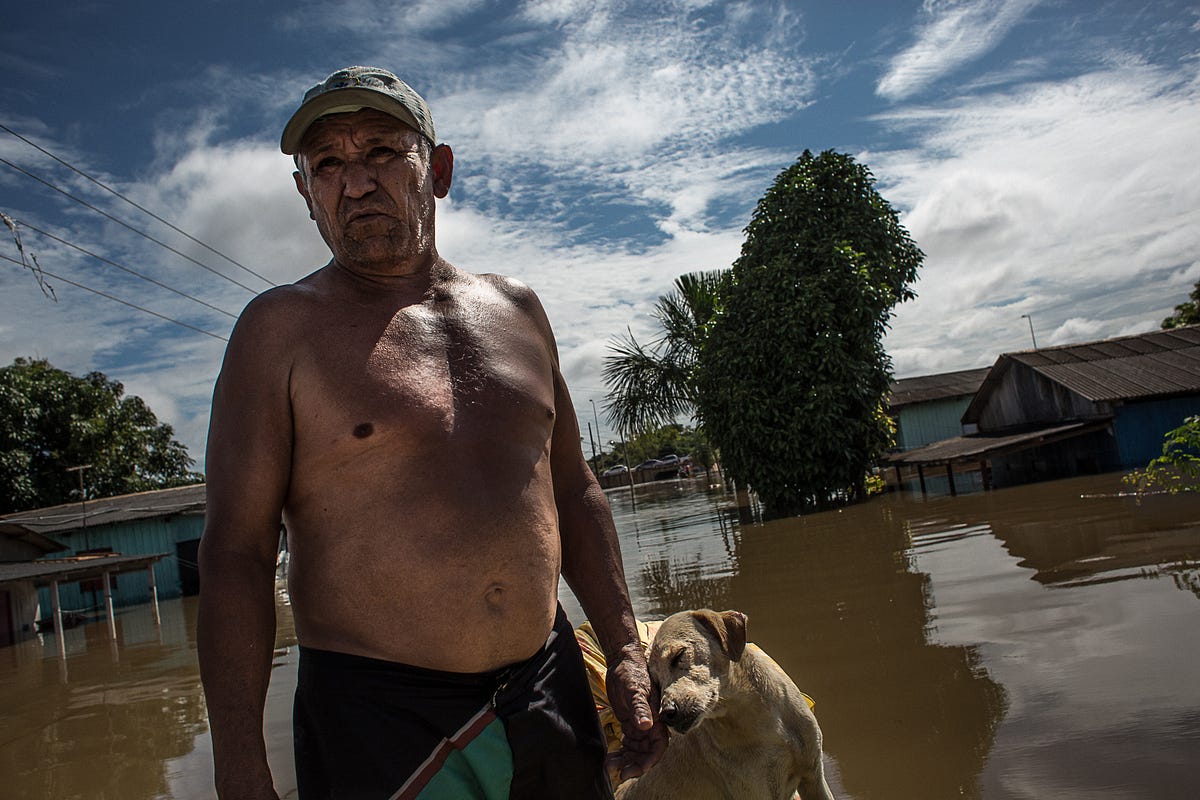
At each step, proposals are often sent back for revision, and they sometimes die altogether. It is an inherently conservative process, says Martin Head, a marine stratigrapher at Brock University in St Catharines, Canada, and the current head of the Quaternary subcommission. “You are messing around with a timescale that is used by millions of people around the world. So if you’re making changes, they have to be made on the basis of something for which there is overwhelming support.”

Some voting members of the Quaternary subcommission have told Nature that they have not been persuaded by the arguments raised so far in favour of the Anthropocene. Gibbard, a friend of Zalasiewicz’s, says that defining this new epoch will not help most Quaternary geologists, especially those working in the Holocene, because they tend not to study material from the past few decades or centuries. But, he adds: “I don’t want to be the person who ruins the party, because a lot of useful stuff is coming out as a consequence of people thinking about this in a systematic way.”

If a proposal does not pass, researchers could continue to use the name Anthropocene on an informal basis, in much the same way as archaeological terms such as the Neolithic era and the Bronze Age are used today. Regardless of the outcome, the Anthropocene has already taken on a life of its own. Three Anthropocene journals have started up in the past two years, and the number of papers on the topic is rising sharply, with more than 200 published in 2014.

By 2019, when the new fossil hall opens at the Smithsonian’s natural history museum, it will probably be clear whether the Anthropocene exhibition depicts an official time unit or not. Wing, a member of the working group, says that he does not want the stratigraphic debate to overshadow the bigger issues. “There is certainly a broader point about human effects on Earth systems, which is way more important and also more scientifically interesting.”

As he walks through the closed palaeontology hall, he points out how much work has yet to be done to refashion the exhibits and modernize the museum, which opened more than a century ago. A hundred years is a heartbeat to a geologist. But in that span, the human population has more than tripled. Wing wants museum visitors to think, however briefly, about the planetary power that people now wield, and how that fits into the context of Earth’s history. “If you look back from 10 million years in the future,” he says, “you’ll be able to see what we were doing today.”

Nature 519, 144–147 (12 March 2015), doi:10.1038/519144a

References

  1. Walker, M. et alJ. Quat. Sci. 24317 (2009).
  2. Crutzen, P. J. & Stoermer, E. F. IGBP Newsletter 411718 (2000).
  3. Zalasiewicz. J. et alGSA Today 18(2), 48 (2008).
  4. Ruddiman, W. F. Ann. Rev. Earth. Planet. Sci. 414568 (2013).
  5. Zalasiewicz, J. et alQuatern. Int. http://dx.doi.org/10.1016/j.quaint.2014.11.045 (2015).
  6. Autin, W. J. & Holbrook, J. M. GSA Today 22(7), 6061 (2012).
  7. Finney, S. C. Geol. Soc. Spec. Publ. 3952328 (2013).

Alckmin descarta repor volume morto até abril (Estadão)

Fabio Leite e Lucas Sampaio – O Estado de S. Paulo

31 Março 2015 | 03h 00

Pela primeira vez, governo admite que chuvas não vão tirar o Sistema Cantareira da dependência da reserva profunda

SÃO PAULO – Mesmo com as chuvas acima da média em fevereiro e março, o Sistema Cantareira não vai conseguir recuperar totalmente o volume morto até o fim de abril, admitiu pela primeira vez o governo Geraldo Alckmin (PSDB). Projeção feita pelo Departamento de Águas e Energia Elétrica (DAEE) revela que o principal manancial paulista deve encerrar o próximo mês com nível 6% abaixo de zero, ou seja, ainda na reserva profunda.

“Poderemos atingir um total armazenado em torno de 420 bilhões de litros, ao fim de abril, 65 bilhões de litros abaixo do ‘zero’ do volume útil por gravidade”, afirmou o superintendente do DAEE, Ricardo Borsari, em ofício encaminhado ao presidente da Agência Nacional de Águas (ANA), Vicente Andreu, no dia 20 deste mês.

O volume de água é o mesmo registrado em 21 de agosto do ano passado. Os dois órgãos são responsáveis pela gestão conjunta do Sistema Cantareira.

Sistema Cantareira abastece 5,6 milhões 

Sistema Cantareira abastece 5,6 milhões

O manancial, formado por quatro represas, tem 1,47 trilhão de litros, dos quais 982 bilhões fazem parte do volume útil, porque ficam acima do nível dos túneis de captação e podem ser retirados por gravidade, e 485 bilhões, do volume morto, que só podem ser captados por bombas. Destes, 287,5 bilhões de litros foram liberados em duas cotas para a Companhia de Saneamento Básico do Estado de São Paulo (Sabesp) abastecer a região metropolitana, onde 5,6 milhões de pessoas ainda dependem da água do sistema.

Nesta segunda-feira, 30, o Cantareira operava com 18,9% da capacidade, segundo a Sabesp, que inclui as duas cotas do volume morto no cálculo. Na prática, contudo, o nível estava em -10,4%, se considerada a quantidade de água da reserva profunda usada como negativo, como quer o Ministério Público Estadual (MPE). No sábado, o Estado mostrou que o sistema tem atualmente 57% menos água do que há um ano, déficit de 243 bilhões de litros.

O documento faz parte das negociações entre a ANA, do governo Dilma Rousseff, e o DAEE, do governo Alckmin, para definir a retirada de água do Cantareira. Por causa das discordâncias entre os órgãos, desde 15 de março o manancial é operado pela Sabesp sem uma regra estabelecida.

O presidente da agência federal quer definir uma metodologia de operação e metas futuras de armazenamento até 30 de novembro.

No ofício, Borsari diz que a projeção considera a manutenção das atuais condições de entrada de água (60% das médias mensais históricas) e retirada (10 mil litros por segundo), como ocorre desde fevereiro. Neste cenário, o volume morto só será recuperado no dia 22 de julho, segundo o simulador lançado em janeiro pelo Estado.

Justiça. Em ação civil movida em 2014, o MPE pede que os gestores do Cantareira e da Sabesp operem o manancial para que ele chegue ao fim de abril com 10% positivos, mesmo índice registrado em 30 de abril do ano passado. O governo Alckmin afirma que essa meta é impossível de ser atingida.

Após duas liminares terem sido concedidas e depois derrubas pela Justiça, o juiz federal Wilson Zauhy Filho decidiu, na semana passada, suspender o processo até o dia 11 de maio, quando o DAEE se comprometeu a entregar, em juízo, os estudos da proposta que será feita pela Sabesp para a renovação da outorga do Sistema Cantareira e as respostas às propostas feitas pela ANA para a gestão do manancial durante a crise.

Usina Nuclear de Angra 3 e a Operação Lava Jato (JC)

Para o físico Heitor Scalambrini Costa, denúncias de propinas na construção da usina e objeções técnicas quanto à obsolescência dos equipamentos tecnologicamente defasados, são fatos graves que devem ser apurados com urgência

Apesar de toda a movimentação no cenário internacional acerca dos problemas e riscos de instalações nucleares, que ficou exacerbada após o desastre de Fukushima (11/3/2011), surpreende a posição das autoridades do Ministério de Minas e Energia, dos “lobistas” da área nuclear,das empreiteiras e fornecedoras de equipamentos ― pois todos continuam insistindo na instalação de mais quatro usinas nucleares no país até 2030, sendo duas delas no Nordeste brasileiro. Além da construção de Angra 3 ― já aprovada.

No caso de Angra 3, a estimativa de custos da obra era de R$ 7,2 bilhões, em 2008; pulou para R$ 10,4 bilhões,no final de 2010;em julho de 2013, de acordo com a Eletronuclear, superava os R$ 13 bilhões; e, até 2018, ano de sua conclusão, devem alcançar R$ 14,9 bilhões. Obviamente a duplicação nos custos de construção desta usina nuclear impactam decisivamente o preço médio de venda de eletricidade no país.

A história da indústria nuclear no Brasil mostra que ela sempre foi ― e continua sendo ― uma indústria altamente dependente de subsídios públicos. Sem dúvida, são perversas as condições de financiamento de Angra 3, com subsídios governamentais ocultos, a serem posteriormente disfarçados nas contas de luz. E quem vai pagar essa conta seremos nós, os usuários, que já pagamos uma das mais altas tarifas de energia elétrica do mundo.

Com a Operação Lava Jato, deflagrada em março de 2014, para investigar um grande esquema de lavagem e desvio de dinheiro envolvendo a Petrobras, grandes empreiteiras do país e diversos políticos, começam a ter desnudados os reais interesses, nada republicanos, da decisão de construção das grandes obras energéticas, como a usina hidroelétrica de Belo Monte e a usina nuclear Angra 3.

Desde a decisão de construí-la no âmbito do conturbado acordo nuclear Brasil-Alemanha, a usina de Angra 3foi cercada de mistério, controvérsias, incertezas e falta de transparência, comuns no setor nuclear brasileiro.

As obras civis da usina foram licitadas à Construtora Andrade Gutierrez mediante contrato assinado em 16 de junho de 1983(governo Figueiredo, 1979-1985). Em abril de 1986, as obras foram paralisadas por falta de recursos, alto custo e dúvidas quanto à conveniência e riscos desta fonte de energia. Mesmo assim a construtora recebeu durante décadas um pagamento de aproximadamente US$ 20 milhões/ano.

Depois de 23 anos parada, as obras de Angra 3 foram retomadas em 2009 (governo Lula, 2003-2010). O governo Lula optou por não fazer licitações, e revalidou a concorrência ganha pela construtora Andrade Gutierrez, em 1983. Embora não tenha feito novas licitações, a Eletronuclear negociou atualizações de valores com todos os fornecedores e prestadores de serviços. A obra e seus equipamentos ficaram bem mais caros. Em dólares, seu valor pulou de US$ 1,8 bilhão para aproximadamente cerca de US$ 3,3 bilhões.

Diante da decisão de manter o contrato com a Andrade Gutierrez, construtoras concorrentes, especialmente a Camargo Corrêa, tentaram em vão convencer o governo a rever sua decisão, alegando que neste período houve uma revolução tecnológica que reduziu em até 40% o custo de obras civis de usinas nucleares. Também o plenário do Tribunal de Contas da União, em setembro de 2008, ao avaliar o assunto não impediu a revalidação dos contratos. Porém considerou que Angra 3 apresentava “indícios de irregularidade grave” sem recomendar, todavia, a paralisação do empreendimento.

O contrato das obras civis não foi o único a ser tirado do congelador pelo governo Lula. Para o fornecimento de bens e serviços importados foi definida a fabricante Areva, empresa resultante da fusão entre a alemã Siemens KWU e a francesa Framatome. A rigor, a Areva nem assinou o contrato. Ela foi escolhida porque herdou da KWU o acordo original.

Já os contratos da montagem foram assinados em 2 de setembro de 2014 com os seguintes consórcios: consórcio ANGRA 3, para a realização dos serviços de montagens eletromecânicas dos sistemas associados ao circuito primário da usina (sistemas associados ao circuito de geração de vapor por fonte nuclear),constituído pela empresas Construtora Queiroz Galvão S.A., EBE – Empresa Brasileira de Engenharia S.A. e Techint Engenharia S.A. E consórcio UNA 3, para a execução das montagens associadas aos sistemas convencionais da usina, constituído pelas empresas Construtora Andrade Gutierrez S.A., Construtora Norberto Odebrecht S.A., Construções e Comércio Camargo Corrêa S.A. e UTC Engenharia S.A.

O atual planejamento da Eletronuclear prevê a entrada em operação de Angra 3 em maio de 2018. Mas esta meta deverá ser revista depois de a obra ser praticamente paralisada no final de abril de 2014, devido à alegação de dívidas não pagas a empreiteira (governo Dilma, 2011-2014).

Depois de todos estes percalços, para uma obra tão polêmica, tomamos conhecimento das denúncias feitas por um dos executivos da empreiteira Camargo Correa, que passou a colaborar com as investigações da Operação Lava Jato e relatou aos procuradores, durante negociações para o acordo de delação premiada, uma suposta propina para o ex-ministro das Minas e Energia, Edson Lobão, na contratação da Camargo Correa para a execução de obras da usina de Angra 3.

Caso se confirmem tais acusações ficará claro para a sociedade brasileira que os reais interesses pela construção de Angra 3 e de mais 4 usinas nucleares tiveram como principal motivação as altas somas que autoridades públicas receberam como suborno. É bom lembrar que neste caso o ministro Lobão tinha poder de comando sobre a empresa pública responsável pela obra, a Eletronuclear ― subsidiária da Eletrobrás.

A partir deste episódio não podemos mais ignorar as objeções técnicas, como as denúncias com relação à obsolescência dos equipamentos tecnologicamente defasados (comprometendo o seu funcionamento e aumentando o risco de um desastre nuclear). Nem as denúncias de que o custo desta obra poderia encarecer durante a sua construção ― o que,de fato, já aconteceu.Tampouco o questionamento sobre o empréstimo realizado pela Caixa Econômica Federal, para a construção de Angra 3.

A expectativa é que todas as denúncias sejam investigadas e apuradas as responsabilidades. O fato em si é gravíssimo, e suficiente para a interrupção das atividades nucleares no país, em particular a construção de Angra 3, com o congelamento de novas instalações. Não se pode admitir que a decisão de construir centrais nucleares no país tenha sido feita em um mero balcão de negócios.

Heitor Scalambrini Costa é graduado em Física pela Universidade de Campinas/SP, mestrado em Ciências e Tecnologias Nucleares na Universidade Federal de Pernambuco, e doutorado em Energética – Université dAix-Marseille III (Droit, Econ. et Sciences (1992). Atualmente é professor associado da Universidade Federal de Pernambuco.

Michael Lewis: Our Appetite for Apocalypse (Radio Open Source)

AUDIO

m lewis redoMichael Lewis is the non-fiction novelist of our apocalyptic American mindset in 2010. The heroes of The Big Short, as he puts it in conversation “were betting on the end of the world… The only characters you can really trust are the people who are delivering a very, very dark message.”

Michael Lewis, remember, was never really a sportswriter, despite MoneyballCoach and The Blind Side. Nor was he ever a finance guy, despite the prescience of Liar’s Poker and his sure touch now with the Wall Street collapse of 2007-2008. Michael Lewis’s real business and his genius instinct is for resonant social fables that just happen to play out on ballfields and bond markets.

The Big Short is a high literary feat, complete with a real-life “unreliable narrator,” a particularly despised contrarian bond dealer, Greg Lippmann, who was betting brazenly against his own market. “The guy selling the best ideas is a completely untrustworthy character,” the author remarks. The true center of The Big Short is an atmosphere of anxiety that has developed a taste for the catastrophic. Lewis’s short-selling characters resonate because they’re acting out our common sense of “the probability of extreme change” in financial markets and in real life. It’s an anxiety that envelops Tea Baggers and Greenpeaceniks in the same cloud of anger.
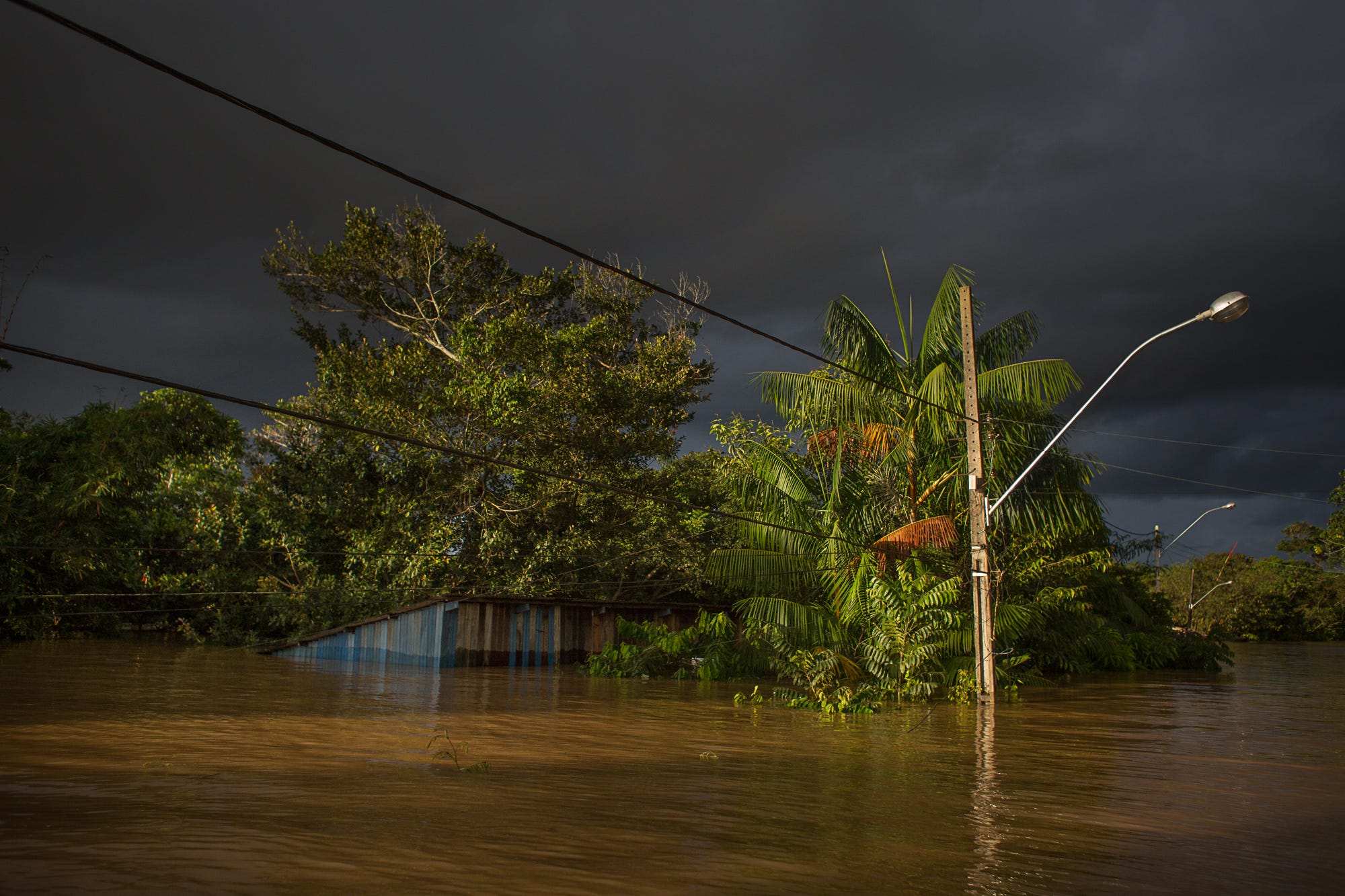
ML: The broader thing about all these characters to me is that their attitudes, their approach to life, their ability to hear the data, was something that was marginalized in the system itself. They didn’t belong, none of them belonged, and they should have belonged. What is it about the system that doesn’t want them as a part of it? And it’s terrifying when all the people who were wrong are in charge, and all the people who are right are on the outside.

CL: It sure is. To me there’s a direct analogy to be drawn with the war in Iraq. The Congress signed off “oh well, he must know something.” Tony Blair embraced it. The media by and large encouraged it. A very, very few people said “are you kidding?” And yet the ones that warned against the war in Iraq got the same prize that your guys got for warning of the meltdown.
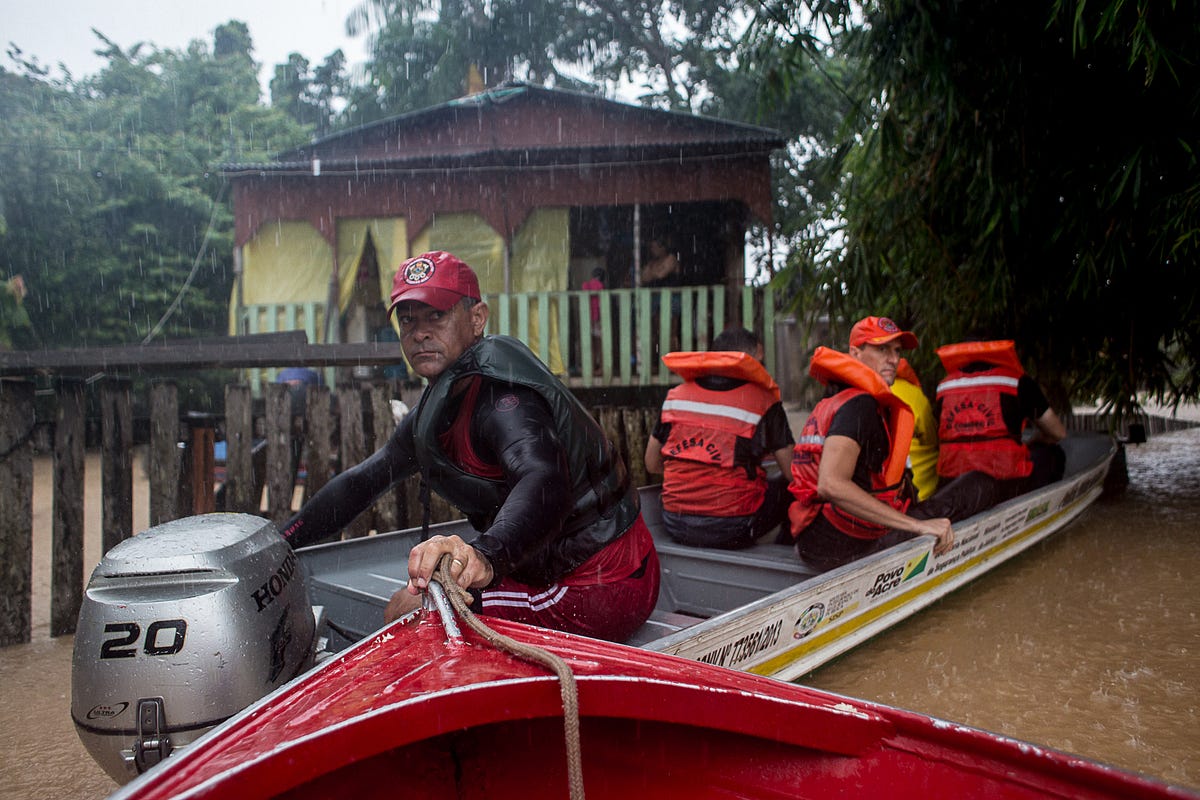
ML: Yes. Ostracism.

CL: Exactly, and they’re still ostracized.

ML: It’s funny. There is an analogy. And the analogy is there’s a kind of a blind faith in leadership that is the result in both cases of ordinary people feeling they can’t evaluate the situation because it’s too complicated. The financial system got so complicated, and the complexity became opacity. When Alan Greenspan stands up and says something, no one understands what he’s saying. But they think that’s a good thing, because it’s all so complicated they shouldn’t understand what he’s saying. And the fact is they should. The fact is, if things aren’t being explained in a way you and I can understand them, it should be a bad sign, not a good sign. But the complexity was turned on its head. It was used as a way to mask bad things that were happening.

There’s a joke in it all. The joke is that the financial system, and there are analogies to the political system, but the financial system wanted to do something it really shouldn’t do. It wanted to make lots of loans that it shouldn’t make. They created all this risk that was going to blow up the system. In order to do that they needed to disguise the risk. So to disguise the risk it used all this complexity, which served as a smokescreen. And the joke is that it ended up disguising the risk from itself. That the very people who created the smokescreen were engulfed in it, and they couldn’t parse the system they created.

Michael Lewis with Chris Lydon in Boston, April 7, 2010.

‘Escolha foi respeitar rito ambiental ou fornecer água’, diz secretário de SP (Folha de S.Paulo)

[Detalhe para o uso da palavra “rito”]

FABRÍCIO LOBEL
GUSTAVO URIBE
DE SÃO PAULO
EDUARDO SCOLESE
EDITOR DE “COTIDIANO”

30/03/2015  03h00

Em meio à pior crise de abastecimento enfrentada pela Grande SP, o secretário estadual Benedito Braga (Recursos Hídricos) diz que a gestão Geraldo Alckmin (PSDB) teve de escolher: levar água para a população no período de seca ou respeitar o rito ambiental tradicional para dar andamento a obras emergenciais.

Foi escolhida a primeira opção, de acordo com ele.

“Se fossem respeitados os ritos, não teríamos condições de prover essa água à população em julho [de 2015]”, afirma o secretário, que diz que deverão ser usados “atalhos” para cumprir as exigências.

Em entrevista à Folha, o secretário, que assumiu a pasta em janeiro em meio à crise de abastecimento, avaliou como muito reduzidas as chances de um rodízio de água neste ano.

Para Braga, que é professor de engenharia hidráulica da USP e presidente do Conselho Mundial da Água, as pessoas que torcem pelo rodízio querem ver uma “situação realmente ruim” em SP.

Entre as principais obras emergenciais previstas para este ano está a ligação entre dois mananciais, o Rio Grande e o Alto Tietê. Outras deverão reverter rios da Serra do Mar, alguns em área de Mata Atlântica, para abastecer os reservatórios da Grande SP.

Karime Xavier/Folhapress
O secretário estadual Recursos Hídricos Benedito Braga (Recursos Hídricos)
O secretário estadual de Recursos Hídricos, Benedito Braga, durante entrevista à Folha

*

Folha – Um rodízio neste ano está completamente descartado em São Paulo?

Benedito Braga – Em função das condições que prevalecem nos nossos sistemas de armazenamento, as chances de termos um rodízio são bastante baixas –e nós estamos trabalhando da forma mais conservadora possível, não fazendo hipóteses de que vamos ter grandes chuvas daqui para frente.

É importante observar que, depois dessa crise, não temos uma condição de previsibilidade [de chuvas] muito boa, como tínhamos antes.

Então, não podemos garantir que não vamos ter rodízio. Temos tudo preparado para tomar as decisões dependendo da condição do clima que prevalecer neste ano. Tudo vai depender de como vem a estação seca [de abril a setembro].

Qual deve ser o custo da crise neste ano para a população?

O custo não será diferente do que está sendo agora. Durante este ano, nós teremos ainda que adotar medidas de redução de pressão que incomodam as pessoas, porque é uma situação fora do normal.

É muito importante termos em conta que a situação que vivemos é muito melhor do que uma situação de rodízio.

Haverá um custo muito menor do que aquele que teríamos se implantássemos o rodízio [interrupção completa do fornecimento de água].

O balanço financeiro da Sabesp relativo a 2014 mostrou que o lucro da empresa caiu pela metade. Essa queda será repassada ao consumidor?

O que houve foi uma queda no lucro [de R$ 1,9 bilhão para R$ 903 milhões]. A redução do lucro era esperada, em função da redução do consumo e da concessão de bônus.

Não tem como repassar para a população, isso é um resultado que tivemos em função da crise da água.

Mas essa queda poderá impactar as obras programadas para este ano?

Não. O custo dessas obras não é exagerado. Há previsão orçamentária e não há atraso nenhum nas obras sob o ponto de vista físico e financeiro.

Pela urgência das obras, a questão ambiental não está sendo atropelada?

Nós temos uma situação em que, se fossem seguidos os ritos tradicionais do setor ambiental, nós não teríamos condições de prover essa água à população em julho.

Então, a questão é uma escolha. O que vocês preferem: seguir o rito ambiental ou trazer água para a população?

O governo fez a escolha?

Fez a escolha de seguir o rito dentro da emergência. E, dentro da emergência, você tem atalhos para o setor ambiental. Tudo está sendo feito dentro da mais absoluta regra da lei e da ordem.

A única coisa é que isso teve que ser feito de uma forma mais rápida. E o rito, dentro dessa forma mais rápida, é diferente das obras tradicionais, em que você tem o relatório de impacto ambiental, audiência pública e assim por diante.

Mas a Cetesb faz todas as análises, (…) e o governo não está fazendo nada fora da lei.

Está sendo feita uma obra de emergência, mas dentro de todos os ritos da lei de licitações e da lei ambiental.

As chuvas recentes fizeram com que o governo estadual recuasse na transparência em relação à crise, como não informar o real risco de um rodízio? Não são os mesmos erros do ano passado?

Não, não há erros nem em 2014 nem em 2015 e não haverá erros em 2016. Trabalhamos com uma boa expectativa de passar este ano, mas nos preparando para o pior, que é um plano de contingência.

Estamos fazendo tudo dentro da mais absoluta técnica. Não existe falta de transparência, porque informamos diariamente a situação dos reservatórios da região metropolitana. Não há nenhuma falta de transparência.

Como o senhor classifica a atual situação?

Nós estamos caminhando para ocupar minimamente o volume morto, o que significa que ainda é uma situação muito difícil. Nós gostaríamos que o reservatório estivesse praticamente cheio.

Mas, com essa reserva que estamos acumulando e com as obras que estamos trazendo, temos a possibilidade de superar a crise, mas não é ainda uma situação confortável.

O sr. disse que não houve erros em 2014. Como eleitor, mesmo fora do cargo, o sr. se sentiu atendido pelas declarações do governo sobre a crise?

As decisões tomadas foram corretas. Em 2014, ainda havia o final do ano como uma época em que normalmente há as chuvas e os reservatórios enchem.

Então, tomar uma medida como o rodízio, como muita gente queria, eu sempre fui publicamente contra. Entraram com o incentivo econômico [bônus para quem economizar], depois com as válvulas redutoras de pressão. E foi tudo muito lógico.

Mas a sobretaxa veio só depois da eleição…

Não quero entrar nesse detalhe de sobretaxa [pagamento adicional para quem extrapolar o consumo médio]. O que estou dizendo é que o que foi feito em 2014 foi certo.

Esse negócio de dizer que o governo errou não está certo. Talvez, as pessoas que insistiram muito em rodízio queriam ver uma situação realmente ruim. Seria fácil fazer o rodízio, é só fechar a manivela. O duro é fazer o que a Sabesp fez: colocar válvulas e sofrer o impacto econômico de colocar o bônus.

Então o sr. acha que ter negado que haveria desabastecimento e que seriam usados os dois volumes mortos foram medidas acertadas?

O resultado foi muito bom. Não tivemos desabastecimento, tivemos 1% da população impactada com as medidas. Portanto não tenho crítica.

Mas há problemas de desabastecimento em alguns bairros na periferia de São Paulo…

Não se pode negar que haja uma crise hídrica. É como em uma guerra dizer: “Você vai me matar com uma uma [arma calibre] 45 ou com uma 22?”. É querer colocar regra em meio a uma situação muito complicada. É querer que todo mundo tenha água quando tivemos um ano de 2014 que teve 50% menos água que a mínima de 1953.

A tarifa hoje é muito barata?

São Paulo tem uma das menores tarifas do Brasil. Tem 21 Estados que praticam tarifas acima da tarifa da Sabesp.

Acho que o custo da água, em função da dificuldade de encontrar novos mananciais e dos custos operacionais… Acho que a tarifa hoje no Estado é aquém do necessário.

A crise traz algum benefício?

Acho que sim. O pessoal no Sudeste não sabia que tinha que fazer a barba abrindo e fechando a torneira. O nordestino já sabia disso há muito tempo. A crise trouxe essa consciência.

Los rayos cósmicos confirman que se fundió el corazón de Fukushima (El País)

Un detector de muones muestra el interior de dos reactores accidentados en Japón

, 23 MAR 2015 – 17:04 CET

Imagen proporcionada por Tepco sobre estos trabajos de detección.

Mientras Chernóbil todavía lucha para cubrir los restos de la tragediacon un segundo sarcófago, en Fukushima aún dan los primeros pasos para controlar por completo y desmantelar los reactores accidentados en 2011, una tarea que durará unas cuatro décadas. Al margen de las interminables fugas de agua que traen de cabeza a los responsables de la central, el principal objetivo es determinar la situación exacta del combustible radiactivo que quedó fuera de control durante varios días, provocando la mayor catástrofe atómica en lustros. Ahora, gracias a los rayos cósmicos, tenemos la confirmación de que el núcleo del reactor 1 de Fukushima se fundió por completo y que también se derritió, parcialmente, el combustible del reactor 2.

Los trabajos de desmantelamiento de la central ya han costado 1.450 millones a Japón

Esas barras de uranio derretidas generan tanto peligro que no ha sido posible entrar hasta el corazón de los reactores accidentados para determinar exactamente su estado. Las mediciones indirectas indicaban que estábamos en un escenario de fusión de los núcleos pero una nueva técnica que se sirve de la física de partículas ha ayudado a radiografiar, por el momento, dos de los reactores accidentados. Se trata de un detector de muones, unas partículas elementales que surgen cuando penetran en la atmósfera los rayos cósmicos, y que llegan por miles hasta la superficie de la Tierra. Estas partículas que frenan al chocar con objetos muy densos, como el combustible nuclear, y se pueden detectar con una suerte de placas de radiografía colocadas a los lados del reactor.

Al atravesar todo el invento, los muones han mostrado que no queda nada de combustible en el corazón del reactor número 1. Es decir, mientras el núcleo estuvo sin refrigerar con agua durante el accidente, las barras de uranio se derritieron por completo, cayendo por el fondo de la vasija que las contenía. Por eso no salen en la fotografía que han conseguido los físicos de varias universidades japonesas, que han desarrollado esta técnica junto a científicos del Laboratorio de Los Álamos y la empresa Toshiba, responsable de los trabajos de desmantelamiento de Fukushima.

Como la plancha detectora de los muones se coloca a ras de suelo, la imagen que ha devuelto de este reactor solo permite saber que el combustible se fundió y ya no está en su sitio, pero no ayuda a saber cuál es su situación en el sótano del reactor o si ha comprometido por el suelo la robusta contención que separa el núcleo del exterior. Posteriormente, Tepco ha dado a conocer el resultado de este examen en el reactor 2, que ha mostrado una descomposición parcial del núcleo al comparar la imagen con la de un reactor en condiciones normales.

Los científicos no pueden saber hasta dónde ha caído el núcleo fundido del reactor

“Los resultados reafirman nuestra idea previa de que una cantidad considerable de combustible se había fundido en el interior”, explicó Hiroshi Miyano, uno de los científicos, a AFP.  “Pero no hay evidencia de que el combustible se haya derretido a través de los edificios de contención y alcanzado el exterior”. Para asegurarse, el siguiente paso será el uso de robots que se cuelen por todos los rincones de los edificios.

Hoy se ha conocido el gasto que ha supuesto hasta el momento el desmantelamiento de Fukushima para los japoneses: 1.450 millones de euros de las arcas públicas, según un informe gubernamental que recoge la agencia Kyodo. Poco más de un tercio de ese dinero se ha gastado en los esfuerzos por controlar las continuas filtraciones y fugas de agua que inundan todo el entorno de la central.

Did a Volcanic Cataclysm 40,000 Years Ago Trigger the Final Demise of the Neanderthals? (Geological Society of America)

19 March 2015

Boulder, Colo., USA – The Campanian Ignimbrite (CI) eruption in Italy 40,000 years ago was one of the largest volcanic cataclysms in Europe and injected a significant amount of sulfur-dioxide (SO2) into the stratosphere. Scientists have long debated whether this eruption contributed to the final extinction of the Neanderthals. This new study by Benjamin A. Black and colleagues tests this hypothesis with a sophisticated climate model.

Black and colleagues write that the CI eruption approximately coincided with the final decline of Neanderthals as well as with dramatic territorial and cultural advances among anatomically modern humans. Because of this, the roles of climate, hominin competition, and volcanic sulfur cooling and acid deposition have been vigorously debated as causes of Neanderthal extinction.

They point out, however, that the decline of Neanderthals in Europe began well before the CI eruption: “Radiocarbon dating has shown that at the time of the CI eruption, anatomically modern humans had already arrived in Europe, and the range of Neanderthals had steadily diminished. Work at five sites in the Mediterranean indicates that anatomically modern humans were established in these locations by then as well.”

“While the precise implications of the CI eruption for cultures and livelihoods are best understood in the context of archaeological data sets,” write Black and colleagues, the results of their study quantitatively describe the magnitude and distribution of the volcanic cooling and acid deposition that ancient hominin communities experienced coincident with the final decline of the Neanderthals.

In their climate simulations, Black and colleagues found that the largest temperature decreases after the eruption occurred in Eastern Europe and Asia and sidestepped the areas where the final Neanderthal populations were living (Western Europe). Therefore, the authors conclude that the eruption was probably insufficient to trigger Neanderthal extinction.

However, the abrupt cold spell that followed the eruption would still have significantly impacted day-to-day life for Neanderthals and early humans in Europe. Black and colleagues point out that temperatures in Western Europe would have decreased by an average of 2 to 4 degrees Celsius during the year following the eruption. These unusual conditions, they write, may have directly influenced survival and day-to-day life for Neanderthals and anatomically modern humans alike, and emphasize the resilience of anatomically modern humans in the face of abrupt and adverse changes in the environment.

FEATURED ARTICLE
Campanian Ignimbrite volcanism, climate, and the final decline of the Neanderthals
Benjamin A. Black et al., University of California, Berkeley, California, USA. Published online ahead of print on 19 March 2015; http://dx.doi.org/10.1130/G36514.1.

Sabesp inicia obras às pressas sem avaliar risco (OESP)

Fabio Leite – O Estado de S. Paulo

15 Março 2015 | 02h 01

Companhia de Saneamento Básico do Estado de São Paulo desengavetou planos sem ter tempo de estudar impacto ambiental

SÃO PAULO – A busca por novos mananciais para suprir a escassez hídrica a curto prazo e tentar evitar o rodízio oficial de água na Grande São Paulo levou a Companhia de Saneamento Básico do Estado de São Paulo (Sabesp) a tirar do papel uma série de projetos engavetados há anos e a executá-los a toque de caixa sem Estudo de Impacto Ambiental (EIA), aprovação em comitês ou decreto de estado de emergência.

Até o momento, são seis obras (uma já concluída) que envolvem transposições entre rios e reservatórios com o objetivo de aumentar a oferta de água para conseguir abastecer 20 milhões de pessoas durante o período seco (que vai de abril a setembro) sem decretar racionamento generalizado. A principal delas é a interligação do Sistema Rio Grande com o Alto Tietê, o segundo manancial mais crítico (21% da capacidade), melhor só que o Cantareira.

Segundo a Sabesp, já foi iniciada a construção de 11 quilômetros de adutora e uma estação de bombeamento para levar até 4 mil litros por segundo da Billings, no ABC, para a Represa Taiaçupeba, em Suzano. A conclusão está prevista para julho. Técnicos do governo Geraldo Alckmin (PSDB) afirmam, contudo, que uma obra desse porte precisaria de EIA, aprovação no Comitê da Bacia do Alto Tietê, além da outorga do Departamento de Águas e Energia Elétrica de São Paulo (DAEE).

A principal das obras é a interligação do Sistema Rio Grande com o Alto Tietê, o segundo manancial mais crítico (21% da capacidade), melhor só que o Cantareira.

A principal das obras é a interligação do Sistema Rio Grande com o Alto Tietê, o segundo manancial mais crítico (21% da capacidade), melhor só que o Cantareira.

Com a provável reversão das águas do poluído corpo central da Billings para o Braço Rio Grande, já manifestada pela Sabesp, seria preciso ainda aprovação prévia do Conselho Estadual do Meio Ambiente (Consema) e de outorga da Agência Nacional de Energia Elétrica (Aneel), já que a represa também fornece água para geração de energia na Usina Henry Borden, em Cubatão. Todo esse trâmite teve de ser seguido para a execução da ligação Billings-Guarapiranga, pelo Braço Taquacetuba, na crise de 2000.

“Ou o governo decreta estado de emergência para tocar as chamadas obras emergenciais sem licitação e estudo de impacto ambiental, com perda de capacidade de concorrência e de participação social, ou então licita e produz os relatórios necessários. Do jeito que está, há uma incoerência brutal”, afirmou o engenheiro Darcy Brega Filho, especialista em gestão de sustentabilidade e ex-funcionário da Sabesp.

Mar. No pacote de obras emergenciais estão a interligação de dois rios de vertente marítima (que deságuam no mar), Itatinga e Capivari, para rios que são afluentes das Represas Jundiaí (Alto Tietê) e Guarapiranga. As duas intervenções recém-anunciadas pela Sabesp já constavam do Plano Diretor de Águas e Abastecimento (PDAA) de 2004 e ficaram engavetadas. Cada uma deve aumentar a vazão dos sistemas em 1 mil litros por segundo e também precisariam de aprovação do Comitê da Bacia da Baixada Santista.

“Sem dúvida, é preciso de obras emergenciais para trazer água para a região metropolitana, mas isso não anula uma avaliação mais acurada desse conjunto de transposições para calcular a eficiência desses projetos e seus efeitos indiretos”, afirmou o especialista em recursos hídricos José Galizia Tundisi, presidente do Instituto Internacional de Ecologia e vice-presidente do Instituto Acqua.

Um exemplo citado por funcionários do governo sobre a falta de avaliação dos projetos é a construção de 9 quilômetros de adutora para levar 1 mil litros por segundo do Rio Guaió para a Represa Taiaçupeba. As obras começaram em fevereiro e devem ser concluídas em maio, segundo a Sabesp. Técnicos da área afirmam que durante o período de estiagem a vazão média desse rio é de apenas 300 litros por segundo, ou seja, 70% menor do que a pretendida.

Anthropocene: New dates proposed for the ‘Age of Man’ (BBC)

Old World New World Map

Scientists believe the collision between the Old and New Worlds led to the start of the Anthropocene 

The Anthropocene – a new geological time period that marks the “Age of man” – began in 1610, a study suggests.

Scientists believe that the arrival of Europeans in the Americas had an unprecedented impact on the planet, marking the dawn of this new epoch.

The findings are published in the journal Nature.

Others say that the industrial revolution or the first nuclear tests better signal the start of the Anthropocene.

While some believe the exact date for a new epoch can only be determined with the benefit of thousands or even millions of years of hindsight.

An international Anthropocene Working Group is currently reviewing the evidence and will announce its favoured start date next year.

We look for these golden spikes – a real point in time when you can show in a record when the whole Earth has changed” – Prof Mark Maslin, University College London

Golden spikes

Geologists carve up Earth’s history into chunks that reflect times of significant change on the planet, perhaps as a result of continental movement, a big asteroid strike, or a major shift in climate.

We are still formally in the Holocene Epoch. It started more than 11,500 years ago as the last Ice Age came to an end.

But now scientists say that humanity has dramatically altered the Earth again.

To pinpoint the start of this new phase, geologists are looking for a clear signal, described as a “golden spike”, that will be captured in rocks, sediments or ice.

Prof Mark Maslin, from University College London, a co-author of the paper, said: “We look for these golden spikes – a real point in time when you can show in a record when the whole Earth has changed.

“If you look back through the entire, wonderful geological timescale, we have defined almost every boundary in that way.”

Painting of Columbus arrives in the Americas, 1492

The arrival of Christopher Columbus in the Americas started an exchange of people, crops – and disease

The study suggests that one such golden spike places the start of the Anthropocene in 1610.

The researchers say the arrival of the Europeans in the Americas 100 years earlier was the start of a major global transformation.

We saw these species jump continents, which is a geologically unprecedented impact, setting Earth off on a new evolutionary trajectory” – Dr Simon Lewis, UCL

Co-author Dr Simon Lewis, also from UCL, said: “The rapid global trade after that time moved species around.

“Maize from Central America was grown in southern Europe and Africa and China. Potatoes from South America were grown in the UK, and all the way through Europe to China. Species went the other way: wheat came to North America and sugar came to South America – a real mixing of species around the world.

“We saw these species jump continents, which is a geologically unprecedented impact, setting Earth off on a new evolutionary trajectory.”

Ancient pollen found in sediments provides a record of this change, but the team says another golden spike relates to deadly diseases brought into the Americas from Europe.

“Around 50 million people (in the Americas) died, and most of those people were farmers,” Dr Lewis told the BBC World Service’s Science in Action programme.

“And this farmland grew back to the original vegetation – tropical forest, dry forest or savannah. And about half the dry weight of a tree is carbon, so all that growing vegetation removed enough carbon from the atmosphere to see a pronounced dip in the global atmospheric carbon dioxide concentration that can be seen in ice core records.

“It provides an exact marker of the Anthropocene at 1610, the lowest point of CO2 in the ice-core record at that time.”

Atomic bomb

Nuclear weapons tests in the mid-20th Century have also left a clear signal of humanity’s impact on the Earth

The researchers also said another date for the new epoch could be 1964, when the nuclear tests of the 1940s, 50s and early 60s came to an end after a ban came into force.

A golden spike is provided by an increase in radioactive carbon in the atmosphere while the tests were taking place, followed by a very sharp drop off when they stopped.

It certainly adds positively to the overall debate on the Anthropocene, and to the growing number of suggestions about where it should start” – Dr Jan Zalasiewicz, Anthropocene Working Group

But Prof Maslin said that while the signal was very sharp, the radioactivity was not related to other great changes taking place at that time.

He explained: “In the mid-1960s, there is a huge change in everything around the planet, which is called the ‘great acceleration’ – with the population increasing by 2% per year, unprecedented changes in agriculture and food production – but the marker doesn’t link to that in any shape or form.”

Commenting on the research, Dr Jan Zalasiewicz, from the University of Leicester, who chairs the Anthropocene Working Group, said it was an interesting piece of work with some “intriguing ideas”.

“The working group will certainly be discussing them,” he told BBC News.

“It adds positively to the overall debate on the Anthropocene, and to the growing number of suggestions about where it should start.

“The 1610 suggestion clearly reflects a historically important event, though it would need more evidence, I think, whether the criteria they suggest would work better than the multiple signals now known to be associated with the mid-20th century ‘great acceleration’.”

Related Stories

O tsunami fluvial que encanta, devasta e assusta o Acre (Conta D’Água)

por Laura Capriglione da Ponte com fotos de Mídia NINJA

3 de março de 2015

Relato da viagem de dois paulistas açoitados pela crise hídrica à maior cheia da história do estado amazônico.

Enquanto o sudeste angustia-se com reservatórios de água em situação crítica, e dá boas vindas às águas de março, o Estado do Acre, no extremo oeste do país, vive realidade absolutamente oposta. O nível do rio Acre atingiu os 17,80 metros na segunda-feira (2/03), em Rio Branco, a capital. Com a cheia histórica, o rio bateu seu próprio recorde de altura, obtido em 1997, quando cravou a cota de 17,66 metros acima do leito normal.

Já se contam mais de 8.000 desabrigados em todo o Estado, 5.450 apenas na capital, divididos em cinco abrigos públicos. A cheia atinge 40 dos 212 bairros da cidade. E as águas não param de subir.

Vista aérea de Brasiléia no ápice da cheia. Foto: Secom/AC

Nas ruas, no comércio, o Acre só fala nisso. Em períodos normais de chuvas, o rio sobe de seis a oito metros. Nas estações secas, desce três metros.

“Eu nunca vi uma situação como esta”, disse Raimundo Nonato da Silva, 85 anos, seringueiro aposentado, que perdeu tudo na atual cheia.

Com o nível do rio subindo dia após dia, Raimundo foi pouco a pouco subindo as coisas de casa. A televisão foi para cima do armário, a geladeira ficou deitada em cima da mesa, roupas escalaram os ganchos mais altos da rede.

Centenas de casas alagadas no Bairro 6 de Agosto, na capital Rio Branco. Foto: Mídia NINJA

Mas a cheia do rio surpreendeu e ultrapassou o teto da casa do seringueiro, no bairro 6 de Agosto –nesta segunda-feira quase totalmente submerso. Isso apesar de a casa ficar em cima de palafitas.

Raimundo só saiu no último instante, quando um bote de resgate da Defesa Civil do município propôs-lhe a derradeira chance de ainda tentar a retirada de umas coisinhas, agora pelo telhado da casa. Não deu tempo.

Selva urbana, o bairro de Taquari foi um dos mais afetados da capital. Foto: Mídia NINJA

O prefeito de Rio Branco, Marcus Alexandre (PT), decretou no domingo o estado de calamidade pública. Estado e município cancelaram as atividades normais do funcionalismo e pediram a todos os servidores públicos que ajudem na assistência aos desabrigados.

A equipe do Conta D’água acompanhou de perto a operação de resgate e suporte da alagação, realizada pela defesa civil na zona rural do estado. Foto: Mídia NINJA

O Acre está assustado com a cheia inédita, mas está também encantado com o espetáculo promovido pelo rio amazônicos.

No domingo, enquanto o rio Acre subia rapidamente, e engordava, avançando sobre o calçadão da Gameleira, um dos principais cartões postais de Rio Branco, milhares de moradores saíram de suas casas para apreciar o espetáculo da corredeira.

Carrinhos vendendo pipocas verdes, amarelas e vermelhas, as cores da bandeira do Acre, disputavam terreno com camelôs que ofereciam balões coloridos do Mickey, dos Angrybirds, de Minions (R$ 10 cada).

Turismo hídrico: a cheia virou atração nesse domingo na capital Rio Branco. Foto: Mídia NINJA

Foto: Mídia NINJA

Meninos jogavam-se no rio feroz e cheio de galhos arrancados das florestas por onde passou. Eram arrastados até a ponte velha, de lá emergindo. E, de novo, jogavam-se no rio. E, de novo.

Os ricos exibiam-se em acrobacias a bordo de jet skis.

Pulos dos mais diversos lugares e alturas marcaram o entretenimento fluvial dos acrianos. Foto: Mídia NINJA

“É triste ver as pessoas perderem tudo com a cheia do rio, mas que é bonito ver essa força das águas, ah, isso é!”, disseram, com variações pequenas, todas as pessoas que entrevistamos.

“Trata-se de uma outra relação com o rio, com a natureza, com os ciclos da vida”, explicou–nos a irmã Maria Amélia, uma freira católica gaúcha que morou em São Paulo durante oito anos. Ela também se admirava com o espetáculo fluvial, enquanto conversava com outra freira, traçando planos de viagem para Brasiléia, na fronteira com a Bolívia, para ajudar os desabrigados de lá.

Centro comercial de Brasiléia, no interior do estado, devastado pela alagação. Foto: Mídia NINJA

Banhada pelo rio Acre, Brasiléia é um município difícil de definir, por causa das incríveis contradições que contém. É por lá que entram os haitianos trazidos por coiotes (especialistas em tráfico de gente). São centenas (já foram milhares) esperando a documentação de refugiados no posto da Polícia Federal.

Também se veem cholas e bolivianos em geral andando pelas ruas, sempre acompanhados por suas famílias. Provêm do vizinho município de Cobija, onde se pode comprar muambas variadas, já que possui uma zona franca à moda de Ciudad Del Leste, no Paraguai. “Chegou Notebook — HP, Asus, Apple, Celulares”, lê-se à guisa de boas vindas, na fronteira.

Pela proximidade com a Bolívia, a região de Brasiléia é marcada pelo comércio. Foto: Mídia NINJA

A ação de limpeza e recuperação da cidade já dura dias. Foto: Mídia NINJA

Separados de Brasiléia apenas pelo rio Acre, os bolivianos pobres de Cobija percorrem as ruas brasileiras, investigando o lixo que os acrianos jogam fora. Reaproveitam quase tudo.

Com as inundações atingiram o centro comercial de Brasiléia como um tsunami fluvial, os brasileiros descartaram de tudo: de mesas com a madeira inchada pela água, roupas e sapatos sujos de lama, fantasias, fogões, geladeiras, colchões, pedaços de vidraças estouradas pela força das águas, pacotes de alimentos e até remédios.

Tudo que aparecesse envolto em um creme cor de chocolate, mas que pudesse recuperar alguma função uma vez lavado era ente recolhido pelas famílias bolivianas, e levado para o outro lado da fronteira.

Mesas, vidros, restos de roupas: de tudo se aproveita. Foto: Mídia NINJA

A inundação criou uma apreensão absolutamente original (e em boa parte imaginária) em Brasiléia. Nos bairros Leonardo Barbosa e Samaúma, situados em uma curva do rio Acre, a cheia ilhou os moradores brasileiros dentro do território boliviano.

“Minha família perdeu quase tudo. Estamos sem energia, sem água; estamos agora ilhados. Perdemos muito, porque não acreditamos que a água fosse subir tanto. Mas não perdemos a vida e o amor pelo Brasil. Não aceito, a esta altura da minha vida, virar boliviano”, disse Francisco Nogueira Cavalcanti, casado, uma filha, enquanto acompanhava a movimentação de uma retroescavadeira cedida pela Prefeitura, que recompunha a ligação entre os dois bairros e o Brasil. Ufa!

Oito dias sem luz, Dona Maria improvisa a iluminação de sua casa com velas. Foto: Mídia NINJA

A cheia dos rios da região amazônica é diferente da cheia dos rios em outras regiões do país. Na bacia amazônica, as cheias fazem parte do regime hidrológico da região. Quando chove, um rio não transborda imediatamente, como acontece em São Paulo, por exemplo. Como vasos comunicantes, os rios sofrem o impacto das cheias nas regiões altas, que “descem” por gravidade para as partes mais baixas do leito fluvial.

Eis porque Rio Branco viveu em suspense toda a semana passada, acompanhando as notícias sobre o comportamento do rio Acre quando passou por Brasiléia primeiro e, depois, por Xapuri. Se subisse fortemente em Brasiléia, se mantivesse a mesma força ao varrer Xapuri, provavelmente as águas chegariam desvastadoras em Rio Branco.

Foi o que aconteceu.


Continuaremos este relato de viagem com as histórias sobre como a cheia devastou a cidade de Xapuri, terra do líder seringueiro e sindicalista Chico Mendes. Também postaremos a entrevista com seu companheiro de sindicato e de luta pela preservação da floresta, Luiz Targino de Oliveira de 83 anos.

*   *   *

A alagação vista dos céus

Confira imagens de Rio Branco, no Acre, durante a maior cheia de sua história

fotos de Mídia NINJA

3 de março de 2015

Já se contam mais de 8.000 desabrigados em todo o Estado, 5.450 apenas na capital, divididos em cinco abrigos públicos. A cheia atinge 40 dos 212 bairros da cidade, com a elevação de 18m do rio. E as águas não param de subir..


A Major Surge in Atmospheric Warming Is Probably Coming in the Next Five Years (Motherboard)

Written by NAFEEZ AHMED

March 2, 2015 // 08:25 PM CET

Forget the so-called ‘pause’ in global warming—new research says we might be in for an era of deeply accelerated heating.

While the rate of atmospheric warming in recent years has, indeed, slowed due to various natural weather cycles—hence the skeptics’ droning on about “pauses”—global warming, as a whole, has not stopped. Far from it. It’s actually sped up, dramatically, as excess heat has absorbed into the oceans. We’ve only begun to realize the extent of this phenomenon in recent years, after scientists developed new technologies capable of measuring ocean temperatures with a depth and precision that was previously lacking.

In 2011, a paper in Geophysical Research Letters tallied up the total warming data from land, air, ice, and the oceans. In 2012, the lead author of that study, oceanographer John Church, updated his research. What Church found was shocking: in recent decades, climate change has been adding on average around 125 trillion Joules of heat energy to the oceans per second.

How to convey this extraordinary fact? His team came up with an analogy: it was roughly the same amount of energy that would be released by the detonation of two atomic bombs the size dropped on Hiroshima. In other words, these scientists found that anthropogenic climate is warming the oceans at a rate equivalent to around two Hiroshima bombs per second. But as new data came in, the situation has looked worse: over the last 17 years, the rate of warming has doubled to about four bombs per second. In 2013, the rate of warming tripled to become equivalent to 12 Hiroshima bombs every second.

So not only is warming intensifying, it is also accelerating. By burning fossil fuels, humans are effectively detonating 378 million atomic bombs in the oceans each year—this, along with the ocean’s over-absorption of carbon dioxide, has fuelled ocean acidification, and now threatens the entire marine food chain as well as animals who feed on marine species. Like, er, many humans.

According to a new paper from a crack team of climate scientists, a key reason that the oceans are absorbing all this heat in recent decades so well (thus masking the extent of global warming by allowing atmospheric average temperatures to heat more slowly), is due to the Pacific Decadal Oscillation (PDO), an El Nino-like weather pattern that can last anywhere between 15-30 years.

In its previous positive phase, which ran from around 1977 to 1998, the PDO meant the oceans would absorb less heat, thus operating as an accelerator on atmospheric temperatures. Since 1998, the PDO has been in a largely negative phase, during which the oceans absorb more heat from the atmosphere.

Such decadal ocean cycles have broken down recently, and become more sporadic. The last, mostly negative phase, was punctuated by a brief positive phase that lasted 3 years between 2002 and 2005. The authors of the new study, Penn State climatologist Michael Mann, University of Minnesota geologist Byron Steinman, and Penn State meteorologist Sonya Miller, point out that the PDO, as well as the Atlantic Multidecadal Oscillation (AMO), have thus played a major role in temporarily dampening atmospheric warming.

“In other words, the ‘slowdown’ is fleeting and will likely soon disappear.”

So what has happened? During this period, Mann and his team show, there has been increased “heat burial” in the Pacific ocean, that is, a greater absorption of all that heat equivalent to hundreds of millions of Hiroshimas. For some, this has created the false impression, solely from looking at global average surface air temperatures, of a ‘pause’ in warming. But as Mann said, the combination of the AMO and PDO “likely offset anthropogenic warming over the past decade.”

Therefore, the “pause” doesn’t really exist, and instead is an artifact of the limitations of our different measuring instruments.

“The ‘false pause’ is explained in part by cooling in the Pacific ocean over the past one-to-two decades,” Mann told me, “but that is likely to reverse soon: in other words, the ‘slowdown’ is fleeting and will likely soon disappear.”

The disappearance of the ‘slowdown’ will, in tangible terms, mean that the oceans will absorb less atmospheric heat. While all the accumulated ocean heat “is certainly not going to pop back out,” NASA’s chief climate scientist Dr. Gavin Schmidt told me, it is likely to mean that less atmospheric heat will end up being absorbed. “Ocean cycles can modulate the uptake of anthropogenic heat, as some have speculated for the last decade or so, but… net flux is still going to be going into the ocean.”

According to Mann and his team, at some point, this will manifest as an acceleration in the rise of global average surface air temperatures. In their Science study, they observe: “Given the pattern of past historical variation, this trend will likely reverse with internal variability, instead adding to anthropogenic warming in the coming decades.”

So at some point in the near future, the PDO will switch from its current negative phase back to positive, reducing the capacity of the oceans to accumulate heat from the atmosphere. That positive phase of the PDO will therefore see a rapid rise in global surface air temperatures, as the oceans’ capacity to absorb all those Hiroshima bomb equivalents declines—and leaves it to accumulate in our skies. In other words, after years of slower-than-expected warming, we may suddenly feel the heat.

So when will that happen? No one knows for sure, but at the end of last year, signs emerged that the phase shift to a positive PDO could be happening right now.

In the five months before November 2014, measures of surface temperature differences in the Pacific shifted to positive, according to the National Oceanic and Atmospheric Administration. This is the longest such positive shift detected in about 12 years. Although too soon to determine for sure whether this is, indeed, the beginning of the PDO’s switch to a new positive phase, this interpretation is consistent with current temperature variations, which during a positive PDO phase should be relatively warm in the tropical Pacific and relatively cool in regions north of about 20 degrees latitude.

In January 2015, further signs emerged that the PDO is right now in transition to a new warm phase. “Global warming is about the get a boost,” ventured meteorologist Eric Holthaus. Recent data including California’s intensifying drought and sightings of tropical fish off the Alaskan coast “are further evidence of unusual ocean warming,” suggesting that a PDO transition “may already be underway a new warm phase.”

While it’s still not clear whether the PDO is really shifting into a new phase just yet, when it does, it won’t be good. Scientists from the UK Met Office’s Hadley Center led by Dr. Chris Roberts of the Oceans and Cryosphere Group estimate in a new paper in Nature that there is an 85 percent chance the faux ‘pause’ will end in the next five years, followed by a burst of warming likely to consist of a decade or so of warm ocean oscillations.

Roberts and his team found that a “slow down” period is usually (60 percent of the time) followed by rapid warming at twice the background rate for at least five years, and potentially longer. And mostly, this warming would be concentrated in the Arctic, a region where temperatures are already higher than the global average, and which is widely recognized to be a barometer of the health of the global climate due to how Arctic changes dramatically alter trends elsewhere. Recent extreme weather events around the world have been attributed to the melting Arctic ice sheets and the impact on ocean circulations and jet streams.

What this means, if the UK Met Office is right, is that we probably have five years (likely less) before we witness a supercharged surge of rapid global warming that could last a decade, further destabilizing the climate system in deeply unpredictable ways.

California’s terrifying climate forecast: It could face droughts nearly every year (Washington Post)

March 2 2015

Not long ago, scientists at NASA and two major universities warned of an inevitable “megadrought” that will parch the southwestern United States for 35 years, starting around 2050. By then, a new study says, Californians should be fairly accustomed to long, harsh and dry conditions.

Over the past 15 years, temperatures have been rising in the Golden State, resulting in annual periods of extreme and blazing heat, while the cycle of low and moderate precipitation cycles have not changed since 1977. That means that it’s far more likely that extreme heat years will coincide with dry years.

[NASA: A ‘megadrought’ will grip U.S. in the coming decades]

That’s a recipe for drought, the authors said. Mix searing heat with little to no rain and snow, then bake.

Unlike other climate studies that sound an alarm for impact far into the future, the Stanford University study led by associate professor Noah Diffenbaugh pored through historical data from the U.S. National Climatic Data Center to explain current conditionsand concluded that California should get used to it. It was published Monday afternoon in the journal of the Proceedings of the National Academy of Sciences.

Diffenbaugh and two graduate students at Stanford’s School of Earth, Energy an Environmental Sciences explored the role temperature has played in California’s drought for 120 years. Between 1896 and 1994, climate patterns in the state created a 50 percent chance that a year of extremely warm temperatures would merge with a year of moderately dry conditions. But between 1995 and 2014, extreme temperature years were so common that their chance of combining with dry years increased to 80 percent.

The forecast is negative, but not necessarily the outlook, the authors said. California has opportunities to manage its risks with smart water policies that use precipitation to bank ground water so that farms, which use 77 percent of the state’s water, can survive. The statewide water use is similar to what it was 40 years ago, meaning that even though the population has exploded to 33 million, Californians share about as much water now as they did in the 1970s.

State officials can learn from advanced water management practices already in use in the Middle East in nations such as Saudi Arabia and Israel.

“California was already on the cusp, where 100 percent of the years are not only warm but severely warm,” said Diffenbaugh, a senior fellow at Stanford’s university’s Woods Institute for the Environment. “When a low precipitation year occurs with warm conditions, it’s twice as likely to result in drought.”

[Tropical forests may be vanishing even faster than previously thought]

As part of the study, the researchers also observed the impact of greenhouse gases from human activity — carbon dioxide, nitrous oxide and methane from power plants, vehicles, factories and other sources — on temperature and precipitation, Diffenbaugh said. Graduate students Daniel Swain and Danielle Touma were co-authors for the study.

“A lot of this paper is about greenhouse gas emissions that have already happened,” Diffenbaugh said. “Really what California is experiencing is the cumulative emissions of greenhouse gases globally. And the United States has been responsible for a large fraction. Historically the United States has been responsible for a quarter of the emissions and the European Union another quarter.”

Even if world governments that are sharply divided over the approach to lowering greenhouse gas emissions somehow managed to reach a consensus, California will still feel the heat well into the future, Diffenbaugh said.

[How dust leaves the Sahara and floats to Amazon forest]

California, the nation’s most populous state, is suffering one of its worst droughts ever, fueled by the exact conditions cited  in the study — record-low precipitation and record-high heat. The lowest calendar year of precipitation on record in the state happened between 2013 and 2014, and 2014 was the hottest year in California history.

Earlier scientific research suggests that the extremely dry and hot period between 2012 and 2014 might be the worst in a millennium, the study said. But even that can’t hold a candle to the droughts expected 35 years from now. Scientists at NASA and at Cornell and Columbia universities said climate models used for a study released two weeks ago show 80 percent chance of an extended drought between 2050 and 2099, lasting more than three decades if world governments fail to act aggressively to mitigate the effects of climate change.
North America has experienced so-called megadroughts before, during the 12th and 13th centuries. But those were caused by natural changes in weather patterns that give megadroughts a 10 percent chance of forming at any time. The harsh future drought will be the result of human-caused warming.

An international panel of leading climate scientists said in 2013 that the planet is warming at an accelerated pace and found with 95 percent certainty that human activity is the cause. The past three decades have been the hottest on the planet since 1850. Carbon concentrations in the atmosphere have increased 40 percent since then, and carbon, methane and nitrous oxide are at levels unprecedented in at least 800,000 years.

“With climate change, the likelihood of a megadrought goes up considerably,” said Toby R. Ault, an assistant professor in the department of Earth and atmospheric sciences at Cornell, one of the co-authors. Benjamin I. Cook of NASA’s Goddard Institute for Space Studies and Jason E. Smerdon of  Columbia’s Lamont-Doherty Earth Observatory were the other authors for that study.

After 2050, there is “overwhelming evidence of a dry shift,” Ault said, “way drier than the megadroughts of the 1100s and 1200s.” The cause, Smerdon continued, “is twofold, reductions in rainfall and snowfall. Not just rainfall but soil moisture … and changes in evaporation that dry out the soil much more than normal.”

Leading to the theorized megadrought, California is likely to experience a series of micro droughts, researchers say.

[West’s historic drought stokes fears of water crisis]

A third study published three years ago had similar findings. The research is newly published, but its findings are not dramatically different from similar studies in the past. Beverly Law, a specialist in global change biology at Oregon State University’s College of Forestry, co-authored a study of megadroughts three years ago.
It showed that a drought that affected the American West from 2000 to 2004 compared to conditions seen during the medieval megadroughts. But the predicted megadrought this century would be far worse. Law said the NASA study confirmed her previous findings.

“We took the climate model . . . and compared” two periods, 2050 to 2099 and 1950 to 1999, she said. “What it showed is this big, red blotch over Southern California.”