Arquivo da tag: COVID-19

Italians over 80 ‘will be left to die’ as country overwhelmed by coronavirus (The Telegraph)

Hardest-hit region drafts new proposals saying who will live and who will die

By Erica Di Blasi Turin 14 March 2020 • 4:38pm

Coronavirus victims in Italy will be denied access to intensive care if they are aged 80 or more or in poor health should pressure on beds increase, a document prepared by a crisis management unit in Turin proposes.

Some patients denied intensive care will in effect be left to die, doctors fear.

The unit has drawn up a protocol, seen by The Telegraph, that will determine which patients receive treatment in intensive care and which do not if there are insufficient spaces. Intensive care capacity is running short in Italy as the coronavirus continues to spread.

The document, produced by the civil protection deparment of the Piedmont region, one of those hardest hit, says: “The criteria for access to intensive therapy in cases of emergency must include age of less than 80 or a score on the Charlson comorbidity Index [which indicates how many other medical conditions the patient has] of less than 5.”

The ability of the patient to recover from resuscitation will also be considered.

One doctor said: “[Who lives and who dies] is decided by age and by the [patient’s] health conditions. This is how it is in a war.”

The document says: “The growth of the current epidemic makes it likely that a point of imbalance between the clinical needs of patients with COVID-19 and the effective availability of intensive resources will be reached.

“Should it become impossible to provide all patients with intensive care services, it will be necessary to apply criteria for access to intensive treatment, which depends on the limited resources available.”

It adds: “The criteria set out guidelines if the situation becomes of such an exceptional nature as to make the therapeutic choices on the individual case dependent on the availability of resources, forcing [hospitals] to focus on those cases in which the cost/benefit ratio is more favorable for clinical treatment.”

Luigi Icardi, a councilor for health in Piedmont, said: “I never wanted to see such a moment. It [the document] will be binding and will establish in the event of saturation of the wards a precedence code for access to intensive care, based on certain parameters such as potential survival.”

The document is already complete and only approval from a technical-scientific committee is needed before it is sent to hospitals. The criteria are expected to apply throughout Italy, government sources said.

More than 1,000 people in Italy have now died from the virus and the number is growing every day. More than 15,000 are infected.

Italy has 5,090 intensive care beds, which for the moment exceeds the number of patients who need them. It is also working to create new bed capacity in private clinics, nursing homes and even in tents. However, the country also needs also doctors and nurses – the government wants to hire them – and equipment.

Lombardy remains the most critical region. However, the situation is also serious in neighboring Piedmont. Here, in just one day, 180 new cases were recorded, while deaths numbered 27. The trend suggests that the situation is not about to improve.

Roberto Testi, president of the coranavirus technical-scientific committee for Piedmont, told The Telegraph: “Here in Piedmont we aim to delay as long as possible the use of these criteria. At the moment there are still intensive care places available and we are working to create more.

“We want to arrive as late as possible at the point where we have to decide who lives and who dies. The criteria relate only to access to intensive care – those who do not get access to intensive care will still receive all the treatment possible. In medicine we sometimes have to make difficult choices but it’s important to have a system about how to make them.”

Autonomous Groups Are Mobilizing Mutual Aid Initiatives to Combat the Coronavirus (It’s Going Down)

Logo

Donate to IGD March 14

It's Going Down

In the span of just a few weeks, the coronavirus has completely changed life as we know it, while also exposing the vast array of contradictions firmly entrenched within capitalist society. America has been laid bare as to what it always has been, a settler-colonial project that is the sole property of those who own it, as John Jay, one of the ‘Foun ding Fathers’ once argued. In the face of this disaster, Trump has predictably doubled down on painting the pandemic with a xenophobic brush as his supporters use it as yet another excuse to push half-baked conspiracy theories in order to defend the dumpster fire that is his administration. Meanwhile, outside of the gaze of neoliberal TV pundits who now pander to studios with empty audiences, across the so-called United States, autonomous groups are mobilizing to provide mutual aid to their neighbors and those hit the hardest by the exploding virus.

From Pandemic to Class War

For millions of poor and working people, life in this country is going to change – and change very quickly. Already, many companies are starting to lay off workers as the economy slows and things begin to shut down. Low wage workers, many already living just on the edge of eviction and homelessness, now find themselves with even less money coming in and with young children, recently forced out of school, to watch and feed.

In many ways, the coronavirus has accelerated all of the trajectories of modern capitalism that have hurdled us towards our current position: rapidly gentrifying cities, automation and the gig economy displacing workers into precarious forms of employment, the rising cost of living, and lack of access to affordable healthcare, education, and daycare for children. To make matters worse, soon the US will be rocked by a flood of very sick people attempting to access a broken health care system that is unprepared to handle a wide-scale pandemic.

Already there are signs of growing anger. Students in Ohio rioted after police attempted to push them off the streets following a 24-hour eviction notice at their campus in Dayton and students at MIT protested when they were forced to leave as well; some with no idea as to where they would go. Fiat auto workers in Canada walked off the job over coronavirus concerns and fast food workers across the US have picketed and demanded paid sick-leave.

In the face of this growing class anger which threatens to boil over into a potentially insurrectionary wave, elites have already begun to loosen a few chains out of fear. From talks of a stimulus package, to a moratorium on paying interest on student loans, police suspending arrests for minor offenses and scaling back patrols in general, the push to release non-violent offenders, AT&T ending the cap on data, the suspension of evictions in many cities, and Detroit turning water back on to residents who have unpaid bills. In short, poor and working people everywhere should recognize that those in power – are afraid.

Seize the Time

In this moment, everyday people have to seize the initiative and get organized; before a new normal takes hold and the State can re-solidify its authority. The Trump administration will try and do this through blunt violence and police orders, as already the national guard is streaming into various cities. Democrats and the neoliberal media on the other hand will push for the country to “come together” behind Joe Biden – assuming that the November 2020 elections even are held.

If poor and working people see within the coronavirus not only a pandemic that will possibly leave in its wake a massive death count, but also the very real crisis that is modern industrial capitalism, then we must mobilize for our own interests, push back, and actually fight. This means demanding not only bread and butter: free housing, access to food, an end to evictions, and clean water: but also building new human relationships, new forms of actual life. This means creating ways of meeting our needs, making decisions, and organizing ourselves and solving problems outside of the State structure and the capitalist system.

Towards this end, we are encouraged by the explosion of grassroots and autonomous mutual aid projects that are springing up across the US. Not since the early stages of the Occupy Movement have we seen this growth of spontaneous mobilization in the face of a crisis. These efforts must continue to organize themselves, grow, network, and deepen their connections within working-class and poor neighborhoods.

What follows is both a collection of resources and links, as well as a list of active mutual aid projects that are currently mobilizing in the face of the coronavirus. We are also including a short reading list, and information on how to participate in phone-zap campaigns in support of prisoners and migrant detainees.

To have your group or mutual aid project listed, email us at: info [at] itsgoingdown [dot] org

Prisoner and Migrant Detention Phone-Zaps

Organizing and DIY Resources

Organizing Guide

Pacific Northwest

Washington:

  • Puget Sound COV-19 Mutual Aid: Seattle based collective well-being through class solidarity, disability justice, anti-racism, abolition. Resource guide here. Donate here. Instagram.
  • Tacoma Mutual Aid Collective: Tacoma Mutual Aid Collective works in solidarity with Tacoma communities to support resource, knowledge, and skill sharing across our neighborhoods. Currently organizing free food programs for kids hit by school closures and beyond. Support via PayPal. Grocery program sign-up form.
  • Olympia Mutual Aid: We are coordinating food and supply drop offs to people’s front doors. Please use this form if you would like to help make deliveries. Facebook.
  • Common Stash: Mutual Aid in So-Called Olympia: We are not afraid of sickness—many of us are already sick, and those of us who are not yet sick will one day become unwell. But we are afraid of not getting cared for, of not getting what we need and of those we love not getting what they need, so we are coming together, collecting and redistributing herbal remedies, over the counter cough medication, and other supplies to our friends and neighbors. Instagram.

Oregon:

  • Portland-area COVID-19 “Offer Support”: We are an all-volunteer grassroots group operating in the territories of the many tribes who have made their homes near the confluence of the Willamette and Columbia Rivers, including Multnomah, Wasco, Cowlitz, Kathlamet, Clackamas, Bands of Chinook, Tualatin, Kalapuya, Molalla.  Instagram and Facebook.
  • Portland Coronavirus Mutual Aid Fund: We are currently forming a coalition of groups to coordinate grassroots response to the coronavirus.
  • South Willamette Valley Mutual Aid Network: As things get harder, we show up for our neighbors. We advocate collective liberation through class solidarity, disability justice, anti-racism, abolition, and horizontal mutual aid as we reside on stolen Kalapuya land. We are trying to build a network of many neighborhood pods across Lane County. Instagram. Facebook.

Bay Area & Northern California

California:

  • West Oakland Punks With Lunch: Oakland based nonprofit, non religious, DIY organization that hands out lunches, harm reduction supplies, and more to our neighbors in West Oakland. Works largely with houseless community. Instagram.
  • People’s Breakfast Oakland: Free Breakfast and community outreach program in Oakland. Donate here.
  • South Bay Area Mutual Aid: We are coordinating food and supply drop offs to people’s front doors during the COVID-19 quarantine.
  • SF Bay Area: The idea behind this is to crowd source some mutual aid for folks in the SF Bay Area, who are affected by Covid-19 or the current situation.
  • East Bay Disabled Folks: Are you a disabled person (especially prioritizing BIPOC) in the East Bay needing extra support re COVID19?
  • Berkeley Mutual Aid Network: Board for people needing help and those in need.
  • Monterey Peninsula Aid: Please fill out this form if you live on the Monterey Peninsula and have specific needs due to the Coronavirus pandemic. Also use this form to indicate that you can help provide for the needs of other people.
  • Pandemic Solidarity Support: Chico mutual aid coordination.

Southwest

California:

  • Los Angeles Mutual Aid: Ground Game LA is an all-volunteer grassroots group operating in Los Angeles, connected with multiple coalition partners throughout LA. Mutual aid resources and links.
  • Mutual Aid Los Angeles Fundraiser: Mutual Aid Action Los Angeles (M.A.A.L.A.) would like your support to continue our work and keep growing. We are committed to providing a wide range of services and support to anyone who comes through our doors and beyond. We practice Mutual Aid to live our solidarity.
  • Los Angeles Mutual Aid Fund: Providing mutual aid to communities in need of supplies such as drinks, food, sanitary products, clothing, and other things needed. We feel it’s up to us to provide for our communities and we must come together in solidarity in times of crisis. Any amount of donations will help and we thank you for your support!
  • Mutual Aid San Diego: We will be sharing this list with trusted groups doing mutual aid in San Diego, county-wide, who are organizing mutual aid. We will not use or share the info you provide for any other purpose.

Nevada:

  • Las Vegas Mutual Aid: Please fill out this form if you are in the Las Vegas area and are interested in offering support to people impacted by COVID-19 *OR* are requesting support for yourself/a family member.

Utah:

New Mexico:

  • Albuquerque Mutual Aid: In Response to COVID-19, we’re organizing mutual aid to respond to those that are often not included in conversations about public health.
  • Santa Fe Mutual Aid: Times seem really wild and unpredictable right now and we can isolate and hoard or possibly find a way to stay in community and help each other out. Safe distancing is important, but so is solidarity.

Arizona:

  • Tucson Mutual Aid: We are coordinating food and supply drop offs to people’s front doors. Please use this form if you would like to help make deliveries. Thank you!! This is a live document that will continue to change and update as we move forward.

Central

Nebraska:

  • Lincoln/Omaha Mutual Aid: This group is intended to be a forum for people to request and offer help specific to needs related to the COVID-19 pandemic in our area.

Montana:

  • Bozeman Solidarity: The volunteer will drop off the items outside of the residence, in an effort to reduce exposure.
  • Missoula Mutual Aid: In Missoula, we have created a COVID19 Community Organizing group, which aims to organize material support. Immediately we are providing grocery and supply deliveries. We are preparing to expand this to running errands, dog walking, childcare, caregiving, and mental/emotional support among people impacted by the pandemic. Donate here.

Colorado:

  • Front Range Mutual Aid: Front Range Mutual Aid Network is setting up a distribution network to get supplies to people who need them during the COVID-19 crisis.
  • Northern Colorado Mutual Aid and Defense: Northern Colorado Community Mutual Aid and Defense is organizing a supplies distribution service and will get your overstock to people who need it in the Greeley/Evans area. Facebook. Donate here.
  • Aurora Mutual Aid: A group of out of work librarians have come together to create an emergency supply kit distribution group for the elderly or families with children out of school. We have created kits that include: pasta, rice, sauce, seasonings, canned tuna, canned chicken, canned veggies, fruit cups, cookies, oatmeal, handsoap, bar soap, and toilet paper. We are targeting the North Aurora community which is our own community and are hoping to start distributing starting this morning. What we aim to do is we have set up a hotline number for those in need to call and we will drop off supply kits at the door step so they don’t have to leave the house. Call: 720-477-0406. Email: AllHandsOnDeckAurora@gmail.com
  • Denver Service Worker Solidarity: Many of us can not afford to miss a single shift, much less a month and a half of shifts. We need to demand an immediate moratorium on rent collection and evictions, city wide. Alone we are weak, but together we can stand strong and assure that we all make it through this difficult time, together. More details will follow, but it is important that we get our network started IMMEDIATELY. Please share this post far and wide. Bartenders, Servers, Chefs, everyone in this industry: Y’all are some of the baddest motherfuckers in the world. Let’s go!

Texas:

Midwest

Ohio:

Illinois:

  • Chicago Mutual Aid Volunteers: This list is being compiled to share with groups that are doing mutual aid work around COVID-19 in Chicago.
  • Brave Space Alliance: Brave Space Alliance will be operating a crisis food pantry for queer and trans folks on the south side of Chicago during the pandemic.
  • Rockford Mutual Aid Volunteers: This is for members of the Rockford community to offer skills, resources, supplies, space and time to community members who are affected by COVID – 19 and those most vulnerable among us. Facebook.

Indiana:

  • Bloomington Mutual Aid: Are you homebound and in need of help getting access to groceries and other supplies? For your friends and neighbors who are homebound and quarantined, are you willing to help make grocery deliveries and supply runs? Spreadsheet.

Michigan:

  • Kalamazoo: This list is being compiled by Kzoo Covid-19 Mutual Aid to share with groups that are doing mutual aid work around COVID-19 in Kalamazoo.
  • Grand Rapids Mutual Aid: Grand Rapids Area Mutual Aid Network is a hub for folks to share resources to keep each other safe and healthy. Facebook.
  • Huron Valley Mutual Aid: This group is for the purposes of sharing resources, needs, and info about mutual aid work that people are doing at this time.
  • Lansing Mutual Aid: Online hub for various resources.
  • The Mutual Aid Network of Ypsilanti: We believe that as a community we are stronger when we work together to help each other out. Our purpose is to help facilitate as much cooperation and aid as possible. Particularly focusing on the most impacted and marginalized members of our community.

Minnesota:

  • Twin Cities Queer and Trans Mutual Aid: The idea behind this is to crowd source some mutual aid for queer/trans/nonbinary folks in the Twin Cities area, who are affected by Covid-19 or the current situation.
  • Twin Cities Mutual Aid: Add yourself to a list of people willing to help each other in case of quarantine or self isolation during the COVID-19 pandemic. This information will be used to reach out of interested individuals willing to provide assistance if needed.

Wisconsin:

Missouri:

  • St. Louis Mutual Aid: Communities are safer and stronger when its members check in on one another and pitch in in whatever ways they can. This concept is called mutual aid.

Southeast

Tennessee:

North Carolina:

  • Chapel Hill Food Not Bombs: Offering to-go food on Saturdays at Nightlight in Chapel Hill. 430-530pm.
    Along with hygiene products, cleaning supplies, harm reduction. Offering delivery & drive up service. Everything is free. No questions asked. Email: foodnotbombs919@gmail.com. Instagram.
  • Mutual Aid Carrboro: In the coming weeks, potentially millions of workers will be sent home without pay. For the most precarious, that could mean evictions, utility shut-offs, missed payments, and other economic catastrophes. That’s why Mutual Aid Carrboro is partnering with NC Piedmont DSA to create the COVID-19 Mutual Aid Relief Fund. Donate here.
  • Surry County Mutual Aid Network: Our goal is to help get needed supplies to people to help prevent the spread of Covid-19 into Surry County NC.
  • Asheville Survival Program: In any kind of crisis we are always strongest when we work together. We can overcome our fears and the urge to isolate and hoard, to instead be part of a meaningful community wide response. Information sharing is a critical first step, from there we can work together as neighbors and friends to ensure everyone has what we need.

Atlanta:

  • Food 4 Life: In response to the COVID-19 pandemic crisis, we are operating a grocery delivery program in Atlanta, Georgia to ensure that those impacted by the virus will not be forced to choose between decent food and their health. Food is a human right, we must help each other! Donate here. Website.
  • Atlanta Mutual Aid: Students at Emory, Morehouse, Spelman, and Georgia State are facing removal and even eviction from their dorms in the response to the COVID-19 outbreak. Many students, such as international, LGBTQIA+, and out-of-state students do not have an immediate place to move to or store their belongings. Tens of thousands of students are being displaced and are in immediate need of resources and support.

Washington DC:

  • Takoma DC Community Care and Mutual Aid: Times that are potentially scary require us to better support one another. In the same way that we bring casseroles to grieving families and baby clothes to celebrate newborns, we can come together as a community to help each other through this difficult time.
  • East River Mutual Aid Fund: In the wake of the COVID-19, the people of D.C. are mobilizing to launch and expand real grassroots mutual aid efforts. Facebook. Spreadsheet.

Alabama:

  • Birmingham Mutual Aid: In these fast moving and uncertain times, it’s important to show up for each other and remember that we are not alone. Mutual aid is a powerful way to build strong connections – we all have something to offer and we all have something we need.

Kentucky:

  • Lexington Mutual Aid: We are building a network of people who can support their neighbors through mutual aid in Lexington, Kentucky.
  • Louisville Mutual Aid: We are building a network of people who can support their neighbors through mutual aid in Louisville, Kentucky.
  • Kentucky Mutual Aid: With the current uncertainty, it’s important that no one falls through the cracks. Facebook.
  • Youth Mutual Aid Fund: For young folks in Kentucky and Appalachia experiencing income loss or food and housing insecurity due to COVID-19. We’re also providing social events and general trainings to keep folks busy via video and phone calls and are available to chat with folks who are looking for social connection and need help finding resources. In the next few weeks, we’ll be expanding to ensure young folks get fair treatment from universities. Donate here.

Arkansas:

  • Mutual Aid Northwest Arkansas: We are building a network of folks who can support their neighbors through mutual aid in Northwest Arkansas.
  • Free Store Pantry in Fayetteville, Arkansas: A working food bank at 647 W. Dickson St. in Fayetteville AR. as the ongoing COVID-19 crisis continues. All donations will be to help those who do not have the means or access to food.

.@DSA_of_NWA has opened out emergency mutual aid pantry for the #COVID19US pandemic pic.twitter.com/eIypIzsQdh

— Blanca Estevez (@best__ev) March 13, 2020

Louisiana:

  • New Orleans Mutual Aid: As the city and country shuts down over the coming days and weeks, it is crucial that we build robust mutual aid networks that can support the elderly, the immunocompromised and the vast group of hospitality workers who have no safety net. Instagram.
  • Bvlbancha Collective: If you are local to the Bvlbancha area and you or a neighbor could benefit from fresh garden herbs, or plant medicines, pls contact us through email or the contact us portion of our page!!! We have herbs for immune-boosting, respiratory health, lymphatic support & working with fevers. Fresh & dried herbs for teas & steams, syrups, & some tinctures on hand. We also have a limited supply of stress relief herbs/elixirs. And more brewing right now. Plus, everything in stock from our website. No one will be declined due to lack of funds as long as we have supplies on hand. We are happy to do porch/mailbox drops as time allows. Also, we have homemade hand sanitizer! Pls, don’t hesitate to reach out! We’re in this together!

Florida:

  • Tampa Mutual Aid: In response to the COVID-19 epidemic, Tampa Dream Defenders and Mutual Aid Disaster Relief are partnering to support the most vulnerable in our community.

Northeast

Maryland:

  • Mutual Aid and Emergency Relief Fund: Food, Clothing & Resistance Collective – Maroon Movement is doing a mutual aid & emergency relief fundraising drive, and pop-up distributions, for anyone who may need some “extra assistance” to stock up food, toiletries and medical supplies in Baltimore during this still very early stage of an emerging pandemic (Covid-19), in the middle of another pandemic (Influenza). Twitter.
  • Baltimore Mutual Aid: Spreadsheet hub for mutual aid in Baltimore, Maryland.

Pennsylvania:

  • Pitt Mutual Aid: We‘re a team of student leaders dedicated to providing up-to-date information and resources for the COVID-19 pandemic. Check out our resource guide here.
  • Neighbors Helping Neighbors: We are simply neighbors helping neighbors. The aid provided comes from community support and solidarity thus we cannot guarantee to meet each request but we will be trying our best to do so . We are not funded, we are not a government or medical agency, we are simply neighbors connecting neighbors to neighbors who can help (and we happen to be organizers). Facebook.

Neighbors Helping Neighbors in Philadelphia

Massachusetts:

  • Mutual Aid Medford and Somerville: In these fast moving and uncertain times, it’s important that we show up for each other and remember that we are not alone. Facebook.
  • Charles River Mutual Aid: We will be pooling funds in a Mutual Aid Fund to purchase food, medical supplies, and other necessities, and organizing to provide these resources to the community.
  • Tufts Mutual Aid: Tufts is closing due to COVID-19, and are compiling resources for students who need it. Fill out the form if you have resources to give, and reach out to those who have resources you need!
  • Solidarity Supply Distro: Solidarity Supply Distro is a coalition of leftist and anti-capitalist organizers in Boston who are building community resilience to the COVID-19 pandemic. Donate here. Facebook.

Rhode Island:

New Jersey:

  • Central New Jersey: This form originally was asking for volunteers too, but we have enough for now! We’ll ask for more as requests come in.
  • North New Jersey Mutual Aid: This group is for the purposes of sharing resources, needs, and info about mutual aid work that people are doing at this time. Facebook.

New York:

  • Friends of Westcott Mutual Aid Group: Many of us in Westcott (Syracuse, NY) are looking for ways to help those in our neighborhood who may be affected by Covid-19. Some people in our community may have health risks. Others may be financially affected due to social distancing. This includes employees at the several businesses in our neighborhood that rely on people going out to eat and drink.
  • NYC United Against the Coronavirus: Massive collection of mutual aid projects and resources throughout the New York area. Includes many localized mutual aid groups.
  • NYC Mutual Aid Network: Mutual aid is a powerful way to build strong connections – we all have something to offer and we all have something we need.

Vermont:

  • Mutual Aid Hubs in Vermont: These Mutual Aid links each consist of a spreadsheet with multiple tabs for different categories of need (food, transportation, housing, emotional support, etc) and are specific to different regions of Vermont.

New Hampshire:

Canada

Reading List

Coronovírus: mensagem espiritual de Bezerra de Menezes (Chico de Minas Xavier)

on 16 de março de 2020

By chicodeminas

Coronovírus: mensagem espiritual de Bezerra de Menezes

Durante a 22ª Conferência Estadual Espírita, neste domingo, 15, em Curitiba (PR),. Bezerra de Menezes proferiu linda mensagem espiritual de fé e força neste momento que a Terra enfrenta o Coronovírus através de psicofonia pela mediunidade de Divaldo Franco.

Ele reforça a necessidade de aprendizado e amor ao próximo neste momento de mudanças e reflexões no mundo, com ações em escalas planetárias para combater do Coronavírus.

‘Nunca houve tão bela e nobre consciência’, diz em psicofonia Bezerra de Menezes, que afirma que esse momento consequentemente será compreendido pelos nossos corações.

Confira abaixo a íntegra da psicofonia de Bezerra de Menezes:

Bezerra de Menezes observa, também, a necessidade de precaução, obedecendo as leis vigentes de contenção da pandemia. E lembra que Jesus precisa de todos nós neste momento, unindos através do ‘amor responsável’.

Amor que doa sem receber

Através da psicofonia, Dr. Bezerra de Menezes lembra de como devemos amar, nos doando, sem desejar receber nada em troca.

‘Os céus enviam seus embaixadores para quem o intercâmbio se faça com mais facilidade. Tenha cuidado para que suas ondas mentais sincronizem as mentes que administram as vidas’, ressalta, para evitarmos a agonia.

Mudança de padrão de pensamento

Em outras palavras, alerta para a mudança de padrão de pensamento e energético que precisamos desempenhar para auxiliar os trabalhadores encarnados e desencarnados no combate ao Coronavírus.

Exemplo: dedicar no final de suas preces diárias energias para toda a humanidade. Portanto, busque a serenidade, encarando esse momento como aprendizado e cura.

What Might Africa Teach the World? Covid-19 and Ebola Virus Disease Compared (African Arguments)

By Paul Richards March 17, 2020
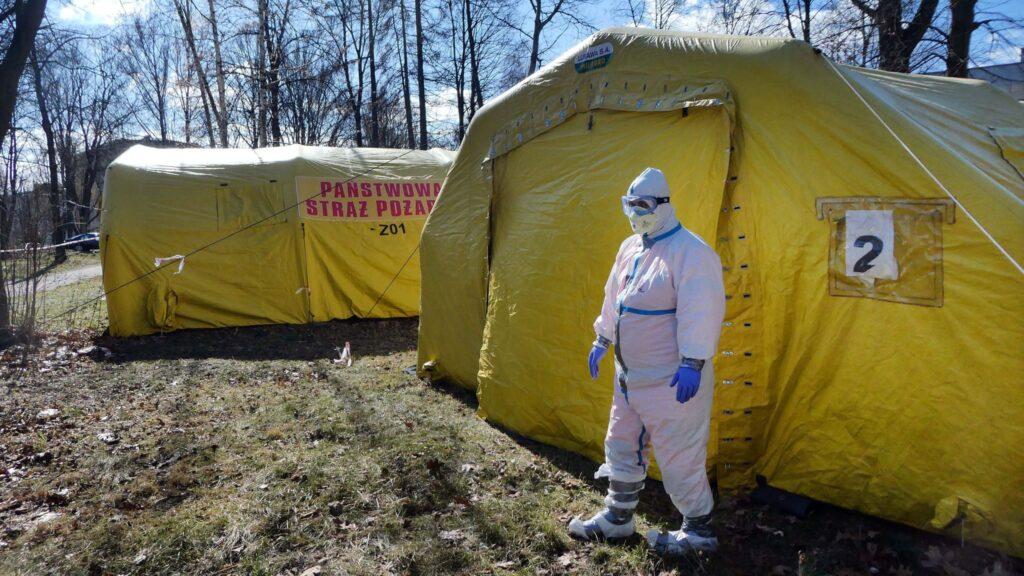
A medical official outside an emergency tent installed for patients infected by COVID-19 in Poland- Credit Sky News

Covid-19 is a flu-like illness (symptoms include fever, cough, and breathing problems) caused by a corona virus (SARS CoV-2). Like Ebola, the virus causing Covid-19 circulates within populations of bats and crossed over to humans via the bush meat trade. The first human cases were identified in China in December 2019, and the infection has now (March 2020) reached more than 100 countries.

The disease is now recognised by the World Health Organization as a pandemic. Up to 80 percent of the population of some countries might eventually become infected. Most cases will be mild, and recovery spontaneous. About 5 percent of cases will be life-threatening. Death rates appear to be around 1-2 percent. The elderly are most at risk.[1]

Currently, attention is focused on reducing the rate at which Covid-19 spreads. One aim is to delay the peak of infection beyond the winter flu period in the northern hemisphere, when medical help is stretched. Slowing the epidemic also allows more time for preparation of health systems to cope with large numbers, and for work on vaccine development.

Predictably, some politicians have demanded border closures against immigrants and refugees, even though spread is associated with tourism and normal business travel. Africans internationally stigmatised by Ebola might feel aggrieved that cases of Covid-19 have been introduced from Europe and Asia. But in a globally connected and inter-dependent world blaming and stigmatising helps no one. It is better to share ideas about what can be done to protect.

This is where Africa’s experience of Ebola has something to offer. Communities experiencing Ebola in West Africa in 2014-15 rapidly learnt from scratch how to cope with a deadly new infection, and this provides the rest of the world with important information on strategies to address novel disease threats more generally.

Like Ebola, Covid-19 is a family disease, in the sense that many infections occur in the home. Restrictions on travel can slow the spread of the disease, but it also helps if individuals and families understand infection pathways and implement domestic precautions. This is something in which West Africans confronted by Ebola have had much experience.

History of Pandemics – credit Virtual Capitalists

The name for Ebola in Mende, one of the main languages of Sierra Leone, the worst affected country in 2014-15, was bonda wote, literally ‘family turn round’. In other words, it was clearly recognised that this was a disease requiring families to change behaviour in major ways, especially in how they cared for the sick.

Covid-19 will require similar changes at the family level, especially in terms of how the elderly are protected. The buzz words for epidemic responders include self-isolation and social distancing, but the details of how to implement these vague concepts have been left to local social imagination.

Answers are required for both the uninfected elderly, and for others who are sick.

Should grandpa be packed off to a shed in the garden away from the family for his own protection? What happens when grandma gets lonely and wants to see the grandchildren? Who does the shopping? How does the daily-paid worker ‘self-isolate’ when there is no sick pay? Who collects the children from school when a single mum is sick?

Much depends on actual family arrangements and housing stock. So African solutions for Ebola will not work directly in other parts of the world. But it is important to know that under the challenge of Ebola local people showed much inventiveness in devising solutions to such problems.

Evidence shows that ways can be found to reduce family risks of infection, even with a disease 30 times more deadly than Covid-19.[2]For Ebola, these ranged from the elbow knock that replaced shaking of hands as a public greeting, to the appointment of a single carer in the household to look after the sick while waiting for help, to the carefully choreographed ‘safe and respectful’ funerals that allowed some element of local ritual back into the burial process, a major source of infection.

Every encouragement should be given to this local adaptive creativity, and the authorities should listen carefully to information from below about what would help to make a difference.

However, Covid-19 is not Ebola, and differences have to be taken into account. Some of the major questions about how the disease spreads are as yet unknown, and citizens and households need to be listening for this information as it becomes available and helped to adapt to its implications in real time.

This implies having very good means of two-way communication. In Sierra Leone a telephone helpline, ‘117’, played an important part in arranging emergency Ebola response, but it was much poorer at harvesting feedback from communities about what could be done better.

It seems that the lesson has not been learnt with Covid-19. In Britain, the National Health Service helpline, ‘111’ has now been ‘stood down’ for Covid-19 enquiries relating to domestic testing, since the epidemic is deemed to have passed into a new phase. How then are the authorities to have a conversation with families about the resources most needed for adaptation at household level?

Case-handling is a second area of difference. Ebola does not spread easily. The virologist Peter Piot put it well when he stated that he would have no problem sitting next to someone with Ebola provided they were not vomiting over him. Infection spreads only through contact with body fluids. Covid-19, however, spreads through the air, as well as via bodily contact, and case numbers will be much higher.

With Ebola in West Africa the number of cases turning up at specialist Ebola care facilities at the height of the epidemic numbered in tens or hundreds per week. With Covid-19 the numbers of cases requiring intensive care at the peak of the epidemic may amount to hundreds of thousands.

Even if stretched out over several months infection on this scale implies a large extra demand for medical care.

Ebola taught that epidemics cause deaths from other diseases through their impact on health systems. In all there were about 12,000 Ebola deaths in Upper West Africa (Guinea, Liberia, Sierra Leone) in 2014-15 but many additional fatalities resulted from, for example, closure of facilities such as maternity clinics.

So contingency planning is required. A key challenge for Covid-19 is how health system care should best be organized, without severely disrupting other forms of health provision.

For Ebola, the first response was to build large field hospitals (Ebola Treatment Centres).[3]These were seen as the safest option. But they were shunned by families, because so few patients came out alive. They were also often in the wrong place (built behind, not ahead, of the epidemic).

Information started to filter through that some communities were taking their own steps to reduce infection and bury the dead. This raised the question whether there was more scope for community care.

Family do-it-yourself responses proved controversial. International responders were adamant that there would be nothing resembling home care; it was too dangerous. Local communities were equally adamant that there would have to be some form of home care; they could not stand by and watch family members die, when an ambulance to take a patient to an ETC might take days to arrive over bad or non-existent roads.

Families saw it as their duty to be involved in care of the sick. So, they repeatedly asked what to do while waiting for help to arrive. Could they not prepare food for the sick? Could they not be trained to safely bury the dead?

No, they were told. Ebola required specialist management.

Communities answered back. They pointed to areas at the outset of the epidemic, where the epidemic was rolled back with only local resources. In Kailahun District, for example, an intense initial outbreak was reduced to a trickle of cases by local responders organizing quarantine and burial with improvised resources. That cases then declined without outside help implied either that the disease burnt out more readily than anticipated, or that local improvisation worked better than expected. There is evidence to support both interpretations.[4]

Experts knew that Ebola control required prompt diagnosis, before the ‘wet’ symptoms of the disease became apparent. Something had to be done to speed up the presentation of cases. The answer was to build much smaller community care centres (CCC) close to where active transmission was taking place.[5]This also changed the relationship between families and Ebola responders from fear to active cooperation.

Staff of CCC were for the most part local volunteers – trained nurses who had not been absorbed on to the payroll of the Ministry of Health, or villagers willing to take on high-risk chores for a decent wage. The fact that staffing was local meant patients saw familiar faces, and this built trust. CCC also normalized Ebola by bringing treatment within a framework of general medical assistance.

As a result, patients were presented more promptly than was the case with the distant ETC. Ebola (indistinguishable from malaria or typhoid in its early phase) was more rapidly identified and isolated. One study estimates that CCC contributed up to one third of the infection control ending the epidemic in Sierra Leone.[6]

This example of responders modifying their approach to infection control better to accommodate family requirements may hold lessons for Covid-19.

Specifically, cases may have to be kept out of main hospitals as much as possible, Thus, there may be a need for field treatment facilities not dissimilar to CCC, as a half-way house between home isolation and intensive care. In effect these facilities would isolate and triage the most vulnerable cases, as was the case with Ebola CCC.

There is also a possibility that any such facilities might be run up by military personnel[7]and staffed by medically trained ‘volunteers’ (retired doctors and nurses), as in Sierra Leone.

Interesting to note, the chief medical advisor for England was previously one of the proponents of the introduction of CCC in Sierra Leone, and we may be about to see some lessons directly transferred.[8]

Quarantine for Ebola in Sierra Leone is also an issue from which Covid-19 responders might wish to draw lessons. Much of it was organised and imposed by the state, and was at times heavy-handed. But communities also organised their own quarantine. They understood that self-isolation was in their own interest, and this sometimes worked surprisingly effectively.

Use was made of an approach used during the civil war of 1991-2002 of mobilising community youth to identify infiltrators. Visitors who might have been carrying the virus were turned away. But in other cases the approach was more focused on sequestering those who were well. Rural families sometimes decamped from villages with outbreaks to settle down for a few weeks in their farms, where sleeping quarters were sometimes built for the purpose.

In this respect, Sierra Leonean rural communities showed a clear appreciation of the fact that there were two distinct kinds of quarantine – self-isolation and protective sequestration. Both kinds are being used as part of the response to Covid-19, but at times without adequate discussion of how the two types differ and have different social motivations – self-protection and altruism towards neighbours. It is not wise to talk about self-isolation for the sick and the elderly in the same breath. The different motivations need to be more clearly explained.

In conclusion, it is also important to say something about what Africa can learn from its own experience of Ebola. The point made above should be reiterated – about the differences as well as similarities between Covid-19 and Ebola.

Prompt case finding, contact tracing and quarantine are being applied to Covid-19 as they were for Ebola.[9]Good hygiene practices, such as hand washing, also remain applicable. African countries with experience of Ebola know how to do these things, and this will be helpful in dealing with early cases.

However, African countries also have to be prepared to learn to adapt to the specific features of this new disease as more data emerge. This will pose more of a challenge, since this will require rapid knowledge-based domestic adaptation to new information on how Covid-19 spreads (perhaps most notably, why it affects the old more than the young, and how older people might be best protected from its effects).

The main lesson for both Africa and other parts of the world from Ebola for Covid-19, however, is that shared learning between communities and medical professionals is a key aspect of human adaptive response to emergent diseases. In any disease in which community mobilization is an important aspect families need to think like epidemiologists, but equally epidemiologists need to think like families.

Paul Richards’ Ebola book front cover, part of the African Arguments book series

References:

[1]Xu, J., Zhao, S., Teng T., Abdalla, A.E., Zhu, W., Xie, L., Wang, Y., Guo, X. (2020) ‘Systematic comparison of two animal-to-human transmitted human coronaviruses: SARS-CoV-2 and SARS-CoV’, Viruses 12, 244.

[2]Richards, P. (2016) Ebola: How a People’s Science Helped End an Epidemic, London: Zed Books.

[3]Richards, P., Mokuwa, E., Welmers, P., Maat, H., Beisel, U. (2019) ‘Trust, and distrust, of Ebola Treatment Centers: a case-study from Sierra Leone’, PLoS ONE14(12): e0224511. https://doi.org/10.1371/journal.pone.0224511.

[4]Glynn, Judith R. et al. (2017) ‘Asymptomatic infection and unrecognised Ebola virus disease in Ebola-affected households in Sierra Leone: a cross-sectional study using a new non-invasive assay for antibodies to Ebola virus’,Lancet Infectious Diseases17(6), 645-653. On local case finding, quarantine and burial procedures see Richards (2016) op. cit.

[5]Mokuwa, E.Y., Maat, H. (2020) ‘Rural populations exposed to Ebola Virus Disease respond positively to localised case handling: evidence from Sierra Leone’, PLoS Negl Trop Dis 14(1): e0007666. https://doi.org/10.1371/journal.pntd.0007666.

[6]Pronyk, P., Rogers, B., Lee, S., Bhatnagar, A., Wolman, Y., Monasch, R., Hipgrave, D., Salama, P., Kucharski, A., Chopra, M., and on behalf of the UNICEF Sierra Leone Ebola Response Team, (2016) ‘The effect of community-based prevention and care on Ebola transmission in Sierra Leone’,American Journal of Public Health 106, 727–32, https://doi.org/10.2105/AJPH.2015.303020.

[7]Aaaron Walawalkar and Jamie Grierson, The Guardian,8 March 2020, 14.12 GMT.

[8]Whitty, C.J.M., Farrar, J., Ferguson, N., Edmunds, W.J., Piot, P., Leach, M., Davies, S.C. (2014) ‘Tough choices to reduce Ebola transmission’, Nature515, 13 November, 192–4; see also Ian Sample and Lisa O’Carroll ‘Prof Chris Whitty – the expert we need in the coronavirus crisis’, Guardian,4 March 2020.

[9]Hellewell, J. et al. (2020) ‘Feasibility of controlling Covid-19 outbreaks by isolation of cases and contacts’, Lancet, 28 February 2020, https://doi.org/10.1016/S2214-109X(20)30074-7.


The Coronavirus Called America’s Bluff (The Atlantic)

Like Japan in the mid-1800s, the United States now faces a crisis that disproves everything the country believes about itself. March 15, 2020

Anne Applebaum Staff writer at The Atlantic

A coronavirus patient in quarantine
Jason Redmond / Reuters

On July 8, 1853, Commodore Matthew Perry of the U.S. Navy sailed into Tokyo Bay with two steamships and two sailing vessels under his command. He landed a squadron of heavily armed sailors and marines; he moved one of the ships ostentatiously up the harbor, so that more people could see it. He delivered a letter from President Millard Fillmore demanding that the Japanese open up their ports to American trade. As they left, Perry’s fleets fired their guns into the ether. In the port, people were terrified: “It sounded like distant thunder,” a contemporary diarist wrote at the time, “and the mountains echoed back the noise of the shots. This was so formidable that the people in Edo [modern Tokyo] were fearful.”

This is the story of an unnatural disaster.

But the noise was not the only thing that frightened the Japanese. The Perry expedition famously convinced them that their political system was incapable of coping with new kinds of threats. Secure in their island homeland, the rulers of Japan had been convinced for decades of their cultural superiority. Japan was unique, special, the homeland of the gods. “Japan’s position, at the vertex of the earth, makes it the standard for the nations of the world,” the nationalist thinker Aizawa Seishisai wrote nearly three decades before Perry’s arrival. But the steamships and the guns changed all that. Suddenly, the Japanese realized that their culture, their political system, and their technology were out of date. Their samurai-warrior leaders and honor culture were not able to compete in a world dominated by science.

The coronavirus pandemic is in its early days. But the scale and force of the economic and medical crisis that is about to hit the United States may turn out to be as formidable as Perry’s famous voyage was. Two weeks ago—it already seems like an infinity—I was in Italy, writing about the first signs of the virus. Epidemics, I wrote, “have a way of revealing underlying truths about the societies they impact.” This one has already done so, and with terrifying speed. What it reveals about the United States—not just this administration, but also our health-care system, our bureaucracy, our political system itself—should make Americans as fearful as the Japanese who heard the “distant thunder” of Perry’s guns.

Not everybody has yet realized this, and indeed, it will take some time, just as it has taken time for the nature of the virus to sink in. At the moment, many Americans are still convinced that, even in this crisis, our society is more capable than others. Quite a lot was written about the terrifying and reckless behavior of the authorities in Wuhan, China, who initially threatened doctors who began posting information about the new virus, forcing them into silence.

On the very day that one of those doctors, Li Wenliang, contracted the virus, the Wuhan Municipal Health Commission issued a statement declaring,“So far no infection [has been] found among medical staff, no proof of human-to-human transmission.” Only three weeks after the initial reports were posted did authorities begin to take the spread of the disease seriously, confirming that human-to-human transmission had in fact occurred. And only three days later did the lockdown of the city, and eventually the entire province, actually begin.

This story has been told repeatedly—and correctly—as an illustration of what’s wrong with the Chinese system: The secrecy and mania for control inside the Communist Party lost the government many days during which it could have put a better plan into place. But many of those recounting China’s missteps have become just a little bit too smug.

The United States also had an early warning of the new virus—but it, too, suppressed that information. In late January, just as instances of COVID-19, the disease caused by the coronavirus, began to appear in the United States, an infectious-disease specialist in Seattle, Helen Y. Chu, realized that she had a way to monitor its presence. She had been collecting nasal swabs from people in and around Seattle as part of a flu study, and proposed checking them for the new virus. State and federal officials rejected that idea, citing privacy concerns and throwing up bureaucratic obstacles related to lab licenses.

Finally, at the end of February, Chu could stand the intransigence no longer. Her lab performed some tests and found the coronavirus in a local teenager who had not traveled overseas. That meant the disease was already spreading in the Seattle region among people who had never been abroad. If Chu had found this information a month earlier, lives might have been saved and the spread of the disease might have slowed—but even after the urgency of her work became evident, her lab was told to stop testing.

Chu was not threatened by the government, like Li had been in Wuhan. But she was just as effectively silenced by a rule-bound bureaucracy that was insufficiently worried about the pandemic—and by officials at the Food and Drug Administration and the Centers for Disease Control and Prevention who may even have felt political pressure not to take this disease as seriously as they should.

For Chu was not alone. We all now know that COVID-19 diagnostic tests are in scarce supply. South Korea, which has had exactly the same amount of time as the U.S. to prepare, is capable of administering 10,000 tests every day. The United States, with a population more than six times larger, had only tested about 10,000 people in total as of Friday. Vietnam, a poor country, has tested more people than the United States. During congressional testimony on Thursday, Anthony Fauci, the most distinguished infectious-disease doctor in the nation, described the American testing system as “failing.” “The idea of anybody getting [tested] easily the way people in other countries are doing it? We’re not set up for that,” he said. “Do I think we should be? Yes, but we’re not.”

And why not? Once again, no officials from the Chinese Communist Party instructed anyone in the United States not to carry out testing. Nobody prevented American public officials from ordering the immediate production of a massive number of tests. Nevertheless, they did not. We don’t know all the details yet, but one element of the situation cannot be denied: The president himself did not want the disease talked of too widely, did not want knowledge of it to spread, and, above all, did not want the numbers of those infected to appear too high. He said so himself, while explaining why he didn’t want a cruise ship full of infected Americans to dock in California. “I like the numbers being where they are,” he said. “I don’t need to have the numbers double because of one ship that wasn’t our fault.”

Donald Trump, just like the officials in Wuhan, was concerned about the numbers—the optics of how a pandemic looks. And everybody around him knew it. There are some indications that Alex Azar, the former pharmaceutical-industry executive and lobbyist who heads the Department of Health and Human Services, was not keen on telling the president things he did not want to hear. Here is how Dan Diamond, a Politico reporter who writes about health policy, delicately described the problem in a radio interview: “My understanding is [that Azar] did not push to do aggressive additional testing in recent weeks, and that’s partly because more testing might have led to more cases being discovered of coronavirus outbreak, and the president had made clear—the lower the numbers on coronavirus, the better for the president, the better for his potential reelection this fall.”

Once again: Nobody threatened Azar. But fear of offending the president may have led him to hesitate to push for aggressive testing nevertheless.

Without the threats and violence of the Chinese system, in other words, we have the same results: scientists not allowed to do their job; public-health officials not pushing for aggressive testing; preparedness delayed, all because too many people feared that it might damage the political prospects of the leader. I am not writing this in order to praise Chinese communism—far from it. I am writing this so that Americans understand that our government is producing some of the same outcomes as Chinese communism. This means that our political system is in far, far worse shape than we have hitherto understood.

What if it turns out, as it almost certainly will, that other nations are far better than we are at coping with this kind of catastrophe? Look at Singapore, which immediately created an app that could physically track everyone who was quarantined, and that energetically tracked down all the contacts of everyone identified to have the disease. Look at South Korea, with its proven testing ability. Look at Germany, where Chancellor Angela Merkel managed to speak honestly and openly about the disease—she predicted that 70 percent of Germans would get it—and yet did not crash the markets.

The United States, long accustomed to thinking of itself as the best, most efficient, and most technologically advanced society in the world, is about to be proved an unclothed emperor. When human life is in peril, we are not as good as Singapore, as South Korea, as Germany. And the problem is not that we are behind technologically, as the Japanese were in 1853. The problem is that American bureaucracies, and the antiquated, hidebound, unloved federal government of which they are part, are no longer up to the job of coping with the kinds of challenges that face us in the 21st century. Global pandemics, cyberwarfare, information warfare—these are threats that require highly motivated, highly educated bureaucrats; a national health-care system that covers the entire population; public schools that train students to think both deeply and flexibly; and much more.

The failures of the moment can be partly ascribed to the loyalty culture that Trump himself has spent three years building in Washington. Only two weeks ago, he named his 29-year-old former bodyguard, a man who was previously fired from the White House for financial shenanigans, to head up a new personnel-vetting team. Its role is to ensure that only people certifiably loyal are allowed to work for the president. Trump also fired, ostentatiously, the officials who testified honestly during the impeachment hearings, an action that sends a signal to others about the danger of truth-telling.

These are only the most recent manifestations of an autocratic style that has been described, over and over again, by many people. And now we see why, exactly, that style is so dangerous, and why previous American presidents, of both political parties, have operated much differently. Within a loyalty cult, no one will tell the president that starting widespread emergency testing would be prudent, because anyone who does is at risk of losing the president’s favor, even of being fired. Not that it matters, because Trump has very few truth-tellers around him anymore. The kinds of people who would dare make the president angry have left the upper ranks of the Cabinet and the bureaucracy already.

But some of what we are seeing is unrelated to Trump. American dysfunction is also the result of our bifurcated health-care system, which is both the best in the world and the worst in the world, and is simply not geared up for any kind of collective national response. The present crisis is the result of decades of underinvestment in civil service, of undervaluing bureaucracy in public health and other areas, and, above all, of underrating the value of long-term planning.

Back from 2001 to 2003, I wrote multiple editorials for The Washington Post about biological warfare and pandemic preparedness—issues that were at the top of everyone’s agenda in the wake of 9/11 and the brief anthrax scare. At the time, some very big investments were made into precisely those issues, especially into scientific research. We will now benefit from them. But in recent years, the subjects fell out of the news. Senators, among them the vaunted Republican moderate Susan Collins of Maine, knocked “pandemic preparedness” out of spending bills. New flu epidemics didn’t scare people enough. More recently, Trump eliminated the officials responsible for international health from the National Security Council because this kind of subject didn’t interest him—or very many other people in Washington, really.

As a nation, we are not good at long-term planning, and no wonder: Our political system insists that every president be allowed to appoint thousands of new officials, including the kinds of officials who think about pandemics. Why is that necessary? Why can’t expertise be allowed to accumulate at the highest levels of agencies such as the CDC? I’ve written before about the problem of discontinuity in foreign policy: New presidents arrive and think they can have a “reset” with other nations, as if other nations are going to forget everything that happened before their arrival—as if we can cheerfully start all relationships from scratch. But the same is true on health, the environment, and other policy issues. Of course there should be new Cabinet members every four or eight years. But should all their deputies change? And their deputies’ deputies? And their deputies’ deputies’ deputies? Because that’s often how it works right now.

All of this happens on top of all the other familiar pathologies: the profound polarization; the merger of politics and entertainment; the loss of faith in democratic institutions; the blind eyes turned to corruption, white-collar crime, and money laundering; the growth of inequality; the conversion of social media and a part of the news media into for-profit vectors of disinformation. These are all part of the deep background to this crisis too.

The question, of course, is whether this crisis will shock us enough to change our ways. The Japanese did eventually react to Commodore Perry’s squadron of ships with something more than fear. They stopped talking about themselves as the vertex of the Earth. They overhauled their education system. They adopted Western scientific methods, reorganized their state, and created a modern bureaucracy. This massive change, known as the Meiji Restoration, is what brought Japan, for better or for worse, into the modern world. Naturally, the old samurai-warrior class fought back against it, bitterly and angrily.

But by then the new threat was so obvious that enough people got it, enough people understood that a national mobilization was necessary, enough people understood that things could not go on that way indefinitely. Could it happen here, too?

Anne Applebaum is a staff writer at The Atlantic. She is a senior fellow of the Agora Institute at Johns Hopkins University. Her latest book is Red Famine: Stalin’s War on Ukraine.

“A Time to Rethink America”: Sanders Sets Tone at Coronavirus Debate (Truthout)

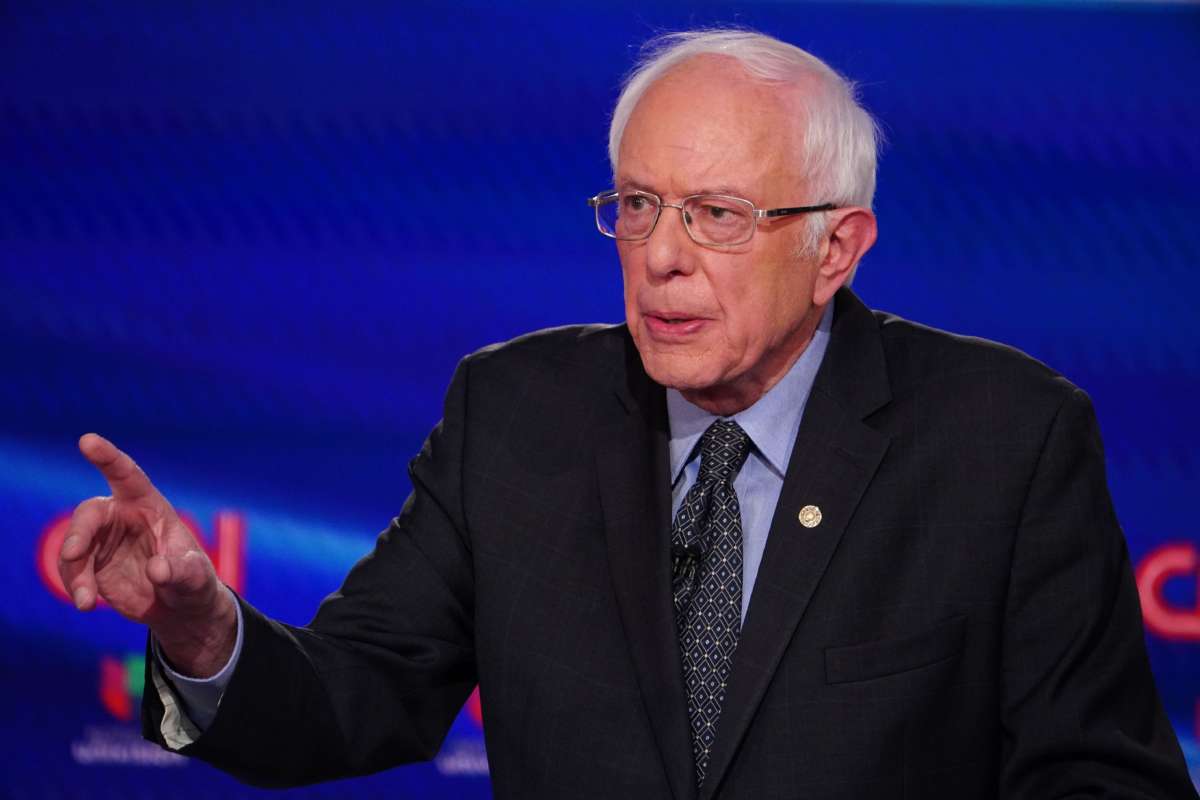
Bernie Sanders speaks in front of a blue screen bearing CNN's logo
Democratic presidential hopeful Sen. Bernie Sanders takes part in the 11th Democratic Party 2020 presidential debate in a CNN Washington Bureau studio in Washington, D.C., on March 15, 2020.

By William Rivers Pitt, Truthout

Published March 16, 2020

The final Democratic presidential debate of 2020 was a dispiriting affair for reasons that went far beyond the politics of it. The specter of COVID-19 lent a stark gloominess to the occasion, as did the seeming emptiness of the room itself: three CNN moderators, two men and the cameras. I never thought I’d miss a debate audience, but the energy was gone from that room, and the brightly lit set could not make up for it.

And then there’s this: “The Centers for Disease Control and Prevention recommended that events of 50 people or more not be held for about two months,” Bloomberg News reported on Sunday. “For the next eight weeks, organizers should cancel or postpone in-person events of that size throughout the U.S.”

Primaries are scheduled to be held on Tuesday in Arizona, Ohio, Illinois and Florida. These contests were set to be decisive before the CDC’s recommendation — if Joe Biden wins them all, his delegate lead over Bernie Sanders would become all but insurmountable — and may be all the more so now. These four primaries could be the last of the season. Georgia has postponed its primary, which was slated for next Tuesday, and Louisiana’s April 4 primary has likewise been delayed.

It’s quite simple: If we are listening to the CDC’s recommendations, the remaining primaries will probably be put on hold at some point, either until this thing burns itself out, or altogether depending on the circumstances. The primaries this Tuesday may happen, or they may not, but no one should be surprised if they are the last ones for a long while.

“Election dates are very, very important. We don’t want to be getting into the habit of messing around with them,” Sanders told CNN’s Anderson Cooper in a post-debate interview. “I would hope that governors listen to the public health experts, and what they are saying is … ‘We don’t want gatherings of more than 50 people.’ I’m thinking about some of the elderly people sitting behind the desks registering people to enroll, that stuff. Does that make a lot of sense? I’m not sure that it does.”

A cancelled primary election season would be the worst of all possible outcomes, and not just because Joe Biden would basically become the Democratic nominee by default. We do elections in this country, because if we don’t, we have lost all semblance of democracy. That all-important sentiment falls to ashes in the face of the coronavirus, which has the potential to lay waste to the nation’s older and immunocompromised population if not contained.

Authorities not named Donald Trump have been warning us this situation would bring sweeping changes to our lives, and they haven’t been wrong. A shortened 2020 Democratic nomination process may soon become part of that change, so the ability of either candidate to increase their nomination chances felt blunted by the same circumstances that led them to debate each other in that bright, empty room.

Joe Biden is fortunate that Bernie Sanders was feeling conciliatory under the circumstances, because Biden lied, lied and lied throughout the evening.

Sanders was strong throughout, opening the evening with a broadside against Wall Street and the wealthy, who were taken care of by the Federal Reserve in fine style on Friday. The Fed conjured $1.5 trillion in magic money and dumped it into the banking system so businesses can still borrow without breaking themselves financially. By the end of the weekend, the interest rate had been cut to basically zero.

“Bottom line from an economic point of view,” said Sanders, “what we have got to say to the American people, if you lose your job, you will be made whole. You’re not going to lose income. If Trump can put, or the fed can put a trillion and a half into the banking system, we can protect the wages of every worker in America.”

Biden, for his part, came into the evening looking to survive without damaging himself too badly. In this, he had help from an unlikely source: his opponent. While Sanders repeatedly sought to hold Biden’s feet to the fire on various aspects of the former vice president’s voting record, it became clear early on that Sanders was not out for blood.

“I know your heart is in the right place,” Sanders said to Biden on more than one occasion, a rhetorical fig leaf intended to convey the sense that Trump is the main enemy, and these two presidential candidates share many areas of common ground. “We talk about the Green New Deal and all of these things in general terms,” said Sanders toward the end of the first hour, “but details make a difference.”

Joe Biden is fortunate that Bernie Sanders was feeling conciliatory under the circumstances, and more fortunate the CNN moderators appeared unwilling to do their jobs, because Biden lied, lied and lied again throughout the evening. When tasked to defend his serially gruesome legislative record, Biden sailed off into the land of self-serving fantasy so often that #LyinBiden and #LyingJoe were top trends on Twitter all night long.

Biden has been lying about his stance on Social Security for months now, but found a whole new gear last night. He lied straight into the camera about statements he has made and votes he has cast, as if he’d forgotten that the internet exists and such brazen bullshit artistry doesn’t fly so well anymore.

Biden was similarly slippery on his support of the bankruptcy bill, on the Hyde Amendment and reproductive rights, on his vote for the Iraq War, on the Defense of Marriage Act, and on any and all areas where his record fails to meet the standard Sanders set simply by being in the room. One of the two candidates last night spent the last 30 years being right on the signal issues of the day, and it showed.

“A time to rethink America,” indeed.

“The fact is that the idea that I in fact supported the things that you suggested is not accurate,” was a typical Biden response to Sanders throughout the evening. The CNN moderators didn’t bother trying to call Biden on his loose relationship with the truth, but Sanders persistently did so.

Biden’s most newsworthy moment of the evening came when he flatly declared that he would select a woman to serve as his vice president. “I commit that I’ll pick a woman to be vice president,” said Biden. “There are a number of women who are qualified to be president tomorrow, I would pick a woman to be my vice president.”

This was, among other things, Joe Biden paying a debt to Rep. Jim Clyburn, whose endorsement before the South Carolina primary resurrected Biden’s moribund campaign. Clyburn has made it clear that he wants Biden to select a woman for a running mate, and preferably a Black woman. Biden’s announcement last night was a “Yes, sir” telegraphed to the House majority whip via live television broadcast.

For Sanders, this debate was perhaps his last, best opportunity to make the case for his vision for the presidency as clearly as possible. As usual, he did not disappoint:

In this moment of economic uncertainty, in addition to the coronavirus, it is time to ask how we get to where we are, not only our lack of preparation for the virus, but how we end up with an economy, with so many about people are hurting at a time of massive income and wealth inequality. It is time to ask the question of where the power is in America. Who owns the media? Who owns the economy? Who owns the legislative process? Why do we give tax breaks to billionaires and not raise the minimum wage?

Why do we pump up the oil industry while a half a million people are homeless in America? This is the time to move aggressively, dealing with the coronavirus crisis, to deal with the economic fallout, but it’s also a time to rethink America, and create a country where we care about each other, rather than a nation of greed and corruption, which is what is taking place among the corporate elite.

“A time to rethink America,” indeed. A great many sacred cows — most especially capitalism and its deleterious effect on health care — are on their way to the coronavirus slaughterhouse. Whether or not we proceed with the remaining primaries, we will be other than what we are as a nation when we come out the far side of this. Bernie Sanders told us as much last night, just as he has for the full term of his public life. If and how we heed him, finally, will be up to us in the end.

William Rivers Pitt is a senior editor and lead columnist at Truthout. He is also a New York Times and internationally bestselling author of three books: War on Iraq: What Team Bush Doesn’t Want You to Know, The Greatest Sedition Is Silence and House of Ill Repute: Reflections on War, Lies, and America’s Ravaged Reputation. His fourth book, The Mass Destruction of Iraq: Why It Is Happening, and Who Is Responsible, co-written with Dahr Jamail, is available now on Amazon. He lives and works in New Hampshire.

Coronavírus e as quebradas: 16 perguntas ainda sem resposta sobre impacto da pandemia nas periferias (Periferia em Movimento)

Publicado porThiago Borges –

Precisamos falar sobre o novo coronavírus, mas sem pânico.

Nesta quinta-feira (12/03), o Brasil acordou com 52 pessoas infectadas pelo coronavírus e foi dormir com 69 casos confirmados. Em todo o mundo, são 122 mil casos confirmados e mais de 4.500 mortes registradas. A Organização Mundial da Saúde (OMS) declarou pandemia, isto é, o vírus deixou de ser restrito determinadas regiões e passa a ser uma questão de saúde pública global.

A taxa de mortalidade do novo vírus, ainda sem vacina, é considerada baixa – em torno de 3% dos casos – e atinge principalmente pessoas com maior vulnerabilidade, como idosos ou com doenças pré-existentes (como diabetes, câncer, etc.).

Com mais de 50 casos no País, o Ministério da Saúde do governo de Jair Bolsonaro alerta que a transmissão deve se dar de forma geométrica – isto é, deixa de ser restrita a pessoas que se infectaram em outras regiões do mundo e passa a acontecer no próprio território.

Segundo o Instituto Pensi do Hospital Infantil Sabará, após atingir 50 casos confirmados o total de infectados no Brasil pode aumentar para 4.000 casos em 15 dias e cerca de 30.000 depois de 21 dias.

Com isso, o vírus deve se expandir rapidamente nas próximas semanas e o Sistema Único de Saúde (SUS) precisaria de 3.200 novos leitos em UTI (Unidade de Terapia Intensiva) para dar conta da demanda – 95% dos 16.000 leitos de hoje já estão ocupados.

Dito isso, nós moradoras e moradores de periferias urbanas, povos da floresta e marginalizados em geral, precisamos nos atentar com as medidas de prevenção (confira no gráfico abaixo) mas também com efeitos colaterais dessa pandemia no nosso dia a dia.

Muito se fala no impacto da pandemia sobre a economia global. Mas em um País marcado por desigualdade social, machismo, racismo e LGBTfobia, com cortes em políticas públicas e desemprego recorde, o coronavírus tem potencial de impactar não apenas nossa saúde como também nossa frágil convivência em sociedade. Precisamos de solidariedade e vigilância nesse momento.

Por isso, a Periferia em Movimento faz 16 perguntas ainda sem resposta (a lista continua em atualização) sobre esse novo cenário:

1. As periferias vão receber recursos da saúde de forma proporcional às nossas necessidades?

2. O governo vai adotar medidas de confinamento ou restrição de circulação de pessoas?

3. Como fazer quarentena em área de aglomeração, como periferias e favelas?

4. Os governantes vão acionar a Polícia Militar pra controlar a população nas periferias?

5. Se rolar quarentena, quem vai dirigir os ônibus, fazer o pão de cada dia e entregar a comida do ifood no apartamento da classe média?

6. Com o desemprego recorde e o mercado informal em alta, pessoas que vivem de bico vão conseguir fazer dinheiro como?

7. Se as aulas forem suspensas, com quem ficarão as crianças que frequentam creches em período integral?

8. Sem aulas, sem merenda: estudantes em situação de insegurança alimentar vão passar fome se não forem pra escola?

9. Ainda sobre a suspensão das aulas, qual é o risco da explosão de casos de violência sexual contra crianças e adolescentes – que passarão mais tempo em casa?

10. O maior tempo em casa também aumenta o risco de mulheres sofrerem violência de seus companheiros?

11. E com mais pessoas com circulação restrita, o risco de conflitos em comunidades também aumenta?

12. Como os governantes avaliam as possibilidades de aumento em todos os tipos de violência com essa pandemia?

13. Como idosos em situação de vulnerabilidade serão assistidos pelo governo?

14. De que forma, a pandemia deve impactar a população em situação de rua?

15. Como ficam os presidiários, que já vivem em situações de aglomeração, tortura e com doenças que estão controladas no mundo externo?

16. E como serão atendidos os indígenas, que necessitam de estratégias específicas de saúde devido à menor imunidade a doenças transmitidas desde a invasão europeia ao continente americano?

Esta imagem possuí um atributo alt vazio; O nome do arquivo é catarse_-pem-_-stories.jpg

Seja assinante e contribua!

ARTIGO: Pandemia de coronavírus é um teste de nossos sistemas, valores e humanidade (Nações Unidas Brasil)

Publicado em 13/03/2020. Atualizado em 13/03/2020

Em artigo publicado na imprensa internacional, a alta-comissária da ONU para direitos humanos, Michelle Bachelet, e o alto-comissário da ONU para refugiados, Filippo Grandi, afirmam que a doença provocada pelo novo coronavírus, a Covid-19, é um teste não apenas de nossos sistemas e mecanismos de assistência médica para responder a doenças infecciosas, mas também de nossa capacidade de trabalharmos juntos como uma comunidade de nações diante de um desafio comum.

“É um teste da cobertura dos benefícios de décadas de progresso social e econômico em relação aqueles que vivem à margem de nossas sociedades, mais distantes das alavancas do poder.”

Um jovem refugiado lava as mãos em Mafraq, na Jordânia, onde um sistema de aquecimento movido a energia solar, instalado com o apoio da IKEA Foundation e da Practical Action, ajuda a fornecer água quente. Foto: ACNUR/Hannah Maule-ffinch

Um jovem refugiado lava as mãos em Mafraq, na Jordânia, onde um sistema de aquecimento movido a energia solar, instalado com o apoio da IKEA Foundation e da Practical Action, ajuda a fornecer água quente. Foto: ACNUR/Hannah Maule-ffinch

Por Michelle Bachelet e Filippo Grandi*

Se nós precisávamos lembrar que vivemos em um mundo interconectado, o novo coronavírus tornou isso mais claro do que nunca.

Nenhum país pode resolver esse problema sozinho, e nenhuma parcela de nossa sociedade pode ser desconsiderada se quisermos efetivamente enfrentar este desafio global.

O Covid-19 é um teste não apenas de nossos sistemas e mecanismos de assistência médica para responder a doenças infecciosas, mas também de nossa capacidade de trabalharmos juntos como uma comunidade de nações diante de um desafio comum.

É um teste da cobertura dos benefícios de décadas de progresso social e econômico em relação aqueles que vivem à margem de nossas sociedades, mais distantes das alavancas do poder.

As próximas semanas e meses desafiarão o planejamento nacional de crises e os sistemas de proteção civil — e certamente irão expor deficiências em saneamento, habitação e outros fatores que moldam os resultados de saúde.

Nossa resposta a essa epidemia deve abranger e focar, de fato, naqueles a quem a sociedade negligencia ou rebaixa a um status menor. Caso contrário, ela falhará.

A saúde de todas as pessoas está ligada à saúde dos membros mais marginalizados da comunidade. Prevenir a disseminação desse vírus requer alcance a todos e garantia de acesso equitativo ao tratamento.

Isso significa superar as barreiras existentes para cuidados de saúde acessíveis e combater o tratamento diferenciado há muito tempo baseado em renda, gênero, geografia, raça e etnia, religião ou status social.

Superar paradigmas sistêmicos que ignoram os direitos e as necessidades de mulheres e meninas ou, por exemplo, limitar o acesso e a participação de grupos minoritários será crucial para a prevenção e tratamento eficazes do COVID-19.

As pessoas que vivem em instituições — idosos ou detidos — provavelmente são mais vulneráveis ​​à infecção e devem ser especificamente incluídas no planejamento e resposta à crise.

Migrantes e refugiados — independentemente de seu status formal — devem ser plenamente incluídos nos sistemas e planos nacionais de combate ao vírus. Muitas dessas mulheres, homens e crianças se encontram em locais onde os serviços de saúde estão sobrecarregados ou inacessíveis.

Eles podem estar confinados em abrigos, assentamentos, ou vivendo em favelas urbanas onde a superlotação e o saneamento com poucos recursos aumentam o risco de exposição.

O apoio internacional é urgentemente necessário para ajudar os países anfitriões a intensificar os serviços — tanto para refugiados e migrantes quanto para as comunidades locais — e incluí-los nos acordos nacionais de vigilância, prevenção e resposta. Não fazer isso colocará em risco a saúde de todos — e o risco de aumentar a hostilidade e o estigma.

Também é vital que qualquer restrição nos controles das fronteiras, restrições de viagem ou limitações à liberdade de movimento não impeça as pessoas que possam estar fugindo da guerra ou perseguição de acessar a segurança e proteção.

Além desses desafios muito imediatos, o coronavírus também testará, sem dúvida, nossos princípios, valores e humanidade compartilhada.

Espalhando-se rapidamente pelo mundo, com a incerteza em torno do número de infecções e com uma vacina ainda a muitos meses de distância, o vírus está provocando ansiedade e medos profundos em indivíduos e sociedades.

Sem dúvida, algumas pessoas sem escrúpulos procurarão tirar vantagem disso, manipulando medos genuínos e aumentando as preocupações.

Quando o medo e a incerteza surgem, os bodes expiatórios nunca estão longe. Já vimos raiva e hostilidade dirigidas a algumas pessoas de origem do leste asiático.

Se continuar assim, o desejo de culpar e excluir poderá em breve se estender a outros grupos — minorias, marginalizados ou qualquer pessoa rotulada como “estrangeira”.

As pessoas em deslocamento, incluindo refugiados, podem ser particularmente alvo. No entanto, o próprio coronavírus não discrimina; os infectados até o momento incluem turistas, empresários internacionais e até ministros nacionais, que estão localizados em dezenas de países, abrangendo todos os continentes.

O pânico e a discriminação nunca resolveram uma crise. Os líderes políticos devem assumir a liderança, conquistando confiança através de informações transparentes e oportunas, trabalhando juntos para o bem comum e capacitando as pessoas a participar na proteção da saúde.

Ceder espaço a boatos, medos e histeria não apenas prejudicará a resposta, mas poderá ter implicações mais amplas para os direitos humanos e para o funcionamento de instituições democráticas responsáveis.

Atualmente, nenhum país pode se isolar do impacto do coronavírus, tanto no sentido literal quanto econômico e social, como demonstram as bolsas de valores e as escolas fechadas.

Uma resposta internacional que garanta que os países em desenvolvimento estejam equipados para diagnosticar, tratar e prevenir esta doença será crucial para proteger a saúde de bilhões de pessoas.

A Organização Mundial da Saúde (OMS) está fornecendo experiência, vigilância, sistemas, investigação de casos, rastreamento de contatos, pesquisa e desenvolvimento de vacinas. É a prova de que a solidariedade internacional e os sistemas multilaterais são mais vitais do que nunca.

A longo prazo, devemos acelerar o trabalho de construção de serviços de saúde pública equitativos e acessíveis. E a maneira como reagimos a essa crise agora, sem dúvida, moldará esses esforços nas próximas décadas.

Se nossa resposta ao coronavírus estiver fundamentada nos princípios de confiança pública, transparência, respeito e empatia pelos mais vulneráveis, não apenas defenderemos os direitos intrínsecos de todo ser humano; usaremos e criaremos as ferramentas mais eficazes para garantir que possamos superar essa crise e aprender lições para o futuro.

*Michelle Bachelet é a alta-comissária da ONU para direitos humanos. Filippo Grandi é o alto-comissário da ONU para refugiados. Este artigo foi originalmente publicado no site The Telegraph.

O coronavírus revela que éramos cegos e não sabíamos (El País)

Somente quando o vírus nos encerra em nossas casas e limita nossos movimentos percebemos como é triste a solidão forçada. Quando nos privam da cotidianidade nos sentimos escravos, porque o homem nasceu para ser livre

"Tudo ficará bem", diz um cartaz na varanda de um prédio de Torino ( Nicolò Campo/LightRocket via Getty Images).
“Tudo ficará bem”, diz um cartaz na varanda de um prédio de Torino ( Nicolò Campo/LightRocket via Getty Images).

Juan Arias – 14 mar 2020 – 18:49BRT

A imagem mais dramática e terna, que simboliza ao mesmo tempo a tristeza e a solidão do isolamento ao qual a loucura do coronavírus está nos arrastando, é a dos italianos, habitantes de um país da arte, do tato e da comunicação, que hoje cantam nas janelas das casas diante de ruas e praças vazias. Cantam para consolar os vizinhos encerrados em suas casas. Os lamentos de suas vozes são o símbolo da dor evocada pelos tristes tempos das guerras e dos refúgios contra os bombardeios.

Mas é às vezes nos tempos das catástrofes e do desalento, das perdas que nos angustiam, que descobrimos que, como dizia o Nobel de literatura José Saramago, “somos cegos que, vendo, não veem”. Descobrimos, como uma luz que acende em nossa vida, que éramos cegos, incapazes de apreciar a beleza do natural, os gestos cotidianos que tecem nossa existência e dão sentido à vida.

A pandemia do novo vírus, por mais paradoxal que pareça, poderia servir para abrir nossos olhos e percebermos que o que hoje vemos como uma perda, como passear livres pela rua, dar um beijo ou um abraço, ir ao cinema ou ao bar para tomar uma cerveja com os amigos, ou ao futebol, eram gestos de nosso cotidiano que fazíamos muitas vezes sem descobrir a força de poder agir em liberdade, sem imposições do poder.

Descobri essa sensação quando, dias atrás, fui dar a mão a um amigo e ele retirou a sua. Tinha me esquecido do vírus e pensei que meu amigo poderia estar ofendido comigo. Foi como um calafrio de tristeza.

Às vezes abraçamos, beijamos e nos movemos em liberdade sem saber o valor desses gestos que realizamos quase de forma mecânica. Quando os pais sentem às vezes, no dia a dia, o peso de terem que levar as crianças ao colégio e as deixam lá com um beijo apressado e correndo, mecânico, apreciam, depois do coronavírus, a emoção de que seu filho te peça um beijo ou segure a sua mão. E apreciamos a força de um abraço, do tato, de estarmos juntos apenas quando nos negam essa possibilidade.

Somente quando o vírus nos encerra em nossas casas e limita nossos movimentos percebemos como é triste a solidão forçada, e entendemos melhor o abandono dos presos e dos excluídos. Somente quando nos impedem de nos aproximarmos dos nossos animais de estimação é que descobrimos a maravilha que é poder acariciá-los e abraçá-los.

Se, como dizia Saramago, no cotidiano somos cegos quando não apreciamos a força da liberdade, também, muitas vezes, amando não amamos e livres nos sentimos escravos. O que nos parece cansaço e castigo da rotina revela-se como o maior valor. Quando nos privam dessa cotidianidade nos sentimos escravos, porque o homem nasceu para ser livre.

Na obra Ensaio Sobre a Cegueira (Companhia das Letras), de Saramago, tão recordada nestes momentos de trevas mundiais, na qual uma cidade inteira fica cega e as pessoas enclausuradas, descobre-se melhor nossa insolidariedade e nosso egoísmo. O escritor é duro em seu romance ao fazer daqueles cegos a metáfora de uma sociedade onde cada um, nos momentos de perigo e angústia, pensa apenas em si mesmo.

A única que redime aquela situação perversa dos cegos é uma mulher, a esposa do médico, a única que não perdeu a visão e que se faz passar por cega para ajudar os que de fato são. Aquela mulher é representada hoje pelos italianos que usam suas vozes para, com suas notas doloridas, aliviar a solidão dos vizinhos.

Nestes momentos vividos por boa parte das pessoas do mundo, enclausuradas e presas pelo rigor do poder que as condena negando-lhes a liberdade de movimento, que a dor coletiva nos ajude a vencer nosso atávico egoísmo cotidiano, ao contrário dos cegos egoístas do romance de Saramago.

Que a tragédia do coronavírus consiga nos transformar no futuro em guias e ajuda amorosa dos novos cegos de uma sociedade que muitas vezes parece não saber onde caminhar e que, quando goza de liberdade, anseia pela escravidão.

Que a dor de hoje se transforme em tomada de consciência de que vale mais a liberdade das aves do céu que a escravidão que nos impomos quando somos livres. Que o mundo não caia na tentação dos escravos que Moisés havia tirado da escravidão do Egito, que, enquanto eram conduzidos pelo deserto rumo à liberdade, continuavam preferindo as cebolas e os alhos do tempo da escravidão ao maná que Deus lhes enviava do céu. Não existe maior bem neste planeta do que a liberdade que nos permite amar e sofrer sem sucumbir.

E ante a catástrofe do coronavírus, que poderia nos alcançar a todos, que se rompam neste país as trincheiras entre bolsonaristas e lulistas para nos sentirmos solidários numa mesma preocupação.

Na dor e na calamidade coletiva, sentimos que somos menos desiguais do que pensamos. E que, no fim das contas, as lágrimas não têm ideologia.

Mais informações

Pandemic Hardship/Pandemic Change (Psychology Today)

How the COVID-19 coronavirus pandemic can change how we live

Paul Stoller

Posted Mar 16, 2020

Most of us face multiple hardships in life—financial stress, job loss, divorce, the premature death of a spouse or parent.  Painful and unsettling life events divert our lives into unimaginable paths filled with stress and pain. Like most people, I have experienced a number of painful events: religious discrimination, the suicide of a loved one, divorce, and the death of parents.  I have also been diagnosed with and treated for Non-Hodgkin Lymphoma (NHL), a series of blood cancers most of which are classified as incurable. These life-altering experiences have shaped the course of my personal and professional life—in unexpected ways. 

My life as an anthropologist has afforded me a particular perspective on existentially troubling life events.  During early fieldwork in the Republic of Niger, one of the poorest nations in the world, I had to confront the psychological and existential ramifications of yearly meningitis outbreaks.  These always occurred during the hot dry season—from March until the first rains of June.  In hot and dry conditions that were perfect for transmission, a few of my students, some of my friends and many children got sick. 

Many of the children died. 

One year during a particularly bad outbreak I witnessed daily processions of men and women carrying the newly dead to their final resting place. Men walked silently their gazes downcast.  Women wailed as they accompanied their loved ones to the cemetery.  During that outbreak, a pall settled over the rural village where I lived. Conversations lapsed into stressful silences.  We all wondered if we would be next.  Was the tightness in my neck muscular, or was it the onset of meningitis? Invisible and silent, the scourge of meningitis put my life at risk, a visceral threat that forced me to consider what was important in my life.

 Paul Stoller
In Niger, hot and dry conditions create a perfect storm for meningitis outbreaks. Source: Paul Stoller

During another year of fieldwork in Niger, I lived through a cholera epidemic. While the transmission of meningitis bacteria and/or virus comes from close contact with infected others—cholera makes its way to human beings through contaminated water or food. 

That year, many people in the region of Tillaberi became cholera victims.  In response to a flood of new cholera patients, the local government, which had no funds to meet the challenges of the outbreak, set up a makeshift lean-to village—a horrible place to put the sick and dying.  The lean-to village had been built close to the dunetop compound where I was living.  From our compound we observed the arrival of hundreds of emaciated victims, wrapped in soiled rags, being transported on donkey-pulled carts to the cholera village.  The stench of that lean-to village saturated my senses and haunts me to this day. During that time of contagion, conversations focused on the onset of cholera, treatment regimens, and death rates, which soared in an exceedingly poor region of rural Niger.  The long shadow of cholera cast its shade on us all. Despite my relative privilege among the poor and destitute, I nonetheless wondered about the safety of my water and food.  Would I succumb to cholera?  Again, the threat of an epidemic compelled me to think about what mattered in my life:  love, family and my contributions, however small they might be, to my community and my profession.

We are now living through the COVID-19 coronavirus pandemic.  The deadly virus is spreading exponentially, and there is no apparent end is in sight.  An unsettling eeriness extends itself over our lives and our communities.  Are we unwitting carriers of the virus who have exposed our loved ones and our friends to the COVID-19 coronavirus?  It is a hard reality to bear.  Even so, we don’t know if we’ll be infected or not.  And if we are infected, we don’t know if our illness will be serious—or even deadly. We are, in fact, living in a moment of a devastating uncertainty in which we have been told to practice social distancing—a good way to slow the rate of contagion. Concerts have been cancelled. Sporting events have been postponed. Theaters have gone dark. In grocery stores, it is difficult to find bread, water, eggs, milk and TP.

Paul Stoller
Coronavirus shopping on March 14, 2020 Source: Paul Stoller

Travel has been curtailed.  Gyms and restaurants are closed. Universities have emptied their dormitories and have transitioned to remote education. K-12 public and private schools have shut their doors. The entire populations of Italy, Spain, France have been placed on lockdown.  Where I live, people have been told to stay at home—all to contain the silent and invisible virus.  If this surreal scenario is not the end of the world, it may well be the end of social life as we have known it.

The great French surrealist thinker Antonin Artaud thought that most of us make our way through life in a half-conscious state.  “You look but you don’t see,” as a wise elder among the Songhay people of Niger and Mali once told me. “You listen but you don’t hear. You touch but you don’t feel.”  Indeed, the routine of everyday life can numb our sensibilities. Each day, most of us wake up, go to school, or to work. At midday we eat lunch. At day’s end we return home, enjoy some sort of dinner, enjoy a night watching television, or steaming a film.  Sometimes we break the routine.  We hang out with our friends. We go out for dinner, have a drink at our favorite bar, or attend a sporting event or a concert.

This routine is, for all intents and purposes, social life as we expect it to unfold.  When those expectations are subverted—by an outbreak of meningitis, a cholera epidemic or the COVID-19 coronavirus pandemic—we are forced to change our routines and reconfigure our personal and social expectations.  Facing potential illness or possible death, many of us are provoked to think about what is important, about what we might do for our family, our neighbors, our communities.

We are about to experience the full turbulence of a pandemic.  There will be isolation, confusion, pain, suffering and loss, but such a state can also provoke penetratingly honest self-reflection, deep listening, existential change, and social transformation. Pandemic hardship can bring on pandemic change.  Trapped in this unsettled moment between our past and future, perhaps we can take time to reconnect and, to paraphrase T.S. Elliot, know ourselves for the first time.  

Paul Stoller, Ph.D., is a professor at the Department of Anthropology-Sociology, West Chester University in Pennsylvania.

Here’s Why Coronavirus And Climate Change Are Different Sorts Of Policy Problems (Forbes)

Editors’ Pick | Mar 15, 2020, 07:05pm EST

Nives Dolsak and Aseem Prakash

Contributor Green Tech

NETHERLANDS-HEALTH-VIRUS-TRANSPORT-AVIATION
Passengers wearing protective face masks stand at Schiphol Airport in Amsterdam, on March 13, 2020, amid an outbreak of COVID-19, the new coronavirus. Photo by OLAF KRAAK/ANP/AFP via Getty Images.

Climate protection and public health have striking similarities. The benefits of both can be enjoyed by everyone, even by individuals who do not contribute to the collective efforts to address these problems. If climate change slows down, both drivers of gas-guzzlers and electric cars will benefit – although the former did not help in climate efforts. Similarly, if the spread of Coronavirus is halted (the so-called flattening the curve), individuals who refused to wash their hands, as well as the ones who washed them assiduously, will enjoy the restored normal life.

Most countries have gotten their acts together, although belatedly, on Coronavirus. Citizens also seem to be following the advice of public health officials. Could then the Coronavirus policy model be applied to climate change? We urge caution because these crises are different, which means that policies that worked well for Coronavirus might not be effective for climate change.

Different Penalties for Policy and Behavioral Procrastination

Climate change is the defining crisis of our times. Floods, hurricanes, forest fires, and extreme weather events have become more frequent and severe over the years. Although climate change generates passionate discussions in big cities and university campuses, there is inadequate public clamor for immediate action. Some types of decarbonization policies are certainly in place. However, carbon-intensive lifestyles continue (with “flying shame” in Scandinavia being an exception). Today In: Green Tech

This policy lethargy and behavioral inertia are due to many reasons, including concerted opposition by the fossil fuel industry to deep decarbonization. But there are other reasons as well. Climate change is cumulative and does not have a quick onset. Its effects are not always immediate and visible. Many individuals probably do not see a clear link  between their actions and the eventual outcome. This reduces the willingness to alter lifestyles and tolerate personal sacrifices for the collective good.

In contrast, Coronavirus is forcing an immediate policy response and behavioral changes. Its causality is clear and its onset quick. Lives are at stake, especially in western countries. The stock markets are tanking, and the economy is heading towards a recession. Politicians recognize that waffling can lead to massive consequences, even in the short-term. Corona-skeptic President Trump has reversed course and declared a national emergency.

PROMOTED Deloitte BrandVoice  | Paid Program Reducing Environmental Impact Is Now A Business Imperative UNICEF USA BrandVoice  | Paid Program Women’s Advice For Girls: Stay In School. Believe In Yourself. Grads of Life BrandVoice  | Paid Program Where to Begin: Essential Metrics For Talent-Conscious Businesses

In the US, there is federal inaction on climate change. But Coronavirus seems different. 2020 is a Presidential election year, and perhaps this motivates the federal government to (finally) act decisively so that Coronavirus does not become Hurricane Katrina type of political liability.

Spatial Optimism

Climate policies are hobbled by “spatial optimism,” whereby individuals believe that their risk of getting affected by climate change is less than for others. This reduces the willingness to tolerate personal sacrifices for deep decarbonization.

Coronavirus episode began with some level of spatial optimism in the Western world. After all, it was happening in China. But this confidence has quickly disappeared. Globalization means a lot of international travel and trade. China is the main global supplier of many products. Prominent companies such as Apple (AAPL) and Tesla (TSLA) depend on China for manufacturing and sales of their products. Spatial optimism has been overwhelmed by international travel as well as globalized supply chains and financial markets.

Belief in the Efficacy of Adaptation

Some might believe that climate change can be “managed.” Innovators will probably develop commercial-scale negative carbon technologies and societies will adapt to sea-level rise by building seawalls, or maybe relocating some communities to safer areas.

Coronavirus offers no such comfort. Unlike the seasonal flu, there is no vaccine (yet). It is difficult to adapt to the Coronavirus threat when you don’t know what to touch, where to go, and if your family members and neighbors are infected. Not to mention, how many rolls of tissue paper you need to stock before the supplies run out at the local grocery store.

Different Incentives to Attack Scientific Knowledge

On Coronavirus, citizens seem to be willing to follow the advice of public health professionals (at least when it comes to social distancing as reflected in empty roads and shopping centers). Every word of Dr. Anthony Fauci counts.

Why has this advice not drawn scorn from politicians who are suspicious of the “deep state”? After all, the same politicians attack scientific consensus on climate change.

Climate skeptics probably see substantial political and economic payoffs by delaying climate action. Stock markets have not penalized climate skepticism in the US: markets hit record high levels in the first three years of the Trump presidency. And, climate opposition is not leading to electoral losses. On the contrary, the climate agendas in liberal states, such as Oregon and Washington, have stalled.  

Nobody seems to gain by attacking scientific consensus to delay policy action on Coronavirus. Airlines, hospitality, and tourism industries, who have taken a direct hit from social-distancing policies, probably want the problem to be quickly addressed so that people can get back to their “normal” lives.

US politicians who talk about the “deep state,” may want Coronavirus issue resolved before the November 2020 election. Attacking science does not further their political objectives. After all, the looming recession and the stock market decline could influence the election outcomes.

Depth, Scale, and Duration of Changes

Climate policy will cause economic and social dislocation. Decarbonization means that some industries will shut down. Jobs will be lost, and communities will suffer unless “just transition” policies are in place.

Coronavirus policies will probably not cause long-term structural changes in the economy. People will resume flying, tourists will flock to Venice, Rome, and Paris, and the basketball arenas will again overflow with spectators.

However, some short-term measures could lead to long-term changes. For example, individuals may realize that telecommuting is easy and efficient. As a result, they may permanently reduce their work-related travel. Coronavirus may provide the sort of a “nudge” that shifts long-term behavioral preferences.

In sum, the contrast between the rapid response to Coronavirus and policy waffling on climate change reveals how citizens think of risk and how this shapes their willingness to incur costs for the collective good. Further, it suggests that politicians respect science when its recommendations serve their political ends.

Nives Dolsak is Stan and Alta Barer Professor in Sustainability Science and Director of the School of Marine & Environmental Affairs. Aseem Prakash is the Walker Family Professor and the Director of the Center for Environmental Politics. Both are at the University of Washington, Seattle.  

A Professor of Disasters and Health on Covid-19 (Nautilus)

Posted By Ilan Kelman on Mar 16, 2020

It is no mystery why pandemics happen. Those with the knowledge, wisdom, and resources must choose to decide to avoid these disasters that afflict everyone.Photograph by Pavel L Photo and Video / Shutterstock

A new virus sweeps the world, closing borders, shutting down arts and sports, and killing thousands of people. Is this coronavirus pandemic, with the disease named Covid-19, simply a natural disaster, a culling of overpopulation as suggested by callous commentators who seem to revel in human misery? Is it nature’s rebuttal to human-caused climate change, forcing us to reduce fossil fuel-based transportation and overconsumption (apart from toilet paper)? The answer is neither. As with almost all disasters, the Covid-19 disaster is the outcome of human choices.

The Earth, with its microorganisms, tectonic activity, powerful weather, and other phenomena, has long posed dangers to humans. We know this, so it is up to us to deal with it. Sometimes we manage and sometimes we do not. Sometimes we are forced into situations with few choices, such as impoverished people living on the slopes of Mexico City’s volcano or in the subsiding floodplains of Jakarta. Not everyone can or should be a planner or engineer, to avoid houses built on soils prone to liquefying in an earthquake or offices lacking basic seismic reinforcement. Sometimes, we need to trust the zoning regulations and building codes—and their monitoring and enforcement—to keep us safe. Too often, gaps are revealed only after people have died, from the collapse of the CTV Building in Christchurch, New Zealand, during the 2011 earthquake, to New Orleans flooding during Hurricane Katrina in 2005. Those who suffer most, from Australia’s 2020 bushfires to Haiti’s 2010 earthquake, tend to have the fewest options for countering their vulnerabilities which were created by others.

We know that, by disturbing ecosystems, we make pandemics beyond Covid-19 more likely to occur.

When we are vulnerable to nature, it is because societal actions set people up to be harmed by nature. As we cannot blame nature for disasters, we should avoid the phrase “natural disaster.” They are just “disasters.” It could be shoddily built infrastructure, breaking or not having planning regulations, not being able to afford or not having insurance, poor communication of warnings, or fearing assault in an evacuation shelter. It is the same with disease. 

The World Health Organization of the United Nations was lambasted for being far too slow to observe and respond to what became the largest Ebola epidemic yet known, in West Africa between 2014 and 2016. In the years before, donor countries to the WHO had slashed the funds available, particularly hitting the division responsible for surveilling, monitoring, preparing for, and responding to possible epidemics. Experienced staff departed, communication lines to health systems around the world slackened, and institutional memory faded. Not that the UN’s organizations are perfect otherwise, displaying their own operational failings alongside geographic and cultural biases. Plus, many of the Ebola-struck countries—for instance, Guinea, Liberia, and Sierra Leone—have long lacked adequate health systems, with the governments mired in corruption, conflict, external exploitation, and incompetence. Deficient local, national, and international governance for epidemics meant that Ebola spread far faster and farther afield than it would have if health systems had been supported. A further illustration comes from infected people ending up in the United Kingdom and the United States, yet neither country experienced an Ebola outbreak nor was there ever a pandemic. When it was decided that the spread of Ebola should be stopped, knowledge, resources, and actions were harnessed to stop the spread of Ebola. Earlier choices in West Africa, especially long-term backing for health systems, would have curtailed the disease far sooner.

And so we come to Covid-19. When a strange form of pneumonia appeared in patients in Wuhan, China in December 2019, medical staff reported it and soon identified the origin in one market. They isolated the new virus and publicly announced its genetic sequence. Authorities gave assurances that transmission between humans was not possible and that the virus was under control, despite evidence that neither was the case. Medical staff in Wuhan noticing the sickness explained that they were not permitted to broadcast their knowledge about it. Ai Fen, an emergency department doctor, was reprimanded and told to keep quiet. An ophthalmologist, Li Wenliang, was intimidated and silenced. He eventually died of coronavirus, with the media adorning him with the poignant label of “whistle blower.”

It is a choice to institute what is now referred to as a “cover up” when a potential public health threat emerges. It is a choice not to listen to health professionals hired in key positions when they are trying to save lives through public health measures. It is a choice to have opaque dissemination procedures and to try to shut down information flow. Now that the pandemic has been created by choices early on, it is a choice that many others are making to panic-buy soap while others are not bothering to wash their hands properly or to stop touching their food or face with unwashed hands. So much of disease is about human behavior. This in no way diminishes the importance of the essential medical responses. Without vaccines, smallpox, polio, rinderpest, measles, mumps, and a whole host of other lethal diseases would continue to run rampant. Along with antibiotics and other pharmaceuticals, vaccines not only save lives daily, but also reduce the costs of running health systems by stopping illness.

Health systems must have technologies and tools—dialysis machines, isolation wards, defibrillators, and stents within the dizzying array—but must not stop at technical means and buildings. Any health system must be underpinned by people, training, and experience—exactly what many of the authorities disdained when people in Wuhan suddenly fell ill. Earlier choices in China might have curtailed the spread of Covid-19 before it morphed into a pandemic. Even basic hygiene when dealing with animals might have prevented the virus from jumping species to humans.

Today, diseases targeted for eradication include rubella, measles, dracunculiasis (Guinea worm disease), and polio. The latter two remain endemic in conflict zones, often reappearing due to war, like polio did in 2013, in Syria, where it had disappeared a decade previously. Similarly, dracunculiasis is close to being eradicated, stubbornly remaining in areas wracked by violence including Chad and South Sudan. Choices to target these diseases are nonetheless preventing epidemics of them, with eradication in sight. London and Paris famously eliminated cholera in the 19th century by building sewage systems, among other actions. Malaria used to be prevalent in southern England and across the US. Dedicated efforts eradicated it and continue to prevent its re-introduction, despite cases from travelers and near international airports. We can continue these efforts by choice or we can let malaria return.

We know that, by disturbing ecosystems, we make pandemics beyond Covid-19 more likely to occur. “In Africa, we see a lot of incursion driven by oil or mineral extraction in areas that typically had few human populations,” Dennis Carroll, an infectious disease researcher, told Nautilus editor Kevin Berger. “The problem is not only moving workers and establishing camps in these domains, but building roads that allow for even more movement of populations. Roads also allow for the movement of wildlife animals, which may be part of a food trade, to make their way into urban settlements. All these dramatic changes increase the potential spread of infection.” It is no mystery why pandemics happen. Those with the knowledge, wisdom, and resources must choose to decide to avoid these disasters that afflict everyone.

Ilan Kelman is Professor of Disasters and Health at University College London and the author of Disaster By Choice: How Our Actions Turn Natural Hazards into Catastrophes. Follow him on Twitter/Instagram @IlanKelman.