BY JEREMY SCHMIDT, Jan 27, 2015
A panel discussion with Bill Cronon and Francis Ludlow. Bill’s portion starts around 35 minutes in.
BY JEREMY SCHMIDT, Jan 27, 2015
A panel discussion with Bill Cronon and Francis Ludlow. Bill’s portion starts around 35 minutes in.
Sunday, 25 January 2015 00:00 By Dahr Jamail, Truthout | News Analysis

(Image: Jared Rodriguez / Truthout)
I have been researching and writing about anthropogenic climate disruption (ACD) for Truthout for the past year, because I have long been deeply troubled by how fast the planet has been emitting its obvious distress signals.
On a nearly daily basis, I’ve sought out the most recent scientific studies, interviewed the top researchers and scientists penning those studies, and connected the dots to give readers as clear a picture as possible about the magnitude of the emergency we are in.
This work has emotional consequences: I’ve struggled with depression, anger, and fear. I’ve watched myself shift through some of the five stages of grief proposed by Elisabeth Kübler-Ross: Denial, anger, bargaining, depression, acceptance I’ve grieved for the planet and all the species who live here, and continue to do so as I work today.
I have been vacillating between depression and acceptance of where we are, both as victims – fragile human beings – and as perpetrators: We are the species responsible for altering the climate system of the planet we inhabit to the point of possibly driving ourselves extinct, in addition to the 150-200 species we are already driving extinct.
Can you relate to this grieving process?
If so, you might find solace in the fact that you are not alone: Climate science researchers, scientists, journalists and activists have all been struggling with grief around what we are witnessing.
To see more stories like this, visit “Planet or Profit?”
Take Professor Camille Parmesan, a climate researcher who says that ACD is the driving cause of her depression.
“I don’t know of a single scientist that’s not having an emotional reaction to what is being lost,” Parmesan said in the National Wildlife Federation’s 2012 report. “It’s gotten to be so depressing that I’m not sure I’m going to go back to this particular site again,” she said in reference to an ocean reef she had studied since 2002, “because I just know I’m going to see more and more of the coral dead, and bleached, and covered with brown algae.”
Last year I wrote about the work of Joanna Macy, a scholar of Buddhism, eco-philosophy, general systems theory and deep ecology, and author of more than a dozen books. Her initiative, The Work That Reconnects, helps people essentially do nothing more mysterious than telling the truth about what we see, know and feel is happening to our world.
In order to remain able to continue in our work, we first must feel the full pain of what is being done to the world, according to Macy.” Refusing to feel pain, and becoming incapable of feeling the pain, which is actually the root meaning of apathy, refusal to suffer – that makes us stupid, and half alive,” she told me. “It causes us to become blind to see what is really out there.”
I recently came across a blog titled, Is This How You Feel? It is an extraordinary compilation of handwritten letters from highly credentialed climate scientists and researchers sharing their myriad feelings about what they are seeing.
The blog is run and operated by Joe Duggan, a science communicator, who described his project like this: “All the scientists that have penned letters for this site have a sound understanding of climate change. Some have spent years designing models to predict changing climate, others, years investigating the implications for animal life. More still have been exploring a range of other topics concerning the causes and implications of a changing climate. As a minimum, they’ve all achieved a PhD in their area of expertise.”
With Joe’s permission, I am happy to share the passages below. In the spirit of opening the door to a continuing dialog among readers about our collective situation, what follows are the – often very personal – thoughts and feelings of several leading climate scientists.
Frustration
“Like many others I feel frustrated with the current state of public discourse and I’m dismayed by those who, seemingly motivated by their own short-term self interest, have chosen to hijack that discussion,” wrote Dr. John Fasullo, a project scientist in the climate analysis section of the National Centre for Atmospheric Research, on the Is This How You Feel? blog. “The climate is changing and WE are the primary cause.”
Professor Peter B. deMenocal with Columbia University’s Lamont-Doherty Earth Observatory shared an analogy to the climate scientist’s predicament, comparing it to how a medical doctor would feel while having to inform their patient, who is an old, lifelong friend, of a dire but treatable diagnosis. The friend goes on to angrily disregard what you have to say, for a variety of very human reasons, as you watch helplessly as their pain and illness unfold over the rest of their now-shortened life. “Returning to our patient, I feel frustrated that my friend won’t listen,” he concluded.
Dr. Helen McGregor, a research fellow at the Australian National University’s Research School of Earth Sciences, shared a very emotionally honest letter about her experience as a climate scientist. Here is what she wrote in full:
I feel like nobody’s listening. Ok Sure, some people are listening but not enough of our leaders are listening – those that make decisions that influence all our lives. And climate change is affecting and will continue to affect all our lives.
I feel perplexed at why many of our politicians, business leaders, and members of the public don’t get that increased CO2 in the Earths atmosphere is a problem. The very premise that CO2 traps heat is based on fundamental physics – the very same physics that underpins so much of modern society. The very same physics that has seen higher C02 linked with warmer periods in the geological past. And sure, there have been warm periods in the past and the Earth weathered the storm (excuse the pun) but back then there weren’t millions of people, immovable infrastructure, or entire communities in harms way.
I feel astonished that some would accuse me of being part of some global conspiracy to get more money – if I was in it for the money I would have stayed working as a geologist in the mining industry. No, I do climate research because I find climate so very interesting, global warming or not.
I feel both exasperation and despair in equal measure, that perhaps there really is nothing I can do. I feel vulnerable, that perhaps by writing this letter I expose myself to trolling and vitriol – perhaps I’m better off just keeping quiet.
Hope
Dr. Jennie Mallela with the Research Schools of Biology and Earth Sciences at the Australian National University shared a range of emotions, including optimism.
“I believe people are capable of amazing things and I do believe that climate change can be halted and even reversed,” she wrote. “I just hope it happens in my lifetime. I don’t want to become the generation that future children talk of as having destroyed the planet. I’d like to be the generation that fought back (and won) against human induced climate change. The generation that worked out how to live in harmony with the planet – that generation!”
She wasn’t alone.
“So whilst there is enough good and committed people we can change our path of warming,” wrote Dr. Jim Salinger, an honorary research associate in climate science with the University of Auckland’s School of Environment. However, he went on to add, “I am always hopeful – but 4 to 5 degrees Celsius of change will be a challenge to survive.”
I asked Dr. Ira Lefier, an Atmospheric/Oceanic Scientist whose research has focused on methane how he felt about our current situation. He expressed his concerns and frustration, but also optimism.
“I find the current situation is highly distressing, in that the facts regarding global warming have been known for many decades, because like an aircraft carrier avoiding a collision, course changes can easily be managed well in advance, but become impossible at the last minute – inertia seals the future destiny,” he said. “And I ask myself, what did we (scientists and activists and concerned citizens of the planet), how did we get here, so close to the midnight? And I think that there was a tragic underestimate based on the successful campaign to save the Ozone Layer through the fight against CFCs – a gas with almost no political lobby, that the global society could easily accept the widespread changes needed to address global climate change through reducing CO2 emissions – which affects almost everyone on the planet. And that political change could be engendered simply by scientists presenting their facts and observations.
“So yes, I find it highly distressing that we are having a societal discussion on whether to take climate change seriously, half a century late. Still, I refuse not to be an optimist, – it is not yet too late. I continue to do whatever I can both scientifically and by communicating with the public, firstly, because it is the right thing to do, and secondly, in the hope and belief that even now, positive action will reduce the damage from ma warming climate to the ecosystem. I refuse to accept ‘apres moi le deluge’ [after me comes the flood].”
Concern
“As a human-being, and especially as a parent, I feel concerned that we are doing damage to the planet,” wrote Professor Peter Cox, of the University of Exeter, on the blog. “I don’t want to leave a mess for my children, or anyone else’s children, to clear-up. We are currently creating a problem for them at an alarming rate – that is worrying.”
Professor Gabi Hegerl, a professor of climate system science with the University of Edinburgh, wrote, “I look at my children and think about what I know is coming their way and I worry how it will affect them.”
Dr. Sarah Perkins, a climate scientist and extreme events specialist with the University of New South Wales, shared both her concern and hope about our Earth.
For sometime now I’ve been terribly worried. I wish I didn’t have to acknowledge it, but everything I have feared is happening. I used to think I was paranoid, but it’s true. She’s slipping away from us. She’s been showing signs of acute illness for quite a while, but no one has really done anything. Her increased erratic behavior is something I’ve especially noticed. Certain behaviors that were only rare occurrences are starting to occur more often, and with heightened anger. I’ve tried to highlight these changes time and time again, as well as their speed of increase, but no one has paid attention.
It almost seems everyone has been ignoring me completely, and I’m not sure why. Is it easier to pretend there’s no illness, hoping it will go away? Or because they’ve never had to live without her, so the thought of death is impossible? Perhaps they cannot see they’ve done this to her. We all have.
To me this is all false logic. How can you ignore the severe sickness of someone you are so intricately connected to and dependent upon. How can you let your selfishness and greed take control, and not protect and nurture those who need it most? How can anyone not feel an overwhelming sense of care and responsibility when those so dear to us are so desperately ill? How can you push all this to the back of your mind? This is something I will never understand. Perhaps I’m the odd one out, the anomaly of the human race. The one who cares enough, who has the compassion, to want to help make her better.
The thing is we can make her better!! If we work together, we can cure this terrible illness and restore her to her old self before we exploited her. But we must act quickly, we must act together. Time is ticking, and we need to act now.
Sharing both his frustration and concern, Dr. Alex Sen Gupta with the Climate Change Research Center at the University of New South Wales wrote:
I feel frustrated. The scientific evidence is overwhelming. We know what’s going on, we know why it’s happening, we know how serious things are going to get and still after so many years, we are still doing practically nothing to stop it. I feel concerned that unmitigated our inaction will cause terrible suffering to those least able to cope with change and that within my lifetime many of the places that make this planet so special – the snows on Kilimanjaro, the Great Barrier Reef, even the ice covered Arctic will be degraded beyond recognition – our legacy to the next generation.
Anger
“My overwhelming emotion is anger; anger that is fuelled not so much by ignorance, but by greed and profiteering at the expense of future generations,” wrote Professor Corety Bradshaw, the director of ecological modeling at the University of Adelaide. “I am not referring to some vague, existential bonding to the future human race; rather, I am speaking as a father of a seven year-old girl who loves animals and nature in general. As a biologist, I see irrefutable evidence every day that human-driven climate disruption will turn out to be one of the main drivers of the Anthropocene mass extinction event now well under way.”
The rest of his letter is worth reading in full:
Public indifference and individual short-sightedness aside, I am furious that politicians like Abbott and his anti-environment henchman are stealing the future from my daughter, and laughing about it while they line their pockets with the figurative gold proffered by the fossil-fuel industry. Whether it is sheer stupidity, greed, deliberate dishonesty or all three, the outcome is the same – destruction of the environmental life-support system that keeps us all alive and prosperous. Climates change, but the rapidity with which we are disrupting the current climate on top of the already heavily compromised environmental health of the planet makes the situation dire.
My frustration with these greedy, lying bastards is personal. Human-caused climate disruption is not a belief – it is one of the best-studied phenomena on Earth. Even a half-wit can understand this. As any father would, anyone threatening my family will by on the receiving end of my ire and vengeance. This anger is the manifestation of my deep love for my daughter, and the sadness I feel in my core about how others are treating her future.
Mark my words, you plutocrats, denialists, fossil-fuel hacks and science charlatans – your time will come when you will be backed against the wall by the full wrath of billions who have suffered from your greed and stupidity, and I’ll be first in line to put you there.
“The Pivotal Psychological Reality of Our Time”
Joe told me the response to his project has been, in general, positive.
“I have received emails from all over the world from people of all walks of life thanking me for establishing the website – from retired grandmothers through to undergraduate university students,” he said. “The letters have been picked up by various social media sites like Science Alert…and have subsequently reached massive audiences.”
He was happy to add that the responses from scientists have been positive, and said his question of “How does climate change make you feel?” is “something they have not been asked before.”
“Of course there have been some very vocal opponents to my work,” Joe added. “This is to be expected. As I have said in the past, there is a small but very vocal group of people out there whose sole goal is to misinform and mislead the general public about climate change. These people don’t have to use the facts, they don’t have to even use the real data. They can cherry-pick from graphs, or even tell flat-out lies in an attempt to mislead the greater public. To what end, who knows? ITHYF [Is This How You Feel] does not exist to change the minds of deniers. It exists to provide an avenue through which every day people can relate to climate change.”
The term “climate change deniers,” then, has an entirely new – and ever more relevant – meaning when viewed through the lenses of the Kübler-Ross five stages of grief, given that “denial” is literally one of the five stages.
Joe is now asking laypeople to send in their letters about how they feel, and plans to publish those as well.
“This approach is not the only way to communicate on climate change, but it is one way, and I certainly feel that it is effective,” he concluded.
The practice of scientists sharing their feelings runs contrary to the dominant consumer capitalist culture of the West, which guards against – and attempts to divert attention from – the prospect of people getting in touch with feelings provoked by witnessing the wholesale destruction of the planet.
In fact, Joanna Macy believes it is not in the self-perceived interest of multinational corporations, or the government and the media that serve them “for us to stop and become aware of our profound anguish with the way things are.”
Nevertheless, these disturbing trends of widespread denial, disinformation by the corporate media, and the worsening impacts of runaway ACD, which are all increasing, are something she is very mindful of. As she wrote in World as Lover, World as Self, “The loss of certainty that there will be a future is, I believe, the pivotal psychological reality of our time.”
We don’t know how long we have left on earth. Five years? 15 years? 30? Beyond the year 2100? But when we allow our hearts to be shattered – broken completely open – by these stark, cold realities, we allow our perspectives to be opened up to vistas we’ve never known. When we allow ourselves to fully experience the crisis in this way, we are then able to truly see it through new eyes.
Like reaching new heights on a mountain, we can see things we’ve never seen before. Our thinking, attitudes, and outlook on life changes dramatically. It is a new consciousness, one in which we realize the pivotal stage in history we find ourselves in.
Perhaps, within this new consciousness, we can live in this time with grace, dignity, and caring. Perhaps, here, we can find ways to save habitat for a few more species, while we share this precious lives and this precious time with loved ones, in the wild places we love so much, on this rare and precious world.

From De Ethica, Michel Bourban (Lausanne): Climate Change, Human Rights and the Problem of Motivation; Robert Heeger (Utrecht): Climate Change and Responsibility to Future Generations: Reflections on the Normative Questions; Casey Rentmeester (Finlandia): Do No Harm: A Cross-Disciplinary, Cross-Cultural Climate Ethics; and Norbert Campagna (Luxembourg): Climate Migration and the State’s Duty to Protect. Harvard’s David Keith knows how to dial down the Earth’s thermostat — is it time to try? Renzo Taddei (UNIFESP): Alter Geoengineering. Tobias Boes and Kate Marshall on writing the Anthropocene. People don’t work as hard on hot days — or on a warming planet. James West on 2014 was the year we finally started to do something about climate change. How much is climate change going to cost us? David Roberts investigates. Is a climate disaster inevitable? Adam Frank on what astrobiology can tell us about the fate of the planet. If we’re all headed for extinction anyway—AND WE ARE—won’t it be a lot more enjoyable to run out the clock with everyone looking a little more pleasant? Welcome to the latest exciting opportunity in the sights of investors: the collapse of planet Earth. You can download Tropic of Chaos: Climate Change and the New Geography of Violence by Christian Parenti (2011). You can download Minimal Ethics for the Anthropocene by Joanna Zylinska (2014).
[Emphasis added]
|
Zev Trachtenberg | January 5, 2015 at 7:00 am
|
As 2014 came to a close I received a wonderfully provocative e-mail from my friend and colleague in the Environmental Political Theory community John Meyer. He wrote that he has been led to
ask — out loud — a question that may seem either naive or cynical, but is not meant as either: so what’s the big deal about the Anthropocene? . . . To be clear, I get why it’s a big deal in geological terms. But what I’m wondering is: in what ways does it alter our understanding/approach/argument as philosophers, political theorists, political ecologists, environmental humanists, etc., that have already been working on environmental/sustainability concerns?
Does it add to or modify established critiques of “nature”? Does it convey an urgency that might otherwise be lacking? Does it alter our sense of human/more-than-human relations? Is it primarily a vehicle that might convey a set of concerns to a broader public? I know that none of these questions are original, but I pose them b/c I’m fascinated with the explosion of attention to the concept over the past couple years and yet genuinely struggling to make sense of the impetus/es for it.
This strikes me as a really good question. So as 2015 begins, here are some (I hope) seasonally appropriate reflections–not direct answers to John–on whether speaking about the Anthropocene adds some distinctive value to preexisting conversations about anthropogenic environmental change.
An immediate issue has to do with the status of the word as a term in Geology; in that context of course the Anthropocene is a proposed period in the geological time-scale, and it is an open question as to whether or not it will be formally adopted by the International Commission on Stratigraphy (the “ICS”—the decision is anticipated in 2016; here is the website for the working group handling the proposal). But the “explosion of attention” John mentions is due to the usage of the term in an informal way to refer to the massive transformation of Earth systems by human beings. Reference to the Anthropocene lends a kind of scientific prestige; it may be that work in the Humanities (my own area) is particularly prone to the urge to bolster its relevance and credibility by affiliating itself with a scientific endorsement of the project of discussing human-induced environmental change. And that appeal (made explicitly or implicitly) to Geology seems to vindicate the sense that anthropogenic change is really happening.
There is, no doubt, a degree of “wow factor” to the idea that humanity has become a force of nature, akin to geological phenomena like volcanoes and earthquakes, and potentially just as cataclysmic. Reference to the Anthropocene seems to ground this amazing thought in the sober authority of dispassionate geologists attuned to processes that shape the Earth itself. To speak of the Anthropocene is thus to hitch one’s claims to a fundamental understanding of nature, which can help justify one’s own demands on one’s audience for belief, and for action. It is not impossible, therefore, that we are experiencing a bandwagon effect–that the term “Anthropocene” is functioning as a buzzword in what will turn out to be a passing wave of academic fashion. Its passage might be accelerated if people find that, after all, adding the term to studies of particular examples of anthropogenic environmental change does not in fact add any value. And I can’t help but wonder what would happen if the ICS ends up rejecting the term next year. Will that deflate an academic bubble? Or will there be an intensification of C.P. Snow’s split between two cultures?
My own sense is that the “buzzier” sense of “Anthropocene” in fact does have some value—though I want to acknowledge that it is probably not be the best word for the job I want to approve. As a geological term “Anthropocene” refers to a hypothesized condition or set of facts about the Earth; it is the task of the ICS to decide whether that hypothesis is, in it sbest scientific judgment, true. But the informal usage of the word seems to connote a meaning over and above the idea that the present condition of the Earth has been profoundly shaped by human activity. On this additional meaning the word refers not to a condition, but to a broad intellectual approach. In this sense “Anthropocene” can be taken to name something like a paradigm: an intellectual framework which provides a consistent way for understanding diverse phenomena. The framework brings together a range of ideas and outlooks which harmonize around the theme that human activity has led to a distinctive condition of the Earth; it might therefore be called “Anthropocenism.” Thankfully I’ve not see that word before—and hope never to again. But the absence of a viable name leaves the imprecise usage—of the name for the condition—in place as the label for the approach, i.e. for the cluster of views that overlap by attending to anthropogenic environmental change.
In other words, the recent “explosion of attention” to the Anthropocene John notices might reflect the emergence of a consensus across a fairly wide range of disciplines on how to think about the relationship between human beings and the physical environment. The concept may not add any new information to any given field—many of which have well established traditions of examining that relationship. But, by redescribing ideas that are already available it facilitates the recognition that disparate fields indeed address a common theme. The shared term holds out at least the potential that researchers with profoundly different interests can see in each other’s work ideas that can advance their own. At the risk of sounding Pollyannaish, I believe that the possibility that the Anthropocene proposal might facilitate disciplinary cross-fertilization means that the value it adds to existing work is not negligible.
What I’ve said so far is pretty general; I have not given much detail about the content of the “paradigm” I’ve suggested the term the Anthropocene should be taken to name. One hope for this blog is that that content might emerge out the readings we are presenting in our reading posts. But I will conclude with a highly compressed (and too general) statement of what I take to be the core notions.
As the name of an outlook, the Anthropocene articulates the idea that human beings are natural: human life is embedded in the natural world. I draw two key implications from this starting point. First, while it is a commonplace of environmental thinking that our embeddedness means that human beings are essentially dependent on the causal processes at work in natural world, embeddedness equally means that human actions have effects in the natural world; this fact is also essential to our status as natural beings. The causal continuity here points to a systemic understanding, whereby there is no clear conceptual distinction between human and natural domains. Second, the humancharacter of the causal processes by which human beings affect the world is associated with technology. An image from the beginning of Stanley Kubrick’s 2001 conveys my point here. The proto-human creature becomes human by using a tool—the bone it uses as a weapon. It then tosses the bone in the air, and we next see a space craft. But the human character of human causality is at the same time social—and technology can only be understood in terms of the social and economic structures and processes through which it is developed and deployed.
As a matter of shorthand I interpret the Anthropocene (in the precise sense of a condition of the Earth) as the consequence of these two implications of naturalism: the socially organized deployment of technology so amplifies and concentrates human causal power that human activity can redirect or disrupt planetary-scale Earth system processes, yielding a state of the system best characterized by reference to human influence. But I am suggesting that we also use the term Anthropocene in a less precise way, to point to something like a paradigm. In that sense it gathers together empirical research that describes and explains the socially and technologically mediated effects human beings have on the world. Within this paradigm the project of understanding observations involves interpreting them in terms of the traces of human causal influence they might reveal. And that is why, I believe, this paradigm can successfully link normative inquiries to descriptive ones. For, by attending centrally to the structure and dynamics of human causal power within the natural world, it keeps in clear focus the issue of moral responsibility.
MARCELO LEITE, 7 dez 2014
RESUMO Impacto da atividade humana sobre o planeta gera debate acerca do advento de uma nova época geológica, o Antropoceno. Em livro, a jornalista Naomi Klein prega reviravolta no capitalismo para frear o aquecimento global –tema de conferência em Lima, nesta semana, e de encontro decisivo no ano que vem, em Paris.
Prepare-se para o advento do Antropoceno. Em 2016 ele poderá estar entre nós. “Antropoceno” é o nome proposto no ano 2000 pelo Nobel de Química Paul Crutzen para uma nova época geológica, a “Idade do Homem”. Ela viria suceder o Holoceno, no qual vivemos há quase 12 mil anos, desde o fim da última era glacial.
Nesse intervalo, curto para a o tempo geológico (a Terra tem mais de 4 bilhões de anos), a espécie humana tirou proveito do clima estável e ameno. Desenvolveu a agricultura, multiplicou-se e se espalhou ainda mais pelo globo.
A questão agora é saber se ela modificou o planeta e aqueceu a atmosfera o bastante para deixar uma marca inconfundível no registro estratigráfico. Os geólogos do futuro distante conseguirão distinguir uma camada de terreno que não existiria sem que 7 ou 10 bilhões de pessoas vivessem e produzissem na sua superfície?
A Comissão Internacional de Estratigrafia (ICS, em inglês), a quem compete decidir sobre as divisões oficiais da história da Terra, pode bater o martelo geológico em meados de 2016, quando se realizará o Congresso Internacional de Geologia. Foi esse o prazo que se autoimpôs o Grupo de Trabalho do Antropoceno (GTA) reunido por ela, que tem 37 especialistas e a tarefa de instruir o processo.
Um deles é o próprio Paul Crutzen. Outro, o jornalista norte-americano Andrew Revkin, convidado por ter introduzido, num livro de 1992, “Global Warming” (Aquecimento global), a ideia de um pós-Holoceno produzido pelo homem. Hoje ele lamenta sua “escolha imperfeita de palavra”: “Propus Antroceno’… Idiota”.
Também integra o grupo o climatologista brasileiro Carlos Nobre, secretário de Pesquisa e Desenvolvimento do Ministério da Ciência, Tecnologia e Inovação. “Acho que será aprovado o estabelecimento de uma nova época, em função do peso de evidências”, avalia. “Mas o marco temporal ainda suscita discussões acaloradas.”
Não há muita dúvida de que cidades como São Paulo, Nova York ou Mumbai deixarão abundantes vestígios fósseis e arqueológicos para os milênios que virão. Os puristas, contudo, exigem que um novo período geológico esteja demarcado, literalmente, nas rochas.
Uma proposta é fixar o limiar do Antropoceno em 1945, quando começaram as detonações atômicas. Elas aspergiram por todos os continentes uma camada sutil, mas detectável, de plutônio, césio e estrôncio, subprodutos da explosiva reação nuclear.
Outra possibilidade, defendida por Crutzen, seria o final do século 19, no marco da Revolução Industrial. O argumento privilegia os hidrocarbonetos aromáticos policíclicos (HAPs), poluentes produzidos na queima de combustíveis fósseis (carvão e derivados de petróleo, principalmente) que se depositam em todos os ambientes.
O consumo avantajado de combustíveis fósseis sustenta ainda outra hipótese para a delimitação. Nesse caso, sobressaem os efeitos produzidos com o agravamento do efeito estufa decorrente de bilhões de toneladas de dióxido de carbono (CO2) lançadas no ar.
Assim como a atmosfera, os oceanos também se aquecem no processo. Além disso, tornam-se mais ácidos ao absorver parte do CO2, o que, em algumas profundidades, interrompe o ciclo de deposição de carbonatos que dá origem a rochas claras, como o calcário. O resultado seria uma banda escura no registro estratigráfico.
“O tópico todo é preocupante”, resume Naomi Oreskes, historiadora da ciência da Universidade Harvard que integra o GTA.
Oreskes é autora do livro “Merchants of Doubt” (Mercadores da dúvida, de 2011), que demonstra os propósitos ideológicos dos “céticos” militantes em organizações conservadoras como o American Enterprise Institute e a Heritage Foundation, para os quais é uma farsa a noção de mudança do clima causada pelo homem.
Esse pessoal não quer nem ouvir falar em Antropoceno.
LEGIÃO Em contrapartida, a dupla Antropoceno e aquecimento global faz sucesso com outra turma. Uma legião estimada em 400 mil pessoas tomou as ruas e avenidas de Nova York em 21 de setembro último, na Marcha do Povo pelo Clima. Apesar do nome, lá estavam Ban Ki-Moon, secretário-geral da ONU, que convocara uma Cúpula do Clima para dois dias depois, a ex-presidente da Irlanda Mary Robinson e o ex-vice-presidente dos EUA Al Gore.
Não faltaram, além deles, vegetarianos, ex-hippies sexagenários e indígenas na passeata convocada pela 350.org. A ONG luta pelo retorno à concentração de 350 partes por milhão (ppm) de CO2 na atmosfera terrestre; no fim de novembro, ela estava em 398 ppm, muito acima dos 280 ppm dos tempos pré-industriais.
O CO2 é o principal gás do efeito estufa, por sua capacidade de aprisionar e reter junto à superfície da Terra parte da radiação solar que incide sobre ela, como os vidros de um abrigo para plantas.
Na fracassada Conferência de Copenhague, em 2009, só houve acordo quanto à necessidade de limitar as emissões de CO2 para que o aquecimento global não exceda 2°C. Acima disso, a mudança do clima poderia conduzir a uma série devastadora de eventos extremos como secas, furacões, ondas de calor e enchentes.
No restante, impera o desacordo entre países mais desenvolvidos e menos desenvolvidos. Pela 20ª vez, duas centenas deles estão reunidos em Lima, até a próxima sexta-feira (12), para tentar traçar as linhas de base de um tratado capaz de reduzir as emissões na proporção e no ritmo necessários. O prazo se extingue dentro de um ano, quando se realizará a Conferência de Paris –a COP 21.
Os pesquisadores do clima estimam que, para não ultrapassar a marca dos 2°C, a humanidade conta com um orçamento total, desde o início da espécie, de 1 trilhão de toneladas de CO2 para gastar. Do século 19 para cá, 600 bilhões já viraram fumaça.
Para sobreviver com a pífia dotação de 400 bilhões, seria desejável que as emissões já estivessem em queda, como pressupunha o malfadado Protocolo de Kyoto (1997). Mas continuam a subir. Só recuam em anos de crise, como 2009. Em 2013, o aumento foi de 2,3%.
Se a tendência presente se mantiver, restam apenas 25 anos de carbono para torrar. Isso exigiria cortar para zero as emissões, de um ano para o outro, em 2040. Como não vai acontecer, as reduções teriam de começar já, na toada de pelo menos 8% ao ano.
Os manifestantes da marcha de Nova York desconfiam de que os governos reunidos em Lima e Paris, sem pressão, não cumprirão a meta de temperatura acordada em Copenhague. Daí a mobilização.
ANTICAPITALISMO Mais radical é a jornalista Naomi Klein, polêmica autora de “Sem Logo”. Em seu mais novo livro, “This Changes Everything “” Capitalism vs. the Climate” [Simon & Schuster, R$ 53,30, 576 págs.; R$ 66,71, e-book] (Isso muda tudo “” capitalismo contra o clima), ela defende que não é possível enfrentar o desafio da mudança do clima sem virar de pernas para o ar o capitalismo contemporâneo, marcado por desregulamentação, cortes de gastos sociais, privatização e liberalização do comércio mundial.
Nas mais de 500 páginas de texto, não faltam dados e exemplos convincentes de que a economia mundial se tornou dependente do carbono, vale dizer, dos combustíveis fósseis. Como um viciado, aceita pagar cada vez mais para explorar reservas não convencionais, como o gás de folhelho (ou xisto) nos EUA, as areias betuminosas no Canadá e o pré-sal no Brasil.
Klein confronta o leitor com uma conta acabrunhante: as reservas já escrituradas de carvão, petróleo e gás natural correspondem ao quíntuplo do orçamento de carbono que resta para gastar. Ou seja, 4/5 delas seriam “inqueimáveis”, do ponto de vista do aquecimento global.
A não ser, é claro, que surjam tecnologias eficientes e baratas para limpar da atmosfera o carbono liberado em décadas após ficar retido nas entranhas da Terra por milhões de anos. O problema é que a indústria fóssil não investe muito nisso, mas sim em aumentar reservas e produção. Para Klein, essa indústria teria de ser obrigada pelos governos a comprometer seus lucros na limpeza do planeta.
Acredite quem quiser. Mas o livro também tem seções para lá de otimistas com os avanços já alcançados em fontes renováveis de energia, como a fotovoltaica (solar) e a eólica (ventos).
Klein se derrama na narrativa sobre comunidades e cidades que retomaram o controle local da geração, contornando a resistência das grandes distribuidoras quanto às fontes alternativas. Ela vê nessa descentralização o germe de um movimento de contestação do capitalismo como o conhecemos e uma oportunidade nunca vista antes pelos movimentos sociais.
Klein não se demora muito na China, cujo capitalismo de Estado produziu a maior máquina poluidora do planeta, tendo já ultrapassado os EUA –embora o país asiático já se torne também o que mais investe em energias alternativas, como solar e eólica.
Uma das passagens mais sublinhadas do livro, como pode constatar quem o lê em versão eletrônica, citada também por Elizabeth Kolbert em resenha na revista “The New York Review of Books”, resume a conversão térmica da autora:
“Comecei a perceber todas as maneiras pelas quais a mudança climática pode se tornar um catalisador para a mudança positiva –como ela pode ser o melhor argumento que os progressistas jamais tiveram para exigir a reconstrução e a revitalização das economias locais; para recuperar nossas democracias da corrosiva influência corporativa; para barrar danosos acordos de livre-comércio e reescrever os anteriores; para investir na depauperada infraestrutura pública de transporte coletivo e habitação social; para retomar a propriedade de serviços essenciais como água e energia; para reconstruir o sistema agrícola doente de modo muito mais saudável; para abrir as fronteiras a migrantes cujo deslocamento está ligado aos impactos do clima; para enfim respeitar os direitos de indígenas à terra –tudo isso ajudaria a acabar com os grotescos níveis de desigualdade em nossas nações e entre elas.”
REFORMA Como assinala a resenhista Kolbert, é um programa ambicioso –se não irreal, caberia acrescentar. Klein não chega a provar que a solução para o clima exija uma reviravolta anticapitalista. Baseia sua fé nos movimentos sociais redentores só em si própria –ou seja, em pensamento positivo.
Com essa viseira, não consegue enxergar que o capitalismo não é um monólito, mas um sistema flexível e cambiante. Entre outras coisas, capaz de criar nichos de mercado para energias limpas (como a eólica, recentemente, no Brasil) mesmo em meio às ideias fixas na hidreletricidade e petróleo.
Até os mais céticos quanto ao processo internacional de negociações sobre clima, como o cientista político Eduardo Viola, da UnB, se distanciam dessa perspectiva: “O capital tende a estar cada vez mais dividido entre forças inerciais, conservadoras, e forças que apontam para a descarbonização”.
“Mesmo dentro de cada empresa há essa divisão”, afirma Viola. “[O impasse] na política internacional é derivado disso.” Como Klein, o professor da UnB vê num imposto sobre o carbono o meio mais eficiente para promover a transformação necessária –mas numa moldura capitalista: “As forças reformistas estão procurando regras para precificar o carbono”.
Naomi Oreskes tampouco acompanha Klein. “Reconhecer a mudança do clima como uma falha de mercado não obriga ninguém a concluir que a falha não possa ser corrigida”, diz a historiadora de Harvard. Na sua avaliação, a xará acaba por confirmar o preconceito dos céticos de que a defesa do clima não passa de ataque sub-reptício contra a liberdade do capital.
“Klein pode estar certa, mas espero que não esteja, porque reformar o capitalismo parece uma tarefa mais difícil que reformar nossos sistemas de energia e infraestrutura. Ambas as coisas parecem quase impossíveis, mas a segunda eu ao menos consigo imaginar.”
Andrew Revkin segue na linha de Viola e Oreskes. “Podemos evitar a perigosa mudança climática de origem humana (e os impactos do clima) sem desfazer o capitalismo”, afirma o jornalista.
“Existem modelos pós-extrativistas para construir negócios bem-sucedidos. No fim das contas, é um misto de pesquisa básica com operação do setor privado (capitalista) que está reduzindo os cursos da energia alternativa e levando a ganhos de eficiência.”
REGENERAÇÃO A receita reformista favorita aposta na combinação de energia fotovoltaica e eólica, talvez algumas usinas térmicas nucleares, para substituir carvão, óleo e gás natural na geração de eletricidade, que seria distribuída por redes inteligentes (“smart grids”) com desperdício reduzido.
Só a radiação solar tem potencial para fornecer pelo menos seis vezes mais energia que os 15 trilhões de watts hoje obtidos de combustíveis fósseis. Boa parte dessa energia poderia ser usada para massificar a dessalinização de água do mar e, quem sabe, para recapturar carbono da atmosfera.
Em vez da sentimental “regeneração” do planeta defendida por Klein no fim do livro, essa perspectiva implicaria redobrar a aposta prometeica no Antropoceno. Se não há volta nos ponteiros do relógio geológico, resta continuar mudando o mundo –para melhor.
Seria a única saída para evitar uma ração impalatável de 2.000 watts por pessoa que a matriz fóssil atual exigiria para baixar as emissões de carbono ao nível necessário. Um americano consome hoje 12.000 watts e jamais se contentaria com menos; o restante do mundo vê como um direito a chance de chegar a esse patamar.
Nem por isso se pode dar Klein por nocauteada. A janela para conter a mudança do clima está se fechando, e a trajetória que governos, ONGs, ONU, empresas verdes e líderes idem –Al Gore à frente como sacerdote-mor do termoevangelismo– até aqui fracassou.
E fracassou, entre outras razões, como aponta “This Changes Everything”, porque a mudança do clima se tornou um meio de vida para muita gente. O livro é impiedoso ao desvendar a teia de relações e doações que une as ONGs ambientais mais famosas a empresas e empresários convertidos à causa ambiental que, no frigir dos ovos da rentabilidade, seguem investindo no bom e velho carbono.
PORVIR Para uns, como Ricardo Abramovay, professor de economia da USP, esse estado de coisas deixa margem para algum otimismo, ainda que tisnado pela dúvida: “Algum dia essa conta terá de ser paga; resta saber se será com catástrofe ou não”.
Para outros, como a professora de filosofia Déborah Danowski (PUC-Rio) e o antropólogo Eduardo Viveiros de Castro (Museu Nacional), autores do livro “Há Mundo Por Vir? Ensaio sobre os Medos e os Fins” [Instituto Socioambiental, R$ 35, 175 págs.], há sérias razões para inquietar-se.
“Nosso presente é o Antropoceno; este é o nosso tempo”, escrevem. “Mas este tempo presente vai se revelando um presente sem porvir, um presente passivo, portador de um carma geofísico que está inteiramente fora de nosso alcance anular –o que torna tanto mais urgente e imperativa a tarefa de sua mitigação.”
“What is ecological engineering?”
by Ingo Schlupp
CITATION:
Mitsch, W.J. 2012. Ecological Engineering, Vol. 45, pp. 5-12.
ON-LINE AVAILABILITY:
doi:10.1016/j.ecoleng.2012.04.013
ABSTRACT:
Ecological engineering, defined as the design of sustainable ecosystems that integrate human society with its natural environment for the benefit of both, has developed over the last 30 years, and rapidly over the last 10 years. Its goals include the restoration of ecosystems that have been substantially disturbed by human activities and the development of new sustainable ecosystems that have both human and ecological values. It is especially needed as conventional energy sources diminish and amplification of nature’s ecosystem services is needed even more. There are now several universities developing academic pro- grams or departments called ecological engineering, ecological restoration, or similar terms, the number of manuscripts submitted to the journal Ecological Engineering continue to increase at an rapid rate, and the U.S. National Science Foundation now has a specific research focus area called ecological engineer- ing. There are many private firms now developing and even prospering that are now specializing in the restoration of streams, rivers, lakes, forests, grasslands, and wetlands, the rehabilitation of minelands and urban brownfields, and the creation of treatment wetlands and phytoremediation sites. It appears that the perfect synchronization of academy, publishing, research resources, and practice is beginning to develop. Yet the field still does not have a formal accreditation in engineering and receives guarded acceptance in the university system and workplace alike.
William Mitsch is one of the founders of the field of Ecological Engineering, which specializes on managing and restoring ecosystems. There seems to be an obvious connection between the Anthropocene idea and this relatively new field. The Mitsch paper is a good place to start to understand the effort to be more deliberate and thoughtful about ways we intervene in natural systems—something that has run amok in the Anthropocene.
But it is important to me to put Ecological Engineering into a biological context. One of the key concepts that come to the mind of a biologist when we think of the Anthropocence is how almost any organism manipulates its environment. (Zev Trachtenberg has posted on the related idea of “niche construction.”) This is sometimes an apparent byproduct of physiological functions like plants releasing oxygen into the air (thereby making the planet hospitable to most animals) or a very clear, active manipulation like the beaver dam that creates a pond. The pond directly serves the beavers, but many organisms benefit from the existence of the novel pond. Others drown, of course. This kind of large scale and far reaching effect is classified as ecosystem engineering and has become a key concept in ecology. We now recognize that ecosystem engineering has many consequences, including a large increase in species richness. (In the Further Reading section I list a recent meta-analysis by Romero et al. in the highly respected journal Biological Reviews which just made this point.)
So, animals manipulate their environment all the time, how about humans? How are our efforts different? Often we simply mimic nature: we put artificial reefs in place of natural ones. These fake reefs have some of the same functions as natural reefs built by corals, mainly providing hard substrate for other animals to grow upon. Because corals provide more that just a substrate and are living, breathing part of the reef, other functions cannot be mimicked.
Humans have taken ecosystem engineering to a new dimension, partly creating the very Anthropocene we are discussing here. Like almost every other species on the planet our own species has altered the environment from Day 1, but when did we cross the threshold and became the masters of ecosystem engineering? Was it the invention of agriculture? Or any other milestone in the evolution of humanity?
Whenever it was, for our own species ecosystem engineering is obviously now very active and has resulted in planet-wide alterations. This leads me back to Ecological Engineering: it is an applied science, pioneered by Mitsch, who has promoted it since the early 1990’s. What is intriguing about this field is that it is by definition transdisciplinary, but it suffers from a problem that all of transdisciplinary approaches have, namely limited acceptance in the “pure” fields.
It is necessary for us to realize that Ecosystem Engineering, when done by humans has a moral and political dimension to it, but an engineering approach has additional aspects to think about: Engineering might be a misleading term, as it implies that we have control over all the moving parts. The science of Ecology is far from having a complete understanding of the dynamics that govern ecosystems; can we manage something we don’t understand all that well? At the same time we may have already altered all “natural” systems to a point where we are unable to research them as if they were naturals. Maybe this is the biological version of Heisenberg’s uncertainty principle.
FURTHER READING:
Mitsch, W.J., 1993. Ecological engineering—a cooperative role with the planetary life–support systems. Environmental Science and Technology, 27, 438–445. DOI: 10.1021/es00040a600. One of Mitsch’s early papers that helped launch the field.
Romero, G.Q. et al. 2014. Ecosystem engineering effects on species diversity across ecosystems: a meta-analysis. Biological Reviews, DOI: 10.1111/brv.12138. This paper argues that ecosystem engineering increases the number of species, but the effects depend e.g. on latitude (they are stronger in the tropics) and other factors.
DECEMBER 5, 2014 BY
NOVEMBER 10, 2014 BY JEREMY SCHMIDT
Por Graça Portela
29/10/2014
Com respostas bastante reflexivas, o pesquisador Carlos Saldanha, autor do livro “Desenvolvimento Sustentável para o Antropoceno”, responde a entrevista do site do Icict, falando de suas expectativas em relação à sua obra, suas análises e compreensão de que estamos em um momento único na história da humanidade e que é sim o momento de agirmos pelo meio ambiente. Sem medos.
 Escrevi esse livro pensando nos jovens estudantes. A juventude vem assumindo, desde meados dos anos 1960, relevante papel na vida política mundial. As ações dos jovens, que instituem formas novas de movimentos sociais e de protestos, não obedecem à lógica dos partidos políticos, sindicatos ou associações atreladas às tradicionais estruturas políticas de poder. Com este livro, espero contribuir para a ampliação dos mapas cognitivos e o reforço da potencialidade de transformação desse ator social extremamente relevante para a transformação da vida social. Nesses primeiros 14 anos do século XXI, nós pouco fizemos em relação ao enfrentamento da crise política que paira sobre nós, principalmente no que se refere à necessidade de aprimoramento do processo de democratização da sociedade brasileira, hoje carente de espaços públicos, fóruns e arenas de interlocução entre governantes e cidadãos. Eu diria que se a vida política tem uma ecologia, os jovens são, então, a fonte geradora de sua renovação, acredito que a democracia não é façanha indivíduos solitários, mas de um concerto a várias vozes, de uma polifonia na Era em que vivemos, o Antropoceno.
O mérito desse operador conceitual é o de permitir pensar o mundo em que vivemos sem dissociar a história da Terra da história da humanidade, consequentemente, reconhecer o papel do Homem como força motriz de processos de transformação dos sistemas que sustentam a vida na Terra. Atualmente, é quase um consenso que a Era do Antropoceno foi inaugurada com a Revolução Industrial na Inglaterra, em fins do século XVIII, por ocasião do funcionamento das primeiras máquinas a vapor. Algumas entidades internacionais das áreas das Ciências da Terra estão discutindo quando teria, de fato, começado o Antropoceno. Aliás, é interessante observar que já existe uma previsão de anúncio oficial, em 2016, desse entendimento compartilhado. Se eu tivesse que resumir, sintetizar, as características do Antropoceno, presentes em maior ou menor grau nas sociedades contemporâneas, diria que elas consistem, entre outras importantes determinações, numa Era de transformações climáticas naturais e destruição de ambientes naturais. Podemos lembrar aqui que o aumento do consumo de combustíveis fósseis, a contaminação dos solos por hidrocarbonetos, a emissão de gases de efeito estufa, o desmatamento e o crescimento das áreas de produção agrícola com uso intenso de fertilizantes e agrotóxicos são apenas alguns exemplos de como a interferência do Homem no ambiente alterou a vida no Planeta. Todas essas transformações são vistas como constitutivas da nossa sociedade, com graus variados, é verdade, de manifestações no ”continente” brasileiro, mas, ao mesmo tempo, questões essenciais que mobilizam cada vez mais os jovens.
Por conta de tais características, o livro não se propõe a percorrer todos os meandros do Antropoceno. Eu quis apresentar um olhar panorâmico, afinal, seria impossível dar conta, empiricamente, de todas as questões que concernem o debate atual sobre as relações entre o homem, a natureza e a sociedade. Neste livro, eu me debrucei prioritariamente sobre os problemas e as soluções jurídicas, com o Direito se formando e se transformando em ações concretas dos homens que fazem, refazem e desfazem, com seu comportamento, as regras de conduta que nos governam. Tais questões se referem, no caso específico do trabalho de pesquisa que eu desenvolvo, aos problemas ambientais enfrentados pela sociedade brasileira.
Sim. Não é preciso ser um especialista para se dar conta de que a história humana é contingente. Portanto, não deve ser pensada como um processo no sentido de sucessão temporal, um conceito da Era do Antropoceno que usa o princípio da causalidade, típico das ciências naturais, como seu pressuposto. A história, ainda que fraturada, caótica, pode ser retomada em termos novos para que possamos nos apropriar do sentido. Um sentido que nós podemos assumir com prudência posto que é contingente. Nessa perspectiva, é preciso ater-se aos acontecimentos e aos momentos de ruptura que nos permitem compreender o que é consumado e um novo tempo que se inaugura.
Nessa linha de raciocínio, eu diria que não obstante as características do Antropoceno sintetizadas na pergunta anterior, características emblemáticas e dramáticas dos tempos que se convencionou chamar de modernos, se, por um lado, a submissão a certas condições é o modo pelo qual uma certa existência humana é possível, por outro lado, está sempre ao alcance do homem a liberação dessa sujeição mediante o acesso a uma outra forma de existência expressa através do conceito de desenvolvimento sustentável. Desse modo, a força compulsória de certas condições encontra sempre limites, aqueles da existência específica à qual se relacionam. A presente condição humana é, por exemplo, necessária e inelutável no planeta Terra, mas não o seria em um outro ponto do universo. Ou seja, o homem nunca é inteiramente condicionável, porque é permanentemente capaz de múltiplas formas de existência, isto é, capaz da transcendência das próprias modalidades da existência terrena na teia da vida de um único planeta, inter-relacionado e interdependente, com montanhas vertiginosas, cordilheiras imponentes, vales profundos, ilhas oceânicas, desertos extensos, planícies encharcadas, savanas, geleiras e tundras espaçosas, vulcões adormecidos e furiosos, florestas majestosas e cidades densamente povoadas com veículos automotores e homens dependentes de recursos naturais e de energias externas. Não obstante, no Século XX, tanto as duas grandes ideologias, a liberal quanto a socialista, não souberam lidar com, e nem mesmo contemplaram no seu projeto político, a degradação ambiental em processos industriais, com a geração de fumaça, resíduos sólidos e efluentes líquidos no solo e nos corpos hídricos; muito pelo contrário, ambos, o capitalismo industrialista e o coletivismo industrialista, colocaram em operação um modelo industrial agressivo aos valores ambientais de vida em sociedade. Portanto, a disposição de mudar de ideia e recomeçar oferece aos seres humanos uma condição de liberdade para estabelecer novas relações e novos começos.
Eu acredito que na dinâmica relacional Homem-Terra, o presente só vislumbra a esperança quando voltado para o futuro. Ou seja, a busca da transcendência dos custos ambientais gerados pelo desenvolvimento industrial das sociedades humanas – um traço comum que transcende as particularidades culturais e, portanto, refletem a condição humana – tem sido uma preocupação desde o século XIX, mas, somente a partir do final dos anos 60 do século passado até o presente, que problemas ambientais transnacionais passaram a fazer parte da agenda política dos países à luz dos conhecimentos científicos produzidos, com o reconhecimento de que o ambiente – ar, água, solo, subsolo, flora, fauna, pessoas, espaço sideral e suas inter-relações – é frágil e precisa de proteção legal especial, com justiça social traduzida em estruturas administrativas que promovam o desenvolvimento sustentável, formando um conjunto de instrumentos da ação pública assentado na legislação ambiental e nas práticas jurídicas específicas ao processo de formação de cada sociedade.
Em relação a primeira parte da pergunta, eu diria que no Brasil, até o final dos anos 1980, havia apenas preocupações pontuais com o meio ambiente, objetivando a sua conservação e não a sua preservação. As ações estatais estiveram organizadas, primordialmente, para assegurar a integridade física do território, em detrimento da integração social. A proteção jurídica do meio ambiente, explorado de forma desregrada era solucionada por intermédio do Código Civil, de influência nitidamente liberal, atualizado somente 86 anos depois de sua entrada em vigor, em 2002. Por mais de um século e meio, o legislador nacional procurou proteger categorias mais amplas de recursos naturais, limitando simplesmente a sua exploração desordenada. Protegia-se o todo a partir das partes e, de forma fragmentada, tutelava-se somente aquilo que tivesse interesse econômico. Havia, portanto, um conjunto de leis vagas e dispersas, estabelecidas em diversos níveis jurídico-administrativos, que regulavam atividades específicas. No país, as leis não tinham caráter ambiental, pois haviam sido concebidas e eram implementadas no contexto de um modelo de desenvolvimento e de um arcabouço legal que ignorava a questão ambiental, pelo menos nos termos em que já se colocava internacionalmente os problemas de conservação e proteção da natureza. Até 1972, por ocasião da Conferência de Estocolmo, o Brasil defendia a tese de que o principal sujeito da proteção ambiental era o ser humano, já que a “poluição da pobreza” (falta de saneamento básico e de cuidados com a saúde pública, a alimentação e a higiene) e a “poluição da riqueza” (industrial) possuíam um efeito muito mais avassalador do que os danos ao meio ambiente decorrentes do crescimento econômico. Entre os anos 1970 e 1980, os instrumentos legais variavam de estado para estado da federação no que se refere ao controle da poluição ambiental, leis federais específicas se destinavam tão somente a controlar a propriedade e o uso dos recursos naturais por meio do disciplinamento das atividades agroindustriais.
A proteção jurídica integral ao meio ambiente no país só veio a ocorrer a partir de 1981, com a institucionalização da Política Nacional do Meio Ambiente (lei nº 6.938). Os recursos ambientais passaram a abranger “a atmosfera, as águas interiores, superficiais e subterrâneas, os estuários, o mar territorial, o solo, o subsolo, os elementos da biosfera, a fauna e a flora” (lei nº 6.938/1981, artigo 3º, V, com redação dada pela lei nº 7.804/1989). O arranjo institucional previsto para lidar com as questões ambientais foi, então, pensado como um Sistema Nacional de Meio Ambiente (Sisnama), evidenciando a lógica federativa, especialmente por meio da divisão de responsabilidades (órgãos central, seccionais e locais). É interessante observar que, com base em uma concepção de sistema ecológico integrado, essa proteção passou a ocorrer de forma holística. Até esse momento, o desenvolvimento internacional dessa concepção, que vinha desde o final dos anos 1960, objetivava a proteção das partes a partir do todo, enfatizando o relacionamento entre os seres humanos e seus ambientes, bem como os aspectos de ordem teórica e normativa no compromisso com a sociedade por meio de uma relação diferente, responsável e harmoniosa. A partir dos anos 1980 é que se pode dizer que a questão ambiental (ecológica e socioambiental) emergiu efetivamente no interior do Estado brasileiro – ao mesmo tempo que a democracia se afirmava no imaginário da sociedade, na sua luta coletiva e no conjunto dos movimentos sociais –, quando um pensamento jurídico ambiental foi constituído no país.
Em relação à segunda parte da pergunta, eu diria que faz parte do processo de aprimoramento institucional brasileiro a luta para pôr em prática o modelo de desenvolvimento nacional, definido constitucionalmente como sustentável. É um desafio enorme reformar a atual versão do septuagenário modelo desenvolvimentista brasileiro. Em suas várias versões, uma coisa não mudou, ele continua a se basear no uso intensivo de combustíveis fósseis, dependente da exportação de produtos primários, as chamadas commodities, além de estar assentado em um modo de exploração dos recursos naturais que leva à destruição de extensas áreas dos biomas brasileiros. Tampouco, não podemos deixar de mencionar aqui a questão das dificuldades para demarcação das terras indígenas, ou ainda da não realização da reforma agrária.
Deveríamos discutir os ”fins” para os quais nos apropriamos da matéria e da energia disponíveis na porção de Terra onde vivemos. Como membros de uma coletividade territorial e juridicamente circunscrita, nós precisamos definir o que é prioridade para o nosso país em termos de desenvolvimento. Precisamos nos colocar a questão dos graves prejuízos ao patrimônio biológico e genético causados pelo consumo exponencial de agrotóxicos, levando à morte milhares de seres vivos envolvidos direta ou indiretamente com a produção agrícola. Ora, as pesquisas nas áreas das ciências e das tecnociências demonstram, há décadas, que as decisões sobre as políticas públicas em um Estado Democrático de Direito para fazer frente à degradação ambiental e ao uso predatório dos recursos naturais não podem mais ser tomadas apenas por critérios econômicos. É preciso agir de forma responsável em um mundo comum que contemple a todos em direitos e deveres.
Eu gostaria de concluir essa entrevista lembrando que quando a intervenção humana faz falta para modificar o curso das coisas na Era do Antropoceno, e criar o novo, o mundo é ameaçado pela sua própria ação destrutiva. Portanto, não há tempo para pessimismo e crise existencial quando ações individuais e coletivas precisam ser empreendidas se quisermos continuar avançando na construção de uma sociedade sustentável, passando de uma economia que tolera danos ambientais a uma que não tolera.

CreditJason Holley
WE are barreling into the Anthropocene, the sixth mass extinction in the history of the planet. A recent study published in the journal Science concluded that the world’s species are disappearing as much as 1,000 times faster than the rate at which species naturally go extinct. It’s a one-two punch — on top of the ecosystems we’ve broken, extreme weather from a changing climate causes even more damage. By 2100, researchers say, one-third to one-half of all Earth’s species could be wiped out.
As a result, efforts to protect species are ramping up as governments, scientists and nonprofit organizations try to build a modern version of Noah’s Ark. The new ark certainly won’t come in the form of a large boat, or even always a place set aside. Instead it is a patchwork quilt of approaches, including assisted migration, seed banks and new preserves and travel corridors based on where species are likely to migrate as seas rise or food sources die out.
The questions are complex. What species do you save? The ones most at risk? Charismatic animals, such as lions or bears or elephants? The ones most likely to survive? The species that hold the most value for us?
One initiative, the Intergovernmental Platform on Biodiversity and Ecosystem Services formed in 2012 by the governments of 121 countries, aims to protect and restore species in wild areas and to protect species like bees that carry out valuable ecosystem service functions in the places people live. Some three-quarters of the world’s food production depends primarily on bees.
“We still know very little about what could or should be included in the ark and where,” said Walter Jetz, an ecologist at Yale involved with the project. Species are being wiped out even before we know what they are.
Another project, the EDGE of Existence, run by the Zoological Society of London, seeks to protect the most unusual wildlife at highest risk. These are species that evolved on their own for so long that they are very different from other species. Among the species the project has helped to preserve are the tiny bumblebee bat and the golden-rumped elephant shrew.
While the traditional approach to protecting species is to buy land, preservation of the right habitat can be a moving target, since it’s not known how species will respond to a changing climate.
To complete the maps of where life lives, scientists have enlisted the crowd. A crowdsourcing effort called the Global Biodiversity Information Facility identifies and curates biodiversity data — such as photos of species taken with a smartphone — to show their distribution and then makes the information available online. That is especially helpful to researchers in developing countries with limited budgets. Another project, Lifemapper, at the University of Kansas Biodiversity Institute, uses the data to understand where a species might move as its world changes.
“We know that species don’t persist long in fragmented areas and so we try and reconnect those fragments,” said Stuart L. Pimm, a professor of conservation at Duke University, and head of a nonprofit organization called SavingSpecies. One of his group’s projects in the Colombian Andes identified a forest that contains a carnivorous mammal that some have described as a cross between a house cat and a teddy bear, called anolinguito, new to science. Using crowd-sourced data, “we worked with local conservation groups and helped them buy land, reforest the land and reconnect pieces,” Dr. Pimm says.
Coastal areas, especially, are getting scrutiny. Biologists in Florida, which faces a daunting sea level rise, are working on a plan to set aside land farther inland as a reserve for everything from the MacGillivray’s seaside sparrow to the tiny Key deer.
To thwart something called “coastal squeeze,” a network of “migratory greenways” is envisioned so that species can move on their own away from rising seas to new habitat. “But some are basically trapped,” said Reed F. Noss, a professor of conservation biology at the University of Central Florida who is involved in the effort, and they will most likely need to be picked up and moved. The program has languished, but Amendment 1, on the ballot this November, would provide funding.
One species at risk is the Florida panther. Once highly endangered, with just 20 individuals left, this charismatic animal has come back — some. But a quarter or more of its habitat is predicted to be under some three feet of water by 2100. Males will move on their own, but females will need help because they won’t cross the Caloosahatchee River. Experts hope to create reserves north of the river, and think at some point they will have to move females to new quarters.
Protecting land between reserves is vital. The Yellowstone to Yukon Conservation Initiative, known as Y2Y, would protect corridors between wild landscapes in the Rockies from Yellowstone National Park to northern Canada, which would allow species to migrate.
RESEARCHERS have also focused on “refugia,” regions around the world that have remained stable during previous swings of the Earth’s climate — and that might be the best bet for the survival of life this time around.
A section of the Driftless Area encompassing northeastern Iowa and southern Minnesota, also known as Little Switzerland, has ice beneath some of its ridges. The underground refrigerator means the land never gets above 50 or so degrees and has kept the Pleistocene snail, long thought extinct, from disappearing there. Other species might find refuge there as things get hot.
A roughly 250-acre refugia on the Little Cahaba River in Alabama has been called a botanical lost world, because of its wide range of unusual plants, including eight species found nowhere else. Dr. Noss said these kinds of places should be sought out and protected.
Daniel Janzen, a conservation ecologist at the University of Pennsylvania who is working to protect large tracts in Costa Rica, said that to truly protect biodiversity, a place-based approach must be tailored to the country. A reserve needs to be large, to be resilient against a changing climate, and so needs the support of the people who live with the wild place and will want to protect it. “To survive climate change we need to minimize the other assaults, such as illegal logging and contaminating water,” he said. “Each time you add one of those you make it more sensitive to climate change.”
The Svalbard Global Seed Vault, beneath the permafrost on an island in the Arctic Ocean north of mainland Norway, preserves seeds from food crops. Frozen zoos keep the genetic material from extinct and endangered animals. The Archangel Ancient Tree Archive in Michigan, meanwhile, founded by a family of shade tree growers, has made exact genetic duplicates of some of the largest trees on the planet and planted them in “living libraries” elsewhere — should something befall the original.
In 2008, Connie Barlow, a biologist and conservationist, helped move an endangered conifer tree in Florida north by planting seedlings in cooler regions. Now she is working in the West. “I just assisted in the migration of the alligator juniper in New Mexico by planting seeds in Colorado,” she said. “We have to. Climate change is happening so fast and trees are the least capable of moving.”
January 15, 2014
Judith Farquhar
This article is part of the series: A reader’s guide to the “ontological turn”
Editor’s note: In the wake of the discussion about the ‘ontological turn’ at this year’s American Anthropological Association conference, we asked several scholars, “which texts or resources would you recommend to a student or colleague interested in the uses of ‘ontology’ as an analytical category in recent work in anthropology and science and technology studies?” This was the reading list we received fromJudith Farquhar, Max Palevsky Professor of Anthropology at the University of Chicago. Answers from a number of other scholars will appear as separate posts in the series.
In providing a reading list, I had lots of good “ontological” resources at hand, having just taught a seminar called “Ontological Politics.” This list is pared down from the syllabus; and the syllabus itself was just a subset of the many useful philosophical, historical, and ethnographic readings that I had been devouring during the previous year, when I was on leave.
I really like all these pieces, though I don’t actually “follow” all of them. This is a good thing, because the field — if it can be called that — tends to go in circles, with all the usual suspects citing all the usual suspects. In the end, as we worked our way through the course, I found the ethnographic work more exciting than most of the more theoretically inclined writing. At the other end of the spectrum, I feel quite transformed by having read Heidegger’s “The Thing” — but I’m not sure why!
Philosophical and methodological works in anthropology and beyond:
Philippe Descola, 2013, The Ecology of Others, Chicago: Prickly Paradigm Press.
William Connolly, 2005, Pluralism. Durham: Duke University Press. (Ch. 3, “Pluralism and the Universe” [on William James], pp. 68-92.)
Eduardo Viveiros de Castro, 2004, “Perspectival Anthropology and the Method of Controlled Equivocation,” Tipiti 2 (1): 3-22.
Eduardo Viveiros de Castro, 2012, “Immanence and Fear: Stranger events and subjects in Amazonia,” HAU: Journal of Ethnographic Theory 2 (1): 27-43.
Marisol de la Cadena, 2010, “Indigenous Cosmopolitics in the Andes: Conceptual reflections beyond ‘politics’,” Cultural Anthropology 25 (2): 334-370.
Bruno Latour, 2004, “Why Has Critique Run Out of Steam? From matters of fact to matters of concern.” Critical Inquiry 30 (2): 225-248.
A dialogue from Common Knowledge 2004 (3): Ulrich Beck: “The Truth of Others: A Cosmopolitan Approach” (pp. 430-449) and Bruno Latour: “Whose Cosmos, Which Cosmopolitics? Comments on the Peace Terms of Ulrich Beck” (pp. 450-462).
Graham Harman, 2009, Prince of Networks: Bruno Latour and Metaphysics. Melbourne: Re.Press. (OA)
Isabelle Stengers, 2005, “The Cosmopolitical Proposal,” in Bruno Latour & Peter Weibel, eds., Making Things Public: Atmospheres of Democracy. Cambridge MA: MIT Press, pp. 994-1003.
Martin Heidegger, 1971, “The Thing,” in Poetry, Language, Thought (Tr. Albert Hofstadter). New York: Harper & Row, pp. 163-180
Graham Harman, 2010, “Technology, Objects and Things in Heidegger,”Cambridge Journal of Economics 34: 17-25.
Jane Bennett and William Connolly, 2012, “The Crumpled Handkerchief,” in Bernd Herzogenrath, ed., Time and History in Deleuze and Serres. London & New York: Continuum, pp. 153-171.
Tim Ingold, 2004, “A Circumpolar Night’s Dream,” in John Clammer et al., eds., Figured Worlds: Ontological Obstacles in Intercultural Relations. Toronto: University of Toronto Press, pp. 25-57.
Annemarie Mol, 1999, “Ontological Politics: A Word and Some Questions,” in John Law, and J. Hassard, ed., Actor Network Theory and After. Oxford: Blackwell, pp. 74-89.
Terrific ethnographic studies very concerned with ontologies:
Mario Blaser, 2010, Storytelling Globalization from the Chaco and Beyond. Durham NC: Duke University Press.
Eduardo Kohn, 2013, How Forests Think: Toward an anthropology beyond the human. Berkeley: University of California Press.
Helen Verran, 2011, “On Assemblage: Indigenous Knowledge and Digital Media (2003-2006) and HMS Investigator (1800-1805).” In Tony Bennet & Chris Healey, eds., Assembling Culture. London & New York: Routledge, pp. 163-176.
Morten Pedersen, 2011, Not Quite Shamans: Spirit worlds and Political Lives in Northern Mongolia. Ithaca: Cornell University Press.
John Law & Marianne Lien, 2013, “Slippery: Field Notes in Empirical Ontology,” Social Studies of Science 43 (3): 363-378.
Stacey A. Langwick, 2011, Bodies, Politics, and African Healing: The Matter of Maladies in Tanzania. Bloomington: Indiana University Press.
Judith Farquhar is Max Palevsky Professor of Anthropology and Social Sciences at the University of Chicago. Her research concerns traditional medicine, popular culture, and everyday life in contemporary China. She is the author of Knowing Practice: The Clinical Encounter of Chinese Medicine (Westview 1996),Appetites: Food and Sex in Post-Socialist China (Duke 2002), and Ten Thousand Things: Nurturing Life in Contemporary Beijing (Zone 2012) (with Qicheng Zhang), and editor (with Margaret Lock) of Beyond the Body Proper: Reading the Anthropology of Material Life (Duke 2007).
* * *
January 17, 2014
Javier Lezaun
This article is part of the series: A reader’s guide to the “ontological turn”
Editor’s note: In the wake of the discussion about the ‘ontological turn’ at this year’s American Anthropological Association conference, we asked several scholars, “which texts or resources would you recommend to a student or colleague interested in the uses of ‘ontology’ as an analytical category in recent work in anthropology and science and technology studies?” This was the answer we received from Javier Lezaun, James Martin Lecturer in Science and Technology Governance at the University of Oxford.
Those of us who have been brought up in the science and technology studies (STS) tradition look at claims of an ‘ontological turn’ with a strange sense of familiarity: it’s déjà vu all over again! For we can read the whole history of STS (cheekily and retroactively, of course) as a ‘turn to ontology’, albeit one that was rarely thematized as such.
A key text in forming STS and giving it a proto-ontological orientation (if such a term can be invented) is Ian Hacking’s Representing and Intervening (1983). On its surface the book is an introduction to central themes and keywords in the philosophy of science. In effect, it launches a programme of research that actively blurs the lines between depictions of the world and interventions into its composition. And it does so by bringing to the fore the constitutive role of experimental practices – a key leitmotiv of what would eventually become STS.
Hacking, of course, went on to develop a highly original form of pragmatic realism, particularly in relation to the emergence of psychiatric categories and new forms of personhood. His 2004 book, Historical Ontology, captures well the main thrust of his arguments, and lays out a useful contrast with the ‘meta-epistemology’ of much of the best contemporary writing in the history of science.
But we are getting ahead of ourselves and disrespecting our good old friend Chronology. The truth is that references to ontology are scarce in the foundational texts of STS (the term is not even indexed in Representing and Intervening, for instance). This is hardly surprising: alluding to the ontological implies a neat distinction between being and representing, precisely the dichotomy that STS scholars were trying to overcome – or, more accurately, ignore – at the time. The strategy was to enrich our notion of representation, not to turn away from it in favour of higher plane of being.
It is in the particular subfield of studies of particle physics that the discussion about ontology within STS developed, simply because matters of reality – and the reality of matter – featured much more prominently in the object of study. Andrew Pickering’s Constructing Quarks: A Sociological History of Particle Physics (1984) was one of the few texts that tackled ontological matters head on, and it shared with Hacking’s an emphasis on the role of experimental machineries in producing agreed-upon worlds. In his following book, The Mangle of Practice: Time, Agency, and Science (1995), Pickering would develop this insight into a full-fledged theory of temporal emergence based on the dialectic of resistance and accommodation.
An interesting continuation and counterpoint in this tradition is Karen Barad’s book, Meeting the Universe Halfway: Quantum Physics and the Entanglement of Matter and Meaning (2007). Barad’s thesis, particularly her theory of agential realism, is avowedly and explicitly ontological, but this does not imply a return to traditional metaphysical problem-definitions. In fact, Barad speaks of ‘onto-epistemology’, or even of ‘onto-ethico-epistemology’, to describe her approach. The result is an aggregation of planes of analysis, rather than a turn from one to the other.
Arguments about the nature of quarks, bubble chambers and quantum physics might seem very distant from the sort of anthropo-somatic questions that preoccupy readers of this blog, but it is worth noting that this rarefied discussion has been the terrain where key elements of the current STS interest in ontology – the idioms of performativity and materialism in particular – were first tested.
The work that best represents this current interest in matters of ontology within STS is that of Annemarie Mol and John Law. Their papers on topologies (e.g., ‘Regions, Networks and Fluids: Anaemia and Social Topology’ in 1994; ‘Situating technoscience: an inquiry into spatialities’, 2001) broke new ground in making explicit the argument about the multiplicity of the world(s), and served to develop a first typology of alternative modes of reality. Mol’s ethnography of atherosclerosis, The Body Multiple: Ontology in Medical Practice (2003), is of course the (provisional?) culmination of this brand of ‘empirical philosophy’, and a text that offers a template for STS-inflected anthropology (and vice versa).
One distinct contribution of this body of work – and this is a point made by Malcolm Ashmore in his review of The Body Multiple – is to extend STS modes of inquiry beyond the study of new or controversial entities, and draw the same kind of analytical intensity to realities – like that (or those) of atherosclerosis – whose univocal reality we tend to take for granted. For better and worse, STS grew out of an effort to understand how new facts and artifacts enter our world, and the field remains attached to all that is (or appears to be) new – even if the end-result of the analysis is often to challenge those claims to novelty. The current ‘ontological turn’ in STS would then represent an effort to excavate mundane layers of reality, to draw attention to the performed or enacted nature of that that appears old, settled or uncontroversial. I suspect this manoeuvre carries less value in Anthropology, where the everyday and the taken-for-granted is often the very locus of inquiry.
The other value of the ‘ontological turn’ is, in my view, to recast the question of politics – as both an object of study and a mode of engagement with the world. This recasting can take at least two different forms. There are those who argue that attending to the ontological, i.e., to the reality of plural worlds and the unavoidable condition of multinaturalism, intensifies (and clarifies) the normative implications of our analyses (see for instance the genealogical argument put forward very forcefully by Dimitris Papadopoulos in his article ‘Alter-ontologies: towards a constituent politics in technoscience’). A slightly different course of action is to think of ontology as a way of addressing the intertwining of the technological and the political. Excellent recent examples of this approach are Noortje Marres’s Material Participation: Technology, the Environment, and everyday Publics (2012) and Andrew Barry’s Material Politics: Disputes Along the Pipeline (2013).
In sum, and to stake out my own position, I think STS is best seen as a fairly tight bundle of analytical sensibilities – sensibilities that are manifested in an evolving archipelago of case studies. It is not a theory of the world (let alone a theory of being), and it quickly becomes trite and somewhat ritualistic when it is transformed into a laundry list of statements about what the world is or should be like. In this sense, an ‘ontological turn’ would run counter to the STS tradition, as I see it, if it implies asserting a particular ontology of the world, regardless of whether the claim is that that ontology is plural, multiple, fluid, relational, etc. This sort of categorical, pre-empirical position smothers the critical instincts that energize the field and have driven its evolution over the last three decades. Steve Woolgar and I have formulated this view in a recent piece for Social Studies of Science (‘The wrong bin bag: a turn to ontology in science and technology studies?’), and a similar argument been made often and persuasively by Michael Lynch (e.g., “Ontography: investigating the production of things, deflating ontology”).
Javier Lezaun is James Martin Lecturer in Science and Technology Governance and Deputy Director at the Institute for Science, Innovation and Society in the School of Anthropology and Museum Ethnography at the University of Oxford. His research focuses on the politics of scientific research and its governance. He directs the research programme BioProperty, funded by the European Research Council, which investigates the role of property rights and new forms of ownership in biomedical research. Javier is also currently participating in research projects on thegovernance of climate geoengineering, and new forms of consumer mobilization in food markets.
* * *
February 12, 2014
Morten Axel Pedersen
This article is part of the series: A reader’s guide to the “ontological turn”
Editor’s note: In the wake of all the discussion about the ‘ontological turn’ at this year’s American Anthropological Association conference, we asked four scholars, “which texts or resources would you recommend to a student or colleague interested in the uses of ‘ontology’ as an analytical category in recent work in anthropology and science and technology studies?” This was the reading list we received fromMorten Axel Pedersen, Professor of Anthropology at the University of Copenhagen.
As someone who has, for a decade, participated in discussions about ‘ontology’ at various European anthropology venues and departments, I share the sense of déjà-vu noted by Lezaun in Part 2 of this Reader’s Guide. In fact, it is surprising just how much interest and enthusiasm, not to mention critique and aversion, has been generated by the recent introduction of this discussion into mainstream US anthropology. Arguably, the ontological turn now faces the risk of becoming the latest ‘new thing’, so critique is inevitable, necessary and welcome. Indeed, students and scholars from some of the same institutions that spearheaded anthropology’s turn to ontology are now questioning its most deeply held assumptions and cherished arguments. That, of course, is precisely how things should be. And hopefully, the part-repetition in the US of debates that are now losing steam in Latin America, Japan and Europe will provide a new framework for experimentally transforming and productively distorting anthropology’s engagement with ontology, and thus avoid the ever lurking danger of it becoming just another orthodoxy.
What follows here is a list of predominantly anthropological readings, which does not cover the creative interfaces between STS and anthropology explored by scholars in Copenhagen, Manchester, Osaka, and elsewhere. The list is not intended to be exclusive. Indeed, many scholars who figure on it may well not consider themselves part of the ontological turn and may be critical of part or all of it. The reason why they are nevertheless included is that they all have, in my view, played a role in making the ‘turn’ what it is today.
Books
Blaser, Mario. 2010. Storytelling Globalization from the Chaco and Beyond. Durham NC: Duke University Press.
Descola, Philippe. 2013. Beyond Nature and Culture. Trans. J. Lloyd. Chicago: University of Chicago Press
Gell, Alfred. 1998. Art and Agency: An Anthropological Theory. Oxford: Clarendon Press.
Holbraad, Martin. 2012. Truth in Motion: The Recursive Anthropology of Cuban Divination. Chicago: Chicago University Press.
Kohn, Eduardo. 2012. How Forests Think: Toward an anthropology beyond the human. Berkeley: University of California Press.
Krøijer, Stine. Forthcoming. Figurations of the Future: Forms and Temporality of Left Radical Politics in Northern Europe. Oxford: Berghahn Books.
Maurer, Bill. 2005. Mutual Life, Limited. Islamic Banking, Alternative Currencies, Lateral Reason. Princeton: Princeton University Press.
Miyazaki, Hirokazu. 2013. Arbitraging Japan: Dream of Capitalism at the End of Finance. Berkeley: University of California Press.
Rio, Knut Mikjel. 2007. The Power of Perspective. Social Ontology and Agency on Ambrym Island, Vanuatu. Oxford: Berghahn Books.
Scott, Michael W. 2007. The Severed Snake: Matrilineages, Making Place, and a Melanesian Christianity in Southeast Solomon Islands. Durham NC: Carolina Academic Press.
Stasch, Rupert. 2009. Society of Others. Kinship and Mourning in a West Papuan Place. Berkeley: University of California Press.
Strathern, Marilyn. 2004. Partial Connections (Updated Edition). Walnut Creek, CA: Altamira.
Swancutt, Katrhine, 2012. Fortune and the Cursed: The Sliding Scale of Time in Mongolian Divination. Oxford: Berghahn.
Wagner, Roy. 1975. The Invention of Culture. Chicago: University of Chicago Press.
Willerslev, Rane. 2007. Soul Hunters: Hunting, Animism and Personhood amomg the Siberian Yukaghirs. Berkeley: University of California Press.
Viveiros de Castro, Eduardo. 2009. Métaphysiques cannibales. Paris: Presses Universitaires de France
Edited volumes/sections
Jensen, C. B, M. A. Pedersen & B. R. Wintereik, eds. 2011. “Comparative Relativism”, special issue of Common Knowledge 17 (1).
Jensen, C. B. & A. Morita, eds. 2012. “Anthropology as critique of reality: A Japanese turn“. Forum in HAU: Journal of Ethnographic Theory 2 (2): 358-405.
Candea, Matei & Lys Alcayna–Stevens, eds. 2012. “Internal Others: Ethnographies of Naturalism“, Special section in Cambridge Anthropology30(2): 36-146
Henare, A., M: Holbraad and S.Wastell, eds. 2007. Thinking Through Things: Theorising Artifacts Ethnographically. London: Routledge. (Here’s a pre-publication version of the Introduction).
Pedersen, M. A., R. Empson and C. Humphrey, eds. 2007. “Inner Asian Perspectivism,” special issue of Inner Asia 9 (2) (especially papers by da Col,Holbraad/Willerslev and Viveiros de Castro)
Articles engaging explicitly with “ontology”, also critically
Alberti, B., S. Fowles, M. Holbraad, Y. Marshall, C. Witmore. 2011. ‘Worlds otherwise’: Archaeology, Anthropology, and Ontological Difference forum.Current Anthropology 52(6): 896-912
Blaser, Mario. 2013. Ontological conflicts and the stories of peoples in spite of Europe: toward a conversation on political ontology. Current Anthropology54(5): 547-568.
Course, Magnus. 2010. Of Words and Fog. Linguistic relativity and Amerindian ontology. Anthropological Theory 10(3): 247–263.
De la Cadena, Marisol. 2010. Indigenous Cosmopolitics in the Andes: Conceptual Reflections beyond ‘Politics’. Cultural Anthropology 25 (2): 334-70.
Hage, Ghassan. 2012. Critical anthropological thought and the radical political imaginary today. Critique of Anthropology 32(3): 285–308
Heywood, Paolo. 2012. Anthropology and What There Is: Reflections on “Ontology”. Cambridge Anthropology 30 (1): 143-151.
Holbraad, Martin. 2009. Ontography and Alterity: Defining anthropological truth. Social Analysis 53 (2): 80-93.
Holbraad, Martin. 2011. Can the Thing Speak? OAP Press, Working Paper Series, Article # 7.
Laidlaw, James. 2012. Ontologically Challenged. Anthropology of This Century, vol. 4, London, May 2012.
Laidlaw, James and Paolo Heywood, 2013. One More Turn and You’re There.Anthropology of This Century, vol. 7, London, May 2013.
Nielsen, Morten. 2013. Analogic Asphalt: Suspended value conversions among young road workers in Southern Mozambique. HAU: Journal of Ethnographic Theory 3 (2): 79-96.
Pedersen, Morten Axel. 2001. Totemism, animism and North Asian indigenous ontologies. Journal of the Royal Anthropological Institute 7 (3): 411-427.
Pedersen, Morten Axel. 2012. Common nonsense. A review of certain recent reviews of the ‘ontological turn.’ Anthropology of This Century, 5.
Salmon, Amira. 2013. Transforming translations (part I):“The owner of these bones”. HAU: Journal of Ethnographic Theory 3(3): 1-32.
Scott, Michael W. 2013. The Anthropology of Ontology (Religious Science?).Journal of the Royal Anthropological Institute 19 (4): 859–72.
Venkatesan, Soumhya et al. 2010. Ontology Is Just Another Word for Culture: Motion Tabled at the 2008 Meeting of the Group for Debates in Anthropological Theory, University of Manchester. Critique of Anthropology30 (2):152-200. (The papers can also be downloaded here).
Viveiros de Castro, Eduardo. 2002. And. Manchester: Papers in Social Anthropology.
Viveiros de Castro, E. 2013 “The Relative Native” by HAU: Journal of Ethnographic Theory 3(3): 473-502.
**
Finally, there are some recent and ongoing dialogues in France between anthropologists and philosophers concerning issues of metaphysics and ontology, which may be of interest:
Morten Axel Pedersen is Professor of Anthropology at the University of Copenhagen. His publications include Not Quite Shamans: Spirit Worlds and Political Lives in Northern Mongolia (2011). He is also co-editor, with Martin Holbraad, of Times of Security: Ethnographies of Fear, Protest, and the Future(2013). A new book co-authored with Lars Højer, Urban Hunters: Dealing and Dreaming in Times of Transition is forthcoming.
* * *
March 19, 2014
Annemarie Mol
This article is part of the series: A reader’s guide to the “ontological turn”
Editor’s note: In the wake of all the discussion about the ‘ontological turn’ at this year’s American Anthropological Association conference, we asked four scholars, “which texts or resources would you recommend to a student or colleague interested in the uses of ‘ontology’ as an analytical category in recent work in anthropology and science and technology studies?” This was the answer we received fromAnnemarie Mol, professor of Anthropology of the Body at the University of Amsterdam. Answers from Judith Farquhar, Javier Lezaun, and Morten Axel Pedersen appear as separate posts in the series.
The point of the use of the word ‘ontology’ in STS was that it allowed us not just to talk about the methods that were used in the sciences, but (in relation to these) also address what the sciences made of their object. E.g. rather than asking whether or not some branch of science knows ‘women’ correctly, or instead with some kind of bias, we wanted to shift to the question: what are the topics, the concerns and the questions that knowledge practices insist on; how do they interfere in practices; what do they do to/with women; etc. At first this was cast in constructivist terms as ‘what do various scientific provinces make ofwomen’. But then we began to doubt whether ‘making’ was such a good metaphor, as it gives some ‘maker’ too much credit; as it suggests a time line with a before and an after; and materials out of which x or y might be made. So we shifted terminology and used words like perform, or do, or enact. Here we widened the idea of the staging of social realities (e.g. identities) to that of physical realities.
The idea was that there are not just many ways of knowing ‘an object’, but rather many ways of practising it. Each way of practising stages – performs, does, enacts – a different version of ‘the’ object. Hence, it is not ‘an object’, but more than one. An object multiple. That reality might be multiple goes head on against the Euroamerican tradition in which different people may each have their own perspective on reality, while there is only one reality – singular, coherent, elusive – to have ‘perspectives’ on. To underline our break with this monorealist heritage of monotheism, we imported the old fashioned philosophical term of ontology and put it in the plural. Ontologies. That was – at the time – an unheard of oxymoron.
Crucial in all this was the work of Donna Haraway (even if she did not particularly use the word ontology). Read it all – or pick out what seems interesting to you. Here, now. But if you don’t quite know where to start, plunge into Primate Visions.
Crucial, too, was earlier STS work on methods that had recast these as techniques of staging a world (not just of objects, but also of tools, money, readers, investors, etc.). Here Bruno Latour, Michel Callon and John Law worked in ways that later fed into the ‘ontology’ stream. See for that particular history: Annemarie Mol, “Actor-Network Theory: Sensitive Terms and Enduring Tensions.”
The branches of STS from which studies into ontology grew, took themselves as shifting the anthropological gaze from ‘the others’ to the sciences, scienced that staged themselves as universal, but weren’t. They were variously situated techno-science practices and making them travel was hard work. “Show me a universal and I will ask how much it costs,” wrote Bruno Latour, (in Irréductions, the second part of The Pasteurisation of France) Hence, going out in the world to study ‘others’ while presuming ‘the West’ (or at least (its) science) was rational, coherent, naturalist, what have you – seemed a bad idea to us. The West could do with some thorough unmasking – and taking this to what many saw as pivotal to its alleged superiority, its truth machines, seemed a good idea (even if a lot later some of the techniques involved were highjacked by climate change deniers… ).
But there were also always specific relevant interventions to be made. For instance, if ontology is not singular and given, the question arises about whichreality to ‘do’. Ontology does not precede or escape politics, but has a politics of its own. Not a politics of who (who gets to speak; act; etc.) but a politics of what(what is the reality that takes shape and that various people come to live with?) See: A. Mol, “Ontological politics. A word and some questions,” (in Law & Hassard, Actor Network Theory and After).
For a longer and more extensive opening up of ontologies / realities (in the plural), well, there is my book The body multiple: Ontology in medical practice(Duke University Press 2003) – that lays it all out step by step… Including the difficult aspect of ontological multiplicity that while there is more reality than one, its different versions are variously entangled with one another, so that there are less than many. (As Donna Haraway put it; and as explored by Marilyn Strathern in Partial Connections)
For an earlier use of the term ontological that makes its relevance clear and lays out how realities being done may change over time: Cussins, Charis.“Ontological choreography: Agency through objectification in infertility clinics.” Social studies of science 26, no. 3 (1996): 575-610. Later reworked in Thompson Charis, Making Parents: The Ontological Choreography of Reproductive Technologies.
For an early attempt to differentiate the semiotics involved from the symbolic interactionist tradition and its perspectives see: Mol, Annemarie, and Jessica Mesman. “Neonatal food and the politics of theory: some questions of method.” Social Studies of Science 26, no. 2 (1996): 419-444.
The politics at stake come out very well in Ingunn Moser: “Making Alzheimer’s disease matter. Enacting, interfering and doing politics of nature.” Geoforum39, no. 1 (2008): 98-110.
And for the haunting question as to what/who acts and/or what/who is enacted, see: Mol, Annemarie, and John Law. “Embodied action, enacted bodies: the example of hypoglycaemia.” Body & Society 10, no. 2-3 (2004): 43-62.
If you like realities as they get tied up with techniques, this is an exciting one, as it multiplies what it is to give birth: Akrich, Madeleine, and Bernike Pasveer.“Multiplying obstetrics: techniques of surveillance and forms of coordination.”Theoretical medicine and bioethics 21, no. 1 (2000): 63-83.
Remember, the multiplicity of reality does not imply its plurality. Here is a great example of that, a study that traces the task of coordinating between different versions of reality in the course of an operation: Moreira, Tiago.“Heterogeneity and coordination of blood pressure in neurosurgery.” Social Studies of Science 36, no. 1 (2006): 69-97.
But if different versions of ‘an object’ may be enacted in practice, this is not to say that they are always fused at some point into ‘an object’ – they may never quite get to hang together. For a good case of that, see: Law, John, and Vicky Singleton. “Object lessons.” Organization 12, no. 3 (2005): 331-355.
And here an obligatory one for anthropologists, as the ‘object’ being studied – and multiplied – is a ‘population’ as defined by genetics in practice: M’charek, Amâde. “Technologies of population: Forensic DNA testing practices and the making of differences and similarities.” Configurations 8, no. 1 (2000): 121-158.
Oh, and I should not forget this troubling of ‘perspectives’ that went beyond realities to also include appreciations: Pols, Jeannette. “Enacting appreciations: beyond the patient perspective.” Health Care Analysis 13, no. 3 (2005): 203-221.
More recently, there was a special issue of Social Studies of Science to do with ontologies. It has a good introduction: Woolgar, Steve, and Javier Lezaun. “The wrong bin bag: A turn to ontology in science and technology studies?.”Social Studies of Science 43, no. 3 (2013): 321-340. In it, you may want to read: Law, John, and Marianne Elisabeth Lien. “Slippery: Field notes in empirical ontology.” Social Studies of Science 43, no. 3 (2013): 363-378.
And if you are still hungry for ontologies, then there is (with the example of eating and with norms explicitly added to ‘onto’): Mol, Annemarie. “Mind your plate! The ontonorms of Dutch dieting.” Social Studies of Science 43, no. 3 (2013): 379-396.
All of which is not to say that I would want to argue for such a thing as a ‘turn to ontology’ in anthropology or anywhere else. In the branch of the social studies of science, technology and medicine that I come from this term, ontology, has served quite specific purposes. It has helped to put some issues and questions on the agenda. But of course, like all terms, it has its limits. For it evokes ‘reality’ better than other things deserving our attention – norms, processes, spatialities, dangers, pleasures: what have you…
Annemarie Mol is professor of Anthropology of the Body at the University of Amsterdam. In her work she combines the ethnographic study of practices with the task of shifting our theoretical repertoires. She is author of The body multiple: Ontology in medical practice and The Logic of Care: Health and the Problem of Patient Choice.
28/10/2014
A proposta de formalização de uma nova época da Terra levanta questões sobre utilidade, responsabilidade e formas alternativas de narrar a história do mundo em que vivemos
Os impactos das ações humanas sobre o planeta nos últimos 200 anos têm sido tão profundos que podem justificar a definição de nova época para a Terra, o Antropoceno. No último dia 17 de outubro, a Comissão Internacional sobre Estratigrafia (ICS, na sigla inglês), reuniu-se em Berlim para dar continuidade às discussões sobre a formalização dessa nova época terrena, cuja decisão final será votada somente em 2016. A despeito dos processos burocráticos, o termo já foi informalmente assimilado por filósofos, arqueólogos, historiadores, ambientalistas e cientistas do clima e, nesse meio, o debate segue, para além da reunião de evidências físicas, no sentido de compreender sua utilidade: estamos prontos para assumir a época dos humanos?
A história da Terra se divide em escalas de tempo geológicas, que são definidas pela ICS, com sede em Paris, na França. Essas escalas de tempo começam com grandes espaços de tempos chamados éons, que se dividem em eras (como a Mezozóica), e então em períodos (Jurássico, Neogeno), épocas e por fim, em idades. Quem acenou pela primeira vez a necessidade de definir uma nova época, baseada nos impactos indeléveis das ações humanas sobre a paisagem terrestre foi o químico atmosférico Paul J. Crutzen, prêmio Nobel de química em 1995. Cutzen sugeriu o termo Antropoceno durante o encontro do Programa Internacional de Geofera e Biosfera (IGBP, na sigla em inglês), no México, em 2000. O evento tinha por objetivo discutir os problemas do Holoceno, a época em que nos encontramos há cerca de 11700 anos,desde o fim da era glacial.
A hipótese sustentada pelos defensores da nova denominação baseia-se nas observações sobre as mudanças iniciadas pelo homem sobre o ambiente desde 1800, cujas evidências geológicas possuem impacto a longo prazo na história da Terra. E quais são as evidências que podem justificar a adoção do termo Antropoceno? “O que nós humanos mais fizemos nesses dois séculos foi criar coisas que não existiram pelos 4,5 bilhões de anos da história da Terra”, denuncia o geólogo Jan Zalasiewicz, presidente do grupo de trabalho sobre o Antropoceno da ICS, em colóquio em Sidney, na Autrália, em março deste ano.

Minerais sintéticos, fibras de carbono, plásticos, concreto, são alguns exemplos de novos elementos criados pelo homem. O concreto, um material produzido pela mistura de cimento, areia, pedra e água, vem se espalhando na superfície de nosso planeta a uma velocidade de 2 bilhões de quilômetros por ano, conforme aponta o geólogo. Abaixo da superfície, escavações em busca de minérios e petróleo já abriram mais de 50 milhões de quilômetros em buracos subterrâneos.
Além das mudanças físicas, a emissão exagerada de dióxido de carbono e outros gases de efeito estufa, resultantes da ação humana, provocam mudanças químicas na atmosfera, como aquecimento global, descongelamento de calotas polares e acifidificação dos oceanos. A biosfera é também analisada, já que mudanças resultantes da perda de habitats, atividades predatórias e invasão de especies também provocam mudanças na composição química e física dos ambientes.
As evidências do impacto da ação humana,que vêm sendo consistentemente apontadas em estudos climáticos, foram reforçadas pelo 5º. Relatório do Painel Intercontinental de Mudanças Climáticas (IPCC), publicado no início do ano, com um consenso de 97% dos cientistas. Mais recentemente, no dia 30 de setembro, um relatório publicado no publicado pela WWF (World Wildlife Fund, em inglês), em parceria com a Sociedade Zoológica de Londres, apontou ainda que, nos últimos 40 anos, 52% da população de animais vertebrados na Terra desapareceu. Ao mesmo tempo, os seres humanos dobraram em quantidade. “Estamos empurrando a biosfera para a sua 6ª. extinção em massa”, alerta Hans-Otto Pörtner, do Instituto Alfred Wegener de Pesquisa Marinha e Polar, em Bremerhaven, Alemanha, e co-autor do capítulo sobre ecossistema do relatório do IPCC publicado nesse ano. Pörtner refere-se às cinco grandes extinções em massa registradas nos últimos 540 milhões de anos, caracterizadas por palentólogos como períodos em que mais de 75% das espécies foram extintas do planeta em um curto intervalo geológico.
“Há 200 anos, a coisas começaram a mudar o suficiente para visivelmente impactar o planeta: a população cresceu, assim como as emissões de CO2”, destaca Zalasiwicz. Segundo ele, o uso de energia cresceu 90 vezes entre 1800 e 2010, e já queimamos cerca de 200 milhões de anos de fósseis, entre carvão, óleo e gás. “Os humanos correspondem a 1/3 de todos os vertebrados da terra. Mas a dominação sem precedentes sobre todos os outros seres vivos, faz dessa a er a humana”, conclui.
Eileen Crist pesquisadora do Departamento de Ciências e Tecnologia na Sociedade, no Virginia Tech, no EUA, desafia a escolha do termo, defendendo que o discurso do Antropoceno deixa de questionar a soberania humana para propor, ao contrário, abordagens tecnológicas que poderiam tornar o domínio humano sustentável. “Ao afirmar a centralidade do homem – tanto como uma força causal quanto como objeto de preocupação – o Antropoceno encolhe o espaço discursivo para desafiar a dominação da biosfera, oferecendo, ao invés disso, um campo técnico-científico para a sua racionalização e um apelo pragmático para nos resignarmos à sua atualidade”, argumenta a pesquidadora em um artigo publicado em 2013.
O Antropoceno, dessa forma, entrelaça uma série de temas na formatação de seu discurso, como, por exemplo, o aumento acelerado da população que chegará a superar os 10 bilhões de habitantes; o crescimento econômico e a cultura de consumo enquanto modelo social dominante; a tecnologia como destino inescapável e, ao mesmo tempo, salvação da vida humana na Terra; e, ainda, o pressuposto de que o impacto humano é natural e contingente da nossa condição de seres providos de inteligência superior. Crist aponta que esse discurso mascara a opção de racionalizar o regime totalitátio do humano no planeta. “Como discurso coeso, ele bloqueia formas alternativas de vida humana na Terra”, indica.

Relacionalidade
Donna Haraway, professora emérita da Universidade da Califórina em Santa Cruz, EUA, comentou, em participação no Colóquio Os Mil Nomes de Gaia, em setembro, que essa discussão é um dos “modos de buscar palavras que soam muito grandes, porém, não são grandes o suficiente para compreender a continuidade e a precariedade de viver e morrer nessa Terra”. Haraway é também umas das críticas do termo Antropoceno. Segundo ela, o Antropoceno implica um homem individual, que se desenvolve, e desenvolve uma nova paisagem de mundo, estranho a todas as outras formas de vida: uma percepção equivocada de um ser que seria capaz existir sem se relacionar com o resto do planeta. “Devemos compreender que para ser um, devemos ser muitos. Nos tornamos com outros seres”, comenta.
Para Haraway, épreciso, problematizar essa percepção, e endereçar a responsabilidade pelas mudanças, que está justamente no sistema capitalista que criamos. Este sim tem impulsionado a exploração, pelos homens, da Terra: “A história inteira poderia ser Capitaloceno, e não Antropoceno”, diz. Tal percepção, de acordo com a filósofa, pemite-nos resistir ao senso inescapabilidade presente nesse discurso, como Crist mencionou acima. “Estamos cercados pelo perigo de assumir que tudo está acabado, que nada pode acontecer”, diz.
Haraway aponta, entretanto, que é necessário evocar um senso de continuidade (ongoingness,em inglês),a partir de outras possibilidades narrativas e de pensamento.Uma delas, seria o Cthulhuceno, criado pela filósofa. A expressão vem de um conto de H.P.Lovecraft, O chamado de Cthulhu, que fala sobre humanos que têm suas mentes deterioradas quando, em rituais ao deus Cthulhu – uma mistura de homem, dragão e polvo que vive adormecido sob as águas do Pacífico Sul – conseguem vislumbrar uma realidade diferente da que conheciam. No início da história, o autor norte-americano descreve o seguinte: “A coisa mais misericordiosa do mundo, acho eu, é a incapacidade da mente humana de correlacionar tudo que ela contém”. A partir desse contexto, Donna Haraway explica que é necessário “desestabilizar mundos de pensamentos, com mundos de pensamentos”. O Cthulhuceno não é sobre adotar uma transcendência, uma ideia de vida ou morte: “trata-se de abraçar a continuidade sinuosa do mundo terreno, no seu passado, presente e futuro. Entretanto, tal continuidade implica em assumir que existe um problema muito grande e que ele precisa ser enfrentado. Devemos lamentar o que aconteceu, pois não deveria ter ocorrido. Mas não temos que continuar no mesmo caminho”, sugere.
CITATION: Edgeworth, M., Benjamin, J., Clarke, B., Crossland, Z., Domanska, E., Gorman, A. C., Graves-Brown, P., Harris, E. C., Hudson, M. J., Kelley, J. M., Paz, V. J., Salerno, M. A., Witmore, C. & Zarankin, A. 2014. Forum: Archaeology of the Anthropocene. Journal of Contemporary Archaeology, 1,1, pp. 73-132. ON-LINE AVAILABILITY: ABSTRACT: What role will archaeology play in the Anthropocene – the proposed new geological epoch marked by human impact on Earth systems? That is the question discussed by thirteen archaeologists and other scholars from five continents in this thought-provoking forum. Their responses are diverse and wide-ranging. While Edward Harris looks to archaeological stratigraphy for a material paradigm of the Anthropocene, Alice Gorman explores the extent of human impact on orbital space and lunar surfaces – challenging the assumption that the Anthropocene is confined to Earth. Jeff Benjamin investigates the sounds of the Anthropocene. Paul Graves-Brown questions the idea that the epoch had its onset with the invention of the steam engine, while Mark Hudson uses Timothy Morton’s concept of hyperobjects to imagine the dark artefacts of the future. Victor Paz doubts the practical relevance of the concept to archaeological chronologies, and Bruce Clarke warns archaeologists to steer clear of the Anthropocene altogether, on the grounds of the overbearing hubris of the very idea of the Age of Humans. Others like Jason Kelly and Ewa Domanska regard the Anthropocene debate as an opportunity to reach new forms of understanding of Earth systems. André Zarankin and Melisa Salerno ground significant issues in the archaeology of Antarctica. And Zoe Crossland explores the vital links between the known past and the imagined future. As a discipline orientated to the future and contemporary world as well as the past, Chris Witmore concludes, archaeology in the Anthropocene will have more work than it can handle. The archaeological imagination is the ability to conceive of a past through encounters with old objects, substances, or places (Thomas, 1996, p. 63-64). In a sense, the archaeological imagination meshes the past with the present, as ancient objects are animated with contemporary concerns. Imagining a past and even empathizing with ancient actors likely has its roots in early modern humans (Gamble, 2008, p. 1-2). That is, everyone has an archaeological imagination. Archaeologists in particular have spent a fair amount of time honing their scientific toolkits and theoretical frameworks to create informed narratives about the past. Much archaeological effort has been oriented towards elucidating patterns and processes in deep time, although archaeologies of modern rubbish disposal or ruination (e.g. Rathje and Murphy, 2001, p, Dawdy, 2010, p.) have coexisted with studies of the more ancient. Indeed, archaeology’s focus on the material world—or human entanglements with it—provides relevant viewpoint in which to engage with, critique, or document the Anthropocene. In the inaugural issue of the Journal of Contemporary Archaeology, Edgeworth and colleagues turn their archaeological imagination towards the “anthropocene” and ask what does an archaeology of the Anthropocene look like, how do today’s practices create tangible (or even acoustic) traces, and what might the Anthropocene’s archaeological record look like in the future? The collection of short papers emerged from the 2013 Theoretical Archaeology Group meeting, and there is much to digest here. Of the contributions in the forum, those by Edgeworth (“Introduction”) and Witmore (“Archaeology, the Anthropocene, and the Hypanthropocene”) provide useful discussions of the themes, controversies, and contributions. Broadly speaking, the forum participants engage with the ways in which the Anthropocene destabilizes disciplinary boundaries and makes complex the relationship between time scales (human versus geological) and the spatial scale(s) of human activity in the world. These same sorts of themes echo ongoing debate regarding the Anthropocene as a precise “thing” whose identity is controlled by Geologists, or one that invokes or necessitates many viewpoints. Of particular interest to me were those contributions that highlighted ways in which aspects of Anthropocenic habitation extend or unsettle traditional archaeological imaginations. For example, Hudson (“Dark Artifacts: Hyperobjects and the Archaeology of the Anthropocene”) considers from an archaeological perspective what Morton (2010, p.) refers to as “hyperobjects.” Paraphrasing Hudson, hyperobjects are characterized as massively distributed such that they are physically and conceptually viscous, of a particular phase but of great durability, nonlocal (i.e. not typical of any one place), formed from interactions, and often “dangerous”. Cited examples include Styrofoam, radionuclides, or plastiglomerate (so, too, the rebounding landscapes described by Ingo Schlupp may qualify); the spatial distribution, small size, or virtual character of hyperobjects makes them difficult to visualize or even comprehend. Not only do hyperobjects resist easy interpretation due to their lack of being of a particular place, their durability means that they lack life-cycles that are intelligible within a human framework of hundreds or thousands of years (that is, they will co-exist with many different kinds of societies in the future). While hyperobjects are of human agency, they reside in a strange state between cultural and natural whose ubiquity does not neatly sit in the localized or humanized imagined pasts that we are accustomed to thinking through, and which may ultimately lead to indifference towards them. In a related vein, Crossland (“Anthropocene: Locating Agency, Imagining the Future”) considers the ways in which narratives about the Anthropocene can warp time and agency. To paraphrase Crossland, by restricting the Anthropocene to the industrial era (replete with dangerous hyperobjects), a teological arrow is held fast between the past and the present, such that only a dystopic future is possible. On the other hand, relocating the Anthropocene to the ancient world (the so-called Paleoanthropocene) may promote continuity between present and past (and redistribute the responsibility for it globally), but “the power of the imagery is undercut, and the ability of the concept to shock people and governments into change seems to be weakened” (p. 125). Crossland suggests a third route for our archaeological imaginations in the Anthropocene, which is to accept that at any point in time futures are open ended, and that “traces of the past therefore provide the ground for imagining the future” (p. 127). While preexisting conditions are important, traces of the past are really collaborations between the past and the present. We can avoid historical narratives that are arranged as progressive change with dystopian futures by envisioning that presents (in the past and our own) had many potential futures. Kenneth Sassaman (2012, p.) has similarly argued that the relationships between past/present/future are never stable, and that communities in the past likely planned for their own alternative futures. I’m not certain that the concept of hyperobject does anything for us, particularly as a marker of the Anthropocene. It is likely that other “pre-modern” objects or technologies have been equally influential but we do not reflect on them either. Furthermore, the time and space bending properties of the archaeological imagination are not easily translated into a world dominated by progressive thinking. But, Hudson and other papers in this contribution challenges us to think about how the categories of objects and substances we are creating today—and the methods we use to interrogate them—can influence how we think about time, culture, and even social justice. In this regard, I suspect the upcoming “Anthropocene Slam: A Cabinet of Curiosities” forum (which will apparently be streamed live) will provide much food for thought. According to the forum’s description, each contributor has provided an object of study, ranging from substances such as concrete to room thermostats, through which we might visualize or imagine the relations between pasts and futures and different ecologies. What will a future archaeological imagination make of the anthropocene? Time will certainly tell. Yet, perhaps thinking about how we are creating an archaeological record of our own may make us more keenly future oriented. FURTHER READING: Dawdy, S. L. 2010. Clockpunk Anthropology and the Ruins of Modernity. Current Anthropology, 51, 761-793. DOI 10.1086/657626. Dawdy explores the ways in which creative uses of and experiences with the past in contemporary times undermines easy separations between modern and premodern. Gamble, C. 2008. Archaeology: the basics, New York, Routledge. This is an easy to read introductory text on Archaeology and interpretation. Morton, T. 2010. The ecological thought, Cambridge, Mass., Harvard University Press. Morton considers what interconnectedness means, particularly when we acknowledge that all things have relations. Rathje, W. L. & Murphy, C. 2001. Rubbish!: the archaeology of garbage, Tucson, AZ, University of Arizona Press. This popular book provides insights from archaeological examinations of modern refuse disposal practices. Sassaman, K. E. 2012. Futurologists Look Back. Archaeologies, 10.1007/s11759-012-9205-0, 1–19. 10.1007/s11759-012-9205-0. Sassaman argues that the wall that is often erected between modern and premodern communities is minimized if we allow ancient communities to have imagined and acted upon their own futures (so called futures past). Thomas, J. 1996. Time, Culture and Identity: An Interpretive Archaeology, London, Routledge. Thomas introduces the concept of the archaeological imagination. |
Publicado em 27 de agosto de 2014

Sobre Há mundo por vir? Ensaio sobre os medos e os fins, livro de Déborah Danwoski e Eduardo Viveiros de Castro
Segundo Bruno Latour, a catástrofe ambiental em curso faz com que “nos sintamos transportados de volta para o clima do século XVI. Uma outra Era do Descobrimento”: “nos encontramos exatamente em uma Era similar àquela de Colombo, quando sua viagem encontrou um continente inteiramente novo”. E como o “problema”, a “solução” também lhe parece semelhante: tratar-se-ia de estabelecer um novo “Nomos da Terra”, nome cunhado por Carl Schmitt para designar a ordem jurídica mundial estabelecida com a Conquista (o “descobrimento”), e que consistiria na divisão do mundo em duas zonas: a Europa, em que vigeriam as regras do direito de guerra, ou seja, o espaço de normalidade; e o mar e as zonas “livres” – o Novo e Novíssimo Mundo –, que podiam ser simplesmente apropriáveis pelas potências europeias e sua “superioridade espiritual”, espaço de excepcionalidade em que não haveria mitigação da guerra. Nesse sentido, se há algum Nomos da Terra que se avizinha, este parece ser a ordem (de pânico) que Isabelle Stengers visualiza no horizonte: a formação de uma espécie de governo de caráter global (espaço normal), legitimado a agir excepcionalmente (isto é, a intervir) sobre países e coletivos sob o imperativo da urgência da crise. É evidente que Latour toma o conceito do “tóxico” Schmitt com pinças, buscando uma outra idéia de Nomos, mas será que é possível fazê-lo, tendo como ponto de partida a analogia com o “descobrimento”? Será que é possível no cenário atual retomar a oposição amigo-inimigo schmittiana, oposição narcisista em que o inimigo é definido como “negação existencial” do amigo, isto é, seu mero negativo, sem consistência própria? Os Terranos (amigo?) de que fala tão belamente Latour seriam apenas a negação dos Humanos (inimigo?)?
A questão maior talvez seja a do ponto de vista: Nós quem, cara pálida?, parecem perguntar ao seu principal interlocutor, de modo sutil mas provocante ao longo desse ensaio, Déborah Danowski e Eduardo Viveiros de Castro, os quais, americanos não-atacados pela síndrome de Estocolmo como grande parte da esquerda, rejeitam a posição universalista que o Ocidente se adjudicou a si e insistem a todo momento em colocar o dedo na ferida: quem é esse nós (o “sujeito” que se vê novamente na Era do Descobrimento, o mesmo “sujeito” do Descobrimento), quem é o anthropos do Antropoceno? E quem são os outros, quem são esses “nós-outros” que estavam do lado de lá (de cá) do Descobrimento, para os quais este foi uma Conquista, um primeiro – de muitos – fim de mundo?Há mundo por vir? Ensaio sobre o medo e os fins, ao passar em revista algumas formulações – estéticas, filosóficas, etc. – da mitologia contemporânea em torno do fim do mundo, tornada realidade tangível (a “mitofísica” contemporânea, pra usar uma expressão genial dos autores), não adota a posição do demiurgo criador da ordem (Nomos), mas do deceptor que confunde as divisões (amigo-inimigo), que divide as divisões, que desobedece as hierarquias: um exercício de bricolagem em que se encontram os Singularitanos e os Maya, formulações de Meillassoux e um mito aikewara, Melancholia e Chiapas, Gaia e Pachamama. O encontro promovido pela “descoberta”, lembra Oswald de Andrade, não era apenas do europeu com um “continente inteiramente novo” a ser apropriado, mas com uma “humanidade inteiramente nova”, isto é, “uma humanidade diferente da que era então conhecida” pelos europeus – e a expressão máxima de tal encontro seriam as Utopias, resultado da percepção sensível da contingência das formações político-econômico-metafísicas ocidentais, isto é, a possibilidade de um outro mundo, de outros mundos possíveis, incluindo aí, uma outra concepção do homem. Se o Nomos representou uma “saída” (pra que tudo continuasse igual) do beco-sem-saída da mitigação da guerra, as Utopias significavam, por sua vez, uma linha de fuga. E são justamente linhas de fuga (e não identidades e oposições) que Danowski e Viveiros de Castro apresentam a partir desses encontros de fins de mundo: a possibilidade (e talvez a necessidade) de um “bom encontro” da nossa (?) mitologia com a ameríndia, para se contrapor ao “mau encontro” da Descoberta (o genocídio americano, mas também a polícia mundial que a nova Era pode trazer). Não se trata, porém, de um encontro pacífico, mas cheio de faíscas, beligerante, mas não de uma guerra narcísica, e sim de uma guerrilha de resistência, contra o Estado, contra a forma-Estado de pensamento. O que se questiona é a própria oposição binária (o princípio da não-contradição) das identificações: o que está em jogo é um exercício de descentramento, em que o “ser-enquanto-outro” do pensamento ameríndio permite repotencializar também aqueles momentos do pensamento ocidental em que o Ocidente difere de si mesmo (Deleuze e Guattari, a monadologia panpsiquista de Gabriel Tarde, a cosmologia de Peirce – e, eu acrescentaria, talvez mesmo a oikeiosis estóica, já que estamos falando de ecologia), em que a alteridade deixa vestígios erráticos que são roteiros de um mundo por vir. E um desses roteiros talvez seja a biografiade Thoreau – o qual dizia ser apenas “um hóspede da Natureza” –, sobre quem Virginia Wolff pergunta se sua “simplicidade é algo que vale por si mesmo” ou seria “antes um método de intensificação, um modo de pôr em liberdade a complicada e delicada máquina da alma, tornando-se assim seus resultados o contrário do simples?” Pergunta retórica, evidentemente: Thoreau, como poucos (ocidentais), soube limitar o limite, isto é, viver a partir do limite, mas no limite, isto é: convertendo o limite, de impedimento extensional, em via de acesso à intensidade. Para dizê-lo com uma expressão de Viveiros de Castro: soube viver/fazer a “poesia do mundo”. Nesse sentido, se “É difícil saber”, como afirma Wolff, “se devemos considerá-lo o último de uma linhagem mais antiga de homens, ou o primeiro de uma ainda por vir”, índio ou moderno, isso se deve ao fato de que o agenciamento, a composição de Thoreau inopera o binarismo: é um velho que devém jovem, um moderno que devém índio. Dito de outro modo: os Terranos de Danowski e Viveiros de Castro não são uma identidade ou uma essência ou uma substância, mas um devir: são aqueles que, segundo Juliana Fausto, dizem, com Bartleby, I would prefer not, e que devêm, eu arriscaria afirmar, nesse gesto e enquanto dura esse gesto, gaiatos. De fato, há mundo por vir parece apresentar como ciência por vir nesses tempos sombrios de homens sombrios isso que poderíamos chamar de “gaiatologia”, a feliz ciência não do homem, mas do gaiato, não dessa espécie envelhecida e que envelhece o planeta, mas daquele ainda por vir jovem habitante de Gaia, a ciência do bricoleur, da gambiarra (conceito tomado a partir de Fernanda Bruno, e que tem um lugar de destaque ao final do livro, enquanto técnica de agenciamento natural-cultural). O mundo está acabando, mas a alegria continua a ser a prova dos nove.
August 18, 2014 by Adrian J Ivakhiv
The following is a guest post by Clive Hamilton, professor of public ethics at Charles Sturt University in Canberra, Australia. It continues the Immanence series “Debating the Anthropocene.” See here, here, and here for previous articles in the series. (And note that some lengthy comments have been added to the previous post by Jan Zalasiewicz, Kieran Suckling, and others.)

The Anthropocene: Too Serious for Post-Modern Games
by Clive Hamilton
In his post “Against the Anthropocene”, Kieran Suckling makes two main arguments. The first is that the choice of “Anthropocene” as the name for the new epoch breaks with stratigraphic tradition; he feels uncomfortable with a change in tradition, not least because he suspects the break reflects a hidden political objective. The second is that similar names have been invented for the era of industrialism in the past, names that have gone out of fashion, and the Anthropocene will go the same way.
Many scientists and social scientists have entered the debate over the Anthropocene. Each of them seems to want to impose their own disciplinary framework on it. Thus one respondent to Kieran’s post wrote that it is “difficult to get a handle on the term ‘Anthropocene’ because it means very different things to different people”. This is true, but it is true because most people have not bothered to read the half dozen basic papers on the Anthropocene by those who have defined it, and therefore do not know what they are talking about.
The problem is that those who want to colonise and redefine the Anthropocene completely miss the central point being made by Earth system scientists like Paul Crutzen, Will Steffen and Jan Zalasiewicz. I have elsewhere explained why those who have not made the gestalt shift to Earth system thinking cannot help but get the Anthropocene wrong. The Earth system scientists are saying that something radically new has occurred on planet Earth, something that can be detected from the late 18th-century and which is due predominantly to a serious disruption to the global carbon cycle. This disruption has set the Earth system on a new, unpredictable and dangerous trajectory.
Ecologists who have not made the leap to Earth system thinking have been the worst offenders. But a few social scientists and humanities people have been joining the fray, bringing their constructivist baggage. Kieran, I fear, is one of them.
In response to Jan Zalasiewicz’s comment that Paul Crutzen came up with the term at the right time, Kieran misunderstands him, asking: “Why was the time right? Is there something about western psychology and history that made this time right?” So he treats the development of a body of scientific evidence as if it were merely an emanation of social and psychological conditions. It’s a reading that has all of the epistemological and political faults of the “social construction of science”, an approach that today is deployed most effectively by climate science deniers.
Kieran’s disquisition on the historical use of terms like “the age of man” compounds this mistake. It suggests that he has missed the fundamental point – thefundamental point – about the new epoch: that the functioning of the Earth systemhas changed, and that it changed at the end of the 18th century; or, if we want to be absolutely certain, in the decades after the Second World War. I sense that Jan Z’s gentle reminder was lost, so let me stress it. He wrote: “The Anthropocene is not about being able to detect human influence in stratigraphy, but reflects a change in the Earth system” (my emphasis). The core of the problem, I think, is that most participants in the debate do not actually understand what is meant by “the Earth system”.
So whatever historical interest it may have (and personally I find it fascinating), the fact that Cuvier, Buffon, de Chardin and several others have deployed terms like “the age of man” has no bearing whatsoever on the current debate, which is about a physical transformation, a rupture, that has actually occurred. Arguing that it’s all been said before – “I can show that your claim to have come up with something decisively new is historically inaccurate” – is a standard rhetorical strategy known as deflation. But it carries the same danger we were warned of as children when our parents read us the story of the boy who cried wolf. Whatever historical precedent, and whatever environmental alarm bell may have been rung in the past, the wolf has arrived.
Deflationary moves that characterise the Anthropocene as merely the latest attempt by anthropocentric westerners to impose an “age of man” frame on the world – that it is a fad that will wane as all the others have – betray an essential failure to grasp what the Earth scientists are telling us is now happening in the Earth system. When the IPCC tells us we are heading for a doubling or, more likely, a trebling of CO2concentrations it is not a fad. When the world’s scientific academies warn we are heading into a world of 4°C warming, changing the conditions of life on the planet, they are not saying it because it’s fashionable. And if the Anthropocene is another example of western linguistic imperialism, changing the name will not exempt the poor and vulnerable of the South from its devastating effects.
No, I’m sorry, this is serious now. After all the attacks on climate science and the well-funded, systematic campaign to discredit climate scientists, people of good will have an absolute obligation not to play around with the science. The constructivist games of the 80s and 90s are an intellectual luxury we can no longer afford.
Let me now comment on Kieran’s argument that the Anthropocene is wrongly named because it deviates from naming tradition. He writes that epochs are never named for the causes of change but for the changed composition of the species present in each epoch, era or period. When we examine the helpful lists he provides linking eras, periods and epochs to their characteristic biota, the word that appears uniformly is “appear”. Eukaryotes appear, reptiles appear, fish appear, mammals appear, and so on.
When he calls for consistency in naming, then, we should name the Anthropocene not after the cause of the new epoch (techno-industrial anthropos) but after the new forms of life that have appeared. The problem is that no new forms of life have yet appeared. It seems very likely they will, but it would be impractical to wait 100,000 years before we knew what to name the latest epoch. By then all of the members of the International Commission on Stratigraphy will be dead (they who already in my imagination are like the wizened judges of the Court of Chancery hearing Jarndyce v Jarndyce in Bleak House).
So we are stuck with an anomaly; why this should cause anxiety, except to those wedded to tradition, I do not know. We are practical people; if we cannot apply the old principle to naming a manifestly new and important geological epoch then we must choose a new principle.
Kieran’s solution to the problem is to name the epoch after the radical homogenization of the planet’s species (along with the extinction of many). He suggests the “Homogenocene”. But here he only smuggles in a new criterion, replacing the appearance of new species with a change in the distribution of existing ones. If we were to accept Kieran’s argument then, as Jan points out, why not name the epoch after the overwhelmingly dominant feature of homogenisation, the spread of humans across the globe. According to Vaclav Smil, humans and their domestic animals now account for a breath-taking 97 per cent of the biomass of all terrestrial vertebrates. On Kieran’s own criterion, we would name the new epoch … the Anthropocene.
Finally, it will help if I tell the story of the naming of the Anthropocene, for an innocent reader of Kieran’s piece may draw the conclusion that there was some kind of secret meeting at which a group of western scientists committed to an anthropocentric worldview conspired to promote their ideology by choosing a name that embodies it. Kieran asks: “What belief system(s) drive the shift … to a name based on the power of one species, a species that happens to be us?”
The answer is more prosaic and goes like this. In 2000 Paul Crutzen was at a scientific meeting in Mexico. As the discussion progressed he became increasingly frustrated at the use of the term “Holocene” which he felt no longer described the state of the Earth system, which he knew had been irreversibly disrupted and damaged by human activity. Unable to contain his irritation he intervened, declaring to the meeting: “It’s not the Holocene, it’s … it’s … it’s … the Anthropocene.”
That was it. He just blurted it out; and it stuck. Paul Crutzen is an atmospheric chemist. Given his training it is no surprise that as his brain struggled for the right word it would come with one that linked the state of the Earth to the activities of humans, anthropos. If there had been a savvy sociologist sitting at the table, she might have said: “Wait a minute Paul. It’s not humans in general who got us into this mess, but western industrial ones. So let’s call it the Capitalocene or the Technocene.”
Who knows, perhaps that intervention would have changed the course of history right then. But it didn’t happen, and we have the term we are now debating. Crutzen and his various co-authors would agree with the savvy sociologist that it has been techno-industrialism with its origins in Europe that brought on the new epoch. They have argued persistently that the Anthropocene began with the growth of industries powered by fossil energy towards the end of the 18th-century and accelerated with the hyper-consumerism of the post-war decades.
The real adversaries here are not Crutzen et al. but those scientists, mostly ecologists who do not ‘get’ Earth system science, who are making all sorts of erroneous and confusing claims about the Anthropocene’s origins lying in the distant past, thousands of years before European industrialisation. If anyone is trying to displace responsibility for the mess we are in then they are the culprits. It is they who want to blend the Anthropocene into the Holocene and thereby make theanthropos of the Anthropocene a neutral, blameless, meaningless cause, so that the radical transformation that we now see is the result merely of humans doing what humans do, which nothing can change. No wonder political conservatives are drawn to the early Anthropocene hypothesis.
Bettina Aptheker and Anna Tsing opened the Anthropocene Conference May 8-10, 2014 at Santa Cruz, USA and introduced keynote speaker Ursula K. Le Guin.
Ursula K. Le Guin, Keynote 5/8/14 from AURA on Vimeo.
The talk by Ursula K. Le Guin was the first event in the three days Anthropocene Conference: “Arts of Living on a Damaged Planet”. The acclaimed science fiction author gave a talk about her work in front of a completely sold out theatre. A panel discussion with Donna Haraway and James Clifford followed after her talk.
On the first official day of the Anthropocene Conference Anna Tsing gave the opening speech and introduced the program.
Anna Tsing, Opening 5/9/14 from AURA on Vimeo.
Presentations by Donna Haraway and Margaret McFall-Ngai. Discussant: Jenny Reardon
Sympoiesis, not autopoiesis, threads the string figure game played by Terran critters. Always many-stranded, SF is spun from science fact, speculative fabulation, science fiction, and, in French, soin de ficelles (care of/for the threads). The sciences of the mid-20th-century “new evolutionary synthesis” shaped approaches to human-induced mass extinctions and reworldings later named the Anthropocene. Rooted in units and relations, especially competitive relations, these sciences have a hard time with three key biological domains: embryology and development, symbiosis and collaborative entanglements, and the vast worlds of microbes. Approaches tuned to “multi-species becoming with” better sustain us in staying with the trouble on Terra. An emerging “new new synthesis” in trans-disciplinary biologies and arts proposes string figures tying together human and nonhuman ecologies, evolution, development, history, technology, and more. Corals, microbes, robotic and fleshly geese, artists, and scientists are the dramatis personae in this talk’s SF game.
The Changing Landscape in Light of Advances in Molecular Biology, Genomics, and Microbiology The impact on biology of major advances in technology cannot be overestimated. Since 2006, the cost of sequencing of genomic material has decreased from ~$6000 to ~$0.10 a megabase, enabling the field of biology to explore aspects of the form and function of the biosphere never before possible. Most notable has been our new found ability to identify and characterize the diversity of the microbial world. The data to date demonstrate that microbes are extremely diverse and that the historical focus of biology principally on animals and plants does not provide an accurate view of the biological world. This presentation will examine our current views and how the field might make the transition to a more integrated conceptual framework.
Presentations by Kate Brown & Deborah Bird Rose. Discussants: Eric Porter & William Cronon
The experience of carrying the radiogenic legacy of the nuclear arms race is akin to the shadowy existence of radioactive isotopes itself. People who lived downwind and downstream of the world’s first plutonium plants (in the American West and the Russian Urals) have had an extremely difficult time making themselves heard or seen as victims of the plants’ massive issuance of millions of curies of radioactive isotopes into the surrounding environment over four decades of the arms race. These bystanders of nuclear exposure rarely showed up in medical and environmental studies. They were overlooked in the post-Cold War declarations of the plutonium plant territories as national sacrifice zones slated for clean-up. Courts have dismissed them as plaintiffs and denied many compensation. Recently, at the 70th anniversary of the Hanford plutonium plant, celebrants will enjoy a “James Bond theme evening,” and a Casino Royale with plutonium passes, but nothing on the program refers to downwinders or the health effects of long term exposure to low doses of radioactive isotopes. The uses of interdisciplinary research and experimental narrative forms goes part way toward figuring out how to observe and describe the existence of people whose biological existence, and that of their off-spring, are irretrievably entangled with the radioactive waste of the 20th century nuclear arms race.
The politics of greed are doing their best to ensure that love for life’s symbiotic gifts and pleasures is denigrated and ridiculed, if not utterly destroyed. I have been working with those who are vulnerable, particularly with endangered animal species and their human defenders. In this paper I seek to open our hearts to the beauty of multispecies love in the midst of plunder.
Presentations by Jens-Christian Svenning & Jessica Weir. Discussants: Ingrid Parker & Chris Connery
A new approach to nature management is increasingly discussed and implemented, namely rewilding. It emphasizes the re-establishment of self-managing ecosystems, with species introductions to restore ecosystem functioning as a key facet. Large animals (megafauna) has received most emphasis in rewilding, reflecting the disproportionate and often dramatic losses of megafaunas around the world within the last 50,000 years and historical shifts in human-megafauna relations. I will first provide an overview the reasons for these losses and their ecological implications. I will then discuss rewilding in the context of the shifting human-megafauna relations and their current dynamics. Finally, based on these considerations I will provide a future-oriented perspective on megafaunas in the Anthropocene.
Amongst the irrigated rivers of southeast Australia, Indigenous people engage in ecological restoration projects so as to build momentum for a management change that invests more in ecological and cultural integrity. Here, Indigenous people have long been marginalized in the institutions of land and water management, and the assertion of their rights and responsibilities to ‘Care for Country’ can often be confrontational. This paper considers the strategies that Indigenous people use to both fit into this space, as well as transform it, so as to create better conditions for their own knowledges and practices, including greater respect for Country. Much more than social justice, this work is about resituating humans within their environments, and more-than-humans within cultural and ethical domains (Plumwood 2013), and provides insight into one experience of articulating a rethink of nature so as to change understandings of fact and governance.
Presentation by William Cronon. Discussants: Andrew Mathews & Jens-Christian Svenning
In a lecture drawn from the first chapter of the book he is writing on the history of Portage, Wisconsin, William Cronon meditates on the roles that memory and storytelling play in human place-making. A natural ecosystem or an abstract geographical space becomes a human place, he argues, through the endless accretion of narratives that render that place meaningful for those who visit or live in it. Curiously, although Portage is virtually unknown to most Americans, it has played a surprisingly important role in shaping American ideas of nature.
Presentations by Deborah Gordon & Anne Pringle. Discussants: Donna Haraway & Anna Tsing.
An ant colony operates without central control. No ant can assess what needs to be done. Each ant responds to its interactions with other ants nearby. In the aggregate, these stochastic, dynamical networks of interaction regulate colony behavior. I have been studying a population of about 300 harvester ant colonies in the desert in southeastern Arizona for more than 25 years. A colony lives for 25-30 years. Harvester ant colonies regulate foraging activity according to food availability and current humidity. Colonies differ in how they regulate foraging behavior. Recently we have been able to match parent and offspring colonies. We used this to learn about colony life history and to measure colony reproductive success, to ask how collective behavior is evolving in current drought conditions. Colonies that regulate foraging so as to conserve water are having more offspring colonies. Ants are extremely diverse, and species differences in collective behavior reflect relations with diverse environments.
Lichens are ecosystems, typically formed from an individual fungus, associated photosynthetic partners, and myriad other fungi and bacteria. In October 2005 I began a survey of Xanthoparmelia lichens growing on tombstones of a New England cemetery. Each year I record the births, growth, and deaths of near to 1,000 thalli. I am using data to explore a series of questions, including: is the probability of death equivalent across years, or is death more likely at older ages? Can a lichen be immortal? I am also using genetic data to explore the demographic histories of these species, testing a hypothesis that Xanthoparmelia experienced a massive increase in numbers in the recent past, coincident with the advent of intensive farming across New England and construction of miles of stone walls. Data collected to date suggest the life history patterns of these symbiotic, modular, and indeterminate organisms may be poorly served by traditional demographic models.
Presentations by Carla Freccero & Marianne Lien. Discussants: Thomas Wentzer & Maya Peterson.
Carla Freccero, “Wolf/Men,” 5/10/14 from AURA on Vimeo.
This paper considers the genealogy of the relationship between humans and wolves, both in material encounters and in imaginative figurations. In Jacques Derrida’s seminar on The Beast and the Sovereign, the wolf figures prominently as “wild” double of the sovereign. Both the wolf and the sovereign represent exceptions insofar as they are a law unto themselves, the one on the outside of the polis, the other mirroring him as the “tyrant” inside. From Hobbes’s famous deployment of Plautus’s phrase, “homo homini lupus,” onward, the wolf has been asked to stand in for something particularly “savage” about mankind, even as female wolves walk their own path of figural maternal mirroring. Finally, wolf-human mergers also carry with them atavistic fantasies about racial difference that continue to impress modernity with their spectral effects.
In Norway, which is home to the largest living population of wild Atlantic salmon, human and salmon have guided each others’ lives in a fluid evolutionary tapestry that predates historical records. More recently, industrial development, hydroelectric power, and salmon farming have added new layers to this tapestry, and we see some salmon flourish while others are under threat.
My paper traces salmon stories from the shores of the Vosso river, where the original Vosso salmon are returning in great numbers, as a result of recent cultivation efforts. Salmon provide not only prey for anxious anglers, but data too, and as such they help to ‘domesticate’ a river, making it legible for biologists in charge. What emerges from these efforts are multiple propositions about the nature of the river, couched within a paradigm of what John Law calls a ‘one-world world’.
In my paper I will search, instead for the cracks, and the openings where the data become less certain, more indeterminate, and don’t add up. Tracing the movements of salmon that ‘wander off’, the misfits, and the ones that never quite make it, I will try to tell a story of the river which is not over-determined, but remains sensitive to the generative capacity of underwater lives. My concern is how to tell a story that allows the messiness, the damaged, and the incidental rubble, and my stories are an attempt to answer, ethnographically.
Presentation by Lesley Stern
Lesley Stern, “A Garden or a Grave? The Canyonic Landscape of the Tijuana-San Diego Region,” 5/10/14 fromAURA on Vimeo.
Lesley Stern, Q&A from AURA on Vimeo.
We stand on a dusty ledge on the edge of a canyon near a freeway and a long snaking wall, the wall that divides Tijuana and San Diego, Mexico and the U.S. On one side we look down to preserved wetlands—on the other side to a slum city. These two landscapes are forged out of one canyon, Las Laureles Canyon, through which sometimes flows (and sometimes flows disastrously) the Tijuana River. The entire Tijuana-San Diego area is built on, around, and in spite of canyons. Some, in a spirit of ecological progress, are now being Edenically restored, some are being progressively destroyed. But they are all linked. Los Laureles Canyon has served as a laboratory for various disciplinary investigations—ethnography, ecology, urban planning, border studies. …This paper, while mindful of these approaches, asks, rather, how might we write the story of the canyons and their inhabitants in that space where ideas of ‘landscape’ and conceptions of ‘the garden’ intersect. Not always harmoniously.
The roundtable discussion ended the Anthropocene Conference in Santa Cruz, May 8-10, 2014.
Nils Bubandt from AURA on Vimeo.
Margaret Fitzsimmons from AURA on Vimeo.
Peter Funch from AURA on Vimeo.
Nora Bateson from AURA on Vimeo.
McKenzie Wark
August 9th, 2014
1. One does not have to look far to find intellectuals trained in the humanities, even the social sciences, who feel the need to ‘critique’ the concept of the Anthropocene. Clearly, since we did not invent this concept, it must somehow be lacking! And yet rarely does one find them trying the inverse procedure: what if we took the Anthropocene as that which critiques the state of critical thought? Maybe it is our concepts that are to be found lacking…
2. Even to understand the Anthropocene in its own terms calls for a certain ‘vulgarity’ of thought. The Anthropocene is about the consequences of the production and reproduction of the means of existence of social life on a planetary scale. The Anthropocene calls for the definitive abandonment of the privileging of the superstructures, as the sole object of critique. The primary object of thought is something very basic now: the means of production of social life as a whole.
3. It seems likely that the Anthropocene as a kind of periodization more or less corresponds to the rise of capitalism. But it is no longer helpful, even if that is the case, to tarry among critical theories that only address capitalism and have nothing to say about other periods, other modes of production. The Anthropocene may be brief, but the Holocene is long. A much long temporality is called for. It is ironic that critical theory, so immune in other ways to ‘anthropocentrism’, nevertheless insists on thinking in merely human time scales.
4. To even know the Anthropocene calls on the expertise of many kinds of scientific knowledge and an elaborate technical apparatus. Those who have led the charge in raising alarm about the Anthropocene have been scientific workers. Those who attempt to deny its significance do so through mystifications which, it must be acknowledge, nevertheless draw on critiques of science. Critical theory need not submit itself to scientific knowledge, but it needs to accept its existence and the validity of its methods. One has to know when one’s tactics, even if correct in themselves, put you on the wrong side of history.
5. Means for enduring the Anthropocene are not going to be exclusively cultural or political, let alone theological. They will also have to be scientific and technical. A united front of many kinds of knowledge and labor is absolutely necessary. To imagine that the ‘political’ or ‘revolution’ or ‘communism’ will now work the miracles they so failed to work in the last two centuries is a charming habit of thought, but not a useful one. In the domain of praxis everything is yet to be invented.
6. And so it is not enough to just critique the Anthropocene with the tired old theory toolbox handed down now for more than one generation through the graduate schools. The Anthropocene is a standing rebuke to the exhaustion of those hallowed texts. Let’s have done with answering all contingencies with the old quotations from Freud and Heidegger, Lukacs and Benjamin, Althusser and Foucault. It is time for critical theory to acknowledge its conservative habits – and to break with them.
7. At a minimum, the Anthropocene calls on critical theory to entirely rethink its received ideas, its habituated traditions, its claims to authority. It needs to look back in its own archive for more useful critical tools. Ones that link up with, rather than dismiss or vainly attempt to control, forms of technical and scientific knowledge. The selective tradition needs to be selected again. The judgments of certain unquestioned authorities need for once to be questioned.
8. And in the present, it is time to work transversally, in mixed teams, with the objective of producing forms of knowledge and action that are problem-centered rather than tradition and discipline centered. Critical though avoids the inevitable fate of becoming hypocritical theory when it takes its problems from without, from the world of praxis, rather than from within its own discursive games. The Anthropocene is the call from without to pay attention to just such problems.
9. It is time, in short, for critical theory to be as ‘radical’ in its own actual practice of thought as it advertises. Let’s have done with the old masters and their now rather old-timey concerns. Let’s start with the problem before us, whose name is the Anthropocene.
Written by BRIAN MERCHANT, SENIOR EDITOR
July 29, 2014 // 02:00 PM CET
That cockroaches will inherit our despoiled earth is just a tired misconception. The real champions will be disease-carrying rats.
Even though cockroaches seem to be of inexhaustible supply, their invertebrate ilk are actually suffering a fairly rapid decline—and the rodents are rising up. In a recent and widely-discussed study in Science, researchers examined a process called defaunation—remember that term, it’s likely to prove as vital as ‘Arctic ice melt’ or ‘habitat loss’ to understanding our planet’s ecological collapse—that describes how the majority of the world’s animals are vanishing at a rapid pace.
Led by Rodolfo Dirzo, a professor of biology at Stanford University, a team of scientists documented the rate that fauna are going extinct in the modern era. Since the year 1500 AD, at least 320 vertebrate species have been extinguished, primarily due to human activity. Those that remain have seen their total populations decline by 25 percent. Even more striking is the decline of insects: In the past 35 years alone, the scientists found that the number of invertebrates have plummeted 45 percent. The researchers cite the drops as further evidence that we are bearing witness to the unfurling of the Anthropocene Extinction event—the planet’s sixth great mass extinction.
So who wins, besides humans, when the bees and the tigers and the bears lose? Rats.
“Where human density is high, you get high rates of defaunation, high incidence of rodents, and thus high levels of pathogens, which increases the risks of disease transmission,” Dirzo said in a statement upon the study’s publication. “Who would have thought that just defaunation would have all these dramatic consequences? But it can be a vicious circle.”
Hilary Young, one of the study’s authors, has conducted previous research examining how rodents thrived after a large species went extinct.
RATS COULD GROW LARGER THAN SHEEP
“What we found was that these areas quickly experienced massive increases of rodents,” Young told The Current. “All the grass and shrubs normally eaten by this megafauna was, instead, available for rodents—both as food and as shelter. Consequently, the number of rodents doubled—and so did the abundance of the disease-carrying ectoparasites that they harbored.”
Twice the rats. And twice the ectoparasites. A 2013 study in the International Journal of Current Microbiology and Applied Sciences examined how parasite-carrying rats are instrumental in transporting disease: “Rodents together with arthropod ectoparasites can play an important role in the distribution of the arboviruses, streptococcal infections, choriomeningitis, plague, tularemia, leptospirosis, spirochaetosis etc.,” the authors wrote.
“Ectoparasites include insects and acarnies (fleas and mites),” the 2013 study continued, “some of them are permanent like lice, while most of the mature ticks and fleas are temporary parasites. Rats are known to harbor four groups of arthropod ectoparasites: fleas, ticks, mites and lice… Some of the ectoparasites can biologically or mechanically transfer infectious agents to the human or animals and results in the spread of infection.”
In other words, rats carry a lot of parasites, which carry a lot of diseases. Here, according to the Centers for Disease Control, is a quick list of the diseases rats are currently responsible for spreading in the United States:
It’s an ugly list. And in light of their impending dominance, it’s worth remembering that rats played a key role in helping spread the bubonic plague during the Black Death. Crammed, unhygienic living conditions helped it become such a devastating killer, but it was an ectoparasite—a flea—that brought the plague.
“The bubonic plague, a disease still present in some areas of the world, is now known to have spread via fleas living on rats,” Mark Ormrod, a professor of history at the University of York, wrote for the BBC.
Our hygiene and health-care are much improved from Medieval times, but we are headed towards a future marked by shared, maybe cramped, living spaces: More than half the world’s population currently lives in cities, billions are slated to join them, and so, the megacities are growing. More urban living, paired with more rats, could beget similar, if not as deadly, health woes.
And Dirzo and his crew aren’t the only ones who worry about the rise of the rats. In fact, just earlier this year, another group of scientists determined that rodents would be the species most likely to outlast all others.
Dr. Jan Zalasiewicz, a geologist at the University of Leicester, believes that rats are the animal best suited to repopulate the world in the event of a mass extinction.
“[Rats] are now on many, if not most, islands around the world,” he explained, “and once there, have proved extraordinarily hard to eradicate. They’re often there for good, essentially. Once there, they have out-competed many native species and at times have driven them to extinction. As a result, ecospace is being emptied—and rats are in a good position to re-fill a significant chunk of it, in the mid to far geological future.”
For many of us, that future is exceedingly easy to imagine. By some counts, in New York, there are twice as many rats as human residents. They are a scourge in other cities, too, of course.
As humans continue to knock out the larger fauna, and the number of rats “double” to fill the void, we can, theoretically, look forward to seeing more of all of the above. And even if you’re not concerned with the health implications, there’s the simple fact that we’re hacking away at our immense, spectacular biodiversity, and trading it in for a deeply unpleasant, rat-centric monotony.
Beyond defaunation, there’s evidence that climate change is improving conditions for rats in general in many regions, too. It’s also probably worth adding at this point that warmer temperatures are causing some rat species to grow larger, too, thus adding another potential population booster. Zalasiewicz, for his part, imagines that once its competition is scarce, rats could become larger than sheep.
So that, then, is a foreboding slice of the Anthropocene: Giant, parasite-and-disease-carrying rats, multiplying in droves while everything else goes extinct.
28/7/2014 – 11h10
por Fernanda B. Müller, do CarbonoBrasil

Em uma coletânea de estudos sobre a crise e os desafios do imenso número de extinções causadas pelos humanos, revista ressalta as implicações da ‘defaunação’ dos ecossistemas.
A triste conclusão de que as nossas florestas, além de estarem em um processo contínuo de desmatamento, estão vazias, cada vez mais depauperadas da vida que as constitui, é o foco de uma série especial da revista Science.
A publicação chama a atenção para um termo que deve se tornar cada vez mais conhecido, a ‘defaunação’: a atual biodiversidade animal, produto de 3,5 bilhões de anos de evolução, apesar da extrema riqueza, está decaindo em níveis que podem estar alcançando um ponto sem volta.
Segundo cientistas, tal perda parece estar contribuindo com o que classificam como o início do sexto evento de extinção biológica em massa – ao contrário dos outros, que tiveram causas naturais, nós seríamos os culpados, devido às chamadas atividades antrópicas.
“Muito permanece desconhecido sobre a ‘defaunação do antropoceno’; essas brechas no conhecimento prejudicam a nossa capacidade de prever e limitar os seus impactos. Porém, claramente, a defaunação é tanto um componente perverso da sexta extinção em massa do planeta quanto uma grande causadora da mudança ecológica global”, concluíram pesquisadores no artigo ‘Defaunação no Antropoceno‘.
Na abertura da revista, um dos editores, Sacha Vignieri, lembra que, há alguns milhares de anos, o planeta servia de lar para espetaculares animais de grande porte, como mamutes, tartarugas gigantes, tigres-dente-de-sabre, entre outros.
Porém, evidências apontam o ser humano como o grande culpado pelo desaparecimento desses animais, afirma o editor.
E infelizmente, a tendência parece longe de mudar, e com ela, toda uma série de funções dos ecossistemas, das quais depende a nossa vida, são alteradas de formas dramáticas.
Como mostram os artigos na Science, os impactos da perda da fauna vão desde o empobrecimento da cobertura vegetal até a redução na produção agrícola devido à falta de polinizadores, passando pelo aumento de doenças, a erosão do solo, os impactos na qualidade da água, entre outros. Ou seja, os efeitos da perda de uma única espécie são sistêmicos.
 Números
De acordo com o estudo ‘Defaunação no Antropoceno‘, as populações de vertebrados declinaram em uma média de mais de um quarto nos últimos quarenta anos. Isso fica extremamente evidente quando qualquer um de nós caminha nos remanescentes de Mata Atlântica: é realmente muito difícil encontrar animais de médio e grande portes.
Pelo menos 322 espécies de vertebrados foram extintas desde 1500, e esse número só não é maior porque não conhecemos todas as espécies que já habitaram ou ainda residem em nossas florestas.
Se a situação é complicada para os vertebrados, que são muito mais conhecidos, é angustiante imaginar o tamanho da crise para os invertebrados, como os insetos, muito menos estudados.
“Apesar de menos de 1% das 1,4 milhão de espécies de invertebrados descritas terem sido avaliadas quanto à ameaça pela IUCN, das analisadas, cerca de 40% são consideradas ameaçadas”, afirma o estudo.
Solução?
Certamente, a resolução dessa crise do Antropoceno não é simples.
As causas dessas perdas são bem conhecidas – caça, fragmentação dos habitats, uso de agrotóxicos, poluição, etc. –, e as tentativas para reverter essas tendências estão aumentando, como a reintrodução da fauna.
 No artigo ‘Revertendo a defaunação: restaurando espécies em um mundo mutante’, pesquisadores revisam uma série de translocações conservacionistas, como o reforço, a reintrodução e métodos mais controversos que buscam restaurar populações fora do seu habitat natural ou substituir espécies extintas.
Os autores escrevem que a meta mais tradicional, de ter populações selvagens autosustentadas em paisagens pristinas intocadas pela influência humana, é “cada vez mais inalcançável”. Assim, eles sugerem que criar a “selva”, em vez de restaurá-la, é o caminho mais prático para avançar.
Entretanto, os desafios para reverter as extinções estão se mostrando muito desafiadores, e as pesquisas atuais mostram que, “se não conseguirmos acabar ou reverter as taxas dessas perdas, significará mais para o nosso futuro do apenas que corações desiludidos ou uma floresta vazia”, disse Vignieri, o editor do especial na Science.
Rodolfo Dirzo, professor da Universidade de Stanford – um dos autores de Defaunação no Antropoceno –, argumenta que reduzir imediatamente as taxas de alteração dos habitats e a sobre-exploração ajudaria, mas que isso precisaria ser feito de acordo com as características de cada região e situação.
Ele espera que a sensibilização sobre a atual extinção em massa e suas consequências ajude a desencadear mudanças.
“Os animais importam para as pessoas, mas no equilíbrio, eles importam menos do que a alimentação, emprego, energia, dinheiro e desenvolvimento. Enquanto continuarmos a enxergar os animais nos ecossistemas como tão irrelevantes para essas necessidades básicas, os animais perderão”, disseram Joshua Tewksbury e Haldre Rogers no artigo “Um futuro rico em animais”.
* Publicado originalmente no site CarbonoBrasil.
(CarbonoBrasil)
Agência FAPESP – A revista científica norte-americana Scienceacaba de publicar uma edição especial sobre as consequências do desaparecimento de espécies animais para a biodiversidade do planeta e para o próprio futuro da humanidade.
“Durante o Pleistoceno, apenas dezenas de milhares de anos atrás, nosso planeta sustentava animais grandes e espetaculares. Mamutes, ‘aves do terror’, tartarugas gigantes e tigres-dentes-de-sabre, bem como espécies muito menos conhecidas, como preguiças gigantes (algumas das quais chegavam a 7 metros de altura) e gliptodontes (que pareciam tatus do tamanho de automóveis), vagavam livremente”, diz a introdução do especial.
“Desde então, no entanto, o número e a diversidade de espécies animais na Terra têm declinado consistente e firmemente. Hoje, ficamos com uma fauna relativamente depauperada e continuamos a ver a rápida extinção de espécies animais. Embora algum debate persista, a maioria das evidências sugere que os seres humanos foram responsáveis pela extinção dessa fauna do Pleistoceno, e continuamos a induzir extinções de animais por meio da destruição de terras selvagens, da caça para consumo ou como luxo e da perseguição de espécies que vemos como ameaças ou concorrentes”, destaca o texto.
O especial traz artigos em que pesquisadores de diversos países citam espécies animais que estão desaparecendo, os complexos fatores por trás do processo de defaunação e as dificuldades para colocar em prática alternativas eficazes de conservação.
Um dos artigos do especial, Defaunation in the Anthropocene, tem entre seus autores o professor Mauro Galetti, do Departamento de Ecologia da Universidade Estadual Paulista (Unesp), campus de Rio Claro, responsável por projetos de pesquisa que integram o programa BIOTA-FAPESP.
O artigo de Galetti, produzido em colaboração com pesquisadores dos Estados Unidos, do México e do Reino Unido, ressalta que o mundo está passando por uma das maiores extinções de animais em sua história.
De acordo com os autores, a onda global de perda de biodiversidade tem a ação humana como principal causadora. Mas os impactos humanos sobre a biodiversidade animal representam uma forma ainda não reconhecida de mudanças ambientais globais.
“Dos vertebrados terrestres, 322 espécies se tornaram extintas desde 1500, e populações das espécies restantes mostram declínio médio de 25% em abundância”, dizem os autores.
“Tais declínios animais impactarão o funcionamento de ecossistemas e o bem-estar humano. Muito permanece desconhecido sobre a ‘defaunação antropocênica’. Essas lacunas de conhecimento dificultam a nossa capacidade de prever e limitar os impactos da defaunação. Claramente, no entanto, a defaunação é tanto um componente pervasivo da sexta extinção em massa do planeta como também um grande condutor de mudança ecológica global”, destacam.
Segundo Galetti e colegas, de todas as espécies animais atuais – estimadas entre 5 milhões e 9 milhões –, o mundo perde anualmente entre 11 mil e 58 mil espécies. E isso não inclui os declínios de abundância animal entre populações, ou seja, de espécies que agonizam lentamente.
“A ciência tem se preocupado com o impacto das extinções das espécies, mas o problema também envolve a extinção local de populações. Algumas espécies podem não estar globalmente ameaçadas mas podem estar extintas localmente. Essa extinção local de animais afeta o funcionamento dos ecossistemas naturais vitais ao homem. Nesse trabalho agora publicado, compilamos dados populacionais de grandes mamíferos, como rinocerontes, gorilas e leões, e também de invertebrados, como borboletas. Uma em cada quatro espécies de vertebrados tem suas populações reduzidas”, disse Galetti, em entrevista ao site da Unesp.
“A maioria dos pesquisadores analisa os efeitos humanos sobre a extinção das espécies e, nesse trabalho, nós enfocamos a extinção local de populações. A extinção de uma espécie tem um grande impacto, e a redução das populações animais causa um impacto maior ainda nos ecossistemas”, disse.
McKenzie Wark
June 26th, 2014
A small, handmade green book mysteriously appeared in my New School mail slot, with the intriguing title: The Anthropocene, or “The work is going well, but it looks like it might be the end of the world.”
Its author is Woodbine, which turns out to be an address in Brooklyn where the texts in this small book were first presented. (The texts, and information about this interesting project, can also be found here and here). I have never been to Woodbine, but good things seem to be happening there.
I read the book on the way home to Queens from the New School, on the subway. As it turns out this was a fitting place to be reading these very interesting texts, passing through geological strata.
Whenever I raise the Anthropocene with humanities-trained people, their first instinct is to critique it as a concept. It’s hard to buck that liberal arts and grad school training, but it’s an impulse to resist. It’s time to rethink the whole project of ‘humanist culture’, to which even us card-carrying anti-humanists still actually belong.
The Woodbine text makes some useful advances in that direction. But for me I think the project now is not to apply the old grad school bag o’tricks to the Anthropocene, but rather to apply the Anthropocene to a root-and-branch rethinking of how we make knowledge outside the sciences and social sciences.
Woodbine: “The naming of the Anthropocene comes not to announce humankind’s triumph but rather its exhaustion.” (3) This disposes with the most idiotic criticism of the Anthropocene, that it is ‘hubris’ to raise up the human to such a power that it could name a geological age. The Anthropocene actually does something very different. Its not the old rhetoric of a Promethean triumph over nature, but rather poses the question: “How are we to live in a ruin?” (4)
The geologist Paul Crutzen has succinctly listed the signs of the Anthropocene: deforestation, urbanization, mass extinctions, ocean acidification, loss of biodiversity and climate change. He thinks collective human labor is starting to transform the very lithosphere itself. Woodbines modulates this a bit, calling this “the Anthropocene biopolitical epoch.” (15) But that’s where I think the radical import of the Anthropocene gets lost. Those trained in the humanities are besotted with the idea of politics, attributing all sorts of magical agency to it. But really, up against the lithosphere, politics may be as uselessly superstructural as fine art, or as imaginary as the Gods of the religions.
Woodbine engagingly calls Marx ‘Captain Anthropocene.’ He is perhaps one of our great witness-conceptualizers about the moment when the Anthropocene really accelerated: “Proletarianizing us, as Marx called it, didn’t just separate us from our conditions of existence: it literally recreated how we live, setting up walls against any other way of living.” (12) Collective social labor made a second nature, over and against nature, but in part also alienating the human from that which produced it.
As I have argued elsewhere, the historical response to this has been to erect a third nature, over and against second nature, to overcome its alienating effects – but in the process producing new ones. That’s where we are now, with the growing disenchantment with the internet and all that.
Crisis is a tricky concept, as my New School colleague Janet Roitman ably explains in her book Anti-Crisis. If there’s no crisis then how can the critical be made to work? The self interest of the latter requires the perception of the former. As somebody once said, to a critic with a hammer, everything looks like a thumb.
The Anthropocene might subtly modulate the old rhetoric of crisis. Woodbine: “with the Anthropocene, the catastrophe is here in the form of the age itself, meaning our entire civilization, and its requisite way of life, is already a ruin.” (18) Crisis is not a thing or event in the world, it is the world.
This would be the profound shock of Crutzen’s provocation, that crisis is not merely political or even economic, but geological. Woodbine: “It’s crazy, like we’re reading Heidegger in the annals of the geological societies!” (19) Actually, here is where I would want to dissent from the Woodbine text. It is not that one finds Heidegger in the geological annals, but the reverse. Heidegger is only of any interest to the extent that one finds the geological in his thought, unrecognized.
It is striking how much of the grad school canon lets us down when it comes to the Anthropocene. It’s disorienting. Things once safely left unaddressed cannot be depended on. Latour: “to live in the Anthropocene is to live in a declared state of war.” But one has to ask whether Latour’s recent discovery of the Anthropocene is really all that consistent with his past work, which seems to me to concede too much to the vanity of humanists. It was only ever about part- or quasi- objects. It never really made the leap of recognizing the weakness of its own methods. Latour was a half-way house, a holding operation. As Donna Haraway pointed out a long time ago, Latour still has a thing for stories about great men waging great conflicts.
For Woodbine, the Anthropocene is the scene of a “metaphysical war.” (21) But it might be more interesting to think this the other way around. What if metaphysics was nothing more than a displaced echo of the Anthropocene? Metaphysics is not an essential key to it. Metaphysics is rather one of the pollutants. Metaphysics is just the off-gassing of the Anthropocene.
Let’s pause, too, over the war metaphor, so beloved of the cold war decision sciences. We need a new imaginary of the relation.
Still, Woodbine does get some mileage out of the dust of the old concepts. There is surely a crisis of state at the moment. The link between rationality and governance can no longer be finessed, it is finally abandoned. Governments become ad hoc reaction machines. Its what I call the spectacle of disintegration, where the state can (1) no longer orient itself in an historical time, (2) is now deceiving itself, and not just its subjects, and (3) wears out and fragments all of the ideological detritus that once sustained at least the illusion that state and history were one.
This is where Woodbine is right to point to the rhetorical figure of ‘resilience’ as a salient one. It’s a rejection of the old mastery trope. No longer is the state the collective subject of history bending the objects of nature to a collective will. Rather, it’s a rhetoric of connecting what were once objects and subjects together in webs and nets in constant flux. Now it’s all feedback loops and recursive, adaptive systems. At least in theory. For now in actuality, power is just disintegrating. Its new militarization is a sign of its lack of confidence. The game is up.
Woodbine chooses here a local, New York example. MoMA organized a show, just after the housing bubble burst, called Rising Currents. The brief was for architects and planners to show how the city (actually mostly Manhattan and the cool bits of Brooklyn) could be more resilient. One project imagines a restoration of the old oyster beds that used to dot the foreshores, as a kind of eco- econo- climate resilience virtuous circle.
When I heard someone not unconnected to Woodbine present this part of the Woodbine text at the Historical Materialism conference, the oyster bed project was met with hoots of laughter. But to me this just shows how alienated humanities-trained people are from design and urban planning as kinds of practice. It’s so much harder to even imagine what one might build in the Anthropocene than to divine its concept. And particularly hard to even imagine what one could build that would scale, that would work for the seven billion.
“The Anthropocene provides the urgency to draw together previously unrelated knowledges, practices, and technologies into a network of relation….” (26-27) One might struggle for and against certain forms such networks might take, or even as to whether they are really going to be ‘networks’ (that word which in our time is both ideological and yet so real). Maybe we would rather be infuriating swarms or packs than networks.
Woodbine: “In the Anthropocene, the critical gesture is finished. New Land, new horizons. Everything is to be reinvented.” (28) One might not want to put it in too declarative a style, but yes indeed. Perhaps its time to get to work re-inventing what humanities knowledge might be, and with what it connects, and how it connects.
The actual culture may be way ahead of us. On the one hand, the Anthropocene is the cultural unconscious. Every movie and tv show is about it, whether it knows it or not. We are “living in this end without end, an exhausted civilization dreams its apocalypse anew each morning…” (32) But a certain paralysis results from this.
Woodbine has a good analysis of this. The apocalypse means to uncover, reveal. For the messianic sects that arose out of Rome in decline, apocalyptic time was unidirectional and teleological. Things are in a state of incompletion. The meaning of the fragments around about one lies in the anticipation of the revealing of their unit. “As a result of this anticipation of an eschatological event through which things and beings will be saved from their decrepitude, the whole of reality is derealized. The disenchantment of the world has closely followed this strange derealization of the real…” (39) This is the problem: the apocalypse disconnects us from the world. As for that matter does the communist horizon, that partly secularized version of the temporal logic of apocalypse.
In this perspective, empire is that which holds back the purifying apocalypse. But in our time, apocalypse has been desacralized. It no longer promises redemption. Resilience is government under conditions of constant apocalypse. It’s a temporality which disperses apocalypse, but also takes away its redeeming power. It is to be endured. There’s no revelation imminent. “If we can understand Rome as catechon, warding off a single catastrophe in space and time (Armageddon), resilience multiplies and diffuses this structure across the whole globe…” (49) Salvation is unthinkable, resilience is all about survival.
And yet, curiously, resilience “maintains the homogenous time of a government without end.” (50) Empire wants to think it is not that which impedes the apocalypse which reveals meaning in its totality, after time breaks. Empire today wants to think it can be rubbery enough to be ‘sustainable’, to pass through multiple crises, but keep a homogenous, spectacular time ticking over. Power gets it that the old subject as master of the object ontology has to go, but strangely still maintains a universal homogenous time of petty and baseless things and their wondrous ‘networks.’
That, I think, is a wonderfully distilled analysis. I read Woodbine as wanting to reanimate the messianic rather than abandoning this whole conceptual tar pit. Hence: “Inhabiting the messianic means no longer waiting for the end of the world.” (55) The project is one of transforming lived time. The messianic becomes a practice of the here and now, a practice that might restore a shattered world, that restore being: “we must inhabit the desert.” (57)
There’s a Deleuzian note here, from the cinema books, for example, about believing in the world. “To enter messianic time is to believe in the world, in its possibilities of movement and intensities, and to create worlds.” (58) But as Woodbine acknowledges, this is worse than collapse of Rome. If it’s a ‘crisis’ it is not one that happens in time, it is rather a crisis of time.
Perhaps the worn-out old names so endlessly recycled in grad school are not going to be of much help to us. Are we really expecting, that if time appears now in a very new way, that those who survived the old time and became those who marked its tempo are going to talk about a time not their own? What if Walter Benjamin, Martin Heidegger or Carl Schmitt had nothing to say about the Anthropocene? When did humanists become the arch-conservatives? Insisting on ever occasion that the answers are always in the same old books? And always the same answers, no matter what the question.
On the one hand, it might be more interesting to pay attention to the organic intellectuals emerging out of more or less consciously Anthropocene practices. Woodbine thinks these are in two categories. Firstly, there’s the insurrections and occupations. Secondly, there’s the cultures of hacking, prepping, modding, which are often not ‘political’ in any overt sense, but which tend to have a firm notion that we need new practices of engaging with the world.
Woodbine wants to think insurrection and occupation as having an almost spiritual dimension. But perhaps the driver of the dissolution of legitimate political form really is going to be the food riot, as it was so often in the past as well. Here I want a much more vulgar read on Marx than Woodbine. We’re going to have to get our hands at least conceptually dirty.
Thinking alongside the organic intellectuals who are hacking and modding the interfaces to the old infrastructure strikes me as a necessary project. I agree with Benjamin Bratton that the question of our time is (as I hear him phrase it, at least): can the infrastructure of the old world produce a qualitatively new infrastructure? But thinking that problem would require a much wider collaboration among forms of knowledge and practice than I think Woodbine is prepared to entertain. It is not the case that only the Gods can save us.
The discourse of the humanities revels in the qualitative, and wants to see only the good side of the qualitative and the bad side of quantitative knowledge, viz: “To be able to judge a situation, or a being, you must introduce some standard of measurement, and hence reduce a living, breathing fullness to an abstracted mass of equivalents. A subject or an object is thus the stripped bare life that can be replaced.” (74)
The problem with this is that it doesn’t follow. There’s no necessary link between measuring something and thinking it replaceable. Climate science, as quantitative knowledge, is counter-factual example enough. On the other hand, the qualitative, as that which makes distinctions, is perfectly capable of making distinctions between who or what matters and what doesn’t, and is replaceable. ‘Bare life’, after all, is a Roman legal category, which has nothing to do with quantification.
Hence I am not too convinced that salvation alone lies in reworking a kind of affirmative ontology: “Whatever singularity is simply the inhabiting, really inhabiting, of the being that we already are…” (75) Rather, the problem might be the very notion that a philosophy can have such magical properties, if only one gets the incantation right. If philosophy was ever going to save us, it would have done so by now.
Most of our theories, it seems now in the Anthropocene, are not keys or tools, but rather symptoms. They are more part of the problem than the solution. I see no difference between keeping the Heidegger industry going and keeping the coal-fired power industry going. Except that the former has even more tenacious apologists.
But I like the Woodbine texts. I salute their attention to what matters. Theory has to know what time it is. Its time is the Anthropocene.
Before the cannons fired at Fort Sumter, the Confederates announced their rebellion with lofty rhetoric about “violations of the Constitution of the United States” and “encroachments upon the reserved rights of the States.” But the brute, bloody fact beneath those words was money. So much goddamn money.
The leaders of slave power were fighting a movement of dispossession. The abolitionists told them that the property they owned must be forfeited, that all the wealth stored in the limbs and wombs of their property would be taken from them. Zeroed out. Imagine a modern-day political movement that contended that mutual funds and 401(k)s, stocks and college savings accounts were evil institutions that must be eliminated completely, more or less overnight. This was the fear that approximately 400,000 Southern slaveholders faced on the eve of the Civil War.
Today, we rightly recoil at the thought of tabulating slaves as property. It was precisely this ontological question—property or persons?—that the war was fought over. But suspend that moral revulsion for a moment and look at the numbers: Just how much money were the South’s slaves worth then? A commonly cited figure is $75 billion, which comes from multiplying the average sale price of slaves in 1860 by the number of slaves and then using the Consumer Price Index to adjust for inflation. But as economists Samuel H. Williamson and Louis P. Cain argue [1], using CPI-adjusted prices over such a long period doesn’t really tell us much: “In the 19th century,” they note, “there were no national surveys to figure out what the average consumer bought.” In fact, the first such survey, in Massachusetts, wasn’t conducted until 1875.
In order to get a true sense of how much wealth the South held in bondage, it makes far more sense to look at slavery in terms of the percentage of total economic value it represented at the time. And by that metric, it was colossal. In 1860, slaves represented about 16 percent of the total household assets—that is, all the wealth—in the entire country, which in today’s terms is a stunning $10 trillion.
Ten trillion dollars is already a number much too large to comprehend, but remember that wealth was intensely geographically focused. According to calculations made by economic historian Gavin Wright, slaves represented nearly half the total wealth of the South on the eve of secession. “In 1860, slaves as property were worth more than all the banks, factories and railroads in the country put together,” civil war historian Eric Foner tells me. “Think what would happen if you liquidated the banks, factories and railroads with no compensation.”
* * *
In 2012, the writer and activist Bill McKibben published a heart-stopping essay in Rolling Stone titled “Global Warming’s Terrifying New Math [2].” I’ve read hundreds of thousands of words about climate change over the last decade, but that essay haunts me the most.
The piece walks through a fairly straightforward bit of arithmetic that goes as follows. The scientific consensus is that human civilization cannot survive in any recognizable form a temperature increase this century more than 2 degrees Celsius (3.6 degrees Fahrenheit). Given that we’ve already warmed the earth about 0.8 degrees Celsius, that means we have 1.2 degrees left—and some of that warming is already in motion. Given the relationship between carbon emissions and global average temperatures, that means we can release about 565 gigatons of carbon into the atmosphere by mid-century. Total. That’s all we get to emit if we hope to keep inhabiting the planet in a manner that resembles current conditions.
Now here’s the terrifying part. The Carbon Tracker Initiative, a consortium of financial analysts and environmentalists, set out to tally [3] the amount of carbon contained in the proven fossil fuel reserves of the world’s energy companies and major fossil fuel–producing countries. That is, the total amount of carbon we know is in the ground that we can, with present technology, extract, burn and put into the atmosphere. The number that the Carbon Tracker Initiative came up with is… 2,795 gigatons. Which means the total amount of known, proven extractable fossil fuel in the ground at this very moment is almost five times the amount we can safely burn.
Proceeding from this fact, McKibben leads us inexorably to the staggering conclusion that the work of the climate movement is to find a way to force the powers that be, from the government of Saudi Arabia to the board and shareholders of ExxonMobil, to leave 80 percent of the carbon they have claims on in the ground. That stuff you own, that property you’re counting on and pricing into your stocks? You can’t have it.
Given the fluctuations of fuel prices, it’s a bit tricky to put an exact price tag on how much money all that unexcavated carbon would be worth, but one financial analyst puts the price at somewhere in the ballpark of $20 trillion. So in order to preserve a roughly habitable planet, we somehow need to convince or coerce the world’s most profitable corporations and the nations that partner with them to walk away from $20 trillion of wealth. Since all of these numbers are fairly complex estimates, let’s just say, for the sake of argument, that we’ve overestimated the total amount of carbon and attendant cost by a factor of 2. Let’s say that it’s just $10 trillion.
The last time in American history that some powerful set of interests relinquished its claim on $10 trillion of wealth was in 1865—and then only after four years and more than 600,000 lives lost in the bloodiest, most horrific war we’ve ever fought.
It is almost always foolish to compare a modern political issue to slavery, because there’s nothing in American history that is slavery’s proper analogue. So before anyone misunderstands my point, let me be clear and state the obvious: there is absolutely no conceivable moral comparison between the enslavement of Africans and African-Americans and the burning of carbon to power our devices. Humans are humans; molecules are molecules. The comparison I’m making is a comparison between the political economy of slavery and the political economy of fossil fuel.
More acutely, when you consider the math that McKibben, the Carbon Tracker Initiative and the Intergovernmental Panel on Climate Change [4] (IPCC) all lay out, you must confront the fact that the climate justice movement is demanding that an existing set of political and economic interests be forced to say goodbye to trillions of dollars of wealth. It is impossible to point to any precedent other than abolition.
* * *
The connection between slavery and fossil fuels, however, is more than metaphorical. Before the widespread use of fossil fuels, slaves were one of the main sources of energy (if not the main source) for societies stretching back millennia. Prior to the Industrial Revolution, nearly all energy to power societies flowed from the natural ecological cascade of sun and food: the farmhands in the fields, the animals under saddle, the burning of wood or grinding of a mill. A life of ceaseless exertion.
Before fossil fuels, the only way out of this drudgery was by getting other human beings to do the bulk of the work that the solar regime required of its participants. This could be done by using accrued money to pay for labor, but more often than not—particularly in societies like the Roman Empire that achieved density and scale—it was achieved through slavery. Slavery opened up for the slave owners vast new vistas of possibility. The grueling mundane exertions demanded of everyone under a solar regime could be cast off, pushed down on the shoulders of the slave.
In this respect, the basic infrastructure of energy distribution and exploitation in the plantation South was not so different from feudal Europe or ancient Egypt. During the first half of the nineteenth century, coal, whale oil, pneumatic power and all manner of mechanization penetrated the more urbanized North, while the South remained largely mired in the pre-industrial age. In 1850, only 14 percent of the nation’s canal mileage and 26 percent of its railroad mileage ran through slave states, and the industrial output of the entire region was only one-third that of Massachusetts alone.
Not only that, but as time marched forward, the South lagged further and further behind. In Battle Cry of Freedom, James McPherson notes that while in 1850 slave states had 42 percent of the population, they “possessed only 18 percent of the country’s manufacturing capacity, a decline from the 20 percent of 1840.” The same holds true for the South’s percentage of railroad miles, which was declining as the war approached. In 1852, James D.B. DeBow, a vociferous advocate of diversifying the Southern economy, lamented that “the North grows rich, and powerful, and great, whilst we, at best, are stationary.” (This underdevelopment would haunt the South well into the twentieth century: in 1930, only 38 percent of residents of the former Confederate states had electricity, compared with about 85 percent in states that had been free.)
This lagging wasn’t just happenstance: many historians argue that it was, in fact, the availability of the cheap, plentiful energy resource of slavery that meant the South faced less pressure to urbanize, electrify or industrialize. Slavery, and the energy it provided, was a kind of crutch giving the antebellum South its own version of what modern-development economists now call, in a very different context, a “resource curse”—that is, an overreliance on a resource (in this case, enslaved human beings) that stunts economic diversification and development.
Crucially, as slavery became more profitable to the planter class and ever more central to the economic health of the South, the ideas about slavery grew increasingly aggressive, expansionist and reactionary. “Very few people at the time of the Revolution and the Constitution publicly affirmed the desirability of slavery,” Foner observes. “They generally said, ‘We’re stuck with it; there’s nothing we can do.’”
Even in much of the South, slavery was at first seen as a necessary evil, a shameful feature of the American experience that would necessarily be phased out over time. Many slave-owning founders shared in this consensus. Slave owner and Virginian Patrick Henry referred to slavery in a private letter as an “abominable practice…a species of violence and tyranny” that was “repugnant to humanity.” His fellow Virginian Richard Henry Lee called the slave trade an “iniquitous and disgraceful traffic” in 1759 while introducing a bill to try to end it. Thomas Jefferson, at times an ardent defender of slavery and the white supremacy that undergirded it, confessed in 1779 that “the whole commerce between master and slave is a perpetual exercise of the most boisterous passions, the most unremitting despotism on the one part, and degrading submissions on the other.”
When Jefferson wrote those words, slavery had nowhere near the economic grip on the South that it would have during the cotton boom in the first half of the nineteenth century. Between 1805 and 1860, the price per slave grew from about $300 to $750, and the total number of slaves increased from 1 million to 4 million—which meant that the total value of slaves [5] grew a whopping 900 percent in the half-century before the war.
This increase in the price of slaves was due largely to two factors. In 1808, the Act Prohibiting Importation of Slaves took effect, permanently constraining supply. From then on, all new slaves came as the offspring of existing slaves. And then there was cotton. It’s hard to overestimate the impact that cotton had on the South during the decades leading up to the war. No place on earth produced more cotton, and the world’s demand was insatiable. Economic historian Roger L. Ransom writes that “by the mid-1830s, cotton shipments accounted for more than half the value of all exports from the United States.” So lucrative was the crop that the planter class rushed into it, leaving behind everything else. As McPherson notes, per capita production of the South’s principal food crops actually declined during this period.
All of this led to a heady kind of triumphalism. In 1858, Senator James Henry Hammond, a South Carolina plantation owner, took to the floor of the Senate to inquire mockingly:
What would happen if no cotton was furnished for three years? I will not stop to depict what every one can imagine, but this is certain: England would topple headlong and carry the whole civilized world with her, save the South. No, you dare not make war on cotton. No power on earth dares to make war upon it. Cotton is king.
It is perhaps not surprising that under conditions of stupendous profit and accumulation, the rhetoric of the South’s politicians and planter class changed to a florid celebration of the peculiar institution. “By the 1830s, [John C.] Calhoun and all these guys, some of them go so far as to say, ‘It would be better for white workers if they were slaves,’” Foner tells me. “They have a whole literature on why slavery should be expanded.” Indeed, here’s Calhoun in 1837:
I hold that in the present state of civilization, where two races of different origin, and distinguished by color, and other physical differences, as well as intellectual, are brought together, the relation now existing in the slaveholding States between the two, is, instead of an evil, a good—a positive good.
Here’s Hammond in the same “Cotton is king” speech, playing the same notes:
In all social systems there must be a class to do the menial duties, to perform the drudgery of life. That is, a class requiring but a low order of intellect and but little skill. Its requisites are vigor, docility, fidelity. Such a class you must have, or you would not have that other class which leads progress, civilization, and refinement…. Fortunately for the South, she found a race adapted to that purpose to her hand. A race inferior to her own, but eminently qualified in temper, in vigor, in docility, in capacity to stand the climate, to answer all her purposes. We use them for our purpose, and call them slaves.
“Our negroes,” according to Southern social theorist George Fitzhugh, “are not only better off as to physical comfort than free laborers, but their moral condition is better…. [They are] the happiest, and, in some sense, the freest people in the world.”
So the basic story looks like this: in the decades before the Civil War, the economic value of slavery explodes. It becomes the central economic institution and source of wealth for a region experiencing a boom that succeeded in raising per capita income and concentrating wealth ever more tightly in the hands of the Southern planter class. During this same period, the rhetoric of the planter class evolves from an ambivalence about slavery to a full-throated, aggressive celebration of it. As slavery becomes more valuable, the slave states find ever more fulsome ways of praising, justifying and celebrating it. Slavery increasingly moves from an economic institution to a cultural one; it becomes a matter of identity, of symbolism—indeed, in the hands of the most monstrously adept apologists, a thing of beauty.
And yet, at the very same time, casting a shadow over it all is the growing power of the abolition movement in the North and the dawning awareness that any day might be slavery’s last. So that, on the eve of the war, slavery had never been more lucrative or more threatened. That also happens to be true of fossil fuel extraction today.
* * *
America is in the grip of a fossil fuel frenzy almost without precedent. By 2015, the United States is projected to surpass Saudi Arabia as the largest producer of oil in the world. After sixty years of being a net importer of fuel, we are now a net exporter, and it’s possible that we will break our 1970 record for peak oil production. This comes thanks to both deepwater drilling and shale fields like the Bakken formation in North Dakota, whose previously inaccessible reserves have been unlocked by horizontal drilling and hydraulic fracturing technologies, also known as “fracking.”
These same technologies have also produced an unprecedented natural gas surge, as fracking wells are sunk into the soil of ranches and parks and hillsides across the country. Pennsylvania’s Marcellus Shale alone produces about 14 billion cubic feet of natural gas per day—the equivalent of more than 2.4 million barrels of oil. Shale extraction has quadrupled in the past four years and now accounts for about 40 percent of the annual natural gas yields in the United States, which recently surpassed Russia as the world’s largest natural gas producer.
At the very same time that extraction has come to play an increasingly dominant role in the US economy, we have seen a dramatic reversal in the politics of fossil fuel and climate change. Whereas high-profile Republicans once expressed ambivalence about our reliance on fossil fuels, viewing it as a kind of necessary evil that would ultimately be phased out, in the last five years the extraction of fossil fuels has become—to steal a phrase—“a positive good.”
During the 1988 vice-presidential debate, Dan Quayle argued that “the greenhouse effect is an important environmental issue. It’s important for us to get the data in, to see what alternatives we have to the fossil fuels…. We need to get on with it, and in a George Bush administration, you can bet that we will.”
That wasn’t quite the case, but in 1989, Newt Gingrich was one of twenty-five Republican co-sponsors of the Global Warming Prevention Act, which held that “the Earth’s atmosphere is being changed at an unprecedented rate by pollutants resulting from human activities, inefficient and wasteful fossil fuel use, and the effects of rapid population growth in many regions” and that “increasing the nation’s and world’s reliance on ecologically sustainable solar and renewable resources…is a significant long-term solution to reducing fossil-generated carbon dioxide and other pollutants.” In 1990, President George H.W. Bush said at an IPCC event, “We all know that human activities are changing the atmosphere in unexpected and in unprecedented ways.”
While his son did little to curb carbon emissions when he took his turn at the presidency, he did at least give it lip service. Speaking ahead of the 2005 G8 Summit, George W. Bush said, “It’s now recognized that the surface of the earth is warmer, and that an increase in greenhouse gases caused by humans is contributing to the problem.” As part of the 2007 Energy Independence and Security Act, he signed into law minimum efficiency requirements to begin to phase out the use of incandescent bulbs in 2012. (A law that would, in the Obama era, become a top conservative target, as the Tea Party rallied to support the incandescent bulb as if it were a constitutionally enshrined right.)
And in 2008, somewhat miraculously, John McCain’s platform featured support for a cap-and-trade bill that would have effectively put a price on carbon. But even by that year, you could already feel a seismic shift in the rhetoric. I sat in the Xcel Energy Center in St. Paul in 2008 and watched Sarah Palin lead thousands of people in a thunderous chant of “Drill, baby, drill!”
After Obama’s election, things moved quickly: McCain dropped support for his own legislation to regulate carbon pollution. In 2010, Bob Inglis, a conservative congressman from South Carolina, was soundly defeated by a Tea Party challenger in the Republican primary, due chiefly to Inglis’s refusal to deny the science on climate change. A year later, Gingrich called his appearance alongside Nancy Pelosi in a 2008 ad urging action on climate change the “dumbest single thing I’ve done in years,” recanting his acceptance of the science and embracing denialism. He was not alone—in fact, outright denialism is now more or less the official Republican line. In 2011, and again in January of this year, Republicans on the House Energy and Commerce Committee voted to block the EPA from regulating carbon emissions and against amendments that would acknowledge that climate change is, in fact, happening.
And it’s not just denialism: extracting and burning carbon is now roundly celebrated by conservative politicians, as if plunging holes into the earth to pull out fossilized peat is a sign of the nation’s potency. In 2012, Mitt Romney said he would build the controversial Keystone XL pipeline himself. Texas Representative Steve Stockman tweeted [6] in March 2013 that “the best thing about the Earth is if you poke holes in it oil and gas come out.”
Remember, all of this is happening at the same time that (a) fossil fuel companies are pulling more carbon out of the ground than ever before, and (b) it’s becoming increasingly clear that those companies will have to leave 80 percent of their reserves in the ground if we are to avert a global cataclysm. In the same way that the abolition movement cast a shadow over the cotton boom, so does the movement to put a price on carbon spook the fossil fuel companies, which even at their moment of peak triumph wonder if a radical change is looming around the corner.
Let me pause here once again to be clear about what the point of this extended historical comparison is and is not. Comparisons to slavery are generally considered rhetorically out of bounds, and for good reason. We are walking on treacherous terrain. The point here is not to associate modern fossil fuel companies with the moral bankruptcy of the slaveholders of yore, or the politicians who defended slavery with those who defend fossil fuels today.
In fact, the parallel I want to highlight is between the opponents of slavery and the opponents of fossil fuels. Because the abolitionists were ultimately successful, it’s all too easy to lose sight of just how radical their demand was at the time: that some of the wealthiest people in the country would have to give up their wealth. That liquidation of private wealth is the only precedent for what today’s climate justice movement is rightly demanding: that trillions of dollars of fossil fuel stay in the ground. It is an audacious demand, and those making it should be clear-eyed about just what they’re asking. They should also recognize that, like the abolitionists of yore, their task may be as much instigation and disruption as it is persuasion. There is no way around conflict with this much money on the line, no available solution that makes everyone happy. No use trying to persuade people otherwise.
* * *
If I’ve done my job so far, you should, right about now, be feeling despair. If, indeed, what we need to save the earth is to forcibly pry trillions of dollars of wealth out of the hands of its owners, and if the only precedent for that is the liberation of the slaves—well, then you wouldn’t be crazy if you concluded that we’re doomed, since that result was achieved only through the most brutal extended war in our nation’s history.
So here is why we’re not doomed. Among many obvious differences between the slave power and the fossil fuel cabal is this definitive one. Slaves were incredibly valuable in large part because they produced huge amounts of value with relatively little capital required. Slave owners merely had to provide food, water and shelter (often wretchedly insufficient) and maintain a system of repression and surveillance to guard against the ever-present threat of rebellion or escape. Compared with many other kinds of investments, unlocking the value of slaves required very little of the plantation owners.
Such is not the case with fossil fuels. Fossil fuel extraction is one of the most capital-intensive industries in the world. While it is immensely, unfathomably profitable, it requires ungodly amounts of money to dig and drill the earth, money to pump and refine and transport the fuel so that it can go from the fossilized plant matter thousands of feet beneath the earth’s surface into your Honda. And that constant need for billions of new dollars in investment capital is the industry’s Achilles’ heel.
A variety of forces are now attacking precisely this vulnerability. The movement to stop the Keystone XL pipeline is probably the largest social movement in American history directed at stopping a piece of capital investment, which is what the pipeline is. Because without that pipeline, a lot of the dirty fuel trapped in the Alberta tar sands is too costly to be worth pulling out.
The divestment movement is pushing colleges, universities, municipalities, pension funds and others to remove their investment from fossil fuel companies. So far, eighteen foundations, twenty-seven religious institutions, twenty-two cities, and eleven colleges and universities have committed [7] themselves to divestment. Together, they have pledged to divest hundreds of millions of dollars from the fossil fuel companies so far.
Of course, that’s a drop in the global pool of capital. But some of the largest funds in the world are sovereign wealth funds, which are subject to political pressure. The largest such fund belongs to Norway, which is seriously considering divesting from fossil fuels.
Investors, even those unmotivated by stewardship of the planet, have reason to be suspicious of the fossil fuel companies. Right now, they are seeing their investment dollars diverted from paying dividends to doing something downright insane: searching for new reserves. Globally, the industry spends $1.8 billion a day [8] on exploration. As one longtime energy industry insider pointed out to me, fossil fuel companies are spending much more on exploring for new reserves than they are posting in profits.
Think about that for a second: to stay below a 2 degree Celsius rise, we can burn only one-fifth of the total fossil fuel that companies have in their reserves right now. And yet, fossil fuel companies are spending hundreds of billions of dollars looking for new reserves—reserves that would be sold and emitted only in some distant postapocalyptic future in which we’ve already burned enough fossil fuel to warm the planet past even the most horrific projections.
This means that fossil fuel companies are taking their investors’ money and spending it on this extremely expensive suicide mission. Every single day. If investors say, “Stop it—we want that money back as dividends rather than being spent on exploration,” then, according to this industry insider, “what that means is, literally, the oil and gas companies don’t have a viable business model. If all your investors say that, and all the analysts start saying that, they can no longer grow as businesses.”
Please support The Nation. Donate now! [9]
In fact, in certain climate and investment circles, people have begun to talk about “stranded assets”—that is, the risk that either national or global carbon-pricing regimes will make the extraction of some of the current reserves uneconomical. Recently, shareholders pushed ExxonMobil to start reporting on its exposure to the risk of stranded assets, which was a crucial first step, though the report itself was best summarized by McKibben as saying, basically, “We plan on overheating the planet, we don’t think any government will stop us, we dare you to try.”
That is the current stance of the fossil fuel companies: “It’s our property, and we’re gonna extract, sell and burn all of it. What are you gonna do about it?”
Those people you see getting arrested outside the White House protesting Keystone XL, showing up at shareholder meetings and sitting in on campuses to get their schools to divest are doing something about it. They are attacking the one weak link in the chain of doom that is our fossil fuel economy.
As the great abolitionist Frederick Douglass said, “Power concedes nothing without a demand. It never did and it never will.” What the climate justice movement is demanding is the ultimate abolition of fossil fuels. And our fates all depend on whether they succeed.
Read more of The Nation’s special #MyClimateToo [10] coverage:
Mark Hertsgaard: Why TheNation.com Today Is All About Climate [11]
Naomi Klein: The Change Within: The Obstacles We Face Are Not Just External [12]
Dani McClain: The ‘Environmentalists’ Who Scapegoat Immigrants and Women on Climate Change [13]
Mychal Denzel Smith: Racial and Environmental Justice Are Two Sides of the Same Coin [14]
Katrina vanden Heuvel: Earth Day’s Founding Father [15]
Wen Stephenson: Let This Earth Day Be The Last [16]
Katha Pollitt: Climate Change is the Tragedy of the Global Commons [17]
Michelle Goldberg: Fighting Despair to Fight Climate Change [18]
George Zornick: We’re the Fossil Fuel Industry’s Cheap Date [19]
Dan Zegart: Want to Stop Climate Change? Take the Fossil Fuel Industry to Court [20]
Jeremy Brecher: ‘Jobs vs. the Environment’: How to Counter the Divisive Big Lie [21]
Jon Wiener: Elizabeth Kolbert on Species Extinction and Climate Change [22]
Dave Zirin: Brazil’s World Cup Will Kick the Environment in the Teeth [23]
Steven Hsieh: People of Color Are Already Getting Hit the Hardest by Climate Change [24]
John Nichols: If Rick Weiland Can Say “No” to Keystone, So Can Barack Obama [25]
Michelle Chen: Where Have All the Green Jobs Gone? [26]
Peter Rothberg: Why I’m Not Totally Bummed Out This Earth Day [27]
Leslie Savan: This Is My Brain on Paper Towels [28]
Links:
[1] http://www.measuringworth.com/slavery.php
[2] http://www.rollingstone.com/politics/news/global-warmings-terrifying-new-math-20120719
[3] http://www.carbontracker.org/wp-content/uploads/downloads/2011/07/Unburnable-Carbon-Full-rev2.pdf
[4] https://www.ipcc.ch/report/ar5/wg1/
[5] http://eh.net/encyclopedia/the-economics-of-the-civil-war/
[6] https://twitter.com/SteveWorks4You/status/314791823992311808
[7] http://gofossilfree.org/commitments/
[8] http://carbontracker.live.kiln.it/Unburnable-Carbon-2-Web-Version.pdf
[9] http://donate.thenation.com/nb-donation-pages/donation-pages-2014/spring-2014-appeal/5_20140417_jnlink
[10] https://twitter.com/search?q=%23MyClimateToo&src=hash&f=realtime
[11] http://www.thenation.com/article/179458/why-thenationcom-today-all-about-climate
[12] http://www.thenation.com/article/179460/change-within-obstacles-we-face-are-not-just-external
[13] http://www.thenation.com/blog/179436/environmentalists-who-scapegoat-immigrants-and-women-climate-change
[14] http://www.thenation.com/blog/179471/racial-and-environmental-justice-are-two-sides-same-coin
[15] http://www.thenation.com/blog/179449/earth-days-founding-father
[16] http://www.thenation.com/blog/179375/let-earth-day-be-last
[17] http://www.thenation.com/blog/179455/climate-change-tragedy-global-commons
[18] http://www.thenation.com/blog/179450/fighting-to despair-fight-climate-change
[19] http://www.thenation.com/blog/179469/were-fossil-fuel-industrys-cheap-date
[20] http://www.thenation.com/article/179459/want-stop-climate-change-take-fossil-fuel-industry-court
[21] http://www.thenation.com/article/179452/jobs-vs-environment-how-counter-divisive-big-lie
[22] http://www.thenation.com/blog/179390/were-asteroid-elizabeth-kolbert-species-extinction-and-climate-change
[23] http://www.thenation.com/blog/179389/brazils-world-cup-will-kick-environment-teeth
[24] http://www.thenation.com/blog/179407/people-color-are-already-getting-hit-hardest-climate-change
[25] http://www.thenation.com/blog/179470/if-rick-weiland-can-say-no-keystone-so-can-barack-obama
[26] http://www.thenation.com/blog/179439/where-have-all-green-jobs-gone
[27] http://www.thenation.com/blog/179468/why-im-not-totally-bummed-out-earth-day
[28] http://www.thenation.com/blog/179444/my-brain-paper-towels
[29] http://activism.thenation.com/p/dia/action3/common/public/?action_KEY=13567
Date: June 4, 2014
Source: Aarhus University
Summary: Was it humankind or climate change that caused the extinction of a considerable number of large mammals about the time of the last Ice Age? Researchers have carried out the first global analysis of the extinction of the large animals, and the conclusion is clear — humans are to blame. The study unequivocally points to humans as the cause of the mass extinction of large animals all over the world during the course of the last 100,000 years.

Skeleton of a giant ground sloth at the Los Angeles County Museum of Natural History, circa 1920. Credit: Public Domain, via Wikimedia Commons
Was it humankind or climate change that caused the extinction of a considerable number of large mammals about the time of the last Ice Age? Researchers at Aarhus University have carried out the first global analysis of the extinction of the large animals, and the conclusion is clear — humans are to blame. A new study unequivocally points to humans as the cause of the mass extinction of large animals all over the world during the course of the last 100,000 years.
“Our results strongly underline the fact that human expansion throughout the world has meant an enormous loss of large animals,” says Postdoctoral Fellow Søren Faurby, Aarhus University.
Was it due to climate change?
For almost 50 years, scientists have been discussing what led to the mass extinction of large animals (also known as megafauna) during and immediately after the last Ice Age.
One of two leading theories states that the large animals became extinct as a result of climate change. There were significant climate changes, especially towards the end of the last Ice Age — just as there had been during previous Ice Ages — and this meant that many species no longer had the potential to find suitable habitats and they died out as a result. However, because the last Ice Age was just one in a long series of Ice Ages, it is puzzling that a corresponding extinction of large animals did not take place during the earlier ones.
Theory of overkill
The other theory concerning the extinction of the animals is ‘overkill’. Modern man spread from Africa to all parts of the world during the course of a little more than the last 100,000 years. In simple terms, the overkill hypothesis states that modern man exterminated many of the large animal species on arrival in the new continents. This was either because their populations could not withstand human hunting, or for indirect reasons such as the loss of their prey, which were also hunted by humans.
First global mapping
In their study, the researchers produced the first global analysis and relatively fine-grained mapping of all the large mammals (with a body weight of at least 10 kg) that existed during the period 132,000-1,000 years ago — the period during which the extinction in question took place. They were thus able to study the geographical variation in the percentage of large species that became extinct on a much finer scale than previously achieved.
The researchers found that a total of 177 species of large mammals disappeared during this period — a massive loss. Africa ‘only’ lost 18 species and Europe 19, while Asia lost 38 species, Australia and the surrounding area 26, North America 43 and South America a total of 62 species of large mammals.
The extinction of the large animals took place in virtually all climate zones and affected cold-adapted species such as woolly mammoths, temperate species such as forest elephants and giant deer, and tropical species such as giant cape buffalo and some giant sloths. It was observed on virtually every continent, although a particularly large number of animals became extinct in North and South America, where species including sabre-toothed cats, mastodons, giant sloths and giant armadillos disappeared, and in Australia, which lost animals such as giant kangaroos, giant wombats and marsupial lions. There were also fairly large losses in Europe and Asia, including a number of elephants, rhinoceroses and giant deer.
Weak climate effect
The results show that the correlation between climate change — i.e. the variation in temperature and precipitation between glacials and interglacials — and the loss of megafauna is weak, and can only be seen in one sub-region, namely Eurasia (Europe and Asia). “The significant loss of megafauna all over the world can therefore not be explained by climate change, even though it has definitely played a role as a driving force in changing the distribution of some species of animals. Reindeer and polar foxes were found in Central Europe during the Ice Age, for example, but they withdrew northwards as the climate became warmer,” says Postdoctoral Fellow Christopher Sandom, Aarhus University.
Extinction linked to humans
On the other hand, the results show a very strong correlation between the extinction and the history of human expansion. “We consistently find very large rates of extinction in areas where there had been no contact between wildlife and primitive human races, and which were suddenly confronted by fully developed modern humans (Homo sapiens). In general, at least 30% of the large species of animals disappeared from all such areas,” says Professor Jens-Christian Svenning, Aarhus University.
The researchers’ geographical analysis thereby points very strongly at humans as the cause of the loss of most of the large animals.
The results also draw a straight line from the prehistoric extinction of large animals via the historical regional or global extermination due to hunting (American bison, European bison, quagga, Eurasian wild horse or tarpan, and many others) to the current critical situation for a considerable number of large animals as a result of poaching and hunting (e.g. the rhino poaching epidemic).
Journal Reference:
By Emil Tsao
April 10, 2014
Cross-posting this piece by Emil from A(s)cene. Taylor’s coral reef art is beautiful. See also the discussion of Donna Haraway’s “String Figures” lecture and Bruno Latour’s 11 theses on capitalism.
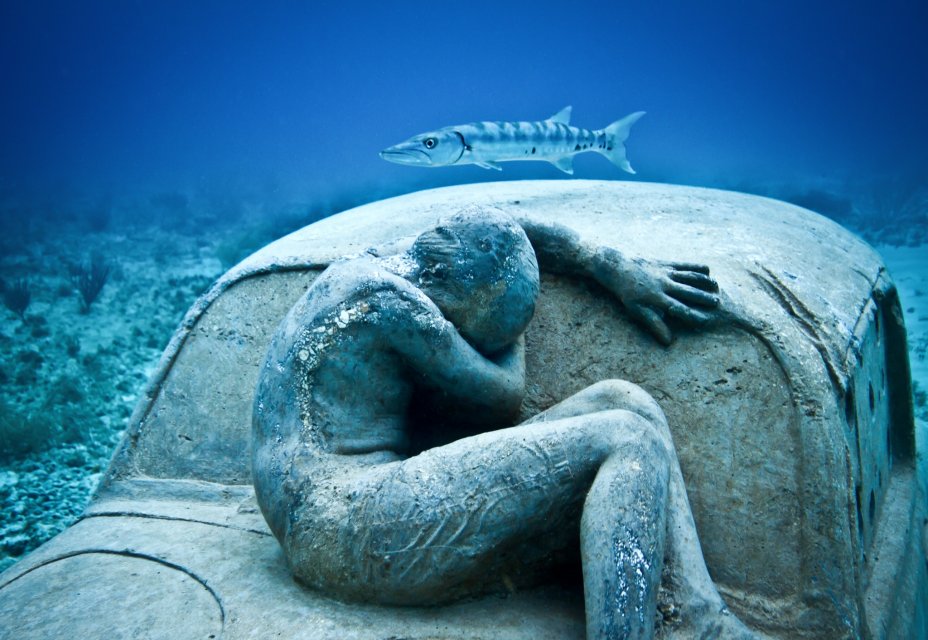
Last week, Lee led us through an exercise that helped to contextualize the minuteness of the period in which humans (and modern life on Earth) have existed. Dovetailing off of Haraway’s talk on the Anthropocene (or perhaps Capitaloscene) and her use of visual media and aesthetics to conceptualize and re-conceptualize the term’s significance, this week we will be exploring various aesthetic and artistic interpretations of the Anthropocene (although many of the images may not be constructed by self-proclaimed ‘artists’). There are some interesting works here, as well as in Making the Geologic Now, which we briefly focused on at the beginning of the semester.
I’d like to draw attention to the living sculptures of Jason deCaires Taylor, an artist and coral reef advocate based out of Cancun, Mexico. Opposing the capitalist “land as commodity” paradigm, Taylor subverts the resource-as-value mentality by installing art pieces, whose inherent value to humans is not economic, but artistic, that actively proliferate life on their structures. Taylor’s sculptures, which are composed of ph-neutral, environmentally friendly materials, are not just an interpretation of the world, that is a medium for-us, but rather an artwork acknowledging our large-scale presence that also seeks to heal the world’s depleting reefs – a medium for-them.
With scientists estimating that 80% or more of all reefs on Earth will be lost by 2050, Taylor aims to decouple us from the notion that it is our vulnerability at stake in the Anthropocene. Yes, as Nigel Clark argues, we can succumb to this inhuman nature that is entirely indifferent to preserving our lives, but as Taylor wishes to show, so are the coral reefs. In Taylor’s piece intitled Anthropocene, an old VW bug is submerged on the ocean floor supporting a fossilized child who appears to be asleep. The sculpture is hollow with various openings close to the floor, allowing lobsters to make their homes in the structure. I wonder if these crustaceans symbolize the ancient beginnings of life.
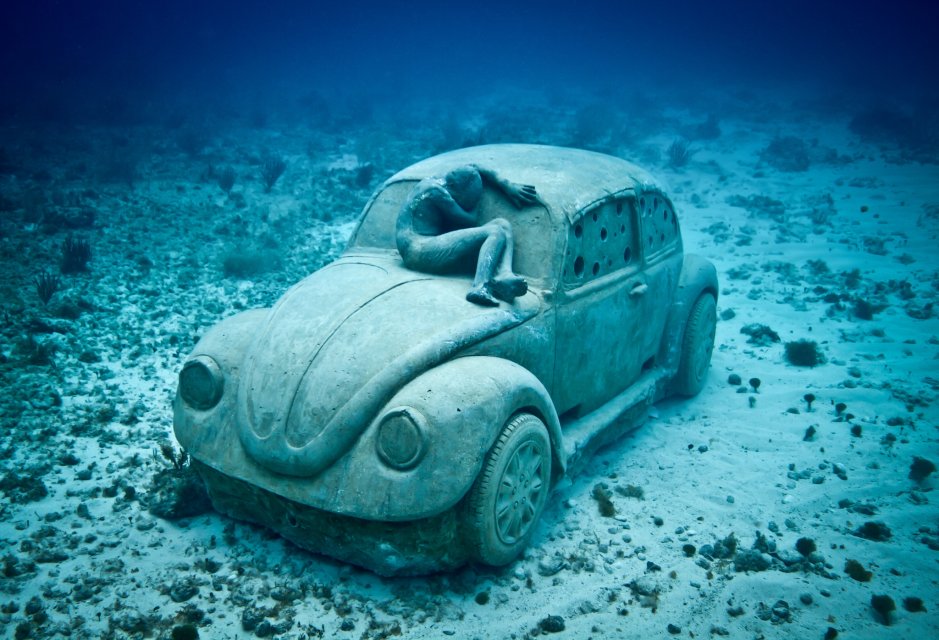
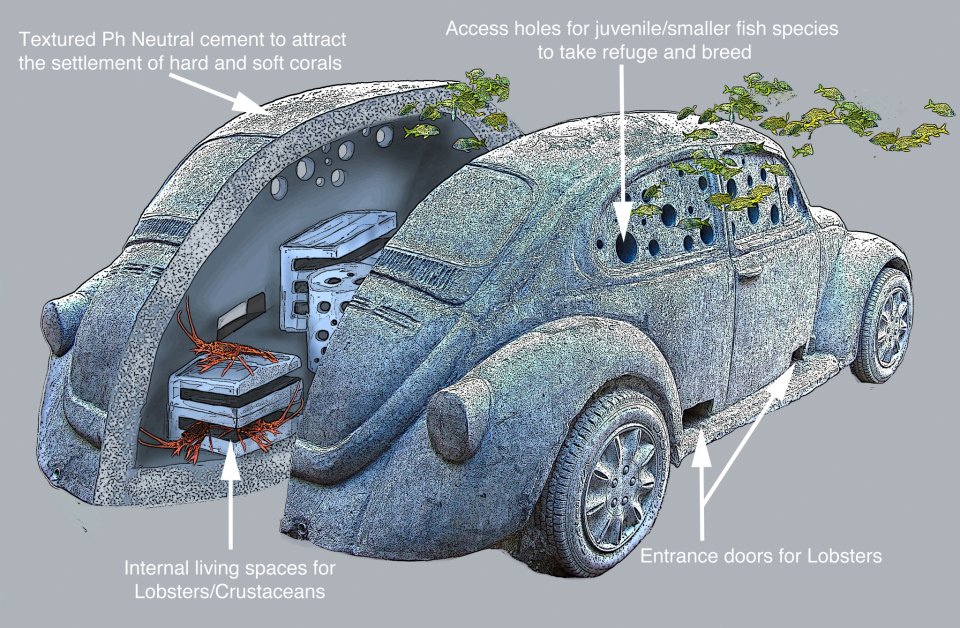
In another piece entitled The Silent Evolution for which he received critical acclaim, Taylor took casts of over 400 humans and installed them in an area over 420 square meters in size. While this underwater society appears human at first, it is imperceptibly transformed into a marine assemblage until it is no longer familiar to us. Taylor’s installations remind us of our simultaneous vulnerability (ala Clark) and our unique human qualities, like our capacity to both destroy life and to engender it. As an aesthetic medium, we are invited to explore the ocean floor and discover these strange objects that evolve over time. Almost a kind of wild Banksy, Taylor plays off of our land-evolved eyesight, drawing our attention to the new ways that light refracts, and colors/perspectives appear underwater.
 Take Action: Stop Cove Point
 Uma (in)certa antropologia
#mediaviewer/File:MatchCut.JPG)
.jpg)
Você precisa fazer login para comentar.