Arquivo da tag: Animais

Self-Medication in Animals Much More Widespread Than Believed (Science Daily)

Apr. 11, 2013 — It’s been known for decades that animals such as chimpanzees seek out medicinal herbs to treat their diseases. But in recent years, the list of animal pharmacists has grown much longer, and it now appears that the practice of animal self-medication is a lot more widespread than previously thought, according to a University of Michigan ecologist and his colleagues.

A parasite-infected monarch butterfly lays her eggs on medicinal tropical milkweed that will help to protect her offspring from disease. (Credit: Image credit Jaap de Roode)

Animals use medications to treat various ailments through both learned and innate behaviors. The fact that moths, ants and fruit flies are now known to self-medicate has profound implications for the ecology and evolution of animal hosts and their parasites, according to Mark Hunter, a professor in the Department of Ecology and Evolutionary Biology and at the School of Natural Resources and Environment.

In addition, because plants remain the most promising source of future pharmaceuticals, studies of animal medication may lead the way in discovering new drugs to relieve human suffering, Hunter and two colleagues wrote in a review article titled “Self-Medication in Animals,” to be published online today in the journal Science.

“When we watch animals foraging for food in nature, we now have to ask, are they visiting the grocery store or are they visiting the pharmacy?” Hunter said. “We can learn a lot about how to treat parasites and disease by watching other animals.”

Much of the work in this field has focused on cases in which animals, such as baboons and woolly bear caterpillars, medicate themselves. One recent study has suggested that house sparrows and finches add high-nicotine cigarette butts to their nests to reduce mite infestations.

But less attention has been given to the many cases in which animals medicate their offspring or other kin, according to Hunter and his colleagues. Wood ants incorporate an antimicrobial resin from conifer trees into their nests, preventing microbial growth in the colony. Parasite-infected monarch butterflies protect their offspring against high levels of parasite growth by laying their eggs on anti-parasitic milkweed.

Hunter and his colleagues suggest that researchers in the field should “de-emphasize the ‘self’ in self-medication” and base their studies on a more inclusive framework.

“Perhaps the biggest surprise for us was that animals like fruit flies and butterflies can choose food for their offspring that minimizes the impacts of disease in the next generation,” Hunter said. “There are strong parallels with the emerging field of epigenetics in humans, where we now understand that dietary choices made by parents influence the long-term health of their children.”

The authors argue that animal medication has several major consequences on the ecology and evolution of host-parasite interactions. For one, when animal medication reduces the health of parasites, there should be observable effects on parasite transmission or virulence.

For example, when gypsy moth caterpillars consume foliage high in certain toxic compounds, transmission of viruses between the caterpillars is reduced, facilitating moth outbreaks.

In addition, animal medication should affect the evolution of animal immune systems, according to Hunter and his colleagues. Honeybees are known to incorporate antimicrobial resins into their nests. Analysis of the honeybee genome suggests that they lack many of the immune-system genes of other insects, raising the possibility that honeybees’ use of medicine has been partly responsible — or has compensated — for a loss of other immune mechanisms.

The authors also note that the study of animal medication will have direct relevance for human food production. Disease problems in agricultural organisms can worsen when humans interfere with the ability of animals to medicate, they point out.

For example, increases in parasitism and disease in honeybees can be linked to selection by beekeepers for reduced resin deposition by their bees. A reintroduction of such behavior in managed bee colonies would likely have great benefits for disease management, the authors say.

The first author of the Science paper is Jacobus de Roode of Emory University. The other author is Thierry Lefevre of the Institut de Recherche pour le Developpement in France.

Journal Reference:

  1. J. C. de Roode, T. Lefevre, M. D. Hunter. Self-Medication in AnimalsScience, 2013; 340 (6129): 150 DOI:10.1126/science.1235824

Monkey Study Reveals Why Middle Managers Suffer the Most Stress (Science Daily)

Apr. 2, 2013 — A study by the universities of Manchester and Liverpool observing monkeys has found that those in the middle hierarchy suffer the most social stress. Their work suggests that the source of this stress is social conflict and may help explain studies in humans that have found that middle managers suffer the most stress at work.

Female Barbary macaques at Trentham Monkey Forest. (Credit: Image courtesy of Manchester University)

Katie Edwards from Liverpool’s Institute of Integrative Biology spent nearly 600 hours watching female Barbary macaques at Trentham Monkey Forest in Staffordshire. Her research involved monitoring a single female over one day, recording all incidents of social behaviour. These included agonistic behaviour like threats, chases and slaps, submissive behaviour like displacing, screaming, grimacing and hind-quarter presentation and affiliative behaviour such as teeth chatter, embracing and grooming.

The following day faecal samples from the same female were collected and analysed for levels of stress hormones at Chester Zoo’s wildlife endocrinology laboratory.

Katie explains what she found: “Not unsurprisingly we recorded the highest level of stress hormones on the days following agonistic behaviour. However, we didn’t find a link between lower stress hormone levels and affiliative behaviour such as grooming.”

She continues: “Unlike previous studies that follow a group over a period of time and look at average behaviours and hormone levels, this study allowed us to link the observed behaviour of specific monkeys with their individual hormone samples from the period when they were displaying that behaviour.”

Another key aspect of the research was noting where the observed monkey ranked in the social hierarchy of the group. The researchers found that monkeys from the middle order had the highest recorded levels of stress hormones.

Dr Susanne Shultz, a Royal Society University Research Fellow in the Faculty of Life Sciences at The University of Manchester oversaw the study: “What we found was that monkeys in the middle of the hierarchy are involved with conflict from those below them as well as from above, whereas those in the bottom of the hierarchy distance themselves from conflict. The middle ranking macaques are more likely to challenge, and be challenged by, those higher on the social ladder.”

Katie says the results could also be applied to human behaviour: “It’s possible to apply these findings to other social species too, including human hierarchies. People working in middle management might have higher levels of stress hormones compared to their boss at the top or the workers they manage. These ambitious mid-ranking people may want to access the higher-ranking lifestyle which could mean facing more challenges, whilst also having to maintain their authority over lower-ranking workers.”

The research findings have been published in the journalGeneral and Comparative Endocrinology.

Talking about the research, Susan Wiper the Director of Trentham Monkey Forest, said: “Katie has conducted a thorough study with very interesting results based on the natural groupings and environment that the Barbary macaques live in here. We are always pleased when more data is found on this fascinating endangered species of non-human primate.”

Katie is currently based at Chester Zoo where she is studying hormone levels in relation to behaviour in a bid to encourage Black Rhinos to reproduce more frequently.

Journal Reference:

  1. Katie L. Edwards, Susan L. Walker, Rebecca F. Bodenham, Harald Ritchie, Susanne Shultz. Associations between social behaviour and adrenal activity in female Barbary macaques: Consequences of study designGeneral and Comparative Endocrinology, 2013; 186: 72 DOI: 10.1016/j.ygcen.2013.02.023

When Animals Learn to Control Robots, You Know We’re in Trouble (Wired)

BY WIRED SCIENCE

03.21.13 – 6:30 AM

Unless an asteroid or deadly pandemic wipes us out first, the force we are most afraid will rob us of our place as rulers of Earth is robots. The warnings range from sarcastic to nervous to dead serious, but they all describe the same scenario: Robots become sentient, join forces and turn on us en masse.

But with all the paranoia about machines, we’ve ignored another possibility: Animals learn to control robots and decide it’s their turn to rule the planet. This would be even more dangerous than dolphins evolving opposable thumbs. And the first signs of this coming threat are already starting to appear in laboratories around the world where robots are being driven by birds, trained by moths and controlled by the minds of monkeys.

Something Other Than Adaptation Could Be Driving Evolution (Wired)

BY BRANDON KEIM

03.28.13

A computational model of greenish warbler evolution (left) fits real-world patterns of the species (right). Color corresponds to degrees of genetic difference. Image: Martins et al./PNAS

What explains the incredible variety of life on Earth? It seems obvious. Evolution, of course! But perhaps not the evolution most people grew up with.

Some ecologists say the theory needs an update. They’ve proposed a new dynamic driving the emergence of new species, one that doesn’t involve adaptations or survival of the fittest.

Give evolution enough time and space, they say, and new species can just happen. Speciation might not only be an evolutionary consequence of fitness differences and natural selection, but a property intrinsic to evolution, just as all matter has gravity.

“Our work shows that evolution wants to be diverse,” said Yaneer Bar-Yam, president of the New England Complex Systems Institute. “It’s enough for organisms to be spread out in space and time.”

In a March 13 Proceedings of the National Academy of Sciences paper, Bar-Yam and his co-authors, Brazilian ecologists Ayana Martins at the University of Sao Paulo and Marcus Aguiar at the University of Campinas, modeled the evolution of greenish warblers living around the Tibetan plateau.

The warblers are what’s known as a ring species, a rare phenomenon that occurs when species inhabit a horseshoe-shaped range. Genes flow around the ring, passing between neighboring populations — yet at the ring’s tips, the animals no longer interbreed with one another.

By the usual standards, these end populations have become new species. According to the researchers’ model of the process, no special adaptations or differences in reproductive fitness are needed to explain — or at least to computationally replicate — the greenish warblers’ divergence.

‘An alternative hypothesis to adaptation and selection of new species.’

“This sounds kind of crazy, right? We normally think of species as being adapted for particular functions. They have their own role to play in a community. That’s the standard wisdom,” said theoretical ecologist James O’Dwyer of the Santa Fe Institute, who was not involved in the study.

Instead, over 2,000 modeled generations, a time frame that fits with the 10,000 years that greenish warblers have ringed the Tibetan plateau’s slopes since their exposure by retreating glaciers, random genetic mutations drifted through the birds’ populations, ultimately clustering in diversity patterns resembling what’s seen in reality.

Adaptation and natural selection certainly played a part in the warblers’ evolution, said Bar-Yam, but they weren’t necessarily the driving forces. And though geography is involved, it’s very different from the population-isolating physical separation created by mountain ranges or islands.

“The plateau plays an important role in the formation of the ring species, but it does not block gene flow,” said Aguiar. “No barriers and no specific selection processes are required.” Rather than adaptation, distance is the driver.

That notion falls under the umbrella of neutral biodiversity theory, a dry-sounding name for a dramatic challenge to the notion that adaptation is biological diversity’s wellspring. First articulated by University of California, Los Angeles ecologist Stephen Hubbell, who in 2001 published The Unified Neutral Theory of Biodiversity and Biogeography, it’s a challenge occasioned by the surprising difficulty of explaining biodiversity, or why life is arranged the way it is.

Neutral biodiversity doesn’t reject the usual evolutionary drivers of adaptation and geographic isolation, which are clearly at work in shaping species traits and generating diversity. But these drivers don’t seem to explain many big-picture patterns. It’s not just ring species that are perplexing. Tropical forests, which originally inspired Hubbell’s theory, seemingly have far more species than there are niches to adaptively inhabit. Common patterns of species distribution also occur in disparate places, such as rain forests and coral reefs. The usual evolutionary models didn’t fit these phenomena.

A greenish warbler in Taibai Shan, China. Image: Ron Knight/Flickr

Some under-appreciated forces seemed to be operating, which Hubbell identified as neutral genetic drift: the flow, at landscape-level scales, of random genetic variations that emerge in individuals and spread through populations, but are ‘neutral,’ having no biological function.

That most mutations are neutral isn’t a new idea. It was first proposed in the late 1960s by Japanese geneticist Mootoo Kimura, and is an established dynamic in population genetics. That it might actually drive diversity on its own, though, accounting for substantial differences between species, was new.

How exactly this might work and how important it could be has been hotly debated ever since, at least in ecological circles. Some ecologists reject the idea altogether. Other researchers, including Bar-Yam’s group, have built on Hubbell’s original ideas.

Their work “offers an alternative hypothesis to adaptation and selection of new species,” said O’Dwyer, but he warned that it’s hard to tell whether neutral processes really occur. Computational models of neutral biodiversity often seem to predict real-world patterns, as with the greenish warblers, but that doesn’t mean they’re right.

Datasets necessary to test neutral explanations need to span hundreds if not thousands of years, and should encompass not just a few species but entire ecosystems, said O’Dwyer. He thinks some combination of neutral and non-neutral processes likely shape biodiversity, and teasing their contributions apart will be difficult.

Ecologist Rampal Etienne of the University of Groningen, whose own research suggests that sexual reproduction makes evolution speed up, echoed O’Dwyer’s point. “The major question is what data will be able to distinguish neutral from non-neutral explanations,” said Etienne, who cautioned against jumping to conclusions with Bar-Yam’s model.

Like any model, it’s based on assumptions and only imperfectly imitates reality, he said. Its more fundamental value, as with other work on neutral biodiversity, is that it critically examines whether adaptation really explains the natural world’s richness.

In other words, the theory of evolution is still evolving.

Citation: “Evolution and stability of ring species.” By Ayana B. Martins, Marcus A. M. de Aguiar and Yaneer Bar-Yam. Proceedings of the National Academy of Sciences, March 11, 2013.

Update 3/28: Text modified to emphasize that neutral biodiversity theory does not exclude ‘traditional’ evolutionary mechanisms, but would be an addition to them.

Mascote em extinção? (Ciência Hoje)

Pesquisadores criam plano de ação para preservar o macaco muriqui. Confira a entrevista concedida por um dos responsáveis pelo projeto à CH On-line.

Por: Mariana Rocha, Ciência Hoje On-line

Publicado em 19/03/2013 | Atualizado em 20/03/2013

Mascote em extinção?Maior primata não humano das Américas, o muriqui sofre em função do desmatamento desenfreado e da caça para consumo humano. (foto: Sinara Conessa/ Flickr – CC BY 2.0)

Menos de três mil exemplares. É tudo o que resta do macaco muriqui na Mata Atlântica. Forte candidato a mascote das Olimpíadas de 2016, o primata corre o risco de sumir das florestas por conta do desmatamento desenfreado e da caça para consumo humano. No intuito de reverter esse quadro, pesquisadores traçam estratégias para garantir a sobrevivência do muriqui.

Batizado de Plano de Ação Nacional para a Conservação dos Muriquis (PAN Muriquis) e desenvolvido no âmbito do Instituto Chico Mendes de Conservação da Biodiversidade(ICMBio), o projeto conta com dez metas e 54 ações. As atividades são diversas e englobam medidas como a contagem das populações de muriquis, a fiscalização das florestas para protegê-los de caçadores e iniciativas de educação ambiental que conscientizem a população sobre a importância do macaco.

Na lista vermelha da União Internacional para a Conservação da Natureza, o muriqui-do-norte, que ocupa Minas Gerais e Espírito Santo, é classificado como animal criticamente em perigo e, dentro de três gerações, pode sofrer uma redução populacional de 80%. Já o muriqui-do-sul, encontrado no Rio de Janeiro, São Paulo e norte do Paraná, é classificado como espécie em perigo e pode ter sua população diminuída em pelo menos 20% dentro de duas gerações.

Até 2020, o PAN Muriquis pretende retroceder em pelo menos um nível o risco de extinção do primata. A meta é fazer com que o muriqui-do-norte seja classificado como espécie em perigo e o do sul como vulnerável.

Candidato a mascote

De origem indígena, a palavra muriqui significa povo manso da floresta e descreve um animal de comportamento pacífico e solidário. O hábito de abraçar seus companheiros fez do macaco um forte candidato a representar os anfitriões brasileiros nas Olimpíadas de 2016.

Veja vídeo da campanha em favor do muriqui como mascote das Olimpíadas de 2016

A campanha para eleger o primata-mascote do evento conta com o apoio de instituições envolvidas no PAN Muriquis e discute a necessidade de preservá-lo.

Para saber mais sobre ações que buscam garantir a sobrevivência do macaco muriqui, a CH On-line conversou com Maurício Talebi, bioantropólogo da Universidade Federal de São Paulo-Diadema e coautor do PAN Muriquis.

Maurício TalebiComo e quando começou a elaboração do PAN Muriquis?
O projeto surgiu a partir do Plano de Sobrevivência das Espécies, uma ferramenta conceitual da Comissão de Sobrevivência das Espécies (CSE), uma divisão da União Internacional para Conservação da Natureza. A CSE desenvolve atividades para a conservação de diversas espécies ameaçadas no planeta. O documento que descreve as ações do PAN Muriqui começou a ser desenvolvido em 2003 pelo ICMBio e foi finalizado em 2010. Esse planejamento contou com a participação de diversos setores da sociedade, como governo, universidades e organizações não governamentais.

Quais são as principais atividades do homem que prejudicam os muriquis?
Diversas ameaças acometem populações selvagens de muriquis. As principais são a redução de hábitat, caça ilegal, baixos investimentos em vigilância e fiscalização, índices reduzidos de reprodução em cativeiro e a fragmentação do hábitat em ilhas de florestas.

O senhor coordena o monitoramento das populações de muriquis em vários locais – alguns deles já são estudados há 20 anos. Como essa medida auxilia no planejamento de ações para preservar os muriquis?
Pesquisas de longa duração são fundamentais por vários motivos. É importante obter informações sobre os animais em várias épocas do ano, conhecer seu comportamento frente a variações ambientais, entender como eles organizam sua vida cotidiana e como executam tarefas vitais para a sobrevivência. Obtemos, também, informações sobre quais variáveis ambientais devem ser levadas em conta durante ações de reflorestamento do hábitat desses primatas. Complementarmente, esses estudos propiciam o treinamento das futuras gerações de pesquisadores. Nosso grupo de pesquisa na Associação Pró-muriqui treinou mais de 200 estudantes de graduação e pós-graduação nos últimos dez anos.

Quais são as principais dificuldades na execução do PAN Muriquis?
O principal fator restritivo é a baixa disponibilidade de recursos financeiros. Atualmente, contamos com recursos humanos qualificados para a execução desses trabalhos, mas faltam recursos para financiar a mão de obra. Uma das metas é criar um fundo financeiro que viabilize a execução de todas as ações do plano. Lamentamos que, no Brasil, os fundos financeiros para a conservação de hábitat e de espécies ainda sejam praticamente inexistentes.

O senhor acredita que a candidatura do muriqui a mascote das Olimpíadas de 2016 pode auxiliar na preservação do primata?

Caso seja confirmado como mascote olímpico, o muriqui será conhecido globalmente e diversos setores da economia se interessarão por investir em um emblema tão poderoso quanto ele

Certamente sim. A maioria dos brasileiros desconhece que o maior primata (não humano) das Américas ocorre exclusivamente em nosso país. Caso seja confirmado como mascote olímpico, o muriqui será conhecido globalmente e diversos setores da economia se interessarão por investir em um emblema tão poderoso quanto ele. Assim, será possível conseguir recursos para os esforços que poucos brasileiros e estudantes estão fazendo para a pesquisa e conservação da espécie. A conscientização nos níveis nacional e internacional poderá gerar recursos para continuarmos trabalhando e assim contribuirmos para que o muriqui possa ser visto ao vivo e a cores em seu hábitat natural pelas futuras gerações.

Este texto foi atualizado para incluir a seguinte alteração:
Além de Rio de Janeiro e São Paulo, o muriqui-do-sul é encontrado no norte do Paraná. (20/03/2013)

Dogs May Understand Human Point of View (Science Daily)

Feb. 11, 2013 — Domestic dogs are much more likely to steal food when they think nobody can see them, suggesting for the first time that dogs are capable of understanding a human’s point of view.

Dr Juliane Kaminski and her dog, Ambula. (Credit: Image courtesy of University of Portsmouth)

Many dog owners think their pets are clever or that they understand humans but, until now, this has not been tested by science.

Dr Juliane Kaminski, of the University of Portsmouth’s Department of Psychology, has shown that when a human forbids a dog from taking food, dogs are four times more likely to disobey in a dark room than a lit room, suggesting they take into account what the human can or cannot see.

Dr Kaminski said: “That’s incredible because it implies dogs understand the human can’t see them, meaning they might understand the human perspective.”

This is the first study to examine if dogs differentiate between different levels of light when they are developing strategies on whether to steal food. It is published in the journal Animal Cognition. The research was funded by the Max Planck Society, Dr Kaminski’s former employer.

Dr Kaminski said: “Humans constantly attribute certain qualities and emotions to other living things. We know that our own dog is clever or sensitive, but that’s us thinking, not them.

“These results suggest humans might be right, where dogs are concerned, but we still can’t be completely sure if the results mean dogs have a truly flexible understanding of the mind and others’ minds. It has always been assumed only humans had this ability.”

The research is an incremental step in our understanding of dogs’ ability to think and to understand which could, in turn, be of use to those working with dogs and those who keep them as pets.

Dr Kaminski ran a series of experiments in varied light conditions. In each test, a dog was forbidden by a human from taking the food. When the room was dark, the dogs took more food and took it more quickly than when the room was lit.

The tests were complex and involved many variables to rule out that dogs were basing their decisions on simple associative rules, for example, that dark means food.

There is no evidence on how well dogs can see in the dark, but the results of this research show dogs can differentiate between light and dark.

Dr Kaminski said: “The results of these tests suggest that dogs are deciding it’s safer to steal the food when the room is dark because they understand something of the human’s perspective.”

Dogs’ understanding may be limited to the here and now, rather than on any higher understanding, Dr Kaminski said, and more research is needed to identify what mechanisms are controlling dogs’ behaviour.

In total, 42 female and 42 male domestic dogs aged one year or older took part in the tests. They were chosen only if they were comfortable without their owners in the room, even in complete darkness, and if they were interested in food. “Some dogs are more interested in by food than others,” Dr Kaminski said.

Previous studies have shown chimpanzees have a sophisticated understanding and seem to know when someone else can or can’t see them and can also remember what others have seen in the past. It is not known how sophisticated dogs’ understanding is in comparison. Many earlier research papers have found that, for dogs, a human’s eyes are an important signal when deciding how to behave, and that they respond more willingly to attentive humans, than inattentive ones.

Journal Reference:

  1. Juliane Kaminski, Andrea Pitsch, Michael Tomasello. Dogs steal in the darkAnimal Cognition, 2012; DOI:10.1007/s10071-012-0579-6

Doing Business With a Parrot: Self-Control Observed in Cockatoos (Science Daily)

Mar. 13, 2013 — Alice Auersperg from the Department of Cognitive Biology from the University of Vienna and her team has for the first time succeeded in observing self-control in cockatoos.

The results of this research project appear in the current issue of the journal Biology Letters.

Waiting: a clever move

In the 1970’s, self-control of human infants was investigated using the prominent ‘Stanford Marshmallow Experiment’: the children were presented with a marshmallow and were told they could either eat it now or wait and receive a second one if the first one was still intact after a time delay of several minutes. Interestingly, children that were able to wait for the delayed reward showed greater success in adult life than the ones that ate the first marshmallow right away.

Schematic presentation of the Procedure: The birds were first shown both food types inside the open hands of the experimenter and are then allowed to pick up the item of lower quality. Thereafter the animals have to decide to either eat the lower quality food straight away or to wait out the time delay to earn the better food. (Credit: Image courtesy of University of Vienna)

The ability to anticipate a delayed gain is considered cognitively challenging since it requires not only the capacity to control an direct impulse but also to assess the gain’s beneficial value relative to the costs associated with having to wait as well as the reliability of the trader. Such abilities can be considered precursors of economic decision making and are rarely found outside humans. Only few, typically large-brained animals, have been shown to be able to inhibit the consumption of an immediate food reward in anticipation for a bigger one for more than one minute.

Speculative trading of the Goffin cockatoos

A new study at the University of Vienna, on an Indonesian cockatoo species — the Goffin’s cockatoo — showed notable results. “The animals were allowed to pick up an initial food item and given the opportunity to return it directly into the experimenter’s hand after an increasing time delay. If the initial food item had not been nibbled by this time, the bird received another reward of an even higher preferred food type or of a larger quantity than the initial food in exchange” explains Isabelle Laumer, who conducted the study at the Goffin Lab at the University of Vienna. “Although we picked pecan nuts as initial reward which were highly liked by the birds and would under normal circumstances be consumed straight away, we found that all 14 of birds waited for food of higher quality, such as cashew nut for up to 80 seconds,” she further reports.

Evolution of self-control

Alice Auersperg, the manager of the Vienna Goffin Lab says: “When exchanging for better qualities, the Goffins acted astonishingly like economic agents, flexibly trading-off between immediate and future benefits. They did so, relative not only to the length of delay, but also to the difference in trade value between the ‘currency’ and the ‘merchandise’: they tended to trade their initial items more often for their most preferred food, than for one of intermediate preference value and did not exchange in a control test in which the value of the initial item was higher than that of the expected one.” She adds: “While human infants or primates can hold the initial food in their hands, one should also consider that the birds were able to wait, although they had to hold the food in their beaks, directly against their taste organs while waiting. Imagine placing a cookie directly into a toddler’s mouth and telling him/her, he/she will only receive a piece of chocolate if the cookie is not nibbled for over a minute.”

Thomas Bugnyar, who previously conducted similar studies on ravens and crows, says, “Until recently, birds were considered to lack any self-control. When we found that corvids could wait for delayed food, we speculated which socio-ecological conditions could favor the evolution of such skills. To test our ideas we needed clever birds that are distantly related to corvids. Parrots were the obvious choice and the results on Goffins show that we are on the right track.”

Journal Reference:

  1. A. M. I. Auersperg, I. B. Laumer, T. Bugnyar. Goffin cockatoos wait for qualitative and quantitative gains but prefer ‘better’ to ‘more’Biology Letters, 2013; 9 (3): 20121092 DOI: 10.1098/rsbl.2012.1092

The interspecies internet: Diana Reiss, Peter Gabriel, Neil Gershenfeld and Vint Cerf at TED2013 (TED)

Posted by: Kate Torgovnick 

February 28, 2013 at 8:13 pm EST

Photos: James Duncan Davidson

The internet connects people all over the world. But could the internet also connect us with dolphins, apes, elephants and other highly intelligent species?

In a bold talk in Session 10 of TED2013, four incredible thinkers come together to launch the idea of the interspecies internet. Each takes four minutes to talk, then passes the metaphorical baton, building the narrative in parts.

The talk begins with Diana Reiss, a cognitive psychologist who studies intelligence in animals. She shows us a video of an adorable dolphin twirling in the water. But the dolphin isn’t spinning playfully for the camera — the dolphin is watching itself in a two-way mirror.

“A dolphin has self-awareness,” says Reiss. “We used to think this was a uniquely human quality, but dolphins aren’t the only non-human animals to show self-recognition in a mirror. Great apes, our closest relatives, also show this ability.” Ditto for elephants and even magpies.

Reiss shares her work with dolphins — she’s been teaching them to communicate through an underwater keyboard of symbols that correspond to whistles and playful activities. Through this keyboard, the dolphins learned to perform activities on demand, and also to express their desire for them. (For more on how a similar dolphin keyboard works, read up on Denise Herzing’s talk from earlier today.)

TED2013_0065235_D41_2938

“You can’t get more alien than the dolphin. We’re separated by 95 million years of divergent evolution. These are true non-terrestrials,” says Reiss. “This self-organized learning, the same thing we heard from TED Prize winner Sugata Mitra. I’m suggesting this is our Hole in the Water.”

Reiss was conducting this work on her own. And then she got a call from iconic musician Peter Gabriel.

“I make noises for a living, and on a good day it’s music,” says Gabriel. He has always looked into the eyes of animals and wondered what is going on inside their heads, he says, soe excitedly read about research, like Reiss’, examining communication with animals.

“What was amazing to me was that [the animals] seemed a lot more adept at getting a handle on our language than we were at getting a handle on theirs,” says Gabriel. “I work with a lot of musicians from around the world. Often we don’t have any common language at all. We sit behind our instruments and it’s a way to connect.”

TED2013_0064754_DSC_8824

So Gabriel started cold-calling scientists to see if he could be a part of this work. His goal: To try writing music with an animal. And he got his chance.

In a video clip that raises oohs and ahhs from audience, Gabriel shares a video of a bonobo with a keyboard. While bonobos had been introduced to percussion instruments before, and bashed them with their fists, this was the first time this bonobo had ever seen a keyboard. And with accompaniment, she played truly amazing music.

“She discovers a note she likes. She finds the octave,” says Gabriel, narrating the beautiful melody in the video. “We began to dream … What would happen if we could somehow find new interfaces – visual, audio — to allow us to communicate with the remarkable beings we share the planet with.”

Gabriel brought the video of this unusual jam session to Neil Gershenfeld, the Director of MIT’s Center for Bits and Atoms.

TED2013_0064789_DSC_8859

“I lost it when I saw that clip,” says Gershenfeld, stepping up to the stage. “I was struck by the history of the internet, because it started as the internet of middle-aged white men … I realized that we humans had missed something — the rest of the planet.”

At this point, Gershenfeld video-conferenced in animals live — including orangutans in Waco, Texas, dolphins at the National Aquarium in Baltimore, and elephants in Thailand.

Gershenfeld is known for his work in the internet of things. And he thinks animals can be a part of it, too. ”We’re starting to think about how you integrate the rest of the biomass of the planet into the internet,” he says.

Which brings us to Vint Cerf, who helped lay the foundations for the internet as we know it and is now vice president and Chief Internet Evangelist for  Google.

TED2013_0065415_D41_3118

“Forty years ago we wrote the script of the internet. Thirty years ago we turned it on,” says Cerf. “We thought we were building a system to connect computers together. But we quickly learned that it’s a system for connecting people.”

“You know where this is going,” Cerf continues, to a laugh, bringing it back to research in communicating with animals. ”What’s important about what these people are doing: They’re beginning to learn how to communicate with species that are not us, but share a sensory environment. [They’re figuring out] what it means to communicate with something that’s not a person. I can’t wait to see these experiments unfold.”

So what’s next? The internet of things, yes, and the ability for us to communicate with computers without keyboards and mice. And in addition to the internet of species, he even imagines an interplanetary internet.

“These interactions with other animals will teach us, ultimately, how we might interact with an alien from another world,” says Cerf. “I can hardly wait.”

Primates, Too, Can Move in Unison (Science Daily)

Jan. 28, 2013 — Japanese researchers show for the first time that primates modify their body movements to be in tune with others, just like humans do. Humans unconsciously modify their movements to be in synchrony with their peers. For example, we adapt our pace to walk in step or clap in unison at the end of a concert. This phenomenon is thought to reflect bonding and facilitate human interaction. Researchers from the RIKEN Brain Science Institute report that pairs of macaque monkeys also spontaneously coordinate their movements to reach synchrony.

Monkey training (A), and experimental setting (B and C). (Credit: Image courtesy of RIKEN)

This research opens the door to much-needed neurophysiological studies of spontaneous synchronization in monkeys, which could shed light into human behavioral dysfunctions such as those observed in patients with autism spectrum disorders, echopraxia and echolalia — where patients uncontrollably imitate others.

In the research, recently published in the journal Scientific Reports, the team led by Naotaka Fujii developed an experimental set-up to test whether pairs of Japanese macaque monkeys synchronize a simple push-button movement.

Before the experiment, the monkeys were trained to push a button with one hand. In a first experiment the monkeys were paired and placed facing each other and the timing of their push-button movements was recorded. The same experiment was repeated but this time each monkey was shown videos of another monkey pushing a button at varying speeds. And in a last experiment the macaques were not allowed to either see or hear their video-partner.

The results show that the monkeys modified their movements — increased or decreased the speed of their push-button movement — to be in synchrony with their partner, both when the partner was real and on video. The speed of the button pressing movement changed to be in harmonic or sub-harmonic synchrony with the partners’ speed. However, different pairs of monkeys synchronized differently and reached different speeds, and the monkeys synchronized their movements the most when they could both see and hear their partner.

The researchers note that this behavior cannot have been learnt by the monkeys during the experiment, as previous research has shown that it is extremely difficult for monkeys to learn intentional synchronization.

They add: “The reasons why the monkeys showed behavioral synchronization are not clear. It may be a vital aspect of other socially adaptive behavior, important for survival in the wild.”

The study was partly supported by Grant-in-Aid for Scientific Research on Innovative Areas ‘Neural creativity for communication’ (22120522 and 24120720) of MEXT, Japan.

Journal Reference:

  1. Yasuo Nagasaka, Zenas C. Chao, Naomi Hasegawa, Tomonori Notoya, Naotaka Fujii. Spontaneous synchronization of arm motion between Japanese macaquesScientific Reports, 2013; 3 DOI:10.1038/srep01151

Digestão bloqueada, praga controlada (Revista Fapesp)

[Curioso que tanto receio exista com relação à geoengenharia, e tão pouco direcionado a esse tipo de zooengenharia.]
Pesquisa da função intestinal de insetos aumenta o conhecimento da fisiologia desses animais e pode ajudar a criar métodos inovadores de combater doenças e controlar pragas da lavoura (estrutura 3D da catepsina L2)

30/01/2013

Por Fábio Reynol

Agência FAPESP – Diversas enfermidades humanas, como dengue, doença de chagas e leishmaniose, e pragas que destroem lavouras de algodão, cana-de-açúcar e bananeira são problemas que têm como ponto comum o fato de serem provocadas por insetos.

Uma extensa pesquisa feita no Instituto de Química (IQ) da Universidade de São Paulo (USP) ampliou o conhecimento sobre diferentes insetos por meio de uma abordagem peculiar: a investigação da função intestinal. Com isso, abriu espaço para métodos inovadores de controle.

O trabalho compôs o projeto “A digestão dos insetos: uma abordagem molecular, celular, fisiológica e evolutiva”, conduzido de 2008 a 2012 e apoiado pela FAPESP por meio da modalidade Auxílio à Pesquisa – Projeto Temático.

O projeto, coordenado por Walter Ribeiro Terra, professor titular do IQ-USP – com a professora Clelia Ferreira como investigadora principal e vice-coordenadora –, é uma continuação de Temáticos sobre o mesmo tema desenvolvidos desde 1991. O novo projeto teve início em 2012 com conclusão prevista para 2017.

Entre as principais descobertas do projeto concluído este ano foi a de que mosquitos hematófagos da ordem Díptera têm em comum tripsinas especiais, fundamentais para a digestão de proteínas. “Essa informação torna esse tipo de tripsina um possível alvo de controle para todos os mosquitos desse grupo”, disse Terra.

Trata-se de um alvo bastante relevante, uma vez que a ordem Díptera engloba os gênerosAnophelesAedes e Culex, os quais agrupam insetos vetores de importantes doenças como malária, febre amarela, dengue e filariose.

Segundo Terra, inibir a tripsina poderia ser um método eficaz de controle dessas doenças, uma vez que bloquearia o processo de digestão dos insetos. Para isso, o trabalho também envolveu a busca por inibidores químicos das enzimas encontradas.

O método utilizado foi o da modelagem computacional a partir de imagens tridimensionais dessas moléculas. Em um modelo digital em 3D da enzima a ser inibida são testadas virtualmente moléculas inibidoras que se encaixam no maior número possível de reentrâncias, ou sítios funcionais.

“Em quanto mais sítios funcionais o reagente atracar, mais forte será a ligação e mais eficiente será o inibidor”, disse Terra à Agência FAPESP, explicando que a modelagem molecular 3D é amplamente usada na indústria farmacêutica.

A enzima bloqueada não consegue se recombinar e cumprir sua função no processo de digestão, o de quebrar outras moléculas. Sem conseguir absorver os nutrientes de que precisam, os mosquitos morrem.

O estudo da fisiologia do barbeiro Rhodnius prolixus, vetor da doença de chagas, sempre foi difícil e a observação de sua função intestinal um obstáculo para os pesquisadores.

A equipe de Terra contornou o problema encontrando um inseto similar, o Dysdercus peruvianus, percevejo que ataca o algodão. Transcriptomas (partes do genoma que codificam proteínas) desse inseto mostraram detalhes que podem ser válidos também para o barbeiro, podendo gerar alvos de controle naquele inseto.

O agronegócio da cana-de-açúcar também poderá se beneficiar do estudo. A catepsina L, enzima digestiva típica de muitos besouros, foi isolada no Sphenophorus levis, besouro cuja fase larval ataca o sistema radicular da cana. Essa enzima foi clonada, expressa e caracterizada com substratos sintéticos e inibidores. A mesma enzima encontrada no Tenebrio molitor, besouro conhecido como bicho-da-farinha, teve sua estrutura tridimensional resolvida.

“O maior desafio em identificar a estrutura tridimensional é a cristalização da proteína, porque se ela não cristaliza não conseguimos obter o modelo”, disse Terra, esclarecendo que várias proteínas não conseguem formar cristais, inviabilizando a sua visualização tridimensional.

Estrutura do desenvolvimento

Uma estrutura particular do sistema intestinal dos insetos recebeu atenção especial no Projeto Temático conduzido no IQ-USP: a membrana peritrófica.

Em formato de um minúsculo tubo, sabe-se que seu papel está ligado à eficiência digestiva, porém suas funções ainda não são totalmente conhecidas pela ciência. Algumas dessas funções hipotéticas foram testadas em insetos modelos e descobriu-se que ela possui participação preponderante no desenvolvimento dos insetos.

Insetos cujas membranas peritróficas foram inibidas tiveram o seu desenvolvimento prejudicado. Ao mesmo tempo, algumas plantas possuem reagentes naturais que atacam essa membrana, o que as protege de serem devoradas por insetos. “Essas informações tornam essa estrutura um importante alvo para processos inovadores de controle”, observou Terra.

O Projeto Temático também promoveu avanços consideráveis no conhecimento da evolução das espécies. Além de possível alvo de controle das moscas domésticas, a enzima catepsina D também está presente em humanos e em outros animais que possuem sistemas digestivos muito ácidos voltados a processar alimentos ricos em bactérias.

“O interessante dessa descoberta foi constatar que a mesma adaptação evolutiva ocorreu duas vezes e de maneira independente na mosca e na espécie humana”, disse Terra.

Outro avanço importante foi sobre a morfofisiologia dos insetos. Um estudo com o percevejoPodisus nigrispinus, predador de outros insetos, mostrou que a então chamada digestão extraoral daquele inseto é uma dispersão dos tecidos da presa por ação de uma substância salivar. A digestão propriamente dita ocorre no interior do intestino do inseto.

A descoberta, publicada no Journal of Insect Physiology, provocou uma menção especial de um parecerista da revista. “Ele escreveu que a partir desse trabalho deve-se repensar os conceitos de digestão fora do corpo”, disse Terra, salientando que a equipe recebeu com muito orgulho esse reconhecimento.

O projeto ainda identificou a lisozima como uma enzima crítica na digestão de moscas que atacam frutas, a trealase é crucial para lagartas pragas de lavouras e as beta-glucanases, ausentes nos mamíferos, estão relacionadas à digestão e ao sistema imunológico de insetos. Todas elas são potenciais alvos de controle dos insetos envolvidos.

Mais de 1,3 mil citações

Os resultados dos quatro anos de estudos estão registrados em 20 publicações e quatro capítulos de livros e os trabalhos de laboratório do projeto foram citados 1.357 vezes na literatura científica mundial nesse período.

No âmbito do Projeto Temático foram desenvolvidas três dissertações de mestrado, seis teses de doutorado e duas de pós-doutorado. O projeto contou com cinco Bolsas FAPESP de Iniciação Científica, uma de Doutorado e as duas de Pós-Doutorado.

O Temático ainda promoveu trabalhos em parcerias com diversas instituições nacionais como a Universidade Federal de Santa Catarina (UFSC), a Universidade Federal de Lavras (UFL), a Universidade Federal de São Carlos (UFSCar), o Instituto Nacional de Ciência e Tecnologia (INCT) de Entomologia Molecular do qual o IQ-USP faz parte e a Escola Superior de Agricultura Luiz de Queiroz (Esalq) também da USP.

O grupo ainda participa de um consórcio internacional para o sequenciamento do genoma do barbeiro Rhodnius prolixus cujos resultados ainda estão em análise e, de acordo com Terra, ainda devem gerar diversas aplicações práticas.

Cultural Evolution Changes Bird Song (Science Daily)

Jan. 29, 2013 — Thanks to cultural evolution, male Savannah sparrows are changing their tune, partly to attract “the ladies.”

Savannah sparrow. (Credit: Image courtesy of University of Guelph)

According to a study of more than 30 years of Savannah sparrows recordings, the birds are singing distinctly different songs today than their ancestors did 30 years ago — changes passed along generation to generation, according to a new study by University of Guelph researchers.

Integrative biology professors Ryan Norris and Amy Newman, in collaboration with researchers at Bowdoin College and Williams College in the U.S., analyzed the songs of male Savannah sparrows (Passerculus sandwichiensis) recorded over three decades, and found that the songs had changed distinctly from 1980 to 2011.

“The change is the result of cultural transmission of different song elements through many generations,” said Norris.

Norris added that the change in tune resembles changes in word choice and language among humans.

“If you listen to how people used to talk in the 1890s and how we talk today, you would notice major differences, and this is the result of shifts in culture or the popularity of certain forms,” he said. “The change in sparrow songs over time has occurred much the same way”

The sparrows, which live on Kent Island, N.B., in the Bay of Fundy, can generally sing only one song type that consists of several parts. Male sparrows learn that song early in their first year and continue to sing the same tune for the rest of their lives.

“Young male sparrows learn their songs from the birds around them,” said Norris. “It may be their fathers, or it could be other older male birds that live nearby.”

Each male sparrow has his own unique sound, added Newman.

“While the island’s sparrows all sing a characteristic ‘savannah sparrow song,’ with the same verses and sound similar, there are distinct differences between each bird,” she said. “Essentially, it is like karaoke versions of popular songs. It is the rise and fall in popular cover versions that has changed over time.”

The research team found that, in general, each song has three primary elements. The first identifies the bird as a Savannah sparrow, the second identifies which individual is singing, and the third component is used by females to assess males.

Using sonograms recorded from singing males each breeding season, the researchers determined that, while the introductory notes had stayed generally consistent for the last 30 years, the sparrows had added a series of clicks to the middle of their songs. The birds had also changed the ending trill: once long and high-frequency, it is now shorter and low-frequency.

“We found that the ending trill of the song has become shorter, likely because female sparrows preferred this, because males with shorter trills had higher reproductive success,” Norris said.

Kent Island has been home to the Bowdoin Scientific Station since it was donated by J. Sterling Rockefeller in 1932, and the birds have been recorded since the 1980s. Individual birds are also monitored throughout their lifetime.

“We know the identity and history of every single sparrow in the study population” said Norris, who has led the project with Newman since 2009. “To have 30 years of recordings is very rare, and it was definitely surprising to see such drastic changes.”

Journal Reference:

  1. Heather Williams, Iris I. Levin, D. Ryan Norris, Amy E.M. Newman, Nathaniel T. Wheelwright. Three decades of cultural evolution in Savannah sparrow songsAnimal Behaviour, 2013; 85 (1): 213 DOI:10.1016/j.anbehav.2012.10.028

Bonobos Will Share With Strangers Before Acquaintances (Science Direct)

Jan. 2, 2013 — You’re standing in line somewhere and you decide to open a pack of gum. Do you share a piece with the coworker standing to one side of you, or with the stranger on the other?

This is an infant bonobo feeding on papaya. (Credit: Jingzhi Tan)

Most humans would choose the person they know first, if they shared at all.

But bonobos, those notoriously frisky, ardently social great apes of the Congo, prefer to share with a stranger before sharing with an animal they know. In fact, a bonobo will invite a stranger to share a snack while leaving an acquaintance watching helplessly from behind a barrier.

“It seems kind of crazy to us, but bonobos prefer to share with strangers,” said Brian Hare, a professor of evolutionary anthropology at Duke University. “They’re trying to extend their social network.” And they apparently value that more than maintaining the friendships they already have.

To measure this willingness to share, Hare and graduate student Jingzhi Tan ran a series of experiments with bonobos living in the Lola ya Bonobo sanctuary in Kinshasa, Democratic Republic of Congo. The experiments involved piles of food and enclosures that the test subjects were able to unlock and open. Tan and Hare describe their work in a paper in the Jan. 2, 2013 edition of PLOS ONE.

In the first series of experiments, a pile of food was placed in a central enclosure flanked by two enclosures, each of them holding another animal. The test subject had the knowledge and ability to open a door to either of the other chambers, or both. On one side was a bonobo they knew from their group (not necessarily a friend or family member) and in the other was a bonobo they had never really met, but had only seen at a distance.

Upon entering the chamber with the food, the test subjects could easily just sit down and consume it all themselves, or they could let in one or both of the other animals to share.

Nine of the 14 animals who went through this test released the stranger first. Two preferred their groupmates. Three showed no particular preference in repeated trials. The third animal was often let in on the treat as well, but more often it was the stranger, not the test subject, who opened the door for them.

Tan said that by letting the third animal into the enclosure, the stranger voluntarily outnumbered himself or herself with two bonobos who knew each other, which a chimpanzee would never do. In 51 trials of the experiment, there was never any aggression shown, although there was quite a bit of typical bonobo genital rubbing between the strangers.

To isolate how much motivation the animals receive from social interaction, the researchers ran a second set of experiments in which the subject animal wouldn’t receive any social contact with another animal. In the first of these experiments, the subjects couldn’t get any food for themselves regardless of whether they chose to open the door to allow the other animal to get some food. Nine out of ten animals shared with the stranger at least once.

In the final experiment without social contact, the subject animal was given access to the food in such a way that opening the door to share with the other animal would cost them some food. But they still wouldn’t have any social contact as a reward. In this instance, the animals chose not to share. “If they’re not going to see a social benefit, they won’t share,” Hare said.

This second test is similar to something called the dictator game in which humans are given the chance to share cash with a stranger, Hare said. Most people will share anonymously, but they share even more when they aren’t anonymous. Bonobos won’t share at all in the anonymous condition if it costs them food.

“They care about others,” Hare said, but only in a sort of selfish way. “They’ll share when it’s a low-cost/low-benefit kind of situation. But when it’s a no-benefit situation, they won’t share. That’s different from a human playing the dictator game. You really have to care about others to give anonymously.”

The findings, which Hare calls “one of the crazier things we’ve found” in more than a decade of bonobo research, form yet another distinction between bonobos and chimpanzees, our two closest relatives. “Chimps can’t do these tests, they’d be all over each other.”

The work was funded by the National Science Foundation and the European Research Council.

Journal Reference:

  1. Tan J, Hare B. Bonobos Share with StrangersPLOS ONE, 2013; 8 (1): e51922 DOI:10.1371/journal.pone.0051922

Dogs Can Accurately Sniff out ‘Superbug’ Infections (Science Daily)

A new study finds that dogs can sniff out Clostridium difficile (the infective agent that is responsible for many of the dreaded “hospital acquired infections”) in stool samples and even in the air surrounding patients in hospital with a very high degree of accuracy. (Credit: © CallallooAlexis / Fotolia)

Dec. 13, 2012 — Dogs can sniff out Clostridium difficile (the infective agent that is responsible for many of the dreaded “hospital acquired infections”) in stool samples and even in the air surrounding patients in hospital with a very high degree of accuracy, finds a study in the Christmas issue published on bmj.com today.

The findings support previous studies of dogs detecting various types of cancer and could have great potential for screening hospital wards to help prevent C. difficile outbreaks, say the researchers.

C. difficile infection most commonly occurs in older people who have recently had a course of antibiotics in hospital, but it can also start in the community, especially in care homes. Symptoms can range from mild diarrhoea to a life-threatening inflammation of the bowel.

Early detection is vital to prevent transmission, but diagnostic tests can be expensive and slow, which can delay treatment for up to a week.

Diarrhoea due to C. difficile has a specific smell, and dogs have a superior sense of smell compared with humans. This prompted researchers in the Netherlands to investigate whether a dog could be trained to detect C. difficile.

A two-year old male beagle (called Cliff) was trained by a professional instructor to identify C. difficile in stool samples and in patients with C. difficile infection. He was taught to indicate the presence of the specific scent by sitting or lying down.

The dog had not been trained for detection purposes before.

After two months of training, the dog’s detection abilities were formally tested on 50 C. difficile positive and 50 C. difficilenegative stool samples. He correctly identified all 50 positive samples and 47 out of 50 negative samples.

This equates to 100% sensitivity and 94% specificity (sensitivity measures the proportion of positives correctly identified, while specificity measures the proportion of negatives correctly identified).

The dog was then taken onto two hospital wards to test his detection abilities in patients. He correctly identified 25 out of 30 cases (sensitivity 83%) and 265 out of 270 negative controls (specificity 98%).

The researchers add that the dog was quick and efficient, screening a complete hospital ward for the presence of patients with C. difficile infection in less than 10 minutes.

They point to some study limitations, such as the unpredictability of using an animal as a diagnostic tool and the potential for spreading infections via the dog, and say some unanswered questions remain.

However, they say their study demonstrates that a detection dog can be trained to identify C. difficile infection with a high degree of accuracy, both in stool samples and in hospitalised patients. “This could have great potential for C. difficileinfection screening in healthcare facilities and thus contribute to C. difficile infection outbreak control and prevention,” they conclude.

Journal Reference:

  1. M. K. Bomers, M. A. van Agtmael, H. Luik, M. C. van Veen, C. M. J. E. Vandenbroucke-Grauls, Y. M. Smulders. Using a dog’s superior olfactory sensitivity to identify Clostridium difficile in stools and patients: proof of principle studyBMJ, 2012; 345 (dec13 8): e7396 DOI:10.1136/bmj.e7396

The Case Against Big Cat Ownership (N.Y.Times)

November 9, 2012, 7:51 AM

By RACHEL NUWER

Titan, Bali and Java, three massive tigers, recently journeyed from a financially struggling Texas shelter to a new home in North Carolina. Driven through the night in the back of a trailer, convivial Titan accepted the change without batting a whisker, while stressed-out Java and Bali protested with booming roars and skittish lunges.

The tigers will never see the jungles of their species’ native Asia, but rather will live out the remainder of their lives in their new Appalachian enclosure.

A tiger being moved  to a sanctuary in Indiana.© M. Booth/I.F.A.W.A tiger being moved to a sanctuary in Indiana.

A new documentary film, “Removed,” tells the tigers’ story. (Its premiere was originally scheduled for Thursday at the third annual New York Wildlife and Conservation Film Festival, but organizers postponed the festival after last week’s hurricane.)

Titan, Mali and Java’s ordeal — shuttling from facility to facility and living in cramped captivity after being rescued from zoos, private homes and failing shelters — is an all-too-familiar situation in the United States, cat activists say.

The implications are far from trivial. More tigers live in private captivity in Texas than in the wild, where conservationists estimate that around 3,000 of the endangered animals remain. No one knows for sure how many big cats — including tigers, lions, panthers, cheetahs, leopards and others — are kept today in backyards and apartments across the United States, but estimates run as high as 20,000. (The Endangered Species Act does not prohibit domestic trade in captive-bred wildlife.)

“Many of these cases are misguided animal enthusiasts who become enamored by a beautiful baby that quickly becomes wild, and then the situation gets out of control,” said Tracy Coppola, a campaigns officer at the International Fund for Animal Welfare.

“The animals are often abandoned, relinquished or just kept in very substandard and dangerous conditions because they’re wild animals and people don’t know how to deal with them,” she said.

The Department of Agriculture assumes responsibility for monitoring big cat possession and for inspecting the animals’ facilities, but Ms. Coppola said the department does not have the resources to thoroughly evaluate each situation, meaning that some individual animals are never assessed.

When owners eventually realize that they can no longer care for a big cat — each of which costs upward of $6,000 annually to care for — they often donate it to a sanctuary. But sanctuaries usually lack the resources to care for an influx of animals, and many of these privately financed institutions were hit hard by the recession.

“Sanctuaries are critical and do a lot of public good, but they’re not enough to battle this problem,” Ms. Coppola said.

To address this need, the International Fund for Animal Welfare, along with a coalition of other animal charities, is pushing for legislation that would bolster regulations on big cat ownership in the United States.

Currently, 28 states fully ban big cat possession, yet seven do not address the issue at all, the fund says. The others fall somewhere in between, making for a confusing patchwork of skimpy-to-stringent rules. “If you or I moved to West Virginia, we could basically have a tiger in our backyard with no regulation whatsoever,” Ms. Coppola said.

The proposed legislation, the Big Cats and Public Safety Protection Act, aims to change that. The bill would amend the Lacey Act Amendments of 1981 to explicitly prevent private big cat ownership across the United States. Private pet owners who already owned big cats could keep them as long as they registered them with the Department of Agriculture, but going forward, only zoos or sanctuaries could adopt new felines.

Private owners could no longer breed and auction off their animals, either. The Senate bill, sponsored by Senator John Kerry of Massachusetts, is currently in the Committee on Environment and Public Works, while two California lawmakers, Representative Buck McKeon, a Republican, and Representative Loretta Sanchez, a Democrat, are sponsoring the House version.

Ms. Coppola and her colleagues lobbied for the legislation not just to protect animals, but to ensure the safety of local communities, too. A major impetus, she said, was the abrupt decision of an exotic animal farm owner in Zanesville, Ohio, to release all of his animals, including 38 large cats, last year. Of the cats, only three leopards survived the ordeal.

While no locals were apparently harmed by the animals, past cases — like the 2005 death of a 17-year-old who was attacked by a Siberian tiger as she was posing for a photo — demonstrate the threat that big cat ownership poses to public safety.

“I’m afraid there’s going to be another Zanesville,” Ms. Coppola said. “We’re trying to phase out the big cat trade and help the U.S.D.A. before that happens.”

A jumble of varying state regulations makes it difficult to ensure that big cats are humanely cared for.
International Fund for Animal WelfareA jumble of varying state regulations makes it difficult to ensure that big cats are humanely cared for.

How animals predict earthquakes (BBC)

1 December 2011

By Victoria Gill – Science reporter, BBC Nature

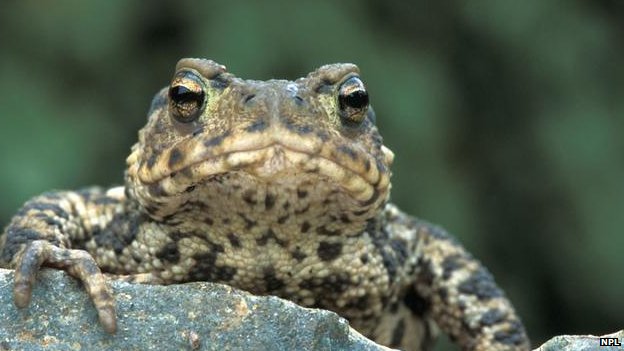
Common toadCan pond-dwelling animals pick up pre-earthquake signals?

Animals may sense chemical changes in groundwater that occur when an earthquake is about to strike.

This, scientists say, could be the cause of bizarre earthquake-associated animal behaviour.

Researchers began to investigate these chemical effects after seeing a colony of toads abandon its pond in L’Aquila, Italy, in 2009 – days before a quake.

They suggest that animal behaviour could be incorporated into earthquake forecasting.

When you think of all of the many things that are happening to these rocks, it would be weird if the animals weren’t affected in some way” – Rachel GrantThe Open University

The team’s findings are published in the International Journal of Environmental Research and Public Health. In this paper, they describe a mechanism whereby stressed rocks in the Earth’s crust release charged particles that react with the groundwater.

Animals that live in or near groundwater are highly sensitive to any changes in its chemistry, so they might sense this days before the rocks finally “slip” and cause a quake.

The team, led by Friedemann Freund from Nasa and Rachel Grant from the UK’s Open University hope their hypothesis will inspire biologists and geologists to work together, to find out exactly how animals might help us recognise some of the elusive signs of an imminent earthquake.

Strange behaviour

The L’Aquila toads are not the first example of strange animal behaviour before a major seismic event. There have been reports throughout history of reptiles, amphibians and fish behaving in unusual ways just before an earthquake struck.

STRANGE OR NOT

  • In July 2009, just hours after a large earthquake in San Diego, local residents discovered dozens of Humboldt squid washed up on beaches. These deep sea squid are usually found at depths of between 200 and 600m
  • At 5.58am on 28 June 1992 the ground began to shake in the Mojave Desert, California, right in the middle of a scientific study on desert harvester ants. Measurements revealed the ants did not change their behaviour at all during the earthquake, the largest to strike the US in four decades.

In 1975, in Haicheng, China, for example, many people spotted snakes emerging from their burrows a month before the city was hit by a large earthquake.

This was particularly odd, because it occurred during the winter. The snakes were in the middle of their annual hibernation, and with temperatures well below freezing, venturing outside was suicide for the cold-blooded reptiles.

But each of these cases – of waking reptiles, fleeing amphibians or deep-sea fish rising to the surface – has been an individual anecdote. And major earthquakes are so rare that the events surrounding them are almost impossible to study in detail.

This is where the case of the L’Aquila toads was different.

Toad exodus

Ms Grant, a biologist from the Open University, was monitoring the toad colony as part of her PhD project.

“It was very dramatic,” she recalled. “It went from 96 toads to almost zero over three days.”

Ms Grant published her observations in the Journal of Zoology.

“After that, I was contacted by Nasa,” she told BBC Nature.

Scientists at the US space agency had been studying the chemical changes that occur when rocks are under extreme stress. They wondered if these changes were linked to the mass exodus of the toads.

Their laboratory-based tests have now revealed, not only that these changes could be connected, but that the Earth’s crust could directly affect the chemistry of the pond that the toads were living and breeding in at the time.

Toads mating (c) Rachel GrantAll of the toads left the breeding colony days before the 2009 earthquake

Nasa geophysicist Friedemann Freund showed that, when rocks were under very high levels of stress – for example by the “gargantuan tectonic forces” just before an earthquake, they release charged particles.

These charged particles can flow out into the surrounding rocks, explained Dr Freund. And when they arrive at the Earth’s surface they react with the air – converting air molecules into charged particles known as ions.

“Positive airborne ions are known in the medical community to cause headaches and nausea in humans and to increase the level of serotonin, a stress hormone, in the blood of animals,” said Dr Freund. They can also react with water, turning it into hydrogen peroxide.

This chemical chain of events could affect the organic material dissolved in the pond water – turning harmless organic material into substances that are toxic to aquatic animals.

It’s a complicated mechanism and the scientists stress that it needs to be tested thoroughly.

But, Dr Grant says this is the first convincing possible mechanism for a “pre-earthquake cue” that aquatic, semi-aquatic and burrowing animals might be able to sense and respond to.

“When you think of all of the many things that are happening to these rocks, it would be weird if the animals weren’t affected in some way,” she said.

Dr Freund said that the behaviour of animals could be one of a number of connected events that might forecast an earthquake.

“Once we understand how all of these signals are connected,” he told BBC Nature, “if we see four of five signals all pointing in [the same] direction, we can say, ‘ok, something is about to happen’.”

*   *   *

Toads can ‘predict earthquakes’ and seismic activity

Wednesday, 31 March 2010

By Matt Walker 
Editor, Earth News

Common toad (Bufo bufo)

Common toads sense danger

Common toads appear to be able to sense an impending earthquake and will flee their colony days before the seismic activity strikes.

The evidence comes from a population of toads which left their breeding colony three days before an earthquake that struck L’Aquila in Italy in 2009.

How toads sensed the quake is unclear, but most breeding pairs and males fled.

They reacted despite the colony being 74km from the quake’s epicentre, say biologists in the Journal of Zoology.

It is hard to objectively and quantifiably study how animals respond to seismic activity, in part because earthquakes are rare and unpredictable.

Some studies have been done on how domestic animals respond, but measuring the response of wild animals is more difficult.

Even those that have been shown to react, such as fish, rodents and snakes tend to do so shortly before an earthquakes strikes, rather than days ahead of the event.

However, biologist Dr Rachel Grant of the Open University, in Milton Keynes, UK, was routinely studying the behaviour of various colonies of common toads on a daily basis in Italy around the time a massive earthquake struck.

Her studies included a 29-day period gathering data before, during and after the earthquake that hit Italy on 6 April 2009.

The quake, a 6.3-magnitude event, struck close to L’Aquila city, about 95km (60 miles) north-east of Rome.

Dr Grant was studying toads 74km away in San Ruffino Lake in central Italy, when she recorded the toads behaving oddly.

Five days before the earthquake, the number of male common toads in the breeding colony fell by 96%.

Common frogs (Rana temporaria) mating

That is highly unusual for male toads: once they have bred, they normally remain active in large numbers at breeding sites until spawning has finished.

Yet spawning had barely begun at the San Ruffino Lake site before the earthquake struck.

Also, no weather event could be linked to the toads’ disappearance.

Three days before the earthquake, the number of breeding pairs also suddenly dropped to zero.

While spawn was found at the site up to six days before the earthquake, and again six days after it, no spawn was laid during the so-called earthquake period – the time from the first main shock to the last aftershock.

“Our study is one of the first to document animal behaviour before, during and after an earthquake,” says Dr Grant.

She believes the toads fled to higher ground, possibly where they would be at less risk from rock falls, landslides and flooding.

Sensing danger

Exactly how the toads sense impending seismic activity is unclear.

The shift in the toads’ behaviour coincided with disruptions in the ionosphere, the uppermost electromagnetic layer of the earth’s atmosphere, which researchers detected around the time of the L’Aquila quake using a technique known as very low frequency (VLF) radio sounding.

Such changes to the atmosphere have in turn been linked by some scientists to the release of radon gas, or gravity waves, prior to an earthquake.

In the case of the L’Aquila quake, Dr Grant could not determine what caused the disruptions in the ionosphere.

However, her findings do suggest that the toads can detect something.

“Our findings suggest that toads are able to detect pre-seismic cues such as the release of gases and charged particles, and use these as a form of earthquake early warning system,” she says.

Ants ignore quakes

One other study has quantified an animal’s response to a major earthquake.

Researchers had the serendipitous opportunity to measure how the behaviour of the desert harvester ant (Messor pergandei) changed as the ground began to tremble in the Mojave Desert, California, on 28 June 1992.

The largest quake to hit the US in four decades struck during the middle of an ongoing study, which measured how many ants walked the trails to and from the colony, the distributions of worker ants and even how much carbon dioxide the ants produced.

However, in response to that 7.4 magnitude quake, the ants did not appear to alter their behaviour at all.

ITALIAN EARTHQUAKE


Os últimos 300 Muriquis: o macaco é um dos animais com maior risco de extinção no mundo (O Globo)

JC e-mail 4609, de 23 de Outubro de 2012.

Pesquisadores vão mapear os locais no Rio onde o maior primata das Américas e candidato a mascote das Olimpíadas de 2016 resiste.

Restam apenas 300 muriquis no estado do Rio de Janeiro. Eles são ameaçados pela diminuição das áreas de floresta, pela caça e por doenças transmitidas por outros bichos. Correndo risco de extinção, o maior primata das Américas e candidato a mascote dos Jogos Olímpicos de 2016 ainda padece com a falta generalizada de informações. Pesquisadores vão a campo a partir de janeiro e, num prazo de dois anos, pretendem concluir o primeiro censo populacional e o georreferenciamento do mono-carvoeiro, como também é conhecido esse macaco exclusivamente brasileiro.

Uma força-tarefa com 20 pesquisadores vai percorrer 350 mil hectares de florestas no estado. Além do censo e do georreferenciamento, eles pretendem coletar material genético, observar hábitos, costumes, analisar a dieta, identificar os vegetais que servem de alimento. Tudo isso para entender como se dá a interação dos muriquis com o meio ambiente. O trabalho, que custará em torno de R$ 5,5 milhões, vai servir de base científica para a criação de um plano estadual de proteção do macaco. Este documento deverá orientar desde a localização de novas áreas de preservação até a escolha das espécies de plantas usadas em programas de reflorestamento, sempre levando em consideração as preferências do animal.

A iniciativa faz parte de um conjunto de outras medidas, que incluem a campanha para a escolha da mascote dos Jogos Olímpicos, programas de educação ambiental e propagandas, que pretendem fazer do muriqui um animal conhecido e protegido. A meta é criar as condições que permitam aumento da população e, principalmente, a retirada da espécie da lista de extinção.

“O muriqui servirá de modelo para outros estudos científicos, com certeza. O boto-cinza, por exemplo, também receberá investimentos do estado para pesquisas científicas”, antecipa o secretário estadual do Ambiente, Carlos Minc.

O projeto, chamado oficialmente de “Conservação do Muriqui no Rio de Janeiro: levantamento da situação da espécie para a elaboração de um plano de ação estadual”, mobilizará especialistas da ONG Ecoatlântica, do Instituto Estadual do Ambiente (Inea), do Jardim Botânico, dos centros de primatologias do Brasil e do Rio de Janeiro, da Fiocruz, UFF e UFRJ, entre outras instituições.

Não vai ser fácil mapear os hábitos do muriqui. Ao menor barulho, ele foge, com uma agilidade tão grande que é praticamente impossível persegui-lo. A desenvoltura do animal na mata, que faz lembrar a agilidade de um atleta olímpico, é um dos argumentos para fazer do muriqui a mascote dos Jogos Olímpicos do Rio. Para observar de perto esse bicho arredio, os pesquisadores terão que escalar montanhas e se embrenharem em locais de difícil acesso.

A estratégia será dividir os especialistas em dez grupos. Nas primeiras incursões, eles se espalharão pelo estado em busca de relatos e de vestígios dos muriquis. Nos locais nos quais haja alguma probabilidade de encontrar o macaco, todos eles se reunirão para fazer a varredura para a contagem e coleta de material. Quando for possível, será realizada a captura, com o auxílio de armas que lançam tranquilizantes. Nestes casos, será feita a coleta de sangue e marcação do animal.

“O muriqui é um banco genético. A gente não tem ideia hoje de como está realmente a área verde. Por exemplo, quando fizermos o estudo das fezes e analisarmos as sementes encontradas, tenho quase certeza de que identificaremos espécies novas da flora da Mata Atlântica”, explica Paula Breves, veterinária e presidente da ONG Ecoatlântica. “O Jardim Botânico ficará responsável pela análise da flora. A UFF fará o georreferenciamento das informações, mapa de ameaças, do estudo botânico. Serão muitos mapas. O pessoal da Fiocruz vai desenvolver ações de educação ambiental. Por exemplo, como trabalhar com agricultores a prevenção das queimadas.”

Os especialistas pretendem comprovar, ainda, que o Rio é o único estado da federação no qual é possível encontrar não apenas o muriqui-do-sul (Brachyteles arachnoides), que também ocorre nas matas de São Paulo e extremo Norte do Paraná, como também o muriqui-do-norte (Brachyteles hypoxanthus).

“Nenhum outro estado tem a ocorrência das duas outras espécies do animal. Vamos tentar identificar o muriqui-do-norte em Itatiaia”, antecipa Daniela Pires e Albuquerque, técnica do Inea.

Há diferenças físicas entre os muriquis-do-norte, mais despigmentado, e do sul, aparentemente mais escuro. O estudo vai permitir uma comparação entre ambas as espécies, já que hoje é grande a desinformação em relação ao muriqui-do-sul. Tanto que uma das hipóteses a ser verificada é a de que não se tratam de duas espécies distintas, mas de uma subespécie.

“Temos grandes dúvidas se realmente são duas espécies distintas. Ou se um deles é uma subespécie. Vamos tentar entender isso, porque até então não há um estudo genético do muriqui-do-sul”, salienta Paula. “A pesquisa não vai gerar informações apenas sobre o muriqui. Qualquer animal que aparecer será identificado. Vamos usar câmeras para tirar fotos de qualquer bicho que se mover em uma determinada área. Até pássaros, o que for observado, anotaremos. Será um resultado secundário, que vai gerar informação importante para os parques.”

Os pesquisadores terão atenção especial em áreas nas quais haja indícios da presença do muriqui, sobretudo os parques estaduais do Desengano (que se espalha por Santa Maria Madalena, São Fidélis e Campos), dos Três Picos (Cachoeiras de Macacu, Friburgo, Teresópolis, Guapimirim e Silva Jardim), Cunhambebe (Mangaratiba, Rio Claro, Angra e Itaguaí); parques nacionais da Serra dos Órgãos (Teresópolis, Guapimirim, Magé e Petrópolis), de Itatiaia; Área de Proteção Ambiental do Cairuçu; e Reserva Ecológica da Juatinga (ambas em Paraty).

“Este estudo de campo é fundamental para a preservação do muriqui”, resume Paula. “Ainda temos relatos de caça, em Cunhambebe, há um mês. O legal é que já estamos recebendo telefones de proprietários de áreas com mata perguntando o que eles podem fazer para ajudar o muriqui, o que eles podem plantar. Isso é fantástico.”

Outro importante local para especialistas é o Centro de Primatologia do Rio de Janeiro (CPRJ), em Guapimirim. Mantido pelo Inea, há 22 espécies de primatas e 230 animais. Porém, faltam pesquisadores. Apenas o chefe da unidade, Alcides Pissinatti, desenvolve trabalhos científicos, dividindo seu tempo com a administração local. O CPRJ recebe estudiosos visitantes, mas sem vínculo com o local. Está prevista a contratação de um veterinário no próximo concurso público, diz o Inea.

“Com os muriquis em cativeiro, é possível conhecer a biologia e o comportamento da espécie. Temos seis animais, sendo que o último nasceu no dia 5 de fevereiro de 2012”, relata Pissinatti. “O ideal seria contar com cerca de 30 animais, que não podem ser da mesma família.”

Falta de espaço – Diferentemente do muriqui do Estado do Rio, que sofre com a falta de informações científicas, há cerca de 30 anos o muriqui-do-norte (Brachyteles hypoxanthus), sobretudo os que vivem na reserva Feliciano Miguel Abdala, em Caratinga, Leste de Minas Gerais, vêm sendo estudado pelo grupo de pesquisadores liderados pela primatóloga americana Karen Strier, pesquisadora e professora da Universidade de Wisconsin-Madison. Neste período, a população do macaco pulou de 60 para cerca de 200. Se, por um lado, o crescimento revela o sucesso das medidas de preservação; por outro, mostra os problemas de manter o muriqui confinado em pequenas unidades de conservação. Já falta espaço.

Esta situação está provocando mudanças de comportamento do muriqui. Os macacos ficam mais no chão, para terem outros locais além da copa das árvores. E procuram matas vizinhas, nem sempre seguras. Por este motivo, os ambientalistas querem criar um corredor ligando as unidades de conservação, com o objetivo de dar mais espaço para o maior primata das Américas se expandir.

“A mata tem seus limites. Crescendo a população, para onde vão os muriquis? É a mesma situação de uma família, quando ela cresce, precisa ir para uma casa maior ou encontrar outro espaço”, explica Karen.

Pesquisadores também constataram o aumento do número de machos. Para a especialista, esta pode ser uma forma de controle do número de macacos. Se a população crescesse muito, haveria disputa entre os animais. Neste momento, a tendência é que o índice de crescimento da população diminua.

“Ninguém entende como esse mecanismo funciona, mas, quando há excesso de população, nascem mais machos. A população cresce mais quando há mais fêmeas”, revela Karen. “Os muriquis são as espécies mais pacíficas do mundo. Eles têm um comportamento sem agressividade, não brigam. Os dentes caninos são muito pequenos. Entre eles, em vários aspectos, não tem hierarquia. Vivem numa sociedade igualitária.”

Em vez de brigar, os muriquis têm o hábito de abraçar uns aos outros. De acordo com a pesquisadora, esta é uma forma de cumprimentar o companheiro. E, se algo os assusta, eles se abraçam para se sentirem mais confiantes. Os machos não têm dominância sobre as fêmeas. Quando copulam, os machos da maioria das outras espécies ficam muito agressivos, há forte competição. No caso do muriqui, não há disputa entre machos, que compartilham as fêmeas. Pesquisadores relatam casos em que os machos esperam em fila a sua vez de ficar com a fêmea.

“Já vi cinco machos copulando no prazo de 11 minutos, sem briga alguma. Por isso os muriquis já foram comparados com os hippies: paz e amor”, conta Karen. “Eles nos mostram que é possível viver numa sociedade, até mesmo em densidade demográfica alta, sem brigas, sem disputas. E com muita tolerância, paciência e pacifismo. Hoje em dia me inspiro no comportamento do muriqui. Quando eu percebo após 30 anos de trabalho, que a espécie está crescendo e que o problema agora é procura novas áreas protegidas para esta população, fico mais esperançosa. Existe solução, é fácil. Os próprios macacos estão nos mostrando de que eles precisam: mais florestas preservadas e protegidas.”

NIH Decision Signals the Beginning of the End for Medical Research on Chimps (Wired)

By Brandon Keim

September 21, 2012

Henry, one of the chimps at Chimp Haven. Image: Steven Snodgrass/Flickr

With the retirement of 110 government-owned chimpanzees, the end of medical research on man’s closest living relative may be near.

Today, the National Institutes of Health announced that all of its chimps now living at the New Iberia Research Center would be permanently removed from the research population.

Long criticized by animal advocates for mistreating animals and illegally breeding chimps, New Iberia operates the largest research chimp colony in the United States and is a bastion of a practice abandoned in every other country.

“This is a major message from the NIH: that this era is coming to an end,” said John Pippin of the Physicians Committee for Responsible Medicine, an animal advocacy group. “This is huge.”

In December of last year, an expert panel convened by the Institute of Medicine, the nation’s medical science advisers, declared that medical research on chimpanzees was ethically problematic and, in most cases, scientifically unnecessary. The NIH announced a moratorium on new chimp research funding and agreed to review the status of its own animals. After years of fighting for an end to medical research on chimps, whose ability to think, feel and suffer is not far removed from our own, animal advocates greeted that news with cautious relief. The NIH’s intentions sounded good, but what they’d actually do remained to be seen.

With the decision to retire 110 chimps at New Iberia, the NIH leaves little doubt of its plans. “This is a significant step in winding down NIH’s investment in chimpanzee research based on the way science has evolved and our great sensitivity to the special nature of these remarkable animals, our closest relatives,” said NIH director Francis Collins to the Washington Post.

‘They do not have scientific or ethical justification to continue.’
Excluding the retired chimpanzees, the NIH still owns an estimated 475 chimps eligible for research. Another 500 or so are owned by pharmaceutical companies. The NIH’s decisions influence their fate as well, said Pippin.

“With this indication that the NIH is going to get out of chimp research, that’s going to drop the bottom out of the whole chimpanzee research enterprise,” Pippin said. “How are you going to justify your research in light of what the IOM and NIH have said? Even those not directly affected by this prohibition are going to give up. They do not have scientific or ethical justification to continue.”

Kathleen Conlee, animal research director with the Humane Society of the United States, was more measured in her response.

“They’re taking a step in the right direction by deeming these chimps ineligible for research,” she said. “But we’d rather see them go to sanctuary.” She noted that while 10 of the New Iberia retirees will be sent to the Chimp Haven sanctuary, the rest will go to the Texas Biomedical Institute’s Southwest National Primate Research Center.

Though the newly retired chimps won’t be used again in medical research, that type of research still occurs at Southwest. Indeed, it was an attempt to send retired chimps back into research at Southwestthat sparked the controversy that led to the IOM report and NIH review.

“Places like Southwest were built to be research labs. We’d urge the chimps to be sent somewhere where the mission is the well-being of chimps,” Conlee said. According to Conlee, housing animals at Chimp Haven costs the government $40 per day, compared to $60 per day at research laboratories.

Conlee said that some companies, including Abbott Labs and Idenix, have agreed to follow the IOM guidelines for chimp research or abandon it altogether. Others, including GlaxoSmithKline, have already given up.

Rather than relying on corporate goodwill, however, both Conlee and Pippin urged people to support the Great Ape Protection Act and Cost Savings Act. Now under Congressional consideration, the bill would end on medical research on chimps.

Salamanders Display Survival Techniques in Period of Extreme Drought (Science Daily)

ScienceDaily (Sep. 5, 2012) — The stress of drought is acutely felt by aquatic animals such as salamanders. The extreme drought in the southeastern United States in 2007-2008 provided an opportunity to study how salamanders react and survive during such dry conditions. It also gave us clues as to how salamanders and other aquatic organisms may react to global warming.

The journal Herpetologica reports on a 5-year study of the Northern Dusky Salamander, common to eastern North America. From 2005 to 2009, including two severe drought years, the presence of salamanders was recorded at 17 first-order streams in the Piedmont region of North Carolina. Data on the amphibians’ presence were established by capturing, marking, and recapturing salamanders over the course of the study.

Researchers found that the adult salamanders had a high rate of survival over the course of the study, even during the drought years. The abundance of larval salamanders, however, decreased by an average of 30 percent during the drought. This differential mortality suggests a between-generation survival strategy, with the high survival rate of adults mitigating the effect of drought on the numbers of larvae.

During the extreme drought, water levels reached a 110-year low. Many streams were dry for periods of 2 to 3 months at a time, reduced to pools rather than flowing water. These conditions brought about another survival strategy, temporary migration of adult salamanders — at twice the rate of non-drought years. They moved from stream beds to underground or high-humidity refuges. Crayfish burrows and rocks provided shelter from the hot and dry conditions.

Because climate change is expected to bring warming trends and more drought, this study offers implications for the survival of stream-dwelling salamanders. An increase in the mortality of larvae, or early metamorphosis, could mean declines in salamander fitness and size.

Journal Reference:

  1. Steven J. Price, Robert A. Browne, and Michael E. Dorcas.Resistance and Resilience of A Stream Salamander To Supraseasonal DroughtHerpetologica:, September 2012; 68 (3): 312-323 DOI: 10.1655/HERPETOLOGICA-D-11-00084.1

Tigers Take the Night Shift to Coexist With People (Science Daily)

ScienceDaily (Sep. 3, 2012) — Tigers aren’t known for being accommodating, but a new study in the Proceedings of the National Academy of Sciences indicates that the carnivores in Nepal are taking the night shift to better coexist with humans.

A tiger camera trapped in Chitwan National Forest in Nepal. (Credit: Center for Systems Integration and Sustainability, Michigan State University)

The revelation that tigers and people are sharing exactly the same space — the same roads and trails — of Chitwan National Park flies in the face of long-held convictions in conservation circles. It also underscores how successful conservation efforts need sciences that takes into account both nature and humans.

“As our planet becomes more crowded, we need to find creative solutions that consider both human and natural systems,” said Jianguo “Jack” Liu, the director of the Center for Systems Integration and Sustainability at Michigan State University. “Sustainability can be achieved if we have a good understanding of the complicated connections between both worlds. We’ve found something very interesting is happening in Nepal that holds promise for both humans and nature to thrive.”

Conventional conservation wisdom is that tigers need plenty of people-free space, which often leads to people being relocated or their access to resources compromised to make way for tigers.

Neil Carter, MSU doctoral student and one of the paper’s co-authors, spent two seasons setting motion-detecting camera traps. His analysis of the images shows that people and tigers are walking the same paths, albeit at different times.

Tigers typically move around at all times of the day and night, monitoring their territory, mating and hunting. But in the study area, the tigers had become creatures of the night. People in Nepal generally avoid the forests at night. Essentially, quitting time for people signals starting time for Chitwan’s tigers.

“It’s a very fundamental conflict over resources,” Carter said. “Tigers need resources, people need the same resources. If we operate under the traditional wisdom that tigers only can survive with space dedicated solely for them, there would always be conflict. If your priority is people, tigers lose out. If your priority is tigers, people lose out.”

In Chitwan, tigers seem to be adapting to make it work, he added.

“There appears to be a middle ground where you might actually be able to protect the species at high densities and give people access to forest goods they need to live,” Carter said. “If that’s the case, then this can happen in other places, and the future of tigers is much brighter than it would be otherwise.”

Additional co-authors of the paper include Binoj Shresthaof the Institute for Social and Environmental Research in Nepal, Jhamak Karkiof Nepal’s Department of National Parks and Wildlife Conservation and Narendra Man Babu Pradhan of the World Wildlife Fund in Nepal.

The research was funded by the National Science Foundation, NASA, the U.S. Fish and Wildlife Service Rhinoceros and Tiger Conservation Fund and MSU AgBioReseach. It was part of the Partnership for International Research and Education.

Biodiversity Conservation Depends On Scale: Lessons from the Science–policy Dialogue (Science Daily)

ScienceDaily (Aug. 30, 2012) — The year 2010 marked the deadline for the political targets to significantly reduce and halt biodiversity loss. The failure to achieve the 2010 goal stimulated the setting up of new targets for 2020. In addition, preventing the degradation of ecosystems and their services has been incorporated in several global and the EU agendas for 2020. To successful meet these challenging targets requires a critical review of the existing and emerging biodiversity policies to improve their design and implementation, say a team scientists in a paper published in the open access journal Nature Conservation.

These and other questions of increasing the “scale-awareness” of policy makers have been actively discussed at a special SCALES symposium at the 3rd European Congress of Conservation Biology (ECCB) in Glasgow on 28th-31st of August 2012. The lead author Dr Riikka Paloniemi from the Environmental Policy Centre, Finnish Environment Institute (SYKE), in Helsinki, Finland, said: “The policies that regulate biodiversity protection and management operate at many administrative levels, employ a range of instruments at different scales, and involve a variety of governmental and non-governmental actors. These actors often have different insights as to what constitutes a scale-challenge and how to deal with it, inevitably leading to contrasting opinions.”

“The question of scale has never been so acute before. Neglecting the spatial and temporal scale at which ecosystems functions when designing conservation measures may lead to long-standing negative consequences, and the failure of the 2010 target is one of the best examples of that” added Dr Klaus Henle from the Helmholtz Centre for Environmental Research — UFZ in Leipzig, Germany and coordinator of SCALES.

The main conclusion of the scientists is that scale-related problems, and their potential solutions, are all about improving our understanding of complexity of the processes. Dealing with a number of different scales and scale-mismatches in biodiversity conservation is challenging; it requires an analytical and political framework that is able to assess the adverse impacts of global change, and to implement the relevant policies at the relevant scale.

Journal Reference:

  1. Riikka Paloniemi, Evangelia Apostolopoulou, Eeva Primmer, Malgorzata Grodzinska-Jurcak, Klaus Henle, Irene Ring, Marianne Kettunen, Joseph Tzanopoulos, Simon Potts, Sybille van den Hove, Pascal Marty, Andrew McConville, Jukka Simila. Biodiversity conservation across scales: lessons from a science–policy dialogueNature Conservation, 2012; 2 (0): 7 DOI:10.3897/natureconservation.2.3144

The Cambridge Declaration on Consciousness

On this day of July 7, 2012, a prominent international group of cognitive neuroscientists, neuropharmacologists, neurophysiologists, neuroanatomists and computational neuroscientists gathered at The University of Cambridge to reassess the neurobiological substrates of conscious experience and related behaviors in human and non-human animals. While comparative research on this topic is naturally hampered by the inability of non-human animals, and often humans, to clearly and readily communicate about their internal states, the following observations can be stated unequivocally:

 The field of Consciousness research is rapidly evolving. Abundant new techniques and strategies for human and non-human animal research have been developed. Consequently, more data is becoming readily available, and this calls for a periodic reevaluation of previously held preconceptions in this field. Studies of non-human animals have shown that homologous brain circuits correlated with conscious experience and perception can be selectively facilitated and disrupted to assess whether they are in fact necessary for those experiences. Moreover, in humans, new non-invasive techniques are readily available to survey the correlates of consciousness.

 The neural substrates of emotions do not appear to be confined to cortical structures. In fact, subcortical neural networks aroused during affective states in humans are also critically important for generating emotional behaviors in animals. Artificial arousal of the same brain regions generates corresponding behavior and feeling states in both humans and non-human animals. Wherever in the brain one evokes instinctual emotional behaviors in non-human animals, many of the ensuing behaviors are consistent with experienced feeling states, including those internal states that are rewarding and punishing. Deep brain stimulation of these systems in humans can also generate similar affective states. Systems associated with affect are concentrated in subcortical regions where neural homologies abound. Young human and nonhuman animals without neocortices retain these brain-mind functions. Furthermore, neural circuits supporting behavioral/electrophysiological states of attentiveness, sleep and decision making appear to have arisen in evolution as early as the invertebrate radiation, being evident in insects and cephalopod mollusks (e.g., octopus).

 Birds appear to offer, in their behavior, neurophysiology, and neuroanatomy a striking case of parallel evolution of consciousness. Evidence of near human-like levels of consciousness has been most dramatically observed in African grey parrots. Mammalian and avian emotional networks and cognitive microcircuitries appear to be far more homologous than previously thought. Moreover, certain species of birds have been found to exhibit neural sleep patterns similar to those of mammals, including REM sleep and, as was demonstrated in zebra finches, neurophysiological patterns, previously thought to require a mammalian neocortex. Magpies in particular have been shown to exhibit striking similarities to humans, great apes, dolphins, and elephants in studies of mirror self-recognition.

 In humans, the effect of certain hallucinogens appears to be associated with a disruption in cortical feedforward and feedback processing. Pharmacological interventions in non-human animals with compounds known to affect conscious behavior in humans can lead to similar perturbations in behavior in non-human animals. In humans, there is evidence to suggest that awareness is correlated with cortical activity, which does not exclude possible contributions by subcortical or early cortical processing, as in visual awareness. Evidence that human and nonhuman animal emotional feelings arise from homologous subcortical brain networks provide compelling evidence for evolutionarily shared primal affective qualia.

We declare the following: “The absence of a neocortex does not appear to preclude an organism from experiencing affective states. Convergent evidence indicates that non-human animals have the neuroanatomical, neurochemical, and neurophysiological substrates of conscious states along with the capacity to exhibit intentional behaviors. Consequently, the weight of evidence indicates that humans are not unique in possessing the neurological substrates that generate consciousness. Nonhuman animals, including all mammals and birds, and many other creatures, including octopuses, also possess these neurological substrates.”

* The Cambridge Declaration on Consciousness was written by Philip Low and edited by Jaak Panksepp, Diana Reiss, David Edelman, Bruno Van Swinderen, Philip Low and Christof Koch. The Declaration was publicly proclaimed in Cambridge, UK, on July 7, 2012, at the Francis Crick Memorial Conference on Consciousness in Human and non-Human Animals, at Churchill College, University of Cambridge, by Low, Edelman and Koch. The Declaration was signed by the conference participants that very evening, in the presence of Stephen Hawking, in the Balfour Room at the Hotel du Vin in Cambridge, UK. The signing ceremony was memorialized by CBS 60 Minutes.

Manifesto de neurocientistas sobre a consciência animal

16/07/2012

Comportamento animal

Quase humanos (Veja)

Neurocientistas publicam manifesto afirmando que mamíferos, aves e até polvos têm consciência e esquentam debate sobre direitos dos animais

Marco Túlio Pires

Chimpanzé alimenta um filhote de tigre dourado, em mini zoológico na cidade de Samutprakan, Tailândia

Chimpanzé alimenta um filhote de tigre dourado, em mini zoológico na cidade de Samutprakan, Tailândia: percepção de sua própria existência e do mundo ao seu redor (Rungroj Yongrit/EFE)

Os seres humanos não são os únicos animais que têm consciência. A afirmação não é de ativistas radicais defensores dos direitos dos animais. Pelo contrário. Um grupo de neurocientistas — doutores de instituições de renome como Caltech, MIT e Instituto Max Planck — publicou um manifesto asseverando que o estudo da neurociência evoluiu de modo tal que não é mais possível excluir mamíferos, aves e até polvos do grupo de seres vivos que possuem consciência. O documento divulgado no último sábado (7), em Cambridge, esquenta uma discussão que divide cientistas, filósofos e legisladores há séculos sobre a natureza da consciência e sua implicação na vida dos humanos e de outros animais.

Leia mais: A íntegra, em inglês, do manifesto que afirma a existência da consciência em todos os mamíferos, aves e outras criaturas, como polvos

Apresentado à Nasa nesta quinta-feira, o manifesto não traz novas descobertas da neurociência — é uma compilação das pesquisas da área. Representa, no entanto, um posicionamento inédito sobre a capacidade de outros seres perceberem sua própria existência e o mundo ao seu redor. Em entrevista ao site de VEJA, Philip Low, criador do iBrain, o aparelho que recentemente permitiu a leitura das ondas cerebrais do físico Stephen Hawking, e um dos articuladores do movimento, explica que nos últimos 16 anos a neurociência descobriu que as áreas do cérebro que distinguem seres humanos de outros animais não são as que produzem a consciência. “As estruturas cerebrais responsáveis pelos processos que geram a consciência nos humanos e outros animais são equivalentes”, diz. “Concluímos então que esses animais também possuem consciência.”

O que é consciência?

PARA A FILOSOFIA
Filosoficamente, é o entendimento que uma criatura tem sobre si e seu lugar na natureza. Alguns atributos definem a consciência, como ser senciente, ou seja, sentir o mundo à sua volta e reagir a ele; estar alerta ou acordado ou ter consciência sobre si mesmo (o que, para a filosofia já basta para incluir alguns animais “não-linguísticos” entre os seres com consciência).Fonte: Enciclopédia de Filosofia de Stanford

PARA A CIÊNCIA
A ciência considera como consciência as percepções sobre o mundo e as sensações corporais, junto com os pensamentos, memórias, ações e emoções. Ou seja, tudo o que escapa aos processos cerebrais automáticos e chega à nossa atenção. O conteúdo da consciência geralmente é estudado usando exames de imagens cerebrais para comparar quais estímulos chegam à nossa atenção e quais não. Como resumiu o neurocientista Bernard Baars, em 1987, o cérebro é como um teatro no qual a maioria dos eventos neurais são inconscientes, portanto acontecem “nos bastidores”, enquanto alguns poucos entram no processo consciente, ou seja, chegam ao “palco”.

Estudos recentes, como os da pesquisadora Diana Reiss (uma das cientistas que assinaram o manifesto), da Hunter College, nos Estados Unidos, mostram que golfinhos e elefantes também são capazes de se reconhecer no espelho. Essa capacidade é importante para definir se um ser está consciente. O mesmo vale para chimpanzés e pássaros. Outros tipos de comportamento foram analisados pelos neurocientistas. “Quando seu cachorro está sentindo dor ou feliz em vê-lo, há evidências de que no cérebro deles há estruturas semelhantes às que são ativadas quando exibimos medo e dor e prazer”, diz Low.

Personalidade animal – Dizer que os animais têm consciência pode trazer várias implicações para a sociedade e o modo como os animais são tratados. Steven Wise, advogado e especialista americano em direito dos animais, diz que o manifesto chega em boa hora. “O papel dos advogados e legisladores é transformar conclusões científicas como essa em legislação que ajudará a organizar a sociedade”, diz em entrevista ao site de VEJA. Wise é líder do Projeto dos Direitos de Animais não Humanos. O advogado coordena um grupo de 70 profissionais que organizam informações, casos e jurisprudência para entrar com o primeiro processo em favor de que alguns animais — como grandes primatas, papagaios africanos e golfinhos — tenham seu status equiparado ao dos humanos.

O manifesto de Cambridge dá mais munição ao grupo de Wise para vencer o caso. “Queremos que esses animais recebam direitos fundamentais, que a justiça as enxergue como pessoas, no sentido legal.” Isso, de acordo com o advogado, quer dizer que esses animais teriam direito à integridade física e à liberdade, por exemplo. “Temos que parar de pensar que esses animais existem para servir aos seres humanos”, defende Wise. “Eles têm um valor intrínseco, independente de como os avaliamos.”

Questão moral – O manifesto não decreta o fim dos zoológicos ou das churrascarias, muito menos das pesquisas médicas com animais. Contudo, já foi suficiente para provocar reflexão e mudança de comportamento em cientistas, como o próprio Low. “Estou considerando me tornar vegetariano”, diz. “Temos agora que apelar para nossa engenhosidade, para desenvolver tecnologias que nos permitam criar uma sociedade cada vez menos dependente dos animais.” Low se refere principalmente à pesquisa médica. Para estudar a vida, a ciência ainda precisa tirar muitas. De acordo com o neurocientista, o mundo gasta 20 bilhões por ano para matar 100 milhões de vertebrados. Das moléculas medicinais produzidas por esse amontoado de dinheiro e mortes, apenas 6% chega a ser testada em seres humanos. “É uma péssima contabilidade”, diz Low.

Contudo, a pesquisa com animais ainda é necessária. O endocrinologista americano Michael Conn, autor do livro The Animal Research War, sem edição no Brasil, argumenta que se trata de uma escolha priorizar a espécie humana. “Conceitos como os de consentimento e autonomia só fazem sentido dentro de um código moral que diz respeito aos homens, e não aos animais”, disse em entrevista ao site de VEJA. “Nossa obrigação com os animais é fazer com que eles sejam devidamente cuidados, não sofram nem sintam dor — e não tratá-los como se fossem humanos, o que seria uma ficção”, argumenta. “Se pudéssemos utilizar apenas um computador para fazer pesquisas médicas seria ótimo. Mas a verdade é que não é possível ainda.”

A inteligência dos polvos

O vídeo mostra diversas situações em que o polvo consegue resolver problemas. Desde a captura de presas em diferentes tipos de recipientes até escapar de locais extremamente difíceis. As situações mostram que o animal é capaz de formular soluções para problemas específicos, o que denota, na opinião dos neurocientistas, um estado de consciência inteligente.

*   *   *

“Não é mais possível dizer que não sabíamos”, diz Philip Low (Veja)

Entrevista

Neurocientista explica por que pesquisadores se uniram para assinar manifesto que admite a existência da consciência em todos os mamíferos, aves e outras criaturas, como o polvo, e como essa descoberta pode impactar a sociedade

Marco Túlio Pires

Epilepsia: especialistas estimam que 2% da população brasileira tenha a doença

Estruturas do cérebro responsáveis pela produção da consciência são análogas em humanos e outros animais, dizem neurocientistas (Thinkstock)

O neurocientista canadense Philip Low ganhou destaque no noticiário científico depois deapresentar um projeto em parceria com o físico Stephen Hawking, de 70 anos. Low quer ajudar Hawking, que está completamente paralisado há 40 anos por causa de uma doença degenerativa, a se comunicar com a mente. Os resultados da pesquisa foram revelados no último sábado (7) em uma conferência em Cambridge. Contudo, o principal objetivo do encontro era outro. Nele, neurocientistas de todo o mundo assinaram um manifesto afirmando que todos os mamíferos, aves e outras criaturas, incluindo polvos, têm consciência. Stephen Hawking estava presente no jantar de assinatura do manifesto como convidado de honra.

Philip LowPhilip Low: “Todos os mamíferos e pássaros têm consciência”. Divulgação.

Low é pesquisador da Universidade Stanford e do MIT (Massachusetts Institute of Technology), ambos nos Estados Unidos. Ele e mais 25 pesquisadores entendem que as estruturas cerebrais que produzem a consciência em humanos também existem nos animais. “As áreas do cérebro que nos distinguem de outros animais não são as que produzem a consciência”, diz Low, que concedeu a seguinte entrevista ao site de VEJA:

Estudos sobre o comportamento animal já afirmam que vários animais possuem certo grau de consciência. O que a neurociência diz a respeito?Descobrimos que as estruturas que nos distinguem de outros animais, como o córtex cerebral, não são responsáveis pela manifestação da consciência. Resumidamente, se o restante do cérebro é responsável pela consciência e essas estruturas são semelhantes entre seres humanos e outros animais, como mamíferos e pássaros, concluímos que esses animais também possuem consciência.

Quais animais têm consciência? Sabemos que todos os mamíferos, todos os pássaros e muitas outras criaturas, como o polvo, possuem as estruturas nervosas que produzem a consciência. Isso quer dizer que esses animais sofrem. É uma verdade inconveniente: sempre foi fácil afirmar que animais não têm consciência. Agora, temos um grupo de neurocientistas respeitados que estudam o fenômeno da consciência, o comportamento dos animais, a rede neural, a anatomia e a genética do cérebro. Não é mais possível dizer que não sabíamos.

É possível medir a similaridade entre a consciência de mamíferos e pássaros e a dos seres humanos? Isso foi deixado em aberto pelo manifesto. Não temos uma métrica, dada a natureza da nossa abordagem. Sabemos que há tipos diferentes de consciência. Podemos dizer, contudo, que a habilidade de sentir dor e prazer em mamíferos e seres humanos é muito semelhante.

Que tipo de comportamento animal dá suporte à ideia de que eles têm consciência?Quando um cachorro está com medo, sentindo dor, ou feliz em ver seu dono, são ativadas em seu cérebro estruturas semelhantes às que são ativadas em humanos quando demonstramos medo, dor e prazer. Um comportamento muito importante é o autorreconhecimento no espelho. Dentre os animais que conseguem fazer isso, além dos seres humanos, estão os golfinhos, chimpanzés, bonobos, cães e uma espécie de pássaro chamada pica-pica.

Quais benefícios poderiam surgir a partir do entendimento da consciência em animais? Há um pouco de ironia nisso. Gastamos muito dinheiro tentando encontrar vida inteligente fora do planeta enquanto estamos cercados de inteligência consciente aqui no planeta. Se considerarmos que um polvo — que tem 500 milhões de neurônios (os humanos tem 100 bilhões) — consegue produzir consciência, estamos muito mais próximos de produzir uma consciência sintética do que pensávamos. É muito mais fácil produzir um modelo com 500 milhões de neurônios do que 100 bilhões. Ou seja, fazer esses modelos sintéticos poderá ser mais fácil agora.

Qual é a ambição do manifesto? Os neurocientistas se tornaram militantes do movimento sobre o direito dos animais? É uma questão delicada. Nosso papel como cientistas não é dizer o que a sociedade deve fazer, mas tornar público o que enxergamos. A sociedade agora terá uma discussão sobre o que está acontecendo e poderá decidir formular novas leis, realizar mais pesquisas para entender a consciência dos animais ou protegê-los de alguma forma. Nosso papel é reportar os dados.

As conclusões do manifesto tiveram algum impacto sobre o seu comportamento? Acho que vou virar vegano. É impossível não se sensibilizar com essa nova percepção sobre os animais, em especial sobre sua experiência do sofrimento. Será difícil, adoro queijo.

O que pode mudar com o impacto dessa descoberta? Os dados são perturbadores, mas muito importantes. No longo prazo, penso que a sociedade dependerá menos dos animais. Será melhor para todos. Deixe-me dar um exemplo. O mundo gasta 20 bilhões de dólares por ano matando 100 milhões de vertebrados em pesquisas médicas. A probabilidade de um remédio advindo desses estudos ser testado em humanos (apenas teste, pode ser que nem funcione) é de 6%. É uma péssima contabilidade. Um primeiro passo é desenvolver abordagens não invasivas. Não acho ser necessário tirar vidas para estudar a vida. Penso que precisamos apelar para nossa própria engenhosidade e desenvolver melhores tecnologias para respeitar a vida dos animais. Temos que colocar a tecnologia em uma posição em que ela serve nossos ideais, em vez de competir com eles.

Projeto proíbe uso de animais em pesquisas se houver sofrimento (Agência Câmara)

JC e-mail 4551, de 31 de Julho de 2012.

Está em análise na Câmara o Projeto de Lei 2905/11, do deputado Roberto De Lucena (PV-SP), que proíbe o uso de animais em pesquisas quando eles forem submetidos a algum tipo de sofrimento físico ou psicológico.

A proibição vale para estudos relacionados à produção de cosméticos, perfumes, produtos para higiene pessoal, limpeza doméstica, lavagem de roupas, de suprimentos de escritório, de protetores solares, além de vitaminas e suplementos.

Atualmente a Lei dos Crimes Ambientais (9.605/98), que define punições para quem praticar atividade lesiva ao meio ambiente, criminaliza apenas a realização de experiência dolorosa ou cruel em animal vivo, ainda que para fins didáticos ou científicos, quando existirem recursos alternativos.

Pelo projeto, quem não cumprir a determinação ficará sujeito às penalidades previstas na lei de crimes ambientais. No caso de provocar o sofrimento de animais durante pesquisa, a pessoa poderá pegar de três meses a um ano de prisão, além de ser multada.

Declaração Universal – O autor do projeto lembra que a Declaração Universal dos Direitos dos Animais, estabelecida pela Organização das Nações Unidas para a Educação, Ciência e a Cultura (Unesco) em 1978, prevê que experimentos que causem sofrimento físico ou psicológico violam os direitos dos animais e que métodos alternativos devem ser desenvolvidos e sistematicamente implementados.

“O ideal seria dispormos de técnicas alternativas ao uso de animais em toda atividade de ensino e pesquisa. A cura para muitas doenças depende de pesquisas médicas que utilizam animais e não podem ainda ser realizadas por métodos alternativos. Mas o que dizer, entretanto, de pesquisas relacionadas, por exemplo, à produção de cosméticos? Cosméticos não são produtos essenciais para a vida e a saúde humana. Não há, neste caso, nenhuma justificativa para tolerarmos o sofrimento de milhares de animais”, disse o parlamentar.

Tramitação – A proposição tramita em conjunto com o PL 4548/98 e outras oito propostas, que estão prontas para serem votadas em Plenário.

Antas dos brancos, veados grandes, onças de criação (ComCiência)

Artigo

Por Felipe Ferreira Vander Velden
10/12/2011

O antropólogo francês Philippe Descola argumentou certa vez que, se as Américas contribuíram de modo decisivo com produtos agrícolas, vegetais, para a economia e a culinária europeias, o traço distintivo do fluxo oposto – da Europa para terras americanas –bem poderia ter sido a introdução de numerosas espécies de animais domesticados no Novo Mundo: bois, cabras, ovelhas, cavalos, galinhas, porcos, e mesmo cães e patos, cujas populações nativas alcançavam apenas certas porções do continente (América do Norte e Central, Andes e a região do escudo das Guianas).

Pode-se afirmar, todavia, que o que de mais importante os europeus trouxeram para a América – e, aqui, passo a referir-me especificamente à América do Sul e, ainda mais precisamente, às terras baixas do continente, uma vez que a zona andina (as terras altas, montanhosas) possui características muito particulares quanto a essas questões – não foram os animais em si, mas a própria domesticidade enquanto critério definidor de certa relação entre seres humanos e animais. Com efeito, não havia animais domesticados, no sentido estrito do termo – populações animais mantidas em estreito contato com agrupamentos humanos por meio do controle reprodutivo e da seleção artificial – por estas plagas; havia, isto sim, e em abundância, animais que chamamos familiarizados, ou amansados (na tradução do inglês tamed, ou do francês apprivoisée), isto é, trazidos como filhotes da floresta e criados no convívio com humanos nas aldeias: aquilo que os povos Tupi costeiros denominavam xerimbabos.

Credito: Revista de Atualidade Indígena, ano II, nº 8, 1978. Funai. Primeiro contato com os Matis, no vale do Javari (AM): os índios pediram filhotes de cães aos funcionários da Funai

Essa domesticidade foi, evidentemente, transformada aqui, de modos diversos, processo que continua a se desenrolar hoje em dia. Não obstante, se a presença de animais de origem exógena nas aldeias indígenas na Amazônia e em outras partes das terras baixas sul-americanas despertou algum interesse (pouco, é verdade), este foi sobretudo anedótico ou, quando muito, impressionista: “abundam cães” em uma aldeia Tapirapé, ou os Parintintim “criam galinhas em quantidade” ou, ainda “os Bakairi adotaram a criação bovina no início do século XX”. Nada mais do que isso, carecemos de pesquisas detalhadas que compreendam o lugar ocupado por essas espécies alienígenas nos universos sociais, cosmológicos, técnico-econômicos e rituais das diferentes sociedades indígenas no continente, mesmo naqueles locais em que esses seres emergiram inequivocamente como de capital valor simbólico e de crucial importância no conjunto de práticas e conhecimentos nativos, tal o cavalo entre os Kadiweu (inclusive chamados, no período colonial, de “índios cavaleiros”) no Mato Grosso do Sul e os bovinos entre os Wayuu (também conhecidos como Guajiro) na fronteira venezuelana-colombiana.

Tal ausência dos animais domesticados de origem europeia nas reflexões de cientistas sociais contrasta fortemente com a ubiquidade desses seres nas aldeias, no passado e atualmente e, provavelmente, expressa uma faceta daquilo que a antropóloga Joanna Overing definiu como “um desinteresse antropológico pela domesticidade e pelo cotidiano”. Focada em uma interpretação que toma, como definidora das sociocosmologias nativas das terras baixas, a relação com a alteridade definida pelo idioma da afinidade (aliança) e atualizada em mecanismos de abertura violenta para o exterior como a caça, o canibalismo, o xamanismo e a guerra, a etnologia e a história indígenas da América do Sul têm deixado, tradicionalmente, de lado as dimensões “internas” das sociedades nativas, os modos por meio dos quais a sociedade é criada a partir das relações de consanguinidade, de filiação, de amizade, de companheirismo, de mutualismo, de confiança, de afeição. Ora, qualquer um que tenha animais de estimação, ou que se interesse minimamente pelo tema, sabe que este é o vocabulário absolutamente compreensível e corrente: falar de animais domésticos é falar em convivência (ou convivialidade, como a mesma Joanna Overing prefere dizer).

A afinidade, portanto, parece não servir bem como modelo para abordar as relações entre índios e animais domesticados. Serve para a caça, mas não para a domesticidade, melhor descrita pelos idiomas da familiarização e da consanguinidade. Os Karitiana – povo de língua Tupi-Arikém em Rondônia, com quem trabalho há dez anos, e entre os quais desenvolvi uma pesquisa sobre a presença desses seres exóticos – afirmam que “cachorro é como filho”, destacando, assim, a relação de familiaridade/consanguinidade que corta as fronteiras entre o humano e o não-humano. Como tal, os animais criados por eles assumem uma posição em tudo análoga à das crianças humanas: há um genuíno prazer na criação desses seres, no cuidado cotidiano com eles; prazer que, inclusive, porta dimensão estética, pois se diz que os animais de criação (como são chamados), como as crianças, “enfeitam a aldeia”, tornando-a agradável ao olhar de todos; há, ainda, a percepção de que esses seres cumprem um ciclo de vida tal qual o dos humanos: filhotes são mimados e protegidos, mas animais adultos devem portar-se como indivíduos autônomos e responsáveis, cuidando de suas próprias necessidades e desejos – da mesma forma que qualquer humano maduro; por fim, há de se frisar que o cuidado com os animais domésticos é, sobretudo, assunto de mulheres, competência de uma esfera de saberes e afetos propriamente femininos.

Como filhos, matar esses animais com quem se convive diuturnamente torna-se uma questão complexa e prenhe de implicações afetivas e emocionais. Há, nas aldeias Karitiana, sempre muitas galinhas, e os índios afirmam que as comem; entretanto, conforme relatado por outros autores, os Karitiana “dizem que comem, mas não comem”. Ao menos, não comem as galinhas de sua criação, pois não parece haver problema em deliciar-se com galinhas alheias, roubadas do vizinho, compradas na cidade ou cedidas para outrem. Apenas duas vezes vi pessoas terem de sacrificar suas próprias galinhas em função da necessidade de se ter carne para o almoço – e, como é amplamente sabido, na Amazônia uma refeição sem carne está lamentavelmente incompleta: nas duas ocasiões as aves foram perseguidas por homens armados de arco e flechas, numa perfeita simulação do ato de caçar. Assim, para que sejam tornadas alimento, as galinhas domésticas precisam, antes, ser convertidas em caça, des-familiarizadas violentamente, interpondo entre elas e a panela a ação das armas que buscam quebrar o vínculo forte entre os animais e as mulheres que as criam. O que não quer dizer que o consumo dessa carne seja, deste modo, tornado simples e desprovido de sentimentos: toda morte de um animal gera sentimentos ambíguos e, no caso dos animais de criação, genuína tristeza e raiva (contra o agressor), especialmente nas mulheres e nas crianças.

Para comer, pois, é necessário caçar: o termo Karitiana para (animal de) caça (himo) é, significativamente, o mesmo para carne. Os animais de criação, então, não são carne e, em certo sentido, não são mesmo animais, presos à convivência direta e contínua com seus pares humanos: o que define a animalidade propriamente dita – a intolerância à presença humana, a agressividade, a fuga, a timidez e, acima de tudo, a comestibilidade (pois caça é carne e é animal) – falta aos animais domésticos, comensais dos homens e mulheres, seus protegidos, seus filhos. Sua eventual conversão em carne, como visto acima, envolve operações simbólicas precisas não isentas, contudo, de fortes implicações afetivas.

O idioma da predação, portanto, não parece prestar-se à domesticidade. Isso, quanto aos animais introduzidos pelos brancos: este ser por definição doméstico não é familiarizado no sentido usual do termo – tornado familiar de um afim genérico, como acontece, por contraste, com o animal trazido do mato e amansado nas aldeias, conforme Carlos Fausto. Ele parece, desde já, portar uma familiaridade intrínseca, talvez por vir sempre acompanhado de humanos (brancos) e, em certo sentido, ser feito por eles: “criado”, na dupla acepção da palavra em português (fazer e cuidar). Talvez por isso os Karitiana sustentem uma diferença notável entre os animais nativos e aqueles introduzidos: estes, diz-se, “não têm história”, destacando-se que não existiam nos tempos míticos – o que denominam “tempo antigamente” – e não foram feitos pelos criadores do universo Karitiana, como aconteceu com os xerimbabos nativos. Vieram “pela mão dos brancos”, como contam as narrativas dos primeiros encontros de vários dos homens e mulheres mais idosos, que viram essas curiosas criaturas, pela primeira vez, na infância, lá pelos anos de 1940.

Assim, esses animais – exóticos, exógenos, introduzidos – portam uma dupla marca de estranheza, advinda do fato de terem se apresentado sempre na companhia dos colonizadores brancos: não partilham da história antiga do povo Karitiana, e não habitam a floresta (gopit), espaço por excelência dos animais criados pelo demiurgo Botyj no início de tudo. Estranheza que os Karitiana buscaram administrar por meio da designação dessas novas espécies de seres, feita a partir das criaturas que já conheciam: assim, cavalos viraram “veados grandes” (de ty), bois tornaram-se “antas dos brancos” (opoko irip’), cachorros, “onças de criação”, “onças domésticas” (obaky by’edna). Galinhas, denominadas opok ako, “o muito dos brancos”, quer seja, aquilo que os brancos possuem e carregam em abundância, sinaliza outro tema importante da percepção Karitiana não só desses animais, mas também dos brancos e de seus bens em geral: a multiplicidade, ou a capacidade de reproduzir-se de maneira descontrolada e exagerada. De fato, xerimbabos nativos só muito raramente reproduzem no interior das aldeias; galinhas, contudo, contrariam essa esterilidade aldeã de forma notável; assim fazendo, apontam na direção das formas de apropriação contemporânea desses animais entre numerosos povos indígenas nas terras baixas.

Mulher Tapuia, de Albert Eckhout (1643) pintada no período da ocupação holandesa do Nordeste. Símbolo da ferocidade e do caráter diabólico, a presença do cachorro está em consonância com a imagem que os europeus tinham dos índios do interior nordestino, selvagens e bárbaros em comparação com os Tupi da costa. A obra também pode sugerir a convivência e relação próxima existente entre índios e cães – introduzidos com a colonização – no sertão desde, pelo menos, o século XVII

O animal doméstico: história e antropologia

A introdução de animais domesticados de origem exógena em populações indígenas é uma constante na história do Brasil, intercâmbio inaugurado na própria certidão de nascimento do Brasil, a carta de Pero Vaz de Caminha, que narra o encontro entre índios e portugueses no litoral sul da Bahia em abril de 1500, e que conta como os índios reagiram à aproximação de cabras e galinhas trazidas nas embarcações europeias. Desde então, esses seres exóticos espalharam-se rapidamente pelo território nacional, naquilo que o biogeógrafo Alfred Crosby definiu como “imperialismo ecológico”: a paulatina transformação da biota nativa em paisagens cada vez mais parecidas com a Europa, colonização movida pela “pata do boi”, no dizer de Capistrano de Abreu. Conhecemos razoavelmente bem os mecanismos e os efeitos da “frente de ocupação pastoril” – conforme a definiu Darcy Ribeiro – mas apenas em suas linhas-mestras; o detalhe permanece-nos obscuro, e sabemos menos ainda dos modos como a ocupação do Brasil por esses animais estrangeiros impactou as múltiplas sociedades indígenas que habitavam, e habitam, a região. Menos ainda se sabe sobre como esses seres – bovinos, caprinos, suínos, equinos, caninos, galináceos – ocuparam a Amazônia, dado que, nas áreas de floresta densa, os animais não podem se mover livremente, dependendo da condução de seres humanos: dado para o qual atentam os Karitiana, que afirmam ter conhecido esses seres desde sempre “na companhia dos brancos”. Uma história da ocupação animal da floresta amazônica ainda está por ser escrita.

Ocupação cuja face perversa estamos vendo se agravar nos dias correntes, com o avanço da pecuária sobre a hileia, na última fronteira do processo que tornou o Brasil o dono do maior rebanho de bois e o maior exportador de carne bovina do planeta. Este processo de transformação do país em um gigante global do agronegócio tem sido feito às custas da brutal destruição da Amazônia e da sua transformação em extensas pastagens.

Vários povos indígenas na Amazônia – como os Karitiana – e alhures não escapam a essa febre agropastoril, e vêm, crescentemente, se interessando por projetos de implementação de criação animal em suas aldeias. Vinculando a introdução da pecuária a políticas de segurança alimentar e combate à fome e à desnutrição, os proponentes desses projetos – ligados a esferas estatais e a organizações não-governamentais – ignoram aspectos importantes da natureza das relações entre índios e animais. O mecanismo de familiarização – animais tratados como filhos – acima evocado, por exemplo, traz importantes implicações para a tripla relação entre animais, povos indígenas e esses novos agentes de formulação e implantação de políticas públicas. Com efeito, muitos dos projetos destinados às aldeias indígenas, em seus componentes geração de renda e economia, preconizam a instalação da criação animal em escalas ampliadas. Esses projetos desconsideram, ainda, a experiência, pois as perspectivas de sucesso têm se mostrado, em geral, pífias: colecionam-se fracassos – galinheiros destruídos, bois abandonados, gramíneas forrageiras invasoras espalhando-se descontroladamente, abate indiscriminado, desconhecimento técnico – mas as razões para eles ainda são pouco conhecidas.

Olhar para a introdução de animais domesticados em povos indígenas nas terras baixas da América do Sul implica, portanto, também estar atento às inflexões locais de processos macropolíticos e macroeconômicos. Ademais, questões de saúde pública (zoonoses) também se colocam, sem falar na reflexão – ainda por fazer, mas mais do que necessária – sobre a precária condição de muitos desses seres nas aldeias vis-à-vis à legislação ambiental e de proteção aos animais do país e os intensos debates, acadêmicos e leigos, acerca da defesa e da libertação animal.

A antropologia pode e deve, seguramente, ser uma ferramenta a contribuir com esse importante conjunto de debates públicos, ao olhar com cuidado para as modalidades indígenas de constituição das relações entre humanos e animais. O foco nos afetos, emoções e vínculos, contudo, sugere que um passo a mais deve ser dado na análise consagrada de taxonomias e de representações indígenas de seres e da relação com esses mesmos seres. Não o animal como signo, ou símbolo, mas – conforme defende o antropólogo John Knight – o animal como sujeito, como partícipe ativo e agente na construção e reconstrução das sociabilidades comunitárias. Animais e humanos como elementos de um conjunto de laços de natureza simbiótica, naturezaculturas, na inspirada sugestão de Donna Haraway. Só assim poderemos compreender melhor o que é o animal domesticado, esta figura ambígua e complexa entre a natureza e a cultura ou, como dizem os Karitiana, entre a casa e o mato e entre a aldeia e a cidade. Assim poderemos avaliar com justeza o papel central que tiveram esses seres não só na história geral do Novo Mundo, mas nas histórias particulares de cada um de seus povos nativos.

Para saber mais:

– “Rebanhos em aldeias: investigando a introdução de animais domesticados e formas de criação animal em povos indígenas na Amazônia (Rondônia)”, de Felipe Vander Velden. Espaço Ameríndio, vol. 5, no. 1, 2011, disponível em http://seer.ufrgs.br/EspacoAmerindio/article/view/16602)

– Número especial da Revista de História da Biblioteca Nacional (no. 60, setembro de 2010) dedicado a abordagens historiográficas sobre os animais, e que traz alguns artigos sobre a introdução de espécies no Brasil colonial. (disponível apenas para assinantes)

Felipe Vander Velden é professor do Departamento de Ciências Sociais e do Programa de Pós-Graduação em Antropologia Social da Universidade Federal de São Carlos (UFSCar). A tese de doutorado (Inquietas companhias: sobre os animais de criação entre os Karitiana, Campinas, Unicamp, 2010) de Felipe Vander Velden, na qual discute aprofundadamente os temas apenas evocados neste artigo, será publicada, em breve, pela Alameda Casa Editorial.