Todos os posts de renzotaddei

Avatar de Desconhecido

Sobre renzotaddei

Anthropologist, professor at the Federal University of São Paulo

Of gods and men: Societies living in harsh environments are more likely to believe in moralizing gods (Science Daily)

Date: November 10, 2014

Source: National Evolutionary Synthesis Center (NESCent)

Summary: New research finds that cultures living in harsher ecosystems with limited resources are more prone to a belief in moralizing, high gods. The results indicate that other cross-disciplinary factors, including as political complexity, also influence this belief.


Just as physical adaptations help populations prosper in inhospitable habitats, belief in moralizing, high gods might be similarly advantageous for human cultures in poorer environments. A new study from the National Evolutionary Synthesis Center (NESCent) suggests that societies with less access to food and water are more likely to believe in these types of deities.

“When life is tough or when it’s uncertain, people believe in big gods,” says Russell Gray, a professor at the University of Auckland and a founding director of the Max Planck Institute for History and the Sciences in Jena, Germany. “Prosocial behavior maybe helps people do well in harsh or unpredictable environments.”

Gray and his coauthors found a strong correlation between belief in high gods who enforce a moral code and other societal characteristics. Political complexity–namely a social hierarchy beyond the local community– and the practice of animal husbandry were both strongly associated with a belief in moralizing gods.

The emergence of religion has long been explained as a result of either culture or environmental factors but not both. The new findings imply that complex practices and characteristics thought to be exclusive to humans arise from a medley of ecological, historical, and cultural variables.

“When researchers discuss the forces that shaped human history, there is considerable disagreement as to whether our behavior is primarily determined by culture or by the environment,” says primary author Carlos Botero, a researcher at the Initiative for Biological Complexity at North Carolina State University. “We wanted to throw away all preconceived notions regarding these processes and look at all the potential drivers together to see how different aspects of the human experience may have contributed to the behavioral patterns we see today.”

The paper, which is now available online, will be published in an upcoming issue of the Proceedings of the National Academies of Science. To study variables associated with the environment, history, and culture, the research team included experts in biology, ecology, linguistics, anthropology, and even religious studies. The senior author, Gray, studies the intersection of psychology and linguistics, while Botero, an evolutionary ecologist, has examined coordinated behaviors in birds.

This study began with a NESCent working group that explored the evolution of human cultures. On a whim, Botero plotted ethnographic data of societies that believe in moralizing, high gods and found that their global distribution is quite similar to a map of cooperative breeding in birds. The parallels between the two suggested that ecological factors must play a part. Furthermore, recent research has supported a connection between a belief in moralizing gods and group cooperation. However, prior to this study, evidence supporting a relationship between such beliefs and the environment was elusive.

“A lot of evolutionists have been busy trying to bang religion on the head. I think the challenge is to explain it,” Gray says.

“Although some aspects of religion appear maladaptive, the near universal prevalence of religion suggests that there’s got to be some adaptive value and by looking at how these things vary ecologically, we get some insight.”

Botero, Gray, and their coauthors used historical, social, and ecological data for 583 societies to illustrate the multifaceted relationship between belief in moralizing, high gods and external variables. Whereas previous research relied on rough estimates of ecological conditions, this study used high-resolution global datasets for variables like plant growth, precipitation, and temperature. The team also mined the Ethnographic Atlas– an electronic database of more than a thousand societies from the 20th century– for geographic coordinates and sociological data including the presence of religious beliefs, agriculture, and animal husbandry.

“The goal became not just to look at the ecological variables, but to look at the whole thing. Once we accounted for as many other factors as we could, we wanted to see if we could still detect an environmental effect,” Botero says. “The overall picture is that these beliefs are ultimately shaped by a combination of historical, ecological, and social factors.”

Botero believes that this study is just the tip of the iceberg in examining human behavior from a cross-disciplinary standpoint. The team plans to further this study by exploring the processes that have influenced the evolution of other human behaviors including taboos, circumcision, and the modification of natural habitats.

“We are at an unprecedented time in history,” Botero says. “Now we’re able to harness both data and a combination of multidisciplinary expertise to explore these kinds of questions in an empirical way.”


Journal Reference:

  1. C. A. Botero, B. Gardner, K. R. Kirby, J. Bulbulia, M. C. Gavin, R. D. Gray. The ecology of religious beliefsProceedings of the National Academy of Sciences, 2014; DOI: 10.1073/pnas.1408701111

Opinion poll: Canada’s climate change consensus confronts Keystone (Science Daily)

Date: November 20, 2014

Source: University of Montreal

Summary: Despite the fact that 81% of Canadians accept that temperature on Earth is increasing, researchers have revealed that Canadians are generally misinformed about the science of climate change and are divided over the construction of new oil pipelines.


Despite the fact that 81% of Canadians accept that temperature on Earth is increasing, Université de Montréal researchers have revealed that Canadians are generally misinformed about the science of climate change and are divided over the construction of new oil pipelines. The researchers’ study also found that 70% of Canadians perceive significant changes in weather where they live; 60% believe that weather in Canada has been getting more extreme; and 87% believe these changes are somewhat or very likely the consequence of a warming planet.

The nationally representative telephone survey interviewed 1401 adult Canadians during the month of October, yielding a margin of error of +/- 2.6% in 19 of 20 samples. The study, run concurrently with researchers at the University of Michigan and Muhlenberg College in the US, highlights a stark contrast between the views of Canadians and Americans on the existence of climate change and support for pipelines, yet remarkable convergence on perceptions of weather and climate-related knowledge.

Hardly opinions based in fact

80% of Canadians, versus 60% of Americans, believe there is solid evidence that the average temperature on Earth has increased over the past four decades. This figure was significantly lower in Alberta (72%) and the Prairies (Manitoba and Saskatchewan, 60%.)

Of those who perceive an increase in temperature, 61% attribute the warming to human causes, compared to only 45% in the US. The figure was significantly higher in Quebec, at 71%, and significantly lower in Alberta, at 41%.

70% of Canadians perceive significant changes in weather patterns where they live, with 60% of Canadians perceive national weather is becoming more extreme, with highest figures in Ontario and on the Atlantic and Pacific coasts. These figures were 58% and 68% respectively for Americans.

Extreme weather is either somewhat (40%) or very (47%) likely the result of global warming, according to 87% of Canadians (and 68% of Americans.) Moreover, 59% of Canadians believe climate change will begin to harm people living in Canada within the next 10 to 25 years. A plurality of Canadians (35%) believe it already is.

Finally, two out of three Canadians (67%) believe the government is either not too prepared (34%) or not at all prepared (33%) for the consequences of a warming planet

Despite all this, more Americans (35%) than Canadians (30%) know that methane is a more potent greenhouse gas than carbon dioxide, while 60% of Canadians (and 45% of Americans) believe that carbon dioxide emissions are responsible for the hole in the ozone layer.

Pipelines and politics

Canadians are more likely to oppose (44%) than support (36%) the Keystone XL energy pipeline, while 20% have a neutral opinion. The opposite is true on the other side of the border: the figures are 34%, 52% and 14%, respectively. However, support is highest among self-identified supporters of the federal Conservative Party of Canada (55%), mirroring the polarized situation in the United States, where 72% of Republicans support the project against 39% of Democrats.

Within Canada, support for Keystone XL was highest in Alberta (58%). At 50%, Trans Canada’s Energy East project has greater support than Keystone XL, but opinions vary substantially across regions. At the high end, 68% of citizens in Alberta support the project, compared to a low of 33% of citizens in Quebec.

Finally, support for a system of cap and trade in Canada has increased to 60% in 2014, and continues to be more popular among Canadians than a carbon tax (48%).

“When you dig into the data, you see that Canadians are beginning to connect the dots between the notion of ‘climate change’ and observable changes in weather where they live. However, Canadians lack a certain degree of climate literacy, and it would be a mistake to assume that all Canadians are on the same page when it comes to fundamental climate science,” explained Erick Lachapelle, Assistant Professor of Political Science at the University of Montreal and principal investigator for the Canadian portion of the study. “The public is not as informed as perhaps they should be about this important issue, and there continues to be wide variation across the country, in terms of perceptions, beliefs, and preferences. The division over pipelines is a case in point.”

About the poll

The National Survey of Canadian Public Opinion on Climate Change was designed by Erick Lachapelle (Université de Montréal), Chris Borick (Muhlenberg College) and Barry Rabe (University of Michigan). The survey was administered to a nationally representative sample of 1,401 Canadians aged 18 and over. All interviews were conducted via telephone in English and French from 6 October 2014 to 27 October 2014. Calls were made using both landline and mobile phone listings. The margin of sampling error for the full sample is plus or minus 2.6% in 19 of 20 samples. Regional margins of error vary according to subsample size. Results reported here are weighted according to gender, age, language and region to reflect the latest population estimates from Statistics Canada (Census 2011).

Gregory Bateson: the centennial (Edge)

About Bateson

John Brockman  [11.19.04]

Introduction

November 20, 2004 — In 1974, in honor of my friend Gregory Bateson’s 70th birthday, I asked him if he would give his blessing to a book I was planning about his work. He agreed, and the result was About Bateson, a volume of original essays about his work and ideas by interesting thinkers in various fields bracketed by my Introduction and his Afterword, both of which follow below.

Gregory Bateson was one of the most important and least understood thinkers of the twentieth century. Bateson originated the double bind theory of schizophrenia, was the first to apply cybernetic theory to the social sciences, and made important biological discoveries about such nonhuman species as the dolphin. His book, Steps To An Ecology of Mind, published in 1972, attracted widespread attention. We met in April, 1973 at the AUM Conference (“American University of Masters”) at Esalen in Big Sur,  where we immediately became friends, and where he convinced me to become an agent. Within a month I had founded Brockman, Inc. and sold his book The Evolutionary Idea (ultimately published under the title Mind In Nature).

While Gregory was very much alive, with his blessing and mentoring, I conceived of, and edited, a book entitled About Bateson, a book which featured seven substantial essays by eminent thinkers in their own right-containing their own interpretations of and reactions to Bateson’s work.

In the 250-page volume, Mary Catherine Bateson discussed her father’s treatment of the concept of wisdom and love-the “lucid” computations of the heart”; Ray Birswhistell analyzed Bateson’s unique methodology; David Lipset provided a short biography of the thinker’s wary years; Rollo May discussed Bateson’s humanism; Margaret Mead explored his effect on cross-cultural analysis (Groegory her 2nd husband); Edwin Schlossberg contributed a piece on consciousness, social change, and cybernetics. As editor, I wrote the introductory essay. The book concluded with Gregory Bateson’s own original 12-page Afterword, in which he presented his latest thinking on his life’s work. Also included was a 2-page CV and a Bibliography page of his book.

At that time, Bateson contended that as a result of advances in cybernetics and fundamental mathematics, many other areas of thought have shifted. In The Evolutionary Idea, a proposed new book, he planned to gather together those new advances to present an alternative to then current orthodox theories of evolution. This alternative view was to stress the role of information, that is, of mind, in all levels of biology from genetics to ecology and from human culture to the pathology of schizophrenia. In place of natural selection of organisms, Bateson considered the survival of patterns, ideas, and forms of interaction,

“Any descriptive proposition,” he said, “which remains true longer will out-survive other propositions which do not survive so long. This switch from the survival of the creatures to the survival of ideas which are immanent in the creatures (in their anatomical forms and in their interrelationships) gives a totally new slant to evolutionary ethics and philosophy. Adaptation, purpose, homology, somatic change, and mutation all take on new meaning with this shift in theory.”

Bateson had an endless repertoire of concepts and ideas to talk about. A typical conversation might be about metaphor versus sacrament, schismogenesis, metaphysics, explanatory principles, heuristic versus fundamental ideas, the value of deduction, steady state society, metapropositions, deuterolearning, cybernetic explanation, idea as difference, logical categories of learning, mental determinism, end linkage, and on and on.

While his ideas did take hold in some fields (schizophrenia, family therapy, among others), the natural audience for his work, the evolutionary biologists, had little interest in him. The mainstream thinkers in that field believed his ideas were muddled. This is one of several reasons why he ultimately abandoned the The Evolutionary Idea, which was to have been the first major restatement of evolutionary theory in half a century. Based on his previous experience, he was worried about the difficulty of getting across his ideas. The implications of the theory are based on acceptance of a radical new order of things, a worldview totally alien to our traditional Western way of thinking.

Aspects of this worldview derived from his association in the 1940s with Warren McCulloch, John von Neumann, Claude Shannon, and Norbert Wiener et al, who were all present at the creation of cybernetic theory. It was the radical epistemology behind these ideas seemed to inform a lot of this thinking. “The cybernetic idea is the most important idea since Jesus Christ.,” he once told me.

And this is where we connected, as my book, By The Late John Brockman, which was very much on the radar screen at that time, was nothing if not a radical epistemological statement on language, thought, and reality. I had written the trilogy that ultimately comprised the book with no reference to Bateson as I had not read him and had barely heard of him until I was invited to the AUM conference in 1973 (my late invitation was sent when the organizers, John Lilly and Alan Watts, both strong supporters of my book, found out their keynote speaker, Richard Feynman, was ill, and they needed a replacement. Only when I arrived at the conference did I find out what I was walking into.)

“Evolutionists are an anxious, conservative, and spiteful bunch,” Bateson said. “In fact, they kill each other.” Bateson was referring to the famous affair involving his father, William Bateson, the preeminent British scientist of his day who, picking up on the work of Mendel, coined the word “genetics” and began the field, and William Kammerer, the Austrian biologist. Kammerer, a Lamarckian, committed suicide over research involving the inherited characteristics of the midwife toad. “I don’t think they will like this book very much,” Bateson said, realizing that he will be straying far from the traditional debate of natural selection versus inherited characteristics. “I shall not write the book. I am too old and too sick to fight the fight”.

But he was always willing to travel, to interact with all kinds of people in order to present his ideas. This would lead him into strange surroundings, where the participants had no idea of what to expect and were not prepared for his depth and erudition. “Why do you bother?” I ask in reference to this particularly moribund gathering. It is clear that few here have any inkling of what he is saying. “One simply keeps going,” he says gently, “and leaves the name behind.” It wasn’t easy making a living as an epistemologist, he noted.

Yet, he did receive recognition. Charles Roycroft, British psychoanalyst, was quoted in the Seventy-Fifth Anniversary Issue of the Times Literary Supplement as saying that Gregory Bateson was the most underrated writer of the past seventy-five years.

Bateson is not easy. The only way to “get” Bateson is to read him. To spend time with him, in person or through his essays, was a rigorous intelligent exercise, an immense relief from the trivial forms that command respect in contemporary society

—JB


GREGORY BATESON: THE CENTENNIAL

(JOHN BROCKMAN:) It is March 1973 in Big Sur. California. A diverse group of thinkers are assembled to spend ten days together exploring the work of British mathematician G. Spencer Brown. Alan Watts and John Lilly, the coorganizers, are billing the event as “The AUM Conference.” shorthand for The American University of Masters.

They have gathered together intellectuals, philosophers, psychologists, and scientists. Each has been asked to lecture on his own work in terms of its relationship to Brown’s new ideas in mathematics. C. Spencer Brown lectures for two days on his Laws of Form. Alan Watts talks of Eastern religious thought. John Lilly discusses maps of reality. Karl Pribram explores new possibilities for thinking about neuroscience. Ram Dass presents a spiritual path. Stewart Brand lectures on whole systems. Psychologists Will Schutz, Claudio Naranjo, and Charles Tart are in attendance. Heinz von Foerster holds forth on cybernetic modeling. My own topic is “Einstein, Gertrude Stein, Wittgenstein, and Frankenstein.”

Perhaps, of all the “Masters” present, Gregory Bateson, at sixty-eight, is at once the best known and the least known. Among his assembled peers, his reputation is formidable. At the AUM Conference, stories of his profound effect on postmodern thinking abound. Yet few outside the relatively small circle of avant-garde thinkers know about him or his work.

There is valid reason. Bateson is not very accessible. His major book, Steps to an Ecology of Mind, is just being published. It is a collection of essays he has written over a thirty-five-year period.

Bateson begins lecturing in the conference room. Clearly he is held in awe by his colleagues. Nothing in his imposing presence detracts from his reputation. He is a large man with a deep rich voice imbued with an unmistakable English accent. There is an air of authenticity about him.


Nora Bateson, Gregory Bateson, John Brockman at Aum Conference, 1973

His talk is filled with brilliant insights and vast erudition as he takes us on a tour of subjects that include zoology, psychiatry, anthropology, aesthetics, linguistics, evolution, cybernetics, and epistemology’. “The point,” he says, “is that the ways of nineteenth-century thinking are becoming rapidly bankrupt, and new ways are growing out of cybernetics, systems theory, ecology, meditation, psychoanalysis, and psychedelic experience.”

As he talks I look through a paper he has left for us as we entered the room. “Form, Substance, and Difference” is the nineteenth Korzybski Lecture, delivered by Bateson in 1970. In it he points out that he’s touched on numerous fields but is an expert in none. He’s not a philosopher, nor is anthropology exactly his business. This doesn’t help me much. All I know about him is that he has an anthropological background, was once married to Margaret Mead, and was a prime mover behind the important Macy Conferences in Cybernetics in the 1940s.

His theme in the Korzybski Lecture was the same as his theme today: “the area of impact between very abstract and formal philosophic thought on the one hand and the natural history of man and other creatures on the other.” His ideas are clearly of an epistemological nature. He asks us to do away with our Newtonian language, our Cartesian coordinates, to see the world in terms of the mind we all share. Bateson presents a new approach based on a cybernetic epistemology: “The individual mind is immanent but not only in the body. It is immanent also in the pathways and messages outside the body; and there is a larger mind of which the individual mind is only a subsystem. This larger mind is comparable to God and is perhaps what some people mean by ‘God,’ but it is still immanent in the total interconnected social system and planetary ecology.”

~

“Very few people have any idea of what I am talking about,” Bateson says as he picks at a piece of fish in a Malibu restaurant. We are having dinner and discussing his plans for a new book concerning evolutionary theory. It is June 1973. (At the AUM Conference in March, I had been pressed into service as a literary agent.)

Bateson defies simple labeling, easy explanation. People have problems with his work. He talks of being an explorer who cannot know what he is exploring until it has been explored. His introduction to Steps states: “I found that in my work with primitive peoples, schizophrenia, biological symmetry, and in my discontent with the conventional theories of evolution and learning, I had identified a widely scattered set of bench marks as points of reference from which a new scientific territory could be defined. These bench marks I have called ‘Steps’ in the title of the book.”

But this is where Bateson gets difficult. Just what is this new scientific territory’? Most people look for the next place, the next piece of knowledge. Instead, Bateson presents an epistemology so radical that as one climbs from step to step, the ground supporting the ladder abruptly vanishes. Not easy, this cybernetic explanation of Gregory Bateson. Not comfortable. Not supportive. Not loving. The center dissolves, and man is dead; and in his place we have the metaphysical “I”. So dismiss yourself; let go: There’s nothing lost.

~

Bateson’s readers often find it difficult to grasp that his way of thinking is different from theirs. His students believe that he is hiding something from them, that there’s a secret behind his thinking that he won’t share. There’s something to this. Bateson is not clearly understood because his work is not an explanation, but a commission, As Wittgenstein noted, “a commission tells us what we must do.” In Bateson’s case, what we must do is reprogram ourselves, train our intelligence and imagination to work according to radical configurations. Heinz Von Foerster points out that “the blessed curse of a meta-language is that it wears the cloth of a first-order language, an ‘object language.’ Thus, any proposition carries with it the tantalizing ambiguity: Was it made in meta or in object language?” Nobody, knows and you can’t find out. All attempts to speak about a meta-language, that is, to speak in meta-meta-language, are doomed to fail. As Wittgenstein observed: “Remain silent!” But Bateson cannot remain silent. His childlike curiosity, his intellectual vigor and strength compel him to continue exploring new ground.

Yet he is hesitant about writing his new book. The Evolutionary Idea will be the first major restatement of evolutionary theory in half a century. Based on his previous experience, he is worried about the difficulty of getting across his ideas. The implications of the theory are based on acceptance of a radical new order of things, a worldview totally alien to our traditional Western way of thinking.

“Evolutionists are an anxious, conservative, and spiteful bunch,” he says. “In fact, they kill each other.” Bateson is referring to the famous affair involving his father, William Bateson, and William Kammerer, the Austrian biologist. Kammerer, a Lamarckian, committed suicide over research involving the inherited characteristics of the midwife toad. “I don’t think they will like this book very much,” Bateson says, realizing that he will be straying far from the traditional debate of natural selection versus inherited characteristics.

Bateson contends that as a result of advances in cybernetics and fundamental mathematics, many other areas of thought have shifted. In The Evolutionary Idea, he will gather together these new advances to present an alternative to current orthodox theories of evolution. This alternative view will stress the role of information, that is, of mind, in all levels of biology from genetics to ecology and from human culture to the pathology of schizophrenia. In place of natural selection of organisms, Bateson will consider the survival of patterns, ideas, and forms of interaction,

“Any descriptive proposition,” he says, “which remains true longer will out-survive other propositions which do not survive so long. This switch from the survival of the creatures to the survival of ideas which are immanent in the creatures (in their anatomical forms and in their interrelationships) gives a totally new slant to evolutionary ethics and philosophy. Adaptation, purpose, homology, somatic change, and mutation all take on new meaning with this shift in theory.”

~

It is the morning after our dinner discussion about the new book. Bateson, about forty other people, and I are together for a two-day seminar to explore “Ecology of Mind.” Most of the people have paid one hundred dollars to hear Bateson talk. The auspices are an institute for humanistic development. The audience appears to be interested in self-help and personal awareness. This is the first opportunity I have had to hear him speak before a general audience. After the excitement surrounding his performance at the AUM Conference, I am preparing myself for another memorable experience.

Bateson slowly guides us through his endless repertoire of concepts and ideas. He talks about metaphor versus sacrament, schismogenesis, metaphysics, explanatory principles, heuristic versus fundamental ideas, the value of deduction, steady state society, metapropositions, deuterolearning, cybernetic explanation, idea as difference, logical categories of learning, mental determinism, end linkage, and on and on.

After a few hours, the attention of the group begins to wander. Many appear to be bored. By the end of the first day, at least one-third of the people have left. Bateson is unperturbed. Many people seek him out for the wrong reasons: for entertainment; for answers; as a guru. He explains that his receptions vary from the extreme boredom of this day to the excitement of the Macy Conferences of the 1940s. Still, he is always willing to travel, to interact with all kinds of people in order to present his ideas. “Why do you bother?” I ask in reference to this particularly moribund gathering. It is clear that few here have any inkling of what he is saying. “One simply keeps going,” he says gently, “and leaves the name behind.”

~

Christmas time, 1973. I am about to approach a publisher to sell rights to The Evolutionary Idea. I had phoned Bateson requesting a biographical sketch. His letter arrives:

“John Brockman suggests that I write you a personal letter telling you who I am. I enclose an outline curriculum vitae,* to which I will add as follows.

“My father was William Bateson, F.R.S., geneticist, a fellow of St. John’s College, and first director of the John Innes Horticultural Institute, which was and still is a large genetical research institute.

“Boyhood was mainly devoted to natural history: butterflies and moths, beetles, dragonflies, marine invertebrates, flowering plants, etc.

“Cambridge was mainly biology until I got a chance to go to the Galapagos Islands, where I realized that I did not know what to do with field natural history. In those days, biology, both in field and lab, was mainly taxonomy, and I knew that was not what I wanted to do. So, on return to Cambridge, I took anthropology under A. C. Haddon, who sent me out to the Sepik River, New Guinea, to study historical culture contact between the Sepik and the Fly River peoples. This was the equivalent in anthropology of taxonomy in biology. The result was two field expeditions, groping very unhappily for what one could do to establish some theory in anthropology. The final product was Naven, a book which was then very difficult for people to read but is gradually coming into almost orthodoxy. Levi-Strauss has worked on some of the problems of cultural structure which I raised then, and I think he’s done a good deal to make my stuff readable and ‘safe’ for anthropologists.

“After that, field work in the Dutch Indies, in Bali, with my wife Margaret Mead. Then I did an elaborate photographic study of personal relations among the Balinese, especially interchange between parents and children. This was published with about 700 photographs as Balinese Character.

“Not much of my period of fellowship at St. John’s College was spent in Cambridge. I was mostly in New Guinea and Bali. But of course it was an important piece of my life, and there were important people-L. S. B. Leakey, Harold Jeffries, Claude Guillebaud, Reginald Hall, Teulon Porter, Sir Frederick Bartlett, and others.

“In those days I was on the sidelines of the anthropologically famous battles between Radcliffe-Brown and Malinowski. I’d taught under Radcliffe-Brown in Sydney and learned a great deal from him, some of which got built into Naven (the hook-up with French anthropology came down to me from Durkheim and Mauss through Radcliffe-Brown, who was a great admirer of them). I enjoyed Malinowski very much, loved him, but thought him a lousy’ anthropological theorist. Most of my colleagues (other than his students) hated his guts but were dreadfully afraid that he was a great theorist.

“In World War II, I came running back to England in September 1939 while Margaret was having a baby* in New York. I was promptly advised to return to America to help America join England. The Japanese finally did that for us. And I went through the war with the American Office of Strategic Services as a psychological planner. I don’t think I helped the war much, but we did run four issues of an underground newspaper behind the Japanese lines in Burma.

(* Mary Catherine Bateson)

‘Oh yes, before I went overseas I had a job analyzing German propaganda films in the Museum of Modern Art, New York City, and just before going overseas, I had met Warren McCulloch and Bigelow, who were all excited about ‘feedback’ in electronic machinery. So while I was overseas, and mostly bored and frustrated, I occasionally comforted myself by thinking about the properties of closed self-corrective circuits. On arrival back in New York I went straight to the Macy Foundation to ask for a conference on these things. Fremont-Smith said, ‘McCulloch was here a week ago with the same request, and he’s going to be the chairman.’ Membership in those conferences, with Norbert Wiener, John Von Neumann, McCulloch, and the rest, was one of the great events in my life. Wiener coined the word ‘cybernetics’ for what it was we were discussing.

“I was gently dropped from Harvard because a rumor got around, ‘Bateson says anthropologists ought to be psychoanalyzed.’ I did not say this, and I don’t think I even believed it, but if they thought this was a good reason for dropping me, then I was probably lucky to be dropped. I was immediately picked up by Jurgen Ruesch for his research project in the Langley Porter Clinic, a psychiatric institution. This was the beginning of fourteen years of association with psychiatry, where I did my best, again, to bring formal theory into a very unformed Augean stable. The result was the so-called double bind hypothesis, which provided a framework for the formal description of schizophrenic symptoms and the experience of the schizophrenic in his family. I think this held up and still holds up pretty well in the face of a lot of misunderstanding and a little criticism. I am still pretty sure that something like the double bind story is an essential part of the phenomenon called ‘schizophrenia.’ In England my chief admirer in this field is Ronnie Laing. (By the way, you will probably run into rumors that Ronnie got too many of his ideas from me. I don’t think this is really true. He certainly got some, and it is after all the purpose of scientific publication to spread ideas around, and I don’t think he could at all be accused of plagiarism. I, too, have benefited by reading his stuff.)

“Enough mental hospitals and schizophrenic families is after a while enough, so I went off in 1963 to study dolphins, first under John Lilly, and then in Hawaii with the Oceanic Institute. A fascinating but terribly difficult animal to study. But they forced me to straighten out my contributions to learning theory and what’s wrong with B. F. Skinner. But alas, the Institute went broke.

“So here I am, corrupting the minds of the youth in the University of California at Santa Cruz. And also the minds of the faculty. I have a class for seventy students called ‘The Ecology of Mind.’ For this I have six section leaders, who are fully grown-up professors, a molecular biologist, an astronomer from Lick Observatory, a tidepool zoologist, a historian, a literary bloke, and a self-unfrocked Jesuit. What I mean is that my stuff is relevant and sometimes difficult for all sorts of people. On the whole, the students get more out of it than the grown-ups.’

~

Fifty-odd pages of The Evolutionary Idea have arrived. It is April 1974. The material is dense and difficult. I have responded with faint praise and well-intentioned criticism, urging Bateson to open it up, be more chatty, try to include the human, the anecdotal, and so forth. I have asked if the format of a metalogue between a father and a young daughter is necessary. Why can’t the ideas be presented in a more traditional form? Bateson’s letter is biting:

“I have now your letter of April 16th, your long-distance telephone call of the day before yesterday, and some pieces of telephone talk in New York. All these tend in the direction of ‘please be more prolix.’ I tossed the first two chapters in the wastepaper basket at four o’clock this morning and shall probably do so again tomorrow. I think the real difficulty is that some readers (et tu, Brute?) just do not believe that I mean what I say. I suspect they think it is all a sort of entertainment and hope to come out at the end feeling refreshed. Believe me, John, that is not at all what it is about. Anybody who really reads and notices what is said and after several readings be gins to understand it, will come out in despair and nearer to tears than laughter.

“In any ease, my colleagues writing in the same field, whether terse or prolix, are incredibly difficult. The ideas which we deal with are difficult, painful, and foreign ideas. If you doubt this, I suggest a dose of Immanuel Kant as an example of the prolix, or a dose of Wittgenstein’s Tractatus as an example of the terse. Honestly, I believe Kant is the more difficult.

“There are good and serious reasons why one party in the metalogues has to be in the period of sexual latency. This is not just in order to be cute; it is in order to be acute.

“For the rest, I will try not to let your remarks disturb me. I am, alas, too liable to let that sort of thing enrage me.

“There is a cute story going around about Picasso. A gent wanted him to paint things in a more representational manner, ‘like this photograph of my wife. It is really like her.’ Picasso looked at it and said, ‘She is small, isn’t she? And fiat.'”

~

New technology equals new perception. The English biologist J. Z, Young points out that man creates tools and then molds himself in their image. Reality is manmade. An invention, a metaphor.

“The heart is a pump” is a statement we all accept as a truism. “The brain is a computer” is a statement that usually brings forth cries of humanistic horror. We seem to forget that the first statement is a creature of Newtonian mathematics. Newton created a mechanistic methodology. We invented ourselves in terms of its descriptive language.

We don’t say the heart is like a pump. The heart is a pump. The metaphor is operational.

Although many of us are not ready for it, within a few years we will all recognize that the brain is a computer. This will be a result of the cybernetic ideas developed by such men as Gregory Bateson, Norbert Wiener, Warren McCulloch, Cordon Pask, Ross Ashby, John Von Neumann, Heinz Von Foerster, and John Lilly, to name a few. New technology equals new perception. The words of the world are the life of the world. Nature is not created. Nature is said.

We are just now beginning to recognize the new order resulting from the development of the science of cybernetics. Bateson believes that the cybernetic explanation is the most important fundamental intellectual advance of the last two thousand years. It tears the fabric of our habitual thinking apart. Subject and object fuse. The individual self decreates. It is a world of pattern, of order, of resonances.

Bateson is special. He is the only living person fully equipped to construct a bridge between the world of nineteenth-century science and the cybernetic world of today. He has lived on both sides of the bridge. On one side, the solid world embodied by his father, William Bateson, on the other side, the undone world of Gregory Bateson, a world of language, communication, and pattern.

~

Bateson is sitting in my living room in May 1974. Today is his seventieth birthday. As we prepare for a big party, I suggest the possibility of organizing a hook in his honor. “I hope that if there were such a book that it focus on the ideas and what they are doing to us,” he says.

We talk and plan. Bateson gives his blessing to the project. Steps to An Ecology of Mind is by no means an easy or popular presentation of the core problems he has addressed himself to. We decide to invite a number of his friends and colleagues to contribute original essays, using Steps as a springboard, something either to disagree with or to take off from. Bateson writes a letter for the invitees. In the letter he suggests:

“Possible angles which the authors might cover include: changed perceptions of the Self; changed concepts of responsibility; changed feelings about time; money; authority; attitudes toward environment; sex; children; family; control and law; city planning; biological bases for human planning and ethics; the seeking of optimal and homeostatic goals rather than maxima; population control; changes in the balance between ‘feelings’ and ‘intellect’; changes in educational methods; new horizons in psychiatry; etc., etc.

“The possible field is very wide, but in sum what I would like to see would be a thoughtful forum on the subject of what you all (and I, too) are doing to the premises of civilization.”

~

Eight people, myself included, will contribute to the book. Mary Catherine Bateson (anthropologist and the daughter of Bateson and Margaret Mead), Ray L. Birdwhistell (expert in kinesics and communication), David Lipset (Bateson’s authorized biographer), Rollo May (humanistic psychologist), Margaret Mead (anthropologist and Bateson’s first wife), Edwin Schlossberg (physicist and environmental designer), and C. H. Waddington (geneticist). Unfortunately, Waddington dies before his piece is completed.

Other invited people are too busy with their own work or have problems with Bateson’s ideas. His insistence on strict, as opposed to loose, thinking is most apparent with regard to his attitude toward his close friends and colleagues. It is December 1974, and I have just received his correspondence with a famous psychologist and author (who is not represented in this book). The psychologist plans to write about energy. “Everybody talks about it and nobody knows what it means,” he says.

Bateson’s response typifies the rigor of his precise thinking.

~

“You say ‘energy’ and qualify the word by saying that neither you nor anybody knows what it is.”But that (the qualifying comment) is not quite true, because, after all, we (scientists) made up the concept and therefore know (or should know) what we put into it.

“What is on the other side of the fence, of course, we do not know. But we made the concept to cover what we thought was ‘out there’ and gave the concept what we thought were appropriate characteristics. These latter we know, because we put them where they are, inside that word ‘energy.’

“I am strongly of the opinion that these well-known characteristics are not appropriate to the sort of explanatory principle which psychologists want to make of the concept.

“1) ‘Energy’ is a quantity. It is indeed rather like ‘mass,’ which is another quantity. Or ‘velocity.’ None of these is a ‘substance’ or a ‘pattern.’ They are quantities, not numbers.

“2) ‘Energy’ is a very tightly defined quantity, having the dimensions ML(2)/T(2) (i.e., (mass X length X length) ÷ (time X time), or, more familiarly, mass X velocity (2)).

“Now the rub is that no quantity can ever generate a pattern, and to assert that this can occur is precisely the entering wedge of the new supernaturalism, for which Freud, Marx, and Jung are much to blame. (They ‘could’ have known better.)

“Quantity, of course, can and often does develop and intensify latent difference but never creates that difference. Tension may find out the weakest link in the chain but it is never the explanation of how that particular link came to be the weakest (Indeed the characteristic called ‘being weakest’ is not inherent in that link but precisely in the relation between that link and the others. ‘It’ could be ‘protected’ by filing one of the others!).

“3) The next step in supernaturalism alter the invocation of ‘energy’ is the belief in Lamarckian inheritance and ESP. After that the next step is the assertion that man contains two real existing principles, viz., a Body and a Soul. After that, any sort of tyranny and oppression can be rationalized as ‘good’ for the victim.”

“So there is a slot in our proposed book for arguments in favor of ‘energy’ as an explanatory principle, but such arguments in that context will necessarily be controversial. I urge you to treat ‘energy’ as a controversial issue, not as a ‘matter-of-course.’

“Personally I have never been able to see or feel why this very ‘mechanical’ metaphor (‘energy’) appeals to especially humanistic psychologists. What are the arguments for this metaphor rather than ‘entropy’ (which is still a sort of quantity)? What characteristics of the original concept (energy or entropy) are to be carried over when the concept is used metaphorically to explain action or (?) anatomy?

“Are you familiar with Larry Kubie’s paper,* long ago, in which he neatly and (I think) completely exploded the whole Freudian ‘economics’ of energy? It was that paper that earned him his place at the Macy Cybernetic conferences. But he never contributed anything there. I guess they slapped his wrist for heresy.

(* “Fallacious Use of Quantitative Concepts in Dynamic Psychology,” Psychoanalytic Quarterly 16 (1947): 507-18.)

“Finally, believe me that the intensity of passion and care spent upon this letter is a function of both my esteem for you and my hatred of the principles which hide behind the use of ‘energy’ (and ‘tension,’ ‘power,’ ‘force,’ etc.) to explain behavior.”

~

It is January 1977. The publisher has called. The book is overdue. The pieces have been written, discussed, and edited. They provide an excellent entry into areas of Bateson’s thought. The contributors have measured his work in terms of its effect, in terms of information.

I call Bateson in Santa Cruz to discuss the introduction. Before we get down to business, he tells me that Governor Brown has just named him to the Board of Regents of the University of California. Also, Charles Roycroft, British psychoanalyst, is quoted in the Seventy-Fifth Anniversary Issue of the Times Literary Supplement as saying that Gregory Bateson is the most underrated writer of the past seventy-five years.

I would like to interview Bateson for the introduction, but this proves logistically impossible. Thus I must edit my thoughts, notes, and our correspondence to present him to the reader. The present piece, I realize, is hardly a comprehensive introduction to the man and his work. But, as Bateson might say, it is a “step.” It is important that readers realize that although this book is an introduction to Gregory Bateson, the only way to “get” Bateson is to read him. Study him. Editing this book has been, for me, most important. I found it necessary to force myself to sit quite still for many, many hours and study (not read) Steps to an Ecology of Mind, a rich, exhilarating experience. Roycroft is correct. Bateson is the most underrated writer of the century. To spend time with him, in person or through his essays, is rigorous intelligent exercise, an immense relief from the trivial forms that command respect in contemporary society.

~

I ask Bateson to write an afterword to the book. “What do you want me to write about?” he responds. I am most interested in his ideas on cybernetic explanation and epistemology. While pondering his question, I remember a conversation with cultural anthropologist Edward T. Hall, who pointed out to me that the most significant, the most critical inventions of man were not those ever considered to be inventions, but those that appeared to be innate and natural. To illustrate the point, he told a story of a group of cavemen living in prehistoric times. One day, while sitting around the fire, one of the men said, “Guess what? We’re talking.” Silence. The others looked at him with suspicion. “What’s talking?” one of them asked. “It’s what we’re all doing. Right now. We’re talking!” “You’re crazy,” another man replied. “Who ever heard of such a thing?” “I’m not crazy,” the first man said, “you’re crazy. We’re talking.” And it became a question of “who’s crazy?” The group could not see or understand because “talking” was invented by the first man. The moment he said “We’re talking” was a moment of great significance in the process of evolution.

~

A modern-day descendant of Hall’s caveman is Gregory Bateson. He is busy inventing something, an invention so profound that once fully propounded, it will seem always to have been “natural.” The full impact of Bateson’s thinking is so radical that, yes, I have doubts that he fully believes in his own ideas. This is the way it has to be. He has entered no man’s land. He is trying something new. “We’re talking.”


AFTERWORD
by Gregory BatesonDear John

When you first suggested this volume and undertook to put it together, I said, “Don’t let it be a Festschrift,” and we agreed that you would ask your authors rather for some work and thinking of theirs that might have developed out of or alongside some part of my work. You would ask not for praise or criticism, but for some original material of theirs. So let me thank them, and then become, myself, one of your authors. Rather than replying to the other authors, let me tell you where I stand today and what, for me, came out of all that work in New Guinea and Bali and, later, with schizophrenics and dolphins.

As you know, the difficulty was always to get people to approach the formal analysis of mind with a similar or even an open epistemology. Many people claim to have no epistemology and must just overcome this optimism. Only then can they approach the particular epistemology here proposed. In other words, two jumps are required of the reader, and of these the first is the more difficult. We all cling fast to the illusion that we are capable of direct perception, uncoded and not mediated by epistemology. The double hind hypothesis, i.e., the mental description of schizophrenia—was itself a contribution to epistemology, and to evaluate it was an exercise, if you please, in a sort of metaepistemology. Epistemology itself is becoming a recursive subject, a recursive study of recursiveness. So that anybody encountering the double bind hypothesis has the problem that epistemology was already changed by the double bind hypothesis, and the hypothesis itself therefore has to be approached with the modified way of thinking which the hypothesis had proposed.

I am sure that none of us in the 1950s realized how difficult this was. Indeed, we still did not realize that, if our hypothesis was even partly correct, it must also be important as a contribution to what I have sometimes called the “fundamentals” our stock of “necessary” truths.

So what I have to do now is to tell you how, for me, an epistemology grew out of ethnographic observation and cybernetic theory, and how this epistemology determines not only double bind theory and all the thinking that has followed in the field of psychiatry but also affects evolutionary thinking and the whole body-mind problem.

I have to present here a description of an epistemology, and then I have to fit the double bind hypothesis and thoughts about evolution into that epistemology. In a word, I have to invite the reader to come in backward upon the whole business.

From time to time I get complaints that my writing is dense and hard to understand. It may comfort those who find the matter hard to understand if I tell them that I have driven myself, over the years, into a “place” where conventional dualistic statements of mind-body relations—the conventional dualisms of Darwinism, psychoanalysis, and theology—are absolutely unintelligible to me. It is becoming as difficult for me to understand dualists as it is for them to understand me. And I fear that it’s not going to become easier, except by those others being slowly exercised in the art of thinking along those pathways that seem to me to be “straight.” My friends in New Guinea, the Iatmul, whose language and culture I studied, used to say, “But our language is so easy. We just talk.”

So in writing about evolution—in trying to write about it—a second book has started to appear. It became necessary to tell the reader a number of very elementary (as it seemed to me) things which he certainly ought to have learned in high school but which Anglo-Saxons certainly do not learn in high school. This book, budded from the first, larger book, I called, tentatively, What Every Schoolboy Knows, an ironic quote from Lord Macaulay. what the good gentleman really said was, “Every schoolboy knows who imprisoned Montezuma and who strangled Atahualpa.”

Let me start by trying to characterize my epistemology as it has grown under my hands, with some notable influence from other people.

First, it is a branch of natural history. It was McCulloch who, for me, pulled epistemology down out of the realms of abstract philosophy into the much more simple realm of natural history. This was dramatically done in the paper by McCulloch and his friends entitled “What the Frog’s Eye Told the Frog’s Brain.” In that paper he showed that any answer to the question “How can a frog know anything?” would be delimited by the sensory machinery of the frog; and that the sensory machinery of the frog could, indeed, be investigated by experimental and other means. It turned out that the frog could only receive news of such moving objects as subtended less than ten degrees at the eye. All else was invisible and produced no impulses on the optic nerve. From this paper it followed that, to understand human beings, even at a very elementary level, you had to know the limitations of their sensory input.

And that matter became part of my experience when I went through the experiments of Adelbert Ames, Jr. I discovered that when I see something, or hear a sound, or taste, it is my brain, or perhaps I should better say “mind”—it is I who create an image in the modality of the appropriate sense organ. My image is my aggregation and organization of information about the perceived object, aggregated and integrated by me according to rules of which I am totally unconscious. I can, thanks to Ames, know about these rules; but I cannot be conscious of the process of their working.

Ames showed me that I (and you), looking through our eyes, create, out of showers of impulses on the optic nerve, images of the perceived that appear to be three-dimensional images. I “see” an image in depth. But the way in which that image is given depth depends upon essentially Euclidian arguments within the brain and of which the perceiver is unconscious. It is as if the perceiver knew the premises of parallax and created his image in accordance with those rules, never letting himself know at any conscious level that he has applied the rules of parallax to the shower of impulses. Indeed, the whole process, including the shower of impulses itself, is a totally unconscious business.

It seems to be a universal feature of human perception, a feature of the underpinning of human epistemology, that the perceiver shall perceive only the product of his perceiving act, He shall not perceive the means by which that product was created. The product itself is a sort of work of art.

But along with this detached natural history, in which 1, as an epistemology, describe the frog or myself—along with that natural history goes a curious and unexpected addition. Now that we have pulled epistemology down from philosophy and made it a branch of natural history, it becomes necessarily a normative branch of natural history. This study is normative in the sense that it will chide us when we ignore its strictures and regularities. One had not expected that natural history could be normative, but indeed, the epistemology which I am building for you is normative in two almost synonymous ways. It can be wrong, or I can be wrong about it. And either of those two sorts of error becomes itself part of any epistemology in which it occurs. Any error will propose pathology. (But I am the epistemology.)

Take the statement in a previous paragraph, The organism builds images in depth out of the shower of impulses brought to the brain by the optic nerve. It is possible that this statement is incorrect, that future scientific study of the act of perception may show that this is not so, or that its syntax is inappropriate. That is what I mean by being in error in the first way. And the second way of possible error would be to believe that the images that I see are in fact that which I am looking at, that my mental map is the external territory. (But we wander off into philosophy if we ask, “Is there really a territory?”)

And then there is the fact that the epistemology I am building is monistic. Applying Occam’s Razor, I decline to pay attention to notions—which others assert to be subjectively supported—that mind or soul is somehow separable from body and from matter. On the other hand, it is absolutely necessary, of course, that my epistemology shall allow for the natural history fact that, indeed, many human beings of many different cultures have the belief that the mind is indeed separable from the body. Their epistemology is either dualistic or pluralistic. In other words, in this normative natural history called epistemology there must be a study of errors, and evidently certain sorts of error are predictably common. If you look over the whole span of my work, starting with the notion of schismogenesis, or starting even with the patterns in partridge feathers and going from that to schismogenesis in New Guinea to end linkage in national character, to the double bind and to the material we got from the porpoises, you will see that up to a certain date my language of report is dualistic.

The double bind work was for me a documentation of the idea that mind is a necessary explanatory principle. Simple nineteenth-century materialism will not accept any hierarchy of ideas or differences. The world of mindlessness, the Pleroma, contains no names, no classes.

It is here that I have always in my thinking followed Samuel Butler in his criticisms of Darwinian evolution. It always seems to me that the Darwinian phrasings were an effort to exclude mind. And indeed that materialism in general was an effort to exclude mind. And therefore, since materialism is rather barren, it was hardly surprising to me as an epistemological naturalist to note that physicists, from William Crookes onward, have been prone to go to mediums and other tricksters. They needed solace in their materialism.

But the matter was always difficult. I could not tolerate the dualism seriously, and yet I knew that the narrow materialistic statement was a gross oversimplification of the biological world. The solution came when I was preparing the Korzybski Lecture, when I suddenly realized that of course the bridge between map and territory is difference. It is only news of difference that can get from the territory to the map, and this fact is the basic epistemological statement about the relationship between all reality out there and all perception in here: that the bridge must always be in the form of difference. Difference, out there, precipitates coded or corresponding difference in the aggregate of differentiation which we call the organism’s mind. And that mind is immanent in matter, which is partly inside the body—but also partly “outside,” e.g., in the form of records, traces, and perceptibles.

Difference, you see, is just sufficiently away from the grossly materialistic and quantitative world so that mind, dealing in difference, will always be intangible, will always deal in intangibles, and will always have certain limitations because it can never encounter with Immanuel Kant called the Ding an Sich, the thing in itself. It can only encounter news of boundaries—news of the contexts of difference.

It is worthwhile to list several points about “difference” here,

1. A difference is not material and cannot be localized. If this apple is different from that egg, the difference does not lie in the apple or in the egg, or in the space between them. To locate difference, i.e., to delimit the context or interface, would be to posit a world incapable of change. Zeno’s famous arrow could never move from a position “here” in this context to a position “there” in the next context,

2. Difference cannot be placed in time. The egg can be sent to Alaska or can be destroyed, and still the difference remains. Or is it only the news of the difference that remains? Or is the difference ever anything but news? With a million differences between the egg and the apple, only those become information that make a difference.

3. Difference is not a quantity. It is dimensionless and, for sense organs, digital. It is delimited by threshold.

4. Those differences, or news of differences, which are information, must not be confused with “energy.” The latter is a quantity with physical dimensions (Mass X the square of a Velocity). It is perfectly clear that information does not have dimensions of this kind*; and that information travels, usually, where energy already is. That is, the recipient, the organism receiving information—or the end organ or the neuron—is already energized from its metabolism, so that, for example, the impulse can travel along the nerve, not driven by the energy, but finding energy ready to undergo degradation at every point of the travel. The energy is there in advance of the information or the response. This distinction between information and energy becomes conspicuous whenever that which does not happen triggers response in an organism. I commonly tell my classes that if they don’t flu] in their income tax forms the Internal Revenue people will respond to the difference between the forms which they don’t fill in and the forms which they might have filled in. Or your aunt, if you don’t write her a letter, will respond to the difference between the letter you do not write and the letter you might have written. A tick on the twig of a tree waits for the smell of butyric acid that would mean “mammal in the neighborhood.” When he smells the butyric acid, he will fall from the tree. But if he stays long enough on the tree and there is no butyric acid, he will fall from the tree anyway and go to climb up another one. He can respond to the “fact” that something does not happen.

(* But, of course, a difference in energy (not itself of the dimensions of energy) can generate news of difference.)

5. Last in regard to information, and the identity between information and news of difference, I want to give a sort of special honor to Gustav Fechner, who in the 1840s got a whiff of this enormously powerful idea. It drove him almost mad, but he is still remembered and his name is still carried in the Weber-Fechner Law. He must have been an extraordinarily gifted man, and a very strange one.

To continue my sketch of the epistemology that grew out of my work, the next point is recursiveness. Here there seem to be two species of recursiveness, of somewhat different nature, of which the first goes back to Norbert Wiener and is well known, the “feedback” that is perhaps the best-known feature of the whole cybernetic syndrome. The point is that self-corrective and quasi purposive systems necessarily and always have the characteristic that causal trains within the system are themselves circular. Such causal trains, when independently energized, are either self-corrective or runaway systems. In the wider epistemology, it seems that, necessarily, a causal train either in some sense dies out as it spreads through the universe, or returns to the point from which it started. In the first case there is no question of its survival. In the second case, by returning to the place from which it started, a subsystem is established which, for greater or less length of time, will necessarily survive.

The second type of recursiveness has been proposed by Varela and Maturana. These mathematicians discuss the case in which some property of a whole is fed back into the system, producing a somewhat different type of recursiveness, for which Varela has worked out the formalisms. We live in a universe in which causal trains endure, survive through time, only if they are recursive. They “survive”—i.e., literally live upon themselves—and some survive longer than others.

If our explanations or our understanding of the universe is in some sense to match that universe, or model it, and if the universe is recursive, then our explanations and our logics must also be fundamentally recursive.

And finally there is the somewhat disputed area of “levels.” For me the double bind, among other things, as a phenomenon of natural history, is strong evidence that, at least in the natural history aspects of epistemology, we encounter phenomena that are generated by organisms whose epistemology is, for better or for worse, structured in hierarchic form. It seems to me very clear and even expectable that end organs can receive only news of difference. Each receives difference and creates news of difference; and, of course, this proposes the possibility of differences between differences, and differences that are differently effective or differently meaningful according to the network within which they exist. This is the path toward an epistemology of gestalt psychology, and this clumping of news of difference becomes especially true of the mind when it, in its characteristic natural history, evolves language and faces the circumstance that the name is not the thing named, and the name of the name is not the name. This is the area in which I’ve worked very considerably in constructing a hypothetical hierarchy of species of learning.

These four components, then, give you the beginnings of a sketch of an epistemology:

1. That message events are activated by difference.

2. That information travels in pathways and systems that are collaterally energized (with a few exceptions where the energy itself in some form, perhaps a light, a temperature, or a motion, is the traveling information). The separation of energy is made clear in a very large number of eases in which the difference is fundamentally a difference between zero and one. In such eases, “zero-not-one” can be the message, which differs from “one-not-zero.”

3. A special soft of holism is generated by feedback and recursiveness.

4. That mind operates with hierarchies and networks of
difference to create gestalten.

I want to make clear that there are a number of very important statements that are not made in this sketch of an epistemology and whose absence is an important characteristic. I said above that, as I see it and believe it, the universe and any description of it is monistic; and this would imply a certain continuity of the entire world of information. But there is a very strong tendency in Western thinking (perhaps in all human thinking) to think and talk as if the world were made up of separable parts.

All peoples of the world, I believe, certainly all existing peoples, have something like language and, so far as I can understand the talk of linguists, it seems that all languages depend upon a particulate representation of the universe. All languages have something like nouns and verbs, isolating objects, entities, events, and abstractions. In whatever way you phrase it, “difference” will always propose delimitations and boundaries. If our means of describing the world arises out of notions of difference (or what G. Spencer Brown’s Laws of Form calls “distinction” and “indication”), then our picture of the universe will necessarily be particulate. It becomes an act of faith to distrust language and to believe in monism. Of necessity we shall still split our descriptions when we talk about the universe. But there may be better and worse ways of doing this splitting of the universe into nameable parts.

Finally, let me try to give you an idea of what it felt like, or what sort of difference it made, for me to view the world in terms of the epistemology that I have described to you, instead of viewing it as I used to and as I believe most people always do.

First of all, let me stress what happens when one becomes aware that there is much that is our own contribution to our own perception. Of course I am no more aware of the processes of my own perception than anybody else is. But I am aware that there are such processes, and this awareness means that when I look out through my eyes and see the redwoods or the yellow flowering acacia of California roadsides, I know that I am doing all sorts of things to my percept in order to make sense of that percept. Of course I always did this, and everybody does it. We work hard to make sense, according to our epistemology, of the world which we think we see.

Whoever creates an image of an object does so in depth, using various cues for that creation, as I have already said in discussing the Ames experiments. But most people are not aware that they do this, and as you become aware that you are doing it, you become in a curious way much closer to the world around you. The word “objective” becomes, of course, quite quietly obsolete; and at the same time the word “subjective,” which normally confines “you” within your skin, disappears as well. It is, I think, the debunking of the objective that is the important change. The world is no longer “out there” in quite the same way that it used to seem to be.

Without being fully conscious or thinking about it all the time, I still know all the time that my images—especially the visual, but also auditory, gustatory, pain, and fatigue—1 know the images are “mine” and that I am responsible for these images in a quite peculiar way. It is as if they are all in some degree hallucinated, as indeed they partly are. The shower of impulses coming in over the optic nerve surely contains no picture. The picture is to be developed, to be created, by the intertwining of all these neural messages. And the brain that can do this must be pretty smart. It’s my brain. But everybody’s brain-any mammalian brain—can do it, I guess.

I have the use of the information that that which I see, the images, or that which I feel as pain, the prick of a pin, or the ache of a tired muscle—for these, too, are images created in their respective modes—that all this is neither objective truth nor is it all hallucination. There is a combining or marriage between an objectivity that is passive to the outside world and a creative subjectivity, neither pure solipsism nor its opposite.

Consider for a moment the phrase, the opposite of solipsism. In solipsism, you are ultimately isolated and alone, isolated by the premise “I make it all up.” But at the other extreme, the opposite of solipsism, you would cease to exist, becoming nothing but a metaphoric feather blown by the winds of external “reality.” (But in that region there are no metaphors!) Somewhere between these two is a region where you are partly blown by the winds of reality and partly an artist creating a composite out of the inner and outer events.

A smoke ring is, literally and etymologically, introverted. It is endlessly turning upon itself, a torus, a doughnut, spinning on the axis of the circular cylinder that is the doughnut. And this turning upon its own in-turned axis is what gives separable existence to the smoke ring. It is, after all, made of nothing but air marked with a little smoke. It is of the same substance as its “environment.” But it has duration and location and a certain degree of separation by virtue of its in-turned motion. In a sense, the smoke ring stands as a very primitive, oversimplified paradigm for all recursive systems that contain the beginnings of self-reference, or, shall we say, selfhood.

But if you ask me, “Do you feel like a smoke ring all the time?” of course my answer is no. Only at very brief moments, in flashes of awareness, am I that realistic. Most of the time I still see the world, feel it, the way I always did. Only at certain moments am I aware of my own introversion. But these are enlightening moments that demonstrate the irrelevance of intervening states.

And as I try to tell you about this, lines from Robert Browning’s “Grammarian’s Funeral” keep coming to mind.

Yea, this in him was the peculiar grace . . .
That before living he learned how to live.

Or again,

He settled Hoti’s business—let it be! —
Properly based Oun—
Gave us the doctrine of the enclitic De,
Dead from the waist down.

And again, there is the misquotation that is going the rounds today,

A man’s reach should exceed his grasp,
Or what’s a meta for?

I’m afraid this American generation has mostly forgotten “The Grammarian’s Funeral” with its strange combination of awe and contempt.

Imagine, for a moment, that the grammarian was neither an adventurous explorer, breaking through into realms previously unexplored, nor an intellectual, withdrawn from warm humanity into a cold but safe realm. Imagine that he was neither of these, but merely a human being rediscovering what every other human being and perhaps every dog—always instinctively and unconsciously —knew: that the dualisms of mind and body, of mind and matter, and of God and world are all somehow faked up. He would be terribly alone. He might invent something like the epistemology I have been trying to describe, emerging from the repressed state, which Freud called “latency,” into a more-or-less distorted rediscovery of that which had been hidden. Perhaps all exploration of the world of ideas is only a searching for a rediscovery, and perhaps it is such rediscovery of the latent that defines us as “human,” “conscious,” and “twice born.” But if this be so, then we all must sometimes hear St. Paul’s “voice” echoing down the ages: “It is hard for thee to kick against the pricks.”

I am suggesting to you that all the multiple insults, the double binds and invasions that we all experience in life, the impact (to use an inappropriate physical word) whereby experience corrupts our epistemology, challenging the core of our existence, and thereby seducing us into a false cult of the ego—what I am suggesting is that the process whereby double binds and other traumas teach us a false epistemology is already well advanced in most occidentals and perhaps most orientals, and that those whom we call “schizophrenics” are those in whom the endless kicking against the pricks has become intolerable.

GREGORY

CURRICULUM VITAE
Gregory Bateson

Born May 9, 1904, Grantchester, England, son of William Bateson, F.R.S. Naturalized U.S. citizen February 7, 1956.

1917-21
Student, Charterhouse, England.

1922-26
Cambridge University. Entrance Scholar St. John’s College, 1922, Foundation Scholar, 1924; Natural Science Tripos, first class honors, 1924. Anthropologist Tripos, first class honors, 1926.
B.A., 1925, Natural Science.
MA., 1930 Anthropology.

1927-29
Anthony Wilkin Student of Cambridge University. The period of this studentship was spent in anthropological fieldwork in New Britain and New Guinea.

1931-37
Fellow of St. John’s College, Cambridge.
1931-33, Anthropological fieldwork, New Guinea, financed jointly by Fellowship and by the Royal Society.
1934, Visit to the United States. Lectured at Columbia and Chicago.
1936, Married Margaret Mead (divorced, 1950). One daughter.
1936-38, Anthropological fieldwork, Bali.

1938-39
Anthropological fieldwork, New Guinea.

1939
Brief fieldwork, Bali.

1940 Entered the United States as a resident.

1941
Film analysis with the Museum of Modern Art, New York City.

1942-45
Office of Strategic Services of the U.S. Government. Overseas in Ceylon, India, Burma, and China.

1946-47
Visiting Professor, New School for Social Research, New York.

1947-48
Visiting Professor, Harvard University, Cambridge, Massachusetts.

1947
Guggenheim Fellow.

1948-49
University of California Medical School. Research Associate with Dr. Jurgen Ruesch.

1949-to date
Ethnologist at Veteran’s Administration Hospital, Palo Alto, California. Engaged in teaching and research on the borderline fields of anthropology, psychiatry, and cybernetics.

1951-to date
Part-time Visiting Professor, Stanford University, in the Department of Anthropology.

1952-54
Director, Research Project on the Role of the Paradoxes of Abstraction in Communication, under a grant from the Rockefeller Foundation.

1954-59
Director, Research Project on Schizophrenic Communication, under a grant from the Josiah Macy, Jr., Foundation.

1959-62
Principal Investigator, Research in Family Psychotherapy, under a grant from the Foundation’s Fund for Research in Psychiatry.
Part-time Professor, California School of Fine Arts, San Francisco, California.

1961
Frieda Fromm-Reichmann Award for research in schizophrenia.

1963-64
Associate Director, Communication Research Institute, St. Thomas, U.S. Virgin Islands.

1964
Career Development Award, National Institute of Mental Health.

1965
Associate Director for Research, Oceanic Institute, Waimanalo, Hawaii.

1972
Visiting Professor, University of California at Santa Crux, Santa Cruz, California.

1976 Member, Board of Regents, University of California.


BIBLIOGRAPHY
of the Works of Gregory BatesonAngels Fear: Towards an Epistemology of the Sacred. Gregory Bateson & Mary Catherine Bateson. New York: Bantam, 1988.

Balinese Character: A Photographic Analysis. Special Publications of the New York Academy of Sciences, vol. 2. New York: New York Academy of Sciences, 1942. With Margaret Mead.

Communication: The Social Matrix of Psychiatry. New York: W. W. Norton, 1951. With Jurgen Ruesch.

Mind and Nature: A Necessary Unity. New York: Bantam Books, 1980; Hampton Press, 2002.

Naven: A Survey of the Problems Suggested by a Composite Picture of the Culture of a New Guinea Tribe Drawn from Three Points of View. Cambridge: Cambridge Univ. Press, 1936. 2d ed., with “Epilogue 1958.” Stanford: Stanford Univ. Press, 1965.

Perceval’s Narrative: A Patient’s Account of His Psychosis, 1830-1832, by John Perceval. Edited with an Introduction by Gregory Bateson. Stanford: Stanford Univ. Press, 1961.

A Sacred Unity: Further Steps to an Ecology of Mind. New York: HarperCollins Publishers, 1991.

Steps to An Ecology of Mind: Collected Essays in Anthropology, Psychiatry, Evolution, and Epistemology. New York: Ballantine Books, 1972; University of Chicago Press, 2000.

BIBLIOGRAPHY
of Selected Works about Gregory Bateson

About Bateson. Edited by John Brockman with an Afterword by Gregory Bateson. New York: E. P. Dutton, 1977.

Our Own Metaphor: A Personal Account of a Conference on the Effects of Conscious Purpose on Human Adaptation. By Mary Catherine Bateson. New York: Harper Collins, 1972; Hampton Press, 2004.

Gregory Bateson: The Legacy of a Scientist. By David Lipset, Boston: Beacon Press, 1982.

With a Daughter’s Eye: A Memoir of Margaret Mead and Gregory Bateson, by Mary Catherine Bateson. New York: Harper Collins, 1984/2001.


Beyond Edge

Gregory Bateson: The Institute for Intercultural Studies

Greogory Bateson@100: Mutiple Views of the World

Animação da Nasa mostra rotas do CO2 ao redor do planeta (BBC)

VIDEO

Uma nova animação divulgada pela Nasa mostra como os gases de efeito estufa se comportam ao longo de um ano.

O modelo evidencia que a concentração do gás carbônico ocorre na América do Norte, Europa e norte da Ásia.

Cerca de metade do dióxido de carbono emitido pela queima de combustíveis fósseis permanece na atmosfera; a outra metade é absorvida por plantas e pelos oceanos.

A animação permite ver ainda que os gases não ficam parados, mas se dispersam seguindo padrões climáticos.

A presença dos gases diminui na primavera e no verão do hemisfério norte, quando as plantas absorvem gás carbônico no processo de fotossíntese.

O vídeo usa imagens de 2006. Segundo a agência espacial americana, as concentrações de gás carbônico na atmosfera aumentam ano a ano – o que contribui para o aumento das temperaturas globais.

Small volcanic eruptions could be slowing global warming (Science Daily)

Date: November 18, 2014

Source: American Geophysical Union

Summary: Small volcanic eruptions might eject more of an atmosphere-cooling gas into Earth’s upper atmosphere than previously thought, potentially contributing to the recent slowdown in global warming, according to a new study.

The Sarychev Peak Volcano, on Matua Island, erupted on June 12, 2009. New research shows that eruptions of this size may contribute more to the recent lull in global temperature increases than previously thought. Credit: NASA

Small volcanic eruptions might eject more of an atmosphere-cooling gas into Earth’s upper atmosphere than previously thought, potentially contributing to the recent slowdown in global warming, according to a new study.

Scientists have long known that volcanoes can cool the atmosphere, mainly by means of sulfur dioxide gas that eruptions expel. Droplets of sulfuric acid that form when the gas combines with oxygen in the upper atmosphere can remain for many months, reflecting sunlight away from Earth and lowering temperatures. However, previous research had suggested that relatively minor eruptions — those in the lower half of a scale used to rate volcano “explosivity” — do not contribute much to this cooling phenomenon.

Now, new ground-, air- and satellite measurements show that small volcanic eruptions that occurred between 2000 and 2013 have deflected almost double the amount of solar radiation previously estimated. By knocking incoming solar energy back out into space, sulfuric acid particles from these recent eruptions could be responsible for decreasing global temperatures by 0.05 to 0.12 degrees Celsius (0.09 to 0.22 degrees Fahrenheit) since 2000, according to the new study accepted to Geophysical Research Letters, a journal of the American Geophysical Union.

These new data could help to explain why increases in global temperatures have slowed over the past 15 years, a period dubbed the ‘global warming hiatus,’ according to the study’s authors.

The warmest year on record is 1998. After that, the steep climb in global temperatures observed over the 20th century appeared to level off. Scientists previously suggested that weak solar activity or heat uptake by the oceans could be responsible for this lull in temperature increases, but only recently have they thought minor volcanic eruptions might be a factor.

Climate projections typically don’t include the effect of volcanic eruptions, as these events are nearly impossible to predict, according to Alan Robock, a climatologist at Rutgers University in New Brunswick, N.J., who was not involved in the study. Only large eruptions on the scale of the cataclysmic 1991 Mount Pinatubo eruption in the Philippines, which ejected an estimated 20 million metric tons (44 billion pounds) of sulfur, were thought to impact global climate. But according to David Ridley, an atmospheric scientist at the Massachusetts Institute of Technology in Cambridge and lead author of the new study, classic climate models weren’t adding up.

“The prediction of global temperature from the [latest] models indicated continuing strong warming post-2000, when in reality the rate of warming has slowed,” said Ridley. That meant to him that a piece of the puzzle was missing, and he found it at the intersection of two atmospheric layers, the stratosphere and the troposphere- the lowest layer of the atmosphere, where all weather takes place. Those layers meet between 10 and 15 kilometers (six to nine miles) above the Earth.

Traditionally, scientists have used satellites to measure sulfuric acid droplets and other fine, suspended particles, or aerosols, that erupting volcanoes spew into the stratosphere. But ordinary water-vapor clouds in the troposphere can foil data collection below 15 km, Ridley said. “The satellite data does a great job of monitoring the particles above 15 km, which is fine in the tropics. However, towards the poles we are missing more and more of the particles residing in the lower stratosphere that can reach down to 10 km.”

To get around this, the new study combined observations from ground-, air- and space-based instruments to better observe aerosols in the lower portion of the stratosphere.

Four lidar systems measured laser light bouncing off aerosols to estimate the particles’ stratospheric concentrations, while a balloon-borne particle counter and satellite datasets provided cross-checks on the lidar measurements. A global network of ground-based sun-photometers, called AERONET, also detected aerosols by measuring the intensity of sunlight reaching the instruments. Together, these observing systems provided a more complete picture of the total amount of aerosols in the stratosphere, according to the study authors.

Including these new observations in a simple climate model, the researchers found that volcanic eruptions reduced the incoming solar power by -0.19 ± 0.09 watts of sunlight per square meter of the Earth’s surface during the ‘global warming hiatus’, enough to lower global surface temperatures by 0.05 to 0.12 degrees Celsius (0.09 to 0.22 degrees Fahrenheit). By contrast, other studies have shown that the 1991 Mount Pinatubo eruption warded off about three to five watts per square meter at its peak, but tapered off to background levels in the years following the eruption. The shading from Pinatubo corresponded to a global temperature drop of 0.5 degrees Celsius (0.9 degrees Fahrenheit).

Robock said the new research provides evidence that there may be more aerosols in the atmosphere than previously thought. “This is part of the story about what has been driving climate change for the past 15 years,” he said. “It’s the best analysis we’ve had of the effects of a lot of small volcanic eruptions on climate.”

Ridley said he hopes the new data will make their way into climate models and help explain some of the inconsistencies that climate scientists have noted between the models and what is being observed.

Robock cautioned, however, that the ground-based AERONET instruments that the researchers used were developed to measure aerosols in the troposphere, not the stratosphere. To build the best climate models, he said, a more robust monitoring system for stratospheric aerosols will need to be developed.

Journal Reference:

  1. D. A Ridley, S. Solomon, J. E. Barnes, V.D. Burlakov, T. Deshler, S.I. Dolgii, A.B. Herber, T. Nagai, R. R. Neely, A.V. Nevzorov, C. Ritter, T. Sakai, B. D. Santer, M. Sato, A. Schmidt, O. Uchino, J. P. Vernier. Total volcanic stratospheric aerosol optical depths and implications for global climate changeGeophysical Research Letters, 2014; DOI: 10.1002/2014GL061541

Risk analysis for a complex world (Science Daily)

Date: November 18, 2014

Source: International Institute for Applied Systems Analysis

Summary: Developing adaptable systems for finance and international relations could help reduce the risk of major systemic collapses such as the 2008 financial crisis, according to a new analysis.


Developing adaptable systems for finance and international relations could help reduce the risk of major systemic collapses such as the 2008 financial crisis, according to a new analysis.

The increasing complexity and interconnection of socioeconomic and environmental systems leaves them more vulnerable to seemingly small risks that can spiral out of control, according to the new study, published in the journal Proceedings of the National Academy of Sciences.

The study examines risks are perceived as extremely unlikely or small, but because of interconnections or changes in systems, can lead to major collapses or crises. These risks, which the researchers term “femtorisks,” can include individuals such as terrorists, dissidents, or rogue traders, or factors like climate change, technologies, or globalization.

“A femtorisk is a seemingly small-scale event that can trigger, often through complex chains of events, consequences at much higher levels of organization,” says Princeton University professor and IIASA Distinguished Visiting Fellow Simon Levin, who adopted the term (originally suggested by co-organizer Joshua Ramo) together with an international group of experts during a 2011 IIASA conference on risk modeling in complex adaptive systems.

Levin explains, “A complex adaptive system is a system made up of individual agents that interact locally, with consequences at much higher levels of organization, which feed back in turn to affect individual behaviors. The individual agents can be anything from cells and molecules, to birds in a flock, to traders in a market, to each and every one of us in the global environment.”

The complexity of such systems makes it difficult or even impossible to model the outcomes of specific changes or risks, particularly very small or seemingly insignificant ones. The study examines several examples of such femtorisks that set off major crises, including the credit default swaps that led to the 2008 financial crisis, the recent protests in the Middle East and Ukraine that led to the broad upheavals in both regions’ political systems, and the warming temperatures in the Arctic that have led to massive international interest in the region for mining and economic development.

Risk management for an unpredictable world 

In light of such unpredictable risks, the researchers say, the most resilient management systems are those that can adapt to sudden threats that have not been explicitly foreseen. In particular, the researchers suggest a model drawing on biological systems such as the vertebrate immune system, which have evolved to respond to unpredictable threats and adapt to new situations.

“In practice it is generally impossible to identify which of these risks will end up being the important ones,” says Levin. “That is why flexible and adaptive governance is essential.”

The general principles of such management include: effective surveillance, generalized and immediate initial responses, learning and adaptive responses, and memory, say the researchers. Levin says, “We need to design systems to automatically limit the potential for catastrophic contagious spread of damage, and to complement that with effective and flexible adaptive responses.”


Journal Reference:

  1. Aaron Benjamin Frank, Margaret Goud Collins, Simon A. Levin, Andrew W. Lo, Joshua Ramo, Ulf Dieckmann, Victor Kremenyuk, Arkady Kryazhimskiy, JoAnne Linnerooth-Bayer, Ben Ramalingam, J. Stapleton Roy, Donald G. Saari, Stefan Thurner, Detlof von Winterfeldt. Dealing with femtorisks in international relationsProceedings of the National Academy of Sciences, 2014; 201400229 DOI: 10.1073/pnas.1400229111

Survey shows what Americans fear most (Science Daily)

Date: October 21, 2014

Source: Chapman University

Summary: The Chapman Survey on American Fears included 1,500 participants from across the nation and all walks of life. The research team leading this effort pared the information down into four basic categories: personal fears, crime, natural disasters and fear factors.


Chapman University has initiated the first comprehensive nationwide study on what strikes fear in Americans in the first of what is a planned annual study. According to the Chapman poll, the number one fear in America today is walking alone at night.

The Chapman Survey on American Fears included1,500 participants from across the nation and all walks of life. Underscoring Chapman’s growth and emergence in the sciences, the research team leading this effort pared the information down into four basic categories: personal fears, crime, natural disasters and fear factors.

The survey shows that the top five things Americans fear the most are:

1) Walking alone at night

2) Becoming the victim of identity theft

3) Safety on the internet

4) Being the victim of a mass/random shooting

5) Public speaking

“What initially lead us into this line of research was our desire to capture this information on a year-over-year basis so we can draw comparisons with what items are increasing in fear as well as decreasing,” said Dr. Christopher Bader, who led the team effort. “We learned through this initial survey that we had to phrase the questions according to fears vs. concerns to capture the information correctly, so that is how we present it,” Bader continued.

The top five things Americans worry or are concerned about are:

1) Having identity stolen on the internet

2) Corporate surveillance of internet activity

3) Running out of money in the future

4) Government surveillance of internet activity

5) Becoming ill/sick

“The sky is falling (and a serial killer is chasing me)”

Turning to the crime section of the Chapman Survey on American Fears, the team discovered findings that not only surprised them, but also those who work in fields pertaining to crime.

“What we found when we asked a series of questions pertaining to fears of various crimes is that a majority of Americans not only fear crimes such as, child abduction, gang violence, sexual assaults and others; but they also believe these crimes (and others) have increased over the past 20 years,” said Dr. Edward Day who led this portion of the research and analysis. “When we looked at statistical data from police and FBI records, it showed crime has actually decreased in America in the past 20 years. Criminologists often get angry responses when we try to tell people the crime rate has gone down.”

Despite evidence to the contrary, Americans do not feel like the United States is becoming a safer place. The Chapman Survey on American Fears asked how they think prevalence of several crimes today compare with 20 years ago. In all cases, the clear majority of respondents were pessimistic; and in all cases Americans believe crime has at least remained steady. Crimes specifically asked about were: child abduction, gang violence, human trafficking, mass riots, pedophilia, school shootings, serial killing and sexual assault.

“Fear of Disaster — Little Action to Prepare” 

Chapman’s growth in global climate change research and extreme events led another portion of The Chapman Survey on American Fears into the area of natural disasters and people’s preparedness. The findings showed that despite widespread fear, the vast majority of those surveyed do not have emergency kits — even in regions hardest hit by natural disasters.

The top five most feared natural disasters by Americans are:

1. Tornado/hurricane

2. Earthquakes

3. Floods

4. Pandemic or Major Epidemic

5. Power Outage

Despite these fears, only 25 percent of Americans have a disaster preparedness kit that includes food, water, clothing and medical supplies.

“Our research indicated that Americans are aware, but better communication strategies are needed to encourage the nearly 75 percent who are unprepared for catastrophe,” said Dr. Ann Gordon, who led this portion of the survey. “We are conducting follow-up studies to examine why so many Americans remain unprepared despite lessons learned from recent natural disasters,” Gordon continued. “And, we are also taking a closer look at ‘preppers’ — a community that takes preparedness to the extreme.”

Dr. Gordon’s work includes maps of America that breaks down the fears of natural disasters by region, which can be seen at http://www.chapman.edu/fearsurvey

“Fear Factors”

The remainder of The Chapman Survey on American Fears looks at fear factors.

“Through a complex series of analyses, we were able to determine what types of people tend to fear certain things, and what personal characteristics tend to be associated with most types of fear,” said Dr. Christopher Bader, who performed the analysis.

Factors Bader and his team looked at included: age, gender, race, work status, education, income, region of the country, urban vs. rural, political preference, religion, TV viewing, and gun ownership.

Through their analysis two key factors emerged: having a lower level of education and also high frequency of television viewing were the most consistent predictors of fear.

Dança da chuva em São Paulo tem 38 mil pessoas confirmadas nas redes sociais (IG)

Por iG São Paulo | 19/11/2014 12:55 – Atualizada às 19/11/2014 15:53

Ideia é mobilizar as pessoas contra a seca enfrentada no Estado. Idealizadores querem entrar para livro dos recordes

Durante uma aula da escola Miami Ad School oferecido pela Escola Superior de Propaganda e Marketing (ESPM), os alunos decidiram criar um evento nas redes sociais para conseguir atrair grande número de pessoas para uma dança da chuva que será realizada nesta sexta-feira (21), às 19h, no Masp. O evento já tem 38 mil pessoas confirmadas.

Reprodução/Facebook

Dança da chuva tem 38 mil pessoas confirmadas nas redes sociais

A dança da chuva vai ocorrer na mesma data em que a presidente da Companhia de Saneamento Básico do Estado de São Paulo (Sabesp) anunciou que acabaria a cota do volume morto.

Segundo o estudante Eduardo Lunardi, um dos idealizadores do projeto, a ideia é mobilizar o maior número de pessoas possível para uma causa tão importante como a seca enfrentada pelo Estado de São Paulo. “Com a proporção que foi tomando, nós vimos a possibilidade de fazer algo ainda maior”. A ideia do grupo é entrar para o livro dos recordes como a maior dança da chuva do mundo, batendo a da Irlanda, em 2011, que reuniu 395 pessoas.

Segundo o Instituto Nacional de Meteorologia (Inmet), existem possibilidades de pancadas de chuva no Estado na sexta-feira, por causa do ar quente e úmido. O nível do Sistema Cantareira chegou a 10,2% nesta terça-feira (18), de acordo com dados da Sabesp.

Represa do Jaguari, na cidade de Vargem, em setembro. Foto: Luiz Augusto Daidone/Prefeitura de Vargem

Premonição multiplica pedido de folga de quem trabalha na Paulista (UOL)

Rodrigo Bertolotto

Do UOL, em São Paulo

19/11/201416h53 

Se você é supersticioso, usa muito rede social e trabalha na área da avenida Paulista, a próxima quarta-feira (26) é um bom dia para pedir uma folga ou para faltar ao serviço. Pelo menos, é isso o que está acontecendo com muita gente que trabalha no centro financeiro do Brasil.

“Esse vidente é de uma insanidade incrível. Ele podia, pelo menos, consultar um aeronauta para perceber que é impossível que isso aconteça porque as rotas de aviões não passam pela Paulista”, afirma o ex-piloto de avião José Carlos de Araújo, que trabalha na região.

O clima de temor começou com a previsão do vidente Juscelino Nóbrega da Luz, registrada em um cartório no centro da cidade. Na premonição documentada, um avião decolará do aeroporto de Congonhas com destino para Brasília e baterá contra um edifício, perto da esquina da avenida Paulista com a alameda Campinas.

Divulgação

Carta de síndico de um prédio na avenida Paulista que cita a previsão do vidente Juscelino Nóbrega da Luz

A previsão bombou nas redes sociais e nos bate-papos de rua e de elevador. Resultado: muitos empregados devem faltar e muitos comércios e escritórios devem fechar ou trabalhar com pouca gente no dia 26 de novembro. “Sou gerente e tenho de dar o exemplo, mas tenho um pouco de medo. Muitas meninas que trabalham comigo já confirmaram que não vem”, afirma Simone França, que gerencia uma clínica de estética no edifício Barão do Serro Azul.

O síndico desse edifício enviou aos condôminos do prédio comercial um alerta sobre o prognóstico de um acidente aéreo no local na manhã do dia 26 de novembro. O aviso sobre a premonição foi distribuído na terça-feira (18) por Severino Alves de Lima, 67. Ele disse que, mesmo não acreditando, escreveu o comunicado apenas para informar.

Tamanho é o burburinho que até a Aeronáutica já informou que nenhum avião decola de Congonhas para Brasília tem como rota sobrevoar a Paulista.

“Essas visões abalam o psicológico da gente. Eu não vou fazer entrega aqui na Paulista na quarta nem ferrando”, fala o motoboy Tiago Arruda, quando saia do edifício Barão do Serro Azul. O vidente teve a visão em 2005 e desde lá vem avisando os trabalhadores e moradores da região. Juscelino ganhou fama este ano por uma suposta previsão da morte em acidente aéreo do então presidenciável Eduardo Campos.

CLARIVIDENTE AFIRMA QUE AVIÃO CAIRÁ NA AVENIDA PAULISTA EM NOVEMBRO DE 2014

http://player.mais.uol.com.br/embed_v2.swf?mediaId=14987648&ver=1

*   *   *

Número de voo da TAM é alterado após previsão de tragédia em SP (Folha de S.Paulo)

DE SÃO PAULO

20/11/2014 16h53

O número do voo da TAM previsto para sair próxima quarta-feira (26) de São Paulo para Brasília foi alterado após um síndico alertar para a previsão de queda de um avião na capital paulista.

De acordo com o vidente Juscelino Nóbrega da Luz, o avião que faria o voo JJ3720 atingiria um edifício comercial no cruzamento da Paulista com a alameda Campinas, próximo ao hotel Maksoud Plaza. Todas as passagens já foram vendidas pela companhia.

O número do voo, entretanto, foi alterado para JJ4732 apenas no dia em que está previsto o acidente. A TAM informou que a alteração foi feita porque a empresa “considerou o alerta e permanecerá atenta às operações no período citado”. A empresa disse ainda que “realiza manutenções preventivas com regularidade em toda a sua frota” e as “operações aéreas da empresa estão certificadas pelas principais autoridades aeronáuticas do mundo.”

O vidente diz que sonhou com o acidente em 2005 e desde então tem alertado o condomínio sobre suas premonições.

Rubens Cavallari/Folhapress
Condomínio que, segundo vidente, deve ser atingido por avião no próximo dia 26

No comunicado, o síndico de outro prédio nas proximidades Severino Lima diz que o fez para “ficar com a consciência tranquila”, decidindo avisar sobre a possibilidade de um avião atingir um prédio no cruzamento da Paulista com a alameda Campinas.

Lima diz que espera que as previsões não se concretizem e que não quis ser alarmista. Questionado se estaria no prédio no dia 26, ele diz que sim. “Não sou crédulo nem incrédulo. As pessoas que têm esse dom acertam e erram. Na minha convicção, não deve acontecer nada, mas mesmo assim decidi informar.”

Reprodução

A profecia da Crise (Medium)

Margem do Rio Tietê, na altura da cidade de Itu, interior paulista. Foto: Mídia NINJA
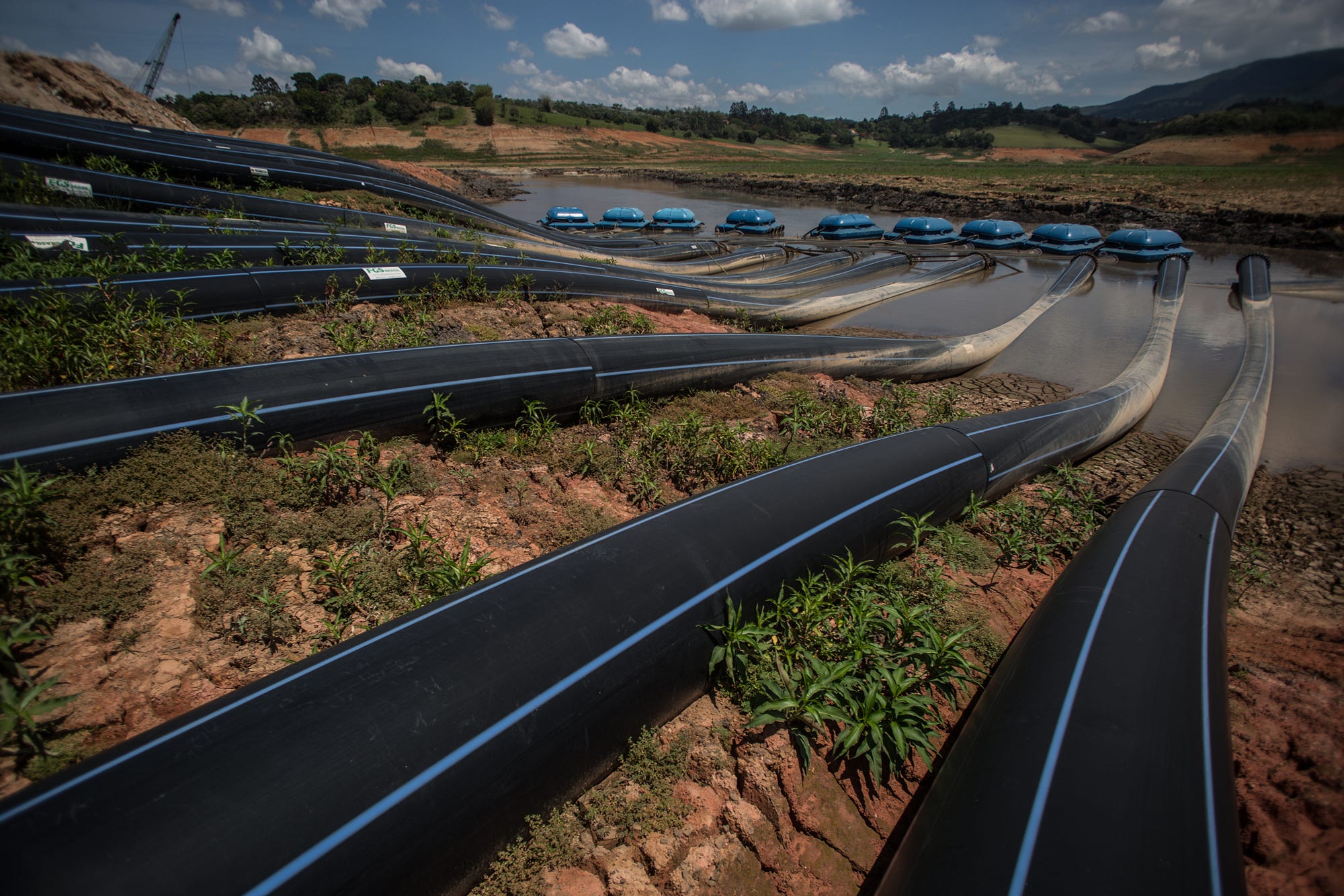
Em 2003, quando a Sabesp teve seu capital aberto ao mercado, parlamentares e movimentos sociais já se preocupavam com a priorização de interesses privados sobre a universalização do acesso à água.

Por Felipe Bianchi do Barão de Itararé

19 nov 2014


Apesar de atingir seu estopim em 2014, as razões para a grave crise hídrica pela qual passa o estado de São Paulo remetem a episódios que pouco têm a ver com falta de chuva ou caprichos da natureza. Um deles nos leva de volta a 2003, quando a Assembleia de São Paulo (Alesp) aprovou — na calada da noite — o Projeto de Lei 410/2003, de autoria do PSDB e responsável por abrir o capital da Sabesp ao mercado financeiro. Foram 55 votos contra 22, em sessão iniciada às 4h30 da madrugada do dia 27 de agosto.

Com a mudança na forma de gestão da empresa, 50,3% do seu capital encontra-se mãos do Governo do Estado de São Paulo, enquanto a bolsa de Nova Iorque (NYSE) detem 24,9% e a BM&F Bovespa abocanha 24,8% das ações. Ao longo desse período, a empresa atingiu números impressionantes: sua valorização bateu a marca de 601% e seu valor de mercado passou de R$ 6 bilhões a mais de R$ 17,1 bilhões.

Em 2012, os expressivos resultados foram comemorados no ‘Sabesp Day’, em plena Big Apple, com uma série de atividades especiais na bolsa nova-iorquina. Durante as festividades, a presidente da empresa, Dilma Pena, reafirmou o compromisso de “oferecer 100% de água tratada, 100% de coleta de esgoto e 100% de tratamento de esgoto em todo o interior do Estado de São Paulo até 2014”. Celebrada pelos acionistas, a dirigente argumentou que “a cada novo ano, a Sabesp mostra ter condições de executar seu objetivo com eficiência, de maneira sólida, dinâmica, inovadora e sustentável em termos financeiros, ambientais e sociais”.

Ou faltou combinar com o governador de São Paulo, Geraldo Alckmin, ou trata-se de uma realidade paralela. A conta da água não fecha. Apesar do sucesso da Sabesp na bolsa de valores, São Paulo sofre com a falta de abastecimento — o sistema da Cantareira, por exemplo, opera com 11% de sua capacidade e já utiliza a segunda cota do volume morto, levantando a seguinte questão: o modelo de gestão da Sabesp é o mais adequado para garantir a universalização do direito básico que é o acesso à água?

Sobre política e profecias

Na ocasião da votação que selou a entrada da Sabesp no mundo financeiro, a então deputada estadual Maria Lúcia Prandi fez uma declaração ‘profética’ sobre o tema, indagando se a empresa seria capaz de manter seu caráter público e priorizar os interesses da população ou se voltaria suas atenções aos desejos dos acionistas.


“Na prática, é uma quase privatização da Sabesp, que poderá perder seu caráter de empresa pública, abrindo espaço para os interesses privados, que visam lucros e não o benefício comum (…). Quem comprar as ações da Sabesp terá grande poder na gestão da empresa. Como ficará a questão das tarifas? Até que ponto a empresa vai querer investir em áreas carentes ou de difícil atendimento, como os morros? Como conseguir que as redes de esgoto e de distribuição de água cheguem a comunidades mais distantes?”


10 anos depois, ela comenta que “não se trata de profecia, mas de visão de mundo e de Estado”. Para a deputada federal, sua fala em 2003 foi uma “demonstração de que, a médio ou longo prazo, a população poderia pagar caro pela escolha que o governo estava prestes a fazer”.

Prandi recorda que, enquanto o PL 410/2003 estava em pauta, houve uma grande resistência na Alesp por parte de partidos à esquerda, que chegaram a realizar longos estudos sobre o tema para embasar o posicionamento contrário à matéria. “A Sabesp, à época, estava muito endividada. Tanto que havia forte pressão sobre os municípios não-conveniados. A capitalização foi uma das ferramentas que o governo lançou mão para sanar a situação e, na votação, foram vitoriosos”.

A tese de Prandi, no entanto, parece jogar luz sobre as origens de uma crise tratada de forma obscura pelo poder público paulista. “Ao vender ações, você sofre pressão de acionistas para aumentar o lucro, colocando os interesses dos donos das ações em primeiro lugar”, argumenta. “O acesso a um serviço essencial como o abastecimento de água nunca poderia ter sido relegado ao segundo plano”.

De acordo com ela, o governo poderia ter feitos ótimos investimentos que prevenissem crises como essa, já que há uma seca história no estado e o governo federal destina um significativo aporte financeiro para essa finalidade. “Mas a prioridade”, sugere, “parece ser agradar os acionistas”.

Primeira cota do Voume Morto, no sistema cantareira, São Paulo. Foto: Mídia NINJA
Governo optou por tratar água como negócio

Para Edson Aparecido da Silva, sociólogo e coordenador da Frente Nacional pelo Saneamento Ambiental, a opção feita 10 anos atrás pelo governo estadual foi de tratar a gestão da água como negócio. “Na época, a justificativa foi de que era preciso captar recursos em agências financeiras e bancos internacionais. Aderir à bolsa daria segurança aos que emprestassem dinheiro à Sabesp”, explica.

“Uma empresa pública com gestão privada”. Assim o sociólogo define a Sabesp, desde que passou a operar segundo a lógica de ampliação do lucro e de distribuição dos dividendos aos acionistas.

O principal problema, na avaliação de Silva, é a absoluta falta de transparência no modelo de gestão vigente. “Ainda que a quantidade de recursos investidos seja significativa — cerca de R$ 2 bilhões anuais -, não se tem a menor ideia de como é empregado. Os relatórios dizem apenas se foram feitos na região metropolitana, no interior ou no litoral, sem maiores detalhes, sendo que dentro desse valor podem estar embutidos, por exemplo, pagamentos a empresas terceirizadas que prestam serviço de má qualidade. A crise prova que os investimentos da Sabesp nos últimos anos podem ter sido péssimos”.

Ele repudia a postura de Geraldo Alckmin em não reconhecer publicamente a dimensão da crise e a responsabilidade que cabe à sua gestão, mesmo depois de pedir R$ 3,5 bilhões ao governo federal para bancar um pacote de medidas emergenciais. “Alckmin nsiste em negar que há redução da pressão da água durante certos períodos do dia, sendo que boa parte da população das periferias de São Paulo enfrenta o problema quase que diariamente. O governo poderia optar por uma política transparente, informando o cidadão das faixas de horário de racionamento a fim de reduzir, inclusive, o desperdício”.

Uma marca de cerveja nunca dirá ao seu consumidor ‘não compre cerveja’. É essa regra de mercado que a Sabesp tem seguido, mas seu produto é um serviço público, direito de todos”, afirma Edson Aparecido da Silva


Os números da Sabesp: declínio iminente?

O estatuto da Sabesp prevê que os acionistas podem receber até 25% do lucro líquido anual da empresa, mas desde a aprovação da regulamentação, o índice nunca foi menor que 26,1%. Em 2003, por exemplo, logo após a vitória de Geraldo Alckmin nas urnas de São Paulo, a porção que morreu nas mãos do capital privado atingiu obscenos 60,5% do montante total. Estima-se, ainda, que um terço do lucro líquido total da Sabesp já foi repassado aos acionistas, o que significa aproximadamente R$ 4,13 bilhões — o dobro do que a Sabesp investe anualmente em saneamento básico, segundo os cálculos do Jornal GGN

Presidente do Sindicato dos Trabalhadores em Água, Esgoto e Meio Ambiente (Sintaema) entre 1988 e 1994 e atual vice-presidente da Central dos Trabalhadores e Trabalhadoras do Brasil (CTB), Nivaldo Santana ressalta que a antes vigorosa taxa de lucro da Sabesp já tem acusado o golpe da crise: “A diminuição da receita tarifária, por conta da menor oferta de água, faz com que a empresa torne-se pouco atraente para os acionistas, até porque o investidor de Nova Iorque, por exemplo, não está preocupado se falta água para a população de São Paulo, mas sim com o retorno de seu investimento. Por isso, a tendência é que a queda nos números se acentue cada vez mais”.

Segundo ele, “o que se vê na Sabesp é uma administração privatista, que segue a lógica privada mesmo tendo uma gestão, ao menos em tese, mista”. “No curto prazo, a aprovação do PL 410/2003 visava fazer caixa para a Sabesp, mas a longo prazo, é parte de um projeto de redução do papel do Estado nos serviços públicos”, assinala.

Por fim, Santana destaca o fator ‘mídia’ como um grande empecilho para a discussão do problema: os grandes meios de comunicação não abordam a dimensão política da crise, em sua opinião, “dando enfoque excessivo ao problema da seca, ao fenômeno natural, como se nos restasse apenas torcer para que chova muito”. Para ele, “trata-se de uma cortina de fumaça sobre os investimentos insuficientes e ruins feitos pela Sabesp, poupando o governo estadual de críticas por parte da opinião pública”.

Coal Rush in India Could Tip Balance on Climate Change (N.Y.Times)

A mine in Jharkhand State. India’s coal rush could push the world past the brink of irreversible climate change, scientists say. CreditKuni Takahashi for The New York Times 

DHANBAD, India — Decades of strip mining have left this town in the heart of India’s coal fields a fiery moonscape, with mountains of black slag, sulfurous air and sickened residents.

But rather than reclaim these hills or rethink their exploitation, the government is digging deeper in a coal rush that could push the world into irreversible climate change and make India’s cities, already among the world’s most polluted, even more unlivable, scientists say.

“If India goes deeper and deeper into coal, we’re all doomed,” said Veerabhadran Ramanathan, director of the Center for Atmospheric Sciences at the Scripps Institution of Oceanography and one of the world’s top climate scientists. “And no place will suffer more than India.”

India’s coal mining plans may represent the biggest obstacle to a global climate pact to be negotiated at a conference in Paris next year. While the United States and China announced a landmark agreement that includes new targets for carbon emissions, and Europe has pledged to reduce greenhouse gas emissions by 40 percent, India, the world’s third-largest emitter, has shown no appetite for such a pledge.

“India’s development imperatives cannot be sacrificed at the altar of potential climate changes many years in the future,” India’s power minister, Piyush Goyal, said at a recent conference in New Delhi in response to a question. “The West will have to recognize we have the needs of the poor.”

Mr. Goyal has promised to double India’s use of domestic coal from 565 million tons last year to more than a billion tons by 2019, and he is trying to sell coal-mining licenses as swiftly as possible after years of delay. The government has signaled that it may denationalize commercial coal mining to accelerate extraction.

“India is the biggest challenge in global climate negotiations, not China,” said Durwood Zaelke, president of the Institute for Governance & Sustainable Development.

Prime Minister Narendra Modi has also vowed to build a vast array of solar power stations, and projects are already springing up in India’s sun-scorched west.

But India’s coal rush could push the world past the brink of irreversible climate change, with India among the worst affected, scientists say.

Indian cities are already the world’s most polluted, with Delhi’s air almost three times more toxic than Beijing’s by one crucial measure. An estimated 37 million Indians could be displaced by rising seas by 2050, far more than in any other country. India’s megacities are among the world’s hottest, with springtime temperatures in Delhi reaching 120 degrees. Traffic, which will only increase with new mining activity, is already the world’s most deadly. And half of Indians are farmers who rely on water from melting Himalayan glaciers and an increasingly fitful monsoons.

India’s coal is mostly of poor quality with a high ash content that makes it roughly twice as polluting as coal from the West. And while China gets 90 percent of its coal from underground mines, 90 percent of India’s coal is from strip mines, which are far more environmentally costly. In a country three times more densely populated than China, India’s mines and power plants directly affect millions of residents. Mercury poisoning has cursed generations of villagers in places like Bagesati, in Uttar Pradesh, with contorted bodies, decaying teeth and mental disorders.

The city of Dhanbad resembles a postapocalyptic movie set, with villages surrounded by barren slag heaps half-obscured by acrid smoke spewing from a century-old fire slowly burning through buried coal seams. Mining and fire cause subsidence that swallows homes, with inhabitants’ bodies sometimes never found.

Suffering widespread respiratory and skin disorders, residents accuse the government of allowing fires to burn and allowing pollution to poison them as a way of pushing people off land needed for India’s coal rush.

“The government wants more coal, but they are throwing their own people away to get it,” said Ashok Agarwal of the Save Jharia Coal Field Committee, a citizens’ group.

T. K. Lahiry, chairman of Bharat Coking Coal, a government-owned company that controls much of the Jharia region, denied neglecting fires and pollution but readily agreed that tens of thousands of residents must be displaced for India to realize its coal needs. Evictions are done too slowly, he said.

 Hauling coal by bicycle in Jharkhand in eastern India. The country plans to double its use of domestic coal by 2019 as part of efforts to reduce poverty. CreditKuni Takahashi for The New York Times 

“We need to shift these people to corporate villages far from the coal fields,” Mr. Lahiry said during an interview in his large office.

With land scarce, Bharat Coking is digging deeper at mines it already controls. On a tour of one huge strip mine, officials said they had recently purchased two mammoth Russian mining shovels to more than triple annual production to 10 million tons. The shovels are clawing coal from a 420-foot-deep pit, with huge trucks piling slag in flat-topped mountains. The deeper the mine goes, the more polluting the coal produced.

India has the world’s fifth-largest reserves of coal but little domestic oil or natural gas production. The country went on a coal-fired power plant building spree over the last five years, increasing capacity by 73 percent. But coal mining grew just 6 percent, leading to expensive coal imports, idle plants and widespread blackouts. Nearly 300 million Indians do not have access to electricity, and millions more get it only sporadically.

“India is going to use coal because that’s what it has,” said Chandra Bhushan, deputy director of the Delhi-based Center for Science and Environment, a prominent environmental group. “Its strategy is ‘all of the above,’ just like in the U.S.”

Each Indian consumes on average 7 percent of the energy used by an American, and Indian officials dismiss critics from wealthy countries.

“I don’t want to use the word ‘pontificate’ when talking about these people, but it would be reasonable to expect more fairness in the discussion and a recognition of India’s need to reach the development of the West,” Mr. Goyal said with a tight smile.

One reason for the widespread domestic support for India’s coal rush is the lack of awareness of just how bad the air has already become, scientists say. Smog levels that would lead to highway shutdowns and near-panic in Beijing go largely unnoticed in Delhi. Pediatric respiratory clinics are overrun, but parents largely shrug when asked about the cause of their children’s suffering. Face masks and air purifiers, ubiquitous among China’s elite, are rare here. And there are signs Indian air is rapidly worsening.

“People need to wake up to just how awful the air already is,” said Rajendra K. Pachauri, chairman of the Intergovernmental Panel on Climate Change, the world’s leading intergovernmental organization for the assessment of climate change.

India’s great hope to save both itself and the world from possible environmental dystopia can be found in the scrub grass outside the village of Neemuch, in India’s western state of Madhya Pradesh. Welspun Energy has constructed what for the moment is Asia’s largest solar plant, a $148 million silent farm of photovoltaic panels on 800 acres of barren soil.

Welspun harvests some of the most focused solar radiation in the world. Dust is so intense that workers must wash each panel every two weeks.

Under Mr. Modi, India is expected to soon underwrite a vast solar building program, and Welspun alone has plans to produce within two years more than 10 times the renewable energy it gets from its facility in Neemuch.

The benefits of solar and the environmental costs of coal are so profound that India has no other choice but to rely more on renewables, said Dr. Pachauri.

“India cannot go down China’s pathway, because the consequences for the public welfare are too horrendous,” he said.

São Pedro não tem ações da Sabesp (Medium)

19 Nov 2014

Reserva da Represa Jaguari/Jacarei no sistema Cantareira, em São Paulo. Foto: Mídia NINJA

No meio de uma crise sem precedentes no abastecimento de água de São Paulo, empresa deve chegar ao fim de 2014 com lucro perto de R$ 1,9 bilhão

por Arnaldo Pagano, especial para a Ponte

Diz a máxima que o capitalismo privatiza os lucros e socializa os prejuízos. No caso da Sabesp, a frase é ainda mais verdadeira: a privatização dos lucros e a socialização dos prejuízos ocorre simultaneamente.

No ano de 2014, marcado por uma crise sem precedentes no abastecimento de água no Estado de São Paulo, a Sabesp apresentou no segundo trimestre um lucro líquido de R$ 302,4 milhões e deve chegar ao fim do ano com um montante próximo do R$ 1,9 bilhão de lucro de 2013.

Isso mesmo! Enquanto parte da população da região metropolitana vê as torneiras secas há meses (como mostra o site colaborativo faltouagua.com), os acionistas da Sabesp têm um faturamento nada escasso. Diante desse quadro, o governo estadual tenta convencer a população de que a culpa é da falta de chuvas. Não é!

Culpar São Pedro pela crise hídrica em São Paulo é brigar com os fatos e desconhecer — ou querer esconder — a ineficiência da gestão da Sabesp, em grande parte provocada pela forma como a empresa é constituída economicamente e pelos interesses que tem de atender.

Dentre alguns pontos discordantes aqui e ali, pode-se tomar essa conclusão do debate realizado na USP na terça-feira (11/11) com acadêmicos especializados em urbanismo e gestão de recursos hídricos. No encontro promovido pelo CENEDIC (Centro de Estudos dos Direitos da Cidadania), discutiram o tema Gabriel Kogan, arquiteto mestre em gerenciamento hídrico no IHE (Institute for Water Education), Antonio Carlos Zuffo, professor do Departamento de Recursos Hídricos da Unicamp, Luis Antonio Venturi, professor da USP na área de Geografia dos Recursos Naturais, e Nabil Bonduki, professor na Faculdade de Arquitetura e Urbanismo da USP, vereador pelo PT e membro da CPI da Sabesp.

A questão político-econômica

Para entender a crise da água em 2014 é preciso voltar 20 anos no tempo. Em 1994, a Sabesp deixou de ser 100% estatal, tornando-se uma empresa de economia mista e capital aberto. Até 1997, ela era negociada no mercado de ações de balcão, com o governo dono de 95% da empresa.

Foto: Vagner Magalhães/Terra

Em 1997, as ações foram transferidas à Bovespa e, em 2002, passam a ser negociadas também na Bolsa de Valores de Nova York. Hoje, o Governo de São Paulo detém 50,3% das ações. O restante, 49,7%, é negociado nos mercados financeiros brasileiro e norte-americano.

Para Gabriel Kogan, essa configuração já é um problema. “Água é algo muito estratégico para ser gerido de maneira privada”, analisa. Para ele, o que ocorreu desde a abertura do capital foi uma maximização dos lucros dos acionistas ao mesmo tempo em que os investimentos que poderiam ter evitado a crise atual, como ampliação da rede de captação e saneamento, foram minimizados.

Agora, a crise é enfrentada com a externalização dos custos. O governador Geraldo Alckmin (PSDB-SP) pediu ao Governo Federal uma verba de R$ 3,5 bilhões para combater a crise hídrica com projetos a longo e médio prazo. Gabriel Kogan lembra que a quantia equivale a dois anos de lucros dos acionistas.

Ou seja, a Sabesp terá mais dinheiro público, agora da União, sendo que seus acionistas têm esse dinheiro. Mas a externalização de custos pode ser ainda mais cruel. Nós estaremos financiando a Sabesp e seus acionistas, mas e o prejuízo do dono de restaurante da região periférica, que fecha as portas porque falta água quase diariamente porque a Sabesp não investiu no passado? Quem o indenizará?

Para Nabil Bonduki, esse tipo de gestão da Sabesp é totalmente incompatível com o uso sustentável da água. “A água virou objeto de lucro. A Sabesp vive de vender água. Quanto mais água usarmos, maior vai ser a lucratividade da empresa”, comentou.

Dona Rute, moradora do Capão Redondo, vive um racionamento não declarado que pode durar até 9 dias sem água na torneira. A redução do consumo não interessa à lucratividade da empresa. Foto: Sarah Pabst

Para o vereador, a conscientização sobre o uso racional deve ocorrer, inclusive na época de abundância da água, para que os reservatórios estejam sempre cheios, já que, uma vez que eles estejam vazios, a recuperação torna-se muito mais difícil, devido ao chamado “efeito esponja” (com as represas esvaziadas, parte do solo argiloso que antes ficava submersa fica exposta e seca. Quando a chuva acontece, o solo absorve a água como uma esponja, antes de ser capaz de armazenar o líquido precioso).

Diante da lógica da maximização dos lucros, a Sabesp não tomou as medidas necessárias para conter a crise já em 2013, quando o nível dos reservatórios estava baixando. Políticas de racionamento, com penalização de quem desperdiçasse água, e de informação não foram feitas.

Ao contrário, o governo decidiu dar um bônus a quem economizasse. Para Nabil, essa foi a única medida séria, mas totalmente ineficiente, já que gerou uma economia “pífia” de 5%. Muito mais poderia ser obtido se houvesse um investimento da Sabesp na redução de perdas com vazamentos.

Integrante da CPI da Sabesp na Câmara Municipal de São Paulo, Nabil Bonduki diz que é preciso investigar como a redução de perdas de 2009 a 2014 foi de 0,6% (de 20,4% para 19,8%) sendo que o contrato estabelecia um investimento nada modesto de R$ 1,1 bilhão — um investimento bilionário para um resultado insignificante.

Mas a Sabesp não teve apenas um ano para tomar medidas que evitassem o problema atual. O esgotamento do sistema Cantareira já era previsto no ano de 2001 por Aldo Rebouças, professor emérito do Instituto de Geociências da USP, falecido em 2011. À época, Aldo Rebouças disse que o problema era seriíssimo, porque o nível estava perto do limite do sistema.

A Sabesp poderia ter feito um planejamento para “salvar” o Cantareira, mas optou por outra medida, como mostra a reportagem “Sabesp maquia crise no sistema Cantareira”, de Mariana Viveiros, da “Folha de S.Paulo”, em 29 de março de 2001. A repórter obteve um documento interno produzido pela Superintendência de Comunicação da empresa. A orientação era esconder a crise.

Propaganda da Sabesp veiculada no site da Revista Veja na semana de 17 de Novembro de 2014.

E não é de hoje que a influência do capital prejudica o abastecimento sustentável da Grande São Paulo. Em uma entrevista à Agência Fapesp em 2012, a geógrafa Vanderli Custódio, do Instituto de Estudos Brasileiros da USP, disse que a vazão do Tietê quando atravessa a região metropolitana é de 82 metros cúbicos por segundo. A Sabesp, com todos os seus sistemas em capacidade máxima, produz aproximadamente 67 metros cúbicos de água por segundo.

O Tietê, portanto, abasteceria São Paulo inteira e ainda sobraria água, mas isso hoje é totalmente inviável dada a poluição do rio, que tem origem na concessão feita na década de 1920 pelo governo paulista à Light, quando se permitiu a inversão do curso do Rio Pinheiros visando à exploração dos recursos hídricos da Bacia do Alto Tietê para a geração de energia.

Tais problemas levam à questão central pela qual passam as possíveis soluções para a crise: a reestatização da Sabesp. Como uma empresa sem controle público e sob a lógica do capital poderia gerir um recurso essencial à vida? Para Gabriel Kogan, essa mudança será impossível “sem o povo nas ruas”.

Protesto contra a falta de água e má gestão hídrica em frente a sede da Sabesp, em São Paulo. Foto: Mídia NINJA

A questão natural

Só a água do Aquífero Alter do Chão, na Amazônia, abasteceria a humanidade inteira por três séculos. A água do Aquífero Guarani, mais 150 anos. O dado impressionante foi um dos exemplos utilizados pelo professor Luis Antônio Venturi para ilustrar o fato de que a água é, numa perspectiva geográfica dos recursos naturais em escala planetária, o recurso mais abundante do planeta. É praticamente inesgotável.

Tendo em vista que a fonte das águas continentais são os oceanos, enquanto eles existirem, enquanto o sol aquecê-los, enquanto a Terra girar para levar a umidade aos continentes e enquanto a lei da gravidade permitir as precipitações – o que deve acontecer “por um certo tempo”-, não é possível pensar na finitude da água.

Mas, e numa escala local? Segundo Venturi, o mapa hidrográfico de São Paulo é de dar inveja a qualquer região. Por que estamos nessa crise, então? Venturi estabelece sete motivos:

1- Os sistemas não são equilibrados em relação à oferta e demanda. O sistema Rio Grande estava com o dobro de água do Cantareira para atender uma população cinco vezes menor.

2- Os sistemas não estão eficientemente articulados em rede. Deste modo, toda a água que temos não está disponível para todos.

3- Problemas de perdas na rede de distribuição. A média mundial de perdas é de 11%, enquanto em São Paulo é de 19,8% (segundo os dados oficiais, embora especialistas acreditem que essa porcentagem seja maior; na Holanda é de 0%).

4- Algumas represas, como Atibainha, são em formato de pires, com grande superfície de evaporação e baixo armazenamento (o formato ideal seria de uma xícara, por exemplo).

5- Os sistemas só estão sendo equipados agora para usar o volume morto, necessário em planos emergenciais. Sem planejamento, estamos correndo atrás do prejuízo.

6- Você já reparou que a água que bebemos é a mesma água limpíssima que usamos para dar descarga? Sem a utilização da água de reúso, ocorre uma perda qualitativa da água. Metade da água usada em casa poderia ser não-potável.

7- Estiagem natural.

Governador Geraldo Alckmin. Foto: Autoria desconhecida

De acordo com Luis Antônio Venturi, o governo de São Paulo, ao falar com a população sobre a crise, inverte a ordem, colocando a estiagem natural como primeira causa, sem assumir as outras causas, que refletem erros da Sabesp. E mais: essa estiagem não é a maior, já que a falta de chuvas foi mais grave nos anos de 1963 e 1984. Além disso, a estiagem era previsível. São Paulo possui uma ampla base estatística que permite saber quando haverá períodos de mais ou menos chuva.

O professor Antônio Carlos Zuffo revelou alguns fatos que mostram que o atual período não é excepcionalmente seco em São Paulo. Vemos em 2014 seca em São Paulo e na Califórnia, e enchentes na Amazônia e na Europa (na Croácia é a pior da história).

No ano de 1953 o quadro foi rigorosamente o mesmo, com direito a grave estiagem em São Paulo e a maior enchente do Amazonas. Zuffo ainda recordou uma reportagem do jornal O Estado de S. Paulo de 27/11/1953, com o título “Mudanças Climáticas ameaçam a produção de café no Brasil”.

O curioso, segundo Zuffo, é que em 53 não havia nem Transamazônica. Para o professor, a ação humana (antrópica) é ínfima perto da influência dos ciclos solares no clima global. Esse assunto ainda gera mais discussão entre os especialistas, mas o fato mostra que a estiagem em São Paulo não é sem precedentes e que era previsível.

“Como São Paulo fica à mercê de chuva como as sociedades primitivas?”, questiona Luis Antônio Venturi. O professor ainda nota que o governo de São Paulo pode ficar em uma situação desconfortável em breve.

Morador da cidade de Itu, no interior de São Paulo, toma banho de chuva depois de meses de estiagem e racionamento de água. Foto: Itu Vai Parar

Quando começar a chover, o problema da água não será resolvido, dada a situação dramática do Cantareira. Haverá alagamentos, como já houve há algumas semanas. O governo certamente colocará a culpa das inundações na chuva, não no assoreamento ou impermeabilização do solo.

Surgirá, então, a incômoda questão: Como é possível faltar água pela escassez de chuvas e ao mesmo tempo haver enchente pelo excesso de chuvas?

São Pedro merece ser poupado dessa. Ele não está no mercado de ações.

How the bacteria in our gut affect our cravings for food (Conversation)

November 6 2014, 10.00pm EST

Vincent Ho

Gut bacteria can manufacture special proteins that are very similar to hunger-regulating hormones. Lighthunter/Shutterstock

We’ve long known that that the gut is responsible for digesting food and expelling the waste. More recently, we realised the gut has many more important functions and acts a type of mini-brain, affecting our mood and appetite. Now, new research suggests it might also play a role in our cravings for certain types of food.

How does the mini-brain work?

The gut mini-brain produces a wide range of hormones and contains many of the same neurotransmitters as the brain. The gut also contains neurons that are located in the walls of the gut in a distributed network known as the enteric nervous system. In fact, there are more of these neurons in the gut than in the entire spinal cord.

The enteric nervous system communicates to the brain via the brain-gut axis and signals flow in both directions. The brain-gut axis is thought to be involved in many regular functions and systems within the healthy body, including the regulation of eating.

Let’s consider what happens to the brain-gut axis when we eat a meal. When food arrives in the stomach, certain gut hormones are secreted. These activate signalling pathways from the gut to the brainstem and the hypothalamus to stop food consumption. Such hormones include the appetite-suppressing hormones peptide YY and cholecystokinin.

Gut hormones can bind and activate receptor targets in the brain directly but there is strong evidence that the vagus nerve plays a major role in brain-gut signalling. The vagus nerve acts as a major highway in the brain-gut axis, connecting the over 100 million neurons in the enteric nervous system to the medulla (located at the base of the brain).

Research has shown that vagus nerve blockade can lead to marked weight loss, while vagus nerve stimulation is known to trigger excessive eating in rats.

This brings us to the topic of food cravings. Scientists have largely debunked the myth that food cravings are our bodies’ way of letting us know that we need a specific type of nutrient. Instead, an emerging body of research suggests that our food cravings may actually be significantly shaped by the bacteria that we have inside our gut. In order to explore this further we will cover the role of gut microbes.

Gut microbiota

As many as 90% of our cells are bacterial. In fact, bacterial genes outnumber human genes by a factor of 100 to one.

The gut is an immensely complex microbial ecosystem with many different species of bacteria, some of which can live in an oxygen-free environment. An average person has approximately 1.5 kilograms of gut bacteria. The term “gut microbiota” is used to describe the bacterial collective.

We each have around 1.5kg of bacteria in our guts. Christopher PooleyCC BY

Gut microbiota send signals to the brain via the brain-gut axis and can have dramatic effects on animal behaviour and health.

In one study, for example, mice that were genetically predisposed to obesity remained lean when they were raised in a sterile environment without gut microbiota. These germ-free mice were, however, transformed into obese mice when fed a faecal pellet that came from an obese mouse raised conventionally.

The role of gut microbiota in food cravings

There is growing evidence to support the role of gut microbiota in influencing why we crave certain foods.

We know that mice that are bred in germ-free environments prefer more sweets and have greater number of sweet taste receptors in their gut compared to normal mice. Research has also found that persons who are “chocolate desiring” have microbial breakdown products in their urine that are different from those of “chocolate indifferent individuals” despite eating identical diets.

Many gut bacteria can manufacture special proteins (called peptides) that are very similar to hormones such as peptide YY and ghrelin that regulate hunger. Humans and other animals have produced antibodies against these peptides. This raises the distinct possibility that microbes might be able to directly influence human eating behaviour through their peptides that mimic hunger-regulating hormones or indirectly through antibodies that can interfere with appetite regulation.

Practical implications

There are substantial challenges to overcome before we can apply this knowledge about gut microbiota in a practical sense.

First, there is the challenge of collecting the gut microbes. Traditionally this is collected from stools but gut microbiota is known to vary between different regions of the gut, such as the small intestine and colon. Obtaining bacterial tissue through endoscopy or another invasive collection technique in addition to stool samples may lead to more accurate representation of the gut microbiome.

Second, the type of sequencing that is currently used for gut microbiota screening is expensive and time-consuming. Advances will need to be made before this technology is in routine use.

Probably the greatest challenge in gut microbiota research is the establishment of a strong correlation between gut microbiota patterns and human disease. The science of gut microbiota is in its infancy and there needs to be much more research mapping out disease relationships.

Probiotics contain live microorganisms. Quanthem/Shutterstock

But there is reason to be hopeful. There is now strong interest in utilising both prebiotics and probiotics to alter our gut micro biome. Prebiotics are non-digestible carbohydrates that trigger the growth of beneficial gut bacteria, while probiotics are beneficial live microorganisms contained in foods and supplements.

Faecal transplantation is also now an accepted treatment for those patients that have a severe form of gut bacterial infection called Clostridium difficile, which has been unresponsive to antibiotics.

The use of such targeted strategies is likely to become increasingly common as we better understand how gut microbiota influence our bodily functions, including food cravings.

Kelman: ‘A solução para a crise hídrica no país passa pela iniciativa privada’ (Brasil Econômico)

17/11/2014 | 08:40 – Atualizado em: 17/11/2014 | 08:43

Responsável pela implementação da Agência Nacional de Águas (ANA), o engenheiro Jerson Kelman, hoje na UFRJ, defende as Parcerias Público-Privadas para ampliar a segurança hídrica no país

Nicola Pamplona e Octávio Costa

Com passagens pelo comando da Agência Nacional de Águas (ANA) e da Agência Nacional de Energia Elétrica (Aneel), o engenheiro Jerson Kelman defende o modelo de Parcerias Público-Privadas para ampliar a segurança hídrica no país. Segundo ele, investimentos em saneamento e novas fontes de captação de água serão mais eficientes se forem contratados como prestação de serviços, e não como obras públicas. “Esse conceito de contratação pelo resultado, e não pela obra, é um salto qualitativo”, afirma. Para Kelman, que também passou pela presidência da Light, o poder público está amarrado pelo “excessivo” sistema de controle, pelo lobby das empreiteiras e por circunstâncias políticas, responsáveis pela falta de transparência sobre a dimensão das crises de água e de energia no período pré-eleitoral.

“Faltou, em São Paulo, dizer claramente à população que a situação era grave. Mas isso vale também para o governo federal na energia”, comenta o especialista (hoje de volta à Coppe/UFRJ), que não acredita, porém, em um cenário de desabastecimento. “A minha visão é de que, mesmo a longuíssimo prazo, tem água para todos. Mas a questão é tratada com um componente emocional muito forte”, afirma, defendendo a posição de São Paulo na briga pela captação de água do Rio Paraíba do Sul. Responsável pelo relatório que identificou as causas do racionamento de 2001, que levou seu nome, Kelman diz que o diagnóstico da crise energética atual é o mesmo da época: falta de garantias físicas das hidrelétricas.

O que nos trouxe a esse cenário de crise hídrica?

A hidrologia este ano, de fato, ali na região do Piracicaba, que abastece o Sistema Cantareira, não é só a pior da história, é disparada a pior da história. Nenhum hidrólogo poderia imaginar que isso pudesse acontecer. Se a afluência média no verão é 100, o pior ano histórico até então era metade disso. E este ano é metade da metade. É metade do pior. No São Francisco é também a pior do histórico. Não é uma seca trivial, é barra pesada.

É uma situação que costumava acontecer apenas no Nordeste…

São Paulo, em condições normais, já tem baixa disponibilidade de recursos hídricos, porque fica na cabeceira dos rios. Se dividir a disponibilidade hídrica pela população, o Nordeste terá uma taxa maior, porque a população de São Paulo é brutal, 20 milhões de habitantes. Por isso, São Paulo já depende, há muito tempo, de água das bacias vizinhas. E este ano teve uma seca tão intensa, que toda a análise hidrológica anterior terá que ser refeita, ninguém imaginava a possibilidade de ter tão pouca chuva. Quer dizer, São Paulo sempre esteve mais inseguro do que imaginávamos, porque nós não sabíamos que poderia acontecer um ano tão seco.

E como ampliar a segurança hídrica?

São Paulo já tinha feito um plano de macro metrópole, procurando fontes de abastecimento de água, porque não tem outra fonte local. E não tem também porque a água é muito poluída. Se o esgoto estivesse sendo coletado e tratado, os rios Pinheiros e Tietê seriam fontes de abastecimento. Então, antes mesmo da crise, ficou pronto um plano sobre onde buscar água para São Paulo. Mas aquilo era para ser visto a longo ou médio prazo, hoje é urgente, porque São Paulo não pode mais viver sem reforço. E aí há três possíveis locais. Uma possibilidade é tirar água do Alto Paraíba do Sul, mais especificamente da Represa de Jaguari. O problema é que se tirar dali, a água deixa de correr para cidades paulistas como São José dos Campos, Taubaté, e depois para as cidades fluminenses até Campos. E para complicar mais, em 1950, foi feita a transposição do Paraíba do Sul para o Guandu.

Mas o Rio quer impedir a retirada, alegando que pode faltar água aos cariocas…

Hoje, em uma situação crítica, a Cedae está retirando 110 metros cúbicos por segundo do Paraíba do Sul. Mas só usa 50. Abaixo do Guandu, tem umas indústrias, que tiram outros 10, mais ou menos. O Alckmin quer tirar cinco e diz que só vai afetar produção de energia. E ele tem razão. Somando a Cedae e as indústrias, mais uma projeção de crescimento, a demanda máxima no futuro seriam uns 80 metros cúbicos por segundo. Se está passando hoje 110, no mínimo sobram uns 30. O que falta dizer é que, vergonhosamente, o Rio Guandu recebe dejetos de pequenos rios que cortam a Baixada Fluminense. Então, os 110 metros cúbicos por segundo são usados para diluir a carga de poluição. Nos anos 80, fizemos um projetinho simples de desviar essa água poluída para depois da captação. A obra nunca foi feita.

Qual o investimento?

É de R$ 75 milhões. Não é nada. E até a Cedae economizaria. Mas ainda tem outro problema. Se reduzir a vazão do Guandu, lá perto de Sepetiba, o mar invade um pouco mais e tem uma intrusão salina no local de captação dessas indústrias. Esse é um problema de facílima solução, é só mudar a tomada de água das indústrias e trazer por uma tubulação. Resumindo, a ideia de captar água do Paraíba do Sul é perfeitamente exequível. Não há porque ter guerra d’água, desde que se faça o dever de casa no Guandu e no Paraíba do Sul. No fundo, é investimento em saneamento. Se tratar da qualidade da água, sobra quantidade.

Cinco metros cúbicos por segundo resolvem o problema de São Paulo?

Melhora muito, porque, com cinco metros cúbicos por segundo, São Paulo volta a ter a confiabilidade que imaginávamos ter. E pode tirar até mais. São Paulo vai crescer e não pode ficar fazendo obrinha. Mas, enquanto isso for visto como uma obra pública, vamos cair nessas armadilhas relacionadas à origem do dinheiro, e se o Estado do Rio deixa ou não deixa. Uma alternativa seria fazer desse problema uma oportunidade para uma PPP (Parceria Público-Privada). Em vez de obra pública, com dinheiro do PAC, imagine fazer uma licitação para colocar água no Cantareira, vencendo quem oferecer o menor preço por metro cúbico. Essa empresa privada teria que fazer todas as obras necessárias para viabilizar a captação, não só a adutora: resolveria o problema da poluição no Guandu e faria a nova captação de água para as indústrias. Seria uma solução em que ninguém perde. Quem oferecer o melhor preço, leva um contrato para vender água por 30 anos.

A legislação tem instrumentos para permitir isso?

Tem, é uma PPP. Esse modelo se ajusta a quase todas as obras do PAC. Algumas já são assim, como o Minha Casa Minha Vida, por exemplo. O governo paga pelo resultado, não fica pagando por ferro, tijolo. Quando eu estava na ANA, fiz um projeto piloto disso, para a construção de estações de tratamento de esgoto. É normal, no saneamento, ter dinheiro público, porque o beneficiário é o cidadão, e não o consumidor — é a comunidade. No mundo inteiro tem subsídio para saneamento. Ou faz uma obra pública, que é o que se fez aqui sempre, mas não funciona, porque toda a ênfase está na obra; ou se cria um modelo de PPP. O que se fez na ANA foi garantir o recebível. Quer dizer, não quero saber da tecnologia, qual o seu projeto. Quero saber quanto esgoto chega na estação e quanto é tratado. Se trata no padrão combinado, recebe o valor por metro cúbico. Então, o cara não tem risco. E tudo que ele tem que fazer é demonstrar que é capaz de coletar e tratar o esgoto. Esse conceito de pagamento pelo resultado, e não pela obra, é um salto qualitativo.

E as outras alternativas?

Uma é tirar água ao Sul, do Rio Juquiá, que tem várias usinas hidrelétricas. É uma obra cara, porque é longe, e o Juquiá está mais baixo que São Paulo, teria que subir uns 300 metros. Nessa alternativa também pode ser uma PPP, mas como o bombeamento é muito grande, o esquema devia ser um backup: continua tirando água do Sistema Cantareira e, em uma situação parecida com 2014, bombeia a água para lá. Nesse caso, teria que desligar as hidrelétricas, que são da CBA (Companhia Brasileira de Alumínio, do grupo Votorantim), e cuja concessão vence em 2016. Pode ser fazer uma nova licitação prevendo a parada das usinas nos anos críticos. E a terceira fonte é mais longínqua, é lá no Paranapanema, na divisa com o Paraná, na Represa Jurumirim, a 200 km da região metropolitana. Mas tem a vantagem de resolver uma série de problemas de abastecimento de cidades pelo caminho.

Qual a melhor alternativa?

Acho que o Paraíba do Sul, que custa uns R$ 500 milhões. Mas, pode ser que tirar da Votorantim seja melhor. O problema é que os projetistas sempre imaginaram obras públicas, com as restrições políticas que existem. Quer dizer, já foi uma ousadia imaginar tirar 5 m³ por segundo do Paraíba do Sul porque o Rio ia chiar. É um falso problema, que só existe porque não se resolveu o saneamento. Se resolver, o problema não existe. A minha visão é que, mesmo a longuíssimo prazo, tem água para todos. Mas a questão é tratada com um componente emocional muito forte.

São Paulo e Rio têm perdas enormes nas redes de água. Como resolver isso?

As duas empresas são estatais e a regulação e a fiscalização são muito mais tênues quando se trata de estatais. A Aneel, por exemplo, tem centenas de empresas para fiscalizar, o poder de fiscalização dela é bem maior. Em São Paulo, é uma agência para fiscalizar um monstro que é a Sabesp. E no Rio de Janeiro, a agência não tem nenhum peso, é para inglês ver. No médio prazo, precisamos fazer duas coisas diferentes. A primeira é investir em saneamento. Se compararmos os índices de saneamento básico brasileiro com países análogos, vemos que estamos atrasados. Enquanto 99,3% das casas têm energia elétrica, apenas 60% têm conexões e redes de tratamento de esgoto. E, em tratamento, é pior ainda. E temos que investir também em perdas. A Cedae trata 47 m³ por segundo, mas fatura muito menos do que isso. Deve faturar 60% disso. E essa diferença tem duas origens: uma é vazamento físico, outra são as perdas comerciais. É gato, água roubada, não medida… Tem que trabalhar nas duas frentes. Mas isso tudo são programas de décadas que não deveriam ser feitos com obras públicas, e sim no modelo PPP.

O fato de as empresas de saneamento serem estatais é um obstáculo?

Não. O problema é que o motor que move o saneamento é o lobby da construção civil; não é o lobby da operação do sistema. Quem está no Congresso fazendo emenda ao orçamento está preocupado em construir, em inaugurar obra. Aí, depois de dois anos, se a obra estiver funcionando ou não, não tem problema. Temos um sistema perverso, porque o lobby é para construção, para maximização do custo, para inauguração e para o não funcionamento. Quando ouço na campanha política o cara dizer “Gastei tanto, vou gastar tanto”, penso: e daí? Não interessa quanto gasta; interessa é quando ficará pronto, se funciona ou não. E o segredo disso é a PPP, botar a iniciativa privada na história.

No curto prazo, o Brasil corre risco de desabastecimento?

Nenhuma das obras sobre as quais falamos é para 2015. Olhando para trás, o governo fez a melhor política em relação à água? Claro que não. Porque era ano eleitoral. Não teve transparência, não teve a franqueza com a população que teve, por exemplo, o governo Fernando Henrique Cardoso em 2001. Lá, o governo disse que havia um problema grave. Fui coordenador de uma comissão em 2001 para explicar porque tinha havido o racionamento. Foi feito um relatório, que o setor elétrico chamou de relatório Kelman, que concluía que houve problema de governança. Eu fui entregar o relatório ao presidente e disse que, infelizmente, o governo não saía bem na fotografia. Mas o presidente determinou que comunicássemos à população que a situação era grave e que precisávamos adotar medidas. Uma coisa o governo de São Paulo fez: bônus para quem economizar. Mas não basta, quem usa mais água tem que levar uma pancada. Cerca de 50% da população de São Paulo diminuiu o consumo, cerca de um quarto ficou na mesma e um quarto aumentou. São os espertos. Esse pessoal tem comportamento antissocial e precisa ser penalizado. No racionamento em 2001, quem consumia mais do que a meta pagava uma multa. Em São Paulo, só teve a cenoura, não teve o tacape. Faltou também dizer claramente à população que a situação estava grave. Mas isso vale para o governo federal também na energia. Foi uma infelicidade que 2014 fosse um ano eleitoral, porque não se aplicou a mesma transparência, a mesma clareza de informações que tivemos em 2001. O Alckmin deve ter tido suas razões, porque em 2002 quem ganhou as eleições foi o Lula, e não o Serra. Esse deve ter sido o raciocínio dele. Mas sob o ponto de vista de governo, de interesse público, a atuação não foi a melhor, desperdiçou-se água e os reservatórios estão mais vazios do que deveriam.

Essa atitude ampliou o risco?

A população olha os últimos seis meses e, baseada na experiência de não ter chovido nada, entra em pânico achando que não vai chover nos próximos seis meses. É errado. As pessoas não se lembram que as chuvas são muito sazonais, elas caem no verão. Então, não tem dúvida de que vai chover no verão, e não tem dúvida de que os reservatórios vão se recuperar no verão. A dúvida é se vai chover o suficiente. Se chover a média, os reservatórios da Cantareira vão chegar em abril, no final da estação chuvosa, com 25%. O que está longe do estoque confortável, que é de 65%. Se chegarem a 65%, estamos com a vida ganha. Mas não vão chegar. O mais provável é que saiam do negativo, recuperem um pouquinho, mas de forma insuficiente para dar conforto em 2015. E tem, claro, um cenário péssimo, que não encha nada, e aí é uma tragédia, pode ter caos em São Paulo. Mas é pouco provável. Os dois extremos são improváveis. Então, 2015 será parecido com 2014. Não é o caos, mas as pessoas vão sofrer, como hoje.

Não seria melhor fazer um racionamento compulsório?

Em energia elétrica é possível fazer, já foi feito no Rio nos anos 50, porque pode programar e ter baterias nos hospitais, pode de alguma forma se organizar. Em água, é um pouco mais complicado. Porque as tubulações estão sempre sob pressão e vazando água para o terreno. Quando esvazia o tubo, o terreno está encharcado de água poluída que passa a entrar pelos buracos da tubulação. Então, tem um risco de saúde pública. Têm razão aqueles que dizem para ter cuidado com racionamento. Então o prognóstico para 2015 é preocupante. A obra que está aí na pauta, de uso de água do Paraíba do Sul, já deveria estar sendo feita em regime emergencial, o mais rápido possível. Mas o Brasil caiu em uma armadilha de excesso de controle. A cada novo escândalo, a tendência da população é clamar por mais controle. No setor público, o mecanismo de controle de corrupção, de mau gasto, não tem a medida de eficiência, de qual é o custo do controle versus o custo de eficiência. A não ser na Receita Federal, que é um exemplo positivo. Então, o que tem acontecido é cada vez mais controle, mais burocracia. Na tentativa de inibir o comportamento deletério dos desonestos ou incompetentes, cria-se um monte de regras que restringe a capacidade de operar do honesto e do capaz. Na realidade, todo o incentivo para a administração pública é para não fazer nada. Se não fizer nada, não corre o risco.

A crise energética é grave?

Não falta energia. O que acontece é que a energia está muito cara. Eu fiz uma conta grosseira: de acordo com o TCU, consumidores e contribuintes pagaram extraordinariamente, ou seja, a mais do que seria normal, R$ 60 bilhões nos últimos anos, por conta da hidrologia desfavorável. Para onde foi esse dinheiro externo ao setor elétrico brasileiro? Pagar combustível, porque nós tivemos que ligar as térmicas. Quanto se pagou? R$ 50 bilhões. Então, R$ 10 bilhões foi dinheiro que mudou de bolso dentro do setor elétrico. Geradora que estava com excesso de energia e ganhou bastante dinheiro, por exemplo. De fato, isso não é muito salutar. Em dois anos, um volume tão grande de dinheiro mudar de mãos é porque alguma coisa entre as regras está mal. Mas o fundamental é que R$ 50 bilhões de gasto com térmicas é demais.

Qual o diagnóstico?

A PSR (consultoria especializada), desde 2010, descobriu o que ela chama de fator de ficção. 2013 não foi um ano de hidrologia muito ruim. Pelo contrário, essa energia afluente no sistema, que neste ano está em 80%, foi de 98% em 2013. Foi um ano na média. No entanto, os reservatórios chegaram ao final do ano vazios. Em 2013, foram ligadas todas as térmicas, foi um ano de hidrologia normal e os reservatórios chegaram vazios. A que atribuir isso? A primeira coisa é atraso. O setor conta com a entrada de um monte de usinas e esse cronograma, sistematicamente, atrasa. E muito mais do que atribuir ao Ibama, à Funai, é atribuir às sentenças judiciais tomadas sem que o juiz tenha uma percepção das consequências — na economia, em nossa competitividade, no nível de emprego, no preço da energia.

Como resolver esse problema?

Com planejamento. No Brasil, estamos aprovando, ou desaprovando, empreendimentos individualmente. A análise dos empreendimentos é assim: “Devo construir a usina X, seja hidrelétrica termelétrica ou solar?”. Faz-se uma audiência pública. Quem vai à audiência são os que serão prejudicados localmente, um legítimo direito, e alguns que têm ideologia contrária. Agora, os beneficiários de uma resposta positiva somos todos nós espalhados pelo Brasil inteiro, que não vamos à audiência pública, nem sabemos que existe isso. Hoje, sou favorável a uma discussão política sobre a matriz elétrica que precisamos. O planejamento do país tem que sair de uma esfera puramente tecnocrata para uma esfera política, em que se faça um pacto sobre qual matriz precisamos. Isso foi feito, por exemplo, no trabalho Plataformas dos Cenários Energéticos, realizado por uma ONG, que chamou o Greenpeace, a Coppe, o pessoal de carvão e o ITA. O Greenpeace disse que queria tudo solar. É possível? É. Agora, vai precisar de bateria, porque de noite não tem sol. A energia vai custar tanto, e aí o Brasil não fica competitivo. É isso mesmo? Quem quer o Brasil competitivo ou não gosta de bateria vai se opor. Ou seja, muda de patamar a discussão, em vez de ser “não, não, não”.

Como se daria essa discussão no âmbito político?

Poderia ser no âmbito do Conselho Nacional de Política Energética. Uma discussão da matriz elétrica que passasse a ser mandatória para os órgãos. Em vez de Ibama, ICMBio, Funai examinarem item a item, você reúne o presidente desses órgãos com o ministro de Minas e Energia para chegar a um acordo sobre uma lista de empreendimentos que atenda às necessidades do país. Não será uma lista ótima do ponto de vista ambiental, econômico, energético ou social, mas será uma lista possível. Hoje, temos uma Torre de Babel.

Que nos trouxe a essa situação…

Além dos atrasos nas obras, há uma questão técnica. As decisões tomadas no setor elétrico seguem modelos matemáticos e de otimização muito sofisticados. Mas como qualquer modelo, os dados de entrada têm de estar corretos. Percebeu-se que temos garantia física de usinas que não condiz à realidade. A PSR percebeu uma divergência entre o mundo real e o que o modelo está vendo. No real, está se usando mais água para se produzir energia do que o modelo imaginava. E aí tem uma série de hipóteses que ninguém sabe ao certo o que é. A primeira é uma mudança do regime hidrológico. Outra hipótese é que a relação entre a quantidade de água que passa na turbina e a quantidade de energia produzida esteja errada. Além disso, os reservatórios são como se fossem bacias e, depois de 30 anos que aquilo foi alagado, já mudou completamente a topografia, com o acúmulo de sedimentos no fundo.

Temos um estoque de energia menor do que imaginamos?

Isso. É tão importante conhecer a real capacidade que eu até prefiro que se faça uma anistia: “Olha meus amigos, me contem a verdade, e eu não vou lhes punir”. Uma espécie de delação premiada. Permitiria fazer uma energia de reserva maior.

E as perspectivas para 2015?

Acho que a energia vai continuar cara. Vai ter um grande salto de custo de energia e o cenário mais provável é que continue acumulando isso, porque as térmicas continuarão ligadas.

Pode vir uma chuva e resolver?

Sim, eventualmente, pode chover. Mas eu prefiro esperar, porque é precoce falar de tragédia em novembro, início da estação chuvosa, seja em água, seja em energia. Mas, imaginando um verão que não chova nada, o que não é comum, nós vamos ter racionamento de energia e água em 2015. Porque vamos chegar a abril com estoque perto de zero.

No relatório Kelman, de 2001, o diagnóstico foi de governança…

(Interrompendo) Não, o problema principal é que havia energia garantida falsa na praça.

Ou seja, se houvesse um relatório Kelman agora, o diagnóstico seria o mesmo…

(Risos) É verdade, o problema é parecido.

Feliciano apresenta PL que torna obrigatório o ensino do criacionismo nas escolas (Portal Aprendiz)

TER, 18/11/2014 – 06:45

ATUALIZADO EM 18/11/2014 – 06:45

Por Pedro Ribeiro Nogueira e Raiana Ribeiro, do Portal Aprendiz

O deputado federal e pastor Marco Feliciano (PSC-SP) apresentou à Câmara dos Deputados nesta quinta-feira (13/11) um Projeto de Lei que torna obrigatório o ensino do criacionismo – doutrina religiosa que se opõe à teoria da Evolução de Darwin – nas escolas públicas e privadas do Brasil. Antes de ser discutido e votado, o PL será encaminhado para a Comissão de Constituição e Justiça (CCJ).

Clique aqui para acessar o PL

A proposta de lei afirma que as grades curriculares brasileiras deverão incluir “noções de que a vida tem sua origem em Deus, como criador supremo de todo universo e de todas as coisas que o compõe”. Segundo o texto, ele deverá ser ensinado “analogamente ao evolucionismo, alternância de conhecimento de fonte diversa a fim de que o estudante avalie cognitivamente ambas as disciplinas” (sic).

Os argumentos que sustentam o PL apontam que é necessário inserir o “conceito de origem divina”, pois “ensinar apenas a teoria do evolucionismo nas escolas é violar a liberdade de crença, uma vez que a maioria das religiões brasileiras acredita no criacionismo”.

Helena Nader, presidenta da Sociedade Brasileira para o Progresso da Ciência (SBPC), associação que congrega mais de 130 sociedades científicas, afirmou que “negar Darwin é voltar ao obscurantismo”.

“A ciência nunca quis discutir a fé. Mas parece que algumas religiões estão interessadas em discutir a ciência”, alertou.

A pesquisadora lembrou que não é a primeira vez que esse tipo de proposta tramita no legislativo brasileiro e que a SBPC manterá seu posicionamento contrário.

“É preciso esclarecer que nada na ciência elimina, para quem acredita, a presença de um ser superior. Por isso, confundir criacionismo com ciência é inadmissível”, defendeu.

Confusão

O texto descreve as crianças que frequentam as escolas públicas como “confusas”, pois estariam aprendendo noções de evolucionismo na escola e criacionismo na igreja. Para o deputado, “o ensino darwinista limita a visão cosmológica de mundo existencialista levando os estudantes a desacreditarem da existência de um criador que está acima das frágeis conjecturas humanas forjadas em tubos de ensaio laboratorial”.

Mas o próprio PL também apresenta suas confusões, ao misturar a teoria do Big Bang – que explica o surgimento do universo – com a teoria da Evolução. “Como é sabido, hoje vigora nos currículos escolares o ensino do Evolucionismo, propagando que a vida originou-se de uma  “célula primitiva que se pôs em movimento pelo ‘Big Bang’”, diz o texto.

Até o fechamento desta reportagem, o Portal Aprendiz não conseguiu contato com o deputado Marco Feliciano.

___________________________

Lei de Diretrizes e Bases da Educação Nacional (LDB)  dispõe que o ensino religioso é parte integrante da formação básica do cidadão e é uma disciplina facultativa das escolas públicas de ensino fundamental, “assegurando o respeito à diversidade cultural religiosa do Brasil, vedadas quaisquer formas de proselitismo”. Em outras palavras, é possível que comunidades escolares se organizem para ensinar história e filosofia das religiões, mas sem qualquer forma de doutrinação.

Koch brothers sought say in academic hiring in return for university donation (The Guardian)

Florida university receives $1.5m from rightwing billionaires

Kochs wanted appointment of ultra-rightwing economics faculty

theguardian.com, Friday 12 September 2014 19.56 BST

Americans for Prosperity Foundation Chairman David Koch in 2013.David Koch, above, and his brother Charles donated to 163 colleges and univerisites in 2012. Photograph: Phelan M Ebenhack/AP

The billionaire Koch brothers attempted to wield political influence over appointments and teaching at a major US university in exchange for donations, newly published documents reveal.

Internal emails and memos from the economics department of Florida State University (FSU) open a window into the kind of direct pressure the Kochs seek to exert over academic institutions in return for their largesse. The 16 pages of documents, obtained by the Center for Public Integrity, show that the energy tycoons demanded through their grant-giving arm, the Charles Koch Foundation, a role in faculty appointments and an emphasis on teaching that was in tune with their radical political views.

Charles and David Koch are major funders of the Tea Party and other ultra-rightwing movements that oppose government intervention and advocate for an unregulated free market.

A memo drawn up by the then chair of the FSU economics department, Bruce Benson, set out the Kochs’ terms for funding, noting that “the proposal is … not to just give us money to hire anyone we want and fund any graduate student that we choose. There are constraints.”

A section of the memo headlined “Constrained hiring” says: “As we all know, there are no free lunches. Everything comes with costs. In this case, the money for faculty lines and graduate students is coming from a group of funding organisations with strong libertarian views. These organisations have an explicit agenda.

“They want to expose students to what they believe are vital concepts about the benefits of the market and the dangers of government failure, and they want to support and mentor students who share their views. Therefore, they are trying to convince us to hire faculty who will provide exposure and mentoring. If we are not willing to hire such faculty, they are not willing to fund us.”

The documents date back to 2007, when the Koch deal was first being negotiated with FSU. Among the other demands made by the foundation was that Benson, a free-market libertarian who shares many of the Kochs’ beliefs, must have his term as chair of the economics department extended for three years as a requirement of the donation.

Dave Levinthal, the centre’s senior political reporter, who broke the story, said: “The documents give a blueprint of what the Kochs wanted and if ultimately they didn’t get everything they demanded it still gives a rare view into their intentions. They were saying ‘We want this, this and that, and if you don’t do it, we are not going to give you any money’.”

The Koch’s financial gift was finalised in 2009 at the sum of $1.5m (£920,000) to be spread over six years – a drop in the ocean for the brothers who own the second largest privately owned company in the US and are valued at $36bn each. The university says that as of April this year it had received $1m.

Under the initial deal with the Kochs, they had direct input into the appointment of faculty members in the economics department through a three-person advisory board set up specifically to liaise with the Charles Koch Foundation over hiring. The terms of the donation have been a running sore within FSU, prompting considerable internal opposition.

In the face of widespread criticism, the university authorities in 2013 revised the terms of the Koch funding to weaken the brothers’ grip on appointments. A statement from the university released earlier this year said that “the decision was made to eliminate any role whatsoever of the advisory group in the hiring of tenure-track faculty members in the department of economics”.

Benson did not immediately reply to questions from the Guardian. But he told the Center for Public Integrity that the documents had been intended for internal use and were written at “early stages of discussion” over the Koch grant, well before it was finalised in 2008.

Florida State University is not the only academic institution that the Kochs have financial relationships with. According to the CPI, the brothers dispensed $13m in 2012 to 163 colleges and universities.

U.S. and China Reach Climate Accord After Months of Talks (N.Y.Times)


President Obama and President Xi Jinping of China, with their delegations, met inside the Great Hall of the People in Beijing on Wednesday.CreditMandel Ngan/Agence France-Presse — Getty Images

BEIJING — China and the United States made common cause on Wednesday against the threat of climate change, staking out an ambitious joint plan to curb carbon emissions as a way to spur nations around the world to make their own cuts in greenhouse gases.

The landmark agreement, jointly announced here by President Obama and President Xi Jinping, includes new targets for carbon emissions reductions by the United States and a first-ever commitment by China to stop its emissions from growing by 2030.

Administration officials said the agreement, which was worked out quietly between the United States and China over nine months and included a letter from Mr. Obama to Mr. Xi proposing a joint approach, could galvanize efforts to negotiate a new global climate agreement by 2015.

It was the signature achievement of an unexpectedly productive two days of meetings between the leaders. Mr. Obama and Mr. Xi also agreed to a military accord designed to avert clashes between Chinese and American planes and warships in the tense waters off the Chinese coast, as well as an understanding to cut tariffs for technology products.

A climate deal between China and the United States, the world’s No. 1 and No. 2 carbon polluters, is viewed as essential to concluding a new global accord. Unless Beijing and Washington can resolve their differences, climate experts say, few other countries will agree to mandatory cuts in emissions, and any meaningful worldwide pact will be likely to founder.

“The United States and China have often been seen as antagonists,” said a senior official, speaking in advance of Mr. Obama’s remarks. “We hope that this announcement can usher in a new day in which China and the U.S. can act much more as partners.”

As part of the agreement, Mr. Obama announced that the United States would emit 26 percent to 28 percent less carbon in 2025 than it did in 2005. That is double the pace of reduction it targeted for the period from 2005 to 2020.

China’s pledge to reach peak carbon emissions by 2030, if not sooner, is even more remarkable. To reach that goal, Mr. Xi pledged that so-called clean energy sources, like solar power and windmills, would account for 20 percent of China’s total energy production by 2030.

Administration officials acknowledged that Mr. Obama could face opposition to his plans from a Republican-controlled Congress. While the agreement with China needs no congressional ratification, lawmakers could try to roll back Mr. Obama’s initiatives, undermining the United States’ ability to meet the new reduction targets.

Still, Mr. Obama’s visit, which came days after a setback in the midterm elections, allowed him to reclaim some of the momentum he lost at home. As the campaign was turning against the Democrats last month, Mr. Obama quietly dispatched John Podesta, a senior adviser who oversees climate policy, to Beijing to try to finalize a deal.

For all the talk of collaboration, the United States and China also displayed why they are still fierce rivals for global economic primacy, promoting competing free-trade blocs for the Asian region even as they reached climate and security deals.

The maneuvering came during a conference of Pacific Rim economies held in Beijing that has showcased China’s growing dominance in Asia, but also the determination of the United States, riding a resurgent economy, to reclaim its historical role as a Pacific power.

Adding to the historic nature of the visit, Mr. Obama and Mr. Xi were scheduled to give a joint news conference on Wednesday that will include questions from reporters — a rare concession by the Chinese leader to a visiting American president.

On Tuesday evening, Mr. Xi invited Mr. Obama to dinner at his official residence, telling his guest he hoped they had laid the foundation for a collaborative relationship — or, as he more metaphorically put it, “A pool begins with many drops of water.”

Greeting Mr. Obama at the gate of the walled leadership compound next to the Forbidden City, Mr. Xi squired him across a brightly lighted stone bridge and into the residence. Mr. Obama told the Chinese president that he wanted to take the relationship “to a new level.”

“When the U.S. and China are able to work together effectively,” he added, “the whole world benefits.”

But as the world witnessed this week, it is more complicated than that. Mr. Xi won approval Tuesday from the 21 countries of the Asia-Pacific Economic Cooperation forum to study the creation of a China-led free-trade zone that would be an alternative to Mr. Obama’s Trans-Pacific Partnership, a 12-nation trading bloc that excludes China.

On Monday, Mr. Obama met with members of that group here and claimed progress in negotiating the partnership, a centerpiece of his strategic shift to Asia.

Negotiations for the Trans-Pacific Partnership are much further along than those for the nascent Chinese plan, known as the Free Trade Area of Asia Pacific, and some analysts said the approval by the Pacific Rim nations of a two-year study was mainly a gesture to the Chinese hosts to give them something to announce at the meeting.

For all the jockeying, the biggest trade headline was a breakthrough in negotiations with China to eliminate tariffs on information technology products, from video-game consoles and computer software to medical equipment and semiconductors.

The understanding, American officials said, opens the door to expanding a World Trade Organization agreement on these products, assuming other countries can be persuaded to accept the same terms. With China on board, officials predicted a broader deal would be reached swiftly.

“We’re going to take what’s been achieved here in Beijing back to Geneva to work with our W.T.O. partners,” said Michael B. Froman, the United States trade representative. “While we don’t take anything for granted, we’re hopeful that we’ll be able to work quickly” to conclude an expansion of the agreement, known as the Information Technology Agreement.

On Wednesday morning, Mr. Xi formally welcomed Mr. Obama at a ceremony in the Great Hall of the People; they later toasted each other at a state banquet.

Administration officials said Mr. Obama had pressed Mr. Xi to resume a United States-China working group on cybersecurity issues, which abruptly stopped its discussions after the United States charged several Chinese military officers with hacking.

“We did see a chill in the cyber dialogue,” said Benjamin J. Rhodes, the deputy national security adviser. “We do believe it’s better if there’s a mechanism for dialogue.”

On Tuesday, Mr. Obama credited APEC with originating the work on reducing tariffs, saying, “The United States and China have reached an understanding that we hope will contribute to a rapid conclusion of the broader negotiations in Geneva.”

Talks with China over expanding the 1997 accord on information technology broke down last year over the scope of the products covered by the agreement. But after intensive negotiations leading up to Mr. Obama’s visit, Mr. Froman said, the Americans and the Chinese agreed Monday evening to eliminate more than 200 categories of tariffs.

While the United States still exports many high-technology goods, China is the world’s dominant exporter of electronics and has much to gain from an elimination of tariffs. Taiwan, South Korea and Japan increasingly find themselves supplying China’s huge electronics industry, deepening their dependence on decisions made in Beijing.

The administration estimated that expanding the Information Technology Agreement would create up to 60,000 jobs in the United States by eliminating tariffs on goods that generate $1 trillion in sales a year. About $100 billion of those products are American-made. The administration faces a longer path on the Trans-Pacific Partnership, including whether Mr. Obama will obtain fast-track trade authority from Congress. That could make it easier for the United States to extract concessions from other countries, since they would have more confidence that the treaty would be ratified by Congress.

While Mr. Froman conceded that sticking points remained, he said, “It’s become clearer and clearer what the landing zones are.” He said that Mr. Obama would seek fast-track authority, but that the best way for him to win congressional passage of the Trans-Pacific Partnership would be to negotiate the best deal.

Nível do mar avança e deve aumentar os custos no cais (A Tribuna)

Quinta-feira, 13 de Novembro de 2014 – 14h19

Leopoldo Figueiredo

O aumento do nível do mar previsto para as próximas décadas aumentará os custos do Porto de Santos, pontualmente seus gastos com dragagem e a manutenção de sua faixa de cais. Tais impactos reforçam a tese de que a expansão do complexo marítimo deve ocorrer fora da área do estuário, na região da costa, alternativa que já está em análise pela Companhia Docas do Estado de São Paulo (Codesp),a administradora do porto.

A análise foi apresentada pelo professor universitário e pesquisador Paolo Alfredini na manhã de quarta-feira (12), durante sua palestra Adaptação das operações náuticas portuárias às mudanças climáticas em curso, parte da programação da 6ª edição do Seminário e Workshop em Engenharia Oceânica (Semengo), realizada em Rio Grande (RS).

Organizado a cada dois anos pela Universidade Federal de Rio Grande (RS) e considerado um dos principais eventos do setor, o Semengo tem como tema desta edição Engenharia Costeira e Portuária. Para debater os avanços e desafios nessas duas áreas, participam pesquisadores, consultores e empresários de São Paulo, Rio de Janeiro, Rio Grande do Sul e de países como Portugal e Canadá.

N/A

Gastos com dragagem e a manutenção da faixa de cais estão entre os investimentos previstos

SITUAÇÃO CRÍTICA

Doutor em Engenharia Civil e professor da Escola Politécnica da Universidade de São Paulo (USP) e da Universidade Católica de Santos (UniSantos), Alfredini disse que o nível do mar na costa brasileira, inclusive na região de Santos, está aumentando. E a situação é ainda mais crítica. De acordo com o pesquisador, a taxa desse crescimento é cada vez maior.

Levantamento realizado por ele e pela professora Emília Arasaki aponta que o nível médio do mar subiu 25,4 centímetros por século no período de 1952 a 2007. Mas se forem analisados os 37 últimos anos (de 1970 a 2007),essa taxa sobe para 39,1 centímetros por século.

“Percebemos que o nível do mar já vinha aumentando, mas se nos concentrarmos nos últimos anos, esse aumento é ainda maior. Conforme os registros bibliográficos, a partir dos anos 70, essa velocidade tem aumentando no mundo todo”, afirmou o engenheiro.

Para as áreas urbanas da Baixada Santista, isso significa que cada vez mais, nas próximas décadas, o mar deve avançar sobre suas “terras baixas”, afetando áreas residenciais e ruas e avenidas próximas à costa (como no caso do bairro da Ponta da Praia).

No Porto de Santos, o aumento do nível do mar acaba por aumentar o transporte de sedimentos pelas correntes e pela costa, intensificando o assoreamento (a deposição de areia, entre outros materiais, em um leito, tornando-o mais raso) do estuário santista e da região da barra (onde os navios ficam fundeados, à espera de uma vaga ou do momento de atracar).

Para contrabalançar esse fenômeno e manter a profundidade, será necessário reforçar a dragagem na região, ou seja, um custo a mais para o complexo marítimo.

MANUTENÇÃO

Outro reflexo destacado por Alfredini é o maior gasto com as obras de manutenção da infraestrutura portuária, pontualmente com a faixa de cais. Isso ocorrerá pois um maior nível do mar amplia a altura das ondas e consequentemente sua energia – de acordo com o professor, a energia de uma onda é proporcional ao quadrado de sua altura. Nesse cenário, ondas mais altas vão se chocar com uma força ainda maior contra o cais, tendo mais chances de danificá-lo e reduzindo sua vida útil.

“E custo com manutenção é custo para a vida toda”, enfatizou. Segundo o pesquisador, recentemente o Governo Federal decidiu acompanhar os efeitos do aumento do nível do mar na costa brasileira. Os dados apresentados ontem integram um trabalho que Paolo Alfredini realiza para a Secretaria de Assuntos Estratégicos da Presidência da República.

SANTOSVLAKTE É A SAÍDA PARA EXPANSÃO

Ao comentar o aumento do assoreamento do canal do Porto e a necessidade cada vez maior de dragá-lo, o pesquisador Paolo Alfredini lembrou que “a dragagem de Santos está em um nível crítico, tanto que é cada vez mais difícil e trabalhoso manter a cota de ao menos 15 metros de profundidade”.

Por isso, para ele, a expansão do complexo marítimo deve ocorrer fora da área do estuário. Alfredini explica que a profundidade natural do canal (se nunca tivesse sido dragado) seria de 8 ou 9 metros. Em seus 122 anos de história como porto organizado, o complexo ampliou essa medida, chegando hoje a valores entre 13 e 15 metros em toda a sua extensão.

Ecada vez que há um aprofundamento, sua manutenção envolve maiores esforços. Para o engenheiro, esse fato e os reflexos previstos com o aumento do nível do mar mostram que a expansão do complexo marítimo deve ocorrer fora da área do estuário. E citou que a Codesp já estuda ampliar o porto com a construção de terminais offshore. “Nesse sentido, Santos terá de seguir o caminho de Roterdã e Le Havre e crescer para o mar”, afirmou, referindo-se aos projetos de Maasvlaktee Port 2000.

No primeiro, o Porto de Roterdã, na Holanda, aterrou uma área do Mar do Norte para a construção de novas instalações. No segundo, a Autoridade Portuária de Le Havre, na França, utilizou espaços aterrados na foz do Rio Sena.

Conforme reportagem exclusiva publicada em A Tribuna em 14 de setembro passado, a Codesp estuda ampliar as instalações do complexo santista com a implantação de terminais na costa. Essa pesquisa, iniciada no último ano e que está em seu estágio inicial, é desenvolvida em parceria com o Instituto de Oceanografia da USP. Devido à semelhança com a iniciativa holandesa, o projeto foi batizado como Santosvlakte.

Manipulação do clima pode causar efeitos indesejados (N.Y.Times/FSP)

Ilvy Njiokiktjien/The New York Times
Olivine, a green-tinted mineral said to remove carbon dioxide from the atmosphere, in the hands of retired geochemist Olaf Schuiling in Maasland, Netherlands, Oct. 9, 2014. Once considered the stuff of wild-eyed fantasies, such ideas for countering climate change — known as geoengineering solutions — are now being discussed seriously by scientists. (Ilvy Njiokiktjien/The New York Times)
Olivina, um mineral esverdeado que ajudaria remover o dióxido de carbono da atmosfera

HENRY FOUNTAIN
DO “NEW YORK TIMES”

18/11/2014 02h01

Para Olaf Schuiling, a solução para o aquecimento global está sob nossos pés.

Schuiling, geoquímico aposentado, acredita que a salvação climática está na olivina, mineral de tonalidade verde abundante no mundo inteiro. Quando exposta aos elementos, ela extrai lentamente o gás carbônico da atmosfera.

A olivina faz isso naturalmente há bilhões de anos, mas Schuiling quer acelerar o processo espalhando-a em campos e praias e usando-a em diques, trilhas e até playgrounds. Basta polvilhar a quantidade certa de rocha moída, diz ele, e ela acabará removendo gás carbônico suficiente para retardar a elevação das temperaturas globais.

“Vamos deixar a Terra nos ajudar a salvá-la”, disse Schuiling, 82, em seu gabinete na Universidade de Utrecht.
Ideias para combater as mudanças climáticas, como essas propostas de geoengenharia, já foram consideradas meramente fantasiosas.

Todavia, os efeitos das mudanças climáticas podem se tornar tão graves que talvez tais soluções passem a ser consideradas seriamente.

A ideia de Schuiling é uma das várias que visam reduzir os níveis de gás carbônico, o principal gás responsável pelo efeito estufa, de forma que a atmosfera retenha menos calor.

Outras abordagens, potencialmente mais rápidas e viáveis, porém mais arriscadas, criariam o equivalente a um guarda-sol ao redor do planeta, dispersando gotículas reflexivas na estratosfera ou borrifando água do mar para formar mais nuvens acima dos oceanos. A menor incidência de luz solar na superfície da Terra reduziria a retenção de calor, resultando em uma rápida queda das temperaturas.

Ninguém tem certeza de que alguma técnica de geoengenharia funcionaria, e muitas abordagens nesse campo parecem pouco práticas. A abordagem de Schuiling, por exemplo, levaria décadas para ter sequer um pequeno impacto, e os próprios processos de mineração, moagem e transporte dos bilhões de toneladas de olivina necessários produziriam enormes emissões de carbono.

Jasper Juinen/The New York Times
Kids play on a playground made with Olivine, a material said to remove carbon dioxide from the atmosphere, in Arnhem, Netherlands, Oct. 9, 2014. Once considered the stuff of wild-eyed fantasies, such ideas for countering climate change — known as geoengineering solutions — are now being discussed seriously by scientists. (Jasper Juinen/The New York Times)
Crianças brincam em playground na Holanda revestido com olivina; minério esverdeado retira lentamento o gás carbônico presente na atmosfera

Muitas pessoas consideram a ideia da geoengenharia um recurso desesperado em relação à mudança climática, o qual desviaria a atenção mundial da meta de eliminar as emissões que estão na raiz do problema.

O clima é um sistema altamente complexo, portanto, manipular temperaturas também pode ter consequências, como mudanças na precipitação pluviométrica, tanto catastróficas como benéficas para uma região à custa de outra. Críticos também apontam que a geoengenharia poderia ser usada unilateralmente por um país, criando outra fonte de tensões geopolíticas.

Especialistas, porém, argumentam que a situação atual está se tornando calamitosa. “Em breve poderá nos restar apenas a opção entre geoengenharia e sofrimento”, opinou Andy Parker, do Instituto de Estudos Avançados sobre Sustentabilidade, em Potsdam, Alemanha.

Em 1991, uma erupção vulcânica nas Filipinas expeliu a maior nuvem de gás anidrido sulforoso já registrada na alta atmosfera. O gás formou gotículas de ácido sulfúrico, que refletiam os raios solares de volta para o Espaço. Durante três anos, a média das temperaturas globais teve uma queda de cerca de 0,5 grau Celsius. Uma técnica de geoengenharia imitaria essa ação borrifando gotículas de ácido sulfúrico na estratosfera.

David Keith, pesquisador na Universidade Harvard, disse que essa técnica de geoengenharia, chamada de gestão da radiação solar (SRM na sigla em inglês), só deve ser utilizada lenta e cuidadosamente, para que possa ser interrompida caso prejudique padrões climáticos ou gere outros problemas.

Certos críticos da geoengenharia duvidam que qualquer impacto possa ser equilibrado. Pessoas em países subdesenvolvidos são afetadas por mudanças climáticas em grande parte causadas pelas ações de países industrializados. Então, por que elas confiariam que espalhar gotículas no céu as ajudaria?

“Ninguém gosta de ser o rato no laboratório alheio”, disse Pablo Suarez, do Centro do Clima da Cruz Vermelha/Crescente Vermelho.

Ideias para retirar gás carbônico do ar causam menos alarme. Embora tenham questões espinhosas –a olivina, por exemplo, contém pequenas quantidades de metais que poderiam contaminar o meio ambiente–,elas funcionariam de maneira bem mais lenta e indireta, afetando o clima ao longo de décadas ao alterar a atmosfera.

Como o doutor Schuiling divulga há anos sua ideia na Holanda, o país se tornou adepto da olivina. Estando ciente disso, qualquer um pode notar a presença da rocha moída em trilhas, jardins e áreas lúdicas.

Eddy Wijnker, ex-engenheiro acústico, criou a empresa greenSand na pequena cidade de Maasland. Ela vende areia de olivina para uso doméstico ou comercial. A empresa também vende “certificados de areia verde” que financiam a colocação da areia ao longo de rodovias.

A obstinação de Schuiling também incitou pesquisas. No Instituto Real de Pesquisa Marítima da Holanda em Yerseke, o ecologista Francesc Montserrat está pesquisando a possibilidade de espalhar olivina no leito do mar. Na Bélgica, pesquisadores na Universidade de Antuérpia estudam os efeitos da olivina em culturas agrícolas como cevada e trigo.

Boa parte dos profissionais de geoengenharia aponta a necessidade de haver mais pesquisas e o fato de as simulações em computador serem limitadas.

Poucas verbas no mundo são destinadas a pesquisas de geoengenharia. No entanto, até a sugestão de realizar experimentos em campo pode causar clamor popular. “As pessoas gostam de linhas bem demarcadas, e uma bem óbvia é que não há problema em testar coisas em um computador ou em uma bancada de laboratório”, comentou Matthew Watson, da Universidade de Bristol, no Reino Unido. “Mas elas reagem mal assim que você começa a entrar no mundo real.”

Watson conhece bem essas delimitações. Ele liderou um projeto financiado pelo governo britânico, que incluía um teste relativamente inócuo de uma tecnologia. Em 2011, os pesquisadores pretendiam soltar um balão a cerca de um quilômetro de altitude e tentar bombear um pouco de água por uma mangueira até ele. A proposta desencadeou protestos no Reino Unido, foi adiada por meio ano e, finalmente, cancelada.

Hoje há poucas perspectivas de apoio governamental a qualquer tipo de teste de geoengenharia nos EUA, onde muitos políticos negam sequer que as mudanças climáticas sejam uma realidade.

“O senso comum é que a direita não quer falar sobre isso porque reconhece o problema”, disse Rafe Pomerance, que trabalhou com questões ambientais no Departamento de Estado. “E a esquerda está preocupada com o impacto das emissões.”

Portanto, seria bom discutir o assunto abertamente, afirmou Pomerance. “Isso ainda vai levar algum tempo, mas é inevitável”, acrescentou.

Para especialistas, causas da seca vão além do desmatamento na Amazônia (Deutsche Welle/Carta Capital)

14/11/2014 – 12h24

por Fernando Caulyt, da Deutsche Welle

operacaopequiacapa 1 Para especialistas, causas da seca vão além do desmatamento na Amazônia

Floresta possui função importante de levar chuvas a outras regiões do continente. No entanto, cientistas são cautelosos com associação entre redução da mata e a pior estiagem em 80 anos no Sudeste

O Sudeste passa pela pior seca dos últimos 80 anos, com mais 130 municípios de São Paulo, Rio de Janeiro e Minas Gerais afetados. Um relatório recente, apoiado pela ONG WWF Brasil, apontou o desmatamento na Amazônia como uma possível causa para o fenômeno – e a conseguinte crise da água. Especialistas ouvidos pela DW, porém, dizem que os motivos vão além.

Ainda não há um estudo científico que comprove a relação direta entre desmatamento e seca. E estudiosos são céticos em fazer essa ligação, sobretudo porque a queda na precipitação em 2014 está fora da proporção na comparação com o aumento da área desmatada no último ano – em 2013 ela atingiu um total de 763 quilômetros quadrados.

Apesar de pesquisadores concordarem sobre a importância da Amazônia na regulação do clima para todo o país, a contribuição do desmatamento para a atual seca é controversa.

Devido à capacidade das árvores de absorver água do solo, a floresta amazônica possui um importante papel para a regulação do clima na América do Sul. Ela libera umidade para atmosfera, mantendo o ar em movimento e levando chuvas para o continente.

A umidade é exportada para regiões distantes pelos chamados “rios voadores” – sistemas aéreos de vapor – irrigando áreas no Sul, Sudeste, Centro-Oeste do Brasil, além de Bolívia, Paraguai e Argentina.

Esse papel já foi comprovado por diversos estudos. E foi reforçado por um relatório que reuniu artigos sobre o potencial climático da floresta divulgado no final de outubro pela Articulação Regional Amazônica (ARA), como o apoio da WWF Brasil.

O documento, porém, vai além. E aponta que o desmatamento na região pode ter um impacto significativo sobre o clima próximo e também distante da Amazônia, ao reduzir a transpiração da floresta e modificar a dinâmica de nuvens e chuvas no continente.

“Não posso colocar toda a culpa na Amazônia, mas há uma combinação de efeitos, e o desmatamento é em parte responsável. Há também uma oscilação natural e as mudanças climáticas provocadas pelos homens”, afirma Claudio Maretti, líder da Iniciativa Amazônia Viva da WWF.

Maretti diz que os efeitos do aquecimento global pioram com o desmatamento na região, que aumenta as emissões de CO2 na atmosfera.

Para Pedro Telles, coordenador de Clima e Energia do Greenpeace Brasil, a destruição da floresta é um dos fatores que contribuiu para causar a atual seca, mas não é o principal. “O principal fator da crise da água em São Paulo é a má gestão. Há anos já se sabia que o Sistema Cantareira tinha limitações e possivelmente chegaria a uma situação de crise e esgotamento. Há problemas na distribuição da água, o desperdício nessa etapa ultrapassa 30%, além da pouca preservação da área de manancial. Mas esses fatores nunca foram tratados adequadamente”, afirma Telles.

O biólogo Philip Fearnside, do Instituto Nacional de Pesquisas da Amazônia (Inpa), também é ponderado ao relacionar a seca ao desmatamento. Ele afirma que pode haver uma relação entre os dois, devido ao papel climático da floresta, mas evita apontá-lo como a causa principal. “Não temos dados para explicar uma queda de precipitação tão drástica somente por esse efeito. A queda na precipitação no corrente ano está muito fora da proporção em relação ao aumento da área desmatada de 2013 para 2014″, completa Fearnside.

Entre a comunidade científica é quase unânime a importância da Amazônia para as chuvas no continente. No entanto, há divergências sobre sua relação com a estiagem.

“Não dá para dizer que o desmatamento da Amazônia é responsável pela estiagem no Sudeste, porque não existe nenhum estudo científico que comprove essa relação direta”, afirma o meteorologista Gilvan Sampaio, do Instituto Nacional de Pesquisas Espaciais (Inpe).

O meteorologista da USP Tercio Ambrizzi é da mesma opinião. “É muito difícil associar a atual seca com o desmatamento. Ele causa impacto, mas numa variabilidade de mais longo prazo e contribui para as mudanças climáticas”, reforça.

Sampaio lembra que a seca foi causada pelo predomínio de uma intensa massa de ar seco sobre o estado de São Paulo durante o verão, que bloqueou as frentes frias vindas do sul trazendo as chuvas.

Além disso, as mudanças climáticas podem estar contribuindo para a situação atual. “A seca pode ser caracterizada com um desses extremos e pode ser já uma resposta às mudanças climáticas, mas não ocorre somente por isso”, completa Ambrizzi.

Com chuvas abaixo da média, o volume de água em importantes rios e represas do Sudeste, como o rio Paraíba do Sul, a nascente do São Francisco e o Sistema Cantareira, diminuiu drasticamente. O abastecimento hídrico em várias cidades está comprometido.

A estiagem também contribuiu para aumentar o número de incêndios florestais no Sudeste. Entre em janeiro e novembro deste ano, os focos de incêndios aumentaram 275% no Rio de Janeiro, 150% em São Paulo e 135% em Minas Gerais, em relação ao mesmo período de 2013.

* Publicado originalmente pela Deutsche Welle e retirado do site Carta Capital.

(Carta Capital)

Worlding Anthropologies of Technosciences? (Blog.castac.org)

October 28th, 2014, by

The past 4S meeting in Buenos Aires made visible the expansion of STS to various regions of the globe. Those of us who happened to be at the 4S meeting at University of Tokyo four years ago will remember the excitement of having the opportunity to work side-by-side with STS scholars from East and Southeast Asia. The same opportunity for worlding STS was opened again this past summer in Buenos Aires.

In order to help increase diversity of perspectives, Sharon Traweek and I organized a 4S panel on the relationships between STS and anthropology with a focus on the past, present, and future of the exchange among national traditions. The idea came out of our conversations about the intersections between science studies and the US anthropology of the late 1980’s with the work of CASTAC pioneers such as Diana Forsythe, Gary Downey, Joseph Dumit, David Hakken, David Hess, and Sharon Traweek, among several others who helped to establish the technosciences as legitimate domains of anthropological inquiry. It was not an easy battle, as Chris Furlow’s post on the history of CASTAC reminded us, but the results are undeniably all around us today. Panels on anthropology of science and technology can always be found at professional meetings. Publications on science and technology have space in various journals and the attention of university publishers these days.

For our panel this year we had the opening remarks of Gary Downey who, after reading our proposal aloud, emphasized the importance of advancing a cultural critique of science and technology through a situated, grounded stance. Quoting Marcus and Fischer’s “Anthropology as Cultural Critique” (1986) he emphasized that anthropology of science and technology could not dispense with the reflection upon the place, the situation, and the positioning of the anthropologist. Downey described his own positioning as an anthropologist and critical participant in engineering. Two decades ago Downey challenged the project of “anthropology as cultural critique” to speak widely to audiences outside anthropology and to practice anthropology as cultural critique, as suggested by the title of his early AAA paper, “Outside the Hotel”.

Yet “Anthropology as Cultural Critique” represented, he pointed out, one of the earliest reflexive calls in US anthropology for us to rethink canonical fieldwork orientations and our approach to the craft of ethnography with its representational politics. Downey and many others who invented new spaces to advance critical agendas in the context of science and technology did so by adding to the identity of the anthropologist other identities and responsibilities, such as that of former mechanical engineer, laboratory physicist, theologian, and experimenter of alternative forms of sociality, etc. These overlapping and intersecting identities opened up a whole field of possibilities for renewed modes of inquiry which, after “Anthropology as Cultural Critique”, consisted, as Downey suggested, in the juxtaposition of knowledge, forms of expertise, positionalities, and commitments. This is where we operate as STS scholars: at intersecting research areas, bridging “fault lines” (as Traweek’s felicitous expression puts it), and doing anthropology with and not without anthropologists.

The order of presentations for our panel was defined in a way to elicit contrasts and parallels between different modes of inquiry, grounded in different national anthropological traditions. The first session had Marko Monteiro (UNICAMP), Renzo Taddei (UNIFESP), Luis Felipe R. Murillo (UCLA), and Aalok Khandekar (Maastricht University) as presenters and Michael M. J. Fischer (MIT) as commentator. Marko Monteiro, an anthropologist working for an interdisciplinary program in science and technology policy in Brazil addressed questions of scientific modeling and State policy regarding the issue of deforestation in the Amazon. His paper presented the challenges of conducting multi-sited ethnography alongside multinational science collaborations, and described how scientific modeling for the Amazalert project was designed to accommodate natural and sociocultural differences with the goal of informing public policy. In the context of his ethnographic work, Monteiro soon found himself in a double position as a panelist expert and as an anthropologist interested in how different groups of scientists and policy makers negotiate the incorporation of “social life” through a “politics of associations.”

Similarly to Monteiro’s positioning, Khandekar benefited in his ethnographic work for being an active participant and serving as the organizer of expert panels involving STS scholars and scientists to design nanotechnology-based development programs in India. Drawing from Fischer’s notion of “third space”, Khandekar addressed how India could be framed productively as such for being a fertile ground for conceptual work where cross-disciplinary efforts have articulated humanities and technosciences under the rubric of innovation. Serving as a knowledge broker for an international collaboration involving India, Kenya, South Africa, and the Netherlands on nanotechnology, Khandekar had first-hand experience in promoting “third spaces” as postcolonial places for cross-disciplinary exchange through story telling.

Shifting the conversation to the context of computing and political action, Luis Felipe R. Murillo’s paper described a controversy surrounding the proposal of a “feminist programming language” and discussed the ways in which it provides access to the contemporary technopolitical dynamics of computing. The feminist programming language parody served as an entry point to analyze how language ideologies render symbolic boundaries visible, highlighting fundamental aspects of socialization in the context of computing in order to reproduce concepts and notions of the possible, logical, and desirable technical solutions. In respect to socioeconomic and political divisions, he suggested that feminist approaches in their intersectionality became highly controversial for addressing publicly systemic inequalities that are transversal to the context of computing and characterize a South that is imbricated in the North of “big computing” (an apparatus that encompasses computer science, information technology industries, infrastructures, and cultures with their reinvented peripheries within the global North and South).

Renzo Taddei recasted the debate regarding belief in magic drawing from a long lasting thread of anthropological research on logical reasoning and cultural specificity. Taddei opened up his take on our conversation with the assertion that to conduct ethnography on witchcraft assuming that it does not exist is fundamentally ethnocentric. This observation was meant to take us the core of his concerns regarding climate sciences vis-à-vis traditional Brazilian forms of forecasting from Sertão, a semi-arid and extremely impoverished area of the Northeast of Brazil. He then proceeded to discuss magical manipulation of the atmosphere from native and Afro-Brazilian perspectives in Brazil.

For the second day of our panel, we had papers by Kim Fortun (RPI), Mike Fortun (RPI), Sharon Traweek (UCLA) and the commentary of Claudia Fonseca (UFRGS) whose long-term contributions to study of adoption, popular culture, science and human rights in Brazil has been highly influential. In her paper, Kim Fortun addressed the double bind of expertise, the in-between of competence and hubris, structural risk and unpredictability of the very infrastructures experts are called upon to take responsibility. Fortun’s call was for a mode of interaction and engagement among science and humanities scholars oriented toward friendship and hospitality as well as commitment for our technoscientific futures under the aegis of late industrialism. “Ethnographic insight”, according to Fortun, “can loop back into the world” through the means of creative pedagogies which are attentive to the fact that science practitioners and STS scholars mobilize different analytic lenses while speaking through and negotiating with distinct discursive registers in the context of international collaborations. Our assumptions of what is conceptually shared should not anticipate what is to be seen or forged in the context of our international exchange, since what is foregrounded in discourse always implicates one form or another of erasure. The image Fortun suggested for us to think with is not that of a network, but that of a kaleidoscope in which the complexity of disasters can be seen across multiple dimensions and scales in their imbrication at every turn.

In his presentation, Michael Fortun questioned the so-called “ontological turn” to recast the “hauntological” dimensions of our research practices vis-à-vis those of our colleagues in the biosciences, that is, to account for the imponderables of scientific and anthropological languages and practices through the lens of a poststructural understanding of the historical functioning of language. In his study of asthma, Fortun attends to multiple perspectives and experiences with asthma across national, socioeconomic, scientific and technical scales. In the context of his project “The Asthma Files”, he suggests, alongside Kim Fortun, hospitality and friendship as frames for engaging instead of disciplining the contingency of ethnographic encounters and ethnographic projects. For future collaborations, two directions are suggested: 1) investigating and experimenting with modes of care and 2) designing collaborative digital platforms for experimental ethnography. The former is related to the scientists care for their instruments, methods, theories, intellectual reproduction, infrastructures, and problems in their particular research fields, while the latter poses the question of care among ourselves and the construction of digital platforms to facilitate and foster collaboration in anthropology.

This panel was closed with Sharon Traweek’s paper on multi-scalar complexity of contemporary scientific collaborations, based on her current research on data practices and gender imbalance in astronomy. Drawing from concepts of meshwork and excess proposed by researchers with distinct intellectual projects such as Jennifer McWeeny, Arturo Escobar, Susan Paulson, and Tim Ingold, Traweek discussed billion-dollar science projects which involve multiple research communities clustered around a few recent research devices and facilities, such as the Atacama Large Millimeter/submillimeter Array (ALMA) in Chile and the International Thermonuclear Experimental Reactor (ITER) in France. In the space of ongoing transformations of big science toward partially-global science, women and ethnic minorities are building meshworks as overlapping networks in their attempts to build careers in astronomy. Traweek proposed a revision of the notion of “enrollment” to account for the ways in which mega projects in science are sustained for decades of planning, development, construction, and operation at excessive scales which require more than support and consensus. Mega projects in the technosciences are, in Traweek’s terms, “over-determined collages that get built and used” by international teams with “glocal” structures of governance and funding.

In his concluding remarks Michael M. J. Fischer addressed the relationship between anthropology and STS through three organizing axes: time, topic, and audiences. As a question of time, a quarter century has passed for the shared history of STS and anthropology and probing questions have been asked and explored in the technosciences in respect to its apparatuses, codes, languages, life cycle of machines, educational curricula, personal and technical trajectories, which is well represented in one of the foundational texts of our field, Traweek’s “Beamtimes and Lifetimes” (1988). Traweek has helped establish a distinctive anthropological style “working alongside scientists and engineers through juxtaposition not against them.” In respect to the relationships between anthropology and STS, Fischer raised the question of pedagogies as, at once, a prominent form of engagement in the technosciences as well as an anthropological mode of engagement with the technosciences. The common thread connecting all the panel contributions was the potential for new pedagogies to emerge with the contribution of world anthropologies of sciences and technologies. That is, in the space of socialization of scientists, engineers, and the public, space of the convention, as well as invention, and knowledge-making, all the presenters addressed the question of how to advance an anthropology of science and technology with forms of participation, as Fischer suggests, as productive critique.

Along similar lines, Claudia Fonseca offered closing remarks about her own trajectory and the persistence of national anthropological traditions informing our cross-dialogs and border crossings. Known in Brazil as an “anthropologist with an accent”, an anthropologist born in the US, trained in France, and based in Brazil for the most part of her academic life, she cannot help but emphasize the style and forms of engagement that are specific to Brazilian anthropology which has a tradition of conducting ethnography at home. The panel served, in sum, for the participants to find a common thread connecting a rather disparate set of papers and for advancing a form of dialogue across national traditions and modes of engagement which is attentive to local political histories and (national) anthropological trajectories. As suggested by Michael Fortun, we are just collectively conjuring – with much more empiria than magic – a new beginning in the experimental tradition for world anthropologies of sciences and technologies.

Mundo deverá quadruplicar energias renováveis até 2050 para conter mudanças climáticas (O Globo)

PUBLICADO 04 NOVEMBRO 2014.

9620

Novo relatório do IPCC afirma também que combustíveis fósseis precisarão ser ‘extintos’ até 2100. Combustíveis fósseis deveriam ser ‘extintos’ até 2100, segundo o IPCC

Copenhague – No capítulo final de uma pesquisa iniciada 13 meses atrás, o Painel Intergovernamental sobre Mudanças Climáticas (IPCC) desfilou uma saraivada de números que refletem o caótico aquecimento global. Segundo o estudo, divulgado ontem em Copenhague, a temperatura média na superfície da Terra aumentou 0,85 grau Celsius entre 1880 e 2012. A concentração de gases-estufa na atmosfera é a maior dos últimos 800 mil anos. As ondas de calor vão se tornar cada vez mais intensas e comuns, especialmente no Hemisfério Norte.

Se o mundo quiser evitar que as mudanças climáticas se tornem irreversíveis, o uso de combustíveis fósseis — o principal motor da economia mundial — deve ser zerado em 2100. Para isso, os países precisam quadruplicar o uso de energias renováveis até 2050. Ignorar este ultimato provocará danos “graves, generalizados e irreversíveis”.

Atualmente, os governos gastam cerca de US$ 600 bilhões por ano no subsídio ao consumo de carvão. Ao mesmo tempo, menos de US$ 400 bilhões são investidos por ano no mundo em políticas de redução de emissões ou em outra forma de enfrentar as mudanças climáticas. Segundo o “New York Times”, esta quantia é menor do que a receita de apenas uma petrolífera americana.

De acordo com o presidente do IPCC, Rajendra Pachauri, os projetos de mitigação contra as mudanças climáticas custariam cerca de 0,06% do PIB mundial por ano até o fim do século. Estima-se que, no mesmo período, a economia internacional crescerá 300%.

— O custo da inércia será horrivelmente maior — assegura Rachauri. — Temos pouco tempo pela frente antes que passe a janela de oportunidade para o aumento de temperatura permanecer abaixo de 2 graus Celsius. Manter o atual modelo de crescimento não é uma opção para nós.

GOLPE NA ECONOMIA

Copresidente de um dos três grupos de trabalho do IPCC, Youba Sokona ressalta que há, no mínimo, 66% de chances de a temperatura global aumentar mais de 2 graus Celsius até 2100, caso a queima de combustíveis fósseis continue no ritmo atual.

— A transição para uma economia com baixo teor de carbono é tecnicamente viável — destaca. — Mas faltam políticas e instituições apropriadas. Quanto mais esperarmos para agir, maior será o custo para mitigação e adaptação.

A liberação de gases-estufa segue em escalada nas últimas décadas. Cerca de metade das emissões de CO2 da era industrial ocorreu nos últimos 40 anos. Com isso, o cenário mais provável é que a temperatura média global ultrapasse os 4 graus Celsius até 2100. Atingir esta marca significa “dificultar a redução da pobreza (…) e corroer a segurança alimentar”, diz o estudo.

Entre 1901 e 2010, o nível do mar aumentou 0,19 centímetro — um valor maior do que nos 2 mil anos anteriores. Se os termômetros continuarem crescendo, em 2050 o gelo do Oceano Ártico terá praticamente desaparecido nos meses de setembro. Até o fim do século, o nível do mar pode aumentar 82 centímetros. Há previsões de grandes enchentes e desaparecimento de países insulares e cidades costeiras.

A mudança do regime de chuvas, a absorção de gases-estufa pelo oceano e o derretimento de geleiras vão afetar a disponibilidade de alimentos para as espécies marinhas. Sua migração também prejudicará a indústria pesqueira.

O calor também afetará o rendimento de safras de trigo, arroz, milho e soja. Estes recursos são a base da economia de países em desenvolvimento. Suas populações, as mais atingidas por eventos extremos, devem migrar para outras regiões. A chegada dos refugiados climáticos aumentará a desigualdade social e a possibilidade de conflitos violentos.

Esta descrição foi atenuada na redação final do relatório. O documento original, editado durante a semana, afirmava que a migração em massa de populações provocaria conflitos violentos “na forma de guerra civil”.

Segundo o Banco Mundial, a comunidade internacional precisará investir entre US$ 1 trilhão e US$ 1,5 trilhão por ano para ajustar sua infraestrutura ao perigo representado pelas mudanças climáticas.

— O impacto das mudanças climáticas será muito diferente em cada país. Por isso é tão difícil estimá-lo — admite a economista Stéphane Hallegatte, coautora do relatório do IPCC. — Eles precisam de dinheiro para desenvolver a tecnologia ecológica, defesa costeira, planos de mitigação e adaptação e gestão de risco de desastres.

Pachauri lembra que as nações mais vulneráveis contribuem pouco para as emissões de gases-estufa. Por isso, atacar o problema torna-se responsabilidade de todos os governos:

— Enfrentar o aquecimento global não será possível se cada agente pensar apenas em seu plano. Precisamos de cooperação entre os países para alcançar nossos objetivos.

FALTA DE ACORDO GLOBAL

O relatório do IPCC, que está em sua quinta edição, deve servir como base para as discussões da Conferência do Clima de Lima, em dezembro deste ano. As esperanças, porém, estão concentradas na edição do ano que vem do encontro, em Paris. Espera-se que este fórum resulte em um acordo global contra as mudanças climáticas. Havia a mesma expectativa em Copenhague, em 2009, quando o debate foi pautado pelo quarto documento do IPCC.

— Tivemos uma conversa extensa há cinco anos, mas, olhando para trás, talvez os líderes mundiais não estivessem tão preparados para discutir o clima — admite o secretário-geral da ONU, Ban ki-Moon. — Eles precisam agir. O tempo não está ao nosso lado.

Não é tão simples assim. O combate às mudanças climáticas é marcado por desentendimentos. Países em desenvolvimento se recusam a aceitar metas para reduzir emissões de CO2 — exigência imposta pelas nações desenvolvidas.

Em setembro, Ban ki-Moon organizou uma Cúpula do Clima na ONU, em uma tentativa de antecipar as discussões previstas para os fóruns ambientais. No encontro foi apresentada a Declaração de Nova York, um documento que propunha a redução pela metade do corte de florestas até 2020 e zerá-lo na década seguinte. Com esta medida, entre 4,5 bilhões e 8,8 bilhões de toneladas de CO2 deixariam de ser liberadas para a atmosfera — o equivalente à remoção de um bilhão de carros das ruas até 2030. Brasil, Índia e China, que estão entre os maiores desmatadores do mundo, recusaram-se a assinar o acordo.

A China, maior poluidora do planeta, comprometeu-se apenas a divulgar quando atingirá o pico de suas emissões — o que deve ocorrer antes de 2030. Os EUA limitam-se a cobrar projetos da potência asiática. A União Europeia e o Brasil estabeleceram metas voluntárias — ou seja, sem valor legal. A Índia, que será a nação mais populosa do mundo daqui a menos de 20 anos, luta para ser definida como país em desenvolvimento, um sinal de que não pretende assumir objetivos.

DISCUSSÕES MADRUGADA ADENTRO

Pachauri, porém, acredita que o novo relatório pode virar o jogo. De acordo com ele, o documento apresentado ontem é “o mais forte e robusto” já produzido pelo IPCC. Para especialistas, o maior objetivo foi cumprido: enfatizar como a ação humana interfere na temperatura do planeta, tese muito contestada poucos anos atrás.

Vice-presidente do IPCC, Suzana Kahn avalia que o relatório final foi mais “claro e objetivo” do que os documentos escritos nos últimos meses pelos grupos de trabalho. Suzana, porém, acredita que os números do IPCC não mudarão facilmente o posicionamento dos governos nas negociações internacionais.

— Os países permanecem com suas posições históricas já consolidadas — afirma Suzana, uma das responsáveis por resumir o relatório original, que tinha 175 páginas, no divulgado ontem, com 40 páginas. — Para fazer isso, foi uma dificuldade. Imagine, então, na negociação propriamente dita. Tanto que, em vez de encerrarmos as discussões na sexta-feira, às 18h, elas só foram fechadas no sábado, às 16h, e precisamos debater todas as madrugadas. Ou seja, tudo foi marcado por pouca disposição de cooperação.

Os climatologistas ressaltam que, mesmo se todas as medidas de mitigação e adaptação forem tomadas, os estragos provocados pelo homem no clima serão visíveis no próximo século, já que as alterações feitas em biomas, geleiras e o acúmulo de carbono nos oceanos não serão remediadas imediatamente. O meio ambiente tem seu próprio tempo. E, para assegurá-lo, o ser humano corre contra o relógio.

Fonte: GVces / O Globo.

Desmatamento na Amazônia na mídia – 10 de novembro de 2014

“Estamos indo direto para o matadouro”, diz o cientista Antonio Nobre (Portal do Meio Ambiente)

PUBLICADO 04 NOVEMBRO 2014.

Antonio Donato Nobre é um dos melhores cientistas brasileiros, pertence ao grupo do IPCC que mede o aquecimento da Terra e é um especialista em questões amazônicas. É mundialmente conhecido como pesquisador do INPE (Instituto Nacional de Pesquisas Espaciais).  Excerto do evento de lançamento do relatório “O Futuro Climático da Amazônia” em 30/10/2014.

Por Daniela Chiaretti, Do Valor

Eis a entrevista.

Quanto já desmatamos da Amazônia brasileira?

Só de corte raso, nos últimos 40 anos, foram três Estados de São Paulo, duas Alemanhas ou dois Japões. São 184 milhões de campos de futebol, quase um campo por brasileiro. A velocidade do desmatamento na Amazônia, em 40 anos, é de um trator com uma lâmina de três metros se deslocando a 726 km/hora – uma espécie de trator do fim do mundo. A área que foi destruída corresponde a uma estrada de 2 km de largura, da Terra até a Lua. E não estou falando de degradação florestal.

Essa é a “guilhotina de árvores” que o senhor menciona?

Foram destruídas 42 bilhões de árvores em 40 anos, cerca de 3 milhões de árvores por dia, 2.000 árvores por minuto. É o clima que sente cada árvore que é retirada da Amazônia. O desmatamento sem limite encontrou no clima um juiz que conta árvores, não esquece e não perdoa.

O sr. pode explicar?

Os cientistas que estudam a Amazônia estão preocupados com a percepção de que a floresta é potente e realmente condiciona o clima. É uma usina de serviços ambientais. Ela está sendo desmatada e o clima vai mudar.

A mudança climática…

A mudança climática já chegou. Não é mais previsão de modelo, é observação de noticiário. Os céticos do clima conseguiram uma vitória acachapante, fizeram com que governos não acreditassem mais no aquecimento global. As emissões aumentaram muito e o sistema climático planetário está entrando em falência como previsto, só que mais rápido.

No estudo o sr. relaciona destruição da floresta e clima?

A literatura é abundante, há milhares de artigos escritos, mais de duas dúzias de projetos grandes sendo feitos na Amazônia, com dezenas de cientistas. Li mais de 200 artigos em quatro meses. Nesse estudo quis esclarecer conexões, porque esta discussão é fragmentada. “Temos que desenvolver o agronegócio. Mas e a floresta? Ah, floresta não é assunto meu”. Cada um está envolvido naquilo que faz e a fragmentação tem sido mortal para os interesses da humanidade. Quando fiz a síntese destes estudos, eu me assombrei com a gravidade da situação.

Qual é a situação?

A situação é de realidade, não mais de previsões. No arco do desmatamento, por exemplo, o clima já mudou. Lá está aumentando a duração da estação seca e diminuindo a duração e volume de chuva. Agricultores do Mato Grosso tiveram que adiar o plantio da soja porque a chuva não chegou. Ano após ano, na região leste e sul da Amazônia, isso está ocorrendo. A seca de 2005 foi a mais forte em cem anos. Cinco anos depois teve a de 2010, mais forte que a de 2005. O efeito externo sobre a Amazônia já é realidade. O sistema está ficando em desarranjo.

A seca em São Paulo se relaciona com mudança do clima?

Pegue o noticiário: o que está acontecendo na Califórnia, na América Central, em partes da Colômbia? É mundial. Alguém pode dizer – é mundial, então não tem nada a ver com a Amazônia. É aí que está a incompreensão em relação à mudança climática: tem tudo a ver com o que temos feito no planeta, principalmente a destruição de florestas. A consequência não é só em relação ao CO2 que sai, mas a destruição de floresta destrói o sistema de condicionamento climático local. E isso, com as flutuações planetárias da mudança do clima, faz com que não tenhamos nenhuma almofada.

Almofada?

A floresta é um seguro, um sistema de proteção, uma poupança. Se aparece uma coisa imprevista e você tem algum dinheiro guardado, você se vira. É o que está acontecendo agora, não sentimos antes os efeitos da destruição de 500 anos da Mata Atlântica, porque tínhamos a “costa quente” da Amazônia. A sombra úmida da floresta amazônica não permitia que sentíssemos os efeitos da destruição das florestas locais.

O sr. fala em tapete tecnológico da Amazônia. O que é?

Eu queria mostrar o que significa aquela floresta. Até eucalipto tem mais valor que floresta nativa. Se olharmos no microscópio, a floresta é a hiper abundância de seres vivos e qualquer ser vivo supera toda a tecnologia humana somada. O tapete tecnológico da Amazônia é essa assembleia fantástica de seres vivos que operam no nível de átomos e moléculas, regulando o fluxo de substâncias e de energia e controlando o clima.

O sr. fala em cinco segredos da Amazônia. Quais são?

O primeiro é o transporte de umidade continente adentro. O oceano é a fonte primordial de toda a água. Evapora, o sal fica no oceano, o vento empurra o vapor que sobe e entra nos continentes. Na América do Sul, entra 3.000 km na direção dos Andes com umidade total. O segredo? Os gêiseres da floresta.

Gêiseres da floresta?

É uma metáfora. Uma árvore grande da Amazônia, com dez metros de raio de copa, coloca mais de mil litros de água em um dia, pela transpiração. Fizemos a conta para a bacia Amazônica toda, que tem 5,5 milhões de km2: saem desses gêiseres de madeira 20 bilhões de toneladas de água diárias. O rio Amazonas, o maior rio da Terra, que joga 20% de toda a água doce nos oceanos, despeja 17 bilhões de toneladas de água por dia. Esse fluxo de vapor que sai das árvores da floresta é maior que o Amazonas. Esse ar que vai progredindo para dentro do continente vai recebendo o fluxo de vapor da transpiração das árvores e se mantém úmido, e, portanto, com capacidade de fazer chover. Essa é uma característica das florestas

É o que faz falta em São Paulo?

Sim, porque aqui acabamos com a Mata Atlântica, não temos mais floresta. Qual o segundo segredo?

Chove muito na Amazônia e o ar é muito limpo, como nos oceanos, onde chove pouco. Como, se as atmosferas são muito semelhantes? A resposta veio do estudo de aromas e odores das árvores. Esses odores vão para atmosfera e quando têm radiação solar e vapor de água, reagem com o oxigênio e precipitam uma poeira finíssima, que atrai o vapor de água. É um nucleador de nuvens. Quando chove, lava a poeira, mas tem mais gás e o sistema se mantém.

E o terceiro segredo?

A floresta é um ar-condicionado e produz um rio amazônico de vapor. Essa formação maciça de nuvens abaixa a pressão da região e puxa o ar que está sobre os oceanos para dentro da floresta. É um cabo de guerra, uma bomba biótica de umidade, uma correia transportadora. E na Amazônia, as árvores são antigas e têm raízes que buscam água a mais de 20 metros de profundidade, no lençol freático. A floresta está ligada a um oceano de água doce embaixo dela. Quando cai a chuva, a água se infiltra e alimenta esses aquíferos.

Como tudo isso se relaciona à seca de São Paulo?

No quarto segredo. Estamos em um quadrilátero da sorte – uma região que vai de Cuiabá a Buenos Aires no Sul, São Paulo aos Andes e produz 70% do PIB da América do Sul. Se olharmos o mapa múndi, na mesma latitude estão o deserto do Atacama, o Kalahari, o deserto da Namíbia e o da Austrália. Mas aqui, não, essa região era para ser um deserto. E no entanto não é, é irrigada, tem umidade. De onde vem a chuva? A Amazônia exporta umidade. Durante vários meses do ano chega por aqui, através de “rios aéreos”, o vapor que é a fonte da chuva desse quadrilátero.

E o quinto segredo?

Onde tem floresta não tem furacão nem tornado. Ela tem um papel de regularização do clima, atenua os excessos, não deixa que se organizem esses eventos destrutivos. É um seguro.

Qual o impacto do desmatamento então?

O desmatamento leva ao clima inóspito, arrebenta com o sistema de condicionamento climático da floresta. É o mesmo que ter uma bomba que manda água para um prédio, mas eu a destruo, aí não tem mais água na minha torneira. É o que estamos fazendo. Ao desmatar, destruímos os mecanismos que produzem esses benefícios e ficamos expostos à violência geofísica. O clima inóspito é uma realidade, não é mais previsão. Tinha que ter parado com o desmatamento há dez anos. E parar agora não resolve mais.

Como não resolve mais?

Parar de desmatar é fundamental, mas não resolve mais. Temos que conter os danos ao máximo. Parar de desmatar é para ontem. A única reação adequada neste momento é fazer um esforço de guerra. A evidência científica diz que a única chance de recuperarmos o estrago que fizemos é zerar o desmatamento. Mas isso será insuficiente, temos que replantar florestas, refazer ecossistemas. É a nossa grande oportunidade.

E se não fizermos isso?

Veja pela janela o céu que tem em São Paulo – é de deserto. A destruição da Mata Atlântica nos deu a ilusão de que estava tudo bem, e o mesmo com a destruição da Amazônia. Mas isso é até o dia em que se rompe a capacidade de compensação, e é esse nível que estamos atingindo hoje em relação aos serviços ambientais. É muito sério, muito grave. Estamos indo direto para o matadouro.

O que o sr. está dizendo?

Agora temos que nos confrontar com o desmatamento acumulado. Não adianta mais dizer “vamos reduzir a taxa de desmatamento anual.” Temos que fazer frente ao passivo, é ele que determina o clima.

Tem quem diga que parte desses campos de futebol viraram campos de soja.

O clima não dá a mínima para a soja, para o clima importa a árvore. Soja tem raiz de pouca profundidade, não tem dossel, tem raiz curta, não é capaz de bombear água. Os sistemas agrícolas são extremamente dependentes da floresta. Se não chegar chuva ali, a plantação morre.

O que significa tudo isso? Que vai chover cada vez menos?

Significa que todos aqueles serviços ambientais estão sendo dilapidados. É a mesma coisa que arrebentar turbinas na usina de Itaipu – aí não tem mais eletricidade. É de clima que estamos falando, da umidade que vem da Amazônia. É essa a dimensão dos serviços que estamos perdendo. Estamos perdendo um serviço que era gratuito que trazia conforto, que fornecia água doce e estabilidade climática. Um estudo feito na Geórgia por uma associação do agronegócio com ONGs ambientalistas mediu os serviços de florestas privadas para áreas urbanas. Encontraram um valor de US$ 37 bilhões. É disso que estamos falando, de uma usina de serviços.

As pessoas em São Paulo estão preocupadas com a seca.

Sim, mas quantos paulistas compraram móveis e construíram casas com madeira da Amazônia e nem perguntaram sobre a procedência? Não estou responsabilizando os paulistas porque existe muita inconsciência sobre a questão. Mas o papel da ciência é trazer o conhecimento. Estamos chegando a um ponto crítico e temos que avisar.

Esse ponto crítico é ficar sem água?

Entre outras coisas. Estamos fazendo a transposição do São Francisco para resolver o problema de uma área onde não chove há três anos. Mas e se não tiver água em outros lugares? E se ocorrer de a gente destruir e desmatar de tal forma que a região que produz 70% do PIB cumpra o seu destino geográfico e vire deserto? Vamos buscar água no aquífero?

Não é uma opção?

No norte de Pequim, os poços estão já a dois quilômetros de profundidade. Não tem uso indefinido de uma água fóssil, ela tem que ter algum tipo de recarga. É um estoque, como petróleo. Usa e acaba. Só tem um lugar que não acaba, o oceano, mas é salgado.
O esforço de guerra é para acabar com o desmatamento?

Tinha que ter acabado ontem, tem que acabar hoje e temos que começar a replantar florestas. Esse é o esforço de guerra. Temos nas florestas nosso maior aliado. São uma tecnologia natural que está ao nosso alcance. Não proponho tirar as plantações de soja ou a criação de gado para plantar floresta, mas fazer o uso inteligente da paisagem, recompor as Áreas de Proteção Permanente (APPs) e replantar florestas em grande escala. Não só na Amazônia. Aqui em São Paulo, se tivesse floresta, o que eu chamo de paquiderme atmosférico…

Como é?

É a massa de ar quente que “sentou” no Sudeste e não deixa entrar nem a frente fria pelo Sul nem os rios voadores da Amazônia.

O que o governo do Estado deveria fazer?

Programas massivos de replantio de reflorestas. Já. São Paulo tem que erradicar totalmente a tolerância com relação a desmatamento. Segunda coisa: ter um esforço de guerra no replantio de florestas. Não é replantar eucalipto. Monocultura de eucalipto não tem este papel em relação a ciclo hidrológico, tem que replantar floresta e acabar com o fogo. Poderia começar reconstruindo ecossistemas em áreas degradadas para não competir com a agricultura.

Onde?

Nos morros pelados onde tem capim, nos vales, em áreas íngremes. Em vales onde só tem capim, tem que plantar árvores da Mata Atlântica. O esforço de guerra para replantar tem que juntar toda a sociedade. Precisamos reconstruir as florestas, da melhor e mais rápida forma possível.

E o desmatamento legal?

Nem pode entrar em cogitação. Uma lei que não levou em consideração a ciência e prejudica a sociedade, que tira água das torneiras, precisa ser mudada.

O que achou de Dilma não ter assinado o compromisso de desmatamento zero em 2030, na reunião da ONU, em Nova York?
Um absurdo sem paralelo. A realidade é que estamos indo para o caos. Já temos carros-pipa na zona metropolitana de São Paulo. Estamos perdendo bilhões de dólares em valores que foram destruídos. Quem é o responsável por isso? Um dia, quando a sociedade se der conta, a Justiça vai receber acusações. Imagine se as grandes áreas urbanas, que ficarem em penúria hídrica, responsabilizarem os grandes lordes do agronegócio pelo desmatamento da Amazônia. Espero que não se chegue a essa situação. Mas a realidade é que a torneira da sua casa está secando.

Quanto a floresta consegue suportar?

Temos uma floresta de mais de 50 milhões de anos. Nesse período é improvável que não tenham acontecido cataclismas, glaciação e aquecimento, e no entanto a Amazônia e a Mata Atlântica ficaram aí. Quando a floresta está intacta, tem capacidade de suportar. É a mesma capacidade do fígado do alcoólatra que, mesmo tomando vários porres, não acontece nada se está intacto. Mas o desmatamento faz com que a capacidade de resiliência que tínhamos, com a floresta, fique perdida.

Aí vem uma flutuação forte ligado à mudança climática global e nós ficamos muito expostos, como é o caso do “paquiderme atmosférico” que sentou no Sudeste. Se tivesse floresta aqui, não aconteceria, porque a floresta resfria a superfície e evapora quantidade de água que ajuda a formar chuva.

O esforço terá resultado?

Isso não é garantido, porque existem as mudanças climáticas globais, mas reconstruir ecossistemas é a melhor opção que temos. Quem sabe a gente desenvolva outra agricultura, mais harmônica, de serviços agroecossistêmicos. Não tem nenhuma razão para o antagonismo entre agricultura e conservação ambiental. Ao contrário. A agricultura consciente, que soubesse o que a comunidade científica sabe, estaria na rua, com cartazes, exigindo do governo proteção das florestas. E, por iniciativa própria, replantaria a floresta nas suas propriedades.

*   *   *

10/11/2014 – 01h16

Alerta: desmatamento na Amazônia tende a crescer (WWF Brasil)

por Redação do WWF Brasil

amazonia desmatamento peter 1 Alerta: desmatamento na Amazônia tende a crescer

O mais recente relatório divulgado, na última semana, pelo Painel Intergovernamental sobre Mudanças Climáticas da ONU (IPCC, na sigla em inglês) alertou: o planeta precisa de mudanças, caso contrário os danos ambientais e climáticos poderão ser irreversíveis. No Brasil, a situação não é diferente. Muito há que ser mudado, principalmente, no que se refere à conservação da maior floresta tropical do mundo, a Amazônia. Pelo fato de desempenhar um papel essencial no combate aos efeitos das mudanças climáticas, pesquisas recentes associam a destruição das florestas no norte do País às graves consequências para o clima, devido à sua função na estocagem do carbono e na regulação do regime das chuvas, que abastecem, por exemplo, as regiões Sudeste e Sul.

Apesar do alerta e da necessidade de mudança, o Brasil tem caminhado no sentido contrário, principalmente, no que diz respeito ao desmatamento da Amazônia. Antes mesmo da divulgação das estimativas oficiais de desmatamento em 2014, prevista para as próximas semanas, os números do sistema de Detecção do Desmatamento em Tempo Real (Deter) apontam uma tendência de crescimento no norte do País.

Segundo o sistema, baseado em estimativas a partir de imagens de satélites e destinado a orientar a fiscalização em campo, nos últimos três anos (2012, 2013 e 2014), houve um aumento de cerca de 49% nas taxas correspondentes entre agosto de um ano a julho do ano seguinte. Na comparação de 2013 a 2014, considerando apenas os meses do início da estação seca na Amazônia (maio-julho), os quais concentram boa parte do desmatamento anual, o valor dobrou, passando de 893 km2 para 1535 km2 (veja gráfico abaixo).

grafico desmatamento 1 Alerta: desmatamento na Amazônia tende a crescer

O sistema Deter é um dos sistemas de monitoramento criado pelo governo para apontar alertas de desmatamento e demonstrar suas tendências. Por esta razão, serve também para estimar o que deve acontecer com os dados oficiais de referência para o monitoramento do desmatamento, por meio de um segundo sistema mais acurado. Este segundo sistema é o que gera os dados a serem divulgados nas próximas semanas, que terão por base os valores levantados pelo Programa de Cálculo do Desflorestamento da Amazônia (Prodes), do Instituto Nacional de Pesquisas Espaciais (Inpe), que registra, via satélite, áreas equivalentes a pouco mais de seis campos de futebol (6,25 hectares). Esta estimativa é divulgada sempre no final do ano, geralmente no mês de novembro. Em meados de julho do ano seguinte, as taxas são consolidadas oficialmente, após o detalhamento dos estudos. Entretanto, as estimativas de novembro contém uma imprecisão muito pequena em relação aos dados definitivos que serão divulgados no ano que vem.

“As taxas de desmatamento da Amazônia, consideradas como oficiais pelo governo brasileiro, são as do Prodes, que trabalha com imagens de melhor resolução espacial, capazes de mostrar também os pequenos desmatamentos. No entanto, os números apontados pelo Deter são importantes indicadores para os órgãos de controle e fiscalização e para nos mostrar a tendência que vem por aí”, explica Mauro Armelin, superintendente de conservação do WWF-Brasil. O Prodes, em seu último levantamento, já havia registrado um aumento em relação ao ano anterior de 29% nas taxas de desmatamento para o período de agosto de 2012 a julho de 2013, em que 5.891 km² de floresta amazônica foram perdidos. “Existe a tendência do Prodes acompanhar a tendência do Deter, ou seja, haver aumento do desmatamento registrado oficialmente em 2014. É claro que esperamos boas notícias, ou seja, que estejamos errados em nossa análise, e que as novas taxas do Prodes mostrem o recuo do desmatamento. Mas a tendência é justamente a contrária”, conclui.

Segundo Armelin, o Brasil corre o risco de fechar o ano com a pior performance ambiental dos últimos anos. “Estamos numa situação complicada. Ao mesmo tempo que o desmatamento tende a crescer, também não avançamos em alternativas energéticas de baixo carbono. Para piorar, os incentivos do governo têm aumentado para a expansão automobilística, com um forte incentivo a combustíveis fósseis, com cada vez mais subsídios para a gasolina, por exemplo”, avalia Armelin. Tais investimentos não contribuem em nada com as metas divulgadas pelo relatório do IPCC. O documento sugere que o uso, sem restrições de combustíveis fósseis (carvão, petróleo, gás), seja suspenso até o ano de 2100 e que o uso de alternativas renováveis suba até 70% até 2050. “Acreditamos que para contribuir com essas recomendações, o Brasil precisa ter um melhor planejamento energético que considere fontes de energia de menor impacto, como solar, eólica, baseada em biomassa e em pequenas centrais hidrelétricas, as PCHs”, explica Mauro.

Sem estes investimentos, continuaremos a ir na direção contrária ao desenvolvimento sustentável. “Precisamos finalmente entender, como sociedade, que as escolhas que fizermos agora irão refletir na qualidade de vida das futuras gerações. Eventos climáticos extremos, como a escassez de chuvas no sudeste que está ocorrendo agora, serão fenômenos que se tornarão mais comuns enquanto a temperatura do planeta continuar a crescer. A Amazônia é um ativo chave para a proteção da segurança climática, hídrica e energética, não só da população brasileira, mas também mundial”, alerta Armelin.

Alternativas

O atual cenário da Amazônia clama por uma intervenção urgente. O governo precisa agir rapidamente para evitar que o desmatamento fuja do controle e aumente os riscos para a região em termos da perda de sua biodiversidade e da depreciação de seu capital natural, com fortes impactos sobre sua população. “É preciso avançar em ações estruturantes, como a implementação em larga escala do Cadastro Ambiental Rural, de iniciativas de restauração florestal dentro das propriedades privadas, de forma a assegurar cumprimento da lei ambiental, e de ações de ordenamento e de planejamento do uso do solo”, ressalta Marco Lentini, coordenador do Programa Amazônia do WWF-Brasil.

Além disso, segundo o especialista, é preciso implementar de forma mais eficiente ações que levem ao bom uso e à valorização de florestas, principalmente em iniciativas de manejo florestal, e que apresentem alternativas econômicas contra o desmatamento. Um exemplo seria o desenvolvimento de um amplo sistema para o Pagamento por Serviços Ambientais (PSA) como carbono, água e biodiversidade. “A floresta amazônica, além de proporcionar serviços imensuráveis em termos de regulação do clima e do regime de chuvas, oferece uma ampla gama de produtos que podem ser aproveitados de forma racional pela sociedade. Ou seja, podemos aliar conservação e desenvolvimento. Nossa sociedade tem investido em modelos que priorizam ou um objetivo, ou o outro. É chegado o momento de sairmos desta paralisia de paradigma”, avalia Lentini.

* Publicado originalmente no site WWF Brasil.

(WWF Brasil)

*   *   *

10/11/2014 – 01h08

Destamento: Má notícia pode virar pesadelo (Greenpeace)

por Redação do Greenpeace

desmatamento1 Destamento: Má notícia pode virar pesadelo

Últimos dados do sistema de alerta Deter apontam tendência de crescimento do desmatamento da Amazônia.

O que foi má notícia no ano passado se anuncia antecipadamente como pesadelo para 2015: depois de vários anos de queda, o aumento no desmatamento da Amazônia pode se confirmar como tendência em 2014 (assim que a taxa oficial anual da derrubada de árvores na região para este ano for divulgada) e como grande desafio em 2015. Segundo a Folha de S.Paulo, em nota divulgada em seu site, sexta-feira, dia 7, os alertas de desmatamento na região aumentaram 122% em agosto e setembro passados, comparados com o mesmo período do ano anterior. Dados do Deter, diz a Folha, mostram alertas de desmatamentos num total de 1.626 km² de florestas nesses dois meses.

Agosto e setembro são os dois primeiros meses que comporão a taxa oficial de desmatamento em 2015. Por razões técnicas, o INPE (Instituto Nacional de Pesquisas Espaciais) monitora desmatamento entre agosto de um ano e julho do próximo, – o chamado “ano fiscal do desmatamento”. Os alertas são baseados em imagens de satélite que permitem análise rápida por serem mais leves, dada a baixa resolução das imagens, e compõem o Deter – o sistema de monitoramento em tempo real passado ao Ibama para auxiliar no combate a ilegalidades na floresta. Sendo assim, os meses de agosto e setembro de 2014 comporão os dois primeiros do “ano fiscal” de 2015.

Apesar de o sistema Deter ter um grau de imprecisão na medição, o crescimento nesses dois primeiros meses de apuração da taxa de desmatamento a ser considerada em 2015 é motivo para séria preocupação, explica Paulo Adario, estrategista sênior do Greenpeace para florestas. “O aumento dos números do Deter apontado pela Folha confirma uma tendência já apontada pelos dados da ONG Imazon e acende a luz vermelha. O dragão do desmatamento acordou.”

“Essa é uma má notícia para o governo, que vinha se beneficiando da imagem positiva criada pela queda no desmatamento, e para todos nós. O desmatamento da Amazônia é a principal contribuição do Brasil para a mudança climática. A floresta perde cada vez mais cobertura e nós sentimos a consequência dessa destruição para muito além das fronteiras da Amazônia, como na forte estiagem que seca as torneiras no Sudeste.”

* Publicado originalmente no site Greenpeace.

(Greenpeace)