Khaleej Times reports that more than 100 people have died “following the intense heatwave” in the southern Indian states of Andhra Pradesh and Telangana. It adds that “[m]ore than a dozen districts saw temperatures above 45C” in Andhra Pradesh, with temperatures “soar[ing]” over 48C in its East and West Godavari regions. According to ETV Bharat, Telangana’s Warangal registered 23 heat deaths, the highest in the region. While national crime record data says Telangana recorded 116 heat deaths in 2024, the state’s 2026 heatwave action plan “places the deaths at just 10 for the same period”, according to the New Indian Express, sparking concern that “the true human cost of extreme heat may remain invisible in official records”. In the neighbouring eastern state of Odisha, the state government confirmed that three people died of sunstroke, reports the New Indian Express.
Meanwhile, doctors tell the Independent that health impacts are “getting worse” because of record night-time temperatures, with Delhi recording “its warmest May night in almost 14 years” this week. As temperatures approach 46C in the capital today, authorities warn that heatwave conditions will continue over large parts of central and north-western India, says the Indian Express. According to Down to Earth, the current heatwave is pushing India’s power grid into “uncharted territory”, with “residential cooling demand now overtaking industrial demand growth in several regions”. An opinion piece in the Hindustan Times by health researchers argues that heat mortality is not caused by “temperature alone”, but “infrastructure design failure” and “severely limited access to cooling”.
The UK and Europe have experienced “mind-boggling” new temperature records for May amid a deadly heatwave, reports the Financial Times. The extreme heat has been linked to “about a dozen” deaths across the region, the newspaper says, adding: “Temperatures hit 35.1C in London on Tuesday, breaching the record of 34.8C set the previous day, according to provisional readings from the UK’s Met Office. This was 2C higher than the previous May record set in 1944. A new record was also set in Ireland on Tuesday, and agencies said France could reach new highs under a so-called heat dome where warm air from northern Africa is trapped by a high-pressure system over western Europe.” The FT quotes Prof Peter Thorne, director ICARUS Climate Research Centre at Maynooth University, who calls the temperatures “mind-boggling crazy”.
The Associated Press reports that the UK “smashed a century-old temperature record for the second time in 24 hours on Tuesday”. It adds that London experienced a “rare ‘tropical night’, defined as one in which the temperature does not fall below 20C”. It adds: “Records also fell in France, where temperatures reached 36C on Monday in the country’s southwest and widely remained above 20C at night.” France’s national weather service, Météo-France, said that its “heat dome” was “producing temperatures more than 10C above what is usual for this time of year”, according to the newswire. ABC News says the heatwave has been linked to 11 deaths in the UK and France. This includes seven people in France, five of whom died by drowning and two who suffered heat-related deaths while competing in sporting events, says the Guardian. The Independent reports that four teenagers also drowned in the UK amid the record heat. France24 reports that “restrictions on outdoor work were imposed in parts of Italy”. CNN adds that, in the UK, “a wildfire broke out near Arthur’s Seat, a hill in Edinburgh, Scotland, and hundreds of properties in south-east England were left without water as demand spiked”.
Several publications look into why Europe is experiencing a record heatwave and the links to climate change. BBC News says: “The immediate cause of the heatwave is a ‘heat dome’ – where an area of high pressure gets ‘stuck’ over Europe, trapping warm air underneath. But scientists have little doubt that human-caused climate change – largely the result of the burning of coal, oil and gas – has supercharged the heat.” Richard Betts, head of climate impacts research at the Met Office and a professor at the University of Exeter, tells BBC News: “When we have a heatwave it’s happening more severely, because it’s on top of a warming climate. I’ve been a climate scientist for 33 years and we’re seeing exactly the kinds of things that we were warning back then… [although] these records are perhaps more extreme and coming sooner than we had expected.” The Independent reports that the heatwave “has the fingerprints of climate change all over it”. The Guardian examines why heat can be a “silent killer”. Sky News has a video on whether the UK can expect more record-smashing heat. Inside Climate News and Scientific American also cover the climate links.
Chennai was not on the list this time, but is no stranger to high temperatures. In the south-eastern coastal capital of Tamil Nadu, extreme humidity and heat are inescapable facts of life.
“The heat is by no means manageable, but we have no choice but to deal with it,” said Mohammed S, a 29-year-old grocery platform delivery worker, speaking to Carbon Brief.
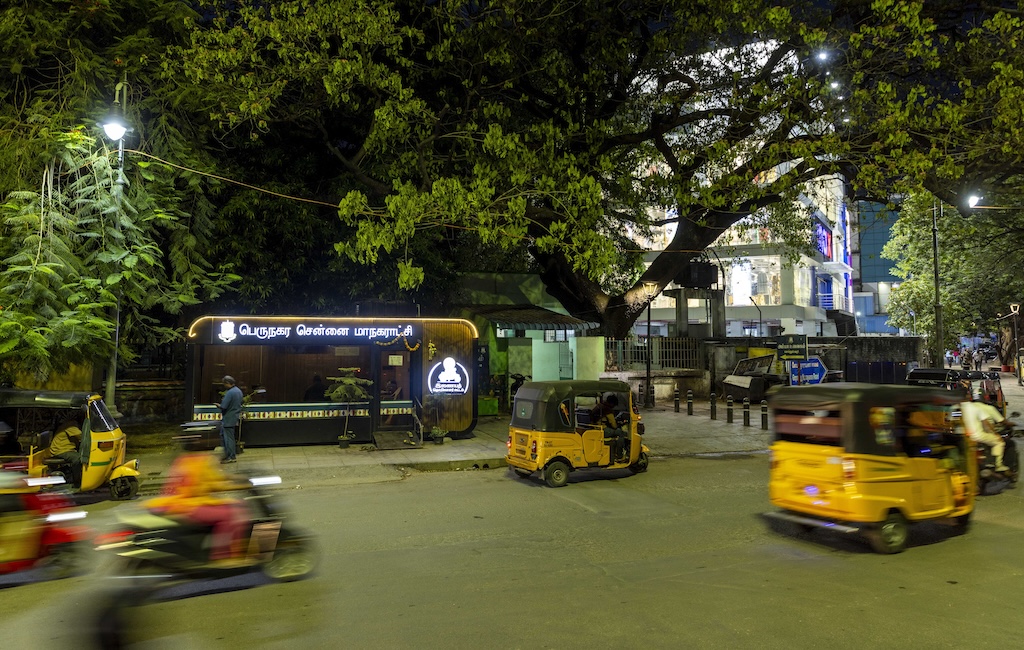
Last year, Chennai became India’s first ever city to roll out air-conditioned lounges for millions of gig workers, like Mohammed, navigating India’s increasingly hotter cities.
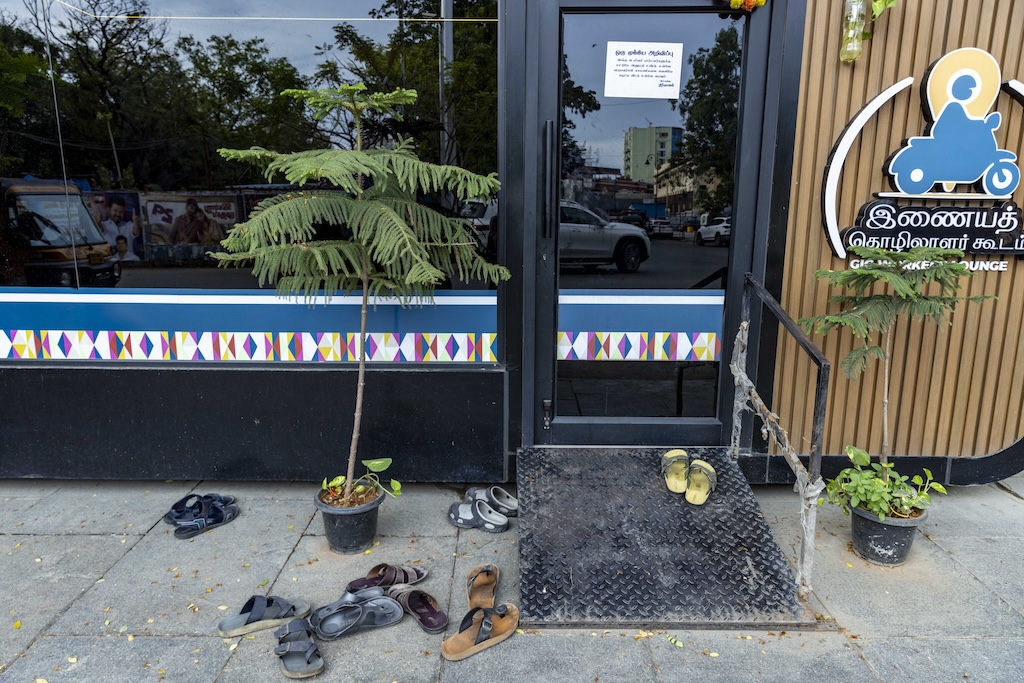
Gig workers leave their slippers outside the lounge. Credit: Ishan Tankha / Scorched
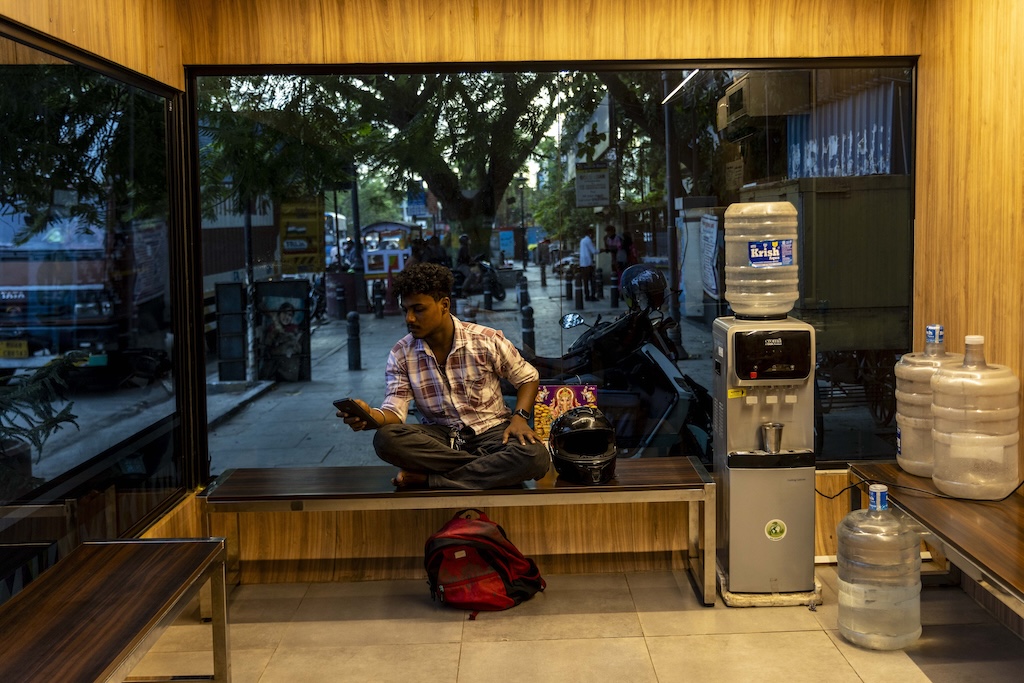
Through the building’s tinted windows, workers wearing synthetic jerseys emblazoned with food delivery app logos are stretched out on wooden benches meant to seat 25 people.
The lounge has charging points for phones, a water cooler and a unisex toilet. It might not seem like much, but workers tell Carbon Brief that it has made a “huge difference” to their lives – even on a day when the air conditioner stopped working.
“Before this, life was very difficult,” said Mohammed. He continued:
“We would park our [electric] bikes and try to find a tree to sleep under, stop for tea and tea shop owners would tell us we couldn’t sit there for more than 10 minutes, try to rest in a building’s stairwell and be chased away, then try to find shade under a flyover. Now we can sit in the AC and avoid the worst of the heat.”
Dinesh, 27, said his day starts at dawn before the sun is up, picking up packages from companies in north Chennai – another critical heat hotspot.
For the next seven hours, there is no “off point” or breaks for Dinesh as apps rush deliveries.
Some of Chennai’s gig workers told Carbon Brief they try to avoid the worst of afternoon temperatures from noon to 3pm, but for many – especially migrant workers – sitting back in the lounge is not a choice they can afford. One of them explained:
“If you don’t have cash to cover your bills or have to send money back home, you head out into the heat for a 12-hour shift and hope for the best.”
Dinesh checks his orders in the gig worker’s lounge. Credit: Ishan Tankha / Scorched
Feeling ‘gear’
In Chennai, heat might be normalised, but it has its own vocabulary. Speaking to Carbon Brief, the city’s gig workers, auto rickshaw drivers and fish sellers used an all-encompassing term – “gear” – to describe their symptoms, including dizziness, exhaustion and nausea.
Last summer, researchers offered Delhi’s gig workers a Rs 200 (roughly £2) cash transfer on the first day of a heatwave, to provide them with a means to achieve “real-time” adaptation to heat risk. Workers who received a cash transfer reported fewer heat-related symptoms, according to the study.
Asked if they would accept similar incentives to stay home on 40C days, workers in the T Nagar lounge expressed disbelief. Dinesh – who also trains technicians on how to repair air conditioners to support his income – told Carbon Brief:
“They [the apps] offer us incentives to go out in the heat when there are fewer riders.”
Barring a few, none of the dozens of outdoor workers Carbon Brief spoke to had an air conditioner at home or in their hostels, making the lounge the only place they could cool down.
Anna Bawden Health and social affairs correspondent
Sat 16 May 2026 05.00 BST
The climate crisis should be declared a global public health emergency by the World Health Organization, or millions more people will die unnecessarily, leading international experts have said.
The international spread of vector-borne disease, such as dengue and chikungunya, as well as the health impacts of extreme weather events, global heating, food insecurity and air pollution make a Pheic necessary, said the commission’s report, which will be presented to European ministers on Sunday before the WHO’s world health assembly starts on Monday.
Pheics are the highest level of health alert. Previous declarations include infectious diseases such as Covid and Mpox. While declaring one would not on its own reverse climate change, it would trigger the kind of coordinated international response that the scale of the health crisis demands but has not yet materialised.
The 11-strong independent commission, which includes former health and climate ministers, said: “Far from being a fading priority or fake news, climate change poses an immediate and long-term threat to health, economic, food, water, environmental, personal, community and national security.”
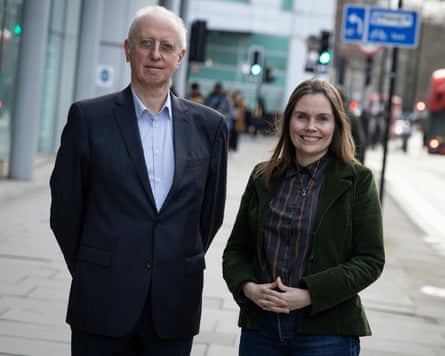
Andrew Haines and Katrin Jakobsdóttir, the commission’s chief scientific adviser and chair respectively. Photograph: WHO/Hedinn Halldorsson
In an interview with the Guardian, Katrín Jakobsdóttir, a former prime minister of Iceland who chaired the commission, said: “The climate crisis may not be a pandemic, but it’s still a public health emergency that threatens humanity’s very health and survival. And if we don’t act more quickly and comprehensively, many millions more people could die or face life-changing illness.”
Sir Andrew Haines, a professor of environmental change and public health at the London School of Hygiene & Tropical Medicine, and the commission’s chief scientific adviser, said: “WHO has already recognised that climate change is a major threat to global health. What we’re asking for is a step further.”
He added: “If we carry on emitting at current rates, that will accelerate the risks to health for both current and future generations including: more people suffering and dying from excess heat, floods and infectious diseases, air pollution from wildfires, more preterm births and more food insecurity.”
The commission also urged governments to stop subsidising fossil fuels, which are directly responsible for 600,000 premature deaths a year in Europe alone. The region spends about €444bn (£387bn) a year on subsidies for oil and gas production, the report said. In 12 European countries, fossil fuel subsidies exceeded 10% of national health expenditure in 2023 and in four exceeded the entire health budget, the report observed.
“This is not a sustainable energy policy. It’s really more of a public health failure,” Jakobsdóttir said. “And it’s one that could get a lot worse. New subsidies for fossil fuels as well as countries considering redrilling in the wake of the Iran crisis would be catastrophic for health.
“European governments are subsidising the very industries responsible for their own citizens’ premature deaths. We need health leaders to really step into the climate debate and not just be on the receiving end of it.”
The commission urged governments to stop subsidising fossil fuels, which are responsible for 600,000 premature deaths a year in Europe. Photograph: Christopher Furlong/Getty Images
The report also called for measures to tackle disinformation, greater use of national climate health impact assessments, as well as recognition that climate change was also a mental health crisis.
Jakobsdóttir said: “The way to challenge climate scepticism and misinformation is simple: make it personal. Climate change is not happening somewhere else, to someone else, in the future. It is shortening lives in European cities right now. It is filling hospitals. It is driving anxiety and stress and other mental health issues. And the policies that would fix it – clean air, active travel, insulated homes, sustainable food – are exactly the policies that make people healthier and happier today.
“When the health argument and the climate argument are the same argument, it becomes very hard to oppose.”
The report also recommended that countries’ healthcare systems needed to become more resilient to the rapidly changing environment in order to try to adapt as much as possible.
“Every country needs to be aware of where its health facilities are situated, how likely it is to be flooded and how they would deal with an extreme and prolonged heatwave,” Haines said, pointing out that hospitals were often built on floodplains and frequently were not energy efficient.
“Even in the UK, which is a temperate country, we know that many hospitals struggle when it comes to extreme heat,” he added. “Many of the buildings were designed before climate change.”
The healthcare sector accounts for 5% of global emissions worldwide, so needs to prioritise adaptation to become more resilient, the report concluded.
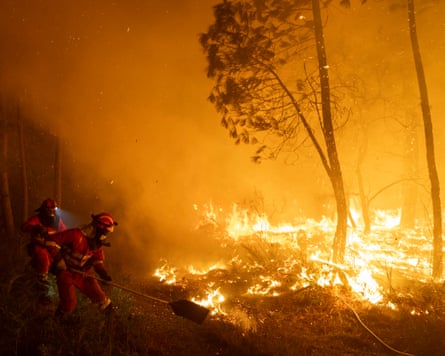
Members of the emergency military unit try to extinguish a wildfire in Ourense province, Spain, in August 2025. Photograph: Pablo Blázquez Domínguez/Getty Images
Responding to the recommendations, Dr Hans Kluge, the WHO’s regional director for Europe, said: “The conflicts in Ukraine and the Middle East have clearly shown what fossil fuel dependency really means – not just higher bills, but strained or broken health systems, disrupted food and fuel supplies and societies under pressure.
“The case for acting on climate now is not just environmental. It is a security argument, a health argument and an economic argument, all at once. And it is a moral imperative.”
Kluge added: “The decisions taken by governments today will determine the disease burden carried by people who are currently in primary school. It now falls to the rest of us to act on their recommendations and protect future generations. I commit to ensuring that climate change is treated as the health emergency it is across the 53 member states of the WHO European region.”
Johan Rockström, the director of the Potsdam Institute for Climate Impact Research, welcomed the report. He said: “The current state of the planet, where we are breaching multiple planetary boundaries, and which manifests itself as public health threats impacting millions of people across the world, provides ample scientific evidence that climate change should be declared a public health emergency of international concern.”
Na última noite do Grupo Especial, nessa terça (17/02), foram 800 atendimentos médicos nos seis postos da Secretaria Municipal de Saúde (SMS) instalados no Sambódromo. Desses, mais de 300 foram causados pelo calor. E olha que os termômetros marcavam “apenas” 28°C na região da Apoteose – mas imaginem usando uma fantasia de 20 kg, plumas, paetês, luz de refletores e muito calor humano misturado ao álcool?
Entre as principais ocorrências, além da turma derretida, estão a descompensação de doenças crônicas, picos de pressão, mal-estar e fadiga por esforço, dor de cabeça, cortes, entorses, lesões ortopédicas, contusões e intoxicação por consumo exagerado de bebidas alcoólicas.
No balanço geral de todos os dias de desfile, foram 2.843 atendimentos. Destes, 167 precisaram ser encaminhados para hospitais da rede. Durante a passagem de algumas escolas, foi possível ver o resgate de integrantes na pista e de foliões nas frisas e arquibancadas.
Fevereiro no Rio é mistura de loteria climática com teste de sobrevivência, a cidade já viveu carnaval debaixo d’água e sob calor escaldante. Segundo pesquisas sobre aquecimento global, não há Fundação Cacique Cobra Coral que resolva contrato com o clima em definitivo. Num futuro não muito distante, o carnaval vai precisar mudar o calendário?
O biólogo Mario Moscatelli diz: “A conta climática é imprevisível, e estamos longe de entender perfeitamente como o sistema funciona. O Rio não consegue resolver nem os velhos problemas estruturais, quanto mais se preparar para os novos. Ondas de calor estão cada vez mais frequentes, enchentes seguem devastadoras, e a perda de biodiversidade — apontada por especialistas como a sexta extinção em massa — já é uma realidade”.
Ele lembra ainda que ano de eleição também é ano de escolha: “A forma de mudar esse ecocídio global passa pelos votos de pessoas mais antenadas com a questão ambiental e menos com as páginas policiais relacionadas a superfaturamentos, desvios de verbas, criação de mais facilidades para as castas públicas e por aí vai. Quem não for 300% competente na gestão dessa nova realidade vai pagar um preço muito alto, tanto do ponto de vista de perdas materiais, como humanas e ambientais. Acabou a fase da improvisação”.


Você precisa fazer login para comentar.