
Arquivo da tag: Política
Ninguna consultora pudo pronosticar la diferencia entre Macri y Filmus (Clarin)
[Eleições municipais em Buenos Aires]
11/07/11
Las encuestadoras oficialistas erraron por 13 puntos la brecha entre los dos primeros
Por MARTÍN BRAVO
Dos consultoras difundieron enc uestas en la semana previa a estas elecciones en la Ciudad con una diferencia de prácticamente 15 puntos en la intención de voto entre Mauricio Macri y Daniel Filmus.
El resto indicaba una brecha menor, y más corta cuanto más cercano al kirchnerismo era el encargado del relevamiento.
Al cierre de esta edición, los datos oficiales marcaban que el actual jefe de Gobierno cosechaba 803.486 votos (un 47,06%) y el senador kirchnerista 475.364 (un 27,84%). Con el 96,31% de las mesas escrutadas, la diferencia a favor de Macri daba casi 19,3%. Management & Fit difundió sus últimos números el 4 de julio, con 42,2% para Macri y 27,4% para Filmus, es decir 14,8% de distancia. La misma brecha proyectó la encuesta de Poliarquía, encargada por el diario La Nación y publicada el viernes: 45,3% a 30,5%.
Aresco, una encuestadora de consulta habitual del Gobierno nacional, difundió 48 horas antes de la elección -no publicada por la veda- una intención de voto del 43,8% para Macri sobre el 34,3% para Filmus, es decir una ventaja de 9,5%. Ya en el boca de urna dio una distancia bastante mayor: 44% a 31%, aunque también por debajo de la ventaja final. Con el resultado puesto, en ningún caso quedó cerca. OPSM difundió el jueves sus números, a los que accedió este diario, con 38% para Macri y 27,8% para Filmus. Una diferencia del 10,2%, apenas menor a su boca de urna: 44% a 33,7%. Esta consultora se presenta como independiente, aunque el búnker kirchnerista le presta mucha atención.
Rouvier & Asociados, que en esta campaña trabajó para Filmus, daba una diferencia de 6,4 puntos una semana antes de la elección (36,2% a 29,8%) y de 7,4 (42,6% a 35,2%) el último jueves. Analogías, que presentó su trabajo como independiente, asignó ocho días atrás una intención de voto a Macri de 38,2% y a Filmus de 29,7%, una brecha de 8,5%. En sus últimas mediciones, no publicadas por Clarín porque ya regía la veda electoral, la diferencia crecía 1,5 puntos: 42% a 32%.
CEOP, la encuestadora que en 2009 anunció un triunfo de Néstor Kirchner por 8 puntos en la provincia (perdió por 3%) atribuía 36,6% a Macri y 30,5% a Filmus, una distancia de 6,1% . Esta consultora, que también mide habitualmente para el Gobierno nacional, dio con amplia ventaja a Rosana Bertone en el balotaje de Tierra del Fuego, en el que Fabiana Ríos consiguió su reelección.
Fernando Solanas llevaba el 12,82% de los votos, según los datos oficiales al cierre de esta edición, un porcentaje superior al que medía en la mayoría de las encuestas, entre ellas Aresco (8,6%), OPSM (8,9%) y Rouvier & Asociados (10%). Pero peor quedó con el resultado puesto el sondeo encargado por su espacio, Proyecto Sur, a la consultora Panorama: difundió el jueves que el cineasta tenía una inteción de voto del 24,5%, por encima de Filmus, y también lo daba ganador sobre Macri en una eventual segunda vuelta.
Tampoco anticipó el holgado triunfo del actual jefe de Gobierno la encuesta de Nueva Comunicación, encargada por Jorge Telerman: su última medición, el 2 de julio, le asignó a Macri una intención de voto del 39,1% sobre el 31,8% para Filmus, una ventaja de 7,3%. A Telerman le daba el 6,9%, lo que le hubiera permitido asegurarse su banca como legislador. Al cierre de esta edici ón tenía 1,76%.
The Impact of Candidates’ Statements About Climate Change On Electoral Success (Science Daily)
ScienceDaily (July 5, 2011) — Candidates gain votes by taking a “green” position on climate change — endorsing the existence of warming, human causation, and the need for taking action to address it, according to a new study of U.S. adults.
Among citizens who are Democrats and Independents, a hypothetical U.S. Senate candidate gained votes by making a green statement on climate change and lost votes by making a not-green statement, compared to making no statement on climate. Among citizens who are Republicans, the candidate’s vote share was unaffected by taking a green position or a not-green position, compared to being silent on climate.
These results suggest that by taking a green position on climate, candidates of either party can gain the votes of Democrats and Independents while not alienating Republicans.
These results are based on experiments embedded in telephone surveys of a representative national sample of American adults conducted in November 2010 and in telephone surveys of representative samples of adult residents of three states (Florida, Maine, and Massachusetts) in July 2010.
The report by Jon A. Krosnick, Bo MacInnis, and Ana Villar is entitled, “The Impact of Candidates’ Statements about Climate Change on Electoral Success in 2010: Experimental Evidences.”
Dilma Rousseff – a favela with a presidential name (The Guardian)
Renaming of Brazilian shantytown puts spotlight on problems facing country’s 16 million citizens living in extreme poverty
Tom Phillips in Rio de Janeiro ; guardian.co.uk, Monday 27 June 2011 16.58 BST
 Three-month old Karen da Silva – the youngest resident of Dilma Rousseff – with her mother, 23-year-old Maria da Paixao Sequeira da Silva. Photograph: Tom Phillips
They call her Dilma Rousseff’s daughter: a dribbling three-month-old girl, coated in puppy fat and smothered by cooing relatives.
But Karen da Silva is no relation of Brazil’s first-ever female president. She is the first child to be born into one of the country’s newest favelas – the Comunidade Dilma Rousseff, a roadside shantytown on the western outskirts of Rio de Janeiro that was recently re-baptised with the name of the most powerful woman in the country
“She’s Dilma’s baby,” said Vagner Gonzaga dos Santos, a 33-year-old brick-layer-cum-evangelical preacher and the brains behind the decision to change the name of this hitherto unknown favela.
Last month, just as Rousseff was about to complete six months in power, Santos says he received a heaven-sent message suggesting the renaming.
“God lit up my heart,” he said. “The idea was to pay homage to the president and also to get the attention of the government, of our leaders, so they look to us and help the families here. The poor are God’s children too.”
Until recently, the 30-odd shacks that flank the Rio-Sao Paulo highway were known simply as “kilometre 31”. But its transition to Dilma Rousseff has not been entirely smooth.
At first, locals plastered A4 posters on the area’s walls and front doors, announcing the new name. But the posters referred to the Comunidade “Roussef” – one “f” short of the president’s Bulgarian surname. In May a sign was erected welcoming visitors to their shantytown, but again spelling proved an issue. This time the name given was “Dilma Rusself.”
That mistake has now been corrected, after an intervention from the preacher’s wife, who took a pot of red nail varnish to the sign. Locals say the name-change is starting to pay off.
“It’s been good having the president’s names,” said Marlene Silva de Souza, a 57-year-old mother of five and one of the area’s oldest residents. “Now we can say our community’s name with pride. Before we didn’t have a name at all.”
Dozens of Brazilian newspapers have flocked to the community – poking fun at its misspelt sign but also drawing attention to the poor living conditions inside the favela.
“It has brought us a lot of attention … The repercussion has been marvellous. Today things are starting to take shape, things are improving,” said Santos, who hopes local authorities will now formally recognise the favela, bringing public services such as electricity and rubbish collection.
Still, problems abound. Raw sewage trickles out from the houses, through a patchwork of wooden shacks, banana and mango trees and an allotment where onions sprout amid piles of rubbish. Rats and cockroaches proliferate in the wasteland that encircles the area.
Ownership is also an issue. Dilma Rousseff is built on private land – “The owners are Spanish, I think,” says Santos – and on paper the community does not officially exist. Without a fixed abode Karen “Rousseff” da Silva – the favela’s firstborn child – has yet to be legally registered.
Last month the Brazilian government launched a drive to eradicate extreme poverty unveiling programmes that will target 16 million of Brazil’s poorest citizens.
“My government’s most determined fight will be to eradicate extreme poverty and create opportunities for all,” Rousseff said in her inaugural address in January. “I will not rest while there are Brazilians who have no food on their tables, while there are desperate families on the streets [and] while there are poor children abandoned to their own fate.”
Residents of Rousseff’s namesake, who scratch a living selling biscuits and drinks to passing truck drivers, hope such benefits will soon reach them.
A visit from the president herself may also be on the cards, after Santos launched an appeal in the Brazilian media.
“We dream of her coming one day,” said the preacher, perched on a wooden bench outside his redbrick church, the House of Prayers. “It might be impossible for man to achieve, but for God everything is possible.”
Naming a community
Tear-jerking soap operas, political icons, stars of stage and screen – when it comes to baptising a Brazilian favela, all are fair game. The north-eastern city of Recife is home to favelas called Ayrton Senna, Planet of the Apes and Dancing Days, the title of a popular 1970stelenovela,
In the 1980s residents of a shantytown in Belo Horizonte named their community Rock in Rio – a tribute to the Brazilian rock festival that has played host to acts such as Neil Young, David Bowie and Queen.
Rio de Janeiro is home to the Boogie Woogie favela, the Kinder Egg favela and one community called Disneylandia. Vila Kennedy – a slum in west Rio – was named after the American president John F Kennedy and features a three-metre tall replica of the Statue of Liberty. Nearby, locals christened another hilltop slum Jorge Turco or Turkish George. Jorge was reputedly a benevolent gangster who ruled the community decades ago.
10 tactics for turning information into action

10 tactics features 25 info-activism stories told from the point of view of advocates in different countries including Lebanon, India, Tunisia, Egypt, Kenya, Indonesia, South Africa and the UK. For more information see http://www.informationactivism.org/.
Reveling in the Pain of Others: Moral Degeneracy and Violence in the “Kill Team” Photos (Truthout)
By Henry A. Giroux, Truthout | News Analysis
Monday, 20 June 2011
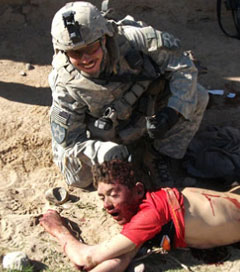 Cpl. Jeremy Morlock poses with the body of an unarmed Afghan boy named Gul Mudin in the village of La Mohammad Kalay. (Photo: US Army)
The inability to identify with others was unquestionably the most important psychological condition for the fact that something like Auschwitz could have occurred in the midst of more or less civilized and innocent people…. The coldness of the societal monad, the isolated competitor, was the precondition, as indifference to the fate of others…. Regressive tendencies, that is, people with repressed sadistic traits, are produced everywhere today by the global evolution of society…. Everywhere where it is mutilated, consciousness is reflected back upon the body and the sphere of the corporeal in an unfree form that tends toward violence. -Theodor Adorno
War, violence and death have become the organizing principle of governance and culture in the United States as we move into the second decade of the 21st century. Lacking a language for the social good, the very concept of the social as a space in which justice, equality, social protections and a responsibility to the other mediate everyday life is being refigured through a spectacle of violence and cruelty. Under such circumstances, ethical considerations and social costs are removed from market-driven policies and values just as images of human suffering are increasingly abstracted from not only their social and political contexts, but also the conditions that make such suffering possible. Moreover, as public issues collapse into privatized considerations, matters of agency, responsibility and ethics are now framed within the discourse of extreme individualism. Unexpected violence, aggression and the “‘masculine’ virtues of toughness, strength, decisiveness and determination … are accentuated,” along with the claims of vengeance, militarization and violence.(1) The collapse of the social and the formative culture that make human bonds possible is now outmatched by the rise of a Darwinian ethic of greed and self-interest in which violence, aggressiveness and sadism have become the primary metric for living and dying. As the social contract is replaced by social collapse, a culture of depravity has emerged in American society. The spectacle of violence permeates every aspect of the machinery of cultural production and screen culture – extending from television news and reality TV to the latest Hollywood fare. Of course, this is not new. What is new is that more and more people desire spectacles of high-intensity violence and images of death, mutilation and suffering and their desires should no longer be attributed to an individual aberration, but instead suggest an increasingly widespread social pathology.
Death and violence have become the mediating link between US domestic policy – the state’s treatment of its own citizens – and foreign policy, between the tedium of ever expanding workdays and the thrill of sadistic release. Disposable bodies now waste away in American prisons, schools and shelters just as they litter the battlefields of Iraq and Afghanistan. America has become a permanent warfare state, with a deep investment in a cultural politics and the corollary cultural apparatuses that legitimate and sanctify its machinery of death. The American public’s fascination with violence and death is evident in the recent popular obsession with high-octane action films, along with the ever-expanding volume of vampire and zombie films, TV shows and books. We also see death-dealing and violent acts accrue popularity with Hollywood films such as the 2010 academy-award winning “The Hurt Locker,” in which the American bomb disposal expert, William James (Jeremy Renner), repeatedly puts himself at risk in the face of defusing various bomb threats – thus to highlight the filmmaker’s concern with a growing “addiction” to war. As Mark Featherstone points out, there is more represented here than the reckless behavior of immature and hyper-masculine soldiers. He writes, “James takes unnecessary risks and lives for the limit experience…. [H]e feels most alive when he is closest to death … When James … throws the bomb suit away and stands before the bomb with no protection, he puts himself at the mercy of the bomb, the embodiment of the death drive.”(2)
“The Hurt Locker” is only one of a number of serious films that address, if not mirror, a psychological state in which the production of a virulent masculinity now augurs both a pathological relationship with the body, pain and violence and a disdain for compassion, human rights and social justice. The death drive in American society has become one of its fundamental characteristics and, undoubtedly, its most disabling pathology. More than a trace of this mode of aggression and moral indifference now dominates contemporary American life. Marked by a virulent notion of hardness and aggressive masculinity, a culture of depravity has become commonplace in a society in which pain, humiliation and abuse are condensed into digestible spectacles of violence endlessly circulated through extreme sports, reality TV, video games, YouTube postings and proliferating forms of the new and old media. But the ideology of hardness and the economy of pleasure it justifies are also present in the material relations of power that have intensified since the Reagan presidency, when a shift in government policies first took place and set the stage for the emergence of an unchecked regime of torture and state violence under the Bush-Cheney regime. Conservative and liberal politicians alike now spend millions waging wars around the globe, funding the largest military state in the world, providing huge tax benefits to the ultra-rich and major corporations, and all the while draining public coffers, increasing the scale of human poverty and misery and eliminating all viable public spheres – whether they be the social state, public schools, public transportation, or any other aspect of a formative culture that addresses the needs of the common good.
Mainstream politicians now call for cutbacks in public funding in order to address the pressing problems of the very deficit they not only created, but gladly embrace, since it provides an excuse either to drastically reduce funding for vital entitlements such as Medicare and early childhood education or to privatize public education, transportation, and other public services, while putting more money into the hands of the rich and powerful. The real deficit here is one of truth and morality. The politics of austerity has now become a discourse for eviscerating the social state and forcing upon cities, families and individuals previously unimaginable levels of precarity, suffering and insecurity. As Rania Khalek points out, conservatives want to “exploit the budget crisis in order to starve government…. The truth is that the economic crisis, sparked by decades of deregulation and greedy financial forms, caused high levels of unemployment that dramatically reduced state and local tax revenues. Add to that years of tax cuts for the wealthy and decades of corporate tax-dodging and you’ve got yourself a budget crisis.”(3) The discourse of “deficit porn” now justifies the shift in public policy and state funding further away from providing social protections and safeguarding civil liberties toward the establishment of legislative programs intent on promoting shared fears and increasing disciplinary modes of governance that rely on the criminalization of social problems.(4)
The broader cultural turn toward the death drive and the strange economy of desire it produces is also evident in the emergence of a culture of depravity in which the American public appears more and more amenable to deriving pleasure from images that portray gratuitous violence and calamity. As mentioned above, exaggerated violence now rules screen culture. The public pedagogy of entertainment includes extreme images of violence, human suffering and torture splashed across giant movie screens, some in 3D, offering viewers every imaginable portrayal of violent acts, each more shocking and brutal than the last. The growing taste for sadism can be seen in the recent fascination on the part of the media with Peter Moskos’ book “In Defense of Flogging,” in which the author seriously proposes that prisoners be given a choice between a standard sentence and a number of lashes administered in public.(5) In the name of reform, Moskos argues, without any irony, that public flogging is more honest and a sure-fire way of reducing the prison population. Not only is this book being given massive air time in the mainstream media, but its advocacy of corporal punishment and flogging is treated as if it is a legitimate proposal for reform. Mind-crushing punishment is presented as the only choice left for prisoners outside of serving their sentences. Moreover, this medieval type of punishment inflicts pain on the body as part of a public spectacle. Moskos seems to miss how the legacy of slavery informs his proposal, given that flogging was one of the preferred punishments handed out to slaves and that 70 percent of all current prisoners in the United States are people of color. Surely, the next step will be a reality TV franchise in which millions tune in to watch public floggings. This is not merely barbarism parading as reform – it is also a blatant indicator of the degree to which sadism and the infatuation with violence have become normalized in a society that seems to take delight in dehumanizing itself.
As the social is devalued along with rationality, ethics and any vestige of democracy, spectacles of violence and brutality now merge into forms of collective pleasure that constitute what I believe is an important and new symbiosis among visual pleasure, violence and suffering. As I have suggested, taking pleasure in violence can no longer be reduced to a matter of individual pathology, but registers a larger economy of pleasure across the broader culture and social landscape. The consumption of images of human pain as a matter of personal pleasure and taste has given way to representations of human suffering, humiliation and death that circulate across the culture as part of the collective indulgence in gross spectacles that persist in being called entertainment, news and knowledge sharing. What is more, privatized pleasures and violence translate increasingly into forms of structural violence that are mobilized by the death drive and use the spectacles of violence to generate a source of gratification and intense socially experienced pleasure. Amplified sadism and voyeurism are now characteristic of a contemporary society that has narrowed the range of social expression and values to the receipt of instant gratification and the pursuit of pleasure as one of its sole imperatives. As images of degradation and human suffering become more palatable and pleasurable, the body no longer becomes the privileged space of agency, but “the location of violence, crime and social pathology.”(6) Americans now find themselves in the midst of a brutal authoritarianism in which freedom is reduced to the narrow realm of individual needs, narcissistic pleasures and the removal of all forms of social responsibility, particularly those imposed by the government. Sovereignty and governance, under the guise of “personal choice,” are instead produced and defined by the market and the power of large corporations and financial institutions. As decadence and despair are normalized in the wider culture, people are increasingly exploited for their pleasure quotient, while any viable notion of the social is subordinated to the violence of a deregulated market economy and its ongoing production of a culture of cruelty.(7) For all intents and purposes, politics as a matter of public governance is dead in the United States.
How else to explain the insistent demand by many conservative and liberal pundits and the American public at large that the government release the grisly images of Osama bin Laden’s corpse, even though the fact of his assassination was never in doubt? How might we understand the growing support among the American populace for state-sanctioned torture and the rising indifference to images which reveal its horrible injustices? Just as torture is sanctioned by the state and becomes normalized for many Americans, the spectacle of violence spreads through the culture with ever-greater intensity. Whatever bleeds – now gratuitously and luxuriously – brings in box office profits and dominates media headlines, despite being often presented without any viable context for making sense of the imagery, or any critical commentary that might undercut or rupture the pleasure viewers are invited to derive from such images. Representations of violence and human tragedy now merge seamlessly with neoliberalism’s culture of depravity in which risk and mayhem reinforce shared fears rather than shared responsibilities and a Hobbesian war of all against all becomes the organizing principle for structuring a vast array of institutions and social relations.
As corporate capitalism translates into corporate fascism, prominent politicians such as Sarah Palin, radio hosts such as Rush Limbaugh and media monopoly moguls such as those who deliver Fox News repeatedly deploy the vocabulary of violence to attack the social state, labor unions, immigrants, young people, teachers and public-service employees. At the same time, the depravity of aesthetics gains popular currency in organs of the dominant media that reproduce an endless stream of denigrating images and narratives of people constrained by the forces of poverty, racism and disability. Their pain and suffering now become a source of delight for late-night comics, radio talk show hosts and TV programs that provide ample narratives and images of poor families, individuals and communities who become fodder for the “poverty porn” industry.(8) Programs such as the reality TV series “Jersey Shore,” the syndicated tabloid TV talk show series “The Jerry Springer Show” (and its endless imitators) and “The Biggest Loser” all exemplify what Gerry Mooney and Lynn Hancock claim is a massive “assault on people experiencing poverty [seizing] on any example of ‘dysfunctionality’ in poor working class communities … [exhibiting] expressions of middle-class fears and distrust, [while] also [displaying] a fascination with poverty and the supposedly deviant lifestyles of those affected – where viewers of moral outrage are encouraged to find the worst and weakest moments of people’s lives also funny and entertaining.”(9)Disconnected from any moral criteria, the search for ever more intense levels of sensation and excitation become the pedagogical and performative force par excellence in shaping the world of entertainment. Within this context, the pleasure of humiliation and violence is maximized and cruelty is elevated to a structuring principle of society.
What has led to this immunity and insensitivity to cruelty and prurient images of violence? Part of this process is due to the fact that the American public is bombarded by an unprecedented “huge volume of exposure to … images of human suffering.”(10)As Zygmunt Bauman argues, there are social costs that come with this immersion of the culture in staged violence. One consequence is that “the sheer numbers and monotony of images may have a ‘wearing off’ impact [and] to stave off the ‘viewing fatigue,’ they must be increasingly gory, shocking and otherwise ‘inventive’ to arouse any sentiments at all or indeed draw attention. The level of ‘familiar’ violence, below which the cruelty of cruel acts escapes attention, is constantly rising.”(11) Hyper-violence and spectacular representations of cruelty disrupt and block our ability to respond politically and ethically to the violence as it’s actually happening on the ground. In this instance, unfamiliar violence such as extreme images of torture and death becomes banally familiar, while familiar violence that occurs daily is barely recognized, becoming, if not boring, then relegated to the realm of the unnoticeable and unnoticed. An increasing volume of violence is pumped into the culture as yesterday’s spine-chilling and nerve-wrenching violence loses its shock value. As the need for more intense images of violence accumulates, the moral indifference and desensitization to violence grow, while matters of cruelty and suffering are offered up as fodder for sports, entertainment, news media, and other outlets for seeking pleasure.
Under the regime of neoliberal policies, relations and values, profit-making becomes the only legitimate mode of exchange; private interests replace public concerns; and unbridled individualism infects a society in which the vocabulary of fear, competition, war and punishment governs existing relationships. Within an economy of pleasure and commodification, freedom is subsumed by a calculated deficit that reduces agency to a regressive infantilism and degraded forms of gratification. What Leo Lowenthal called “the atomization of the individual” bespeaks a figure now terrorized by other human beings and reduced to living “in a state of stupor, in a moral coma.”(12) This type of depoliticized inward thinking – with its repudiation of the obligations of shared sociality, disengagement from moral responsibility and outright disdain for those who are disadvantaged by virtue of being poor, young or elderly – does more than fuel the harsh, militarized and ultra-masculine logic of the news and entertainment sector. This “atomization of the individual” also elevates death over life, selfishness over compassion and economics over politics. The spectrum of disdain and vulnerability has been extended at the current historical moment to contempt for life itself. Life reduced to “bare life” and the vulnerability it produces elicits imperviousness at best and a new kind of pleasure at worst. Precarity, uncertainty and misfortune no longer evoke compassion but disdain, while simultaneously opening up a space in which vulnerability offers a pretext for forms of pleasure that reinforce a culture of cruelty.(13) But even more so, it produces a kind of dysfunctional silence in American society in the face of widespread hardship and suffering – virtually wiping out society’s collective memories of moral decency and mutuality.
The merging of violence and pleasure has been on full display throughout American history, though images of such depravities have often been hidden. Exceptions can be found in the history of racism and the startling and disturbing images of the public lynching of African-Americans, the brutal murder of Emmett Till and the mass killings at My Lai depicted in photographs of American soldiers relaxing and smiling after the carnage. More recently, a number of photographs have once again surfaced which display grotesque acts of violence and murder by a select group of American soldiers stationed in Afghanistan. The images released by Rolling Stone magazine in the United States focused on the murderous actions of 12 US soldiers, who decided to kill Afghan civilians allegedly for sport. They used the moniker “The Kill Team” to refer to themselves, aptly registering both the group’s motivation and its monstrous actions. In the five months during which these soldiers went on a murderous rampage in Kandahar Province, writes one reporter, “they engaged in routine substance abuse and brutality toward Afghan locals that led to four premeditated murders of innocent civilians, the ritual mutilation of corpses (some of the soldiers reportedly severed fingers from their victims to keep as trophies) and the snapping of celebratory photographs alongside the deceased as if they were bagged deer.”(14) The soldiers’ actions exhibited their immersion in a death-driven culture that differs only in degree from the one I have been documenting throughout this article. Their actions were neither isolated nor individualized, but reflect their evident belief that killing for sport in such a culture could take place with impunity. Proudly bearing the title “Kill Team” registers “the pure depravity of the alleged crimes.”(15) In one particularly disturbing photo celebrating a kill, one of the soldiers, Jeremy Morlock, is shown posing with the body of Gul Mudin, a 15-year-old Afghan boy. With a grin on his face and a thumbs-up sign, Morlock is kneeling on the ground next to Mudin’s bloody and half-naked corpse, grabbing a handful of hair to lift up his bloodied face.
The platoon’s squad leader, Staff Sgt. Calvin Gibbs, was so pleased with the kill that he desecrated the young boy’s dead body by severing one of his fingers. Mark Boal quotes one soldier’s account of the incident: “‘It was like another day at the office for him’…. Gibbs started ‘messing around with the kid, moving his arms and mouth and acting like the kid was talking.'” Boal adds, “Then, using a pair of razor-sharp medic’s shears, [Gibbs] reportedly sliced off the dead boy’s pinky finger and gave it to [the soldier], as a trophy for killing his first Afghan.”(16)Gibbs’ instinct for barbarism appears utterly ruthless and lacking in any sense of ethical consideration or self-reflection – to say nothing of the political and social costs incurred by the US-led mission. The staff sergeant was so intent on killing Afghan civilians that he actually boasted about it, telling one soldier, “Come down to the line and we’ll find someone to kill.”(17)Revealing the depth of his inhumanity, Gibbs reportedly told his soldiers that all Afghans were savages, and talked to his squad about how they might be inventive in killing civilians. In one almost unbelievable scenario, the soldiers considered throwing “candy out of a Stryker vehicle as they drove through a village and shoot[ing] the children who came running to pick up the sweets. According to one soldier, they also talked about a second scenario in which they ‘would throw candy out in front and in the rear of the Stryker; the Stryker would then run the children over.'”(18)
Unlike the Abu Ghraib prison photos that were designed to humiliate detainees, the “Kill Team” photos suggest a deeper depravity, an intense pleasure in acts of violence that are preplanned and carried out with no impending threat, culminating in the sadistic collection of body parts of the slain victims as trophies. The “Kill Team” was after more than humiliation and the objectification of the other; it harbored a deep desire to feel intense excitement through pathological acts of murder and then captured the savagery in photos that served as mementos, so they could revisit and experience once again the delight that comes with descending into the sordid pornographic hell that connects violence, pleasure and death. The smiles on the faces of the young soldiers as they posed among their trophy killings are not the snapshots of privatized violence, but images of sadism that are symptoms of a social pathology in which shared pleasure in violence is now commonplace. As my colleague David L. Clark points out, the smiles on the faces of these soldiers suggest something perverse and alarming. He writes, “This isn’t Hannibal Lecter, after all, but G.I. Joe [and these photos appear as] symptomatic evidence of a certain public enjoyment of violence for the sake of violence, i.e., not the smile of shared pleasures between intimates (one form of the everyday), but a smile that marks a broader acceptance and affirmation of cruelty, killing for sport. Those smiles register a knowing pleasure in that violence and say that it is okay to kill and okay to take pleasure in that killing.”(19)
The “Kill Team” photographs are important because they signify a new register of what can be called a failed sociality. In this instance, the social does not disappear as much as it is overwritten by a sociality of shared violence – a sociality marked not by the injurious violence of the lone sociopath, but instead by a growing army of sociopaths. The “Kill Team” photographs offer a glimpse into a larger set of social conditions in a winner-take-all society in which it becomes difficult to imagine pleasure in any other terms except through the spectacle of violence buttressed by a market-driven culture and dominated by a survivalist ethic. What is it about these photos that reveals the smear of the pornographic, a titillation grounded in maximizing the pleasure of violence? What are the political, economic and social forces bearing down on American society that so easily undercut its potential to raise critical questions about war, violence, morality and human suffering? What forms of responsibility and what pedagogical strategies does one invoke in the face of a society that feeds off spectacles of violence and cruelty? What forms of witnessing and education might be called into play in which the feelings of pleasure mobilized by images of human suffering can be used as “a catalyst for critical inquiry and deep thought?”(20)Rather than being reduced to a mechanism for the cathartic release of pleasure, a society saturated in the claims of violence, war, aggression and poisonous modes of masculinity must serve as an indictment, a source of memory and evidence of the need to imagine otherwise.
In contrast to the “Kill Team” photos, we have seen images from Libya, Syria and Iran where the murder of young students and other protesters by state militia thugs have been captured on video and circulated the world over. Such images become a pedagogical tool, a critical mode of public pedagogy capable of forms of witnessing that allow people to imagine the unimaginable. What is emancipatory about these images, as Georges Didi-Huberman points out in a different context, is that they work to refuse what he calls the “disimagination machine”; that is, these are images that are “images in spite of all” – bearing witness to a different and critical sense of remembering, agency, ethics and collective resistance.(21) These images have ignited massive collective protests against repressive governments. Such images did not feed the basest of collective desires and pleasurable fantasies detached from any real consequences. To the contrary, such images of abuse and suffering have inflamed a society in which a formative culture exists that enables people to connect emotional investments and desires to a politics in which unthinkable acts of violence are confronted as part of a larger “commitment to political accountability, community and the importance of positive affect for both belonging and change.”(22)
America has lost the formative culture that would allow us to contest, challenge and transform the prevailing culture of unbridled individualism, consumerism, militarism and desire for instant pleasure. Both major political parties now impose harsh penalties on the poor, young people, the elderly, immigrants, and other groups considered disposable. We are on the brink of an authoritarianism in which war and violence not only cause unbearable hardship and suffering for the vast majority of the American people, but also produce a larger social pathology in which the actions of the “Kill Team” soldiers who sought out pleasure in the most vile and grotesque acts of violence are symptomatic of something that is becoming normalized and commonplace in American society. This is a violence being waged against democracy and the public good, one that feeds on mobilization of desires and collective pleasures in the face of the suffering of others.
Footnotes:
1. Richard J. Bernstein, The Abuse of Evil (London: Polity, 2005), p. 49.
2. Mark Featherstone, “The Hurt Locker: What is the Death Drive?” Sociology and Criminology at Keele University – Blogspot (February 25, 2010). Online here.
3. Rania Khalek, “Death by Budget Cut: Why Conservatives and Some Dems Have Blood on their Hands,” AlterNet (June 13, 2011). Online here.
4. See, for instance, Loic Wacquant, “Punishing the Poor: The Neoliberal Government of Social Insecurity,” (Durham: Duke University Press, 2009).
5. Peter Moskos, “In Defense of Flogging,” (New York: Basic Books, 2011).
6. Paul Gilroy, “‘After the Love Has Gone’: Bio-Politics and Ethepoetics in the Black Public Sphere,” Public Culture 7:1 (1994), p. 58.
7. I take up in great detail the notion of a culture of cruelty in Henry A. Giroux, “Zombie Politics and Culture in the Age of Casino Capitalism,” (New York: Peter Lang, 2011).
8. I have taken the term “poverty porn” from Gerry Mooney and Lynn Hancock, “Poverty Porn and the Broken Society,” Variant 39/40 (Winter 2010). Online here.
10. Zygmunt Bauman, “Life in Fragments,” (Malden: Blackwell, 1995), p. 149.
11. Zygmunt Bauman, “Life in Fragments,” (Malden: Blackwell, 1995), pp. 149-150.
12. Leo Lowenthal, “Atomization of Man,” False Prophets: Studies in Authoritarianism (New Brunswick, NJ: Transaction Books, 1987), p. 182.
13. Judith Butler touches on this issue in Judith Butler, “Precarious Life: The Powers of Mourning and Violence,” (London: Verso Press, 2004).
14. Jim Frederick, “Anatomy of a War Crime: Behind the Enabling of the ‘Kill Team,'” Time (March 29, 2011). Online here.
16. Mark Boal, “The Kill Team,” Rolling Stone, (March 27, 2011). Online here.
19. David L. Clark, personal correspondence, May 15, 2011.
20. Mieke Bal, “The Pain Of Images,” in “Beautiful Suffering,” ed. Mark Reinhardt, Holly Edwards and Erina Duganne (Chicago: University of Chicago Press, 2007), p. 111.
21. Georges Didi-Huberman, “Images in Spite of All: Four Photographs from Auschwitz,” trans. Shane B. Lillis (Chicago: University of Chicago Press, 2008), pp. 1-2.
22. Clare Hemmings, “Invoking Affect: Cultural Theory and the Ontological Turn,” Cultural Studies 19:5 (September 2005), pp. 557-558.
Henry A. Giroux currently holds the Global TV Network Chair Professorship at McMaster University in the English and Cultural Studies Department. His most recent books include: Youth in a Suspect Society (Palgrave, 2009); Politics After Hope: Obama and the Crisis of Youth, Race, and Democracy (Paradigm, 2010); Hearts of Darkness: Torturing Children in the War on Terror (Paradigm, 2010); The Mouse that Roared: Disney and the End of Innocence (co-authored with Grace Pollock, Rowman and Littlefield, 2010); Zombie Politics and Culture in the Age of Casino Capitalism (Peter Lang, 2011); Henry Giroux on Critical Pedagogy (Continuum, 2011). His newest books: Education and the Crisis of Public Values (Peter Lang) and Twilight of the Social: Resurgent Publics in the Age of Disposability (Paradigm Publishers) will be published in 2012. Giroux is also a member of Truthout’s Board of Directors. His website is www.henryagiroux.com.
Analysis: ‘Lulismo’ Appeals in Latin America but Hard to Copy (N.Y. Times)
By REUTERS
Published: June 22, 2011 at 12:12 PM ET
RIO DE JANEIRO/LIMA (Reuters) – It was a political pilgrimage that surprised no one.
Within days of winning Peru’s presidential election, Ollanta Humala flew to Brazil to learn more about its success over the past decade and meet former President Luiz Inacio Lula da Silva, who inspired Humala’s journey from the radical left toward the political center.
Humala’s election victory was the latest sign that Lula’s mix of market-friendly policies and social programs for the poor, credited with turning Brazil into an economic powerhouse, is going international. Call it the Brasilia Consensus, or “Lulismo.”
The former union boss established an enviable electoral formula by making deep inroads into poverty in his eight years in power while pleasing Wall St. bankers and elevating Brazil into the league of emerging market powers like China and India.
Leftist Mauricio Funes won El Salvador’s presidency in 2009 at the head of a party of former Marxist guerrillas after convincing enough middle-class voters that he was inspired by Lula rather than Venezuela’s socialist President Hugo Chavez.
One of Lula’s leading election marketers even helped him craft his campaign, and other former advisers to Lula’s party helped Humala craft his campaign message in Peru.
In South America, several leaders have opted to take the Lula path — most notably Jose “Pepe” Mujica, a former guerrilla who was elected president of Uruguay in 2009.
Paraguay’s President Fernando Lugo has also steered clear of copying the more radical leftist policies of the region since his election in 2008.
And pointing to the Lula model is now smart politics for any left-wing candidate in Latin America looking to ease voters’ concerns that he or she might be too radical.
“Brazil is the lodestar, the reference for a lot of governments as an example of success,” said Michael Shifter, president of the Inter-American Dialogue in Washington.
“There are vast differences between Brazil and other Latin American countries but there does seem to be a formula, a consensus that has produced real results.”
EASIER SAID THAN DONE
Still, copying the Lula formula is easier said than done, as Humala may discover in the coming months.
Lula’s two-term presidency — which ended on January 1 when his hand-picked successor Dilma Rousseff was sworn in as president — was built on a long journey to the political center by his Workers’ Party, a sustained boom in global commodities prices and his own magnetic charisma.
In contrast, Humala’s embrace of center-left policies came much later and his party lacks the institutional strength of the Workers’ Party in Brazil. Peru, whose previous government had center-right policies in line with countries such as Chile, Colombia and Mexico, has a tiny budget that limits its ability to help poor, rural areas.
“Any emulation is going to face serious limitations,” said Matias Spektor, an international relations professor at the Getulio Vargas Foundation, a think tank in Rio de Janeiro.
“That said, what Humala seems to be doing is realizing that there is a message for progressive parties in the region that you do need financial stability with some degree of redistribution. It’s not about people on the street fighting the old elite, it’s about minimal-level redistribution.”
Lula himself has hailed Humala’s win as a step forward in Latin America for the progressive left, in which he included Venezuela’s Hugo Chavez and his closest disciples, Bolivian President Evo Morales and Ecuador’s President Rafael Correa.
“While in the European continent, politics is moving to the right and conservatives are occupying space, in Latin America it is the progressive sectors that are advancing,” Lula was reported as saying in Sao Paulo with Humala on June 10.
LULA OR CHAVEZ?
But there has long been a clear divide between Chavez’s more radical brand of socialism opposed to U.S. influence and Lula’s more moderate version. Lately, it is Lulismo that is gaining ground while the socialist, anti-U.S. alliance spearheaded by Chavez has run into trouble.
The economies of the Chavez-led leftist bloc have mostly struggled. Venezuela has been unable to tame double-digit inflation and economic growth has been patchy. The private sector has shrunk, nationalized companies have performed poorly and there are frequent shortages of basic goods.
Chavez has also lost support among ordinary Latin Americans in recent years with strong-arm policies such as threatening media freedoms, said Yehude Simon, a former leftist who served as prime minister under Peruvian President Alan Garcia.
“The Chavez of 2006 is nothing compared with the Chavez of 2011. He made a series of errors,” he said. “Chavez can be very friendly and charming but sometimes he’s very authoritarian.”
In Peru, Humala repeatedly borrowed tactics from Lula, going as far as to hire two experienced aides from Brazil’s Workers’ Party to help run his campaign.
They had Humala — who narrowly lost the 2006 election running on an ultranationalist platform that spooked investors — codify his promises to fight inflation and run a balanced budget in a letter to the Peruvian people.
The tactic was borrowed directly from the playbook of Lula, who won the presidency in 2002 on his fourth try by casting himself as a moderate who had outgrown his hard-left roots.
Humala also wants to emulate another pillar of Lulismo — wealth distribution policies that in Brazil have helped lift millions of poor people into a thriving lower middle class.
Humala has proposed taxing the windfall profits of wealthy mining companies for a fund to help the one-third of Peruvians who are poor, but critics say that model will only work if commodity prices stay high.
“Humala is going to need a lot of skill to keep foreign and Peruvian businesses investing here while managing demands from the provinces for better social programs,” said Simon.
Peru and other countries in the region have much smaller federal budgets, limiting the ability of governments to copy Lula’s heavy spending on social programs.
Their economies are also far less diversified than Brazil, so they are more vulnerable to economic shocks caused by a slump in commodities, for example. A sharp downturn in prices could quickly undermine their ability to keep financial markets and their poorer citizens happy at the same time.
In the end, it may be communist China — now Brazil’s No. 1 trade partner and Peru’s second-biggest — that could be the most important factor determining the success of Lulismo inside and outside Brazil.
“If China’s economy suffers a slowdown, it will be a problem for Humala,” said Simon. “Much of Latin America is dependent on China.”
(Additional reporting by Andrew Cawthorne in Caracas; Editing by Todd Benson and Kieran Murray)
O futuro do presente no pretérito (Fapesp)
HUMANIDADES | LITERATURA
A ficção científica brasileira e a relação do país com a ciência e a tecnologia
Carlos Haag
Edição Impressa 184 – Junho 2011
A Presidência da República dos Estados Unidos do Brasil estava confiada a uma mulher. O país estava mais forte, mais belo e rico. Para aqui convergiam povos de todos os recantos da Terra. A Amazônia está urbanizada, o analfabetismo foi abolido e, na roça, os trabalhadores cantam trechos da última ópera a que assistiram ou recitam, de cor, os poemas mais lindos.” Aviso: isso não é um texto institucional desvairado do governo atual. A autora, Adalzira Bittencourt (1904-1976), descreveu essa “previsão” em 1929 em Sua Excia. a presidente da República. Mas esse “paraíso” de ficção científica tem um porém: tudo isso foi conseguido graças à ascensão na política das mulheres, que implementam um rígido programa de eugenia e higiene social. Por uma ironia do destino, a presidente, dra. Mariangela de Albuquerque, apaixona-se pelo pintor Jorge, que só conhece por cartas amorosas. Cansada de esperar o amante, a primeira mandatária ordena que seja trazido, algemado, em sua presença. “Era lindo de rosto, mas tinha não mais do que 90 cm de altura e tinha nas costas uma corcunda enorme.” A presidente eugenista ordena, implacável, a eutanásia profilática no amado. “Era mulher”, encerra-se, em tom vitorioso, a novela.
O tom “ideológico” da novela percorreu, e ainda se mantém, a produção de ficção científica brasileira, infelizmente pouco estudada e vista, em geral, como “produto de segunda ordem” e indigno do cânone literário. “Desde o século XIX o gênero provou ser um veículo ideal para registrar tensões na definição da identidade nacional e do processo de modernização. Essas tensões são exacerbadas na América Latina e, por isso, a produção da ficção em países como Brasil, Argentina e México, grandes representantes desse gênero no continente, é muito mais politizada do que a escrita nos países do Norte. No Brasil, o gênero ajudou a refletir uma agenda política mais concreta e os escritores, ontem e hoje, estão mais intimamente envolvidos com os rumos futuros de seu país e usaram o gênero nascente não apenas para circular suas idéias na arena pública, mas também para mostrar aos seus compatriotas suas opiniões sobre a realidade presente e suas visões sobre um tempo futuro, melhor e mais moderno”, explica a historiadora Rachel Haywood Ferreira, da Universidade do Estado de Iowa, autora de The emergence of Latin American science fiction, que acaba de ser lançado nos EUA pela Wesleyan University Press. “A ficção científica brasileira permite traçar a crise de identidade que acompanhou a modernização, juntamente com o senso de perda que a persegue, e que é parte da entrada do Brasil na condição pós-moderna. A ficção nacional em parte exemplifica a erosão da narrativa latino-americana de identidade nacional, porque ela se torna cada vez mais influenciada pela troca cultural inerente à globalização iniciada nos anos 1990”, concorda a professora de literatura Mary Ginway, da Universidade da Flórida, autora de Ficção científica brasileira: mitos culturais e nacionalidade no país do futuro (Devir Livraria). Apesar disso, o gênero continua considerado como “menor”. “É uma pena, porque o deslocamento da tradição da ficção para o contexto de um país em desenvolvimento nos permite revelar certas assunções sobre como se dá esse desenvolvimento e determinar a função desse gênero nesse tipo de sociedade. A ficção científica fornece um barômetro para medir atitudes diante da tecnologia, ao mesmo tempo que reflete as implicações sociais da modernização da sociedade brasileira”, avalia Mary. “Há mesmo uma variação gradual de um clima de otimismo para outro, de pessimismo: a ciência parece não mais ser a garantia da verdade, como se pensava, e o impacto da tecnologia pode nem sempre ser positivo, o que dificulta que se alcance o potencial nacional. Tudo isso se pode ver na ficção científica latino-americana: a definição da identidade nacional; as tensões entre ciência e religião e entre campo e cidade; a pseudociência”, nota Rachel.
Para a pesquisadora, a literatura especulativa é importante em paí-ses como o Brasil, onde “ciência e tecnologia têm um papel-chave na vida intelectual, já que a tecnologia é vista como a solução possível para que o país possa superar o atraso histórico do desenvolvimento econômico com a esperança de se criar uma sociedade melhor e mais utópica”. Infelizmente, foi justamente essa ligação com o nacional que representou a glória e o desprezo da ficção científica no Brasil, apesar de termos acompanhado com certa rapidez a expansão do gênero na Europa. A primeira ficção científica nacional data de 1868 (foi publicada no jornal O Jequitinhonha até 1872), Páginas da história do Brasil, escrita no ano 2000, de Joaquim Felício dos Santos, uma obra satírica sobre a monarquia que leva dom Pedro II numa viagem pelo tempo até o futuro, onde descobre como seu regime de governo era pernicioso ao país. “Obras como essas que adentram o século XX, até os anos 1920, mostram que havia interesse dos brasileiros em desenvolver narrativas utópicas, fantasias moralizadoras e até o romance científico, um corpo de ficção especulativa que poderia ter sustentado uma produção maior nas décadas seguintes. Infelizmente, como viria a acontecer nos anos 1970, os exercícios nacionais não resistiram à pressão estrangeira, à pressão da crítica, que não criou um nicho para o gênero no Brasil, e ao relativo desinteresse do público leitor”, analisa Roberto de Sousa Causo, autor de Ficção científica, fantasia e horror no Brasil: 1875-1950 (Editora da UFMG). “A separação rígida entre a literatura sancionada e a não sancionada redundou na quase total ausência de uma pulp era no contexto brasileiro. A ficção especulativa perdeu esse espaço de inventividade desregrada, de abertura de novas possibilidades, de constituição de uma tradição mais empreendedora”, avalia.
Como observa Antonio Candido, em sua Formação da literatura brasileira, há uma posição fechada no país de considerar a literatura como prática constitutiva de nacionalidade, um pragmatismo que implica até hoje a diminuição da imaginação, pelo interesse de se usar politicamente as letras como forma de representar a experiência social e humana. Nesse movimento, avalia Causo, os usos da literatura como instrumento de formação da nacionalidade teriam preferido a documentação realista e naturalista orientada pelo progresso e pelo determinismo. “A versão brasileira sofre duplamente por causa de suas associações com ‘arte baixa’, fruto de uma tradição autoritária nacional que abomina a cultura de massas e a arte popular, e por ser um gênero imaginativo num país que dá alto valor ao realismo literário”, concorda a brasilianista Mary Gingway. Num conto de Jorge Calife, um dos mais conhecidos autores contemporâneos de ficção científica, Brasil, país do futuro, um jovem, em 1969, durante a ditadura, tem como dever de casa escrever um ensaio sobre o Brasil do ano 2000. Ele, de fato, consegue viajar no tempo e ver o Rio do futuro, uma dolorosa decepção ao descobrir que nada mudara e a vida dos brasileiros continuava miserável. De volta ao quarto, escreve o texto descrevendo uma cidade imaginária sob um domo, com medo de ser reprovado pelo professor se falasse a verdade. “Essa história é um lembrete de que, a despeito da modernização global, o Brasil pode enfrentar uma longa espera antes de receber os benefícios da tecnologia”, afirma a pesquisadora americana.
Os inícios da ficção científica foi o chamado romance científico, desenvolvido entre 1875 e 1939, que tomava como modelos europeus os livros de Jules Verne e Wells. “Embora as contribuições científicas latino-americanas desse período fossem pequenas em comparação com o resto do mundo, os cientistas desses países estavam em sintonia com o que fazia na Europa e a adoção da eugenia é um sinal da aprovação generalizada da ciência como prova de modernidade cultural. Os textos criados nesse espírito não se revelam como imitações de modelos literários imperialistas que mostravam sociedades imaginárias baseadas em tecnologias inviáveis, mas em obras que descreviam o presente com a autoridade do discurso científico e almejavam o futuro brilhante que viria com certeza. São textos utópicos que acontecem em lugares remotos ou tempos distantes, descrevendo sociedades inexistentes em detalhes”, analisa Rachel. A eugenia dessas obras, porém, vem embalada numa versão mais soft, um ramo alternativo das noções hereditárias de Lamarck, em que havia espaço para a reforma das deformações humanas, algo que entusiasmava os brasileiros, já que ofereciam soluções científicas viáveis para os “problemas” nacionais. “Era um neolamarckismo tingido com cores otimistas em que reformas do meio social poderiam resultar em melhoras permanentes e que o progresso, mesmo nos trópicos, era possível. Mais tarde, o darwinismo social se juntaria ao caldo que produziria a ficção”, conta a pesquisadora. Um bom exemplo é o romance pioneiro no gênero, Dr. Benignus (1875), de Augusto Zaluar, uma expedição científica ao interior do Brasil, com direito a seres vindos do Sol, muita conversa e pouca aventura. Para Benignus, a ciência serviria para dar valor ao cidadão importante ou resgataria a nação “bárbara” e abandonada.
Outro tema característico aparece em O presidente negro ou O choque das raças (1926), de Monteiro Lobato, que mostra como a divisão do eleitorado branco em 2228 permite a eleição nos EUA de um presidente negro, o que faz os brancos se unirem novamente para colocar os negros “sob controle”. Para o escritor, a mestiçagem era justamente o fator responsável pelo atraso econômico e cultural. A solução era seduzir os negros com um alisador de cabelos, os “raios Ômega”, que provocavam a esterilização do usuário. De forma menos agressiva, o tom eugenista transparece nas obras do jornalista Berilo Neves, autor da coletânea A costela de Adão (1930) e O século XXI (1934), histórias satíricas passadas no futuro cujo alvo preferencial eram o feminismo e as frivolidades femininas. Em geral suas narrativas misóginas envolvem a criação de máquinas de reprodução humana que fazem as mulheres obsoletas ou um mundo futuro em que os gêneros aparecem trocados. Em A liga dos planetas (1923), de Albino José Coutinho, o primeiro romance nacional a mostrar uma viagem espacial, o narrador constrói seu “aeroplano” e finca a bandeira brasileira na Lua. Mas não foge do pensamento corrente: a missão espacial tinha como justificativa um pedido presidencial para que o herói encontrasse, em outros mundos, gente de qualidade, porque aqui isso não acontecia.
Mas houve exceções honrosas ao darwinismo social, como A Amazônia misteriosa (1925), de Gustavo Cruls, inspirado em A ilha do Dr. Moureau, de Wells, com uma solução nacional: o protagonista perdido pela Amazônia se encontra com um cientista alemão, o professor Hartmann, que faz experiências em crianças do sexo masculino desprezadas pelas amazonas. Como se isso não bastasse, o médico, após tomar uma droga alucinógena, topa com Atahualpa, que descreve a ele os abusos feitos pelos europeus. O protagonista vê que esses foram mantidos pelo cientista tedesco e rejeita as explorações colonialistas e o abuso da ciência. Em A república 3.000 ou A filha do inca (1930), o modernista Menotti Del Picchia descreve uma expedição que se depara com uma civilização de grande tecnologia em pleno Brasil Central, isolada sob uma cúpula invisível. Os protagonistas rejeitam os postulados positivistas, fogem com a princesa inca e tudo se encerra com uma elegia à vida simples. Jerônymo Monteiro, o futuro autor do personagem Dick Peter, usa seu romance Três meses no século 81 (1947) para mostrar o seu protagonista Campos confrontando o próprio Wells sobre a viagem do tempo, usando o recurso da “transmigração da alma”, provocada por médiuns. “O herói de Monteiro não apenas viaja no tempo, mas lidera uma rebelião de humanistas contra a elite massificadora da Terra futura, aliando-se aos marcianos com quem o nosso planeta está em guerra”, diz Causo. “Por um lado, a nossa ficção científica vai se imbuindo da realidade trágica do subdesenvolvimento e ilumina a compreensão do leitor sobre a conjuntura particular em que vive, o que nos diferenciava da ficção científica do Primeiro Mundo. Ao mesmo tempo, reconhecer isso nos fez rejeitar conceitos importados, como o darwinismo social. Não havia mais razão na convivência entre esse discurso e uma conjuntura de neocolonialismo, como se vê na ficção científica brasileira do final do século XIX e início do XX, salvo dentro de uma postura elitista interna ao país”, analisa o pesquisador.
Enquanto isso, florescia nos EUA, em revistas populares, as pulp magazines, uma ficção científica tecnófila, pouco preocupada com o estilo ou com a caracterização de personagens, mais interessada no engajamento do leitor na ação, na aventura e na extravagância das ideias, as pulp fictions. Apesar dos esforços pulps de Berilo Neves e em particular de Jerônymo Monteiro (considerado o “pai da ficção científica brasileira”), essa forma popular não vingou no país. “O Brasil perdeu ao não ter acesso a esse material ou por não ter criado a sua versão de uma era de revistas populares, em que a inventividade estava presente e o público reagia, criando um forte vínculo entre produtores e consumidores de ficção científica”, lembra Causo. Ao lado dessa golden age anglo–americana, a ficção nacional, também em função dos efeitos do pós-guerra, passa a apresentar uma desconfiança básica da ciência e da tecnologia nas mãos dos humanos por conta do poder da razão em face dos excessos da emoção. “Em razão da aguda divisão de classes da sociedade brasileira, com forte concentração de renda nas mãos da elite, a tecnologia é vista como um elemento divisor, e não unificador. Para os brasileiros, a tecnologia é mais um problema político e econômico, e não uma forma de resolvê-lo”, analisa Mary Ginway. Apesar disso, os anos 1960 presenciam uma explosão do gênero graças aos esforços do editor baiano Gumercindo Rocha Dorea, criador das Edições GRD, que passam a batizar e abrigar uma nova geração de escritores, incluindo-se criadores do mainstream convidados a criar ficção como Dinah Silveira de Queiroz, Rachel de Queiroz, Fausto Cunha, entre outros.
Entre EUA e Brasil passam a acontecer descompassos ficcionais. “Se a ficção científica americana abraça a tecnologia e a mudança, mas teme rebeliões ou invasões por robôs e alienígenas, a ficção brasileira tende a rejeitar a tecnologia, mas abraça os robôs e acha os alienígenas como sendo indiferentes ou exóticos, mas pouco ameaçadores, quando não portadores de uma mensagem de paz ao mundo”, afirma Mary. Tampouco as visões americanas de megalópoles plenas de mecanismos futuristas agradavam aos brasileiros. “A sociedade brasileira, por seu passado rural e patriarcal, valoriza o personalismo nas relações, colocando valo no contato humano. Assim, essa rejeição pode ser lida como a negação de uma nova ordem baseada na uniformização e na obediência cega a uma cultura organizacional”, continua a pesquisadora. A ficção científica nacional começa a colocar o seu sabor sobre os arroubos do futuro. “A tecnologia só pode ser solução, nessas obras, quando é reduzida e humanizada. Os alienígenas, comparados aos estrangeiros, são descritos como indiferentes aos humanos e seus destinos, tomando recursos e abandonando os humanos à sua sorte. A Amazônia, por exemplo, passa a ser alvo desses invasores, que pousam ali. Já os robôs são vistos com grande simpatia, talvez em função do passado escravista em que havia uma promiscuidade entre servos e senhores. Assim, os ícones da ficção são transformados pelas relações sociais brasileiras tradicionais e suas possibilidades como agentes de mudança social, enquanto possibilidades utópicas são geralmente negadas.” Os autores nacionais se apropriam de um gênero do Primeiro Mundo que lida com ciência e tecnologia e, ao transformarem seus paradigmas, tornam-no antitecnológico e nacional, segundo a pesquisadora, um gesto compreensível de resistência ante o temor da modernização que ameaçava destruir a cultura e as tradições humanistas do Brasil, como se verá com o golpe de 1964.
Esse período da ditadura marca o início da ficção científica distópica, ou seja, usar elementos familiares e fazê-los estranhos para discutir ideias e fazer denúncias. “Ao usar um mundo futurista imaginário, as distopias se concentram em temas políticos e satirizam tendências presentes na sociedade. Daí as distopias nacionais serem todas representações alegóricas de um Brasil sob regime militar, com alusões à censura, tortura, controle etc. Os enredos são sempre sobre rebeliões contra uma tecnocracia perversa e arbitrária”, nota Mary. É um abrasileiramento da tendência da new age da ficção científica internacional, sob os auspícios de Ray Bradbury, em que a tecnologia aparece como vilã ao roubar dos brasileiros a sua identidade (uma questão recorrente desde o século XIX), em especial quando em mãos de um governo autoritário. “No lado oposto está o mito da identidade, visto como natural e imutável, assumindo a forma da natureza, da mulher, da sexualidade, da terra”, nota Causo. Com o fim da ditadura, a ficção científica volta ao seu padrão em formas mais sofisticadas como o cyberpunk, a ficção hard e as histórias alternativas, muitas escritas por mulheres.
Em 1988, Ivan Carlos Regina lança o manifesto antropofágico da ficção científica brasileira, que como o manifesto de Oswald de Andrade, propõe uma “canabalização” do gênero pelos escritores brasileiros. “Precisamos deglutir, após o bispo Sardinha, a pistola de raios laser, o cientista maluco, o alienígena bonzinho, o herói invencível, a dobra espacial, a mocinha com pernas perfeitas e cérebro de noz e o disco voador, que estão tão distantes da realidade brasileira quanto a mais longínqua das estrelas.” “Ao combinar formas altas e baixas de literatura, ao unir mito, mídia, tecnologia moderna e ao abordar questões como raça e gênero sexual, a ficção nacional da pós-ditadura desconstrói a noção de Brasil como uma nação tropical exótica, cheia de gente feliz, oferecendo um mosaico pós-moderno dos conflitos brasileiros para lutar com a sua própria história e com a crescente globalização”, nota Mary. Nesse momento há mesmo quem advogue o gênero como terreno fértil para os escritores do mainstream. “Os heróis da prosa de ficção brasileira estão cansados. Faz pelo menos 20 anos que a sua rotina não muda”, avisa o escritor Nelson de Oliveira, autor de Os transgressores, em seu “Convite ao mainstream”. “Nossa sorte é que na literatura brasileira existem outras correntes além da principal. A mais vigorosa, brutal e vulgar é a ficção científica. Ela é como os bárbaros que puseram abaixo Roma. Os bárbaros são a solução para uma civilização decadente. Os temas da ficção científica são a semente desses guerreiros que, ao fecundarem a prosa cansada e decadente do mainstream, ajudarão a gerar contos e romances mais consistentes e menos artificiais.”
IPCC estuda geoengenharia para minimizar aquecimento (Carbono Brasil)
JC e-mail 4286, de 24 de Junho de 2011
Talvez motivada pela lentidão das negociações climáticas, entidade sugere que cientistas avaliem possibilidades para refletir os raios solares e até o depósito de ferro nos oceanos para estimular o crescimento de algas que absorvam o CO².
O jornal britânico The Guardian teve acesso a documentos do Painel Intergovernamental de Mudanças Climáticas da ONU (IPCC) destinados para os cientistas que formam o grupo de trabalho em geoengenharia da entidade e revelou que utilizar essa opção para lidar com as mudanças climáticas está sendo considerada com seriedade.
O grupo de cientistas se reúne na próxima semana em Lima, no Peru, e tem como principal objetivo fornecer sugestões para os governos de quais tecnologias de geoengenharia seriam mais eficientes e seguras.
Entre as propostas que o IPCC pede para serem avaliadas estão: Dispersar aerossóis de enxofre na estratosfera para refletir parte dos raios solares de volta para o espaço; Depositar grandes quantidades de ferro nos oceanos para o crescimento de algas que absorvam o CO²; Realizar a bioengenharia de culturas agrícolas para que tenham uma cor que reflita os raios solares; Suprimir a formação de nuvens do tipo cirrus, que agem acentuando o efeito estufa.
De acordo com o The Guardian, outras medidas que podem ser estudadas são a dispersão de partículas de água do mar nas nuvens para que reflitam os raios solares, a pintura de branco das estradas e telhadas em todo o mundo e diferentes maneiras de capturar e armazenar os gases do efeito estufa.
Apesar das ideias parecerem ficção científica, algumas delas já foram inclusive tiradas do papel. No começo de 2009, um navio de pesquisas alemão carregado com 20 toneladas de sulfato de ferro partiu em direção à Antártica com o objetivo de injetar o material no fundo do oceano. A operação acabou sendo suspensa no último momento pelo governo alemão que atendeu aos pedidos da comunidade internacional.
Realizar projetos de geoengenharia sempre levantou muita polêmica, tanto que em 2010 a Convenção sobre Diversidade Biológica (CDB) aprovou uma moratória desse tipo de iniciativa. Entretanto, a moratória permite a continuidade de estudos em pequena escala em circunstâncias controladas.
Mesmo a Sociedade Americana de Meteorologia (AMS), entidade que defende o uso da geoengenharia, alerta que ainda são necessários muitos estudos antes que seja feita qualquer alteração de grande porte nos sistemas terrestres.
“O potencial para ajudar a sociedade, assim como os riscos de consequências inesperadas, exigem mais pesquisas, regulamentações e transparência nas iniciativas”, ressalta a instituição.
Contrários até mesmo a continuidade de estudos sobre o assunto, 125 grupos ambientais e de direitos humanos de 40 países, incluindo a Friends of the Earth International e a Via Campesina, entregaram uma carta nesta semana para o presidente do IPCC, Rajendra Pachauri, alertando que a entidade não tem competência para avaliar a opção da geoengenharia.
“Perguntar a um grupo de cientistas que trabalham com geoengenharia se é preciso fazer mais pesquisas sobre o assunto é igual perguntar se um urso quer mel”, afirma a carta. Segundo os ambientalistas, essa não é uma questão apenas cientifica, é política.
A geoengenharia voltou a ganhar força depois que foi registrado que em 2010 as emissões bateram um novo recorde histórico, apesar de todas as promessas dos governos mundiais. De acordo com a Agência Internacional de Energia, o ano passado registrou a emissão de 30,6 gigatoneladas de dióxido de carbono.
Além disso, o ritmo das negociações internacionais está muito lento, tornando praticamente impossível que seja criado um acordo climático global nos próximos meses.
A própria presidente da Convenção-Quadro da ONU sobre Mudanças Climáticas (UNFCCC), Christiana Figueres, afirmou que talvez seja preciso adotar tecnologias mais radicais para conter o aquecimento em no máximo 2°C e evitar as piores consequências das mudanças climáticas.
“Estamos nos colocando em uma situação onde precisaremos utilizar métodos mais drásticos para retirar as emissões da atmosfera”, concluiu Figueres.
IPCC aprimora rigor científico e estratégias de comunicação (FAPESP)
POLÍTICA DE C & T
Em clima de diálogo
Carlos Fioravanti
Edição Impressa 184 – Junho 2011
 Dos Andes para a Amazônia: bactérias da bartonelose se espalham. © EDUARDO CESAR
O Painel Intergovernamental de Mudanças Climáticas (IPCC) está em fase de reformulação. Deve ampliar o rigor científico com que sua equipe de cientistas tem trabalhado e se tornar mais sensível às inquietações de negociadores internacionais como Sir John Beddington, conselheiro científico chefe do governo do Reino Unido (ver entrevista). No dia 11 de maio, o primeiro de um workshop do Programa FAPESP de Pesquisa sobre Mudanças Climáticas Globais (PFPMCG), Beddington alertou para as consequências provavelmente dramáticas das mudanças do clima, da urbanização, da escassez de alimentos e de água no mundo. Dois dias depois, 13 de maio, em Abu Dabi, capital dos Emirados Árabes Unidos, os líderes do IPCC anunciaram que adotarão as recomendações sobre mudanças de métodos de trabalho e estratégias de comunicação propostas pelo InterAcademy Council (IAC), que embasam as mudanças em curso.
Em abril de 2010 as Nações Unidas, que mantêm o IPCC, tinham pedido ao IAC para formar um comitê independente de revisão dos procedimentos do IPCC, que havia perdido credibilidade após a divulgação de uma série de mensagens eletrônicas indicando que algumas previsões sobre os efeitos das alterações climáticas tinham sido precipitadas. Uma delas era que as geleiras do Himalaia desapareceriam até 2035. “Os erros, embora pequenos, tiveram um efeito imenso”, observou para Pesquisa FAPESP Robbert Dijkgraaf, membro do IAC, presidente da Academia Real Holandesa de Ciências e Artes e professor da Universidade de Amsterdã, Holanda. “Eles deveriam ter sido corrigidos imediatamente, mas o IPCC não achava que havia necessidade de comunicação ou de explicações, já que as medidas que apresentavam eram consensuais.”
Dijkgraaf acompanhou o trabalho do comitê do IAC, que reuniu 12 especialistas de academias de ciências e conselhos de pesquisa de diversos países, entre os quais o Brasil, representado por Carlos Henrique de Brito Cruz, diretor científico da FAPESP. “Os dirigentes do IPCC aceitaram a maioria de nossas recomendações e sugestões”, comentou o economista Harold Shapiro, professor e ex-reitor da Universidade Princeton, nos Estados Unidos, e coordenador do comitê.
As recomendações do comitê do IAC sugerem mudanças na governança e no gerenciamento, nos métodos de revisão do trabalho científico, na caracterização e na comunicação das incertezas científicas e nas estratégias de comunicação. “Qualquer organização precisa se rever, de tempos em tempos, porque os tempos mudam”, disse Shapiro para Pesquisa FAPESP. O comitê do IAC sugeriu que o presidente do IPCC tenha apenas um mandato e que todo o enfoque de trabalho seja revisto a cada quatro ou seis anos.
O IAC sugeriu que o IPCC explicitasse mais claramente os modos pelos quais os documentos técnicos serão revisados, apresentasse uma variedade maior de visões científicas, incluindo aquelas sujeitas a controvérsias. Outro ponto relevante: explicitar as incertezas científicas. “O IPCC e os cientistas do clima devem reconhecer mais claramente o que sabem e também o que não sabem”, disse Dijkgraaf. Outra recomendação seguida à risca: implementar uma estratégia de comunicação que enfatize a transparência e respostas rápidas e satisfatórias a qualquer interessado. “O IPCC deve se tornar mais interativo e os cientistas do clima, mais críticos do que fazem.”
Colaborações – Na abertura do workshop do Programa FAPESP de Pesquisa em Mudanças Climáticas Globais (PFPMCG), Shaun Quegan, pesquisador da Universidade de Sheffield, Reino Unido, comentou: “As estimativas anuais de áreas desmatadas em florestas tropicais são precisas e altamente confiáveis, pelo menos no Brasil”. No entanto, acrescentou, “a utilização desses dados para avaliar as emissões de carbono provenientes de mudanças de uso do solo traz grandes incertezas, principalmente porque o mapeamento da biomassa das florestas é precário”. O objetivo do encontro era estimular a integração entre as equipes dos vários projetos de pesquisa que compõem o PFPMCG, agora coordenado por Reynaldo Luiz Victoria, pesquisador da Universidade de São Paulo, que substituiu o climatologista Carlos Nobre.
Em uma das apresentações do segundo dia, o médico Manuel Cesario, pesquisador da Universidade de Franca (Unifran), relatou seu estudo sobre disseminação de doenças infecciosas na Amazônia – ampliadas pelas mudanças no uso da terra promovidas pelo asfaltamento de estradas, pelo desmatamento e pela urbanização – e as alterações do clima na América do Sul. Pesquisadores da Universidade de São Paulo, Universidade Estadual Paulista, Universidade Federal da Bahia, Universidade Federal de Santa Catarina e Fundação Oswaldo Cruz participam desse trabalho.
Cesario acredita que a bartonelose, doença de origem bacteriana com sintomas semelhantes aos da malária, antes restrita a regiões dos Andes de 500 a 3.200 metros de altitude, pode ter se expandido geograficamente e se adaptado a regiões mais baixas na esteira da crescente migração e das alterações climáticas. A seu ver, essa doença, detectada pela primeira vez em 2004 na região de Madre de Dios, sudeste do Peru, pode passar facilmente pela fronteira com o Acre, no Brasil, e com Pando, na Bolívia. As cidades dessa região estão cada vez mais interligadas pelo prolongamento da rodovia BR-317: a Rodovia Interoceânica, também chamada de Estrada do Pacífico, já em operação e quase toda asfaltada.
A leishmaniose também avança. “As duas formas de leishmaniose, a visceral e a cutânea, no Brasil, eram doenças associadas ao desmatamento, transmitidas por vetores tipicamente de florestas, mas hoje estão ligadas à urbanização e ao desmatamento”, disse. A bartonelose e a leishmaniose são transmitidas por insetos do gênero Lutzomyia, abundantes na região. Em 2008 Cesario e sua equipe percorreram o município de Assis Brasil e, para capturar insetos, instalavam armadilhas das seis da noite às seis da manhã. Em uma semana coletaram mais de 3 mil insetos de 56 espécies de Lutzomyia. “As casas com frestas, próximas à floresta e com animais de criação por perto”, disse ele, “formam o ambiente ideal para os insetos que saem de seus espaços naturais e usam restos de material orgânico para se reproduzir e animais para sugar o sangue, aproximando-se das pessoas e transmitindo as doenças”.
Genes, germs and the origins of politics (New Scientist)
NS 2813: Genes, germs and the origins of politics
* 18 May 2011 by Jim Giles
A controversial new theory claims fear of infection makes the difference between democracy and dictatorship
COMPARE these histories. In Britain, democracy evolved steadily over hundreds of years. During the same period, people living in what is now Somalia had many rulers, but almost all deprived them of the chance to vote. It’s easy to find other stark contrasts. Citizens of the United States can trace their right to vote back to the end of the 18th century. In Syria, many citizens cannot trace their democratic rights anywhere – they are still waiting for the chance to take part in a meaningful election.
Conventional explanations for the existence of such contrasting political regimes involve factors such as history, geography, and the economic circumstances and culture of the people concerned, to name just a few. But the evolutionary biologist Randy Thornhill has a different idea. He says that the nature of the political system that holds sway in a particular country – whether it is a repressive dictatorship or a liberal democracy – may be determined in large part by a single factor: the prevalence of infectious disease.
It’s an idea that many people will find outrageously simplistic. How can something as complex as political culture be explained by just one environmental factor? Yet nobody has managed to debunk it, and its proponents are coming up with a steady flow of evidence in its favour. “It’s rather astonishing, and it could be true,” says Carlos Navarrete, a psychologist at the Michigan State University in East
Lansing.
Thornhill is no stranger to controversy, having previously co-authored A Natural History of Rape, a book proposing an evolutionary basis for rape. His iconoclastic theory linking disease to politics was inspired in part by observations of how an animal’s development and behaviour can respond rapidly to physical dangers in a region, often in unexpected ways. Creatures at high risk of being eaten by predators, for example, often reach sexual maturity at a younger age than genetically similar creatures in a safer environment, and are more likely to breed earlier in their lives. Thornhill wondered whether threats to human lives might have similarly influential consequences to our psychology.
The result is a hypothesis known as the parasite-stress model, which Thornhill developed at the University of New Mexico, Albuquerque, with his colleague Corey Fincher.
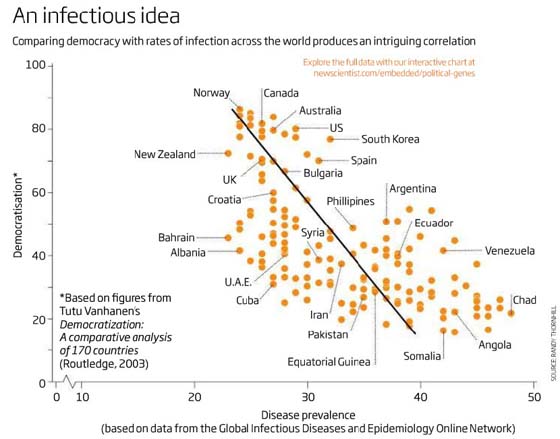
Xenophobic instincts
The starting point for Thornhill and Fincher’s thinking is a basic human survival instinct: the desire to avoid illness. In a region where disease is rife, they argue, fear of contagion may cause people to avoid outsiders, who may be carrying a strain of infection to which they have no immunity. Such a mindset would tend to make a community as a whole xenophobic, and might also discourage interaction between the various groups within a society – the social classes, for instance – to prevent unnecessary contact that might spread disease. What is more, Thornhill and Fincher argue, it could encourage people to conform to social norms and to respect authority, since adventurous behaviour may flout rules of conduct set in place to prevent contamination.
Taken together, these attitudes would discourage the rich and influential from sharing their wealth and power with those around them, and inhibit the rest of the population from going against the status quo and questioning the authority of those above them. This is clearly not a situation conducive to democracy. When the threat of disease eases, however, these influences no longer hold sway, allowing forces that favour a more democratic social order to come to the fore.
That’s the idea, anyway. But where is the evidence?
The team had some initial support from earlier studies that had explored how a fear of disease affects individual attitudes. In 2006, for example, Navarrete found that when people are prompted to think about disgusting objects, such as spoilt food, they become more likely to express nationalistic values and show a greater distrust of foreigners (Evolution and Human Behavior, vol 27, p 270). More recently, a team from Arizona State University in Tempe found that reading about contagious illnesses made people less adventurous and open to new experiences, suggesting that they have become more inward looking and conformist (Psychological Science, vol 21, p 440).
Temporarily shifting individual opinions is one thing, but Thornhill and Fincher needed to show that these same biases could change the social outlook of a whole society. Their starting point for doing so was a description of cultural attitudes called the “collectivist-individualist” scale. At one end of this scale lies the collectivist outlook, in which people place the overall good of society ahead of the freedom of action of the individuals within it. Collectivist societies are often, though not exclusively, characterised by a greater respect for authority – if it’s seen as being necessary for the greater good. They also tend to be xenophobic and conformist. At the other end there is the individualist viewpoint, which has more emphasis on openness and freedom for the individual.
Pathogen peril
In 2008, the duo teamed up with Damian Murray and Mark Schaller of the University of British Columbia in Vancouver, Canada, to test the idea that societies with more pathogens would be more collectivist. They rated people in 98 different nations and regions, from Estonia to Ecuador, on the collectivist-individualist scale, using data from questionnaires and studies of linguistic cues that can betray a social outlook. Sure enough, they saw a correlation: the greater the threat of disease in a region, the more collectivist people’s attitudes were (Proceedings of the Royal Society B, vol 275, p 1279). The correlation remained even when they controlled for potential confounding factors, such as wealth and urbanisation.
A study soon followed showing similar patterns when comparing US states. In another paper, Murray and Schaller examined a different set of data and showed that cultural differences in one collectivist trait – conformity – correlate strongly with disease prevalence (Personality and Social Psychology Bulletin, vol 37, p 318).
Thornhill and Fincher’s next challenge was to find evidence linking disease prevalence not just with cultural attitudes but with the political systems they expected would go with them. To do so, they used a 66-point scale of pathogen prevalence, based on data assembled by the Global Infectious Diseases and Epidemiology Online Network. They then compared their data set with indicators that assess the politics of a country. Democracy is a tough concept to quantify, so the team looked at a few different measures, including the Freedom House Survey, which is based on the subjective judgements of a team of political scientists working for an independent American think tank, and the Index of Democratization, which is based on estimates of voter participation (measured by how much of a population cast their votes and the number of referendums offered to a population) and the amount of competition between political parties.
The team’s results, published in 2009, showed that each measure varied strongly with pathogen prevalence, just as their model predicted (Biological Reviews, vol 84, p 113). For example, when considering disease prevalence, Somalia is 22nd on the list of nations, while the UK comes in 177th. The two countries come out at opposite ends of the democratic scale (see “An infectious idea”).
Importantly, the relationship still holds when you look at historical records of pathogen prevalence. This, together with those early psychological studies of immediate reactions to disease, suggests it is a nation’s health driving its political landscape, and not the other way around, according to the team.
Last year, they published a second paper that used more detailed data of the diseases prevalent in each region. They again found that measures of collectivism and democracy correlate with the presence of diseases that are passed from human to human – though not with the prevalence of diseases transmitted directly from animals to humans, like rabies (Evolutionary Psychology, vol 8, p 151). Since collectivist behaviours would be less important for preventing such infections, this finding fits with Thornhill and Fincher’s hypothesis.
“Thornhill’s work strikes me as interesting and promising,” says Ronald Inglehart, a political scientist at the University of Michigan in Ann Arbor who was unaware of it before we contacted him. He notes that it is consistent with his own finding that a society needs to have a degree of economic security before democracy can develop. Perhaps this goes hand in hand with a reduction in disease prevalence to signal the move away from collectivism, he suggests.
Inglehart’s comments nevertheless highlights a weakness in the evidence so far assembled in support of the parasite-stress model. An association between disease prevalence and democracy does not necessarily mean that one drives the other. Some other factor may drive both the prevalence of disease in an area and its political system. In their 2009 paper, Thornhill and Fincher managed to eliminate some of the possible “confounders”. For example, they showed that neither a country’s overall wealth nor the way it is distributed can adequately explain the link between the prevalence of disease there and how democratic it is.
But many other possibilities remain. For example, pathogens tend to be more prevalent in the tropics, so perhaps warmer climates encourage collectivism. Also, many of the nations that score high for disease and low for democracy are in sub-Saharan Africa, and have a history of having been colonised, and of frequent conflict and foreign exploitation since independence. Might the near-constant threat of war better explain that region’s autocratic governments? There’s also the possibility that education and literacy would have an impact, since better educated people may be more likely to question authority and demand their rights to a democracy. Epidemiologist Valerie Curtis of the London School of Hygiene and Tropical Medicine thinks such factors might be the ones that count, and says the evidence so far does not make the parasite-stress theory any more persuasive than these explanations.
Furthermore, some nations buck the trend altogether. Take the US and Syria, for example: they have sharply contrasting political systems but an almost identical prevalence of disease. Though even the harshest critic of the theory would not expect a perfect correlation, such anomalies require some good explanations.
Also lacking so far in their analysis is a coherent account of how historical changes in the state of public health are linked to political change. If Thornhill’s theory is correct, improvements in a nation’s health should lead to noticeable changes in social outlook. Evidence consistent with this idea comes from the social revolution of the 1960s in much of western Europe and North America, which involved a shift from collectivist towards individualist thinking. This was preceded by improvements in public health in the years following the second world war – notably the introduction of penicillin, mass vaccination and better malaria control.
There are counter-examples, too. It is not clear whether the opening up of European society during the 18th century was preceded by any major improvements in people’s health, for example. Nor is there yet any clear evidence linking the current pro-democracy movements in the Middle East and north Africa to changes in disease prevalence. The theory also predicts that episodes such as the recent worldwide swine-flu epidemic should cause a shift away from democracy and towards authoritarian, collectivist attitudes. Yet as Holly Arrow, a psychologist at the University of Oregon in Eugene, points out, no effect has been recorded.
Mysterious mechanisms
To make the theory stick, Thornhill and his collaborators will also need to provide a mechanism for their proposed link between pathogens and politics. If cultural changes are responsible, young people might learn to avoid disease – and outsiders – from the behaviour of those around them. Alternatively, the reaction could be genetically hard-wired. So far, it has not proved possible to eliminate any of the possible mechanisms. “It’s an enormous set of unanswered questions. I expect it will take many years to explore,” Schaller says.
One possible genetic explanation involves 5-HTTLPR, a gene that regulates levels of the neurotransmitter serotonin. People carrying the short form of the gene are more likely to be anxious and to be fearful of health risks, relative to those with the long version. These behaviours could be a life-saver if they help people avoid situations that would put them at risk of infection, so it might be expected that the short version of the gene is favoured in parts of the world where disease risk is high. People with the longer version of 5-HTTLPR, on the other hand, tend to have higher levels of serotonin and are therefore more extrovert and more prone to risk-taking. This could bring advantages such as an increased capacity to innovate, so the long form of the gene should be more
common in regions relatively free from illness.
That pattern is exactly what neuroscientists Joan Chiao and Katherine Blizinsky at Northwestern University in Evanston, Illinois, have reported in a paper published last year. Significantly, nations where the short version of the gene is more common also tend to have more collectivist attitudes (Proceedings of the Royal Society B, vol 277, p 529).
It is only tentative evidence, and some doubt that Chiao and Blizinsky’s findings are robust enough to support their conclusions (Proceedings of the Royal Society B, vol 278, p 329). But if the result pans out with further research, it suggests the behaviours involved in the parasite-stress model may be deeply ingrained in our genetic make-up, providing a hurdle to more rapid political change in certain areas. While no one is saying that groups with a higher proportion of short versions of the gene will never develop a democracy, the possibility that some societies are more genetically predisposed to it than others is nevertheless an uncomfortable idea to contemplate.
Should the biases turn out to be more temporary – if flexible psychological reactions to threat, or cultural learning, are the more important mechanisms – the debate might turn to potential implications of the theory. Projects aiming to improve medical care in poor countries might also lead a move to more democratic and open governments, for example, giving western governments another incentive to fund these schemes. “The way to develop a region is to emancipate it from parasites,” says Thornhill.
Remarks like that seem certain to attract flak. Curtis, for instance, bristled a little when New Scientist put the idea to her, pointing out that the immediate threat to human life is a pressing enough reason to be concerned about infectious disease.
Thornhill still has a huge amount of work ahead of him if he is to provide a convincing case that will assuage all of these doubts. In the meantime, his experience following publication of A Natural History of Rape has left him prepared for a hostile reception. “I had threats by email and phone,” he recalls. “You’re sometimes going to hurt people’s feelings. I consider it all in a day’s work.”
Jim Giles is a New Scientist correspondent based in San Francisco
World-Wide Assessment Determines Differences in Cultures (NSF)
[Apesar dos problemas metodológicos desse tipo de pesquisa (identificação de fronteiras nacionais com fronteiras culturais, reificação do conceito de cultura, abordagem sincrônica, dentre muitos outros), os resultados são provocadores, e portanto incitam a um debate interessante. RT]
Press Release 11-106 – Video
Michele Gelfand discusses what makes cultures restrictive versus permissive.
Watch video here.
University of Maryland Psychology Professor Michele Gelfand discusses recent research that investigates the “tightness” and “looseness” of 33 countries. “Tight” refers to nations that have strong social norms and low tolerance for deviation from those norms, whereas another term, “loose,” refers to nations with weak social norms and a high tolerance for deviation from those norms.
Credit: University of Maryland/National Science Foundation.
Press Release 11-106
World-Wide Assessment Determines Differences in Cultures
Ukraine, Israel, Brazil and the United States are “loose” cultures
 Population density helps determine whether a country is tight or loose as this German street hints.
May 26, 2011
Conflicts and misunderstandings frequently arise between individuals from different cultures. But what makes cultures different; what makes one more restrictive and another less so?
A new international study led by the University of Maryland and supported by the National Science Foundation’s Division of Behavioral and Cognitive Sciences offers insights that may help explain such cultural differences and bridge the gaps between them.
Published in the May 27 issue of the journal Science, the study for the first time assesses the degree to which countries are restrictive versus permissive and it all comes down to factors that shape societal norms.
The researchers found a wide variation in the degree to which various societies impose social norms, enforce conformity and punish anti-social behavior. They also found the more threats experienced by a society, the more likely the society is to be restrictive, the authors say.
“There is less public dissent in tight cultures,” said University of Maryland Psychology Professor Michele Gelfand, who led the study. “Tight societies require much stronger norms and are much less tolerant of behavior that violates norms.”
“Tight” refers to nations that have strong social norms and low tolerance for deviation from those norms, whereas another term, “loose,” refers to nations with weak social norms and a high tolerance for deviation from them.
Gelfand and colleagues found that countries such as Japan, Korea, Singapore and Pakistan are much tighter whereas countries such as the Ukraine, Israel, Brazil and the United States are looser.
“Is important, within our view, to be mindful that we don’t think that either culture is worse or better,” said Gelfand.
She and her colleagues examined cultural variation in both types of societies.
“We believe this knowledge about how tight or loose a country is and why it is that way can foster greater cross-cultural tolerance and understanding,” said Gelfand. “Such understanding is critical in a world where both global interdependence and global threats are increasing.”
The researchers surveyed 6,823 respondents in 33 nations. In each nation, individuals from a wide range of occupations, as well as university students, were included. Data on environmental and historical threats and on societal institutions were collected from numerous established databases. Historical data–population density in 1500, history of conflict over the last hundred years, historical prevalence of disease outbreaks–were included whenever possible, and data on a wide range of societal institutions, including government, media and criminal justice, were obtained.
“You can see tightness reflected in the response in Japan to the natural disasters recently,” said Gelfand referring to the massive earthquake and tsunami that hit the country on March 11 of this year.
“The order and social coordination after the event, we believe, is a function of the tightness of the society,” Gelfand said, noting that tightness is needed in Japan to face these kinds of ecological vulnerabilities.
The research further showed that a nation’s tightness or looseness is in part determined by the environmental and human factors that have shaped a nation’s history–including wars, natural disasters, disease outbreaks, population density and scarcity of natural resources.
Tight and loose societies also vary in their institutions, with tight societies having more autocratic governments, more closed media and criminal justice systems that have more monitoring and greater deterrence of crime as compared to loose societies.
The study found that the situations that people encounter differ in tight and loose societies. For example, everyday situations–like being in a park, a classroom, the movies, a bus, at job interviews, restaurants and even one’s bedroom–constrain behavior much more in tight societies and afford a wider range of behavior in loose societies.
“We also found that the psychological makeup of individual citizens varies in tight and loose societies,” Gelfand said. “For example, individuals in tight societies are more prevention focused, have higher self-regulation strength and have higher needs for order and self-monitoring abilities than individuals in loose societies.”
These attributes, Gelfand said, help people to adapt to the level of constraint, or latitude, in their cultural context, and at the same time, reinforce it.
The research team combined all these measures in a multi-level model that shows how tight and loose systems are developed and maintained.
Gelfand said knowledge about these cultural differences can be invaluable to many people–from diplomats and global managers to military personal, immigrants and travelers–who have to traverse the tight-loose divide.
“When we understand why cultures, and the individuals in those cultures, are the way they are, it helps us to become less judgmental. It helps us to understand and appreciate societal differences.”
-NSF-
Media Contacts
Bobbie Mixon, NSF (703) 292-8485 bmixon@nsf.gov
Lee Tune, University of Maryland (301) 405-4679 ltune@umd.edu
Principal Investigators
Michele Gelfand, University of Maryland (301) 405-6972 mgelfand@psyc.umd.edu
Why Are Spy Researchers Building a ‘Metaphor Program’? (The Atlantic)
MAY 25 2011, 4:19 PM ET
ALEXIS MADRIGAL – Alexis Madrigal is a senior editor at The Atlantic. He’s the author of Powering the Dream: The History and Promise of Green Technology.
A small research arm of the U.S. government’s intelligence establishment wants to understand how speakers of Farsi, Russian, English, and Spanish see the world by building software that automatically evaluates their use of metaphors.That’s right, metaphors, like Shakespeare’s famous line, “All the world’s a stage,” or more subtly, “The darkness pressed in on all sides.” Every speaker in every language in the world uses them effortlessly, and the Intelligence Advanced Research Projects Activity wants know how what we say reflects our worldviews. They call it The Metaphor Program, and it is a unique effort within the government to probe how a people’s language reveals their mindset.
“The Metaphor Program will exploit the fact that metaphors are pervasive in everyday talk and reveal the underlying beliefs and worldviews of members of a culture,” declared an open solicitation for researchers released last week. A spokesperson for IARPA declined to comment at the time.

IARPA wants some computer scientists with experience in processing language in big chunks to come up with methods of pulling out a culture’s relationship with particular concepts.”They really are trying to get at what people think using how they talk,” Benjamin Bergen, a cognitive scientist at the University of California, San Diego, told me. Bergen is one of a dozen or so lead researchers who are expected to vie for a research grant that could be worth tens of millions of dollars over five years, if the team scan show progress towards automatically tagging and processing metaphors across languages.
“IARPA grants are big,” said Jennifer Carter of Applied Research Associates, a 1,600-strong research company that may throw its hat in the Metaphor ring after winning a lead research spot in a separate IARPA solicitation. While no one knows the precise value of the rewards of the IARPA grants and the contracts are believed to vary widely, they tend to support several large teams of multidisciplinary researchers, Carter said. The awards, which would initially go to several teams, could range into the five digits annually. “Generally what happens… there will be a ‘downselect’ each year, so maybe only one team will get money for the whole program,” she said.*
All this to say: The Metaphor Program may represent a nine-figure investment by the government in understanding how people use language. But that’s because metaphor studies aren’t light or frilly and IARPA isn’t afraid of taking on unusual sounding projects if they think they might help intelligence analysts sort through and decode the tremendous amounts of data pouring into their minds.
In a presentation to prospective research “performers,” as they’re known, The Metaphor Program’s manager, Heather McCallum-Bayliss gave the following example of the power of metaphors in political discussions. Her slide reads:
Metaphors shape how people think about complex topics and can influence beliefs. A study presented participants with a report on crime in a city; they were asked how crime should be addressed in the city. The report contained statistics, including crime and murder rates, as well as one of two metaphors, CRIME AS A WILD BEAST or CRIME AS A VIRUS. The participants were influenced by the embedded metaphor…
McCallum-Bayliss appears to be referring to a 2011 paper published in the PLoS ONE, “Metaphors We Think With: The Role of Metaphor in Reasoning,” lead authored by Stanford’s Paul Thibodeau. In that case, if people were given the crime-as-a-virus framing, they were more likely to suggest social reform and less likely to suggest more law enforcement or harsher punishments for criminals. The differences generated by the metaphor alternatives were “were larger than those that exist between Democrats and Republicans, or between men and women,” the study authors noted.
Every writer (and reader) knows that there are clues to how people think and ways to influence each other through our use of words. Metaphor researchers, of whom there are a surprising number and variety, have formalized many of these intuitions into whole branches of cognitive linguistics using studies like the one outlined above (more on that later). But what IARPA’s project calls for is the deployment of spy resources against an entire language. Where you or I might parse a sentence, this project wants to parse, say, all the pages in Farsi on the Internet looking for hidden levers into the consciousness of a people.
“The study of language offers a strategic opportunity for improved counterterrorist intelligence, in that it enables the possibility of understanding of the Other’s perceptions and motivations, be he friend or foe,” the two authors of Computational Methods for Counterterrorism wrote. “As we have seen, linguistic expressions have levels of meaning beyond the literal, which it is critical to address. This is true especially when dealing with texts from a high-context traditionalist culture such as those of Islamic terrorists and insurgents.”
In the first phase of the IARPA program, the researchers would simply try to map from the metaphors a language used to the general affect associated with a concept like “journey” or “struggle.” These metaphors would then be stored in the metaphor repository. In a later stage, the Metaphor Program scientists will be expected to help answer questions like, “What are the perspectives of Pakistan and India with respect to Kashmir?” by using their metaphorical probes into the cultures. Perhaps, a slide from IARPA suggests, metaphors can tell us something about the way Indians and Pakistanis view the role of Britain or the concept of the “nation” or “government.”
The assumption is that common turns of phrase, dissected and reassembled through cognitive linguistics, could say something about the views of those citizens that they might not be able to say themselves. The language of a culture as reflected in a bunch of text on the Internet might hide secrets about the way people think that are so valuable that spies are willing to pay for them.
MORE THAN WORDS
IARPA is modeled on the famed DARPA — progenitors of the Internet among other wonders — and tasked with doing high-risk, high-reward research for the many agencies, the NSA and CIA among them, that make up the American intelligence-gathering force. IARPA is, as you might expect, a low-profile organization. Little information is available from the organization aside from a couple of interviews that its administrator, Lisa Porter, a former NASA official, gave back in 2008 to Wiredand IEEE Spectrum. Neither publication can avoid joking that the agency is like James Bond’s famous research crew, but it turns out that the place is more likely to use “cloak-and-dagger” in a sentence than in actual combat with supervillainy.
A major component of the agency’s work is data mining and analysis. IARPA is split into three program offices with distinct goals: Smart Collection “to dramatically improve the value of collected data from all sources”; Incisive Analysis “to maximize insight from the information we collect, in a timely fashion”; and Safe & Secure Operations “to counter new capabilities implemented by our adversaries that would threaten our ability to operate freely and effectively in a networked world.” The Metaphor Program falls under the office of Incisive Analysis and is headed by the aforementioned McCallum-Bayliss, a former technologist at Lockheed Martin and IBM, who co-filed several patents relating to the processing of names in databases.
Incisive Analysis has put out several calls for other projects. They range widely in scope and domain. The Babel Program seeks to “demonstrate the ability to generate a speech transcription system for any new language within one week to support keyword search performance for effective triage of massive amounts of speech recorded in challenging real-world situations.” ALADDIN aims to create software to automatically monitor massive amounts of video. The FUSE Program is trying to “develop automated methods that aid in the systematic, continuous, and comprehensive assessment of technical emergence” using the scientific and patent literature.
All three projects are technologically exciting, but none of those projects has the poetic ring nor the smell of humanity of The Metaphor Program. The Metaphor Program wants to understand what human beings mean through the unvoiced emotional inflection of our words. That’s normally the work of an examined life, not a piece of spy software.
There is some precedent for the work. It comes from two directions: cognitive linguistics and natural language processing. On the cognitive linguistic side, George Lakoff and Mark Johnson of the University of California, Berkeley did the foundational work, notably in their 1980 book,Metaphors We Live By. As summarized recently by Zoltán Kövecses in his book, Metaphor: A Practical Introduction, Lakoff and Johnson showed that metaphors weren’t just the devices of writers but rather “a valuable cognitive tool without which neither poets nor you and I as ordinary people could live.”
In this school of cognitive linguistics, we need to use more embodied, concrete domains in order to describe more abstract ones. Researchers assembled the linguistic expressions we use like “That class gave me food for thought” and “His idea was half-baked” into a construct called a “conceptual category.” These come in the form of awesomely simple sentences like “Ideas Are Food.” And there are whole great lists of them. (My favorites: Darkness Is a Solid; Time Is Something Moving Toward You; Happiness Is Fluid In a Container; Control Is Up.) The conceptual categories show that humans use one domain (“the source”) to describe another (“the target”). So, take Ideas Are Food: thinking is preparing food and understanding is digestion and believing is swallowing and learning is eating and communicating is feeding. Put simply: We import the logic of the source domain into the target domain.
Below, you can check out how one, “Ideas Are Food,” is expressed, or skip past the gallery to the rest of the story.
The main point here is that metaphors, in this sense, aren’t soft or literary in any narrow sense. Rather, they are a deep and fundamental way that humans make sense of the world. And unfortunately for spies who want to filter the Internet to look for dangerous people, computers can’t make much sense out of sentences like, “We can make beautiful music together,” which Google translates as something about actually playing music when, of course, it really means, “We can be good together.” (Or as the conceptual category would phrase it: “Interpersonal Harmony Is Musical Harmony.”)
While some of the underlying structures of the metaphors — the conceptual categories — are near universal (e.g. Happy Is Up), there are many variations in their range, elaboration, and emphasis. And, of course, not every category is universal. For example, Kövecses points to a special conceptual category in Japanese centered around the hara, or belly, “Anger Is (In The) Hara.” In Zulu, one finds an important category, “Anger Is (Understood As Being) In the Heart,” which would be rare in English. Alternatively, while many cultures conceive of anger as a hot fluid in a container, it’s in English that we “blow off steam,” a turn of phrase that wouldn’t make sense in Zulu.
These relationships have been painstakingly mapped by human analysts over the last 30 years and they represent a deep culturolinguistic knowledge base. For the cognitive linguistic school, all of these uses of language reveal something about the way the people of a culture understand each other and the world. And that’s really the target of the metaphor program, and what makes it unprecedented. They’re after a deeper understanding of the way people use words because the deep patterns encoded in language may help intelligence analysts understand the people, not just the texts.
For Lakoff, it’s about time that the government started taking metaphor seriously. “There have been 30 years of neglect of current linguistics in all government-sponsored research,” he told me. “And finally there is somebody in the government who has managed to do something after many years of trying.”
UC San Diego’s Bergen agreed. “It’s a totally unique project,” he said. “I’ve never seen anything like it.”
But that doesn’t mean it’s going to be easy to create a system that can automatically deduce what Americans’ biases about education from a statement like “The teacher spoon-fed the students.”
Lakoff contends that it will take a long, sustained effort by IARPA (or anyone else) to complete the task. “The quick-and-dirty way” won’t work, he said. “Are they going to do a serious scientific account?”
BUILDING A METAPHOR MACHINE
The metaphor problem is particularly difficult because we don’t even know what the right answers to our queries are, Bergen said.
“If you think about other sorts of automation of language processing, there are right answers,” he said. “In speech recognition, you know what the word should be. So you can do statistical learning. You use humans, tag up a corpus and then run some machine learning algorithms on that. Unfortunately, here, we don’t know what the right answers are.”
For one, we don’t really have a stable way of telling what is and what is not metaphorical language. And metaphorical language is changing all the time. Parsing text for metaphors is tough work for humans and we’re made for it. The kind of intensive linguistic analysis that’s made Lakoff and his students (of whom Bergen was one) famous can take a human two hours for every 500 words on the page.
But it’s that very difficulty that makes people want to deploy computing resources instead of human beings. And they do have some directions that they could take. James Martin of the University of Colorado played a key role in the late 1980s and early 1990s in defining the problem and suggesting a solution. Martin contended “the interpretation of novel metaphors can be accomplished through the systematic extension, elaboration, and combination of knowledge about already well-understood metaphors,” in a 1988 paper.
What that means is that within a given domain — say, “the family” in Arabic — you can start to process text around that. First you’ll have humans go in and tag up the data, finding the metaphors. Then, you’d use what they learned about the target domain “family” to look for metaphorical words that are often associated with it. Then, you run permutations on those words from the source domain to find other metaphors you might not have before. Eventually you build up a repository of metaphors in Arabic around the domain of family.
Of course, that’s not exactly what IARPA’s looking for, but it’s where the research teams will be starting. To get better results, they will have to start to learn a lot more about the relationships between the words in the metaphors. For Lakoff, that means understanding the frames and logics that inform metaphors and structure our thinking as we use them. For Bergen, it means refining the rules by which software can process language. There are three levels of analysis that would then be combined. First, you could know something about the metaphorical bias of an individual word. Crossroads, for example, is generally used in metaphorical terms. Second, words in close proximity might generate a bias, too. “Knockout in the same clause as ‘she’ has a much higher probability of being metaphorical if it’s in close proximity to ‘he,'” Bergen offered as an example. Third, for certain topics, certain words become more active for metaphorical usage. The economy’s movement, for example, probably maps to a source domain of motion through space. So, accelerate to describe something about the economy is probably metaphorical. Create a statistical model to combine the outputs of those three processes and you’ve got a brute-force method for identifying metaphors in a text.
In this particular competition, there will be more nuanced approaches based on parsing the more general relationships between words in text: sorting out which are nouns and how they connect to verbs, etc. “If you have that information, then you can find parts of sentences that don’t look like they should be there,” Bergen explained. A classic kind of identifier would be a type mismatch. “If I am the verb ‘smile,’ I like to have a subject that has a face,” he said. If something without a face is smiling, it might be an indication that some kind of figurative language is being employed.
From these constituent parts — and whatever other wild stuff people cook up — the teams will try to build a metaphor machine that can convert a language into underlying truths about a culture. Feed text in one end and wait on the other end of the Rube Goldberg software for a series of beliefs about family or America or power.
We might never be able to build such a thing. Indeed, I get the feeling that we can’t, at least not yet. But what if we can?
“Are they going to use it wisely?” Lakoff posed. “Because using it to detect terrorists is not a bad idea, but then the question is: Are they going to use it to spy on us?”
I don’t know, but I know that as an American I think through these metaphors: Problem Is a Target; Society Is a Body; Control Is Up.
* This section of the story was updated to more accurately reflect the intent of Carter’s statement.
Major reform for climate body (Nature)
Intergovernmental panel aims to become more responsive.
By Quirin Schiermeier
Published online 16 May 2011 | Nature 473, 261 (2011)
IPCC chairman Rajendra Pachauri faced calls to quit after errors were
found in a key report.
After months of soul-searching, the Intergovernmental Panel on Climate
Change (IPCC) has agreed on reforms intended to restore confidence in
its integrity and its assessments of climate science.
Created as a United Nations body in 1988 to analyse the latest
knowledge about Earth’s changing climate, it has worked with thousands
of scientists and shared the Nobel Peace Prize in 2007. But its
reputation crumbled when its leadership failed to respond effectively
to mistakes — including a notorious error about the rate of Himalayan
glacier melting — that had slipped into its most recent assessment
report (see Nature 463, 276–277; 2010).
That discovery coincided with the furore over leaked e-mails from the
University of East Anglia’s Climatic Research Unit in Norwich, UK (see
Nature 462, 397; 2009). Some e-mails seemed to show that leading
climate scientists, who had contributed key findings to previous IPCC
reports, had tried to stifle critics. This put the panel — especially
its chairman, Rajendra Pachauri — under intense pressure. The
InterAcademy Council, a consortium of national science academies, was
commissioned to review the structure and procedures of the IPCC and to
suggest improvements to its operations (see Nature 467, 14; 2010).
The council identified the lack of an executive body as a key factor
in the IPCC’s failure to respond to the crisis. It also urged the
panel to improve the transparency of its assessments and to make its
communication and outreach activities more professional. The IPCC
adopted several minor changes at a meeting last October (see Nature
467, 891–892; 2010).
More substantial reforms were signed off last week in Abu Dhabi at a
meeting of delegates from IPCC member states. An executive committee
will be created to oversee the body’s daily operations and to act on
issues that cannot wait for full plenary meetings. The 13-strong
committee will be led by the chairman, and includes the vice-chairs
and co-chairs of its working groups and technical support units.
A new conflict-of-interest policy will require all IPCC officials and
authors to disclose financial and other interests relevant to their
work (Pachauri had been harshly criticized in 2009 for alleged
conflicts of interest.) The meeting also adopted a detailed protocol
for addressing errors in existing and future IPCC reports, along with
guidelines to ensure that descriptions of scientific uncertainties
remain consistent across reports. “This is a heartening and
encouraging outcome of the review we started one year ago,” Pachauri
told Nature. “It will strengthen the IPCC and help restore public
trust in the climate sciences.”
The first major test of these changes will be towards the end of this
year, with the release of a report assessing whether climate change is
increasing the likelihood of extreme weather events. Despite much
speculation, there is scant scientific evidence for such a link —
particularly between climate warming, storm frequency and economic
losses — and the report is expected to spark renewed controversy.
“It’ll be interesting to see how the IPCC will handle this hot potato
where stakes are high but solid peer-reviewed results are few,” says
Silke Beck, a policy expert at the Helmholtz Centre for Environmental
Research in Leipzig, Germany.
The IPCC overhaul is not yet complete. Delegates postponed a decision
about the exact terms of office of the group’s chairman and head of
the secretariat. Critics say that these terms should be strictly
limited to the time it takes to produce a single assessment report,
about six or seven years. With no clear decision on that issue,
Pachauri could theoretically remain in office beyond 2014, when the
next full report is due for release.
But the Indian economist says he has not considered staying on that
long. “My job is to successfully complete the next assessment,” he
says. “That’s what I’m solely focused on.”
Read more on climate controversy at: nature.com/climategate
Como não poderia deixar de ser, aí vem a tropa de choque do policiamento linguístico
MPF prevê ações contra o uso de livro com erros pelo MEC
Para a procuradora da República Janice Ascari, os responsáveis pela edição e pela distribuição do livro “estão cometendo um crime” contra a educação brasileira.
Diante da denúncia de que o livro “Por uma vida melhor”, da professora Heloísa Ramos – que foi distribuído a 485 mil estudantes jovens e adultos pelo Programa Nacional do Livro Didático, do Ministério da Educação -, defende o uso da linguagem popular e admite erros gramaticais grosseiros como “nós pega o peixe”, a procuradora da República Janice Ascari, do Ministério Público Federal, previu que haverá ações na Justiça. Para ela, os responsáveis pela edição e pela distribuição do livro “estão cometendo um crime” contra a educação brasileira.
– Vocês estão cometendo um crime contra os nossos jovens, prestando um desserviço à educação já deficientíssima do País e desperdiçando dinheiro público com material que emburrece em vez de instruir. Essa conduta não cidadã é inadmissível, inconcebível e, certamente, sofrerá ações do Ministério Público – protestou a procuradora da República em seu blog.
No domingo, o livro já tinha sido duramente criticado por educadores e escritores. O MEC confirmou que não pretende retirar a publicação das escolas, alegando que não tem ingerência sobre o conteúdo das obras. Afirmando que se manifestava como mãe e sem analisar o aspecto jurídico da questão, Janice disse que ficou chocada com as notícias sobre o livro com erros aprovado e distribuído pelo MEC. Os autores defendem que essa linguagem coloquial não poderia ser classificada de certa ou errada, mas de adequada ou inadequada.
– Ainda não estou refeita do choque sofrido com as notícias sobre o conteúdo do livro aprovado pelo MEC, no qual consta autorização expressa para que os alunos falem “Nós pega o peixe”, “Os livro mais interessante estão emprestado” e por aí vai. Não, MEC e autores do livro, definitivamente isso não é certo e nem adequado – disse Janice Ascari.
Para o MEC, o debate é nas universidades – O MEC confirmou nesta segunda-feira que não cogita alterar o processo de seleção e avaliação de livros didáticos. As obras são lidas por professores de universidades públicas, a quem cabe selecionar os títulos que farão parte do catálogo nacional de livros. É com base nesse catálogo que escolas de todo o país escolhem as coleções que receberão gratuitamente, distribuídas pelo Programa Nacional do Livro Didático.
O MEC diz que o debate sobre a adequação ou não de uma obra didática deve ocorrer nas universidades, como é no sistema atual, e não dentro do ministério. Do contrário, segundo o MEC, haveria o risco de direcionamento político na escolha das obras a serem aprovadas para uso em sala de aula.
A professora Heloísa Ramos, autora do livro, discorda de que seja preciso modificar qualquer trecho. Ela argumenta que a frase discutida em seu livro trata de linguagem oral, e não escrita. E que a norma popular da língua é diferente da norma culta, mas não necessariamente errada, no caso da linguagem oral.
– Eu não admito mais que alguém escreva que o nosso livro ensina a falar errado ou que não se dedica a ensinar a norma culta – disse Heloísa. – Por que, em educação, todo mundo acha que conhece os assuntos e pode falar com propriedade? Este assunto é complexo, é para especialistas.
Professora aposentada de língua portuguesa da rede estadual de São Paulo, Heloísa presta serviços de consultoria e escreve uma coluna na revista “Nova Escola”, dedicada a tirar dúvidas de professores. Segundo ela, o livro “Por uma vida melhor” é pioneiro ao destacar a importância da norma popular da língua, o que considera um avanço, no sentido de não menosprezar a fala da população menos instruída.
Responsável por livro com erros admite mudar texto – Responsável pela produção do livro didático “Por uma vida melhor”, da Editora Global, a ONG Ação Educativa admite que poderá mudar o texto, numa eventual nova edição. É o que disse nesta segunda-feira a coordenadora-geral da ONG, Vera Masagão. Ela classificou como infeliz a frase que considera correto, em certos contextos, falar com erros de concordância:
– Não acho que seja necessário recolher os livros, de forma nenhuma. Eventualmente, numa próxima vez, a gente pode colocar uma frase que não gere mal-entendidos. Concordo que a frase é infeliz, ainda mais destacada do contexto.
“Você pode estar se perguntando: ‘Mas eu posso falar os livro?’. Claro que pode. Mas fique atento porque, dependendo da situação, você corre o risco de ser vítima de preconceito linguístico”, diz a frase criticada por ela.
Para Vera, a leitura integral do capítulo deixa claro que o foco é o ensino da norma culta da língua. O capítulo se chama “Escrever é diferente de falar”. O professor Marcos Bagno, da Universidade de Brasília (UnB), disse que não há motivo para polêmica, porque já faz mais de 15 anos que os livros didáticos de língua portuguesa aprovados pelo MEC abordam o tema da variação linguística:
– Não é coisa de petista. Já no governo Fernando Henrique, sob a gestão do ministro Paulo Renato, os livros didáticos de português avaliados pelo MEC começavam a abordar os fenômenos da variação linguística, o caráter inevitavelmente heterogêneo de qualquer língua viva falada no mundo transforma qualquer idioma usado por uma comunidade humana.
(O Globo)
ABL critica livro distribuído pelo MEC que defende erro em fala
Segundo a Academia, professor deve ensinar a língua-padrão.
A Academia Brasileira de Letras divulgou ontem uma nota criticando o MEC (Ministério da Educação) e os autores do livro didático “Por uma Vida Melhor”, distribuído pelo ministério a 4.236 escolas do País.
Ao tratar da diferença entre a língua oral e a escrita, o livro didático afirma que é possível dizer “Os livro ilustrado mais interessante estão emprestado” em determinados contextos. “A Casa de Machado de Assis vem estranhar certas posições teóricas dos autores de livros que chegam às mãos de alunos dos cursos fundamental e médio com a chancela do Ministério da Educação, órgão que se vem empenhando em melhorar o nível do ensino escolar no Brasil”, diz a nota.
A ABL argumenta que não cabe ao professor de língua portuguesa em sala de aula ensinar outras variedades da língua que não seja a padrão. “[O professor] espera encontrar no livro didático o respaldo dos usos da língua-padrão que ministra a seus discípulos, variedade que eles deverão conhecer e praticar no exercício da efetiva ascensão social que a escola lhes proporciona.”
O MEC afirmou na semana passada que o livro está em acordo com os Parâmetros Curriculares Nacionais, que servem como orientação para escolas e professores. Sobre a nota da ABL, o MEC afirma que o programa de aquisição e seleção dos livros didáticos -em que há uma avaliação das obras e liberdade para as escolas escolherem os livros com que trabalharão- foi discutido e aprovado por várias associações, entre elas a ABL.
O livro em questão, elaborado pela ONG Ação Educativa, no capítulo em que trata das diferenças entre escrever e falar e das variações na linguagem oral, afirma: “Você pode estar se perguntando: “Mas eu posso falar os livro?”. Claro que pode. Mas fique atento porque, dependendo da situação, você corre o risco de ser vítima de preconceito linguístico”.
A coordenadora da Ação Educativa, Vera Masagão Ribeiro, diz que a frase foi tirada de contexto e que o livro deixa claro que há uma norma culta da língua. De acordo com Ribeiro, não há o risco de um aluno entender que pode escrever dessa forma num concurso público ou falar assim numa entrevista de emprego.
(Folha de São Paulo)
Coluna de Merval Pereira no O Globo desta terça-feira (17)
Há um aspecto perverso nessa crise do livro didático de português, que o MEC insiste em manter em circulação, que ultrapassa qualquer medida do bom-senso de um governo, qualquer governo.
A pretexto de defender a fala popular como alternativa válida à norma culta do português, o Ministério da Educação está estimulando os alunos brasileiros a cultivarem seus erros, que terão efeito direto na sua vida na sociedade e nos resultados de exames, nacionais e internacionais, que avaliam a situação de aprendizado dos alunos, debilitando mais ainda a competitividade do país.
O ministro Fernando Haddad, que já protagonizou diversas confusões administrativas, agora se cala diante dessa “pedagogia da ignorância” que apresenta aos alunos da rede pública a defesa de erros de português, como se fossem corretas ou aceitáveis expressões populares como “nós pega o peixe” ou “dois real”.
(Aliás, cada vez que escrevo essas frases, o corretor de texto teima em sublinhá-las em verde, como se estivessem erradas. Esse computador ainda não passou pelo crivo do MEC).
Mas é o próprio MEC que veicula anúncios exaltando supostos avanços dos alunos brasileiros no Pisa (Programa Internacional de Avaliação de Alunos).
O País registrou crescimento em todas as notas, embora continue muito abaixo da média dos países da Organização para a Cooperação e Desenvolvimento Econômico (OCDE), e mesmo de alguns da América Latina.
Ora, se o próprio governo baliza sua atuação pela régua do Pisa, como justificar que a defesa de uma alternativa da fala correta seja uma política oficial do Estado brasileiro?
A professora Heloísa Ramos, autora do livro “Por uma vida melhor”, da Coleção Viver, Aprender (Editora Global) acredita ser “importante que o falante de português domine as duas variantes e escolha a que julgar adequada à sua situação de fala”.
Seria preciso então que as escolas e faculdades ensinassem o português popular para os que foram alfabetizados pela norma culta, numa radicalização esdrúxula que esse raciocínio estimula.
O caráter ideológico de certos livros didáticos utilizados pelo MEC, especialmente de história contemporânea, ganha assim uma nova vertente, mais danosa que a primeira, ou melhor, mais prejudicial para a vida do cidadão-aluno.
Enquanto distorções políticas que afetem posições pessoais do aluno podem ser revertidas no decorrer de sua vida, por outros conhecimentos e vivências, distorções didáticas afetam a perspectiva desse aluno, que permanecerá analfabeto, sem condições de melhorar de vida.
Fosse o livro uma obra de linguística da professora Heloísa Ramos, nada a opor quanto à sua existência, embora seus métodos e conclusões rasteiras do que seja preconceito contra a fala popular possam, sim, ser refutados como uma mera mistificação política.
Se fosse um romance, não haveria problema algum em reproduzir a maneira de falar de uma região, ou os erros de português de um personagem.
Mas o livro didático não pode aceitar como certo o erro de português. Didática, pelo dicionário (?) é “a arte de transmitir conhecimento, técnica de ensinar” ou “que proporciona instrução e informação”.
O fato de falarem de certa maneira em algumas regiões não quer dizer que este ou aquele linguajar represente o português correto.
A visão deturpada do que seja ensinar aparece na declaração de um assessor anônimo do MEC no Globo de ontem, alegando que não cabe ao ministério dizer “o que é certo e o que errado”, e nem mesmo fazer a análise do conteúdo dos livros didáticos.
Se não exerce esses deveres básicos, o que faz o MEC em relação ao ensino do País?
Seria um equívoco lamentável e perigoso se o MEC, com essa postura, estivesse pretendendo fazer uma política a favor dos analfabetos, dos ignorantes, como se ela fosse a defesa dos que não tiveram condições de estudar. Na verdade, está é agravando as condições precárias do cidadão-aluno que busca na escola melhorar de vida, limitando, se não impossibilitando, que atinjam esse objetivo.
Se, porém, a base da teoria for uma tentativa de querer justificar a maneira como o presidente Lula fala, aí então teremos um agravante ao ato criminoso de manter os estudantes na ignorância.
Querer transformar um defeito, uma falha da educação formal do presidente-operário, em uma coisa meritória é um desserviço à população.
Os erros de português de Lula não têm mérito nenhum, ele os explora para fazer política, é um clássico do populismo, cuja consequência é deseducar a população.
Mas ele nunca teve a coragem de defender a fala errada, embora goste de ironizar palavras ou expressões que considera rebuscadas.
Ele desvaloriza o estudo, com frases como “não sei por que estudou tanto, e eu fiz mais do que ele”, ou quando se mostra como exemplo de que é possível subir na vida sem estudar.
Mas em outras ocasiões, estimula que a universidade seja acessível a todos, numa atitude que parece paradoxal, mas que ganha coerência quando se analisam os objetivos políticos de cada uma das atitudes.
Se, no entanto, o desdém pela norma culta do português transformou-se em política de Estado, aí teremos a certeza de termos chegado ao fundo do poço.
UFRN aprova obra que defende fala popular
Segundo o MEC, o aval ao livro que admite uso de linguagem oral com erros para estabelecer comunicação partiu de comissão de docentes potiguares.
Uma comissão formada por professores da Universidade Federal do Rio Grande do Norte (UFRN) aprovou o livro Por uma Vida Melhor, da Coleção Viver e Aprender. O livro, que chegou a 484.195 alunos de todo o País, defende que a forma de falar não precisa necessariamente seguir a norma culta. “Você pode estar se perguntando: ‘Mas eu posso falar os livro?’. Claro que pode”, diz um trecho.
Por uma Vida Melhor, de autoria de Heloísa Ramos, afirma que o uso da língua popular – ainda que com seus erros gramaticais – é válido na tentativa de estabelecer comunicação. O livro lembra que, caso deixem de usar a norma culta, os alunos podem sofrer “preconceito linguístico”. “Fique atento porque, dependendo da situação, você corre o risco de ser vítima de preconceito linguístico. Muita gente diz o que se deve e o que não se deve falar e escrever, tomando as regras estabelecidas para a norma culta como padrão de correção de todas as formas linguísticas.”
O livro foi escolhido por um total de 4.236 escolas que definiram a obra “mais apropriada a cada contexto”, considerando as “propostas pedagógicas e curriculares desenvolvidas”, informou o Ministério da Educação. O MEC não comenta o mérito do livro – ressalta que coube a docentes da UFRN aprovar a obra e a cada escola a decisão de adotá-la ou não nas salas.
Padrões – Em nota divulgada pelo MEC, a autora defendeu que a ideia de “correto e incorreto no uso da língua deve ser substituída pela ideia de uso da língua adequado e inadequado, dependendo da situação comunicativa”. Cercado pela polêmica que o livro levantou, o MEC observa que a seleção do conteúdo didático não coube ao ministério.
Os livros do Programa Nacional do Livro Didático para a Educação de Jovens e Adultos (PNLDEJA) são encaminhados para uma comissão, responsável pela avaliação e seleção das coleções didáticas. No caso de Por uma Vida Melhor, o debate ficou entre um grupo de docentes da UFRN. Depois de aprovadas, as obras são colocadas à disposição no Guia do Livro Didático, que funciona como uma ferramenta de orientação
na definição dos títulos.O ministério arca com as despesas dos livros.
Programa – Ao tratar dos componentes curriculares, o edital do programa do Ministério da Educação previa que os alunos do segundo segmento – do 6.º ao 9.º ano do ensino fundamental, que receberam a obra – “demandam novos tipos de reflexão sobre o funcionamento e as propriedades da linguagem em uso” e “a sistematização dos conhecimentos linguísticos correlatos mais relevantes”.
O edital também diz que “cabe ao ensino de língua materna, nesse nível de ensino-aprendizagem, aprofundar o processo de inserção qualificada do aluno na cultura da escrita”. O MEC afirmou que até ontem não havia pedidos de devolução dos exemplares. A Editora Global informou, por meio de sua assessoria de imprensa, que é responsável pela comercialização e pela produção do livro, mas não pelo seu conteúdo. Procurada, a assessoria da UFRN disse que não se pronunciaria.
‘O livro é fruto da minha carreira. Escrevi o que já havia praticado’
Entrevista com Heloisa Cerri Ramos, coautora do livro “Por uma vida melhor”.
● Foi um mal entendido?
Pegaram uma frase sem contexto. Dentro do capítulo que trata de concordância nominal e verbal, explico que, na língua oral, quando se diz “os livro é popular”, entende-se que é plural. Mas, na verdade, acho que houve uma falta de aceitação. A mídia diz que a escola não produz aprendizagem, mas quando se mostra um aspecto pedagógico ou didático, ela tem posição conservadora, trata com ironia.
● A discussão, então, é antiga?
Sim. Há pelo menos 30 anos se fala disso entre os que se preocupam em democratizar o ensino. Talvez em um tempo em que só a elite ia para escola, a normal culta bastasse. Hoje, com o acesso da classe popular, a formação tem de ser mais ampla. E nosso livro é direcionado ao Ensino de Jovens e Adultos. Foi feito para aquele que pode ter sido discriminado por falar errado. Não defendo uma escola que fique parada na linguagem popular. Com o aprendizado, o estudante se vê como um falante da sua língua e sabe que, sem a norma culta, não terá acesso a bens culturais e conhecimentos científicos.
● O espanto, então, é por que você escreveu, colocou no papel, o que já se discute há tempos?
Sim. Acho que nenhum livro didático falou diretamente disso. Nosso livro tem a linguagem voltada para o aluno. Por isso, explicito essa questão da concordância. Recebi elogios de colegas. Muitos deles disseram que eu fui corajosa.
● E como é receber críticas de professores e de membros da Academia Brasileira de Letras?
Estou muito tranquila. Não cometi nenhum erro conceitual. O livro é fruto da minha carreira. O que eu escrevi, já havia praticado com meus alunos. E o livro também recebeu pareceres antes da publicação. Os outros dois autores da coleção e eu sempre falamos: se ninguém quiser os nossos livros, nós queremos.
(O Estado de São Paulo)
Danzing sobre comunicação, inteligência e tortura
O debate é marcado por certa visão interna americana sobre o valor social do aparato de inteligência, mas há pontos interessantes sobre comunicação e política, relevantes para pesquisa na área.
Five Reasons Why Torture Did Not Help U.S. Forces Find Bin Laden
5-3-2011
By David Danzig – http://www.humanrightsfirst.org
The AP reported: “Current and former U.S. officials say that Khalid Sheikh Mohammed, the mastermind of the Sept. 11, 2001 terrorist attacks, provided the nom de guerre of one of bin Laden’s most trusted aides. The CIA got similar information from Mohammed’s successor, Abu Faraj al-Libi. Both were subjected to harsh interrogation tactics inside CIA prisons in Poland and Romania.”
Since Bin Laden’s death, Liz Cheney, the daughter of the former Vice President, and other proponents of “enhanced” interrogation techniques have taken to the air waves to trumpet this bit of news, but there is every reason to believe that torture actually hindered, rather than helped, U.S. efforts to find Bin Laden. Here are five of them.
1) It’s not so simple
Khalid Sheik Muhammed (KSM) did not talk, according to the AP, when he was tortured, but rather months later when he was questioned using humane interrogation techniques.
When asked on “Morning Joe” if KSM had provided information on the courier due to torture, John Brennan, the President’s Counter Terrorism advisor said, “not to my knowledge.” Brennan was later asked on FOX News if KSM and al-Libi had provided the initial information about the courier. “If only it were that simple,” he said.
2) KSM did not tell us everything he knew
KSM and al-Libi almost certainly concealed a great deal of information about the courier who ultimately led US forces to Bin Laden. Indeed, Bin Laden was killed in the town where Al Libi used to live. Al Libi’s role was to prepare safe houses for Al Qaeda leaders like Bin Laden, and the courier has been described repeatedly as “a confidant of Khalid Sheik Muhammed.” Yet all CIA interrogators were able to learn was a nickname for him. As compared to what they could have learned, this is not very impressive.
A senior US official told reporters that it was only four years later that US forces learned the courier’s real name and location.
3) Interrogators say that using torture does not make a detainee reveal the whole truth later
Some will argue that it was only thanks to the waterboarding that KSM and al-Libi were willing to talk at all. This notion is rejected by the more than 75 interrogators, questioners and debriefers with the military, the FBI and the CIA who I have spoken to in depth about this subject since the revelations of abuse at Abu Ghraib. I have yet to speak to a professional interrogator who believes that torture is an effective means of questioning suspected terrorists.
Jack Cloonan who served on the FBI’s Osama Bin Laden unit for 6 years told me that during an interrogation (or what the FBI calls an interview) the goal was to, “work towards the objective of getting this person to cross the threshold and become, in effect, a traitor to their own cause.”
According to Cloonan, “the Al Qaeda people that I dealt with were all very sophisticated in terms of their language skills and understanding of what was at stake.” Cloonan said that it essentially became a question of whether he could offer the detainee enough of what he wanted (protection for his family, more lenient sentencing/incarceration etc.) to convince him to talk. “They struggled,” he said, “with whether or not I was being truthful and I was going to honor everything I said.”
If you gave the detainee any reason not to trust you, there is no negotiation, Cloonan explained. The detainee won’t be willing to bargain with giving up his knowledge in exchange for something the interrogator can provide. He simply won’t trust you. Torture, Cloonan says, shatters any possibility for trust. “It changes the dynamic,” Cloonan said. “And once you have gone down that path, in my experience there is no going back.”
4) We simply do not know how much more helpful KSM and Al Libi might have been if they had been interrogated solely using humane methods that have been proven to be effective
In the war on terror, the most wanted men to date have been captured thanks to intelligence developed by interrogators who do not use abuse.
I once showed Joe Navarro a former FBI special agent who used to teach questioning techniques, a TV clip of the FOX show “24” featuring Jack Bauer torturing someone while yelling “where is the bomb?” and asked him why that sort of tactic would not work on high value detainees. “That’s ridiculous,” said Navarro. “I want to know everything that a detainee knows. I don’t simply want to know where the bomb is! I want to know who funds him and how? Where are their safehouses? Who else does he know? What does he know that I don’t even know to ask about?” The dynamics of a torture session make for good TV because the detainee delivers the info in a short sound bite. But in the real world, interrogators who use abuse put themselves in a position where detainees will, at best, provide them with only limited information.
Consider other high profile captures and kills in the war on terrorism. The former insurgent who fingered Saddam Hussein voluntarily drew his U.S. interrogator a map showing exactly what spider hole the former dictator was hiding in. And the Al Qaeda operative who pointed US forces to Al Zarqawi, the former head of Al Qaeda in Iraq, told his interrogators the name of Zarqawi’s spiritual advisor and what kind of car he drove. (Ultimately coalition forces followed the advisor’s car to Zarqawi.)
This level of cooperation is unthinkable if torture is used. And it leaves one wondering if we might have found Osama Bin Laden earlier if KSM and al-Libi had been interrogated by the FBI’s subject matter expert or another interrogator committed to using humane techniques from the start.
5) The optics of the US using torture do not help in the larger struggle
Consider the case of Nasir Abbas, a former high-level terrorist who worked with Jemaah Islamiya (JI), the Indonesian terrorist group responsible for the Bali bombings.
Abbas was captured by Detachment 88, an Indonesian police task force so committed to using humane techniques that its interrogators often begin interrogation sessions by praying together with detainees as “fellow muslims.” Abbas, as he explains, in a best selling book recently released in Indonesia decided, in part thanks to his treatment by police authorities, that the way that JI engaged in killing innocent civilians was wrong. He provided the Indonesian police with dozens of leads and it is thanks to his – and other former JI operatives’ conversion – that officials say they have been able to substantially reduce the threat from JI.
How many chances has the U.S. had to convert someone like Nasir Abbas to our side?
How potent a weapon might it be to have a former Al Qaeda operative announce publically that he thinks that what Al Qaeda does is wrong and that he was wrong about his captors? (And for that matter how helpful might it be to have found a well-placed Pakistani in the town where Bin Laden was holed up who was willing to rat him out simply because it was the right thing to do.)
I am sure that the Liz Cheney’s of the world would say that this outlook is naive and that these trained killers would never turn on their comrades. To them, I can only say that I am sure that the directors of Detachment 88, in Indonesia, and the interrogators who led us to Saddam Hussein and Al Zarqawi faced the same criticism.
David Danzig is a senior advisor to Human Rights First
Estatais inovam mais do que as companhias privadas, mostra pesquisa (Agência Brasil)
JC e-mail 4244, de 26 de Abril de 2011.
Entre 2006 e 2008, as empresas estatais federais promoveram mais inovações do que as companhias privadas.
Praticamente sete em cada 10 empresas públicas criaram algum produto ou processo nesse período, segundo a Pesquisa de Inovação nas Empresas Estatais Federais 2008, divulgada quarta-feira (20) pelo Instituto Brasileiro de Geografia e Estatística (IBGE). Entre as empresas privadas, de acordo com a última Pesquisa de Inovação Tecnológica (Pintec) do IBGE, a relação cai para quatro em cada dezena.
O estudo sobre inovação nas estatais foi feito em parceria com os ministérios da Ciência e Tecnologia e do Planejamento e analisou, pela primeira vez, as empresas federais isoladamente. Ao todo, foram investigadas 72 companhias públicas, de um total de 118 acompanhadas pelo Departamento de Coordenação e Controle das Empresas Estatais (Dest).
De acordo com a gerente responsável pela pesquisa, Fernanda Vilhena, esse resultado reflete o padrão de inovação observado nas estatais federais, mais voltado para pesquisa e desenvolvimento (P&D), geralmente em parceria com universidades. “O grande diferencial é que as empresas, sobretudo as industriais, promovem a inovação muito baseada na compra de máquinas e equipamentos. Já nas estatais federais, o padrão de inovação é voltado para pesquisa e desenvolvimento dentro da própria empresa e, também, com arranjos cooperativos com universidades. Isso é muito interessante e acabou determinando o resultado positivo de inovação nessas companhias”, disse ele.
A pesquisa também revelou que, entre as estatais inovadoras, 27,8% lançaram algum produto novo no mercado nacional e 29,2% implementaram processo inédito, também direcionado ao mercado interno. Nas empresas privadas, esses percentuais são 4,4% e 2,4%, respectivamente.
Vilhena ressaltou que essa diferença pode ser explicada, além do volume maior de investimentos em pesquisa e desenvolvimento, pelo monopólio que algumas estatais exercem em determinados setores, como o de energia. “Essas empresas são muito intensivas em pesquisa e desenvolvimento, o que gera muito processo inovador. No caso dos produtos, as estatais, muitas vezes, são as únicas ofertantes de um produto.
Então, ao lançar um produto novo, ele é automaticamente novo para o mercado”.
A pesquisa também destacou que o apoio do governo, por meio de bolsas de fundações de amparo à pesquisa e dos incentivos do Plano de Aceleração do Crescimento (PAC), impulsionou as inovações nas empresas estatais. Já em relação aos entraves para implementar processos inovadores, o estudo revela que as dificuldades são mais evidentes nas companhias públicas. Mais da metade (57,1%) enfrentaram pelo menos um obstáculo de importância alta ou média para inovar, especialmente relacionado à burocracia da administração pública. A dificuldade para se adequar a padrões, normas e regulamentações e a rigidez organizacional foram citados por 64,2% delas. Já para o conjunto de empresas privadas ouvidas pela Pintec, os maiores obstáculos foram os elevados custos da inovação (57,1%), os riscos econômicos excessivos (65,6%) e a escassez de financiamento (51,4%).
(Agência Brasil)
Que democracia racial é essa? (Carta Capital)
Por Rodrigo Martins
20 de abril de 2011
Apesar da redução das disparidades propiciadas por programas de segurança alimentar, como o Bolsa Família, o abismo que separa brancos e negros no Brasil continua gigantesco. Essa é uma das conclusões do 2º Relatório Anual de Desigualdades Raciais, divulgado na terça-feira 19, pelo Instituto de Economia da Universidade Federal do Rio de Janeiro (UFRJ).
Os indicadores foram compilados a partir de diferentes bases de dados do IBGE, dos ministérios da Saúde e Educação, entre outras instituições públicas. O estudo revela que os afrodescendentes têm menor acesso ao sistema de saúde (uma taxa de não cobertura de 27%, frente aos 14% verificados entre a população branca), a exames ginecológicos preventivos, ao pré-natal e sofrem com uma taxa maior de mortalidade materna.
Por dia, morrem cerca de 2,6 mulheres pretas ou pardas por complicações na gestação, enquanto este mesmo problema acomete 1,5 mulheres brancas. Entre 1986 e 2008, a taxa de fecundidade das afrodescendentes caiu de forma mais acelerada (48,8%) que a das brancas (36,7%). No entanto, as mulheres pretas ou pardas se sujeitam com mais intensidade a procedimentos radicais de contracepção, como as laqueaduras. Quase 30% dessa população em idade fértil estavam esterilizada em 2006, frente a uma taxa de 21,7% das mulheres brancas.
“Ninguém é contra o planejamento familiar. A queda na taxa de natalidade representa uma melhora na qualidade de vida das pessoas. Mas as afrodescendentes poderiam ter acesso a formas menos agressivas de intervenção”, avalia o economista Marcelo Paixão, coordenador do relatório. “A esterilização é uma solução radical demais. É como arrancar um dente para não tratar uma cárie. Por isso, causa preocupação o fato de parte dessa redução da fecundidade estar associada às laqueaduras.”
Nos últimos 20 anos, a média do tempo de estudos dos afrodescendentes acima de 15 anos passou de 3,6 anos para 6,5. Mesmo assim, está muito aquém da população branca, hoje com uma média de 8,3 anos de estudo. Além disso, 45,4% das crianças pretas ou pardas entre 6 e 10 anos estudava na série inadequada em 2008, frente ao percentual do 40,4% dos brancos. Entre as crianças de 11 e 14 anos, o problema é ainda mais grave, pois 62,3% dos afrodescendentes não estudavam na série correta. Entre os jovens brancos, a inadequação atingia 45,7%.
Por outro lado, as famílias pretas ou pardas beneficiadas pelo Bolsa Família conseguiram aumentar a quantidade de alimentos consumidos em proporção superior (75,7%) a das famílias brancas (70,1%). A elevação no consumo de arroz entre os afrodescendentes foi de 68,5%. Brancos: 31,5%. No caso do feijão, o consumo dos pretos e pardos cresceu 68%. Brancos: 32%.
“Apesar de melhorar a segurança alimentar dos afrodescendentes, o que é importantíssimo, em todos os outros setores percebe que a discrepância entre brancos e negros prevalece”, comenta Paixão. “Devido às elevadas taxas de desemprego, rotatividade no mercado de trabalho e informalidade, os pretos e partos tem um acesso bem menor à cobertura da Previdência Social. A diferença chega a dez pontos percentuais na população masculina e 20% entre as mulheres”, completa.
Outro dado que chama a atenção é o baixo índice de condenação por crimes de racismo no Brasil. Entre 2007 e 2008, 66,9% dos casos julgados nos Tribunais de Justiça de todo o País foram vencidas pelos réus e apenas 29,7% das supostas vítimas saíram vitoriosas. Na primeira instância, as vítimas tiveram sua demanda judicial contemplada em 40,5% dos acórdãos.
“Talvez os magistrados ainda acreditem no mito da democracia racial brasileira e, por isso, sejam mais brandos nas condenações e na aplicação das penas”, especula o professor da UFRJ. “Pela lei, o racismo é um crime inafiançável e imprescritível, mas não tenho notícia de um único racista condenado à prisão no Brasil. Vejo apenas punições pecuniárias, sobretudo indenizações, e pedidos de desculpas formais.”
Climate, Communication and the ‘Nerd Loop’ (N.Y. Times, Dot Earth)
April 14, 2011, 9:46 AM – By ANDREW C. REVKIN
Randy Olson, the marine biologist turned filmmaker and author who’s about as far from the label “nerd” as can be, had his Howard Beale “mad as hell” moment over climate miscommunication last week on his blog, The Benshi.
The piece, “The Nerd Loop: Why I’m Losing Interest in Communicating Climate Change,” is a long disquisition on why there’s too much thumb sucking and circular analysis and not enough experimentation among institutions concerned about public indifference to risks posed by human-driven global warming. He particularly criticizes scientific groups, universities, environmental groups and foundations and other sources of funding. Randy summarized his points in a short “index card” presentation (in lieu of a Powerpoint) and followup interview on Skype (above). [Stephen McIntyre of Climateaudit has posted a response, entitled “The Smug Loop.“]
In our chat I admitted freely that I’ve stepped aboard the “nerd loop” on occasion on this blog, exploring humanity’s “blah, blah, blah, bang” habit when it comes to confronting certain kinds of risks. This goes for financial bubbles and tsunamis as well as long-term, long-lasting changes in the climate.
I agree with Olson, utterly, that there’s not enough experimentation, too much fear of failure and also far too much fear and misunderstanding at scientific institutions, from America’s universities to the Intergovernmental Panel on Climate Change, about the obligation and responsibility to engage the public in a sustained way. As I’ve put it here and elsewhere many times, it’s particularly important as traditional science journalism becomes a shrinking wedge of a growing pie of communication portals.
I encourage you to watch the video and/or read Olson’s provocative essay. You won’t agree with all of what he says. I don’t, and in fact I think that research revealing the human habit of embracing or ignoring information based on predispositions and emotion, not the information, is vitally important to convey (and needs to be conveyed more creatively, too!).
But I hope you’ll recognize the merits in Olson’s argument. Here’s the summary of the “Nerd Loop” essay:
Mass communication is not a science. How many times do I have to say this? The more you think it is — or even let yourself talk about the science side of it without allocating EQUAL energy to the art side of it, the more you are doomed to take it deeper into the hole of boredom and irrelevance. Such is the state of climate science communication by the large science and environmental organizations who have bought into the magic bullet of metrics and messaging.
AND FURTHERMORE … eh, hem (a colleague at NASA just pointed this out to me) … look at this quote: “Recent advances in behavioral and decision science also tell us that emotion is an integral part of our thinking, perceptions, and behavior, and can be essential for making well-judged decisions.”
“RECENT ADVANCES”??? Social scientists think this is some sort of recent breakthrough — that humans are not robots? The quote comes from a paper in the first volume of the new Nature Climate journal. As my colleague said, “What rock did these guys crawl out from under? Give me a break all you social scientists and quit living up to your stereotype.”
Honestly.
Here are some relevant posts and links. Beware, you’re about to enter “the nerd loop” (which I, personally, see as important, even as everyone loosens up and starts experimenting):
“The Psychology of Climate Change Communication” (The Center for Research on Environmental Decisions, Columbia University)
“Climate, Mind and Behavior” (a series of symposiums at the Garrison Institute)
“Communicating Climate Change” (The Pew Center on Global Climate Change)
“Knowledge of Climate Change Across Global Warming’s Six Americas” (Yale Project on Climate Change Communication)
[Original link: http://dotearth.blogs.nytimes.com/2011/04/14/climate-communication-and-the-nerd-loop/]
Imprensa versus governo (Fapesp)
Imprensa versus governo
Rede da Democracia, formada por três grandes jornais, teve papel na queda de Jango
Carla Rodrigues
Edição Impressa 181 – Março 2011
| © AGÊNCIA ESTADO |
 |
| Tropas no comício da Central do Brasil |
No jargão da imprensa escrita, “retranca” é a classificação do assunto contido em uma página, editoria ou em um conjunto de textos jornalísticos. Sob a retranca “Na Rede da Democracia”, entre outubro de 1963 e março de 1964, os três mais importantes jornais do país – O Jornal, dos Diários Associados, Jornal do Brasil, da família Nascimento Brito, e O Globo, da família Marinho – se uniram em torno de uma pauta em comum: a defesa do nacionalismo contra o comunismo, a crítica à ineficiência do Congresso, a falta de legitimidade do presidente João Goulart, o perigo de o governo ceder às pressões das manifestações de massa e dos movimentos populares. Diariamente publicada nos três diários e veiculada à noite nas suas respectivas emissoras de rádio, a Rede da Democracia ajudou a enfraquecer e derrubar o governo de Jango, deposto pelos militares que tomaram o poder em 1964.
Os acontecimentos políticos posteriores a esse momento da história brasileira têm sido muito registrados e debatidos. Mas sobre o consórcio formalizado pelos jornais sob a denominação de Rede da Democracia pouco se estudou. Foi nesse vazio que trabalhou o historiador Aloysio Castelo de Carvalho em sua pesquisa de pós-doutorado em história social na Universidade de São Paulo (USP), cujo resultado está sendo lançado no livro A Rede da Democracia: O Globo, O Jornal e Jornal do Brasil na queda do governo Goulart (1961-1964), coedição entre a NitPress e a Editora da UFF (Universidade Federal Fluminense), onde Carvalho também é professor.
“A Rede da Democracia está incluída num debate sobre a relação entre os jornais e o governo de João Goulart”, diz o pesquisador. Relação que evoluiu de maneira peculiar: em agosto de 1961, quando Jânio Quadros renunciou, os três jornais defenderam uma posição antigolpe, afirmando a legalidade da posse do vice João Goulart. Dois anos depois, a Rede da Democracia cerrava fileiras contra o presidente.
Em 1961 coube ao então governador do Rio Grande do Sul, Leonel Brizola, montar a chamada Rede da Legalidade, que transmitia, a partir do porão do Palácio Piratini, discursos do aliado de Jango reproduzidos em ondas curtas por dezenas de emissoras do interior e de outros estados. O modelo de resistência brizolista inspiraria, anos depois, o empresário Assis Chateaubriand, dono dos Diários Associados. As rádios Tupi, Globo e Jornal do Brasil passaram a transmitir em conjunto, a partir de 1963, pronunciamentos que no dia seguinte eram publicados nos jornais com a mesma retranca. Alguns títulos ilustram o conteúdo editorial da Rede: “União Nacional dos Estudantes é um antro de delinquentes políticos”, “O dispositivo chamado sindical é na realidade dispositivo comunista”, “Dias graves se aproximam se não for repelida a invasão marxista”, “Ministério do Trabalho comanda as greves que agitam nosso país”, “Nosso país não está só ameaçado, mas comprometido com o comunismo” são exemplos da tomada de posição da imprensa diante do governo de Jango. Entre os signatários estavam parlamentares da oposição e donos de jornais que, na visão de Carvalho, se arvoraram na pretensão de se tornarem atores políticos.
| © AGÊNCIA ESTADO |
 |
| Tanques do Exército no Rio no dia do golpe militar |
Padrão – Foi em busca de compreender qual foi o papel da imprensa na queda de Jango e na emergência do governo militar que Carvalho acabou encontrando um padrão discursivo formado por quatro principais eixos: uma concepção valorativa da própria imprensa, que se atribui o papel de porta-voz da opinião pública; o temor de que o ingresso das massas no sistema político seria um risco para o país; a falta de confiança no presidente da República quando ele conta com apoio popular; a falta de confiança nas instituições políticas, inclusive no Congresso e no Senado, contribuindo para reforçar a percepção do papel da imprensa como fiscal dessas mesmas instituições e afirmando a importância da liberdade de imprensa.
No período Jango, os três jornais unificados sob a Rede da Democracia viam a sociedade brasileira como uma emergente sociedade de massas, mas resistiam ao ingresso dessa massa na participação política, que passou a se dar pela via dos movimentos sociais e das manifestações populares. “Os jornais reagiram de forma conservadora, afirmando que a única participação política legítima era pelas formas institucionais”, lembra Carvalho.
No entanto, essas formas institucionais estavam fechadas à massa de trabalhadores que, no processo de urbanização e industrialização, chegava à vida política. O voto não era permitido aos analfabetos, por exemplo, e em 1963 metade da população brasileira não sabia ler nem escrever. Daí a grande importância da Rede da Democracia em veicular suas ideias no rádio, a fim de ganhar adesões também entre as massas como parte de um processo que, para Carvalho, faz parte da competição da imprensa para representar a opinião pública. “É uma visão publicista de opinião pública, que desvaloriza a expressão pela via do voto ou das instituições”, explica o professor.
Embora reconheça que há períodos muito negativos, Eugênio Bucci, professor de jornalismo da Escola Superior de Propaganda e Marketing (ESPM), considera que generalizações sobre a relação entre governo e imprensa enfrentam dois problemas: o primeiro, a dificuldade de caracterizar a imprensa como uma entidade de condutas unificadas. Há, lembra ele, pluralidade e diversidade. Que poderia ser maior, reconhece, mas que já avançou muito em relação aos anos 1960. No cenário atual, não apenas jornais, mas rádios, TVs, sites de internet formam um mosaico de veículos de comunicação com expressão de pontos de vista muito distintos entre si.
“Apesar do comportamento de certos veículos da chamada grande imprensa, há mais diversidade, mais pluralidade. Sobrevive entre nós uma mentalidade que tem repercussão na imprensa e rejeita tudo aquilo que emerge do povo iletrado, essa mistura de raça e cor considerada ruim”, argumenta Bucci. Para ele, é preciso ter muito cuidado para não cair num modelo linear, segundo o qual se pode classificar a imprensa de boa ou ruim.
Lua de mel – O que leva Bucci a discutir o segundo problema: como se tem visto no noticiário após a posse da presidente Dilma Rousseff, há períodos de verdadeira lua de mel entre jornais e governo. Foi assim, por exemplo, no início do primeiro mandato de Lula, lembra Bucci. Segundo ele, o tratamento que o governo Lula recebeu varia muito entre os períodos e entre os veículos. “A TV Record, por exemplo, compete com a TV Globo na cobertura crítica do governo”, exemplifica, lembrando que blogs e sites, como o IG, exercem papel importante em contrapontos ao discurso dos grandes jornais e também formam opinião.
| © FOLHAPRESS |
 |
| Goulart fala com multidão na Central do Brasil |
O fato de a internet ainda não ser uma mídia de massa faz com que o cientista político Paulo Baía, professor da Universidade Estadual do Rio de Janeiro (UFRJ), discorde da capacidade desses novos meios de comunicação de democratizar a informação e se constituir numa via alternativa à grande imprensa. Para ele, o mecanismo fundamental que mantém a relação umbilical entre poder e imprensa é a lei das concessões de rádio e TV. Por isso, acredita que a única forma de alterar o que chama de “relação bilateral” entre Estado e meios de comunicação é uma revisão na lei das concessões. “É preciso assegurar que qualquer grupo social possa se expressar com autonomia”, defende Baía.
A autonomia da imprensa sempre esteve em debate em tempos de crise. Foi assim nos anos 1960, quando a Rede da Democracia pregava seu direito à liberdade de imprensa como forma de garantir a expressão de um determinado ponto de vista em relação ao governo Jango e compartilhado pelos três jornais que integravam o consórcio. O debate sobre liberdade de imprensa esteve novamente em pauta durante os dois mandatos do governo Lula, e com ele veio a discussão sobre mecanismos de controle social da informação. “A liberdade de imprensa é um eixo discursivo dos jornais quando eles querem se valorizar como único canal de expressão da opinião pública”, alega Carvalho. “Lula é um produto da liberdade de imprensa”, contrapõe Bucci, lembrando que foi a abertura política e, com ela, o fim da censura à imprensa que permitiram o contato entre o Partido dos Trabalhadores e o eleitorado.
Carvalho conclui que, quando se sentem ameaçados, os jornais formam alianças formais, como a Rede da Democracia, para fazer ecoar o discurso liberal e conservador. “Vai chegar o momento em que a imprensa será objeto de crítica das outras instituições. E os jornais não poderão mais ser irresponsáveis e manipuladores”, aposta Carvalho.
Literatura da fome: projeto promove encontro inusitado (Faperj)
Danielle Kiffer

“Você tem fome de quê?”. A música Comida, da banda Titãs, já colocava há algum tempo o questionamento sobre as inúmeras fomes que sentimos, que vão desde o desejo de consumir arte à necessidade da própria comida. Porém, é a abordagem do sentido literal da palavra que dá forma a um encontro que parecia improvável: entre os escritores brasileiros Josué de Castro e Graciliano Ramos, o cineasta Glauber Rocha e o poeta, ator e diretor teatral francês Antonin Artaud. O projeto “O corpo extremo: da escrita limite ao limite da escrita”, desenvolvido pela professora Ana Paula Veiga Kiffer, da Pontifícia Universidade Católica (PUC-Rio), analisa a questão da fome e da loucura de Antonin Artaud, usando como referência a fundamentação crítica e teórica dos três autores brasileiros.
Para a professora, que é Jovem Cientista do Nosso Estado, da FAPERJ, poucas semelhanças unem os quatro escritores, além do foco no tema que os reúne. “Todos retrataram a fome, mas de maneiras diversas. Em termos de estilo, acredito que Glauber Rocha é o que mais se aproxima de Artaud, pois ambos extrapolam a escrita e a vinculam ao traço pictórico, reinventando a gramática em suas obras, o que mostra a necessidade de criar um modo de dizer o que sentiam que ia além das palavras”, detalha. Dos quatro pensadores, por exemplo, o único que realmente vivenciou a fome foi o poeta francês, como explica Ana Paula: “Apesar de vir de uma família com boas condições financeiras, Artaud experimentou a pobreza e a fome em diferentes fases da vida. Ele viveu a decadência e a carência material do período entre a primeira e a segunda guerras mundiais na Europa e durante sua internação em instituições psiquiátricas, onde a alimentação era escassa. Durante a Segunda Guerra, época de sua internação, a fome foi utilizada como forma de extermínio nessas instituições.”

movimento conhecido como mangue beat.
Uma das primeiras teorias de Artaud que tem relação com a fome é o manifesto Teatro da Crueldade, de 1934. Nele, o autor clama por um teatro e uma cultura cujas forças vivas fossem idênticas às da fome. Ainda nos anos 1930, ele escreveu o poema intitulado A fome não espera, em que denuncia a decadência político-econômica da Europa da época. No poema, Artaud incita o leitor a transformar sua fome em seu próprio tesouro. Como destaca Ana Paula, há, no texto, uma grande semelhança com a Estétyka da Fome, de Glauber Rocha, na qual ele também nos desafia a fazer da nossa precariedade a nossa força. “Artaud é um autor radical como Glauber também é radical. O discurso de ambos não tem nada de vitimização, muito pelo contrário. É, sim, transformador, um estímulo à potência, à afirmação de uma diferença e às características que o povo brasileiro possui. Muitas vezes, de onde muito pouco se espera, há grandes movimentos de superação. Um exemplo que podemos citar, aqui mesmo no Rio de Janeiro, é o caso da Coopa-Roca, uma cooperativa de mulheres da favela da Rocinha, que fez do fuxico sua arte, sua forma de sobrevivência. E tudo com muito sucesso.”
Apesar de não ser mais um assunto discutido na intelectualidade, a literatura sobre a fome, no Brasil, gerou frutos que rendem até hoje. Um grande exemplo vem do escritor e médico Josué de Castro. Uma de suas principais obras e seu único romance, Homens e Caranguejos, publicado em 1967, influenciou, quase trinta anos mais tarde, a formulação do movimento musical mangue beat, liderado por Chico Science e Fred Zero Quatro, na década de 1990, em Recife. Se Josué de Castro compara os homens, catadores de caranguejo, aos próprios crustáceos, ambos famintos e mergulhados na lama, Chico Science fala do mangue e sua sociedade marginal de homens-caranguejo, juntando na mesma panela musical, funk, hip hop e influências regionais.
Durante suas pesquisas em obras literárias, Ana Paula observou que a relação entre a loucura e a fome é estreita. Em Vidas Secas, de Graciliano Ramos, por exemplo, os personagens centrais da trama que se passa no sertão nordestino brasileiro, sentem tanta fome que passam a delirar. “Pode-se dizer que a fome leva à loucura e a loucura pode levar a um tal estado de abandono e indigência, em que a fome certamente estará presente. Estas duas características estão muito próximas.”
Também a experiência do francês Artaud, durante o período em que ficou internado, tanto no asilo de Rodez quanto em Ivry-Sur-Seine, na França, foi registrada, de forma original e única, em cadernos escolares. “Nestes cadernos, podemos perceber a materialização da fome vivida, que transforma essa experiência em um discurso que traz um novo modo de dizer, que parece tratar a linguagem como algo concreto e material.” Para Ana Paula, a discussão sobre a fome deve ser retomada sob outro ângulo, encarando-a e a outros problemas da nossa sociedade, mas substituindo a vitimização pela superação.
 Uma (in)certa antropologia
Você precisa fazer login para comentar.