Two new studies have finally put an end to the theory that the Americas were populated by ancient peoples who walked across the Bering Strait.
Two new studies have now, finally, put an end to the long-held theory that the Americas were populated by ancient peoples who walked across the Bering Strait land-bridge from Asia approximately 15,000 years ago. Because much of Canada was then under a sheet of ice, it had long been hypothesised that an “ice-free corridor” might have allowed small groups through from Beringia, some of which was ice-free. One study published in the journal Nature, entitled “Postglacial Viability and Colonization in North America’s Ice-Free Corridor” found that the corridor was incapable of sustaining human life until about 12,600 years ago, or well after the continent had already been settled.
An international team of researchers “obtained radiocarbon dates, pollen, macrofossils and metagenomic DNA from lake sediment cores” from nine former lake beds in British Columbia, where the Laurentide and Cordellian ice sheets split apart. Using a technique called “shotgun sequencing,” the team had to sequence every bit of DNA in a clump of organic matter in order to distinguish between the jumbled strands of DNA. They then matched the results to a database of known genomes to differentiate the organisms. Using this data they reconstructed how and when different flora and fauna emerged from the once ice-covered landscape. According to Mikkel Pedersen, a Ph.D. student at the Center for Geogenetics, University of Copenhagen, in the deepest layers, from 13,000 years ago, “the land was completely naked and barren.”
“What nobody has looked at is when the corridor became biologically viable,” noted study co-author, Professor Eske Willerslev, an evolutionary geneticist at the Centre for GeoGenetics and also the Department of Zoology, the University of Cambridge. “The bottom line is that even though the physical corridor was open by 13,000 years ago, it was several hundred years before it was possible to use it.” In Willerslev’s view, “that means that the first people entering what is now the U.S., Central and South America must have taken a different route.”
A second study, “Bison Phylogeography Constrains Dispersal and Viability of the Ice Free Corridor in Western Canada,” published in the Proceedings of the National Academy of Sciences, examined ancient mitochondrial DNA from bison fossils to “determine the chronology for when the corridor was open and viable for biotic dispersals” and found that the corridor was potentially a viable route for bison to travel through about 13,000 years ago, or slightly earlier than the Nature study.
Geologists had long known that the towering icecaps were a formidable barrier to migration from Asia to the Americas between 26,000 to 10,000 years ago. Thus the discovery in 1932 of the Clovis spear points, believed at that time to be about 10,000 years old, presented a problem, given the overwhelming presumption of the day that the ancient Indians had walked over from Asia about that time. In 1933, the Canadian geologist William Alfred Johnston proposed that when the glaciers began melting, they broke into two massive sheets long before completely disappearing, and between these two ice sheets people might have been able to walk through, an idea dubbed the “ice-free corridor” by Swedish-American geologist Ernst Antevs two years later.
Archaeologists then seized on the idea of a passageway to uphold the tenuous notion that Indians had arrived to the continent relatively recently, until such belief became a matter of faith. Given the recent discoveries that place Indians in the Americas at least 14,000 years ago, both studies now finally lay to rest the ice-free corridor theory. As Willerslev points out, “The school book story that most of us are used to doesn’t seem to be supported.” The new school book story is that the Indians migrated in boats down along the Pacific coast around 15,000 years ago. How long that theory will hold up remains to be seen.
Crows and their relatives among them ravens, magpies and jays are renowned for their intelligence and for their ability to flourish in human-dominated landscapes. That ability may have to do with cross-species social skills. In the Seattle area, where rapid suburban growth has attracted a thriving crow population, researchers have found that the birds can recognize individual human faces.
John M. Marzluff, a wildlife biologist at the University of Washington, has studied crows and ravens for more than 20 years and has long wondered if the birds could identify individual researchers. Previously trapped birds seemed more wary of particular scientists, and often were harder to catch. “I thought, ‘Well, it’s an annoyance, but it’s not really hampering our work,’ ” Dr. Marzluff said. “But then I thought we should test it directly.”
To test the birds’ recognition of faces separately from that of clothing, gait and other individual human characteristics, Dr. Marzluff and two students wore rubber masks. He designated a caveman mask as “dangerous” and, in a deliberate gesture of civic generosity, a Dick Cheney mask as “neutral.” Researchers in the dangerous mask then trapped and banded seven crows on the university’s campus in Seattle.
In the months that followed, the researchers and volunteers donned the masks on campus, this time walking prescribed routes and not bothering crows.
The crows had not forgotten. They scolded people in the dangerous mask significantly more than they did before they were trapped, even when the mask was disguised with a hat or worn upside down. The neutral mask provoked little reaction. The effect has not only persisted, but also multiplied over the past two years. Wearing the dangerous mask on one recent walk through campus, Dr. Marzluff said, he was scolded by 47 of the 53 crows he encountered, many more than had experienced or witnessed the initial trapping. The researchers hypothesize that crows learn to recognize threatening humans from both parents and others in their flock.
After their experiments on campus, Dr. Marzluff and his students tested the effect with more realistic masks. Using a half-dozen students as models, they enlisted a professional mask maker, then wore the new masks while trapping crows at several sites in and around Seattle. The researchers then gave a mix of neutral and dangerous masks to volunteer observers who, unaware of the masks’ histories, wore them at the trapping sites and recorded the crows’ responses.
The reaction to one of the dangerous masks was “quite spectacular,” said one volunteer, Bill Pochmerski, a retired telephone company manager who lives near Snohomish, Wash. “The birds were really raucous, screaming persistently,” he said, “and it was clear they weren’t upset about something in general. They were upset with me.”
Again, crows were significantly more likely to scold observers who wore a dangerous mask, and when confronted simultaneously by observers in dangerous and neutral masks, the birds almost unerringly chose to persecute the dangerous face. In downtown Seattle, where most passersby ignore crows, angry birds nearly touched their human foes. In rural areas, where crows are more likely to be viewed as noisy “flying rats” and shot, the birds expressed their displeasure from a distance.
Though Dr. Marzluff’s is the first formal study of human face recognition in wild birds, his preliminary findings confirm the suspicions of many other researchers who have observed similar abilities in crows, ravens, gulls and other species. The pioneering animal behaviorist Konrad Lorenz was so convinced of the perceptive capacities of crows and their relatives that he wore a devil costume when handling jackdaws. Stacia Backensto, a master’s student at the University of Alaska Fairbanks who studies ravens in the oil fields on Alaska’s North Slope, has assembled an elaborate costume including a fake beard and a potbelly made of pillows because she believes her face and body are familiar to previously captured birds.
Kevin J. McGowan, an ornithologist at the Cornell Laboratory of Ornithology who has trapped and banded crows in upstate New York for 20 years, said he was regularly followed by birds who have benefited from his handouts of peanuts and harassed by others he has trapped in the past.
Why crows and similar species are so closely attuned to humans is a matter of debate. Bernd Heinrich, a professor emeritus at the University of Vermont known for his books on raven behavior, suggested that crows’ apparent ability to distinguish among human faces is a “byproduct of their acuity,” an outgrowth of their unusually keen ability to recognize one another, even after many months of separation.
Dr. McGowan and Dr. Marzluff believe that this ability gives crows and their brethren an evolutionary edge. “If you can learn who to avoid and who to seek out, that’s a lot easier than continually getting hurt,” Dr. Marzluff said. “I think it allows these animals to survive with us and take advantage of us in a much safer, more effective way.”
It’s no surprise that corvids — the “crow family” of birds that also includes ravens, jays, magpies, and nutcrackers — are smart. They use tools, recognize faces, leave gifts for people they like, and there’s even a video on Facebook showing a crow nudging a stubborn little hedgehog out of traffic. Corvids will also drop rocks into water to push floating food their way.
What is perhaps surprising is what the authors of a new study published last week in the journal Science have found: Crows are capable of thinking about their own thoughts as they work out problems. This is a level of self-awareness previously believed to signify the kind of higher intelligence that only humans and possibly a few other mammals possess. A crow knows what a crow knows, and if this brings the word sentience to your mind, you may be right.
It’s long been assumed that higher intellectual functioning is strictly the product of a layered cerebral cortex. But bird brains are different. The authors of the study found crows’ unlayered but neuron-dense pallium may play a similar role for the avians. Supporting this possibility, another study published last week in Science finds that the neuroanatomy of pigeons and barn owls may also support higher intelligence.
“It has been a good week for bird brains!” crow expert John Marzluff of the University of Washington tells Stat. (He was not involved in either study.)
Corvids are known to be as mentally capable as monkeys and great apes. However, bird neurons are so much smaller that their palliums actually contain more of them than would be found in an equivalent-sized primate cortex. This may constitute a clue regarding their expansive mental capabilities.
In any event, there appears to be a general correspondence between the number of neurons an animal has in its pallium and its intelligence, says Suzana Herculano-Houzel in her commentary on both new studies for Science. Humans, she says, sit “satisfyingly” atop this comparative chart, having even more neurons there than elephants, despite our much smaller body size. It’s estimated that crow brains have about 1.5 billion neurons.
Ozzie and Glenn not pictured. Credit: narubono/Unsplash
The kind of higher intelligence crows exhibited in the new research is similar to the way we solve problems. We catalog relevant knowledge and then explore different combinations of what we know to arrive at an action or solution.
The researchers, led by neurobiologist Andreas Nieder of the University of Tübingen in Germany, trained two carrion crows (Corvus corone), Ozzie and Glenn.
The crows were trained to watch for a flash — which didn’t always appear — and then peck at a red or blue target to register whether or not a flash of light was seen. Ozzie and Glenn were also taught to understand a changing “rule key” that specified whether red or blue signified the presence of a flash with the other color signifying that no flash occurred.
In each round of a test, after a flash did or didn’t appear, the crows were presented a rule key describing the current meaning of the red and blue targets, after which they pecked their response.
This sequence prevented the crows from simply rehearsing their response on auto-pilot, so to speak. In each test, they had to take the entire process from the top, seeing a flash or no flash, and then figuring out which target to peck.
As all this occurred, the researchers monitored their neuronal activity. When Ozzie or Glenn saw a flash, sensory neurons fired and then stopped as the bird worked out which target to peck. When there was no flash, no firing of the sensory neurons was observed before the crow paused to figure out the correct target.
Nieder’s interpretation of this sequence is that Ozzie or Glenn had to see or not see a flash, deliberately note that there had or hadn’t been a flash — exhibiting self-awareness of what had just been experienced — and then, in a few moments, connect that recollection to their knowledge of the current rule key before pecking the correct target.
During those few moments after the sensory neuron activity had died down, Nieder reported activity among a large population of neurons as the crows put the pieces together preparing to report what they’d seen. Among the busy areas in the crows’ brains during this phase of the sequence was, not surprisingly, the pallium.
Overall, the study may eliminate the layered cerebral cortex as a requirement for higher intelligence. As we learn more about the intelligence of crows, we can at least say with some certainty that it would be wise to avoid angering one.
Climate change academics from some of the regions worst hit by warming are struggling to be published, according to a new analysis.
The study looked at 100 of the most highly cited climate research papers over the past five years.
Less than 1% of the authors were based in Africa, while only 12 of the papers had a female lead researcher.
The lack of diverse voices means key perspectives are being ignored, says the study’s author.
Researchers from the Carbon Brief website examined the backgrounds of around 1,300 authors involved in the 100 most cited climate change research papers from 2016-2020.
They found that some 90% of these scientists were affiliated with academic institutions from North America, Europe or Australia.
Issues of concern to African climate researchers were in danger of being ignored
The African continent, home to around 16% of the world’s population had less than 1% of the authors according to the analysis.
There were also huge differences within regions – of the 10 authors from Africa, eight of them were from South Africa.
When it comes to lead authors, not one of the top 100 papers was led by a scientist from Africa or South America. Of the seven papers led by Asian authors, five were from China.
“If the vast majority of research around climate change is coming from a group of people with a very similar background, for example, male scientists from the global north, then the body of knowledge that we’re going to have around climate change is going to be skewed towards their interests, knowledge and scientific training,” said Ayesha Tandon from Carbon Brief, who carried out the analysis and says that “systemic bias” is at play here.
“One study noted that a lot of our understanding of climate change is biased towards cooler climates, because it’s mainly carried out by scientists who live in the global north in cold climates,” she added.
There are a number of other factors at play that limit the opportunities for researchers from the global south. These include a lack of funding for expensive computers to run the computer models, or simulations, that are the bedrock of much climate research.
Other issues include a different academic culture where teaching is prioritised over research, as well as language barriers and a lack of access to expensive libraries and databases.
Most of the leading papers on climate change were published by institutions in the global north
Even where researchers from better-off countries seek to collaborate with colleagues in the developing world, the efforts don’t always work out well.
One researcher originally from Tanzania but now working in Mexico explained what can happen.
“The northern scientist often brings his or her own grad students from the north, and they tend to view their local partners as facilitators – logistic, cultural, language, admin – rather than science collaborators,” Dr Tuyeni Mwampamba from the Institute of Ecosystems and Sustainability Research in Mexico told Carbon Brief.
Researchers from the north are often seen as wanting to extract resources and data from developing nations without making any contribution to local research, a practice sometimes known as “helicopter science”.
For women involved in research in the global south there are added challenges in getting your name on a scientific paper
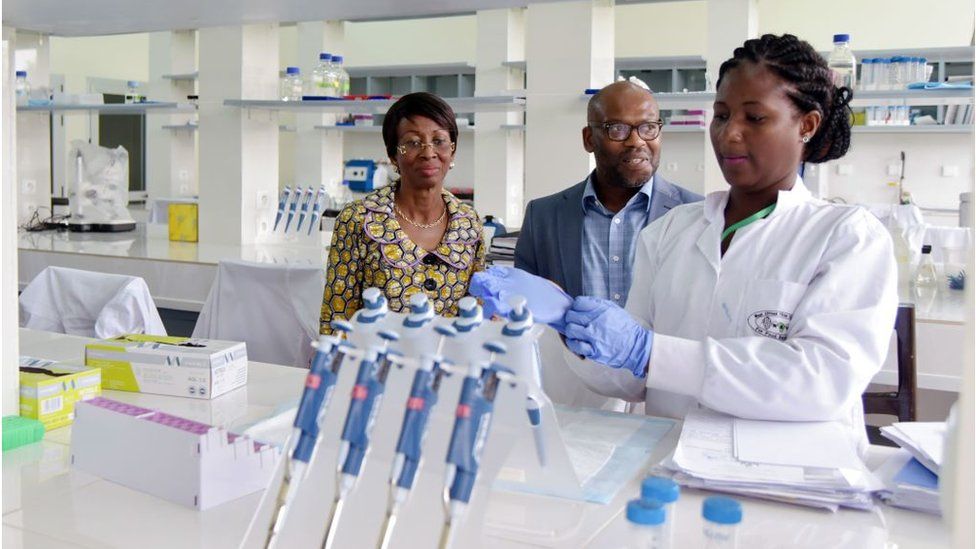
A scientist at work in Cote D’Ivoire
“Women tend to have a much higher dropout rate than men as they progress through academia,” said Ayesha Tandon.
“But then women also have to contend with stereotypes and sexism, and even just cultural norms in their country or from the upbringing that might prevent them from spending as much time on their science or from pursuing it in the way that men do.”
The analysis suggests that the lack of voices from women and from the global south is hampering the global understanding of climate change.
Solving the problem is not going to be easy, according to the author.
“This is a systemic problem and it will progress and keep getting worse, because people in positions of power will continue to have those privileges,” said Ayesha Tandon.
“It’s a problem that will not just go away on its own unless people really work at it.”
Após ser aprovado na Câmara dos Deputados, no último dia 29 de setembro, o projeto de lei que regulamenta o uso da inteligêcia artificial (IA) no Brasil (PL 21/20) passará agora pela análise do Senado. Enquanto isso não acontece, o PL que estabelece o Marco Civil da IA, ainda é alvo de discussões.
A proposta, de autoria do deputado federal Eduardo Bismarck (PDT-CE), foi aprovado na Câmara na forma de um substitutivo apresentado pela deputada federal Luisa Canziani (PTB-PR). O texto define como sistemas de inteligência artificial as representações tecnológicas oriundas do campo da informática e da ciência da computação. Caberá privativamente à União legislar e editar normas sobre a matéria.
Em entrevista ao Portal Rota Jurídica, o neurocientista Álvaro Machado Dias salientou, por exemplo, que as intenções contidas no referido do PL apontam um caminho positivo. Contudo, as definições genéricas dão a sensação de que, enquanto o projeto tramita no Senado, vai ser importante aprofundar o contato com a área.
O neurocientista, que é professor livre-docente da UNIFESP, sócio da WeMind Escritório de Inovação, do Instituto Locomotiva de Pesquisas e do Rhizom Blockchain, salienta por outro lado que, em termos sociais, o Marco Civil da Inteligência Artificial promete aumentar a consciência sobre os riscos trazidos pelos algoritmos enviesados, bem como estimular a autorregulação.
Isso, segundo diz, deve aumentar a “justiça líquida” destes dispositivos que tanto influenciam a vida em sociedade. Ressalta que, em termos econômicos, a interoperabilidade (o equivalente a todas as tomadas teremos o mesmo número de pinos) vai fortalecer um pouco o mercado.
“Porém, verdade seja dita, estes impactos não serão tão grandes, já que o PL não fala em colocar a IA como tema estratégico para o País, nem aponta para maior apoio ao progresso científico na área”, acrescenta.
Riscos
Para o neurocientista, os riscos são os de sempre: engessamento da inovação; endereçamento das responsabilidades aos alvos errados; externalidades abertas por estratégias que questionarão as bases epistemológicas do conceito com certa razão (o famoso: dada a definição X, isto aqui não é inteligência artificial).
Porém, o especialista diz que é importante ter em mente que é absolutamente fundamental regular esta indústria, cujo ponto mais alto é a singularidade. “Isto é, a criação de dispositivos capazes de fazer tudo aquilo que fazemos, do ponto de vista interativo e produtivo, só que com mais velocidade e precisão. Trata-se de um debate muito complexo. E, como sempre, na prática, a teoria é outra”, completou.
Objetivos
Álvaro Machado Dias explica que o objetivo principal do PL é definir obrigações para a União, estados e municípios, especialmente regras de governança, responsabilidades civis e parâmetros de impacto social, relacionadas à aplicação e comercialização de plataformas de inteligência artificial. Existe também uma parte mais técnica, que foca a interoperabilidade, isto é, a capacidade dos sistemas trocarem informações.
Observa, ainda, que a principal premissa do projeto é a de que estas tecnologias devem ter sua implementação determinada por princípios como a ausência da intenção de fazer o mal, a qual seria escorada na transparência e responsabilização dos chamados agentes da inteligência artificial.
Frances Haugen’s testimony at the Senate hearing today raised serious questions about how Facebook’s algorithms work—and echoes many findings from our previous investigation.
October 5, 2021
Karen Hao
Facebook whistleblower Frances Haugen testifies during a Senate Committee October 5. Drew Angerer/Getty Images
On Sunday night, the primary source for the Wall Street Journal’s Facebook Files, an investigative series based on internal Facebook documents, revealed her identity in an episode of 60 Minutes.
Frances Haugen, a former product manager at the company, says she came forward after she saw Facebook’s leadership repeatedly prioritize profit over safety.
Before quitting in May of this year, she combed through Facebook Workplace, the company’s internal employee social media network, and gathered a wide swath of internal reports and research in an attempt to conclusively demonstrate that Facebook had willfully chosen not to fix the problems on its platform.
Today she testified in front of the Senate on the impact of Facebook on society. She reiterated many of the findings from the internal research and implored Congress to act.
“I’m here today because I believe Facebook’s products harm children, stoke division, and weaken our democracy,” she said in her opening statement to lawmakers. “These problems are solvable. A safer, free-speech respecting, more enjoyable social media is possible. But there is one thing that I hope everyone takes away from these disclosures, it is that Facebook can change, but is clearly not going to do so on its own.”
During her testimony, Haugen particularly blamed Facebook’s algorithm and platform design decisions for many of its issues. This is a notable shift from the existing focus of policymakers on Facebook’s content policy and censorship—what does and doesn’t belong on Facebook. Many experts believe that this narrow view leads to a whack-a-mole strategy that misses the bigger picture.
“I’m a strong advocate for non-content-based solutions, because those solutions will protect the most vulnerable people in the world,” Haugen said, pointing to Facebook’s uneven ability to enforce its content policy in languages other than English.
Haugen’s testimony echoes many of the findings from an MIT Technology Review investigation published earlier this year, which drew upon dozens of interviews with Facebook executives, current and former employees, industry peers, and external experts. We pulled together the most relevant parts of our investigation and other reporting to give more context to Haugen’s testimony.
How does Facebook’s algorithm work?
Colloquially, we use the term “Facebook’s algorithm” as though there’s only one. In fact, Facebook decides how to target ads and rank content based on hundreds, perhaps thousands, of algorithms. Some of those algorithms tease out a user’s preferences and boost that kind of content up the user’s news feed. Others are for detecting specific types of bad content, like nudity, spam, or clickbait headlines, and deleting or pushing them down the feed.
All of these algorithms are known as machine-learning algorithms. As I wrote earlier this year:
Unlike traditional algorithms, which are hard-coded by engineers, machine-learning algorithms “train” on input data to learn the correlations within it. The trained algorithm, known as a machine-learning model, can then automate future decisions. An algorithm trained on ad click data, for example, might learn that women click on ads for yoga leggings more often than men. The resultant model will then serve more of those ads to women.
And because of Facebook’s enormous amounts of user data, it can
develop models that learned to infer the existence not only of broad categories like “women” and “men,” but of very fine-grained categories like “women between 25 and 34 who liked Facebook pages related to yoga,” and [target] ads to them. The finer-grained the targeting, the better the chance of a click, which would give advertisers more bang for their buck.
The same principles apply for ranking content in news feed:
Just as algorithms [can] be trained to predict who would click what ad, they [can] also be trained to predict who would like or share what post, and then give those posts more prominence. If the model determined that a person really liked dogs, for instance, friends’ posts about dogs would appear higher up on that user’s news feed.
Before Facebook began using machine-learning algorithms, teams used design tactics to increase engagement. They’d experiment with things like the color of a button or the frequency of notifications to keep users coming back to the platform. But machine-learning algorithms create a much more powerful feedback loop. Not only can they personalize what each user sees, they will also continue to evolve with a user’s shifting preferences, perpetually showing each person what will keep them most engaged.
Who runs Facebook’s algorithm?
Within Facebook, there’s no one team in charge of this content-ranking system in its entirety. Engineers develop and add their own machine-learning models into the mix, based on their team’s objectives. For example, teams focused on removing or demoting bad content, known as the integrity teams, will only train models for detecting different types of bad content.
This was a decision Facebook made early on as part of its “move fast and break things” culture. It developed an internal tool known as FBLearner Flow that made it easy for engineers without machine learning experience to develop whatever models they needed at their disposal. By one data point, it was already in use by more than a quarter of Facebook’s engineering team in 2016.
Many of the current and former Facebook employees I’ve spoken to say that this is part of why Facebook can’t seem to get a handle on what it serves up to users in the news feed. Different teams can have competing objectives, and the system has grown so complex and unwieldy that no one can keep track anymore of all of its different components.
As a result, the company’s main process for quality control is through experimentation and measurement. As I wrote:
Teams train up a new machine-learning model on FBLearner, whether to change the ranking order of posts or to better catch content that violates Facebook’s community standards (its rules on what is and isn’t allowed on the platform). Then they test the new model on a small subset of Facebook’s users to measure how it changes engagement metrics, such as the number of likes, comments, and shares, says Krishna Gade, who served as the engineering manager for news feed from 2016 to 2018.
If a model reduces engagement too much, it’s discarded. Otherwise, it’s deployed and continually monitored. On Twitter, Gade explained that his engineers would get notifications every few days when metrics such as likes or comments were down. Then they’d decipher what had caused the problem and whether any models needed retraining.
How has Facebook’s content ranking led to the spread of misinformation and hate speech?
During her testimony, Haugen repeatedly came back to the idea that Facebook’s algorithm incites misinformation, hate speech, and even ethnic violence.
“Facebook … knows—they have admitted in public—that engagement-based ranking is dangerous without integrity and security systems but then not rolled out those integrity and security systems in most of the languages in the world,” she told the Senate today. “It is pulling families apart. And in places like Ethiopia it is literally fanning ethnic violence.”
Here’s what I’ve written about this previously:
The machine-learning models that maximize engagement also favor controversy, misinformation, and extremism: put simply, people just like outrageous stuff.
Sometimes this inflames existing political tensions. The most devastating example to date is the case of Myanmar, where viral fake news and hate speech about the Rohingya Muslim minority escalated the country’s religious conflict into a full-blown genocide. Facebook admitted in 2018, after years of downplaying its role, that it had not done enough “to help prevent our platform from being used to foment division and incite offline violence.”
As Haugen mentioned, Facebook has also known this for a while. Previous reporting has found that it’s been studying the phenomenon since at least 2016.
In an internal presentation from that year, reviewed by the Wall Street Journal, a company researcher, Monica Lee, found that Facebook was not only hosting a large number of extremist groups but also promoting them to its users: “64% of all extremist group joins are due to our recommendation tools,” the presentation said, predominantly thanks to the models behind the “Groups You Should Join” and “Discover” features.
In 2017, Chris Cox, Facebook’s longtime chief product officer, formed a new task force to understand whether maximizing user engagement on Facebook was contributing to political polarization. It found that there was indeed a correlation, and that reducing polarization would mean taking a hit on engagement. In a mid-2018 document reviewed by the Journal, the task force proposed several potential fixes, such as tweaking the recommendation algorithms to suggest a more diverse range of groups for people to join. But it acknowledged that some of the ideas were “antigrowth.” Most of the proposals didn’t move forward, and the task force disbanded.
In my own conversations, Facebook employees also corroborated these findings.
A former Facebook AI researcher who joined in 2018 says he and his team conducted “study after study” confirming the same basic idea: models that maximize engagement increase polarization. They could easily track how strongly users agreed or disagreed on different issues, what content they liked to engage with, and how their stances changed as a result. Regardless of the issue, the models learned to feed users increasingly extreme viewpoints. “Over time they measurably become more polarized,” he says.
In her testimony, Haugen also repeatedly emphasized how these phenomena are far worse in regions that don’t speak English because of Facebook’s uneven coverage of different languages.
“In the case of Ethiopia there are 100 million people and six languages. Facebook only supports two of those languages for integrity systems,” she said. “This strategy of focusing on language-specific, content-specific systems for AI to save us is doomed to fail.”
She continued: “So investing in non-content-based ways to slow the platform down not only protects our freedom of speech, it protects people’s lives.”
I explore this more in a different article from earlier this year on the limitations of large language models, or LLMs:
Despite LLMs having these linguistic deficiencies, Facebook relies heavily on them to automate its content moderation globally. When the war in Tigray[, Ethiopia] first broke out in November, [AI ethics researcher Timnit] Gebru saw the platform flounder to get a handle on the flurry of misinformation. This is emblematic of a persistent pattern that researchers have observed in content moderation. Communities that speak languages not prioritized by Silicon Valley suffer the most hostile digital environments.
Gebru noted that this isn’t where the harm ends, either. When fake news, hate speech, and even death threats aren’t moderated out, they are then scraped as training data to build the next generation of LLMs. And those models, parroting back what they’re trained on, end up regurgitating these toxic linguistic patterns on the internet.
How does Facebook’s content ranking relate to teen mental health?
One of the more shocking revelations from the Journal’s Facebook Files was Instagram’s internal research, which found that its platform is worsening mental health among teenage girls. “Thirty-two percent of teen girls said that when they felt bad about their bodies, Instagram made them feel worse,” researchers wrote in a slide presentation from March 2020.
Haugen connects this phenomenon to engagement-based ranking systems as well, which she told the Senate today “is causing teenagers to be exposed to more anorexia content.”
“If Instagram is such a positive force, have we seen a golden age of teenage mental health in the last 10 years? No, we have seen escalating rates of suicide and depression amongst teenagers,” she continued. “There’s a broad swath of research that supports the idea that the usage of social media amplifies the risk of these mental health harms.”
In my own reporting, I heard from a former AI researcher who also saw this effect extend to Facebook.
The researcher’s team…found that users with a tendency to post or engage with melancholy content—a possible sign of depression—could easily spiral into consuming increasingly negative material that risked further worsening their mental health.
But as with Haugen, the researcher found that leadership wasn’t interested in making fundamental algorithmic changes.
The team proposed tweaking the content-ranking models for these users to stop maximizing engagement alone, so they would be shown less of the depressing stuff. “The question for leadership was: Should we be optimizing for engagement if you find that somebody is in a vulnerable state of mind?” he remembers.
But anything that reduced engagement, even for reasons such as not exacerbating someone’s depression, led to a lot of hemming and hawing among leadership. With their performance reviews and salaries tied to the successful completion of projects, employees quickly learned to drop those that received pushback and continue working on those dictated from the top down….
That former employee, meanwhile, no longer lets his daughter use Facebook.
How do we fix this?
Haugen is against breaking up Facebook or repealing Section 230 of the US Communications Decency Act, which protects tech platforms from taking responsibility for the content it distributes.
Instead, she recommends carving out a more targeted exemption in Section 230 for algorithmic ranking, which she argues would “get rid of the engagement-based ranking.” She also advocates for a return to Facebook’s chronological news feed.
Ellery Roberts Biddle, a projects director at Ranking Digital Rights, a nonprofit that studies social media ranking systems and their impact on human rights, says a Section 230 carve-out would need to be vetted carefully: “I think it would have a narrow implication. I don’t think it would quite achieve what we might hope for.”
In order for such a carve-out to be actionable, she says, policymakers and the public would need to have a much greater level of transparency into how Facebook’s ad-targeting and content-ranking systems even work. “I understand Haugen’s intention—it makes sense,” she says. “But it’s tough. We haven’t actually answered the question of transparency around algorithms yet. There’s a lot more to do.”
Nonetheless, Haugen’s revelations and testimony have brought renewed attention to what many experts and Facebook employees have been saying for years: that unless Facebook changes the fundamental design of its algorithms, it will not make a meaningful dent in the platform’s issues.
Her intervention also raises the prospect that if Facebook cannot put its own house in order, policymakers may force the issue.
“Congress can change the rules that Facebook plays by and stop the many harms it is now causing,” Haugen told the Senate. “I came forward at great personal risk because I believe we still have time to act, but we must act now.”
Unidade da Universidade Federal de São Paulo. (Foto: Divulgação)
Universitária buscou atendimento psiquiátrico na Unifesp, instituição de ensino que oferece o serviço médico gratuitamente aos alunos
Thayná Alexandrino conta que há tempos percebe alguns sintomas associados à depressão e ansiedade
Segundo a jovem de 24 anos, a médica que a atendeu a julgou pela aparência física; universidade não se pronunciou
Texto: Letícia Fialho Edição: Nadine Nascimento
A estudante de geografia da Universidade Federal de São Paulo (Unifesp), Thayná Alexandrino (24), buscou ajuda psiquiátrica na unidade de atendimento gratuito oferecida pela instituição aos alunos, há cerca de um mês. A jovem relata ter sido julgada pela sua aparência física no atendimento, quando ouviu da profissional que a atendeu: “você não tem cara de paciente psiquiátrica. Mulheres como você precisam ser fortes”.
“Ingressei na universidade e tive a oportunidade de cuidar da minha saúde através dos serviços gratuitos oferecidos por eles. Contudo, ao chegar lá, me deparei com algo totalmente diferente do que esperava. Fui mal tratada pela psiquiatra, que me julgou do começo ao fim”, relata Thayná.
A estudante conta que há tempos percebe alguns sintomas associados à depressão e ansiedade e que, por conta dos estigmas relacionados a doenças mentais, demorou a procurar ajuda. Durante a pandemia, ela perdeu pessoas próximas e se sentiu fragilizada para lidar com o luto.
“Mesmo contando para ela sobre o luto pelo qual estou passando, sobre meu histórico familiar e pré-disposições, escutei a pior justificativa ‘você está muito bem vestida para ter algum problema de ordem mental’ e também que ‘não pode se dar ao luxo de ser fraca’”, relata a vítima que desistiu do atendimento quando a profissional disse: “Mulheres como você sabem lidar muito bem com a dor”.
A estudante conta que sentiu-se impotente e negligenciada no atendimento prestado pela unidade de atendimento da universidade. Segundo ela, a profissional que a atendeu era uma mulher branca, na faixa etária dos 40 anos, com bagagem profissional e acadêmica.
“Parece que a única alternativa sugerida por profissionais brancos é que nós, mulheres negras, precisamos ser fortes o tempo todo. Pessoalmente, na visão dela, eu não poderia sofrer. Lembro que na minha infância uma professora disse que a vida seria dura pra quem fosse fraco. E agora ouvi quase a mesma coisa, vindo de uma profissional de saúde mental”, reflete Thayná.
Insegurança da aluna
Em busca de atendimento adequado, a estudante recorreu a um psicólogo, seguindo orientação médica, em outra unidade de atendimento. E novamente teve uma abordagem pouco acolhedora.
“Quando relatei sobre o episódio em que fui vítima de racismo. Fui surpreendida com a colocação de mais um profissional branco. Ele disse que eu não era negra e, sim, ‘mulata’, em vista de outros pacientes negros que ele atende. Até quando um cara branco pode julgar a negritude de outras pessoas?”, conta.
A estudante diz que, até o momento, não recorreu a nenhum outro profissional por conta dos valores altos e por sentir-se insegura. “Eu adoro a área da saúde e ser atendida por profissionais que não tiveram a sensibilidade de olhar para a minha dor, me toca bastante. Outra coisa é a falta de representatividade. O fato de não ter pessoas negras inseridas nesses espaços, perpetua o racismo estrutural”, reitera a Thayná.
A Alma Preta Jornalismo entrou em contato com a Unifesp para solicitar um posicionamento sobre o caso, mas até o momento não teve retorno. Caso a instituição se posicione, o texto será atualizado.
Americano Joshua Walker defende que decisões judiciais nunca sejam automatizadas
Identificar as melhores práticas e quais fatores influenciaram decisões judiciais são alguns dos exemplos de como o uso da inteligência artificial pode beneficiar o sistema de Justiça e, consequentemente, a população, afirma o advogado americano Joshua Walker.
Um dos fundadores do CodeX, centro de informática legal da Universidade de Stanford (EUA) —onde também lecionou— e fundador da Lex Machina, empresa pioneira no segmento jurídico tecnológico, Walker iniciou a carreira no mundo dos dados há mais de 20 anos, trabalhando com processos do genocídio de 1994 em Ruanda, que matou ao menos 800 mil pessoas em cem dias.
Autor do livro “On Legal AI: Um Rápido Tratado sobre a Inteligência Artificial no Direito” (Revista dos Tribunais, 2021), no qual fala sobre como softwares de análise podem ser usados na busca de soluções no direito, Walker palestrou sobre o tema na edição da Fenalaw —evento sobre uso da tecnologia por advogados.
Em entrevista à Folha por email, ele defende que os advogados não só aprendam a usar recursos de inteligência artificial, como também assumam o protagonismo nos processos de desenvolvimento de tecnologias voltadas ao direito.
“Nós [advogados] precisamos começar a nos tornar cocriadores porque, enquanto os engenheiros de software se lembram dos dados, nós nos lembramos da estória e das histórias”, afirma.
Ao longo de sua carreira, quais tabus foram superados e quais continuam quando o assunto é inteligência artificial? Como confrontar essas ideias? Tabus existem em abundância. Há mais e novos todos os dias. Você tem que se perguntar duas coisas: o que meus clientes precisam? E como posso ser —um ou o— melhor no que faço para ajudar meus clientes? Isso é tudo que você precisa se preocupar para “inovar”.
A tradição jurídica exige que nos adaptemos, e nos adaptemos rapidamente, porque temos: a) o dever de lealdade de ajudar nossos clientes com os melhores meios disponíveis; b) o dever de melhorar a prática e a administração da lei e do próprio sistema.
A inteligência artificial legal e outras técnicas básicas de outros campos podem impulsionar de forma massiva ambas as áreas. Para isso, o dever de competência profissional nos exige conhecimentos operacionais e sobre as plataformas, que são muito úteis para serem ignorados. Isso não significa que você deve adotar tudo. Seja cético.
Estamos aprendendo a classificar desafios humanos complexos em estruturas processuais que otimizam os resultados para todos os cidadãos, de qualquer origem. Estamos aprendendo qual impacto as diferentes regras locais se correlacionam com diferentes classes de resultados de casos. Estamos apenas começando.
FolhaJus
Seleção das principais notícias da semana sobre o cenário jurídico e conteúdos exclusivos com entrevistas e infográficos.
O sr. começou a trabalhar com análise de dados por causa do genocídio de Ruanda. O que aquela experiência lhe ensinou sobre as possibilidades e limites do trabalho com bancos de dados? O que me ensinou é que a arquitetura da informação é mais importante do que o número de doutores, consultores ou milhões de dólares do orçamento de TI (tecnologia da informação) que você tem à sua disposição.
Você tem que combinar a infraestrutura de TI, o design de dados, com o objetivo da equipe e da empresa. A empresa humana, seu cliente (e para nós eram os mortos) está em primeiro lugar. Todo o resto é uma variável dependente.
Talento, orçamento etc. são muito importantes. Mas você não precisa necessariamente de dinheiro para obter resultados sérios.
Como avalia o termo inteligência artificial? Como superar a estranheza que ele gera? É basicamente um meme de marketing que foi usado para inspirar financiadores a investir em projetos de ciência da computação, começando há muitas décadas. Uma boa descrição comercial de inteligência artificial —mais prática e menos jargão— é: software que faz análise. Tecnicamente falando, inteligência artificial é: dados mais matemática.
Se seus dados são terríveis, a IA resultante também o será. Se são tendenciosos, ou contêm comunicação abusiva, o resultado também será assim.
Esse é um dos motivos de tantas empresas de tecnologia jurídica e operações jurídicas dominadas pela engenharia fracassarem de forma tão espetacular. Você precisa de advogados altamente qualificados, técnicos, matemáticos e advogados céticos para desenvolver a melhor tecnologia/matemática.
Definir IA de forma mais simples também implica, precisamente, que cada inteligência artificial é única, como uma criança. Ela sempre está se desenvolvendo, mudando etc. Esta é a maneira de pensar sobre isso. E, como acontece com as crianças, você pode ensinar, mas nenhum pai pode controlar operacionalmente um filho, além de um certo limite.
Como o uso de dados pode ampliar o acesso à Justiça e torná-lo mais ágil? Nunca entendi muito bem o que significa o termo “acesso à Justiça”. Talvez seja porque a maioria das pessoas, de todas as origens socioeconômicas e étnicas, compartilha a experiência comum de não ter esse acesso.
Posso fazer analogias com outras áreas, porém. Um pedaço de software tem um custo marginal de aproximadamente zero. Cada vez que um de nós usa uma ferramenta de busca, ela não nos custa o investimento que foi necessário para fazer esse software e sofisticá-lo. Há grandes custos fixos, mas baixo custo por usuário.
Essa é a razão pela qual o software é um ótimo negócio. Se bem governado, podemos torná-lo um modus operandi ainda melhor para um país moderno. Isso supondo que possamos evitar todos os pesadelos que podem acontecer!
Podemos criar software de inteligência artificial legal que ajuda todas as pessoas em um país inteiro. Esse software pode ser perfeitamente personalizado e tornar-se fiel a cada indivíduo. Pode custar quase zero por cada operação incremental.
Eu criei um pacote de metodologias chamado Citizen’s AI Lab (laboratório de IA dos cidadãos) que será levado a muitos países ao redor do mundo, incluindo o Brasil, se as pessoas quiserem colocá-lo para funcionar. Vai fazer exatamente isso. Novamente, esses sistemas não apenas podem ser usados para cada operação (uso) de cada indivíduo, mas também para cada país.
FolhaJus Dia
Seleção diária das principais notícias sobre o cenário jurídico em diferentes áreas
Em quais situações não é recomendado que a Justiça use IA? Nunca para a própria tomada de decisão. Neste momento, em qualquer caso, e/ou em minha opinião, não é possível e nem desejável automatizar a tomada de decisões judiciais.
Por outro lado, juízes podem sempre se beneficiar com a inteligência artificial. Quais são as melhores práticas? Quantos casos um determinado juiz tem em sua pauta? Ou em todo o tribunal? Como isso se compara a outros tribunais e como os resultados poderiam ser diferentes por causa dos casos ou do cenário econômico, político ou outros fatores?
Há protocolos que ajudam as partes a obter uma resolução antecipada de disputas? Esses resultados são justos?, uma questão humana possibilitada por uma base ou plataforma empírica auxiliada por IA. Ou os resultados são apenas impulsionados pelo acesso relativo aos fundos de litígio pelos litigantes?
Como estruturamos as coisas para que tenhamos menos disputas estúpidas nos tribunais? Quais advogados apresentam os comportamentos de arquivamento mais malignos e abusivos em todos os tribunais? Como a lei deve ser regulamentada?
Essas são perguntas que não podemos nem começar a fazer sem IA —leia-se: matemática— para nos ajudar a analisar grandes quantidades de dados.
Quais são os limites éticos para o uso de bancos de dados? Como evitar abusos? Uma boa revisão legal é essencial para todo projeto de inteligência artificial e dados que tenha um impacto material na humanidade. Mas para fazer isso em escala, nós, os advogados, também precisamos de mecanismos legais de revisão de IA.
Apoio muito o trabalho atual da inteligência artificial ética. Infelizmente, nos Estados Unidos, e talvez em outros lugares, a “IA ética” é uma espécie de “falsa questão” para impedir os advogados de se intrometerem em projetos de engenharia lucrativos e divertidos. Isso tem sido um desastre político, operacional e comercial em muitos casos.
Nós [advogados] precisamos começar a nos tornar cocriadores porque, enquanto os engenheiros de software se lembram dos dados, nós nos lembramos da estória e das histórias. Nós somos os leitores. Nossas IAs estão imbuídas de um tipo diferente de sentido, evoluíram de um tipo diferente de educação. Cientistas da computação e advogados/estudiosos do direito estão intimamente alinhados, mas nosso trabalho precisa ser o de guardiões da memória social.
Pesquisa Datafolha com advogados brasileiros mostrou que apenas 29% dos 303 entrevistados usavam recursos de IA no dia a dia. Como é nos EUA? O que é necessário para avançar mais? O que observei no “microclima” da tecnologia legal de São Paulo foi que o “tabu” contra o uso de tecnologia legal foi praticamente eliminado. Claro, isso é um microclima e pode não ser representativo ou ser contrarrepresentativo. Mas as pessoas podem estar usando IA todos os dias na prática, sem estar cientes disso. Os motores de busca são um exemplo muito simples. Temos que saber o que é algo antes de saber o quanto realmente o usamos.
Nos EUA: suspeito que o uso ainda esteja no primeiro “trimestre” do jogo em aplicações de IA para a lei. Litígio e contrato são casos de uso razoavelmente estabelecidos. Na verdade, eu não acho que você pode ser um advogado de propriedade intelectual de nível nacional sem o impulsionamento de alguma forma de dados empíricos.
Ainda são raros cursos de análise de dados para estudantes de direito no Brasil. Diante dessa lacuna, o que os profissionais devem fazer para se adaptar a essa nova realidade? Qual é o risco para quem não fizer nada? Eu começaria ensinando processo cívil com dados. Essa é a regra, é assim que as pessoas aplicam a regra (o que arquivam), e o que acontece quando o fazem (consequências). Isso seria revolucionário. Alunos, professores e doutores podem desenvolver todos os tipos de estudos e utilidades sociais.
Existem inúmeros outros exemplos. Os acadêmicos precisam conduzir isso em parceria com juízes, reguladores, a imprensa e a Ordem dos Advogados.
Na verdade, meu melhor conselho para os novos alunos é: assuma que todos os dados são falsos até prova em contrário. E quanto mais sofisticada a forma, mais volumosa a definição, mais para se aprofundar.
RAIO X
Joshua Walker
Autor do livro “On Legal AI – Um Rápido Tratado sobre a Inteligência Artificial no Direito” (Revista dos Tribunais, 2021) e diretor da empresa Aon IPS. Graduado em Havard e doutor pela Faculdade de Direito da Universidade de Chicago, foi cofundador do CodeX, centro de informática legal da Universidade de Stanford, e fundador da Lex Machina, empresa pioneira do segmento jurídico tecnológico. Também lecionou nas universidades de Stanford e Berkeley
Pesquisadores Syukuro Manabe, Klaus Hasselmann e Giorgio Parisi vão dividir prêmio de 10 milhões de coroas suecas
O prêmio Nobel em Física deste ano foi dedicado ao estudo de sistemas complexos, dentre eles os que permitem a compreensão das mudanças climáticas que afetam nosso planeta. A escolha coloca um carimbo definitivo de consenso sobre a ciência do clima.
Os pesquisadores Syukuro Manabe, dos Estados Unidos, e Klaus Hasselmann, da Alemanha, foram premiados especificamente por modelarem o clima terrestre e fazerem predições sobre o aquecimento global. A outra metade do prêmio foi para Giorgio Parisi, da Itália, que revelou padrões ocultos em materiais complexos desordenados, das escalas atômica à planetária, em uma contribuição essencial à teoria de sistemas complexos, com relevância também para o estudo do clima.
“Muitas pessoas pensam que a física lida com fenômenos simples, como a órbita perfeitamente elíptica da Terra ao redor do Sol ou átomos em estruturas cristalinas”, disse Thors Hans Hansson, membro do comitê de escolha do Nobel, na coletiva que apresentou a escolha.
”Mas a física é muito mais que isso. Uma das tarefas básicas da física é usar teorias básicas da matéria para explicar fenômenos e processos complexos, como o comportamento de materiais e qual é o desenvolvimento no clima da Terra. Isso exige intuição profunda por quais estruturas e quais progressões são essenciais, e também engenhosidade matemática para desenvolver os modelos e as teorias que as descrevem, coisas em que os laureados deste ano são poderosos.”
“Eu acho que é urgente que tomemos decisões muito fortes e nos movamos em um passo forte, porque estamos numa situação em que podemos ter uma retroalimentação positiva e isso pode acelerar o aumento de temperatura”, disse Giorgio Parisi, um dos vencedores, na coletiva de apresentação do evento. “É claro que para as gerações futuras nós temos de agir agora de uma forma muito rápida.”
COMO É ESCOLHIDO O GANHADOR DO NOBEL
A tradicional premiação do Nobel teve início com a morte do químico sueco Alfred Nobel (1833-1896), inventor da dinamite. Em 1895, em seu último testamento, Nobel registrou que sua fortuna deveria ser destinada para a construção de um prêmio —o que foi recebido por sua família com contestação. O primeiro prêmio só foi dado em 1901.
O processo de escolha do vencedor do prêmio da área de física começa no ano anterior à premiação. Em setembro, o Comitê do Nobel de Física envia convites (cerca de 3.000) para a indicação de nomes que merecem a homenagem. As respostas são enviadas até o dia 31 de janeiro.
Podem indicar nomes os membros da Academia Real Sueca de Ciências; membros do Comitê do Nobel de Física; ganhadores do Nobel de Física; professores física em universidades e institutos de tecnologia da Suécia, Dinamarca, Finlândia, Islândia e Noruega, e do Instituto Karolinska, em Estocolmo; professores em cargos semelhantes em pelo menos outras seis (mas normalmente em centenas de) universidades escolhidas pela Academia de Ciências, com o objetivo de assegurar a distribuição adequada pelos continentes e áreas de conhecimento; e outros cientistas que a Academia entenda adequados para receber os convites.
Autoindicações não são aceitas.
Começa então um processo de análise das centenas de nomes apontados, com consulta a especialistas e o desenvolvimento de relatórios, a fim de afunilar a seleção. Finalmente, em outubro, a Academia, por votação majoritária, decide quem receberá o reconhecimento.
Peebles ajudou a entender como o Universo evoluiu após o Big Bang, e Mayor e Queloz descobriram um exoplaneta (planeta fora do Sistema Solar) que orbitava uma estrela do tipo solar.
Pesquisas com laser foram premiadas em 2018, com láureas para Arthur Ashkin, Donna Strickland e Gérard Mourou.
Indo um pouco mais longe, o prêmio já esteve nas mãos de Max Planck (1918), por ter lançado as bases da física quântica e de Albert Einstein (1921), pela descoberta do efeito fotoelétrico. Niels Bohr (1922), por suas contribuições para o entendimento da estrutura atômica, e Paul Dirac e Erwin Schrödinger (1933), pelo desenvolvimento de novas versões da teoria quântica, também foram premiados.
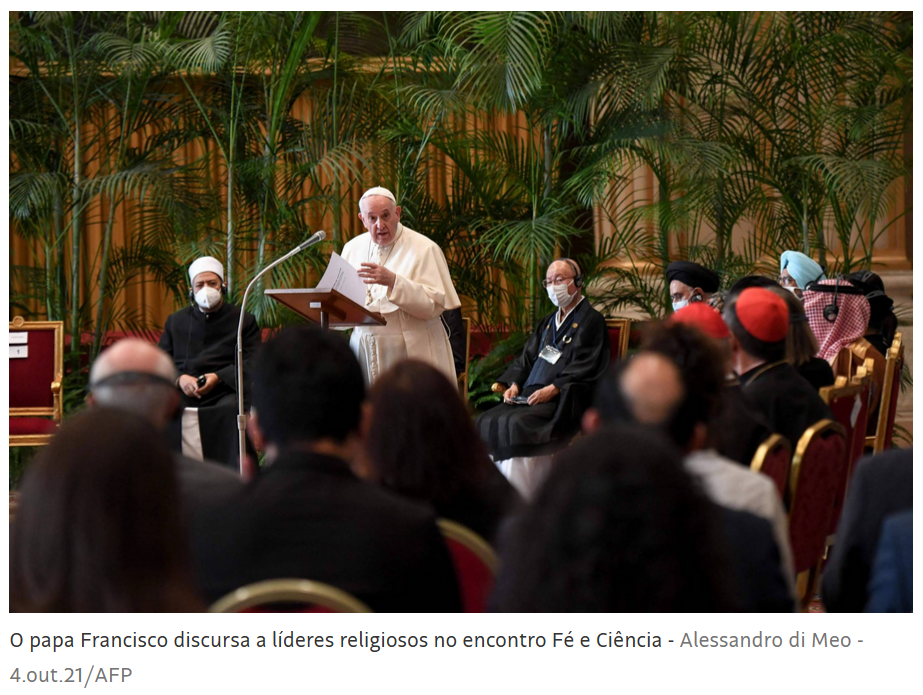
“A COP 26 está sendo convocada a oferecer, urgentemente, respostas eficazes para a crise ecológica sem precedentes e para a crise de valores em que vivemos”, disse o pontífice. “Isso permitirá dar uma esperança concreta às futuras gerações. Vamos acompanhar com nosso compromisso e nossa proximidade espiritual.
O argentino transmitiu a mensagem em encontro no Vaticano batizado de “Fé e Ciência: Rumo à COP 26”. Estavam presentes líderes cristãos, como Justin Welby, arcebispo de Canterbury e líder espiritual dos anglicanos, e o patriarca ortodoxo Bartolomeu; mas também representantes muçulmanos, judeus, hindus, sikhs, budistas e taoistas, entre outros.
A reunião terminou com a assinatura de um apelo aos participantes da 26ª Conferência das Nações Unidas sobre Mudança Climática (COP 26), que acontecerá em Glasgow, na Escócia, de 31 de outubro a 12 de novembro. O texto foi entregue ao chanceler italiano, Luigi Di Maio, e ao presidente da COP, Alok Sharma.
A menos de um mês do evento sobre o clima, o documento é mais um movimento de pressão para que os líderes mundiais ajam de forma rápida e contundente ante um aquecimento global chamado de “catastrófico” pelos religiosos.
Lá fora
Na newsletter de Mundo, semanalmente, as análises sobre os principais fatos do globo, explicados de forma leve e interessante.
Essas “sementes de conflito”, destacou o papa, “causam as graves feridas que provocamos ao meio ambiente, como as mudanças climáticas, a desertificação, a poluição, a perda da biodiversidade”.
Welby, por sua vez, criticou que “nos últimos 100 anos tenhamos declarado guerra à Criação”.
“Nossos abusos, nossa guerra contra o clima, afetam os mais pobres”, disse. Ele defendeu o que chamou de “arquitetura financeira global que se arrependa de seus pecados” para promover mudanças como impostos que estimulem atividades mais sustentáveis e a economia verde.
Outros líderes destacaram a importância de uma ação conjunta entre os países —e Francisco afirmou que diferenças culturais devem ser vistas como uma força, não uma fraqueza, nesse contexto. “Se um país naufragar, todos naufragamos”, disse Rajwant Singh, líder sikh americano.
Há um mês, o papa Francisco, Welby e o chefe da Igreja Ortodoxa, Bartolomeu, lançaram um “apelo urgente”. Nele, pediram “a todo mundo, independentemente de suas crenças, ou visão de mundo, que se esforce para ouvir o grito da Terra”.
Durante a pandemia do novo coronavírus, vimos nascer uma série de inovações ligadas à Inteligência Artificial (IA). Um exemplo foi o projeto “IACOV-BR: Inteligência Artificial para Covid-19 no Brasil”, do Laboratório de Big Data e Análise Preditiva em Saúde da Faculdade de Saúde Pública da Universidade de São Paulo (USP), que desenvolve algoritmos de machine learning (aprendizagem de máquina) para antecipar o diagnóstico e o prognóstico da doença e é conduzido com hospitais parceiros em diversas regiões do Brasil para auxiliar médicos e gestores.
Já uma pesquisa da Universidade Federal de São Paulo (Unifesp), em parceria com a Rede D’Or e o Instituto Tecnológico de Aeronáutica (ITA), apontou, em fase piloto, ser possível identificar de forma rápida a gravidade dos casos de infecção por SARS-CoV-2 atendidos em pronto socorro lançando mão da IA para realizar a análise de diversos marcadores clínicos e de exames de sangue dos pacientes.
Esses são apenas dois – e nacionais – de uma infinidade de cases que mostram como o desenvolvimento e aprimoramento da IA pode ser benéfico para a sociedade. Temos que ressaltar, contudo, que a tecnologia é a famosa faca de dois gumes. De um lado, faz a humanidade avançar, otimiza processos, promove disrupções. De outro, cria divergências, paradoxos e traz problemas e dilemas que antes pareciam inimagináveis.
Em 2020, por exemplo, o departamento de polícia de Detroit, no Centro-Oeste dos Estados Unidos, foi processado por prender um homem negro identificado erroneamente por um software de reconhecimento facial como autor de um furto.
Ainda, um estudo publicado na revista Science em outubro de 2019 apontou que um software usado em atendimentos hospitalares nos EUA privilegiava pacientes brancos em detrimento de negros na fila de programas especiais voltados ao tratamento de doenças crônicas, como problemas renais e diabetes. A tecnologia, segundo os pesquisadores, tinha sido desenvolvida pela subsidiária de uma companhia de seguros e era utilizada no atendimento de, aproximadamente, 70 milhões de pacientes.
Mais recentemente, já em 2021, a startup russa Xsolla demitiu cerca de 150 funcionários com base em análise de big data. Dados dos colaboradores foram avaliados em ferramentas como o Jira – software que permite o monitoramento de tarefas e acompanhamento de projetos –, Gmail e o wiki corporativo Confluence, além de conversas e documentos, para classificá-los como “interessados” e “produtivos” no ambiente de trabalho remoto. Os que ficaram aquém do esperado foram desligados. Controverso, no mínimo, vez que houve a substituição de uma avaliação de resultados pelo simples monitoramento dos funcionários.
Novamente, esses são apenas alguns exemplos em um mar de diversos outros envolvendo polêmicas similares, cuja realidade demonstra que os gestores não estão preparados para lidar. O estudo “O estado da IA responsável: 2021”, produzido pela FICO em parceria com a empresa de inteligência de mercado Corinium, apontou que 65% das organizações não conseguem explicar como as decisões ou previsões dos seus modelos de IA são feitas. A pesquisa foi elaborada com base em conversas com 100 líderes de grandes empresas globais, inclusive brasileiros. Ainda, 73% dos entrevistados afirmaram estar enfrentando dificuldades para conseguir suporte executivo voltado a priorizar a ética e as práticas responsáveis de IA.
Softwares e aplicativos de Inteligência Artificial, que envolvem técnicas como big data e machine learning, não são perfeitos porque, justamente, foram programados por seres humanos. Há uma diferença, que pode até parecer sutil à primeira vista, entre ser inteligente e ser sábio, o que as máquinas, ao menos por enquanto, ainda não são. Em um mundo algorítmico, a IA responsável, pautada pela ética, deve ser o modelo de governança. Ao que tudo indica, entretanto, como demonstrou o estudo da FICO, é que tanto executivos como programadores não sabem como se guiar nesse sentido.
É aqui que entra a importância dos marcos regulatórios, que jogam luz sobre um tema, procuram prevenir conflitos e, caso estes ocorram, demonstram como os problemas devem ser solucionados.
Assim como ocorreu em relação à proteção de dados pessoais, a União Europeia busca ser protagonista e se tornar modelo global na regulação da IA. Por lá, o debate ainda é incipiente, mas já envolve pontos como a criação de uma autoridade para promover as normas de IA em cada país da União Europeia (EU). A regulação também mira o IA que potencialmente coloque em risco a segurança e os direitos fundamentais dos cidadãos, além da necessidade de uma maior transparência no uso de automações, como chatbots.
No Brasil, o Marco Legal da Inteligência Artificial (Projeto de Lei 21/2020) já está em tramitação no Congresso Nacional, para o qual o regime de urgência, que dispensa algumas formalidades regimentais, foi aprovado na Câmara dos Deputados. Além de toda a problemática envolvendo a falta de uma discussão aprofundada sobre o tema no Legislativo, o substitutivo do projeto se mostrou uma verdadeira bomba quanto à responsabilidade, trazendo que:
“(…) normas sobre responsabilidade dos agentes que atuam na cadeia de desenvolvimento e operação de sistemas de inteligência artificial devem, salvo disposição em contrário, se pautar na responsabilidade subjetiva, levar em consideração a efetiva participação desses agentes, os danos específicos que se deseja evitar ou remediar, e como esses agentes podem demonstrar adequação às normas aplicáveis por meio de esforços razoáveis compatíveis com padrões internacionais e melhores práticas de mercado”.
Enquanto a responsabilidade objetiva depende apenas de comprovação de nexo causal, a responsabilidade subjetiva pressupõe dolo ou culpa na conduta. Significa que agentes que atuam na cadeia de desenvolvimento e operação de sistemas de IA somente responderão por eventuais danos causados por esses sistemas se for comprovado que eles desejaram o resultado danoso ou que foram negligentes, imprudentes ou imperitos. Ademais, quem são tais agentes? Não há quaisquer definições sobre quem seriam esses operadores.
Na pressa de regular, corre-se o risco de termos, assim como diversas outras leis de nosso país, uma legislação “para inglês ver”, que mais atrapalha do que ajuda; que em vez de fazer justiça, é, na verdade, injusta. Por enquanto, no Brasil, não se tem registros de casos como os trazidos no início do texto, mas, invariavelmente, haverá. É apenas questão de tempo. E quando isso ocorrer, o risco que correremos é o de termos em mãos uma legislação incompatível com os preceitos constitucionais, que não protegem o cidadão, mas o tornam ainda mais vulnerável.
*André Aléxis de Almeida é advogado, especialista em Direito Constitucional, mestre em Direito Empresarial e mentor jurídico de empresas







 Uma (in)certa antropologia
Você precisa fazer login para comentar.