Arquivo mensal: abril 2013

Chimpanzees Use Botanical Skills to Discover Fruit (Science Daily)

Apr. 10, 2013 — Fruit-eating animals are known to use their spatial memory to relocate fruit, yet, it is unclear how they manage to find fruit in the first place. Researchers of the Max Planck Institute for Evolutionary Anthropology in Leipzig, Germany, have now investigated which strategies chimpanzees in the Taï National Park in Côte d’Ivoire, West Africa, use in order to find fruit in the rain forest. The result: Chimpanzees know that trees of certain species produce fruit simultaneously and use this botanical knowledge during their daily search for fruit.

Chimpanzees gazing up tree crowns in their search for fruit. (Credit: Ammie Kalan)

To investigate if chimpanzees know that if a tree is carrying fruit, then other trees of the same species are likely to carry fruit as well, the researchers conducted observations of their inspections, i.e. the visual checking of fruit availability in tree crowns. They focused their analyses on recordings in which they saw chimpanzees inspect empty trees, when they made “mistakes.”

By analysing these “mistakes,” the researchers were able to exclude that sensory cues of fruit had triggered the inspection and were the first to learn that chimpanzees had expectations of finding fruit days before feeding on it. They, in addition, significantly increased their expectations of finding fruit after tasting the first fruit in season. “They did not simply develop a ‘taste’ for specific fruit on which they had fed frequently,” says Karline Janmaat. “Instead, inspection probability was predicted by a particular botanical feature — the level of synchrony in fruit production of the species of encountered trees.”

The researchers conclude that chimpanzees know that trees of certain species produce fruit simultaneously and use this information during their daily search for fruit. They base their expectations of finding fruit on a combination of botanical knowledge founded on the success rates of fruit discovery and an ability to categorize fruits into distinct species. “Our results provide new insights into the variety of food-finding strategies employed by our close relatives, the chimpanzees, and may well elucidate the evolutionary origins of categorization abilities and abstract thinking in humans,” says Christophe Boesch, director of the Max Planck Institute for Evolutionary Anthropology’s Department of Primatology.

Journal Reference:

  1. Karline R. L. Janmaat, Simone D. Ban & Christophe Boesch Ta. Chimpanzees use Botanical Skills to Discover Fruit: What we can Learn from their Mistakes.Animal Cognition, 10 April 2013

Young Children Have Grammar and Chimpanzees Don’t (Science Daily)

Apr. 10, 2013 — A new study from the University of Pennsylvania has shown that children as young as 2 understand basic grammar rules when they first learn to speak and are not simply imitating adults.

Nim Chimpsky. (Credit: Image courtesy of Herbert Terrace, who began Project Nim in the early 1970s)

The study also applied the same statistical analysis on data from one of the most famous animal language-acquisition experiments — Project Nim — and showed that Nim Chimpsky, a chimpanzee who was taught sign language over the course of many years, never grasped rules like those in a 2-year-old’s grammar.

The study was conducted by Charles Yang, a professor of linguistics in the School of Arts and Sciences and of computer science in the School of Engineering and Applied Science. It was published in the Proceedings of the National Academy of Sciences.

Linguists have long debated whether young children actually understand the grammar they are using or are simply memorizing and imitating adults. One of the difficulties in resolving this debate is the inherent limitations of the data; 2-year-old children have very small vocabularies and thus don’t provide many different examples of grammar usage.

“While a child may not say very much, that doesn’t mean that they don’t know anything about language,” Yang said, “Despite the superficial lack of diversity of speech patterns, if you study it carefully and formulate what having a grammar would entail within those limitations, even young children seem very much on target.”

Yang’s approach was to look at one area of grammar that young children do regularly display: article usage, or whether to put “a” or “the” before a noun. He found a sufficient number of examples of article usage in the nine data sets of child speech he analyzed, but there was another challenge in determining if these children understood the grammar rules they were using.

“When children use articles, they’re pretty much error free from day one,” Yang said. “But being error free could mean that they’ve learned the grammar of article usage in English, or they have memorized and are imitating adults who wouldn’t make mistakes either.”

To get around this problem, Yang took advantage of the fact that most nouns can be paired with either the definite or indefinite article to produce a grammatically correct phrase, but the resulting phrases have different meanings and usages. This makes the combinations vary in frequency.

For example, “the bathroom” is a more common phrase than “a bathroom,” while “a bath” is more common than “the bath.” This difference has nothing to do with grammar but rather the frequency with which phrases containing those combinations are used. There are simply more opportunities to use phrases like “I need to go to the bathroom” or “the dog needs a bath” than there are phrases like “there’s a bathroom on the second floor” or “the bath was too cold.”

This means that the likelihood of using a particular article with a given noun is not 50/50; it is weighted toward either “the” or “a.” Such lopsided combination tendencies can be characterized by general statistical laws of language, which Yang used to develop a mathematical model for predicting the expected diversity of noun phrases in a sample of speech.

This model was able to differentiate between the expected diversity if children were using grammar, as compared to if they were simply imitating adults. Due to the differences of these frequencies, an adult might only say “the bathroom” — never saying “a bathroom” — to a child, but that child would still be able to say “a bathroom” if he or she understood the underlying grammar.

“When you compare what children should say if they follow grammar against what children do say, you find it to almost indistinguishable,” Yang said. “If you simulate the expected diversity when a child is only repeating what adults say, it produces a diversity much lower than what children actually say.”

As a comparison, Yang applied the same predictive models to the set of Nim Chimpsky’s signed phrases, the only data set of spontaneous animal language usage publicly available. He found further evidence for what many scientists, including Nim’s own trainers, have contended about Nim: that the sequences of signs Nim put together did not follow from rules like those in human language.

Nim’s signs show significantly lower diversity than what is expected under a systematic grammar and were similar to the level expected with memorization.

This suggests that true language learning is — so far — a uniquely human trait, and that it is present very early in development.

“The idea that children are only imitating adults’ language is very intuitive, so it’s seen a revival over the last few years,” Yang said. “But this is strong statistical evidence in favor of the idea that children actually know a lot about abstract grammar from an early age.”

Journal Reference:

  1. C. Yang. Ontogeny and phylogeny of language.Proceedings of the National Academy of Sciences, 2013; DOI: 10.1073/pnas.1216803110

Suicide Risk Linked to Rates of Gun Ownership, Political Conservatism (Science Daily)

Apr. 4, 2013 — Residents of states with the highest rates of gun ownership and political conservatism are at greater risk of suicide than those in states with less gun ownership and less politically conservative leanings, according to a study by University of California, Riverside sociology professor Augustine J. Kposowa.

UCR study links risk of suicide with rate of gun ownership and political conservatism at the state level. (Credit: Image courtesy of University of California, Riverside)

The study, “Association of suicide rates, gun ownership, conservatism and individual suicide risk,” was published online in the journal Social Psychiatry & Psychiatric Epidemiology in February.

Suicide was the 11th leading cause of death for all ages in the United States in 2007, the most recent year for which complete mortality data was available at the time of the study. It was the seventh leading cause of death for males and the 15th leading cause of death for females. Firearms are the most commonly used method of suicide by males and poisoning the most common among females.

Kposowa, who has studied suicide and its causes for two decades, analyzed mortality data from the U.S. Multiple Cause of Death Files for 2000 through 2004 and combined individual-level data with state-level information. Firearm ownership, conservatism (measured by percentage voting for former President George W. Bush in the 2000 election), suicide rate, church adherence, and the immigration rate were measured at the state level. He analyzed data relating to 131,636 individual suicides, which were then compared to deaths from natural causes (excluding homicides and accidents).

“Many studies show that of all suicide methods, firearms have the highest case fatality, implying that an individual who selects this technique has a very low chance of survival,” Kposowa said. Guns are simply the most efficient method of suicide, he added.

With few exceptions, states with the highest rates of gun ownership — for example, Alaska, Montana, Wyoming, Idaho, Alabama, and West Virginia — also tended to have the highest suicide rates. These states were also carried overwhelmingly by George Bush in the 2000 presidential election.

The study also found that:

  • The odds of committing suicide were 2.9 times higher among men than women
  • Non-Hispanic whites were nearly four times as likely to kill themselves as Non-Hispanic African Americans
  • The odds of suicide among Hispanics were 2.3 times higher than the odds among Non-Hispanic African Americans
  • Divorced and separated individuals were 38 percent more likely to kill themselves than those who were married
  • A higher percentage of church-goers at the state level reduced individual suicide risk.

“Church adherence may promote church attendance, which exposes an individual to religious beliefs, for example, about an afterlife. Suicide is proscribed in the three monotheistic religions: Judaism, Christianity and Islam,” Kposowa noted in explaining the finding that church membership at the state level reduces individual risk of suicide. “In states with a higher percentage of the population that belong to a church, it is plausible that religious views and doctrine about suicide are well-known through sacred texts, theology or sermons, and adherents may be less likely to commit suicide.”

Kposowa is the first to use a nationally representative sample to examine the effect of firearm availability on suicide odds. Previous studies that associated firearm availability to suicide were limited to one or two counties. His study also demonstrates that individual behavior is influenced not only by personal characteristics, but by social structural or contextual attributes. That is, what happens at the state level can influence the personal actions of those living within that state.

The sociologist said that although policies aimed at seriously regulating firearm ownership would reduce individual suicides, such policies are likely to fail not because they do not work, but because many Americans remain opposed to meaningful gun control, arguing that they have a constitutional right to bear arms.

“Even modest efforts to reform gun laws are typically met with vehement opposition. There are also millions of Americans who continue to believe that keeping a gun at home protects them against intruders, even though research shows that when a gun is used in the home, it is often against household members in the commission of homicides or suicides,” Kposowa said.

“Adding to the widespread misinformation about guns is that powerful pro-gun lobby groups, especially the National Rifle Association, seem to have a stranglehold on legislators and U.S. policy, and a politician who calls for gun control may be targeted for removal from office in a future election by a gun lobby,” he added.

Although total suicide rates in the U.S. are not much higher than in other Western countries, without changes in gun-ownership policies “the United States is poised to remain a very armed and potentially dangerous nation for its inhabitants for years to come.”

Journal Reference:

  1. Augustine J. Kposowa. Association of suicide rates, gun ownership, conservatism and individual suicide risk.Social Psychiatry and Psychiatric Epidemiology, 2013; DOI:10.1007/s00127-013-0664-4

How Our Bodies Interact With Our Minds in Response to Fear and Other Emotions (Science Daily)

Apr. 7, 2013 — New research has shown that the way our minds react to and process emotions such as fear can vary according to what is happening in other parts of our bodies.

New research has shown that the way our minds react to and process emotions such as fear can vary according to what is happening in other parts of our bodies. (Credit: © sellingpix / Fotolia)

In two different presentations on April 8 at the British Neuroscience Association Festival of Neuroscience (BNA2013) in London, researchers have shown for the first time that the heart’s cycle affects the way we process fear, and that a part of the brain that responds to stimuli, such as touch, felt by other parts of the body also plays a role.

Dr Sarah Garfinkel, a postdoctoral fellow at the Brighton and Sussex Medical School (Brighton, UK), told a news briefing: “Cognitive neuroscience strives to understand how biological processes interact to create and influence the conscious mind. While neural activity in the brain is typically the focus of research, there is a growing appreciation that other bodily organs interact with brain function to shape and influence our perceptions, cognitions and emotions.

“We demonstrate for the first time that the way in which we process fear is different dependent on when we see fearful images in relation to our heart.”

Dr Garfinkel and her colleagues hooked up 20 healthy volunteers to heart monitors, which were linked to computers. Images of fearful faces were shown on the computers and the electrocardiography (ECG) monitors were able to communicate with the computers in order to time the presentation of the faces with specific points in the heart’s cycle.

“Our results show that if we see a fearful face during systole (when the heart is pumping) then we judge this fearful face as more intense than if we see the very same fearful face during diastole (when the heart is relaxed). To look at neural activity underlying this effect, we performed this experiment in an MRI [magnetic resonance imaging] scanner and demonstrated that a part of the brain called the amygdala influences how our heart changes our perception of fear.

“From previous research, we know that if we present images very fast then we have trouble detecting them, but if an image is particularly emotional then it can ‘pop’ out and be seen. In a second experiment, we exploited our cardiac effect on emotion to show that our conscious experience is affected by our heart. We demonstrated that fearful faces are better detected at systole (when they are perceived as more fearful), relative to diastole. Thus our hearts can also affect what we see and what we don’t see — and can guide whether we see fear.

“Lastly, we have demonstrated that the degree to which our hearts can change the way we see and process fear is influenced by how anxious we are. The anxiety level of our individual subjects altered the extent their hearts could change the way they perceived emotional faces and also altered neural circuitry underlying heart modulation of emotion.”

Dr Garfinkel says that her findings might have the potential to help people who suffer from anxiety or other conditions such as post traumatic stress disorder (PTSD).

“We have identified an important mechanism by which the heart and brain ‘speak’ to each other to change our emotions and reduce fear. We hope to explore the therapeutic implications in people with high anxiety. Anxiety disorders can be debilitating and are very prevalent in the UK and elsewhere. We hope that by increasing our understanding about how fear is processed and ways that it could be reduced, we may be able to develop more successful treatments for these people, and also for those, such as war veterans, who may be suffering from PTSD.

“In addition, there is a growing appreciation about how different forms of meditation can have therapeutic consequences. Work that integrates body, brain and mind to understand changes in emotion can help us understand how meditation and mindfulness practices can have calming effects.”

In a second presentation, Dr Alejandra Sel, a postdoctoral researcher in the Department of Psychology at City University (London, UK), investigated a part of the brain called the somatosensory cortex — the area that perceives bodily sensations, such as touch, pain, body temperature and the perception of the body’s place in space, and which is activated when we observe emotional expressions in the faces of other people.

“In order to understand other’s people emotions we need to experience the same observed emotions in our body. Specifically, observing an emotional face, as opposed to a neutral face, is associated with an increased activity in the somatosensory cortex as if we were expressing and experiencing our own emotions. It is also known that people with damage to the somatosensory cortex find it difficult to recognise emotion in other people’s faces,” Dr Sel told the news briefing.

However, until now, it has not been clear whether activity in the somatosensory cortex was simply a by-product of the way we process visual information, or whether it reacts independently to emotions expressed in other people’s faces, actively contributing to how we perceive emotions in others.

In order to discover whether the somatosensory cortex contributes to the processing of emotion independently of any visual processes, Dr Sel and her colleagues tested two situations on volunteers. Using electroencephalography (EEG) to measure the brain response to images, they showed participants either a face showing fear (emotional) or a neutral face. Secondly, they combined the showing of the face with a small tap to an index finger or the left cheek immediately afterwards.

Dr Sel said: “By tapping someone’s cheek or finger you can modify the ‘resting state’ of the somatosensory cortex inducing changes in brain electrical activity in this area. These changes are measureable and observable with EEG and this enables us to pinpoint the brain activity that is specifically related to the somatosensory cortex and its reaction to external stimuli.

“If the ‘resting state’ of the somatosensory cortex when a fearful face is shown has greater electrical activity than when a neutral face is shown, the changes in the activity of the somatosensory cortex induced by the taps and measured by EEG also will be greater when observing fearful as opposed to neutral faces.

“We subtracted results of the first situation (face only) from the second situation (face and tap), and compared changes in the activity related with the tap in the somatosensory cortex when seeing emotional faces versus neutral faces. This way, we could observe responses of the somatosensory cortex to emotional faces independently of visual processes,” she explained.

The researchers found that there was enhanced activity in the somatosensory cortex in response to fearful faces in comparison to neutral faces, independent of any visual processes. Importantly, this activity was focused in the primary and secondary somatosensory areas; the primary area receives sensory information directly from the body, while the secondary area combines sensory information from the body with information related to body movement and other information, such as memories of previous, sensitive experiences.

“Our experimental approach allows us to isolate and show for the first time (as far as we are aware) changes in somatosensory activity when seeing emotional faces after taking away all visual information in the brain. We have shown the crucial role of the somatosensory cortex in the way our minds and bodies perceive human emotions. These findings can serve as starting point for developing interventions tailored for people with problems in recognising other’s emotions, such as autistic children,” said Dr Sel.

The researchers now plan to investigate whether they get similar results when people are shown faces with other expressions such as happy or angry, and whether the timing of the physical stimulus, the tap to the finger or cheek, makes any difference. In this experiment, the tap occurred 105 milliseconds after a face was shown, and Dr Sel wonders about the effect of a longer time interval.

Story Source:

The above story is reprinted from materials provided byBritish Neuroscience Association, via AlphaGalileo.

Brain’s Stress Circuits Undergo Profound Learning Early in Life, Scientists Find (Science Daily)

Apr. 7, 2013 — Researchers at the University of Calgary’s Hotchkiss Brain Institute have discovered that stress circuits in the brain undergo profound learning early in life. Using a number of cutting edge approaches, including optogenetics, Jaideep Bains, PhD, and colleagues have shown stress circuits are capable of self-tuning following a single stress. These findings demonstrate that the brain uses stress experience during early life to prepare and optimize for subsequent challenges.

Newborn baby. Stress circuits in the brain undergo profound learning early in life. (Credit: © Iosif Szasz-Fabian / Fotolia)

The team was able to show the existence of unique time windows following brief stress challenges during which learning is either increased or decreased. By manipulating specific cellular pathways, they uncovered the key players responsible for learning in stress circuits in an animal model. These discoveries culminated in the publication of two back-to-back studies in the April 7 online edition ofNature Neuroscience.

“These new findings demonstrate that systems thought to be ‘hardwired’ in the brain, are in fact flexible, particularly early in life,” says Bains, a professor in the Department of Physiology and Pharmacology. “Using this information, researchers can now ask questions about the precise cellular and molecular links between early life stress and stress vulnerability or resilience later in life.”

Stress vulnerability, or increased sensitivity to stress, has been implicated in numerous health conditions including cardiovascular disease, obesity, diabetes and depression. Although these studies used animal models, similar mechanisms mediate disease progression in humans.

“Our observations provide an important foundation for designing more effective preventative and therapeutic strategies that mitigate the effects of stress and meet society’s health challenges,” he says.

Journal References:

  1. Wataru Inoue, Dinara V Baimoukhametova, Tamás Füzesi, Jaclyn I Wamsteeker Cusulin, Kathrin Koblinger, Patrick J Whelan, Quentin J Pittman, Jaideep S Bains.Noradrenaline is a stress-associated metaplastic signal at GABA synapsesNature Neuroscience, 2013; DOI:10.1038/nn.3373
  2. Jaclyn I Wamsteeker Cusulin, Tamás Füzesi, Wataru Inoue, Jaideep S Bains. Glucocorticoid feedback uncovers retrograde opioid signaling at hypothalamic synapsesNature Neuroscience, 2013; DOI:10.1038/nn.3374

Fetal Exposure to Excessive Stress Hormones in the Womb Linked to Adult Mood Disorders (Science Daily)

Apr. 6, 2013 — Exposure of the developing fetus to excessive levels of stress hormones in the womb can cause mood disorders in later life and now, for the first time, researchers have found a mechanism that may underpin this process, according to research presented April 7 at the British Neuroscience Association Festival of Neuroscience (BNA2013) in London.

(Credit: © Tatyana Gladskih / Fotolia)

The concept of fetal programming of adult disease, whereby the environment experienced in the womb can have profound long-lasting consequences on health and risk of disease in later life, is well known; however, the process that drives this is unclear. Professor Megan Holmes, a neuroendocrinologist from the University of Edinburgh/British Heart Foundation Centre for Cardiovascular Science in Scotland (UK), will say: “During our research we have identified the enzyme 11ß-HSD2 which we believe plays a key role in the process of fetal programming.”

Adverse environments experienced while in the womb, such as in cases of stress, bereavement or abuse, will increase levels of glucocorticoids in the mother, which may harm the growing baby. Glucocorticoids are naturally produced hormones and they are also known as stress hormones because of their role in the stress response.

“The stress hormone cortisol may be a key factor in programming the fetus, baby or child to be at risk of disease in later life. Cortisol causes reduced growth and modifies the timing of tissue development as well as having long lasting effects on gene expression,” she will say.

Prof Holmes will describe how her research has identified an enzyme called 11ß-HSD2 (11beta-hydroxysteroid dehydrogenase type 2) that breaks down the stress hormone cortisol to an inactive form, before it can cause any harm to the developing fetus. The enzyme 11ß-HSD2 is present in the placenta and the developing fetal brain where it is thought to act as a shield to protect against the harmful actions of cortisol.

Prof Holmes and her colleagues developed genetically modified mice that lacked 11ß-HSD2 in order to determine the role of the enzyme in the placenta and fetal brain. “In mice lacking the enzyme 11ß-HSD2, fetuses were exposed to high levels of stress hormones and, as a consequence, these mice exhibited reduced fetal growth and went on to show programmed mood disorders in later life. We also found that the placentas from these mice were smaller and did not transport nutrients efficiently across to the developing fetus. This too could contribute to the harmful consequences of increased stress hormone exposure on the fetus and suggests that the placental 11ß-HSD2 shield is the most important barrier.

“However, preliminary new data show that with the loss of the 11ß-HSD2 protective barrier solely in the brain, programming of the developing fetus still occurs, and, therefore, this raises questions about how dominant a role is played by the placental 11ß-HSD2 barrier. This research is currently ongoing and we cannot draw any firm conclusions yet.

“Determining the exact molecular and cellular mechanisms that drive fetal programming will help us identify potential therapeutic targets that can be used to reverse the deleterious consequences on mood disorders. In the future, we hope to explore the potential of these targets in studies in humans,” she will say.

Prof Holmes hopes that her research will make healthcare workers more aware of the fact that children exposed to an adverse environment, be it abuse, malnutrition, or bereavement, are at an increased risk of mood disorders in later life and the children should be carefully monitored and supported to prevent this from happening.

In addition, the potential effects of excessive levels of stress hormones on the developing fetus are also of relevance to individuals involved in antenatal care. Within the past 20 years, the majority of women at risk of premature delivery have been given synthetic glucocorticoids to accelerate fetal lung development to allow the premature babies to survive early birth.

“While this glucocorticoid treatment is essential, the dose, number of treatments and the drug used, have to be carefully monitored to ensure that the minimum effective therapy is used, as it may set the stage for effects later in the child’s life,” Prof Holmes will say.

Puberty is another sensitive time of development and stress experienced at this time can also be involved in programming adult mood disorders. Prof Holmes and her colleagues have found evidence from imaging studies in rats that stress in early teenage years could affect mood and emotional behaviour via changes in the brain’s neural networks associated with emotional processing.

The researchers used fMRI (Functional Magnetic Resonance Imaging) to see which pathways in the brain were affected when stressed, peripubertal rats responded to a specific learned task. [1].

Prof Holmes will say: “We showed that in stressed ‘teenage’ rats, the part of the brain region involved in emotion and fear (known as amygdala) was activated in an exaggerated fashion when compared to controls. The results from this study clearly showed that altered emotional processing occurs in the amygdala in response to stress during this crucial period of development.”

Abstract title: “Perinatal programming of stress-related behaviour by glucocorticoids.” Symposium: “Early life stress and its long-term effects — experimental studies.”

Story Source:

The above story is reprinted from materials provided byBritish Neuroscience Association, via AlphaGalileo.

Segue o Seco (Rolling Stone)

Edição 77 – Fevereiro de 2013

Enquanto a Bahia sofre com “a pior seca dos últimos 50 anos”, os habitantes do sertão se desdobram para superar os percalços. A esperança persiste, mas é minguada como a água da chuva

Segue o SecoFoto: Flavio Forner

Por MAÍRA KUBÍK MANO

“Para o carro! para o carro! olha ali, em cima das pedras! Tá vendo?” Não, eu não via nada. A paisagem parecia exatamente a mesma da última meia hora. Toda cor de terra, com uma ou outra catingueira no horizonte e os mandacarus, sempre em maior número, acompanhando o traçado da estrada de chão. “Lembra da cena em que o Fabiano vai tentar pegar um preá? Olha ali!”, o interlocutor insiste, apontando. Vidro abaixado, olhos a postos. Dois bichos pequenos, amarronzados e amendoados, de focinho pontudo, se mexem e se fazem notar. Pronto, lá estão os preás. Júlio César Santos fica satisfeito. Afinal, ele fora parar no sertão justamente depois de ler Vidas Secas.

“Eu sou da Zona da Mata, mas quando li Graciliano Ramos quis vir para cá”, conta Santos, um engenheiro agrônomo que se encantou pela caatinga quando ainda era estudante da Universidade Federal do Recôncavo Baiano (UFRB). Hoje, é chefe do escritório da EBDA (Empresa Baiana de Desenvolvimento Agrícola) em Ipirá, um dos 258 municípios da Bahia em situação de emergência por causa da seca. Junto com outros 17 órgãos e secretarias do governo de Jaques Wagner (PT), a EDBA faz parte do Comitê Estadual de Ações de Convivência com a Seca.

Estamos a caminho da cidade vizinha, Pintadas, onde a estiagem é ainda mais crítica. No percurso, cruzamos quatro rios. Três deles, secos. O céu nublado ao longe parece o prenúncio da mudança. Um chuvisco havia caído naquela madrugada, algo que não acontecia há muito tempo. As marcas ainda estavam na terra, em alguns sulcos rasos que provavelmente abrigaram fios de água corrente. Santos parece aliviado. “Agora precisa chover mais”, diz.

Em uma curva à esquerda surge a casa de Messias e Ginalva Jesus Pereira. A plantação de palmas logo se destaca da monocromia – é verde-escura, com nenhum tom de marrom. Na seca, o vegetal tem sido fonte de alimento imprescindível para garantir a sobrevivência dos animais, que já não têm mais pasto. “O povo vem, visita, admira. Outros ficam com usura”, fala Ginalva, sobrancelhas levantadas, há cerca de 20 anos vivendo naquele roçado.

Como era de se esperar, a conversa envereda para o clima e as gotas que caíram à noite. “Choveu em Ipirá, foi? Ah, aqui foi só uma neblina”, rebate o pequeno Matheus, filho do meio de Ginalva. “Aqui não chove mesmo há três anos. Perdemos dois bezerros e dois umbuzeiros para a seca. Painho está pedindo a Deus para esse resto de palma pegar”, diz, referindo-se a uma área mais distante da casa, plantada há pouco, onde o verde já está quase desbotando.

O cálculo de Matheus não é exagerado. Geralmente, chove na caatinga entre janeiro e maio, justamente a época do plantio. Em 2012, porém, a água não caiu e um período de estiagem emendou no outro, fazendo desta a maior seca dos últimos 50 anos, segundo a Coordenação de Defesa Civil da Bahia (Cordec). A previsão é que ela se estenda por mais um ou dois anos. “Agora, com a chuva, vai ser outra coisa. Vai mudar tudo”, avalia uma experiente Ginalva. Assim como o protagonista Fabiano da obra de Graciliano Ramos, ela sabe que a caatinga ressuscita.

Na casa dela, canos estrategicamente posicionados aguardam a próxima precipitação para recolher a água em cisternas. Enquanto isso não ocorre, Ginalva mantém, por meio de irrigação artificial, a produção – que inclui também feijão de corda, cebolinha, coentro, mamão, batata-doce e quiabo, além da criação de ovinos, caprinos e bovinos. O poço, recém-construído, foi financiado via Pronaf (Programa Nacional de Fortalecimento da Agricultura Familiar) Emergencial.

Assim como Ginalva, outros 6 mil agricultores da região apresentaram projetos para acessar o Programa. Segundo o Banco do Nordeste do Brasil (BNB), foram liberados R$ 10 milhões do Pronaf Emergencial até janeiro de 2013 para os 17 municípios do entorno de Feira de Santana, entre eles Pintadas e Ipirá. “São pequenos agricultores que você vê aqui, solicitando financiamento para plantar palmas ou fazer aguada para recuperar o pasto”, diz José Wilson Junqueira Queiroz, gerente de negócios do BNB. Em todo o Brasil, entre maio e dezembro de 2012, o governo federal autorizou R$ 656,2 milhões em linhas de crédito emergenciais para atender os atingidos pela seca.

“São essas políticas públicas que estão segurando as famílias no campo”, avalia Jeane de Almeida Santiago. Agrônoma que trabalha em uma ONG chamada Fundação Apaeba, ela presta assistência técnica para os produtores de Pintadas, Ipirá, Riachão do Jacuípe, Pé de Serra, Baixa Grande e Nova Fátima, todas na Bahia. “Antes, tinha muito mais gente que ia para São Paulo e outros estados para fazer migração.”

O relato é de alguém que conhece de perto a situação. Jeane nasceu em Pintadas. Estudou na escola agrícola e saiu para fazer curso técnico em Juazeiro e faculdade no Recôncavo Baiano. Voltou quando se formou, querendo transmitir os conhecimentos aprendidos. Olhos vivos e atentos, ela muda o tom e reavalia sua afirmação: “É, mas este ano muitos jovens estão indo. Com a seca, a rentabilidade das propriedades está zero. E as pessoas não vão ficar aqui sem ter dinheiro. Infelizmente, são obrigadas a sair, de coração partido, para São Paulo em busca de trabalho, ver se conseguem mandar dinheiro para a família que ficou aqui manter o rebanho vivo”.

De fato, o ponto de ônibus de Pintadas estava cheio naquela manhã. A cidade ainda não tem rodoviária e o asfalto que a conecta com o resto do mundo foi inaugurado há apenas um ano, como avisam as placas do governo do estado logo na entrada. Todos aguardavam na calçada o próximo transporte para a capital paulista, malas e parentes em pé, sol a pino. Há cerca de três semanas, Ginalva se despedia ali mesmo do filho mais velho, de 18 anos, que decidiu tentar a vida fora dali. “Me ligou ontem dizendo que já arrumou um emprego numa fábrica. É temporário, mas é um emprego”, ela conta. É a famosa ponte aérea Pintadas-São Paulo.

“O pior é que não temos previsão boa para este ano”, lamenta Jeane. Ela conta que até a palma e o mandacaru, também usados para alimentar o rebanho, começaram a desaparecer, e que a maioria das terras da região está na mão de pequenos agricultores de subsistência ou pecuaristas. “Já faz mais de um ano que o município está dando ração aos animais porque não tem mais pasto. Mas agora a ração esgotou. Você procura e não acha. Quando acha, é um valor que não dá para colocar no orçamento.”

Jeane preocupa-se: “Tem produtores que estão pagando três ou quatro projetos. Vai chegar uma hora que ninguém vai conseguir pegar mais [crédito], de tanto que devem. E aí, não sei como vai ser. Porque a propriedade não está tendo rentabilidade para pagar os empréstimos que já deve. Sem crédito, eu acredito que na zona rural fica impossível.”

“A causa desta seca é a destruição do meio ambiente”, ela sentencia, citando uma pesquisa recente que constata que 90% da mata nativa da região havia desaparecido. “A natureza está respondendo. O território está descoberto. E a partir daí vêm as queimadas. Muitos solos já se perderam ou estão enfraquecidos. O pessoal não tem a cultura de adubar e vão explorando e explorando. Os rios que tínhamos morreram. As nascentes estão desmatadas.”

Em Ipirá, logo ao lado, a realidade é semelhante. No lugar da caatinga, estão os bois. A cena mais comum é ver o gado ou os cavalos amontoados embaixo das poucas árvores que restam para escapar do sol escaldante – cabeça na sombra, lombo de fora. “Ipirá era um município cheio de minifúndios”, explica Orlando Cintra, gerente de Agricultura e Cooperativismo da Prefeitura. “Os grandes criadores começaram a chegar nos anos 1960. Este pessoal comprou a terra barata e empurrou o homem que produzia a batata, a mandioca e a mamona para a periferia daqui ou para São Paulo, Mato Grosso e Paraná.” Outros tantos foram trabalhar no corte da cana-de-açúcar. “Aqui não tinha boi e os pequenos produtores não desmatavam”, continua. “O que criávamos mais era o bode. Foi com a chegada dos grandes fazendeiros que o clima em Ipirá começou a mudar mais rapidamente. Desmataram para plantar capim.”

“A caatinga não é uma área para agropecuária. É para criação de caprinos, ovinos, animais de médio porte. Trouxeram a cultura do Sul, de pecuarista, e todo mundo quis ter fazenda de boi aqui”, completa Meire Oliveira, assessora da Secretaria de Agricultura e Meio Ambiente de Ipirá.

Meire passou a infância na zona rural do município e ainda se lembra do cheiro dessa mata. Conta que, quando criança, fazia burros a partir de umbus: enfiava quatro pedaços de galhinhos na fruta, representando as quatro patas. “Pena que, muitas vezes, quando eu digo para não desmatar, nem meu pai me ouve”, lamenta. Ela parece conhecer todas as plantas da caatinga. Quando encontra um cacto coroa-de-frade, mostra que é possível comer seu fruto, pequenino e vermelho. Caminhando pelas propriedades da região, cruza as cercas de arame farpado com desenvoltura. Pega um punhado de maxixe ainda verde e explica como cozinhá-lo. “Igualzinho a quiabo, sabe?” No sertão, tudo pode ser aproveitado. “A caatinga tem um poder de regeneração incrível”, explica. “A solução seria deixá-la descansar. Algumas áreas no entorno do Rio do Peixe já estão em processo de desertificação.”

Um exemplo de preservação ambiental é o assentamento D. Mathias, que completou sete anos de existência. Ali, a caatinga aos poucos renasce entre bodes, cabras e ovelhas. As árvores são podadas apenas o suficiente para não machucarem os animais, que circulam livremente pelas aroeiras, xique-xiques e umbuzeiros. Organizado pelo Movimento Luta Camponesa (MLC), o símbolo do assentamento é uma família de retirantes desenhada em preto e vermelho. A fila é puxada por uma mulher com uma foice nas mãos. Em seguida vem um homem, com uma enxada nos ombros. Dois filhos, um menino e uma menina seguem-nos de mãos dadas. Por último, um cachorro que, quiçá, se chama Baleia.

Júlio César Santos, dirigente da EBDA, presta assistência aos assentados e explica que os camponeses estão muito atentos às políticas públicas e linhas de crédito oferecidas pelos governos estadual e federal. Com isso, já conseguiram construir casas, comprar uma resfriadeira de leite e ampliar a criação de ovelhas. Entre as últimas iniciativas no local está a plantação adensada de palmas, mais rentável do que a tradicional. Em um primeiro momento, os agricultores não confiaram na técnica e continuaram plantando os cactos distantes uns dos outros, como sempre fizeram. Para contornar as dificuldades, Santos utilizou o “método de Paulo Freire”. Plantou dois roçados: de um lado, as palmas, adensadas; de outro, as tradicionais. Agora, as duas estão crescendo e ele espera, em breve, provar sua teoria. “Tomara que a falta de chuva não queime elas”, diz.

O sucesso do assentamento motivou, há 11 meses, um acampamento no latifúndio vizinho. Leidinaura Souza Santana, ou simplesmente Leila, é uma das moradoras do acampamento Elenaldo Teixeira. “O problema maior aqui é a água para beber e cozinhar. Ficamos quase 15 dias sem água. O caminhão-pipa chegou só ontem”, reclama. “A Embasa [Empresa Baiana de Águas e Saneamento] suspendeu o pipa por causa do rio, que já estava muito baixo, e também porque deu um problema na bomba”, explica Meire, que acompanha a visita. “Tivemos que tomar uma água que não é boa para beber”, murmura Leila.

Leila nasceu em Coração de Maria, ao norte de Feira de Santana. O marido trabalhava como vaqueiro em Malhador, povoado no município de Ipirá, quando souberam dos boatos da ocupação. Vieram logo participar. “Estamos esperando chegar a hora para entrar dentro da fazenda e acabar com o sofrimento. A área já foi atestada como improdutiva. O assentamento aqui do lado é uma maravilha. Me animei de ver que esse pessoal era acampado como a gente. Não desisto, não”, afirma. Meire aproveita para dar uma injeção de ânimo: “Eu acompanhei o outro acampamento desde o começo e era igualzinho. Acho que era até mais quente que este. Este é mais fresco. E olha como estão hoje”.

A conversa acontece na escola do acampamento, onde jovens e adultos são alfabetizados. A pequena construção de palha e madeira da escola fica no início daquela que foi batizada de “Avenida Brasil”, uma sequência bem aprumada de cerca de 15 barracos de lona. Leila acabou de passar para a 4a série do ensino fundamental e soletra o nome para mim. “L-E-I-D-I-N-A-U-R-A.” “Não é com ‘l’, não?”, pergunta Meire. “Não, é com ‘u’ mesmo”, Leila responde.

Em Tamanduá, povoado do entorno de Ipirá, motos e jegues passam com gente e baldes na garupa. Tudo lembra a estiagem. Egecivaldo Oliveira Nunes está à beira da estrada, ao volante do caminhão-pipa estacionado em frente à casa azul e branca. “Só trabalho particular, não trabalho com Exército nem Prefeitura. Pegamos água das barragens porque os açudes estavam secos”, ele conta, afirmando que nos piores dias da seca não “acha tempo” para as entregas solicitadas. O pagamento é por distância, e a cada quilômetro rodado muda o valor: 5 quilômetros são equivalentes a 9 mil litros e custam R$ 80. Quem não puder pagar (como os acampados) pode esperar pela Defesa Civil estadual – que afirma ter investido R$ 4 milhões em caminhões-pipa – ou pelo Exército, que mensalmente abastece de água 137 municípios.

“A cada ano, a seca vem mais intensa e a tendência é sempre durar mais”, lamenta Orlando Cintra, gerente de Agricultura e Cooperativismo de Ipirá. “A perspectiva é a de que em cinco ou seis anos ninguém vá produzir mais nada aqui, na área da agricultura. O clima vem se transformando. A cada ano piora.”

“Já tivemos tantas previsões, e nada”, diz Jeane Santiago. “Passa a previsão de chuva no jornal e as pessoas dizem: ‘Não tenho mais fé, só acredito se eu vir’. O pessoal da zona rural tem simpatias, como ‘se a flor do mandacaru desabrochar é sinal de que vai chover’. Mas todas deram errado até agora. A fé está acabando.” Os mandacarus já florearam. O vermelho-forte chama atenção. Agora é esperar.

Multiplying the Old Divisions of Class in Britain (N.Y.Times)

By SARAH LYALL

Published: April 3, 2013

LONDON — Class in Britain used to be a relatively simple matter, or at least it used to be treated that way. It came in three flavors — upper, middle and working — and people supposedly knew by some mysterious native sixth sense exactly where they stood. As the very tall John Cleese declared to the less-tall Ronnie Corbett in the famous 1966 satirical television sketch meant to illustrate class attitudes in Britain — or, possibly, attitudes toward class attitudes — “I look down on him, because I am upper class.”

From left: John Cleese, Ronnie Barker and Ronnie Corbett in a video still from a satirical British TV sketch illustrating class. And height.

It is not as easy as all that, obviously. The 2010 election was enlivened at one point by a perfectly serious discussion of whether David Cameron, now the prime minister, counted as upper upper-middle class, or lower upper-middle class. But on Wednesday, along came the BBC, muddying the waters with a whole new set of definitions.

Having commissioned what it called The Great British Class Survey, an online questionnaire filled out by more than 161,000 people, the BBC concluded that in today’s complicated world, there are now seven different social classes. (“As if three weren’t annoying enough,” a woman named Laura Phelps said on Twitter.) These range from the “elite” at the top, distinguished by money, connections and rarefied cultural interests, to the “precariat” at the bottom, characterized by lack of money, lack of connections and unrarefied cultural interests.

That might sound kind of familiar, but Fiona Devine, a sociologist who helped devise the study, said, “It’s what’s in the middle which is really interesting and exciting.”

The middle categories, as the study defines them, include the “technical middle class,” a group that has a lot of money but few superior social connections or cultural activity; the “emergent service workers,” a young, urban group that has little money but a high amount of social and cultural capital; and the “new affluent workers,” who score high on social and cultural activity, but have only a middling amount of money.

“There’s a much more fuzzy area between the traditional working class and the traditional middle class,” Ms. Devine, a professor of sociology at Manchester University, said in remarks accompanying the research. “The survey has really allowed us to drill down and get a much more complete picture of class in modern Britain.”

Not everyone sees it that way. In a country that is not sure whether it is (a.) obsessed with class, or (b.) merely obsessed with whether it is as obsessed about class as it used to be (if it ever really was), the survey got widespread attention. But some Britons thought the researchers had not considered the correct criteria.

“There are only two classes: those with tattoos, and those without,” said one Daily Mail reader, commenting on the paper’s article about the new categories.

Another wrote: “What are they called in ‘Brave New World’? Alphas, Betas, Gammas and Epsilons? That’s well on the way to becoming a factual book. We already have most of the population on ‘Soma,’ ” a reference to the antidepressant in the book.

The study was published in the journal Sociology and conducted by Ms. Devine in conjunction with Mike Savage, a professor of sociology at the London School of Economics, and the BBC Lab UK.

Throwing out the old formula by which class was defined according to occupation, wealth and education, it created in its place a definition calculated according to “economic capital,” which includes income and savings; “social capital,” which refers to whom one knows from among 37 different occupations; and “cultural capital,” which is defined as the sorts of cultural interests one pursues, from a list of 27.

In the 1950s, the author Nancy Mitford argued that it was possible to tell which class people were in — upper class (“U”) or not upper class (“non-U”) — according to their choice of vocabulary. U-speakers said “rich” and “jam,” she observed, while non-U speakers said “wealthy” and “preserves,” among other things.

(“Almost everyone I know has some personal antipathy which they condemn as middle class quite irrationally,” Evelyn Waugh wrote in response. “My mother-in-law believes it is middle class to decant claret.”)

Mitford was being mischievous, except that she kind of wasn’t, since she was describing the way people actually spoke. In conjunction with today’s study, the BBC offered a modern adaptation of the Mitford test, a handy do-it-yourself online class calculator.

In their report, the researchers acknowledged that their Web survey showed a large amount of bias, in that the type of people who filled it out were the type of people inclined to fill out BBC surveys (well educated, and 90 percent white, for instance). So they conducted a separate face-to-face survey of 1,026 nationally representative people and then combined the two sets of results, arriving at the seven categories.

Cary L. Cooper, a professor at Lancaster University and the chairman of the Academy of Social Sciences, said that what he found intriguing was not what the study said about different social categories, but rather what it said about people’s desire to place themselves in one or another such category .

“People love filling in questionnaires,” Mr. Cooper said in an interview. “From a psychologists’ point of view, it’s very interesting that they love to pigeonhole themselves — ‘I am that kind of person,’ ‘No matter what people like to say, I am an X.’ ”

Britain remains a “status-conscious society,” he said, especially at times of social and economic insecurity. He attributed the public’s love of “Downton Abbey” and other class-related nostalgic entertainment to a yearning for a time when things were simpler, when “even though there was a rigid class system, at least it was stable.”

Back on the Daily Mail Web site, readers continued to debate the conclusions, and the limitations, of the BBC research.

“I couldn’t find ‘awesome’ class,” one commenter complained.

Another wrote: “What rubbish. Only three classes, working, middle and wealthy. You either have money, no money or some money.”

Lições Espanholas: debate entre o movimento 15M da Espanha e os movimentos de Porto Alegre (MaterialismoS)

Publicado em abril 4, 2013 por 

Debate com participante do movimento 15M, da Espanha, este sábado às 17h45 no Quilombo das Artes/Assentamento Urbano Utopia e Luta, escadaria da Borges.

Lições Espanholas MaterialismosG

Enquanto Porto Alegre viu, nas últimas semanas, aquilo que pode ser o início de um novo movimento de massa, a Espanha tem vivido desde maio de 2011 um momento riquíssimo de mobilização popular. Mais antigo, mais numeroso e mais duradouro que o movimento Occupy dos Estados Unidos, o 15M foi o primeiro dos movimentos globais a seguir o exemplo da Primavera Árabe e reagir contra as políticas de austeridade, a ditadura do capital financeiro e a erosão da democracia representativa no estado espanhol e na Europa; foi da Espanha que originalmente partiu o chamado para o dia de ação global de 15 de outubro de 2011, que transformou Occupy em um fenômeno global.

Nestes quase dois anos, o 15M se deparou com vários desafios que os movimentos de Porto Alegre terão de enfrentar cada vez mais: a necessidade de ampliar seu alcance para parcelas cada vez maiores da população; as tentativas de criminalização pela polícia e a mídia; a relação com os partidos políticos e a política institucional; o problema de como aumentar a capacidade de agir mantendo a democracia interna; a necessidade de desenvolver diversidade e flexibilidade de táticas de ação e comunicação para atacar as questões sociais de diferentes ângulos.

Este encontro é uma oportunidade para aprender mais sobre esta experiência com alguém que a vive por dentro: Sérgio González, cientista político e ecólogo, membro da rede 15M de Barcelona e do projeto X.net, associação de defesa da cultura livre e da democracia em rede. É também uma ocasião para refletir sobre o que estamos fazendo em Porto Alegre, e pensar, a partir daquilo que tem se construído na Espanha, quais podem ser nossos próximos passos.

O debate é coorganizado pelo grupo de pesquisa MaterialismoS e o Assentamento Urbano Utopia e Luta, e dá continuidade a discussões iniciadas no evento O que significa mudar o mundo hoje? de outubro de 2011.

Para saber mais sobre o 15M:

http://es.wikipedia.org/wiki/Movimiento_15-M
https://es.wikipedia.org/wiki/X.net
https://es.wikipedia.org/wiki/Stop_Desahucios#Stop_Desahucios
http://15mparato.wordpress.com/
http://www.youtube.com/watch?v=kODIHGNokrI&list=PL92FE5C92CA3F3211

Para saber mais sobre o Assentamento Urbano Utopia e Luta:

http://www.sul21.com.br/jornal/2011/09/assentamento-em-predio-publico-de-porto-alegre-desafia-politica-habitacional/

In Big Data, We Hope and Distrust (Huffington Post)

By Robert Hall

Posted: 04/03/2013 6:57 pm

“In God we trust. All others must bring data.” — W. Edwards Deming, statistician, quality guru

Big data helped reelect a pesident, find Osama bin Laden, and contributed to the meltdown of our financial system. We are in the midst of a data revolution where social media introduces new terms like Arab Spring, Facebook Depression and Twitter anxiety that reflect a new reality: Big data is changing the social and relationship fabric of our culture.

We spend hours installing and learning how to use the latest versions of our ever-expanding technology while enduring a never-ending battle to protect our information. Then we labor while developing practices to rid ourselves of technology — rules for turning devices off during meetings or movies, legislation to outlaw texting while driving, restrictions in classrooms to prevent cheating, and scheduling meals or family time where devices are turned off. Information and technology: We love it, hate it, can’t live with it, can’t live without it, use it voraciously, and distrust it immensely. I am schizophrenic and so am I.

Big data is not only big but growing rapidly. According to IBM, we create 2.5 quintillion bytes a day and that “ninety percent of the data in the world has been created in the last two years.” Vast new computing capacity can analyze Web-browsing trails that track our every click, sensor signals from every conceivable device, GPS tracking and social network traffic. It is now possible to measure and monitor people and machines to an astonishing degree. How exciting, how promising. And how scary.

This is not our first data rodeo. The early stages of the customer relationship management movement were filled with hope and with hype. Large data warehouses were going to provide the kind of information that would make companies masters of customer relationships. There were just two problems. First, getting the data out of the warehouse wasn’t nearly as hard as getting it into the person or device interacting with the customers in a way that added value, trust and expanded relationships. We seem to always underestimate the speed of technology and overestimate the speed at which we can absorb it and socialize around it.

Second, unfortunately the customers didn’t get the memo and mostly decided in their own rich wisdom they did not need or want “masters.” In fact as providers became masters of knowing all the details about our lives, consumers became more concerned. So while many organizations were trying to learn more about customer histories, behaviors and future needs — customers and even their governments were busy trying to protect privacy, security, and access. Anyone attempting to help an adult friend or family member with mental health issues has probably run into well-intentioned HIPAA rules (regulations that ensure privacy of medical records) that unfortunately also restrict the ways you can assist them. Big data gives and the fear of big data takes away.

Big data does not big relationships make. Over the last 20 years as our data keeps getting stronger, our customer relationships keep getting weaker. Eighty-six percent of consumers trust corporations less than they did five years ago. Customer retention across industries has fallen about 30 percent in recent years. Is it actually possible that we have unwittingly contributed in the undermining of our customer relationships? How could that be? For one thing, as companies keep getting better at targeting messages to specific groups and those groups keep getting better at blocking their messages. As usual, the power to resist trumps the power to exert.

No matter how powerful big data becomes, if it is to realize its potential, it must build trust on three levels. First, customers must trust our intentions. Data that can be used for us can also be used against us. There is growing fear institutions will become a part of a “surveillance state.” While organizations have gone to great length to promote protection of our data — the numbers reflect a fair amount of doubt. For example, according to MainStreet, “87 percent of Americans do not feel large banks are transparent and 68 percent do not feel their bank is on their side.:

Second, customers must trust our actions. Even if they trust our intentions, they might still fear that our actions put them at risk. Our private information can be hacked, then misused and disclosed in damaging and embarrassing ways. After the Sandy Hook tragedy a New York newspaper published the names and addresses of over 33,000 licensed gun owners along with an interactive map that showed exactly where they lived. In response names and addresses of the newspaper editor and writers were published on-line along with information about their children. No one, including retired judges, law enforcement officers and FBI agents expected their private information to be published in the midst of a very high decibel controversy.

Third, customers must trust the outcome — that sharing data will benefit them. Even with positive intentions and constructive actions, the results may range from disappointing to damaging. Most of us have provided email addresses or other contact data — around a customer service issue or such — and then started receiving email, phone or online solicitations. I know a retired executive who helps hard-to-hire people. She spent one evening surfing the Internet to research about expunging criminal records for released felons. Years later, Amazon greets her with books targeted to the felon it believes she is. Even with opt-out options, we felt used. Or, we provide specific information, only to repeat it in the next transaction or interaction — not getting the hoped for benefit of saving our time.

It will be challenging to grow the trust at anywhere near the rate we grow the data. Information develops rapidly, competence and trust develop slowly. Investing heavily in big data and scrimping on trust will have the opposite effect desired. To quote Dolly Parton who knows a thing or two about big: “It costs a lot of money to look this cheap.”

How Big Could a Man-Made Earthquake Get? (Popular Mechanics)

Scientists have found evidence that wastewater injection induced a record-setting quake in Oklahoma two years ago. How big can a man-made earthquake get, and will we see more of them in the future?

By Sarah Fecht – April 2, 2013 5:00 PM

hydraulic fracking drilling illustration

Hydraulic fracking drilling illustration. Brandon Laufenberg/Getty Images

In November 2011, a magnitude-5.7 earthquake rattled Prague, Okla., and 16 other nearby states. It flattened 14 homes and many other buildings, injured two people, and set the record as the state’s largest recorded earthquake. And according to a new study in the journal Geology, the event can also claim the title of Largest Earthquake That’s Ever Been Induced by Fluid Injection.”

In the paper, a team of geologists pinpoints the quake’s starting point at less than 200 meters (about 650 feet) from an injection well where wastewater from oil drilling was being pumped into the ground at high pressures. At 5.7 magnitude, the Prague earthquake was about 10 times stronger than the previous record holder: a magnitude-4.8 Rocky Mountain Arsenal earthquake in Colorado in 1967, caused by the U.S. Army injecting a deep well with 148,000 gallons per day of fluid wastes from chemical-weapons testing. So how big can these man-made earthquakes get?

The short answer is that scientists don’t really know yet, but it’s possible that fluid injection could cause some big ones on very rare occasions. “We don’t see any reason that there should be any upper limit for an earthquake that is induced,” says Bill Ellsworth, a geophysicist with the U.S. Geological Survey, who wasn’t involved in the new study.

As with natural earthquakes, most man-made earthquakes have been small to moderate in size, and most are felt only by seismometers. Larger quakes are orders of magnitude rarer than small quakes. For example, for every 1000 magnitude-1.0 earthquakes that occur, expect to see 100 magnitude-2.0s, 10 magnitude-3.0s, just 1 magnitude-4.0, and so on. And just as with natural earthquakes, the strength of the induced earthquake depends on the size of the nearby fault and the amount of stress acting on it. Some faults just don’t have the capacity to cause big earthquakes, whether natural or induced.

How do Humans Trigger Earthquakes?

Faults have two major kinds of stressors: shear stress, which makes two plates slide past each other along the fault line, and normal stress, which pushes the two plates together. Usually the normal stress keeps the fault from moving sideways. But when a fluid is injected into the ground, as in Prague, that can reduce the normal stress and make it easier for the fault to slip sideways. It’s as if if you have a tall stack of books on a table, Ellsworth says: If you take half the books away, it’s easier to slide the stack across the table.

“Water increases the fluid pressure in pores of rocks, which acts against the pressure across the fault,” says Geoffrey Abers, a Columbia University geologist and one of the new study’s authors. “By increasing the fluid pressure, you’re decreasing the strength of the fault.”

A similar mechanism may be behind earthquakes induced by large water reservoirs. In those instances, the artificial lake behind a dam causes water to seep into the pore spaces in the ground. In 1967, India’s Koyna Dam caused a 6.5 earthquake that killed 177 people, injured more than 2000, and left 50,000 homeless. Unprecedented seasonal fluctuations in water level behind a dam in Oroville, Calif., are believed to be behind the magnitude-6.1 earthquake that occurred there in 1975.

Extracting a fluid from the ground can also contribute to triggering a quake. “Think about filling a balloon with water and burying it at the beach,” Ellsworth says. “If you let the water out, the sand will collapse inward.” Similarly, when humans remove large amounts of oil and natural gas from the ground, it can put additional stress on a fault line. “In this case it may be the shear stresses that are being increased, rather than normal stresses,” Ellsworth says.

Take the example of the Gazli gas field in Uzbekistan, thought to be located in a seismically inactive area when drilling began in 1962. As drillers removed the natural gas, the pressure in the gas field dropped from 1030 psi in 1962 to 515 psi in 1976, then down to 218 psi in 1985. Meanwhile, three large magnitude-7.0 earthquakes struck: two in 1976 and one in 1984. Each quake had an epicenter within 12 miles of Gazli and caused a surface uplift of some 31 inches. Because the quakes occurred in Soviet-era Uzbekistan, information about the exact locations, magnitudes, and causes are not available. However, a report by the National Research Council concludes that “observations of crustal uplift and the proximity of these large earthquakes to the Gazli gas field in a previously seismically quiet region strongly suggest that they were induced by hydrocarbon extraction.” Extraction of oil is believed to have caused at least three big earthquakes in California, with magnitudes of 5.9, 6.1, and 6.5.

Some people worry that hydraulic fracturing, or fracking‚Äîwherein high-pressure fluids are used to crack through rock layers to extract oil and natural gas‚Äîwill lead to an increased risk of earthquakes. However, the National Research Council report points out that there are tens of thousands of hydrofracking wells in existence today, and there has only been one case in which a “felt” tremor was linked to fracking. That was a 2.3 earthquake in Blackpool, England, in 2011, which didn’t cause any significant damage. Although scientists have known since the 1920s that humans trigger earthquakes, experts caution that it’s not always easy to determine whether a specific event was induced.

Are Human Activities Making Quakes More Common?

Human activities have been linked to increased earthquake frequencies in certain areas. For instance, researchers have shown a strong correlation between the volume of fluid injected into the Rocky Mountain Arsenal well and the frequency of earthquakes in that area.

Geothermal-energy sites can also induce many earthquakes, possibly due to pressure, heat, and volume changes. The Geysers in California is the largest geothermal field in the U.S., generating 725 megawatts of electricity using steam from deep within the earth. Before The Geysers began operating in 1960, seismic activity was low in the area. Now the area experiences hundreds of earthquakes per year. Researchers have found correlations between the volume of steam production and the number of earthquakes in the region. In addition, as the area of the steam wells increased over the years, so did the spatial distribution of earthquakes.

Whether or not human activity is increasing the magnitude of earthquakes, however, is more of a gray area. When it comes to injection wells, evidence suggests that earthquake magnitudes rise along with the volume of injected wastewater, and possibly injection pressure and rate of injection as well, according to a statement from the Department of Interior.

The vast majority of earthquakes caused by The Geysers are considered to be microseismic events—too small for humans to feel. However, researchers from Lawrence Berkeley National Laboratory note that magnitude-4.0 earthquakes, which can cause minor damage, seem to be increasing in frequency.

The new study says that though earthquakes with a magnitude of 5.0 or greater are rare east of the Rockies, scientists have observed an 11-fold increase between 2008 and 2011, compared with 1976 through 2007. But the increase hasn’t been tied to human activity. “We do not really know what is causing this increase, but it is remarkable,” Abers says. “It is reasonable that at least some may be natural.”

Monkey Study Reveals Why Middle Managers Suffer the Most Stress (Science Daily)

Apr. 2, 2013 — A study by the universities of Manchester and Liverpool observing monkeys has found that those in the middle hierarchy suffer the most social stress. Their work suggests that the source of this stress is social conflict and may help explain studies in humans that have found that middle managers suffer the most stress at work.

Female Barbary macaques at Trentham Monkey Forest. (Credit: Image courtesy of Manchester University)

Katie Edwards from Liverpool’s Institute of Integrative Biology spent nearly 600 hours watching female Barbary macaques at Trentham Monkey Forest in Staffordshire. Her research involved monitoring a single female over one day, recording all incidents of social behaviour. These included agonistic behaviour like threats, chases and slaps, submissive behaviour like displacing, screaming, grimacing and hind-quarter presentation and affiliative behaviour such as teeth chatter, embracing and grooming.

The following day faecal samples from the same female were collected and analysed for levels of stress hormones at Chester Zoo’s wildlife endocrinology laboratory.

Katie explains what she found: “Not unsurprisingly we recorded the highest level of stress hormones on the days following agonistic behaviour. However, we didn’t find a link between lower stress hormone levels and affiliative behaviour such as grooming.”

She continues: “Unlike previous studies that follow a group over a period of time and look at average behaviours and hormone levels, this study allowed us to link the observed behaviour of specific monkeys with their individual hormone samples from the period when they were displaying that behaviour.”

Another key aspect of the research was noting where the observed monkey ranked in the social hierarchy of the group. The researchers found that monkeys from the middle order had the highest recorded levels of stress hormones.

Dr Susanne Shultz, a Royal Society University Research Fellow in the Faculty of Life Sciences at The University of Manchester oversaw the study: “What we found was that monkeys in the middle of the hierarchy are involved with conflict from those below them as well as from above, whereas those in the bottom of the hierarchy distance themselves from conflict. The middle ranking macaques are more likely to challenge, and be challenged by, those higher on the social ladder.”

Katie says the results could also be applied to human behaviour: “It’s possible to apply these findings to other social species too, including human hierarchies. People working in middle management might have higher levels of stress hormones compared to their boss at the top or the workers they manage. These ambitious mid-ranking people may want to access the higher-ranking lifestyle which could mean facing more challenges, whilst also having to maintain their authority over lower-ranking workers.”

The research findings have been published in the journalGeneral and Comparative Endocrinology.

Talking about the research, Susan Wiper the Director of Trentham Monkey Forest, said: “Katie has conducted a thorough study with very interesting results based on the natural groupings and environment that the Barbary macaques live in here. We are always pleased when more data is found on this fascinating endangered species of non-human primate.”

Katie is currently based at Chester Zoo where she is studying hormone levels in relation to behaviour in a bid to encourage Black Rhinos to reproduce more frequently.

Journal Reference:

  1. Katie L. Edwards, Susan L. Walker, Rebecca F. Bodenham, Harald Ritchie, Susanne Shultz. Associations between social behaviour and adrenal activity in female Barbary macaques: Consequences of study designGeneral and Comparative Endocrinology, 2013; 186: 72 DOI: 10.1016/j.ygcen.2013.02.023

Historic First Weather Satellite Image (Discovery)

By Tom Yulsman | April 2, 2013 7:46 pm

The first image ever transmitted back to Earth from a weather satellite. It was captured by TIROS-1. (Image: CIMSS Satellite Blog)

The awesome folks over at the satellite blog of the Cooperative Institute for Meteorological Satellite Studies posted this historic image yesterday — and I just couldn’t let it go without giving it more exposure.

The first weather satellite image ever, it was captured by TIROS-1 on April 1, 1960 — meaning yesterday was the 53rd anniversary of the event.

Okay, that may not be as significant as, say, the 50th anniversary was. But this is still a great opportunity to see how far we’ve come with remote sensing of the home planet.

On the same day that the satellite sent back this image, the U.S. Census Bureau determined that the resident population of the United States was 179,245,000. As I write this post, the bureau estimates the population to be 315,602,806. (By the time you read this, the population will be even larger!)

Thanks in part to the pioneering efforts of TIROS-1, and weather satellites that followed, today we have access to advanced warming of extreme events like hurricanes — a capability that has saved many lives.

“TIROS” stands for Television Infrared Observation Satellite Program. Here’s how NASA describes its mission:

The TIROS Program . . . was NASA’s first experimental step to determine if satellites could be useful in the study of the Earth. At that time, the effectiveness of satellite observations was still unproven. Since satellites were a new technology, the TIROS Program also tested various design issues for spacecraft: instruments, data and operational parameters. The goal was to improve satellite applications for Earth-bound decisions, such as “should we evacuate the coast because of the hurricane?”.

Here is the second image taken by Tiros-1 — 53 years ago today:

Tiros-1 transmitted a second weather image on April 2, 1960, 53 years ago today.

Head over to the CIMSS satellite blog for more details. The post there includes  spectacular comparison images from the SUOMI NPP satellite of the same general area: Maine and the Canadian Maritime provinces. One of them is a “visual image at night,” meaning it was shot under moonlight. You can see the sparkling lights of cities.

Futuristic predictions from 1988 LA Times Magazine come true… mostly (Singularity Hub)

Written By: 

Posted: 03/28/13 8:52 AM

los-angeles-banner

In 2013, a day in the life of a Los Angeles family of four is an amazing testament to technological progress and the idealistic society that can be achieved…or at least that’s what the Los Angeles Times Magazine was hoping for 25 years ago. Back in April 1988, the magazine ran a special cover story called “L.A. 2013″ and presented what a typical day would be like for a family living in the city.

The author of the story, Nicole Yorkin, spoke with over 30 experts and futurists to forecast daily life in 2013 and then wove these into a story akin to those “World of Tomorrow” MGM cartoons from the mid-20th century. But unlike the cartoons which often included far fetched technologies for humor, what’s most remarkable about the 1988 article is just how many of the predictions have actually come to pass, giving some leeway in how accurately the future can be imagined.

For anyone considering what will happen in the next 25 years, the article is worth a read as it serves as an amazing window into how well the future can be predicted in addition to what technology is able to achieve in a short period of time.

LA-2013-banner

Just consider the section on ‘smart cars’ speculated to be “smaller, more efficient, more automated and more personalized” than cars 25 years ago. While experts envisioned that cars would have more Transformer-like abilities to change from a sports car to a beach buggy, the key development in automobile technology will be “a central computer in the car that will control a number of devices.” Furthermore, cars were expected to be equipped with “electronic navigation or map systems,” or GPS systems. Although modern cars don’t have a ‘sonar shield’ that would cause a car to slow down when it came closer to another, parking sensors are becoming common and rearview cameras may soon be required by law.

Though the article doesn’t explicitly predict the Internet and all its consequences per se, computers were implicit to some of the predictions, such as telecommuting, virtual shopping, smart cards for health monitoring, a personalized ‘home newspaper,’ and video chatting. Integrated computers were also expected in the form of smart appliances, wall-to-ceiling computer displays in classrooms, and 3D video conferencing. These technologies exist today thanks to the networked computer revolution that was amazingly only in its infancy in 1988.

LA-2013-robot

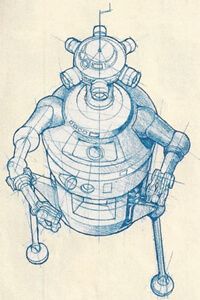
‘The Ultimate Appliance’ is the mobile robot expected to be a ‘fixture’ in today’s homes.

But of all the technologies expected to be part of daily life in 2013, the biggest miss by the article comes with robots.

In fact, the mobile robot “Billy Rae” is depicted as an integral component to the household, much like Rosie The Robot was in The Jetsons. In the story, the family communicates with Billy Rae naturally as the mother reads a list of chores for cleaning the house and preparing meals. There’s even a pet canine robot named Max that helps the son learn to read and do math. The robots aren’t necessarily depicted as being super intelligent, but they were still expected to be vital, even being referred to as the “ultimate appliance.”

In recent years, great strides have been made with robots and artificial intelligence, but we are years away from having a maid-like robot that was hoped for in the article. We’re all familiar withcleaning robots like the Roomba and hospitals are starting to utilize healthcare robots.Personal assistants like Siri show that we’re getting closer to the day when people and computers can communicate verbally. But bringing all these technologies together is one of the most challenging problems to be solved, even with the high amounts of expectation and huge market potential that these bots will experience.

In light of this, it’s interesting to compare the predictions in this article to those in French illustrations drawn around 1900, which also include a fair share of robotic automation.

The piece is peppered with utopian speculation, but already on the radar were concerns about the shifting job market, increasing pollution, and the need for quality schooling, public transportation, and affordable housing, issues that have reached or are nearing crisis levels. It’s comforting to know that many of the problems that modern cities face were understood fairly well a quarter of a century ago, but it is sobering to recognize how technologies have been slow in some cases at handling these problems.

Perhaps the greatest lesson from reading the article is that few of the predictions are completely wrong, but the timescale was ambitious. Almost all of the technologies described will get here sooner or later. The real issue then is, what is preventing rapid innovation or broad-scale adoption of technologies?

Not surprisingly, the answers today are the same as they were 25 years ago: time and money.

LA-metro-rail

[images: kla4067/Flickr, LA Times]

Brain scans can now tell who you’re thinking about (Singularity Hub)

Written By: 

Posted: 03/23/13 7:48 AM

[Source: Listal]

[Source: Listal]

Beware stalkers, these neuroscientists can tell who you’re thinking of. Or, at least, the kind of personality he or she might have.

As a social species humans are highly attuned to the behavior of others around them. It’s a survival mechanism, helping us to safely navigate the social world. That awareness involves both evaluating people and predicting how they will behave in different situations in the future (“Uh oh, don’t get him started!”). But just how does the brain represent another person’s personality?

To answer this question a group of scientists at Cornell’s College of Human Ecology (whatever that means) used functional magnetic resonance imaging (fMRI) to measure neuronal activity while people thought about different types of personalities. The 19 participants – all young adults – learned about four protagonists, all of whom had considerably different personalities, based on agreeableness (e.g., “Likes to cooperate with others”) and extraversion (“Is sometimes shy”). They were then presented different scenarios (such as sitting on a bus with no empty seats and watching an elderly person get on) and asked to imagine how each of the four protagonists would react.

Varying degrees of a person's deemed "agreeableness" and "extraversion" combine to produce different brain activation patterns in the brain. [Source: Cerebral Cortex]

Varying degrees of a person’s deemed “agreeableness” and “extraversion” combine to produce different brain activation patterns in the brain. [Source: Cerebral Cortex]

The study’s lead author, Nathan Spreng, said they were “shocked” when they saw the results. The brain scans revealed that each of the four distinct personalities elicited four distinct activity patterns in the medial prefrontal cortex, an area at the front of the brain known to be involved in decision making. In essence, the researchers had succeeded in extracting mental pictures – the personalities of others – that people were thinking of.The study was published in the March 5 issue of Cerebral Cortex.

Sizing up the personality of another or thinking what they’re thinking is unique to social animals and in fact to do so was until recently thought to be uniquely human. But there’s now reason to believe the network – called the ‘default network’ – is a fundamental feature of social mammals in general. As Spreng explained in an email, “Macaque [monkeys] clearly have a similar network, observable even in the rat. All of these mammalian species are highly social.”

The fact that the mental snapshot of others was seen in the neurons of the medial prefrontal cortex means the current study may have implications for autism, Spreng said in a Cornell University news release. “Prior research has implicated the anterior mPFC in social cognition disorders such as autism, and our results suggest people with such disorders may have an inability to build accurate personality models. If further research bears this out, we may ultimately be able to identify specific brain activation biomarkers not only for diagnosing such diseases, but for monitoring the effects of interventions.”

Previous work has shown that brain scans can tell us a lot about what a person’s thinking. With an array of electrodes placed directly on the brain, researchers were able to decode specific words that people were thinking. In another experiment fRMI scans of the visual cortex were used to reconstruct movie trailers that participants were watching.

Much of neuroscience explores how the brain processes the sensory information that guides us through our physical environment. But, for many species, navigating the social environment can be just as important to survival. “For me, an important feature of the work is that our emotions and thoughts about other people are felt to be private experiences,” Spreng said. “In our life, we may choose to share our thoughts and feelings with peers, friends and loved ones. However, [thoughts and feelings] are also physical and biological processes that can be observed. Considering how important our social world is, we know very little about the brain processes that support social knowledge. The objective of this work is to understand the physical mechanisms that allow us to have an inner world, and a part of that is how we represent other people in our mind.”

The Ant-Driven Landscape (Quest)

http://science.kqed.org

Post on Mar 14, 2013 by  from 

In this part of California we may thank our lucky stars for being free of Burmese pythonsbrown recluse spidersor Africanized honeybees. But during the last few decades, while most of us weren’t paying attention, much of California was taken over by ants from Argentina.

Argentine ants, Linepithema humile, love the environment of our homes and gardens. The soil is watered regularly, there’s warmth nearby in the winter, and it almost never floods. The species is aggressive, and unlike most ants they don’t fight each other’s colonies. Recent research suggests that even though they’re genetically diverse, Argentine ants always smell the same to each other, so undistracted by internal wars they combine forces and simply overwhelm most other ant species.

But our different kinds of native ants are crucial members of the local ecosystem. Some eat corpses, while others scavenge the ground for dead plant matter. Some live like farmers, cultivating certain fungus species by feeding them plant materials. Some depend on specific plants, which benefit from the attention. (KQED has acool gallery of Bay Area native ant species and their lifeways.)

When the Argentine ants move in, all of those specialized services are handicapped or disappear. There’s plenty of reading out there about the effect of these ants on ecosystems, but as a geologist I wonder about their effect on bioturbation, the processes by which living things stir the soil. Ground-dwelling animals have profound effects on soil: the way it breathes, circulates water and cycles nutrients. Ants and worms are the most important of these.

Among the various ant species, Argentine ants are small and their nests are shallow. That means, for instance, they’re not capable of building the piles of coarse sand and gravel, brought up from meters below the ground, that desert red ants made in this example from Nevada.

Photos by Andrew Alden

Photos by Andrew Alden

Fortunately Argentine ants have trouble where it’s dry and cold, so gold prospectors in the Mojave can continue their practice of sampling buried rocks from anthills. But around here, how does the soil respond when the deep-digging ant species are gone? I also wonder about the various bee species that dig holes in the ground, like these ones I spotted on a San Mateo County seacliff.

bees

As scientists learn more about invasive species, it’s clear that no matter wherever they live, people need to raise their game and learn defensive practices: call it eco-hygeine.

Consider the earthworms of Minnesota. Did you know that in Minnesota and much of its neighboring states there aren’t any native earthworms? Since the ice age glaciers melted, some 10,000 years ago, the earthworms haven’t managed to crawl north fast enough, and the forests there are adapted to worm-free soils that consist of raw glacier sediment with a thick layer of organic matter on top. Worms eat all that stuff and dig it into the dirt. That’s why we love them in most places, but in Minnesota the worms brought in with nursery plants and baitworms thrown away during fishing trips are ruining the woods. Up there, the Great Lakes Worm Watch is trying to raise consciousness and fight the problem.

Around here, we have to think more about our ants. At Stanford University’s Jasper Ridge Biological Preserve they’ve been monitoring the Argentine ant invasion and are learning what limits them: cold, dry ground and ant species with strong defenses. Volunteers all over the Bay Area can act locally by gathering data through theBay Area Ant Survey, coordinated by the California Academy of Sciences.

There has been a lot of talk lately about “Anthropocene time,” a name for the geological time period that includes the present and future. It represents a concept I might call the human-driven planet: our actions and influences have become as important as natural forces in governing the planetary environment. The root “anthropo-” refers to human causes, but for teaching purposes it may be better just to look down at our feet and think “ant-” instead. Because humans brought the invaders here.

By the way, Argentine ants are well controlled with boric acid bait. I’ve had lasting success with this simple method.

Everybody Knows. Climate Denialism has peaked. Now what are we going to do? (EcoEquity)

– Tom Athanasiou (toma@ecoequity.org).  April 2, 2013.

It was never going to be easy to face the ecological crisis.  Even back in the 1970s, before climate took center stage, it was clear that we the prosperous were walking far too heavily.  And that “environmentalism,” as it was called, was only going to be a small beginning.  But it was only when the climate crisis pushed fossil energy into the spotlight that the real stakes were widely recognized.  Fossil fuels are the meat and potatoes of industrial civilization, and the need to rapidly and radically reduce their emissions cut right through to the heart of the great American dream.  And the European dream.  And, inevitably, the Chinese dream as well.

Decades later, 81% of global energy is still supplied by the fossil fuels: coal, gas, and oil.[1]  And though the solar revolution is finally beginning, the day is late.  The Arctic is melting, and, soon, as each year the northern ocean lies bare beneath the summer sun, the warming will accelerate.  Moreover, our plight is becoming visible.  We have discovered, to our considerable astonishment, that most of the fossil fuel on the books of our largest corporations is “unburnable” – in the precise sense that, if we burn it, we are doomed.[2]  Not that we know what to do with this rather strange knowledge.  Also, even as China rises, it’s obvious that it’s not the last in line for the promised land.  Billions of people, all around the world, watch the wealthy on TV, and most all of them want a drink from the well of modern prosperity.  Why wouldn’t they?  Life belongs to us all, as does the Earth.

The challenge, in short, is rather daunting.

The denial of the challenge, on the other hand, always came ready-made.  As Francis Bacon said so long ago, “what a man would rather were true, he more readily believes.”  And we really did want to believe that ours was still a boundless world.  The alternative – an honest reckoning – was just too challenging.  For one thing, there was no obvious way to reconcile the Earth’s finitude with the relentless expansion of the capitalist market.  And as long as we believed in a world without limits, there was no need to see that economic stratification would again become a fatal issue.  Sure, our world was bitterly riven between haves and have-nots, but this problem, too, would fade in time.  With enough growth – the universal balm – redistribution would never be necessary.  In time, every man would be a king.

The denial had many cheerleaders.  The chemical-company flacks who derided Rachel Carson as a “hysterical woman” couldn’t have known that they were pioneering a massive trend.  Also, and of course, big money always has plenty of mouthpieces.  But it’s no secret that, during the 20th Century, the “engineering of consent” reached new levels of sophistication.  The composed image of benign scientific competence became one of its favorite tools, and somewhere along the way tobacco-industry science became a founding prototype of anti-environmental denialism.  On this front, I’m happy to say that the long and instructive history of today’s denialist pseudo-science has already been expertly deconstructed.[3]  Given this, I can safely focus on the new world, the post-Sandy world of manifest climatic disruption in which the denialists have lost any residual aura of scientific legitimacy, and have ceased to be a decisive political force.  A world in which climate denialism is increasingly seen, and increasingly ridiculed, as the jibbering of trolls.

To be clear, I’m not claiming that the denialists are going to shut up anytime soon.  Or that they’ll call off their suicidal, demoralizing campaigns.  Or that their fogs and poisons are not useful to the fossil-fuel cartel.  But the battle of the science is over, at least as far as the scientists are concerned.  And even on the street, hard denialism is looking pretty ridiculous.  To be sure, the core partisans of the right will fight on, for the win and, of course, for the money.[4]  And they’ll continue to have real weight too, for just as long as people do not believe that life beyond carbon is possible.  But for all this, their influence has peaked, and their position is vulnerable.  They are – and visibly now – agents of a mad and dangerous ideology.  They are knaves, and often they are fools.[5]

As for the rest of us, we can at least draw conclusions, and make plans.

As bad as the human prospect may be – and it is quite bad – this is not “game over.”  We have the technology we need to save ourselves, or most of it in any case; and much of it is ready to go.  Moreover, the “clean tech” revolution is going to be disruptive indeed.  There will be cascades of innovation, delivering opportunities of all kinds, all around the world.  Also, our powers of research and development are strong.  Also, and contrary to today’s vogue for austerity and “we’re broke” political posturing, we have the money to rebuild, quickly and on a global scale.  Also, we know how to cooperate, at least when we have to.  All of which is to say that we still have options.  We are not doomed.

But we are in extremely serious danger, and it is too late to pretend otherwise.  So allow me to tip my hand by noting Jorgen Randers’ new book, 2052: A Global Forecast for the Next Forty Years.[6]  Randers is a Norwegian modeler, futurist, professor, executive, and consultant who made his name as co-author of 1972’s landmark The Limits to Growth.  Limits, of course, was a global blockbuster; it remains the best-selling environmental title of all times.  Also, Limits has been relentlessly ridiculed (the early denialists cut their teeth by distorting it[7]) so it must be said that – very much contrary to the mass-produced opinions of the denialist age – its central, climate-related projections are holding up depressingly well.[8]

By 2012 (when he published 2052) Randers had decided to step away from the detached exploration of multiple scenarios that was the methodological core of Limits, and to make actual predictions.  After a lifetime of frustrated efforts, these predictions are vivid, pessimistic and bitter.  In a nutshell, Randers doesn’t expect anything beyond what he calls “progress as usual,” and while he expects it to yield a “light green” buildout (e.g., solar on a large scale) he doesn’t think it will suffice to stabilize the climate system.  Such stabilization, he grants, is still possible, but it would require concerted global action on a scale that neither he nor Dennis Meadows, the leader of the old Limits team, see on today’s horizon.  Let’s call that kind of action global emergency mobilization.  Meadows, when he peers forwards, sees instead “many decades of uncontrolled climatic disruption and extremely difficult decline.”[9]  Randers is more precise, and predicts that we will by 2052 wake to find ourselves on a dark and frightening shore, knowing full well that our planet is irrevocably “on its way towards runaway climate change in the last third of the twenty-first century.”

This is an extraordinary claim, and it requires extraordinary evidence.[10]  Such evidence, unfortunately, is readily available, but for the moment let me simply state the public secret of this whole discussion.  To wit: we (and I use this pronoun advisedly) can still avoid a global catastrophe, but it’s not at all obvious that we will do so.  What is obvious is that stabilizing the global climate is going to be very, very hard.  Which is a real problem, because we don’t do hard anymore.  Rather, when confronted with a serious problem, we just do what we can, hoping that it will be enough and trying our best not to offend the rich.  In truth, and particularly in America, we count ourselves lucky if we can manage governance at all.

This essay is about climate politics after legitimate skepticism.  Climate politics in a world where, as Leonard Cohen put it, “everybody knows.”  What does this mean?  In the first place, it means that we’ve reached the end of what might be called “environmentalism-as-usual.”  This point is widely understood and routinely granted, as when people say something like “climate is not a merely environmental problem,” but my concern is a more particular one.  As left-green writer Eddie Yuen astutely noted in a recent book on “catastrophism,” the problems of the environmental movement are to a very large degree rooted in “the pairing of overwhelmingly bleak analysis with inadequate solutions.”[11]  This is exactly right.

The climate crisis demands a “new environmentalism,” and such a thing does seem to be emerging.  It’s final shape is unknowable, but one thing is certain – the environmentalism that we need will only exist when its solutions and strategies stand up to its own analyses.  The problem is that this requires us to take our “overwhelmingly bleak” analyses straight, rather than soft-pedaling them so that our “inadequate solutions” might look good.  Pessimism, after all, is closely related to realism.  It cannot just be wished away.

Soft-pedaling, alas, has long been standard practice, on both the scientific and the political sides of the climate movement.  Examples abound, but the best would have to be the IPCC itself, the U.N’s Intergovernmental Panel on Climate Change.  The world’s premier climate-science clearinghouse, the IPCC is often attacked from the right, and has developed a shy and reticent culture.  Even more importantly, though, and far more rarely noted, is that the IPCC is conservative by definition and by design.[12]  It almost has to be conservative to do its job, which is to herd the planet’s decision makers towards scientific realism.  The wrinkle is that, at this point, this isn’t even close to being good enough, not at least in the larger scheme.  At this point, we need strategic realism as well as baseline scientific realism, and it demands a brutal honesty in which underlying scientific and political truths are clearly drawn and publicly expressed.

Yet when it comes to strategic realism, we balk.  The first impulse of the “messaging” experts is always to repeat their perennial caution that sharp portraits of the danger can be frightening, and disempowering, and thus lead to despair and passivity.  This is an excellent point, but it’s only the beginning of the truth, not the end.  The deeper problem is that the physical impacts of climate disruption – the destruction and the suffering – will continue to escalate.  “Superstorm Sandy” was bad, but the future will be much worse.  Moreover, the most severe suffering will be far away, and easy for the good citizens of the wealthy world to ignore.  Imagine, for example, a major failure of the Indian Monsoon, and a subsequent South Asian famine.  Imagine it against a drumbeat background in which food is becoming progressively more expensive.  Imagine the permanence of such droughts, and increasing evidence of tipping points on the horizon, and a world in which ever more scientists take it upon themselves to deliver desperate warnings.  The bottom line will not be the importance of communications strategies, but rather the manifest reality, no longer distant and abstract, and the certain knowledge that we are in deep trouble.  And this is where the dangers of soft-pedaling lie.  For as people come to see the scale of the danger, and then to look about for commensurate strategies and responses, the question will be if such strategies are available, and if they are known, and if they are plausible.  If they’re not, then we’ll all going, together, down the road “from aware to despair.”

Absent the public sense of a future in which human resourcefulness and cooperation can make a decisive difference, we assuredly face an even more difficult future in which denial fades into a sense of pervasive hopelessness.  The last third of the century (when Randers is predicting “runaway climate change”) is not so very far away.  Which is to say that, as denialism collapses – and it will – the challenge of working out a large and plausible response to the climate crisis will become overwhelmingly important.  If we cannot imagine such a response, and explain how it would actually work, then people will draw their own conclusions.  And, so far, it seems that we cannot.  Even those of us who are now climate full-timers don’t have a shared vision, not in any meaningful detail, nor do we have a common sense of the strategic initiatives that could make such a vision cohere.

The larger landscape is even worse.  For though many scientists are steeling themselves to speak, the elites themselves are still stiff and timid, and show few signs of rising to the occasion.  Each month, it seems, there’s another major report on the approaching crisis – the World Bank, the National Intelligence Council, and the International Energy Agency have all recently made hair-raising contributions – but they never quite get around to the really important questions.  How should we contrive the necessary global mobilization?  What conditions are needed to absolutely maximize the speed of the clean-tech revolution?  By what strategy will we actually manage to keep the fossil-fuels in the ground?  What kind of international treaties are necessary, and how shall we establish them?  What would a fast-enough global transition cost, and how shall we pay for it?  What about all those who are forced to retreat from rising waters and drying lands?  How shall they live, and where?  How shall we talk about rights and responsibilities in the Greenhouse Century?  And what about the poor?  How shall they find futures in a climate-constrained world?  Can we even imagine a world in which they do?

In the face of such questions, you have a choice.  You can conclude that we’ll just have to do the best we can, and then you can have a drink.  Or maybe two.  Or you can conclude that, despite all evidence to the contrary, enough of us will soon awaken to reality.  What’s certain is that, all around us, there is a vast potentiality – for reinvention, for resistance, for redistribution, and for renewal of all kinds – and that it could at any time snap into solidity.  And into action.

Forget about “hope.”  What we need now is intention.

***

About a decade ago, in San Francisco, I was on a PBS talk show with, among others, Myron Ebell, chief of climate propaganda at the Competitive Enterprise Institute.  Ebell is an aggressive professional, and given the host’s commitment to phony balance he was easily able to frame the conversation.[13]  The result was a travesty, but not an entirely wasted time, at least not for me.  It was instructive to speak, tentatively, of the need for global climate justice, and to hear, in response, that I was a non-governmental fraud that was only in it for the money.  Moreover, as the hour wore on, I came to appreciate the brutal simplicity of the denialist strategy.  The whole point is to suck the oxygen out of the room, to weave such a tangle of confusionism and pseudo-debate that the Really Big Question – What is to be done? – becomes impossible to even ask, let alone discuss.

When Superstorm Sandy slammed into the New York City region, Ebell’s style of hard denialism took a body blow, though obviously it has not dropped finally to the mat.  Had it done do, the Big Question, in all its many forms, would be buzzing constantly around us.  Clearly, that great day has not yet come.  Still, back in November of 2012, when Bloomberg’s Business Week blared “It’s Global Warming, Stupid” from its front cover, this was widely welcomed as a overdue milestone.  It may even be that Michael Tobis, the editor of the excellent Planet 3.0, will prove correct in his long-standing, half-facetious prediction that 2015 will be the date when “the Wall Street Journal will acknowledge the indisputable and apparent fact of anthropogenic climate change; the year in which it will simply be ridiculous to deny it.”[14]  Or maybe not.  Maybe that day will never come.  Maybe Ebell’s style of well-funded, front-group denialism will live on, zombie-like, forever.  Or maybe (and this is my personal prediction) hard climate denialism will soon go the way of creationism and far-right Christianity, becoming a kind of political lifestyle choice, one that’s dangerous but contained.  One that’s ultimately more dangerous to the right than it is to the reality-based community.

If so, then at some point we’re going to have to ask ourselves if we’ve been so long distracted by the hard denialists that we’ve missed the parallel danger of a “soft denialism.”  By which I mean the denialism of a world in which, though the dangers of climate change are simply too ridiculous to deny, they still – somehow – are not taken to imply courage, and reckoning, and large-scale mobilization.  This is a long story, but the point is that, now that the Big Question is finally on the table, we’re going to have to answer it.  Which is to say that we’re going to have to face the many ways in which political timidity and small-bore realism have trained us to calibrate our sense of what must be done by our sense of what can be done, which these days is inadequate by definition.

And not just because of the denialists.

George Orwell once said that “To see what is in front of one’s nose needs a constant struggle.”[15]  As we hurtle forward, this struggle will rage as never before.  The Big Question, after all, changes everything.  Another way of saying this is that our futures will be shaped by the effort to avoid a full-on global climate catastrophe.  Despite all the rest of the geo-political and geo-economic commotion that will mark the 21st Century (and there’ll be plenty) it will be most fundamentally the Greenhouse Century.  We know this now, if we care to, though still only in preliminary outline.  The details, inevitably, will surprise us all.

The core problem, of course, will be “ambition” – action on the scale that’s actually necessary, rather than the scale that is or appears to be possible.  And here, the legacies of the denialist age – the long-ingrained habits of soft-pedaling and strained optimism – will weigh heavily.  Consider the quasi-official global goal (codified, for example, in the Copenhagen Accord) to hold total planetary warming to 2°C (Earth surface average) above pre-industrial levels.  This is the so-called “2°C target.”  What are we to do with it in the post-denialist age?  Let me count the complications: One, all sorts of Very Important People are now telling us it’s going to all but impossible to avoid overshooting 2°C.[16]  Two, in so doing, they are making a political and not a scientific judgment, though they’re not always clear on this point.  (It’s probably still technically possible to hold the 2°C line – if we’re not too unlucky – though it wouldn’t be easy under the best of circumstances.)[17]  Three, the 2°C line, which was once taken to be reasonably safe, is now widely seen (at least among the scientists) to mark the approximate point of transition from “dangerous” to “extremely dangerous,” and possibly to altogether unmanageable levels of warming.[18]  Four, and finally, it’s now widely recognized that any future in which we approach the 2°C line (which we will do) is one in which we also have a real possibility of pushing the average global temperature up by 3°C, and if this were to come to pass we’d be playing a very high-stakes game indeed, one in which uncontrolled positive feedbacks and worst-case scenarios were surrounding us on every side.

The bottom line is today as it was decades ago.  Greenhouse-gas emissions were increasing then, and they are increasing now.  In late 2012, the authoritative Global Carbon Project reported that, since 1990, they had risen by an astonishing 58 percent.[19]  The climate system has unsurprisingly responded with storms, droughts, ice-melt, conflagrations and floods.  The weather has become “extreme,” and may finally be getting our attention.  In Australia, according to the acute Mark Thomson of the Institute for Backyard Studies in Adelaide, the crushing heatwave of early 2013 even pushed aside “the idiot commentariat” and cleared the path for a bit of 11th-hour optimism: “Another year of this trend will shift public opinion wholesale.  We’re used to this sort of that temperature now and then and even take a perverse pride in dealing with it, but there seems to be a subtle shift in mood that ‘This Could Be Serious.’”  Let’s hope he’s right.  Let’s hope, too, that the mood shift that swept through America after Sandy also lasts, and leads us, too, to conclude that ‘This Could Be Serious.’  Not that this alone would be enough to support a real mobilization – the “moral equivalent of war” that we need – but it would be something.  It might even lead us to wonder about our future, and about the influence of money and power on our lives, and to ask how serious things will have to get before it becomes possible to imagine a meaningful change of direction.

The wrinkle is that, before we can advocate for a meaningful change of direction, we have to have one we believe in, one that we’re willing to explain in global terms that actually scale to the problem.  None of which is going to be easy, given that we’re fast approaching a point where only tales of existential danger ring true.  (cf the zombie apocalypse).  The Arctic ice, as noted above, offers an excellent marker.  In fact, the first famous photos of Earth from space – the “blue marble” photos taken in 1972 by the crew of the Apollo 17 – allow us to anchor our predicament in time and in memory.  For these are photos of an old Earth now passed away; they must be, because they show great expanses of ice that are nowhere to be found.  By August of 2012 the Arctic Sea’s ice cover had declined by 40%,[20] a melt that’s easily large enough to be visible from space.  Moreover, beneath the surface, ice volume is dropping even more precipitously.  The polar researchers who are now feverishly evaluating the great melting haven’t yet pushed the entire scientific community to the edge of despair, though they have managed to inspire a great deal of dark muttering about positive feedbacks and tipping points.  Soon, it seems, that muttering will become louder.  Perhaps as early as 2015, the Arctic Ocean will become virtually ice free for the first time in recorded history.[21]  When it does, the solar absorptivity of the Arctic waters will increase, and shift the planetary heat balance by a surprisingly large amount, and by so doing increase the rate of  planetary warming.  And this, of course, will not be end of it.  The feedbacks will continue.  The cycles will go on.

Should we remain silent about such matters, for risk of inflaming the “idiot commentariat?”  It’s absurd to even ask.  The suffering is already high, and if you know the science, you also know that the real surprise would be an absence of positive feedbacks.  The ice melt, the methane plumes, the drying of the rainforests – they’re all real.  Which is to say that there are obviously tipping points before us, though we do not and can not know how much time will pass before they force themselves upon our attention.  The real question is what we must do if we would talk of them in good earnest, while at the same time speaking, without despair and effectively, about the human future.


[1] Jorgen Randers, 2052: A Global Forecast for the Next Forty Years, Chelsea Green, 2012, page 99.

[2] Begin at the Carbon Track Initiative’s website.  http://www.carbontracker.org/

[3] Two excellent examples: Naomi Oreskes, Erik M. M. Conway, Merchants of Doubt: How a Handful of Scientists Obscured the Truth on Issues from Tobacco Smoke to Global Warming, Bloomsbury Press, 2011,  Chris Mooney, The Republican War on Science, Basic Books, 2006.

[4] See, for example, Suzanne Goldenberg, “Secret funding helped build vast network of climate denial thinktanks,” February 14, 2013, The Guardian.

[5] “Lord Monckton,” in particular, is fantastic.  See http://www.youtube.com/watch?v=w833cAs9EN0

[6] Randers, 2012.  See also Randers’ essay and video at the University of Cambridge 2013 “State of Sustainability Leadership,” athttp://www.cpsl.cam.ac.uk/About-Us/What-is-Sustainability-Leadership/The-State-of-Sustainability-Leadership.aspx

[7] Ugo Bardi, in The Limits to Growth Revisited (Springer Briefs, 2011) offers this summary:

“If, at the beginning, the debate on LTG had seemed to be balanced, gradually the general attitude on the study became more negative. It tilted decisively against the study when, in 1989, Ronald Bailey published a paper in “Forbes” where he accused the authors of having predicted that the world’s economy should have already run out of some vital mineral commodities whereas that had not, obviously, occurred.

Bailey’s statement was only the result of a flawed reading of the data in a single table of the 1972 edition of LTG. In reality, none of the several scenarios presented in the book showed that the world would be running out of any important commodity before the end of the twentieth century and not even of the twenty-first. However, the concept of the “mistakes of the Club of Rome” caught on. With the 1990s, it became commonplace to state that LTG had been a mistake if not a joke designed to tease the public, or even an attempt to force humankind into a planet-wide dictatorship, as it had been claimed in some earlier appraisals (Golub and Townsend 1977; Larouche 1983). By the end of the twentieth century, the victory of the critics of LTG seemed to be complete. But the debate was far from being settled.”

[8] See, for example, Graham Turner, “A Comparison of The Limits to Growth with Thirty Years of Reality.” Global Environmental Change, Volume 18, Issue 3, August 2008, Pages 397–411.  An unprotected copy (without the graphics) can be downloaded at www.csiro.au/files/files/plje.pdf.  Also

[9] In late 2012, Dennis Meadows said that “In the early 1970s, it was possible to believe that maybe we could make the necessary changes.  But now it is too late.  We are entering a period of many decades of uncontrolled climatic disruption and extremely difficult decline.”  See Christian Parenti, “The Limits to Growth’: A Book That Launched a Movement,” The Nation, December 24, 2012.

[11] Eddie Yuen, “The Politics of Failure Have Failed: The Environmental Movement and Catastrophism,” in Catastrophism: The Apocalyptic Politics of Collapse and Rebirth, Sasha Lilley, David McNally, Eddie Yuen, James Davis, with a foreword by Doug Henwood. PM Press 2012.  Yuen’s whole line is “the main reasons that [it] has not led to more dynamic social movements; these include catastrophe fatigue, the paralyzing effects of fear; the pairing of overwhelmingly bleak analysis with inadequate solutions, and a misunderstanding of the process of politicization.” 

[12] See Glenn Scherer, “Special Report: IPCC, assessing climate risks, consistently underestimates,” The Daily Climate, December 6, 2012.   More formally (and more interestingly) see Brysse, Oreskes, O’Reilly, and Oppenheimer, “Climate change prediction: Erring on the side of least drama?,” Global Environmental Change 23 (2013), 327-337.

[13] KQED-FM, Forum, July 22, 2003.

[14] Michael Tobis, editor of Planet 3.0, is amusing on this point.  He notes that “many data-driven climate skeptics are reassessing the issue,” that “In 1996 I defined the turning point of the discussion about climate science (the point where we could actually start talking about policy) as the date when theWall Street Journal would acknowledge the indisputable and apparent fact of anthropogenic climate change; the year in which it would simply be ridiculous to deny it.  My prediction was that this would happen around 2015… I’m not sure the WSJ has actually accepted reality yet.  It’s just starting to squint in its general direction.  2015 still looks like a good bet.”  See http://planet3.org/2012/08/07/is-the-tide-turning/

[15] The Collected Essays, Journalism and Letters of George Orwell: In Front of Your Nose, 1945-1950, Sonia Orwell and Ian Angus, Editors / Paperback / Harcourt Brace Jovanovich, 1968, p. 125.

[16] See for example, Fatih Birol and Nicholas Stern, “Urgent steps to stop the climate door closing,” The Financial Times, March 9, 2011.  And see Sir Robert Watson’s Union Frontiers of Geophysics Lecture at the 2012 meeting of the American Geophysical Union, athttp://fallmeeting.agu.org/2012/events/union-frontiers-of-geophysics-lecture-professor-sir-bob-watson-cmg-frs-chief-scientific-adviser-to-defra/

[17] I just wrote “probably still technically possible.”  I could have written “Excluding the small probability of a very bad case, and the even smaller probability of a very good case, it’s probably still technically possible to hold the 2°C line, though it wouldn’t be easy.”  This, however, is a pretty ugly sentence.  I could also have written “Unless we’re unlucky, and the climate sensitivity turns out be on the high side of the expected range, it’s still technically possible to hold the 2°C line, though it wouldn’t be easy, unless we’re very lucky, and the climate sensitivity turns out to be on the low side.”  Saying something like this, though, kind of puts the cart before the horse, since I haven’t said anything about “climate sensitivity,” or about how the scientists think about probability – and of course it’s even uglier.  The point, at least for now, is that climate projections are probabilistic by nature, which does not mean that they are merely “uncertain.”  We know a lot about the probabilities.

[18] See Kevin Anderson, a former director of Britain’s Tyndall Center, who has been unusually frank on this point.  His views are clearly laid out in a (non-peer-reviewed) essay published by the Dag Hammarskjold Foundation in Sweden.  See “Climate change going beyond dangerous – Brutal numbers and tenuous hope” in Development Dialog #61, September 2012, available at http://www.dhf.uu.se/wordpress/wp-content/uploads/2012/10/dd61_art2.pdf.  For a peer-reviewed paper, see Anderson and Bows, “Beyond ‘dangerous’ climate change: emission scenarios for a new world.”  Philosophical Transactions of The Royal Society, (2011) 369, 20-44 and for a lecture, see “Are climate scientists the most dangerous climate skeptics?” a Tyndall Centre video lecture (September 2010) at http://www.tyndall.ac.uk/audio/are-climate-scientist-most-dangerous-climate-sceptics.

[19] “The challenge to keep global warming below 2°C,” Glen P. Peters, et. al., Nature Climate Change (2012) 3, 4–6 (2013) doi:10.1038/nclimate1783.  December 2, 2012.  This figure might actually be revised upward, as 2012 saw the second-largest annual  concentration increase on record (http://climatedesk.org/2013/03/large-rise-in-co2-emissions-sounds-climate-change-alarm/)

[20] The story of the photos is on Wikipedia – see “blue marble.”  For the latest on the Arctic ice, see the “Arctic Sea Ice News and Analysis” page that the National Snow and Ice Data Center — http://nsidc.org/arcticseaicenews/

[21] Climate Progress is covering the “Arctic Death Spiral” in detail.  See for example Joe Romm, “NOAA: Climate Change Driving Arctic Into A ‘New State’ With Rapid Ice Loss And Record Permafrost Warming,” Climate Progress, Dec 6, 2012.  Give yourself a few hours and follow the links.

Climate Maverick to Retire From NASA (N.Y.Times)

Michael Nagle for The New York Times. James E. Hansen of NASA, retiring this week, reflected in a window at his farm in Pennsylvania.

By 

Published: April 1, 2013

His departure, after a 46-year career at the space agency’s Goddard Institute for Space Studies in Manhattan, will deprive federally sponsored climate research of its best-known public figure.

At the same time, retirement will allow Dr. Hansen to press his cause in court. He plans to take a more active role in lawsuits challenging the federal and state governments over their failure to limit emissions, for instance, as well as in fighting the development in Canada of a particularly dirty form of oil extracted from tar sands.

“As a government employee, you can’t testify against the government,” he said in an interview.

Dr. Hansen had already become an activist in recent years, taking vacation time from NASA to appear at climate protests and allowing himself to be arrested or cited a half-dozen times.

But those activities, going well beyond the usual role of government scientists, had raised eyebrows at NASA headquarters in Washington. “It was becoming clear that there were people in NASA who would be much happier if the ‘sideshow’ would exit,” Dr. Hansen said in an e-mail.

At 72, he said, he feels a moral obligation to step up his activism in his remaining years.

“If we burn even a substantial fraction of the fossil fuels, we guarantee there’s going to be unstoppable changes” in the climate of the earth, he said. “We’re going to leave a situation for young people and future generations that they may have no way to deal with.”

His departure, on Wednesday, will end a career of nearly half a century working not just for a single agency but also in a single building, on the edge of the Columbia University campus.

From that perch, seven floors above the diner made famous by “Seinfeld,” Dr. Hansen battled the White House, testified dozens of times in Congress, commanded some of the world’s most powerful computers and pleaded with ordinary citizens to grasp the basics of a complex science.

His warnings and his scientific papers have drawn frequent attack from climate-change skeptics, to whom he gives no quarter. But Dr. Hansen is a maverick, just as likely to vex his allies in the environmental movement. He supports nuclear power and has taken stands that sometimes undercut their political strategy in Washington.

In the interview and in subsequent e-mails, Dr. Hansen made it clear that his new independence would allow him to take steps he could not have taken as a government employee. He plans to lobby European leaders — who are among the most concerned about climate change — to impose a tax on oil derived from tar sands. Its extraction results in greater greenhouse emissions than conventional oil.

Dr. Hansen’s activism of recent years dismayed some of his scientific colleagues, who felt that it backfired by allowing climate skeptics to question his objectivity. But others expressed admiration for his willingness to risk his career for his convictions.

Initially, Dr. Hansen plans to work out of a converted barn on his farm in Pennsylvania. He has not ruled out setting up a small institute or taking an academic appointment.

He said he would continue publishing scientific papers, but he will no longer command the computer time and other NASA resources that allowed him to track the earth’s rising temperatures and forecast the long-run implications.

Dr. Hansen, raised in small-town Iowa, began his career studying Venus, not the earth. But as concern arose in the 1970s about the effects of human emissions of greenhouse gases, he switched gears, publishing pioneering scientific papers.

His initial estimate of the earth’s sensitivity to greenhouse gases was somewhat on the high side, later work showed. But he was among the first scientists to identify the many ways the planet is likely to respond to rising temperatures and to show how those effects would reinforce one another to produce immense changes in the climate and environment, including a sea level rise that could ultimately flood many of the world’s major cities.

“He’s done the most important science on the most important question that there ever was,” said Bill McKibben, a climate activist who has worked closely with Dr. Hansen.

Around the time Dr. Hansen switched his research focus, in the 1970s, a sharp rise in global temperatures began. He labored in obscurity over the next decade, but on a blistering June day in 1988 he was called before a Congressional committee and testifiedthat human-induced global warming had begun.

Speaking to reporters afterward in his flat Midwestern accent, he uttered a sentence that would appear in news reports across the land: “It is time to stop waffling so much and say that the evidence is pretty strong that the greenhouse effect is here.”

Given the natural variability of climate, it was a bold claim to make after only a decade of rising temperatures, and to this day some of his colleagues do not think he had the evidence.

Yet subsequent events bore him out. Since the day he spoke, not a single month’s temperatures have fallen below the 20th-century average for that month. Half the world’s population is now too young to have lived through the last colder-than-average month, February 1985.

In worldwide temperature records going back to 1880, the 19 hottest years have all occurred since his testimony.

Again and again, Dr. Hansen made predictions that were ahead of the rest of the scientific community and, arguably, a bit ahead of the evidence.

“Jim has a real track record of being right before you can actually prove he’s right with statistics,” said Raymond T. Pierrehumbert, a planetary scientist at the University of Chicago.

Dr. Hansen’s record has by no means been spotless. Even some of his allies consider him prone to rhetorical excess and to occasional scientific error.

He has repeatedly called for trying the most vociferous climate-change deniers for “crimes against humanity.” And in recent years, he stated that excessive carbon dioxide emissions might eventually lead to a runaway greenhouse effect that would boil the oceans and render earth uninhabitable, much like Venus.

His colleagues pointed out that this had not happened even during exceedingly warm episodes in the earth’s ancient past. “I have huge respect for Jim, but in this particular case, he overstated the risk,” said Daniel P. Schrag, a geochemist and the head of Harvard’s Center for the Environment, who is nonetheless deeply worried about climate change.

Climate skeptics have routinely accused Dr. Hansen of alarmism. “He consistently exaggerates all the dangers,” Freeman Dyson, the famed physicist and climate contrarian,told The New York Times Magazine in 2009.

Perhaps the biggest fight of Dr. Hansen’s career broke out in late 2005, when a young political appointee in the administration of George W. Bush began exercising control over Dr. Hansen’s statements and his access to journalists. Dr. Hansen took the fight public and the administration backed down.

For all his battles with conservatives, however, he has also been hard on environmentalists. He was a harsh critic of a failed climate bill they supported in 2009, on the grounds that it would have sent billions into the federal government’s coffers without limiting emissions effectively.

Dr. Hansen agrees that a price is needed on carbon dioxide emissions, but he wants the money returned to the public in the form of rebates on tax bills. “It needs to be done on the basis of conservative principles — not one dime to make the government bigger,” said Dr. Hansen, who is registered as a political independent.

In the absence of such a broad policy, Dr. Hansen has been lending his support to fights against individual fossil fuel projects. Students lured him to a coal protest in 2009, and he was arrested for the first time. That fall he was cited again after sleeping overnight in a tent on the Boston Common with students trying to pressure Massachusetts into passingclimate legislation.

“It was just humbling to have that solidarity and support from this leader, this lion among men,” said Craig S. Altemose, an organizer of the Boston protest.

Dr. Hansen says he senses the beginnings of a mass movement on climate change, led by young people. Once he finishes his final papers as a NASA employee, he intends to give it his full support.

“At my age,” he said, “I am not worried about having an arrest record.”

Secretário da ONU pede urgência na criação de metas globais para o clima (G1/Globo Natureza)

JC e-mail 4699, de 05 de Abril de 2013.

Ban Ki-moon disse que será tarde demais se nada for feito até 2015. Data é limite para criar acordo global que reduza emissão de gases-estufa

O secretário-geral da ONU, Ban Ki-moon, declarou nesta quarta-feira (3) em Mônaco que será “tarde demais” para salvar o meio ambiente, se não forem adotadas medidas vinculantes até 2015 para o clima.

“As palavras não foram seguidas por ações. Logo será tarde demais. Nossos padrões de consumo são incompatíveis com a saúde do planeta”, indicou Ban Ki-moon, diante de uma plateia de personalidades. “Devemos agir agora, se quisermos que em 2050 o planeta continue a ser habitável para os seus nove bilhões de pessoas”, argumentou.

Ele se refere à criação de um novo tratado (ou protocolo) previsto para ser assinado em 2015 e entrar em vigor a partir de 2020, quando o Protocolo de Kyoto perder sua validade. Assim, todos países pretendem terão que cumprir metas para reduzir os gases de efeito estufa e conter a elevação da temperatura do planeta.

Dos noventa objetivos adotados pela comunidade internacional relacionados a questões ambientais nos últimos 20 anos, apenas quatro registraram progressos significativos, lamentou o secretário das Nações Unidas.

Problemas ambientais

Segundo a agência de notícias France Presse, ele destacou como problemas atuais a diminuição da biodiversidade, a redução dos recursos pesqueiros, a maior acidez dos oceanos e o aumento das emissões de gases do efeito estufa. “Temos que acelerar nossa dinâmica. Precisamos desenvolver o que estamos testando em tubos de ensaio há 40 anos. Para isso, devemos adotar medidas de incentivos eficazes, e principalmente colocar um preço sobre as emissões de carbono”, declarou.

“Também devemos adotar, até 2015, um instrumento universal e jurídico vinculante relativo ao clima, de modo que todos os países adotem medidas adicionais para reduzir os efeitos da mudança climática”, instou o secretário-geral das Nações Unidas.

Homenagens em Mônaco

Ban também prestou homenagem à Fundação Prince Albert II de Mônaco, que “é respeitada em todo o mundo pelo trabalho que faz nas áreas da biodiversidade, da água e na luta contra as mudanças climáticas”.

“No momento em que a terra e os oceanos sofrem pressões sem precedentes, em particular devido ao crescimento da população global e às mudanças climáticas, é nossa responsabilidade agir de forma decisiva para preparar para o futuro”, declarou por sua vez o príncipe Albert de Mônaco.

Para o pequeno principado, a visita oficial de Ban Ki-moon marca o 20º aniversário da entrada do Mônaco na Organização das Nações Unidas, em 28 de maio de 1993. “Eu lembro com carinho o orgulho que ele sentiu por esse reconhecimento”, disse o soberano em referência a seu pai, o príncipe Rainier III.

Ban Ki-moon, que iniciou nesta semana um giro europeu com uma visita aos pequenos principados de San Marino e Andorra, também visitará a Espanha e a Holanda. Ele se reunirá na quinta-feira (4) em Mônaco com o chefe de governo.

Chimps: Ability to ‘Think About Thinking’ Not Limited to Humans (Science Daily)

Apr. 3, 2013 — Humans’ closest animal relatives, chimpanzees, have the ability to “think about thinking” — what is called “metacognition,” according to new research by scientists at Georgia State University and the University at Buffalo.

Humans’ closest animal relatives, chimpanzees, have the ability to “think about thinking.” (Credit: © Ambigreen / Fotolia)

Michael J. Beran and Bonnie M. Perdue of the Georgia State Language Research Center (LRC) and J. David Smith of the University at Buffalo conducted the research, published in the journalPsychological Science of the Association for Psychological Science.

“The demonstration of metacognition in nonhuman primates has important implications regarding the emergence of self-reflective mind during humans’ cognitive evolution,” the research team noted.

Metacognition is the ability to recognize one’s own cognitive states. For example, a game show contestant must make the decision to “phone a friend” or risk it all, dependent on how confident he or she is in knowing the answer.

“There has been an intense debate in the scientific literature in recent years over whether metacognition is unique to humans,” Beran said.

Chimpanzees at Georgia State’s LRC have been trained to use a language-like system of symbols to name things, giving researchers a unique way to query animals about their states of knowing or not knowing.

In the experiment, researchers tested the chimpanzees on a task that required them to use symbols to name what food was hidden in a location. If a piece of banana was hidden, the chimpanzees would report that fact and gain the food by touching the symbol for banana on their symbol keyboards.

But then, the researchers provided chimpanzees either with complete or incomplete information about the identity of the food rewards.

In some cases, the chimpanzees had already seen what item was available in the hidden location and could immediately name it by touching the correct symbol without going to look at the item in the hidden location to see what it was.

In other cases, the chimpanzees could not know what food item was in the hidden location, because either they had not seen any food yet on that trial, or because even if they had seen a food item, it may not have been the one moved to the hidden location.

In those cases, they should have first gone to look in the hidden location before trying to name any food.

In the end, chimpanzees named items immediately and directly when they knew what was there, but they sought out more information before naming when they did not already know.

The research team said, “This pattern of behavior reflects a controlled information-seeking capacity that serves to support intelligent responding, and it strongly suggests that our closest living relative has metacognitive abilities closely related to those of humans.”

The research was supported in part by the National Institutes of Health and the National Science Foundation.

Journal Reference:

  1. M. J. Beran, J. D. Smith, B. M. Perdue. Language-Trained Chimpanzees (Pan troglodytes) Name What They Have Seen but Look First at What They Have Not SeenPsychological Science, 2013; DOI:10.1177/0956797612458936

You Don’t ‘Own’ Your Own Genes: Researchers Raise Alarm About Loss of Individual ‘Genomic Liberty’ Due to Gene Patents (Science Daily)

Mar. 25, 2013 — Humans don’t “own” their own genes, the cellular chemicals that define who they are and what diseases they might be at risk for. Through more than 40,000 patents on DNA molecules, companies have essentially claimed the entire human genome for profit, report two researchers who analyzed the patents on human DNA.

In a new study, researchers report that through more than 40,000 patents on DNA molecules, companies have essentially claimed the entire human genome for profit. (Credit: © X n’ Y hate Z / Fotolia)

Their study, published March 25 in the journal Genome Medicine, raises an alarm about the loss of individual “genomic liberty.”

In their new analysis, the research team examined two types of patented DNA sequences: long and short fragments. They discovered that 41 percent of the human genome is covered by longer DNA patents that often cover whole genes. They also found that, because many genes share similar sequences within their genetic structure, if all of the “short sequence” patents were allowed in aggregate, they could account for 100 percent of the genome.

Furthermore, the study’s lead author, Dr. Christopher E. Mason of Weill Cornell Medical College, and the study’s co-author, Dr. Jeffrey Rosenfeld, an assistant professor of medicine at the University of Medicine & Dentistry of New Jersey and a member of the High Performance and Research Computing Group, found that short sequences from patents also cover virtually the entire genome — even outside of genes.

“If these patents are enforced, our genomic liberty is lost,” says Dr. Mason, an assistant professor of physiology and biophysics and computational genomics in computational biomedicine at the Institute for Computational Biomedicine at Weill Cornell. “Just as we enter the era of personalized medicine, we are ironically living in the most restrictive age of genomics. You have to ask, how is it possible that my doctor cannot look at my DNA without being concerned about patent infringement?”

The U.S. Supreme Court will review genomic patent rights in an upcoming hearing on April 15. At issue is the right of a molecular diagnostic company to claim patents not only on two key breast and ovarian cancer genes — BRCA1 and BRCA2 — but also on any small sequence of code within BRCA1, including a striking patent for only 15 nucleotides.

In its study, the research team matched small sequences within BRCA1 to other genes and found that just this one molecular diagnostic company’s patents also covered at least 689 other human genes — most of which have nothing to do with breast or ovarian cancer; rather, its patents cover 19 other cancers as well as genes involved in brain development and heart functioning.

“This means if the Supreme Court upholds the current scope of the patents, no physician or researcher can study the DNA of these genes from their patients, and no diagnostic test or drug can be developed based on any of these genes without infringing a patent,” says Dr. Mason.

One Patented Sequence Matched More Than 91 Percent of Human Genes

Dr. Mason undertook the study because he realized that his research into brain and cancer disorders inevitably involved studying genes that were protected by patents.

Under U.S. patent law, genes can be patented by those researchers, either at companies or institutions, who are first to find a gene that promises a useful application, such as for a diagnostic test. For example, the patents received by a company in the 1990s on BRCA1 and BRCA2 enables it to offer a diagnostic test to women who may have, or may be at risk for, breast or ovarian cancer due to mutations in one or both of these genes. Women and their doctors have no choice but to use the services of the patents’ owner, which costs $3,000 per test, “whereas any of the hundreds of clinical laboratories around the country could perform such a test for possibly much less,” says Dr. Mason.

The impact on these patents is equally onerous on research, Dr. Mason adds.

“Almost every day, I come across a gene that is patented — a situation that is common for every geneticist in every lab,” says Dr. Mason.

Dr. Mason and his research partner sought to determine how many other genes may be impacted by gene patents, as well as the overall landscape of intellectual property on the human genome.

To conduct the study, Dr. Mason and Dr. Rosenfeld examined the structure of the human genome in the context of two types of patented sequences: short and long fragments of DNA. They used matches to known genes that were confirmed to be present in patent claims, ranging from as few as 15 nucleotides (the building blocks of DNA) to the full length of all patented DNA fragments.

Before examining the patented sequences, the researchers first calculated how many genes had common segments of 15 nucleotide (15mer), and found that every gene in the human genome matched at least one other gene in this respect, ranging from as few as five matches 15mer to as many as 7,688 gene matches. They also discovered that 99.999 percent of 15mers in the human genome are repeated at least twice.

“This demonstrates that short patent sequences are extremely non-specific and that a 15mer claim from one gene will always cross-match and patent a portion of another gene as well,” says Dr. Mason. “This means it is actually impossible to have a 15mer patent for just one gene.”

Next, researchers examined the total sequence space in human genes covered by 15mers in current patent claims. They found 58 patents whose claims covered at least 10 percent of all bases of all human genes. The broadest patent claimed sequences that matched 91.5 percent of human genes. Then, when they took existing gene patents and matched patented 15mers to known genes, they discovered that 100 percent of known genes are patented.

“There is a real controversy regarding gene ownership due to the overlap of many competing patent claims. It is unclear who really owns the rights to any gene,” says Dr. Rosenfeld. “While the Supreme Court is hearing one case concerning just the BRCA1 patent, there are also many other patents whose claims would cover those same genes. Do we need to go through every gene to look at who made the first claim to that gene, even if only one small part? If we resort to this rule, then the first patents to be granted for any DNA will have a vast claim over portions of the human genome.”

A further issue of concern is that patents on DNA can readily cross species boundaries. A company can have a patent that they received for cow breeding and have that patent cover a large percentage of human genes. Indeed, the researchers found that one company owns the rights to 84 percent of all human genes for a patent they received for cow breeding. “It seems silly that a patent designed to study cow genetics also claims the majority of human genes,” says Dr. Rosenfeld.

Finally, they also examined the impact of longer claimed DNA sequences from existing gene patents, which ranged from a few dozen bases up to thousands of bases of DNA, and found that these long, claimed sequences matched 41 percent (9,361) of human genes. Their analysis concluded that almost all clinically relevant genes have already been patented, especially for short sequence patents, showing all human genes are patented many times over.

“This is, so to speak, patently ridiculous,” adds Dr. Mason. “If patent claims that use these small DNA sequences are upheld, it could potentially create a situation where a piece of every gene in the human genome is patented by a phalanx of competing patents.”

In their discussion, the researchers argue that the U.S. Supreme Court now has a chance to shape the balance between the medical good versus inventor protection, adding that, in their opinion, the court should limit the patenting of existing nucleotide sequences, due to their broad scope and non-specificity in the human genome.

“I am extremely pro-patent, but I simply believe that people should not be able to patent a product of nature,” Dr. Mason says. “Moreover, I believe that individuals have an innate right to their own genome, or to allow their doctor to look at that genome, just like the lungs or kidneys. Failure to resolve these ambiguities perpetuates a direct threat to genomic liberty, or the right to one’s own DNA.”

Journal Reference:

  1. Jeffrey Rosenfeld, and Christopher E Mason. Pervasive sequence patents cover the entire human genome.Genome Medicine, 2013 (in press) DOI: 10.1186/gm431

Survey Shows Many Republicans Feel America Should Take Steps to Address Climate Change (Science Daily)

Apr. 2, 2013 — In a recent survey of Republicans and Republican-leaning Independents conducted by the Center for Climate Change Communication (4C) at George Mason University, a majority of respondents (62 percent) said they feel America should take steps to address climate change. More than three out of four survey respondents (77 percent) said the United States should use more renewable energy sources, and of those, most believe that this change should begin immediately.

The national survey, conducted in January 2013, asked more than 700 people who self-identified as Republicans and Republican-leaning Independents about energy and climate change.

“Over the past few years, our surveys have shown that a growing number of Republicans want to see Congress do more to address climate change,” said Mason professor Edward Maibach, director of 4C. “In this survey, we asked a broader set of questions to see if we could better understand how Republicans, and Independents who have a tendency to vote Republican, think about America’s energy and climate change situation.”

Other highlights from the survey include the following:

  • Republicans and Republican-leaning Independents prefer clean energy as the basis of America’s energy future and say the benefits of clean energy, such as energy independence (66 percent) saving resources for our children and grandchildren (57 percent), and providing a better life for our children and grandchildren (56 percent) outweigh the costs, such as more government regulation (42 percent) or higher energy prices (31 percent).
  • By a margin of 2 to 1, respondents say America should take action to reduce its fossil fuel use.
  • Only one third of respondents agree with the Republican Party’s position on climate change, while about half agree with the party’s position on how to meet America’s energy needs.
  • A large majority of respondents say their elected representatives are unresponsive to their views about climate change.

“The findings from this survey suggest there is considerable support among conservatives for accelerating the transition away from fossil fuels and toward clean renewable forms of energy, and for taking steps to address climate change,” said Maibach. “Perhaps the most surprising finding, however, is how few of our survey respondents agreed with the Republican Party’s current position on climate change.”

The report can be downloaded at: http://climatechangecommunication.org

The report is based on findings from a nationally representative survey conducted by the George Mason University Center for Climate Change Communication. A total of 726 adults (18+) were interviewed between January 12th and January 27th, 2013. The average margin of error for the survey +/- 4 percentage points at the 95% confidence level.

Violent Video Games Are a Risk Factor for Criminal Behavior and Aggression, New Evidence Shows (Science Daily)

Mar. 26, 2013 — People are quick to point the finger or dismiss the effect of violent video games as a factor in criminal behavior. New evidence from Iowa State researchers demonstrates a link between video games and youth violence and delinquency.

Iowa State researchers say there is a strong connection between violent video games and youth violence and delinquency. (Credit: Photo by Bob Elbert)

Matt DeLisi, a professor of sociology, said the research shows a strong connection even when controlling for a history of violence and psychopathic traits among juvenile offenders.

“When critics say, ‘Well, it’s probably not video games, it’s probably how antisocial they are,’ we can address that directly because we controlled for a lot of things that we know matter,” DeLisi said. “Even if you account for the child’s sex, age, race, the age they were first referred to juvenile court — which is a very powerful effect — and a bunch of other media effects, like screen time and exposure. Even with all of that, the video game measure still mattered.”

The results were not unexpected, but somewhat surprising for Douglas Gentile, an associate professor of psychology, who has studied the effects of video game violence exposure and minor aggression, like hitting, teasing and name-calling.

“I didn’t expect to see much of an effect when we got to serious delinquent and criminal level aggression because youth who commit that level of aggression have a lot of things going wrong for them. They often have a lot of risk factors and very few protective factors in their lives,” Gentile said.

The study published in the April issue of Youth Violence and Juvenile Justice examined the level of video game exposure for 227 juvenile offenders in Pennsylvania. The average offender had committed nearly nine serious acts of violence, such as gang fighting, hitting a parent or attacking another person in the prior year.

The results show that both the frequency of play and affinity for violent games were strongly associated with delinquent and violent behavior. Craig Anderson, Distinguished Professor of psychology and director of the Center for the Study of Violence at Iowa State, said violent video game exposure is not the sole cause of violence, but this study shows it is a risk factor.

“Can we say from this study that Adam Lanza, or any of the others, went off and killed people because of media violence? You can’t take the stand of the NRA that it’s strictly video games and not guns,” Anderson said. “You also can’t take the stand of the entertainment industry that it has nothing to do with media violence that it’s all about guns and not about media violence. They’re both wrong and they’re both right, both are causal risk factors.”

Researchers point out that juvenile offenders have several risk factors that influence their behavior. The next step is to build on this research to determine what combination of factors is the most volatile and if there is a saturation point.

“When studying serious aggression, looking at multiple risk factors matters more than looking at any one,” Gentile said. “The cutting edge of research is trying to understand in what combination do the individual risk factors start influencing each other in ways to either enhance or mitigate the odds of aggression?”

What does this mean for parents?

There is a lot of misinformation about video game exposure, Anderson said, that makes it difficult for parents to understand the harmful effects. Although it is one variable that parents can control, he understands that with mixed messages about the risks some parents may feel it’s not worth the effort.

“What parent would go through the pain and all the effort it takes to really control their child’s media diet, if they don’t really think it makes any difference? That is why it is so important to get out the simple and clear message that media violence does matter,” Anderson said.

Just because a child plays a violent video game does not mean he or she is going to act violently. Researchers say if there is a take away for parents, it is an awareness of what their children are playing and how that may influence their behavior.

“I think parents need to be truthful and honest about who their children are in terms of their psychiatric functioning,” DeLisi said. “If you have a kid who is antisocial, who is a little bit vulnerable to influence, giving them something that allows them to escape into themselves for a long period of time isn’t a healthy thing.”

Journal Reference:

  1. M. DeLisi, M. G. Vaughn, D. A. Gentile, C. A. Anderson, J. J. Shook. Violent Video Games, Delinquency, and Youth Violence: New EvidenceYouth Violence and Juvenile Justice, 2012; 11 (2): 132 DOI:10.1177/1541204012460874

Women Make Better Decisions Than Men, Study Suggests (Science Daily)

Mar. 25, 2013 — Women’s abilities to make fair decisions when competing interests are at stake make them better corporate leaders, researchers have found.

A survey of more than 600 board directors showed that women are more likely to consider the rights of others and to take a cooperative approach to decision-making. This approach translates into better performance for their companies.

The study, which was published this week in the International Journal of Business Governance and Ethics, was conducted by Chris Bart, professor of strategic management at the DeGroote School of Business at McMaster University, and Gregory McQueen, a McMaster graduate and senior executive associate dean at A.T. Still University’s School of Osteopathic Medicine in Arizona.

“We’ve known for some time that companies that have more women on their boards have better results,” explains Bart. “Our findings show that having women on the board is no longer just the right thing but also the smart thing to do. Companies with few female directors may actually be shortchanging their investors.”

Bart and McQueen found that male directors, who made up 75% of the survey sample, prefer to make decisions using rules, regulations and traditional ways of doing business or getting along.

Female directors, in contrast, are less constrained by these parameters and are more prepared to rock the boat than their male counterparts.

In addition, women corporate directors are significantly more inclined to make decisions by taking the interests of multiple stakeholders into account in order to arrive at a fair and moral decision. They will also tend to use cooperation, collaboration and consensus-building more often — and more effectively — in order to make sound decisions.

Women seem to be predisposed to be more inquisitive and to see more possible solutions. At the board level where directors are compelled to act in the best interest of the corporation while taking the viewpoints of multiple stakeholders into account, this quality makes them more effective corporate directors, explains McQueen.

Globally, women make up approximately 9% of corporate board memberships. Arguments for gender equality, quotas and legislation have done little to increase female representation in the boardroom, despite evidence showing that their presence has been linked to better organizational performance, higher rates of return, more effective risk management and even lower rates of bankruptcy. Bart’s and McQueen’s finding that women’s higher quality decision-making ability makes them more effective than their male counterparts gives boards a method to deal with the multifaceted social issues and concerns currently confronting corporations.

The International Journal of Business Governance and Ethicsis available online.

How do people make decisions?

  • Personal interest reasoning: The decision maker is motivated by ego, selfishness and the desire to avoid trouble. This method is most often exhibited by young children who largely tend to be motivated to seek pleasure and avoid pain.
  • Normative reasoning: The decision maker tries to avoid “rocking the boat” by adhering to rules, laws or norms. Stereotypical examples of groups that use this form of reasoning include organizations with strong established cultures like Mary Kay or the US Marines.
  • Complex moral reasoning: The decision maker acknowledges and considers the rights of others in the pursuit of fairness by using a social cooperation and consensus building approach that is consistently applied in a non-arbitrary fashion.

Why should boards have more female directors?

  • Boards with high female representation experience a 53% higher return on equity, a 66% higher return on invested capital and a 42% higher return on sales (Joy et al., 2007).
  • Having just one female director on the board cuts the risk of bankruptcy by 20% (Wilson, 2009).
  • When women directors are appointed, boards adopt new governance practices earlier, such as director training, board evaluations, director succession planning structures (Singh and Vinnicombe, 2002)
  • Women make other board members more civilized and sensitive to other perspectives (Fondas and Sassalos, 2000) and reduce ‘game playing’ (Singh, 2008)
  • Female directors are more likely to ask questions rather than nodding through decisions (Konrad et al., 2008).

Journal Reference:

  1. Chris Bart, Gregory McQueen. Why women make better directorsInternational Journal of Business Governance and Ethics, 2013; 8 (1): 93 DOI:10.1504/IJBGE.2013.052743