Arquivo da tag: Mediação tecnológica

NSF seeks cyber infrastructure to make sense of scientific data (Federal Computer Week)

By Camille Tuutti, Oct 04, 2011

The National Science Foundation has tapped a research team at the University of North Carolina-Chapel Hill to develop a national data infrastructure that would help future scientists and researchers manage the data deluge, share information and fuel innovation in the scientific community.

The UNC group will lead the DataNet Federation Consortium, which includes seven universities. The infrastructure that the consortium will try to create would support collaborative multidisciplinary research and will “democratize access to information among researchers and citizen scientists alike,” said Rob Pennington, program director in NSF’s Office of Cyberinfrastructure.

“It means researchers on the cutting edge have access to new, more extensive, multidisciplinary datasets that will enable breakthroughs and the creation of new fields of science and engineering,” he added.

The effort would be a “significant step in the right direction” in solving some of the key problems researchers run into, said Stan Ahalt, director at the Renaissance Computing Institute at UNC-Chapel Hill, which federates the consortium’s data repositories to enable cross-disciplinary research. One of the issues researchers today grapple with is how to best manage data in a way that maximizes its utility to the scientific community, he said. Storing massive quantities of data and the lack of well-designed methods that allow researchers to use unstructured and structured data simultaneously are additional obstacles for researchers, Ahalt added.

The national data infrastructure may not solve everything immediately, he said, “but it will give us a platform for start working meticulously on more long-term rugged solutions or robust solutions.”

DFC will use iRODS, the integrated Rule Oriented Data System, to implement a data management infrastructure. Multiple federal agencies are already using the technology: the NASA Center for Climate Simulation, for example, imported a Moderate Resolution Imaging Spectroradiometer satellite image dataset onto the environment so academic researchers would have access, said Reagan Moore, principal investigator for the Data Intensive Cyber Environments research group at UNC-Chapel Hill that leads the consortium.

It’s very typical for a scientific community to develop a set of practices around a particular methodology of collecting data, Ahalt explained. For example, hydrologists know where their censors are and what those mean from a geographical perspective. Those hydrologists put their data in a certain format that may not be obvious to someone who is, for example, doing atmospheric studies, he said.

“The long-term goal of this effort is to improve the ability to do research,” Moore said. “If I’m a researcher in any given area, I’d like to be able to access data from other people working in the same area, collaborate with them, and then build a new collection that represents the new research results that are found. To do that, I need access to the old research results, to the observational data, to simulations or analyze what happens using computers, etc. These environments then greatly minimize the effort required to manage and distribute a collection and make it available to research.”

For science research as a whole, Ahalt said the infrastructure could mean a lot more than just managing the data deluge or sharing information within the different research communities.

“Data is the currency of the knowledge economy,” he said. “Right now, a lot of what we do collectively and globally from an economic standpoint is highly dependent on our ability to manipulate and analyze data. Data is also the currency of science; it’s our ability to have a national infrastructure that will allow us to share those scientific assets.”

The bottom line: “We’ll be more efficient at producing new science, new innovation and new innovation knowledge,” he said.

About the Author

Camille Tuutti is a staff writer covering the federal workforce.

More anthropologists on Wall Street please (The Economist)

Education policy

Oct 24th 2011, 20:58 by M.S.

APPARENTLY Rick Scott, the governor of Florida, called two weeks ago for reducing funding for liberal-arts disciplines at state universities and shifting the money to science, technology, engineering and math, which he abbreviates to STEM. (Amusingly, if you Google “Rick Scott STEM” you end up getting multiple references to Mr Scott’s apparently non-operative campaign pledge to ban stem-cell research in Florida. Between the two issues, you’ve got a sort of operatic treatment of the modern Republican love-hate relationship with science.) Mr Scott seems to have repeatedly singled out the discipline of anthropology for derision. On one occasion, he apparently told a right-wing radio host: “You know, we don’t need a lot more anthropologists in the state. It’s a great degree if people want to get it, but we don’t need them here. I want to spend our dollars giving people science, technology, engineering, math degrees…so when they get out of school, they can get a job.” On another occasion, he’s quoted as telling a business group in Tallahassee: “Do you want to use your tax dollars to educate more people who can’t get jobs in anthropology? I don’t.”

Few would defend deliberately educating more people who can’t get jobs in anthropology, as such. (Of course, giving people math degrees rather than anthropology degrees will render them even less able to get jobs in anthropology.) Many, however, would defend educating more people in anthropology, regardless of what they wind up getting jobs in. In Slate on Friday, Michael Crow, president of Arizona State University, gave the traditional and entirely accurate pitch:

[R]esolving the complex challenges that confront our nation and the world requires more than expertise in science and technology. We must also educate individuals capable of meaningful civic participation, creative expression, and communicating insights across borders. The potential for graduates in any field to achieve professional success and to contribute significantly to our economy depends on an education that entails more than calculus.

Curricula expressly tailored in response to the demands of the workforce must be balanced with opportunities for students to develop their capacity for critical thinking, analytical reasoning, creativity, and leadership—all of which we learn from the full spectrum of disciplines associated with a liberal arts education. Taken together with the rigorous training provided in the STEM fields, the opportunities for exploration and learning that Gov. Scott is intent on marginalizing are those that have defined our national approach to higher education.

This is a solid response. What it lacks are rhetorical oomph and concrete examples. So here’s a concrete example with a little oomph. Some of the best analysis of the 2007-2008 financial crisis, and of the ongoing follies on Wall Street these days, has been produced by the Financial Times‘ Gillian Tett. Ms Tett began warning that collateralised debt obligations and credit-default swaps were likely to lead to a major financial implosion in 2005 or so. The people who devise such complex derivatives are generally trained in physics or math. Ms Tett has a PhD in anthropology. Here’s a 2008 profile of Ms Tett by the Guardian’s Laurie Barton.

Tett began looking at the subject of credit five years ago. “Everyone was looking at the City and talking about M&A [mergers and acquisitions] and equity markets, and all the traditional high-glamour, high-status parts of the City. I got into this corner of the market because I passionately believed there was a revolution happening that had been almost entirely ignored. And I got really excited about trying to actually illustrate what was happening.”

Not that anyone particularly wanted to listen. “You could see everyone’s eyes glazing over … But my team, not just me, we very much warned of the dangers. Though I don’t think we expected the full scale of the disaster that’s unfolded.”

There is something exceedingly calm and thorough about Tett. She talks with the patient enthusiasm of a Tomorrow’s World presenter—a throwback, perhaps, to her days studying social anthropology, in which she has a PhD from Cambridge. “I happen to think anthropology is a brilliant background for looking at finance,” she reasons. “Firstly, you’re trained to look at how societies or cultures operate holistically, so you look at how all the bits move together. And most people in the City don’t do that. They are so specialised, so busy, that they just look at their own little silos. And one of the reasons we got into the mess we are in is because they were all so busy looking at their own little bit that they totally failed to understand how it interacted with the rest of society.

“But the other thing is, if you come from an anthropology background, you also try and put finance in a cultural context. Bankers like to imagine that money and the profit motive is as universal as gravity. They think it’s basically a given and they think it’s completely apersonal. And it’s not. What they do in finance is all about culture and interaction.”

Another person with an anthropology degree who’s been doing terrific work in recent years in a somewhat-related field is the Dutch journalist Joris Luyendijk, who produced a fantastic short book last year analysing the tribal culture of the Dutch parliament and the media circles that cover it. He’s currently working on a study of the City as well. Anyway, the general point is that while studying human behaviour through complex derivatives has its uses, there’s something to be said for the more rigorous and less egocentric analytical tools that anthropology brings to play, and it might be worth Mr Scott’s time to take a course or two. It’s never too late to learn.

A skeptical physicist ends up confirming climate data (Washington Post)

Posted by Brad Plumer at 04:18 PM ET, 10/20/2011
Back in 2010, Richard Muller, a Berkeley physicist and self-proclaimed climate skeptic, decided to launch the Berkeley Earth Surface Temperature (BEST) project to review the temperature data that underpinned global-warming claims. Remember, this was not long after the Climategate affair had erupted, at a time when skeptics were griping that climatologists had based their claims on faulty temperature data.(Jonathan Hayward/AP)Muller’s stated aims were simple. He and his team would scour and re-analyze the climate data, putting all their calculations and methods online. Skeptics cheered the effort. “I’m prepared to accept whatever result they produce, even if it proves my premise wrong,” wrote Anthony Watts, a blogger who has criticized the quality of the weather stations in the United Statse that provide temperature data. The Charles G. Koch Foundation even gave Muller’s project $150,000 — and the Koch brothers, recall, are hardly fans of mainstream climate science.So what are the end results? Muller’s team appears to have confirmed the basic tenets of climate science. Back in March, Muller told the House Science and Technology Committee that, contrary to what he expected, the existing temperature data was “excellent.” He went on: “We see a global warming trend that is very similar to that previously reported by the other groups.” And, today, the BEST team has released a flurry of new papers that confirm that the planet is getting hotter. As the team’s two-page summary flatly concludes, “Global warming is real.”Here’s a chart comparing their findings with existing data:

The BEST team tried to take a number of skeptic claims seriously, to see if they panned out. Take, for instance, their paper on the “urban heat island effect.” Watts has long argued that many weather stations collecting temperature data could be biased by being located in cities. Since cities are naturally warmer than rural areas (because building materials retain more heat), the uptick in recorded temperatures might be exaggerated, an illusion spawned by increased urbanization. So Muller’s team decided to compare overall temperature trends with only those weather stations based in rural areas. And, as it turns out the trends match up well. “Urban warming does not unduly bias estimates of recent global temperature change,” Muller’s group concluded.

That shouldn’t be so jaw-dropping. Previous analyses — like this one from the National Oceanic and Atmospheric Administration — have responded to Watts’ concerns by showing that a few flawed stations don’t warp the overall trend. But maybe Muller’s team can finally put this controversy to rest, right? Well, not yet. As Watts responds over at his site, the BEST papers still haven’t been peer-reviewed (an important caveat, to be sure). And Watts isn’t pleased with how much pre-publication hype the studies are getting. But so far, what we have is a prominent skeptic casting a critical eye at the data and finding, much to his own surprise, that the data holds up.

Estudo americano confirma aquecimento da superfície terrestre (BBC)

Richard Black

Da BBC News

Estação meteorológica próxima de aeroporto.Grupo afirma que estações meteorológicas dão dados precisos sobre aquecimento

Uma nova análise de um grupo de cientistas dos Estados Unidos concluiu que a superfície da Terra está ficando mais quente.

Desde 1950, a temperatura média em terra aumentou em um grau centígrado, segundo as descobertas do grupo Berkeley Earth Project.

O Berkeley Earth Project usou novos métodos e novos dados, mas as descobertas do grupo seguem a mesma tendência climática vista pela Nasa e pelo Escritório de Meteorologia da Grã-Bretanha, por exemplo.

“Nossa maior surpresa foi que os novos resultados concordam com os valores de aquecimento publicados anteriormente por outras equipes nos Estados Unidos e Grã-Bretanha”, afirmou o professor Richard Muller, que estabeleceu o Berkeley Earth Project na Universidade da Califórnia reunindo dez cientistas renomados.

“Isto confirma que estes estudos foram feitos cuidadosamente e que o potencial de (estudos) tendenciosos, identificados pelos céticos em relação ao aquecimento global, não afetam seriamente as conclusões”, acrescentou.

O grupo de cientistas também relata que, apesar de o efeito de aumento de calor perto de cidades – o chamado efeito de ilha de calor urbana – ser real e já ter sido estabelecido, ele não é o responsável pelo aquecimento registrado pela maioria das estações climáticas no mundo todo.

Ceticismo

O grupo examinou as alegações de blogueiros “céticos” em relação ao fenômeno, que afirmam que os dados de estações meteorológicas não mostram uma tendência verdadeira de aquecimento global.

Eles dizem que muitas estações meteorológicas registraram aquecimento pois estão localizadas perto de cidades e as cidades crescem, aumentando o calor.

No entanto, o grupo de cientistas descobriu cerca de 40 mil estações meteorológicas no mundo todo cujas informações foram gravadas e armazenadas no formato digital.

Os pesquisadores então desenvolveram uma nova forma de analisar os dados para detectar a tendência das temperaturas globais em terra desde 1800.

O resultado foi um gráfico muito parecido com aqueles produzidos pelos grupos mais importantes do mundo, que tiveram seus trabalhos criticados pelos céticos.

Dois destes três registros são mantidos pelos Estados Unidos, na Administração Oceânica e Atmosférica Nacional (NOAA) e na Nasa. O terceiro é uma colaboração entre o Escritório de Meteorologia da Grã-Bretanha e o Centro de Pesquisa Climática da Universidade de East Anglia (UEA).

O professor Phil Jones, do Centro de Pesquisa Climática da UEA, encarou o trabalho do grupo com cautela e afirmou que espera ler “o relatório final”, quando for publicado.

“Estas descobertas iniciais são muito encorajadoras e ecoam nossos resultados e nossa conclusão de que o impacto das ilhas urbanas de calor na média global de temperatura é mínimo”, disse.

Trânsito e fumaça em rua da China (Reuters)Céticos dizem que proximidade de cidades alteram dados de estações
Phil Jones foi um dos cientistas britânicos acusados de manipular dados para exagerar a influência humana no aquecimento global. Os cientistas foram inocentados em 2010.

O caso teve início em 2009, com o vazamento de e-mails de Jones nos quais o cientista parecia sugerir que alguns dados de pesquisas sobre o aquecimento global fossem excluídos de apresentações que seriam realizadas na conferência da ONU sobre mudanças climáticas.

O episódio deu munição aos céticos em relação ao papel dos seres humanos nas alterações climáticas. Mas a sindicância da Universidade de East Anglia concluiu que não havia dúvidas sobre o rigor e a honestidade dos cientistas.

Sem publicação

Bob Ward, diretor de política e comunicações para o Instituto Graham de Mudança Climática e Meio Ambiente, de Londres, afirmou que o aquecimento global é claro.

“Os chamados céticos devem deixar de lado sua alegações de que o aumento na temperatura média global pode ser atribuído ao impacto do crescimento das cidades”, disse.

A equipe do Berkeley Earth Project decidiu divulgar os dados de suas pesquisas inicialmente em seu próprio website, ao invés de fazê-lo em uma publicação especializada.

Os pesquisadores estão pedindo para que os internautas comentem e forneçam suas opiniões antes de preparar os manuscritos para a publicação científica formal.

Richard Muller, que criou o grupo de pesquisa, afirmou que esta livre circulação de informações marca uma volta à forma como a ciência precisa ser feita, ao invés de apenas publicar o estudo em revistas científicas.

Revealed – the capitalist network that runs the world (New Scientist)

19 October 2011 by Andy Coghlan and Debora MacKenzie

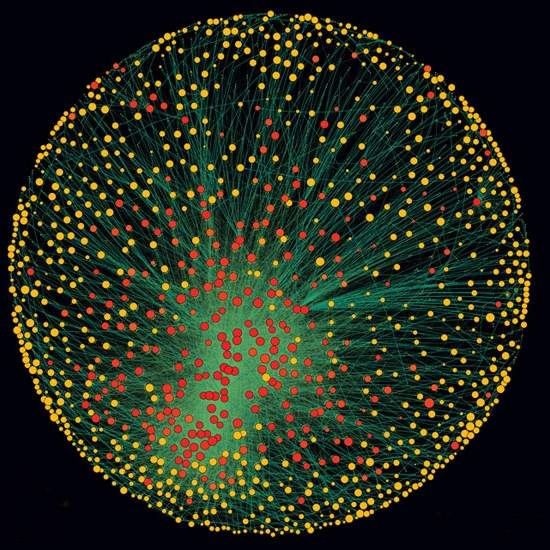
The 1318 transnational corporations that form the core of the economy. Superconnected companies are red, very connected companies are yellow. The size of the dot represents revenue (Image: PLoS One)

AS PROTESTS against financial power sweep the world this week, science may have confirmed the protesters’ worst fears. An analysis of the relationships between 43,000 transnational corporations has identified a relatively small group of companies, mainly banks, with disproportionate power over the global economy.

The study’s assumptions have attracted some criticism, but complex systems analysts contacted by New Scientist say it is a unique effort to untangle control in the global economy. Pushing the analysis further, they say, could help to identify ways of making global capitalism more stable.

The idea that a few bankers control a large chunk of the global economy might not seem like news to New York’s Occupy Wall Street movement and protesters elsewhere (see photo). But the study, by a trio of complex systems theorists at the Swiss Federal Institute of Technology in Zurich, is the first to go beyond ideology to empirically identify such a network of power. It combines the mathematics long used to model natural systems with comprehensive corporate data to map ownership among the world’s transnational corporations (TNCs).

“Reality is so complex, we must move away from dogma, whether it’s conspiracy theories or free-market,” says James Glattfelder. “Our analysis is reality-based.”

Previous studies have found that a few TNCs own large chunks of the world’s economy, but they included only a limited number of companies and omitted indirect ownerships, so could not say how this affected the global economy – whether it made it more or less stable, for instance.

The Zurich team can. From Orbis 2007, a database listing 37 million companies and investors worldwide, they pulled out all 43,060 TNCs and the share ownerships linking them. Then they constructed a model of which companies controlled others through shareholding networks, coupled with each company’s operating revenues, to map the structure of economic power.

The work, to be published in PloS One, revealed a core of 1318 companies with interlocking ownerships (see image). Each of the 1318 had ties to two or more other companies, and on average they were connected to 20. What’s more, although they represented 20 per cent of global operating revenues, the 1318 appeared to collectively own through their shares the majority of the world’s large blue chip and manufacturing firms – the “real” economy – representing a further 60 per cent of global revenues.

When the team further untangled the web of ownership, it found much of it tracked back to a “super-entity” of 147 even more tightly knit companies – all of their ownership was held by other members of the super-entity – that controlled 40 per cent of the total wealth in the network. “In effect, less than 1 per cent of the companies were able to control 40 per cent of the entire network,” says Glattfelder. Most were financial institutions. The top 20 included Barclays Bank, JPMorgan Chase & Co, and The Goldman Sachs Group.

John Driffill of the University of London, a macroeconomics expert, says the value of the analysis is not just to see if a small number of people controls the global economy, but rather its insights into economic stability.

Concentration of power is not good or bad in itself, says the Zurich team, but the core’s tight interconnections could be. As the world learned in 2008, such networks are unstable. “If one [company] suffers distress,” says Glattfelder, “this propagates.”

“It’s disconcerting to see how connected things really are,” agrees George Sugihara of the Scripps Institution of Oceanography in La Jolla, California, a complex systems expert who has advised Deutsche Bank.

Yaneer Bar-Yam, head of the New England Complex Systems Institute (NECSI), warns that the analysis assumes ownership equates to control, which is not always true. Most company shares are held by fund managers who may or may not control what the companies they part-own actually do. The impact of this on the system’s behaviour, he says, requires more analysis.

Crucially, by identifying the architecture of global economic power, the analysis could help make it more stable. By finding the vulnerable aspects of the system, economists can suggest measures to prevent future collapses spreading through the entire economy. Glattfelder says we may need global anti-trust rules, which now exist only at national level, to limit over-connection among TNCs. Bar-Yam says the analysis suggests one possible solution: firms should be taxed for excess interconnectivity to discourage this risk.

One thing won’t chime with some of the protesters’ claims: the super-entity is unlikely to be the intentional result of a conspiracy to rule the world. “Such structures are common in nature,” says Sugihara.

Newcomers to any network connect preferentially to highly connected members. TNCs buy shares in each other for business reasons, not for world domination. If connectedness clusters, so does wealth, says Dan Braha of NECSI: in similar models, money flows towards the most highly connected members. The Zurich study, says Sugihara, “is strong evidence that simple rules governing TNCs give rise spontaneously to highly connected groups”. Or as Braha puts it: “The Occupy Wall Street claim that 1 per cent of people have most of the wealth reflects a logical phase of the self-organising economy.”

So, the super-entity may not result from conspiracy. The real question, says the Zurich team, is whether it can exert concerted political power. Driffill feels 147 is too many to sustain collusion. Braha suspects they will compete in the market but act together on common interests. Resisting changes to the network structure may be one such common interest.

The top 50 of the 147 superconnected companies

1. Barclays plc
2. Capital Group Companies Inc
3. FMR Corporation
4. AXA
5. State Street Corporation
6. JP Morgan Chase & Co
7. Legal & General Group plc
8. Vanguard Group Inc
9. UBS AG
10. Merrill Lynch & Co Inc
11. Wellington Management Co LLP
12. Deutsche Bank AG
13. Franklin Resources Inc
14. Credit Suisse Group
15. Walton Enterprises LLC
16. Bank of New York Mellon Corp
17. Natixis
18. Goldman Sachs Group Inc
19. T Rowe Price Group Inc
20. Legg Mason Inc
21. Morgan Stanley
22. Mitsubishi UFJ Financial Group Inc
23. Northern Trust Corporation
24. Société Générale
25. Bank of America Corporation
26. Lloyds TSB Group plc
27. Invesco plc
28. Allianz SE 29. TIAA
30. Old Mutual Public Limited Company
31. Aviva plc
32. Schroders plc
33. Dodge & Cox
34. Lehman Brothers Holdings Inc*
35. Sun Life Financial Inc
36. Standard Life plc
37. CNCE
38. Nomura Holdings Inc
39. The Depository Trust Company
40. Massachusetts Mutual Life Insurance
41. ING Groep NV
42. Brandes Investment Partners LP
43. Unicredito Italiano SPA
44. Deposit Insurance Corporation of Japan
45. Vereniging Aegon
46. BNP Paribas
47. Affiliated Managers Group Inc
48. Resona Holdings Inc
49. Capital Group International Inc
50. China Petrochemical Group Company

* Lehman still existed in the 2007 dataset used

Graphic: The 1318 transnational corporations that form the core of the economy

(Data: PLoS One)  

Brain Scans Support Findings That IQ Can Rise or Fall Significantly During Adolescence (Science Daily)

ScienceDaily (Oct. 20, 2011) — IQ, the standard measure of intelligence, can increase or fall significantly during our teenage years, according to research funded by the Wellcome Trust, and these changes are associated with changes to the structure of our brains. The findings may have implications for testing and streaming of children during their school years.

Across our lifetime, our intellectual ability is considered to be stable, with intelligence quotient (IQ) scores taken at one point in time used to predict educational achievement and employment prospects later in life. However, in a study published October 20 in the journal Nature, researchers at the Wellcome Trust Centre for Neuroimaging at UCL (University College London) and the Centre for Educational Neuroscience show for the first time that, in fact, our IQ is not constant.

The researchers, led by Professor Cathy Price, tested 33 healthy adolescents in 2004 when they were between the ages of 12 and 16 years. They then repeated the tests four years later when the same subjects were between 15 and 20 years old. On both occasions, the researchers took structural brain scans of the subjects using magnetic resonance imaging (MRI).

Professor Price and colleagues found significant changes in the IQ scores measured in 2008 compared to the 2004 scores. Some subjects had improved their performance relative to people of a similar age by as much as 20 points on the standardised IQ scale; in other cases, however, performance had fallen by a similar amount.

To test whether these changes were meaningful, the researchers analysed the MRI scans to see whether there was a correlation with changes in the structure of the subjects’ brains.

“We found a considerable amount of change in how our subjects performed on the IQ tests in 2008 compared to four years earlier,” explains Sue Ramsden, first author of the study. “Some subjects performed markedly better but some performed considerably worse. We found a clear correlation between this change in performance and changes in the structure of their brains and so can say with some certainty that these changes in IQ are real.”

The researchers measured each subject’s verbal IQ, which includes measurements of language, arithmetic, general knowledge and memory, and their non-verbal IQ, such as identifying the missing elements of a picture or solving visual puzzles. They found a clear correlation with particular regions of the brain.

An increase in verbal IQ score correlated with an increase in the density of grey matter — the nerve cells where the processing takes place — in an area of the left motor cortex of the brain that is activated when articulating speech. Similarly, an increase in non-verbal IQ score correlated with an increase in the density of grey matter in the anterior cerebellum, which is associated with movements of the hand. However, an increase in verbal IQ did not necessarily go hand-in-hand with an increase in non-verbal IQ.

According to Professor Price, a Wellcome Trust Senior Research Fellow, it is not clear why IQ should have changed so much and why some people’s performance improved while others’ declined. It is possible that the differences are due to some of the subjects being early or late developers, but it is equally possible that education had a role in changing IQ, and this has implications for how schoolchildren are assessed.

“We have a tendency to assess children and determine their course of education relatively early in life, but here we have shown that their intelligence is likely to be still developing,” says Professor Price. “We have to be careful not to write off poorer performers at an early stage when in fact their IQ may improve significantly given a few more years.

“It’s analogous to fitness.A teenager who is athletically fit at 14 could be less fit at 18 if they stopped exercising. Conversely, an unfit teenager can become much fitter with exercise.”

Other studies from the Wellcome Trust Centre for Neuroimaging and other research groups have provided strong evidence that the structure of the brain remains ‘plastic’ even throughout adult life. For example, Professor Price showed recently that guerrillas in Columbia who had learned to read as adults had a higher density of grey matter in several areas of the left hemisphere of the brain than those who had not learned to read. Professor Eleanor Maguire, also from the Wellcome Trust Centre, showed that part of a brain structure called the hippocampus, which plays an important part in memory and navigation, has greater volume in licensed London taxi drivers.

“The question is, if our brain structure can change throughout our adult lives, can our IQ also change?” adds Professor Price. “My guess is yes. There is plenty of evidence to suggest that our brains can adapt and their structure changes, even in adulthood.”

“This interesting study highlights how ‘plastic’ the human brain is,” said Dr John Williams, Head of Neuroscience and Mental Health at the Wellcome Trust. “It will be interesting to see whether structural changes as we grow and develop extend beyond IQ to other cognitive functions. This study challenges us to think about these observations and how they may be applied to gain insight into what might happen when individuals succumb to mental health disorders.”

Future-Directed Therapy Helps Depression Patients Cultivate Optimistic Outlook (Science Daily)

ScienceDaily (Oct. 20, 2011) — Patients with major depression do better by learning to create a more positive outlook about the future, rather than by focusing on negative thoughts about their past experiences, researchers at Cedars-Sinai say after developing a new treatment that helps patients do this.

While Major Depressive Disorder patients traditionally undergo cognitive-behavior therapy care that seeks to alter their irrational, negative thoughts about past experiences, patients who were treated with the newly-developed Future-Directed Therapy™ demonstrated significant improvement in depression and anxiety, as well as improvement in overall reported quality of life, the researchers found.

Results were published recently in the peer-reviewed journal CNS Neuroscience & Therapeutics.

“Recent imaging studies show that depressed patients have reduced functioning in the regions of the brain responsible for optimism,” said Jennice Vilhauer, PhD, study author and clinical director of Adult Outpatient Programs for the Cedars-Sinai Department of Psychiatry and Behavioral Neurosciences. “Also, people with depression tend to have fewer skills to help them develop a better future. They have less ability to set goals, problem solve or plan for future events.”

According to the U.S. Centers for Disease Control and Prevention, an estimated one in 10 American adults meet the diagnostic criteria for depression.

Anand Pandya, MD, interim chair of Cedars-Sinai’s Department of Psychiatry and Behavioral Neurosciences, said, “Future-Directed Therapy is designed to reduce depression by teaching people the skills they need to think more positively about the future and take the action required to create positive future experiences. This is the first study that demonstrates this intervention intended to increase positive expectations about the future can reduce symptoms of Major Depressive Disorder.”

When people talk only about the negative aspects of their lives, it causes them to focus more attention on what makes them unhappy, Vilhauer said. “Talking about what makes you unhappy in life doesn’t generate the necessary thinking patterns or action needed to promote a state of thriving and create a more positive future,” Vilhauer said. “Future-Directed Therapy helps people shift their attention constructing visions of what they want more of in the future and it helps them develop the skills that they will need to eventually get there.”

In the study conducted at Cedars-Sinai, 16 adult patients diagnosed with Major Depressive Disorder attended future-directed group therapy sessions led by a licensed psychologist twice a week for 10 weeks. Each week, patients read a chapter from a Future-Directed Therapy manual and completed worksheets aimed at improving certain skills, such as goal-setting. Another group of 17 patients diagnosed with depression underwent standard cognitive group therapy. The study team measured the severity of depression and anxiety symptoms, and quality of life before and after treatment, using the Quick Inventory of Depressive Symptoms, the Beck Anxiety Inventory, and the Quality-of-Life Enjoyment and Satisfaction Questionnaire short form.

Results include:

Patients in the Future-Directed Therapy group experienced on average a 5.4 point reduction in their depressive symptoms on the Quick Inventory of Depressive Symptoms scale, compared to a two point reduction in the cognitive therapy group.

Patients in the Future-Directed Therapy group on average reported a 5.4 point reduction in anxiety symptoms on the Beck Anxiety Inventory, compared to a reduction of 1.7 points in the cognitive therapy group.

Patients in the Future-Directed Therapy group reported on average an 8.4 point improvement in their self-reported quality of life on the Quality of Life Enjoyment and Satisfaction scale, compared to a 1.2 point improvement in the cognitive therapy group.

Number of Facebook Friends Linked to Size of Brain Regions, Study Suggests (Science Daily)

ScienceDaily (Oct. 20, 2011) — Scientists funded by the Wellcome Trust have found a direct link between the number of ‘Facebook friends’ a person has and the size of particular brain regions. Researchers at University College London (UCL) also showed that the more Facebook friends a person has, the more ‘real-world’ friends they are likely to have.

The researchers are keen to stress that they have found a correlation and not a cause, however: in other words, it is not possible from the data to say whether having more Facebook friends makes the regions of the brain larger or whether some people are ‘hardwired’ to have more friends.

The social networking site Facebook has more than 800 million active users worldwide. Nearly 30 million of these are believed to be in the UK.

The site allows people to keep in touch online with a network of friends. The sizes of individual networks vary considerably, and some users have only a handful of online friends while others have over a thousand; however, whether this variability is reflected in the size of real-world social networks has not been clear.

Professor Geraint Rees, a Wellcome Trust Senior Clinical Research Fellow at UCL, said: “Online social networks are massively influential, yet we understand very little about the impact they have on our brains. This has led to a lot of unsupported speculation that the internet is somehow bad for us.

“Our study will help us begin to understand how our interactions with the world are mediated through social networks. This should allow us to start asking intelligent questions about the relationship between the internet and the brain — scientific questions, not political ones.”

Professor Rees and colleagues at the UCL Institute of Cognitive Neuroscience and the Wellcome Trust Centre for Neuroimaging studied brain scans of 125 university students — all active Facebook users — and compared them against the size of the students’ network of friends, both online and in the real world. Their findings, which they replicated in a further group of 40 students, are published October 20 in the journal Proceedings of the Royal Society B.

Professor Rees and colleagues found a strong connection between the number of Facebook friends an individual had and the amount of grey matter (the brain tissue where the processing is done) in several regions of the brain. One of these regions was the amygdala, a region associated with processing memory and emotional responses. A study published recently showed that the volume of grey matter in this area is larger in people with a larger network of real-world friends — the new study shows that the same is true for people with a larger network of online friends.
The size of three other regions — the right superior temporal sulcus, the left middle temporal gyrus and the right entorhinal cortex — also correlated with online social networks but did not appear to correlate with real-world networks.

The superior temporal sulcus has a role in our ability to perceive a moving object as biological, and structural defects in this region have been identified in some children with autism. The entorhinal cortex, meanwhile, has been linked to memory and navigation — including navigating through online social networks. Finally, the middle temporal gyrus has been shown to activate in response to the gaze of others and so is implicated in perception of social cues.

Dr Ryota Kanai, first author of the study, added: “We have found some interesting brain regions that seem to link to the number of friends we have — both ‘real’ and ‘virtual’. The exciting question now is whether these structures change over time — this will help us answer the question of whether the internet is changing our brains.”
As well as examining brain structure, the researchers also examined whether there was a link between the size of a person’s online network of friends and their real-world network. Previous studies have looked at this, but only in relatively small sample sizes.

The UCL researchers asked their volunteers questions such as ‘How many people would send a text message to you marking a celebratory event (e.g. birthday, new job, etc.)?’, ‘What is the total number of friends in your phonebook?’ and ‘How many friends have you kept from school and university that you could have a friendly conversation with now?’ The responses suggest that the size of their online networks also related to the size of their real world networks.

“Our findings support the idea that most Facebook users use the site to support their existing social relationships, maintaining or reinforcing these friendships, rather than just creating networks of entirely new, virtual friends,” adds Professor Rees.

Commenting on the study, Dr John Williams, Head of Neuroscience and Mental Health at the Wellcome Trust, said: “We cannot escape the ubiquity of the internet and its impact on our lives, yet we understand little of its impact on the brain, which we know is plastic and can change over time. This new study illustrates how well-designed investigations can help us begin to understand whether or not our brains are evolving as they adapt to the challenges posed by social media.”

Onças-pintadas ajudam a preservar Caatinga (Valor Econômico)

JC e-mail 4366, de 18 de Outubro de 2011.

Mapear quantas são, como vivem e por onde andam as onças-pintadas da Caatinga permitirá conhecer o efeito da transposição do São Francisco sobre a região.

É bem ali, onde a onça bebe água, que se arma o laço. Em setembro, no auge da seca na Caatinga, foram dez armadilhas na região de Sento Sé, município do norte baiano, às margens do lago de Sobradinho. Cinco pesquisadores, 30 dias, água racionada, nada de luz elétrica, computador ou telefone, e R$ 22 mil de investimento. No fim da expedição, nenhuma onça-pintada ganhou colar com GPS. Mas a frustração dos cientistas dá logo lugar ao planejamento da nova campanha. É nesse compasso que vão perseguindo a criação de uma espécie de “índice-onça de sustentabilidade”, que está relacionado com uma das principais, e mais polêmicas, obras do Programa de Aceleração do Crescimento (PAC), a transposição do rio São Francisco.

Tanto interesse nesse gato hiperbólico – é o maior felino das Américas, o terceiro maior do mundo depois do tigre e do leão, e dono da mordida mais potente entre seus parentes – transcende a biologia. Onça-pintada só vive onde tem água e é predador importante, que regula ecossistemas. Não deixa, por exemplo, a população de capivaras, veados ou ratos explodir. No topo da cadeia alimentar, é uma espécie guarda-chuva. “Protegendo a onça-pintada, está se protegendo todas as outras”, diz o veterinário Ronaldo Gonçalves Morato, 44 anos, um dos poucos especialistas em onças do país das onças.

Na base do estudo está a proposta de se criar, no coração do Semiárido, um corredor de fauna. A tentativa é construir uma área de proteção que leve em conta o potencial econômico da região. Um dos elementos é o Parque Nacional Boqueirão da Onça, em estudo há dez anos. Teria 800 mil hectares e seria a maior unidade de conservação fora da Amazônia. Mas enquanto o governo não resolve se cria ou não o parque, o valor e a grilagem das terras aumentam. Há também o interesse do Ministério das Minas e Energia, que vê na região um bom potencial eólico.

O governo busca consenso para garantir alguma proteção ao terceiro e mais castigado bioma brasileiro. Menos de 2% da Caatinga é área protegida. Mais de 45% da vegetação foi desmatada e a região sofre desertificação. “Temos a visão de que a Caatinga é pobre e pronto. Mas existem paisagens fantásticas e recursos naturais mal aproveitados”, diz Morato. “Explorar a Caatinga com um bom programa turístico, seria bem interessante.”

A diversidade biológica é rica, mesmo com escassez de água. Há centenas de espécies de pássaros, répteis e anfíbios. As paisagens são belas e variadas, há pinturas rupestres e frutas que dão doces exóticos. Na seca, a vegetação fica sem folhas, para gastar menos energia. “O pessoal chama esse cenário de mata branca. É só chover que, três dias depois, está tudo verde. É maravilhoso”, encanta-se Morato.

O parque, que não sai do papel, tomaria 45% do município de Sento Sé, região bem pouco povoada de gente e talvez bem povoada por onças. A pintada, que se espalhava pela Caatinga nos tempos de Lampião, hoje está restrita a 25% do bioma. Os pesquisadores acreditam que existam cinco grandes populações de onças-pintadas no Semiárido, um ou dois animais a cada 100 km2 – em Cáceres, no Pantanal, a densidade é bem mais alta, média de sete onças a cada 100 km2. As estimativas falam em 300 a 400 animais na Caatinga.

Mapear, com alguma precisão, quantas são, como vivem e por onde andam as onças-pintadas do sertão nordestino é ter um indicador ambiental para saber, depois, o quanto a transposição do São Francisco afetou a região. Se as onças-pintadas continuarem por lá depois da obra, é sinal positivo. O projeto faz parte do Programa de Revitalização da Bacia do São Francisco, coordenado pelo Ministério do Meio Ambiente em parceria com o da Integração Regional. Também conseguiu recursos na BM&F Bovespa. Onças, principalmente as pintadas, são animais glamourosos.

A majestade da espécie-símbolo da fauna brasileira, impressa nas cédulas de R$ 50, é inversamente proporcional ao que se conhece sobre o animal. “Nem sabemos o quanto uma onça-pintada vive”, diz Morato. “A cada pergunta que respondemos, surge uma nova.” Ele começou a carreira fazendo estágio no zoológico de Sorocaba, em São Paulo, o suficiente para perceber que queria mesmo era estudar animais em vida livre.

Morato trabalha com onças há 20 anos, há seis é o coordenador do Centro Nacional de Pesquisa e Conservação de Mamíferos Carnívoros (Cenap), instituto que estuda uma lista de 26 espécies – de lobos-guará a ariranhas. Só de felinos são oito espécies, entre onças pintadas e pardas, jaguatiricas e gatos-do-mato. Dá para ver da estrada o painel gigante de uma onça-pintada nos vidros da sede do Cenap, em Atibaia. O centro foi criado há 17 anos e é um braço do Instituto Chico Mendes de Conservação da Biodiversidade (ICMBio).

Os investimentos no projeto Ecologia e Conservação da Onça-Pintada no Médio São Francisco, ou simplesmente Onças da Caatinga, é de R$ 800 mil em quatro anos. A primeira campanha de captura para colocação do colar foi em 2010, e também não teve êxito. Não é fácil pegar um bicho desses. Os laços de aço são montados perto das áreas que elas costumam frequentar. “A gente identifica os pontos onde as onças passam, e deixamos os laços. Mas às vezes elas andam ao lado do laço e a gente só vê os rastros no dia seguinte. É difícil.”

Difícil é pouco. Para um mês de acampamento em setembro, levaram 300 litros de água por pessoa. Não há estradas, carro não chega, as pedras cortam os pneus. Equipamentos e água são levados a pé. Banho, só de caneca.

Quando dá sorte e a onça cai no laço, os pesquisadores lançam o dardo anestésico e começam a medir o animal: peso, tamanho, tamanho da pata, análise dos dentes. É a hora de colocar o colar com telemetria que pesa 800 gramas e tem um GPS instalado em uma caixinha, na parte da frente. Cada animal tem frequência própria. Depois, programam de quanto em quanto tempo o pesquisador receberá as informações por onde anda a onça – de duas em duas horas, por exemplo. Uma vez por semana, os dados são enviados ao e-mail do cientista pela empresa que administra o satélite. O colar pode ser programado para cair do pescoço depois de determinado período, e ser recolhido. “Fica, por exemplo, 400 dias na onça, e aí cai”, explica Morato.

“A tecnologia favoreceu muito o nosso trabalho”, diz ele. O avanço tecnológico tem seu preço, nada disso é barato. O Cenap usa colares da suíça Televilt, cada um a US$ 3.800. O contrato anual do satélite são outros US$ 1.200 por colar. Hoje existem 40 equipamentos do gênero em onças-pintadas no Brasil. Ao recolher várias informações sobre o comportamento do animal – desde como e para onde se desloca, quais ambientes procura, como se alimenta – os cientistas desenham o tamanho da “área de vida” da onça. “Vou vislumbrando o ambiente que posso sugerir para preservação”, explica Morato.

O “Onças na Caatinga” levantou recursos na BVS&A, portal da Bovespa que lista projetos sociais e ambientais. “Quem tiver interesse pode entrar lá, escolher o que acha interessante, e doar”, diz Sonia Favaretto, diretora de sustentabilidade da Bolsa. A iniciativa resultou em R$ 150 mil em dois anos. O Cenap trabalhou em parceria com a ONG Pró-Carnívoros, que ajuda a viabilizar os projetos de pesquisa.

O papel de regulador ecológico da onça-pintada não é o único. “Com a perda de espécies, perdem-se ambientes, ficamos mais expostos a catástrofes”, aponta Morato. A redução de predadores representa aumento das presas e mais pressão sobre a vegetação. “Isso, a longo prazo, diminui o estoque de carbono”, lembra. Morato defende que é preciso refletir sobre o valor econômico das onças-pintadas e o apelo turístico que representam.

Archaeologists Find Sophisticated Blade Production Much Earlier Than Originally Thought (Tel Aviv University)

Monday, October 17, 2011
American Friends of Tel Aviv University

Blade manufacturing “production lines” existed as much as 400,000 years ago, say TAU researchers

Archaeology has long associated advanced blade production with the Upper Palaeolithic period, about 30,000-40,000 years ago, linked with the emergence of Homo Sapiens and cultural features such as cave art. Now researchers at Tel Aviv University have uncovered evidence which shows that “modern” blade production was also an element of Amudian industry during the late Lower Paleolithic period, 200,000-400,000 years ago as part of the Acheulo-Yabrudian cultural complex, a geographically limited group of hominins who lived in modern-day Israel, Lebanon, Syria and Jordan.

Prof. Avi Gopher, Dr. Ran Barkai and Dr. Ron Shimelmitz of TAU’s Department of Archaeology and Ancient Near Eastern Civilizations say that large numbers of long, slender cutting tools were discovered at Qesem Cave, located outside of Tel Aviv, Israel. This discovery challenges the notion that blade production is exclusively linked with recent modern humans.

The blades, which were described recently in the Journal of Human Evolution, are the product of a well planned “production line,” says Dr. Barkai. Every element of the blades, from the choice of raw material to the production method itself, points to a sophisticated tool production system to rival the blade technology used hundreds of thousands of years later.

An innovative product

Though blades have been found in earlier archaeological sites in Africa, Dr. Barkai and Prof. Gopher say that the blades found in Qesem Cave distinguish themselves through the sophistication of the technology used for manufacturing and mass production.

Evidence suggests that the process began with the careful selection of raw materials. The hominins collected raw material from the surface or quarried it from underground, seeking specific pieces of flint that would best fit their blade making technology, explains Dr. Barkai. With the right blocks of material, they were able to use a systematic and efficient method to produce the desired blades, which involved powerful and controlled blows that took into account the mechanics of stone fracture. Most of the blades of were made to have one sharp cutting edge and one naturally dull edge so it could be easily gripped in a human hand.

This is perhaps the first time that such technology was standardized, notes Prof. Gopher, who points out that the blades were produced with relatively small amounts of waste materials. This systematic industry enabled the inhabitants of the cave to produce tools, normally considered costly in raw material and time, with relative ease.

Thousands of these blades have been discovered at the site. “Because they could be produced so efficiently, they were almost used as expendable items,” he says.

Prof. Cristina Lemorini from Sapienza University of Rome conducted a closer analysis of markings on the blades under a microscope and conducted a series of experiments determining that the tools were primarily used for butchering.

Modern tools a part of modern behaviors

According to the researchers, this innovative industry and technology is one of a score of new behaviors exhibited by the inhabitants of Qesem Cave. “There is clear evidence of daily and habitual use of fire, which is news to archaeologists,” says Dr. Barkai. Previously, it was unknown if the Amudian culture made use of fire, and to what extent. There is also evidence of a division of space within the cave, he notes. The cave inhabitants used each space in a regular manner, conducting specific tasks in predetermined places. Hunted prey, for instance, was taken to an appointed area to be butchered, barbequed and later shared within the group, while the animal hide was processed elsewhere.

Risco é coisa séria (JC)

JC e-mail 4364, de 14 de Outubro de 2011.

Artigo de Francisco G. Nóbrega enviado ao JC Email pelo autor.

A sociedade moderna está banhada em comunicação. Como “boa notícia não é notícia”, a lente psicológica humana registra sempre um cenário pior que a realidade. A percepção usual é que os riscos de todos os tipos aumentam dia a dia. A redução global da violência, por exemplo, é tema do livro recente do psicólogo da Universidade Harvard, Steven Pinker (http://www.samharris.org/blog/item/qa-with-steven-pinker). Ao arrepio do senso comum, ele demonstra, objetivamente, que estamos progredindo neste quesito.

Mas nossa mente não descança em sua aguda capacidade de detectar outras fontes de risco. Temos alguns campeões de audiência: energia nuclear para eletricidade, alimentos geneticamente modificados e aquecimento global catastrófico e antropogênico. O dano potencial das três ameaças mencionadas, objetivamente, não se concretizou de maneira alguma, embora a terceira ameaça deva se realizar no futuro, segundo seus defensores. As pessoas se encantam com o automóvel e seus acessórios, cada vez mais atraentes. Não se pensa em baní-lo, apesar de resultar em cerca de 40.000 mortos e inúmeros incapacitados cada ano, só no Brasil. David Ropeik, que pertence ao Centro Harvard para Análise de Risco, explica como facilmente se distorce o perigo real de situações. Quanto mais afastadas do senso comum (como radiação e plantas geneticamente modificadas), mais facilmente são manipuladas, por ignorância ou interesses outros, apavorando o cidadão comum. Ropeik explica como este medo sem sentido passa a ser um fator de estresse e um risco objetivo para a saúde das pessoas, devendo ser evitado.

Dentro desse universo, são justificadas as preocupações do Dr. Ferraz (“O feijão nosso de cada dia”, Jornal da Ciência, 6/10/2011). Ele é membro da CTNBio, atua na setorial vegetal/ambiental e sua área de concentração é em agroecologia, o que explica, pelo menos em parte, suas dúvidas. No entanto essas preocupações não têm a consistência sugerida pelo autor e a análise da CTNBio, que resultou na aprovação deste feijão, é confiável.

A comissão se pauta sempre pelas diretivas da legislação que são amplas, para dar conta de todas as possibilidades de risco para os consumidores e meio ambiente. No entanto o corpo técnico existe exatamente para atuar de maneira seletiva e consciente, examinando caso a caso. Os testes são examinadas com o rigor que a modificação introduzida na planta exige para plena segurança. Se as modificações são consideradas sem qualquer risco significativo, os testes são avaliados à luz deste fato.

Testes com muitos animais, altamente confiáveis estatisticamente, seriam exigidos pela comissão na eventualidade de uma planta transgênica produzir, por exemplo, uma molécula pesticida não protéica que seria em tudo semelhante a uma droga produzida pela indústria farmacêutica. Isto poderá acontecer em certo momento, já que as plantas têm capacidade de produzir os mais variados pesticidas naturais para se defenderem na natureza. A substância seria absorvida no intestino e se disseminaria por órgãos e tecidos, possivelmente exercendo efeitos sistêmicos e localizados que exigem avaliação. Isso já aconteceu, sem querer, com uma batata produzida por melhoramento convencional nos EUA. Seu consumo levou a mal estar e foi recolhida apressadamente: portava altos níveis de glicoalcalóides tóxicos para o homem, o que explicava sua excelente resistência às pragas da cultura.

No caso do feijão Embrapa, nenhuma molécula não protéica nova é produzida e o pequeno RNA que interfere com a replicação do vírus, caso alguém venha a ingerir folhas e caules, será um entre centenas ou milhares de RNAs que ingerimos diariamente com qualquer produto vegetal. O RNA introduzido, no entanto, não foi detectado no grão do feijão cozido, usando técnicas extremamente poderosas.

As variações detectadas, se estatisticamente significativas (concentração de vitamina B2 ou cisteína por exemplo) não representam risco algum. A técnica clássica de cultura de tecidos, usada para gerar variedades de qualidade em horticultura e propagação de árvores, reconhecidamente resulta em variações naturais que introduzem certas modificações desejáveis e algumas indesejáveis, que o melhorista depois seleciona. É a variação somaclonal, que também afeta os clones geneticamente modificados na sua fase de seleção.

Portanto, é no mínimo ingênuo dizer que o feijão Embrapa 5.1 “deveria ser idêntico” a variedade de origem pois as manipulações necessárias para gerar o transgênico resultam em certas alterações que, se irrelevantes, são ignoradas e se deletérias são descartadas pelos cientistas. Se fizermos as mesmas análises, cujos resultados preocupam alguns, com as muitas variedades convencionais consumidas no país, as diferenças serão impressionantes e irrelevantes para a questão “segurança”.

Como já foi comentado anteriormente, não existe base factual (bioquímica ou genética) para imaginar que o feijão Embrapa apresente risco maior do que um feijão comum ou melhorado por mutagênese química ou física, que por sinal, não é supervisionado nutricional e molecularmente antes de sua comercialização. Sem base biológica, os testes tornam-se formalidades supérfluas e o ruído experimental, principalmente com amostras pequenas, quase inevitavelmente vai gerar resultados que são irrelavantes a menos que se amplie muito o número de animais (para amostras controle e transgênicas) além de ser prudente incluir animais alimentados com outros feijões convencionais para uma idéia realista do significado das variações detectadas. Imaginem o custo dessa busca “caça fantasma”, desencadeada simplesmente devido a uma aplicação pouco esclarecida do princípio da precaução. As preocupações sem base racional, levantadas a todo momento pelos que temem a tecnologia, se aplicariam com maior lógica aos produtos convencionais.

Caso isso aconteça, do dia para a noite estaria inviabilizada a produção agrícola do planeta. Por que não fazer estudos com Rhizobium e nodulação em todos os feijões comercializados? Por que não conduzir estudos nutricionais de longo prazo com os alimentos convencionais derivados de mutagênese? Qual a razão lógica que exclui essas preocupações com as plantas convencionais? Ou a razão seria metafísica? A alteração introduzida seria “contra a natureza”, algo como o pecado original, que, em muitas interpretações, consistiu apenas em comer o fruto da “árvore do conhecimento”? Recentemente 41 cientistas suecos da área vegetal lançaram um manifesto contra a sobre-regulação da genética moderna na Europa (reproduzido no blog GenPeace: genpeace.blogspot.com). Os autores observam que, fazendo um paralelo com as exigências para os produtos farmacêuticos, a “lógica da legislação atual sugere que apenas drogas produzidas por meio de engenharia genética deveriam ser avaliadas quando a efeitos indesejáveis”.

Instilar o medo com base em suposições não ajuda a proteger a população ou o meio ambiente. Marie Curie teria dito “Na vida nada deve ser temido. Mas tudo deve ser compreendido”. Considero irresponsável usar o “princípio da precaução” como alguns o fazem. Inclusive a OMS caiu nesta armadilha, classificando os telefones celulares no grupo 2B de risco para causar câncer. A radiação destes equipamentos é cerca de um milhão de vezes inferior à energia que pode produzir radicais livres e gerar dano ao DNA. A classe 2B inclui o risco de câncer relativo ao café, resíduos da queima de combustíveis fósseis e uso de dentadura…. O que a WHO manteve viva, irresponsavelmente, é a justificativa para a dúvida, que vai legitimar pesquisas caras e irrelevantes, cujo resultado será inconclusivo, como o mega estudo anterior. Incrivelmente mais perigoso é o uso do celular enquanto se dirige.

Francisco G. da Nóbrega é professor da Universidade de São Paulo (USP).

Medida da discórdia (quântica) (Fapesp)

Pesquisadores brasileiros medem diretamente pela primeira vez propriedade que pode se mostrar muito importante para o desenvolvimento da computação quântica (montagem:Ag.FAPESP)

14/10/2011

Por Elton Alisson

Agência FAPESP – A fragilidade das propriedades quânticas, que desaparecem devido à interação com o meio ambiente, a temperatura finita ou em corpos macroscópicos, representa um dos maiores obstáculos para o desenvolvimento dos desejados computadores quânticos, máquinas ultravelozes que seriam capazes de realizar simultaneamente e, em questão de segundos, operações que os computadores convencionais demorariam bilhões de anos para efetuar.

Um grupo de físicos brasileiros mediu experimentalmente de forma direta, pela primeira vez, uma propriedade que pode ser útil para o desenvolvimento da computação quântica.

Derivados do projeto “Informação quântica e decoerência”, apoiado pela FAPESP por meio do Programa Jovens Pesquisadores em Centros Emergentes, os resultados dos experimentos foram publicados em 30 de setembro na Physical Review Letters.

Em 9 de agosto, o grupo havia publicado na mesma revista um artigo em que descreveram como conseguiram medir a chamada discórdia quântica à temperatura ambiente.

Introduzido em 2001, o conceito de discórdia quântica indica a correlação não clássica entre duas entidades, como núcleos, elétrons, spins e fótons, que implica em características que não podem ser observadas em sistemas clássicos.

Até então se acreditava que essa grandeza quântica só poderia ser medida em sistemas muito bem controlados ou a baixíssimas temperaturas e isolados do meio ambiente, uma vez que qualquer interferência seria capaz de destruir a ligação entre os objetos quânticos, que era atribuída unicamente a um fenômeno físico chamado emaranhamento – o que dificultaria a concepção de um computador quântico.

“Entretanto, medimos experimentalmente essa correlação (discórdia) quântica e demonstramos que ela está presente onde não se esperava e que esse fenômeno pode ser explorado mesmo à temperatura ambiente, em situações em que há muito ruído térmico”, disse Roberto Menezes Serra, professor da Universidade Federal do ABC (UFABC) e coordenador do projeto, à Agência FAPESP.

Para medir a discórdia quântica, os pesquisadores trabalharam com uma molécula de clorofórmio, que possui um átomo de carbono, um de hidrogênio, e três de cloro.

Utilizando técnicas de ressonância magnética nuclear, eles codificaram um bit quântico no spin do núcleo do hidrogênio e outro no de carbono, em um cenário em que eles não estavam emaranhados, e demonstraram que é possível medir as correlações quânticas entre os dois spins nucleares.

Por intermédio do experimento, desenvolveram um método prático para medir correlações quânticas (a discórdia quântica) através de uma grandeza física, denominada “testemunha ocular”, que permite a observação direta do caráter quântico da correlação de um sistema. “Isso demonstrou de forma inequívoca a natureza quântica dos testes de princípios realizados em ressonância magnética nuclear à temperatura ambiente. Esses resultados podem abrir caminho para outras aplicações em informação quântica à temperatura embiente”, disse Serra.

No trabalho publicado no novo artigo, os pesquisadores brasileiros mediram outro fenômeno que haviam previsto, denominado mudança súbita de comportamento da discórdia quântica.

O efeito descreve a alteração de comportamento da discórdia quântica quando o sistema físico em que ela está presente entra em contato com o meio ambiente, causando uma perda de coerência do sistema (um fenômeno conhecido como decoerência). Nessa situação, a discórdia quântica pode permanecer constante e insensível ao ruído térmico durante um determinado tempo e, depois, começar a decair.

“Conhecer as sutilezas do comportamento dinâmico desse sistema é importante porque, se utilizarmos a discórdia quântica para obter alguma vantagem em algum processo, como de metrologia ou de processamento de informação, precisamos saber o quão robusto esse aspecto quântico é em relação a essa perda de coerência para conhecer por quanto tempo o dispositivo pode funcionar bem e quais erros devem ser corrigidos”, explicou Serra.

Referência mundial

Até há alguns anos, os cientistas achavam que o emaranhamento fosse uma propriedade essencial para obtenção de ganhos em um sistema quântico, como a maior capacidade para a troca de informações entre objetos quânticos. Recentemente, descobriu-se que essa propriedade não é necessariamente fundamental para a vantagem quântica em processamento de informação, porque há protocolos em que a vantagem quântica é obtida em sistemas não emaranhados. Dessa forma, conjectura-se que a discórdia quântica é que poderia estar associada às vantagens de um sistema quântico .

Em função disso, tanto a discórdia como o emaranhamento passaram a ser reconhecidos como úteis para a realização de tarefas em um computador quântico. No entanto, sistemas não emaranhados dotados de discórdia teriam a vantagem de ser mais robustos à ação do meio externo, uma vez que o emaranhamento pode desaparecer subitamente, em um fenômeno chamado “morte súbita”.

“Nosso maior interesse, no momento, é avançar na compreensão da origem da vantagem dos computadores quânticos. Se soubermos isso, poderemos construir dispositivos mais eficientes, consumindo menos recursos para controlar sua coerência”, disse Serra.

De acordo com o pesquisador, o grupo de físicos brasileiros foi o primeiro a utilizar técnicas de ressonância magnética nuclear para medir a discórdia quântica de forma direta e se tornou referência mundial na área.

Para realizar as medições, o grupo de pesquisadores da UFABC se associou inicialmente ao grupo liderado pelo professor Tito José Bonagamba, do Instituto de Física da Universidade de São Paulo (USP), campus de São Carlos, que coordenou os primeiros experimentos por meio do projeto“Manipulação de spins nucleares através de técnicas de ressonância magnética e quadrupolar nuclear”, também realizado com apoio da FAPESP.

Os experimentos mais recentes foram realizados por meio de uma colaboração entre os pesquisadores da UFABC e da USP de São Carlos com um grupo de pesquisa do Centro Brasileiro de Pesquisas Físicas (CBPF), no Rio de Janeiro, liderado pelo professor Ivan Oliveira. Os pesquisadores também contaram com o apoio do Instituto Nacional de Ciência e Tecnologia de Informação Quântica (INCT-IQ).

“Nesse momento, estão sendo desenvolvidos no CBPF métodos para lidar com sistemas de três e quatro bits quânticos que, associados às técnicas que desenvolvemos para medir a discórdia quântica e outras propriedades, permitirão testarmos protocolos mais complexos em ciência da informação quântica como, por exemplo, de metrologia e de máquinas térmicas quânticas”, contou Serra.

Os artigos Experimentally Witnessing the Quantumness of Correlations e Environment-Induced Sudden Transition in Quantum Discord Dynamics, de Serra e outros (doi: 10.1103/PhysRevLett.107.070501 e 10.1103/PhysRevLett.107.140403), ), publicados naPhysical Review Letters, podem ser lidos emlink.aps.org/doi/10.1103/PhysRevLett.107.070501 elink.aps.org/doi/10.1103/PhysRevLett.107.140403.

MP3 Players ‘Shrink’ Our Personal Space (Science Daily)

Science Daily (Oct. 12, 2011) — How close could a stranger come to you before you start feeling uncomfortable? Usually, people start feeling uneasy when unfamiliar people come within an arm’s reach. But take the subway (underground rail) during rush hour and you have no choice but to get up close and personal with complete strangers.

Researchers at Royal Holloway, University of London wanted to find out whether there is a way to make this intrusion more tolerable. Their results, published in the journal PLoS One, reveal that listening to music through headphones can change people’s margins of personal space.

Dr Manos Tsakiris, from the Department of Psychology at Royal Holloway, said: “This distance we try to maintain between ourselves and others is a comfort zone surrounding our bodies. Everyone knows where the boundaries of their personal space are even though they may not consciously dictate them. Of course personal space can be modified for example in a number of relationships including family members and romantic partners, but on a busy tube or bus you can find complete strangers encroaching in this space.”

The study, led by Dr Tsakiris and Dr Ana Tajadura-Jiménez from Royal Holloway, involved asking volunteers to listen to positive or negative emotion-inducing music through headphones or through speakers. At the same time, a stranger started walking towards them and the participants were asked to say “stop” when they started feeling uncomfortable.

The results showed that when participants were listening to music that evoked positive emotions through headphones, they let the stranger come closer to them, indicating a change in their own personal space. Dr Tajadura-Jiménez explains: “Listening to music that induces positive emotions delivered through headphones shifts the margins of personal space. Our personal space “shrinks,” allowing others to get closer to us.”

Dr Tsakiris added: “So next time you are ready to board a packed train, turn on your mp3 player and let others come close to you without fear of feeling invaded.”