Arquivo da tag: Discriminação

Is Some Homophobia Self-Phobia? (Science Daily)

ScienceDaily (Apr. 6, 2012) — Homophobia is more pronounced in individuals with an unacknowledged attraction to the same sex and who grew up with authoritarian parents who forbade such desires, a series of psychology studies demonstrates.

The study is the first to document the role that both parenting and sexual orientation play in the formation of intense and visceral fear of homosexuals, including self-reported homophobic attitudes, discriminatory bias, implicit hostility towards gays, and endorsement of anti-gay policies. Conducted by a team from the University of Rochester, the University of Essex, England, and the University of California in Santa Barbara, the research will be published the April issue of the Journal of Personality and Social Psychology.

“Individuals who identify as straight but in psychological tests show a strong attraction to the same sex may be threatened by gays and lesbians because homosexuals remind them of similar tendencies within themselves,” explains Netta Weinstein, a lecturer at the University of Essex and the study’s lead author.

“In many cases these are people who are at war with themselves and they are turning this internal conflict outward,” adds co-author Richard Ryan, professor of psychology at the University of Rochester who helped direct the research.

The paper includes four separate experiments, conducted in the United States and Germany, with each study involving an average of 160 college students. The findings provide new empirical evidence to support the psychoanalytic theory that the fear, anxiety, and aversion that some seemingly heterosexual people hold toward gays and lesbians can grow out of their own repressed same-sex desires, Ryan says. The results also support the more modern self-determination theory, developed by Ryan and Edward Deci at the University of Rochester, which links controlling parenting to poorer self-acceptance and difficulty valuing oneself unconditionally.

The findings may help to explain the personal dynamics behind some bullying and hate crimes directed at gays and lesbians, the authors argue. Media coverage of gay-related hate crimes suggests that attackers often perceive some level of threat from homosexuals. People in denial about their sexual orientation may lash out because gay targets threaten and bring this internal conflict to the forefront, the authors write.

The research also sheds light on high profile cases in which anti-gay public figures are caught engaging in same-sex sexual acts. The authors cite such examples as Ted Haggard, the evangelical preacher who opposed gay marriage but was exposed in a gay sex scandal in 2006, and Glenn Murphy, Jr., former chairman of the Young Republican National Federation and vocal opponent of gay marriage, who was accused of sexually assaulting a 22-year-old man in 2007, as potentially reflecting this dynamic.

“We laugh at or make fun of such blatant hypocrisy, but in a real way, these people may often themselves be victims of repression and experience exaggerated feelings of threat,” says Ryan. “Homophobia is not a laughing matter. It can sometimes have tragic consequences,” Ryan says, pointing to cases such as the 1998 murder of Matthew Shepard or the 2011 shooting of Larry King.

To explore participants’ explicit and implicit sexual attraction, the researchers measured the discrepancies between what people say about their sexual orientation and how they react during a split-second timed task. Students were shown words and pictures on a computer screen and asked to put these in “gay” or “straight” categories. Before each of the 50 trials, participants were subliminally primed with either the word “me” or “others” flashed on the screen for 35 milliseconds. They were then shown the words “gay,” “straight,” “homosexual,” and “heterosexual” as well as pictures of straight and gay couples, and the computer tracked precisely their response times. A faster association of “me” with “gay” and a slower association of “me” with “straight” indicated an implicit gay orientation.

A second experiment, in which subjects were free to browse same-sex or opposite-sex photos, provided an additional measure of implicit sexual attraction.

Through a series of questionnaires, participants also reported on the type of parenting they experienced growing up, from authoritarian to democratic. Students were asked to agree or disagree with statements like: “I felt controlled and pressured in certain ways,” and “I felt free to be who I am.” For gauging the level of homophobia in a household, subjects responded to items like: “It would be upsetting for my mom to find out she was alone with a lesbian” or “My dad avoids gay men whenever possible.”

Finally, the researcher measured participants’ level of homophobia — both overt, as expressed in questionnaires on social policy and beliefs, and implicit, as revealed in word-completion tasks. In the latter, students wrote down the first three words that came to mind, for example for the prompt “k i _ _.” The study tracked the increase in the amount of aggressive words elicited after subliminally priming subjects with the word “gay” for 35 milliseconds.

Across all the studies, participants with supportive and accepting parents were more in touch with their implicit sexual orientation, while participants from authoritarian homes revealed the most discrepancy between explicit and implicit attraction.

“In a predominately heterosexual society, ‘know thyself’ can be a challenge for many gay individuals. But in controlling and homophobic homes, embracing a minority sexual orientation can be terrifying,” explains Weinstein. These individuals risk losing the love and approval of their parents if they admit to same sex attractions, so many people deny or repress that part of themselves, she said.

In addition, participants who reported themselves to be more heterosexual than their performance on the reaction time task indicated were most likely to react with hostility to gay others, the studies showed. That incongruence between implicit and explicit measures of sexual orientation predicted a variety of homophobic behaviors, including self-reported anti-gay attitudes, implicit hostility towards gays, endorsement of anti-gay policies, and discriminatory bias such as the assignment of harsher punishments for homosexuals, the authors conclude.

“This study shows that if you are feeling that kind of visceral reaction to an out-group, ask yourself, ‘Why?'” says Ryan. “Those intense emotions should serve as a call to self-reflection.”

The study had several limitations, the authors write. All participants were college students, so it may be helpful in future research to test these effects in younger adolescents still living at home and in older adults who have had more time to establish lives independent of their parents and to look at attitudes as they change over time.

Other contributors to the paper include Cody DeHaan, Andrew Przybylski, and Nicole Legate, all from the University of Rochester, and William Ryan, from the University of California in Santa Barbara.

Man on ‘Jeopardy’ penalized for mispronouncing Wimbledon (Yahoo Sports)

By Chris Chase | Busted Racquet – Tue, Mar 13, 2012 12:56 PM EDT

(Jeopardy)

It happens every June like a rite of summer. Uppity British journalists and/or American tennis fans scoff when the less sophisticated among us butcher the name of the most hallowed event in the sport.

“Wimbledon,” they say, affecting a slight British accent, even if they’re from Parsippany. Each syllable is quick, but distinct. The first three letters are accentuated. “Whim.” The middle three are softly pushed from your lips. “Bull.” For the final syllable, you move your tongue to the roof of your mouth. “Din.”

WHim-bull-din.

A Nebraska man found out the particulars of the pronunciation on Monday’s episode of “Jeopardy.” Reid Rodgers correctly answered a question (or questioned an answer) about the first women’s champion at an 1884 tennis tournament. “WimbleTIN,” he said, with a distinct hint of Midwestern twang.

Even after being exposed to the syllable police for years, I didn’t notice the verbal faux pas. Neither did Alex Trebek. He awarded Rodgers his $400 and moved to the next question.

A moment later, before Rodgers was set to receive a Daily Double answer, Trebek issued a ruling.

“I’m informed that you very clearly said Wimble-TON not Wimble-DIN a few moments ago,” Trebek told him.

Rodgers’ money was taken away and the railroad mechanic had money deducted for the incorrect answer. His total went from $1,000 to $200.

Alright, first off, he didn’t say “Wimble-TON.” He said “Wimble-TIN,” Trebek. Neither is right, but the least you could have done with accurately quote his mistake. (Leave it to Trebek to smarmily add that “very clearly.” If it was so clear, why didn’t you hear it first, bub?)

Second of all, COME ON! We all know what Rodgers was trying to say. He knew the answer. Is it his fault that he was born an American and, thus, a brutish rogue who doesn’t appreciate the King’s English?

“Dialectical bias,” CBS Sports blogger Will Brinson wrote on Twitter.

Like Alex Trebek should talk. Just last week he was sputtering out umlauts like a college kid in Intro to German.

We feel for you, Reid Rodgers. And don’t worry about your lack of tennis pronunciation. Bud Collins has been involved with the sport for 60 years and still can’t say “Navratilova.”

Canibais? Nós? Imagine! (Revista Geo)

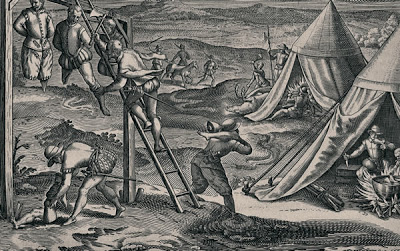
Canibais viveram na América do Sul ou na Nova Guiné – mas com certeza não na Europa! Que engano! Ainda no século 19, a antropofagia era praticada em Berlim ou Paris; embora não de forma tão grotesca como na gravura (à esquerda). Na Europa, partes do corpo humano eram consumidas por razões médicas…

Por Andreas Weiser

Edição 31 – 2011

No dia em que fui preso ainda navegávamos a cerca de sete milhas de distância de Bertioga, quando os selvagens tomaram o rumo de uma ilha. Eles puxaram as canoas para a terra e depois me arrastaram para fora. Eu não conseguia ver nada de tão machucado que estava meu rosto. Também não conseguia andar por causa da lesão na minha perna; portanto, fiquei caído na areia. Os selvagens me cercaram e indicaram com gestos ameaçadores que pretendiam me devorar.”

Hans Staden é o nome do infeliz tão gravemente ferido, caído em uma praia no litoral brasileiro naquela ensolarada tarde de dezembro de 1553. Ele é um “lansquenê” (do alemão Landsknecht, soldado mercenário alemão). Staden era procedente da região do atual estado de Hesse, na Alemanha, mas estava a serviço dos colonialistas portugueses comandando uma pequena fortificação não muito distante da atual cidade de São Paulo.

Levianamente, ele havia se afastado demais da área protegida pelo forte, caindo nas mãos dos índios tupinambá, que estavam em pé de guerra com os portugueses. Prisioneiros inimigos costumavam ser escravizados pelos índios litorâneos – ou eram devorados. “Quando nos aproximamos da aldeia chamada Ubatuba, vi sete cabanas. Perto da praia na qual eles tinham largado suas canoas havia mulheres trabalhando na roça… Fui forçado a lhes gritar de longe em sua língua Aju ne xe remiurama, que quer dizer: ‘Eu, vossa comida, estou chegando’.”

O lansquenê não estava destinado ao consumo imediato. Os tupinambá o reservariam para ser devorado durante uma festividade. Staden permaneceu em cativeiro durante nove meses.

Durante esse tempo ele foi obrigado a assistir como os índios matavam e comiam outros prisioneiros. Em seus diários, o alemão descreve o ritual nos mínimos detalhes – e de uma forma tão distante que é como se o medo de logo chegar a sua vez o tivesse feito sair de si mesmo e se transformado em um observador imparcial.
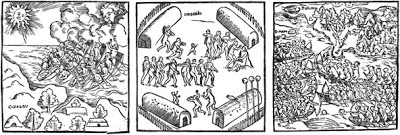
Uma crônica do século 16 ilustra como o lansquenê (do alemão Landsknecht, soldado mercenário alemão que, nos séculos 15 e 16 servia sob o comando de oficiais de sua nacionalidade) Hans Staden cai nas mãos dos “nus comedores de gente”

“Eles fazem borlas de plumas para a clava com o qual matam o prisioneiro”, escreveu o lansquenê. “Quando tudo está preparado, eles determinam o dia em que o infeliz morrerá e convidam índios de outras aldeias para essa celebração.”

Depois disso, o drama na mata Atlântica se aproxima de seu clímax: “Por fim, um dos homens pega a clava, se posiciona diante do prisioneiro e lhe mostra a arma de tal modo que a vítima é obrigada a olhar para ela. Enquanto isso, o índio que matará o prisioneiro sai em companhia de outros 13 ou 14. Eles pintam os corpos com cinzas antes de retornarem à praça onde está o cativo.”

Segue-se uma troca de palavras entre o prisioneiro e o índio que irá matá-lo. Depois disso, o guerreiro “o atinge com a clava por trás na cabeça”.

Imediatamente, as mulheres esfolam o cadáver sobre uma fogueira. Em seguida, Hans Staden descreve como o morto é esquartejado. Um homem “corta suas pernas acima do joelho e separa os braços do torso; então quatro mulheres pegam essas quatro partes e, com grande gritaria de alegria, correm com elas ao redor da cabana. Depois disso, eles separam as costas com o traseiro da parte dianteira do corpo. Eles comem as tripas e também a carne da cabeça. O cérebro, a língua e todo o resto comestível da cabeça são reservados para as crianças. Depois que tudo isso aconteceu, cada um volta para sua oca levando a sua parte”.

ISSO REALMENTE PODE ser verdade? Os relatos de Staden não lembram demais aquelas histórias em quadrinhos de canibais em que o homem branco cozinha no caldeirão de um cacique da selva todo enfeitado com plumas e ossos?

Atualmente, muitos cientistas acreditam que está provado que os tupinambá, bem como outras tribos indígenas, de fato eram canibais. Ao que tudo indica, aquela fração de antropólogos que queria categoricamente absolver “o bom selvagem” da acusação de antropofagia foi refutada: um patologista e bioquímico comprovou a existência de traços de proteínas humanas em restos de excrementos e em panelas centenárias dos índios anasazi norte-americanos – provas irrefutáveis de canibalismo. Na Amazônia, pesquisadores documentaram casos de antropofagia ritualística até o século 20. Os índios wari, por exemplo, não consumiam apenas seus inimigos mortos mas também parentes falecidos. A ideia de enterrar um ente querido na terra úmida e mofada da floresta lhes era repugnante.

Nos anos 90, o indianista Werner Hammer ainda presenciou como os índios yanomami misturavam as cinzas de seus mortos em uma papa de banana e depois a consumiam. Desse modo a comunidade internalizava seus falecidos.

Pergunta-se também o quanto Hans Staden foi verossímil como cronista. Sua obra Viagens e aventuras no Brasil (o título original é: História Verdadeira e Descrição de uma Terra de Selvagens Nus e Cruéis Comedores de Seres Humanos, Situada no Novo Mundo da América, Desconhecida antes e depois de Jesus Cristo nas Terras de Hessen até os Dois Últimos Anos, Visto que Hans Staden, de Homberg, em Hessen, a Conheceu por Experiência Própria e agora a Traz a Público com Essa Impressão”) foi publicada pela primeira vez em 1557, em Marburgo, Alemanha. Ela é um dos primeiros documentos detalhados de um mundo que já não existe mais. Muitos consideram o relato de Staden autêntico – e pesquisadores brasileiros também o utilizam como uma fonte valiosa de informação.

A antropofagia: (não) era um tabu na Europa

O canibalismo como expressão extrema de miséria também existiu na Europa: soldados espanhóis comem condenados à morte

Hans Staden descreve sem refletir sobre o que ocorre à sua volta. Ele não compreende que os tupinambá não matam e comem seus prisioneiros pelo puro prazer de matar. Ele é intelectualmente incapaz de conceber que o canibalismo praticado por eles brota de sua crença mágica de se apropriarem da força física e espiritual do inimigo por meio do ritual antropofágico.

De certa forma, a cerimônia era até uma homenagem à força do oponente: na Amazônia daquela época, ter um fim desses era considerado sofrer uma morte honrosa, explica Richard Sugg, da Universidade de Durham, na Inglaterra. Uma de suas áreas de pesquisa é o chamado “canibalismo medicinal”. Mas, para Staden, os indígenas não passavam de selvagens que comiam suas vítimas movidos apenas por um “grande ódio e inveja”.

ESTA ERA UMA OPINIÃO que certamente estava de acordo com o espírito de época vigente na Europa. Na Espanha do século 16, os habitantes nativos do Novo Mundo eram coletivamente demonizados – inclusive como justificativa para sua submissão e escravização. Para os europeus, o canibalismo era um fenômeno fora de seus próprios limites morais e geográficos. Um tabu, um ato de anomalia proibido por uma questão moral. Eram selvagens os que comiam a carne de sua própria espécie – algo impensável em uma sociedade civilizada. Ou pelo menos era nisso que os europeus queriam acreditar. Porém, eles estavam completamente equivocados.

Antropólogos distinguem três tipos básicos de comportamento antropofágico: o canibalismo por fome, o ritualístico e o medicinal. O primeiro é uma estratégia de sobrevivência na luta pela existência nua e crua, que ocorre em todas as sociedades a qualquer momento.

Cenas da vida cotidiana dos índios tupinambá, do ponto de vista de Hans Staden. O guerreiro à esquerda carrega a clava com a qual os presos eram abatidos antes de serem esquartejados

Na época em que Hans Staden aguardava seu próprio sacrifício na América do Sul, a Europa sofria com epidemias, atrocidades da guerra e fome. As cidades foram vitimadas pela peste; mais tarde a guerra dos Trinta Anos (1618-1648) devastou grandes áreas do continente e uma catastrófica mudança climática destruiu uma colheita atrás da outra. A Europa mergulhou em uma terrível fome.

Testemunhas da Alsácia de 1636 relataram, por exemplo, que as pessoas iam aos cemitérios e desenterravam cadáveres para comê-los, ou cortavam os enforcados do cadafalso para consumi-los. No mesmo ano, uma pastora de gado de Ruppertshofen, no sul da Alemanha, teria “arrancado a carne dos ossos de seu marido morto; cortando-a em pedaços, cozinhando e consumindo-a com seus filhos”.

NOS TEMPOS MODERNOS, a mais absoluta necessidade também pode transformar pessoas perfeitamente normais em canibais. Foi o que ocorreu com os membros de uma equipe de rúgbi do Uruguai, cujo avião caiu nos Andes, em 1972. Isolados durante 72 dias na gélida cordilheira, os sobreviventes se alimentaram da carne de seus colegas mortos. Sob o título Sobreviventes dos Andes, o trágico e sinistro episódio foi recriado em um filme de Hollywood.

O mesmo aconteceu no cerco a Leningrado, na União Soviética, entre 1941 e 1944, quando o exército alemão cortou todo e qualquer fornecimento de víveres à cidade. Desesperadas, as pessoas viram-se diante de duas alternativas: morrer de fome (o que aconteceu com centenas de milhares) ou fazer o impensável – o que centenas de fato fizeram.

Já o canibalismo ritualístico, como o praticado pelos índios tupinambá, não é um ato de necessidade ou desespero. Nem o canibalismo medicinal – a variante europeia de práticas antropofágicas.

Carne fresca da forca: particularmente cobiçada

Saque de cadáveres na guerra dos Trinta Anos: os famintos desenterravam até caixões. O canibalismo medicinal era a variante socialmente aceitável dessas ações repugnantes

Essas duas formas de antropofagia tinham suas raízes na idéia de que o corpo humano, mesmo depois de morto, ainda continha forças que podiam ser transferidas aos vivos – um conceito que sobreviveu até os primórdios da modernidade na cultura dos tupinambá, wari ou yanomami; bem como entre os povos das florestas tropicais da Nova Guiné, que ainda viviam na Idade da Pedra, e entre muitos cidadãos de Londres, Paris ou Berlim.

Os canibais europeus também consumiam partes do corpo humano para se beneficiar das forças obscuras do morto; contudo, eles não capturavam pessoas para consumi-las. Na Europa, aproveitavam-se os corpos de vítimas de execuções.

NO SÉCULO 16, quando Hans Staden ainda aguardava a sua morte na América do Sul –, médicos e farmacêuticos europeus acreditavam plenamente na energia mágica que, segundo eles, emanava dos corpos de recém-executados. A ingestão de carne humana não era, de forma alguma, um ritual secreto, realizado à luz bruxuleante de velas. Na Europa, os membros dos mortos ou as substâncias derivadas deles farão parte durante séculos do repertório do tratamento médico. O comércio de múmias e partes de cadáveres se transformou em um ramo altamente lucrativo da economia.

O famoso médico, alquimista, físico e astrólogo suíço Paracelso é considerado o representante mais conhecido do canibalismo medicinal – e ele deixou instruções precisas. No século 17, seu seguidor Johann Schroeder escreveu: “O ideal é você pegar o corpo de um homem ruivo, de cerca de 24 anos, que morreu de morte violenta”.

Cabelos ruivos eram sinal de “sangue mais leve” e de “uma carne melhor”. Era considerado particularmente importante que o cadáver não tivesse “dessangrado” – sangrado até a morte; pois, de acordo com a escola de pensamento dominante, um corpo sem sangue era um corpo sem alma.

Os tupinambá trazem o prisioneiro (a partir da esquerda); duas mulheres dançam ao redor da fogueira. A vítima é desmembrada. Sua cabeça é fervida; Staden está presente e reza

Todavia, o poder inerente ao cadáver era um produto altamente perecível. Era preciso captá-lo sem demora, para que não se esvaísse. De acordo com a imaginação da época, quando alguém morria, o vínculo entre a alma e o corpo se dissolvia em um prazo de 3 ou 4 dias. Portanto, somente quem se alimentasse de um cadáver fresco (ou de produtos derivados dele) podia ingerir também a sua alma e beneficiar- se de seus poderes.

Acreditava-se que era principalmente o sangue que continha aqueles “espíritos vitais” (Lebensgeister, em alemão) que uniriam a alma e o corpo. Dizem que quando o papa Inocêncio VIII estava à beira da morte, em 1492, os médicos teriam sangrado três meninos para ministrar ao seu proeminente paciente o sangue deles. Depois do procedimento, os meninos teriam morrido – e a intervenção aparentemente também não teria ajudado o Santo Padre.

NAQUELA ÉPOCA, os médicos papais também desconheciam o princípio que Paracelso postularia pouco mais tarde: “especialmente eficazes”, escreveu ele em sua Arte Necromantia, “são a carne e o sangue de criminosos executados”.

“Por que justamente os cadáveres de criminosos executados são considerados a melhor substância possível?”, pergunta a pesquisadora sociocultural Anna Bergman em seu livro Der entseelte Patient (“O paciente desalmado” – até onde pude verificar, sem tradução para o português), que descreve em detalhes as práticas do canibalismo medicinal. Uma parte da resposta parece ser puro pragmatismo: “Como, de que forma obter cadáveres jovens e frescos sem se tornar um assassino?” Para Bergman, a recomendação de Paracelso tem motivos mais profundos, que se enraízam nos mundos imaginários mágicos e nos rituais de execução cristãos – que hoje nos parecem tão bizarros quanto a crença tupinambá em espíritos.

De acordo com a convicção reinante na época, a alma do “pobre pecador” era purgada de todos os seus males (pecados) nos porões das câmaras de tortura da Justiça (significando que o pecador confessava sua culpa) – uma analogia à crucificação de Jesus Cristo. Estes corpos que, arrependidos e purificados pela Graça Divina, despedem-se deste mundo no cadafalso, são particularmente cobiçados pelos canibais da Europa.

Sangue dos decapitados: remédio para as massas
 

QUANDO O SANGUE esguicha e jorra das artérias e veias do delinquente decapitado, os espectadores se amontoam na cerca ao redor do cadafalso com recipientes coletores em punho. Os assistentes do carrasco coletam o sangue e devolvem os recipientes aos seus respectivos donos – que bebem avidamente o líquido. São epilépticos convencidos de que seu sofrimento pode ser curado com o sangue fresco de um executado. Eles querem incorporar sua alma – afinal, Hildegard von Bingen já havia explicado a epilepsia como uma “evasão da alma que sai do corpo”.

Essa cena no cadafalso não se passa na Idade Média, mas em Göttingen, na Alemanha, em 1858. Naquele ano, o primeiro cabo submarino entre Europa e América entrou em operação; Karl Marx escreveu sua Contribuição à crítica da Economia Política e Rudolf Virchow apresentou sua teoria, segundo a qual as doenças surgem em consequência de perturbações nas células do corpo – que substituiu o antigo conceito sobre o funcionamento dos fluidos corporais.

Para os adeptos do canibalismo medicinal, a coleta do sangue no cadafalso é apenas o começo do aproveitamento dos mortos. Médicos e anatomistas assediam os carrascos para obterem partes do corpo particularmente cobiçadas. O povo mais simples, por sua vez, tenta se apossar por conta própria das preciosas partes (sem passar pelo caminho da medicina, cara demais para eles) e começa a praticar saques tanto ao cadafalso como nos cemitérios. Frequentemente, os restos mortais dos executados são completamente dilacerados após poucos dias.
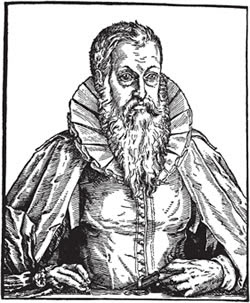
Hans Staden escapou com vida; os tupinambá o deixaram viver – talvez por que ele lhes parecesse covarde demais? Seus relatos tornaram-se uma fonte etnográfica

O QUE OCORREU NA EUROPA foi uma diversificação daquela prática que teve seu apogeu no século 17. Muitas receitas circulavam entre a população; transmitidas oralmente na medicina popular ou artisticamente impressas em tratados eruditos. O médico Johann Schröder, por exemplo, autor do manual de medicina mais importante do século 17, recomenda “cortar a carne humana em fatias, ou pedaços pequenos”, temperá-la, curti-la em aguardente de vinho e, por fim, secá-la.

A gordura corporal também é um produto muito desejado. Em 1675, o professor de medicina Tobias Andreae desmembra uma infanticida morta por afogamento, derrete sua carne e obtém 20 quilos da chamada “gordura do pecador pobre” (expressão que definia os criminosos condenados à morte). E, na Grande Enciclopédia Universal de Zedler, de 1739, pode-se ler como transformar essa gordura em um medicamento antropofágico para uso doméstico. Não seriam, portanto, os europeus que deveriam ser chamados de “selvagens ferozes comedores de gente”? Foi precisamente isso o que aconteceu entre os habitantes da África ao sul do Saara até o século 20: mesmo sem conhecimentos detalhados sobre o canibalismo praticado no hemisfério norte, os negros acreditavam que os brancos eram antropofágicos.

OS EUROPEUS JÁ HAVIAM levantado demasiado suspeitas perpetrando crimes colonialistas. Por volta de 1800, o explorador escocês Mungo Park, especializado no continente africano, relata que os escravos acorrentados tinham certeza de que os homens brancos os estavam levando ao abatedouro e não para realizar trabalhos forçados. No Peru, a primeira insurgência contra os espanhóis foi desencadeada pelo boato de que os senhores coloniais estavam matando os povos indígenas para obter gordura corporal.

O comércio de matérias-primas canibalescas na Europa assumiu proporções transcontinentais, envolvendo múmias. Entre 1500 e 1900, os médicos, os farmacêuticos e até os charlatães prescrevem a seus pacientes partes de cadáveres embalsamados, em pó ou forma esférica (comprimido), como remédio contra quase todos os males.

O negócio com a chamada mumia vera aegyptica (a “verdadeira múmia egípcia”) assume tais dimensões que em pouco tempo a demanda por exemplares autênticos do reino dos faraós não pode mais ser atendida. Comerciantes e farmacêuticos apelam para falsificações e corpos embalsamados de mendigos, leprosos e vítimas da peste. Fetos abortados também são secados e vendidos como múmias infantis.

As verdadeiras múmias egípcias são um artigo de luxo. O rei francês Francisco I (1494-1547) sempre carregava consigo uma pequena quantidade da preciosa substância para, no caso de uma queda do cavalo ou outro ferimento se medicar imediatamente. O filósofo inglês Francis Bacon (1561- 1626) apostava tanto no poder de cura das múmias quanto o poeta Léon Tolstoi, no final do século 19. Ainda em 1912, a empresa farmacêutica alemã Merck oferecia em seu catálogo a mumia vera aegyptica – “enquanto os estoques durassem”. O preço era citado por quilo: na época, o equivalente a 17,50 marcos alemães.

As vozes céticas eram escassas. Um dos críticos mais proeminentes foi o humanista francês Michel de Montaigne que em pleno século 16 rotulou a mania das múmias como comportamento canibal e chamaou a atenção para a “crítica hipócrita” dos europeus em relação à antropofagia indígena.

Com toda razão, julga o historiador de medicina britânico Richard Sugg. Segundo ele, o canibalismo do Velho Mundo possuiu uma dimensão muito mais abrangente do que o dos índios. O consumo de múmias não era uma cerimônia mágica, mas uma parte da cultura cotidiana e da vida econômica. Na Europa, médicos e farmacêuticos faziam bons negócios com o canibalismo. No topo dessa rentável cadeia comercial estavam os carrascos e os ladrões de túmulos. “A antropofagia europeia influiu nas mais diversas esferas e países”, resume Sugg. “Não se pode compará-la ao canibalismo limitado praticado, por exemplo, por uma tribo no Brasil.” Segundo o historiador, os verdadeiros canibais viviam na Europa.

DURANTE O SEU CATIVEIRO, Hans Staden observou, incrédulo, como os índios tupinambá tratavam bem aqueles que eles haviam reservado para suas festividades: “Eles lhe dão uma mulher que cuida dele, lhe dá de comer e também se deita com ele. Se ela engravidar, eles criam a criança… Alimentam muito bem o prisioneiro e o mantêm vivo por algum tempo, enquanto fazem todos os preparativos para a celebração. Eles fabricam muitos recipientes para as bebidas e outros mais especiais para as substâncias com as quais o pintam e decoram”.

Antes de ser abatida, a vítima desfruta do maior respeito; os tupinambá até permitem que ela gere descendentes – embora o venerado inimigo seja obrigado a provar que é digno de seu papel. Como?

Os sobreviventes da queda de um avião nos Andes, em 1972, alimentaram-se durante semanas da carne de seus companheiros de viagem mortos. Seu drama de sobrevivência se transformou em um filme de Hollywood

OS ASTECAS, por exemplo, torturavam seus prisioneiros para pôr à prova a sua coragem e assim determinar se eles eram ou não adequados para uma cerimônia antropofágica, explica Richard Sugg. Segundo ele, as vítimas cooperavam com seus torturadores – na certeza de estarem sendo criticamente observadas pelo deus sol.

Hans Staden relatou que os tupinambá também davam grande valor à força física e mental do inimigo. Afinal de contas, estas eram as características mais importantes que pretendiam incorporar ao devorá-lo. O lansquenê de Hesse, no entanto, foi um completo fracasso nesse sentido.

As regras desse jogo sinistro permaneceram incompreensíveis para ele. Em sua terra natal, a Europa do século 16, as pessoas que comerão e a que será comida não estabelecem nenhum tipo de relacionamento antes da morte da vítima. Staden havia perdido toda a sua coragem. Ele implorou, suplicou, chorou e rezou aos brados ao seu deus. E depois descreveu a reação dos tupinambá com as seguintes palavras: “Então eles disseram: ‘Ele é um verdadeiro português. Agora ele grita desse jeito porque está com horror da morte’… Eles zombaram cruelmente de mim; tanto os jovens como os velhos”.

A cientista cultural brasileira Vanete Santana Dezmann presume que o pânico de Hans Staden o tenha tornado indigno aos olhos dos índios. O que fazer com um pedaço de carne impregnado de covardia? Talvez tenha sido por essa razão que os tupinambá o libertaram novamente após nove meses de cativeiro.

O medo devora a alma: Staden teve a sorte do medroso. Ele voltou para Hesse e, juntamente com um médico, escreveu o seu livro sobre os comedores de gente.

Em Marburgo, o lansquenê abandonou o mercenarismo e foi trabalhar em uma jazida de salitre. Ele morreu em 1576.

A história não nos transmitiu o que aconteceu com o seu corpo.

Books Without Borders (N.Y. Times)

EDITORIAL

Published: March 15, 2012

When we reached Tony Diaz, novelist and novice smuggler, by phone this week, he was in West Texas, 500 miles from his home in Houston and about a third of the way through a journey with three dozen comrades and serious contraband. That is, a busload of books.

“The Aztec muse is manifesting right now!” Mr. Diaz said, which was a gleeful way of saying: Watch out, Tucson. Dangerous literature on the way.

Mr. Diaz is the impresario behind an inspiring act of indignation and cultural pride. His bus-and-car caravan is “smuggling” books by Latino authors into Arizona. It’s a response to an educational mugging by right-wing politicians, who enacted a state law in 2010 outlawing curriculums that “advocate ethnic solidarity,” among other imagined evils. That led to the banning of Mexican-American studies in Tucson’s public schools last year.

School officials say the books are not technically banned, just redistributed to the library. But what good is having works from thereading list — like “Los Tucsonenses: The Mexican Community in Tucson, 1854-1941” and “The House on Mango Street,” by Sandra Cisneros — on the shelves if they can’t be taught? Indeed, the point of dismantling the curriculum was to end classroom discussions about these books.

That’s where Mr. Diaz’s “librotraficantes,” or book traffickers, come in. “Arizona tried to erase our history,” he says. “So we’re making more.” They left Houston on Monday. On the way, they’ve held readings with “banned” authors at galleries, bookshops and youth centers. After leaving El Paso on Wednesday, they followed the Rio Grande to Albuquerque, to meet with Rudolfo Anaya, a godfather of Chicano literature. They also planned to wrap some volumes in plastic and carry the “wetbooks” across the river. At the Arizona border, there will be a crossing ceremony. They expect to be in Tucson, singing, dancing and handing out books, by the weekend.

Do neighborhood conditions affect school performance? (The University of Chicago Urban Network)

March 1, 2012

A recent report issued by the Center on Education Policy predicted that 48 percent of US public school students would not meet reading and math standards by 2014, as legally mandated by the decade-old No Child Left Behind Act (NCLB). The law was originally established to address the comparatively low test scores of low-income students. With the limited success of NCLB, the discussion about school performance has again grabbed the headlines.  While social scientists have always been interested in the dynamics behind the low achievement of students living in disadvantaged urban neighborhoods, in recent years researchers have been trying to establish precisely the extent to which neighborhood conditions, net of other factors, influence educational achievement.

Better neighborhoods, higher test scores

Social scientists Jens LudwigHelen Ladd, and Greg Duncan used data from the Moving to Opportunity (MTO) experiment to investigate the impact of neighborhood environment on educational outcomes. The MTO experiment was conducted in five cities: Baltimore, Boston, Chicago, Los Angeles, and New York. Families who volunteered were randomly assigned to different treatment groups. Whereas the experimental group received counseling and vouchers to move into low-poverty neighborhoods, the second group simply received regular Section 8 subsidies without being encouraged to move out of high-poverty areas. A third group functioned as a control group and received no subsidies at all. Using data from the Baltimore site, Ludwig, Ladd, and Duncan found that elementary school students in the experimental group who had moved to better neighborhoods scored about one-quarter of a standard deviation higher in reading and math tests than children in the control group. Robert SampsonPatrick Sharkey, and Stephen Raudenbush foundsimilar results when they investigated the impact of neighborhood disadvantage on the verbal ability of African American children.  Based on intelligence tests administered within the framework of the Human Development in Chicago Neighborhoods project, they found that children who live in disadvantaged neighborhoods on average score four points lower than children living in better-off areas—a result that is almost equal to missing a year of schooling.

Better neighborhoods, no improvement?

A more recent analysis of MTO data from all five cities generated very different results. Social scientists Lisa SanbonmatsuJeffrey KlingGreg Duncan, and Jeanne Brooks-Gunnfound that math as well as reading scores did not significantly improve for children aged between six and twenty. The children were assessed four to six years after they had moved to a low-poverty neighborhood. Sanbonmatsu and her colleagues also revisited the children in the Ludwig Baltimore sample and found that the Baltimore elementary school children did not sustain their educational gains. In the final results of the MTO experiment, published in October 2011, Sanbonmatsu and her colleagues confirmed that there are few significant improvements in test scores ten to fifteen years after children had moved to less disadvantaged neighborhoods. There was no significant difference in achievement between those children who stayed in high-poverty areas and those who had moved away. The researchers suggested that the results may be related to the segregated, low-quality schools the children continued to attend even though they had moved to low-poverty areas.

In a review of neighborhood-effects studies and a reanalysis of the MTO data, sociologistJulia Burdick-Will and her colleagues challenged this null finding. They argued that the results of MTO, the Project on Human Development in Chicago Neighborhoods, and other studies showed that neighborhood effects may work in nonlinear ways. The size of the effect visible may be contingent on other factors, such as exposure to violence or the relative disadvantage of the neighborhood the child lives in. Children who come from very disadvantaged neighborhoods may experience larger neighborhood effects than those living in moderately disadvantaged areas. Consequently, the size of the neighborhood effect depends on the city. In high-poverty areas of Chicago and Baltimore, the MTO data showed an improvement in test scores. In Boston, Los Angeles, and New York, where neighborhoods are comparatively less disadvantaged, the researchers did not find clear test-score improvements.

Cultural factors

Sociologist David Harding argued that neighborhood effects mainly work through cultural pathways. Children living in disadvantaged neighborhoods are exposed to a greater variety of educational choices than their peers in other areas. He suggested that living in a culturally heterogeneous neighborhood has a negative impact on educational achievement. Using the National Longitudinal Study of Adolescence (AddHealth), he showed that inner-city children observe educational behavior ranging from dropping out of high school to graduating from college. This greater variety of educational models seems to be affecting children’s own educational aspirations, by forcing them to decide among too many competing alternatives. Analyzing the same data set in another recent article, Harding also found that high levels of neighborhood violence may have a detrimental effect on high school graduation rates. He found that living in neighborhoods with high rates of violence was associated with significantly lower chances of high school graduation, regardless of family structure, income, and language spoken in the household.

Multigenerational effects

Sharkey and sociologist Felix Elwert have recently argued that neighborhood poverty has a cumulative effect across generations. Relying on data from the Panel Study of Income Dynamics (PSID), they showed that children who were raised in poor neighborhoods by parents who had grown up in similarly disadvantaged communities had cognitive ability scores more than half a standard deviation below their peers. The children scored on average 9.27 points lower on the reading test and 8.36 points lower on the problem-solving test than children who were raised in non-poor neighborhoods by parents who had grown up in similarly non-poor areas. Though the authors demonstrated the presence of multigenerational effects through advanced statistical models, they explained that disentangling the precise interactions underlying the complex web of mechanisms at work over generations was impossible.

While researchers try to disentangle the impact of neighborhoods and generational effects on schooling, policy makers are beginning to consider alternatives to NCLB. In September of 2011, President Obama announced that states may now opt out of the program under certain conditions. With schools failing to meet the test score standards of NCLB, the government is rethinking its approach to helping the most disadvantaged students.

How did the KKK lose nearly one-third of its chapters in one year? (Slate)

Ku Klux Kontraction

By |Posted Thursday, March 8, 2012, at 4:55 PM ET

57886367

Members of the Fraternal White Knights of the Ku Klux Klan participate in the 11th Annual Nathan Bedford Forrest Birthday march July 11, 2009 in Pulaski, Tenn.Spencer Platt/Getty Images

The number of hate groups in the United States is on the rise, but the Ku Klux Klan is losing chapters, according to data released on Wednesday by the Southern Poverty Law Center. The number of KKK chapters dropped from 221 to 152 in just one year. Why is the Klan shrinking?

Consolidation and defections. The Klan is not a stable organization. There’s no real national leadership, and chapters are constantly appearing, disappearing, splitting, and merging. In 2010, to take one example, the True Invisible Empire Knights of Pulaski, Tenn., merged with the Traditional American Knights from Potosi, Mo. to form the True Invisible Empire Traditionalist American Knights of the Ku Klux Klan. (Note: this link, like others in this article, leads to an extremist website.) Such mergers decrease the number of chapters without necessarily changing membership totals. Not all the Klan’s losses are just on paper, though. Jeremy Parker, who led the Ohio-based Brotherhood of Klans, left the KKK for the Aryan Nations in 2010 and likely took a significant number of members with him. The Brotherhood of Klans was the second-largest Klan association in the country, with 38 chapters.

Membership totals are hard to track, because the Klan doesn’t willingly release member lists. Over the long term, the KKK is clearly contracting, since its rolls have shrunk from millions in the 1920s to between 3,000 and 5,000 today. But no one knows how membership has changed in the last few years.

Klan-watchers, however, suspect that the nation’s oldest domestic terrorist organization is indeed struggling to keep pace with other racist hate groups. Young racists tend to think of the Klan as their grandfathers’ hate group, and of its members as rural, uneducated, and technologically unsophisticated. The Klan doesn’t seem to have used the web and social media as well as its competitors. The group’s failure to effectively deploy technology is a bit of an irony, since one of those newfangled motion pictures, The Birth of a Nation, launched the KKK’s second era in 1915.

The Klan’s history of violence is another challenge to recruitment. The organization will always be associated with the lynching of innocent African-Americans in the 20th century, which puts off more moderate racists.

The KKK is also suffering from a proliferation of competitors. People who wanted to join a white supremacist movement back in the 1920s didn’t have a lot of choices. Today, there are countless options, enabling an extremist to find a group that matches his personal brand of intolerance. The more extreme groups in the burgeoning patriot movement cater to anti-Muslim, homophobic, and xenophobic sentiment, with less animosity toward African-Americans and Jews. Aryan Nations offers a heavy focus on Christian identity. Some groups preach more violence, while others offer a veneer of intellectualism.American Renaissance, for example, caters to “suit-and-tie” racists, offering pseudo-scientific papers on white supremacy. The group even holds conferences at a hotel near Dulles airport in Virginia.

Many young racist activists aren’t bothering to join groups at all anymore, further hampering the Klan’s recruitment efforts. Former KKK Grand Wizard Don Black in 1995 launched the website Stormfront, which enables individuals in the white supremacist movement to share ideas and read news stories reported from a racist perspective. The community-building site, and others like it, lessens the need for racists to socialize at Klan barbecues or introduce their children to Klanta Klaus at the KKK Christmas rally.

Number of U.S. Hate Groups Is Rising, Report Says (N.Y. Times)

By KIM SEVERSON – Published: March 7, 2012

ATLANTA — Fed by antagonism toward President Obama, resentment toward changing racial demographics and the economic rift between rich and poor, the number of so-called hate groups and antigovernment organizations in the nation has continued to grow, according to a report released Wednesday by the Southern Poverty Law Center.

The center, which has kept track of such groups for 30 years, recorded 1,018 hate groups operating last year.

The number of groups whose ideology is organized against specific racial, religious, sexual or other characteristics has risen steadily since 2000, when 602 were identified, the center said. Antigay groups, for example, have risen to 27 from 17 in 2010.

The report also described a “stunning” rise in the number of groups it identifies as part of the so-called patriot and militia movements, whose ideologies include deep distrust of the federal government.

In 2011, the center tracked 1,274 of those groups, up from 824 the year before.

“They represent both a kind of right-wing populist rage and a left-wing populist rage that has gotten all mixed up in anger toward the government,” said Mark Potok of the Southern Poverty Law Center and the author of the report.

The center, based in Montgomery, Ala., records only groups that are active, meaning that the groups are registering members, passing out fliers, protesting or showing other signs of activity beyond maintaining a Web site.

The Occupy movement is not on the list because its participants as a collective do not meet the center’s criteria for an extremist group, he said.

One of the groups that was moved from the “patriot” list to the hate group list this year is the Georgia Militia, some of whose members were indicted last year in a failed plot to blow up government buildings and spread poison along Atlanta freeways. They were reclassified because their speech includes anti-Semitism.

The far-right patriot movement gained steam in 1994 after the government used violence to shut down groups at Ruby Ridge, Idaho, and Waco, Tex. It peaked after the 1995 Oklahoma City bombing and began to fade. Its rise began anew in 2008, after the election of Mr. Obama and the beginning of the recession.

There have been declines in some hate groups, including native extremist groups like the Militiamen, which focused on illegal immigration. Chapters of the Ku Klux Klan fell to 152, from 221.

Among the states with the most active hate groups were California, Florida, Georgia, New Jersey and New York. The federal government does not focus on groups that engage in hate-based speech, but rather monitors paramilitary groups and others that have shown some indication of violence, said Daryl Johnson, a former senior domestic terrorism analyst for the Department of Homeland Security.

The Justice Department does not comment on the center’s annual report, but a spokeswoman said the agency had increased prosecution of hate crimes by 35 percent during the first three years of Mr. Obama’s presidency.

A version of this article appeared in print on March 8, 2012, on page A17 of the New York edition with the headline: Number of U.S. Hate Groups Is Rising, Report Says.

Vídeo da Comissão Europeia tem circulação suspensa (Opinião e Notícia)

XENOFOBIA

Peça publicitária mostra Europa atacada por chineses, brasileiros e indianos.

Por Felipe Varne – 8/03/2012

Uma bela mulher (usando o macacão amarelo imortalizado nas telas do cinema por Bruce Lee em O Jogo da Morte, e homenageado por Quentin Tarantino emKill Bill) caminha sozinha por um galpão abandonado. Subitamente ela é ameaçada pela presença de três homens. O primeiro, um ninja com traços orientais. O segundo, um homem de turbante e portando uma ameaçadora espada. O terceiro é um capoeirista acrobático e musculoso. Sem se intimidar, a mulher se concentra, e se multiplica em vários clones que formam um círculo ao redor do trio. As três figuras se tornam menos ameaçadoras, e os clones se sentam em posição de lótus, antes de se transformarem na bandeira da União Europeia.

O final do comercial que promove a expansão da União Europeia termina com a seguinte mensagem: “quanto maiores formos, mais fortes seremos”. A mensagem pode até ser verdadeira, mas o comercial foi retirado do ar às pressas, graças a uma enxurrada de comentários que acusaram a Comunidade Europeia de racismo e xenofobia.

Recebemos muitas mensagens sobre nosso último vídeo, incluindo algumas que se mostraram preocupadas com a mensagem que estava sendo passada.

O vídeo era uma experiência viral, visando atingir por meio de redes sociais e novas mídias, jovens entre 26 e 24 anos, familiarizados com artes marciais e vídeo games. As reações dentro dessa faixa etária foram positivas, assim como as dos grupos de testes nos quais o vídeo foi testado.

O vídeo apresenta personagens típicos do gênero das artes marciais: mestres de kung fu, kalripayattu e capoeira. Tudo começa com uma demonstração de suas habilidades e termina com todos os personagens demonstrando seu respeito mútuo, numa posição de paz e harmonia. O gênero foi escolhido para atrair os jovens e aumentar sua curiosidade a respeito de uma importante política da União Europeia.

O vídeo não tinha intenção alguma de promover o racismo, e nós obviamente lamentamos que ele tenha sido encarado desta maneira. Pedimos desculpas a qualquer um que tenha se ofendido. Por causa da polêmica, decidimos interromper a campanha imediatamente, e retirar o vídeo de circulação.

A mensagem acima é assinada por Stefano Sannino, diretor-geral do programa de expansão da Comissão Europeia. Nos tempos de crise, é natural que a União Europeia queira se fortalecer, e nada mais natural do que vender essa ideia aos jovens. Artes marciais e vídeo games são uma boa forma de atrair essa faixa etária, além de serem uma linguagem universal (algo importante quando o bloco em questão concentra um número gigantesco de idiomas e dialetos).

No entanto, a mensagem de Sannino se não é mentirosa, é, no mínimo, ingênua. Os três mestres, embora sejam muito habilidosos, não estão apenas demonstrando suas habilidades, e sim ameaçando a pobre mulher indefesa. Ou será que há algum outro motivo para que ela se multiplique em dez, formando um círculo ao redor do trio? E não é preciso ser nenhum gênio para ver que os mestres também não são apenas mestres, mas sim um chinês, um indiano e um brasileiro. China, índia e Brasil são integrantes do grupo dos BRICs, os países emergentes da economia mundial, que estão prosperando e crescendo, enquanto a Europa atravessa maus bocados. O quarto país do grupo, a Rússia, não apareceu no vídeo. Para isso existem duas explicações. Ou não foi possível encontrar um mestre de sambo (a mais famosa arte marcial da Rússia) a tempo, ou ironicamente, o país de Putin e Medvedev pode fazer parte dos planos de expansão da União Europeia. Ambas as opções soam absurdas, mas nada é impossível.

A Europa atravessa uma crise criada por ela mesma, e que apenas ela pode resolver. Ao buscar nos países emergentes um bode expiatório, a Comissão Europeia deu o primeiro tiro no pé. E ao apresentar desculpas esfarrapadas e subestimar a inteligência dos espectadores do vídeo, pode ter dado o segundo.

Stadium ban for EU hooligans undermines civil rights (The Limping Messenger blog)

February 3, 2012 by Tjebbe van Tijen

EUROPEAN FOOTBALL STADIUM BAN FOR HOOLIGANS… Ahmed Aboutaleb major of the City of Rotterdam rejoices today the European Parliament initiative for an European level implementation of banning locally convicted football hooligans from all EU stadiums. (1) This law initiative has been long in the making. An earlier document by the Council of the European Union “Resolution of the Council on preventing and restraining football hooliganism through the exchange of experience, exclusion from stadiums and media policy” dates back to the year 1997:

The responsible Ministers invite their national sports associations to examine, in accordance with national law, how stadium exclusions imposed under civil law could also apply to football matches in a European context.

However much I dislike football hooligans this is a juridical precedent which will have far reaching negative consequences for civil rights in general. Not only does it create yet another centrally managed person database that can be accessed by all EU police forces (like data on persons DNA, illegal migrants and so on) it is a further step in constructing a ‘central EU police force’ with all its inherent dangers. Such an EU-wide anti-hooligan law also means multiplied condemnation – for a big part of the European continent – on the basis of a local conviction.

Together with actual proposals (in the Netherlands) for ‘whole sale mass arrests’, not only hooligan “leaders”, but also of their “followers” (‘meeloophooligens’ is the Dutch term), we can be certain that such an extra-national banning and black-listing power, will be abused in ways beyond our imagination. Once such a law and its enforcement has been put into effect, other ‘social distinct groups’ whose behaviour is classified as unruly can get the same routine treatment in the future. The Council of Europe document of 1997 cited above speaks of “preventing and containing of disorder”, so one need not to be surprised when other forms of ”disorder” will be handled in the long run in the same way. For instance, when we take in account the frequent attempts by politicians – defending employers interest – to criminalise strike actions, trade union activists could be databased and blacklisted with the same ‘anti-hooligan routine’.

—-
(1) It is interesting to note that the ‘hooligan-ban’ proposals in the European Parliament plenary session of February 2. 2012, was part of a bundle of all kind of measures related to sport listed in this order: – Promote sport for girls; – Blacklist hooligans; – Make doping a criminal offence; – Regulate sport agents; -Combine learning and training. The resolution – thus packaged – has been passed with 550 votes in favour, 73 against and 7 abstentions. In the section of hooligans is also this sentence: “MEPs also call on Member States and sports governing bodies to commit to tackling homophobia and racism against athletes.” Something problematic in the sense of ‘civil rights’ has been hidden inside a package of mostly emancipatory proposals.

The right’s stupidity spreads, enabled by a too-polite left (Guardian)

Conservativism may be the refuge of the dim. But the room for rightwing ideas is made by those too timid to properly object

by George Monbiot, The Guardian

Self-deprecating, too liberal for their own good, today’s progressives stand back and watch, hands over their mouths, as the social vivisectionists of the right slice up a living society to see if its component parts can survive in isolation. Tied up in knots of reticence and self-doubt, they will not shout stop. Doing so requires an act of interruption, of presumption, for which they no longer possess a vocabulary.

Perhaps it is in the same spirit of liberal constipation that, with the exception of Charlie Brooker, we have been too polite to mention the Canadian study published last month in the journal Psychological Science, which revealed that people with conservative beliefs are likely to be of low intelligence. Paradoxically it was the Daily Mail that brought it to the attention of British readers last week. It feels crude, illiberal to point out that the other side is, on average, more stupid than our own. But this, the study suggests, is not unfounded generalisation but empirical fact.

It is by no means the first such paper. There is plenty of research showing that low general intelligence in childhood predicts greater prejudice towards people of different ethnicity or sexuality in adulthood. Open-mindedness, flexibility, trust in other people: all these require certain cognitive abilities. Understanding and accepting others – particularly “different” others – requires an enhanced capacity for abstract thinking.

But, drawing on a sample size of several thousand, correcting for both education and socioeconomic status, the new study looks embarrassingly robust. Importantly, it shows that prejudice tends not to arise directly from low intelligence but from the conservative ideologies to which people of low intelligence are drawn. Conservative ideology is the “critical pathway” from low intelligence to racism. Those with low cognitive abilities are attracted to “rightwing ideologies that promote coherence and order” and “emphasise the maintenance of the status quo”. Even for someone not yet renowned for liberal reticence, this feels hard to write.

This is not to suggest that all conservatives are stupid. There are some very clever people in government, advising politicians, running thinktanks and writing for newspapers, who have acquired power and influence by promoting rightwing ideologies.

But what we now see among their parties – however intelligent their guiding spirits may be – is the abandonment of any pretence of high-minded conservatism. On both sides of the Atlantic, conservative strategists have discovered that there is no pool so shallow that several million people won’t drown in it. Whether they are promoting the idea that Barack Obama was not born in the US, that man-made climate change is an eco-fascist-communist-anarchist conspiracy, or that the deficit results from the greed of the poor, they now appeal to the basest, stupidest impulses, and find that it does them no harm in the polls.

Don’t take my word for it. Listen to what two former Republican ideologues, David Frum and Mike Lofgren, have been saying. Frum warns that “conservatives have built a whole alternative knowledge system, with its own facts, its own history, its own laws of economics”. The result is a “shift to ever more extreme, ever more fantasy-based ideology” which has “ominous real-world consequences for American society”.

Lofgren complains that “the crackpot outliers of two decades ago have become the vital centre today”. The Republican party, with its “prevailing anti-intellectualism and hostility to science” is appealing to what he calls the “low-information voter”, or the “misinformation voter”. While most office holders probably don’t believe the “reactionary and paranoid claptrap” they peddle, “they cynically feed the worst instincts of their fearful and angry low-information political base”.

The madness hasn’t gone as far in the UK, but the effects of the Conservative appeal to stupidity are making themselves felt. This week the Guardian reported that recipients of disability benefits, scapegoated by the government as scroungers, blamed for the deficit, now find themselves subject to a new level of hostility and threats from other people.

These are the perfect conditions for a billionaires’ feeding frenzy. Any party elected by misinformed, suggestible voters becomes a vehicle for undisclosed interests. A tax break for the 1% is dressed up as freedom for the 99%. The regulation that prevents big banks and corporations exploiting us becomes an assault on the working man and woman. Those of us who discuss man-made climate change are cast as elitists by people who happily embrace the claims of Lord Monckton, Lord Lawson or thinktanks funded by ExxonMobil or the Koch brothers: now the authentic voices of the working class.

But when I survey this wreckage I wonder who the real idiots are. Confronted with mass discontent, the once-progressive major parties, as Thomas Frank laments in his latest book Pity the Billionaire, triangulate and accommodate, hesitate and prevaricate, muzzled by what he calls “terminal niceness”. They fail to produce a coherent analysis of what has gone wrong and why, or to make an uncluttered case for social justice, redistribution and regulation. The conceptual stupidities of conservatism are matched by the strategic stupidities of liberalism.

Yes, conservatism thrives on low intelligence and poor information. But the liberals in politics on both sides of the Atlantic continue to back off, yielding to the supremacy of the stupid. It’s turkeys all the way down.

Twitter: @georgemonbiot

Colombia prosecutors question ‘shaman rain payment’ (BBC)

18 January 2012 Last updated at 16:49 GMT

By Arturo Wallace
BBC Mundo, Bogota

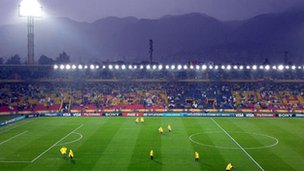
The tournament, won by Brazil, was held across Colombia with the final in Bogota

Colombian prosecutors are investigating why organisers paid a “shaman” $2,000 (£1,400) to keep rain away from the closing ceremony of the Fifa U-20 World Cup held in the country last year.

The inquiry was launched after cost overruns totalling $1m came to light.

But the focus of their questions is a 64-year-old man who says he uses dowsing to stave off or attract rain.

The event’s organisers defended their decision to use him, noting that the final event was indeed rain-free.

The “rain-stopper” in question, Jorge Elias Gonzalez, has been dubbed a “shaman” or medicine man by the Colombian media.

A dark joke doing the rounds in the capital, Bogota, asks why the shaman was not also hired to minimise the impact of the last rainy season, which killed 477 people and affected some 2.6 million Colombians.

Yet more cynical voices have said that, given the corruption allegations involving the Bogota authorities in recent years, Mr Gonzalez should be praised as the only contractor to deliver what he promised.

The spectacular closing ceremony in Bogota’s El Campin stadium on 20 August last year remained dry – a stark contrast with the opening event in Barranquilla a month earlier that was drenched.

Ana Marta de Pizarro, the anthropologist and theatre director who was in charge of the ceremony, used this argument to defend the hiring of a rain stopper.

“Had it rained, the event would not have taken place. It didn’t rain on the ceremony, it was successful and I would use him again if I needed to,” she said.

And Ms Pizarro also said Mr Gonzalez had been hired in the past to ensure Bogota’s International Theatre Festival was rain-free.

In an interview with a local radio station on Wednesday, Mr Gonzalez also said he was also hired to keep the rain away from the swearing-in ceremony of President Juan Manuel Santos.

This has, as yet, neither been confirmed nor denied by the president’s office.

Respect

Prosecutors are adamant that Mr Gonzalez’s contract will be investigated.

The procurement law requires efficiency and professionalism in all service providers paid for by public funds “and that doesn’t include shamans”, a statement from the local comptroller’s office said.

“We’ll ask him to explain in which circumstances, how and where he can stop rain,” said the deputy prosecutor, Juan Carlos Forero.

The debate has also drawn in those who want to make sure no public funds are used to pay for any sort of religious rites, and those who want the traditions of indigenous Colombians to be treated with more respect.

In a bizarre twist to the dispute, Mr Gonzalez has always insisted that he is not a shaman.

“I’m not indigenous, so don’t call me a shaman, for I don’t even know what that is. Nor am I a wizard,” he told a local newspaper several years ago.

Mr Gonzalez has said that he can stop or attract rain using dowsing, although he also prays.

Anthropologist Mauricio Pardo believes that by describing him as a shaman, the Colombian media might end up belittling an important indigenous tradition.

“And those traditions deserve to be respected. Even our constitution demands so,” he told BBC Mundo.

Desenvolvimento e destruição (Ciência Hoje)

O antropólogo Luiz Fernando Dias Duarte aborda na sua coluna de dezembro as contribuições críticas de uma antropologia voltada ao enfrentamento direto dos desafios que o projeto de desenvolvimento econômico apresenta para o planeta e as sociedades contemporâneas.

Por: Luiz Fernando Dias Duarte

Publicado em 02/12/2011 | Atualizado em 02/12/2011

Desenvolvimento e destruiçãoA locomotiva a vapor, ícone da Revolução Industrial, foi ao mesmo tempo um símbolo do progresso triunfante e um agourento fantasma a recobrir de cinza e fumaça os campos e as cidades. (foto: Jim Daly/ Sxc.hu)

Há poucas categorias tão onipresentes nas discussões atuais sobre a condição de nossas sociedades quanto a de ‘desenvolvimento’. Cadernos inteiros de nossos jornais dedicam-se regularmente aos desafios e dilemas que cercam o projeto do desenvolvimento econômico de nosso país ou de toda a humanidade.

De um modo geral, estamos informados sobre a permanente busca das políticas governamentais modernas de progresso material por meio da expansão das bases da atividade econômica, de sua circulação mercantil e de sua apropriação pelo consumo generalizado.

Mas sabemos provavelmente mais ainda sobre os riscos e ameaças que essa expansão vem acarretando para nossa população e para o planeta em geral. Nos últimos dias, quem não se assustou com o vazamento de petróleo na costa fluminense ou não se preocupou com a retomada das obras da hidrelétrica de Belo Monte no Rio Xingu e com a possibilidade de abertura do Parque Nacional da Serra da Canastra à exploração de diamantes?

Ainda aqui na Ciência Hoje On-line, meu colega Jean Remy Guimarães acaba de descrever com detalhes os desastres ambientais decorrentes da mineração desenfreada de ouro no Equador (Leia coluna Sobre ouro, ceviche e arroz).

A questão não é nova, porém. Desde o começo da Revolução Industrial contrapõem-se sistematicamente os desejos de uma constante e infinita melhoria das condições de reprodução econômica das populações e os alertas sobre a destruição física e a degradação humana acarretadas pelo industrialismo e pelas relações capitalistas de produção.

A imagem da locomotiva a vapor foi ao mesmo tempo um símbolo do progresso triunfante e um agourento fantasma a recobrir de cinza e fumaça os campos e as cidades. O próprio socialismo, crítico da desumanização proletária, não renegou o princípio do avanço ilimitado das forças produtivas e dá, ainda hoje, o aval à desastrosa modernização chinesa.

Mancha de óleo provocada pelo vazamento no poço da Chevron na Bacia de Campos, no norte fluminense. Ao mesmo tempo em que somos informados sobre a busca permanente das políticas governamentais de progresso material, sabemos dos riscos envolvidos, para a população e o planeta em geral. (foto: Agência Brasil)

Antropologia e desenvolvimento

Acaba de se realizar em Brasília a 2ª Conferência de Desenvolvimento (Code), organizada pelo Instituto de Pesquisa Econômica Aplicada (Ipea), com o propósito de “debater e problematizar as diversas formulações possíveis para conceitos, trajetórias, atores, instituições e políticas públicas para o desenvolvimento brasileiro”.

Diversas associações de ciências humanas juntaram-se a esse debate, tendo a Associação Brasileira de Antropologia organizado e participado de duas séries de mesas em que se assumiu o desafio do encontro.

Todos reconhecem a insanidade do sistema atual de exploração a qualquer custo dos recursos ambientais

Há duas vias possíveis para a discussão da relação entre desenvolvimento e antropologia.

A primeira segue o rumo da institucionalização crescente de uma ‘antropologia do desenvolvimento’, dedicada ao conhecimento das formas pelas quais se organiza esse campo, ou seja, as ações voltadas para o progresso material e a promoção social das populações humanas em situações desprivilegiadas ou vulneráveis em todo o planeta. Isso envolve particularmente o que se desenrola no plano internacional, associado à dinâmica da globalização.

A segunda via é a do reconhecimento e articulação de um vasto número de linhas de pesquisa antropológica que tem em comum abordar questões de reprodução, identidade e transformação social em contextos desprivilegiados, vulneráveis e subordinados a dinâmicas de grande escala, inclusive transnacionais.

No entanto, esses trabalhos não se voltam prioritariamente a uma problemática do ‘desenvolvimento’ em si. Constituem, assim, não uma especialização disciplinar, mas um foco, a que se pode chamar de ‘antropologia e desenvolvimento’.

No encontro de Brasília, antropólogos, sociólogos, economistas e cientistas políticos examinaram de diversos ângulos as formas contemporâneas do dilema do desenvolvimento.

“Todos reconhecem a insanidade do sistema atual de exploração a qualquer custo dos recursos ambientais e todos denunciam a violência com que os grandes projetos de desenvolvimento são implantados, em detrimento do interesse de amplas populações locais.”

Debate sobre Belo Monte no Congresso
Congressistas discutem com comunidades indígenas violações de direitos humanos na região onde funcionará a usina de Belo Monte, um dos grandes empreendimentos desenvolvimentistas do governo federal. (foto: Antonio Cruz/ ABr)

Desatino coletivo

Embora haja um grande ceticismo por parte desses atores em relação às possibilidades de plena assunção pelos governos atuais de uma nova visão de ‘desenvolvimento sustentável’, eles não pretendem esmorecer em sua ação combinada de estudos e intervenção pública, visando a conscientização e responsabilização pelo destino não apenas de nossa geração, mas de todo o planeta e, com ele, de toda a humanidade.

Essa verdadeira militância científica denuncia os procedimentos autoritários com que se afirmam os empreendimentos desenvolvimentistas e também os saberes que justificam tais políticas com argumentos naturalistas, tecnicistas, em que um abstrato ‘bem comum’ ocupa o lugar concreto do bem de todos e de cada um.

Luta por uma disposição democrática na condução dos projetos econômicos de grande escala, atenta ao que já se vem chamando de ‘justiça ambiental’ ou de ‘modernidades alternativas’.

É generalizada a consciência de que não se poderá mudar de um dia para o outro o paradigma do melhorismo iluminista, dessa aspiração de construção de um paraíso de consumo sobre a terra.

“Há conhecimento suficiente sobre a vida social, econômica e política de todo este mundo para deixar claro que o paradigma terá que ser desviado de um curso insano”

Há hoje, porém, conhecimento suficiente sobre a vida social, econômica e política de todo este mundo para deixar claro que o paradigma terá que ser modificado, nuançado, desviado de um curso insano.

A política da competição entre as nações, armada pela crescente interdependência econômica global, é por ora um estímulo ao desatino coletivo. A destruição se dá no Brasil, assim como no Equador, na China ou na África do Sul.

A antropologia se esforça para conhecer e dar a conhecer os infindáveis nódulos de tão grande trama e, nessa luta, não pode calar ao se deparar com os mil infernos localizados que essa inglória busca de gozo incendeia aqui e ali.

Mais do que o sentido, é o destino global do humano que está em jogo.

Luiz Fernando Dias Duarte
Museu Nacional
Universidade Federal do Rio de Janeiro

Medical Marijuana Laws Reduce Traffic Deaths, Preliminary Research Suggests (Science Daily)

ScienceDaily (Nov. 29, 2011) — A groundbreaking new study shows that laws legalizing medical marijuana have resulted in a nearly nine percent drop in traffic deaths and a five percent reduction in beer sales.

“Our research suggests that the legalization of medical marijuana reduces traffic fatalities through reducing alcohol consumption by young adults,” said Daniel Rees, professor of economics at the University of Colorado Denver who co-authored the study with D. Mark Anderson, assistant professor of economics at Montana State University.

The researchers collected data from a variety of sources including the National Survey on Drug Use and Health, the Behavioral Risk Factor Surveillance System, and the Fatality Analysis Reporting System.

The study is the first to examine the relationship between the legalization of medical marijuana and traffic deaths.

“We were astounded by how little is known about the effects of legalizing medical marijuana,” Rees said. “We looked into traffic fatalities because there is good data, and the data allow us to test whether alcohol was a factor.”

Anderson noted that traffic deaths are significant from a policy standpoint.

“Traffic fatalities are an important outcome from a policy perspective because they represent the leading cause of death among Americans ages five to 34,” he said.

The economists analyzed traffic fatalities nationwide, including the 13 states that legalized medical marijuana between 1990 and 2009. In those states, they found evidence that alcohol consumption by 20- through 29-year-olds went down, resulting in fewer deaths on the road.

The economists noted that simulator studies conducted by previous researchers suggest that drivers under the influence of alcohol tend to underestimate how badly their skills are impaired.They drive faster and take more risks.In contrast, these studies show that drivers under the influence of marijuana tend to avoid risks.

However, Rees and Anderson cautioned that legalization of medical marijuana may result in fewer traffic deaths because it’s typically used in private, while alcohol is often consumed at bars and restaurants.

“I think this is a very timely study given all the medical marijuana laws being passed or under consideration,” Anderson said. “These policies have not been research-based thus far and our research shows some of the social effects of these laws. Our results suggest a direct link between marijuana and alcohol consumption.”

The study also examined marijuana use in three states that legalized medical marijuana in the mid-2000s, Montana, Rhode Island, and Vermont.Marijuana use by adults increased after legalization in Montana and Rhode Island, but not in Vermont.There was no evidence that marijuana use by minors increased.

Opponents of medical marijuana believe that legalization leads to increased use of marijuana by minors.

According to Rees and Anderson, the majority of registered medical marijuana patients in Arizona and Colorado are male.In Arizona, 75 percent of registered patients are male; in Colorado, 68 percent are male.Many are under the age of 40.For instance, 48 percent of registered patients in Montana are under 40.

“Although we make no policy recommendations, it certainly appears as though medical marijuana laws are making our highways safer,” Rees said.

Tratamento à base de tortura (Correio Braziliense)

JC e-mail 4394, de 29 de Novembro de 2011.

Durante vistorias em 68 comunidades terapêuticas espalhadas pelo país, psicólogos encontraram pacientes que são surrados com pedaço de madeira e vítimas de cárcere privado.

Cavar uma cova da dimensão do próprio corpo, escrever reiteradamente o Salmo 119 da Bíblia ou ser surrado com um pedaço de madeira em que está escrita a palavra gratidão são algumas das terapias oferecidas a usuários de drogas em tratamento no país. As violações estão documentadas no relatório da 4ª Inspeção Nacional de Direitos Humanos, uma pesquisa realizada periodicamente pelos conselhos regionais de psicologia sob a coordenação da entidade federal da categoria e com o apoio de parceiros, como o Ministério Público e a Ordem dos Advogados do Brasil. Em todos os 68 locais de internação para tratamento de dependentes químicos visitados, especialmente clínicas e comunidades terapêuticas, houve flagrantes de desrespeito. Entre os problemas mais frequentes estão isolamento, proibição de falar ao telefone com parentes, trabalho não remunerado e punições físicas e psicológicas para atos de desobediência.

As denúncias, que serão levadas à ministra dos Direitos Humanos, Maria do Rosário, surgem a uma semana do lançamento oficial de um plano de combate às drogas, quando a presidente Dilma Rousseff anunciará a inclusão das comunidades terapêuticas na rede de tratamento, com financiamento do Sistema Único de Saúde (SUS). “Não nos deram a oportunidade de participar do debate sobre esse plano, ao contrário de outros segmentos da sociedade. A simples possibilidade de financiar tais instituições já representa um retrocesso em tudo o que a reforma antimanicomial conquistou”, disse Clara Goldmann, vice-presidente do Conselho Federal de Psicologia. Ao destacar que encaminhará o documento à ministra, o ouvidor Nacional dos Direitos Humanos, Domingos Sávio Dresch da Silveira, destacou as medidas cabíveis. “Vou conhecer o relatório e, havendo indícios de violações, caberá um procedimento coletivo de apuração”, disse.

Casos de locais já investigados pelo Ministério Público, como a Casa de Recuperação Valentes de Gideão, em Simões Filhos, na Bahia, apresentaram problemas graves, como espaços inadequados e até exorcismo para tratar crises de abstinência. “É assustador que o clamor por tratamento silencie até mesmo a voz de autoridades que já foram notificadas, quatro anos atrás, sobre o tratamento desumano. Não estou dizendo que todas as comunidades terapêutica têm esse padrão, mas assusta ver a Valentes de Gideão aberta”, destaca Marcus Vinícius de Oliveira, integrante da Rede Nacional Internúcleos da Luta Antimanicomial.

Para o diretor da Federação Brasileira de Comunidades Terapêuticas (Febract), Maurício Landre, a amostra considerada pelo relatório é tendenciosa e não representa o universo das instituições. Ele também questiona a competência dos conselhos regionais de psicologia para fazerem inspeções. “É lamentável que uma classe tão conceituada, com profissionais que realizam trabalhos extraordinários dentro de comunidades terapêuticas, faça denúncias tão irresponsáveis”, afirma. “Existe comunidade terapêutica, clínica e até hospital que deve ser fechado? Existe. Mas não se trata de todos. Vamos ajudar na capacitação, vamos trabalhar em vez de ficar reclamando”, afirma. Segundo o dirigente, a real intenção com os ataques é financeira. “Tem a ideologia e também o capitalismo. Tratar em comunidade é mais barato do que ficar fazendo redução de dano, que eles defendem.”

Ligações monitoradas – O tema escolhido para a inspeção deste ano foi álcool e drogas. Só não foram feitas visitas em Amapá e Tocantins. No DF, a única instituição que participou foi a Fazendo do Senhor Jesus, em Brazlândia. O monitoramento de ligações dos familiares, bem como de visitas, é um ponto criticado no relatório. A violação das correspondências trocadas pelos pacientes também foi destacada no documento. Além disso, há relato de um homicídio e de uma denúncia por cárcere privado.

Are We Getting Nicer? (N.Y. Times)

By NICHOLAS D. KRISTOF
Published: November 23, 2011

It’s pretty easy to conclude that the world is spinning down the toilet.

So let me be contrary and offer a reason to be grateful this Thanksgiving. Despite the gloomy mood, the historical backdrop is stunning progress in human decency over recent centuries.

War is declining, and humanity is becoming less violent, less racist and less sexist — and this moral progress has accelerated in recent decades. To put it bluntly, we humans seem to be getting nicer.

That’s the central theme of an astonishingly good book just published by Steven Pinker, a psychology professor at Harvard. It’s called “The Better Angels of Our Nature,” and it’s my bet to win the next Pulitzer Prize for nonfiction.

“Today we may be living in the most peaceable era in our species’ existence,” Pinker writes, and he describes this decline in violence as possibly “the most important thing that has ever happened in human history.”

He acknowledges: “In a century that began with 9/11, Iraq, and Darfur, the claim that we are living in an unusually peaceful time may strike you as somewhere between hallucinatory and obscene.”

Still, even in a 20th century notorious for world war and genocide, only around 3 percent of humans died from such man-made catastrophes. In contrast, a study of Native-American skeletons from hunter-gather societies found that some 13 percent had died of trauma. And in the 17th century, the Thirty Years’ War reduced Germany’s population by as much as one-third.

Wars make headlines, but there are fewer conflicts today, and they typically don’t kill as many people. Many scholars have made that point, most notably Joshua S. Goldstein in his recent book “Winning the War on War: The Decline of Armed Conflict Worldwide.” Goldstein also argues that it’s a myth that civilians are more likely to die in modern wars.

Look also at homicide rates, which are now far lower than in previous centuries. The murder rate in Britain seems to have fallen by more than 90 percent since the 14th century.

Then there are the myriad forms of violence that were once the banal backdrop of daily life. One game in feudal Europe involved men competing to head-butt to death a cat that had been nailed alive to a post. One reason this was considered so entertaining: the possibility that it would claw out a competitor’s eye.

Think of fairy tales and nursery rhymes. One academic study found that modern children’s television programs have 4.8 violent scenes per hour, compared with nursery rhymes with 52.2.

The decline in brutality is true of other cultures as well. When I learned Chinese, I was startled to encounter ideographs like the one of a knife next to a nose: pronounced “yi,” it means “cutting off a nose as punishment.” That’s one Chinese character that students no longer study.

Pinker’s book rang true to me partly because I often report on genocide and human rights abuses. I was aghast that Darfur didn’t prompt more of an international response from Western governments, but I was awed by the way American university students protested on behalf of a people who lived half a world away.

That reflects a larger truth: There is global consensus today that slaughtering civilians is an outrage. Governments may still engage in mass atrocities, but now they hire lobbyists and public relations firms to sanitize the mess.

In contrast, until modern times, genocide was simply a way of waging war. The Bible repeatedly describes God as masterminding genocide (“thou shalt save alive nothing that breatheth” — Deuteronomy 20:16), and European-Americans saw nothing offensive about exterminating Native Americans. One of my heroes, Theodore Roosevelt, later a winner of the Nobel Peace Prize, was unapologetic: “I don’t go so far as to think that the only good Indians are the dead Indians, but I believe nine out of ten are, and I shouldn’t like to inquire too closely in the case of the tenth.”

The pace of moral progress has accelerated in the last few decades. Pinker notes that on issues such as civil rights, the role of women, equality for gays, beating of children and treatment of animals, “the attitudes of conservatives have followed the trajectory of liberals, with the result that today’s conservatives are more liberal than yesterday’s liberals.”

The reasons for these advances are complex but may have to do with the rise of education, the decline of chauvinism and a growing willingness to put ourselves in the shoes (increasingly, even hooves) of others.

Granted, the world still faces brutality and cruelty. That’s what I write about the rest of the year! But let’s pause for a moment to acknowledge remarkable progress and give thanks for the human capacity for compassion and moral growth.

Fraud Case Seen as a Red Flag for Psychology Research (N.Y. Times)

By BENEDICT CAREY

Published: November 2, 2011

A well-known psychologist in the Netherlands whose work has been published widely in professional journals falsified data and made up entire experiments, an investigating committee has found. Experts say the case exposes deep flaws in the way science is done in a field,psychology, that has only recently earned a fragile respectability.

Joris Buijs/Pve

The psychologist Diederik Stapel in an undated photograph. “I have failed as a scientist and researcher,” he said in a statement after a committee found problems in dozens of his papers.

The psychologist, Diederik Stapel, of Tilburg University, committed academic fraud in “several dozen” published papers, many accepted in respected journals and reported in the news media, according to a report released on Monday by the three Dutch institutions where he has worked: the University of Groningen, the University of Amsterdam, and Tilburg. The journal Science, which published one of Dr. Stapel’s papers in April, posted an “editorial expression of concern” about the research online on Tuesday.

The scandal, involving about a decade of work, is the latest in a string of embarrassments in a field that critics and statisticians say badly needs to overhaul how it treats research results. In recent years, psychologists have reported a raft of findings on race biases, brain imaging and even extrasensory perception that have not stood up to scrutiny. Outright fraud may be rare, these experts say, but they contend that Dr. Stapel took advantage of a system that allows researchers to operate in near secrecy and massage data to find what they want to find, without much fear of being challenged.

“The big problem is that the culture is such that researchers spin their work in a way that tells a prettier story than what they really found,” said Jonathan Schooler, a psychologist at the University of California, Santa Barbara. “It’s almost like everyone is on steroids, and to compete you have to take steroids as well.”

In a prolific career, Dr. Stapel published papers on the effect of power on hypocrisy, on racial stereotyping and on how advertisements affect how people view themselves. Many of his findings appeared in newspapers around the world, including The New York Times, which reported in December on his study about advertising and identity.

In a statement posted Monday on Tilburg University’s Web site, Dr. Stapel apologized to his colleagues. “I have failed as a scientist and researcher,” it read, in part. “I feel ashamed for it and have great regret.”

More than a dozen doctoral theses that he oversaw are also questionable, the investigators concluded, after interviewing former students, co-authors and colleagues. Dr. Stapel has published about 150 papers, many of which, like the advertising study, seem devised to make a splash in the media. The study published in Science this year claimed that white people became more likely to “stereotype and discriminate” against black people when they were in a messy environment, versus an organized one. Another study, published in 2009, claimed that people judged job applicants as more competent if they had a male voice. The investigating committee did not post a list of papers that it had found fraudulent.

Dr. Stapel was able to operate for so long, the committee said, in large measure because he was “lord of the data,” the only person who saw the experimental evidence that had been gathered (or fabricated). This is a widespread problem in psychology, said Jelte M. Wicherts, a psychologist at the University of Amsterdam. In a recent survey, two-thirds of Dutch research psychologists said they did not make their raw data available for other researchers to see. “This is in violation of ethical rules established in the field,” Dr. Wicherts said.

In a survey of more than 2,000 American psychologists scheduled to be published this year, Leslie John of Harvard Business School and two colleagues found that 70 percent had acknowledged, anonymously, to cutting some corners in reporting data. About a third said they had reported an unexpected finding as predicted from the start, and about 1 percent admitted to falsifying data.

Also common is a self-serving statistical sloppiness. In an analysis published this year, Dr. Wicherts and Marjan Bakker, also at the University of Amsterdam, searched a random sample of 281 psychology papers for statistical errors. They found that about half of the papers in high-end journals contained some statistical error, and that about 15 percent of all papers had at least one error that changed a reported finding — almost always in opposition to the authors’ hypothesis.

The American Psychological Association, the field’s largest and most influential publisher of results, “is very concerned about scientific ethics and having only reliable and valid research findings within the literature,” said Kim I. Mills, a spokeswoman. “We will move to retract any invalid research as such articles are clearly identified.”

Researchers in psychology are certainly aware of the issue. In recent years, some have mocked studies showing correlations between activity on brain images and personality measures as “voodoo” science, and a controversy over statistics erupted in January after The Journal of Personality and Social Psychology accepted a paper purporting to show evidence of extrasensory perception. In cases like these, the authors being challenged are often reluctant to share their raw data. But an analysis of 49 studies appearing Wednesday in the journal PLoS One, by Dr. Wicherts, Dr. Bakker and Dylan Molenaar, found that the more reluctant that scientists were to share their data, the more likely that evidence contradicted their reported findings.

“We know the general tendency of humans to draw the conclusions they want to draw — there’s a different threshold,” said Joseph P. Simmons, a psychologist at the University of Pennsylvania’s Wharton School. “With findings we want to see, we ask, ‘Can I believe this?’ With those we don’t, we ask, ‘Must I believe this?’ ”

But reviewers working for psychology journals rarely take this into account in any rigorous way. Neither do they typically ask to see the original data. While many psychologists shade and spin, Dr. Stapel went ahead and drew any conclusion he wanted.

“We have the technology to share data and publish our initial hypotheses, and now’s the time,” Dr. Schooler said. “It would clean up the field’s act in a very big way.”

That’s Gross! Study Uncovers Physiological Nature of Disgust in Politics (Science Daily)

ScienceDaily (Oct. 25, 2011) — Most likely, you would be disgusted if confronted with a picture of a man eating a mouthful of writhing worms. Or a particularly bloody wound. Or a horribly emaciated but still living body. But just how much disgust you feel may lend important insight into your personal political proclivities.

In a new study, political scientists closely measured people’s physiological reactions as they looked at a series of pleasant and unpleasant images. Participants who identified themselves as conservative — and, in particular, those who said they were against gay marriage — had strong physiological reactions when shown the gross pictures.

The study, the latest to examine the connection between political differences and humans’ built-in physiological traits, was co-authored by University of Nebraska-Lincoln political science professors Kevin Smith and John Hibbing and appears this month in the online journal PLoS ONE, published by the Public Library of Science.

“This is one more piece of evidence that we, quite literally, have gut feelings about politics,” Smith said. “Our political attitudes and behaviors are reflected in our biology.”

Researchers worked with 27 women and 23 men who were chosen from a larger pool of participants who also underwent thorough political questioning. The subjects were shown a series of disgusting and also relatively pleasant images while electrodes on their skin measured subtle skin conductance changes, which indicated an emotional response.

As predicted, conservatives responded to the pictures with much more intense disgust than did liberals. Attitudes in opposition to same-sex marriage were highly connected.

The results add to a growing area of research that suggests biology plays a larger role in influencing political orientation than many might think. Recent UNL work has produced findings in this area, including a 2008 study that found people who are highly responsive to threatening images were likely to support defense spending, capital punishment, patriotism and the Iraq War.

“The proper interpretation of the findings (in the current study) is not that biology causes politics or that politics causes biology,” the authors write, “but that certain political orientations at some unspecified point become housed in our biology, with meaningful political consequences.”

Acceptance of the role of involuntary physiological responses is not easy for many, however: “Most are proud of their political orientations, believe them to be rational responses to the world around them, and are reluctant to concede that subconscious predispositions play any role in shaping them,” they wrote. Still, the authors suggest that if recognition of the relevance of politics of involuntary physiology became more widespread, it could diminish frustration from the perceived illogical inflexibility of political opponents and reduce political hostility.

“After all, if political differences are traceable in part to the fact that people vary in the way they physically experience the world, certitude that any particular worldview is ‘correct’ may abate, lessening the hubris that fuels political conflict.”

In addition to UNL’s Smith and Hibbing, the study was co-authored by Douglas Oxley of Texas A&M University; Matthew Hibbing of the University of California, Merced; and John Alford of Rice University.

Questioning Privacy Protections in Research (New York Times)

Dr. John Cutler, center, during the Tuskegee syphilis experiment. Abuses in that study led to ethics rules for researchers. Coto Report

By PATRICIA COHEN
Published: October 23, 2011

Hoping to protect privacy in an age when a fingernail clipping can reveal a person’s identity, federal officials are planning to overhaul the rules that regulate research involving human subjects. But critics outside the biomedical arena warn that the proposed revisions may unintentionally create a more serious problem: sealing off vast collections of publicly available information from inspection, including census data, market research, oral histories and labor statistics.

Organizations that represent tens of thousands of scholars in the humanities and social sciences are scrambling to register their concerns before the Wednesday deadline for public comment on the proposals.

The rules were initially created in the 1970s after shocking revelations that poor African-American men infected with syphilis in Tuskegee, Ala., were left untreated by the United States Public Health Service so that doctors could study the course of the disease. Now every institution that receives money from any one of 18 federal agencies must create an ethics panel, called an institutional review board, or I.R.B.

More than 5,875 boards have to sign off on research involving human participants to ensure that subjects are fully informed, that their physical and emotional health is protected, and that their privacy is respected. Although only projects with federal financing are covered by what is known as the Common Rule, many institutions routinely subject all research with a human factor to review.

The changes in the ethical guidelines — the first comprehensive revisions in more than 30 years — were prompted by a surge of health-related research and technological advances.

Researchers in the humanities and social sciences are pleased that the reforms would address repeated complaints that medically oriented regulations have choked off research in their fields with irrelevant and cumbersome requirements. But they were dismayed to discover that the desire to protect individuals’ privacy in the genomics age resulted in rules that they say could also restrict access to basic data, like public-opinion polls.

Jerry Menikoff, director of the federal Office for Human Research Protections, which oversees the Common Rule, cautions that any alarm is premature, saying that federal officials do not intend to pose tougher restrictions on information that is already public. “If the technical rules end up doing that, we’ll try to come up with a result that’s appropriate,” he said.

Critics welcomed the assurance but remained skeptical. Zachary Schrag, a historian at George Mason University who wrote a book about the review process, said, “For decades, scholars in the social sciences and humanities have suffered because of rules that were well intended but poorly considered and drafted and whose unintended consequences restricted research.”

The American Historical Association, with 15,000 members, and the Oral History Association, with 900 members, warn that under the proposed revisions, for example, new revelations that Public Health Service doctors deliberately infected Guatemalan prisoners, soldiers and mental patients with syphilis in the 1940s might never have come to light. The abuses were uncovered by a historian who by chance came across notes in the archives of the University of Pittsburgh. That kind of undirected research could be forbidden under guidelines designed to prevent “data collected for one purpose” from being “used for a new purpose to which the subjects never consented,” said Linda Shopes, who helped draft the historians’ statement.

The suggested changes, she said, “really threaten access to information in a democratic society.”

Numerous organizations including the Consortium of Social Science Associations, which represents dozens of colleges, universities and research centers, expressed particular concern that the new standards might be modeled on federal privacy rules relating to health insurance and restrict use of the broadest of identifying information, like a person’s ZIP code, county or city.

The 11,000-member American Anthropological Association declared in a statement that any process that is based on the health insurance act’s privacy protections “would be disastrous for social and humanities research.” The 45,000-member American Association of University Professors warned that such restrictions “threaten mayhem” and “render impossible a great deal of social-science research, ranging from ethnographic community studies to demographic analysis that relies on census tracts to traffic models based on ZIP code to political polls that report by precinct.”

Dr. Menikoff said references to the statutes governing health insurance information were meant to serve as a starting point, not a blueprint. “Nothing is ruled out,” he said, though he wondered how the review system could be severed from the issue of privacy protection, as the consortium has discussed, “if the major risk for most of these studies is that you’re going to disclose information inadvertently.” If there is confidential information on a laptop, he said, requiring a password may be a reasonable requirement.

Ms. Shopes, Mr. Schrag and other critics emphasized that despite their worries they were happy with the broader effort to fix some longstanding problems with institutional review boards that held, say, an undergraduate interviewing Grandma for an oral history project to the same guidelines as a doctor doing experimental research on cancer patients.

“The system has been sliding into chaos in recent years,” said Alice Kessler-Harris, president of the 9,000-member Organization of American Historians. “No one can even agree on what is supposed to be covered in the humanities and social sciences.”

Vague rules designed to give the thousands of review boards flexibility when dealing with nonmedical subjects have instead resulted in higgledy-piggledy enforcement and layers of red tape even when no one is at risk, she said.

For example Columbia University, where Ms. Kessler-Harris teaches, exempts oral history projects from review, while boards at the University of Illinois in Urbana-Champaign and the University of California, San Diego, have raised lengthy objections to similar interview projects proposed by undergraduate and master’s students, according to professors there.

Brown University has been sued by an associate professor of education who said the institutional review board overstepped its powers by barring her from using three years’ worth of research on how the parents of Chinese-American children made use of educational testing.

Ms. Shopes said board members at one university had suggested at one point that even using recorded interviews deposited at the Ronald Reagan Presidential Foundation and Library would have needed Reagan’s specific approval when he was alive.

Many nonmedical researchers praised the idea that scholars in fields like history, literature, journalism, languages and classics who use traditional methods of research should not have to submit to board review. They would like the office of human protections to go further and lift restrictions on research that may cause participants embarrassment or emotional distress. “Our job is to hold people accountable,” Ms. Kessler-Harris said.

Dr. Menikoff said, “We want to hear all these comments.” But he maintained that when the final language is published, critics may find themselves saying, “Wow, this is reasonable stuff.”


This article has been revised to reflect the following correction:

Correction: October 26, 2011

An article on Monday about federal officials’ plans to overhaul privacy rules that regulate research involving human subjects, and concerns raised by scholars, paraphrased incorrectly from comments by Linda Shopes, who helped draft a statement by historians about possible changes. She said that board members at a university (which she did not name) — not board members at the University of Chicago — suggested at one point that using recorded interviews deposited at the Ronald Reagan Presidential Foundation and Library would have needed Reagan’s specific approval when he was alive.

20 mil escravos no País (Correio Braziliense)

JC e-mail 4372, de 26 de Outubro de 2011.

A Organização Internacional do Trabalho (OIT) divulgou ontem (25) um perfil do trabalho escravo rural no Brasil, indicando que 81% das pessoas que vivem em condições análogas à escravidão são negras, jovens e com baixa escolaridade.

O estudo foi feito a partir de entrevistas com pessoas libertadas, aliciadores e empregadores em fazendas do Pará, Mato Grosso, Bahia e Goiás entre 2006 e 2007.

Além da predominância da raça negra, o documento aponta que cerca de 93% dessas pessoas iniciaram a vida profissional antes dos 16 anos, o que configura trabalho infantil, e que quase 75% delas são analfabetas. O estudo identificou que a maioria dos empregadores e dos aliciadores, os chamados “gatos”, é branca.

Para o coordenador da área de combate ao trabalho escravo da OIT, Luiz Machado, o dado reflete a condição de vulnerabilidade da população mais pobre ao trabalho escravo, composta maioritariamente por negros. “Isso é um resquício da exploração colonial”, atestou. O fato de não terem frequentado escolas na infância também é destacado pelo coordenador como um indutor do problema. “O trabalho infantil tira as possibilidades futuras e facilita o caminho ao trabalho escravo. Pessoas sem escolaridade não têm oportunidades.”

O Ministério Público do Trabalho (MPT) estima que cerca de 20 mil pessoas estejam submetidas ao trabalho forçado ou degradante no Brasil hoje. Desde 1995, mais de 40 mil trabalhadores foram libertados no país, que assumiu um compromisso internacional para erradicar a prática até 2015. A coordenadora nacional de Combate ao Trabalho Escravo do MPT, Débora Tito, relata que as políticas sobre o tema têm se concentrado no que ela chama “pedagogia do bolso”.

A ideia é enfrentar o problema por meio de multas altas e da inserção de nomes de empregadores em cadastros negativos para que deixem de conseguir financiamentos de bancos. “Temos que tornar essa prática economicamente inviável, para que os fazendeiros parem de economizar à custa da dignidade do trabalhador”, disse a procuradora. Segundo ela, a pena para punir o empregador de trabalho análogo ao escravo é de dois a oito anos de prisão, mas existem poucas condenações no país.

Convenção – As centrais sindicais que representam os servidores públicos das três esferas do governo estão se debatendo para definir o projeto de lei que tratará de temas como direito de greve, negociação coletiva e liberação de dirigentes sindicais de bater o ponto para se dedicar aos assuntos das categorias, itens da Convenção 151 da Organização Internacional do Trabalho (OIT), que deverá ser regulamentada até o fim do ano. Em audiência pública na Câmara ontem, a queda de braço girou em torno da cobrança do imposto sindical, um desconto no contracheque de um dia de salário ao ano, a exemplo do que ocorre com os trabalhadores da iniciativa privada.

Can indigenous peoples be relied on to gather reliable environmental data? (Stanford University)

Public release date: 13-Oct-2011
Contact: Louis Bergeron
Stanford University

No one is in a better position to monitor environmental conditions in remote areas of the natural world than the people living there. But many scientists believe the cultural and educational gulf between trained scientists and indigenous cultures is simply too great to bridge — that native peoples cannot be relied on to collect reliable data.

But now, researchers led by Stanford ecologist Jose Fragoso have completed a five-year environmental study of a 48,000-square-kilometer piece of the Amazon Basin that demonstrates otherwise. The results are presented in a paper published in the October issue of BioScience and are available online.

The study set out to determine the state of the vertebrate animal populations in the region and how they are affected by human activities. But Fragoso and his colleagues knew they couldn’t gather the data over such a huge area by themselves.

“The only way you are going to understand what is in the Amazon in terms of plants and animals and the environment, is to use this approach of training indigenous and the other local people to work with scientists,” Fragoso said.

“If I had tried to use only scientists, postdocs and graduate students to do the work, it would not have been accomplished.”

Fragoso and his colleagues worked in the Rupununi region in Guyana, a forest-savanna ecosystem occupied by the Makushi and Wapishana peoples. They support themselves primarily through a mix of subsistence hunting, fishing and agriculture, along with some commercial fishing, bird trapping and small-scale timber harvesting.

The researchers recruited 28 villages and trained more than 340 villagers in methods of collecting field data in a consistent, systematic way. The villagers were shown how to walk a transect through an area, recording sightings and signs of animals, noting the presence of plants that animals feed on and marking their observations on a map.

The training was not without its challenges. Many of the older villagers were expert bushmen, but could not read, write or do arithmetic. Many of the younger villagers, who had received some formal education, were literate but lacked knowledge of the animals and plants in the wilds around their communities. So researchers paired younger and older villagers to go into the field together. All the villagers were paid for the work they did.

Part of any scientific study is validating the accuracy of the data and Fragoso’s team knew that no matter how well they trained their indigenous technicians, they would have to analyze the data for errors and possible fabrications.

The researchers used a variety of methods, including having a different team of technicians or researchers walk some transects a second time, to verify that they were regularly walked by technicians, that data were accurate and that reported animal sightings were plausible. They also had technicians fill out monthly questionnaires about their work and did statistical analyses for patterns of discrepancy in the data.

The most consistently accurate data was recorded by technicians in communities that had strong leadership and that were part of a larger indigenous organization, such as an association of villages. Fabricated data was most common among technicians from villages unaffiliated or loosely affiliated with such an association, where there was less oversight.

The other main factor was whether a technician’s interest in the work went beyond a salary, whether he was interested in acquiring knowledge.

After all the data verification was done, the researchers found that on average, the indigenous technicians were every bit as able to systematically record accurate data as trained scientists. They were also probably better than scientists at detecting animals and their signs.

“This is the first study at a really large scale that shows that consistently valid field data can be collected by trained, indigenous peoples and it can be done really well,” Fragoso said. “We have measured the error and discovered that 28 percent of villages experienced some data fabrication. This originated from about 5 percent (18 out of 335) of technicians fabricating data, which may not be much different than what occurs in the community of scientists.”

“The indigenous technicians are no more corrupt, sloppy, or lazy than we are,” he said, noting that every year papers published in peer-reviewed science journals have to be withdrawn because of falsified or inaccurate data.

In all, the technicians walked over 43,000 kilometers through the wild, recording data. That’s once around the world and then some. They logged 48,000 sightings of animals of 267 species. They also recorded over 33,000 locations of fruit patches on which various species of animals feed.

Working with indigenous technicians enables researchers to gather far more data over a much larger area than would otherwise be possible, Fragoso said. Such data can be used by governments, scientists and conservation organizations to get an understanding of remote areas, from tropical forests to the Arctic tundra.

Fragoso is optimistic about how the results of the study will be received by the scientific community.

“I have presented this study to some pretty unreceptive groups, such as at scientific meetings, but by the end of the presentation audience members are either convinced, or at least they doubt their argument, which is a major achievement in itself,” he said.

“One thing about the scientific community – if you have enough solid data and the analysis is well done, there is very little you can argue against.”

* * *
[One should ask as well: Can scientists be relied on to gather reliable environmental data? Or journalists? Or politicians?]

Women in Prison: An Issue of Blaming the Individual for Social Problems (Science Daily)

Science Daily (Oct. 11, 2011) — Researchers have long claimed that physical abuse and marginalization lead to criminal activity; however, women in prison are taught to overlook socioeconomic issues and blame only themselves for their behavior, according to a new study published in SAGE Open.

Authors Traci Schlesinger and Jodie Michelle state that there is a real connection between the type of abuse experienced by women, marginalization, and whether or not they will turn to drugs and criminal activity to cope with their experiences. Still, the authors contend current psychiatric and popular discourse portrays female incarceration as the result of poor choices and bad behavior “rather than identifying structural conditions that lead to imprisonment — including changes in laws, racist and sexist legislation, poverty, lack of resources and jobs, and social vulnerability over the course of one’s life.”

The authors analyzed surveys from 170 incarcerated women as well as personal history interviews conducted with 11 formerly imprisoned women and found that women who experience non-sexual physical abuse as well as any type of abuse as adults are more likely to begin using drugs, while women who are victims of sexual abuse as children claim that their imprisonment is a direct, nearly inevitable result of their abuse. They also found that marginalized women (such as women whose parents were also incarcerated and women who were unemployed at the time of their arrest) are more likely to turn to drugs to deal with interpersonal violence than women with the resources to find other ways to cope with their experiences of violence.

“Having few or no options because of their marginalized socioeconomic positions, entrenched racial inequality, and repeated episodes of violence, respondents indicated that criminalized activities became survival mechanisms, which led to incarceration,” write the authors.
The authors point to institutional change and support systems for victims of abuse as a way to prevent female criminal activity.

The authors wrote, “Radical education, community support, decriminalization, job creation, and automatic expungement could work together to push back against the web of interpersonal and state violence experienced by so many marginalized women.”

Making Funny with Climate Change (The Yale Forum on Climate Change & The Media)

Keith Kloor   September 30, 2011

Comedy may be able to make inroads with audiences in ways that ‘serious journalism’ often cannot. With an issue as serious as climate science suggests, communicators should not shy from taking the risks of injecting humor as appropriate.


Last week, Colorado-based science journalist Michelle Nijhuis lamented the standard environmental news story. She wrote:

“Environmental journalists often feel married to the tragic narrative. Pollution, extinction, invasion: The stories are endless, and endlessly the same. Our editors see the pattern and bury us in the back pages; our readers see it and abandon us on the subway or in the dentist’s office.”


Commentary 

A welcome exception to this rule, Nijhuis noted, was New Yorker writer Ian Frazier, who has injected humor into the many environmentally themed nonfiction pieces he’s penned over the years.

This might also be the key to the success of Carl Hiaasen‘s best-selling novels. There is nothing new about the sleazy politics and environmental destruction that are regular themes of his books. But it gets digested through wickedly funny scenes and lampooned characters. There are no sacred cows, either. Tree huggers and traditional eco-villains get equally caricatured.

Writers have had a harder time using humor to communicate global warming. In the non-fiction universe, there are no Ian Fraziers tackling the issue in a quirky, sideways manner. Journalists in mainstream media treat the topic somberly and dutifully. Exhaustion may be setting in for some. Recently NPR’s Robert Krulwich wrote:

“I got a call the other day from some producer I very much admire. They wanted to talk about a series next year on global warming and I thought, why does this subject make me instantly tired? Global warming is important, yes; controversial, certainly; complicated (OK by me); but somehow, even broaching this subject makes me feel like someone’s putting heavy stones in my head.”

But if reporters are getting jaded, TV writers and comedians are eagerly joining the fray. Recent satirical novels by acclaimed writers, such as Jonathan Franzen and Ian McEwan have also tackled climate change.

Whether any of these pop culture and high-minded literary endeavors is influencing attitudes is impossible to know. Still, some climate communicators see humor as their best chance to make climate issues resonate with the public at large, though the tact can be a double-edged sword, as one climate campaigner notes:

“Humor’s capacity for radical imagination creates a mental space for potential change but also comes with a loss of control as it breaks taboos and turns the order of reality upside down and inside out. Indeed, because of this ability to destabilize the established order, George Orwell stated that every joke is a tiny revolution. It denudes power of its authority, which is true of those that we oppose but also those that we cherish. Using humor to communicate on climate change means that scientists and environmentalists lose the monopoly on framing climate change and even risk becoming the butt of the joke. However uncomfortable, this may be necessary if we truly want the public at large to take ownership of the issue.”

That some attempts at humor can backfire has already been demonstrated. But if the stakes are as high as climate science suggests, then that’s a risk climate communicators should not be afraid to take.

Keith Kloor

Keith Kloor is a New York City-based freelance journalist who writes often about the environment and climate change. (E-mail: keith@yaleclimatemediaforum.org)