Arquivo da tag: Clima

“Estamos ultrapassando seis dos nove limites planetários”, alerta cientista Johan Rockström (Um Só Planeta)

O cientista sueco Johan Rockström, diretor do Instituto Potsdam para Pesquisa de Impacto Climático (PIK), é reconhecido mundialmente por ter desenvolvido a estrutura dos limites planetários

Por Naiara Bertão

Um Só Planeta — São Paulo

28/08/2025

cientista sueco Johan Rockström, diretor do Instituto Potsdam para Pesquisa de Impacto Climático (PIK),
cientista sueco Johan Rockström, diretor do Instituto Potsdam para Pesquisa de Impacto Climático (PIK), — Foto: Naiara Bertão / Um Só Planeta

O cientista sueco Johan Rockström, diretor do Instituto Potsdam para Pesquisa de Impacto Climático (PIK), voltou a chamar atenção para os riscos que a humanidade corre ao avançar sobre os limites ambientais que garantem a estabilidade da Terra. Reconhecido mundialmente por ter desenvolvido a estrutura dos limites planetários em 2009, Rockström afirmou que já estamos numa situação perigosa, em que a própria sobrevivência de sociedades humanas complexas está em jogo.

O cientista participou nesta terça-feira (26) do encontro Futuro Vivo, evento organizado pela empresa de telecomunicações Vivo com o objetivo de ser um espaço de debate sobre os limites da tecnologia e de como desenvolver soluções sustentáveis para o meio ambiente.

Os limites planetários mostram exatamente os espaços seguros para um planeta estável — Foto: Divulgação/Netflix

Na palestra, ele retomou o conceito dos nove limites planetários que regulam o funcionamento da Terra para alertar a todos sobre os riscos que a humanidade corre ao ultrapassar os limites ambientais que garantem a estabilidade do planeta.

“Estamos começando a atingir o teto dos processos biofísicos que regulam a resiliência, a estabilidade e a habitabilidade da Terra”, disse em sua palestra.

“Seja em São Paulo, em Estocolmo ou em Pequim, o que acontece em diferentes partes do planeta interage e influencia a estabilidade de todo o sistema climático, da hidrologia e do suporte à vida na Terra. É por isso que precisamos definir um espaço operacional seguro para o desenvolvimento humano no planeta.”

A teoria dos limites planetários definiu estes princípios: clima, biodiversidade, uso da terra, ciclos de nitrogênio e fósforo, recursos hídricos, oceanos, poluição do ar, camada de ozônio e poluentes químicos. “O grande avanço científico não foi apenas identificá-los, mas quantificá-los”, explicou.

Segundo o cientista, a noção de que era possível explorar recursos sem limites ficou no passado. “Há 50 anos, não precisávamos disso. Hoje, ocupamos o planeta inteiro e não há mais espaço para sermos insustentáveis.”

Logo no início de sua palestra, Rockström lembrou que o planeta atravessou, nos últimos 10 mil anos, o período mais estável de sua história recente: o Holoceno. Foi nessa era que surgiram a agricultura e as civilizações humanas, sustentadas por condições climáticas e ecológicas favoráveis. “O Holoceno é o único estado do planeta que sabemos com certeza ser capaz de sustentar nossa vida. É o que eu chamo de Jardim do Éden”, afirmou.

Seca histórica ameaça valiosas colheitas na Califórnia, maior produtora de amêndoas no mundo — Foto: Justin Sullivan / Getty Images

Contudo, essa estabilidade está sendo rompida com a ascensão do Antropoceno, a era em que o ser humano é a principal força de mudança no planeta. “O sistema econômico global está no banco do motorista, superando os impactos de erupções vulcânicas, variações solares e terremotos. Essas forças naturais ainda existem, mas nós as dominamos e até as sobrepujamos.”

Para Rockström, a pressão sobre os sistemas naturais pode levar a mudanças abruptas e irreversíveis.

“O planeta é um sistema complexo e auto-adaptativo, que tem pontos de inflexão. Se empurrarmos demais, a Amazônia, a Groenlândia ou os recifes de coral podem colapsar e passar para estados que deixarão de nos sustentar. Esses pontos de virada não apenas reduzem a resiliência dos ecossistemas, mas também ameaçam diretamente economias e sociedades.”

Para o cientista, os dados não deixam dúvidas. “Estamos em uma situação perigosa. Estamos ameaçando a saúde de todo o planeta.” Ele explica que foram definidas zonas seguras, zonas de incerteza e zonas de alto risco na metodologia dos limites planetários.

“O problema é que, em 2023, já mostramos que seis desses nove limites estão sendo ultrapassados — clima, biodiversidade, mudanças no uso da terra, consumo de água doce, excesso de nitrogênio e fósforo, e a enorme carga de substâncias químicas no sistema terrestre.”

Sobrevoo do Greenpeace mostra a expansão do garimpo na terra Yanomami em 2021 — Foto: Christian Braga/Greenpeace

Essa constatação tem relação direta com o debate sobre políticas públicas no Brasil e no mundo. A Amazônia, por exemplo, é um dos sistemas mais próximos de um ponto de inflexão — quando mudanças irreversíveis podem ser desencadeadas. “O planeta é um sistema complexo e auto-adaptativo, que tem pontos de inflexão. Se empurrarmos demais, a Amazônia, a Groenlândia ou os recifes de coral podem colapsar e passar para estados que deixarão de nos sustentar”, alertou.

Apesar do alerta, o cientista vê na pesquisa uma ferramenta de esperança. Desde 2009, a metodologia dos limites planetários foi refinada e hoje já permite oferecer parâmetros para políticas públicas e decisões empresariais. “Hoje conseguimos oferecer à humanidade um mapa de navegação do Antropoceno. Definimos as fronteiras seguras para o futuro da vida na Terra. Isso nos dá a possibilidade de sermos responsáveis em escala planetária”, disse.

Para Rockström, reconhecer esses limites não é apenas uma questão científica, mas de sobrevivência. “Estamos ameaçando a saúde de todo o planeta. Esse é o diagnóstico da ciência, e ele deve servir como base para qualquer estratégia de desenvolvimento daqui para frente.”

A boa notícia, diz, é que já temos as soluções e já sabemos o que deve ser feito. Seguir o Acordo de Paris e buscar frear o aquecimento do planeta em 1,5ºC é primordial e, segundo ele, é possível. Mas o ritmo de mudanças precisa acelerar urgentemente.

Papel da política internacional e da COP30

A fala de Rockström chega em um momento estratégico: o Brasil se prepara para sediar a COP30, em Belém (PA) em novembro. A conferência deve ser marcada pelo foco em florestas tropicais e na transição justa para países em desenvolvimento. O conceito dos limites planetários, cada vez mais adotado por governos e empresas, oferece um “mapa de navegação” para esse processo.

“Hoje conseguimos oferecer à humanidade um mapa de navegação do Antropoceno. Definimos as fronteiras seguras para o futuro da vida na Terra. Isso nos dá a possibilidade de sermos responsáveis em escala planetária”, disse.

Para especialistas, integrar esse tipo de ciência ao processo político será crucial para que a COP30 avance em compromissos concretos — especialmente em temas como desmatamento zero, proteção da biodiversidade e financiamento climático.

“Estamos ameaçando a saúde de todo o planeta. Esse é o diagnóstico da ciência, e ele deve servir como base para qualquer estratégia de desenvolvimento daqui para frente”, concluiu Rockström.

‘Homicídio culposo’: Petrolíferas são réus em ação inédita movida em nome de mulher que morreu durante onda de calor nos EUA (Um Só Planeta/Globo)

Onda de calor matou mulher nos EUA em 2021, e filha, agora, entrou com processo por homicídio culposo contra seis empresas de petróleo, gás e carvão

Artigo original

Por Redação do Um Só Planeta

03/06/2025

Dados dos Centros de Controle e Prevenção de Doenças mostram que o calor extremo é o fenômeno climático mais mortal dos EUA.
Dados dos Centros de Controle e Prevenção de Doenças mostram que o calor extremo é o fenômeno climático mais mortal dos EUA. — Foto: NASA

No dia 28 de junho de 2021, a americana Julie Leon, de 65 anos, foi encontrada inconsciente em seu carro, no caminho para casa. Paramédicos tentaram reanimá-la, mas sem sucesso. Mais tarde, o legista determinou que a causa da morte foi hipertermia, condição na qual a temperatura corporal aumenta de forma excessiva e perigosa, geralmente acima de 40°C.

Agora, passados quase quatro anos, a filha da vítima, Misti, entrou com um processo inédito em Washington contra ExxonMobil, BP, Chevron, Shell, ConocoPhillips e Phillips 66.

A ação por homicídio culposo é a primeira movida em nome de uma vítima individual das mudanças climáticas nos Estados Unidos, e busca responsabilizar essas empresas pelo papel que desempenharam na causa da morte.

Na época em que Leon faleceu, áreas do noroeste do Pacífico dos Estados Unidos e Canadá experimentaram temperaturas nunca antes observadas, com recordes quebrados em muitos lugares em vários graus Celsius. Em Seatle, onde ela vivia, no dia da sua morte, a temperatura subiu acima de 38°C pelo terceiro dia consecutivo.

Cientistas da World Weather Attribution (WWA) avaliaram, com base em observações e modelagem, que a onda de calor do Pacífico Noroeste de 2021, como foi chamado o fenômeno, seria virtualmente impossível sem as mudanças climáticas causadas pelo homem.

A WWA é uma iniciativa científica internacional que busca avaliar a influência das mudanças climáticas, causadas por atividades humanas, principalmente queima de combustíveis fósseis, em eventos extremos de clima, como ondas de calor, secas, inundações e tempestades.

“As grandes petrolíferas sabem há décadas que seus produtos causariam desastres climáticos catastróficos que se tornariam mais mortais e destrutivos se não mudassem seu modelo de negócios. Mas, em vez de alertar o público e tomar medidas para salvar vidas, mentiram e deliberadamente aceleraram o problema. Agora, pessoas estão morrendo, e esses arquitetos da negação e da mentira climática terão que responder por sua conduta em um tribunal”, disse Richard Wiles, presidente do grupo de defesa Centro para Integridade Climática (CCI), em comunicado.

Ele acrescentou que as vítimas das grandes petrolíferas merecem responsabilização: “Esta é uma indústria que está causando e acelerando condições climáticas que matam pessoas. Elas sabem disso há 50 anos e, em algum momento, precisarão ser responsabilizadas”

Misti quer que as empresas de petróleo, gás e carvão paguem indenizações em valores que serão determinados em julgamento, e, também, está tentando forçar essas companhias a realizar uma campanha de educação pública para corrigir “décadas de desinformação”.

Theodore Boutrous, advogado da Chevron, criticou a ação. “Explorar uma tragédia pessoal para promover litígios políticos sobre danos climáticos é contrário à lei, à ciência e ao bom senso”, afirmou à NPR. “O tribunal deveria adicionar essa alegação absurda à crescente lista de processos climáticos sem mérito que tribunais estaduais e federais já rejeitaram.”

Representantes da Shell, ConocoPhillips, BP e Phillips 66 não quiseram comentar. E um porta-voz da ExxonMobil disse que um comentário da empresa não estava disponível no momento.

Processos por todo os EUA

Petrolíferas enfrentam vários outros processos climáticos movidos por estados e municípios americanos por supostamente enganarem o público durante décadas sobre os perigos da queima de petróleo, gás e carvão, a principal causa das mudanças climáticas.

Segundo o CCI, 10 estados (Califórnia, Connecticut, Delaware, Havaí, Maine, Massachusetts, Minnesota, Nova Jersey, Rhode Island e Vermont), o Distrito de Columbia e dezenas de governos municipais, distritais e tribais de Califórnia, Colorado, Havaí, Illinois, Maryland, Nova Jersey, Nova York, Oregon, Pensilvânia, Carolina do Sul, Washington e Porto Rico, entraram com ações judiciais contra elas.

Esses casos, em conjunto, representam mais de 1 em cada 4 pessoas que vivem nos Estados Unidos. E, conforme destaca o NPR, buscam recursos para ajudar comunidades a lidar com os riscos e danos do aquecimento global, incluindo tempestades, inundações e ondas de calor mais extremas.

Até agora, os resultados foram mistos. Por exemplo, na Pensilvânia, um juiz rejeitou recentemente uma ação climática movida pelo Condado de Bucks contra diversas petrolíferas. Segundo ele, como se tratava principalmente de emissões de gases de efeito estufa, essa era uma questão que caberia ao governo federal, de acordo com a Lei do Ar Limpo.

Por outro lado, em janeiro, a Suprema Corte rejeitou uma tentativa de empresas de petróleo e gás de bloquear uma ação climática movida por Honolulu, e em março os juízes rejeitaram um pedido de procuradores-gerais republicanos para tentar impedir ações climáticas movidas por estados como Califórnia, Connecticut, Minnesota e Rhode Island.

Em declaração enviada à agência NPR na época, o Instituto Americano de Petróleo (ANP) disse que estava decepcionado com as decisões da Suprema Corte, pois as ações são uma “distração” e um “desperdício de recursos do contribuinte”.

Litigância climática: Brasil chega a 120 casos em 2024

With song and seed (Al Jazeera)

Two Maxakali Indigenous people — a man and a woman — stand in front of a verdant landscape
A Maxakali couple pose in front of their plot of land in Minas Gerais, Brazil [Sara Van Horn/Al Jazeera]

How Brazil’s Indigenous Maxakali confront climate change

By Sara Van Horn

Published On 30 Apr 2025 – original article

Bertopolis, Brazil – The hottest region in Brazil is blanketed with guinea grass: thick, invasive and highly flammable. Black swaths of burned earth checkerboard the rolling hills — evidence of the fires that have increased along with the temperature.

Yet enter the village of Pradinho, and a verdant patchwork emerges. Here, lush banana palms, cassava plants and guava trees sprout from the dry plains.

These flourishing lots are the product of Hāmhi Terra Viva, an Indigenous-led agroforestry project in the eastern state of Minas Gerais where ancestral songs and traditions are woven into the planting process.

Each oasis of trees, cultivated in backyard plots or large reforestation areas, signals a kind of rebirth for the local Maxakali people, also known as the Tikmũ’ũn.

The Atlantic Forest, a complex ecosystem of rainforests, coastal broadleaf trees and mangroves, used to cover the Maxakali territory. Its dense canopy trapped in moisture and fostered one of the most biodiverse regions in the world.

But the destruction of the Atlantic Forest has exacerbated the local effects of climate change — and with it, heightened the risks of wildfires.

In Brazil, the Jequitinhonha Valley, where the four Maxakali territories are located, has suffered a dramatic rise in temperatures in recent years.

Twenty Brazilian cities registered temperatures five degrees Celsius (nine degrees Fahrenheit) higher than the average daily maximum, according to 2023 government data analysed by the newspaper O Globo. Of those cities, 18 were in the Jequitinhonha Valley.

The city of Araçuaí even shattered the record for the hottest temperature in Brazil’s history in November of that year, with thermometers rising to 44.8 degrees Celsius — or 112.6 degrees Fahrenheit. It lies a mere 130km (81 miles) from Maxakali territory.

“We are in the epicentre of the climate crisis in Brazil,” said Rosângela Pereira de Tugny, coordinator of the Hāmhi project.

Grass smolders and burns in the rolling hills of Minas Gerais.
A fire in the Minas Gerais grassland smoulders, sending smoke drifting across the landscape [Sara Van Horn/Al Jazeera]

More than 85 percent of the Atlantic Forest has been destroyed, as agriculture, development and practices like logging encroach upon its land. In Minas Gerais, experts estimate, less than eight percent of the forest remains.

“When I was a kid, there was lots of forest,” said Lúcio Flávio Maxakali, a schoolteacher and a master’s degree student at the Federal University of Minas Gerais. “There were lots of animals and we planted food — corn, beans, sugarcane — in the middle of the woods.”

But over the centuries, colonial settlers used fire to clear vast tracts of the Atlantic Forest. Farmers often seeded the burned areas with guinea grass, brought from Africa, to feed their cattle.

A man in a burgundy shirt stands under a tree outdoors in Brazil.
Lúcio Flávio Maxakali remembers the landscape being radically different when he was a child [Sara Van Horn/Al Jazeera]

“The farmers changed the landscape,” said Manuel Damásio Maxakali, the 52-year-old leader of Pradinho village.

His wrinkled hands drawing makeshift maps in the dusty earth, Damásio was eager to communicate the destruction that the farmers wrought. “They burned everything. They added fences. They added cattle. They cut down everything. Each time, the farmers took more land.”

Brazil’s dictatorship, from 1964 to 1985, set the stage for even greater destruction of the region’s tropical forests.

Governed by the motto “integrate to not surrender”, the military leadership cut roadways through dense forest and pushed for development projects in remote regions to stimulate economic growth.

Deforestation ultimately hit a peak in the period between 1995 and 2004, when as much as 27,772 square kilometres (10,723 square miles) of forest in Brazil were destroyed per year.

Damasio Maxakali leans over and draws in the dirt to show how the environment has changed.
Manuel Damásio Maxakali draws maps in the dirt to illustrate how the landscape has changed [Sara Van Horn/Al Jazeera]

That, in turn, increased temperatures across the country. In the region of the Atlantic Forest in particular, one study found that the surface temperature of a hectare increased by one degree Celsius (1.8 degrees Fahrenheit) whenever a quarter of its tree cover was razed.

If the entire hectare of forest was demolished, the study said, temperatures could spike by four degrees Celsius (7.2 degrees Fahrenheit).

Without the moist tree cover, experts say the Maxakali territory has grown hotter and drier. That increases the likelihood of wildfires sparking.

Last year even broke a record for the number of wildfires in Minas Gerais. In less than nine months, 24,475 wildfires were tallied — far exceeding the previous record high in the whole of 2021.

Scarce rainfall also heightens the risk of fires, as does the seemingly endless guinea grass, which creates a thick carpet of flammable material across the landscape.

Grass fires can spread four times as quickly as forest fires, leading the Maxakali to nickname the invasive plant “kerosene”.

Men try to beat back flames that tear through tall grass in Minas Gerais, Brazil.
Men attempt to beat back flames spreading across the dry grassland [Sara Van Horn/Al Jazeera]

Some blazes are started accidentally within the Maxakali communities themselves.

Fire, after all, is a frequent part of Maxakali death rites, which often involve the burning of the deceased’s clothing, tools and house, and it is also used for cooking and to clear areas of snakes.

But wildfires are not the only consequence of the changing climate. The river in the village of Pradinho has shrunk so much that villagers are unable to bathe.

“There’s no water. The water has dried up,” Damásio explained. “We normally use water from the river, but there’s nothing now.”

A small hut stands against a dry and scorched hillside in Minas Gerais, Brazil.
The Atlantic Forest has been destroyed throughout much of the Maxakali territory [Sara Van Horn/Al Jazeera]

Maxakali territory once spanned at least three large valleys in the Atlantic Forest. Elders in the village remember how the forest supplied food, medicine and construction materials — in addition to serving as habitat for the yãmĩyxop, spiritual beings central to Maxakali beliefs.

“There were medicines in the forest for us,” explained Damásio. “When we had stomachaches, we would use the bark from the trees to feel better. But now, it’s just grass. The farmers burned everything.”

But the four remaining Maxakali reservations — reduced to 6,434 hectares (15,900 acres) of pasture — contain less than 17 percent of their original vegetation. Some experts consider the Atlantic Forest to be regionally extinct.

That absence has many Maxakali leaders turning to reforestation — and finding in their musical traditions an ecological blueprint of the past.

Damasio Maxakali holds up a stalk from a banana tree in the lush vegetiation of the Hamhi project.
Manuel Damásio Maxakali tends to banana trees in Minas Gerais, Brazil [Sara Van Horn/Al Jazeera]

Singing organises life in Maxakali villages: Music, for instance, is used to cure illness, teach history or transmit practical instructions, like how to make bags or weave fishing nets.

“Songs tie together the whole Tikmũ’ũn social structure,” said de Tugny, the Hāmhi project coordinator, who is also a musicologist at the Federal University of Minas Gerais. “People don’t compose songs. They have songs.”

To have a song, she added, means being capable of taking care of the spirit considered to be the song’s creator.

Ancestral songs also provide an extremely detailed register of local ecology. Twelve musical canons, distinct in grammar and lexicon, total about 360 hours of song. Contained in the lyrics are hundreds of species of flora and fauna now extinct in the territory.

“We sing about everything: the saplings, the bananas, ourselves,” explained Manuel Kelé, leader of the village of Água Boa. “Even dogs have a song within our religion.”

A Maxakali woman uses a hoe to tend to crops
Caretakers at the Hāmhi nursery tend to the growing trees and plants [Sara Van Horn/Al Jazeera]

One song, for example, lists 33 species of bees, some of which don’t have names in Brazil’s national language, Portuguese, and only two of which are currently present in the territory. The lyrics supply information about bee behaviour that many Maxakali have never witnessed first-hand.

“The songs are snapshots,” said de Tugny. “They are like photographs of every detail that exists in the Atlantic Forest: the names of insects, birds, plants, moments of relationship between an animal and a leaf. All these are registered.”

For the Maxakali, ritual songs also play a crucial role in helping the forest regenerate. Singing is a daily part of their work in Hāmhi’s tree nurseries.

Nursery caretakers not only sing to seeds as they are buried, but they also make music as part of the regular rhythms of harvesting and cultivation. Caretakers divide into groups, position themselves around the nursery, and sing in concert with each other. The song lyrics help participants remember the ecological knowledge of their ancestors.

And while some of the work at Hāmhi is dedicated to planting fruit trees and other crops, the project’s leaders see reforestation as key to reducing the region’s fire risks.

A woman leans on a wooden gardening implement outdoors in Minas Gerais
Song is an important part of the growing cycle in Maxakali culture [Sara Van Horn/Al Jazeera]

Since its inception in 2023, the Hāmhi project has planted over 60 hectares (148 acres) of fruit trees and 155 hectares (383 acres) of Atlantic Forest vegetation. The goal is a reforested area nearly twice that size.

Programme participants have also organised themselves into a provisional fire brigade and even created natural fire barriers, using traditional methods like planting species of fire-resistant vegetation.

“Songs help the forest grow,” said Damásio, the village leader. “We ask those who have died to help us. They walk here and assist us. We are calling on the forest to grow back.”

Scientists have a new explanation for the last two years of record heat (Washington Post)

washingtonpost.com

Shannon Osaka

Feb 16, 2025


For the past few years, scientists have watched, aghast, as global temperatures have surged — with both 2023 and 2024 reachingaround 1.5 degrees Celsius above the preindustrial average. In some ways, that record heat was expected: Scientists predicted that El Niño, combined with decreasing air pollution that cools the earth, would cause temperatures to skyrocket.

But even those factors, scientists say, are not sufficient to explain the world’s recent record heat.

Earth’s overall energy imbalance — the amount of heat the planet is taking in minus the amount of heat it is releasing — also continues to rise, worrying scientists. The energy imbalance drives global warming. If it rises, scientists expect global temperatures to follow.

Two new studies offer a potential explanation: fewer clouds. And the decline in cloud cover, researchers say, could signal the start of a feedback loop that leads to more warming.

“We have added a new piece to the puzzle of where we are headed,” Helge Goessling, a climate physicist at the Alfred Wegener Institute in Germany and the author of one of the studies,saidin a video interview.

For years, scientists have struggled to incorporate clouds’ influence into the large-scale climate models that help them predict the planet’s future. Clouds can affect the climate system in two ways: First, their white surfaces reflect the sun’s light, cooling the planet. But clouds also act as a kind of blanket, reflecting infrared radiation back to the surface of the planet, just like greenhouse gases.

Which factor wins out depends on the type of cloud and its altitude. High, thin cirrus clouds tend to have more of a warming effect on the planet. Low, fluffy cumulus clouds have more of a cooling effect.

“Clouds are a huge lever on the climate system,” said Andrew Gettelman, an affiliate scientist at the University of Colorado at Boulder. “A small change in clouds could be a large change in how we warm the planet.”

Researchers are beginning to pinpoint how clouds are changing as the world warms. In Goessling’s study, published in December in the journal Science, researchers analyzed how clouds have changed over the past decade. They found that low-altitude cloud cover has fallen dramatically — which has also reduced the reflectivity of the planet. The year 2023 — which was 1.48 degrees Celsius above the preindustrial average — had the lowest albedo since 1940.

In short, the Earth is getting darker.

That low albedo, Goessling and his co-authors calculated, contributed 0.2 degrees Celsius of warming to 2023’s record-high temperatures — an amount roughly equivalent to the warming that has so far been unexplained. “This number of about 0.2 degrees fairly well fits this ‘missing warming,’” Goessling said.

Researchers are still unsure exactly what accounts for this decrease. Some believe that it could be due to less air pollution: When particulates are in the air, it can make it easier for water droplets to stick to them and form clouds.

Another possibility, Goessling said, is a feedback loop from warming temperatures. Clouds require moisture to form, and moist stratocumulus clouds sit just underneath a dry layer of air about one mile high. If temperatures warm, hot air from below can disturb that dry layer, mixing with it and making it harder for wet clouds to form.

But those changes are difficult to predict — and not all climate models show the same changes. “It’s really tricky,” Goessling said.

Other scientists have also found decliningcloud cover. In a preprint study presented at a science conference in December, a group of researchers at NASA found that some of the Earth’s cloudiest zones have been shrinking over the past two decades. Three areas of clouds — one that stretches around the Earth’s equator, and two around the stormy midlatitude zones in the Northern and Southern Hemispheres — have narrowed since 2000, decreasing the reflectivity of the Earth and warming the planet.

George Tselioudis, a climate scientist at NASA’s Goddard Institute for Space Studies and the lead author of the preprint, said this decrease in cloud cover can help explain why the Earth’s energy imbalance has been growing over the past two decades. Overall, the cloud cover in these regions is shrinking by about 1.5 percent per decade, he said, warming the Earth.

Tselioudis said that warming could be constraining these cloud-heavy regions — thus heatingthe planet.“We’ve always understood that the cloud feedback is positive — and it very well could be strong,” he said. “This seems to explain a big part of why clouds are changing the way they are.”

If the cloud changes are part of a feedback loop, scientists warn, that could indicate more warming coming, with extreme heat for billions of people around the globe. Every hot year buttresses the idea that some researchers have now embraced, that global temperature rise will reach the high end of what models had predicted. If so, the planet could pass 1.5 degrees Celsius later this decade.

Researchers now say that they are rushing to understand these effects as the planet continues to warm. “We are kind of in crunch time,” Goessling said. “We have a really strong climate signal — and from year to year it’s getting stronger.”

Gestora ambiental de Roraima recebe prêmio de ‘Cientista Indígena do Brasil’ por atuação sobre crise climática (G1)

Sineia Bezerra do Vale, indígena do povo Wapichana, atua há ao menos três décadas com discussões sobre a emergência do clima e defende que cientistas incluam as experiências dos povos tradicionais nos estudos sobre o assunto.

Por Valéria Oliveira, g1 RR — Boa Vista

27/05/2024 06h01  Atualizado há 4 meses

Sineia Bezerra do Vale, lidernaça indígena do povo Wapichana, ao receber o prêmio "Cientista indígena do Brasil", em São Paulo — Foto: Patricia Zuppi/Rede RCA/Cristiane Júlião/Divulvação

Sineia Bezerra do Vale, lidernaça indígena do povo Wapichana, ao receber o prêmio “Cientista indígena do Brasil”, em São Paulo — Foto: Patricia Zuppi/Rede RCA/Cristiane Júlião/Divulvação

Referência em Roraima por estudos sobre a crise climática em comunidades indígenas, a gestora ambiental Sineia Bezerra do Vale agora também é “cientista indígena do Brasil” reconhecida pelo Planetary Guardians, iniciativa que discute a emergência do clima em todo o mundo e tem como foco restaurar a estabilidade da Terra.

Indígena do povo Wapichana, Sineia do Vale recebeu o título no último dia 25 em São Paulo, no mesmo evento em que o cientista brasileiro Carlos Nobre, referência global nos efeitos das mudanças climáticas na Amazônia, foi anunciado com novo membro dos Planetary Guardians – guardiões planetários, em português.

Sineia do Vale tem como principal atuação o foco sobre a crise do clima, que impacta em consequências devastadoras em todo o mundo. Foi dela o primeiro estudo ambiental sobre as transformações do clima ao longo dos anos na vida dos povos tradicionais em Roraima.

Ao receber o prêmio de “cientista indígena do Brasil” das mãos de Carlos Nobre, a defensora ambiental destacou que quando se trata da crise climática, a ciência também precisa levar em conta a experiência de vida que os indígenas vivenciam no dia a dia – discurso que ela sempre defende nos debates sobre o assunto.

“Esse é um momento muito importante para os povos indígenas. Neste momento em que a gente se coloca junto com a ciência que chamamos de ciência universal, a ciência indígena tem uma importância tanto quanto a que os cientistas traduzem para nós, principalmente na questão do clima”, disse Sineia do Vale.

Sineia do Vale (terceira mulher da direira para a esquerda) atua há anos com foco na crise climática e os povos indígenas — Foto: Patricia Zuppi/Rede RCA/Cristiane Júlião/Divulvação

Sineia do Vale (terceira mulher da direira para a esquerda) atua há anos com foco na crise climática e os povos indígenas — Foto: Patricia Zuppi/Rede RCA/Cristiane Júlião/Divulvação

O estudo inédito comandado por Sineia foi o “Amazad Pana’ Adinham: percepção das comunidades indígenas sobre as mudanças climáticas“, relacionado à região da Serra da Lua, em Roraima. A publicação é considerada referência mundial quando se trata da emergência climática e povos tradicionais.

No evento em São Paulo, ela exemplificou como a crise climática é percebida nas comunidades. “Os indígenas já colocaram em seus planos de enfrentamento às mudanças climáticas que as águas já aqueceram, que os peixes já sumiram e que não estamos mais vivendo o período de adaptação, mas o de crise climática.”

“Precisamos de resposta rápidas. Não podemos mais deixar que os países não cumpram seus acordos porque à medida que o globo terrestre vai aquecendo, os povos indígenas sofrem nas suas terras com grandes catástrofes ambientais”, destacou a gestora.

A indicação para que Sineia recebesse o título ocorreu após indicação da ativista ambiental e geógrafa Hindou Oumarou, que é co-presidente do Fórum Internacional de Povos Indígenas sobre Mudanças do Clima e presidente do Fórum Permanente da ONU sobre questões indígenas chadiana.

Além da roraimense, também receberam a honraria de “cientista indígena do Brasil”: as antropólogas indígenas Braulina Baniwa e Cristiane Julião, do povo Pankararu, confundadoras da Articulação Nacional das Mulheres Guerreiras da Ancestralidade (Anmiga), e o antropólogo e escritor Francisco Apurinã, que pesquisa mudanças ecológicas na perspectiva indígena pela Universidade de Helsinki, na Finlândia.

Mais sobre Sineia do Vale

Sineia do Vale participa desde 2011 da Conferência das Nações Unidas sobre as Mudanças Climáticas – COP, em inglês, e promove junto às lideranças indígenas a avaliação climática a partir do conhecimento ancestral.

Ela também participa ativamente das discussões internacionais sobre mudanças climáticas há mais de 20 anos, entre elas, a Conferência de Bonn sobre Mudanças Climáticas – chamada de SB60, que ocorre todos os anos em Bonn, na Alemanha. Este ano, a COP29 ocorrerá de 11 a 24 de novembro em Baku, capital do Azerbaijão.

Em 2021, Sineia foi a única brasileira a participar da Cúpula dos Líderes sobre o Clima, evento convocado pelo então presidente estadunidense Joe Biden e que marcou a volta dos EUA nas discussões internacionais sobre o clima.

No ano passado, ela foi recebeu o “Troféu Romy – Mulheres do Ano“, honraria concedida a mulheres que se destacaram em suas áreas de atuação em 2023.

Gestora ambiental de formação, Sineia cursa mestrado em Sustentabilidade junto a Povos e Territórios Tradicionais na Universidade de Brasília (UnB), coordena o Departamento de Gestão Territorial e Ambiental do Conselho Indígena de Roraima (CIR), e integra a Convenção-Quadro das Nações Unidas sobre a Mudança do Clima (UNFCCC), focada na agenda indígena e a implementação de ações em nível local.

Superfreak pivot: When climate engineering came to South Africa (Daily Maverick)

Our Burning Planet

Superfreak pivot: When climate engineering came to South Africa

 Illustrative image. Photo by Andy Hutchinson on Unsplash

By Kevin Bloom

22 Jan 2019 

Cooling the earth by blocking out the sun, although potentially disastrous, is now a real answer to climate change. As a Harvard research paper published late last year proved, solar geo-engineering is both technically feasible and relatively cheap. With governments and international bodies considering the technology, a South African university has just announced a study. But how convenient is this answer for our politicians and heavy emitters?

I.Global Hollywood

In his book The Planet Remade: How Geo-engineering Could Change the World, Oliver Morton laid down a potential scenario from the not-too-distant future. As briefings editor at The Economist and former chief news and features editor at the scientific journal Nature, it was a given that this scenario—a thought experiment on the deployment into the stratosphere of “climate engineering” aerosols—would be based more in science fact than science fiction. Which is exactly what made it, like the best work of Robert Heinlein or Charlie Brooker, truly terrifying.

According to a Harvard study published in November 2018, three years after the release of Morton’s book, it would work in practice like this: a fleet of purpose-built aircraft, with disproportionately large wings relative to their fuselages, so as to allow “level flight at an altitude of 20 kilometres while carrying a 25-ton payload,” would inject 0.2 million tons of sulphur dioxide into the lower stratosphere per year—thereby reflecting enough solar radiation back out into space to cut the rate of global warming progressively in half. Pre-launch costs in 2018 values would come in at $3.5 billion, with yearly operating costs at $2.25 billion. Given that in 2017 around 50 nations had military budgets of $3 billion or more, noted the Harvard scientists, the barriers to entry would be remarkably low.

“It is not a large nation that does it—indeed, it is not a single nation’s action at all,” speculated Morton back in 2015. “Sometime in the 2020s, there is a small group of them, two of which are in a position to host the runways. They call themselves the Concert; once they go public, others call them the Affront. None of them is a rich nation, but nor are they among the least developed. All of them already have low carbon-dioxide emissions, and all of them are on pathways to no emissions at all. In climate terms, they look like the good guys. But their low emissions and the esteem of the environmentally conscious part of the international community are doing nothing to reduce the climate-related risks their citizens face.”

So why “truly terrifying”?

Because, as Morton went on to explain, solar geo-engineering—otherwise known as solar radiation management, or SRM—was not (or at least was no longer) a conceptual absurdity. When he wrote his book, its probability of deployment was already based on two of the most urgent existential questions in the history of humanity: 1) Are the risks of climate change great enough to warrant serious action aimed at mitigating them? 2) Will the world’s largest industrial economies be able to lower their carbon emissions to net zero by the middle of the century?

But terrifying more specifically because, by 2018, the answer to the first question was a scientifically unqualified “yes” and to the second a statistically implausible “no”—and yet the effect of SRM on the biosphere was still unknown. With the results from the Harvard study leading to the scheduling of tests as early as the first half of 2019, the Berlin-based climate science and policy institute Climate Analytics wasted no time in recommending a global ban on the technology.

“Solar radiation management aims at limiting temperature increase by deflecting sunlight, mostly through injection of particles into the atmosphere,” the institute noted. “At best, SRM would mask warming temporarily, but more fundamentally is itself a potentially dangerous interference with the climate system.”

SRM, argued the scientists at Climate Analytics, would “alter the global hydrological cycle as well as fundamentally affect global circulation patterns such as monsoons.” It would not “halt, reverse or address in any other way the profound and dangerous problem of ocean acidification which threatens coral reefs and marine life as it does not reduce CO2 emissions and hence influence atmospheric C02 concentration.” Also, the scientists pointed out, the approach was “unlikely to attenuate the effects of global warming on global agricultural production” as its “potentially positive effect due to cooling” was projected to be counterbalanced by “negative effects on crop production of reducing solar radiation at the earth’s surface.”

In other words, according to Climate Analytics, while cooler temperatures would be helpful to the world’s farmers, the crops would still need sunlight to grow. And none of the above even counted as the number one reason that the institute was raising the alarm—SRM’s gravest danger, these scientists and policy experts insisted, was that it would divert attention from the core problem, which remained the unprecedented amount of carbon being spewed daily into the atmosphere by the extraction of coal, crude oil and natural gas.

For Morton, this was the predicament known as the “superfreak pivot”—the turning of large masses of humanity from the position that “global warming requires no emissions reduction because it isn’t a real problem” to the position that “the Concert has it all covered”. It was a predicament highlighted too by Harvard scientist David Keith, who told the Guardian in 2017:

“One of the main concerns I and everyone involved in this have is that Trump might tweet ‘geoengineering solves everything—we don’t have to bother about emissions.’ That would break the slow-moving agreement among many environmental groups that sound research in this field makes sense.”

As for South Africa, less than two months after publication of the seminal Harvard paper of late 2018, a press release was issued by the African Climate and Development Initiative of the University of Cape Town.

“UCT researchers to embark on pioneering study on potential impacts of solar geoengineering in southern Africa,” it stated.

II. Local Hollywood

As the recipient of a grant from the international DECIMALS Fund (Developing Country Impacts Modelling Analysis for SRM), the UCT team cited two reasons for going ahead with the study—and both of them had to do with the social and economic havoc that anthropogenic climate change had so far wrought in our corner of the world. First, the 2015/16 summer rainfall failure over southern Africa, which led to 30 million people becoming food insecure in South Africa, Mozambique, Botswana and Zimbabwe. Second, Cape Town almost running out of water in 2018. If SRM could be done in a safe and reliable manner, so the rationale went, it was “the only known way” to quickly offset the temperature increases that were behind the droughts.

“We want to understand the impact of solar radiation management on drought conditions,” Dr Romaric Odoulami, the project’s leader, told Daily Maverick, “that’s our motivation. What will the implications be for regional agriculture? But I want to make one thing clear: SRM has never been implemented in the real world… and we are not going to do it either.”

What the African Climate and Development Initiative was going to do, said Odoulami, was climate modelling. The project, he added, would run for the next “one or two years”—as soon as he got “something interesting,” he promised, he would let Daily Maverick know. For the moment, he wanted to leave us with this:

“Solar radiation management doesn’t stop climate change. It doesn’t stop global emissions of greenhouse gases. The only thing it does is help to reduce the global temperature by reducing the amount of solar radiation reaching the earth’s surface.”

This caution in the face of the sheer unprecedented scale of the thing was also detectable in the words of Andy Parker, project director of the Solar Radiation Management Governance Initiative, the UK-based organisation—founded in 2010 by, among others, The World Academy of Sciences and the Royal Society—that set up the DECIMALS Fund in 2018. Speaking to Daily Maverick from a conference in Bangladesh, Parker was vague yet morbidly fascinating on the legislative context that could eventually give the green light to SRM.

“That’s really tricky to predict,” he said. “We can imagine various different deployment scenarios. There’s the desperation scenario, where a country or perhaps a coalition of countries that are really suffering from climate change decide that they are going to use solar geo-engineering to stop the temperature from rising. That could be seen as unilateral and illegitimate deployment. At the other end of things, it’s possible that through the United Nations—the UN General Assembly or one of the UN conventions—there’s a much broader coalition that comes together with much more legitimacy to develop a decision-making infrastructure for if we were to ever use this, or indeed, for how we would reject it.

“Really, at this stage, we don’t know what’s going to happen. We don’t know what’s going to happen with the research, we don’t know how governments are going to deal with this, and we don’t know how quickly and how deeply the impacts of climate change are going to bite.”

In South Africa, unfortunately, all indications are that the bite is going to be serious. As Daily Maverick learned from the country’s leading land-based climate scientist in October last year, we are warming at twice the global average. At 3°C of global warming, which is 6°C regionally—and which at current emission rates we are steaming towards, as per the most conservative estimates, before the end of the century—there will be a total collapse of the maize crop and livestock industry. This is something that the Department of Environmental Affairs seems to understand well, as evidenced by their “Third National Communication” under the United Nations Framework Convention on Climate Change, submitted in March 2018.

But the other unknown factor in this general SRM universe of “unknown unknowns” is the person that currently sits atop the DEA. Has Nomvula Mokonyane, who was named at the State Capture inquiry on Monday for allegedly accepting bribes in the form of monthly cash payments, even read the Third National Communication? Does President Cyril Ramaphosa plan on replacing her with someone who will? Aside from Tito Mboweni at treasury, does anyone in the upper echelons of the ANC get the urgency of the situation?

These are the questions that highlight the possibility of South Africa one day performing the superfreak pivot. Because it might not only suit the government to defer to technology when the food and water shortages get real, it might also suit Sasol, the coal mining companies and the country’s heavy emitters at large. DM

Spray and Pray – The risky business of geoengineering Africa’s climate (Daily Maverick)

CLIMATE GEOENGINEERING

Spray and Pray – The risky business of geoengineering Africa’s climate

 Solar Radiation Modification refers to deliberate, large-scale interventions in the global climate system to increase the amount of sunlight reflected away from the planet to reduce global temperatures. Illustrative image: (Generated with Flux AI)

By Ethan van Diemen

07 Aug 2024 

In a webinar on Tuesday, scientists and other experts agreed on the need for solar geoengineering research to enhance the portfolio of climate change responses.

Solar geoengineering, whether through space mirrors or stratospheric particles, is a complex, controversial and contentious field. In a webinar on Tuesday, atmospheric scientists and other experts from across Africa agreed that it is completely rational to explore its role in a portfolio of climate change responses. 

Geoengineering refers to deliberate, large-scale interventions in the Earth’s natural systems with the aim of counteracting climate change. The primary goal of geoengineering is to mitigate the adverse effects of global warming and manage the Earth’s climate system. There are two main categories of geoengineering: Solar Radiation Management (SRM) and Carbon Dioxide Removal (CDR).

The webinar focused on the former, which The Alliance for Just Deliberation on Solar Geoengineering says refers to “deliberate, large-scale interventions in the global climate system to increase the amount of sunlight reflected away from the planet to reduce global temperatures”.

Read more: Superfreak pivot: When climate engineering came to South Africa

The Intergovernmental Panel on Climate Change (IPCC) in its Sixth Assessment Report defines SRM as “a range of radiation modification measures not related to greenhouse gas mitigation that seek to limit global warming. Most methods involve reducing the amount of incoming solar radiation reaching the surface, but others also act on the longwave radiation budget by reducing optical thickness and cloud lifetime.”

geoengineering africa climate

(Source: The Alliance for Just Deliberation on Solar Geoengineering)

Hassaan Sipra, director of global engagement at The Alliance and a climate researcher, explained that SRM – in line with conclusions by the IPCC – is not meant to stop climate change but only to buy time for the deep reductions in greenhouse gas emissions needed to limit global warming. He also set out the context wherein SRM was an increasingly attractive area of research. 

During the UN climate conference in Paris, the world agreed to accelerate efforts to limit the global average temperature increase over pre-industrial levels to below 1.5°C. At present, we are on a trajectory to exceed even 2°C. This is important because every fraction of a degree drastically increases the risks associated with anthropogenic climate change. 

“And typically, now, within this context,” said Sipra, “what is being talked about is the use of carbon dioxide removal technologies. So we know that we’re not going to get to net zero emissions until about 2100 if we’re looking for 1.5°C. If it’s 2°C, we’re not going to get there until after 2100. So in the meantime, we also need to start scaling up our carbon dioxide removal technologies so that whatever carbon is in the atmosphere, we are immediately able to capture it and bring that back.”

Put differently, carbon removal will still be necessary in the future because even with significant reductions in greenhouse gas emissions, existing atmospheric carbon levels must be reduced to meet net zero targets and stabilise global temperatures, as outlined in the Paris Agreement. This ensures long-term climate goals are achievable by offsetting any remaining emissions.

Sipra explained that the problem with carbon dioxide removal was the interrelated problems of cost and scale. 

It’s “an expensive technology or a set of technologies that would take a long time to scale up and would require a tremendous amount of resources, and at present, those resources are not yet scalable… they’re not yet available, the technologies are not yet fully tested, and so we need a lot of time before we’re going to get to carbon dioxide removal technologies.

“We need time to cut emissions and we need time to get to carbon dioxide removal technologies. Yet climate impacts are continuing to rise in the meantime. And this is the point where for scientists, policymakers, civil society, the deliberation has begun as to what might be the possibility of buying some additional time; putting in a potential stopgap measure.”

geoengineering africa climate

Napkin diagram roughly showing SRM’s role in managing climate risks.(This work is licensed under a Creative Commons Attribution-NonCommercial-ShareAlike 4.0 International License.)

SRM is a “stopgap measure”, Sipra explained, in contrast to emissions reductions or carbon dioxide removal because “it does not actually offer a solution to our climate problems, it merely masks it. And so, without addressing the root cause of climate change, you are kind of just giving yourself this, in essence, a drug which may delay – potentially – some of the impacts of climate change”.

But just how is SRM meant to achieve this? 

Prof Babatunde Abiodun, an expert in climate model developments and applications, shared some details on the state of SRM research and the various approaches being explored and experiments undertaken. Three of the projects he noted are highlighted here:

  • Stratospheric Aerosol Processes, Budget and Radiative Effects (SABRE): SABRE investigates how tiny particles in the stratosphere may reflect sunlight to cool the Earth. The project is “an extended airborne science measurement programme” and aims to understand the effectiveness and potential impacts of these aerosols so as to strengthen the “scientific foundation to inform policy decisions related to regulating global emissions that impact the stratosphere (eg ozone depleting substances, rocket exhaust) and the potential injection of material into the stratosphere to combat global warming (climate intervention)”.
  • Stratospheric Controlled Perturbation Experiment (SCoPex): SCoPex, a Harvard University-led project, explores the feasibility of dispersing reflective particles in the stratosphere to mimic volcanic cooling effects using a high-altitude balloon to release small amounts of aerosols over a small area. However, the project has recently moved away from its focus on science related to solar geoengineering.
  • Geoengineering Assessment Across Uncertainties, Scenarios and Strategies (GAUSS): GAUSS evaluates the potential risks and benefits of various geoengineering methods by using complex computer simulations. Early findings suggest that while geoengineering can reduce global temperatures, it may also lead to regional climate changes, emphasising the need for careful, scenario-based planning. They explain that “one challenge today is a degree of arbitrariness in the scenarios used in current SRM simulations”.

SRM and other geoengineering approaches, however, are not without controversy. The main concerns are the potential for unintended environmental side effects, ethical issues regarding the manipulation of natural systems and the risk of unequal impacts on different regions potentially exacerbating global inequalities.

The IPCC says in the Summary for Policymakers of its Sixth Assessment Report that, with high confidence, “solar radiation modification approaches, if they were to be implemented, introduce a widespread range of new risks to people and ecosystems, which are not well understood. Solar radiation modification approaches have the potential to offset warming and ameliorate some climate hazards, but substantial residual climate change or overcompensating change would occur at regional scales and seasonal timescales.

“Large uncertainties and knowledge gaps are associated with the potential of solar radiation modification approaches to reduce climate change risks. Solar radiation modification would not stop atmospheric CO₂ concentrations from increasing or reducing resulting ocean acidification under continued anthropogenic emissions.”

To this, the gathered scientists and experts said that while they recognised the potential risks, these should be weighed against the risk of the status quo or inaction.

“It makes sense to think about SRM as a very risky proposition, but it’s a risky proposition that has to be compared to an alternative risky proposition, which is worsening climate change. So, climate change increases risks to peoples and ecosystems. With each ton of carbon dioxide we’re adding into the atmosphere, with each incremental bit of warming, those risks rise exponentially.

“So, just like climate change has its risks, SRM has risks. It also has potential benefits, and it has a large amount of uncertainties, and none of them are well understood. So, in order to make a comparison against climate change with SRM, we need to really have an informed decision-making process around SRM so that we can have a better sense of its benefits and its drawbacks,” said Sipra.

“We need to explore SRM in the context of worsening climate change,” he said, adding that geoengineering would “not be a discussion if the climate situation had been resolved after the Rio summit when they formulated the UN Framework Convention on Climate Change.

The fact that the climate is getting worse; the fact that we are not mitigating, is the reason people are beginning to have a conversation about SRM. So, it can only ever be contextualised in comparison to climate change.” DM

How Close Are the Planet’s Climate Tipping Points? (New York Times)

nytimes.com

Raymond Zhong, Mira Rojanasakul

12 Aug 2024


Right now, every moment of every day, we humans are reconfiguring Earth’s climate bit by bit. Hotter summers and wetter storms. Higher seas and fiercer wildfires. The steady, upward turn of the dial on a host of threats to our homes, our societies and the environment around us.

We might also be changing the climate in an even bigger way.

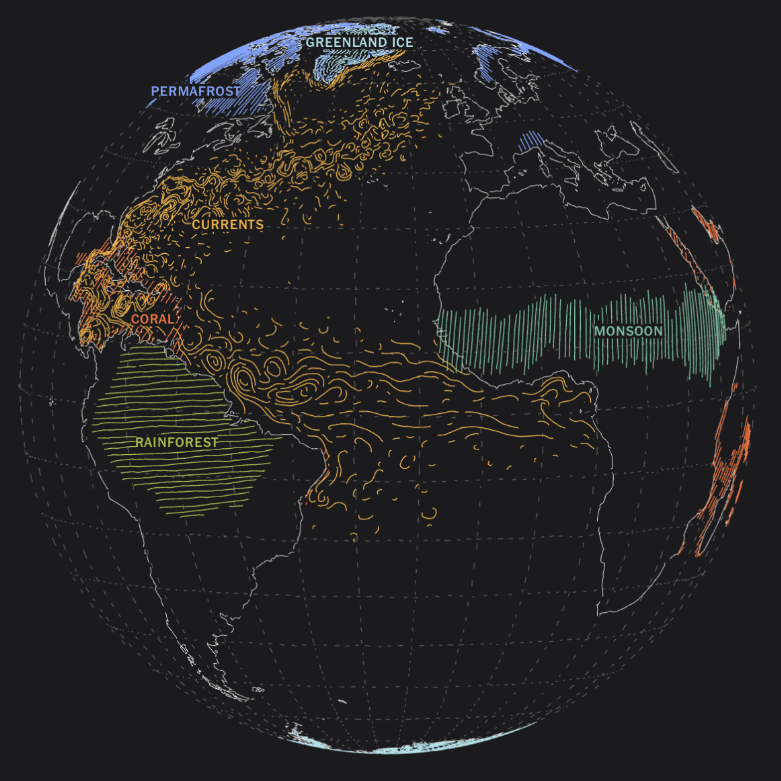
For the past two decades, scientists have been raising alarms about great systems in the natural world that warming, caused by carbon emissions, might be pushing toward collapse. These systems are so vast that they can stay somewhat in balance even as temperatures rise. But only to a point.

Once we warm the planet beyond certain levels, this balance might be lost, scientists say. The effects would be sweeping and hard to reverse. Not like the turning of a dial, but the flipping of a switch. One that wouldn’t be easily flipped back.

Mass Death of Coral Reefs

When corals go ghostly white, they aren’t necessarily dead, and their reefs aren’t necessarily gone forever. Too much heat in the water causes the corals to expel the symbiotic algae living inside their tissues. If conditions improve, they can survive this bleaching. In time, the reefs can bounce back. As the world gets warmer, though, occasional bleaching is becoming regular bleaching. Mild bleaching is becoming severe bleaching.

Scientists’ latest predictions are grim. Even if humanity moves swiftly to rein in global warming, 70 percent to 90 percent of today’s reef-building corals could die in the coming decades. If we don’t, the toll could be 99 percent or more. A reef can look healthy right up until its corals start bleaching and dying. Eventually, it is a graveyard.

This doesn’t necessarily mean reef-building corals will go extinct. Hardier ones might endure in pockets. But the vibrant ecosystems these creatures support will be unrecognizable. There is no bouncing back anytime soon, not in the places corals live today, not at any scale.

When it might happen: It could already be underway.

Abrupt Thawing of Permafrost

In the ground beneath the world’s cold places, the accumulated remains of long-dead plants and animals contain a lot of carbon, roughly twice the amount that’s currently in the atmosphere. As heat, wildfires and rains thaw and destabilize the frozen ground, microbes get to work, converting this carbon into carbon dioxide and methane. These greenhouse gasses worsen the heat and the fire and the rain, which intensifies the thawing.

Like many of these vast, self-propelling shifts in our climate, permafrost thaw is complicated to predict. Large areas have already come unfrozen, in Western Canada, in Alaska, in Siberia. But how quickly the rest of it might defrost, how much that would add to global warming, how much of the carbon might stay trapped down there because the thawing causes new vegetation to sprout up on top of it — all of that is tricky to pin down.

“Because these things are very uncertain, there’s a bias toward not talking about it or dismissing the possibility, even,” said Tapio Schneider, a climate scientist at the California Institute of Technology. “That, I think, is a mistake,” he said. “It’s still important to explore the risks, even if the probability of occurrence in the near future is relatively small.”

When it might happen: The timing will vary place to place. The effects on global warming could accumulate over a century or more.

Collapse of Greenland Ice

The colossal ice sheets that blanket Earth’s poles aren’t melting the way an ice cube melts. Because of their sheer bigness and geometric complexity, a host of factors shapes how quickly the ice sheds its bulk and adds to the rising oceans. Among these factors, scientists are particularly concerned about ones that could start feeding on themselves, causing the melting to accelerate in a way that would be very hard to stop.

In Greenland, the issue is elevation. As the surface of the ice loses height, more of it sits at a balmier altitude, exposed to warmer air. That makes it melt even faster.

Scientists know, from geological evidence, that large parts of Greenland have been ice-free before. They also know that the consequences of another great melt could reverberate worldwide, affecting ocean currents and rainfall down into the tropics and beyond.

When it might happen: Irreversible melting could begin this century and unfold over hundreds, even thousands, of years.

Breakup of West Antarctic Ice

At the other end of the world from Greenland, the ice of western Antarctica is threatened less by warm air than by warm water.

Many West Antarctic glaciers flow out to sea, which means their undersides are exposed to constant bathing by ocean currents. As the water warms, these floating ice shelves melt and weaken from below, particularly where they sit on the seafloor. Like a dancer holding a difficult pose, the shelf starts to lose its footing. With less floating ice to hold it back, more ice from the continent’s interior would slide into the ocean. Eventually, the ice at the water’s edge might fail to support its own weight and crack into pieces.

The West Antarctic ice sheet has probably collapsed before, in Earth’s deep past. How close today’s ice is to suffering the same fate is something scientists are still trying to figure out.

“If you think about the future of the world’s coastlines, 50 percent of the story is going to be the melt of Antarctica,” said David Holland, a New York University scientist who studies polar regions. And yet, he said, when it comes to understanding how the continent’s ice might break apart, “we are at Day Zero.”

When it might happen: As in Greenland, the ice sheet could begin to recede irreversibly in this century.

Sudden Shift in the West African Monsoon

Around 15,000 years ago, the Sahara started turning green. It began when small shifts in Earth’s orbit caused North Africa to be sunnier each summer. This warmed the land, causing the winds to shift and draw in more moist air from over the Atlantic. The moisture fell as monsoon rain, which fed grasses and filled lakes, some as large as the Caspian Sea. Animals flourished: elephants, giraffes, ancestral cattle. So did humans, as engravings and rock paintings from the era attest. Only about 5,000 years ago did the region transform back into the harsh desert we know today.

Scientists now understand that the Sahara has flipped several times over the ages between arid and humid, between barren and temperate. They are less sure about how, and whether, the West African monsoon might shift or intensify in response to today’s warming. (Despite its name, the region’s monsoon unleashes rain over parts of East Africa as well.)

Whatever happens will matter hugely to an area of the world where many people’s nutrition and livelihoods depend on the skies.

When it might happen: Hard to predict.

Loss of Amazon Rainforest

Besides being home to hundreds of Indigenous communities, millions of animal and plant species and 400 billion trees; besides containing untold numbers of other living things that have yet to be discovered, named and described; and besides storing an abundance of carbon that might otherwise be warming the planet, the Amazon rainforest plays another big role. It is a living, churning, breathing engine of weather.

The combined exhalations of all those trees give rise to clouds fat with moisture. When this moisture falls, it helps keep the region lush and forested.

Now, though, ranchers and farmers are clearing the trees, and global warming is worsening wildfires and droughts. Scientists worry that once too much more of the forest is gone, this rain machine could break down, causing the rest of the forest to wither and degrade into grassy savanna.

By 2050, as much of half of today’s Amazon forest could be at risk of undergoing this kind of degradation, researchers recently estimated.

When it might happen: Will depend on how rapidly people clear, or protect, the remaining forest.

Shutdown of Atlantic Currents

Sweeping across the Atlantic Ocean, from the western coasts of Africa, round through the Caribbean and up toward Europe before heading down again, a colossal loop of seawater sets temperatures and rainfall for a big part of the globe. Saltier, denser water sinks to the ocean depths while fresher, lighter water rises, keeping this conveyor belt turning.

Now, though, Greenland’s melting ice is upsetting this balance by infusing the North Atlantic with immense new flows of freshwater. Scientists fear that if the motor slows too much, it could stall, upending weather patterns for billions of people in Europe and the tropics.

Scientists have already seen signs of a slowdown in these currents, which go by an unwieldy name: the Atlantic Meridional Overturning Circulation, or AMOC. The hard part is predicting when a slowdown might become a shutdown. At the moment, our data and records are just too limited, said Niklas Boers, a climate scientist at the Technical University of Munich and the Potsdam Institute for Climate Impact Research.

Already, though, we know enough to be sure about one thing, Dr. Boers said. “With every gram of additional CO2 in the atmosphere, we are increasing the likelihood of tipping events,” he said. “The longer we wait” to slash emissions, he said, “the farther we go into dangerous territory.”

When it might happen: Very hard to predict.

Methodology

The range of warming levels at which each tipping point might potentially be triggered is from David I. Armstrong McKay et al., Science.

The shaded areas on the maps [see here] show the present-day extent of relevant areas for each natural system. They don’t necessarily indicate precisely where large-scale changes could occur if a tipping point is reached.

Calor pode nos tornar mais agressivos e menos inteligentes (Folha de S.Paulo)

www1.folha.uol.com.br

Dana G. Smith

02.julho.2024


The New York Times Em julho de 2016, uma onda de calor atingiu Boston, nos EUA, com temperaturas diurnas médias de 33 graus Celsius durante cinco dias consecutivos. Alguns estudantes universitários locais que ficaram na cidade durante o verão tiveram sorte e moravam em dormitórios com ar-condicionado central. Outros estudantes, nem tanto —ficaram presos em dormitórios mais antigos sem ar-condicionado.

Jose Guillermo Cedeño Laurent, um pesquisador da Universidade de Harvard na época, decidiu aproveitar esse experimento natural para ver como o calor, e especialmente o calor à noite, afetava o desempenho cognitivo dos jovens adultos. Ele fez com que 44 alunos realizassem testes de matemática e autocontrole cinco dias antes da temperatura subir, todos os dias durante a onda de calor e dois dias depois.

“Muitos de nós pensamos que somos imunes ao calor”, afirma Cedeño, agora professor assistente de saúde ambiental e ocupacional e justiça na Universidade Rutgers. “Então, algo que eu queria testar era se isso era realmente verdade.”

Acontece que até estudantes universitários jovens e saudáveis são afetados por altas temperaturas. Durante os dias mais quentes, os alunos nos dormitórios sem ar-condicionado, onde as temperaturas noturnas médias eram de 26 graus, tiveram um desempenho significativamente pior nos testes que fizeram todas as manhãs do que os alunos com ar-condicionado, cujos quartos permaneciam agradáveis a 21 graus.

Uma onda de calor está cobrindo novamente o Nordeste, Sul e Centro-Oeste dos EUA. Altas temperaturas podem ter um efeito alarmante em nossos corpos, aumentando o risco de ataques cardíacos, insolação e morte, especialmente entre adultos mais velhos e pessoas com doenças crônicas. Mas o calor também prejudica nossos cérebros, prejudicando a cognição e nos tornando irritáveis, impulsivos e agressivos.

Como o calor nos torna menos inteligentes

Numerosos estudos em ambientes de laboratório produziram resultados semelhantes aos da pesquisa de Cedeño, com pontuações em testes cognitivos diminuindo à medida que os cientistas aumentavam a temperatura na sala.

Isso pode ter consequências reais. R. Jisung Park, um economista ambiental e do trabalho na Universidade da Pensilvânia, analisou as notas de testes padronizados do ensino médio e descobriu que elas caíram 0,2% para cada grau acima de 22 Celsius. Isso pode não parecer muito, mas pode acumular para estudantes fazendo um exame em uma sala sem ar-condicionado durante uma onda de calor de 32 graus.

Em outro estudo, Park descobriu que quanto mais dias mais quentes do que a média havia durante o ano letivo, pior os alunos se saíam em um teste padronizado —especialmente quando o termômetro subia acima de 26 graus. Ele acredita que isso pode ser porque a maior exposição ao calor estava afetando o aprendizado dos alunos ao longo do ano.

O efeito foi “mais pronunciado para estudantes de baixa renda e minorias raciais”, explica Park, possivelmente porque eles tinham menos probabilidade de ter ar-condicionado, tanto na escola quanto em casa.

Por que o calor nos torna agressivos

Pesquisadores descobriram pela primeira vez a ligação entre calor e agressão ao analisar dados de crimes, descobrindo que há mais assassinatos, agressões e episódios de violência doméstica em dias quentes. A conexão também se aplica a atos não violentos: quando as temperaturas sobem, as pessoas são mais propensas a se envolver em discursos de ódio online e a buzinar no trânsito.

Estudos de laboratório confirmam isso. Em um experimento de 2019, as pessoas agiram com mais rancor em relação aos outros enquanto jogavam um videogame especialmente projetado em uma sala quente do que em uma sala fria.

A chamada agressão reativa tende a ser especialmente sensível ao calor, provavelmente porque as pessoas tendem a interpretar as ações dos outros como mais hostis em dias quentes, levando-as a responder da mesma forma.

Kimberly Meidenbauer, professora assistente de psicologia na Washington State University, acha que esse aumento na agressão reativa pode estar relacionado ao efeito do calor na cognição, particularmente na queda no autocontrole. “Sua tendência de agir sem pensar, ou não conseguir se impedir de agir de certa maneira, essas coisas também parecem ser afetadas pelo calor,” afirma.

O que acontece no cérebro

Os pesquisadores não sabem por que o calor afeta nossa cognição e emoções, mas existem algumas teorias.

Uma é que os recursos do cérebro estão sendo desviados para mantê-lo frio, deixando menos energia para todo o resto. “Se você está alocando todo o sangue e toda a glicose para partes do seu cérebro que estão focadas na termorregulação, parece muito plausível que você simplesmente não teria o suficiente para algumas dessas funções cognitivas mais altas,” diz Meidenbauer.

Você também pode ficar distraído e irritado por causa do calor e da tristeza que sente. Acontece que essa é, na verdade, uma das respostas de enfrentamento do cérebro. Se você não conseguir se acalmar, seu cérebro “fará você se sentir ainda mais desconfortável, de modo que encontrar o que você precisa para sobreviver se tornará desgastante”, explicou Shaun Morrison, professor de cirurgia neurológica na Oregon Health and Science University.

O efeito do calor no sono também pode desempenhar um papel. No estudo de Boston, quanto mais quente ficava, mais o sono dos alunos era interrompido —e pior eles se saíam nos testes.

A melhor maneira de compensar esses efeitos é se refrescar o mais rápido possível. Se você não tem acesso ao ar-condicionado, ventiladores podem ajudar, e certifique-se de se manter hidratado. Pode parecer óbvio, mas o que mais importa para seu cérebro, humor e cognição é quão quente seu corpo está, não a temperatura lá fora.

2 em cada 3 pagariam mais caro em carro elétrico para combater mudanças climáticas, diz Datafolha (Folha de S.Paulo)

www1.folha.uol.com.br

Jéssica Maes

02.julho.2024


Os brasileiros estão dispostos a modificar hábitos de consumo para ajudar na luta contra o aquecimento global, mostra uma nova pesquisa Datafolha, divulgada nesta segunda-feira (1º).

Em uma questão em que foram apresentadas possíveis medidas individuais para combater as mudanças climáticas, 100% dos entrevistados afirmaram que adotariam alguma delas.

Quase a totalidade concordaria com atitudes simples, como trocar as lâmpadas de casa por modelos mais econômicos (99%) e reduzir o uso de plástico e embalagens descartáveis (94%). Os índices de aceitação são altos mesmo entre atitudes de custo superior, como colocar painéis solares em casa (89%) ou pagar mais caro por produtos com baixa emissão de carbono (74%) Dois em cada três (63%) investiriam mais por um carro elétrico (63%).

A pesquisa sobre a compreensão e a relação da população com as mudanças climáticas foi realizada presencialmente, com 2.457 pessoas de 16 anos ou mais em 130 municípios pelo Brasil, entre os dias 17 e 22 de junho. A margem de erro é de dois pontos percentuais, com taxa de confiança de 95%.

O levantamento mostra que a maioria das pessoas também aceitaria usar mais o transporte público ou a bicicleta (82%), escolher viagens para lugares mais próximos para evitar usar avião (77%) e até mesmo reduzir o consumo de carne (68%) em prol do meio ambiente.

A queima de combustíveis fósseis, como petróleo, carvão e gás, para produção de energia, transporte e pela indústria é a maior fonte de emissões de gases de efeito estufa no mundo. No Brasil, a principal fonte de emissões é o desmatamento, que tem no setor agropecuário o seu motor mais significativo.

Além disso, o plástico, que é um derivado do petróleo, ainda causa um problema ambiental por si só —especialmente aquele de uso único, como embalagens ou produtos descartáveis. Cerca de 450 milhões de toneladas desse material são descartadas por ano no mundo e apenas 9% é reciclado. Até 2050, as previsões são de que haja mais plástico do peixe nos oceanos.

Os resultados da pesquisa Datafolha apontam, ainda, que 83% dos brasileiros acreditam que atitudes individuais têm um papel importante para resolver problemas ambientais.

Metade (51%) das pessoas diz acreditar que ações individuais contribuem muito para a sustentabilidade e preservação do meio ambiente, e um terço (32%) que contribuem um pouco, enquanto apenas 16% dizem que essas atitudes não contribuem.

O índice de quem acredita na importância de ações individuais para a conservação chega a 93% entre aqueles com ensino superior, 86% para quem tem nível médio e cai a 73% entre os de nível fundamental.

A taxa também cresce, atingindo 88%, na parcela mais jovem dos entrevistados, de 16 a 24 anos. O número fica em 86% para o estrato de 25 a 44 anos, 82% para a faixa etária entre 45 e 59 anos e reduz para 76% na parcela mais velha, de 60 anos ou mais.

Ao mesmo tempo que metade dos brasileiros acreditam que ações individuais são muito significativas para a sustentabilidade, apenas 25% se sentem, pessoalmente, muito responsáveis pelas mudanças climáticas. Outros 51% dizem se sentir um pouco responsáveis e 23%, nada responsáveis. Só 1% não soube opinar.

De modo geral, ações tomadas individualmente pelos cidadãos podem contribuir para reduzir as emissões de gases que aquecem o planeta, como abrir mão de meios de transporte movidos a combustão, fazer adaptações na dieta e consumir produtos de origem sustentável, como recomendado pelo Programa das Nações Unidas para o Meio Ambiente.

Contudo, para mudar significativamente o cenário e as previsões para o futuro do clima, são necessárias grandes transformações em setores econômicos, o que requer medidas contundentes de governos e corporações.

97% dos brasileiros percebem mudanças climáticas no dia a dia, aponta Datafolha (Folha de S.Paulo)

www1.folha.uol.com.br

Jéssica Maes

02.julho.2024


Em meio a fenômenos de proporções históricas, como os alagamentos que devastaram o Rio Grande do Sul e a seca que vem causando incêndios florestais recordes no pantanal, 97% dos brasileiros afirmam que percebem no dia a dia que o planeta está passando por mudanças climáticas.

O dado pertence a uma nova pesquisa Datafolha, divulgada nesta segunda-feira (1º), que aponta que apenas 2% dos entrevistados negam a existência das alterações no clima, enquanto 1% não soube responder.

O levantamento foi realizado presencialmente, com 2.457 pessoas de 16 anos ou mais em 130 municípios pelo Brasil, entre os dias 17 e 22 de junho. A margem de erro é de dois pontos percentuais, com taxa de confiança de 95%.

Os resultados mostram que essa percepção quase unânime se repete mesmo considerando diferentes recortes, como gênero, nível de escolaridade e faixa etária —chegando, por exemplo, a 100% de concordância sobre a ocorrência das mudanças climáticas entre os mais jovens, de 16 a 24 anos.

Os índices caem, porém, quando questionados sobre os agentes que provocam essa transformação. São 77% quem acha que as mudanças climáticas são causadas principalmente pelas ações humanas, enquanto 20% defendem que a causa delas é a oscilação natural da temperatura.

Conforme aponta o consenso científico, a crise do clima atual é provocada pelos gases de efeito estufa emitidos pelas atividades humanas, principalmente a queima de combustíveis fósseis e o desmatamento, que aquecem o planeta. Em 2021, uma análise de quase 90 mil artigos científicos mostrou que mais de 99,9% dos pesquisadores do mundo concordam sobre essas causas e efeitos.

Os altos índices gerais de reconhecimento da mudança do clima podem estar relacionados ao aumento da intensidade, frequência e exposição a eventos climáticos extremos. A pesquisa perguntou se nas últimas semanas o lugar onde o entrevistado mora passou por diferentes tipos de fenômenos desta natureza, e 77% disseram que sim.

Entre esses, o número mais expressivo foi o de pessoas que passaram por calor extremo (65%), seguido de chuva intensa ou tempestade (33%), e seca extrema (29%). Enchentes atingiram 20% dos entrevistados e deslizamentos de terra, 7%.

Um quarto dos respondentes (23%) afirmou não ter vivenciado nenhum destes eventos recentemente.

Para Paulo Artaxo, professor de física da USP (Universidade de São Paulo) e membro do IPCC (Painel Intergovernamental sobre Mudanças Climáticas), vinculado à ONU, no mundo inteiro a população está percebendo que o clima mudou para pior, o que é reforçado pela ocorrência de fenômenos extremos.

“As mudanças climáticas se dão em dois níveis. Primeiro, um lento e gradual: degradação ambiental com o aumento lento da temperatura, redução ou aumento lento da precipitação, o aumento do nível do mar que afeta as áreas costeiras e assim por diante”, explica.

“Um segundo componente é a intensificação dos eventos climáticos extremos, que cada vez mais se tornam muito perceptíveis para a população em geral, causando enormes danos na saúde, na economia e na sociedade em geral”.

Marcio Astrini, secretário-executivo do Observatório do Clima, que reúne mais de uma centena de organizações ambientais, concorda.

“As pessoas não precisam mais procurar um relatório científico para se informar. Elas abrem a janela de casa, ligam a televisão e as mudanças climáticas estão acontecendo —não são mais uma previsão, são o presente”, diz. “Isso, obviamente, faz com que as pessoas tenham mais capacidade de compreender o que está acontecendo”.

O Datafolha mostra que a escolaridade é um fator que impacta a percepção dos brasileiros sobre o clima. Entre pessoas com educação de nível fundamental, 67% acreditam que as mudanças climáticas são causadas pela humanidade, 26% dizem que elas fazem parte da natureza e 4%, que não existem, Entre aquelas com ensino superior, os números são, respectivamente, 87%, 13% e 1%.

Astrini afirma que os resultados estão relacionados à falta de acesso à informação qualificada e à abundância de fake news disseminadas sobre o tema.

“Nós vivemos em um mundo em que existe desinformação em larga escala e alguns setores são alvos preferenciais de quem provoca a desinformação. O meio ambiente é um deles”, diz. “Em meio ambiente há muito, muito tempo, a gente enfrenta um verdadeiro batalhão —que vem enfraquecendo, mas ainda existe— de negacionismo, de desinformação”.

Também é entre os que passaram menos tempo na educação formal que está a taxa mais alta de descrença nas previsões da ciência sobre as consequências do aquecimento global. Daqueles que estudaram até o ensino fundamental, 43% dizem acreditar que cientistas e ambientalistas exageram sobre os impactos das mudanças climáticas, enquanto na população geral o índice é de 31%.

O nível mais alto de confiança nos especialistas está entre os mais jovens, com 77% dos que têm entre 16 e 24 anos afirmando que não há exagero a respeito do tema; 21% dizem o contrário.

Já entre aqueles com 60 anos ou mais o patamar de descrença está acima da média nacional, com mais de um terço (36%) concordando com a afirmação de que cientistas e ambientalistas exageram ao tratar dos impactos da crise do clima.

“É esperado que os mais jovens e os com mais acesso à informação mostrem maior concordância com as avaliações científicas. Os mais velhos têm a memória de condições mais estáveis e se formaram em um ambiente onde o tema não estava tão difundido, estudado ou documentado”, avalia Mercedes Bustamante, professora do departamento de ecologia da UnB (Universidade de Brasília).

Cruzando os dados da pesquisa, é possível notar, ainda, que aqueles que relatam não terem vivenciado um evento climático extremo no local onde moram são mais propensos a duvidar do parecer científico sobre os impactos do aquecimento global. Neste grupo, 36% das pessoas acham que os especialistas exageram, 61% acham que não e 3% não souberam responder.

A taxa de descrédito cai para 29% entre aqueles que passaram por alguma situação climática extrema recentemente, enquanto 69% deste estrato acha que não há exagero e 2% não soube responder.

Mais da metade dos brasileiros diz que crise do clima representa ameaça imediata, mostra Datafolha (Folha de S.Paulo)

www1.folha.uol.com.br

Jéssica Maes

02.julho.2024


Mais da metade (52%) dos brasileiros acha que as mudanças climáticas são um risco imediato para a população do planeta, enquanto 43% opinam que elas só representarão perigo para quem viverá daqui a muitos anos. Apenas 5% dizem que a crise do clima não representa risco algum.

Os números são da pesquisa Datafolha divulgada nesta segunda-feira (1º), que trata das percepções e opiniões sobre as alterações no clima. O levantamento ouviu 2.457 pessoas de 16 anos ou mais em 130 municípios pelo Brasil, entre os dias 17 e 22 de junho. A margem de erro é de dois pontos percentuais, com taxa de confiança de 95%.

“O percentual de brasileiros que compreende a mudança climática é elevado em comparação a outros países (por exemplo, os Estados Unidos)”, analisa Mercedes Bustamante, professora do departamento de Ecologia da Universidade de Brasília. Ela se refere a outros dados da pesquisa, que mostram que 77% das pessoas dizem acreditar que as mudanças climáticas são provocadas principalmente pelas atividades humanas.

A pesquisadora pondera, porém, que é interessante comparar esses índices com a divisão que aparece quando os entrevistados são questionados sobre os efeitos do aquecimento global. “Isso talvez seja uma indicação [de que há uma] percepção da existência do problema, mas ainda não [percebe-se] como seus mais variados efeitos já estão no dia a dia.”

Estudos mostram que o planeta já aqueceu mais de 1,2°C desde o período pré-industrial (1850-1900), que marca o grande aumento na emissão de carbono pela humanidade, e que fenômenos climáticos extremos, como tempestades e ondas de calor, já estão mais intensos e frequentes.

O Datafolha aponta ainda que, para 58% dos entrevistados, a humanidade não conseguirá agir para reverter os impactos das mudanças climáticas. Menos de um terço da população (31%) acha que será possível retornar a um clima mais ameno, enquanto 7% dizem que isso não faz diferença para a humanidade e o planeta.

O patamar de descrença na capacidade da humanidade de reverter as mudanças climáticas varia de acordo com a escolaridade, sendo mais alto entre aqueles que têm ensino de nível médio (60%). No estrato da população com ensino superior, 36% acreditam na possibilidade dos humanos conseguirem frear a crise climática.

Apesar disso, a pesquisa mostra que a disposição dos próprios brasileiros para mudar atitudes que têm o poder de potencializar o aquecimento global é alta.

Quase a totalidade diz que concordaria em adotar atitudes simples, como trocar as lâmpadas de casa por modelos mais econômicos (99%) e reduzir o uso de plástico (94%), e os índices de aceitação são altos mesmo diante de uma atitude custosa, como colocar paineis solares em casa (89%) e pagar mais caro por produtos com baixa emissão de carbono (74%) ou para ter um carro elétrico (63%).

Para especialistas, o que pode parecer uma contradição pode ser, na verdade, apenas desesperança com a inação de governantes e grandes corporações –que são os maiores culpados pelas emissões de gases de efeito estufa e, portanto, os principais responsáveis por reduzi-las.

“A ciência mostra caminhos para a resolução da mudança do clima. No entanto, creio que a percepção de que não haverá reversão indica a avaliação da morosidade ou mesmo falta de ações políticas concretas e robustas para abordar as soluções”, afirma Bustamante.

“A falta de ação das indústrias do petróleo e dos governos que são associados a elas, que financiam uma enorme quantidade de governos no mundo todo, está fazendo com que o planeta esteja indo por uma trajetória de aumento de temperatura médio da ordem de 3°C”, afirma o físico Paulo Artaxo, pesquisador da USP.

“Isto pode comprometer muito a qualidade de vida das próximas gerações, e isso não é para o final do século, já é para as próximas décadas”, acrescenta ele.

Para Marcio Astrini, secretário-executivo do Observatório do Clima, rede que reúne mais de uma centena de organizações ambientais, o impacto dessa desesperança da população em reverter as mudanças climáticas pode ter um efeito nocivo, de diminuir esforços nesse sentido.

“Quando o ser humano pensa, ‘olha, já que não tem jeito, então para que que eu vou me esforçar? Para resolver algo que não tem solução?’. Isso, inclusive, se reflete no voto, na escolha dos governantes que vão gerenciar a máquina estatal, que é quem vai resolver o problema”, explica.

“Isso desencadeia um problema em cima do outro, porque é uma imobilização. E quanto mais passa o tempo, mais estreita vai ficar a janela para termos alguma esperança de solução”, diz Astrini.

Ciência sozinha não vai resolver crise climática, diz filósofo americano (Folha de S.Paulo)

www1.folha.uol.com.br

Maurício Meireles

26.junho.2024


Só a ciência, sem a política, não vai conseguir produzir as soluções que o mundo precisa para combater a crise climática.

Quem diz é Michael Sandel, professor de filosofia política da Universidade Harvard e autor de diversos livros —o último publicado no Brasil é “O Descontentamento da Democracia” (ed. Civilização Brasileira).

A frase pode até parecer um truísmo, mas resume o cerne das críticas de Sandel às democracias contemporâneas: quando a política é dominada pelo discurso tecnocrático, os cidadãos acabam sem voz e sem meios de participar das decisões que afetam suas vidas.

Em “O Descontentamento da Democracia”, ele diz que a culpa da ascensão do autoritarismo pelo mundo é do chamado neoliberalismo, que promoveu o fortalecimento do setor financeiro e a desregulação dos mercados.

Para Sandel, essas políticas foram levadas adiante por tecnocratas de direita e esquerda que alienaram cidadãos das decisões econômicas, amparados por um discurso de meritocracia, gerando uma reação de ressentimento contra as elites e ceticismo quanto à democracia.

Por isso, diz, é importante não repetir o mesmo erro com a política climática. A ciência é, sim, crucial para embasar as decisões, mas é preciso participação democrática —e as lideranças não podem usar o discurso científico como forma de escapar de suas responsabilidades.

Sandel participou recentemente do ciclo de palestras online Clima e Sociedade, promovido pela UFSM (Universidade Federal de Santa Maria), em que conversou com lideranças comunitárias que estão no front de combate aos efeitos das enchentes que atingiram o Rio Grande do Sul.

Em entrevista à Folha, ele explica como os pontos levantados em seu livro se aplicam ao debate climático, avalia a atuação de instituições multilaterais nesse campo e defende que se evite o discurso apocalíptico.

Em vez de reforçar um sentimento de solidariedade, crises como a pandemia parecem ter explicitado divisões —e democracias como os Estados Unidos continuam tão polarizadas quanto antes. O mundo superestima a capacidade dessas crises de gerar solidariedade mútua?

A pandemia foi um ótimo teste. No começo da crise de saúde, com frequência ouvíamos que essa emergência iria nos unir, mostrando que somos igualmente vulneráveis, apesar das desigualdades econômicas. Quem podia trabalhar de casa logo percebeu o quanto dependemos do trabalho de pessoas que são ignoradas.

Poderia ter sido a hora para debater melhores salários e reconhecimento para os trabalhadores essenciais. Mas isso não ocorreu. A pandemia retrocedeu e a gratidão a eles também. Foi uma oportunidade perdida, a pandemia não nos levou a uma transformação social ou espiritual.

Para manter o senso de comunidade que crises como as enchentes no Sul despertam, é necessário criar instituições e espaços públicos sólidos, além formas de organização. Pressionar os governos por recursos é importante, mas é preciso construir instituições na sociedade civil, estabelecer um diálogo contínuo para que todos entendam que dividimos uma vida comum.

Você coloca a economia no centro da sua análise da crise das democracias liberais, em detrimento de uma análise mais cultural, que hoje parece mais popular no debate público. Por que essa abordagem econômica é mais adequada?

Em “O Descontentamento da Democracia”, escrevo sobre o que chamo de economia política da cidadania. Nas últimas décadas, erramos ao pressupor que o único propósito da economia é promover o consumo. E que, portanto, nosso foco principal deveria ser o crescimento do PIB e a distribuição da riqueza.

Tudo isso importa, é claro, mas não são as únicas questões que devemos levar em conta. É preciso se perguntar quais arranjos econômicos são favoráveis à participação democrática.

Democracia não é só ir votar. Democracia é criar condições econômicas e sociais que possibilitem às pessoas deliberar como iguais [sobre seu destino], moldando as forças que as governam.

Quando as pessoas não têm voz, elas se sentem excluídas, raivosas, ressentidas —e vão se conectar a políticos demagogos que canalizam essa alienação. Isso é o que começa a explicar o que está havendo, nos últimos anos, tanto nos EUA quanto no Brasil.

Sou contra uma separação tão dura entre uma análise econômica e outra cultural sobre por que cidadãos têm apoiado líderes autoritários pelo mundo.

Nos últimos anos, a divisão entre vencedores e derrotados se aprofundou, envenenando a política. Isso tem em partes a ver com a desigualdade, mas há também uma mudança de atitude em relação ao sucesso individual.

Quem está no topo acha que os lucros que recebeu do mercado são a medida de seus méritos —e que quem ficou para trás, por consequência, também mereceria o próprio destino.

Isso ajuda a explicar a política da raiva e do ressentimento. E também o crescimento do populismo autoritário de direita. Muitos da classe trabalhadora acham que as elites os olham de cima para baixo, com especial desprezo contra aqueles que não receberam educação universitária.

Agora, quanto dessa análise é econômica e quanto é cultural? São ambos os casos. É econômica porque mostra como a economia pode deteriorar a democracia participativa. E porque foca no papel do crescimento da desigualdade. Mas também é cultural, porque identifico esses elementos de ressentimento.

É preciso atar as duas pontas, resolver as desigualdades e lidar com a sensação de não ter voz, a raiva de tantos da classe trabalhadora.

Sua análise está centrada na globalização e nas chamadas políticas neoliberais. Qual o impacto disso no debate político sobre a mudança climática?

A política da mudança climática é um exemplo de como algo focado nas elites rapidamente vira um discurso tecnocrático quanto ao meio ambiente, que pode reforçar a polarização.

Há um jeito de organizar a economia e conduzir as políticas públicas que leva os cidadãos a se sentir sem voz. É uma política que trata as questões econômicas e ambientais como algo técnico, que só diz respeito aos especialistas.

Vimos esse discurso tecnocrático durante a pandemia, quando representantes das elites diziam que só estavam “seguindo a ciência”, o que é um jeito de escapar das responsabilidades.

Claro que é importante seguir a ciência no meio de uma pandemia ou da mudança climática —mas é um erro pressupor que a ciência sozinha pode realizar as avaliações políticas necessárias.

Por exemplo, durante a pandemia, a ciência não podia resolver se deveríamos fechar as escolas e por quanto tempo. Esse era um julgamento político, que teve que ser debatido pelos cidadãos dentro do processo democrático —e quem tomou as decisões teria que assumir responsabilidade por elas.

Não adianta só dizer que se está seguindo a ciência. No caso da política climática, a ciência precisa informar as decisões que vamos tomar, mas essas medidas precisam ser debatidas entre as pessoas implicadas nelas. Pois isso envolve negociações, questões distributivas, um debate sobre quem vai pagar o preço da transição para a economia verde… E por aí vai.

O que nos trouxe a esse momento tão polarizado é a insistência das elites políticas de que são especialistas ou que estão amparadas por especialistas. Com isso, fica implícito que quem discorda ou está mal informado ou é ignorante. E que, portanto, essas pessoas não estariam qualificadas a ter voz.

É o mesmo que ocorreu com a dignidade da classe trabalhadora, deteriorada pela financeirização da economia, a terceirização do trabalho, tudo em nome dos especialistas que diziam que isso seria bom para todos.

Se repetimos essa postura tecnocrática no combate à mudança climática, teremos outra vez as elites olhando os cidadãos de cima, dizendo que estão só seguindo a ciência.

A mudança climática é uma crise que requer ação global. Mas, no seu livro, você mostra ceticismo quanto às organizações multilaterais. Como elas deveriam funcionar?

A mudança climática requer cooperação global, sem dúvidas. E isso significa que precisamos de instituições multilaterais para conceber e implementar políticas, a fim de proteger o planeta e promover a transição para a economia verde.

As instituições globais hoje operam como instituições tecnocráticas, sem legitimidade ou participação democrática. E esse é um problema com o qual teremos que lidar.

A Europa já estava lidando com isso antes de a crise climática se tornar algo tão central. Mesmo esse bloco, onde a maioria dos países têm tradição democrática, tem sido associado aos burocratas de Bruxelas. Cidadãos nacionais se ressentem de determinações vindas desses burocratas e acham que não têm voz.

O mesmo vale para as instituições que serão necessárias para lidarmos com a crise climática. Precisamos de plataformas para um discurso público global, que possa envolver os cidadãos comuns na formulação de políticas que nos levarão a uma economia verde.

Se for algo puramente tecnocrático, mesmo o grupo de especialistas melhor administrado não vai ser capaz de conquistar legitimidade democrática e implementar qualquer política. Em resumo, não sou cético quanto às instituições multilaterais, apenas quero enfatizar a necessidade de participação democrática.

Seu principal ponto é que as políticas neoliberais teriam levado eleitores para a extrema direita. Você aponta que o presidente Joe Biden foi o primeiro a romper com essas diretrizes econômicas. No entanto, Donald Trump tem grandes chances de ser eleito. O que houve?

Um novo mandato de Trump aumentaria os riscos que a democracia americana enfrenta. Sim, Joe Biden rompeu com o mercado neoliberal que produziu a polarização política.

Ele falou sobre tentar restaurar a dignidade do trabalho, inclusive para quem não tem formação universitária.

Biden revitalizou as políticas antitruste, não só com objetivo de diminuir preços ao consumidor, mas também de responsabilizar o poder econômico, especialmente no caso das “big techs”. Também levou o Congresso a implementar investimentos públicos em infraestrutura que não eram vistos há décadas.

Por que ele não está colhendo dividendos políticos disso? Ele não foi capaz de articular essas medidas em uma nova visão de governo, não conseguiu explicar como todas essas políticas, se vistas em conjunto, podem renovar a cidadania democrática. E que, ao restaurar a dignidade do trabalho, as pessoas podem ter voz na política.

Uma liderança não depende só de implementar boas políticas, mas de oferecer uma visão que seja ao mesmo tempo econômica, política e moral.


RAIO-X

Michael J. Sandel, 71

É professor de filosofia política na Universidade Harvard, nos EUA, com obras que já foram traduzidas para mais de 30 línguas. Em livros como “O Descontentamento da Democracia” e “A Tirania do Mérito”, escreve sobre ética, economia e democracia, entre outros temas. Seu curso intitulado Justiça foi o primeiro de Harvard a ser disponibilizado gratuitamente online —e já foi visto por dezenas de milhões de pessoas.

Ditching ‘Anthropocene’: why ecologists say the term still matters (Nature)

A aerial view of a section of the Niger river in Bamako clogged with plastic waste and other polluting materials.
Plastic waste is clogging the Niger River in Bamako, Mali. After it sediments, plastic will become part of the geological record of human impacts on the planet. Credit: Michele Cattani/AFP via Getty

Original article

Beyond stratigraphic definitions, the name has broader significance for understanding humans’ place on Earth.

David Adam

14 March 2024

After 15 years of discussion, geologists last week decided that the Anthropocene — generally understood to be the age of irreversible human impacts on the planet — will not become an official epoch in Earth’s geological timeline.

The rejected proposal would have codified the end of the current Holocene epoch, which has been in place since the end of the last ice age 11,700 years ago. It suggested that the Anthropocene started in 1952, when plutonium from hydrogen-bomb tests showed up in the sediment of Crawford Lake near Toronto, Canada.

The vote has drawn controversy over procedural details, and debate about its legitimacy continues. But whether or not it’s formally approved as a stratigraphic term, the idea of the Anthropocene is now firmly rooted in research. So, how are scientists using the term, and what does it mean to them and their fields?

‘It’s a term that belongs to everyone’

As head of the Leverhulme Centre for Anthropocene Biodiversity at the University of York, UK, Chris Thomas has perhaps more riding on the term than most. “When the news of this — what sounds like a slightly dodgy vote — happened, I sort of wondered, is it the end of us? But I think not,” he says.

For Thomas, the word Anthropocene neatly summarizes the sense that humans are part of Earth’s system and integral to its processes — what he calls indivisible connectedness. “That helps move us away from the notion that somehow humanity is apart from the rest of nature and natural systems,” he says. “It’s undoable — the change is everywhere.”

The concept of an era of human-driven change also provides convenient common ground for him to collaborate with researchers from other disciplines. “This is something that people in the arts and humanities and the social sciences have picked up as well,” he says. “It is a means of enabling communication about the extent to which we are living in a truly unprecedented and human-altered world.”

Seen through that lens, the fact that the Anthropocene has been formally rejected because scientists can’t agree on when it began seems immaterial. “Many people in the humanities who are using the phrase find the concept of the articulation of a particular year, based on a deposit in a particular lake, a ridiculous way of framing the concept of a human-altered planet.”

Jacquelyn Gill, a palaeoecologist at the University of Maine in Orono, agrees. “It’s a term that belongs to everyone. To people working in philosophy and literary criticism, in the arts, in the humanities, the sciences,” she says. “I think it’s far more meaningful in the way that it is currently being used, than in any attempts that stratigraphers could have made to restrict or define it in some narrow sense.”

She adds: “It serves humanity best as a loose concept that we can use to define something that we all widely understand, which is that we live in an era where humans are the dominant force on ecological and geological processes.”

Capturing human influences

The idea of the Anthropocene is especially helpful to make clear that humans have been shaping the planet for thousands of years, and that not all of those changes have been bad, Gill says. “We could do a better job of thinking about human–environment relationships in ways that are not inherently negative all the time,” she says. “People are not a monolith, and neither are our attitudes or relationships to nature.”

Some 80% of biodiversity is currently stewarded on Indigenous lands, Gill points out. “Which should tell you something, right? That it’s not the presence of people that’s the problem,” she says. “The solution to those problems is changing the way that many dominant cultures relate to the natural world.”

The concept of the Anthropocene is owned by many fields, Gill says. “This reiterates the importance of understanding that the role of people on our planet requires many different ways of knowing and many different disciplines.”

In a world in which the threat of climate change dominates environmental debates, the term Anthropocene can help to broaden the discussion, says Yadvinder Malhi, a biodiversity researcher at the University of Oxford, UK.

“I use it all the time. For me, it captures the time where human influence has a global planetary effect, and it’s multidimensional. It’s much more than just climate change,” he says. “It’s what we’re doing. The oceans, the resources we are extracting, habitats changing.”

He adds: “I need that term when I’m trying to capture this idea of humans affecting the planet in multiple ways because of the size of our activity.”

The looseness of the term is popular, but would a formal definition help in any way? Malhi thinks it would. “There’s no other term available that captures the global multidimensional impacts on the planet,” he says. “But there is a problem in not having a formal definition if people are using it in different terms, in different ways.”

Although the word ‘Anthropocene’ makes some researchers think of processes that began 10,000 years ago, others consider it to mean those of the past century. “I think a formal adoption, like a definition, would actually help to clarify that.”

doi: https://doi.org/10.1038/d41586-024-00786-2

The Anthropocene is dead. Long live the Anthropocene (Science)

Panel rejects a proposed geologic time division reflecting human influence, but the concept is here to stay

Original article

5 MAR 20244:00 PM ET

BY PAUL VOOSEN

A mushroom cloud rises in the night sky
A 1953 nuclear weapons test in Nevada was among the human activities that could have marked the Anthropocene. NNSA/NEVADA FIELD OFFICE/SCIENCE SOURCE

For now, we’re still in the Holocene.

Science has confirmed that a panel of two dozen geologists has voted down a proposal to end the Holocene—our current span of geologic time, which began 11,700 years ago at the end of the last ice age—and inaugurate a new epoch, the Anthropocene. Starting in the 1950s, it would have marked a time when humanity’s influence on the planet became overwhelming. The vote, first reported by The New York Times, is a stunning—though not unexpected—rebuke for the proposal, which has been working its way through a formal approval process for more than a decade.

“The decision is definitive,” says Philip Gibbard, a geologist at the University of Cambridge who is on the panel and serves as secretary-general of the International Commission on Stratigraphy (ICS), the body that governs the geologic timescale. “There are no outstanding issues to be resolved. Case closed.”

The leaders of the Anthropocene Working Group (AWG), which developed the proposal for consideration by ICS’s Subcommission on Quaternary Stratigraphy, are not yet ready to admit defeat. They note that the online tally, in which 12 out of 18 subcommission members voted against the proposal, was leaked to the press without approval of the panel’s chair. “There remain several issues that need to be resolved about the validity of the vote and the circumstances surrounding it,” says Colin Waters, a geologist at the University of Leicester who chaired AWG.

Few opponents of the Anthropocene proposal doubted the enormous impact that human influence, including climate change, is having on the planet. But some felt the proposed marker of the epoch—some 10 centimeters of mud from Canada’s Crawford Lake that captures the global surge in fossil fuel burning, fertilizer use, and atomic bomb fallout that began in the 1950s—isn’t definitive enough.

Others questioned whether it’s even possible to affix one date to the start of humanity’s broad planetary influence: Why not the rise of agriculture? Why not the vast changes that followed European encroachment on the New World? “The Anthropocene epoch was never deep enough to understand human transformation of this planet,” says Erle Ellis, a geographer at the University of Maryland, Baltimore County who resigned last year in protest from AWG.

Opponents also felt AWG made too many announcements to the press over the years while being slow to submit a proposal to the subcommission. “The Anthropocene epoch was pushed through the media from the beginning—a publicity drive,” says Stanley Finney, a stratigrapher at California State University Long Beach and head of the International Union of Geological Sciences, which would have had final approval of the proposal.

Finney also complains that from the start, AWG was determined to secure an “epoch” categorization, and ignored or countered proposals for a less formal Anthropocene designation. If they had only made their formal proposal sooner, they could have avoided much lost time, Finney adds. “It would have been rejected 10 years earlier if they had not avoided presenting it to the stratigraphic community for careful consideration.”

The Anthropocene backers will now have to wait for a decade before their proposal can be considered again. ICS has long instituted this mandatory cooling-off period, given how furious debates can turn, for example, over the boundary between the Pliocene and Pleistocene, and whether the Quaternary—our current geologic period, a category above epochs—should exist at all.

Even if it is not formally recognized by geologists, the Anthropocene is here to stay. It is used in art exhibits, journal titles, and endless books. And Gibbard, Ellis, and others have advanced the view that it can remain an informal geologic term, calling it the “Anthropocene event.” Like the Great Oxygenation Event, in which cyanobacteria flushed the atmosphere with oxygen billions of years ago, the Anthropocene marks a huge transition, but one without an exact date. “Let us work together to ensure the creation of a far deeper and more inclusive Anthropocene event,” Ellis says.

Waters and his colleagues will continue to press that the Anthropocene is worthy of recognition in the geologic timescale, even if that advocacy has to continue in an informal capacity, he says. Although small in size, Anthropocene strata such as the 10 centimeters of lake mud are distinct and can be traced using more than 100 durable geochemical signals, he says. And there is no going back to where the planet was 100 years ago, he says. “The Earth system changes that mark the Anthropocene are collectively irreversible.”


doi: 10.1126/science.z3wcw7b

Are We in the ‘Anthropocene,’ the Human Age? Nope, Scientists Say. (New York Times)

A panel of experts voted down a proposal to officially declare the start of a new interval of geologic time, one defined by humanity’s changes to the planet.

Four people standing on the deck of a ship face a large, white mushroom cloud in the distance.
In weighing their decision, scientists considered the effect on the world of nuclear activity. A 1946 test blast over Bikini atoll. Credit: Jack Rice/Associated Press

Original article

By Raymond Zhong

March 5, 2024

The Triassic was the dawn of the dinosaurs. The Paleogene saw the rise of mammals. The Pleistocene included the last ice ages.

Is it time to mark humankind’s transformation of the planet with its own chapter in Earth history, the “Anthropocene,” or the human age?

Not yet, scientists have decided, after a debate that has spanned nearly 15 years. Or the blink of an eye, depending on how you look at it.

A committee of roughly two dozen scholars has, by a large majority, voted down a proposal to declare the start of the Anthropocene, a newly created epoch of geologic time, according to an internal announcement of the voting results seen by The New York Times.

By geologists’ current timeline of Earth’s 4.6-billion-year history, our world right now is in the Holocene, which began 11,700 years ago with the most recent retreat of the great glaciers. Amending the chronology to say we had moved on to the Anthropocene would represent an acknowledgment that recent, human-induced changes to geological conditions had been profound enough to bring the Holocene to a close.

The declaration would shape terminology in textbooks, research articles and museums worldwide. It would guide scientists in their understanding of our still-unfolding present for generations, perhaps even millenniums, to come.

In the end, though, the members of the committee that voted on the Anthropocene over the past month were not only weighing how consequential this period had been for the planet. They also had to consider when, precisely, it began.

By the definition that an earlier panel of experts spent nearly a decade and a half debating and crafting, the Anthropocene started in the mid-20th century, when nuclear bomb tests scattered radioactive fallout across our world. To several members of the scientific committee that considered the panel’s proposal in recent weeks, this definition was too limited, too awkwardly recent, to be a fitting signpost of Homo sapiens’s reshaping of planet Earth.

“It constrains, it confines, it narrows down the whole importance of the Anthropocene,” said Jan A. Piotrowski, a committee member and geologist at Aarhus University in Denmark. “What was going on during the onset of agriculture? How about the Industrial Revolution? How about the colonizing of the Americas, of Australia?”

“Human impact goes much deeper into geological time,” said another committee member, Mike Walker, an earth scientist and professor emeritus at the University of Wales Trinity Saint David. “If we ignore that, we are ignoring the true impact, the real impact, that humans have on our planet.”

Hours after the voting results were circulated within the committee early Tuesday, some members said they were surprised at the margin of votes against the Anthropocene proposal compared with those in favor: 12 to four, with two abstentions. (Another three committee members neither voted nor formally abstained.)

Even so, it was unclear on Tuesday whether the results stood as a conclusive rejection or whether they might still be challenged or appealed. In an email to The Times, the committee’s chair, Jan A. Zalasiewicz, said there were “some procedural issues to consider” but declined to discuss them further. Dr. Zalasiewicz, a geologist at the University of Leicester, has expressed support for canonizing the Anthropocene.

This question of how to situate our time in the narrative arc of Earth history has thrust the rarefied world of geological timekeepers into an unfamiliar limelight.

The grandly named chapters of our planet’s history are governed by a body of scientists, the International Union of Geological Sciences. The organization uses rigorous criteria to decide when each chapter started and which characteristics defined it. The aim is to uphold common global standards for expressing the planet’s history.

A man stands next to a machine with tubing and lines of plastic that end up in a shallow pool of water.
Polyethylene being extruded and fed into a cooling bath during plastics manufacture, circa 1950. Credit: Hulton Archive, via Getty Images

Geoscientists don’t deny our era stands out within that long history. Radionuclides from nuclear tests. Plastics and industrial ash. Concrete and metal pollutants. Rapid greenhouse warming. Sharply increased species extinctions. These and other products of modern civilization are leaving unmistakable remnants in the mineral record, particularly since the mid-20th century.

Still, to qualify for its own entry on the geologic time scale, the Anthropocene would have to be defined in a very particular way, one that would meet the needs of geologists and not necessarily those of the anthropologists, artists and others who are already using the term.

That’s why several experts who have voiced skepticism about enshrining the Anthropocene emphasized that the vote against it shouldn’t be read as a referendum among scientists on the broad state of the Earth. “This was a narrow, technical matter for geologists, for the most part,” said one of those skeptics, Erle C. Ellis, an environmental scientist at the University of Maryland, Baltimore County. “This has nothing to do with the evidence that people are changing the planet,” Dr. Ellis said. “The evidence just keeps growing.”

Francine M.G. McCarthy, a micropaleontologist at Brock University in St. Catharines, Ontario, is the opposite of a skeptic: She helped lead some of the research to support ratifying the new epoch.

“We are in the Anthropocene, irrespective of a line on the time scale,” Dr. McCarthy said. “And behaving accordingly is our only path forward.”

The Anthropocene proposal got its start in 2009, when a working group was convened to investigate whether recent planetary changes merited a place on the geologic timeline. After years of deliberation, the group, which came to include Dr. McCarthy, Dr. Ellis and some three dozen others, decided that they did. The group also decided that the best start date for the new period was around 1950.

The group then had to choose a physical site that would most clearly show a definitive break between the Holocene and the Anthropocene. They settled on Crawford Lake, in Ontario, where the deep waters have preserved detailed records of geochemical change within the sediments at the bottom.

Last fall, the working group submitted its Anthropocene proposal to the first of three governing committees under the International Union of Geological Sciences. Sixty percent of each committee has to approve the proposal for it to advance to the next.

The members of the first one, the Subcommission on Quaternary Stratigraphy, submitted their votes starting in early February. (Stratigraphy is the branch of geology concerned with rock layers and how they relate in time. The Quaternary is the ongoing geologic period that began 2.6 million years ago.)

Under the rules of stratigraphy, each interval of Earth time needs a clear, objective starting point, one that applies worldwide. The Anthropocene working group proposed the mid-20th century because it bracketed the postwar explosion of economic growth, globalization, urbanization and energy use. But several members of the subcommission said humankind’s upending of Earth was a far more sprawling story, one that might not even have a single start date across every part of the planet.

Two cooling towers, a square building and a larger building behind it with smokestacks and industrial staircases on the outside.
The world’s first full-scale atomic power station in Britain in 1956. Credit: Hulton Archive, via Getty Images

This is why Dr. Walker, Dr. Piotrowski and others prefer to describe the Anthropocene as an “event,” not an “epoch.” In the language of geology, events are a looser term. They don’t appear on the official timeline, and no committees need to approve their start dates.

Yet many of the planet’s most significant happenings are called events, including mass extinctions, rapid expansions of biodiversity and the filling of Earth’s skies with oxygen 2.1 to 2.4 billion years ago.

Even if the subcommission’s vote is upheld and the Anthropocene proposal is rebuffed, the new epoch could still be added to the timeline at some later point. It would, however, have to go through the whole process of discussion and voting all over again.

Time will march on. Evidence of our civilization’s effects on Earth will continue accumulating in the rocks. The task of interpreting what it all means, and how it fits into the grand sweep of history, might fall to the future inheritors of our world.

“Our impact is here to stay and to be recognizable in the future in the geological record — there is absolutely no question about this,” Dr. Piotrowski said. “It will be up to the people that will be coming after us to decide how to rank it.”

Raymond Zhong reports on climate and environmental issues for The Times.

Latest News on Climate Change and the Environment

Protecting groundwater. After years of decline in the nation’s groundwater, a series of developments indicate that U.S. state and federal officials may begin tightening protections for the dwindling resource. In Nevada, Idaho and Montana, court decisions have strengthened states’ ability to restrict overpumping. California is considering penalizing officials for draining aquifers. And the White House has asked scientists to advise how the federal government can help.

Weather-related disasters. An estimated 2.5 million people were forced from their homes in the United States by weather-related disasters in 2023, according to new data from the Census Bureau. The numbers paint a more complete picture than ever before of the lives of people affected by such events as climate change supercharges extreme weather.

Amazon rainforest. Up to half of the Amazon rainforest could transform into grasslands or weakened ecosystems in the coming decades, a new study found, as climate change, deforestation and severe droughts damage huge areas beyond their ability to recover. Those stresses in the most vulnerable parts of the rainforest could eventually drive the entire forest ecosystem past a tipping point that would trigger a forest-wide collapse, researchers said.

A significant threshold. Over the past 12 months, the average temperature worldwide was more than 1.5 degrees Celsius, or 2.7 degrees Fahrenheit, higher than it was at the dawn of the industrial age. That number carries special significance, as nations agreed under the 2015 Paris Agreement to try to keep the difference between average temperatures today and in preindustrial times to 1.5 degrees Celsius, or at least below 2 degrees Celsius.

New highs. The exceptional warmth that first enveloped the planet last summer is continuing strong into 2024: Last month clocked in as the hottest January ever measured, and the hottest January on record for the oceans, too. Sea surface temperatures were just slightly lower than in August 2023, the oceans’ warmest month on the books.

Polémica con el Antropoceno: la humanidad todavía no sabe en qué época geológica vive (El País)

elpais.com

Un comité de expertos ha tumbado la propuesta de declarar un nuevo momento geológico, pero el propio presidente denuncia irregularidades en la votación

Manuel Ansede

Madrid –

Extracción de un testigo de sedimentos del fondo del lago Crawford, a las afueras de Toronto (Canadá). TIM PATTERSON / UNIVERSIDAD DE CARLETON

La idea del Antropoceno —que la humanidad vive desde 1950 en una nueva época geológica caracterizada por la contaminación humana— se ha hecho tan popular en los últimos años que hasta la Real Academia Española adoptó el término en el Diccionario de la Lengua en 2021. Los académicos se dieron esta vez demasiada prisa. El concepto sigue en el aire, en medio de una vehemente polémica entre especialistas. Miembros del comité de expertos que debe tomar la decisión en la Unión Internacional de Ciencias Geológicas (UICG) —la Subcomisión de Estratigrafía del Cuaternario— han filtrado este martes al diario The New York Times que han votado mayoritariamente en contra de reconocer la existencia del Antropoceno. Sin embargo, el presidente de la Subcomisión, el geólogo Jan Zalasiewicz, explica a EL PAÍS que el resultado preliminar de la votación se ha anunciado sin su autorización y que todavía quedan “algunos asuntos pendientes con los votos que hay que resolver”. La humanidad todavía no sabe en qué época geológica vive.

El químico holandés Paul Crutzen, ganador del Nobel de Química por iluminar el agujero de la capa de ozono, planteó en el año 2000 que el planeta había entrado en una nueva época, provocada por el impacto brutal de los seres humanos. Un equipo internacional de especialistas, el Grupo de Trabajo del Antropoceno, ha analizado los hechos científicos desde 2009 y el año pasado presentó una propuesta para proclamar oficialmente esta nueva época geológica, marcada por la radiactividad de las bombas atómicas y los contaminantes procedentes de la quema de carbón y petróleo. El diminuto lago Crawford, a las afueras de Toronto (Canadá), era el lugar indicado para ejemplificar el inicio del Antropoceno, gracias a los sedimentos de su fondo, imperturbados desde hace siglos.

La mayoría de los miembros de la Subcomisión de Estratigrafía del Cuaternario de la UICG ha votado en contra de la propuesta, según el periódico estadounidense. El geólogo británico Colin Waters, líder del Grupo de Trabajo del Antropoceno, explica a EL PAÍS que se ha enterado por la prensa. “Todavía no hemos recibido una confirmación oficial directamente del secretario de la Subcomisión de Estratigrafía del Cuaternario. Parece que The New York Times recibe los resultados antes que nosotros, es muy decepcionante”, lamenta Waters.

El geólogo reconoce que el dictamen, si se confirma, sería el fin de su propuesta actual, pero no se rinde. “Tenemos muchos investigadores eminentes que desean continuar como grupo, de manera informal, defendiendo las evidencias de que el Antropoceno debería ser formalizado como una época”, afirma. A su juicio, los estratos geológicos actuales —contaminados por isótopos radiactivos, microplásticos, cenizas y pesticidas— han cambiado de manera irreversible respecto a los del Holoceno, la época geológica iniciada hace más de 10.000 años, tras la última glaciación. “Dadas las pruebas existentes, que siguen aumentando, no me sorprendería un futuro llamamiento a reconsiderar nuestra propuesta”, opina Waters, de la Universidad de Leicester.

El jefe del Grupo de Trabajo del Antropoceno sostiene que hay “algunas cuestiones de procedimiento” que ponen en duda la validez de la votación. La geóloga italiana Silvia Peppoloni, jefa de la Comisión de Geoética de la UICG, confirma que su equipo ha realizado un informe sobre esta pelea entre la Subcomisión de Estratigrafía del Cuaternario y el Grupo de Trabajo del Antropoceno. El documento está sobre la mesa del presidente de la UICG, el británico John Ludden.

La geóloga canadiense Francine McCarthy estaba convencida de que el lago Crawford convencería a los escépticos. Desde fuera parece pequeño, con apenas 250 metros de largo, pero su profundidad roza los 25 metros. Sus aguas superficiales no se mezclan con las de su lecho, por lo que el suelo del fondo se puede analizar como una lasaña, en la que cada capa acumula sedimentos procedentes de la atmósfera. Ese calendario subacuático del lago Crawford revela la denominada Gran Aceleración, el momento alrededor de 1950 en el que la humanidad empezó a dejar una huella cada vez más evidente, con el lanzamiento de bombas atómicas, la quema masiva de petróleo y carbón y la extinción de especies.

“Ignorar el enorme impacto de los humanos en nuestro planeta desde mediados del siglo XX tiene potencialmente consecuencias dañinas, al minimizar la importancia de los datos científicos para hacer frente al evidente cambio en el sistema de la Tierra, como ya señaló Paul Crutzen hace casi 25 años”, advierte McCarthy.

Em votação, cientistas negam que estejamos no Antropoceno, a época geológica dos humanos (Folha de S.Paulo)

www1.folha.uol.com.br

Grupo rejeitou que mudanças sejam profundas o bastante para encerrar o Holoceno

Raymond Zhong

5 de março de 2024


O Triássico foi o amanhecer dos dinossauros. O Paleogeno viu a ascensão dos mamíferos. O Pleistoceno incluiu as últimas eras glaciais.

Está na hora de marcar a transformação da humanidade no planeta com seu próprio capítulo na história da Terra, o “Antropoceno”, ou a época humana?

Ainda não, decidiram os cientistas, após um debate que durou quase 15 anos. Ou um piscar de olhos, dependendo do ângulo pelo qual você olha.

Um comitê de cerca de duas dezenas de estudiosos votou, em grande maioria, contra uma proposta de declarar o início do Antropoceno, uma época recém-criada do tempo geológico, de acordo com um anúncio interno dos resultados da votação visto pelo The New York Times.

Pela linha do tempo atual dos geólogos da história de 4,6 bilhões de anos da Terra, nosso mundo agora está no Holoceno, que começou há 11,7 mil anos com o recuo mais recente dos grandes glaciares.

Alterar a cronologia para dizer que avançamos para o Antropoceno representaria um reconhecimento de que as mudanças recentes induzidas pelo homem nas condições geológicas foram profundas o suficiente para encerrar o Holoceno.

A declaração moldaria a terminologia em livros didáticos, artigos de pesquisa e museus em todo o mundo. Orientaria os cientistas em sua compreensão do nosso presente ainda em desenvolvimento por gerações, talvez até por milênios.

No fim das contas, porém, os membros do comitê que votaram sobre o Antropoceno nas últimas semanas não estavam apenas considerando o quão determinante esse período havia sido para o planeta. Eles também tiveram que considerar quando, precisamente, ele começou.

Pela definição que um painel anterior de especialistas passou quase uma década e meia debatendo e elaborando, o Antropoceno começou na metade do século 20, quando testes de bombas nucleares espalharam material radioativo por todo o nosso mundo.

Para vários membros do comitê científico que avaliaram a proposta do painel nas últimas semanas, essa definição era muito limitada, muito recente e inadequada para ser um marco adequado da remodelação do Homo sapiens no planeta Terra.

“Isso restringe, confina, estreita toda a importância do Antropoceno”, disse Jan A. Piotrowski, membro do comitê e geólogo da Universidade de Aarhus, na Dinamarca. “O que estava acontecendo durante o início da agricultura? E a Revolução Industrial? E a colonização das Américas, da Austrália?”

“O impacto humano vai muito mais fundo no tempo geológico”, disse outro membro do comitê, Mike Walker, cientista da Terra e professor emérito da Universidade de Gales Trinity Saint David. “Se ignorarmos isso, estamos ignorando o verdadeiro impacto que os humanos têm em nosso planeta.”

Horas após a circulação dos resultados da votação dentro do comitê nesta terça-feira (5) de manhã, alguns membros disseram que ficaram surpresos com a margem de votos contra a proposta do Antropoceno em comparação com os a favor: 12 a 4, com 2 abstenções.

Mesmo assim, nesta terça de manhã não ficou claro se os resultados representavam uma rejeição conclusiva ou se ainda poderiam ser contestados ou apelados. Em um e-mail para o Times, o presidente do comitê, Jan A. Zalasiewicz, disse que havia “algumas questões procedimentais a considerar”, mas se recusou a discuti-las mais a fundo.

Zalasiewicz, geólogo da Universidade de Leicester, expressou apoio à canonização do Antropoceno.

Essa questão de como situar nosso tempo na narrativa da história da Terra colocou o mundo dos guardiões do tempo geológico sob uma luz desconhecida.

Os capítulos grandiosamente nomeados da história de nosso planeta são governados por um grupo de cientistas, a União Internacional de Ciências Geológicas. A organização usa critérios rigorosos para decidir quando cada capítulo começou e quais características o definiram. O objetivo é manter padrões globais comuns para expressar a história do planeta.

Os geocientistas não negam que nossa era se destaca dentro dessa longa história. Radionuclídeos de testes nucleares. Plásticos e cinzas industriais. Poluentes de concreto e metal. Aquecimento global rápido. Aumento acentuado de extinções de espécies. Esses e outros produtos da civilização moderna estão deixando vestígios inconfundíveis no registro mineral, especialmente desde meados do século 20.

Ainda assim, para se qualificar para a entrada na escala de tempo geológico, o Antropoceno teria que ser definido de uma maneira muito específica, que atendesse às necessidades dos geólogos e não necessariamente dos antropólogos, artistas e outros que já estão usando o termo.

Por isso, vários especialistas que expressaram ceticismo quanto à consagração do Antropoceno enfatizaram que o voto contra não deve ser interpretado como um referendo entre cientistas sobre o amplo estado da Terra.

“Este é um assunto específico e técnico para os geólogos, em sua maioria”, disse um desses céticos, Erle C. Ellis, um cientista ambiental da Universidade de Maryland. “Isso não tem nada a ver com a evidência de que as pessoas estão mudando o planeta”, afirmou Ellis. “A evidência continua crescendo.”

Francine M.G. McCarthy, micropaleontóloga da Universidade Brock em St. Catharines, Ontário (Canadá), é tem visão oposta: ela ajudou a liderar algumas das pesquisas para apoiar a ratificação da nova época.

“Estamos no Antropoceno, independentemente de uma linha na escala de tempo”, disse McCarthy. “E agir de acordo é o nosso único caminho a seguir.”

A proposta do Antropoceno teve início em 2009, quando um grupo de trabalho foi convocado para investigar se as recentes mudanças planetárias mereciam um lugar na linha do tempo geológica.

Após anos de deliberação, o grupo, que passou a incluir McCarthy, Ellis e cerca de três dezenas de outros, decidiu que sim. O grupo também decidiu que a melhor data de início para o novo período era por volta de 1950.

O grupo então teve que escolher um local físico que mostrasse de forma mais clara uma quebra definitiva entre o Holoceno e o Antropoceno. Eles escolheram o Lago Crawford, em Ontário, no Canadá, onde as águas profundas preservaram registros detalhados de mudanças geoquímicas nos sedimentos do fundo.

No outono passado, o grupo de trabalho enviou sua proposta do Antropoceno para o primeiro dos três comitês governantes da União Internacional de Ciências Geológicas —60% de cada comitê precisam aprovar a proposta para que ela avance para o próximo.

Os membros do primeiro comitê, a Subcomissão de Estratigrafia do Quaternário, enviaram seus votos a partir do início de fevereiro. (Estratigrafia é o ramo da geologia que se dedica ao estudo das camadas de rocha e como elas se relacionam no tempo. O Quaternário é o período geológico em curso que começou há 2,6 milhões de anos.)

De acordo com as regras da estratigrafia, cada intervalo de tempo da Terra precisa de um ponto de partida claro e objetivo, que se aplique em todo o mundo. O grupo de trabalho do Antropoceno propôs meados do século 20 porque isso abrangia a explosão do crescimento econômico pós-guerra, a globalização, a urbanização e o uso de energia.

Mas vários membros da subcomissão disseram que a transformação da humanidade na Terra era uma história muito mais abrangente, que talvez nem tenha uma única data de início em todas as partes do planeta.

Por isso, Walker, Piotrowski e outros preferem descrever o Antropoceno como um “evento”, não como uma “época”. Na linguagem da geologia, eventos são um termo mais amplo. Eles não aparecem na linha do tempo oficial, e nenhum comitê precisa aprovar suas datas de início.

No entanto, muitos dos acontecimentos mais significativos do planeta são chamados de eventos, incluindo extinções em massa, expansões rápidas da biodiversidade e o preenchimento dos céus da Terra com oxigênio há 2,1 bilhões a 2,4 bilhões de anos.

Mesmo que o voto da subcomissão seja mantido e a proposta do Antropoceno seja rejeitada, a nova época ainda poderá ser adicionada à linha do tempo em algum momento posterior. No entanto, terá que passar por todo o processo de discussão e votação novamente.

Q&A: To Save The Planet, Traditional Indigenous Knowledge Is Indispensable (Inside Climate News)

Politics & Policy

Indigenous peoples’ ecological expertise honed over centuries is increasingly being used by policymakers to complement mainstream science.

By Katie Surma

February 14, 2024

A member of the Indigenous Baduy tribe works at his field on Indonesia's Java island. Anthropologist Gonzalo Oviedo says Indigenous communities in Southeast Asia “tend to recognize many more varieties of plant subspecies.” Credit: Bay Ismoyo/AFP via Getty Images
A member of the Indigenous Baduy tribe works at his field on Indonesia’s Java island. Anthropologist Gonzalo Oviedo says Indigenous communities in Southeast Asia “tend to recognize many more varieties of plant subspecies.” Credit: Bay Ismoyo/AFP via Getty Images

The past few years have been a triumph for traditional Indigenous knowledge, the body of observations, innovations and practices developed by Indigenous peoples throughout history with regard to their local environment. 

First, the world’s top scientific and environmental policymaking bodies embraced it. Then, in 2022, the Biden administration instructed U.S. federal agencies to include it in their decision making processes. And, last year, the National Science Foundation announced $30 million in grants to fund it.

Traditional Indigenous knowledge, also called traditional ecological knowledge or traditional knowledge, is compiled by tribes according to their distinct culture and generally is transmitted orally between generations. It has evolved since time immemorial, yet mainstream institutions have only begun to recognize its value for helping to address pressing global problems like climate change and biodiversity loss, to say nothing of its cultural importance.  

Traditional Indigenous knowledge has helped communities sustainably manage territories and natural resources—from predicting natural disasters to protecting biologically important areas and identifying medicinal plants. Today, more than a quarter of land globally is occupied, managed or owned by Indigenous peoples and local communities, with roughly 80 percent of Earth’s biodiversity located on Indigenous territories. Study after study has confirmed that those lands have better environmental outcomes than alternatives. 

But, just as the links between those outcomes and Indigenous expertise are becoming more widely acknowledged, the communities stewarding this knowledge are coming under increasing threat from land grabbing, rapid cultural changes and other factors.

Then there is the backlash from the right and the left. As traditional Indigenous knowledge has moved into the mainstream alongside science for a better understanding and management of the natural world, critics on all sides have emerged. Some have argued that just as Christian creationism is incompatible with science, so too is traditional knowledge—this argument is widely seen as premised on a misunderstanding about what traditional knowledge is. On the other end of the ideological spectrum, some progressives have balked at the notion that there are fundamental differences between the two systems. 

For a better understanding of what traditional knowledge is, Inside Climate News spoke with Gonzalo Oviedo, an anthropologist and environmental scientist who has worked on social aspects of conservation for more than three decades. This conversation has been lightly edited for clarity and length.

For people who may not know much about traditional knowledge, can you give some examples of what it is? 

One key element of traditional knowledge is the understanding of where key biodiversity areas are located in the landscape where communities have traditionally lived. 

This is exactly what conservation science does: identify areas that contain important genetic resources, or areas that contain important features that influence the rest of the ecosystem. 

Traditional cultures do exactly this with areas that are key for the reproduction of animal species, for conserving water sources or for harboring certain types of plants including medicinal plants. Often, those areas become sacred places that Indigenous communities protect very rigorously. Protecting those key biodiversity areas is one of the most important management practices and it’s based on an understanding of how an ecosystem works in a given area. 

Another element is closely related to the work of botanists, which is the creation of very sophisticated botanic taxonomy (the systematic classification of organisms). There are taxonomic systems generated by Indigenous peoples that are more sophisticated than mainstream taxonomy. In Southeast Asia, for example, Indigenous communities tend to recognize many more varieties of plant subspecies based on their practices and lifeways. They see the plants in a more detailed way and notice more differences. They also have more linguistic terms for diverse shades of green that represent different types of plants. 

A third element is the understanding of the biological succession of forests and other ecosystems. Communities have very detailed knowledge of how ecosystems have changed and evolved over long periods of time. People who live within ecosystems, and in a way where their livelihoods are connected to the ecosystem, are a fundamental source of direct knowledge of how ecosystems evolve. 

In places like the Arctic, where people are dependent on their ability to predict changes in the climate, there has been a lot of important research done with Indigenous communities to systematize their climate knowledge. In dry land climates, where traditional communities are very vulnerable to changes in precipitation, they’ve identified key biodiversity areas that serve as reservoirs for periods when droughts are prolonged and these communities strictly protect those reservoirs. Fishing communities in the Pacific are extremely knowledgeable about marine biodiversity and the management of those ecosystems.

What developments have contributed to more mainstream acceptance of traditional knowledge? It’s hard to imagine that Indigenous peoples’ advocacy for stronger protection of their rights hasn’t played a role. Have there been other developments contributing to the growing recognition of the value of this knowledge system to global conservation efforts? 

The process of integrating traditional knowledge into the mainstream is still relatively new. Only in the last 20 years or so has there been more significant progress on this. The Convention on Biological Diversity, the CBD, entered into force in 1993 and has a very important provision in Article 8(j) on the recognition of traditional knowledge and the need to “respect, preserve and maintain” it. As a result of that provision, there has been a lot of interest in how to integrate that into public policy, biodiversity management and related fields. 

The evolution of nature conservation paradigms in the last 20 to 30 years or so has also been an important driver. Three decades ago it was still very difficult to get conservation organizations to recognize that the traditional knowledge of Indigenous and local communities is a positive factor for conservation and that working together with those communities is fundamental. Today, the conservation movement universally agrees to this.

When you say “evolution of nature conservation paradigms,” are you referring to the shift away from “fortress conservation,” or the model where protected areas were fenced off and Indigenous and local communities removed from their traditional lands in the name of conservation? 

There have been several factors contributing to the change and moving away from the fortress conservation concept to inclusive conservation has been one of them. By inclusive I mean the understanding that Indigenous and community held lands are better protected through traditional management practices and the value of traditional knowledge associated with that. 

It is also better recognized today that working for sustainable livelihoods like subsistence farming and harvesting is good for conservation. In the past, livelihood activities were seen as a threat to conservation. Today, it is widely accepted that by supporting sustainable livelihoods, you’re supporting conservation as well. 

Also, today, it is recognized that humans have always managed ecosystems. The concept of “empty wilderness” is no longer viable for conservation and it’s not true in most parts of the world. These are several ways that the conservation paradigm is evolving. It’s safe to say that not everyone is on the same page. But things are evolving in the direction of inclusiveness. 

What are some of the biggest challenges to ensuring that traditional knowledge is protected and, if approved by communities, transmitted for use in mainstream conservation efforts?

There are two main challenges. One relates to how other knowledge systems see traditional knowledge. 

This is essentially the problem of getting people to understand what traditional knowledge is, and overcoming unhelpful and incorrect stereotypes about it. For example, some people say that, unlike science, traditional knowledge is not based on evidence or is not based on credible scientific processes that allow for verification. That is not necessarily true. 

There are, of course, differences between traditional knowledge and scientific knowledge. Traditional knowledge tends to use more qualitative methods and less quantitative approaches and methodologies compared to what science does today. 

But there are several aspects in which both are quite similar. To start, the key motivation in both systems is problem solving. The intellectual process of both sometimes works through comparisons and applies methods of trial and error. You also have in both the process of moving from practical knowledge to abstraction, and also feedback looping and adaptive learning.

Misunderstandings or stereotypes about what traditional knowledge is have led to unfriendly public policies in natural resource management and education systems. 

To address this, institutions like the Intergovernmental Panel on Climate Change (IPCC) and the Intergovernmental Science-Policy Platform on Biodiversity and Ecosystem Services (IPBES) need to continue collecting evidence and information about traditional knowledge and communicate its value to policymakers. That is still a fundamental need. 

A second major challenge relates to the erosion of the intergenerational transmission of traditional knowledge. That transmission mostly happens through oral systems that require direct physical contact between different generations. That is being lost because of demographic changes, migration and the use of formal education systems that take children into schools and separate them physically from transmitters of traditional knowledge. This is a serious problem but there are examples of helpful actions that have been implemented in places like Ecuador, where the formal education system works together with Indigenous communities under an inter-cultural model. 

Another aspect of this is the loss of knowledge. If there is lack of transmission or insufficient transmission between generations, when elders die a significant amount of knowledge dies with them.

Cultural change is also a factor. People are coming into contact with other forms of knowledge, some that are presented in a more dynamic way, like on television, and that tend to capture the attention of younger people. 

The pace of change is happening so fast. Traditional knowledge is transmitted slowly through in person contact and in the context of daily life. If the pace of cultural change isn’t managed, and communities aren’t supported in their maintenance of knowledge transmission, then that knowledge will be irreversibly lost. 

There has been some pushback to the incorporation of traditional knowledge alongside science in policy making and into education curriculums. Critics have analogized traditional knowledge with “creationism.”  What do you make of this? 

It’s important to understand precisely what traditional knowledge is and to differentiate it from spirituality. 

Communities often connect spirituality with traditional knowledge. Spirituality is part of the traditional life of the communities, but spirituality is not in itself traditional knowledge. For example, people in Laos fishing communities that live around wetlands have a sophisticated knowledge of how wetlands function. They have for generations fished and taken resources from the wetlands.

Based on their traditional knowledge of the wetlands, they understand the need for rules to avoid depletion of fish populations by preserving key areas for reproduction and ecological processes. They have developed a set of norms so people understand they cannot fish in certain areas, and those norms take place through spirituality. They say, “You can’t fish in this area because this is where our spirits live and these spirits shouldn’t be interfered with.” This becomes a powerful norm because it connects with a deep spiritual value of the community. 

This doesn’t mean that when recognizing the traditional knowledge of the community, one has to take the topic of the spirits as knowledge that has to be validated. The spiritual aspect is the normative part, articulated around beliefs, it is not the knowledge. The same thing goes for practices protecting key biodiversity areas. Traditional cultures all over the world have sacred sites, waters, and they are based on some knowledge of how the ecosystem works and the need to protect key and sensitive areas. Traditional knowledge is essentially problem solving, practical and develops through empirical processes of observation and experience. You have to distinguish it from spirituality, that develops through stories, myths and visions from spiritual leaders. 

The relationship between knowledge and spiritual beliefs happened in a similar way in the history of western science and with traditional Chinese medicine. Historically, you will find that Chinese medical science was intimately linked to Taoist religion and Confucianism. Yet the value of Chinese medicine doesn’t mean that you have to adopt Taoism or Confucianism. It takes a long time for societies to understand how to distinguish these things because their connections are very complex. 

What is at stake if traditional knowledge is lost? 

First, that would be a loss for all of humanity. There has been recent research showing that traditional knowledge can benefit the whole of society if understood and transmitted to other knowledge systems.

There are certain aspects of traditional knowledge that, if lost, will be difficult to recuperate like elements of botanic taxonomy that are not recorded. If lost, we’re losing an important part of human knowledge. 

Second, traditional knowledge is important for cultures that have generated and use that knowledge, especially for their adaptation to climatic and other changes. If properly recognized and supported, that knowledge can be a factor of positive development and evolution for those communities. Change is happening everywhere and will continue to happen in traditional societies. But there are different types of cultural change and some are destructive to traditional communities, like the absorption of invasive external values and mythologies that completely destroy young peoples’ cultural background and erode the fabrics of traditional societies. 

There is also cultural change that can be positive if it is well managed. Young peoples’ use of technology could be a good source of change if it is used to help maintain and transmit their traditional culture. That can prompt pride and value in communities, and promote intercultural understanding which is fundamental in a world where there is still so much cultural discrimination against Indigenous peoples and a lack of understanding of their cultures and value systems.

Traditional knowledge can play an important role in intercultural dialogues. We need healing processes within societies so that cultures can speak to each other on equal footing, which unfortunately isn’t the case in many places today. 

Katie Surma – Reporter, Pittsburgh

Katie Surma is a reporter at Inside Climate News focusing on international environmental law and justice. Before joining ICN, she practiced law, specializing in commercial litigation. She also wrote for a number of publications and her stories have appeared in the Washington Post, USA Today, Chicago Tribune, Seattle Times and The Associated Press, among others. Katie has a master’s degree in investigative journalism from Arizona State University’s Walter Cronkite School of Journalism, an LLM in international rule of law and security from ASU’s Sandra Day O’Connor College of Law, a J.D. from Duquesne University, and was a History of Art and Architecture major at the University of Pittsburgh. Katie lives in Pittsburgh, Pennsylvania, with her husband, Jim Crowell.

The Weather Man (Stanford Magazine)

Daniel Swain studies extreme floods. And droughts. And wildfires. Then he explains them to the rest of us.

February 6, 2024


An illustration of Daniel Swain walking through the mountains and clouds.

By Tracie White

Illustrations by Tim O’Brien

7:00 a.m., 45 degrees F

The moment Daniel Swain wakes up, he gets whipped about by hurricane-force winds. “A Category 5, literally overnight, hits Acapulco,” says the 34-year-old climate scientist and self-described weather geek, who gets battered daily by the onslaught of catastrophic weather headlines: wildfires, megafloods, haboobs (an intense dust storm), atmospheric rivers, bomb cyclones. Everyone’s asking: Did climate change cause these disasters? And, more and more, they want Swain to answer.

Swain, PhD ’16, rolls over in bed in Boulder, Colo., and checks his cell phone for emails. Then, retainer still in his mouth, he calls back the first reporter of the day. It’s October 25, and Isabella Kwai at the New York Times wants to know whether climate change is responsible for the record-breaking speed and ferocity of Hurricane Otis, which rapidly intensified and made landfall in Acapulco as the eastern Pacific’s strongest hurricane on record. It caught everyone off guard. Swain posted on X (formerly known as Twitter) just hours before the storm hit: “A tropical cyclone undergoing explosive intensification unexpectedly on final approach to a major urban area . . . is up there on list of nightmare weather scenarios becoming more likely in a warming #climate.”

Swain is simultaneously 1,600 miles away from the tempest and at the eye of the storm. His ability to explain science to the masses—think the Carl Sagan of weather—has made him one of the media’s go-to climate experts. He’s a staff research scientist at UCLA’s Institute of the Environment and Sustainability who spends more than 1,100 hours each year on public-facing climate and weather communication, explaining whether (often, yes) and how climate change is raising the number and exacer­bating the viciousness of weather disasters. “I’m a physical scientist, but I not only study how the physics and thermo­dynamics of weather evolve but how they affect people,” says Swain. “I lead investigations into how extreme events like floods and droughts and wildfires are changing in a warming climate, and what we might do about it.”

He translates that science to everyday people, even as the number of weather-disaster headlines grows each year. “To be quite honest, it’s nerve-racking,” says Swain. “There’s such a demand. But there’s a climate emergency, and we need climate scientists to talk to the world about it.”

No bells, no whistles. No fancy clothes, makeup, or vitriolic speech. Sometimes he doesn’t even shave for the camera. Just a calm, matter-of-fact voice talking about science on the radio, online, on TV. In 2023, he gave nearly 300 media interviews—sometimes at midnight or in his car. The New York Times, CNN, and BBC keep him on speed dial. Social media is Swain’s home base. His Weather West blog reaches millions. His weekly Weather West “office hours” on YouTube are public and interactive, doubling as de facto press conferences. His tweets reach 40 million people per year. “I don’t think that he appreciates fully how influential he is of the public understanding of weather events, certainly in California but increasingly around the world,” says Stanford professor of earth system science Noah Diffenbaugh, ’96, MS ’97, Swain’s doctoral adviser and mentor. “He’s such a recognizable presence in newspapers and radio and television. Daniel’s the only climate scientist I know who’s been able to do that.”

Illustration of Daniel Swain's reflection in a puddle.

There’s no established job description for climate communicator—what Swain calls himself—and no traditional source of funding. He’s not particularly a high-energy person, nor is he naturally gregarious; in fact, he has a chronic medical condition that often saps his energy. But his work is needed, he says. “Climate change is an increasingly big part of what’s driving weather extremes today,” Swain says. “I connect the dots between the two. There’s a lot of misunderstanding about how a warming climate affects day-to-day variations in weather, but my goal is to push public perception toward what the science actually says.” So when reporters call him, he does his best to call them back. 

Decoration

7:30 a.m., winds at 5 mph from the east northeast

Swain finishes the phone call with the Times reporter and schedules a Zoom interview with Reuters for noon. Then he brushes his teeth. He’s used to a barrage of requests when there’s a catastrophic weather event. Take August 2020, when, over three days, California experienced 14,000 lightning strikes from “dry” thunderstorms. More than 650 reported wildfires followed, eventually turning the skies over San Francisco a dystopian orange. “In a matter of weeks, I did more than 100 interviews with television, radio, and newspaper outlets, and walked a social media audience of millions through the disaster unfolding in their own backyards,” he wrote in a recent essay for Nature.

Swain’s desire to understand the physics of weather stretches back to his preschool years. In 1993, his family moved from San Francisco across the Golden Gate Bridge to San Rafael, and the 4-year-old found himself wondering where all that Bay City fog had gone. Two years later, Swain spent the first big storm of his life under his parents’ bed. He lay listening to screeching 100 mile-per-hour winds around his family’s home, perched on a ridge east of Mount Tamalpais. But he was more excited than scared. The huge winter storm of 1995 that blew northward from San Francisco and destroyed the historic Conservatory of Flowers just got 6-year-old Swain wired.

‘Climate change is an increasingly big part of what’s driving weather extremes today. I connect the dots between the two.’

“To this day, it’s the strongest winds I’ve ever experienced,” he says. “It sent a wind tunnel through our house.” It broke windows. Shards of glass embedded in one of his little brother’s stuffies, which was sitting in an empty bedroom. “I remember being fascinated,” he says. So naturally, when he got a little older, he put a weather station on top of that house. And then, in high school, he launched his Weather West blog. “It was read by about 10 people,” Swain says, laughing. “I was a weather geek. It didn’t exactly make me popular.” Two decades, 550 posts, and 2 million readers later, well, who’s popular now?

Swain graduated from UC Davis with a bachelor’s degree in atmospheric science. He knew then that something big was happening on the weather front, and he wanted to understand how climate change was influencing the daily forecast. So at Stanford, he studied earth system science and set about using physics to understand the causes of changing North Pacific climate extremes. “From the beginning, Daniel had a clear sense of wanting to show how climate change was affecting the weather conditions that matter for people,” says Diffenbaugh. “A lot of that is extreme weather.” Swain focused on the causes of persistent patterns in the atmosphere—long periods of drought or exceptionally rainy winters—and how climate change might be exacerbating them.

The first extreme weather event he studied was the record-setting California drought that began in 2012. He caught the attention of both the media and the scientific community after he coined the term Ridiculously Resilient Ridge, referring to a persistent ridge of high pressure caused by unusual oceanic warmth in the western tropical Pacific Ocean. That ridge was blocking weather fronts from bringing rain into California. The term was initially tongue-in-cheek. Today the Ridiculously Resilient Ridge (aka RRR or Triple R) has a Wikipedia page.

“One day, I was sitting in my car, waiting to pick up one of my kids, reading the news on my phone,” says Diffenbaugh. “And I saw this article in the Economist about the drought. It mentioned this Ridiculously Resilient Ridge. I thought, ‘Oh, wow, that’s interesting. That’s quite a branding success.’ I click on the page and there’s a picture of Daniel Swain.”

Diffenbaugh recommended that Swain write a scientific paper about the Ridiculously Resilient Ridge, and Swain did, in 2014. By then, the phrase was all over the internet. “Journalists started calling while I was still at Stanford,” says Swain. “I gave into it initially, and the demand just kept growing from there.”

Decoration

11:45 a.m., precipitation 0 inches

Swain’s long, lanky frame is seated ramrod straight in front of his computer screen, scrolling for the latest updates about Hurricane Otis. At noon, he signs in to Zoom and starts answering questions again.

Reuters: “Hurricane Otis wasn’t in the forecast until about six to 10 hours before it occurred. What would you say were the factors that played into its fierce intensification?”

Swain: “Tropical cyclones, or hurricanes, require a few different ingredients. I think the most unusual one was the warmth of water temperature in the Pacific Ocean off the west coast of Mexico. It’s much higher than usual. This provided a lot of extra potential intensity to this storm. We expect to see increases in intensification of storms like this in a warming climate.”

Swain’s dog, Luna, bored by the topic, snores softly. She’s asleep just behind him, next to a bookshelf filled with weather disaster titles: The Terror by Dan Simmons; The Water Will Come by Jeff Goodell; Fire Weather by John Vaillant. And the deceptively hopeful-sounding Paradise by Lizzie Johnson, which tells the story of the 2018 Camp Fire that burned the town of Paradise, Calif., to the ground. Swain was interviewed by Johnson for the book. The day of the fire, he found himself glued to the comment section of his blog, warning anyone who asked about evacuation to get out.

“During the Camp Fire, people were commenting, ‘I’m afraid. What should we do? Do we stay or do we go?’ Literally life or death,” he says. He wrote them back: “There is a huge fire coming toward you very fast. Leave now.” As they fled, they sent him progressively more horrifying images of burning homes and trees like huge, flaming matchsticks. “This makes me extremely uncomfortable—that I was their best bet for help,” says Swain.

Swain doesn’t socialize much. He doesn’t have time. His world revolves around his home life, his work, and taking care of his health. He has posted online about his chronic health condition, Ehlers-Danlos syndrome, a heritable connective tissue disease that, for him, results in fatigue, gastrointestinal problems, and injuries—he can partially dislocate a wrist mopping the kitchen floor. He works to keep his health condition under control when he has down time, traveling to specialists in Utah, taking medications and supplements, and being cautious about any physical activity. When he hikes in the Colorado Rocky Mountains, he’s careful and tries to keep his wobbly ankles from giving out. Doctors don’t have a full understanding of EDS. So, Swain researches his illness himself, much like he does climate science, constantly looking for and sifting through new data, analyzing it, and sometimes sharing what he discovers online with the public. “If it’s this difficult to parse even as a professional scientist and science communicator, I can only imagine how challenging this task is for most other folks struggling with complex/chronic illnesses,” he wrote on Twitter. 

‘“There is a huge fire coming toward you very fast. Leave now.” This makes me extremely uncomfortable—that I was their best bet for help. ’

It helps if he can exert some control over his own schedule to minimize fatigue. The virtual world has helped him do that. He mostly works from a small, extra bedroom in an aging rental home perched at an elevation of 5,400 feet in Boulder, where he lives with his partner, Jilmarie Stephens, a research scientist at the University of Colorado Boulder.

When Swain was hired at UCLA in 2018, Peter Kareiva, the then director of the Institute of the Environment and Sustainability, supported a nontraditional career path that would allow Swain to split his time between research and climate communication, with the proviso that he find grants to fund much of his work. That same year, Swain was invited to join a group at the National Center for Atmospheric Research (NCAR) located in Boulder, which has two labs located at the base of the Rocky Mountains. 

“Daniel had a very clear vision about how he wanted to contribute to science and the world, using social media and his website,” says Kareiva, a research professor at UCLA. “We will not solve climate change without a movement, and communication and social media are key to that. Most science papers are never even read. What we do as scientists only matters if it has an impact on the world. We need at least 100 more Daniels.”

And yet financial support for this type of work is never assured. In a recent essay in Nature, Swain writes about what he says is a desperate need for more institutions to fund climate communication by scientists. “Having a foot firmly planted in both research and public-engagement worlds has been crucial,” he writes. “Even as I write this, it’s unclear whether there will be funding to extend my present role beyond the next six months.”

Decoration

4:00 p.m., 67 degrees F

“Ready?” says the NBC reporter on the computer screen. “Can we just have you count to 10, please?”

“Yep. One, two, three, four, five, six, seven, eight, nine, 10,” Swain says.

“Walk me through in a really concise way why we saw this tropical storm, literally overnight, turn into a Category 5 hurricane, when it comes to climate change,” the reporter says.

“So, as the Earth warms, not only does the atmosphere warm or air temperatures increase, but the oceans are warming as well. And because warm tropical oceans are hurricane fuel, the maximum potential intensity of hurricanes is set by how warm the oceans are,” Swain says.

An hour later, Swain lets Luna out and prepares for the second half of his day: He’ll spend the next five hours on a paper for a science journal. It’s a review of research on weather whiplash in California—the phenomenon of rapid swings between extremes, such as the 2023 floods that came on the heels of a severe drought. Using atmospheric modeling, Swain predicted in a 2018 Nature Climate Change study that there would be a 25 percent to 100 percent increase in extreme dry-to-wet precipitation events in the years ahead. Recent weather events support that hypothesis, and Swain’s follow-up research analyzes the ways those events are seriously stressing California’s water storage and flood control infrastructure.

“What’s remarkable about this summer is that the record-shattering heat has occurred not only over land but also in the oceans,” Swain explained in an interview with Katie Couric on YouTube in August, “like the hot tub [temperature] water in certain parts of the shallow coastal regions off the Gulf of Mexico.” In a warming climate, the atmosphere acts as a kitchen sponge, he explains later. It soaks up water but also wrings it out. The more rapid the evaporation, the more intense the 
precipitation. When it rains, there are heavier downpours and more extreme flood events.

‘What we do as scientists only matters if it has an impact on the world. We need at least 100 more Daniels.’

“It really comes down to thermo­dynamics,” he says. The increasing temperatures caused by greenhouse gases lead to more droughts, but they also cause more intense precipitation. The atmosphere is thirstier, so it takes more water from the land and from plants. The sponge holds more water vapor. That’s why California is experiencing these wild alternations, he says, from extremely dry to extremely wet. “It explains the role climate change plays in turning a tropical storm overnight into hurricane forces,” he says.

Decoration

October 26, expected high of 45 degrees F

In 2023, things got “ludicrously crazy” for both Swain and the world. It was the hottest year in recorded history. Summer temperatures broke records worldwide. The National Oceanic and Atmospheric Administration reported 28 confirmed weather/climate disaster events with losses exceeding $1 billion—among them a drought, four flooding events, 19 severe storm events, two tropical cyclones, and a killer wildfire. Overall, catastrophic weather events resulted in the deaths of 492 people in the United States. “Next year may well be worse than that,” Swain says. “It’s mind-blowing when you think about that.” 

“There have always been floods and wildfires, hurricanes and storms,” Swain continues. “It’s just that now, climate change plays a role in most weather disasters”—pumped-up storms, more intense and longer droughts and wildfire seasons, and heavier rains and flooding. It also plays a role in our ability to manage those disasters, Swain says. In a 2023 paper he published in Communications Earth & Environment, for example, he provides evidence that climate change is shifting the ideal timing of prescribed burns (which help mitigate wildfire risk) from spring and autumn to winter.

The day after Hurricane Otis strikes, Swain’s schedule has calmed down, so he takes time to make the short drive from his home up to the NCAR Mesa Lab, situated in a majestic spot where the Rocky Mountains meet the plains. Sometimes he’ll sit in his Hyundai in the parking lot, looking out his windshield at the movements of the clouds while doing media interviews on his cell phone. Today he scrolls through weather news updates on the aftermath of Hurricane Otis, keeping informed for the next interview that pops up, or his next blog post. In total, 52 people will be reported dead due to the disaster. The hurricane destroyed homes and hotels, high-rises and hospitals. Swain’s name will appear in at least a dozen stories on Hurricane Otis, including one by David Wallace-Wells, an opinion writer for the New York Times, columnist for the New York Times Magazine, and bestselling author of The Uninhabitable Earth: Life After Warming. “It’s easy to get pulled into overly dramatic ways of looking at where the world is going,” says Wallace-Wells, who routinely listens to Swain’s office hours and considers him a key source when he needs information on weather events. “Daniel helps people know how we can better calibrate those fears with the use of scientific rigor. He’s incredibly valuable.”

From the parking lot in the mountains, Swain often watches the weather that blows across the wide-open plains that stretch for hundreds of miles, all the way to the Mississippi River. He never tires of examining weather in real time, learning from it. He studies the interplay between the weather and the clouds at this spot where storms continually roll in and roll out.

“After all these years,” he says, “I’m still a weather geek.” 


Tracie White is a senior writer at Stanford. Email her at traciew@stanford.edu.

With the World Stumbling Past 1.5 Degrees of Warming, Scientists Warn Climate Shocks Could Trigger Unrest and Authoritarian Backlash (Inside Climate News)

Science

With the World Stumbling Past 1.5 Degrees of Warming, Scientists Warn Climate Shocks Could Trigger Unrest and Authoritarian Backlash

Most of the public seems unaware that global temperatures will soon push past the target to which the U.N. hoped to limit warming, but researchers see social and psychological crises brewing.

By Bob Berwyn

January 28, 2024

Activists march in protest on day nine of the COP28 Climate Conference on Dec. 9, 2023 in Dubai, United Arab Emirates. Credit: Sean Gallup/Getty Images

As Earth’s annual average temperature pushes against the 1.5 degree Celsius limit beyond which climatologists expect the impacts of global warming to intensify, social scientists warn that humanity may be about to sleepwalk into a dangerous new era in human history. Research shows the increasing climate shocks could trigger more social unrest and authoritarian, nationalist backlashes.

Established by the 2015 Paris Agreement and affirmed by a 2018 report from the Intergovernmental Panel on Climate Change, the 1.5 degree mark has been a cliff edge that climate action has endeavored to avoid, but the latest analyses of global temperature data showed 2023 teetering on that red line. 

One major dataset suggested that the threshold was already crossed in 2023, and most projections say 2024 will be even warmerCurrent global climate policies have the world on a path to heat by about 2.7 degrees Celsius by 2100, which would threaten modern human civilization within the lifespan of children born today.

Paris negotiators were intentionally vague about the endeavor to limit warming to 1.5 degrees, and the Intergovernmental Panel on Climate Change put the goal in the context of 30-year global averages. Earlier this month, the Berkeley Earth annual climate report showed Earth’s average temperature in 2023 at 1.54 degrees Celsius above the 1850-1900 pre-industrial average, marking the first step past the target. 

But it’s barely registering with people who are being bombarded with inaccurate climate propaganda and distracted by the rising cost of living and regional wars, said Reinhard Steurer, a climate researcher at the University of Natural Resources and Life Sciences, Vienna.

“The real danger is that there are so many other crises around us that there is no effort left for the climate crisis,” he said. “We will find all kinds of reasons not to put more effort into climate protection, because we are overburdened with other things like inflation and wars all around us.”

Steurer said he doesn’t expect any official announcement from major climate institutions until long after the 1.5 degree threshold is actually crossed, when some years will probably already be edging toward 2 degrees Celsius. “I think most scientists recognize that 1.5 is gone,” he said.

“We’ll be doing this for a very long time,” he added, “not accepting facts, pretending that we are doing a good job, pretending that it’s not going to be that bad.” 

In retrospect, using the 1.5 degree temperature rise as the key metric of whether climate action was working may have been a bad idea, he said.

“It’s language nobody really understands, unfortunately, outside of science,” he said. ”You always have to explain that 1.5 means a climate we can adapt to and manage the consequences, 2 degrees of heating is really dangerous, and 3 means collapse of civilization.”

Absent any formal notification of breaching the 1.5 goal, he hopes more scientists talk publicly about worst-case outcomes.

“It would really make a difference if scientists talked more about societal collapse and how to prepare for that because it would signal, now it’s getting real,” he said. “It’s much more tangible than 1.5 degrees.”

Instead, recent public climate discourse was dominated by feel-good announcements about how COP28 kept the 1.5 goal alive, he added.

“This is classic performative politics,” he said. “If the fossil fuel industry can celebrate the outcome of the COP, that’s not a good sign.”

Like many social scientists, Steurer is worried that the increasingly severe climate shocks that warming greater than 1.5 degrees brings will reverberate politically as people reach for easy answers.

“That is usually denial, in particular when it comes to right-wing parties,” he said. “That’s the easiest answer you can find.” 

“Global warming will be catastrophic sooner or later, but for now, denial works,” he said. “And that’s all that matters for the next election.”

‘Fear, Terror and Anxiety’

Social policy researcher Paul Hoggett, professor emeritus at the University of the West of England in Bristol, said the scientific roots of 1.5-degree target date back to research in the early 2000s that culminated in a University of Exeter climate conference at which scientists first spelled out the risks of triggering irreversible climate tipping points above that level of warming.

“I think it’s still seen very much as that key marker of where we move from something which is incremental, perhaps to something which ceases to be incremental,” he said. “But there’s a second reality, which is the reality of politics and policymaking.” 

The first reality is “profoundly disturbing,” but in the political world, 1.5 is a symbolic maker, he said. 

“It’s more rhetorical; it’s a narrative of 1.5,” he said, noting the disconnect of science and policy. “You almost just shrug your shoulders. As the first reality worsens, the political and cultural response becomes more perverse.” 

A major announcement about breaching the 1.5 mark in today’s political and social climate could be met with extreme denial in a political climate marked by “a remorseless rise of authoritarian forms of nationalism,” he said. “Even an announcement from the Pope himself would be taken as just another sign of a global elite trying to pull the wool over our eyes.” 

An increasing number of right-wing narratives simply see this as a set of lies, he added.

“I think this is a huge issue that is going to become more and more important in the coming years,” he said. “We’re going backwards to where we were 20 years ago, when there was a real attempt to portray climate science as misinformation,” he said. “More and more right wing commentators will portray what comes out of the IPCC, for example, as just a pack of lies.”

The IPCC’s reports represent a basic tenet of modernity—the idea that there is no problem for which a solution cannot be found, he said.

“Even an announcement from the Pope himself would be taken as just another sign of a global elite trying to pull the wool over our eyes.”

“However, over the last 100 years, this assumption has periodically been put to the test and has been found wanting,” Hoggett wrote in a 2023 paper. The climate crisis is one of those situations with no obvious solution, he wrote. 

In a new book, Paradise Lost? The Climate Crisis and the Human Condition, Hoggett says the climate emergency is one of the big drivers of authoritarian nationalism, which plays on the terror and anxiety the crisis inspires.

“Those are crucial political and individual emotions,” he said. “And it’s those things that drive this non-rational refusal to see what’s in front of your eyes.”

“At times of such huge uncertainty, a veritable plague of toxic public feelings can be unleashed, which provide the effective underpinning for political movements such as populism, authoritarianism, and totalitarianism,” he said.

“When climate reality starts to get tough, you secure your borders, you secure your own sources of food and energy, and you keep out the rest of them. That’s the politics of the armed lifeboat.” 

The Emotional Climate

“I don’t think people like facing things they can’t affect,” said psychotherapist Rebecca Weston, co-president of the Climate Psychology Alliance of North America. “And in trauma, people do everything that they possibly can to stop feeling what is unbearable to feel.”

That may be one reason why the imminent breaching of the 1.5 degree limit may not stir the public, she said.

“We protect ourselves from fear, we protect ourselves from deep grief on behalf of future generations and we protect ourselves from guilt and shame. And I think that the fossil fuel industry knows that,” she said. “We can be told something over and over and over again, but if we have an identity and a sense of ourselves tied up in something else, we will almost always refer to that, even if it’s at the cost of pretending that something that is true is not true.”

Such deep disavowal is part of an elaborate psychological system for coping with the unbearable. “It’s not something we can just snap our fingers and get ourselves out of,” she said.

People who point out the importance of the 1.5-degree warming limit are resented because they are intruding on peoples’ psychological safety, she said, and they become pariahs. “The way societies enforce this emotionally is really very striking,” she added. 

But how people will react to passing the 1.5 target is hard to predict, Weston said.

“I do think it revolves around the question of agency and the question of meaning in one’s life,” she said. “And I think that’s competing with so many other things that are going on in the world at the same time, not coincidentally, like the political crises that are happening globally, the shift to the far right in Europe, the shift to the far right in the U.S. and the shift in Argentina.”

Those are not unrelated, she said, because a lack of agency produces a yearning for false, exclusionary solutions and authoritarianism. 

“If there’s going to be something that keeps me up at night, it’s not the 1.5. It’s the political implications of that feeling of helplessness,” she said. “People will do an awful lot to avoid feeling helpless. That can mean they deny the problem in the first place. Or it could mean that they blame people who are easier targets, and there is plenty of that to witness happening in the world. Or it can be utter and total despair, and a turning inward and into a defeatist place.”

She said reaching the 1.5 limit will sharpen questions about addressing the problem politically and socially. 

“I don’t think most people who are really tracking climate change believe it’s a question of technology or science,” she said. “The people who are in the know, know deeply that these are political and social and emotional questions. And my sense is that it will deepen a sense of cynicism and rage, and intensify the polarization.”

Unimpressed by Science

Watching the global temperature surging past the 1.5 degree mark without much reaction from the public reinforces the idea that the focus on the physical science of climate change in recent decades came at the expense of studying how people and communities will be affected and react to global warming, said sociologist and author Dana Fisher, a professor in the School of International Service at American University and director of its Center for Environment, Community, and Equity.

“It’s a fool’s errand to continue down that road right now,” she said. “It’s been an abysmal ratio of funds that are going to understand the social conflict that’s going to come from climate shocks, the climate migration and the ways that social processes will have to shift. None of that has been done.”

Passing the 1.5 degree threshold will “add fuel to the fire of the vanguard of the climate movement,” she said. “Groups that are calling for systemic change, that are railing against incremental policy making and against business as usual are going to be empowered by this information, and we’re going to see those people get more involved and be more confrontational.”

And based on the historical record, a rise in climate activism is likely to trigger a backlash, a dangerous chain reaction that she outlined in her new book, Saving Ourselves: From Climate Shocks to Climate Action

“When you see a big cycle of activism growing, you get a rise in counter-movements, particularly as activism becomes more confrontational, even if it’s nonviolent, like we saw during the Civil Rights period,” she said. “And it will lead to clashes.”

Looking at the historic record, she said, shows that repressive crackdowns on civil disobedience is often where the violence starts. There are signs that pattern will repeat, with police raids and even pre-emptive arrests of climate activists in Germany, and similar repressive measures in the United Kingdom and other countries.

“I think that’s an important story to talk about, that people are going to push back against climate action just as much as they’re going to push for it,” she said. “There are those that are going to feel like they’re losing privileged access to resources and funding and subsidies.”

“When you see a big cycle of activism growing, you get a rise in counter-movements, particularly as activism becomes more confrontational, even if it’s nonviolent, like we saw during the Civil Rights period.”

A government dealing effectively with climate change would try to deal with that by making sure there were no clear winners and losers, she said, but the climate shocks that come with passing the 1.5 degree mark will worsen and intensify social tensions.

“There will be more places where you can’t go outside during certain times of the year because of either smoke from fires, or extreme heat, or flooding, or all the other things that we know are coming,” she said. “That’s just going to empower more people to get off their couches and become activists.”

‘A Life or Death Task For Humanity’

Public ignorance of the planet’s passing the 1.5 degree mark depends on “how long the powers-that-be can get away with throwing up smokescreens and pretending that they are doing something significant,” said famed climate researcher James Hansen, who recently co-authored a paper showing that warming is accelerating at a pace that will result in 2 degrees of warming within a couple of decades.

“As long as they can maintain the 1.5C fiction, they can claim that they are doing their job,” he said. “They will keep faking it as long as the scientific community lets them get away with it.”

But even once the realization of passing 1.5 is widespread, it might not change the social and political responses much, said Peter Kalmus, a climate scientist and activist in California.

“Not enough people care,” he said. “I’ve been a climate activist since 2006. I’ve tried so many things, I’ve had so many conversations, and I still don’t know what it will take for people to care. Maybe they never will.”

Hovering on the brink of this important climate threshold has left Kalmus feeling “deep frustration, sadness, helplessness, and anger,” he said. “I’ve been feeling that for a long time. Now, though, things feel even more surreal, as we go even deeper into this irreversible place, seeming not to care.”

“No one really knows for sure, but it may still be just physically possible for Earth to stay under 1.5C,” he said, “if humanity magically stopped burning fossil fuels today. But we can’t stop fossil fuels that fast even if everyone wanted to. People would die. The transition takes preparation.”

And there are a lot of people who just don’t want to make that transition, he said.

“We have a few people with inordinate power who actively want to continue expanding fossil fuels,” he said. “They are the main beneficiaries of extractive capitalism; billionaires, politicians, CEOs, lobbyists and bankers. And the few people who want to stop those powerful people haven’t figured out how to get enough power to do so.”

Kalmus said he was not a big fan of setting a global temperature threshold to begin with. 

“For me it’s excruciatingly clear that every molecule of fossil fuel CO2 or methane humanity adds to the atmosphere makes irreversible global heating that much worse, like a planet-sized ratchet turning molecule by molecule,” he said. “I think the target framing lends itself to a cycle of procrastination and failure and target moving.”

Meanwhile, climate impacts will continue to worsen into the future, he said.

“There is no upper bound, until either we choose to end fossil fuels or until we simply aren’t organized enough anymore as a civilization to burn much fossil fuel,” he said. “I think it’s time for the movement to get even more radical. Stopping fossil-fueled global heating is a life-or-death task for humanity and the planet, just most people haven’t realized it yet.”

Bob Berwyn – Reporter, Austria

Bob Berwyn an Austria-based reporter who has covered climate science and international climate policy for more than a decade. Previously, he reported on the environment, endangered species and public lands for several Colorado newspapers, and also worked as editor and assistant editor at community newspapers in the Colorado Rockies.

Reinaldo José Lopes: Camadas do fundo de um lago retratam como presença humana transformou radicalmente a Terra (Folha de S.Paulo)

www1.folha.uol.com.br

Opinião

3.dez.2023 às 23h15

“O mundo está mudando: sinto-o na água, sinto-o na terra e farejo-o no ar.” Quem só assistiu aos filmes da série “O Senhor dos Anéis” se acostumou a ouvir essa frase na voz augusta de Cate Blanchett (a elfa Galadriel); nos livros, quem a pronuncia é o ent (gigante arvoresco) Barbárvore. Trata-se, no fundo, de um resumo da conclusão do romance de fantasia de J.R.R. Tolkien: o fim de uma era e o começo de outra, caracterizada pelo Domínio dos Homens. E se fosse possível detectar diretamente algo muito parecido com isso no nosso mundo do século 21? Algo que prove, para além de qualquer dúvida, que a nossa espécie passou a moldar a Terra de forma irreversível?

A resposta a essa pergunta pode ser encontrada em muitos lugares, mas tudo indica que a versão mais contundente e consolidada dela, a que entrará para os livros de geologia e de história, vem do lago Crawford, no Canadá. Os cientistas encarregados de definir formalmente o início do chamado Antropoceno –a época geológica caracterizada pela intervenção humana maciça em diversos aspectos do funcionamento do planeta– estão usando o lago como o exemplo por excelência desse fenômeno.

É por isso que convido o leitor para um mergulho naquelas águas alcalinas. Entender os detalhes que fazem do lugar um exemplo tão útil para entender o Antropoceno é, ao mesmo tempo, uma pequena aula de método científico e um retrato do poderio –frequentemente destrutivo– que desenvolvemos como espécie.

Uma das análises mais completas da lagoa canadense foi publicado na revista científica The Anthropocene Review por uma equipe da Universidade Brock, no Canadá. A primeira coisa a se ter em mente é que o lago Crawford parece um grande funil: relativamente pequeno (2,4 hectares de área) e fundo (24 m entre a superfície e o leito). Isso faz com que as camadas d’água, embora bem oxigenadas, misturem-se pouco. Por causa da salinidade e alcalinidade elevadas, há pouca vida animal no fundo.

E esse é o primeiro grande pulo do gato: tais características fazem com que camadas muito estáveis de sedimento possam se depositar anualmente no leito do lago Crawford. Todo ano é a mesma história: durante o outono, uma lâmina mais escura de matéria orgânica desce ao fundo (como estamos no Canadá, muitas árvores perdem as folhas nessa época); no verão, essa camada é recoberta por outra, mais clara, de minerais ricos em cálcio. Essa regularidade nunca é bagunçada pela chamada bioturbação (invertebrados aquáticos cavando o leito, por exemplo).

Ou seja, o fundo do lago é um reloginho, ou melhor, um calendário. Cilindros de sedimento tirados de seu fundo podem ser datados ano a ano com pouquíssima incerteza.

Isso significa que dá para identificar com precisão o aparecimento do elemento químico plutônio –resultado direto do uso de armas nucleares, principalmente em testes militares– a partir de 1948, com um pico em 1967 e uma queda nos anos 1980. Dada a natureza dos elementos radioativos, essa assinatura estará lá rigorosamente “para sempre” (ao menos do ponto de vista humano).

Algo muito parecido vale para as chamadas SCPs (partículas esferoidais carbonáceas, na sigla inglesa). Elas são produzidas pela queima industrial, em altas temperaturas, de carvão mineral e derivados do petróleo. Começam a aparecer nos sedimentos da segunda metade do século 19, mas sua presença só dispara mesmo, de novo, no começo dos anos 1950. Nada que não seja a ação humana poderia produzir esse fenômeno.

É por isso que os cientistas estão propondo o ano de 1950 como o início do Antropoceno. Ainda que a proposta não “pegue” nesse formato exato, o peso de evidências como as camadas do lago Crawford é dificílimo de contrariar. Está na água, na terra e no ar. E, para o bem ou para o mal, a responsabilidade é nossa.

Mônica Bergamo: Pesquisa Ipec revela que 7 em cada 10 brasileiros já vivenciaram um evento climático extremo (Folha de S.Paulo)

www1.folha.uol.com.br

3.dez.2023 às 23h15


Uma pesquisa inédita feita pelo Ipec (Inteligência em Pesquisa e Consultoria Estratégica) a pedido do Instituto Pólis revela que 7 em cada 10 brasileiros já vivenciaram ao menos um evento extremo ligado às mudanças climáticas.

Entre os episódios sofridos mais citados pelos entrevistados estão chuvas muito fortes (20%), seca e escassez de água (20%), alagamentos, inundações e enchentes (18%), temperaturas extremas (10%), apagão (7%), ciclones e tempestades de vento (6%) e queimadas e incêndios (5%).

O Ipec ouviu 2.000 pessoas com 16 anos ou mais entre os dias 22 e 26 de julho deste ano. A pesquisa encomendada pelo Instituto Pólis, com apoio do Instituto Clima e Sociedade, tem uma margem de erro de dois pontos percentuais, para mais ou para menos, e um índice de confiança de 95%.

O levantamento mostra que as temperaturas extremas —seja muito frio ou muito calor— são as ocorrências mais associadas pela população (44%) à crise climática. Em termos práticos, porém, a falta de água e a seca são os eventos que mais preocupam, sendo apontados por 34% dos respondentes.

Na sequência são citados temores em relação a alagamento, inundação e enchente (23%), incêndios e queimadas (18%) e chuva forte (17%). A preocupação com o advento do calor ou do frio extremo surge em quinto lugar, sendo temido por 16% dos entrevistados.

Ainda de acordo com a pesquisa, as apreensões variam de acordo com a classe e com cor dos entrevistados. Alagamentos, inundações e enchentes preocupam mais as classes D e E, sendo indicadas por 25% dos entrevistados desses segmentos, do que as classes A e B (19%). A média nacional é de 23%.

A população negra, por sua vez, apresenta maior preocupação (25%) em relação a essas mesmas ocorrências do que a população branca (21%).

Para pesquisadores que integram o Pólis, as respostas também indicam que a população brasileira defende o investimento em fontes renováveis de energia para combater as mudanças climáticas.

Do total de entrevistados, 84% dizem se preocupar com o futuro e apoiar o investimento nessas modalidades. Para 57%, a energia solar deveria ser priorizada em termos de investimentos públicos. Fontes hídricas (14%) e a eólicas (13%) são citadas na sequência.

Por outro lado, os entrevistados afirmam que o petróleo (73%), o carvão mineral (72%) e o gás fóssil (67%) são as categorias que mais contribuem para o agravamento das mudanças climáticas.

“A pesquisa indica, de forma inédita, que há uma tendência de custo político cada vez mais elevado se o caminho das decisões governamentais continuar sendo no investimento de fontes não renováveis”, afirma o diretor-executivo do Instituto Pólis, Henrique Frota.

“Os números mostram que os brasileiros querem investimento prioritário em fontes renováveis e entendem essa decisão como fundamental para o combate às mudanças climáticas”, completa Frota.

U.N. Chief’s Test: Shaming Without Naming the World’s Climate Delinquents (New York Times)

nytimes.com

Somini Sengupta

Sept. 19, 2023


António Guterres told world leaders gathered in New York that their efforts to address the climate crisis had come up “abysmally short.”

António Guterres, in dark suit and light blue necktie, speaks at a microphone and gestures with his left hand. Behind him, a blue background with the United Nations logo and the words “United Nations” in several languages.
António Guterres in India this month. “History is coming for the planet-wreckers,” he has said. Credit: Arun Sankar/Agence France-Presse — Getty Images

Somini Sengupta

The world’s top diplomat, António Guterres, the United Nations secretary general, on Tuesday told world leaders their efforts to address the climate crisis had come up “abysmally short” and called on them to do what even climate-ambitious countries have been reluctant to do: stop expanding coal, oil and gas production.

“Every continent, every region and every country is feeling the heat, but I’m not sure all leaders are feeling that heat,” he said in his opening remarks to presidents and prime ministers assembled for their annual gathering in the General Assembly. “The fossil fuel age has failed.”

Mr. Guterres, now in his second and last term, has made climate action his centerpiece issue and has become unusually blunt in his language about the need to rein in the production of fossil fuels and not just focus on reducing greenhouse gas emissions from their use.

As always, he pointed to the world’s 20 largest economies for not moving fast enough. As always, he stopped short of calling on specific countries.

Not China, the world’s coal behemoth. Not Britain or the United States, who both have ambitious climate laws but continue to issue new oil and gas permits. Not the United Arab Emirates, a petrostate where a state-owned oil company executive is hosting the upcoming United Nations climate negotiations — a move that activists have decried as undermining the very legitimacy of the talks.

The contradictions show not only the constraints on Mr. Guterres, a 74-year-old politician from Portugal, but also the shortcomings of the diplomatic playbook on a problem as urgent as global warming.

“The rules of multilateral diplomacy and multilateral summitry are not fit for the speedy and effective response that we need,” said Richard Gowan, who decodes the rituals of the United Nations for the International Crisis Group.

The 2015 Paris climate accord asks only that countries set voluntary targets to address climate pollution. The agreements that come out of annual climate negotiations routinely get watered down, because every country, including champions of coal, oil and gas, must agree on every word and comma.

The secretary general can cajole but not command, urge but not enforce. He doesn’t name specific countries, though nothing in the United Nations Charter prevents him from doing so.

Despite his exhortations, governments have only increased their fossil fuel subsidies, to a record $7 trillion in 2022. Few nations have concrete plans to move their economies away from fossil fuels, and many depend directly or indirectly on revenues from coal, oil and gas. The human toll of climate change continues to mount.

“He has interpreted his role as a sort of truth teller,” said Rachel Kyte, a former United Nations climate diplomat and a professor at the Fletcher School at Tufts University. “The powers available to him as secretary general are awesome but limited.”

On Wednesday, he is deploying a bit of a diplomatic wink-nod. At a Climate Ambition Summit he is hosting , he is giving the mic only to those countries that have done as he has urged, and only if they send a high-level leader, to show that they take the summit seriously. “A naming and shaming device that doesn’t actually require naming and shaming anyone,” Mr. Gowan said.

Diplomatic jockeying around who will get on the list has been intense. More than 100 countries sent in requests to speak, and Mr. Guterres’s aides have in turn requested more information to prove they deserve to be on the list. What have you done on coal phaseout, some have been asked. How much climate funding have you offered? Are you still issuing new oil and gas permits? And so on.

“It’s good to see Guterres trying to hold their feet to the fire,” said Mohamed Adow, a Kenyan activist.

Mr. Guterres has waited until the last possible minute to make public the list of speakers.

The Secretary General has invited neither the United States nor China, the worlds biggest climate polluters, to speak at the summit on Wednesday. Nor has India secured a speaking invitation. Brazil, South Africa and the European Union have.

Expect the awkward.

John Kerry, the United States climate envoy, is expected to attend but not speak. (Mr. Guterres is giving the mic only to high-level national leaders.) It’s unclear whether the head of the Chinese delegation this year, Vice President Han Zheng, will have a speaking role. The European Commission president, Ursula von der Leyen, has secured the mic. Britain’s prime minister, Rishi Sunak, isn’t coming to the General Assembly conclave at all. Sultan al-Jaber, the head of the Emirati oil company, and host of the next climate talks, is scheduled to speak.

Mr. Guterres will also invite companies with what he calls “credible” targets to reduce their climate emissions to participate. Expect to count them with the fingers of one hand.

“If fossil fuel companies want to be part of the solution, they must lead the transition to renewable energy,” he said Tuesday.

Mr. Guterres, who had led the United Nations refugee agency for 10 years before being selected for the top job, didn’t always make climate change his centerpiece issue.

In fact, he didn’t talk about it when he was chosen to head the United Nations in 2016. Climate was seen as the signature issue of his predecessor, Ban Ki-moon, who shepherded through the Paris Agreement in 2015. Mr. Guterres spoke instead about the war in Syria, terrorism, and gender parity in the United Nations. (His choice disappointed those who had pressed for a woman to lead the world body for the first time in its 70-year history.)

In 2018 came a shift. At that year’s General Assembly, he called climate change “the defining issue of our time.” In 2019, he invited the climate activist Greta Thunberg to the General Assembly, whose raw anger at world leaders (“How dare you?” she railed at world leaders) spurred a social media clash with President Donald J. Trump, who was pulling the United States out of the Paris Accord.

Mr. Guterres, for his part, studiously avoided criticism of the United States by name.

By 2022, as oil companies were raking in record profits in the aftermath of the Russian invasion of Ukraine, he amped up his language. “We need to hold fossil fuel companies and their enablers to account,” he told world leaders at the General Assembly. He called for a windfall-profit tax, urged countries to suspend subsidies for fossil fuels and appointed a committee to issue guidelines for private companies on what counts as “greenwashing.”

This year, he stepped into the contentious debate between those who want greenhouse gas emissions from oil and gas projects captured and stored away, or “abated,” and those who want to keep oil and gas tucked in the ground altogether. “The problem is not simply fossil fuel emissions. It’s fossil fuels, period,” Mr. Guterres said in June.

The reactions from the private sector are mixed, said Paul Simpson, a founder and former head of CDP, a nongovernmental group that works with companies to address their climate pollution. Some executives privately say Mr. Guterres is right to call for a swift phaseout of fossil fuels, while others note that most national governments still lack concrete energy transition plans, no matter what he says.

“The question really is, how effective is the United Nations?” Mr. Simpson said. “It has the ability to get governments to focus and plan. But the U.N. itself doesn’t have any teeth, so national governments and companies must act.”

Somini Sengupta is The Times’s international climate correspondent. She has also covered the Middle East, West Africa and South Asia and is the author of the book, “The End of Karma: Hope and Fury Among India’s Young.”

A version of this article appears in print on  , Section A, Page 11 of the New York edition with the headline: U.N. Chief Implores Leaders to Improve on Climate.