Arquivo da tag: Mudanças climáticas

Media files on the Anthropocene

Confronting the ‘Anthropocene’ (Dot Earth, New York Times)

London from orbit

NASA Donald R. Pettit, an astronaut, took this photograph of London while living in the International Space Station.

LONDON — I’m participating in a one-day meeting at the Geological Society of London exploring the evidence for, and meaning of, the Anthropocene. This is the proposed epoch of Earth history that, proponents say, has begun with the rise of the human species as a globally potent biogeophysical force, capable of leaving a durable imprint in the geological record.

This recent TEDx video presentation by Will Steffen, the executive director of the Australian National University’s Climate Change Institute, lays out the basic idea:

There’s more on the basic concept in National Geographic and from the BBC. Paul Crutzen, the Nobel laureate in chemistry who, with others, proposed the term in 2000, and Christian Schwägerl, the author of “The Age of Man” (German), described the value of this new framing for current Earth history in January in Yale Environment 360:

Students in school are still taught that we are living in the Holocence, an era that began roughly 12,000 years ago at the end of the last Ice Age. But teaching students that we are living in the Anthropocene, the Age of Men, could be of great help. Rather than representing yet another sign of human hubris, this name change would stress the enormity of humanity’s responsibility as stewards of the Earth. It would highlight the immense power of our intellect and our creativity, and the opportunities they offer for shaping the future. [Read the rest.]

I’m attending because of a quirky role I played almost 20 years ago in laying the groundwork for this concept of humans as a geological force. A new paper from Steffen and three coauthors reviewing the conceptual and historic basis for the Anthropocene includes an appropriately amusing description of my role:

Biologist Eugene F. Stoermer wrote: ‘I began using the term “anthropocene” in the 1980s, but never formalized it until Paul [Crutzen] contacted me’. About this time other authors were exploring the concept of the Anthropocene, although not using the term. More curiously, a popular book about Global Warming, published in 1992 by Andrew C. Revkin, contained the following prophetic words: ‘Perhaps earth scientists of the future will name this new post-Holocene period for its causative element—for us. We are entering an age that might someday be referred to as, say, the Anthrocene [sic]. After all, it is a geological age of our own making’. Perhaps many readers ignored the minor linguistic difference and have read the new term as Anthro(po)cene!

If you’ve been tracking my work for a while, you’re aware of my focus on the extraordinary nature of this moment in both Earth and human history. As far as science can tell, there’s never, until now, been a point when a species became a planetary powerhouse and also became aware of that situation.

As I first wrote in 1992, cyanobacteria are credited with oxygenating the atmosphere some 2 billion years ago. That was clearly a more profound influence on a central component of the planetary system than humans raising the concentration of carbon dioxide 40 percent since the start of the industrial revolution. But, as far as we know, cyanobacteria (let alone any other life form from that period) were neither bemoaning nor celebrating that achievement.

It was easier to be in a teen-style resource binge before science began to delineate an edge to our petri dish.

We no longer have the luxury of ignorance.

We’re essentially in a race between our potency, our awareness of the expressed and potential ramifications of our actions and our growing awareness of the deeply embedded perceptual and behavioral traits that shape how we do, or don’t, address certain kinds of risks. (Explore “Boombustology” and “Disasters by Design” to be reminded how this habit is not restricted to environmental risks.)

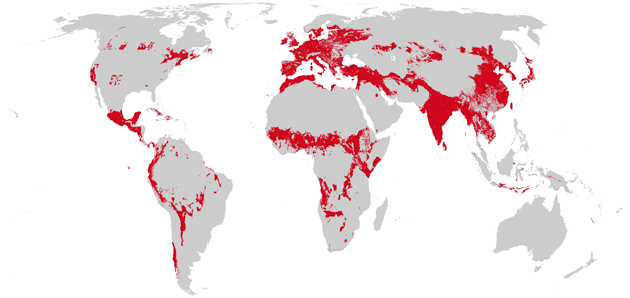
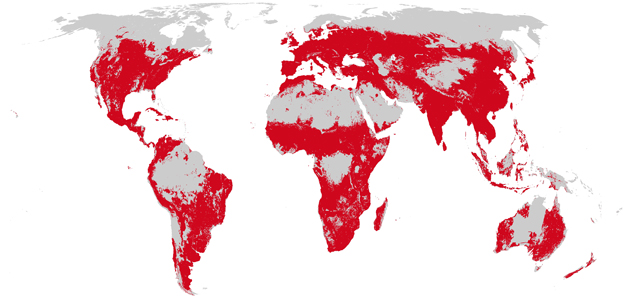
This meeting in London is two-pronged. It is in part focused on deepening basic inquiry into stratigraphy and other branches of earth science and clarifying how this human era could qualify as a formal chapter in Earth’s physical biography. As Erle C. Ellis, an ecologist at the University of Maryland, Baltimore County, put it in his talk, it’s unclear for the moment whether humanity’s impact will be long enough to represent an epoch, or will more resemble “an event.” Ellis’s presentation was a mesmerizing tour of the planet’s profoundly humanized ecosystems, which he said would be better described as “anthromes” than “biomes.”

Ellis said it was important to approach this reality not as a woeful situation, but an opportunity to foster a new appreciation of the lack of separation of people and their planet and a bright prospect for enriching that relationship. In this his views resonate powerfully with those of Rene Dubos, someone I’ll be writing about here again soon.

Through the talks by Ellis and others, it was clear that the scientific effort to define a new geological epoch, while important, paled beside the broader significance of this juncture in human history.

In my opening comments at the meeting, I stressed the need to expand the discussion from the physical and environmental sciences into disciplines ranging from sociology to history, philosophy to the arts.

I noted that while the “great acceleration” described by Steffen and others is already well under way, it’s entirely possible for humans to design their future, at least in a soft way, boosting odds that the geological record will have two phases — perhaps a “lesser” and “greater” Anthropocene, as someone in the audience for my recent talk with Brad Allenby at Arizona State University put it.

I also noted that the term “Anthropocene,” like phrases such as “global warming,” is sufficiently vague to guarantee it will be interpreted in profoundly different ways by people with different world views. (As I explained, this is as true for Nobel laureates in physics as it is for the rest of us.)

Some will see this period as a “shame on us” moment. Others will deride this effort as a hubristic overstatement of human powers. Some will argue for the importance of living smaller and leaving no scars. Others will revel in human dominion as a normal and natural part of our journey as a species.

A useful trait will be to get comfortable with that diversity.

Before the day is done I also plan on pushing Randy Olson’s notion of moving beyond the “nerd loop” and making sure this conversation spills across all disciplinary and cultural boundaries from the get-go.

There’s much more to explore of course, and I’ll post updates as time allows. You might track the meeting hash tag, #anthrop11, on Twitter.

*   *   *

8/16/2014 @ 1:05PM – James Conca

The Anthropocene Part 1: Tracking Human-Induced Catastrophe On A Planetary Scale (Forbes)

For almost 30 years, we geologists have been having a debate about what Geologic Epoch we find ourselves in right now. It is presently called the Holocene, but some want to add another epoch and call it the Anthropocene.

Anthropocene combines the Greek words for humanand recent time period, to denote the period of time since human activity went global and we became an important geologic process in our own right (In These Times; see also UN video http://vimeo.com/39048998).

In other words, what should we call this period of time when we started trashing the planet? And when did it begin?

You might know some of the big Geologic Ages, Epochs, Periods, Eras and Eons. The dinosaurs died out 66 million years ago in the Maastrichtian Age in the Late Epoch of the Cretaceous Period in the Mesozoic Era of the Phanerozoic Eon.

The sum of Earth’s history, divided up into these different sections, is called the Geologic Time Scale and geologists have been defining and refining it for about 150 years (Geologic Society of America). The latest deliberation concerns the epoch from the present stretching back to about 12,000 years.  The term Anthropocene was popularized fourteen years ago by atmospheric scientists Paul Crutzen and Eugene Stoermer, to more decisively focus discussion on human global effects to the whole planet.

The Geologic Time Scale - the sectioning up of 4.6 billion years of Earth’s history into manageable time periods bounded by significant geological events. The present debate is - do we want to call the present epoch we are in the Anthropocene to reflect humanity’s global effect on the planet? Click on the link in the text for the full image. Source: The Geological Society of America

To Judith Wright, a chemostratigrapher, this is not just an academic exercise for the Ivory Tower (Ocean Redox Variations Through Time). There are obvious political and social implications, not the least being the role of human activities in climate change, wholesale extinctions of species unlike anytime in history, and the accelerating environmental destruction on a planetary scale that could spell our own doom.

What we call something matters. It sets the scale of importance and pushes the discussion in the direction that we need these debates to go.

The scientific decision on whether to incorporate the term Anthropocene into the geologic lexicon falls to a carefully deliberative group called the International Commission on Stratigraphy, particularly its Subcommission on Quaternary Stratigraphy which has formed an Anthropocene Working Group. There is a rumor they may arrive at a decision after only several years of debate, making this deliberation downright hasty.

This discussion concerns not just what to name it, but when it started. There is always some defining characteristic to one of these epochs or periods. Often a huge extinction event marks the end of an epoch, like the end of the Triassic Period 200 million years ago when half of all life perished. Or the appearance of something new in evolution, like the beginning of the Cambrian Period when organisms learned how to grow shells, bones, teeth and other hard parts from the increased dissolved minerals in seawater, providing huge survival advantages.

Sometimes there is a chemical marker, or layer, that is unique to that time or process, like the iridium layer that is one of the singular markers of the huge meteorite impact that finally stressed the dinosaurs’ environment to the point of extinction.

But why do stratigraphers get to decide this question? In the geologic sciences, stratigraphy is the study of rock layers on the Earth – how they relate to each other and to relative and absolute time, how they got there, and what they tell us about Earth history. Stratigraphy can be traced to the beginnings of modern geology in the 17th century with Nicholas Steno and his three stratigraphic rules:

–   the law of superposition (younger rocks lay on top of older ones)

–   the principle of original horizontality (all sedimentary and volcanic layers are originally laid down horizontally, or normal to the Earth’s gravitational field)

–   the principle of lateral continuity (sedimentary layers generally continue for a long distance as most were laid down in the ocean, and an abrupt edge indicates that something happened to break it off, like a fault or surface erosion).

These were profound observations and fundamentally changed how we understood time and geologic processes like flooding and earthquakes. In fact, the unique perspective that geology brings to humans is the understanding of time at all levels.

According to Patricia Corcoran and co-workers (GSA), material being laid down across the Earth in our present time is the most bizarre mix of chemicals and materials the Earth has ever seen, some compounds of which have never occurred in nature. Maybe compounds that could not have been produced naturally would make a good marker for the Anthropocene.

But defining a geologic time period requires a sufficiently large, clear and distinctive set of geologic characteristics to be useful as a global geologic boundary and that will also survive throughout geologic time.

We presently find ourselves in the Holocene Epoch of the Quaternary Period in the Cenozoic Era of the Phanerozoic Eon, defined as starting from the end of the last glacial retreat, an obvious event that led to our present global range in climate and other characteristics we define as the Earth today. The problem is, humans have dominated this entire epoch in many ways, from the dawn of agriculture, to smelting of iron and lead, burning of forests and finally the effects of the industrial revolution.

As in all environmental issues, it’s the number of people on Earth that’s the problem. For over 100,000 years, the global human population was steady at about 10 million. Then civilization appeared, fueled by the many significant developments that humans had begun to apply en masse including agriculture, domesticated animals, tools, serious engineering, and various uses of fire, fibers and the wheel.

Our population began to increase about 2000 years ago, at the beginning of the Common Era, rising to 300 million during the Middle Ages and to a billion at the beginning of the Industrial Age. Then 2 billion in 1927, 3 billion in 1960, 4 billion in 1974, 5 billion in 1987, 6 billion in 1999 and 7 billion in 2011. This exponential rise is textbook for a bacterial colony in a petri dish, right before it dies from outpacing its food sources and generating too much waste. It’s also eerily analogous for people on the petri dish of Earth.

Humans now comprise the largest mass of vertebrate matter on land on the entire Earth. The rest is almost all our food and friends, mainly the animals we domesticated over the last 50,000 years, plus a bunch of xenobiotics we’ve transported far from their habitats (Cornell University). Only a small percentage of all vertebrate mass on land is wild or natural (In These Times).

Let that sink in for a minute. Most of what people see in National Geographic or on the Discovery Channel or in movies about animals, IS ALMOST ALL GONE. Humans have dammed a third of the world’s rivers, have covered, destroyed or altered almost half of the world’s land surface. We use up most of the fresh water faster than it can be replenished. And we extinct about 30,000 species every year.

Whether from deforestation, agriculture, urbanization, roads, mining activities, aquatic farming, moving xenobiotic species around the world that destroy native species, dumping huge amounts of waste on land, in the ocean and in the atmosphere, and all other human activities, we have decimated the natural environment without thinking about what effect it has on global ecosystems and what it takes for our own species to survive.

There is a point where humans, our pets, our food animals and our food crops cannot survive without some aspects of a wild nature. Much of our crops need pollinators. The oxygen on this planet comes mainly from organisms in the top 300 feet of the ocean. Biodiversity is not just an environmental catch-phrase, it’s a necessity for survival.

So when did the Anthropocene begin?

Was it when agriculture began, when we started burning forests to clear land? Was it during the Iron Age when we clear-cut the northern forests to smelt iron ore?

Was it the advent of civilization, particularly the rise in agriculture and mining activities around the Mediterranean by the Phoenicians, Greeks and Romans, signified by a rise in environmental Pb levels (Shotyk et al, 1998) that continued until just recently?

Was it the 19th century when our population passed a billion and we began burning fossil fuels that has made carbon itself a global marker? Was it the 20thcentury when humans passed plate tectonics as the primary mechanism for moving rock and dirt on this planet?

Access to huge amounts of chemical energy trapped in fossil fuels allowed human populations to explode and allowed human effects to really go global. This is why most researchers point to the mid-19th century as the obvious time to start the Anthropocene.

One popular idea for the start of the Anthropocene is the beginning of the atomic age. Above-ground nuclear tests spread unique radionuclides like Pu around the world, elements that have not been seen in our solar nebula for six billion years, but now show up in surface sediments and ice cores, albeit in minute concentrations.

Crutzen recently gave his support for this point in time. However, the atomic age is just another aspect of the modern age of humans not associated with a particular change in a global characteristic. It cannot be seen in the field and marks no special geologic event, and would be more of a political or sociological marker than a geological one.

Perhaps we should wait until the end of this century when the worst effects will be upon us and the world will barely be recognizable to anyone living today. We might be able to just point to the time “when there used to be forests.”

In the end, this debate might be shear hubris since when we are gone, future geologists, of whatever species, will decide for themselves where they want to place the beginning of this particular catastrophe.

So…what’s your vote for when we start the Anthropocene?

*   *   *

2/29/2012 @ 11:55PM 487 views – Jayne Jung

On The Anthropocene Age (Forbes)

Original caption from NASA: "S103-E-5037 ...

Image via Wikipedia

The term, the Anthropocene Age, is now common. It represents the time since the early 1800s when man began to have an impact on the Earth’s climate. There is still some debate about its use though. Scientists have traditionally called the current period the Holocene Age, meaning entirely new. The Holocene Age started around 10,000 BC, after the last glacial period when there was significant glacier movement.

From the German newspaper Spiegel Online, interview with British geologist Jan Zalasiewicz:

SPIEGEL ONLINE: The idea of mankind as the owner of Earth — is that not disconcerting?

Zalasiewicz: While we now may be said to “own” the planet, that is not the same as controlling it. Our global experiment with CO2 is something that virtually every government would like to see brought under control, and yet collectively we are, at present, unable to do so. That seems to call for feelings of something other than hubris.

SPIEGEL ONLINE: Do you see more to Anthropocene than just a geological term? Is it a new way of thinking about mankind’s role on Earth?

Zalasiewicz: That is almost certainly part of the attraction of the term for the wider public. The term does encapsulate and integrate a wide range of phenomena that are often considered separately. It also provides a sense of the scale and significance of anthropogenic global change. It emphasizes the importance of the Earth’s long geological history as a context within which to better understand what is happening today.

Interview conducted by Christian Schwägerl

From the New York Times‘ editorial “The Anthropocene”:

Other species are embedded in the fossil record of the epochs they belong to. Some species, like ammonites and brachiopods, even serve as guides — or index fossils — to the age of the rocks they’re embedded in. But we are the only species to have defined a geological period by our activity — something usually performed by major glaciations, mass extinction and the colossal impact of objects from outer space, like the one that defines the upper boundary of the Cretaceous.

Humans were inevitably going to be part of the fossil record. But the true meaning of the Anthropocene is that we have affected nearly every aspect of our environment — from a warming atmosphere to the bottom of an acidifying ocean.

From Yale’s website “The Anthropocene Debate: Marking Humanity’s Impact” by Elizabeth Kobert:

One argument against the idea that a new human-dominated epoch has recently begun is that humans have been changing the planet for a long time already, indeed practically since the start of the Holocene. People have been farming for 8,000 or 9,000 years, and some scientists — most notably William Ruddiman, of the University of Virginia — have proposed that this development already represents an impact on a geological scale. Alternatively, it could be argued that the Anthropocene has not yet arrived because human impacts on the planet are destined to be even greater 50 or a hundred years from now.

“We’re still now debating whether we’ve actually got to the event horizon, because potentially what’s going to happen in the 21st century could be even more significant,” observed Mark Williams, a member of the Anthropocene Working Group who is also a geologist at the University of Leicester.

I personally do not want to know what that “event horizon” is.

*   *   *

The Dawning of the Age of Anthropocene (In These Times)

By altering the earth, have humans ushered in a new epoch?

BY JESSICA STITES

By inviting awe rather than—or along with—terror, the Anthropocene may offer a way to grapple with climate change rather than deny it.

Scientists have been clanging the alarm about human-caused climate change, trying to bring around the 33 percent of Americans who don’t believe the earth is warming and the 18 percent of believers in global warming who think the process is “natural.” But as climate scientists race against time to convince the resisters, another branch of science, geology, is taking the tortoise approach. For more than a decade, geologists have been debating whether to officially declare the existence of a new epoch, the “Anthropocene,”to acknowledge that humans are radically reshaping the earth’s surface. Some geologists see the Anthropocene model as a way to widen the lens on human impact on the earth and cut through both the alarmism and the resistance to spur concrete policy solutions.

Geologists divide the earth’s 4.5 billion-year history into eons, which are subdivided into eras, periods and epochs. Each division is marked by a discernable change in the earth’s strata, such as a new type of fossil representing a major evolutionary shift. On this global scale, humans are relative infants, just 200,000 years old. Civilization has sprung up only during the most recent epoch, the relatively warm interglacial Holocene, spanning the past 11,700 years.

But the Holocene’s days may be numbered. In 2000, the late biologist Eugene F. Stoermer and Nobel Prize-winning atmospheric chemist Paul Crutzen made a radical proposal in the International Geosphere-Biosphere Programme newsletter: that the Industrial Revolution’s explosion of carbon emissions had ushered in a new epoch, the Anthropocene, marked by human impact. In 2009, the International Commission on Stratigraphy’s Subcommission of Quaternary Stratigraphy assembled an Anthropocene Working Group, which in 2016 will issue a recommendation on whether to formally adopt the term.

For stratigraphers, this is “breakneck speed,” says University of Leicester paleobiologist Jan Zalasiewicz, the head of the working group. The geological time scale is as fundamental to the discipline as the periodic table is to chemistry. The last official change, when the Ediacaran Period supplanted the Vendian in 2004, came after 20 years of debate and shook up a scale that had been static for 120 years.

Whether or not the term is formalized, Zalasiewicz believes in the Anthropocene’s potential to alter perception, for geologists and non-geologists alike. “ ‘Anthropocene’ places our environmental situation in a different perspective,” he says. “You look at it sideways, as it were.”

Certainly, you look at it from a broader perspective. Zooming out to an aeonic scale is a sober way to assess the significance of climate change. Overall, human emissions have driven up global temperatures about 0.85 degrees Celsius since the 19th century, according to the UN’s Intergovernmental Panel on Climate Change. Deniers are fond of noting that Earth’s current temperatures are not the highest they’ve been, and that the earth cyclically warms and cools. That’s true. There have been several “hyperthermal” events when carbon dioxide has been released by the ton from the ground or the ocean, and the earth’s temperature has spiked. However, as Zalasiewicz and colleague Mark Williams note in a recent paper in the Italian journal Rendiconti Lincei, carbon is being released today more than 10 times faster than during any of these events. And when the other hyperthermal events began, the earth was already relatively warm, without today’s ice-capped poles that threaten to melt and pump up sea levels. Already, warming has eroded Arctic sea ice and altered the territory of climate-sensitive species—effects potentially stark enough by themselves to declare an Anthropocene.

But even if we set aside climate change, there are still plenty of arguments for an Anthropocene, says Zalasiewicz. Take mineral traces: He calculates that humans have purified a half-billion tons of aluminum, enough to cover the United States in tinfoil. We’ve also made never-before-seen alloys, like the boron carbide used in bullet-proof vests and the tungsten carbide that forms the balls in ballpoint pens. And then there are plastics—more than 250 million tons are now produced annually. Zalasiewicz and his colleagues term these various human-made objects “technofossils.”

Technofossils aren’t the only things that humans scatter; we’ve also spread germs, seaweed, strawberries, sparrows, rats, jicama, cholera … the list goes on. You might see us as bees pollinating the earth or, less flatteringly, dung beetles scuttling our shit around. Today, according to a 1999 Cornell study, 98 percent of U.S. food—both animal-and plant-derived—is non-native.

Then there’s the population explosion. Humans now make up nearly one-fourth of total land vertebrate biomass, and most of the rest is our food animals, with wild animals—the lions, tigers and bears—making up a mere 3 percent. Those proliferating people suck up resources: According to calculations by Stanford geology PhD student Miles Traer, humans use the equivalent of 13 barrels of oil per person every year, and the United States consumes 345 billion gallons of fresh water a day, enough to drain all of Lake Michigan every 10 years.

In the face of all this, few geologists deny that stratigraphers a billion years from now (either human or alien, depending on your level of optimism) will see our current period as a major shift in the geological record. So the main question facing the Anthropocene Working Group is when the Anthropocene began, or in geological parlance, where to plant “the golden spike.” Four possibilities are under consideration.

One camp favors the 1800s, when megacities began to emerge and form unique strata of compressed rubble and trash heaps. London was the first, with a population of 3 million in 1850. With megacities came industrialization and a sudden escalation in CO2 emissions that began to push up global temperatures.

A second group, including many archeologists, argues for an earlier date. University of Virginia paleoclimatology professor William F. Ruddiman calculates that the first Agricultural Revolution, which began some 12,000 years ago, caused greater climate effects than have yet to be seen from the Industrial Revolution. Due to the widespread preindustrial use of fire to clear forests, Ruddiman believes that emissions of greenhouse gases, coupled with the loss of forests’ cooling effect, caused the earth’s temperature to be 1.3 to 1.4 degrees Celsius higher than if humans had never existed, warding off an overdue Ice Age.

However, where to plant the golden spike in this model isn’t entirely clear, since the changes happened over thousands of years. One option would be the mass extinction of large animals in the Americas some 12,500 years ago, believed to be caused by humans. In that case, the Anthropocene would supplant the Holocene.

A third school believes the Anthropocene should be dated to the mid-20th century, when the “Great Acceleration” began and population, urbanization, globalization and CO2 emissions took off. The past 60-odd years have seen a doubling of the human population and the release of three-quarters of all human-caused CO2 emissions. Zalasiewicz favors this hypothesis because of the sharpness of the acceleration and the synchronicity of the changes. The automobile, for instance, proliferated worldwide in less than a century, the blink of a geologic eye. This time period contains a dramatic option for the “golden spike”: the first A-bomb tests of the 1940s, which left radionuclidic traces across the earth that are readily detectable in ice core samples pulled from the poles. Astrobiologist David Grinspoon, a proponent of the nuclear-testing golden spike, writes, “The symbolism is so potent—the moment we grasped that terrible Promethean fire that, uncontrolled, could consume the world.”

The fourth and final camp is made up of the “not yets,” who point out that everything is still accelerating—population, technofossil production, CO2 emissions—with no reason to believe things will stabilize and some reason to expect dramatic upheavals. Many geologists predict that the next two centuries will bring a mass extinction event of a magnitude seen only five times before (e.g., the dinosaur die-off ). A number of drastic changes triggered by climate change may lie in store, according to an IPCC report released March 31—not only extinctions, but also food and water shortages, irreversible loss of coral reefs and Arctic ice, and “abrupt or drastic changes” like Greenland melting or the Amazon rainforest drying.

It’s here that the conversation veers from the scientific into the panicked, which does not sit well with Mike Osborne, a Stanford Ph.D student in earth sciences and the creator of the “Generation Anthropocene” podcast. More comfortable with data and description than prediction, Osborne eschews apocalyptic thinking, and he doesn’t like the vitriol and politicization of the climate-change debate.

But of course, the issue is political, because it’s inseparable from human choices. A forthcoming peer-reviewed study funded by NASA’s Goddard Space Flight Center warns of the potential for “irreversible” collapse of civilization in the next few decades and stresses that the key factors are both environmental and social. The study says that the enormous consumption of resources is dangerous specifically because it is paired with “the economic stratification of society into Elites [rich] and Masses (or “Commoners”) [poor]”—noting that these two features were common to the toppling of numerous empires, from Han to Roman, over the last 5,000 years.

The issue is also emotional. One side calls the other “alarmist” and “hysterical,” which may be code for “I can’t handle hearing this.” Even for believers, there seems to be a gap between apprehending the problem and believing in a solution. Pew found that 62 percent of Americans understand that climate change is happening and 44 percent believe it’s human-caused, but when Pew asked Americans in another survey what our government’s top priority should be, climate change ranked 19th of 20 issues, just above global trade.

Osborne says he “hesitate[s] to be overly optimistic or pessimistic,” even though, with his first child just born, the earth’s future weighs on his mind. “The Anthropocene’s great utility for me in terms of imagination,” he says, “is that at its best, it comes with a sense of awe: Holy cow, the world is freaking huge and amazing and beautiful and scary.”

By inviting awe rather than—or along with—terror, the Anthropocene may offer a way to grapple with climate change rather than deny it.“The pace of change seems to be ever accelerating, but so does the response. I am loathe to underestimate human ingenuity,” says Osborne. Zalasiewicz and Osborne both think that certain effects of the Anthropocene, like warming and biodiversity loss, warrant environmentalist solutions, such as measures to curb CO2 emissions, and wildlife preserves on both land and sea.

Whatever the working group proposes in 2016—which must then be affirmed by three higher bodies—Zalasiewicz believes the concept of the Anthropocene is here to stay. “If it wasn’t useful, if it was a catchphrase, it would have quite quickly fallen by the wayside,” he says. “It packages up a whole range of different isolated phenomena—ocean acidification, landscape change, biodiversity loss—and integrates them into a common signal or trend or pattern.”

Perhaps the data-driven, methodical approach of geology is what this debate needs. To Osborne, the Anthropocene is exciting because it forces us to look closely at what’s really happening and challenges our tendency to think in a nature/human divide. In the Anthropocene model, the earth’s workings and fate are intertwined with our own. Indeed, science theorist Bruno Latour goes so far as to say that the Anthropocene could mark “the final rejection of the separation between Nature and Human that has paralyzed science and politics since the dawn of modernism.”

*   *   *

Nasa-funded study: industrial civilisation headed for ‘irreversible collapse’? (The Guardian)

Natural and social scientists develop new model of how ‘perfect storm’ of crises could unravel global system

This NASA Earth Observatory released on

This Nasa Earth Observatory image shows a storm system circling around an area of extreme low pressure in 2010, which many scientists attribute to climate change. Photograph: AFP/Getty Images

A new study partly-sponsored by Nasa’s Goddard Space Flight Center has highlighted the prospect that global industrial civilisation could collapse in coming decades due to unsustainable resource exploitation and increasingly unequal wealth distribution.

Noting that warnings of ‘collapse’ are often seen to be fringe or controversial, the study attempts to make sense of compelling historical data showing that “the process of rise-and-collapse is actually a recurrent cycle found throughout history.” Cases of severe civilisational disruption due to “precipitous collapse – often lasting centuries – have been quite common.”

The independent research project is based on a new cross-disciplinary ‘Human And Nature DYnamical’ (HANDY) model, led by applied mathematician Safa Motesharrei of the US National Science Foundation-supported National Socio-Environmental Synthesis Center, in association with a team of natural and social scientists. The HANDY model was created using a minor Nasa grant, but the study based on it was conducted independently. The study based on the HANDY model has been accepted for publication in the peer-reviewed Elsevier journal, Ecological Economics.

It finds that according to the historical record even advanced, complex civilisations are susceptible to collapse, raising questions about the sustainability of modern civilisation:

“The fall of the Roman Empire, and the equally (if not more) advanced Han, Mauryan, and Gupta Empires, as well as so many advanced Mesopotamian Empires, are all testimony to the fact that advanced, sophisticated, complex, and creative civilizations can be both fragile and impermanent.”

By investigating the human-nature dynamics of these past cases of collapse, the project identifies the most salient interrelated factors which explain civilisational decline, and which may help determine the risk of collapse today: namely, Population, Climate, Water, Agriculture, and Energy.

These factors can lead to collapse when they converge to generate two crucial social features: “the stretching of resources due to the strain placed on the ecological carrying capacity”; and “the economic stratification of society into Elites [rich] and Masses (or “Commoners”) [poor]” These social phenomena have played “a central role in the character or in the process of the collapse,” in all such cases over “the last five thousand years.”

Currently, high levels of economic stratification are linked directly to overconsumption of resources, with “Elites” based largely in industrialised countries responsible for both:

“… accumulated surplus is not evenly distributed throughout society, but rather has been controlled by an elite. The mass of the population, while producing the wealth, is only allocated a small portion of it by elites, usually at or just above subsistence levels.”

The study challenges those who argue that technology will resolve these challenges by increasing efficiency:

“Technological change can raise the efficiency of resource use, but it also tends to raise both per capita resource consumption and the scale of resource extraction, so that, absent policy effects, the increases in consumption often compensate for the increased efficiency of resource use.”

Productivity increases in agriculture and industry over the last two centuries has come from “increased (rather than decreased) resource throughput,” despite dramatic efficiency gains over the same period.

Modelling a range of different scenarios, Motesharrei and his colleagues conclude that under conditions “closely reflecting the reality of the world today… we find that collapse is difficult to avoid.” In the first of these scenarios, civilisation:

“…. appears to be on a sustainable path for quite a long time, but even using an optimal depletion rate and starting with a very small number of Elites, the Elites eventually consume too much, resulting in a famine among Commoners that eventually causes the collapse of society. It is important to note that this Type-L collapse is due to an inequality-induced famine that causes a loss of workers, rather than a collapse of Nature.”

Another scenario focuses on the role of continued resource exploitation, finding that “with a larger depletion rate, the decline of the Commoners occurs faster, while the Elites are still thriving, but eventually the Commoners collapse completely, followed by the Elites.”

In both scenarios, Elite wealth monopolies mean that they are buffered from the most “detrimental effects of the environmental collapse until much later than the Commoners”, allowing them to “continue ‘business as usual’ despite the impending catastrophe.” The same mechanism, they argue, could explain how “historical collapses were allowed to occur by elites who appear to be oblivious to the catastrophic trajectory (most clearly apparent in the Roman and Mayan cases).”

Applying this lesson to our contemporary predicament, the study warns that:

“While some members of society might raise the alarm that the system is moving towards an impending collapse and therefore advocate structural changes to society in order to avoid it, Elites and their supporters, who opposed making these changes, could point to the long sustainable trajectory ‘so far’ in support of doing nothing.”

However, the scientists point out that the worst-case scenarios are by no means inevitable, and suggest that appropriate policy and structural changes could avoid collapse, if not pave the way toward a more stable civilisation.

The two key solutions are to reduce economic inequality so as to ensure fairer distribution of resources, and to dramatically reduce resource consumption by relying on less intensive renewable resources and reducing population growth:

“Collapse can be avoided and population can reach equilibrium if the per capita rate of depletion of nature is reduced to a sustainable level, and if resources are distributed in a reasonably equitable fashion.”

The NASA-funded HANDY model offers a highly credible wake-up call to governments, corporations and business – and consumers – to recognise that ‘business as usual’ cannot be sustained, and that policy and structural changes are required immediately.

Although the study based on HANDY is largely theoretical – a ‘thought-experiment’ – a number of other more empirically-focused studies – by KPMG and the UK Government Office of Science for instance – have warned that the convergence of food, water and energy crises could create a ‘perfect storm’ within about fifteen years. But these ‘business as usual’ forecasts could be very conservative.

Dr Nafeez Ahmed is executive director of the Institute for Policy Research & Development and author of A User’s Guide to the Crisis of Civilisation: And How to Save It among other books. Follow him on Twitter @nafeezahmed

  • This article was amended on 26 March 2014 to reflect the nature of the study and Nasa’s relationship to it more clearly.

Imagining the Anthropocene (AEON)

The Anthropocene idea has been embraced by Earth scientists and English professors alike. But how useful is it?

Jedediah Purdy is Professor of Law at Duke University in North Carolina. His forthcoming book is After Nature: A Politics for the Anthropocene.

Edited by Ross Andersen

Officially, for the past 11,700 years we have been living in the Holocene epoch. From the Greek for ‘totally new’, the Holocene is an eyeblink in geological time. In its nearly 12,000 years, plate tectonics has driven the continents a little more than half a mile: a reasonably fit person could cover the scale of planetary change in a brisk eight-minute walk. It has been a warm time, when temperature has mattered as much as tectonics. Sea levels rose 115 feet from ice melt, and northern landscapes rose almost 600 feet, as they shrugged off the weight of their glaciers.

But the real news in the Holocene has been people. Estimates put the global human population between 1 million and 10 million at the start of the Holocene, and keep it in that range until after the agricultural revolution, some 5,000 years ago. Since then, we have made the world our anthill: the geological layers we are now laying down on the Earth’s surface are marked by our chemicals and industrial waste, the pollens of our crops, and the absence of the many species we have driven to extinction. Rising sea levels are now our doing. As a driver of global change, humanity has outstripped geology.

This is why, from the earth sciences to English departments, there’s a veritable academic stampede to declare that we live in a new era, the Anthropocene – the age of humans. Coined by the ecologist Eugene Stoermer in the 1980s and brought to public attention in 2000 by the Nobel Prize-winning atmospheric scientist Paul Crutzen, the term remains officially under consideration at the Stratigraphy Commission of the Geological Society of London.

The lack of an official decision has set up the Anthropocene as a Rorschach blot for discerning what commentators think is the epochal change in the human/nature relationship. The rise of agriculture in China and the Middle East? The industrial revolution and worldwide spread of farming in the Age of Empire? The Atomic bomb? From methane levels to carbon concentration, from pollen residue to fallout, each of these changes leaves its mark in the Earth’s geological record. Each is also a symbol of a new set of human powers and a new way of living on Earth.

The most radical thought identified with the Anthropocene is this: the familiar contrast between people and the natural world no longer holds. There is no more nature that stands apart from human beings. There is no place or living thing that we haven’t changed. Our mark is on the cycle of weather and seasons, the global map of bioregions, and the DNA that organises matter into life. The question is no longer how to preserve a wild world from human intrusion; it is what shape we will give to a world we can’t help changing.

The discovery that nature is henceforth partly a human creation makes the Anthropocene the latest of three great revolutions: three kinds of order once thought to be given and self-sustaining have proved instead to be fragile human creations. The first to fall was politics. Long seen as part of divine design, with kings serving as the human equivalents of eagles in the sky and oaks in the forest, politics proved instead a dangerous but inescapable form of architecture – a blueprint for peaceful co‑existence, built with crooked materials. Second came economics. Once presented as a gift of providence or an outgrowth of human nature, economic life, like politics, turned out to be a deliberate and artificial achievement. (We are still debating the range of shapes it can take, from Washington to Greece to China.) Now, in the Anthropocene, nature itself has joined the list of those things that are not natural. The world we inhabit will henceforth be the world we have made.

The revolution in ideas that the Anthropocene represents is rooted in hundreds of eminently practical problems. The conversation about climate change has shifted from whether we can keep greenhouse-gas concentrations below key thresholds to how we are going to adapt when they cross those thresholds. Geo‑engineering, deliberately intervening in planetary systems, used to be the unspeakable proposal in climate policy. Now it is in the mix and almost sure to grow more prominent. As climate change shifts ecological boundaries, issues such as habitat preservation come to resemble landscape architecture. We can’t just pen in animals to save them; they need landscape-scale corridors and other help in migrating as their habitats move. There is open talk in law-and-policy circles about triage in species preservation – asking what we can save, and what we most want to save.

What work is this idea of the Anthropocene doing in culture and politics? As much as a scientific concept, the Anthropocene is a political and ethical gambit. Saying that we live in the Anthropocene is a way of saying that we cannot avoid responsibility for the world we are making. So far so good. The trouble starts when this charismatic, all-encompassing idea of the Anthropocene becomes an all-purpose projection screen and amplifier for one’s preferred version of ‘taking responsibility for the planet’.

Peter Kareiva, the controversial chief scientist of the Nature Conservancy, uses the theme ‘Conservation in the Anthropocene’ to trash environmentalism as philosophically naïve and politically backward. Kareiva urges conservationists to give up on wilderness and embrace what the writer Emma Marris calls the ‘rambunctious garden’. Specifically, Kareiva wants to rank ecosystems by the quality of ‘ecosystem services’ they provide for human beings instead of ‘pursuing the protection of biodiversity for biodiversity’s sake’. He wants a pro‑development stance that assumes that ‘nature is resilient rather than fragile’. He insists that: ‘Instead of scolding capitalism, conservationists should partner with corporations in a science-based effort to integrate the value of nature’s benefits into their operations and cultures.’ In other words, the end of nature is the signal to carry on with green-branded business as usual, and the business of business is business, as the Nature Conservancy’s partnerships with Dow, Monsanto, Coca-Cola, Pepsi, J P Morgan, Goldman Sachs and the mining giant Rio Tinto remind us.

Kareiva is a favourite of Andrew Revkin, the roving environmental maven of The New York Times Magazine, who touts him as a paragon of responsibility-taking, a leader among ‘scholars and doers who see that new models for thinking and acting are required in this time of the Anthropocene’. This pair and their friends at the Breakthrough Institute in California can be read as making a persistent effort to ‘rebrand’ environmentalism as humanitarian and development-friendly (and capture speaking and consultancy fees, which often seem to be the major ecosystem services of the Anthropocene). This is itself a branding strategy, an opportunity to slosh around old plonk in an ostentatiously shiny bottle.

Elsewhere in The New York Times Magazine, you can enjoy the other end of the Anthropocene projection screen, from business-as-usual to this-changes-everything. In his essay ‘Learning How to Die in the Anthropocene’ (2013), the Princeton scholar and former soldier Roy Scranton writes: ‘this civilisation is already dead’ (emphasis original) and insists that the only way forward is ‘to realise there’s nothing we can do to save ourselves’ and therefore ‘get down to the hard work … without attachment or fear’. He concludes: ‘If we want to learn to live in the Anthropocene, we must first learn how to die.’

Other humanists bring their own preoccupations to a sense of gathering apocalypse. In his influential essay ‘The Climate of History’ (2008), Dipesh Chakrabarty, a theory-minded historian at the University of Chicago, proposes that the Anthropocene throws into question all received accounts of human history, from Whiggish optimism to his own post-colonial postmodernism. He asks anxiously: ‘Has the period from 1750 to the present been one of freedom or that of the Anthropocene?’ and concludes that the age requires a new paradigm of thought, a ‘negative universal history’.

In their introduction to Ecocriticism (2012), a special issue of American Literature, the English scholars Monique Allewaert of the University of Wisconsin-Madison and Michael Ziser of the University of California Davis describe the Anthropocene as best captured in ‘a snapshot of the anxious affect of the modern world as it destroys itself – and denies even its own traces’.

The Anthropocene does not seem to change many minds. But it does turn them up to 11

All of these people (except for the branding opportunists) are trying, with more or less success, to ask how the Anthropocene changes the projects to which they’ve given chunks of their lives. Some far-ranging speculation and sweeping summaries are to be expected, and forgiven. Nonetheless, something in the Anthropocene idea seems to provoke heroic thinking, a mood and rhetoric of high stakes, of the human mind pressed up against the wall of apocalypse or arrived at the end of nature and history.

In this provocative defect, Anthropocene talk is a discourse of responsibility, to borrow a term from Mark Greif’s study of mid-20th-century American thought, The Age of the Crisis of Man (2015). Greif argues that a high-minded (but often middle-brow) strain of rhetoric responded to the horrors of the world wars and the global struggles thereafter with a blend of urgent language and sweeping concepts (or pseudo-concepts): responsibility, the fate of man, the urgency of now. Greif describes discourses of responsibility as attempts to turn words and thoughts, uttered in tones of utmost seriousness, into a high form of action. All of this is recognisable in Anthropocene talk. The Anthropocene does not seem to change many minds, strictly speaking, on point of their cherished convictions. But it does turn them up to 11.

On the whole, this is the inevitable and often productive messiness that accompanies a new way of seeing, one that unites many disparate events into a single pattern. As an offer to unify what might seem unrelated, ‘the Anthropocene’ is an attempt to do the same work that ‘the environment’ did in the 1960s and early ’70s: meld problems as far-flung as extinction, sprawl, litter, national parks policy, and the atom bomb into a single phenomenon called ‘the ecological crisis’. Such a classification is always somewhat arbitrary, though often only in the trivial sense that there are many ways to carve up the world. However arbitrary, it becomes real if people treat it as real, by forming movements, proposing changes, and passing laws aimed at ‘the environment’.

We know what the concept ‘the environment’ has wrought but what will the Anthropocene be like? To put this over-dramatised idea in the least heroic garb possible, what will the weather be like in the Anthropocene? And how will we talk about the weather there?

For all the talk of crisis that swirls around the Anthropocene, it is unlikely that a changing Earth will feel catastrophic or apocalyptic. Some environmentalists still warn of apocalypse to motivate could-be, should-be activists; but geologic time remains far slower than political time, even when human powers add a wobble to the planet. Instead, the Anthropocene will be like today, only more so: many systems, from weather to soil to your local ecosystem, will be in a slow-perennial crisis. And where apocalyptic change is a rupture in time, a slow crisis feels normal. It feels, in fact, natural.

So the Anthropocene will feel natural. I say this not so much because of the controversial empirics-cum-mathematics of the climate-forecasting models as because of a basic insight of modernity that goes back to Rousseau: humanity is the adaptable species. What would have been unimaginable or seemed all but unintelligible 100 years ago, let alone 500 (a sliver of time in the evolutionary life of a species), can become ordinary in a generation. That is how long it took to produce ‘digital natives’, to accustom people to electricity and television, and so on for each revolution in our material and technological world. It takes a great deal of change to break through this kind of adaptability.

This is all the more so because rich-country humanity already lives in a constant technological wrestling match with exogenous shocks, which are going to get more frequent and more intense in the Anthropocene. Large parts of North America regularly experience droughts and heat waves that would devastate a simpler society than today’s US. Because the continent is thoroughly engineered, from the water canals of the West to the irrigation systems of the Great Plains to air conditioning nearly everywhere, these are experienced as inconvenience, as mere ‘news’. The same events, in poorer places, are catastrophes.

Planetary changes will amplify the inequalities that sort out those who get news from those who get catastrophes; but these inequalities, arising as they do from a post-natural nature, will feel as if they were built into the world itself. Indeed, nature has always served to launder the inequalities that humans produce. Are enslaved people kept illiterate and punished brutally when they are not servile? Then ignorance and servility must be in their nature, an idea that goes back in a continuous line to Aristotle. The same goes for women, with some edits to their nature: docile, nurturing, delicate, hysterical, etc. It was not until Harriet Taylor and John Stuart Mill worked together on The Subjection of Women (published under his name alone in 1869), that English-language philosophy produced a basic challenge to millennia of nature-talk about sexual difference.

The expulsion of Native Americans was ‘justified’ on several versions of nature. Maybe they were racially different. Maybe their climate made them weak and irrational, unable to cultivate the land or resist European settlement. (Colonists briefly embraced this idea, then grew uneasy when they realised that the North American climate was now theirs; by the time of American independence, they raced to reject climatic theories of racial character.) Maybe Native Americans had simply failed to fulfil the natural duty of all mankind, to clear and plant the wilderness and make it bloom like an English garden, an idea that many theorists of natural law advanced in the 17th and 18th centuries. One way or another, nature was a kind of ontological insurance policy for human injustice.

And now? Well, it’s common wisdom that rising sea levels will first affect some of the world’s poorest people, notably in Bangladesh and coastal India. But it’s much worse than that grim geographic coincidence. Wealth has always meant some protection from nature’s cruel measures. In fact, that is the first spur to technology and development of all kinds: not to be killed. Tropical diseases with changing range will find some populations well-equipped with vaccination and medicine, others struggling with bad government and derelict health systems. When seas rise fast, even the feckless but rich US will begin adapting fast, and coastal flooding will be classified in the rich-world mind as a catastrophe of the poor.

So will starvation. A legal regime of unequal Anthropocene vulnerability is well underway. Take the vast, long-term leases that Chinese companies have entered into for some of Africa’s richest farmland. When drought, soil exhaustion or crop crisis puts a pinch on global food supply, contracts and commerce will pull trillions of calories to fat-and-happy Beijing. This is, of course, only the latest chapter in centuries of imperialism and post-imperial, officially voluntary global inequality. But it is the chapter that we the living are writing.

Neoliberal environmentalism aims to bring nature fully into the market, merging ecology and economy

For the moment, Anthropocene inequality has a special affinity with neoliberalism, the global extension of a dogmatic market logic and increasingly homogenous market forms, along with an accompanying ideology insisting that, if the market is not beyond reproach, it is at least beyond reform: there is no alternative. Where previous episodes of global ecological inequality took place under direct imperial administration – witness the Indian famines of the late 19th century, suffered under British rule – ours is emerging under the sign of free contract. Anthropocene inequality is thus being doubly laundered: first as natural, second as the voluntary (and presumptively efficient) product of markets. Because human activity now shapes the ‘natural’ world at every point, it is especially convenient for that world-shaping activity to proceed in its own pseudo-natural market.

But Anthropocene problems also put pressure on the authority of economics. Much of environmental economics has been built on the concept of the externality, economist-speak for a side-effect, a harm or benefit that has no price tag, and so is ignored in market decisions. Air pollution – free to the polluter – is the classic bad side-effect, or ‘negative externality’. Wetlands – not valued on the real-estate market, but great sources of filtration, purification and fertility, which would otherwise cost a lot to replicate – are the model positive externality. So neoliberal environmentalism, which Kareiva’s Nature Conservancy has been cultivating, aims to bring nature fully into the market, finding a place in the bottom line for all former side-effects, and fully merging ecology and economy.

In a climate-changed Anthropocene, the side-effects overwhelm the ‘regular’ market in scale and consequence. And there is no ‘neutral’, purely market-based way to put a value on side-effects. Take the example of carbon emissions. It is possible to create a market for emissions, as Europe, California and other jurisdictions have done; but at the base of that market is a political decision about how to value the economic activity that emits carbon against all the (uncertain and even speculative) effects of the emissions. The same point holds for every (post-)natural system on an Anthropocene planet. Ultimately, the question is the value of life, and ways of life. There is no correct technocratic answer.

The shape of the Anthropocene is a political, ethical and aesthetic question. It will answer questions about what life is worth, what people owe one another, and what in the world is awesome or beautiful enough to preserve or (re)create. Either the answers will reproduce and amplify existing inequality or they will set in motion a different logic of power. Either the Anthropocene will be democratic or it will be horrible.

A democratic Anthropocene would start from a famous observation of the economics Nobel Prize laureate Amartya Sen: no minimally democratic society has ever suffered a famine. Natural catastrophes are the joint products of natural and human systems. Your vulnerability to disaster is often a direct expression of your standing in a political (and economic) order. The Anthropocene stands for the intensifying merger of ecology, economics and politics, and one’s standing in those systems will increasingly be a single question.

But talk of democracy here is – like much about the Anthropocene – in danger of becoming abstract and moralising. Reflecting on a democratic Anthropocene becomes an inadvertent meditation on the devastating absence of any agent – a state, or even a movement – that could act on the scale of the problem. Indeed, it reveals that there is no agent that could even define the problem. If the Anthropocene is about the relationship between humanity and the planet, well, there is no ‘humanity’ that agrees on any particular meaning and imperative of climate change, extinction, toxification, etc. To think about the Anthropocene is to think about being able to do nothing about everything. No wonder the topic inspires compensatory fantasies that the solution lies in refining the bottom line or honing personal enlightenment – always, to be sure, in the name of some fictive ‘we’.

This returns us to the basic problem that the Anthropocene drives home: as Hannah Arendt observed in The Origins of Totalitarianism (1951), the idea of human rights – such as the right to democratic standing in planetary change – is a chimera and a cruel taunt without a political community that can make it good through robust institutions and practices. The Anthropocene shows how far the world is from being such a polity, or a federation of such polities, and how much is at stake in that absence. The world is too much with us. Worse, there is no ‘we’ to be with it.

In the face of all these barriers, what could all this talk about the Anthropocene possibly accomplish? Ironically, a useful comparison lies in Arendt’s target, the mere idea of human rights. While mere ideas are in fact sorry comforts in an unmanageable situation, they can be the beginning of demands, projects, even utopias, that enable people to organise in new ways to pursue them. The idea of human rights has gained much of its force this way, as a prism through which many efforts are focused and/or refracted.

A democratic Anthropocene is just a thought for now, but it can also be a tool that activists, thinkers and leaders use to craft challenges and invitations that bring some of us a little closer to a better possible world, or a worse one. The idea that the world people get to inhabit will only be the one they make is, in fact, imperative to the development of a political and institutional programme, even if the idea itself does not tell anyone how to do that. There might not be a world to win, or even save, but there is a humanity to be shaped and reshaped, freely and always in partial and provisional ways, that can begin intending the world it shapes.

31 March 2015

Popular now

Climate change: Embed the social sciences in climate policy (Nature)

David Victor

01 April 2015

David G. Victor calls for the IPCC process to be extended to include insights into controversial social and behavioural issues.

Illustration by David Parkins

The Intergovernmental Panel on Climate Change (IPCC) is becoming irrelevant to climate policy. By seeking consensus and avoiding controversy, the organization is suffering from the streetlight effect — focusing ever more attention on a well-lit pool of the brightest climate science. But the insights that matter are out in the darkness, far from the places that the natural sciences alone can illuminate.

With the ink barely dry on the IPCC’s latest reports, scientists and governments are planning reforms for the next big assessment12. Streamlining the review and writing processes could, indeed, make the IPCC more nimble and relevant. But decisions made at February’s IPCC meeting in Nairobi showed that governments have little appetite for change.

The basic report-making process and timing will remain intact. Minor adjustments such as greater coverage of cross-cutting topics and more administration may make the IPCC slower. Similar soul searching, disagreement, indecision and trivial procedural tweaks have followed each of the five IPCC assessments over the past 25 years3.

This time needs to be different. The IPCC must overhaul how it engages with the social sciences in particular (see go.nature.com/vp7zgm). Fields such as sociology, political science and anthropology are central to understanding how people and societies comprehend and respond to environmental changes, and are pivotal in making effective policies to cut emissions and collaborate across the globe.

The IPCC has engaged only a narrow slice of social-sciences disciplines. Just one branch — economics — has had a major voice in the assessment process. In Working Group III, which assesses climate-change mitigation and policy, nearly two-thirds of 35 coordinating lead authors hailed from the field, and from resource economics in particular. The other social sciences were mostly absent. There was one political scientist: me. Among the few bright spots in that report compared with earlier ones is greater coverage of behavioural economics and risk analysis. In Working Group II, which assesses impacts and adaptation, less than one-third of the 64 coordinating lead authors were social scientists, and about half of those were economists.

Bringing the broader social sciences into the IPCC will be difficult, but it is achievable with a strategy that reflects how the fields are organized and which policy-relevant questions these disciplines know well. It will require big reforms in the IPCC, and the panel will have to relinquish part of the assessment process to other organizations that are less prone to paralysis in the face of controversy.

Tunnel vision

The IPCC walks a wavering line between science, which requires independence, and diplomacy, which demands responsiveness to government preference. Although scientists supply and hone the material for reports, governments have a say in all stages of assessment: they adopt the outline for each chapter, review drafts and approve the final reports.

“Insights such as which policies work (or fail) in practice are skirted.”

Such tight oversight creates incentives for scientists to stick to the agreed scope and strip out controversial topics. These pressures are especially acute in the social sciences because governments want to control statements about social behaviour, which implicate policy. This domain covers questions such as which countries will bear the costs of climate change; schemes for allocating the burden of cutting emissions; the design of international agreements; how voters respond to information about climate policy; and whether countries will go to war over climate-related stress. The social sciences can help to provide answers to these questions, key for effective climate policy. In practice, few of these insights are explored much by the IPCC.

The narrowness of what governments will allow the IPCC to publish is particularly evident in the summary for policy-makers produced at the end of each assessment. Governments approve this document line-by-line with consensus. Disagreements range from those over how to phrase concepts such as a ‘global commons’ that requires collective action to those about whole graphs, which might present data in ways that some governments find inconvenient.

For example, during the approval of the summary from Working Group III last April, a small group of nations vetoed graphs that showed countries’ emissions grouped according to economic growth. Although this format is good science — economic growth is the main driver of emissions — it is politically toxic because it could imply that some countries that are developing rapidly need to do more to control emissions4.

Context dependent

The big problem with the IPCC’s output is not the widely levelled charge that it has become too policy prescriptive or is captivated by special interests5. Its main affliction is pabulum — a surfeit of bland statements that have no practical value for policy. Abstract, global numbers from stylized, replicable models get approved because they do not implicate any country or action. Insights such as which policies work (or fail) in practice are skirted. Caveats are buried or mangled.

Readers of the Working Group III summary for policy-makers might learn, for instance, that annual economic growth might decrease by just 0.06 percentage points by 2050 if governments were to adopt policies that cut emissions in line with the widely discussed goal of 2 °C above pre-industrial levels6. They would have to wade through dense tables to realize that only a fraction of the models say that the goal is achievable, and through the main report to learn that the small cost arises only under simplified assumptions that are far from messy reality.

Source: Ref. 6

That said, the social sciences are equally culpable. Because societies are complex and are in many ways harder to study than cells in a petri dish, the intellectual paradigms across most of the social sciences are weak. Beyond a few exceptions — such as mainstream economics — the major debates in social science are between paradigms rather than within them.

Consider the role of international law. Some social scientists treat law like a contract; others believe that it works mainly through social pressures. The first set would advise policy-makers to word climate deals precisely — to include targets and timetables for emissions cuts — and to apply mechanisms to ensure that countries honour their agreements. The second group would favour bold legal norms with clear focal points — striving for zero net emissions, for example7. Each approach could be useful in the right context.

Multiple competing paradigms make it hard to organize social-science knowledge or to determine which questions and methods are legitimate. Moreover, the incentives within the social sciences discourage focusing on particular substantive topics such as climate change — especially when they require interdisciplinary collaboration. In political science, for example, research on political mobilization, administrative control and international cooperation among other specialities are relevant. Yet no leading political-science department has a tenured professor who works mainly on climate change8.

The paradigm problem need not be paralysing. Social scientists should articulate why different intellectual perspectives and contexts lead to different conclusions. Leading researchers in each area can map out disagreement points and their relevance.

Climate scientists and policy-makers should talk more about how disputes are rooted in different values and assumptions — such as about whether government institutions are capable of directing mitigation. Such disputes help to explain why there are so many disagreements in climate policy, even in areas in which the facts seem clear9.

Unfortunately, the current IPCC report structure discourages that kind of candour about assumptions, values and paradigms. It focuses on known knowns and known unknowns rather than on deeper and wider uncertainties. The bias is revealed in how the organization uses official language to describe findings — half of the statements in the Working Group III summary were given a ‘high confidence’ rating (see ‘Confidence bias’).

Wider vista

Building the social sciences into the IPCC and the climate-change debate more generally is feasible over the next assessment cycle, which starts in October and runs to 2022, with efforts on the following three fronts.

First, the IPCC must ask questions that social scientists can answer. If the panel looks to the social-sciences literature on climate change, it will find little. But if it engages the fields on their own terms it will find a wealth of relevant knowledge — for example, about how societies organize, how individuals and groups perceive threats and respond to catastrophic stresses, and how collective action works best.

Dieter Telemans/Panos

The solar-powered Barefoot College in Rajasthan, India, trains rural villagers in how to install, build and repair solar technologies.

As soon as the new IPCC leadership is chosen later this year, the team should invite major social-sciences societies such as the American Political Science Association, the American and European societies of international law, the American Sociological Association and the Society for Risk Analysis to propose relevant topics that they can assess and questions they can answer. Multidisciplinary scientific organizations in diverse countries — such as the Royal Society in London and the Third World Academy of Sciences — would round out the picture, because social-sciences societies tend to be national and heavily US-based.

These questions should guide how the IPCC scopes its next reports. The agency should also ask such societies to organize what they know about climate by discipline — how sociology examines issues related to the topic, for example — and feed that into the assessment.

Second, the IPCC must become a more attractive place for social-science and humanities scholars who are not usually involved in the climate field and might find IPCC involvement daunting. The IPCC process is dominated by insiders who move from assessment to assessment and are tolerant of the crushing rounds of review and layers of oversight that consume hundreds of hours and require travel to the corners of the globe. Practically nothing else in science service has such a high ratio of input to output. The IPCC must use volunteers’ time more efficiently.

Third, all parties must recognize that a consensus process cannot handle controversial topics such as how best to design international agreements or how to govern the use of geoengineering technologies. For these, a parallel process will be needed to address the most controversial policy-relevant questions.

This supporting process should begin with a small list of the most important questions that the IPCC cannot handle on its own. A network of science academies or foundations sympathetic to the UN’s mission could organize short reports — drawing from IPCC assessments and other literature — and manage a review process that is truly independent of government meddling. Oversight from prominent social scientists, including those drawn from the IPCC process, could give the effort credibility as well as the right links to the IPCC itself.

The list of topics to cover in this parallel mechanism includes how to group countries in international agreements — beyond the crude kettling adopted in 1992 that split the world into industrialized nations and the rest. The list also includes which kinds of policies have had the biggest impact on emissions, and how different concepts of justice and ethics could guide new international agreements that balance the burdens of mitigation and adaptation. There will also need to be a sober re-assessment of policy goals when it becomes clear that stopping warming at 2 °C is no longer feasible10.

The IPCC has proved to be important — it is the most legitimate body that assesses the climate-related sciences. But it is too narrow and must not monopolize climate assessment. Helping the organization to reform itself while moving contentious work into other forums is long overdue.

Nature 520, 27–29 (02 April 2015), doi:10.1038/520027a

References

  1. IPCC. Future Work of the IPCC: Chairman’s Vision Paper on the Future of the IPCC (IPCC, 2015).
  2. IPCC. Future Work of the IPCC: Consideration of the Recommendations by the Task Group on Future Work of the IPCC (IPCC, 2015).
  3. Committee to Review the Intergovernmental Panel on Climate ChangeClimate Change Assessments: Review of the Processes and Procedures of the IPCC (InterAcademy Council, 2010).
  4. Victor, D. G.Gerlagh, R. & Baiocchi, G. Science 3453436 (2014).
  5. Hulme, M. et alNature 463730732 (2010).
  6. IPCCSummary for Policymakers in Climate Change 2014: Mitigation of Climate Change. Contribution of Working Group III to the Fifth Assessment Report of the Intergovernmental Panel on Climate Change (eds Edenhofer, O. et al.) (Cambridge Univ. Press, 2014).
  7. Hafner-Burton, E. M.Victor, D. G. & Lupu, Y. Am. J. Intl Law 1064797 (2012).
  8. Keohane, R. O. PS: Political Sci. & Politics 481926 (2015).
  9. Hulme, M. Why We Disagree About Climate Change: Understanding Controversy, Inaction and Opportunity (Cambridge Univ. Press, 2009).
  10. Victor, D. G. & Kennel C. F. Nature 5143031 (2014).

Anthropocene: The human age (Nature)

Momentum is building to establish a new geological epoch that recognizes humanity’s impact on the planet. But there is fierce debate behind the scenes.

Richard Monastersky

11 March 2015

Illustration by Jessica Fortner

Almost all the dinosaurs have vanished from the National Museum of Natural History in Washington DC. The fossil hall is now mostly empty and painted in deep shadows as palaeobiologist Scott Wing wanders through the cavernous room.

Wing is part of a team carrying out a radical, US$45-million redesign of the exhibition space, which is part of the Smithsonian Institution. And when it opens again in 2019, the hall will do more than revisit Earth’s distant past. Alongside the typical displays of Tyrannosaurus rex and Triceratops, there will be a new section that forces visitors to consider the species that is currently dominating the planet.

“We want to help people imagine their role in the world, which is maybe more important than many of them realize,” says Wing.

This provocative exhibit will focus on the Anthropocene — the slice of Earth’s history during which people have become a major geological force. Through mining activities alone, humans move more sediment than all the world’s rivers combined. Homo sapiens has also warmed the planet, raised sea levels, eroded the ozone layer and acidified the oceans.

Given the magnitude of these changes, many researchers propose that the Anthropocene represents a new division of geological time. The concept has gained traction, especially in the past few years — and not just among geoscientists. The word has been invoked by archaeologists, historians and even gender-studies researchers; several museums around the world have exhibited art inspired by the Anthropocene; and the media have heartily adopted the idea. “Welcome to the Anthropocene,” The Economist announced in 2011.

The greeting was a tad premature. Although the term is trending, the Anthropocene is still an amorphous notion — an unofficial name that has yet to be accepted as part of the geological timescale. That may change soon. A committee of researchers is currently hashing out whether to codify the Anthropocene as a formal geological unit, and when to define its starting point.

But critics worry that important arguments against the proposal have been drowned out by popular enthusiasm, driven in part by environmentally minded researchers who want to highlight how destructive humans have become. Some supporters of the Anthropocene idea have even been likened to zealots. “There’s a similarity to certain religious groups who are extremely keen on their religion — to the extent that they think everybody who doesn’t practise their religion is some kind of barbarian,” says one geologist who asked not to be named.

The debate has shone a spotlight on the typically unnoticed process by which geologists carve up Earth’s 4.5 billion years of history. Normally, decisions about the geological timescale are made solely on the basis of stratigraphy — the evidence contained in layers of rock, ocean sediments, ice cores and other geological deposits. But the issue of the Anthropocene “is an order of magnitude more complicated than the stratigraphy”, says Jan Zalasiewicz, a geologist at the University of Leicester, UK, and the chair of the Anthropocene Working Group that is evaluating the issue for the International Commission on Stratigraphy (ICS).

Written in stone

For geoscientists, the timescale of Earth’s history rivals the periodic table in terms of scientific importance. It has taken centuries of painstaking stratigraphic work — matching up major rock units around the world and placing them in order of formation — to provide an organizing scaffold that supports all studies of the planet’s past. “The geologic timescale, in my view, is one of the great achievements of humanity,” says Michael Walker, a Quaternary scientist at the University of Wales Trinity St David in Lampeter, UK.

Walker’s work sits at the top of the timescale. He led a group that helped to define the most recent unit of geological time, the Holocene epoch, which began about 11,700 years ago.

Sources: Dams/Water/Fertilizer, IGBP; Fallout, Ref. 5; Map, E. C. Ellis Phil. Trans. R. Soc. A 369, 1010–1035 (2011); Methane, Ref. 4

The decision to formalize the Holocene in 2008 was one of the most recent major actions by the ICS, which oversees the timescale. The commission has segmented Earth’s history into a series of nested blocks, much like the years, months and days of a calendar. In geological time, the 66 million years since the death of the dinosaurs is known as the Cenozoic era. Within that, the Quaternary period occupies the past 2.58 million years — during which Earth has cycled in and out of a few dozen ice ages. The vast bulk of the Quaternary consists of the Pleistocene epoch, with the Holocene occupying the thin sliver of time since the end of the last ice age.

When Walker and his group defined the beginning of the Holocene, they had to pick a spot on the planet that had a signal to mark that boundary. Most geological units are identified by a specific change recorded in rocks — often the first appearance of a ubiquitous fossil. But the Holocene is so young, geologically speaking, that it permits an unusual level of precision. Walker and his colleagues selected a climatic change — the end of the last ice age’s final cold snap — and identified a chemical signature of that warming at a depth of 1,492.45 metres in a core of ice drilled near the centre of Greenland1. A similar fingerprint of warming can be seen in lake and marine sediments around the world, allowing geologists to precisely identify the start of the Holocene elsewhere.

“The geologic timescale, in my view, is one of the great achievements of humanity.”

Even as the ICS was finalizing its decision on the start of the Holocene, discussion was already building about whether it was time to end that epoch and replace it with the Anthropocene. This idea has a long history. In the mid-nineteenth century, several geologists sought to recognize the growing power of humankind by referring to the present as the ‘anthropozoic era’, and others have since made similar proposals, sometimes with different names. The idea has gained traction only in the past few years, however, in part because of rapid changes in the environment, as well as the influence of Paul Crutzen, a chemist at the Max Plank Institute for Chemistry in Mainz, Germany.

Crutzen has first-hand experience of how human actions are altering the planet. In the 1970s and 1980s, he made major discoveries about the ozone layer and how pollution from humans could damage it — work that eventually earned him a share of a Nobel prize. In 2000, he and Eugene Stoermer of the University of Michigan in Ann Arbor argued that the global population has gained so much influence over planetary processes that the current geological epoch should be called the Anthropocene2. As an atmospheric chemist, Crutzen was not part of the community that adjudicates changes to the geological timescale. But the idea inspired many geologists, particularly Zalasiewicz and other members of the Geological Society of London. In 2008, they wrote a position paper urging their community to consider the idea3.

Those authors had the power to make things happen. Zalasiewicz happened to be a member of the Quaternary subcommission of the ICS, the body that would be responsible for officially considering the suggestion. One of his co-authors, geologist Phil Gibbard of the University of Cambridge, UK, chaired the subcommission at the time.

Although sceptical of the idea, Gibbard says, “I could see it was important, something we should not be turning our backs on.” The next year, he tasked Zalasiewicz with forming the Anthropocene Working Group to look into the matter.

A new beginning

Since then, the working group has been busy. It has published two large reports (“They would each hurt you if they dropped on your toe,” says Zalasiewicz) and dozens of other papers.

The group has several issues to tackle: whether it makes sense to establish the Anthropocene as a formal part of the geological timescale; when to start it; and what status it should have in the hierarchy of the geological time — if it is adopted.

When Crutzen proposed the term Anthropocene, he gave it the suffix appropriate for an epoch and argued for a starting date in the late eighteenth century, at the beginning of the Industrial Revolution. Between then and the start of the new millennium, he noted, humans had chewed a hole in the ozone layer over Antarctica, doubled the amount of methane in the atmosphere and driven up carbon dioxide concentrations by 30%, to a level not seen in 400,000 years.

When the Anthropocene Working Group started investigating, it compiled a much longer long list of the changes wrought by humans. Agriculture, construction and the damming of rivers is stripping away sediment at least ten times as fast as the natural forces of erosion. Along some coastlines, the flood of nutrients from fertilizers has created oxygen-poor ‘dead zones’, and the extra CO2 from fossil-fuel burning has acidified the surface waters of the ocean by 0.1 pH units. The fingerprint of humans is clear in global temperatures, the rate of species extinctions and the loss of Arctic ice.

The group, which includes Crutzen, initially leaned towards his idea of choosing the Industrial Revolution as the beginning of the Anthropocene. But other options were on the table.

Some researchers have argued for a starting time that coincides with an expansion of agriculture and livestock cultivation more than 5,000 years ago4, or a surge in mining more than 3,000 years ago (see ‘Humans at the helm’). But neither the Industrial Revolution nor those earlier changes have left unambiguous geological signals of human activity that are synchronous around the globe (see ‘Landscape architecture’).

This week in Nature, two researchers propose that a potential marker for the start of the Anthropocene could be a noticeable drop in atmospheric CO2 concentrations between 1570 and 1620, which is recorded in ice cores (see page 171). They link this change to the deaths of some 50 million indigenous people in the Americas, triggered by the arrival of Europeans. In the aftermath, forests took over 65 million hectares of abandoned agricultural fields — a surge of regrowth that reduced global CO2.

Landscape architecture

A model of land use, based on human-population estimates, suggests that people modified substantial parts of the continents even thousands of years ago.

Land used intensively by humans.

8,000 years before present (bp)

8,000 years before present (bp)

1,000 years before present (bp)

anthropocene-slideshow-5

Present

anthropocene-slideshow-10

Source: E. C. Ellis Phil. Trans. R. Soc. A 369, 1010–1035 (2011).

In the working group, Zalasiewicz and others have been talking increasingly about another option — using the geological marks left by the atomic age. Between 1945 and 1963, when the Limited Nuclear Test Ban Treaty took effect, nations conducted some 500 above-ground nuclear blasts. Debris from those explosions circled the globe and created an identifiable layer of radioactive elements in sediments. At the same time, humans were making geological impressions in a number of other ways — all part of what has been called the Great Acceleration of the modern world. Plastics started flooding the environment, along with aluminium, artificial fertilizers, concrete and leaded petrol, all of which have left signals in the sedimentary record.

In January, the majority of the 37-person working group offered its first tentative conclusion. Zalasiewicz and 25 other members reported5 that the geological markers available from the mid-twentieth century make this time “stratigraphically optimal” for picking the start of the Anthropocene, whether or not it is formally defined. Zalasiewicz calls it “a candidate for the least-worst boundary”.

The group even proposed a precise date: 16 July 1945, the day of the first atomic-bomb blast. Geologists thousands of years in the future would be able to identify the boundary by looking in the sediments for the signature of long-lived plutonium from mid-century bomb blasts or many of the other global markers from that time.

A many-layered debate

The push to formalize the Anthropocene upsets some stratigraphers. In 2012, a commentary published by the Geological Society of America6 asked: “Is the Anthropocene an issue of stratigraphy or pop culture?” Some complain that the working group has generated a stream of publicity in support of the concept. “I’m frustrated because any time they do anything, there are newspaper articles,” says Stan Finney, a stratigraphic palaeontologist at California State University in Long Beach and the chair of the ICS, which would eventually vote on any proposal put forward by the working group. “What you see here is, it’s become a political statement. That’s what so many people want.”

Finney laid out some of his concerns in a paper7 published in 2013. One major question is whether there really are significant records of the Anthropocene in global stratigraphy. In the deep sea, he notes, the layer of sediments representing the past 70 years would be thinner than 1 millimetre. An even larger issue, he says, is whether it is appropriate to name something that exists mainly in the present and the future as part of the geological timescale.

“It’s become a political statement. That’s what so many people want.”

Some researchers argue that it is too soon to make a decision — it will take centuries or longer to know what lasting impact humans are having on the planet. One member of the working group, Erle Ellis, a geographer at the University of Maryland, Baltimore County, says that he raised the idea of holding off with fellow members of the group. “We should set a time, perhaps 1,000 years from now, in which we would officially investigate this,” he says. “Making a decision before that would be premature.”

That does not seem likely, given that the working group plans to present initial recommendations by 2016.

Some members with different views from the majority have dropped out of the discussion. Walker and others contend that human activities have already been recognized in the geological timescale: the only difference between the current warm period, the Holocene, and all the interglacial times during the Pleistocene is the presence of human societies in the modern one. “You’ve played the human card in defining the Holocene. It’s very difficult to play the human card again,” he says.

Walker resigned from the group a year ago, when it became clear that he had little to add. He has nothing but respect for its members, he says, but he has heard concern that the Anthropocene movement is picking up speed. “There’s a sense in some quarters that this is something of a juggernaut,” he says. “Within the geologic community, particularly within the stratigraphic community, there is a sense of disquiet.”

Zalasiewicz takes pains to make it clear that the working group has not yet reached any firm conclusions.“We need to discuss the utility of the Anthropocene. If one is to formalize it, who would that help, and to whom it might be a nuisance?” he says. “There is lots of work still to do.”

Any proposal that the group did make would still need to pass a series of hurdles. First, it would need to receive a supermajority — 60% support — in a vote by members of the Quaternary subcommission. Then it would need to reach the same margin in a second vote by the leadership of the full ICS, which includes chairs from groups that study the major time blocks. Finally, the executive committee of the International Union of Geological Sciences must approve the request.

At each step, proposals are often sent back for revision, and they sometimes die altogether. It is an inherently conservative process, says Martin Head, a marine stratigrapher at Brock University in St Catharines, Canada, and the current head of the Quaternary subcommission. “You are messing around with a timescale that is used by millions of people around the world. So if you’re making changes, they have to be made on the basis of something for which there is overwhelming support.”

Some voting members of the Quaternary subcommission have told Nature that they have not been persuaded by the arguments raised so far in favour of the Anthropocene. Gibbard, a friend of Zalasiewicz’s, says that defining this new epoch will not help most Quaternary geologists, especially those working in the Holocene, because they tend not to study material from the past few decades or centuries. But, he adds: “I don’t want to be the person who ruins the party, because a lot of useful stuff is coming out as a consequence of people thinking about this in a systematic way.”

If a proposal does not pass, researchers could continue to use the name Anthropocene on an informal basis, in much the same way as archaeological terms such as the Neolithic era and the Bronze Age are used today. Regardless of the outcome, the Anthropocene has already taken on a life of its own. Three Anthropocene journals have started up in the past two years, and the number of papers on the topic is rising sharply, with more than 200 published in 2014.

By 2019, when the new fossil hall opens at the Smithsonian’s natural history museum, it will probably be clear whether the Anthropocene exhibition depicts an official time unit or not. Wing, a member of the working group, says that he does not want the stratigraphic debate to overshadow the bigger issues. “There is certainly a broader point about human effects on Earth systems, which is way more important and also more scientifically interesting.”

As he walks through the closed palaeontology hall, he points out how much work has yet to be done to refashion the exhibits and modernize the museum, which opened more than a century ago. A hundred years is a heartbeat to a geologist. But in that span, the human population has more than tripled. Wing wants museum visitors to think, however briefly, about the planetary power that people now wield, and how that fits into the context of Earth’s history. “If you look back from 10 million years in the future,” he says, “you’ll be able to see what we were doing today.”

Nature 519, 144–147 (12 March 2015), doi:10.1038/519144a

References

  1. Walker, M. et alJ. Quat. Sci. 24317 (2009).
  2. Crutzen, P. J. & Stoermer, E. F. IGBP Newsletter 411718 (2000).
  3. Zalasiewicz. J. et alGSA Today 18(2), 48 (2008).
  4. Ruddiman, W. F. Ann. Rev. Earth. Planet. Sci. 414568 (2013).
  5. Zalasiewicz, J. et alQuatern. Int. http://dx.doi.org/10.1016/j.quaint.2014.11.045 (2015).
  6. Autin, W. J. & Holbrook, J. M. GSA Today 22(7), 6061 (2012).
  7. Finney, S. C. Geol. Soc. Spec. Publ. 3952328 (2013).

Climate denial is immoral, says head of US Episcopal church (The Guardian)

Climate change is a moral challenge threatening the rights of the world’s poorest people and those who deny it are not using God’s gift of knowledge, says presiding bishop Katharine Jefferts Schori

Episcopal Presiding Bishop Katharine Jefferts Schori

Episcopal presiding bishop Katharine Jefferts Schori has called climate denial a ‘blind’ position. Photograph: Ed Ou/AP

The highest ranking woman in the Anglican communion has said climate denial is a “blind” and immoral position which rejects God’s gift of knowledge.

Katharine Jefferts Schori, presiding bishop of the Episcopal church and one of the most powerful women in Christianity, said that climate change was a moral imperative akin to that of the civil rights movement. She said it was already a threat to the livelihoods and survival of people in the developing world.

“It is in that sense much like the civil rights movement in this country where we are attending to the rights of all people and the rights of the earth to continue to be a flourishing place,” Bishop Jefferts Schori said in an interview with the Guardian. “It is certainly a moral issue in terms of the impacts on the poorest and most vulnerable around the world already.”

In the same context, Jefferts Schori attached moral implications to climate denial, suggesting those who reject the underlying science of climate change were turning their backs on God’s gift of knowledge.

“Episcopalians understand the life of the mind is a gift of God and to deny the best of current knowledge is not using the gifts God has given you,” she said. “In that sense, yes, it could be understood as a moral issue.”

She went on: “I think it is a very blind position. I think it is a refusal to use the best of human knowledge, which is ultimately a gift of God.”

The sense of urgency around the issue has been deepened by Pope Francis forceful statements on global warming, which he is expected to amplify in a papal encyclical in June and during an address to the US Congress in September.

The Episcopalian church will host a webcast on 24 March to kick off a month-long action campaign designed to encourage church members to reduce their own carbon footprints and lobby government and international corporations to fight climate change.

An oceanographer before she was ordained at the age of 40, Bishop Jefferts Schori said she hoped to use her visibility as a church leader to help drive action on climate change.

As presiding bishop, she oversees 2.5m members of the Episcopal church in 17 countries, and is arguably one of the most prominent women in Christianity. The two largest denominations in the US, Roman Catholics and Southern Baptists, do not ordain women.

“I really hope to motivate average Episcopalians to see the severity of this issue, the morality of this issue,” she said. “Turning the ship in another direction requires the consolidated efforts of many people who are moving in the same direction.”

She acknowledged that the challenge was deepened by the strain of climate denial in American politics, and by continued resistance to science in American classrooms.

“It’s hard work when you have a climate denier who will not see the reality of scientific truth,” she said.

However, she, like a number of church leaders, said they had seen an uptick in climate activism in recent months, spurred by the pope’s comments last January, and the conjunction later this year of United Nations conferences on development and climate change.

Evangelical churches – once seen as a conservative force – were now taking up the climate cause, largely because of growing awareness of its threat to the poor.

“One of the significant changes in particular has been the growing awareness and activism among the evangelical community who at least somewhat in the more distant past refused to encounter this issue, refused to deal with it,” Jeffers Schori said. “The major evangelical groups in this country have been much more forward in addressing this issue because they understand that it impacts the poor.”

A number of denominations have also joined the growing fossil fuel divestment movement which is encouraging organisations to move their investments out of coal, oil and gas companies. The United Methodist church, the third largest denomination, dumped coal companies from its pension fund.

The Unitarian church and the United church of Christ have also voted to divest, according to Reverent Fletcher Harper of Green Faith. And the World Council of Churches has pledged not to invest in fossil fuels. A number of individual congregations have also divested from fossil fuels.

The Guardian launched a campaign on Monday to encourage the Bill and Melinda Gates Foundation and the Wellcome Trust to divest from fossil fuels.

The Episcopal church has also come under pressure to withdraw its fossil fuel holdings. A number of diocese are pressing for divestment, and will bring the issue to a vote at the church’s annual convention this summer.

Jefferts Schori opposes fossil fuel divestment. “If you divest you lose any direct ability to influence the course of a corporation’s behavior,” she said. “I think most pragmatists realise that we can’t close the spigot on the oil wells and close the coal mines immediately without some other energy source to shift to.”

Climate change: at last a breakthrough to our catastrophic political impasse? (The Guardian)

Expecting the Paris talks to succeed is a pious hope: but the Oslo principles, launched today, argue that governments are already in flagrant breach of their legal obligations to the planet

climate change conference in peru 2014

‘The dismal pace of international negotiations is why the Guardian has thrown its weight behind a divestment campaign.’ The South Korea delegation are all smiles at the 2014 UN climate change conference in Peru, intended to produce a draft deal to be adopted in Paris in December. Photograph: Rodrigo Abd/AP

Today a group of eminent jurists accuse governments and enterprises of being in clear and flagrant breach of their legal obligations on climate change – under human rights law, international law, environmental law, and tort law.

Human ravaging of our planet and climate through relentless fossil fuel extraction and greenhouse gas emissions is undoubtedly the defining existential challenge of our time. Our collective failure to commit to meaningful reductions in emissions is a political and moral travesty, with catastrophic implications, particularly for the poorest and most marginalised, domestically and globally.

The dismal pace of international negotiations – and the prospect of yet more disappointment at the UN Paris conference in December – is why the Guardian has thrown its weight behind a divestment campaign, pressurising moral investors to take a stand against those responsible for the greatest emissions. After all, two-thirds of all greenhouse emissions come from just 90 coal, oil and gas companies.

But in the Oslo Principles on Global Climate Change Obligations – launching in London today – a working group of current and ex-judges, advocates and professors, drawn from each region of the world, argue that any new international agreement will just be a coda to obligations already present, pressing and unavoidable in existing law.

What the Oslo principles offer is a solution to our infuriating impasse in which governments – especially those from developed nations, responsible for 70% of the world’s emissions between 1890 and 2007 – are in effect saying: “We all agree that something needs to be done, but we cannot agree on who has to do what and how much. In the absence of any such agreement, we have no obligation to do anything.” The Oslo principles bring a battery of legal arguments to dispute and disarm that second claim. In essence, the working group asserts that governments are violating their legal duties if they each act in a way that, collectively, is known to lead to grave harms.

Governments will retort that they cannot know their obligations to reduce emissions in the absence of an international agreement. The working group’s response is that they can know this, already, and with sufficient precision.

There is a clear answer to the question of each country’s reasonable share, based on a permissible quantum of emissions per capita that never threatens the perilous 2C mean temperature increase that would profoundly and irreversibly affect all life on earth. This reasonable share is what nations owe on the basis of their common but differentiated responsibilities for contributing to climate change. The Oslo principles duly incorporate mechanisms to accommodate the differential impacts and demands on nations and enterprises, particularly in the least developed countries.

Backed by distinguished international lawyers, professors and judges, the principles are a template for courts, advocates and lawmakers to act swiftly, embodying the urgency, conviction and black-letter reasoning required if humanity is to turn the corner before it is too late.

The document is the product of an independent, rigorous, multi-year effort led by Yale University’s Professor Thomas Pogge, and Jaap Spier, the advocate-general of the Netherlands supreme court. It is championed by, among others, Antonio Benjamin, the Brazilian high court justice; Michael Kirby, a former Australian high court justice; Dinah Shelton, a former president of the inter-American commission on human rights; and Elisabeth Steiner, a judge at the European court of human rights.

These principles deserve detailed consideration by lawyers, scientists, advocates and – critically – the policymakers engaged in last-ditch negotiations in Paris in December to divert us from the path towards climate catastrophe. They provide some opinio juris that allows judges to prohibit conduct that, practised by many or all states, will cause enormous damage to people and the planet.

But the working group’s core message is that we simply cannot wait in the pious hope that short-term-minded governments and enterprises will save us; and that when we act it must be on the basis of equity and justice, according to law. Every year that we miss increases the challenge and risk. We’ve squandered decades already, and our window for action is closing. We must act now.

The Anthropocene Myth (Jacobin)

30.3.2015

Blaming all of humanity for climate change lets capitalism off the hook.

by Andreas Malm

A coal-cleaning plant near Pittsburgh. John Collier / Library of Congress

A coal-cleaning plant near Pittsburgh. John Collier / Library of Congress

Last year was the hottest year ever recorded. And yet, the latest figures show that in 2013 the source that provided the most new energy to the world economy wasn’t solar, wind power, or even natural gas or oil, but coal.

The growth in global emissions — from 1 percent a year in the 1990s to 3 percent so far this millennium — is striking. It’s an increase that’s paralleled our growing knowledge of the terrible consequences of fossil fuel usage.

Who’s driving us toward disaster? A radical answer would be the reliance of capitalists on the extraction and use of fossil energy. Some, however, would rather identify other culprits.

The earth has now, we are told, entered “the Anthropocene”: the epoch of humanity. Enormously popular — and accepted even by many Marxist scholars — the Anthropocene concept suggests that humankind is the new geological force transforming the planet beyond recognition, chiefly by burning prodigious amounts of coal, oil, and natural gas.

According to these scholars, such degradation is the result of humans acting out their innate predispositions, the inescapable fate for a planet subjected to humanity’s “business-as-usual.” Indeed, the proponents cannot argue otherwise, for if the dynamics were of a more contingent character, the narrative of an entire species ascending to biospheric supremacy would be difficult to defend.

Their story centers on a classic element: fire. The human species alone can manipulate fire, and therefore it is the one that destroys the climate; when our ancestors learned how to set things ablaze, they lit the fuse of business-as-usual. Here, write prominent climate scientists Michael Raupach and Josep Canadell, was “the essential evolutionary trigger for the Anthropocene,” taking humanity straight to “the discovery that energy could be derived not only from detrital biotic carbon but also from detrital fossil carbon, at first from coal.”

The “primary reason” for current combustion of fossil fuels is that “long before the industrial era, a particular primate species learned how to tap the energy reserves stored in detrital carbon.” My learning to walk at the age of one is the reason for me dancing salsa today; when humanity ignited its first dead tree, it could only lead, one million years later, to burning a barrel of oil.

Or, in the words of Will Steffen, Paul J. Crutzen, and John R. McNeill: “The mastery of fire by our ancestors provided humankind with a powerful monopolistic tool unavailable to other species, that put us firmly on the long path towards the Anthropocene.” In this narrative, the fossil economy is the creation precisely of humankind, or “the fire-ape, Homo pyrophilus,” as in Mark Lynas’s popularization of Anthropocene thinking, aptly titled The God Species.

Now, the ability to manipulate fire was surely a necessary condition for the commencement of large-scale fossil fuel combustion in Britain in the early nineteenth century. Was it also the cause of it?

The important thing to note here is the logical structure of the Anthropocene narrative: some universal trait of the species must be driving the geological epoch that is its own, or else it would be a matter of some subset of the species. But the story of human nature can come in many forms, both in the Anthropocene genre and in other parts of climate change discourse.

In an essay in the anthology Engaging with Climate Change, psychoanalyst John Keene offers an original explanation for why humans pollute the planet and refuse to stop. In infancy, the human being discharges waste matter without limits and learns that the caring mother will take away the poo and the wee and clean up the crotch.

As a result, human beings are accustomed to the practice of spoiling their surroundings: “I believe that these repeated encounters contribute to the complementary belief that the planet is an unlimited ‘toilet-mother’, capable of absorbing our toxic products to infinity.”

But where is the evidence for any sort of causal connection between fossil fuel combustion and infant defecation? What about all those generations of people who, up to the nineteenth century, mastered both arts but never voided the carbon deposits of the earth and dumped them into the atmosphere: were they shitters and burners just waiting to realize their full potentials?

It’s easy to poke fun at certain forms of psychoanalysis, but attempts to attribute business-as-usual to the properties of the human species are doomed to vacuity. That which exists always and everywhere cannot explain why a society diverges from all others and develop something new – such as the fossil economy that only emerged some two centuries ago but now has become so entrenched that we recognize it as the only ways human can produce.

As it happens, however, mainstream climate discourse is positively drenched in references to humanity as such, human nature, the human enterprise, humankind as one big villain driving the train. In The God Species, we read: “God’s power is now increasingly being exercised by us. We are the creators of life, but we are also its destroyers.” This is one of the most common tropes in the discourse: we, all of us, you and I, have created this mess together and make it worse each day.

Enter Naomi Klein, who in This Changes Everything expertly lays bare the myriad ways in which capital accumulation, in general, and its neoliberal variant, in particular, pour fuel on the fire now consuming the earth system. Giving short shrift to all the talk of a universal human evildoer, she writes, “We are stuck because the actions that would give us the best chance of averting catastrophe — and would benefit the vast majority — are extremely threatening to an elite minority that has a stranglehold over our economy, our political process, and most of our major media outlets.”

So how do the critics respond? “Klein describes the climate crisis as a confrontation between capitalism and the planet,” philosopher John Gray counters in the Guardian. “It would be be more accurate to describe the crisis as a clash between the expanding demands of humankind and a finite world.”

Gray isn’t alone. This schism is emerging as the great ideological divide in the climate debate, and proponents of the mainstream consensus are fighting back.

In the London Review of Books, Paul Kingsnorth, a British writer who has long argued that the environmental movement should disband and accept total collapse as our destiny, retorts: “Climate change isn’t something that a small group of baddies has foisted on us”; “in the end, we are all implicated.” This, Kingsnorth argues, “is a less palatable message than one which sees a brutal 1 per cent screwing the planet and a noble 99 per cent opposing them, but it is closer to reality.”

Is it closer to reality? Six simple facts demonstrate the opposite.

First, the steam engine is widely, and correctly, seen as the original locomotive of business-as-usual, by which the combustion of coal was first linked to the ever-expanding spiral of capitalist commodity production.

While it is admittedly banal to point out, steam engines were not adopted by some natural-born deputies of the human species. The choice of a prime mover in commodity production could not possibly have been the prerogative of that species, since it presupposed, for a start, the institution of wage labor. It was the owners of the means of production who installed the novel prime mover. A tiny minority even in Britain — all-male, all-white — this class of people comprised an infinitesimal fraction of humanity in the early nineteenth century.

Second, when British imperialists penetrated into northern India around the same time, they stumbled on coal seams that were, to their great amazement, already known to the natives — indeed, the Indians had the basic knowledge of how to dig, burn, and generate heat from coal. And yet they cared nothing for the fuel.

The British, on the other hand, desperately wanted the coal out of the ground — to propel the steamboats by which they transported the treasure and raw materials extracted from the Indian peasants towards the metropolis, and their own surplus of cotton goods towards the inland markets. The problem was, no workers volunteered to step into the mines. Hence the British had to organize a system of indentured labor, forcing farmers into the pits so as to acquire the fuel for the exploitation of India.

Third, most of the twenty-first century emissions explosion originates from the People’s Republic of China. The driver of that explosion is apparent: it is not the growth of the Chinese population, nor its household consumption, nor its public expenditures, but the tremendous expansion of manufacturing industry, implanted in China by foreign capital to extract surplus value out of local labor, perceived around the turn of the millennium as extraordinarily cheap and disciplined.

That shift was part of a global assault on wages and working conditions — workers all over the world being weighed down by the threat of capital’s relocation to their Chinese substitutes, who could only be exploited by means of fossil energy as a necessary material substratum. The ensuing emissions explosion is the atmospheric legacy of class warfare.

Fourth, there is probably no other industry that encounters so much popular opposition wherever it wants to set up shop as the oil and gas industry. As Klein chronicles so well, local communities are in revolt against fracking and pipelines and exploration from Alaska to the Niger Delta, from Greece to Ecuador. But against them stands an interest recently expressed with exemplary clarity by Rex Tillerson, president and CEO of ExxonMobil: “My philosophy is to make money. If I can drill and make money, then that’s what I want to do.” This is the spirit of fossil capital incarnate.

Fifth, advanced capitalist states continue relentlessly to enlarge and deepen their fossil infrastructures — building new highways, new airports, new coal-fired power-plants — always attuned to the interests of capital, hardly ever consulting their people on these matters. Only the truly blind intellectual, of the Paul Kingsnorth-type, can believe that “we are all implicated” in such policies.

How many Americans are involved in the decisions to give coal a larger share in the electric power sector, so that the carbon intensity of the US economy rose in 2013? How many Swedes should be blamed for the ramming through of a new highway around Stockholm — the greatest infrastructure project in modern Swedish history — or their government’s assistance to coal power plants in South Africa?

The most extreme illusions about the perfect democracy of the market are required to maintain the notion of “us all” driving the train.

Sixth, and perhaps most obvious: few resources are so unequally consumed as energy. The 19 million inhabitants of New York State alone consume more energy than the 900 million inhabitants of sub-Saharan Africa. The difference in energy consumption between a subsistence pastoralist in the Sahel and an average Canadian may easily be larger than 1,000-fold — and that is an average Canadian, not the owner of five houses, three SUVs, and a private airplane.

A single average US citizen emits more than 500 citizens of Ethiopia, Chad, Afghanistan, Mali, or Burundi; how much an average US millionaire emits — and how much more than an average US or Cambodian worker — remains to be counted. But a person’s imprint on the atmosphere varies tremendously depending on where she is born. Humanity, as a result, is far too slender an abstraction to carry the burden of culpability.

Ours is the geological epoch not of humanity, but of capital. Of course, a fossil economy does not necessarily have to be capitalist: the Soviet Union and its satellite states had their own growth mechanisms connected to coal, oil, and gas. They were no less dirty, sooty, or emissions-intensive — perhaps rather more — than their Cold War adversaries. So why focus on capital? What reason is there to delve into the destructiveness of capital, when the Communist states performed at least as abysmally?

In medicine, a similar question would perhaps be, why concentrate research efforts on cancer rather than smallpox? Both can be fatal! But only one still exists. History has closed the parenthesis around the Soviet system, and so we are back at the beginning, where the fossil economy is coextensive with the capitalist mode of production — only now on a global scale.

The Stalinist version deserves its own investigations, and on its own terms (the mechanisms of growth being of their own kind). But we do not live in the Vorkuta coal-mining gulag of the 1930s. Our ecological reality, encompassing us all, is the world founded by steam-powered capital, and there are alternative courses that an environmentally responsible socialism could take. Hence capital, not humanity as such.

Naomi Klein’s success and recent street mobilizations notwithstanding, this remains a fringe view. Climate science, politics, and discourse are constantly couched in the Anthropocene narrative: species-thinking, humanity-bashing, undifferentiated collective self-flagellation, appeal to the general population of consumers to mend their ways and other ideological pirouettes that only serve to conceal the driver.

To portray certain social relations as the natural properties of the species is nothing new. Dehistoricizing, universalizing, eternalizing, and naturalizing a mode of production specific to a certain time and place — these are the classic strategies of ideological legitimation.

They block off any prospect for change. If business-as-usual is the outcome of human nature, how can we even imagine something different? It is perfectly logical that advocates of the Anthropocene and associated ways of thinking either champion false solutions that steer clear of challenging fossil capital — such as geoengineering in the case of Mark Lynas and Paul Crutzen, the inventor of the Anthropocene concept — or preach defeat and despair, as in the case of Kingsnorth.

According to the latter, “it is now clear that stopping climate change is impossible” — and, by the way, building a wind farm is just as bad as opening another coal mine, for both desecrate the landscape.

Without antagonism, there can never be any change in human societies. Species-thinking on climate change only induces paralysis. If everyone is to blame, then no one is.

Earth is halfway to being inhospitable to life, scientist says (RT)

Published time: March 20, 2015 04:02

Edited time: March 21, 2015 10:25 

Reuters / NASA

Reuters / NASA

A Swedish scientist claims in a new theory that humanity has exceeded four of the nine limits for keeping the planet hospitable to modern life, while another professor told RT Earth may be seeing an impending human-made extinction of various species.

Environmental science professor Johan Rockstrom, the executive director of the Stockholm Resilience Centre in Sweden, argues that there are nine “planetary boundaries” in a new paper published in Science – and human beings have already crossed four of them.

Those nine include carbon dioxide concentrations, maintaining biodiversity at 90 percent, the use of nitrogen and phosphorous, maintaining 75 percent of original forests, aerosol emissions, stratospheric ozone depletion, ocean acidification, fresh water use and the dumping of pollutants.

The planet has been our best friend by buffering our actions and showing its resilience,” said Rockstrom. “But for the first time ever, we might shift the planet from friend to foe.”

Image from ideas.ted.com

Image from ideas.ted.com

Rockstrom’s planetary boundary theory was first conceived in 2007. His new paper reveals that because of climate stability, which began when the Ice Age ended 11,000 years ago, a planetary calm helped our ancestors to cultivate wheat, domesticate animals, and launch industrial and communications revolutions. But those advances have strained the stability of the planet, and Rockstrom says we have broken four boundaries: too much nitrogen has been added to ecosystems, too many forests have been cut down, the climate is changing too quickly and species are going extinct at too great a rate.

Speaking to RT’s Ben Swann, Professor of Ethics Bron Taylor from the University of Florida said that we have accelerated the extinction crisis through deforestation and ocean acidification, a development which is driving species to extinction.

“[Human] beings have increased, even from 1925, from 2 billion – which is considered to be a sustainable population for human beings, according to northern European consumption standards – to 7.2 billion at this point,” he said.

What we have also done is increased the number of domestic animals, the ones we eat and the ones that are companion animals. We have 4.3 domestic animals one for every two human beings on the planet. Cultivating the land they need creates species extinction because where they are, other organism are not. Where we cut down forests for cattle, other species are not there.”

We are losing literally tens of thousands of endemic or native species to these trends.”

Professor Taylor told RT that scientists say we entering the Sixth extinction, but that this an anthropogenic extinction caused by human beings.

If you don’t have control over something, there is no moral obligation,” said Taylor. “In this case, we are doing it. So we have to ask the question: If we are doing something that is driving species off the planet, are we in some sense morally culpable?”

“What right do we have to drive [out] other species, who got here in precisely in the same way that we have, who have participated in the long struggle for existence just as we have?”

Meanwhile, Professor Rockstrom is using his planetary boundary theory not as a doomsday message but as analysis to keep the planet “safe” for humanity. He said nations can cut their carbon emissions to almost nothing and pull the Earth back across the climate boundary.

“For the first time,” he said, “we have a framework for growth, for eradicating poverty and hunger, and for improving health.”

Coping with the anthropocene: How we became nature (Science Daily)

Date: March 17, 2015

Source: De Gruyter

Summary: Overpopulation, the greenhouse effect, warming temperatures and overall climate disruption are all well recognized as a major threat to the ecology and biodiversity of the Earth.  The issue of humankind’s negative impact on the environment, albeit hotly debated and continuously present in the public eye, still only leads to limited policy action.


Overpopulation, the greenhouse effect, warming temperatures and overall climate disruption are all well recognized as a major threat to the ecology and biodiversity of the Earth. The issue of mankind’s negative impact on the environment, albeit hotly debated and continuously present in the public eye, still only leads to limited policy action. Urgent action is required, insist Paul Cruzten and Stanislaw Waclawek, the authors of “Atmospheric Chemistry and Climate in the Anthropocene,” published in open access in the new Chemistry-Didactics-Ecology-Metrology.

In their sobering review, Crutzen, the 1995 Nobel Laureate in Chemistry, and Waclawek, outline the development of a new geological epoch — the Anthropocene, where human actions become a global geophysical force, surpassing that of nature itself.

Anthropocene, which relates to the present geological epoch, in which human actions determine the behavior of the planet Earth to a greater degree than other natural processes. The term, coined by American ecologist Eugene F. Stoermer and popularized by Crutzen, introduced the epoch succeeding the Holocene, which is the official term for the present epoch on Geological Time Scale, covering the last 11, 500 years.

Although Anthropocene is not a new concept, it is only now that the authors present stunning evidence in support of their claim. The article describes the negative impact of the human footprint, which ensues a gradual destruction of the Earth. Highlighting different data elements — it yields overwhelming evidence that “man, the eroder” now transforms the atmospheric, geologic, hydrologic, biospheric, and other earth system processes.

The list is long and unforgiving:

· Excessively rapid climate change, so that ecosystems cannot adapt

· The Arctic ocean ice cover is thinner by approximately 40% compared to 20-40 years ago

· Ice loss and the growing sea levels

· Overpopulation (fourfold increase in the 20th century alone)

· Increasing demand for freshwater

· Releases of NO into the atmosphere, resulting in high surface ozone layers

· Loss of agricultural soil through erosion

· Loss of phosphorus. Dangerous depletion in agricultural regions

· Melting supplies of phosphate reserves (leading to serious reduction in crop yield)

Describing the negative impact of human activities on the environment, the authors identify planetary boundaries, as means to attaining global sustainability. It is “a well-documented summary of all humankind actions affecting the environment on all scales. According to Crutzen, we live in a new era, Anthropocene, and our survival fully depends on us. I strongly recommend this unusual publication in the form of highly informative compressed slides and graphs.” says Marina Frontasyeva from the Joint Institute for Nuclear Research in Dubna, Russia. Nature is us, and responding to the Anthropocene means building a culture that grows with the Earth’s biological wealth instead of depleting it.


Journal Reference:

  1. Paul J. Crutzen, Stanisław Wacławek. Atmospheric Chemistry and Climate in the AnthropoceneChemistry-Didactics-Ecology-Metrology, 2015 DOI: 10.1515/cdem-2014-0001

Geoengineering proposal may backfire: Ocean pipes ‘not cool,’ would end up warming climate (Science Daily)

Date: March 19, 2015

Source: Carnegie Institution

Summary: There are a variety of proposals that involve using vertical ocean pipes to move seawater to the surface from the depths in order to reap different potential climate benefits. One idea involves using ocean pipes to facilitate direct physical cooling of the surface ocean by replacing warm surface ocean waters with colder, deeper waters. New research shows that these pipes could actually increase global warming quite drastically.


To combat global climate change caused by greenhouse gases, alternative energy sources and other types of environmental recourse actions are needed. There are a variety of proposals that involve using vertical ocean pipes to move seawater to the surface from the depths in order to reap different potential climate benefits.A new study from a group of Carnegie scientists determines that these types of pipes could actually increase global warming quite drastically. It is published in Environmental Research Letters.

One proposed strategy–called Ocean Thermal Energy Conversion, or OTEC–involves using the temperature difference between deeper and shallower water to power a heat engine and produce clean electricity. A second proposal is to move carbon from the upper ocean down into the deep, where it wouldn’t interact with the atmosphere. Another idea, and the focus of this particular study, proposes that ocean pipes could facilitate direct physical cooling of the surface ocean by replacing warm surface ocean waters with colder, deeper waters.

“Our prediction going into the study was that vertical ocean pipes would effectively cool the Earth and remain effective for many centuries,” said Ken Caldeira, one of the three co-authors.

The team, which also included lead author Lester Kwiatkowski as well as Katharine Ricke, configured a model to test this idea and what they found surprised them. The model mimicked the ocean-water movement of ocean pipes if they were applied globally reaching to a depth of about a kilometer (just over half a mile). The model simulated the motion created by an idealized version of ocean pipes, not specific pipes. As such the model does not include real spacing of pipes, nor does it calculate how much energy they would require.

Their simulations showed that while global temperatures could be cooled by ocean pipe systems in the short term, warming would actually start to increase just 50 years after the pipes go into use. Their model showed that vertical movement of ocean water resulted in a decrease of clouds over the ocean and a loss of sea-ice.

Colder air is denser than warm air. Because of this, the air over the ocean surface that has been cooled by water from the depths has a higher atmospheric pressure than the air over land. The cool air over the ocean sinks downward reducing cloud formation over the ocean. Since more of the planet is covered with water than land, this would result in less cloud cover overall, which means that more of the Sun’s rays are absorbed by Earth, rather than being reflected back into space by clouds.

Water mixing caused by ocean pipes would also bring sea ice into contact with warmer waters, resulting in melting. What’s more, this would further decrease the reflection of the Sun’s radiation, which bounces off ice as well as clouds.

After 60 years, the pipes would cause an increase in global temperature of up to 1.2 degrees Celsius (2.2degrees Fahrenheit). Over several centuries, the pipes put the Earth on a warming trend towards a temperature increase of 8.5 degrees Celsius (15.3 degrees Fahrenheit).

“I cannot envisage any scenario in which a large scale global implementation of ocean pipes would be advisable,” Kwiatkowski said. “In fact, our study shows it could exacerbate long-term warming and is therefore highly inadvisable at global scales.”

The authors do say, however, that ocean pipes might be useful on a small scale to help aerate ocean dead zones.


Journal Reference:

  1. Lester Kwiatkowski, Katharine L Ricke and Ken Caldeira. Atmospheric consequences of disruption of the ocean thermoclineEnvironmental Research Letters, 2015 DOI: 10.1088/1748-9326/10/3/034016

Welcome to Global Warming’s Terrifying New Era (Slate)

By Eric Holthaus

19 March 2015

466467728-in-this-handout-image-provided-by-unicef-the-storm

Storm damage in Port Vila, Vanuatu. Photo by UNICEF via Getty Images

On Wednesday, the National Oceanic and Atmospheric Administration announcedthat Earth’s global temperature for February was among the hottest ever measured. So far, 2015 is tracking above record-warm 2014—which, when combined with the newly resurgent El Niño, means we’re on pace for another hottest year in history.

In addition to the just-completed warmest winter on record globally (despite the brutal cold and record snow in the eastern U.S.), new data on Thursday from the National Snow and Ice Data Center show that this year’s peak Arctic sea ice reached its lowest ever maximum extent, thanks to “an unusual configuration of the jet stream” that greatly warmed the Pacific Ocean near Alaska.

But here’s the most upsetting news. It’s been exactly 30 years since the last time the world was briefly cooler than its 20th-century average. Every single month since February 1985 has been hotter than the long-term average—that’s 360 consecutive months.

More than just being a round number, the 30-year streak has deeper significance. In climatology, a continuous 30-year stretch of data is traditionally what’s used to define what’s “normal” for a given location. In a very real way, we can now say that for our given location—the planet Earth—global warming is now “normal.” Forget debating—our climate has officially changed.

This 30-year streak should change the way we think and talk about this issue. We’ve entered a new era in which global warming is a defining characteristic and a fundamental driver of what it means to be an inhabitant of planet Earth. We should treat it that way. For those who care about the climate, that may mean de-emphasizing statistics and science and beginning to talk more confidently about the moral implications of continuing on our current path.

Since disasters disproportionately impact the poor, climate change is increasingly an important economic and social justice issue. The pope will visit the United States later this year as part of a broader campaign by the Vatican to directly influence the outcome of this year’s global climate negotiations in Paris—recent polling data show his message may be resonating, especially with political conservatives and nonscience types. Two-thirds of Americans now believe that world leaders are morally obligated to take steps to reduce carbon.

Scientists and journalists have debated the connection between extreme weather and global warming for years, but what’s happening now is different. Since weather impacts virtually every facet of our lives (at least in a small way), and since climate change is affecting weather at every point in the globe every day (at least in a small way), that makes it at the same time incredibly difficult to study and incredibly important. Formal attribution studies that attempt to scientifically tease out whether global warming “caused” individual events are shortsighted and miss the point. It’s time for a change in tack. The better question to ask is: How do we as a civilization collectively tackle the weather extremes we already face?

In the aftermath of the nearly unprecedented power and destructive force of Cyclone Pam’s landfall in the remote Pacific island nation of Vanuatu—where survivors were forced to drink saltwater—emerges perhaps the best recent example I’ve seen of a government acknowledging this changed climate in a scientifically sound way:

Cyclone Pam is a consequence of climate change since all weather is affected by the planet’s now considerably warmer climate. The spate of extreme storms over the past decade—of which Pam is the latest—is entirely consistent in science with the hottest ever decade on record.

The statement was from the government of the Philippines, the previous country to suffer a direct strike by a Category 5 cyclone—Haiyan in 2013. As chair of the Climate Vulnerable Forum negotiating bloc, the Philippines also called for a strengthening of ambition in the run-up to this year’s global climate agreement in Paris.

The cost of disasters of all types is rising around the globe as population and wealth increase and storms become more fierce. This week in Japan, 187 countries agreed on a comprehensive plan to reduce loss of life from disasters as well as their financial impact. However, the disaster deal is nonbinding and won’t provide support to the most vulnerable countries.

Combining weather statistics and photos of devastated tropical islands with discussions of political and economic winners and losers is increasingly necessary as climate change enters a new era. We’re no longer describing the problem. We’re telling the story of how humanity reacts to this new normal.

As the Guardian’s Alan Rusbridger, in an editorial kickoff of his newspaper’s newly heightened focus on climate, said, “the mainstream argument has moved on.” What’s coming next isn’t certain, but it’s likely to be much more visceral and real than steadily upward sloping lines on a graph.

Climatology Versus Pseudoscience: Exposing the Failed Predictions of Global Warming Skeptics (Science Blogs)

Greg Laden, March 11, 2015

A Major Surge in Atmospheric Warming Is Probably Coming in the Next Five Years (Motherboard)

Written by NAFEEZ AHMED

March 2, 2015 // 08:25 PM CET

Forget the so-called ‘pause’ in global warming—new research says we might be in for an era of deeply accelerated heating.

While the rate of atmospheric warming in recent years has, indeed, slowed due to various natural weather cycles—hence the skeptics’ droning on about “pauses”—global warming, as a whole, has not stopped. Far from it. It’s actually sped up, dramatically, as excess heat has absorbed into the oceans. We’ve only begun to realize the extent of this phenomenon in recent years, after scientists developed new technologies capable of measuring ocean temperatures with a depth and precision that was previously lacking.

In 2011, a paper in Geophysical Research Letters tallied up the total warming data from land, air, ice, and the oceans. In 2012, the lead author of that study, oceanographer John Church, updated his research. What Church found was shocking: in recent decades, climate change has been adding on average around 125 trillion Joules of heat energy to the oceans per second.

How to convey this extraordinary fact? His team came up with an analogy: it was roughly the same amount of energy that would be released by the detonation of two atomic bombs the size dropped on Hiroshima. In other words, these scientists found that anthropogenic climate is warming the oceans at a rate equivalent to around two Hiroshima bombs per second. But as new data came in, the situation has looked worse: over the last 17 years, the rate of warming has doubled to about four bombs per second. In 2013, the rate of warming tripled to become equivalent to 12 Hiroshima bombs every second.

So not only is warming intensifying, it is also accelerating. By burning fossil fuels, humans are effectively detonating 378 million atomic bombs in the oceans each year—this, along with the ocean’s over-absorption of carbon dioxide, has fuelled ocean acidification, and now threatens the entire marine food chain as well as animals who feed on marine species. Like, er, many humans.

According to a new paper from a crack team of climate scientists, a key reason that the oceans are absorbing all this heat in recent decades so well (thus masking the extent of global warming by allowing atmospheric average temperatures to heat more slowly), is due to the Pacific Decadal Oscillation (PDO), an El Nino-like weather pattern that can last anywhere between 15-30 years.

In its previous positive phase, which ran from around 1977 to 1998, the PDO meant the oceans would absorb less heat, thus operating as an accelerator on atmospheric temperatures. Since 1998, the PDO has been in a largely negative phase, during which the oceans absorb more heat from the atmosphere.

Such decadal ocean cycles have broken down recently, and become more sporadic. The last, mostly negative phase, was punctuated by a brief positive phase that lasted 3 years between 2002 and 2005. The authors of the new study, Penn State climatologist Michael Mann, University of Minnesota geologist Byron Steinman, and Penn State meteorologist Sonya Miller, point out that the PDO, as well as the Atlantic Multidecadal Oscillation (AMO), have thus played a major role in temporarily dampening atmospheric warming.

“In other words, the ‘slowdown’ is fleeting and will likely soon disappear.”

So what has happened? During this period, Mann and his team show, there has been increased “heat burial” in the Pacific ocean, that is, a greater absorption of all that heat equivalent to hundreds of millions of Hiroshimas. For some, this has created the false impression, solely from looking at global average surface air temperatures, of a ‘pause’ in warming. But as Mann said, the combination of the AMO and PDO “likely offset anthropogenic warming over the past decade.”

Therefore, the “pause” doesn’t really exist, and instead is an artifact of the limitations of our different measuring instruments.

“The ‘false pause’ is explained in part by cooling in the Pacific ocean over the past one-to-two decades,” Mann told me, “but that is likely to reverse soon: in other words, the ‘slowdown’ is fleeting and will likely soon disappear.”

The disappearance of the ‘slowdown’ will, in tangible terms, mean that the oceans will absorb less atmospheric heat. While all the accumulated ocean heat “is certainly not going to pop back out,” NASA’s chief climate scientist Dr. Gavin Schmidt told me, it is likely to mean that less atmospheric heat will end up being absorbed. “Ocean cycles can modulate the uptake of anthropogenic heat, as some have speculated for the last decade or so, but… net flux is still going to be going into the ocean.”

According to Mann and his team, at some point, this will manifest as an acceleration in the rise of global average surface air temperatures. In their Science study, they observe: “Given the pattern of past historical variation, this trend will likely reverse with internal variability, instead adding to anthropogenic warming in the coming decades.”

So at some point in the near future, the PDO will switch from its current negative phase back to positive, reducing the capacity of the oceans to accumulate heat from the atmosphere. That positive phase of the PDO will therefore see a rapid rise in global surface air temperatures, as the oceans’ capacity to absorb all those Hiroshima bomb equivalents declines—and leaves it to accumulate in our skies. In other words, after years of slower-than-expected warming, we may suddenly feel the heat.

So when will that happen? No one knows for sure, but at the end of last year, signs emerged that the phase shift to a positive PDO could be happening right now.

In the five months before November 2014, measures of surface temperature differences in the Pacific shifted to positive, according to the National Oceanic and Atmospheric Administration. This is the longest such positive shift detected in about 12 years. Although too soon to determine for sure whether this is, indeed, the beginning of the PDO’s switch to a new positive phase, this interpretation is consistent with current temperature variations, which during a positive PDO phase should be relatively warm in the tropical Pacific and relatively cool in regions north of about 20 degrees latitude.

In January 2015, further signs emerged that the PDO is right now in transition to a new warm phase. “Global warming is about the get a boost,” ventured meteorologist Eric Holthaus. Recent data including California’s intensifying drought and sightings of tropical fish off the Alaskan coast “are further evidence of unusual ocean warming,” suggesting that a PDO transition “may already be underway a new warm phase.”

While it’s still not clear whether the PDO is really shifting into a new phase just yet, when it does, it won’t be good. Scientists from the UK Met Office’s Hadley Center led by Dr. Chris Roberts of the Oceans and Cryosphere Group estimate in a new paper in Nature that there is an 85 percent chance the faux ‘pause’ will end in the next five years, followed by a burst of warming likely to consist of a decade or so of warm ocean oscillations.

Roberts and his team found that a “slow down” period is usually (60 percent of the time) followed by rapid warming at twice the background rate for at least five years, and potentially longer. And mostly, this warming would be concentrated in the Arctic, a region where temperatures are already higher than the global average, and which is widely recognized to be a barometer of the health of the global climate due to how Arctic changes dramatically alter trends elsewhere. Recent extreme weather events around the world have been attributed to the melting Arctic ice sheets and the impact on ocean circulations and jet streams.

What this means, if the UK Met Office is right, is that we probably have five years (likely less) before we witness a supercharged surge of rapid global warming that could last a decade, further destabilizing the climate system in deeply unpredictable ways.

California’s terrifying climate forecast: It could face droughts nearly every year (Washington Post)

March 2 2015

Not long ago, scientists at NASA and two major universities warned of an inevitable “megadrought” that will parch the southwestern United States for 35 years, starting around 2050. By then, a new study says, Californians should be fairly accustomed to long, harsh and dry conditions.

Over the past 15 years, temperatures have been rising in the Golden State, resulting in annual periods of extreme and blazing heat, while the cycle of low and moderate precipitation cycles have not changed since 1977. That means that it’s far more likely that extreme heat years will coincide with dry years.

[NASA: A ‘megadrought’ will grip U.S. in the coming decades]

That’s a recipe for drought, the authors said. Mix searing heat with little to no rain and snow, then bake.

Unlike other climate studies that sound an alarm for impact far into the future, the Stanford University study led by associate professor Noah Diffenbaugh pored through historical data from the U.S. National Climatic Data Center to explain current conditionsand concluded that California should get used to it. It was published Monday afternoon in the journal of the Proceedings of the National Academy of Sciences.

Diffenbaugh and two graduate students at Stanford’s School of Earth, Energy an Environmental Sciences explored the role temperature has played in California’s drought for 120 years. Between 1896 and 1994, climate patterns in the state created a 50 percent chance that a year of extremely warm temperatures would merge with a year of moderately dry conditions. But between 1995 and 2014, extreme temperature years were so common that their chance of combining with dry years increased to 80 percent.

The forecast is negative, but not necessarily the outlook, the authors said. California has opportunities to manage its risks with smart water policies that use precipitation to bank ground water so that farms, which use 77 percent of the state’s water, can survive. The statewide water use is similar to what it was 40 years ago, meaning that even though the population has exploded to 33 million, Californians share about as much water now as they did in the 1970s.

State officials can learn from advanced water management practices already in use in the Middle East in nations such as Saudi Arabia and Israel.

“California was already on the cusp, where 100 percent of the years are not only warm but severely warm,” said Diffenbaugh, a senior fellow at Stanford’s university’s Woods Institute for the Environment. “When a low precipitation year occurs with warm conditions, it’s twice as likely to result in drought.”

[Tropical forests may be vanishing even faster than previously thought]

As part of the study, the researchers also observed the impact of greenhouse gases from human activity — carbon dioxide, nitrous oxide and methane from power plants, vehicles, factories and other sources — on temperature and precipitation, Diffenbaugh said. Graduate students Daniel Swain and Danielle Touma were co-authors for the study.

“A lot of this paper is about greenhouse gas emissions that have already happened,” Diffenbaugh said. “Really what California is experiencing is the cumulative emissions of greenhouse gases globally. And the United States has been responsible for a large fraction. Historically the United States has been responsible for a quarter of the emissions and the European Union another quarter.”

Even if world governments that are sharply divided over the approach to lowering greenhouse gas emissions somehow managed to reach a consensus, California will still feel the heat well into the future, Diffenbaugh said.

[How dust leaves the Sahara and floats to Amazon forest]

California, the nation’s most populous state, is suffering one of its worst droughts ever, fueled by the exact conditions cited  in the study — record-low precipitation and record-high heat. The lowest calendar year of precipitation on record in the state happened between 2013 and 2014, and 2014 was the hottest year in California history.

Earlier scientific research suggests that the extremely dry and hot period between 2012 and 2014 might be the worst in a millennium, the study said. But even that can’t hold a candle to the droughts expected 35 years from now. Scientists at NASA and at Cornell and Columbia universities said climate models used for a study released two weeks ago show 80 percent chance of an extended drought between 2050 and 2099, lasting more than three decades if world governments fail to act aggressively to mitigate the effects of climate change.
North America has experienced so-called megadroughts before, during the 12th and 13th centuries. But those were caused by natural changes in weather patterns that give megadroughts a 10 percent chance of forming at any time. The harsh future drought will be the result of human-caused warming.

An international panel of leading climate scientists said in 2013 that the planet is warming at an accelerated pace and found with 95 percent certainty that human activity is the cause. The past three decades have been the hottest on the planet since 1850. Carbon concentrations in the atmosphere have increased 40 percent since then, and carbon, methane and nitrous oxide are at levels unprecedented in at least 800,000 years.

“With climate change, the likelihood of a megadrought goes up considerably,” said Toby R. Ault, an assistant professor in the department of Earth and atmospheric sciences at Cornell, one of the co-authors. Benjamin I. Cook of NASA’s Goddard Institute for Space Studies and Jason E. Smerdon of  Columbia’s Lamont-Doherty Earth Observatory were the other authors for that study.

After 2050, there is “overwhelming evidence of a dry shift,” Ault said, “way drier than the megadroughts of the 1100s and 1200s.” The cause, Smerdon continued, “is twofold, reductions in rainfall and snowfall. Not just rainfall but soil moisture … and changes in evaporation that dry out the soil much more than normal.”

Leading to the theorized megadrought, California is likely to experience a series of micro droughts, researchers say.

[West’s historic drought stokes fears of water crisis]

A third study published three years ago had similar findings. The research is newly published, but its findings are not dramatically different from similar studies in the past. Beverly Law, a specialist in global change biology at Oregon State University’s College of Forestry, co-authored a study of megadroughts three years ago.
It showed that a drought that affected the American West from 2000 to 2004 compared to conditions seen during the medieval megadroughts. But the predicted megadrought this century would be far worse. Law said the NASA study confirmed her previous findings.

“We took the climate model . . . and compared” two periods, 2050 to 2099 and 1950 to 1999, she said. “What it showed is this big, red blotch over Southern California.”

Dahr Jamail | The “Mega-Drought Future,” the Disappearance of Coral Reefs and the Unwillingness to Listen (Truthout)

Monday, 02 March 2015 00:00

By Dahr Jamail, Truthout | Report 

Since 2011, destruction of the oceans has not only continued, but it has increased dramatically. A World Resources report states that all coral reefs will be gone by 2050 "if no actions are taken," a study published in BioScience states that oysters are already "functionally extinct" since their populations are decimated by overharvesting and disease, and the "dead zone" in the Gulf of Mexico, and others around the globe, continue to break size records. (Photo via Shutterstock)

Since 2011, destruction of the oceans has not only continued, but it has increased dramatically. (Photo: Dead Coral Reef via Shutterstock)

Scientists are now mapping a world that is changing rapidly in often-terrifying ways. Climate disruption and world leaders’ unwillingness to act have put us at risk of experiencing mega-droughts, the disappearance of coral reefs and other ecological impacts of an anthropogenically warming planet.

The UN World Meteorological Organization recently announced that 14 of the 15 hottest years ever recorded have occurred since 2000. Ponder that for a moment before reading further.

In what is perhaps eerily prophetic timing, this February marked the 50th anniversary of US President Lyndon B. Johnson’s warning about carbon dioxide. In a 1965 special message to Congress, he warned about the buildup of carbon dioxide and said, in what would become the harbinger warning of anthropogenic climate disruption (ACD):

Air pollution is no longer confined to isolated places. This generation has altered the composition of the atmosphere on a global scale through radioactive materials and a steady increase in carbon dioxide from the burning of fossil fuels.

The potential consequences of this warming are also multiplying, as witnessed by a recent NASA study that shows that the United States is “at risk of [a] mega-drought future.” The research shows that the Southwest and Central Plains are both on course for super-droughts, which have not been witnessed in over 1,000 years.

To see more stories like this, visit “Planet or Profit?”

In this month’s climate dispatch, we document a wide range of research along similar lines: Scientists are now mapping a world that is changing rapidly in often terrifying ways.

Earth

After the single worst mountaineering accident in history took place last summer on Mount Everest, the standard climbing route for that mountain has become off limits. Many mountaineers, including this writer, credit ACD with making the section of the route where the deadly accident occurred more dangerous than ever before.

Climate Disruption DispatchesAn increasing number of reports now demonstrate that ACD is leading to new disease outbreaks around the world. In fact, many scientists fear that ACD is already creating the ecological basis for infectious deadly diseases to spread to both new places and new hosts as the planet’s atmosphere changes.

Other scientists are warning of a coming “climate plague,” and say that exotic diseases like Ebola, SARS and West Nile virus will become “increasingly common” as ACD progresses. Less dramatically but equally pertinent, recent studies are already linking ACD to longer and more intense hay fever seasons in the United States.

Wildlife is reflecting the changes to the climate as well. Grizzlies in Yellowstone National Park emerged several weeks early from their winter hibernation due to the arrival of spring-like weather, with warmer temperatures and rain falling instead of the usual snow, according to a park spokesperson.

Dramatic acceleration of ACD and its impacts on agriculture mean that “profound” societal changes are needed in order to feed the world’s ever-growing population.

Madagascar’s lemur species, most of them already imperiled, are now being severely impacted by the effects of ACD, which will cause an average of half of their current habitats to be removed over the next 70 years.

Although it’s not as though we needed any further evidence that ACD is real and progressing rapidly, a study recently published in Nature, drawn from evidence taken from ancient plankton fossils drilled from the ocean floor, supports current predictions about ACD, as it verifies what we are seeing today, and where it will lead, since it has happened in the past.

On the human front, a recent report shows how disasters resulting from ACD are pushing India’s poorest children further into poverty and sometimes human trafficking, as parents are displaced.

Lastly, researchers at an annual American Association for the Advancement of Science conference in the United States reported that the dramatic acceleration of ACD and its impacts on agriculture mean that “profound” societal changes are needed in order to feed the world’s ever-growing population. One example of these changes is the fact that, according to one of the scientists at the conference, in order to feed the planet between 2000 and 2050, agricultural output would have to produce the same amount of food as was produced in the last 500 years.

Water

As usual, the impact of ACD is extremely clear when it comes to water and water-related issues around the globe.

In Alaska, the annual Iditarod sled dog race is in increasing jeopardy, as warmer temperatures and dwindling snow cover are making it more challenging to run the race. Mushers are having to skirt open-water sections of previously frozen rivers, run their teams and sleds over long sections of bare ground, and run their dogs at night because daytime temperatures are sometimes too warm.

In the Pacific Northwest, a possibly record-setting bad snow year is in full swing, as mountain snowfalls remain at record low levels, and forecasts for the rest of the season are calling for more of the same. By way of example, the snowpack in the Olympic Mountains is at only 8 percent of its usual level.

The planet is experiencing “unabated planetary warming” when one includes the vast amounts of greenhouse-trapped heat in the oceans.

recent report revealed that anthropogenic air pollution in the northern hemisphere is reducing rainfall over Central America. Scientists explained that sun-masking pollution cools the northern hemisphere where most global industry is based. This then pushes the intertropical convergence zone (a rain band that encircles the globe) south because it moves toward the warmer hemisphere.

Researchers from the University of Arizona have shown that melting ice is causing the land to rise up in Iceland, and possibly elsewhere. The result of this could be a dramatic increase in the number of volcanic eruptions around the globe – yet another unintended consequence of ACD.

While it’s no secret that glaciers are melting in Antarctica and Greenland, a recently published study provided new evidence that the carbon from melting glaciers is impacting the downstream food chains and having a significant impact on those ecosystems. This means substantial changes to the base of the food web, changes that will have clear ramifications for global fisheries and ultimately, humans’ ability to feed themselves.

A recent study published in the journal PLOS ONE, titled “Smothered Oceans: Extreme Oxygen Loss in Oceans Accompanied Past Global Climate Change,” revealed that abrupt, extensive loss of oxygen occurred in the oceans when the global ice sheets melted approximately 10,000 to 17,000 years ago. These findings explain similar changes that are already occurring in the oceans right now.

New analysis of thousands of temperature measurements taken during deep ocean probes confirmed that the planet is experiencing “unabated planetary warming” when one includes the vast amounts of greenhouse-trapped heat in the oceans.

Life in the oceans is being impacted in what are increasingly obvious ways. Rutgers University professor Malin Pinsky, who studies the effects of ACD on fisheries, recently announced a study showing species redistribution (having to move to new areas due to temperature changes) of fluke, which are being pushed north toward cooler waters. Pinsky has already studied a similar phenomenon happening with flounder.

In California, nearly 1,000 sea lions have been washed ashore this year in what rehabilitation centers state is a growing crisis for the animals. National Oceanic and Atmospheric Administration officials are blaming warming ocean temperatures for the problem.

ACD-fueled drought continues to plague the planet, as the major vacillations between extreme dryness and floods grow increasingly common.

It’s important to place this distressing news for the planet’s oceans in a larger – and even more distressing – context. Now is a good time to recall an alarming 2011 report, in which the International Program on the State of the Ocean warned of mass extinction, based on the then-current rate of marine distress. The expert panel of scientists warned that a mass extinction event “unlike anything human history has ever seen” was coming, if the multifaceted degradation of the world’s oceans continues.

Since 2011, destruction of the oceans has not only continued, but it has increased dramatically. A World Resources report states that all coral reefs will be gone by 2050 “if no actions are taken,” a study published in BioScience states that oysters are already “functionally extinct” since their populations are decimated by overharvesting and disease, and the “dead zone” in the Gulf of Mexico, and others around the globe, continue to break size records.

Other water-related effects of climate disruption abound.

The massive snowfall in Boston this winter set all-time records for snow within 14, 20, and 30-day periods, and has been tied to ACD.

ACD-fueled drought continues to plague the planet, as the major vacillations between extreme dryness and floods grow increasingly common.

Sao Paulo, Brazil’s largest and wealthiest city that typically has access to one-eighth of the fresh water on the planet, is now seeing its taps run dry as the region struggles to cope with “an unprecedented water crisis.” And in the United States, California’s drought continues to make front-page news, as usual. The state suffered one of its driest Januarys on record, indicating that, without a doubt, the state is headed into a fourth straight year of drought.

Also in California, scientists are seeing that state’s shrinking snowpack as a harbinger of things to come. They are expecting the snowpack to shrink by at least one-third as the climate continues to warm in the coming decades, and expect that by the end of this century, more than half of what now functions as a massive natural freshwater reservoir could be gone.

Indeed, a recent NASA study warns us of an “unprecedented” North American drought, and shows that California is currently in the midst of its worst drought in more than 1,200 years. The study also shows how things are only going to get worse.

Meanwhile, the distress signals from the Arctic continue to make themselves known, in the form of melting ice.

A study recently published in the Journal of Climate shows that the amount of ice already lost in the Arctic dwarfs any of the ice gains that have occurred around Antarctica. ACD deniers had pointed toward increasing ice buildup in parts of the Antarctic as a sign that ACD was not happening, but this study blows that “argument” out of the water. “I hope that these results will make it clear that, globally, the Earth has lost sea ice over the past several decades, despite the Antarctic gains,” wrote study author Claire Parkinson, a sea ice researcher at NASA’s Goddard Space Flight Center in Maryland.

Seattle-based urban planner Jeffrey Linn produced a series of maps that show what is going to occur as sea levels continue to rise and major cities are submerged in hundreds of feet of water. They are worth looking at closely.

A study just published in the journal Nature Communications shows that sea levels north of New York City “jumped by 128mm (5 inches)” in just two years. This is an unprecedented rate in the history of tide gauge records. The US scientists who authored the study warned that coastal areas now need to prepare for “short term and extreme sea level events.”

Lastly, on the subject of rising sea levels, researchers recently reported that rising sea levels are already impacting Kennedy Space Center in Florida, where the historic and iconic launch pads 39A and 39B are under threat as nearby beachfront is washing away at an alarming rate.

Fire

A recent state-commissioned study in the US projects between a 2.5 to 5.5-degree Fahrenheit temperature increase by 2050, which would bring more disease, crop damage and wildfires to the state of Colorado, along with other states in the center of the country.

To make matters worse, another recent report makes it clear that wildfire season in the United States, which used to be confined to the months of July and August, has grown two and a half months longer in the last 40 years – and continues to expand.

Beyond the US, a recent study in the New Scientist revealed that ACD-augmented wildfires could begin releasing radioactive material locked in contaminated forest soils around Chernobyl, allowing them to spread all over Europe.

Air

A recent study published in Scientific Reports reveals that the forests’ ability to suck carbon from the atmosphere is likely slowing down. The ramifications for this are obvious: With forests’ ability to remove carbon dioxide from the atmosphere compromised, the impacts of ACD speed up dramatically.

Climate Central recently published an interactive tool called Winter Loses Its Cool, which allows you to see how daily low temperature projections for US cities are being impacted by ACD.

A modeling study published in LiveScience in February shows how ACD is spawning even more tornadoes in the US Southeast.

Another report – which shouldn’t surprise anyone living in the frigid northeastern US – shows how ACD is clearly shifting the jet stream that drives the weather for that region. This has been evident throughout most of February, where record-breakingbitterly cold air from Siberia wracked the region, along with the eastern half of Canada, with incredibly low temperatures and record snowfalls. It is obvious that something is amiss with the planet’s atmosphere when the US Northeast is getting weather, regularly now, that used to be found only within the Arctic Circle. As global temperatures slowly equalize as a result of ACD, the jet stream is no longer contained to its previous patterns.

January 2015 showed that worldwide temperatures are showing little sign of relenting from 2014’s record high levels, as January matched the warmest records for the month in 125 years of data records, according to Japan’s Meteorological Agency.

Lastly, the giant craters in Siberia that are believed to have been caused by methane gas eruptions in melting permafrost are now sparking fears of the unfolding of an Arctic natural disaster. That disaster would look like increasingly escalating temperatures that cause self-reinforcing feedback loops to kick in, and cause the permafrost in the Arctic to continue melting, hence releasing the rest of the trapped methane.

Denial and Reality

There is some big news on the ACD-denial front this month, as it was recently revealed how the deniers’ favorite scientist, Harvard-Smithsonian Center for Astrophysics’ Wei-Hock Soon, has been taking cash from corporate interests – and the documents are there to prove it. He has accepted more than a cool $1.2 million in money from the fossil fuel industry, and opted not to disclose that minor conflict of interest in the vast majority of his so-called scientific papers.

Nevertheless, others who are taking massive amounts of cash from the fossil fuel industry, like the infamous Sen. Jim Inhofe (R-Oklahoma), continue to spout onabout how only God can cause climate change.

A recently published op-ed in LiveScience asks the question, “Is it safe to be a climate scientist?” given how aggressive and even dangerous the pushback has been against scientists for simply doing their jobs.

It’s a legitimate question because given the fact that 2014 was the hottest year on record and all the other overwhelming evidence that ACD is in full swing and accelerating by the day, the denial movement has began to reach new heights of lying and propagandizing. By way of example, Australian Prime Minister Tony Abbott’s top business advisor Maurice Newman says that he believes ACD is a “myth.”

“We are conditioning ourselves to ignore the information coming into our ears.”

Meanwhile, talk of “geoengineering” as a “solution” for ACD continues to grow in frequency and volume, to the extent that the National Academy of Sciences (NAS) recently issued two firmly pessimistic reports on the subject. The NAS refused to call it “geoengineering,” however, instead calling it “climate intervention.” The NAS panel rejects the use of the term “geoengineering” because, “We felt ‘engineering’ implied a level of control that is illusory,” according to Dr. Marcia McNutt, who led the report committee.

Another, little-noticed factor that may be driving denial: noise pollution. A senior US scientist recently expressed concerns about how human-created noise is making us oblivious to the sound of nature. Rising background noise in some areas threatens to make people deaf to the sounds of birds, flowing water and wind blowing through trees, and the problem is exacerbated by people opting to use iPods during their hikes. “We are conditioning ourselves to ignore the information coming into our ears,” the scientist said. Along with the fact that the majority of the global population now lacks regular access to wilderness, it is becoming ever easier for people to avoid thinking about ACD, since they are out of touch with the planet.

There have been important recent developments on the reality front for this section.

As a mitigation option, a recent Reuters story reminds us, “Giving more women who want it access to birth control to limit their family size, in both rich and poor countries, could be a hugely effective way to curb climate change, according to experts.”

Truthout also recently published an analytical piece on this topic, noting that there are 225,000 people at the dinner table tonight who weren’t there last night – and that the vast majority of carbon emissions are coming from so-called developed countries, rather than poorer “developing” countries.

In an action geared toward raising global awareness, Catholics in 45 countries aim to send an ACD message through their Lenten chain of fasting this year. In addition, Pope Francis’ scheduled address to a joint session of Congress this fall is aiming to put Republican lawmakers who are ACD deniers square on the hot seat.

Given recent reports and events, let us remember the shockwaves caused in the global scientific community when, in 2010, Australian emeritus professor of microbiology Frank Fenner, who helped eradicate smallpox from the planet, predicted the human race would be extinct within the next 100 years. Believing humans will be unable to survive the ongoing twin-headed dragon of unbridled population explosion and overconsumption, Fenner stated unequivocally, “It’s an irreversible situation. I think it’s too late. I try not to express that because people are trying to do something, but they keep putting it off.”

On that note, researchers at Oxford University recently compiled a “scientific assessment about the possibility of oblivion” that predicts various scenarios of how human civilization will most likely end.

With ACD listed as the No. 1 most likely way we perish, the list goes on to include other possibilities like global thermonuclear war, a global pandemic, ecological catastrophe and global system catastrophe. Only two of the 12 scenarios – major asteroid impact and a super volcano – were not anthropogenic.

Regarding ACD, the researchers believe the possibility of global coordination to mitigate the impacts to be the largest controllable factor in whether or not catastrophe can be prevented. However, they also warned that the impact of ACD would be strongest in poorer countries, and that large human die-offs stemming from migrations and famines would cause major global instability.

Copyright, Truthout. May not be reprinted without permission.

Protocolo de Kyoto completa 10 anos em vigor (Envolverde)

02/3/2015 – 09h27

por Fundação Grupo Boticário

emissoes_1

Maior acordo ambiental internacional sobre clima já estabelecido no mundo deve ser substituído por novo compromisso que será firmado neste ano  

Há exatamente uma década, no início de 2005, entrava em vigor o Protocolo de Kyoto. Na ocasião, o documento que havia sido aprovado oito anos antes, durante uma conferência internacional da ONU, adquiria valor jurídico para os 141 países que o ratificaram.

André Ferretti, gerente de Estratégias de Conservação da Fundação Grupo Boticário de Proteção à Natureza, instituição ambientalista que apoia projetos relacionados às mudanças climáticas, explica que o principal objetivo do acordo era reduzir as emissões de Gases de Efeitos Estufa (GEEs) no planeta. “O Protocolo de Kyoto foi um grande avanço para o combate às mudanças climáticas. O documento estabelecia metas específicas e obrigatórias de redução de GEEs para os países industrializados, considerados os principais responsáveis pelas mudanças no clima global.” De modo geral, a maior parte das nações industrializadas deveriam reduzir as emissões, até 2012, a níveis 5% menores daqueles registrados em 1990.

A isenção de metas para os países não industrializados, comentada por Ferretti, acabou tornando-se um dos pontos polêmicos que envolveram o Protocolo. O principal emissor mundial de emissões na época, os Estados Unidos (hoje na 2ª posição, atrás da China), não ratificaram Kyoto. “A falta de exigência de redução de emissões para as nações em desenvolvimento e possíveis prejuízos para a economia do país foram os principais motivos que levaram os norte-americanos a se retirarem das negociações do Protocolo”, relembra.

Na COP 18, no Qatar, o Protocolo de Kyoto teve seu prazo prorrogado até 2020, porém sem contar com a assinatura de países como Japão, Rússia, Canadá, Nova Zelândia e novamente os EUA.

E o Brasil como fica?

Com a maior potência comercial do mundo de fora, o tratado perdeu força. Embora tenha havido reduções significativas em algumas nações industrializadas signatárias, muitas nações industrializadas e economias emergentes aumentaram significativamente suas emissões de GEEs em relação ao que emitiam em 1990. Entre elas, China, Índia e o próprio Brasil.

De acordo com dados divulgados em novembro de 2014 pelo Observatório do Clima, rede de ONGs que atuam na agenda climática nacional, as emissões brasileiras atingiram 1,57 bilhão de t CO2e [tonelada de gás carbônico equivalente] em 2013. O valor é o maior desde 2008 e 7,8% maior do que o registrado em 2012, representando a reversão de uma tendência observada desde 2005 no país, quando as emissões vinham caindo ano a ano, devido a sucessivas quedas no desmatamento.

“O perfil brasileiro de emissões tem mudado ao longo dos últimos anos e o país tem se aproximado do modelo de nações industrializadas, nas quais setores como energia e indústria representam a maior parte das emissões. No Brasil, a emissão dessas áreas tem aumentado ano após ano, embora a maior parcela ainda seja proveniente de mudanças no uso do solo, especialmente em virtude de desmatamentos na Amazônia e no Cerrado”, detalha Ferretti.

Próximos passos para Kyoto

A 20ª edição da Conferência das Partes da Convenção-Quadro da ONU sobre Mudança do Clima, a COP 20, foi realizada em dezembro de 2014, em Lima, no Peru. Durante o evento, foi elaborado o “Chamamento de Lima para a Ação sobre o Clima”, um documento com os elementos básicos para o novo acordo global que substituirá Kyoto, previsto para ser aprovado durante a COP 21, que será realizada no final deste ano, em Paris.

Nesta semana, adiantando-se ao prazo informal estipulado pela ONU, a União Europeia (UE) divulgou sua proposta de redução de GEEs para o novo tratado global. Os 27 países do bloco indicaram que a Contribuição Nacionalmente Determinada Pretendida (INDC) da UE é reduzir as emissões “em pelo menos 40%”, até 2030, em relação aos níveis de 1990. O novo acordo passará a valer a partir de 2021.

Para conferir o documento na íntegra, clique aqui. Confira também a avaliação de especialistas brasileiros sobre a proposta da União Europeia, neste link.

Em 10 anos, falta d’água atingirá 2,9 bilhões (Estadão)

Os países mais deficitários serão os com menos recursos e populações jovens e em crescimento

Um relatório internacional divulgado ontem adverte que, em 15 anos, a demanda mundial por água doce será 40% superior à oferta. Os países mais deficitários serão os com menos recursos e populações jovens e em crescimento. O documento do Instituto de Água, Meio Ambiente e Saúde (INWEH) da Universidade das Nações Unidas com sede no Canadá, prevê que em 10 anos 48 países – e uma população de 2,9 bilhões de pessoas – estarão classifica dos como “com escassez ou com estresse de água”.

O conteúdo na íntegra está disponível em: http://digital.estadao.com.br/download/pdf/2015/02/25/A15.pdf

(O Estado de S.Paulo)

Suspeita de abuso derruba ‘chefão do clima’ da ONU (Estadão)

Rajendra Pachauri renuncia e IPCC fica sem uma direção permanente em momento crítico das negociações por um novo acordo mundial

Acusado de assédio sexual, o indiano Rajendra Pachauri abandonou a presidência do Painel Intergovernamental da ONU para Mudanças Climáticas (IPCC) em um momento crítico nas negociações para um acordo sobre emissões de CO 2.Em comunicado emitido ontem, a ONU aceitou sua renúncia.

O conteúdo na íntegra está disponível em: http://digital.estadao.com.br/download/pdf/2015/02/25/A15.pdf

(O Estado de S.Paulo)

Nada cai do céu (Folha de S.Paulo)

JC, 5124, 25 de fevereiro de 2015

Carlos Magno

Com ou sem chuva à vista, a população precisa entender que a água pode –e vai– acabar se não forem tomadas medidas preventivas

O racionamento a que pode ser submetida boa parte da população paulistana –e de outras cidades e Estados brasileiros– poderia ser evitado? A questão é muito mais complexa do que possa parecer e jamais deveria ser levada ao campo do flá-flu político. Afinal, todos que vivemos nessas áreas já somos e seremos ainda mais afetados.

O calor bate recordes no mundo. Dados recentes da Nasa e da Administração Oceânica e Atmosférica dos Estados Unidos (Noaa, sigla para o nome em inglês do órgão) apontam 2014 como o ano mais quente da história. A temperatura média no solo e nos oceanos aumentou 0,69 graus, superando recordes anteriores. Parece pouco, mas não é.

A cada 20 ou 30 anos, em média, o oceano Pacífico, a maior massa de água do planeta, sofre variações de temperatura, ficando mais quente ou mais frio do que o normal. Essas oscilações de longo período interferem nos ventos, na chuva e na temperatura em muitas regiões do globo. No Brasil, diversos Estados já sentem os impactos dessa alteração climática.

O verão passado foi um dos mais secos e quentes da história, não apenas na região da capital paulista e seu entorno mas também em grande parte do Sudeste, especialmente em Minas Gerais e no vale do Piracicaba, de onde vem a maior parte da água que abastece a região metropolitana de São Paulo, por meio do sistema Cantareira. Áreas dessa região chegaram a registrar anomalias de até 5 graus nas temperaturas máximas em janeiro de 2014.

Com pouca água e maior consumo, devido ao calor, os rios e represas que abastecem o sistema caíram aos menores níveis já registrados. Em São Paulo, por exemplo, desde 2012 o Cantareira vem sofrendo com chuva abaixo do normal. Nem mesmo as chuvas de fevereiro, que elevaram o nível dos reservatórios, são ainda suficientes para mudar o quadro de seca.

E as previsões não são as melhores. Segundo estudo da Climatempo, somente no verão de 2017 é que se poderá esperar por uma chuva normal ou acima da média, que vá colaborar para uma consistente recuperação do sistema.

Reverter a situação é um desafio. Trata-se de algo muito mais educativo do que meteorológico ou de obras faraônicas –que, se agora são necessárias, deveriam ter sido planejadas há pelo menos dez anos.

Desde o final de 2013, meteorologistas têm alertado sobre esse cenário crítico. Já se sabe que o quadro não é favorável, e há poucas chances de mudança em curto prazo.

Porém, em um planeta onde 1,4 bilhão de quilômetros cúbicos é ocupado por água, o ser humano ainda parece acreditar que ela nunca irá acabar.

Com ou sem chuva à vista, a população precisa entender que a água pode –e vai– acabar se não forem tomadas medidas preventivas. A conscientização sobre o consumo deve ser permanente.

Optar pelo reúso pode ser uma das soluções. Aliás, a ideia de cobrar uma sobretaxa para aqueles que consumirem mais água do que o normal nesse período está entre as boas medidas já tomadas –tão boa quanto os descontos anunciados desde o ano passado para quem economiza água.

Em São Paulo, a despoluição dos rios Tietê e Pinheiros também é um caminho. Mas esse parece ser um cenário utópico, sobretudo se lembrarmos que a ideia é citada há décadas pelo poder público.

O que nossas autoridades precisam entender é que não dá para passar uma vida acreditando na ajuda divina. É preciso arregaçar as mangas e se preparar. Há ainda muito a fazer e a investir. Porque nada cai do céu –nem mesmo a água tem caído ultimamente.

CARLOS MAGNO, 53, é meteorologista e presidente da Climatempo Meteorologia

Os artigos publicados com assinatura não traduzem a opinião do jornal. Sua publicação obedece ao propósito de estimular o debate dos problemas brasileiros e mundiais e de refletir as diversas tendências do pensamento contemporâneo. debates@uol.com.br

Deeper Ties to Corporate Cash for Doubtful Climate Researcher (New York Times)

Wei-Hock Soon of the Harvard-Smithsonian Center for Astrophysics, whose articles have been tied to corporate funding. CreditPete Marovich 

For years, politicians wanting to block legislation on climate change have bolstered their arguments by pointing to the work of a handful of scientists who claim that greenhouse gases pose little risk to humanity.

One of the names they invoke most often is Wei-Hock Soon, known as Willie, a scientist at the Harvard-Smithsonian Center for Astrophysics who claims that variations in the sun’s energy can largely explain recent global warming. He has often appeared on conservative news programs, testified before Congress and in state capitals, and starred at conferences of people who deny the risks of global warming.

But newly released documents show the extent to which Dr. Soon’s work has been tied to funding he received from corporate interests.

He has accepted more than $1.2 million in money from the fossil-fuel industry over the last decade while failing to disclose that conflict of interest in most of his scientific papers. At least 11 papers he has published since 2008 omitted such a disclosure, and in at least eight of those cases, he appears to have violated ethical guidelines of the journals that published his work.

The documents show that Dr. Soon, in correspondence with his corporate funders, described many of his scientific papers as “deliverables” that he completed in exchange for their money. He used the same term to describe testimony he prepared for Congress.

Though Dr. Soon did not respond to questions about the documents, he has long stated that his corporate funding has not influenced his scientific findings.

The documents were obtained by Greenpeace, the environmental group, under the Freedom of Information Act. Greenpeace and an allied group, the Climate Investigations Center, shared them with several news organizations last week.

The documents shed light on the role of scientists like Dr. Soon in fostering public debate over whether human activity is causing global warming. The vast majority of experts have concluded that it is and that greenhouse emissions pose long-term risks to civilization.

Historians and sociologists of science say that since the tobacco wars of the 1960s, corporations trying to block legislation that hurts their interests have employed a strategy of creating the appearance of scientific doubt, usually with the help of ostensibly independent researchers who accept industry funding.

Fossil-fuel interests have followed this approach for years, but the mechanics of their activities remained largely hidden.

“The whole doubt-mongering strategy relies on creating the impression of scientific debate,” said Naomi Oreskes, a historian of science at Harvard University and the co-author of “Merchants of Doubt,” a book about such campaigns. “Willie Soon is playing a role in a certain kind of political theater.”

Environmentalists have long questioned Dr. Soon’s work, and his acceptance of funding from the fossil-fuel industry was previously known. But the full extent of the links was not; the documents show that corporate contributions were tied to specific papers and were not disclosed, as required by modern standards of publishing.

“What it shows is the continuation of a long-term campaign by specific fossil-fuel companies and interests to undermine the scientific consensus on climate change,” said Kert Davies, executive director of the Climate Investigations Center, a group funded by foundations seeking to limit the risks of climate change.

Charles R. Alcock, director of the Harvard-Smithsonian Center, acknowledged on Friday that Dr. Soon had violated the disclosure standards of some journals.

“I think that’s inappropriate behavior,” Dr. Alcock said. “This frankly becomes a personnel matter, which we have to handle with Dr. Soon internally.”

Dr. Soon is employed by the Smithsonian Institution, which jointly sponsors the astrophysics center with Harvard.

“I am aware of the situation with Willie Soon, and I’m very concerned about it,” W. John Kress, interim under secretary for science at the Smithsonian in Washington, said on Friday. “We are checking into this ourselves.”

Dr. Soon rarely grants interviews to reporters, and he did not respond to multiple emails and phone calls last week; nor did he respond to an interview request conveyed to him by his employer. In past public appearances, he has reacted angrily to questions about his funding sources, but then acknowledged some corporate ties and said that they had not altered his scientific findings.

“I write proposals; I let them decide whether to fund me or not,” he said at an event in Madison, Wis., in 2013. “If they choose to fund me, I’m happy to receive it.” A moment later, he added, “I would never be motivated by money for anything.”

The newly disclosed documents, plus additional documents compiled by Greenpeace over the last four years, show that at least $409,000 of Dr. Soon’s funding in the past decade came from Southern Company Services, a subsidiary of the Southern Company, based in Atlanta.

Senator James M. Inhofe, Republican of Oklahoma, praising scientists like Dr. Soon. CreditCSPAN 

Southern is one of the largest utility holding companies in the country, with huge investments in coal-burning power plants. The company has spent heavily over many years to lobby against greenhouse-gas regulations in Washington. More recently, it has spent significant money to research ways to limit emissions.

“Southern Company funds a broad range of research on a number of topics that have potentially significant public-policy implications for our business,” said Jeannice M. Hall, a spokeswoman. The company declined to answer detailed questions about its funding of Dr. Soon’s research.

Dr. Soon also received at least $230,000 from the Charles G. Koch Charitable Foundation. (Mr. Koch’s fortune derives partly from oilrefining.) However, other companies and industry groups that once supported Dr. Soon, including Exxon Mobil and the American Petroleum Institute, appear to have eliminated their grants to him in recent years.

As the oil-industry contributions fell, Dr. Soon started receiving hundreds of thousands of dollars through DonorsTrust, an organization based in Alexandria, Va., that accepts money from donors who wish to remain anonymous, then funnels it to various conservative causes.

The Harvard-Smithsonian Center for Astrophysics, in Cambridge, Mass., is a joint venture between Harvard and the Smithsonian Institution, housing some 300 scientists from both institutions. Because the Smithsonian is a government agency, Greenpeace was able to request that Dr. Soon’s correspondence and grant agreements be released under the Freedom of Information Act.

Though often described on conservative news programs as a “Harvard astrophysicist,” Dr. Soon is not an astrophysicist and has never been employed by Harvard. He is a part-time employee of the Smithsonian Institution with a doctoral degree in aerospace engineering. He has received little federal research money over the past decade and is thus responsible for bringing in his own funds, including his salary.

Though he has little formal training in climatology, Dr. Soon has for years published papers trying to show that variations in the sun’s energy can explain most recent global warming. His thesis is that human activity has played a relatively small role in causing climate change.

Many experts in the field say that Dr. Soon uses out-of-date data, publishes spurious correlations between solar output and climate indicators, and does not take account of the evidence implicating emissions from human behavior in climate change.

Gavin A. Schmidt, head of the Goddard Institute for Space Studies in Manhattan, a NASA division that studies climate change, said that the sun had probably accounted for no more than 10 percent of recent global warming and that greenhouse gases produced by human activity explained most of it.

“The science that Willie Soon does is almost pointless,” Dr. Schmidt said.

The Harvard-Smithsonian Center for Astrophysics, whose scientists focus largely on understanding distant stars and galaxies, routinely distances itself from Dr. Soon’s findings. The Smithsonian has also published a statement accepting the scientific consensus on climate change.

Dr. Alcock said that, aside from the disclosure issue, he thought it was important to protect Dr. Soon’s academic freedom, even if most of his colleagues disagreed with his findings.

Dr. Soon has found a warm welcome among politicians in Washington and state capitals who try to block climate action. United States Senator James M. Inhofe, an Oklahoma Republican who claims that climate change is a global scientific hoax, has repeatedly cited Dr. Soon’s work over the years.

In a Senate debate last month, Mr. Inhofe pointed to a poster with photos of scientists questioning the climate-change consensus, including Dr. Soon. “These are scientists that cannot be challenged,” the senator said. A spokeswoman for the senator said Friday that he was traveling and could not be reached for comment.

As of late last week, most of the journals in which Dr. Soon’s work had appeared were not aware of the newly disclosed documents. The Climate Investigations Center is planning to notify them over the coming week. Several journals advised of the situation by The New York Times said they would look into the matter.

Robert J. Strangeway, the editor of a journal that published three of Dr. Soon’s papers, said that editors relied on authors to be candid about any conflicts of interest. “We assume that when people put stuff in a paper, or anywhere else, they’re basically being honest,” said Dr. Strangeway, editor of the Journal of Atmospheric and Solar-Terrestrial Physics.

Dr. Oreskes, the Harvard science historian, said that academic institutions and scientific journals had been too lax in recent decades in ferreting out dubious research created to serve a corporate agenda.

“I think universities desperately need to look more closely at this issue,” Dr. Oreskes said. She added that Dr. Soon’s papers omitting disclosure of his corporate funding should be retracted by the journals that published them.

Negacionistas do clima e da evolução não são ‘céticos’ (Folha de S.Paulo)

POR MAURÍCIO TUFFANI

21/02/15  13:53

Página de petição provida pelo CSI (Comitê para Investigação Cética). Imagem: ReproduçãoPágina de petição provida pelo CSI (Comitê para Investigação Cética). Imagem: Reprodução

Já conta com quase 23 mil assinaturas de cientistas a petição “Negadores não são céticos”, promovida nos Estados Unidos em apelo à  imprensa para deixar de chamar de “céticos” os negadores do aquecimento global antropogênico, isto é, provocado pela ação humana e além do efeito estufa natural. Organizada pelo CSI (Comitê para Investigação Cética) em dezembro do ano passado, a iniciativa pretende alcançar 25 mil assinaturas de pesquisadores.

O comitê foi criado em 1976, tendo entre seus objetivos o de “promover a pesquisa por meio da investigação objetiva e imparcial em áreas onde ela for necessária”. O grupo reúne cerca de 100 pesquisadores de projeção internacional, inclusive ganhadores do Prêmio Nobel, como os físicos norte-americanos Murray Gell-Mann (1969), Steven Weinberg (1979) e o químico britânico Harry Kroto(1996). Na petição, os membros do conselho executivo do CSI afirmam:

“estamos preocupados por as palavras ‘cético’ e ‘negador’ terem sido confundidas pela mídia popular. O verdadeiro ceticismo promove a investigação científica, a investigação crítica e do uso da razão ao examinar alegações controversas e extraordinárias. Ele é fundamental para o método científico. A negação, por outro lado, é a rejeição a priori de ideias sem consideração objetiva.”

Mau uso

A expressão “céticos do clima” e suas variações passaram a ser usadas mais intensamente a partir de 2001 com o lançamento do livro “O Ambientalista Cético”, do estatístico dinamarquês Bjorn Lomborg. Em 2003, o Comitê Dinamarquês sobre Desonestidade Científica concluiu que essa obra se enquadrava em seus critérios de má-conduta na pesquisa, pois seus dados argumentos se baseados em pesquisas não foram contrapostos por fontes semelhantes, mas praticamente só por reportagens.

Os autores do abaixo-assinado têm razão ao apontar esse mau uso do termo “cético”. De fato, não há problema em usar a palavra para se referir a pesquisadores que, por razões exclusivamente acadêmicas, e sem ser recorrer a más-condutas científicas, contestam o aquecimento global antropogênico.

Lobbies

O problema é que entre os mais atuantes contestadores da mudança climática tem sido difícil encontrar exemplos de interesse exclusivamente científico, que são minoria na comunidade científica e mal aparecem na imprensa. Desse modo, o rótulo tem sido muito mais aplicado a políticos e também a acadêmicos e especialistas comprometidos com lobbies da indústria do petróleo e de grupos atrasados do agronegócio.

Esses grupos são contrários às ações propostas pelo IPCC (Painel Intergovernamental de Mudanças Climáticas das Nações Unidas) para reduzir as emissões de gases estufa, especialmente pelo uso de combustíveis fósseis. Por essa razão eles rejeitam as conclusões cientificas do painel da ONU sobre a origem humana do aumento de 0,85ºC da temperatura média global de 1888 a 2012 e de sua previsão de até 2100 a elevação a partir de agora ultrapassar 2ºC, podendo chegar a 4,5ºC.

Um exemplo desses lobbies é o do American Enterprise Institute, que recebe recursos do grupo Exxon, como mostrou a reportagem “Crescem pedidos de quebra de sigilo de climatologistas dos EUA, publicada pela Folha na quinta-feira (19.fev). Entidades que atuam da mesma forma e também têm suporte de empresas petrolíferas são o Energy & Environmental Legal Institute, dos EUA, e a GWPF (Fundação da Política do Aquecimento Global), sediada em Londres, no Reino Unido.

Rótulos

A petição do CSI finaliza dizendo:

“Somos céticos que dedicaram grande parte de nossas carreiras para praticar e promover o ceticismo científico. Pedimos aos jornalistas que tenham mais cuidado ao reportarem sobre aqueles que rejeitam a ciência do clima, e mantenham os princípios da verdade nessa classificação. Por favor, parem de usar a palavra ‘cético’ para designar negadores.”

Na verdade, faltou ao CSI nessa reclamação ser realmente crítico, pois o mau uso condenado pelo comitê não é exclusivo dos meios de comunicação. Além de muitos pesquisadores, inclusive em artigos científicos, até mesmo autoridades das Nações Unidas também têm empregado o rótulo dessa forma, como o próprio secretário-geral Bam Ki-Moon, que em um pronunciamento em setembro do ano passado afirmou:

“Vamos reunir esforços para empurrar para trás céticos e interesses entrincheirados.”

Na língua portuguesa já tem sido usado o neologismo “negacionistas” para designar esses negadores com segundas intenções, entre elas a rejeição às metas de redução da emissão de gases estufa, previstas no protocolo de Kyoto, criado em 1997 no âmbito da Convenção das Nações Unidas sobre Mudança Climática e vigente desde 2005.

Muitos jornalistas têm adotado o cuidado de usar aspas ao reportarem sobre negacionistas. Foi o que fiz na segunda-feira (16.fev) ao publicar neste blog o post “O ciclo do carbono e os ‘céticos’ do clima”. Outro recurso também tem sido fazer referência a eles como “os autodenominados” ou “os chamados céticos”.

Filosofia

Além do significado científico apontado pelo CSI, o termo “cético” teve inicialmente um sentido filosófico. O ceticismo é a corrente cujo maior expoente na Antiguidade foi Pirro de Élis (c. 360-275 a.C.), cujo pensamento foi resgatado na obra “Hipotiposes Pirrônicas”, de Sexto Empírico (c. 160-210 d.C.). Pirro propunha a ataraxia, que em grego significa a imperturbabilidade diante de questões controversas, como explica o professor de filosofia Plínio Junqueira Smith, da Unifesp (Universidade Federal de São Paulo):

“A terapia pirrônica, tal como no-la descreve Sexto, faz-se por meio da oposição de discursos e razões e supõe que os dogmáticos sofrem de precipitação e arrogância, que se manifestariam na adesão apressada a um discurso argumentativo e a uma tese em detrimento da tese e discurso argumentativo opostos. O problema do dogmático não consiste na adoção desta ou daquela tese filosófica, mas numa atitude que se caracteriza pela precipitação e pela arrogância. É essa atitude, segundo Sexto, que deve ser tratada. Além disso, a idéia pirrônica é que essa atitude dogmática é fonte de perturbação e de uma vida pior.”
(Plínio Junqueira Smith, “Ceticismo dogmático e dogmatismo sem dogmas”, revista “Integração”, nº 45, abr/mai/jun 2006, págs. 181-182.)

Enfim, os negacionistas não têm nada a ver com o ceticismo, seja no sentido científico ou no filosófico. Além disso, pouco importa para eles que as ações propostas para reduzir as emissões crescentes de gases estufa estão também diretamente relacionadas à prevenção de outros impactos ambientais, como a poluição do ar e das águas e a devastação de áreas de vegetação nativa, que trazem prejuízos cada vez maiores para a capacidade de o planeta atender às necessidades humanas atuais e das futuras gerações.

O pior de tudo é que também existem negacionistas da teoria da evolução das espécies por meio da seleção natural. E eles já começaram a se autodenominar “céticos da evolução” ou “céticos de Darwin”. Só falta essa impostura ser consagrada pelo uso!

Quebra de protocolo (Folha de S.Paulo)

19/02/2015

O Protocolo de Kyoto –controverso tratado de 1997 para conter a mudança do clima– teve escasso sucesso. A melhor evidência disso está no fato de as negociações internacionais sobre o tema tomarem hoje rumo muito diferente.

Nada assegura, no entanto, que uma trilha bem-sucedida se iniciará na decisiva conferência de Paris, a ser realizada em dezembro.

Neste fevereiro faz dez anos que o protocolo entrou em vigor, após a ratificação por 189 países. O acordo estabelecia que 37 nações industrializadas reduziriam suas emissões de gases do efeito estufa em 5% no período de 2008 a 2012, tomando por base o ano de 1990.

A meta foi alcançada com folga. Os países comprometidos cortaram em 22,6% a poluição que aprisiona radiação solar na atmosfera, aquecendo-a além da conta. Assim, falar em fracasso parece mesquinho.

Ocorre que as emissões globais subiram 16,2% até 2012. O clima mundial seguiu firme na rota do aquecimento porque não participavam do tratado os dois maiores poluidores, China e Estados Unidos.

O primeiro, por ser um país em desenvolvimento –e que desenvolvimento: sua economia cresceu a taxas próximas de 10% ao ano. O segundo, por força da política doméstica, uma vez que a eleição do presidente democrata Barack Obama foi incapaz de reverter o veto congressual a qualquer acordo que excluísse a China.

Ao final do primeiro período de Kyoto, em 2012, tentou-se em Doha (Qatar) um novo e mais ambicioso objetivo: reduzir em 18% as emissões até 2020. Apenas 23 nações aderiram à meta até agora.

O fracasso da via aberta em 1997 e pavimentada em 2005 foi sobretudo político. Obter consenso entre diversos países em torno de objetivos que possam ser monitorados e cobrados por uma instância internacional parece cada vez mais inviável, assim como a transferência de recursos e tecnologia, anátema entre potências desenvolvidas.

A alternativa surgida na tortuosa negociação diplomática sobre mudança do clima, após o fiasco da Cúpula de Copenhague (2009), foi afrouxar compromissos. Eles podem agora ser voluntários, e cada nação propõe quando planeja alcançá-lo e com base em qual ano.

Há amplo ceticismo, porém, quanto à chance de que a estratégia desvinculante produza o resultado esperado, a saber, impedir que o aquecimento ultrapasse 2°C neste século. Além desse limite, a ciência indica risco acentuado de desastres como secas duradouras e enchentes avantajadas.

Todas as atenções se voltam para o fim do outono em Paris.

*   *   *

Kyoto, 10, engatinha

16/02/2015

Protocolo, que entrou em vigor em 2005, fracassou em reduzir emissões mundiais de gases-estufa; para piorar, novas metas, traçadas em 2012, só tiveram 23 adesões

MAURÍCIO TUFFANI

COLABORAÇÃO PARA A FOLHA

Dez anos após ter entrado em vigor, o Protocolo de Kyoto tem um diagnóstico claro: o acordo fracassou em reduzir as emissões mundiais de gases-estufa, que cresceram 16,2% de 2005 a 2012.

O pacto internacional, porém, não foi de todo inócuo e teve certo sucesso em conscientizar a sociedade e implantar projetos ambientais, tecnológicos e de desenvolvimento econômico para prevenir o agravamento do aquecimento global.

Concluído em 1997 em Kyoto, no Japão, o protocolo estabelecia metas de redução das emissões de gases-estufa. Só em 2005 ele adquiriu força para entrar em vigor, com a ratificação pela Rússia.

O protocolo teve 189 ratificações, entre elas a do Brasil, em 2002. Mas suas novas metas de redução de emissões de 2013 a 2020, estabelecidas em 2012 no Qatar, só tiveram até agora 23 adesões.

Em um balanço, a secretaria da Convenção-Quadro das Nações Unidas sobre Mudança Climática (UNFCCC) destacou que 37 países, a maioria da União Europeia, superaram sua meta de reduzir em 5% suas emissões até 2012.

A agência, contudo, deixou de lado os números do aumento global das emissões e o alerta enfático feito em 2014 por seu braço científico, o IPCC (Painel Intergovernamental sobre Mudança Climática): não há mais tempo para reduzir a concentração de gases-estufa para que o aumento médio da temperatura da superfície terrestre até 2100 seja inferior a 2º C.

Essa elevação traria como consequência mais secas, derretimento de geleiras e inundações de zonas costeiras pela elevação dos oceanos.

Para evitar esse cenário, seria preciso reduzir as emissões em 80% até 2050.

PERDAS E GANHOS

“Estou convencida de que sem o protocolo de Kyoto não estaríamos avançados como hoje na crescente penetração das energias renováveis”, disse Christiana Figueres, secretária-executiva da UNFCCC.

Figueres também destacou cerca de 7.800 projetos de apoio a países em desenvolvimento, envolvendo benefícios de até US$ 13,5 bilhões para reduzir emissões por desmate e para “sequestro de carbono” da atmosfera por meio de recuperação e ampliação de florestas.

“Se olharmos quantitativamente para as emissões, o protocolo falhou. Mas sem ele a União Europeia não teria atingido grandes avanços nas reduções”, diz Carlos Nobre, que acaba de assumir o cargo de diretor do Cemaden (Centro de Monitoramento e Alerta de Desastres Naturais).

Nobre ressalta que a Alemanha mostrou que é possível reduzir os gases-estufa sem diminuir seu PIB. “Vejo com otimismo esse efeito pedagógico”, disse Nobre.

Já para o físico da USP e membro do IPCC Paulo Artaxo, ainda que o tratado tenha aumentado a adesão de novas tecnologias e a conscientização para o que ele chama de “problema mais sério já enfrentado pela humanidade”, houve, além do aumento da concentração de carbono na atmosfera, acúmulo de CO2 nos oceanos, o que pode causar desequilíbrios para a vida marinha.

PERSPECTIVAS

Segundo Carlos Rittl, secretário-executivo do Observatório do Clima, a próxima conferência do clima, em dezembro, em Paris, poderá ter avanços graças ao recente acordo entre EUA (que assinaram mas não ratificaram o Protocolo de Kyoto) e China.

Para ele, um dos grandes desafios para os governos, inclusive o do Brasil, é o planejamento econômico e energético. Ele afirma que isso ainda é feito sem assimilar as mudanças climáticas, e a atual crise energética e hídrica do país é prova disso.

Fabio Feldmann, secretário-executivo do Fórum Paulista de Mudanças Climáticas e de Biodiversidade e ex-secretário estadual do Meio Ambiente de São Paulo, afirma ainda que a redução de desmatamentos no Brasil criou uma “falsa impressão” de que o país pode continuar com os mesmos níveis de emissões em outros setores.

De fato, enquanto as emissões por desmates no país diminuíram 64% de 2005 a 2013, as das atividades agropecuárias e do consumo de energia cresceram, respectivamente, 6% e 42%, segundo o Observatório do Clima.

Guerra do clima (Folha de S.Paulo)

Pedidos de quebra de sigilo de cientistas crescem com a proximidade da Cúpula do Clima de Paris e acentuam embate sobre aquecimento global nos EUA

RAFAEL GARCIA

19/02/2015

ENVIADO ESPECIAL A SAN JOSE (EUA)

A animosidade entre climatologistas e grupos que questionam a atribuição do aquecimento global às emissões de CO2 tem crescido, e uma nova guerra pelo controle da informação começa a ser travada nos bastidores, principalmente nos EUA.

Os métodos usados nesse embate, porém, são diferentes daquele usado às vésperas da Cúpula do Clima de Copenhague, em 2009, quando diversos cientistas tiveram e-mails roubados e vazados na internet.

Agora, céticos do clima usam pedidos formais, baseados em leis de acesso à informação, para tentar quebrar o sigilo de correspondência dos pesquisadores.

“Veremos uma escalada similar à medida que a Cúpula do Clima de Paris se aproxima, no fim de 2015”, disse o climatologista Michael Mann, da Universidade do Estado da Pensilvânia, em palestra no encontro da AAAS (Associação Americana para o Avanço da Ciência), em San Jose.

Do encontro em Paris deve sair um novo acordo internacional para combater o aquecimento global, no lugar do Protocolo de Kyoto.

“Vai haver um esforço para confundir o público e os formuladores de politicas”, afirmou Mann.

As petições que buscam quebrar o sigilo de e-mail e anotações de cientistas em geral alegam suspeita de fraude e se baseiam em leis de transparência de informações que garante acesso a documentos produzidos por funcionários de governo.

Segundo um novo relatório da ONG Union of Concerned Scientists, esse tipo de abordagem a climatologistas cresce desde 2010, quando o promotor Ken Cuccinelli intimou a Universidade da Virgínia a liberar e-mails e anotações de Mann, que trabalhou para a instituição.

O processo se estendeu por quatro anos e, mesmo com decisão favorável ao cientista, longas horas foram consumidas para discussões com a própria universidade –que ameaçava liberar os dados temendo ser punida.

Mann foi o único a travar uma disputa pública. Mas, segundo a AGU (União Americana de Geofísica), questionamentos do tipo têm se direcionado a cientistas de instituições como Nasa, NOAA (agência oceânica e atmosférica) e o Departamento de Energia. Alguns desistem de travar a batalha legal.

Steven Dyer, da Universidade Commonwealth da Virgínia, achou que passar mais de 100 horas compilando mensagens para responder a petições seria menos dispendioso e interrompeu seu período sábatico para fazê-lo.

A entidade autora da petição –o centro de estudos conservador American Tradition Institute– passou então a exigir seus “livros de registro”. Essa e outras entidades recebem verbas da indústria do petróleo.

“Eles acham que temos um livro onde os pós-graduandos relatam o que estão fazendo”, diz Michael Helpern, autor do relatório da Union of Concerned Scientists.

Desde 2011, o congresso anual da AGU tem centro jurídico a disposição de cientistas de clima, que os orienta sobre como agir nesses casos.

“No último ano, tive muito trabalho”, conta a advogada Lauren Kurtz. Ela dirige agora o Fundo para Defesa Legal da Ciência do Clima, que levanta recursos para atender a cientistas assediados.