Arquivo da tag: Filosofia

Anthropologies #21: Annual Review of Anthropology, Climate Change, Anthropocene (Savage Minds)

August 31, 2015 / 

To kick off this issue, we begin with Sean Seary’s excellent overview of recent literature about anthropology’s engagement with climate. This review originally appeared on Anthropology Report, has been reproduced here to give us a solid foundation for moving forward. Seary, a recent graduate from Hartwick College, currently lives in Brunswick, Maine. His research interests focus on the convergence of anthropology and climate change. Seary’s work has also been featured on PopAnth. –R.A.

Introduction: Anthropological Interventions

Since the 1960s, global climate and environmental change have been important topics of contemporary scientific research. Growing concerns about climate change have introduced a (relatively) new variable in climate change research: the anthropogenic causes of local-global climate and environmental change. Despite archaeologists providing some of the first research and commentary on climate change–a point that is explored in Daniel Sandweiss and Alice Kelley’s Archaeological Contributions to Climate Change Research: The Archaeological Record as a Paleoclimatic and Paleoenvironmental Archive–the field of climate and environmental change research has been predominantly studied by “natural scientists.” This is where Susan Crate’s Climate and Culture: Anthropology in the Era of Contemporary Climate Change in the 2011 Annual Review of Anthropology intervenes. Crate calls for anthropological engagement with the natural sciences (and vice versa) on global climate change discourse, with the intention of creating new multidisciplinary ethnographies that reflect all the contributors to global environmental change.

Crate’s review begins by stating that the earliest anthropological research on climate change was associated with archaeologists: most of whom studied how climate change had an impact on cultural dynamics, societal resilience and decline, and social structure. Anthropological and archaeological engagement with climate change revolved around how cultures attributed meaning and value to their interpretations of weather and climate. Archaeology has long been working on understanding the relationship between climate, environment, and culture. Historically, archaeologists have worked with “natural” scientists in the recovery of climate and environmental data pulled from archaeological strata (Sandweiss and Kelley 2012:372). Such works include Environment and Archaeology: An Introduction to Pleistocene Geography (Butzer 1964), Principles of Geoarchaeology: A North American Perspective (Waters 1992) and Environmental Archaeology: Principles and Practice(Dincauze 2000). The archaeological record incorporates not only stratigraphic data, but also proxy records. These records contributed to much larger paleoclimate and paleoenvironmental studies, including publications in general science literature like ScienceNature, and Proceedings of the National Academy of Sciences (Sandweiss and Kelley 2012:372; see also the 2013 article in NatureContribution of anthropology to the study of climate change). Conversely, the work of “natural” scientists has also appeared in archaeological literature. Contemporarily, archaeologists have studied the impacts that water (or lack thereof) can have on human-environment interactions, through the study of soil and settlements drawing from case studies in Coastal Peru, Northern Mesopotamia, the Penobscot Valley in Maine, or Shetland Island.

Contemporary anthropological analysis of climate change usually focuses on adaptations towards local climate, temperature, flooding, rainfall, and drought (Crate 2011:178). Climate change impacts the cultural framework in which people perceive, understand, experience, and respond to the world in which they live. Crate believes that because of anthropologists’ ability to “be there,” anthropologists are well-suited to interpret, facilitate, translate, communicate, advocate, and act in response to the cultural implications of global (and local) climate change. Understanding the role that people and culture play in understanding land use changes is crucial to defining anthropology’s engagement with climate change. Anthropologists, as well as scientists from allied disciplines must engage in vigorous cross-scale, local-global approaches in order to understand the implications of climate change (Crate 2011:176).

Crate urges that anthropology use its experience in place-based community research and apply it to a global scale, while focusing on ethnoclimatology, resilience, disasters, displacement, and resource management. By studying people living in “climate-sensitive” areas, anthropologists can document how people observe, perceive, and respond to the local effects of global climate change, which at times can compromise not only their physical livelihood, but also undermine their cultural orientations and frameworks (Crate 2011:179). Anthropology is well positioned to understand the “second disaster,” or sociocultural displacement which follows the first disaster (physical displacement), as a result local environmental and climate change. Some of these “second disasters” include shifts in local governance, resource rights, and domestic and international politics (Crate 2011:180). These “second disasters” present yet another challenge to anthropology’s involvement with global climate change: that global climate change is a human rights issue. Therefore, anthropologists should take the initiative in being active and empowering local populations, regions, and even nation-states to seek redress for the damage done by climate change (Crate 2011:182) It is the responsibility of anthropologists working in the field of climate change to link the local and lived realities of environmental change with national and international policies.

In order to accommodate to the rapidly changing (human) ecology, anthropology is in need of new ethnographies that show how the “global” envelops the local, and the subsequent imbalance (environmental injustice/racism) that it creates during this process. Crate urgently calls for anthropologists to become actors in the policy process, utilizing a multidisciplinary, multi-sited collaboration between organizations, foundations, associations, as well as political think tanks and other scientific disciplines. Anthropology’s task at hand is to bridge what is known about climate change to those who are not aware of its impacts, in order to facilitate a global understanding of climate change and its reach (Crate 2011:184).

Crate’s “Climate and Culture” may not have been the first Annual Review article regarding climate change and anthropology, but it is certainly one of the most urgent and pressing. Crate became a member of the American Anthropological Association’s Global Climate Change Task Force. Their report released in January 2015 sets an ambitious agenda for anthropology and climate change. Crate’s article also became foundational for a thematic emphasis of the 2012 Annual Review of Anthropology, which featured seven additional articles on anthropology and climate change.

Politics of the Anthropogenic

Nathan Sayre’s Politics of the Anthropogenic continues where Crate’s Climate and Culture left off: at the advent of a new form of anthropology, one that utilizes an interdisciplinary approach towards understanding the human ecology in relation to global climate change. Sayre invokes a term which Crate did not use in her review article, but that seems to have increasing salience to anthropology: The Anthropocene. Notably, the idea of the Anthropocene and its relationship to anthropology was also the subject of Bruno Latour’s keynote lecture to the American Anthropological Association in 2014: Anthropology at the Time of the Anthropocene.

Sayre describes the Anthropocene as the moment in history when humanity began to dominate, rather than coexist with the “natural” world (Sayre 2012:58). What defines the Anthropocene as a distinct epoch or era is when human activities rapidly shifted (most often considered the Industrial Revolution) from merely influencing the environment in some ways to dominating it in many ways. This is evident in population growth, urbanization, dams, transportation, greenhouse gas emissions, deforestation, and the overexploitation of natural resources. The adverse effects of anthropogenic climate change can be measured on nearly every corner of the earth. As a result of local environmental change and global climate change, humans, climate, soil, and nonhuman biota have begun to collapse into one another; in this scenario, it is impossible to disentangle the “social” from the “natural” (Sayre 2012:62). Sayre states that anthropology’s role, together with other sciences, in analyzing climate change in the Anthropocene is to understand that there is no dichotomy between what is considered natural and cultural. Understanding the fluctuations in the earth’s ecosystems cannot be accounted for without dispelling the ideological separation between the natural and the cultural. By adopting conceptual models of “climate justice” and earth system science, anthropologists and biophysical scientists can further dispel the archaic dichotomy of humanity and nature.

The atmosphere, the earth, the oceans, are genuinely global commons. However, environmental climate change and the subsequent effects are profoundly and unevenly distributed throughout space and time (Sayre 2012:65). Biophysically and socioeconomically, the areas that have contributed most to global climate change are the least likely to suffer from its consequences. Those who have contributed the least suffer the most. Anthropologists can play an important role in utilizing climate-based ethnography to help explain and understand the institutions that are most responsible for anthropogenic global warming–oil, coal, electricity, automobiles–and the misinformation, lobbying, and public relations behind “climate denialism” in the Anthropocene. This is the first step in seeking redress for the atrocities of environmental injustice.

Evolution and Environmental Change in Early Human Prehistory

Understanding climate change in the Anthropocene is no easy task, but as Richard Potts argues in Evolution and Environmental Change in Early Human Prehistory, humans have been influencing their environments and their environments have been influencing them well before the era that is considered the “Anthropocene.” Throughout the last several million years the earth has experienced one of its most dramatic eras of climate change, which consequently coincided with the origin of hominins. Homo sapiens represent a turning point in the history of protohuman and human life, because of their capacity to modify habitats and transform ecosystems. Now, approximately 50% of today’s land surface is reserved for human energy flow, and a further 83% of all the viable land on the planet has either been occupied or altered to some extent (Potts 2012:152).

Vrba’s turnover-pulse hypothesis (TPH) and Potts’s variability selection hypothesis (VSH) both serve as explanations for the correlation between environmental and evolutionary change. Vrba’s TPH focused on the origination and extinction of lineages coinciding with environmental change, particularly the rate of species turnovers following major dry periods across equatorial Africa. Potts’s VSH focused on the inherited traits that arose in times of habitat variability, and the selection/favoring of traits that were more adaptively versatile to unstable environments (Potts 2012:154-5). There are three ways in which environmental change and human evolution can potentially be linked. First, evolutionary events may be concentrated in periods of directional environmental change. Second, evolution may be elicited during times of rising environmental variability and resource uncertainty. Finally, evolution may be independent of environmental trend or variability (Potts 2012:155). The aforementioned hypotheses and subsequent links between evolution and environmental change help shed light on the origins and adaptations of Homo sapiens and Homo neanderthals. The anatomical, behavioral, and environmental differences between neanderthals and modern humans suggests that their distinct fates reflect their differing abilities to adjusting to diverse and fluctuating habitats (Potts 2012:160). Potts does an excellent job of stating that before the Anthropocene, early Homo sapiens and Homo neanderthals not only impacted and manipulate their surrounding environments, but were (genetically) impacted by their environments.

Sea Change: Island Communities and Climate Change

Heather Lazrus’s Annual Review article Sea Change: Island Communities and Climate Change returns to climate change in the more recent Anthropocene. For island communities, climate change is an immediate and lived reality in already environmentally fragile areas. These island communities, despite their seeming isolation and impoverishment, are often deeply globally connected in ways that go beyond simplistic descriptions of “poverty” and “isolated” (Lazrus 2012:286). Globally, islands are home to one-tenth of the world’s population, and much of the world’s population tends to be concentrated along coasts. Therefore both are subject to very similar changes in climate and extreme weather events. Islands tend to be regarded as the planet’s “barometers of change” because of their sensitivity to climate change (Lazrus 2012:287). Not only are islands environmentally dynamic areas, consisting of a variety of plants and animal species, but they also have the potential to be areas of significant social, economic, and political interest.

Madagascar: A History of Arrivals, What Happened, and Will Happen Next

Madagascar is a fascinating example of sociopolitical and ecological convergence, and is explored by Robert Dewar and Alison Richard in their Madagascar: A History of Arrivals, What Happened, and Will Happen Next. Madagascar has an extremely diverse system of human ecology that is nearly as diverse the island’s topography, environments, and climate. As a product of its physical diversity, the human ecology of Madagascar has a dynamic social and cultural history. In the Southwest, the Mikea derive significant portions of their food from foraging in the dry forest. Outside of most urban areas, hunting and collecting wild plants is common. Along the west coast, fishing is crucial as a central focus of the economy, but also as a supplement to farming. Farmers in Madagascar have a wide range of varieties and species to choose from including maize, sweet potatoes, coffee, cacao, pepper, cloves, cattle, chickens, sheep, goats, pigs, and turkeys (Dewar and Richard 2012:505). Throughout the island, rice and cattle are the two most culturally and economically important domesticates, and are subsequently adapted to growing under the local conditions of the microclimates of Madagascar. Semi-nomadic cattle pastoralism takes place in the drier regions of Madagascar. Whatever the environmental, climatic, social, or economic surroundings may be, Madagascar (as well as other islands) serve as local microcosms for climate change on the global scale. This relates to Crate’s call for an anthropology that brings forth the global array of connections (“natural”/ sociocultural) portraying local issues of climate change to the global sphere.

Ethnoprimatology and the Anthropology of the Human-Primate Interface

Agustin Fuentes’s main arguments in Ethnoprimatology and the Anthropology of the Human-Primate Interface focus on human-induced climate change and how it affects a vast amount of species, including the other primates (Fuentes 2012:110). By getting rid of the ideology that humans are separate from natural ecosystems and the animals within them, then anthropology can better grasp inquiries relating to global climate change within the Anthropocene. Fuentes then goes on to say (similarly to Crate and Sayre) that by freeing anthropological (and other scientific discourse) from the dichotomy of nature and culture, people will fully understand their relationship in the order of primates, but also their place within the environment. Our human capacity to build vast urban areas, transportation systems, and the deforestation of woodland all impact the local environments in which we live, and consequently gives humans an aura of dominance over nature. As Fuentes states, “at the global level, humans are ecosystem engineers on the largest of scales, and these altered ecologies are inherited not only by subsequent generations of humans but by all the sympatric species residing within them. The ways in which humans and other organisms coexist (and/or conflict) within these anthropogenic ecologies shape the perceptions, interactions, histories, and futures of the inhabitants” (Fuentes 2012:110). Essentially, Fuentes points out that humans have dominated ecosystems on a global scale; however, this has impacted not only human populations but also various plant and animals species, as well as entire ecosystems. It is only within the understanding of the symbiotic relationship between human/plants/animals/ecosystems that people will realize their impact on the environment on a global scale.

Lives With Others: Climate Change and Human-Animal Relations

In Lives With Others: Climate Change and Human-Animal Relations, Rebecca Cassidy ties together Fuentes’s arguments with Crate’s by demonstrating how climate change not only impacts people’s physical livelihood, but also their sociocultural lives. Cassidy states that people with animal-centered livelihoods experience climate change on many different levels, and subsequently, climate change may see those animals (or plants) become incapable of fulfilling their existing functions. Societies that are most frequently geopolitically marginalized often are left reeling from the impacts that climate change has on their social, political, economic, and environmental lives (Cassidy 2012:24). The impacts that climate change has on marginalized societies often affects their ability to live symbiotically and sustainably with other species. Human/animal “persons” are conceived to be reciprocal and equal, living in a symbiotic world system, in which their sustenance, reproduction, life, and death are all equally important. The extinction of particular species of animals and plants can cause cosmological crises, as well as disrupt the potential for future adaptability.

Cassidy’s claim that humans, animals, plants, and their environments are reciprocal and symbiotic ties in with Crate’s plea for an anthropology that rids itself of the old dichotomy of the natural and cultural. Crate’s idea for new ethnographies that consider the human ecology of climate change begin by utilizing what Lazrus calls Traditional Environmental Knowledge, or TEK. TEK is “a cumulative body of knowledge, practice, and belief, evolving by adaptive process and handed down through generations by cultural transmission, about the relationship of living beings (including humans) with one another and with their environment” (Lazrus 2012:290). TEK utilizes the spiritual, cosmological, and moral practices that condition human relationships with their surrounding physical environments. Such ethnographies should reflect all of the potential contributors to climate change in the Anthropocene, but they should also infuse new urgency to anthropological approaches. As Crate states “anthropologists need to become more globalized agents for change by being more active as public servants and engaging more with nonanthropological approaches regarding climate change” (Crate 2011: 183).

As made evident by the work of Sandweiss and Kelley, anthropology has early roots in climate change research dating back to the 1960s. Since then, anthropology’s contribution to climate change research has been significant, and is now sparking a new generation of engaged anthropology in the Anthropocene.

The Anthropocene debate: Why is such a useful concept starting to fall apart? (Entitle Blog)

July 7, 2015

by Aaron Vansintjan*

Like ‘sustainability’, ‘development’, ‘natural’, or ‘green’, the term is so vague that it can be used by anyone, whether they want to challenge the powers that be, just want to make a quick buck, or score a research grant. While the term can be used to support arguments for action on climate change, it can just as well be used to support digging more oil wells (“oh what the heck, we live in the age of human superiority anyway!”).

In order to keep the ‘bad’ Anthropocene in check, scientists have proposed using airborne particles to deflect sunlight, intentionally altering the atmosphere. Source: http://www.nasa.gov/topics/earth/features/warming_aerosols.html

The word “Anthropocene” has become a rallying cry, to many signifying the urgency of action on climate change. The question now is whether we should keep using it.

‘Good’ Anthropocene or ‘Bad’ Anthropocene?

The types of opinions that cluster around the Anthropocene vary. In the book The God Species, prominent environmental writer Mark Lynas argues that, since we are entering into a new, never-seen-before era of human control of the environment, we have the responsibility, duty, and possibility to control it further. He argues that precisely because we are seeing unforeseen problems at a greater scale than anything we’ve ever seen, we will need to use all tools at our disposal. That includes nuclear power and genetic engineering.

Recently, Mark Lynas joined a cohort of other pro-tech scientists, writers, and environmentalists, and helped pen an “eco-modernist manifesto” The authors claim that “modern technologies, by using natural ecosystem flows and services more efficiently, offer a real chance of reducing the totality of human impacts on the biosphere. To embrace these technologies is to find paths to a good Anthropocene.”

The Anthropocene is often used to justify massive geo-engineering schemes, leading to an attitude that Richard Heinberg calls “we’re-in-charge-and-loving-it.”. Source: http://www.bbc.com/news/science-environment-11076786

Richard Heinberg at the Post-Carbon Institute calls this the “we’re-in-charge-and-loving-it” attitude. To him, this “techno-Anthropocene” argument signifies a brand of scientist who embraces the Anthropocene simply because it gives humans full license to keep terraforming the planet. Heinberg proposes his own version: the “lean-green Anthropocene”, since any feasible techno-solution will be powered by more energy, not less.

Somewhat surprisingly, the term has been eagerly adopted by critical theorists—perhaps too uncritically. Bruno Latour often likes to use the term as a launching point to discuss the new politics that these crises require. Recently, he pushed back against the eco-modernist manifesto, complaining that “to add ‘good’ to Anthropocene was a ridiculous thing to do”. According to Latour, there is only a ‘bad’ Anthropocene. But there is no doubt that there is an Anthropocene.

Prominent political ecology scholars Laura Ogden, Paul Robbins, and Nik Heynen reference the term to support their own arguments that grassroots organisations are the key to resilience and political resistance in this new era. In another article on this blog, Robbins and Sarah A. Moore suggest that while political ecologists and eco-moderns may have differing views, they are both reactions to the reality of the Anthropocene. Slavoj Zizek suggests that the Anthropocene, and the scientists that propose it, make us ask new questions about humans’ relationship to their environment, and our culture’s obsession with the ever-present apocalypse. In another essay, Dipesh Chakrabarty partly challenges the term from a postcolonial perspective, but ends up endorsing it, since it means that everyone (the colonisers and the colonised, the rich and the poor) will be affected by the coming disasters.

I say surprisingly since these same theorists would hesitate to use the words democracy, development, or progress without “scare-quotes”—they specialise in questioning everything under the sun (and rightly so). For them to endorse this new word so uncritically is perhaps the best indication of its widespread appeal.

One geo-engineering proposal would see expensive mirrors launched into space to reflect sunlight. Source: http://www.scmp.com/lifestyle/technology/article/1438078/mirrors-space-ocean-plankton-no-easy-climate-change-fix-says

The politics of climate science

Yet, in the past year—especially the past months—a flurry of critiques of the Anthropocene concept have appeared.

The first key issue is scientific.

Since Paul Crutzen first proposed the term (he suggested it started with the industrial revolution, but then changed his mind claiming that it started with the testing of atomic bombs) scientists have struggled to define what it is exactly and when it started. There is currently no consensus.

The vagueness of the term led to the inability to pin down what it would actually look like, and how it could be measured. Leading scientists have posed the question whether the Anthropocene is really just a ‘pop culture’ phenomenon, or a serious issue of concern for stratigraphers.

Consequentially, these scientific conversations are political in themselves. For many scientists involved, there is a feeling that those advancing the concept are interested more in highlighting the destructive qualities of humans to encourage action on climate change than to define a new scientific term. As such, the Anthropocene once again reveals that science—often claimed to be objective—is driven by, and subject to, personal and political agendas.

Blaming humans, erasing history

But it’s not just because the Anthropocene is politically charged and difficult to pin down that we should think again about using it. There are more troubling issues with the concept that we should be aware of.

First is the concern that the Anthropocene concept ‘naturalizes’ human’s impact on the earth. What does this mean? Essentially, that by saying that this is the ‘epoch of humans’, we are suggesting that all humans are the cause. In other words, that there is something intrinsically bad about humans, where we will always and inevitably leave an imprint on our environment.

At play here is the (very Western) idea that humans are separate from nature, and that either we get back to it or we rise above it. The alternative, as environmental theorist Jim Proctor suggests, is appreciating that the Anthropocene is not ‘because’ of humans. It requires acknowledging that these processes and events are many and they are intertwined—there is no clear separation between nature and culture, between human desires and natural forces.

But what forces should we blame? In all of the climate change research, we are told that it is definitely ‘man-made’. Arguing against this could bring us dangerously close to the denialist road.

It is at this point that we might want to select option (C): ask a historian. James W. Moore, a professor in environmental history, has asked whether we really ought to point the finger at steam engines, atomic bombs, or humanity as a whole. Instead, he argues for a different term altogether: the ‘Capitalocene’: the geological era of capitalism.

In short, it is not because of the steam engine that we saw unprecedented use of fossil fuels—it is rather a system of governance and social organisation that led to the global alterations we are seeing today.

It is strange to see the extent to which these kinds of wider social dynamics are totally obscured in the Anthropocene debate. Many have argued that the invention of fire was the first spark that would inevitably lead to the immense footprint that humans place on the earth. This idea is endorsed by, for example, Paul Crutzen, Mark Lynas, and John R. McNeill.

But to say that the control of fire was a necessary condition for humanity’s ability to burn coal is one thing, to argue that it is the reason why we are currently facing a climate crisis is another. Many Anthropocene proponents tend to reduce complex social and historical processes to simple, reductive explanations. But climate change is not just a matter of humans vs. earth.

Neither is the Anthropocene ‘the new reality’ affecting everyone. Actually, as Andreas Malm and Alf Hornborg point out, because of existing power relationships, the ‘new reality’ will be more ‘real’ for some than for others. For most people, it will mean increased hardship and a fight for survival, while for some there will be easy lifeboats.

In this way, Malm and Hornborg suggest that Dipesh Chakrabarty, the scholar embracing the concept from a postcolonial perspective, should rethink his position: climate change is not, in itself, a universal levelling force, but may instead further exacerbate inequalities between the rich and the poor.

Climate change won’t affect everyone equally. More likely, it will mean that some get lifeboats and others do not. Source: http://www.abc.net.au/news/2014-09-05/pacific-islanders-reject-calls-for-27climate-refugee27-status/5723078

This leads to a final issue: the problem of politics. If, as many Anthropocene enthusiasts argue, the concept helps people understand the extent of human involvement in the earth’s systems, it also could lead to a promising political conversation, finally alerting those in power that something needs to be done.

But depending on your personal beliefs, the Anthropocene concept will lead you to different conclusions and calls to action. As Ian Angus from Climate and Capitalism argues, ecomodernists have hijacked the term for their own uses. But perhaps it’s the concepts own vagueness that has allowed it to be co-opted in the first place. It’s likely that this vagueness has played at least a small part in both the struggles of scientists to define the term and its chameleon-like ability to fit anyone’s agenda.

Is the term still useful?

It’s hard to say if the term is, on average, inimical to good debate or if it encourages it. But after considering the twists and turns the concept has taken since its inception until its current use, it’s worth taking the critics seriously.

Yes, ‘Anthropocene’ can be useful to tell the history of life on earth. It can also illustrate the extent to which humans have modified the earth’s systems. It also suggests that we can no longer go back to a ‘pristine’ nature that existed before humans, as cultural critics have long suggested. The term is incredibly appealing from a geological perspective, highlighting the fact that humans have made so deep an impact on the earth’s crust that future inhabitants of the earth, when digging, will come across a layer of soil that has ‘human’ written all over it. This geological fact is a useful tidbit to highlight all of the above.

But it doesn’t necessarily, as many have argued, help challenge the systems that perpetuate climate change. Because it applies to humans as a whole, it does not indicate that our problem is political, resting on the uneven distribution of power. In leaving the starting date of the Anthropocene undefined (some say 50 years ago, others say 400 years ago, yet others say 10,000, still others say 50,000), the word fails to highlight the primary actors of today’s ecological crisis.

Like ‘sustainability’, ‘development’, ‘natural’, or ‘green’, the term is so vague that it can be used by anyone, whether they want to challenge the powers that be, just want to make a quick buck, or score a research grant. While the term can be used to support arguments for action on climate change, it can just as well be used to support digging more oil wells (“oh what the heck, we live in the age of human superiority anyway!”).

You might ask, isn’t this the case with all words? Not true. There are plenty of terms that the climate movement is using that are both powerful and are not so easy to appropriate: degrowthclimate justiceecocide, ecological debt, and 350ppm are just few.

Unfortunately, the term ‘Anthropocene’ fails to adequately frame the current situation, and in-so-doing allows anyone to co-opt it for their own solutions. While it has certainly got many people talking, it is neither political nor precise, and therefore may not lead to a very good, or challenging, conversation. And right now we need to have challenging conversations.

*Aaron Vansintjan studies ecological economics, food systems, and urban change. He is co-editor at Uneven Earth and enjoys journalism, wild fermentations, decolonization, degrowth, and long bicycle rides.

A version of this article originally appeared on Uneven Earth.

The Anthropocene as Fetishism (Mediations)

Daniel Cunha

“A society that is always sicker, but always stronger, has everywhere concretely re-created the world as the environment and decor of its illness, a sick planet.”1

The “Anthropocene” has become a fashionable concept in the natural and social sciences.2 It is defined as the “human-dominated geologic epoch,” because in this period of natural history it is Man who is in control of the biogeochemical cycles of the planet.3The result, though, is catastrophic: the disruption of the carbon cycle, for example, leads to a global warming that approaches tipping points that might be irreversible.4 The exponential growth of our freedom and power, that is, of our ability to transform nature, is now translated into a limitation to our freedom, including the destabilization of the very framework of life. It reaches its highest degree with the problem of global warming.5 In this context, it becomes clear that the Anthropocene is a contradictory concept. If the “human-dominated geologic epoch” is leading to a situation in which the existence of humans might be at stake, there is something very problematic with this sort of domination of Nature that reduces it to a “substrate of domination” that should be investigated.6 Its very basic premise, that it is human-dominated, should be challenged — after all there should be something inhuman or objectified in a sort of domination whose outcome might be human extinction.

What is claimed here is that, exactly as for freedom, the Anthropocene is an unfulfilled promise. The same way that freedom in capitalism is constrained by fetishism and class relations — capitalist dynamics are law-bound and beyond the control of individuals; the workers are “free” in the sense that they are not “owned” as slaves, but also in the sense that they are “free” from the means of production, they are deprived of their conditions of existence; the capitalists are “free” insofar as they follow the objectified rules of capital accumulation, otherwise they go bankrupt — so is the social metabolism with Nature. Therefore, I claim that the Anthropocene is the fetishized form of interchange between Man and Nature historically specific to capitalism, the same way as the “invisible hand” is the fetishized form of “freedom” of interchange between men.

Since primitive accumulation, capital caused a metabolic rift between Man and Nature. It was empirically observable at least since the impoverishment of soils caused by the separation between city and countryside in nineteenth-century Great Britain.7 In the twenty-first century, though, this rift is globalized, including critical disruptions of the carbon cycle (global warming), the nitrogen cycle, and the rate of biodiversity loss that implies that humanity is already outside of a “safe operating space” of global environmental conditions.8 The Anthropocene, appears, then, as the globalized disruption of global natural cycles — and, most importantly, not as a (for whatever reason) planned, intentional, and controlled disruption, but as an unintended side effect of social metabolism with Nature that seems to be progressively out of control. It can easily be illustrated with examples. In the case of the carbon cycle, the burning of fossil fuels is carried out as an energy source for industrial and transport systems. Massive coal extraction began in England during the Industrial Revolution so that, with this new mobile energy source, industries could move from near dams to the cities where cheap labor was.9

There was no intention to manipulate the carbon cycle or to cause global warming, or any consciousness of it. The result, though, is that, in the twenty-first century, atmospheric carbon dioxide concentration is already beyond the safe boundary of 350 ppm for long-term human development. As for the nitrogen cycle, it was disrupted by the industrialization of agriculture and fertilizer production, including the fixation of atmospheric nitrogen with the Haber-Bosch process. Again, there was no intention or plan to control the nitrogen cycle, to cause eutrophication of lakes, or to induce the collapse of ecosystems. Once again, the boundary of sixty-two million tons of nitrogen removed from the atmosphere per year is by far already surpassed, with 150 million tons in 2014.10 A similar story could be told about the rate of biodiversity loss, and the phosphorous cycle and ocean acidification are following the same pattern. The “human-dominated” geologic epoch, in this regard, seems much more a product of chance and unconsciousness than of a proper control of the global material cycles, in spite of Crutzen’s reference to Vernadsky’s and Chardin’s “increasing consciousness and thought” and “world of thought” (noösphere). “They do not know it, but they do it” — this is what Marx said about the fetishized social activity mediated by commodities, and this is the key to a critical understanding of the Anthropocene.11

In fact, Crutzen locates the beginning of the Anthropocene in the design of the steam engine during the Industrial Revolution.12 However, instead of seeing it as a mere empirical observation, the determinants of the “human-dominated” geologic epoch should be conceptually investigated in the capitalist form of social relations. With his analysis of fetishism, Marx showed that capitalism is a social formation in which there is a prevalence of “material relations between persons and social relations between things,” in which “the circulation of money as capital is an end in itself.”13 Capital is the inversion where exchange value directs use, abstract labor directs concrete labor: a social formation in which the process of production has mastery over man, instead of the opposite,” and its circulation as money and commodities for the sake of accumulation constitutes the “automatic subject,” “self-valorizing value.”14 Locating the Anthropocene in capitalism, therefore, implies an investigation into the relation between the Anthropocene and alienation, or, as further developed by the late Marx, fetishism.15 This is the core of the contradictions of the “human-dominated” geologic epoch. According to Marx, the labor-mediated form of social relations of capitalism acquires a life of its own, independent of the individuals that participate in its constitution, developing into a sort of objective system over and against individuals, and increasingly determines the goals and means of human activity. Alienated labor constitutes a social structure of abstract domination that alienates social ties, in which “starting out as the condottiere of use value, exchange value ended up waging a war that was entirely its own.”16 This structure, though, does not appear to be socially constituted, but natural.17 Value, whose phenomenic form of appearance is money, becomes in itself a form of social organization, a perverted community. This is the opposite of what could be called “social control.”18 A system that becomes quasi-automatic, beyond the conscious control of those involved, and is driven by the compulsion of limitless accumulation as an end-in-itself, necessarily has as a consequence the disruption of the material cycles of the Earth. Calling this “Anthropocene,” though, is clearly imprecise, on one hand, because it is the outcome of a historically specific form of metabolism with Nature, and not of a generic ontological being (antropo), and, on the other hand, because capitalism constitutes a “domination without subject,” that is, in which the subject is not Man (not even a ruling class), but capital.19

It is important to note that fetishism is not a mere illusion that should be deciphered, so that the “real” class and environmental exploitation could be grasped. As Marx himself pointed out, “to the producers…the social relations between their private labors appear as what they are, i.e., as material relations between persons and social relations between things”; “commodity fetishism…is not located in our minds, in the way we (mis)perceive reality, but in our social reality itself.”20 That is why not even all scientific evidence of the ecological disruption, always collected post festum, is able to stop the destructive dynamic of capital, showing to a caricatural degree the uselessness of knowledge without use.21The fact that now “they know very well what they are doing, yet they are doing it” does not refute, but rather confirms that the form of social relations is beyond social control, and merely changing the name of the “Anthropocene” (to “Capitolocene” or whatever) would not solve the underlying social and material contradictions.22 Value-directed social production, that is, production determined by the minimization of socially necessary labor time, results in an objectified mode of material production and social life that can be described by “objective” laws. Time, space, and technology are objectified by the law of value. Of course the agents of the “valorization of value” are human beings, but they perform their social activity as “character [masks],” “personifications of economic relations”: the capitalist is personified capital and the worker is personified labor.23 The fetishistic, self-referential valorization of value through the exploitation of labor (M-C-M’) with its characteristics of limitless expansion and abstraction of material content implies the ecologically disruptive character of capitalism, that is, that in capitalism “the development of productive forces is simultaneously the development of destructive forces.”24 Self-expanding value creates an “industrial snowball system” that is not consciously controlled, “a force independent of any human volition.”25 In this context, it is not a surprise that the disruption of global ecological cycles is presented as the “Anthropocene,” that is, as a concept allusive to a natural process. That Man is presented as a blind geologic force, such as volcanic eruptions or variations in solar radiation, is an expression of the naturalized or fetishized form of social relations that is prevalent in capitalism.

Therefore, the technical structures with which Man carries out its metabolism with Nature is logically marked by fetishism. As Marx noted, “technology reveals the active relation of man to nature, the direct process of the production of his life, and thereby it also lays bare the process of the production of the social relations of his life, and of the mental conceptions that flow from those relations.”29 In capitalism, production processes are not designed according to the desires and needs of the producers, ecological or social considerations, but according to the law of value. Taking as an example the world energy systems, it has been demonstrated that there is no technical constraint to a complete solar transition in two or three decades if we consider the use-value of fossil and renewable energies (their energy return and material requirements), that is, it is technically feasible to use fossil energy to build a solar infrastructure to provide world energy in a quantity and quality sufficient for human development.27 This transition, which from the point of view of use-value or material wealth is desirable, necessary, and urgent (due to global warming) is not being carried out, though, because fossil energy is still more prone to capital accumulation, to the valorization of value: capital went to China to exploit cheap labor and cheap coal, causing a strong spike in carbon emissions on the eve of a climate emergency, in a clear display of fetishistic irrationality.28 More generally, the American ecologist Barry Commoner showed that in the twentieth century many synthetic products were developed (such as plastics and fertilizers) that took the place of natural and biodegradable products. However, the new products were not better than the old ones; the transition was only carried out because it was more lucrative to produce them, although they were much more polluting and environmentally harmful — in fact it is shown that these new technologies were the main factor for the increase of pollution in the United States, more than the increase in population or consumption.26

Of course the law of value does not determine only the final products, but also the production processes, which must be constantly intensified both in terms of rhythms and material efficiency, if not in terms of the extension of the working day. Already, in his day, Marx highlighted the “fanaticism that the capitalist shows for economizing on means of production” as they seek the “refuse of production” for reuse and recycling.30 However, under the capitalist form of social production, productivity gains result in a smaller amount of value created per material unit, so that it fosters enlarged material consumption.31 This general tendency is empirically observable in the so-called Jevons Paradox, when efficiency gains eventually result in a rebound effect, increased material production.32 It was first shown by William Stanley Jevons, who presented data that demonstrate that the economy of coal in steam engines during the Industrial Revolution resulted in increased coal consumption.33 What in a conscious social production would be ecologically beneficial (increased efficiency in resource use), in capitalism increases relative surplus-value, and therefore reinforces the destructive limitless accumulation of capital and a technological system that is inappropriate in the first place. It is astonishing that many environmentalists still preach efficiency as an ecological fix, without noticing that the capitalist social form of wealth (value) turns productivity into a destructive force.

Even the way capitalism deals with the problem of pollution is configured by alienation: everything can be discussed, but the mode of production based on commodification and maximization of profits. As production is carried out in competing isolated private production units, socio-technical control is limited to external control, through state regulations that enforce end-of-pipe technologies and market mechanisms. The Kyoto Protocol is the best example of market mechanism. It represents the commodification of the carbon cycle, establishing the equivalence principle, the very form of commodity fetishism, in a sort of stock exchange of carbon. Therefore, it implies a whole process of abstraction of ecological, social, and material qualities to make possible the equivalence of carbon emissions, offsets, and carbon sinks located in very different ecological and social contexts. The abstraction process includes the equalization of emission reductions in different social and ecological contexts, of emissions reductions carried out with different technologies, of carbon of fossil origin and biotic origin, the equalization of different molecules through the concept of “carbon equivalent” and a definition of “forest” that does not include any requirement of biodiversity.34

However, as with any commodity in capitalism, use-value (carbon emissions reductions) is governed by exchange-value. The fetishistic inversion of use-value and exchange-value that characterizes capitalism implies that the effective goal of the whole process of emissions trading comes to be money, not emissions reduction. Empirical examples abound. The trading scheme does not present any incentive for long-term technology transition, but only for short-term financial earnings (time is money). Offsets in practice allow polluters to postpone a technological transition, while the corresponding Clean Development Mechanism (CDM) project probably generates a rebound effect that will foster fossil fuel deployment in developing countries.35 Easy technological reductions, such as burning methane in landfills, allow the continuation of carbon emissions by big corporations. Some industries earned more profits mitigating emissions of HFC-23 than with the commodities they produced, while generating huge amounts of offsets that again allow polluters to keep up with their emissions.36 And the comparison of projects with baseline “would be” scenarios even tragically allows the direct increase of emissions, for example, by financing coal mines that mitigate methane emissions. And more examples could be cited. The fact that global warming is determined by cumulative emissions in any meaningful human time-scale reveals the perverse effects of this exchange-value−driven scheme: delays in emissions reductions today constrain the possibilities of the future.37Again, as could be grasped beforehand with a simple theoretical Marxian critique, exchange-value becomes dominant over use-value, as the allocation of carbon emissions is determined not by socio-ecological criteria, but according to the valorization requirements or by “the optimized allocation of resources” — when the global carbon market hit the record market value of 176 billion dollars in 2011, the World Bank said that “a considerable portion of the trades is primarily motivated by hedging, portfolio adjustments, profit taking, and arbitrage,” typical jargon of financial speculators.38 Kyoto, with its quantitative approach, does not address, and hampers, the qualitative transition that is necessary to avoid a catastrophic climate change, that is, the solar transition. Even though substantial amounts of capital are mobilized with the trading schemes, global carbon emissions continue to increase.

In this scenario, it is increasingly likely that the application of an end-of-pipe technology might be necessary. With the rise of the Welfare State and ecological regulation, a myriad of such technologies were used to mitigate industrial emissions to water, air, and soil — air filters, wastewater treatment plants, etc. The problem is that these technologies can only be applied in particular corporate units if it is feasible in the context of value-driven production, that is, only if it does not jeopardize the profitability of corporations. It happens, though, that carbon capture and storage (CCS) is still too expensive to be used in production units or transport systems. Therefore, what comes to the fore is geoengineering, the ultimate end-of-pipe technology, the technological mitigation of the effects of carbon emissions on a planetary scale, the direct manipulation of world climate itself — with the use of processes such as the emission of aerosols to the stratosphere to reflect solar radiation, or the fertilization of oceans with iron to induce the growth of carbon-sequestering algae.39 Its origins can be traced back to the Vietnam War and Stalinist projects, and one of its first proponents was Edward Teller, the father of the atomic bomb.40 There are huge risks involved in this approach, as the climate system and its subsystems are not fully understood and are subject to non-linearities, tipping points, sudden transitions, and chaos. Besides, climate system inertia implies that global warming is irreversible in the time scale of a millennium, so that such geoengineering techniques would have to be applied for an equal amount of time, what would be a burden for dozens of future generations.41 In case of technological failure of the application of geoengineering, the outcome could be catastrophic, with a sudden climate change.42

Considering its relatively low cost, though, it is likely that capitalism assumes the risk of business as usual in order to preserve its fetishistic quest for profits, keeping geoengineering as a sort of silver bullet of global warming.43 Of course there is the frightening possibility of combining geoengineering and trading schemes, so that geoengineering projects could generate carbon credits in a competitive market. That was the idea of Planktos Inc. in a controversial experiment of ocean fertilization, that alludes to a dystopian future in which world climate is manipulated according to the interests of corporate profits.44 It is clear that capitalist control of pollution, either through market mechanisms or state regulations, resembles the Hegelian Minerva’s Owl: it only (re)acts after the alienated process of production and the general process of social alienation. However, if the core of destructiveness is the fetishistic process itself that is reproduced by trading schemes, and end-of-pipe technologies are subject to failure and complex dynamics that are not rationally accessible to the time scales of human institutions (at least in their current forms), both market and state mechanisms might fail in avoiding a catastrophic climate change.

Future projections of global warming by neoclassical economists reveal the alienated core of the Anthropocene in its very essence. In integrated climate-economic models such as the ones developed by William Nordhaus and Nicholas Stern, the interest rate ultimately determines what is acceptable in terms of atmospheric concentration of greenhouse gases and its related impacts (coastal inundations, biodiversity loss, agricultural disruption, epidemic outbreaks, etc.), as “cost-benefit analyses” discount future impacts and compound present earnings.45 But as shown by Marx, the interest is the part of the profit that the industrial capitalist pays to the financial capitalist that lent him money-capital in the first place, after the successful valorization process.46 Interest-bearing capital is value that possesses the use-value of creating surplus-value or profit. Therefore, “in interest-bearing capital the capital relationship reaches its most superficial and fetishized form,” “money that produces money,” “self-valorizing value.”47 Interest-bearing capital is the perfect fetishistic representation of capital, as the automatic geometric progression of surplus-value production, a “pure automaton.”48Correspondingly, the determination of future social metabolism with Nature by the interest rate is the ultimate expression of the fetishistic character of this historical form of social metabolism with Nature, that is, of the fetishistic core of the so-called Anthropocene, no matter the magnitude of the interest rate. In capitalism the interest rate is determinant of investments and allocation of resources, and overcoming this is not a matter of moralistically (and irrealistically) using a lower magnitude for the interest rate as Stern does, but of overcoming the capitalist mode of production itself.49

Future scenarios determined by the interest rate ultimately negate history, since only in capitalism the interest rate is socially determining, as it is capital in its purest form. While in capitalism interest-bearing capital becomes totally adapted to the conditions of capitalist production, and fosters it with the development of the credit system, in pre-capitalist social formations, “usury impoverishes the mode of production, cripples the productive forces.”50This is so because in capitalism credit is given in the expectation that it will function as capital, that the borrowed capital will be used to valorize value, to appropriate unpaid “free” labor, while in the Middle Ages the usurer exploited petty producers and peasants working for themselves.51 The determination of future social metabolic relation with Nature by the interest rate is thus an extrapolation of the capitalist mode of production and all of its categories (value, surplus-value, abstract labor, etc.) into the future, the fetishization of history — again, this is in line with the term Anthropocene, that makes reference to an ahistorical Man.

Besides, the sort of cost-benefit analysis that Nordhaus and Stern carry out tends to negate not only history, but matter itself, as the trade-off of the degradation of material resources with the abstract growth implies the absolute exchangeability between different material resources, and hence between abstract wealth (capital) and material wealth, which in practice is a false assumption. For example, the most basic natural synthetic process necessary for life as we know on Earth, photosynthesis, is not technologically substitutable, that is, no amount of exchange-value could replace it.52 Besides, synthesizing the complex interactions and material and energy fluxes that constitute ecosystems of different characteristics and scales, with their own path-dependent natural histories, is not at all a trivial task — material interactions and specificity are exactly what exchange-value abstracts from. What this sort of analysis takes for granted is commodity-form itself, with its common substance (value) that allows the exchange between different material resources in definite amounts, detached from their material and ecological contexts. But it is this very detachment or abstraction that leads to destructiveness. “The dream implied by the capital form is one of utter boundlessness, a fantasy of freedom as the complete liberation from matter, from nature. This ‘dream of capital’ is becoming the nightmare of that from which it strives to free itself — the planet and its inhabitants.”53

Last but not least, capital is also trying to increase its profits exploiting the very anxiety caused by the prospect of the ecological catastrophe, as an extension of the production of subjectivity by the culture industry.54 For example, Starbucks cafés offer their customers a coffee that is a bit more expensive, but claim that part of the money goes to the forest of Congo, poor children in Guatemala, etc. This way, political consciousness is depoliticized in what is called the “Starbucks effect.”55 It can also be seen in commercial advertisements. In one of them, after scenes depicting some kind of undefined natural catastrophe intercalated with scenes of a carpenter building an undefined wooden structure and women in what seems to be a fashion show, the real context is revealed: the models are going to a sort of Noah’s Arc built by the carpenter, so that they can survive the ecological catastrophe. The purpose of the advertisement is finally disclosed: to sell deodorant — “the final fragrance.” The slogan — “Happy end of the world!” — explicitly exploits the ecological collapse to sell commodities.56 Opposition and political will themselves are being seduced to fit into the commodity form, even pervading climate science itself. Some scientists seem to notice this pervasive pressure of economic fetishism over science when they state: “liberate the science from the economics, finance, and astrology, stand by the conclusions however uncomfortable” or “geoengineering is like a heroin addict finding a new way of cheating his children out of money.”57Decarbonization is always challenged to be “economically feasible.” What is necessary, though, is that a more radical critique come to the fore in the public debate, an explicitly anticapitalist stance that refuses the requirements of capital accumulation in the definition of socio-environmental policies — not the least because it seems it is already impossible to reconcile the limitation of global warming to two degrees Celsius and simultaneously keep “economic growth.”58

It must be highlighted that the fetishization here described and its ecological destructiveness are a historical development, specific to capitalism, and that is why it can be overcome: the social metabolism with nature is not necessarily destructive. Commodity fetishism and labor as the social-mediating category (abstract labor) are historically specific to capitalism, and began with primitive accumulation.59 The Anthropocene as the globalized disruption of Nature is the externalization of alienated labor, its logical material conclusion.60 Overcoming it requires the reappropriation of what has been constituted in alienated form, that is, the decommodification of human social activity or the overcoming of capitalism.61 Technology so reconfigured and socialized would no longer be determined by profitability, but would be the technical translation of new values, and would tend to become art.62 Instead of being determined by the unidimensional valorization of value, social production would be the outcome of a multiplicity of commonly discussed criteria, ranging from social, ecological, aesthetic, and ethical considerations, and beyond — in other words, material wealth should be freed from the value-form. Technologies such as solar energy, microelectronics, and agroecology, for example, could be used to shape a world of abundant material wealth and a conscious social metabolism with Nature — a world with abundant clean renewable energy, abundant free social time due to the highly automated productive forces, and abundant food ecologically produced, under social control.63

Then and only then Man could be in conscious control of planetary material cycles and could use this control for human ends (even if deciding to keep them in their “natural” state). In fact, this means taking the promise of the Anthropocene very seriously, that is, Man should take conscious control of planetary material cycles, extend the terrain of the political hitherto left to the blind mechanics of nature and, in capitalism, to commodity fetishism.64 And this not only because the productive forces developed by capitalism allow it — although up to now we do it without conscious social control — but also because it might be necessary. Civilization is adapted to the Holocenic conditions that prevailed in the last ten thousand years, and we should be prepared to act to preserve these conditions that allow human development, or mitigate sudden changes, because they could be challenged not only by human (fetishized) activity, but also by natural causes, what already occurred many times in natural history (such as in the case of glacial-interglacial cycles triggered by perturbations in Earth’s orbit, or the catastrophic extinction of dinosaurs due to a meteor impact).65 The (fetishized) “invisible hand” and the (fetishized) “Anthropocene” are two faces of the same coin, of the same unconscious socialization, and should both be overcome with the communalization of social activity, that is, the real control of planetary material cycles depends on conscious social control of world production.

It should be emphasized that what is here criticized as “fetishism” is not merely the imprecise naming of the “Anthropocene,” but the form of material interchange itself. And yet what emerges here is a truly utopian perspective, the promise of the realization of the Anthropocene, not as an anthropological constant or a “natural” force, but as a fully historical species-being that consciously controls and gives form to the material conditions of the planet. If, as put by the young Marx, alienated labor alienates Man’s species-being, the liberatory reorganization of social-material interchange would unleash the species potential that is embedded, though socially negated, in the “Anthropocene.”66Geoengineering and advanced technology in general freed from value-form and instrumental reason could be used not only to solve the climate problem, but also, as Adorno wrote, to “help nature to open its eyes,” to help it “on the poor earth to become what perhaps it would like to be.”67 Advanced forces of production imply that Fourier’s poetic utopian vision recalled by Walter Benjamin could be materialized:

cooperative labor would increase efficiency to such an extent that four moons would illuminate the sky at night, the polar ice caps would recede, seawater would no longer taste salty, and beasts of prey would do man’s bidding. All this illustrates a kind of labor which, far from exploiting nature, would help her give birth to the creations that lie dormant in her womb.68

Even the elimination of brutality in nature (predation) and the abolition of slaughterhouses through the production of synthetic meat nowadays seem within theoretical reach with “genetic reprogramming” and stem-cell technology. That goes beyond the wildest Marcusean utopian dreams.69 Of course, this requires a social struggle that subverts the production determined by the valorization of value and frees, first of all, human potential. On the other hand, with business as usual, we are likely to see our material future on Earth being determined by the interest rate, emergency geoengineering, and chance.

  1. Guy Debord, The Sick Planet, trans. Not Bored (2006 [1971]) http://www.notbored.org/the-sick-planet.htmlBACK
  2. I would like to thank Cláudio R. Duarte, Raphael F. Alvarenga, Salvatore Engel-Di Mauro, and the anonymous reviewers for the valuable suggestions.BACK
  3. Paul Crutzen, “Geology of Mankind,” Nature 415 (2002) 23.BACK
  4. David Archer, The Global Carbon Cycle (Princeton: Princeton UP, 2010), and James Hansen, Storms of My Grandchildren: The Truth about the Coming Climate Catastrophe and Our Last Chance to Save Humanity (New York: Bloomsbury, 2009). BACK
  5. Slavoj Žižek, Living in the End Times (New York: Verso, 2010) 333.BACK
  6. Max Horkheimer and Theodor Adorno, Dialectic of Enlightenment: PhilosophicalFragments. Trans. Edmund Jephcott (Stanford: Stanford UP, 2002 [1947]) 6.BACK
  7. Karl Marx, Capital: A Critique of Political Economy, Volume III, trans. David Fernbach (London: Penguin, 1991 [1894]) 949, and John Bellamy-Foster, Marx’s Ecology: Materialism and Nature (New York: Monthly Review, 2000). BACK
  8. Johan Rockström et al., “A Safe Operating Space for Humanity,” Nature 461 (2009): 472-75, and Will Steffen et al. (2015), “Planetary Boundaries: Guiding Human Development on a Changing Planet,” Science 347: 6223 (13 February 2015).BACK
  9. Andreas Malm, “The Origins of Fossil Capital: From Water to Steam in the British Cotton Industry,” Historical Materialism 21:1 (2013): 15-68. BACK
  10. Steffen et al., “Planetary Boundaries.”BACK
  11. Karl Marx, Capital: A Critique of Political Economy, as per first German edition, trans. Albert Dragstedt (n. d. [1867]).BACK
  12. Crutzen, “Geology.” BACK
  13. Karl Marx, Capital: A Critique of Political Economy, Volume I. Trans. Ben Fowkes. (London: Penguin, 1990 [1867]) 166, 253. BACK
  14. Marx, Capital, Vol. 1, 175, 255.BACK
  15. For a discussion of the continuity between the Marxian concepts of alienation and fetishism, see Lucio Colletti’s introduction in Karl Marx, Marx’s Early Writings, trans. Rodney Livingstone and Gregor Benton (London: Penguin, 1992 [1844]).BACK
  16. Guy Debord, Society of the Spectacle, trans. D. Nicholson-Smith (New York: Zone, 1994 [1967]) 46. See also Moishe Postone, Time, Labor, and Social Domination: A Reinterpretation of Marx’s Critical Theory (Cambridge: Cambridge UP, 1993), and Anselm Jappe, Les aventures de la marchandise: Pour une nouvelle critique de la valeur (Paris: Denoël, 2003): 25-86.BACK
  17. Postone, Time 158-60. BACK
  18. Jappe, Les aventures 25-86. BACK
  19. Robert Kurz, Subjektlose Herrschaft: zur Aufhebung einer verkürzten Gesellschaftskritik, EXIT! (1993).BACK
  20. Capital, Volume I 166 (emphasis added), and Žižek, End Times 190. BACK
  21. Debord, Sick PlanetBACK
  22. Slavoj Žižek, Mapping Ideology (New York: Verso, 1994) 8.BACK
  23. Capital, Volume I 179, 989. BACK
  24. Paul Burkett, Marx and Nature: A Red and Green Perspective (New York: St. Martin’s, 1999) 79-98, and Robert Kurz, Schwarzbuch Kapitalismus (Frankfurt am Main: Eichborn, 2009 [1999]) 10. BACK
  25. Kurz, Schwarzbuch 218, and John Holloway, Crack Capitalism (New York: Pluto, 2010) 146.BACK
  26. Capital, Volume I 493n4. BACK
  27. Peter D. Schwartzman and David W. Schwartzman, A Solar Transition Is Possible(London: IPRD, 2011), and Mark Jacobson and Mark Delucchi, “A Path to Sustainable Energy by 2030,” Scientific American (Nov. 2009): 58-65BACK
  28. Andreas Malm, “China as Chimney of the World: The Fossil Capital Hypothesis,” Organization and Environment 25:2 (2012): 146-77, and Daniel Cunha, “A todo vapor rumo à catástrofe?” Sinal de Menos 9 (2013): 109-33. BACK
  29. Barry Commoner, “Chapter 8: Population and Affluence” and “Chapter 9: The Technological Flaw,” The Closing Circle: Nature, Man, and Technology (New York: Knopf, 1971).  BACK
  30. Capital, Volume III 176.BACK
  31. Claus Peter Ortlieb, “A Contradiction between Matter and Form,” Marxism and the Critique of Value, ed. Neil Larsen, Mathias Nilges, Josh Robinson, and Nicholas Brown (Chicago: MCM’, 2014 [2008]) 77-121.BACK
  32. John Bellamy-Foster, Brett Clark, and Richard York, The Ecological Rift: Capitalism’s War on the Earth (New York: Monthly Review, 2010): 169-182. BACK
  33. William Stanley Jevons, The Coal Question: An Inquiry Concerning the Progress of the Nation, and the Probable Exhaustion of Our Coal Mines (n. d. [1865]) http://www.econlib.org/library/YPDBooks/Jevons/jvnCQ.htmlBACK
  34. Larry Lohmann, “The Endless Algebra of Climate Markets,” Capitalism Nature Socialism22:4 (2011): 93-116, and Maria Gutiérrez, “Making Markets Out of Thin Air: A Case of Capital Involution,” Antipode 43:3 (2011): 639-61.BACK
  35. Kevin Anderson, “The Inconvenient Truth of Carbon Offsets,” Nature 484 (2012) 7. BACK
  36. Lohmann, “Endless Algebra.”BACK
  37. Damon Matthews, Nathan Gillet, Peter Stott, and Kirsten Zickfeld, “The Proportionality of Global Warming to Cumulative Carbon Emissions,” Nature 459 (2009): 829-33.BACK
  38. Jeff Coelho, “Global Carbon Market Value Hits Record $176 Billion,” Reuters (30 May 2012).BACK
  39. ETC Group, Geopiracy: The Case Against Geoengineering (Manila: ETC Group, 2010).BACK
  40. Eli Kintisch, Hack the Planet: Science’s Best Hope—or Worst Nightmare—for Averting Climate Catastrophe (Hoboken: John Wiley & Sons, 2010): 77-102. BACK
  41. Susan Solomon, Gian-Kasper Plattner, Reto Knutti, and Pierre Friedglinstein, “Irreversible Climate Change Due to Carbon Dioxide Emissions,” PNAS 106:6 (2009): 1704-9. BACK
  42. Victor Brovkin, Vladimir Petoukhov, Martin Claussen, Eva Bauer, David Archer, and Carlo Jaeger, “Geoengineering Climate by Stratospheric Sulfur Injections: Earth System Vulnerability to Technological Failure,” Climatic Change 92 (2009): 243-59. BACK
  43. Scott Barrett, “The Incredible Economics of Geoengineering,” Environmental and Resource Economics 39:1 (2007): 45-54.BACK
  44. Martin Lukacs, “World’s Biggest Geoengineering Experiment ‘Violates’ UN Rules,” The Guardian (15 October 2012).BACK
  45. William Nordhaus, A Question of Balance: Weighing the Options on Global Warming Policies (New Haven: Yale UP, 2008), and Nicholas Stern, The Economics of Climate Change: The Stern Review (London: HM Treasury, 2007). BACK
  46. Capital, Volume III 459-524. BACK
  47. Capital, Volume III 515. BACK
  48. Capital, Volume III 523. BACK
  49. Stern, Economics.BACK
  50. Capital, Volume III 731-32.BACK
  51. Capital, Volume III 736.BACK
  52. Robert Ayres, “On the Practical Limits to Substitution,” Ecological Economics 61 (2007): 115-28.BACK
  53. Postone, Time 383. BACK
  54. Horkheimer and Adorno, Dialectic. BACK
  55. Slavoj Žižek, Catastrophic But Not Serious. Lecture video (2011).BACK
  56. Axe, “Happy End of the World!” Advertisement video (2012).BACK
  57. Kevin Anderson and Alice Bows, “A New Paradigm for Climate Change: How Climate Change Science Is Conducted, Communicated and Translated into Policy Must Be Radically Transformed If ‘Dangerous’ Climate Change Is to Be Averted,” Nature Climate Change 2 (Sept. 2012): 639-40, and Kintisch, Hack 57. BACK
  58. Kevin Anderson and Alice Bows, “Beyond ‘Dangerous’ Climate Change: Emission Scenarios for a New World,” Philosophical Transactions of the Royal Society 369 (2011): 20-44.BACK
  59. Postone, Time; Holloway, Crack Capitalism; Krisis Group, Manifesto Against Labour(1999).BACK
  60. Sick Planet.BACK
  61. Time.BACK
  62. Commoner, Closing Circle; Herbert Marcuse, One-Dimensional Man: Studies in the Ideology of Advanced Industrial Society (Boston: Beacon, 1964); Herbert Marcuse, An Essay on Liberation (Boston: Beacon, 1969). BACK
  63. Robert Kurz, Antiökonomie und Antipolitik. Zur Reformulierung der sozialen Emanzipation nach dem Ende des “Marxismus” (1997); Schwartzman and Schartzman, Solar Transition;Miguel Altieri, Agroecology: The Science of Sustainable Agriculture (Boulder: Westview, 1995).BACK
  64. Eric Swyngedouw, “Apocalypse now! Fear and Doomsday Pleasures,” Capitalism NatureSocialism 24:1 (2013): 9-17. BACK
  65. Hansen, Storms, and Rockström et al., “Safe Operating Space.”BACK
  66. Marx, Marx’s Early Writings. BACK
  67. Cited in Herbert Marcuse, Counterrevolution and Revolt (Boston: Beacon, 1972) 66.BACK
  68. Walter Benjamin, “On the Concept of History” in Walter Benjamin, Selected Writings, Volume 4, 1938-1940, ed. Howard Eiland and Michael W. Jennings (Cambridge: Belknap, 2003) 394.BACK
  69. See David Pierce, Reprogramming Predators (2009), and BBC, World’s First Lab-Grown Burger Is Eaten in London (5 Aug. 2013). Marcuse’s skepticism about the “pacification of nature” is expressed in Counterrevolution and Revolt 68.BACK

Lecture: On Latour and Simondon’s Mode of Existence (Digital Milieu)

Posted by Yuk Hui – 2 Feb 2015

On Latour and Simondon’s Mode of Existence

– fragments of a fictional dialogue yet to come

Yuk Hui, intervention given in a Workshop on Latour@ Denkerei, 28 Jan,2013

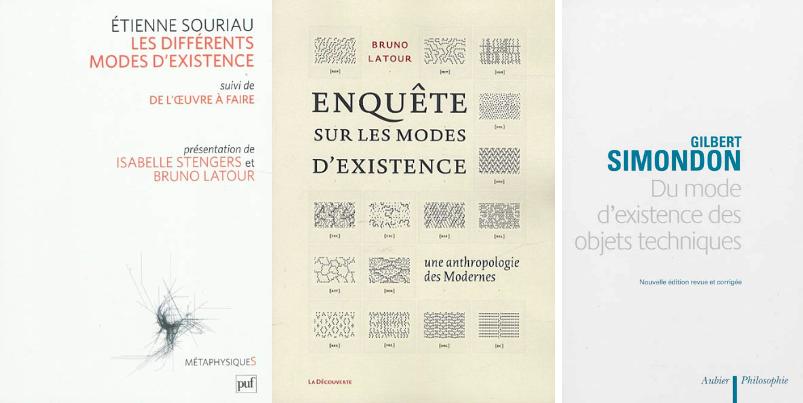
This intervention from its outset searches a dialogue between Simondon and Latour, a fictional dialogue, that nevertheless exists though it hasn’t happened. It hasn’t happened, or should I say it was once about to happen, when Latour praised Simondon’s Du Mode d’existence des objets techniques, and commented that it is a work that didn’t yet find its successor. But it does exist, this fictional dialogue, or at least we can talk about its mode of existence if you prefer since being fictional is also a mode of existence. We cannot draw a squared circle but we can think of a squared circle, it has meanings, this was an example given by Edmund Husserl as a critique of formal logic. The secrete philosopher of Bruno Latour, Étienne Souriau hold a similar idea in his Les différents Modes d’existence. A fictional object or character doesn’t occur in time and space as a physical object, or a historical event, but it does exists in works, in the socio-psychological life and imaginations of their readers and witness. Modes of existence is always plural, it doesn’t follow the rule of contradiction, it is rather key to what Latour calls ontological pluralism.

The question of the mode of existence departs from the question of Dasein posted by Martin Heidegger, and the meaning of Sein, eliminates the Ontologische Differenz between Sein and Seienden in order to de-prioritize certain mode of existence, with a kind of ontological politeness. Modes of existence is a new organon to the analysis of modern life, and also one that revolt against the 20th century philosophy aiming a unified theory of existence. Now to enter the modes of existence, according to Latour one must employ a new dispostif called diplomatic, meaning one should be aware of oneself, resisting esoteric temptations, while being polite and try to negotiate different terms. Hence Latour proposed to go back to an anthropology that starts with reflection on European modernity instead of starting with dialogues with others.

It is also this word “Mode of existence” on the one hand brings together Latour and Simondon to us since Simondon is a philosopher of the mode of existence instead of existence; on the other hand, it allows us to go beyond the question of network in actor-network theory, as Latour himself said in an interview with la vie des idées “what is complicated to understand, maybe, for those who know the rest of my works, it is that network is no longer the principle mode of driving, of vehicle. The world became a bit populated: there is more vehicles moving in different forms”1.That is to say, network is only one mode of existence out of 15 different modes, among which we also find Reproduction, Metamorphose, Habit, Technics, Fiction, Reference, Politics, Right, Religion, Attachment, Organization, Morality, Preposition and Double Click. Network can no longer alonemonopolize the academic social research (by saying so, network still seems to be the framework of the whole book2). Instead it is necessary to re-articulate this specific mode of existence with other modes of existence. For Latour, new position or preposition on the mode of existence allows us to open up the new field of philosophical investigation of the Moderns. The task is no longer how “we have never been modern”, a project done 20 years ago, but rather according to Latour it is an effort to complete the uniquely negative title – we have never been modern – “with a positive version this time of the same affirmation”3.

Mode of Existences and Ontological Politeness

How could one find an entrance to the question of “mode of existence”? Philosophy starts always with dialogue, the most ancient mode of dialectics, and Socrates has always been the model of such a tradition. Now, we want to ask what could this dialogue between Latour and Simondon be? How could us continue a fiction which was started by Latour? For Latour, the significance of the work of Simondon is that he has moved far beyond subject and object, and more importantly when the like and dislike of Heidegger which still shadows the research in philosophy of technology. Latour wrote: “Simondon has grasped that the ontological question can be extracted from the search of substance, from the fascination for particular knowledge, from the obsession for the bifurcation between subject and object, and be posed rather in terms of vector.” Latour quoted a paragraph from Du Mode d’existence des objets techniques:

This de-phasing of the mediation between figural characters and background characters translates the appearance of a distance between man and the world. And mediation itself, instead of being a simple structuration of the universe, takes on a certain density; it becomes objective in the technical and subjective in religion, making the technical object appear to be the primary object and divinity the primary subject, whereas before there was only the unity of the living thing and its milieu: objectivity and subjectivity appear between the living thing and its milieu, between man and the world, at a moment where the world does not yet have a full status as object, and man a complete status as subject.4

But then he continues abruptly: “yet Simondon remains a classical thinker, obsessed as he is by original unity and future unity, deducing his modes from each other in a manner somewhat reminiscent of Hegel…Multirealism turns out to be nothing more, in the end, than a long detour that brings him back to a philosophy of being, the seventh of the modes he sketched.” Latour copied and pasted these paragraphs in numerous articles, this commentary on Simondon is only a passage to the work of Étienne Souriau’s Les Différents modes d’existence. For Latour, it was Souriau but not Simondon who really showed us how can one affirm an ontological pluralism without falling back to the old and weak anthropological relativism and philosophical monism.

In this passing [passe] in Latour’s own sense, Simondon was portrait as an original thinker who wasn’t able to break away from “classical philosophy”, then unfortunately fell back to the shadow of the “original unity and future unity”. But what does it really mean by this quote from Simondon? What does it mean by “this de-phasing of the mediation between figural characters and background characters translates the appearance of a distance between man and the world” and what would be the context of such a quote? If we allow ourselves a bit of patience, Simondon was referring to the figure and background distinction as explained in Gestalt psychology. The figural reality expresses the possibilities of human action in the world, and the background reality expresses the power of nature. Simondon was trying to explain the relation between technics and religions, that originated from the incomparability between man and the world. A society of magic, sees Simondon as the moment where subject and object, human world and nature, figure and background were not fully distinct. But it is also the result of the resolution of incomparability between human being and its milieu, the unity described by Latour is only the possibility for incompatibility. If it could be counted as the repetition of the gesture of classical philosophy in searching of an unity, then biology, physics and chemistry may also have to bear the same accusation.

What is indeed profound in Simondon’s concept of the mode of existence is that this tension or incompatibility has to be resolved constantly both in the process of individualization of technical objects, and also individuation of living beings. It is also by the notion of incompatibility that one has to affirm the multiplicity of objects and their modes of existence. Indeed, Simondon doesn’t think that one can seize an object by its end, there exists ‘espèce technique’, it is rather more productively to think of analogies between different technical species, for example a pendulum clock and a cable winch5.We must recognize here that Simondon’s didn’t only talk about the mode of existence of technical objects, for Simondon, the theory of ontogenesis and individuation is also an inquiry into how different modes of existence interact with each other and and in constant process of evolution. In other words, there is no peace for us, and there hasn’t been a mode of existence called peace – the goal of some kind of all diplomatic activities. Any pursuit of stability is only an illusion, though lets say such an illusion is also a mode of existence. There is no unity of identity, or recollection, of unity composed of parts and united according to certain method of classification6. For Latour, or his reading of Souriau, the ontological pluralism/multi-realism must affirm the existence of phenomenon, things, soul, fictional beings, god, without recurring to a phenomenological account. It must revolt against the Kantian tradition and move towards a speculative realism without correlationism. Some commentators on Simondon such as Xavier Guchet sees the similarity of the approaches between Simondon and Souriau, especially the common word “modulation” they used to signify the internal transformation in being, which is exactly dephasing in Simondon’s own vocabularies, and quoted by Latour above. As Guchet states for Simondon “unity of existence is not an unity of identity, of recollection from an situation of scattering[éparpillement], an unity obtained by composition of part and according to a method of classification”7. If there is an unity in the thoughts of Simondon, then this unity is nothing other than tension and incompatibility. Simondon didn’t use often the word “realism”, but rather “reality”, and what is human reality is actually always in tension with technical reality, while what signified by technical reality is not a single unity or a single phenomenon, but a reality conditioned by many other factors, such as geographical, industrial, natural, etc. For example, the production of white boots and raincoats is conditioned by limitation of the research in material, the visibility of certain colour in that environment, etc. If we can translate into Latour’s own vocabularies, it is the heterogeneous actors in play with different values.

Latour didn’t elaborate all these, except an abrupt assertion that seems a bit brutal, and lack of ontological politeness – to certain extent. In the book Enquête sur les Modes d’existence, we can find another commentary from Latour on Simondon. The section collected in the book is from his earlier article Prendre le Pli des techniques, in which Latour praised Simondon, but at the same time, proposed to look at the mode of existence of technics instead of the mode of existence of technical objects. Latour and Simondon are just like two acquaintances, you smile and say hi without shaking hand, but he has to node his head anyway since there must be a politeness if one wants to be diplomatic. Latour thinks that it is impossible to find the technical mode of existence in objects themselves but rather technics itself. Since technical objects don’t give us visibility, in fact they make technics opaque to us. One can probably find a similar concern from Heidegger, especially the question of Besorgen. We are concernful beings and we always forget what is in front of us, what we are using, especially Being which we are and in which we dwell: we are far away from what is closest to us.

But this dialectic movement of visible and invisible seems to be a general tendency of all technical objects, and it is the particular mode of existence of technical objects and technics, which has been widely recognized in the study of technologies. Latour was right that technics hides itself deeper than alétheia. The mode of existence of technics is only visible through technical objects, and it is also rendered invisible by technical objects, since on the one hand there is no technics without materialisation, or leaving traces; on the other hand materialisation doesn’t assure visibility, that is to say one cannot find identity or essence from eidos. I would rather say compared to Latour’s proposal of going back to the “transcendence” of technics, Simondon shows a more concrete account of the levels of existence of technical objects: namely usage, historical characters, and the profound structure of technicity. And these modes of existences also account different level of visibility and invisibility. For example, how can we think of the diode in your computer? Or lets take away the subject who speculates, how does the diode in your computer exist by itself, a diode that really exists in a black box even if you open the case of your computer and check every component? How can we think of Mercedes Benz, the different models that nevertheless associate with the brand name Mercedes Benz? When are are visible to us and invisible to us, without being reduced to question of transcendence and immanence?

Be diplomatic without double-clicks

Another Latourian commentary on Simondon comes indirectly from Graham Harman, if we can use Latour’s own vocabulary on the modes of existence, it is the overlap between Reference and Network that bring forth this mode of existence: another fictional dialogue between Latour and Simondon in the regime of enunciation of Harman. Speaking of the relational philosophy of Latour, Harman compared it with kinds of monism that supposes “a single lump universe, a world devoid of any specific realities at all8”. Among these monisms, Harman found one peculiar one, that is one related to Deleuze, and more specifically Simondon, if we now count how much Deleuze has taken from the concept of individuation of Simondon. In contrary to the single lump universe, this monism “try to enjoy the best of both worlds, defining a unified realm beneath experience that is not completely unified. Instead of a total lump-world, it is one animated in advance by different ‘pre-individual’ zones that prevent the world from being purely homogeneous.”

As Alberto Toscano describes Simondon’s position, ‘whilst [preindividual being] is yet to be in- dividuated, [it] can already be regarded as affected by relationality. This preindividual relationality, which takes place between heterogeneous dimensions, forces or energetic tendencies, is nevertheless also a sort of non- relation […]. Being is thus said to be more-than-one to the extent that all of its potentials cannot be actualized at once’. Simondon like DeLanda wants the world to be both heterogeneous and not yet parcelled out into individuals. In this way, specific realities lead a sort of halfhearted existence somewhere between one and many9.

Harman further explained that this is certainly not the case for Latour, since “his actors are fully in- dividual from the start; his philosophy contains no such concept as ‘pre- individual’. His actors are not blended together in a ‘continuous yet heterogeneous’ whole, but are basically cut off from one another. There is no continuum for Latour despite his relationism, and this thankfully entails that his relationism is less radical than it is for philosophies of the virtual (note that Latour’s rare flirtations with monism seem to coincide with his equally rare flirtations with the term ‘virtual’).” In fact, maybe it is because Harman didn’t read Simondon since he relied on Alberto Toscano’s reading, he hence has a rather vague idea of individuation. Here we see another problem of not being diplomatic enough, that is due the disagreement of word without looking into the content. The question for us is how can we negotiate different ontologies, not to generate an unity, but to affirm different realisms without a double click? In other words, how to become a professional diplomate as Latour suggests?

The fact that there are always individuals for Simondon, but individuals didn’t disclose us anything of operation or process, which can only be studied through individuation. Taking individual as isolable individual or as part of collective, according to Simondon is the problem of the substantialism of sociology and psychology. For Simondon, as well as Latour, individuals cannot be reduced; but for Simondon, who sees further than Harman, the individual cannot be reduced to itself. Each individual is not individual in itself, but always accompanied by the pre-individual, which is the potential and energetic that provide the motivation for individuation: it is a transindividual rather than an individual. And if actor-network aims to look into the complexity and the process of social phenomenon, didn’t Simondon and Latour walk in parallel?

Now if Actor-Network theory has to be re-articulated according to the modes of existence of the modern according to Latour, we must pay attention to the translation that is not necessarily diplomatic but sincere. We must also note that this notion of translation is so important in Actor-Network theory, since according to the annotation of Latour’s Ebook, it is called la sociologie de la traduction, sociology of translation. But lets be a bit careful here, with the word traduction, Latour distinguish it from translation. For him, the particular mode of existence he calls “Double Click” is a translation without traduction, meaning without transformation, without process, it is simply a jump from one process to another. But isn’t Latour and Harmon’s reading of Simondon also such a double click?

I am not rejecting Latour and Harman due to their double clicks on a button called “Simondon”, since we have to be diplomatic and polite. But maybe we need to pay attention that, there are different style of being diplomatic, and I feel like a more productive dialogue is possible if we are able to negotiate like diplomates who try to translation different terms and requests into conditions and agreements, as Latour himself suggests. These negotiations may allow us to peek into a more profound investigation on the modes of existence of Moderns. Actor-Network, a concept according to Latour needs to be renewed in the inquiry into the mode of existence, the remaining task is to re-situate network in the broader framework of the modes of existence.

Lets start and conclude with something lighter and more motivated and leave something heavier and more specific behind, so that we can find ways to start a real negotiation – even though you may criticise this is also a double-click of some kind later. Instead of going into every mode of existence, lets me outline a framework for such a dialogue. These are four pairs of beings: 1) Actor – Individual; 2) Network – Milieu; 3)Relations – Affectivo-emotive/Social-psychological; 4) Traduction – Transduction. We wouldn’t be able to go through all these pairs in details, since they deserve a work of its own. Here I can only offer a very brief detour, shows how Latour and Simondon’s interest in describing processes and operations can give us a synthetic reading of both. We will see that how different modes of existences can hardly be classified into 15 categories and simple overlap between these categories could already bring us a lot of headaches. What seems to me problematic is that actors as individuals – according to Harman – are too rigid. Of course, each individual exist, me, I am speaking in front of you as an individual, but I am not an individual to you as a total other, since you are listening to me, and we are thinking together, at least you are thinking according to my voice. You are listening to my demands, my ontologies, with your politeness. And I am observing you, some of you smiling, some of you shaking head, many of you checking Facebook, and I must adjust my speech, my tone, the volume of my voice, my perception of my speech and even myself. There are many possibilities that is totally outside me, but they are the pre-individual for me as a transindividual as Simondon proposed.

Simondon is more persistent with trans-.Note that it is a transindividual but not an individual; a transduction and not only a traduction, transduction is at the same time change and exchange that triggers transformation of structure. Latour, he himself wants to dissolve network into the question of the mode of existence, and here we can see again the possibility of reconstitute it in the concept of milieu. The network of Latour is too much into “international relations” due to its diplomatic nature, and for Simondon the milieu has to be socio-psychological and emo-affective, it is also why Simondon was able to talk about an social-psychology of technicity. This is not a simple defence for Simondon, since it wouldn’t be fruitful to do so, but in order to search the possibility of a dialogue that doesn’t dismiss each other in a double-click. For an inquiry into the modes of existence is possible, it seems that one must not repeat what has happened in the history of the inquiry into existence, like how Jorge Luis Borges made fun of Bishop John Wilkins’ ontology and the funny Chinese encyclopedia; indeed 12+310 categories doesn’t seem to be much different from15 categories except when the “+” counts. If we dare to take it a step further, then it is how a metaphysics departs from its history, not only in terms of content, but also style.

1Le diplomate de la Terre Entretien avec Bruno Latour, par Arnaud Esquerre & Jeanne Lazarus [18-09-2012], http://www.laviedesidees.fr/Le-diplomate-de-la-Terre.html

2Thanks to Jeremy James Lecomte and Markus Burkhardt for insisting on this point

3Latour, EMD, 23

4In Latour, « Reflections on Etienne Souriau’s Les Modes d’existence », in (edited by Graham Harman, Levi Bryant and Nick Srnicek The Speculative Turn Continental Materialism and Realism re.press Australi, pp. 304-333, Melbourne, Australie

5Simondon, MEOT (2012), Aubier, p.21

6Guchet, Pour un humanisme technologique. Culture, technique et société dans la philosophie de Gilbert Simondon, PUF,2011, 35

7Ibid, « l’unité de l’existence n’est pas une unité d’identité, de récollection à partir d’une situation d’éparpillement, une unité obtenue par composition de parties et selon une méthode de classification »

8Harman, Prince of Networks: Bruno Latour and Metaphysics, 159

9ibid

10Latour, EMO, 477

Flavorwire Exclusive: Civilization Is Doomed! McKenzie Wark Takes on the Anthropocene (Flavorwire)

By Jonathon Sturgeon – Apr 29, 2015 12:00pm

In the below excerpt, drawn from the conclusion of his energizing new book Molecular Red, McKenzie Wark confesses that “we all know this civilization can’t last.” Nevertheless! Wark asserts that our imaginations are up to the standard of describing a new and better world, and so he sets out to consider what metaphors we might use to define a future that will “undo the workings of the Anthropocene.” The industriousness and intellectual range you see here defines Molecular Red, a brilliant and persistently entertaining book that considers everything from cyborgs to Russian intellectuals and Kim Stanley Robinson’s Marstrilogy.

From the conclusion to Molecular Red:

There is still some low theory work to do, to transmit the metaphor of the Anthropocene between domains, but in that process, those labor processes will change it. Rather than “interrogate” Crutzen’s Anthropocene—and where did that metaphor come from?—perhaps it is better to see it as what it is: a brilliant hack. The Anthropocene introduces the labor point of view—in the broadest possible sense—into geology. Perhaps the challenge is then to find analogous but different ways to hack other specialized domains of knowledge, to orient them to the situation and the tasks at hand.

Let’s invent new metaphors! Personally, I like the #misanthropocene, but don’t expect it to catch on. Jason Moore prefers the Capitalocene, Jussi Parikka the Anthrobscene. Kate Raworth suggests Manthropocene, given the gender make-up of the Anthropocene Working Group considering it as a name for a geological era. Donna Haraway offers to name it the Chthulucene, a more chthonic version of Cthulhu, the octopoid monster of H. P. Lovecraft’s weird stories. “Chthulucene does not close in on itself; it does not round off; its contact zones are ubiquitous and continuously spin out loopy tendrils.”

Haraway notes the strikingly parallel evolution of new meta- phorical tools in both humanities and biologies, where competitive individualism is no longer a given. In Bogdanovite terms, perhaps it is because in both domains, producing knowledge got strangely complex, collaborative, and mediated by apparatuses. A new breed of basic metaphor is at least partly at work and in play, one which in the biologies could be described as a “multi-species becoming-with.”

Haraway wants to both “justify and trouble” the language of the Anthropocene. As Edwards does with climate science, she insists on the embeddedness in an infrastructure that makes the global appear as a work-object to those natural scientists for whom the Anthropocene makes sense as a metaphor. She points to the limits of its basic metaphors, which still think one-sidedly of competition between populations or genes, where success equals reproduction. More symbiotic—dare we say comradely?—kinds of life hardly figure in such metaphors. But perhaps, as Haraway says, “we are all lichens now”—cyborg lichens.

After Robinson, the task is not debating names or trading stories, but making comradely alliances. Is not Crutzen one of those curious scientist-intellectuals that Robinson’s fiction trains us to look out for? Crutzen and his colleagues in the earth sciences have flagged something that needs to shape the agenda for knowledge, culture, and organization. For those of us seeking to respond from the left, I think the authors presented in Molecular Red offer some of the best ways of processing that information. Bogdanov and Platonov would not really be surprised by the Anthropocene. They were vulgar enough to think aspects of it already.

So let’s pop the following tools into the dillybag for future use:

Something like an empirio-monism has its uses, because it is a way of doing theory that directs the tendency to spin out webs of metaphoric language to the task at hand. It steers the language arts toward agendas arising out of working processes, including those of sciences. It is agnostic about which metaphors best explain the real, but it sees all of them as substitutions which derive from the forms of labor and apparatus of the time.

Something like proletkult has its uses, as the project for the self-organization of the labor point of view. It filters research into past culture and knowledge through the organizational needs of the present. Those needs put pressure on the traditional category of labor, opening it toward feminist standpoints, not to mention our queer cyborg entanglements.

Something like a tektology has its uses, as a way of coordinating labor other than through exchange or hierarchy, or the new infra- structure of corporatized “networks.” It communicates between labor processes poetically and qualitatively. It is a training of the metaphoric wiliness of language toward particular applications which correspond to and with advances in labor technique.

Lastly, something like the utopia of Red Star has its uses, in motivating those working in separate fields to think beyond the fetishistic habits of the local and toward comradely goals. In the absence of a single counter-hegemonic ideology, perhaps something like a meta-utopia might be more useful, and more fun. Meta-utopia offers not so much an imaginary solution to real problems as a real problematizing of how to navigate the differences between the imaginal that corresponds to each particular labor points of view.

And so, to conclude with the slogan with which we began. It might be the slogan of a Cyborg International. One which already possesses in imagination the means and the will to undo the workings of the Anthropocene. One with nothing for it but to build the new living world within the ruins of the old one. We all know this civilization can’t last. Let’s make another.

WORKINGS OF THE WORLD UNTIE! YOU HAVE A WIN TO WORLD!

Imagining the Anthropocene (AEON)

The Anthropocene idea has been embraced by Earth scientists and English professors alike. But how useful is it?

Jedediah Purdy is Professor of Law at Duke University in North Carolina. His forthcoming book is After Nature: A Politics for the Anthropocene.

Edited by Ross Andersen

Officially, for the past 11,700 years we have been living in the Holocene epoch. From the Greek for ‘totally new’, the Holocene is an eyeblink in geological time. In its nearly 12,000 years, plate tectonics has driven the continents a little more than half a mile: a reasonably fit person could cover the scale of planetary change in a brisk eight-minute walk. It has been a warm time, when temperature has mattered as much as tectonics. Sea levels rose 115 feet from ice melt, and northern landscapes rose almost 600 feet, as they shrugged off the weight of their glaciers.

But the real news in the Holocene has been people. Estimates put the global human population between 1 million and 10 million at the start of the Holocene, and keep it in that range until after the agricultural revolution, some 5,000 years ago. Since then, we have made the world our anthill: the geological layers we are now laying down on the Earth’s surface are marked by our chemicals and industrial waste, the pollens of our crops, and the absence of the many species we have driven to extinction. Rising sea levels are now our doing. As a driver of global change, humanity has outstripped geology.

This is why, from the earth sciences to English departments, there’s a veritable academic stampede to declare that we live in a new era, the Anthropocene – the age of humans. Coined by the ecologist Eugene Stoermer in the 1980s and brought to public attention in 2000 by the Nobel Prize-winning atmospheric scientist Paul Crutzen, the term remains officially under consideration at the Stratigraphy Commission of the Geological Society of London.

The lack of an official decision has set up the Anthropocene as a Rorschach blot for discerning what commentators think is the epochal change in the human/nature relationship. The rise of agriculture in China and the Middle East? The industrial revolution and worldwide spread of farming in the Age of Empire? The Atomic bomb? From methane levels to carbon concentration, from pollen residue to fallout, each of these changes leaves its mark in the Earth’s geological record. Each is also a symbol of a new set of human powers and a new way of living on Earth.

The most radical thought identified with the Anthropocene is this: the familiar contrast between people and the natural world no longer holds. There is no more nature that stands apart from human beings. There is no place or living thing that we haven’t changed. Our mark is on the cycle of weather and seasons, the global map of bioregions, and the DNA that organises matter into life. The question is no longer how to preserve a wild world from human intrusion; it is what shape we will give to a world we can’t help changing.

The discovery that nature is henceforth partly a human creation makes the Anthropocene the latest of three great revolutions: three kinds of order once thought to be given and self-sustaining have proved instead to be fragile human creations. The first to fall was politics. Long seen as part of divine design, with kings serving as the human equivalents of eagles in the sky and oaks in the forest, politics proved instead a dangerous but inescapable form of architecture – a blueprint for peaceful co‑existence, built with crooked materials. Second came economics. Once presented as a gift of providence or an outgrowth of human nature, economic life, like politics, turned out to be a deliberate and artificial achievement. (We are still debating the range of shapes it can take, from Washington to Greece to China.) Now, in the Anthropocene, nature itself has joined the list of those things that are not natural. The world we inhabit will henceforth be the world we have made.

The revolution in ideas that the Anthropocene represents is rooted in hundreds of eminently practical problems. The conversation about climate change has shifted from whether we can keep greenhouse-gas concentrations below key thresholds to how we are going to adapt when they cross those thresholds. Geo‑engineering, deliberately intervening in planetary systems, used to be the unspeakable proposal in climate policy. Now it is in the mix and almost sure to grow more prominent. As climate change shifts ecological boundaries, issues such as habitat preservation come to resemble landscape architecture. We can’t just pen in animals to save them; they need landscape-scale corridors and other help in migrating as their habitats move. There is open talk in law-and-policy circles about triage in species preservation – asking what we can save, and what we most want to save.

What work is this idea of the Anthropocene doing in culture and politics? As much as a scientific concept, the Anthropocene is a political and ethical gambit. Saying that we live in the Anthropocene is a way of saying that we cannot avoid responsibility for the world we are making. So far so good. The trouble starts when this charismatic, all-encompassing idea of the Anthropocene becomes an all-purpose projection screen and amplifier for one’s preferred version of ‘taking responsibility for the planet’.

Peter Kareiva, the controversial chief scientist of the Nature Conservancy, uses the theme ‘Conservation in the Anthropocene’ to trash environmentalism as philosophically naïve and politically backward. Kareiva urges conservationists to give up on wilderness and embrace what the writer Emma Marris calls the ‘rambunctious garden’. Specifically, Kareiva wants to rank ecosystems by the quality of ‘ecosystem services’ they provide for human beings instead of ‘pursuing the protection of biodiversity for biodiversity’s sake’. He wants a pro‑development stance that assumes that ‘nature is resilient rather than fragile’. He insists that: ‘Instead of scolding capitalism, conservationists should partner with corporations in a science-based effort to integrate the value of nature’s benefits into their operations and cultures.’ In other words, the end of nature is the signal to carry on with green-branded business as usual, and the business of business is business, as the Nature Conservancy’s partnerships with Dow, Monsanto, Coca-Cola, Pepsi, J P Morgan, Goldman Sachs and the mining giant Rio Tinto remind us.

Kareiva is a favourite of Andrew Revkin, the roving environmental maven of The New York Times Magazine, who touts him as a paragon of responsibility-taking, a leader among ‘scholars and doers who see that new models for thinking and acting are required in this time of the Anthropocene’. This pair and their friends at the Breakthrough Institute in California can be read as making a persistent effort to ‘rebrand’ environmentalism as humanitarian and development-friendly (and capture speaking and consultancy fees, which often seem to be the major ecosystem services of the Anthropocene). This is itself a branding strategy, an opportunity to slosh around old plonk in an ostentatiously shiny bottle.

Elsewhere in The New York Times Magazine, you can enjoy the other end of the Anthropocene projection screen, from business-as-usual to this-changes-everything. In his essay ‘Learning How to Die in the Anthropocene’ (2013), the Princeton scholar and former soldier Roy Scranton writes: ‘this civilisation is already dead’ (emphasis original) and insists that the only way forward is ‘to realise there’s nothing we can do to save ourselves’ and therefore ‘get down to the hard work … without attachment or fear’. He concludes: ‘If we want to learn to live in the Anthropocene, we must first learn how to die.’

Other humanists bring their own preoccupations to a sense of gathering apocalypse. In his influential essay ‘The Climate of History’ (2008), Dipesh Chakrabarty, a theory-minded historian at the University of Chicago, proposes that the Anthropocene throws into question all received accounts of human history, from Whiggish optimism to his own post-colonial postmodernism. He asks anxiously: ‘Has the period from 1750 to the present been one of freedom or that of the Anthropocene?’ and concludes that the age requires a new paradigm of thought, a ‘negative universal history’.

In their introduction to Ecocriticism (2012), a special issue of American Literature, the English scholars Monique Allewaert of the University of Wisconsin-Madison and Michael Ziser of the University of California Davis describe the Anthropocene as best captured in ‘a snapshot of the anxious affect of the modern world as it destroys itself – and denies even its own traces’.

The Anthropocene does not seem to change many minds. But it does turn them up to 11

All of these people (except for the branding opportunists) are trying, with more or less success, to ask how the Anthropocene changes the projects to which they’ve given chunks of their lives. Some far-ranging speculation and sweeping summaries are to be expected, and forgiven. Nonetheless, something in the Anthropocene idea seems to provoke heroic thinking, a mood and rhetoric of high stakes, of the human mind pressed up against the wall of apocalypse or arrived at the end of nature and history.

In this provocative defect, Anthropocene talk is a discourse of responsibility, to borrow a term from Mark Greif’s study of mid-20th-century American thought, The Age of the Crisis of Man (2015). Greif argues that a high-minded (but often middle-brow) strain of rhetoric responded to the horrors of the world wars and the global struggles thereafter with a blend of urgent language and sweeping concepts (or pseudo-concepts): responsibility, the fate of man, the urgency of now. Greif describes discourses of responsibility as attempts to turn words and thoughts, uttered in tones of utmost seriousness, into a high form of action. All of this is recognisable in Anthropocene talk. The Anthropocene does not seem to change many minds, strictly speaking, on point of their cherished convictions. But it does turn them up to 11.

On the whole, this is the inevitable and often productive messiness that accompanies a new way of seeing, one that unites many disparate events into a single pattern. As an offer to unify what might seem unrelated, ‘the Anthropocene’ is an attempt to do the same work that ‘the environment’ did in the 1960s and early ’70s: meld problems as far-flung as extinction, sprawl, litter, national parks policy, and the atom bomb into a single phenomenon called ‘the ecological crisis’. Such a classification is always somewhat arbitrary, though often only in the trivial sense that there are many ways to carve up the world. However arbitrary, it becomes real if people treat it as real, by forming movements, proposing changes, and passing laws aimed at ‘the environment’.

We know what the concept ‘the environment’ has wrought but what will the Anthropocene be like? To put this over-dramatised idea in the least heroic garb possible, what will the weather be like in the Anthropocene? And how will we talk about the weather there?

For all the talk of crisis that swirls around the Anthropocene, it is unlikely that a changing Earth will feel catastrophic or apocalyptic. Some environmentalists still warn of apocalypse to motivate could-be, should-be activists; but geologic time remains far slower than political time, even when human powers add a wobble to the planet. Instead, the Anthropocene will be like today, only more so: many systems, from weather to soil to your local ecosystem, will be in a slow-perennial crisis. And where apocalyptic change is a rupture in time, a slow crisis feels normal. It feels, in fact, natural.

So the Anthropocene will feel natural. I say this not so much because of the controversial empirics-cum-mathematics of the climate-forecasting models as because of a basic insight of modernity that goes back to Rousseau: humanity is the adaptable species. What would have been unimaginable or seemed all but unintelligible 100 years ago, let alone 500 (a sliver of time in the evolutionary life of a species), can become ordinary in a generation. That is how long it took to produce ‘digital natives’, to accustom people to electricity and television, and so on for each revolution in our material and technological world. It takes a great deal of change to break through this kind of adaptability.

This is all the more so because rich-country humanity already lives in a constant technological wrestling match with exogenous shocks, which are going to get more frequent and more intense in the Anthropocene. Large parts of North America regularly experience droughts and heat waves that would devastate a simpler society than today’s US. Because the continent is thoroughly engineered, from the water canals of the West to the irrigation systems of the Great Plains to air conditioning nearly everywhere, these are experienced as inconvenience, as mere ‘news’. The same events, in poorer places, are catastrophes.

Planetary changes will amplify the inequalities that sort out those who get news from those who get catastrophes; but these inequalities, arising as they do from a post-natural nature, will feel as if they were built into the world itself. Indeed, nature has always served to launder the inequalities that humans produce. Are enslaved people kept illiterate and punished brutally when they are not servile? Then ignorance and servility must be in their nature, an idea that goes back in a continuous line to Aristotle. The same goes for women, with some edits to their nature: docile, nurturing, delicate, hysterical, etc. It was not until Harriet Taylor and John Stuart Mill worked together on The Subjection of Women (published under his name alone in 1869), that English-language philosophy produced a basic challenge to millennia of nature-talk about sexual difference.

The expulsion of Native Americans was ‘justified’ on several versions of nature. Maybe they were racially different. Maybe their climate made them weak and irrational, unable to cultivate the land or resist European settlement. (Colonists briefly embraced this idea, then grew uneasy when they realised that the North American climate was now theirs; by the time of American independence, they raced to reject climatic theories of racial character.) Maybe Native Americans had simply failed to fulfil the natural duty of all mankind, to clear and plant the wilderness and make it bloom like an English garden, an idea that many theorists of natural law advanced in the 17th and 18th centuries. One way or another, nature was a kind of ontological insurance policy for human injustice.

And now? Well, it’s common wisdom that rising sea levels will first affect some of the world’s poorest people, notably in Bangladesh and coastal India. But it’s much worse than that grim geographic coincidence. Wealth has always meant some protection from nature’s cruel measures. In fact, that is the first spur to technology and development of all kinds: not to be killed. Tropical diseases with changing range will find some populations well-equipped with vaccination and medicine, others struggling with bad government and derelict health systems. When seas rise fast, even the feckless but rich US will begin adapting fast, and coastal flooding will be classified in the rich-world mind as a catastrophe of the poor.

So will starvation. A legal regime of unequal Anthropocene vulnerability is well underway. Take the vast, long-term leases that Chinese companies have entered into for some of Africa’s richest farmland. When drought, soil exhaustion or crop crisis puts a pinch on global food supply, contracts and commerce will pull trillions of calories to fat-and-happy Beijing. This is, of course, only the latest chapter in centuries of imperialism and post-imperial, officially voluntary global inequality. But it is the chapter that we the living are writing.

Neoliberal environmentalism aims to bring nature fully into the market, merging ecology and economy

For the moment, Anthropocene inequality has a special affinity with neoliberalism, the global extension of a dogmatic market logic and increasingly homogenous market forms, along with an accompanying ideology insisting that, if the market is not beyond reproach, it is at least beyond reform: there is no alternative. Where previous episodes of global ecological inequality took place under direct imperial administration – witness the Indian famines of the late 19th century, suffered under British rule – ours is emerging under the sign of free contract. Anthropocene inequality is thus being doubly laundered: first as natural, second as the voluntary (and presumptively efficient) product of markets. Because human activity now shapes the ‘natural’ world at every point, it is especially convenient for that world-shaping activity to proceed in its own pseudo-natural market.

But Anthropocene problems also put pressure on the authority of economics. Much of environmental economics has been built on the concept of the externality, economist-speak for a side-effect, a harm or benefit that has no price tag, and so is ignored in market decisions. Air pollution – free to the polluter – is the classic bad side-effect, or ‘negative externality’. Wetlands – not valued on the real-estate market, but great sources of filtration, purification and fertility, which would otherwise cost a lot to replicate – are the model positive externality. So neoliberal environmentalism, which Kareiva’s Nature Conservancy has been cultivating, aims to bring nature fully into the market, finding a place in the bottom line for all former side-effects, and fully merging ecology and economy.

In a climate-changed Anthropocene, the side-effects overwhelm the ‘regular’ market in scale and consequence. And there is no ‘neutral’, purely market-based way to put a value on side-effects. Take the example of carbon emissions. It is possible to create a market for emissions, as Europe, California and other jurisdictions have done; but at the base of that market is a political decision about how to value the economic activity that emits carbon against all the (uncertain and even speculative) effects of the emissions. The same point holds for every (post-)natural system on an Anthropocene planet. Ultimately, the question is the value of life, and ways of life. There is no correct technocratic answer.

The shape of the Anthropocene is a political, ethical and aesthetic question. It will answer questions about what life is worth, what people owe one another, and what in the world is awesome or beautiful enough to preserve or (re)create. Either the answers will reproduce and amplify existing inequality or they will set in motion a different logic of power. Either the Anthropocene will be democratic or it will be horrible.

A democratic Anthropocene would start from a famous observation of the economics Nobel Prize laureate Amartya Sen: no minimally democratic society has ever suffered a famine. Natural catastrophes are the joint products of natural and human systems. Your vulnerability to disaster is often a direct expression of your standing in a political (and economic) order. The Anthropocene stands for the intensifying merger of ecology, economics and politics, and one’s standing in those systems will increasingly be a single question.

But talk of democracy here is – like much about the Anthropocene – in danger of becoming abstract and moralising. Reflecting on a democratic Anthropocene becomes an inadvertent meditation on the devastating absence of any agent – a state, or even a movement – that could act on the scale of the problem. Indeed, it reveals that there is no agent that could even define the problem. If the Anthropocene is about the relationship between humanity and the planet, well, there is no ‘humanity’ that agrees on any particular meaning and imperative of climate change, extinction, toxification, etc. To think about the Anthropocene is to think about being able to do nothing about everything. No wonder the topic inspires compensatory fantasies that the solution lies in refining the bottom line or honing personal enlightenment – always, to be sure, in the name of some fictive ‘we’.

This returns us to the basic problem that the Anthropocene drives home: as Hannah Arendt observed in The Origins of Totalitarianism (1951), the idea of human rights – such as the right to democratic standing in planetary change – is a chimera and a cruel taunt without a political community that can make it good through robust institutions and practices. The Anthropocene shows how far the world is from being such a polity, or a federation of such polities, and how much is at stake in that absence. The world is too much with us. Worse, there is no ‘we’ to be with it.

In the face of all these barriers, what could all this talk about the Anthropocene possibly accomplish? Ironically, a useful comparison lies in Arendt’s target, the mere idea of human rights. While mere ideas are in fact sorry comforts in an unmanageable situation, they can be the beginning of demands, projects, even utopias, that enable people to organise in new ways to pursue them. The idea of human rights has gained much of its force this way, as a prism through which many efforts are focused and/or refracted.

A democratic Anthropocene is just a thought for now, but it can also be a tool that activists, thinkers and leaders use to craft challenges and invitations that bring some of us a little closer to a better possible world, or a worse one. The idea that the world people get to inhabit will only be the one they make is, in fact, imperative to the development of a political and institutional programme, even if the idea itself does not tell anyone how to do that. There might not be a world to win, or even save, but there is a humanity to be shaped and reshaped, freely and always in partial and provisional ways, that can begin intending the world it shapes.

31 March 2015

Popular now

Time and Events (Knowledge Ecology)

March 24, 2015 / Adam Robbert

tumblr_nivrggIBpb1qd0i7oo1_1280

[Image: Mohammad Reza Domiri Ganji]

I just came across Massimo Pigliucci’s interesting review of Mangabeira Unger and Lee Smolin’s book The Singular Universe and the Reality of Time. There are more than a few Whiteheadian themes explored throughout the review, including Unger and Smolin’s (U&S) view that time should be read as an abstraction from events and that the “laws” of the universe are better conceptualized as habits or contingent causal connections secured by the ongoingness of those events rather than as eternal, abstract formalisms. (This entangling of laws with phenomena, of events with time, is one of the ways we can think towards an ecological metaphysics.)

But what I am particularly interested in is the short discussion on Platonism and mathematical realism. I sometimes think of mathematical realism as the view that numbers, and thus the abstract formalisms they create, are real, mind-independent entities, and that, given this view, mathematical equations are discovered (i.e., they actually exist in the world) rather than created (i.e., humans made them up to fill this or that pragmatic need). The review makes it clear, though, that this definition doesn’t push things far enough for the mathematical realist. Instead, the mathematical realist argues for not just the mind-independent existence of numbers but also their nature-independence—math as independent not just of all knowers but of all natural phenomena, past, present, or future.

U&S present an alternative to mathematical realisms of this variety that I find compelling and more consistent with the view that laws are habits and that time is an abstraction from events. Here’s the reviewer’s take on U&S’s argument (the review starts with a quote from U&S and then unpacks it a bit):

“The third idea is the selective realism of mathematics. (We use realism here in the sense of relation to the one real natural world, in opposition to what is often described as mathematical Platonism: a belief in the real existence, apart from nature, of mathematical entities.) Now dominant conceptions of what the most basic natural science is and can become have been formed in the context of beliefs about mathematics and of its relation to both science and nature. The laws of nature, the discerning of which has been the supreme object of science, are supposed to be written in the language of mathematics.” (p. xii)

But they are not, because there are no “laws” and because mathematics is a human (very useful) invention, not a mysterious sixth sense capable of probing a deeper reality beyond the empirical. This needs some unpacking, of course. Let me start with mathematics, then move to the issue of natural laws.

I was myself, until recently, intrigued by mathematical Platonism [8]. It is a compelling idea, which makes sense of the “unreasonable effectiveness of mathematics” as Eugene Wigner famously put it [9]. It is a position shared by a good number of mathematicians and philosophers of mathematics. It is based on the strong gut feeling that mathematicians have that they don’t invent mathematical formalisms, they “discover” them, in a way analogous to what empirical scientists do with features of the outside world. It is also supported by an argument analogous to the defense of realism about scientific theories and advanced by Hilary Putnam: it would be nothing short of miraculous, it is suggested, if mathematics were the arbitrary creation of the human mind, and yet time and again it turns out to be spectacularly helpful to scientists [10].

But there are, of course, equally (more?) powerful counterarguments, which are in part discussed by Unger in the first part of the book. To begin with, the whole thing smells a bit too uncomfortably of mysticism: where, exactly, is this realm of mathematical objects? What is its ontological status? Moreover, and relatedly, how is it that human beings have somehow developed the uncanny ability to access such realm? We know how we can access, however imperfectly and indirectly, the physical world: we evolved a battery of sensorial capabilities to navigate that world in order to survive and reproduce, and science has been a continuous quest for expanding the power of our senses by way of more and more sophisticated instrumentation, to gain access to more and more (and increasingly less relevant to our biological fitness!) aspects of the world.

Indeed, it is precisely this analogy with science that powerfully hints to an alternative, naturalistic interpretation of the (un)reasonable effectiveness of mathematics. Math too started out as a way to do useful things in the world, mostly to count (arithmetics) and to measure up the world and divide it into manageable chunks (geometry). Mathematicians then developed their own (conceptual, as opposed to empirical) tools to understand more and more sophisticated and less immediate aspects of the world, in the process eventually abstracting entirely from such a world in pursuit of internally generated questions (what we today call “pure” mathematics).

U&S do not by any means deny the power and effectiveness of mathematics. But they also remind us that precisely what makes it so useful and general — its abstraction from the particularities of the world, and specifically its inability to deal with temporal asymmetries (mathematical equations in fundamental physics are time-symmetric, and asymmetries have to be imported as externally imposed background conditions) — also makes it subordinate to empirical science when it comes to understanding the one real world.

This empiricist reading of mathematics offers a refreshing respite to the resurgence of a certain Idealism in some continental circles (perhaps most interestingly spearheaded by Quentin Meillassoux). I’ve heard mention a few times now that the various factions squaring off within continental philosophy’s avant garde can be roughly approximated as a renewed encounter between Kantian finitude and Hegelian absolutism. It’s probably a bit too stark of a binary, but there’s a sense in which the stakes of these arguments really do center on the ontological status of mathematics in the natural world. It’s not a direct focus of my own research interests, really, but it’s a fascinating set of questions nonetheless.

Review of Thinking with Whitehead: A Free and Wild Creation of Concepts (Notre Dame Philosophical Reviews)

2012.06.21
ISABELLE STENGERS
Thinking with Whitehead: A Free and Wild Creation of Concepts
Isabelle Stengers, Thinking with Whitehead: A Free and Wild Creation of Concepts, Michael Chase (tr.), Harvard University Press, 2011, 531pp., $49.95 (hbk), ISBN 9780674048034.

Reviewed by Roland Faber, Claremont School of Theology

Isabelle Stengers’ work on Whitehead was a long time in the making — as a work on Whitehead’s work, as an outcome of her thinking with Whitehead through different instantiations of her own writing, and as a process of translation from the French original. It is an important work, unusual not only for the bold generality with which it tries to characterize Whitehead’s philosophical work in its most important manifestations, but even more importantly, for its effort to present a radical alternative mode of contemporary thinking. One is almost tempted to say that the urgency of this book’s intensity is motivated by nothing less than Stengers’ immediate feeling of the importance of Whitehead’s work for the future of (human) civilization. Since we need to make life-and-death decisions regarding the directions we might (want to) take, the explication of Whitehead’s alternatives may be vital. Hence to think with Whitehead is to think alternatives in which we “sign on in advance to an adventure that will leave none of the terms we normally use as they were.” Yet, as a rule, Stengers is “with” Whitehead not only in sorting out such alternatives, but also in his non-confrontational method of peace-making, in which nothing “will be undermined or summarily denounced as a carrier of illusion.” (24)

The two parts of the book roughly bring to light the development of Whitehead’s thought and its shifting points of gravity, circling around two of its major developments.  One of these developments could be said to be temporal, since Whitehead’s philosophical work over time can be characterized as developing from a philosophy of nature (as it was still embedded in the discussion of a philosophy of science) to a metaphysics (that included everything that a philosophy of science has excluded). The other is more spatial, since it circles around the excluded middle between the philosophy of science (excluding mind) and a general metaphysics (of all worlds), namely, a cosmology of our real universe. In an interesting twist, not so common today in any of the standard fields of discourse, we could also agree with Bruno Latour, who in his introduction suggests that both developments, the temporal — how to overcome the bifurcation of nature — and the spatial — how to understand a cosmos of creative organisms — are again (and further) de-centered by the unusual Whiteheadian reintroduction of “God.” (xiii)

The first fourteen chapters that discuss the “temporal” development of Whitehead’s thought (“From the Philosophy of Nature to Metaphysics”) begin with a hermeneutical invitation to the reader to view the Whiteheadian adventure of thought as a dislocation from all commonly held beliefs and theories about nature and the world in general because it asks “questions that will separate them from every consensus.” (7) As its major problem and point of departure, Stengers identifies Whitehead’s criticism of the “bifurcation of nature,” that is, the constitutional division of the universe into mutually exclusive sections (which are often at war with one another because of this division). One section consists of what science finds to be real, but valueless, and the other of that which constitutes mind — a setup that reduces the first section to senseless motion and the second to mere “psychic additions.” (xii) At first exploring Whitehead’s The Concept of Nature, the beginning chapters draw out the contours of Whitehead’s reformulation of the concept of nature, implying that it must not avoid “what the concept of nature designates as ultimate: knowledge.” (41) In Whitehead’s view, knowledge and conceptualization become essential to the concept of nature. While the “goal is not to define a nature that is ‘knowable’ in the philosophers’ sense,” Whitehead defines nature and knowledge “correlatively” such that “‘what’ we perceive does indeed designate nature rather than the perceiving mind.” (44) Conversely, “exactness” is no longer an ideal, but “a thickness with a plurality of experiences occurring simultaneously — like a person walking by.” (55) With Bergson, Whitehead holds that such duration — an event — is the “foothold of the mind” (67) in nature. Being a standpoint, a perspective, paying attention to the aspects of its own integration, such a characterization of an event is meant to generate Whitehead’s argument, as unfolded in Science and the Modern World, against the “fallacy of misplaced concreteness” (which excludes standpoints by introducing exactness in describing vacuous matter) and, thereby, the bifurcation of nature. (113)

On the way to the cosmology of Process and Reality — itself “a labyrinth-book, a book about which one no longer knows whether it has an author, or whether it is not rather the book that has fashioned its author” (122) — Stengers examines the two unexpected metaphysical chapters of Science and the Modern World — on Abstraction and God — as urged by the aesthetic question within a universe, which defines itself by some kind of harmony and a rationality, that is, by faith in the order of a nature, that does not exclude organisms as exhibiting “living values.” (130) As it resists bifurcation, it enables us to reconcile science and philosophy. This is the moment where, as Stengers shows, Whitehead finds himself in a place where he needs to introduce the concept of God. This move is, however, not motivated by a “preliminary affirmation of His existence,” but by a

fundamental experience of humanity . . . of which no religion can be the privileged expression, although each one develops and collapses, from epoch to epoch, according to whether its doctrines, its rites, its commands, or its definitions do or do not evoke this vision, revive it, or inhibit it, giving it or failing to give it adequate expression (133).

The second part (“Cosmology”) features mainly Process and Reality. Stengers probes the uniqueness and necessity of speculative philosophy and its “intellectual intuition” (234) by exploring its criterion of reciprocal presupposition. (237) This expresses the impossibility of any bifurcation: “the ambition of speculative coherence is to escape the norms to which experiences, isolated by the logical, moral, empiricist, religious, and other stakes that privilege them, are” at “risk of ignoring” the mutuality of “each dancer’s center of gravity” with the “dancer’s spin.” This mutuality of movement requires speculative philosophy, which, in its very production, brings to existence the possibility of a thought ‘without gravity,’ without a privileged direction. The ‘neutral’ metaphysical thought of Science and the Modern World had already risked the adventure of trusting others ‘precursively’ at the moment when one accepts that one’s “own body is put off balance.” (239)

What, in such a world, is ultimately given, then? While in The Concept of Nature the Ultimate was Mind and in Science and the Modern World it was God, in Process and Reality it becomes Creativity. (255) Creativity affirms a universe of accidents, for which God introduces a requirement of the reciprocity of these accidents (265). Creativity is, like Deleuze’s “plane of immanence”, that “which insists and demands to be thought by the philosopher, but of which the philosopher is not in any way the creator.” (268)

Stengers’ distinctive mode of thought tries to avoid common dichotomies and to always highlight Whitehead’s alternative, carved out of the always present aura of complexities that surrounds any activity of becoming, interpretation and reflection. Therefore, she introduces the meaning and function of the Whiteheadian organization of organisms — each event being a “social effort, employing the whole universe” (275) — and the organization of thought (the obligations of speculative philosophy) — correcting the initial surplus of chaotic subjectivity (277). Both these forms of organization lead to “the most risky interpretation” (277) of empiricism as that which makes things hold together, neither crushed nor torn apart. Further investigating how occasions and philosophies function together (by dealing with what has been excluded), Stengers presents us with the fundamental importance of how “feeling” (or the transformation of scars) can offer new ways for (concepts of) life that testify to that which has been eliminated or neglected: how decisions can reduce the cost and victims they require (334) and, in actual and conceptual becoming, transform the status quo. (335) Whiteheadian feeling, of course, precedes consciousness and (even prior to perception) is the unconstrained reception that creates the events of its passing.

In chapters 21 and 22, God again enters the picture, not as rule of generality (metaphysically, aesthetically, or ethically), but as “divine endowment [that] thus corresponds to an individual possibility, not to what individuals should accomplish in the name of interest that transcend them.” (390) Divine intervention responds to “what is best for this impasse” (421), a proposition whose actualization is indeterminate by definition. Here, Whitehead’s metaphysics has rejected the normal/normative in favor of the relevant/valuable. (422) This again is related to the concepts of expression and importance in chapter 23, as “the way living societies can simultaneously canalize and be infected by what lurks [from the future]: originality.” (429)

Most interestingly, Stengers describes this interstitial space as a “sacrament” — the “unique sacrament of expression” — that in its “call for a sacramental plurality” conveys Whitehead’s understanding of “the cosmic meaning he confers upon expression and importance” in order to develop “a sociology of life” (435) for which signs are not only functional, but expressive. It is in this context that “Whitehead’s metaphysical God does not recognize his own, he does not read our hearts, he does not understand us better than we do ourselves, he does not demand our recognition or our gratitude, and we shall never contemplate him in his truth.” Rather, God “celebrates my relation to my self and my belongings, to my body, to my feelings, my intentions, my possibilities and perception.” (448)

If there is, for Stengers, a divine function of salvation regarding Whitehead’s God, it is that which only opens through following Whitehead’s call for a secularization of the notion of the divine. (469, 477) Nothing (not a soul) is lost (in this new secularism), although it is only saved in “the unimaginable divine experience.” (469) This “does not make God the being to whom one may say ‘Thou,’ for he has no other value than the difference he will make in the occasional experience that will derive from him its initial aim.” (477) For Stengers, Whitehead wanted to save God from the role assigned to God by the theological propositions that make God the mere respondent to the religious vision. (479) Instead, God affirms the “full solemnity of the world” (493) for us through a neutral metaphysics in which God stands for all appetite, but impersonally so — saving what is affirmed and excluded alike. (490)

Stengers concludes with one of the most astonishing characteristics of Whitehead’s philosophy: namely, his missing ethics. Instead of viewing this as a lack, she conceives his philosophy as ethos, ethos as habit, and habit as aesthetics, (515) “celebrating the adventure of impermanent syntheses.” This ethos, for Stengers, is not “critical wakefulness,” but “the difference between dream and nightmare” — a dream, a storytelling from within the Platonic cave, together with those who live and argue within in it, but also enjoy together the living values that can be received at the interstices. (516-7) In the end, as in the beginning, the adventure of alternative thinking in Whitehead asks us to walk with him in his vectors of disarming politeness — by asking polite questions that one creature may address to another creature. (518)

If there is a weakness in Stengers’ rendering of Whitehead’s work, it is of a more generic nature, demonstrating its embeddedness in a wider cultural spirit or zeitgeist. Anyone who has some knowledge of the history and development of the reception of, and scholarship on, Whitehead will not fail to discover that Stengers is not the only one who has rediscovered this Whitehead, the Whitehead of the alternative adventure, at least within the last twenty years. Her sporadic recourse to Deleuze functions only as a fleeting spark of light that, if slowed down, would highlight the philosophic background on which current thinkers (including Stengers) have begun to view Whitehead. Although this remains almost undetected between the tectonic shifts of Stengers´ reconfiguration of Whitehead’s thought, one will find Stengers’ work to be the outcome of this same tradition. As with several other of these newer approaches, one of the (unfortunate) fault-lines of Stengers’ endeavor is that, when its sources remain hidden, it contradicts the Whiteheadian spirit of recollection, rediscovery and synthesis in ever new concrescences. Originality (creativity) must not suppress the traditions on which it stands; in particular, a hundred years of Whiteheadian scholarship in process theology that is left in silence. It is sad that a rediscovery of Whitehead should narrow the creative synthesis down by being dominated by such a negative prehension. Granted that from afar one might not see the inner diversity and rich potential of process theology’s rhizomatic development, but to think that to name “God” (anew) in (Whitehead’s) philosophy today is original when it in fact rehearses positions process theology has developed over the last century still leaves me with a question: Is freedom from the past necessarily coupled with its oblivion?

In any case, Stengers’ Thinking with Whitehead is an important contribution to the current landscape of the rediscovery of Whitehead in philosophy and adjunct disciplines. It is also a gift for addressing urgent questions of survival and the “good and better life,” the envisioning of which Whitehead sees as a function of philosophy. May Stengers’ rendering of such an alternative congregation of thought for a new future of civilization steer us toward a more peaceful, polite, and less viciously violent vision.

The Idea of a Multiversum – Logics, Cosmology, Politics (Backdoor Broadcasting Company)

The Centre for Research in Modern European Philosophy (CRMEP) and the London Graduate School in collaboration with Art and Philosophy at Central Saint Martins present:

A Lecture of the Centre for Research in Modern European Philosophy’s 20th Anniversary Public Lecture Series, in association with the London Graduate School.

Professor Etienne Balibar (CRMEP, Kingston University/Columbia University, NY) – The Idea of a Multiversum – Logics, Cosmology, Politics

TALK

Clive Hamilton: Climate change signals the end of the social sciences (The Conversation)

January 24 2013, 7.24pm
Clive Hamilton

Our impact on the earth has brought on a new geographical epoch – The Age of Humans.AAP/Damien Shaw

In response to the heatwave that set a new Australia-wide record on 7 January, when the national average maximum reached 40.33°C, the Bureau of Meteorology issued a statement that, on reflection, sounds the death knell for all of the social sciences taught in our universities.

“Everything that happens in the climate system now”, the manager of climate monitoring at the Bureau said, “is taking place on a planet which is a degree hotter than it used to be.”

Eminent US climate scientist, Kevin Trenberth, made the same point more fully last year:

The answer to the oft-asked question of whether an event is caused by climate change is that it is the wrong question. All weather events are affected by climate change because the environment in which they occur is warmer and moister than it used to be.

Trenberth’s commentary calls on us to reframe how we think about human-induced climate change. We can no longer place some events into the box marked “Nature” and some into the box marked “Human”.

The invention of these two boxes was the defining feature of modernity, an idea founded on Cartesian and Kantianphilosophies of the subject. Its emergence has also been tracked by science studies in the contradiction between purified science and the messy process of knowledge creation, leading to Bruno Latour’s troubling claim that the separation of Human and Nature was an illusion, and that “we have never been modern”.

Climate science is now telling us that such a separation can no longer be sustained, that the natural and the human are mixed up, and their influences cannot be neatly distinguished.

This human-nature hybrid is true not just of the climate system, but of the planet as a whole, although it would be enough for it to be true of the climate system. We know from the new discipline of Earth system science that changes in the atmosphere affect not just the weather but the Earth’s hydrosphere (the watery parts), the biosphere (living creatures) and even the lithosphere (the Earth’s crust). They are all linked by the great natural cycles and processes that make the planet so dynamic. In short, everything is in play.

Apart from climatic change, it is apparent that human activity has transformed the Earth in profound ways. Every cubic metre of air and water, every hectare of land now has a human imprint, from hormones in the seas, to fluorocarbons in the atmosphere and radioactivity from nuclear weapons tests in the soil.

Each year humans shift ten times more rock and soil around the Earth than the great natural processes of erosion and weathering. Half of the land surface has been modified by humans. Dam-building since the 1930s has held back enough water to keep the oceans three centimetres lower than otherwise. Extinctions are now occurring at a rate 100 times faster than the natural one.

So profound has been the influence of humans that Earth scientists such as Will Steffen have recently declared that the Earth has entered a new geological epoch, an epoch defined by the fact that the “human imprint on the global environment has now become so large and active that it rivals some of the great forces of Nature in its impact on the functioning of the Earth system”. Known as the Anthropocene, the Age of Humans, it marks the end of the Holocene, the 10,000-year period of remarkable climatic stability and clemency that allowed civilisation to flourish.

The modern social sciences — sociology, psychology, political science, economics, history and, we may add, philosophy — rest on the assumption that the grand and the humdrum events of human life take place against a backdrop of an inert nature. Only humans have agency. Everything worthy of analysis occurs in the sealed world of “the social”, and where nature does make itself felt – in environmental history, sociology or politics – “the environment” is the Umwelt, the natural world “over there” that surrounds us and sometimes intrudes on our plans, but always remains separate.

What was distinctive of the “social sciences” that emerged in 18th-century Europe was not so much their aspiration to science but their “social-only” domain of concern.

So the advent of the Anthropocene shatters the self-contained world of social analysis that is the terrain of modern social science, and explains why those intellectuals who remain within it find it impossible to “analyze” the politics, sociology or philosophy of climate change in a way that is true to the science. They end up floundering in the old categories, unable to see that something epochal has occurred, a rupture on the scale of the Industrial Revolution or the emergence of civilization itself.

A few are trying to peer through the fog of modernism. In an epoch-marking intervention, Chicago historian Dipesh Chakrabarty has argued that the distinction we have drawn between natural history and human history has now collapsed. With the arrival of the Anthropocene, humans have become a geological force so that the two kinds of history have converged and it is no longer true that “all history properly so called is the history of human affairs”.

E.H. Carr’s famous definition of history must now be discarded:

History begins when men begin to think of the passage of time in terms not of natural processes — the cycle of the seasons, the human life-span — but of a series of specific events in which men are consciously involved and which they can consciously influence.

From hereon our history will increasingly be dominated by “natural processes”, influenced by us but largely beyond our control. Our future has become entangled with that of the Earth’s geological evolution. As I argue in a forthcoming book, contrary to the modernist faith, it can no longer be maintained that humans make their own history, for the stage on which we make it has now entered into the play as a dynamic and capricious force.

And the actors too must be scrutinised afresh. If on the Anthropocene’s hybrid Earth it is no longer tenable to characterise humans as the rational animal, God’s chosen creatures or just another species, what kind of being are we?

The social sciences taught in our universities must now be classed as “pre-Anthropocene”. The process of reinventing them — so that what is taught in our arts faculties is true to what has emerged in our science faculties — will be a sustained and arduous intellectual enterprise. After all, it was not just the landscape that was scorched by 40.33°C, but modernism itself.

Another Weird Story: Intentional, Post-Intentional, and Unintentional Philosophy (The Cracked Egg)

JANUARY 18, 2015
KAT CRAIG

I was a “2e” kid: gifted with ADHD but cursed with the power to ace standardized tests. I did so well on tests they enrolled me in a Hopkins study, but I couldn’t remember to brush my hair. As if that wasn’t enough, there were a lot of other unusual things going on, far too many to get into here. My brain constantly defied people’s expectations. It was never the same brain from day to day. I am, apparently, a real neuropsychiatric mystery, in both good and bad ways. I’m a walking, breathing challenge to people’s assumptions and perceptions. Just a few examples: the assumption that intelligence is a unitary phenomenon, and the perception that people who think like you are smarter than those who think differently. Even my reasons for defying expectations were misinterpreted. I hated the way people idolized individuality, because being different brought me only pain. People mistook me for trying to be different. Being different is a tragedy!

And it got weirder: I inherited the same sociocognitive tools as everyone else, so I made the same assumptions. Consequently, I defied even my own expectations. So I learned to mistrust my own perceptions, always looking over my shoulder, predicting my own behavior as if I were an outside observer. I literally had to re-engineer myself in order to function in society, and that was impossible to do without getting into some major philosophical questions. I freely admit that this process has taken me my entire life and only recently have I had any success. I am just now learning to function in society–I’m a cracked egg. Cracked once from outside, and once from inside. And just now growing up, a decade late.

So it’s no surprise that I’m so stuck on the question of what people’s brains are actually doing when they theorize.

I stumbled onto R. Scott Bakker’s theories after reading his philosophical thriller, Neuropath. Then I found his blog, and I was blown away that someone besides me was obsessed with the role of ingroup/outgroup dynamics in intellectual circles. As someone with no ingroup (at least not yet), it’s very refreshing. But what really blew my mind was that he had a theory of cognitive science that could explain many of my frustrating experiences: the Blind Brain Theory, or BBT.

The purpose of this post is not to explain BBT, so you’ll have to click the link if you want that. I’ll go more into depth on the specifics of BBT later, but for a ridiculously short summary: it’s a form of eliminativism. Eliminativism is the philosophical view that neuroscience reveals our traditional conceptions of the human being, like free will, mind, and meaning, to be radically mistaken. But BBT is unique among eliminativisms in its emphasis of neglect: the way in which blindness, or lack of information, actually *enables* our brains to solve problems, especially the problem of what we are. And from my perspective, that makes perfect sense.

BBT is a profoundly counterintuitive theory that cautions us against intuition itself. And ironically, it substantiates my skeptical intuitions.  In short, it shows I’m not the only one who has no clue what she’s doing. If BBT is correct, non-neurotypical individuals aren’t really “impaired.” They simply fit differently with other people. Fewer intersecting lines, that’s all. Bakker has developed his theory further since he published this paper, building on his notion of post-intentional theory (see here for a more general introduction). BBT has stirred up quite a lot of drama.

While we all argue over BBT, absorbed in defending our positions, I feel like an outsider, even among people who understand ingroups. Why? Because most of the people in the debate seem to be discussing something hypothetical, something academic. For me, as I’ve explained, the question of intentionality is a question of everyday life. So I can’t shirk my habit of wondering about biology: what’s going on in the brains of intentionalists? What’s going on in the brains of post-intentionalists? And what’s going on inside my own brain? Bakker would say this is precisely the sort of question a post-intentionalist would ask.

But what happens if the post-intentionalist has never done intentional philosophy? Allow me to explain, with a fictionalized example from my own experience. I use the term “intentional” in both an everyday and philosophical sense, interchangeably:

Intentional, Post-Intentional, and Unintentional Philosophy

Imagine you’re an ordinary person. You just want to get on with your life, but you have a terminal illness. It’s an extremely rare neuropsychiatric syndrome: in order to recover, you must solve an ancient philosophical question. You can’t just come up with any old answer. You actually have to prove you solved it, and convince everyone alive you at least have to convince yourself that you could convince anyone whose counterargument could possibly sway you. You’re skeptical to the marrow, and very good at Googling.

Remember, this is a terminal illness, so you have limited time to solve the problem.

In college, philosophy professors said you were a brilliant student. Plus, you have a great imagination from always being forced to do bizarre things. So naturally, you think you can solve it.

But it takes more time than you thought it would. Years more time. Enough time that you turn into a mad hermit. Your life collapses around you and you’re left with no friends, family, or work. But your genes are really damn virulent, and they simply don’t contain the stop codons for self-termination, so you persist.

And finally, after many failed attempts, you cough up something that sticks. An intellectual hairball.

But then the unimaginable happens: you come across a horrifying argument. The argument goes that when it comes to philosophy, intention matters. If your “philosophy” is just a means to survive, it is not philosophy at all; only that which is meant as philosophy can be called philosophical. So therefore, your solution is not valid. It is not even wrong.

So, it’s back to the drawing board for you. You have to find a new solution that makes your intention irrelevant. A solution that satisfies both the intentional philosophers, who do philosophy because they want to, and the unintentional philosophers who do it because they are forced to.

And then you run across something called post-intentional philosophy. It seems like a solution, but…

But post-intentional philosophy, as you see, requires a history: namely, a history of pre-post-intentional philosophy. Or, to oversimplify, intentional philosophy! The kind people do on purpose, not with a gun to their head.

You know that problems cannot be solved from the same level of consciousness that created them, so you try to escape what intentional and post-intentional philosophy share: theory. You think you can tackle your problem by finding a way out of theory altogether. A way that allows for the existence of all sorts of brains generating all sorts of things, intentional, post-intentional, and unintentional. A nonphilosophy, not a Laruellian non-philosophy. That way must exist, otherwise your philosophy will leave your very existence a mystery!

What do you do?

Are Theory and Practice Separate? Separable? Or something completely different?

Philosophy is generally a debate, but as an unintentional thinker I can’t help but remain neutral on everything except responsiveness to reality (more on that coming later). In this section I am attempting neither to support nor to attack it, but to explore it.

Bakker’s heuristic brand of eliminativism appears to bank on the ability to distinguish between the general and the specific, the practical and the theoretical. Correct me if I am wrong.

As the case of the “unintentional philosopher” suggests, philosophers themselves are counterexamples to the robustness of this distinction, just like people with impaired intentional cognition offer counterexamples that question folk psychology. If BBT is empirically testable, the practice-vs-theory distinction must remain empirically testable. We should be able to study everyday cognition (“Square One”) independently of theoretical cognition (“Square Two”) and characterize the neurobiological relationship of the two as either completely modular, somewhat modular, or somewhere in between. We should also be able to predict whether someone is an intentionalist or a post-intentionalist by observing their brains.

From a sociobiological perspective, one possibility is that Bakker is literally trying to hack philosophers’ brains: to separate the neural circuitry that connects philosophical cognition with daily functionality.

If that were the case, their disagreement would come as no surprise.

But my real point here, going back to my struggles with my unusual neurobiology, is that I am personally, neurologically, as close to “non-intentional” as people get. And that presents a problem for my ability to understand any of these philosophical distinctions regarding intentionality, post-intentionality, etc. But just as a person with Aspergers syndrome is forced to intellectually explore the social, my relative deficit of intentionality has simultaneously made it unavoidable–necessary for me to explore intentionality.  My point about theory and practice is to ask whether this state of affairs is “just my problem,” or whether it says something about the entire project of theory.

If nothing else, it certainly questions the assumption that the doctor is never the patient, that the post-intentional theorist is always, necessarily some sort of detached intellectual observer with no deviation from the intentional norm in his own neurobiology.

Come back later for a completely different view…

Katerina Kolozova on The Real in Contemporary Philosophy (Synthetic Zero)

Jan 15, 2015

The Real in Contemporary Philosophy

Katerina Kolozova

What Baudrillard called the perfect crime has become the malaise of the global(ized) intellectual of the beginning of the 21’st century. The “perfect crime” in question is the murder of the real, carried out in such way as to create the conviction it never existed and that the traces of its erased existence were mere symptom of its implacable originary absence. The era of postmodernism has been one of oversaturation with signification as a reality in its own right and also as the only possible reality. In 1995, with the publication of The Perfect Crime, Baudrillard declared full realization of the danger he warned against as early as in 1976 in his book The Symbolic Exchange and Death. The latter book centered on the plea to affirm reality in its form of negativity, i.e., as death and the trauma of interrupted life. And he did not write of some static idea of the “Negative,” of “the constitutive lack” or “absence” as conceived by postmodernism and epistemological poststructuralism. The fact that, within the poststructuralist theoretical tradition, the real has been treated as the “inaccessible” and “the unthinkable” has caused “freezing” of the category (of the real) as immutable, univocal and bracketed out of discursiveness as an unspoken axiom.

The romantic fascination with the possibility of self-invention, the dream of being the demiurge of oneself and one’s own reality, has been nesting in most postmodern readings of the idea of utter linguistic constructedness of the self and it’s jouissance. The theoretical trend of what I would call “cyber-optimism” of the 90’ was informed by the old European myth of transcending physical limitations by way of liberating desires from the body. Through prosthetic mediation, one would “emancipate” desire and re-create oneself as the product and the reality of pure signification. This is a theoretical trend mostly inspired by the work of Donna Haraway. However, in my view, one which has failed to see the terrifying void gaping behind that utter intentionality of the human mind that Donna Haraway’s Simians, Cyborgs, and Women: The Reinvention of Nature (1991) and Primate Visions (1989) expose. She speaks of the Cyborg we all are, a creature of no origin, “the bastard of patriarchal militarism” as the revolutionary subject that should aim to destroy the narratives of hierarchy which humanism and its anthropocentric vision of nature produce. Haraway radically problematizes the dualistic hierarchy which subdues and exploits nature. The Cyborg, that “militant bastard” of humanism, faces the horror of auto-seclusion in its narcissistic and auto-referential universe of dreams and desires informed by the universe of his philosophical fathers.

The realization about the fundamentally discursively constructed humanity, including its entire history of idea, its universe and horizon of thinkability, creates the following aporia: the limits of construction reveal a certain “out-there” against which one is constructed. The “out-there” has been habitually relegated by the postmodernists to the realm of nonsense which deserves no theoretical consideration insofar as it could only assume the status of the unthinkable real. Nonetheless, Baudrillard appealed to think it as affirmed negativity, and the Lacanians attempted to think it as trauma or “constitutive lack.” In Bodies that Matter (1993), Butler assigned the status of the real to some of the laws of phantasmatic construction of the body and gender. These efforts of invoking the real within a theory which is marked as predominantly poststructuralist seem to have failed to offer a satisfactory response to the ever increasing theoretical and existential need to reclaim the real. Hence, the emergence in the second half of the first decade of the 21st century of strands of philosophical thought such as “speculative realism,” “object oriented ontology,” Badousian-Žižekian realist tendencies in political theory and, finally, François Laruelle’s non-standard philosophy or non-philosophy. There has been a notable tendency in the last couple of years to subsume all these lines of thinking under the single label of “speculative realism.” The notion of “speculative realism” has taken a life of its own against the fact that virtually all of the prominent representatives of the heterogeneous theoretical trends it pretends to refer to do not endorse or even reject the label (except for some representatives of object oriented ontology).

All these trends to which the identification of “speculative realism” is assigned to, in spite of their fundamental differences, have something in common: they identify limitations to thought or discursivity precisely in the alleged “limitlessness” of thought, proclaimed by most postmodernists. The main epistemic problem of postmodern philosophy identified by the “new realists” is what Quentin Meillassoux, in his book After Finitude (2008), called “correlationism.” At the heart of postmodern philosophy lies “correlationism,” a philosophical axiom based on the premise that thought can only “think itself,” that the real is inaccessible to knowledge and human subjectivity.

Laruelle’s non-philosophy radicalizes the problem by way of insisting that indeed all that thought can operate with is thinking itself, and that the hallucinatory world of representation is indeed the only means and topos for mediating the real, viz. for signifying it. Nonetheless, according to him and radically differently from any postmodernist stance, the real can be thought and ought to be thought. Laruelle argues one should produce thought in accordance with the syntax of the real, a thought affected by the real and which accounts for the effects of the real. The real is not a meaning, it is not a truth of anything and does not possess an epistemic structure since it is not mirrored by and does not mirror any accurate knowledge of its workings. Therefore, a thought established in accordance with the effects of the real is unilateral. In non-philosophy, this stance is called dualysis. Namely, the radically different status of the immanent (the real) and of the transcendental (thought) is affirmed, and by virtue of such affirmation the thinking subject attempts to describe some effects of sheer exteriority, i.e., the real. The interpretation of these effects makes use of “philosophical material,” but it does not succumb to philosophy but rather to the real as its authority in the last instance.

Such fundamentally heretical stance with respect to the history of philosophical ideas or to the idea of philosophy itself creates the possibility of being radically innovative as far as political possibilities are concerned, both in terms of theory and action. In The Cut of the Real, I attempt to explore the potentiality for radicalizing some core concepts of the legacy of feminist poststructuralist philosophy. By way of resorting to some of the methodological procedures proferred by the non-philosophy, but also by way of unraveling a radically realist heuristics in the thought of Judith Butler, Luce Irigaray and Drucilla Cornell, I attempt to create grounds for a language of politics “affected by immanence” (Laruelle).

SOURCE: http://www.cupblog.org/?p=9763

[][][]

Katerina Kolozova, PhD. is the director of the Institute in Social Sciences and Humanities-Skopje and a professor of philosophy, sociological theory and gender studies at the University American College-Skopje. She is also visiting professor at several universities in Former Yugoslavia and Bulgaria (the State University of Skopje, University of Sarajevo, University of Belgrade and University of Sofia as well as at the Faculty of Media and Communications of Belgrade). In 2009, Kolozova was a visiting scholar at the Department of Rhetoric (Program of Critical Theory) at the University of California-Berkeley. Kolozova is the author of Cut of the Real: Subjectivity in Poststructuralist Philosophy (2014), The Lived Revolution: Solidarity with the Body in Pain As the New Political Universal (2010), The Real and “I”: On the Limit and the Self (2006), The Crisis of the Subject with Judith Butler and Zarko Trajanoski (2002), and The Death and the Greeks: On Tragic Concepts of Death from Antiquity to Modernity (2000).

Ulrich Beck obituaries by Lash and Latour (Art Forum)

Ulrich Beck. Photo: Augsburger Allgemeine.

I FIRST ENCOUNTERED Ulrich Beck as a (superannuated) postdoc. I was a Humboldt Stipendiat in Berlin, where in 1987, I heard the sociologist Helmuth Berking give a paper on Beck’s “Reflexive Modernisierung” (Reflexive Modernization) at a Freie Universität colloquium. I had already published a paper called “Postmodernity and Desire” in the journal Theory and Society, and Beck’s notion of reflexive modernization seemed to point to an opening beyond the modern/postmodern impasse. Today, Foucault, Deleuze, and even Lebenssoziologie (Life sociology) are all present in German intellectual life. But in 1987, this kind of stuff was beyond the pale. Habermas and Enlightenment modernism ruled. And rightly so: It is largely thanks to Habermas that Germany now is a land rooted less in fiercely nationalistic Blut und Boden (Blood-and-Soil) than in a more pluralistic Verfassungspatriotismus (Constitutional Patriotism).

Beck’s foundational Risikogesellschaft (Risk Society), however, abandoned the order of Habermas’s “ideal speech situation” for contingency and unintended consequences. This was hardly a celebration of contingency; Beckian contingency was rooted in the Chernobyl disaster; it was literally a poison, or in German a Gift. Hence Beck’s subsequent book was entitled Gegengift, or “Counter-poison.” It was subtitled Die organisierte Unverantwortlichkeit (The Organized Irresponsibility). Beck’s point was that institutions needed to be responsible for a politics of antidote that would address the unintentional generation of environmental crises. This was a critique of systematic institutional irresponsibility—or more literally “un-responsibility”—for ecological disaster. Beck’s thinking became more broadly accepted in Germany over the years. Yet the radically original themes of contingency and unintended consequences remained central to Beck’s own vision of modernity and inspired a generation of scholars.

Beck’s influence has been compared by Joan Subirats, writing in in El País, to that of Zygmunt Baumanand Richard Sennett. Yet there is little in Bauman’s idea of liquidity to match the power of Beck’s understanding of reflexivity. It was based in a sociology of knowledge in which the universal of the concept could never subsume the particular of the empirical. At the same time, Beck’s subject was still knowledge, not the impossibility of knowledge and inevitability of the irrational (not, in other words, the “known unknowns” and the “unknown unknowns” that have proved so damaging to contemporary political thought). Beck’s reflexivity, then, was not just about a Kant’s What can I know?—it was just as much a question of the Kantian What should I do? and especially What can I hope?

For Beck, “un-responsible” institutions were still situated in what he referred to as “simple modernity.” They would need to deal with modernity’s ecological contingency in order to be reflexive. They would need to be aware of unintended consequences, of what environmental economists (and later the theory of cognitive capitalism) would understand as “externalities.” Beck’s reflexivity extended to his later work on cosmopolitanism and Europe. For him, Europe is not an ordering of states as atoms, in which one is very much like the other. It is instead a collection of singularities. Hence his criticism of German Europe’s “Merkiavelli”-ism in treating Greece and the European South as if all were uniform Teutonic entities to be subject to the principle of austerity.

Though Beck has remained highly influential, Bruno Latour’s “actor-network” theory has outstripped his ideas in terms of popularity, establishing a dominant paradigm among sociologists. Yet the instrumentalist assumptions of actor-network theory do not open up the ethical or hopeful dimension of Beck’s work. The latter has been a counter-poison, an antidote to the instrumentalism at the heart of today’s neoliberal politics, in which our singularity has been eroded under the banner of a uniform and possessive individualism. Because of the contingency at its heart, Beck’s work could never become a dominant paradigm.

Beck’s ideas clearly drove the volume Reflexive Modernization, which he, Anthony Giddens, and I published in 1994. There, I developed a notion of “aesthetic reflexivity,” and although in some ways I am more of a Foucault, Deleuze, and perhaps Walter Benjamin guy, Beck’s ideas still drive my own work today. Thus we should extend Beckian reflexivity to speak of a reflexive community, and of a necessary risk-sharing that must be at the heart of any contemporary politics of the commons.

I was offered the post to be Ulrich’s Nachfolger (successor) at University of Bamberg when he moved to Munich in 1992. In the end, I decided to stay in the UK, but we kept in touch. Although to a certain extent I’ve become a cultural theorist, Ulrich always treated me as a sociologist, and he was right: When I attended his seventieth birthday party in April 2014, all of cultural Munich was there, from newspaper editors to museum directors. Every February, when he was based at the London School of Economics, Ulrich and his wife Elisabeth would spend a Sunday afternoon with Celia Lury and me at our house in Finsbury Park/Highbury, enjoying a lunch of Kaffee und Kuchen (coffee and cake) and deli cheeses and hams. No more than a fortnight before his death Ulrich emailed me about February 2015. I replied sadly that I would be in Asia and for the first time would miss this annual Sunday gathering. At his seventieth birthday Ulrich was in rude health. I was honestly looking forward to his eightieth. Now neither the Islington Sundays nor the eightieth birthday will happen. It is sad.

Scott Lash is the Research Director at the Center for Cultural Studies at Goldsmiths, University of London.

*  *  *

Ulrich Beck, 2007.

THE DEATH OF ULRICH BECK is terrible news. It is a tragedy for his family, for his research team, and for his many colleagues and friends, but it is also a tragedy for European thought.

Ulrich was a public intellectual of the infinitely rare kind in Germany, one that was thought only to exist in France. But he had a very individual way—and not at all French—of exercising this authority of thought: There was nothing of the intellectual critic in him. All his energy, his generosity, his infinite kindness, were put in the service of discovering what actors were in the midst of changing about their way of producing the social world. So for him, it was not about discovering the existing laws of such a world or about verifying, under new circumstances, the stability of old conceptions of sociology. No: It was the innovations in ways of being in the world that interested him above all. What’s more, he didn’t burden himself with a unified, seemingly scientific apparatus in order to locate those innovations. Objectivity, in his eyes, was going to come from his ability to modify the explanatory framework of sociology at the same time as actors modified their way of connecting to one another. His engagement consisted of simply prolonging the innovations he observed in them, innovations from which he was able to extricate power.

This ability to modify the explanatory framework was something that Ulrich would first manifest in his invention of the concept of Risikogesellschaft (risk society), which was initially so difficult to comprehend. By the term risk, he didn’t mean that life was more dangerous than before, but that the production of risks was henceforth a constituent part of modern life and that it was foolhardy to pretend that we were going to take control of them. To the contrary, it was necessary to replace the question of the mode of production and of the unequal distribution of wealth with the symmetrical question of the mode of production and the unequal distribution of ills. Coincidentally, the same year that he proposed the term Risikogesellschaft, the catastrophe of Chernobyl lent his diagnostic an indisputable significance—a diagnostic that current ecological transformations have only reinforced.

In turning the uneven division of ills into the common thread of his inquiries, Ulrich would gradually change the vocabulary of the social sciences. And, first and foremost, he changed the understanding of the relationship between societies and their environment. Everything that had seemed to be outside of culture—and outside of sociology—he would gradually reintegrate, because the consequences of industrial, scientific, and military actions were henceforth part of the very definition of communal life. Everything that modernity had decided to put off until later, or simply to deny, needed to become the very content of collective existence. Hence the delicate and intensely discussed expression “reflexive modernity” or “second modernity.”

This attention to risk would, in turn, modify all the usual ingredients of the social sciences: First, politics—its conventional definition gradually being emptied of its content while Ulrich’s notion of “subpolitics” spread everywhere—but also psychology, the elements of which never ceased to change, along with the limits of collectives. Even love, to which he devoted two books with his wife Elisabeth Beck-Gernsheim, who is so grief stricken today. Yes, Ulrich Beck went big. Perhaps this is why, on a visit to Munich, he was keen to take me on a pilgrimage to Max Weber’s house. The magnitude of Beck’s conceptions, the audacity of trying to rethink—with perfect modesty and without any pretension of style, without considering himself to be the great innovator that he was—truly made him a descendant of Weber. Like him, Beck wanted sociology to encompass everything.

What makes Beck’s death all the harder to accept, for everyone following his work, is that for many years he was making the social sciences undergo a kind of de-nationalization of its methods and theoretical frameworks. Like the question of risk, the question of cosmopolitism (or better, of cosmopolitanism) was one of his great concerns. By this venerable term, he was not designating some call for the universal human, but the redefinition of humans belonging to something other than nation-states. Because his investigations constantly butted against the obstacle of collected facts managed, conceived of, and diffused by and for states—which clearly made impossible any objective approach toward the new kinds of associations for which the empty term globalization did not allow—the methods of examination themselves had to be radically modified. In this, he was succeeding, as can be seen in the impressive expansion of his now leaderless research group.

Beck manifested this mistrust of the nation-state framework in a series of books, articles, and even pamphlets on the incredible experience of the construction of Europe, a phenomenon so admirable and yet so constantly disdained. He imagined a Europe of new affiliations, as opposed to a Europe of nation-states (and, in particular, in contrast to a uniquely Germanic or French conception of the state). How sad it is to think that such an essential question, yet one that is of interest to so few thinkers, can no longer be discussed with him.

I cannot imagine a sadder way to greet the new year, especially considering that Beck’s many research projects (we were just talking about them again in Paris a few weeks ago) addressed the most urgent questions of 2015: How to react to the world’s impotence on the question of climate change? How to find an adequate response to the resurgences of nationalisms? How to reconsider Europe through conceptions of territory and identity that are not a crude and completely obsolete reprise of sovereignty? That European thought has lost at this precise moment such a source of intelligence, innovation, and method is a true tragedy. When Beck asked, in a recent interview, “How does the transformative power of global risk (Weltrisikogesellschaft) transform politics?” no one could have suspected that he was going to leave us with the anxiety of finding the answer alone.

Bruno Latour is professor at Sciences Po Paris and Centennial Professor at the London School of Economics.

Translated from French by Molly Stevens.

A version of this text was published in German on January 5 in the Frankfurter Allgemeine Zeitung.

O quente e o fervendo (Folha de S.Paulo)

A Terra na época do Antropoceno

MARCELO LEITE, 7 dez 2014

RESUMO Impacto da atividade humana sobre o planeta gera debate acerca do advento de uma nova época geológica, o Antropoceno. Em livro, a jornalista Naomi Klein prega reviravolta no capitalismo para frear o aquecimento global –tema de conferência em Lima, nesta semana, e de encontro decisivo no ano que vem, em Paris.

Prepare-se para o advento do Antropoceno. Em 2016 ele poderá estar entre nós. “Antropoceno” é o nome proposto no ano 2000 pelo Nobel de Química Paul Crutzen para uma nova época geológica, a “Idade do Homem”. Ela viria suceder o Holoceno, no qual vivemos há quase 12 mil anos, desde o fim da última era glacial.

Nesse intervalo, curto para a o tempo geológico (a Terra tem mais de 4 bilhões de anos), a espécie humana tirou proveito do clima estável e ameno. Desenvolveu a agricultura, multiplicou-se e se espalhou ainda mais pelo globo.

A questão agora é saber se ela modificou o planeta e aqueceu a atmosfera o bastante para deixar uma marca inconfundível no registro estratigráfico. Os geólogos do futuro distante conseguirão distinguir uma camada de terreno que não existiria sem que 7 ou 10 bilhões de pessoas vivessem e produzissem na sua superfície?

A Comissão Internacional de Estratigrafia (ICS, em inglês), a quem compete decidir sobre as divisões oficiais da história da Terra, pode bater o martelo geológico em meados de 2016, quando se realizará o Congresso Internacional de Geologia. Foi esse o prazo que se autoimpôs o Grupo de Trabalho do Antropoceno (GTA) reunido por ela, que tem 37 especialistas e a tarefa de instruir o processo.

Um deles é o próprio Paul Crutzen. Outro, o jornalista norte-americano Andrew Revkin, convidado por ter introduzido, num livro de 1992, “Global Warming” (Aquecimento global), a ideia de um pós-Holoceno produzido pelo homem. Hoje ele lamenta sua “escolha imperfeita de palavra”: “Propus Antroceno’… Idiota”.

Também integra o grupo o climatologista brasileiro Carlos Nobre, secretário de Pesquisa e Desenvolvimento do Ministério da Ciência, Tecnologia e Inovação. “Acho que será aprovado o estabelecimento de uma nova época, em função do peso de evidências”, avalia. “Mas o marco temporal ainda suscita discussões acaloradas.”

Não há muita dúvida de que cidades como São Paulo, Nova York ou Mumbai deixarão abundantes vestígios fósseis e arqueológicos para os milênios que virão. Os puristas, contudo, exigem que um novo período geológico esteja demarcado, literalmente, nas rochas.

Uma proposta é fixar o limiar do Antropoceno em 1945, quando começaram as detonações atômicas. Elas aspergiram por todos os continentes uma camada sutil, mas detectável, de plutônio, césio e estrôncio, subprodutos da explosiva reação nuclear.

Outra possibilidade, defendida por Crutzen, seria o final do século 19, no marco da Revolução Industrial. O argumento privilegia os hidrocarbonetos aromáticos policíclicos (HAPs), poluentes produzidos na queima de combustíveis fósseis (carvão e derivados de petróleo, principalmente) que se depositam em todos os ambientes.

O consumo avantajado de combustíveis fósseis sustenta ainda outra hipótese para a delimitação. Nesse caso, sobressaem os efeitos produzidos com o agravamento do efeito estufa decorrente de bilhões de toneladas de dióxido de carbono (CO2) lançadas no ar.

Assim como a atmosfera, os oceanos também se aquecem no processo. Além disso, tornam-se mais ácidos ao absorver parte do CO2, o que, em algumas profundidades, interrompe o ciclo de deposição de carbonatos que dá origem a rochas claras, como o calcário. O resultado seria uma banda escura no registro estratigráfico.

“O tópico todo é preocupante”, resume Naomi Oreskes, historiadora da ciência da Universidade Harvard que integra o GTA.

Oreskes é autora do livro “Merchants of Doubt” (Mercadores da dúvida, de 2011), que demonstra os propósitos ideológicos dos “céticos” militantes em organizações conservadoras como o American Enterprise Institute e a Heritage Foundation, para os quais é uma farsa a noção de mudança do clima causada pelo homem.

Esse pessoal não quer nem ouvir falar em Antropoceno.

LEGIÃO Em contrapartida, a dupla Antropoceno e aquecimento global faz sucesso com outra turma. Uma legião estimada em 400 mil pessoas tomou as ruas e avenidas de Nova York em 21 de setembro último, na Marcha do Povo pelo Clima. Apesar do nome, lá estavam Ban Ki-Moon, secretário-geral da ONU, que convocara uma Cúpula do Clima para dois dias depois, a ex-presidente da Irlanda Mary Robinson e o ex-vice-presidente dos EUA Al Gore.

Não faltaram, além deles, vegetarianos, ex-hippies sexagenários e indígenas na passeata convocada pela 350.org. A ONG luta pelo retorno à concentração de 350 partes por milhão (ppm) de CO2 na atmosfera terrestre; no fim de novembro, ela estava em 398 ppm, muito acima dos 280 ppm dos tempos pré-industriais.

O CO2 é o principal gás do efeito estufa, por sua capacidade de aprisionar e reter junto à superfície da Terra parte da radiação solar que incide sobre ela, como os vidros de um abrigo para plantas.

Na fracassada Conferência de Copenhague, em 2009, só houve acordo quanto à necessidade de limitar as emissões de CO2 para que o aquecimento global não exceda 2°C. Acima disso, a mudança do clima poderia conduzir a uma série devastadora de eventos extremos como secas, furacões, ondas de calor e enchentes.

No restante, impera o desacordo entre países mais desenvolvidos e menos desenvolvidos. Pela 20ª vez, duas centenas deles estão reunidos em Lima, até a próxima sexta-feira (12), para tentar traçar as linhas de base de um tratado capaz de reduzir as emissões na proporção e no ritmo necessários. O prazo se extingue dentro de um ano, quando se realizará a Conferência de Paris –a COP 21.

Os pesquisadores do clima estimam que, para não ultrapassar a marca dos 2°C, a humanidade conta com um orçamento total, desde o início da espécie, de 1 trilhão de toneladas de CO2 para gastar. Do século 19 para cá, 600 bilhões já viraram fumaça.

Para sobreviver com a pífia dotação de 400 bilhões, seria desejável que as emissões já estivessem em queda, como pressupunha o malfadado Protocolo de Kyoto (1997). Mas continuam a subir. Só recuam em anos de crise, como 2009. Em 2013, o aumento foi de 2,3%.

Se a tendência presente se mantiver, restam apenas 25 anos de carbono para torrar. Isso exigiria cortar para zero as emissões, de um ano para o outro, em 2040. Como não vai acontecer, as reduções teriam de começar já, na toada de pelo menos 8% ao ano.

Os manifestantes da marcha de Nova York desconfiam de que os governos reunidos em Lima e Paris, sem pressão, não cumprirão a meta de temperatura acordada em Copenhague. Daí a mobilização.

ANTICAPITALISMO Mais radical é a jornalista Naomi Klein, polêmica autora de “Sem Logo”. Em seu mais novo livro, “This Changes Everything “” Capitalism vs. the Climate” [Simon & Schuster, R$ 53,30, 576 págs.; R$ 66,71, e-book] (Isso muda tudo “” capitalismo contra o clima), ela defende que não é possível enfrentar o desafio da mudança do clima sem virar de pernas para o ar o capitalismo contemporâneo, marcado por desregulamentação, cortes de gastos sociais, privatização e liberalização do comércio mundial.

Nas mais de 500 páginas de texto, não faltam dados e exemplos convincentes de que a economia mundial se tornou dependente do carbono, vale dizer, dos combustíveis fósseis. Como um viciado, aceita pagar cada vez mais para explorar reservas não convencionais, como o gás de folhelho (ou xisto) nos EUA, as areias betuminosas no Canadá e o pré-sal no Brasil.

Klein confronta o leitor com uma conta acabrunhante: as reservas já escrituradas de carvão, petróleo e gás natural correspondem ao quíntuplo do orçamento de carbono que resta para gastar. Ou seja, 4/5 delas seriam “inqueimáveis”, do ponto de vista do aquecimento global.

A não ser, é claro, que surjam tecnologias eficientes e baratas para limpar da atmosfera o carbono liberado em décadas após ficar retido nas entranhas da Terra por milhões de anos. O problema é que a indústria fóssil não investe muito nisso, mas sim em aumentar reservas e produção. Para Klein, essa indústria teria de ser obrigada pelos governos a comprometer seus lucros na limpeza do planeta.

Acredite quem quiser. Mas o livro também tem seções para lá de otimistas com os avanços já alcançados em fontes renováveis de energia, como a fotovoltaica (solar) e a eólica (ventos).

Klein se derrama na narrativa sobre comunidades e cidades que retomaram o controle local da geração, contornando a resistência das grandes distribuidoras quanto às fontes alternativas. Ela vê nessa descentralização o germe de um movimento de contestação do capitalismo como o conhecemos e uma oportunidade nunca vista antes pelos movimentos sociais.

Klein não se demora muito na China, cujo capitalismo de Estado produziu a maior máquina poluidora do planeta, tendo já ultrapassado os EUA –embora o país asiático já se torne também o que mais investe em energias alternativas, como solar e eólica.

Uma das passagens mais sublinhadas do livro, como pode constatar quem o lê em versão eletrônica, citada também por Elizabeth Kolbert em resenha na revista “The New York Review of Books”, resume a conversão térmica da autora:

“Comecei a perceber todas as maneiras pelas quais a mudança climática pode se tornar um catalisador para a mudança positiva –como ela pode ser o melhor argumento que os progressistas jamais tiveram para exigir a reconstrução e a revitalização das economias locais; para recuperar nossas democracias da corrosiva influência corporativa; para barrar danosos acordos de livre-comércio e reescrever os anteriores; para investir na depauperada infraestrutura pública de transporte coletivo e habitação social; para retomar a propriedade de serviços essenciais como água e energia; para reconstruir o sistema agrícola doente de modo muito mais saudável; para abrir as fronteiras a migrantes cujo deslocamento está ligado aos impactos do clima; para enfim respeitar os direitos de indígenas à terra –tudo isso ajudaria a acabar com os grotescos níveis de desigualdade em nossas nações e entre elas.”

REFORMA Como assinala a resenhista Kolbert, é um programa ambicioso –se não irreal, caberia acrescentar. Klein não chega a provar que a solução para o clima exija uma reviravolta anticapitalista. Baseia sua fé nos movimentos sociais redentores só em si própria –ou seja, em pensamento positivo.

Com essa viseira, não consegue enxergar que o capitalismo não é um monólito, mas um sistema flexível e cambiante. Entre outras coisas, capaz de criar nichos de mercado para energias limpas (como a eólica, recentemente, no Brasil) mesmo em meio às ideias fixas na hidreletricidade e petróleo.

Até os mais céticos quanto ao processo internacional de negociações sobre clima, como o cientista político Eduardo Viola, da UnB, se distanciam dessa perspectiva: “O capital tende a estar cada vez mais dividido entre forças inerciais, conservadoras, e forças que apontam para a descarbonização”.

“Mesmo dentro de cada empresa há essa divisão”, afirma Viola. “[O impasse] na política internacional é derivado disso.” Como Klein, o professor da UnB vê num imposto sobre o carbono o meio mais eficiente para promover a transformação necessária –mas numa moldura capitalista: “As forças reformistas estão procurando regras para precificar o carbono”.

Naomi Oreskes tampouco acompanha Klein. “Reconhecer a mudança do clima como uma falha de mercado não obriga ninguém a concluir que a falha não possa ser corrigida”, diz a historiadora de Harvard. Na sua avaliação, a xará acaba por confirmar o preconceito dos céticos de que a defesa do clima não passa de ataque sub-reptício contra a liberdade do capital.

“Klein pode estar certa, mas espero que não esteja, porque reformar o capitalismo parece uma tarefa mais difícil que reformar nossos sistemas de energia e infraestrutura. Ambas as coisas parecem quase impossíveis, mas a segunda eu ao menos consigo imaginar.”

Andrew Revkin segue na linha de Viola e Oreskes. “Podemos evitar a perigosa mudança climática de origem humana (e os impactos do clima) sem desfazer o capitalismo”, afirma o jornalista.

“Existem modelos pós-extrativistas para construir negócios bem-sucedidos. No fim das contas, é um misto de pesquisa básica com operação do setor privado (capitalista) que está reduzindo os cursos da energia alternativa e levando a ganhos de eficiência.”

REGENERAÇÃO A receita reformista favorita aposta na combinação de energia fotovoltaica e eólica, talvez algumas usinas térmicas nucleares, para substituir carvão, óleo e gás natural na geração de eletricidade, que seria distribuída por redes inteligentes (“smart grids”) com desperdício reduzido.

Só a radiação solar tem potencial para fornecer pelo menos seis vezes mais energia que os 15 trilhões de watts hoje obtidos de combustíveis fósseis. Boa parte dessa energia poderia ser usada para massificar a dessalinização de água do mar e, quem sabe, para recapturar carbono da atmosfera.

Em vez da sentimental “regeneração” do planeta defendida por Klein no fim do livro, essa perspectiva implicaria redobrar a aposta prometeica no Antropoceno. Se não há volta nos ponteiros do relógio geológico, resta continuar mudando o mundo –para melhor.

Seria a única saída para evitar uma ração impalatável de 2.000 watts por pessoa que a matriz fóssil atual exigiria para baixar as emissões de carbono ao nível necessário. Um americano consome hoje 12.000 watts e jamais se contentaria com menos; o restante do mundo vê como um direito a chance de chegar a esse patamar.

Nem por isso se pode dar Klein por nocauteada. A janela para conter a mudança do clima está se fechando, e a trajetória que governos, ONGs, ONU, empresas verdes e líderes idem –Al Gore à frente como sacerdote-mor do termoevangelismo– até aqui fracassou.

E fracassou, entre outras razões, como aponta “This Changes Everything”, porque a mudança do clima se tornou um meio de vida para muita gente. O livro é impiedoso ao desvendar a teia de relações e doações que une as ONGs ambientais mais famosas a empresas e empresários convertidos à causa ambiental que, no frigir dos ovos da rentabilidade, seguem investindo no bom e velho carbono.

PORVIR Para uns, como Ricardo Abramovay, professor de economia da USP, esse estado de coisas deixa margem para algum otimismo, ainda que tisnado pela dúvida: “Algum dia essa conta terá de ser paga; resta saber se será com catástrofe ou não”.

Para outros, como a professora de filosofia Déborah Danowski (PUC-Rio) e o antropólogo Eduardo Viveiros de Castro (Museu Nacional), autores do livro “Há Mundo Por Vir? Ensaio sobre os Medos e os Fins” [Instituto Socioambiental, R$ 35, 175 págs.], há sérias razões para inquietar-se.

“Nosso presente é o Antropoceno; este é o nosso tempo”, escrevem. “Mas este tempo presente vai se revelando um presente sem porvir, um presente passivo, portador de um carma geofísico que está inteiramente fora de nosso alcance anular –o que torna tanto mais urgente e imperativa a tarefa de sua mitigação.”

Terry Eagleton reviews Trouble in Paradise and Absolute Recoil by Slavoj Žižek (Guardian)

Like Socrates on steroids: Žižek is both breathtakingly perceptive and outrageously irresponsible. Is he just out to scandalise?

zizek

 A curious mixture of illusion and reality … Slavoj Žižek. Photograph: David Levene

It is said that Jean-Paul Sartre turned white-faced with excitement when a colleague arrived hotfoot from Germany with the news that one could make philosophy out of the ashtray. In these two new books, Slavoj Žižek philosophises in much the same spirit about sex, swearing, decaffeinated coffee, vampires, Henry KissingerThe Sound of Music, the Muslim Brotherhood, the South Korean suicide rate and a good deal more. If there seems no end to his intellectual promiscuity, it is because he suffers from a rare affliction known as being interested in everything. In Britain, philosophers tend to divide between academics who write for each other and meaning-of-life merchants who beam their reflections at the general public. Part of Žižek’s secret is that he is both at once: a formidably erudite scholar well-versed in Kant and Heidegger who also has a consuming passion for the everyday. He is equally at home with Hegel and Hitchcock, the Fall from Eden and the fall of Mubarak. If he knows about Wagnerand Schoenberg, he is also an avid consumer of vampire movies and detective fiction. A lot of his readers have learned to understand Freud or Nietzsche by viewing them through the lens of Jaws or Mary Poppins.

Academic philosophers can be obscure, whereas popularisers aim to be clear. With his urge to dismantle oppositions, Žižek has it both ways here. If some of his ideas can be hard to digest, his style is a model of lucidity. Absolute Recoil is full of intractable stuff, but Trouble in Paradise reports on the political situation in Egypt, China, Korea, Ukraine and the world in general in a crisp, well-crafted prose that any newspaper should be proud to publish. Not that, given Žižek’s provocatively political opinions, many of them would. He sees the world as divided between liberal capitalism and fundamentalism – in other words, between those who believe too little and those who believe too much. Instead of taking sides, however, he stresses the secret complicity between the two camps. Fundamentalism is the ugly creed of those who feel washed up and humiliated by a west that has too often ridden roughshod over their interests. One lesson of the Egyptian revolt, Žižek argues in Trouble in Paradise, is that if moderate liberal forces continue to ignore the radical left, “they will generate an unsurmountable fundamentalist wave”. Toppling tyrants, which all good liberals applaud, is simply a prelude to the hard work of radical social transformation, without which fundamentalism will return. In a world everywhere under the heel of capital, only radical politics can retrieve what is worth saving in the liberal legacy. It is no wonder that Žižek is as unpopular with Channel 4 as he is on Wall Street.

In any case, market freedom and religious fundamentalism are far from mutually exclusive. “Spiritual” values have been enlisted by Asian nations for capitalist ends. The easy opposition between liberal permissiveness and fundamentalist repression must be rethought. The rise of Islamo-fascism, Žižek points out, went hand in hand with the disappearance of the secular left in Muslim countries, a disappearance the west itself did much to promote. Who now recalls that, 40 years ago, Afghanistan was a strong secular state with a powerful Communist party which took power there independently of the Soviet Union? Every emergence of fascism, Walter Benjamin wrote, bears witness to a failed revolution. In the Muslim world, the west has played a major role in stamping on such movements, creating a political vacuum into which fundamentalism was then able to move. It cannot now feign innocence of its predatory past in the face of the Islamist backlash it has helped to unleash. Those who are reluctant to criticise liberal democracy, Žižek suggests, should also keep quiet about fundamentalism.

Stentorian, faintly manic and almost impossible to shut up, Žižek is a man who gets out of bed talking about psychoanalysis and steps back into it holding forth on Zionism. As a frenetic intellectual activist, he always seems to be in six places on the planet at once, like Socrates on steroids. His day may begin with a visit to Julian Assange in the Ecuadorian embassy and end with writing supportive letters to one of the imprisoned Pussy Riot performers. In between, he passes his time antagonising a sizeable chunk of the world’s population. If he is a scourge of neo-capitalism, he is also a sworn foe of liberal pluralism and political correctness. He tells the story of how at an impeccably enlightened US seminar he attended, the chairperson began by asking each participant to state their name along with their sexual preference. Žižek throttled back the urge to announce that he enjoyed bedding young boys and drinking their blood. He also points out how much less forthcoming the participants would have been if asked to state their salaries.

All this may be because he comes from Slovenia. Small nations tend to have a perverse relation to more powerful ones, as anyone acquainted with the Irish can attest. There is a dash of the Dubliner Oscar Wilde in Žižek, a man who couldn’t hear a pious English sentiment without feeling an irresistible itch to reverse its terms, rip it inside out or stand it on its head. Žižek, who has the grim appearance of a hired assassin in a Jacobean tragedy, lacks Wilde’s stylishness and elegance. He also lacks his distinctive brand of humour. Žižek is funny but not witty. He tells some excellent jokes and has a well-honed sense of the absurd, but one couldn’t extract a book of epigrams from his writing, as one can from Wilde’s. Both men, however, are natural-born debunkers and deconstructors, allergic to high moral tones and good clean fun. That Žižek should be a skilled exponent of Jewish black humour, the Woody Allen of Ljubljana, comes as no surprise. Even so, his urge to deface and deflate is a long way from cynicism. Remarkably, he combines the tragic vision of Freud with a Marxist faith in the future.

Like the rest of his work, these two latest volumes are postmodern in form but anti-postmodern in content. Žižek has the eclecticism of the postmodern, along with its mixing of high and low genres. His books are broken-backed affairs which leap erratically from topic to topic. Absolute Recoil, which lurches from ideas of hysteria, art and absolute knowledge to God, death and the Fall, is grandly subtitled “Towards a New Foundation of Dialectical Materialism”, but this is a barefaced deception. There are only a handful of references to dialectical materialism in its 400 pages. Žižek’s books and chapters are rarely about what they say they are about, since he can’t help saying 50 things at once. He is postmodern, too, in his suspicion of originality. A good deal of what he says has been said before, not by others but by himself. He is one of the great self-plagiarisers of our time, constantly thieving stuff from his own publications. Whole chunks of Absolute Recoil reappear in Trouble in Paradise, and whole chunks of Trouble in Paradise appear twice over. He has now told the same jokes, recycled the same insights and recounted the same anecdotes dozens of times over.

Another postmodern aspect of his work is its merging of illusion and reality. For Žižek’s mentor Jacques Lacan, nobody is more self-deceived than the cynic who claims to have seen through it all, ignorant of the Freudian claim that illusion (or fantasy) is built into reality itself. The same applies to Žižek’s own writing. Are his books genuine arguments or public performances? How sincere is he intending to be? If he can be breathtakingly perceptive, he can also be outrageously irresponsible. Can he really be serious when he claims in Trouble in Paradise that “the worst of Stalinism (is better) than the best of the liberal-capitalist welfare state”, or is he just out to scandalise the suburbs? Does he really think that the sexual misconduct Assange is accused of is “minor”? Or take the fact that he has repeatedly argued for the radical potential of Christianity, and does so again in Absolute Recoil, despite the fact that he is a self-proclaimed atheist. It isn’t quite a question, however, of being a Christian in appearance but an unbeliever in reality. Instead, one might claim that he believes and disbelieves in Christianity at the same time. Or what if he thinks he is an atheist but actually isn’t? What if the God he doesn’t believe in knows he is a believer?

Žižek himself is a curious mixture of illusion and reality. In Trouble in Paradise, he speaks of Hamlet as a clown, and he himself is both intellectual and jester. Shakespeare’s jesters are conscious of their own unreality, and Žižek seems to be, too. As a man for whom the adjective “colourful” could have been specially invented, he is a cult figure who sends up his own cult status, a man in deadly earnest who is also an accomplished self-parodist. There is something fictional, larger-than-life, about his constant globe-trotting and flamboyant antics, as though he has strayed out of a David Lodge novel. His gargantuan appetite for ideas is admirable but also faintly alarming. One would not be altogether surprised to hear that he was put together by a committee and consumer-tested on various student focus groups.

When it comes to content, however, nothing could be further from postmodern pluralism than Žižek’s uncompromising revolutionary politics. It is a strange sign of the times that perhaps the most popular intellectual in the world is a dedicated communist. The lesson of Trouble in Paradise, subtitled From the End of History to the End of Capitalism, is plain: “a new Dark Age is looming, with ethnic and religious passions exploding, and Enlightenment values receding”. Žižek’s style is notable for its hardboiled refusal to be emotionally intense, another postmodern feature; but even he can scarcely contain his disgust at the vision of thieving bankers being subsidised by their ruined victims. As Bertolt Brecht inquired: what’s robbing a bank compared to founding one?

Trouble in Paradise, with its unerring ear for political cant, is a book that everyone, not least the Masters of the Universe, would profit from reading. Absolute Recoil, with its intricate reflections on materialism and dialectics, is likely to have fewer takers. There is less on cant and more on Kant. Even so, it contains some fascinating stuff on Kabbala, slave narratives, espionage, atonal music and God as the supreme criminal. No doubt we shall have a chance to read some of this again in his next few books.

The Battle in Philosophy: Time, Substance, and the Void – Slavoj Zizek vs. Graham Harman (Dark Ecologies)

03 Wednesday Dec 2014

In my pursuit to understand poetry and philosophy in our time I’ve found that “time” is the key: there is a great battle that has up till now been perpetrated under the auspices of subtantialist versus process philosophers – as in the recent battle over Graham Harman and Object Oriented Philosophy (a reversion to a substantive formalism, although non-Aristotelian in intent), and the Process philosophers who seem to come out of Whitehead and others. Part of the wars of speculative realism…

In Harman the object is split between a sensual (phenomenal) appendage and a real (noumenal) withdrawn core, etc. For him this real can never be described, or even known directly, but must be teased out or allured from its “volcanic” hiding place, etc. While for those like Zizek there is nothing there, even less than nothing: a void that is the negation of negation: a self-reflecting nothingness. No core, no substance, no big Other.

Graham Harman will tells us that at the heart of our era there lurks a philosophical dogma, an idealism purporting to mask itself under the rubric of deflationary realism. Under the banner of deflationary realism he will align deconstruction (Jaques Derrida), Lacanian/Hegelian dialectics (Slavoj Zizek), and every dialectical philosophy “which tries to undercut any subterranean power of the things by calling this power an “essence,” then claiming that essence is a naive abstraction unless it finds its proper place in the drama of human knowledge about the world.”1 The point he makes is that at the center of this view of the world is the notion of singular gap between the human and its world. (p. 123)

As one reads Harman’s works which on the surface seem a revisionary turn in phenomenological thinking and philosophy – especially as to its central reading of Heidegger’s concept of readiness-to-hand (Zuhandenheit), which “refers to objects insofar as they withdraw from human view into a dark subterranean reality that never becomes present to practical action any more than it does to theoretical awareness” (ibid. 1). This notion of a non-utilitarian realism beyond the human with its attendant swerve from the linguistic turn, dialectical materialism, and the naturalism of scientific physicalism and scientisms sets the tone: an enframing of the withdrawal of objects from the human/world bifurcation or gap ontology of deflationary realism, and a decentering of the anthropocentric world-view that pervades humanistic philosophy and literature, art and aesthetics offers the base approach of Harman’s philosophical outlay.

Objects for Harman are first of all entities as formal cause, as well as the converse notion that “every set of relations is also an entity” (p. 260). Harman will argue against all naïve materialisms and naturalisms, saying: “

What separates this model from all materialism is that I am not pampering one level of reality (that of infinitesimal particles) at the expense of all others. What is real in the cosmos are forms wrapped inside of forms, not durable specks of material that reduce everything else to derivative status. If this is “materialism,” then it is the first materialism in history to deny the existence of matter.(p. 293)

This notion that there is no physical matter, but that everything from the smallest quantum events to the largest structures in the universe are forms within forms: structured entities immersed in relations and the engines of reality. Yet, these very entities can unplug from these relations and enter into new and different engagements. The point here takes up the notion of intervention and the revisionary process of entities in their actual ongoing movements across the tiers or levels of reality. As he will tell it instead of materialism, this is perhaps a new sort of “formalism,” one that sides with Francis Bacon “who lampoons efficient causation as ridiculous.” (p. 293).

Anyone who has read the early works of Harman finds Zizek everywhere in the pages. Harman fights with Zizek from the opposite end, holding to an new or revised substantial formalism. Zizek starts with lack (Void, Gap, Den: Democritus) at the heart of things, while for Harman there is no lack – everything is fully deployed in an almost copy of the Platonic notion of time as vessel (our universe on a flat plane with multilevel tiers or scales). Zizek sticks with the whirlwind of nothings that Democritus termed “Den”: his less than nothing that gives birth to nothing and from there our universe ( a quantum theory of subjectivity as process and emergence out of the void). This is the basic battle between opposing conceptual frameworks of reality.

Harman will openly tell us he likes Zizek, yet he totally disagrees with almost everything he’s written, saying of one of Zizek’s key concepts: “

Among the most central of these ideas is Zizek’s concept of retroactive causation—a theme in one respect very close to the present book, and in another respect diametrically opposed. (p. 205)

He will tell us that Zizek’s retroactive causation brings with it the notion that the Real is not a “real world” outside of the human sphere, but the very gap between appearance and the non-appearing that is first posited by the fantasy of the human subject.(p. 207) Even a cursory reading of Zizek’s latest two magnum opus’s will attest to this continued drift (see Less Than Nothing, and Absolute Recoil). Zizek against all substantial formalisms will tell us:

This last claim should be qualified, or, rather, corrected: what is retroactively called into existence is not the “hitherto formless matter” but, precisely, matter which was well articulated before the rise of the new, and whose contours were only blurred, or became invisible , from the horizon of the new historical form— with the rise of the new form, the previous form is (mis) perceived as “hitherto formless matter,” that is, the “formlessness” itself is a retroactive effect , a violent erasure of the previous form. If one misses the retroactivity of such positing of presuppositions, one finds oneself in the ideological universe of evolutionary teleology: an ideological narrative thus emerges in which previous epochs are conceived as progressive stages or steps towards the present “civilized” epoch . This is why the retroactive positing of presuppositions is the materialist “substitute for that ‘teleology’ for which [Hegel] is ordinarily indicted.”3

The point Zizek makes is that in a dialectical process, the thing becomes “what it always already was”; that is, the “eternal essence” (or, rather, concept) of a thing is not given in advance, it emerges, forms itself in an open contingent process— the eternally past essence is a retroactive result of the dialectical process. This retroactivity is what Kant was not able to think , and Hegel himself had to work long and hard to conceptualize it. Here is how the early Hegel, still struggling to differentiate himself from the legacy of the other German Idealists, qualifies Kant’s great philosophical breakthrough: in the Kantian transcendental synthesis, “the determinateness of form is nothing but the identity of opposites.(ibid.)

As you can see at the heart of the conflict between Harman and Zizek is a notion of causation, a view of time and the implication of time’s determinations in reality. For Zizek the concept or essence does not precede its history or processual movement in time, but is rather a creation of its contingent interactions in the dialectical process of this time itself. For Harman the “essence” is that core depth of every entity. In his discussion of Zubiri on essence he will tell us: “

Zubiri allows common sense to pull off a bloodless coup d’état at the precise moment when he had begun to open our eyes to a zone of incomparable strangeness—- that of the essence withdrawn from all relation, even from brute causal relation (as overlooked by Heidegger, Levinas, and Whitehead alike).(p. 258)

This is a core notion of Harman’s that real objects (essences) can withdraw from all relations. As he will tell us further on “It is not only the case that every entity has a deeper essence—rather, every essence has a deeper essence as well” (p. 258). Realizing this leads to an infinite regress Harman will instead term it an “indefinite regress, and move on to other problems that arise from the emerging concept of substance” (p. 259). Succinctly Harman’s position is stated as follows:

I have offered the model of reality as a reversal between tool and broken tool, with the tool-being receding not just behind human awareness, but behind all relation whatsoever. This duality has been crossed by another opposition of equal power: the difference between the specific quality of a thing and its systematic union. Furthermore, the world is not split up evenly with a nation of pure tool-being on one side and a land of sheer relations on the other—every point in the cosmos is both a concealed reality and one that enters into explicit contact with others. Finally, in the strict sense, there is no such thing as a sheer “relation”; every relation turns out to be an entity in its own right. As a result, there is no cleared transcendent space that gains a distance from entities to reveal them “as” what they are. There is no exit from the density of being, no way to stand outside the brutal play of forces and vacuum-packed entities that crowd the world.(pp. 288-289).

In the above tool-being and the concept of “essence” are interchangeable. So for Harman the essence of real objects precedes its sensual appendages, and in fact for him withdraws not only from human awareness but from all relation whatsoever.

We are here back at the notion of den in Democritus: a “something cheaper than nothing,” a weird pre-ontological “something” which is less than nothing.

– Slavoj Zizek

(Badiou and Zizek from a materialist perspective also opt for a event based, non-substantive notion of time, a time of rupture and newness: an event.

Zizek recounting an Agatha Christie Jane Marple mystery in which a woman sees a murder on another passing train in which the police find no evidence, and only Mrs. Marple believes her and follows up:

This is an event at its purest and most minimal : something shocking, out of joint that appears to happen all of a sudden and interrupts the usual flow of things; something that emerges seemingly out of nowhere, without discernible causes, an appearance without solid being as its foundation.

It is a manifestation of a circular structure in which the evental effect retroactively determines its causes or reasons.1

As Zizek further qualifies  an event is thus the effect that seems to exceed its causes – and the space of an event is that which opens up by the gap that separates an effect from its causes. Already with this approximate definition, we find ourselves at the very heart of philosophy, since causality is one of the basic problems philosophy deals with: are all things connected with causal links? Does everything that exists have to be grounded in sufficient reasons? Or are there things that somehow happen out of nowhere? How, then, can philosophy help us to determine what an event – an occurrence not grounded in sufficient reasons – is and how it is possible? (Zizek, 5)

Zizek will see this as two approaches or opposing views of reality: the transcendental and the ontological or ontic. The first concerns the universal structure of how reality appears to us. Which conditions must be met for us to perceive something as really existing? ‘Transcendental’ is the philosopher’s technical term for such a frame, which defines the co-ordinates of reality – for example, the transcendental approach makes us aware that, for a scientific naturalist, only spatio-temporal material phenomena regulated by natural laws really exist, while for a premodern traditionalist, spirits and meanings are also part of reality, not only our human projections. The ontic approach, on the other hand, is concerned with reality itself, in its emergence and deployment: how did the universe come to be? Does it have a beginning and an end? What is our place in it?(Zizek, 5-6)

I’ve begun a long arduous process of tracing down this ancient battle between substantial formalists (object oriented) and non-substantive event (process) based philosophers, and have begun organizing a philosophical work around the great theme of Time that will tease out the current climate of Continental thought against this background.

In some ways I want to take up Zizek’s philosophical materialism of non-substantial self-relating nothingness vs. Harman’s substantial formalism where they intersect in the notions of Time and Causality. We’ve seen work on both of these philosophers, but have yet to see the drama they are enacting from the two world perspectives of transcendental vs. ontology and ontic, substance vs. void or gap. I think this would be a worthwhile battle to bring to light what is laying there in fragments.

Stay tuned.

1. Harman, Graham (2011-08-31). Tool-Being: Heidegger and the Metaphysics of Objects (p. 1). Open Court. Kindle Edition
2. Zizek, Slavoj (2014-08-26). Event: A Philosophical Journey Through A Concept (p. 4). Melville House. Kindle Edition.
3. Zizek, Slavoj (2012-04-30). Less Than Nothing: Hegel and the Shadow of Dialectical Materialism (Kindle Locations 6322-6330). Norton. Kindle Edition.

Crash and burn: debating accelerationism (3:AM Magazine)

Alexander Galloway in conversation with Benjamin Noys.

Cover image of Malign Velocities, courtesy of Dean Kenning

Accelerationism emerged as the latest theoretical trend with the publication of Nick Srnicek and Alex Williams’ #Accelerate Manifesto for an Accelerationist Politics in 2013. The book was quickly translated into at least seventeen languages, including German, French, Portuguese, Russian, Turkish and Korean. In 2014 came the publication of #Accelerate: The Accelerationist Reader, edited by Robin Mackay and Arman Avanessian, and during this period a series of public events, seminars and discussions on accelerationism took place, including in Paris, New York, Berlin and London. This appropriately accelerated discussion has often taken place in relation to the art world, including a special issue of the journal e-flux, and has been characterized by heated polemic.

This interview brings together one of the leading critics of accelerationism, Benjamin Noys, who coined the concept as an object of criticism and has just published his critique Malign Velocities (Zero, 2014), with Alexander R. Galloway, an author and programmer working on media theory and contemporary French philosophy. In the discussion they explore the battles over the definition of accelerationism, the role of the negative, questions of abstraction, and the appeal and perils of fantasies of acceleration. The interview was conducted by email and in person between 23 October 2014 and 3 November 2014.

AG: You have a new book titled Malign Velocities: Accelerationism & Capitalism. This is an occasion to celebrate, in any event. And I wonder, even in the spirit of recapitulation, if you might simply define “accelerationism” for us and explain why you decided to return to this concept from your previous book, only now as an “enemy”?

BN: One of the difficult issues in discussing “accelerationism” is that so much of the debate has turned on what exactly that term means. I would say in light of the most recent articulations a simple one-line definition might be: “Accelerationism is the engagement and reworking of forces of abstraction and reason to punch through the limits of an inertial and stagnant capitalism.” Whereas previously much of what I called “accelerationism”, especially in the early 1970s work of Gilles Deleuze and Félix Guattari, Jean-François Lyotard, and Jean Baudrillard, involved a qualified playing with the “accelerated” forces of capitalist production, the current forms stress the need to find new forces that can act against a capitalism that no longer seems to deliver on the “promise” of acceleration. The key figure here is Nick Land, once an academic at the University of Warwick and now a journalist in China. Land’s work in the 1990s provided the most extreme statement of an endorsement of capitalism, or tendencies in capitalism, as mechanisms of acceleration and disintegration. In many ways contemporary accelerationism defines itself against Land, although he still exerts a certain fascination. His recent interest in neo-reactionary thoughtmakes this fascination problematic, to put it mildly.

In terms of my new book I should say I have always been highly skeptical about “accelerationist” strategies, of whatever variety. It was the fact that what I had coined as a term of criticism – although I later found the word occurs in Roger Zelazny’s 1967 novelLord of Light, which I had read – was now being celebrated that was one of the drivers for the new book. The return of interest in strategies of acceleration at a time of capitalist crisis is not surprising, especially when that crisis is taking a long-drawn out and often highly uneven form. In the face of calls for austerity, which almost always fall on the victims of the crisis, signaled in the popularity of the “Keep Calm and Carry On” meme in the UK, a counter-reaction is obvious. While I share the hostility to demands for sacrifice and austerity I think that accelerationist strategies too often feedback into a desire for a return to a, supposedly, productive capitalism. This is what I have called “capitalist Ostalgie.” If “Ostalgie” was nostalgia for the lived experience of “actually-existing socialism”, capitalist Ostalgie is a nostalgia for the images of capitalist dynamism, especially that of the new technologies during the 1990s.

AG: Today’s intellectual current seems to be forking in two distinct directions. The dominant fork is, as you suggest, a kind of technophilic, network affirmationism. But there is an alternative path evident in some of your writings, a path that leads through the negative. Curiously, that erstwhile paragon of progressive theory, Gilles Deleuze, appears now as something of a villain. I recall you use the term “Deleuzian Thatcherism” at a certain point. Can you describe your interest in the negative? Why are you calling for a return to the negative? And what might it offer for the future?

BN: I used “Deleuzian Thatcherism” in the ’90s to describe Nick Land’s work and what I saw as the convergence between his work and certain hyper-Thatcherite currents, which someone referred to at the time as “Thatcherism in its Maoist Phase”. I think, now, a more accurate but inelegant characterization would have been “Lyotardian Thatcherism”, as Land seems to take a lot more from Lyotard’s 1974 book Libidinal Economy, with its argument that there is only one libidinal economy and that this is capitalist. While it’s true that the work of Deleuze, and especially that of Deleuze and Guattari, has never been to my taste, when I wrote on him for my book The Persistence of the Negative I found more appreciation for his work. There is, if we like, a “negative Deleuze”. Also, I think the debate about accelerationism has sharpened positions and I’ve had interesting and supportive responses to my critique from those who are sympathetic both to Deleuze and to Guattari.

In terms of the negative my interest really emerged out of noticing how easily it was being dismissed and how much of contemporary thought defined itself as affirmative or positive, which is what I called, borrowing from Badiou, “Affirmationism”. Obviously we could include accelerationism, with its positive attitude to technology, reason and abstraction, within this broad category. At the same time, despite misunderstandings, this turn to the negative was not simply a matter of miserabilism or “negativity”, in the common use of the word, on my part. I’m not sure whether I qualify as a “happy person”, but my aim wasn’t to celebrate the virtues of depression. Instead, negativity interests me as a way to define a practice of contestation and rupture, and not least to disrupt all the calls to embrace the positive, to embrace “things as they are”, as William Godwin put it. So, a return to the negative is a return to rethinking the negative, not as a “pure” state, but as intertwined with affirmative moments and as a means of thinking change. It is actually the case that “affirmative” thinking is often accompanied by a celebration of hyperbolic and extreme negativity, by a stress on suffering and misery, but only as moment subordinate to a sudden transformation.

Accelerationism stakes a lot on its ability to imagine the future, especially with the acid test of accepting the future need for space travel (with moon gulags, in the joke, for dissidents). Within the provocation and technological utopianism I think there is something to the accelerationists’ stress on not imagining a future communist society as merely ameliorating capitalist barbarism with what Marx called a “barracks communism”. What concerns me, which is another reason I turn to negativity, is not the difficulty in imagining the future, but the difficulty imagining how we might get there. For this reason I have stressed negativity as a form of struggle that operates within a horizon of past struggles, which must be affirmed, in the attempt to decommodify the world, as well as to break with other forms of state power and other forms of oppression and violence.

AG: Along those lines, what is the connection, if any, between negation and nihilism, a philosophical tendency that has rebounded in recent years? I’m thinking of the “wider field” of speculative realism stretching from Ray Brassier to Eugene Thacker. We seem to be in the middle of a kind of Existentialist Revival.

BN: What’s interesting in the recent articulations of nihilism is that they tend to evacuate or even annihilate the subject, unlike classical existentialism. While I have some interest in nihilist thinking, dating back to readings of Re/Search as a teenager and then through my work on Bataille, I think this hyperbolic nihilism often ends up circling back to affirmation – in this case the affirmation of a universe which has no need of subjects. In my terms, thinking of negation, I would like to distinguish negativity from any hyperbolic negativity or nihilism, by stressing that negativity is a practice that engages with points of contradiction and violence. My view of negation is a deflationary one, trying to shift out of the desire to contemplate or even wallow in some collapse of all values, to consider the tensions of negation.

In terms of accelerationism nihilism carries different values. It was obviously crucial to Nick Land, who deployed a nihilism developed from Bataille and Schopenhauer to annihilate the ego. In this vision, we embrace what Nietzsche called “European nihilism”, embodied in the nihilist drive of capital to reduce everything to value, as the means to overcome humanism and to become fully disenchanted. Contemporary accelerationism sometimes tries to weaponize nihilism as almost a therapeutic device, while other currents stress the need to reinvent norms out of an “inhumanism” that can recreate and take the human beyond itself. I’m skeptical of the invocation of a “hard-edged” nihilism, which seems to me to abandon a lot of crucial questions by invoking a “levelling” of values that is, at best, highly uneven. It may even be, ironically, that a radical nihilism is consolatory – giving us a weird sense of security by reaffirming our pointlessness. In this there is a risk of the return of the subject as the one who is able to proclaim the nihilist “bad news” and so remain somehow superior or immune – a kind of cult of non-personality.

AG: One of the classic debates in leftist theory is that of orthodoxy. Lukács famously asked: What is orthodox Marxism? And his unorthodox answer ironically helped solidify a new kind of cultural Marxist orthodoxy in the decades since. Reza Negarestani has labeled this a form of “kitsch” Marxism, suggesting the need for a renewed critique of orthodoxy. How best can we square the necessarily dialectical movement of history with certain foundational categories like justice, democracy, or the people?

BN: I would almost certainly fail any test of Marxist orthodoxy, or even unorthodoxy. This is not because I regard myself as original or dissident, but due to my lack of thorough knowledge of Marx and Marxism and my own formation, which owes something to anarchism, a lot to the Situationists, and more than a little to my maternal grandfather’s straightforward socialism and his stories of his life as a union representative while working on the railways in London (I perhaps also owe something to my paternal grandfather’s ad hoc practice of the “refusal of work”). The result is that my “Marxism” is probably more suspicious of a belief in the productive forces than some of the classical forms and more geared to a suspicion of the category of labor.

In terms of Reza’s characterization there is a truth to the claim that certain forms of postwar Marxism tended to an extreme pessimism, as every undergraduate who does cultural studies usually learns. I have more sympathy for this trend – I think Adorno’s Minima Moralia is a brilliant book. But, of course, a characterization of capitalism as completely dominant, a characterization of all life and culture as completely determined by capital, leaves little to do (and I think very few actually said this). On the other hand, the accelerationists’ critique seems to me to bend the stick too far in the other direction, implying too much acceptance of contemporary technological and cultural forms that does not really consider how they are shaped by capitalism. Presenting capitalism as a parasite (I always think of Futurama’s brain slugs) implies that we simply shrug off the parasite to get back to a neutral technological or cultural possibility. I think capitalism shapes our context and existence in subtler ways than that, although it is always a contradictory social formation. While I would say there is no simple “outside” to capitalism, I don’t think this is a counsel of despair because I’d attend to the contradictions and struggle that always and everywhere exist within this social relation.

AG: Let’s talk in particular about abstraction. Abstraction has always presented something of a problem within critical theory. Yet today many on the left are taking up the question of abstraction again with renewed energy. How do you understand the role of abstraction today? Do you think of abstraction in philosophical terms or in, shall we say, strictly material terms?

BN: I think the crucial category here is Marx’s “real abstraction”, or more precisely Alfred Sohn-Rethel’s formalization of Marx’s comments to define this concept. The paradox of “Real Abstraction” is crucial, in that abstractions, notably “abstract labor”, are very real and very abstract at the same time. In this way abstraction is brutally material in the way, for example, it violently homogenizes all forms of labor into the category of abstract labor, which is geared to value production. Keston Sutherland (pdf here) has written very nicely on how Marx’s German word “Gallerte”, usually translated as “congealed”, refers to boiled down animal products (blood, bone, connective tissue, etc.). When our labor is congealed into abstract labor we become mere “ingredients” and, as Sutherland says, we are processed into abstract “stuff”. I think this usefully expresses how the usual oppositions of abstract and concrete or abstract and material don’t quite capture this process. The abstract is concrete or pseudo-concrete.

This is why, in what’s becoming a theme of this conversation, I think accelerationists are right, but for the wrong reasons. They are right to draw attention to abstraction as a crucial process, but they disengage it too rapidly from this horizon. This is why I think there is a tendency in their work to fetishize abstraction by choosing its most extreme forms to focus on, such as High-Frequency Trading. While this form of algorithmic trading expresses, almost too perfectly, a kind of terminal point of commodity fetishism, in which all we have are ghostly circulations of value, it too requires a brutal series of interventions into “material” forms (as Alberto Toscano has explained). I’d add that this attention to the extreme forms of abstraction also risks missing the more prevalent global forms of real abstraction that, as with abstract labor, dominate and pervade our experience.

It’s for this reason that I also suggest we need to traverse abstraction and can’t simply leap out of abstraction into some “good” alternative. The very search for such alternatives, such as the valorization of the concept of “life” as an excessive force, seems to me to create another abstraction. My problem with accelerationism is that it embraces and then abandons this ground of abstraction. Certainly it does not seek an outside point, a cozy “warm abstraction”, but in its embrace of “cold abstraction” as a global force it neglects these effects of “processing” and the material becomes disembodied in the fantasy of full integration with the abstract.

AG: From abstraction to culture: you also have a keen interest in art and culture. But culture is so unfashionable today! The Linguistic Turn, with its focus on culture and ideology, has been targeted by a number of new schools of thought, including speculative realism and new materialism. Hermeneutics and other interpretive methods, once so dominant, are suffering in the academy at the hands of “distant reading” and other positivistic approaches. What is your relationship to those once stalwart critical methods? I’m thinking of allegory in particular, which you also deploy.

BN: I think this is also a question about the abstract and the material. It seems to me that the general “turn” in the humanities to the material – and my day job is teaching literature – is part of a longer historicist turn that goes back to the 1980s. While everyone tends to think of the humanities as dominated by a “linguistic” post-structuralism (a false image, in fact), the reality I find is a common historicism that constantly invokes the density of “materiality”. This I call a “pop Burkeanism”, as it repeats Edmund Burke’s counter-revolutionary stress on the social as a “dense medium”, but now translated into the form of material artefacts – everything from book covers to letters, from publisher’s offices to architecture, to “material culture”.

This drift is not only politically problematic, but also the general invocation of the “material” often seems fatally abstract. It seems to me that the new materialisms and the various forms of “distant reading” share a paradoxical structure in which the attention to material specificity is coupled with the capacity to skim over or pick and choose between “objects” treated as equal. In what is perhaps a crass allegory I see this as symptomatic of the omission of the commodity-form, which is a form that at once equalizes all commodities as measurable by value and insists on their specific value within this frame. That’s why I have generally tried to explore the continuing possibilities of critique and question this turn to a “post-critical” way of thinking. Critique, I hope, can attend better to the constant processes of transformation of the material to the abstract and vice versa.

In terms of accelerationism I think culture is a central element, which can’t simply be wished away. I often say I think we should have all debates about accelerationism in terms of dance music, and this isn’t a (probably bad) joke. The role of dance music and electronic music in shaping accelerationism goes back to the work of Nick Land and the Cybernetic Culture Research Unit (CCRU) at Warwick, which drew heavily on jungle and drum and bass. These forms of post-rave dance music, which deployed sped-up breakbeats, were taken as aesthetic examples of the power of accelerationism. I was also an avid follower of this music, combined with my ongoing interest in Techno. I belong to the same generation as many of the original accelerationists and so we share, to some degree, a common cultural formation. The crucial role of music in the formation of accelerationism, along with a related visual culture, means that the “aesthetic” reception of accelerationism isn’t simply a category error. In my work, while I don’t deny the energy and acceleration of these forms I’m also interested in how they reflect on elements of friction, both to generate this sense of acceleration and in the way this friction incarnates attempts to transcend or leave behind the body and its labors. The body on the dance floor is both detached from labor, but also experiences a new form of labor, or the repetitions that at once mimic and take to an extreme the repetitions of work.

The logo of the “Metalheads” music label

To treat accelerationism aesthetically is often seen as dismissive, but I think it has to be placed in the context of various avant-garde attempts to instantiate what Badiou calls “the passion for the real”: this is the attempt to not only represent social forms, but to intervene or create something by cutting into those forms. The modernist impulses of accelerationism make it heir to this task. The problem I find, again!, is this misplacing of this problem and a collapsing of the difficulty of representation. This is why I also think the psychoanalytic category of fantasy is crucial, as a social or ideological fantasy, to grasping the accelerationist desire. In terms of accelerationism this is a fantasy we could have done with fantasy, which I think is the final fantasy.

Accelerationism turns on fantasies of integration and immersion, with capitalism, with the machinic, and with the abstract. While these fantasies register our experience of the pains of labor and the threats of unemployment, they also transform them into the dream of ecstatic enjoyment – jouissance. I think the task today is to resist this sort of pleasure, which also involves pain, in a kind of masochism, but not through the dismissal of enjoyment. Instead of a new asceticism I think the task is to articulate and politicize pleasures that resist and interrupt our immersion in contemporary capitalism. This requires neither the appeal to a “pure” outside nor the demand for complete immersion, but a practice that engages with the contradictions and violence we confront.

ABOUT THE INTERVIEWEE
Benjamin Noys teaches at the University of Chichester and his recent publications includeThe Persistence of the Negative: A Critique of Contemporary Theory (Edinburgh, 2010) and Malign Velocities: Accelerationism & Capitalism (Zero Books, 2014). He is currently writing a critique of vitalism in contemporary theory.

ABOUT THE INTERVIEWER
Alexander R. Galloway teaches at New York University. His latest book is Laruelle: Against the Digital (Minnesota, 2014).

First published in 3:AM Magazine: Tuesday, November 4th, 2014.

*   *   *

JC 5060, 6 de novembro de 2014

Acelerar inovação é urgente, afirma CNI (Valor Econômico)

Fórum sobre o tema reuniu 250 empresários, representantes do setor público e pesquisadores ontem em Porto Alegre

Acelerar o passo da inovação é uma necessidade urgente, caso contrário o Brasil ficará para trás no contexto internacional. O alerta é da diretora de Inovação da Confederação Nacional da Indústria (CNI), Gianna Sagazio, uma das palestrantes do Fórum Inovação Social, Eficiência e Produtividade Empresarial, realizado ontem pelo Valor na capital gaúcha.

Leia a matéria na íntegra em: http://www.valor.com.br/empresas/3768914/acelerar-inovacao-e-urgente-afirma-cni

(Dauro Veras / Valor Econômico)

A reader’s guide to the “ontological turn” – Parts 1 to 4 (Somatosphere)

January 15, 2014

A reader’s guide to the “ontological turn” – Part 1

Judith Farquhar

This article is part of the series: A reader’s guide to the “ontological turn”

Editor’s note: In the wake of the discussion about the ‘ontological turn’ at this year’s American Anthropological Association conference, we asked several scholars, “which texts or resources would you recommend to a student or colleague interested in the uses of ‘ontology’ as an analytical category in recent work in anthropology and science and technology studies?”  This was the reading list we received fromJudith Farquhar, Max Palevsky Professor of Anthropology at the University of Chicago.  Answers from a number of other scholars will appear as separate posts in the series.

In providing a reading list, I had lots of good “ontological” resources at hand, having just taught a seminar called “Ontological Politics.”  This list is pared down from the syllabus; and the syllabus itself was just a subset of the many useful philosophical, historical, and ethnographic readings that I had been devouring during the previous year, when I was on leave.

I really like all these pieces, though I don’t actually “follow” all of them.  This is a good thing, because the field — if it can be called that — tends to go in circles, with all the usual suspects citing all the usual suspects.  In the end, as we worked our way through the course, I found the ethnographic work more exciting than most of the more theoretically inclined writing.  At the other end of the spectrum, I feel quite transformed by having read Heidegger’s “The Thing” — but I’m not sure why!

Philosophical and methodological works in anthropology and beyond:

Philippe Descola, 2013, The Ecology of Others, Chicago: Prickly Paradigm Press.

William Connolly, 2005, Pluralism. Durham: Duke University Press. (Ch. 3, “Pluralism and the Universe” [on William James], pp. 68-92.)

Eduardo Viveiros de Castro, 2004, “Perspectival Anthropology and the Method of Controlled Equivocation,” Tipiti 2 (1): 3-22.

Eduardo Viveiros de Castro, 2012, “Immanence and Fear: Stranger events and subjects in Amazonia,” HAU: Journal of Ethnographic Theory 2 (1): 27-43.

Marisol de la Cadena, 2010, “Indigenous Cosmopolitics in the Andes: Conceptual reflections beyond ‘politics’,” Cultural Anthropology 25 (2): 334-370.

Bruno Latour, 2004, “Why Has Critique Run Out of Steam? From matters of fact to matters of concern.Critical Inquiry 30 (2): 225-248.

A dialogue from Common Knowledge 2004 (3): Ulrich Beck: “The Truth of Others: A Cosmopolitan Approach” (pp. 430-449) and Bruno Latour: “Whose Cosmos, Which Cosmopolitics? Comments on the Peace Terms of Ulrich Beck” (pp. 450-462).

Graham Harman, 2009, Prince of Networks: Bruno Latour and Metaphysics.  Melbourne: Re.Press.  (OA)

Isabelle Stengers, 2005, “The Cosmopolitical Proposal,” in Bruno Latour & Peter Weibel, eds., Making Things Public: Atmospheres of Democracy.  Cambridge MA: MIT Press, pp. 994-1003.

Martin Heidegger, 1971, “The Thing,” in Poetry, Language, Thought (Tr. Albert Hofstadter).  New York: Harper & Row, pp. 163-180

Graham Harman, 2010, “Technology, Objects and Things in Heidegger,”Cambridge Journal of Economics 34: 17-25.

Jane Bennett and William Connolly, 2012, “The Crumpled Handkerchief,” in Bernd Herzogenrath, ed., Time and History in Deleuze and Serres. London & New York: Continuum, pp. 153-171.

Tim Ingold, 2004, “A Circumpolar Night’s Dream,” in John Clammer et al., eds., Figured Worlds: Ontological Obstacles in Intercultural Relations.  Toronto: University of Toronto Press, pp. 25-57.

Annemarie Mol, 1999, “Ontological Politics: A Word and Some Questions,” in John Law, and J. Hassard, ed., Actor Network Theory and After.  Oxford: Blackwell, pp. 74-89.

Terrific ethnographic studies very concerned with ontologies:

Mario Blaser, 2010, Storytelling Globalization from the Chaco and Beyond.  Durham NC: Duke University Press.

Eduardo Kohn, 2013, How Forests Think: Toward an anthropology beyond the human. Berkeley: University of California Press.

Helen Verran, 2011, “On Assemblage: Indigenous Knowledge and Digital Media (2003-2006) and HMS Investigator (1800-1805).” In Tony Bennet & Chris Healey, eds.,  Assembling Culture.  London & New York: Routledge, pp. 163-176.

Morten Pedersen, 2011, Not Quite Shamans: Spirit worlds and Political Lives in Northern Mongolia. Ithaca: Cornell University Press.

John Law & Marianne Lien, 2013, “Slippery: Field Notes in Empirical Ontology,” Social Studies of Science 43 (3): 363-378.

Stacey A. Langwick, 2011, Bodies, Politics, and African Healing: The Matter of Maladies in Tanzania.  Bloomington: Indiana University Press.

Judith Farquhar is Max Palevsky Professor of Anthropology and Social Sciences at the University of Chicago. Her research concerns traditional medicine, popular culture, and everyday life in contemporary China. She is the author of Knowing Practice: The Clinical Encounter of Chinese Medicine (Westview 1996),Appetites: Food and Sex in Post-Socialist China (Duke 2002), and Ten Thousand Things: Nurturing Life in Contemporary Beijing (Zone 2012) (with Qicheng Zhang), and editor (with Margaret Lock) of Beyond the Body Proper: Reading the Anthropology of Material Life (Duke 2007).

*   *   *

January 17, 2014

A reader’s guide to the “ontological turn” – Part 2

Javier Lezaun

This article is part of the series: A reader’s guide to the “ontological turn”

Editor’s note: In the wake of the discussion about the ‘ontological turn’ at this year’s American Anthropological Association conference, we asked several scholars, “which texts or resources would you recommend to a student or colleague interested in the uses of ‘ontology’ as an analytical category in recent work in anthropology and science and technology studies?”  This was the answer we received from Javier Lezaun, James Martin Lecturer in Science and Technology Governance at the University of Oxford. 

Those of us who have been brought up in the science and technology studies (STS) tradition look at claims of an ‘ontological turn’ with a strange sense of familiarity: it’s déjà vu all over again! For we can read the whole history of STS (cheekily and retroactively, of course) as a ‘turn to ontology’, albeit one that was rarely thematized as such.

A key text in forming STS and giving it a proto-ontological orientation (if such a term can be invented) is Ian Hacking’s Representing and Intervening (1983). On its surface the book is an introduction to central themes and keywords in the philosophy of science. In effect, it launches a programme of research that actively blurs the lines between depictions of the world and interventions into its composition. And it does so by bringing to the fore the constitutive role of experimental practices – a key leitmotiv of what would eventually become STS.

Hacking, of course, went on to develop a highly original form of pragmatic realism, particularly in relation to the emergence of psychiatric categories and new forms of personhood. His 2004 book, Historical Ontology, captures well the main thrust of his arguments, and lays out a useful contrast with the ‘meta-epistemology’ of much of the best contemporary writing in the history of science.

But we are getting ahead of ourselves and disrespecting our good old friend Chronology. The truth is that references to ontology are scarce in the foundational texts of STS (the term is not even indexed in Representing and Intervening, for instance). This is hardly surprising: alluding to the ontological implies a neat distinction between being and representing, precisely the dichotomy that STS scholars were trying to overcome – or, more accurately, ignore – at the time. The strategy was to enrich our notion of representation, not to turn away from it in favour of higher plane of being.

It is in the particular subfield of studies of particle physics that the discussion about ontology within STS developed, simply because matters of reality – and the reality of matter – featured much more prominently in the object of study. Andrew Pickering’s Constructing Quarks: A Sociological History of Particle Physics (1984) was one of the few texts that tackled ontological matters head on, and it shared with Hacking’s an emphasis on the role of experimental machineries in producing agreed-upon worlds. In his following book, The Mangle of Practice: Time, Agency, and Science (1995), Pickering would develop this insight into a full-fledged theory of temporal emergence based on the dialectic of resistance and accommodation.

An interesting continuation and counterpoint in this tradition is Karen Barad’s book, Meeting the Universe Halfway: Quantum Physics and the Entanglement of Matter and Meaning (2007). Barad’s thesis, particularly her theory of agential realism, is avowedly and explicitly ontological, but this does not imply a return to traditional metaphysical problem-definitions. In fact, Barad speaks of ‘onto-epistemology’, or even of ‘onto-ethico-epistemology’, to describe her approach. The result is an aggregation of planes of analysis, rather than a turn from one to the other.

Arguments about the nature of quarks, bubble chambers and quantum physics might seem very distant from the sort of anthropo-somatic questions that preoccupy readers of this blog, but it is worth noting that this rarefied discussion has been the terrain where key elements of the current STS interest in ontology – the idioms of performativity and materialism in particular – were first tested.

The work that best represents this current interest in matters of ontology within STS is that of Annemarie Mol and John Law. Their papers on topologies (e.g., ‘Regions, Networks and Fluids: Anaemia and Social Topology’ in 1994; ‘Situating technoscience:  an inquiry into spatialities’, 2001) broke new ground in making explicit the argument about the multiplicity of the world(s), and served to develop a first typology of alternative modes of reality. Mol’s ethnography of atherosclerosis, The Body Multiple: Ontology in Medical Practice (2003), is of course the (provisional?) culmination of this brand of ‘empirical philosophy’, and a text that offers a template for STS-inflected anthropology (and vice versa).

One distinct contribution of this body of work – and this is a point made by Malcolm Ashmore in his review of The Body Multiple – is to extend STS modes of inquiry beyond the study of new or controversial entities, and draw the same kind of analytical intensity to realities – like that (or those) of atherosclerosis – whose univocal reality we tend to take for granted. For better and worse, STS grew out of an effort to understand how new facts and artifacts enter our world, and the field remains attached to all that is (or appears to be) new – even if the end-result of the analysis is often to challenge those claims to novelty. The current ‘ontological turn’ in STS would then represent an effort to excavate mundane layers of reality, to draw attention to the performed or enacted nature of that that appears old, settled or uncontroversial. I suspect this manoeuvre carries less value in Anthropology, where the everyday and the taken-for-granted is often the very locus of inquiry.

The other value of the ‘ontological turn’ is, in my view, to recast the question of politics – as both an object of study and a mode of engagement with the world. This recasting can take at least two different forms. There are those who argue that attending to the ontological, i.e., to the reality of plural worlds and the unavoidable condition of multinaturalism, intensifies (and clarifies) the normative implications of our analyses (see for instance the genealogical argument put forward very forcefully by Dimitris Papadopoulos in his article ‘Alter-ontologies: towards a constituent politics in technoscience’). A slightly different course of action is to think of ontology as a way of addressing the intertwining of the technological and the political. Excellent recent examples of this approach are Noortje Marres’s Material Participation: Technology, the Environment, and everyday Publics (2012) and Andrew Barry’s Material Politics: Disputes Along the Pipeline (2013).

In sum, and to stake out my own position, I think STS is best seen as a fairly tight bundle of analytical sensibilities – sensibilities that are manifested in an evolving archipelago of case studies. It is not a theory of the world (let alone a theory of being), and it quickly becomes trite and somewhat ritualistic when it is transformed into a laundry list of statements about what the world is or should be like. In this sense, an ‘ontological turn’ would run counter to the STS tradition, as I see it, if it implies asserting a particular ontology of the world, regardless of whether the claim is that that ontology is plural, multiple, fluid, relational, etc. This sort of categorical, pre-empirical position smothers the critical instincts that energize the field and have driven its evolution over the last three decades. Steve Woolgar and I have formulated this view in a recent piece for Social Studies of Science (‘The wrong bin bag:  a turn to ontology in science and technology studies?’), and a similar argument been made often and persuasively by Michael Lynch (e.g., “Ontography: investigating the production of things, deflating ontology”).

Javier Lezaun is James Martin Lecturer in Science and Technology Governance and Deputy Director at the Institute for Science, Innovation and Society in the School of Anthropology and Museum Ethnography at the University of Oxford. His research focuses on the politics of scientific research and its governance. He directs the research programme BioProperty, funded by the European Research Council, which investigates the role of property rights and new forms of ownership in biomedical research. Javier is also currently participating in research projects on thegovernance of climate geoengineering, and new forms of consumer mobilization in food markets.

*   *   *

February 12, 2014

A reader’s guide to the “ontological turn” – Part 3

Morten Axel Pedersen

This article is part of the series: A reader’s guide to the “ontological turn”

Editor’s note: In the wake of all the discussion about the ‘ontological turn’ at this year’s American Anthropological Association conference, we asked four scholars, “which texts or resources would you recommend to a student or colleague interested in the uses of ‘ontology’ as an analytical category in recent work in anthropology and science and technology studies?”  This was the reading list we received fromMorten Axel Pedersen, Professor of Anthropology at the University of Copenhagen.

As someone who has, for a decade, participated in discussions about ‘ontology’ at various European anthropology venues and departments, I share the sense of déjà-vu noted by Lezaun in Part 2 of this Reader’s Guide. In fact, it is surprising just how much interest and enthusiasm, not to mention critique and aversion, has been generated by the recent introduction of this discussion into mainstream US anthropology. Arguably, the ontological turn now faces the risk of becoming the latest ‘new thing’, so critique is inevitable, necessary and welcome. Indeed, students and scholars from some of the same institutions that spearheaded anthropology’s turn to ontology are now questioning its most deeply held assumptions and cherished arguments. That, of course, is precisely how things should be. And hopefully, the part-repetition in the US of debates that are now losing steam in Latin America, Japan and Europe will provide a new framework for experimentally transforming and productively distorting anthropology’s engagement with ontology, and thus avoid the ever lurking danger of it becoming just another orthodoxy.

What follows here is a list of predominantly anthropological readings, which does not cover the creative interfaces between STS and anthropology explored by scholars in Copenhagen, Manchester, Osaka, and elsewhere. The list is not intended to be exclusive. Indeed, many scholars who figure on it may well not consider themselves part of the ontological turn and may be critical of part or all of it. The reason why they are nevertheless included is that they all have, in my view, played a role in making the ‘turn’ what it is today.

Books

Blaser, Mario. 2010. Storytelling Globalization from the Chaco and Beyond.  Durham NC: Duke University Press.

Descola, Philippe. 2013. Beyond Nature and Culture. Trans. J. Lloyd. Chicago: University of Chicago Press

Gell, Alfred. 1998. Art and Agency: An Anthropological Theory. Oxford: Clarendon Press.

Holbraad, Martin. 2012. Truth in Motion: The Recursive Anthropology of Cuban Divination. Chicago: Chicago University Press.

Kohn, Eduardo. 2012. How Forests Think: Toward an anthropology beyond the human. Berkeley: University of California Press.

Krøijer, Stine. Forthcoming. Figurations of the Future: Forms and Temporality of Left Radical Politics in Northern Europe. Oxford: Berghahn Books.

Maurer, Bill. 2005. Mutual Life, Limited. Islamic Banking, Alternative Currencies, Lateral Reason. Princeton: Princeton University Press.

Miyazaki, Hirokazu. 2013. Arbitraging Japan: Dream of Capitalism at the End of Finance. Berkeley: University of California Press.

Rio, Knut Mikjel. 2007. The Power of Perspective. Social Ontology and Agency on Ambrym Island, Vanuatu. Oxford: Berghahn Books.

Scott, Michael W. 2007. The Severed Snake: Matrilineages, Making Place, and a Melanesian Christianity in Southeast Solomon Islands. Durham NC: Carolina Academic Press.

Stasch, Rupert. 2009. Society of Others. Kinship and Mourning in a West Papuan Place. Berkeley: University of California Press.

Strathern, Marilyn. 2004. Partial Connections (Updated Edition). Walnut Creek, CA: Altamira.

Swancutt, Katrhine, 2012. Fortune and the Cursed: The Sliding Scale of Time in Mongolian Divination. Oxford: Berghahn.

Wagner, Roy. 1975. The Invention of Culture. Chicago: University of Chicago Press.

Willerslev, Rane. 2007. Soul Hunters: Hunting, Animism and Personhood amomg the Siberian Yukaghirs. Berkeley: University of California Press.

Viveiros de Castro, Eduardo. 2009. Métaphysiques cannibales. Paris: Presses Universitaires de France

Edited volumes/sections

Jensen, C. B, M. A. Pedersen & B. R. Wintereik, eds. 2011. “Comparative Relativism”, special issue of Common Knowledge 17 (1).

Jensen, C. B. & A. Morita, eds. 2012. “Anthropology as critique of reality: A Japanese turn“. Forum in HAU: Journal of Ethnographic Theory 2 (2): 358-405.

Candea, Matei & Lys Alcayna–Stevens, eds. 2012. “Internal Others: Ethnographies of Naturalism“, Special section in Cambridge Anthropology30(2): 36-146

Henare, A., M: Holbraad and S.Wastell, eds. 2007. Thinking Through Things: Theorising Artifacts Ethnographically. London: Routledge. (Here’s a pre-publication version of the Introduction).

Pedersen, M. A., R. Empson and C. Humphrey, eds. 2007. “Inner Asian Perspectivism,” special issue of Inner Asia 9 (2) (especially papers by da Col,Holbraad/Willerslev and Viveiros de Castro)

Articles engaging explicitly with “ontology”, also critically

Alberti, B., S. Fowles, M. Holbraad, Y. Marshall, C. Witmore. 2011. ‘Worlds otherwise’: Archaeology, Anthropology, and Ontological Difference forum.Current Anthropology 52(6): 896-912

Blaser, Mario. 2013. Ontological conflicts and the stories of peoples in spite of Europe: toward a conversation on political ontology. Current Anthropology54(5): 547-568.

Course, Magnus. 2010. Of Words and Fog. Linguistic relativity and Amerindian ontology. Anthropological Theory 10(3): 247–263.

De la Cadena, Marisol. 2010. Indigenous Cosmopolitics in the Andes: Conceptual Reflections beyond ‘Politics’. Cultural Anthropology 25 (2): 334-70.

Hage, Ghassan. 2012. Critical anthropological thought and the radical political imaginary today. Critique of Anthropology 32(3): 285–308

Heywood, Paolo. 2012. Anthropology and What There Is: Reflections on “Ontology”. Cambridge Anthropology 30 (1): 143-151.

Holbraad, Martin. 2009. Ontography and Alterity: Defining anthropological truth. Social Analysis 53 (2): 80-93.

Holbraad, Martin. 2011. Can the Thing Speak? OAP Press, Working Paper Series, Article # 7.

Laidlaw, James. 2012. Ontologically Challenged. Anthropology of This Century, vol. 4, London, May 2012.

Laidlaw, James and Paolo Heywood, 2013. One More Turn and You’re There.Anthropology of This Century, vol. 7, London, May 2013.

Nielsen, Morten. 2013. Analogic Asphalt: Suspended value conversions among young road workers in Southern Mozambique. HAU: Journal of Ethnographic Theory 3 (2): 79-96.

Pedersen, Morten Axel. 2001. Totemism, animism and North Asian indigenous ontologies. Journal of the Royal Anthropological Institute 7 (3): 411-427.

Pedersen, Morten Axel. 2012. Common nonsense. A review of certain recent reviews of the ‘ontological turn.’ Anthropology of This Century, 5.

Salmon, Amira. 2013. Transforming translations (part I):“The owner of these bones”. HAU: Journal of Ethnographic Theory 3(3): 1-32.

Scott, Michael W. 2013. The Anthropology of Ontology (Religious Science?).Journal of the Royal Anthropological Institute 19 (4): 859–72.

Venkatesan, Soumhya et al. 2010. Ontology Is Just Another Word for Culture: Motion Tabled at the 2008 Meeting of the Group for Debates in Anthropological Theory, University of Manchester. Critique of Anthropology30 (2):152-200. (The papers can also be downloaded here).

Viveiros de Castro, Eduardo. 2002. And. Manchester: Papers in Social Anthropology.

Viveiros de Castro, E. 2013 “The Relative Native” by HAU: Journal of Ethnographic Theory 3(3): 473-502.

**

Finally, there are some recent and ongoing dialogues in France between anthropologists and philosophers concerning issues of metaphysics and ontology, which may be of interest:

Morten Axel Pedersen is Professor of Anthropology at the University of Copenhagen. His publications include Not Quite Shamans: Spirit Worlds and Political Lives in Northern Mongolia (2011). He is also co-editor, with Martin Holbraad, of Times of Security: Ethnographies of Fear, Protest, and the Future(2013). A new book co-authored with Lars Højer, Urban Hunters: Dealing and Dreaming in Times of Transition is forthcoming.

*   *   *

March 19, 2014

A reader’s guide to the “ontological turn” – Part 4

Annemarie Mol

This article is part of the series: A reader’s guide to the “ontological turn”

Editor’s note: In the wake of all the discussion about the ‘ontological turn’ at this year’s American Anthropological Association conference, we asked four scholars, “which texts or resources would you recommend to a student or colleague interested in the uses of ‘ontology’ as an analytical category in recent work in anthropology and science and technology studies?”  This was the answer we received fromAnnemarie Mol, professor of Anthropology of the Body at the University of Amsterdam.  Answers from Judith Farquhar, Javier Lezaun, and Morten Axel Pedersen appear as separate posts in the series.

The point of the use of the word ‘ontology’ in STS was that it allowed us not just to talk about the methods that were used in the sciences, but (in relation to these) also address what the sciences made of their object. E.g. rather than asking whether or not some branch of science knows ‘women’ correctly, or instead with some kind of bias, we wanted to shift to the question: what are the topics, the concerns and the questions that knowledge practices insist on; how do they interfere in practices; what do they do to/with women; etc. At first this was cast in constructivist terms as ‘what do various scientific provinces make ofwomen’. But then we began to doubt whether ‘making’ was such a good metaphor, as it gives some ‘maker’ too much credit; as it suggests a time line with a before and an after; and materials out of which x or y might be made. So we shifted terminology and used words like perform, or do, or enact. Here we widened the idea of the staging of social realities (e.g. identities) to that of physical realities.

The idea was that there are not just many ways of knowing ‘an object’, but rather many ways of practising it. Each way of practising stages – performs, does, enacts – a different version of ‘the’ object. Hence, it is not ‘an object’, but more than one. An object multiple. That reality might be multiple goes head on against the Euroamerican tradition in which different people may each have their own perspective on reality, while there is only one reality – singular, coherent, elusive – to have ‘perspectives’ on.  To underline our break with this monorealist heritage of monotheism, we imported the old fashioned philosophical term of ontology and put it in the plural. Ontologies. That was – at the time – an unheard of oxymoron.

Crucial in all this was the work of Donna Haraway (even if she did not particularly use the word ontology). Read it all – or pick out what seems interesting to you. Here, now. But if you don’t quite know where to start, plunge into Primate Visions.

Crucial, too, was earlier STS work on methods that had recast these as techniques of staging a world (not just of objects, but also of tools, money, readers, investors, etc.). Here Bruno Latour, Michel Callon and John Law worked in ways that later fed into the ‘ontology’ stream. See for that particular history: Annemarie Mol, “Actor-Network Theory: Sensitive Terms and Enduring Tensions.”

The branches of STS from which studies into ontology grew, took themselves as shifting the anthropological gaze from ‘the others’ to the sciences, scienced that staged themselves as universal, but weren’t. They were variously situated techno-science practices and making them travel was hard work. “Show me a universal and I will ask how much it costs,” wrote Bruno Latour, (in Irréductions, the second part of The Pasteurisation of France) Hence, going out in the world to study ‘others’ while presuming ‘the West’ (or at least (its) science) was rational, coherent, naturalist, what have you – seemed a bad idea to us. The West could do with some thorough unmasking – and taking this to what many saw as pivotal to its alleged superiority, its truth machines, seemed a good idea (even if a lot later some of the techniques involved were highjacked by climate change deniers… ).

But there were also always specific relevant interventions to be made. For instance, if ontology is not singular and given, the question arises about whichreality to ‘do’. Ontology does not precede or escape politics, but has a politics of its own. Not a politics of who (who gets to speak; act; etc.) but a politics of what(what is the reality that takes shape and that various people come to live with?) See: A. Mol, “Ontological politics. A word and some questions,” (in Law & Hassard, Actor Network Theory and After).

For a longer and more extensive opening up of ontologies / realities (in the plural), well, there is my book The body multiple: Ontology in medical practice(Duke University Press 2003) – that lays it all out step by step… Including the difficult aspect of ontological multiplicity that while there is more reality than one, its different versions are variously entangled with one another, so that there are less than many. (As Donna Haraway put it; and as explored by Marilyn Strathern in Partial Connections)

For an earlier use of the term ontological that makes its relevance clear and lays out how realities being done may change over time: Cussins, Charis.“Ontological choreography: Agency through objectification in infertility clinics.” Social studies of science 26, no. 3 (1996): 575-610. Later reworked in Thompson Charis, Making Parents: The Ontological Choreography of Reproductive Technologies.

For an early attempt to differentiate the semiotics involved from the symbolic interactionist tradition and its perspectives see: Mol, Annemarie, and Jessica Mesman. “Neonatal food and the politics of theory: some questions of method.” Social Studies of Science 26, no. 2 (1996): 419-444.

The politics at stake come out very well in Ingunn Moser: “Making Alzheimer’s disease matter. Enacting, interfering and doing politics of nature.” Geoforum39, no. 1 (2008): 98-110.

And for the haunting question as to what/who acts and/or what/who is enacted, see: Mol, Annemarie, and John Law. “Embodied action, enacted bodies: the example of hypoglycaemia.” Body & Society 10, no. 2-3 (2004): 43-62.

If you like realities as they get tied up with techniques, this is an exciting one, as it multiplies what it is to give birth: Akrich, Madeleine, and Bernike Pasveer.“Multiplying obstetrics: techniques of surveillance and forms of coordination.”Theoretical medicine and bioethics 21, no. 1 (2000): 63-83.

Remember, the multiplicity of reality does not imply its plurality. Here is a great example of that, a study that traces the task of coordinating between different versions of reality in the course of an operation: Moreira, Tiago.“Heterogeneity and coordination of blood pressure in neurosurgery.” Social Studies of Science 36, no. 1 (2006): 69-97.

But if different versions of ‘an object’ may be enacted in practice, this is not to say that they are always fused at some point into ‘an object’ – they may never quite get to hang together. For a good case of that, see: Law, John, and Vicky Singleton. “Object lessons.” Organization 12, no. 3 (2005): 331-355.

And here an obligatory one for anthropologists, as the ‘object’ being studied – and multiplied – is a ‘population’ as defined by genetics in practice: M’charek, Amâde. “Technologies of population: Forensic DNA testing practices and the making of differences and similarities.” Configurations 8, no. 1 (2000): 121-158.

Oh, and I should not forget this troubling of ‘perspectives’ that went beyond realities to also include appreciations: Pols, Jeannette. “Enacting appreciations: beyond the patient perspective.” Health Care Analysis 13, no. 3 (2005): 203-221.

More recently, there was a special issue of Social Studies of Science to do with ontologies. It has a good introduction: Woolgar, Steve, and Javier Lezaun. “The wrong bin bag: A turn to ontology in science and technology studies?.”Social Studies of Science 43, no. 3 (2013): 321-340. In it, you may want to read: Law, John, and Marianne Elisabeth Lien. “Slippery: Field notes in empirical ontology.” Social Studies of Science 43, no. 3 (2013): 363-378.

And if you are still hungry for ontologies, then there is (with the example of eating and with norms explicitly added to ‘onto’): Mol, Annemarie. “Mind your plate! The ontonorms of Dutch dieting.” Social Studies of Science 43, no. 3 (2013): 379-396.

All of which is not to say that I would want to argue for such a thing as a ‘turn to ontology’ in anthropology or anywhere else. In the branch of the social studies of science, technology and medicine that I come from this term, ontology, has served quite specific purposes. It has helped to put some issues and questions on the agenda. But of course, like all terms, it has its limits. For it evokes ‘reality’ better than other things deserving our attention – norms, processes, spatialities, dangers, pleasures: what have you…


Annemarie Mol is professor of Anthropology of the Body at the University of Amsterdam. In her work she combines the ethnographic study of practices with the task of shifting our theoretical repertoires. She is author of  The body multiple: Ontology in medical practice and The Logic of Care: Health and the Problem of Patient Choice.

On Culture and Other Crimes: An Interview with Slavoj Zizek (Exchange)

Accessed October 28, 2014

By Kerry Chance
Anthropology
University of Chicago

Slavoj Zizek, psychoanalytic philosopher and cultural critic at the Institute of Sociology in Slovenia, has taught all over the world, most recently at the University of Chicago. His first public lecture at Chicago, entitled “The Ignorance of Chicken, or, Who Believes What Today”, looked every bit the rock show. Crowds stretched across the main campus quad, a ‘merch’ table featured his latest book The Parallax View, and as the lecture began with crowds still waiting outside, people climbed through the windows of the packed auditorium. While at Chicago, Zizek also taught a seminar as the Critical Inquiry Visiting Professor on topics ranging from Lacanian ethics, political correctness, habit in Hegel, the Big Other, Stalin, theology, politics and the role of the intellectual. Zizek has written innumerable articles and is the author of more than fifty books, including The Sublime Object of Ideology, The Ticklish Subject, Did Somebody Say Totalitarianism?, On Belief andWelcome to the Desert of the RealÑto name just a few that have contributed to his widespread popularity in and outside the academy. Here, Zizek speaks to Exchange about culture, Lacan, cognitive science, neoliberalism and projects for contemporary anthropology.

I.

Chance: In class and in your public lectures here at Chicago, you’ve frequently talked about culture and have done so in two ways: first, in terms of belief as you have theorized it in your earlier work, and secondly in terms of Hegel’s notion of habit. How are you thinking culture in Lacanian terms?

Zizek: Traditionally, Lacanians like to identify culture simply as the symbolic system, within which there is a linguistically limited horizon of meaning, but I think two things should be added.

First, what is for me the zero-sum of culture, if I improvise, is what to do about embarrassing excesses. When somebody does something embarrassing, burps after eating for example, culture is how you react to it in a polite way. To be very vulgar, all seduction rituals are the cultured way of dealing with the fact that people would like to copulate with each other. Now, someone will say, “wait a minute, to feel something as embarrassment, culture must already be there.” No, I don’t think so. Somehow, embarrassment is first. In other words, we have to presuppose an excess, again, embarrassment apropos of something disgusting, non-social, or an excess of obscenity or enjoyment.

So again, this would be the first specification: to put it in bombastic Lacanian terms, first the excess of the real, embarrassment, shock – and culture is how you deal with it. This is why Lacan in a nice, tasteless way put it that one measure of the passage from the animal to the human kingdom is what to do with shit. He always liked this example, that an animal by definition just shits wherever, for humans shit is always an embarrassment. It always amused me when I was a boy that, at circuses, you have animals, horses and especially elephants that take a big shit and usually you see people hidden behind them ready to make the shit quickly disappear. Animals don’t care. The problem with humans is what to do with this embarrassment.

The second thing that interests me, which is a much more concrete historical analysis, is why there is such an obsession with culture today. Why is it that today not only do we have culture studies but everything – and by everything I mean at least the humanities and for some people even the hard sciences – has become a subspecies of cultural studies? In the hard sciences, people will say following Thomas Kuhn’s The Structure of Scientific Revolutions, their history is the history of culture, of paradigm shifts and so on. Everything becomes culture.

Chance: How is this linked to your notion of belief?

Zizek: Again, this is linked to my notion of belief, to the idea that something is changing in the status of belief. Today, the predominant form is a belief that culture is the name of a belief, which is no longer taken seriously. Culture means, for example, I am a Jew, and although I don’t think there was a stupid god coming down and shouting some stupid things to people on Mount Sinai, I nonetheless say out of respect for my lifestyle or whatever, I don’t eat pork. This is culture.

To complicate things even further, I think two traps should be avoided here. Among other things, I have tried to focus my work on one of these traps in the last few years. First, it is too simple to say, “does this mean once before people were taking culture seriously.” No. Not only conservatives, but even progressives like to criticize the present, evoking, “oh, but once it was different, things were more authentic.” No, it wasn’t. It is not that before people did believe. If anything, they believe more today. It’s just that the modality of distance was different. Before, it wasn’t a matter of belief. Rather, it was a feeling of being more attached to, and having more respect for, the power of appearance of ritual as such. Something changed today at that level, I think. So paradoxically these external signs of belief – “nobody takes anything seriously” – if anything, points to how it’s more difficult today for us to trust the symbolic ritual, the symbolic institution. But again, there is no time when people ‘really meant it.’

What I know from anthropology, I may be wrong, is that all the great errors started with a phenomenological evolutionary illusion. I think when researchers found a certain gap between reality and beliefs or between form and content, they always thought, “ah, we have a later descendent state of evolution, there must have been some point earlier when people meant it.” The dream is that there was an original moment when people really ‘meant it.’ An example I know from my Marxist past, in anthropology you must know him from the 19th century, Lewis Henry Morgan. I remember from my youth that Engels among other classical Marxists relied on him. Morgan found that in some tribes all the men in one tribe referred to the women of the other tribe as their ‘sister wives.’ From this he deduced, that this is the linguistic remainder of some primordial form of marriage. The incest prohibition already in place, you were not allowed to have sex with women in your tribe, but only with the women in another tribe. The women were exchanged in a block, collectively. It was basic incest, but regulated. The way I heard it, anthropologists later proved that there never was this nice regulated collective orgy. That is to say, the wrong conclusion was that from this name ‘sister wives’ you conclude that there was a point when it was really meant. No, the gap is here from the very beginning.

What fascinates me in this example also is the logic of institution. By institution, I mean how, in order for something to function as a belief, you cannot simply say, “okay, let’s pretend.” In my book, I think the Ticklish Subject (Verso, 1999), I have a wonderful anecdote, which for me again tells about what culture is as an institution. It is a crazy story about elections some fifteen years ago in my country, Slovenia. An ex-friend of mine, who was a candidate told me – okay, he had to do these democratic games like kissing the asses of local constituents – an old lady came to him and said if he wanted her vote he would have to do her a favor. She was obsessed with the idea that something was wrong with her house number (number 24, not even 13), that this number brings misfortune. There was a burglary twice, lightning struck the house, and she’s convinced that it’s because of the number. She said, can she arrange with the city authorities to change the number, to 23a or something, just not 24. He said to her, “But lady, why even go through all this mess? Why don’t you simply paint a new number and change it yourself?” She said, “No, it must be done properly.” Though it was only superstition, to be effective it must be done properly through the institution. The must be a minimum reification to take the game seriously.

Chance: Is this a project for anthropology?

Zizek: This returns to another aspect of your question. That is, another lesson of all these notions of culture is the irreducibility of alienation. We should abandon this old phenomenological – and for some people, Marxist motive – that every institutionalization means reification in two directions, the past and the future. For the past, it is the idea that we should try to reconstitute a moment when it was not alienated, when it was ‘meant seriously.’ For the future, it is to isolate the moment, to dream or to work toward the moment when this transparency and authenticity of meaning will be reinstalled. No, we should also see the liberating aspect of it.

To return here to what I know of anthropology, when anthropology about half a century ago shifted from “let’s observe the mating rituals in Southern Samoa or South Pacific” or whatever, to focusing on our daily life rituals. You remember Florida, the scandal elections and the first Bush victory. A guy somewhere from Africa wrote an article imitating that sort of journalistic report, you know, an enlightened Western journalist goes to Africa, where they allegedly have some election and he mocks the election, “ha, ha, what corruption.” Well, this guy wrote about Florida in the same way, saying there are votes disappearing, the brother of the candidate is the local government, you know, describing Florida as a provincial Banana Republic case of cheating. It was a wonderful result. It was anthropology at its best.

I think this is what interests me, the anthropology of our lives. Not only is this a politically correct procedure – in this exceptional case, I use the term ‘politically correct’ in a positive way – but also I find it always a subversive procedure. The starting point is always the implicit racism of the anthropologist: you look at a foreign culture, you study them with this detachment, “oh what strange rituals” and so on. The phenomenological humanist temptation would be to say, “No, in this engaged participating fieldwork, we should immerse ourselves, become one of them to really understand them.” This series of presuppositions we should reject. What does it mean that we should be one of them to understand them? They usually don’t understand themselves – isn’t it the basic experience that people as a rule follow rituals that are just a part of tradition, which they themselves don’t get? I think the anthropology of our lives is the true breakthrough from this implicitly racist attitude of studying the eccentricity of others, to adopt the same view of ourselves. It is much better as a double alienation.

This is connected to another central motive of my work, this obsession with not only rules but also habits, which tell you how to obey or disobey rules. Especially social prohibitions never mean what they appear to mean. This is an incredibly wealthy topic of ideology for contemporary anthropology. Why is it so important? Precisely because we live in an era of so-called post-ideology. I claim that at precisely this level, ideology has survived.

My interest in anthropology, what always fascinated me was people never mean what they say and in order to be a part of a culture you have to get this gap. There is an important role of obscenities here. Let me tell you a comic adventure. This weekend, I was with Fred Jameson at Duke and there Fred invited an old, very distinguished Argentine gentleman – I will not tell you the name it’s too embarrassing – because of my wife, who is also Argentinean. This gentleman, you would be afraid of using the f-word in front of him, so I said to myself, okay, can I make him say something dirty? And I did seduce him, you know how? The specificities of Argentine Spanish are very different from say Venezuelan Spanish or Mexican Spanish. So, I told him how I tried to learn Spanish, and then I made my first step into obscenity. I told him I knew the word ‘cojo,’ which in Spanish simply means ‘to catch’ something, like “how do I catch a taxi?” Now, this word will be important because I told him I heard somewhere in Argentina there is a series of jokes, where a stupid Spaniard comes to Argentina and asks, “Where do I catch a taxi?” In Argentinean Spanish, ‘catch’ here means the f-word. Then, the distinguished gentleman smiled briefly and I saw that he knew a really dirty example. And I like it how he broke down. After two or three minutes, he broke down and said, “It’s against my nature but I must tell you Argentines have an even more dirty joke…” which is that a Spanish guy says, “How do you catch a cab?,” which means to fuck a taxi, and the Argentine says, “Well, the only practical way I can imagine is the exhaust pipe.” I was so glad that this distinguished gentleman, that I made him say this joke. For me, this is culture. For me, it is not a violation, but the closest you can get to authentic communication.

II.

Chance: I wanted to talk about Lacanian ethics and about Lacan’s injunction to be consistent with your desire –

Zizek: The thing about Lacan’s injunction is what if your desire is not consistent? In other words, the way I read Lacan is that more and more in his late work he devalues desire, desire itself as not an ethical category. The Lacan of the fifties and sixties, it is the ethics of desire to not compromise your desire. But later, more and more he emphasizes that desire is a priori something hypocritical, inconsistent. In this sense, desire mostly thinks with a secret code that you will not get, the whole economy is to avoid the realization of desire, which is why Lacan understood that fantasy is a realization of desire. He doesn’t mean realization of desire in the sense of getting what you desire, like I want to eat strawberry cakes and I in the fantasy imagine myself realizing it. For Lacan, it is to stage a scene where that desire as such emerges. What would be a nicer example, let’s say I have a desire to eat strawberries but as always with desires, you have this suspicion, what if I will be disappointed. A fantasy would be, for example, I am there sleeping and somebody brings me strawberries, then I taste one, then I stop and it goes on. This ‘going on’ – I never fully have the strawberries – is fantasy. You don’t realize desire – getting your dirty mouth full of strawberries – you just stage this scene on a pleasant, hopeful state of desire, on the verge of satisfaction but not yet there. There is a pleasant obstacle preventing it all the time. This is fantasy.

Chance: How does this ethical injunction, both in the early and late Lacan, play out in the political realm, specifically thinking about it in relation to the cartoon depictions of Mohammad, a debate that opposed unlimited freedom of the press to respect for the other?

Zizek: Do you see the piece I wrote – not in The New York Times, which was censored – but “Antinomies of Tolerant Reason”? (See HYPERLINK “http://www.lacan.com” http://www.lacan.com)

You know, many leftists were mad at me there. They thought I made too many compromises with Western liberals, too much anti-Muslim compromise. But the reason I did it was that I got a little bit sick and tired with these politically correct Western liberals – didn’t you notice this hypocrisy? I noticed it was the same people, who in the West are so sensitive – like I look at you and it already can be harassment – and all of sudden, they say it is a different culture, blah, blah, blah. I hate that even some feminists now are turning to culture as one of the standard defenses of Islam. In the West, we at least have formal equality of women. I am very sorry but there, you have a culture, at least in the predominant mode that is so openly anti-feminine. My god, but they are openly doing what we here are trying to unearth as the anti-feminism beneath the emancipated feminine. My god, are we now even prohibited from stating the obvious?

Do you know this famous, eternal politically correct example of clitoridechtomy? This example is not Islam – it is a ritual independent of Islam. But I remember some Muslim women claiming: isn’t it that in the West in order to be attractive to men, women have to remain slim, seductive; isn’t this a global clitoridechtomy; isn’t it much worse? There, it’s only the clitoris, here, it’s as if your entire body is clitoridechtomized. I hate this – I remember when I was a youth what the facts were about the Gulag. People would say: but at least here, you are in or out of the Gulag; isn’t it that the whole United States is one ideological Gulag? You know, this cheap counter universalization. I don’t buy it – this is what I try to say in that text. The first thing is to admit a genuine deadlock and to stop this hypocrisy.

In that text, I hope it is obvious this fury I have at this logic of respect. Sometimes, respect is the most disrespectful category. Respect here is like telling a child false things so not to hurt him. Here, respect means not taking him seriously. I think a lot of the people who preach, “you should show restraint, show respect to Islam,” are enacting the worst sort of patronization. Paradoxically, violent critics of Islam, on the most elementary level, show more respect for Islam than those who, out of respect, do not attack it. I am not saying we should turn to this, but at least those critics take people seriously as believers.

III.

Chance: What does it mean to return to big theory?

Zizek: You remember, years ago it was fashionable to say big theory overlooks its own historical, concrete, anthropological conditions and presuppositions. That it is na•ve. Foucault has this attitude in its utmost when he says, before asking what’s the meaning of the universe, you should ask in what historical context is it even possible to ask this question. So direct truth questions become questions about the concrete historical conditions in which one can raise such a question. I think this was a deadlock.

Today’s big theory is no longer a na•ve big theory. It’s not saying “let’s forget about historical context and again ask, does god exist, or are we free.” No, the point is that concrete theory – the idea that we cannot ask metaphysical questions, only historical questions – had a skeleton in the closet: it has its own big theory presuppositions. Usually, even some rather primitive historicist, relativist ideas, for example, everything depends on historical circumstances or interactions, there are no universalities, and so on. So for me, it’s about not forgetting from where one speaks. It’s about including into reflection, into historical reflection, the very historicism, which was unquestioned in this eternal, Foucauldian model. I find it so boring. It’s so boring to say, “no, you shouldn’t ask are we free, the only question is what does it mean in our society to ask the question are we free.”

Chance: The presence of cognitive science is increasingly felt in anthropology. What particular problems does cognitive science pose for social sciences?

Zizek: Big theory brings us nicely to cognitive science because what it so tickling about them is precisely this question of freedom – does it mean we are not free? It’s interesting that all the debates about cognitive sciences – the image of the human being emerging from all these interactions, from the brain sciences or more abstract mind sciences – is about are we free.

I don’t know about social sciences, but I know about my field, psychoanalysis. I dealt with cognitive sciences extensively in my last book (SeeThe Parallax View, MIT Press 2006). I think firstly, they should be taken seriously. They should not be dismissed as just another na•ve, naturalizing, positivist approach. The question should be seriously asked, how do they compel us to redefine the most basic notions of human dignity, freedom? That is to say, what we experience as dignity and freedom is it all just an illusion, as they put it in computer user terms, a user’s illusion. Meaning, for example, when you write a text on a computer, you have this user’s illusion scrolling up or down that there is text above or below. There is no text there. Is our freedom the same as a user’s illusion or is there a freedom?

The thing to do – and I’m not saying I did it, I’m saying I am trying to do it – is to take these sciences very seriously, and find a point in them where there is a need for an intervention of concepts developed by psychoanalysis. I think – I hope – that I isolated one such point. I noticed how, when they tried to account for consciousness, they all have to resort to almost always the same metaphor of this autopoesis, self-reflexive move, some kind of self-relating, self-referring closed circuit. They are only able to describe it metaphorically. What I claim is that this is what Freud meant by death drive and so on.

But it’s not that we psychoanalysts know it and can teach the idiots. I think this is also good for us – and by us I mean, my gang of psychoanalytically oriented people. It compels us also to formulate our terminology, to purify our technology as it were.

IV.

Chance: What, if anything, is neoliberalism?

Zizek: You must know, and it has often been noted, that the big shift in the study of the human mind from traditional approaches to modern cognitivism mirrors perfectly the shift from bureaucratic capitalism to neoliberal capitalism with its flexibility and plasticity. It’s so interesting to notice how many cognitivists that I’ve read even say this openly. They say that traditional science of mind was production oriented, organizing up and down, like traditional bureaucratic capitalism. Today, it’s like this digital, flexible capitalism – you don’t have one central deciding point, you have free interaction, nomadic plasticity and so on. I found this very interesting.

Catherine Malabou wrote a wonderful book called What to Do With the Human Brain. She develops, in a very nice way, that plasticity can have two meanings. One meaning is this neoliberal plasticity. Basically, it’s an accommodating plasticity: how to succeed on the market, how to adopt new identity. But there is a more radical plasticity, where the point is not just an adaptive plasticity. It’s a plasticity that not only adapts itself to existing circumstances but also tries to form a margin of freedom to intervene, to change the circumstances.

The same would go for me for neoliberalism. My point would be first, there obviously exists something like neoliberalism. That is to say, it is a fact that at the level of relations between the states, within singular economies new rules of capitalism are emerging today.

But my first doubt would be about the process of describing the fact that something new is emerging. I don’t think it is adequately described by the way neoliberalism describes itself. For example, saying “the rule is no longer state intervention, but free interaction, flexibility, the diminishing role of the state.” But wait a minute, is this really going on? I mean, take Reagan’s presidency and Bush’s presidency today. While bombasting against big spending Democrats – that is to say, big state – the state has never been as strong as it is today and there is an incredible explosion of state apparatuses. State control today is stronger than ever. That would be my automatic reaction: yes, there is something new but, when covered by the label neoliberalism, it is not adequately described. The self-perception of today’s era as neoliberal is a wrong self-perception.

Even leftist critics all too often accept this self-description on its own terms and then proceed to criticize it, saying, “no, we can’t leave everything to the market.” Wait a minute, who is leaving everything to the market? If we look at today’s American economy, how much support there is for American farmers, how much intervention, military contracts, where is there any free market? I mean, sorry, but I don’t see much free market here.

Just look at this paradox, which I think is the nicest icon of what goes on today. You know the problem of cotton in the state of Mali I think, which is the producer of cheap cotton far better than the United States’ cotton. The country is going to ruin because, as you know, the American cotton producers get more state support than the entire Gross Domestic Product of the state of Mali. And they say there, we don’t want American help, what we want is just when you preach about corrupt state intervention and the free market, you play by your own rules. You know, there’s so much cheating going on here.

So that would be the kind of anthropological study that’s needed: what neoliberalism really means. That’s what we have to do.

Zizek PicksMost important book published in the last six months: On Creaturely Life by Eric Santner

It will sound hypocritical but really, I would say On Creaturely Life. If you go further back to 2005, it would be The Persistence of Subjectivity by Robert Pippin.

Most important film released in the last six months: Manderlay directed by Lars Von Trier

My god, this is a tough question. My problem is, as much as I love even commercial Hollywood, I really don’t remember one in particular. It’s a weird film but I like it, the last Lars Von Trier, Manderlay. Need I add that I haven’t seen it, but a priori I don’t deal with empirical things.

Favorite obscure text: Sex and Character by Otto Weininger

Sex and Character. It’s obscure today but remember that this book was published in 1903 and was reprinted like fifty times. Then, it was a megabook. It’s vicious – radically anti-feminist, anti-Semitic, anti-whatever-you-want but I think it’s shattering.

Most underrated philosopher: Hegel

It will sound crazy because he is one of the most overrated philosophers, but I think, Hegel. Because for the last two hundred years, every philosopher defines himself as somehow wanting to go over Hegel. He’s this universal punching bag. Known as he is, he is still the most underrated.

Favorite politician of all time? Lenin and Cromwell

My answer is so boring. It’s boring, it’s stupid, it’s provocative, I’m ashamed to pronounce it: Lenin. You know, many na•ve leftists, who want to maintain their democratic credentials, would say some tragic victim like Allende. I think there is no perspective there. I have a cynical idea that Pinochet’s coup d’etat came at the right point. Imagine what would have happened if someone like Clinton and not that stupid Nixon-Kissinger gang were in power. Someone like Clinton would have gotten the formula: annoy him economically, wait for the true economic crisis to explode and then Allende would either have to opt for a three-way neoliberalism and play all those emancipatory welfare games. Or, he would have to turn Castro, get really tough and lose. Don’t you think they struck at the right point to redeem him? So I don’t respect this kind of person.

I would love to have somebody else – I have such traditional tastes. Okay, again, it’s traditional but if you go back further, Freud loved him: Oliver Cromwell. I like it the way he ruthlessly went from first using the Parliament to cut off the head of the king, to then disbanding Parliament.

What surprises me is this myth that Cromwell was this cruel Puritan. Not only did he have personal integrity, but contrary to royalist myth, he was not revengeful. To put it naively, he was even personally kind. It may also come as a surprise how religiously tolerant he was. This is a myth, you know, this pale-lips Puritan just killing all the Catholics and everybody else. No, he was striving very much, for his vision was a kind of secular plurality of religions. He was a genuine tragic, tragic figure, I think.

Suando no apocalipse (Folha de S.Paulo)

24/10/2014 02h00

Michel Laub

Num ensaio sobre “Júlio César”, filme de Joseph Mankiewicz baseado em Shakespeare, Roland Barthes vê na transpiração dos personagens um sinal de moralidade. “Todos suam porque debatem algo consigo mesmos”, escreve o pensador francês. Homens até então virtuosos, como Brutus, demonstram o “enorme trabalho fisiológico” que dá abandonar princípios para cometer um crime.

Se há uma moral no suor derramado em São Paulo, que teve dias de 37 graus em meio a uma crise hídrica sem precedentes, ela também deveria vir de uma espécie de culpa: a lembrança de que o clima excêntrico dos últimos anos nasce de uma responsabilidade coletiva, dos danos que nosso estilo de vida causa à natureza segundo a quase unanimidade dos cientistas.

É sobre a dificuldade de reconhecermos isso, entre outros temas, que trata uma entrevista recente do antropólogo Eduardo Viveiros de Castro e da filósofa Déborah Danowski à jornalista e escritora Eliane Brum. Se um utopista consegue imaginar coisas grandes e abstratas, como o tal do mundo melhor, mas não implementá-las na prática, hoje seríamos o contrário: tecnicamente capazes de fazer drones e bombas, mas não de conceber –ao menos em empatia– a hipótese concreta de seus efeitos.

Daí nasce a leviandade com que seguimos tratando florestas, rios e cidades, apesar dos múltiplos alertas. Na entrevista, publicada no site do “El País”, o cenário em que estamos prestes a entrar –uma megalópole sem água– é descrito como uma versão real da ficção maia do fim do mundo, uma narrativa sem redenção em que “nosso primeiro pé já encontrou o nada”.

A saída para amenizar o estrago seria a superação de um modelo baseado na “acumulação de lixo como principal produto”. Aqui entra o lado político de Viveiros de Castro, que desagrada petistas, tucanos e qualquer um que celebre a entrada de milhões de brasileiros no mercado consumidor. Na campanha que se encerra domingo, os argumentos do antropólogo foram compreensivelmente ignorados.

Segundo ele, a visão do pobre como um “nós de segunda classe”, alguém que deve ser melhorado para se tornar no futuro o que somos hoje –com nossas geladeiras, carros, comida transgênica barata e farta, Netflix sob o ar-condicionado silencioso–, é parte do problema. Não há recursos que deem conta de tanta demanda sem causar desmatamento, poluição, fluxos migratórios forçados e trágicos.

Um otimista à esquerda dirá que o caminho não é o crescimento sem limites, e sim uma distribuição radical da riqueza. Viveiros de Castro usa a expressão “superdesenvolvido” para nações como os Estados Unidos, onde o gasto individual é o equivalente ao de 32 pessoas do Quênia. Já um otimista à direita dirá que o capitalismo sempre criou tecnologias que o salvaram de impasses como o atual.

Tendo como parâmetro a história, na qual também há tragédias suficientes geradas pelo igualitarismo puro e duro (e que não é igualitarismo, vide a ex-URSS), o segundo cenário é mais possível. Difícil imaginar o Primeiro Mundo abrindo mão de sua riqueza voluntariamente e no prazo necessário. Ou países com imensas dívidas sociais –Brasil, Índia, China– desistindo de sua chance de desenvolvimento tardio.

O problema é que “possível” é diferente de “provável”. O otimismo gosta de se alimentar da falta de informação. Ou de uma ingenuidade teimosa em relação à boa fé e visão de longo prazo de quem nos dirige. A usina nuclear de Fukushima foi construída numa área sujeita a tsunamis. No circo negacionista da Sabesp, somos palhaços por motivos eleitorais.

Num outro ensaio de Barthes, igualmente sobre um tema a calhar aqui –o plástico–, o milagre é definido como uma “conversão brusca da natureza”. O mesmo daria para dizer de seu avesso, a catástrofe. Déborah Danowski acredita que a dúvida não é mais sobre se ela vai acontecer, e sim sobre sua dimensão –a diferença entre um aquecimento de dois, quatro ou seis graus na Terra, entre uma vida “difícil” e uma “hostil à espécie humana”.

Diante disso, acrescenta Viveiros de Castro, nos restará pouco além de aprender com aqueles que, sem sonhos produtivos e consumistas, são o oposto dos pobres: os índios. No Brasil, eles experimentam o apocalipse desde 1500. Se há algo que conhecem bem, é como tentar “viver melhor num mundo pior”, num presente/futuro que foi “roubado por nós mesmos de nós”

An Indigenous Feminist’s take on the Ontological Turn: ‘ontology’ is just another word for colonialism (Urbane Adventurer: Amiskwacî)

Personal paradigm shifts have a way of sneaking up on you. It started, innocently enough, with a trip to Edinburgh to see the great Latour discuss his latest work in February 2013. I was giddy with excitement: a talk by the Great Latour. Live and in colour! In his talk, on that February night, he discussed the climate as sentient. Funny, I thought, this sounds an awful lot like the little bit of Inuit cosmological thought I have been taught by Inuit friends. I waited, through the whole talk, to hear the Great Latour credit Indigenous thinkers for their millennia of engagement with sentient environments, with cosmologies that enmesh people into complex relationships between themselves and all relations. 

It never came. He did not mention Inuit. Or Anishinaabe. Or Nehiyawak. Or any Indigenous thinkers at all. In fact, he spent a great deal of time interlocuting with a Scottish thinker, long dead. And with Gaia.

I left the hall early, before the questions were finished. I was unimpressed. Again, I thought with a sinking feeling in my chest, it appeared that the so-called Ontological Turn was spinning itself on the backs of non-european thinkers. And, again, the ones we credited for these incredible insights into the ‘more-than-human’, and sentience and agency, were not the people who built and maintain the knowledge systems that european and north american anthropologists and philosophers have been studying for well over a hundred years, and predicating their current ‘aha’ ontological moment upon. No, here we were celebrating and worshipping a european thinker for ‘discovering’ what many an Indigenous thinker around the world could have told you for millennia. The climate is sentient!

So, again, I was just another inconvenient Indigenous body in a room full of people excited to hear a white guy talk around Indigenous thought without giving Indigenous people credit. Doesn’t this feel familiar, I thought.

As an Indigenous woman, I have tried, over the last few years, to find thinkers who engage with Indigenous thought respectfully. Who give full credit to Indigenous laws, stories and epistemologies. Who quote and cite Indigenous people rather than anthropologists who studied them 80 years ago. This is not always easy. I am so grateful to scholars like David Anderson, Julie Cruikshank and Ann Fienup-Riordan, among others, for giving me hope amidst the despair I’ve felt as the ‘Ontological Turn’ gains steam on both sides of the Atlantic. I am so grateful, too, for the Indigenous thinkers who wrestle with the academy, who have positioned themselves to speak back to Empire despite all of the polite/hidden racism, heteropatriarchy, and let’s face it–white supremacy–of the University.

The euro-western academy is colonial. It elevates people who talk about Indigenous people above people who speak with Indigenous people as equals, or who ARE Indigenous. (Just do a body count of the number of Indigenous scholars relative to non-Indigenous scholars in the euro academy, and you’ll see that over here there are far more people talking about Indigenous issues than Indigenous people talking about those issues themselves). As scholars of the euro-western tradition, we have a whole host of non-Indigenous thinkers we turn to, in knee-jerk fashion, when we want to discuss the ‘more-than-human’ or sentient environments, or experiential learning. There are many reasons for this. I think euro scholars would benefit from reading more about Critical Race theory, intersectionality, and studying the mounting number of rebukes against the privilege of european philosophy and thought and how this silences non-white voices within and outside the academy. This philosopher, Eugene Sun Park, wrote a scathing critique of the reticence of philosophy departments in the USA to consider non-european thought as ‘credible’. I would say many of the problems he identifies in euro-western philosophy are the same problems I have experienced in european anthropology, despite efforts to decolonise and re-direct the field during the ‘reflexive turn’ of the 1970s-onwards.

As an Indigenous feminist, I think it’s time we take the Ontological Turn, and the european academy more broadly, head on. To accomplish this, I want to direct you to Indigenous thinkers who have been writing about Indigenous legal theory, human-animal relations and multiple epistemologies/ontologies for decades. Consider the links at the end of this post as a ‘cite this, not that’ cheat-sheet for people who feel dissatisfied with the current euro (and white, and quite often, male) centric discourse taking place in our disciplines, departments, conferences and journals.

My experience, as a Métis woman from the prairies of Canada currently working in the UK, is of course limited to the little bit that I know. I can only direct you to the thinkers that I have met or listened to in person, whose writing and speaking I have fallen in love with, who have shifted paradigms for me as an Indigenous person navigating the hostile halls of the academy. I cannot, nor would I try, to speak for Indigenous thinkers in other parts of the world. But I guarantee that there are myriad voices in every continent being ignored in favour of the ‘GREAT WHITE HOPES’ we currently turn to when we discuss ontological matters (I speak here, of course, of ontology as an anthropologist, so hold your horses, philosophers, if you feel my analysis of ‘the ontological’ is weak. We can discuss THAT whole pickle another day).

So why does this all matter? Why am I so fired up at the realisation that (some) european thinkers are exploiting Indigenous thought, seemingly with no remorse? Well, it’s this little matter of colonialism, see. Whereas the european academy tends to discuss the ‘post-colonial’, in Canada I assure you that we are firmly still experiencing the colonial (see Pinkoski 2008 for a cogent discussion of this issue in Anthropology). In 2009, our Prime-Minister, Stephen Harper, famously claimed that Canada has ‘no history of colonialism’. And yet, we struggle with the fact that Indigenous women experience much higher rates of violence than non-Indigenous women (1200 Indigenous women have been murdered or gone missing in the last forty years alone, prompting cries from the UN and other bodies for our government to address this horrific reality). Canada’s first Prime-Minister, proud Scotsman John A. MacDonald (I refuse to apply the ‘Sir’), famously attempted to ‘kill the Indian in the Child’ with his residential schools. Canada is only now coming around to the realisation that through things like residential schools, and the deeply racist—and still legislated!–Indian Act, that it, as a nation, was built on genocide and dispossession. Given our strong British roots in Canada, you can imagine that it’s All Very Uncomfortable and creates a lot of hand-wringing and cognitive dissonance for those who have lived blissfully unaware of these violences. But ask any Indigenous person, and you will hear that nobody from an Indigenous Nation has ever laboured under the fantasy that Canada is post-colonial. Or benevolent. Nor would we pretend that the British Empire saddled us with solely happy, beautiful, loving legacies. For all its excessive politeness, the British colonial moment rent and tore apart sovereign Indigenous nations and peoples in what is now Canada, and though the sun has set on Queen Victoria’s Empire, British institutions (including the academy) still benefit from that colonial moment. We are enmeshed, across the Atlantic, in ongoing colonial legacies. And in order to dismantle those legacies, we must face our complicity head on.

Similarly, with the wave of the post-colonial wand, many european thinkers seem to have absolved themselves of any implication in ongoing colonial realities throughout the globe. And yet, each one of us is embedded in systems that uphold the exploitation and dispossession of Indigenous peoples. The academy plays a role in shaping the narratives that erase ongoing colonial violence. My experience in Britain has been incredibly eye-opening: as far as the majority of Brits are concerned, their responsibility for, and implication in, colonialism in North America ended with the War of Independence (in America) or the repatriation of the Canadian constitution (1982).

Is it so simple, though? To draw such arbitrary lines through intergenerational suffering and colonial trauma, to absolve the european academy and the european mind of any guilt in the genocide of Indigenous people (if and when european and north american actors are willing to admit it’s a genocide)? And then to turn around and use Indigenous cosmologies and knowledge systems in a so-called new intellectual ‘turn’, all the while ignoring the contemporary realities of Indigenous peoples vis-à-vis colonial nation-states, or the many Indigenous thinkers who are themselves writing about these issues? And is it intellectually or ethically responsible or honest to pretend that european bodies do not still oppress Indigenous ones throughout the world?

Zygmunt Bauman (1989) takes sociology to task for its role in narrating the Holocaust, and its role in erasing our collective guilt in the possibility for a future Holocaust to emerge. He argues that by framing the Holocaust as either a a) one-off atrocity never to be repeated (“a failure of modernity”) (5) or b) an inevitable outcome of modernity, sociology enables humanity to ignore its ongoing complicity in the conditions that created the horrors of the Holocaust. The rhetoric of the post-colonial is similarly complacent: it absolves the present generation of thinkers, politicians, lawyers, and policy wonks for their duty to acknowledge what came before, and, in keeping with Bauman’s insights, the possibility it could happen again — that within all societies lurk the ‘two faces’ of humanity that can either facilitate or quash systemic and calculated human suffering and exploitation. But the reality is, as Bauman asserts, that humanity is responsible. For all of these atrocities. And humanity must be willing to face itself, to acknowledge its role in these horrors, in order to ensure we never tread the path of such destruction again. 

I take Bauman’s words to heart, and ask my non-Indigenous peers to consider their roles in the ongoing colonial oppression of Indigenous peoples. The colonial moment has not passed. The conditions that fostered it have not suddenly disappeared. We talk of neo-colonialism, neo-Imperialism, but it is as if these are far away things (these days these accusations are often mounted with terse suspicion against the BRIC countries, as though the members of the G8 have not already colonized the globe through neo-liberal economic and political policies). The reality is that we are just an invasion or economic policy away from re-colonizing at any moment. So it is so important to think, deeply, about how the Ontological Turn–with its breathless ‘realisations’ that animals, the climate, water, ‘atmospheres’ and non-human presences like ancestors and spirits are sentient and possess agency, that ‘nature’ and ‘culture’, ‘human’ and ‘animal’ may not be so separate after all—is itself perpetuating the exploitation of Indigenous peoples. To paraphrase a colleague I deeply admire, Caleb Behn: first they came for the land, the water, the wood, the furs, bodies, the gold. Now, they come armed with consent forms and feeble promises of collaboration and take our laws, our stories, our philosophies. If they bother to pretend to care enough to do even that much—many simply ignore Indigenous people, laws, epistemologies altogether and re-invent the more-than-human without so much as a polite nod towards Indigenous bodies/Nations.

A point I am making in my dissertation, informed by the work of Indigenous legal theorists like John Borrows, Kahente Horn-Miller, Tracey Lindberg, and Val Napoleon, is that Indigenous thought is not just about social relations and philosophical anecdotes, as many an ethnography would suggest. These scholars have already shown that Indigenous epistemologies and ontologies represents legal orders, legal orders through which Indigenous peoples throughout the world are fighting for self-determination, sovereignty. The dispossession wrought by centuries of stop-start chaotic colonial invasion and imposition of european laws and languages is ongoing. It did not end with repatriation of constitutions or independence from colonial rule. Europe is still implicated in what it wrought through centuries of colonial exploitation. Whether it likes it or not.

My point here is that Indigenous peoples, throughout the world, are fighting for recognition. Fighting to assert their laws, philosophies and stories on their own terms. And when anthropologists and other assembled social scientists sashay in and start cherry-picking parts of Indigenous thought that appeal to them without engaging directly in (or unambiguously acknowledging) the political situation, agency and relationality of both Indigenous people and scholars, we immediately become complicit in colonial violence. When we cite european thinkers who discuss the ‘more-than-human’ but do not discuss their Indigenous contemporaries who are writing on the exact same topics, we perpetuate the white supremacy of the academy.

So, for every time you want to cite a Great Thinker who is on the public speaking circuit these days, consider digging around for others who are discussing the same topics in other ways. Decolonising the academy, both in europe and north america, means that we must consider our own prejudices, our own biases. Systems like peer-review and the subtle violence of european academies tend to privilege certain voices and silence others. Consider why, as of 2011, there were no black philosophy profs in all of the UK. Consider why it’s okay to discuss sentient climates in an Edinburgh lecture hall without a nod to Indigenous epistemologies and not have a single person openly question that. And then, familiarise yourself with the Indigenous thinkers (and more!) I am linking below and broaden the spectrum of who you cite, who you reaffirm as ‘knowledgeable’.

hiy-hiy.

Zoe Todd (Métis) is a PhD Candidate in Social Anthropology at the University of Aberdeen, Scotland. She researches human-fish relations in the community of Paulatuuq in the Inuvialuit Settlement Region, Northwest Territories, Canada. She is a 2011 Pierre Elliott Trudeau Foundation Scholar.

Guy Debord e a clandestinidade da vida privada. (Prólogo de “O Uso dos Corpos” de Giorgio Agamben) (Obeissance est morte)

Outubro 13, 2014

Foi este mês lançado em Itália “L’Uso dei Corpi” de Giorgio Agamben. Com este volume Agamben termina a sua série “Homo Sacer”, iniciada em 1995 com a publicação de “Homo Sacer: O Poder Soberano e a Vida Nua”. Deixamos aqui uma tradução apressada do seu prólogo, um olhar extremamente lúcido sobre a figura de Guy Debord. 

1

1. É curioso como em Guy Debord uma consciência lúcida da insuficiência da vida privada era acompanhada pela mais ou menos consciente convicção de que existia, na sua própria existência ou na dos seus amigos, algo de único e de exemplar, que exigia ser recordado e comunicado. Já em Critique de La séparation Debord evoca, enquanto algo de certo modo intransmissível, “essa clandestinidade da vida privada sobre a qual nunca temos mais do que documentos derisórios”; E todavia nos seus primeiros filmes e ainda em Panégyrique não cessam de desfilar os rostos dos seus amigos um após outro, o de Asger Jorn, o de Maurice Wyckaert, o de Ivan Chtcheglov, e finalmente a sua própria cara, junto às das mulheres que amou. E não só, em Panégyrique surgem também as casas que habitou, o nº 28 da via delle Caldeie em Florença, a casa de campo em Champot, o Square des missions étrangères em Paris (na verdade o nº 109 da rue du Bac, o seu último endereço parisiense, na sala do qual uma fotografia de 1984 o retrata sentado num divã de couro inglês que parecia agradar-lhe).

Dá-se aqui uma contradição central, que os situacionistas não conseguiram superar e, simultaneamente algo de precioso que exige ser retomado e desenvolvido: talvez a obscura e inconfessada consciência de que o elemento genuinamente político consiste exactamente nesta incomunicável e quase ridícula clandestinidade da vida privada. Já que mesmo essa – a vida clandestina, a nossa foma-de-vida – é tão intima e próxima, que se a tentamos capturar nos deixa nas mãos apenas a impenetrável e tediosa quotidianidade. E todavia talvez seja mesmo esta homónima, promíscua e sombria presença a custodiar o segredo da política. A outra face do arcanum imperii na qual naufraga toda a biografia e toda a revolução. E Guy, que era tão hábil e perspicaz quando tinha de analisar e descrever as formas alienadas da existência na sociedade espectacular, é então assim tão cândido e impotente quando tenta comunicar a forma da sua vida e quando tenta olhar na cara e explodir a clandestinidade com a qual partilhou a viagem até ao último momento.

2. In Girum imus nocte et consumimur igni (1978) abre com uma declaração de guerra contra o seu tempo e prossegue com uma análise inexorável das condições de vida que a sociedade mercantil no estádio supremo do seu desenvolvimento instaurou sobre a totalidade do planeta. Inesperadamente a meio do filme a descrição detalhada e impiedosa cessa para dar lugar à evocação melancólica e quase débil das memórias e eventos pessoais que antecipam a intenção declaradamente autobiográfica dePanégyrique. Guy recorda a Paris da sua juventude, que já não existe, em cujas ruas e cafés tinha partido com os seus amigos em obstinada busca desse “Graal nefasto, que ninguém deseja”. Embora o Graal em questão, “fugazmente vislumbrado”, mas nunca “encontrado”, tivesse indiscutivelmente um significado político, já que os que o procuravam “se encontraram capazes de compreender a vida falsa à luz da verdadeira”, o tom da comemoração, marcado por citações da Eclisiastes, de Omar Khayyan, de Shakespeare e de Bossuet, é no entanto indiscutivelmente nostálgico e sombrio: “a meio do caminho da verdadeira vida, fomos rodeados por uma melancolia escura, expressa por palavras tristes e de escárnio, no café da juventude perdida”. Desta juventude perdida, Guy recorda a desordem, os amigos e os amores (“como não recordar os bandidos charmosos e as prostitutas orgulhosas com quem habitei esses ambientes duvidosos”), enquanto no ecrã surgem imagens de Gil J. Wolman, de Ghislain de Marbaix, de Pinot-Gallizio, de Attila Kotanyi e de Donald Nicholson-Smith. Mas é no fim do filme que o impulso autobiográfico reaparece com mais força e a visão de Florença quando era livre se entrança com as imagens da vida privada de Guy e das mulheres com quem viveu nessa cidade na década de setenta. Veem-se depois passar rapidamente as casas onde Guy viveu, o Impasse de Clairvaux, a rue St Jacques, a rue St. Martin, uma igreja em Chianti, Champot e, mais uma vez, os rostos dos amigos, enquanto se escutam as palavras da canção de Gilles em Les Visiteurs du soir: “Tristes enfants perdus, nous errions dan la nuit…”. E, poucas sequências antes do final, os retratos de Guy aos 19, 25, 27, 31, e 45. O nefasto Graal, do qual os situacionistas partiram em busca, concerne não apenas a política, mas de certo modo também a clandestinidade da vida privada, da qual o filme não hesita em exibir, aparentemente sem pudor, os “documentos ridículos”.

3. A intenção autobiográfica estava, de resto, já presente no palíndromo que dá nome ao filme. Logo após invocar a sua juventude perdida, Guy acrescenta que nada expressa melhor o dispêndio do que esta “antiga frase construída letra após letra como um labirinto sem saída, de modo a recordar perfeitamente a forma e o conteúdo da perda: in girum imus nocte et consumimur igni ‘Andamos em circulo pela noite e somos devorados pelo fogo’”.

A frase, definida por vezes como o “verso do diabo”, provém, na verdade, segundo uma cursiva indicação de Heckscher, da literatura emblemática e refere-se às traças inexoravelmente atraídas pela chama da vela que as consumirá. Um emblema é composto por uma impresa – uma frase ou um mote – e por uma imagem; nos livros que pude consultar, a imagem da traça devorada pelo fogo surge frequentemente, nunca associada ao livro em questão mas sim a frases que se referem à paixão amorosa (“assim o prazer vivo conduz à morte”, “assim de bem amar porto tempestuoso”) ou, em casos mais raros, à imprudência na política ou na guerra (“non temere est cuiquam temptanda potentia regis”, “temere ac periculose”). Nos Amorum emblemata de Otto van Veen (1608), a contemplar as traças que se precipitam em direção à chama da vela está um amor alado e a impresa diz: brevis et damnosa voluptas.

É provável, então, que Guy, escolhendo o palíndromo enquanto título, paragonasse a si próprio e aos seus companheiros às traças, que amorosamente e temerariamente atraídas pela luz estão destinadas a perder-se e a consumir-se no fogo. Na Ideologia Alemã – uma obra que Guy conhecia perfeitamente – Marx evoca criticamente a mesma imagem: “e é assim que as borboletas noturnas, quando o sol do universal se põe, procuram a luz de lâmpada do particular”. Tanto mais singular é que, apesar desta advertência, Guy tenha continuado a seguir esta luz, a espiar obstinadamente a chama da existência singular e privada.

4. No final dos anos noventa, nas bancas de uma livraria parisiense, o segundo volume dePanégyrique, contendo a iconografia, estava exposto – por acaso ou por intenção irónica do livreiro – ao lado da autobiografia de Paul Ricouer. Nada é mais instrutivo do que comparar o uso das imagens em ambos os casos. Enquanto as fotografias do livro de Ricoeur retratam o filósofo exclusivamente no decurso de convénios académicos, como se ele não tivesse tido outra vida fora deles, as imagens de Panégyrique pretendiam um estatuto de verdade biográfica que observava a existência do autor em todos os seus aspectos. “A ilustração autêntica”, adverte a curta promessa, “ilumina o discurso verdadeiro… saberemos finalmente então qual a minha aparência em diferentes idades; e que tipo de rostos sempre me rodearam; e que lugares habitei…”. Uma vez mais, não obstante a evidente insuficiência e banalidade dos seus documentos, a vida – a vida clandestina – está em primeiro plano.

5. Uma noite, em Paris, Alice, quando lhe disse que muitos jovens em Itália continuavam interessados nos escritos de Guy e que esperavam dele uma palavra, repondeu: “Existimos, deveria ser-lhes suficiente”. Que queria dizer “existimos”? Nesses anos viviam isolados e sem telefone entre Paris e Champot, de certo modo com os olhos postos no passado, e a sua “existência” estava, por assim dizer, totalmente achatada na “clandestinidade da vida privada”.

No entanto, ainda um pouco antes do seu suicídio em novembro de 1994, o titulo do seu último filme preparado para o Canal Plus: Guy Debord, son art, son temps não parece – apesar do esse son art realmente inesperado – de todo irónico na sua intenção biográfica e, antes de se concentrar com extraordinária veemência no horror do “seu tempo”, esta espécie de testamento espiritual reitera com o mesmo candor e as mesmas velhas fotografias a evocação nostálgica da vida transcorrida.

O que significa então “existimos”? A existência – este conceito fundamental na primeira filosofia do ocidente – terá talvez constituitivamente a ver com a vida. “Ser”, escreve Aristóteles, “para os vivos significa viver”. E, alguns séculos depois, Nietzsche precisa: “ser: não temos outra representação que viver”. Trazer à luz – fora de qualquer vitalismo – o intimo cruzamente de ser e existir: esta é certamente hoje a tarefa do pensamento (e da política)

6. A Sociedade do Espectáculo abre com a palavra “vida” (“Toda a vida das sociedades nas quais reinam as condições modernas de produção se anuncia como uma imensa acumulação de espectáculos) e até ao último momento as análises do livro não cessam de pôr em causa a vida. O espectáculo, onde “tudo o que era directamente vivido se distancia numa representação”, é definido enquanto uma “inversão concreta da vida”. “Quanto mais a vida do homem se torna no seu produto, tanto mais ele é separado da sua vida”. A vida nas condições espectaculares é uma “falsa vida”, uma “sobrevivência” ou um “pseudo-uso da vida”. Contra esta vida alienada e separada, é postulado algo que Guy chama “vida histórica”, que surge logo no renascimento como uma “ruptura alegre com a eternidade”: “na vida exuberante das cidades italianas… a vida é conhecida enquanto um disfrute da passagem do tempo”. Anos antes, em Sur le passage de qualques personnes e em Critique de la séparation, Guy afirma de si e dos seus companheiros que “queriam reinventar tudo todos os dias, tornar-se patrões e donos da sua própria vida”, e que os seus encontros eram como “sinais provenientes de uma vida mais intensa, que nunca foi verdadeiramente encontrada”.

O que fosse esta vida “mais intensa”, o que era arruinado ou falsificado no espectáculo ou simplesmente o que deve ser entendido por “vida na sociedade” não é esclarecido em qualquer momento; e no entanto seria demasiado fácil censurar ao autor incoerência ou imprecisão terminológica. Guy não faz que repetir uma postura constante na nossa cultura, na qual a vida não é nunca definida enquanto tal, mas é recorrentemente dividida em Bios e Zoè, vida politicamente qualificada e vida nua, vida pública e vida privada, vida vegetativa e vida de relação, num modo em que nenhuma das partições é determinável senão na sua relação com a outra. E é talvez em última análise exactamente o indecidível da vida que faz com que ela seja sempre de novo decidida singular e politicamente. E a indecisão de Guy entre a clandestinidade da sua vida privada – que, com o passar do tempo, devia parecer-lhe mais fugidia e indocumentável – e a vida histórica, entre a sua vida individual e a época obscura e irrenunciável na qual ela esteve inscrita, traduz uma dificuldade que, pelo menos nas condições presentes, ninguém se pode iludir de ter resolvido de uma vez por todas. De qualquer modo, o Graal obstinadamente procurado, a vida que inutilmente se consome na chama, não era reduzível a nenhum dos termos opostos, nem à idiotez da vida privada nem ao incerto prestígio da vida pública, revogando assim a questão da própria possibilidade de as distinguir.

Ivan Illich observou que a noção corrente de vida (não “uma vida”, mas “a vida” em geral) é percecionada enquanto “facto científico”, que não tem já qualquer relação com a experiência do vivente singular. A vida é algo anónimo e genérico, que pode designar tanto um espermatozoide, uma pessoa, uma abelha, um urso ou um embrião. Deste “facto científico”, tão genérico que a ciência renunciou a procurar-lhe uma definição, a Igreja fez o último recetáculo do sagrado, e a bioética o termo chave da sua impotente absurdez.

Assim como nessa vida se insinuou um resíduo sacro, a outra, a clandestina, que Guy seguia, tornou-se ainda mais indescritível. A tentativa situacionista de restituir a vida à política esbarra com uma dificuldade posterior, mas não é por isso menos urgente.

O que significa que a vida privada nos acompanhe enquanto uma vida clandestina? Acima de tudo, que está separada de nós como está um clandestino, e do mesmo modo que é de nós inseparável no modo como, enquanto clandestino, partilha subrepticiamente a vida connosco. Esta cisão e inseparabilidade definem tenazmente o estatuto da vida na nossa cultura. A vida é algo que pode ser dividido – e no entanto sempre articulado e reunido numa máquina médica, filosófico-teológica ou biopolítica. Assim não é apenas a vida privada que nos acompanha enquanto clandestina na nossa breve ou longa viagem, mas a própria vida corpórea e tudo o que tradicionalmente se inscreve na esfera da chamada “intimidade”: a nutrição, a digestão, o urinar, o defecar, o sono, a sexualidade… E o peso desta companheira sem cara é tão forte que todos o procuramos partilhar com um outro – e todavia a estranheza e a clandestinidade nunca desaparecem e permanecem irresolúveis até na mais amorosa das convivências. A vida aqui é verdadeiramente como a raposa roubada que o rapaz esconde sob as suas roupas e não pode confessar ainda que lhe dilacere atrozmente a carne.

É como se cada um sentisse obscuramente que a própria opacidade da vida clandestina encerra em si um elemento genuinamente político, e como tal por excelência partilhável – e todavia, se o tentamos partilhar, foge obstinadamente à sua prisão e não deixa senão um resíduo ridículo e incomunicável. O castelo de Silling, no qual o poder político não tem outro objecto que a vida vegetativa dos corpos é neste sentido a figura da verdade e, do mesmo modo, o fracasso da política moderna – que é na verdade uma biopolítica. Ocorre mudar a vida, levar a política ao quotidiano – e no entanto, no quotidiano, o político não pode senão naufragar.

E quando, como sucede hoje, o eclipse da política e da esfera pública não deixa subsistir senão o privado e a vida nua, a vida clandestina, que se torna a única dona do campo, deve, enquanto privada, publicitar-se e tentar comunicar os seus próprios já não risíveis (e todavia ainda tais) documentos que coincidem agora imediatamente com ela, com as suas jornadas indistintas filmadas ao vivo e transmitidas pelos ecrãs aos outros, uma após a outra.

E, no entanto, apenas se o pensamento for capaz de encontrar o elemento político que se escondeu na clandestinidade da existência singular, apenas se para lá da cisão entre público e privado, política e biografia, zoè e bios, for possível delinear os contornos de uma forma de vida e de um uso comum dos corpos, a política poderá sair do seu mutismo e da biografia individual da sua idiotez.