Arquivo da tag: Antropologia

Brazil accused of not protecting isolated indigenous group (AP)

By Associated Press, Published: April 18

SAO PAULO — Brazil’s government has failed to comply with a court order to protect the Awa indigenous people in the Amazon jungles, a British-based Indian rights group said Thursday.

Survival International said in a statement that authorities have ignored a federal judge’s deadline “to evict all invaders from the heartland of Earth’s most threatened tribe by the end of March.” It said the deadline passed and not a single illegal logger or settler has been evicted.

On March 12, 2012, judge Jirair Aram Meguerian ordered that all the loggers and settlers should be removed within 12 months.

The organization said the Awa tribe “is at extreme risk of extinction.”

It added that Funai, Brazil’s indigenous affairs agency was “still waiting for support from the Justice Ministry, the federal police and central government to evict the invaders.”

Funai’s press office said it had no immediate comment. Calls to the Justice Ministry and federal police went unanswered.

Survival International said that more than 30 percent of Awa territory has been deforested and that loggers are “rapidly closing in on their communities and have already been marking trees for deforestation.

It quotes an Awa Indian called Haikaramoka’a, as saying: “The loggers are ruining our forest. They have built roads. We are scared; they could go after the uncontacted Indians. We are scared because the loggers could kill us, and the uncontacted Indians.”

About 100 of the 450 Awa remain uncontacted and are at particular risk of diseases brought in by the outsiders. Survival International said.

Copyright 2013 The Associated Press. All rights reserved. This material may not be published, broadcast, rewritten or redistributed.

A Radical Anthropologist Finds Himself in Academic ‘Exile’ (The Chronicle of Higher Education)

April 15, 2013

A Radical Anthropologist Finds Himself in Academic 'Exile' 1

Pete Marovich for The Chronicle. David Graeber, an anthropologist who studies and participates in the radical left, finds fans of his work inside academe and out. Here he speaks with audience members during a talk at a public library in Washington, D.C.

By Christopher Shea

Who’s afraid of David Graeber? Not the dozens of D.C.-area residents who showed up on a recent night at the Martin Luther King Jr. Memorial Library to hear the anthropologist and radical activist talk about his new book, The Democracy Project: A History, a Crisis, a Movement(Spiegel & Grau). Aimed at the mainstream, the book discusses Mr. Graeber’s involvement in the Occupy Wall Street movement and the idea that principles drawn from anarchist theory—a wholesale rejection of current electoral politics, for starters, in favor of groups operating on the basis of consensus—offer an alternative to our present polity, which he calls “organized bribery” (or “mafia capitalism”).

On this warm spring evening the rumpled scholar was interviewed by a friendly and more conventionally telegenic writer, Thomas Frank. Graying lefties and young liberals and radicals in the crowd alike seemed impressed. Even the token skeptical economist in the audience framed her question respectfully, and C-Span broadcast live.

Mr. Graeber is a star in the left-academic world. Indeed, it’s possible that, given his activism and his writings, he is the most influential anthropologist in the world. He played a part in establishing the nonhierarchical “organization” of the Occupy movement, in its early days in Manhattan, and his 500-plus-page Debt: The First 5,000 Years (Melville House, 2011) struck scholars for its verve and sweep. It made the case that lending and borrowing evolved out of humane, communitarian impulses in premodern societies—out of a free-floating interest in the common weal—and only later became institutionalized actions spawning moral guilt and legal punishment.

The book ranged from discussions of ancient Sumerian economics to analyses of how Nambikwara tribesmen in Brazil settle their affairs to the international monetary system. “An argument of Debt’s scope hasn’t been made by a professional anthropologist for the best part of a century, certainly not one with as much contemporary relevance,” wrote the British anthropologist Keith Hart, of Goldsmiths College, University of London, in a review on his Web site last year. The book won a prize for best book in anthropology from the Society for Cultural Anthropology in 2012 and according to his agent has sold nearly 100,000 copies in English alone.

But strikingly, Mr. Graeber, 52, has been unable to get an academic job in the United States. In an incident that drew national attention, Yale University, in 2005, told him it would not renew his contract (which would have promoted him from assistant professor to “term associate” professor). After a fight, he won a reprieve—but only for two years. He never came up for tenure.

Foreign universities immediately sent out feelers, he says. From 2008 through this spring, Mr. Graeber was a lecturer and then a reader at Goldsmiths College and, just last month, he accepted a professorship at the London School of Economics and Political Science.

But no American universities approached him, he says, and nearly 20 job applications in this country (or Canada) have borne no fruit. The applications came in two waves: directly after the Yale brouhaha and a couple of years later, when he concluded he wanted to return to the States for reasons that were partly personal (a long-distance romantic relationship, the death of his mother and older brother).

His academic “exile,” as he calls it, has not gone unnoticed. “It is possible to view the fact that Graeber has not secured a permanent academic position in the United States after his controversial departure from Yale University as evidence of U.S. anthropology’s intolerance of political outspokenness,” writes Jeff Maskovsky, an associate professor of anthropology at the Graduate Center of the City University of New York, in the March issue of American Anthropologist.

That charge might seem paradoxical, given anthropology’s reputation as a leftist redoubt, but some of Mr. Graeber’s champions see that leftism as shallower than it might first appear. Anthropology “is radical in the abstract,” says Laura Nader, a professor in the field at the University of California at Berkeley. “You can quote Foucault and Gramsci, but if you tell it like it is,” it’s a different story, she says.

Mr. Graeber “talks about possibilities, and God, if there’s anything we need now it’s possibilities,” she says. “We are in tunnels. We are turned in. We are more ethnocentric than ever. We’ve turned the United States into a military zone. And into this move-to-the-right country comes David Graeber.”

When he applied to Berkeley in the early 2000s and the department failed to hire him, “we really missed the boat,” she says.

Jonathan Marks, a professor of anthropology at the University of North Carolina at Charlotte, who had no direct experience with any Graeber job search, agrees: “Whoever had a chance to hire him and didn’t missed out on having the author of one of the most important books in recent memory on their faculty,” he wrote in an e-mail.

 ‘Incredibly Conformist’

Mr. Graeber was at first reluctant to talk about his failed job searches, for fear of coming across as bitter and souring future chances, but he decided to open up after the LSE job became official. As he recalled, the places to which he applied twice were the City University of New York Graduate Center, the New School, Cornell University, and the University of Chicago. The others were Hunter College, Emory, Duke, Columbia, Stanford, and Johns Hopkins—as well as the University of Toronto. He heard indirectly of colleagues at other universities trying to secure him a position, to no avail.

Responding to anthropologists’ frequent claim that they embrace activist scholarship, he echoes Ms. Nader: “They don’t mean it”—at least when it comes truly radical activism.

“If I were to generalize,” Mr. Graeber says, “I would say that what we see is a university system which mitigates against creativity and any form of daring. It’s incredibly conformist and it represents itself as the opposite, and I think this kind of conformism is a result of the bureaucratization of the university.”

He and his allies also suspect that false information emanating from his public fight with Yale, garnered secondhand, has hurt him.

When Yale announced it was not renewing his contract, students and some professors rallied behind him, and he gave interviews suggesting that the decision was politically motivated. (The story made The New York Times.) He had spent part of a sabbatical working with the Global Justice Movement, which has mounted protests against such groups as the International Monetary Fund and the World Bank. Perhaps surprisingly, he did not take much part in the heated Yale debate over graduate-student unionization. He was, he likes to say, “a scholar in New Haven and an activist in New York.”

During the dispute over his Yale position, he said, he’d been accused of not doing service work (though he did all he was asked, he said), of being late for classes, and of being ill prepared to teach. Yancey Orr, a graduate student in religion at the time who took courses from Mr. Graeber and is now an assistant professor of anthropology at the University of Alberta, says that charge is absurd: “He was easily the most helpful seminar leader you could ask for.”

Being denied tenure at Yale is hardly unusual, but not getting rehired at Mr. Graeber’s stage is. Some professors Mr. Orr has talked to at institutions that failed to hire Mr. Graeber were under the impression that he went nuclear over a tenure denial, but the situation was more complex, more unorthodox, says Mr. Orr.

The chairs of the departments to which Mr. Graeber applied who could be reached all cited confidentiality in declining to talk about the decisions—or, typically, even to confirm he’d applied. But several denied that politics would affect such decisions. “I can say without hesitation,” wrote James Ferguson, the chair of anthropology at Stanford, in an e-mail, “that I personally would not regard Graeber’s political orientation as in any way disqualifying, nor would I expect such views to be held by my colleagues.”

“As is known throughout the world,” wrote Janet Roitman, chair of anthropology at the New School, “the New School prides itself for its longstanding tradition of radical politics; David would not have been the first hire or tenured faculty member to pursue ‘radical’ political positions or to engage in activism.”

Some anthropologists, including Alex Golub, a contributor to the popular blog Savage Minds and an assistant professor at the University of Hawaii-Manoa, suggested that a general dearth of jobs in the field would be enough to explain Mr. Graeber’s run of bad luck—especially because the book that brought him fame, Debt, had not been published at the time of the searches. (Though he’d published four others by 2009, as well as a much-read pamphlet, “Fragments of an Anarchist Anthropology,” with Prickly Paradigm.) But Mr. Graeber scoffs at that: “Gee, I applied for 17. Somebody got those jobs.” Moreover, Britain is not brimming with anthropology jobs, either, yet he’s had little problem there.

“I believe it’s possible that his politics have helped him in some cases and hurt him in others,” says Mr. Maskovksy, of CUNY, who in his American Anthropologist essay raised the issue of what Mr. Graeber’s academic exile to England meant for the profession . “He has a huge following among graduate students because of his protest work and because he links his protest work to the kind of anthropology he wants to do. But there’s a huge gap between generating that kind of interest and respect, on the one hand, and job-hiring decisions. I don’t know what makes people hire and what makes them not.”

On Collegiality

One charge that has dogged Mr. Graeber is that he is “difficult,” an attribute that’s obviously hard to gauge. Ms. Nader says she urged him to soften his rough edges—to send thank-you cards, even, when protocol suggested it. (Mr. Graeber does not recall that counseling session on manners and says he always sends thank-you notes.) But she finds it deplorable that scholars would value superficial clubbability over originality of thought; she decries the “‘harmony ideology’ that has hit the academy.” She also thinks the fact that he “writes in English,” eschewing jargon, hasn’t helped him.

There is some evidence of Mr. Graeber’s contentiousness. During an online seminar about Debt on the blog Crooked Timber, Henry Farrell, an associate professor of political science at George Washington University, said Mr. Graeber had—for example—provided insufficient evidence that in the first Gulf War the United States had attacked Iraq partly because Iraq had stopped using dollars as its reserve currency and turned to the euro. In Mr. Graeber’s response, he accused Mr. Farrell of “consummate dishonesty” and said he had failed to engage with the argument and instead sought to show its maker was a “lunatic.” Mr. Farrell responded that he was “very unhappy” with Mr. Graeber’s charges and tone.

From February to April 1, J. Bradford DeLong, an economist at the University of California at Berkeley, baited Mr. Graeber by setting up an automated Twitter stream that sarcastically recounted dozens of alleged (or actual) errors of fact in Debt. For example: “Learned that 12 Regional Fed Banks not private banks like Citi or Goldman Sachs? Stay away until you do! #Graebererrors.” Mr. Graeber responded aggressively. At one point he wrote, on Twitter, referring to Mr. DeLong’s work in the Clinton Treasury Department on the North American Free Trade Agreement: “I bet the poor guy had a rough time at 14. Tried to compensate by gaining power, then look—destroyed Mexico’s economy.”

Mr. Graeber calls some of Mr. DeLong’s postings “libelous”—a virtual campaign of harassment. “He has been on a crusade to hurt me in every way,” he says, growing angry.

“Yet these guys are considered mainstream and I’m the crazy guy who can’t get a job.” He adds, “I don’t even write negative book reviews.”

Mr. Graeber, who says he gets along just fine with his colleagues in London—and, indeed, with most of his former colleagues at Yale—has his own take on what scholars mean by “collegiality”: “What collegiality means in practice is: ‘He knows how to operate appropriately within an extremely hierarchical environment.’ You never see anyone accused of lack of collegiality for abusing their inferiors. It means ‘not playing the game in what we say is the proper way.'”

In his American Anthropologist essay, CUNY’s Mr. Maskovsky said that the many graduate students who took part in Occupy Wall Street might view Mr. Graeber’s difficulty finding a job as a cautionary tale. Would their advisers see their activism as, at the least, a distraction from their research?

Manissa Maharawal is one such student, at CUNY, a participant in Occupy now studying the activist projects that emerged from it. She says she has received nothing but support from her advisers and doesn’t understand the politics of academic hiring, but finds the Graeber situation perplexing—in a bad way. “His work is really good, he’s well reviewed, he’s become pretty famous in the last year,” she says. “I’m not sure what’s going on. You can have all the boxes you’re supposed to check checked and still not get a job. It’s scary, for sure.”

A ontogênese e o aprender (O Estado de São Paulo)

[A despeiro das boas intenções do autor, esse artigo é um retrocesso. Se acumulam evidências e contribuições da antropologia – ver Clifford Geertz, Tim Ingold, Bruno Latour, pra citar apenas alguns – em sentido oposto: desenvolvimento biológico e cultural estão relacionados diretamente; na genética, todo o campo da epigenética se desenvolve também na direção oposta. O discurso do artigo se funda mais em argumentos burocráticos, de organização do conhecimento e da atividade estatal de educação, do que numa discussão verdadeiramente ontológica. RT] 

JC e-mail 4703, de 11 de Abril de 2013.

Artigo de Fernando Reinach publicado no jornal O Estado de São Paulo

O uso da palavra aprender não acompanhou o progresso científico. O resultado é que ainda usamos a mesma palavra para descrever dois fenômenos distintos. Considere a seguinte frase: “Meu filho aprendeu a andar com 1 ano e aprendeu a escrever com 6”. Esses dois processos, descritos como “aprender”, são fenômenos muito diferentes. Não reconhecer essa diferença atrapalha nossa concepção de educação.

Todas as pessoas, de qualquer origem, nascidas em qualquer sociedade nos últimos milhares de séculos, começaram a andar na infância. Por outro lado, somente uma pequena fração das pessoas sabe escrever – e essa capacidade apareceu entre os humanos faz alguns milhares de anos. A razão é simples e conhecida dos biólogos há muito tempo. Andar faz parte de nossa ontogênese; escrever faz parte de nossa herança cultural.

Ontogênese é o nome dado ao processo de formação de um ser vivo. Descreve a transformação de uma semente em árvore ou o surgimento de uma pessoa a partir de um óvulo fecundado. Inicialmente, o conceito de ontogênese era usado para descrever as mudanças de forma durante o desenvolvimento de um ser vivo. Descrevia a formação da espinha vertebral, do coração, o aparecimento dos dedos, o crescimento do cabelo, e todas as mudanças que ocorrem antes do nascimento. Mas o processo de ontogênese continua após o nascimento. O corpo cresce, atingimos a maturidade sexual, paramos de crescer e finalmente começamos a envelhecer. São as etapas inevitáveis de nossa ontogênese.

A ontogênese se caracteriza por uma sequência de eventos que ocorrem de maneira precisa e semelhante em todos os seres vivos de uma espécie. Ela é determinada por nossos genes e modulada pelo meio ambiente. Todas as crianças crescem, mas, se bem alimentadas, crescem mais rápido.

Não é usual utilizarmos a palavra aprender para descrever processos que fazem parte da ontogênese. É por isso que afirmar que “minha filha aprendeu a menstruar aos 13 anos” soa estranho. Ao longo de todo o século XX houve uma melhor compreensão dos processos que fazem parte de nossa ontogênese e se descobriu que um número crescente de etapas pelas quais passamos durante a vida é parte de nossa ontogênese.

É o caso do andar e do falar, cujos aparecimentos estão codificados em nossos genes da mesma maneira que a capacidade de crescer pelos pubianos. É muito difícil, e é necessário um ambiente muito hostil, para evitar que uma criança desenvolva o andar e a capacidade de falar. No caso da fala, sabemos que a língua que a pessoa vai utilizar depende unicamente do ambiente ao qual ela está exposta, mas o surgimento, nos primeiros anos, da capacidade de falar alguma língua faz parte de nossa ontogênese.

Aos poucos, os cientistas descobriram que um número crescente de características que desenvolvemos em alguma fase de nossa vida faz parte de nossa ontogenia. Hoje sabemos que nascemos com a capacidade de fazer adições e subtrações de pequenos números (até três ou quatro). Sabemos que parte de nossa capacidade de julgamento moral, de convivência social, de comunicação por meio de expressões faciais e inúmeras outras características comportamentais também fazem parte de nosso processo ontogenético.

Nossa ontogênese surgiu à medida que nossa espécie e a de nossos ancestrais foi moldada pelo processo de seleção natural. Cada etapa e cada característica de nossa ontogênese foram incorporadas ao longo de milhões de anos e agora fazem parte das características de nossa espécie. O surgimento de um dedo durante nossa vida no útero e de nossa capacidade de somar números pequenos ao nascer é o resultado de um único e longo processo de seleção natural. É por isso que essas capacidades surgem aparentemente de forma espontânea durante as diferentes fases de nossa vida. Como são programadas para ocorrer, seu aparecimento é difícil de ser evitado e, caso seu aparecimento seja inibidos violentamente, as consequências podem ser nefastas para o indivíduo.

A distinção entre esses dois fenômenos seria mais fácil se a palavra aprender fosse restrita à aquisição de novas características e habilidades que não fazem parte de nosso processo ontogenético. Fazer operações matemáticas com números grandes, escrever, andar de bicicleta, calcular a órbita de um satélite e programar um computador são capacidades que podemos adquirir porque nosso corpo e cérebro têm a flexibilidade para incorporar novos comportamentos e conhecimentos, mas não foram moldadas pela seleção natural nem incorporadas à nossa ontogênese.

Essas habilidades foram descobertas muito recentemente pelo homem e derivam da evolução cultural. Esses aprendizados podem ser incluídos no repertório de cada um de nós de maneira opcional, num processo que chamamos de educação. E, como todos sabemos, sua incorporação depende de um grande esforço e dedicação de quem ensina e de quem aprende, leva um longo tempo e consome muita energia dos indivíduos e da sociedade.

Reconhecer as mudanças que fazem parte de nossa ontogênese e separar e cultivar de maneira distinta as mudanças ontogenéticas das induzidas pelo processo educacional podem gerar seres humanos mais felizes. Mas para isso não podemos confundir os dois fenômenos que hoje chamamos de “aprender”.

Fernando Reinach é biólogo.

Maya Long Count Calendar Calibrated to Modern European Calendar Using Carbon-14 Dating (Science Daily)

Apr. 11, 2013 — The Maya are famous for their complex, intertwined calendric systems, and now one calendar, the Maya Long Count, is empirically calibrated to the modern European calendar, according to an international team of researchers.

Elaborately carved wooden lintel or ceiling from a temple in the ancient Maya city of Tikal, Guatemala, that carries a carving and dedication date in the Maya calendar. (Credit: Courtesy of the Museum der Kulturen)

“The Long Count calendar fell into disuse before European contact in the Maya area,” said Douglas J. Kennett, professor of environmental archaeology, Penn State.

“Methods of tying the Long Count to the modern European calendar used known historical and astronomical events, but when looking at how climate affects the rise and fall of the Maya, I began to question how accurately the two calendars correlated using those methods.”

The researchers found that the new measurements mirrored the most popular method in use, the Goodman-Martinez-Thompson (GMT) correlation, initially put forth by Joseph Goodman in 1905 and subsequently modified by others. In the 1950s scientists tested this correlation using early radiocarbon dating, but the large error range left open the validity of GMT.

“With only a few dissenting voices, the GMT correlation is widely accepted and used, but it must remain provisional without some form of independent corroboration,” the researchers report in today’s (April 11) issue of Scientific Reports.

A combination of high-resolution accelerator mass spectrometry carbon-14 dates and a calibration using tree growth rates showed the GMT correlation is correct.

The Long Count counts days from a mythological starting point. The date is composed of five components that combine a multiplier times 144,000 days — Bak’tun, 7,200 days — K’atun, 360 days — Tun, 20 days — Winal, and 1 day — K’in separated, in standard notation, by dots.

Archaeologists want to place the Long Count dates into the European calendar so there is an understanding of when things happened in the Maya world relative to historic events elsewhere. Correlation also allows the rich historical record of the Maya to be compared with other sources of environmental, climate and archaeological data calibrated using the European calendar.

The samples came from an elaborately carved wooden lintel or ceiling from a temple in the ancient Maya city of Tikal, Guatemala, that carries a carving and dedication date in the Maya calendar. This same lintel was one of three analyzed in the previous carbon-14 study.

Researchers measured tree growth by tracking annual changes in calcium uptake by the trees, which is greater during the rainy season.

The amount of carbon-14 in the atmosphere is incorporated into a tree’s incremental growth. Atmospheric carbon-14 changes through time, and during the Classic Maya period oscillated up and down.

The researchers took four samples from the lintel and used annually fluctuating calcium concentrations evident in the incremental growth of the tree to determine the true time distance between each by counting the number of elapsed rainy seasons. The researchers used this information to fit the four radiocarbon dates to the wiggles in the calibration curve. Wiggle-matching the carbon-14 dates provided a more accurate age for linking the Maya and Long Count dates to the European calendars.

These calculations were further complicated by known differences in the atmospheric radiocarbon content between northern and southern hemisphere.

“The complication is that radiocarbon concentrations differ between the southern and northern hemisphere,” said Kennett. “The Maya area lies on the boundary, and the atmosphere is a mixture of the southern and northern hemispheres that changes seasonally. We had to factor that into the analysis.”

The researchers results mirror the GMT European date correlations indicating that the GMT was on the right track for linking the Long Count and European calendars.

Events recorded in various Maya locations “can now be harmonized with greater assurance to other environmental, climatic and archaeological datasets from this and adjacent regions and suggest that climate change played an important role in the development and demise of this complex civilization,” the researchers wrote.

Journal Reference:

  1. Douglas J. Kennett, Irka Hajdas, Brendan J. Culleton, Soumaya Belmecheri, Simon Martin, Hector Neff, Jaime Awe, Heather V. Graham, Katherine H. Freeman, Lee Newsom, David L. Lentz, Flavio S. Anselmetti, Mark Robinson, Norbert Marwan, John Southon, David A. Hodell, Gerald H. Haug. Correlating the Ancient Maya and Modern European Calendars with High-Precision AMS 14C DatingScientific Reports, 2013; 3 DOI:10.1038/srep01597

Os invisíveis querem ser vistos (Fapesp)

Livro resgata a contribuição dos antropólogos franceses Pierre e Hélène Clastres sobre os Tupi-Guarani, “um desafio para o modelo de desenvolvimento dominante” (reprodução)

09/04/2013

Por José Tadeu Arantes

Agência FAPESP – O resgate do pensamento dos antropólogos franceses Pierre e Hélène Clastres é uma das peças de resistência do livro O Profeta e o Principal, de Renato Sztutman, professor do Departamento de Antropologia da Universidade de São Paulo (USP).

Ponto de clivagem na reflexão antropológica, com profunda repercussão na filosofia, na sociologia e na prática política, a obra seminal do casal Clastres foi objeto de atenta releitura por parte de Sztutman em sua tese de doutorado, desenvolvida de 2001 a 2005, sob a orientação de Dominique Tilkin Gallois, com Bolsa da FAPESP. O livro, recentemente publicado também com apoio da FAPESP, é uma revisão dessa tese, que tem por objeto o material teórico relativo aos Tupi-Guarani.

“A reflexão acerca dos Guarani foi fundamental para que Pierre Clastres [1934-1977] formulasse sua concepção de sociedade contra o Estado”, afirmou Sztutman. “E o que estamos vendo hoje, 35 anos depois da morte prematura de Clastres [que faleceu aos 43 anos em um acidente automobilístico], é justamente um reflexo disso. Por se estruturarem como uma sociedade contra o Estado, os Guarani se tornaram indesejáveis para a sociedade e para o Estado hegemônicos”.

Sztutman aponta diversas características que fariam dos Guarani um desafio para o modelo de desenvolvimento dominante: “São povos que vivem em regiões que estão sendo ocupadas pelo agronegócio; que atravessam as fronteiras nacionais, transitando entre o Brasil, o Paraguai, a Argentina e o Uruguai; que têm uma relação com a terra completamente diferente do que se possa imaginar como sendo propriedade; que, apesar de terem líderes e saberem se organizar politicamente para a autodefesa, resistem à centralização política e à figura de um chefe central”.

Segundo o pesquisador, durante muito tempo a sociedade brasileira fez vistas grossas aos crimes cometidos contra os Guarani. “Eles estavam sendo dizimados e ninguém se importava. Hoje, uma parcela expressiva da sociedade chegou finalmente à compreensão de que é imprescindível dar direito de existência a populações que são contra o modelo hegemônico. Não podemos mais fazer vistas grossas. Temos que nos posicionar pelo direito de essas sociedades serem o que são: contra o Estado (e seu modelo desenvolvimentista), dentro de um Estado”, disse.

No Sudeste e Sul do Brasil, há Guarani em muitos locais. Na própria cidade de São Paulo, a não muitos quilômetros do marco central, na Praça da Sé, existem três aldeias guarani: duas em Parelheiros e outra próxima do Pico do Jaraguá. Mas, por ocuparem pouco espaço, estarem sempre em movimento e serem discretos no contato com a sociedade envolvente, esses Guarani se tornaram praticamente invisíveis.

“Em um texto de meados dos anos 1980, Eduardo Viveiros de Castro (antropólogo e professor da Universidade Federal do Rio de Janeiro) se referiu a eles como povo imperceptível”, disse Sztutman. “Quando pensamos em índio, pensamos na Amazônia ou no passado. Mas os Guarani não estão na Amazônia nem no passado. Estão diante dos nossos olhos. E nós não os vemos.”

Conforme Sztutman, outro marco divisório, este no domínio teórico da antropologia, com repercussão na filosofia e nas ciências humanas em geral, foi estabelecido, décadas atrás, pelo livroA Sociedade contra o Estado, de Pierre Clastres. Nele, o pesquisador francês interpretou a ausência de Estado nas sociedades indígenas não como uma deficiência (algo a que elas ainda não chegaram), mas como uma rejeição (algo a que elas se opõem, por meio de mecanismos eficazes).

A partir de Clastres, o esquema clássico, calcado na experiência dos povos da Europa, deixou de ser um modelo inelutável para a interpretação da trajetória de todos os povos do mundo. O Profeta e o Principal, de Sztutman, se insere em um grande movimento de recuperação e releitura da obra de Clastres.

“Principalmente nos anos 1980, os antropólogos se afastaram muito da perspectiva clastreana, pois buscavam uma antropologia mais empírica e Clastres era considerado excessivamente filosófico: alguém que trabalhava com os dados de maneira imprecisa e chegava a grandes conclusões com base em poucas evidências. De fato, na época em que ele escreveu, décadas de 1960 e 1970, havia poucos estudos etnográficos sobre os povos amazônicos, dentre eles os de língua tupi. Porém, nas décadas seguintes, estudos importantes foram realizados. E, principalmente com o trabalho de Viveiros de Castro, começou a haver uma reaproximação da etnologia com a filosofia, mas, então, já com a possibilidade de se discutir ideias filosóficas a partir de uma grande riqueza de dados empíricos. Aí, se abriu uma brecha para a releitura dos Clastres, Pierre e Hélène”, disse Sztutman.

Sztutman, que também é pesquisador do Centro de Estudos Ameríndios e do Laboratório de Imagem e Som em Antropologia, considera-se um herdeiro dessa nova tendência, reconhecendo, além da contribuição de Viveiros de Castro, as influências de Márcio Goldman e Tânia Stolze Lima, do Rio de Janeiro, e de Dominique Gallois e Beatriz Perrone-Moisés, de São Paulo, com quem tem trabalhado frequentemente e que prefaciou o seu livro.

“Realizei, em 1996, um trabalho de campo entre os Wajãpi, grupo de língua tupi que habita a região do rio Oiapoque, no extremo norte do Brasil, perto da fronteira com a Guiana Francesa. Escrevi sobre essa experiência em minha tese de mestrado. Foi uma permanência curta, mas que originou muitas inquietações que motivaram, depois, meu doutorado”, contou Sztutman.

“Embora os Guarani sejam, hoje, o povo indígena mais populoso da América do Sul, existem também muitos povos Tupi na Amazônia. O que suscitou meu interesse pelos Tupi antigos foram os Tupi amazônicos, e não os Guarani”, afirmou.

O xamã e o guerreiro

“Meu trabalho de pesquisa se baseia na continuidade das formas indígenas de organização políticas do passado até o presente. Tento identificar, como base dessa continuidade, a relação de duas figuras importantes: a do chefe ou ‘principal’, ligado à guerra, e a do xamã ou ‘profeta’, ligado ao mundo não humano. São duas figuras ao mesmo tempo opostas e complementares”, disse Sztutman.

“ É um pouco na alternância dessas duas formas de liderança que a vida social se constitui. Mas não há um dualismo total, porque você não encontra essas figuras puras. Todo chefe de guerra é um pouco xamã; todo xamã é um pouco guerreiro. São princípios em combinação. O profeta é um grande xamã, alguém que vai além do xamanismo estrito, voltado para a cura e a feitiçaria, e lhe dá um sentido político, liderando as grandes migrações rumo à ‘terra sem mal’”, explicou.

Sztutman reconhece que seu viés é mais o do pesquisador teórico-bibliográfico do que o do pesquisador de campo. Porém considera a pesquisa de campo uma passagem obrigatória para o antropólogo.

“Uma professora que tive dizia que é muito diferente ler uma etnografia quando se teve experiência de campo. A formação do antropólogo tem que passar pelo campo, mesmo que ele descubra que a sua vocação é mais ligada ao trabalho de comparação, de análise, de sistematização ou mesmo de história intelectual, como é o meu caso”, disse.

“Voltei a campo, depois que estive com os Wajãpi. E gostaria de voltar novamente. Mas acho que a melhor contribuição que posso dar é a de cotejar as etnografias, de confrontar as teorias com os dados, e, também, de fazer um pouco da história da etnologia indígena. Acho que a etnologia indígena pode dar uma contribuição muito grande para as ciências humanas em geral”, disse Sztutman.

A Thousand Kinds of Life: Culture, Nature, and Anthropology (Dissent)

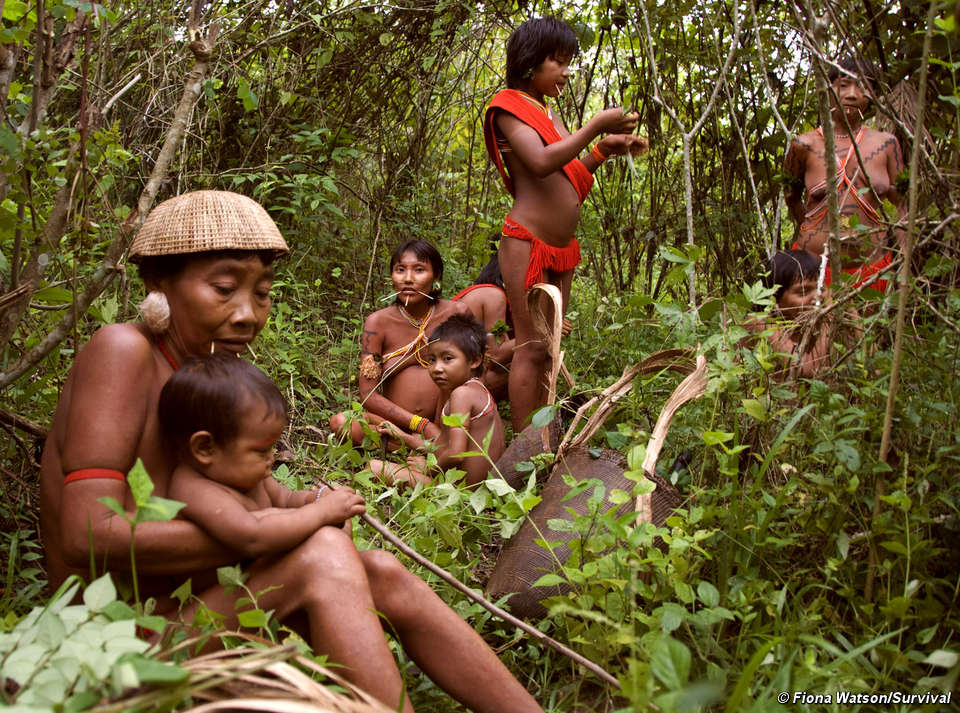
Yanomami villagers at an indigenous expo in Caracas (Luigino Bracci, 2011, Flickr creative commons)

By David Moberg – March 21, 2013

In the latest twist in an unusually public academic dispute, one of the world’s most influential and highly regarded anthropologists resigned in protest from the prestigious National Academy of Sciences in late February. In quitting the academy, Marshall Sahlins took aim in part at the work of fellow anthropologist Napoleon Chagnon, whose contentious memoir, Noble Savages: My Life Among Two Dangerous Tribes—The Yanamamö and the Anthropologists, was recently published by Simon & Schuster. But his action is also a skirmish in a much longer and very important debate over what it means to be human—a debate with consequences for the broader public discussion.

Sahlins, the Charles F. Grey Distinguished Service Professor Emeritus of Anthropology at the University of Chicago, said that he was leaving the 150-year-old academy for two reasons: the election of Chagnon to the NAS last year and the involvement of the NAS in research for the military. His action prompted an outpouring of petitions and statements of support from colleagues, including several hundred in Brazil.

The academy says that principled resignations like Sahlins’ are “rare”—so rare that the only precedent anyone could identify was famed Harvard biologist and geneticist Richard Lewontin’s 1971 departure in protest against NAS military work related to the war in Vietnam. In the 1960s Sahlins himself was helping to launch campus teach-ins against the Vietnam War and to raise issues about the relationship of anthropology to the military.

Sahlins initially tried to resign last year in May, after Chagnon was named to the NAS, then again in October, when he received a request sent to all eighty-four anthropologists at the academy for advice on two research projects aimed at making the military more effective. The request arrived at a time when a controversy was already smoldering in the field about anthropologists’ involvement in implementing the Human Terrain Systems counterinsurgency strategy in Iraq (the October request for help appears unrelated to HTS). The academy had indirectly been involved in military research since the allied National Research Council was established in 1916 specifically for military research. But Sahlins objected to any NAS involvement in projects such as the two proposed in October. One focused on “contextual factors that influence individual and small unit behavior,” and the other sought scientifically valid methods, including any suggested by neuroscience, for improving individual and group military performance.

The publication of Chagnon’s memoirs prompted a third, successful attempt at resignation. Sahlins had objected to the NAS admitting Chagnon—formerly at the Universities of Michigan and of California at Santa Barbara, now at the University of Missouri—because of the quality of his research and his ethics in the field. Sahlins is also critical of both the theoretical and empirical underpinnings of sociobiology, more often referred to now as evolutionary psychology. A minority of anthropologists adopt its viewpoint. But many non-anthropologists—such as Richard Dawkins, Stephen Pinker, and Jared Diamond—have used the work of Chagnon and like-minded anthropologists to reach a large audience.

Fundamentally, this group of writers and researchers see biology as destiny. They argue that biological evolution defines human nature through the inheritance of traits that provide individuals with a reproductive advantage—that is, with more offspring.

In the late 1960s Chagnon worked among the Yanomami people living on both sides of the border between Venezuela and Brazil. He portrayed the Yanomami—which he dubbed “the fierce people,” for their frequent inter-village warfare—as living in a “state of nature” essentially like that of our Paleolithic ancestors. And he claimed to present evidence that men who were “killers” had many more offspring—which, even when he occasionally hedged, others took as proof that evolution favored and preserved traits for male aggression and violence.

Anthropologists, including Sahlins, have since criticized nearly every aspect of Chagnon’s research. (See “Natural Born Nonkillers.”) For example, many note that other tribal people have relatively peaceful, cooperative cultures. Research from various perspectives also runs counter to Chagnon’s argument that evolution rewards killers with more offspring—including computer simulations of evolution, studies of animal behavior showing that killing within a species is rare, even military studies of how men in combat try to avoid killing others. In any case, critics say, the Yanomami were not in a pristine state of nature when Chagnon first visited: they had a history, including likely displacement from their original land by pressures from European colonial settlers and some continuing contact with the wider world that led to the acquisition of a few trade goods. There were many more charges that his data were flawed. To take one example, Chagnon categorized Yanomami men as killers or not killers based on their own classification as unokai or not unokai. But the term identifies a man who has gone through a purification ritual, which was used by both real “killers” and by men who, say, had employed sorcery.

In 2000 journalist Patrick Tierney published Darkness in El Dorado, which accused Chagnon of spreading fatal diseases (like measles) through his collaboration with geneticist James V. Neel, of fomenting some of the inter-village fighting, and other ethical offenses. The American Anthropological Association established a taskforce that dismissed some of Tierney’s most lurid charges but concluded that Chagnon, among other lapses, did not get informed consent from Yanomami research subjects and may have improperly delayed immunizations he and Neel were providing. At its convention, the AAA adopted the taskforce’s report and criticisms, but later Chagnon’s supporters moved to rescind the report largely on procedural grounds. With only 10 percent of members voting, the AAA reversed its endorsement of the report—which Chagnon backers inappropriately claimed as the profession’s vindication of his work.

Sahlins first weighed in against sociobiology in the mid-1970s with The Use and Abuse of Biology, but he has continued to pursue many of the same critical themes in recent books, such as What Kinship Is—And Is Not and The Western Illusion of Human Nature. He argues that human nature is culture—that is, the learned values, beliefs, and patterns of behavior that social groups follow or believe they should follow, as well as the capacity to change those ideas passed from previous generations. Culture—and not some special features of biological evolution, like a carnivore’s teeth or the short beak of a seed-eating bird—provides humans with a flexible, varied means of adapting to a wide and changing variety of circumstances.

Homo sapiens evolved biologically and mentally from our hominid ancestors over several million years within the context of the hominid tool-making culture. “What evolved was our capacity to realize biological necessities, from sex to nutrition, in the thousand different ways that different societies have developed,” Sahlins says. “Hence, culture, the symbolically organized modes of the ways we live, including our bodily functioning, is the specifically ‘human nature.’”

Sahlins argues against the sociobiologists’ neo-Hobbesian view of human nature as a war of all against all—with a brutal, competitive nature clashing with culture. This view of human nature has deep roots in Western cultural traditions, he writes, but it also projects a more modern capitalist view of self-interested, even selfish, behavior on both humanity and the rest of the natural world. In many other societies, people do not see the same sharp division between nature and culture. And all human societies have systems of kinship, which Sahlins defines as “mutuality of being,” meaning that “kinfolk are members of one another, intrinsic to each other’s identity and existence.”

“Symbolically and emotionally, kinfolk live each other’s lives and die each other’s deaths,” Sahlins says. “Why don’t scientists base their ideas of human nature on this truly universal condition—a condition in which self-interest at the expense of others is precluded by definition, insofar as people are parts of one another?” Sahlins cites a classic definition of kinship first developed by Aristotle: kinfolk are in various degrees other selves of ourselves.

Moreover, this kinship is not biological. There are many ways besides birth that societies have developed notions of mutual being, Sahlins says. For example, in the highlands of New Guinea, strangers can become your kin by eating from the land where your ancestors are buried. The food raised on that land is in effect the transubstantiation of the ancestors. Accordingly, people who eat from it share ancestral being. In the local conception, they are as much kin to each other as people who have the same parents.

In the West, and even in much anthropological writing past and present, kinship is treated as genealogy, or biology. But even biological reproduction, Sahlins argues, takes place within the context of a particular kinship system, and to reproduce children is to reproduce that culturally defined kinship order. And in most cultures, notions of kinship diverge, often dramatically, from our “folk theory,” with its emphasis on biological genealogy. In any case, all human societies exist within some framework of “mutuality of being,” which starkly contrasts with the view of human life run by selfish genes.


In an email interview, Sahlins responded to a few questions about his resignation, incorporating some passages from his recent writings.

DM: You offered two reasons for your resignation from the National Academy of Sciences. Starting with the election of Napoleon Chagnon to the NAS, what were your most important objections to that election—the quality of his scholarship, professional ethics in the field, or other issues?

MS: He deals in caricature: of the people he studies, of science, of anthropological theory, of fellow anthropologists, and of himself as a beleaguered “fierce person.” His vicious misrepresentations of Yanomami as savage and disgusting have, as many local scholars have pointed out, aided and abetted national and entrepreneurial forces anxious to exploit and pollute their land and, directly or indirectly, drive them to extinction. Likewise, his own fieldwork methods have contributed to the sufferings and destabilization of the Yanomami (as I discussed in an article for the Washington Post).

The idea that the Yanomami represent the primordial human condition of the Stone Age is preposterous. Why them and not the numerous other, quite different societies—including many, such as Australian aboriginals, with just as modest economies but a quite different social order and inter-group relationships? In fact, all have long histories, including dynamic relations with other societies, that remove them as far from the Paleolithic as modern nations. Moreover, as other studies of Yanomami show, they have a richness of oral tradition (so-called mythology), a spiritual pantheon, and a metaphysics of culture and nature that is virtually totally ignored by Chagnon where it is not simply dismissed.

Compared to the rich fieldwork of many Amazonian anthropologists, his ethnography is shallow. His generalizations are sophomoric. His thesis about the reproductive success of Yanomami warriors, contradicted by his own data, has been thoroughly refuted by others. His evolutionary anthropology is from the ancien régime, outdated by almost a century.

DM: You argue that “biologism” is the problem, that “human nature is culture,” and that Western thought in general is dominated by the idea that there is a conflict between a disruptive human nature and vulnerable culture. How would you address a predictable layperson’s view that surely human nature must be at least in part an independent biology as well as culture? What essential qualities, if any, do you think “human nature” may have if it is indeed defined in terms of culture?

MS: Yes, all cultures have sex, aggression, etc., but whether and how it is expressed is subordinate to the cultural order. Sociobiologists say that individuals achieve immortality by having many children, but apparently no one ever told that to the Catholic clergy. The important point is not that all cultures have sex, but that all sex has culture, that is, social norms that specify with whom, how, where, and when sexual relations are appropriate or inappropriate. Culture preceded modern human physical form by a million years or more. The body of the modern human species, Homo sapiens, was formed under the aegis of culture. What evolved was the ability and necessity to realize our bodily needs and dispositions in cultural forms.

Biology became the dependent variable. These needs had to be subordinate to and encompassed by their cultural forms of expression, otherwise how could the same needs or dispositions be realized in the thousands of different ways known to history and ethnography—the various cultural ways of having sex, eating, being aggressive, and the like? As Clifford Geertz put it, we “all begin with the natural equipment to live a thousand kinds of life but end in the end having lived only one.” That can only be if our natural dispositions were subject to cultural ordering rather than the source thereof.

For over two thousand years, Western people have been haunted recurrently by the specter of their own inner being: an apparition of human nature so covetous and contentious that unless it is somehow governed it will plunge society into anarchy. Indeed, by the twentieth century the worst in us had become the best. In the neoliberal view, self-interest in the form of each person’s pursuit of happiness at the cost of whom it might concern was a god-given right. The insatiable love of the flesh that for Augustine was slavery became “freedom” itself. Likewise, then, political Augustinism has been reversed: self-interest having been transformed from slavery to liberty, the least government is now the best. Although for neoliberalism the ancient vice of self-love is greatly to be desired, in other native anthropologies it remains a potentially fatal quality of the human make-up.

DM: Given the harsh criticism of Chagnon’s work by the American Anthropological Association, the leading professional academic organization in the field, how do you account for the NAS decision and for the apparent popular appeal of his work, such as suggested by two recent, highly sympathetic articles about him and his new memoir in the New York Times?

MS: NAS decision? I am not sure, but I believe that many members, those who elected him, have a natural science sense of anthropology, as archaeologists almost have by necessity, and Chagnon promotes himself under that description. Popularity? Mostly on college campuses, I would think, from his textbooks and movies, which resonate with certain popular undergraduate preoccupations: sex, drugs, and violence. America.

DM: You also said that you were resigning because the NAS was supporting social science research on improving combat performance of the U.S. military. To what extent is support for such military-related research a new or growing development within the NAS?

MS: Since resigning I have learned that the NAS, with its charter of research for the nation, engaged in secret military research as far back as the Vietnam War, and who knows how much before or since. At least one prominent scientist, the extraordinary biologist Richard Lewontin, has resigned from the NAS for that reason. Professor Lewontin did so in 1971.

DM: You suggest that NAS should instead, if it does anything in the field, study how to promote peace. Do you have any suggestions about what sort of research would be useful for anthropologists or others to pursue to that end?

MS: What are the consequences of attempts to forcefully impose democracy on societies with no such traditions? Especially, how does the imposition of “winner-take-all” democratic elections in ethnically divided societies exacerbate violence, as has happened time and again in many postcolonial societies in recent decades? How does the reframing of local differences in terms of international issues, backed by opposed international forces, create a virtual state of nature, as happened in Iraq, India, Sri Lanka, and many other similar situations, going back to the encompassment of local disputes in the opposition between democratic-imperial Athens and oligarchic Sparta in the Peloponnesian War? (See “Iraq, The State of Nature Effect.”)

DM: Finally, do you see any connection between your two reasons for resigning or are they independent motivations?

MS: There is a connection: it is referenced in one of my answers in a Counterpunch article by David Price. The premise of American overseas aggression, according to Donald Rumsfeld and others, is something like the line in the movie Full Metal Jacket: “inside every gook there is an American trying to get out.” All we have to do to liberate this innately freedom-loving, self-interested, democracy-needing, capitalist-in-waiting is to rid him of the oppressive, evil-minded regime holding him down—by force if necessary. That is, Chagnon’s view of self-aggrandizing human nature is the sociobiological equivalent of the neocon premise of the virtues of American imperialism: making the world safe for self-interest. It is the same native Western ideology of the innate character of mankind. A huge ethnocentric and egocentric philosophy of human nature underlies the double imperialism of our sociobiological science and our global militarism.


David Moberg is a senior editor at In These Times.

Latour: “No estaba escrito que la ecología fuera un partido” (El País)

ENTREVISTA

“No estaba escrito que la ecología fuera un partido”

Sociólogo, antropólogo, filósofo y director científico del Instituto de Estudios Políticos de París.

Bruno Latour tiene una mirada ácida y provocadora de la sociedad y el medio ambiente.

MIGUEL MORA 25 MAR 2013 – 11:52 CET19

Bruno Latour. / MANUEL BRAUN

¿Ha servido para algo el activismo ecológico? ¿Han forjado los verdes una política común? ¿Escuchan los políticos a los científicos cuando alertan sobre el cambio climático? ¿Puede la Tierra soportar más agresiones? El sociólogo, antropólogo y filósofo francés Bruno Latour(Beaune, 1947) lleva más de 20 años reflexionando sobre estos asuntos, y su pronóstico es desolador. A su juicio, la llegada de los ecologistas a la política ha sido un fracaso porque los verdes han renunciado al debate inteligente, los políticos se limitan a aplicar viejas recetas sin darse cuenta de que la revolución se ha producido ya y fue “una catástrofe”: ocurrió en 1947, cuando la población mundial superó el número que garantizaba el acceso a los recursos. Según Latour, es urgente poner en marcha una nueva forma de hacer ecología política, basada en una constitución que comprometa a gobernantes, científicos y ciudadanos a garantizar el futuro de la Tierra. Esta idea es una de las propuestas de su libro Políticas de la naturaleza. Por una democracia de las ciencias, publicado en Francia en 1999 y que ahora edita en español RBA.

Latour, aire de sabio despistado, recibe a El País Semanal en su caótico y enorme despacho del Instituto de Estudios Políticos de París, del que es director científico y director adjunto desde 2007.

PREGUNTA: Este libro se publicó en Francia hace ya 14 años. ¿Sigue suscribiendo lo que escribió?

RESPUESTA: Casi todo, sí. Pero las cosas no han mejorado. He seguido trabajando en lo mismo, pero con otro tono. Hoy debo de ser el único que se ocupa de estas cuestiones, de una filosofía política que exige una verdadera política ecologista. Lo que no ha funcionado es que pensé que iba a ser un libro fundador para los ecologistas. ¡Y ha sido un fracaso total! Los ecologistas han desaparecido.

P: En Francia al menos hay verdes en el Gobierno.

R: Sí, pero tienen una visión muy estrecha de la ecología, no reflexionan ni sobre la economía ni sobre la sociedad. La ecología está limitada a las cuestiones de la naturaleza, cuando en realidad no tiene nada que ver con eso. Hay que elegir entre naturaleza y política. Desgraciadamente, se ha intentado hacer una política ecologista que no ha producido nada bueno porque se ha basado en la lucha tradicional, que tenía como objetivo torpedear la política o, mejor, someterla; en cierto modo, los verdes actúan como un tribunal que trata de definir una especie de soberanía.

P: ¿De superioridad moral o natural?

R: Sí, pero sobre todo de estupidez. Evidentemente, el tomar la naturaleza como un fin no ha hecho más que debilitar la posición de los ecologistas, que nunca han sido capaces de hacer política; en fin, auténtica política en el sentido de la tradición socialista, en la que se hubieran debido inspirar. No han hecho el trabajo que el socialismo primero, el marxismo después y luego la socialdemocracia hicieron. No ha habido, para nada, un trabajo de invención intelectual, de exploración; han preferido “el escaparate”. Puede que no hubiera otra solución, pues no estaba escrito que la ecología se fuera a convertir en un partido.

“Hay una ecología profunda con un gran papel en EE UU y alemania”

P: ¿Entonces el ecologismo es hoy una especie de ac­­tivismo sin conexión científica?

R: Ha habido movimientos interesantes gracias a una casuística muy concreta, importante en lo que concierne a los animales, las plantas, los dientes de los elefantes, el agua, los ríos, etcétera. Han mostrado además gran energía en las cuestiones locales, pero sin afrontar las cuestiones de la política, de la vida en común. Por eso el ecologismo sigue siendo marginal, justo en un momento en que las cuestiones ecológicas se han convertido en un asunto de todos. Y se da una paradoja: la ecología se ocupa de temas minúsculos relacionados con la naturaleza y la sociedad mientras que la cuestión de la Tierra, la presencia de la Tierra en la política, se hace cada vez más apremiante. Esa urgencia, que ya era acuciante hace 10 o 15 años, lo es mucho más ahora.

P: ¿Quizá ha faltado formar una Internacional Verde?

R: No se ha hecho porque los ecologistas pensaban que la Tierra iba a unificar todos estos movimientos. Han surgido un montón de redes, basadas en casos concretos, como Greenpeace. Hay asociaciones, pero nada a nivel político. La internacional sigue siendo la geopolítica clásica de los Estados nación. No ha habido reflexión sobre la nueva situación. Existe una ecología profunda, deep ecology, en Francia prácticamente inexistente, que ha tenido un papel importante en Alemania, en los países escandinavos y en Norteamérica. Pero está muy poco politizada.

P: Estamos ante un fracaso político y ante una mayor conciencia de los científicos. ¿Y los ciudadanos?

R: Paradójicamente, esa dolorosa pelea sobre el clima nos ha permitido progresar. En cierto modo, la querella ha tenido un papel importante en una “comprensión renovada” por parte del público de la realidad científica. El problema es que intentamos insertar las cuestiones ecológicas en el viejo modelo “ciencia y política”. Desde este punto de vista, incluso los científicos más avanzados siguen intentando poner estas cuestiones dentro del marco de esa situación superada que intento criticar. Este es el tema del libro, y en ese sentido sigue de actualidad.

P: En Francia hay una identificación entre ecologismo y territorio. José Bové, por ejemplo, es un proteccionista a ultranza. Es rara esta evolución de la ecología hacia el nacionalismo, ¿no?

R: Sí, pero al mismo tiempo es útil e interesante replantearse lo que es el territorio, el terruño, por usar la palabra francesa. Los ecologistas siempre se han mostrado indecisos sobre el carácter progresista o reaccionario de su apego a la tierra, porque la expresión en francés puede significar cosas muy distintas. Pero es importante, porque es una de las dimensiones de la cuestión ecológica, tanto de la progresista como de la arcaica. Ese era uno de los objetivos fundamentales del libro, saber si hemos sido realmente modernos alguna vez. Hay aspectos regresivos en el apego al terruño, y a la vez hay otros muy importantes sobre la definición de los límites, de los entornos en los cuales vivimos, que son decisivos para el porvenir. Una vez más, los verdes han omitido trabajar esa cuestión. Pero el problema de la orientación, de la diferencia entre el apego reaccionario o progresista a la tierra, es fundamental. Si vemos movimientos como Slow Food, nos preguntamos si están adelantados o retrasados, porque tienen aspectos regresivos. Pero si se piensa en el tema de los circuitos de distribución, ¿por qué las lasañas inglesas tendrían que estar hechas con caballo rumano y transitar por 25 intermediarios? No es una tontería: si tomamos caballo francés, rumano o turco, las cuestiones de pertenencia y de límites se convierten en cuestiones progresistas.

El antropólogo iconoclasta

Bruno Latour nació en la Borgoña, donde surgen los vinos más caros del planeta. Su padre era viticultor. De ahí sus pecualiares análisis sobre el terruño y la tradición. Cursó Antropología y Sociología. Su formación es tan variopinta como los centros donde ha impartido clase, desde la Escuela de Minas de París hasta la London School of Economics y la cátedra de Historia de Harvard.

Escritor incansable, es autor de una treintena de libros de ensayo, todos los últimos editados por Harvard, por los que circulan la tierra, la sociedad, la guerra, la energía, la ciencia, la tecnología, la modernidad y los medios de comunicación.

Su último proyecto está conectado con el llamado medialab, un espacio donde desarrollar conexiones entre las tecnologías digitales, la sociología y los estudios científicos.

P: Su libro llama a superar los esquemas de izquierda y derecha. Pero no parece que eso haya cambiado mucho.

R: El debate afronta un gran problema. Hay una inversión de las relaciones entre el marco geográfico y la política: el marco ha cambiado mucho más que la política. Las grandes negociaciones internacionales manifiestan esa inercia de la organización económica, legal y política, mientras que el marco, lo que antes llamábamos la Tierra, la geografía, cambia a velocidad asombrosa. Esa mutación es difícil de comprender por la gente acostumbrada a la historia de antes, en la cual había humanos que se peleaban, como en el siglo XX: hombres haciéndose la guerra dentro de un marco geográfico estable desde la última glaciación. Es una razón demasiado filosófica. Así que preferimos pensar que tenemos tiempo, que todo está en su sitio, que la economía es así, que el derecho internacional es así, etcétera. Pero incluso los términos para señalar las aceleraciones rápidas han cambiado, volcándose hacia la naturaleza y los glaciares. El tiempo que vivimos es el del antropoceno, y las cosas ya no son como antes. Lo que ha cambiado desde que escribí el libro es que en aquel momento no teníamos la noción del antropoceno. Fue una invención muy útil de Crutzen, un climatólogo, pero no existía entonces, me habría ayudado mucho.

P: ¿Y qué fue de su propuesta de aprobar una constitución ecológica?

R: Intenté construir una asociación de parlamentarios y lanzar una constitución para que las cuestiones de la energía empezaran a ser tratadas de otro modo. Intentaba abrir un debate, que naturalmente no ha tenido lugar. El debate sobre la Constitución empezó bien, se consideró una gran invención de la democracia europea. El problema es que ya no se trata de la cuestión de la representación de los humanos, sino que ese debate atañe a los innumerables seres que viven en la Tierra. Me parecía necesario en aquel momento, y ahora más incluso, hacer un debate constitucional. ¿Cómo sería un Parlamento dedicado a la política ecológica? Tendrá que crearse, pero no reflexionamos lo suficiente sobre las cuestiones de fondo.

P: ¿Las grandes conferencias medioambientales resuelven algo?

R: El problema es que la geopolítica organizada en torno a una nación, con sus propios intereses y nivel de agregación, está mal adaptada a las cuestiones ecológicas, que son transnacionales. Todo el mundo sabe eso, los avances no pueden plasmarse ya a base de mapas, no jugamos en territorios clásicos. Así, desde Copenhague 2009 hay una desafección por las grandes cumbres, no solo porque no se consigue decidir nada, sino también porque nos damos cuenta de que el nivel de decisión y agregación política no es el correcto. De hecho, las ciudades, las regiones, las naciones, las provincias, toman a menudo más iniciativas que los Estados.

P: Francia es uno de los países más nuclearizados del mundo. Los ecologistas braman. ¿Le parece bien?

R: Los ecologistas se han obstinado en la cuestión nuclear, pero nadie ha venido a explicarnos por qué lo nuclear es antiecológico, mientras mucha gente seria considera que el átomo es una de las soluciones, a largo plazo no, pero a corto plazo sí. De nuevo estamos ante la ausencia total de reflexión política por parte de los ecologistas, que militan contra lo nuclear sin explicar por qué. Por consiguiente, no hemos avanzado un centímetro. De hecho, en este momento hay un gran debate público sobre la transición energética, y los verdes siguen siendo incapaces de comprender nada, incluso de discutir, porque han moralizado la cuestión nuclear. Cuando se hace ética, no hay que hacer política, hay que hacer religión.

P: ¿Está realmente en cuestión la supervivencia de la especie?

R: La especie humana se las apañará. Nadie piensa que vaya a desaparecer, ¿pero la civilización? No se sabe lo que es una Tierra a seis u ocho grados, no lo hemos conocido. Hay que remontarse centenares de millones de años. El problema no se abordaba con la misma urgencia cuando escribí el libro en 1999, se hablaba aún de las generaciones futuras. Ahora hablamos de nuestros hijos. No hay una sola empresa que haga un cálculo más allá de 2050, es el horizonte más corto que ha habido nunca. La mutación de la historia es increíblemente rápida. Ahora se trata de acontecimientos naturales, mucho más rápidos que los humanos. Es inimaginable para la gente formada en el siglo XX, una novedad total.

P: ¿Es la globalización? ¿O más que eso?

R: Tiene relación con la globalización, pero no por la extensión de las conexiones entre los humanos. Se trata de la llegada de un mundo desagradable que impide la globalización real: es un conflicto entre globos. Nos hemos globalizado, y eso resulta tranquilizador porque todo está conectado y hace de la Tierra un planeta pequeño. Pero que un gran pueblo sea aplastado al chocar con otra cosa tranquiliza menos.

La especie humana se las apañará. nadie piensa que va a desaparecer”

P: ¿Y el malestar que sentimos, la indignación, tiene que ver con ese miedo?

R: Ese catastrofismo siempre ha existido; siempre ha habido momentos de apocalipsis, de literatura de la catástrofe; pero al mismo tiempo existe un sentimiento nuevo: no se trata del apocalipsis de los humanos, sino del final de recursos, en un sentido, creo, literal.

P: ¿Nos hemos zampado el planeta?

R: La gente que analiza el antropoceno dibuja esquemas de este tipo (muestra un famoso gráfico de población y recursos). Esto se llama “la gran aceleración”, ocurrió en 1947. La revolución ya ha tenido lugar, y es una de las causas de esa nueva ansiedad. La gente sigue hablando de la revolución, desesperándose porque no llega, pero ya está aquí. Es un acontecimiento pasado y de consecuencias catastróficas. Eso también nubla la mente de progresistas y reaccionarios. ¿Qué significa vivir en una época en la cual la revolución ha ocurrido ya y cuyos resultados son catastróficos?

P: ¿No querrá decir que la austeridad es la solución?

R: Ya existe el concepto del decrecimiento feliz, no sé si la tienen en España… ¡Sí! Ustedes están muy adelantados sobre decrecimiento.

P: Estamos en plena vanguardia, pero del infeliz.

R: Es uno de los grandes temas del momento, la crisis económica es decrecimiento no deseado, desigualmente repartido; y hay algo más: austeridad no es necesariamente la palabra, sino ascetismo. Sería la visión religiosa, o espiritual, de la austeridad. Eso se mezcla con las nuevas visiones geológicas de los límites que debemos imponernos…

P: ¿Habla del regreso al campo o de reconstruir el planeta?

R: No me refiero a volver al campo, sino a otra Tierra.

P: ¿La tecnología es la única brújula?

R: La tecnología se encuentra en esa misma situación. Existe una solución muy importante de la geoingeniería, que considera que la situación es reversible, que se pueden recrear artificialmente unas condiciones favorables tras haberlas destruido sin saberlo. Así ha surgido un inmenso movimiento de geoingeniería en todas partes. Ya que es la energía de la Tierra, podemos mandar naves espaciales, modificar la acidez de las aguas del mar, etcétera. Hacer algo que contrarreste lo que se hizo mal. Si hemos podido modificar la Tierra, podemos modificarla en el otro sentido, lo que es un argumento peligroso, porque la podemos destrozar por segunda vez.

P: ¿No se regenerará sola?

R: Sí, ¡pero sin humanos! Se regenerará sola mientras no haya humanos. Puede deshacerse de nosotros, es una de las hipótesis, volviéndose invivible, pero eso no sería muy positivo. La era de los límites puede llegar hasta la extinción.

P: ¿Acabaremos fatal?

R: La historia no está repleta de ejemplos favorables. No se sabe. No hay nada en la naturaleza humana que favorezca la reflexión, por lo cual la solución solo puede ser mala.

P: Algunos temen que acabaremos devorados por los chinos.

R: Los chinos tienen más problemas que nosotros y corren el peligro de comerse a sí mismos por el suelo, el agua y el aire. No nos amenazan, desaparecerán antes que nosotros.

P: Žižek dice que nuestros problemas provienen de la mediocridad intelectual de Alemania y Francia, que esa es la razón principal de la decadencia actual. ¿Qué piensa?

R: Es una estupidez. Ocurren muchas más cosas intelectualmente en Europa que en América, infinitamente más. Por ejemplo, en arte, en filosofía, en ciencias, en urbanismo. Es insensato decir cosas así, pero es que Žižek es un viejo cretino, una especie de cosa de extrema izquierda, fruto del agotamiento de la extrema izquierda, de su decadencia final, de la cual es el síntoma. Por otra parte, es un chico muy majo. La extrema izquierda se ha equivocado tanto sobre el mundo que al final todos estos viejos de extrema izquierda no tienen otra cosa que hacer salvo vomitar sobre el mundo, como hace Alain Badiou en Francia.

P: ¿Prefiere a Marine Le Pen?

R: No soy político, no puedo responder a esta pregunta, no me interesa.

P: ¿No le gusta hablar de política?

R: Sí hablo de política, he escrito un libro sobre política, ¡que yo sepa!,Las políticas de la naturaleza.

P: ¿No le interesa la política de todos los días?

R: La de todos los días sí, pero no la de los partidos, son agitaciones superficiales, sobre todo en Francia, donde ya no hay verdaderamente política.

P: Critica a la extrema izquierda, ¿y nada a la extrema derecha?

R: Se agita, intenta agarrarse a un clavo ardiendo, pero no tiene mucha importancia. No es ahí donde las cosas están en juego.

P: ¿Cree que es residual?

R: No, no es residual, puede desarrollarse y provocar daños, tanto como la extrema izquierda; el no pensar siempre provoca daños, pero no es eso lo que va a solucionar los problemas de la Tierra, la economía, las ciudades, el transporte y la tecnología.

P: ¿Qué escenario prevé para 2050? ¿Qué Tierra, qué humanidad?

R: Ese no es mi trabajo, mi trabajo consiste en prepararnos para las guerras. Las guerras ecológicas van a ser muy importantes y tenemos que preparar nuestros ejércitos de un modo intelectual y humano. Ese es mi trabajo.

P: ¿Habrá guerras violentas por el clima?

R: La definición misma de guerra va a cambiar, estamos en una situación en la cual no podemos ganar contra la Tierra, es una guerra asimétrica: si ganamos, perdemos, y si perdemos, ganamos. Así pues, esta situación crea obligaciones a multitud de gente y antes que nada a los intelectuales.

P: ¿La batalla principal es esa?

R: Si no tenemos mundo, no podemos hacer gran cosa, ni siquiera la revolución. Cuando se lee a Marx, uno se queda impresionado por lo que dice sobre los humanos. En esta época, la cuestión de la ciencia y del margen geográfico, más la presencia de miles de millones de personas, conforma un escenario crucial. Antes teníamos otros problemas, pero este no.

P: ¿Así que se trata de ser o no ser?

R: En cada informe científico, las previsiones son peores, el plan más pesimista siempre aparece. Hay que tener en cuenta eso. Son previsiones extremas, pero de momento son las únicas válidas. No se trata de una guerra mundial, sino de una acumulación de guerras mundiales. Es parecido al invierno nuclear de la guerra fría, una situación de cataclismo, pero con algunas ventajas: es más radical, pero más lento, tenemos mucha capacidad de invención, 9.000 millones de personas y muchas mentes inteligentes. Pero también es un reto. Por tanto, es una cuestión de alta política y no de naturaleza. La política viene primero.

P: ¿Tiene la sensación de estar solo?

R: Lo que era complicado en este libro era crear el vínculo entre ciencia y política, y no puedo decir que haya convencido a mucha gente. Si además se hace el vínculo entre la religión y las artes, es más difícil. Gente como Sloterdijk sería muy capaz de comprenderlo. Sin embargo, muchos intelectuales siguen en el siglo XX, como Žižek. Permanecen en un contexto, en un ideal revolucionario, de decepción. Están decepcionados con los humanos.

P: ¿Cree que los humanos se dejarán ayudar?

R: Primero hay que ayudar a la Tierra. En el antropoceno ya no se puede hacer la distinción entre los humanos y la Tierra.

P: ¿Y sus estudiantes están listos para la lucha?

R: En mi escuela soy el único en dar clases sobre cuestiones donde no entra la política en el sentido clásico. Hay un curso o dos sobre cuestiones ecológicas. Es culpa mía, no he trabajado lo suficiente como para cambiar las cosas. Llevamos mucho retraso.

Notas sobre a violência – De antropólogos e outras tribos ferozes (Folha de S.Paulo)

DOMINGO, 17 DE MARÇO DE 2013

MARCELO LEITE

RESUMO Antropólogo Napoleon Chagnon retoma em novo livro teoria sobre agressividade ianomâmi e ataca adversários da sociobiologia. Jared Diamond escreve obra de bases semelhantes, mas mais generosa com ‘primitivos’, aproximando-se de adversários de Chagnon, como Manuela Carneiro da Cunha, que lança coletânea.

É preciso ter estômago forte para digerir a narrativa de um antropólogo que escolhe iniciar o relato de seu primeiro dia de campo entre os ianomâmis -meio século depois- com a frase: “Nunca antes tinha visto tanto ranho verde”. Não é a antropologia, porém, a disciplina que ensina a combinar o máximo de disciplina com o mínimo de conforto em benefício do entendimento do homem?

Leia-se então com dose generosa de bonomia antropológica a obra mais recente do americano Napoleon Chagnon, “Noble Savages – My Life among two Dangerous Tribes – The Yanomamö and the Anthropologists” [Simon & Schuster, 531 págs., R$ 87,50]. Em desagravo, que seja, porque Chagnon pagou um preço alto demais por sua crença nas explicações ultradarwinistas do comportamento, cuja matriz -a natureza humana- acredita ter desvendado nas selvas do Orinoco.

O estudioso americano dedicou pelo menos duas décadas de sua vida a longas permanências em terras ianomâmis, quase sempre na Venezuela (com desastradas incursões também do lado brasileiro). As três seguintes ele ocupou em defesa da carreira e da reputação quase arruinadas por dois outros livros: “O Povo Feroz” (1968), trabalho acadêmico de sua própria lavra, e “Trevas no Eldorado”, um panfleto do jornalista Patrick Tierney (2000).

Os que desconhecem a crônica dessa guerra entre os clãs cultural e biológico da antropologia encontrarão um resumo devastador das acusações mútuas no documentário “Os Segredos da Tribo”, de José Padilha. Não se recomenda o consumo de pipoca na sessão de barbaridades que a fita apresenta.

O povo feroz do título de Chagnon são os ianomâmis. Sua caracterização pelo antropólogo como uma etnia violenta, de homens “maliciosos, agressivos e intimidadores”, que acumulam homicídios para obter mais mulheres e maior sucesso reprodutivo, despertou a ira dos antropólogos culturalistas.

Primeiro, Chagnon foi acusado de distorcer a imagem do grupo e, assim, facilitar sua dizimação por brancos dos dois lados da fronteira. Depois, foi denunciado por Tierney como genocida, pois teria -intencional ou negligentemente, sob a tutela do médico americano James V. Neel- contribuído para uma epidemia de sarampo que matou centenas de índios.

BOM SELVAGEM “Noble Savages” (“bons selvagens”) é um acerto de contas com as duas tribos que infernizaram sua vida. A partir da descrição para o público não especializado de seu convívio de cinco anos com os ianomâmis, Chagnon retoma sua conclusão de que o “bom selvagem” concebido por Rousseau é um mito politicamente correto e que só há uma resposta biológica (evolucionista) -e simploriamente hobbesiana- para a questão de por que seres humanos são sociais: a luta de todos contra todos para aumentar a própria prole (ou pôr mais cópias dos próprios genes no mundo, na vulgata sociobiológica).

Não faltam páginas desairosas para os ianomâmis no livro. “Olhei para cima e arfei, em choque, quando vi uma dúzia de homens corpulentos, nus, suados e pavorosos nos encarando por trás dos caniços de suas setas apontadas!” -conta sobre a primeira visita a uma casa coletiva dos índios.

“Imensos rolos de tabaco verde estavam enfiados entre os dentes e os lábios inferiores, tornando sua aparência ainda mais pavorosa. Veios de ranho verde escuro pingavam ou pendiam de suas narinas -tão longos que se desprendiam de seus queixos, caíam sobre os músculos peitorais e escorriam preguiçosamente sobre seus ventres, mesclando-se com a pintura vermelha e o suor.”

Chagnon também não economiza relatos sobre tentativas mal sucedidas de engodo dos ianomâmis contra ele. Sempre eficazes, por outro lado, eram seus próprios ardis para levá-los a ceder amostras de sangue (para Neel) e a revelar nomes de ancestrais mortos -um tabu- para rechear suas genealogias e estatísticas. As mesmas informações, pagas com machados, facas e panelas de metal, que lhe permitiriam afirmar, depois, serem os homens com mais homicídios nas costas também os de prole mais numerosa.

Muito antes das acusações de Tierney, as conclusões sociobiológicas e os métodos traficantes de Chagnon já vinham sendo questionados por seus pares na comunidade antropológica. Até a correlação estatística entre ferocidade e fertilidade masculina, formulada num famigerado artigo de 1988 para a revista acadêmica “Science”, teve seus dados postos em dúvida (o autor foi acusado de excluir da amostra aqueles pais que já haviam sido mortos por vingança, portanto sem meios de multiplicar descendência).

Os antropólogos culturais, refratários à moldura biológica em que Chagnon queria enquadrar o painel exuberante das culturas, já estavam no seu encalço. Nada se compara, porém, com a virulência do ataque de Tierney. Assim que um capítulo do livro foi publicado na revista “New Yorker”, em outubro de 2000, a Associação Antropológica Americana entrou na briga -do lado dos culturalistas. Foi montado um comitê de investigação, que acabou por inocentar o médico Neel e descartar a epidemia intencional, mas recriminou Chagnon por desvios éticos.

O caso teve enorme repercussão na imprensa mundial, brasileira inclusive. Contudo, quando a obra do “jornalista investigativo” Tierney e os próprios investigadores da AAA passaram a ser investigados, a começar pela historiadora da ciência Susan Lindee, o vento virou.

Forçada por um referendo entre seus membros, a associação renegaria o relatório. As acusações de Tierney não paravam de pé, como reconstitui com farta documentação um ensaio demolidor da também historiadora Alice Dreger publicado em 2011 no periódico acadêmico “Human Nature”, sob o título “Darkness’s descent on the American Anthropological Association. A cautionary tale” (trevas sobre a Associação Antropológica Americana – uma fábula moral; leia em bit.ly/adreger).

Dreger puxa vários fios da teia de perseguição a Chagnon. Levanta a suspeita, intrigante, de que a cruzada de Tierney pode ter ocorrido sob o patrocínio da Igreja Católica, mais especificamente da ordem de padres salesianos, que já mantinha missões junto aos ianomâmis da Venezuela quando o antropólogo por lá baixou.

Após alguns meses de convívio e cooperação, cientista e religiosos se estranharam. Na versão fantástica narrada em “Noble Savages”, isso ocorreu depois de um hierarca pedir a Chagnon ajuda para matar um padre amasiado com índia. Na passagem do livro que mais se avizinha do estilo de Tierney, o antropólogo também acusa os salesianos de distribuir espingardas cartucheiras entre os índios para conquistar seu favor.

A inconsistência mais relevante da obra, porém, não decorre do ânimo retaliatório, e sim da pretensão de ter localizado entre os ianomâmis as nascentes da agressividade que supõe inerente à natureza humana. A antropóloga Elizabeth Povinelli assinalou, numa resenha escaldante de “Noble Savages” para o “New York Times”, que a tese se assenta sobre a premissa falaciosa de que os ianomâmis sejam relíquias de uma infância neolítica da humanidade.

FÓSSEIS Desde esse ponto de vista, compreende-se melhor o esforço retórico de Chagnon em degradar os ianomâmis, acentuando nas suas descrições uma animalidade que serve para relocar sua cultura na vizinhança da biologia. Ora, não há básica empírica nenhuma para afirmar que sociedades “primitivas” como a dos ianomâmis se mantiveram à margem da história, fósseis de um passado inaugural da espécie humana.

Como lembra Manuela Carneiro da Cunha -que presidia a Associação Brasileira de Antropologia quando esta cerrou fileiras contra Chagnon- na coletânea de ensaios “Índios no Brasil – História, Direitos e Cidadania” [Claro Enigma, 160 págs., R$ 29,50], essa é uma visão originária do século 19, que atribui “à natureza e à fatalidade de suas leis o que é produto de política e práticas humanas, […] consoladoras para todos à exceção de suas vítimas”.

Os ianomâmis, por exemplo, só permaneceram mais ou menos isolados (na realidade, longas redes de contatos já lhes garantiam acesso a artefatos de metal) porque suas terras montanhosas não interessavam a colonizador algum.

A perspectiva adotada por Chagnon -um engenheiro convertido para a antropologia- faz tábula rasa de tudo que há de peculiar no modo de vida ianomâmi. Por que cargas d’água esses índios cremam seus mortos, moem os ossos calcinados e ingerem as cinzas com um mingau de banana? É esse tipo de manifestação simbólica que a antropologia cultural se esforça por sistematizar e elucidar, mas que a obra de Chagnon relega à penumbra dos detalhes irrelevantes para a “natureza humana”.

Ótica semelhante anima o último best-seller de outro adepto declarado da sociobiologia (rebatizada psicologia evolucionista), Jared Diamond, mas com resultados muito diversos, se não opostos. Em “The World until Yesterday – What Can We Learn from Traditional Societies?” [Viking, 512 págs., R$ 96,90], Diamond acredita piamente ter aberto uma janela para o passado nas suas décadas de visitas à Nova Guiné para estudar pássaros.

A ilha, fervilhante com centenas de tribos e línguas em contato e conflito, constitui um continente cultural descoberto como tal por ocidentais só nas primeiras décadas do século 20. Fornece a Diamond, portanto, o equivalente dos ianomâmis para Chagnon, em matéria de isolamento e primitivismo.

As diferenças entre esses dois generalizadores prodigiosos, contudo, salta já do título de Diamond. Ao contrário de Chagnon, ele está aberto -mais que isso, interessado- a aprender algo com os nativos, e não só sobre eles. São muitas as lições úteis que o observador de pássaros e homens extrai para o aperfeiçoamento marginal do indubitavelmente superior modo de vida ocidental: ingerir menos sal, aleitar bebês à vontade até os três anos, dar educação bilíngue às crianças, fazer refeições lentamente com amigos…

Até das ameaças constantes da natureza e do estado de guerra crônica entre os primitivos Diamond retira um ensinamento, centro de gravidade do livro, que chama de “paranoia construtiva”: o estado de vigilância permanente para os muitos perigos que a vida oferece aos homens. Depois de embasbacar multidões com as generalizações audazes de “Armas, Germes e Aço” (livro pelo qual ganhou o Pulitzer em 1998), Diamond corteja com leveza o gênero da autoajuda e compila um volume de leitura bem mais amena que

“Noble Savages”. Os ilhéus são feios e sujos como os ianomâmis, mas simpáticos e sábios.

Já a paranoia de Chagnon, se cabe falar assim, é corrosiva. Nos termos da controvérsia que animou o Brasil escravizador de índios nos séculos 18 e 19, relatada por Manuela Carneiro da Cunha, eles podem ser encarados como cães, canibais e ferozes, ou como homens, diferentes e por isso exemplares de capacidade adaptativa e perfectibilidade. É uma questão de escolha, ou de ponto de vista.

Como diz a antropóloga, repetindo o que ouviu em conferência de Claude Lévi-Strauss, a sociodiversidade pode ser tão preciosa quanto a biodiversidade: “Creio, com efeito, que ela constitui essa reserva de achados na qual as futuras gerações poderão encontrar exemplos -e quem sabe novos pontos de partida- de processos e sínteses sociais já postos à prova”.

-

Em 2012, Napoleon Chagnon foi eleito para a prestigiada Academia Nacional de Ciências (NAS) dos Estados Unidos. Ato contínuo, em protesto, o antropólogo Marshall Sahlins -que em 2000 se engajara na campanha contra ele- renunciou à sua cadeira na NAS.

Manifesto de 17 antropólogos que trabalham com ianomâmis deblaterou mais uma vez contra a noção de “povo feroz” reiterada no novo livro, que poderia ser usada por governos para prejudicar a etnia. Uma nota do líder ianomâmi David Kopenawa sobre a obra aponta as guerras dos brancos como muito mais ferozes que as de seu povo -uma observação antropologicamente perspicaz, ao menos no que respeita às tribos dos culturalistas e dos sociobiólogos.

O mercado de almas selvagens (Rolling Stone)

Edição 63 – Dezembro de 2011

Missionários cristãos investem pesado na evangelização dos índios brasileiros com métodos ortodoxos, investimento internacional e persistência messiânica

O Mercado de almas selvagensINDIO SAN

por FELIPE MILANEZ

Jesus ressuscitou. Saiu do sepulcro e apareceu primeiro para Maria Madalena. Em seguida, ela anunciou aos que haviam estado com ele. Manifestou-se a dois que iam para o campo, e depois a outros. Finalmente, de acordo com o Evangelho segundo Marcos, capítulo 16, Jesus apareceu aos 11 assentados à mesa “e lançou-lhes em rosto a sua incredulidade e dureza de coração, por não haverem crido nos que o tinham visto já ressuscitado”. Disparou então, segundo o livro sagrado dos cristãos, a mensagem determinante da “missão”, em versículos 15 e 16:

“E disse-lhes: ide por todo o mundo, pregai o evangelho a toda criatura.”

“Quem crer e for batizado será salvo; mas quem não crer será condenado.”

No versículo 17, ainda segundo Marcos, Jesus vai mais longe: “E estes sinais seguirão aos que crerem: em meu nome expulsarão os demônios, falarão novas línguas”.

Condenadas à danação de um pecado original estão as criaturas não batizadas, portanto, todas as culturas não cristãs. Aos crentes, foi dada a obrigação, na forma de uma missão, da evangelização universal: eles deveriam traduzir a Bíblia para todas as línguas. Tarefa arriscada nos “confins da Terra”, que viria a ser complementada, pelo versículo 18, com a proteção divina: “Pegarão nas serpentes; e, se beberem alguma coisa mortífera, não lhes fará dano algum; e porão as mãos sobre os enfermos, e os curarão”.

Outubro de 2011, Caldas Novas, interior de Goiás: em um hotel de águas termais, tendas estão dispostas como uma conferência comercial, ou como uma feira de negócios na qual empresas utilizam estandes para vender seus pacotes e produtos. “Judeus por Jesus”; “Curso de Evangelização de Árabes”; “Missão Novas Tribos do Brasil”; “Adote um Povo”. Índios, ciganos, quilombolas, pobres do sertão nordestino: no VI Congresso Brasileiro de Missões, todas as criaturas desprovidas possuem representantes que negociam suas almas.

Minha alma, ateia, é a única condenada que circula pelo local. “Experimenta uma vez”, diz um senhor, com sorriso maroto no rosto. “Sou careta”, brinco. Ele quer que eu experimente a religião dele, como se fosse uma cápsula de felicidade a ser engolida. “Experimenta, você não vai se arrepender. Você vai ser feliz.”

Desconverso, contando histórias de aventuras na Amazônia. “Já sei”, diz o pastor Thomas Gregory. “Precisamos de gente com coragem.” Ele me oferece um exemplar do livro O Contrabandista de Deus, com a seguinte dedicatória: “Por Jesus vale a pena gastar nossas vidas! Experimente!” Em seguida, me apresenta a um jovem destemido da missão “Portas Abertas: Servindo Cristãos Perseguidos”. “Estamos indo traficar Bíblias para a China em dezembro. Ano que vem, vamos levar até a Coreia do Norte”, o rapaz me relata, determinado, consciente dos riscos de antecipar o que acredita ser o “julgamento final” e negando qualquer tipo de medo. “Não. Jesus está comigo”, diz.

No encontro organizado pela Associação de Missões Transculturais Brasileiras (AMTB), os índios são apenas uma parte de um universo pagão de almas condenadas. Parte pequena, porém cobiçada: de acordo com levantamento da própria AMTB, os índios são compreendidos como 616 mil indivíduos de 340 etnias (para a Funai são 220) e que falam 181 línguas. Ainda segundo os mesmos cálculos, no Brasil há 69 línguas sem a Bíblia traduzida, 182 etnias contam com presença missionária evangélica e 257 programas de evangelização estão em curso, coordenados por cerca de 15 agências missionárias de diferentes denominações evangélicas históricas, mas em sua maioria batista, associadas à AMTB.

De todas as almas selvagens existentes, as consideradas mais valiosas são as dos índios ditos “isolados”: elas representam o universo a ser conquistado e cuja alma adquire maior valor, econômico e moral, no mercado espiritual. O levantamento da AMTB indica que 147 etnias não possuem a presença missionária evangélica, e que 27 povos seriam considerados “isolados”. O principal desafio que consta no relatório “Indígenas do Brasil” são as “etnias remotas (com pouco ou nenhum contato externo)”, que somam 42 povos. A lista mais recente da Funai, a ser divulgada, aponta 84 referências onde podem existir povos indígenas sem contato. Nesses locais, geralmente áreas de difícil acesso, é proibida a entrada de qualquer indivíduo sem a autorização da Funai.

Os “índios isolados” são as comunidades indígenas que vivem de forma autônoma na floresta, evitam a aproximação com o universo ocidental e esse contato, se ocorrer, é eventual e conflituoso. A ocupação recente da Amazônia ocasionou os primeiros encontros com diversos povos, como os zo’é e suruwahá, que a Funai considera de “recente contato”. Eles recebem proteção especial em razão da vulnerabilidade física da população, suscetível a epidemias.

O principal objetivo dessas agências evangelizadoras é “alcançar” outras culturas com a leitura de sua forma de crença, daí o aspecto “trans” do tema “cultural” das religiões. “Precisamos de mais 500 novos missionários para pregar o Evangelho a todos os povos indígenas no Brasil”, conclama no microfone Ronaldo Lidório, um dos principais líderes desse movimento. Traduzindo: o objetivo é convencer os índios, assim como todas as pessoas do mundo, a se tornarem crentes – salvar as almas condenadas pelo pecado original.

Henrique terena é alto, tem cabelos longos e usa um charmoso cocar de penas azuis de arara. Falando com desenvoltura e retórica apurada, ele anda sempre próximo a Eli Tikuna, líder indígena que vem da margem do rio Solimões, já quase na fronteira com a Colômbia. Juntos, aguardam o chamado para pregar no salão lotado de brancos, curiosos para ouvir os tais “índios crentes”.

Grandes astros da conferência, os índios pastores formam o que os missionários evangélicos consideram ser a “terceira onda evangelizadora”. Primeiro, eram os estrangeiros que aportaram no Brasil com a Bíblia debaixo do braço (no século 19 e no pós-guerra); a segunda onda ocorreu por meio dos missionários brasileiros, com a institucionalização das missões estrangeiras no Brasil, ao longo da segunda metade do século passado; e hoje os próprios índios agem como missionários.

As almas indígenas são o objeto do alcance proselitista de um determinado grupo de evangélicos, principalmente os de denominação batista (conhecidos como “históricos”). O sistema de evangelização ocorre segundo regras capitalistas, com agências, igrejas e crentes financiadores. Por trás de tudo, há diversos interesses que se aliam com a conveniência exigida para a alma condenada ser alcançada – garimpeiros no Amapá, madeireiros e fazendeiros no Pará, seringueiros no Acre, o exército no Amazonas. Nessas alianças, domesticar os selvagens para servirem de mão de obra é o objetivo dos laicos. Já o alcance e a salvação das almas é a verdadeira missão religiosa.

Em 1991, a Fundação Nacional do Índio determinou a expulsão de todas as missões das áreas indígenas e rompeu os contratos que tinha com os missionários de prestação de saúde e educação para os índios. Por parte do governo, não havia o conhecimento exato do número de aldeias com presença missionária. Mas o então presidente da Funai, o sertanista Sidney Possuelo, conhecia de perto a atuação da New Tribes Mission (hoje, Missão Novas Tribos do Brasil) junto do povo zo’é, cujo primeiro contato ocorreu em 1986. Na época, a expedição contava com a presença de Edward Luz, que atualmente é o presidente da Novas Tribos do Brasil. Antropólogos afirmaram então que cerca de 30% da população índia pereceu devido a doenças levadas pelos missionários. Possuelo, que trabalhou junto aos zo’é, determinou a retirada dos missionários assim que assumiu a Funai. Na visão de Luz, que até hoje tenta retomar contato com os zo’é, a Funai “persegue” os missionários.

“Nós, como instituição, só temos a agradecer a essa perseguição. Porque quanto mais a perseguição vem, mais nós crescemos”, afirma Luz. “O Cristianismo sempre foi pautado por isso. O sangue dos mártires regava a semente daqueles que haviam de nascer. E no governo brasileiro isso foi a mesma coisa.”

Conheci Edward Luz no V Congresso Brasileiro de Missões, em 2008, em Águas de Lindoia (SP). Naquele momento, o drama da tribo dos índios suruwahá estava à tona: a Funai havia expulsado dali o grupo “Jovens com uma Missão” (Youth with a Mission, no original). Os missionários acusavam os índios de serem violentos assassinos de crianças e praticarem o infanticídio – era preciso a evangelização para salvá-los. A Funai culpa os missionários por uma leva de suicídios que chegou a atingir 10% da população local. Marcia Suzuki foi a missionária que se colocou como porta-voz do drama. “No Parque do Xingu também praticam o infanticídio, e dizem que não”, ela declarou na época. O tema do infanticídio foi levantado na mídia em torno de um filme de ficção, mas tratado como um “docudrama”, realizado pelo filho do fundador da Youth with a Mission, o cineasta David L. Cunningham. Em Hakani: A Survivor’s Story, índios suruwahá aparecem enterrando uma menina viva. O departamento da Funai que protege os suruwahá afirmou que os índios ficaram revoltados ao saber da história. Hakani, a tal criança índia, foi retirada da aldeia por Suzuki e hoje a acompanha em igrejas, na busca de recursos para a missão Atini. O drama de Hakani também serviu para divulgar um projeto de lei chamado Muwaji, que incriminaria funcionários públicos em caso de infanticídio e que legitimaria a presença de evangélicos em aldeias.

A bancada evangélica no Congresso Nacional, formada por cerca de 50 deputados, pouco se mobilizou. A maioria, pentecostal, é distante das denominações históricas, como os batistas. “Há evangélicos contra a evangelização dos índios, como os ecumênicos”, afirma Geter Borges, assessor parlamentar presente no Congresso Brasileiro de Missões. As divergências internas praticamente impediriam, diz ele, que a bancada mostrasse uma união sobre projetos – “não votam juntos, e não têm o peso e a força, por exemplo, dos ruralistas”, diz. Sobre a evangelização, Borges contextualiza: “Esse grupo da AMTB é que tem essa proposta de evangelizar os índios, que é proselitista. É a visão que se tem do Espírito Santo. Eu sou batista, mas creio que podemos ser salvos sem o batismo”.

A estratégia de utilizar os próprios índios como missionários foi definida no VI Congresso de Missões. E, para facilitar a realização do trabalho, eles farão uso de um dogma retórico: “O Estado não pode impedir um índio de encontrar um outro índio”, explica Luz. O objetivo das agências atualmente é capitalizar a maior quantidade de indígenas possível para se tornarem pastores. Para provocar uma reação pública, decidiram que irão solicitar, através dos índios kanamari, o ingresso na terra indígena Vale do Javari, onde está localizada a maior população de índios isolados remanescente do mundo. Caso a Funai negue a presença missionária, a estratégia prometida será acionar o Poder Judiciário contra o governo. “Metade dos povos indígenas não são aldeados. Um grande número frequenta as universidades. E a maioria fala: vou voltar para o meu povo e vou levar o evangelho pra eles. E contra essa força não há resistência”, conclama Luz.

O presidente da Novas Tribos insiste que o impedimento da entrada dos missionários nas aldeias tem cunho “ideológico”. “A Constituição não dá amparo para esse tipo de perseguição”, afirma Luz. “Nós temos o direito de pregar o evangelho para todo mundo. E toda pessoa tem o direito a aderir ou não. Vamos levar essa discussão às raias do Supremo.” Argumento-chave nesse debate é o que Luz chama de “direito da comunidade indígena de decidir o seu presente e seu futuro” – ou seja, de escolher sua religião. É o mesmo ponto levantado por alguns raros antropólogos que não se opõem aos missionários. “Os índios podem escolher seu destino”, declarou uma antropóloga evangélica que não quis ser identificada. “Agora, nem sempre os missionários são honestos nas opções que oferecem.”

“A motivação deles é ideológica: eles querem expandir a ideologia religiosa deles para todos os seres humanos do planeta”, rebate Márcio Meira, presidente da Funai, que alega que a Constituição Federal protege a liberdade de crença, assegurando a proteção aos locais de culto. Nesse caso, a Funai tem poder de vetar a entrada nas áreas habitadas por índios “isolados”, assim como dos povos de pouco contato: “Cabe ao Estado laico exercer o poder de proteção e impedir qualquer contato de missionários com índios isolados”.

“Alguns povos, como os zo’é, os yanomami, os suruwahá, possuem contato, mas não possuem elementos de conhecimento das outras religiões para tomar uma decisão. Temos que garantir seus espaços de liturgia”, prossegue Meira, afirmando ainda que a Fundação não intervém nos casos de povos com contato antigo com a sociedade envolvente. “A Funai tem a obrigação legal de respeitar a vontade dos índios de permanecerem isolados”, diz.

“Em 2 mil anos, a bíblia foi traduzida apenas para 500 línguas”, prega o pastor Ronaldo Lidório no grande salão do VI Congresso Brasileiro de Missões, com certo tom de indignação frente às ovelhas de seu rebanho. É a hora de provocar “um tsunami espiritual”, conforme reforça o pastor indígena Henrique Terena no mesmo salão principal. Todos parecem chocados com mais um dado “oficial” divulgado pela AMTB: “147 povos indígenas no Brasil não conhecem o Evangelho”.

O encontro das sociedades europeias com os índios na América aflorou entre os crentes a missão determinada pelo “ide” de Marcos. Pelo lado católico, a catequização foi praticada inicialmente na aliança da Companhia de Jesus, pelos jesuítas, com os estados colonizadores espanhol e português (rompida no século 18). As tentativas de conquista de holandeses e franceses foram acompanhadas de religiosos protestantes. Enquanto a famosa “Primeira Missa” católica foi celebrada em 26 de abril de 1500 pelo frade Henrique de Coimbra, o primeiro culto evangélico em terras brasileiras ocorreu mais de 50 anos depois, em 10 de março de 1557, no Rio de Janeiro, pelos huguenotes franceses. Poucos anos depois, Jacques Balleur foi enforcado por pregar a religião da Reforma junto aos índios tamoios.

Hoje, os católicos atendem sob a organização do Conselho Indigenista Missionário (Cimi), que prega, de forma oficial, o respeito às religiões indígenas. De acordo com essa leitura, o papel do Espírito Santo salvaria as almas, independentemente do batismo. “É a tese de São Tomás de Aquino. Mas alguns ainda praticam o proselitismo”, assume Paulo Suess, um dos principais teólogos do Cimi. “Nunca oficialmente. Nunca vão dizer isso abertamente em uma assembléia do Cimi. Mas na aldeia eles podem agir assim.” A última missão jesuíta em atividade no Brasil foi a Utiariti, no Mato Grosso, completamente destruída pelos índios nos anos 70. Alguns líderes indígenas, jovens na época, guardam más lembranças das atuações dos padres. “Forçavam o casamento interétnico”, recorda o índio pareci Daniel Cabixi. “A gente sofria muito.”

Com as revoluções sociais do pós-guerra, sobretudo por causa do Concílio Vaticano II, e a teologia da libertação que se desenvolveu em seguida, os católicos na América passaram a optar pelo princípio da “encarnação”, segundo manifesto escrito em Goiânia, em 1975: “Seguindo os passos de Cristo, optar seriamente, como pessoas e como igreja, por uma encarnação realista e comprometida com a vida dos povos indígenas, convivendo com eles, investigando, descobrindo e valorizando, adotando sua cultura e assumindo sua causa, com todas as consequências; superando as formas de etnocentrismo e colonialismo até o ponto de ser aceito como um deles”.

Em 1912, ocorreu a evangelização dos índios terenas, no atual Mato Grosso do Sul. Esse é o marco, entre os evangélicos, da primeira evangelização indígena no Brasil. E foi também entre os terenas que foi “plantada” a primeira igreja. Em julho de 2012, o Conselho Nacional dos Pastores e Líderes Indígenas (Conplei) prepara a comemoração do centenário desse primeiro batismo. “Vai ser um grande encontro”, promete o pastor Henrique Terena, que diz contar com a presença de indígenas evangélicos do Paraguai e da Bolívia. “Vamos receber cinco mil indígenas. E vamos criar o Conselho Mundial dos Pastores e Líderes Indígenas.” As inscrições para o evento custam de R$ 80 (índios) a R$ 200 (não índios).

Nesse verdadeiro mercado de almas que é o Congresso Brasileiro de Missões, até é possível “adotar” um povo. Em um dos estandes, a missionária explica: “Você assume esse povo, e deve orar por eles”. Além da oração, é sugerido também que sejam doados recursos para financiar o trabalho missionário. Valores não são mencionados, mas estima-se ser necessário cinco igrejas para sustentar o trabalho em um único povo. No palco, Eli Tikuna conta sobre o dia de glória que teve ao visitar uma igreja batista na Grande São Paulo: “Consegui R$ 10 mil em doações. Glória ao Pai!”

Na quinta edição do Congresso, em 2008, um empresário de São José dos Campos doou um avião modelo Caravan para a missão Asas do Socorro, que presta serviços de transporte aéreo para as agências missionárias e, segundo o comandante Rocindes Correa, conta já com 11 aeronaves. “Pregamos o evangelho integral, que cuida da alma, mas também da vida da comunidade”, diz Correa. Nesse intuito, a Asas do Socorro oferece também o transporte de médicos e dentistas evangélicos.

Segundo dados divulgados pela própria AMTB, a edição 2011 do Congresso Brasileiro de Missões custou por volta de US$ 40 mil e recebeu aproximadamente 500 pessoas (291 responderam a um questionário), sendo 40% batistas e mais da metade oriunda da região Sudeste. Um terço era de pastores, lideranças religiosas, e 98% dos presentes consideraram a programação “boa ou excelente”. A próxima edição, aliás, já tem data marcada: acontece em 2014.

E se jesus realmente retornar e for parar no meio dos índios? Dizem os crentes que a comunidade deverá estar preparada para recebê-lo – diferentemente do que aconteceu da primeira vez, quando ele nasceu em berço judaico durante a dominação romana e foi morto ainda jovem. Essa é a explicação sugerida pelo antropólogo Darcy Ribeiro, que morreu em 1997, sobre o principal motivo que leva os missionários a “gastarem sua vida” em nome da evangelização dos índios na Amazônia.

Foi Ribeiro quem trouxe os missionários do Summer Institut of Linguistics (SIL) para o Brasil, na década de 50. Preocupado com o desaparecimento das línguas indígenas, o antropólogo imaginaria que, ao custo da tradução da Bíblia, ao menos as línguas seriam documentadas, em caso de desaparecimento de um povo. Escreveu ele no livro Confissões: “Serviço maior meu foi mandar uma linguista do Instituto Linguístico de Verão, com doutorado, conviver com eles e dedicar-se por quase um ano ao estudo do idioma ofaié. Assim, ao menos sua língua se salvou pelo registro escrito e sonoro para futuros estudiosos das falas humanas”.

Quando se dedicou a salvar as línguas indígenas, Ribeiro desconhecia as ligações do SIL com a poderosa família norte-americana Rockfeller, que procurava novas jazidas de petróleo, e com a direita norte-americana e agências de informações dos Estados Unidos, fatos mostrados no livroThy Will Be Done, de Gerard Coilby e Charlotte Dennet. No Brasil, onde persiste o fantasma da “internacionalização da Amazônia”, essas ligações suspeitas fizeram crescer os temores de ações escusas dos missionários.

Se externamente há fantasmas da internacionalização, nas aldeias, os índios reclamam da interferência em suas culturas. Os missionários Manfred e Barbara Kern, da New Tribes, divulgaram que um dos líderes indígenas da tribo uru-eu-wau-wau, de Rondônia, teria cometido adultério. “Pelo que entendemos, ele é reincidente e já foi repreendido pelos outros líderes”, escreveram eles, em uma carta pública divulgada em 28 de junho. “Reze para o Senhor fazer um grande trabalho de restauração na sua vida e da sua esposa.” Os uru-eu formam um povo tupi e não são tradicionalmente monogâmicos, mas, de acordo com os missionários, estão “aprendendo a ser”.

A abordagem em relação ao adultério foi justamente o que chamou a atenção do líder indígena Davi Kopenawa Yanomami sobre a conduta suspeita de missionários. Ele afirma ter conhecido o Evangelho através da ação de membros da Novas Tribos, que estiveram presentes na aldeia yanomami Toototobi, e fez sua opção: “O missionário não é como garimpeiro. É outro político. Eles não invadiam a terra, mas a nossa cultura, a nossa tradição, o nosso conhecimento. Eles são outro pensamento para tirar o nosso conhecimento e depois colocar o conhecimento deles, a sabedoria deles, a religião deles. Isso é diferente. Eu, Davi, já fui crente. Junto com eles. Mas depois queria conhecer Jesus Cristo. E não deu certo. Um missionário não índio namorou uma yanomami. Daí não deu certo. Descobri que não é verdade. Aí eu não acreditei mais. São crentes falsos. E não acreditei mais”.

De fato, não é incomum as alianças estratégicas para a evangelização assumirem feições mais mundanas, muitas vezes contrárias aos direitos indígenas. Em um caso emblemático ocorrido em 1986, a Novas Tribos teria se unido a seringueiros que escravizavam índios no Acre, conforme relata o cacique yawanawa Biraci “Bira” Brasil.

Ainda jovem, Bira foi morar em Rio Branco (AC), onde percebeu que “nosso povo estava não apenas perdendo a língua, mas perdendo o nosso espírito. Nossa conexão espiritual com nós mesmos, com a natureza, com o nosso mundo, com os nossos ancestrais”. Decidiu, então, unir os jovens e expulsar os missionários, instalados na tribo por três décadas. “Convenceram todo mundo a ser crente. Botaram uma ameaça no nosso coração, dizendo que sem essa religião todo mundo iria para o inferno, que nós não teríamos salvação, não seríamos capaz de ser um povo feliz. Que nós vivíamos com o demônio. Que nossos rituais e nossas crenças eram coisas do demônio.”

“Eram racistas”, o cacique prossegue. “Não gostavam da gente, pareciam que tinham nojo de índio. Não deixavam índio andar no mesmo barco com eles. Não deixavam comer junto. Nos tratavam mal. Sem respeito. Principalmente os americanos. Eram muito arrogantes. A gente sofria muito. A gente tinha vergonha de ser a gente. A missão estava dizendo que a nossa cultura era coisa do demônio. Nossa ayahuasca, nossas cerimônias. Nós éramos proibidos, através da intimidação, de realizar nossos rituais. Do lado da missão estavam os seringalistas, seringueiros. Se aliavam com todo mundo. E a igreja fazia a gente aceitar ser dominado. Além da evangelização, dessa descaracterização cultural do nosso povo, ainda mantinham a presença dos não indígenas dentro da terra. Faziam a gente aceitar nossa condição de escravo.”

A expulsão dos missionários e dos seringueiros ocorreu em uma noite de 1986. Em carta publicada em 28 de fevereiro desse ano, os missionários Stephen e Corine relatam que na época os índios queriam “roubar seus pertences e queimar suas casas”. A Polícia Federal foi convocada, e Bira foi perseguido e acusado de ter se engajado com uma “organização de esquerda”.

Atualmente, Bira é referência espiritual na aldeia e há uma década organiza um dos maiores festivais indígenas do Brasil, o Yawa, quando recebe povos de outras etnias e visitantes ocidentais para celebrar a cultura e a espiritualidade yawanawa, com muito rapé e ayahuasca. Ele também viaja pelo mundo realizando rituais xamânicos tradicionais de seu povo. Aprendeu com os pajés Yawa e Tatá, que nunca deixaram de praticar os ritos, ainda que escondidos, durante a dominação da Missão Novas Tribos.

No que depender das agências evangelizadoras, porém, a luta está apenas começando. “A perseguição nos dá força. O sangue dos mártires regava as sementes daqueles que haviam de nascer”, reforça o missionário Edward Luz, prometendo jamais desistir de evangelizar o povo zo’é, de onde foi expulso pela Funai. “Nós vamos voltar para os zo’é. Não sei como. Mas vamos voltar. Nosso Deus é soberano. O homem pode espernear, mas no final vai ter um encontro com Deus. E, se não estiver preparado, vai sofrer.”

Luz prevê que, se o Estado tentar impedir a pregação da Bíblia nas aldeias, o fato poderia unir todas as denominações evangélicas, que são rivais entre si. “Se [o governo] proíbe pregar o evangelho, está proibindo a liberdade da adoração; proíbe o autor do evangelho, o senhor Jesus; e proibiu aBíblia, proibiu o Deus criador”, diz. E desafia: “E nós partimos para um confronto”

Anthropology Inc. (The Atlantic)

MARCH 2013 – ATLANTIC MAGAZINE

Forget online surveys and dinnertime robo-calls. A consulting firm called ReD is at the forefront of a new trend in market research, treating the everyday lives of consumers as a subject worthy of social-science scrutiny. On behalf of its corporate clients, ReD will uncover your deepest needs, fears, and desires.

By GRAEME WOOD

Viktor Koen

On a hot Austin night last summer, 60 natives convened for a social rite involving stick-on mustaches, paella, and a healthy flow of spirits. Young lesbians formed the core of the crowd. The two organizers, who had been lovers for a couple months, were celebrating their birthdays with a Spanish-themed party, decorated in bullfighting chic. It was a classic hipster affair, and everyone was loose and at ease, except for one black-haired interloper with a digital camera and a tiny notepad.

This interloper was Min Lieskovsky, a 31-year-old straight New Yorker who mingled freely and occasionally ducked into a bathroom to scribble notes. She’d left a Ph.D. program in sociocultural anthropology at Yale two years earlier, impatient with academia but still eager to use the ethnographic skills she’d mastered. Tonight, that meant she partied gamely and watched her subjects with a practiced eye, noting everything: when the party got started and when it reached its peak, who stuck mustaches on whom—and above all, what, when, and how people drank.

For Lieskovsky, it was all about the booze. The consulting firm she worked for, ReD Associates, is at the forefront of a movement to deploy social scientists on field research for corporate clients. The vodka giant Absolut had contracted with ReD to infiltrate American drinking cultures and report back on the elusive phenomenon known as the “home party.” This corrida de lesbianas was the latest in a series of home parties that Lieskovsky and her colleagues had joined in order to write an extended ethnographic survey of drinking practices, attempting to figure out the rules and rituals—spoken and unspoken—that govern Americans’ drinking lives, and by extension their vodka-buying habits.

“There’s a huge amount of vodka that’s sold for drinking at home,” Lieskovsky says. “But no one knew where it was really goingapart from down someone’s throat eventually, and on a bad night perhaps back up again. Was it treated as a sacred fluid, not to be polluted or adulterated except by an expert mixologist? Some Absolut advertising and iconography suggested exactly this, assuming understandably that buyers of a “premium” vodka would want laboratory precision for their cocktails. Another possibility was that the drinkers might not care much about the purity of the product, and that bringing it to a party merely lubricated social interaction. “We wanted to know what they are seeking,” Lieskovsky says. “Do they want the ‘perfect’ cocktail party? Is it all about how they present themselves to their friends, for status? Is it collaboration, friendship, fun?”

Over the course of the company’s research, the rituals gradually emerged. “One after another, you see the same thing,” Lieskovsky told me. “Someone comes with a bottle. She gives it to the host, then the host puts it in the freezer and listens to the story of where the bottle came from, and why it’s important.” And then, when the bottle is served, it goes right out onto the table with all the other booze, the premium spirits and the bottom-shelf hooch mixed together, in a vision of alcoholic egalitarianism that would make a pro bartender or a cocktail snob cringe.

What mattered most, to the partygoers and their hosts, were the narratives that accompanied the drinks. “We found that there is this general shift away from premium alcohol, at least as it’s defined by price point, toward something that has a story behind it,” Lieskovsky says. “They told anecdotes from their own lives in which a product played a central role—humorous, self-deprecating stories about first encountering a vodka, or discovering a liqueur while traveling in Costa Rica or Mexico.” The stories were a way to let people show humor, or to declare that they’re, for instance, the kind of Austin lesbians who, upon finding exotic elixirs in far-off lands, are brave enough to try them.

ReD consultants fanned out and shadowed drinkers at about 18 different parties, trying to see which drinking practices held constant, whether in Austin, New York, or Columbus. This is one that did. Which meant that if a premium vodka brand tried to market itself solely as a product with chemistry-lab purity, it risked misunderstanding the home-party market and leaving money on the table.

The corporate anthropology that ReD and a few others are pioneering is the most intense form of market research yet devised, a set of techniques that make surveys and dinnertime robo-calls (“This will take only 10 minutes of your time”) seem superficial by comparison. ReD is one of just a handful of consultancies that treat everyday life—and everyday consumerism—as a subject worthy of the scrutiny normally reserved for academic social science. In many cases, the consultants in question have trained at the graduate level in anthropology but have forsaken academia—and some of its ethical strictures—for work that frees them to do field research more or less full-time, with huge budgets and agendas driven by corporate masters.

The world of management consulting consists overwhelmingly of quantitative consultants, a group well known from the successes of McKinsey & Company, the Boston Consulting Group, and Bain & Company. ReD’s entry into consulting represents an attempt to match the results of these titans without relying heavily on math and spreadsheets, and instead focusing on what anthropologists call “participant observation.” This method consists, generally, of living among one’s research subjects, at least briefly. Such immersive experiences lead not only to greater intimacy and trust, but also to a slowly emerging picture of the subjects’ everyday lives and thoughts, complete with truths about them that they themselves might not know.

Absolut, which paid ReD to observe home parties, is using both quantitative analysis and this new form of ethnographic research. “We are intensive consumers of market research,” Maxime Kouchnir, the vice president of vodka marketing for Pernod Ricard USA, which distributes Absolut, told me. “The McKinseys and BCGs of the world will bring you heavy data. And I think those guys sometimes lack the human factor. What ReD brings is a deep understanding of consumers and the dynamics you find in a society.” That means finding out not only what consumers say they want in a liquor, but also what their actions reveal about the social effect they crave from bringing it to a party. “If you observe them, they will be humans, exposed with all their contradictions and complexities,” Kouchnir says. “At the end of the day, we manufacture a spirit, but we have to sell an experience.”

The method dates back nearly a century in academic anthropology, though its pedigree in the business world is somewhat more recent. Xerox PARC, the legendary Palo Alto think tank that birthed many of the ideas that made the personal-computing revolution possible, employed anthropologists as early as 1979. Leslie Perlow, a Harvard Business School professor who has applied participant observation in corporate environments, says, “There is a long history of doing this in the study of organization—taking the ethnographic method from anthropology and, instead of taking it to faraway places, trying to understand the culture of our own work worlds.”

Now a handful of consultancies specialize in ethnographic research, and many companies (including General Motors and Dell) retain their own ethnographers on staff. Microsoft is said to be the second-largest employer of anthropologists in the world, behind only the U.S. government.

Tech firms, certainly, appear to be major consumers of ethnographic research. “Technology companies as a whole are in danger of being more disconnected from their customers than other companies,” says Ken Anderson, an ethnographer at Intel. Tech designers succumb to the illusion that their users are all engineers. “Our mind-set is that people are really just like us, and they’re really not,” Anderson says. Ethnography helps teach the techie types to understand those consumers who “aren’t living and breathing the technology” the way an Intel engineer might. (A curious exception to this cautious embrace of ethnographic methods is Apple, whose late co-founder, Steve Jobs, trusted his designers—and especially himself—more than he trusted consumers or researchers. “It isn’t the consumers’ job to know what they want,” he famously said.)

Min Lieskovsky, the ReD consultant on the Absolut project, has been a friendly acquaintance of mine for nearly a decade. Christian Madsbjerg, a co-founder of ReD, gave me access to ReD consultants on two other projects, one on home appliances and the other on health care, and allowed me to tag along while they did their research. I agreed not to disclose the clients behind these two projects, and to change the names of the two women whose households the company was studying. In each case, ReD paid the households a nominal amount to answer its consultants’ questions.

Microsoft is said to be the second-largest employer of anthropologists in the world.

Both interviews I attended felt unusually intrusive. As a journalist, I’ve interviewed people about sensitive topics, such as their murderous past, or their fondness for sex with children. But a six-hour ethnographic interview felt in many ways even more intimate. After all, the corporate clients who commissioned these studies already knew the type of consumer information they could get through phone or Internet surveys. They knew everything except their customers’ naked, innermost selves, and now they wanted ReD’s ethnographers to get them those, too.

The first ReD anthropologist I went into the field with was Esra Ozkan, an MIT Ph.D. who had joined the company less than a year earlier. She wrote her dissertation on the study of corporate culture in the U.S., but she was a trained ethnographer, and spoke fluently about how Michael Fischer, a cultural anthropologist at MIT, and Joseph Dumit, an anthropologist at the University of California at Davis, had influenced her work. By birth a Muslim from eastern Turkey, Ozkan is married to an American Jew, whose family provided the connection to the woman she’d be interviewing.

The household we were about to visit was in Forest Hills, New York, and Ozkan said it was a home kept so strictly kosher that it had two kitchens, one for daily use and another, ultraclean one for Passover. The plan, she said, was to ask the ranking female, a 50‑something working mother I’ll call Rebecca, how she and her family used their living space—how they negotiated the kitchens, the bedrooms, the living rooms; what rules they followed and, more important, which ones they sometimes broke. “We want to hear them describe their homes, both for functionality, but also to hear what emotion they use to describe places,” Ozkan said.

She said much of her method involves noting which objects are assigned special importance. Interviewees carefully select the parts of their lives they exhibit to an ethnographer, and sometimes they will pause over a certain item—say, a kitchen utensil that cost $5 at Walmart, but that carries with it the memories of 30 Passovers—indicating that the object’s meaning is greater than its utility. “Those moments, when something is more than itself, are the ones I pay attention to,” Ozkan told me.

We drove to the house, a detached two-story Tudor in a quiet wooded neighborhood, and parked on the street. Upon exiting the car, Ozkan immediately whipped out an iPhone and began photographing everything, from the front lawn to the windows to the mezuzah on the doorjamb. Rebecca answered the door before we had a chance to knock, and introduced her poodle—a little yapper named Sir Paul—before introducing herself.

We walked into the house, where the children’s photos and religious decorations—every room in the “public” areas of the house showed signs of Jewish practice—gave a clear sense of self-presentation and values. Upstairs, away from the area most visitors would see, she showed us her room-size shrine to the Beatles, packed floor-to-ceiling with concert posters, guitars, and other memorabilia.

Rebecca sat us down in a slightly messy dining room adjoining a large and well-used kitchen, and Ozkan set up a camera to record everything. Our host dove right in, pointing to various appliances and explaining what each one meant to her, and where it fit in with kosher law. For every note I made, Ozkan made two. Although she knew Jewish practice well through her husband and past research, Ozkan asked Rebecca to explain the holidays and purity laws, just to see how she talked about them.

Rebecca confessed without any prompting that she would occasionally let her kosher vigilance slip slightly when she ate out, and that her husband, also Jewish, would drop the kosher thing entirely without her. “He’d eat a bacon cheeseburger if I weren’t around,” she said, perhaps half-joking. But Rebecca also said that inside the house itself, and especially around the inner-sanctum Passover kitchen, she never considered defying kosher law. “It’s like breathing, for us,” she said.

Over lunch the next day, I asked Ozkan what she had concluded from the visit. She noted all the things that Rebecca had never stated explicitly, but that were clearly what mattered most in her life. “She treats the kitchen as a holy place,” Ozkan said. That made three holy places in the house, if you count the two kitchens separately, and the Beatles shrine upstairs. Her deviance on the outside was, Ozkan said, a point well worth noting. “If you listen really carefully, you’ll find some things that don’t quite match the super-ideal framework of kosher,” she said. “And it’s always great to see that. It’s a way to see how people deal with practicalities and challenges in life, and how they choose to break that ideal image.” Listen to people talk about how they break the rules, in other words, and you’ll figure out what they consider the important rules in the first place.

Ozkan’s questions had hinted at product ideas that ReD’s client, a home-appliance maker, was considering. Would Rebecca contemplate buying an automated fridge that would advise her when she was running short on orange juice? And as Rebecca responded, her implicit consecration of her kitchen became evident. She seemed to care less about whether her kitchen remained well stocked or running smoothly than whether it remained her sacred space, controlled by her for her family, and not by, say, a talking robot. As with the vodka drinkers, the key elements were emotional ownership and connection.

The client’s goals were, in this case, never made fully clear to me. But Rebecca’s was only one of 21 homes the consultants would visit, and the only kosher one on the list. The visit would, however, begin to tell a story about Americans who love and hate their own kitchens, fetishizing some gadgets while simultaneously viewing them as instruments of their own enslavement.

If you’re selling a personal computer in China, the whole concept of “personal” is culturally wrong.

If the lessons were indistinct, they were deliberately so. ReD is gleefully defiant of those who want clear answers to simple questions, and prefers to inhabit a space where answers tend not to come in yes/no formats, or in pie charts and bar graphs. “We know numbers get you only so far,” the company’s Web site announces. “Standard techniques work for standard problems because there’s a clear benefit from being measured and systematic. But when companies are on the verge of something new or uncertain … those existing formulas aren’t easily applied.”

Jun Lee, a ReD partner, says that when clients are confronted with the company’s anthropological research, they often discover fundamental differences between the businesses they thought they were in, and the businesses they actually are in. For example, the Korean electronics giant Samsung had a major conceptual breakthrough when it realized that its televisions are best thought of not as large electronic appliances, measurable by screen size and resolution, but as home furniture. It matters less how thoroughly a speaker system rattles the bones and eardrums of its listeners than how these big screens occupy the physical space alongside one’s tables, chairs, and sofas. The company’s project engineers reframed their products accordingly, paying more attention to how they fit into living spaces, rather than how they perform on their technical spec sheets.

Christian Madsbjerg co-founded ReD almost a decade ago, after a brief stint in journalism. He dresses the part of the Nordic intellectual, alternating slick minimalist threads (think Dieter fromSaturday Night Live’s “Sprockets”) with modish Western wear that no American could really pull off. After more than 30 years in London and his native Denmark, he fled for New York, where ReD operates out of a wood-paneled Battery Park office once occupied by John D. Rockefeller.

The founding story of ReD sounds more like the genesis of a doctoral dissertation than of a multimillion-dollar company. Madsbjerg says he became enamored first with post-structural theory, and then with the 20th-century German philosopher Martin Heidegger, who argued that the distinction between objects and their beholders needed to be effaced. When we consider a hammer, we might naturally think of its objective scientific properties: a certain weight and balance, a hardness, a handle with a rubber grip that has a particular coefficient of friction. What Heidegger posited is that these objective attributes are in fact secondary to the hammer’s subjective relationship with the person wielding it. The hammer has uses (a weapon, a tool), meanings (a symbol on the Soviet flag), and other characteristics that do not exist independently of the meeting of subject and object. A common mistake of philosophers, he claimed, is to think of the object as distinct from the subject. If all of this sounds opaque, I can assure you that in the original German it is much, much worse.


NowThisNews explores how Heidegger’s philosophy helps drive American marketing.


But before long, Madsbjerg had a list of clients desperate for Heideggerian readings of their businesses. The service he provides sounds even more improbable to a scholar who knows his Heidegger than to a layperson who does not. Many philosophers spend their lives trying and failing to understand what Heidegger was talking about. To interest a typical ReD client—usually a corporate vice president who is, Madsbjerg says, “the least laid-back person you can imagine, with every minute of their day divided into 15-minute blocks”—in the philosopher’s turgid, impenetrable post-structural theory is as unlikely a pitch as could be imagined.

But it’s the pitch Madsbjerg has been making. The fundamental blindness in the sorts of consulting that dominate the market, he says, is that they are Cartesian in their outlook: they view objects as the sum of their performance and physical properties. “If you are selling personal computers, you look at the machine and say it’s this many gigahertz, this many pixels,” he says. And you then determine whether a potential new market needs computers that perform faster than the ones currently on offer, and how big that market will be.

These specs, as well as data about how many households in, say, China will reach income levels that will allow a personal-computer purchase, fit nicely into spreadsheets and graphs. But they overlook human elements that exist in plain sight, the things the Anglo-Polish founder of the ethnographic method, Bronisław Malinowski, called “the imponderabilia of actual life.” These are, he wrote, “small incidents, characteristic forms of taking food, of conversing, of doing work, [that] are found occurring over and over again.”

These imponderabilia turn out to have huge consequences if you want to sell a personal computer in China. “We find that these objects have meanings, not just facts,” Madsbjerg says, “and that the meaning is often what matters.” So to sell a personal computer in China, for example, what matters is the whole concept of a “personal” computer, which is culturally wrong from the start. “Household objects don’t have the same personal attachment [in China as they do in America]. It has to be ashared thing.” So if the device isn’t designed and marketed as a shared household object, but instead as one customized for a single user, it probably won’t sell, no matter how many gigahertz it has.

China is a huge potential market, and every corporation with any ambition wants its piece of that pie, on the idea that if you make a dollar off each man, woman, and child in China, you’ve just made $1 billion. A source told me, for instance, that Coca-Cola approached ReD after years of trying and failing to sell bottled tea in China. (ReD would not confirm that the client in question was Coca-Cola.) The beverage company had imagined that this would be a simple variant on the fizzy-sugared-water business that had made it a global icon. Instead, it failed to seize a respectable market share, even though it was competing with lightweight local competitors.

Long-term observation revealed that when it comes to tea in China, what is for sale isn’t merely a tasty beverage. Instead, the consumption of tea takes place in a highly specific web of cultural rules, some of them explicit but many others not. For instance, you might serve strong tea to close friends, or to people you want to draw closer. But you would never serve strong tea to new acquaintances. That meant that no tea, however tasty, would sell if its strength was uniform. Let the consumer choose the strength, however, and you may be able to sell the product within the culture. Coca-Cola’s Chinese tea products are now on course to change accordingly.

To sell the ReD idea—that products and objects are inevitably encrusted with cultural meaning, and that a company that neglects to explore social theory is bound to leave profits on the table—Madsbjerg has evangelized with great success, giving what are surely the only successful corporate sales pitches salted with words like hermeneutics and phenomenology. Most of his consultants don’t have the usual business pedigree; M.B.A.s are very scarce (“tend not to fit in,” he says). Rather, many employees come from academia, and some from another interview- and observation-based realm: journalism. (I came to know the firm first through Lieskovsky—the former anthropology student on the Absolut project—and through another employee, who is a former editor at GQ.)

The second consultant I followed, Rachel Singh, also came from academia. A native of Manitoba, she’d joined ReD a year and a half earlier, after doing ethnographic work for Intel’s Ireland office and attending graduate school in digital anthropology at University College London.

We met a few blocks from the apartment of the day’s interview subject, at a café in the Los Angeles suburb of Tarzana—a concrete jungle named after the principal literary creation of Edgar Rice Burroughs, an early celebrity resident of the area. It occurred to me that in a previous era, before anthropologists discovered that their own societies were as irrationally rule-bound as so-called primitive ones, Singh might have aspired to perform fieldwork in actual jungles, and to study actual Tarzans.

The view of anthropologists as tourists in exotic lands is old and tired, which is not to say dead. Singh surprised me with her candor several times over the course of the day, but the first occasion was when she described her entry into the world of anthropology, which sounded to me like exactly that sort of romantic vision. “I came to university as a premed, and one day I just wandered into a lecture hall and heard a guy giving a lecture about his fieldwork with the Kwakiutl of British Columbia. He went on a ‘vision quest,’ and after falling asleep on a secluded beach, he woke up surrounded by seals. He returned to the village and was told by an elder that he had found his guardian animal.” Then, she said, the lecturer hiked up his sleeve to reveal a seal tattoo. Singh was hooked on the study of culture. She changed her major, and she sees continuity between her academic work and what she does now as an ethnographic hired gun.

In Tarzana, Singh was scheduled to meet, on behalf of a ReD client in the health-care field, a woman I’ll call Elsie. It was 10 a.m. on a beautiful Southern California Sunday—a perfectly awful time to sit inside and discuss the day’s topic, the visible precancerous skin lesions from which Elsie suffers. “It makes me feel like a leper,” Elsie confided after we began, and Singh nodded sympathetically, like an old friend. “It makes me feel like hiding.”

The interview started much the same way the previous one had, with the anthropologist documenting the setting in minute detail. With her iPhone, Singh snapped shots of the street, the parking garage, the squares of grass and the tropical trees in the neighborhood. Once inside, her eyes darted over every surface, and she noted the vacuum track marks on the floor; the drawers full of tubes of prescription creams; the European posters. Singh set up a video camera to record every minute of the six-hour interview—the better to capture the moments when Elsie’s responses revealed traces of unexpected emotion or meaning. Singh asked Elsie, a hefty, sun-spotted redhead of 52, about her medical regimen, then about the basic details of her life—what her childhood had been like, where she had lived, when she woke up every morning, what she ate, and whom she spoke with.

Singh unpacked Elsie’s responses methodically, adding an occasional compassionate or sympathetic word. When Singh asked about Elsie’s lesions, she phrased the questions carefully, suggesting that she could feel Elsie’s pain. “How would get this condition?” she asked. “What would be the symptoms?”

Elsie’s was the first of perhaps two dozen similarly in-depth interviews, Singh told me later. The client had created a product to treat one of Elsie’s conditions. The company knew very well what would happen to a lesion if it were frozen, zapped, or rubbed with cream. But what about the person attached to the lesion? A simplistic model of patient behavior might say that patients want whatever the most effective treatment is. But the conversation with Elsie revealed a much more fraught human experience. She had her taboos, such as being forced to even say the word lesion. She wanted to escape not just her lesions, but the shame they brought on.

Once Singh had completed the interview, before we parted ways, she made clear that there was at least one argument within anthropology that she was tired of hearing about: “Just don’t make this another story about the clash between practicing anthropologists and academics.”

The politics of anthropologists in academia tends to the Marxist left, even more so than the politics of academics in general. And to many of them, the defection of young scholars to the corporate world looks like a betrayal at best, and a devil’s bargain at worst. I told Singh that academic anthropologists had already shared some harsh words for their applied-anthropology brothers and sisters. “Well, they’re endangered,” she said of the academics, a little snootily. “We’re doing work that’s needed. We’re dealing with human issues.”

ReD offers businesses Heideggerian analysis, which sounds even more improbable to a scholar than to a layperson.

The corporate anthropologists I met generally come across as people who acknowledge the limits of what they do. Ken Anderson, the Intel ethnographer, co-founded a conference called EPIC for corporate ethnographers. Over the phone, he was warm and jokey, seemingly without rancor when he told me about his failed quest for an academic job out of graduate school (“At the time, the employment opportunities for white guys in academic anthropology were pretty darn slim”). He found instead a corporate career that has encouraged anthropological work—as long as it could hold relevance to the corporation at some point. He has spent weeks in London hanging out with bike messengers for Intel, and hunkered down in the Azores as digital technology reached remote settlements. Sure enough, his research sounds very blue-sky, and on a recognizable continuum with the anthropological research cultivated in the groves of academe.

A few years ago, he conducted an ethnographic study of “temporality,” about the perception of the passage and scarcity of time—noting how Americans he studied had come to perceive busy-ness and lack of time as a marker of well-being. “We found that in social interaction, virtually everyone would claim to be ‘busy,’ and that everyone close to them would be ‘busy’ too,” he told me. But in fact, coordinated studies of how these people used technology suggested that when they used their computers, they tended to do work only in short bursts of a few minutes at a time, with the rest of the time devoted to something other than what we might identify as work. “We were designing computers, and the spec at the time was to use the computer to the max for two hours,” Anderson says. “We had to make chips that would perform at that level. You don’t want them to overheat. But when we came back, we figured that we needed to rethink this, because people’s time is not quite what we imagine.” For a company that makes microchip processors, this discovery has had important consequences for how to engineer products—not only for users who constantly need high-powered computing for long durations, but for people who just think they do.

Among the luxuries of working for a corporate master is, of course, deliverance from the endless hustle to find funding. My partner is an academic anthropologist, and she goes from year to year having to pull together funding for trips to field sites in the Central African Republic—which, unlike China, is not a hotbed of corporate interest. (By contrast, Madsbjerg told me, “Our resources are not infinite. But almost.”)

But the bigger issue for academics is the fear that corporate anthropology is an ethical free-fire zone. “If there isn’t an IRB [institutional review board], a sort of neutral third party that watches out for the interests of those who are being researched, then obviously there is cause for concern,” says Hugh Gusterson, a George Mason University professor who has led anthropologists in opposing cooperation with certain U.S. military projects. He pointed to fury among his colleagues a few years ago, when it became known that Disney had paid ethnographers to study teenagers’ spending habits, the better to sell them Disney products. “They were learning about people—and not just any people, but minors—so they could exploit them, for profit.”

To get a research project approved at a modern university, a researcher faces a review board of professors commissioned to scrutinize the proposal and check for ethical sticking points—ways the project could hurt the people it studied, disrupt their lives, or take advantage of them. ReD, meanwhile, is bound only by the sense of decency of its senior partners. Luckily, they are Danish. I asked Madsbjerg if he had ever turned away a contract on account of scruples, and he told me the military of a South American country had approached him to discuss an ethnographic project on weapons design. He refused, on the grounds that helping people shoot other people wasn’t what ReD was about. Nor would he do work for a company that wanted to sell junk food to children. On the other hand, even contracts that are less obviously perilous, ethically speaking, could raise the hackles of an academic review board. Helping Coca-Cola feed sweetened beverages to 1.3 billion Chinese, for example, will probably not have a healthy impact on that country’s incidence of diabetes.

Roberto González, a cultural anthropologist who teaches at San Jose State University, goes so far as to argue that those who don’t follow the American Anthropological Association’s code of ethics should no longer be considered anthropologists at all. “Part of being an anthropologist is following a code of ethics, and if you don’t do that, you’re not an anthropologist”—just as you’re no longer fit to call yourself a doctor if you do unauthorized experiments on your patients. “Of course,” Hugh Gusterson adds, “we don’t license anthropologists, so we can’t un-license them either.”

Some anthropologists caution against assuming that the work done by ReD consultants and their corporate brethren is really ethnography at all. During the U.S. invasions of Iraq and Afghanistan, the U.S. Army convened a team of purported ethnographers to staff a group called the Human Terrain System, which was tasked with producing militarily significant ethnographic reports and providing cultural advice. Professional anthropologists raised hell, condemning the participants for using their training inappropriately, but in time it became clear that there weren’t many anthropologists on the HTS staff at all. (One team member I knew had a doctorate in Russian literature.) The civilians on the staff were, for the most part, just a bunch of well-educated people reading up on Iraqi and Afghan tribes and writing reports that were quasi-anthropological at best.

That, it seems to me, is probably the best way to view much of what ReD does as well. The value the firm brings to clients comes partly from anthropology, practiced in a way that may or may not please those still in academia. But the value is also just an effect of putting an impressive ethnographic sheen on the work of many smart, right-brained individuals in a sector that overvalues quantitative research. Much of what I encountered while shadowing ReD’s consultants seemed like the type of insight that any observant interviewer might have produced, with or without an anthropology degree or a working knowledge of Heidegger.

Madsbjerg’s admiration for Heidegger does, however, show something of his genius for self-marketing. Many consulting firms plot growth curves and recommend efficiency strategies, but few offer the kind of research ReD does. Still fewer firms immerse themselves so happily in academic language, and only Madsbjerg has the cojones to walk into a corporate boardroom and tell his audience that the impenetrable works of a long-dead German philosopher hold the keys to financial success.

I asked Madsbjerg how he would sell his firm to a potential employee currently teaching at a university, and he leaned toward me with a smile, slipping comfortably into the Marxist lingo of academia. “Do you want to sit and write about the world,” he asked, “or do you want to do something in it?”

I couldn’t help but think of Steve Jobs’s famous entreaty to John Sculley, then the president of PepsiCo, asking him to join Apple in 1983 as CEO. “Do you want to sell sugared water for the rest of your life?,” Jobs asked. “Or do you want to come with me and change the world?”

The irony, of course, is that ReD is changing the world in part by helping a global beverage company sell more sugared water.

Graeme Wood is an Atlantic contributing editor.

Edward O. Wilson: The Riddle of the Human Species (N.Y.Times)

THE STONEFebruary 24, 2013, 7:30 pm

By EDWARD O. WILSON

The task of understanding humanity is too important and too daunting to leave to the humanities. Their many branches, from philosophy to law to history and the creative arts, have described the particularities of human nature with genius and exquisite detail, back and forth in endless permutations. But they have not explained why we possess our special nature and not some other out of a vast number of conceivable possibilities. In that sense, the humanities have not accounted for a full understanding of our species’ existence.

So, just what are we? The key to the great riddle lies in the circumstance and process that created our species. The human condition is a product of history, not just the six millenniums of civilization but very much further back, across hundreds of millenniums. The whole of it, biological and cultural evolution, in seamless unity, must be explored for an answer to the mystery. When thus viewed across its entire traverse, the history of humanity also becomes the key to learning how and why our species survived.

A majority of people prefer to interpret history as the unfolding of a supernatural design, to whose author we owe obedience. But that comforting interpretation has grown less supportable as knowledge of the real world has expanded. Scientific knowledge (measured by numbers of scientists and scientific journals) in particular has been doubling every 10 to 20 years for over a century. In traditional explanations of the past, religious creation stories have been blended with the humanities to attribute meaning to our species’s existence. It is time to consider what science might give to the humanities and the humanities to science in a common search for a more solidly grounded answer to the great riddle.

To begin, biologists have found that the biological origin of advanced social behavior in humans was similar to that occurring elsewhere in the animal kingdom. Using comparative studies of thousands of animal species, from insects to mammals, they have concluded that the most complex societies have arisen through eusociality — roughly, “true” social condition. The members of a eusocial group cooperatively rear the young across multiple generations. They also divide labor through the surrender by some members of at least some of their personal reproduction in a way that increases the “reproductive success” (lifetime reproduction) of other members.

Leif Parsons

Eusociality stands out as an oddity in a couple of ways. One is its extreme rarity. Out of hundreds of thousands of evolving lines of animals on the land during the past 400 million years, the condition, so far as we can determine, has arisen only about two dozen times. This is likely to be an underestimate, due to sampling error. Nevertheless, we can be certain that the number of originations was very small.

Furthermore, the known eusocial species arose very late in the history of life. It appears to have occurred not at all during the great Paleozoic diversification of insects, 350 to 250 million years before the present, during which the variety of insects approached that of today. Nor is there as yet any evidence of eusocial species during the Mesozoic Era until the appearance of the earliest termites and ants between 200 and 150 million years ago. Humans at the Homo level appeared only very recently, following tens of millions of years of evolution among the primates.

Once attained, advanced social behavior at the eusocial grade has proved a major ecological success. Of the two dozen independent lines, just two within the insects — ants and termites — globally dominate invertebrates on the land. Although they are represented by fewer than 20 thousand of the million known living insect species, ants and termites compose more than half of the world’s insect body weight.

The history of eusociality raises a question: given the enormous advantage it confers, why was this advanced form of social behavior so rare and long delayed? The answer appears to be the special sequence of preliminary evolutionary changes that must occur before the final step to eusociality can be taken. In all of the eusocial species analyzed to date, the final step before eusociality is the construction of a protected nest, from which foraging trips begin and within which the young are raised to maturity. The original nest builders can be a lone female, a mated pair, or a small and weakly organized group. When this final preliminary step is attained, all that is needed to create a eusocial colony is for the parents and offspring to stay at the nest and cooperate in raising additional generations of young. Such primitive assemblages then divide easily into risk-prone foragers and risk-averse parents and nurses.

Leif Parsons

What brought one primate line to the rare level of eusociality? Paleontologists have found that the circumstances were humble. In Africa about two million years ago, one species of the primarily vegetarian australopithecine evidently shifted its diet to include a much higher reliance on meat. For a group to harvest such a high-energy, widely dispersed source of food, it did not pay to roam about as a loosely organized pack of adults and young like present-day chimpanzees and bonobos. It was more efficient to occupy a campsite (thus, the nest) and send out hunters who could bring home meat, either killed or scavenged, to share with others. In exchange, the hunters received protection of the campsite and their own young offspring kept there.

From studies of modern humans, including hunter-gatherers, whose lives tell us so much about human origins, social psychologists have deduced the mental growth that began with hunting and campsites. A premium was placed on personal relationships geared to both competition and cooperation among the members. The process was ceaselessly dynamic and demanding. It far exceeded in intensity anything similar experienced by the roaming, loosely organized bands of most animal societies. It required a memory good enough to assess the intentions of fellow members, to predict their responses, from one moment to the next; and it resulted in the ability to invent and inwardly rehearse competing scenarios of future interactions.

The social intelligence of the campsite-anchored prehumans evolved as a kind of non-stop game of chess. Today, at the terminus of this evolutionary process, our immense memory banks are smoothly activated across the past, present, and future. They allow us to evaluate the prospects and consequences variously of alliances, bonding, sexual contact, rivalries, domination, deception, loyalty and betrayal. We instinctively delight in the telling of countless stories about others as players upon the inner stage. The best of it is expressed in the creative arts, political theory, and other higher-level activities we have come to call the humanities.

The definitive part of the long creation story evidently began with the primitive Homo habilis (or a species closely related to it) two million years ago. Prior to the habilines the prehumans had been animals. Largely vegetarians, they had human-like bodies, but their cranial capacity remained chimpanzee-size, at or below 500 cubic centimeters. Starting with the habiline period the capacity grew precipitously: to 680 cubic centimeters in Homo habilis, 900 in Homo erectus, and about 1,400 in Homo sapiens. The expansion of the human brain was one of the most rapid episodes of evolution of complex organs in the history of life.


Still, to recognize the rare coming together of cooperating primates is not enough to account for the full potential of modern humans that brain capacity provides. Evolutionary biologists have searched for the grandmaster of advanced social evolution, the combination of forces and environmental circumstances that bestowed greater longevity and more successful reproduction on the possession of high social intelligence. At present there are two competing theories of the principal force. The first is kin selection: individuals favor collateral kin (relatives other than offspring) making it easier for altruism to evolve among members of the same group. Altruism in turn engenders complex social organization, and, in the one case that involves big mammals, human-level intelligence.

The second, more recently argued theory (full disclosure: I am one of the modern version’s authors), the grandmaster is multilevel selection. This formulation recognizes two levels at which natural selection operates: individual selection based on competition and cooperation among members of the same group, and group selection, which arises from competition and cooperation between groups. Multilevel selection is gaining in favor among evolutionary biologists because of a recent mathematical proof that kin selection can arise only under special conditions that demonstrably do not exist, and the better fit of multilevel selection to all of the two dozen known animal cases of eusocial evolution.

The roles of both individual and group selection are indelibly stamped (to borrow a phrase from Charles Darwin) upon our social behavior. As expected, we are intensely interested in the minutiae of behavior of those around us. Gossip is a prevailing subject of conversation, everywhere from hunter-gatherer campsites to royal courts. The mind is a kaleidoscopically shifting map of others, each of whom is drawn emotionally in shades of trust, love, hatred, suspicion, admiration, envy and sociability. We are compulsively driven to create and belong to groups, variously nested, overlapping or separate, and large or small. Almost all groups compete with those of similar kind in some manner or other. We tend to think of our own as superior, and we find our identity within them.

The existence of competition and conflict, the latter often violent, has been a hallmark of societies as far back as archaeological evidence is able to offer. These and other traits we call human nature are so deeply resident in our emotions and habits of thought as to seem just part of some greater nature, like the air we all breathe, and the molecular machinery that drives all of life. But they are not. Instead, they are among the idiosyncratic hereditary traits that define our species.

The major features of the biological origins of our species are coming into focus, and with this clarification the potential of a more fruitful contact between science and the humanities. The convergence between these two great branches of learning will matter hugely when enough people have thought it through. On the science side, genetics, the brain sciences, evolutionary biology, and paleontology will be seen in a different light. Students will be taught prehistory as well as conventional history, the whole presented as the living world’s greatest epic.

We will also, I believe, take a more serious look at our place in nature. Exalted we are indeed, risen to be the mind of the biosphere without a doubt, our spirits capable of awe and ever more breathtaking leaps of imagination. But we are still part of earth’s fauna and flora. We are bound to it by emotion, physiology, and not least, deep history. It is dangerous to think of this planet as a way station to a better world, or continue to convert it into a literal, human-engineered spaceship. Contrary to general opinion, demons and gods do not vie for our allegiance. We are self-made, independent, alone and fragile. Self-understanding is what counts for long-term survival, both for individuals and for the species.

Edward O. Wilson is Honorary Curator in Entomology and University Research Professor Emeritus, Harvard University. He has received more than 100 awards for his research and writing, including the U. S. National Medal of Science, the Crafoord Prize and two Pulitzer Prizes in non-fiction. His most recent book is “The Social Conquest of Earth.”

*   *   *

Interview with Edward O. Wilson: The Origin of Morals (Spiegel)

February 26, 2013 – 01:23 PM

By Philip Bethge and Johann Grolle

American sociobiologist Edward O. Wilson is championing a controversial new approach for explaining the origins of virtue and sin. In an interview, the world-famous ant reseacher explains why he believes the inner struggle is the characteristic trait of human nature.

Edward O. Wilson doesn’t come across as the kind of man who’s looking to pick a fight. With his shoulders upright and his head tilting slightly to the side, he shuffles through the halls of Harvard University. His right eye, which has given him trouble since his childhood, is halfway closed. The other is fixed on the ground. As an ant researcher, Wilson has made a career out of things that live on the earth’s surface.

There’s also much more to Wilson. Some consider him to be the world’s most important living biologist, with some placing him on a level with Charles Darwin.

In addition to discovering and describing hundreds of species of ants, Wilson’s book on this incomparably successful group of insects is the only non-fiction biology tome ever to win a Pulitzer Prize. Another achievement was decoding the chemical communication of ants, whose vocabulary is composed of pheromones. His study of the ant colonization of islands helped to establish one of the most fruitful branches of ecology. And when it comes to the battle against the loss of biodiversity, Wilson is one of the movement’s most eloquent voices.

‘Blessed with Brilliant Enemies’

But Wilson’s fame isn’t solely the product of his scientific achievements. His enemies have also helped him to establish a name. “I have been blessed with brilliant enemies,” he says. In fact, the multitude of scholars with whom Wilson has skirmished academically is illustrious. James Watson, one of the discoverers of the double helix in DNA is among them, as is essayist Stephen Jay Gould.

At 83 years of age, Wilson is still at work making a few new enemies. The latest source of uproar is a book, “The Social Conquest of Earth,” published last April in the United States and this month in a German-language edition. In the tome, Wilson attempts to describe the triumphal advance of humans in evolutionary terms.

It is not uncommon for Wilson to look to ants for inspiration in his writings — and that proves true here, as well. When, for example, he recalls beholding two 90-million-year-old worker ants that were trapped in a piece of fossil metasequoia amber as being “among the most exciting moments in my life,” a discovery that “ranked in scientific importance withArchaeopteryx, the first fossil intermediary between birds and dinosaurs, and Australopithecus, the first ‘missing link’ discovered between modern humans and the ancestral apes.”

But that’s all just foreplay to the real controversy at the book’s core. Ultimately, Wilson uses ants to explain humans’ social behavior and, by doing so, breaks with current convention. The key question is the level at which Darwinian selection of human characteristics takes place. Did individuals enter into a fight for survival against each other, or did groups battle it out against competing groups?

Prior to this book, Wilson had been an influential champion of the theory of kin selection. He has now rejected his previous teachings, literally demolishing them. “The beautiful theory never worked well anyway, and now it has collapsed,” he writes. Today, he argues that human nature can only be understood if it is perceived as being the product of “group selection” — a view that Wilson’s fellow academics equate with sacrilege. They literally lined up to express their scientific dissent in a joint letter.

Some of the most vociferous criticism has come from Richard Dawkins, whose bestselling 1976 book “The Selfish Gene” first introduced the theory of kin selection to a mass audience. In a withering review of Wilson’s book in Britain’s Prospect magazine, Dawkins accuses a man he describes as his “lifelong hero” of “wanton arrogance” and “perverse misunderstandings”. “To borrow from Dorothy Parker,” he writes, “this is not a book to be tossed lightly aside. It should be thrown with great force.”

SPIEGEL recently sat down with sociobiologist Wilson to discuss his book and the controversy surrounding it.

SPIEGEL: Professor Wilson, lets assume that 10 million years ago some alien spacecraft had landed on this planet. Which organisms would they find particularly intriguing?

Wilson: Their interest, I believe, would not have been our ancestors. Primarily, they would have focused on ants, bees, wasps, and termites. Their discovery is what the aliens would report back to headquarters.

SPIEGEL: And you think those insects would be more interesting to them than, for example, elephants, flocks of birds or intelligent primates?

Wilson: They would be, because, at that time, ants and termites would be the most abundant creatures on the land and the most highly social creatures with very advanced division of labor and caste. We call them “eusocial,” and this phenomenon seems to be extremely rare.

SPIEGEL: What else might the aliens consider particularly interesting about ants?

Wilson: Ants engage in farming and animal husbandry. For example, some of them cultivate fungi. Others herd aphids and literally milk them by stroking them with their antennae. And the other thing the aliens would find extremely interesting would be the degree to which these insects organize their societies by pheromones, by chemical communication. Ants and termites have taken this form of communication to extremes.

SPIEGEL: So the aliens would cable back home: “We have found ants. They are the most promising candidates for a future evolution towards intelligent beings on earth?”

Wilson: No, they wouldn’t. They would see that these creatures were encased in exoskeletons and therefore had to remain very small. They would conclude that there was little chance for individual ants or termites to develop much reasoning power, nor, as a result, the capacity for culture. But at least on this planet, you have to be big in order to have sufficient cerebral cortex. And you probably have to be bipedal and develop hands with pulpy fingers, because those give you the capacity to start creating objects and to manipulate the environment.

SPIEGEL: Would our ancestors not have caught their eye?

Wilson: Ten million years ago, our ancestors indeed had developed a somewhat larger brain and versatile hands already. But the crucial step had yet to come.

SPIEGEL: What do you mean?

Wilson: Let me go back to the social insects for a moment. Why did social insects start to form colonies? Across hundreds of millions of years, insects had been proliferating as solitary forms. Some of them stayed with their young for a while, guided them and protected them. You find that widespread but far from universal in the animal kingdom. However, out of those species came a much smaller number of species who didn’t just protect their young, but started building nests that they defended …

SPIEGEL: … similar to birds.

Wilson: Yes. And I think that birds are right at the threshold of eusocial behaviour. But looking at the evolution of ants and termites again, there is another crucial step. In an even smaller group, the young don’t only grow up in their nest, but they also stay and care for the next generation. Now you have a group staying together with a division of labor. That is evidently the narrow channel of evolution that you have to pass through in order to become eusocial.

SPIEGEL: And our ancestors followed the same path?

Wilson: Yes. I argue that Homo habilis, the first humans, also went through these stages. In particular, Homo habilis was unique in that they already had shifted to eating meat.

SPIEGEL: What difference would that make?

Wilson: When animals start eating meat, they tend to form packs and to divide labor. We know that the immediate descendants of Homo habilis, Homo erectus, gathered around camp sites and that they actually had begun to use fire. These camp sites are equivalent to nests. That’s where they gathered in a tightly knit group, and then individuals went out searching for food.

SPIEGEL: And this development of groups drives evolution even further?

Wilson: Exactly. And, for example, if it now comes to staking out the hunting grounds, then group stands against group.

SPIEGEL: Meaning that this is the origin of warfare?

Wilson: Yes. But it doesn’t take necessarily the forming of an army or a battalion and meeting on the field and fighting. It was mostly what you call “vengeance raids”. One group attacks another, maybe captures a female or kills one or two males. The other group then counterraids, and this will go back and forth, group against group.

SPIEGEL: You say that this so called group selection is vital for the evolution of humans. Yet traditionally, scientists explain the emergence of social behavior in humans by kin selection.

Wilson: That, for a number of reasons, isn’t much good as an explanation.

SPIEGEL: But you yourself have long been a proponent of this theory. Why did you change your mind?

Wilson: You are right. During the 1970s, I was one of the main proponents of kin selection theory. And at first the idea sounds very reasonable. So for example, if I favored you because you were my brother and therefore we share one half of our genes, then I could sacrifice a lot for you. I could give up my chance to have children in order to get you through college and have a big family. The problem is: If you think it through, kin selection doesn’t explain anything. Instead, I came to the conclusion that selection operates on multiple levels. On one hand, you have normal Darwinian selection going on all the time, where individuals compete with each other. In addition, however, these individuals now form groups. They are staying together, and consequently it is group versus group.

SPIEGEL: Turning away from kin selection provoked a rather fierce reaction from many of your colleagues.

Wilson: No, it didn’t. The reaction was strong, but it came from a relatively small group of people whose careers are based upon studies of kin selection.

SPIEGEL: Isn’t that too easy? After all, 137 scientists signed a response to your claims. They accuse you of a “misunderstanding of evolutionary theory”.

Wilson: You know, most scientists are tribalists. Their lives are so tied up in certain theories that they can’t let go.

SPIEGEL: Does it even make a substantial difference if humans evolved through kin selection or group selection?

Wilson: Oh, it changes everything. Only the understanding of evolution offers a chance to get a real understanding of the human species. We are determined by the interplay between individual and group selection where individual selection is responsible for much of what we call sin, while group selection is responsible for the greater part of virtue. We’re all in constant conflict between self-sacrifice for the group on the one hand and egoism and selfishness on the other. I go so far as to say that all the subjects of humanities, from law to the creative arts are based upon this play of individual versus group selection.

SPIEGEL: Is this Janus-faced nature of humans our greatest strength at the end of the day?

Wilson: Exactly. This inner conflict between altruism and selfishness is the human condition. And it is very creative and probably the source of our striving, our inventiveness and imagination. It’s that eternal conflict that makes us unique.

SPIEGEL: So how do we negotiate this conflict?

Wilson: We don’t. We have to live with it.

SPIEGEL: Which element of this human condition is stronger?

Wilson: Let’s put it this way: If we would be mainly influenced by group selection, we would be living in kind of an ant society.

SPIEGEL: … the ultimate form of communism?

Wilson: Yes. Once in a while, humans form societies that emphasize the group, for example societies with Marxist ideology. But the opposite is also true. In other societies the individual is everything. Politically, that would be the Republican far right.

SPIEGEL: What determines which ideology is predominant in a society?

Wilson: If your territory is invaded, then cooperation within the group will be extreme. That’s a human instinct. If you are in a frontier area, however, then we tend to move towards the extreme individual level. That seems to be a good part of the problem still with America. We still think we’re on the frontier, so we constantly try to put forward individual initiative and individual rights and rewards based upon individual achievement.

SPIEGEL: Earlier, you differentiated between the “virtue” of altruism and the “sin” of individualism. In your book you talk about the “poorer and the better angels” of human nature. Is it helpful to use this kind of terminology?

Wilson: I will admit that using the terminology of “virtue” and “sin” is what poets call a “trope”. That is to say, I wanted the idea in crude form to take hold. Still, a lot of what we call “virtue” has to do with propensities to behave well toward others. What we call “sin” are things that people do mainly out of self-interest.

SPIEGEL: However, our virtues towards others go only so far. Outside groups are mainly greeted with hostility.

Wilson: You are right. People have to belong to a group. That’s one of the strongest propensities in the human psyche and you won’t be able to change that. However, I think we are evolving, so as to avoid war — but without giving up the joy of competition between groups. Take soccer …

SPIEGEL: … or American football.

Wilson: Oh, yes, American football, it’s a blood sport. And people live by team sports and national or regional pride connected with team sports. And that’s what we should be aiming for, because, again, that spirit is one of the most creative. It landed us on the moon, and people get so much pleasure from it. I don’t want to see any of that disturbed. That is a part of being human. We need our big games, our team sports, our competition, our Olympics.

SPIEGEL: “Humans,” the saying goes, “have Paleolithic emotions” …

Wilson: … “Medieval institutions and god-like technology”. That’s our situation, yeah. And we really have to handle that.

SPIEGEL: How?

Wilson: So often it happens that we don’t know how, also in situations of public policy and governance, because we don’t have enough understanding of human nature. We simply haven’t looked at human nature in the best way that science might provide. I think what we need is a new Enlightenment. During the 18th century, when the original Enlightenment took place, science wasn’t up to the job. But I think science is now up to the job. We need to be harnessing our scientific knowledge now to get a better, science-based self-understanding.

SPIEGEL: It seems that, in this process, you would like to throw religions overboard altogether?

Wilson: No. That’s a misunderstanding. I don’t want to see the Catholic Church with all of its magnificent art and rituals and music disappear. I just want to have them give up their creation stories, including especially the resurrection of Christ.

SPIEGEL: That might well be a futile endeavour …

Wilson: There was this American physiologist who was asked if Mary’s bodily ascent from Earth to Heaven was possible. He said, “I wasn’t there; therefore, I’m not positive that it happened or didn’t happen; but of one thing I’m certain: She passed out at 10,000 meters.” That’s where science comes in. Seriously, I think we’re better off with no creation stories.

SPIEGEL: With this new Enlightenment, will we reach a higher state of humanity?

Wilson: Do we really want to improve ourselves? Humans are a very young species, in geologic terms, and that’s probably why we’re such a mess. We’re still living with all this aggression and ability to go to war. But do we really want to change ourselves? We’re right on the edge of an era of being able to actually alter the human genome. But do we want that? Do we want to create a race that’s more rational and free of many of these emotions? My response is no, because the only thing that distinguishes us from super-intelligent robots are our imperfect, sloppy, maybe even dangerous emotions. They are what makes us human.

SPIEGEL: Mr. Wilson, we thank you for this conversation.

Interview conducted by Philip Bethge and Johann Grolle

The Destruction of Conscience in the National Academy of Sciences (Counter Punch)

FEBRUARY 26, 2013

An Interview With Marshall Sahlins

by DAVID H. PRICE

Last Friday, esteemed University of Chicago anthropologist Marshall Sahlins formally resigned from the National Academy of Sciences (NAS), the United States’ most prestigious scientific society.

Sahlins states that he resigned because of his “objections to the election of [Napoleon] Chagnon, and to the military research projects of the Academy.” Sahlins was elected to the National Academy of Sciences in 1991.  He issued the below statement explaining his resignation:

“By the evidence of his own writings as well as the testimony of others, including Amazonian peoples and professional scholars of the region, Chagnon has done serious harm to the indigenous communities among whom he did research.  At the same time, his “scientific” claims about human evolution and the genetic selection for male violence–as in the notorious study he published in 1988 in Science–have proven to be shallow and baseless, much to the discredit of the anthropological discipline. At best, his election to the NAS was a large moral and intellectual blunder on the part of members of the Academy. So much so that my own participation in the Academy has become an embarrassment.

Nor do I wish to be a party to the aid, comfort, and support the NAS is giving to social science research on improving the combat performance of the US military, given the toll that military has taken on the blood, treasure, and happiness of American people, and the suffering it has imposed on other peoples in the unnecessary wars of this century.  I believe that the NAS, if it involves itself at all in related research, should be studying how to promote peace, not how to make war.”

Napoleon Chagnon rose to fame after his fieldwork among the Yanomami (also known as Yanomamo) in the rainforests of northeastern South America’s Orinoco Basin in the 1960s and 70s.  He wrote a bestselling ethnography used in introductory anthropology classes around the world, describing the Yanomami as “the fierce people” because of the high levels of intra- and inter-group warfare observed during his fieldwork, warfare that he would describe as innate and as representing humankind in some sort of imagined natural state.

Chagnon, is currently basking in the limelight of a national book tour, pitching a memoir (Nobel Savages) in which he castes the bulk of American anthropologists as soft-skulled anti-science postmodern cretins embroiled in a war against science.

The truth is that outside of the distortion field of the New York Times and a few other media vortexesthere is no “science war” raging in anthropology.  Instead the widespread rejection of Chagnon’s work among many anthropologists has everything to do with the low quality of his research.  On his blog, Anthropomics, anthropologist Jon Marks recently described Chagnon as an “incompetent anthropologist,” adding:

“Let me be clear about my use of the word “incompetent”.  His methods for collecting, analyzing and interpreting his data are outside the range of acceptable anthropological practices.  Yes, he saw the Yanomamo doing nasty things.  But when he concluded from his observations that the Yanomamo are innately and primordially “fierce”  he lost his anthropological credibility, because he had not demonstrated any such thing.   He has a right to his views, as creationists and racists have a right to theirs, but the evidence does not support the conclusion, which makes it scientifically incompetent.”

The widely shared rejection of Chagnon’s interpretations among anthropologists comes from the shoddy quality of his work and the sociobiological nature of his analysis, not with an opposition to science.

Among Chagnon’s most dogged critics was my dissertation chair, anthropologist Marvin Harris, himself an arch positivist and a staunch advocate of the scientific method, yet Harris rejected Chagnon and his sociobiological findings in fierce academic debates that lasted for decades, not because Harris was anti-science, but because Chagnon was a bad scientist (I should note that Harris and Sahlins also famously feuded over fundamental theoretical differences; yet both shared common ground objecting to the militarization of the discipline, and rejecting Chagnon’s sociobiological work).

I suppose if there really were battles within anthropology between imagined camps embracing and rejecting science, I would be about as firmly in the camp of science as anyone; but if such divisions actually existed, I would be no closer to accepting the validity and reliability (the hallmarks of good science) of Chagnon’s findings than those imagined to reject the foundations of science.

In 2000, there was of course a huge painful crisis within the American Anthropological Association following the publication of Patrick Tierney’s book Darkness in El Dorado, in which numerous accusations of exploitation (and worse) were leveled against Chagnon and other anthropologists working with the Yanomami (see Barbara Rose Johnston’s essay on the José Padilha’s film, Secrets of the Tribe). Without detailing all the twists and turns involved in establishing  the wreckage of Chagnon and the paucity of his claims, suffice it to say that the choice of offering one of the select seats in the National Academy of Sciences’ Section 51 to Dr. Chagnon is an affront to a broad range of anthropologists, be they self-identified as scientists or not.

Marshall Sahlins’ resignation is an heroic stand against the subversion of science to those claiming an innate nature of human violence, and a stand opposing the increasing militarization of science.  While Sahlins’ credentials as an activist opposing the militarization of knowledge are well established—he is widely recognized as the creator of the “teach-in,” organizing the February 1965 University of Michigan teach-in—it still must have been difficult for him to resign this prestigious position.

In late 1965 Sahlins traveled to Vietnam to learn firsthand about the war and the Americans fighting it, work that resulted in his seminal essay “The Destruction of Conscience in Vietnam.”   He became one of the clearest and most forceful anthropological voices speaking out against efforts (in the 1960s and 70s, and in again in post-9/11 America) to militarize anthropology.

In 2009 I was part of a conference at the University of Chicago critically examining renewed efforts by U.S. military and intelligence agencies to use anthropological data for counterinsurgency projects.  Sahlins’ paper at the conference argued that, “in Vietnam, the famous anti-insurgency strategy was search and destroy; here it is research and destroy.  One might think it good news that the military’s appropriation of anthropological theory is incoherent, simplistic and outmoded – not to mention tedious – even as its ethnographic protocols for learning the local society and culture amount to unworkable fantasies. ”

Yesterday, Sahlins sent me an email that had been circulated to NAS Section 51 (Anthropology) members, announcing two new “consensus projects” under sponsorship of the Army Research Institute.  The first project examined “The Context of Military Environments: Social and Organizational Factors,”  the second, “Measuring Human Capabilities: Performance Potential of Individuals and Collectives.”   Reading the announcement of these projects forwarded by Sahlins, it is apparent that the military wants the help of social scientists who can streamline military operations, using social science and social engineering to enable interchangeable units of people working on military projects to smoothly interface.  This seems to be increasingly becoming the role Americans see for anthropologists and other social scientists: that of military facilitator.

Below is the exchange, I had with Sahlins yesterday discussing his resignation, Chagnon’s election to the National Academy of Sciences, and the Academy’s links to military projects.

Price:  How has Chagnon so successfully turned numerous attacks on his ethically troubling research and scientifically questionable methods and findings into what is widely seen as an attack on science itself?

Sahlins: There has been no address of the issues on Chagnon’s part, notably of the criticism of his supposed empirical results, as in the 1988 Science article, and the numerous criticisms from Amazonian anthropologists of his shallow ethnography and villainously distorted portrayal of Yanomami.  These Cro-Chagnon scientists simply refuse to discuss the facts of the ethnographic case.  Instead they issue ad hominem attacks–before it was against the Marxists, now it is the ‘fuzzy-headed humanists.’ Meanwhile they try to make it an ideological anti-science persecution–again ironically as a diversion from discussing the empirical findings.  Meanwhile the serious harm, bodily and emotionally, inflicted on the Yanomami, plus the reckless instigation of war by his field methods, are completely ignored in the name of science. Research and destroy, as I called the method. A total moral copout.

Price: Most of the publicity surrounding your resignation from the National Academy of Sciences focuses either exclusively on Napoleon Chagnon’s election to the Association, or on the supposed “science wars” in anthropology, while little media attention has focused on your statements opposing the NAS’s increasing links to military projects.   What were the reactions within NAS Section 51 to the October 2012 call to members of the Academy to conduct research aimed at improving the military’s mission effectiveness?

Sahlins: The National Association of Science would not itself do the war research. It would rather enlist recruits from its sections–as in the section 51 memos–and probably thus participate in the vetting of reports before publication.  The National Research Council organizes the actual research, obviously in collaboration with the NAS. Here is another tentacle of the militarization of anthropology and other social sciences, of which the Human Terrain Systems is a familiar example. This one as insidious as it is perfidious.

Price: Was there any internal dialogue between members of NAS Section 51 when these calls for these new Army Research Institute funded projects were issued?

Sahlins: I was not privy to any correspondence, whether to the Section officers or between the fellows, if there was any–which I don’t know.

Price: What, if any reaction have you had from other NAS members?

Sahlins: Virtually none. One said I was always opposed to sociobiology

Price: To combine themes embedded in Chagnon’s claims of human nature, and the National Academy of Sciences supporting to social science for American military projects; can you comment on the role of science and scientific societies in a culture as centrally dominated by military culture as ours?

Sahlins: There is a paragraph or two in my pamphlet on The Western Illusion of Human Nature, of which I have no copy on hand, which cites Rumsfeld to the effect (paraphrasing Full Metal Jacket) that inside every Middle eastern Muslim there’s an American ready to come out, a self-interested freedom loving American, and we just have to force it out or force out the demons who are perpetrating other ideas [see page 42 of Sahlins; The Western Illusions of Human Nature].  Isn’t American global policy, especially neo-con policy, based on the confusion of capitalist greed and human nature? Just got to liberate them from their mistaken, externally imposed ideologies. For the alternative see the above mentioned pamphlet on the one true universal, kinship, and the little book I published last month: What Kinship Is–And Is Not.

Price: You mention a desire to shift funding streams from those offering military support, to those supporting peace.  Do you have any insight on how we can work to achieve this shift?

Sahlins:  I have not thought about it, probably because the idea that the National Academy of Sciences would so such a thing is essentially unthinkable today.

There is a rising international response supporting Sahlins’ stance.  Marshall shared with me a message he received form Professor, Eduardo Viveiros de Castro, of the National Museum, Rio de Janeiro, in which de Castro wrote,

“Chagnon’s writings on the Yanomami of Amazonia have contributed powerfully to reinforce the worst prejudices against this indigenous people, who certainly do not need the kind of stereotyping pseudo-scientific anthropology Chagnon has chosen to pursue at their cost. The Yanomami are anything but the nasty, callous sociobiological robots Chagnon makes them look – projecting, in all likelihood, his perception of his own society (or personality) onto the Yanomami. They are an indigenous people who have managed, against all odds, to survive in their traditional ways in an Amazonia increasingly threatened by social and environmental destruction. Their culture is original, robust and inventive; their society is infinitely less “violent” than Brazilian or American societies.

Virtually all anthropologists who have worked with the Yanomami, many of them with far larger field experience with this people than Chagnon, find his research methods objectionable (to put it mildly) and his ethnographic characterizations fantastic. Chagnon’s election to the NAS does not do honor to American science nor to anthropology as a discipline, and it also bodes ill to the Yanomami. As far as I am concerned, I deem Chagnon an enemy of Amazonian Indians. I can only thank Prof. Sahlins for his courageous and firm position in support of the Yanomami and of anthropological science.”

We are left to wonder what is to become of science, whether practiced with a capital (at times blind) “S” or a lower case inquisitive variety, when those questioning some its practices, misapplications and outcomes are increasingly marginalized, while those whose findings align with our broader cultural values of warfare are embraced.  The NAS’s rallying around such a divisive figure as Chagnon, demonizing his critics, claiming they are attacking not his practices and theories, but science itself damages the credibility of these scientists.  It is unfortunate that the National Academy of Sciences has backed itself into this corner.

The dynamics of such divisiveness are not unique to this small segment of the scientific community. In his 1966 essay on, “The Destruction of Conscience in Vietnam,” Sahlins argued that to continue wage the war, America had to destroy its own conscience—that facing those destroyed by our actions was too much for the nation to otherwise bare, writing: “Conscience must be destroyed: it has to end at the barrel of a gun, it cannot extend to the bullet.  So all peripheral rationales fade into the background.  It becomes a war of transcendent purpose, and in such a war all efforts on the side of Good are virtuous, and all deaths unfortunate necessary.  The end justifies the means.”

It is a tragic state of affairs when good people of conscience see the only acceptable act before them to be that of resignation; but sometimes the choice of disassociation is the strongest statement one can courageously make.

David Price a professor of anthropology at Saint Martin’s University in Lacey, Washington. He is the author of Weaponizing Anthropology: Social Science in Service of the Militarized State published by CounterPunch Books.

‘Noble Savages’: Chagnon’s new book triggers resignation and protests (Survival International)

http://www.survivalinternational.org/news/8997

26 February 2013

Davi Kopenawa, Yanomami spokesperson and shaman, has spoken out against Napoleon Chagnon's new book 'Noble Savages'.

Davi Kopenawa, Yanomami spokesperson and shaman, has spoken out against Napoleon Chagnon’s new book ‘Noble Savages’. © Fiona Watson/Survival

A new book by controversial American anthropologist Napoleon Chagnon has triggered a wave of protests among experts and Yanomami Indians:

  • Marshall Sahlins, ‘the world’s most respected anthropologist alive today’, has resigned from the US National Academy of Sciences in protest at Chagnon’s election to the Academy. Sahlins previously wrote a devastating critique of Chagnon’s work in the Washington Post.
  • Davi Kopenawa, a spokesman for Brazil’s Yanomami and President of the Yanomami association Hutukara, has spoken out about Chagnon’s work: ‘[Chagnon] said about us, ‘The Yanomami are savages!’ He teaches false things to young students. ‘Look, the Yanomami kill each other because of women.’ He keeps on saying this. But what do his leaders do? I believe that some years ago his leader waged a huge war – they killed thousands of children, they killed thousands of girls and boys. These big men killed almost everything. These are the fierce people, the true fierce people. They throw bombs, fire machine guns and finish off with the Earth. We don’t do this…’
  • A large group of anthropologists who have each worked with the Yanomami for many years have issued a statement challenging Chagnon’s assessment of the tribe as ‘fierce’ and ‘violent’. They describe the Yanomami as ‘generally peaceable.’
  • Survival International’s Director Stephen Corry has said, ’Chagnon’s work is frequently used by writers, such as Jared Diamond and Steven Pinker, who want to portray tribal peoples as ‘brutal savages’ – far more violent than ‘us’. But none of them acknowledge that his central findings about Yanomami ‘violence’ have long been discredited.’

Napoleon Chagnon’s autobiography ‘Noble Savages: My Life Among Two Dangerous Tribes – the Yanomamö and the Anthropologists’, has just been published. His 1968 book ‘Yanomamö: The Fierce People’ portrayed the Yanomami as ‘sly, aggressive and intimidating’, and claimed they ‘live in a state of chronic warfare’. It is still a standard work in undergraduate anthropology.

The Yanomami live in Brazil and Venezuela and are the largest relatively isolated tribe in South America. Their territory is protected by law, but illegal goldminers and ranchers continue to invade their land, destroying their forest and spreading diseases which in the 1980s killed one out of five Brazilian Yanomami.

Napoleon Chagnon's view that the Yanomami are 'sly, aggressive and intimidating' and that they 'live in a state of chronic warfare' has been widely discredited.Napoleon Chagnon’s view that the Yanomami are ‘sly, aggressive and intimidating’ and that they ‘live in a state of chronic warfare’ has been widely discredited. © Fiona Watson/Survival

Chagnon’s work has had far-reaching consequences for the rights of the Yanomami. In the late 1970s, Brazil’s military dictatorship, which was refusing to demarcate the Yanomami territory, was clearly influenced by the characterization of the Yanomami as hostile to each other and in the 1990s, the UK government refused funding for an education project with the Yanomami, saying that any project with the tribe should work on ‘reducing violence’.

Most recently, Chagnon’s work was cited in Jared Diamond’s highly controversial book ‘The World Until Yesterday’, in which he states that most tribal peoples, including the Yanomami, are ’trapped in cycles of violence and warfare’ and calls for the imposition of state control in order to bring them peace.

Survival International’s Director Stephen Corry said today, ‘The greatest tragedy in this story is that the real Yanomami have largely been written out of it, as the media have chosen to focus only on the salacious details of the debate that rages between anthropologists or on Chagnon’s disputed characterizations. In fact, Yanomamö: The Fierce People had disastrous repercussions both for the Yanomami and tribal peoples in general. There’s no doubt it’s been used against them and it has brought the 19th century myth of the ‘Brutal Savage’ back into mainstream thinking.’

Note to editors:
The full statements and additional information about the controversy can be found here.

Janet Chernela Interview with Davi Kopenawa (Affinities Blog)

Published 23 FEBRUARY 2013

Janet Chernela Interview with Davi Kopenawa
Recorded in Demini, Parima Mountain Range, Brazil
June 7, 2001

This interview was conducted June 7, 2001, in the Yanomami village of Demini, Parima Highlands, Brazil. I had known Davi, who is a recognized spokesperson on indigenous affairs, through prior meetings in New York and in Brazil. Arrangements for the interview were made through CCPY, a Brazilian non-governmental organization working on behalf of the Yanomami. In this I relied on long-term contacts with CCPY and their abilities to reach Davi by radio. (Individuals who provided assistance included Marcos Wesley de Oliveira, Bruce Albert, Gale Gomez, and Ari Weidenshadt.) Although Davi now lives in Demini, he is from Totoobi, where, as a child of 9 he was vaccinated by the Neel team. Davi’s comments about the period of the Neel collections must be understood as childhood recollections. In the measles epidemic of 1968 Davi lost his mother and siblings. He and his older sister are the only remaining members of his immediate family. Both recall having supplied blood to the researchers. As you will see in the interview, they are not concerned with the whereabouts of their own blood as they are the whereabouts of the blood of their deceased relatives.

I invited Davi to participate in what I call “reciprocal interviewing” — that is, he could interview me as I could interview him. You will see that he exercises his privilege toward the end of the interview. He understood that he was invited to speak to the American Anthropological Assocation in this interview, and refers to the Association in the course of his talk.

Davi and I spoke in Portuguese. The interview was recorded on audio and video-tape, and later translated from tapes into English. Paragraphs, titles, and bracketed comments were added. Since Portuguese is not first language to either of us, it is not clear that the word choices were ideal. In some cases I included Davi’s choice of Portuguese term.

The publication of Patrick Tierney’s Darkness in El Dorado is dated Jan. 17, 2002; an English-language copy was circulating on the internet about six months prior to its publication. At the time of the interview no Spanish or Portuguese version yet existed. A number of anthropologists had discussed the Tierney book with Davi before my arrival. Among these were Bruce Albert, Leda Martins, and an anthropologist whose name Davi could not recall. That anthropologist may have been Javier Carrera Rubio, a Venezuelan anthropologist who worked briefly for CCPY. I was accompanied in this interview by Ari Weidenshadt of CCPY, who participated actively in the discussion. For an understanding of events in 1968 the interview should be evaluated in light of documents that have been released since it was conducted. The words of Davi Yanomami, however, continue to have resonance beyond the past to include the enterprise of anthropological research, in general. The implications for globalization, cultural rights, and morality, are far-reaching.

“RECIPRICAL INTERVIEWS”

While walking to the shabono, a circular, thatch-roofed communal dwelling, I can overhear Ari speaking to Davi in the distance. Through my tape-recorder, I first hear Davi:

Davi: “hunt, tapir, monkey…bringing relatives together…call together people to kill the guy who killed own member…remembering, crying, everyone is angry..ai…Everyone goes there, they paint themselves. Prepare arrows. Get together alot of people — 50 Yanomami. They go to another shabono. Bring food, arrows, sleep in the forest. Next day get closer, and sleep close to the shabono. So they know..they will be avenged. At dawn, the enemy approaches. While people are sleeping inside, they wait…then when people go out to urinate — tchong! They strike with arrows. Arrows. Everyone wakes up, grabs his bow and arrows [and flees]. Everyone is running. They run out another exit, shootong as they go. There are three types of fighting. This is the third. THIS is war.

Janet: Does this actually happen?

Davi: Yes.

Janet: Did it happen in your lifetime?

Davi: Yes. I know about it because when I was small my uncle carried out alot of wars like this.

Janet: So it no longer occurs?

Davi: No, no one does this anymore. The warriors died. We are their children and we don’t make war. You can’t fight any more.

Janet: Is that group in Surucucú fighting?

Davi: Yes, they are fighting there. Because there they killed alot of people — they killed the headman of Surucucú so they [group from Surucucú] went over to Moxavi and killed the headman over there. The headman of Surucucú was a valiant warrior and a hard worker. He was an honest person. So his children avenged his death and killed the headman of Moxavi. Now it’s calm.

Janet: Where are the children today?

Davi: They are over there in Surucucú — Xerimú, Vinice, Hakoma, Tarimú Davi’s comments about the period of the Neel collections must be understood as the recollections of a child at the time., they are in Surucucú — enemies of Moxavi. Three groups are friends: Piris, Surucucú, Arawapu.

Janet: How many people live in Surucucú Davi’s comments about the period of the Neel collections must be understood as the recollections of a child at the time?

Davi: Thirty-something people, divided. The group that is making war is four hours walk away. They stopped fighting — they had to go back to work in their gardens. Food began to run out — there were no more bananas because they were afraid to leave the house to work in the gardens. They were afraid that people from Moxavi would attack. They are using fire arms over there at Surucucú [army post in Brazil near Venezuelan border].

Janet: How did they get these fire arms?

Davi: They got them from the goldminers who invaded our land.

Janet: Are there Yanomami in the army base at Surucucú Davi’s comments about the period of the Neel collections must be understood as the recollections of a child at the time?

Davi: No. In the beginning they [government] wanted that. They called Yanomami to serve in the army base. But no. Life in the armed forces isn’t a good thing. It’s very bad. It’s another kind of work — another fight. So they went back. They continue to be Yanomami. You must be who you are, the way you are. If not, you will suffer alot. It will be wrong. You will do many things wrong.

Janet: In Homoxi do they have war?

Davi: I don’t know. The Escurimuteri were allies of the Wahakuwu and they are enemies of people of Thirei and Homoxi [villages I visited in 2000].

Janet: Do people of Thirei use shotguns?

Davi: Yes.

Janet: From where did they get them?

Davi: From the miners.

Formal Interview: Davi on the book Darkness in El Dorado by Patrick Tierney

Davi: An anthropologist entered Yanomami lands in Venezuela. Many people know about this. …This book told stories about the Yanomami and it spread everywhere. So I remembered it when our friend [unnamed anthropologist] mentioned his name. When that young man spoke the name I remembered. We called him Waru. He was over there in Hasabuiteri… Shamatari…A few people — Brazilian anthropologists — are asking me what I think about this.

Anthropologists who enter the Yanomami area — whether Brazil or Venezuela — should speak with the people first to establish friendships; speak to the headman to ask for permissions; arrange money for flights. Because nabu (the white) doesn’t travel without money. Nabu doesn’t travel by land. Only by plane. It’s very far. So he’s very far away, this anthropologist who worked among the Shamatari. Those people are different.

He arrived, like you, making conversation, taking photos, asking about what he saw. He arrived as a friend, without any fighting. But he had a secret. You can sleep in the shabono, take photos, I’m not saying no. It’s part of getting to know us.
But, later what happened was this. After one or two months he started to learn our language. Then he started to ask questions, “Where did we come from, who brought us here?” And the Yanomami answered, we are from right here! This is our land! This is where Omam placed us. This is our land. Then the anthropologist wanted to learn our language. I know a little Shamatari, but not much. So, he stayed there in the shabono, and he thought it was beautiful. He thanked the headman and he took some things with him. He brought pans, knives, machetes, axes. And so he arrived ready, ready to trick the Yanomami. This is how the story goes. I was small at the time…[pointing to a boy] like this..about nine. I remember. I remember when people from there came to our shabono. They said, “A white man is living over there. He speaks our language, he brings presents, hammocks.” They said that he was good, he was generous. He paid people in trade when he took photos, when he made interviews, [or] wrote in Portuguese [likely Spanish], English, and Yanomami, and taperecording too. But he didn’t say anything to me. [tape changes here]

An anthropologist should really help, as a friend. He shouldn’t deceive. He should defend…defend him when he is sick, and defend the land as well…saying “You should not come here — the Yanomami are sick.” If a Yanomami gets a cold, he can die. But he didn’t help with this. The first thing that interested him was our language. So today, we are hearing — other Yanomami are talking about it — people from Papiu, Piri, and here. People of Tootobi — my brothers-in-law — they also are talking about the American anthropologist who worked in Hasabuiteri. He wrote a book. When people made a feast and afterward a fight happened, the anthropologist took alot of photos and he also taped it. This is how it began. The anthropologist began to lose his fear — he became fearless. When he first arrived he was afraid. Then he developed courage. He wanted to show that he was brave. If the Yanomami could beat him, he could beat them. This is what the people in Tootobi told us. I am here in Watorei, but I am from Tootobi. I am here to help these people. So I knew him. He arrived speaking Yanomami. People thought he was Yanomami. There was also a missionary. He didn’t help either. They were friends. That’s how it was. He accompanied the Yanomami in their feasts…taking [the hallucinogen] ebena, and after, at the end of the feast, the Yanomami fought. They beat on one anothers’ chests with a stone, breaking the skin. This anthropologist took photos. And so he saved it, he “kept” the fight. So, after, when the fight was over, and the Yanomami lay down in their hammocks, in pain, the anthropologist recorded it all on paper. He noted it all on paper. He wrote what he saw, he wrote that the Yanomami fought. He thought it was war. This isn’t war, no! But he wrote without asking the people in the community. You have to ask first. He should have asked, “Yanomami, why are you fighting? You are fighting, hitting your very brother.” He should have helped us to stop fighting. But he didn’t. He’s no good.

I will explain.

The nabu [whites] think that every type of fighting is war. But there are three kinds of fighting [as follows].

Ha’ati kayu [titles were added later]: the chest fight to relieve anger. Let’s say your relatives take a woman. So you get angry. The Yanomami talk and form a group to fight against the other group that took the woman. So they make a feast. They call him [the relative that took the woman.] They hold him and use this club [gesturing to indicate a length about a foot long] to hit him on the chest. This club-striking is not war. It’s fighting. So, let’s say this guy took my woman. I become his enemy. So I hit him here [pointing to chest]. I want to cause him pain. He can hit me too. This club is not war. It’s to get rid of a mess in the community. Then there’s the headman. What does the headman do? He says, “OK, you have already fought. Now stop this.” So they stop. This fight doesn’t kill anyone.

Xeyu. There’s another kind of fight, Xeyu. Let’s say I have a friend who speaks badly of me. He might say I’m a coward, or he might say I’m no good. So he has to fight my relatives, my family. I have ten brothers. So I can decide whether he’s a man, whether he has courage. So we call friends from other shabonos and set a date. We go into the forest and make a small clearing for the fight, so people can see that we are angry. We take this weapon — it’s a long stick — about 10 ms long. So everyone is there. I’m here, and the enemy is there. Everyone is ready to hit. When I hit the enemy he hits me as well. My brother hits his brother and his brother hits mine back. This is how we fight [two lines with people fighting in pairs].

Janet: How does it end?

Davi: When everyone is covered with blood — heads bloodied, everyone beaten. So the headman says, ‘OK, enough. We’ve already shed blood. So, it’s over. This isn’t war either, no.

Janet: It’s not war. But it includes one group lined up on one side, and another on the other — yes?

Davi: Yes. One group of brothers or the members of a shabono in one line and the other brothers in another line.

Davi: Then there is another kind of fight with a club that’s about a meter long — Genei has one. Everyone gathers and stands in the center of the shabono. The enemy comes over. But again the headman is there. He says, ‘you can’t hit here, you can’t hit here [gesturing] — you can only hit here — in the middle of the head. It doesn’t kill anyone.

Yaimu, Noataiyu, Nakayu, Wainakayu, Bulayu. But if you hit in the wrong place, he can die. So, if this happens, a brother will grab an arrow and go after the one who killed his brother. They will both die — the first with club, the second with arrow. So, what happens? The relatives of the man killed with the club carry the body to the shabono. They take it there. They put it in the fire, burn it, gather the ashes and remaining bones and pound them into powder. They put the ash in a calabash bowl. His father, his mother, his brothers, all of his relatives sit there at the edge of the fire, crying. So the warrior thinks. If they have ten warriors, all angry, they are going to avenge the death. So the father may say, “Look, they killed my son with a club, not with arrow.” He can stop the fighting right there and then. Or, he can say, “Now we will kill them with arrows.” Then they would get all their relatives and friends from the shabono and nearby communities. They make a large feast, bringing everyone together. We call this Yaimu, Noataiyu, Nakayu, Wainakayu, Bulayu. Then they get manioc bread [beiju] and offer food to everyone. Everyone is friends — the enemies are way over there. Then they leave together. The women stay in the house, and the warriors leave to make war. They cover themselves in black paint. This is war. This is war: Waihu, Ni’aiyu. Waihu, Ni’aiyu, Niaplayu, Niyu aiyu. Then, at about nine or ten o’clock at night they start walking. These warriors are going to sleep at about 5 AM. In the forest they make a small lean-to of saplings. The next day they leave again. They are nearing the enemy. After tomorrow they are there. They don’t arrive in the open — they sneak up on the shabono. They move in closer about 3 or 4 in the morning. The enemies are sleeping in the shabono. The warriors arrive just as the sun is coming up. This is ‘fighting with arrows’ — Waihu, Ni’aiyu, Niaplayu, Niyu aiyu. These are war — war with arrows, to kill. He [the enemy] can be brother, cousin, uncle.

Janet: Is it vengeance?

Davi: It is vengeance.

Davi: So this Chagnon, he was there; he accompanied it. He took photographs, he recorded on tape, and he wrote on paper. He wrote down the day, the time, the name of the shabono, the name of the local descent group. He put down these names. But he didn’t ask us. So we are angry. He worked. He said that the Yanomami are no good, that the Yanomami are ferocious. So this story, he made this story. He took it to the United States. He had a friend who published it. It was liked. His students thought that he was a courageous man, an honest man, with important experience.

Janet: What is the word for courageous?

Davi: Waiteri. He is waiteri because he was there. He is waiteri because he was giving orders. He ordered the Yanomami to fight among themselves. He paid with pans, machetes, knives, fishooks.

Janet: Is this the truth or this is what is being said?

Davi: It’s the truth.

Janet: He paid directly or indirectly?

Davi: No, he didn’t pay directly. Only a small part. The life of the indian that dies is very expensive. But he paid little. He made them fight more to improve his work. The Yanomami didn’t know his secret.

Janet: But why did he want to make the Yanomami fight?

Davi: To make his book. To make a story about fighting among the Yanomami. He shouldn’t show the fights of the others. The Yanomami did not authorize this. He did it in the United States. He thought it would be important for him. He became famous. He is speaking badly about us. He is saying that the Yanomami are fierce, that they fight alot, that they are no good. That the Yanomami fight over women.

Janet: It is not because of women.

Davi: It’s not over women that we go to war.

Janet: It’s not over women that one goes to war with arrows?

Davi: It’s not over women that we go to war with arrows. It is because of male warriors that kill other male warriors.
Janet: to avenge the death?

Davi: [Yes,] to avenge. I no longer think that the Yanomami should authorize every anthropologist who appears. Because these books come out in public.

I ask if he has message.

Davi: I don’t know the anthropologists of the United States. If they want to help, if …you whites use the judicial process ..
Janet: Would you like to send a message to the American Anthropological Association?

DAVI’S MESSAGE TO THE AMERICAN ANTHROPOLOGICAL ASSOCIATION

Davi: I would like to speak to the young generation of anthropologists. Not to the old ones who have already studied and think in the old ways. I want to speak to the anthropologists who love nature, who like indigenous people — who favor the planet earth and indigenous peoples. This I would like. This is new, clean, thinking. To write a new book that anyone would like, instead of speaking badly about indigenous peoples. There must be born a new anthropologist who is in favor of a new future. And the message I have for him is to work with great care. If a young anthropologist enters here in Brazil or Venezuela, he should work like a friend. Arrive here in the shabono. He should say, “I am an anthropologist; I would like to learn your language. After, I would like to teach you.” Tell us something of the world of the whites. The world of the whites is not good. It is good, but it is not all good. There are good people and bad people. So, “I am an anthropologist here in the shabono, defending your rights and your land, your culture, your language, don’t fight among yourselves, don’t kill your own relatives.”

We already have an enemy among us — it is disease. This enemy kills indeed. It is disease that kills. We are all enemies of disease. So the anthropologist can bring good messages to the Indian. They can understand what we are doing, we can understand what they are doing. We can throw out ideas to defend the Yanomami, even by helping the Yanomami understand the ways of the whites to protect ourselves. They cannot speak bad of the Yanomami. They can say, “The Yanomami are there in the forest. Let’s defend them. Let’s not allow invasions. Let’s not let them die of disease.” But not to use the name of the indian to gain money. The name of the Indian is more valuable than paper. The soul of the Indian that you capture in your image is more expensive than the camera with which you shoot it. You have to work calmly. You have to work the way nature works. You see how nature works. It rains a little. The rain stops. The world clears. This is how you have to work, you anthropologists of the United States.

I never studied anything. But I am a shaman, hekura. So I have a capacity to speak in Yanomami and to speak in Portuguese. But I can’t remember all the Portuguese words.

Ari: You have to be clear, this is important.

Davi: To repeat, Chagnon is not a good friend of our relatives. He lived there, but he acted against other relatives. He had alot of pans. I remember the pans. Our relatives brought them from there. They were big and they were shallow. He bought them in Venezuela. When he arrived [at the village], and called everyone together, he said, [Yanomami]…”That shabono, three or four shabonos,” as if it were a ball game. “Whoever is the most courageous will earn more pans. If you kill ten more people I will pay more. If you kill only two, I will pay less.” Because the pans came from there. They arrived at Wayupteri, Wayukupteri, and Tootobi. Our relatives came from Wayupteri and said, “This Chagnon is very good. He gives us alot of utensils. He is giving us pans because we fight alot.”

Janet: They killed them and they died?

Davi: Yes. Because they used poison on the point of the arrow. This isn’t good. This kills. Children cried; fathers, mothers, cried. Only Chagnon was happy. Because in his book he says we are fierce. We are garbage. The book says this; I saw it. I have the book. He earned a name there, Watupari. It means king vulture — that eats decaying meat. We use this name for people who give alot of orders. He smells the indians and decides where he will land on the earth. He ordered the Yanomami to fight. He never spoke about what he was doing.

Davi: And, the blood. If he had been our friend he would not have helped the doctor of the United States. He would have said, you can go to the Yanomami. The Yanomami don’t kill anyone — only when you order them to. Chagnon brought the doctors there, he interpreted because the Yanomami don’t speak English. When the doctor requested something he translated it. So when the doctor wanted to take blood, Chagnon translated it. But he didn’t explain the secret. We didn’t know either — no one understood the purpose of giving blood; no one knew what the blood had inside it. …

After, the missionaries who lived in Totoobi spoke to my uncle, my father-in-law. He said, “Look, this doctor would like to take your blood; will you permit it?” And the Yanomami said, “Yes.” He agreed because he would receive pans — pans, machetes.

Janet: But he didn’t explain why?

Davi: The Yanomami was just supposed to give blood and stand around looking. He didn’t talk about malaria, flu, tuberculosis, or dysentery. He said nothing about these things. But he took alot of blood. He even took my blood. With a big bottle like this. He put the needle here [pressing the veins of his inner arm]; put it here, the rubber tube over here. He took alot! I was about nine or ten. He arrived there in Totoobi with the doctor. Chagnon translated. The missionaries, Protestants, lived there in Totoobi. They camped there. They slept there. And they ordered us to call other relatives: there were three shabonos. They called everyone together. Husband, wife, and children, altogether. They always took the blood of one family together. They took my mother’s blood. They took my uncle’s blood. My father had already died. And me. And my sister. She remembers it too. It was a bottle — a big one — like this. He put a needle in your arm and the blood came out. He paid with matihitu– machete, fishhooks, knives. The doctor asked him to speak for him. He translated. He would say, “Look, this doctor wants you to allow him to take your blood.” And the Yanomami understood and allowed it. The missionaries who lived there hardly helped. They were mimahodi, innocents.

Janet: The law controls this now.

Davi: Nobody can do this anymore. So now we are asking about this blood that was taken from us without explanation, without saying anything, without the results. We want to know the findings. What did they find in the blood — information regarding disease? What was good? Our relatives whose blood was taken are now dead. My mother is dead; our uncles, our relatives have died. But their blood is in the United States. But some relatives are still alive. Those survivors are wondering — “What have the doctors that are studying our blood found? What do they think? Will they send us a message? Will they ask authorization to study and look at our blood?” I think that Yanomami blood is O positive. Is it useful in their bodies? If that’s the case, and our blood is good for their bodies — then they’ll have to pay. If it helped cure a disease over there, then they should compensate us. If they don’t want to pay, then they should consider returning our blood. To return our blood for our terahonomi. If he doesn’t want to return anything, then lawyers will have to resolve the issue. I am trying to think of a word that whites do…sue. If he doesn’t want to pay, then we should sue. If he doesn’t want a suit, then he should pay. Whoever wants to use it, can use it. But they’ll have to pay. It’s not their blood. We’re asking for our blood back. If they are going to use our blood then they have to pay us.

Janet: I don’t know where it is. It may be in a university.

Davi: The blood of the Yanomami can’t stay in the United States. It can’t. It’s not their blood.

Janet: So this is a request for those who have stored the blood?

Davi: I am speaking to them. You take this recording to them. You should explain this to them. You should ask them, “What do you Nabu think?” In those days no one knew anything. Even I didn’t know anything. But now I am wanting to return to the issue. My mother gave blood. Now my mother is dead. Her blood is over there. Whatever is of the dead must be destroyed. Our customs is that when the Yanomami die, we destroy everything. To keep it, in a freezer, is not a good thing. He will get sick. He should return the Yanomami blood; if he doesn’t, he [the doctor] and his children will become ill; they will suffer.

Janet: Were there repercussions in the area of medical services after this book came out?

Davi: No. FUNAI used to bring in vaccines. When they stopped the government health agency, FUNASA, took over. Now it’s [the NGO] URIHI. They have ten posts in the region and bring vaccines to all the villages. Each post has an employee.

Janet: Are these services only on the Brazilian side of the border?

Davi: Only in Brazil.

Janet: Is that why Yanomami from Venezuela frequent the URIHI posts?

Davi: Yes. Here we have a chief. The president of Brazil. He is bad, but he is also good. He provides a little money for us to get medicines. He provides airplanes and nurses to bring vaccinations and treatments from Boa Vista all the way here. The Brazilian government is now helping — somewhat. It’s not very much, but it is something. We in Brazil are very concerned about our Venezuelan relatives. Because over there people are dying — many people — from malaria, flu.

Ari: I am talking about the epidemic of measles in 1968. I am asking Davi if this began before or after the arrival of Neel and Chagnon.

Davi: I think it began before their arrival. Many were dying. After they took blood, many died. So this missionary, Kitt, went to Manaus. He went to Manaus and there his daughter became ill with measles. She picked up measles in Manaus. At first they didn’t know it was measles. They took a plane from Manaus to Boa Vista and from there to Totoobi. She arrived sick there, all three — father, mother and child. Then they realized that it was measles. So they asked us to please stay away from them. He said, “If you get measles you will all die. Please stay far away.” They had no vaccine in those days. A Yanomami entered to greet her and he ordered the Yanomami to leave. But he had already caught it. So then the missionary spoke to us all, saying, “Look, you can’t come to our house because my daughter is ill with measles. Stay in your house.” It didn’t accomplish anything. The disease spread. It went to the shabono. Everyone began to get sick, and to die. Three nearby shabonos — each of them with people ill and dying. My uncle was the first to die. Then my mother died. Another sister, uncle, cousin, nephew. Many died. I was very sick but I didn’t die. I think Omam protected me to give this testimony. My sister and I remained.

Janet: Your uncle died, your nephew, your mother…

Davi: uncle, nephew, mother, relatives…So, later [when the road opened], we died also. This place was part of Catrimani. When the road [BR 210, Perimetral Norte] was open, there were MANY people here. Most died then of measles. Only a few survived [he recalls the names of the survivors] — only ten men survived. I was here [working with FUNAI at the time], we brought vaccines for the measles epidemic then. These things happened in our land…FUNAI didn’t take care of us before the road opened.

Janet: What years are we discussing?

Davi: 1976, no 1975.

Ari: The road went from the Wai Wai to the mission at Catrimani.

Davi: They had roads BR 210-215.

Ari: After it was closed the forest reclaimed the road.

Janet: When was it closed?

Davi: After the invasion of the garimpeiros.

Janet: Did the garimpeiros come in this far by road?

Davi: Yes. We would try to stop them. I once got everyone together to go to the road with bows and arrows to block the entrance. I said, this isn’t a place for miners. We won’t allow it. I said if you want to mine, it had better be far from here, because if you stay here you will die here. Our warriors are angry. So they left. I invented all that so they would leave and they did. So they passed by. There were more than 150 — more people than we had.

Janet: Is there a word for “warrior” in Yanomami?

Davi: Yes, waiteri.

Janet: Waiteri means warrior.

Davi: Yes; waiteri is courageous, brave. Those that aren’t are horebu.

Janet: And that means..?

Davi: Scared, fearful, weak.

Janet: Do these concepts have power still today?

Davi: No. This fight isn’t going on any more. But we are still waiteri. No one controls us. Here, we control ourselves. And there are some warriors. There’s one over there in Ananebu. A waiteri is over there in Ananebu, in the forest. Here at home, in THIS shabono, we are all cowards [chuckles].

Davi Interviews Janet

Davi: I want to ask you about these American anthropologists. Why are they fighting among themselves? Is it because of this book? Is this book bad? Did one anthropologist like it and another one say it’s wrong?

Janet: First, in the culture of anthropologists there is a type of fighting. This fight comes out in the form of publications. One anthropologist says, ‘things are like this,’ the other one says, ‘no, things are like this.’ So, after Chagnon’s book came out he received many criticisms from other anthropologists. Some said, this should not be called war. Just as you said. But Chagnon provided a definition of war and continued to use that word. This was one of the criticisms made by anthropologists. After this there were others, and these debates went on in the publications and in conferences. In the year 1994 there was a conference in which anthropologists debated the anthropology of Chagnon and others among the Yanomami. In 1988-89, when there was a struggle over demarcation of Yanomami lands and the Brazilian government favored demarcation in island fragments, the anthropologists of Brazil criticized Chagnon’s image of the Yanomami as “fierce,” saying it served the interests of the military in limiting Yanomami land rights. At that time the American Anthropological Association did not have explicit ethical guidelines. At that point they formed a committee to develop guidelines for ethical fieldwork and a committee of human rights. Now, with the book by Tierney and the support of anthropologists who have had criticisms of Chagnon, the issue was brought before the Association. This raises questions about the ethical conduct of anthropologists.

Davi: But will the anthropologists resolve this problem?

Janet: They will demand that anthropologists conform to the norms of the newly revised ethics. They will explicitly clarify the obligations of the anthropologists.

Ari: In 1968 when Chagnon worked, there was no code of ethics of the Association.

Davi: What about the taking of blood?

Janet: Performing any experimentation has been controlled by the medical profession since 1971. It is now prohibited to involve people in experiments without their explicit authorization. They must be made completely aware of the advantages and disadvantages, and all purposes. They must decide whether they will agree or disagree to participate. Nowadays, this consent has to be in writing or taped.

Davi: This Yanomami blood is going to stay there? Or will they return the blood?

Janet: I don’t know. It must be in a blood bank, perhaps at the University of Michigan.

Ari: Chagnon [once] proposed an exchange between the Universidade Federal of Roraima and the University of California at Santa Barbara. He was proposing a collaboration in human genetics with a graduate student in biology. She worked with DNA. He invited her there. Her name is Sylvana Fortes. She is now doing a doctorate at FIUCRUZ in Rio de Janeiro. Another issue in this dispute is Darwinian evolutionism. Is this the idea of the impact of the environment on man?

Davi: I don’t like this, no. I don’t like these anthropologists who use the name of the Yanomami on paper, in books. One doesn’t like it. Another says its wrong. For us Yanomami, this isn’t good. They are using our name as if we were children. The name Yanomami has to be respected. It’s not like a ball to throw around, to play with, hitting from one side to another. The name Yanomami refers to the indigenous peoples of Brazil and Venezuela. It must be respected. This name is authority. It is an old name. It is an ancient name. These anthropologists are treating us like animals — as they would fish or birds. Omam created us first. We call him Omam. He created earth, forest, trees, birds, river, this earth. We call him Omam. After him, he called us Yanomami [Yan-Omam-i]. So it must be respected. No one uses it on paper to fight — they have to respect it. It is our name and the name of our land. They should speak well of us. They should say, “These Yanomami were here first in Brazil and Venezuela.” They should respect us! They should also say that we preserve our land. Yanomami know how to conserve, to care for their lands. Yanomami never destroyed the earth. I would like to read this. Speaking well of Omam, and of the Yanomami. This would be good. But if they are going to go on fighting like this–I think that the head of the anthropologists has money …

Ari: But Tierney’s book, even as it criticizes Chagnon, has become a major seller. He is earning money selling his book because of the theme. …

Davi: Bruce Albert, Alcida Ramos are not Yanomami. You have to call the very Yanomami, to hear them speak. Look, Alcida speaks Sanuma. Chagnon speaks Shamatari. And Bruce speaks our language. So there are three anthropologists who can call three Yanomami to speak at this meeting. The anthropologists should ask us directly. The Yanomami can speak his own language. These anthropologists can translate. They have to hear our language. They have to hear us in our own language. What does the Yanomami think? What does the Yanomami think is beautiful? You have to ask the Yanomami themselves. These people are making money from the Yanomami name. Our name has value. They are playing with the name of an ancient people. I don’t know alot about politics. But I see and hear that an anthropologist is becoming famous. Famous — why? Some think its good. So he became famous, like a chief. So among them nothing will be resolved. One becomes famous, the other one [his critic] becomes famous, and they go on fighting among themselves and making money…

Janet: Did you know Tierney?

Davi: I met him in Boa Vista. I went to his house. He didn’t say anything to me about what he was doing. So, Chagnon made money using the name of the Yanomami. He sold his book. Lizot too. I want to know how much they are making each month. How much does any anthropologist earn? And how much is Patrick making? Patrick must be happy. This is alot of money. They may be fighting but they are happy. They fight and this makes them happy. They make money and fight.

Janet: Yes; the anthropologists are fighting. Patrick is a journalist.

Davi: Patrick left the fight to the others! He can let the anthropologists fight with Chagnon, and he, Patrick, he’s outside, he’s free. He’s just bringing in the money — he must be laughing at the rest. Its like starting a fight among dogs. Then they fight, they bark and he’s outside. He spoke bad of the anthropologist — others start fighting, and he’s gaining money! The name Yanomami is famous [and valuable] — more famous than the name of any anthropologist. So he’s earning money without sweating, without hurting his hands, without the heat of the sun. He’s not suffering. He just sits and writes, this is great for him. He succeeded in writing a book that is bringing in money. Now he should share some of this money with the Yanomami. We Yanomami are here, suffering from malaria, flu, sick all the time. But he’s there in good health — just spending the money that he gained in the name of the Yanomami Indians.

Ari: One American had patented the name Yanomami on the internet.

Davi: She was using our name for an internet site or to write a book and earn US$20,000. A Canadian working for CCPY discovered this. My friend explained that they are using the name of the Yanomami without requesting authorization. I said I didn’t like it. So I sent her a letter. She was an American journalist. So she stopped. So I was able to salvage the name of the Yanomami. … They have alot of names. They don’t know the trunk and the roots of the Yanomami. They only know the name. But the trunk and the roots of the Yanomami, they don’t know. They don’t know where we were born, how we were born, who brought us here. Without knowing these things, no one can use the name.

I am speaking to the American Anthropology Association. They are trying to clean up this problem. They should bring three Yanomami to their meeting. There are three anthropologists who understand our three languages: Chagnon, Alcida, and Bruce. These anthropologists could translate. We could speak, and people could ask questions of us. I could go myself, but it would be best to have three from Venezuela, or four, perhaps one from Brazil. They need to see our faces. Alcida doesn’t look like a Yanomami. Nor do Bruce or Chagnon. They don’t have Yanomami faces. The Americans will believe us if they see us. I went to the United States during the fight against the goldminers. They believed me. For this reason, I say, it’s important to go there and speak to them. … This is a fight between men who make money.

I ask what the appropriate form of compensation for an anthropology interview, and he says money. “That way he can buy what he wants — pan, machete, axe, line, fishing hooks. It is good to speak to Yanomami. If you give money to the whites, they put it in their pocket. Nabu loves money. It’s for this reason that the nabu are fighting. Its not for him, for friends, its for money.”

Jungle Fever: Marshall Sahlins on Napoleon Chagnon and the Darkness in El Dorado controversy (The Washington Post)

Internet Source: The Washington Post, BOOK WORLD; Pg. X01, December 10, 2000

Jungle Fever

Marshall Sahlins

DARKNESS IN EL DORADO
How Scientists and Journalists
Devastated the Amazon
By Patrick Tierney
Norton. 417 pp. $ 27.95

Guilty not as charged.

Well before it reached the bookstores, Patrick Tierney’s Darkness in El Dorado set off a flurry of publicity and electronic debate over its allegations that, at about the same time American soldiers were carrying out search-and-destroy missions in the jungles of Vietnam, American scientists were doing something like research-and-destroy by knowingly spreading disease in the jungles of Amazonia. On closer examination, the alleged scientific horror turned out to be something less than that, even as it was always the lesser part of Tierney’s book. By far the greater part is the story, sufficiently notorious in its own right, of the well-known anthropologist Napoleon Chagnon: of his work among the Yanomami people of Venezuela and his fame among the science tribe of America.

The pre-publication sound and fury, however, concerned the decorated geneticist and physician the late James Neel–for whose researches in the upper Orinoco during the late 1960s and early 1970s Chagnon had served as a jungle advance man and blood collector. Sponsored by the U.S. Atomic Energy Commission (AEC), Neel’s investigations were designed to establish mutation rates in a population uncontaminated by nuclear radiation for comparison with the survivors of Hiroshima and Nagasaki. But according to Tierney, Neel also had another agenda: He wanted to test an original theory of immunity-formation in a “virgin soil” population, exposed for the first time to a devastating foreign disease. Hence the sensational chapter on “The Outbreak,” where Tierney alleges that Neel abetted, if not created, a deadly measles epidemic by inoculating Yanomami Indians with an outmoded type of vaccine known to cause severe reactions. Or so it says in the original review galleys of the book.

But by the time Darkness in El Dorado was published, it was already in a second, revised edition, one that qualified some of Tierney’s more sensational claims in the galley proofs of “The Outbreak.” Tierney is an investigative journalist, and critical aspects of his original indictment of Neel took the form of well-documented speculation, leaving plenty of space for the heated exchanges by e-mail and Internet that ensued among respectable scholars who for the most part hadn’t read the book. These hasty incriminations and recriminations created their own versions of what Neel had done–and, accordingly, criticisms of Tierney that had nothing to do with what he had said. Still, it became clear enough that Neel could not have originated or spread genuine measles by the vaccine he administered. Tierney then revised the conclusion of the relevant chapter in the published version, making the vaccine issue more problematic–and to that extent, the chapter self-contradictory. Other issues, such as whether Neel was doing some kind of experiment that got out of hand, remain unresolved as of this writing.

The brouhaha in cyberspace seemed to help Chagnon’s reputation as much as Neel’s, for in the fallout from the latter’s defense many academics also took the opportunity to make tendentious arguments on Chagnon’s behalf. Against Tierney’s brief that Chagnon acted as an anthro-provocateur of certain conflicts among the Yanomami, one anthropologist solemnly demonstrated that warfare was endemic and prehistoric in the Amazon. Such feckless debate is the more remarkable because most of the criticisms of Chagnon rehearsed by Tierney have been circulating among anthropologists for years, and the best evidence for them can be found in Chagnon’s writings going back to the 1960s.

The ’60s were the longest decade of the 20th century, and Vietnam was the longest war. In the West, the war prolonged itself in arrogant perceptions of the weaker peoples as instrumental means of the global projects of the stronger. In the human sciences, the war persists in an obsessive search for power in every nook and cranny of our society and history, and an equally strong postmodern urge to “deconstruct” it. For his part, Chagnon writes popular textbooks that describe his ethnography among the Yanomami in the 1960s in terms of gaining control over people.

Demonstrating his own power has been not only a necessary condition of Chagnon’s fieldwork, but a main technique of investigation. In a scientific reprise of a losing military tactic, he also attempted to win the hearts and minds of the people by a calculated redistribution of material wealth, and in so doing, managed to further destabilize the countryside and escalate the violence. Tierney quotes a prominent Yanomami leader: “Chagnon is fierce. Chagnon is very dangerous. He has his own personal war.” Meanwhile, back in California a defender of Chagnon in the e-mail battles has lauded him as “perhaps the world’s most famous living social anthropologist.” The Kurtzian narrative of how Chagnon achieved the political status of a monster in Amazonia and a hero in academia is truly the heart of Darkness in El Dorado. While some of Tierney’s reporting has come under fire, this is nonetheless a revealing book, with a cautionary message that extends well beyond the field of anthropology. It reads like an allegory of American power and culture since Vietnam.

“I soon learned that I had to become very much like the Yanomami to be able to get along with them on their terms: sly, aggressive, and intimidating,” Chagnon writes in his famous study Yanomamo: The Fierce People. This was not the usual stance toward fieldwork in the 1960s, when the anthropologist already enjoyed the protection of the colonial masters. Chagnon was working in the Amazonian Wild West, populated by small, independent and mobile communities in uneasy relations of alliance and hostility that could readily escalate to death by poisoned arrow. Moreover, when Chagnon began to collaborate with biological scientists, his fieldwork became highly peripatetic itself, and highly demanding of the Yanomami’s compliance. By 1974, he had visited 40 to 50 villages in less than as many months, collecting blood, urine and genealogies–a tour punctuated by stints of filmmaking with the noted cineaste Timothy Asch. Hitting-and-running, Chagnon did fieldwork in the mode of a military campaign.

This helps explain why many other anthropologists who have done longer and more sedentary work in particular Yanomami villages, including former students and colleagues of Chagnon, have disavowed his one-sided depiction of the Yanomami as “a fierce people.” “The biggest misnomer in the history of anthropology,” said anthropologist Kenneth Good of Chagnon’s use of that phrase in the title of his popular textbook.

Good and other Yanomami specialists make it clear that the supreme accolade of Yanomami personhood–the term waiteri that Chagnon translates as “fierce people”–involves a subtle combination of valor, humor and generosity. All of these, moreover, are reciprocal relations. One should return blow for blow, and Chagnon is hardly the only male anthropologist to get into dust-ups with Yanomami warriors. But according to his own account, while Chagnon readily joined the negative game of holding one’s ground, he knowingly brought contempt on himself by refusing to be generous with food. Continuous food-sharing is a basic criterion of humanity for Yanomami, the material foundation of their sociality.

Needing blood and information quickly, Chagnon would announce his visits to a village in the guise of a Yanomami warrior: dressed only in loincloth, body painted red, feathered–and carrying a shotgun. His field kits have been known to contain chemical mace and an electric stun gun. He tried to cultivate a reputation for dangerous magical power by engaging in narcotic shamanistic seances. When someone stole from him, he got children to inform on the thief; then he returned the favor by carrying off the latter’s hammock until he got his stuff back. But when it came to the reciprocity of food sharing, he protested that he could not feed the whole village. On the contrary, he disgusted curious Yanomami by telling them the canned frankfurters he was eating were animal penises, and peanut butter likewise was just what it looked like. Unselfconsciously, he acknowledges that his unwillingness to share food generously or widely made him “despicable in their eyes.”

“The next morning,” he writes, “I began the delicate task of identifying everyone by name and numbering them with indelible ink to make sure that everyone had only one name and identity.” Chagnon inscribed these indelible identification numbers on people’s arms–barely 20 years after World War II.

But he indeed had a delicate problem. He badly needed to know the people’s names and their genealogies. This information was indispensable to the AEC biological studies. He was also engaged in an absurdist anthropological project, which he took seriously, of finding ancestor-based lineage institutions among a people who by taboo could not know, could not trace and could not name their ancestors–or for that matter, could not bear to hear their own names. To utter people’s names in their presence is the gravest offense, a horror: “In battle they shout out the name because they are enemies.” As for the dead, they are completely excluded from Yanomami society, ritually as well as verbally, as a necessary condition of the continued existence of the living. But for the sake of science, Chagnon had to know–and so set in motion an opposition between their humanity and his epistemology that developed progressively through his professorial career.

Chagnon invented draconian devices for getting around the name taboos. He exploited animosities within the village to induce some people to tell on others. He “bribed” (his quotation marks) children to disclose names when their elders were not around. Most productive of all, he went to enemy villages to get people’s genealogies, and then confirmed the information by seeing if they got angry when he recited the names to their faces. By the early 1970s Chagnon had collected some 10,000 Yanomami names, including 7,000 names of the dead. It must have caused a lot of pain and hate.

Collecting names and blood was destabilizing not only for the insults it required, but because Chagnon was buying these with large payments of machetes, axes, utensils and other steel trade goods. These were prize objects of Yanomami desire, but not simply because of their economic advantages. The history of native Americans is too often written as if there had to be a white man behind every red man. Incorporating the foreign technology in their own cultural order, the Yanomami became the authors of its distinctive historical effects. They placed imported steel in the highest category of their own hierarchy of values, together with their most precious things, a position to which the foreign objects were entitled because of their analogous associations with marvelous powers–in this case, European powers. Surely steel was useful, but its utility was transcendent, beyond the ways Yanomami knew of making or controlling things. And as signs and means of power, the foreign goods were engaged in the fundamental transactions of a native Yanomami system of alliance and competition. They were materials of feasting, marriage payments, trading, making alliances, attracting followers, sorcerizing and much more. More than producing food, trade goods produced and reproduced Yanomami culture, hence every kind of satisfaction the Yanomami know. Accordingly, the foreign goods themselves became objects of native competition–as did their human sources, notably Napoleon Chagnon.

Chagnon was not the only outsider whose distribution of steel goods plunged him in a maelstrom of Yanomami violence, although it’s doubtful that any other anthropologist became so involved in participant-instigation. “The distribution of trade goods,” as Chagnon observed early on, “would always anger people who did not receive something they wanted, and it was useless to try and work any longer in the village.” Yet moving could only generate further contention, now among the villages so favored and disfavored by Chagnon’s presence. Hostilities thus tracked the always-changing geopolitics of Chagnon-wealth, including even pre-emptive attacks to deny others access to him. As one Yanomami man recently related to Tierney: “Shaki [Chagnon] promised us many things, and that’s why other communities were jealous and began to fight against us.”

Movie-making was an additional mode of provocation, especially when Chagnon and Timothy Asch used wealth to broker alliances among previously hostile groups for that purpose. The allies were then disposed to cement their newfound amity by combining in magical or actual raids on Yanomami third parties. Deaths from disease were also known to follow filming, prompting Tierney to observe that Chagnon and Asch were being awarded prizes for “the greatest snuff films of all time.”

Over time, the demands on Chagnon’s person and goods became more importuning and aggressive, to which he would respond with an equal and opposite display of machismo. (“He glared at me with naked hatred in his eyes, and I glared back at him in the same fashion.”) Soon enough he had good reason to fear for his life, by magical as well as physical attack–including the time when some erstwhile Yanomami friends shot arrows into an effigy of him. Yet Chagnon also knew how to mobilize his own camp. Early on, he fostered what was to become a life-long sociology of conflicts whose “basic logic,” as Tierney put it, saw “Yanomami villages opposed to Chagnon attacking those villages that received him.”

By 1976, however, Chagnon’s ethnography had cost him official anthropological support in Caracas, and for nearly a decade he was unable to secure a permit to resume fieldwork. In 1985, when he did return, in the company of one of his students, the latter reported they were greeted by a crowd of Indians shouting the Yanomami version of “Chagnon go home!” In 1989 Chagnon was again kept out because the law required that foreign researchers collaborate with Venezuelan scientists, and, as he complained to a missionary whose help he sought, “the local anthropologists do not like me.” Bereft of legitimate support, Chagnon returned in 1990 under the dubious aegis of Cecelia Matos, the mistress of then-president of Venezuela, and one Charles Brewer Carias, a self-proclaimed naturalist, known opponent of Indian land rights and entrepreneur with a reputation for illegal gold mining. The trio had concocted a scheme to create a Yanomami reserve and scientific biosphere in 6,000 square miles of the remote Siapa Highlands, to be directed by Brewer and Chagnon and subsidized by a foundation set up by Matos. According to Tierney, Brewer had his eye on rich tin resources in Yanomami territory. In an intensified repetition of a now-established pattern, the huge amount of goods that military aircraft ferried in for the project helped set off the bloodiest war in Yanomami history, with Chagnon’s people pitted against a coalition of Yanomami opponents, directed by a charismatic leader of their own.

In three years, the scheme collapsed. Matos was eventually indicted for corruption, in part for her role in commandeering military support for the reserve caper, and she remains a fugitive from Venezuelan justice. In September 1993, in the wake of huge protests that followed from their appointment as administrators of the reserve, Chagnon and Brewer were expelled from Yanomami territory by judicial decree. (Among the protesters were the 300 Indians representing 19 tribes at the first Amazon Indian Congress, who took to the streets against Chagnon and Brewer in the town of Porto Ayachuco.) An army colonel escorted Chagnon to Caracas and advised him to leave the country, which he did forthwith.

In America anyhow, he suffered no such indignities. On the contrary, the more unwanted Chagnon became in the Venezuelan jungle, the more celebrated he was in American science. The day before his last expulsion from Yanomami land, the New York Academy of Sciences held a special meeting devoted to his work.

In the course of Chagnon’s career, the further away he got from any sort of anthropological humanism, the more he became a natural scientist. (This could be a lesson for us all.) Whatever the accusations of ferocity and inhumanity made against his ethnography, he increasingly justified it by claims of empirical-scientific value. So he was able to answer his growing chorus of critics by the scientific assertion that they were “left-wing anthropologists,” “anti-Darwinian romantics” and other such practitioners of the “politically correct.” One might say that Chagnon made a scientific value of the belligerence in which he was entangled, elevating it to the status of the sociobiological theory that human social evolution positively selects for homicidal violence. Whatever the other consolations of this theory, it brought Chagnon the massive support of prominent sociobiologists. The support remained constant right through the fiasco that attended his attempt in 1988 to prove the reproductive (hence genetic) advantages of killing in the pages of Science.

The truth claims of the argument presented by Chagnon in Science may have had the shortest half-life of any study ever published in that august journal. Chagnon set out to demonstrate statistically that known killers among the Yanomami had more than twice as many wives and three times as many children as non-killers. This would prove that humans (i.e., men) do indeed compete for reproductive advantages, as sociobiologists claimed, and homicidal violence is a main means of the competition. Allowing the further (and fatuous) assumption that the Yanomami represent a primitive stage of human evolution, Chagnon’s findings would support the theory that violence has been progressively inscribed in our genes.

But Chagnon’s statistics were hardly out before Yanomami specialists dismembered them by showing, among other things, that designated killers among this people have not necessarily killed, nor have designated fathers necessarily fathered. Many more Yanomami are known as killers than there are people killed because the Yanomami accord the ritual status of man-slayer to sorcerers who do death magic and warriors who shoot arrows into already wounded or dead enemies. Anyhow, it is a wise father who knows his own child (or vice versa) in a society that practices wife-sharing and adultery as much as the Yanomami do. Archkillers, besides, are likely to father fewer children inasmuch as they are prime targets for vengeance, a possibility Chagnon conveniently omitted from his statistics by not including dead fathers of living children. Nor did his calculations allow for the effects of age, shamanistic attainments, headship, hunting ability or trading skill–all of which are known on ethnographic grounds to confer marital advantages for Yanomami men.

Supporters of Chagnon, and lately Chagnon himself, have defended his sociobiology by referring to several other studies showing that men who incarnate the values of their society, whatever these values may be, have the most sex and children. Even granting this to be true–except for our society, where the rich get richer but the poor get children–this claim only demonstrates that the genetic impulses of a people are under the control of their culture rather than the other way around. For dominant cultural values vary from society to society, even as they may change rapidly in any given society. There is no universal selective pressure for violence or any other genetic disposition, nor could genes track the behavioral values varying rapidly and independently of them. It follows that what is strongly selected for in human beings is the ability to realize innate biological dispositions in a variety of meaningful ways, by a great number of cultural means. Violence may be inherently satisfying, but we humans can make war on the playing fields of Eton, by sorcery, by desecrating the flag or a thousand other ways of “kicking butt,” including writing book reviews. What evolution has allowed us is the symbolic capacity to sublimate our impulses in all the kinds of cultural forms that human history has known.

In time, Chagnon became a legend of ferocity in the Amazon. Representations of him grew more monstrous in proportion to the scale of the struggles he provoked, and even his trade goods were poisoned with the memories of death. Tierney reports that shamans now portray his cameras, guns, helicopters and blood-collecting equipment as machinery of black magic, the products of a factory of xawara wakeshi, the deadly smoke of disease.

Yet in America, the scientific doctors accord the sociobiological gases emanating from this same technology the highest esteem, worthy of hours and hours of inhalation in the rooms of the New York Academy of Sciences. On college campuses across the country, Chagnon’s name is a dormitory word. His textbooks have sold in the millions. In the huge undergraduate courses that pass for education in major universities, his prize-winning films are able to hold late adolescents spellbound by primitivizing, hence, eternalizing, their own fascination with drugs, sex and violence. America.

Marshall Sahlins is the Charles F. Grey Distinguished Service Professor of Anthropology emeritus at the University of Chicago. He is the author of the just- published essay collection “Culture in Practice.

An Anthropologist’s War Stories (N.Y.Times)

BOOKS

“Noble Savages”

By 

Published: February 18, 2013

What were our early ancestors really like as they accomplished the transition from hunter-gathering bands to more complex settled societies? The anthropologist Napoleon A. Chagnon may have come closest to the answer in his 35-year study of a remarkable population, the Yanomamö of Venezuela and Brazil.

His new book, “Noble Savages,” has three themes. First, it is a beautifully written adventure story of how Dr. Chagnon learned to survive in an entirely alien culture and environment, among villages locked in perpetual warfare and jaguars that would stalk his tracks through the jungle. Second, it describes the author’s gradual piecing together of how Yanomamö society actually works, a matter of great relevance to recent human evolution. Third, it recounts his travails at the hands of the American Anthropological Association.

Most tribes studied by anthropologists have lost much of their culture and structure under Western influences. In the 1960s, when Dr. Chagnon first visited them, the Yanomamö were probably as close as could be to people living in a state of nature. Their warfare had not been suppressed by colonial powers. They had been isolated for so long, even from other tribes in the Amazon, that their language bears little or no relationship to any other. Consisting of some 25,000 people, living in 250 villages, the Yanomamö cultivated plantains, hunted wild animals and raided one another incessantly.

Trained as an engineer before taking up anthropology, Dr. Chagnon was interested in the mechanics of how the Yanomamö worked. He perceived that kinship was the glue that held societies together, so he started to construct an elaborate genealogy of the Yanomamö (often spelled Yanomani.)

The genealogy took many years, in part because of the Yanomamö taboo on mentioning the names of the dead. When completed, it held the key to unlocking many important features of Yanomamö society. One of Dr. Chagnon’s discoveries was that warriors who had killed a man in battle sired three times more children than men who had not killed.

His report, published in Science in 1988, set off a storm among anthropologists who believed that peace, not war, was the natural state of human existence. Dr. Chagnon’s descriptions of Yanomamö warfare had been bad enough; now he seemed to be saying that aggression was rewarded and could be inherited.

A repeated theme in his book is the clash between his empirical findings and the ideology of his fellow anthropologists. The general bias in anthropological theory draws heavily from Marxism, Dr. Chagnon writes. His colleagues insisted that the Yanomamö were fighting over material possessions, whereas Dr. Chagnon believed the fights were about something much more basic — access to nubile young women.

In his view, evolution and sociobiology, not Marxist theory, held the best promise of understanding human societies. In this light, he writes, it made perfect sense that the struggle among the Yanomamö, and probably among all human societies at such a stage in their history, was for reproductive advantage.

Men form coalitions to gain access to women. Because some men will be able to have many wives, others must share a wife or go without, creating a great scarcity of women. This is why Yanomamö villages constantly raid one another.

The raiding over women creates a more complex problem, that of maintaining the social cohesion required to support warfare. A major cause of a village’s splitting up is fights over women. But a smaller village is less able to defend itself against larger neighbors. The most efficient strategy to keep a village both large and cohesive through kinship bonds is for two male lineage groups to exchange cousins in marriage. Dr. Chagnon found that this is indeed the general system practiced by the Yanomamö.

After overtaxing one of his informants, the shaman Dedeheiwä, about the reason for a succession of village fissions into smaller hostile groups, Dr. Chagnon found himself rebuked with the outburst, “Don’t ask such stupid questions! Women! Women! Women! Women! Women!”

During his years of working among the Yanomamö, Dr. Chagnon fell into cross purposes with the Salesians, the Catholic missionary group that was the major Western influence in the Yanomamö region. Instead of traveling by canoe and foot to the remote Yanomamö villages, the Salesians preferred to induce the Yanomami to settle near their mission sites, even though it exposed them to Western diseases to which they had little or no immunity, Dr. Chagnon writes. He also objected to the Salesians’ offering the Yanomamö guns, which tribe members used to kill one another as well as for hunting.

The Salesians and Dr. Chagnon’s academic enemies saw the chance to join forces against him when the writer Patrick Tierney published a book, “Darkness in El Dorado” (2000), accusing Dr. Chagnon and the well-known medical geneticist James V. Neel of having deliberately caused a measles epidemic among the Yanomamö in 1968.

On the basis of these accusations, two of Dr. Chagnon’s academic critics denounced him to the American Anthropological Association, comparing him with the Nazi physician Josef Mengele. The association appointed a committee that, though it cleared Dr. Chagnon of the measles charge, was nevertheless hostile, accusing him of going against the Yanomamös’ interests.

In 2005, the association’s members voted by a 2-to-1 margin to rescind acceptance of the committee’s report. But the damage was done. Dr. Chagnon’s opponents in Brazil were able to block further research trips. His final years of research on the Yanomamö were disrupted.

In 2010 the A.A.A. voted to strip the word “science” from its long-range mission plan and focus instead on “public understanding.” Its distaste for science and its attack on Dr. Chagnon are now an indelible part of its record.

Dr. Chagnon’s legacy, on the other hand, is that he was able to gain a deep insight into the last remaining tribe living in a state of nature. “Noble Savages” is a remarkable testament to an engineer’s 35-year effort to unravel the complex working of an untouched human society.

Read an excerpt of “Noble Savages.”

A version of this review appeared in print on February 19, 2013, on page D3 of the New York edition with the headline: An Anthropologist’s War Stories.

How Napoleon Chagnon Became Our Most Controversial Anthropologist (N.Y.Times Magazine)

Brian Finke for The New York Times

Napoleon Chagnon, one of America’s best-known and most maligned anthropologists.

By 

Published: February 13, 2013 – 167 Comments

Among the hazards Napoleon Chagnon encountered in the Venezuelan jungle were a jaguar that would have mauled him had it not become confused by his mosquito net and a 15-foot anaconda that lunged from a stream over which he bent to drink. There were also hairy black spiders, rats that clambered up and down his hammock ropes and a trio of Yanomami tribesmen who tried to smash his skull with an ax while he slept. (The men abandoned their plan when they realized that Chagnon, a light sleeper, kept a loaded shotgun within arm’s reach.) These are impressive adversaries — “Indiana Jones had nothing on me,” is how Chagnon puts it — but by far his most tenacious foes have been members of his own profession.

All photographs from Napoleon Chagnon.

At 74, Chagnon may be this country’s best-known living anthropologist; he is certainly its most maligned. His monograph, “Yanomamö: The Fierce People,” which has sold nearly a million copies since it was first published in 1968, established him as a serious scientist in the swashbuckling mode — “I looked up and gasped when I saw a dozen burly, naked, filthy, hideous men staring at us down the shafts of their drawn arrows!” — but it also embroiled him in controversy.

In turning the Yanomami into the world’s most famous “unacculturated” tribe, Chagnon also turned the romantic image of the “noble savage” on its head. Far from living in harmony with one another, the tribe engaged in frequent chest-pounding duels and deadly inter-village raids; violence or threat of violence dominated social life. The Yanomami, he declared, “live in a state of chronic warfare.”

The phrase may be the most contested in the history of anthropology. Colleagues accused him of exaggerating the violence, even of imagining it — a projection of his aggressive personality. As Chagnon’s fame grew — his book became a standard text in college courses — so did the complaints. No detail was too small to be debated, including the transliteration of the tribe’s name. As one commentator wrote: “Those who refer to the group as Yanomamö generally tend to be supporters of Chagnon’s work. Those who prefer Yanomami or Yanomama tend to take a more neutral or anti-Chagnon stance.”

In 2000, the simmering criticisms erupted in public with the release of “Darkness in El Dorado,” by the journalist Patrick Tierney. A true-life jungle horror story redolent with allusions to Conrad, the book charged Chagnon with grave misdeeds: not just fomenting violence but also fabricating data, staging documentary films and, most sensational, participating in a biomedical expedition that may have caused or worsened a measles epidemic that resulted in hundreds of Yanomami deaths. Advance word of the book was enough to plunge anthropology into a global public-relations crisis — a typical headline: “Scientist ‘Killed Amazon Indians to Test Race Theory.’ ” But even today, after thousands of pages of discussion, including a lengthy investigation by the American Anthropological Association (A.A.A.), there is no consensus about what, if anything, Chagnon did wrong.

Shut out of the jungle because he was so polarizing, he took early retirement from the University of California at Santa Barbara in 1999. “The whole point of my existence as a human being and as an anthropologist was to do more and more research before this primitive world disappeared,” he told me bitterly. He spent much of the past decade working on a memoir instead, “Noble Savages: My Life Among Two Dangerous Tribes — the Yanomamö and the Anthropologists,” which comes out this month. It is less likely to settle the score than to reignite debate. “The subtitle is typical Chagnon,” says Leslie Sponsel, an anthropologist at the University of Hawaii and a longtime critic of Chagnon. “Some will interpret it as an insult to the Yanomami and to anthropology in general.” Sponsel despaired that what is known as “the fierce controversy” would ever be satisfactorily resolved. “It’s quicksand, a Pandora’s box,” he said. “It’s also to some degree a microcosm of anthropology.”

When Chagnon first went into the jungle, in 1964, the public image of anthropology was at its peak. Claude Lévi-Strauss’s “Tristes Tropiques,” his magisterial memoir of his years studying tribes in Brazil, had recently been translated into English, prompting Susan Sontag to declare anthropology “one of the rare intellectual vocations that do not demand a sacrifice of one’s manhood. Courage, love of adventure and physical hardiness — as well as brains — are used by it.” “Dead Birds” (1963), Robert Gardner’s depiction of ritual warfare among the Dani people of New Guinea, was greeted as a landmark of ethnographic filmmaking. In the “Stone Age” culture of the Dani, anthropologists believed they had a snapshot of human development at a crucial early stage, and rumors of other “uncontacted” tribes fueled fantasies of genuine discovery. Membership in the A.A.A. doubled between 1960, when Margaret Mead, the field’s pre-eminent authority, served a term as president, and 1968.

Chagnon was well cast for life in the field. A 26-year-old graduate student at the University of Michigan, he grew up poor in rural Port Austin, Mich., the second of 12 children. He was self-sufficient and handy with a shotgun — minimum requirements for surviving on jungle terrain where the nearest airstrip was several hours downstream by motorized canoe. “It’s the harshest environment in the world, physically speaking,” Kenneth Good, an anthropologist at New Jersey City University, who accompanied Chagnon to Venezuela in 1975 and eventually married a teenage Yanomami woman, told me. “I nearly died of malaria several times.”

Today, Chagnon’s own health is fragile. He had open-heart surgery in 2006 — “a likely consequence of the attacks on me,” he says — and suffers from a lung condition that keeps him tethered to a portable oxygen tank much of the time. Still, when I met him in January, at his home in a wooded subdivision near the University of Missouri in Columbia, where he and his wife, Carlene, had just moved so that he could take up a new position in the anthropology department, he had half a dozen pheasants in his freezer, quarry from a recent hunting expedition with his German shorthaired pointer, Darwin. “Pheasant breast on toast with butter is one of the more delicious breakfasts I’ve ever eaten,” he said solemnly.

In his baseball cap and faded jeans, with a thermos of Heineken at his side, he seemed a pointed rebuke to Ivory Tower decorum. The house, a cavernous brick two-story, was only partly furnished — the Chagnons had lived there all of 10 days. But elegantly arrayed along a ledge above the mantel were a couple dozen woven baskets, like so many households around the rim of a shabono — the vine-and-leaf structure that encloses an entire Yanomami village.

Chagnon’s account of his first encounter with the tribe is legendary: he crept through the low entrance of a shabono, startling a group of Yanomami warriors — the dozen “filthy, hideous men” — who had just concluded a bloody club fight with a neighboring village over the abduction of seven women. “Immense wads of green tobacco were stuck between their lower teeth and lips making them look even more hideous,” Chagnon wrote, “and strands of dark-green slime dripped or hung from their noses.” (The green snot was a side effect of ebene, a hallucinogen that the Yanomami blow into one another’s nostrils.)

By the end of that first day, Chagnon knew he needed to rethink what he had been taught. Apart from a handful of reports by missionaries and European ethnographers, little was known about the Yanomami, who were scattered among several hundred shabonosacross roughly 70,000 square miles on the Venezuelan-Brazilian border. According to the reigning “cultural materialist” doctrine — which owed as much to Marx as to the noble-savage ideal — conflict among groups arose only when there was competition for strategic resources: food, tools, land. The Yanomami in Bisaasi-teri, the shabono that Chagnon had entered, appeared not to be lacking these things. They shouldn’t have been fighting with their neighbors, and certainly not over women — that kind of reproductive competition, cultural materialists claimed, had nothing to do with warfare. During Chagnon’s initial 17 months in the field, one nearby village was raided 25 times. “I began realizing that my training in Michigan was not all that it was supposed to be,” he said.

He spent his first few months trying to learn the villagers’ names and kinship ties, a standard practice at the time and a particular challenge in this case, given the Yanomami’s name taboos: to call someone by his name is often an insult, and the names of the dead aren’t supposed to be uttered at all. Chagnon rewarded informants with fish hooks, matches and, for men who really dished, knives and machetes. (The Yanomami made no metal tools themselves.) Then, on a visit to another village, Chagnon cautiously mentioned the names of the Bisaasi-teri headman and his wife. The residents burst out laughing. He realized that he’d been had: the names he’d been given were slang for genitalia.

Genealogies became Chagnon’s driving obsession. They were crucial for tracing patterns of reproduction — determining which men had the most offspring or how many had wives from other villages. By the end of his last trip to the jungle, in 1995, Chagnon had data on about 4,000 Yanomami, in some cases going back to the 19th century. “That’s what he lives for,” Raymond Hames, an anthropologist at the University of Nebraska who worked with Chagnon as a graduate student, told me. “To collect the data, update the data, crosscheck it. He’s incredibly meticulous.”

Genealogies could also be useful for understanding genetic variations within social groups — then a new avenue of research. Before leaving Ann Arbor, Chagnon met with James V. Neel, a prominent geneticist at the university’s medical school, to propose a collaboration. Neel was best known for his genetic studies of survivors of the Hiroshima and Nagasaki bombings. But he was interested in indigenous populations, in part because, having never been exposed to atomic radiation, they could provide a base line for comparison. After taking samples of the Yanomani’s blood, Neel discovered that the tribe’s levels of heavy metals and other environmental toxins were similar to Westerners’. They also lacked immunity to measles. In 1968, Chagnon helped Neel’s team vaccinate 1,000 Yanomami against the disease, just as it broke out near Bisaasi-teri.

Chagnon believed that biology was essential to understanding the tribe’s warfare over women. After all, more women meant more opportunities to pass on genes through reproduction — a basic tenet of evolutionary thought. But biology had no place in the cultural-materialist paradigm. And explanations of human behavior that relied on evolutionary theory were typically met with suspicion in anthropological circles, a legacy of the American eugenics movement, which invoked Darwinian ideas to justify racist efforts to “improve” the gene pool. “The last bastions of resistance to evolutionary theory,” Chagnon told me, “are organized religion and cultural anthropology.”

Marvin Harris, the leading cultural materialist and a professor at Columbia, was adamant that the Yanomami could not be fighting over women, and in 1975, he threw down a gauntlet. One of Harris’s former students, Daniel Gross, had just published a paper arguing that a scarcity of animal protein led to conditions that favored violence among Amazonian tribes, a theory Harris enthusiastically adopted. Chagnon, who had taken a job at Penn State, and three graduate students met with Harris in New York, on their way to Venezuela. “Harris said, ‘If you can show me that the Yanomami get the protein equivalent of one Big Mac per day, I’ll eat my hat,’ ” recalled Chagnon, who accepted the challenge.

By then Chagnon was waging battles on several fronts. That year, the Harvard biologist Edward O. Wilson published “Sociobiology,” to the dismay of many anthropologists, who were appalled by what they perceived as Wilson’s attempt to reduce human social behavior to an effect of genes. But Chagnon was excited by Wilson’s ideas, and in 1976 he and a colleague arranged for two sessions on sociobiology to take place at the annual A.A.A. convention. The evening before the sessions, several scholars moved to prohibit them. “Impassioned accusations of racism, fascism and Nazism punctuated the frenzied business meeting that night,” Chagnon writes in “Noble Savages.” Only after Margaret Mead denounced the motion as a “book burning” was it defeated.

At the same time, Chagnon’s portrayal of Yanomami aggression was meeting with increasing resistance. One theory had it that his habit of rewarding cooperative subjects with steel tools — common practice at the time — worsened conflicts. Jacques Lizot, a French anthropologist who spent more than 15 years in a village near Bisaasi-teri, wrote that he hoped to “revise the exaggerated representation that has been given of Yanomami violence. The Yanomami are warriors; they can be brutal and cruel, but they can also be delicate, sensitive and loving.” These latter traits also appeared, though less prominently, in Chagnon’s work. In “The Fierce People,” he recounts the night he became “emotionally close to the Yanomamö for the first time.” A village headman had been killed in a raid, and his brothers were audibly mourning his death. Moved, Chagnon lay quietly in his hammock, not wanting to intrude with his tape recorder or notebook. When asked why he was not “making a nuisance of himself as usual,” Chagnon explained that he was sad. This news was quickly passed around, and for the rest of the night he was treated with great deference: “I was hushuo, in a state of emotional disequilibrium, and had finally begun to act like a human being as far as they were concerned.”

What could have been fruitful academic debates became personal and nasty. It didn’t help that Chagnon could be arrogant and impolitic. “Oh, God, did we have some fights in the field,” says Raymond Hames, who accompanied him on the 1975 protein-challenge trip. “He’s pretty damn sure of himself.” Hames, who remains a close friend, says he and Chagnon “made it work out.” But this was not the case with others.

Kenneth Good was also on the trip and was delegated to study protein consumption at a village far upstream from Bisaasi-teri. Chagnon, he says, refused to give him a steel boat or replenish his anti-malaria pills and didn’t care that he capsized and was stranded without food for three days. “If he had behaved in a civil way, we could have been lifelong allies,” Good told me. (Chagnon says that Good’s demands were unreasonable: “He wasn’t civil to me from the very beginning. I took him into the most exciting field opportunity that existed in anthropology at the time, and he never even sent me a progress report.”)

After Good returned to the United States, he left Chagnon’s department and finished his dissertation with Harris. When the protein studies were finally published, the findings, perhaps unsurprisingly, were split: Good showed that the Yanomami in his village ate slightly less protein than what’s in a Big Mac; Chagnon and Hames showed that their group ate much more. Daniel Gross, who recently retired from the World Bank, says the debate remains unresolved. He pointed out that the Yanomami are about five feet tall, on average. “You have to wonder what accounts for their low stature,” he said. “It’s most likely not a genetic trait.”

Chagnon also fell out with Lizot, the French anthropologist, and with Timothy Asch, an ethnographic filmmaker with whom he collaborated on more than a dozen documentaries. The partnership yielded ingenious work, including “A Man Called ‘Bee’ ” (1974), in which the camera turns, for once, on the ethnographer. Chagnon strides into the middle of a shabono in a loincloth and faded high tops and strikes a warrior pose — a bearded Tarzan aping his subjects, to their audible delight. (The film’s title comes from Chagnon’s Yanomami nickname, “Shaki,” their word for a particularly pesky species of bee.) But by 1975, with the release of “The Ax Fight,” a prizewinning record of a Yanomami brawl, Chagnon and Asch’s own fighting, mostly over who should get top billing in the credits, had destroyed their relationship.

Nor did Chagnon manage to stay on good terms with the local Salesian priests, who, thanks to their influence in Caracas, had considerable say over which scientists got to work with the tribe. In 1993, Chagnon attacked the Salesians in an Op-Ed in The New York Times, charging that the Yanomami were using mission-issued guns to kill one another. The Salesians fought back, depositing anti-Chagnon leaflets at the annual A.A.A. convention and mailing packets of letters — including one from Lizot — to anthropology departments across the country, denouncing his claims.

Chagnon sensed that his access to the Yanomami was ending. Anthropology was changing, too. For more than a decade, the discipline had been engaged in a sweeping self-critique. In 1983, the New Zealand anthropologist Derek Freeman delivered a major blow when he published “Margaret Mead and Samoa,” charging that Mead had been duped by informants in her pioneering ethnography, “Coming of Age in Samoa.” Postmodern theory precipitated a crisis. Under the influence of Derrida and Foucault, cultural anthropologists turned their gaze on their own “texts” and were alarmed by what they saw. Ethnographies were not dispassionate records of cultural facts but rather unstable “fictions,” shot through with ideology and observer bias.

This postmodern turn coincided with the disappearance of anthropology’s traditional subjects — indigenous peoples. Even the Yanomami were becoming assimilated, going to mission schools, appearing on television in Caracas and flying to the United States to speak at academic conferences. Traditional fieldwork opportunities may have been drying up, but there was still plenty of work to do exposing anthropologists’ complicity in oppressing “the other.” As one scholar in the journal Current Anthropology put it, “Isn’t it odd that the true enemy of society turns out to be that guy in the office down the hall?”

One way to confront the field’s ethical dilemmas was to redefine the ethnographer’s role. A new generation of anthropologists came to see activism on their subjects’ behalf as a principal part of the job. Chagnon did not; to him, the Yanomami were invaluable data sets, not a human rights cause — at least not primarily. In 1988, he published a provocative article in Science. Drawing on his genealogies, he showed that Yanomami men who were killers had more wives and children than men who were not. Was the men’s aggression the main reason for their greater reproductive success? Chagnon suggested that the question deserved serious consideration. “Violence,” he speculated, “may be the principal driving force behind the evolution of culture.”

The article was seized on by the press, including two newspapers in Brazil, where illegal gold miners had begun invading Yanomami lands. The Brazilian Anthropological Association warned that Chagnon’s “dubious scientific conclusions” could have terrible political consequences: “Wide publicity about Yanomami ‘violence’ in racist terms . . . is being used by the powerful lobby of mining interests as an excuse for the invasion of these Indians’ lands.”

As Alcida Ramos, a Yanomami expert at the University of Brasilia, later explained to Science: “To do anthropology in Brazil is in itself a political act. We don’t separate our interests as anthropologists from our responsibility as citizens.” Her colleague Bruce Albert told Science that a plan by the Brazilian government to divide the tribe’s land into a series of disconnected “islands” was being justified by claims that, as the reporter put it, the Yanomami “are violent and need to be kept separate so they will stop killing each other.” Nevertheless, the reporter noted, Albert “cannot demonstrate a direct connection between Chagnon’s writings and the government’s Indian policy.”

Scientists have since endorsed Chagnon’s Science article. “It shouldn’t be a shocking finding,” Steven Pinker, the Harvard evolutionary psychologist who cites the paper in his book, “The Better Angels of Our Nature: Why Violence Has Declined,” told me. “As a pattern in history, it’s well documented.” Pinker said that he was troubled by the notion that social scientists should suppress unflattering information about their subjects because it could be exploited by others. “This whole tactic is a terrible mistake: always putting your moral action in jeopardy of empirical findings,” he told me. “Once you have the equation that the Yanomami are nonviolent and deserve to be protected, the converse is that if they are violent they don’t deserve to be protected.”

Chagnon had alienated most of the anthropologists in Venezuela and Brazil who might have helped broker his visits to the tribe. In 1990, desperate to return to the jungle, he accepted an invitation from an old contact, Charles Brewer-Carías, to serve as an adviser to Fundafaci, a Venezuelan foundation established by Cecilia Matos, the consort of President Carlos Andrés Pérez, to help the country’s poor. The association proved disastrous for Chagnon. Brewer-Carías, a well-connected dentist and former Venezuelan youth minister, had been accused of illegally mining for gold on Yanomami land. (Brewer-Carías has denied the allegations.) “He’s a dapper opportunist,” Chagnon told me. “Charlie can talk his way into and out of just about everything.”

For months, Fundafaci helicopters flew in and out of some of the most pristine Yanomami settlements, ferrying researchers, television crews and the occasional wealthy tourist — as well as, inevitably, their germs. According to Patrick Tierney, during one helicopter landing, several Yanomami were injured when the roof of a shabono collapsed. Chagnon and Brewer-Carías also urged President Pérez to turn part of the region into a biosphere, which, Tierney writes, would have given them “a scientific monopoly over an area the size of Connecticut.” The A.A.A., which appointed an El Dorado task force to look into Tierney’s allegations, concluded that this charge could not be proved, since Pérez abandoned the Fundafaci proposal. But the task force was harshly critical of Chagnon, stating that his affiliation with Fundafaci “violated Venezuelan laws, associated his research with the activities of corrupt politicians and involved him in activities that endangered the health and well-being of the Yanomami.”

The adventure came to an end in 1993, when Pérez was impeached. Chagnon, characteristically, is unrepentant. “I got a year’s worth of data,” he said. “It was worth it for that reason.”

Was Fundafaci an isolated case of bad judgment, or part of a pattern of ethically egregious behavior? Tierney’s “Darkness in El Dorado,” which he spent more than a decade reporting, took the latter view and was eagerly anticipated by Chagnon’s critics: the moment when a rogue anthropologist would get a rare public comeuppance. In August 2000, while the book was still in galleys, Leslie Sponsel, of the University of Hawaii, and Terence Turner, an anthropologist at Cornell, sent an e-mail to the A.A.A.’s leadership, warning of an “impending scandal,” unparalleled in its “scale, ramifications and sheer criminality and corruption.” In lurid detail, they laid out the book’s major allegations, concluding: “This nightmarish story — a real anthropological heart of darkness beyond the imagining of even a Josef [sic] Conrad (though not, perhaps, a Josef Mengele) — will be seen (rightly in our view) by the public, as well as most anthropologists, as putting the whole discipline on trial.”

By November, when the A.A.A. met for its annual meeting, the scandal had hit the press, and “Darkness in El Dorado” had been excerpted in The New Yorker and named a finalist for the National Book Award. Much of the coverage focused on Tierney’s most sensational charges regarding the 1968 measles epidemic.

In his galleys, Tierney speculated that Neel, who died in 2000, hoped to simulate a measles epidemic among the Yanomami as part of a genetics experiment. In the published book, this theory was no longer explicit — Tierney had made last-minute changes — but it was insinuated. “Measles,” Tierney wrote, “was tailor-made for experiments.” Moreover, Neel’s choice of vaccine, Edmonston B, “was a bold decision from a research perspective” because it “provided a model much closer to real measles than other, safer vaccines, in the attempt to resolve the great genetic question of selective adaptation.” Although he quoted a leading measles researcher emphatically denying that measles vaccine can transmit the virus, he nevertheless maintained that it was “unclear whether the Edmonston B became transmissible or not.” (This line was excised from the paperback edition.) Tierney repeatedly faulted the expedition’s members for putting their scientific objectives ahead of the tribe’s health. By vaccinating the Yanomami against measles, he maintained, Neel and Chagnon may have been responsible for needless illness and death.

At an open-mike A.A.A. session, attendees, few of whom had read the book, weighed in on the controversy. Thomas Gregor and Daniel Gross later described the event in a damning article in American Anthropologist: “Virtually every aspect of [Chagnon’s] behavior, relevant or otherwise, was open for public dissection. One participant took the microphone and claimed that Chagnon had treated her rudely in the field during the 1960s. A colleague from Uganda praised Tierney’s book and suggested that Westerners manufactured the Ebola virus and disseminated it in his country, just as Chagnon and Neel had started the measles epidemic. Members of the audience applauded both speakers.” For Gregor, who recently retired as an anthropologist at Vanderbilt, the session was “a watershed moment.” “These are people who are supposed to be scientists,” he told me. “This had the look of an emotionally charged witch hunt.”

Within a few months, half a dozen academic institutions had refuted aspects of Tierney’s claims, including the International Genetic Epidemiology Society, whose statement reflected a growing consensus: “Far from causing an epidemic of measles, Neel did his utmost to protect the Yanomamö from the ravages of the impending epidemic by a vaccination program using a vaccine that was widely used at the time and administered in an appropriate manner.” (In an e-mail to me, Tierney defended his book, acknowledging only “several small errors,” concerning Neel’s work in Japan.)

The A.A.A.’s El Dorado task force was the most ambitious investigation to date but was undermined by a lack of due process. The group went so far as to interview Yanomami in Venezuela but, according to Chagnon, failed to give him an opportunity to respond to its verdicts. As Gregor and Gross put it, what the inquiry most clearly demonstrated was not Chagnon’s guilt or innocence but rather anthropology’s “culture of accusation,” a “tendency within the discipline to attack its own methods and practitioners.”

At least one task-force member had doubts about the exercise. In April 2002, shortly before the group released its report, Jane Hill, the task force’s chairwoman and a former president of the A.A.A. wrote an e-mail to a colleague in which she called Tierney’s book “just a piece of sleaze, that’s all there is to it (some cosmetic language will be used in the report, but we all agree on that).” Nevertheless, she said, the A.A.A. had to act: anthropologists’ work with indigenous groups in Latin America “was put seriously at risk by its accusations,” and “silence on the part of the A.A.A would have been interpreted as either assent or cowardice. Whether we’re doing the right thing will have to be judged by posterity.”

The e-mail is quoted in a paper by Alice Dreger that appeared in the journal Human Nature in 2011. Dreger, a professor of bioethics at Northwestern, was writing a book about scientific controversies in the Internet age, when she learned about the scandal in anthropology. She researched the case for a year, conducting 40 interviews, and by the time she published her paper, she considered Chagnon a friend, a fact reflected in her sometimes zealous tone. Among other things, she discovered that Tierney helped prepare a dossier critical of Chagnon, which he attributed to Leda Martins, a Brazilian anthropologist: “Leda’s dossier was an important resource for my research.” (Martins says that she translated the dossier into Portuguese.) But Dreger reserves her most withering remarks for the A.A.A. She told me, “All these people knew that Tierney’s book was a house of cards but proceeded anyway because they needed a ritualistic cleansing.”

In fairness, Tierney seems to have gotten some things right. The task force called his account of Chagnon’s Fundafaci episode one of the “better supported allegations.” And many have vouched for Tierney’s description of Jacques Lizot, Chagnon’s French rival, ensconced in the jungle with an entourage of Yanomami boys, whom he plied with trade goods in exchange for sex. (Lizot has said that the sex was between consenting adults.)

Yet it’s possible to imagine how a discipline seeking to expiate its sins could have overreached in Chagnon’s case. He was prominent and controversial, a sociobiologist who declined to put activism on a par with research. On the rare occasions that he adopted the mantle of advocate, the gesture typically backfired, as when he told a Brazilian magazine: “The real Indians get dirty, smell bad, use drugs, belch after they eat, covet and sometimes steal each other’s women, fornicate and make war. They are normal human beings. This is reason enough for them to deserve care and attention.” His critics, appalled by the first sentence, typically ignored the rest.

In this charged atmosphere, Tierney was to play a vital role: that of the impartial journalist who would give the discipline’s verdict on Chagnon the stamp of objectivity. Yet as Tierney himself admitted, he was not impartial. “I gradually changed from being an observer to being an advocate,” he wrote. “It was a completely inverted world, where traditional, objective journalism was no longer an option for me.” Was objectivity possible for anyone?

In 2005, the A.A.A.’s members agreed to rescind the task-force report, by a vote of 846 to 338. Daniel Gross called Chagnon to give him the news. “I saved that phone message for years,” Chagnon told me. “That was the point at which my emotional stability began to ascend.” Last spring, he was elected to the National Academy of Sciences — a prestigious honor that he took as vindication. “A lot of anthropologists have red faces from the extent to which they advocated in support of the accusations against me,” he said.

Not every critic has conceded. “The charges have not all been disproven by any means,” Leslie Sponsel pointed out. Leda Martins, who teaches at Pitzer College in Los Angeles, was more circumspect. “The controversy is so big, and the devil is all in the details,” she said. “Unless you know where Chagnon was, in what village, and what he was doing — unless you know everything — it’s really hard to talk about it.” I told her I thought that Tierney was sure he’d found another Kurtz, another “Heart of Darkness.” “Patrick and Chagnon have some similar characteristics,” Martins replied. “How ironic is it that Patrick got carried away in the same way that Chagnon got carried away?”

By now, at least a few Yanomami have read both “The Fierce People” and “Darkness in El Dorado,” and many more have been told about their contents by people with varied agendas. During an interview with a member of the A.A.A.’s task force, Davi Kopenawa, a Brazilian Yanomami leader, was invited to pose some questions of his own. “I want to ask you about these American anthropologists,” he said. “Why are they fighting among themselves? Is it because of this book?”

The interviewer answered in the affirmative, and Kopenawa went on: “So, Chagnon made money using the name of the Yanomami. He sold his book. Lizot, too. I want to know how much they are making each month. How much does any anthropologist earn? And how much is Patrick making? Patrick must be happy. This is a lot of money. They may be fighting, but they are happy. They fight, and this makes them happy.”

Emily Eakin has written for The New Yorker and The New York Review of Books blog. Her last article for the magazine was on Jonathan Franzen.

Editor: Sheila Glaser

Which Way Did the Taliban Go? (New York Times)

Joël van Houdt for The New York Times. Colonel Daowood, left, considered his next move on the Chak Valley road.

By LUKE MOGELSON

Published: January 17, 2013 96 Comments

The village was abandoned. Streets deserted. Houses empty. Behind the central mosque rose a steep escarpment. Behind the escarpment mountains upon mountains. Up there — above the timberline, among the peaks — a white Taliban flag whipped in the wind. Several Afghan soldiers were admiring it when a stunted and contorted person emerged from an alley. Dressed in rags, he waved a hennaed fist at them and wailed. Tears streamed down his face. Most of the soldiers ignored him. Some laughed uncomfortably. A few jabbed their rifles at his chest and simulated shooting. The man carried on undeterred — reproaching them in strange tongues.

A truck pulled up, and Lt. Col. Mohammad Daowood, the battalion commander, stepped out. Everyone waited to see what he would do. Daowood is a man alive to his environment and adept at adjusting his behavior by severe or subtle degrees. He can transform, instantaneously, from empathetic ally to vicious disciplinarian. To be with him is to be in constant suspense over the direction of his mood. At the same time, there is a calculation to his temper. You feel it is always deliberately, never capriciously, employed. This only adds to his authority and makes it impossible to imagine him in a situation of which he is not the master. A flicker of recognition in the deranged man’s eyes suggested that he intuited this. He approached Daowood almost bashfully; only as he closed within striking range did he seem to regain his lunatic energy, emitting a low, threatening moan. We waited for Daowood to hit him. Instead, Daowood began to clap and sing. Instantly, the man’s face reorganized itself. Tearful indignation became pure, childish joy. He started to dance.

This continued for a surprisingly long time. The commander clapping and singing. The deranged man lost in a kind of ecstatic, whirling performance, waving his prayer cap in the air, stamping his feet. When at last Daowood stopped, the man was his. He stood there — breathless and obsequious — waiting for what came next. Daowood mimed the motion of wrapping a turban on his head. Where are the Taliban? Eager to please, the man beamed and pointed across the valley.

Several hours later, as I shared the bed of a pickup truck with an Afghan soldier who manned a machine gun mounted on the roof of the cab, it became evident that we were lost. The rest of the company was nowhere to be seen, though we could hear them, not far off, exchanging rocket and automatic-weapons fire with insurgents who had fled into the mountains and were hiding behind protective crags, shooting down. The driver sped up one narrow rutted path after another. The paths were hemmed in by rock walls — a labyrinth of cul-de-sacs — and the driver grew more panicked and reckless with each dead end. Aside from the occasional night raid, no Afghan or American forces had been to this place in more than a decade. Men stood on top of the walls, watching.

“Where are we going?” I asked the machine-gunner.

He offered the words I had heard time and again — so often, and so predictably, they could be the battalion motto. The words were invoked in response to such questions as: What is the plan? Who is shooting? Where will we sleep tonight? How many dead?

The words are “Mulam nes” — “It isn’t clear.”

Finally the driver stopped and asked a bearded man in a black turban for directions. The man — a Talib? — kindly pointed the way.

Soon we arrived on a bare ridge and found Colonel Daowood almost alone. Two young soldiers stood nearby with rifles. Daowood sat on a rock. A teenage boy knelt before him, kowtowing, wrists cuffed behind his back. Daowood was doing something to his head. As we got closer, we saw that he held scissors and was roughly shearing the boy’s hair. A neat pile of long black locks lay on the ground between Daowood’s feet.

When Daowood noticed us, he smiled and winked. Then he went back to work, screaming in the boy’s ear, “Now do you like being a Talib?”

“No,” the boy whimpered.

“What?”

“No, no, no.”

Daowood lifted him to his feet and examined with satisfaction the ugly patchwork of uneven tufts and bald scalp. He removed the boy’s handcuffs and said, “Go.”

The boy ran away, forgetting his shoes.

While Daowood was giving the haircut, our driver, who it turned out was a company commander, yelled at a pair of intrepid young soldiers who had taken it upon themselves to scale the mountain and capture the Taliban’s flag. We were leaving soon, and the commander wanted them to come back down. The young soldiers, however, were too high. They couldn’t hear him. The commander yelled and yelled. If only they had radios. If only he had a radio. In lieu of one, the commander drew his sidearm, aimed in the general vicinity of the soldiers, then shot two bullets.

The soldiers ducked, peered down. The commander waved.

It was the third day of a four-day operation being conducted by the Afghan National Army (A.N.A.) in Chak District, Wardak Province. There were no U.S. forces in sight. Every so often, a pair of American attack helicopters circled overhead; otherwise, the Afghans — roughly 400 of them — were on their own. For the A.N.A. — which every day assumes a greater share of responsibility for the security of Afghanistan — the operation was an ambitious undertaking and a test of its ability to function independently. For years now, the U.S. military’s priority in Afghanistan has been shifting from effectively prosecuting the present war to preparing Afghans for a future one in which our role is minimal. But even as American troops return home and American bases across the country close, such a future continues to feel difficult to envision. How will the A.N.A. fare when it is truly on its own? Predictions vary, tending toward the pessimistic. To the extent that assessments of the competency and preparedness of the A.N.A. take into consideration on-the-ground observations, however, they are usually limited to the perspective of American forces working in concert with Afghan units.

After a week with Daowood’s battalion, what I found is that the A.N.A. looks very different when there are no Americans around.

So does the war.

The operation to Chak District was nearly over before it began. Just hours before departure, during a briefing at Combat Outpost Dash-e Towp, the battalion headquarters, Daowood told his subordinate officers: “The only thing we’re waiting on is the fuel. If we don’t receive the fuel, we will not be able to do the operation.” A cohort of American advisers stood in the back of the room, silently listening. In the past, they probably would have offered to provide the fuel themselves. But that paradigm has changed. Increasingly, A.N.A. units must rely on their own supply lines, however inefficient they may be. Nevertheless, as the officers rose from their chairs, an Afghan captain pulled aside one of the advisers and told him the battalion lacked batteries for the metal detectors used to find improvised explosive devices. The adviser sighed. “Come over to our side,” he said, “and we’ll see what we can do.”

The American side of Dash-e Towp is separated from the Afghan side by a tall wall and a door that can be opened only with a code to which the Afghans do not have access. Whereas a close partnership between coalition and Afghan forces was for years considered a cornerstone of the overall military strategy (shohna ba shohna — shoulder to shoulder — went the ubiquitous NATO slogan), recently the Americans have distanced and even sequestered themselves from their erstwhile comrades. The about-face is a response to a rash of insider or “green on blue” attacks that killed more than 60 foreign troops in 2012 (and wounded 94), accounting for 22 percent of all coalition combat deaths. The Americans claim that many of the killings result from cultural differences; the Taliban claim to have infiltrated the security forces; the Afghan government claims “foreign spy agencies” are to blame. Whatever their provenance, the attacks have eroded trust to such a degree that NATO has begun designating some personnel as “guardian angels.” It is the guardian angel’s job to protect the NATO soldier from the Afghan soldier whom it is the NATO soldier’s job to train.

Other concerns abound. When the time comes, for instance, will Afghanistan’s army be able to maintain its own equipment and facilities? Evacuate and treat its own casualties? Overcome ethnic divisions within its ranks? Furnish its units with essential rations like food and fuel? Retain sufficient numbers despite alarmingly high attrition rates? Implement a uniform training doctrine despite alarmingly low literacy rates? Today, according to the Pentagon, exactly one Afghan brigade is capable of operating without any help from the coalition. For better or worse, come Dec. 31, 2014, the other 22 will likely have to do the same.

In anticipation of this reality, the A.N.A. has begun a countrywide realignment of troops that is transforming the battlefield. “Look at the situation,” Gen. Sher Mohamad Karimi, the chief of army staff, told me recently in Kabul. “One hundred and forty thousand international troops, with all the power that they have — the aircraft, the artillery, the tanks, the support — all of that now is going. You cannot expect the Afghan Army to do exactly what the international troops were doing.” As coalition forces diminish, that is, the A.N.A. must decide not only how to fill the gaps but also which gaps to forgo filling. For years, to secure roads and rural areas, Afghan soldiers have manned hundreds of check posts throughout the provinces. Now the A.N.A. plans to relinquish almost all of these in favor of consolidating its forces in significantly fewer locations. General Karimi claims there are two reasons for doing this. First: the Afghans simply lack the wherewithal to keep the more remote posts adequately provisioned. Second: the A.N.A. must move away from defending static positions, toward executing offensive operations. Theoretically, the police will take over check posts as the army quits them. But this will not always be the case; it may seldom be the case. And when vacated posts are not assumed by the police — as has happened in Wardak — it will be hard not to see the ongoing “realignment of troops” as anything other than an old-fashioned retreat.

Chak was one of the first districts in Afghanistan to undergo this change. When Daowood’s battalion woke around 3 a.m. and headed out from Dash-e Towp, the convoy included several large flatbed trailers hauling backhoes and bulldozers that would be used to destroy five of the six A.N.A. check posts in the area. (The last time abandoned posts were left standing in Wardak Province, the Taliban moved into them.) The sun was just starting to rise when the battalion arrived at the first one: a compact fortress of gravel-filled Hesco barriers perched on a squat hill that overlooked the entrance to the district. It was easy to see, from here, why the Taliban liked Chak. Parallel ranges form a wide valley with a river snaking down its middle. Apple orchards and trees with white trunks and bright yellow leaves crowd the basin. Dark canyons branch into the mountains. A single road follows the river deeper into the valley, connecting the lawless foothills of the Hindu Kush to Highway 1, a critical transit route that bridges Kabul and Kandahar, northern and southern Afghanistan.

After being reconstructed by an American firm at an estimated cost of $300 million, Highway 1 was extolled by the U.S. ambassador, in 2005, as “a symbol of Afghan renewal and progress.” Since then it has become one of the most dangerous roads on earth, scarred by bomb blasts, the site of frequent ambushes and executions by insurgent marauders, strewed with the charred carcasses of fuel tankers set alight on their way to NATO bases. As Daowood looked out from the top of the hill, he explained that Chak was an ideal staging ground for attacks on the highway and that the check posts were the only way to protect it. “When we had these check posts, there was good security,” Daowood said. “The people were happy. Of course, when we leave them, the Taliban will come back. As soon as we’re gone, they will own this whole area.”

Already, Daowood said, the road following the river was known to accommodate large quantities of remotely detonated bombs. As the colonel ordered the convoy to start forward, I watched two minesweepers testing out their metal detectors. The devices looked antique: Vietnam-era green with thick black wires connected to bulky plastic headphones. It was the sort of technology that made you remember ham radios, and I confess I was skeptical of their ability to clear the way. But after only a half-mile or so, one of the minesweepers stopped. A skinny, bearded soldier jumped out of a Humvee wielding a pickax. The minesweeper pointed at a spot. The soldier with the pickax attacked it. Soon he called to Daowood: “Found it!”

When C-4 explosive was packed around the bomb and exploded from what was deemed a safe remove, the blast proved much larger than anyone expected. Dirt rained down on those of us who were crouched behind a tree 100 meters away. The crater rendered the road impassable, obliging the Afghans to spend the next half-hour filling it with stones. By the time we started moving again, the minesweepers had begun working on another bomb just around the bend. I found the skinny, bearded soldier standing to the side with his pickax lightly balanced on his shoulder, smoking an immense joint.

His name was Shafiullah. He wore a pair of blue latex medical gloves and a metal helmet several sizes too big that sat low and loose over wide, wild eyes: preternaturally alert eyes bugging from their sockets as if to get a little closer to whatever they were looking at. “Did you see that last one?” Shafiullah wanted to know.

“It was big.”

He nodded rapidly, the helmet bucking forward and backward on his head, now threatening to fly off, now jerked into place by its leather chinstrap.

“Very big! Very nice!” He took another toke, held the doobie upright and became suddenly, deeply engrossed in its glowing tip.

“What are the gloves for?” I asked.

“The human body carries an electrical charge. When you work on the bombs, if you’re not careful, you can ignite them with the electricity in your fingers.”

“Do you always smoke hash before you work on the bombs?”

More vigorous nodding. “It takes away the fear.”

Shafiullah told me he joined the army about five years ago, when he turned 18. He served for three years as a regular infantry soldier in the violent Pakistani border regions before volunteering to become an explosive-ordnance-disposal technician. “I always wanted to be one,” he said. “I love when someone calls me an engineer.” About a year ago, after graduating from a six-month training program taught by French and American soldiers, Shafiullah was deployed to Wardak. Since then, he estimated, he had disposed of roughly 50 bombs. “Thanks to God I’ve never been hurt,” he said.

I asked if any of the other engineers were less fortunate. Shafiullah said that he belonged to a team of 20 technicians and that during the past three months two were killed and eight badly injured. He also said that nine of his friends from the training course were now dead or maimed. Back on the road, one of the minesweepers called for the pickax. Shafiullah took a last drag before joining them. A few minutes later, the valley echoed with a tremendous boom.

The shooting started soon after: rifles, machine guns, rocket-propelled grenades. It was too far ahead to see exactly what was happening. Later I learned that a group of insurgents ambushed the lead element in the convoy, strafing a narrow stretch in the road from within a dense stand of trees. The soldiers responded forcefully — with more and bigger weapons — killing six people in the village where the attack originated. A little while later, not far from the first shootout, there was another. This time an Afghan soldier fired a rocket-propelled grenade at a group of gunmen, killing seven. According to the soldiers, all the dead were Taliban.

By the time I reached the site with Colonel Daowood, the convoy had already moved on, resuming its lurching penetration of the valley. Perhaps not coincidentally, the ambushes occurred near a small gas station that was the target of an American airstrike the night before. The owner of the gas station — a Taliban leader named Gulam Ali, who Daowood said commanded several hundred insurgents in Chak — was killed by a missile. Two old fuel pumps still stood out front, but the row of shops behind them was ruined: windows shattered, charred metal bars curled back like the melted tines of a plastic fork. Each shop offered its own little diorama of destruction. Hundreds of pill bottles scattered on a pharmacy floor; emptied shelves hanging vertically in a general store; an iron and a sewing machine standing improbably upright on a tailor’s wooden table, among burned and tattered rolls of cloth.

Next to the gas station was Gulam Ali’s home and headquarters: an immaculate compound centered on a courtyard with rosebushes and a deep freshwater well. An exterior staircase ascended to the bedroom. Inside I was surprised to find the walls pasted with posters illustrating idyllic scenes from some future civilization, in which sleek modern buildings were harmoniously incorporated into rugged natural landscapes. Or maybe it was Switzerland — hard to say. Either way, it was odd to imagine Gulam Ali privately meditating on them. Nor did the inspirational quotes at the top of each poster lessen the oddness. “We love life,” one italicized blurb instructed, “not because we are used to living, but because we are used to loving.” And, “Even if you are on the right track, you’ll get run over if you just sit there.”

When I returned to the courtyard, Daowood announced that he was going to the village where the 13 insurgents had just been killed. “It’s Gulam Ali’s village,” he explained. “I want to pay my respects.” He headed into the trees with no protection other than the two teenage bodyguards who accompanied him everywhere. He wore no helmet or body armor (“I don’t like them; they give me a headache”), and he carried no weapon. Instead he walked with his hands clasped behind his back, casually flipping a string of turquoise prayer beads. When we reached the compound that belonged to Gulam Ali’s parents, where his relatives had gathered to mourn, Daowood told me to wait outside — the presence of a foreigner would offend the family. When he emerged several minutes later, I was happy to be leaving the place. But as we made our way back to the main road, we encountered dozens of men congregated on a low knoll among the plain stone markers and colored flags of the village graveyard. It was a funeral for the Taliban, and the men regarded us with something less than brotherly affection. Daowood said, “Keep walking.” Then he addressed the funeral. “The aircraft are coming back tonight!” he shouted. “The American Special Forces are coming! Leave this area! Don’t stay here! If you stay, you might get killed!”

Immediately, the ceremony began to scatter, the men fleeing down the slope as swiftly as they could without betraying panic. “The helicopters are coming!” Daowood went on. “The Special Forces will be here soon!”

At the time, the colonel’s prompt dissolution of what appeared to be a potentially dangerous situation seemed to me as deft and inspired as his handling of the deranged man would a couple of days later. But something else was going on as well. Expressing his condolences to Gulam Ali’s family, warning the people about a possible airstrike and night raid — it was all part of Daowood’s game. The more time I spent with him, the clearer it became that Daowood was practicing his own version of counterinsurgency, one that involved endearing himself to locals by characterizing as common enemies not only the Taliban but also the Americans and the Afghan government. In almost every village we visited, I watched Daowood rail against Kabul’s political elite to rapt audiences of disgruntled farmers. Once, in a place known to abet insurgents, the colonel told a crowd: “All the high-ranking officials in the government are thieves. They don’t care about the country, the people. They take money from the foreigners and put it in their pockets. They make themselves fat. They go abroad, sleep in big houses, buy expensive cars and never think about the people. They have done nothing for this country.”

As with Daowood’s occasional flights of rage, it was tough to tell just how much of this was theater and how much true belief. My sense was that Daowood was genuinely conflicted: a committed soldier who spent 10 years of his life in the service of a government he was profoundly disenchanted with. And he wasn’t alone. Most soldiers I spoke to conspicuously avoided expressing any fondness for — much less allegiance to — their government. Of course, this is the same with other soldiers in other armies (imagine a U.S. Marine explaining his compulsion to enlist by citing a feeling of fidelity to the Bush or Obama administrations), but the nascency of the Islamic Republic of Afghanistan makes its political leadership and national character uniquely synonymous. Put another way, in a government that has had only one president, you can’t distinguish between corrupt individuals and a broken system. All of which raises the question: In such a country, how can you be both a detractor and a patriot, as Daowood and some of his men seemed clearly to be? The Marine ostensibly fights on behalf of American principles and institutions that transcend elected officials; on behalf of what did the colonel and these soldiers fight? Most of them, when I asked, answered with the word “watan,” or “homeland.” But what does the notion of a homeland mean for someone who has seen his ruled by monarchists, dictators, communists, mujahedeen, Islamic fundamentalists and Karzai?

When it grew dark, we occupied a half-built mud house on the outskirts of a small mountain village, and Colonel Daowood told us his story. The owner of the property had killed a chicken and prepared for us a large pot of soup. Daowood and his entourage huddled around the iridescent mantles of a kerosene lamp, passing the ladle around, hugging their wool field blankets against a near-freezing night.

Daowood’s military career began three decades ago, when he fought the Russians in the tall mountains and narrow valleys of his native Paghman District. After the Soviet-backed government collapsed in 1992, rival mujahedeen groups turned viciously upon one another. While Kabul became the epicenter of a ferocious civil war, Paghman, just 20 minutes west of the city, remained relatively peaceful. Daowood stayed home, preferring not to enter a fray that was decimating the capital and its residents, with no end in sight. But in 1996, when the Taliban entered Kabul and ejected with unexpected ease each of its warring factions, Daowood took his wife and children to Panjshir Valley, an anti-Taliban stronghold where the warlord Ahmed Shah Massoud had retreated in preparation for a longer, harder fight. Although Massoud and his men were Tajiks and Daowood was a Pashtun (the ethnicity of the Taliban) — and although the recent civil war inflamed ethnic animosities — Daowood was received with open arms. Massoud gave his family a house and put Daowood in charge of 100 men.

More war followed for Daowood. Years of land mines and rockets, ambushes and close calls. Years of night operations in the orchards of the vast Shomali Plain — a verdant land between Panjshir and Kabul. Years, finally, of much spilled blood but little ground lost or gained. And then came the year everything changed. When Daowood talks about that time — after he and his comrades routed the Taliban with the help of American air power and special operators — he grins the way you might at a memory of your naïver self. It’s the optimism of those days that both embarrasses and saddens him, the feeling that Afghanistan had been born anew.

Daowood was among the tens of thousands of fighters in the so-called Northern Alliance — a loose confederation of anti-Taliban militias loyal to Massoud and other commanders. Although Massoud himself was assassinated two days before 9/11, his successor, Mohammed Qasim Fahim, supposedly a drug trafficker, was installed as the defense minister for Hamid Karzai’s interim government. Under Fahim, a majority of the Northern Alliance, including Daowood and his 100 men, became the first incarnation of the new Afghan military. While the United States remained committed to the “light footprint” approach championed by Bush and Rumsfeld — eschewing any commitment of resources that might be construed as “nation-building” — Fahim presided over the creation of a force that soon came to resemble the factionalism of the past far more than the nationalism of a future so eagerly anticipated by people like Daowood. As the International Crisis Group put it: “Units became organs of patronage, rewarding allies and supporters with officer commissions. The result was a weak chain of command over a mix of militias plagued by high desertion rates and low operational capacity.”

Whatever power-jockeying and cronyism afflicted the fledgling military, the civilian government under President Karzai was looking even worse. After two years, weary and bitter, Daowood resigned. “It was the corruption,” he explained. “It ruined everything. Everything was destroyed.” While Daowood embraced a new life back in Paghman — managing his family’s land and enjoying the company of his wife and sons — a resurgent Taliban began to exploit a growing disillusionment with the government and a meager deployment of security forces outside the capital. By 2006, there was no denying it: The insurgency had evolved from a lingering nuisance to a legitimate threat.

One day, an old friend from Panjshir, who was serving as a corps commander in the A.N.A., visited Daowood at his farm in Paghman. “We argued a lot,” Daowood recalled. “I didn’t want to be in the army anymore. I didn’t want to fight for this government. When I explained this to him, my friend told me: ‘If good men don’t participate, the criminals will take over. We have to reclaim this country from them.’ ” In the end, Daowood was convinced. Once more he left Paghman. Once more he took up arms.

When Daowood finished his story, I asked whether he really believed that the system was reformable. He thought for a while. Finally, he offered another reason for fighting — one that rang somewhat truer. “The government only steals money,” he told me. “At least they aren’t against education or women or human rights or rule of law.”

The next morning, some soldiers found a Taliban flag and brought it to Daowood. It wasn’t much: Arabic script scrawled in blue ballpoint pen on a square of white bedsheet tied with twine to a stick. Daowood slashed it with his knife and tried setting it on fire. The cloth was slow to catch. While the soldiers fussed with cardboard and kindling, Daowood received a call from the American advisers at Dash-e Towp. They wanted to remind him to begin tearing down the check posts. Daowood was incredulous; he still couldn’t believe it. “What nonsense is this?” he said when he hung up. “Do they want to hand Afghanistan to the Taliban?” The other soldiers looked just as galled. They sullenly watched the flag absorb a green lick of flame, shrivel and burn. “After these check posts are destroyed, we won’t be able to enter this valley,” Daowood said.

All the Afghans in Wardak, it seemed, shared Daowood’s contempt for the decision to close the check posts. When I met with Wardak’s provincial governor, Abdul Majid Khogyani, in Kabul, he told me: “I was a strong opponent of this idea. The police commander of Wardak and the National Directorate of Security chief were also against it. We know this will not work. The result of this strategy is that the Taliban have become stronger. Without the check posts, the Taliban will easily penetrate these areas. And once that happens, it is very difficult to clear them out again.” Majid was convinced that the realignment of troops had been forced on the A.N.A. command by NATO — a suspicion held by many Afghan officers I spoke to. “The local population are asking why NATO would deliberately provide the Taliban with such an opportunity,” the governor said. NATO has declined to comment on its involvement.

In Chak Valley, only one A.N.A. position would remain — the most distant outpost from the highway, manned by a contingent of roughly 100. That afternoon, when the convoy reached this last outpost, a fresh company relieved the bedraggled-looking men who had been stationed there for the past 12 months, collaborating with a U.S. Special Forces team, struggling to gain a foothold. Every one of them painted a similarly bleak picture of near-daily fighting against a more numerous guerrilla army. Mile after mile of mountains and forest was owned wholly by the insurgents. Out in that big wilderness, there was even a Taliban weapons bazaar, where insurgent fighters bought and sold Kalashnikovs and rockets and machine guns and grenades.

The question hovered like a bad smell: How would the Afghan soldiers who remained deep in Chak survive (or perhaps more accurately: What would they be able to accomplish beyond merely surviving?) once every check post between them and Highway 1 was razed? Severing entirely their already embattled position from the foot of the valley would be simple enough. After all, there was only one way in and out. As if to highlight this uncomfortable fact, a local informant called Daowood as soon as the convoy started to make its way back in the direction from which it had come. A number of bombs, the informant warned, were buried somewhere up ahead.

Shafiullah and his team headed to the front, and the procession of Humvees and trucks slowed to a crawl. Right away, the engineers found a copper wire attached to a massive I.E.D. buried two feet underground. A few minutes later, they found another. And then another. As soon as Shafiullah blew up the third bomb, Colonel Daowood’s informant called back to say that there were probably “many more,” though he was uncertain where. By now it was dark, and we still had miles to travel before reaching the relative security of an open area nearer the highway, where the battalion was supposed to bed down. Fifty feet or so ahead of the lead vehicle Shafiullah knelt in the dim beams of the headlights scratching at the dirt with his pickax. After a while there was some hollering and a disorderly hustle toward the rear. The explosion that followed was so powerful that bits of earth lashed our backs in a warm wave.

No one was hurt, and the convoy started forward again. Then it stopped again. While Shafiullah went back to work, I joined a group of soldiers sitting on the remains of an old Soviet tank. Someone produced a joint. The mood was jolly. It turned out the soldiers belonged to the company stationed since last winter at the remotest outpost in Chak. They were glad to be rotating out — even if it meant swapping one deadly place for another. Most of them were Pashtuns from eastern Afghanistan who served for many years and had wives and children to whom they sent their salaries and saw once every several months. The soldiers hoped to get some leave when they returned to Dash-e Towp — but visiting home, they said, was a mission in itself. Stretches of the highway between Dash-e Towp and Kabul were treacherous; many soldiers had been abducted and murdered by insurgents on their way to see their families. In the past you could dress in the traditionalshalwar kameez, hire a taxi and pose as a civilian. But now the Taliban had spies who alerted them when soldiers headed out. The only option was to catch a ride on a convoy, and those could be rare. Recently, the soldiers said, one of their lieutenants lost his infant son to an illness: though he was from Kapisa Province — a short drive north by car — it took him 20 days to get back.

Eventually Shafiullah found and detonated the fourth bomb, and the soldiers on the tank — high as kites by then — returned to the road and continued on. It was 1 in the morning by the time they reached their destination. On the way, they had to stop again and again for Shafiullah’s team to excavate and blow up I.E.D.’s — 11 in total. At some point after midnight the engineers got sloppy, igniting the C-4 on one bomb before Shafiullah could escape the blast radius. The pressure wave collapsed a mud-brick wall he was walking by, crushing his ankle. When I saw Shafiullah the next morning, his pant leg was in tatters and he was limping. His leg looked badly swollen. He hadn’t seen a medic yet and didn’t plan to.

The ground froze solid during the night and Shafiullah — who like most of the men in the battalion was never issued a sleeping bag — got no more than a cold hour’s rest. Nevertheless, while he waited in line to collect his breakfast (a plastic bag containing a hard piece of bread and a boiled egg and a mini-carton of coffee creamer), he seemed in high spirits. “I told you I’d never been hurt before, and now I’m hurt,” Shafiullah said with a laugh. “I was close! But God saved me.”

This was the day that Daowood brought his men up the mountain to a village called Ali Shah and found it deserted except for the deranged man who danced for him. Among the Afghan soldiers, Ali Shah was infamous — an insurgent sanctuary where no government forces had dared to venture in more than a decade. (“Even the women are Taliban!” one sergeant told me.) Daowood had received intelligence that there would be a wedding in the village that day with several insurgent commanders in attendance. He said he wanted to pace the operation to crash the wedding in time for lunch.

When Daowood asked where the Taliban went, the deranged man pointed to a distant hillside where a large group of villagers had gathered outside a mosque. Daowood and his men jumped in their trucks and headed that way. I rode in the back of a Toyota pickup with a middle-aged machine-gunner named Fazil. It turned out that Fazil was the lieutenant the soldiers on the tank had mentioned the night before — the one who had been unable to get home in time for his son’s burial. As we talked, there was something deeply familiar about the way Fazil described his village in Kapisa Province. He might have been a U.S. Marine reminiscing about the family ranch in Texas. The river was wide and clear, bountiful with fish. The people were kind; the air was fresh; the fruit was sweet.

Fazil’s education in the peculiarities of war began when he was 12, during the jihad. One day, while he was with his father and uncle at the local bazaar, a foot patrol of Russian commandos — or Russian soldiers who Fazil assumed were commandos because of the ski masks they were wearing — opened fire on the villagers. Fazil’s uncle bled out and died on the ground in front of him; Fazil’s father also took a bullet but survived. Several years later, a jet from the Soviet-backed government launched a missile at Fazil’s home that killed both of his parents; shortly thereafter, Fazil joined the mujahedeen in Panjshir led by Massoud. During a battle with Soviet fighters, Fazil was shot in the leg and had to be taken to a hospital in Kabul. There the government asked him to switch sides. Fazil agreed and for a year fought for the national army against his former comrades. When I asked how he could volunteer for the same force that killed his parents, Fazil said: “The mujahedeen knew I was with the government the whole time. I was giving them information.” After the government collapsed, Fazil went back to Panjshir and rejoined with Massoud.

This capacity for switching sides, betraying sides, playing sides, often simultaneously, always baffled the foreign forces in Afghanistan. The complex logic of Afghanistan’s ever-shifting allegiances is simply inscrutable to most outsiders; we have never really understood whom we’re fighting or why they’re fighting us. I once went on a mission in a volatile eastern province with a platoon of American soldiers and a member of the U.S. Army’s Human Terrain System — a historian with a doctorate and an assault rifle whose job it was to map which anti-Soviet mujahedeen groups the elders in the area identified with. Some Afghan troops were there as well, and I remember the mystified looks on their faces as this soldier-professor grilled (through an interpreter) one graybeard after another about the commanders they fought under 20 years ago.

Daowood’s method was different. When a fighting-age male struck him as suspicious, the colonel would use his thumbs and index fingers to pull open both of the man’s eyelids. Then he would lean close and stare searchingly. Usually, after several seconds, as though he had suddenly found precisely what he was looking for, Daowood would declare, in mock surprise, “He’s Taliban!”

It was a joke, of course — one that mostly made fun of the Americans. A few years ago, the coalition embarked on an ambitious enterprise to record in an electronic database the biometric information of hundreds of thousands of Afghan citizens, and a hallmark of American patrols has subsequently been the lining up of villagers to digitally register their eyes and fingerprints. Daowood’s faux iris scan was in part an acknowledgment of the A.N.A.’s inferior technology. But it was also a dig at the coalition’s somewhat desperate reliance on technology. Where Daowood’s interactions with villagers were always intimate, it is hard to imagine a more clinical and alienating dynamic between two people than that of the NATO service member aiming his Hand-held Interagency Identity Detection Equipment at the face of a rural Afghan farmer. In such moments, the difference in the field between the U.S. and Afghan soldier is far starker than that of the foreigner and the native. It is more akin to the difference in the ocean between a scuba diver and a fish.

For example: it never occurred to me that Daowood was being entirely serious when he said he wanted to arrive at the wedding in time for lunch. But as soon as we reached the gathering on the hillside in Ali Shah, we were invited into a house and served generous plates of stewed lamb and rice. Daowood dutifully commenced his anti-establishment diatribe, telling me, in a voice loud enough for everyone to hear: “These are good people, all of them. If the government worked for them, if the government helped them, they wouldn’t fight us. The government officials should come to places like this. They know nothing of the people’s lives outside of Kabul.” When one villager added that “the ministers put all the money in their own accounts, they build themselves nice houses and buy nice cars,” Daowood nodded in sympathetic agreement.

Just outside, meanwhile, some soldiers standing guard discovered a canvas sack full of rocket-propelled grenades stashed behind a boulder. A group of men were spotted fleeing into the mountains, and the day’s fighting began.

Late that night, after the rest of the battalion went to sleep, Daowood set off into a Taliban-controlled village on foot, accompanied by four guards. He wanted to meet with a local Talib, who was also a paid informant. He never said so explicitly — “he’s an old friend” and “he gives me information” was all he allowed — but I had the sense this was the man who warned Daowood about the bombs in the road. There was not much of a moon and just enough starlight to see the ground beneath our feet. As we made our way over a steep hill, along a creek, through a field and into winding streets, a chorus of dogs began to howl, and the four soldiers Daowood dragged along grew nervous. “Don’t worry,” Daowood kept telling them. “We’re close.”

When we reached the Talib’s house, a young boy ushered us into a long narrow room dimly lighted by a gas lantern. Pink lace curtains hung over the windows; plush cushions lined the walls; gaudily decorative carpets covered the floor. The informant was a middle-aged man affecting the usual beard and turban. He embraced Daowood and gestured for us to sit. The boy brought tea and then platters of rice and meat and bread. After a while, Daowood said: “We’re closing the check posts tomorrow. We’re pulling out of here.”

“That will be fine,” the man said. “The aircraft were searching here last night.”

“Just stay inside,” Daowood told him.

His phone rang. When he hung up, Daowood announced, “There’s going to be an ambush tomorrow.” And to the informant: “Tomorrow we’re going to search this area.”

The informant nodded. “There won’t be any problem.”

The next day, there was in fact an ambush — even while the bulldozers and backhoes were leveling the check posts. We were heading up a tight canyon, along the banks of a shallow stream, when rockets and machine guns echoed up ahead. By now, most of the soldiers were ragged with fatigue. Over the past four days, they had walked some 30 miles, stayed up shivering through frigid nights, eaten little more than bread and rice. And they had fought and killed people, too. As Daowood rushed ahead at a brisk pace toward the gunfire, we passed one soldier after another sitting on the side of the trail, leaning against a rock, flushed and spent. “Don’t stop!” Daowood urged them. “You’re in the enemy’s country now! Move like a lion!”

And for the most part — even if not exactly lionlike — the soldiers got up and pushed on.

It’s too early to tell what the Afghan National Army will look like on Dec. 31, 2014. No doubt its level of readiness for the uncertain future will vary hugely from region to region, unit to unit. But it is a mistake to dismiss or disparage the Afghan soldier, as is often done by foreigners in Afghanistan. After the ambush (three insurgents were injured; no soldiers), I walked toward the highway, which we could see through the bare trees at the foot of the valley, alongside a young medic from Daykundi Province named Abdul Karim. Like most of the people from Daykundi, Karim was Hazara, one of Afghanistan’s ethnic minorities. Because they follow the Shia branch of Islam, and because their distinct facial features make them easily recognizable, Hazaras are uniquely vulnerable to militant Sunni fundamentalists. In Afghanistan, this has certainly been true with the Taliban, who, during their rise to power, massacred Hazaras by the thousands. “For my people,” Karim told me, “it is important to serve in this army.” Almost all of the men in his family, he said, enlisted as soon as they were old enough. Twenty-eight of Karim’s brothers and cousins wore the uniform.

There might have been a time early in the war when most American soldiers and Marines genuinely believed that they were fighting to protect their homeland, their watan. But those days are over now; they have been for a while. You can feel it just as surely as you can feel that for soldiers like Karim they will never end.

Almost as soon as we got back to Dash-e Towp, I overheard some U.S. officers loudly complaining about the inability of Afghan soldiers to make appointments on time. Afghan soldiers do have difficulty making appointments on time, it’s true. They also don’t like to stand in straight lines or dress according to regulation or march in step or do so many of the things intrinsic to a Western notion of professional soldiering. When a lieutenant calls a formation of Afghan privates to attention, they will inevitably resemble, as my drill sergeant used to say, “a soup sandwich.” But they will also accept a much higher level of risk than any coalition force ever has. Their ranks are filled with tough and brave men who run toward the fight without body armor or helmets or armored vehicles and sleep on the frozen ground without sleeping bags and dig up I.E.D.’s with a pickax and often go hungry and seldom complain.

It was dark by the time Daowood returned to the base; he wanted to be the last man in. When I visited him in his room, he was sitting on the floor, drinking tea. A small TV played quietly in the corner, and as we talked I heard a broadcaster mention the news: yesterday, Barack Obama was re-elected president. I pointed this out to Daowood, who wasn’t much interested. “They’re all the same to us,” he said. Then, seeing I was taking notes, he added, “We just want someone who will help Afghanistan.” But the colonel seemed to know that in the end that job would be his.

Luke Mogelson is a contributing writer for the magazine and a co-editor of Razistan.org. He last wrote about a lawless Afghanistan border town.

Editor: Joel Lovell

A version of this article appeared in print on January 20, 2013, on page MM28 of the Sunday Magazine with the headline: Which Way Did the Taliban Go?.

Beyond Capitalism: Alternative and Non-Capitalist Political Ecologies (Living Anthropologically)

March 31, 2012 · In Human Economy – By Jason Antrosio

Update January 2013: Boone Shear and Brian Burke publish Beyond Capitalism: Beyond Critique in Anthropology News. Thanks for a very nice reference to Living Anthropologically! Be sure to check out the other pieces in Anthropology News: Beyond Capitalism issue. I’ve made updates in brackets below and see Anthropology Beyond Capitalism at Anthropology Report for a round-up.

At the Society for Applied Anthropology 2012 meetings in Baltimore, anthropologists Boone Shear and Brian Burke organized a special track of events on alternative political ecologies, grouping together a plenary session, panels, papers, and related events. This post focuses on the opening plenary, featuring talks from Stephen Healy, James Igoe, Kevin St. Martin, and Paige West.

Boone had contacted me about possibly participating in the track after I wrote Anthropology, Moral Optimism, and Capitalism: A Four-Field Manifesto. While this piece was far and away my most viewed blog-post of 2011, almost no one liked my list of ten things that “anthropology urges.” Some people felt it was fine for anthropology to critique but not propose. Others said it would kill capitalism. But Boone said there was nothing non-capitalist about the proposals–that they were proposals to modify or reform, but not to go beyond capitalism, which is what this special track proposes.

At the time I was certainly drawing on critiques of capitalism which stressed a need to move beyond criticisms reproducing notions of capitalist invincibility. My main sources for this re-thinking have been Michel-Rolph Trouillot’s Global Transformations: Anthropology and the Modern World and Anna Lowenhaupt Tsing’s Friction: An Ethnography of Global Connection. Both these books speak of capitalism’s destructive record–but they also speak of new imaginations and desires, of potential and possibility within and alongside capitalism. [Sadly, Trouillot passed away July 2012. See In Memoriam, Michel-Rolph Trouillot, 1949-2012]

I was less familiar with what the alternative political ecologies framework has been drawing upon, the work of J.K. Gibson-Graham The End Of Capitalism (As We Knew It): A Feminist Critique of Political Economy and the follow-up A Postcapitalist Politics. From their website Community Economies, J.K Gibson-Graham is the pen-name of Katherine Gibson and the late Julie Graham, feminist political economists and economic geographers based at the University of Western Sydney, Australia and the University of Massachusetts Amherst. [See My Trouble with the Anti-Essentialist Struggle by Elizabeth L. Krause for some similar reflections on juxtaposing a political economy in the tradition of Eric Wolf with that of Gibson-Graham.]

First up at the plenary was Stephen Healy. Healy’s co-authored book, Take Back the Economy: An Ethical Guide for Transforming Our Communities (available May 2013) aims to provide concrete metrics of the community economy. The idea is to “desire and enact post-capitalism in the present moment” and he stressed the use of mapping and linking technologies for self-consciously alternative economies. The book aims to make this re-evaluation of economic life into a habit, providing ethical questions toward the goal of “negotiated interdependence.”

Next was Kevin St. Martin. St. Martin brought in the idea of the commons, but again linked these ideas to the role of mapping and data collection. He initially set up an opposition between Community Supported Fisheries (CSF) and Marine Spatial Planning (MSP)–that on their face, the CSF is an effort to establish community and a commons-like fishery, whereas MSP looks like a typical neoliberal project to enclose and privatize marine resouces. However, his own research has mapped a community using GIS technologies, so that in some ways MSP data is actually foundational to the CSF, that by making a map the people were able to “perform the commons.” This is therefore an effort to go “beyond alternative binaries” of markets as automatically opposed to commons. These kinds of ideas have been very important to my own collaborative work with Rudi Colloredo-Mansfeld, pushing toward ideas of how marketplaces and economic activity can be reconceputalized in the framework of a commons. [See Who’s on the Map? by Janelle Cornwell.]

Paige West followed, speaking about her work on the themes of how new worlds can emerge. However, she then shifted more toward talking about new worlds in the context of social reproduction and academic reproduction. West seemed perhaps to be something of an outlier here–in a later paper titled “Moving Beyond Reform,”Vincent Lyon-Callo would say that assigning West’s book made the students even feel bad about fair trade–and West’s main point seemed to be talking about making our scholarship and theory more accessible. [See Lyon-Callo’s Teaching for Hope?in the Anthropology News: Beyond Capitalism issue.]

In a memorable final quote, West said that “to build new worlds, we have to understand the one we’re in” and she criticized excessive theorizations based solely on inaccessible Western traditions. This point blended quite nicely with a point Daniel Lende would make at 8am the next morning: that we need not just open access to our publications, but open access to our theory (Lende’s comments reminded me of my guest post for Savage MindsThe Bongobongo and Open Access).

The final plenary speaker was James Igoe, who wove together anthropology with his work on anarchist collectives in Detroit. Igoe talked of how anarchism and anthropology go well together: both are concerned with diversity, with challenging authority, and naturalness, with alternative forms of organizing. Igoe also discussed the influence of a “feminist uptake of the Boasian tradition,” an alternative and salutary influence Boas might not have predicted. [See Paige West and James J. Igoe, Imagining and Actualizing an Anthropology of Non-Capitalist Possibilities, which also locates this activity in a Boasian tradition.]

I here hope to have conveyed a selection of ideas and influences from the opening plenary. My follow-up post, Development, Reform, Revolution–and the Bridge, talks about the special track in relation to other panels and papers at the Society for Applied Anthropology 2012 meetings. For published reflections, see the Anthropology News: Beyond Capitalism issue.

Common nonsense: a review of certain recent reviews of the “ontological turn” (Anthropology of this Century)

By Morten Axel Pedersen

http://aotcpress.com/articles/common_nonsense/

If the success of a new theoretical approach can be measured by the intensity of the passion and the amount of critique it generates, then surely the so-called “ontological turn” within anthropology and cognate disciplines qualifies as one. As still more scholars and perhaps especially students express sympathy with some or all of its analytical aspirations, the larger and the louder becomes the chorus of anthropological sceptics expressing reservations about the project and its implications. But what is this “turn” really about, and how fair – and thus also how damaging – are the various critiques raised against it? With a view to addressing these and related questions, my aim in this essay is to review certain recent reviews of the ontological turn with special emphasis on whether or not this theoretical method and some of the most common critiques of it may themselves be said to rest on implicit meta-ontologies.

Let me begin by describing what I consider the ontological turn to be all about. I shall be relatively brief, for a lot has already been written about this question, notably by my friend and sometimes partner in crime Martin Holbraad, partly in relation to critiques of the book Thinking Through Things, which he co-edited with Amira Henare and Sari Wastell (and to which I myself contributed) in 2007.

In a recent paper about the oftentimes implicit linguistic conventions underpinning anthropological descriptions of Amerindian cosmologies, Magnus Course correctly observes ‘that what people have meant by ontology has been diverse’ and that the ontological turn therefore comprises ‘neither a “school” nor even a “movement”, but rather a particular commitment to recalibrate the level at which analysis takes place’ (2010: 248). Nevertheless, Course goes on to define it as the ‘dual movement towards, on the one hand, exploring the basis of the Western social and intellectual project and, on the other, of exploring and describing the terms in which non-Western understandings of the world are grounded’ (ibid). This characterization seems to me basically right, for the ontological turn has always above all been a theoretically reflexive project, which is concerned with how anthropologists might get their ethnographic descriptions right. The ambition is to devise a new analytical method from which classic ethnographic questions may be posed afresh. For that is what the ontological turn was always meant to be, in my understanding: a technology of description, which allows anthropologists to make sense of their ethnographic material in new and experimental ways.

So, why all the fuss? Leaving aside the already hotly debated proposition that ‘ontology is just another word for culture’ (Venkatesan 2010) and other claims that the ontological turn is simply an anachronistic icing on the obsolete culturalist cake, one of the most common objections centres on the very word ontology itself. For just how – many students and scholars ask themselves and others with varying degrees of incredulity and shock (for a good example, see Keane 2009) – can this term, with its heavy load of philosophical baggage and its metaphysical, essentialist, and absolutist connotations, be of any use to the anthropological project? One of the best examples of this critique can be found in a recent essay by Paolo Heywood (2012). Inspired by Quine’s (mocking) concept of “bloated universes” in which ‘”existence” covers everything both actual and potential’ (2012: 148), Heywood argues that the ontological turn has failed to live up to its own mission of always allowing ethnographic specificity to trump theoretical generality by operating with a tacit meta-ontology of its own. ‘At some point or another along the path traced by the “ontological turn”‘, Heywood asserts, ‘we will have to start deciding what is, and what is not. Holbraad and others use the word “ontology” precisely because of the connotations of “reality” and “being” it brings with it; yet they neglect to acknowledge that insisting on the “reality” of multiple worlds commits you to a meta-ontology in which such worlds exist: what Quine would call “a bloated universe”‘ (2012: 146).

Of the different critiques of the ontological turn that I have come across over the years, this is one of the subtlest. For, even if one does not necessarily share Heywood’s concern that ‘there is a difference of usage in the concept [of ontology] as it is employed by anthropologists and by analytical philosophers’ (after all, why should this constitute a problem at all – surely this is a sign of growing disciplinary confidence and maturity?), Heywood is evidently touching upon a rather delicate question, namely whether the ontological turn amounts to a big theory (or “meta-ontology”, in Heywood’s terms) or not? To be sure, Holbraad in particular has gone to great lengths to stress that the ontological turn (or the “recursive move”, as he calls it in more recent writings) is a heuristic analytical device as opposed to a fixed theoretical framework. In a characteristically mind-boggling line of reasoning, he explains:

At issue … are not the categories of those we purport to describe, but rather our own when our attempts to do so fail … Rather than containing [contingency] at the level of ethnographic description, the recursive move allows the contingency of ethnographic alterity to transmute itself to the level of analysis … [R]ecursive anthropology … render[s] all analytical forms contingent upon the vagaries of ethnographically driven aporia … This, then, is also why such a recursive argument could hardly pretend to set the conditions of possibility of all knowledge, anthropological or otherwise … [T]he recursive move is just that: a move – as contingent, time-bound, and subjunctive as any (Holbraad 2012: 263-264).

It is hard to imagine a more logically compelling response to Heywood’s critique. No, goes Holbraad’s reply, the ontological turn has no covert meta-ontological ground, for its only “ground” is precisely its radically contingent attitude expressed not only in its open-ended attitude to its object of study, but also in its relative lack of commitment to the heuristic concepts that it creates and deploys to make sense of “ethnographically driven aporia”. To claim, as Heywood and several others have done, that variants of the ontological turn have ‘moved too far from the call to “take seriously” other worlds, and started positing world of their own’ (2012: 144) is to fail to recognise the limited degree to which the ontological turn takes itselfseriously. Indeed, seen from its own radically contingent perspective, ‘…a future non- or even anti-recursive turn cannot be excluded, just as they cannot yet, in their constitutive ethnographic contingency, be conceived. What we have, in effect, is a machine for thinking in perpetual motion – an excessive motion, ever capable of setting the conditions of possibility for its own undoing’ (Holbraad 2012: 264-65).

Yet, compelling as Holbraad’s argument is, I am not entirely sure that it lets him and other self-proclaimed “ontographers” (myself included) fully off the hook. For the question is whether the analytic ideal of a radically heuristic “ethnographic theory” (Da Col & Graeber 2011) is actually synthetically possible, to adopt Kant’s old distinction. A perfectly recursive anthropology of the sort sketched by Holbraad above may well be logically conceivable as a pure abstract possibility. But, to my knowledge, all of the “ontographic” studies published to date have been wedded to a particular theoretical ground captured by concepts such as “relational” (Strathern 1988), “fractal” (Wagner 1991), and “intensive” (Deleuze 1994). Certainly, some of my own work is guilty of this – if that is what it is to analyse from a set of theoretical assumptions: a sin for which one can be charged and found guilty in the Cambridge court. As far as I am concerned, the meta-ontological critique made by Heywood does not refer to an ethnographic crime but an anthropological necessity of which one can, as long as one maintains a high level of theoretical reflexivity, consider oneself proud. Indeed, as I am going to suggest in what remains of this essay, this is the main weakness of Heywood’s and other recent critiques of the ontological turn: they are curiously blind to their own theoretical ground. For, no matter whether they want this or not, they too are meta-ontological sinners.

Nowhere is this more clear than in James Laidlaw’s recent review in this journal of my book on Mongolian shamanism, Not Quite Shamans, or, put differently – in keeping with Laidlaw’s own jesting spirit – his review of a single footnote in the book’s Introduction, where I summarise my take on the term “ontology”. The problem, Laidlaw argues (closely echoing Heywood’s critique of Holbraad), is that my position involves a tacit ‘oscillat[ation] between two different uses of “ontology”‘, which are mutually incompatible. On the one hand, Laidlaw asserts, I use this term in the same sense as he himself appears to subscribe to, namely with reference to ‘the study of, or reflection on, the question of what there is – what are the fundamental entities or kinds of stuff that exist?’ And, on the other hand, I also deploy ontology in what Laidlaw considers to be a more radical and dubious sense of a purported ‘”radical alterity” of certain societies … [which] consists not in them having different “socially constructed” viewpoints on the same (natural) world, but in them living in actually different worlds. The differences between them and Euro-America are not therefore epistemological (different ways of knowing the same reality) but ontological (fundamentally different realities)’. This, Laidlaw maintains, is a contradiction, for if in the first sense, ‘”ontologies” … refer to views about what exists rather than … a claim about what exists’, then, in the second and what he calls “original” sense, people in ‘Melanesia, the Amazon, and northern Mongolia live in different worlds, [and] enjoy ontological auto-determination’. Accordingly, Laidlaw concludes, my concept of ontology and therefore my theoretical position more generally, ‘delivers not new post-plural multi-naturalism, but merely the familiar old idea that different peoples have different theories about the world’ (Laidlaw 2012).

Now, I am happy to admit that my use of the term ontology “oscillates” between two different and apparently contradictory meanings, namely ontology in the sense of “essence” (what there is) and ontology in the sense of “theory” or “model” (of what there is). But I am less inclined to agree that this poses any real anthropological problem; in fact, I would like to think of this seeming slippage from essence to theory/model as one of the greatest methodological advantages of the ontological turn. For Laidlaw, there is a qualitative difference between ‘refer[ing] to views about what exists’ as opposed to ‘putting forward a claim about what exists’, and it is precisely because what he refers to as the “original” ontological turn is concerned with the latter project (“ontology”) and not the former (“epistemology”) that it disqualifies itself as (good) anthropology and turns into (bad) philosophy. However, is this a fair depiction of the ontological turn, be that in its “original” form or not? And further, does not the distinction between describing ontologies and making ontologies hinge on a tacit meta-ontology of its own? It seems to me that Laidlaw’s critique of the ontological turn contains a boomerang-effect, in that the more or less implicit premises underwriting his identification of internal contradictions in my usage of the term “ontology” may be turned back on Laidlaw himself to the effect of exposing otherwise hidden theoretical grounds in his own anthropological project.

To flesh out this point, it is instructive to look at a concrete example of what Laidlaw refers to as my ontological “possession” or “challenge”. He sums up my attempt to describe what a Darhad Mongolian shamanic spirit (and a shaman) is in the following way:

Instead of being unchanging entities of which people’s diverse fleeting impressions are imperfect representations, the unseen entities of shamanism are labile, as it were, “all the way up” … The confusing, fragmentary manifestations people encounter in a shamanic séance just is what there is. On this account, “genuine shamans”, those who are able to some degree to pin their spirits down and control them are, Pedersen argues, less shamanic than the not-quite shamans whose unpredictable behaviour more fully manifests the “fluid ontology of spirits”: “ontology” here meaning merely “composition” (Laidlaw 2012).

This is a stellar gloss of one of the central arguments of my book, with which I have no difficulty. Indeed, note that Laidlaw and I here seem to agree about how “ontology” might be used in an anthropologically meaningful sense, namely as “composition”. But what interests me for our present purposes is the seemingly insignificant “merely” in Laidlaw’s formulation. For what he presents us with here, I think, is the tip of a conceptual iceberg that extends right down to the edifice of his own meta-ontology. After all, what invisible referent could this “merely” have other than the essentialist notion of “the really real” with which Laidlaw (unjustifiably, in my view) accuses the ontological turn of operating? It would appear that, in his eagerness to expose the contradictions of my argument, Laidlaw inadvertently brings to the fore some pretty serious ontological challenges of his own.

But of course, this does not let me off the hook, either. The fact that Laidlaw performs the same meta-ontological sleight of hand that he associates with me does not make his critique of the ontological turn less pertinent. But then again, perhaps it does in one way. For what happens, we may ask, the moment we omit the word “merely” from Laidlaw’s depiction of the Northern Mongolian shamanic cosmos ? We are left with an anthropological concept of ontology that does not confuse “essence” and “model”, or “reality” and its “representations”, but that denotes a single yet infinitely differentiated object of ethnographic study, which spans ‘everything both actual and potential’ (Heywood in op cit). This anthropological ontology contains everything one encounters during fieldwork – spirit beliefs and doubts about these, propositions about the nature of reality, and descriptions of such propositions, and then some – for the whole point is to never ‘start deciding what is, and what is not’ (ibid). This is what the talk about “multiple worlds” is all about: not the (epistemologically and politically) dubious reduction of each “culture” or “people” to a encapsulated reality, but, on the contrary, the explosion of potential concepts and “worlds” in a given ethnographic material, or combination (comparison) of such materials. There are still too many things that do not yet exist, to paraphrase a memorable expression by Eduardo Viveiros de Castro (1998).

Still – and here my position may be seen to differ somewhat from Holbraad’s – although the ontological turn offers an unusually open-ended and creative technology of ethnographic description, it does, nevertheless, rest on a certain set of theoretical premises, which may or may not (depending on how strictly one defines this term) be deemed meta-ontological. Methodological monism, we might call this heuristic anthropological ontology: the strategic bracketing of any assumption – on behalf of the ethnographer and the people studied – that the object of anthropological analysis is comprised by separate, bounded and extensive units. The ontological turn amounts to a sustained theoretical experiment, which involves a strategic decision to treat all ethnographic realities as if they were “relationally” composed, and, in keeping with its “recursive” ambitions, seeks to conduct this experiment in a manner that is equally “intensive” itself. This is why the ontological turn contains within its conceptual make-up the means for its own undoing: it is nothing more, and nothing less, than a particular mode of anthropological play designed with the all too serious aim of posing ethnographic questions anew, which already appear to have been answered by existing approaches. To claim, as Laidlaw for instance does in his review of my book (Pedersen 2012), that I overlook what appears to be the most obvious interpretation in my analysis of a Mongolian hunter’s uncertainty about the spirits not as doubt about their existence but as doubt about their whereabouts at a particular time and place is therefore not entirely off the mark. But the point is that this “least obvious” interpretation (see Holbraad & Pedersen 2009) is done entirely deliberately and with a very particular purpose, namely, in the case at hand, to account for peoples’ “apparently irrational beliefs” and their distancing towards such beliefs in a new and ethnographically more satisfactory way.

For the same reason, the ontological turn does not, as I would like to see it, automatically mean taking people, animals, artefacts, or whatever “more seriously” than other anthropologists do, as if there were a vantage-point imbued with the authority to pass such normative judgements. But it does involve adopting a certain, and theoretically highly self-reflexive, stance towards what ethnographic data might be, what concepts they might evince, as well as what such data and their conceptual yield might do to common senses of what reality is. It is, above all, this theoretical reflexivity which Holbraad and I try to “take seriously”, and for which we may justly be criticized, albeit not, I think, necessarily for the reasons laid out by Heywood, Laidlaw, and others.

The ontological turn, then, does indeed involve a concept of a “bloated universe”, but this does not mean that it celebrates itself as the holy grail of anthropological theory. Rather, it represents a certain (and thus unavoidably fading) moment in the recent history of the discipline, where a vaguely defined cohort of mostly Cambridge-associated scholars found it exciting to experiment with the nature of ethnographic description and anthropological theorizing in a certain way. Certainly, no one is pretending that the ontological turn is particularly new anymore, let alone that it will last forever. Indeed, the time may well have come to put the ontological turn to rest, or at least to transform it beyond recognition by distorting its core assumptions from within. So, by all means, let us all look for ways to puncture the inflated ontological balloon, insofar as it is fair to say that such a thing ever existed beyond the artificial confines of the monster created by its critics to shoot it down.

Still, there are different ways of deflating the ontological bubble. Some of these critiques may be deemed more productive than others in that they seek to push forward the limits of anthropological theory and the riddles that good ethnography poses, as opposed to trying to defend an imagined status quo or, even, reverting to ossified positions. As I have suggested elsewhere (2012), such a productive unsettling of the ontological turn (and of “relational anthropology” more generally) would seem necessarily to entail a further radicalization or distortion of its “intensive” ground to the point where it ceases being “relational” anymore. Possibly, this differs from Holbraad’s attempt to construct a ‘machine for thinking in perpetual motion’ (cf. op. cit), for whereas he takes “alterity” to constitute an ethnographic fact that only a recursive anthropology can take fully seriously, I wonder whether the notion of ‘ethnographic alterity’ itself might not be inseparable from the very ‘relational anthropology’ that we might now imagine leaving behind. Be that as it may, whether a creative destruction or distortion of the ontological turn can occur from within its own recursive logic (as Holbraad seems to suggest) or – as I rather tend to think – not, is, in the larger scheme of things, beside the point. What matters is the commitment to an anthropological vision, which insists that a viable answer can only be found through still more ethnographic explorations and experimentations. To be sure, it is hard to imagine Laidlaw or any other critic of the ontological turn disagreeing with this (again: show me an anthropologist who does not aspire to take his ethnography seriously!) But I do think that he and other “default sceptics” may be criticized for a certain lack of reflexivity about their own theoretical grounds. After all, scepticism – along with its favourite rhetorical trope, sarcasm – rests on a certain ontology, too.

In his classic essay, “Common sense as a cultural system” (1975), Clifford Geertz writes:

There are a number of reasons why treating common sense as a relatively organized body of considered thought, rather than just what anyone clothed and in his right mind knows, should lead on to some useful conclusions; but perhaps the most important is that it is an inherent characteristic of common sense thought precisely to deny this and to affirm that its tenets are immediate deliverances of experience not deliberated reflections upon it … Common sense is not what the mind … spontaneously apprehends; it is what the mind filled with presuppositions … concludes … [N]o religion is more dogmatic, no science more ambitious, no philosophy more general. Its tonalities are different, and so are the arguments to which it appeals, but … it pretends to reach past illusion to truth, to, as we say, things as they are (1975: 7, 16-17)

This, it seems to me, is a rather precise depiction of the more or less conscious meta-ontological ground inhabited by Laidlaw, Heywood, and, coming to think of it, what seems to be most other recent critiques of the ontological turn (see e.g. Geismar 2011): common sense, in its various guises. Or, could we say, provocatively, common nonsense, as a way of conveying what in my own (and it would appear also Geertz’s) opinion represents the basic flaw of this approach, namely its striking unwillingness to reflect on its own theoretical presuppositions. Common nonsense, that is to say, as a term for denoting the all too common anthropological problem of not recognising the intrinsic and inescapable theoretical ground of all ethnographic description and anthropological analysis, including – and perhaps especially so – those descriptions and analyses that claim “to not be overly theoretical” or, worse, to “not be theoretical” at all, as if “theory” was the name of a spirit that could be exorcized by denying its presence and not talking about it. And, not for the first time, we can thank an old anthropological master like Geertz for reminding us that common (non)sense, along with other meta-ontologies in our discipline, is associated with certain particular ‘stylistic features, the marks of attitude that give it its peculiar stamp’ (1975: 17). For is that not how the otherwise tacit ontology of anthropological skepticism shows its face: through a telling ‘air of “of-courseness,” a sense of “it figures” [that] is cast over … some selected, underscored things’ (1975: 18)?

It should be amply clear by now that, from the perspective of the critiques of the ontological turn, the question (indeed, the mere mention) of the word “ontology” is better left to the philosophers to deal with (as if philosophers were especially well equipped to address “big” questions about the reality of things, leaving the “smaller” question of how different people see and know these things to anthropologists and other mortals). But, as I have tried to show, this is, for a number of reasons, an untenable position. The time has come to challenge the commonsensical sceptics to stand up and make explicit their own theoretical ground.

REFERENCES

Course, Magnus. 2010. Of Words and Fog. Linguistic relativity and Amerindian ontology. Anthropological Theory 10(3): 247–263.

Da Col, Giovanni & David Graeber. 2011. Foreword: The return of ethnographic theory. HAU: Journal of Ethnographic Theory 1 (1): vi–xxxv.

Deleuze, Gilles. 1994. Difference and Repetition. London: Athlone.

Geismar, Haidy. 2011. Material Culture Studies and other Ways to Theorize Objects: A Primer to a Regional Debate. Comparative Studies in Society and History 53(1): 210–218.

Geertz, Clifford. 1975. Common Sense as a Cultural System. The Antioch Review 33 (1), pp. 5-26.

Henare, Amira, Martin Holbraad and Sari Wastell. 2007. Thinking Through Things. Theorizing Artefacts Ethnographically. London: Routledge.

Heywood, Paolo. 2012. Anthropology and What There Is: Reflections on “Ontology”. Cambridge Anthropology 30 (1): 143-151.

Holbraad, Martin. 2012. Truth in Motion. The Recursive Anthropology of Cuban Divination. Chicago: Chicago University Press.

Holbraad, Martin and Morten Axel Pedersen. 2009. “Planet M : The intense abstraction of Marilyn Strathern.” Anthropological Theory 9 (4): 371-394.

Keane, Webb. 2009. On Multiple Ontologies and the Temporality of Things. Material World blog, 7 July 2009. URL: http://www.materialworldblog.com/2009/07/on-multiple-ontologies-and-the-temporality-of-things/. Accessed 15 Sept. 2012.

Laidlaw, James. 2012. Ontologically Challenged. Anthropology of This Century, vol. 4, London, May 2012. URL: http://aotcpress.com/articles/ontologically-challenged/.

Pedersen, Morten Axel. 2011. Not Quite Shamans. Spirit Worlds and Political Lives in Northern Mongolia. Cornell University Press.

Pedersen, Morten Axel. 2012. The Task of Anthropology is to Invent Relations: For the Motion. Critique of Anthropology 32 (1): 59-65.

Strathern, Marilyn. 1988. The Gender of the Gift. Berkeley: University of California Press.

Venkatesan, Soumhya et al. 2010. Ontology Is Just Another Word for Culture: Motion Tabled at the 2008 Meeting of the Group for Debates in Anthropological Theory, University of Manchester. Critique of Anthropology 30 (2) pp 152-200.

Viveiros de Castro, Eduardo. 1998a. Cosmological deixis and Amerindian perspectivism. Journal of the Royal Anthropological Institute 4 (3): 469-88.

Wagner, Roy. 1991. The Fractal Person. In Big Men and Great Men. Personifications of power in Melanisia. M. Godelier & M. Strathern (eds.), pp.159-173. Cambridge University Press.

Tim Ingold: La antropología en crisis (Clarin)

08/01/13

Con una visión crítica, el especialista británico denuncia que esta ciencia no forma parte de debates importantes, y sostiene que “debería mirar al futuro a Través de la lente del pasado”, ser “especulativa y no sólo una disciplina empírica”.

POR VIVIAN SCHEINSOHN

ANTIACADEMICA. Tim Ingold dice que su disciplina desafía el modo académico de producción de conocimiento. / Gustavo Castaing

ANTIACADEMICA. Tim Ingold dice que su disciplina desafía el modo académico de producción de conocimiento. / Gustavo Castaing

Mientras que en el ámbito de las ciencias sociales las escuelas y teorías se multiplican, el antropólogo británico Tim Ingold parece responder sólo a sí mismo. Difícilmente clasificable en una corriente en particular, sus aportes teóricos a la antropología lo convierten en una figura insoslayable. Profesor de Antropología Social en la Universidad de Aberdeen (Escocia), Ingold estuvo en Buenos Aires a fines de 2012, dictó una conferencia en la Universidad Nacional de General San Martín y también viajó a Córdoba donde dictó un curso en el Museo de Antropología de la Universidad de Córdoba.

Ambientes para la vida. Conversaciones sobre humanidad, conocimiento y antropología es el título de su único libro traducido al español.

Sobre el papel de la antropología en el presente y en el futuro, en Europa y en América Latina, dialogó con Ñ .

¿Qué definición le cabe a la antropología en esta época y en este contexto?

Tenemos que movernos más allá de la idea de que la antropología estudia las culturas. Necesitamos pensarla como una disciplina especulativa, que mira las posibilidades y potencialidades de los seres humanos. Por eso, según mi definición, es una filosofía que incluye a la gente. No es sólo pensar cómo fue o es la vida humana en ciertos lugares o momentos sino cómo podría ser, qué tipo de vida podríamos vivir. La antropología debería mirar al futuro a través de la lente del pasado. Debe ser especulativa y no sólo una disciplina empírica.

¿Y entonces qué distingue a la antropología del resto de las ciencias sociales?

Puede pensarse en las ciencias sociales como conformando un paisaje donde cada disciplina es definida por el lugar donde se ubica. Se puede ver entonces que la antropología está hablándole a los sociólogos, a los historiadores, a los lingüistas. Si se toma la sociología, los sociólogos le están hablando a los antropólogos, a los historiadores, pero también a los economistas o a los historiadores del derecho, a los cuales la antropología no les habla. Entonces vemos diferentes lazos con diferentes disciplinas. Todas están conectadas pero ocupan diferentes posiciones en este paisaje. El ambiente de la investigación puede definirse como ese paisaje, con diferentes colinas o montañas donde están la antropología, la sociología, etcétera. Se puede ir de una a la otra sin cruzar ningún límite en particular. El punto es que cada disciplina no es más que un grupo de gente haciendo cosas y conversando. A esa conversación se une mucha gente, cada uno con su propio campo de referencia, en términos de a quiénes leyeron, dónde estuvieron, en que país estudiaron. Por eso no creo que se pueda hablar de disciplinas como si fueran una suerte de supraorganismo. Las ciencias sociales sólo se distinguen entre sí por las conversaciones que tuvieron. Y eso es lo divertido: que todos traemos algo diferente a esa conversación. Y nunca se sabe qué va a salir de eso.

Sin embargo, esa conversación interdisciplinaria no parece funcionar del todo bien. A veces, ciertas disciplinas parecen jugar su propio juego y eso hace que ciertos temas que fueron largamente debatidos en una disciplina sean redescubiertos en otra.

Sí, y eso es extremadamente problemático. Los antropólogos del Reino Unido tenemos problemas para hablar con las ciencias políticas. También tenemos un problema similar con la psicología, donde hoy se dan por sentado supuestos que nosotros deconstruimos hace tiempo. Y esto no sólo afecta a las ciencias sociales. Por ejemplo los biólogos comenzaron a darse cuenta de que la teoría dar-winiana estándar no era suficiente como para explicar la cultura. Entonces ahora aparece la Teoría de la Construcción de Nicho, es decir, la idea de que los humanos son animales que continuamente están construyendo su nicho y que los efectos de esa construcción condicionan la forma en que las futuras generaciones viven. Pero están reinventando la pólvora. Esa idea está bien establecida en antropología desde hace tiempo. Lo único que agregaron es la formalización. Lo hacen de una manera matemática de modo que la gente del ámbito de las ciencias naturales pueda entender esa idea y respetarla. No están preparados para entender o respetar una teoría si no está planteada de esa forma. No es tanto una nueva teoría, entonces, sino una traducción a un nuevo lenguaje de algo que ya sabíamos hace tiempo. Por eso que pienso que una de las principales tareas de la antropología es demostrar que hay formas distintas de ver las cosas, diferentes a lo que hoy es corriente en economía o en psicología. En ese sentido la antropología es una disciplina antidisciplinaria ya que está contra la idea de que todo el terreno del conocimiento puede dividirse en diferentes países, que estudian diferentes disciplinas. Además, la antropología es totalmente antiacadémica. Nos apoyamos en el mundo académico para existir pero siempre desafiando el modelo académico de producción de conocimiento. La antropología nos dice todo el tiempo que la gente con la que trabajamos es la que conoce lo que pasa, que deberíamos aprender de ellos.

Usted fue uno de los primeros en criticar la separación que se hizo a lo largo de la historia entre naturaleza y cultura. Este es un debate que se está dando ahora en otras disciplinas, fuera de la antropología. Y si bien hay un acuerdo respecto de que hay que superar esa división no parece existir un acuerdo hacia dónde se dirige esa alternativa, ¿Cuál sería su propuesta?

Mi propuesta es procesual, relacional y vinculada con el desarrollo o crecimiento. Los conceptos de naturaleza y cultura son sustantivos. Tendemos a pensar en el mundo como algo que ya existe de entrada. Pero en vez de esto, supongamos que el mundo del que hablamos es un mundo que se está haciendo todo el tiempo, que no es nunca el mismo de un momento al otro. En cada momento este mundo se esta revelando, desarrollando. Tenemos entonces que pensar en términos de verbos, más que de sustantivos, como algo que se está convirtiendo en lo que es. Y entonces podemos pensar en las formas que vemos como surgiendo de ese proceso. Por ejemplo, el biólogo supone que la forma ya está prefigurada en el ADN de un organismo y la única cosa que hace la vida es revelar esa forma. La alternativa que propongo es pensar que esas formas de vida, de organismos, de artefactos, son patrones emergentes que surgen de un proceso de desarrollo o crecimiento que se está llevando a cabo de manera continua. Las formas surgen del proceso que les da lugar. Hay que empezar a hablar de desarrollo entonces.

¿Habla del desarrollo a nivel de los individuos o de los grupos?

No veo que haya individuos versus grupos. El organismo es un lugar en un campo de relaciones. Volvamos otra vez al paisaje: se puede tomar un lugar dentro de ese paisaje y ese lugar estará creciendo, se estará desarrollando: eso es el organismo. Tenemos que dejar de pensar en individuos y grupos y comenzar a pensar en posicionalidad, en lugares o puntos en un campo de relaciones. Eso es lo que me satisface de la Teoría de los Sistemas de Desarrollo, que permite pensar en esos términos. Por ejemplo, normalmente se piensa en las habilidades como transmitidas de una generación a la otra. Para mí, nada se transmite. Las habilidades crecen de nuevo, se recrean con cada generación. Lo que una generación contribuye a la siguiente son los contextos de aprendizaje en los cuales los novicios pueden redescubrir por ellos mismos lo que sus predecesores ya conocían. Vamos a un ejemplo: supongamos que hay un granjero que tiene una granja y que muchas generaciones después sus descendientes siguen cultivando esa granja. La gente que se enmarca dentro de la Teoría de Construcción de Nicho diría que ese es un ejemplo de herencia ecológica, ya que el primer granjero creó un nicho y se los pasó a sus descendientes. Pero la realidad es que esa tierra cambió. En un sentido legal se puede decir que el descendiente heredó la tierra pero en un sentido práctico el descendiente trabaja esa tierra y la mantiene productiva gracias a su trabajo. Así seguramente usó técnicas totalmente distintas a las que usaba su abuelo. Y descubrió las cosas que conocía su abuelo pero al mismo tiempo descubrió cosas nuevas. El trabajo de una generación armó las condiciones del trabajo de la siguiente. Y eso no es otra cosa que la historia. Lo cual nos lleva a que hay que romper la división entre historia y evolución. No podemos tener una teoría en historia y otra en evolución. Necesitamos una teoría general de la evolución que se enfrente al darwinismo, como hizo la teoría de Einstein respecto de la de Newton. La física newtoniana sirve, funciona, pero sabemos que no es del todo correcta y que el universo no funciona exactamente así. Lo mismo pasa con el paradigma darwiniano: funciona la mayor parte del tiempo pero en lo que respecta a la historia humana no es exactamente así. Necesitamos una teoría para la cual el darwinismo sea un caso especial.

En el mapa académico usted no parece una figura fácilmente clasificable. ¿Usted, cómo se definiría?

Bueno es gracioso porque yo siempre me pensé como un antropólogo. Siempre pensé que la antropología es la única disciplina que puede unir a las ciencias naturales y a las humanidades, de una forma que no sea reduccionista y sin sacarlas de la realidad, sino comprometida con ella. Pero fui en esa dirección y al hacerlo me alejé cada vez más de la antropología tal como se practica hoy. Creo que eso habla también de lo que le pasó a la antropología en estos últimos tiempos: por lo menos en Gran Bretaña: está fuera de los debates importantes. En los debates que se escuchan en los medios, uno ve historiadores, psicólogos, biólogos pero no se ven antropólogos. Están por fuera de todas las grandes preguntas: qué significa ser humano, los problemas ambientales, etcétera. Los antropólogos tienen cosas terriblemente importantes para decir sobre eso pero, en cambio, se escuchan a los economistas o psicólogos difundiendo malentendidos que nos llevará años corregir. Esto no es enteramente culpa de los antropólogos, porque la popularización de la ciencia en los medios depende de una fórmula particular. Si se trabaja en publicidad hay que ser muy consciente de lo que la gente quiere o piensa, darle un giro y venderlo bajo una nueva forma. La popularización de la ciencia hace exactamente eso. Toma lo que la gente piensa, le da un nuevo enfoque y se lo ofrece de nuevo al público diciéndole que es el último adelanto en investigación científica. Obviamente los antropólogos no están preparados para jugar ese juego. La antropología trabaja para poner todas las certezas en cuestión. Y eso a la gente no le gusta. Por eso a la antropología le resulta difícil venderse sin comprometer sus principios. Pero tampoco me parece bien que se hayan abandonado las grandes preguntas. Para despertar algún interés, la antropología debería hacerse esas preguntas. La disciplina está sufriendo una cierta crisis de confianza, posiblemente relacionada con un ambiente académico inseguro: no hay muchos puestos laborales y por eso los estudiosos se ocupan de los temas pequeños, tratando de sobrevivir enfatizando el tema que sienten que los hace diferentes. Y eso no es una buena estrategia si querés salir al ruedo público y hacer ruido.

¿Qué nota de distinto entre la antropología británica y la que se hace en los distintos países de Latinoamérica?

Durante esta visita me encontré con gente de la Universidad de San Martín y fue muy interesante porque, por un lado la antropología que ellos están enseñando es una antropología social muy tradicional, la que me era familiar en los sesenta, cuando era estudiante. Pero ellos me dicen que esa antropología significa algo muy diferente en la Argentina. Porque aquí la antropología política se compromete con las peleas que se están dando en el país mientras que en Gran Bretaña la antropología política está desconectada de la vida política de la nación. Otro es el caso de Brasil: están muy influenciados por Francia y Norteamérica pero son lo suficientemente fuertes, ingeniosos y poderosos como para desarrollar sus propias aproximaciones. Del resto de Latinoamérica no puedo hablar demasiado.

Finalmente, ¿cuál es el papel que tiene la antropología en esta época?

Todas las disciplinas tienen subidas y bajadas. Hay momentos en que algunas son muy poderosas y llevan la delantera a las demás. En los años 50 y principios de los 60 la antropología iba a la vanguardia. Los antropólogos británicos eran líderes entre los intelectuales: Edmond Leach, Evans Pritchard, Raymond Firth, estaban en la radio, escribían en los diarios, eran figuras públicas. Hoy en día eso no pasa y hay otras disciplinas que tomaron la delantera. Creo que ese es uno de los resultados de la tendencia contemporánea de la antropología a retrotraerse dentro de la etnografía y olvidarse las grandes preguntas.

‘Universal’ Personality Traits Don’t Necessarily Apply to Isolated Indigenous People (Science Direct)

Jan. 3, 2013 — Five personality traits widely thought to be universal across cultures might not be, according to a study of an isolated Bolivian society.

Researchers who spent two years looking at 1,062 members of the Tsimane culture found that they didn’t necessarily exhibit the five broad dimensions of personality — openness, conscientiousness, extraversion, agreeableness and neuroticism — also known as the “Big Five.” The American Psychological Association’s Journal of Personality and Social Psychologypublished the study online Dec. 17.

While previous research has found strong support for the Big Five traits in more developed countries and across some cultures, these researchers discovered more evidence of a Tsimane “Big Two:” socially beneficial behavior, also known as prosociality, and industriousness. These Big Two combine elements of the traditional Big Five, and may represent unique aspects of highly social, subsistence societies.

“Similar to the conscientiousness portion of the Big Five, several traits that bundle together among the Tsimane included efficiency, perseverance and thoroughness. These traits reflect the industriousness of a society of subsistence farmers,” said the study’s lead author, Michael Gurven, PhD, of the University of California, Santa Barbara. “However, other industrious traits included being energetic, relaxed and helpful. In small-scale societies, individuals have fewer choices for social or sexual partners and limited domains of opportunities for cultural success and proficiency. This may require abilities that link aspects of different traits, resulting in a trait structure other than the Big Five.”

The Tsimane, who are forager-farmers, live in communities ranging from 30 to 500 people dispersed among approximately 90 villages. Since the mid-20th century, they have come into greater contact with the modern world but mortality rates remain high (approximately 20 percent of babies born never reach age 5) and the fertility rate is very high (approximately nine births per woman), the study said. Most Tsimane are not formally educated, with a literacy rate close to 25 percent. Some 40 percent speak Spanish in addition to their native language. They live in extended family clusters that share food and labor and they limit contact with outsiders unless absolutely necessary, according to the authors.

Researchers translated into the Tsimane language a standard questionnaire that assesses the Big Five personality traits. Between January 2009 and December 2010, they interviewed 632 adults from 28 villages. The sample was 48 percent female with an average age of 47 years (ranging from 20 to 88) and little more than a year of formal education.

Researchers also conducted a separate study between March 2011 and January 2012 to gauge the reliability of the model when answered by peers. They asked 430 Tsimane adults, including 66 people from the first study, to evaluate their spouse’s personality. The second study revealed that the subject’s personality as reported by his or her spouse also did not fit with the Big Five traits.

The researchers controlled for education level, Spanish fluency, gender and age. Previous research has suggested that formal schooling and greater interaction with others, such as when villagers venture to markets in other towns, can lead to more abstract reflection and may be one reason why the Big Five replicates in most places, according to the authors. However, there were no significant differences between the less educated, Tsimane-only speakers and the more educated bilingual participants.

Other recent research, some of which was outlined in an article in the American Psychologist, has shown the existence of Big Five personality traits may be lacking in some developing cultures, particularly in Asia and Africa, but this is the first study of a large sample of an exclusively indigenous population completed with rigorous methodological controls, according to Gurven. He suggested personality researchers expand beyond the limited scope of more Western, industrialized and educated populations. “The lifestyle and ecology typical of hunter-gatherers and horticulturalists are the crucible that shaped much of human psychology and behavior,” he said. “Despite its popularity, there is no good theory that explains why the Big Five takes the form it does, or why it is so commonly observed. Rather than just point out a case study where the Big Five fails, our goal should be to better understand the factors that shape personality more generally.”

The study was part of the University of California-Santa Barbara’s and University of New Mexico’s Tsimane Health and Life History Project, co-directed by Gurven and study co-author Hillard Kaplan, PhD, of the University of New Mexico, and was funded by the National Institute on Aging.

Journal Reference:

  1. Michael Gurven, Christopher von Rueden, Maxim Massenkoff, Hillard Kaplan, Marino Lero Vie. How Universal Is the Big Five? Testing the Five-Factor Model of Personality Variation Among Forager–Farmers in the Bolivian Amazon.Journal of Personality and Social Psychology, 2012; DOI: 10.1037/a0030841

O agronegócio e a manipulação midiática: o caso dos conflitos fundiários em Mato Grosso do Sul e o papel da Antropologia (ABA)

Fabio Mura (antropólogo, membro da CAI)

Informativo especial n° 026/2012  |  28/11/2012 (retificado)

Uma decisão judicial revertendo uma reintegração de posse e tendo como beneficiária uma comunidade indígena, e, ademais, determinando que o Estado brasileiro (através do órgão indigenista oficial) promova a conclusão dos estudos para identificação e delimitação de uma terra indígena é seguida de uma chuva de artigos em jornais, revistas e blogs, que estão com ela diretamente relacionados. Em seu cerne, estes artigos focam-se num ataque aos antropólogos que são os profissionais responsáveis por tais tipos de estudos. Tal coincidência de fatos merece uma devida contextualização e uma análise, que passaremos a delinear.

“No que toca aos indígenas em especial a Veja tem exercitado com inteira impunidade o direito de desinformar a opinião pública, realimentar velhos estigmas e preconceitos, e inculcar argumentos de encomenda que não resistem a qualquer exame ou discussão”.

As matérias mentirosas, caluniosas e carregadas de preconceito “não devem ser vistas como episódios isolados, mas como manifestações de um poder abusivo que pretende inviabilizar o cumprimento de direitos constitucionais, abafando as vozes das coletividades subalternizadas e cerceando o livre debate e a reflexão dos cidadãos”

João Pacheco de Oliveira, Coordenador da CAI, maio de 2010

O artigo  expressa o ponto de vista da Associação Brasileira de Antropologia-ABA.

O contexto que dá origem à solidariedade da sociedade civil para com os indígenas e à reação midiática em defesa do agronegócio 

Vem cada vez mais ganhando a atenção da sociedade civil a situação em que se encontram os indígenas Guarani-Kaiowa e Guarani-Ñandéva de Mato Grosso do Sul. Os episódios de violência de que estes indígenas têm sido alvo em diversos enfrentamentos fundiários chamam a atenção por sua natureza: pessoas espancadas, feridas por arma de fogo, mortas, indícios de sequestro de corpos de vítimas para confundir investigações policiais, assim como um clima de tensão, gerado em cercos aos acampamentos organizados por esses indígenas nos espaços que consideram como de sua ocupação tradicional, e demonstrações de opulência paramilitar nas estradas que conduzem às fazendas da região.

Nos últimos tempos, a luta de uma comunidade kaiowa específica, Pyelito Kue, tem se constituído em algo emblemático pela tenacidade demonstrada por seus integrantes.  Acampada próxima ao rio Hovy, no município de Iguatemi, sul do estado essa comunidade afirmou uma disposição de morrer, antes de deixar o que consideram como suas terras de origem e de onde foram expulsas. Com efeito, não obstante a fragilidade de vida no acampamento – sofrendo de fome, com casos de suicídio entre seus membros –, as famílias de Pyelito reagiram à liminar de despejo emitida pela Justiça Federal de Naviraí (MS) dispondo-se a morrer na terra ancestral.

Todos esses fatores (embasados por outros de caráter especificamente jurídicos) eram de conhecimento do Juiz, através da argumentação interposta pelo MPF.  Na audiência para decidir o pleito, o juiz pode, ademais, contar com os esclarecimentos prestados pela antropóloga responsável pelos estudos de identificação e delimitação da terra indígena correspondente à comunidade de Pyelito, no concernente ao processo de expropriação fundiária que desembocou na expulsão das famílias de Pyelito de seus espaços de ocupação tradicional – ora reivindicados.  Não obstante essas informações, e o fato de os índios ocuparem apenas um hectare do total de 700 da fazenda cujo proprietário impetrou a ação de reintegração de posse, a sentença foi desfavorável aos indígenas – de modo idêntico, aliás, à esmagadora maioria dos casos julgados em primeira instância em Mato Grosso do Sul sobre disputa fundiária envolvendo comunidades Guarani-Kaiowa e Guarani-Ñandéva.

Em seguida, a referida atitude dos indígenas provocou a solidariedade e a indignação de parte significativa da sociedade civil, que percebia na decisão judicial uma atitude que atentava ao direito à vida e à especificidade dessa vida do ponto de vista indígena, assim refutando o que se revela como um genocídio e um etnocídio dos Guarani. Através das redes sociais da internet, iniciou-se uma campanha, de repercussão nacional e internacional, focada principalmente sobre o destino da comunidade de Pyelito e, de modo mais geral, sobre o destino de todo este povo.

Em decorrência de recurso da decisão, em uma instância externa a Mato Grosso do Sul, o Tribunal Regional Federal de São Paulo, não apenas foi acatado o recurso, suspendendo a liminar de despejo, mas, no corpo da sentença, intimou-se o Governo, responsável pelo processo administrativo, a publicar, no prazo de 30 dias, o relatório de identificação e delimitação da terra indígena – no caso, a “Terra Indígena Iguatemipegua I”, que abrange as comunidades de Pyelito Kue e Mbarakay.

É justamente a partir, e contrastando o mérito desta última decisão judicial, que no espaço de apenas duas semanas tem-se uma sequência de artigos publicados pela revista “Veja” e pela “Folha de São Paulo”, apoiados em resultados de uma pesquisa feita pelo Datafolha, sob encomenda de um organismo nada isento de interesse, como é a Confederação Nacional da Agricultura e Pecuária do Brasil (CNA). Mais do que aprofundar-se em entender casos específicos como o de Pyelito, o intento destes artigos é discutir quais seriam as “reais exigências e interesses dos índios contemporâneos” (sic). Vejamos (e analisemos) a seguir os principais dados e argumentos apresentados pelos articulistas, bem como suas conclusões.

Os argumentos de certa mídia sobre os povos indígenas 

Os artigos veiculados pela revista Veja (Visão medieval de antropólogos deixa índios na penúria), de Leonardo Coutinho (http://www.abant.org.br/file?id=864 – Nota de João Pacheco de Oliveira, Coordenador da Comissão de Assuntos Indígenas, em maio de 2010 sobre a matéria intitulada “A farra da antropologia oportunista”,  elaborada pelo mesmo mau jornalista), e os de autoria de Reinaldo Azevedo (As reservas indígenas e o surrealismo brasileiro: celular, televisão, cesta básica, Bolsa Família e 13% do território brasileiro para… nada! E há gente querendo mais!, e O que realmente querem os índios e o que alguns antropólogos querem que eles queiram…), publicados respectivamente nos dias 4, 10 e 11 de novembro de 2012, bem como a matéria Uma antropologia imóvel, da senadora Kátia Abreu, na Folha de São Paulo do sábado, dia 17 de novembro, apresentam estruturas argumentativas e objetivos bastante semelhantes, complementando-se entre si. A finalidade principal é apresentar resultados de pesquisas como aquela realizada recentemente pelo Datafolha, arrogando-se a competência necessária para analisar os dados produzidos, e apresentando situações sociais, culturais e materiais de suma complexidade, como se estas fossem de simples compreensão.

Improvisando-se em especialistas em antropologia e questões indígenas, os autores declaram que as “reais necessidades” dos indígenas contemporâneos, seriam manifestadas a partir de uma lógica de consumo, em tudo semelhante àquela que impulsiona a classe média da sociedade nacional: os índios desejam celulares, televisões, casas de alvenaria, geladeiras, etc. Afirma-se que escola e trabalho seriam, portanto, os caminhos para se conseguir estes bens, que permitiriam “progredir socialmente”, sendo a terra e os recursos naturais nela presentes de importância secundária, se não irrelevante. Declara-se que os indígenas (em geral) seriam, em suas origens, “pescadores, nômades e coletores”, como escreve a senadora Abreu, razão pela qual não teriam, em suas organizações enquanto povos, um vínculo específico com um determinado lugar; eles apenas “vagam” pelo Brasil”, como afirmado por Leonardo Coutinho. Não seriam agricultores, produtores de alimentos e as reivindicações fundiárias não surgiriam, portanto, das necessidades destes povos, mas da cabeça de missionários e antropólogos, que teriam convencido os índios (sempre nas palavras de Coutinho) “de que o nascimento ou o sepultamento de um de seus membros em um pedaço de terra que ocupem enquanto vagam pelo Brasil é o suficiente para considerarem toda a área de sua propriedade”.

Como fica evidente até mesmo nos títulos das matérias, a imagem que se quer transmitir é de uma antropologia que, propositalmente ou romanticamente, buscaria descrever os indígenas com características que seriam apenas de seus antepassados remotos, com o intuito de justificar a demarcação de amplas frações do território nacional para nelas continuar tutelando os povos indígenas. Reinaldo Azevedo chega a afirmar que o processo demarcatório estaria produzindo “uma horda de miseráveis com celular, televisão e DVD”.

Desta forma, acusa-se profissionais com uma longa formação acadêmica de manifestar um “pensamento medieval”, de promover uma “antropologia do miolo mole”, como definido pelo mesmo Azevedo em seu blog, ou ainda uma “antropologia imóvel”, segundo a expressão de Kátia Abreu.  Com exceção feita ao escrito da senadora, cujo tom apresenta uma formal polidez , para veicular esses argumentos as matérias utilizam-se de uma linguagem arrogante e profundamente preconceituosa, quando não ofensiva, principalmente em relação aos indígenas. Os Guarani (Kaiowa e Ñandéva) de Mato Grosso do Sul prontamente responderam aos argumentos de Coutinho, através de nota emitida pelo conselho da Aty Guasu, a assembleia geral destes povos, manifestando indignação e acusando a revista Veja de fomentar o preconceito para com os índios, apresentados que são como incapazes de pensar com suas próprias cabeças e de tomar suas próprias decisões. No tocante ao papel da Antropologia, cabe observar que especificamente a senadora, na abertura de sua matéria, parece reconhecer os profundos conhecimentos que a Antropologia vem acumulando a respeito dos diferentes povos indígenas, mas ao mesmo tempo afirma que seria injustificável que estas informações “sejam usadas como instrumento de dominação e manipulação”. Ainda citando o caso dos povos tupi e guarani, argumenta ela que estes “são estudados há tanto tempo quanto os astecas e os incas, mas a ilusão de que eles, em seus sonhos e seus desejos, estão parados no tempo não resiste a meia hora de conversa com qualquer um dos seus descendentes atuais”.

Pois bem, estas colocações nos levam a questionar: quem de fato está manipulando informações?  Qual seria a Antropologia que não leva em consideração, em suas análises, as formas de viver e de conceituar o mundo por parte dos indígenas contemporâneos? Comecemos enfrentando a segunda questão, para, em seguida, nos dedicarmos à primeira.

Desconstruindo estereótipos e lugares comuns: o saber antropológico e a questão indígena 

Indicaremos aqui, de modo sucinto, a complexidade dos dados e dos estudos voltados a identificar e delimitar uma terra indígena, bem como dos conhecimentos antropológicos, de modo geral. Para tal propósito, focaremos um contexto específico: o das reivindicações fundiárias feitas pelos Guarani Kaiowa e Guarani Ñandéva, em Mato Grosso do Sul. Com isto queremos evitar sermos excessivamente generalistas e, ao mesmo tempo, poder informar sobre o caso que desencadeou a reação de uma certa mídia, representada aqui pelos veículos e autores citados. O objetivo é revelar quão superficiais, mal informados, caricaturais e mal intencionados são os argumentos das matérias jornalísticas aqui tratadas.

Em primeiro lugar, é totalmente falso o fato de que todos os povos indígenas sejam ou tenham, um dia, sido nômades, centrando as suas economias na caça, na pesca e na coleta. E mais importante ainda, quando nômades, estes não “vagam” por um espaço geográfico, mas constroem, através de suas experiências acumuladas ao longo de séculos, verdadeiros territórios de referência, nos quais baseiam suas atividades e desenvolvem suas vidas.

Em segundo lugar, significativa parte dos indígenas centra suas atividades econômicas na agricultura. Os Guarani aqui em tela são milenares agricultores, existindo uma ampla e rica literatura histórica, arqueológica e antropológica que documenta este fato. Esta mesma literatura coloca em destaque também o fato de os Guarani terem, ao longo de milênios, num processo de expansão civilizacional em busca de terras férteis, realizado amplas migrações; isto de modo algum os caracteriza como nômades, como é muitas vezes erroneamente apresentado pela mídia. Com efeito, ao considerarmos os últimos séculos, percebe-se um modo de ocupação sedentário; milhares de sítios arqueológicos justamente revelam para os Guarani uma continuidade ocupacional e o desenvolvimento de rotações de cultivos ao redor de centros de habitações. Estes centros são construídos nas proximidades de fontes de água (nascentes, córregos e rios), formando amplas redes de comunidades locais. A relação entre estas comunidades, que permite a integração social e a cooperação, é determinada por uma elevada mobilidade espacial, para participar de rituais, realizar atividades econômicas (coleta, caça e pesca), socializar, visitar parentes, estabelecer casamentos, formar ou fortalecer alianças e, antigamente, para organizar e empreender ações guerreiras. Como fica claro, esta mobilidade não representa absolutamente um “vagar” pelo Brasil (ou entre Brasil e Paraguai), conforme pretendido por Leonardo Coutinho em sua matéria.

Em terceiro lugar, é importante destacar que os indígenas não são uma realidade abstrata e homogênea, cada povo sendo um sujeito histórico com suas peculiaridades, constituídas ao longo do tempo, em situações sociais, econômicas e territoriais concretas. Neste sentido, os povos indígenas não podem ser vistos como estáticos, relegados a um modo de vida pretérito, nem como seres passivos, suas vidas, desejos e inspirações sendo definidas apenas por fatores externos ao seu próprio agir. Não cabe dúvida de que o impacto da colonização e o contato com outras civilizações têm-lhe proporcionado novos saberes, tornando as experiências individuais e coletivas mais ricas e diversificadas.  Por outro lado, é também verdade que estas novas experiências não são realizadas a partir de um vazio de informação, de parâmetros e de lógicas de entendimento sobre o mundo; os indígenas vêm, ao longo de séculos e milênios, construído tradições de conhecimento, produzindo cosmologias, definindo quadros morais, lógicas de troca, circulação e uso de bens materiais e simbólicos, fatores estes que permitem a definição de parâmetros para dar um sentido específico a suas coletividades.

É a partir da compreensão destes parâmetros, que costumam ser bastante sofisticados, que podemos entender qual espaço um determinado objeto ocupa na escala de valores definida pelos indígenas, qual será o seu destino de uso, suas propriedades simbólicas, como este pode ser transacionado, trocado, distribuído, etc. Para dar um pequeno exemplo, quando se encontram geladeiras nas residências kaiowa, estas são utilizadas de uma forma bem específica: suas prateleiras são quase totalmente ocupadas por garrafas PET cheias de água, que é destinada ao preparo do tererê (infusão fria da erva mate), consumido geralmente de modo coletivo, quando da visita de parentes, algo constante nas residências destes indígenas. Fica, portanto, óbvio que a eficiência técnica da geladeira, como instrumento que subtrai calor, é algo apreciado pelos kaiowa, mas o uso social deste objeto é definido de modo bem particular. Este exemplo representa apenas a ponta de um iceberg, cuja base não poderemos apresentar aqui por falta de espaço, havendo que se levar em conta todos os parâmetros acima descritos, que são absolutamente diferentes daqueles que servem como referência aos membros da nova classe média nacional, e não similar, como pretendido em seu blog por Reinaldo Azevedo.

Há que se considerar, ainda, que a terra não representa para os povos indígenas em geral um mero meio econômico, assim como a agricultura e outras atividades produtivas não apresentam apenas aspectos materiais, sendo intimamente ligadas à ordem cósmica, adquirindo fortes conotações religiosas. Neste sentido, no caso dos kaiowa, pensar-se que a retirada forçada de seus integrantes de significativas porções de seus territórios de ocupação tradicional, com a sucessiva depauperação dos mesmos (por desmatamento para pecuária extensiva e monoculturas exportadoras) leve estes indígenas a renunciarem àqueles espaços territoriais, representa uma visão extremamente superficial do fenômeno em pauta. Com efeito, as famílias indígenas consideram-se pertencentes a esses lugares, cujo uso material e simbólico revela-se para elas fundamental na manutenção da ordem cósmica e no destino de seu povo. As violências (físicas e simbólicas) sofridas por efeitos da colonização têm, ao contrário, conduzido a uma exaltação simbólica das propriedades da terra e dos lugares de origem, num complexo processo de construção cultural do sentido de pertencimento territorial, étnico e cósmico. Esta complexidade emerge através de acuradas pesquisas e não resulta das presumidas fantasias de “antropólogos de miolo mole” (como disse Azevedo), que estariam convencendo os índios de que “o nascimento ou o sepultamento de um de seus membros em um pedaço de terra” lhes outorga o direito de propriedade sobre o mesmo (como afirmado por Leonardo Coutinho, na Veja).

Finalmente, é importante observar que quando se identifica e delimita uma terra indígena busca-se relacionar famílias indígenas concretas e específicas com espaços territoriais também concretos e específicos. Para tal propósito é necessário verificar as modalidades de uso, conceituação e exploração do território por parte do grupo em consideração. Assim, em Mato Grosso do Sul, a tarefa consiste em analisar a relação de comunidades indígenas contemporâneas com os lugares de onde foram expulsas há apenas poucas décadas, delimitando-se apenas os espaços necessários à reprodução física e cultural dessas comunidades específicas, conforme os ditames da Constituição Federal vigente. No caso da comunidade de Pyelito Kue, que tem atraído toda essa atenção midiática, por exemplo, trata-se de um esbulho ocorrido a partir dos anos quarenta e que se acirrou com uma remoção maciça das famílias indígenas dos lugares que consideram de sua origem no final da década de 1970. Não se trata, pois, de definir um elo imemorial com a situação pré-colonial, criando um território indígena abstrato e sem parâmetros no tamanho. Portanto, é totalmente desprovido de fundamento afirmar-se que, uma vez que antes da conquista européia o Brasil era habitado unicamente por indígenas, estes últimos poderiam reivindicar hoje a totalidade da sua superfície, colocando assim em perigo o resto da população do país (e a capacidade produtiva e econômica da nação).

Inúmeras páginas ainda poderiam detalhar os fatores necessários para se desenvolver uma adequada pesquisa que dê embasamento aos Relatórios Circunstanciados de Identificação e Delimitação de uma Terra Indígena (orientada, aliás, por regulamentação específica e criteriosa), feitos pelos antropólogos, mas, por motivos de espaço, isto se torna impossível. O objetivo maior é apontar sua complexidade, ao tempo que revela a desinformação, a banalização e a distorção da realidade que são apresentadas nos artigos aqui elencados. Poder-se-ia talvez afirmar que isto é fruto da ignorância, mas isto não é uma justificativa válida. Há uma vasta e riquíssima literatura sobre povos indígenas, constituída por publicações, dissertações e teses, bem como por relatórios de identificação de terras e laudos periciais antropológicos, que poderia bem ser consultada. Por que será que isto não ocorre? Pensamos que seja não um problema de mera ignorância, mas devido a uma proposital intenção de manipular a informação, cujas razões consideraremos a seguir.

Os interesses do agronegócio e a Antropologia como incômodo

Os estudos e aprofundamentos antropológicos podem se constituir em uma ameaça aos interesses do agronegócio. A imprensa que apoia as suas razões, por sua vez, sabe que em processos administrativos e jurídicos, argumentações bem fundamentadas, fruto das pesquisas de profissionais sérios, com formação consistente e ampla experiência sobre os indígenas podem redundar no reconhecimento de direitos territoriais, colocando assim em risco seus empreendimentos. Seus representantes sabem, igualmente, que atacar diretamente a Antropologia como um todo, uma ciência com mais de um século de formação, seria contraproducente; proceder deste modo os exporia, deixando transparecer de modo evidente e radical a unilateralidade de seus próprios interesses. Não podendo afrontá-la diretamente, enveredam por caminhos indiretos. Em lugar de conduzir o debate a partir de conteúdos antropológicos, lançam mão dos sentimentos nacionalistas, suscitando com isto alarmismos, ao afirmar que os índios atentam à soberania nacional, representam o atraso e estão associados a interesses estrangeiros. Recorrem também a ataques pessoais, buscando contrastar os profissionais antropólogos não tanto em seus argumentos, mas como indivíduos, que seriam suspeitos. Ainda assim, necessitam contornar o fato de que os argumentos antropológicos lhes são inconvenientes. Constroem então o expediente de se referir aos antropólogos que realizam identificações e laudos periciais como sendo representantes de “certa Antropologia”. É bastante evidente o objetivo desta estratégia: deixar imaginar a existência de outras possíveis Antropologias, cujos argumentos refutariam aqueles normalmente apresentados nos relatórios e nas perícias. Afirma-se, por exemplo, que os antropólogos da FUNAI em Mato Grosso do Sul estariam querendo demarcar o maior número de terras indígenas para nelas perpetuar a tutela. Isto é algo falso, na medida em que os Grupos Técnicos que estão realizando os trabalhos naquele estado são coordenados por antropólogos que não são funcionários desta instituição oficial. Ademais, esses antropólogos têm formação acadêmica em nível de doutorado ou mestrado, em sua maioria sendo professores de universidades federais, com experiência sobre os indígenas em pauta, tendo defendido sobre eles dissertações e teses, publicando livros e diversos artigos científicos.

É evidente que estas estratégias discursivas são rapidamente desmascaradas frente a um crivo acadêmico. Porém, há que se evidenciar que o seu principal alvo (além obviamente da opinião pública, contribuindo para reforçar lugares comuns) é o mundo jurídico, mais especificamente a Justiça Federal, buscando influenciar suas decisões, formando verdadeiros dossiês, compostos com matérias de artigos impressos e da internet. Por vezes os juízes não possuem parâmetros para discernir sobre a qualidade de um estudo antropológico, nem sobre correntes, paradigmas teóricos, metodologias, etc. É justamente em virtude desta situação que, por exemplo, em vários contra-laudos (documentos elaborados para contrastar os relatórios de identificação de terras e as perícias antropológicas) são exaltados determinados autores que sequer têm formação antropológica, apresentando-os como eminências na disciplina, buscando criar assim uma Antropologia fictícia, a ser contraposta àquela “Antropologia do miolo mole”. Gera-se, nesses termos, uma imagem de autoridade sobre a matéria, cuja verificação se torna de difícil realização pelos juízes, que confiam na idoneidade de seus elaboradores.

Por último mas não menos relevante, ao deslocar a atenção do conteúdo e da qualidade dos relatórios antropológicos de identificação de uma terra indígena para um ataque à FUNAI, essas estratégias discursivas buscam igualmente desestabilizar e deslegitimar a estrutura do Estado, procurando interferir, o máximo possível, nos processos administrativos voltados ao cumprimento de ditames constitucionais.


Em busca de um novo lugar para o homem e a natureza. Entrevista com Philippe Descola (Instituto Humanitas Unisinos)

Terça, 20 de novembro de 2012

O francês Philippe Descola, de 64 anos, é parte de um grupo de antropólogos contemporâneos – ao lado do também francês Bruno Latour e do brasileiro Eduardo Viveiros de Castro – que propõe embaçar a distinção natureza/cultura, durante muito tempo orientadora do pensamento sobre o humano.

O ponto de partida de sua obra foi uma longa convivência, nos anos 1970, com a tribo achuar, indígenas da Amazônia equatoriana, sobre os quais publicou no Brasil “As Lanças do Crepúsculo” (Cosac Naify). Antes de se formar em antropologia sob a orientação de Claude Lévi-Strauss, estudou filosofia com Michel Foucault e Gilles Deleuze, pensadores que também o influenciaram.

Descola, que esteve no Brasil no mês passado para série de conferências no Rio, em Brasília e no Recife, hoje se interessa pelo que chama de “ontologia das imagens”, mais uma estratégia de questionar o naturalismo e a ideia de que os humanos possuem uma interioridade distinta que os separa dos outros existentes.

A entrevista é de Carla Rodrigues e publicada pelo jornal Valor, 20-11-2012.

Nesta entrevista, ele fala dos desdobramentos desse tipo de pensamento, acusado muitas vezes de relativista, para o ambiente, a defesa dos animais e a forma de fazer antropologia, dentro do que chama de “uma teoria geral sobre a continuidade e a descontinuidade entre humanos e não humanos”.

Eis a entrevista.

Sua obra começa com uma etnologia na Amazônia, nos anos 1970. O senhor acompanha o debate sobre a questão indígena na Amazônia hoje?

É um debate relativamente simples. De um lado, a espoliação territorial das terras indígenas – que é muito grave e diferente nos diversos países que compõem a Amazônia -, a destruição da floresta e do modo de vida de populações que vivem dela, como seringueiros. São problemas muito graves e cada país o encara de maneira diversa. Mesmo assim, a situação do extermínio da população ameríndia já foi pior. Quando comecei a fazer etnologia na Amazônia, os ameríndios não eram representados na cena pública. Os etnólogos ocupavam um papel importante como porta-vozes, para fazer eco a situações que eram dramáticas. A grande mudança atual é que os ameríndios ocupam uma posição de interlocução, o que no Brasil é particularmente notável. Sem intermediários, são capazes de se fazer entender por eles mesmos, o que é muito positivo.

A partir desse trabalho, o senhor começou a pensar as relações entre humanos e não humanos. Quais são as consequências desse tipo de pensamento?

Toda a tradição do pensamento humanista consiste, de forma um tanto paradoxal, em pôr os humanos no centro e, ao mesmo tempo, de tirá-los do centro do mundo. É uma espécie de contradição permanente do pensamento. O que tento fazer – inspirado por Lévi-Strauss – é “desantropocentralizar” a antropologia, uma disciplina que nasceu, no âmbito das ciências sociais, como resultado da vontade de ter uma atitude reflexiva sobre as nossas experiências coletivas, na Europa e no mundo ocidental. Sociedade, natureza, cultura, história e razão são conceitos que nos permitiram nos objetivar a nós mesmos, mas são extremamente inadaptados para a análise e a descrição de realidades diferentes. O que tento fazer é compreender como em outros sistemas culturais, aqui, por exemplo, na Amazônia, existem espécies animais, vegetais, espíritos que formam certa espécie de sociedade. São sociedades coextensivas aos cosmos que nos impedem de distinguir a cultura de um lado, a natureza de outro.

Trata-se de repensar os objetivos da antropologia?

A antropologia nasce na segunda metade do século XIX na Europa para questionar sobre como viviam as sociedades que não estabeleciam a distinção natureza/cultura, justamente no momento em que o pensamento europeu estava se estabelecendo a partir dessa distinção. Era a partir dessa distinção que os departamentos das universidades começaram a se organizar, separando as ciências da natureza das ciências humanas. Nesse mesmo momento havia a descoberta de que havia sociedades que não consideravam essa distinção. De certa forma, a antropologia surge como uma ciência que busca entender esse “escândalo lógico”. Essa distinção que hoje nos parece superada tem uma história, que eu retracei no livro “Par-delà Nature et Culture” (Gallimard), que começa com os gregos, passa pelo cristianismo, mas começou a emergir entre o século XV e o XVII.

Qual é a importância desse tipo de pensamento para a defesa do ambiente?

O fato de distinguir de um lado a vida social, de outro a natureza, favoreceu a percepção de que a natureza é alguma coisa exterior ao homem e pode ser transformada em um recurso passível de ser destruído em nome da vida social. Chamar a atenção sobre outras formas de concepção da relação entre humano e não humano – que se dá não apenas nos ameríndios, mas no budismo e em outras formas de organização -, é mostrar que os humanos são uma prolongação do ambiente e as perturbações que produzem nele não apenas são dramáticas para todos os seres, mas também para nós. Há cada vez mais pessoas convencidas de que a distinção natureza/cultura não tem nenhum sentido, porque fenômenos como aquecimento global e efeito estufa são naturais, mas também culturais. O que se vê é a irrupção do social dentro do natural e do natural dentro do social, o que terá efeitos políticos importantes que, esperamos, não seja tarde demais.

O crescente movimento de defesa dos animais também pode ser considerado um desdobramento desse tipo de pensamento?

Faço distinção entre duas formas de defender os direitos dos não humanos. Há uma versão, individualista, que inclui nomes muito conhecidos, como Peter Singer, que tem por objetivo estender aos não humanos certos direitos que são dos humanos. O que pode ser muito positivo, mas é um tipo de discurso a partir de uma visão muito ocidental da questão. Há outro tipo de defesa dos animais, que chamo de ecocentrada, defensora da biodiversidade. Em tudo, nas espécies, na cultura, vale mais a diversidade do que a monotonia.

O senhor e o brasileiro Viveiros de Castro compartilham muitas ideias a respeito da necessidade de superação da distinção natureza/cultura. O que há de proximidade e de distância no pensamento dos senhores?

Ao longo do tempo desenvolvemos nosso pensamento por meio de um diálogo permanente, que começou há 30 anos e perseverou na França e no Brasil. Somos muito influenciados por Lévi-Strauss, o que já é um ponto de partida importante. Também somos ambos especializados nas sociedades amazônicas e contribuímos para transformar a visão sobre esses grupos ao aportar a percepção de que parte importante da vida dessas sociedades se passa não com os humanos, mas com os não humanos. Para compreender essas sociedades, pensar a relação com a natureza foi muito importante. Nós dois sublinhamos que essa relação com a natureza se traduz numa forma de existência e organização social muito particular, ao incluir os não humanos na vida social. Não podemos compreender essas sociedades se não compreendermos isso.

No entanto, a diferença que se estabelece entre nós ao longo do tempo é que eu desenvolvi um pensamento que visa tomar as sociedades amazônicas e particularmente sua concepção de relação entre humanos e não humanos como um tipo entre outros, dentro de uma teoria geral sobre a continuidade e a descontinuidade entre humanos e não humanos. Já Viveiros de Castro se engajou em um trabalho filosófico sobre o pensamento ameríndio como um tipo de pensamento alternativo ao pensamento ocidental.

Nossas divergências hoje vêm do fato de que eu sempre estive engajado em um projeto geral de antropologia, do qual as sociedades amazônicas fazem parte, entre outras, enquanto Viveiros de Castro, principalmente no seu último livro, publicado na França (“Métaphysiques Cannibales. Lignes d’Anthropologie post-Structurale“, PUF, 2009, sem edição brasileira), expõe um projeto inspirado pela filosofia de Gilles Deleuze, de desenvolver o que poderia ser chamado de uma filosofia indígena, que se propõe a ser um contraponto à filosofia ocidental.