Palestra do antropólogo Eduardo Viveiros de Castro no IEB (USP) em 09/10/08, por ocasião de um evento consagrado ao 100o aniversário de Claude Lévi-Strauss.
Palestra do antropólogo Eduardo Viveiros de Castro no IEB (USP) em 09/10/08, por ocasião de um evento consagrado ao 100o aniversário de Claude Lévi-Strauss.
Pesquisa FAPESP
Edição 189 – Novembro 2011
Ciência > Envelhecimento
O preço da longevidade
Carlos Fioravanti
As pessoas com deficiência intelectual, que há 40 anos morriam na adolescência, hoje podem viver mais de 60 anos. Como estão vivendo mais, outros problemas orgânicos estão surgindo. Reunidos durante dois dias em agosto na Associação de Paes e Amigos dos Excepcionais (Apae) de São Paulo, médicos e pesquisadores da Universidade Federal de São Paulo (Unifesp) e da Universidade de São Paulo (USP), psicólogos, terapeutas, advogados, assistentes sociais e outros profissionais da saúde reconheceram um dos graves problemas emergentes, a possibilidade de envelhecimento precoce.
Em um levantamento preliminar feito em 2009 em seis instituições da cidade de São Paulo, de um grupo de 373 pessoas com deficiência intelectual (ou DI; a expressão deficiência mental não é mais recomendada) e mais de 30 anos de idade, 192 apresentavam pelo menos três sinais de provável envelhecimento precoce, de acordo com um questionário que avaliava eventuais perdas de memória, de autonomia nas tarefas do dia a dia, de interesse por atividades ou de visão e audição. Para dimensionar esse problema, está sendo preparado um levantamento mais abrangente e detalhado, com cerca de 500 pessoas com DI e idade entre 30 e 59 anos da Grande São Paulo.
Os estudos em andamento são essenciais para “vermos o que pode ser feito, em termos de atendimento médico e de políticas públicas”, diz Regina Leondarides, coordenadora do grupo de estudo de envelhecimento precoce das pessoas com deficiência intelectual, que reúne 10 instituições de atendimento. “Temos muitas políticas de saúde voltadas para a criança, mas as políticas para o envelhecimento estão começando a ser construídas”, comenta Esper Cavalheiro, professor da Unifesp e presidente do conselho científico do Instituto Apae de São Paulo. “Estamos atrasados, em vista do envelhecimento acelerado da população brasileira.”
Um estudo da Espanha publicado em 2008 indicou que as pessoas com DI envelhecem prematuramente – as com síndrome de Down, de modo mais intenso. Para chegar a essas conclusões, os pesquisadores acompanharam a saúde de 238 pessoas com DI e mais de 40 anos de idade durante cinco anos. Não se trata, aparentemente, de um fenômeno inevitável. O envelhecimento precoce das pessoas com DI leve e moderada resulta da falta de programas de promoção de saúde e do acesso reduzido a serviços médicos e sociais. As pessoas com DI se mostraram com maior tendência à obesidade (apenas 25% tinham peso considerado normal), à hipertensão arterial (25% do total) e a distúrbios metabólicos, como diabetes e hipotireoidismo (10% do total).
“O envelhecimento precoce, se confirmado, pode ter causas genéticas ou ambientais, independentemente da deficiência intelectual”, comenta Dalci Santos, gerente do Instituto Apae de São Paulo. Matemática de formação, com doutorado em andamento na Unifesp, ela acrescenta: “Não conseguiremos avançar muito até esclarecermos melhor a origem das deficiências intelectuais”. As causas podem ser genéticas, como na síndrome de Down, ou ambientais (causas não genéticas), incluindo infecções, baixa oxigenação do cérebro do feto, alcoolismo, radiação, intoxicação por chumbo durante a gravidez ou prematuridade – muitas vezes, vários fatores em conjunto.
Causas ambientais ou genéticas
Em um artigo no primeiro número da Revista de Deficiência Intelectual DI, publicação do Instituto Apae lançada em outubro, João Monteiro de Pina-Neto, médico geneticista da Faculdade de Medicina de Ribeirão Preto da USP, apresenta os resultados de um estudo sobre as causas da deficiência intelectual em 200 pessoas atendidas nas Apaes de Altinópolis e Serrana, dois municípios da região de Ribeirão Preto. Esse estudo faz parte de um levantamento maior, com cerca de mil pessoas com DI atendidas em quatro Apaes, que Pina-Neto e sua equipe pretendem concluir em meados de 2012. Os resultados obtidos até agora indicam o predomínio de causas ambientais (42,5% do total), seguidas pelas genéticas (29%) e indeterminadas (20%).
Um estudo similar feito com 10 mil pessoas na Carolina do Sul, Estados Unidos, apresentou o mesmo percentual de causas genéticas, mas apenas 18% de causas ambientais e 56% de causas desconhecidas. Alguns contrastes chamam a atenção. Enquanto a deficiência intelectual causada por falta de oxigenação cerebral responde por 5% do total das causas de DI nos Estados Unidos, em São Paulo é 16,5%; a prematuridade, de 5% nos Estados Unidos, foi de 14,5% no estudo paulista; o efeito das infecções, de 5%, é quase o dobro aqui, 9%.
A conclusão que emerge dessa comparação é que o número de nascimentos de bebês com DI poderia ser reduzido por meio de algumas medidas preventivas. “Melhorar o atendimento pré-natal e a qualidade do parto são uma prioridade”, ressalta Pina-Neto. “Ainda temos casos de deficiência causada por sífilis, rubéola ou toxoplasmose contraída durante a gestação e meningites pós-natais”, lamenta. Segundo ele, outro problema que pode ser controlado é o alcoolismo. “De 20% a 30% das mulheres da região de Ribeirão Preto consomem bebida alcoólica em excesso e, como resultado, de cada 100 gravidezes, nasce uma criança com DI causada por síndrome alcoólica fetal”, diz ele. “Não fazemos ainda a adequada prevenção das causas da deficiência intelectual.”
As causas genéticas podem ser controladas, já que o risco de uma criança nascer com síndrome de Down aumenta muito com a idade dos pais. “As mulheres estão tendo filhos após os 35 anos de idade, portanto mais propensas a terem filhos com Down, e os homens estão se casando várias vezes, tendo filhos em cada casamento”, diz Pina-Neto. Segundo ele, homens estéreis que procuram as clínicas de reprodução deveriam ser mais informados sobre a possibilidade de terem alterações genéticas que podem ser transmitidas aos filhos caso se tornem férteis.
As pessoas com DI apresentam capacidade de raciocínio bastante abaixo da média e limitações para aprender, se cuidar ou se comunicar com outras, mas atualmente são muito mais integradas socialmente, autônomas e produtivas, com mais oportunidades para expressar a criatividade do que há algumas décadas. Frequentam escolas regulares, com outras crianças e adultos, participam de competições esportivas e conquistam mais postos de mercado de trabalho. Crianças e adultos com DI não vão mais à Apae de São Paulo para aprender todo dia, mas aparecem algumas vezes por semana para atendimento educacional especializado ou para consultas médicas. O serviço de apoio ao envelhecimento atende 132 pessoas com idade entre 30 e 67 anos.
Ainda há muitas dúvidas sobre como lidar com os novos problemas. Crianças e adultos com deficiência precisam de hábitos e horários para se sentir calmos e confortáveis. Ao mesmo tempo, hábitos imutáveis podem favorecer o surgimento da doença de Alzheimer, doença neurológica que se agrava com o envelhecimento. Vem daí um impasse: manter a rotina inalterada poderia alimentar a propensão ao Alzheimer, mas quebrar a rotina pode ser perturbador.
Propensão ao alzheimer
O cérebro das pessoas com Down pode exibir um dos sinais típicos do Alzheimer: o acúmulo de placas amiloides, que dificultam o funcionamento adequado dos neurônios. Uma equipe da Universidade da Califórnia em Los Angeles, Estados Unidos, encontrou placas amiloides em quantidade mais elevada no cérebro de pessoas com Down do que em pessoas com Alzheimer já diagnosticado e em pessoas normais.
“Os sinais biológicos de Alzheimer podem surgir antes dos sinais clínicos”, observa Orestes Forlenza, professor da Faculdade de Medicina da USP. “Ter amiloide não significa ter demência futura. Qual a melhor intervenção futura? Não sabemos. Talvez via nutrição ou atividade física seja mais seguro do que por medicamentos.” Ira Lott e sua equipe da Universidade da Califórnia em Irvine fizeram um estudo duplo-cego durante dois anos com 53 pessoas com síndrome de Down para ver se a complementação da dieta com compostos antioxidantes poderia melhorar o funcionamento mental ou estabilizar a perda da capacidade cognitiva. Os resultados, publicados em agosto na American Journal of Medical Genetics, indicaram que não.
Esper Cavalheiro apresentou três perguntas ainda sem resposta. De que modo as alterações próprias do envelhecimento, como as doenças cardiovasculares, diabetes e câncer, se apresentam nas pessoas com DI? Como alterações frequentes nessas pessoas, a exemplo de demências e osteoporose, se comportam no envelhecimento? Os medicamentos usados para tratar hipertensão, diabetes e outras doenças típicas do envelhecimento funcionam nas pessoas com DI do mesmo modo que em outros indivíduos?
Outra dúvida: as estratégias de controle dos fatores de risco de doenças cardiovasculares recomendadas para pessoas normais, como o estímulo a atividades físicas, têm o mesmo impacto sobre a saúde das pessoas com e sem deficiência intelectual? “Supomos que sim, mas não sabemos ao certo”, diz Ricardo Nitrini, da USP.
Segundo Cavalheiro, as pessoas com DI com 65 anos ou mais correspondiam a 4% da população total no Censo de 2000; hoje respondem por 5,5% da população total. “Não podemos nos contentar apenas com estatísticas e diagnósticos”, alerta. “Temos de enfrentar esse problema com rapidez. Quanto mais gente dialogando e pensando nesses problemas, melhor.”
 Satellite image of area of desert with archaeological interpretation of features: fortifications are outlined in black, areas of dwellings are in red and oasis gardens are in green. (Credit: Copyright 2011 Google, image copyright 2011 DigitalGlobe)
Using satellites and air-photographs to identify the remains in one of the most inhospitable parts of the desert, a British team has discovered more than 100 fortified farms and villages with castle-like structures and several towns, most dating between AD 1-500.
These “lost cities” were built by a little-known ancient civilisation called the Garamantes, whose lifestyle and culture was far more advanced and historically significant than the ancient sources suggested.
The team from the University of Leicester has identified the mud brick remains of the castle-like complexes, with walls still standing up to four metres high, along with traces of dwellings, cairn cemeteries, associated field systems, wells and sophisticated irrigation systems. Follow-up ground survey earlier this year confirmed the pre-Islamic date and remarkable preservation.
“It is like someone coming to England and suddenly discovering all the medieval castles. These settlements had been unremarked and unrecorded under the Gaddafi regime,” says the project leader David Mattingly FBA, Professor of Roman Archaeology at the University of Leicester.
“Satellite imagery has given us the ability to cover a large region. The evidence suggests that the climate has not changed over the years and we can see that this inhospitable landscape with zero rainfall was once very densely built up and cultivated. These are quite exceptional ancient landscapes, both in terms of the range of features and the quality of preservation,” says Dr Martin Sterry, also of the University of Leicester, who has been responsible for much of the image analysis and site interpretation.
The findings challenge a view dating back to Roman accounts that the Garamantes consisted of barbaric nomads and troublemakers on the edge of the Roman Empire.
“In fact, they were highly civilised, living in large-scale fortified settlements, predominantly as oasis farmers. It was an organised state with towns and villages, a written language and state of the art technologies. The Garamantes were pioneers in establishing oases and opening up Trans-Saharan trade,” Professor Mattingly said.
The professor and his team were forced to evacuate Libya in February when the anti-Gaddafi revolt started, but hope to be able to return to the field as soon as security is fully restored. The Libyan antiquities department, badly under-resourced under Gaddafi, is closely involved in the project. Funding for the research has come from the European Research Council who awarded Professor Mattingly an ERC Advanced Grant of nearly 2.5m euros, the Leverhulme Trust, the Society for Libyan Studies and the GeoEye Foundation.
“It is a new start for Libya’s antiquities service and a chance for the Libyan people to engage with their own long-suppressed history,” says Professor Mattingly.
“These represent the first towns in Libya that weren’t the colonial imposition of Mediterranean people such as the Greeks and Romans. The Garamantes should be central to what Libyan school children learn about their history and heritage.”
 Lançado pelo Instituto Microsoft Research-FAPESP de Pesquisas em TI, o livro O Quarto Paradigma debate os desafios da eScience, nova área dedicada a lidar com o imenso volume de informações que caracteriza a ciência atual
Por Fábio de Castro
Agência FAPESP – Se há alguns anos a falta de dados limitava os avanços da ciência, hoje o problema se inverteu. O desenvolvimento de novas tecnologias de captação de dados, nas mais variadas áreas e escalas, tem gerado um volume tão imenso de informações que o excesso se tornou um gargalo para o avanço científico.
Nesse contexto, cientistas da computação têm se unido a especialistas de diferentes áreas para desenvolver novos conceitos e teorias capazes de lidar com a enxurrada de dados da ciência contemporânea. O resultado é chamado de eScience.
Esse é o tema debatido no livro O Quarto Paradigma – Descobertas científicas na era da eScience, lançado no dia 3 de novembro pelo Instituto Microsoft Research-FAPESP de Pesquisas em TI.
Organizado por Tony Hey, Stewart Tansley, Kristin Tolle – todos da Microsoft Research –, a publicação foi lançada na sede da FAPESP, em evento que contou com a presença do diretor científico da Fundação, Carlos Henrique de Brito Cruz.
Durante o lançamento, Roberto Marcondes Cesar Jr., do Instituto de Matemática e Estatística (IME) da Universidade de São Paulo (USP), apresentou a palestra “eScience no Brasil”. “O Quarto Paradigma: computação intensiva de dados avançando a descoberta científica” foi o tema da palestra de Daniel Fay, diretor de Terra, Energia e Meio Ambiente da MSR.
Brito Cruz destacou o interesse da FAPESP em estimular o desenvolvimento da eScience no Brasil. “A FAPESP está muito conectada a essa ideia, porque muitos dos nossos projetos e programas apresentam essa necessidade de mais capacidade de gerenciar grandes conjuntos de dados. O nosso grande desafio está na ciência por trás dessa capacidade de lidar com grandes volumes de dados”, disse.
Iniciativas como o Programa FAPESP de Pesquisa sobre Mudanças Climáticas Globais (PFPMCG), o BIOTA-FAPESP e o Programa FAPESP de Pesquisa em Bioenergia (BIOEN) são exemplos de programas que têm grande necessidade de integrar e processar imensos volumes de dados.
“Sabemos que a ciência avança quando novos instrumentos são disponibilizados. Por outro lado, os cientistas normalmente não percebem o computador como um novo grande instrumento que revoluciona a ciência. A FAPESP está interessada em ações para que a comunidade científica tome consciência de que há grandes desafios na área de eScience”, disse Brito Cruz.
O livro é uma coleção de 26 ensaios técnicos divididos em quatro seções: “Terra e meio ambiente”, “Saúde e bem-estar”, “Infraestrutura científica” e “Comunicação acadêmica”.
“O livro fala da emergência de um novo paradigma para as descobertas científicas. Há milhares de anos, o paradigma vigente era o da ciência experimental, fundamentada na descrição de fenômenos naturais. Há algumas centenas de anos, surgiu o paradigma da ciência teórica, simbolizado pelas leis de Newton. Há algumas décadas, surgiu a ciência computacional, simulando fenômenos complexos. Agora, chegamos ao quarto paradigma, que é o da ciência orientada por dados”, disse Fay.
Com o advento do novo paradigma, segundo ele, houve uma mudança completa na natureza da descoberta científica. Entraram em cena modelos complexos, com amplas escalas espaciais e temporais, que exigem cada vez mais interações multidisciplinares.
“Os dados, em quantidade incrível, são provenientes de diferentes fontes e precisam também de abordagem multidisciplinar e, muitas vezes, de tratamento em tempo real. As comunidades científicas também estão mais distribuídas. Tudo isso transformou a maneira como se fazem descobertas”, disse Fay.
A ecologia, uma das áreas altamente afetadas pelos grandes volumes de dados, é um exemplo de como o avanço da ciência, cada vez mais, dependerá da colaboração entre pesquisadores acadêmicos e especialistas em computação.
“Vivemos em uma tempestade de sensoriamento remoto, sensores terrestres baratos e acesso a dados na internet. Mas extrair as variáveis que a ciência requer dessa massa de dados heterogêneos continua sendo um problema. É preciso ter conhecimento especializado sobre algoritmos, formatos de arquivos e limpeza de dados, por exemplo, que nem sempre é acessível para o pessoal da área de ecologia”, explicou.
O mesmo ocorre em áreas como medicina e biologia – que se beneficiam de novas tecnologias, por exemplo, em registros de atividade cerebral, ou de sequenciamento de DNA – ou a astronomia e física, à medida que os modernos telescópios capturam terabytes de informação diariamente e o Grande Colisor de Hádrons (LHC) gera petabytes de dados a cada ano.
Instituto Virtual
Segundo Cesar Jr., a comunidade envolvida com eScience no Brasil está crescendo. O país tem 2.167 cursos de sistemas de informação ou engenharia e ciências da computação. Em 2009, houve 45 mil formados nessas áreas e a pós-graduação, entre 2007 e 2009, tinha 32 cursos, mil orientadores, 2.705 mestrandos e 410 doutorandos.
“A ciência mudou do paradigma da aquisição de dados para o da análise de dados. Temos diferentes tecnologias que produzem terabytes em diversos campos do conhecimento e, hoje, podemos dizer que essas áreas têm foco na análise de um dilúvio de dados”, disse o membro da Coordenação da Área de Ciência e Engenharia da Computação da FAPESP.
Em 2006, a Sociedade Brasileira de Computação (SBC) organizou um encontro a fim de identificar os problemas-chave e os principais desafios para a área. Isso levou a diferentes propostas para que o Conselho Nacional de Desenvolvimento Científico e Tecnológico (CNPq) criasse um programa específico para esse tipo de problema.
“Em 2009, realizamos uma série de workshops na FAPESP, reunindo, para discutir essa questão, cientistas de áreas como agricultura, mudanças climáticas, medicina, transcriptômica, games, governo eletrônico e redes sociais. A iniciativa resultou em excelentes colaborações entre grupos de cientistas com problemas semelhantes e originou diversas iniciativas”, disse César Jr.
As chamadas do Instituto Microsoft Research-FAPESP de Pesquisas em TI, segundo ele, têm sido parte importante do conjunto de iniciativas para promover a eScience, assim como a organização da Escola São Paulo de Ciência Avançada em Processamento e Visualização de Imagens Computacionais. Além disso, a FAPESP tem apoiado diversos projetos de pesquisa ligados ao tema.
“A comunidade de eScience em São Paulo tem trabalhado com profissionais de diversas áreas e publicado em revistas de várias delas. Isso é indicação de qualidade adquirida pela comunidade para encarar o grande desafio que teremos nos próximos anos”, disse César Jr., que assina o prefácio da edição brasileira do livro.

Almost 900 years ago, in the mid-12th century, the southwestern U.S. was in the middle of a multi-decade megadrought. It was the most recent extended period of severe drought known for this region. But it was not the first.
The second century A.D. saw an extended dry period of more than 100 years characterized by a multi-decade drought lasting nearly 50 years, says a new study from scientists at the University of Arizona.
UA geoscientists Cody Routson, Connie Woodhouse and Jonathan Overpeck conducted a study of the southern San Juan Mountains in south-central Colorado. The region serves as a primary drainage site for the Rio Grande and San Juan rivers.
“These mountains are very important for both the San Juan River and the Rio Grande River,” said Routson, a doctoral candidate in the environmental studies laboratory of the UA’s department of geosciences and the primary author of the study, which is upcoming in Geophysical Research Letters.
The San Juan River is a tributary for the Colorado River, meaning any climate changes that affect the San Juan drainage also likely would affect the Colorado River and its watershed. Said Routson: “We wanted to develop as long a record as possible for that region.”
Dendrochronology is a precise science of using annual growth rings of trees to understand climate in the past. Because trees add a normally clearly defined growth ring around their trunk each year, counting the rings backwards from a tree’s bark allows scientists to determine not only the age of the tree, but which years were good for growth and which years were more difficult.
“If it’s a wet year, they grow a wide ring, and if it’s a dry year, they grow a narrow ring,” said Routson. “If you average that pattern across trees in a region you can develop a chronology that shows what years were drier or wetter for that particular region.”
Darker wood, referred to as latewood because it develops in the latter part of the year at the end of the growing season, forms a usually distinct boundary between one ring and the next. The latewood is darker because growth at the end of the growing season has slowed and the cells are more compact.
To develop their chronology, the researchers looked for indications of climate in the past in the growth rings of the oldest trees in the southern San Juan region. “We drove around and looked for old trees,” said Routson.
Literally nothing is older than a bristlecone pine tree: The oldest and longest-living species on the planet, these pine trees normally are found clinging to bare rocky landscapes of alpine or near-alpine mountain slopes. The trees, the oldest of which are more than 4,000 years old, are capable of withstanding extreme drought conditions.
“We did a lot of hiking and found a couple of sites of bristlecone pines, and one in particular that we honed in on,” said Routson.
To sample the trees without damaging them, the dendrochronologists used a tool like a metal screw that bores a tiny hole in the trunk of the tree and allows them to extract a sample, called a core. “We take a piece of wood about the size and shape of a pencil from the tree,” explained Routson.
“We also sampled dead wood that was lying about the land. We took our samples back to the lab where we used a visual, graphic technique to match where the annual growth patterns of the living trees overlap with the patterns in the dead wood. Once we have the pattern matched we measure the rings and average these values to generate a site chronology.”
“In our chronology for the south San Juan mountains we created a record that extends back 2,200 years,” said Routson. “It was pretty profound that we were able to get back that far.”
The chronology extends many years earlier than the medieval period, during which two major drought events in that region already were known from previous chronologies.
“The medieval period extends roughly from 800 to 1300 A.D.,” said Routson. “During that period there was a lot of evidence from previous studies for increased aridity, in particular two major droughts: one in the middle of the 12th century, and one at the end of the 13th century.”
“Very few records are long enough to assess the global conditions associated with these two periods of Southwestern aridity,” said Routson. “And the available records have uncertainties.”
But the chronology from the San Juan bristlecone pines showed something completely new:
“There was another period of increased aridity even earlier,” said Routson. “This new record shows that in addition to known droughts from the medieval period, there is also evidence for an earlier megadrought during the second century A.D.”
“What we can see from our record is that it was a period of basically 50 consecutive years of below-average growth,” said Routson. “And that’s within a much broader period that extends from around 124 A.D. to 210 A.D. — about a 100-year-long period of dry conditions.”
“We’re showing that there are multiple extreme drought events that happened during our past in this region,” said Routson. “These megadroughts lasted for decades, which is much longer than our current drought. And the climatic events behind these previous dry periods are really similar to what we’re experiencing today.”
The prolonged drought in the 12th century and the newly discovered event in the second century A.D. may both have been influenced by warmer-than-average Northern Hemisphere temperatures, Routson said: “The limited records indicate there may have been similar La Nina-like background conditions in the tropical Pacific Ocean, which are known to influence modern drought, during the two periods.”
Although natural climate variation has led to extended dry periods in the southwestern U.S. in the past, there is reason to believe that human-driven climate change will increase the frequency of extreme droughts in the future, said Routson. In other words, we should expect similar multi-decade droughts in a future predicted to be even warmer than the past.
Routson’s research is funded by fellowships from the National Science Foundation, the Science Foundation Arizona and the Climate Assessment of the Southwest. His advisors, Woodhouse of the School of Geography and Development and Overpeck of the department of geosciences and co-director of the UA’s Institute of the Environment, are co-authors of the study.
Our language is made up of metaphors, even in our legal texts. Stefan Larsson has studied what consequences this has when digital phenomena, such as file sharing and downloading, are limited by descriptions intended for an analogue world. “When legal arguments equate file sharing with theft of physical objects, it sometimes becomes problematic,” says Stefan Larsson, who doesn’t think it is possible to equate an illegal download with theft of a physical object, as has been done in the case against The Pirate Bay.
Using the compensation model employed in the case against The Pirate Bay, the total value of such a site could be calculated at over SEK 600 billion. This is almost as much as Sweden’s national budget, says Stefan Larsson. The prosecutor in the Pirate Bay case chose to pursue a smaller number of downloads and the sum of the fines therefore never reached these proportions.
In Stefan Larsson’s view, the word ‘copies’ is a hidden legal metaphor that causes problematic ideas in the digital society. For example, copyright does not take into account that a download does not result in the owner losing his or her own copy. Neither is it possible to equate number of downloads with lost income for the copyright holder, since it is likely that people download a lot more than they would purchase in a shop.
Other metaphors that are used for downloading are infringement, theft and piracy. “The problem is that these metaphors make us equate copyright with ownership of physical property,” says Stefan Larsson.
Moreover, there are underlying mindsets which guide the whole of copyright, according to Stefan Larsson. One such mindset is the idea that creation is a process undertaken by sole geniuses and not so much in a cultural context. In Stefan Larsson’s view, this has the unfortunate consequence of making stronger copyright protection with longer duration and a higher degree of legal enforcement appear reasonable. The problem is that it is based on a misconception of how a lot of things are created, says Stefan Larsson: “Borrowing and drawing inspiration from other artists is essential to a lot of creative activity. This is the case both online and offline.”
Stefan Larsson has also studied the consequences when public perception of the law, or social norms, is not in line with what the law says. One consequence is that the State needs to exercise more control and issue more severe penalties in order to ensure that the law is followed. The European trend in copyright law is heading in this direction. Among other things, it is being made easier to track what individuals do on the Internet. This means that the integrity of the many is being eroded to benefit the interests of a few, according to Stefan Larsson: “When all’s said and done, it is about what we want the Internet to be. The fight for this is taking place, at least partially, through metaphorical expressions for underlying conceptions, but also through practical action on the role of anonymity online.”
Stefan Larsson’s thesis is entitled Metaphors and Norms – Understanding Copyright Law in a Digital Society.

In response to Trenberth’s argument a second review, by Dr Judith Curry, focuses on the concept of a ‘null hypothesis’ the default position which is taken when research is carried out. Currently the null hypothesis for climate change attribution research is that humans have no influence.
“Humans are changing our climate. There is no doubt whatsoever,” said Trenberth. “Questions remain as to the extent of our collective contribution, but it is clear that the effects are not small and have emerged from the noise of natural variability. So why does the science community continue to do attribution studies and assume that humans have no influence as a null hypothesis?”
To show precedent for his position Trenberth cites the 2007 report by the Intergovernmental Panel on Climate Change which states that global warming is “unequivocal,” and is “very likely” due to human activities.
Trenberth also focused on climate attribution studies which claim the lack of a human component, and suggested that the assumptions distort results in the direction of finding no human influence, resulting in misleading statements about the causes of climate change that can serve to grossly underestimate the role of humans in climate events.
“Scientists must challenge misconceptions in the difference between weather and climate while attribution studies must include a human component,” concluded Trenberth. “The question should no longer be is there a human component, but what is it?”
In a second paper Dr Judith Curry, from the Georgia Institute of Technology, questions this position, but argues that the discussion on the null hypothesis serves to highlight fuzziness surrounding the many hypotheses related to dangerous climate change.
“Regarding attribution studies, rather than trying to reject either hypothesis regardless of which is the null, there should be a debate over the significance of anthropogenic warming relative to forced and unforced natural climate variability,” said Curry.
Curry also suggested that the desire to reverse the null hypothesis may have the goal of seeking to marginalise the climate sceptic movement, a vocal group who have challenged the scientific orthodoxy on climate change.
“The proponents of reversing the null hypothesis should be careful of what they wish for,” concluded Curry. “One consequence may be that the scientific focus, and therefore funding, would also reverse to attempting to disprove dangerous anthropogenic climate change, which has been a position of many sceptics.”
“I doubt Trenberth’s suggestion will find much support in the scientific community,” said Professor Myles Allen from Oxford University, “but Curry’s counter proposal to abandon hypothesis tests is worse. We still have plenty of interesting hypotheses to test: did human influence on climate increase the risk of this event at all? Did it increase it by more than a factor of two?”
JC e-mail 4378, de 04 de Novembro de 2011.
Aloizio Mercadante e o governador do Ceará, Cid Gomes, inauguraram o Radar Meteorológico Banda-S, em Quixeramobim (CE). Equipamento ajudará na previsão de secas e cheias.
Previsão de secas e cheias, mudanças climáticas e todos os eventos ligados a meteorologia passam a ser informados pela Fundação Cearense de Meteorologia e Recursos Hídricos (Funceme) com mais previsão, já que agora o órgão conta com um novo equipamento para captação dessas informações.
O novo Radar Meteorológico Banda-S foi inaugurado nesta quinta-feira (3) pelo governador Cid Gomes e o ministro da Ciência e Tecnologia, Aloizio Mercadante. Localizado no Morro de Santa Maria, em Quixeramobim, no Sertão Central, o equipamento vai funcionar como parte da Rede Cearense de Radares (RCR), por meio da integração com o Radar Doppler de Banda X instalado em Fortaleza. “Parece um equipamento aparentemente simples, mas por trás existe uma utilidade inimaginável. A tecnologia pode ser um aliado na melhoria da qualidade de vida da população, que é o nosso compromisso”, destacou Cid Gomes durante a inauguração.
Segundo explicou o governador, o novo equipamento pode informar condições climáticas bem específicas, como por exemplo “que no município de Nova Olinda, no Cariri, choveu cinco milímetros”, exemplificou. “Na medida que uma informação dessas é casada com outras, isso vai ajudar a diagnosticar por exemplo um período de seca ou de cheias. Somos um estado com quase 300 mil pequenos agricultores, e eles precisam de informações concretas para cuidar da colheita. E nisso o Radar vai ser bastante útil”, ressaltou Cid Gomes.
O Radar Banda-S tem capacidade para estimar uma precipitação dentro de um raio de 200 quilômetros. Além disso, pode fazer o monitoramento de sistemas meteorológicos que atuam em um alcance de até 400 quilômetros. Por sua capacidade e localização, também será possível obter informações não só do Ceará, como de vários estados nordestinos. “Esse é um instrumento de planejamento agrícola que vai beneficiar também muitos estados do Nordeste, como Paraíba, Pernambuco, Piauí e Rio Grande do Norte”, lembrou Aloizio Mercadante. O ministro também ressaltou sua importância na prevenção de desastres naturais, como longos períodos de seca ou chuvas bem acima da média. “Precisamos entender porque esses eventos acontecem e prevenir as ações que as mudanças climáticas podem causar”, explicou Mercadante.
Para a instalação do Radar Meteorológico Banda-S foram investidos R$ 14 milhões, sendo R$ 10 milhões partiram do Governo Federal, por meio do Ministério da Ciência e Tecnologia e Inovação (MCTI) e R$ 4 milhões do governo do estado do Ceará. Do total, R$ 12 milhões foram utilizados para a compra do equipamento e o restante (R$ 2 milhões) para a melhoria dos acessos ao local (construção de vias) e alimentação energética.
Segundo lembrou o secretário estadual da Ciência e Tecnologia, René Barreira, a instalação do Radar partiu de uma emenda de Ciro Gomes quando deputado federal, que aliado a sensibilidade do ex-presidente Lula, tornou possível a obra. “Com esse importante equipamento vamos ter um zoneamento agrícola e um controle mais efetivo e técnico dos eventos de grande risco”, ressaltou o secretário.
November 3, 2011
by BARBARA J KING

Without a trace of agitation, the male chimpanzee piles up stones in small caches within his enclosure. He does this in the morning, before zoo visitors arrive. Hours later, in an aroused state, the ape hurls the stones at people gathering to watch him.
A detailed report by Mathias Osvath concluded that the ape had planned ahead strategically for the future. It is exactly this feat of mental time travel that psychologist Michael C. Corballis, in his book The Recursive Mind: The Origins of Human Language, Thought, and Civilization, claims is beyond the reach of nonhuman animals. Last week, my review of Corballis’s book appeared in the Times Literary Supplement.
Corballis suggests that mental time travel is one of two human ways of thinking that propelled our species into a unique cognitive status. (The other, theory of mind, I won’t deal with here.)
During mental time travel, we insert into our present consciousness an experience that we’ve had in the past or that we imagine for ourselves in the future. Corballis calls this ability mental recursion, and he’s right that we humans do it effortlessly. When we daydream at work about last weekend’s happy times with family and friends, or anticipate tonight’s quiet evening with a book, we engage in mental time travel.
Our highly elaborated ability to insert the past or future recursively into our thinking may play a role in the evolution of human civilization, as Corballis claims. But Corballis’s argument is weakened because he dismisses other animals’ mental capacities far too readily.
It’s not only one chimpanzee in a Swedish zoo who makes me think so.
When our pets grieve, as I wrote about in this space recently, they hold in their mind some memory of the past that causes them to miss a companion.
New research on the pattern of food storage by Eurasian jays indicates that these birds think ahead about what specific foods they will want in the future.
When apes (chimpanzees) and corvids (crows and ravens) make tools to obtain food, they too think ahead to a goal, even as they fashion a tool to solve the problem before them.
In the NATURE documentary film A Murder of Crows, a New Caledonian crow solves a three-part tool-using problem totally new to him (or to any other crow). As one researcher put it, the bird thinks “three chess moves into the future” as he finds one tool that allows him to get another tool that he uses finally to procure food.
Have a look at this crow’s stunning problem-solving here. The experimental footage begins at 16:30, but starting at 13:00 offers good context. And the entire film is a delight.
A well-known psychologist in the Netherlands whose work has been published widely in professional journals falsified data and made up entire experiments, an investigating committee has found. Experts say the case exposes deep flaws in the way science is done in a field,psychology, that has only recently earned a fragile respectability.

The psychologist Diederik Stapel in an undated photograph. “I have failed as a scientist and researcher,” he said in a statement after a committee found problems in dozens of his papers.
The psychologist, Diederik Stapel, of Tilburg University, committed academic fraud in “several dozen” published papers, many accepted in respected journals and reported in the news media, according to a report released on Monday by the three Dutch institutions where he has worked: the University of Groningen, the University of Amsterdam, and Tilburg. The journal Science, which published one of Dr. Stapel’s papers in April, posted an “editorial expression of concern” about the research online on Tuesday.
The scandal, involving about a decade of work, is the latest in a string of embarrassments in a field that critics and statisticians say badly needs to overhaul how it treats research results. In recent years, psychologists have reported a raft of findings on race biases, brain imaging and even extrasensory perception that have not stood up to scrutiny. Outright fraud may be rare, these experts say, but they contend that Dr. Stapel took advantage of a system that allows researchers to operate in near secrecy and massage data to find what they want to find, without much fear of being challenged.
“The big problem is that the culture is such that researchers spin their work in a way that tells a prettier story than what they really found,” said Jonathan Schooler, a psychologist at the University of California, Santa Barbara. “It’s almost like everyone is on steroids, and to compete you have to take steroids as well.”
In a prolific career, Dr. Stapel published papers on the effect of power on hypocrisy, on racial stereotyping and on how advertisements affect how people view themselves. Many of his findings appeared in newspapers around the world, including The New York Times, which reported in December on his study about advertising and identity.
In a statement posted Monday on Tilburg University’s Web site, Dr. Stapel apologized to his colleagues. “I have failed as a scientist and researcher,” it read, in part. “I feel ashamed for it and have great regret.”
More than a dozen doctoral theses that he oversaw are also questionable, the investigators concluded, after interviewing former students, co-authors and colleagues. Dr. Stapel has published about 150 papers, many of which, like the advertising study, seem devised to make a splash in the media. The study published in Science this year claimed that white people became more likely to “stereotype and discriminate” against black people when they were in a messy environment, versus an organized one. Another study, published in 2009, claimed that people judged job applicants as more competent if they had a male voice. The investigating committee did not post a list of papers that it had found fraudulent.
Dr. Stapel was able to operate for so long, the committee said, in large measure because he was “lord of the data,” the only person who saw the experimental evidence that had been gathered (or fabricated). This is a widespread problem in psychology, said Jelte M. Wicherts, a psychologist at the University of Amsterdam. In a recent survey, two-thirds of Dutch research psychologists said they did not make their raw data available for other researchers to see. “This is in violation of ethical rules established in the field,” Dr. Wicherts said.
In a survey of more than 2,000 American psychologists scheduled to be published this year, Leslie John of Harvard Business School and two colleagues found that 70 percent had acknowledged, anonymously, to cutting some corners in reporting data. About a third said they had reported an unexpected finding as predicted from the start, and about 1 percent admitted to falsifying data.
Also common is a self-serving statistical sloppiness. In an analysis published this year, Dr. Wicherts and Marjan Bakker, also at the University of Amsterdam, searched a random sample of 281 psychology papers for statistical errors. They found that about half of the papers in high-end journals contained some statistical error, and that about 15 percent of all papers had at least one error that changed a reported finding — almost always in opposition to the authors’ hypothesis.
The American Psychological Association, the field’s largest and most influential publisher of results, “is very concerned about scientific ethics and having only reliable and valid research findings within the literature,” said Kim I. Mills, a spokeswoman. “We will move to retract any invalid research as such articles are clearly identified.”
Researchers in psychology are certainly aware of the issue. In recent years, some have mocked studies showing correlations between activity on brain images and personality measures as “voodoo” science, and a controversy over statistics erupted in January after The Journal of Personality and Social Psychology accepted a paper purporting to show evidence of extrasensory perception. In cases like these, the authors being challenged are often reluctant to share their raw data. But an analysis of 49 studies appearing Wednesday in the journal PLoS One, by Dr. Wicherts, Dr. Bakker and Dylan Molenaar, found that the more reluctant that scientists were to share their data, the more likely that evidence contradicted their reported findings.
“We know the general tendency of humans to draw the conclusions they want to draw — there’s a different threshold,” said Joseph P. Simmons, a psychologist at the University of Pennsylvania’s Wharton School. “With findings we want to see, we ask, ‘Can I believe this?’ With those we don’t, we ask, ‘Must I believe this?’ ”
But reviewers working for psychology journals rarely take this into account in any rigorous way. Neither do they typically ask to see the original data. While many psychologists shade and spin, Dr. Stapel went ahead and drew any conclusion he wanted.
“We have the technology to share data and publish our initial hypotheses, and now’s the time,” Dr. Schooler said. “It would clean up the field’s act in a very big way.”
ScienceDaily (Nov. 1, 2011) — People who feel like they’re stuck with a rule or restriction are more likely to be content with it than people who think that the rule isn’t definite. The authors of a new study, which will be published in an upcoming issue of Psychological Science, a journal of the Association for Psychological Science, say this conclusion may help explain everything from unrequited love to the uprisings of the Arab Spring.
Psychological studies have found two contradictory results about how people respond to rules. Some research has found that, when there are new restrictions, you rationalize them; your brain comes up with a way to believe the restriction is a good idea. But other research has found that people react negatively against new restrictions, wanting the restricted thing more than ever.
Kristin Laurin of the University of Waterloo thought the difference might be absoluteness — how much the restriction is set in stone. “If it’s a restriction that I can’t really do anything about, then there’s really no point in hitting my head against the wall and trying to fight against it,” she says. “I’m better off if I just give up. But if there’s a chance I can beat it, then it makes sense for my brain to make me want the restricted thing even more, to motivate me to fight” Laurin wrote the new paper with Aaron Kay and Gavan Fitzsimons of Duke University.
In an experiment in the new study, participants read that lowering speed limits in cities would make people safer. Some read that government leaders had decided to reduce speed limits. Of those people, some were told that this legislation would definitely come into effect, and others read that it would probably happen, but that there was still a small chance government officials could vote it down.
People who thought the speed limit was definitely being lowered supported the change more than control subjects, but people who thought there was still a chance it wouldn’t happen supported it less than these control subjects. Laurin says this confirms what she suspected about absoluteness; if a restriction is definite, people find a way to live with it.
This could help explain how uprisings spread across the Arab world earlier this year. When people were living under dictatorships with power that appeared to be absolute, Laurin says, they may have been comfortable with it. But once Tunisia’s president fled, citizens of neighboring countries realized that their governments weren’t as absolute as they seemed — and they could have dropped whatever rationalizations they were using to make it possible to live under an authoritarian regime. Even more, the now non-absolute restriction their governments represented could have exacerbated their reaction, fueling their anger and motivating them to take action.
And how does this relate to unrequited love? It confirms people’s intuitive sense that leading someone can just make them fall for you more deeply, Laurin says. “If this person is telling me no, but I perceive that as not totally absolute, if I still think I have a shot, that’s just going to strengthen my desire and my feeling, that’s going to make me think I need to fight to win the person over,” she says. “If instead I believe no, I definitely don’t have a shot with this person, then I might rationalize it and decide that I don’t like them that much anyway.”
ScienceDaily (Oct. 31, 2011) — From the dotcom bust in the late nineties to the housing crash in the run-up to the 2008 crisis, financial bubbles have been a topic of major concern. Identifying bubbles is important in order to prevent collapses that can severely impact nations and economies.
A paper published this month in the SIAM Journal on Financial Mathematics addresses just this issue. Opening fittingly with a quote from New York Federal Reserve President William Dudley emphasizing the importance of developing tools to identify and address bubbles in real time, authors Robert Jarrow, Younes Kchia, and Philip Protter propose a mathematical model to detect financial bubbles.
A financial bubble occurs when prices for assets, such as stocks, rise far above their actual value. Such an economic cycle is usually characterized by rapid expansion followed by a contraction, or sharp decline in prices.
“It has been hard not to notice that financial bubbles play an important role in our economy, and speculation as to whether a given risky asset is undergoing bubble pricing has approached the level of an armchair sport. But bubbles can have real and often negative consequences,” explains Protter, who has spent many years studying and analyzing financial markets.
“The ability to tell when an asset is or is not in a bubble could have important ramifications in the regulation of the capital reserves of banks as well as for individual investors and retirement funds holding assets for the long term. For banks, if their capital reserve holdings include large investments with unrealistic values due to bubbles, a shock to the bank could occur when the bubbles burst, potentially causing a run on the bank, as infamously happened with Lehman Brothers, and is currently happening with Dexia, a major European bank,” he goes on to explain, citing the significance of such inflated prices.
Using sophisticated mathematical methods, Protter and his co-authors answer the question of whether the price increase of a particular asset represents a bubble in real time. “[In this paper] we show that by using tick data and some statistical techniques, one is able to tell with a large degree of certainty, whether or not a given financial asset (or group of assets) is undergoing bubble pricing,” says Protter.
This question is answered by estimating an asset’s price volatility, which is stochastic or randomly determined. The authors define an asset’s price process in terms of a standard stochastic differential equation, which is driven by Brownian motion. Brownian motion, based on a natural process involving the erratic, random movement of small particles suspended in gas or liquid, has been widely used in mathematical finance. The concept is specifically used to model instances where previous change in the value of a variable is unrelated to past changes.
The key characteristic in determining a bubble is the volatility of an asset’s price, which, in the case of bubbles is very high. The authors estimate the volatility by applying state of the art estimators to real-time tick price data for a given stock. They then obtain the best possible extension of this data for large values using a technique called Reproducing Kernel Hilbert Spaces (RKHS), which is a widely used method for statistical learning.
“First, one uses tick price data to estimate the volatility of the asset in question for various levels of the asset’s price,” Protter explains. “Then, a special technique (RKHS with an optimization addition) is employed to extrapolate this estimated volatility function to large values for the asset’s price, where this information is not (and cannot be) available from tick data. Using this extrapolation, one can check the rate of increase of the volatility function as the asset price gets arbitrarily large. Whether or not there is a bubble depends on how fast this increase occurs (its asymptotic rate of increase).”
If it does not increase fast enough, there is no bubble within the model’s framework.
The authors test their methodology by applying the model to several stocks from the dot-com bubble of the nineties. They find fairly successful rates in their predictions, with higher accuracies in cases where market volatilities can be modeled more efficiently. This helps establish the strengths and weaknesses of the method.
The authors have also used the model to test more recent price increases to detect bubbles. “We have found, for example, that the IPO [initial public offering] of LinkedIn underwent bubble pricing at its debut, and that the recent rise in gold prices was not a bubble, according to our models,” Protter says.
It is encouraging to see that mathematical analysis can play a role in the diagnosis and detection of bubbles, which have significantly impacted economic upheavals in the past few decades.
Robert Jarrow is a professor at the Johnson Graduate School of Management at Cornell University in Ithaca, NY, and managing director of the Kamakura Corporation. Younes Kchia is a graduate student at Ecole Polytechnique in Paris, and Philip Protter is a professor in the Statistics Department at Columbia University in New York.
Professor Protter’s work was supported in part by NSF grant DMS-0906995.
ScienceDaily (Oct. 31, 2011) — Cancer doctors want to offer a sympathetic ear, but sometimes miss the cues from patients. To help physicians better address their patients’ fears and worries, a Duke University researcher has developed a new interactive training tool.
The computer tutorial includes feedback on the doctors’ own audio recorded visits with patients, and provides an alternative to more expensive courses.
In a study appearing Nov. 1, 2011, in the Annals of Internal Medicine, the research team found that the course resulted in more empathic responses from oncologists, and patients reported greater trust in their doctors — a key component of care that enhances quality of life.
“Earlier studies have shown that oncologists respond to patient distress with empathy only about a quarter of the time,” said James A. Tulsky, MD, director of the Duke Center for Palliative Care and lead author of the study.
“Often, when patients bring up their worries, doctors change the subject or focus on the medical treatment, rather than the emotional concern. Unfortunately, this behavior sends the message, ‘This is not what we’re here to talk about.'”
Tulsky said cancer doctors have many reasons for avoiding emotionally fraught conversations. Some worry that the exchanges will cause rather than ease stress, or that they don’t have time to address non-medical concerns.
Neither is true, Tulsky said, noting his research shows that asking the right questions during patient visits can actually save time and enhance patient satisfaction.
“Oncologists are among the most devoted physicians — passionately committed to their patients. Unfortunately, their patients don’t always know this unless the doctors articulate their empathy explicitly,” Tulsky said. “It’s a skill set. It’s not that the doctors are uncaring, it’s just that communication needs to be taught and learned.”
The current gold standard for teaching empathy skills is a multiday course that involves short lectures and role-playing with actors hired to simulate clinical situations. Such courses are time-consuming and expensive, costing upwards of $3,000 per physician.
Tulsky’s team at Duke developed a computer program that models what happens in these courses. The doctors receive feedback on pre-recorded encounters, and are able to complete the intervention in their offices or homes in a little more than an hour, at a cost of about $100.
To test its effectiveness, Tulsky and colleagues enrolled 48 doctors at Duke, the Veterans Affairs Medical Center in Durham, NC, and the University of Pittsburgh Medical Center. The research team audio-recorded four to eight visits between the doctors and their patients with advanced cancer.
All the doctors then attended an hour-long lecture on communication skills. Half were randomly assigned to receive a CD-ROM tutorial, the other half received no other intervention.
The CD taught the doctors basic communication skills, including how to recognize and respond to opportunities in conversations when patients share a negative emotion, and how to share information about prognosis. Doctors also heard examples from their own clinic encounters, with feedback on how they could improve. They were asked to commit to making changes in their practice and then reminded of these prior to their next clinic visits.
Afterward, all the doctors were again recorded during patient visits, and the encounters were assessed by both patients and trained listeners who evaluated the conversations for how well the doctors responded to empathic statements.
Oncologists who had not taken the CD course made no improvement in the way they responded to patients when confronted with concerns or fears. Doctors in the trained group, however, responded empathically twice as often as those who received no training. In addition, they were better at eliciting patient concerns, using tactics to promote conversations rather than shut them down.
“Patient trust in physicians increased significantly,” Tulsky said, adding that patients report feeling better when they believe their doctors are on their side. “This is exciting, because it’s an easy, relatively inexpensive way to train physicians to respond to patients’ most basic needs.”
Although the CD course is not yet widely available, efforts are underway to develop it for broader distribution.
In addition to Tulsky, study authors include: Robert M. Arnold; Stewart C. Alexander; Maren K. Olsen; Amy S. Jeffreys; Keri L. Rodriguez; Celette Sugg Skinner; David Farrell; Amy P. Abernethy; and Kathryn I. Pollak.
Funding for the study came from the National Cancer Institute. Study authors reported no conflicts.
ScienceDaily (Oct. 31, 2011) — A study using a procedure called the rubber hand illusion has found striking new evidence that people experiencing schizophrenia have a weakened sense of body ownership and has produced the first case of a spontaneous, out-of-body experience in the laboratory.
These findings suggest that movement therapy, which trains people to be focused and centered on their own bodies, including some forms of yoga and dance, could be helpful for many of the2.2 million people in the United States who suffer from this mental disorder.
The study, which appears in the Oct. 31 issue of the scientific journal Public Library of Science One, measured the strength of body ownership of 24 schizophrenia patients and 21 matched control subjects by testing their susceptibility to the “rubber hand illusion” or RHI. This tactile illusion, which was discovered in 1998, is induced by simultaneously stroking a visible rubber hand and the subject’s hidden hand.
“After a while, patients with schizophrenia begin to ‘feel’ the rubber hand and disown their own hand. They also experience their real hand as closer to the rubber hand.” said Sohee Park, the Gertrude Conaway Vanderbilt Chair of Psychology and Psychiatry, who conducted the study with doctoral candidate Katharine Thakkar and research analysts Heathman Nichols and Lindsey McIntosh.
“Healthy people get this illusion too, but weakly,” Park said. “Some don’t get it at all, and there is a wide range of individual differences in how people experience this illusion that is related to a personality trait called schizotypy, associated with psychosis-proneness.”
Body ownership is one of two aspects of a person’s sense of self awareness. (The other aspect is self-agency, the sense that a person is initiating his or her own actions.) According to the researchers, the finding that schizophrenia patients are more susceptible to the rubber hand illusion suggests that they have a more flexible body representation and weakened sense of self compared to healthy people.
“What’s so interesting about Professor Park’s study is that they have found that the sense of bodily ownership does not diminish among patients with schizophrenia, but it can be extended to other objects more easily,” observed David Gray, Mellon assistant professor of philosophy at Vanderbilt, who is an expert on the philosophy of the mind. He did not participate in the study but is familiar with it. “Much of the literature concerning agency and ownership in schizophrenia focuses on the sense of lost agency over one’s own movements: But, in these cases, the sense of ownership is neither diminished nor extended.”
Before they began the procedure, the researchers gave participants a questionnaire to rate their degree of schizotypy: the extent to which they experience perceptual effects related to the illusion. The researchers found that the individuals who rated higher on the scale were more susceptible to the illusion.
The researchers gauged the relative strength of the RHI by asking participants to estimate the position of the index finger of their hidden hand on rulers placed on top of the box that conceals it before and after stimulation. The stronger the effect, the more the subjects’ estimate of the position of their hidden hand shifted in the direction of the rubber hand. Even the estimates of those who did not experience the effect subjectively shifted slightly.
The rubber hand illusion also has a physiological signature. Scientists don’t know why, but the temperature of the hidden hand drops by a few tenths of a degree when a person experiences the illusion. “It’s almost as if the hand is disowned and rejected, no longer part of the self,” Park commented.
The researchers were surprised when one of the patients undergoing the procedure experienced a full out-of-body experience. He reported that he was floating above his own body for about 15 minutes. According to Park, it is extremely rare to observe spontaneous out-of-body experiences in the laboratory. When they invited the patient back for a second session, he once again had an out-of-body experience during the rubber hand procedure, proving that the experience is repeatable.
“Anomalous experiences of the self were considered to be core features of schizophrenia decades ago but in recent years much of the emphasis has been on cognitive functions such as working memory,” said Park.
According to the psychologist, out-of-body experiences and body ownership are associated with a particular area in the brain called the temporoparietal junction. Lesions in this area and stimulation by strong magnetic fields can elicit out-of-body experiences. The new study suggests that disorders in this part of the brain may also contribute to the symptoms of schizophrenia.
The relationship between schizophrenia and body ownership may help explain the results of a German study published in 2008 that found a 12-week exercise program reduced the symptoms and improved the behavior of a small group of patients with chronic schizophrenia when compared to a control group that did not exercise. The study also found that the exercise increased size of the patients’ hippocampus slightly — a smaller-than-normal hippocampus is a well established symptom of schizophrenia.
“Exercise is inexpensive and obviously has a broad range of beneficial effects, so if it can also reduce the severity of schizophrenia, it is all to the good,” said Park. These findings suggest that focused physical exercise which involves precise body control, such as yoga and dancing, could be a beneficial form of treatment for this disorder.
The study was partly funded by a grant from the National Institutes of Health and the Gertrude Conaway Vanderbilt Endowed Chair.
ScienceDaily (Oct. 25, 2011) — Most likely, you would be disgusted if confronted with a picture of a man eating a mouthful of writhing worms. Or a particularly bloody wound. Or a horribly emaciated but still living body. But just how much disgust you feel may lend important insight into your personal political proclivities.
In a new study, political scientists closely measured people’s physiological reactions as they looked at a series of pleasant and unpleasant images. Participants who identified themselves as conservative — and, in particular, those who said they were against gay marriage — had strong physiological reactions when shown the gross pictures.
The study, the latest to examine the connection between political differences and humans’ built-in physiological traits, was co-authored by University of Nebraska-Lincoln political science professors Kevin Smith and John Hibbing and appears this month in the online journal PLoS ONE, published by the Public Library of Science.
“This is one more piece of evidence that we, quite literally, have gut feelings about politics,” Smith said. “Our political attitudes and behaviors are reflected in our biology.”
Researchers worked with 27 women and 23 men who were chosen from a larger pool of participants who also underwent thorough political questioning. The subjects were shown a series of disgusting and also relatively pleasant images while electrodes on their skin measured subtle skin conductance changes, which indicated an emotional response.
As predicted, conservatives responded to the pictures with much more intense disgust than did liberals. Attitudes in opposition to same-sex marriage were highly connected.
The results add to a growing area of research that suggests biology plays a larger role in influencing political orientation than many might think. Recent UNL work has produced findings in this area, including a 2008 study that found people who are highly responsive to threatening images were likely to support defense spending, capital punishment, patriotism and the Iraq War.
“The proper interpretation of the findings (in the current study) is not that biology causes politics or that politics causes biology,” the authors write, “but that certain political orientations at some unspecified point become housed in our biology, with meaningful political consequences.”
Acceptance of the role of involuntary physiological responses is not easy for many, however: “Most are proud of their political orientations, believe them to be rational responses to the world around them, and are reluctant to concede that subconscious predispositions play any role in shaping them,” they wrote. Still, the authors suggest that if recognition of the relevance of politics of involuntary physiology became more widespread, it could diminish frustration from the perceived illogical inflexibility of political opponents and reduce political hostility.
“After all, if political differences are traceable in part to the fact that people vary in the way they physically experience the world, certitude that any particular worldview is ‘correct’ may abate, lessening the hubris that fuels political conflict.”
In addition to UNL’s Smith and Hibbing, the study was co-authored by Douglas Oxley of Texas A&M University; Matthew Hibbing of the University of California, Merced; and John Alford of Rice University.
JC e-mail 4376, de 01 de Novembro de 2011.
O governo apresenta nesta terça-feira (1º) a versão oficial do documento com oito propostas para a Conferência das Nações Unidas sobre o Desenvolvimento Sustentável, conhecida como Rio+20, a ser realizada no Rio de Janeiro de 28 de maio a 6 de junho de 2012. O documento foi apresentado hoje pela ministra do Meio Ambiente, Izabella Teixeira e pelo Itamaraty, em coletiva de imprensa, em Brasília.
A primeira proposta é a criação de um programa de proteção socioambiental global, cujo objetivo é assegurar garantia de renda para superar a pobreza extrema no mundo e promover ações estruturantes que garantam qualidade ambiental, segurança alimentar, moradia adequada e acesso à água limpa para todos.
A ideia desse programa, conforme consta do documento, é fazer com que “toda estrutura multilateral opere” para facilitar o acesso a tecnologias, recursos financeiros, infraestrutura e capacitação, a fim de que todas as pessoas tenham a quantidade e qualidade mínima de alimento, água e ambiente saudável.
Pela proposta brasileira, esse programa teria como foco uma estratégia de garantia de renda adequada às condições de cada país, diante de um momento de crise internacional em que se mobilizam vastos recursos globais para a recuperação do sistema financeiro. “O programa seria uma aposta no componente social, importante na solução brasileira para o enfrentamento da crise”, destaca o documento. “Essa é uma plataforma de diálogo global que poderia ser um passo crucial rumo ao desenvolvimento sustentável, com potencial para reforçar o papel virtuoso do multilateralismo”, complementa.
Na segunda proposta, o governo sugere a implementação de “objetivos de desenvolvimento sustentável”, adotando um programa de economia verde inclusiva, em lugar “de negociações complexas que busquem o estabelecimento de metas restritivas vinculantes”. Dentre outros, esses objetivos poderiam estar associados a erradicação da pobreza extrema; a segurança alimentar e nutricional; acesso a empregos adequados (socialmente justos e ambientalmente corretos); acesso a fontes adequadas de energia; a microempreendedorismo e microcrédito; a inovação para a sustentabilidade; acesso a fontes adequadas de recursos hídricos; e adequação da pegada ecológica à capacidade de regeneração do planeta.
Compras públicas sustentáveis – Na terceira proposta, o Brasil sugere um pacto global para produção e consumo sustentáveis. Ou seja, um conjunto de iniciativas para promover mudanças nos padrões de produção e consumo em diversos setores. Dessa forma, poderiam ser adotadas, com caráter prioritário, iniciativas que ofereçam suporte político a compras públicas sustentáveis, já que essas representam parte significativa da economia internacional, de cerca de 15% do Produto Interno Bruto (PIB) mundial; a classificações de consumo e eficiência energética; e financiamento de estudos e pesquisas para o desenvolvimento sustentável (com o objetivo de qualificar recursos humanos de alto nível e apoiar projetos científicos, tecnológicos e inovadores).
A quarta proposta sugere estabelecer repositório de iniciativas para dinamizar os mecanismos nacionais e de cooperação internacional, inclusive a utilização de recursos dos organismos multilaterais. Já a quinta sugestão propõe a criação de protocolo internacional para a sustentabilidade do setor financeiro.
Na sexta proposta o governo sugere novos indicadores para mensuração do desenvolvimento. Hoje os mais importantes são o Índice de Desenvolvimento Humano (IDH) e o Produto Interno Bruto (PIB) que, como medida de desenvolvimento sustentável, “são claramente limitadas”, por não integrarem a grande diversidade de aspectos sociais e ambientais aos valores econômicos, o que induz, segundo o documento, a percepções errôneas do grau de desenvolvimento e de progresso dos países.
Na sétima proposta o governo sugere a implementação de um “pacto pela economia verde inclusiva. A ideia é estimular a divulgação de relatórios e de índices de sustentabilidade por empresas estatais, bancos de fomento, patrocinadoras de entidades de previdência privada, empresas de capital aberto e empresas de grande porte. Ou seja, além dos aspectos econômico-financeiros, essas instituições incluam nas divulgações, obrigatoriamente, e de acordo com padrões internacionalmente aceitos e comparáveis, informações sobre suas atuações em termos sociais, ambientais e de governança corporativa.
Por sua vez, a oitava proposta é ligada a “estrutura institucional do desenvolvimento sustentável. Essa aborda vários tópicos, dentre os quais a adoção de mecanismo de coordenação institucional para o desenvolvimento sustentável”; reforma do Conselho Econômico e Social das Nações Unidas (ECOSOC), transformando-o em Conselho de Desenvolvimento Sustentável das Nações Unidas; aperfeiçoamento da governança ambiental internacional; o lançamento de processo negociador para uma convenção global sobre acesso à informação, participação pública na tomada de decisões e acesso à justiça em temas ambientais; e a governança da água.
(Viviane Monteiro – Jornal da Ciência)
JC e-mail 4376, de 01 de Novembro de 2011.
Texto de Michael Nielsen publicado no The Wall Street Journal e divulgado pelo Valor Econômico.
Um matemático da Universidade de Cambridge chamado Tim Gowers decidiu em janeiro de 2009 usar seu blog para realizar um experimento social inusitado. Ele escolheu um problema matemático difícil e tentou resolvê-lo abertamente, usando o blog para apresentar suas ideias e como estava progredindo. Ele convidou todo mundo para contribuir com ideias, na esperança de que várias mentes unidas seriam mais poderosas que uma. Ele chamou o experimento de Projeto Polímata (“Polymath Project”).
Quinze minutos depois de Gowers abrir o blog para discussão, um matemático húngaro-canadense publicou um comentário. Quinze minutos depois, um professor de matemática do ensino médio dos Estados Unidos entrou na conversa. Três minutos depois disso, o matemático Terence Tao, da Universidade da Califórnia em Los Angeles, também comentou. A discussão pegou fogo e em apenas seis semanas o problema foi solucionado.
Embora tenham surgido outros desafios e os colaboradores dessa rede nem sempre tenham encontrado todas as soluções, eles conseguiram criar uma nova abordagem para solucionar problemas. O trabalho deles é um exemplo das experiências com ciência colaborativa que estão sendo feitas para estudar desde de galáxias até dinossauros.
Esses projetos usam a internet como ferramenta cognitiva para amplificar a inteligência coletiva. Essas ferramentas são um meio de conectar as pessoas certas com os problemas certos na hora certa, ativando o que é um conhecimento apenas latente.
A colaboração em rede tem o potencial de acelerar extraordinariamente o número de descobertas da ciência como um todo. É provável que assistiremos a uma mudança mais fundamental na pesquisa científica nas próximas décadas do que a ocorrida nos últimos três séculos.
Mas há obstáculos grandes para alcançar essa meta. Embora pareça natural que os cientistas adotem essas novas ferramentas de descobrimento, na verdade eles têm demonstrado uma inibição surpreendente. Iniciativas como o Projeto Polímata continuam sendo exceção, não regra.
Considere a simples ideia de compartilhar dados científicos on-line. O melhor exemplo disso é o projeto do genoma humano, cujos dados podem ser baixados por qualquer um. Quando se lê no noticiário que um certo gene foi associado a alguma doença, é praticamente certo que é uma descoberta possibilitada pela política do projeto de abrir os dados.
Apesar do valor enorme de divulgar abertamente os dados, a maioria dos laboratórios não faz um esforço sistemático para compartilhar suas informações com outros cientistas. Como me disse um biólogo, ele estava “sentado no genoma” de uma nova espécie inteira há mais de um ano. Uma espécie inteira! Imagine as descobertas cruciais que outros cientistas poderiam ter feito se esse genoma tivesse sido carregado num banco de dados aberto.
Por que os cientistas não gostam de compartilhar?
Se você é um cientista buscando um emprego ou financiamento de pesquisa, o maior fator para determinar seu sucesso será o número de publicações científicas que já conseguiu. Se o seu histórico for brilhante, você se dará bem. Se não for, terá problemas. Então você dedica seu cotidiano de trabalho à produção de artigos para revistas acadêmicas.
Mesmo que ache pessoalmente que seria muito melhor para a ciência como um todo se você organizasse e compartilhasse seus dados na internet, é um tempo que o afasta do “verdadeiro” trabalho de escrever os artigos. Compartilhar dados não é algo a que seus colegas vão dar crédito, exceto em poucas áreas.
Há outras áreas em que os cientistas ainda estão atrasados no uso das ferramentas on-line. Um exemplo são os “wikis” criadas por pioneiros corajosos em assuntos como computação quântica, teoria das cordas e genética (um wiki permite o compartilhamento e edição colaborativa de um conjunto de informações interligadas, e o site Wikipedia é o mais conhecido deles).
Os wikis especializados podem funcionar como obras de referência atualizadas sobre as pesquisas mais recentes de um campo, como se fossem livros didáticos que evoluem ultrarrápido. Eles podem incluir descrições de problemas científicos importantes que ainda não foram resolvidos e podem servir de ferramenta para encontrar soluções.
Mas a maioria desses wikis não deu certo. Eles têm o mesmo problema que o compartilhamento de dados: mesmo se os cientistas acreditarem no valor da colaboração, sabem que escrever um único artigo medíocre fará muito mais por suas carreiras. O incentivo está completamente errado.
Para a ciência em rede alcançar seu potencial, os cientistas precisam abraçar e recompensar o compartilhamento aberto de todos os conhecimentos científicos, não só o publicado nas revistas acadêmicas tradicionais. A ciência em rede precisa ser aberta.
Michael Nielsen é um dos pioneiros da computação quântica e escreveu o livro “Reinventing Discovery: The New Era of Networked Science” (Reinventando a Descoberta: A Nova Era da Ciência em Rede, sem tradução para o português), de onde esse texto foi adaptado.
27 October 2011 Last updated at 23:08 GMT

As the world population reaches seven billion people, the BBC’s Mike Gallagher asks whether efforts to control population have been, as some critics claim, a form of authoritarian control over the world’s poorest citizens.
The temperature is some 30C. The humidity stifling, the noise unbearable. In a yard between two enormous tea-drying sheds, a number of dark-skinned women patiently sit, each accompanied by an unwieldy looking cloth sack. They are clad in colourful saris, but look tired and shabby. This is hardly surprising – they have spent most of the day in nearby plantation fields, picking tea that will net them around two cents a kilo – barely enough to feed their large families.
Vivek Baid thinks he knows how to help them. He runs the Mission for Population Control, a project in eastern India which aims to bring down high birth rates by encouraging local women to get sterilised after their second child.
As the world reaches an estimated seven billion people, people like Vivek say efforts to bring down the world’s population must continue if life on Earth is to be sustainable, and if poverty and even mass starvation are to be avoided.
There is no doubting their good intentions. Vivek, for instance, has spent his own money on the project, and is passionate about creating a brighter future for India.
But critics allege that campaigners like Vivek – a successful and wealthy male businessman – have tended to live very different lives from those they seek to help, who are mainly poor women.
These critics argue that rich people have imposed population control on the poor for decades. And, they say, such coercive attempts to control the world’s population often backfired and were sometimes harmful.
Population scare
Most historians of modern population control trace its roots back to the Reverend Thomas Malthus, an English clergyman born in the 18th Century who believed that humans would always reproduce faster than Earth’s capacity to feed them.
Giving succour to the resulting desperate masses would only imperil everyone else, he said. So the brutal reality was that it was better to let them starve.

From Thomas Malthus’ Essay on Population, 1803 edition:
A man who is born into a world already possessed – if he cannot get subsistence from his parents on whom he has a just demand, and if the society do not want his labour, has no claim of right to the smallest portion of food.
At nature’s mighty feast there is no vacant cover for him. She tells him to be gone, and will quickly execute her own orders, if he does not work upon the compassion of some of her guests. If these guests get up and make room for him, other intruders immediately appear demanding the same favour. The plenty that before reigned is changed into scarcity; and the happiness of the guests is destroyed by the spectacle of misery and dependence in every part of the hall.
Rapid agricultural advances in the 19th Century proved his main premise wrong, because food production generally more than kept pace with the growing population.
But the idea that the rich are threatened by the desperately poor has cast a long shadow into the 20th Century.
From the 1960s, the World Bank, the UN and a host of independent American philanthropic foundations, such as the Ford and Rockefeller foundations, began to focus on what they saw as the problem of burgeoning Third World numbers.
The believed that overpopulation was the primary cause of environmental degradation, economic underdevelopment and political instability.
Massive populations in the Third World were seen as presenting a threat to Western capitalism and access to resources, says Professor Betsy Hartmann of Hampshire College, Massachusetts, in the US.
“The view of the south is very much put in this Malthusian framework. It becomes just this powerful ideology,” she says.
In 1966, President Lyndon Johnson warned that the US might be overwhelmed by desperate masses, and he made US foreign aid dependent on countries adopting family planning programmes.
Other wealthy countries such as Japan, Sweden and the UK also began to devote large amounts of money to reducing Third World birth rates.
‘Unmet need’
What virtually everyone agreed was that there was a massive demand for birth control among the world’s poorest people, and that if they could get their hands on reliable contraceptives, runaway population growth might be stopped.
But with the benefit of hindsight, some argue that this so-called unmet need theory put disproportionate emphasis on birth control and ignored other serious needs.

“It was a top-down solution,” says Mohan Rao, a doctor and public health expert at Delhi’s Jawaharlal Nehru University.
“There was an unmet need for contraceptive services, of course. But there was also an unmet need for health services and all kinds of other services which did not get attention. The focus became contraception.”
Had the demographic experts worked at the grass-roots instead of imposing solutions from above, suggests Adrienne Germain, formerly of the Ford Foundation and then the International Women’s Health Coalition, they might have achieved a better picture of the dilemmas facing women in poor, rural communities.
“Not to have a full set of health services meant women were either unable to use family planning, or unwilling to – because they could still expect half their kids to die by the age of five,” she says.
India’s sterilisation ‘madness’

Indira Gandhi and her son Sanjay (above) presided over a mass sterilisation campaign. From the mid-1970s, Indian officials were set sterilisation quotas, and sought to ingratiate themselves with superiors by exceeding them. Stories abounded of men being accosted in the street and taken away for the operation. The head of the World Bank, Robert McNamara, congratulated the Indian government on “moving effectively” to deal with high birth rates. Funding was increased, and the sterilising went on.
In Delhi, some 700,000 slum dwellers were forcibly evicted, and given replacement housing plots far from the city centre, frequently on condition that they were either sterilised or produced someone else for the operation. In poorer agricultural areas, whole villages were rounded up for sterilisation. When residents of one village protested, an official is said to have threatened air strikes in retaliation.
“There was a certain madness,” recalls Nina Puri of the Family Planning Association of India. “All rationality was lost.”
Us and them
In 1968, the American biologist Paul Ehrlich caused a stir with his bestselling book, The Population Bomb, which suggested that it was already too late to save some countries from the dire effects of overpopulation, which would result in ecological disaster and the deaths of hundreds of millions of people in the 1970s.
Instead, governments should concentrate on drastically reducing population growth. He said financial assistance should be given only to those nations with a realistic chance of bringing birth rates down. Compulsory measures were not to be ruled out.
Western experts and local elites in the developing world soon imposed targets for reductions in family size, and used military analogies to drive home the urgency, says Matthew Connelly, a historian of population control at Columbia University in New York.
“They spoke of a war on population growth, fought with contraceptive weapons,” he says. “The war would entail sacrifices, and collateral damage.”
Such language betrayed a lack of empathy with their subjects, says Ms Germain: “People didn’t talk about people. They talked of acceptors and users of family planning.”
Emergency measures
Critics of population control had their say at the first ever UN population conference in 1974.
Karan Singh, India’s health minister at the time, declared that “development is the best contraceptive”.
But just a year later, Mr Singh’s government presided over one of the most notorious episodes in the history of population control.
In June 1975, the Indian premier, Indira Gandhi, declared a state of emergency after accusations of corruption threatened her government. Her son Sanjay used the measure to introduce radical population control measures targeted at the poor.
The Indian emergency lasted less than two years, but in 1975 alone, some eight million Indians – mainly poor men – were sterilised.
Yet, for all the official programmes and coercion, many poor women kept on having babies.
And where they did not, it arguably had less to do with coercive population control than with development, just as Karan Singh had argued in 1974, says historian Matt Connelly.
For example, in India, a disparity in birth rates could already be observed between the impoverished northern states and more developed southern regions like Kerala, where women were more likely to be literate and educated, and their offspring more likely to be healthy.
Women there realised that they could have fewer births and still expect to see their children survive into adulthood.
Steven Mosher was a Stanford University anthropologist working in rural China who witnessed some of the early, disturbing moments of Beijing’s One Child Policy.
“I remember very well the evening of 8 March, 1980. The local Communist Party official in charge of my village came over waving a government document. He said: ‘The Party has decided to impose a cap of 1% on population growth this year.’ He said: ‘We’re going to decide who’s going to be allowed to continue their pregnancy and who’s going to be forced to terminate their pregnancy.’ And that’s exactly what they did.”
“These were women in the late second and third trimester of pregnancy. There were several women just days away from giving birth. And in my hearing, a party official said: ‘Do not think that you can simply wait until you go into labour and give birth, because we will not allow your baby to live. You will go home alone’.”
Total control
By now, this phenomenon could be observed in another country too – one that would nevertheless go on to impose the most draconian population control of all.
The One Child Policy is credited with preventing some 400 million births in China, and remains in place to this day. In 1983 alone, more than 16 million women and four million men were sterilised, and 14 million women received abortions.
Assessed by numbers alone, it is said to be by far the most successful population control initiative. Yet it remains deeply controversial, not only because of the human suffering it has caused.
A few years after its inception, the policy was relaxed slightly to allow rural couples two children if their first was not a boy. Boy children are prized, especially in the countryside where they provide labour and care for parents in old age.
But modern technology allows parents to discover the sex of the foetus, and many choose to abort if they are carrying a girl. In some regions, there is now a serious imbalance between men and women.
Moreover, since Chinese fertility was already in decline at the time the policy was implemented, some argue that it bears less responsibility for China’s falling birth rate than its supporters claim.
“I don’t think they needed to bring it down further,” says Indian demographer AR Nanda. “It would have happened at its own slow pace in another 10 years.”
Backlash
In the early 1980s, objections to the population control movement began to grow, especially in the United States.
In Washington, the new Reagan administration removed financial support for any programmes that involved abortion or sterilisation.
“If you give women the tools they need – education, employment, contraception, safe abortion – then they will make the choices that benefit society”
Adrienne Germain
The broad alliance to stem birth rates was beginning to dissolve and the debate become more polarised along political lines.
While some on the political right had moral objections to population control, some on the left saw it as neo-colonialism.
Faith groups condemned it as a Western attack on religious values, but women’s groups feared changes would mean poor women would be even less well-served.
By the time of a major UN conference on population and development in Cairo in 1994, women’s groups were ready to strike a blow for women’s rights, and they won.
The conference adopted a 20-year plan of action, known as the Cairo consensus, which called on countries to recognise that ordinary women’s needs – rather than demographers’ plans – should be at the heart of population strategies.
After Cairo
Today’s record-breaking global population hides a marked long-term trend towards lower birth rates, as urbanisation, better health care, education and access to family planning all affect women’s choices.
With the exception of sub-Saharan Africa and some of the poorest parts of India, we are now having fewer children than we once did – in some cases, failing even to replace ourselves in the next generation. And although total numbers are set to rise still further, the peak is now in sight.
 China promoted birth control before implementing its one-child policy
Assuming that this trend continues, total numbers will one day level off, and even fall. As a result, some believe the sense of urgency that once surrounded population control has subsided.
The term population control itself has fallen out of fashion, as it was deemed to have authoritarian connotations. Post-Cairo, the talk is of women’s rights and reproductive rights, meaning the right to a free choice over whether or not to have children.
According to Adrienne Germain, that is the main lesson we should learn from the past 50 years.
“I have a profound conviction that if you give women the tools they need – education, employment, contraception, safe abortion – then they will make the choices that benefit society,” she says.
“If you don’t, then you’ll just be in an endless cycle of trying to exert control over fertility – to bring it up, to bring it down, to keep it stable. And it never comes out well. Never.”
Nevertheless, there remain to this day schemes to sterilise the less well-off, often in return for financial incentives. In effect, say critics, this amounts to coercion, since the very poor find it hard to reject cash.
“The people proposing this argue ‘Don’t worry, everything’ s fine now we have voluntary programmes on the Cairo model’,” says Betsy Hartmann.
“But what they don’t understand is the profound difference in power between rich and poor. The people who provide many services in poor areas are already prejudiced against the people they serve.”
Work in progress
For Mohan Rao, it is an example of how even the Cairo consensus fails to take account of the developing world.
“Cairo had some good things,” he says. “However Cairo was driven largely by First World feminist agendas. Reproductive rights are all very well, but [there needs to be] a whole lot of other kinds of enabling rights before women can access reproductive rights. You need rights to food, employment, water, justice and fair wages. Without all these you cannot have reproductive rights.”
Perhaps, then, the humanitarian ideals of Cairo are still a work in progress.
Meanwhile, Paul Ehrlich has also amended his view of the issue.
If he were to write his book today, “I wouldn’t focus on the poverty-stricken masses”, he told the BBC.
“I would focus on there being too many rich people. It’s crystal clear that we can’t support seven billion people in the style of the wealthier Americans.”
Mike Gallager is the producer of the radio programme Controlling People on BBC World Service
Where do you fit into 7 billion?
The world’s population is expected to hit seven billion in the next few weeks. After growing very slowly for most of human history, the number of people on Earth has more than doubled in the last 50 years. Where do you fit into this story of human life? Fill in your date of birth here to find out.
Oct 22nd 2011 | from the print edition

IN 1950 the whole population of the earth—2.5 billion—could have squeezed, shoulder to shoulder, onto the Isle of Wight, a 381-square-kilometre rock off southern England. By 1968 John Brunner, a British novelist, observed that the earth’s people—by then 3.5 billion—would have required the Isle of Man, 572 square kilometres in the Irish Sea, for its standing room. Brunner forecast that by 2010 the world’s population would have reached 7 billion, and would need a bigger island. Hence the title of his 1968 novel about over-population, “Stand on Zanzibar” (1,554 square kilometres off east Africa).
Brunner’s prediction was only a year out. The United Nations’ population division now says the world will reach 7 billion on October 31st 2011 (America’s Census Bureau delays the date until March 2012). The UN will even identify someone born that day as the world’s 7 billionth living person. The 6 billionth, Adnan Nevic, was born on October 12th 1999 in Sarajevo, in Bosnia. He will be just past his 12th birthday when the next billion clicks over.
That makes the world’s population look as if it is rising as fast as ever. It took 250,000 years to reach 1 billion, around 1800; over a century more to reach 2 billion (in 1927); and 32 years more to reach 3 billion. But to rise from 5 billion (in 1987) to 6 billion took only 12 years; and now, another 12 years later, it is at 7 billion (see chart 1). By 2050, the UN thinks, there will be 9.3 billion people, requiring an island the size of Tenerife or Maui to stand on.
Odd though it seems, however, the growth in the world’s population is actually slowing. The peak of population growth was in the late 1960s, when the total was rising by almost 2% a year. Now the rate is half that. The last time it was so low was in 1950, when the death rate was much higher. The result is that the next billion people, according to the UN, will take 14 years to arrive, the first time that a billion milestone has taken longer to reach than the one before. The billion after that will take 18 years.

Once upon a time, the passing of population milestones might have been cause for celebration. Now it gives rise to jeremiads. As Hillary Clinton’s science adviser, Nina Fedoroff, told the BBC in 2009, “There are probably already too many people on the planet.” But the notion of “too many” is more flexible than it seems. The earth could certainly not support 10 billion hunter-gatherers, who used much more land per head than modern farm-fed people do. But it does not have to. The earth might well not be able to support 10 billion people if they had exactly the same impact per person as 7 billion do today. But that does not necessarily spell Malthusian doom, because the impact humans have on the earth and on each other can change.
For most people, the big questions about population are: can the world feed 9 billion mouths by 2050? Are so many people ruining the environment? And will those billions, living cheek-by-jowl, go to war more often? On all three counts, surprising as it seems, reducing population growth any more quickly than it is falling anyway may not make much difference.
Start with the link between population and violence. It seems plausible that the more young men there are, the more likely they will be to fight. This is especially true when groups are competing for scarce resources. Some argue that the genocidal conflict in Darfur, western Sudan, was caused partly by high population growth, which led to unsustainable farming and conflicts over land and water. Land pressure also influenced the Rwandan genocide of 1994, as migrants in search of a livelihood in one of the world’s most densely populated countries moved into already settled areas, with catastrophic results.
But there is a difference between local conflicts and what is happening on a global scale. Although the number of sovereign states has increased almost as dramatically as the world’s population over the past half-century, the number of wars between states fell fairly continuously during the period. The number of civil wars rose, then fell. The number of deaths in battle fell by roughly three-quarters. These patterns do not seem to be influenced either by the relentless upward pressure of population, or by the slackening of that pressure as growth decelerates. The difference seems to have been caused by fewer post-colonial wars, the ending of cold-war alliances (and proxy wars) and, possibly, the increase in international peacekeepers.
More people, more damage?
Human activity has caused profound changes to the climate, biodiversity, oceanic acidity and greenhouse-gas levels in the atmosphere. But it does not automatically follow that the more people there are, the worse the damage. In 2007 Americans and Australians emitted almost 20 tonnes of carbon dioxide each. In contrast, more than 60 countries—including the vast majority of African ones—emitted less than 1 tonne per person.
This implies that population growth in poorer countries (where it is concentrated) has had a smaller impact on the climate in recent years than the rise in the population of the United States (up by over 50% in 1970-2010). Most of the world’s population growth in the next 20 years will occur in countries that make the smallest contribution to greenhouse gases. Global pollution will be more affected by the pattern of economic growth—and especially whether emerging nations become as energy-intensive as America, Australia and China.
Population growth does make a bigger difference to food. All things being equal, it is harder to feed 7 billion people than 6 billion. According to the World Bank, between 2005 and 2055 agricultural productivity will have to increase by two-thirds to keep pace with rising population and changing diets. Moreover, according to the bank, if the population stayed at 2005 levels, farm productivity would have to rise by only a quarter, so more future demand comes from a growing population than from consumption per person.
Increasing farm productivity by a quarter would obviously be easier than boosting it by two-thirds. But even a rise of two-thirds is not as much as it sounds. From 1970-2010 farm productivity rose far more than this, by over three-and-a-half times. The big problem for agriculture is not the number of people, but signs that farm productivity may be levelling out. The growth in agricultural yields seems to be slowing down. There is little new farmland available. Water shortages are chronic and fertilisers are over-used. All these—plus the yield-reductions that may come from climate change, and wastefulness in getting food to markets—mean that the big problems are to do with supply, not demand.
None of this means that population does not matter. But the main impact comes from relative changes—the growth of one part of the population compared with another, for example, or shifts in the average age of the population—rather than the absolute number of people. Of these relative changes, falling fertility is most important. The fertility rate is the number of children a woman can expect to have. At the moment, almost half the world’s population—3.2 billion—lives in countries with a fertility rate of 2.1 or less. That number, the so-called replacement rate, is usually taken to be the level at which the population eventually stops growing.

The world’s decline in fertility has been staggering (see chart 2). In 1970 the total fertility rate was 4.45 and the typical family in the world had four or five children. It is now 2.45 worldwide, and lower in some surprising places. Bangladesh’s rate is 2.16, having halved in 20 years. Iran’s fertility fell from 7 in 1984 to just 1.9 in 2006. Countries with below-replacement fertility include supposedly teeming Brazil, Tunisia and Thailand. Much of Europe and East Asia have fertility rates far below replacement levels.
The fertility fall is releasing wave upon wave of demographic change. It is the main influence behind the decline of population growth and, perhaps even more important, is shifting the balance of age groups within a population.
When gold turns to silver
A fall in fertility sends a sort of generational bulge surging through a society. The generation in question is the one before the fertility fall really begins to bite, which in Europe and America was the baby-boom generation that is just retiring, and in China and East Asia the generation now reaching adulthood. To begin with, the favoured generation is in its childhood; countries have lots of children and fewer surviving grandparents (who were born at a time when life expectancy was lower). That was the situation in Europe in the 1950s and in East Asia in the 1970s.
But as the select generation enters the labour force, a country starts to benefit from a so-called “demographic dividend”. This happens when there are relatively few children (because of the fall in fertility), relatively few older people (because of higher mortality previously), and lots of economically active adults, including, often, many women, who enter the labour force in large numbers for the first time. It is a period of smaller families, rising income, rising life expectancy and big social change, including divorce, postponed marriage and single-person households. This was the situation in Europe between 1945 and 1975 (“les trente glorieuses”) and in much of East Asia in 1980-2010.
But there is a third stage. At some point, the gilded generation turns silver and retires. Now the dividend becomes a liability. There are disproportionately more old people depending upon a smaller generation behind them. Population growth stops or goes into reverse, parts of a country are abandoned by the young and the social concerns of the aged grow in significance. This situation already exists in Japan. It is arriving fast in Europe and America, and soon after that will reach East Asia.
A demographic dividend tends to boost economic growth because a large number of working-age adults increases the labour force, keeps wages relatively low, boosts savings and increases demand for goods and services. Part of China’s phenomenal growth has come from its unprecedentedly low dependency ratio—just 38 (this is the number of dependents, children and people over 65, per 100 working adults; it implies the working-age group is almost twice as large as the rest of the population put together). One study by Australia’s central bank calculated that a third of East Asia’s GDP growth in 1965-90 came from its favourable demography. About a third of America’s GDP growth in 2000-10 also came from its increasing population.
The world as a whole reaped a demographic dividend in the 40 years to 2010. In 1970 there were 75 dependents for every 100 adults of working age. In 2010 the number of dependents dropped to just 52. Huge improvements were registered not only in China but also in South-East Asia and north Africa, where dependency ratios fell by 40 points. Even “ageing” Europe and America ended the period with fewer dependents than at the beginning.
A demographic dividend does not automatically generate growth. It depends on whether the country can put its growing labour force to productive use. In the 1980s Latin America and East Asia had similar demographic patterns. But while East Asia experienced a long boom, Latin America endured its “lost decade”. One of the biggest questions for Arab countries, which are beginning to reap their own demographic dividends, is whether they will follow East Asia or Latin America.
But even if demography guarantees nothing, it can make growth harder or easier. National demographic inheritances therefore matter. And they differ a lot.
Where China loses
Hania Zlotnik, the head of the UN’s Population Division, divides the world into three categories, according to levels of fertility (see map). About a fifth of the world lives in countries with high fertility—3 or more. Most are Africans. Sub-Saharan Africa, for example, is one of the fastest-growing parts of the world. In 1975 it had half the population of Europe. It overtook Europe in 2004, and by 2050 there will be just under 2 billion people there compared with 720m Europeans. About half of the 2.3 billion increase in the world’s population over the next 40 years will be in Africa.

The rest of the world is more or less equally divided between countries with below-replacement fertility (less than 2.1) and those with intermediate fertility (between 2.1 and 3). The first group consists of Europe, China and the rest of East Asia. The second comprises South and South-East Asia, the Middle East and the Americas (including the United States).
The low-fertility countries face the biggest demographic problems. The elderly share of Japan’s population is already the highest in the world. By 2050 the country will have almost as many dependents as working-age adults, and half the population will be over 52. This will make Japan the oldest society the world has ever known. Europe faces similar trends, less acutely. It has roughly half as many dependent children and retired people as working-age adults now. By 2050 it will have three dependents for every four adults, so will shoulder a large burden of ageing, which even sustained increases in fertility would fail to reverse for decades. This will cause disturbing policy implications in the provision of pensions and health care, which rely on continuing healthy tax revenues from the working population.
At least these countries are rich enough to make such provision. Not so China. With its fertility artificially suppressed by the one-child policy, it is ageing at an unprecedented rate. In 1980 China’s median age (the point where half the population is older and half younger) was 22 years, a developing-country figure. China will be older than America as early as 2020 and older than Europe by 2030. This will bring an abrupt end to its cheap-labour manufacturing. Its dependency ratio will rise from 38 to 64 by 2050, the sharpest rise in the world. Add in the country’s sexual imbalances—after a decade of sex-selective abortions, China will have 96.5m men in their 20s in 2025 but only 80.3m young women—and demography may become the gravest problem the Communist Party has to face.
Many countries with intermediate fertility—South-East Asia, Latin America, the United States—are better off. Their dependency ratios are not deteriorating so fast and their societies are ageing more slowly. America’s demographic profile is slowly tugging it away from Europe. Though its fertility rate may have fallen recently, it is still slightly higher than Europe’s. In 2010 the two sides of the Atlantic had similar dependency rates. By 2050 America’s could be nearly ten points lower.
But the biggest potential beneficiaries are the two other areas with intermediate fertility—India and the Middle East—and the high-fertility continent of Africa. These places have long been regarded as demographic time-bombs, with youth bulges, poverty and low levels of education and health. But that is because they are moving only slowly out of the early stage of high fertility into the one in which lower fertility begins to make an impact.
At the moment, Africa has larger families and more dependent children than India or Arab countries and is a few years younger (its median age is 20 compared with their 25). But all three areas will see their dependency ratios fall in the next 40 years, the only parts of the world to do so. And they will keep their median ages low—below 38 in 2050. If they can make their public institutions less corrupt, keep their economic policies outward-looking and invest more in education, as East Asia did, then Africa, the Middle East and India could become the fastest-growing parts of the world economy within a decade or so.
 Here’s looking at you
Demography, though, is not only about economics. Most emerging countries have benefited from the sort of dividend that changed Europe and America in the 1960s. They are catching up with the West in terms of income, family size and middle-class formation. Most say they want to keep their cultures unsullied by the social trends—divorce, illegitimacy and so on—that also affected the West. But the growing number of never-married women in urban Asia suggests that this will be hard.
If you look at the overall size of the world’s population, then, the picture is one of falling fertility, decelerating growth and a gradual return to the flat population level of the 18th century. But below the surface societies are being churned up in ways not seen in the much more static pre-industrial world. The earth’s population may never need a larger island than Maui to stand on. But the way it arranges itself will go on shifting for centuries to come.
By Muriel Kane
Sunday, October 30, 2011
 The Occupy Wall Street protesters who were left without power after their gas-fueled generators were confiscated by New York City authorities on Friday may have found the idea solution in the form of a stationary bicycle hooked up to charge batteries.
Stephan Keegan of the non-profit environmental group Time’s Up showed off one of the bikes to The Daily News, explaining that OWS’s General Assembly has already authorized payment for additional bikes and that “soon we’ll have ten of these set up and we’ll be powering the whole park with batteries.”
Protester Lauren Minis told CBS New York, “We’ve got five bike-powered generator systems that are coming from Boston and we’ve got five more plus other ones that are going to supplement as well so we’re completely, completely off the grid.”
According to CBS, “Insiders at Occupy Wall Street say they expect to have their media center and the food service area fully powered and illuminated by Monday.”
“We need some exercise,” Keegan explained enthusiastically, “and we’ve got a lot of volunteers, so we should be able to power these, no problem. … We did an energy survey of the whole park, found out how much energy we were using. …. Ten will give us twice as much power.”
Keegan also boasted that the system is “very clean” and is environmentally superior not only to fossil fuel but even to solar panels, because it uses almost entirely recycled materials.
[Click que image to watch video, or click here]
Pesquisa FAPESP
Edição 188 – Outubro 2011
Humanidades > Psicologia
Tempos de cólera no amor
O refrão da música de Belchior renova-se a cada geração como uma maldição sem antídoto: “Minha dor é perceber/ Que apesar de termos feito tudo o que fizemos/ Ainda somos os mesmos e vivemos como nossos pais”. É o que revela a pesquisa Violência entre namorados adolescentes (lançada agora em livro, Amor e violência, pela Editora Fiocruz), feita entre 2007 e 2010 a pedido do Centro Latino-Americano de Estudos da Violência e Saúde Jorge Careli (Claves/Fiocruz) e coordenada por Kathie Njaine, professora do Departamento de Saúde Pública da Universidade Federal de Santa Catarina (UFSC). O projeto reuniu um grupo de 11 pesquisadores de diversas universidades para investigar a violência nas relações afetivo-sexuais de “ficar” ou namorar entre jovens de 15 a 19 anos de idade, a partir de um universo de 3,2 mil estudantes de escolas públicas e privadas de 10 capitais brasileiras. “Os jovens de hoje, ao mesmo tempo que recriam novas formas e meios de se relacionar, em que o ‘ficar’ e o uso da internet para interação amorosa e sexual são o novo, repetem e reproduzem modelos relacionais tradicionais e conservadores, como o machismo e o sentimento de posse, expressos em suas falas e no trato com o parceiro e a parceira”, afirma a pesquisadora. Talvez até com maior intensidade do que faziam nossos pais.
Praticamente, nove em cada 10 jovens que namoram praticam ou sofrem variadas formas de violência e para marcar território casais jovens recorrem à violência para controlar seus parceiros, e a agressão virou sinônimo de domínio nas relações amorosas desses adolescentes. “Creio que a violência vem se tornando uma forma de comunicação entre muitos jovens, que alternam os papéis de vítima e autor, de acordo com o momento e o meio em que vivem. Esses atos estão se banalizando a ponto de serem incorporados naturalmente na convivência, sem reflexão alguma sobre o que isso pode significar para a vida afetiva-sexual”, observa Kathie. “Os adolescentes adotam cada vez mais cedo a violência em diversos graus e começam a achar isso muito natural. Acreditam que para ter o controle da relação e do companheiro é preciso usar a violência.” Belchior continua profético ao afirmar “que o novo sempre vem”, ainda que nem sempre num registro positivo. Segundo o estudo, as garotas são, ao mesmo tempo, as maiores agressoras e vítimas de violência verbal e na categoria de agressões físicas, que incluem tapas, puxão de cabelo, empurrão, socos e chutes, os números revelam que os homens são mais vítimas do que as mulheres: 28,5% delas informaram que agridem fisicamente o parceiro; 16,8% dos meninos confessaram o mesmo. Em termos de violência sexual, o esperado acontece, porém há surpresas: 49% dos homens relatam praticar esse tipo de agressão, enquanto 32,8% das moças admitem o comportamento. Curiosamente, na opinião de 22% dos jovens de ambos os sexos, a violência é o principal problema do mundo de hoje, bem à frente da fome, da pobreza e da miséria. Quem disse que coerência é o forte dos jovens?
Isso se reflete igualmente em práticas que os jovens, em casa, abominam em seus pais, como a vigilância constante de hábitos e vestuários. Para dominar o parceiro, o adolescente busca controlar o comportamento do outro, as roupas que usa, os nomes na agenda do celular, os acessos a redes virtuais de relacionamento, as pessoas com quem conversa. “Como se não bastasse isso, surge um elemento novo: a ameaça de difamação do outro pela divulgação de fotos íntimas pelo celular ou via internet foram estratégias citadas pelos jovens como tentar evitar o fim do namoro, em especial por parte dos meninos”, conta a socióloga e pesquisadora da Fiocruz Maria Cecília de Souza Minayo, organizadora do estudo ao lado de Kathie. A violência em tom de ameaça (provocar medo, ameaçar machucar ou destruir algo de valor) vitima 24,2% dos jovens, um jogo sujo perpetrado por 29,2% dos entrevistados. De acordo com os dados, 33,3% das meninas assumem que ameaçam mais seus parceiros em relação a 22,6% dos meninos. “Os números se aproximam. Tudo sugere que existe um ciclo de vitimização e perpetração. As experiências permanentes de situações agressivas se traduzem no estímulo a relacionamentos conflituosos e no aprendizado do uso da violência para obter poder e amedrontar os outros. Esse comportamento aprendido e aceito interfere no lugar que o jovem ocupará na rede social e no seu desempenho nas relações afetivas e sexuais”, observa a médica Simone Gonçalves de Assis, pesquisadora do Claves/Fiocruz e outra das organizadoras do projeto.
Afetivas – “O complexo é que existe uma identidade que ultrapassa regiões e classes sociais quando observamos o comportamento dos jovens dessas 10 capitais. Há também similaridades entre os estudantes das redes de ensino público e privado. Nas relações afetivas dos jovens chamam mais a atenção as semelhanças do que os eventuais aspectos divergentes”, nota Kathie. Um aspecto que reúne todos é o novo formato das relações amorosas contemporâneas. “Elas são mais provisórias, temporárias. Desde os anos 1980 vem sendo bastante usada entre os jovens a expressão ‘ficar’ para caracterizar uma fase de atração sem maiores compromissos e que pode envolver de beijos a relações sexuais”, observa Maria Cecília. No “ficar”, notam as pesquisadoras, o amor não é pré-requisito e implica uma aprendizagem amorosa, um tipo de teste para um eventual namoro, relação vista como mais “séria” e, principalmente, mais pública, simbolizando a entrada do jovem na cena dos adultos em visitas aos pais do parceiro e no planejamento do tempo em conjunto e o sentimento de maior solidez na relação. “É, no entanto, tudo muito nebuloso e muitos jovens afirmam que, depois de ‘ficar’, não sabem se estão namorando ou não”, diz a autora. Nos dois estados existe o ciúme e o desejo de controlar o outro. “Por causa da iminência de serem acusados de ciúme, desconfiança e traição nas relações de namoro, muitos rapazes e moças justificam sua preferência pelo ‘ficar’, relação em que supostamente não existem amarras e há menos risco de se apaixonar e de se decepcionar”, nota Kathie. Ou, na fala de um entrevistado: “Eu mesmo não confio em ninguém. Eu posso pensar: eu não vou trair ela, mas ninguém sabe o que está acontecendo com ela”.
“São sempre reações antagônicas: compromisso versus não compromisso; longa duração versus pouca duração; intimidade sexual versus superficialidade sexual; envolvimento afetivo versus não envolvimento afetivo; exclusividade versus traição”, avalia a pesquisadora. “No entanto, se há uma persistência do machismo como um (anti) valor de longa duração, existem mudanças provocadas pelas mulheres, que se colocam numa posição de parceiras capazes de questionar e propor novas modalidades de relacionamento. Muitas adotam comportamentos ditos masculinos, como a agressão física e verbal”, observa Maria Cecília. No caso do sexo, inclusive. “Os meninos usam estratégias românticas para transar com as parceiras, com argumentos de que seria uma ‘prova de amor’. Muitas meninas reproduzem valores de subjugação, mas um número não desprezível delas toma a iniciativa e testa os garotos na sua sexualidade, humilhando os que não querem transar com elas”, completa. O “ficar” trouxe novidades também para os homossexuais e bissexuais: 3% e 1% dos rapazes, respectivamente, assumiram o comportamento. “Para os jovens que se engajam nessas relações, o ‘ficar’ serve como experimentação e confirmação da opção sexual. Por serem menos públicas, as relações do ‘ficar’ geram menos suspeitas e minimizam rejeições, assédios e violências até que o jovem esteja seguro de sua orientação sexual”, nota Simone. Mas, apesar do discurso renovado dos jovens que dizem “adorar amigos gays”, a realidade mantém o preconceito dos velhos tempos e é uma fonte de bullying entre colegas.
Outro aliado do “ficar” é a internet, vista como espaço mais livre e de maior comunicação para a organização de encontros, ampliando a possibilidade de experimentação das relações e forma de conhecer melhor o parceiro, se aproximar e travar amizades. Mas nem mesmo a ferramenta moderna consegue pôr fim ao combustível natural das brigas: o ciúme, considerado entre os jovens como algo natural entre pessoas que se amam. Incluindo-se os célebres “gritos”: algumas adolescentes usam essa estratégia para evitar a subjugação, adotando uma postura agressiva antes que os rapazes o façam. Eles, por sua vez, ao contrário do que pensam as mulheres, consideram que gritar não resolve problemas de relação. Nisso há um dado preocupante. “Observamos que o jovem que é vítima da violência verbal do parceiro tem 2,6 vezes mais chances de ter sofrido esse tipo de agressão por parte dos pais, comparado com quem não sofreu nenhuma forma de violência”, diz Kathie. “Os adolescentes elegeram a família como a principal referência para questões afetivo-sexuais. Os dados revelam, porém, que raramente os adolescentes procuram ajuda em situações de violência no relacionamento e apenas 3,5% dentre eles afirmaram ter solicitado apoio profissional por causa de uma agressão causada pelo parceiro.” Para Kathie, os profissionais nas escolas e os amigos precisam ser informados para ajudar no processo.
Agressão – “Grande parte dos rapazes e moças considera normal a agressão verbal e física na resolução de seus conflitos amorosos. Romper com essas práticas implica o questionamento sobre certos modelos de existência instituídos no campo social. É importante questionar a associação mecânica de características tidas como universais ao ‘ser homem’ e ao ‘ser mulher’, bem como criticar a desqualificação de um gênero em prol da valorização do outro”, avisa a pesquisadora. Os padrões de violência afetivo-sexual tendem a se reproduzir, porque são estruturais e estruturantes. “Atua-se muito pouco em relação a essa violência entre jovens e adolescentes. Eles costumam ficar em seus próprios mundos, as escolas geralmente não se envolvem no assunto porque julgam que isso não é de sua alçada. Os pais ou não têm tempo ou não acompanham verdadeiramente a vida dos filhos e a tendência é a reprodução dos padrões familiares e grupais”, analisa Maria Cecília. Segundo ela, há uma supervalorização de modelos de consumo, beleza, competitividade e poder, em detrimento de outros modelos, incrementada em grande parte pela mídia, o que provoca uma crise de valores na sociedade. “A juventude reflete de muitos modos esses valores. Mas eu tendo a achar que os jovens de hoje, no meio de mudanças profundas e aceleradas, não são piores que os de nosso tempo, nem ideológica, nem do ponto de vista do compromisso social”, acredita a autora. “Ao contrário: como sempre eles estão aí para realizar uma nova direção do mundo e nos surpreender, como vem ocorrendo, politicamente em vários países do mundo.” Na contramão, felizmente, dos nossos pais.
JC e-mail 4373, de 27 de Outubro de 2011.
As pesquisas em mudança climática no Brasil começam a mudar de rumo. Se há alguns anos o foco estava nos esforços de redução das emissões dos gases-estufa, agora miram a adaptação ao fenômeno.
“Sabemos que nos próximos cinco ou dez anos não há perspectiva para que seja firmado internacionalmente um acordo de redução nas emissões de gases-estufa de grandes proporções, com cortes entre 70% a 80%”, diz o físico Paulo Artaxo, da USP, um estudioso da Amazônia. “Esse panorama é cada vez mais longínquo. Portanto é fundamental que se estudem estratégias de adaptação.”
Em outras palavras, as pesquisas devem se voltar para os efeitos da mudança do clima nos ecossistemas, em ambientes urbanos, em contextos sociais. “Não é uma questão de dinheiro, mas de direcionamento dos estudos”, diz Artaxo, membro do conselho diretor do Painel Brasileiro de Mudança Climática, órgão científico ligado aos ministérios da Ciência e Tecnologia e Ambiente. “O País precisa se preparar mais adequadamente para a mudança climática.”
“É preciso pesquisar mais, por exemplo, as alterações no ciclo hidrológico”, cita Reynaldo Victoria, coordenador do Programa Fapesp de Pesquisa sobre Mudanças Climáticas Globais. “Saber onde vai chover mais e onde vai chover menos”, explica. É um dos braços da pesquisa de Artaxo na Amazônia. “Porque não se quer construir uma hidrelétrica onde choverá muito menos nas próximas décadas”, ilustra o físico.
O programa de mudança climática da Fapesp já conta com investimentos de US$ 30 milhões em projetos na área. É um dos braços mais novos da fundação, mas já está ganhando musculatura. Tem 21 projetos em andamento, 14 contratos novos, dois outros em parceria com instituições estrangeiras, como o britânico Natural Environment Research Council (Nerc) ou a francesa Agence Nationale de la Recherche (ANR). Em dez anos, a previsão é de investimentos de mais de R$ 100 milhões.
As pesquisas começam a se voltar para campos pouco estudados. “Vamos analisar questões críticas para o Brasil”, diz Artaxo. Ele cita, por exemplo, o ciclo de carbono na Amazônia – algo muito mais complexo do que estudar a fotossíntese e a respiração das plantas.
Victoria, que também é professor do Centro de Energia Nuclear Aplicada à Agricultura (Cena-USP), diz que a intenção do programa é mirar campos novos, como entender qual o papel do Atlântico Sul no clima da região Sul do Brasil e Norte da Argentina. Outro exemplo é obter registros históricos na área de paleoclima.
Os impactos na área de saúde também serão mais estudados. Já se sabe que a mudança do clima faz com que doenças que não existiam em determinado lugar, passem a ocorrer. A dengue, por exemplo, encontra ambiente propício em regiões mais quentes. Entre as novas pesquisas de doenças emergentes há o estudo de um tipo de leishmaniose, comum na Bolívia e no Peru, que não existia no Brasil e agora ameaça surgir no Acre. Provocada por um mosquito, a doença causa uma infecção cutânea e pode ser mortal.
Os pesquisadores falaram sobre seus projetos durante a Fapesp Week, evento que faz parte da comemoração pelos 50 anos da Fundação de Amparo à Pesquisa do Estado de São Paulo e terminou ontem, em Washington.
Por Gabriela Caesar – Do Portal, 28/10/2011. Fotos: Eduardo de Holanda.
Embora a “soberania nacional e o mercado criem cenário conflitoso”, a população está consciente de que o estilo de vida precisa mudar, acredita o antropólogo Roberto da Matta. Já a jornalista Sônia Bridi pondera que “não adianta discutir ou culpar quem começou”, mas trocar o modelo de produção. Reunidos na PUC-Rio para o debate “Terra, que tempo é esse?” (assista às partes 1 e 2 abaixo), nesta segunda-feira (24), com mediação do professor Paulo Ferracioli, do Departamento de Economia, eles reforçaram a importância de um desenvolvimento mais alinhado às demandas ambientais.
O secretário estadual do Ambiente, Carlos Minc (PT-RJ), acrescentou que a negociação com grandes empresas, como a Companhia Siderúrgica Nacional (CSN), deve incluir o acompanhamento de tecnologias que possam não só diminuir as agressões ambientais, mas também resguardar a saúde dos trabalhadores. Ainda em relação a tecnologias “ecologicamente corretas”, Sônia Bridi afirmou que o estado do Rio “erra ao se decidir por ônibus, em vez de veículo leve sobre trilho”.
Diante dos aproximadamente cem estudantes que acompanhavam o debate no auditório do RDC, Roberto da Matta destacou que a mudança para um estilo de vida mais saudável e comprometido com o ambiente revela-se igualmente importante para combater outro problema, segundo ele, agravado pela globalização: a obesidade mórbida, que dá origem ao neologismo “globesidade”. Para diminuir o avanço da doença, que aumentou em um terço na China, o antropólogo é categórico ao propor um padrão social menos consumista.
Usina de contrastes e um dos principais lubrificantes do consumo mundial, a China encara o desafio de reduzir as faturas ambientais – alvo recorrente de críticas em foruns internacionais – e de saúde. Para Sônia Bridi, a locomotiva da economia global investe no longo prazo:
– Até 2020, a China terá 20 mil quilômetros de trem bala. Eles estão preocupados com isso, porque a qualidade da saúde deles está piorando muito.
O trilho do desenvolvimento responsável não passa necessariemente por grandes investimentos. O diretor do Núcleo Interdisciplinar do Meio Ambiente (Nima), Luiz Felipe Guanaes, lembrou que iniciativas como a coleta seletiva, implantada em junho deste ano no campus da PUC-Rio, também aproximam o cidadão de um maior compromisso ambiental e social. Outra oportunidade de a “comunidade se engajar na causa”, lembrou ele, será o encontro de pesquisadores e especialistas na universidade em 2012, para a Rio+20, em parceria com a ONU.
Sônia também contou bastidores da série de reportagem “Terra, que país é esse?” – que mostrou os avanços do aquecimento global e nomeou o debate. No Peru, ela e o repórter cinematográfico Paulo Zero notaram o impacto no cotidiano, até em rituais.
– Num determinado dia, próximo à festa do Corpus Christi, confrarias do país inteiro sobem certa montanha e colhem blocos de gelo. Tiveram de mudar o ritual, que vem do tempo dos incas, incorporado pelo cristianismo. Eles pararam de tirar gelo.
Paulo Zero admite que a produção jornalística, atrelada ao cumprimento de prazos “curtos”, dificulta o tratamento do assunto. Outra barreira, diz Paulo, pode ser a logística. Para a reportagem na Groelândia, por exemplo, ele e Sônia navegaram por seis horas até chegar à ilha. Se o trajeto atrapalhou, a sorte foi uma aliada.
– Chegamos à geleira e, em cinco minutos, caiu um grande bloco de gelo. Ficamos mais três horas lá e não caiu mais nenhum pedaço de gelo. Ou seja, estávamos na hora certa e no lugar certo – contou o cinegrafista.
Parte 1 (clique na imagem)
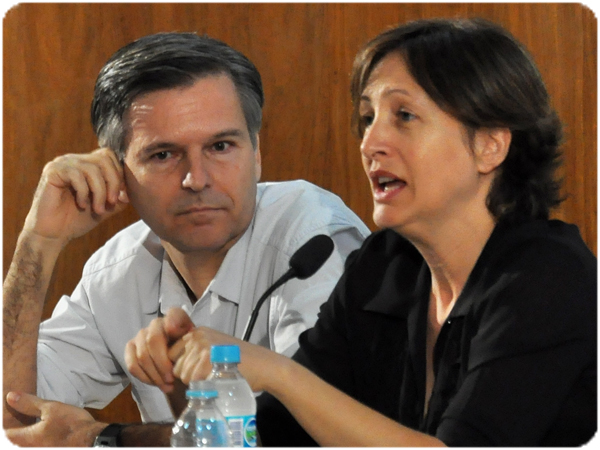
Parte 2 (clique na imagem)

 Amazônia está muito próxima de um ponto de não retorno para sua sobrevivência, diz Thomas Lovejoy, da George Mason University, no simpósio internacional FAPESP Week (foto: JVInfante Photography/Wilson Center)
Agência FAPESP – A Amazônia está muito próxima de um ponto de não retorno para sua sobrevivência, devido a uma combinação de fatores que incluem aquecimento global, desflorestamento e queimadas que minam seu sistema hidrogeológico.
A advertência foi feita por Thomas Lovejoy, atualmente professor da George Mason University, no Estado de Virgínia, EUA, no primeiro dia do simpósio internacional FAPESP Week, em Washington, nesta segunda-feira.
O biólogo Lovejoy, um dos mais importantes especialistas em Amazônia do mundo, começou a trabalhar na floresta brasileira em 1965, “apenas três anos depois da fundação da FAPESP”, lembrou.
Apesar de muita coisa positiva ter acontecido nestes 47 anos (“quando pisei pela primeira vez em Belém, só havia uma floresta nacional e uma área indígena demarcada e quase nenhum cientista brasileiro se interessava em estudar a Amazônia; hoje esse situação está totalmente invertida”), também apareceram no período diversos fatores de preocupação.
Lovejoy acredita que restam cinco anos para inverter as tendências em tempo de evitar problemas de maior gravidade. O aquecimento da temperatura média do planeta já está na casa de 0,8 grau centígrado. Ele acredita que o limite aceitável é de 2 graus centígrados e que ele pode ser alcançado até 2016 se nada for feito para efetivamente reduzi-lo.
O objetivo fixado nas mais recentes reuniões sobre o clima em Cancun e Copenhague de limitar o aumento médio da temperatura média global em 2 graus centígrados pode ser insuficiente, na opinião de Lovejoy, devido a essa conjugação de elementos.
De forma similar, Lovejoy crê que 20% de desflorestamento em relação ao tamanho original da Amazônia é o máximo que ela consegue suportar e o atual índice já é de 17% (em 1965, a taxa era de 3%).
A boa notícia, diz o biólogo, é que há bastante terra abandonada, sem nenhuma perspectiva de utilização econômica na Amazônia e que pode ser de alguma forma reflorestada, o que poderia proporcionar certa margem de segurança.
Em sua palestra, Lovejoy saudou vários cientistas brasileiros como exemplares em excelência em suas pesquisas. Entre outros, Eneas Salati, Carlos Nobre e Carlos Joly.
 Uma (in)certa antropologia
Você precisa fazer login para comentar.