Directed by Frank Heimans.
Arquivo anual: 2011
Brazil’s tale of two middle classes (FT)
July 20, 2011 3:40 pm
By Joe Leahy in São Paulo

Link: http://www.ft.com/cms/s/0/6745ef9a-b1e9-11e0-a06c-00144feabdc0.html#axzz1SlUzd9Me
Trance and Dance in Bali, documentário de Margaret Mead & Gregory Bateson
Boom brasileiro opõe classes médias tradicional e emergente, diz ‘FT’ (BBC)
Atualizado em 21 de julho, 2011 – 08:22 (Brasília) 11:22 GMT
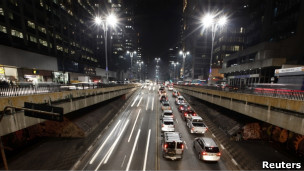 Para jornal, classe média tradicional sofre com aumento de preços e infraestrutura congestionada
O sucesso das políticas do governo brasileiro para tirar milhões de pessoas da pobreza na última década vem provocando a criação de dois tipos opostos de classe média, afirma reportagem publicada nesta quinta-feira pelo diário econômico britânico Financial Times.
O jornal observa que os 33 milhões de brasileiros que deixaram a pobreza para integrar a nova classe média emergente foram os grandes beneficiados pelas políticas oficiais, enquanto a classe média tradicional considera que a situação no período ficou mais difícil.
“Os preços da carne e da gasolina dobraram, pedágios nas estradas subiram e comer fora ou comprar imóveis ficou proibitivamente caro”, lista a reportagem.
O jornal comenta que 105,5 milhões dos 190 milhões de brasileiros são considerados hoje de classe média, mas que os 20 milhões da classe média tradicional, com renda mensal maior que R$ 5.174, estão “no lado perdedor”.
“Diferentemente da Índia, onde a antiga classe média se beneficiou com a criação de novas indústrias, como o fornecimento de serviços terceirizados de tecnologia da informação, muitos na classe média brasileira reclamam de aumentos de preços, impostos, infraestrutura congestionada e mais competição por empregos”, diz a reportagem.
Perda de renda
O jornal cita o economista da Fundação Getúlio Vargas Marcelo Neri, que se dedica a estudar a classe média, segundo o qual a renda dos 50% mais pobres cresceu 68% em termos reais nos últimos dez anos, enquanto os 10% mais ricos viram sua renda crescer somente 10% no período.
Ele destaca ainda outro dado ainda mais revelador, que mostra que a renda média dos analfabetos brasileiros cresceu 37% entre 2003 e 2009, enquanto aqueles com estudo universitário tiveram uma perda de 17% na renda no mesmo período.
Na avaliação de Neri ao jornal, as mudanças representam um reordenamento da riqueza no país que estava pendente desde a abolição da escravatura, em 1888.
A reportagem afirma que “o processo tem sido em parte impulsionado pelo maior acesso à educação”, com o aumento da oferta de cursos universitários privados à nova classe média, que passou a competir com a classe média tradicional por empregos.
Efeito político
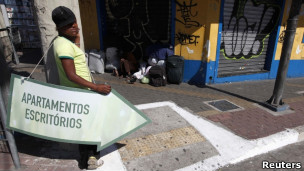 Dilma Rousseff lançou recentemente plano para tirar mais 16 milhões de pessoas da pobreza
O jornal observa que o efeito político da redução da pobreza levou a presidente Dilma Rousseff a lançar recentemente um programa para retirar outros 16 milhões de brasileiros da pobreza, mas afirma que isso não garantirá a ela os votos da classe média tradicional, concentrada nos Estados industrializados do sul do país, especialmente em São Paulo.
“Alguns reclamam que o governo ajuda os pobres por meio de benefícios e aumentos salariais e os ricos por meio de empréstimos subsidiados para suas empresas”, diz a reportagem.
“Isso inunda a economia com dinheiro, levando à inflação, a qual o Banco Central tenta então combater com aumentos de juros, penalizando a classe média”, continua o Financial Times.
A reportagem conclui afirmando que “enquanto muitos nas classes médias tradicionais do Brasil concordam com a distribuição de renda, eles estão temerosos sobre o quanto isso está lhes custando”
Articulista é condenado à prisão por crime de racismo contra indígenas (MPF)
Do MPF
por Sue Lizzie Viana Coitinho
14/07/2011 14:56
Condenação é inédita em MS e rara no país. Justiça considera que liberdade de expressão não pode ser usada para propagar racismo.
A Justiça aceitou os argumentos do Ministério Público Federal em Mato Grosso do Sul (MPF/MS) e condenou o advogado e articulista Isaac Duarte de Barros Júnior a dois anos de reclusão pelo crime de racismo contra etnia indígena. A sentença, de 6 de julho, é inédita em Mato Grosso do Sul, estado com a 2ª maior população indígena do país.
Ele escreveu um artigo, publicado no jornal O Progresso, de Dourados, com termos ofensivos aos indígenas da região. O MPF ajuizou duas ações na Justiça Federal contra o articulista, uma penal e outra por danos morais, em que é exigida reparação que pode passar de R$ 30 milhões. Com a presente decisão judicial, a ação por danos morais, que estava suspensa, deve voltar a tramitar.
Isaac foi condenado com base no artigo 20 da Lei 7.716/89, que define os crimes de preconceito de raça ou cor. Na sentença, o juiz afirma que a liberdade de expressão não é uma garantia absoluta. “A dignidade da pessoa humana, base do estado democrático de direito, prevalece sobre qualquer manifestação de pensamento que incite ao preconceito ou à discriminação racial, étnica e cultural”
Cultura indígena deve acabar
O artigo foi publicado em 27 e 28 de dezembro de 2008, sob o título “Índios e o Retrocesso”. Nele, o articulista utilizou os termos “bugrada” e “malandros e vadios” para referir-se aos indígenas. Afirmou, ainda, que eles “se assenhoram das terras como verdadeiros vândalos, cobrando nelas os pedágios e matando passantes”.
Em outro trecho, critica a cultura indígena: “A preservação de costumes que contrariem a modernidade são retrocessos e devem acabar. Quanto a uma civilização indígena que não deu certo e em detrimento disso foi conquistada pela inteligência cultural dos brancos, também é retrógrada a atitude de querer preservá-la”.
Também é contrário ao respeito à organização social, a cultura, crenças e tradições indígenas, mandamento constitucional confirmado como cláusula pétrea: “Em nome da razão e dos avanços culturais modernos civilizados, os palacianos parlamentares brasileiros deveriam retirar imediatamente a tutela constitucional exercida comodamente sobre os costumes ultrapassados dos índios aculturados”.
O articulista também se insurgiu contra o processo de demarcação de terras indígenas em Mato Grosso do Sul: “O que necessitamos, com maturidade responsável, é dar urgente finalidade social e produtiva a todos os quinhões brasileiros, inclusive aqueles ocupados por índios malandros e vadios”.
A culpa é da TV
Chamado a explicar-se perante a 1ª Vara da Justiça Federal de Dourados, o articulista negou o que havia escrito e atribuiu suas ideias a um avô e a programas de TV, afirmando que “os donos da terra são os silvícolas e deve haver uma distribuição de terras aos indígenas(…) que ao seu ver bugre é bandido, índio não”. As alegações não foram aceitas pela Justiça: “Observa-se a tentativa do acusado em ludibriar esse juízo (…) Como pode uma pessoa com formação intelectual, escrever sobre questões indígenas e desconhecer o real significado dos termos por ele próprio utilizados?”.
Referência processual na Justiça Federal de Dourados:
Processo penal: 2009.60.02.000481-5
Processo cível (indenização): 2009.60.02.004327-4
[Publicado no blog de Luis Nassif em 20/07/2011 – ver aqui]
Can a Candid Climate Modeler Convince Contrarians? (Scientific American)
Intrepid British climate scientist sets out to win over global warming doubters
By Jeremy Lovell and ClimateWire | July 19, 2011
 CONVINCING CONTRARIANS: Scientists attempt to win over climate change doubters. Image: Courtesy of NOAA
LONDON — David Stainforth is a brave man. His mission is to try to remove some of the confusion over the climate debate by explaining why uncertainty has to be a part of the computerized climate models that scientists use to forecast the expected impacts of climate change, including more violent storms as well as more flooding and droughts.
Stainforth, a climate modeler and senior research fellow at the London School of Economics, hopes that by coming clean on the degree of difficulty in making such predictions, he and his fellow climate scientists will find it easier to make — and win — the argument that prompt action now is not only necessary but the far cheaper alternative to inaction.
“Governments and people want certainty about what will happen with climate change, so scientists tend to turn to climate modeling. But the models are wrong in so many ways because there are so many uncertainties and unknowns built into them,” Stainforth told ClimateWire here at the Royal Academy’s recent annual Summer Science Exhibition.
“The reason is that they are just that, models, not reality. The bottom line is that they give a quite useful message from science to the adaptation community. But it is all relative and hedged about with qualifications. They give likelihoods not certainties, ranges of probabilities, not absolutes. That is where the discussion then must start, not end,” he added.
It is a bold step to take at a time when the climate skeptics appear to be making the most of the continuing public confusion and denial over the issues shown in repeated polls in the United States and United Kingdom. Skeptics have taken advantage of the revelations of scientific infighting with the leaked emails from the United Kingdom’s University of East Anglia in late 2009. They have also pointed to evidence of some sloppy science by the Intergovernmental Panel on Climate Change to assert that the feared results of climate change may be more fiction than science.
Take that, add the diplomatic bickering and backsliding in international climate change talks, then fold in the news of the continuing global economic crisis and reports that renewable energy will drive up energy costs. You will get a sense that what Stainforth is attempting is a very hard sell.
The ‘trouble’ with climate models
“You can explain in five or 10 minutes why we need to do something about climate change — and do it without using climate models. But it is far harder to persuade people of the degree and speed of what needs to be done without the models, and that is where the trouble starts,” said Stainforth.
“Governments and the media demand certainty. They don’t want uncertainties and probabilities. For example, all our models predict wetter winters and warmer summers, but they are far less certain about wetter or drier summers, and that has major implications for the siting and size of flood defenses,” he explained, referring to dams and levees.
“Climate scientists have moved a long way beyond discussing whether climate change is a threat to our societies and economies. That is settled. But that is not to say they do not still disagree about a lot of things like the design of the models and the degree of change,” he added.
He remains hopeful that the non-scientific public will understand the strong consensus among climate scientists that makes the remaining bickering look small. “There is uncertainty, but there is also probability. By showing and discussing the degree of each in public and with the public, we hope to involve them and therefore get out of the loop and move forward.”
Stainforth’s mission is backed by an array of groups including the United Kingdom’s Natural Environment Research Council, the Economic and Social Research Council and the Centre for Climate Change Economics and Policy as well as the London School of Economics. There is also the Grantham Research Institute on Climate Change and the Environment — headed by Lord Nicholas Stern, whose report on the economics of climate change in 2006 electrified governments worldwide on the issue.
Trying some interactive games
Using literature and interactive games at the Confidence in Climate website, the project sets out to show how probabilities work and why different models may come up with quite widely differing predictions. It then applies this to a composite of theories and observations on the climate conundrum.
“When you make a decision about the future — whether it is based on theory or observation — it is a sort of gamble. You can never know what is going to happen. When we make decisions about how to tackle climate change it is no different,” the website says.
“Because of the uncertainty we can’t be sure exactly what degree of challenge we will face. None the less, some things are clear — uncertainty doesn’t mean ignorance. … We also know that bigger increases in atmospheric greenhouse gas levels are likely to lead to much bigger impacts; the impact of a 4 degree warming is likely to be more than twice the impact of a 2 degree warming,” it adds.
As for Stainforth, he thinks the debate urgently needs to be widened considerably from the rather restricted inner core of scientists, modelers, meteorologists and statisticians who have monopolized it to date.
“We need ecologists, farmers, doctors, anthropologists, sociologists, engineers, psychologists, hydrologists, social scientists. The climate change problem involves everyone and should therefore include everyone,” he said.
“We have to grasp the nettle here and communicate openly the uncertainty, to explain what is uncertain, where, why and to what degree. We don’t want it split into ‘believers’ and ‘unbelievers’; we want people to understand.”
Reprinted from Climatewire with permission from Environment & Energy Publishing, LLC. http://www.eenews.net, 202-628-6500
On Experts and Global Warming (N.Y. Times)
July 12, 2011, 4:01 PM
By GARY GUTTING
Experts have always posed a problem for democracies. Plato scorned democracy, rating it the worst form of government short of tyranny, largely because it gave power to the ignorant many rather than to knowledgeable experts (philosophers, as he saw it). But, if, as we insist, the people must ultimately decide, the question remains: How can we, nonexperts, take account of expert opinion when it is relevant to decisions about public policy?
Once we accept the expert authority of climate science, we have no basis for supporting the minority position.
To answer this question, we need to reflect on the logic of appeals to the authority of experts. First of all, such appeals require a decision about who the experts on a given topic are. Until there is agreement about this, expert opinion can have no persuasive role in our discussions. Another requirement is that there be a consensus among the experts about points relevant to our discussion. Precisely because we are not experts, we are in no position to adjudicate disputes among those who are. Finally, given a consensus on a claim among recognized experts, we nonexperts have no basis for rejecting the truth of the claim.
These requirements may seem trivially obvious, but they have serious consequences. Consider, for example, current discussions about climate change, specifically about whether there is long-term global warming caused primarily by human activities (anthropogenic global warming or A.G.W.). All creditable parties to this debate recognize a group of experts designated as “climate scientists,” whom they cite in either support or opposition to their claims about global warming. In contrast to enterprises such as astrology or homeopathy, there is no serious objection to the very project of climate science. The only questions are about the conclusions this project supports about global warming.
There is, moreover, no denying that there is a strong consensus among climate scientists on the existence of A.G.W. — in their view, human activities are warming the planet. There are climate scientists who doubt or deny this claim, but even they show a clear sense of opposing a view that is dominant in their discipline. Nonexpert opponents of A.G.W. usually base their case on various criticisms that a small minority of climate scientists have raised against the consensus view. But nonexperts are in no position to argue against the consensus of scientific experts. As long as they accept the expert authority of the discipline of climate science, they have no basis for supporting the minority position. Critics within the community of climate scientists may have a cogent case against A.G.W., but, given the overall consensus of that community, we nonexperts have no basis for concluding that this is so. It does no good to say that we find the consensus conclusions poorly supported. Since we are not experts on the subject, our judgment has no standing.
It follows that a nonexpert who wants to reject A.G.W. can do so only by arguing that climate science lacks the scientific status needed be taken seriously in our debates about public policy. There may well be areas of inquiry (e.g., various sub-disciplines of the social sciences) open to this sort of critique. But there does not seem to be a promising case against the scientific authority of climate science. As noted, opponents of the consensus on global warming themselves argue from results of the discipline, and there is no reason to think that they would have had any problem accepting a consensus of climate scientists against global warming, had this emerged.
Some nonexpert opponents of global warming have made much of a number of e-mails written and circulated among a handful of climate scientists that they see as evidence of bias toward global warming. But unless this group is willing to argue from this small (and questionable) sample to the general unreliability of climate science as a discipline, they have no alternative but to accept the consensus view of climate scientists that these e-mails do not undermine the core result of global warming.
I am not arguing the absolute authority of scientific conclusions in democratic debates. It is not a matter of replacing Plato’s philosopher-kings with scientist-kings in our polis. We the people still need to decide (perhaps through our elected representatives) which groups we accept as having cognitive authority in our policy deliberations. Nor am I denying that there may be a logical gap between established scientific results and specific policy decisions. The fact that there is significant global warming due to human activity does not of itself imply any particular response to this fact. There remain pressing questions, for example, about the likely long-term effects of various plans for limiting CO2 emissions, the more immediate economic effects of such plans, and, especially, the proper balance between actual present sacrifices and probable long-term gains. Here we still require the input of experts, but we must also make fundamental value judgments, a task that, pace Plato, we cannot turn over to experts.
The essential point, however, is that once we have accepted the authority of a particular scientific discipline, we cannot consistently reject its conclusions. To adapt Schopenhauer’s famous remark about causality, science is not a taxi-cab that we can get in and out of whenever we like. Once we board the train of climate science, there is no alternative to taking it wherever it may go.
New York Times Publishes a Searing Drought Story, But Completely Misses the Climate Change Angle (Climate Central)
Published: July 12th, 2011, Last Updated: July 13th, 2011
By Andrew Freedman
In Monday’s New York Times, Kim Severson and Kirk Johnson wrote an eloquent story on the intense drought that is maintaining a tight grip on a broad swath of America’s southern tier, from Arizona to Florida. Reporting from Georgia, Severson and Johnson detailed the plight of farmers struggling to make ends meet as the parched soil makes it nearly impossible for them to grow crops and feed livestock.
 Monday’s story from the New York Times on drought.
The piece is a great example of how emotionally moving storytelling from a local perspective can convey the consequences of broad issues and trends, in this case, a major drought that has enveloped 14 states. In that sense, it served Times readers extraordinarily well.
However, when it came to providing readers with a thorough understanding of the drought’s causes and aggravating factors, Severson and Johnson left out any mention of the elephant in the room — global climate change, and pinned the entire drought on one factor, La Niña. For this, it was overly simplistic, and even just downright inaccurate.
Here’s how the story framed the drought’s causes:
From a meteorological standpoint, the answer is fairly simple. “A strong La Niña shut off the southern pipeline of moisture,” said David Miskus, who monitors drought for the National Oceanic and Atmospheric Administration.
The La Niña “lone gunman” theory is problematic from a scientific standpoint. Just last week, Marty Hoerling, the federal government’s top researcher tasked with examining how climate change may be influencing extreme weather and climate events, told reporters that “we cannot reconcile it [the drought] with just the La Niña impact alone, at least not at this time.”
Instead, the causal factors are more nuanced than that, and they do include global warming, since it is changing the background conditions in which such extreme events occur.
During a press conference last week from a drought management meeting in the parched city of Austin, Texas, Hoerling made clear that climate change is already increasing average temperatures across the drought region, and is expected to lead to more frequent and intense droughts in the Southwest. Other research indicates the trend towards a drier Southwest is already taking place. “There are recent regional tendencies toward more severe droughts in the southwestern United States, parts of Canada and Alaska, and Mexico,” stated a 2008 report from the U.S. Global Change Research Program.
As is the case with any extreme weather or climate event now, one cannot truly separate climate change from the mix, considering that droughts, floods, and other extreme events now occur in an environment that has been profoundly altered by human emissions of greenhouse gases, such as carbon dioxide. This doesn’t mean that climate change is causing all of these extreme events, but it does mean that climate change may be increasing the likelihood that some types of events will occur, and may be changing the characteristics of some extreme events, such as by making heat waves more intense.
The fact that the Times story detailed both the drought and the record heat accompanying it, yet left out any mention of climate change, was a particularly puzzling error of omission. Hoerling, for one, pointed to the extreme heat seen during this drought as a possible sign of things to come, as climate change helps produce dangerous combinations of heat and drought.
“We haven’t necessarily dealt with drought and heat at the same time in such a persistent way, and that’s a new condition,” Hoerling said, noting that higher temperatures only hasten the drying of soils.
 Many ponds in Texas, such as this one in Rusk County, were nearly dry by late June 2011. Credit: agrilifetoday/flickr.
Texas had its warmest June on record, for example, and on June 26th, Amarillo, Texas recorded its warmest temperature on record for any month, at 111°F. According to the Weather Channel, parts of Oklahoma and Texas have already exceeded their yearly average number of days at or above 100 degrees, including Oklahoma City, Dallas, and Austin. The heat is related to the drought, because when soil moisture is so low, more of the sun’s energy goes towards heating the air directly.
It’s unfortunate that the Times story, which was a searing portrayal of how a drought can impact communities that are already down on their luck due to economic troubles, did not include at least some discussion on climate change. As I’ve shown here, and climate blogger Joe Romm has also pointed out, there was sufficient evidence to justify raising the climate change topic in that story, and many others like it. After all, if the media doesn’t make an effort to evaluate the evidence on the links between extreme weather and climate change, then how can we expect the public to understand how global warming may affect their lives?
At Climate Central, our scientists are working to better understand whether and how climate change is increasing the likelihood of certain extreme weather events, such as heat waves, while at the same time, our journalists are covering the Southern drought and wildfire situation with the goal of making sure our readers understand what scientific studies show about global warming and extreme events.
This is not an easy task, but it need not be such a lonely one.
Update, July 13: The Times published an editorial on the drought today, which also blames the drought squarely on La Niña-related weather patterns, and makes no mention of climate change impacts or projections.
* * *
EDITORIAL (New York Times)
Suffering in the Parched South
Published: July 12, 2011
Right now, the official drought map of the United States looks as if it has been set on fire and scorched at the bottom edge. Scorched is how much of the Southeast and Southwest feel, in the midst of a drought that is the most extreme since the 1950s and possibly since the Dust Bowl of the 1930s. The government has classified much of this drought as D4, which means exceptional. The outlook through late September shows possible improvement in some places, but in most of Texas, Oklahoma, southern Arkansas, and northern Louisiana and Mississippi the drought is expected to worsen.
Dry conditions began last year and have only intensified as temperatures rose above 100 in many areas. Rain gauges have been empty for months, causing a region-wide search for new underground sources of water as streams and lakes dry up. The drought is produced by a pattern of cooling in the Pacific called La Niña. A cooler ocean means less moisture in the atmosphere, which shuts down the storms shuttling east across the region.
Droughts are measured in dollars as well as degrees. The prospects for cattle and wheat, corn and cotton crops across the South are dire. There is no way yet to estimate the ultimate cost of this drought because there is no realistic estimate of when it will end. Farmers have been using crop insurance payments, and federal relief is available in disaster areas, including much of Texas. But the only real relief will be the end of the dry, hot winds and the beginning of long, settled rains.
* * *
Drought Spreads Pain From Florida to Arizona
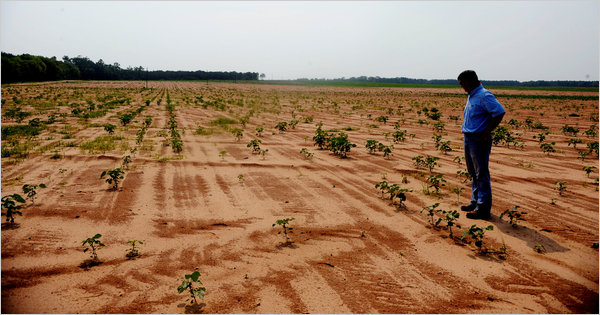 Grant Blankenship for The New York Times. Buster Haddock, an agricultural scientist at the University of Georgia, in a field where cotton never had the chance to grow.
By KIM SEVERSON and KIRK JOHNSON
Published: July 11, 2011
COLQUITT, Ga. — The heat and the drought are so bad in this southwest corner of Georgia that hogs can barely eat. Corn, a lucrative crop with a notorious thirst, is burning up in fields. Cotton plants are too weak to punch through soil so dry it might as well be pavement.
 Waiting for Rain

Dangerously Dry – Nearly a fifth of the contiguous United States has been faced with the worst drought in recent years.
 The Dry Season
 OKLAHOMA A simple, if plaintive, message from the residents of Hough, in the panhandle, late last month. Shawn Yorks/The Guymon Daily Herald, via Associated Press
Farmers with the money and equipment to irrigate are running wells dry in the unseasonably early and particularly brutal national drought that some say could rival the Dust Bowl days.
“It’s horrible so far,” said Mike Newberry, a Georgia farmer who is trying grow cotton, corn and peanuts on a thousand acres. “There is no description for what we’ve been through since we started planting corn in March.”
The pain has spread across 14 states, from Florida, where severe water restrictions are in place, to Arizona, where ranchers could be forced to sell off entire herds of cattle because they simply cannot feed them.
In Texas, where the drought is the worst, virtually no part of the state has been untouched. City dwellers and ranchers have been tormented by excessive heat and high winds. In the Southwest, wildfires are chewing through millions of acres.
Last month, the United States Department of Agriculture designated all 254 counties in Texas natural disaster areas, qualifying them for varying levels of federal relief. More than 30 percent of the state’s wheat fields might be lost, adding pressure to a crop in short supply globally.
Even if weather patterns shift and relief-giving rain comes, losses will surely head past $3 billion in Texas alone, state agricultural officials said.
Most troubling is that the drought, which could go down as one of the nation’s worst, has come on extra hot and extra early. It has its roots in 2010 and continued through the winter. The five months from this February to June, for example, were so dry that they shattered a Texas record set in 1917, said Don Conlee, the acting state climatologist.
Oklahoma has had only 28 percent of its normal summer rainfall, and the heat has blasted past 90 degrees for a month.
“We’ve had a two- or three-week start on what is likely to be a disastrous summer,” said Kevin Kloesel, director of the Oklahoma Climatological Survey.
The question, of course, becomes why. In a spring and summer in which weather news has been dominated by epic floods and tornadoes, it is hard to imagine that more than a quarter of the country is facing an equally daunting but very different kind of natural disaster.
From a meteorological standpoint, the answer is fairly simple. “A strong La Niña shut off the southern pipeline of moisture,” said David Miskus, who monitors drought for the National Oceanic and Atmospheric Administration.
The weather pattern called La Niña is an abnormal cooling of Pacific waters. It usually follows El Niño, which is an abnormal warming of those same waters.
Although a new forecast from the National Weather Service’s Climate Prediction Center suggests that this dangerous weather pattern could revive in the fall, many in the parched regions find themselves in the unlikely position of hoping for a season of heavy tropical storms in the Southeast and drenching monsoons in the Southwest.
Climatologists say the great drought of 2011 is starting to look a lot like the one that hit the nation in the early to mid-1950s. That, too, dried a broad part of the southern tier of states into leather and remains a record breaker.
But this time, things are different in the drought belt. With states and towns short on cash and unemployment still high, the stress on the land and the people who rely on it for a living is being amplified by political and economic forces, state and local officials say. As a result, this drought is likely to have the cultural impact of the great 1930s drought, which hammered an already weakened nation.
“In the ’30s, you had the Depression and everything that happened with that, and drought on top,” said Donald A. Wilhite, director of the school of natural resources at the University of Nebraska in Lincoln and former director of the National Drought Mitigation Center. “The combination of those two things was devastating.”
Although today’s economy is not as bad, many Americans ground down by prolonged economic insecurity have little wiggle room to handle the effects of a prolonged drought. Government agencies are in the same boat.
“Because we overspent, the Legislature overspent, we’ve been cut back and then the drought comes along and we don’t have the resources and federal government doesn’t, and so we just tighten our belt and go on,” said Donald Butler, the director of the Arizona Department of Agriculture.
The drought is having some odd effects, economically and otherwise.
“One of the biggest impacts of the drought is going to be the shrinking of the cattle herd in the United States,” said Bruce A. Babcock, an agricultural economist at Iowa State University in Ames. And that will have a paradoxical but profound impact on the price of a steak.
Ranchers whose grass was killed by drought cannot afford to sustain cattle with hay or other feed, which is also climbing in price. Their response will most likely be to send animals to slaughter early. That glut of beef would lower prices temporarily.
But America’s cattle supply will ultimately be lower at a time when the global supply is already low, potentially resulting in much higher prices in the future.
There are other problems. Fishing tournaments have been canceled in Florida and Mississippi, just two of the states where low water levels have kept recreational users from lakes and rivers. In Texas, some cities are experiencing blackouts because airborne deposits of salt and chemicals are building up on power lines, triggering surges that shut down the system. In times of normal weather, rain usually washes away the environmental buildup. Instead, power company crews in cities like Houston are being dispatched to spray electrical lines.
In this corner of Georgia, where temperatures have been over 100 and rainfall has been off by more than half, fish and wildlife officials are worried over the health of the shinyrayed pocketbook and the oval pigtoe mussels, both freshwater species on the endangered species list.
The mussels live in Spring Creek, which is dangerously low and borders Terry Pickle’s 2,000-acre farm here. He pulls his irrigation from wells that tie into the water system of which Spring Creek is a part.
Whether nature or agriculture is to blame remains a debate in a state that for 20 years has been embroiled in a water war with Alabama and Florida. Meanwhile, Colquitt has allowed the state to drill a special well to pump water back into the creek to save the mussels from extinction.
Most farmers here are much more worried about the crops than the mussels. With cotton and corn prices high, they had high hopes for the season. But many have had to replant fields several times to get even one crop to survive. Others, like Mr. Pickle, have relied on irrigation so expensive that it threatens to eat into any profits.
The water is free, but the system used to get it from the ground runs on diesel fuel. His bill for May and June was an unheard of $88,442.
Thousands of small stories like that will all contribute to the ultimate financial impact of the drought, which will not be known until it is over. And no one knows when that will be.
The United States Department of Agriculture’s Farm Service Agency has already provided over $75 million in assistance to ranchers nationwide, with most of it going to Florida, New Mexico and Texas. An additional $62 million in crop insurance indemnities have already been provided to help other producers.
Economists say that adding up the effects of drought is far more complicated than, say, those of a hurricane or tornado, which destroy structures that have set values. With drought, a shattered wheat or corn crop is a loss to one farmer, and it has a specific price tag. But all those individual losses punch a hole in the food supply and drive prices up. That is good news for a farmer who manages to get a crop in. The final net costs down the line are thus dispersed, and mostly passed along.
That means grocery shoppers will feel the effects of the drought at the dinner table, where the cost of staples like meat and bread will most likely rise, said Michael J. Roberts, an associate professor of agricultural and resource economics at North Carolina State University in Raleigh, N.C. “The biggest losers are consumers,” he said.
Kim Severson reported from Colquitt, Ga., and Kirk Johnson from Denver. Dan Frosch contributed reporting from Denver.
Our Extreme Future: Predicting and Coping with the Effects of a Changing Climate (Scientific American)
Adapting to extreme weather calls for a combination of restoring wetland and building drains and sewers that can handle the water. But leaders and the public are slow to catch on. Final part of a three-part series
By John Carey | Thursday, June 30, 2011 | 97
 Image: Fikret Onal/Flickr
Editor’s note: This article is the last of a three-part series by John Carey. Part 1, “Storm Warning: Extreme Weather Is a Product of Climate Change,” was posted on June 28. Part 2, “Global Warming and the Science of Extreme Weather,” was posted on June 29.
Extreme weather events have become both more common and more intense. And increasingly, scientists have been able to pin at least part of the blame on humankind’s alteration of the climate. What’s more, the growing success of this nascent science of climate attribution (finding the telltale fingerprints of climate change in extreme events) means that researchers have more confidence in their climate models—which predict that the future will be even more extreme.
Are we prepared for this future? Not yet. Indeed, the trend is in the other direction, especially in Washington, D.C., where a number of members of Congress even argue that climate change itself is a hoax.
Scientists hope that rigorously identifying climate change’s contribution to individual extreme events can indeed wake people up to the threat. As the research advances, it should be possible to say that two extra inches (five centimeters) of rain poured down in a Midwestern storm because of greenhouse gases, or that a California heat wave was 10 times more likely to occur thanks to humans’ impacts on climate. So researchers have set up rapid response teams to assess climate change’s contribution to extreme events while the events are still fresh in people’s minds. In addition, the Intergovernmental Panel on Climate Change (IPCC) is preparing a special report on extreme events and disasters, due out by the end of 2011. “It is important for us emphasize that climate change and its impacts are not off in the future, but are here and now,” explained Rajendra Pachauri, chair of the IPCC, during a briefing at United Nations climate talks in Cancún last December.
The message is beginning to sink in. The Russian government, for instance, used to doubt the existence of climate change, or argue that it might be beneficial for Russia. But now, government officials have realized that global warming will not bring a gradual and benign increase in temperatures. Instead, they’re likely to see more crippling heat waves. As Russian President Dmitry Medvedev told the Security Council of the Russian Federation last summer: “Everyone is talking about climate change now. Unfortunately, what is happening now in our central regions is evidence of this global climate change, because we have never in our history faced such weather conditions.”
Doubts persist despite evidence
Among the U.S. public, the feeling is different. Opinion pollsand anecdotal reports show that most Americans do not perceive a threat from climate change. And a sizable number of Americans, including many newly elected members of Congress, do not even believe that climate change exists. Extreme weather? Just part of nature, they say. After all, disastrous floods and droughts go back to the days of Noah and Moses. Why should today’s disasters be any different? Was the July 23, 2010, storm that spawned Les Scott’s record hailstone evidence of a changing climate, for instance? “Not really,” Scott says. “It was just another thunderstorm. We get awful bad blizzards that are a lot worse.”
And yes, 22 of Maryland’s 23 counties were declared natural disaster areas after record-setting heat and drought in 2010. “It was the worst corn crop I ever had,” says fourth-generation farmer Earl “Buddy” Hance. But was it a harbinger of a more worrisome future? Probably not, says Hance, the state’s secretary of agriculture. “As farmers we are skeptical, and we need to see a little more. And if it does turn out to be climate change, farmers would adapt.” By then, adaptation could be really difficult, frets Minnesota organic farmer Jack Hedin, whose efforts to raise the alarm are “falling on deaf ears,” he laments.
Many scientists share Hedin’s worry. “The real honest message is that while there is debate about how much extreme weather climate change is inducing now, there is very little debate about its effect in the future,” says Michael Wehner, staff scientist at Lawrence Berkeley National Laboratory and member of the lead author teams of the interagency U.S. Climate Change Science Program’s Synthesis and Assessment reports on climate extremes. For instance, climate models predict that by 2050 Russia will have warmed up so much that every summer will be as warm as the disastrous heat wave it just experienced, says Richard Seager of Columbia University’s Lamont–Doherty Earth Observatory. In other words, many of today’s extremes will become tomorrow’s everyday reality. “Climate change will throw some significant hardballs at us,” says Martin Hoerling, a research meteorologist at the National Oceanic and Atmospheric Administration’s Earth System Research Laboratory in Boulder, Colo. “There will be a lot of surprises that we are not adapted to.”
A dusty future
One of the clearest pictures of this future is emerging for the U.S. Southwest and a similar meteorological zone that stretches across Italy, Greece and Turkey. Work by Tim Barnett of the Scripps Institution of Oceanography, Seager and others predicts that these regions will get hotter and drier—and, perhaps more important, shows that the change has already begun. “The signal of a human influence on climate pops up in 1985, then marches on getting strong and stronger,” Barnett says. By the middle of the 21st century, the models predict, the climate will be as dry as the seven-year long Dust Bowl drought of the 1930s or the damaging 1950s drought centered in California and Mexico, Seager says: “In the future the drought won’t last just seven years. It will be the new norm.”
That spells trouble. In the Southwest the main worry is water—water that makes cities like Los Angeles and Las Vegas possible and that irrigates the enormously productive farms of California’s Central Valley. Supplies are already tight. During the current 11-year dry spell, the demand for water from the vast Colorado River system, which provides water to 30 million people and irrigates four million acres (1.6 million hectares) of cropland, has exceeded the supply. The result: water levels in the giant Lake Mead reservoir dropped to a record low in October (before climbing one foot, or 30 centimeters, after torrential winter rains in California reduced the demand for Colorado River water). Climate change will just make the problem worse. “The challenge will be great,” says Terry Fulp, deputy regional director of the U.S. Department of the Interior’s Bureau of Reclamation’s Lower Colorado Region. “I rank climate change as probably my largest concern. When I’m out on my boat on Lake Mead, it’s on my mind all the time.”
The Southwest is just a snapshot of the challenges ahead. Imagine the potential peril to regions around the world, scientists say. “Our civilization is based on a stable base climate—it doesn’t take very much change to raise hell,” Scripps’s Barnett says. And given the lag in the planet’s response to the greenhouse gases already in the atmosphere, many of these changes are coming whether we like them or not. “It’s sort of like that Kung Fu guy who said, ‘I’m going to kick your head off now, and there’s not a damn thing you can do about it,'” Barnett says.
Grassroots action
Although efforts to fight climate change are now stalled in Washington, many regions do see the threat and are taking action both to adapt to the future changes and to try to limit the amount of global warming itself. The Bureau of Reclamation’s Lower Colorado Region office, for instance, has developed a plan to make “manageable” cuts in the amounts of water that the river system supplies, which Fulp hopes will be enough to get the region through the next 15 years. In Canada, after experiencing eight extreme storms (of more than one-in-25-year intensity) between 1986 and 2006, Toronto has spent hundreds of millions of dollars to upgrade its sewer and storm water system for handling deluges. “Improved storm drains are the cornerstone of our climate adaptation policy,” explains Michael D’Andrea, Toronto’s director of water infrastructure management.
In Iowa, even without admitting that climate change is real, farmers are acting as if it is, spending millions of dollars to alter their practices. They are adding tile drainage to their fields to cope with increased floods, buying bigger machinery to move more quickly because their planting window has become shorter, planting a month earlier than they did 50 years ago, and sowing twice as many corn plants per acre to exploit the additional moisture, says Gene Takle, professor of meteorology at Iowa State University in Ames. “Iowa’s floods are in your face—and in your basement—evidence that the climate has changed, and the farmers are adapting,” he says.
Local officials have seen the connection, too. After the huge floods of 2008, the Iowa town of Cedar Falls passed an ordinance requiring that anyone who lives in the 500-year flood plain must have flood insurance—up from the previous 200-year flood requirement. State Sen. Robert Hogg wants to make the policy statewide. He also is pushing to restore wetlands that can help soak up floodwaters before they devastate cities. “Wetland restoration costs money, but it’s cheaper than rebuilding Cedar Rapids,” he says. “I like to say that dealing with climate change is not going to require the greatest sacrifices, but it is going to require the greatest foresight Americans have ever had.”
Right now, that foresight is more myopia, many scientists worry. So when and how will people finally understand that far more is needed? It may require more flooded basements, more searing heat waves, more water shortages or crop failures, more devastating hurricanes or other examples of the increases in extreme weather that climate change will bring. “I don’t want to root for bad things to happen, but that’s what it will take,” says one government scientist who asked not to be identified. Or as Nashville resident Rich Hays says about his own experience with the May 2010 deluge: “The flood was definitely a wake-up call. The question is: How many wake-up calls do we need?”
Reporting for this story was funded by the Pew Center on Global Climate Change.
Global Warming and the Science of Extreme Weather (Scientific American)
How rising temperatures change weather and produce fiercer, more frequent storms. Second of a three-part series
By John Carey | Wednesday, June 29, 2011 | 46
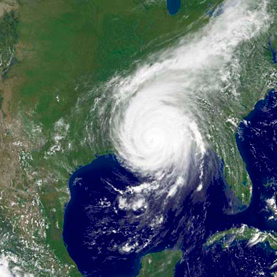 HURRICANE KATRINA battered New Orleans in 2005. Image: NOAA
Editor’s note: This article is the second of a three-part series by John Carey. Part 1, posted on June 28, is “Storm Warning: Extreme Weather Is a Product of Climate Change”.
Extreme floods, prolonged droughts, searing heat waves, massive rainstorms and the like don’t just seem like they’ve become the new normal in the last few years—they have become more common, according to data collected by reinsurance company Munich Re (see Part 1 of this series). But has this increase resulted from human-caused climate change or just from natural climatic variations? After all, recorded floods and droughts go back to the earliest days of mankind, before coal, oil and natural gas made the modern industrial world possible.
Until recently scientists had only been able to say that more extreme weather is “consistent” with climate change caused by greenhouse gases that humans are emitting into the atmosphere. Now, however, they can begin to say that the odds of having extreme weather have increased because of human-caused atmospheric changes—and that many individual events would not have happened in the same way without global warming. The reason: The signal of climate change is finally emerging from the “noise”—the huge amount of natural variability in weather.
Scientists compare the normal variation in weather with rolls of the dice. Adding greenhouse gases to the atmosphere loads the dice, increasing odds of such extreme weather events. It’s not just that the weather dice are altered, however. As Steve Sherwood, co-director of the Climate Change Research Center at the University of New South Wales in Australia, puts it, “it is more like painting an extra spot on each face of one of the dice, so that it goes from 2 to 7 instead of 1 to 6. This increases the odds of rolling 11 or 12, but also makes it possible to roll 13.”
Why? Basic physics is at work: The planet has already warmed roughly 1 degree Celsius since preindustrial times, thanks to CO2and other greenhouse gases emitted into the atmosphere. And for every 1-degree C (1.8 degrees Fahrenheit) rise in temperature, the amount of moisture that the atmosphere can contain rises by 7 percent, explains Peter Stott, head of climate monitoring and attribution at the U.K. Met Office’s Hadley Center for Climate Change. “That’s quite dramatic,” he says. In some places, the increase has been much larger. Data gathered by Gene Takle, professor of meteorology at Iowa State University in Ames, show a 13 percent rise in summer moisture over the past 50 years in the state capital, Des Moines.
The physics of too much rain
The increased moisture in the atmosphere inevitably means more rain. That’s obvious. But not just any kind of rain, the climate models predict. Because of the large-scale energy balance of the planet, “the upshot is that overall rainfall increases only 2 to 3 percent per degree of warming, whereas extreme rainfall increases 6 to 7 percent,” Stott says. The reason again comes from physics. Rain happens when the atmosphere cools enough for water vapor to condense into liquid. “However, because of the increasing amount of greenhouse gases in the troposphere, the radiative cooling is less efficient, as less radiation can escape to space,” Stott explains. “Therefore the global precipitation increases less, at about 2 to 3 percent per degree of warming.” But because of the extra moisture, when precipitation does occur (in both rain and snow), it’s more likely to be in bigger events.
Iowa is one of many places that fits the pattern. Takle documented a three- to seven-fold increase in high rainfall events in the state, including the 500-year Mississippi River flood in 1993, the 2008 Cedar Rapids flood as well as the 500-year event in 2010 in Ames, which inundated the Hilton Coliseum basketball court in eight feet (2.5 meters) of water . “We can’t say with confidence that the 2010 Ames flood was caused by climate change, but we can say that the dice are loaded to bring more of these events,” Takle says.
And more events seem to be in the news every month, from unprecedented floods in Riyadh, Saudi Arabia, to massive snowstorms that crippled the U.S. Northeast in early 2011, to the November 2010 to January 2011 torrents in Australia that flooded an area the size of Germany and France . This “disaster of biblical proportions,” as local Australian officials called it, even caused global economic shock waves: The flooding of the country’s enormously productive coal mines sent world coal prices soaring.
More stormy weather
More moisture and energy in the atmosphere, along with warmer ocean temperatures also mean more intense hurricanes, many scientists say. In fact, 2010 was the first year in decades in which two simultaneous category 4 hurricanes, Igor and Julia, formed in the Atlantic Ocean. In addition, the changed conditions bring an increased likelihood of more powerful thunderstorms with violent updrafts, like a July 23, 2010, tempest in Vivian, S.D., that produced hailstones that punched softball-size holes through roofs—and created a behemoth ball of ice measured at a U.S. record 8 inches (20 centimeters) in diameter even after it had partially melted. “I’ve never seen a storm like that before—and hope I’ll never go through anything like it,” says Les Scott, the Vivian farmer and rancher who found the hailstone .
Warming the planet alters large-scale circulation patterns as well. Scientists know that the sun heats moist air at the equator, causing the air to rise. As it rises, the air cools and sheds most of its moisture as tropical rain. Once six to 10 miles (9.5 to 16 kilometers) aloft, the now dry air travels toward the poles, descending when it reaches the subtropics, normally at the latitude of the Baja California peninsula. This circulation pattern, known as a Hadley cell, contributes to desertification, trade winds and the jet stream.
On a warmer planet, however, the dry air will travel farther north and south from the equator before it descends, climate models predict, making areas like the U.S. Southwest and the Mediterranean even drier. Such an expanded Hadley cell would also divert storms farther north. Are the models right? Richard Seager of Columbia University’s Lamont–Doherty Earth Observatory has been looking for a climate change–induced drying trend in the Southwest, “and there seems to be some tentative evidence that it is beginning to happen,” he says. “It gives us confidence in the models.” In fact, other studies show that the Hadley cells have not only expanded, they’ve expanded more than the models predicted.
Such a change in atmospheric circulation could explain both the current 11-year drought in the Southwest and Minnesota’s status as the number one U.S. state for tornadoes last year. On October 26, 2010, the Minneapolis area even experienced record low pressure in what Paul Douglas, founder and CEO of WeatherNation in Minnesota, dubbed a “landicane”—a hurricanelike storm that swept across the country. “I thought the windows of my home would blow in,” Douglas recalls. “I’ve chased tornados and flown into hurricanes but never experienced anything like this before.” Yet it makes sense in the context of climate change, he adds. “Every day, every week, another piece of the puzzle falls into place,” he says. “More extreme weather seems to have become the rule, not just in the U.S. but in Europe and Asia.”
The rise of climate attribution
Is humankind really responsible? That’s where the burgeoning field of climate attribution, pioneered by Hadley’s Peter Stott and other scientists, comes in. The idea is to look for trends in the temperature or precipitation data that provide evidence of overall changes in climate. When those trends exist, it then becomes possible to calculate how much climate change has contributed to extreme events. Or in more technical terms, the probability of a particular temperature or rainfall amount is shaped roughly like a bell curve. A change in climate shifts the whole curve. That, in turn, increases the likelihood of experiencing the more extreme weather at the tail end of the bell curve. Whereas day-to-day weather remains enormously variable, the underlying human-caused shift in climate increases the power and number of the events at the extreme. The National Oceanic and Atmospheric Administration’s (NOAA) Deke Arndt puts it more colorfully: “Weather throws the punches, but climate trains the boxer,” he says. By charting the overall shift, then, it’s possible to calculate the increased chances of extreme events due to global warming.
This idea was already in the air in 2003 when Stott traveled though the worst heat wave in recorded European history on a wedding anniversary trip to Italy and Switzerland. One of the striking consequences he noticed was that the Swiss mountains were missing their usual melodious tinkling of cowbells. “There was no water in the mountains, and the farmers had to take all their cows down in the valley,” he says. He decided to see if he could pin part of the blame on climate change after he returned to his office in Exeter, England. “I didn’t expect to get a positive result,” he says
But he did. In fact, the signal of a warming climate was quite clear in Europe, even using data up to only 2000. In a landmark paper in Nature Stott and colleagues concluded that the chances of a heat wave like the 2003 event have more than doubled because of climate change. (Scientific American is part of Nature Publishing Group.) Data collected since then show that the odds are at least four times higher compared with pre-industrial days. “We are very aware of the risks of misattribution,” Stott says. “We don’t want to point to specific events and say that they are part of climate change when they really are due to natural variability. But for some events, like the 2003 heat wave, we have the robust evidence to back it up.”
Case in point: Hurricane Katrina
Another event with a clear global warming component, says Kevin Trenberth, head of climate analysis at the National Center for Atmospheric Research (NCAR) in Boulder, Colo., was Hurricane Katrina. Trenberth calculated that the combination of overall planetary warming, elevated moisture in the atmosphere, and higher sea-surface temperatures meant that “4 to 6 percent of the precipitation—an extra inch [2.5 centimeters] of rain—in Katrina was due to global warming,” he says. “That may not sound like much, but it could be the straw that breaks the camel’s back or causes a levee to fail.” It was also a very conservative estimate. “The extra heat produced as moisture condenses can invigorate a storm, and at a certain point, the storm just takes off,” he says. “That would certainly apply to Nashville.” So climate change’s contribution to Katrina could have been twice as high as his calculations show, he says. Add in higher winds to the extra energy, and it is easy to see how storms can become more damaging.
This science of attribution is not without controversies. Another case in point: the 2010 Russian heat wave, which wiped out one quarter of the nation’s wheat crop and darkened the skies of Moscow with smoke from fires. The actual meteorological cause is not in doubt. “There was a blocking of the atmospheric circulation,” explains Martin Hoerling, a research meteorologist at the NOAA’s Earth System Research Laboratory, also in Boulder. “The jet stream shifted north, bringing a longer period of high pressure and stagnant weather conditions.” But what caused the blocking? Hoerling looked for an underlying long-term temperature trend in western Russia that might have increased the odds of a heat wave, as Stott had done for the 2003 European event. He found nothing. “The best explanation is a rogue black swan—something that came out of the blue,” he says.
Wrong, retorts NCAR’s Trenberth. He sees a clear expansion of the hot, dry Mediterranean climate into western Russia that is consistent with climate change predictions—and that also intensified the Pakistan monsoon. “I completely repudiate Marty—and it doesn’t help to have him saying you can’t attribute the heat wave to climate change,” he says. “What we can say is that, as with Katrina, this would not have happened the same way without global warming.”
Yet even this dispute is smaller than it first appears. What is not in doubt is that the Russian heat wave is a portent—a glimpse of the future predicted by climate models. Even Hoerling sees it as a preview of coming natural disasters. By 2080, such events are expected to happen, on average, once every five years, he says: “It’s a good wake-up call. This type of phenomenon will become radically more common.”
Storm Warnings: Extreme Weather Is a Product of Climate Change (Scientific American)
More violent and frequent storms, once merely a prediction of climate models, are now a matter of observation. Part 1 of a three-part series
By John Carey | Tuesday, June 28, 2011 | 130
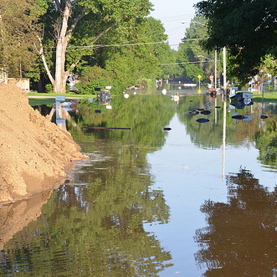 DROWNING: The Souris River overflowed levees in Minot, N.D., as seen here on June 23. Image: Patrick Moes/U.S. Army Corps of Engineers
In North Dakota the waters kept rising. Swollen by more than a month of record rains in Saskatchewan, the Souris River topped its all time record high, set back in 1881. The floodwaters poured into Minot, North Dakota’s fourth-largest city, and spread across thousands of acres of farms and forests. More than 12,000 people were forced to evacuate. Many lost their homes to the floodwaters.
Yet the disaster unfolding in North Dakota might be bringing even bigger headlines if such extreme events hadn’t suddenly seemed more common. In this year alone massive blizzards have struck the U.S. Northeast, tornadoes have ripped through the nation, mighty rivers like the Mississippi and Missouri have flowed over their banks, and floodwaters have covered huge swaths of Australia as well as displaced more than five million people in China and devastated Colombia. And this year’s natural disasters follow on the heels of a staggering litany of extreme weather in 2010, from record floods in Nashville, Tenn., and Pakistan, to Russia’s crippling heat wave.
These patterns have caught the attention of scientists at the National Climatic Data Center in Asheville, N.C., part of the National Oceanic and Atmospheric Administration (NOAA). They’ve been following the recent deluges’ stunning radar pictures and growing rainfall totals with concern and intense interest. Normally, floods of the magnitude now being seen in North Dakota and elsewhere around the world are expected to happen only once in 100 years. But one of the predictions of climate change models is that extreme weather—floods, heat waves, droughts, even blizzards—will become far more common. “Big rain events and higher overnight lows are two things we would expect with [a] warming world,” says Deke Arndt, chief of the center’s Climate Monitoring Branch. Arndt’s group had already documented a stunning rise in overnight low temperatures across the U.S. So are the floods and spate of other recent extreme events also examples of predictions turned into cold, hard reality?
Increasingly, the answer is yes. Scientists used to say, cautiously, that extreme weather events were “consistent” with the predictions of climate change. No more. “Now we can make the statement that particular events would not have happened the same way without global warming,” says Kevin Trenberth, head of climate analysis at the National Center for Atmospheric Research (NCAR) in Boulder, Colo.
That’s a profound change—the difference between predicting something and actually seeing it happen. The reason is simple: The signal of climate change is emerging from the “noise”—the huge amount of natural variability in weather.
Extreme signals
There are two key lines of evidence. First, it’s not just that we’ve become more aware of disasters like North Dakota or last year’s Nashville flood, which caused $13 billion in damage, or the massive 2010 summer monsoon in Pakistan that killed 1,500 people and left 20 million more homeless. The data show that the number of such events is rising. Munich Re, one of the world’s largest reinsurance companies, has compiled the world’s most comprehensive database of natural disasters, reaching all the way back to the eruption of Mount Vesuvius in A.D. 79. Researchers at the company, which obviously has a keen financial interest in trends that increase insurance risks, add 700 to 1,000 natural catastrophes to the database each year, explains Mark Bove, senior research meteorologist in Munich Re’s catastrophe risk management office in Princeton, N.J. The data indicate a small increase in geologic events like earthquakes since 1980 because of better reporting. But the increase in the number of climate disasters is far larger. “Our figures indicate a trend towards an increase in extreme weather events that can only be fully explained by climate change,” says Peter Höppe, head of Munich Re’s Geo Risks Research/Corporate Climate Center: “It’s as if the weather machine had changed up a gear.
The second line of evidence comes from a nascent branch of science called climate attribution. The idea is to examine individual events like a detective investigating a crime, searching for telltale fingerprints of climate change. Those fingerprints are showing up—in the autumn floods of 2000 in England and Wales that were the worst on record, in the 2003 European heat wave that caused 14,000 deaths in France, in Hurricane Katrina—and, yes, probably even in Nashville. This doesn’t mean that the storms or hot spells wouldn’t have happened at all without climate change, but as scientists like Trenberth say, they wouldn’t have been as severe if humankind hadn’t already altered the planet’s climate.This new science is still controversial. There’s an active debate among researchers about whether the Russian heat wave bears the characteristic signature of climate change or whether it was just natural variability, for instance. Some scientists worry that trying to attribute individual events to climate change is counterproductive in the larger political debate, because it’s so easy to dismiss the claim by saying that the planet has always experienced extreme weather. And some researchers who privately are convinced of the link are reluctant to say so publicly, because global warming has become such a target of many in Congress.
But the evidence is growing for a link between the emissions of modern civilization and extreme weather events. And that has the potential to profoundly alter the perception of the threats posed by climate change. No longer is global warming an abstract concept, affecting faraway species, distant lands or generations far in the future. Instead, climate change becomes personal. Its hand can be seen in the corn crop of a Maryland farmer ruined when soaring temperatures shut down pollination or the $13 billion in damage in Nashville, with the Grand Ole Opry flooded and sodden homes reeking of rot. “All of a sudden we’re not talking about polar bears or the Maldives any more,” says Nashville-based author and environmental journalist Amanda Little. “Climate change translates into mold on my baby’s crib. We’re talking about homes and schools and churches and all the places that got hit.”
Drenched in Nashville
Indeed, the record floods in Nashville in May 2010 shows how quickly extreme weather can turn ordinary life into a nightmare. The weekend began innocuously. The forecast was a 50 percent chance of rain. Musician Eric Normand and his wife Kelly were grateful that the weather event they feared, a tornado, wasn’t anticipated. Eric’s Saturday concert in a town south of Nashville should go off without a hitch, he figured.
He was wrong. On Saturday, it rained—and rained. “It was a different kind of rain than any I had experienced in my whole life,” says Nashville resident Rich Hays. Imagine the torrent from an intense summer thunderstorm, the sort of deluge that prompts you to duck under an underpass for a few minutes until the rain stops and it’s safe to go on, Little says. It was like that, she recalls—except that on this weekend in May 2010 it didn’t stop. Riding in the bus with his fellow musicians, Normand “looked through a window at a rain-soaked canopy of green and gray,” he wrote later. Scores of cars were underwater on the roads they had just traveled. A short 14-hour bus gig turned out to be “one of the most stressful and terrifying we had ever experienced,” Normand says.
And still it rained—more than 13 inches (33 centimeters) that weekend. The water rose in Little’s basement—one foot, two feet, three feet (one meter) deep. “You get this panicky feeling that things are out of control,” she says. Over at Hays’s home, fissures appeared in the basement floor, and streams of water turned into a “full-on river,” Hays recalls. Then in the middle of night, “I heard this massive crack, almost like an explosion,” he says. The force of the water had fractured the house’s concrete foundation. He and his wife spent the rest of the night in fear that the house might collapse.
Sunday morning, Normand went out in the deluge to ask his neighbor if he knew when the power might go back on—it was then he realized that his normal world had vanished. A small creek at the bottom of the hill was now a lake one-half mile (0.8 kilometer) wide, submerging homes almost up to their second stories. “My first reaction was disbelief,” Normand says. He and his family were trapped, without power and surrounded by flooded roads. “We were just freaked out,” he recalls.
And all across the flooded city the scenes were surreal, almost hallucinatory, Little says. “There were absurdities heaped upon absurdities. Churches lifted off foundations and floating down streets. Cars floating in a herd down highways.” In her own basement her family’s belongings bobbed like debris in a pond.
By time the deluge ended, more than 13 inches (33 centimeters) of rain had fallen, as recorded at Nashville’s airport. The toll: 31 people dead, more than $3 billion in damage—and an end to the cherished perception that Nashville was safe from major weather disasters. “A community that had never been vulnerable to this incredible force of nature was literally taken by storm,” Little says.
But can the Nashville deluge, the North Dakota floods and the many other extreme weather events around the world be connected with the greenhouse gases that humans have spewed into the atmosphere? Increasingly the answer seems to be yes. Whereas it will never be possible to say that any particular event was caused by climate change, new science is teasing out both the contributions that it makes to individual events—and the increase in the odds of extreme weather occurring as a result of climate change.
Reviewing the Nisbet ‘Climate Shift’ Report and Controversial Claims of Media Progress (Yale Forum on Climate Change & The Media)
by John Wihbey | July 11, 2011
Matt Nisbet’s ‘Climate Shift’ research report raised headline-grabbing points on fundraising successes by those advocating action on climate change. But it’s what lies behind those headlines — and relating specifically to media coverage — that also warrants further review and analysis.
Few pieces of recent academic research on climate change have stirred up as much controversy as American University professor Matthew Nisbet’s April 2011 report “Climate Shift: Clear Vision for the Next Decade of Public Debate.”
The report’s biggest headline-grabbing finding — that the environmental lobby is now holding its own in the money race with industry groups opposing carbon regulations — doubtless will generate further analysis, and one can imagine more such annual scorecards assessing this power struggle. And the questions “Climate Shift” raises about the relative political wisdom — or lack of same — in pushing the failed cap-and-trade bill in Congress may well be debated by historians for years to come.
Perhaps the most underappreciated facet of the scholarship that Nisbet put forth, however, involves his analysis of media coverage in the years 2009-2010, contained in his provocatively titled chapter 3, “The Death of a Norm: Evaluating False Balance in News Coverage.”
According to Nisbet’s story-by-story analysis that covers the vertiginous period involving Copenhagen, the so-called “climategate” hacked e-mails, and federal cap-and-trade, the mainstream media — represented in his analysis by The New York Times, CNN.com, The Wall Street Journal, Politico, and The Washington Post — basically moved past the oft-criticized journalistic mode of “he said, she said,” or “false balance.” In its place, those media generally reflected the “consensus science” as backed by organizations such as the U.N.’s IPCC and the National Academy of Sciences and most of its international counterparts. (The opinion pages of the Journal are bracketed as an exception, and Nisbet’s analysis shows that its editorials do indeed continue to cast doubt on climate science.)
Nisbet’s assertion is a profound one, with significant implications. His stated goal with “Climate Shift” is to help reorient the priorities of groups trying to combat global change through the promotion of science and smart messaging to the public. (See companion posting based on author’s extensive e-mail interview with Nisbet.)
“[I]f trend-setting national media have overwhelmingly portrayed the consensus views on the fundamentals of climate science (as the report’s findings indicate),” Nisbet wrote in a recent e-mail interview with The Yale Forum, “then we should be turning to other types of media organizations in our engagement efforts and focusing on other dimensions of coverage, including … subsidizing the ability of local and regional media to cover climate change and energy insecurity as these challenges relate to their region and communities.” These are ideas Nisbet has raised also in previous reports.
Lines of Criticism
Bloggers at Media Matters do criticize how Nisbet interprets his data around the “climategate” period — one of the few on-the-numbers critiques. Nisbet responds that changes in coverage since then are either not “statistically significant” or “not meaningful.”
Other than that, few have questioned the particulars of Nisbet’s labor-intensive analysis of how those five outlets performed. Their selection — and the exclusion of others — though, is the subject of debate.
Nisbet says he chose those specific news outlets because they set the news agenda and have high-volume traffic, as reflected in Nielsen-tabulated figures. CNN.com, the Post and the Times ranked numbers 4, 5 and 9, respectively, in terms of web traffic in 2009. But given that news aggregators such as Yahoo, AOL, and Google ranked 1, 3, and 6, respectively, one might think that Nisbet’s universe of analysis did not capture the true flow of public news information.
The combined traffic of the aggregators is nearly twice that of the news sites Nisbet focused on. Admittedly, though, these aggregators would be a moving target — and an empirical analysis of the quality of news linked to would be difficult — but that’s where some huge portion of the public gets its news and information, and therefore its impressions and opinions.
(One other quibble, about the selection of Politico: Nisbet calls it “the paper ‘the White House wakes up to,’ as memorably headlined in a profile at The New York Times.” In fact, the article he cites is really just a profile of Politico reporter Mike Allen and his important day calendar “Playbook” blog. Though Politico is powerful and prolific, what constitutes “the paper of record for members of Congress,” as Nisbet puts it, may be an issue of reasonable disagreement among media watchers.)
Climate communications expert and University of Colorado-Boulder professor Max Boykoff was one of the formal reviewers for the “Climate Shift” report. He told The Yale Forum in an e-mail interview, “Overall, I found [Nisbet’s] work in Chapter 3 to be good. As he assembled it I spoke with Matt multiple times. (Chapter 3 was the part of the report I most focused on). We discussed how to replicate the methods and approaches that I undertook in my work on empirically testing the accuracy of coverage about human contributions to climate change (aka, the ‘balance as bias’ thesis). His methods and findings (re: WSJ op-ed divergence etc.) appeared valid and reliable.”
Still, Boykoff stated a potentially striking limitation of this type of analysis in his reviewer comments submitted back to Nisbet: Such analysis “still isn’t equipped to gauge how one particular carefully/prominently/well- or ill-timed article or commentary could have a much greater influence on public perceptions and views than consistently inaccurate treatment. In other words, the sometimes haphazard nature of media consumption — from skimming articles to just hearing/watching portions of a segment — isn’t accounted for through this approach. At the end of the day, these studies … struggle to account for ‘selective listening’ or ‘selective reading’ that we actually engage in during our daily lives.”
Boykoff also said he told Nisbet that his (Nisbet’s) research had not provided sufficient support for the “Climate Shift” report’s contention that “even in a world of blogs and fragmented audiences, the coverage appearing at these outlets strongly shapes the news decisions made at the broadcast and cable networks and informs the decisions of policymakers.”
The Fox News Question
Other notable criticisms of Nisbet’s approach in Chapter 3 of his report have focused on his exclusion of television sources, particularly Fox News. Prolific blogger and energy/climate expert Joseph Romm, who leveled ferocious criticism of Nisbet on his “Climate Progress” blog, makes much of this point. This dispute is a tricky one, resting on a difficult-to-resolve social science debate about how “persuade-able” the Fox News audience is, and just how best to measure the impacts of its huge ratings and online readership as part of American political consciousness.
In his comments to The Yale Forum, Nisbet replied, “As I discuss in the report, the audience for Fox News and political talk radio tend to be strongly self-selecting with consumption of these media tending to reinforce the views of those already doubtful or dismissive of climate change (approximately 25 percent of Americans).” Moreover, he says it “is not clear how these unsurprising findings would help us to move forward since any level of engagement with Fox News producers or talk radio hosts is unlikely to lead to changes in their coverage patterns. We can complain about and criticize these outlets, but much of the criticism and anger, I would argue, often ends up distracting us from initiatives where we can make a difference with journalists, editors, and with different publics.”
This latter point, of course, highlights an important facet of Nisbet’s project, namely that it has a particular goal, an “agenda” even, that puts an emphasis on both utility, or making a “difference,” and on truth as criteria for inquiry. (It’s possible this is where he opens the door for controversy, as it leaves him open to criticisms that he is downplaying conservative media and thereby painting an unduly positive picture of the U.S. media as a whole on climate issues.)
Columbia Journalism Review science editor Curtis Brainard told The Yale Forum recently that he thinks the spirit of Nisbet’s report is basically right in Chapter 3, at least as it relates to “news reporters and news articles.” For Nisbet and Brainard both, broad accusations that public ignorance is the media’s “fault” are no longer well-founded.
“There is this conventional wisdom floating around out there that journalists are inept, rarely able to get their facts straight or explain or deliver an accurate account of events,” Brainard wrote in an e-mail. “They’re not. But it’s much easier for activists and other policy or program stakeholders to blame the media when things don’t go their way than to analyze the much more complicated interplay of multiple factors.”
(As an aside, Brainard notes that he wrote about precisely this dynamic in his recent article, “Tornadoes and Climate Change,” which pushes back against such charges leveled by environmental writer and activist Bill McKibben. Brainard says McKibben is too quick to condemn the media as a whole for not making connections between various extreme weather events.)
We’re past those earlier days, Brainard told The Yale Forum, when the basic questions about climate science are portrayed in most mainstream news media as being unsettled: “The coverage has become so much more sophisticated since then, delving into the specific consequences of climate change, from sea level rise, to changing precipitation and drought patterns, to consequences for flora and fauna. Many reporters struggle to accurately explain the highly uncertain and nuanced science underlying these phenomena, but the flaws in the coverage are quite different from the false balance that was on exhibit before, say, 2006. First of all, there is nowhere near as much scientific consensus about these finer points of climate science as there is about the fundamentals (i.e., the Earth is warming, and humans are most likely to blame), so today’s stories are really apples compared with yesterday’s oranges.”
Work Ahead for Media, Scholars
If Nisbet’s report has an underlying flaw, perhaps, it may be in its packaging, particularly in its “Move On”-style message and ambition to deliver a definitive verdict. Its real virtue is that it has just very effectively — whether or not one buys it all — started a different kind of conversation. And given that just five outlets were analyzed in the report, there is certainly much more conversation to be had.
As mentioned, Nisbet has said he is already carrying out new research and further study on local and regional media. (See his latest thoughts on this issue as they relate to Chicago.) It’s a cause on which all academics and media professionals and critics might agree, as the business model for such outlets continues to erode. Local information ecosystems are changing, shifting, and in many cases decaying. But many observers point out how essential they remain.
“It would also be good to look at the practically countless number of local TV network affiliates across the country since, collectively, they are where most Americans still get their news,” Brainard also noted.
“Local newspapers, as Pew has documented, remain at the center of the local media ecosystem, with the overwhelming number of regional/local issues covered by local TV news and at local blogs originating from local newspaper coverage,” Nisbet said. “In this sense, on climate change and energy, we should think about local and regional newspapers as being part of the central communication infrastructure that regions and communities need to learn, connect, plan and make collective choices on the issue.”
Perhaps, through further studies by Nisbet and others, this important work on local and regional media — their shortcomings and needs — can shed additional light.
John Wihbey is a regular contributor to the Yale Forum. He is a journalist and researcher, and he can be reached at jpwihb@yahoo.com.
Nordeste perde um quinto dos reservatórios de água em 2010 (FSP)
JC e-mail 4304, de 20 de Julho de 2011.
Relatório aponta bacias da região semiárida como as mais críticas.
A região Nordeste do País perdeu, entre outubro de 2009 e outubro de 2010, 20% dos reservatórios de água que possuía no período anterior, segundo a ANA (Agência Nacional de Águas). O dado está em um relatório sobre os recursos hídricos do País, publicado ontem e disponível em http://bit.ly/pnZBqo. Segundo a agência, a perda de reservatórios na região se deve à menor quantidade de chuvas.
Na região ficam as bacias do Semiárido, um dos pontos críticos quanto aos recursos hídricos, segundo o relatório. Também são classificadas assim as bacias do rio Meia Ponte, no Centro-Oeste, e a do Tietê, no Sudeste.
A definição leva em conta a disponibilidade e o uso de água, além da presença ou não de vegetação nativa e como é feito o tratamento dos resíduos sólidos no local. Segundo a ministra do Meio Ambiente, Izabella Teixeira, a ideia é, a partir dos dados do relatório, “focar os esforços nas áreas críticas”.
A ampliação dos serviços de saneamento foi apontada como prioridade pela ministra, principalmente nas cidades de até 50 mil habitantes. O pior índice de qualidade da água é o das áreas de grande densidade urbana.
(Folha de São Paulo)
Rios em péssimas condições (O Globo)
JC e-mail 4304, de 20 de Julho de 2011.
Brasil tem só 4% de recursos hídricos com qualidade ótima, segundo relatório.
Com 12% da oferta de água do planeta, o Brasil tem apenas 4% de seus recursos hídricos com qualidade considerada ótima, percentual que caiu seis pontos de 2008 para 2009. Segundo avaliação do “Informe 2011 da Conjuntura dos Recursos Hídricos do Brasil”, divulgado ontem pela Agência Nacional de Águas (ANA), cem rios estão em situação ruim ou péssima.
Para avaliar o índice de qualidade da água, a agência usa nove parâmetros, que levam em conta principalmente a contaminação dos rios pelo lançamento de esgoto. Essa centena de rios em situação precária não consegue depurar naturalmente a quantidade de resíduos que vêm recebendo. Embora o governo argumente que está fazendo investimentos em políticas públicas de saneamento, mais da metade das cidades do país – 2.926 municípios – não tem tratamento de esgoto. O relatório aponta que em 2009 foram investidos R$21,4 bilhões em saneamento e gestão da água, sendo R$13,2 bilhões em obras de tratamento de esgoto.
A água de pior qualidade se concentra perto das regiões metropolitanas de São Paulo, Curitiba, Belo Horizonte, Porto Alegre, Rio de Janeiro e Salvador e das cidades de médio porte, como Campinas (SP) e Juiz de Fora (MG). Entre os rios cuja água é de péssima ou má qualidade, estão o Tietê, que corta a capital paulista, o Iguaçu, que forma as famosas Cataratas do Iguaçu, e o Guandu-Mirim, no Rio – os dois últimos ficam dentro de unidades de conservação, o Parque Nacional do Iguaçu e a Área de Proteção Ambiental (APA) do Rio Guandu, respectivamente.
Entre 2008 e 2009, a água de qualidade péssima no país se manteve em 2%; a ruim aumentou de 6% para 7%; a regular passou de 12% para 16% e a boa subiu de 70% para 71%. Nesse período, o número de pontos monitorados caiu de 1.812 para 1.747. O superintendente de Planejamento de Recursos Hídricos da agência, Ney Maranhão, mostrou-se satisfeito com os resultados do estudo.
– Temos 90,6% dos rios num estado satisfatório de qualidade e de disponibilidade (quantidade de água). Apenas 2% não apresentam resultado satisfatório – avaliou Maranhão, que coordenou o trabalho.
Estresse hídrico e agricultura – Maranhão ressaltou que as políticas públicas têm sido direcionadas para as bacias que estão em situação crítica, seja por apresentarem baixa disponibilidade ou qualidade de água. A maior parte dos rios e bacias com problema de oferta de água se encontra no Nordeste.
A ministra do Meio Ambiente, Izabella Teixeira, disse que, no futuro, o estresse hídrico (falta de água em algumas regiões do país) vai impactar na agricultura. Ao todo, 69% dos recursos consumidos pela população são usados em irrigação. Izabella aproveitou a ocasião para mandar um recado ao Congresso, onde tramita a reforma do Código Florestal.
– Quando estamos discutindo Código Florestal, não falamos apenas do uso do solo. Estamos falando de recursos hídricos e qualidade de vida. O relatório traz com muita propriedade o estresse hídrico com perda de mata ciliar (vegetação nativa às margens dos rios). Onde se desmata mata ciliar, há comprometimento dos recursos hídricos – afirmou a ministra.
O levantamento da ANA também levou em conta o problema das mudanças climáticas, responsáveis por eventos naturais extremos em datas diferentes no ano passado: a estiagem na Amazônia; as enchentes em Alagoas, Pernambuco e em Minas Gerais; as cheias no Rio, em São Paulo e no Rio Grande do Sul. Um exemplo do agravamento dessa situação: em 2006, foram registradas 135 situações de emergência ou de calamidade pública por conta de fortes chuvas. Em 2010, esse número de ocorrências subiu para 601. No total, quase 10% das cidades brasileiras – 563 municípios – decretaram situação de emergência devido a enchentes, inundações, enxurradas e alagamentos.
No caso das secas, houve uma inversão: 2010 registrou menos casos de emergência (583) do que 2006 (914). Entre 2009 e 2010 houve diminuição de 20,8% no nível dos reservatórios de água construídos no Nordeste para combater estiagens.
(O Globo)
La Niña’s Exit Leaves Climate Forecasts in Limbo (NASA)
06.29.11
 The latest satellite data of Pacific Ocean sea surface heights from the NASA/European Ocean Surface Topography Mission/Jason-2 satellite show near-normal conditions in the equatorial Pacific. The image is based on the average of 10 days of data centered on June 18, 2011. Higher (warmer) than normal sea surface heights are indicated by yellows and reds, while lower (cooler) than normal sea surface heights are depicted in blues and purples. Green indicates near-normal conditions. Image credit: NASA/JPL Ocean Surface Topography Team
It’s what Bill Patzert, a climatologist and oceanographer at NASA’s Jet Propulsion Laboratory in Pasadena, Calif., likes to call a “La Nada” – that puzzling period between cycles of the El Niño-Southern Oscillation climate pattern in the Pacific Ocean when sea surface heights in the equatorial Pacific are near average.
The comings and goings of El Niño and La Niña are part of a long-term, evolving state of global climate, for which measurements of sea surface height are a key indicator. For the past three months, since last year’s strong La Niña event dissipated, data collected by the U.S.-French Ocean Surface Topography Mission (OSTM)/Jason-2 oceanography satellite have shown that the equatorial Pacific sea surface heights have been stable and near average. Elsewhere, however, the northeastern Pacific Ocean remains quite cool, with sea levels much lower than normal. The presence of cool ocean waters off the U.S. West Coast has also been a factor in this year’s cool and foggy spring there.
The current state of the Pacific is shown in this OSTM/Jason-2 image, based on the average of 10 days of data centered on June 18, 2011. The image depicts places where Pacific sea surface height is higher (warmer) than normal as yellow and red, while places where the sea surface is lower (cooler) than normal are shown in blue and purple. Green indicates near-normal conditions. Sea surface height is an indicator of how much of the sun’s heat is stored in the upper ocean.
For oceanographers and climate scientists like Patzert, “La Nada” conditions can bring with them a high degree of uncertainty. While some forecasters (targeting the next couple of seasons) have suggested La Nada will bring about “normal” weather conditions, Patzert cautions previous protracted La Nadas have often delivered unruly jet stream patterns and wild weather swings.
In addition, some climatologists are pondering whether a warm El Niño pattern (which often follows La Niña) may be lurking over the horizon. Patzert says that would be perfectly fine for the United States.
“For the United States, there would be some positives to the appearance of El Niño this summer,” Patzert said. “The parched and fire-ravaged southern tier of the country would certainly benefit from a good El Niño soaking. Looking ahead to late August and September, El Niño would also tend to dampen the 2011 hurricane season in the United States. We’ve had enough wild and punishing weather this year. Relief from the drought across the southern United States and a mild hurricane season would be very welcome.”
Jason-2 scientists will continue to monitor Pacific Ocean sea surface heights for signs of El Niño, La Niña or prolonged neutral conditions.
JPL manages the U.S. portion of the OSTM/Jason-2 mission for NASA’s Science Mission Directorate, Washington, D.C.
For more information on NASA’s ocean surface topography missions, visit: http://sealevel.jpl.nasa.gov/missions/.
To view the latest Jason-1 and OSTM/Jason-2 data, visit: http://sealevel.jpl.nasa.gov/science/elninopdo/latestdata/.
Alan Buis 818-354-0474
Jet Propulsion Laboratory, Pasadena, Calif.
Alan.buis@jpl.nasa.gov
2011-199
Estudo faz diagnóstico atualizado da situação da água e de sua gestão no Brasil (ANA)
JC e-mail 4303, de 19 de Julho de 2011.
Relatório da ANA aponta desafios para a qualidade das águas e evolução da gestão dos recursos hídricos.
A partir de hoje (19), o Brasil saberá qual é a real situação da água no País em vários aspectos, como: disponibilidade hídrica, qualidade e gestão de recursos hídricos. A Agência Nacional de Águas (ANA) divulga o Relatório de Conjuntura dos Recursos Hídricos no Brasil – Informe 2011. A publicação estará disponível também no site: http://conjuntura.ana.gov.br/conjuntura/.
Com dados consolidados até dezembro de 2010, o estudo da ANA, que atende a uma demanda do Conselho Nacional de Recursos Hídricos, é uma ferramenta de acompanhamento sistemático e anual da condição dos recursos hídricos e de sua gestão em escala nacional, por regiões hidrográficas, em temas fundamentais para o setor de recursos hídricos, como: volume de chuvas; ocorrência de eventos hidrológicos críticos (secas e cheias); disponibilidade hídrica nas diferentes regiões do Brasil; os usos múltiplos da água (irrigação, saneamento e hidroeletricidade, por exemplo); qualidade das águas; a evolução dos comitês de bacias; o planejamento, a regulação e a cobrança pelo uso dos recursos hídricos.
O trabalho registra melhorias na qualidade da água na última década em algumas bacias brasileiras, que receberam investimentos em tratamento de esgotos. Além disso, o estudo mostra que em 2010, 19% dos municípios brasileiros decretaram situação de emergência ou estado de calamidade pública devido à ocorrência de cheias ou problemas de estiagem ou seca, sendo que o número geral desses registros caiu de 1967, em 2009, para 1184 no ano passado. No aspecto da gestão de recursos hídricos, o Informe 2011 indica um aumento do número de comitês de bacias e da área de cobertura do território nacional por planos de recursos hídricos (51% do território nacional) – planos diretores que visam a fundamentar e orientar a implementação do gerenciamento e da Política Nacional de Recursos Hídricos.
O Informe 2011 contém uma análise considerando de forma integrada os aspectos de quantidade (relação entre demanda de água e oferta – balanço quantitativo) e qualidade da água nas bacias brasileiras. Os resultados dessa avaliação apontam para um conjunto de bacias críticas, onde há maior potencial para ocorrência de conflitos pelo uso da água, que deverão merecer atenção crescente por parte dos gestores de recursos hídricos.
Para a ministra do Meio Ambiente, Izabella Teixeira, o Relatório de Conjuntura dos Recursos Hídricos no Brasil – Informe 2011 é uma ferramenta importante para que o País conheça a realidade da condição de suas águas. “O acompanhamento e a avaliação da situação dos recursos hídricos em escala nacional pelo Relatório subsidiam a definição das ações e intervenções necessárias para a melhora da quantidade e da qualidade das águas”, afirma.
Segundo o diretor-presidente da ANA, Vicente Andreu, o Informe 2011 permite o acompanhamento dos desafios e da evolução do setor de recursos hídricos no Brasil. “Por meio do Relatório de Conjuntura, os gestores públicos têm um panorama da situação dos recursos hídricos do País, o que permite a evolução da gestão de nossas águas”, destaca.
Para a elaboração do Relatório de Conjuntura – Informe 2011, a ANA contou com a parceria da Secretaria de Recursos Hídricos e Ambiente Urbano do Ministério do Meio Ambiente (SRHU/MMA), Departamento Nacional de Obras contras as Secas (DNOCS), do Instituto Nacional de Meteorologia (Inmet) e de todos os órgãos gestores estaduais de recursos hídricos e meio ambiente.
A primeira edição do Relatório de Conjuntura foi lançada em 2009, em reunião do Conselho Nacional de Recursos Hídricos (CNRH). No ano seguinte, o trabalho serviu de base para a 1ª atualização do Plano Nacional de Recursos Hídricos. Entre 2010 e 2012, estão previstos Informes anuais que atualizam os dados do estudo.
Qualidade das águas – Em comparação ao Informe 2010, o diagnóstico dos mais de 1.700 pontos analisados quanto à qualidade das águas revela a manutenção do quadro geral do País com várias bacias comprometidas devido ao grande lançamento de esgotos urbanos domésticos sem tratamento adequado, especialmente nas regiões metropolitanas. No entanto, em algumas bacias foi possível associar melhorias na qualidade das águas a investimentos realizados em tratamento de esgotos na última década, como por exemplo nas seguintes bacias: do rio das Velhas, Paraíba do Sul, Grande e Tietê (Reservatório Billings – Braço do Taquacetuba).
Eventos críticos – Em 2010, exatos 563 municípios brasileiros decretaram situação de emergência ou estado de calamidade pública devido à ocorrência de cheias, causadas por chuvas acima da média histórica. São Paulo, Rio de Janeiro, Alagoas, Pernambuco, Bahia e os estados da região Sul foram os mais atingidos. Já o Semiárido e a região Amazônica concentraram a maior parte dos 521 municípios (aproximadamente 9% do total nacional) que tiveram que decretar situação de emergência ou estado de calamidade pública em decorrência de estiagem (evento mais duradouro) ou seca. Em comparação a 2009, o número de ocorrências de 2010 caiu de 1967 para 1184.
Irrigação – Responsável por 69% do consumo de água no Brasil, a irrigação atingia no final da última década 4,5 milhões de hectares irrigados dos 29,6 milhões irrigáveis.
Hidroeletricidade – Entre 2009 e 2010, ocorreu um aumento de 2.093 MW (acréscimo de 3%) na capacidade hidrelétrica instalada que alcançou, ao final de 2010, 80.703 MW, o que representa 71% da matriz elétrica nacional.
Gestão de recursos hídricos – Sobre o planejamento de recursos hídricos em bacias interestaduais, em 2010 foi concluído e aprovado o Plano de Recursos Hídricos da Bacia do Rio Doce. Os planos da Bacia Amazônica – Afluentes da Margem Direita e Verde Grande, concluídos em 2010, tiveram sua aprovação em 2011, respectivamente pelo CNRH e pelo comitê da bacia do Verde Grande. Com isso, a cobertura do território brasileiro por planos de recursos hídricos finalizados chegou a 51%. Com a conclusão de seus planos estaduais de recursos hídricos, Piauí e Minas Gerais fizeram com que 12 das 27 da unidades da Federação tivessem o instrumento. Estes planos diretores visam a fundamentar e orientar a implementação do gerenciamento e da Política Nacional de Recursos Hídricos.
No que diz respeito aos comitês de bacias, em 2007 havia 150 no País. Já em 2010, o número chegou a 173 desses colegiados (um tipo de parlamento das águas), sendo 164 estaduais e 9 interestaduais. Já a cobrança pelo uso dos recursos hídricos entrou em funcionamento na bacia do rio São Francisco, integrando com as bacias do Paraíba do Sul e dos rios Piracicaba, Capivari e Jundiaí (PCJ), o conjunto de bacias interestaduais com cobrança implementada.
Sobre a outorga de direito de uso de recursos hídricos, entre 2009 e 2010 houve um aumento de 8% na vazão total outorgada no País, que chegou a 5.825m³/s, em virtude do avanço da implementação do instrumento pelos estados, do aumento da demanda por água e também devido ao aumento da base de dados considerada neste Informe 2011, quando comparada com a dos relatórios passados.
Nota-se também uma tendência do fortalecimento das políticas estaduais e nacional de recursos hídricos em bacias onde há maior comprometimento quali-quantitativo.
(Ascom da ANA)
Ensino americano abandona aos poucos a escrita em cursivo (Valor Econômico)
JC e-mail 4302, de 18 de Julho de 2011.
Maioria dos estados já não obriga o aprendizado; especialistas veem tendência.
O estado de Indiana, localizado no Meio-Oeste americano, acabou com a exigência de que as suas escolas ensinem a escrita cursiva, aquele estilo de escrever em que as palavras são formadas com letras emendadas pelas pontas. Com isso, juntou-se a uma onda crescente nos Estados Unidos de privilegiar no currículo outras habilidades hoje consideradas mais úteis, como digitar textos em teclados dos computadores.
Com a mudança, Indiana alinha-se a um padrão comum de ensino adotado por 46 Estados americanos. Nele, não há nenhuma menção à escrita cursiva, mas recomenda-se o ensino de digitação. É um reconhecimento de que, com as novas tecnologias, como computadores e telefones inteligentes, as pessoas cada vez menos precisam escrever de forma cursiva, seja no trabalho ou nas suas atividades do dia-a-dia. Basta aprender a escrever com a mão – exigência que ainda faz parte do currículo de Indiana e dos padrões comuns adotados pelos estados – seja com letras de forma, cursiva ou um misto dos dois estilos.
Também é um reflexo do que muitos nos Estados Unidos veem como uma sobrecarga no currículo escolar, com tempo sempre insuficiente para ensinar disciplinas consideradas fundamentais para passar nos testes usados para admissão nas faculdades, como matemática e leitura de textos. Pesquisas nacionais sobre como o tempo é gasto nas salas de aula mostram que 90% dos professores da 1ª a 3ª séries do ensino primário dedicam apenas 60 minutos por semana ao desenvolvimento da escrita com a mão.
A tendência de abandonar o ensino da escrita cursiva é vista com preocupação por parte dos americanos. Para alguns, as novas gerações terão mais dificuldades para fazer atividades básicas, como preencher e assinar cheques. Outros ponderam que os jovens não serão capazes de ler a declaração de independência no original, toda escrita de forma cursiva, num argumento que apela para o patriotismo americano.
Richard S. Christen, professor da Escola de Educação da Universidade de Portland, no Estado do Oregon, é um dos que dizem que as escolas devem pensar duas vezes antes de suspender o ensino da escrita cursiva, embora ele considere cada vez mais difícil defender a tese de que essa é uma habilidade com valor prático.
Divulgação – Richard Christen, professor da Escola de Educação da Universidade de Portland. “Se você voltar ao século XVII ou XIX, seria impossível fechar negócios sem os escrivãos, que foram cuidadosamente treinados na técnica de escrever com as mãos para registrar os fatos”, disse Christen ao Valor. “Mas hoje o valor prático disso é bem menor.”
Ele pondera, porém, que a escrita cursiva também tem um valor estético em si mesma e diz respeito a valores importantes como civilidade. “A escrita cursiva é um jeito de as pessoas se comunicarem com as outras de forma elegante, valorizando a beleza”, afirma. “Essa é uma chance para as crianças fazerem algo com suas mãos todos os dias, prestando atenção para os elementos de beleza, como formas, contornos e linhas”, afirma. Além disso, estimula as crianças a prestarem atenção na forma como se dirigem e se comunicam com as outras pessoas.
Para o professor Steve Graham, da Universidade de Vanderbilt, uma das maiores autoridades americanas no assunto, a questão central não é necessariamente a escrita cursiva, mas sim preservar o espaço para a escrita à mão de forma geral no currículo.
Apesar de todo o barulho em torno das novas tecnologias, a realidade, afirma ele ao Valor, é que hoje a maioria das crianças nas escolas americanas ainda faz os seus trabalhos em sala de aula com as mãos, pois de forma geral ainda não existe um computador para cada uma delas. Num ambiente como esse, a boa grafia é crucial para o bom aprendizado e para o sucesso na vida acadêmica, ainda que no mundo fora das salas de aula predominem computadores, iPads e telefones inteligentes.
Pesquisa recente conduzida por Graham mostra que, se trabalhos escolares ou provas são apresentados numa grafia sofrível, as notas tendem a ser mais baixas, a despeito do conteúdo. “As pessoas formam opiniões sobre a qualidade de suas ideias com base na sua qualidade de sua escrita”, afirma Graham.
Nesse estudo, alunos escreveram redações, que foram submetidas em seguida a avaliações com notas entre 0 e 100. O passo seguinte foi pegar redações medianas, que tiveram nota 50, e reproduzir seu conteúdo em duas versões, uma com grafia impecável e outra com grafia sofrível, embora legível. Submetidas a uma nova avaliação, a conclusão é que a mesma redação mediana ganhou notas muito boas quando escrita com letras caprichadas e notas inferiores quando escritas com garranchos.
A habilidade de escrever à mão também tem influência sobre a capacidade da criança de produzir bons conteúdos na escrita. Velocidade é crucial. Quando a escrita se torna um processo automático, afirma Graham, as ideias fluem mais rapidamente do cérebro para o papel e, portanto, não se perdem no meio do caminho. Pessoas bem treinadas para escrever com as mãos fazem tudo de forma automática e não precisam pensar sobre o que ocorre com o lápis – e sobram assim mais neurônios para serem dedicados a coisas mais importantes, como refletir sobre a mensagem, organizar as ideias e formar frases e parágrafos.
São bons argumentos para não se abandonar o ensino da escrita à mão pela digitação. Mas qual técnica é mais importante: a cursiva ou a simples escrita à mão? Graham diz que a escrita em letras de forma é em geral mais legível do que a cursiva, mas a escrita cursiva é mais rápida do que a escrita em letra de forma. “As diferenças não são grandes o suficiente para justificar muito debate”, disse. “O importante é ter um estilo de escrita à mão que seja ao mesmo tempo legível e rápido.”
Mas no futuro, reconhece ele, o ensino da escrita à mão pode se tornar menos importante, à medida que ter um computador para cada aluno se torne algo universal. O ensino de digitação, por outro lado, torna-se cada vez mais relevante. “Eles são muito bons com seus telefones, com o twitter, mas não com os computadores”, afirma Graham.
No Brasil, educadores se dividem sobre benefícios – Pais decepcionados com o aprendizado dos filhos poderiam dizer que tudo não passa de um debate bizantino sobre se é melhor tentar decifrar garranchos escritos com letra de médico ou torpedos criptografados numa novilíngua que aboliu as vogais. De qualquer forma, as opiniões se dividem também entre os educadores brasileiros quando se discute a validade de um abandono do ensino da escrita em cursivo.
Para Telma Weisz, doutora em psicologia da aprendizagem e do desenvolvimento pela Universidade de São Paulo (USP) e supervisora pedagógica do Programa Ler e Escrever, do governo do Estado de São Paulo, “a escrita manuscrita é um resto da Idade Média”. “Do ponto de vista da aprendizagem, não há perda em não usar a manuscrita”, afirma. Segundo ela, a escrita cursiva ajuda o aluno a memorizar a forma ortográfica das palavras, mas um programa de computador processador de texto tem a mesma eficiência, “com mais recursos, aliás”.
Weisz diz que o problema não é desprezar a escrita cursiva e mergulhar de vez na digitação, e sim que “no Brasil não há condições de se fazer isso. Temos escolas onde não há luz, que dirá escola onde todos os alunos tenham um computador”.
João Batista Araujo e Oliveira, doutor em pesquisa educacional pela Florida State University (EUA) e presidente do Instituto Alfa e Beto, ONG dedicada à alfabetização, discorda de Weisz. “Há pesquisas que comparam crianças que aprenderam com a letra cursiva e que aprenderam no teclado, e quem escreve mais à mão grava mais a forma ortográfica da palavra”, diz.
No entanto, Oliveira não tem uma posição radical contra a política adotada pela maioria dos Estados americanos, de não obrigar o ensino do cursivo. “Essas coisas mudam mesmo, é inevitável. Sempre que você tem uma tecnologia nova você procura um meio mais eficiente de avançar. A letra cursiva, por exemplo, é um grande avanço em relação à letra de forma, porque o aluno não tira o lápis do papel.”
Oliveira acredita que antes de se fazer uma mudança dessas é preciso pensar nos “efeitos colaterais”, dando como exemplo a tabuada e a máquina de calcular. “Para pagar o táxi, o cafezinho, você tem que fazer conta de cabeça. Quem só ensina usando a calculadora priva o cidadão de uma competência que dá uma eficiência social muito grande.”
Luis Marcio Barbosa, diretor-geral do colégio Equipe, de São Paulo, descarta adotar a política na sua escola. “Há um conjunto de aprendizado que vem junto com o aprendizado da escrita cursiva que é imprescindível para o desenvolvimento das crianças, que tem a ver com a motricidade, com a organização espacial.” E, além de tudo, diz, “as crianças podem aprender as duas coisas, não precisa ser uma em detrimento da outra.”
A vida dos índios da cidade grande (OESP)
Disponível em: http://www.estadao.com.br/estadaodehoje/20110717/not_imp745999,0.php
Na Favela Real Parque, onde se instalaram nos anos 1950, pancararus conservam tradições espirituais; em aldeia de Parelheiros, crianças guaranis colhem frutas no pé
17 de julho de 2011
Bruno Paes Manso – O Estado de S.Paulo
Assim como migrantes nordestinos, os pancararus começaram a chegar da zona do sertão do São Francisco, em Pernambuco, em meados da década de 1950, em busca de emprego. Eles foram chamados para cortar árvores em loteamentos do bairro do Morumbi, na zona sul, e depois ajudaram nas obras da construção do estádio do São Paulo.
 Paulo Liebert/AE. No extremo sul. Índios guaranis na aldeia Tenondê Porã, em Parelheiros
Instalaram-se nos terrenos vizinhos, descampados que viraram a Favela Real Parque, hoje em processo de urbanização. Estima-se que existam pelo menos mais de 3 mil pancararus na capital, o que os tornaria uma das etnias mais numerosas da cidade. “Depois do incêndio na favela (ocorrido em setembro do ano passado), muitos se dispersaram. Eram mil e hoje são cerca de 200. Estão vivendo de aluguel em outros bairros ou voltaram para a aldeia”, diz o pancararu Ubirajara Ângelo de Souza, de 47 anos, que chegou à Real Parque aos 20 anos. Seu pai trabalhou nas obras do estádio do Morumbi.
Na favela ainda existem lideranças espirituais que rezam nas casas dos indígenas locais e usam ervas medicinais para cura. Também há grupos de canto e dança que utilizam trajes tradicionais em festas indígenas na capital. Para se adaptar às transformações na cidade, os pancararus precisaram aprender a conviver nos últimos anos com as lideranças do tráfico local. “É cada um de um lado. Eu os respeito e eles nos respeitam”, diz Ubirajara, que assim que vender sua casa deve voltar para a aldeia onde nasceu, em Pernambuco.
A melhoria de renda nos Estados do Norte e do Nordeste, por sinal, pode estar levando muitos indígenas a retornar às suas aldeias. Dados do Censo 2010 do Instituto Brasileiro de Geografia e Estatística (IBGE) apontaram redução entre aqueles que se declaram indígenas na Grande São Paulo e na capital. Há dez anos, 33 mil pessoas diziam ser indígenas na metrópole. Atualmente, são 21 mil.
 A aldeia guarani Tenondê Porã, em Parelheiros. Tiago Queiroz/AE
No ano que vem, o IBGE vai divulgar os números da primeira pesquisa em que os indígenas declararam aos recenseadores suas etnias. O levantamento mais completo na capital havia sido feito no ano passado pela Fundação Nacional do Índio (Funai) e apontou a existência de 22 etnias na metrópole paulista. “Ainda é preciso olhar os números do censo com cautela. Pode estar de fato havendo uma onda migratória, porque os indígenas se mudam com grande frequência. Mas só os resultados detalhados no ano que vem vão permitir sabermos com mais clareza o que está ocorrendo”, afirma a antropóloga Lúcia Helena Rangel, da Pontifícia Universidade Católica (PUC-SP).
Mesmo em uma das maiores cidades do mundo, a vida dos índios paulistanos pode ser bem parecida à de indígenas de tribos no interior do País. Na aldeia Tenondê Porã, em Parelheiros, vivem cerca de 1,2 mil guaranis, a 70 quilômetros da Praça da Sé. São basicamente oito grandes famílias, com filhos, netos, bisnetos, genros e noras, que compartilham casas de tijolos, construídas pelo Companhia de Desenvolvimento Habitacional e Urbano de São Paulo (CDHU), seguindo as orientações dos próprios indígenas.
Pratica-se basicamente a agricultura de subsistência, que fornece o alimento cotidiano. Há bananeiras, pés de goiaba, mexerica, goiaba, laranja e manga, que as crianças colhem no pé. A renda vem basicamente do artesanato indígena, vendido para lojinhas da capital.
O cacique, líder local, trava atualmente uma briga para ampliar os perímetros das terras guaranis. Cinco pajés servem como guias espirituais, dando conselhos e rezando em uma casa sagrada. Os pajés também batizam as crianças da aldeia com nomes em guarani, dependendo das características de cada uma. “Vivemos em família, por isso nunca um deixa faltar nada ao outro em nossa comunidade”, afirma o coordenador educacional indígena da aldeia, Adriano Veríssimo, que em guarani se chama Tenonde Porã, nome que significa “belo futuro”.
A vida fora das aldeias pode ser mais difícil. O terena Elton José, de 32 anos, veio para Mogi das Cruzes há dez anos, depois de nascer em uma aldeia em Mato Grosso do Sul onde caçava com lanças e morava em ocas de palha. Acabou seus estudos na Grande São Paulo e hoje trabalha com tecnologia da informação, prestando serviço a grandes empresas. Ele admite que na Grande São Paulo teve acesso a um tipo de conforto que jamais teria se tivesse permanecido em sua aldeia, mas sente falta do que deixou para trás e quer voltar. “Há conforto, mas não há qualidade de vida. Sinto falta do mato. Em São Paulo, você vegeta se não tem dinheiro. O contato familiar é sempre difícil e a relação com os parentes é algo que prezamos muito”, diz.
Elton conta, no entanto, que só passou a realmente valorizar a cultura indígena depois de deixar a sua aldeia.
 Ana Rosa Verissimo, de 89 anos, quarenta deles vividos na aldeia Tenondê Porã. Ela veio com o marido do Paraná e tem mais de cem descendentes, entre filhos, netos e bisnetos. Paulo Liebert/AE
 Keila Pires de Lima, de 7 anos, na aldeia guarani Tenondê Porã, Paulo Liebert/AE
 O xavante Lúcio Waane Terowaa usa brincos de madeira santa. Segundo a tradição, eles ajudam a prever o futuro por meio dos sonhos. Nilton Fukuda/AE.
 Índias da aldeia guarani Tekoa Pyau, na região do Jaraguá. Paulo Liebert/AE
 Tucano e indiozinho na aldeia Tekoa Pyau, na região do Jaraguá. Paulo Liebert/AE
* * *
Cidade de SP tem 38 etnias indígenas
Levantamento da ONG Opção Brasil mostra que Região Metropolitana tem quase o mesmo nº de povos que o Estado do Amazonas
17 de julho de 2011
Bruno Paes Manso – O Estado de S.Paulo
O índio xavante Lúcio Waane Terowaa, de 33 anos, migrou para São Paulo há cinco anos vindo de uma tribo de Barra do Garças, em Mato Grosso. Chegou ao Itaim Paulista, na zona leste, para seguir os passos do mais famoso representante de sua etnia, o cacique Mário Juruna, eleito deputado constituinte em 1986, conhecido por gravar promessas suspeitas de políticos.
No ano passado, em São Paulo, Terowaa se lançou candidato a deputado estadual pelo PSL e teve 318 votos. Em vez do gravador, usa o Facebook como ferramenta política. Tem 910 amigos, com quem debate formas de criar uma aldeia “ecologicamente correta” e autossustentável, que sirva como modelo a ser replicado no Brasil, a partir de São Paulo. “Tenho amigos virtuais de 23 etnias só aqui na cidade. É uma das maiores diversidades do Brasil e por isso São Paulo é uma base importante para a política indígena.”
As impressões do xavante são confirmadas pelo levantamento feito pela ONG Opção Brasil, que organiza cursos de educação indígena nas tribos de São Paulo. Na Região Metropolitana, a Opção Brasil já contactou índios de 54 etnias diferentes – 38 só na capital. No Estado do Amazonas, o site da Fundação Nacional do Índio relaciona 60 etnias.
A exemplo de migrantes das zonas rurais e sertões, os indígenas de São Paulo chegam em busca de emprego e vivem principalmente em bairros pobres da periferia. “Fazemos o mapeamento pelo contato boca a boca. Um índio passa o telefone de outro. O objetivo é criar uma rede para que a vida na cidade grande seja mais fácil”, explica o coordenador da Opção Brasil, Marcos Aguiar.
Os guaranis – índios autóctones que já viviam no Estado antes da chegada dos portugueses – são a única etnia a viver em aldeias na cidade. Duas delas, a Krucutu e a Tenonde Porã, ficam em Parelheiros, na zona sul. A terceira, a Tekoah Itu, é do Pico do Jaraguá, na zona norte. Reúnem cerca de 3 mil guaranis. A Expedição Metrópole foi até lá visitá-los (veja na C3).
As outras 53 etnias são formadas por índios que moram em bairros e favelas da metrópole. Pode ser um pastor evangélico wassu cocal ou um faxineiro cambiuá. Em comum, enfrentam o desafio de carregar uma cultura tradicional e coletivista em uma sociedade moderna e competitiva. “Viver no mundo de hoje sem negar as origens é uma arte”, diz a pedagoga Chirley de Souza Almeida Santos, de 37 anos, pancará que mora na cidade há 12.
Philippines: Geckos Are A No-Go For AIDS (NPR)
by SCOTT HENSLEY
12:09 pm
July 18, 2011
 The trade in dried geckos, such as these from Indonesia, is on the rise amid growing demand for their use as an ingredient in medicinal and skin care products in Asia.
Traditional forms of medicine used in China and elsewhere in Asia make use of some wild ingredients — literally — from rhino horn to pangolin scales.
But geckos? Yep, in some places even those lizards, thrust into many Americans’ consciousness by omnipresent insurance ads, are used as remedies.
The description of a scientific paper published back in 1998 by the journal Zhong Yao Cai, or the Journal of Chinese Medicinal Materials, says the heads and feet of geckos “have obvious pharmacological action without any toxic or side effects….” The article is in Chinese, though, which is beyond Shots.
But health officials in the Philippines are now warning people not to rely on geckos as medical treatments for some serious conditions, including infection with HIV. “The folkloric practice of using geckos (or “tuko”) as cure for AIDS and asthma persists to this day and is of serious concern….” the Philippines Department of Health said in a statement. “There is no basis that this practice cures ailments like AIDS or brings relief from symptoms of asthma. Thus, we do not recommend it as cure for any ailment.”
Folk healers in the country sometimes recommend “pulverized, fried geckos” sprinkled over water as a remedy for asthma sufferers, according to Agence France-Presse.
The Tokay Gecko, also called “tuko” in the Philippines, is the principal target of hunters. Besides telling people not to use the lizards for medicine, the Philippines government is reminding its citizens not to trap and sell them, because it’s against the law.
The demand for geckos as traditional medicine ingredients has reportedly led to “rampant collection and trade,” the government has said. And that’s putting the gecko population under pressure. In recent years, Chinese demand for sea cucumbers harvested in the Philippines has pushed some species toward extinction.
Geckos can be pretty nasty and give quite a bite. A gecko hunter in Indonesia describes his own battles with the geckos in the Al Jazeera video below.
As raízes coloniais do entendimento da alma nacional (FAPESP)
HUMANIDADES | MELANCOLIA
A psicologia do púlpito
Carlos Haag
Edição Impressa 185 – Julho 2011
 © MELENCOLIA I (GRAVURA DE ALBRECHT DÜRER / WIKIMEDIA COMMONS)
Em seu Sermão da quarta dominga depois da Páscoa, o padre Antônio Vieira (1608-1697) discute a tristeza a partir da passagem bíblica em que Cristo anuncia sua morte aos apóstolos, que se entristecem. Para Vieira, porém, a causa daquela tristeza não era a ausência iminente do mestre, mas o silêncio diante de sua partida. Se tivessem perguntado aonde Cristo iria teriam compreendido que não havia motivos para sofrer. Assim, a causa da tristeza era o silêncio. Num curioso paralelo, em 1895, Freud afirmou: “Sofremos de reminiscências que se curam lembrando”. A base da psicanálise freudiana era a cura pela palavra e pelo autoconhecimento da alma. Algo a que, em 1676, Vieira (leia mais na página 86) já aludia em As cinco pedras da funda de Davi: “O primeiro móbil de todas as nossas ações é o conhecimento de nós mesmos”, acrescentando no Sermão da quarta dominga do advento: “Nenhuma coisa trazemos mais esquecida, mais detrás de nós que a nós mesmos”.
“Nessa primeira modernidade havia uma forma de terapia que usava as palavras para tratar as dores da alma, ainda que identificá-la diretamente com a psicoterapia atual seja uma imprecisão”, explica o psicólogo Paulo José Carvalho da Silva, professor da Pontifícia Universidade Católica de São Paulo (PUC-SP), autor da pesquisa Ideias sobre as dores da alma no Brasil entre os séculos XVI e XVIII, apoiada pela FAPESP. “Ainda assim, investigar as noções de dores da alma nesse período é um desdobramento original da história das ideias psicológicas, uma área de pesquisa emergente na história da ciência. A psicologia como ciência de práticas terapêuticas só foi sistematizada no final do século XIX, mas desde a Antiguidade muitos pensadores quiseram compreender e tratar a alma e um dos nomes desses saberes era a medicina da alma”, analisa o pesquisador. “Muitos dos conceitos da psicologia moderna têm raízes no passado e olhar para esse passado nos permite reconhecer os elos de continuidade com nosso presente, as origens de teorias e métodos próprios do nosso modo de pensar. Se analisarmos o conjunto da produção luso-brasileira colonial, destacando-se o aporte dos jesuítas, notamos a criação de formas e métodos para a construção de um tipo de conhecimento da subjetividade e do comportamento humanos muito relevantes para a definição dos alicerces que darão origem à psicologia moderna”, afirma a psicóloga Marina Massimi, professora da Faculdade de Psicologia da Universidade de São Paulo e autora, entre outros, de História da psicologia brasileira (E.P.U.) “A preocupação com os fenômenos psicológicos no Brasil não é recente e desde os tempos da colônia eles aparecem em obras de filosofia, moral, teologia, medicina, política etc. cujo estudo mostra uma produção muitas vezes original e mesmo questões até hoje atuais”, concorda a psicóloga Mitsuko Makino Antunes, da PUC-SP, e autora de A psicologia no Brasil: leitura histórica sobre sua constituição.
O psicólogo e professor da USP Isaías Pessotti observa em seu estudo Notas para uma história da psicologia brasileira que “a evolução da psicologia moderna começa no Brasil colonial em que se veiculam ideias de interesse para a área em diversas áreas do saber mesmo sem a presunção de construir uma psicologia”. Segundo o pesquisador, esses textos eram explicitamente sobre outros temas, mas tratavam de questões como método de ensino, controle das emoções, causas da loucura, diferença de comportamentos entre sexos e raças etc. compondo o pensamento da elite cultural da época colonial. “É um período pré-institucional, pois o que se publica são obras desvinculadas de instituições da psicologia. São trabalhos individuais, sem compromisso com a construção ou difusão do saber psicológico, escritos por autores indiferentes ao progresso do saber psicológico per se. Na sua maioria são religiosos ou políticos, homens de projeção e poder, iluminados pela cultura europeia e interessados em usar essa ‘psicologia’ para a organização da sociedade e do Estado brasileiro.”
Os tratamentos para as patologias da alma eram assumidos, no início, pelos religiosos, no caso do Brasil colônia pelos missionários jesuítas, seguidos de outros, embora isso não significasse que a medicina da alma fosse uma empresa estritamente religiosa. Postulava-se, de modo geral, uma continuidade entre a dor do corpo e a da alma, identificada como tristeza, luto ou descontentamento. “Na primeira modernidade, o debate filosófico sobre a definição da natureza das paixões também incluía sua relação com a violência. Muitos sustentavam que a paixão era um perigoso elemento da natureza humana com enorme potencial subversivo. Filósofos das mais variadas tradições afirmavam que as paixões são capazes de corromper governos, arruinar sociedades ou mesmo provocar a morte. A paixão era um problema da ordem da ética, da política, estética, medicina e da teologia”, nota Carvalho da Silva. Para os que viviam no Brasil dos séculos XVI e XVII, experimentar uma paixão era sinônimo de “sentir”, de ter sentimentos, e ser afetado por uma paixão significava emocionar-se, viver uma emoção. “Há uma produção cultural elaborada no Brasil que mostra o interesse predominante dessa dimensão poderosa e frágil da experiência humana. O conhecimento, controle e manipulação das paixões, em sua natureza teórica e prática, eram um instrumento particularmente importante para os objetivos religiosos, sociais e políticos da Companhia de Jesus, como revela o interesse dos jesuítas sobre o tema”, avalia Marina Massimi.
 © NARCISO (MICHELANGELO CARAVAGGIO / WIKIMEDIA COMMONS)
O sistema baseava-se nas teorias formuladas por Aristóteles, revisitado no século XIII por Tomás de Aquino (daí a sua denominação de doutrina “aristotélico-tomista”), um caldo reelaborado pelos pensadores da companhia, nos chamados tratados Conimbrences (termo derivado de Conimbrica, nome latino da cidade de Coimbra, onde os estudos foram elaborados), comentários das obras aristotélicas sobre as paixões. Esses estudiosos atribuíam grande importância aos estados da alma definidos como paixões, entendidas como movimentos do apetite sensitivo, provenientes da apreensão do bem ou do mal, acarretando algum tipo de mutação não natural do corpo. “Os filósofos jesuítas reafirmaram, nos moldes de Aristóteles e Aquino, a função positiva das paixões, caso fossem ordenadas pela razão, o que ajudaria na sobrevivência do homem e o ajudariam a alcançar a virtude. Elas se transformariam em doenças ou distúrbios do ânimo apenas enquanto se afastam da regra e moderação da razão. Assim, a ‘psicologia’ dos Conimbrences é expressiva da posição cultural da modernidade nascente”, avalia Marina. Nesse movimento se estabelece uma analogia profunda entre o organismo do homem, considerado como realidade psicossomática, e o organismo político-social. “É nesse encontro que o controle e a terapia das paixões parecem encontrar sua função teórica e prática. Na dinâmica do corpo social, bem como na do corpo individual, o ‘despotismo’ das paixões deve ser submetido a uma ‘monarquia’ onde o governo da razão e da liberdade atribua a cada aspecto da vida psíquica sua função e seu lugar peculiar”, completa a pesquisadora.
“Daí decorre a importância da pregação, vista como fonte de transmissão de conceitos e práticas psicológicas, mas também como expressão da articulação entre retórica, teoria do conhecimento e psicologia filosófica, resultando numa prática de uso da palavra muito significativa e, num certo sentido, precursora da moderna confiança na força da palavra e do discurso que está presente na psicanálise e nas psicoterapias em geral.” A palavra do pregador seria capaz de mudar juízos e atitudes dos ouvintes e um dos alicerces desse poder, nota a autora, seria a possibilidade de a palavra atingir e mobilizar o dinamismo psíquico dos destinatários, nos termos das psicologias formuladas por Aristóteles, Tomás e Agostinho. “A palavra pregada visa ensinar o ato de conhecimento envolvendo todo o psiquismo humano”, afirma Marina. Um caso exemplar disso seriam os Sermões de Vieira, onde se combinariam a preocupação jesuítica com os efeitos morais da tristeza entre a população brasileira, a apreensão pela insatisfação melancólica dos colonos e a longa tradição europeia de meditações médicas, filosóficas e teológicas sobre essa paixão da alma. “Vieira enfatiza a universalidade e a gravidade da tristeza a que estão sujeitos mesmo os reis de todas as terras, os imperadores mais poderosos e os papa. Ela é tão perigosa para a saúde do corpo como para a salvação da alma. Mais ou menos aguda, a tristeza é sempre mortal, é como um verme que come por dentro, secando tudo até que o princípio da vida se apague. Também segundo ele, as tristezas que permanecem ocultas são as mais opressivas, sensíveis e perigosas”, explica Carvalho.
Mas a dor era entendida como um fenômeno da condição humana que extravasa os limites concebíveis entre a alma, o corpo e mesmo os limites que separariam um indivíduo de outro. O que revela que existia uma confluência de saberes e campos que ora se apresentavam dissociados, mas que, naquele período, dialogavam de modo mais ou menos fluente. Falar sobre a dor implicava abordar não apenas a saúde e a doença, mas temas como finitude e eternidade, perda e separação, fantasia e realidade, afeto e razão, gozo e sofrimento, vida e morte”, continua o pesquisador. “Que é este mundo senão um mapa universal de misérias, de trabalhos, de perigos, de desgraças e mortes?”, escreveu o Padre Vieira. A consolação passou, então, a fazer parte das atividades pastorais, e ao lado da administração dos sacramentos os padres ofereciam a medicina da alma para aqueles que se encontravam na dor. “Para tanto, a identificação da verdadeira e legítima dor é uma referência fundamental para o consolador cristão e uma condição para a experiência de ir além da dor, necessária para a salvação da alma. Todo consolador, como todo confessor, deve saber nomear a dor de quem sofre”, diz Carvalho. Segundo o pesquisador, os sermões eram o meio mais utilizado para a realização da arte da consolação e da medicina da alma em sua função psicológica e espiritual, o que pressupunha um conhecimento prático sobre a importância da memória na experiência da dor e no seu tratamento, em especial, na sua função na origem e na permanência das dores da alma e, portanto, na sua superação. “Mas é importante lembrar que consolar-se é fruto de uma decisão solitária e pessoal. Na medida em que a noção de indivíduo e de vida interior ganhou mais espaço na mentalidade moderna, a relação entre conhecimento de si e a experiência da consolação foi se estreitando cada vez mais.”
Vieira, em particular, apostava na autonomia da razão humana para dominar suas paixões e apetites quando afirma que “o conhecimento de si mesmo, e o conceito que cada um faz de si, é uma força poderosa sobre as próprias ações”. É preciso voltar os olhos, sempre abertos em coisas exteriores, para o interior. “Frei Chagas, por exemplo, recomendava que era melhor empregar o tempo e a inteligência não tanto no exame da história, da geografia e da cultura, mas no da própria alma. Essa anatomia de si é o equivalente moderno do que se viria a ser a análise da alma, ou seja, a decomposição nas menores partes para poder compreendê-la melhor”, nota o autor. “O saber de si mesmo é visto como funcional para o controle sobre suas próprias ações, fundamentando-se na possibilidade de o sujeito representar sua vivência interior através do discurso. A necessidade da palavra para formular o autoconhecimento faz com que esse não seja possível, por exemplo, em experiências intensas como o choro simplesmente. O autoconhecimento se traduz num discurso cuja finalidade é comunicar para o outro a experiência vivenciada. O outro é um ouvinte. A escuta, que ele oferece ao sujeito, permite a este a melhor articulação de sua comunicação verbal e a catarse. O relacionamento interpessoal e o diálogo assumem uma função terapêutica, princípio, aliás, de toda psicoterapia moderna”, analisa Marina. Assim, o sujeito ocupa um lugar ativo, sendo o conhecimento possível pela transformação em discurso da vivência interior que ele próprio elabora. A consciência dos fenômenos e sua comunicação verbal são as condições para o entendimento deste fenômeno.
 © DETALHE DE O SONHO DE CONSTANTINO (PIERO DELLA FRANCESCA / WIKIMEDIA COMMONS)
“As palavras, ao mesmo tempo que objetivam os fenômenos subjetivos, exteriorizando o que era contido na intimidade da pessoa, favorecem a libertação das emoções penosas desses estados.” Falar das dores podia aliviar o coração, bem como silenciá-las fazia com que essas se acumulassem e aumentassem ainda mais. “Era possível curar por meio da palavra. Acreditava-se também que o verdadeiro orador, como um médico de almas, curaria seus auditórios de suas enfermidades, combatendo as paixões que lhes são contrárias: eles apaziguam a cólera, aumentam a coragem e fazem suceder o amor ao ódio, e assim por diante”, fala Carvalho. “Vale lembrar ainda a importância da imagem, que, juntamente com a palavra, é um grande recurso de transmissão cultural em sociedades marcadas pela oralidade”, observa Marina.
A chegada de novos princípios científicos ao Brasil colonial trazem mudanças nessa visão psicológica do homem. “Desenvolvem-se uma psicologia e uma psicopatologia inovadoras em relação à tradição cultural anterior. Sendo a mente redutível ao organismo e sendo este regulado pelas leis da natureza, é possível abordar o seu estudo por meio do método científico, que já se mostrara efetivo na física e na biologia. Os distúrbios psíquicos, assim, que dependem do funcionamento do organismo segundo essa nova visão iluminada, poderiam ser conhecidos causalmente, prevenidos e tratados, modificando as variáveis por remédios físicos e normas higiênicas”, explica a pesquisadora. “A terapêutica das dores da alma, agora, deve ser realizada por remédios farmacêuticos que acabam por subordinar a teologia moral à medicina, considerada a disciplina que ultimamente pode instrumentar os tratamentos da alma, inclusive aqueles tradicionalmente cuidados pelos confessores”, concorda Carvalho.
É o caso, por exemplo, de Francisco de Mello Franco (1757-1822), que em sua Medicina teológica postula que a figura do confessor seja substituída pela do médico que detém o conhecimento exato das causas das enfermidades da alma e proporciona os métodos terapêuticos como remédio, tudo fruto de uma análise objetiva e causal. “O objetivo da psicologia médica do século XVIII, que será consolidada no século XIX, é o de definir uma ‘verdade’ sobre o homem, alternativa à proclamada pelo saber tradicional de matriz cristã. A felicidade é identificada com a boa regulação da máquina corporal, segundo a ordem do sistema da natureza”, diz Marina. “Não é uma cura pela palavra, mas uma medicina propriamente dita. Obras como a de Mello Franco propõem a substituição dos confessores pela nova medicina dos nervos e defende que é necessário conhecer os nervos, sua estrutura, para poder tratar os vícios humanos. Na contramão da medicina da alma, abre-se uma nova via à medicina, fundada nas bases de uma nova concepção de homem, de ciência e de racionalidade”, defende Carvalho.
Afinal, o mundo ideal preconizado em sermões não se sustentava mais. “O sonho de uma sociedade ordenada pela verdade e pela justiça é substituído pela consciência da inevitabilidade do destino imposto pelo regime colonial. Então, a dimensão psicológica interior do homem não é mais concebida como o espelho da harmonia universal, como queria a reforma ordenada aristotélico-tomista, nem como o lugar onde mora no homem aquela faísca divina que garante a sua imortalidade, mas como o refúgio precário e passageiro do indivíduo ante os absolutismos do poder e a desordem exterior da sociedade”, explica a pesquisadora. Aos poucos, nasce a ideologia do caráter nacional brasileiro que manipula traços psicológicos na construção de teorias para definir características coletivas do “brasileiro”. “No século XIX, o processo de organização da sociedade nacional traz a necessidade de nivelar os sujeitos sociais e culturais. A nova pergunta é ‘quem somos nós?’ Creio que foi a ocorrência desse processo um dos motivos que explicam, parcialmente, por que a introdução e a difusão da psicologia moderna no país, em suas vertentes de ciência do comportamento ou da psicologia das diferenças individuais, com suas técnicas de avaliação e de medida do ser humano, foi muito favorecida e apoiada como instrumento oportuno e moderno a ser utilizado nessa perspectiva.” Até o início do século XIX não havia no Brasil uma psicologia propriamente dita como prática reconhecida. Mas era crescente o interesse da elite nacional pela produção e aplicação de saberes psicológicos, em especial nas recém-criadas faculdades de Medicina do Rio e da Bahia, onde se produziram várias teses sobre o tema.
Na Bahia, a preocupação principal era a aplicação da psicologia nos problemas sociais, como na higiene mental e psiquiatria forense. No Rio, o interesse era sobre a relação da psicologia com a neuropsiquiatria e a neurologia, com estudos de psicologia experimental. “Boa parte dessas produções se ligava ao movimento que buscava o saneamento das cidades, o que envolvia a eliminação das ‘imundícies’ físicas e morais dos centros urbanos. Os médicos se envolviam em ações para erradicar esses problemas e criar uma sociedade sadia, organizada, normalizada, livre da desordem e dos desvios da escória social. Chegaram os hospícios, com o argumento de ajudar o louco, os quais seriam asilos higiênicos, com base no tratamento moral, mas serviram apenas para excluir do convívio social os indesejáveis”, nota Mitsuko Antunes. Uma escolha que trouxe graves consequências para a psicologia nacional. “Um psicólogo enraizado em sua cultura e sociedade é um agente de transformação social e não de normalização. Hoje temos uma escolha: atuar na redução do ser humano como peça produtiva da sociedade globalizada ou atuar para afirmá-lo como protagonista da sociedade. Acho que o conhecimento das ideias psicológicas surgidas no âmago da história cultural de nosso país tem a função de iluminar essa escolha”, avalia Marina.
“O socialismo é uma doutrina triunfante” (Brasil de Fato)
Aos 93 anos, Antonio Candido explica a sua concepção de socialismo, fala sobre literatura e revela não se interessar por novas obras
12/07/2011
Joana Tavares
da Redação
Crítico literário, professor, sociólogo, militante. Um adjetivo sozinho não consegue definir a importância de Antonio Candido para o Brasil. Considerado um dos principais intelectuais do país, ele mantém a postura socialista, a cordialidade, a elegância, o senso de humor, o otimismo. Antes de começar nossa entrevista, ele diz que viveu praticamente todo o conturbado século 20. E participou ativamente dele, escrevendo, debatendo, indo a manifestações, ajudando a dar lucidez, clareza e humanidade a toda uma geração de alunos, militantes sociais, leitores e escritores.
Tão bom de prosa como de escrita, ele fala sobre seu método de análise literária, dos livros de que gosta, da sua infância, do começo da sua militância, da televisão, do MST, da sua crença profunda no socialismo como uma doutrina triunfante. “O que se pensa que é a face humana do capitalismo é o que o socialismo arrancou dele”, afirma.
Brasil de Fato – Nos seus textos é perceptível a intenção de ser entendido. Apesar de muito erudito, sua escrita é simples. Por que esse esforço de ser sempre claro?
Antonio Candido – Acho que a clareza é um respeito pelo próximo, um respeito pelo leitor. Sempre achei, eu e alguns colegas, que, quando se trata de ciências humanas, apesar de serem chamadas de ciências, são ligadas à nossa humanidade, de maneira que não deve haver jargão científico. Posso dizer o que tenho para dizer nas humanidades com a linguagem comum. Já no estudo das ciências humanas eu preconizava isso. Qualquer atividade que não seja estritamente técnica, acho que a clareza é necessária inclusive para pode divulgar a mensagem, a mensagem deixar de ser um privilégio e se tornar um bem comum.
O seu método de análise da literatura parte da cultura para a realidade social e volta para a cultura e para o texto. Como o senhor explicaria esse método?
Uma coisa que sempre me preocupou muito é que os teóricos da literatura dizem: é preciso fazer isso, mas não fazem. Tenho muita influência marxista – não me considero marxista – mas tenho muita influência marxista na minha formação e também muita influência da chamada escola sociológica francesa, que geralmente era formada por socialistas. Parti do seguinte princípio: quero aproveitar meu conhecimento sociológico para ver como isso poderia contribuir para conhecer o íntimo de uma obra literária. No começo eu era um pouco sectário, politizava um pouco demais minha atividade. Depois entrei em contato com um movimento literário norte-americano, a nova crítica, conhecido como new criticism. E aí foi um ovo de colombo: a obra de arte pode depender do que for, da personalidade do autor, da classe social dele, da situação econômica, do momento histórico, mas quando ela é realizada, ela é ela. Ela tem sua própria individualidade. Então a primeira coisa que é preciso fazer é estudar a própria obra. Isso ficou na minha cabeça. Mas eu também não queria abrir mão, dada a minha formação, do social. Importante então é o seguinte: reconhecer que a obra é autônoma, mas que foi formada por coisas que vieram de fora dela, por influências da sociedade, da ideologia do tempo, do autor. Não é dizer: a sociedade é assim, portanto a obra é assim. O importante é: quais são os elementos da realidade social que se transformaram em estrutura estética. Me dediquei muito a isso, tenho um livro chamado “Literatura e sociedade” que analisa isso. Fiz um esforço grande para respeitar a realidade estética da obra e sua ligação com a realidade. Há certas obras em que não faz sentido pesquisar o vínculo social porque ela é pura estrutura verbal. Há outras em que o social é tão presente – como “O cortiço” [de Aluísio Azevedo] – que é impossível analisar a obra sem a carga social. Depois de mais maduro minha conclusão foi muito óbvia: o crítico tem que proceder conforme a natureza de cada obra que ele analisa. Há obras que pedem um método psicológico, eu uso; outras pedem estudo do vocabulário, a classe social do autor; uso. Talvez eu seja aquilo que os marxistas xingam muito que é ser eclético. Talvez eu seja um pouco eclético, confesso. Isso me permite tratar de um número muito variado de obras.
Teria um tipo de abordagem estética que seria melhor?
Não privilegio. Já privilegiei. Primeiro o social, cheguei a privilegiar mesmo o político. Quando eu era um jovem crítico eu queria que meus artigos demonstrassem que era um socialista escrevendo com posição crítica frente à sociedade. Depois vi que havia poemas, por exemplo, em que não podia fazer isso. Então passei a outra fase em que passei a priorizar a autonomia da obra, os valores estéticos. Depois vi que depende da obra. Mas tenho muito interesse pelo estudo das obras que permitem uma abordagem ao mesmo tempo interna e externa. A minha fórmula é a seguinte: estou interessado em saber como o externo se transformou em interno, como aquilo que é carne de vaca vira croquete. O croquete não é vaca, mas sem a vaca o croquete não existe. Mas o croquete não tem nada a ver com a vaca, só a carne. Mas o externo se transformou em algo que é interno. Aí tenho que estudar o croquete, dizer de onde ele veio.
O que é mais importante ler na literatura brasileira?
Machado de Assis. Ele é um escritor completo.
É o que senhor mais gosta?
Não, mas acho que é o que mais se aproveita.
E de qual o senhor mais gosta?
Gosto muito do Eça de Queiroz, muitos estrangeiros. De brasileiros, gosto muito de Graciliano Ramos… Acho que já li “São Bernardo” umas 20 vezes, com mentira e tudo. Leio o Graciliano muito, sempre. Mas Machado de Assis é um autor extraordinário. Comecei a ler com 9 anos livros de adulto. E ninguém sabia quem era Machado de Assis, só o Brasil e, mesmo assim, nem todo mundo. Mas hoje ele está ficando um autor universal. Ele tinha a prova do grande escritor. Quando se escreve um livro, ele é traduzido, e uma crítica fala que a tradução estragou a obra, é porque não era uma grande obra. Machado de Assis, mesmo mal traduzido, continua grande. A prova de um bom escritor é que mesmo mal traduzido ele é grande. Se dizem: “a tradução matou a obra”, então a obra era boa, mas não era grande.
Como levar a grande literatura para quem não está habituado com a leitura?
É perfeitamente possível, sobretudo Machado de Assis. A Maria Vitória Benevides me contou de uma pesquisa que foi feita na Itália há uns 30 anos. Aqueles magnatas italianos, com uma visão já avançada do capitalismo, decidiram diminuir as horas de trabalho para que os trabalhadores pudessem ter cursos, se dedicar à cultura. Então perguntaram: cursos de que vocês querem? Pensaram que iam pedir cursos técnicos, e eles pediram curso de italiano para poder ler bem os clássicos. “A divina comédia” é um livro com 100 cantos, cada canto com dezenas de estrofes. Na Itália, não sou capaz de repetir direito, mas algo como 200 mil pessoas sabem a primeira parte inteira, 50 mil sabem a segunda, e de 3 a 4 mil pessoas sabem o livro inteiro de cor. Quer dizer, o povo tem direito à literatura e entende a literatura. O doutor Agostinho da Silva, um escritor português anarquista que ficou muito tempo no Brasil, explicava para os operários os diálogos de Platão, e eles adoravam. Tem que saber explicar, usar a linguagem normal.
O senhor acha que o brasileiro gosta de ler?
Não sei. O Brasil pra mim é um mistério. Tem editora para toda parte, tem livro para todo lado. Vi uma reportagem que dizia que a cidade de Buenos Aires tem mais livrarias que em todo o Brasil. Lê-se muito pouco no Brasil. Parece que o povo que lê mais é o finlandês, que lê 30 volumes por ano. Agora dizem que o livro vai acabar, né?
O senhor acha que vai?
Não sei. Eu não tenho nem computador… as pessoas me perguntam: qual é o seu… como chama?
E-mail?
Isso! Olha, eu parei no telefone e máquina de escrever. Não entendo dessas coisas… Estou afastado de todas as novidades há cerca de 30 anos. Não me interesso por literatura atual. Sou um velho caturra. Já doei quase toda minha biblioteca, 14 ou 15 mil volumes. O que tem aqui é livro para visita ver. Mas pretendo dar tudo. Não vendo livro, eu dou. Sempre fiz escola pública, inclusive universidade pública, então é o que posso dar para devolver um pouco. Tenho impressão que a literatura brasileira está fraca, mas isso todo velho acha. Meus antigos alunos que me visitam muito dizem que está fraca no Brasil, na Inglaterra, na França, na Rússia, nos Estados Unidos… que a literatura está por baixo hoje em dia. Mas eu não me interesso por novidades.
E o que o senhor lê hoje em dia?
Eu releio. História, um pouco de política… mesmo meus livros de socialismo eu dei tudo. Agora estou querendo reler alguns mestres socialistas, sobretudo Eduard Bernstein, aquele que os comunistas tinham ódio. Ele era marxista, mas dizia que o marxismo tem um defeito, achar que a gente pode chegar no paraíso terrestre. Então ele partiu da ideia do filósofo Immanuel Kant da finalidade sem fim. O socialismo é uma finalidade sem fim. Você tem que agir todos os dias como se fosse possível chegar no paraíso, mas você não chegará. Mas se não fizer essa luta, você cai no inferno.
O senhor é socialista?
Ah, claro, inteiramente. Aliás, eu acho que o socialismo é uma doutrina totalmente triunfante no mundo. E não é paradoxo. O que é o socialismo? É o irmão-gêmeo do capitalismo, nasceram juntos, na revolução industrial. É indescritível o que era a indústria no começo. Os operários ingleses dormiam debaixo da máquina e eram acordados de madrugada com o chicote do contramestre. Isso era a indústria. Aí começou a aparecer o socialismo. Chamo de socialismo todas as tendências que dizem que o homem tem que caminhar para a igualdade e ele é o criador de riquezas e não pode ser explorado. Comunismo, socialismo democrático, anarquismo, solidarismo, cristianismo social, cooperativismo… tudo isso. Esse pessoal começou a lutar, para o operário não ser mais chicoteado, depois para não trabalhar mais que doze horas, depois para não trabalhar mais que dez, oito; para a mulher grávida não ter que trabalhar, para os trabalhadores terem férias, para ter escola para as crianças. Coisas que hoje são banais. Conversando com um antigo aluno meu, que é um rapaz rico, industrial, ele disse: “o senhor não pode negar que o capitalismo tem uma face humana”. O capitalismo não tem face humana nenhuma. O capitalismo é baseado na mais-valia e no exército de reserva, como Marx definiu. É preciso ter sempre miseráveis para tirar o excesso que o capital precisar. E a mais-valia não tem limite. Marx diz na “Ideologia Alemã”: as necessidades humanas são cumulativas e irreversíveis. Quando você anda descalço, você anda descalço. Quando você descobre a sandália, não quer mais andar descalço. Quando descobre o sapato, não quer mais a sandália. Quando descobre a meia, quer sapato com meia e por aí não tem mais fim. E o capitalismo está baseado nisso. O que se pensa que é face humana do capitalismo é o que o socialismo arrancou dele com suor, lágrimas e sangue. Hoje é normal o operário trabalhar oito horas, ter férias… tudo é conquista do socialismo. O socialismo só não deu certo na Rússia.
Por quê?
Virou capitalismo. A revolução russa serviu para formar o capitalismo. O socialismo deu certo onde não foi ao poder. O socialismo hoje está infiltrado em todo lugar.
O socialismo como luta dos trabalhadores?
O socialismo como caminho para a igualdade. Não é a luta, é por causa da luta. O grau de igualdade de hoje foi obtido pelas lutas do socialismo. Portanto ele é uma doutrina triunfante. Os países que passaram pela etapa das revoluções burguesas têm o nível de vida do trabalhador que o socialismo lutou para ter, o que quer. Não vou dizer que países como França e Alemanha são socialistas, mas têm um nível de vida melhor para o trabalhador.
Para o senhor é possível o socialismo existir triunfando sobre o capitalismo?
Estou pensando mais na técnica de esponja. Se daqui a 50 anos no Brasil não houver diferença maior que dez do maior ao menor salário, se todos tiverem escola… não importa que seja com a monarquia, pode ser o regime com o nome que for, não precisa ser o socialismo! Digo que o socialismo é uma doutrina triunfante porque suas reivindicações estão sendo cada vez mais adotadas. Não tenho cabeça teórica, não sei como resolver essa questão: o socialismo foi extraordinário para pensar a distribuição econômica, mas não foi tão eficiente para efetivamente fazer a produção. O capitalismo foi mais eficiente, porque tem o lucro. Quando se suprime o lucro, a coisa fica mais complicada. É preciso conciliar a ambição econômica – que o homem civilizado tem, assim como tem ambição de sexo, de alimentação, tem ambição de possuir bens materiais – com a igualdade. Quem pode resolver melhor essa equação é o socialismo, disso não tenho a menor dúvida. Acho que o mundo marcha para o socialismo. Não o socialismo acadêmico típico, a gente não sabe o que vai ser… o que é o socialismo? É o máximo de igualdade econômica. Por exemplo, sou um professor aposentado da Universidade de São Paulo e ganho muito bem, ganho provavelmente 50, 100 vezes mais que um trabalhador rural. Isso não pode. No dia em que, no Brasil, o trabalhador de enxada ganhar apenas 10 ou 15 vezes menos que o banqueiro, está bom, é o socialismo.
O que o socialismo conseguiu no mundo de avanços?
O socialismo é o cavalo de Troia dentro do capitalismo. Se você tira os rótulos e vê as realidades, vê como o socialismo humanizou o mundo. Em Cuba eu vi o socialismo mais próximo do socialismo. Cuba é uma coisa formidável, o mais próximo da justiça social. Não a Rússia, a China, o Camboja. No comunismo tem muito fanatismo, enquanto o socialismo democrático é moderado, é humano. E não há verdade final fora da moderação, isso Aristóteles já dizia, a verdade está no meio. Quando eu era militante do PT – deixei de ser militante em 2002, quando o Lula foi eleito – era da ala do Lula, da Articulação, mas só votava nos candidatos da extrema esquerda, para cutucar o centro. É preciso ter esquerda e direita para formar a média. Estou convencido disso: o socialismo é a grande visão do homem, que não foi ainda superada, de tratar o homem realmente como ser humano. Podem dizer: a religião faz isso. Mas faz isso para o que são adeptos dela, o socialismo faz isso para todos. O socialismo funciona como esponja: hoje o capitalismo está embebido de socialismo. No tempo que meu irmão Roberto – que era católico de esquerda – começou a trabalhar, eu era moço, ele era tido como comunista, por dizer que no Brasil tinha miséria. Dizer isso era ser comunista, não estou falando em metáforas. Hoje, a Federação das Indústrias, Paulo Maluf, eles dizem que a miséria é intolerável. O socialismo está andando… não com o nome, mas aquilo que o socialismo quer, a igualdade, está andando. Não aquela igualdade que alguns socialistas e os anarquistas pregavam, igualdade absoluta é impossível. Os homens são muito diferentes, há uma certa justiça em remunerar mais aquele que serve mais à comunidade. Mas a desigualdade tem que ser mínima, não máxima. Sou muito otimista. (pausa). O Brasil é um país pobre, mas há uma certa tendência igualitária no brasileiro – apesar da escravidão – e isso é bom. Tive uma sorte muito grande, fui criado numa cidade pequena, em Minas Gerais, não tinha nem 5 mil habitantes quando eu morava lá. Numa cidade assim, todo mundo é parente. Meu bisavô era proprietário de terras, mas a terra foi sendo dividida entre os filhos… então na minha cidade o barbeiro era meu parente, o chofer de praça era meu parente, até uma prostituta, que foi uma moça deflorada expulsa de casa, era minha prima. Então me acostumei a ser igual a todo mundo. Fui criado com os antigos escravos do meu avô. Quando eu tinha 10 anos de idade, toda pessoa com mais de 40 anos tinha sido escrava. Conheci inclusive uma escrava, tia Vitória, que liderou uma rebelião contra o senhor. Não tenho senso de desigualdade social. Digo sempre, tenho temperamento conservador. Tenho temperamento conservador, atitudes liberais e ideias socialistas. Minha grande sorte foi não ter nascido em família nem importante nem rica, senão ia ser um reacionário. (risos).
A Teresina, que inspirou um livro com seu nome, o senhor conheceu depois?
Conheci em Poços de Caldas… essa era uma mulher extraordinária, uma anarquista, maior amiga da minha mãe. Tenho um livrinho sobre ela. Uma mulher formidável. Mas eu me politizei muito tarde, com 23, 24 anos de idade com o Paulo Emílio. Ele dizia: “é melhor ser fascista do que não ter ideologia”. Ele que me levou para a militância. Ele dizia com razão: cada geração tem o seu dever. O nosso dever era político.
E o dever da atual geração?
Ter saudade. Vocês pegaram um rabo de foguete danado.
No seu livro “Os parceiros do Rio Bonito” o senhor diz que é importante defender a reforma agrária não apenas por motivos econômicos, mas culturalmente. O que o senhor acha disso hoje?
Isso é uma coisa muito bonita do MST. No movimento das Ligas Camponesas não havia essa preocupação cultural, era mais econômica. Acho bonito isso que o MST faz: formar em curso superior quem trabalha na enxada. Essa preocupação cultural do MST já é um avanço extraordinário no caminho do socialismo. É preciso cultura. Não é só o livro, é conhecimento, informação, notícia… Minha tese de doutorado em ciências sociais foi sobre o camponês pobre de São Paulo – aquele que precisa arrendar terra, o parceiro. Em 1948, estava fazendo minha pesquisa num bairro rural de Bofete e tinha um informante muito bom, Nhô Samuel Antônio de Camargos. Ele dizia que tinha mais de 90 anos, mas não sabia quantos. Um dia ele me perguntou: “ô seu Antonio, o imperador vai indo bem? Não é mais aquele de barba branca, né?”. Eu disse pra ele: “não, agora é outro chamado Eurico Gaspar Dutra”. Quer dizer, ele está fora da cultura, para ele o imperador existe. Ele não sabe ler, não sabe escrever, não lê jornal. A humanização moderna depende da comunicação em grande parte. No dia em que o trabalhador tem o rádio em casa ele é outra pessoa. O problema é que os meios modernos de comunicação são muito venenosos. A televisão é uma praga. Eu adoro, hein? Moro sozinho, sozinho, sou viúvo e assisto televisão. Mas é uma praga. A coisa mais pérfida do capitalismo – por causa da necessidade cumulativa irreversível – é a sociedade de consumo. Marx não conheceu, não sei como ele veria. A televisão faz um inculcamento sublimar de dez em dez minutos, na cabeça de todos – na sua, na minha, do Sílvio Santos, do dono do Bradesco, do pobre diabo que não tem o que comer – imagens de whisky, automóvel, casa, roupa, viagem à Europa – cria necessidades. E claro que não dá condições para concretizá-las. A sociedade de consumo está criando necessidades artificiais e está levando os que não têm ao desespero, à droga, miséria… Esse desejo da coisa nova é uma coisa poderosa. O capitalismo descobriu isso graças ao Henry Ford. O Ford tirou o automóvel da granfinagem e fez carro popular, vendia a 500 dólares. Estados Unidos inteiro começou a comprar automóvel, e o Ford foi ficando milionário. De repente o carro não vendia mais. Ele ficou desesperado, chamou os economistas, que estudaram e disseram: “mas é claro que não vende, o carro não acaba”. O produto industrial não pode ser eterno. O produto artesanal é feito para durar, mas o industrial não, ele tem que ser feito para acabar, essa é coisa mais diabólica do capitalismo. E o Ford entendeu isso, passou a mudar o modelo do carro a cada ano. Em um regime que fosse mais socialista seria preciso encontrar uma maneira de não falir as empresas, mas tornar os produtos duráveis, acabar com essa loucura da renovação. Hoje um automóvel é feito para acabar, a moda é feita para mudar. Essa ideia tem como miragem o lucro infinito. Enquanto a verdadeira miragem não é a do lucro infinito, é do bem-estar infinito.
Antonio Candido de Mello e Souza nasceu no Rio de Janeiro em 24 de julho de 1918, concluiu seus estudos secundários em Poços de Caldas (MG) e ingressou na recém-fundada Universidade de São Paulo em 1937, no curso de Ciências Sociais. Com os amigos Paulo Emílio Salles Gomes, Décio de Almeida Prado e outros fundou a revista Clima. Com Gilda de Mello e Souza, colega de revista e do intenso ambiente de debates sobre a cultura, foi casado por 60 anos. Defendeu sua tese de doutorado, publicada depois como o livro “Os Parceiros do Rio Bonito”, em 1954. De 1958 a 1960 foi professor de literatura na Faculdade de Filosofia de Assis. Em 1961, passou a dar aulas de teoria literária e literatura comparada na USP, onde foi professor e orientou trabalhos até se aposentar, em 1992. Na década de 1940, militou no Partido Socialista Brasileiro, fazendo oposição à ditadura Vargas. Em 1980, foi um dos fundadores do Partido dos Trabalhadores. Colaborou nos jornais Folha da Manhã e Diário de São Paulo, resenhando obras literárias. É autor de inúmeros livros, atualmente reeditados pela editora Ouro sobre Azul, coordenada por sua filha, Ana Luisa Escorel.
Publicado originalmente na edição 435 do Brasil de Fato.
ABC e INMET fecham parceria com Organização Meteorológica Mundial (Ascom do INMET)
Firmado acordo de cooperação internacional para meteorologia
JC e-mail 4300, de 14 de Julho de 2011
O ministro Marco Farani,diretor da Agência Brasileira de Cooperação (ABC), esteve na sede do Instituto Nacional de Meteorologia (INMET), em Brasília, no início do mês, para assinar os termos do Programa Executivo de implementação de um Projeto de Cooperação Técnica com a Organização Meteorológica Mundial (OMM), no valor aproximado de 11 milhões de dólares. O projeto tem a finalidade de promover a consolidação das atividades do INMET relacionadas à previsão numérica de tempo e ao monitoramento e previsão de eventos severos. Será desenvolvido pela OMM, em conjunto com a ABC, e executado pelo INMET, no período de cinco anos.
Segundo o diretor do INMET, Antonio Divino Moura, o novo projeto toma como base e dá seguimento aos excelentes resultados alcançados por meio de um Projeto de Cooperação Técnica anterior (2002-2007) que possibilitou ao Brasil a implantação de uma moderna rede de estações meteorológicas de superfície, com economia de cerca de R$ 40 milhões ao Brasil.
Marco Farani considera que é obrigação da Agência Brasileira de Cooperação apoiar as instituições brasileiras que querem e precisam da cooperação para poder evoluir, adquirir mais conhecimentos e tecnologia. “Esse projeto que nós assinamos com o INMET e com a OMM vai permitir tudo isso. Por outro lado, nós nos preocupamos em levar um pouco do lado brasileiro para o exterior, compartilhar com outros países nossas boas práticas. Nós queremos estimular uma atuação maior do INMET no exterior, de forma a levar boas práticas e tecnologias do Brasil a países em desenvolvimento e agir de forma solidária com eles. Então, nós temos essas duas vias: a via de apoiar a captação de tecnologia, de conhecimento para o Brasil, pela cooperação; e de apoiar o compartilhamento e a prestação de apoio e de ajuda aos países, a partir do conhecimento acumulado no Brasil”, disse Marco Farani.
Em 7 de junho de 2011, aproveitando sua participação no 16º Congresso Meteorológico Mundial, realizado em Genebra, Suíça, Divino Moura obteve a assinatura do Secretário Executivo da OMM, Michel Jarraud, nos termos do Programa Executivo de implementação do Projeto de Cooperação Técnica com aquela Organização.
(Ascom do INMET)
Filósofo define elementos da “corrupção pós-moderna” (JC)
JC e-mail 4298, de 12 de Julho de 2011.
Renato Janine Ribeiro avalia as práticas políticas brasileiras e questiona: é possível governar com ética?
Uma das conferências da 63ª Reunião Anual da Sociedade Brasileira para o Progresso da Ciência (SBPC) realizada na manhã desta segunda-feira (11), foi proferida por Renato Janine Ribeiro, filósofo e professor da Universidade de São Paulo (USP). Na ocasião, ele falou sobre “a corrupção como ameaça à vida republicana”, avaliando as dificuldades da política contemporânea em lidar com a ética.
O professor foi apresentado por Aldo Malavasi, secretário geral da SBPC e seu companheiro de docência na USP. Malavasi iniciou os trabalhos elogiando a capacidade argumentativa de Janine Ribeiro: “você não hesita em suas falas”. O palestrante esmiuçou a etimologia de “corrupção”. O ponto de partida da palavra seria a filosofia natural do mundo antigo que, grosso modo, definia o termo como morte do corpo, degeneração das células. Por extensão, os antigos consideravam o espaço da política também como um corpo que poderia apodrecer e perder a vitalidade social; ou seja, perder as virtudes exigidas aos homens no espaço público.
Para os romanos, cuja forma de governança era a república, ou “governo para o bem comum”, a maior corrupção seria o retorno ao mundo privado ou o desvirtuamento da atenção dos homens para longe das decisões públicas. A segunda forma de definir a ação foi feita como referência à política moderna, cujos Estados são sustentados a custas de impostos e encargos da própria população e as decisões, ainda que políticas, são tomadas com base em um orçamento comum. De modo que a corrupção moderna, então, teria relação direta com o furto ao patrimônio público. “O corrupto moderno não estaria apenas prejudicando os cofres públicos, mas provocando problemas diretos aos indivíduos, danificando as ações de políticas públicas, o laço social. Assim a sociedade não se sustenta mais”, explicou o professor.
A terceira classificação atribuída pelo professor foi a “corrupção pós- moderna”, digna dos tempos “fluidos” da contemporaneidade. Segundo Janine Ribeiro, esta não envolve diretamente o furto e nem somente beneficia os atores com dinheiro ou valores. Ocorre, sim, troca de favores, de cargos, favorecimento em prestação de serviço, negociações internas, com a iniciativa privada ou até mesmo entre movimentos sociais, além da formação de caixas extras para os partidos políticos, teoricamente representantes diretos do mundo da governança. Assim, a essência de que “um favor paga outro” torna-se fundamental para a “corrupção pós-moderna”. “Às vezes os sujeitos são pessoalmente honestos, mas colaboram para a corrupção maior e a realizam em seu dia-a-dia”, completou.
Partido dos Trabalhadores – O exemplo dado e discutido pelo professor Janine Ribeiro e pelos participantes da conferência foi o da trajetória do Partido dos Trabalhadores (PT) em seus quase nove anos de governo. “O PT, que sempre foi o partido ético brasileiro por excelência, no governo age diferente. Embora pouco tenha sido provado, existem fortes acusações sustentadas até mesmo pelo Supremo Tribunal Federal. O PT sempre fez comissões éticas internas, por que agora não faz mais?”, questionou.
O caso do “mensalão”, para o professor, é emblemático de como, para se manter no poder, determinado grupo político é capaz de ferir os próprios valores éticos. Ele alertou que, mesmo que se tenha simpatia por qualquer partido político ou até mesmo por gestões institucionais, não se deve ignorar as ações de corrupção. “A honestidade deveria ser um valor maior, não uma exceção”, avaliou. Por último, Janine Ribeiro lançou um questionamento ao público: “é possível governar sem corrupção?”
(Ascom da UFG)
The Birth of Religion (fragment, National Geographic)
By Charles C. Mann
Photograph by Vincent J. Musi
June 2011
 Göbekli Tepe
[…]
Anthropologists have assumed that organized religion began as a way of salving the tensions that inevitably arose when hunter-gatherers settled down, became farmers, and developed large societies. Compared to a nomadic band, the society of a village had longer term, more complex aims—storing grain and maintaining permanent homes. Villages would be more likely to accomplish those aims if their members were committed to the collective enterprise. Though primitive religious practices—burying the dead, creating cave art and figurines—had emerged tens of thousands of years earlier, organized religion arose, in this view, only when a common vision of a celestial order was needed to bind together these big, new, fragile groups of humankind. It could also have helped justify the social hierarchy that emerged in a more complex society: Those who rose to power were seen as having a special connection with the gods. Communities of the faithful, united in a common view of the world and their place in it, were more cohesive than ordinary clumps of quarreling people.
Göbekli Tepe, to Schmidt’s way of thinking, suggests a reversal of that scenario: The construction of a massive temple by a group of foragers is evidence that organized religion could have come before the rise of agriculture and other aspects of civilization. It suggests that the human impulse to gather for sacred rituals arose as humans shifted from seeing themselves as part of the natural world to seeking mastery over it. When foragers began settling down in villages, they unavoidably created a divide between the human realm—a fixed huddle of homes with hundreds of inhabitants—and the dangerous land beyond the campfire, populated by lethal beasts.
French archaeologist Jacques Cauvin believed this change in consciousness was a “revolution of symbols,” a conceptual shift that allowed humans to imagine gods—supernatural beings resembling humans—that existed in a universe beyond the physical world. Schmidt sees Göbekli Tepe as evidence for Cauvin’s theory. “The animals were guardians to the spirit world,” he says. “The reliefs on the T-shaped pillars illustrate that other world.”
Schmidt speculates that foragers living within a hundred-mile radius of Göbekli Tepe created the temple as a holy place to gather and meet, perhaps bringing gifts and tributes to its priests and craftspeople. Some kind of social organization would have been necessary not only to build it but also to deal with the crowds it attracted. One imagines chanting and drumming, the animals on the great pillars seeming to move in flickering torchlight. Surely there were feasts; Schmidt has uncovered stone basins that could have been used for beer. The temple was a spiritual locus, but it may also have been the Neolithic version of Disneyland.
Over time, Schmidt believes, the need to acquire sufficient food for those who worked and gathered for ceremonies at Göbekli Tepe may have led to the intensive cultivation of wild cereals and the creation of some of the first domestic strains. Indeed, scientists now believe that one center of agriculture arose in southern Turkey—well within trekking distance of Göbekli Tepe—at exactly the time the temple was at its height. Today the closest known wild ancestors of modern einkorn wheat are found on the slopes of Karaca Dağ, a mountain just 60 miles northeast of Göbekli Tepe. In other words, the turn to agriculture celebrated by V. Gordon Childe may have been the result of a need that runs deep in the human psyche, a hunger that still moves people today to travel the globe in search of awe-inspiring sights.
Some of the first evidence for plant domestication comes from Nevalı Çori (pronounced nuh-vah-LUH CHO-ree), a settlement in the mountains scarcely 20 miles away. Like Göbekli Tepe, Nevalı Çori came into existence right after the mini ice age, a time archaeologists describe with the unlovely term Pre-pottery Neolithic (PPN). Nevalı Çori is now inundated by a recently created lake that provides electricity and irrigation water for the region. But before the waters shut down research, archaeologists found T-shaped pillars and animal images much like those Schmidt would later uncover at Göbekli Tepe. Similar pillars and images occurred in PPN settlements up to a hundred miles from Göbekli Tepe. Much as one can surmise today that homes with images of the Virgin Mary belong to Christians, Schmidt says, the imagery in these PPN sites indicates a shared religion—a community of faith that surrounded Göbekli Tepe and may have been the world’s first truly large religious grouping.
Naturally, some of Schmidt’s colleagues disagree with his ideas. The lack of evidence of houses, for instance, doesn’t prove that nobody lived at Göbekli Tepe. And increasingly, archaeologists studying the origins of civilization in the Fertile Crescent are suspicious of any attempt to find a one-size-fits-all scenario, to single out one primary trigger. It is more as if the occupants of various archaeological sites were all playing with the building blocks of civilization, looking for combinations that worked. In one place agriculture may have been the foundation; in another, art and religion; and over there, population pressures or social organization and hierarchy. Eventually they all ended up in the same place. Perhaps there is no single path to civilization; instead it was arrived at by different means in different places.
[…]
Full text at http://ngm.nationalgeographic.com/2011/06/gobekli-tepe/mann-text/1
 Uma (in)certa antropologia
Você precisa fazer login para comentar.