Arquivo da tag: Floresta Amazônica

The Forest Eaters | Rachel Nolan (New York Review of Books)

nybooks.com

In 2017, the Brazilian journalist Eliane Brum moved from São Paulo to a small city in the Amazon. Her new book vividly uncovers how the rainforest is illegally seized and destroyed.

February 22, 2024 issue

Rachel Nolan


In August 2017 Eliane Brum, one of Brazil’s best-known journalists, moved from the great metropolis of São Paulo to Altamira, a small, violence-plagued city along the Xingu River in the Amazon. Brum worked for the country’s most respected newspaper, Folha de São Paulo, as well as other smaller news outlets, where she was known for a column called The Life No One Sees, about lives that are usually “reduced to a footnote so tiny it almost slides off the page.” She regularly embedded for long periods of time with those who had no obvious reason to appear in a newspaper: a retired school lunch lady who is slowly dying of cancer, a baggage handler who dreams of taking a flight one day.

Born to Italian immigrants in Brazil, Brum was a single, teenage mother when she began working as a journalist in Florianópolis, a midsize beach city in the south. She wrote news coverage, several nonfiction books, and a novel, and codirected three documentaries. During her time in São Paulo, after covering urban Brazil for decades, she decided that the biggest story—not just in the country, but in the world—was in the rainforest. Her new book’s subtitle is “The Amazon as the Center of the World.” The book is about her move, what pulled her to Altamira, and what she found there—her attempt to radically remake her life, which she calls “reforesting” herself.

About three quarters of the Amazonian population live in towns and cities. Altamira—a city in the state of Pará, nearly twice as large as Texas—is not beautiful, it is not picturesque, it is not pleasant. Though the waters of the Xingu River used to run clear, it is now not anyone’s idea of an idyllic rainforest outpost. Once a Jesuit mission, it is now a 100,000-strong city of hulking Land Rovers with tinted windows threatening to mow down those poor or reckless enough to walk in the street. It has the dubious distinction of being among Brazil’s most violent cities, worse than Rio de Janeiro, with its famous street crime, where I was scolded within an inch of my life by an elderly stranger for leaving apartment keys and cash folded into a towel on the beach while I went for a solo swim.

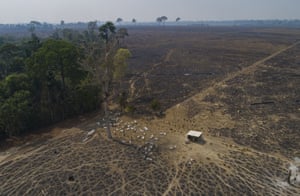
Altamira is territory of the grileiros—whom Brum’s translator, Diane Whitty, glosses as “land grabbers”and their henchmen. Worth the price of admission is Brum’s detailed explanation of their particular technique of seizing and destroying the Amazon: the grileiros hire private militias to drive out Indigenous peoples, along with anyone else who lives on public preserves in the forest; chop down hardwood trees (illegally—but who is to tell in such a remote area?); and then set the rest on fire. Once that patch of the Amazon is burned, grileiros bring in cattle or plant soybeans to solidify their claim, as well as to turn a profit beyond the value of the stolen land. At the local level, corrupt officials bow to or directly work with the grileiros.The noncorrupt rightly fear them. At the national level, Brazilians have neither the resources nor the will to do much to stop them. Grileiros are, Brum writes with a flourish, “key to understanding the destruction of the rainforest, yesterday, today, always.”

The fires that spread in the Amazon in 2019 and so horrified those of us watching abroad on tiny screens were unusually large, but not unusual in any other way. The Amazon burns continuously in fires set by those working for grileiros,even now, after Jair Bolsonaro, who was elected president in 2018 on a platform of explicit support for the grileiros (his enthusiasm for murdering the rainforest earned him the nickname Captain Chainsaw), was voted out of office. The feverish pace of deforestation of the Bolsonaro years has slowed, dropping by 33.6 percent during the first six months after Luiz Inácio Lula da Silva—known to all as Lula—was inaugurated president for his third term in 2023. But less has changed than those of us rooting for the survival of planet Earth might like: the local dynamics, the destructive ways of making money from the rainforest, the permissiveness and lawlessness have remained the same.

Over the past fifty years, an estimated 17 percent of the Amazon has been turned into cropland or cattle pasture. Many scientists warn that, at around 20 or 25 percent deforestation, the Amazon could reach a tipping point, at which the poetically named “flying rivers” that recycle water vapor from the forest into rain in other areas of South America would cease to fly. Huge areas of the rainforest would turn to scrubby savanna, possibly over only a few decades, with potentially catastrophic effects, like severe droughts in places as far away as the western United States.

Heriberto Araújo, a Spanish journalist who has covered China and Latin America for Agence France-Presse and the Mexican news agency Notimex, among others, wrote in his recent book Masters of the Lost Land1 that when he traveled the Trans-Amazonian Highway past Altamira and deeper into the state of Pará, he saw not the thick vegetation of rainforest but rolling pastures and fields of soybeans:

While I had vaguely hoped to see a wild jaguar—a beast formerly so common in these forests that pioneers, unafraid, had even domesticated some specimens and treated them like pets—I was disappointed; the sole animal in sight was the humpbacked, floppy-eared, glossy white Nelore cow, the ultimate conqueror of the frontier.

Visitors in the nineteenth century described the Amazon as a wall of sound, loud with the bellows of red howler monkeys and the calls of birds and frogs. Now large areas are silent but for the rustling of cows’ tails as they slap flies—except where chainsaws grate against the remaining trees.

The subject of Brum’s book is not the rainforest itself but the human beings who live in it, logging, burning, farming, gathering, tending, replanting. An estimated 30 million people live in the Amazon. This sounds wrong to some outsiders: Apart from Indigenous groups, shouldn’t the Amazon be empty of humans, the better to leave the plants and animals in peace? (Some go so far as to argue that even the Indigenous should be displaced to cities, echoing anti-Native conservationist ideas throughout history and around the world, including in the US.)

But Brum distinguishes between the human residents of the Amazon who harm their environment, like the grileiros and big cattle, oil, and timber,and those who make a less damaging living from farming, gathering, or engaging in renewable or smaller-scale extraction. The latter group, many of whom were driven out by huge development projects like dams, mourn the trees and fish and fruit. Brum thinks that this group should have the right to stay. Her book is an attempt to be more like them, to get up close with those who have merged with the rainforest in a way that she seeks to emulate, and then to try to convey to outsiders what she has heard and felt and learned—with all its sweat and noise and discomfort. She confesses that the “book harbors the desire to make the Amazon a personal matter for those reading it.”

Brum is a useful guide to the people of the Amazon, from the Yanomami in and around Altamira and the “pioneers” who first brought in the cows to the hired guns and the workers who today clear the forest and tend cattle and soy for little or no pay. Some grileiros are small-time cattle rustlers or heads of neo-Pentecostal churches preaching the gospel of prosperity. The most powerful “don’t live in the Amazon or get their hands dirty” at all; they are members of the country’s one percent, from São Paulo, Minas Gerais, and Rio Grande do Sul. “Right now, while I’m writing and you’re reading,” she says, “they might be playing polo or listening to the São Paulo Symphony Orchestra.”

Most victims of the Amazon’s many murders are workers who demand back wages or other rights, activists who demand land for the landless, and foreign or local Yanomami environmental defenders. In 2005 an American-born nun named Dorothy Stang, who was supporting the poor in their efforts to defend land against ranchers so that they could earn a living extracting forest products without cutting down the trees, was killed on the orders of a local cattleman.

The term grileiro derives from the Portuguese word for “cricketer,” because back in the 1970s, Brum writes,

the men used to consummate their fraud by placing new sheets of paper and live crickets in boxes where the insects…produced excrement that yellowed the documents and made them look more believably like old land titles.

Grileiros worked with lawyers and corrupt civil servants who helped authenticate the fake papers: a bribe to officials registering deeds made the title official. Unlike homesteading in the United States, which was also often made possible by fraudulent claims, land grabs in the Amazon are ongoing. In Brazil, scattered notaries public, rather than a centralized registry, oversee land titles, leaving the door wide open to fraud and corruption. The researcher and journalist Maurício Torres found in 2009 that the municipality of São Félix do Xingu, in Pará, would have to be three stories high to make space for all the titles registered at the land deed offices.

This whole set of flora and fauna—cows, soybeans, grileiros—is part of the long story of what in Brazil is called “colonization.” That word, as in other Latin American countries, refers not to overseas colonies but to projects that fill out the population in valuable hinterlands. Since Brazil gained its independence from Portugal in 1822, the country has been preoccupied with keeping control over the Amazon. Brazil claims the largest portion of the rainforest, but it spills over national borders into Peru and Colombia, with smaller portions held by five other nations, as well as 3,344 separate acknowledged Indigenous territories. Beyond symbolizing natural majesty, not to mention mystery, in the world’s imagination, the Amazon represents wealth. Ten percent of all species live there, and the Amazon River, with over a thousand tributaries, holds a fifth of the planet’s fresh water.

The word “colonization” in Brazil once had the sort of positive connotation that “exploration” and “westward expansion” did to North American ears. The violent process still occupies a place among the country’s founding myths: bandeirantes (literally “flag carriers”) are honored with statues all over Brazil. During the colonial period bandeirantes cleared and settled the areas around São Paulo, then explored the interior, pushing land claims well beyond what had been allotted to the Portuguese in their 1494 treaty with the Spanish. In the eighteenth century they set off a gold rush. To grab more land for Brazil, the bandeirantes organized sneak attacks on Indigenous villages and enslaved captives. Their actual and spiritual heirs went on to slaughter Indigenous people and clear lands around the country for centuries.

After independence, government officials promoted the settlement of more remote areas in the hope of encouraging smallholding farms, not unlike the Jeffersonian ideal for early North America. Who might those farmers be? Not Indigenous peoples. Certainly not Black Brazilians, since slavery lasted for six and a half decades after independence, later than any other country in the Americas. (During the colonial period, Brazilians built an economy of sugar plantations worked by enslaved Africans—over 40 percent of all Africans forcibly brought to the New World disembarked in Brazil.) The land was for whiter Brazilians.

Europeans were shipped in, too, though mostly as workers. As in similar schemes to attract European migrants to Argentina, Venezuela, and elsewhere in Latin America, Brazilian officials in the state of São Paulo engaged in an explicit program of branqueamento,or “whitening,” just as Brazilian slaves became free. They offered free transatlantic boat passage to European immigrants, even sending agents over to impoverished northern Italian port cities to sign up the likes of Brum’s great-great-grandparents.

When Brum was still new to Altamira, she went shopping in a supermarket with an activist who worked on land conflicts, and ran into a tall white stranger. Exchanging pleasantries, she realized they were from the same part of southern Brazil, where people proudly refer to themselves as gaúchos, a kind of Brazilian cowboy. Brum had been proud of this heritage, too. After the man left, the activist told her, “He’s a grileiro.” “Still naive, I replied, ‘Gosh, a gaúcho, how disgraceful.’ Then he explained, ‘You have to understand that gaúchos are known as the Amazon’s locusts.’”

While colonization schemes “integrated” the Amazon into the rest of Brazil, the result was not sweet little farms but a thriving rubber economy. In the late nineteenth and early twentieth centuries, men from northeastern Brazil, including many recently manumitted slaves, worked throughout the Amazon as tappers on a freelance basis—affixing drains to trees to siphon off latex, the basis of wild rubber, which was at that time an important raw material for the global industrial revolution. (In 1928 Henry Ford, in an attempt to vertically integrate his car empire, briefly opened a rubber plantation and model city in the Amazon called Fordlândia.)

Escaping harsh work conditions and debts to predatory traders, many of these migrant workers vanished into the forest and settled, intermarrying with Indigenous people and quilombolas,the descendants of runaway slaves. Brum writes about the difficulty of characterizing this group, called the beiradeiros—literally, those who live on the edge of the river—to outsiders. She explains that they are the “third people” of the forest, neither quilombolas nor Indigenous. “The beiradeiros fish and hunt, crack Brazil nuts, pick açaí, plant fields, make flour, sometimes raise chickens,” she writes.

They might tap rubber if the price is good, prospect a little when there’s a new gold strike. They hunted a lot of jaguars and oncillas in the past because whites wanted the hides.

Brum opposes the conservationist groups who would oust the beiradeiros in the name of preserving the ecosystem: “Humans—this generic term invented to conceal asymmetries—are not a threat to the forest; rather, some humans are. Others interact with it, transform it, and even plant it.” Since before the “colonization” of the Amazon, even before the Portuguese disembarked in what is now Brazil, Indigenous peoples of the region have contributed to the richness of the soil and density of the forest cover by cultivating sweet potatoes, peanuts, cacao, manioc, and squash.

Brazil’s military dictatorship, in power from 1964 to 1985, oversaw a new colonization scheme in the Amazon that was much like the old one, but with more chainsaws, more funding, and more paranoia. Their colossal development plan involved displacing almost one million people—rubber tappers, farmers, Indigenous people—to exploit natural resources and build infrastructure like the Trans-Amazonian Highway, a 2,500-mile road connecting the whole basin from east to west. They also offered tax breaks, special lines of credit, and cheap land to those who would relocate to the Amazon from elsewhere in the country. On September 27, 1972, the dictator Emílio Garrastazu Médici traveled to Altamira to cut the ribbon on the project and claimed that it solved two problems: “men without land in the northeast and land without men in the Amazon.” The slogan of the project became “a land without men for men without land.” It is no accident that this sounds much like the Zionist phrase “a land without a people for a people without a land”—both draw on the concept of terra nullius (nobody’s land) that has given a legal veneer to the seizure of land around the world.

There was widespread fear in the government that foreign powers, particularly the US, had designs on the Amazon, as well as cold war concerns that guerrilla fighters might use the remote rainforest as a base. “Occupy so as not to surrender” was one not-so-subtle slogan. There were some guerrilla fighters active in Pará, but they were executed upon capture in the 1970s. After spending some time in Brazil, I was startled to learn that many people still believe that outsiders—now often the European Union and the United Nations—wish to invade, steal, or prohibit Brazilians from profiting from the Amazon, or even from entering it, by declaring it an international reserve.

As president, Bolsonaro floated the idea that international nonprofits had set the enormous 2019 blazes because they “lost money.” Later, when questioned by foreign reporters about his evidence-free assertions about international conspiracies to take over the Amazon, he said, with characteristic indelicacy, “Brazil is the virgin that every foreign pervert wants to get their hands on.” This may be a case of projection—the most successful national land grabs in the Amazon have been by Brazil, which took Acre from Bolivia and a piece of what is now Amapá from French Guiana. The historian Barbara Weinstein recalls that Itamar Franco, Brazil’s president after Fernando Collor de Mello was impeached for corruption in 1992, referred to US organizations that complained about destruction in the Amazon as “palefaces.” The implication was that North Americans slaughtered their Indigenous populations and stole and settled their land. Why shouldn’t Brazilians do the same? Bolsonaro’s views are crude but not new.

Colonization involved the massacre of whole Indigenous settlements: a truth commission report later found that over the course of the military dictatorship, government officials killed at least 8,350 Indigenous people. It also turned out to be an economic disaster for everyone other than cattle ranchers and grileiros, costing billions of dollars, and to this day the infrastructure is plagued by mudslides and flooding. Between 1978 and 1988 the Amazon was deforested by the equivalent of the whole state of Connecticut each year. Ideas of environmental protection have certainly evolved, but the destruction of the Amazon caused an outcry even at the time. The environmentalist Chico Mendes, head of the rubber tappers’ union, opposed the destruction of the Amazon, saying the government should demarcate “extractive reserves” for people to use the rainforest, but cautiously and in sustainable ways. (Dorothy Stang, the murdered nun, echoed this approach.) Mendes was assassinated by a rancher in 1988. In 1989 the prominent Kayapó leader Raoni Metuktire toured the world warning of climate collapse:

If you continue the burn-offs, the wind will increase, the Sun will grow very hot, the Earth too. All of us, not just the Indigenous, will be unable to breathe. If you destroy the forest, we will all be silenced.

In 1988, during the transition to democracy, the new Brazilian constitution granted Indigenous people “their original rights to the lands they traditionally occupy,” making it the state’s responsibility to demarcate these lands and ensure respect for property. Over the next several decades, 690 Indigenous preserves—13 percent of the national territory, much of it in the Amazon—were cordoned off. In addition to representing (insufficient) reparations for past harms, the preserves appear to be by far the best option to prevent deforestation: Indigenous peoples have proved themselves to be the world’s best protectors of the forest in study after scientific study.

Last September, Brazil’s Supreme Court blocked efforts by agribusiness-supported politicians to mandate that groups were only entitled to land they physically occupied when the 1988 constitution was signed, even though many communities had been expelled from their lands during the dictatorship. After nine of eleven judges sided with Indigenous peoples, a member of the Pitaguarí group told news outlets about the celebrations outside the courthouse:

We’re happy and we cry because we know that it’s only with demarcated territory, with protected Indigenous territory, that we’ll be able to stop climate change from happening and preserve our biome.

Then agribusiness struck back. Its allies in the National Congress quickly amended part of the legislation that the Supreme Court had found unconstitutional. Lula vetoed the new bill, but Congress overturned the veto, reinstating the absurd rule, at least until the question returns to the Supreme Court.

Though technically 13 percent of the country’s land is protected for Indigenous groups, in practice people living on these preserves—Indigenous, Black, and a combination of the two groups—are often forced out by violence or extreme poverty. The latest available numbers show 36 percent of Brazil’s Indigenous people living in cities. The Covid-19 pandemic fell hard on Indigenous Brazilians, killing many of the elders who led resistance movements or were among the last to speak their languages.

Before he was elected president, Bolsonaro’s anti-Indigenous views were already notorious. He lamented that Brazil had been less “efficient” than the North Americans, “who exterminated the Indians.” He called the demarcation of Yanomami territory “high treason” and said, “I’m not getting into this nonsense of defending land for Indians,” especially in mineral-rich areas. Brum writes that Bolsonaro “used the virus as an unexpected biological weapon in his plan to destroy original peoples” by refusing to make vaccines available or implement public health measures as it became clear that the virus’s victims were disproportionately Indigenous.

For many years Brum resisted writing directly about Indigenous groups, including the Yanomami who occupy the area nearest to Altamira. She felt she didn’t know enough, worried that she didn’t speak the language. After moving to Altamira, she got over her reticence. Some of the most intriguing quotations in her book are from the Yanomami shaman and diplomat Davi Kopenawa, who refers to outsiders to the forest as “commodities people” or “forest eaters.” He describes our books as “paper skin” where words are imprisoned, but nevertheless agreed to write one, as told in Yanomami to a French anthropologist named Bruce Albert. I followed Brum’s book into Kopenawa’s The Falling Sky (2013),2 thinking I would read just a few sections, and then tore through its six hundred pages. “I gave you my story so that you would answer those who ask themselves what the inhabitants of the forest think,” he tells Albert at the beginning of the book. Kopenawa hopes that outsiders can come to understand the following:

The Yanomami are other people than us, yet their words are right and clear…. Their forest is beautiful and silent. They were created there and have lived in it without worry since the beginning of time. Their thought follows other paths than that of merchandise.

In quoting Kopenawa extensively, Brum wants the reader to see that everyone outside the Amazon, not just gaúchos, are the locusts. Through our consumption patterns—the voracious global appetite for red meat, construction materials, new furniture, new paper created from pulped trees—most of us are preying on the Amazon and by extension on people like the Yanomami. In a place like Altamira, Brum writes, the “chain of relations is short or even nonexistent. Here it’s impossible to play innocent, or play innocent so well that we believe it ourselves, as you can do in cities like São Paulo or New York.” Brum could have included a bit more information from further up the supply chain—many of the “forest eaters” are not individual consumers but agribusiness firms unchained in Brazil, where regulations often go unenforced—but the point stands.

Brum finds plenty to criticize in Lula’s mixed record on environmental issues, and reserves her sharpest words for his support of the Belo Monte dam. The dam is a hydroelectric power plant built on the Xingu River, a project that she wrote about with rage and at length in a previous book, The Collector of Leftover Souls (2019). The fifth largest in the world, the plant was first dreamed up by the military dictatorship, but fiercely opposed by inhabitants of the Amazon because the plans required diverting rivers, destroying animal habitats, flooding huge sections of the rainforest, and displacing at least tens of thousands of people. Construction of a slightly modified plan went ahead anyway during Lula’s first term and was completed in 2019, with builders digging more earth than was moved to construct the Panama Canal. Critics say that even aside from large-scale environmental destruction, the engineering of the plant meant it would never produce the amount of energy originally promised.

Lula is of course better on Amazon policy than Bolsonaro. So is a potato, or a child. But like other Latin American leftists, he paid for extensive social spending, especially successful programs fighting malnutrition and hunger, with income from high-priced global commodities. Producing and exporting these commodities, like soybeans, takes a high environmental toll. Nonetheless, there is reason for modest optimism. His environment and climate change minister, Marina Silva, is an extraordinary woman who was born in a rubber-tapping region of the Amazon and became an environmental activist alongside Chico Mendes. But the National Congress is still dominated by agribusiness and with many earlier land grabs already laundered into legality with false paperwork, one of the most effective strategies has been not taking back stolen land, but slowing deforestation and ongoing land theft in less frequently claimed parts of the Amazon.

Though she lived a daring life even before her move to the Amazon, Brum has written a semi-memoir surprisingly low on memoir, heavy on close readings of other people, and appealingly self-deprecating. “Any journalist who makes themself out to be a great adventurer is simply foolish,” she writes.

Just live alongside the pilots and bowmen of Amazonian motor canoes and you’ll retreat into your inescapable insignificance. They can spot tracajá eggs where I see only sand, pointy rocks where I see only water, rain where I see only blue. I could barely manage to hang my hammock in a tree at bedtime.

She points out what should be obvious: that those best equipped to care for and report on the Amazon are those who are native to it and know it best.

Her projects in the Amazon now go well beyond journalism, extending into activism. She writes that her first marriage did not endure the move to Altamira, and she later married a British journalist named Jonathan Watts, who covers the environment for The Guardian.The couple, along with four other journalists, founded the Rainforest Journalism Fund in 2018 to promote reporting initially in the Amazon, and then in the Congo Basin and Southeast Asia as well. Brum and Watts have since set up an experimental 1.2-acre reforestation scheme in Altamira, on lands that had been devastated by burning for cattle grazing.

In El País in 2014, Brum interviewed the Brazilian anthropologist Eduardo Viveiros de Castro, who told her, “The Indigenous are experts in the end of the world.” Brum’s recommendation—really, her plea—is that as the planet warms and the Amazon turns to savanna, outsiders “listen to the people who have been called barbarians…. Listen [out of] an ultimate survival instinct.” She writes:

Perhaps, if we are fortunate, those whose lives have so often been destroyed by those who label themselves civilized will agree to teach us to live after the end of the world.
Newly discovered ancient Amazonian cities reveal how urban landscapes were built without harming nature (Science Alert)

25-May-2022

A newly discovered network of “lost” ancient cities in the Amazon could provide a pivotal new insight into how ancient civilisations combined the construction of vast urban landscapes while living alongside nature. 

A team of international researchers, including Professor Jose Iriarte from the University of Exeter, has uncovered an array of intricate settlements in the Llanos de Mojos savannah-forest, Bolivia, that have laid hidden under the thick tree canopies for centuries. 

The cities, built by the Casarabe communities between 500-1400 AD, feature an unprecedented array of elaborate and intricate structures unlike any previously discovered in the region – including 5m high terraces covering 22 hectares – the equivalent of 30 football pitches – and 21m tall conical pyramids. 

Researchers also found a vast network of reservoirs, causeways and checkpoints, spanning several kilometres. 

The discovery, the researchers say, challenges the view of Amazonia as a historically “pristine” landscape, but was instead home to an early urbanism created and managed by indigenous populations for thousands of years. 

Crucially, researchers maintain that these cities were constructed and managed not at odds with nature, but alongside it – employing successful sustainable subsistence strategies that promoted conservationism and maintained the rich biodiversity of the surrounding landscape. 

The research, by Heiko Prümers, from the Deutsches Archäologisches Institut, Carla Jaimes Betancourt from the University of Bonn, José Iriarteand Mark Robinson from the University of Exeter, and Martin Schaichfrom the ArcTron 3D is published in the journal Nature

Professor Iriarte said: “We long suspected that the most complex pre-Columbian societies in the whole basin developed in this part of the Bolivian Amazon, but evidence is concealed under the forest canopy and is hard to visit in person. Our lidar system has revealed built terraces, straight causeways, enclosures with checkpoints, and water reservoirs. There are monumental structures are just a mile apart connected by 600 miles of canals long raised causeways connecting sites, reservoirs and lakes.   

“Lidar technology combined with extensive archaeological research reveals that indigenous people not only managed forested landscapes but also created urban landscapes, which can significantly contribute to perspectives on the conservation of the Amazon.   

“This region was one of the earliest occupied by humans in Amazonia, where people started to domesticate crops of global importance such as manioc and rice. But little is known about daily life and the early cities built during this period.” 

The team of experts used lidar technology – dubbed “lasers in the sky” – to peer through the tropical forest canopy and examine the sites, found in the savannah-forest of South West Amazonia. 

The research revealed key insights into the sheer magnitude and magnificence of the civic-ceremonial centres found buried in the forest.   

It showed that the core, central spread over several hectares, on top of which lay civic-ceremonial U-shaped structures, platform mounds and 21-m tall conical pyramids.  

The research team conservatively suggest that the scale of labour and planning to construct the settlements has no precedents in Amazonia and is instead comparable only with the Archaic states of the central Andes. 

Crucially, the research team insist this new discovery gives a pivotal new insight into how this ancient urbanism was carried out sustainably and embracing conservationism. 

At the same time the cities were built communities in the Llanos de Mojos transformed Amazonian seasonally flooded savannas, roughly the size of England, into productive agricultural and aquacultural landscapes.  

The study shows that the indigenous people not only managed forested landscapes, but also created urban landscapes in tandem – providing evidence of successful, sustainable subsistence strategies but also a previously undiscovered cultural-ecological heritage. 

Co-author, Dr Mark Robinson of the University of Exeter added: “These ancient cities were primary centres of a regional settlement network connected by still visible, straight causeways that radiate from these sites into the landscape for several kilometres. Access to the sites may have been restricted and controlled.  

“Our results put to rest arguments that western Amazonia was sparsely populated in pre-Hispanic times. The architectural layout of Casarabe culture large settlement sites indicates that the inhabitants of this region created a new social and public landscape.

“The scale, monumentality and labour involved in the construction of the civic-ceremonial architecture, water management infrastructure, and spatial extent of settlement dispersal, compare favourably to Andean cultures and are to a scale far beyond the sophisticated, interconnected settlements of Southern Amazonia.” 

Lidar reveals pre-Hispanic low-density urbanism in the Bolivian Amazon is published in Nature.

Pictures are available at https://we.tl/t-zeOzapPZvc

Forests follow unexpected—and surprisingly fast—paths to recovery (Anthropocene Magazine)

anthropocenemagazine.org

A new study found that carbon, nitrogen and soil density in cleared forests reached 90% of levels in untouched forests after 1 to 9 years. They key was leaving them alone.

By Warren Cornwall

February 16, 2022


Forests follow unexpected—and surprisingly fast—paths to recovery

A new study found that carbon, nitrogen and soil density in cleared forests reached 90% of levels in untouched forests after 1 to 9 years. They key was leaving them alone.

Jungles grow with such abandon they can obscure entire civilizations beneath roots and vines. That fertility could prove vital in the race to heal the scars of deforestation.

Tropical forests burned and cleared for farming and ranching in Central and South America and West Africa can bounce back in little more than a century, with some key features recovering in decades, according to new research.

While not a panacea for the destruction of ancient jungles across the globe, scientists say the findings suggest that if left to themselves, many of these places could regain the lush forests that are rich havens of biodiversity that also suck carbon from the atmosphere.

“These regrowing forests cover vast areas, and can contribute to local and global targets for ecosystem restoration,” said Lourens Poorter, an ecologist at Wageningen University in the Netherlands, who was part of the research.

Tropical jungles like the Amazon have been called the lungs of the planet for good reason. Fueled by abundant water, long growing seasons and fertile soils, forests ringing the planet’s equatorial middle can suck vast amounts of carbon from the atmosphere and provide a home for two-thirds of the world’s species.

But this richness has also made them a target for loggers, ranchers and farmers, ranging from small-time settlers to huge agricultural companies. Today, less than 50% of tropical rainforests are still standing.

As conservationists work to protect tropical landscapes, questions surround the fate of former forests turned into pasture and farmland. In the tropics in the Americas alone, an estimated 28% of forests are regrowing after being cleared. So a team of 90 scientists from research centers across the globe set out to see how these lands recovered.

Because such recovery can stretch for decades, the researchers sought to fast-forward through the process by simultaneously examining 77 sites at different stages of growth, including some old-growth forests. Places had been cleared and then abandoned for more than a century in some cases, and as little as a year in others. The locations covered both dry and wet forests, sprinkled across Central and South America and coastal west Africa.

At each location, the researchers measured a dozen key indicators of different kinds of ecological dynamics, including the makeup of the soil, leaf and stem size, how many plants fixed nitrogen in the soil, the total mass of all plants, the largest tree, and the diversity of plant species.

The forests followed unexpected paths to recovery. Scientists were surprised to see how quickly the soils recovered. Carbon, nitrogen and soil density reached 90% of levels in untouched forests after 1 to 9 years. Likewise, the functional composition of plants in the forests – the size of tree leaves, the density of wood in trees and presence of nitrogen-fixing trees – happened sooner than predicted, taking between 3 and 27 years to approach old-growth conditions, the researchers reported in Science.

The rapid soil recovery indicates that soil nutrients were buffered from slash-and-burn agriculture or enhanced by people as they burned foliage or planted nitrogen-fixing grasses, the scientists surmised. Most of the study plots were also not subject to high-intensity farming that can suck nutrients from the soil.

Some features of the forest flora also came back quickly. Fast-growing plants that first reclaim open ground gave way to more shade-tolerant plants relatively quickly, and plants returned by resprouting from seeds left by cleared plants.

“Nature will take care of it if we let it,” said Clemson University ecologist Saara DeWalt, who contributed data from forests in Panama that she has tracked since the 1990s. “Restoration of tropical forests should rely on natural regeneration. It’s the most efficient way to do it. It’s the most ecologically efficient. It’s the most economically efficient.”

Some kinds of recovery took much longer. The cleared areas took between 27 and 119 years for the total mass of greenery and the largest tree size to approach pristine conditions. It took 12 decades for the full panorama of species found in old-growth tropical forests to appear in re-growing forests.

Even that, however, is “notably fast” given the complexity of tropical forests, the scientists noted. The overall picture is one of resilience after farming or ranching, as long as it’s not too intensive and there is forest nearby to provide seeds. “If there’s no source for seeds, heavily degraded soils, and no way for animals to get there, that’s going to be a problem,” DeWalt said. “There will be times when planting will be necessary.”

Poorter, et. al. “Multidimensional tropical forest recovery.” Science. Dec. 9. 2021

Indigenous peoples by far the best guardians of forests – UN report (The Guardian)

Preserving Latin America’s forests is vital to fight the climate crisis and deforestation is lower in indigenous territories

Damian Carrington Environment editor @dpcarrington

Thu 25 Mar 2021 14.00 GMT Last modified on Thu 25 Mar 2021 16.44 GMT

A Waiapi boy climbs up a Geninapo tree to pick fruits to make body paint at the Waiapi indigenous reserve in Amapa state, Brazil.
A Waiapi boy climbs up a Geninapo tree to pick fruits to make body paint at the Waiapi indigenous reserve in Amapa state, Brazil. Photograph: AFP Contributor/AFP/Getty Images

The embattled indigenous peoples of Latin America are by far the best guardians of the regions’ forests, according to a UN report, with deforestation rates up to 50% lower in their territories than elsewhere.

Protecting the vast forests is vital to tackling the climate crisis and plummeting populations of wildlife, and the report found that recognising the rights of indigenous and tribal peoples to their land is one of the most cost-effective actions. The report also calls for the peoples to be paid for the environmental benefits their stewardship provides, and for funding for the revitalisation of their ancestral knowledge of living in harmony with nature.

However, the demand for beef, soy, timber, oil and minerals means the threats to indigenous peoples and their forest homes are rising. Hundreds of community leaders have been killed because of disputes over land in recent years and the Covid-19 pandemic has added to the dangers forest peoples face.

Sateré-Mawé men collect medicinal herbs to treat people showing Covid symptoms, in a rural area west of Manaus, Brazil.
Sateré-Mawé men collect medicinal herbs to treat people showing Covid symptoms, in a rural area west of Manaus, Brazil. Photograph: Ricardo Oliveira/AFP/Getty Images

Demands by indigenous peoples for their rights have become increasingly visible in recent years, the report said, but this has come with increasing persecution, racism, and assassinations. Supporting these peoples to protect the forests is particularly crucial now with scientists warning that the Amazon is nearing a tipping point where it switches from rainforest to savannah, risking the release of billions of tonnes of carbon into the atmosphere.

The report was produced by the UN Food and Agriculture Organization and the Fund for the Development of Indigenous Peoples of Latin America and the Caribbean (Filac), based on a review of more than 300 studies.

“Almost half of the intact forests in the Amazon basin are in indigenous territories and the evidence of their vital role in forest protection is crystal clear,” said the president of Filac, Myrna Cunningham, an indigenous woman from Nicaragua. “While the area of intact forest declined by only 5% between 2000 and 2016 in the region’s indigenous areas, in the non-indigenous areas it fell by 11%. This is why [indigenous peoples’] voice and vision should be taken into account in all global initiatives relating to climate change, biodiversity and forestry.”

“Indigenous peoples have a different concept of forests,” she said. “They are not seen as a place where you take out resources to increase your money – they are seen as a space where we live and that is given to us to protect for the next generations.”

Indigenous and tribal territories contain about a third of all the carbon stored in the forests of Latin America, said Julio Berdegué, the FAO’s Regional Representative: “These peoples are rich when it comes to culture, knowledge, and natural resources, but some of the poorest when it comes to incomes and access to services.” Supporting them would also help avoid new pandemics, he said, as these are most often the result of the destruction of nature.

Cattle graze on land recently burned and deforested by farmers near Novo Progresso, Pará state, Brazil.
Cattle graze on land recently burned and deforested by farmers near Novo Progresso, Pará state, Brazil. Photograph: André Penner/AP

“Even under siege from Covid-19 and a frightening rise in invasions from outsiders, we remain the ones who can stop the destruction of our forests and their biodiverse treasures,” said José Gregorio Diaz Mirabal, indigenous leader of an umbrella group, the Coordinator of the Indigenous Organizations of the Amazon Basin. He said the report’s evidence supports his call for climate funds to go directly to indigenous peoples and not governments vulnerable to corruption. Advertisement

The report found the best forest protection was provided by peoples with collective legal titles to their lands. A 12-year study in the Bolivian, Brazilian, and Colombian Amazon found deforestation rates in such territories were only one half to one-third of those in other similar forests. Even though indigenous territories cover 28% of the Amazon Basin, they only generated 2.6% of the region’s carbon emissions, the report said.

Indigenous peoples occupy 400m hectares of land in the region, but there is no legal recognition of their property rights in a third of this area. “While the impact of guaranteeing tenure security is great, the cost is very low,” the report said, needing less than $45 per hectare for the mapping, negotiation and legal work required.

The report said it would cost many times more to prevent carbon emissions from fossil fuel burning using carbon capture and storage technology on power plants. The granting of land rights to indigenous people has increased over the last 20 years, Cunningham said, but has slowed down in recent years.

Paying indigenous and tribal communities for the environmental services of their territories has reduced deforestation in countries including Ecuador, Mexico, and Peru. Berdegué said such programmes could attract hundreds of millions of dollars per year from international sources.

The need for protection is urgent, the report said, with annual deforestation rates in Brazil’s indigenous territories rising from 10,000 hectares in 2017 to 43,000 hectares in 2019. In January, indigenous leaders urged the international criminal court to investigate Brazil’s president, Jair Bolsonaro, over his dismantling of environmental policies and violations of indigenous rights.

Elsewhere, the area of large intact forests in indigenous territories has fallen between 2000 and 2016, with 59% lost in Paraguay, 42% in Nicaragua, 30% in Honduras and 20% in Bolivia. Mining and oil concessions now overlay almost a quarter of the land in Amazon basin indigenous and tribal territories, the report said.

Para estudioso do clima, “sorte” explica pandemia não começar pelo Brasil (ECOA/UOL)

Artigo original

Rodrigo Bertolotto De Ecoa, em São Paulo 14/04/2020 18h04

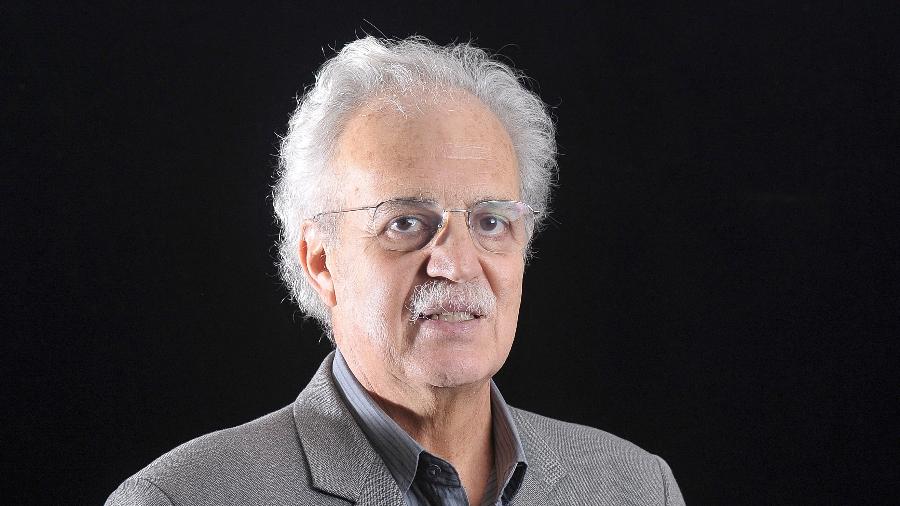
“A Amazônia tem a maior quantidade de microorganismos do mundo. E estamos perturbando o sistema o tempo todo, com populações urbanas se aproximando, desmatamento e comércio de animais silvestres. Então, talvez tenha sido sorte que a pandemia não tenha começado no Brasil”, disse Carlos Nobre, presidente do Painel Brasileiro de Mudanças Climáticas e pesquisador sênior do Instituto de Estudos Avançados da USP (Universidade de São Paulo).

O cientista Carlos Nobre, referência brasileira em estudos sobre aquecimento global e pesquisador do Instituto Nacional de Pesquisa Espacial (Inpe) - Reinaldo Canato/Folhapress
O cientista Carlos Nobre, referência brasileira em estudos sobre aquecimento global e pesquisador do Instituto Nacional de Pesquisa Espacial (Inpe) Imagem: Reinaldo Canato/Folhapress

Nobre participou nesta terça de um seminário “Covid-19 e Clima: Como Estão Conectados?” promovido pela Rede Brasil do Pacto Global da ONU (Organização das Nações Unidas) em parceria com Ecoa, que retransmitiu sua palestra, no formato webinar, ou seja, um seminário pela web.

“Pandemia mostra impacto do desequilíbrio do sistema na nossa vida”

Ele lembrou do caso da leishmaniose, endemia típica da Amazônia que tem como causador um protozoário e o vetor é o mosquito palha. A doença se espalhou pelo mundo, devido à aproximação dos homens dos ambientes silvestres, mas agora está controlada, tendo cura e remédio. O problema agora é outro por lá. “Agora, Manaus está entrando em colapso com o coronavírus, e a doença está chegando às aldeias. Temos que lembrar que os indígenas têm menos resistência imunológica a essas contaminações.”

Nobre também falou como a poluição debilita quem tem contado agora com o vírus surgido na China no final de 2019. “A poluição e o vírus atacam o sistema respiratório. Essa combinação é muito perversa”, afirmou o estudioso.

Ele recordou das queimadas na floresta amazônica em 2019, a que ponto isso afetou os ares até da região Sudeste do Brasil e como esse cenário pode se repetir agora em 2020, quando se está verificando novos recordes de desmatamento.

O ar de São Paulo e outras cidades está mais limpo com menos carros em circulação nesses dias de quarentena, mas, se as queimadas recomeçarem, esse cenário vai mudar e criar novas vulnerabilidades. No ano passado, os postos de saúde da Amazônia estavam cheios pela fumaça das queimadas. Agora estão com a Covid-19.

Aprendizados da crise

O cientista discutiu os vários pontos que aproximam o atual surto biológico com os problemas climáticos, sua especialidade.

“Dá para fazer um paralelo entre essas crises globais. Essa pandemia nos mostra o que pode acontecer quando há um desequilíbrio do sistema. Ela é um alerta e um guia para evitarmos grandes riscos, como os que as mudanças climáticas poderão trazer para a vida na Terra. Se a temperatura do planeta subir cinco graus, os humanos vão ter de viver confinados, como agora, porque em determinados horários todos os dias o termômetro vai estar além do limite fisiológico do corpo nas áreas tropicais como o Brasil.”

Nobre falou das lições que podem ficar desta crise global e das possíveis soluções quando o planeta sair das urgências do coronavírus. Para ele, um dos aprendizados é que a economia caminhe para a sustentabilidade.

“Os países europeus estão discutindo agora uma economia mais verde. E a China também está sinalizando nesse mesmo caminho. Se isso acontecer, o pêndulo mundial vai mudar, e o Brasil vai ter de ir atrás. Os EUA são contra, mas isso pode mudar se em janeiro de 2021 não estiver mais o Donald Trump na Casa Branca”, afirmou Nobre, projetando as dificuldades de reeleição do político republicano com a possível recessão provocada pelo afastamento social durante a crise.

O pesquisador também salientou que é importante mudar a matriz energética, e essa crise pode ser o momento de acelerar esse processo. “Precisamos eletrificar os transportes, e criar mais energia solar e eólica, diminuindo o consumo de combustíveis fósseis.”

Para ele, as mudanças climáticas vão trazer riscos maiores que os atuais com o coronavírus se não forem tomadas providências. “É uma catástrofe com um tempo e uma magnitude muito maior. Por isso, é difícil dimensionar. Mas a atual pandemia é uma amostra disso. E um risco maior também, afinal, todo o planeta vai ser afetado, não só o homem, como agora.”

Veja íntegra do seminário: https://video.uol/18QVJ

How the Amazon’s Cashews and Cacao Point to Cultivation by the Ancients (New York Times)

Scientists studying the Amazon rain forest are tangled in a debate of nature versus nurture.

Many ecologists tend to think that before Europeans arrived in the Americas, the vast wilderness was pristine and untouched by humans. But several archaeologists argue that ancient civilizations once thrived in its thickets and played a role in its development.

Now, researchers have found evidence that indigenous people may have domesticated and cultivated Amazonian plants and trees thousands of years ago, further supporting the idea that ancient humans helped shape the forest.

“Large areas of the Amazon are less pristine than we may think,” said Hans ter Steege, a tropical ecologist at the Naturalis Biodiversity Center in the Netherlands, and an author of a paper published in Science on Thursday. “The people who lived there before Columbus left serious footprints that still persist in the composition as we see today.”

He was one of more than a hundred researchers who found that domesticated tree and palm species — like cacao, cashews, the açaí palm, the Brazil nut and rubber — were five times more likely to dominate the modern Amazonian forest than nondomesticated plants.

Carolina Levis, a doctoral student at the National Institute for Amazonian Research in Brazil and Wageningen University and Research Center in the Netherlands, was the lead author on the study. She and her team looked at a database from the Amazon Tree Diversity Network containing 1,170 plots of forest. Most plots measured approximately 2.5 acres each and had previously been investigated on foot by ecologists who counted and identified the plant species in the plots. Ms. Levis then identified 85 domestic plants to analyze.

One way the team determined that a plant had been domesticated was a look at its fruit. They found, for example, some peach palms that bore fruit weighing 200 grams, or 0.44 pounds, when the fruit grown in the wild matured to about one gram. Several of the domesticated plants they identified are still grown by South Americans.

The harvesting of peach palm in the Amazon. Credit: Tinde van Andel 

Ms. Levis compared her list of 85 plants to another database of more than 3,000 archaeological sites, including ceramics, dirt mounds and rock paintings, dating back before the Spaniards and Portuguese arrived in the Americas 500 years ago. The domesticated plants flourished near the archaeological sites, far more so than nondomesticated ones.

“It’s the first time that we show these correlations between plant species in the forest today and archaeological finds,” she said.

The findings suggest that either the ancient civilizations grew and cultivated the plants, or that they purposely settled in areas that had plants they could eat and use. Ms. Levis said she suspected that people were domesticating the plants, although the study did not definitively pinpoint how settlements were chosen. In some plots, more than half of the plant life consisted of domesticated trees and palms.

Jennifer Watling, an archaeologist at the University of São Paulo, Brazil, who was not involved with the study, said in an email that “the large number of data points sampled by these authors gives good reason to believe that the distribution of domesticated species in many areas of Amazonia is strongly linked to the actions of pre-Columbian societies.”

But Crystal McMichael, a paleoecologist from the University of Amsterdam, said the database comparisons were not convincing. New direct evidence, like fossils of domesticated plants at the archaeological sites, would help advance such theories, she said. While the study shows a potential association between ancient people and modern forest composition, it does not preclude the possibility that the domesticated plant patterns occurred with more modern settlements, she said in an email.

Dr. ter Steege disagreed. The study “changed my view of the forest,” he said. “It’s not only the ecology or the environment that created this forest, but also the people who lived there before.”

Corte seletivo e fogo fazem Floresta Amazônica perder 54 milhões de toneladas de carbono por ano (Agência Fapesp)

JC e-mail 4973, de 16 de junho de 2014

A perda de carbono corresponde a 40% daquela causada pelo desmatamento total

Uma pesquisa conduzida por cientistas no Brasil e no Reino Unido quantificou o impacto causado na Floresta Amazônica por corte seletivo de árvores, destruição parcial pelo fogo e fragmentação decorrente de pastagens e plantações. Em conjunto, esses fatores podem estar subtraindo da floresta cerca de 54 milhões de toneladas de carbono por ano, lançados à atmosfera na forma de gases de efeito estufa. Esta perda de carbono corresponde a 40% daquela causada pelo desmatamento total.

O estudo, desenvolvido por 10 pesquisadores de 11 instituições do Brasil e do Reino Unido, foi publicado em maio na revista Global ChangeBiology.

“Os impactos da extração madeireira, do fogo e da fragmentação têm sido pouco percebidos, pois todos os esforços estão concentrados em evitar mais desmatamento. Essa postura deu grandes resultados na conservação da Amazônia brasileira, cuja taxa de desmatamento caiu em mais de 70% nos últimos 10 anos. No entanto, nosso estudo mostrou que esse outro tipo de degradação impacta severamente a floresta, com enormes quantidades de carbono antes armazenadas sendo perdidas para a atmosfera”, disse a brasileira Erika Berenguer, pesquisadora do Lancaster Environment Centre, da Lancaster University, no Reino Unido, primeira autora do estudo.

Segundo Joice Ferreira, pesquisadora da Empresa Brasileira de Pesquisa Agropecuária (Embrapa Amazônia Oriental), em Belém (PA), e segunda autora do estudo, um dos motivos dessa degradação ser menos percebida é a dificuldade de monitoramento. “As imagens de satélite permitem detectar com muito mais facilidade as áreas totalmente desmatadas”, afirmou.

“Nossa pesquisa combinou imagens de satélite com estudo de campo. Fizemos uma avaliação, pixel a pixel [cada pixel na imagem corresponde a uma área de 900 metros quadrados], sobre o que aconteceu nos últimos 20 anos. Na pesquisa de campo, estudamos 225 parcelas (de 3 mil metros quadrados cada) em duas grandes regiões, com 3 milhões de hectares [30 mil quilômetros quadrados], utilizadas como modelo para estimar o que ocorre no conjunto da Amazônia”, explicou Ferreira.

As imagens de satélite, comparadas de dois em dois anos, possibilitaram que os pesquisadores construíssem um grande painel da degradação da floresta ao longo da linha do tempo, em uma escala de 20 anos. Na pesquisa de campo foram avaliadas as cicatrizes de fogo, de exploração madeireira e outras agressões. A combinação das duas investigações resultou na estimativa de estoque de carbono que se tem hoje.

Duas regiões foram estudadas in loco: Santarém e Paragominas, na porção leste da Amazônia, ambas submetidas a fortes pressões de degradação. Nessas duas regiões foram investigadas as 225 áreas.

“Coletamos dados de mais de 70 mil árvores e de mais de 5 mil amostras de solo, madeira morta e outros componentes dos chamados estoques de carbono. Foi o maior estudo já realizado até o momento sobre a perda de carbono de florestas tropicais devido à extração de madeira e fogos acidentais”, disse Ferreira.

Segundo ela, a pesquisa contemplou quatro dos cinco compartimentos de carbono cujo estudo é recomendado pelo Painel Intergovernamental sobre Mudanças Climáticas (IPCC, na sigla em inglês), da Organização das Nações Unidas (ONU): biomassa acima do solo (plantas vivas), matéria orgânica morta, serapilheira (camada que mistura fragmentos de folhas, galhos e outros materiais orgânicos em decomposição) e solos (até 30 centímetros de profundidade). “Só não medimos o estoque de carbono nas raízes”, disse.

Para efeito de comparação, foram consideradas cinco categorias de florestas: primária (totalmente intacta); com exploração de madeira; queimada; com exploração de madeira e queimada; e secundária (aquela que foi completamente cortada e cresceu novamente).

As florestas que sofreram perturbação, por corte ou queimada, apresentaram de 18% a 57% menos carbono do que as florestas primárias. Uma área de floresta primária chegou a ter mais de 300 toneladas de carbono por hectare, enquanto as áreas de floresta queimada e explorada para madeira tiveram, no máximo, 200 toneladas por hectare, e, em média, menos de 100 toneladas de carbono por hectare.

Corte seletivo tradicional
O roteiro da degradação foi bem estabelecido pelos pesquisadores. O ponto de partida é, frequentemente, a extração de madeiras de alto valor comercial, como o mogno e o ipê; essas árvores são cortadas de forma seletiva, mas sua retirada impacta dezenas de árvores vizinhas.

Deflagrada a exploração, formam-se várias aberturas na cobertura vegetal, o que torna a floresta muito mais exposta ao sol e ao vento, e, portanto, muito mais seca e suscetível à propagação de fogos acidentais. O efeito é fortemente acentuado pela fragmentação da floresta em decorrência de pastagens e plantações.

A combinação dos efeitos pode, então, transformar a floresta em um mato denso, cheio de árvores e cipós de pequeno porte, mas com um estoque de carbono 40% menor do que o da floresta não perturbada.

“Existem, hoje, vários sistemas de corte seletivo, alguns um pouco menos impactantes do que outros. O sistema predominante, que foi aquele detectado em nosso estudo, associado ao diâmetro das árvores retiradas e à sua idade, pode subtrair da floresta uma enorme quantidade de carbono”, disse Plínio Barbosa de Camargo, diretor da Divisão de Funcionamento de Ecossistemas Tropicais do Centro de Energia Nuclear na Agricultura (Cena) da Universidade de São Paulo (USP) e membro da coordenação da área de Biologia da FAPESP, que também assinou o artigo publicado na Global ChangeBiology.

“Por mais que recomendemos no sentido contrário, na hora do manejo efetivo acabam sendo retiradas as árvores com diâmetros muito grandes, em menor quantidade. Em outra pesquisa, medimos a idade das árvores com carbono 14. Uma árvore cujo tronco apresente o diâmetro de um metro com certeza tem mais de 300 ou 400 anos. Não adianta retirar essa árvore e imaginar que ela possa ser substituída em 30, 40 ou 50 anos”, comentou Camargo.

A degradação em curso torna-se ainda mais preocupante no contexto da mudança climática global. “O próximo passo é entender melhor como essas florestas degradadas responderão a outras formas de distúrbios causados pelo homem, como períodos de seca mais severos e estações de chuva com maiores níveis de precipitação devido às mudanças climáticas”, afirmou o pesquisador britânico Jos Barlow, da Lancaster University, um dos coordenadores desse estudo e um dos responsáveis pelo Projeto Temático ECOFOR: Biodiversidade e funcionamento de ecossistemas em áreas alteradas pelo homem nas Florestas Amazônica e Atlântica.

Além dos pesquisadores já citados, assinaram também o artigo da Global ChangeBiologyToby Alan Gardner (Universityof Cambridge e Stockholm EnvironmentInstitute), Carlos Eduardo Cerri e Mariana Durigan (Escola Superior de Agricultura Luiz de Queiroz/USP), Luiz Eduardo Oliveira e Cruz de Aragão (Instituto Nacional de Pesquisas Espaciais e UniversityofExeter), Raimundo Cosme de Oliveira Junior (Embrapa Amazônia Oriental) e Ima Célia Guimarães Vieira (Museu Paraense Emílio Goeldi).

O artigo A large-scalefieldassessmentofcarbon stocks in human-modified tropical forests (doi: 10.1111/gcb.12627), de Erika Berenguer e outros, pode ser lido em http://onlinelibrary.wiley.com/doi/10.1111/gcb.12627/full.

(Agência Fapesp)

Líder indígena brasileiro ganha prêmio ‘Herói da Floresta’ da ONU (G1;Globo Natureza)

JC e-mail 4703, de 11 de Abril de 2013.

Almir Suruí, de Rondônia, fez parceria com Google para monitorar floresta. Ele está na Turquia para receber o título internacional

Almir Suruí, líder indígena de Rondônia, é um dos vencedores do prêmio “Herói da Floresta” este ano. O título é concedido pelas Nações Unidas.

A cerimônia oficial de entrega estava prevista para acontecer na noite desta quarta-feira (10) em Istambul (hora local), onde acontece o Fórum sobre Florestas da ONU, que congrega representantes de 197 país.

Os outros quatro “Heróis da Floresta” deste ano são dos Estados Unidos, Ruanda, Tailândia e Turquia. Almir é o vencedor pela América Latina e o Caribe. Líder dos índios paiter suruí, Almir criou diferentes iniciativas para proteger e desenvolver a Terra Indígena Sete de Setembro, em Rondônia, onde mora.

O projeto mais conhecido usa a internet para valorizar a cultura de seu povo e combater o desmatamento ilegal. A partir de uma parceria com o Google e algumas ONGs, os suruí colocaram à disposição dos usuários da rede um “mapa cultural” que dá informações sobre sua cultura e história.

Eles também usam telefones celulares para tirar fotos da derrubada ilegal de floresta, determinando com o GPS o local exato do crime ambiental e enviando denúncias a autoridades competentes.

No ano passado, outros brasileiros já haviam sido premiados como “Heróis da Floresta” pela ONU: Paulo Adário, diretor do Greenpeace para a Amazônia, e o casal de ativistas José Cláudio Ribeiro e Maria do Espírito Santo, assassinado no Pará em maio de 2011, que foi nomeado como uma homenagem póstuma.