Arquivo da tag: Clima

New Understanding to Past Global Warming Events: Hyperthermal Events May Be Triggered by Warming (Science Daily)

These geological deposits make the Bighorn Basin area of Wyoming ideal for studying the PETM. (Credit: Aaron Diefendorf)

ScienceDaily (Apr. 2, 2012) — A series of global warming events called hyperthermals that occurred more than 50 million years ago had a similar origin to a much larger hyperthermal of the period, the Pelaeocene-Eocene Thermal Maximum (PETM), new research has found. The findings, published in Nature Geoscience online on April 1, 2012, represent a breakthrough in understanding the major “burp” of carbon, equivalent to burning the entire reservoir of fossil fuels on Earth, that occurred during the PETM.

“As geologists, it unnerves us that we don’t know where this huge amount of carbon released in the PETM comes from,” says Will Clyde, associate professor of Earth sciences at the University of New Hampshire and a co-author on the paper. “This is the first breakthrough we’ve had in a long time. It gives us a new understanding of the PETM.” The work confirms that the PETM was not a unique event – the result, perhaps, of a meteorite strike – but a natural part of Earth’s carbon cycle.

Working in the Bighorn Basin region of Wyoming, a 100-mile-wide area with a semi-arid climate and stratified rocks that make it ideal for studying the PETM, Clyde and lead author Hemmo Abels of Utrecht University in the Netherlands found the first evidence of the smaller hyperthermal events on land. Previously, the only evidence of such events were from marine records.

“By finding these smaller hyperthermal events in continental records, it secures their status as global events, not just an ocean process. It means they are atmospheric events,” Clyde says.

Their findings confirm that, like the smaller hyperthermals of the era that released carbon into the atmosphere, the release of carbon in the PETM had a similar origin. In addition, the warming-to-carbon release of the PETM and the other hyperthermals are similarly scaled, which the authors interpret as an indication of a similar mechanism of carbon release during all hyperthermals, including the PETM.

“It points toward the fact that we’re dealing with the same source of carbon,” Clyde says.

Working in two areas of the Bighorn Basin just east of Yellowstone National Park – Gilmore Hill and Upper Deer Creek – Clyde and Abels sampled rock and soil to measure carbon isotope records. They then compared these continental recordings of carbon release to equivalent marine records already in existence.

During the PETM, temperatures rose between five and seven degrees Celsius in approximately 10,000 years — “a geological instant,” Clyde calls it. This rise in temperature coincided exactly with a massive global change in mammals, as land bridges opened up connecting the continents. Prior to the PETM, North America had no primates, ancient horses, or split-hoofed mammals like deer or cows.

Scientists look to the PETM for clues about the current warming of Earth, although Clyde cautions that “Earth 50 million years ago was very different than it is today, so it’s not a perfect analog.” While scientists still don’t fully understand the causes of these hyperthermal events, “they seem to be triggered by warming,” Clyde says. It’s possible, he says, that less dramatic warming events destabilized these large amounts of carbon, releasing them into the atmosphere where they, in turn, warmed the Earth even more.

“This work indicates that there is some part of the carbon cycle that we don’t understand, and it could accentuate global warming,” Clyde says.

Conservatives’ Trust in Science at All-Time Low (Slate/L.A.Times)

A new study suggests a growing partisan divide as science plays an increasing role in policy debates.By  | Posted Thursday, March 29, 2012, at 1:29 PM ET

91275814
A new report suggests the number of conservatives who trust science is at an all-time low. Photo by Aude Guerrucci-Pool/Getty Images.

This may explain some of the rhetoric we’ve been hearing in GOP stump speeches of late: The number of conservatives who say they have a “great deal” of trust in science has fallen to 35 percent, down 28 points from the mid-1970s, according to a new academic paper.

The study, which was published Thursday in the American Sociological Review, found that liberal and moderate attitudes toward the topic have remained mostly unchanged since national pollsters first began posing the question in 1974, back when roughly half of all liberals and conservatives expressed significant trust in science.

The peer-reviewed research paper explains: “These results are quite profound because they imply that conservative discontent with science was not attributable to the uneducated but to rising distrust among educated conservatives.”

The man behind the study, UNC Chapel Hill’s Gordon Gauchat, says the change comes as conservatives have rebelled against the so-called “elite.”

“It kind of began with the loss of Barry Goldwater and the construction of Fox News and all these [conservative] think tanks. The perception among conservatives is that they’re at a disadvantage, a minority,” Gauchat explained in an interview with U.S. News. “It’s not surprising that the conservative subculture would challenge what’s viewed as the dominant knowledge production groups in society—science and the media.”

The sociologist suggested that the shift is also likely tied to science’s changing role in the national dialogue. In the middle of the 20th century, science was tied closely with NASA and the Department of Defense, but now it more frequently comes up when the conversation shifts to the environment and government regulations.

“Science has become autonomous from the government—it develops knowledge that helps regulate policy, and in the case of the EPA, it develops policy,” he said. “Science is charged with what religion used to be charged with—answering questions about who we are and what we came from, what the world is about. We’re using it in American society to weigh in on political debates, and people are coming down on a specific side.”

You can read a more of the interview at U.S. News, a more detailed recap of the the study over the Los Angeles Times, or check out the full paper here.

Conservatives’ trust in science has declined sharply

Since 1974, when conservatives had the highest trust in science, their confidence has dropped precipitously, an American Sociological Review study concludes.

By John Hoeffel – Los Angeles TimesMarch 29, 2012
As the Republican presidential race has shown, the conservatives who dominate the primaries are deeply skeptical of science — making Newt Gingrich, for one, regret he ever settled onto a couch with Nancy Pelosi to chat about global warming.A study released Thursday in the American Sociological Review concludes that trust in science among conservatives and frequent churchgoers has declined precipitously since 1974, when a national survey first asked people how much confidence they had in the scientific community. At that time, conservatives had the highest level of trust in scientists.

Confidence in scientists has declined the most among the most educated conservatives, the peer-reviewed research paper found, concluding: “These results are quite profound because they imply that conservative discontent with science was not attributable to the uneducated but to rising distrust among educated conservatives.”

“That’s a surprising finding,” said the report’s author, Gordon Gauchat, in an interview. He has a doctorate in sociology and is a postdoctoral fellow at the University of North Carolina at Chapel Hill.

To highlight the dramatic impact conservative views of science have had on public opinion, Gauchat pointed to results from Gallup, which found in 2012 that just 30% of conservatives believed the Earth was warming as a result of greenhouse gases versus 50% two years earlier. In contrast, the poll showed almost no change in the opinion of liberals, with 74% believing in global warming in 2010 versus 72% in 2008.

Gauchat suggested that the most educated conservatives are most acquainted with views that question the credibility of scientists and their conclusions. “I think those people are most fluent with the conservative ideology,” he said. “They have stronger ideological dispositions than people who are less educated.”

Chris Mooney, who wrote “The Republican War on Science,” which Gauchat cites, agreed. “If you think of the reasons behind this as nature versus nurture, all this would be nurture, that it was the product of the conservative movement,” he said. “I think being educated is a proxy for people paying attention to politics, and when they do, they tune in to Fox News and blogs.”

Gauchat also noted the conservative movement had expanded substantially in power and influence, particularly during the presidencies of Ronald Reagan and George W. Bush, creating an extensive apparatus of think tanks and media outlets. “There’s a whole enterprise,” he said.

Science has also increasingly come under fire, Gauchat said, because its cultural authority and its impact on government have grown. For years, he said, the role science played was mostly behind the scenes, creating better military equipment and sending rockets into space.

But with the emergence of the Environmental Protection Agency, for example, scientists began to play a crucial and visible role in developing regulations.

Jim DiPeso, policy director of Republicans for Environmental Protection, has been trying to move his party to the center on issues such as climate change, but he said many Republicans were wary of science because they believed it was “serving the agenda of the regulatory state.”

“There has been more and more resistance to accepting scientific conclusions,” he said. “There is concern about what those conclusions could lead to in terms of bigger government and more onerous regulation.”

The study also found that Americans with moderate political views have long been the most distrustful of scientists, but that conservatives now are likely to outstrip them.

Moderates are typically less educated than either liberals or conservatives, Gauchat said. “These folks are just generally alienated from science,” he said, describing them as the “least engaged and least knowledgeable about basic scientific facts.”

The study was based on results from the General Social Survey, administered between 1974 and 2010 by the National Opinion Research Center at the University of Chicago.

Gauchat, who has been studying public attitudes toward science for about eight years, has applied for a National Science Foundation grant to investigate why trust in science has waned. He plans to ask a battery of questions, including some focused on scientific controversies, such as those overvaccines and genetically modified foods, to try to understand what makes conservatives and moderates so distrustful.

“It’s not one simple thing,” he said.

john.hoeffel@latimes.com

Neela Banerjee in the Washington bureau contributed to this report.

Americans Listening to Politicians, Not Climate Scientists (Ars Technica/Wired)

By Scott K. Johnson, Ars Technica
February 27, 2012

US public opinion about climate change has been riding a roller coaster over the past decade. After signs of growing acceptance and emphasis around 2006 and 2007, a precipitous decline brought us back to where we started, with fully a quarter of the public not even thinking that the planet has warmed up. It’s not shocking that concerns about climate change would take a back seat to the economic recession, but that doesn’t explain why some are skeptical that global warming is even real.

Since economic turmoil does not extend to past temperature measurements, it seems clear that public acceptance of the data depends at least partly on something other than the data itself. So the natural question is — what’s driving public opinion? Why the big shifts? The answer to that question may hold the key to the US’ response to the changing climate.A recent study published in Climatic Change evaluates the impact of several potential opinion drivers: extreme weather events, public access to scientific information, media coverage, advocacy efforts, and the influence of political leaders. These are compared to a compilation of 74 surveys performed by six different organizations. The polls took place between 2002 and 2010, and provide a total of 84,000 responses. The researchers used all the questions that asked respondents to rate their concern about climate change to calculate a “climate change threat index” that could be tracked through time.

For extreme weather events, the researchers used NOAA’s Climate Extremes Index, which includes things like unusually high temperatures and precipitation events, as well as severe droughts. To evaluate public access to scientific information, they tracked the number of climate change papers published in Science, major assessments like the 2007 IPCC report, and climate change articles published in popular science magazines.

Similarly, media coverage was tracked with a simple count of stories appearing on broadcast evening news shows and in several leading periodicals. Advocacy was measured using a number of “major environmental” and “conservative magazines.” In addition, they captured the influence of Al Gore’s An Inconvenient Truth (a favorite target of climate contrarians) using the number of times it was mentioned in the New York Times.

Finally, they counted up congressional press releases, hearings, and votes on bills related to climate change. For comparison, they also looked at the influence of unemployment, GDP, oil prices, and the number of deaths associated with the wars in Iraq and Afghanistan.

The researchers compared each time series to their climate change threat index. They found no statistically significant correlation with extreme weather events, papers in Science(hardly shocking—when was the last time you found Science in the waiting room at the dentist’s?), or oil prices. There was a minor correlation with major scientific assessments.

While articles in popular science magazines and advocacy efforts (especially An Inconvenient Truth) appeared to have an effect, the impact of news media coverage came about because it is transmitting statements from political leaders, what the researchers refer to as “elite cues.” That’s where the meat of this story lies. Those elite cues were the most significant driver of public opinion, followed by economic factors.

The researchers note that around the time when public acceptance of climate change reached its peak, political bipartisanship on the subject also hit a high point. Republican Senator and (then) presidential candidate John McCain was pushing for climate legislation, and current presidential candidate Newt Gingrich filmed a commercial together with an unlikely partner — Democratic Congresswoman Nancy Pelosi — urging action.

And then things changed. The economy went pear-shaped and Republican rhetoric shifted into attack mode on climate science. Gingrich’s commercial with Pelosi offers one example — opposing candidates in the presidential race have used its mere existence as a weapon against him, and Gingrich has tried to distance himself, calling it “the dumbest thing I’ve done in the last four years.”

Flipping this around, it suggests that serious action on climate change depends on a healthy economy and bipartisan agreement among politicians. If that leaves you pondering a future connection between global warming legislation and icy conditions in hell, the cooperation in 2007 indicates it isn’t totally unthinkable.

In addition, recent polling has shown that acceptance of climate change is, once again, climbing among those who identify as moderate Republicans. It’s unclear how to interpret that in terms of this study’s conclusions. Is economic optimism having an impact, have Republican presidential candidates alienated moderates in the party, or is something totally different responsible?

While it’s certainly not surprising, it’s discouraging to see how little effect scientific outreach efforts and reports have had on public opinion. Even on simple questions like “Is there solid evidence that the Earth has warmed?” — it’s politicians that are driving public opinion, not scientists or the data they produce.

Image: Hurricane Ike in 2008. (NOAA)

The Inside Story on Climate Scientists Under Siege (Wired/The Guardian)

By Suzanne Goldenberg, The Guardian
February 17, 2012 |

It is almost possible to dismiss Michael Mann’s account of a vast conspiracy by the fossil fuel industry to harass scientists and befuddle the public. His story of that campaign, and his own journey from naive computer geek to battle-hardened climate ninja, seems overwrought, maybe even paranoid.

But now comes the unauthorized release of documents showing how a libertarian thinktank, the Heartland Institute, which has in the past been supported by Exxon, spent millions on lavish conferences attacking scientists and concocting projects to counter science teaching for kindergarteners.

Mann’s story of what he calls the climate wars, the fight by powerful entrenched interests to undermine and twist the science meant to guide government policy, starts to seem pretty much on the money. He’s telling it in a book out on March 6, The Hockey Stick and the Climate Wars: Dispatches From the Front Lines.

“They see scientists like me who are trying to communicate the potential dangers of continued fossil fuel burning to the public as a threat. That means we are subject to attacks, some of them quite personal, some of them dishonest.” Mann said in an interview conducted in and around State College, home of Pennsylvania State University, where he is a professor.

It’s a brilliantly sunny day, and the light snowfall of the evening before is rapidly melting.

Mann, who seems fairly relaxed, has just spoken to a full-capacity, and uniformly respectful and supportive crowd at the university.

It’s hard to square the surroundings with the description in the book of how an entire academic discipline has been made to feel under siege, but Mann insists that it is a given.

“It is now part of the job description if you are going to be a scientist working in a socially relevant area like human-caused climate change,” he said.

He should know. For most of his professional life has been at the center of those wars, thanks to a paper he published with colleagues in the late 1990s showing a sharp upward movement in global temperatures in the last half of the 20th century. The graph became known as the “hockey stick”.

If the graph was the stick, then its publication made Mann the puck. Though other prominent scientists, such as Nasa’s James Hansen and more recently Texas Tech University’s Katharine Hayhoe, have also been targeted by contrarian bloggers and thinktanks demanding their institutions turn over their email record, it’s Mann who’s been the favorite target.

He has been regularly vilified on Fox news and contrarian blogs, and by Republican members of Congress. The attorney general of Virginia, who has been fighting in the courts to get access to Mann’s email from his earlier work at the University of Virginia. And then there is the high volume of hate mail, the threats to him and his family.

“A day doesn’t go by when I don’t have to fend off some attack, some specious criticism or personal attack,” he said. “Literally a day doesn’t go by where I don’t have to deal with some of the nastiness that comes out of a campaign that tries to discredit me, and thereby in the view of our detractors to discredit the entire science of climate change.”

By now he and other climate scientists have been in the trenches longer than the U.S. army has been in Afghanistan.

And Mann has proved a willing combatant. He has not gone so far as Hansen, who has been arrested at the White House protesting against tar sands oil and in West Virginia protesting against coal mining. But he spends a significant part of his working life now blogging and tweeting in his efforts to engage with the public – and fending off attacks.

On the eve of his talk at Penn State, a coal industry lobby group calling itself the Common Sense Movement/Secure Energy for America put up a Facebook page demanding the university disinvite their own professor from speaking, and denouncing Mann as a “disgraced academic” pursuing a radical environmental agenda. The university refused. Common Sense appeared to have dismantled the Facebook page.

But Mann’s attackers were merely regrouping. A hostile blogger published a link to Mann’s Amazon page, and his opponents swung into action, denouncing the book as a “fairy tale” and climate change as “the greatest scam in human history.”

It was not the life Mann envisaged when he began work on his post-graduate degree at Yale. All Mann knew then was that he wanted to work on big problems, that resonated outside academia. At heart, he said, he was like one of the amiable nerds on the television show Big Bang Theory.

“At that time I wanted nothing more than just to bury my head in my computer and study data and write papers and write programs,” he said. “That is the way I was raised. That is the culture I came from.”

What happened instead was that the “hockey stick” graph, because it so clearly represented what had happened to the climate over the course of hundreds of years, itself became a proxy in the climate wars. (Mann’s reconstruction of temperatures over the last millennium itself used proxy records from tree rings and coral).

“I think because the hockey stick became an icon, it’s been subject to the fiercest of attacks really in the whole science of climate change,” he said.

The U.N.’s Intergovernmental Panel on Climate Change produced a poster-sized graph for the launch of its climate change report in 2001.

Those opposed to climate change began accusing Mann of overlooking important data or even manipulating the records. None of the allegations were ever found to have substance. The hockey stick would eventually be confirmed by more than 10 other studies.

Mann, like other scientists, was just not equipped to deal with the media barrage. “It took the scientific community some time I think to realize that the scientific community is in a street fight with climate change deniers and they are not playing by the rules of engagement of science. The scientific community needed some time to wake up to that.”

By 2005, when Hurricane Katrina drew Americans’ attention to the connection between climate change and coastal flooding, scientists were getting better at making their case to the public. George Bush, whose White House in 2003 deleted Mann’s hockey stick graph from an environmental report, began talking about the need for biofuels. Then Barack Obama was elected on a promise to save a planet in peril.

But as Mann lays out in the book, the campaign to discredit climate change continued to operate, largely below the radar until November 2009 when a huge cache of email from the University of East Anglia’s Climatic Research Unit was released online without authorization.

Right-wing media and bloggers used the emails to discredit an entire body of climate science. They got an extra boost when an embarrassing error about melting of Himalayan glaciers appeared in the U.N.’s IPCC report.

Mann now admits the climate community took far too long to realize the extent of the public relations debacle. Aside from the glacier error, the science remained sound. But Mann said now: “There may have been an overdue amount of complacency among many in the scientific community.”

Mann, who had been at the center of so many debates in America, was at the heart of the East Anglia emails battle too.

Though he has been cleared of any wrongdoing, Mann does not always come off well in those highly selective exchanges of email released by the hackers. In some of the correspondence with fellow scientists, he is abrupt, dismissive of some critics. In our time at State College, he mentions more than once how climate scientists are a “cantankerous” bunch. He has zero patience, for example, for the polite label “climate skeptic” for the network of bloggers and talking heads who try to discredit climate change.

“When it comes to climate change, true skepticism is two-sided. One-sided skepticism is no skepticism at all,” he said. “I will call people who deny the science deniers … I guess I won’t be deterred by the fact that they don’t like the use of that term and no doubt that just endears me to them further.”

“It’s frustrating of course because a lot of us would like to get past this nonsensical debate and on to the real debate to be had about what to do,” he said.

But he said there are compensations in the support he gets from the public. He moves over to his computer to show off a web page: I ❤ climate scientists. He’s one of three featured scientists. “It only takes one thoughtful email of support to offset a thousand thoughtless attacks,” Mann said.

And although there are bad days, he still seems to believe he is on the winning side.

Across America, this is the third successive year of weird weather. The U.S. department of agriculture has just revised its plant hardiness map, reflecting warming trends. That is going to reinforce scientists’ efforts to cut through the disinformation campaign, Mann said.

“I think increasingly the campaign to deny the reality of climate change is going to come up against that brick wall of the evidence being so plain to people whether they are hunters, fishermen, gardeners,” he said.

And if that doesn’t work then Mann is going to fight to convince them.

“Whether I like it or not I am out there on the battlefield,” he said. But he believes the experiences of the last decade have made him, and other scientists, far better fighters.

“Those of us who have had to go through this are battle-hardened and hopefully the better for it,” he said. “I think you are now going to see the scientific community almost uniformly fighting back against this assault on science. I don’t know what’s going to happen in the future, but I do know that my fellow scientists and I are very ready to engage in this battle.”

Video: James West, The Climate Desk

Original story at The Guardian.

O planeta doente (culturaebarbarie.org)

por Guy Debord

A “poluição” está hoje na moda, exatamente da mesma maneira que a revolução: ela se apodera de toda a vida da sociedade e é representada ilusoriamente no espetáculo. Ela é tagarelice tediosa numa pletora de escritos e de discursos errôneos e mistificadores, e, nos fatos, ela pega todo mundo pelo pescoço. Ela se expõe em todo lugar enquanto ideologia e ganha terreno enquanto processo real. Esses dois movimentos antagônicos, o estágio supremo da produção mercantil e o projeto de sua negação total, igualmente ricos de contradições em simesmos, crescem em conjunto. São os dois lados pelos quais se manifesta um mesmo momento histórico há muito tempo esperado e freqüentemente previsto sob figuras parciais inadequadas: a impossibilidade da continuação do funcionamento do capitalismo.

A época que tem todos os meios técnicos de alterar as condições de vida na Terra é igualmente a época que, pelo mesmo desenvolvimento técnico e científico separado, dispõe de todos os meios de controle e de previsão matematicamente indubitável para medir com exatidão antecipada para onde conduz — e em que data — o crescimento automático das forças produtivas alienadas da sociedade de classes: isto é, para medir a degradação rápida das condições de sobrevida, no sentido o mais geral e o mais trivial do termo.

Enquanto imbecis passadistas ainda dissertam sobre, e contra, uma crítica estética de tudo isso, e crêem mostrar-se lúcidos e modernos por se mostrarem esposados com seu século, proclamando que a auto-estrada ou Sarcelles têm sua beleza que se deveria preferir ao desconforto dos “pitorescos” bairros antigos ou ainda fazendo observar gravemente que o conjunto da população come melhor, a despeito das nostalgias da boa cozinha, já o problema da degradação da totalidade do ambiente natural e humano deixou completamente de se colocar no plano da pretensa qualidade antiga, estética ou outra, para se tornar radicalmente o próprio problema da possibilidade material de existência do mundo que persegue um tal movimento. A impossibilidade está de fato já perfeitamente demonstrada por todo o conhecimento científico separado, que discute somente sua data de vencimento; e os paliativos que, se fossem aplicados firmemente, a poderiam regular superficialmente. Uma tal ciência apenas pode acompanhar em direção à destruição o mundo que a produziu e que a mantém; mas ela é obrigada a fazê-lo com os olhos abertos. Ela mostra assim, num nível caricatural, a inutilidade do conhecimento sem uso.

Mede-se e se extrapola com uma precisão excelente o aumento rápido da poluição química da atmosfera respirável, da água dos rios, dos lagos e até mesmo dos oceanos; e o aumento irreversível da radioatividade acumulada pelo desenvolvimento pacífico da energia nuclear, dos efeitos do barulho, da invasão do espaço por produtos de materiais plásticos que podem exigir uma eternidade de depósito universal, da natalidade louca, da falsificação insensata dos alimentos, da lepra urbanística que se estende sempre mais no lugar do que antes foram a cidade e o campo; assim como as doenças mentais — aí compreendidas as fobias neuróticas e as alucinações que não poderiam deixar de se multiplicar bem cedo sobre o tema da própria poluição, da qual se mostra em todo lugar a imagem alarmante — e do suicídio, cujas taxas de expansão se entrecruzam já exatamente com as de edificação de um tal ambiente (para não falar dos efeitos da guerra atômica ou bacteriológica, cujos meios estão posicionados como a espada de Dâmocles, mas permanecem evidentemente evitáveis).

Logo, se a amplitude e a própria realidade dos “terrores do Ano Mil” são ainda um assunto controverso entre os historiadores, o terror do Ano Dois Mil é tão patente quanto bem fundado; ele é desde o presente uma certeza científica. Contudo, o que se passa não é em si mesmo nada novo: é somente o fim necessário do antigo processo. Uma sociedade cada vez mais doente, mas cada vez mais poderosa, recriou em todo lugar concretamente o mundo como ambiente e décorde sua doença, enquanto planeta doente. Uma sociedade que não se tornou ainda homogênea e que não é mais determinada por si mesma, mas cada vez maispor uma parte dela mesma que lhe é superior, desenvolveu um movimento de dominação da natureza que contudo não se dominou a si mesmo. O capitalismo finalmente trouxe a prova, por seu próprio movimento, de que ele não pode mais desenvolver as forças produtivas; e isso não quantitativamente, como muitos acreditaram compreender, mas qualitativamente.

Contudo, para o pensamento burguês, metodologicamente, somente o quantitativo é o sério, o mensurável, o efetivo; e o qualitativo é somente a incerta decoração subjetiva ou artística do verdadeiro real estimado em seu verdadeiro peso. Ao contrário, para o pensamento dialético, portanto, para a história e para o proletariado, o qualitativo é a dimensão a mais decisiva do desenvolvimento real. Eis aí o que o capitalismo e nós terminamos por demonstrar.

Os senhores da sociedade são obrigados agora a falar da poluição, tanto para combatê-la (pois eles vivem, apesar de tudo, no mesmo planeta que nós; é este o único sentido ao qual se pode admitir que o desenvolvimento do capitalismo realizou efetivamente uma certa fusão das classes) e para a dissimular, pois a simples verdade dos danos e dos riscos presentes basta para constituir um imenso fator de revolta, uma exigência materialista dos explorados, tão inteiramente vital quanto o foi a luta dos proletários do século XIX pela possibilidade de comer. Após o fracasso fundamental de todos os reformismos do passado — que aspiram todos eles à solução definitiva do problema das classes —, um novo reformismo se desenha, que obedece às mesmas necessidades que os precedentes: lubrificar a máquina e abrir novas oportunidades de lucros às empresas de ponta. O setor mais moderno da indústria se lança nos diferentes paliativos da poluição, como em um novo nicho de mercado, tanto mais rentável quanto mais uma boa parte do capital monopolizado pelo Estado nele está a empregar e a manobrar. Mas se este novo reformismo tem de antemão a garantia de seu fracasso, exatamente pelas mesmas razões que os reformismos passados, ele guarda em face deles a radical diferença de que não tem mais tempo diante de si.

O desenvolvimento da produção se verificou inteiramente até aqui enquanto realização daeconomia política: desenvolvimento da miséria, que invadiu e estragou o próprio meio da vida. A sociedade em que os produtores se matam no trabalho, e cujo resultado devem somente contemplar, lhes deixa claramente ver, e respirar, o resultado geral do trabalho alienado enquanto resultado de morte. Na sociedade da economia superdesenvolvida, tudo entrou na esfera dos bens econômicos, mesmo a água das fontes e o ar das cidades, quer dizer que tudo se tornou o mal econômico, “negação acabada do homem” que atinge agora sua perfeita conclusão material. O conflito entre as forças produtivas modernas e as relações de produção, burguesas ou burocráticas, da sociedade capitalista entrou em sua fase última. A produção da não-vida prosseguiu cada vez mais seu processo linear e cumulativo; vindo a atravessar um último limiar em seu progresso, ela produz agora diretamente a morte.

A função última, confessada, essencial, da economia desenvolvida hoje, no mundo inteiro em que reina o trabalho-mercadoria, que assegura todo o poder a seus patrões, é a produção dos empregos. Está-se bem longe das idéias “progressistas” do século anterior [século XIX] sobre a diminuição possível do trabalho humano pela multiplicação científica e técnica da produtividade, que se supunha assegurar sempre mais facilmente a satisfação das necessidades anteriormente reconhecidas por todos reais e sem alteração fundamental da qualidade mesma dos bens que se encontrariam disponíveis. É presentemente para produzir empregos, até nos campos esvaziados de camponeses, ou seja, para utilizar o trabalho humano enquanto trabalho alienado, enquanto assalariado, que se faz todo o resto; e, portanto, que se ameaça estupidamente as bases, atualmente mais frágeis ainda que o pensamento de um Kennedy ou de um Brejnev, da vida da espécie.

O velho oceano é em si mesmo indiferente à poluição; mas a história não o é. Ela somente pode ser salva pela abolição do trabalho-mercadoria. E nunca a consciência histórica teve tanta necessidade de dominar com tanta urgência seu mundo, pois o inimigo que está à sua porta não é mais a ilusão, mas sua morte.

Quando os pobres senhores da sociedade da qual vemos a deplorável conclusão, bem pior do que todas as condenações que puderam fulminar outrora os mais radicais dos utopistas, devem presentemente reconhecer que nosso ambiente se tornou social, que a gestão detudo se tornou um negócio diretamente político, até as ervas dos campos e a possibilidade de beber, até a possibilidade de dormir sem muitos soníferos ou de tomar um banho sem sofrer de alergias, num tal momento se deve ver também que a velha política especializada deve reconhecer que ela está completamente finda.

Ela está finda na forma suprema de seu voluntarismo: o poder burocrático totalitário dos regimes ditos socialistas, porque os burocratas no poder não se mostraram capazes nem mesmo de gerir o estágio anterior da economia capitalista. Se eles poluem muito menos — apenas os Estados Unidos produzem sozinhos 50% da poluição mundial — é porque são muito mais pobres. Eles somente podem, como por exemplo a China, reunindo em bloco uma parte desproporcionada de sua contabilidade de miséria, comprar a parte de poluição de prestígio das potências pobres, algumas descobertas e aperfeiçoamentos nas técnicas da guerra termonuclear, ou mais exatamente, do espetáculo ameaçador. Tanta pobreza, material e mental, sustentada por tanto terrorismo, condena as burocracias no poder. E o que condena o poder burguês mais modernizado é o resultado insuportável de tanta riquezaefetivamente empestada. A gestão dita democrática do capitalismo, em qualquer país que seja, somente oferece suas eleições-demissões que, sempre se viu, nunca mudava nada no conjunto, e mesmo muito pouco no detalhe, numa sociedade de classes que se imaginava poder durar indefinidamente. Elas aí não mudam nada de mais no momento em que a própria gestão enlouquece e finge desejar, para cortar certos problemas secundários embora urgentes, algumas vagas diretrizes do eleitorado alienado e cretinizado (U.S.A., Itália, Inglaterra, França). Todos os observadores especializados sempre salientaram — sem se preocuparem em explicar — o fato de que o eleitor não muda nunca de “opinião”: é justamente porque é eleitor, o que assume, por um breve instante, o papel abstrato que é precisamente destinado a impedir de ser por si mesmo, e de mudar (o mecanismo foi demonstrado centenas de vezes, tanto pela análise política desmistificada quanto pelas explicações da psicanálise revolucionária). O eleitor não muda mais quando o mundo muda sempre mais precipitadamente em torno dele e, enquanto eleitor, ele não mudaria mesmo às vésperas do fim do mundo. Todo sistema representativo é essencialmente conservador, mesmo se as condições de existência da sociedade capitalista não puderam nunca ser conservadas: elas se modificam sem interrupção, e sempre mais rápido, mas a decisão — que afinal é sempre a decisão de liberar o próprio processo da produção capitalista — é deixada inteiramente aos especialistas da publicidade, quer sejam eles únicos na competição ou em concorrência com aqueles que vão fazer a mesma coisa, e aliás o anunciam abertamente. Contudo, o homem que vota “livremente” nos gaullistas ou no P.C.F., tanto quanto o homem que vota, constrangido e forçado, num Gomulka, é capaz de mostrar o que ele verdadeiramente é, na semana seguinte, participando de uma greve selvagem ou de uma insurreição.

A autoproclamada “luta contra a poluição”, por seu aspecto estatal e legalista, vai de início criar novas especializações, serviços ministeriais, cargos, promoção burocrática. E sua eficácia estará completamente na medida de tais meios. Mas ela somente pode se tornar uma vontade real ao transformar o sistema produtivo atual em suas próprias raízes. E somente pode ser aplicada firmemente no instante em que todas suas decisões, tomadas democraticamente em conhecimento pleno de causa, pelos produtores, estiverem a todo instante controladas e executadas pelos próprios produtores (por exemplo, os navios derramarão infalivelmente seu petróleo no mar enquanto não estiverem sob a autoridade de reais soviets de marinheiros). Para decidir e executar tudo isso, é preciso que os produtores se tornem adultos: é preciso que se apoderem todos do poder.

O otimismo científico do século XIX se desmoronou em três pontos essenciais. Primeiro, a pretensão de garantir a revolução como resolução feliz dos conflitos existentes (esta era a ilusão hegelo-esquerdista e marxista; a menos notada naintelligentsia burguesa, mas a mais rica e, afinal, a menos ilusória). Segundo, a visão coerente do universo, e mesmo simplesmente, da matéria. Terceiro, o sentimento eufórico e linear do desenvolvimento das forças produtivas. Se nós dominarmos o primeiro ponto, teremos resolvido o terceiro; e saberemos fazer bem mais tarde do segundo nossa ocupação e nosso jogo. Não é preciso tratar dos sintomas, mas da própria doença. Hoje o medo está em todo lugar, somente sairemos dele confiando-nos em nossas próprias forças, em nossa capacidade de destruir toda alienação existente e toda imagem do poder que nos escapou. Remetendo tudo, com exceção de nós próprios, ao único poder dos Conselhos de Trabalhadores possuindo e reconstruindo a todo instante a totalidade do mundo, ou seja, à racionalidade verdadeira, a uma legitimidade nova.

Em matéria de ambiente “natural” e construído, de natalidade, de biologia, de produção, de “loucura” etc., não haverá que escolher entre a festa e a infelicidade, mas, conscientemente e em cada encruzilhada, entre, de um lado, mil possibilidades felizes ou desastrosas, relativamente corrigíveis, e, de outra parte, o nada. As escolhas terríveis do futuro próximo deixam esta única alternativa: democracia total ou burocracia total. Aqueles que duvidam da democracia total devem esforçar-se para fazer por si mesmos a prova dela, dando-lhe a oportunidade de se provar em marcha; ou somente lhes resta comprar seu túmulo a prestações, pois “a autoridade, se a viu em obra, e suas obras a condenam” (Jacques Déjacque).

“A revolução ou a morte”: esse slogan não é mais a expressão lírica da consciência revoltada, é a última palavra do pensamento científico de nosso século [XX]. Isso se aplica aos perigos da espécie como à impossibilidade de adesão pelos indivíduos. Nesta sociedade em que o suicídio progride como se sabe, os especialistas tiveram que reconhecer, com um certo despeito, que ele caíra a quase nada em maio de 1968. Essa primavera obteve assim, sem precisamente subi-lo em assalto, um bom céu, porque alguns carros queimaram e porque a todos os outros faltou combustível para poluir. Quando chove, quando há nuvens sobre Paris, não esqueçam nunca que isso é responsabilidade do governo. A produção industrial alienada faz chover. A revolução faz o bom tempo.

Escrito em 1971, por Guy Debord, para aparecer no nº 13 da revista Internacional Situacionista, este artigo permaneceu inédito até recentemente, quando foi publicado, junto com dois outros textos do mesmo autor, em La Planète malade (Paris, Gallimard, 2004, pp. 77-94). A tradução de “O planeta doente” aqui publicada apareceu pela primeira vez em http://juralibertaire.over-blog.com/article-13908597.html. Tradução de Emiliano Aquino (http://emilianoaquino.blogspot.com/).

Fonte:  http://culturaebarbarie.org/sopro/arquivo/planetadoente.html

19 Climate Games that Could Change the Future (Climate Interactive Blog)

By 

March 9, 2012 – 10:13 a.m.

The prevalence of games in our culture provides an opportunity to increase the understanding of our global challenges. In 2008 the Pew Research Centerestimated that over half of American adults played video games and 80% of young Americans play video games. The vast majority of these games serve purely to entertain. There are a growing number of games that aim to make a difference, however. These games range from those that show players the complexity of creating adequate aid packages and delivering them to places in need to games thatrequire people to get out and work to improve their communities to do well in the game.

Looking at the climate change challenge there are a number of games and interactive tools to broaden our understanding of the dynamics involved.Climate Interactive, for one, has led the development of the role-playing game World Climate, which simulates the UN climate change negotiations and is being adopted from middle school all the way up to executive management-level classrooms. Many are recognizing the power of games and everyone from government agencies to NGOs to a group of teenagers is trying to launch a game to help address climate change. Below are some of the climate and sustainability-related games we’ve found. Let us know if you’ve found others.

Computer Games:

Climate Challenge

1. Climate Challenge: The player acts as a European leader who must make decisions for their nation to reduce CO2 emissions, but must also keep in mind public and international approval, energy, food, and financial needs.

2. Fate of the World: A PC game that challenges players to solve the crises facing the Earth from natural disasters and climate change to political uprisings and international relations.

3. CEO2: A game that puts players at the head of a company in one of four industries. The player must then make decisions to reduce the CO2 and maintain (and increase) the company’s value.

4. VGas: Users build a house and select the best furnishing and lifestyle choices to have the lowest carbon footprint.

5. CO2FX: A multi-player educational game, designed for students in high school, which explores the relationship of climate change to economic, political, and science policy decisions.

6. “Operation: Climate Control” Game: A multi-player computer game where the player’s role is to decide on local environmental policy for Europe through the 21st century.

My2050

7. My2050: An interactive game to determine a scenario for the UK to lower its CO2 emissions 20% below 1990 levels by 2050. The user can select from adjustments in sectors from energy to transit.

8. Plan it Green: Gamers act as the planners of a city to revitalize it to become a greener town through energy retrofits, clean energy jobs, and green building.

9. Logicity: A game that challenges players to reduce their carbon footprints by making decisions in a virtual city.

10. Electrocity: A game designed for school children in New Zealand to plan a city that balances the needs of energy, development, and the environment.

11. Climate Culture: A virtual social networking game based on players’ actual carbon footprints and lifestyle choices. Players compete to earn badges and awards for their decisions.

12. World Without Oil: An alternate reality game that was played out on blogs and other social media platforms for 32 weeks in 2007 by thousands of players to simulate what might happen if there was an oil crisis and oil became inaccessible. Participants wrote blogs and made videos about their experience as if it was real.

13. SimCity 5 (coming 2013): With over 20 years of experience and millions of players the SimCity series has captured imaginations by putting players in control of developing cities. Recently announced, SimCity 5 will add among other things the need to face sustainability challenges like climate change, limited natural resources, and urban walkability.

Role-playing Games:

14. World Climate Exercise: A role-playing game for groups that simulates the UN climate change negotiations by dividing the group into regional and national negotiating teams to negotiate a treaty to 2 degrees or less. 

15. “Stabilization Wedge” Game: A game to show participants the different ways to cut carbon emissions, through the concept of wedges.

Board Games:

16. Climate Catan: Building on the widely popular board game Settlers of Catan, this version adds oil as resource that spurs development but if too much is used it also instigates a climate related disaster which can ruin development.

17. Climate-Poker: A card game with the aim to have the largest climate conference in order to address climate change.

18. Keep Cool- Gambling with the Climate: Players take on the roles of national political leaders trying to address climate change and must make decisions about the type of growth and balance the desires of lobby groups and challenges of natural disasters.

19. Polar Eclipse Game: A game where players navigate different decisions in order to chart a path to future that avoids the worst temperature rise.

Lessons from Gaming for Climate Wonks and Leaders — Video

By 

Games can help us ensure that climate and energy analysis gets used to make a difference. Last week at the Climate Prediction Applications Science Workshopin Miami, Climate Interactive co-director Drew Jones, gave a keynote presentation to an audience of climate analysts, many who are working to communicate the massive amount of climate data to the public.

In Drew’s speech below, he draws out the key things that we are learning from games, like Angry Birds, Farmville, World of Warcraft, and the existing efforts to integrate climate change into games. Also included in this presentation, but left out of the video, was a condensed version of the World Climate Exercise, a game that Climate Interactive has developed to help people explore the complex dynamics encountered at the international climate change negotiations.

New report reveals how corporations undermine science with fake bloggers and bribes (io9)

BY ANNALEE NEWITZ

MAR 9, 2012 2:22 PM

You’ve probably heard about how the tobacco industry tried to suppress scientific evidence that smoking causes cancer by publishing shady research, bribing politicians, and pressuring researchers. But you may not have realized that tabacco’s dirty tricks are just the tip of the iceberg. In a disturbing new report published by the Union of Concerned Scientists about corporate corruption of the sciences, you’ll learn about how Monsanto hired a public relations team to invent fake people who harassed a scientific journal online, how Coca Cola offers bribes to suppress evidence that soft drinks harm kids’ teeth, and more. Here are some of the most egregious recent examples of corruption from this must-read report.

The report is a meaty assessment of corporate corruption in science that stretches back to incidents with Big Tobacco in the 1960s, up through contemporary examples. Here are just a few of those.

One way that corporations prevent negative information about their products from getting out is by harassing scientists and the journals that publish them. Here’s how Monsanto did it:

Dr. Ingacio Chapela of the University of California–Berkeley and graduate student David Quist published an article in Nature showing that DNA from genetically modified corn was contaminating native Mexican corn. The research spurred immediate backlash.Nature received a number of letters to the editor, including several comments on the Internet from “Mary Murphy” and “Andura Smetacek” accusing the scientists of bias. The backlash prompted Nature to publish an editorial agreeing that the report should not have been published. However, investigators eventually discovered that the comments from Murphy and Smetacek originated with The Bivings Group, a public relations firm that specializes in online communications and had worked for Monstanto. Mary Murphy and Andura Smetacek were found to be fictional names.

Corporations also form front organizations to hide their efforts to undermine science. That’s what happened when producers of unhealthy food got together to cast doubt on the FDA’s recommended health guidelines:

The Center for Consumer Freedom is a nonprofit that targets dietary guidelines recommended by the FDA, other government agencies, medical associations, and consumer advocacy organizations. The center has run ads and owns a website that accuses government agencies of overregulation, and has published articles claiming to refute evidence that high salt intake and other dietary guidelines are based on inadequate science. The center was founded with a $600,000 grant from Philip Morris, but has also received funding from Cargill, National Steak and Poultry, Monsanto, Coca-Cola, and Sutter Home Winery.

Sometimes corporations just go for it and buy off legit organizations, as Coca Cola did when they appear to have paid dentists to stop saying kids shouldn’t drink Coke:

In 2003, the American Academy of Pediatric Dentistry accepted a $1 million donation from Coca-Cola. That year, the group claimed that “scientific evidence is certainly not clear on the exact role that soft drinks play in terms of children’s oral disease.” The statement directly contradicted the group’s previous stance that “consumption of sugars in any beverage can be a significant factor…that contributes to the initiation and progression of dental caries.”

Corporations can also unduly influence federal agencies, as ReGen did when they wanted their device approved for trials by the FDA, despite serious medical problems:

ReGen Biologics attempted to gain FDA approval for clinical trials of Menaflex, a device it developed to replace knee cartilage. After an FDA panel rejected the device, the company enlisted four members of Congress from its home state of New Jersey to influence the evaluation process. In December 2007, Senator Frank Lautenberg, Senator Robert Menendez, and Representative Steve Rothman wrote to FDA Commissioner Andrew von Eschenbach asking him to personally look into Menaflex. Soon thereafter, the commissioner met with ReGen executives and heeded the company’s advice to have Dr. Daniel Shultz, head of the FDA’s medical devices division, oversee a new review. The FDA fast-tracked and approved the product despite serious concerns from the scientific community.

If bribery doesn’t work, you can always censor negative results, the way pharmaceutical company Boots did:

Boots commissioned Dr. Betty Dong, a scientist at the University of California–San Francisco, to test the effects of Synthroid, a replacement for thyroid hormone. Boots hoped to reveal that despite its high price, Synthroid was more effective than similar drugs. The company closely monitored the research, and when Dong found that the drug was no more effective than its competitors, instructed her not to publish the results. When she refused to comply, Boots threatened to sue. The company relented only after several years, during which consumers continued to pay for the costly product.

You can also try “refuting” scientific results with bad evidence, the way the formaldehyde industry did:

To counter a study that found that formaldehyde caused cancer in rats, a formaldehyde company commissioned its own study. That study-which found no association between the chemical and cancer-exposed only one-third the number of rats to formaldehyde for half as long as the original study. A formaldehyde association quickly publicized the results and argued before the Consumer Product Safety Commission (CPSC) that they indicated “no chronic health effects from exposure to the level of formaldehyde normally encountered in the home”

And then, if you’re Pfizer, you can just generate as much favorable research as you like to bolster sales of a drug, despite your discovery that the drug increases risk of suicide:

From 1998 to 2007, Pfizer discreetly facilitated the publication of 15 case studies, six case reports, and nine letters to the editor to boost off-label use of Neurontin, a drug prescribed to treat seizures in people who have epilepsy and nerve pain. The number of patients taking the drug rose from 430,000 to 6 million, making it one of Pfizer’s most profitable products. An investigation found that Pfizer had failed to publish negative results, selectively reported outcomes, and excluded specific patients from analysis. [Most importantly] Pfizer failed to note that the drug increased the risk of suicide.

Read the full report here, which includes sources for these stories, as well as an extensive section devoted to reforming scientific practices. There are ways we can avoid this kind of corruption, and they involve everything from federal reforms to corporate transparency.

[via Union of Concerned Scientists]

Nature journal criticizes Canadian ‘muzzling’ (CBC News)

Time for Canadian government to set its scientists free, magazine says

The Canadian Press

Posted: Mar 2, 2012 7:08 AM ET

Last Updated: Mar 2, 2012 12:54 PM ET

One of the world's leading scientific journals is criticizing the Harper government for 'muzzling' federal scientists

One of the world’s leading scientific journals is accusing the Harper government of limiting its scientists from speaking publicly about their research.

The journal, Nature, says in an editorial in this week’s issue that it’s time for the Canadian government to set its scientists free.

Nature says Canada is headed in the wrong direction in not letting its scientists speak out freely.Nature says Canada is headed in the wrong direction in not letting its scientists speak out freely. (Nature)It notes that Canada and the United States have undergone role reversals in the past six years.
It says the U.S. has adopted more open practices since the end of George W. Bush’s presidency, while Canada has gone in the opposite direction.

Nature says policy directives on government communications released through access to information requests reveal the Harper government has little understanding of the importance of the free flow of scientific knowledge.

Two weeks ago, the Canadian Science Writers’ Association, the World Federation of Science Journalists and several other groups sent an open letter to Harper, calling on him to unmuzzle federal scientists.

The letter cited a couple of high-profile examples, including one last fall when Environment Canada barred Dr. David Tarasick from speaking to journalists about his ozone layer research when it was published in Nature.

The right’s stupidity spreads, enabled by a too-polite left (Guardian)

Conservativism may be the refuge of the dim. But the room for rightwing ideas is made by those too timid to properly object

by George Monbiot, The Guardian

Self-deprecating, too liberal for their own good, today’s progressives stand back and watch, hands over their mouths, as the social vivisectionists of the right slice up a living society to see if its component parts can survive in isolation. Tied up in knots of reticence and self-doubt, they will not shout stop. Doing so requires an act of interruption, of presumption, for which they no longer possess a vocabulary.

Perhaps it is in the same spirit of liberal constipation that, with the exception of Charlie Brooker, we have been too polite to mention the Canadian study published last month in the journal Psychological Science, which revealed that people with conservative beliefs are likely to be of low intelligence. Paradoxically it was the Daily Mail that brought it to the attention of British readers last week. It feels crude, illiberal to point out that the other side is, on average, more stupid than our own. But this, the study suggests, is not unfounded generalisation but empirical fact.

It is by no means the first such paper. There is plenty of research showing that low general intelligence in childhood predicts greater prejudice towards people of different ethnicity or sexuality in adulthood. Open-mindedness, flexibility, trust in other people: all these require certain cognitive abilities. Understanding and accepting others – particularly “different” others – requires an enhanced capacity for abstract thinking.

But, drawing on a sample size of several thousand, correcting for both education and socioeconomic status, the new study looks embarrassingly robust. Importantly, it shows that prejudice tends not to arise directly from low intelligence but from the conservative ideologies to which people of low intelligence are drawn. Conservative ideology is the “critical pathway” from low intelligence to racism. Those with low cognitive abilities are attracted to “rightwing ideologies that promote coherence and order” and “emphasise the maintenance of the status quo”. Even for someone not yet renowned for liberal reticence, this feels hard to write.

This is not to suggest that all conservatives are stupid. There are some very clever people in government, advising politicians, running thinktanks and writing for newspapers, who have acquired power and influence by promoting rightwing ideologies.

But what we now see among their parties – however intelligent their guiding spirits may be – is the abandonment of any pretence of high-minded conservatism. On both sides of the Atlantic, conservative strategists have discovered that there is no pool so shallow that several million people won’t drown in it. Whether they are promoting the idea that Barack Obama was not born in the US, that man-made climate change is an eco-fascist-communist-anarchist conspiracy, or that the deficit results from the greed of the poor, they now appeal to the basest, stupidest impulses, and find that it does them no harm in the polls.

Don’t take my word for it. Listen to what two former Republican ideologues, David Frum and Mike Lofgren, have been saying. Frum warns that “conservatives have built a whole alternative knowledge system, with its own facts, its own history, its own laws of economics”. The result is a “shift to ever more extreme, ever more fantasy-based ideology” which has “ominous real-world consequences for American society”.

Lofgren complains that “the crackpot outliers of two decades ago have become the vital centre today”. The Republican party, with its “prevailing anti-intellectualism and hostility to science” is appealing to what he calls the “low-information voter”, or the “misinformation voter”. While most office holders probably don’t believe the “reactionary and paranoid claptrap” they peddle, “they cynically feed the worst instincts of their fearful and angry low-information political base”.

The madness hasn’t gone as far in the UK, but the effects of the Conservative appeal to stupidity are making themselves felt. This week the Guardian reported that recipients of disability benefits, scapegoated by the government as scroungers, blamed for the deficit, now find themselves subject to a new level of hostility and threats from other people.

These are the perfect conditions for a billionaires’ feeding frenzy. Any party elected by misinformed, suggestible voters becomes a vehicle for undisclosed interests. A tax break for the 1% is dressed up as freedom for the 99%. The regulation that prevents big banks and corporations exploiting us becomes an assault on the working man and woman. Those of us who discuss man-made climate change are cast as elitists by people who happily embrace the claims of Lord Monckton, Lord Lawson or thinktanks funded by ExxonMobil or the Koch brothers: now the authentic voices of the working class.

But when I survey this wreckage I wonder who the real idiots are. Confronted with mass discontent, the once-progressive major parties, as Thomas Frank laments in his latest book Pity the Billionaire, triangulate and accommodate, hesitate and prevaricate, muzzled by what he calls “terminal niceness”. They fail to produce a coherent analysis of what has gone wrong and why, or to make an uncluttered case for social justice, redistribution and regulation. The conceptual stupidities of conservatism are matched by the strategic stupidities of liberalism.

Yes, conservatism thrives on low intelligence and poor information. But the liberals in politics on both sides of the Atlantic continue to back off, yielding to the supremacy of the stupid. It’s turkeys all the way down.

Twitter: @georgemonbiot

Climate and the culture war (The Washington Post)

By Michael Gerson, Published: January 16, 2012

The Washington Post

The attempt by Newt Gingrich to cover his tracks on climate change has been one of the shabbier little episodes of the 2012 presidential campaign. His forthcoming sequel to “A Contract with the Earth” was to feature a chapter by Katharine Hayhoe, a young professor of atmospheric sciences at Texas Tech University. Hayhoe is a scientist, an evangelical Christian and a moderate voice warning of climate disruption.

Then conservative media got wind. Rush Limbaugh dismissed Hayhoe as a “climate babe.” An Iowa voter pressed Gingrich on the topic. “That’s not going to be in the book,” he responded. “We told them to kill it.” Hayhoe learned this news just as she was passing under the bus.

A theory about the role of carbon dioxide in climate patterns has joined abortion and gay marriage as a culture war controversy. Climate scientists are attacked as greenshirts and watermelons (green on the outside, red on the inside). Skeptics are derided as flat-earthers. Reputations are assaulted and the e-mails of scientists hacked.

A few years ago, the intensity of this argument would have been difficult to predict. In 2005, then-Gov. Mitt Romney joined a regional agreement to limit carbon emissions. In 2007, Gingrich publicly endorsed a cap-and-trade system for carbon.

What explains the recent, bench-clearing climate brawl? A scientific debate has been sucked into a broader national argument about the role of government. Many political liberals have seized on climate disruption as an excuse for policies they supported long before climate science became compelling — greater federal regulation and mandated lifestyle changes. Conservatives have also tended to equate climate science with liberal policies and therefore reject both.

The result is a contest of questioned motives. In the conservative view, the real liberal goal is to undermine free markets and national sovereignty (through international environmental agreements). In the liberal view, the real conservative goal is to conduct a war on science and defend fossil fuel interests. On the margin of each movement, the critique is accurate, supplying partisans with plenty of ammunition.

No cause has been more effectively sabotaged by its political advocates. Climate scientists, in my experience, are generally careful, well-intentioned and confused to be at the center of a global controversy. Investigations of hacked e-mails have revealed evidence of frustration — and perhaps of fudging but not of fraud. It is their political defenders who often discredit their work through hyperbole and arrogance. As environmental writer Michael Shellenberger points out, “The rise in the number of Americans telling pollsters that news of global warming was being exaggerated began virtually concurrently with the release of Al Gore’s movie, ‘An Inconvenient Truth.’”

The resistance of many conservatives to arguments about climate disruption is magnified by class and religion. Tea Party types are predisposed to question self-important elites. Evangelicals have long been suspicious of secular science, which has traditionally been suspicious of religious influence. Among some groups, skepticism about global warming has become a symbol of social identity — the cultural equivalent of a gun rack or an ichthus.

But however interesting this sociology may be, it has nothing to do with the science at issue. Even if all environmentalists were socialists and secularists and insufferable and partisan to the core, it would not alter the reality of the Earth’s temperature.

Since the 1950s, global temperatures have increased about nine-tenths of a degree Celsius — the recent conclusion of the Berkeley Earth Surface Temperature Project — which coincides with a large increase in greenhouse gasses produced by humans. This explanation is most consistent with the location of warming in the atmosphere. It best accounts for changing crop zones, declining species, thinning sea ice and rising sea levels. Scientists are not certain about the pace of future warming — estimates range from 2 degrees C to 5 degrees C over the next century. But warming is already proceeding faster than many plants and animals can adapt to.

These facts do not dictate a specific political response. With Japan, Canada and Russia withdrawing from the Kyoto process, the construction of a global regulatory regime for carbon emissions seems unlikely and may have never been possible. The broader use of nuclear power, the preservation of carbon-consuming rain forests and the encouragement of new energy technologies are more promising.

But any rational approach requires some distance between science and ideology. The extraction and burning of dead plant matter is not a moral good — or the proper cause for a culture war.

michaelgerson@washpost.com

Environment agency becomes crunch issue in Rio talks (Agence France-Presse)

By Richard Ingham (AFP) – 05.Feb.2012

PARIS — The UN Environment Programme (UNEP) is emerging as a hot issue in preparations for June’s Rio conference, styled as a once-in-a-generation chance to restore a sick planet to good health.

The US is fighting a proposal, backed according to France by least 100 countries, for transforming UNEP from a poorly noticed, second-string unit into a planetary super-agency.

Environmentalists have long complained that Nairobi-based UNEP, set up in 1972 as an office of the UN and with a membership of only 58 nations, lacks clout to deal with the globe’s worsening ills.

These range from climate change, water stress and over-fishing to species loss, deforestation and ozone-layer depletion.

But the environmental mess also coincides with the crisis of capitalism, which greens say is blind to the cost for Nature in its relentless quest for growth.

The fateful intertwining of these problems points to a unique chance of a solution at the June 20-22 “Rio+20” conference, they argue.

With possibly scores of leaders in attendance, the 20-year follow-up to the famous Earth Summit has the declared aim of making growth both greener and sustainable.

“The new capitalism which emerges from the crisis has to be environmental, or it won’t be new,” French Ecology Minister Nathalie Kosciusko-Morizet said on Tuesday.

The key vehicle would be UNEP, which according to the vaguely-worded French proposal would be changed into the World Environment Organisation.

It would become the UN’s 16th “specialised” agency alongside the World Health Organisation (WHO), Food and Agricultural Organisation (FAO) and so on.

To the outsider, this may sound at best like a bit of terminological tinkering — at worst, just another bureaucracy-breeding machine.

Experts, though, say status change could be surprisingly far-reaching.

Specialised UN agencies have high degrees of autonomy, enabling them to set agendas, frame international norms, stir up interest in dormant issues and sometimes poke their noses into areas of national sovereignty.

At its most ambitious, a World Environment Organisation would embrace not just the member-states which fund it but also business, green and social groups, becoming a very loud voice indeed.

It could intrude into sensitive areas such as trans-border use of water resources, fishery quotas and habitat use — and even monitor environmental standards for trade in goods and services.

According to Kosciusko-Morizet’s ministry, more than 30 European countries back the French proposal, along with 54 countries in Africa, plus Thailand, Malaysia, Nepal, Chile, Uruguay and others.

But in a US presidential election year where green issues — especially foreign ones — are easily trumped by domestic politics, Washington has set down a marker.

“We do not believe that international efforts on the environment and sustainable development would be improved by creating a new specialised agency on the environment,” a State Department official told AFP.

“We prefer to work towards a strengthened role for UNEP, as well as better coordination across the UN system in integrating environment into development, and in working towards sustainable development.”

Canada, like the US, says it prefers a smarter, better-connected UNEP.

Tensions over this are now emerging at preparatory talks on the “zero draft,” a document that will be finessed into June’s all-important summit communique.

“The Americans have come out guns blazing,” said Farooq Ullah, head of policy and advocacy at a London-based NGO called Stakeholder Forum.

“The risk, of course, is not necessarily that they would veto it (a super-UNEP) but that they would pull out their funding for it. A big part of UNEP’s funding comes from the Americans, so it would be a major blow,” he stressed.

Could the dispute rip Rio apart? Or could it doom it to dismal compromise, as many view the outcome of 2009 Copenhagen climate summit?

“The biggest risk with these things that have a lot of interest is that if you push too far too quickly and it becomes too contentious, it will just be negotiated out,” warned Ullah.

Lucien Chabason of a French thinktank, the Institute of Sustainable Development and International Relations (IDDRI), said the outcome did not have to be dramatic.

“One can imagine a mixture of the two ideas, in which Rio adopts a position in principle to beef up UNEP and launch a negotiation process,” he said.

Farmers in Mozambique trying to adapt farming to climate change (PRI.org)

Published 29 January, 2012 11:15:00 Living on Earth

image
Rui Alberto Campira hoes the soil. He’s part of a group of farmers who received a grant from Save the Children to grow cash crops. (Photo by Rowan Moore Gerety.)

As the rain and water in Mozambique becomes less predictable and less suited to subsistence farming, aid groups and the local government are trying to help some change the way they farm so they’re not so paralyzed by a flood or a drought. But there’s a lot of work to do.

Over the past two decades, Mozambique has suffered more than its fair share of weather disasters.

The east African nation has seen more devastating cyclones, droughts and floods than any country on the continent. Farmers in Mozambique have been particularly hard hit. This year alone, torrential rains in the mountains sent flood waters onto fields below, submerging tens of thousands of acres of crops.

And now, farmers are in the midst of another rainy season, which started in December.

Officials at Mozambique’s National Institute for Disaster Management have to prepare for rescue operations this time of year. Figueredo de Araujo, the institute’s information manager, said the emergency operations center is equipped with rescue boats as well as warehouses with various goods for humanitarian assistance: maize flour, tents, tarps, boots and rain coats among them.

Caia, where Mozambique’s main highway crosses the Zambezi river, sits in the middle of a vast, flat, floodplain that is home to nearly a million people. In 2000, the area was hit by the worst flooding in memory. The floods killed 700 people, displaced 100,000, and cost Mozambique a 1.5 percent loss in GDP through destruction of crops.

To Belem Monteiro, the emergency center’s director, much of Mozambique’s misfortune is a matter of geography.

“The fact that we have a problem is not news to us: given its location, Mozambique could only be vulnerable to these changes in climate,” Monteiro said.

Nearly 80 percent of Mozambican families are subsistence farmers, relying on rain-fed agriculture to produce their food. After the 2000 floods, farmers near the Zambezi River repeatedly lost their homes and crops.

“In the past, it happened every five years, now we have annual emergencies, which shows that the situation has changed,” Monteiro said.

But that’s presented a major challenge for the disaster management institute, which was conceived to intervene during freak emergencies, but has been forced to evolve to a permanent mission.

Some 30 miles from Caia, a resettlement zone called Tchetcha Um is home to some 5,000 families who were moved to higher ground. The organization Save the Children has partnered with the government in a program promoting livelihood resilience, diversifying their income sources, said Clemente Lourenço, a project officer for the group.

Farmer Rui Alberto Campira received a grant from Save the Children in 2009, which enabled he and 11 other farmers to built a 5-acre farm where they can grow crops for both consumption at home and sale at the local market. Campira says the soil is great for cash crops.

“It’s good. Especially for tomatoes. Tomatoes, onions, cabbage, collard greens. That’s what we usually plant here. There we only plant maize. Maize and sweet potatoes,” Campira said of his former home.

The land he’s farming now will also flood during the rainy season, but the irrigation system the grant enabled him to install allows him to farm during the dry season, when cash crops would typically die.

About 55 associations like Campira’s have formed in Caia district, not just growing cash crops, but trading in fish, beans, and clothing, and using animal traction to plow fields. Save the Children funds about 4500 farmers across three provinces.

Joao Novage is raising seven goats, as part of another association. The grant originally bought 40 goats that have in turn born another 20.

“When I see that I have 12 or 13 goats, I’ll take four and sell them to buy school supplies and clothes for my children. Children are our wealth. They’ll bring a better future for us,” Novage said.

Though the projects have been wildly successful, everyone admits they serve an insignificant portion of the population at this point. It remains to be seen if they can be expanded to make a measurable difference in the unger and poverty around this portion of east Africa.

Colombia prosecutors question ‘shaman rain payment’ (BBC)

18 January 2012 Last updated at 16:49 GMT

By Arturo Wallace
BBC Mundo, Bogota

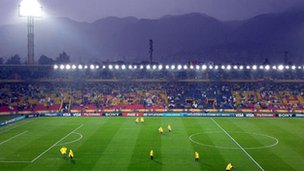
The tournament, won by Brazil, was held across Colombia with the final in Bogota

Colombian prosecutors are investigating why organisers paid a “shaman” $2,000 (£1,400) to keep rain away from the closing ceremony of the Fifa U-20 World Cup held in the country last year.

The inquiry was launched after cost overruns totalling $1m came to light.

But the focus of their questions is a 64-year-old man who says he uses dowsing to stave off or attract rain.

The event’s organisers defended their decision to use him, noting that the final event was indeed rain-free.

The “rain-stopper” in question, Jorge Elias Gonzalez, has been dubbed a “shaman” or medicine man by the Colombian media.

A dark joke doing the rounds in the capital, Bogota, asks why the shaman was not also hired to minimise the impact of the last rainy season, which killed 477 people and affected some 2.6 million Colombians.

Yet more cynical voices have said that, given the corruption allegations involving the Bogota authorities in recent years, Mr Gonzalez should be praised as the only contractor to deliver what he promised.

The spectacular closing ceremony in Bogota’s El Campin stadium on 20 August last year remained dry – a stark contrast with the opening event in Barranquilla a month earlier that was drenched.

Ana Marta de Pizarro, the anthropologist and theatre director who was in charge of the ceremony, used this argument to defend the hiring of a rain stopper.

“Had it rained, the event would not have taken place. It didn’t rain on the ceremony, it was successful and I would use him again if I needed to,” she said.

And Ms Pizarro also said Mr Gonzalez had been hired in the past to ensure Bogota’s International Theatre Festival was rain-free.

In an interview with a local radio station on Wednesday, Mr Gonzalez also said he was also hired to keep the rain away from the swearing-in ceremony of President Juan Manuel Santos.

This has, as yet, neither been confirmed nor denied by the president’s office.

Respect

Prosecutors are adamant that Mr Gonzalez’s contract will be investigated.

The procurement law requires efficiency and professionalism in all service providers paid for by public funds “and that doesn’t include shamans”, a statement from the local comptroller’s office said.

“We’ll ask him to explain in which circumstances, how and where he can stop rain,” said the deputy prosecutor, Juan Carlos Forero.

The debate has also drawn in those who want to make sure no public funds are used to pay for any sort of religious rites, and those who want the traditions of indigenous Colombians to be treated with more respect.

In a bizarre twist to the dispute, Mr Gonzalez has always insisted that he is not a shaman.

“I’m not indigenous, so don’t call me a shaman, for I don’t even know what that is. Nor am I a wizard,” he told a local newspaper several years ago.

Mr Gonzalez has said that he can stop or attract rain using dowsing, although he also prays.

Anthropologist Mauricio Pardo believes that by describing him as a shaman, the Colombian media might end up belittling an important indigenous tradition.

“And those traditions deserve to be respected. Even our constitution demands so,” he told BBC Mundo.

Profetas da chuva do sertão, por Raquel de Queiroz

“Vá, por exemplo, ao sertão nordestino, nos meses de novembro e dezembro. O povo, lá não tira os olhos do céu, em procura dos prenúncios. Pequenas nuvens ao poente… pequenas, claro, ainda não é tempo das grandes, mas, se elas se juntam para o sul, quer dizer uma coisa; se aparecem ao poente, a coisa muda. Só o que elas não dizem é que a coisa será essa: como todos os adivinhos do mundo, gostam de se envolver em mistério. E aquelas nuvens inocentes são branquinhas como se fossem feitas só de gelo e neve, não, têm nada a ver com chuva, são só enfeites do céu…” (p. 13)

QUEIROZ, Rachel. Existe outra saída, sim. Fortaleza: Fundação Demócrito Rocha, 2003.

Politics hindering scientists on climate change (The Seattle Times)

Sunday, December 25, 2011 – Page updated at 08:00 p.m.

By JUSTIN GILLIS
The New York Times

At the end of one of the most bizarre weather years in U.S. history, climate research stands at a crossroads.

Scientists say they could, in theory, do a much better job of answering the question “Did global warming have anything to do with it?” after extreme weather events like the drought in Texas and the floods in New England.

But for many reasons, efforts to put out prompt reports on the causes of extreme weather are essentially languishing. Chief among the difficulties that scientists face: The political environment for new climate-science initiatives has turned hostile, and with the federal budget crisis, money is tight.

And so, as the weather becomes more erratic by the year, the public is left to wonder what is going on.

When 2010 ended, it had seemed as if people had lived through a startling year of weather extremes. But in the United States, if not elsewhere, 2011 has surpassed that.

A typical year in this country features three or four weather disasters whose costs exceed $1 billion each. But this year, the National Oceanic and Atmospheric Administration has tallied a dozen such events, including wildfires in the Southwest, floods in multiple regions of the country and a deadly spring tornado season. And the agency has not finished counting. The final costs are certain to exceed $50 billion.

“I’ve been a meteorologist 30 years and never seen a year that comes close to matching 2011 for the number of astounding, extreme weather events,” Jeffrey Masters, a co-founder of the popular website Weather Underground, said last month. “Looking back in the historical record, which goes back to the late 1800s, I can’t find anything that compares, either.”

Many of the individual events in 2011 do have precedents in the historical record. And the nation’s climate has featured other concentrated periods of extreme weather, including severe cold snaps in the early 20th century and devastating droughts and heat waves in the Dust Bowl era of the 1930s.

But it is unusual, if not unprecedented, for so many extremes to occur in such a short span. The calamities in 2011 included wildfires that scorched millions of acres, extreme flooding in the Upper Midwest and the Mississippi River valley and heat waves that shattered records in many parts of the country. Abroad, huge floods inundated Australia, the Philippines and large parts of Southeast Asia.

A major question nowadays is whether the frequency of particular weather extremes is being affected by human-induced climate change.

Climate science already offers some insight. Researchers have proved the temperature of the Earth’s surface is rising, and they are virtually certain the human release of greenhouse gases, mainly from the burning of fossil fuels, is the major reason. For decades, they have predicted this would lead to changes in the frequency of extreme weather events, and statistics show that has begun to happen.

For instance, scientists have long expected a warming atmosphere would result in fewer extremes of low temperature and more extremes of high temperature. In fact, research shows that about two record highs are being set in the U.S. for every record low, and similar trends can be detected in other parts of the world.

Likewise, a well-understood physical law suggests a warming atmosphere should hold more moisture. Scientists have directly measured the moisture in the air and confirmed it is rising, supplying the fuel for heavier rains, snowfalls and other types of storms.

“We are changing the large-scale properties of the atmosphere — we know that beyond a shadow of a doubt,” said Benjamin D. Santer, a leading climate scientist who works at the Lawrence Livermore National Laboratory in California. “You can’t engage in this vast planetary experiment — warming the surface, warming the atmosphere, moistening the atmosphere — and have no impact on the frequency and duration of extreme events.”

But if the human contribution to heat and precipitation is clear, scientists are on shakier ground analyzing many other events.

Some questions can be answered with focused studies of a specific weather event, but these are often finished years afterward. Lately, scientists have been discussing whether they can do a better job of analyzing events within days or weeks, not years.

“It’s clear we do have the scientific tools and the statistical wherewithal to begin answering these types of questions,” Santer said.

But doing this on a regular basis would probably require new personnel spread across several research teams, along with a strong push by the federal government, which tends to be the major source of financing and direction for climate and weather research. Yet Washington, D.C., is essentially frozen on the subject of climate change.

This year, when the National Oceanic and Atmospheric Administration tried to push through a reorganization that would have provided better climate forecasts to businesses, citizens and local governments, Republicans in the House of Representatives blocked it.

The idea had originated in the Bush administration, was strongly endorsed by an outside review panel and would have cost no extra money. But the House Republicans, many of whom reject the overwhelming scientific consensus about the causes of global warming, labeled the plan an attempt by the Obama administration to start a “propaganda” arm on climate.

In an interview, Jane Lubchenco, the director of NOAA, rejected that claim and said her agency had been deluged with information requests regarding future climate risks. “It’s truly unfortunate that we are not allowed to become more effective and efficient in delivering that information,” she said.

NOAA does finance research to understand the causes of weather extremes, as do the National Science Foundation and the Department of Energy. But with the strains on the federal budget, Lubchenco said, “it’s going to be more and more challenging to devote resources to many of our research programs.”

Copyright © The Seattle Times Company

Climate summit was a pathetic exercise in deceit (Globe and Mail)

Thomas Homer-Dixon
Last updated Monday, Dec. 12, 2011 10:01AM EST

It was an “emperor-has-no-clothes” moment. The 17-year-old youth delegate rose before the assembled participants at the Durban climate conference and looked them straight in the eye.

“I speak for more than half the world’s population,” declared Anjali Appadurai of Maine’s College of the Atlantic. “We are the silent majority. You’ve given us a seat in this hall, but our interests are not at the table. What does it take to get a stake in this game? Lobbyists? Corporate influence? Money?”

“You have been negotiating all of my life. In that time, you’ve failed to meet pledges, you’ve missed targets, and you’ve broken promises.”

Ms. Appadurai nailed it. There’s really only one label for the pathetic exercise we’ve just witnessed in South Africa: deceit. The whole climate-change negotiation process and the larger political discourse surrounding this horrible problem is a drawn-out and elaborate exercise in lying – to each other, to ourselves, and especially to our children. And the lies are starting to corrupt our civilization from inside out.

The climate negotiators lie to each other and the world when they claim the world can still limit the planet’s warming to two degrees Celsius above the pre-industrial average, the point at which many experts believe the risks from climate change rise sharply.

It’s a lie because we’ve already experienced 0.8 degrees warming, and we’ve got at least another 0.6 degrees on the way due to carbon already in the atmosphere. Given that global carbon dioxide emissions of about 35 billion tons each year are now growing at an average of 3 per cent a year – which means they’re doubling every 23 years – it’s virtually certain we’re going to use up the remaining 0.6 degrees of leeway. In fact, the emerging consensus among climate experts is that we’ll be lucky to limit warming to 4 degrees.

India, China, and Brazil lie to their own citizens when they claim that by blocking a climate deal they’re protecting the opportunity for their economies to develop. “Am I to write a blank cheque and sign away the livelihoods and sustainability of 1.2-billion Indians?” asked India’s environment minister, Jayanthi Natarajan.

But this choice is patently false, as senior officials of these countries surely know. It’s not a choice between a climate-change deal and economic development; it’s really a choice of both or neither. If we don’t reduce carbon emissions, the impacts of climate change will eventually devastate the economies of poor countries. Repeated failures of monsoons in India and China or the desiccation of the Amazon basin in Brazil will drive a stake through these countries’ economies. Dealing with climate change is a prerequisite for prosperity this century – for all people on this planet.

The Canadian federal government lies to Canadians when it says we can still meet the government’s stated target of a 17 per cent reduction of emissions below the country’s 2005 level by 2020. Given the projected growth in oil sands output and the Conservatives’ neglect of the climate change file, nobody in the know seriously believes such a target can be achieved.

And we lie to ourselves when we tell ourselves that fixing climate change is someone else’s responsibility, or that the science is too uncertain to justify action, or that we’ll find a technology to solve the problem when it gets serious enough, or that it simply costs too much to do anything.

But most of all we lie to our kids. We tell them we’ve got the climate problem under control, while we’ve actually lost control of it completely. Worse, we tell them that we’re protecting their options for the future, while we’re actually closing down those options to protect powerful political and economic vested interests in the present.

It took a 17-year-old to tell the truth. The rest of us, supposedly adults, should be ashamed.

Thomas Homer-Dixon is the director of the Waterloo Institute for Complexity and Innovation and is the CIGI Chair of Global Systems at the Balsillie School of International Affairs in Waterloo, Ont.

Avanço diplomático, atraso climático (O Globo)

JC e-mail 4403, de 12 de Dezembro de 2011.

A adesão de EUA, China e Índia é marco da COP-17. Mas cortes de CO2 ficam na promessa.

Quase dois dias depois do previsto, a reunião das Nações Unidas sobre mudanças climáticas de Durban, na África do Sul, terminou na madrugada de ontem (11) sem que nenhum novo acordo com valor de lei fosse firmado. Nas 36 horas de prorrogação da cúpula, representantes de 194 países concordaram em estender o Protocolo de Kioto até 2017 e a dar início a negociações para a elaboração de um novo tratado global que só entraria em vigor em 2020. Para analistas, o resultado é uma vitória da diplomacia – uma vez que, pela primeira vez, EUA, China e Índia aceitaram negociar metas compulsórias -, mas um fracasso do ponto de vista climático. A Plataforma de Durban é um plano de ação para negociações futuras, mas representa um atraso concreto nos cortes de gases do efeito estufa.

Cientistas são praticamente unânimes em afirmar que para que o aumento da temperatura da Terra se mantenha no patamar dos 2° Celsius até o fim do século – acima da qual considera-se que haveria mudanças climáticas perigosas – um novo acordo global com metas obrigatórias de cortes de emissões já teria que entrar em vigor até o fim do ano que vem, quando o Protocolo de Kioto expiraria. Quase dez anos de espera para se ter metas compulsórias – “a década perdida”, como já a apelidaram ambientalistas – pode levar o aumento da temperatura planetária para a casa dos 3° Celsius a 4° Celsius, com consequências climáticas dramáticas.

A prorrogação do Protocolo de Kioto até 2017, por sua vez, é apenas simbólica. Com a saída de Rússia, Japão e Canadá do acordo (que nunca teve a adesão dos EUA, nem obrigações dos países em desenvolvimento), o protocolo, atualmente, cobre apenas 15% das emissões do planeta. Como, na melhor das hipóteses, o novo acordo só será implementado em 2020, tampouco se sabe que tratado estará em vigor entre 2017 e 2020.

Negociações formais começam em 2012 – Ainda assim, os participantes da reunião consideraram o acordo uma grande vitória da diplomacia. De fato, foi a primeira vez que Estados Unidos, China e Índia (os maiores emissores de CO2) concordaram em negociar a elaboração de um documento com metas compulsórias de corte de emissões – as negociações começariam já no ano que vem e se estenderiam até 2015. O Brasil, que está entre os cinco maiores emissores por conta do desmatamento, já havia concordado com o plano de intenções e teve papel crucial nas negociações. Se tudo der certo, será a primeira vez que o mundo terá um acordo global, com valor legal e o envolvimento de todos os países.

Para a ministra do Meio Ambiente, Izabella Teixeira, foi um desfecho “histórico”. A presidente Dilma Rousseff, informada do resultado pela ministra, se disse satisfeita com o resultado do encontro e elogiou a participação do Brasil.

“O documento é extraordinário. Ele lança um futuro de cooperação internacional, com condições para que se venha a ter no mesmo instrumento jurídico todos os países, abrindo uma nova era na luta contra a mudança do clima”, resumiu o embaixador Luiz Alberto Figueiredo, negociador-chefe da delegação brasileira.

Especialista da Coppe/UFRJ e integrante do Painel Intergovernamental de Mudanças Climáticas (IPCC) da ONU, Suzana Kahn Ribeiro, tem uma visão diferente. “Se o objetivo dos negociadores era ter algum tipo de acordo, não deixar um vácuo, ok, então eu posso considerar que o encontro foi vitorioso. Agora, se a meta era ter uma solução para o aquecimento global, então a conferência foi um fracasso total. Temos um instrumento legal (Kioto) que não tem valor prático nenhum e um plano de intenções para 2020 puramente declaratório”, afirmou.

Assessor da prefeitura para a Rio+20, o economista Sérgio Besserman concorda com a colega. “Esta é uma negociação diplomática, como tantas outras, mas a diferença, neste caso, é que não temos controle sobre a agenda, que é ditada externamente, pelo clima. Quando o debate é sobre comércio, por exemplo, se atrasar, atrasou. Mas com o clima não é assim, ele tem seu próprio ritmo. É claro que é preferível que se tenha um plano de intenções, que a toalha não tenha sido jogada, mas estamos nos atrasando consideravelmente”, declarou.

Para Besserman, “é assustadora a incapacidade da governança mundial de dar uma resposta ao conhecimento científico que já se tem sobre o que vem pela frente”. “Vale lembrar que um aumento de 3° Celsius é 50% acima do que se considera o limite do perigo”, avaliou.

Duas das principais organizações ambientais do mundo, WWF e Greenpeace condenaram o resultado da conferência. “O mundo merece um pacto melhor que o débil compromisso de Durban”, afirmou Regine Günther, do WWF Alemanha, lembrando que o acordo não impedirá que a temperatura suba acima dos 2° Celsius.

Para o Greenpeace, “o compromisso não conduz a um tratado vinculante mundial para a proteção do clima, mas a um acordo vago”, lembrando que não há sequer sanções para quem não cumprir o plano de intenções.

Para o cientista político e professor de Relações Internacionais da Universidade de Brasília, Eduardo Viola, o resultado da conferência é “desastroso” do ponto de vista do clima. “Tudo foi protelado para 2020, uma vez que essa prorrogação de Kioto é irrelevante, é a prorrogação do nada”, resumiu. “O resultado não é histórico, como estão dizendo os que estavam envolvidos nas negociações. Ele lamenta a decisão de adiar as medidas até 2020, uma ideia de que se está fazendo algo pelo clima quando a ciência aponta que as medidas de redução das emissões já deveriam vigorar em 2013.”

Ainda assim, o especialista garante estar otimista. “A Humanidade aprende pela dor”, afirma, lembrando que as mudanças climáticas ainda são uma realidade distante para boa parte da população. “Ela aprende com mais dor do que precisaria e em muito mais tempo do que seria necessário, mas não está condenada ao suicídio.”

Os principais pontos acertados na COP-17
O que aconteceu em Durban? 194 países se reuniram na 17ª rodada de negociações da Convenção do Clima da ONU, cuja meta é deter o aquecimento global ao limitar as emissões de gases do efeito estufa. A conferência durou dois dias além do previsto, na mais longa reunião ambiental realizada.

O que foi obtido? Após duríssimas negociações, se chegou à “Plataforma de Durban”. No documento de duas páginas, pela primeira vez, todos os países prometem cortar emissões. Um plano guiará os países em negociações até 2015 para que cheguem a um acordo legal de cortes. Porém, ele só começará a vigorar em 2020.

Foi um avanço ou um retrocesso? Depende do ângulo que se olhe. Um sucesso em termos de se manter as negociações vivas, salvando o processo da ONU, após este quase ter colapsado em Copenhague e Cancún. A União Europeia chama seu plano de ação (a Plataforma de Durban) de “avanço histórico”. Para a UE, essa é a primeira vez que EUA, China e Índia se comprometem a assinar um tratado de legal para cortar emissões. Porém, é um atraso do ponto de vista de muitos países em desenvolvimento, de grupos ambientalistas e de cientistas. Eles argumentam que a linguagem usada precisa ser mais forte para forçar os países a agir e que deveria haver datas concretas de cortes.

E o Protocolo de Kioto? Ele será estendido até 2017, com metas de redução para a UE e poucos outros países desenvolvidos. Japão e Rússia já tinham anunciado que deixariam Kioto. Um novo acordo deve ser negociado para cobrir o período até 2020. Porém, Índia, China e EUA continuam de fora. Os dois primeiros porque não têm obrigação legal e os EUA por não serem signatários. Nesse período de intervalo países como o Brasil, que têm metas voluntárias, continuarão a fazer cortes de emissões.

O dinheiro prometido em 2010 para ajudar os países pobres? O Fundo Verde criado em Cancún deverá despender US$60 bilhões por ano a partir de 2020. Porém, os detalhes de como isso será feito são muito vagos. Não está definido de onde virá o dinheiro. Uma das possibilidades são taxas sobre a aviação.

E o desmatamento? O REDD, o plano para pagar países pobres a não cortar suas árvores, avançou pouco. Mais uma vez, não ficou definido de onde virá o dinheiro. Há temor de que os recursos sejam desviados em corrupção. O REDD deverá continuar na mesa de negociação.

O que o acontecerá agora? Rodadas sobre clima estão previstas para março, em Londres, em Bonn (Alemanha), e finalmente no Qatar, na COP-18, em dezembro de 2012. Embora a Rio+20 não tenha foco no clima, especialistas acreditam que ela será fundamental nesse sentido. Em 2012 começam as negociações para se chegar a um acordo em 2015. Isso incluirá as metas por países, que deverão ser diferenciadas. Espera-se que países sejam pressionados pela sociedade a assumir metas mais ousadas.

CO2 may not warm the planet as much as thought (New Scientist)

19:00 24 November 2011 by Michael Marshall

The climate may be less sensitive to carbon dioxide than we thought – and temperature rises this century could be smaller than expected. That’s the surprise result of a new analysis of the last ice age. However, the finding comes from considering just one climate model, and unless it can be replicated using other models, researchers are dubious that it is genuine.

As more greenhouse gases enter the atmosphere, more heat is trapped and temperatures go up – but by how much? The best estimates say that if the amount of carbon dioxide in the atmosphere doubles, temperatures will rise by 3 °C. This is the “climate sensitivity”.

But the 3 °C figure is only an estimate. In 2007, the Intergovernmental Panel on Climate Change (IPCC) said the climate sensitivity could be anywhere between 2 and 4.5 °C. That means the temperature rise from a given release of carbon dioxide is still uncertain.

There have been several attempts to pin down the sensitivity. The latest comes from Andreas Schmittner of Oregon State University, Corvallis, and colleagues, who took a closer look at the Last Glacial Maximum around 20,000 years ago, when the last ice age was at its height.

Icy cold

They used previously published data to put together a detailed global map of surface temperatures. This showed that the planet was, on average, 2.2 °C cooler than today. We already know from ice cores that greenhouse gas levels in the atmosphere at the time were much lower than they are now.

Schmittner plugged the atmospheric greenhouse gas concentrations that existed during the Last Glacial Maximum into a climate model and tried to recreate the global temperature patterns. He found that he had to assume a relatively small climate sensitivity of 2.4 °C if the model was to give the best fit.

If climate sensitivity really is so low, global warming this century will be at the lower end of the IPCC’s estimates. Assuming we keep burning fossil fuels heavily, the IPCC estimates that temperatures will rise about 4 °C by 2100, compared with 1980 to 1999. Schmittner’s study suggests the warming would be closer to their minimum estimate for the “heavy burning” scenario, which is 2.4 °C.

Sensitive models

Past climates can help us work out the true climate sensitivity, says Gavin Schmidt of the NASA Goddard Institute of Space Studies in New York City. But he says the results of Schmittner’s study aren’t strong enough to change his mind about the climate sensitivity. “I don’t expect this to impact consensus estimates,” he says.

In particular, the model that Schmittner used in his analysis underestimates the cooling in Antarctica and the mid-latitudes. “The model estimate of the cooling during the Last Glacial Maximum is a clear underestimate,” Schmidt says. “A different model would give a cooler Last Glacial Maximum, and thus a larger sensitivity.”

Schmittner agrees it is too early to draw firm conclusions.Individual climate models all have their own quirks, so he wants to try the experiment with several models to find out if others repeat the result.

Even if the climate sensitivity really is as low as 2.4 °C, Schmittner says that doesn’t mean we are safe from climate change. The Last Glacial Maximum was only 2.2 °C cooler than today, yet there were huge ice sheets, plant life was different, andsea levels were 120 metres lower.

“Very small changes in temperature cause huge changes in certain regions,” Schmittner says. So even if we get a smaller temperature rise than we expected, the knock-on effects would still be severe.

Journal reference: Science, DOI: 10.1126/science.1203513

World on track for nearly 11-degree temperature rise, energy expert says (Washington Post)

By , Published: November 28

The chief economist for the International Energy Agency said Monday that current global energy consumption levels put the Earth on a trajectory to warm by 6 degrees Celsius (10.8 degrees Fahrenheit) above pre-industrial levels by 2100, an outcome he called “a catastrophe for all of us.”

Fatih Birol spoke as as delegates from nearly 200 countries convened the opening day of annual U.N. climate talks in Durban, South Africa.

This year has been an unprecedented one for natural disasters. By the end of June, economic losses totaled $265 billion, according to German reinsurer Munich Re. That easily exceeds the total figure for 2005, which was previously the costliest year.

International climate negotiators have pledged to keep the global temperature rise to 2 degrees Celsius, or 3.6 degrees Fahrenheit, above pre-industrial levels. The Earth has already warmed 0.8 degrees Celsius, or 1.4 Fahrenheit, so far, according to climate scientists.According to the IEA’s most recent analysis, heat-trapping emissions from the world’s energy infrastructure will lead to a 2-degree Celsius increase in the Earth’s temperature that, as more capacity is added to the system, will climb to 6 degrees Celsius of warming by 2100.Unless there is a shift away from some of the fossil fuel energy now used for electricity generation and transportation, Birol said, “the world is perfectly on track for a six-degree Celsius increase in temperature.“Everybody, even the schoolchildren, knows this is a catastrophe for all of us,” he said at the Carnegie Endowment for International Peace.

Birol spoke in unusually blunt terms about the climate implications of the global energy mix, implications that are disputed by many conservatives in the United States who don’t believe in the connection between human activity and climate change.

David Burwell, who directs the energy and climate program at the Carnegie Endowment, said Birol’s comments have “big implications for capital investment in energy,” though he noted that it will be oil executives and others in the private sector who will drive many of the key decisions.

“We can try to regulate, we can try to incentivize, but ultimately, they’ve got to make the decisions, they’ve got to make the investments,” he said, adding that government officials should engage with the energy industry on this topic. “Now’s the time to have the conversation about investments.”

Burwell added that while the IEA has analyzed energy use and production for years, this is the first year its officials have spoken this publicly about the need to shift gears.

“They’re definitely raising the red flag, because the numbers speak for themselves,” he said. “This is the first year they’ve started stamping their foot and saying, ‘Lookit, listen to us.’ ”

In an interview after his talk, Birol said he believes his agency’s analysis is having an impact in places such as China, which he said would outpace the European Union in per capita carbon emissions by 2015. He added that by 2035, China would outrank the industrialized world as the single biggest overall emitter of greenhouse gases in history.

“They are one of the few countries putting an emphasis on climate change,” Birol said, noting they will experiment next year with putting a price on carbon in some regions.

The U.N. talks, meanwhile, suffered a setback as Canada announced Monday that it would not agree to sign up to a second commitment period under the Kyoto Protocol, the 1997 climate pact that set emissions targets for all major industrialized nations. Canada had pledged to cut its overall greenhouse gas emissions 6 percent by 2012 compared with 1990 levels; as of 2009, its carbon output was 29.8 percent above 1990 levels.

Climate summit opens amid big emitters’ stalling tactics (BBC)

28 November 2011 Last updated at10:40 GMT

By Richard BlackEnvironment correspondent, BBC News

South African minister Maite Nkoana-MashabaneSouth Africa’s Maite Nkoana-Mashabane called for delegates to find a “common solution” for the future
As this year’s UN climate summit opens, some of the developing world’s biggest greenhouse gas emitters are bidding to delay talks on a new global agreement.

To the anger of small islands states, India and Brazil have joined rich nations in wanting to start talks on a legal deal no earlier than 2015.

The EU and climate-vulnerable blocs want to start as soon as possible, and have the deal finalised by 2015.

The UN summit, in Durban, South Africa, may make progress in a few areas.

“We are in Durban with one purpose: to find a common solution that will secure a future to generations to come,” said Maite Nkoana-Mashabane, South Africa’s minister of international relations, who is chairing the summit.

But the process of finding that common solution, in the form of an agreement that can constrain greeenhouse gas emissions enough to keep the global average temperature rise below 2C, will entail some complex and difficult politics.

Developing countries will certainly target rich governments such as Japan, Canada and Russia over their refusal to commit to new emission cuts under the Kyoto Protocol, whose current targets expire at the end of next year.

They see this as a breach of previous commitments and of trust.

But some observers say small island states may begin “naming and shaming” developing countries that are also delaying progress.

They say the impasse should not delay talks on a new deal, arguing that to do so would be, in one delegate’s wording, “the politics of mutually-assured destruction”.

“They’re on the edge of a mess,” another delegate told BBC News, “and they may not be able to resolve this mess”.

“The global response to climate change simply does not have time for advancing self-serving national interests” Mark Roberts, EIA

Seismic shift

The politics of the UN climate process are undergoing something of a fundamental transformation.

Increasingly, countries are dividing into one group that wants a new global treaty as soon as possible – the EU plus lots of developing countries – and another that prefers a delay and perhaps something less rigorous than a full treaty.

The divide was evident earlier this month at the Major Economies Forum (MEF) meeting in Arlington, US – the body that includes 17 of the world’s highest-polluting nations.

There, the UK and others argued that the Durban summit should agree to begin work on a new global agreement immediately, to have it in place by 2015, and operating by 2020 at the very latest.

The US, Russia and Japan were already arguing for a longer timeframe.

But BBC News has learned that at the MEF meeting, Brazil and India took the same position.

DURBAN CLIMATE CONFERENCE

  • Summit will attempt to agree the roadmap for a future global deal on reducing carbon emissions
  • Developing countries are insisting rich nations pledge further emission cuts under the Kyoto Protocol
  • Delegates also aim to finalise some deals struck at last year’s summit
  • These include speeding up the roll-out of clean technology to developing nations…
  • … and a system for managing the Green Climate Fund, scheduled to gather and distribute billions of dollars per year to developing countries
  • Progress may also be made on funding forest protection

Brazil wants the period 2012-15 to be a “reflection phase”, while India suggested it should be a “technical/scientific period”.

China, now the world’s biggest emitter, is said by sources to be more flexible, though its top priority for Durban is the Kyoto Protocol.

“The planet has no other sustainable alternative other than to ensure the continuity of the Kyoto Protocol, through a second commitment period starting in 2013,” said Jorge Arguello, leader of the Argentinian delegation, which this year chairs the powerful G77/China bloc of 131 nations.

“The adoption of a second commitment period for the reduction of greenhouse gases emissions under the Kyoto Protocol is not only a political imperative and a historical responsibility, but a legal obligation that must be faced as such.”

Although the EU does not oppose a second commitment period, other developed nations do.

And as the US left the protocol years ago, nations still signed on account only for about 15% of global emissions – which is why there is so much emphasis on a new instrument, with some legal force, covering all countries.

Cooling wish

The US, Russia, Japan and Canada have all argued for delaying negotiations on this for various domestic political reasons.

EU climate commissioner Connie HedegaardConnie Hedegaard’s EU is increasingly isolated among the industrialised world bloc

But the news that big developing countries are also lobbying for a delay is likely to lead to fireworks in Durban.

Many of the countries most at risk from climate impacts want to cut emissions fast enough to hold the global average temperature rise from pre-industrial times under 1.5C.

Scientific assessments say that for this to happen, global emissions should peak and begin to fall before 2020, adding urgency to these nations’ quest for a new and effective global agreement.

President Nasheed of the Maldives is virtually the only leader who has spoken openly of the need for major developing countries to begin cutting emissions soon.

Equating the need to develop with the right to emit greenhouse gases is, he has said, “rather silly”.

But sources in Durban indicate that delegates from other small developing countries may join him before the fortnight elapses, and demand more of the big developing nations.

China, Brazil and India are also being blamed for blocking moves to phase out the climate-warming industrial HFC gases, which small island states tabled at the Montreal Protocol meeting in Bali last week.

“The global response to climate change simply does not have time for advancing self-serving national interests,” said Mark Roberts, international policy advisor for the Environmental Investigation Agency (EIA).

Funding gap

Sources say, however, that there is real prospect of agreement in Durban on rules and mechanisms for a Green Climate Fund.

This would raise and disburse sums, rising to $100bn per year by 2020, to developing nations.

The industrialised countries (and countries in transition to a market economy) which took on obligations to reduce their greenhouse gas emissions under the Kyoto Protocol. Their combined emissions, averaged out during the 2008-2012 period, should be 5.2% below 1990 levels.

There is no agreement on where the money should come from.

Developing countries say the public coffers of industrialised nations should be the main source, whereas western governments say the bulk must come from private sector sources.

That is unlikely to be resolved until the end of next year.

But finalising the fund’s rules in Durban would be a concrete step forward.

Tim Gore, Oxfam’s chief policy adviser, said UK Climate Minister Chris Huhne must push for “getting the money flowing through the Green Climate Fund that poor people need to fight climate change now.

“A deal to raise resources from international transport could be on the table, and Huhne must convince other ministers to strike it,” he said.

However, there is widespread scepticism about the much smaller funds – $10bn per year – that developed nations are already supposed to be contributing under the Fast Start Finance agreement made in 2009.

Developing countries say only a small fraction of what has been pledged is genuinely “new and additional”, as it is meant to be; and that little has actually materialised.

The summit may also see a row over the EU’s imminent integration of aviation into the Emission Trading Schemen, which India and some other developing nations oppose.

Science panel: Get ready for extreme weather (AP)

November 18, 2011|Seth Borenstein, AP Science Writer

FILE%20-%20Maarten%20van%20Aalst%2C%20leading%20climate%20specialist%20for%20the%20Red%20Cross%20and%20Red%20Crescent%2C%20speaks%20about%20how%20climate%20change%20will%20affect%20people%20and%20assets%20during%20the%20presentation%20of%20the%20Intergovernmental%20Panel%20on%20Climate%20Change%20%28IPCC%29%20report%20at%20a%20press%20conference%20at%20the%20European%20headquarters%20of%20the%20United%20Nations%20in%20Geneva%2C%20Switzerland%2C%20in%20this%20April%2011%2C%202007%20file%20photo.%20Top%20international%20climate%20scientists%20and%20disaster%20experts%20meeting%20in%20Africa%20had%20a%20sharp%20message%20Friday%20Nov.%2018%2C%202011%20for%20the%20worlds%20political%20leaders%3A%20Get%20ready%20for%20more%20dangerous%20and%20unprecedented%20extreme%20weather%20caused%20by%20global%20warming.%20%28AP%20Photo/Keystone%2C%20Salvatore%20Di%20Nolfi%2C%20File%29Maarten van Aalst, leading climate specialist for the Red Cross and Red Crescent, speaks about how climate change will affect people and assets during the presentation of the Intergovernmental Panel on Climate Change (IPCC) report at a press conference at the European headquarters of the United Nations in Geneva, Switzerland, in this April 11, 2007 file photo. Top international climate scientists and disaster experts meeting in Africa had a sharp message Friday Nov. 18, 2011 for the worlds political leaders: Get ready for more dangerous and unprecedented extreme weather caused by global warming. (AP Photo/Keystone, Salvatore Di Nolfi, File)

Think of the Texas drought, floods in Thailand and Russia’s devastating heat waves as coming attractions in a warming world. That’s the warning from top international climate scientists and disaster experts after meeting in Africa.

The panel said the world needs to get ready for more dangerous and “unprecedented extreme weather’’ caused by global warming. These experts fear that without preparedness, crazy weather extremes may overwhelm some locations, making some places unlivable.

The Nobel Prize-winning Intergovernmental Panel on Climate Change issued a special report on global warming and extreme weather Friday after meeting in Kampala, Uganda. This is the first time the group of scientists has focused on the dangers of extreme weather events such as heat waves, floods, droughts and storms. Those are more dangerous than gradual increases in the world’s average temperature.

For example, the report predicts that heat waves that are now once-in-a-generation events will become hotter and happen once every five years by mid-century and every other year by the end of the century. And in some places, such as most of Latin America, Africa and a good chunk of Asia, they will likely become yearly bakings.

And the very heavy rainstorms that usually happen once every 20 years will happen far more frequently, the report said. In most areas of the U.S. and Canada, they are likely to occur three times as often by the turn of the century, if fossil fuel use continues at current levels. In Southeast Asia, where flooding has been dramatic, it is likely to happen about four times as often as now, the report predicts.

One scientist points to this year’s drought and string of 100 degree days in Texas and Oklahoma, which set an all-time record for hottest month for any U.S. state this summer.

“I think of it as a wake-up call,’’ said one of the study’s authors, David Easterling, head of global climate applications for the U.S. National Oceanic and Atmospheric Administration. “The likelihood of that occurring in the future is going to be much greater.’’

The report said world leaders have to prepare better for weather extremes.

“We need to be worried,’’ said one of the study’s lead authors, Maarten van Aalst, director of the International Red Cross/Red Crescent Climate Centre in the Netherlands. “And our response needs to anticipate disasters and reduce risk before they happen rather than wait until after they happen and clean up afterward. … Risk has already increased dramatically.’’

New climate emails leaked ahead of talks (CBS)

November 22, 2011 2:15 PM

The Climatic Research Unit at the University of East Anglia in Norwich, England. (AP)  

LONDON – The British university whose leaked emails caused a global climate science controversy in 2009 says it has discovered a potentially much larger data breach.

University of East Anglia spokesman Simon Dunford said that while academics didn’t have the chance yet to examine the roughly 5,000 emails apparently dumped into the public domain Tuesday, a small sample examined by the university “appears to be genuine.”

The university said in a statement that the emails did not appear to be the result of a new hack or leak. Instead, the statement said that the emails appeared to have been stolen two years ago and held back until now “to cause maximum disruption” to the imminent U.N. climate talks next week in Durban, South Africa.

If that is confirmed, the timing and nature of the leak would follow the pattern set by the so-called “Climategate” emails, which caught prominent scientists stonewalling critics and discussing ways to keep opponents’ research out of peer-reviewed journals.

Those hostile to mainstream climate science claimed the exchanges proved that the threat of global warming was being hyped, and their publication helped destabilize the failed U.N. climate talks in Copenhagen, Denmark, which followed several weeks later.

Although several reviews have since vindicated the researchers’ science, some of their practices – in particular efforts to hide data from critics – have come under strong criticism.

The content of the new batch of emails couldn’t be immediately verified – The Associated Press has not yet been able to secure a copy – but climate skeptic websites carried what they said were excerpts.

Although their context couldn’t be determined, the excerpts appeared to show climate scientists talking in conspiratorial tones about ways to promote their agenda and freeze out those they disagree with. There are several mentions of “the cause” and discussions of ways to shield emails from freedom of information requests.

Penn State University Prof. Michael Mann – a prominent player in the earlier controversy whose name also appears in the latest leak – described the latest leak as “a truly pathetic episode,” blaming agents of the fossil fuel industry for “smear, innuendo, criminal hacking of websites, and leaking out-of-context snippets of personal emails.”

He said the real story in the emails was “an attempt to dig out 2-year-old turkey from Thanksgiving ’09. That’s how desperate climate change deniers have become.”

Bob Ward, with the London School of Economics’ Grantham Research Institute on Climate Change, said in an email that he wasn’t surprised by the leak.

“The selective presentation of old email messages is clearly designed to mislead the public and politicians about the strength of the evidence for man-made climate change,” he said. “But the fact remains that there is very strong evidence that most the indisputable warming of the Earth over the past half century is due to the burning of fossil fuels and other human activities.”

The source of the latest leaked emails was unclear. The perpetrator of the original hack has yet to be unmasked, although British police have said their investigation is still active.

Climate researchers cleared of malpractice
An End to Climategate? Penn State Clears Michael Mann
Why climate change skeptics remain skeptical

From Shore to Forest, Projecting Effects of Climate Change (N.Y. Times)

By 

While the long-term outlook for grape-growers in the Finger Lakes region is favorable, it is less than optimal for skiers and other winter sports enthusiasts in the Adirondacks. Fir and spruce trees are expected to die out in the Catskills, and New York City’s backup drinking water supply may well be contaminated as a result of seawater making its way farther up the Hudson River.

These possibilities — modeled deep into this century — are detailed in a new assessment of the impact that climate change will have in New York State. The 600-page report, published on Wednesday, was commissioned by the New York State Energy Research and Development Authority, a public-benefit corporation, and is a result of three years of work by scientists at state academic institutions, including Columbia and Cornell Universities and the City University of New York.

Its authors say it is the most detailed study that looks at how changes brought about by a warming Earth — from rising temperatures to more precipitation and global sea level rise — will affect the economy, the ecology and even the social fabric of the state.

Cynthia Rosenzweig, a senior research scientist at Columbia’s Earth Institute, said the report was much broader in scope than earlier efforts by New York City that tried to evaluate how best to prepare for climate change.

“New York City’s report focuses on how climate change will affect critical structures” like bridges and sewage systems, she said. “This report also looks at public health, agriculture, transportation and economics.”

The authors drew on results from global climate models and then created projections for variables like rainfall and temperatures for seven regions across the state. Then they tried to assess how those alterations would play out in specific terms. They also developed adaptation recommendations for different economic sectors.

If carbon emissions continue to increase at their current pace, for example, temperatures are expected to rise across the state by 3 degrees Fahrenheit by the 2020s and by as much as 9 degrees by the 2080s. That would have profound effects on agriculture across the state, the report found. For example, none of the varieties of apples currently grown in New York orchards would be viable. Dairy farms would be less productive as cows faced heat stress. And the state’s forests would be transformed; spruce-fir forests and alpine tundra would disappear as invasive species like kudzu, an aggressive weed, gained more ground.

If the Greenland and West Antarctic ice sheets melt, as the report says could happen, the sea level could rise by as much as 55 inches, which means that beach communities would frequently be inundated by flooding.

“In 2020, nearly 96,000 people in the Long Beach area alone may be at risk from sea-level rise,” the report said, referring to just one oceanfront community on the South Shore of Long Island. “By 2080, that number may rise to more than 114,500 people. The value of property at risk in the Long Beach area under this scenario ranges from about $6.4 billion in 2020 to about $7.2 billion in 2080.”

The report found that the effects of climate change would fall disproportionately on the poor and the disabled.

In coastal areas in New York City and along rivers in upstate New York, it said, there is a high amount of low-income housing that would be in the path of flooding.

Art DeGaetano, a professor of earth and atmospheric sciences at Cornell, said that its findings need not be interpreted as totally devastating.

“It would be all bad if you wanted a static New York, with the same species of bird and the same crops,” he said, “but there will be opportunities as well. We expect, for example, that New York State will remain water-rich and we may be able to capitalize when other parts of the country are having severe drought.”

The next step, the authors said, is for them to meet with state agencies and try to work with them to carry out some of the report’s recommendations of ways to cope with climate change

One would be to get the state to routinely incorporate projections of increased sea levels and heavy downpours when building big infrastructure projects. They also suggested protecting and nursing natural barriers to sea-level rise, like coastal wetlands, and changing building codes in certain area for things like roof strength and foundation depth in areas that would be hit hardest by storms.

“If there is one thing we learned from Hurricane Irene,” Dr. Rosenzweig said referring to the tropical storm that pummeled the state this past summer, “we have a lot more we could be doing to prepare.”

Rajendra Pachauri: “A ciência foi deixada de lado na COP” (O Estado de São Paulo)

JC e-mail 4398, de 05 de Dezembro de 2011.

Se ela estivesse no centro do debate sobre mudanças climáticas, ações não poderiam ser adiadas, afirma o cientista indiano Rajendra Pachauri, presidente do Painel Intergovernamental sobre Mudanças Climáticas (IPCC).

O cientista indiano Rajendra Pachauri, de 71 anos, presidente do Painel Intergovernamental sobre Mudanças Climáticas (IPCC), acompanha com frustração a 17.ª Conferência do Clima da ONU, a COP-17. O pesquisador, que concedeu entrevista ao Estado em uma pequena sala VIP no centro de convenções de Durban, avalia que a ciência e os alertas dados pelos cientistas não estão no centro das negociações climáticas.

Para ele, não é necessariamente fundamental garantir a segunda fase do Protocolo de Kyoto nessa reunião, mas é preciso que haja avanços independentemente do acordo que seja escolhido. “Gostaria que houvesse uma forma de tornar a ciência sobre clima uma parte mais central nas discussões nas negociações. Porque pelo menos assim você poderia dizer que não se pode adiar as ações por muito tempo. E tomar medidas pode ser realmente atraente, e não caro”, afirma. A reunião segue até sexta-feira.

Apesar dos alertas do IPCC e do recente relatório especial sobre eventos extremos que mostram os impactos das mudanças climáticas, o avanço nas negociações é muito lento. Como o senhor avalia essa situação?
Nas negociações que estão acontecendo aqui, nós não podemos perder de vista a ciência das mudanças climáticas. Você mencionou corretamente que recentemente publicamos um relatório especial sobre eventos extremos e desastres e como podemos avançar na adaptação (preparação para esses eventos). Eu gostaria de ver uma discussão muito mais focada nessas questões, e o que a comunidade global pode fazer para lidar com esses impactos.

O senhor acha importante focar mais em adaptação?
Acho que precisamos lidar com os dois, adaptação e mitigação (cortes de emissões de gases-estufa). Porque nós não teremos capacidade de nos adaptar a todos os impactos. Podemos nos adaptar a algumas situações, mas, depois de um certo tempo, fica muito difícil e caro fazer isso. Então, precisamos olhar para a mitigação também. Neste ano apresentamos um relatório sobre energias renováveis que claramente mostra que é possível usar muito mais energias renováveis e, com mais pesquisas em seu desenvolvimento, os custos podem cair. O que estou dizendo é que eu gostaria que houvesse uma forma de tornar a ciência sobre clima uma parte mais central nas discussões nas negociações. Porque pelo menos assim você poderia dizer que não se pode adiar as ações por muito tempo. E que tomar medidas pode ser realmente atraente, e não caro.

A ciência então não está no centro da discussão hoje?
Não parece estar. Não estou envolvido diretamente na negociação, mas a acompanho e não vejo a ciência no centro do debate.

As pessoas costumam dizer que os cientistas do IPCC eram radicais e pessimistas. Mas em dois anos novos estudos podem mostrar que a situação é ainda mais perigosa do que o previsto?
Não sei, ainda estamos trabalhando nesse relatório. No relatório especial sobre eventos extremos e desastres, nós apontamos as áreas em que ainda não temos muitas evidências e também as em que as evidências claramente mostram que ondas de calor aumentarão, assim como os eventos de precipitações extremas e a elevação do nível do mar – e isso é uma ameaça a áreas costeiras. Trouxemos todas as informações com um grande cuidado, de forma robusta. Ninguém pode dizer que alguém dentro do IPCC é radical.

Ao contrário, eu ia perguntar se os cientistas não estavam sendo cautelosos demais no relatório de 2007.
Temos muito mais evidências hoje, muito mais pesquisas publicadas sobre mudanças climáticas. E o IPCC funciona com a avaliação de pesquisas publicadas (o IPCC não faz as próprias pesquisas). E, agora, temos muito mais estudos do que nos anos anteriores ao quarto relatório do IPCC, de 2007. Certamente, estamos num nível muito melhor agora. É claro que em algumas partes do mundo temos grandes lacunas, não temos estudos em todos os locais e isso ocorre principalmente nos países mais vulneráveis.

A discussão em Durban tem focado muito no Protocolo de Kyoto. Em sua opinião, é importante ter um segundo período de compromisso de Kyoto? Ou podemos fazer outro tipo de acordo?
É muito difícil dizer, há uma diversidade enorme de opções que podem ser aceitas. Mas eu gostaria de ver um avanço, qualquer que seja a direção tomada, com Kyoto ou outra coisa. E, de novo, se houvesse um foco na ciência, talvez as pessoas veriam que há urgência em agir e as decisões seriam tomadas mais rapidamente.

O senhor acredita que países emergentes como China, Índia e Brasil devem fazer mais, já que são grandes emissores?
Não poderia dizer isso, mas de vou lembrar que as responsabilidades de acordo com a convenção do clima são comuns, mas diferenciadas (os países industrializados, maiores emissores históricos, têm as maiores responsabilidades). E é por isso que essas negociações acontecem. Se olharmos nos últimos 20 anos desde que a convenção do clima foi criada, o mundo não fez o suficiente. E as emissões ainda estão aumentando. Então, não tenho muita certeza se o que tivemos até agora foi realmente muito efetivo. E talvez o que precisamos agora é de algo mais efetivo, que vá de encontro ao objetivo de evitar interferência antropocêntrica (humana) no sistema climático. Que é o objetivo principal da Convenção do Clima da ONU.

Em 2009, pouco antes da COP-15, tivemos o episódio que ficou conhecido como Climategate, quando e-mails de cientistas foram expostos. O senhor tem medo de hackers ou grampos telefônicos?
Tudo isso é crime, e uma pessoa não pode ficar com medo e deixar de fazer o que se espera dela. Temos de continuar nosso trabalho e é isso que estamos tentando fazer.

Mas o senhor recebe ameaças?
Sim, mas eu prefiro não falar sobre elas.

O que o IPCC aprendeu com o erro do Himalaia?
Em primeiro lugar, deixe-me colocar esse erro em perspectiva. Tínhamos 3 mil páginas de relatório e milhares de dados. E uma única informação em que cometemos o erro, de que as geleiras do Himalaia desapareceriam em 2035, não estava no sumário técnico, no sumário para os tomadores de decisão nem no relatório síntese. Estava apenas no relatório principal, que é essencialmente científico, não é para os tomadores de decisão. Então, de nenhuma maneira estávamos tentando chamar a atenção dos tomadores de decisão para esse dado errado. Francamente, não sabíamos do erro. Agora temos procedimentos mais fortes, mais passos a seguir, um protocolo de correção. Tudo isso vai nos ajudar a lidar com uma situação como essa muito melhor no futuro.

O senhor acha que o trabalho se tornando mais burocrático, com mais revisões e correções, pode afastar os cientistas do IPCC?
Nossa instituição tem uma responsabilidade com a sociedade. Então, se nós não temos um sistema em que um erro possa ser corrigido, então claramente há um déficit. É nossa responsabilidade buscar um sistema em que erros, uma vez que apareçam, possam ser investigados e depois corrigidos. E não tínhamos isso no passado.

E os cientistas continuam querendo se ligar ao IPCC, é importante para suas carreiras?
Absolutamente. Não sei a respeito das carreiras, mas com certeza pelo senso de orgulho profissional. Para o 5.º Relatório do IPCC tivemos um número recorde de nomeações. Cerca de 3 mil nomeações, das quais elegemos 831. O número foi pelo menos 50% maior do que tivemos no 4.º relatório. E isso mostra que a comunidade científica se entusiasma em trabalhar com o IPCC.

Acha que a crise econômica está impactando as negociações e as ações dos governos?
Eu acho que sim. Mas é por isso que eu acho que a primazia da ciência deve ser mantida. Vamos encarar a questão: a crise econômica deve ser resolvida em dois, três, quatro anos, algo assim. Mas o problema das mudanças climáticas está aqui para todo o sempre. Então, não podemos nos cegar por considerações de curto prazo.

O que o senhor espera da Rio+20?
O que vai ser a reunião é difícil de prever. Mas eu espero que marque um ponto de virada em nossa forma de pensar e em nossas atitudes. Já é hora de olhar para as implicações no longo prazo do que estamos fazendo e tomar algumas decisões. Eu espero a Rio+20 marque uma mudança na forma de pensar da raça humana.

Secretária da ONU diz que ações são respostas à ciência – A secretária executiva da Convenção do Clima da ONU, Christiana Figueres, negou ao Estado que a ciência não ocupe posição central nas negociações. “Se a ciência não dissesse que temos um problema, não estaríamos aqui. A convenção existe precisamente em resposta à ciência e a convenção sempre está atenta aos seus progressos.” Segundo ela, a convenção acompanhará o 5º Relatório do IPCC, a ser publicado em 2013 e 2014.
(O Estado de São Paulo – 4/12)