Arquivo da tag: Antropoceno

“A Manifesto for Abundant Futures” (Inhabiting the Anthropocene Blog)

Posted on July 21, 2015

CITATION:
Rosemary-Claire Collard, Jessica Dempsey, and Juanita Sundberg. 2015. Annals of the Association of American Geographers. Vol. 105, No. 2, pp. 322-330.
ON-LINE AVAILABILITY:
ABSTRACT:
The concept of the Anthropocene is creating new openings around the question of how humans ought to intervene in the environment. In this article, we address one arena in which the Anthropocene is prompting a sea change: conservation. The path emerging in mainstream conservation is, we argue, neoliberal and postnatural. We propose an alternative path for multispecies abundance. By abundance we mean more diverse and autonomous forms of life and ways of living together. In considering how to enact multispecies worlds, we take inspiration from Indigenous and peasant movements across the globe as well as decolonial and postcolonial scholars. With decolonization as our principal political sensibility, we offer a manifesto for abundance and outline political strategies to reckon with colonial-capitalist ruins, enact pluriversality rather than universality, and recognize animal autonomy. We advance these strategies to support abundant socioecological futures.

What becomes of conservation—a field that has long defined itself as protecting nature from humanity—in a time when human impacts reach every corner of the planet?

Many conservationists, it seems, would argue that the defense of natural spaces has never been more urgent than it is now.  As Michael Soulé puts it, “The worth of nature is beyond question and our obligation to minimize its gratuitous degradation is no less.”  Others, however, are disillusioned with the notion of pristine nature and have instead embraced the idea that we live in a “postnatural” world.  “Conservationists,” they argue, “will have to jettison their idealized notions of nature, parks, and wilderness […] and forge a more optimistic, human-friendly vision. […] [We] need to acknowledge that a conservation that is only about fences, limits, and far away places only a few can actually experience is a losing proposition.”

No single factor can account for the emergence of postnatural conservation—resilience theory, postequilibrium ecology, ecosystems services, climate change, and the Anthropocene proposal itself all come readily to mind.  But, whatever its causes, the postnatural turn suggests the prospect of new common ground with environmental social scientists, philosophers, and historians for whom nature has always been a problematic category.  This is, after all, similar to what we’ve been saying all along.

But is the “new” conservation really what we had in mind?  In their new article, “A Manifesto for Abundant Futures,” geographers Collard, Dempsey, and Sundberg raise several important concerns about conservation’s postnatural turn and offer an alternative set of conservation principles.  What I’d like to do here is very briefly highlight their concerns before commenting (again briefly) on their proposed alternatives.

Collard and her colleagues’ concerns about postnatural conservation revolve around its close connection to neoliberal managerialism.  Postnatural approaches to conservation, they explain, usually propose on the use of economic incentives to promote environmentally sustainable practices.  Under this model, human wellbeing is the tide that raises all ecological ships, and economic optimization the standard according to which competing tradeoffs are weighed.  Meanwhile, postnatural conservation breaks with traditional conservation by orienting itself toward the future rather than the past.  Its focus is not on restoring degraded landscapes to a past condition or addressing the historical roots of contemporary problems, but rather on looking hopefully toward a prosperous, globally integrated future.

This combination of anthropocentrism, instrumentalism, futurism, and globalism make postnatural conservation an excellent fit for neoliberal managerialism, not for critical environmental studies.  As a result, “new” conservation may actually reinforce the “old” political-economic system at the root of our global ecological crisis.  These concerns strongly resonate with those I have raised in prior posts.

What, then, is the alternative Collard and her colleagues envision?  I will not attempt a full summary here—the article itself is a great read!  Instead, I will offer a few comments on how their vision of conservation fits into the themes that emerged through our recent Habitation in the Anthropocene project.

History: As a corrective to the ahistorical futurism and market triumphalism of postnatural conservation, the authors center their approach on addressing the accumulated experiences of social and ecological suffering that characterize the Anthropocene.  Instead of bracketing ecocide, they propose looking back to past nonhuman abundance as an aspirational benchmark for the future.  Likewise, they cite work being done by a host of social and environmental justice movements and call for “political struggle grounded in decolonizing” (p. 326).  Not unlike Asa’s post about the “multitemporal” nature of human-environment interactions, the “Manifesto” conditions future habitability on dealing with the complex inheritances of the past.

Future: Like postnatural conservation, Collard and her colleagues seek to foster a sense of hope that the future will be abundant (as per the definition in their abstract).  Their hope, however, is not for a future dominated by economic rationality, but for a plurality of futures where less instrumental and anthropocentric standards for good living have a chance to define abundance in new ways.  In particular, they highlight Leanne Simpson’s work on the Anishinaabeg concept of mino bimaadiziwin, which denotes “promoting life” or “continuous rebirth” and suggests an “alternative to worlds that are enacted through utilitarianism and extraction” (p. 328).  Finally, they do not look to managerial, market-based solutions within the current global system, but instead insist that “creating conditions for abundance necessitates enacting alternatives to imperial capitalism” (p. 323).

Agency: Against the human exceptionalism of postnatural conservation, they make “multispecies entanglements” foundational to their approach.  They tie the wellbeing of humans to that of nonhumans and, in so many words, propose a relational ethics for multispecies cohabitation.  Although they join postnatural conservation in rejecting the concept of wilderness, they seek to preserve that of wildness so as to recognize “animal autonomy,” meaning “the fullest expression of animal life, including capacity for movement, for social and familial association, and for work and play” (p. 328).  Finally, they advocate “acting pluriversally”—an ontological orientation that aims for radical openness to different ways of bringing the world into being.  In this way, their vision leaves open possibilities for multiple, self-determined futures in a way that postnatural conservation does not.

Limits: The authors acknowledge the material limits to habitability—and in particular how these have been reached as a result of capitalist imperialism and experienced most acutely by politically marginalized humans and nonhumans.  However, as my comments above should make clear, their vision focuses mostly on moral limits to habitability, particularly those involving social justice, animal autonomy, and self-determination.

I hope that “A Manifesto for Abundant Futures” will be read widely.  I share with its authors the sense that the Anthropocene is at best “a spark that will light a fire in our imaginaries” (p. 326) and their hope that we can again achieve “a world literally filled to the brim with different creatures” (p. 321).


FURTHER READING:
William Cronon. 1995. “The Trouble with Wilderness; or, Getting Back to the Wrong Nature.” In William Cronon, ed., Uncommon Ground: Rethinking the Human Place in Nature. New York: W. W. Norton & Co., pp. 69-90. This highly influential essay historicizes the concept of “wilderness” in the US context and explains why tropes of “pristine nature” are not only empirically misleading but also politically damaging.
Peter Kareiva, Michelle Marvier, Robert Lalasz. 2012. “Conservation in the Anthropocene.” Breakthrough Journal. Winter issue. Here Kareiva and colleagues lay out a vision for what is referred to above as postnatural conservation.
Michael Soulé. 2013. “The ‘New Conservation’.” Conservation Biology. Vol. 27., No. 5., pp. 895-897. In this op-ed, Soulé, who is considered one of the founders of conservation science, makes a case against postnatural conservation.

James Lovelock: ‘Saving the planet is a foolish, romantic extravagance’ (Newsweek)

By    5/31/15 at 12:22 PM

Scientist James Lovelock

Harry Borden for Newsweek

Jim Lovelock, environmentalist, scientist, and celebrated proposer of the Gaia hypothesis, has always taken the long view of Earth’s future. So it feels appropriate that he should have retired to a coastguard’s cottage perched above Chesil Beach on Dorset’s Jurassic Coast – so called because 180 million years of geological history lie exposed along its cliffs and coves.

This shoreline is constantly eroding. In the winter storms of 2013, Lovelock’s cottage was cut off for four days when the road leading to it was washed into the sea – not that Lovelock, whose latest book is entitled A Rough Ride to the Future, needed any reminder of the precariousness of our world. A decade ago, he predicted that billions would be wiped out by floods, drought and famine by 2040. He is more circumspect about that date these days, but he has not changed his underlying belief that the consequences of global warming will catch up with us eventually. His conviction that humans are incapable of reversing them – and that it is in any case too late to try – is also unaltered. In the week when the Grantham Research Institute on Climate Change reported that the world is still miles off meeting its 2030 carbon emission targets, Lovelock cannot easily be dismissed.

There are other doomsayers. What makes this one so unusual is his confounding cheerfulness about the approaching apocalypse. His optimism rests on his faith in Gaia – his revolutionary theory, first formulated in the 1970s, that our planet is not just a rock but a complex, self-regulating organism geared to the long-term sustenance of life. This means, among other things, that if there are too many people for the Earth to support, Gaia – Earth – will find a way to get rid of the excess, and carry on.

Lovelock’s concern is less with the survival of humanity than with the continuation of life itself. Against that imperative, the decimation of nations is almost inconsequential to him. “You know, I look with a great deal of equanimity on some sort of happening – not too rapid – that reduces our population down to about a billion,” he says, five minutes into our meeting. “I think the Earth would be happier … A population in England of five or 10 million? Yes, I think that sounds about right.” To him, even the prospect of nuclear holocaust has its upside. “The civilisations of the northern hemisphere would be utterly destroyed, no doubt about it,” he says, “but it would give life elsewhere a chance to recover. I think actually that Gaia might heave a sigh of relief.”

He is driven, at least in part, by a deep affinity for the English countryside. When he warns that sea levels are rising three times faster than the first climatology models predicted, and that this threatens “an awful lot of land north of Cambridge that is one or two meters below sea level”, you sense that he really cares about that landscape’s fate. No doubt he inherited this affection, along perhaps with a certain independence of spirit and thought, from his father. Born in West Berkshire in 1872, Lovelock senior grew up as a “hunter-gatherer” in support of his impoverished family, until, aged 14, he was caught poaching and imprisoned in Reading for six months. “I am very proud of that first part of my father’s life,” he says.

Like others of his generation, Lovelock mourns the changes to the countryside wrought by the post-War agricultural revolution. As a young man in the 1930s, he recalls, he cycled from Kent to the West Country, when England was “unbelievably beautiful”. “It all looks very green and pleasant around here,” he adds, waving at the gentle downland beyond his kitchen window, “but it’s nothing compared to what it used to be”.

Like Gaia, he has evidently developed certain stratagems for the sustenance of life. One would not guess from his appearance that he will be 96 this year. With his American wife Sandy, who is 20 years his junior, he still walks to the village shops each Saturday, a round-trip of six miles; and his intellectual vigour is so unimpaired that conversing with him soon makes the head spin.

Japan Earthquake and tsunami 2011

While the 2011 Japan earthquake caused devastation, Lovelock observes that “zero” have died of radiation from FukushimaThe Asahi Shimbun via Getty

He contends that the end of the world as we know it began in 1712, the year the Devonshire blacksmith Thomas Newcomen invented the coal-powered steam engine. It was the first time that stored solar energy had been harnessed in any serious way, with effects that now “grip us and our world in a series of unstoppable events. We are like the sorcerer’s apprentice, trapped in the consequences of our meddling”. Newcomen’s discovery set in train more than just the era of industrial development. It also marked the start of a new geological epoch, the “Anthropocene”, the most significant characteristic of which, Lovelock believes, has been the emergence of “an entirely new form of evolution” that is one million times faster than the old process of Darwinian natural selection.

He points out that for half a century now, computing power has roughly doubled every two years – a trajectory of growth known as Moore’s Law – and that computers are already capable of many actions far beyond what humans can do. In his scariest scenario, which sounds disturbingly close to the premise of the Arnie Schwarzenegger Terminator movies, he warns that computers could morph into an autarkic life form powerful enough to “destroy us, our carbon life forms, and inherit the Earth”. Luckily he thinks this outcome unlikely, and in the end has no fear of the Rise of the Machines. “Computers are entirely rational creations. But true intelligence, the ability to create and to invent, is intuitive – and you can’t do rational intuition.”

On the other hand, his preferred prediction for humanity is scarcely less disturbing. He foresees the evolution of a man-machine hybrid by a process of endosymbiosis that, he argues, has already begun. “I am already endosymbiotic. I’m fitted with a pacemaker. It runs on a 10-year lithium battery, but the next generation will have its own power supply drawn from the body. I’m already worried about being hacked … Fairly soon, I think, the internet is going to be fully embedded in our bodies.”

Looking further still into the future, he says that life on Earth, based as it presently is on carbon, cannot last beyond 100 million years, because by then it will be too hot. The evolution of a different life form based on some more heat-resistant element – such as electronic silicon – could potentially extend life by another 500 million or even a billion years.

But first, of course, mankind has to survive the immediate global warming crisis. Lovelock is a famously outspoken critic of the green energy revolution, especially wind power, which he describes as “an absolute scam. A great big German scam”. The purveyors of wind turbines and solar panels, he says, are like 18th-century doctors trying to cure serious diseases with leeches and mercury. Instead he wants us to embrace nuclear fission, a completely clean energy source that he regards as a “gift”. The Western world’s prejudice against nuclear – underscored earlier this year when the number of reactors in the US dipped below a hundred for the first time in decades – is “tragic”.

German windmills, Dessau

Lovelock says wind power is a “great big German scam”Fabrizio Bensch/Reuters

“What gets my goat are the lies peddled about Fukushima [the Japanese nuclear reactor disaster of 2011]. Do you know how many people died of radiation? Zero. Not one – although there were 50-odd suicides among people driven to it by fear. Nuclear energy is actually 10 times safer, per GigaWatt hour of production, than wind power. Yet France and Germany responded to Fukushima by temporarily shutting down their entire nuclear industries. It makes no sense.” The reason, he thinks, is public ignorance, combined with a form of green politics that amounts to a “new religion – the same force that drives jihadists in Syria”. It is, he agrees, a paradox that the new accessibility of information brought about by the internet revolution has intensified, not diminished, the old battle between science and superstition. “There’s a campaign in our village to stop a new mobile phone mast. The electromagnetic radiation it will emit is trivial. It’s comparable to a household television. Yet the campaigners say it can give you cancer. This is about fear – not facts.”

With one or two exceptions such as Margaret Thatcher and Germany’s Angela Merkel, both of whom studied chemistry, he thinks our leaders are just as bad. “If you talk to any politician, American or British or European, they are absolutely blind on matters of science,” he says. He reserves special ire for Tony Blair, “the really mad prime minister” who, swayed by green ideology and the Campaign for Nuclear Disarmament, passed legislation subsidising the renewable energy sector, which made fresh investment in the nuclear industry almost impossible. (This, he argues, is one reason why the heating costs of an average house in the UK are up to 10 times greater than in America, which, overall, has a colder climate. For many years, he asserts, the Lovelocks wintered in St Louis, Missouri, purely in order to avoid British heating bills.)

But even a wholesale switch to nuclear power, in his view, would come too late to solve humanity’s principal problem, which is overpopulation. The old post-war goal of sustainable development, he says, has become an oxymoron and should be abandoned in favour of a strategy of sustainable retreat. He is scathing about the very idea of “saving the planet”, which he calls “the foolish extravagance of romantic Northern ideologues”. The vast sums of money being invested in renewable energy would be much better spent on strategies designed to help us survive and adapt, such as flood defences.

Above all, he thinks that we should embrace the ongoing global shift towards urban living. It would, he insists, be far easier and more economic to regulate the climate of cities than our current strategy of attempting to control the temperature of an entire planet. The regions beyond the cities would then be left to Gaia to regulate for herself. It seems a sci-fi fantasy, rather like Mega-City One from the pages of Judge Dredd, a post-apocalypse megalopolis shielded from the “Cursed Earth” beyond by massive boundary walls. But, in fact, the concept is not so futuristic. Noah, arguably, had a similar idea when he built the ark.

It is certainly not a new concept to Lovelock, who wrote a paper for the oil multinational, Shell, as far back as 1966 in which he predicted that the cities of the future would become much denser, and that Shell would be making plenty of money out of “the avoidance of ecological disaster”. The fictional Mega-City One held 800 million citizens, and incorporated the entire eastern seaboard of the United States. Lovelock points that the average population density of England is higher than that of greater Boston. His 1966 paper, which was recently reprinted by Shell, no longer looks as fantastical as it once did.

Singapore, he suggests, shows us how a city can succeed in an overheated climate. The trend there for building underground, as well as in places like Japan and even London (albeit for different reasons), might be part of the same process of adaptation. Architectural practices from the past might also offer clues to a sustainable retreat in the future. The streets of the medieval Dalmatian island town of Korcula, for instance, follow a unique herringbone plan designed to capture and channel the prevailing, cooling sea breeze.

Nature offers models for future city architecture, too. Lovelock is much taken at the moment with termites. Their mounds, he says, are built like the cities of the future might be. Like Korcula, they are oriented towards the prevailing wind. They also tend to lean towards the zenith of the sun, to minimise exposure to its rays at the hottest time of the day – a stratagem that perhaps has its analogue in a recent suggestion by the Scottish nationalist politician Rob Gibson, who wants all new housing estates to be orientated towards the south in order to maximise the efficiency of rooftop solar panels.

(In London, meanwhile, the architects NBBJ recently proposed building the world’s first “shadowless skyscraper” by building two towers – one to block out the sun, the other to reflect light down into the shadow of the first).

More interesting still, a recent paper in Science magazine has shown that termite mounds, once thought to be a sign of encroaching desertification, may actually have the ability to stabilise or even reverse the effects of climate change by trapping rainfall. “Termites are very Gaian,” Lovelock enthuses. “There are these wonderful pictures of little plants growing up between the termite cities. You could look at that as a nice future for humans.”

So does Lovelock really think that humanity could end up mimicking social insects? A dumbed-down world inhabited by worker drones might be environmentally efficient, but what about the surrender of privacy that would imply; isn’t the sublimation of individuality too high a price to pay? How could such a society ever throw up a Beethoven, a Shakespeare, or an Einstein? “That’s true, and of course it depends how far down this track we choose to go,” says Lovelock, “but do you think that evolution, as a process, gives two hoots about any of that?”

This is, to be sure, a reductive view of human existence. A man in the twilight of his years, as Lovelock is, might feel a sense of futility. Instead he maintains a steady wonder at what he calls “the ineffable: a lovely word, don’t you think?” while apparently seeking no earthly legacy beyond a modest hope that he will be remembered as having been consistent in his arguments.

As a man of science, he remains agnostic on the subject of God. And yet, he says, “I am beginning to swing round, to think more and more, that there’s something in Barrow and Tipler’s cosmic-anthropic principle – the idea that the universe was set up in such a way that the formation of intelligent life on some planet somewhere was inevitable … The more you look at the universe, the more puzzling it is that all the figures are just right for the appearance on this planet of people like us.”

For the time being our species may be, as he has written, “scared and confused, like a colony of red ants exposed when we lift the garden slab that is the lid of their nest”. But he is also content to be one of those ants, because he sees a kind of beauty in that confusion – and perhaps even some sort of grand design. “Humanity may be as important to Earth, to Gaia, as the first photo-synthesisers,” he thinks. “We are the first species to harvest information … that is something very special.”

Above all he is convinced that mankind can recover itself – and in this he may be a product of his vanishing generation. Some years ago, at a lecture in Edinburgh, I heard him reminisce how marvellously the British nation had pulled together when threatened by Nazi invasion, but that it had taken that existential threat to make them do so. When the climate crisis finally breaks, he believes, the world’s differences will again be put aside – and our species, for all its present idiocies, will pull together in a way that will astonish the cynics among us.

Schizoanalysis as Anthro-Ecology (Synthetic Zero)

May 31, 2015

WILD ECOLOGIES - Featured Post #3: Edmund Berger with an in-depth 
analysis of Guattari's 'ecosophy' and possible points of connection, 
overlap and divergence from anarchist thought.  

BillStereoLoop

How does one begin to broach the question of linkage, passage, and reflexivity to be found in the theories and practices of anarchism, the radical post-psychoanalysis of Felix Guattari, and the ontological framework that has been ushered in the necessity of acknowledging the forces that we label “the Anthropocene”? The overlaps between each are undeniable: in was ecological concerns that late in his life Guattari turned his mind to; the field that his work is commonly situated – the school of post-structuralism – is often affiliated with anarchism of the so-called “post-left” variety. That Guattari was closely aligned with the Italian Autonomia, which the post-left anarchists owe much of their discourse to, is no passing coincidence. We can also note the presence of “green anarchism” under the post-left label, alongside the controversial, anti-civilizational stance espoused by anarcho-primitivism. Yet we can see clearly that this triad of eco-ontology, Guattari, and anarchism have yet to really have the dialogue that they deserve.

On even a surface level reading the commonalities between each point is immediately clear: none points to a resolving synthesis in thought or being. The Anthropocene has brought us full circle and pried open what was also present but shunted aside by the progress of the West – that civilization and nature are not separate, and that civilization and culture exist entangled in the complex web of the ecology itself, defined as it is by various states of emergence. Anarchism, regardless of which of the many monikers it adapts, is at its core a program that is constantly evading and contesting the centralizing and homogenizing forms of the state itself. Guattari, meanwhile, shifts these focuses to the levels of individuals and group’s subjecthood, looking to move from fixed and stable states to ones far from equilibrium. Keeping in tune with the manner in which each point in this triad presents itself as an ongoing unfolding, this essay will attempt no resolute synthesis. I am more concerned in this moment with simply tracing out a constellation of convergences and patterns, looking for possibilities of a minor politics for the Anthropocene.

Schizo-Ecology 

From beginning to end, Guattari’s work centered on the problems of psychology, even if his approach appeared – and continues to appear – utterly alien to the orthodox scriptures put forth by the orthodoxy of psychoanalysis. He can best be understood as playing the role not of a psychoanalytic atheist (denouncing the whole paradigm, as those of anti-psychiatry are oft to appear), or the agnostic, undecided and wavering back and forth, but the heretic, positioning himself within the discourse but enacting a virulent rebellion against the limitations and interpretations of the primary institutions. While psychoanalysis enacts a practice of steering, moving the divergent subjectivity back into the confines deemed acceptable by civilization (that is, the body as laboring force for productivity), Guattari offers instead a schizoanalysis that renounces steering and searches for ways to unleash the subjectivity in a way that moves against civilization and its regime of production. Each step in his work covers a different region in which outside forces are capable of opening up subjectivity. In Anti-Oedipus (co-authored with Gilles Deleuze in 1972) this took the form of a revolt against Freud psychoanalysis and capitalism, curtesy of Marx, Nietzsche, and a radicalized anthropology. In A Thousand Plateaus (co-authored again with Deleuze, in 1980) a schizoanalytic framework is shown that denies the difference between scales, disciplines, arts and sciences. After his encounter with the Autonomia and their pirate radio programs, media became situated front and center. In 1989 he published the Three Ecologies, turning to the complexity of nature and the cosmos to illustrate the full scope of his project. Much of this work is a natural progression from his work on media technologies, as clear in the book’s opening line: “The Earth is undergoing a period of intense techno-scientific transformations. If no remedy is found, the ecological disequilibrium this has generated will ultimately threaten the continuation of life on the planet’s surface.”[1]

intimate_08

For Guattari the remedy to this state of affairs is not to be found in the technocratic solutions offered by the state and the monoliths of capitalism. It will be found instead in what he calls a practice of ecosophy, that is, a shifting mediation between three intertwining registers: “the environment, social relations and human subjectivity.”[2] This affair, however, is not as simple as it initially appears. Each of these ecological registers, in turn, is largely contingent upon relations with the others. We can read of this entanglement right at the outset of his earliest work with Deleuze, Anti-Oedipus:

…we make no distinction between man and nature: the human essence of nature and the natural essence of man become one within nature in the form of production or industry, just as they do within the life of man as a species. Industry is then no longer considered from the extrinsic point of view of utility, but rather from the point of view of its fundamental identity with nature as production of man and by man… man and nature are not like two opposite terms confronting one another… rather, they are one and the same essential reality producer-product.[3]

Human subjectivity and the social too work in the manner of relationity and encounter. In what he would later call his schizoanalytic cartographies, Guattari maps out the way that subjectivity comes into being, through a series of becomings that emerge from assemblages and states of flows: the territories in which the bodies exist and their own relations to nature, the codification of these territories by state form and cultural constructs, the intimate interactions between bodies, media and technology, architecture and aesthetics, the flows of capital, so on and so forth. As Foucault would so eloquently illustrate, the state of the subject itself is a composition that is molded and enforced by the apparatuses of state and industry; the subject itself can operate as confinement, reproducing through the activities of daily life the demands of regimented production itself. The schizoanalytic cartographies themselves are designed to model (or better, meta-model), these assemblages and apparatuses that work upon the subject in order to find a point of exit, towards other ways of articulating life and existence.  In other words, this particular heresy becomes one of mutation, in which subjectivity transforms into something revolutionary and imperceptible.

cartographies-schizoanalytiques (1)

In his last work, Chaosmosis (1992), Guattari alludes to the schizoanalytic cartographies as an “ecosophic object”, illustrating that the two approaches (the three ecologies and the cartographies) are inseparable entities. This is further compounded by the fact that The Three Ecologies was originally slated to be a chapter in the book titled Schizoanalytic Cartographies, and was published separately at the urging of Paul Virilio.[4] While the prudent thing to do here might be to stop and look at the cartographies themselves,[5] and look at their alignment with the processes laid out within The Three Cartographies, I would like to stop and examine the way in which the schizoanalytic program itself developed at different stages in Guattari’s oeuvre, looking at the way in which it unfolded in different historic moments and terrains of leftist struggle.

Revolutionary Science

Schizoanalytic Cartographies, The Three Ecologies debuted against the escalation of what Guattari described as “integrated world capitalism”, a total planetary marketization that “tends increasingly to decentre its sites of power, moving away from structures producing goods and services towards structures producing signs, syntax and – in particular, through the control which it exercises over the media, advertising, opinion polls, etc. – subjectivity.”[6]  Integrated world capitalism goes by many different names to be applied in different contexts: for the spread of markets, it is “globalization,” to describe the particularities of its govermentality the term “neoliberalism” is preferred. For the transnationalization of production itself, it is “post-Fordism”, for the role of signs, it is “semiocapitalism”. For the ascendancy of intellectual labor through the growth of the so-called ‘white collar’ jobs (primarily finance and I.T. work), it is “cognitive capitalism”. From the perspective of civil societies made global through information technologies, it is the rather ambiguous “network society”.

It is Deleuze and Guattari’s A Thousand Plateaus that is the great text of the network society, written right at the point in which this particular mode of production was first coming into existence. The schema of the network itself is found in the figure of the rhizome, which anticipates not only the eventual structuring of the internet but the way the social itself operates on a globalized level: “any point of the rhizome can be connected to any other, and must be… a rhizome ceaselessly establishes connections between semiotic chains, organizations of power, and circumstances relative to the arts, sciences, and social struggles.”[7] While this is the most commonly remember aspect of the book, it is, all in all, one of the lesser moments; the real purpose of A Thousand Plateaus is to show the central role of new technologies and cutting-edge sciences in bringing this science into fruition, and the ways in which these sciences and technologies can be repurposed towards revolutionary ends.

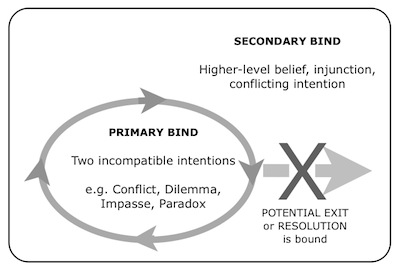
Looking backwards, we can find this same effort at work in Anti-Oedipus as well. As the title of the work implies, the target of attack here is Oedipus, understood as what Lacan would call the “symbolic order” – the rule of language and law, the ‘orderly conduct’ of civilizational affairs that becomes internalized within the subject and conflated with the state of nature. Elsewhere they remark that Oedipus is the operation of the double-bind, a theory of schizophrenia first identified by Gregory Bateson. As Deleuze and Guattari summarize:

Double bind is the term used by Gregory Bateson to describe the simultaneous transmission of two kinds of messages, one of which contradicts the other, for example the father who says to his son: go ahead, criticize me, but strongly hints that all effective criticism – at least a certain type of criticism – will be very unwelcome. Bateson sees in this phenomena a particularly schizophrenizing situation…[8]

what-are-double-binds

Deleuze and Guattari hold Bateson up as an example of deterritorialization, a flight of becoming from the enforced territories of being and thought. Indeed, Bateson not only finds a theory of schizophrenia in the double-bind, but also a remarkable congruence with the Zen koans given to the pupil by the master. If the double-bind in Western civilization leads to psychosis, in the East it leads to Enlightenment: “We feel that the schizophrenic finds himself continually in the same situation as the pupil but he achieves something like disorientation rather than enlightenment.”[9] Bateson would go to find a variety of overlaps between experiences of madness and schizophrenia with initiation rites in other societies; following in these footsteps, R.D. Laing would build a differing school of psychoanalysis that points away the confines of civilization, indicating the direction that schizoanalysis would eventually take.

Through Deleuze and Guattari’s usage of Bateson we can discern in their text a reaction to a specific mode of machinic configuration or arrangement. The machine in question here is less a literal machine and more of a metaphor for systems: that of cybernetics, a sciences of feedback loops, first identified by Norbert Wiener but quickly applied throughout the military, industry, and governance. For Bateson, however, the realization that action derives from interacting agents in a system opened an ontological horizon that could only be described in cosmological terms: systems now could be understood as self-regulating, utilizing the dynamics of positive and negative feedback to reach homeostatic states, as well self-organizing, capable of shifting homeostatic states towards “new patterns” and complexity. An ecology, he reasons, acts as an aggregate of many subsystems bound up in interaction operating across a variety of scales. We shouldn’t think of this ecology strictly in terms of the environment, for the environment itself is one of these parts; it also includes culture, social bodies, and importantly for Bateson, the mind itself. The Cartesian foundation of Western thought, which posits the separation of the physical body from its essence – the mind or soul – becomes unglued in these systems. While the state sought to deploy systems thinking to reinforce its governmental apparatuses and capital looked to streamline its profit producing capabilities, Bateson was charting far-out territories where the boundaries between the human and the non-human dissolve, right down to the molecular level.

Bateson’s so-called “second-order cybernetics” foreshadowed a whole realm of scientific theorizing that would emerge across the 1970s and 80s, going by names such as chaos theory, complexity theory, and emergence. Returning to Deleuze and Guattari, we can draw a resemblance between his ecology of aggregates and the machinic ecologies of flows discussed in Anti-Oedipus: Oedipus, the symbolic order, is a force that blocks the flows, framing them in a way to produce the subject. As a double bind, it assumes the function of the homeostat and prevents or wards off attempts to organize to patterns different from this equilibrium. The openings towards complexity and emergence, however, provided schizoanalytic praxis will a new scientific vocabulary to draw upon, expressed most clearly in A Thousand Plateaus.

SWARM_138-139_low

This influence is found primarily in the chapters of the book focusing on the war machine, that is, minotorian or nomadic bands that can be defined by their degrees of separation from the state. This, incidentally, is also the point in which Deleuze and Guattari appear at their most anarchist. These two points convergence on the acknowledgement that absolute control is an impossibility; as long as there are states, there will be war machines that flee from it. The state here, that Oedipal function, seeks homeostasis but the war machine can disrupt equilibria, triggering processes of self-organization towards new states. “From turba to turbo: in other words, from bands or packs of atoms to the great vortical organizations. The model is a vortical one; it operates in an open space throughout which things-flows are distributed, rather than plotting out a closed space for linear and solid things.”[10]

To further draw out their point, Deleuze and Guattari plot out a dialectic of royal sciences and nomad sciences. We can see how the developments from cybernetics onward can easily reflect both paradigms: for the military looking to maximize its command and control over an environment, managing feedback between movements on the territory and weaponry became paramount. For the government, cybernetics allowed new means to articulate the organizations of power and the constituency, while in the market, feedback systems allowed rapid developments in everything from pricing stock market options and derivatives to the management of logistics for global production chains. These royal applications find their nomadic compliment in cybernetic’s application in all sorts of far-off territories: Stafford Beer’s holism and the Chilean CyberSyn experiment, “cybernetic guerrilla warfare”, R.D. Laing and Gregory Bateson… “What we have… are two formally different conceptions of science, and, ontologically, a single field of interaction in which royal science continually appropriates the contents of vague or nomad science while nomad science continually cuts the contents of royal science loose. At the limit, all that counts is the constantly shifting borderlands.”[11]

Cosmos against Civilization

I must confess a strong suspicion for political discourse that relies heavily on a rhetoric of self-organization. It appears, particularly in the wake of the developments in the economy from the 1990s onward,that such discourse closely to the spectacular logic of neoliberal capitalism itself, which in the technological evolution of integrated world capitalism strives to be an ontological horizon in its own right – a self-organizing system of human interaction that corresponds to the activities of nature. This trajectory can trace its origins back to the economic theories of F.A. Hayek (if not earlier) and his extensive borrowings from early systems thinking. In his methodological individualism, Hayek conflates the self-organizing principles with an atomist understanding of the individual, where agency emerges from not only as a radical force from within (as opposed agency emerging from relations within assemblages and aggregates), but from a Cartesian split between the human and non-human, civilization and nature.

Another problem from a differing perspective is that Guattari seems to take the possibilities inherent in information technology a little too strongly at their face value, seeing the inevitably of critical mutations of subjectivity riding the wave of their development. He guiding points in this techno-optimism were the experiences of Radio Alice in Italy, the usage of the French Minitel system by activist networks, and the growth of online community message boards spring up around groups and interests that appeared marginal against the greater cultural backdrop. Such things were evident, he argued, that minotorian groups could shape the future deployment of media technologies in a way free from statecraft, unleashing a thousand subaltern subjectivities.

This techno-optimism was, however, a cautious one, as he expressed only several times over the course of his later books: “The post-mediatic revolution to come will have to be guided to an unprecedented degree by those minority groups which are still the only ones to have realized the mortal risk for humanity of questions such as: the nuclear arms race; world famine; irreversible ecological degradation; mass-mediatic pollution of collective subjectivities.”[12] Part of this minotorian becoming, he insisted, could come from within movements of capitalism across the globe. In this regard Japan’s unique culture, a collision of the archaic and the hypermodern, was held up as an exemplar of mutant subjectivity that contrasted sharply the capitalist vision of the west. “Might Japanese capitalism,” he posed, “be a mutation resulting from the monstrous crossing of animist powers inherited from feudalism during the ‘Baku-han’ and the machinic powers of modernity to which it appears everything here must revert?”[13]

nyol53103020700.grid-6x2shinto

While there much to say on this idiosyncratic fascination with Japan, it is on this broader point of animism that I now wish to focus. Guattari’s late writings are peppered with references to the possibility of machinic subjectivities that have more in common with those of archaic societies than the contemporary postmodern malaise. He maintained a strong interest in the cosmological belief systems of the Australian Aborigines, which had developed at the time he was preparing the materials for Schizoanalytic Cartographies. To quote anthropologist Barbara Glowczewski at length,

The message that I brought back from Australia after my first field trips in 1979 and 1980 related to the ancestral connections with the land, which Aboriginal people experienced as a moving network: a real ontology in which humans, animals, plants, water and the whole of social life are thought of as the actualization of virtualities that are constantly in feedback with the space-time of Jukurrpa, the itineraries of ancestral travelers called Kangaroo, Plum or Digging-Stick Dreaming. These beings and the tracks of their voyages are effectively defined as being in becoming: sleeping in hundreds of places, springs, rocks, and interacting with humans in their own dreams and rituals, which aim to reinforce the links between all living things. Dreaming was practised as a means of regenerating life. My 1981 thesis Le rapport au temps et à l’espace des Aborigènes d’Australie (The Relation of Australian Aborigines to Time and Space) aimed to demonstrate that this dynamic process – mistakenly described by most anthropologists as ‘out of time’ – was intrinsic to the traditional vision of the world. I also demonstrated the active role of women – whose power had been denied (and continues to be denied) – in these societies. I utilized Guattari’s conception of the flux of desires to account for the mythic networks and to analyse numerous rituals: including the circulation among allies of hair strings as women’s non-alienable possessions, or a secret cult which, dreamed following the wrecking of a ship (Koombanah) deporting Aboriginal people in 1912, had journeyed among different languages groups as a symbolic form of economic transformation producing a double law, including that of the White men. Two years after I defended my thesis, I received a surprise phone call from Guattari, whom I hadn’t yet met. He invited me to his seminar to discuss my thesis, a copy of which he had received from his friend the video-maker François Pain and which he had just read in one sitting.[14]

Shortly thereafter Glowczewski arrived at the La Borde clinic to present her thesis before the patients, who, she recounted, had “a surprisingly intuitive understanding of the Aboriginal aims and workings of these social games and rituals.”[15] For the Aboriginals, all things radiate from the Dreamtime; all social structure, by extension, becomes articulated in terms of a singular family – extremely different from the nuclear family so savagely critiqued all the way back in Anti-Oedipus. This unique form of animism indicates as well that the binary division between the human and the nonhuman elements that compose the territory are largely inseparable, since they come from and will return to the same place.

SYDNEY OLYMPICS -- Sept. 15, 2000 -- Performers during the

Glowczewski not only mentions that Guattari’s interest in the” Aborigines would foreshadow the politics of intertwining described in The Three Ecologies, but that his enthusiasm for the totemic paths and the use of dreams by the Warlpiri was stimulated, by, among other things, the fact that the kinship system – which extends to all the totems (Dreamings) and their associated places – seems to favour social strategies that prevent centralized structures of domination”[16] What Glowczewski is describing here is the influence of anthropologist Pierre Clastres, whose work on ‘primitive’ societies had greatly influenced Deleuze and Guattari. Focusing primarily on Amerindians and particularly those of Amazonia, Clastres illustrates that through kinship structures, the subpolitics of chieftanship, and war as social force the formal organization of the state is prevented at every point in which it could emerge. In his words these societies are, in fact, societies without states.

Using anthropological study to elucidate several key aspects in anarchist theory, Clastres argues that the state-form itself is indistinguishable, particularly where the Western state is involved, from ethnocidal practices of colonization: ethnocide, which is the elimination of the Other or difference to protection the interest of the same, “is clearly a part of the essence of the State…”[17] The state for Clastres is an extension of ethnocentric culture, formed with this culture becomes a property unto itself. It intrinsically forms itself against the Other, assembling itself higher on a hierarchical ladder and grants itself the enlightened goal of managing and correcting the Other’s perceived primitivism. In the case of Western civilization, the rapid expansion and deployment of both ethnocide and genocide under the colonialist banner is directly tied to the growth necessary for the reproduction of capitalist production, as so many Marxist theories of imperialism have waged. Clastres: “What differentiates the West is capitalism, as the impossibility of remaining within a frontier, as the passing beyond of all frontiers… Industrial society, the most formidable machines of production, is for that very reason the most terrifying machine of destruction. Races, societies, individuals; space, nature, forests, subsoils: everything is useful, everything must be used, everything must be productive, with productivity pushed to its maximum rate of intentsity.”[18]

In Anti-Oedipus (a book praised by Clastres), Deleuze and Guattari link this colonialist mentality to the relationship between capitalist production, the state, and Oedipus:

The colonizer… abolishes the chieftainship, or uses it to further his own ends (and he uses many other things besides: the chieftainship is only the beginning). The colonizer says: your father is your father and nothing else, or your maternal grandfather – don’t mistake them for chiefs; you can go have yourself triangulated in your corner, and place your house between those of your paternal and maternal kin; your family is your family and nothing else; sexual reproduction no longer passes through those points, although we rightly need your family to furnish a material that will be subjected to a new order of reproduction. Yes, then, an Oedipal framework is outlined for the dispossessed primitives: a shantytown Oedipus.[19]

Furthermore, they assert, the colonized continually resist Oedipus, fighting back at each turn, either in large, collective movements such as the anti-colonialist revolts of the 1960s, or the private moments of rebellion, as analyzed by Frantz Fanon in The Wretched of the Earth. Just as the schizo can retreat from the civilizing double-bind while the psychoanalyst attempts to ‘(re)colonize his or her mind, the resistance to the state on the part of the Others is “schizoanalysis in action.”[20]

5183aBPmKeL._SY344_BO1,204,203,200_ tumblr_mvpr7pwCjG1rbj6m8o1_1280 Free-all-political-prisoners1971

In A Thousand Plateaus, the two take up again the question of Clastres’ anthropology in their discussion of the war machine. This time, archaic societies ability to evade the state composes the actions of the war machines themselves, nomad movements that constantly overflow the limits but are also sought to be captured by the state. “War machines take shape against the apparatuses that appropriate the war machine and make war their affair and their object: the bring connections to bear against the great conjunction of the apparatuses of capture and domination.”[21] We can now grasp the unification of the archaic and the (post)modern machinic in Guattari’s later work – in A Thousand Plateaus we see two functions of the war machine. On one hand, it is their relationship to these anarchic functions of the anti-state social formations, constantly deterritorializing away from centralization. On the other hand, it is the relationship (which we must acknowledge is only partly a metaphor) between the war machine and nomad science – the sciences of self-organization and emergence, particularly in the contexts in which they break through the boundaries that the apparatuses of Western civilization seek to impose on them. In the era of media-information technologies, intricately bound to these sciences as they are, it is the minor groups that act of the war machine, becoming visible and communicable through the powers of the network. All too unfortunately, the apparatus of capture has appeared to be wildly successful.

The reader might ask, what then of animism? What is the relationship between animist subjectivity and the societies that reject the state, the war machine? Here the writings of Guattari, with or without Deleue, cease to be as instructive as they have to do this point. This is by no means the end of our constellation – the way forward is by looking now to the thinkers who probe these similar areas, pushing thought into new divergent directions by drawing in equal measures the ontological ecologies generated by the nomad sciences and the perspectives articulated by non-Western societies, who to this day exist in extreme danger of disappearance from both capitalism’s insatiable thirst for resources for growth and the ecological reactions to this megamachine.

It is Eduardo Vivieros de Castro, an expert on Amerindians, who insists that “animism is the ontology of societies without a state.”[22] does he mean by this? The state, he holds, can be defined by interiority. For capitalism, all things can be made to be interior to its complex assemblages, while the modern liberal stateform, which seeks to pluralistically manage differences, seeks to act as the universal mediator of social relations within its territories, while seeking to make its outside assimilate to its scripture – in other words, following the spatial expansion of capital, the state too wants to bring the outside into its interior. On the molecular, the self too is defined as interiority, interior to the body in accordance with the Cartesian rationalization that separates body and mind. This molecular rendering, in turn, is plugged into the state-capitalist machine: it is the source of the atomist thought, retained by Hayek, that transformed the subjectivity into a rational actor, primed for the permanent utopia of the market.

9kec7ow5tmyvj4ak1nzs80gzw

In animism, however, this interior exists nowhere – all things are outside, or more properly, in the relationship between things in the outside. In Amerindian belief bodies “are not thought as given but rather as made.”[23] The primordial stuff in which the body and its soul – of which there is zero division – is the stuff of the world itself, limited not only to the physicality of matter but also to the substance of the spiritual. Here too we find zero lines demarcating the division of matter from spirit, as all things are forever being made – the body, culture, nature, all are perfomative and unfolding in a process of worlding. Neither subject nor object, but entanglement and unfolding.

Phillipe Descola argues that this worldview emerges precisely because of these cultures emergence from spaces of complex ecosystems – “Might the apparent inability to objectivize nature of many Amazonian peoples be a consequence of the properties of their environment?”[24] What’s at stake in this observation is representationalism, which aims to separate all things, make them objects, quantifiable, and subject to control via discursive practices. The linguistic turn in critical theory, which took aim at the power of discursivity, managed only to muddy these waters by trapping discourse at the level of the signifier. This turn, however, connects the discursive to matter, making matter matter. Maurizio Lazzarrato: “we must move beyond both language and semiotics.”[25]

de Castro insists that “Not only would Amerindians put a wide birth between themselves and the Great Cartesian Divide which seperates humanity from animality, but their views anticipate the fundamental lessons of ecology which we are now only in a position to assimilate.”[26] Furthermore, their eco-cosmological perspective “reveals itself as the universal admixture of subject and objects, humans and non-humans against modern hubris, the primitive and postmodern ‘hybrids’, to borrow a term from Latour. Next to Latour we could make a list of thinkers that either anticipated or are fully engaged with this posthuman, perfomative turn: Deleuze and Guattari, Donna Haraway, Andrew Pickering, Karen Barad, Timothy Morton, so on and so forth – in short, a roster of the new ontologies that have informed and shaped much critical contemporary critical debate. The key becomes, however, not isolating this debate away into the halls of the academy, which will simply serve to ‘Oedipalize’ and regulate their function at the level of circulating signs. Instead, it becomes imperative not to simply think of these texts, and debate it. The purpose is think alongside action, to see where they meet the infrastructural systems forming in the era of late neoliberalism.

For de Castro, the translation of performativity into anthropology goes by the label “perspectivism”, which he describes as a “cosmology against the state”.[27] While perspectivism is a practice of knowing the subaltern or those operating on what appears to us to be an outside, it also performs a dual political role by bringing to us realizations of being and becoming utterly foreign to our perception. It provides, in its own way, a blueprint for living in a way that differs from capitalist realism. For this reason perspectivist anthropology, in de Castro’s own words, is a nomad science, as described in A Thousand Plateaus. And like schizoanalysis, the purpose is one of decolonization, of restarting the flows that have been blocked in the name of civilized progress.

For me, anthropology is in fact the theory—to sound a bit like Trotsky—the theory of a permanent decolonization. A permanent decolonization of thought. That is anthropology for me. It is not a question of decolonizing society, but of decolonizing thought. How to decolonize thought? And how to do it permanently? Because thinking is constantly recolonized and reterritorialized… What does it mean to live in a society without a state, against the state? We don’t have any idea. You have to live there to see how things happen in a world without a state. In a society that is not only lacking the state but, as Clastres thought, is against the state because it is constituted precisely on the absence of the state. Not because of the lack of a state, but upon the absence of the state, so that the state cannot come into existence. And animism has to do with that.[28]

[1] Felix Guattari The Three Ecologies Athlone Press, 2000, pg. 27

[2] Ibid

[3] Gilles Deleuze and Felix Guattari Anti-Oedipus: Capitalism and Schizophrenia Penguin Classics, 2009, pgs. 4-5

[4] Francois Dosse Gilles Deleuze and Felix Guattari: Intersecting Lives Columbia University Press, 2010, pg. 391

[5] See Brian Holmes “Guattari’s Schizoanalytic Cartographies (or, the Pathic Core at the Heart of Cybernetics)” Three Crises http://threecrises.org/guattaris-schizoanalytic-cartographies/; as well as my own “How Does Schizoanalysis Work? (or, “how do you make a class function like a work of art?”) Deterritorial Investigations Unit, https://deterritorialinvestigations.wordpress.com/2013/05/15/how-does-schizoanalysis-work-or-how-do-you-make-a-class-operate-like-a-work-of-art/

[6] Guattari The Three Ecologies pg. 47

[7] Gilles Deleuze and Felix Guattari A Thousand Plateaus: Capitalism and Schizophrenia University of Minnesota Press, 1989, pg. 6-7

[8] Deleuze and Guattari Anti-Oedipus pg. 76

[9] Gregory Bateson, Don D. Jackson, Jay Haley, and John Weakland “Toward a Theory of Schizophrenia” Behavioral Science, 1956, pg. 5 http://solutions-centre.org/pdf/TOWARD-A-THEORY-OF-SCHIZOPHRENIA-2.pdf

[10] A Thousand Plateaus pg. 361

[11] Ibid, pg. 367

[12] quoted in Gary Genosko “The Promise of Post-Media” in Clemens Apprich, Josephine Berry Slater, Anthony Iles and Oliver Lerone Schultz (eds.) Provocative Alloys: A Post-Media Anthology Mute, 2013, pg. 20

[13] quoted in “Japanese Singularity”, in Gary Genosko Felix Guattari: An Aberrant Introduction Continuum, 2002, pg. 142

[14] Barbara Glowczewski “Guattari and Anthropology: Existential Territories among Indigenous Australians” in Eric Alliez and Andrew Goffey (eds.) The Guattari Effect Bloomsbury, 2011, pg. 102

[15] Ibid, pg. 103

[16] Ibid, pg. 102

[17] Pierre Clastres “On Ethnocide” in Archeology of Violence Semiotext(e), 2010, pg. 111

[18] Ibid, pg. 112

[19] Deleuze and Guattari Anti-Oedipus pg. 169

[20] Ibid, pg. 167

[21] Deleuze and Guattari, A Thousand Plateaus

[22] Angela Melitopoulos and Maurizio Lazzarato “Assemblages: Felix Guattari and Machinic Animism” e-Flux July, 2012 http://www.e-flux.com/journal/assemblages-felix-guattari-and-machinic-animism/

[23] Eduardo Viveiros de Castro Cosmological Perspectivism in Amazonia and Elsewhere: Four lectures given in the Department of Social Anthropology, Cambridge University, February-March 1998 Hau-Net, 2012, pg. 123

[24] Phillipe Descola Beyond Nature and Culture University of Chicago Press, 2013, pg. 11

[25] Maurizio Lazzarato Signs and Machines: Capitalism and the Production of SubjectivitySemiotext(e), 2014, pg. 17

[26] Eduardo Viveiros de Castro “Cosmological Deixis and the Amerindian Perspectivism” The Journal of the Royal Anthropological Institute, Vol. 4, No. 3 (Sep., 1998), pg. 475

[27] Eduardo Viveiros de Castro “The Untimely, Again” introduction to Clastres Archeology of Violencepg. 48

[28] Melitopouos and Lazzarato “Assemblages”

Previsão do clima: terremotos intermitentes (Folha de S.Paulo)

Marcelo Leite, 03/05/2015  01h57

Depois de Katmandu, o terremoto no Nepal sacudiu também uma noção preconcebida comum entre jornalistas de ciência – esta coluna, por exemplo, foi abalada por um tuíte de Matthew Shirts, que levava para uma reportagem da revista “Newsweek”.

A leitura do texto, “Mais Terremotos Fatais Virão, Alertam Cientistas da Mudança do Clima”, trouxe à memória um momento constrangedor. Que o relato sirva para desencorajar nossa tendência a acreditar em verdades estabelecidas.

Certa vez um colega de redação perguntou se eu poderia escrever para explicar por que tsunamis estavam se tornando mais frequentes e qual era a relação disso com o aquecimento global. Segurei a vontade de rir e expliquei, condescendente, que processos climáticos não tinham o poder de desencadear eventos geológicos.

Não é bem assim. Há pesquisadores respeitáveis investigando a hipótese de que a mudança climática deflagrada pelo aquecimento global possa, sim, tornar terremotos e erupções vulcânicas mais frequentes.

Não seria nada inédito na história da Terra. Um exemplo recentíssimo na escala geológica (o planeta tem mais de 4 bilhões de anos) ocorreu entre 20 mil e 12 mil anos atrás, ao término do último período glacial.

A retração de geleiras continentais com quilômetros de espessura aliviou a pressão sobre a crosta terrestre o bastante para desencadear intensa atividade vulcânica. Há boas evidências disso em lugares como a Islândia.

O geólogo britânico Bill McGuire tem uma teoria ainda mais preocupante. Ele acha que a elevação dos mares em 100 m, causada pelo derretimento das calotas de gelo, teria deflagrado também terremotos e tsunamis (o que poderia repetir-se a partir de agora, com o aquecimento da atmosfera).

O imenso volume de água adicionado aos oceanos, ao pressionar suas bordas, teria desestabilizado as falhas geológicas próximas da costa, causando os tremores e colapsos submarinos que levantam ondas colossais. Mas a hipótese de McGuire, detalhada no livro “Acordando o Gigante”, ainda carece de medições e dados para ser aceita.

No caso do terremoto de Katmandu, o mecanismo pressuposto para pôr a culpa no clima é outro: chuva. Não uma pancada qualquer, mas as poderosas monções que castigam Índia e Nepal de junho a agosto.

Tamanho volume de água, que perde só para o movimentado na bacia Amazônica, seria capaz de alterar o balanço do estresse entre as placas Indo-Australiana e Asiática. O geólogo argelino Pierre Bettinelli, então no CalTech, mostrou que a atividade sísmica nos Himalaias é duas vezes mais intensa no inverno e atribuiu isso à gangorra de pressões entre os dois lados da falha tectônica.

Falta provar, claro. Mas que é instigante, isso é.

Quanto a terremotos causados pelo aquecimento global, ninguém precisa sair comprando kits de sobrevivência. O degelo da última glaciação demorou milhares de anos, e as piores previsões para a subida no nível dos oceanos indicam não muito mais que 1 m ou 2 m até o final deste século.

Ninguém está a salvo de tsunamis, porém. Há alguma chance – uma vez a cada 10 mil anos, talvez – de que o litoral brasileiro seja atingido por um deles, como pode ter ocorrido com São Vicente em 1541, após cataclisma nalgum ponto do Atlântico.

The Anthropocene as Fetishism (Mediations)

Daniel Cunha

“A society that is always sicker, but always stronger, has everywhere concretely re-created the world as the environment and decor of its illness, a sick planet.”1

The “Anthropocene” has become a fashionable concept in the natural and social sciences.2 It is defined as the “human-dominated geologic epoch,” because in this period of natural history it is Man who is in control of the biogeochemical cycles of the planet.3The result, though, is catastrophic: the disruption of the carbon cycle, for example, leads to a global warming that approaches tipping points that might be irreversible.4 The exponential growth of our freedom and power, that is, of our ability to transform nature, is now translated into a limitation to our freedom, including the destabilization of the very framework of life. It reaches its highest degree with the problem of global warming.5 In this context, it becomes clear that the Anthropocene is a contradictory concept. If the “human-dominated geologic epoch” is leading to a situation in which the existence of humans might be at stake, there is something very problematic with this sort of domination of Nature that reduces it to a “substrate of domination” that should be investigated.6 Its very basic premise, that it is human-dominated, should be challenged — after all there should be something inhuman or objectified in a sort of domination whose outcome might be human extinction.

What is claimed here is that, exactly as for freedom, the Anthropocene is an unfulfilled promise. The same way that freedom in capitalism is constrained by fetishism and class relations — capitalist dynamics are law-bound and beyond the control of individuals; the workers are “free” in the sense that they are not “owned” as slaves, but also in the sense that they are “free” from the means of production, they are deprived of their conditions of existence; the capitalists are “free” insofar as they follow the objectified rules of capital accumulation, otherwise they go bankrupt — so is the social metabolism with Nature. Therefore, I claim that the Anthropocene is the fetishized form of interchange between Man and Nature historically specific to capitalism, the same way as the “invisible hand” is the fetishized form of “freedom” of interchange between men.

Since primitive accumulation, capital caused a metabolic rift between Man and Nature. It was empirically observable at least since the impoverishment of soils caused by the separation between city and countryside in nineteenth-century Great Britain.7 In the twenty-first century, though, this rift is globalized, including critical disruptions of the carbon cycle (global warming), the nitrogen cycle, and the rate of biodiversity loss that implies that humanity is already outside of a “safe operating space” of global environmental conditions.8 The Anthropocene, appears, then, as the globalized disruption of global natural cycles — and, most importantly, not as a (for whatever reason) planned, intentional, and controlled disruption, but as an unintended side effect of social metabolism with Nature that seems to be progressively out of control. It can easily be illustrated with examples. In the case of the carbon cycle, the burning of fossil fuels is carried out as an energy source for industrial and transport systems. Massive coal extraction began in England during the Industrial Revolution so that, with this new mobile energy source, industries could move from near dams to the cities where cheap labor was.9

There was no intention to manipulate the carbon cycle or to cause global warming, or any consciousness of it. The result, though, is that, in the twenty-first century, atmospheric carbon dioxide concentration is already beyond the safe boundary of 350 ppm for long-term human development. As for the nitrogen cycle, it was disrupted by the industrialization of agriculture and fertilizer production, including the fixation of atmospheric nitrogen with the Haber-Bosch process. Again, there was no intention or plan to control the nitrogen cycle, to cause eutrophication of lakes, or to induce the collapse of ecosystems. Once again, the boundary of sixty-two million tons of nitrogen removed from the atmosphere per year is by far already surpassed, with 150 million tons in 2014.10 A similar story could be told about the rate of biodiversity loss, and the phosphorous cycle and ocean acidification are following the same pattern. The “human-dominated” geologic epoch, in this regard, seems much more a product of chance and unconsciousness than of a proper control of the global material cycles, in spite of Crutzen’s reference to Vernadsky’s and Chardin’s “increasing consciousness and thought” and “world of thought” (noösphere). “They do not know it, but they do it” — this is what Marx said about the fetishized social activity mediated by commodities, and this is the key to a critical understanding of the Anthropocene.11

In fact, Crutzen locates the beginning of the Anthropocene in the design of the steam engine during the Industrial Revolution.12 However, instead of seeing it as a mere empirical observation, the determinants of the “human-dominated” geologic epoch should be conceptually investigated in the capitalist form of social relations. With his analysis of fetishism, Marx showed that capitalism is a social formation in which there is a prevalence of “material relations between persons and social relations between things,” in which “the circulation of money as capital is an end in itself.”13 Capital is the inversion where exchange value directs use, abstract labor directs concrete labor: a social formation in which the process of production has mastery over man, instead of the opposite,” and its circulation as money and commodities for the sake of accumulation constitutes the “automatic subject,” “self-valorizing value.”14 Locating the Anthropocene in capitalism, therefore, implies an investigation into the relation between the Anthropocene and alienation, or, as further developed by the late Marx, fetishism.15 This is the core of the contradictions of the “human-dominated” geologic epoch. According to Marx, the labor-mediated form of social relations of capitalism acquires a life of its own, independent of the individuals that participate in its constitution, developing into a sort of objective system over and against individuals, and increasingly determines the goals and means of human activity. Alienated labor constitutes a social structure of abstract domination that alienates social ties, in which “starting out as the condottiere of use value, exchange value ended up waging a war that was entirely its own.”16 This structure, though, does not appear to be socially constituted, but natural.17 Value, whose phenomenic form of appearance is money, becomes in itself a form of social organization, a perverted community. This is the opposite of what could be called “social control.”18 A system that becomes quasi-automatic, beyond the conscious control of those involved, and is driven by the compulsion of limitless accumulation as an end-in-itself, necessarily has as a consequence the disruption of the material cycles of the Earth. Calling this “Anthropocene,” though, is clearly imprecise, on one hand, because it is the outcome of a historically specific form of metabolism with Nature, and not of a generic ontological being (antropo), and, on the other hand, because capitalism constitutes a “domination without subject,” that is, in which the subject is not Man (not even a ruling class), but capital.19

It is important to note that fetishism is not a mere illusion that should be deciphered, so that the “real” class and environmental exploitation could be grasped. As Marx himself pointed out, “to the producers…the social relations between their private labors appear as what they are, i.e., as material relations between persons and social relations between things”; “commodity fetishism…is not located in our minds, in the way we (mis)perceive reality, but in our social reality itself.”20 That is why not even all scientific evidence of the ecological disruption, always collected post festum, is able to stop the destructive dynamic of capital, showing to a caricatural degree the uselessness of knowledge without use.21The fact that now “they know very well what they are doing, yet they are doing it” does not refute, but rather confirms that the form of social relations is beyond social control, and merely changing the name of the “Anthropocene” (to “Capitolocene” or whatever) would not solve the underlying social and material contradictions.22 Value-directed social production, that is, production determined by the minimization of socially necessary labor time, results in an objectified mode of material production and social life that can be described by “objective” laws. Time, space, and technology are objectified by the law of value. Of course the agents of the “valorization of value” are human beings, but they perform their social activity as “character [masks],” “personifications of economic relations”: the capitalist is personified capital and the worker is personified labor.23 The fetishistic, self-referential valorization of value through the exploitation of labor (M-C-M’) with its characteristics of limitless expansion and abstraction of material content implies the ecologically disruptive character of capitalism, that is, that in capitalism “the development of productive forces is simultaneously the development of destructive forces.”24 Self-expanding value creates an “industrial snowball system” that is not consciously controlled, “a force independent of any human volition.”25 In this context, it is not a surprise that the disruption of global ecological cycles is presented as the “Anthropocene,” that is, as a concept allusive to a natural process. That Man is presented as a blind geologic force, such as volcanic eruptions or variations in solar radiation, is an expression of the naturalized or fetishized form of social relations that is prevalent in capitalism.

Therefore, the technical structures with which Man carries out its metabolism with Nature is logically marked by fetishism. As Marx noted, “technology reveals the active relation of man to nature, the direct process of the production of his life, and thereby it also lays bare the process of the production of the social relations of his life, and of the mental conceptions that flow from those relations.”29 In capitalism, production processes are not designed according to the desires and needs of the producers, ecological or social considerations, but according to the law of value. Taking as an example the world energy systems, it has been demonstrated that there is no technical constraint to a complete solar transition in two or three decades if we consider the use-value of fossil and renewable energies (their energy return and material requirements), that is, it is technically feasible to use fossil energy to build a solar infrastructure to provide world energy in a quantity and quality sufficient for human development.27 This transition, which from the point of view of use-value or material wealth is desirable, necessary, and urgent (due to global warming) is not being carried out, though, because fossil energy is still more prone to capital accumulation, to the valorization of value: capital went to China to exploit cheap labor and cheap coal, causing a strong spike in carbon emissions on the eve of a climate emergency, in a clear display of fetishistic irrationality.28 More generally, the American ecologist Barry Commoner showed that in the twentieth century many synthetic products were developed (such as plastics and fertilizers) that took the place of natural and biodegradable products. However, the new products were not better than the old ones; the transition was only carried out because it was more lucrative to produce them, although they were much more polluting and environmentally harmful — in fact it is shown that these new technologies were the main factor for the increase of pollution in the United States, more than the increase in population or consumption.26

Of course the law of value does not determine only the final products, but also the production processes, which must be constantly intensified both in terms of rhythms and material efficiency, if not in terms of the extension of the working day. Already, in his day, Marx highlighted the “fanaticism that the capitalist shows for economizing on means of production” as they seek the “refuse of production” for reuse and recycling.30 However, under the capitalist form of social production, productivity gains result in a smaller amount of value created per material unit, so that it fosters enlarged material consumption.31 This general tendency is empirically observable in the so-called Jevons Paradox, when efficiency gains eventually result in a rebound effect, increased material production.32 It was first shown by William Stanley Jevons, who presented data that demonstrate that the economy of coal in steam engines during the Industrial Revolution resulted in increased coal consumption.33 What in a conscious social production would be ecologically beneficial (increased efficiency in resource use), in capitalism increases relative surplus-value, and therefore reinforces the destructive limitless accumulation of capital and a technological system that is inappropriate in the first place. It is astonishing that many environmentalists still preach efficiency as an ecological fix, without noticing that the capitalist social form of wealth (value) turns productivity into a destructive force.

Even the way capitalism deals with the problem of pollution is configured by alienation: everything can be discussed, but the mode of production based on commodification and maximization of profits. As production is carried out in competing isolated private production units, socio-technical control is limited to external control, through state regulations that enforce end-of-pipe technologies and market mechanisms. The Kyoto Protocol is the best example of market mechanism. It represents the commodification of the carbon cycle, establishing the equivalence principle, the very form of commodity fetishism, in a sort of stock exchange of carbon. Therefore, it implies a whole process of abstraction of ecological, social, and material qualities to make possible the equivalence of carbon emissions, offsets, and carbon sinks located in very different ecological and social contexts. The abstraction process includes the equalization of emission reductions in different social and ecological contexts, of emissions reductions carried out with different technologies, of carbon of fossil origin and biotic origin, the equalization of different molecules through the concept of “carbon equivalent” and a definition of “forest” that does not include any requirement of biodiversity.34

However, as with any commodity in capitalism, use-value (carbon emissions reductions) is governed by exchange-value. The fetishistic inversion of use-value and exchange-value that characterizes capitalism implies that the effective goal of the whole process of emissions trading comes to be money, not emissions reduction. Empirical examples abound. The trading scheme does not present any incentive for long-term technology transition, but only for short-term financial earnings (time is money). Offsets in practice allow polluters to postpone a technological transition, while the corresponding Clean Development Mechanism (CDM) project probably generates a rebound effect that will foster fossil fuel deployment in developing countries.35 Easy technological reductions, such as burning methane in landfills, allow the continuation of carbon emissions by big corporations. Some industries earned more profits mitigating emissions of HFC-23 than with the commodities they produced, while generating huge amounts of offsets that again allow polluters to keep up with their emissions.36 And the comparison of projects with baseline “would be” scenarios even tragically allows the direct increase of emissions, for example, by financing coal mines that mitigate methane emissions. And more examples could be cited. The fact that global warming is determined by cumulative emissions in any meaningful human time-scale reveals the perverse effects of this exchange-value−driven scheme: delays in emissions reductions today constrain the possibilities of the future.37Again, as could be grasped beforehand with a simple theoretical Marxian critique, exchange-value becomes dominant over use-value, as the allocation of carbon emissions is determined not by socio-ecological criteria, but according to the valorization requirements or by “the optimized allocation of resources” — when the global carbon market hit the record market value of 176 billion dollars in 2011, the World Bank said that “a considerable portion of the trades is primarily motivated by hedging, portfolio adjustments, profit taking, and arbitrage,” typical jargon of financial speculators.38 Kyoto, with its quantitative approach, does not address, and hampers, the qualitative transition that is necessary to avoid a catastrophic climate change, that is, the solar transition. Even though substantial amounts of capital are mobilized with the trading schemes, global carbon emissions continue to increase.

In this scenario, it is increasingly likely that the application of an end-of-pipe technology might be necessary. With the rise of the Welfare State and ecological regulation, a myriad of such technologies were used to mitigate industrial emissions to water, air, and soil — air filters, wastewater treatment plants, etc. The problem is that these technologies can only be applied in particular corporate units if it is feasible in the context of value-driven production, that is, only if it does not jeopardize the profitability of corporations. It happens, though, that carbon capture and storage (CCS) is still too expensive to be used in production units or transport systems. Therefore, what comes to the fore is geoengineering, the ultimate end-of-pipe technology, the technological mitigation of the effects of carbon emissions on a planetary scale, the direct manipulation of world climate itself — with the use of processes such as the emission of aerosols to the stratosphere to reflect solar radiation, or the fertilization of oceans with iron to induce the growth of carbon-sequestering algae.39 Its origins can be traced back to the Vietnam War and Stalinist projects, and one of its first proponents was Edward Teller, the father of the atomic bomb.40 There are huge risks involved in this approach, as the climate system and its subsystems are not fully understood and are subject to non-linearities, tipping points, sudden transitions, and chaos. Besides, climate system inertia implies that global warming is irreversible in the time scale of a millennium, so that such geoengineering techniques would have to be applied for an equal amount of time, what would be a burden for dozens of future generations.41 In case of technological failure of the application of geoengineering, the outcome could be catastrophic, with a sudden climate change.42

Considering its relatively low cost, though, it is likely that capitalism assumes the risk of business as usual in order to preserve its fetishistic quest for profits, keeping geoengineering as a sort of silver bullet of global warming.43 Of course there is the frightening possibility of combining geoengineering and trading schemes, so that geoengineering projects could generate carbon credits in a competitive market. That was the idea of Planktos Inc. in a controversial experiment of ocean fertilization, that alludes to a dystopian future in which world climate is manipulated according to the interests of corporate profits.44 It is clear that capitalist control of pollution, either through market mechanisms or state regulations, resembles the Hegelian Minerva’s Owl: it only (re)acts after the alienated process of production and the general process of social alienation. However, if the core of destructiveness is the fetishistic process itself that is reproduced by trading schemes, and end-of-pipe technologies are subject to failure and complex dynamics that are not rationally accessible to the time scales of human institutions (at least in their current forms), both market and state mechanisms might fail in avoiding a catastrophic climate change.

Future projections of global warming by neoclassical economists reveal the alienated core of the Anthropocene in its very essence. In integrated climate-economic models such as the ones developed by William Nordhaus and Nicholas Stern, the interest rate ultimately determines what is acceptable in terms of atmospheric concentration of greenhouse gases and its related impacts (coastal inundations, biodiversity loss, agricultural disruption, epidemic outbreaks, etc.), as “cost-benefit analyses” discount future impacts and compound present earnings.45 But as shown by Marx, the interest is the part of the profit that the industrial capitalist pays to the financial capitalist that lent him money-capital in the first place, after the successful valorization process.46 Interest-bearing capital is value that possesses the use-value of creating surplus-value or profit. Therefore, “in interest-bearing capital the capital relationship reaches its most superficial and fetishized form,” “money that produces money,” “self-valorizing value.”47 Interest-bearing capital is the perfect fetishistic representation of capital, as the automatic geometric progression of surplus-value production, a “pure automaton.”48Correspondingly, the determination of future social metabolism with Nature by the interest rate is the ultimate expression of the fetishistic character of this historical form of social metabolism with Nature, that is, of the fetishistic core of the so-called Anthropocene, no matter the magnitude of the interest rate. In capitalism the interest rate is determinant of investments and allocation of resources, and overcoming this is not a matter of moralistically (and irrealistically) using a lower magnitude for the interest rate as Stern does, but of overcoming the capitalist mode of production itself.49

Future scenarios determined by the interest rate ultimately negate history, since only in capitalism the interest rate is socially determining, as it is capital in its purest form. While in capitalism interest-bearing capital becomes totally adapted to the conditions of capitalist production, and fosters it with the development of the credit system, in pre-capitalist social formations, “usury impoverishes the mode of production, cripples the productive forces.”50This is so because in capitalism credit is given in the expectation that it will function as capital, that the borrowed capital will be used to valorize value, to appropriate unpaid “free” labor, while in the Middle Ages the usurer exploited petty producers and peasants working for themselves.51 The determination of future social metabolic relation with Nature by the interest rate is thus an extrapolation of the capitalist mode of production and all of its categories (value, surplus-value, abstract labor, etc.) into the future, the fetishization of history — again, this is in line with the term Anthropocene, that makes reference to an ahistorical Man.

Besides, the sort of cost-benefit analysis that Nordhaus and Stern carry out tends to negate not only history, but matter itself, as the trade-off of the degradation of material resources with the abstract growth implies the absolute exchangeability between different material resources, and hence between abstract wealth (capital) and material wealth, which in practice is a false assumption. For example, the most basic natural synthetic process necessary for life as we know on Earth, photosynthesis, is not technologically substitutable, that is, no amount of exchange-value could replace it.52 Besides, synthesizing the complex interactions and material and energy fluxes that constitute ecosystems of different characteristics and scales, with their own path-dependent natural histories, is not at all a trivial task — material interactions and specificity are exactly what exchange-value abstracts from. What this sort of analysis takes for granted is commodity-form itself, with its common substance (value) that allows the exchange between different material resources in definite amounts, detached from their material and ecological contexts. But it is this very detachment or abstraction that leads to destructiveness. “The dream implied by the capital form is one of utter boundlessness, a fantasy of freedom as the complete liberation from matter, from nature. This ‘dream of capital’ is becoming the nightmare of that from which it strives to free itself — the planet and its inhabitants.”53

Last but not least, capital is also trying to increase its profits exploiting the very anxiety caused by the prospect of the ecological catastrophe, as an extension of the production of subjectivity by the culture industry.54 For example, Starbucks cafés offer their customers a coffee that is a bit more expensive, but claim that part of the money goes to the forest of Congo, poor children in Guatemala, etc. This way, political consciousness is depoliticized in what is called the “Starbucks effect.”55 It can also be seen in commercial advertisements. In one of them, after scenes depicting some kind of undefined natural catastrophe intercalated with scenes of a carpenter building an undefined wooden structure and women in what seems to be a fashion show, the real context is revealed: the models are going to a sort of Noah’s Arc built by the carpenter, so that they can survive the ecological catastrophe. The purpose of the advertisement is finally disclosed: to sell deodorant — “the final fragrance.” The slogan — “Happy end of the world!” — explicitly exploits the ecological collapse to sell commodities.56 Opposition and political will themselves are being seduced to fit into the commodity form, even pervading climate science itself. Some scientists seem to notice this pervasive pressure of economic fetishism over science when they state: “liberate the science from the economics, finance, and astrology, stand by the conclusions however uncomfortable” or “geoengineering is like a heroin addict finding a new way of cheating his children out of money.”57Decarbonization is always challenged to be “economically feasible.” What is necessary, though, is that a more radical critique come to the fore in the public debate, an explicitly anticapitalist stance that refuses the requirements of capital accumulation in the definition of socio-environmental policies — not the least because it seems it is already impossible to reconcile the limitation of global warming to two degrees Celsius and simultaneously keep “economic growth.”58

It must be highlighted that the fetishization here described and its ecological destructiveness are a historical development, specific to capitalism, and that is why it can be overcome: the social metabolism with nature is not necessarily destructive. Commodity fetishism and labor as the social-mediating category (abstract labor) are historically specific to capitalism, and began with primitive accumulation.59 The Anthropocene as the globalized disruption of Nature is the externalization of alienated labor, its logical material conclusion.60 Overcoming it requires the reappropriation of what has been constituted in alienated form, that is, the decommodification of human social activity or the overcoming of capitalism.61 Technology so reconfigured and socialized would no longer be determined by profitability, but would be the technical translation of new values, and would tend to become art.62 Instead of being determined by the unidimensional valorization of value, social production would be the outcome of a multiplicity of commonly discussed criteria, ranging from social, ecological, aesthetic, and ethical considerations, and beyond — in other words, material wealth should be freed from the value-form. Technologies such as solar energy, microelectronics, and agroecology, for example, could be used to shape a world of abundant material wealth and a conscious social metabolism with Nature — a world with abundant clean renewable energy, abundant free social time due to the highly automated productive forces, and abundant food ecologically produced, under social control.63

Then and only then Man could be in conscious control of planetary material cycles and could use this control for human ends (even if deciding to keep them in their “natural” state). In fact, this means taking the promise of the Anthropocene very seriously, that is, Man should take conscious control of planetary material cycles, extend the terrain of the political hitherto left to the blind mechanics of nature and, in capitalism, to commodity fetishism.64 And this not only because the productive forces developed by capitalism allow it — although up to now we do it without conscious social control — but also because it might be necessary. Civilization is adapted to the Holocenic conditions that prevailed in the last ten thousand years, and we should be prepared to act to preserve these conditions that allow human development, or mitigate sudden changes, because they could be challenged not only by human (fetishized) activity, but also by natural causes, what already occurred many times in natural history (such as in the case of glacial-interglacial cycles triggered by perturbations in Earth’s orbit, or the catastrophic extinction of dinosaurs due to a meteor impact).65 The (fetishized) “invisible hand” and the (fetishized) “Anthropocene” are two faces of the same coin, of the same unconscious socialization, and should both be overcome with the communalization of social activity, that is, the real control of planetary material cycles depends on conscious social control of world production.

It should be emphasized that what is here criticized as “fetishism” is not merely the imprecise naming of the “Anthropocene,” but the form of material interchange itself. And yet what emerges here is a truly utopian perspective, the promise of the realization of the Anthropocene, not as an anthropological constant or a “natural” force, but as a fully historical species-being that consciously controls and gives form to the material conditions of the planet. If, as put by the young Marx, alienated labor alienates Man’s species-being, the liberatory reorganization of social-material interchange would unleash the species potential that is embedded, though socially negated, in the “Anthropocene.”66Geoengineering and advanced technology in general freed from value-form and instrumental reason could be used not only to solve the climate problem, but also, as Adorno wrote, to “help nature to open its eyes,” to help it “on the poor earth to become what perhaps it would like to be.”67 Advanced forces of production imply that Fourier’s poetic utopian vision recalled by Walter Benjamin could be materialized:

cooperative labor would increase efficiency to such an extent that four moons would illuminate the sky at night, the polar ice caps would recede, seawater would no longer taste salty, and beasts of prey would do man’s bidding. All this illustrates a kind of labor which, far from exploiting nature, would help her give birth to the creations that lie dormant in her womb.68

Even the elimination of brutality in nature (predation) and the abolition of slaughterhouses through the production of synthetic meat nowadays seem within theoretical reach with “genetic reprogramming” and stem-cell technology. That goes beyond the wildest Marcusean utopian dreams.69 Of course, this requires a social struggle that subverts the production determined by the valorization of value and frees, first of all, human potential. On the other hand, with business as usual, we are likely to see our material future on Earth being determined by the interest rate, emergency geoengineering, and chance.

  1. Guy Debord, The Sick Planet, trans. Not Bored (2006 [1971]) http://www.notbored.org/the-sick-planet.htmlBACK
  2. I would like to thank Cláudio R. Duarte, Raphael F. Alvarenga, Salvatore Engel-Di Mauro, and the anonymous reviewers for the valuable suggestions.BACK
  3. Paul Crutzen, “Geology of Mankind,” Nature 415 (2002) 23.BACK
  4. David Archer, The Global Carbon Cycle (Princeton: Princeton UP, 2010), and James Hansen, Storms of My Grandchildren: The Truth about the Coming Climate Catastrophe and Our Last Chance to Save Humanity (New York: Bloomsbury, 2009). BACK
  5. Slavoj Žižek, Living in the End Times (New York: Verso, 2010) 333.BACK
  6. Max Horkheimer and Theodor Adorno, Dialectic of Enlightenment: PhilosophicalFragments. Trans. Edmund Jephcott (Stanford: Stanford UP, 2002 [1947]) 6.BACK
  7. Karl Marx, Capital: A Critique of Political Economy, Volume III, trans. David Fernbach (London: Penguin, 1991 [1894]) 949, and John Bellamy-Foster, Marx’s Ecology: Materialism and Nature (New York: Monthly Review, 2000). BACK
  8. Johan Rockström et al., “A Safe Operating Space for Humanity,” Nature 461 (2009): 472-75, and Will Steffen et al. (2015), “Planetary Boundaries: Guiding Human Development on a Changing Planet,” Science 347: 6223 (13 February 2015).BACK
  9. Andreas Malm, “The Origins of Fossil Capital: From Water to Steam in the British Cotton Industry,” Historical Materialism 21:1 (2013): 15-68. BACK
  10. Steffen et al., “Planetary Boundaries.”BACK
  11. Karl Marx, Capital: A Critique of Political Economy, as per first German edition, trans. Albert Dragstedt (n. d. [1867]).BACK
  12. Crutzen, “Geology.” BACK
  13. Karl Marx, Capital: A Critique of Political Economy, Volume I. Trans. Ben Fowkes. (London: Penguin, 1990 [1867]) 166, 253. BACK
  14. Marx, Capital, Vol. 1, 175, 255.BACK
  15. For a discussion of the continuity between the Marxian concepts of alienation and fetishism, see Lucio Colletti’s introduction in Karl Marx, Marx’s Early Writings, trans. Rodney Livingstone and Gregor Benton (London: Penguin, 1992 [1844]).BACK
  16. Guy Debord, Society of the Spectacle, trans. D. Nicholson-Smith (New York: Zone, 1994 [1967]) 46. See also Moishe Postone, Time, Labor, and Social Domination: A Reinterpretation of Marx’s Critical Theory (Cambridge: Cambridge UP, 1993), and Anselm Jappe, Les aventures de la marchandise: Pour une nouvelle critique de la valeur (Paris: Denoël, 2003): 25-86.BACK
  17. Postone, Time 158-60. BACK
  18. Jappe, Les aventures 25-86. BACK
  19. Robert Kurz, Subjektlose Herrschaft: zur Aufhebung einer verkürzten Gesellschaftskritik, EXIT! (1993).BACK
  20. Capital, Volume I 166 (emphasis added), and Žižek, End Times 190. BACK
  21. Debord, Sick PlanetBACK
  22. Slavoj Žižek, Mapping Ideology (New York: Verso, 1994) 8.BACK
  23. Capital, Volume I 179, 989. BACK
  24. Paul Burkett, Marx and Nature: A Red and Green Perspective (New York: St. Martin’s, 1999) 79-98, and Robert Kurz, Schwarzbuch Kapitalismus (Frankfurt am Main: Eichborn, 2009 [1999]) 10. BACK
  25. Kurz, Schwarzbuch 218, and John Holloway, Crack Capitalism (New York: Pluto, 2010) 146.BACK
  26. Capital, Volume I 493n4. BACK
  27. Peter D. Schwartzman and David W. Schwartzman, A Solar Transition Is Possible(London: IPRD, 2011), and Mark Jacobson and Mark Delucchi, “A Path to Sustainable Energy by 2030,” Scientific American (Nov. 2009): 58-65BACK
  28. Andreas Malm, “China as Chimney of the World: The Fossil Capital Hypothesis,” Organization and Environment 25:2 (2012): 146-77, and Daniel Cunha, “A todo vapor rumo à catástrofe?” Sinal de Menos 9 (2013): 109-33. BACK
  29. Barry Commoner, “Chapter 8: Population and Affluence” and “Chapter 9: The Technological Flaw,” The Closing Circle: Nature, Man, and Technology (New York: Knopf, 1971).  BACK
  30. Capital, Volume III 176.BACK
  31. Claus Peter Ortlieb, “A Contradiction between Matter and Form,” Marxism and the Critique of Value, ed. Neil Larsen, Mathias Nilges, Josh Robinson, and Nicholas Brown (Chicago: MCM’, 2014 [2008]) 77-121.BACK
  32. John Bellamy-Foster, Brett Clark, and Richard York, The Ecological Rift: Capitalism’s War on the Earth (New York: Monthly Review, 2010): 169-182. BACK
  33. William Stanley Jevons, The Coal Question: An Inquiry Concerning the Progress of the Nation, and the Probable Exhaustion of Our Coal Mines (n. d. [1865]) http://www.econlib.org/library/YPDBooks/Jevons/jvnCQ.htmlBACK
  34. Larry Lohmann, “The Endless Algebra of Climate Markets,” Capitalism Nature Socialism22:4 (2011): 93-116, and Maria Gutiérrez, “Making Markets Out of Thin Air: A Case of Capital Involution,” Antipode 43:3 (2011): 639-61.BACK
  35. Kevin Anderson, “The Inconvenient Truth of Carbon Offsets,” Nature 484 (2012) 7. BACK
  36. Lohmann, “Endless Algebra.”BACK
  37. Damon Matthews, Nathan Gillet, Peter Stott, and Kirsten Zickfeld, “The Proportionality of Global Warming to Cumulative Carbon Emissions,” Nature 459 (2009): 829-33.BACK
  38. Jeff Coelho, “Global Carbon Market Value Hits Record $176 Billion,” Reuters (30 May 2012).BACK
  39. ETC Group, Geopiracy: The Case Against Geoengineering (Manila: ETC Group, 2010).BACK
  40. Eli Kintisch, Hack the Planet: Science’s Best Hope—or Worst Nightmare—for Averting Climate Catastrophe (Hoboken: John Wiley & Sons, 2010): 77-102. BACK
  41. Susan Solomon, Gian-Kasper Plattner, Reto Knutti, and Pierre Friedglinstein, “Irreversible Climate Change Due to Carbon Dioxide Emissions,” PNAS 106:6 (2009): 1704-9. BACK
  42. Victor Brovkin, Vladimir Petoukhov, Martin Claussen, Eva Bauer, David Archer, and Carlo Jaeger, “Geoengineering Climate by Stratospheric Sulfur Injections: Earth System Vulnerability to Technological Failure,” Climatic Change 92 (2009): 243-59. BACK
  43. Scott Barrett, “The Incredible Economics of Geoengineering,” Environmental and Resource Economics 39:1 (2007): 45-54.BACK
  44. Martin Lukacs, “World’s Biggest Geoengineering Experiment ‘Violates’ UN Rules,” The Guardian (15 October 2012).BACK
  45. William Nordhaus, A Question of Balance: Weighing the Options on Global Warming Policies (New Haven: Yale UP, 2008), and Nicholas Stern, The Economics of Climate Change: The Stern Review (London: HM Treasury, 2007). BACK
  46. Capital, Volume III 459-524. BACK
  47. Capital, Volume III 515. BACK
  48. Capital, Volume III 523. BACK
  49. Stern, Economics.BACK
  50. Capital, Volume III 731-32.BACK
  51. Capital, Volume III 736.BACK
  52. Robert Ayres, “On the Practical Limits to Substitution,” Ecological Economics 61 (2007): 115-28.BACK
  53. Postone, Time 383. BACK
  54. Horkheimer and Adorno, Dialectic. BACK
  55. Slavoj Žižek, Catastrophic But Not Serious. Lecture video (2011).BACK
  56. Axe, “Happy End of the World!” Advertisement video (2012).BACK
  57. Kevin Anderson and Alice Bows, “A New Paradigm for Climate Change: How Climate Change Science Is Conducted, Communicated and Translated into Policy Must Be Radically Transformed If ‘Dangerous’ Climate Change Is to Be Averted,” Nature Climate Change 2 (Sept. 2012): 639-40, and Kintisch, Hack 57. BACK
  58. Kevin Anderson and Alice Bows, “Beyond ‘Dangerous’ Climate Change: Emission Scenarios for a New World,” Philosophical Transactions of the Royal Society 369 (2011): 20-44.BACK
  59. Postone, Time; Holloway, Crack Capitalism; Krisis Group, Manifesto Against Labour(1999).BACK
  60. Sick Planet.BACK
  61. Time.BACK
  62. Commoner, Closing Circle; Herbert Marcuse, One-Dimensional Man: Studies in the Ideology of Advanced Industrial Society (Boston: Beacon, 1964); Herbert Marcuse, An Essay on Liberation (Boston: Beacon, 1969). BACK
  63. Robert Kurz, Antiökonomie und Antipolitik. Zur Reformulierung der sozialen Emanzipation nach dem Ende des “Marxismus” (1997); Schwartzman and Schartzman, Solar Transition;Miguel Altieri, Agroecology: The Science of Sustainable Agriculture (Boulder: Westview, 1995).BACK
  64. Eric Swyngedouw, “Apocalypse now! Fear and Doomsday Pleasures,” Capitalism NatureSocialism 24:1 (2013): 9-17. BACK
  65. Hansen, Storms, and Rockström et al., “Safe Operating Space.”BACK
  66. Marx, Marx’s Early Writings. BACK
  67. Cited in Herbert Marcuse, Counterrevolution and Revolt (Boston: Beacon, 1972) 66.BACK
  68. Walter Benjamin, “On the Concept of History” in Walter Benjamin, Selected Writings, Volume 4, 1938-1940, ed. Howard Eiland and Michael W. Jennings (Cambridge: Belknap, 2003) 394.BACK
  69. See David Pierce, Reprogramming Predators (2009), and BBC, World’s First Lab-Grown Burger Is Eaten in London (5 Aug. 2013). Marcuse’s skepticism about the “pacification of nature” is expressed in Counterrevolution and Revolt 68.BACK

Slamming the Anthropocene: Performing climate change in museums (reCollections)

reCollections / Issues / Volume 10 number 1 / Papers / Slamming the Anthropocene

by Libby Robin and Cameron Muir – April 2015

The Anthropocene

Today’s museums are generally expected to use their objects and collections in ways that extend beyond exhibitions. Theatrical events, for example, can provide important complementary activities. This particularly applies to public issues such as climate change and nature conservation, which are often framed in scientific and technical terms. An exhibition is expensive to mount and demands long lead times, but a public program is ‘light on its feet’; it can respond to a topical moment such as a sudden disaster, and it can incorporate new scientific findings where relevant.

One way to make such debates inclusive and non-technical is to explore through performance the cultural and emotional dimensions of living with environmental change. Violent Ends: The Arts of Environmental Anxiety, staged at the National Museum of Australia in 2011,is an example of a one-day event that used art, film and performance to explore anxieties and public concerns about climate change. The event opened with the Chorus of Women, who sang a ‘Lament for Gaia’, and it concluded with ‘Reconciliation’, both works excerpted from The Gifts of the Furies(composed by Glenda Cloughly, 2009).[1] The performance presented  issues that are often rendered as ‘dry science’ in a way that enabled emotional responses to be included in discussions about global warming. A legacy of this event is a ‘web exhibition’ that includes podcasts, recordings and some of the art, including that of a leading Australian environmental artist, Mandy Martin, whose more recent work we discuss further below.[2] The curators of the event, Carolyn Strange (Australian National University), Libby Robin (National Museum of Australia and Australian National University), William L Fox (Director of the Center for Art+Environment, Nevada Museum of Art, Reno) and Tom Griffiths (Director of the Centre for Environmental History, Australian National University), are all scholars  with active partnerships in the arts and the museum sector. Violent Ends explored climate change through a variety of environmental arts. Since 2011, we have seen many comparable programs, in Australia and beyond.

banner image for the Violent Ends website

Thunderstorm over Paestum, after Turner, Wanderers in the Desert of the Real, 2008, used in the banner for the Violent Ends website ©Mandy Martin

In this paper, we review some recent international museum and events-based ideas emerging around the concept of the Anthropocene, the proposition that the Earth has now left the Holocene and entered a new epoch: The Anthropocene (or Age of Humans). The Anthropocene is defined by changes in natural systems that have occurred because of the activities of humans. It is an idea that emerges from earth sciences, but it is also cultural: indeed the geological epoch of the Holocene (the last 11,700 years) marks the period in which most of the world’s major civilisations and cultures have emerged; it includes both the Agricultural and Industrial revolutions. To assert that the planet has moved ‘beyond the Holocene’ is to assert that humanity (indeed all life) has entered a new cultural and physical space that has not been previously experienced. Questions of how humans live in a planet with changed atmosphere, oceans, land systems, cities and climates are moral as well as physical. Archbishop Desmond Tutu has described climate change as the greatest human rights issue of our times.[3]

The Anthropocene epoch is defined by material evidence of human activities that have affected the way biophysical systems work. The stratigraphers (geologists) who decide if the new epoch should be formalised are seeking evidence of human activities in the crust of the earth, in rock strata, as this is the way boundaries between geological eras, epochs and ages have been traditionally defined.[4] Paul Crutzen, a Nobel-Prize-winning atmospheric chemist and the author of the original proposal to name the new epoch the ‘Anthropocene’, has focused on global systems, particularly evidence such as CO2 levels in the atmosphere (showing the burning of fossil fuels) and pH factors in the oceans (showing acidification caused by agricultural outfalls).[5]

Perhaps the most important question is not whether the Holocene has ended but, if it has, how are people (and the cultural systems that have evolved in the Holocene years) to live with such change? The idea of an uncharted new Age of Humans has attracted considerable attention from creative artists, museum curators and scholars in the environmental humanities.[6] Even as the stratigraphers debate the end of the Holocene, global change is upon us, and the creative sector has tackled these questions in its own way. One art and ethnographic museum, the Haus der Kulturen der Welt (HKW), Berlin, hosted the most recent scientific meeting of the International Commission on Stratigraphy in October 2014.[7] HKW, with its mission to represent ‘all the cultures of the world’, recognises that the ‘people’ focus of the Anthropocene demands debate that is both cultural and scientific, and that is concerned with more than just the people of the West. The HKW Anthropocene Project and Anthropocene Curriculum have a strong artistic and museum sector focus, which we discuss further below.[8]

Haus der Kulturen der Welt (HKW)

Haus der Kulturen der Welt (HKW), Berlin, October 2014 – photograph by Libby Robin

Environmental humanities scholars of the Anthropocene emphasise the questions of justice (and injustice) embedded in planetary changes. Changes to climate, air quality and oceans, and loss of biodiversity are caused by subsets of humans (not all humanity) and their effects are felt by different people, and of course ultimately all life on Earth. The challenge for the humanities is to enable the voices of the people who suffer from the changes, or advocate on behalf of other creatures, to be part of the conversations that contribute to adapting cultural practices in response. People are already living with rapid change: the so-called ‘Great Acceleration’ of changes since the 1950s includes sharp growths in population, wealth and global financial systems, as well as biodiversity loss, ocean acidification, atmospheric carbon dioxide and inequalities between rich and poor.[9] All these changes together are unsettling, yet people are seeking positive, resilient futures in the face of ‘strange change’. This is a debate where the creative sector – design, architecture, museums and humanistic scholarship – is well-poised to make contributions to ideas for living in a changed world of the future. Artists and scientists alike want a broad-based future, not just one that simply ‘reduces the future to climate’, in the apt phrase of Mike Hulme, one of the world’s leading climate scientists.[10]

The Anthropocene is defined by its materiality. The fossil systems that trace its onset and evolution may be buried under layers of rock, lava or sea, as were the traces of earlier epochs. Stratigraphers seeking ‘markers’ for this epoch look for material that might survive the end of an age of Earth. For example, in the case of the mass extinction of dinosaurs 65 million years ago, footprints in the mud and bones remain, even after the collision of the Earth with a huge meteorite. The ‘markers of the era’ are material, and particularly well preserved if the disaster is sudden and buries them (rather than slow and eroding).  University of Leicester geologist Jan Zalasiewicz and his Anthropocene stratigraphy committee are looking for things that might become ‘buried treasure’, surviving as markers of humanity, after humanity is long gone. They are considering various forms of ‘artificial rock’ – bricks and concrete, for example, are long lasting, human-made and in vast quantities. The group is also considering plastics (manufactured polymers) as ideal for forming fossils that would date this epoch as different from all before it.[11]

The materiality of the Anthropocene makes it of interest to museums, but on a very different scale from that considered by the stratigraphers. One of the alternatives to looking for material change in rock strata is to create cabinets of curiosities in our museums, spaces where objects enable conversations about what is strange change. People now have more ‘stuff’ than ever before and there is ever more waste – what does a gyre of plastic the size of a continent floating in the Pacific ocean (‘the Great Pacific Garbage Patch’), say about the Age of Humans?[12] How could it be embodied as an object or set of objects in a Museum? What are the material objects that complement abstract representations of strata, atmospheric chemical analysis, and graphs trending upwards? The challenge for museums and cultural institutions with a stake in valuing objects is to tell their stories well, and to give them rich context. If we are interested in how objects can entertain, inform and inspire, we need to present them as more than mere ‘stuff’.

The slam

In November 2014, the University of Wisconsin hosted an Anthropocene slam, an object-inspired event that brought together artists, filmmakers, scholars and performers at its campus in the state capital, Madison. The university has, since its inception, avowed a commitment to public intellectual life and the community of Wisconsin state. ‘The Wisconsin Idea’, as expressed by the university’s president, Charles Van Hise, in 1904, is quoted today in the words on the wall of the Wisconsin Seminar Room and on a centenary public memorial on the highest hill on the Madison campus: ‘I shall never be content until the beneficent influence of the university reaches every home in the state’.

‘The Wisconsin Idea’ centenary public memorial

‘The Wisconsin Idea’ centenary public memorial – photograph by Libby Robin

The Wisconsin Idea expresses an aspiration that university work can inform and enrich the ‘public good’ including cultural institutions. The University of Wisconsin takes as its brief to benefit all the citizens of Wisconsin, not just those who have the privilege to be its students. As well as repaying the investment of the state in its university, the public good aspiration has come to hold strong appeal for the state’s benefactors and donors. The Chazen Art Museum in the University of Wisconsin at Madison combines an outstanding collection of modern art and a strong teaching program in art history, including curatorial education, research and leadership programs.

The Nelson Institute’s Center for Culture, History, and Environment (CHE) initiative at the university has also used the support of private donors to develop a range of ambitious programs under the banner ‘Environmental futures’. The film festival Tales from Planet Earth, which has since 2007 successfully screened all over Madison and beyond in a range of venues, including Centro Hispano, a community centre serving Madison’s Latino population, has drawn new local audiences to the university’s programs and has helped to increase diversity within the Nelson Institute for Environmental Studies. In November 2014, the CHE team, Gregg Mitman, William Cronon and Rob Nixon, among others, hosted a new venture, a very different sort of public event, The Anthropocene Slam: A Cabinet of Curiosities.

The ‘slam’ is a concept that originated with poetry, performance and a competitive spirit. The first poetry slam in 1984 was a poetry reading in the Get Me High lounge in Chicago. Poets performed their words and audiences voted with acclamation for the winners. The community audience was essential. The slams were noisy, theatrical and democratic – very different from ‘high art’ poetry recitation. The Anthropocene Slam borrowed the performance and entertainment idea, asking contributors to ‘pitch in a public fishbowl setting’ an object that might represent the Anthropocene in a cabinet of curiosities. From a large field of applicants, 25 objects appeared in five sessions, involving a total of 32 presenters (several objects were presented by teams). The sessions (held across three days from 8-10 November 2014) were grouped into intriguing themes:

  1. nightmares/dreams
  2. Anthropocene fossils
  3. tales and projections
  4. trespass
  5. resistance/persistence.

The aim was to find objects that might help humanity rethink ‘its relationship to time, place, and the agency of things that shape planetary change’.[13] This innovative scholarly method was designed from the start to be inclusive of scientific, artistic and practical ideas, extending what is usually possible in academic settings. One of its public outcomes was the performance event in Madison.

The slam presentations were complemented by a major public lecture from journalist Elizabeth Kolbert, drawing on her bestselling book, The Sixth Extinction.[14] An audience of more than 500 people from all over Wisconsin came out on a chilly night to hear this fluent and well-known communicator of big ideas explain the thesis that the loss of biodiversity today is on a scale equivalent to the mass extinctions evident in geological strata. The last (fifth) mass extinction ended the era of dinosaurs. The slam created a context for this important lecture.[15]

Another aspect of the slam was the building of a travelling cabinet of curiosities,to exhibit the most popular objects and stories, and to take them to local communities. Like the original Wunderkammer from the 16th and 17th centuries, the cabinet created out of the slam is as much a cabinet of conversations and global connections as one of objects.[16] The purpose of the slam was to discover objects that might travel to a cabinet in another context: the Deutsches Museum in Munich, Germany, the largest science and technology museum in the world. One item from the cabinet even made it to opening night on 4 December 2014 of Willkommen im Anthropozän, the world’s first gallery exhibition of the Anthropocene.[17]

There will be a more formal reception for the cabinet and its objects in July 2015, in an Anthropocene Objects and Environmental Futures workshop, a collaboration between the University of Wisconsin, the Rachel Carson Center at Ludwig Maximilian University of Munich (LMU), the Deutsches Museum and the Royal Institute of Technology (KTH), Stockholm.[18] The cabinet will also be available to travel elsewhere, including to Sweden, where the KTH Environmental Humanities Laboratory hosted an international variation on the Tales from Planet Earth film festival in 2014.[19]

The ‘call for objects’ drafted by Gregg Mitman and Rob Nixon was rather different from a standard conference or workshop ‘call’:

We are in the midst of a great reawakening to questions of time – across the spans of geological, ecological, evolutionary, and human history. It is a reawakening precipitated, not by a nostalgia for the past, but by a sense of urgency about the future. The Anthropocene, coined in 2000 by ecologist Eugene Stoermer and popularized by Nobel Prize-winning atmospheric chemist, Paul Crutzen, is one of the most resonant examples of how the urgency of the future has prompted scientists, artists, humanities scholars and social scientists to engage creatively with the emerging legacy of our geomorphic and biomorphic powers. The advent of this new scientific object – the Anthropocene – is altering how we conceptualize, imagine and inhabit time. The Anthropocene encourages us to re-envisage (in Nigel Clark’s phrase) future and past relations between ‘earthly volatility and bodily vulnerability’. What images and stories can we create that speak with conceptual richness and emotional energy to our rapidly changing visions of future possibility? For in a world deluged with data, arresting stories and images matter immeasurably, playing a critical role in the making of environmental publics and the shaping of environmental policy.

The Anthropocene is just one among many moments in time when new scientific objects have altered humanity’s relationship to the past, present, and future. The coming-into-being of scientific objects such as fossils, radioactivity, genetic mutations, toxic pesticides, and ice cores, to name a few, have precipitated different narratives and imaginings of the human past and the human future. What might a cabinet of curiosities for the age of the Anthropocene look like? What objects might jolt us into reimagining environmental time across diverse scales, from the recent past to deep history? How might certain kinds of objects make visible the differential impacts – past, present, and future – that have come to shape the relationships among human and non-human beings, living in an era of extreme hydrocarbon extraction, extreme weather events, and extreme economic disparity?

… How is the appearance and impact of homo sapiensas a geomorphic force registered in the sediments of history, the objects around us, and the things yet to be? What emotionally layered Anthropocene objects can surprise, disturb, startle or delight us into new ways of thinking and feeling? What objects speak to resilience or adaptation, to vanishing biota or emerging morphologies?[20]

The cabinet also explored ‘future imaginaries’, both ‘utopian and apocalyptic’, considering the ideas of art and science, literature and film, history and policy. This wider Environmental Futures project opened a transnational and interdisciplinary conversation, with a focus on material objects and on the emotional responses (for example, hopes and fears) that they invoked. The challenge for the objects and their presenters was to:

… comprehend and portray environmental change that occurs imperceptibly and over eons of time – and that inflicts slow violence upon future generations – when media, corporate, and political cultures thrive on the short-term.[21]

Cabinets of curiosities

The Wunderkammer started life in German as a ‘room of wonder’, rather than the English ‘curiosity’. The cabinet of curiosities evoked awe. Rather than evoking rational curiosity, a cabinet should enable enchantment, according to political ecologist Jane Bennett:

Thirteenth-century writer Albertus Magnus described wonder as, like fear, ‘shocked surprise’ … but fear cannot dominate if enchantment is to be … it is a state of interactive fascination, not fall to your knees awe.’[22]

‘Awe’ was a word laden with moral and religious overtones in pre-Enlightenment times. In the 21st century, the objects of a cabinet stir questions about the ‘ethical relevance of human affect’.[23]

The rarity of objects in the era of the Wunderkammer added much to their value. In 1500, the average Middle European household had just 30 objects. By 1900, such households contained 400 objects. The proliferation of objects continued throughout the 20th century, rising to 12,000 objects per household in 2010.[24] The sheer number of objects in modern life changes them: they are no longer precious but rather just ‘stuff’, too many to count or care about. An Anthropocene-era cabinet of curiosities rediscovers objects that can stir wonder, curiosity and care, even for a jaded 21st-century viewer, whose home is burdened with an excess of objects. Each object’s story needs to be evocative, remarkable, perhaps even luminous. Even a prosaic object can carry a big story. This can be assisted by a great ‘pitch’ or performance that breathes life into the story.

When objects have lost their stories and their place in the lives of their owners, they are just stuff. When the stories are remembered and embraced with the object, they stimulate memories and reflection. These can even have clinical value for those suffering from memory loss. Keeping the context of the object simple and clear is often better for stimulating memory than cluttering it with high-tech apps.[25]

Restoring enchantment to objects demands retelling their stories, making individual objects special and important to identity again. The slam was a deliberate strategy to foster engagement and to enliven and reinvigorate objects, to sponsor a ‘sense of play’. It was a technique that could ‘hone sensory receptivity to the marvellous specificity of things’ and, above all, that could ‘resist the story of the disenchantment of modernity’, in Jane Bennett’s words.[26] The challenge of the Anthropocene is its scale. It may seem so large and frightening that it makes people feel they can do nothing about it. The performance event is a strategy for keeping open possibilities for adaptive strategies in the face of rapid change, allowing objects to explore facets of a bigger story in smaller, playful ways.

Neil MacGregor’s History of the World in 100 Objects is one attempt to tell human history ‘from out of Africa to the credit card’. He argues for the levelling power of objects: not all societies have text to tell their stories, but objects may survive to speak from cultures beyond the written word. A history created from objects can include the 95 per cent of human history that is only told in stone. [27] While organic objects cannot survive indefinitely, and fragile objects are more likely to be lost than robust ones, the survival of an object is not just physical: it is also testimony to a cultural context where someone cared enough to protect this object – perhaps in a grave, perhaps in a pocket. Small objects may survive better than large. Edmund de Waal’s imaginative memoir The Hare with Amber Eyes, told through his global family’s netsuke collection, shows just how powerful a small and special object can become. Netsuke are tiny Japanese ceramic, wood and ivory carvings (originally merely a functional addendum that enabled men to carry a tobacco pouch on a kimono). The de Waal collection of netsuke moved through generations and over a century of extraordinary international events, holding the family memories across time and space, and encapsulating his family’s history.[28]

If we follow Neil MacGregor’s notion of a museum as a place that enables ‘the study of things [which] can lead to a truer understanding of the world’[29], then we have a particular new challenge to find the poignancy of objects in a time when there are too many of them. Which objects might enchant audiences and museum visitors in a world marked by the proliferation of things? How can we learn to wonder or be curious about ‘stuff’? The answer, in Mitman’s vision, is that we select and perform or present just a few objects, juxtaposed with others that can carry the Anthropocene story in quirky ways. When the idea of global change is too big and abstract for human comprehension, a small cabinet can act as a microcosm to enable an imaginative and active response. Each object is there for its own story. Together in a cabinet they become a chorus of stories.

The object

One of the 25 objects ‘performed’ at the Anthropene Slam and subsequently selected for the Deutsches Museum’s Anthropocene Wunderkammer was a domestic pesticide applicator. The familiar bike-pump-sized pesticide sprayer was a popular household item from the 1920s to the 1950s. In the United States the Standard Oil Company’s ‘Flit’ brand of insecticide became synonymous with the spray pump. Other countries had their own brands: in Australia it was Mortein.

‘Flit’ branded handheld pesticide spray pump

‘Flit’ branded handheld pesticide spray pump, 1928 – Hamburg Museum

The pesticide pump sprayer speaks of a faith in science to improve lifestyles, and the hubris of humanity’s desire to control nature. The sprayer’s genealogy links to both the Agricultural and Industrial revolutions, each a break in time that has been argued to mark the Anthropocene.[30] It is an object born of the demographic shift towards large urban populations, and the demands for greater intensification and efficiencies in food growing that make that shift possible. Until the mid-20th century (the likely date stratigraphers will use for the dawn of the Anthropocene[31]), most older-generation pesticides had been available for hundreds of years. Soaps, oils, salt, sulphur, and more toxic substances, such as those derived from arsenic, lead and mercury, were applied in all manner of ways. It was the social and economic changes of the 19th century, however, that drove sprayer development, as growers sought to cover plants and trees on a larger scale, with more efficiency.

Bellows syringe sprayer

Bellows syringe sprayer, 1874 – The Sydney Mail and New South Wales Advertiser

As early as the 1870s, American Agriculturalist reported a French horticulturalist using bellows across a nozzle to disperse insecticide. The article explains that the device and its production of ‘liquid dust’ use the same principles of fluid dynamics as a perfume sprinkler or medical atomiser.[32] A fine spray could cover all of a tree more easily, quickly and without wasting pouring liquid or dusting. By the 1890s the use of portable and horsedrawn pesticide sprayers was so common that the New South Wales Minister for Mines and Agriculture held a field competition in December 1890 at Parramatta to determine the best and most efficient commercial insecticide sprayer. The Australian-made ‘Farrington’ machine was fitted on a cart and could spray 500 gallons per day. Some needed two operators but others could be used by a single person, pumping with one hand and holding the sprayer with the other. The Lowe’s machine had a three-in-one action: it could spray, fumigate and expel a hot vapour of sulphur and steam near its nozzle. Observers noted that cross-winds often wasted the fumigant, so some orchardists proposed enveloping trees in tents that could ensure the expensive fumes were trapped where they were needed. On the day, the most impressive sprayer was a new machine from the United States. It was compact and used compressed air rather than a hand pump to create the hydraulic pressure, so ‘all that the orchardist has to do is stand at the nozzle and blaze away at pest and disease’.[33] It was the fastest of the sprayers in the competition, dressing a tree in just two-and-a-half minutes.

At the same time that chemical companies were advertising pesticide formulas to landholders in the late 19th century, they were adapting agricultural sprayers to deliver chemicals for domestic gardens and inside the home.[34] From the 1920s, when better sprayer design and pervasive chemical industry advertising combined with higher household incomes and campaigns for improved domestic hygiene and ‘mothercraft’, the familiar home pump sprayer became widely used. After the Second World War, the sprayer formulas became longer lasting and more effective, with new synthetic chemicals. Less than two decades later, the public began to discover that the miracle chemicals were not as safe as they had been led to believe.

Performing the object

A ten-minute ‘slam’ format presents a challenge to historians in particular, who by their nature and training, are dedicated to providing context. How much story, information and reflection is possible in ten minutes? The format shaped the form and selection of story – the performance had to provoke and begin a conversation. It would not be possible to explain everything. The invited presenters, Michelle Mart and Cameron Muir, opened their performance by playing characters, two archetypes associated with the use of chemicals in different contexts – domestic, urban, wealthy on the one hand, and industrial, rural and poor on the other.[35]

An immaculate housewife waits at the door to greet her husband

An immaculate housewife waits at the door to greet her husband, 1953 – H Armstrong Roberts/ClassicStock/Corbis

Michelle Mart appeared as a 1950s housewife, a stereotype from the period’s advertising posters come to life, complete with lipstick, pearls and twin-set. She advocated the convenience and virtues of a bug-free household, as images projected in the background showed advertising and stylised scenes of the suburban ideal. Successful domestic management, or orderliness, cleanliness, and wholesomeness: perfect weed-free lawns, insect-free kitchens, and unblemished fruit and vegetables. Mart was the woman who stood on the veranda of a neat, architecturally designed house to welcome her husband home from work. Her home was managed with a pump spray that dispersed DDT through the kitchen cupboards, just like in the military, where officers were photographed spraying DDT down a fellow serviceman’s shirt. Some of the men came home from being sprayed in wartime service to the new peacetime spraying on the suburban frontier.

A US soldier is demonstrating DDT hand-spraying equipment while applying the insecticide

A US soldier is demonstrating DDT hand-spraying equipment while applying the insecticide – Centres for Disease Control Public Health Image Library

Advertising urged homeowners to use chemicals for the sake of the family’s health (some thought polio was spread by the housefly), while another has fruit and vegetables singing, ‘DDT is good for me-e-e!’ Mart’s 1950s character proclaimed she is ‘lucky to live at a time when the wonders of modern technology and chemistry have transformed our lives’, and best of all, the new chemicals are ‘safe for everybody’.[36]

‘DDT is good for m-e-e’ advertisement, Penn Salt Chemicals

‘DDT is good for m-e-e’ advertisement, Penn Salt Chemicals, 1947 – Collector’s Weekly

At this point the second character entered: Cameron Muir was an agricultural worker in a white, full-body chemical hazmat suit, including hood, gloves, goggles and face mask, and carrying a large knapsack pump sprayer adorned with lurid red-and-black warnings about its toxicity. We have moved beyond the innocence of postwar hubris in scientific and industrial expertise, but users are exposed to more chemicals than ever. The agricultural worker character speaks of his brother, who blames the pesticides for illnesses and behavioural problems in his children. He wants to leave the job of spraying but he can’t find work elsewhere. The worker fears local complaints about the chemicals will endanger their relationship with the company employing them.

Woman in Metema community, Ethiopia, using knapsack sprayer

Woman in Metema community, Ethiopia, using knapsack sprayer, 2010 – International Livestock Research Institute

The images projected in the background show the faces of individual agricultural works in developing countries, some of them disfigured by pesticide exposure and light aircraft spraying vast fields. Amidst health concerns and well-informed anxiety about spraying pesticides, industrial agriculture has scaled up again in the 21st century.

Crop duster plane flying over Imperial Valley farms

Crop duster plane flying over Imperial Valley farms, May 1972 – Charles O’Rear/The US National Archives

The object and performance as provocateur

Who owns the story of pesticides? The narrative of triumphant technological progress and control of nature continues to hold influence even in the face of startling costs and unintended consequences. Social and political commentators still attempt to discredit Rachel Carson’s Silent Spring 50 years later, while the chemical and seed industries sell promises of control, simplicity and safety to farmers wracked by the reality of an unpredictable nature and markets. More powerful than earnestness and statistics, Mart and Muir’s performance gave the voice to the Flit spray can and used it to retell the stereotypical narrative of technological progress. Humour, irony and juxtaposition can be more effective than numbers in exposing hubris in the failed narrative. The presentation made its point not just by telling, but by showing. It is a human story. The archetypal characters, images and objects spoke for themselves; each member of the audience actively made their own interpretations and connections.

Towards the end of the presentation, Mart and Muir stepped out of character and spoke to the audience directly, personally. The ‘pitch’ or telling mode was reserved until the object story and its historical frames had been performed beforehand. The background or hypertext for the performance included the bigger scale, Anthropocene stories: since the Second World War humans have released more than 80,000 chemical compounds that no organism had previously encountered in the 3.5-billion-year history of life on earth.[37] This profound change will persist in the geological record and in our genetic legacies. Everyone is still exposed to this chemical soup. Researchers in the Lancet Neurology have declared we are in the midst of a ‘global, silent pandemic of neurodevelopmental toxicity’.[38] It’s even worse for those who farm or who live in the world’s most polluted places. The presentation ended with a provocative set of images. In the 1990s anthropologist Elizabeth Guillette asked children from the Yaqui Valley in Mexico to draw simple pictures – one group was from the agricultural lowlands, the other from the pesticide-free highlands. The children from the agricultural region could barely form shapes.[39] The difference in the drawings was a striking visualisation of what is largely an invisible agent of harm. It was also an illustration of the geographic inequality of toxic burdens.

The chorus

The domestic pesticide applicator object was one of 25 performed in the Madison Chorus. It has now been chosen to travel on to the Deutsches Museum, where a new cabinet of curiosities will be re-assembled in July 2015 with some of the Madison objects and some new, locally chosen Anthropocene objects. Global changes are everywhere, but human responses are personal, local, and the slam was an event for Madison. Munich is another context: another language, a science and technology museum, and the juxtaposition of the cabinet with a whole gallery of ideas and objects for the Anthropocene.[40] What the Madison cabinet brings is an event and a set of objects that can interrogate the gallery project for the Deutsches Museum and its university partner, the Rachel Carson Center. It also invites local content – objects that have resonance in Munich. The slam-style event works to collect together the object stories and to draw out patterns and sympathies between them.

The Anthropocene Slam created a chorus of objects that worked together in Madison, juxtaposed with each other and the performances of their presenters. In fact, the audience was reluctant to vote for ‘best object’ in each section; these were not solo objects or voices, but rather notes that together created chords of global change stories, stories that were layered together with others. It didn’t make sense to pick out the ‘tenor’ or ‘soprano’ line for special attention. The poetry slam is usually a competition with a cash prize. The Anthropocene Slam resisted the competitive framework. Rather, it invited scholarly collaboration in a playful context. The shift from competition to chorus was its great success, enabling collaboration and partnerships and the reflections arising from some very different objects.

The global and the local

The Anthropocene Slam suggested one way to scale the abstract and global through personal objects. It created an object-conversation that worked for all ages and in intergenerational contexts. Educating citizens about living with global change is not a task for schools alone. This story affects every generation. As the Deutsches Museum has already realised, museums can be partners in this global education, and are ideally suited to intergenerational conversations: grandchildren and grandparents already often visit a museum together.

HKW took the scholarly mission to educate people about the Anthropocene as its focus, as part of a two-year Anthropocene Project. For 11 days in November 2014, HKW created an international ‘Anthropocene Campus’, where its galleries showcased the exhibitions, video documentaries and artworks developed through its Anthropocene Project. Campus participants worked to develop a ‘curriculum’, including textbook and online teaching materials, through seminars and workshops on approaches to the ideas of the Anthropocene. Nearly 30 presenters worked with more than 100 interested participants, doctoral and postdoctoral scholars and practising artists.[41] Most of the presenters came from scientific disciplines leading Anthropocene discussions (especially earth, atmospheric and ocean sciences). Participants included a significant number of designers, museum specialists and visual artists, as well as scholars of earth sciences and environmental humanities. The boundaries between science and humanities dissolved in the intense program; the need to communicate and to teach and learn demanded clear, non-technical language and strong images. The overwhelming thrust of the curriculum materials was to develop human and emotional responses to the Anthropocene, as well as ways to converse beyond disciplinary silos to work together to solve problems and engage audiences.

Thinking with museums

How can we slow down the future to enable a sense of control? What is globally curious? What will we ‘wonder’ at in future? What sort of objects should we collect now for museums of the future? These are all urgent present problems as we imagine how museums will work in the changing circumstances of the Anthropocene. For Collecting the Future, a museum event at the American Museum of Natural History in October 2013, Jennifer Newell, Libby Robin and Kirsten Wehner specifically investigated what communities might collect for community museums of the future in local places that are changing fastest. What objects and stories can travel from depopulating Pacific Islands (where people are confronted with salinising ground water and rising seas) to their new communities in New Zealand or New York? These practical questions about living with climate change can bring communities into museums to use their collections in new ways. Community museums, national museums, science museums and art museums are all members of the Museums and Climate Change network of exchange that emerged from this event.[42]

In Australia, as elsewhere, the arts have been engaging with ideas for imaginative futures through local museums and events. Climarte is one such group that ‘harnesses the creative power of the Arts to inform, engage and inspire action on climate change’.[43] It is an arts-led partnership including prominent artists, Nobel-Prize-winning scientist Peter Doherty and directors of key galleries, Maudie Palmer (founding director of Heide Museum of Modern Art and TarraWarra Museum of Art) and Stuart Purves (director of Australian Galleries, Australia’s longest and most established commercial art gallery). Australian Galleries will host the 2015 Climarte Festival’s opening exhibition, The Warming, curated by Mandy Martin, who was one of the international artists attending the Wisconsin Anthropocene Slam. The exhibition brings together eight artists from Australian Galleries with 17 additional artists who have been invited to contribute an ‘Anthropocene cabinet of curiosities’, a plinth of objects at the heart of the show. Some of the artists will also pitch their ‘curious object’ briefly at a special event on 3 May 2015, and there will be responses from moderators, Peter Christoff (from the University of Melbourne and formerly Victorian Commissioner for the Future), William L Fox and Libby Robin. The aim is to create an event to inspire new thinking about what the arts can do in a future beyond the Holocene.

The future is often constructed through the lens of economic expertise. For example, the Australian Treasury has issued a 2015 Intergenerational Report that focuses exclusively on the economic burdens that the present generation places on those living in 2055.[44] Sometimes it is earth system scientists, or climate modellers who describe futures – for example, under the Intergovernmental Panel on Climate Change (IPCC) scenarios of 2 or 4 or 6 degrees of warming. Yet the future is also about cultural and moral choices, not just economics and environment. The worlds of 2055 and beyond will be more than just climate spaces and economies. The museum sector is poised to treat the future as a ‘cultural fact’, in Arjun Appadurai’s terms. Appadurai writes of a future that includes ‘imagination, anticipation and aspiration’.[45] The future is not just about imagining nature or anticipating economic conditions, it is also about aspiration. While ‘probable’ futures are generated by mathematical models of nature and economics, such models often offer little hope. An alternative is to look to museums, to objects and to the creative dialogues of personal visits and performance events to foster qualitative possible futures. The future is not just a technical or neutral space: it is ‘shot through with affect and sensation’.[46] Science and scholarship alone often lack important sensations for imagining the future: ‘awe, vertigo, excitement, disorientation’. Rather than just measuring change in our world – or denying that there is any – we can take a third way that acknowledges change, including, but not only, climate change. Cultural institutions have an important role in enabling communities to get on with living positively with the changes of the Anthropocene. Culture works through ‘the traction of the imagination’, expanding the possibilities for ways to live with the future as it unfolds.[47]

This paper has been independently peer-reviewed.

Endnotes

1 www.chorusofwomen.org.

2 Violent Ends: The Arts of Environmental Anxiety.

3 www.theguardian.com/commentisfree/2014/sep/21/desmond-tutu-climate-change-is-the-global-enemy.

4 Jan Zalasiewicz, Colin N Waters, Mark Williams et al., ‘When did the Anthropocene begin? A mid-twentieth century boundary level is stratigraphically optimal’, Quaternary International, 12 January 2015, http://dx.doi.org/10.1016/j.quaint.2014.11.045.

5 PJ Crutzen, ‘Geology of mankind’, Nature, vol. 415, no. 6867, 2002, 23.

6 Christian Schwägerl, The Anthropocene: The Human Era and How it Shapes the Planet, Synergetic Press, Santa Fe/London, 2014; Luke Keogh & Nina Möllers, ‘Pushing the boundaries: Curating the Anthropocene at the Deutsches Museum’, in Fiona Cameron & Brett Neilson (eds), Climate Change, Museum Futures: The Roles and Agencies of Museums and Science Centers, Routledge, London, 2014, pp. 78–89.

7 Currently chaired by Jan Zalasiewicz, who has worked extensively with humanities scholars (at the University of Chicago and the University of Sydney), and has supervised art projects such as the French artist Yesenia Thibault-Picazo’s Cabinet of Future Geology, currently showing at the Deutsches Museum, Munich, until 2016. In 2015 another version of Thibault-Picazo’s work will be part of the Globale Festival in the New Media Museum, Karlsruhe, Germany.

8 Bernd Scherer (ed.), The Anthropocene Project: A Report, HKW, Berlin, 2014; Libby Robin, Dag Avango, Luke Keogh, Nina Möllers, Bernd Scherer & Helmuth Trischler, ‘Three galleries of the Anthropocene’, Anthropocene Review, vol. 1, no. 3,  207–24.

9 W Steffen, J Grinevald, P Crutzen & J McNeill, ‘The Anthropocene: Conceptual and historical perspectives’, Philosophical Transactions of the Royal Society A,vol. 369, 2011, 842–67.

10 Mike Hulme, ‘Reducing the future to climate: A story of climate determinism and reductionism’, Osiris, vol. 26, 2011, 245–66, p. 245.

11 Jan Zalasiewicz, ‘Buried treasure’, in Geoff Manaugh (ed.), Landscape Futures: Instruments, Devices and Architectural Inventions, Nevada Museum of Art and Actar, Reno, 2013, pp. 258–61.

12 Susan L Dautel, ‘Transoceanic trash: International and United States strategies for the Great Pacific Garbage Patch’, Golden Gate University Environmental Law Journal, vol. 3, no. 1, 2009, 181–208. This sort of global phenomenon (which grew and changed shape dramatically after the tsunami that struck Japan in 2011) has been very effectively illustrated in museums through ‘Science on a Sphere’ technology created by National Oceanic and Atmospheric Administration (NOAA) Alaska State Museum, Juneau, http://juneauempire.com/stories/050109/ent_435381904.shtml#.VRTsEfmUeCc.

13 From the ‘Call for objects’ (distributed through H-Net online 2013), www.carsoncenter.uni-muenchen.de/download/events/cfps/cfp_cabinet-of-curiosities.pdf.

14 Elizabeth Kolbert, The Sixth Extinction: An Unnatural History, Henry Holt and Company, New York, 2014.

15 Crutzen, ‘Geology of mankind’ (p. 23).

16 Oliver Impey & Arthur MacGregor (eds) The Origins of Museums: The Cabinet of Curiosities in Sixteenth and Seventeenth Century Europe, Clarendon Press, Oxford, 1985.

17 Welcome to the Anthropocene: The Earth in Our Hands (in English). The exhibition gallery opened 4 December 2014, and will run till 2016; Nina Möllers, Christian Schwägerl & Helmuth Trischler (eds) Willkommen im Anthropozän: Unsere Verantwortung für die Zukunft der Erde, Deutsches Museum, Munich, 2014; see also Libby Robin, Dag Avango, Luke Keogh, Nina Möllers, Bernd Scherer & Helmuth Trischler, ‘Three galleries of the Anthropocene’, Anthropocene Review, vol. 1, no. 3, 2014, 207–24, doi:10.1177/2053019614550533.

18 Munich, 5–7 July 2015, www.carsoncenter.uni-muenchen.de/events_conf_seminars/calendar/ws_anthropocene-objects/index.html.

19 www.kth.se/en/abe/inst/philhist/historia/2.45962/2.60531/tales.

20 nelson.wisc.edu/che/anthroslam/about/index.php.

21 From Environmental Futures unpublished prospectus (‘Call for papers’), 2013; see also Rob Nixon, Slow Violence and the Environmentalism of the Poor, Harvard University Press, Cambridge, Mass., 2011.

22 Jane Bennett, The Enchantment of Modern Life: Attachments, Crossings, and Ethics, Princeton University Press, New Jersey, 2001, p. 5, emphasis added.

23 Jane Bennett, Vibrant Matter: A Political Ecology of Things, Duke UP, Durham, 2010, p. xi.

24 Christof Mauch, ‘The Great Acceleration of Objects’, Plenary panel, Anthropocene Slam, UW Madison, 10 November 2014.

25 Charles Leadbeater, ‘The disremembered’, Aeon Magazine, March 2015, http://aeon.co/magazine/psychology/where-does-identity-go-once-memory-falters-in-dementia.

26 Bennett, Enchantment,p. 4.

27 Neil MacGregor, A History of the World in 100 Objects, Penguin, London, 2012 (1st edn 2010), p. xix.

28 Edmund de Waal, The Hare with Amber Eyes: A Hidden Inheritance, Vintage, London, 2011.

29 MacGregor, History of the World, p. xxv.

30 William F Ruddiman, ‘The Anthropogenic Greenhouse Era began thousands of years ago’, Climatic Change, vol. 61, no. 3, 2003; Crutzen, ‘Geology of mankind’.

31 Zalasiewicz, Waters, Williams et al., ‘When did the Anthropocene begin?’.

32 ‘Destroying insects – Bellows-Syringe’, Sydney Mail and New South Wales Advertiser, 28 March 1874.

33 ‘Death to fruit pests and diseases: Experiments with appliances’, Cumberland Argus and Fruitgrowers Advocate (Parramatta, NSW), 13 December 1890.

34 Will Allen, The War on Bugs, Chelsea Green, White River Junction, Vt, 2008.

35 Michelle Mart (Pennsylvania State University) and Cameron Muir (Australian National University), both former fellows of the Rachel Carson Center, Munich, independently suggested the sprayer. They were both among the group selected to present at the slam, and since they had the same object, they were asked to work together on it.

36 Michelle Mart & Cameron Muir, ‘Flit sprayer’, Anthropocene Slam presentation, 8 November 2014, University of Wisconsin, Madison, USA.

37 Mariann Lloyd-Smith & Bro Sheffield-Brotherton, ‘Children’s environmental health: Intergenerational equity in action – a civil society perspective’, Annals of the New York Academy of Sciences, vol. 11, no. 1140, 2008, 190–200.

38 Philippe Grandjean & Philip J Landrigan, ‘Neurobehavioural effects of developmental toxicity’, Lancet Neurology, vol. 13, no. 3, 2014, 330–8.

39 Elizabeth A Guillette, Maria Mercedes Meza, Maria Guadalupe Aquilar, Alma Delia Soto & Idalia Enedina Garcia, ‘An anthropological approach to the evaluation of preschool children exposed to pesticides in Mexico’, Environmental Health Perspectives, vol. 106, 1998, 347–53.

40 Robin et al., ‘Three galleries’.

41 Scherer et al., The Anthropocene Project; see also Robin et al., ‘Three galleries’, esp. p. 215, doi:10.1177/2053019614550533.

42 Museums and Climate Change Networkwww.amnh.org/our-research/anthropology/projects/museums-and-climate-change-network; Collecting the Future event, www.amnh.org/our-research/anthropology/news-events/collecting-the-future; Jennifer Newell, Libby Robin & Kirsten Wehner (eds), Curating the Future,University of Hawaii Press, Hawaii, forthcoming.

43 http://climarte.org/category/climarte-archive.

44 www.treasury.gov.au/PublicationsAndMedia/Publications/2015/2015-Intergenerational-Report.

45 Arjun Appadurai, The Future as a Cultural Fact: Essays on the Global Condition, Verso, London, 2013, p. 286.

46 ibid.

47 ibid.

Flavorwire Exclusive: Civilization Is Doomed! McKenzie Wark Takes on the Anthropocene (Flavorwire)

By Jonathon Sturgeon – Apr 29, 2015 12:00pm

In the below excerpt, drawn from the conclusion of his energizing new book Molecular Red, McKenzie Wark confesses that “we all know this civilization can’t last.” Nevertheless! Wark asserts that our imaginations are up to the standard of describing a new and better world, and so he sets out to consider what metaphors we might use to define a future that will “undo the workings of the Anthropocene.” The industriousness and intellectual range you see here defines Molecular Red, a brilliant and persistently entertaining book that considers everything from cyborgs to Russian intellectuals and Kim Stanley Robinson’s Marstrilogy.

From the conclusion to Molecular Red:

There is still some low theory work to do, to transmit the metaphor of the Anthropocene between domains, but in that process, those labor processes will change it. Rather than “interrogate” Crutzen’s Anthropocene—and where did that metaphor come from?—perhaps it is better to see it as what it is: a brilliant hack. The Anthropocene introduces the labor point of view—in the broadest possible sense—into geology. Perhaps the challenge is then to find analogous but different ways to hack other specialized domains of knowledge, to orient them to the situation and the tasks at hand.

Let’s invent new metaphors! Personally, I like the #misanthropocene, but don’t expect it to catch on. Jason Moore prefers the Capitalocene, Jussi Parikka the Anthrobscene. Kate Raworth suggests Manthropocene, given the gender make-up of the Anthropocene Working Group considering it as a name for a geological era. Donna Haraway offers to name it the Chthulucene, a more chthonic version of Cthulhu, the octopoid monster of H. P. Lovecraft’s weird stories. “Chthulucene does not close in on itself; it does not round off; its contact zones are ubiquitous and continuously spin out loopy tendrils.”

Haraway notes the strikingly parallel evolution of new meta- phorical tools in both humanities and biologies, where competitive individualism is no longer a given. In Bogdanovite terms, perhaps it is because in both domains, producing knowledge got strangely complex, collaborative, and mediated by apparatuses. A new breed of basic metaphor is at least partly at work and in play, one which in the biologies could be described as a “multi-species becoming-with.”

Haraway wants to both “justify and trouble” the language of the Anthropocene. As Edwards does with climate science, she insists on the embeddedness in an infrastructure that makes the global appear as a work-object to those natural scientists for whom the Anthropocene makes sense as a metaphor. She points to the limits of its basic metaphors, which still think one-sidedly of competition between populations or genes, where success equals reproduction. More symbiotic—dare we say comradely?—kinds of life hardly figure in such metaphors. But perhaps, as Haraway says, “we are all lichens now”—cyborg lichens.

After Robinson, the task is not debating names or trading stories, but making comradely alliances. Is not Crutzen one of those curious scientist-intellectuals that Robinson’s fiction trains us to look out for? Crutzen and his colleagues in the earth sciences have flagged something that needs to shape the agenda for knowledge, culture, and organization. For those of us seeking to respond from the left, I think the authors presented in Molecular Red offer some of the best ways of processing that information. Bogdanov and Platonov would not really be surprised by the Anthropocene. They were vulgar enough to think aspects of it already.

So let’s pop the following tools into the dillybag for future use:

Something like an empirio-monism has its uses, because it is a way of doing theory that directs the tendency to spin out webs of metaphoric language to the task at hand. It steers the language arts toward agendas arising out of working processes, including those of sciences. It is agnostic about which metaphors best explain the real, but it sees all of them as substitutions which derive from the forms of labor and apparatus of the time.

Something like proletkult has its uses, as the project for the self-organization of the labor point of view. It filters research into past culture and knowledge through the organizational needs of the present. Those needs put pressure on the traditional category of labor, opening it toward feminist standpoints, not to mention our queer cyborg entanglements.

Something like a tektology has its uses, as a way of coordinating labor other than through exchange or hierarchy, or the new infra- structure of corporatized “networks.” It communicates between labor processes poetically and qualitatively. It is a training of the metaphoric wiliness of language toward particular applications which correspond to and with advances in labor technique.

Lastly, something like the utopia of Red Star has its uses, in motivating those working in separate fields to think beyond the fetishistic habits of the local and toward comradely goals. In the absence of a single counter-hegemonic ideology, perhaps something like a meta-utopia might be more useful, and more fun. Meta-utopia offers not so much an imaginary solution to real problems as a real problematizing of how to navigate the differences between the imaginal that corresponds to each particular labor points of view.

And so, to conclude with the slogan with which we began. It might be the slogan of a Cyborg International. One which already possesses in imagination the means and the will to undo the workings of the Anthropocene. One with nothing for it but to build the new living world within the ruins of the old one. We all know this civilization can’t last. Let’s make another.

WORKINGS OF THE WORLD UNTIE! YOU HAVE A WIN TO WORLD!

Media files on the Anthropocene

Confronting the ‘Anthropocene’ (Dot Earth, New York Times)

London from orbit

NASA Donald R. Pettit, an astronaut, took this photograph of London while living in the International Space Station.

LONDON — I’m participating in a one-day meeting at the Geological Society of London exploring the evidence for, and meaning of, the Anthropocene. This is the proposed epoch of Earth history that, proponents say, has begun with the rise of the human species as a globally potent biogeophysical force, capable of leaving a durable imprint in the geological record.

This recent TEDx video presentation by Will Steffen, the executive director of the Australian National University’s Climate Change Institute, lays out the basic idea:

There’s more on the basic concept in National Geographic and from the BBC. Paul Crutzen, the Nobel laureate in chemistry who, with others, proposed the term in 2000, and Christian Schwägerl, the author of “The Age of Man” (German), described the value of this new framing for current Earth history in January in Yale Environment 360:

Students in school are still taught that we are living in the Holocence, an era that began roughly 12,000 years ago at the end of the last Ice Age. But teaching students that we are living in the Anthropocene, the Age of Men, could be of great help. Rather than representing yet another sign of human hubris, this name change would stress the enormity of humanity’s responsibility as stewards of the Earth. It would highlight the immense power of our intellect and our creativity, and the opportunities they offer for shaping the future. [Read the rest.]

I’m attending because of a quirky role I played almost 20 years ago in laying the groundwork for this concept of humans as a geological force. A new paper from Steffen and three coauthors reviewing the conceptual and historic basis for the Anthropocene includes an appropriately amusing description of my role:

Biologist Eugene F. Stoermer wrote: ‘I began using the term “anthropocene” in the 1980s, but never formalized it until Paul [Crutzen] contacted me’. About this time other authors were exploring the concept of the Anthropocene, although not using the term. More curiously, a popular book about Global Warming, published in 1992 by Andrew C. Revkin, contained the following prophetic words: ‘Perhaps earth scientists of the future will name this new post-Holocene period for its causative element—for us. We are entering an age that might someday be referred to as, say, the Anthrocene [sic]. After all, it is a geological age of our own making’. Perhaps many readers ignored the minor linguistic difference and have read the new term as Anthro(po)cene!

If you’ve been tracking my work for a while, you’re aware of my focus on the extraordinary nature of this moment in both Earth and human history. As far as science can tell, there’s never, until now, been a point when a species became a planetary powerhouse and also became aware of that situation.

As I first wrote in 1992, cyanobacteria are credited with oxygenating the atmosphere some 2 billion years ago. That was clearly a more profound influence on a central component of the planetary system than humans raising the concentration of carbon dioxide 40 percent since the start of the industrial revolution. But, as far as we know, cyanobacteria (let alone any other life form from that period) were neither bemoaning nor celebrating that achievement.

It was easier to be in a teen-style resource binge before science began to delineate an edge to our petri dish.

We no longer have the luxury of ignorance.

We’re essentially in a race between our potency, our awareness of the expressed and potential ramifications of our actions and our growing awareness of the deeply embedded perceptual and behavioral traits that shape how we do, or don’t, address certain kinds of risks. (Explore “Boombustology” and “Disasters by Design” to be reminded how this habit is not restricted to environmental risks.)

This meeting in London is two-pronged. It is in part focused on deepening basic inquiry into stratigraphy and other branches of earth science and clarifying how this human era could qualify as a formal chapter in Earth’s physical biography. As Erle C. Ellis, an ecologist at the University of Maryland, Baltimore County, put it in his talk, it’s unclear for the moment whether humanity’s impact will be long enough to represent an epoch, or will more resemble “an event.” Ellis’s presentation was a mesmerizing tour of the planet’s profoundly humanized ecosystems, which he said would be better described as “anthromes” than “biomes.”

Ellis said it was important to approach this reality not as a woeful situation, but an opportunity to foster a new appreciation of the lack of separation of people and their planet and a bright prospect for enriching that relationship. In this his views resonate powerfully with those of Rene Dubos, someone I’ll be writing about here again soon.

Through the talks by Ellis and others, it was clear that the scientific effort to define a new geological epoch, while important, paled beside the broader significance of this juncture in human history.

In my opening comments at the meeting, I stressed the need to expand the discussion from the physical and environmental sciences into disciplines ranging from sociology to history, philosophy to the arts.

I noted that while the “great acceleration” described by Steffen and others is already well under way, it’s entirely possible for humans to design their future, at least in a soft way, boosting odds that the geological record will have two phases — perhaps a “lesser” and “greater” Anthropocene, as someone in the audience for my recent talk with Brad Allenby at Arizona State University put it.

I also noted that the term “Anthropocene,” like phrases such as “global warming,” is sufficiently vague to guarantee it will be interpreted in profoundly different ways by people with different world views. (As I explained, this is as true for Nobel laureates in physics as it is for the rest of us.)

Some will see this period as a “shame on us” moment. Others will deride this effort as a hubristic overstatement of human powers. Some will argue for the importance of living smaller and leaving no scars. Others will revel in human dominion as a normal and natural part of our journey as a species.

A useful trait will be to get comfortable with that diversity.

Before the day is done I also plan on pushing Randy Olson’s notion of moving beyond the “nerd loop” and making sure this conversation spills across all disciplinary and cultural boundaries from the get-go.

There’s much more to explore of course, and I’ll post updates as time allows. You might track the meeting hash tag, #anthrop11, on Twitter.

*   *   *

8/16/2014 @ 1:05PM – James Conca

The Anthropocene Part 1: Tracking Human-Induced Catastrophe On A Planetary Scale (Forbes)

For almost 30 years, we geologists have been having a debate about what Geologic Epoch we find ourselves in right now. It is presently called the Holocene, but some want to add another epoch and call it the Anthropocene.

Anthropocene combines the Greek words for humanand recent time period, to denote the period of time since human activity went global and we became an important geologic process in our own right (In These Times; see also UN video http://vimeo.com/39048998).

In other words, what should we call this period of time when we started trashing the planet? And when did it begin?

You might know some of the big Geologic Ages, Epochs, Periods, Eras and Eons. The dinosaurs died out 66 million years ago in the Maastrichtian Age in the Late Epoch of the Cretaceous Period in the Mesozoic Era of the Phanerozoic Eon.

The sum of Earth’s history, divided up into these different sections, is called the Geologic Time Scale and geologists have been defining and refining it for about 150 years (Geologic Society of America). The latest deliberation concerns the epoch from the present stretching back to about 12,000 years.  The term Anthropocene was popularized fourteen years ago by atmospheric scientists Paul Crutzen and Eugene Stoermer, to more decisively focus discussion on human global effects to the whole planet.

The Geologic Time Scale - the sectioning up of 4.6 billion years of Earth’s history into manageable time periods bounded by significant geological events. The present debate is - do we want to call the present epoch we are in the Anthropocene to reflect humanity’s global effect on the planet? Click on the link in the text for the full image. Source: The Geological Society of America

To Judith Wright, a chemostratigrapher, this is not just an academic exercise for the Ivory Tower (Ocean Redox Variations Through Time). There are obvious political and social implications, not the least being the role of human activities in climate change, wholesale extinctions of species unlike anytime in history, and the accelerating environmental destruction on a planetary scale that could spell our own doom.

What we call something matters. It sets the scale of importance and pushes the discussion in the direction that we need these debates to go.

The scientific decision on whether to incorporate the term Anthropocene into the geologic lexicon falls to a carefully deliberative group called the International Commission on Stratigraphy, particularly its Subcommission on Quaternary Stratigraphy which has formed an Anthropocene Working Group. There is a rumor they may arrive at a decision after only several years of debate, making this deliberation downright hasty.

This discussion concerns not just what to name it, but when it started. There is always some defining characteristic to one of these epochs or periods. Often a huge extinction event marks the end of an epoch, like the end of the Triassic Period 200 million years ago when half of all life perished. Or the appearance of something new in evolution, like the beginning of the Cambrian Period when organisms learned how to grow shells, bones, teeth and other hard parts from the increased dissolved minerals in seawater, providing huge survival advantages.

Sometimes there is a chemical marker, or layer, that is unique to that time or process, like the iridium layer that is one of the singular markers of the huge meteorite impact that finally stressed the dinosaurs’ environment to the point of extinction.

But why do stratigraphers get to decide this question? In the geologic sciences, stratigraphy is the study of rock layers on the Earth – how they relate to each other and to relative and absolute time, how they got there, and what they tell us about Earth history. Stratigraphy can be traced to the beginnings of modern geology in the 17th century with Nicholas Steno and his three stratigraphic rules:

–   the law of superposition (younger rocks lay on top of older ones)

–   the principle of original horizontality (all sedimentary and volcanic layers are originally laid down horizontally, or normal to the Earth’s gravitational field)

–   the principle of lateral continuity (sedimentary layers generally continue for a long distance as most were laid down in the ocean, and an abrupt edge indicates that something happened to break it off, like a fault or surface erosion).

These were profound observations and fundamentally changed how we understood time and geologic processes like flooding and earthquakes. In fact, the unique perspective that geology brings to humans is the understanding of time at all levels.

According to Patricia Corcoran and co-workers (GSA), material being laid down across the Earth in our present time is the most bizarre mix of chemicals and materials the Earth has ever seen, some compounds of which have never occurred in nature. Maybe compounds that could not have been produced naturally would make a good marker for the Anthropocene.

But defining a geologic time period requires a sufficiently large, clear and distinctive set of geologic characteristics to be useful as a global geologic boundary and that will also survive throughout geologic time.

We presently find ourselves in the Holocene Epoch of the Quaternary Period in the Cenozoic Era of the Phanerozoic Eon, defined as starting from the end of the last glacial retreat, an obvious event that led to our present global range in climate and other characteristics we define as the Earth today. The problem is, humans have dominated this entire epoch in many ways, from the dawn of agriculture, to smelting of iron and lead, burning of forests and finally the effects of the industrial revolution.

As in all environmental issues, it’s the number of people on Earth that’s the problem. For over 100,000 years, the global human population was steady at about 10 million. Then civilization appeared, fueled by the many significant developments that humans had begun to apply en masse including agriculture, domesticated animals, tools, serious engineering, and various uses of fire, fibers and the wheel.

Our population began to increase about 2000 years ago, at the beginning of the Common Era, rising to 300 million during the Middle Ages and to a billion at the beginning of the Industrial Age. Then 2 billion in 1927, 3 billion in 1960, 4 billion in 1974, 5 billion in 1987, 6 billion in 1999 and 7 billion in 2011. This exponential rise is textbook for a bacterial colony in a petri dish, right before it dies from outpacing its food sources and generating too much waste. It’s also eerily analogous for people on the petri dish of Earth.

Humans now comprise the largest mass of vertebrate matter on land on the entire Earth. The rest is almost all our food and friends, mainly the animals we domesticated over the last 50,000 years, plus a bunch of xenobiotics we’ve transported far from their habitats (Cornell University). Only a small percentage of all vertebrate mass on land is wild or natural (In These Times).

Let that sink in for a minute. Most of what people see in National Geographic or on the Discovery Channel or in movies about animals, IS ALMOST ALL GONE. Humans have dammed a third of the world’s rivers, have covered, destroyed or altered almost half of the world’s land surface. We use up most of the fresh water faster than it can be replenished. And we extinct about 30,000 species every year.

Whether from deforestation, agriculture, urbanization, roads, mining activities, aquatic farming, moving xenobiotic species around the world that destroy native species, dumping huge amounts of waste on land, in the ocean and in the atmosphere, and all other human activities, we have decimated the natural environment without thinking about what effect it has on global ecosystems and what it takes for our own species to survive.

There is a point where humans, our pets, our food animals and our food crops cannot survive without some aspects of a wild nature. Much of our crops need pollinators. The oxygen on this planet comes mainly from organisms in the top 300 feet of the ocean. Biodiversity is not just an environmental catch-phrase, it’s a necessity for survival.

So when did the Anthropocene begin?

Was it when agriculture began, when we started burning forests to clear land? Was it during the Iron Age when we clear-cut the northern forests to smelt iron ore?

Was it the advent of civilization, particularly the rise in agriculture and mining activities around the Mediterranean by the Phoenicians, Greeks and Romans, signified by a rise in environmental Pb levels (Shotyk et al, 1998) that continued until just recently?

Was it the 19th century when our population passed a billion and we began burning fossil fuels that has made carbon itself a global marker? Was it the 20thcentury when humans passed plate tectonics as the primary mechanism for moving rock and dirt on this planet?

Access to huge amounts of chemical energy trapped in fossil fuels allowed human populations to explode and allowed human effects to really go global. This is why most researchers point to the mid-19th century as the obvious time to start the Anthropocene.

One popular idea for the start of the Anthropocene is the beginning of the atomic age. Above-ground nuclear tests spread unique radionuclides like Pu around the world, elements that have not been seen in our solar nebula for six billion years, but now show up in surface sediments and ice cores, albeit in minute concentrations.

Crutzen recently gave his support for this point in time. However, the atomic age is just another aspect of the modern age of humans not associated with a particular change in a global characteristic. It cannot be seen in the field and marks no special geologic event, and would be more of a political or sociological marker than a geological one.

Perhaps we should wait until the end of this century when the worst effects will be upon us and the world will barely be recognizable to anyone living today. We might be able to just point to the time “when there used to be forests.”

In the end, this debate might be shear hubris since when we are gone, future geologists, of whatever species, will decide for themselves where they want to place the beginning of this particular catastrophe.

So…what’s your vote for when we start the Anthropocene?

*   *   *

2/29/2012 @ 11:55PM 487 views – Jayne Jung

On The Anthropocene Age (Forbes)

Original caption from NASA: "S103-E-5037 ...

Image via Wikipedia

The term, the Anthropocene Age, is now common. It represents the time since the early 1800s when man began to have an impact on the Earth’s climate. There is still some debate about its use though. Scientists have traditionally called the current period the Holocene Age, meaning entirely new. The Holocene Age started around 10,000 BC, after the last glacial period when there was significant glacier movement.

From the German newspaper Spiegel Online, interview with British geologist Jan Zalasiewicz:

SPIEGEL ONLINE: The idea of mankind as the owner of Earth — is that not disconcerting?

Zalasiewicz: While we now may be said to “own” the planet, that is not the same as controlling it. Our global experiment with CO2 is something that virtually every government would like to see brought under control, and yet collectively we are, at present, unable to do so. That seems to call for feelings of something other than hubris.

SPIEGEL ONLINE: Do you see more to Anthropocene than just a geological term? Is it a new way of thinking about mankind’s role on Earth?

Zalasiewicz: That is almost certainly part of the attraction of the term for the wider public. The term does encapsulate and integrate a wide range of phenomena that are often considered separately. It also provides a sense of the scale and significance of anthropogenic global change. It emphasizes the importance of the Earth’s long geological history as a context within which to better understand what is happening today.

Interview conducted by Christian Schwägerl

From the New York Times‘ editorial “The Anthropocene”:

Other species are embedded in the fossil record of the epochs they belong to. Some species, like ammonites and brachiopods, even serve as guides — or index fossils — to the age of the rocks they’re embedded in. But we are the only species to have defined a geological period by our activity — something usually performed by major glaciations, mass extinction and the colossal impact of objects from outer space, like the one that defines the upper boundary of the Cretaceous.

Humans were inevitably going to be part of the fossil record. But the true meaning of the Anthropocene is that we have affected nearly every aspect of our environment — from a warming atmosphere to the bottom of an acidifying ocean.

From Yale’s website “The Anthropocene Debate: Marking Humanity’s Impact” by Elizabeth Kobert:

One argument against the idea that a new human-dominated epoch has recently begun is that humans have been changing the planet for a long time already, indeed practically since the start of the Holocene. People have been farming for 8,000 or 9,000 years, and some scientists — most notably William Ruddiman, of the University of Virginia — have proposed that this development already represents an impact on a geological scale. Alternatively, it could be argued that the Anthropocene has not yet arrived because human impacts on the planet are destined to be even greater 50 or a hundred years from now.

“We’re still now debating whether we’ve actually got to the event horizon, because potentially what’s going to happen in the 21st century could be even more significant,” observed Mark Williams, a member of the Anthropocene Working Group who is also a geologist at the University of Leicester.

I personally do not want to know what that “event horizon” is.

*   *   *

The Dawning of the Age of Anthropocene (In These Times)

By altering the earth, have humans ushered in a new epoch?

BY JESSICA STITES

By inviting awe rather than—or along with—terror, the Anthropocene may offer a way to grapple with climate change rather than deny it.

Scientists have been clanging the alarm about human-caused climate change, trying to bring around the 33 percent of Americans who don’t believe the earth is warming and the 18 percent of believers in global warming who think the process is “natural.” But as climate scientists race against time to convince the resisters, another branch of science, geology, is taking the tortoise approach. For more than a decade, geologists have been debating whether to officially declare the existence of a new epoch, the “Anthropocene,”to acknowledge that humans are radically reshaping the earth’s surface. Some geologists see the Anthropocene model as a way to widen the lens on human impact on the earth and cut through both the alarmism and the resistance to spur concrete policy solutions.

Geologists divide the earth’s 4.5 billion-year history into eons, which are subdivided into eras, periods and epochs. Each division is marked by a discernable change in the earth’s strata, such as a new type of fossil representing a major evolutionary shift. On this global scale, humans are relative infants, just 200,000 years old. Civilization has sprung up only during the most recent epoch, the relatively warm interglacial Holocene, spanning the past 11,700 years.

But the Holocene’s days may be numbered. In 2000, the late biologist Eugene F. Stoermer and Nobel Prize-winning atmospheric chemist Paul Crutzen made a radical proposal in the International Geosphere-Biosphere Programme newsletter: that the Industrial Revolution’s explosion of carbon emissions had ushered in a new epoch, the Anthropocene, marked by human impact. In 2009, the International Commission on Stratigraphy’s Subcommission of Quaternary Stratigraphy assembled an Anthropocene Working Group, which in 2016 will issue a recommendation on whether to formally adopt the term.

For stratigraphers, this is “breakneck speed,” says University of Leicester paleobiologist Jan Zalasiewicz, the head of the working group. The geological time scale is as fundamental to the discipline as the periodic table is to chemistry. The last official change, when the Ediacaran Period supplanted the Vendian in 2004, came after 20 years of debate and shook up a scale that had been static for 120 years.

Whether or not the term is formalized, Zalasiewicz believes in the Anthropocene’s potential to alter perception, for geologists and non-geologists alike. “ ‘Anthropocene’ places our environmental situation in a different perspective,” he says. “You look at it sideways, as it were.”

Certainly, you look at it from a broader perspective. Zooming out to an aeonic scale is a sober way to assess the significance of climate change. Overall, human emissions have driven up global temperatures about 0.85 degrees Celsius since the 19th century, according to the UN’s Intergovernmental Panel on Climate Change. Deniers are fond of noting that Earth’s current temperatures are not the highest they’ve been, and that the earth cyclically warms and cools. That’s true. There have been several “hyperthermal” events when carbon dioxide has been released by the ton from the ground or the ocean, and the earth’s temperature has spiked. However, as Zalasiewicz and colleague Mark Williams note in a recent paper in the Italian journal Rendiconti Lincei, carbon is being released today more than 10 times faster than during any of these events. And when the other hyperthermal events began, the earth was already relatively warm, without today’s ice-capped poles that threaten to melt and pump up sea levels. Already, warming has eroded Arctic sea ice and altered the territory of climate-sensitive species—effects potentially stark enough by themselves to declare an Anthropocene.

But even if we set aside climate change, there are still plenty of arguments for an Anthropocene, says Zalasiewicz. Take mineral traces: He calculates that humans have purified a half-billion tons of aluminum, enough to cover the United States in tinfoil. We’ve also made never-before-seen alloys, like the boron carbide used in bullet-proof vests and the tungsten carbide that forms the balls in ballpoint pens. And then there are plastics—more than 250 million tons are now produced annually. Zalasiewicz and his colleagues term these various human-made objects “technofossils.”

Technofossils aren’t the only things that humans scatter; we’ve also spread germs, seaweed, strawberries, sparrows, rats, jicama, cholera … the list goes on. You might see us as bees pollinating the earth or, less flatteringly, dung beetles scuttling our shit around. Today, according to a 1999 Cornell study, 98 percent of U.S. food—both animal-and plant-derived—is non-native.

Then there’s the population explosion. Humans now make up nearly one-fourth of total land vertebrate biomass, and most of the rest is our food animals, with wild animals—the lions, tigers and bears—making up a mere 3 percent. Those proliferating people suck up resources: According to calculations by Stanford geology PhD student Miles Traer, humans use the equivalent of 13 barrels of oil per person every year, and the United States consumes 345 billion gallons of fresh water a day, enough to drain all of Lake Michigan every 10 years.

In the face of all this, few geologists deny that stratigraphers a billion years from now (either human or alien, depending on your level of optimism) will see our current period as a major shift in the geological record. So the main question facing the Anthropocene Working Group is when the Anthropocene began, or in geological parlance, where to plant “the golden spike.” Four possibilities are under consideration.

One camp favors the 1800s, when megacities began to emerge and form unique strata of compressed rubble and trash heaps. London was the first, with a population of 3 million in 1850. With megacities came industrialization and a sudden escalation in CO2 emissions that began to push up global temperatures.

A second group, including many archeologists, argues for an earlier date. University of Virginia paleoclimatology professor William F. Ruddiman calculates that the first Agricultural Revolution, which began some 12,000 years ago, caused greater climate effects than have yet to be seen from the Industrial Revolution. Due to the widespread preindustrial use of fire to clear forests, Ruddiman believes that emissions of greenhouse gases, coupled with the loss of forests’ cooling effect, caused the earth’s temperature to be 1.3 to 1.4 degrees Celsius higher than if humans had never existed, warding off an overdue Ice Age.

However, where to plant the golden spike in this model isn’t entirely clear, since the changes happened over thousands of years. One option would be the mass extinction of large animals in the Americas some 12,500 years ago, believed to be caused by humans. In that case, the Anthropocene would supplant the Holocene.

A third school believes the Anthropocene should be dated to the mid-20th century, when the “Great Acceleration” began and population, urbanization, globalization and CO2 emissions took off. The past 60-odd years have seen a doubling of the human population and the release of three-quarters of all human-caused CO2 emissions. Zalasiewicz favors this hypothesis because of the sharpness of the acceleration and the synchronicity of the changes. The automobile, for instance, proliferated worldwide in less than a century, the blink of a geologic eye. This time period contains a dramatic option for the “golden spike”: the first A-bomb tests of the 1940s, which left radionuclidic traces across the earth that are readily detectable in ice core samples pulled from the poles. Astrobiologist David Grinspoon, a proponent of the nuclear-testing golden spike, writes, “The symbolism is so potent—the moment we grasped that terrible Promethean fire that, uncontrolled, could consume the world.”

The fourth and final camp is made up of the “not yets,” who point out that everything is still accelerating—population, technofossil production, CO2 emissions—with no reason to believe things will stabilize and some reason to expect dramatic upheavals. Many geologists predict that the next two centuries will bring a mass extinction event of a magnitude seen only five times before (e.g., the dinosaur die-off ). A number of drastic changes triggered by climate change may lie in store, according to an IPCC report released March 31—not only extinctions, but also food and water shortages, irreversible loss of coral reefs and Arctic ice, and “abrupt or drastic changes” like Greenland melting or the Amazon rainforest drying.

It’s here that the conversation veers from the scientific into the panicked, which does not sit well with Mike Osborne, a Stanford Ph.D student in earth sciences and the creator of the “Generation Anthropocene” podcast. More comfortable with data and description than prediction, Osborne eschews apocalyptic thinking, and he doesn’t like the vitriol and politicization of the climate-change debate.

But of course, the issue is political, because it’s inseparable from human choices. A forthcoming peer-reviewed study funded by NASA’s Goddard Space Flight Center warns of the potential for “irreversible” collapse of civilization in the next few decades and stresses that the key factors are both environmental and social. The study says that the enormous consumption of resources is dangerous specifically because it is paired with “the economic stratification of society into Elites [rich] and Masses (or “Commoners”) [poor]”—noting that these two features were common to the toppling of numerous empires, from Han to Roman, over the last 5,000 years.

The issue is also emotional. One side calls the other “alarmist” and “hysterical,” which may be code for “I can’t handle hearing this.” Even for believers, there seems to be a gap between apprehending the problem and believing in a solution. Pew found that 62 percent of Americans understand that climate change is happening and 44 percent believe it’s human-caused, but when Pew asked Americans in another survey what our government’s top priority should be, climate change ranked 19th of 20 issues, just above global trade.

Osborne says he “hesitate[s] to be overly optimistic or pessimistic,” even though, with his first child just born, the earth’s future weighs on his mind. “The Anthropocene’s great utility for me in terms of imagination,” he says, “is that at its best, it comes with a sense of awe: Holy cow, the world is freaking huge and amazing and beautiful and scary.”

By inviting awe rather than—or along with—terror, the Anthropocene may offer a way to grapple with climate change rather than deny it.“The pace of change seems to be ever accelerating, but so does the response. I am loathe to underestimate human ingenuity,” says Osborne. Zalasiewicz and Osborne both think that certain effects of the Anthropocene, like warming and biodiversity loss, warrant environmentalist solutions, such as measures to curb CO2 emissions, and wildlife preserves on both land and sea.

Whatever the working group proposes in 2016—which must then be affirmed by three higher bodies—Zalasiewicz believes the concept of the Anthropocene is here to stay. “If it wasn’t useful, if it was a catchphrase, it would have quite quickly fallen by the wayside,” he says. “It packages up a whole range of different isolated phenomena—ocean acidification, landscape change, biodiversity loss—and integrates them into a common signal or trend or pattern.”

Perhaps the data-driven, methodical approach of geology is what this debate needs. To Osborne, the Anthropocene is exciting because it forces us to look closely at what’s really happening and challenges our tendency to think in a nature/human divide. In the Anthropocene model, the earth’s workings and fate are intertwined with our own. Indeed, science theorist Bruno Latour goes so far as to say that the Anthropocene could mark “the final rejection of the separation between Nature and Human that has paralyzed science and politics since the dawn of modernism.”

*   *   *

Nasa-funded study: industrial civilisation headed for ‘irreversible collapse’? (The Guardian)

Natural and social scientists develop new model of how ‘perfect storm’ of crises could unravel global system

This NASA Earth Observatory released on

This Nasa Earth Observatory image shows a storm system circling around an area of extreme low pressure in 2010, which many scientists attribute to climate change. Photograph: AFP/Getty Images

A new study partly-sponsored by Nasa’s Goddard Space Flight Center has highlighted the prospect that global industrial civilisation could collapse in coming decades due to unsustainable resource exploitation and increasingly unequal wealth distribution.

Noting that warnings of ‘collapse’ are often seen to be fringe or controversial, the study attempts to make sense of compelling historical data showing that “the process of rise-and-collapse is actually a recurrent cycle found throughout history.” Cases of severe civilisational disruption due to “precipitous collapse – often lasting centuries – have been quite common.”

The independent research project is based on a new cross-disciplinary ‘Human And Nature DYnamical’ (HANDY) model, led by applied mathematician Safa Motesharrei of the US National Science Foundation-supported National Socio-Environmental Synthesis Center, in association with a team of natural and social scientists. The HANDY model was created using a minor Nasa grant, but the study based on it was conducted independently. The study based on the HANDY model has been accepted for publication in the peer-reviewed Elsevier journal, Ecological Economics.

It finds that according to the historical record even advanced, complex civilisations are susceptible to collapse, raising questions about the sustainability of modern civilisation:

“The fall of the Roman Empire, and the equally (if not more) advanced Han, Mauryan, and Gupta Empires, as well as so many advanced Mesopotamian Empires, are all testimony to the fact that advanced, sophisticated, complex, and creative civilizations can be both fragile and impermanent.”

By investigating the human-nature dynamics of these past cases of collapse, the project identifies the most salient interrelated factors which explain civilisational decline, and which may help determine the risk of collapse today: namely, Population, Climate, Water, Agriculture, and Energy.

These factors can lead to collapse when they converge to generate two crucial social features: “the stretching of resources due to the strain placed on the ecological carrying capacity”; and “the economic stratification of society into Elites [rich] and Masses (or “Commoners”) [poor]” These social phenomena have played “a central role in the character or in the process of the collapse,” in all such cases over “the last five thousand years.”

Currently, high levels of economic stratification are linked directly to overconsumption of resources, with “Elites” based largely in industrialised countries responsible for both:
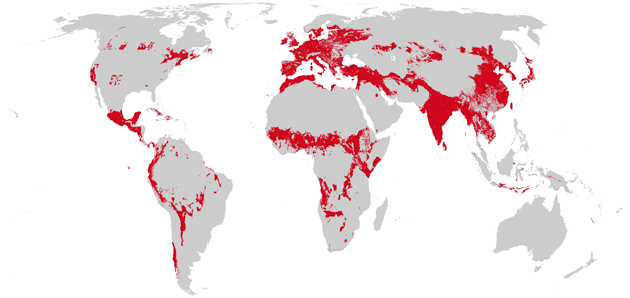
“… accumulated surplus is not evenly distributed throughout society, but rather has been controlled by an elite. The mass of the population, while producing the wealth, is only allocated a small portion of it by elites, usually at or just above subsistence levels.”

The study challenges those who argue that technology will resolve these challenges by increasing efficiency:

“Technological change can raise the efficiency of resource use, but it also tends to raise both per capita resource consumption and the scale of resource extraction, so that, absent policy effects, the increases in consumption often compensate for the increased efficiency of resource use.”

Productivity increases in agriculture and industry over the last two centuries has come from “increased (rather than decreased) resource throughput,” despite dramatic efficiency gains over the same period.

Modelling a range of different scenarios, Motesharrei and his colleagues conclude that under conditions “closely reflecting the reality of the world today… we find that collapse is difficult to avoid.” In the first of these scenarios, civilisation:

“…. appears to be on a sustainable path for quite a long time, but even using an optimal depletion rate and starting with a very small number of Elites, the Elites eventually consume too much, resulting in a famine among Commoners that eventually causes the collapse of society. It is important to note that this Type-L collapse is due to an inequality-induced famine that causes a loss of workers, rather than a collapse of Nature.”

Another scenario focuses on the role of continued resource exploitation, finding that “with a larger depletion rate, the decline of the Commoners occurs faster, while the Elites are still thriving, but eventually the Commoners collapse completely, followed by the Elites.”

In both scenarios, Elite wealth monopolies mean that they are buffered from the most “detrimental effects of the environmental collapse until much later than the Commoners”, allowing them to “continue ‘business as usual’ despite the impending catastrophe.” The same mechanism, they argue, could explain how “historical collapses were allowed to occur by elites who appear to be oblivious to the catastrophic trajectory (most clearly apparent in the Roman and Mayan cases).”

Applying this lesson to our contemporary predicament, the study warns that:

“While some members of society might raise the alarm that the system is moving towards an impending collapse and therefore advocate structural changes to society in order to avoid it, Elites and their supporters, who opposed making these changes, could point to the long sustainable trajectory ‘so far’ in support of doing nothing.”

However, the scientists point out that the worst-case scenarios are by no means inevitable, and suggest that appropriate policy and structural changes could avoid collapse, if not pave the way toward a more stable civilisation.

The two key solutions are to reduce economic inequality so as to ensure fairer distribution of resources, and to dramatically reduce resource consumption by relying on less intensive renewable resources and reducing population growth:

“Collapse can be avoided and population can reach equilibrium if the per capita rate of depletion of nature is reduced to a sustainable level, and if resources are distributed in a reasonably equitable fashion.”

The NASA-funded HANDY model offers a highly credible wake-up call to governments, corporations and business – and consumers – to recognise that ‘business as usual’ cannot be sustained, and that policy and structural changes are required immediately.

Although the study based on HANDY is largely theoretical – a ‘thought-experiment’ – a number of other more empirically-focused studies – by KPMG and the UK Government Office of Science for instance – have warned that the convergence of food, water and energy crises could create a ‘perfect storm’ within about fifteen years. But these ‘business as usual’ forecasts could be very conservative.

Dr Nafeez Ahmed is executive director of the Institute for Policy Research & Development and author of A User’s Guide to the Crisis of Civilisation: And How to Save It among other books. Follow him on Twitter @nafeezahmed

  • This article was amended on 26 March 2014 to reflect the nature of the study and Nasa’s relationship to it more clearly.

Imagining the Anthropocene (AEON)

The Anthropocene idea has been embraced by Earth scientists and English professors alike. But how useful is it?

Jedediah Purdy is Professor of Law at Duke University in North Carolina. His forthcoming book is After Nature: A Politics for the Anthropocene.

Edited by Ross Andersen

Officially, for the past 11,700 years we have been living in the Holocene epoch. From the Greek for ‘totally new’, the Holocene is an eyeblink in geological time. In its nearly 12,000 years, plate tectonics has driven the continents a little more than half a mile: a reasonably fit person could cover the scale of planetary change in a brisk eight-minute walk. It has been a warm time, when temperature has mattered as much as tectonics. Sea levels rose 115 feet from ice melt, and northern landscapes rose almost 600 feet, as they shrugged off the weight of their glaciers.

But the real news in the Holocene has been people. Estimates put the global human population between 1 million and 10 million at the start of the Holocene, and keep it in that range until after the agricultural revolution, some 5,000 years ago. Since then, we have made the world our anthill: the geological layers we are now laying down on the Earth’s surface are marked by our chemicals and industrial waste, the pollens of our crops, and the absence of the many species we have driven to extinction. Rising sea levels are now our doing. As a driver of global change, humanity has outstripped geology.

This is why, from the earth sciences to English departments, there’s a veritable academic stampede to declare that we live in a new era, the Anthropocene – the age of humans. Coined by the ecologist Eugene Stoermer in the 1980s and brought to public attention in 2000 by the Nobel Prize-winning atmospheric scientist Paul Crutzen, the term remains officially under consideration at the Stratigraphy Commission of the Geological Society of London.

The lack of an official decision has set up the Anthropocene as a Rorschach blot for discerning what commentators think is the epochal change in the human/nature relationship. The rise of agriculture in China and the Middle East? The industrial revolution and worldwide spread of farming in the Age of Empire? The Atomic bomb? From methane levels to carbon concentration, from pollen residue to fallout, each of these changes leaves its mark in the Earth’s geological record. Each is also a symbol of a new set of human powers and a new way of living on Earth.

The most radical thought identified with the Anthropocene is this: the familiar contrast between people and the natural world no longer holds. There is no more nature that stands apart from human beings. There is no place or living thing that we haven’t changed. Our mark is on the cycle of weather and seasons, the global map of bioregions, and the DNA that organises matter into life. The question is no longer how to preserve a wild world from human intrusion; it is what shape we will give to a world we can’t help changing.

The discovery that nature is henceforth partly a human creation makes the Anthropocene the latest of three great revolutions: three kinds of order once thought to be given and self-sustaining have proved instead to be fragile human creations. The first to fall was politics. Long seen as part of divine design, with kings serving as the human equivalents of eagles in the sky and oaks in the forest, politics proved instead a dangerous but inescapable form of architecture – a blueprint for peaceful co‑existence, built with crooked materials. Second came economics. Once presented as a gift of providence or an outgrowth of human nature, economic life, like politics, turned out to be a deliberate and artificial achievement. (We are still debating the range of shapes it can take, from Washington to Greece to China.) Now, in the Anthropocene, nature itself has joined the list of those things that are not natural. The world we inhabit will henceforth be the world we have made.

The revolution in ideas that the Anthropocene represents is rooted in hundreds of eminently practical problems. The conversation about climate change has shifted from whether we can keep greenhouse-gas concentrations below key thresholds to how we are going to adapt when they cross those thresholds. Geo‑engineering, deliberately intervening in planetary systems, used to be the unspeakable proposal in climate policy. Now it is in the mix and almost sure to grow more prominent. As climate change shifts ecological boundaries, issues such as habitat preservation come to resemble landscape architecture. We can’t just pen in animals to save them; they need landscape-scale corridors and other help in migrating as their habitats move. There is open talk in law-and-policy circles about triage in species preservation – asking what we can save, and what we most want to save.

What work is this idea of the Anthropocene doing in culture and politics? As much as a scientific concept, the Anthropocene is a political and ethical gambit. Saying that we live in the Anthropocene is a way of saying that we cannot avoid responsibility for the world we are making. So far so good. The trouble starts when this charismatic, all-encompassing idea of the Anthropocene becomes an all-purpose projection screen and amplifier for one’s preferred version of ‘taking responsibility for the planet’.

Peter Kareiva, the controversial chief scientist of the Nature Conservancy, uses the theme ‘Conservation in the Anthropocene’ to trash environmentalism as philosophically naïve and politically backward. Kareiva urges conservationists to give up on wilderness and embrace what the writer Emma Marris calls the ‘rambunctious garden’. Specifically, Kareiva wants to rank ecosystems by the quality of ‘ecosystem services’ they provide for human beings instead of ‘pursuing the protection of biodiversity for biodiversity’s sake’. He wants a pro‑development stance that assumes that ‘nature is resilient rather than fragile’. He insists that: ‘Instead of scolding capitalism, conservationists should partner with corporations in a science-based effort to integrate the value of nature’s benefits into their operations and cultures.’ In other words, the end of nature is the signal to carry on with green-branded business as usual, and the business of business is business, as the Nature Conservancy’s partnerships with Dow, Monsanto, Coca-Cola, Pepsi, J P Morgan, Goldman Sachs and the mining giant Rio Tinto remind us.

Kareiva is a favourite of Andrew Revkin, the roving environmental maven of The New York Times Magazine, who touts him as a paragon of responsibility-taking, a leader among ‘scholars and doers who see that new models for thinking and acting are required in this time of the Anthropocene’. This pair and their friends at the Breakthrough Institute in California can be read as making a persistent effort to ‘rebrand’ environmentalism as humanitarian and development-friendly (and capture speaking and consultancy fees, which often seem to be the major ecosystem services of the Anthropocene). This is itself a branding strategy, an opportunity to slosh around old plonk in an ostentatiously shiny bottle.

Elsewhere in The New York Times Magazine, you can enjoy the other end of the Anthropocene projection screen, from business-as-usual to this-changes-everything. In his essay ‘Learning How to Die in the Anthropocene’ (2013), the Princeton scholar and former soldier Roy Scranton writes: ‘this civilisation is already dead’ (emphasis original) and insists that the only way forward is ‘to realise there’s nothing we can do to save ourselves’ and therefore ‘get down to the hard work … without attachment or fear’. He concludes: ‘If we want to learn to live in the Anthropocene, we must first learn how to die.’

Other humanists bring their own preoccupations to a sense of gathering apocalypse. In his influential essay ‘The Climate of History’ (2008), Dipesh Chakrabarty, a theory-minded historian at the University of Chicago, proposes that the Anthropocene throws into question all received accounts of human history, from Whiggish optimism to his own post-colonial postmodernism. He asks anxiously: ‘Has the period from 1750 to the present been one of freedom or that of the Anthropocene?’ and concludes that the age requires a new paradigm of thought, a ‘negative universal history’.

In their introduction to Ecocriticism (2012), a special issue of American Literature, the English scholars Monique Allewaert of the University of Wisconsin-Madison and Michael Ziser of the University of California Davis describe the Anthropocene as best captured in ‘a snapshot of the anxious affect of the modern world as it destroys itself – and denies even its own traces’.

The Anthropocene does not seem to change many minds. But it does turn them up to 11

All of these people (except for the branding opportunists) are trying, with more or less success, to ask how the Anthropocene changes the projects to which they’ve given chunks of their lives. Some far-ranging speculation and sweeping summaries are to be expected, and forgiven. Nonetheless, something in the Anthropocene idea seems to provoke heroic thinking, a mood and rhetoric of high stakes, of the human mind pressed up against the wall of apocalypse or arrived at the end of nature and history.

In this provocative defect, Anthropocene talk is a discourse of responsibility, to borrow a term from Mark Greif’s study of mid-20th-century American thought, The Age of the Crisis of Man (2015). Greif argues that a high-minded (but often middle-brow) strain of rhetoric responded to the horrors of the world wars and the global struggles thereafter with a blend of urgent language and sweeping concepts (or pseudo-concepts): responsibility, the fate of man, the urgency of now. Greif describes discourses of responsibility as attempts to turn words and thoughts, uttered in tones of utmost seriousness, into a high form of action. All of this is recognisable in Anthropocene talk. The Anthropocene does not seem to change many minds, strictly speaking, on point of their cherished convictions. But it does turn them up to 11.

On the whole, this is the inevitable and often productive messiness that accompanies a new way of seeing, one that unites many disparate events into a single pattern. As an offer to unify what might seem unrelated, ‘the Anthropocene’ is an attempt to do the same work that ‘the environment’ did in the 1960s and early ’70s: meld problems as far-flung as extinction, sprawl, litter, national parks policy, and the atom bomb into a single phenomenon called ‘the ecological crisis’. Such a classification is always somewhat arbitrary, though often only in the trivial sense that there are many ways to carve up the world. However arbitrary, it becomes real if people treat it as real, by forming movements, proposing changes, and passing laws aimed at ‘the environment’.

We know what the concept ‘the environment’ has wrought but what will the Anthropocene be like? To put this over-dramatised idea in the least heroic garb possible, what will the weather be like in the Anthropocene? And how will we talk about the weather there?

For all the talk of crisis that swirls around the Anthropocene, it is unlikely that a changing Earth will feel catastrophic or apocalyptic. Some environmentalists still warn of apocalypse to motivate could-be, should-be activists; but geologic time remains far slower than political time, even when human powers add a wobble to the planet. Instead, the Anthropocene will be like today, only more so: many systems, from weather to soil to your local ecosystem, will be in a slow-perennial crisis. And where apocalyptic change is a rupture in time, a slow crisis feels normal. It feels, in fact, natural.

So the Anthropocene will feel natural. I say this not so much because of the controversial empirics-cum-mathematics of the climate-forecasting models as because of a basic insight of modernity that goes back to Rousseau: humanity is the adaptable species. What would have been unimaginable or seemed all but unintelligible 100 years ago, let alone 500 (a sliver of time in the evolutionary life of a species), can become ordinary in a generation. That is how long it took to produce ‘digital natives’, to accustom people to electricity and television, and so on for each revolution in our material and technological world. It takes a great deal of change to break through this kind of adaptability.

This is all the more so because rich-country humanity already lives in a constant technological wrestling match with exogenous shocks, which are going to get more frequent and more intense in the Anthropocene. Large parts of North America regularly experience droughts and heat waves that would devastate a simpler society than today’s US. Because the continent is thoroughly engineered, from the water canals of the West to the irrigation systems of the Great Plains to air conditioning nearly everywhere, these are experienced as inconvenience, as mere ‘news’. The same events, in poorer places, are catastrophes.

Planetary changes will amplify the inequalities that sort out those who get news from those who get catastrophes; but these inequalities, arising as they do from a post-natural nature, will feel as if they were built into the world itself. Indeed, nature has always served to launder the inequalities that humans produce. Are enslaved people kept illiterate and punished brutally when they are not servile? Then ignorance and servility must be in their nature, an idea that goes back in a continuous line to Aristotle. The same goes for women, with some edits to their nature: docile, nurturing, delicate, hysterical, etc. It was not until Harriet Taylor and John Stuart Mill worked together on The Subjection of Women (published under his name alone in 1869), that English-language philosophy produced a basic challenge to millennia of nature-talk about sexual difference.

The expulsion of Native Americans was ‘justified’ on several versions of nature. Maybe they were racially different. Maybe their climate made them weak and irrational, unable to cultivate the land or resist European settlement. (Colonists briefly embraced this idea, then grew uneasy when they realised that the North American climate was now theirs; by the time of American independence, they raced to reject climatic theories of racial character.) Maybe Native Americans had simply failed to fulfil the natural duty of all mankind, to clear and plant the wilderness and make it bloom like an English garden, an idea that many theorists of natural law advanced in the 17th and 18th centuries. One way or another, nature was a kind of ontological insurance policy for human injustice.

And now? Well, it’s common wisdom that rising sea levels will first affect some of the world’s poorest people, notably in Bangladesh and coastal India. But it’s much worse than that grim geographic coincidence. Wealth has always meant some protection from nature’s cruel measures. In fact, that is the first spur to technology and development of all kinds: not to be killed. Tropical diseases with changing range will find some populations well-equipped with vaccination and medicine, others struggling with bad government and derelict health systems. When seas rise fast, even the feckless but rich US will begin adapting fast, and coastal flooding will be classified in the rich-world mind as a catastrophe of the poor.

So will starvation. A legal regime of unequal Anthropocene vulnerability is well underway. Take the vast, long-term leases that Chinese companies have entered into for some of Africa’s richest farmland. When drought, soil exhaustion or crop crisis puts a pinch on global food supply, contracts and commerce will pull trillions of calories to fat-and-happy Beijing. This is, of course, only the latest chapter in centuries of imperialism and post-imperial, officially voluntary global inequality. But it is the chapter that we the living are writing.

Neoliberal environmentalism aims to bring nature fully into the market, merging ecology and economy

For the moment, Anthropocene inequality has a special affinity with neoliberalism, the global extension of a dogmatic market logic and increasingly homogenous market forms, along with an accompanying ideology insisting that, if the market is not beyond reproach, it is at least beyond reform: there is no alternative. Where previous episodes of global ecological inequality took place under direct imperial administration – witness the Indian famines of the late 19th century, suffered under British rule – ours is emerging under the sign of free contract. Anthropocene inequality is thus being doubly laundered: first as natural, second as the voluntary (and presumptively efficient) product of markets. Because human activity now shapes the ‘natural’ world at every point, it is especially convenient for that world-shaping activity to proceed in its own pseudo-natural market.

But Anthropocene problems also put pressure on the authority of economics. Much of environmental economics has been built on the concept of the externality, economist-speak for a side-effect, a harm or benefit that has no price tag, and so is ignored in market decisions. Air pollution – free to the polluter – is the classic bad side-effect, or ‘negative externality’. Wetlands – not valued on the real-estate market, but great sources of filtration, purification and fertility, which would otherwise cost a lot to replicate – are the model positive externality. So neoliberal environmentalism, which Kareiva’s Nature Conservancy has been cultivating, aims to bring nature fully into the market, finding a place in the bottom line for all former side-effects, and fully merging ecology and economy.

In a climate-changed Anthropocene, the side-effects overwhelm the ‘regular’ market in scale and consequence. And there is no ‘neutral’, purely market-based way to put a value on side-effects. Take the example of carbon emissions. It is possible to create a market for emissions, as Europe, California and other jurisdictions have done; but at the base of that market is a political decision about how to value the economic activity that emits carbon against all the (uncertain and even speculative) effects of the emissions. The same point holds for every (post-)natural system on an Anthropocene planet. Ultimately, the question is the value of life, and ways of life. There is no correct technocratic answer.

The shape of the Anthropocene is a political, ethical and aesthetic question. It will answer questions about what life is worth, what people owe one another, and what in the world is awesome or beautiful enough to preserve or (re)create. Either the answers will reproduce and amplify existing inequality or they will set in motion a different logic of power. Either the Anthropocene will be democratic or it will be horrible.

A democratic Anthropocene would start from a famous observation of the economics Nobel Prize laureate Amartya Sen: no minimally democratic society has ever suffered a famine. Natural catastrophes are the joint products of natural and human systems. Your vulnerability to disaster is often a direct expression of your standing in a political (and economic) order. The Anthropocene stands for the intensifying merger of ecology, economics and politics, and one’s standing in those systems will increasingly be a single question.

But talk of democracy here is – like much about the Anthropocene – in danger of becoming abstract and moralising. Reflecting on a democratic Anthropocene becomes an inadvertent meditation on the devastating absence of any agent – a state, or even a movement – that could act on the scale of the problem. Indeed, it reveals that there is no agent that could even define the problem. If the Anthropocene is about the relationship between humanity and the planet, well, there is no ‘humanity’ that agrees on any particular meaning and imperative of climate change, extinction, toxification, etc. To think about the Anthropocene is to think about being able to do nothing about everything. No wonder the topic inspires compensatory fantasies that the solution lies in refining the bottom line or honing personal enlightenment – always, to be sure, in the name of some fictive ‘we’.

This returns us to the basic problem that the Anthropocene drives home: as Hannah Arendt observed in The Origins of Totalitarianism (1951), the idea of human rights – such as the right to democratic standing in planetary change – is a chimera and a cruel taunt without a political community that can make it good through robust institutions and practices. The Anthropocene shows how far the world is from being such a polity, or a federation of such polities, and how much is at stake in that absence. The world is too much with us. Worse, there is no ‘we’ to be with it.

In the face of all these barriers, what could all this talk about the Anthropocene possibly accomplish? Ironically, a useful comparison lies in Arendt’s target, the mere idea of human rights. While mere ideas are in fact sorry comforts in an unmanageable situation, they can be the beginning of demands, projects, even utopias, that enable people to organise in new ways to pursue them. The idea of human rights has gained much of its force this way, as a prism through which many efforts are focused and/or refracted.

A democratic Anthropocene is just a thought for now, but it can also be a tool that activists, thinkers and leaders use to craft challenges and invitations that bring some of us a little closer to a better possible world, or a worse one. The idea that the world people get to inhabit will only be the one they make is, in fact, imperative to the development of a political and institutional programme, even if the idea itself does not tell anyone how to do that. There might not be a world to win, or even save, but there is a humanity to be shaped and reshaped, freely and always in partial and provisional ways, that can begin intending the world it shapes.

31 March 2015

Popular now

Climate change: Embed the social sciences in climate policy (Nature)

David Victor

01 April 2015

David G. Victor calls for the IPCC process to be extended to include insights into controversial social and behavioural issues.

Illustration by David Parkins

The Intergovernmental Panel on Climate Change (IPCC) is becoming irrelevant to climate policy. By seeking consensus and avoiding controversy, the organization is suffering from the streetlight effect — focusing ever more attention on a well-lit pool of the brightest climate science. But the insights that matter are out in the darkness, far from the places that the natural sciences alone can illuminate.

With the ink barely dry on the IPCC’s latest reports, scientists and governments are planning reforms for the next big assessment12. Streamlining the review and writing processes could, indeed, make the IPCC more nimble and relevant. But decisions made at February’s IPCC meeting in Nairobi showed that governments have little appetite for change.

The basic report-making process and timing will remain intact. Minor adjustments such as greater coverage of cross-cutting topics and more administration may make the IPCC slower. Similar soul searching, disagreement, indecision and trivial procedural tweaks have followed each of the five IPCC assessments over the past 25 years3.

This time needs to be different. The IPCC must overhaul how it engages with the social sciences in particular (see go.nature.com/vp7zgm). Fields such as sociology, political science and anthropology are central to understanding how people and societies comprehend and respond to environmental changes, and are pivotal in making effective policies to cut emissions and collaborate across the globe.

The IPCC has engaged only a narrow slice of social-sciences disciplines. Just one branch — economics — has had a major voice in the assessment process. In Working Group III, which assesses climate-change mitigation and policy, nearly two-thirds of 35 coordinating lead authors hailed from the field, and from resource economics in particular. The other social sciences were mostly absent. There was one political scientist: me. Among the few bright spots in that report compared with earlier ones is greater coverage of behavioural economics and risk analysis. In Working Group II, which assesses impacts and adaptation, less than one-third of the 64 coordinating lead authors were social scientists, and about half of those were economists.

Bringing the broader social sciences into the IPCC will be difficult, but it is achievable with a strategy that reflects how the fields are organized and which policy-relevant questions these disciplines know well. It will require big reforms in the IPCC, and the panel will have to relinquish part of the assessment process to other organizations that are less prone to paralysis in the face of controversy.

Tunnel vision

The IPCC walks a wavering line between science, which requires independence, and diplomacy, which demands responsiveness to government preference. Although scientists supply and hone the material for reports, governments have a say in all stages of assessment: they adopt the outline for each chapter, review drafts and approve the final reports.

“Insights such as which policies work (or fail) in practice are skirted.”

Such tight oversight creates incentives for scientists to stick to the agreed scope and strip out controversial topics. These pressures are especially acute in the social sciences because governments want to control statements about social behaviour, which implicate policy. This domain covers questions such as which countries will bear the costs of climate change; schemes for allocating the burden of cutting emissions; the design of international agreements; how voters respond to information about climate policy; and whether countries will go to war over climate-related stress. The social sciences can help to provide answers to these questions, key for effective climate policy. In practice, few of these insights are explored much by the IPCC.

The narrowness of what governments will allow the IPCC to publish is particularly evident in the summary for policy-makers produced at the end of each assessment. Governments approve this document line-by-line with consensus. Disagreements range from those over how to phrase concepts such as a ‘global commons’ that requires collective action to those about whole graphs, which might present data in ways that some governments find inconvenient.

For example, during the approval of the summary from Working Group III last April, a small group of nations vetoed graphs that showed countries’ emissions grouped according to economic growth. Although this format is good science — economic growth is the main driver of emissions — it is politically toxic because it could imply that some countries that are developing rapidly need to do more to control emissions4.

Context dependent

The big problem with the IPCC’s output is not the widely levelled charge that it has become too policy prescriptive or is captivated by special interests5. Its main affliction is pabulum — a surfeit of bland statements that have no practical value for policy. Abstract, global numbers from stylized, replicable models get approved because they do not implicate any country or action. Insights such as which policies work (or fail) in practice are skirted. Caveats are buried or mangled.

Readers of the Working Group III summary for policy-makers might learn, for instance, that annual economic growth might decrease by just 0.06 percentage points by 2050 if governments were to adopt policies that cut emissions in line with the widely discussed goal of 2 °C above pre-industrial levels6. They would have to wade through dense tables to realize that only a fraction of the models say that the goal is achievable, and through the main report to learn that the small cost arises only under simplified assumptions that are far from messy reality.

Source: Ref. 6

That said, the social sciences are equally culpable. Because societies are complex and are in many ways harder to study than cells in a petri dish, the intellectual paradigms across most of the social sciences are weak. Beyond a few exceptions — such as mainstream economics — the major debates in social science are between paradigms rather than within them.

Consider the role of international law. Some social scientists treat law like a contract; others believe that it works mainly through social pressures. The first set would advise policy-makers to word climate deals precisely — to include targets and timetables for emissions cuts — and to apply mechanisms to ensure that countries honour their agreements. The second group would favour bold legal norms with clear focal points — striving for zero net emissions, for example7. Each approach could be useful in the right context.

Multiple competing paradigms make it hard to organize social-science knowledge or to determine which questions and methods are legitimate. Moreover, the incentives within the social sciences discourage focusing on particular substantive topics such as climate change — especially when they require interdisciplinary collaboration. In political science, for example, research on political mobilization, administrative control and international cooperation among other specialities are relevant. Yet no leading political-science department has a tenured professor who works mainly on climate change8.

The paradigm problem need not be paralysing. Social scientists should articulate why different intellectual perspectives and contexts lead to different conclusions. Leading researchers in each area can map out disagreement points and their relevance.

Climate scientists and policy-makers should talk more about how disputes are rooted in different values and assumptions — such as about whether government institutions are capable of directing mitigation. Such disputes help to explain why there are so many disagreements in climate policy, even in areas in which the facts seem clear9.

Unfortunately, the current IPCC report structure discourages that kind of candour about assumptions, values and paradigms. It focuses on known knowns and known unknowns rather than on deeper and wider uncertainties. The bias is revealed in how the organization uses official language to describe findings — half of the statements in the Working Group III summary were given a ‘high confidence’ rating (see ‘Confidence bias’).

Wider vista

Building the social sciences into the IPCC and the climate-change debate more generally is feasible over the next assessment cycle, which starts in October and runs to 2022, with efforts on the following three fronts.

First, the IPCC must ask questions that social scientists can answer. If the panel looks to the social-sciences literature on climate change, it will find little. But if it engages the fields on their own terms it will find a wealth of relevant knowledge — for example, about how societies organize, how individuals and groups perceive threats and respond to catastrophic stresses, and how collective action works best.

Dieter Telemans/Panos

The solar-powered Barefoot College in Rajasthan, India, trains rural villagers in how to install, build and repair solar technologies.

As soon as the new IPCC leadership is chosen later this year, the team should invite major social-sciences societies such as the American Political Science Association, the American and European societies of international law, the American Sociological Association and the Society for Risk Analysis to propose relevant topics that they can assess and questions they can answer. Multidisciplinary scientific organizations in diverse countries — such as the Royal Society in London and the Third World Academy of Sciences — would round out the picture, because social-sciences societies tend to be national and heavily US-based.

These questions should guide how the IPCC scopes its next reports. The agency should also ask such societies to organize what they know about climate by discipline — how sociology examines issues related to the topic, for example — and feed that into the assessment.

Second, the IPCC must become a more attractive place for social-science and humanities scholars who are not usually involved in the climate field and might find IPCC involvement daunting. The IPCC process is dominated by insiders who move from assessment to assessment and are tolerant of the crushing rounds of review and layers of oversight that consume hundreds of hours and require travel to the corners of the globe. Practically nothing else in science service has such a high ratio of input to output. The IPCC must use volunteers’ time more efficiently.

Third, all parties must recognize that a consensus process cannot handle controversial topics such as how best to design international agreements or how to govern the use of geoengineering technologies. For these, a parallel process will be needed to address the most controversial policy-relevant questions.

This supporting process should begin with a small list of the most important questions that the IPCC cannot handle on its own. A network of science academies or foundations sympathetic to the UN’s mission could organize short reports — drawing from IPCC assessments and other literature — and manage a review process that is truly independent of government meddling. Oversight from prominent social scientists, including those drawn from the IPCC process, could give the effort credibility as well as the right links to the IPCC itself.

The list of topics to cover in this parallel mechanism includes how to group countries in international agreements — beyond the crude kettling adopted in 1992 that split the world into industrialized nations and the rest. The list also includes which kinds of policies have had the biggest impact on emissions, and how different concepts of justice and ethics could guide new international agreements that balance the burdens of mitigation and adaptation. There will also need to be a sober re-assessment of policy goals when it becomes clear that stopping warming at 2 °C is no longer feasible10.

The IPCC has proved to be important — it is the most legitimate body that assesses the climate-related sciences. But it is too narrow and must not monopolize climate assessment. Helping the organization to reform itself while moving contentious work into other forums is long overdue.

Nature 520, 27–29 (02 April 2015), doi:10.1038/520027a

References

  1. IPCC. Future Work of the IPCC: Chairman’s Vision Paper on the Future of the IPCC (IPCC, 2015).
  2. IPCC. Future Work of the IPCC: Consideration of the Recommendations by the Task Group on Future Work of the IPCC (IPCC, 2015).
  3. Committee to Review the Intergovernmental Panel on Climate ChangeClimate Change Assessments: Review of the Processes and Procedures of the IPCC (InterAcademy Council, 2010).
  4. Victor, D. G.Gerlagh, R. & Baiocchi, G. Science 3453436 (2014).
  5. Hulme, M. et alNature 463730732 (2010).
  6. IPCCSummary for Policymakers in Climate Change 2014: Mitigation of Climate Change. Contribution of Working Group III to the Fifth Assessment Report of the Intergovernmental Panel on Climate Change (eds Edenhofer, O. et al.) (Cambridge Univ. Press, 2014).
  7. Hafner-Burton, E. M.Victor, D. G. & Lupu, Y. Am. J. Intl Law 1064797 (2012).
  8. Keohane, R. O. PS: Political Sci. & Politics 481926 (2015).
  9. Hulme, M. Why We Disagree About Climate Change: Understanding Controversy, Inaction and Opportunity (Cambridge Univ. Press, 2009).
  10. Victor, D. G. & Kennel C. F. Nature 5143031 (2014).

Anthropocene: The human age (Nature)

Momentum is building to establish a new geological epoch that recognizes humanity’s impact on the planet. But there is fierce debate behind the scenes.

Richard Monastersky

11 March 2015

Illustration by Jessica Fortner

Almost all the dinosaurs have vanished from the National Museum of Natural History in Washington DC. The fossil hall is now mostly empty and painted in deep shadows as palaeobiologist Scott Wing wanders through the cavernous room.

Wing is part of a team carrying out a radical, US$45-million redesign of the exhibition space, which is part of the Smithsonian Institution. And when it opens again in 2019, the hall will do more than revisit Earth’s distant past. Alongside the typical displays of Tyrannosaurus rex and Triceratops, there will be a new section that forces visitors to consider the species that is currently dominating the planet.

“We want to help people imagine their role in the world, which is maybe more important than many of them realize,” says Wing.

This provocative exhibit will focus on the Anthropocene — the slice of Earth’s history during which people have become a major geological force. Through mining activities alone, humans move more sediment than all the world’s rivers combined. Homo sapiens has also warmed the planet, raised sea levels, eroded the ozone layer and acidified the oceans.

Given the magnitude of these changes, many researchers propose that the Anthropocene represents a new division of geological time. The concept has gained traction, especially in the past few years — and not just among geoscientists. The word has been invoked by archaeologists, historians and even gender-studies researchers; several museums around the world have exhibited art inspired by the Anthropocene; and the media have heartily adopted the idea. “Welcome to the Anthropocene,” The Economist announced in 2011.

The greeting was a tad premature. Although the term is trending, the Anthropocene is still an amorphous notion — an unofficial name that has yet to be accepted as part of the geological timescale. That may change soon. A committee of researchers is currently hashing out whether to codify the Anthropocene as a formal geological unit, and when to define its starting point.

But critics worry that important arguments against the proposal have been drowned out by popular enthusiasm, driven in part by environmentally minded researchers who want to highlight how destructive humans have become. Some supporters of the Anthropocene idea have even been likened to zealots. “There’s a similarity to certain religious groups who are extremely keen on their religion — to the extent that they think everybody who doesn’t practise their religion is some kind of barbarian,” says one geologist who asked not to be named.

The debate has shone a spotlight on the typically unnoticed process by which geologists carve up Earth’s 4.5 billion years of history. Normally, decisions about the geological timescale are made solely on the basis of stratigraphy — the evidence contained in layers of rock, ocean sediments, ice cores and other geological deposits. But the issue of the Anthropocene “is an order of magnitude more complicated than the stratigraphy”, says Jan Zalasiewicz, a geologist at the University of Leicester, UK, and the chair of the Anthropocene Working Group that is evaluating the issue for the International Commission on Stratigraphy (ICS).

Written in stone

For geoscientists, the timescale of Earth’s history rivals the periodic table in terms of scientific importance. It has taken centuries of painstaking stratigraphic work — matching up major rock units around the world and placing them in order of formation — to provide an organizing scaffold that supports all studies of the planet’s past. “The geologic timescale, in my view, is one of the great achievements of humanity,” says Michael Walker, a Quaternary scientist at the University of Wales Trinity St David in Lampeter, UK.

Walker’s work sits at the top of the timescale. He led a group that helped to define the most recent unit of geological time, the Holocene epoch, which began about 11,700 years ago.

Sources: Dams/Water/Fertilizer, IGBP; Fallout, Ref. 5; Map, E. C. Ellis Phil. Trans. R. Soc. A 369, 1010–1035 (2011); Methane, Ref. 4

The decision to formalize the Holocene in 2008 was one of the most recent major actions by the ICS, which oversees the timescale. The commission has segmented Earth’s history into a series of nested blocks, much like the years, months and days of a calendar. In geological time, the 66 million years since the death of the dinosaurs is known as the Cenozoic era. Within that, the Quaternary period occupies the past 2.58 million years — during which Earth has cycled in and out of a few dozen ice ages. The vast bulk of the Quaternary consists of the Pleistocene epoch, with the Holocene occupying the thin sliver of time since the end of the last ice age.

When Walker and his group defined the beginning of the Holocene, they had to pick a spot on the planet that had a signal to mark that boundary. Most geological units are identified by a specific change recorded in rocks — often the first appearance of a ubiquitous fossil. But the Holocene is so young, geologically speaking, that it permits an unusual level of precision. Walker and his colleagues selected a climatic change — the end of the last ice age’s final cold snap — and identified a chemical signature of that warming at a depth of 1,492.45 metres in a core of ice drilled near the centre of Greenland1. A similar fingerprint of warming can be seen in lake and marine sediments around the world, allowing geologists to precisely identify the start of the Holocene elsewhere.

“The geologic timescale, in my view, is one of the great achievements of humanity.”

Even as the ICS was finalizing its decision on the start of the Holocene, discussion was already building about whether it was time to end that epoch and replace it with the Anthropocene. This idea has a long history. In the mid-nineteenth century, several geologists sought to recognize the growing power of humankind by referring to the present as the ‘anthropozoic era’, and others have since made similar proposals, sometimes with different names. The idea has gained traction only in the past few years, however, in part because of rapid changes in the environment, as well as the influence of Paul Crutzen, a chemist at the Max Plank Institute for Chemistry in Mainz, Germany.

Crutzen has first-hand experience of how human actions are altering the planet. In the 1970s and 1980s, he made major discoveries about the ozone layer and how pollution from humans could damage it — work that eventually earned him a share of a Nobel prize. In 2000, he and Eugene Stoermer of the University of Michigan in Ann Arbor argued that the global population has gained so much influence over planetary processes that the current geological epoch should be called the Anthropocene2. As an atmospheric chemist, Crutzen was not part of the community that adjudicates changes to the geological timescale. But the idea inspired many geologists, particularly Zalasiewicz and other members of the Geological Society of London. In 2008, they wrote a position paper urging their community to consider the idea3.

Those authors had the power to make things happen. Zalasiewicz happened to be a member of the Quaternary subcommission of the ICS, the body that would be responsible for officially considering the suggestion. One of his co-authors, geologist Phil Gibbard of the University of Cambridge, UK, chaired the subcommission at the time.

Although sceptical of the idea, Gibbard says, “I could see it was important, something we should not be turning our backs on.” The next year, he tasked Zalasiewicz with forming the Anthropocene Working Group to look into the matter.

A new beginning

Since then, the working group has been busy. It has published two large reports (“They would each hurt you if they dropped on your toe,” says Zalasiewicz) and dozens of other papers.

The group has several issues to tackle: whether it makes sense to establish the Anthropocene as a formal part of the geological timescale; when to start it; and what status it should have in the hierarchy of the geological time — if it is adopted.

When Crutzen proposed the term Anthropocene, he gave it the suffix appropriate for an epoch and argued for a starting date in the late eighteenth century, at the beginning of the Industrial Revolution. Between then and the start of the new millennium, he noted, humans had chewed a hole in the ozone layer over Antarctica, doubled the amount of methane in the atmosphere and driven up carbon dioxide concentrations by 30%, to a level not seen in 400,000 years.

When the Anthropocene Working Group started investigating, it compiled a much longer long list of the changes wrought by humans. Agriculture, construction and the damming of rivers is stripping away sediment at least ten times as fast as the natural forces of erosion. Along some coastlines, the flood of nutrients from fertilizers has created oxygen-poor ‘dead zones’, and the extra CO2 from fossil-fuel burning has acidified the surface waters of the ocean by 0.1 pH units. The fingerprint of humans is clear in global temperatures, the rate of species extinctions and the loss of Arctic ice.

The group, which includes Crutzen, initially leaned towards his idea of choosing the Industrial Revolution as the beginning of the Anthropocene. But other options were on the table.

Some researchers have argued for a starting time that coincides with an expansion of agriculture and livestock cultivation more than 5,000 years ago4, or a surge in mining more than 3,000 years ago (see ‘Humans at the helm’). But neither the Industrial Revolution nor those earlier changes have left unambiguous geological signals of human activity that are synchronous around the globe (see ‘Landscape architecture’).

This week in Nature, two researchers propose that a potential marker for the start of the Anthropocene could be a noticeable drop in atmospheric CO2 concentrations between 1570 and 1620, which is recorded in ice cores (see page 171). They link this change to the deaths of some 50 million indigenous people in the Americas, triggered by the arrival of Europeans. In the aftermath, forests took over 65 million hectares of abandoned agricultural fields — a surge of regrowth that reduced global CO2.

Landscape architecture

A model of land use, based on human-population estimates, suggests that people modified substantial parts of the continents even thousands of years ago.

Land used intensively by humans.

8,000 years before present (bp)

8,000 years before present (bp)

1,000 years before present (bp)

anthropocene-slideshow-5

Present

anthropocene-slideshow-10

Source: E. C. Ellis Phil. Trans. R. Soc. A 369, 1010–1035 (2011).

In the working group, Zalasiewicz and others have been talking increasingly about another option — using the geological marks left by the atomic age. Between 1945 and 1963, when the Limited Nuclear Test Ban Treaty took effect, nations conducted some 500 above-ground nuclear blasts. Debris from those explosions circled the globe and created an identifiable layer of radioactive elements in sediments. At the same time, humans were making geological impressions in a number of other ways — all part of what has been called the Great Acceleration of the modern world. Plastics started flooding the environment, along with aluminium, artificial fertilizers, concrete and leaded petrol, all of which have left signals in the sedimentary record.

In January, the majority of the 37-person working group offered its first tentative conclusion. Zalasiewicz and 25 other members reported5 that the geological markers available from the mid-twentieth century make this time “stratigraphically optimal” for picking the start of the Anthropocene, whether or not it is formally defined. Zalasiewicz calls it “a candidate for the least-worst boundary”.

The group even proposed a precise date: 16 July 1945, the day of the first atomic-bomb blast. Geologists thousands of years in the future would be able to identify the boundary by looking in the sediments for the signature of long-lived plutonium from mid-century bomb blasts or many of the other global markers from that time.

A many-layered debate

The push to formalize the Anthropocene upsets some stratigraphers. In 2012, a commentary published by the Geological Society of America6 asked: “Is the Anthropocene an issue of stratigraphy or pop culture?” Some complain that the working group has generated a stream of publicity in support of the concept. “I’m frustrated because any time they do anything, there are newspaper articles,” says Stan Finney, a stratigraphic palaeontologist at California State University in Long Beach and the chair of the ICS, which would eventually vote on any proposal put forward by the working group. “What you see here is, it’s become a political statement. That’s what so many people want.”

Finney laid out some of his concerns in a paper7 published in 2013. One major question is whether there really are significant records of the Anthropocene in global stratigraphy. In the deep sea, he notes, the layer of sediments representing the past 70 years would be thinner than 1 millimetre. An even larger issue, he says, is whether it is appropriate to name something that exists mainly in the present and the future as part of the geological timescale.

“It’s become a political statement. That’s what so many people want.”

Some researchers argue that it is too soon to make a decision — it will take centuries or longer to know what lasting impact humans are having on the planet. One member of the working group, Erle Ellis, a geographer at the University of Maryland, Baltimore County, says that he raised the idea of holding off with fellow members of the group. “We should set a time, perhaps 1,000 years from now, in which we would officially investigate this,” he says. “Making a decision before that would be premature.”

That does not seem likely, given that the working group plans to present initial recommendations by 2016.

Some members with different views from the majority have dropped out of the discussion. Walker and others contend that human activities have already been recognized in the geological timescale: the only difference between the current warm period, the Holocene, and all the interglacial times during the Pleistocene is the presence of human societies in the modern one. “You’ve played the human card in defining the Holocene. It’s very difficult to play the human card again,” he says.

Walker resigned from the group a year ago, when it became clear that he had little to add. He has nothing but respect for its members, he says, but he has heard concern that the Anthropocene movement is picking up speed. “There’s a sense in some quarters that this is something of a juggernaut,” he says. “Within the geologic community, particularly within the stratigraphic community, there is a sense of disquiet.”

Zalasiewicz takes pains to make it clear that the working group has not yet reached any firm conclusions.“We need to discuss the utility of the Anthropocene. If one is to formalize it, who would that help, and to whom it might be a nuisance?” he says. “There is lots of work still to do.”

Any proposal that the group did make would still need to pass a series of hurdles. First, it would need to receive a supermajority — 60% support — in a vote by members of the Quaternary subcommission. Then it would need to reach the same margin in a second vote by the leadership of the full ICS, which includes chairs from groups that study the major time blocks. Finally, the executive committee of the International Union of Geological Sciences must approve the request.

At each step, proposals are often sent back for revision, and they sometimes die altogether. It is an inherently conservative process, says Martin Head, a marine stratigrapher at Brock University in St Catharines, Canada, and the current head of the Quaternary subcommission. “You are messing around with a timescale that is used by millions of people around the world. So if you’re making changes, they have to be made on the basis of something for which there is overwhelming support.”

Some voting members of the Quaternary subcommission have told Nature that they have not been persuaded by the arguments raised so far in favour of the Anthropocene. Gibbard, a friend of Zalasiewicz’s, says that defining this new epoch will not help most Quaternary geologists, especially those working in the Holocene, because they tend not to study material from the past few decades or centuries. But, he adds: “I don’t want to be the person who ruins the party, because a lot of useful stuff is coming out as a consequence of people thinking about this in a systematic way.”

If a proposal does not pass, researchers could continue to use the name Anthropocene on an informal basis, in much the same way as archaeological terms such as the Neolithic era and the Bronze Age are used today. Regardless of the outcome, the Anthropocene has already taken on a life of its own. Three Anthropocene journals have started up in the past two years, and the number of papers on the topic is rising sharply, with more than 200 published in 2014.

By 2019, when the new fossil hall opens at the Smithsonian’s natural history museum, it will probably be clear whether the Anthropocene exhibition depicts an official time unit or not. Wing, a member of the working group, says that he does not want the stratigraphic debate to overshadow the bigger issues. “There is certainly a broader point about human effects on Earth systems, which is way more important and also more scientifically interesting.”

As he walks through the closed palaeontology hall, he points out how much work has yet to be done to refashion the exhibits and modernize the museum, which opened more than a century ago. A hundred years is a heartbeat to a geologist. But in that span, the human population has more than tripled. Wing wants museum visitors to think, however briefly, about the planetary power that people now wield, and how that fits into the context of Earth’s history. “If you look back from 10 million years in the future,” he says, “you’ll be able to see what we were doing today.”

Nature 519, 144–147 (12 March 2015), doi:10.1038/519144a

References

  1. Walker, M. et alJ. Quat. Sci. 24317 (2009).
  2. Crutzen, P. J. & Stoermer, E. F. IGBP Newsletter 411718 (2000).
  3. Zalasiewicz. J. et alGSA Today 18(2), 48 (2008).
  4. Ruddiman, W. F. Ann. Rev. Earth. Planet. Sci. 414568 (2013).
  5. Zalasiewicz, J. et alQuatern. Int. http://dx.doi.org/10.1016/j.quaint.2014.11.045 (2015).
  6. Autin, W. J. & Holbrook, J. M. GSA Today 22(7), 6061 (2012).
  7. Finney, S. C. Geol. Soc. Spec. Publ. 3952328 (2013).

Michael Lewis: Our Appetite for Apocalypse (Radio Open Source)

AUDIO

m lewis redoMichael Lewis is the non-fiction novelist of our apocalyptic American mindset in 2010. The heroes of The Big Short, as he puts it in conversation “were betting on the end of the world… The only characters you can really trust are the people who are delivering a very, very dark message.”

Michael Lewis, remember, was never really a sportswriter, despite MoneyballCoach and The Blind Side. Nor was he ever a finance guy, despite the prescience of Liar’s Poker and his sure touch now with the Wall Street collapse of 2007-2008. Michael Lewis’s real business and his genius instinct is for resonant social fables that just happen to play out on ballfields and bond markets.

The Big Short is a high literary feat, complete with a real-life “unreliable narrator,” a particularly despised contrarian bond dealer, Greg Lippmann, who was betting brazenly against his own market. “The guy selling the best ideas is a completely untrustworthy character,” the author remarks. The true center of The Big Short is an atmosphere of anxiety that has developed a taste for the catastrophic. Lewis’s short-selling characters resonate because they’re acting out our common sense of “the probability of extreme change” in financial markets and in real life. It’s an anxiety that envelops Tea Baggers and Greenpeaceniks in the same cloud of anger.

ML: The broader thing about all these characters to me is that their attitudes, their approach to life, their ability to hear the data, was something that was marginalized in the system itself. They didn’t belong, none of them belonged, and they should have belonged. What is it about the system that doesn’t want them as a part of it? And it’s terrifying when all the people who were wrong are in charge, and all the people who are right are on the outside.

CL: It sure is. To me there’s a direct analogy to be drawn with the war in Iraq. The Congress signed off “oh well, he must know something.” Tony Blair embraced it. The media by and large encouraged it. A very, very few people said “are you kidding?” And yet the ones that warned against the war in Iraq got the same prize that your guys got for warning of the meltdown.

ML: Yes. Ostracism.

CL: Exactly, and they’re still ostracized.

ML: It’s funny. There is an analogy. And the analogy is there’s a kind of a blind faith in leadership that is the result in both cases of ordinary people feeling they can’t evaluate the situation because it’s too complicated. The financial system got so complicated, and the complexity became opacity. When Alan Greenspan stands up and says something, no one understands what he’s saying. But they think that’s a good thing, because it’s all so complicated they shouldn’t understand what he’s saying. And the fact is they should. The fact is, if things aren’t being explained in a way you and I can understand them, it should be a bad sign, not a good sign. But the complexity was turned on its head. It was used as a way to mask bad things that were happening.

There’s a joke in it all. The joke is that the financial system, and there are analogies to the political system, but the financial system wanted to do something it really shouldn’t do. It wanted to make lots of loans that it shouldn’t make. They created all this risk that was going to blow up the system. In order to do that they needed to disguise the risk. So to disguise the risk it used all this complexity, which served as a smokescreen. And the joke is that it ended up disguising the risk from itself. That the very people who created the smokescreen were engulfed in it, and they couldn’t parse the system they created.

Michael Lewis with Chris Lydon in Boston, April 7, 2010.

The Anthropocene Myth (Jacobin)

30.3.2015

Blaming all of humanity for climate change lets capitalism off the hook.

by Andreas Malm

A coal-cleaning plant near Pittsburgh. John Collier / Library of Congress

A coal-cleaning plant near Pittsburgh. John Collier / Library of Congress

Last year was the hottest year ever recorded. And yet, the latest figures show that in 2013 the source that provided the most new energy to the world economy wasn’t solar, wind power, or even natural gas or oil, but coal.

The growth in global emissions — from 1 percent a year in the 1990s to 3 percent so far this millennium — is striking. It’s an increase that’s paralleled our growing knowledge of the terrible consequences of fossil fuel usage.

Who’s driving us toward disaster? A radical answer would be the reliance of capitalists on the extraction and use of fossil energy. Some, however, would rather identify other culprits.

The earth has now, we are told, entered “the Anthropocene”: the epoch of humanity. Enormously popular — and accepted even by many Marxist scholars — the Anthropocene concept suggests that humankind is the new geological force transforming the planet beyond recognition, chiefly by burning prodigious amounts of coal, oil, and natural gas.

According to these scholars, such degradation is the result of humans acting out their innate predispositions, the inescapable fate for a planet subjected to humanity’s “business-as-usual.” Indeed, the proponents cannot argue otherwise, for if the dynamics were of a more contingent character, the narrative of an entire species ascending to biospheric supremacy would be difficult to defend.

Their story centers on a classic element: fire. The human species alone can manipulate fire, and therefore it is the one that destroys the climate; when our ancestors learned how to set things ablaze, they lit the fuse of business-as-usual. Here, write prominent climate scientists Michael Raupach and Josep Canadell, was “the essential evolutionary trigger for the Anthropocene,” taking humanity straight to “the discovery that energy could be derived not only from detrital biotic carbon but also from detrital fossil carbon, at first from coal.”

The “primary reason” for current combustion of fossil fuels is that “long before the industrial era, a particular primate species learned how to tap the energy reserves stored in detrital carbon.” My learning to walk at the age of one is the reason for me dancing salsa today; when humanity ignited its first dead tree, it could only lead, one million years later, to burning a barrel of oil.

Or, in the words of Will Steffen, Paul J. Crutzen, and John R. McNeill: “The mastery of fire by our ancestors provided humankind with a powerful monopolistic tool unavailable to other species, that put us firmly on the long path towards the Anthropocene.” In this narrative, the fossil economy is the creation precisely of humankind, or “the fire-ape, Homo pyrophilus,” as in Mark Lynas’s popularization of Anthropocene thinking, aptly titled The God Species.

Now, the ability to manipulate fire was surely a necessary condition for the commencement of large-scale fossil fuel combustion in Britain in the early nineteenth century. Was it also the cause of it?

The important thing to note here is the logical structure of the Anthropocene narrative: some universal trait of the species must be driving the geological epoch that is its own, or else it would be a matter of some subset of the species. But the story of human nature can come in many forms, both in the Anthropocene genre and in other parts of climate change discourse.

In an essay in the anthology Engaging with Climate Change, psychoanalyst John Keene offers an original explanation for why humans pollute the planet and refuse to stop. In infancy, the human being discharges waste matter without limits and learns that the caring mother will take away the poo and the wee and clean up the crotch.

As a result, human beings are accustomed to the practice of spoiling their surroundings: “I believe that these repeated encounters contribute to the complementary belief that the planet is an unlimited ‘toilet-mother’, capable of absorbing our toxic products to infinity.”

But where is the evidence for any sort of causal connection between fossil fuel combustion and infant defecation? What about all those generations of people who, up to the nineteenth century, mastered both arts but never voided the carbon deposits of the earth and dumped them into the atmosphere: were they shitters and burners just waiting to realize their full potentials?

It’s easy to poke fun at certain forms of psychoanalysis, but attempts to attribute business-as-usual to the properties of the human species are doomed to vacuity. That which exists always and everywhere cannot explain why a society diverges from all others and develop something new – such as the fossil economy that only emerged some two centuries ago but now has become so entrenched that we recognize it as the only ways human can produce.

As it happens, however, mainstream climate discourse is positively drenched in references to humanity as such, human nature, the human enterprise, humankind as one big villain driving the train. In The God Species, we read: “God’s power is now increasingly being exercised by us. We are the creators of life, but we are also its destroyers.” This is one of the most common tropes in the discourse: we, all of us, you and I, have created this mess together and make it worse each day.

Enter Naomi Klein, who in This Changes Everything expertly lays bare the myriad ways in which capital accumulation, in general, and its neoliberal variant, in particular, pour fuel on the fire now consuming the earth system. Giving short shrift to all the talk of a universal human evildoer, she writes, “We are stuck because the actions that would give us the best chance of averting catastrophe — and would benefit the vast majority — are extremely threatening to an elite minority that has a stranglehold over our economy, our political process, and most of our major media outlets.”

So how do the critics respond? “Klein describes the climate crisis as a confrontation between capitalism and the planet,” philosopher John Gray counters in the Guardian. “It would be be more accurate to describe the crisis as a clash between the expanding demands of humankind and a finite world.”

Gray isn’t alone. This schism is emerging as the great ideological divide in the climate debate, and proponents of the mainstream consensus are fighting back.

In the London Review of Books, Paul Kingsnorth, a British writer who has long argued that the environmental movement should disband and accept total collapse as our destiny, retorts: “Climate change isn’t something that a small group of baddies has foisted on us”; “in the end, we are all implicated.” This, Kingsnorth argues, “is a less palatable message than one which sees a brutal 1 per cent screwing the planet and a noble 99 per cent opposing them, but it is closer to reality.”

Is it closer to reality? Six simple facts demonstrate the opposite.

First, the steam engine is widely, and correctly, seen as the original locomotive of business-as-usual, by which the combustion of coal was first linked to the ever-expanding spiral of capitalist commodity production.

While it is admittedly banal to point out, steam engines were not adopted by some natural-born deputies of the human species. The choice of a prime mover in commodity production could not possibly have been the prerogative of that species, since it presupposed, for a start, the institution of wage labor. It was the owners of the means of production who installed the novel prime mover. A tiny minority even in Britain — all-male, all-white — this class of people comprised an infinitesimal fraction of humanity in the early nineteenth century.

Second, when British imperialists penetrated into northern India around the same time, they stumbled on coal seams that were, to their great amazement, already known to the natives — indeed, the Indians had the basic knowledge of how to dig, burn, and generate heat from coal. And yet they cared nothing for the fuel.

The British, on the other hand, desperately wanted the coal out of the ground — to propel the steamboats by which they transported the treasure and raw materials extracted from the Indian peasants towards the metropolis, and their own surplus of cotton goods towards the inland markets. The problem was, no workers volunteered to step into the mines. Hence the British had to organize a system of indentured labor, forcing farmers into the pits so as to acquire the fuel for the exploitation of India.

Third, most of the twenty-first century emissions explosion originates from the People’s Republic of China. The driver of that explosion is apparent: it is not the growth of the Chinese population, nor its household consumption, nor its public expenditures, but the tremendous expansion of manufacturing industry, implanted in China by foreign capital to extract surplus value out of local labor, perceived around the turn of the millennium as extraordinarily cheap and disciplined.

That shift was part of a global assault on wages and working conditions — workers all over the world being weighed down by the threat of capital’s relocation to their Chinese substitutes, who could only be exploited by means of fossil energy as a necessary material substratum. The ensuing emissions explosion is the atmospheric legacy of class warfare.

Fourth, there is probably no other industry that encounters so much popular opposition wherever it wants to set up shop as the oil and gas industry. As Klein chronicles so well, local communities are in revolt against fracking and pipelines and exploration from Alaska to the Niger Delta, from Greece to Ecuador. But against them stands an interest recently expressed with exemplary clarity by Rex Tillerson, president and CEO of ExxonMobil: “My philosophy is to make money. If I can drill and make money, then that’s what I want to do.” This is the spirit of fossil capital incarnate.

Fifth, advanced capitalist states continue relentlessly to enlarge and deepen their fossil infrastructures — building new highways, new airports, new coal-fired power-plants — always attuned to the interests of capital, hardly ever consulting their people on these matters. Only the truly blind intellectual, of the Paul Kingsnorth-type, can believe that “we are all implicated” in such policies.

How many Americans are involved in the decisions to give coal a larger share in the electric power sector, so that the carbon intensity of the US economy rose in 2013? How many Swedes should be blamed for the ramming through of a new highway around Stockholm — the greatest infrastructure project in modern Swedish history — or their government’s assistance to coal power plants in South Africa?

The most extreme illusions about the perfect democracy of the market are required to maintain the notion of “us all” driving the train.

Sixth, and perhaps most obvious: few resources are so unequally consumed as energy. The 19 million inhabitants of New York State alone consume more energy than the 900 million inhabitants of sub-Saharan Africa. The difference in energy consumption between a subsistence pastoralist in the Sahel and an average Canadian may easily be larger than 1,000-fold — and that is an average Canadian, not the owner of five houses, three SUVs, and a private airplane.

A single average US citizen emits more than 500 citizens of Ethiopia, Chad, Afghanistan, Mali, or Burundi; how much an average US millionaire emits — and how much more than an average US or Cambodian worker — remains to be counted. But a person’s imprint on the atmosphere varies tremendously depending on where she is born. Humanity, as a result, is far too slender an abstraction to carry the burden of culpability.

Ours is the geological epoch not of humanity, but of capital. Of course, a fossil economy does not necessarily have to be capitalist: the Soviet Union and its satellite states had their own growth mechanisms connected to coal, oil, and gas. They were no less dirty, sooty, or emissions-intensive — perhaps rather more — than their Cold War adversaries. So why focus on capital? What reason is there to delve into the destructiveness of capital, when the Communist states performed at least as abysmally?

In medicine, a similar question would perhaps be, why concentrate research efforts on cancer rather than smallpox? Both can be fatal! But only one still exists. History has closed the parenthesis around the Soviet system, and so we are back at the beginning, where the fossil economy is coextensive with the capitalist mode of production — only now on a global scale.

The Stalinist version deserves its own investigations, and on its own terms (the mechanisms of growth being of their own kind). But we do not live in the Vorkuta coal-mining gulag of the 1930s. Our ecological reality, encompassing us all, is the world founded by steam-powered capital, and there are alternative courses that an environmentally responsible socialism could take. Hence capital, not humanity as such.

Naomi Klein’s success and recent street mobilizations notwithstanding, this remains a fringe view. Climate science, politics, and discourse are constantly couched in the Anthropocene narrative: species-thinking, humanity-bashing, undifferentiated collective self-flagellation, appeal to the general population of consumers to mend their ways and other ideological pirouettes that only serve to conceal the driver.

To portray certain social relations as the natural properties of the species is nothing new. Dehistoricizing, universalizing, eternalizing, and naturalizing a mode of production specific to a certain time and place — these are the classic strategies of ideological legitimation.

They block off any prospect for change. If business-as-usual is the outcome of human nature, how can we even imagine something different? It is perfectly logical that advocates of the Anthropocene and associated ways of thinking either champion false solutions that steer clear of challenging fossil capital — such as geoengineering in the case of Mark Lynas and Paul Crutzen, the inventor of the Anthropocene concept — or preach defeat and despair, as in the case of Kingsnorth.

According to the latter, “it is now clear that stopping climate change is impossible” — and, by the way, building a wind farm is just as bad as opening another coal mine, for both desecrate the landscape.

Without antagonism, there can never be any change in human societies. Species-thinking on climate change only induces paralysis. If everyone is to blame, then no one is.

Earth is halfway to being inhospitable to life, scientist says (RT)

Published time: March 20, 2015 04:02

Edited time: March 21, 2015 10:25 

Reuters / NASA

Reuters / NASA

A Swedish scientist claims in a new theory that humanity has exceeded four of the nine limits for keeping the planet hospitable to modern life, while another professor told RT Earth may be seeing an impending human-made extinction of various species.

Environmental science professor Johan Rockstrom, the executive director of the Stockholm Resilience Centre in Sweden, argues that there are nine “planetary boundaries” in a new paper published in Science – and human beings have already crossed four of them.
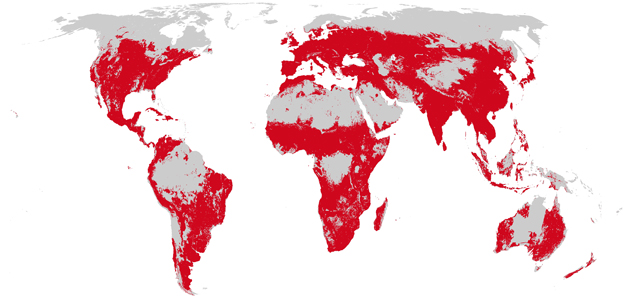
Those nine include carbon dioxide concentrations, maintaining biodiversity at 90 percent, the use of nitrogen and phosphorous, maintaining 75 percent of original forests, aerosol emissions, stratospheric ozone depletion, ocean acidification, fresh water use and the dumping of pollutants.

The planet has been our best friend by buffering our actions and showing its resilience,” said Rockstrom. “But for the first time ever, we might shift the planet from friend to foe.”

Image from ideas.ted.com

Image from ideas.ted.com

Rockstrom’s planetary boundary theory was first conceived in 2007. His new paper reveals that because of climate stability, which began when the Ice Age ended 11,000 years ago, a planetary calm helped our ancestors to cultivate wheat, domesticate animals, and launch industrial and communications revolutions. But those advances have strained the stability of the planet, and Rockstrom says we have broken four boundaries: too much nitrogen has been added to ecosystems, too many forests have been cut down, the climate is changing too quickly and species are going extinct at too great a rate.

Speaking to RT’s Ben Swann, Professor of Ethics Bron Taylor from the University of Florida said that we have accelerated the extinction crisis through deforestation and ocean acidification, a development which is driving species to extinction.

“[Human] beings have increased, even from 1925, from 2 billion – which is considered to be a sustainable population for human beings, according to northern European consumption standards – to 7.2 billion at this point,” he said.

What we have also done is increased the number of domestic animals, the ones we eat and the ones that are companion animals. We have 4.3 domestic animals one for every two human beings on the planet. Cultivating the land they need creates species extinction because where they are, other organism are not. Where we cut down forests for cattle, other species are not there.”

We are losing literally tens of thousands of endemic or native species to these trends.”

Professor Taylor told RT that scientists say we entering the Sixth extinction, but that this an anthropogenic extinction caused by human beings.

If you don’t have control over something, there is no moral obligation,” said Taylor. “In this case, we are doing it. So we have to ask the question: If we are doing something that is driving species off the planet, are we in some sense morally culpable?”

“What right do we have to drive [out] other species, who got here in precisely in the same way that we have, who have participated in the long struggle for existence just as we have?”

Meanwhile, Professor Rockstrom is using his planetary boundary theory not as a doomsday message but as analysis to keep the planet “safe” for humanity. He said nations can cut their carbon emissions to almost nothing and pull the Earth back across the climate boundary.

“For the first time,” he said, “we have a framework for growth, for eradicating poverty and hunger, and for improving health.”

Coping with the anthropocene: How we became nature (Science Daily)

Date: March 17, 2015

Source: De Gruyter

Summary: Overpopulation, the greenhouse effect, warming temperatures and overall climate disruption are all well recognized as a major threat to the ecology and biodiversity of the Earth.  The issue of humankind’s negative impact on the environment, albeit hotly debated and continuously present in the public eye, still only leads to limited policy action.


Overpopulation, the greenhouse effect, warming temperatures and overall climate disruption are all well recognized as a major threat to the ecology and biodiversity of the Earth. The issue of mankind’s negative impact on the environment, albeit hotly debated and continuously present in the public eye, still only leads to limited policy action. Urgent action is required, insist Paul Cruzten and Stanislaw Waclawek, the authors of “Atmospheric Chemistry and Climate in the Anthropocene,” published in open access in the new Chemistry-Didactics-Ecology-Metrology.

In their sobering review, Crutzen, the 1995 Nobel Laureate in Chemistry, and Waclawek, outline the development of a new geological epoch — the Anthropocene, where human actions become a global geophysical force, surpassing that of nature itself.

Anthropocene, which relates to the present geological epoch, in which human actions determine the behavior of the planet Earth to a greater degree than other natural processes. The term, coined by American ecologist Eugene F. Stoermer and popularized by Crutzen, introduced the epoch succeeding the Holocene, which is the official term for the present epoch on Geological Time Scale, covering the last 11, 500 years.

Although Anthropocene is not a new concept, it is only now that the authors present stunning evidence in support of their claim. The article describes the negative impact of the human footprint, which ensues a gradual destruction of the Earth. Highlighting different data elements — it yields overwhelming evidence that “man, the eroder” now transforms the atmospheric, geologic, hydrologic, biospheric, and other earth system processes.

The list is long and unforgiving:

· Excessively rapid climate change, so that ecosystems cannot adapt

· The Arctic ocean ice cover is thinner by approximately 40% compared to 20-40 years ago

· Ice loss and the growing sea levels

· Overpopulation (fourfold increase in the 20th century alone)

· Increasing demand for freshwater

· Releases of NO into the atmosphere, resulting in high surface ozone layers

· Loss of agricultural soil through erosion

· Loss of phosphorus. Dangerous depletion in agricultural regions

· Melting supplies of phosphate reserves (leading to serious reduction in crop yield)

Describing the negative impact of human activities on the environment, the authors identify planetary boundaries, as means to attaining global sustainability. It is “a well-documented summary of all humankind actions affecting the environment on all scales. According to Crutzen, we live in a new era, Anthropocene, and our survival fully depends on us. I strongly recommend this unusual publication in the form of highly informative compressed slides and graphs.” says Marina Frontasyeva from the Joint Institute for Nuclear Research in Dubna, Russia. Nature is us, and responding to the Anthropocene means building a culture that grows with the Earth’s biological wealth instead of depleting it.


Journal Reference:

  1. Paul J. Crutzen, Stanisław Wacławek. Atmospheric Chemistry and Climate in the AnthropoceneChemistry-Didactics-Ecology-Metrology, 2015 DOI: 10.1515/cdem-2014-0001

Welcome to Global Warming’s Terrifying New Era (Slate)

By Eric Holthaus

19 March 2015

466467728-in-this-handout-image-provided-by-unicef-the-storm

Storm damage in Port Vila, Vanuatu. Photo by UNICEF via Getty Images

On Wednesday, the National Oceanic and Atmospheric Administration announcedthat Earth’s global temperature for February was among the hottest ever measured. So far, 2015 is tracking above record-warm 2014—which, when combined with the newly resurgent El Niño, means we’re on pace for another hottest year in history.

In addition to the just-completed warmest winter on record globally (despite the brutal cold and record snow in the eastern U.S.), new data on Thursday from the National Snow and Ice Data Center show that this year’s peak Arctic sea ice reached its lowest ever maximum extent, thanks to “an unusual configuration of the jet stream” that greatly warmed the Pacific Ocean near Alaska.

But here’s the most upsetting news. It’s been exactly 30 years since the last time the world was briefly cooler than its 20th-century average. Every single month since February 1985 has been hotter than the long-term average—that’s 360 consecutive months.

More than just being a round number, the 30-year streak has deeper significance. In climatology, a continuous 30-year stretch of data is traditionally what’s used to define what’s “normal” for a given location. In a very real way, we can now say that for our given location—the planet Earth—global warming is now “normal.” Forget debating—our climate has officially changed.

This 30-year streak should change the way we think and talk about this issue. We’ve entered a new era in which global warming is a defining characteristic and a fundamental driver of what it means to be an inhabitant of planet Earth. We should treat it that way. For those who care about the climate, that may mean de-emphasizing statistics and science and beginning to talk more confidently about the moral implications of continuing on our current path.

Since disasters disproportionately impact the poor, climate change is increasingly an important economic and social justice issue. The pope will visit the United States later this year as part of a broader campaign by the Vatican to directly influence the outcome of this year’s global climate negotiations in Paris—recent polling data show his message may be resonating, especially with political conservatives and nonscience types. Two-thirds of Americans now believe that world leaders are morally obligated to take steps to reduce carbon.

Scientists and journalists have debated the connection between extreme weather and global warming for years, but what’s happening now is different. Since weather impacts virtually every facet of our lives (at least in a small way), and since climate change is affecting weather at every point in the globe every day (at least in a small way), that makes it at the same time incredibly difficult to study and incredibly important. Formal attribution studies that attempt to scientifically tease out whether global warming “caused” individual events are shortsighted and miss the point. It’s time for a change in tack. The better question to ask is: How do we as a civilization collectively tackle the weather extremes we already face?

In the aftermath of the nearly unprecedented power and destructive force of Cyclone Pam’s landfall in the remote Pacific island nation of Vanuatu—where survivors were forced to drink saltwater—emerges perhaps the best recent example I’ve seen of a government acknowledging this changed climate in a scientifically sound way:

Cyclone Pam is a consequence of climate change since all weather is affected by the planet’s now considerably warmer climate. The spate of extreme storms over the past decade—of which Pam is the latest—is entirely consistent in science with the hottest ever decade on record.

The statement was from the government of the Philippines, the previous country to suffer a direct strike by a Category 5 cyclone—Haiyan in 2013. As chair of the Climate Vulnerable Forum negotiating bloc, the Philippines also called for a strengthening of ambition in the run-up to this year’s global climate agreement in Paris.

The cost of disasters of all types is rising around the globe as population and wealth increase and storms become more fierce. This week in Japan, 187 countries agreed on a comprehensive plan to reduce loss of life from disasters as well as their financial impact. However, the disaster deal is nonbinding and won’t provide support to the most vulnerable countries.

Combining weather statistics and photos of devastated tropical islands with discussions of political and economic winners and losers is increasingly necessary as climate change enters a new era. We’re no longer describing the problem. We’re telling the story of how humanity reacts to this new normal.

As the Guardian’s Alan Rusbridger, in an editorial kickoff of his newspaper’s newly heightened focus on climate, said, “the mainstream argument has moved on.” What’s coming next isn’t certain, but it’s likely to be much more visceral and real than steadily upward sloping lines on a graph.

Did a Volcanic Cataclysm 40,000 Years Ago Trigger the Final Demise of the Neanderthals? (Geological Society of America)

19 March 2015

Boulder, Colo., USA – The Campanian Ignimbrite (CI) eruption in Italy 40,000 years ago was one of the largest volcanic cataclysms in Europe and injected a significant amount of sulfur-dioxide (SO2) into the stratosphere. Scientists have long debated whether this eruption contributed to the final extinction of the Neanderthals. This new study by Benjamin A. Black and colleagues tests this hypothesis with a sophisticated climate model.

Black and colleagues write that the CI eruption approximately coincided with the final decline of Neanderthals as well as with dramatic territorial and cultural advances among anatomically modern humans. Because of this, the roles of climate, hominin competition, and volcanic sulfur cooling and acid deposition have been vigorously debated as causes of Neanderthal extinction.

They point out, however, that the decline of Neanderthals in Europe began well before the CI eruption: “Radiocarbon dating has shown that at the time of the CI eruption, anatomically modern humans had already arrived in Europe, and the range of Neanderthals had steadily diminished. Work at five sites in the Mediterranean indicates that anatomically modern humans were established in these locations by then as well.”

“While the precise implications of the CI eruption for cultures and livelihoods are best understood in the context of archaeological data sets,” write Black and colleagues, the results of their study quantitatively describe the magnitude and distribution of the volcanic cooling and acid deposition that ancient hominin communities experienced coincident with the final decline of the Neanderthals.

In their climate simulations, Black and colleagues found that the largest temperature decreases after the eruption occurred in Eastern Europe and Asia and sidestepped the areas where the final Neanderthal populations were living (Western Europe). Therefore, the authors conclude that the eruption was probably insufficient to trigger Neanderthal extinction.

However, the abrupt cold spell that followed the eruption would still have significantly impacted day-to-day life for Neanderthals and early humans in Europe. Black and colleagues point out that temperatures in Western Europe would have decreased by an average of 2 to 4 degrees Celsius during the year following the eruption. These unusual conditions, they write, may have directly influenced survival and day-to-day life for Neanderthals and anatomically modern humans alike, and emphasize the resilience of anatomically modern humans in the face of abrupt and adverse changes in the environment.

FEATURED ARTICLE
Campanian Ignimbrite volcanism, climate, and the final decline of the Neanderthals
Benjamin A. Black et al., University of California, Berkeley, California, USA. Published online ahead of print on 19 March 2015; http://dx.doi.org/10.1130/G36514.1.

Losing our Fear! Facing the Anthro-Obscene (Entitle Blog)

entitlefellows
October 20, 2014

by Erik Swyngedouw**

It’s useless to wait-for a breakthrough, for the revolution, the nuclear apocalypse or a social movement. To go on waiting is madness. The catastrophe is not coming, it is here. We are already situated within the collapse of a civilisation. It is within this reality that we must choose sides.

The Invisible Committee

The hegemonic liberal frame that sutures the environmental literary landscape today is ‘market environmentalism’. Greening the market economy, so the fantasy goes, is systematically advanced across the academic and popular media landscape as the panacea for the environmental deadlock we are in. The dominant argumentation of ‘green economy’ pundits maintains that merely greening the existing socio-economic relations will bring a sustainable solution. Ecologising the economy would be necessary and sufficient to evade a pending ecological Armageddon while permitting the untroubled continuation of civilisation as we know it for a while longer.

It is precisely the premise of this biblical promise of an ecological catastrophe coming near you in the near future that should be rejected completely. Confronted with cataclysmic images of imminent ecological disaster, which predominate the ecological and climate discourse and imaginary, and whose ultimate goal is precisely to make sure that the disaster does not take place (if we take the right measures), the only correct radical answer seems to be ‘don’t worry’ (Al Gore, Prince Charles, green boys and girls, eco-responsible companies, environmental civil servants), your disaster scenario is factually correct, but just a bit out-of-synch; social-ecological Armageddon will not only take place, it is already taking place, it has already happened. Many already live in the apocalypse, in those places where the intertwining of environmental change and social conditions has already reduced living conditions to ‘bare life’. Socio-ecological entanglements have already reached the ‘point of no return’. It is already too late to do something about nature. It has always already been too late. It is precisely by accepting this reality that a new politics can emerge.

Source: Robyn Woolston

‘Welcome to the Anthropocene’ has become an often-heard slogan to inform us that a new geological era has started, that it is already too late to save Nature. Whereas until recently earthly processes only proceeded very slowly and irrespective of human interventions at the earth’s surface or in the atmosphere, human beings have now become co-producers of a deep geological time itself. Paul Crutzen, a Nobel Prize winning chemist, invented the term about ten years ago to refer to what comes after the Holocene, the relatively moderate geo-climatic period in which agriculture, cities and complex human civilisations came into being. The notion of the Anthropocene suggests that the intertwining of social and ‘natural’ processes is now so intense that Nature as the merely external condition of existence for human beings has come to an end. There is no longer a form of Nature that is not influenced by social, cultural, and economic relations. Henrik Ernstson, eminent political ecologist, recently proffered the term ‘Anthro-Obscene’ to signal the starkly de-politicising and plainly disempowering mobilisation of what nonetheless sounds like a revolutionary concept. Is the ‘Anthropocene’ and its intense human – non-human entanglements not precisely the name for the disavowed historical unfolding of the capitalist political ecology of the past few centuries? Has it not been the historical-geographical dynamic of capitalism and its global spread that has banned the very existence of an external nature?

The Anthropocene heralds the period since the beginning of industrialisation, and therefore capitalism, which brought a qualitative change in the geo-eco-climatic dynamic on earth as a result of the ever intensifying interaction between human beings and their physical conditions of existence. The Anthropocene is therefore nothing else than a geological name for capitalism WITH nature. Ocean acidification, changes in biodiversity, genetic migration and new genetic combinations, climate change, large infrastructures which influence the geodetic dynamic, new materials, global and often unexpected new disease carriers and so on and so forth resulted in ever more complex entanglements of ‘natural’ and ‘social’ processes whereby human beings became active agents in the co-production of the earth’s future history. The Anthropocene is just another name to indicate the End or the Death of Nature. This cannot be undone, however hard we try. Time is irreversible. There is no ideal, lost place, time or ecology, no Arcadia to which we can return. Eden has never existed anyway. The past is foreclosed forever, but the future – now including the future of a thoroughly socialised nature – is radically open. It is within this historically and geographically specific configuration that not only the possibility, but also the necessity for a real politicisation of the environment arises, that choices have to be made and different socio-ecological entanglements have to be experimented with and produced.

The Anthropocene in its Anthro-Obscenic reality displaces the terrain of the political as merely inter-human activity to the environment as a whole, including those processes, which recently were left to (the laws of) nature. Non-human actants and processes are now engaged in a process of politicisation. And this should be recognised fully in its radical materiality. The Anthro-Obscene opens a perspective whereby different nature-realities and social-ecological interactions can be imagined and realised. The political struggle about the nature, direction and development of these interactions and about the process of egalitarian social-ecological co-production of the commons of life is what a progressive politicisation of the environment envisages. Yes, the apocalypse is already here, but that is not a reason for despair or panic. Let us fully recognise the emancipatory possibilities of apocalyptic life!

The ‘green economy’. Source: Nation of Change

Many people would concur with the view that the climate crisis will fundamentally not be solved by hegemonic approaches of the ‘green economy’, by making capital compatible with – if not cashing in on – ecology; they note that energy costs are on the rise, social inequalities increase, rigid nationalisms – if not worse – emerge everywhere, and that the marketisation of everything is being paid for at an extravagant ecological and social cost. Many people know that things can and should be different. However, like me, they do not know what to do or how to get to something not only different, but better. We all share this gnawing and uncanny feeling that hopeless attempts by economic and political elites to translate the ecological and social catastrophe which surrounds us into a ecological and social crisisthat can and needs to be managed does not solve the problems but push them into the future or to other places. Indeed, does the dominant rhetoric of the elite not maintain that ‘the situation is serious but not catastrophic’? Is their neoliberal recipe book proffered as guarantee that the disaster will not occur? Don’t they claim that the crisis can be overcome with a bit of goodwill and effort: social unity will be restored, economic growth will recover and ecological problems will be addressed sustainably? ‘Hold on for a while’, they seem to be saying, ‘rescue is on its way!’

Don’t you have the surreptitious feeling that something is wrong about this rhetoric of those who (sometimes literally) want to conserve the existing situation at all cost; that the ecological and social crisis cannot be made manageable with the help of mere technical and organisational adaptations; that the attempts of the elite to reduce the catastrophe to a crisis which only requires ‘good’, ‘participatory’ and ‘ecological’ management only enlarges the anxiety, increases insecurity, and especially, worsens the catastrophe which many already experience?

What would happen if we threw off the fear? If we resolutely accepted that the ecological, social and economic apocalypse is already here, that we live in the Anthro-Obscene, that it no longer needs to be announced as a dystopian promise for an avoidable future (if only the right measures are taken today)? What if we really would believe that things can not only change, but have to? That it really is already too late for many people and ecologies?

Yes but, you might think. After all, there is no catastrophe, we don’t live in the Apocalypse. It was a good wine year, the summer was a bit disappointing but the holidays were sunny, the financial crisis is being addressed without too much pain for me and my siblings, my education proceeds as planned, sustainable environmental technologies are stimulated, the hybrid car really drives smoothly, waste is being reduced, and the new IKEA catalogue promises sustainable entrepreneurship. Furthermore, the green parties are not doing badly in the polls. You’re right. The catastrophe is not for most of you or for me. Crisis, yes, but talking about catastrophe appears a bit overdone.

But perhaps we should not forget the words of the Italian Marxist Amadeo Bordiga: ‘when the ship goes down, so too do the first class passengers’. There is no salvation island where the elites can retreat into splendid isolation (despite their best efforts to do so) he claimed. This slogan is often adopted by ecologists of a variety of stripes or colours. We are all in the same boat. Bill Gates, Al Gore, Jeffrey, Richard Branson, the inhabitants of sinking islands, my son, and even Prince Charles today share the opinion of this notorious communist of the common threat facing the commons. But on closer inspection – I would argue — good old Amadeo was desperately wrong. See the blockbuster movie Titanic once again. A large share of the upper class passengers found a lifeboat; the others remained stuck in the underbelly of the beast. The social and ecological catastrophe is indeed not here for everyone; the apocalypse is uneven. And this is where the ultimate truth of our current predicament is situated. Remember the images of the earthquake in Haiti a few years ago, or the devastation wrought by hurricane Katrina in New Orleans: hundreds of thousands of homeless people, hundreds of deaths, dysentery and malaria spreading fast, exaggerated reports about thieves who stole paltry possessions to stay alive, shortages of drinking water. The earthquake was not the consequence of human interventions in nature, the hurricane perhaps. But what we know very well is that the socio-ecological catastrophe is not caused by the earthquake or the hurricane. It was there long before disaster struck. Nature was not responsible for the post-apocalyptic post-human landscape after the quake. Most Haitians, together with all the others who balance on the verge of survival, have always already lived in the apocalypse, before, during and after the quake. Racial prejudices, dire living conditions and a precarious socio-ecological existence were also the lot of the poor in New Orleans. Or think about the incalculable number of environmental refugees.

Source: FightBack

We have a rough idea about the number that is reaching European shores via the Mediterranean, but we have not a clue about the countless migrants, except through occasional harrowing stories of sunken boats, that fail to make it to the continent, and become fish fodder. It is precisely the combination of ecological, social and economic relations, which pushes them, often with desperately little means, to leave their home countries. They, too, fled a catastrophe. Our apocalyptic times are perversely uneven, whereby the survival pods of the elites are fed and sustained by the disintegration of life-worlds elsewhere.

Consider, for example, how the socio-ecological conditions in Chinese mega-factories, like Foxconn, where our iPhone, iPod, iPad and other gadgets, so indispensable for ‘normal’ life are assembled, make 19th century European cities look like socio-ecological utopias. The social and ecological catastrophe which international elites imposed upon Greece to make sure the European neoliberal model could be sustained a while longer shows that the collapse of daily life is reserved for certain people, so that the others can go on with business as usual. If nuclear power plants close down tomorrow, the lights will continue burning on Putin’s gas. Despite Pussy Riot. And tar sands exploitation or ‘fracking’ will protect us from the disaster of ‘peak oil’ while further pumping up greenhouse gas concentrations in the atmosphere never before found in the earth’s history.

‘Natural’ and ecological disasters show in all their sharpness what we have already known for a long time, namely, the politically powerless and economically weak are paying the price, they always do. The apocalypse is always theirs, and only theirs. While the biblical apocalypse of Saint John announced the final judgment which offered paradise to the chosen few and damned the evil ones, the socio-ecological apocalypse separates the elite from the powerless and excluded.

Perhaps something must be done about the lifeboats. For some, the solution is to seal them off hermetically, to protect them with electric fences and impenetrable walls, to strengthen militarised forces to secure the perimeter of their own little eco-paradise. The zombies of the apocalypse, the hordes at the gates, the motley crew that demands its share of nature, the rebels who ask a new order: they represent the reality of catastrophe today. And this reality should be taken seriously. We all share in it. Eco-warrior, advocate of nuclear energy, incorrigible Malthusian and inventor of the Gaia hypothesis James Lovelock summarised the possible consequences of the uneven apocalypse very eloquently and soberly:

“… what if at some time in the next few years we realise, as we did in 1939, that democracy had temporarily to be suspended and we had to accept a disciplined regime that saw the UK as a legitimate but limited safe haven for civilisation. Orderly survival requires an unusual degree of human understanding and leadership and may require, as in war, the suspension of democratic government for the duration of the survival emergency.”

The emergency situation evoked by Lovelock is not there to make sure everyone survives. It is supposed to be the consequence of the demographic explosion cum ecological disintegration of the Global South as a result of which hordes of eco-zombies will crowd at the gates of the egalitarian social-ecological paradise at the other side of the Channel. An autocratic leadership and the suspension of democracy are precisely needed to keep the gates firmly shut. This might appear a somewhat exaggerated perspective. But is this not exactly what happened over the past few years? Perhaps not so much with regard to climate change (very little has happened on that terrain), but surely with regard to attempts to reduce the economic-financial catastrophe to a manageable crisis. All other problems were shoved aside. Draconian austerity measures were imposed which especially affected the weakest, massive public means were and are mobilised to keep financial institutions afloat, migration is being managed with all possible repressive means. Despite profound and previously unseen protest, only one set of recipes was applied to restore the existing financial-economic order. The elite indeed will, if necessary, use all means available to maintain its status and position.

But does in the generalised forms of resistance reside not only the hope, but the absolute certainty, that change is possible and needed? A change that revolves around the signifiers of democracy, solidarity and the egalitarian management of the commons? Does this not suggest, rather provocatively, that the political project that combines those terms might carry the name ‘communism’; ‘a communism of the commons’. This suggestion breaks so strongly with the currently hegemonic logic and recipes that many will sceptically respond: how can the democratic management of the commons ever be realised? How can the egalitarian and collective management of the commons be organised in the current neoliberal climate which includes the privatisation of nature, the individualisation of daily life, and the fragmentation of the political and ideological landscape? Of course, the critique of the hegemonic project of the green economy is valid, and another approach is necessary, but should we – faced with the coming catastrophes – not rather opt for practical solutions, which maybe do not really question the status quo, but are at least a bit more realistic, less weighted down by history, and feasible today?

Furthermore, the term ‘communism’ probably – and rightly – evokes the horror of the 20th century (the Stalinist terror, the ecological disaster, the social inequality), or at least, the term refers to a radical failure of what was once presented as a utopian solution for society’s ills. Perhaps ‘communism’ is indeed not a good name to refer to a democratic ecological project of the commons. Perhaps we should let fear triumph here too. Or maybe it is better to reserve the term socialism or communism for the elitist and undemocratic mobilisation of the commons for personal gain and the reinforcement of the elite’s power position.

We are all socialists now. Source: Newsweek

In February 2009, Newsweek, not immediately the most radical magazine, stated on its cover “We are all socialists now”. The title evidently referred to the 1.5 trillion dollars of public money that President Barack Obama pumped into the banking system to save Wall Street and to prevent a (foretold apocalyptic) planetary financial meltdown. Shortly afterwards, other countries, including the European Union would follow suit. Trillions of euros, part of the common capital, of our commons, were mobilised to provide the sputtering profit motor with new oil. Is there a better example to show that socialism is a real possibility, that collective means, the commons, can massively and collectively be used to reach a particular social goal, in this case the maintenance of elite positions, the avoidance of the apocalypse for the elite on the back of the weakest? Despite the Spanish Indignados, the Greek outraged, and many Occupy! movements which demand ‘Real Democracy Now’, the assembled elites continue undisturbed, realising their collective phantasmagorical utopia. Indeed, we are living in properly socialist times, a socialism of the elites.

We are NOT all socialists now…..Source: Serr8d.blogspot.se

Is a better example possible that the commons can indeed be used collectively (in this case the collective of the 1% – still a significant number)? That a communism of the elites is precisely the political name for the current neoliberal practice? Putin’s Russia is a good example of the appropriation of the commons by an oligarchic ultra-minority. As Marx stated long ago, history unfolds as a drama (the real socialism of the 20th century) and repeats itself as a farce (the real socialism of the elites today). What the socialist movement of the 20th century mostly failed to realise (the nationalisation of the banks) is being achieved by the elite in a very short lapse of time, in the name of the recovery of and sustainability of capitalism! It appears indeed that the collective management of the commons as such is not the problem. It is certainly not a naive or utopian proposal. The question is rather one of its management by whom and for whom?

Where resides the problem then? What is it that we don’t dare to face? What withholds us from tackling the unequal social-ecological apocalypse? The answer is implicit in what precedes. Not the collective management of the commons, of the environment, is the problem, but rather the undemocratic character of the current type of management. This does not relate to the shortcomings of the institutional and electoral machines of daily policy-making (parliaments, regular elections, public administration, political parties, etcetera  – very few still believe in its potential to nurture democratizing and egalitarian change), but to the basis of a democratic society itself. The foundation of democracy is that everyone is supposed to be equal. Democratic equality is not a sociologically verifiable given – we all know that each concrete society knows many clearly observable inequalities – but an axiomatic principle. The democratic is precisely the axiomatic acceptance of the equality of everyone and the recognition of the egalitarian capacity to govern in a concrete context, which is always marked by social and ecological inequalities.  That is the truth which is put forward time and again by resistance movements, Indignados, the Arab Spring, the women’s, workers’ and environmental movements. That is why the truth of democracy is not a universal standard. Its universal truth (we are all equal in principle) is carried by the particular group who is wronged as its equality is mis- or unrecognised. That is why we can conclusively state that Al Gore, Richard Branson, the president of the European Central bank, or Angela Merkel are undemocratic, while environmental refugees, climate justice activists, resistance movements against the privatisation of the commons and Occupy! activists, through their political action, reveal the scandal of institutionalised democracy and the necessity of an egalitarian communist restructuration of political, social and ecological relations, although they too are a sociological minority. In this sense, they precisely indicate what really matters in these apocalyptic times. Let’s join them. Translating the egalitarian demand in concrete social-ecological equality is the stake of a real politicisation of the environment. And this requires intellectual courage, social mobilisation, and new forms of political action and organisation. We have nothing to lose but our fear.

* I have taken the term ‘Anthro-Obscene’ from Henrik Ernstson, eminent political ecologists of the Universities of Stockholm, Stanford, and Cape Town, who suggested it as part of the theme for an upcoming workshop on politicizing urban political ecology that we are organising in 2015. This blog is a redacted reflection of a foreword for a fantastic book coming out in 2015: Kennis A. and Lievens M. The Myth of the Green Economy. (London and New York: Routledge).

** Erik Swyngedouw Erik is Professor of Geography at the University of Manchester in its School of Environment and Development. He received his PhD entitled “The production of new spaces of production” under the supervision of David Harvey at Johns Hopkins University (1991). From 1988 until 2006 he taught at the University of Oxford and was a Fellow of St. Peter’s College. He moved to the University of Manchester in 2006. Erik has published several books and research papers in the fields of political economy, political ecology, and urban theory and culture. He aims at bringing politically explicit yet theoretically and empirically grounded research that contributes to the practice of constructing a more genuinely humanising geography.

Anthropocene: New dates proposed for the ‘Age of Man’ (BBC)

Old World New World Map

Scientists believe the collision between the Old and New Worlds led to the start of the Anthropocene 

The Anthropocene – a new geological time period that marks the “Age of man” – began in 1610, a study suggests.

Scientists believe that the arrival of Europeans in the Americas had an unprecedented impact on the planet, marking the dawn of this new epoch.

The findings are published in the journal Nature.

Others say that the industrial revolution or the first nuclear tests better signal the start of the Anthropocene.

While some believe the exact date for a new epoch can only be determined with the benefit of thousands or even millions of years of hindsight.

An international Anthropocene Working Group is currently reviewing the evidence and will announce its favoured start date next year.

We look for these golden spikes – a real point in time when you can show in a record when the whole Earth has changed” – Prof Mark Maslin, University College London

Golden spikes

Geologists carve up Earth’s history into chunks that reflect times of significant change on the planet, perhaps as a result of continental movement, a big asteroid strike, or a major shift in climate.

We are still formally in the Holocene Epoch. It started more than 11,500 years ago as the last Ice Age came to an end.

But now scientists say that humanity has dramatically altered the Earth again.

To pinpoint the start of this new phase, geologists are looking for a clear signal, described as a “golden spike”, that will be captured in rocks, sediments or ice.

Prof Mark Maslin, from University College London, a co-author of the paper, said: “We look for these golden spikes – a real point in time when you can show in a record when the whole Earth has changed.

“If you look back through the entire, wonderful geological timescale, we have defined almost every boundary in that way.”

Painting of Columbus arrives in the Americas, 1492

The arrival of Christopher Columbus in the Americas started an exchange of people, crops – and disease

The study suggests that one such golden spike places the start of the Anthropocene in 1610.

The researchers say the arrival of the Europeans in the Americas 100 years earlier was the start of a major global transformation.

We saw these species jump continents, which is a geologically unprecedented impact, setting Earth off on a new evolutionary trajectory” – Dr Simon Lewis, UCL

Co-author Dr Simon Lewis, also from UCL, said: “The rapid global trade after that time moved species around.

“Maize from Central America was grown in southern Europe and Africa and China. Potatoes from South America were grown in the UK, and all the way through Europe to China. Species went the other way: wheat came to North America and sugar came to South America – a real mixing of species around the world.

“We saw these species jump continents, which is a geologically unprecedented impact, setting Earth off on a new evolutionary trajectory.”

Ancient pollen found in sediments provides a record of this change, but the team says another golden spike relates to deadly diseases brought into the Americas from Europe.

“Around 50 million people (in the Americas) died, and most of those people were farmers,” Dr Lewis told the BBC World Service’s Science in Action programme.

“And this farmland grew back to the original vegetation – tropical forest, dry forest or savannah. And about half the dry weight of a tree is carbon, so all that growing vegetation removed enough carbon from the atmosphere to see a pronounced dip in the global atmospheric carbon dioxide concentration that can be seen in ice core records.

“It provides an exact marker of the Anthropocene at 1610, the lowest point of CO2 in the ice-core record at that time.”

Atomic bomb

Nuclear weapons tests in the mid-20th Century have also left a clear signal of humanity’s impact on the Earth

The researchers also said another date for the new epoch could be 1964, when the nuclear tests of the 1940s, 50s and early 60s came to an end after a ban came into force.

A golden spike is provided by an increase in radioactive carbon in the atmosphere while the tests were taking place, followed by a very sharp drop off when they stopped.

It certainly adds positively to the overall debate on the Anthropocene, and to the growing number of suggestions about where it should start” – Dr Jan Zalasiewicz, Anthropocene Working Group

But Prof Maslin said that while the signal was very sharp, the radioactivity was not related to other great changes taking place at that time.

He explained: “In the mid-1960s, there is a huge change in everything around the planet, which is called the ‘great acceleration’ – with the population increasing by 2% per year, unprecedented changes in agriculture and food production – but the marker doesn’t link to that in any shape or form.”

Commenting on the research, Dr Jan Zalasiewicz, from the University of Leicester, who chairs the Anthropocene Working Group, said it was an interesting piece of work with some “intriguing ideas”.

“The working group will certainly be discussing them,” he told BBC News.

“It adds positively to the overall debate on the Anthropocene, and to the growing number of suggestions about where it should start.

“The 1610 suggestion clearly reflects a historically important event, though it would need more evidence, I think, whether the criteria they suggest would work better than the multiple signals now known to be associated with the mid-20th century ‘great acceleration’.”

Related Stories

“Nobres Selvagens” na Ilustríssima (Folha de S.Paulo) de domingo, 22 de fevereiro de 2015

Antropólogos, índios e outros selvagens

RICARDO MIOTO
ilustração ANA PRATA

22/02/2015  03h05

RESUMO Livro do antropólogo Napoleon Chagnon que aborda suas pesquisas entre os ianomâmis é lançado no Brasil. Em entrevista, autor, que direcionou sua carreira para uma interpretação evolutiva do comportamento indígena, fala sobre suas conclusões e comenta a recepção, muitas vezes negativa, de sua obra entre seus pares.

*

Sobre Napoleon Chagnon, 76, há só uma unanimidade: trata-se do pesquisador mais polêmico da antropologia contemporânea.É

Nesta entrevista, o americano –que lança agora no Brasil o livro “Nobres Selvagens: Minha Vida entre Duas Tribos Perigosas: os Ianomâmis e os Antropólogos” pelo selo Três Estrelas, do Grupo Folha– afirma que a antropologia brasileira representa o que há de mais atrasado no pensamento anticientífico nessa área.

Chagnon critica ainda alguns brasileiros ligados à temática indígena, como o líder ianomâmi Davi Kopenawa, “manipulado por antropólogos e ONGs”, e o cineasta José Padilha, autor do documentário “Segredos da Tribo”, que “deveria se limitar a filmar Robocop”.

Ana Prata

Chagnon estudou os ianomâmis do Brasil e, principalmente, da Venezuela a partir de 1964 e ao longo de 35 anos, em 25 viagens que totalizaram 5 anos entre os índios. Foi o pioneiro no contato com várias tribos isoladas, que acredita serem uma janela para as sociedades pré-históricas nas quais o gênero Homo viveu por milhões de anos.

Foi visto com antipatia por diversos colegas antropólogos por propor explicações darwinianas para o comportamento dos índios –e dos humanos em geral– e ao escrever, em 1968, um livro em que tratava amplamente da violência entre os índios e no qual, desde o título, “Yanomamö: The Fierce People” (sem tradução no Brasil), chamava os ianomâmis de “o povo feroz”. Despertou inimizades ao se afastar dos colegas antropólogos, que acreditava mais interessados em fazer política do que ciência, e se aproximar de geneticistas.

Foi em 1988, porém, que causou a fúria dos colegas, ao publicar na revista “Science” um estudo mostrando que os homens ianomâmis com assassinatos no currículo eram justamente os que tinham mais mulheres e descendentes. Em termos biológicos, a violência masculina e certo egoísmo humano seriam estratégias reprodutivas bem-sucedidas, ideia que desagradou fortemente seus colegas das humanidades.

O antropólogo sempre defendeu que os índios que estudou guerreavam movidos por uma insaciável vontade de capturar mulheres, enquanto os livros tradicionais de antropologia diziam que a guerra primitiva tinha motivos como a escassez de alimentos ou de terra.

Chagnon diz que seus críticos são marxistas movidos pela ideologia de que os conflitos humanos se explicam pela luta de classes ou por disputas materiais, e não por motivos mais animalescos, como a busca por sucesso sexual.

Ele afirma que nenhum colega pôde apontar falhas nos dados publicados na “Science”. No entanto, antropólogos questionam seu procedimento não só nesse caso como em outros trabalhos (leia ao lado).

Em 2000, o jornalista Patrick Tierney publicou o livro “Trevas no Eldorado” (lançado no Brasil em 2002, pela Ediouro), acusando Chagnon e colegas, entre outras coisas, de terem espalhado sarampo deliberadamente entre os índios. As acusações foram investigadas pela Associação Americana de Antropologia, que inocentou os pesquisadores da grave acusação.

Na entrevista abaixo, feita por telefone, Chagnon trata ainda de temas como a higiene dos índios e os riscos da selva.

*

Folha – O antropólogo Eduardo Viveiros de Castro criticou na internet a publicação do seu livro no Brasil, dizendo que o sr. está ligado à “direita boçalmente cientificista”.

Napoleon Chagnon – A ideia de que o comportamento humano tem uma natureza biológica, moldada pela evolução, além da cultura, sofreu muita oposição nas últimas décadas de quem tem uma visão marxista. Está havendo uma mudança de paradigma, mas os antropólogos brasileiros são o último reduto dessa oposição e sempre tentaram impedir meu trabalho.

Marxistas não gostam de explicações que não envolvam a luta por recursos materiais. Para eles, isso explica tudo. Eles diziam, por exemplo, que a causa da guerra entre os ianomâmis era a escassez de proteína –uma tribo atacaria a outra em busca de carne. Nossas observações mostraram, porém, que não havia correlação. Eles tinham abundância de proteína; lutavam, na verdade, por mulheres.

Nos EUA, cientistas importantes, como meu grande amigo Steven Pinker e o professor Jared Diamond, escreveram recentemente livros demonstrando a relevância crescente da psicologia evolutiva.

Os antropólogos latino-americanos me atacam, mas não têm dados para rebater as conclusões que proponho, porque não gostam de trabalho de campo. Eles gostam de argumentos teóricos, de ficar sentados nas suas cadeiras na universidade fazendo ativismo. No entanto, para entender o mundo, você tem de coletar informações a fim de testar suas previsões e teorias. Essa é a base do método científico. A tendência pós-modernista é dizer que não há verdade, que tudo é social ou político. Isso é a morte da ciência.

Esses críticos dizem que sua visão dos ianomâmis é muito negativa. Citam trechos do seu livro em que o sr. descreve criticamente os hábitos de higiene dos índios, dizendo que eles espalhavam muco em tudo.

Tenho muitas críticas à minha própria civilização também, como o excesso de filas. Os ianomâmis não têm uma teoria da transmissão de doenças via germes. Então assoam o nariz na mão e passam no cabelo, nos outros, até na minha bermuda [risos]. A primeira coisa que quis aprender na língua deles foi “não encoste em mim, suas mãos estão sujas”, mas não adiantou. Você se acostuma.

Na verdade, você percebe que há coisas mais sérias com que se preocupar. A vida na tribo é perigosa. Há muitas cobras. Um bebê de uma tribo ianomâmi em que vivi sumiu, e os pais concluíram que a única explicação era que tivesse sido comido por uma anaconda. Há ainda muitos insetos, há onças, muitos outros incômodos.

Como é a sua relação com o líder ianomâmi Davi Kopenawa?

Ele é manipulado pelos seus mentores, seus conselheiros políticos, a maioria antropólogos e ONGs, que dizem a ele o que ele deve declarar. Ouço que muitos jornalistas brasileiros têm essa percepção, mas sabem que é impopular dizer isso em público.

As entrevistas com ele costumam ser mediadas por antropólogos.

Pois é. Veja, em uma das minhas visitas aos ianomâmis no Brasil, Kopenawa proibiu o piloto do meu avião de utilizar o combustível que tinha guardado perto de uma das tribos em que ele tinha influência. Ele queria a todo custo que eu ficasse isolado na floresta, fez isso deliberadamente. O piloto teve de conseguir combustível com outros colegas. Essa é uma das razões que me levaram a não ter uma opinião muito positiva a respeito dele.

Kopenawa critica vocês por não devolverem amostras de sangue que coletaram entre os índios em 1967 para estudos científicos na área de genética e que foram parar em bancos de universidades dos EUA.

Sou simpático a esse pedido. Mas essas amostras são 99% de tribos venezuelanas, não brasileiras. Seria horrível se entregássemos tal sangue para os ianomâmis brasileiros, como Kopenawa. Uma tribo ficaria muito assustada de saber que seus vizinhos têm o sangue de seus ancestrais, eles acreditam que isso poderia ser utilizado para fazer magia negra, por exemplo.

É importante dizer que, influenciadas por antropólogos, lideranças ianomâmis tornaram impossível hoje, para qualquer pesquisador, ir a suas tribos e coletar amostras de sangue; foram convencidos de que isso foi um crime terrível que cometemos. Dessa forma, nenhum pesquisador da área biomédica pode agora fazer estudos que envolvam coleta de amostras. Os ianomâmis vetaram para sempre qualquer pesquisa que possa beneficiar a sua saúde e dependa de exames de sangue.

Eu gosto muito dos ianomâmis. Fiquei muitos anos com eles. Eles merecem ser mais bem representados. É nítido que eles precisam de instituições que permitam acesso à medicina moderna, por exemplo. Eles precisam de ajuda.

De qualquer forma, eu não coletei amostras de sangue. Eu só ajudei os médicos a fazê-lo. Eu sou antropólogo. Não estou nem aí para o que acontecerá com as amostras de sangue congeladas nos EUA. Mas seria irresponsável se fossem entregues aos índios errados.

O sr. assistiu ao documentário “Os Segredos da Tribo” (2010), do brasileiro José Padilha?

Padilha mentiu para mim, foi muito desonesto. Ele disse que faria um filme equilibrado, mas nunca mencionou que as acusações feitas contra mim foram completamente desmentidas [pela Associação Americana de Antropologia]. Ele contratou um missionário que falava a língua ianomâmi para fazer as entrevistas com os índios. Esse missionário, amigo meu, depois veio me avisar que Padilha direcionava as entrevistas contra mim, que tudo era feito para criar a impressão de que os ianomâmis me odiavam. O filme é ridículo.

Além disso, Padilha lançou o filme e desapareceu, nunca respondeu às minhas ligações. Na apresentação do filme no festival de Sundance, ele não só não me convidou como chamou três antropólogos inimigos meus para debater. Um deles, Terence Turner, que teve participação ativa na elaboração do filme, me acusava de ser o Mengele das tribos ianomâmis. É doentio. Padilha deveria se limitar a filmar “Robocop”.

Depois de trabalhar muitos anos nas universidades do Michigan e de Missouri, o sr. agora é professor aposentado. Aposentou-se também da pesquisa científica?

Não. Continuo trabalhando com os dados que coletei nas tribos ao longo desses anos todos. Estou para publicar vários artigos em revistas importantes, como a “Science”, mostrando o impacto de conceitos caros à biologia, como o parentesco, na organização das tribos ianomâmis. Se os antropólogos brasileiros não gostam do meu trabalho, ainda não viram nada [risos]. No caso do público brasileiro, espero que os leitores encontrem no meu livro agora publicado uma melhor compreensão da natureza humana, seja no comportamento dos povos indígenas ou no de um vizinho.

RICARDO MIOTO, 25, é editor de “Ciência” e “Saúde” da Folha.

ANA PRATA, 34, é artista plástica.

*   *   *

Livro contribui para distanciar ciências humanas e biológicas

André Strauss

22/02/2015  03h09

Por sua alegada coragem em sustentar hipóteses fundamentadas em princípios darwinianos, o antropólogo americano Napoleon Chagnon, que dedicou sua carreira a estudar a violência entre os índios ianomâmis, apresenta-se em “Nobres Selvagens” [trad. Isa Mara Lando, Três Estrelas, 608 págs., R$ 89,90] como vítima dos mais diversos ataques e preconceitos por parte de seus pares.

Os antropólogos culturais, os religiosos salesianos, os ativistas políticos e os próprios ianomâmis são retratados como grupos ferozes ou biofóbicos. Já Chagnon seria apenas um inocente antropólogo de Michigan. A tese não convence.

Embora o antropólogo pretenda ser um expoente da síntese entre biologia e antropologia, suas proposições são bastante limitadas e, muitas vezes, equivocadas. Exemplo disso é partir do princípio de que uma sociedade não contatada é o mesmo que uma sociedade não impactada, atribuindo aos ianomâmis condição análoga à de sociedades paleolíticas. Propor um contratualismo hobbesiano baseado na luta por mulheres também soa ingênuo.

Em seu livro, Napoleon Chagnon insiste na noção anacrônica de “ciência pura”, desmerecendo a militância pró-indígena dos antropólogos brasileiros como um capricho do politicamente correto.

Mesmo reconhecendo-se que em diversas ocasiões seus detratores exageraram, esse tipo de postura maniqueísta do autor não contribui para a necessária superação dos conflitos epistemológicos e políticos que seguem existindo, ainda que ligeiramente mitigados, entre as chamadas ciências humanas e biológicas.

Um famoso filósofo darwiniano certa vez reconheceu que as teorias antropológicas de cunho biológico têm, inegavelmente, o péssimo hábito de atrair os mais indesejáveis colaboradores. Daí a importância da cada vez maior politização dos bioantropólogos e o movimento explícito por parte deles para impedir que esses associados participem de seus círculos.

Ainda assim, provavelmente Chagnon não é culpado das acusações mais graves que lhe foram imputadas, tal como a de disseminar propositalmente uma epidemia de sarampo entre os indígenas ou a de incentivar, por escambo, que eles declarassem guerras uns contra os outros a fim de que ele pudesse incluir as cenas de violência em um documentário que estava produzindo.

Por outro lado –e isso não se pode negar a Chagnon–, é verdade que as humanidades muitas vezes parecem apresentar aquilo que se convencionou chamar de um “desejo irresistível para a incompreensão”, resultando em acusações injustas e de caráter persecutório.

Algumas décadas atrás, ainda era possível negar a relevância de campos como a genética comportamental, a ecologia humana, a neurociência cognitiva ou a etologia de grandes símios. Atualmente, entretanto, qualquer tentativa de mantê-los fora da esfera antropológica é um exercício vão.

Mais importante, a estratégia comumente utilizada no passado de atrelar os desdobramentos oriundos dessas áreas a implicações nefastas para a dignidade humana, torna-se, além de injusta, muito perigosa.

Juntos, antropólogos e biólogos precisam elaborar uma narrativa capaz de ressignificar esses novos elementos através de uma ótica benigna. Afinal, eles passarão, inevitavelmente, a fazer parte do arcabouço teórico de ambas as disciplinas.

ANDRÉ STRAUSS, 30, é antropólogo do Laboratório de Estudos Evolutivos Humanos da USP e do Instituto Max Planck de Antropologia Evolutiva, na Alemanha.

*   *   *

Trajetória do pesquisador é marcada por querelas

Marcelo Leite

22/02/2015  03h13

Não é trivial resumir as objeções que a antropologia cultural levanta contra Napoleon Chagnon. A controvérsia tem quase meio século, e a tarefa fica mais complicada quando muitos dos antropólogos relevantes do Brasil se recusam a dar entrevistas sobre o caso.

O panorama se turvou de vez em 2000, com o livro “Trevas no Eldorado”. Nele o jornalista Patrick Tierney acusava Chagnon e o médico James Neel de, em 1968, terem causado uma epidemia de sarampo entre os ianomâmis da Venezuela e experimentado nos índios um tipo perigoso de vacina, além de negar-lhes socorro médico.

Chagnon e Neel foram depois inocentados dessas acusações graves. Bruce Albert, antropólogo e crítico de Chagnon que trabalha há 36 anos com os ianomâmis, já escreveu sobre a ausência de fundamento das alegações de Tierney.

Ana Prata

Nem por isso Albert deixa de assinalar sérios erros éticos da dupla. Para ele, os ianomâmis foram usados, sem saber, como grupo de controle para estudos sobre efeitos de radiação nuclear no sangue de sobreviventes de bombardeios em Hiroshima e Nagasaki.

Chagnon, capataz de Neel na expedição, obtinha amostras de sangue em troca de machados, facões e panelas. Embora essa prática perdurasse nos anos 1960-70, Albert ressalva que regras exigindo consentimento informado já vigiam desde 1947 (Código de Nuremberg) e 1964 (Declaração de Helsinque).

Os reparos ao trabalho de Chagnon abarcam também a própria ciência. Ele se diz superior aos antropólogos tradicionais, que acusa de relativistas pós-modernos, xingamento comum nos setores cientificistas da academia americana.

A polêmica teve início com o livro “Yanomamö: The Fierce People”, em que Chagnon apresentou sua tese de que ianomâmis são uma relíquia ancestral da espécie humana: selvagens com compulsão pela guerra como forma de obter mulheres, escassas devido à prática do infanticídio feminino.

Os críticos da etnografia de Chagnon afirmam que ele nunca comprovou o infanticídio seletivo. Com efeito, a explicação foi abandonada em outros estudos, como um famigerado artigo de 1988 no periódico científico “Science”.

O trabalho recorre a dados demográficos coletados por Chagnon para corroborar sua noção, bem ao gosto da sociobiologia, de que os homens mais violentos eram os que tinham mais mulheres e filhos. Esses seriam os que os ianomâmis chamam “unokai” –segundo o autor, os mais temidos no grupo (e, por isso, mais prolíficos).

Albert, Jacques Lizot e outros antropólogos consideram que ele misturou alhos com bugalhos. “Unokai” não seria um atributo individual, mas o estado de impureza (simbólica) daquele que mata alguém com armas ou feitiçaria, ou mesmo só entra em contato com o sangue de cadáveres de inimigos.

Além disso, em incursões contra outras aldeias, os guerreiros muitas vezes dão golpes e flechadas em adversários já mortos. Isso os tornaria “unokai”, não homicidas.

Os mais admirados não seriam esses, mas os “waitheri”, algo como “valorosos”, que se distinguem não só pela valentia, mas também pela capacidade de liderar, de falar bem, até pelo humor.

Não bastasse isso, os críticos apontam manipulação de números. Para inflar seus dados e chegar a 44% de homens que teriam participado de mortes e tinham até o triplo de filhos na comparação com os não “unokai”, Chagnon teria excluído da amostra jovens de 20 a 25 anos e homens mortos –violentos ou não, com ou sem filhos.

Em fevereiro de 2013, o antropólogo Marshall Sahlins renunciou à Academia Nacional de Ciências dos EUA após o ingresso de Chagnon. Num artigo em que explicava o ato, defendeu que um antropólogo alcança entendimento superior de outros povos quando toma seus integrantes como semelhantes –e não objetos naturais, “selvagens”, ao modo de Chagnon.

“É claro que esse não é o único meio de conhecer os outros. Podemos também utilizar nossa capacidade simbólica para tratá-los como objetos físicos”, escreveu. “Mas não obteremos o mesmo conhecimento dos modos simbolicamente ordenados da vida humana, do que é a cultura, ou até a mesma certeza empírica.”

MARCELO LEITE, 57, é repórter especial e colunista da Folha.

*   *   *

Morte sistemática de Ianomâmis é um tabu

Leão Serva

23/02/2015  02h00

Folha publicou com grande destaque na edição de domingo (22) a notícia do lançamento do livro “Nobres Selvagens” (pela Três Estrelas, selo do Grupo Folha), de autoria do antropólogo norte-americano Napoleon Chagnon. Títulos na capa e no caderno da Ilustríssima chamaram a obra de “livro tabu”.

Trata-se de um exagero baseado no discurso persecutório do autor, que sempre responde às críticas a seu trabalho com alegações de perseguição pessoal ou boicote. Uma pesquisa no Google News apresenta 872 respostas com notícias sobre o antropólogo e 64 referências ao livro, incluindo veículos de grande prestígio internacional como “The New York Times” e “Washington Post”.

No Brasil, certamente a obra não foi tema de reportagens simplesmente porque não havia sido lançada.

Na edição, textos de Marcelo Leite e André Strauss compilam as principais fragilidades apontadas pelos críticos da obra de Chagnon.

Uma bem importante, no entanto, não foi mencionada: o antropólogo dá pouca importância ao caráter simbólico das expressões da cultura que aparecem nos depoimentos de índios (e de brancos também, é bom que se diga), o que o leva a tomar o que ouve literalmente. Assim, em sua entrevista, é quase infantil a descrição dos perigos de uma aldeia Ianomâmi. Os medos que Chagnon menciona que concentrariam a atenção dos índios para longe dos cuidados médicos (risco de onças e cobras) são próprios de um alienígena. Já os índios criam cobras em casa para comer ratos; sabem que onças têm medo dos homens e, em situações raras, quando se aproximam furtivamente da periferia da aldeia para tocaiar uma criança, logo são capturadas pelos índios, como eu mesmo testemunhei. Não quer dizer que não haja medo, mas o antropólogo o amplifica para reforçar o estereótipo de atraso.

A história de que um casal ianomâmi teria atribuído o desaparecimento de seu filhinho a uma anaconda esfomeada é bizarra: o bebê na aldeia não fica um minuto longe dos outros e uma sucuri no lento processo de engolir uma criança seria vista por dúzias de pessoas e morta. Chagnon certamente não entendeu o que lhe foi dito ou tomou por verdade uma mentira (vale lembrar que um “civilizado” banqueiro suíço também mente).

Em texto mais antigo, Chagnon apontava o gesto de bater no peito, comum em festas de ianomâmis como expressão da violência da cultura desses grupos. Ora, o mesmo movimento pode ser encontrado diariamente em culturas mais “evoluídas”, segundo seu critério, das grandes cidades da Europa e dos EUA (nas missas católicas quando se diz “Minha culpa, minha culpa, minha máxima culpa”) à Mesopotâmia, berço das civilizações (onde soldados contemporâneos reproduzem o gesto antes de ataques de infantaria). Chagnon não leva em conta o alicerce básico do estudo da antropologia, que as culturas humanas são simultâneas, embora diferentes na expressão material.

Por fim, para desfazer as críticas feitas pelo líder Davi Kopenawa, criou a história de que ele é manipulado por antropólogos. A Folha parte dessa premissa para questionar Chagnon: “As entrevistas com ele costumam ser mediadas por antropólogos”, ao que o autor diz: “Pois é”, e segue sua catilinária.

Trata-se de uma inverdade que qualquer repórter que fale bem português ou ianomâmi pode comprovar. Eu entrevistei Kopenawa três vezes em épocas e lugares diferentes, duas delas sem aviso prévio. Me aproximei, pedi para falar e conversamos sem mediação. Uma vez, em seu escritório em Boa Vista, ele pediu que outras pessoas (que eu não conhecia, índios e brancos) saíssem da sala para ser entrevistado. Fala fluentemente um português simples (de brasileiro não universitário) com forte sotaque. É preciso ter calma e prestar atenção, por vezes pedir que repita para entender a pronúncia de algumas palavras.

A última vez que o encontrei foi numa entrevista para a revista Serafina, com hora marcada. Também ficou só, enquanto eu estava acompanhado da jovem fotógrafa Helena Wolfenson, da Folha. É possível que estrangeiros que falem mal ou não falem português precisem de tradutor. E são certamente raras as pessoas que falam português, ianomâmi e línguas estrangeiras. Talvez daí a história de que ele se faça acompanhar de “antropólogos” ou gente de ONG.

*

O que de fato é um “tabu” (aquilo de que não se fala) na imprensa brasileira é o lento processo de abandono dos Ianomâmi à morte, em curso por incompetência ou (depois de tanto tempo) decisão do governo federal.

Como noticiei nesta coluna em maio do ano passado, as mortes de Ianomâmi por problemas de saúde cresceram nos dois governos do PT (Lula e Dilma). Muitas das doenças são simples de evitar, como provam as estatísticas da segunda metade dos anos 1990.

O aumento se deve em grande medida à interrupção dos trabalhos de medicina preventiva nas aldeias e ao crescimento dos gastos com transporte dos doentes das aldeias para a capital de Roraima, Boa Vista.

A maior parte dos custos do Ministério da Saúde com a saúde indígena em Roraima tem sido despejada em frete de aviões para levar índios a Boa Vista. São poucas as empresas de táxi aéreo, as mesmas que levam políticos locais em seus deslocamentos.

Em janeiro do ano passado, quando a entrevistei, a coordenadora do Ministério da Saúde para as áreas indígenas de Roraima, Maria de Jesus do Nascimento, explicou o aumento das mortes dizendo: “Não, dinheiro não falta… Foi problema de gestão, mesmo”.

Na área Ianomâmi, uma médica cubana do programa Mais Médicos se desesperava: “Não tenho antibióticos, não tenho oxigênio, não tenho equipamentos”. Eu perguntei o que fazia: “Não quero mas sou forçada a mandar os índios de avião para Boa Vista”. O meio se tornou o fim. A saúde dos índios se tornou desculpa para enriquecer as empresas de táxi aéreo.

Quem procura no mesmo Google News notícias sobre as mortes de Ianomâmi pela improbidade dos órgãos de saúde local só encontra quatro notícias, uma delas do espanhol El País, as demais noticiando os protestos dos índios e um debate no Congresso.

Esse genocídio lento e discreto é o verdadeiro tabu.

Notes from the Anthropocene #1 (The Brooklyn Rail)

Nov 5th, 2014

On September 21, 2014, nearly 400,000 people took part in the People’s Climate March and Mobilization, winding their way from Central Park through Midtown Manhattan and ending with a block party celebration on the city’s mostly empty West Side (flooded during Sandy). Cleanly subdivided into six categories of political subjects—indigenous and environmental justice groups up front, a medieval combination of scientists and priests in the fifth, and finally “Here comes everybody! L.G.B.T.Q., N.Y.C. Boroughs, Community Groups, Neighborhoods, Cities, States, and more” in the sixth—the march called on the United Nations Climate Summit and governments around the world to steer a course towards appropriate “climate action” and “climate justice” on behalf of the groups neatly represented like meats and cheeses on a Hormel party tray. The following day, former anti-globalization and Occupy Wall Street activists, many on the payroll of this or that N.G.O., attempted a mass civil disobedience action on the blocks leading to the New York Stock Exchange. When the orchestrated non-violence of Flood Wall Street met the orchestrated non-brutality of the NYPD, ne’er an arrest occurred and the organizers called it all off, going home and turning the streets over to a few hundred unofficial protesters who were determined to be peacefully taken into custody.

As the United Nations met later that week to talk about talking about limiting global temperature rise to less than 3.6 degrees Fahrenheit (2 degrees Celsius) through a reduction in carbon emissions while simultaneously making economies, cities, and networks resilient, the People’s Climate Summit website released its own numbers: 400,000 people, 1,574 organizations, 50,000 college students, 5,200 articles, and 7 celebrity selfies. Homemade and mass-produced signs, puppets and inflatables, polar bear costumes and globes, thousands of buses whose bills were footed by non-profits and Gofundme.com, a pony-tailed Leo DiCaprio parading around as the U.N.’s Messenger for Peace, with a special focus on climate change issues. A success, they say, in launching the climate justice movement, a success as quantifiable as the parts per million of the upper safety limit for the atmosphere. As the march quickly faded into most New Yorkers’ memories, as when a million of us marched against the war that happened anyway, a variety of non-questions circulated to try to cement the march’s legacy. Was it too radical? Not radical enough? Too little too late? A photo-op? A corporate greenwash with the help of the “non-profit industrial complex”? 1 Non-questions for a non-world. Simply put, the Climate March was a blast from the past, mobilizing a set of political techniques and priorities that have literally been left behind by reality, by the new common in which we find ourselves.

A new epoch is certainly at hand; one need only trace the fault lines from the glacial barricades of Kiev’s Maidan across the radioactive swamp left by Fukushima’s failing ice wall to the “Winter is Coming” graffiti of Istanbul’s Gezi commune. Everywhere this age speaks its exhaustion, in the massive human efforts to break through and in the falling of idols. The once coherent subject around which the world was ordered stands in ruin as a neurotic information node whose closest relationship is with a cellphone or iPad. The claims to mastery over the world are being literally washed away by rising seas, while terminal diagnoses of our civilization proliferate as quickly as fantasies of the end (see the Walking Dead’s Terminus). As Brad Evans and Julien Reid describe it in their book Resilient Life, “We are living out the final scenes of the liberal nightmare in all its catastrophic permutations,” an epoch that is sensed just as much in the collapse of the Western Antarctic ice sheet2 and the bamboo barricades of Hong Kong as in the desertification of the Amazon rainforest and the death vows of the Lakota in the face of the KeystoneXL pipeline.3 Some people say the world is ending, but we say it is just a way of life, a certain order of things.

Ironically, it is geologists who have already arrived at this conclusion, by way of atmospheric chemist Paul Crutzen’s “launch[ing] a small hand grenade into the world of geological time scales.”4 Crutzen, formerly most famous for his Nobel Prize-winning research on the depletion of the ozone layer, used the term the Anthropocene in 2000 in a newsletter of the International Geosphere-Biosphere Programme.5 Since then geologists such as Jan Zalasiewicz have taken up the term, forming the Anthropocene Working Group (A.W.G.) to prepare a proposal for its inclusion in the International Commission on Stratigraphy’s official geological time scale. Etymologically the Anthropocene designates the “epoch of man”—a triumphal crowning of the liberal subject and its way of life, dated unsurprisingly from the middle of the 18th century. Stratigraphically the Anthropocene designates that Man has become the most powerful geological force on the planet, meaning that our measurable physical impact on sedimentation is more powerful than the oceans’ tides or the movement of mountains. Though in many popular accounts the Anthropocene is often reduced to the impacts of global warming or other processes contributing to climate change, geologists have focused on a series of metrics in addition to these such as deforestation, the acidification of the ocean, mass extinction, urbanization, the reshuffling of the biosphere, and the homogenization of environments. As such the perceptible triumph of man and his civilization, its coming to the fore as the most powerful force on earth, can best be measured in a catastrophic impact.

In light of the Anthropocene, geologists have also begun reshuffling their own rubrics, expanding the purview of paleontology from the organic to the inorganic and from the past to the present with the introduction of “technostratigraphy.”6According to Zalasiewicz and colleagues Colin Waters (Principal Mapping Geologist at the British Geological Survey) and Mark Williams (Professor of Palaeobiology with Zalasiewicz at Leicester), technofossils7 may well stand as the most convincing evidence of the epoch’s environmental signature. In the first-ever instance of geoscientists using anything other than biological fossils to help classify a chronostratigraphical unit, the A.W.G. are not looking at dinosaur vertebrae frozen in amber or ancient leaf imprints found in stone, but at critical infrastructures and cities like New York itself, which they see as “one of the most extensive, durable and geologically distinctive aspects of the Anthropocene” (Williams et al, 399) and thus as representative index fossils of the epoch’s recent, current, and near future. Whereas palaeontology has always been about studying past geological artifacts, the objects now under consideration as Anthropocene fossils—the key evidence in the Anthropocene dossier—are those of our present-day, still-functioning civilization. Thus for the first time in history, geologists are now dating an epoch in the present tense, studying contemporary, still functioning, infrastructures as fossils, studying the constituent elements of our civilization the way they once studied the remains of a long-vanished life form.

Through their attempt at naming and measuring the epoch of man, studying cities and subways as fossils in real time, and conjuring future geologists from outer space to study a world in which this civilization has completely vanished, thesegeologists have called our entire civilization and its requisite way of life a ruin. It would be easy to read the “humanity” implied in the Anthropocene as the final expression of modern man’s vanity, one last Promethean blast, but doing so misses entirely what’s most decisive about the stratigraphers’ concept: the Anthropocene elevates liberal humanity to prime geohistorical agent, center of the world, but does so only in the moment of its historical collapse. Has there ever been a civilization that named itself after its most cherished principle in order to call the whole thing a failure?

The Anthropocene as name and as phenomenon: the completion of the West, modernity, and liberal humanism. Seemingly by accident, coming from the sciences but immediately overflowing their bounds of acceptability—constant pressure to avoid seeming too negative and to remain dispassionate in their work—the geologists have cleared away the web of confusion. Naming the epoch after its first principle-in-ruins, they force us to face our age in all its schizophrenia.

Even if the geologists can’t quite say aloud what the New York Times could publish—“that this civilization is already dead”8—they place us succinctly and directly in the present. The end of the world is not this or that disaster coming in the future—a biblical flood, the next hurricane, the collapse of Midwestern agriculture—nor is it a potential future extinction of homo sapiens. The end of the world is what we are living through right now. And whereas the deluge of newspaper accounts of “the collapse of civilization”9 focus almost primarily on environmental factors, we insist that the devastation named by the Anthropocene is just as much a spiritual, existential, human devastation as it is an environmental one. It is impossible to separate the collapse of ice sheets from the collapse of man. Yet here again, in the very name itself, the Anthropocene seems to exceed what is considered polite or acceptable to say.

From this angle the People’s Climate March and Mobilization looks a bit different. Rather than being a matter of too much clicktivism, too few paint bombs, or of making demands to an utterly discredited institution, the Mobilization was designed to function as a last ditch attempt to shore up the present. At work in the generation of a discourse of climate crisis and a climate movement is an operation that dims down the complex reality of our epoch to a single phenomenon—global warming as generated by increased ppm of CO2—and deriving from that a set of clearly representable subjects—from “frontline communities” to “climate activists”—and a set of core questions—how can this situation be managed and how can this way of life be saved from itself?—that in effect attempt to hold back the apocalypse one more day, while also holding back any possibility of redemption. Keeping us cocooned, trapped, within an eternal, frozen present.

Conclusion

As Lauren Berlant writes, “the present is perceived, first, affectively: the present is what makes itself present to us before it becomes anything else” (Cruel Optimism, 4). This series will explore our present, an epoch for which we lack precedents or words but in which we are, already, called and shaped. Its aim is to read the tracks in front of us from within the situation, to recognize the present as it unfolds and to trace the breaths and rhythms with which it expresses itself. As such, the writing may occasionally take on different forms—stories, letters, interviews, or whatever seems appropriate. Future topics include “Those Who Go West” in Japan, extinction obsession, France’s Zone A Défendre and other ZADs, hacker spaces, autonomy, “survival skills,” and more. We will read the signs of the time and open ourselves up to the forms of life that are already coming to replace man in this exhausted age. An age obsessed with the end because it wants to see the world reborn.


NOTES


  1. Pinto, Nick. “Last Month’s Climate Protests: Potent Message Or Toothless.” Gothamist. Oct. 13, 2014. Web

  2. Goldberg, Suzanne. “Western Antarctic Ice Sheet Collapse Has Already Begun, Scientists Warn.” The Guardian, May 13, 2014. Web.

  3. Ibanez, Camila. “Lakota Vow: ‘dead or in Prison before We Allow the KXL Pipeline’ – Waging Nonviolence.” Waging Nonviolence. Mar. 13, 2013

  4. Sample, Ian. “Anthropocene: Is This the New Epoch of Humans?” The Guardian. N.p., 16 Oct. 2014. Web.

  5. Stoermer, Eugene. “Have We Entered the ‘Anthropocene’?” – IGBP. Oct. 31, 2014. Web.

  6. Zalasiewicz, Jan, Mark Williams, Colin Waters, Anthony Barnosky, and Peter Haff. “The Technofossil Record of Humans.” The Anthropocene Review 1.2 (2014): 34-43. Web.

  7. “Is the fossil record of complex animal behaviour a stratigraphical analogue for the Anthropocene?” Geological Society of London, Special Publications 10/2013;


    See also Colin N. Waters, Jan A. Zalasiewicz, Mark Williams, Michael A. Ellis, and Andrea M. Snelling, “A stratigraphical basis for the Anthropocene?” Geological Society, London, Special Publications, 395, first published on March 24, 2014.

  8. Scranton, Roy. “Learning How to Die in the Anthropocene.” Opinionator Learning How to Die in the Anthropocene Comments. The New York Times, Nov. 10, 2013.

  9. Ahmed, Nafeez. “Nasa-funded Study: Industrial Civilisation Headed for ‘Irreversible Collapse’?” The Guardian. Mar. 26, 2014.

CONTRIBUTORS

Glenn DyerGLENN DYER was born and raised in New Orleans, Louisiana and now lives in Ridgewood, Queens. He is a historian, translator, amateur strategist, and part-time instructor at the Harry Van Arsdale Jr. Center for Labor Studies. Glenn is also part of 1882 Woodbine, a workshop and organizing space for practical experiments in building autonomy.

Stephanie WakefieldSTEPHANIE WAKEFIELD is a geographer living in Ridgewood, Queens, where she is part of 1882 Woodbine. She teaches Urban and Urban Environmental Studies at Queens College, and her work has appeared in Progress in Human Geography, Society and Space, and May. Stephanie is currently finishing a book on the emerging climate resilience dispositif in New York City.

Anthropologists Release Statement on Humanity and Climate Change (AAA)

February 9, 2015

The American Anthropological Association (AAA) adopted a strong and clear statement on Humanity and Climate Change on January 29, 2015. The statement, based on the final report of the Association’s Global Climate Change Task Force, reveals eight ways anthropologists attack the problems of climate change from an anthropological perspective. The document recognizes climate change as a present reality and an intensifier of current underlying global problems; the markedly uneven distribution of impacts across and within societies; and the fact that humanity’s decisions, actions and cultural behaviors are now the most important causes of the dramatic environmental changes seen in the last century.

“Anthropologists focus on several aspects of climate change research that other scientists do not fully address, specifically the disproportionately adverse impacts on vulnerable populations, the extent to which our current challenges stem from culture and cultural choices on a societal level; and the value of the long record of human development and civilization that can inform our choices for the future,” said Shirley J. Fiske, Ph.D., Chair of the American Anthropological Association Global Climate Change Task Force.

The statement affirms that the global problem of climate change is rooted in social institutions and cultural habits. Solutions and social adaptations therefore require knowledge and insight from the social sciences and humanities. “Resilience and adaptation can be best addressed locally and regionally, by enabling communities to provide knowledge and social capital to construct viable solutions,” said task force member Ben Orlove, Ph.D. While climate change will have a global impact, the impact will fall unevenly; and as climate impacts intensify, public expenditures needed for emergency aid and restoration will escalate.

“It is crucial that we attend to the statement’s message that climate change is not a natural problem, it is a human problem,” said AAA President Monica Heller, Ph.D. in a recent statement. “Anthropologists play a vital role solving this human problem and the AAA is eager to continue to support the work of our members in this area.”

Task force members are Drs. Susan Crate, Carole Crumley, Shirley Fiske, Kathleen Galvin, Heather Lazrus, George Luber, Lisa Lucero, Anthony Oliver-Smith, Ben Orlove, Sarah Strauss and Richard Wilk. Read the entire statement and learn more about the AAA Global Climate Change Task Force at http://bit.ly/1At4qnn.

Clive Hamilton: Climate change signals the end of the social sciences (The Conversation)

January 24 2013, 7.24pm
Clive Hamilton

Our impact on the earth has brought on a new geographical epoch – The Age of Humans.AAP/Damien Shaw

In response to the heatwave that set a new Australia-wide record on 7 January, when the national average maximum reached 40.33°C, the Bureau of Meteorology issued a statement that, on reflection, sounds the death knell for all of the social sciences taught in our universities.

“Everything that happens in the climate system now”, the manager of climate monitoring at the Bureau said, “is taking place on a planet which is a degree hotter than it used to be.”

Eminent US climate scientist, Kevin Trenberth, made the same point more fully last year:

The answer to the oft-asked question of whether an event is caused by climate change is that it is the wrong question. All weather events are affected by climate change because the environment in which they occur is warmer and moister than it used to be.

Trenberth’s commentary calls on us to reframe how we think about human-induced climate change. We can no longer place some events into the box marked “Nature” and some into the box marked “Human”.

The invention of these two boxes was the defining feature of modernity, an idea founded on Cartesian and Kantianphilosophies of the subject. Its emergence has also been tracked by science studies in the contradiction between purified science and the messy process of knowledge creation, leading to Bruno Latour’s troubling claim that the separation of Human and Nature was an illusion, and that “we have never been modern”.

Climate science is now telling us that such a separation can no longer be sustained, that the natural and the human are mixed up, and their influences cannot be neatly distinguished.

This human-nature hybrid is true not just of the climate system, but of the planet as a whole, although it would be enough for it to be true of the climate system. We know from the new discipline of Earth system science that changes in the atmosphere affect not just the weather but the Earth’s hydrosphere (the watery parts), the biosphere (living creatures) and even the lithosphere (the Earth’s crust). They are all linked by the great natural cycles and processes that make the planet so dynamic. In short, everything is in play.

Apart from climatic change, it is apparent that human activity has transformed the Earth in profound ways. Every cubic metre of air and water, every hectare of land now has a human imprint, from hormones in the seas, to fluorocarbons in the atmosphere and radioactivity from nuclear weapons tests in the soil.

Each year humans shift ten times more rock and soil around the Earth than the great natural processes of erosion and weathering. Half of the land surface has been modified by humans. Dam-building since the 1930s has held back enough water to keep the oceans three centimetres lower than otherwise. Extinctions are now occurring at a rate 100 times faster than the natural one.

So profound has been the influence of humans that Earth scientists such as Will Steffen have recently declared that the Earth has entered a new geological epoch, an epoch defined by the fact that the “human imprint on the global environment has now become so large and active that it rivals some of the great forces of Nature in its impact on the functioning of the Earth system”. Known as the Anthropocene, the Age of Humans, it marks the end of the Holocene, the 10,000-year period of remarkable climatic stability and clemency that allowed civilisation to flourish.

The modern social sciences — sociology, psychology, political science, economics, history and, we may add, philosophy — rest on the assumption that the grand and the humdrum events of human life take place against a backdrop of an inert nature. Only humans have agency. Everything worthy of analysis occurs in the sealed world of “the social”, and where nature does make itself felt – in environmental history, sociology or politics – “the environment” is the Umwelt, the natural world “over there” that surrounds us and sometimes intrudes on our plans, but always remains separate.

What was distinctive of the “social sciences” that emerged in 18th-century Europe was not so much their aspiration to science but their “social-only” domain of concern.

So the advent of the Anthropocene shatters the self-contained world of social analysis that is the terrain of modern social science, and explains why those intellectuals who remain within it find it impossible to “analyze” the politics, sociology or philosophy of climate change in a way that is true to the science. They end up floundering in the old categories, unable to see that something epochal has occurred, a rupture on the scale of the Industrial Revolution or the emergence of civilization itself.

A few are trying to peer through the fog of modernism. In an epoch-marking intervention, Chicago historian Dipesh Chakrabarty has argued that the distinction we have drawn between natural history and human history has now collapsed. With the arrival of the Anthropocene, humans have become a geological force so that the two kinds of history have converged and it is no longer true that “all history properly so called is the history of human affairs”.

E.H. Carr’s famous definition of history must now be discarded:

History begins when men begin to think of the passage of time in terms not of natural processes — the cycle of the seasons, the human life-span — but of a series of specific events in which men are consciously involved and which they can consciously influence.

From hereon our history will increasingly be dominated by “natural processes”, influenced by us but largely beyond our control. Our future has become entangled with that of the Earth’s geological evolution. As I argue in a forthcoming book, contrary to the modernist faith, it can no longer be maintained that humans make their own history, for the stage on which we make it has now entered into the play as a dynamic and capricious force.

And the actors too must be scrutinised afresh. If on the Anthropocene’s hybrid Earth it is no longer tenable to characterise humans as the rational animal, God’s chosen creatures or just another species, what kind of being are we?

The social sciences taught in our universities must now be classed as “pre-Anthropocene”. The process of reinventing them — so that what is taught in our arts faculties is true to what has emerged in our science faculties — will be a sustained and arduous intellectual enterprise. After all, it was not just the landscape that was scorched by 40.33°C, but modernism itself.

From the Concorde to Sci-Fi Climate Solutions (Truthout)

Thursday, 29 January 2015 00:00 By Almuth Ernsting, Truthout

The interior of the Concorde aircraft at the Scotland Museum of Flight. (Photo: Magnus Hagdorn)

The interior of the Concorde aircraft at the Scotland Museum of Flight. (Photo: Magnus Hagdorn)

Touting “sci-fi climate solutions” – untested technologies not really scalable to the dimensions of our climate change crisis – dangerously delays the day when we actually reduce greenhouse gas emissions.

Last week, I took my son to Scotland’s Museum of Flight. Its proudest exhibit: a Concorde. To me, it looked stunningly futuristic. “How old,” remarked my son, looking at the confusing array of pre-digital controls in the cockpit. Watching the accompanying video – “Past Dreams of the Future” – it occurred to me that the story of the Concorde stands as a symbol for two of the biggest obstacles to addressing climate change.

The Concorde must rank among the most wasteful ways of guzzling fossil fuels ever invented. No other form of transport is as destructive to the climate as aviation – yet the Concorde burned almost five times as much fuel per person per mile as a standard aircraft. Moreover, by emitting pollutants straight into the lower stratosphere, the Concorde contributed to ozone depletion. At the time of the Concorde’s first test flight in 1969, little was known about climate change and the ozone hole had not yet been discovered. Yet by the time the Concorde was grounded – for purely economic reasons – in 2003, concerns about its impact on the ozone layer had been voiced for 32 years and the Intergovernmental Panel on Climate Change’s (IPCC) first report had been published for 13 years.

The Concorde’s history illustrates how the elites will stop at nothing when pursuing their interests or desires. No damage to the atmosphere and no level of noise-induced misery to those living under Concorde flight paths were treated as bad enough to warrant depriving the richest of a glamorous toy.

If this first “climate change lesson” from the Concorde seems depressing, the second will be even less comfortable for many.

Back in 1969, the UK’s technology minister marveled at Concorde’s promises: “It’ll change the shape of the world; it’ll shrink the globe by half . . . It replaces in one step the entire progress made in aviation since the Wright Brothers in 1903.”

Few would have believed at that time that, from 2003, no commercial flight would reach even half the speed that had been achieved back in the 1970s.

The Concorde remained as fast – yet as inefficient and uneconomical – as it had been from its commercial inauguration in 1976 – despite vast amounts of public and industry investment. The term “Concorde fallacy” entered British dictionaries: “The idea that you should continue to spend money on a project, product, etc. in order not to waste the money or effort you have already put into it, which may lead to bad decisions.”

The lessons for those who believe in overcoming climate change through technological progress are sobering: It’s not written in the stars that every technology dreamed up can be realized, nor that, with enough time and money, every technical problem will be overcome and that, over time, every new technology will become better, more efficient and more affordable.

Yet precisely such faith in technological progress informs mainstream responses to climate change, including the response by the IPCC. At a conference last autumn, I listened to a lead author of the IPCC’s latest assessment report. His presentation began with a depressing summary of the escalating climate crisis and the massive rise in energy use and carbon emissions, clearly correlated with economic growth. His conclusion was highly optimistic: Provided we make the right choices, technological progress offers a future with zero-carbon energy for all, with ever greater prosperity and no need for economic growth to end. This, he illustrated with some drawings of what we might expect by 2050: super-grids connecting abundant nuclear and renewable energy sources across continents, new forms of mass transport (perhaps modeled on Japan’s magnetic levitation trains), new forms of aircraft (curiously reminiscent of the Concorde) and completely sustainable cars (which looked like robots on wheels). The last and most obscure drawing in his presentation was unfinished, to remind us that future technological progress is beyond our capacity to imagine; the speaker suggested it might be a printer printing itself in a new era of self-replicating machines.

These may represent the fantasies of just one of many lead authors of the IPCC’s recent report. But the IPCC’s 2014 mitigation report itself relies on a large range of techno-fixes, many of which are a long way from being technically, let alone commercially, viable. Climate justice campaigners have condemned the IPCC’s support for “false solutions” to climate change. But the term “false solutions” does not distinguish between techno-fixes that are real and scalable, albeit harmful and counterproductive on the one hand, and those that remain in the realm of science fiction, or threaten to turn into another “Concorde fallacy,” i.e. to keep guzzling public funds with no credible prospect of ever becoming truly viable. Let’s call the latter “sci-fi solutions.”

The most prominent, though by no means only, sci-fi solution espoused by the IPCC is BECCS – bioenergy with carbon capture and storage. According to their recent report, the vast majority of “pathways” or models for keeping temperature rise below 2 degrees Celsius rely on “negative emissions.” Although the report included words of caution, pointing out that such technologies are “uncertain” and “associated with challenges and risks,” the conclusion is quite clear: Either carbon capture and storage, including BECCS, is introduced on a very large scale, or the chances of keeping global warming within 2 degrees Celsius are minimal. In the meantime, the IPCC’s chair, Rajendra Pachauri, and the co-chair of the panel’s Working Group on Climate Change Mitigation, Ottmar Edenhofer, publicly advocate BECCS without any notes of caution about uncertainties – referring to it as a proven way of reducing carbon dioxide levels and thus global warming. Not surprisingly therefore, BECCS has even entered the UN climate change negotiations. The recent text, agreed at the Lima climate conference in December 2014 (“Lima Call for Action”), introduces the terms “net zero emissions” and “negative emissions,” i.e. the idea that we can reliably suck large amounts of carbon (those already emitted from burning fossil fuels) out of the atmosphere. Although BECCS is not explicitly mentioned in the Lima Call for Action, the wording implies support for it because it is treated as the key “negative emissions” technology by the IPCC.

If BECCS were to be applied at a large scale in the future, then we would have every reason to be alarmed. According to a scientific review, attempting to capture 1 billion tons of carbon through BECCS (far less than many of the “pathways” considered by the IPCC presume) would require 218 to 990 million hectares of switchgrass plantations (or similar scale plantations of other feedstocks, including trees), 1.6 to 7.4 trillion cubic meters of water a year, and 75 percent more than all the nitrogen fertilizers used worldwide (which currently stands at 1 billion tons according to the “conservative” estimates in many studies). By comparison, just 30 million hectares of land worldwide have been converted to grow feedstock for liquid biofuels so far. Yet biofuels have already become the main cause of accelerated growth in demand for vegetable oils and cereals, triggering huge volatility and rises in the price of wood worldwide. And by pushing up palm oil prices, biofuels have driven faster deforestation across Southeast Asia and increasingly in Africa. As a result of the ethanol boom, more than 6 million hectares of US land has been planted with corn, causing prairies and wetlands to be plowed up. This destruction of ecosystems, coupled with the greenhouse gas intensive use of fertilizers, means that biofuels overall are almost certainly worse for the climate than the fossil fuels they are meant to replace. There are no reasons to believe that the impacts of BECCS would be any more benign. And they would be on a much larger scale.

Capturing carbon takes a lot of energy, hence CCS requires around one-third more fuel to be burned to generate the same amount of energy. And sequestering captured carbon is a highly uncertain business. So far, there have been three large-scale carbon sequestration experiments. The longest-standing of these, the Sleipner field carbon sequestration trial in the North Sea, has been cited as proof that carbon dioxide can be sequestered reliably under the seabed. Yet in 2013, unexpected scars and fractures were found in the reservoir and a lead researcher concluded: “We are saying it is very likely something will come out in the end.” Another one of the supposedly “successful,” if much shorter, trials also raised “interesting questions,” according to the researchers: Carbon dioxide migrated further upward in the reservoir than predicted, most likely because injecting the carbon dioxide caused fractures in the cap rock.

There are thus good reasons to be alarmed about the prospect of large-scale bioenergy with CCS. Yet BECCS isn’t for real.

While the IPCC and world leaders conclude that we really need to use carbon capture and storage, including biomass, here’s what is actually happening: The Norwegian government, once proud of being a global pioneer of CCS, has pulled the plug on the country’s first full-scale CCS project after a scathing report from a public auditor. The Swedish state-owned energy company Vattenfall has shut down its CCS demonstration plant in Germany, the only plant worldwide testing a particular and supposedly promising carbon capture technology. The government of Alberta has dropped its previously enthusiastic support for CCS because it no longer sees it as economically viable.

True, 2014 has seen the opening of the world’s largest CCS power station, after SaskPower retrofitted one unit of their Boundary Dam coal power station in Saskatchewan to capture carbon dioxide. But Boundary Dam hardly confirms the techno-optimist’s hopes. The 100-megawatt unit costs approximately $1.4 billion to build – more than twice the cost of a much larger (non-CCS) 400-megawatt gas power station built by SaskPower in 2009. It became viable thanks only to public subsidies and to a contract with the oil company Cenovus, which agreed to buy the carbon dioxide for the next decade in order to inject it into an oil well to facilitate extraction of more hard to reach oil – a process called enhanced oil recovery (EOR). The supposed “carbon dioxide savings” predictably ignore all of the carbon dioxide emissions from burning that oil. But even with such a nearby oil field suitable for EOR, SaskPower had to make the plant far smaller than originally planned so as to avoid capturing more carbon dioxide than they could sell.

If CCS with fossil fuels is reminiscent of the Concorde fallacy, large-scale BECCS is entirely in the realm of science fiction. The supposedly most “promising technology”has never been tested in a biomass power plant and that has so far proven uneconomical with coal. Add to that the fact that biomass power plants need more feedstock and are less efficient and more expensive to run than coal power plants, and a massive-scale BECCS program becomes even more implausible. And then add to that the question of scale: Sequestering 1 billion tons of carbon a year would produce a volume of highly pressurized liquid carbon dioxide larger than the global volume of oil extracted annually. It would require governments and/or companies stumping up the money to build an infrastructure larger than that of the entire global oil industry – without any proven benefit.

This doesn’t mean that we won’t see any little BECCS projects in niche circumstances. One of these already exists: ADM is capturing carbon dioxide from ethanol fermentation in one of its refineries for use in CCS research. Capturing carbon dioxide from ethanol fermentation is relatively simple and cheap. If there happens to be some half-depleted nearby oil field suitable for enhanced oil recovery, some ethanol “CCS” projects could pop up here and there. But this has little to do with a “billion ton negative emissions” vision.

BECCS thus appears as one, albeit a particularly prominent, example of baseless techno-optimism leading to dangerous policy choices. Dangerous, that is, because hype about sci-fi solutions becomes a cover for the failure to curb fossil fuel burning and ecosystem destruction today.