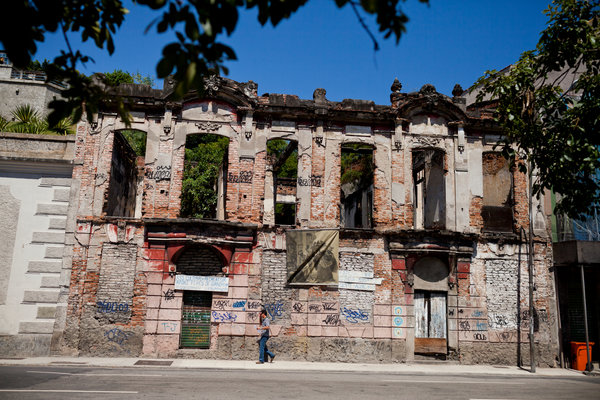
Arquivo da tag: Rio de Janeiro

Jogos promovem maior despejo da história do Rio (Vi o Mundo)

Dario de Negreiros

publicado em 24 de fevereiro de 2014 às 21:56

Amaro Couta da Silva, morador da Vila Autódromo (Fotos Dario de Negreiros)

Rio de remoções: por quais motivos e de que forma a Cidade Olímpica tem promovido a maior leva de despejos de toda a sua história

por Dario de Negreiros, do Rio de Janeiro, especial para o Viomundo* 

No quintal da casa de Amaro Couto da Silva, 58, na Vila Autódromo, zona Oeste do Rio de Janeiro, tem pé de seriguela, cajá, acerola, maracujá, carambola, coco, goiaba e limão. Há ainda algumas galinhas, patos, dois cachorros e um bode – para não falar das outras árvores frutíferas rapidamente listadas pelo morador, mas que escaparam à caneta do repórter.

Talvez o que mais surpreenda aqueles que têm a curiosidade de visitar as casas de moradores ameaçados de remoção em virtude das grandes intervenções urbanas no Rio é como, ao contrário do que se pode imaginar, não são poucos os que vivem em condições de dar inveja aos que se espremem em apartamentos de áreas nobres da capital.

São casas como a da diarista Maria da Penha, 48, também moradora da pacata Vila Autódromo. Ao seu amplo quintal, soma-se ainda uma grande laje coberta, com vista para a lagoa de Jacarepaguá.

 Quintal da casa de Maria da Penha, moradora da Vila Autódromo ameaçada de remoção

“Meu sonho era morar em uma casa com quintal”, diz Penha, que há vinte anos deixou a favela da Rocinha e começou a erguer sua moradia, onde antes só havia um terreno baldio.

Amaro, no terreno de sua casa, construiu também um bar e seis quitinetes, fontes importantes de renda para ele, a esposa e três filhos. “Ficaram insistindo para eu ir ver o apartamento [da proposta de reassentamento]. Não fui e nem vou”, afirma. “Como é que eu vou fazer, lá?”.

Este drama tem sido vivido, no Rio, por mais de 100 mil pessoas, segundo as contas da Anistia Internacional. Entre 2009 e 2013, a Prefeitura admite já ter removido 20.229 famílias, o que equivaleria a aproximadamente 65 mil pessoas, se considerado o tamanho médio da família brasileira.

A elas, acrescentam-se todos os que ainda estão ameaçados de remoção.

“Os ameaçados, nós não sabemos quantos são. A Prefeitura não tem transparência quanto aos projetos, então fica difícil de estimar os impactos”, explica Renata Neder, da Anistia Internacional, segundo quem a capital fluminense estaria vivendo hoje a maior leva de remoções de toda a sua história.

Mas por quais motivos, afinal de contas, estas dezenas de milhares de pessoas estariam sendo despejadas de suas casas? Quais direitos destes moradores estão sendo desrespeitados pelo Estado? Quais alternativas lhes são oferecidas, em quais termos e em que condições?

Os direitos dos moradores e o legado de violações

Se fizermos um recenseamento de todas as salvaguardas que, de acordo com a ONU (Organização das Nações Unidas), deveriam ser observadas em processos inevitáveis de remoção, encontraremos uma boa lista de tudo o que, de acordo com ativistas, está sendo feito no Rio. Só que ao avesso.

“Uma oportunidade de consulta genuína com aqueles que serão afetados” deve ser oferecida, reza documento oficial da ONU, assim como um “aviso adequado e razoável, para todas as pessoas afetadas, da data agendada para a remoção”.

No Rio, para a ampla maioria das famílias já removidas, foi com uma marcação à tinta, feita no muro de suas casas sem seus consentimentos, que o aviso chegou.

Casas marcadas para remoção na Vila União de Curicica

Caminhando pela Vila União de Curicica, comunidade com cerca de 3 mil moradores localizada na região de Jacarepaguá, na zona Oeste, passa-se por ruas em que quase todas as casas possuem a indesejada marcação: “SMH”, sigla da Secretaria Municipal de Habitação.

“Parece nazista marcando judeu com a Estrela de Davi. Isso não é tortura física, é tortura psicológica.” Esta comparação, por estranho que possa parecer, foi feita pelo próprio prefeito Eduardo Paes, em entrevista ao jornalista Juca Kfouri.

“É uma coisa que a Prefeitura do Rio faz há vinte anos”, justificou-se, à época, o alcaide. “Eu nunca tinha me tocado, ninguém tinha se tocado disso.”

Em junho de 2011, o subprocurador geral de Justiça do Ministério Público Federal do Rio, Leonardo de Souza, havia feito exatamente a mesma analogia, na presença de Jorge Bittar, então secretário de Habitação de Paes. Mas foi necessário que se passassem mais de dois anos para que o prefeito, por decreto, proibisse a prática.

Independentemente da proibição de marcação, as formas e o tempo de notificação, afirma a Anistia Internacional, continuam sendo inadequados.

“O padrão de notificação é baixíssimo, totalmente inaceitável”, diz Renata Neder. “Há casos de famílias que receberam notificação com um dia de antecedência. E até de gente que chegou à sua casa e a encontrou demolida. Zero notificação”.

Elmar Freitas, ao lado do seu bar e dos escombros das casas demolidas, na favela Metrô-Mangueira

Quanto ao modo de consulta à comunidade afetada, é emblemático o caso de Elmar Freitas, 38, dono de um bar e ex-morador, recém-despejado, da favela Metrô-Mangueira, zona Norte do Rio.

Em vez de promover audiências com as comunidades e seus representantes, negociando coletivamente, como recomendam os protocolos internacionais, a Prefeitura, dizem os ativistas, prefere bater de porta em porta.

As casas daqueles que aceitam as propostas iniciais de reassentamento são demolidas e seus escombros, a exemplo do que relata Elmar, são abandonados. Os entulhos dos imóveis de seus vizinhos passaram a servir de banheiro público e ponto de consumo de drogas, acumulam lixo e ratos, exalam mau-cheiro e instalam na vizinhança um verdadeiro cenário de guerra.

“Eu saía na porta da minha casa e só via escombros”, diz Elmar, que ainda viu despencar o movimento do seu bar. “Diminuiu 95% o meu lucro. Aqui era cheio”, diz, apontando dezenas de cadeiras empilhadas e mesas empoeiradas.

“Isso tem sido um padrão claro”, diz Renata Neder. “Demole-se as casas e deixa-se os restos como forma de pressionar os moradores.”

Em outras ocasiões, dizem ativistas e moradores, as demolições de casas anexas provocam a interrupção do fornecimento de água e luz daqueles que ficam. “Eles chegam a destruir casas geminadas, mesmo abalando a estrutura da outra casa”, diz Renato Cosentino.

Mas a lista das salvaguardas internacionalmente acordadas que não estariam sendo cumpridas, ainda não a esgotamos: oferecer, sempre, reassentamento próximo à área de remoção; indenizar adequadamente aqueles que preferirem compensação financeira; garantir que o morador vá melhorar ou, no mínimo, manter o seu padrão de vida atual.

“Eles chegaram batendo na minha porta e falando que eu tinha três opções: Cosmos [bairro no extremo Oeste da cidade, a mais de 60 km do Metrô-Mangueira], albergue ou rua”, conta Elmar.

Depois de intensa mobilização da comunidade, foram construídos os conjuntos de Mangueira 1 e Mangueira 2, localizados em região bastante próxima à favela. Antes disso, contudo, mais de 100 famílias, segundo a Anistia Internacional, acabaram por aceitar a oferta inicial e se mudaram para Cosmos.

No caso das comunidades removidas em função das obras da via Transoeste, a média das indenizações oferecidas, diz Renata Neder, ficou na faixa de R$ 8 mil.

“Eles indenizam apenas pela melhoria ou investimento que você fez no local, sem levar em conta o valor do terreno”, explica Renata, segundo quem todos os que optam pela indenização acabam por piorar o seu padrão de vida.

“Se você tira alguém do Metrô-Mangueira, uma área nobre, e paga apenas pelo tijolo que a pessoa botou naquela casa, com aquele dinheiro ela não vai conseguir nem ir para uma favela daquela região, vai ter que ir para uma favela em área distante”, diz.

As remoções formam, assim, a face mais visível do “legado de violação de direitos”, na expressão de Renato Cosentino, deixado até agora pelas obras relacionadas à Copa e às Olimpíadas.

Mas, analisados de maneira mais ampla, quais devem ser os efeitos das grandes intervenções urbanas ligadas aos megaeventos para a organização sócio-espacial do Rio de Janeiro, como um todo?

“O resultado desse processo é, inexoravelmente, uma cidade muito mais desigual”, afirmou o professor Carlos Vainer, da Universidade Federal do Rio de Janeiro, em recente entrevista ao Viomundo.

Aprofundamento da desigualdade que é acompanhado, segundo ele, por aumento de violência, guetificação de áreas pobres, extinção das expectativas de gestão democrática do espaço urbano, criminalização da pobreza e dos movimentos sociais.

“Eu torci bastante para o Brasil ser escolhido sede da Copa, das Olimpíadas”, conta Antônio Carlos de Jesus, 35, um dos moradores ameaçados de remoção na Vila União de Curicica. “Mas não sabia que ia ser assim.”

Pico do morro Dona Marta

Os motivos aparentes e os interesses subjacentes

Como entender a lógica existente por trás da maior onda de remoções da história do Rio? Se funestas são as consequências, justas seriam, ao menos, as motivações iniciais?

Eis uma breve lista, sem pretensões de exaustão, de todos os motivos que já apareceram, em diferentes momentos, para justificar a necessidade de reassentamento dos moradores da Vila Autódromo: obras dos Jogos Panamericanos, perímetro de segurança do Parque Olímpico, área de risco, zona de proteção ambiental, construção de um centro de mídia, da via Transolímpica, de passarelas fixas e móveis, de um estacionamento.

Para estudiosos e ativistas, a falta de transparência dos projetos de intervenção urbana e a mudança constante das alegações que justificariam as remoções seriam sintomas de uma mentira fundamental: as remoções, dizem, longe de constituírem consequências inevitáveis e lastimáveis das operações urbanas, são antes um de seus principais objetivos.

“Os pretextos são os mais variados, mas na verdade são meros pretextos”, afirma Carlos Vainer. “Eles querem limpar aquela área [da Vila Autódromo], fazer um processo de higienização.”

Segundo a Associação de Moradores, a comunidade sequer costuma ser comunicada oficialmente sobre as supostas causas de sua necessidade de reassentamento, descobrindo-as na maioria das vezes por intermédio da imprensa.

“Se antes usaram o argumento de zona de preservação ambiental, como podem, depois, argumentar que vão construir uma via?”, questiona Inalva Mendes Brito, moradora e membro da Associação.

Renato Cosentino, da Justiça Global, oferece uma resposta para a contradição: “É que eles não têm nem o cuidado de manter a mesma mentira”.

Renata Neder, da Anistia Internacional, considera a Vila Autódromo “um exemplo incrível” de como os projetos, ao invés de buscar os menores impactos sociais possíveis – outro imperativo acordado pela ONU –, estão sendo pensados, ao contrário, justamente para promover os despejos.

“Em volta da Vila Autódromo, há um monte de terrenos vazios, que poderiam ser usados para todos os equipamentos que eles gostariam de construir”, diz. “Mas eles querem colocá-los todos onde está a comunidade, para justificar a remoção”.

Entre o final de 2010 e o início de 2011, teria sido a construção da Transoeste, um dos grandes projetos viários da Cidade Olímpica, o fator responsável pela remoção de cerca de 500 das comunidades de Restinga, Vila Harmonia e Vila Recreio II.

“A Transoeste foi construída e a área da qual as casas da Vila Harmonia foram removidas ficou intocada”, conta Carlos Vainer. O mesmo aconteceu, segundo a Anistia Internacional, com parte da área de remoção da Vila Recreio II.

No pico do morro Dona Marta, o governo do Estado, argumentando tratar-se de área de risco, planeja a remoção de 150 famílias. A comissão de moradores, entretanto, conta com um contra-laudo, elaborado pelo engenheiro Maurício Campos, que desmente o perigo.

Como a ocupação do morro, nos anos 1930, se deu de cima para baixo, é no pico que estão as famílias mais antigas da comunidade. Está ameaçada de remoção, inclusive, até mesmo a santa que deu nome ao local, já que é também na parte mais alta da favela que está a capela que abriga a imagem de Santa Marta.

Vitor Lira, morador da favela Santa Marta ameaçado de remoção. A casa de sua família, uma das mais antigas do morro, tem paredes de pedra 

“Eu tenho raízes aqui. Tenho história, luta, sofrimento. Nós não chegamos aqui ontem, não”, diz Vitor Lira, membro da comissão de moradores e cuja família foi uma das primeiras a ocuparem o local.

Vitor não hesita em atribuir aos interesses da especulação imobiliária a tentativa de remoção contra a qual lutam os moradores da favela, localizada no nobre bairro do Botafogo, zona Sul do Rio.

Cinco anos atrás, a primeira de todas as UPPs (Unidade de Polícia Pacificadora) era instalada no Dona Marta. De lá para cá, a valorização dos imóveis e o crescimento da atividade turística têm provocado aumento considerável do custo de vida, causando a saída de antigos moradores. É a chamada “remoção branca”.

“O Estado nunca contribuiu em nada, nunca beneficiou a gente em nada”, diz Vitor, que trabalha como guia turístico no morro. “A gente roeu o osso esse tempo todo e, agora, vai deixar o filé para eles?”.

Um mapa dos reassentamentos, elaborado pelo arquiteto Lucas Faulhaber, mostra com clareza o vetor que orienta esta onda de remoções: é a zona Oeste, região carente de serviços públicos, que recebe a população de baixa renda retirada das áreas nobres ou de interesse da especulação imobiliária.

“Dentre a população de zero a três salários mínimos, 88% dos conjuntos do Minha Casa Minha Vida estão na periferia da zona Oeste”, afirma o deputado estadual Marcelo Freixo (PSOL). “São lugares que não têm sequer acesso a saneamento básico, nem zonas de hospitais e de escolas”, diz.

E onde os serviços públicos claudicam, sabe-se bem, florescem as milícias. Conversando com moradores ameaçados de despejos, não é raro ouvir denúncias de que diversos conjuntos do Minha Casa Minha Vida já estariam sob domínio de milicianos.

Antes, até mesmo, da chegada dos futuros proprietários.

“Mais do que ocupar e controlar, os milicianos chegavam a revender os apartamentos”, conta Renato Cosentino, da Justiça Global. “A pessoa chegava lá e tinha alguém no apartamento, dizendo que o havia comprado.”

Casas colocadas à venda ao lado da estátua de Michael Jackson, na parte turística da favela Santa Marta. Aumento do custo de vida tem provocado a saída de muitos moradores

Vila Autódromo: símbolo de resistência e contra-modelo de cidade

Na luta contra a remoção, os moradores da Vila Autódromo, com o auxílio de pesquisadores da Universidade Federal do Rio de Janeiro e da Universidade Federal Fluminense, elaboraram o Plano Popular da Vila Autódromo.

Em dezembro do ano passado, o plano recebeu o prêmio Urban Age Award, concedido pela London School of Economics e pelo Deutsche Bank. Com a premiação, de US$ 80 mil, a associação de moradores planeja construir uma creche.

Enquanto a proposta inicial da Prefeitura previa a remoção de todos os moradores, o Plano Popular manteria 368 das 450 famílias em suas casas, sendo as demais reassentadas na própria comunidade.

“Esse plano se transformou numa espécie de contra-modelo de cidade”, diz Carlos Vainer, que coordenou uma das equipes responsáveis por sua elaboração.

“Enquanto a cidade, dominada pelos interesses empresariais, é anti-democrática, autoritária, ambientalmente destrutiva e transfere recursos públicos para as mãos de empresários privados, esse é um plano democrático, ambientalmente responsável e que economiza recursos públicos”, diz Vainer.

Segundo quadro comparativo divulgado pelo Comitê Popular da Copa do Rio, o plano popular tem custo estimado de R$ 13,5 milhões, contra R$ 68 milhões da proposta oficial.

“Ali, na Vila Autódromo, se trava uma batalha fundamental, do ponto de vista simbólico e cultural, entre dois modelos de cidade”, complementa.

Organizada juridicamente desde 1987, quando se constituiu como um loteamento popular, a Vila Autódromo serviu também de refúgio para militantes perseguidos pela ditadura civil-militar (1964-1985), fato que ajuda a explicar o alto grau de organização política de seus moradores.

“Há um extraordinário espírito de resistência e coesão dessa comunidade”, diz Carlos Vainer.

Até hoje, a Vila Autódromo é uma das poucas comunidades pobres não-pacificadas do Rio que não estão nem sob o controle de milicianos, nem sob o jugo das facções do tráfico.

Além disso, a maioria dos moradores tem, desde 1998, concessão de direito real de uso de seus terrenos por 99 anos, estando, portanto, em situação legal.

Inalva Mendes Brito, da Associação de Moradores da Vila Autódromo 

Tomo uma bronca de Inalva, da associação de moradores, quando lhe pergunto, em tom de desesperança, se ela considera haver alguma remota possibilidade de que o Plano Popular vença as pressões da Prefeitura e consiga, de fato, sair do papel.

“Eu nem te respondo essa pergunta. Seria negar o que nós construímos durante dois anos”, diz. Em seguida, resume aquele que parece ser o desejo maior de todos os que lutam contra as remoções forçadas: “Nós sempre gostamos de ser sujeitos de nosso próprio destino.”

Outro lado

Consultada pela reportagem, a Secretaria Municipal de Habitação emitiu, por meio de sua assessoria, o seguinte comunicado:

“A Prefeitura vem conduzindo os processos de reassentamento da maneira mais democrática, respeitando os direitos de cada família. O próprio decreto municipal que trata dos reassentamentos estabelece todos os procedimentos obrigatórios para reassentar uma família. Isso implica avisá-las com antecedência, esclarecer sobre a natureza e a importância desse reassentamento, sempre motivado por interesse público mais amplo.


Além das informações prestadas, as famílias são recebidas na própria Secretaria Municipal de Habitação (SMH) para conhecerem os critérios que definem o valor de suas benfeitorias e as alternativas para reassentamento. As famílias são reassentadas de diferentes formas: transferência direta para apartamentos do Programa Minha Casa, Minha Vida; recebimento de aluguel social (R$ 400 por mês) enquanto aguardam uma unidade do Programa Minha Casa, Minha Vida em local desejado; ou indenização. No caso da opção pelo imóvel, as negociações são coletivas. Já quando se trata de indenização, elas são individuais, já que os valores são definidos a partir de critérios de avaliação das moradias.

Todos os reassentamentos são feitos com base em decreto municipal, que estabelece regras claras, baseadas nos direitos humanos e na busca da moradia digna. O primeiro decreto é o de número 20.454, de 24 de agosto de 2001. Depois disso, ao longo do tempo, ele sofreu alterações e atualizações. O mais recente é o 38.197, publicado no Diário Oficial do Município do Rio em 17 de dezembro de 2013. Ele atualiza, sobretudo, os valores pagos aos moradores pela Prefeitura.

De janeiro de 2009 a dezembro de 2013, a Secretaria Municipal de Habitação realizou o reassentamento de 20.299 famílias, que viviam nas áreas informais da cidade. Deste total, 4.953 tiveram que sair de suas casas por viverem em beiras de rios e 8.215 em encostas, ambas as situações classificadas como alto risco. Outros tipos de risco são responsáveis pelo reassentamento de 5.411 famílias, enquanto que 1.720 precisaram deixar suas casas em função de obras.

No quadro atual, 9.320 famílias (cerca de 45% do total de reassentados) receberam imóveis do Minha Casa, Minha Vida, 25% estão recebendo aluguel social e 30% receberam indenização ou realizaram a compra assistida.

A Prefeitura do Rio informa que o processo de transferência dos moradores da Vila Autódromo, que optaram em ir para o Parque Carioca, será feito de forma gradual e deve acontecer a partir da segunda quinzena de março.

Das 285 famílias que deixarão a comunidade para a realização das obras de canalização dos rios e duplicação das Avenidas Salvador Allende e Abelardo Bueno, 253 já optaram entre indenização e imóveis no Parque Carioca – condomínio com 900 unidades localizado a um quilômetro da Vila Autódromo, com apartamentos de dois e três quartos com infraestrutura de lazer, além de creche e espaço comercial.

Elas só serão transferidas para lá quando o empreendimento, que está em fase final de acabamento, estiver concluído. Assim também, qualquer obra na comunidade só acontecerá quando todas as casas estiverem desocupadas.


Quanto ao traçado da Transolímpica, a informação [de que ele teria sido concebido com o intuito de provocar a remoção dos moradores da Vila Autódromo] não procede. A Secretaria Municipal de Obras reafirma que o traçado do corredor expresso Transolímpica foi estudado para evitar o maior número possível de desapropriações e reassentamentos.”

 Obras do Parque Olímpico, vistas da Vila Autódromo

*Dario de Negreiros viajou ao Rio de Janeiro graças ao apoio financeiro dos assinantes do Viomundo, aos quais agradecemos de coração por compartilhar gratuitamente conteúdo jornalístico exclusivo com outros internautas.

Leia também:

Carlos Vainer: A lógica por trás dos megaeventos no Rio

*   *   *

As Brazil Gears Up For Olympics, Some Poor Families Get Moved Out (NPR)

February 27, 2014 3:25 AM
Maria Victoria Agostinho, 5, walks outside her home in the Vila Autodromo area of Rio. Her family is slated for eviction, along with others in the area, to make way for building projects related to the 2016 Summer Olympics.

Maria Victoria Agostinho, 5, walks outside her home in the Vila Autodromo area of Rio. Her family is slated for eviction, along with others in the area, to make way for building projects related to the 2016 Summer Olympics.

Lianne Milton for NPR

Jeane Tomas scraped all her money together to build a house where she could raise her son. She’d been renting in the favela, or shanty town, of Vila Harmonia and wanted to put down roots in the community where she lived when her child was born.

The house went up — only to quickly come down.

“There is this frustration to have worked so hard, dreamed so much to leave everything behind,” she said.

Now that the Winter Olympics in Sochi are over attention will be turning to Brazil, the host of the 2016 Summer Olympics.

Rio de Janeiro is undergoing a massive transformation in advance of the games
and that has brought with it a number of criticisms. Chief among them are the forcible evictions that are taking place across the city.

Tomas was among those who were moved.

It was near her work, near doctors, and other key amenities, she said. About three years ago, she was told she would have to leave to make way for a new road that was being built as part of an infrastructure upgrade.

“And I would ask them, where to? They were asking us to sign papers without knowing where we were going,” she said. “Then they showed us this place and, to be honest, we really didn’t have a choice.”

With the money she received in compensation, she said she couldn’t afford anywhere else.

Jeane Tomas, with her mother, in their two-bedroom apartment, in Rio de Janeiro's far west zone of Campo Grande. The family was relocated to this area three years ago to make way for building projects related to the 2016 Summer Olympics in Rio.

A woman and child at a playground. Nearby, construction is taking place for the Olympic Village.

A youth guides his horse and cart down the main road of Vila Autodromo, an area where many families have been evicted and moved to far away neighborhoods. Construction on the Olympic Village is taking place nearby.

Neighbors gather on Sunday afternoon in Vila Autodromo. More then half of the 3,000 families who have been moved did not want to leave, but say they were pressured.

An elderly woman walks past a home that is marked for eviction in the favela community of Vila Autodromo.

Marcos dos Santos Ribeiro, 11, plays the guitar in his bedroom at home, in Vila Autodromo, where many families have been evicted.

Residents hang out in front of their apartment, in Rio de Janeiro's far west zone of Campo Grande. Many families relocated to this area three years ago to make way for Olympic building.

A resident plays with a kite in the Oiti apartment complex, in Rio de Janeiro's far west zone of Campo Grande. Many families were relocated here three years ago from another part of Rio.

Lianne Milton/for NPR

Some 3,000 Families Uprooted

According to human rights groups, some 3,000 families have already been evicted from their homes in Rio alone. As many as 200,000 people across the country are at risk of the same, according to the Popular Committees for the World Cup and Olympics.

It’s not just the evictions, but also where people are being sent to.

The place where Jeane Tomas now lives is called the OITI complex.

Favelas — for all their poverty — are teeming with life. But the OITI complex feels like it’s on life support. It’s a barren, treeless, apartment compound in a Rio suburb called Campo Grande, miles away from where Tomas lived in Barra de Tijuca.

“Our lives were built around were we lived. The transport is awful here. They talk about this special bus line they built for us out here but it’s not the miracle they say it is. Its chaos,” she said. “There are days when the air-conditioning works, others when it doesn’t. We wait for hours to get out of here.”

The housing is new though and the people live there at a relatively low cost. They pay a small condo fee and utilities.

Still, they don’t own these homes and they can’t rent them to others.

Jeane Tomas complains there are no schools nearby. She still hasn’t been able to enroll her child in daycare. There are no jobs close either. She says her husband lost his job because suddenly he was so far away from it.

Tomas works as a maid and she said she suspects the reason so many people are being moved is because its the Rio elites making the decisions.

“In my opinion, they want us to be there to serve them, then they want us to go as far away as possible,” she said.

Government officials deny those allegations. They say those who have been moved now live in government housing that is far superior to where they lived before.

The Terni apartment complex in Rio de Janeiro's far west zone of Campo Grande. Many residents were relocated to this area because their old neighborhoods were knocked down to make way for building projects related to the Olympics.

The Terni apartment complex in Rio de Janeiro’s far west zone of Campo Grande. Many residents were relocated to this area because their old neighborhoods were knocked down to make way for building projects related to the Olympics.

Lianne Milton for NPR

Upgrades Or Evictions

Leonardo Gryner, the chief operating officer of Rio’s Olympic Organizing Committee, said a few families have been moved to improve the life of many people. The roads and bus lines that have been put in place will allow people to travel more freely, he said.

“One of the main reasons that people live in favelas in Rio is because of transportation,” he said. “When you offer them a new means of transportation, that will help … people to move to new areas farther from the city, living in better conditions that in living in favelas.”

However, activists and academics allege the forcible evictions have more to do with real estate than real help to the poor.

Rio’s Olympic Park is being built in Barra de Tijuca, where Jeane Tomas once lived.

It used to be a poor area. But with the influx of development and roads for the Olympics, luxury apartment complexes are springing up along with Miami-style malls. Land is becoming extremely valuable. For example, the athletes housing during the games is going to be turned into high-end apartment buildings once the games are over.

Orlando Santos Junior is a professor of urban planning at Rio de Janeiro Federal University who has studied the evictions for years.

“The other issue is that the people who are moved live on the margins, if they are uprooted from their networks that allow them to survive it actually makes them worse off, not better,” he said.

He said what is happening is going against the very fabric of what a city should be. In Rio, the changes are creating more homogenous spaces with walls, sometimes real, sometimes invisible, that separate social classes.

Other activists say what are being created are tomorrow’s favelas. As the city moves out these people, they are being trapped in places where they cannot thrive.

Back in the government housing complex, Jeane Tomas said she was grateful for a roof over her head but she spoke wistfully of her former home. On her way to work, she passes the place her favela used to be. Now it’s an empty field next to a new gas station.

Brazil 2014: More than just the World Cup (The Christian Science Monitor)

From elections to transportation fare increases and potentially renewed protests, 2014 promises big stories to watch across Brazil.

By Rachel Glickhouse, Guest blogger / January 2, 2014

People watch fireworks exploding over Copacabana beach during New Year celebrations at the Pavao Pavaozinho slum in Rio de Janeiro, January 1, 2014. Pilar Olivares/Reuters

While 2013 [was] an incredibly interesting year forBrazil, 2014 promises to be even more fascinating. Beyond the World Cup, which promises to occupy much of the year’s headlines, here are some of the big issues to watch.

Transportation fare increases: Governments throughout Brazil backed down on raising bus and subway fares in 2013 after those increases helped spursome of the largest protests seen since redemocratization. Nevertheless, a fare increase could be coming in Rio as early as January.

Inflation and cost of living: In 2013, food prices rose over 9 percent and were the major cause of inflation this year. Overall, inflation this year is estimated at under 6 percent, while some estimates put next year’s inflation at a little over 6 percentSão Paulo and Rio in particular continue to see a rising cost of living.

Consumer debt: With more Brazilians gaining access to the banking system and credit, consumer debt has been a growing problem to keep an eye on. Over the past 12 months, the number of Brazilian families in debt has fluctuated between 60 and 65 percent. Around 20 percent of Brazilians are behind on their bills. Over three-quarters of Brazilians in debt point to credit cardsas the source of their debt; credit card interest rates in Brazil continue to be sky-high, reaching up to 500 percent a year.

Security: While in the past decade, the overall trend for homicides has been an increase in the Northeast and a drop in the Southeast, crimes like robberies andmuggings are rising in cities like Rio and São Paulo. Rio in particular has faced problems with crime this year after a period of seeming improvements.

Pacification in Rio: Though initial results were promising, this year has seen some cracks in Rio’s pacification strategy, such as outbreaks of violence in pacified favelas and revelations of police abuses, the most serious being the torture and murder of favela residents. One of the most important things revealed this year are statistics showing disappearances in pacified favelas rising as murders fall. We’ll see what happens with this trend next year. Fundamentally, the biggest problem with the strategy is the police force itself, as some police have traditionally been criminals themselves, either working directly with drug traffickers or operating in militias when off-duty. Without a major police reform, the strategy could see similar challenges next year.

Health and education policies: One of the major complaints of protesters [last] year was that the government is investing in the World Cup but not enough in hospitals and schools. In 2013, the government began importing Cuban doctors in a bid to bring medical services to underserved areas, which initially was met with controversy that has petered out a bit. Much more remains to be done though, so [this year] it will be interesting to see how the program goes. There were also big teachers’ strikes this year which could potentially happen again in 2014.

Corruption scandals: One of the most important things that happened in 2013 was when a group of defendants in the country’s biggest corruption case went to jail. Parts of the trial are going to drag on next year as some defendants get appeals, but a new corruption scandal would feed another one of the protesters’ complaints.

Protests: While it seems likely that there will be some demonstrations around the World Cup, it remains to be seen whether there will be a repeat of the 2013 protests. That will depend on all of the factors above.

Elections: Brazil will hold presidential and legislative elections in October, which means that federal policies will potentially be designed to appease voters as President Dilma Rousseff seeks reelection. It may not be a year to experiment with reforms or to raise taxes, but it could be a year of bread and circuses.

Infrastructure: While a lot of focus will be on finishing stadiums in time for the games, it remains to be seen how many transportation infrastructure projects, ranging from new highways to airport renovations, will be completed before June. In addition, it will be important to see which major infrastructure projects are moving in an election year, like the Belo Monte dam or the São Francisco water project.

– Rachel Glickhouse is the author of the blog Riogringa.com.

World Cup: Rio favelas being ‘socially cleansed’ in runup to sporting events (The Guardian)

Slum dwellers say thousands forced out of their homes to make way for building projects for tournament and 2016 Olympics

 and  in Rio de Janeiro

The Guardian, Thursday 5 December 2013 17.58 GMT

Boys play football in the Borel favela

Boys playing football in the Borel favela in Rio de Janeira, which will host seven World Cup games followed by the Olympics in 2016. Photograph: Buda Mendes/Getty

The World Cup and the Olympics are being used as a pretext for “social cleansing” as tens of thousands of Rio slum dwellers are driven out to the city periphery, favela residents say.

While millions of eyes turn to north-eastern Brazil for the World Cup draw on Friday, poor communities in Rio de Janeiro are still struggling to be heard as they fight against evictions they say are related to the city’s mega sporting events.

Next year, Rio will host seven games, including the final, followed in 2016 by the Olympics. The city’s mayor, Eduardo Paes, describes this as an opportunity for the city to modernise and create a legacy for future generations. But many of those on the frontline of change feel they are the victims of social cleansing.

At least 19,000 families have been moved to make way for roads, renovated stadiums, an athletes’ village, an ambitious redevelopment of the port area and other projects that have been launched or accelerated to prepare the city for the world’s two biggest sporting events.

“The authorities wouldn’t even enter our community in the past and there was no mention of moving us, but then Brazil won the right to host the World Cup and everything changed,” Maria do Socorro told a hearing in the city council building this week. Socorro’s home of 40 years in the Indiana favela has been marked for demolition.

Countless communities are affected. Among the best known are Vila Autódromo, which will be the site of the main Olympic stadium and athletes’ village; Providência, which is close to the port redevelopment and Indiana, which is about 10 minutes’ drive from the newly refurbished Maracanã stadium.

As was the case in Beijing, London and South Africa before their mega events, the government says such programmes are necessary to modernise the city. Numerous relocations have been carried out in the past as Rio has evolved, but politicians and campaigners say the forthcoming sporting events are driving the process forward at an unprecedented rate, and often in violation of the law. “The government is obliged to publicise preliminary studies, listen to the views of affected communities and offer alternative housing close to their old homes, but the Rio municipality has not complied with any of these laws,” said Renato Cinco, a council member for the leftwing PSOL party.

“People are being moved more than 40km [25 miles] from their homes with very little prior notice and no compensation.”

Civil society groups say the relocations are motivated by surging land values. As new infrastructure is put in place for the World Cup and Olympics, property prices rise in the surrounding areas.

Maracanã stadium

The revamped Maracanã stadium, which is 10 minutes’ drive from the Indiana favela. Photograph: Owen Humphreys/PA

“There is a process of gentrification taking place in the whole city that is connected to the sports events and how the government sees the city: it is no longer a place for residents, but as a business to sell to foreign investors. That’s what the World Cup is about,” said Renata Neder of Amnesty.

“There have been waves of evictions in the past, but this latest one that began after Rio was chosen to host the mega events may be the biggest one yet in terms of numbers.

“The authorities insist that due process has been followed and no residents have been forcibly relocated. The Rio 2016 chief operating officer, Leo Gryner, said the high-profile case of Vila Autódromo showed how far the government was willing to go to accommodate residents.

“In Vila Autódromo the mayor said he would move people to a new place and build nice housing projects for people to move to a new area. People started protesting, saying you couldn’t evict people because of the Olympics. So after some time, the city admitted they should not have forced them to go. They talked to each one of the people living in that area, roughly half said they wanted to move and the other half wanted to stay,” he said.

“Then when they started to see the project going up they realised it was very nice and so they came here to demonstrate and demand to be moved to the new housing! The city talked to everyone.” This is refuted by residents.

That is disputed by residents. And in less prominent cases, residents complain of being harassed by officials and engineers who tell them their homes are not safe. In some cases, this is true. Thousands have died over the years in the floods and landslides that affect many river and hillside favelas during the annual rainy season.

But a visit to the Indiana favela, which sits next to the river Maracanã, suggested the genuine threat to a handful of homes may be being used to justify the clearance of swaths of the community.

Several houses, including two wooden shacks, sat below the flood line and looked too poorly built to withstand a deluge. But the majority of homes marked for demolition – including several that had already been destroyed – were on seemingly firm concrete foundations several metres above the flood line.

“It is true that there are risks from the river, but only in certain places. The problem is that the government is arbitrarily trying to move everyone, even those who are not at risk,” said Ines Ferreira de Abril, a local health worker.”

Many people have already moved out under the relentless pressure from the government. They are going house by house and ultimately, they want to get rid of all of us because this land is very valuable now. They want us out of the way before the big events.”

• This article was amended on 6 December 2013 to clarify that Leo Gryner’s comments about Vila Autódromo are disputed by residents. This article was further amended on 11 December 2013 to correct Renato Cinco’s name, from Renata Silva as the original said.

Brazil: Drug dealers say no to crack in Rio (AP)

By JULIANA BARBASSA

Associated Press

Published: Saturday, Aug. 18, 2012

RIO DE JANEIRO — Business was brisk in the Mandela shantytown on a recent night. In the glow of a weak light bulb, customers pawed through packets of powdered cocaine and marijuana priced at $5, $10, $25. Teenage boys with semiautomatic weapons took in money and made change while flirting with girls in belly-baring tops lounging nearby.

Next to them, a gaggle of kids jumped on a trampoline, oblivious to the guns and drug-running that are part of everyday life in this and hundreds of other slums, known as favelas, across this metropolitan area of 12 million people. Conspicuously absent from the scene was crack, the most addictive and destructive drug in the triad that fuels Rio’s lucrative narcotics trade.

Once crack was introduced here about six years ago, Mandela and the surrounding complex of shantytowns became Rio’s main outdoor drug market, a “cracolandia,” or crackland, where users bought the rocks, smoked and lingered until the next hit. Hordes of addicts lived in cardboard shacks and filthy blankets, scrambling for cash and a fix.

Now, there was no crack on the rough wooden table displaying the goods for sale, and the addicts were gone. The change hadn’t come from any police or public health campaign. Instead, the dealers themselves have stopped selling the drug in Mandela and nearby Jacarezinho in a move that traffickers and others say will spread citywide within the next two years.

The drug bosses, often born and raised in the very slums they now lord over, say crack destabilizes their communities, making it harder to control areas long abandoned by the government. Law enforcement and city authorities, however, take credit for the change, arguing that drug gangs are only trying to create a distraction and persuade police to call off an offensive to take back the slums.

Dealers shake their heads, insisting it was their decision to stop selling crack, the crystalized form of cocaine.

“Crack has been nothing but a disgrace for Rio. It’s time to stop,” said the drug boss in charge. He is Mandela’s second-in-command – a stocky man wearing a Lacoste shirt, heavy gold jewelry and a backpack bulging with $100,000 in drugs and cash. At 37, he’s an elder in Rio’s most established faction, the Comando Vermelho, or Red Command. He’s wanted by police, and didn’t want his name published.

He discussed the decision as he watched the night’s profits pile up in neat, rubber-banded stacks from across the narrow street. He kept one hand on his pistol and the other on a crackling radio that squawked out sales elsewhere in the slum and warned of police.

The talk of crack left him agitated; he raised his voice, drawing looks from the fidgety young men across the road. Although crack makes him a lot of money, he has his own reasons to resent the drug; everyone who comes near it does, he said.

His brother – the one who studied, left the shantytown and joined the air force – fell prey to it. Crack users smoke it and often display more addictive behavior. The brother abandoned his family and his job, and now haunts the edges of the slum with other addicts.

“I see this misery,” he said. “I’m a human being too, and I’m a leader here. I want to say I helped stop this.”

For the ban to really take hold, it would need the support of the city’s two other reigning factions: the Amigos dos Amigos, or Friends of Friends, and the Terceiro Comando, Third Command.

That would mean giving up millions in profits. According to an estimate by the country’s Security Committee of the House and the Federal Police, Brazilians consume between 800 kilos and 1.2 tons of crack a day, a total valued at about $10 million.

It’s unclear how much Rio’s traffickers earn from the drug, but police apprehensions show a surge in its availability in the state. In 2008, police seized 14 kilos; two years later the annual seizure came to 200 kilos, according to the Public Security Institute.

Nonetheless, the other gangs are signing up, said attorney Flavia Froes. Her clients include the most notorious figures of Rio’s underbelly, and she has been shuttling between them, visiting favelas and far-flung high-security prisons to talk up the idea.

“They’re joining en masse. They realized that this experience with crack was not good, even though it was lucrative. The social costs were tremendous. This wasn’t a drug for the rich; it was hitting their own communities.”

As Froes walks these slums, gingerly navigating potholed roads in six-inch stiletto heels and rhinestone-studded jeans, men with a gun in each hand defer to her, calling her “doutora,” or doctor, because of her studies, or “senhora,” or ma’am, out of respect.

“While stocks last, they’ll sell. But it’s not being bought anymore,” she said. “Today we can say with certainty that we’re looking at the end of crack in Rio de Janeiro.”

Even those who question the traffickers’ sudden surge of social conscience say the idea of the city’s drug lords coming together to ban crack isn’t far-fetched. After all, a similar deal between factions kept the drug out of Rio for years.

Crack first took hold in Sao Paulo, the country’s business capital, during the 1990s. In the early 2000s, it spread across Brazil in an epidemic reminiscent of the one the U.S. had experienced decades earlier. A recent survey found it was eventually sold or consumed in 98 percent of Brazilian municipalities. Most of the cities were too understaffed, underfunded and uninformed to resist its onslaught.

And yet, an agreement between factions kept crack a rarity in Rio until a handful of years ago, said Mario Sergio Duarte, Rio state’s former police chief.

“Rio was always cocaine and marijuana,” he said. “If drug traffickers are coming up with this strategy of going back to cocaine and marijuana, it’s not because they suddenly developed an awareness, or because they want to be charitable and help the addicts. It’s just that crack brings them too much trouble to be worth it.”

Duarte believes dealers turned to crack when their other business started losing ground within the city.

Police started taking back slums long given over to the drug trade as Rio vied to host the 2014World Cup and the 2016 Olympics. The plan disrupted trade, and the factions began hemorrhaging money, said Duarte. Crack seemed like the solution, and the drug flooded the market.

“Crack was profit; it’s cheap, but it sells. Addiction comes quick. They were trying to make up their losses,” he said.

Soon, the gangs were being haunted by the consequences.

Unlike the customers who came for marijuana or cocaine, dropped cash and left, crack users hung around the sales points, scraping for money for the next hit. They broke the social code that usually maintains a tense calm in the slums; they stole, begged, threatened or sold their bodies to get their next rock. Their presence made the hard life there nearly unbearable.

The Mandela drug boss said crack even sapped the drug kingpins’ authority.

“How can I tell someone he can’t steal, when I know I sold him the drugs that made him this way?” he said.

Many saw their own family members and childhood friends fall under the drug’s spell.

“The same crack I sell to your son is being sold to mine. I talked to one of the pioneers in selling crack in Rio. His son’s using now. Everyone is saying we have to stop.”

In Mandela, residents had to step over crack users on their way between home and work and warn their children to be careful around the “zombies.”

“There were robberies in the favela, violence, people killed in the middle of the street, people having sex or taking a crap anywhere,” said Cleber, an electronics repair shop owner who has lived in Mandela for 16 years. He declined to give his last name because he lives in a neighborhood ruled bygang members, and like many, prefers not to comment publicly.

“Now we’re going out again, we can set up a barbecue pit outside, have a drink with friends, without them gathering around,” he said. “We’re a little more at ease.”

Researcher Ignacio Cano, at the Violence Analysis Center of Rio de Janeiro State University, said crack is still being sold outside only select communities and that it’s hard to tell if the stop is a temporary, local measure or a real shift in operations citywide.

He said unprecedented pressure bore down on drug gangs once they began selling crack. In particular, the addicts’ encampments were sources of social and health problems, drawing the attention of the authorities.

Since March 2011, dawn raids involving police, health and welfare officials began taking users off the streets to offer treatment, food, a checkup and a hot shower. Since then, 4,706 people have cycled through the system. Of those, 663 were children or teenagers.

“I have operations every day, all over Rio,” said Daphne Braga, who coordinates the effort for the city welfare office.

At the same time, crack became such a dramatic problem nationally that the government allocated special funds to combat it, including a $253 million campaign launched by President Dilma Rousseff in May 2010 to stem the drug trade. Last November, another $2 billion were set aside to create treatment centers for addicts and get them off the streets.

In May, 150 federal police officers occupied a Rio favela to implement a pilot program fighting the crack trade and helping users.

“There are many reasons why they might stop,” said Cano.

Crack’s social cost is clear where the drug is still sold, right outside Mandela and Jacarezinho. In the shantytown of Manguinhos, along a violent area known as the Gaza Strip, an army of crack addicts lives in encampments next to a rail line.

Another couple hundred gather inside the slum, buying from a stand inside a little restaurant. Customers eat next to young men with guns and must step around a table laden with packaged drugs and tightly bound wads of cash to use the restroom. Crack users smoke outside, by the lights of a community soccer field where an animated game draws onlookers late into the night.

The Rev. Antonio Carlos Costa, founder of the River of Peace social service group, knows the dealers and believes the ban on crack here is “real, without return, and has a real chance of spreading to other favelas.”

That’s good news for residents, he said, but users will have to migrate to look for drugs, and that might expose them to real risk.

“They won’t be welcome. This society wants them dead,” he said. “This won’t be a problem that can be solved only with money. We’ll need professionals who really take an interest in these people. We’ll need compassion. It’ll be a challenge to our solidarity.”

Also predicting risks, attorney Froes has prepared a civil court action demanding local and state governments prepare treatment centers for users.

“There will be a great weaning of all these addicts as they’re deprived of drugs,” she said. “We’re not prepared to take on all the people who will need care.”

The addicts recognize the difficulty of their own rehabilitation.

One 16-year-old boy laying on a bare piece of foam said he’d studied until the 2nd grade but couldn’t read. Now, he was going on his third year in the streets.

“Who is going to give me work?” he asked.

Sharing his mattress was a 28-year-old woman. It had been three years since she last saw her three children and parents in Niteroi, the city across the bay from Rio. She was filthy, all of her body bearing the marks of life on the streets: bruises and open wounds, missing front teeth, matted hair.

“I wasn’t born like this. You think my parents want to see me now?” she asked. “I can’t go back there.”

A teenager with jaundiced, bloodshot eyes said she couldn’t remember how long she’d been on the streets, or her age.

She knew her name – Natalia Gonzales – and that she was born in 1997.

“I have nowhere to go,” she said, tears rolling down her cheeks. Softly, she started to sing a hymn, and its call for salvation in the afterlife took on an urgent note.

“God, come save me, extend your hand,” she sang. “Heal my heart, make me live again.”

In the Name of the Future, Rio Is Destroying Its Past (N.Y.Times)

OP-ED CONTRIBUTORS

By THERESA WILLIAMSON and MAURÍCIO HORA

Published: August 12, 2012

THE London Olympics concluded Sunday, but the battle over the next games has just begun in Rio, where protests against illegal evictions of some of the city’s poorest residents are spreading. Indeed, the Rio Olympics are poised to increase inequality in a city already famous for it.

Last month, Unesco awarded World Heritage Site status to a substantial portion of the city, an area that includes some of its hillside favelas, where more than 1.4 million of the city’s 6 million residents live. No favela can claim greater historical importance than Rio’s first — Morro da Providência — yet Olympic construction projects are threatening its future.

Providência was formed in 1897 when veterans of the bloody Canudos war in Brazil’s northeast were promised land in Rio de Janeiro, which was then the federal capital. Upon arriving, they found no such land available. After squatting in front of the Ministry of War, the soldiers were moved to a nearby hill belonging to a colonel, though they were given no title to the land. Originally named “Morro da Favela” after the spiny favela plant typical of the Canudos hills where soldiers had spent many nights, Providência grew during the early 20th century as freed slaves joined the soldiers. New European migrants came as well, as it was the only affordable way to live near work in the city’s center and port.

Overlooking the site where hundreds of thousands of African slaves first entered Brazil, Providência is part of one of the most important cultural sites in Afro-Brazilian history, where the first commercial sambas were composed, traditions like capoeira and candomblé flourished and Rio’s Quilombo Pedra do Sal was founded. Today 60 percent of its residents are Afro-Brazilian.

Over a century after its creation, Providência still bears the cultural and physical imprint of its initial residents. But now it is threatened with destruction in the name of Olympic improvements: almost a third of the community is to be razed, a move that will inevitably destabilize what’s left of it.

By mid-2013 Providência will have received 131 million reais ($65 million) in investments under a private-sector-led plan to redevelop Rio’s port area, including a cable car, funicular tram and wider roads. Previous municipal interventions to upgrade the community recognized its historical importance, but today’s projects have no such intent.

Although the city claims that investments will benefit residents, 30 percent of the community’s population has already been marked for removal and the only “public meetings” held were to warn residents of their fate. Homes are spray-painted during the day with the initials for the municipal housing secretary and an identifying number. Residents return from work to learn that their homes will be demolished, with no warning of what’s to come, or when.

A quick walk through the community reveals the appalling state of uncertainty residents are living in: at the very top of the hill, some 70 percent of homes are marked for eviction — an area supposedly set to benefit from the transportation investments being made. But the luxury cable car will transport 1,000 to 3,000 people per hour during the Olympics. It’s not residents who will benefit, but investors.

Residents of Providência are fearful. Only 36 percent of them hold documentation of their land rights, compared with 70 percent to 95 percent in other favelas. More than in other poor neighborhoods, residents are particularly unaware of their rights and terrified of losing their homes. Combine this with the city’s “divide and conquer” approach — in which residents are confronted individually to sign up for relocation, and no communitywide negotiations are permitted — and resistance is effectively squelched.

Pressure from human rights groups and the international news media has helped. But brutal evictions continue as well as new, subtler forms of removal. As part of the city’s port revitalization plan, authorities declared the “relocations” to be in the interest of residents because they live in “risky areas” where landslides might occur and because “de-densification” is required to improve quality of life.

But there is little evidence of landslide risk or dangerous overcrowding; 98 percent of Providência’s homes are made of sturdy brick and concrete and 90 percent have more than three rooms. Moreover, an important report by local engineers showed that the risk factors announced by the city were inadequately studied and inaccurate.

If Rio succeeds in disfiguring and dismantling its most historic favela, the path will be open to further destruction throughout the city’s hundreds of others. The economic, social and psychological impacts of evictions are dire: families moved into isolated units where they lose access to the enormous economic and social benefits of community cooperation, proximity to work and existing social networks — not to mention generations’ worth of investments made in their homes.

Rio is becoming a playground for the rich, and inequality breeds instability. It would be much more cost-effective to invest in urban improvements that communities help shape through a participatory democratic process. This would ultimately strengthen Rio’s economy and improve its infrastructure while also reducing inequality and empowering the city’s still marginalized Afro-Brazilian population.

Theresa Williamson, the publisher of RioOnWatch.org, founded Catalytic Communities, an advocacy group for favelas. Maurício Hora, a photographer, runs the Favelarte program in the Providência favela.

*   *   *

APRIL 2, 2012

Are the Olympics More Trouble Than They’re Worth?

ProtestingToby Melville/Reuters

Winning a bid to host the Olympics is just the beginning. As London prepares for the 2012 Games this summer, residents have plenty of doubts: Will it be too expensive? Will it disrupt life too much? In the end, will they be better off because of the Games, or just saddled with public debt and a velodrome no one knows what to do with?

What about Rio de Janeiro: Will it come out ahead, after having hosted the Pan American Games in 2007, the World Cup in 2014 and the Olympics in 2016?

READ THE DISCUSSION »

DEBATERS

Neil Jameson

The Games Help Londoners

NEIL JAMESON, LEAD ORGANIZER, LONDON CITIZENS

This is the world’s first “Living Wage Olympics,” and East London residents will reap the rewards.

Julian Cheyne

The Games Hurt Londoners

JULIAN CHEYNE, EVICTED RESIDENT, EAST LONDON

The Olympics are an expensive distraction that sets dangerous precedents, coddling the elite and trampling the poor.

Theresa Williamson

A Missed Opportunity in Rio

THERESA WILLIAMSON, FOUNDER, CATALYTIC COMMUNITIES

In preparing for the World Cup and the Olympics, Rio could make long-term investments and integrate the favelas. Instead it is aggravating its problems.

Bruno Reis

Brazil Can Come Out Ahead

BRUNO REIS, RISK ANALYST IN BRAZIL

These Games represent a golden opportunity, but will Rio de Janeiro repeat the success of Barcelona or the failure of Athens?

Andrew Zimbalist

Venues as an Asset or an Albatross

ANDREW ZIMBALIST, ECONOMIST, SMITH COLLEGE

Olympics planning takes place in a frenzied atmosphere — not optimal conditions for contemplating the future shape of an urban landscape.

Mitchell L. Moss

New York Is Lucky Not to Have the Games

MITCHELL L. MOSS, NEW YORK UNIVERSITY

London will be a morass this summer. Meanwhile, there has never been a better time to visit New York City.