Arquivo da tag: Psicologia

A New Discipline Emerges: The Psychology of Science (Science Daily)

ScienceDaily (Oct. 20, 2011) — You’ve heard of the history of science, the philosophy of science, maybe even the sociology of science. But how about the psychology of science? In a new article in Current Directions in Psychological Science, a journal published by the Association for Psychological Science, San Jose State University psychologist Gregory J. Feist argues that a field has been quietly taking shape over the past decade, and it holds great promise for both psychology and science.

“Science is a cognitive act by definition: It involves personality, creativity, developmental processes,” says Feist — everything about individual psychology. So what is the psychology of science? “Simply put,” he writes, it is “the scientific study of scientific thought and behavior.” The psychology of science isn’t just about scientists, though. It’s about how children make organized sense of the world, what comprises scientific talent and interest — or growing disinterest — and even people’s embrace of pseudoscience.

Reviewing about two dozen articles, Feist mentions work in many psychological subspecialties. Neuroscientists have observed the brain correlations of scientific reasoning, discovering, for instance, that people pay more attention to data that concur with their own personal theories. Developmental psychologists have found that infants can craft theories of the way the world works. They’ve also looked at the ages at which small children begin to distinguish theories from evidence.

In its focus on such processes as problem-solving, memory, and creativity, cognitive psychology may be the most mature of the specialties in its relationship to the doing of science. Feist’s own work in this area offers some intriguing findings. In meta-analyses of personality studies of scientific interest and creativity, he has teased out a contradiction: People who are highly interested in science are higher than others in “conscientiousness” (that is, such traits as caution and fastidiousness) and lower in “openness” to experience. Meanwhile, scientific creativity is associated with low conscientiousness and high openness.

Feist believes that a new psychology of science is good for science, which has become more and more important to society, culture, and the economy. Educators need to understand the ways children and adolescents acquire the requisites of scientific inquiry, he says, “and we want to encourage kids who have that talent to go that way.”

But the new sub-discipline is also good for psychology. “Like other disciplines, psychology is fracturing into smaller and smaller areas that are isolated from each other,” he says. “The psychology of science is one of the few recent disciplines that bucks that trend. We’re saying: ‘Let’s look at the whole person in all the basic psychological areas — cognition, development, neuroscience — and integrate it in one phenomenon.’ That’s an approach which is unusual these days.”

Future-Directed Therapy Helps Depression Patients Cultivate Optimistic Outlook (Science Daily)

ScienceDaily (Oct. 20, 2011) — Patients with major depression do better by learning to create a more positive outlook about the future, rather than by focusing on negative thoughts about their past experiences, researchers at Cedars-Sinai say after developing a new treatment that helps patients do this.

While Major Depressive Disorder patients traditionally undergo cognitive-behavior therapy care that seeks to alter their irrational, negative thoughts about past experiences, patients who were treated with the newly-developed Future-Directed Therapy™ demonstrated significant improvement in depression and anxiety, as well as improvement in overall reported quality of life, the researchers found.

Results were published recently in the peer-reviewed journal CNS Neuroscience & Therapeutics.

“Recent imaging studies show that depressed patients have reduced functioning in the regions of the brain responsible for optimism,” said Jennice Vilhauer, PhD, study author and clinical director of Adult Outpatient Programs for the Cedars-Sinai Department of Psychiatry and Behavioral Neurosciences. “Also, people with depression tend to have fewer skills to help them develop a better future. They have less ability to set goals, problem solve or plan for future events.”

According to the U.S. Centers for Disease Control and Prevention, an estimated one in 10 American adults meet the diagnostic criteria for depression.

Anand Pandya, MD, interim chair of Cedars-Sinai’s Department of Psychiatry and Behavioral Neurosciences, said, “Future-Directed Therapy is designed to reduce depression by teaching people the skills they need to think more positively about the future and take the action required to create positive future experiences. This is the first study that demonstrates this intervention intended to increase positive expectations about the future can reduce symptoms of Major Depressive Disorder.”

When people talk only about the negative aspects of their lives, it causes them to focus more attention on what makes them unhappy, Vilhauer said. “Talking about what makes you unhappy in life doesn’t generate the necessary thinking patterns or action needed to promote a state of thriving and create a more positive future,” Vilhauer said. “Future-Directed Therapy helps people shift their attention constructing visions of what they want more of in the future and it helps them develop the skills that they will need to eventually get there.”

In the study conducted at Cedars-Sinai, 16 adult patients diagnosed with Major Depressive Disorder attended future-directed group therapy sessions led by a licensed psychologist twice a week for 10 weeks. Each week, patients read a chapter from a Future-Directed Therapy manual and completed worksheets aimed at improving certain skills, such as goal-setting. Another group of 17 patients diagnosed with depression underwent standard cognitive group therapy. The study team measured the severity of depression and anxiety symptoms, and quality of life before and after treatment, using the Quick Inventory of Depressive Symptoms, the Beck Anxiety Inventory, and the Quality-of-Life Enjoyment and Satisfaction Questionnaire short form.

Results include:

Patients in the Future-Directed Therapy group experienced on average a 5.4 point reduction in their depressive symptoms on the Quick Inventory of Depressive Symptoms scale, compared to a two point reduction in the cognitive therapy group.

Patients in the Future-Directed Therapy group on average reported a 5.4 point reduction in anxiety symptoms on the Beck Anxiety Inventory, compared to a reduction of 1.7 points in the cognitive therapy group.

Patients in the Future-Directed Therapy group reported on average an 8.4 point improvement in their self-reported quality of life on the Quality of Life Enjoyment and Satisfaction scale, compared to a 1.2 point improvement in the cognitive therapy group.

Number of Facebook Friends Linked to Size of Brain Regions, Study Suggests (Science Daily)

ScienceDaily (Oct. 20, 2011) — Scientists funded by the Wellcome Trust have found a direct link between the number of ‘Facebook friends’ a person has and the size of particular brain regions. Researchers at University College London (UCL) also showed that the more Facebook friends a person has, the more ‘real-world’ friends they are likely to have.

The researchers are keen to stress that they have found a correlation and not a cause, however: in other words, it is not possible from the data to say whether having more Facebook friends makes the regions of the brain larger or whether some people are ‘hardwired’ to have more friends.

The social networking site Facebook has more than 800 million active users worldwide. Nearly 30 million of these are believed to be in the UK.

The site allows people to keep in touch online with a network of friends. The sizes of individual networks vary considerably, and some users have only a handful of online friends while others have over a thousand; however, whether this variability is reflected in the size of real-world social networks has not been clear.

Professor Geraint Rees, a Wellcome Trust Senior Clinical Research Fellow at UCL, said: “Online social networks are massively influential, yet we understand very little about the impact they have on our brains. This has led to a lot of unsupported speculation that the internet is somehow bad for us.

“Our study will help us begin to understand how our interactions with the world are mediated through social networks. This should allow us to start asking intelligent questions about the relationship between the internet and the brain — scientific questions, not political ones.”

Professor Rees and colleagues at the UCL Institute of Cognitive Neuroscience and the Wellcome Trust Centre for Neuroimaging studied brain scans of 125 university students — all active Facebook users — and compared them against the size of the students’ network of friends, both online and in the real world. Their findings, which they replicated in a further group of 40 students, are published October 20 in the journal Proceedings of the Royal Society B.

Professor Rees and colleagues found a strong connection between the number of Facebook friends an individual had and the amount of grey matter (the brain tissue where the processing is done) in several regions of the brain. One of these regions was the amygdala, a region associated with processing memory and emotional responses. A study published recently showed that the volume of grey matter in this area is larger in people with a larger network of real-world friends — the new study shows that the same is true for people with a larger network of online friends.
The size of three other regions — the right superior temporal sulcus, the left middle temporal gyrus and the right entorhinal cortex — also correlated with online social networks but did not appear to correlate with real-world networks.

The superior temporal sulcus has a role in our ability to perceive a moving object as biological, and structural defects in this region have been identified in some children with autism. The entorhinal cortex, meanwhile, has been linked to memory and navigation — including navigating through online social networks. Finally, the middle temporal gyrus has been shown to activate in response to the gaze of others and so is implicated in perception of social cues.

Dr Ryota Kanai, first author of the study, added: “We have found some interesting brain regions that seem to link to the number of friends we have — both ‘real’ and ‘virtual’. The exciting question now is whether these structures change over time — this will help us answer the question of whether the internet is changing our brains.”
As well as examining brain structure, the researchers also examined whether there was a link between the size of a person’s online network of friends and their real-world network. Previous studies have looked at this, but only in relatively small sample sizes.

The UCL researchers asked their volunteers questions such as ‘How many people would send a text message to you marking a celebratory event (e.g. birthday, new job, etc.)?’, ‘What is the total number of friends in your phonebook?’ and ‘How many friends have you kept from school and university that you could have a friendly conversation with now?’ The responses suggest that the size of their online networks also related to the size of their real world networks.

“Our findings support the idea that most Facebook users use the site to support their existing social relationships, maintaining or reinforcing these friendships, rather than just creating networks of entirely new, virtual friends,” adds Professor Rees.

Commenting on the study, Dr John Williams, Head of Neuroscience and Mental Health at the Wellcome Trust, said: “We cannot escape the ubiquity of the internet and its impact on our lives, yet we understand little of its impact on the brain, which we know is plastic and can change over time. This new study illustrates how well-designed investigations can help us begin to understand whether or not our brains are evolving as they adapt to the challenges posed by social media.”

The Political Effects of Existential Fear (Science Daily)

ScienceDaily (Oct. 20, 2011) — Why did the approval ratings of President George W. Bush — who was perceived as indecisive before September 11, 2001 — soar over 90 percent after the terrorist attacks? Because Americans were acutely aware of their own deaths. That is one lesson from the psychological literature on “mortality salience” reviewed in a new article called “The Politics of Mortal Terror.”

The paper, by psychologists Florette Cohen of the City University of New York’s College of Staten Island and Sheldon Solomon of Skidmore College, appears in October’s Current Directions in Psychological Science, a journal published by the Association for Psychological Science.

The fear people felt after 9/11 was real, but it also made them ripe for psychological manipulation, experts say. “We all know that fear tactics have been used by politicians for years to sway votes,” says Cohen. Now psychological research offers insight into the chillingly named “terror management.”

The authors cite studies showing that awareness of mortality tends to make people feel more positive toward heroic, charismatic figures and more punitive toward wrongdoers. In one study, Cohen and her colleagues asked participants to think of death and then gave them statements from three fictional political figures. One was charismatic: he appealed to the specialness of the person and the group to which she belonged. One was a technocrat, offering practical solutions to problems. The third stressed the value of participation in democracy. After thinking about death, support for the charismatic leader shot up eightfold.

Even subliminal suggestions of mortality have similar effects. Subjects who saw the numbers 911 or the letters WTC had higher opinions of a Bush statement about the necessity of invading Iraq. This was true of both liberals and conservatives.

Awareness of danger and death can bias even peaceful people toward war or aggression. Iranian students in a control condition preferred the statement of a person preaching understanding and the value of human life over a jihadist call to suicide bombing. But primed to think about death, they grew more positive toward the bomber. Some even said that they might consider becoming a martyr.

As time goes by and the memory of danger and death grows fainter, however, “morality salience” tends to polarize people politically, leading them to cling to their own beliefs and demonize others who hold opposing beliefs — seeing in them the cause of their own endangerment.

The psychological research should make voters wary of emotional political appeals and even of their own emotions in response, Cohen says. “We encourage all citizens to vote with their heads rather than their hearts. Become an educated voter. Look at the candidate’s positions and platforms. Look at who you are voting for and what they stand for.”

MP3 Players ‘Shrink’ Our Personal Space (Science Daily)

Science Daily (Oct. 12, 2011) — How close could a stranger come to you before you start feeling uncomfortable? Usually, people start feeling uneasy when unfamiliar people come within an arm’s reach. But take the subway (underground rail) during rush hour and you have no choice but to get up close and personal with complete strangers.

Researchers at Royal Holloway, University of London wanted to find out whether there is a way to make this intrusion more tolerable. Their results, published in the journal PLoS One, reveal that listening to music through headphones can change people’s margins of personal space.

Dr Manos Tsakiris, from the Department of Psychology at Royal Holloway, said: “This distance we try to maintain between ourselves and others is a comfort zone surrounding our bodies. Everyone knows where the boundaries of their personal space are even though they may not consciously dictate them. Of course personal space can be modified for example in a number of relationships including family members and romantic partners, but on a busy tube or bus you can find complete strangers encroaching in this space.”

The study, led by Dr Tsakiris and Dr Ana Tajadura-Jiménez from Royal Holloway, involved asking volunteers to listen to positive or negative emotion-inducing music through headphones or through speakers. At the same time, a stranger started walking towards them and the participants were asked to say “stop” when they started feeling uncomfortable.

The results showed that when participants were listening to music that evoked positive emotions through headphones, they let the stranger come closer to them, indicating a change in their own personal space. Dr Tajadura-Jiménez explains: “Listening to music that induces positive emotions delivered through headphones shifts the margins of personal space. Our personal space “shrinks,” allowing others to get closer to us.”

Dr Tsakiris added: “So next time you are ready to board a packed train, turn on your mp3 player and let others come close to you without fear of feeling invaded.”

Cirurgias plásticas reforçam ideal do corpo como capital social (Fapesp)

Pesquisa FAPESP
Edição 187 – Setembro 2011

Humanidades > Antropologia
A economia das aparências

Carlos Haag

“A cirurgia plástica é um crime contra a religião e os bons costumes. Mudar a cara que Deus nos deu, cortar a pele, coser os peitos e quem sabe o que mais, vade retro.” É assim que Ponciana, personagem do romance Tereza Batista cansada de guerra, de Jorge Amado, reage ao ver a vizinha, dona Beatriz, “renovada”, com “rosto liso, sem rugas nem papo, seios altos aparentando não mais de trinta fogosas primaveras, num total descaramento, a glorificação ambulante da medicina moderna”. Imagine–se como ela reagiria hoje, ao saber da pesquisa recente do Ibope em conjunto com a Sociedade Brasileira de Cirurgia Plástica (SBCP): no Brasil a cada minuto é realizada uma operação plástica, 1.700 por dia, um total anual de 645 mil, que só nos deixa atrás dos Estados Unidos, com 1,5 milhão de cirurgias. Das intervenções nacionais, 65% são só cosméticas e as mulheres são as maiores clientes: 82%. A preferência nacional é pela lipo (30%), seguida pela prótese de silicone (21%). Nos últimos cinco anos aumentou em 30% a procura da plástica estética também pelos homens.

“O que fez a plástica virar quase obrigação, com uma demanda crescente em todas as regiões e segmentos sociais? O país é o único que oferece plásticas pelo sistema público de saúde (15% do total) e clínicas particulares têm até carnês de prestações”, diz o antropólogo americano Alexander Edmonds, da Universidade de Amsterdã e autor de Pretty modern: beauty, sex and plastic surgery in Brazil, recém-lançado nos EUA pela Duke University Press. “No Brasil não basta ser magra. A mulher tem que ser sarada, definida, sensual. Mais do que boa mãe, profissional competente e esposa cuidadosa, ela tem que enfrentar o ‘quarto turno’ da academia, correndo atrás de um corpo sempre inatingível. O maior algoz da mulher brasileira é ela mesma, que vive procurando aprovação de outras mulheres. Temos que pensar numa mulher que comporte falhas, não criminalize seu corpo por fugir aos padrões e que aproveite momentos como a maternidade sem querer voltar às pressas à forma anterior”, explica Joana de Vilhena Moraes, coordenadora do Núcleo de Doenças da Beleza da Pontifícia Universidade Católica do Rio (PUC-Rio) e autora de Com que corpo eu vou? Sociabilidade e usos do corpo nas mulheres das camadas altas e populares (Editora Pallas/PUC–Rio), livro que traz os resultados de uma pesquisa financiada pela Faperj sobre os padrões estéticos em diferentes camadas sociais. “Descobrimos que, se a procura do corpo perfeito é democrática, desejo de mulheres ricas ou pobres, há diferentes conceitos de beleza. Entre as ricas, qualquer sacrifício vale a pena para ganhar a magreza das modelos. Entre as mais pobres, o bonito mesmo é o corpo farto e curvilíneo das dançarinas de pagode. O que diverge entre os grupos é o sofrimento: as ricas se escondem sob roupas largas; as pobres exibem a gordura sem pudor em microshorts e tops justos.” Segundo ela, isso não impede que também malhem e fiquem nas filas dos hospitais públicos para fazer plástica estética. “A mídia, com apoio do discurso médico, estimula que as mulheres recorram a esses expedientes que evitam a constatação das mudanças da sua subjetividade, valendo-se, para isso, do estágio atual de evolução das ciências biotecnológicas, nas quais o país é respeitado globalmente.”

Curiosamente, segundo Edmonds, por muito tempo a cirurgia cosmética não foi vista como medicina legítima e para ganhar a aceitação precisou ser transformada em “cura”, aliando-se à psicologia: conceitos como “complexo de inferioridade” deram à operação um fundamento terapêutico. “O cirurgião Ivo Pitanguy foi o responsável por diluir os limites entre as cirurgias estética e reparadora, já que ambas curariam a psique. Para ele, o cirurgião plástico seria um ‘psicólogo com bisturi’ e o objeto terapêutico real da operação não seria o corpo, mas a mente”, nota o americano. Mas há consequências sobre a profissão. “A saúde é, agora, um guarda-chuva simbólico e não se restringe a permanecer na normalidade médica: é cuidar da forma, do peso, da aparência. A ‘saúde’ se estetizou”, analisa Francisco Romão Ferreira, professor do PGEBS (Programa de Pós-Graduação no Ensino de Biociências na Saúde do IOC/Fiocruz) e autor da pesquisa Os sentidos do corpo – Cirurgias estéticas, discurso médico e saúde pública. “Há uma pseudodemocratização da tecnologia que leva as pessoas a pensar que o processo é simples e com poucos riscos, e recém-formados em medicina migram para esse filão do mercado, que faz com que esses profissionais alertem para a banalização das cirurgias. É uma ruptura com a medicina tradicional que tem no corpo seu campo de ação. Essa medicina, ao contrário, se inscreve na superfície do corpo, com critérios subjetivos fora dele. A doença é criada artificialmente no âmbito da cultura, fora do corpo, mas que começa a fazer parte dele.”

“A beleza física ligou-se ao imaginário nacional e global do Brasil e é impossível conceber a identidade brasileira sem um componente estético, uma ‘cidadania cosmética’ que não significa direitos reais, mas forma de reproduzir desigualdades sociais e estruturais”, afirma o antropólogo Alvaro Jarrin, da Duke University, autor da pesquisa Cosmetic citizenship: beauty and social inequality in Brazil. É o que Edmonds chama de “saúde estética”, uma mistura de direito à saúde com consumismo. “Se o povo não realizou sua cidadania, ao menos pode se ‘refazer’ como ‘cidadão cosmético’. Os socialmente excluídos viram ‘sofredores estéticos’. A saúde sempre foi vista como bela; no Brasil, a beleza se transformou em saudável.” Para Jarrin, Pitanguy entendeu essa necessidade dos pobres por uma cidadania da beleza ao criar o primeiro serviço de cirurgia plástica popular num hospital-escola, ganhando apoio do Estado como um serviço filantrópico. “O governo é cúmplice e capitaliza indiretamente o sucesso do desenvolvimento das cirurgias de beleza”, nota. “O direito à cirurgia cosmética nunca foi diretamente autorizado pelo SUS, mas, por redefinições engenhosas do que é saúde, médicos fazem plásticas cosméticas em hospitais públicos, onde podem praticar com poucos riscos de processos por erros, desenvolvendo o ‘estilo brasileiro’, exportado para todo o mundo”, acredita Edmonds.

“Assim, as representações do corpo da mulher brasileira não são mais pela ‘verdadeira natureza perdida’, expressão da mistura das raças, mas produto da associação entre essa noção antiga e as técnicas mais modernas, uma intimidade perigosa entre prótese e carne. Num país cuja imagem é a ‘beleza natural’, a valorização das técnicas cirúrgicas dos médicos brasileiros é um paradoxo”, avalia a historiadora Denise Bernuzzi de Sant’Anna, coordenadora do grupo de pesquisa A Condição Corporal, da PUC-SP, e autora de Corpos de passagem: ensaios sobre a subjetividade contemporânea. “Mas a liberdade de construir o próprio corpo não escapa a exigências como ser jovem e a obsessão pela alegria sem escalas e em curtíssimo prazo, em que cada um é responsável pelo sucesso ou fracasso em função do culto ao corpo ou seu descuido”, avalia. “O problema não é o cuidado de si, mas fazer do corpo um território que dispensa o contato com quem é diferente de nós; não gostar de alguém pelo seu corpo.” Uma segregação com objetivos definidos. “Sofrer para ter um corpo ‘em forma’ é recompensado pela gratificação de pertencer a um grupo de ‘valor superior’. O corpo identifica a pessoa a um grupo e o distingue de outros. Este corpo ‘trabalhado’, ‘malhado’, ‘sarado’, é, hoje, um sinal indicativo de certa virtude. Sob a moral da boa forma, ‘trabalhar’ o corpo é um ato de significação como se vestir. Ele, como as roupas, é um símbolo que torna visível as diferenças entre grupos sociais”, observa a antropóloga Mirian Goldenberg, professora da Universidade Federal do Rio de Janeiro (UFRJ), autora de O corpo como capital e que analisou o fenômeno na pesquisa Mudanças nos papéis de gênero, sexualidade e conjugalidade, apoiada pelo CNPq.

“No Brasil, o corpo é um capital, um modelo de riqueza, a mais desejada pelos indivíduos das camadas médias e das mais pobres, que percebem o corpo como um importante veículo de ascensão social e como capital no mercado de trabalho, no mercado de casamento e no mercado sexual. A busca do corpo ‘sarado’ é, para os adeptos do culto à beleza, uma luta contra a morte simbólica imposta aos que não se disciplinam e se enquadram aos padrões.” Com direito a sutilezas geográficas. “Em São Paulo há a cultura do light, mas a roupa ainda é o adereço importante. No Rio há um desvelamento do corpo. Quando perguntaram a Adriane Galisteu como ela sabia a hora de fechar a boca ela disse: ‘Se me chamarem de gostosa na rua, sei que estou gorda’. Esse é o pensamento carioca”, diz Joana. Todos, porém, querem ser bem avaliados pelos pares. “Uma mulher gorda na classe média e alta é motivo de escárnio. Na favela, ela não precisa se livrar dos recheios para ser admirada. As mais pobres gastam mais energia em garantir direitos básicos de sobrevivência, coisas que para a mulher mais rica estão resolvidas. Pelo menos nessa relação com o corpo as moradoras de favela são mais felizes”, conta.

Em sua pesquisa, Joana descobriu que as mulheres das classes mais abastadas usam um discurso mais sofisticado, individualista, dizendo que fazem sacrifícios, como plásticas e malhação, para elas mesmas. Prova de uma relação tensa com o espelho: nunca se justifica o “trabalho” do corpo como querer ser um objeto de mais desejo. “Nas favelas, elas dizem claramente que fazem as intervenções para ‘ficar gostosas’, numa sexualidade vivida de maneira mais plena”, observa. O que não significa que as mulheres mais pobres não se percebam mais cheinhas e estejam satisfeitas com seus corpos, pois têm acesso à informação, leem revistas, veem a mesma novela que as mulheres mais ricas. “A diferença é que elas não estão aprisionadas nesse processo. Privação e disciplina são valores máximos das classes altas. Nas classes populares, a privação é associada à pobreza, e a gordura à prosperidade. Uma mulher da favela me disse que não ia ‘viver de alface’ porque iam achar que estava na miséria.”

Mas, para desgosto de Gilberto Freyre, que via a beleza brasileira na mulher de seios pequenos e glúteos grandes, Brasil e EUA, hoje, compartilham ideais corpóreos. Uma obsessão americana, o aumento das mamas está em alta aqui desde os anos 1980, a ponto de a capa da revista Time (julho de 2001) trazer a cantora Carla Perez com seios proeminentes, nos moldes das mulheres americanas, com a pergunta se o novo “busto tropical” não seria um “imperialismo cultural”. Mas há diferenças. Um estudo da Sociedade Internacional de Cirurgia Plástica Estética (Isaps, na sigla em inglês) afirma que as brasileiras querem seios maiores, mas também nádegas grandes com quadris esculpidos, em busca do corpo “brasileiro” curvilíneo. Para Bárbara Machado, chefe da equipe médica da clínica Pitanguy, a redução de seios era mais popular, mas, com o aumento da segurança das próteses e os ícones de beleza com seios maiores, a brasileira optou por mamas maiores, sem, no entanto, abrir mão das curvas.

Mera futilidade? Edmonds observa que a beleza é fundamental até no mercado de trabalho. “A aparência, cor e apelo sexual ‘adicionam valor’ ao serviço ou são critérios de seleção. Mulheres e homens atrativos têm maiores salários, pois o trabalhador vira parte do produto oferecido ao consumidor.” A cultura do corpo também é a cultura da produtividade. “A aparência fala sobre seu caráter. Se você souber gerenciar bem seu corpo, a leitura que é feita do seu caráter é que você sabe viver, é bom profissional, não é desleixado e administra sua vida de forma competente”, diz Joana. “As mulheres, porém, precisam pensar num outro modelo de pessoa bem-sucedida, porque o atual está levando as pessoas a um adoecimento extremo, já que há um acúmulo descomunal de tarefas, fruto do feminismo, que deu liberdade para a mulher trabalhar sem levar em conta que ela precisaria, também, ser linda e esbelta.” As conquistas feministas adquirem outro significado na modernidade plástica. “A tirania dos ideais de beleza foi explorado pelas feministas nos anos 1970. Mas agora a luta das mulheres para melhorar a aparência é legitimada como vitória do feminismo e já se aceita o egoísmo sadio do prazer de cuidar de si, um orgulho de exibir em público corpos desejáveis. É preciso evitar o otimismo imprudente. A plástica permite a aquisição de capacidades novas, mas o uso das tecnologias tem um efeito perverso nas mulheres: ocultar os efeitos da velhice é promover a reprodução das desigualdades”, analisa Guita Grin Debert, professora titular do Departamento de Antropologia da Universidade Estadual de Campinas (Unicamp), autora da pesquisa Velhice e tecnologias de rejuvenescimento (apoiada pela FAPESP).

Entre os efeitos está o “ataque” à maternidade. “A retórica da indústria é da liberdade do destino biológico, mas permanecem as tensões entre ser mãe e continuar um ser sexual. A cirurgia acirra o conflito, pois permitiria, teoricamente, à mulher ser mãe e continuar a ter apelo sexual, corrigindo os ‘defeitos’ provocados pela maternidade no corpo pós-parto e na anatomia vaginal”, observa Edmonds. Ou, nas palavras de Diana Zuckerman, do Centro Nacional de Pesquisa de Mulheres e Famílias, dos EUA: “O sonho dos homens de marketing é fazer as mulheres acreditarem que seus corpos ficam repugnantes após o nascimento de um filho”. “A medicalização do corpo pelas cirurgias não se legitima pelo discurso biológico do passado cuja beleza ideal do corpo da mulher proveria da maternidade, com o corpo arredondado, volumoso, ancas desenvolvidas e seios generosos. Agora tudo se baseia no discurso ‘psi’, que traz uma submissão à ordem médica ao afirmar o desejo de possuir um ‘corpo perfeito’ em função da autoestima. Nesse discurso, tudo se explica na ênfase da interioridade, o que leva as pessoas a justificar a necessidade de todos se adequarem a modelos estéticos por causa da autoestima”, analisa a antropóloga Liliane Brum Ribeiro, autora da pesquisa A medicalização da diferença. Essa preocupação antecipa-se cada vez mais e atinge os adolescentes, que se “preparam” para o futuro corrigindo “defeitos” de seus corpos jovens e, acima de tudo, aumentando o seu apelo sexual. Daí o crescimento no percentual de jovens operados, na faixa dos 19 anos (25% do total). “A cirurgia coloca as mulheres em competição por mais tempo e mesmo as diferenças geracionais desaparecem com mães e filhas ‘lutando’ entre si por homens, aumentando ainda mais o ‘valor de mercado’ da aparência de juventude”, nota o americano.

Se os adolescentes foram sexualizados, os mais velhos também sofrem com isso. “A cirurgia significa ‘continuar competitivo’ em qualquer idade. No passado, uma mulher de 40 anos se sentia velha e feia, pronta a ser trocada por uma mais jovem ou condenada à solidão. Agora essa mulher está no mercado competindo com a menina de 20 anos graças à plástica”, diz Edmonds. A plástica trouxe, assim, mudanças culturais intensas. “A partir dos anos 1960, a mulher feia era acusada de o ser por não se amar. Ser moderna virou cultivo da aparência bela e do bem-estar corporal. Recusar a beleza é sinal de negligência a ser combatido, um problema psíquico solucionado pela plástica”, observa Liliane. Os impactos são fortes sobre os idosos. “A cirurgia é uma forma de fugir das marcas do tempo, desnaturalizando processos normais e impedindo que a natureza siga seu destino. Transforma-se a velhice numa questão de negligência corporal, negando os constrangimentos dados pelos limites biológicos do corpo”, avalia Guita. “O envelhecimento é o monstro que a medicina tenta combater. Não é para banir cirurgias, mas não se deve restringir a velhice a um ‘desequilíbrio hormonal’, equipará-la a uma doença, uma questão estética, magicamente resolvida com operação, o que só repete a antiga forma de controle sobre a mulher”, analisa Joana.

Afinal, como observou Guita, há uma tendência a transformar a velhice numa questão de negligência corporal e os médicos se empenham em estimular os idosos a adotarem estratégias para combater as marcas do envelhecimento, negando os constrangimentos dados pelos limites biológicos do corpo. “As operações mostram a aversão ao diferente, e a cirurgia é uma tentativa de fugir das marcas do tempo, desnaturalizando processos naturais, e impedir que a natureza siga o seu destino”, avisa a antropóloga. “A aversão ao corpo envelhecido organiza as tecnologias de rejuvenescimento. Os ideais de perfeição corporal encantam a mídia, mas todos sabem que é uma imagem que jamais se pode atingir. É a materialidade do corpo envelhecido que se transforma em norma pela qual o corpo vivido é julgado e suas possibilidades restringidas.” Com o crescimento de pessoas velhas na população, o mercado se esmera em mostrar como devem os jovens de idade avançada se comportar para reparar as marcas do envelhecimento. “Essa projeção do corpo jovem na materialidade do envelhecido e a negação do curso natural impedem a criação de uma estética da velhice”, nota Guita. Mirian Goldenberg, numa pesquisa recente feita na Alemanha sobre a visão do envelhecimento, encontrou diferenças sintomáticas. “Observando a aparência de alemãs e brasileiras, as últimas parecem mais jovens e em melhor forma, mas se sentem subjetivamente mais velhas e desvalorizadas do que as primeiras. Essa avaliação equivocada me fez perceber que, aqui, a velhice é um problema grande, o que explica o enorme sacrifício que muitas fazem para parecer mais jovens”, avalia Mirian. “Elas constroem seus discursos enfatizando as faltas que sentem, não suas conquistas objetivas. A liberdade das brasileiras aparece como conquista tardia após terem cumprido seus papéis de mãe e esposa. Na nossa cultura, em que o corpo é um capital importante, envelhecer é vivenciado como um momento de grandes perdas (de capital), de falta de homem e de invisibilidade social, na contramão do que sentem as mulheres alemãs mais velhas, que valorizam menos a aparência do que as novas experiências, a realização profissional e a qualidade de vida”, conta a antropóloga.

Nem tudo, porém, são espinhos nas cirurgias estéticas. “Há um elemento democratizante nisso tudo. A plástica, ao enfatizar o corpo nu, em detrimento de roupas e ornamentos, naturaliza e ‘biologiza’ o corpo, já que, nesse estado, ele é menos legível como um ‘corpo social’”, analisa Edmonds. “Ela incita uma visão da beleza como igualitária, um capital social que não depende de nascimento, educação ou redes sociais para avançar. Quando o acesso à educação é limitado, o corpo, em relação à mente, se transforma numa base importante para a identidade, uma fonte de poder.” Para o antropólogo, é esse contexto cultural que faz o Brasil único no uso da cirurgia plástica. “É um país lembrado pela graça, pela sensualidade e dificilmente pela disciplina. Talvez, por isso, a cirurgia plástica no país não se ligue a uma alienação do corpo, um ódio das formas, mas a um ethos mais bem adaptado à indústria da beleza: o amor compulsório pelo corpo.”
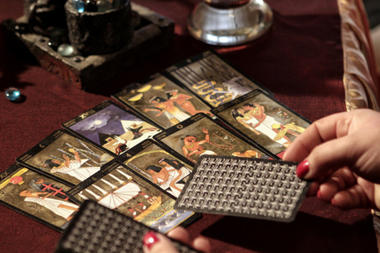
Witch tax hits Romanian witches and fortune tellers (The Christian Science Monitor)

Witch tax: Superstitions are no laughing matter in Romania and have been part of its culture for centuries. President Traian Basescu and his aides have been known to wear purple on certain days, supposedly to ward off evil.

By Alison Mutler, Associated Press / January 7, 2011

Romanian witch Mihaela Minca deals cards during an interview with The Associated Press in Mogosoaia, Romania, Wednesday, Jan. 5, 2011. Trouble is brewing for Romania’s witches, whose toil is being taxed for the first time despite their threats of putting curses on the government. Also being taxed for the first time are fortune tellers, who probably saw this coming. Vadim Ghirda/AP

CHITILA, ROMANIA
Everyone curses the tax man, but Romanian witches angry about having to pay up for the first time hurled poisonous mandrake into the Danube River on Thursday to cast spells on the president and government.

Romania’s newest taxpayers also included fortune tellers — but they probably should have seen it coming.

Superstitions are no laughing matter in Romania — the land of the medieval ruler who inspired the “Dracula” tale — and have been part of its culture for centuries. President Traian Basescu and his aides have been known to wear purple on certain days, supposedly to ward off evil.

A witch at the Danube named Alisia called the new tax law “foolish.”

“What is there to tax, when we hardly earn anything?” she said, identifying herself with only one name as many Romanian witches do.

Yet on the Chitila River in southern Romania, other witches gathered around a fire Thursday and threw corn into an icy river to celebrate Epiphany. They praised the new government measure, saying it gives them official recognition.

Witch Melissa Minca told The Associated Press she was “happy that we are legal,” before chanting a spell to call for a good harvest, clutching a jar of charmed river water, a sprig of mistletoe and a candle.

The new tax law is part of the government’s drive to collect more revenue and crack down on tax evasion in a country that is in recession.

In the past, the less mainstream professions of witch, astrologer and fortune teller were not listed in the Romanian labor code, as were those of embalmer, valet and driving instructor. People who worked those jobs used their lack of registration to evade paying income tax.

Under the new law, like any self-employed person, they will pay 16 percent income tax and make contributions to health and pension programs.

Some argue the law will be hard to enforce, as the payments to witches and astrologers usually are small cash amounts of 20 to 30 lei ($7-$10) per consultation.

Mircea Geoana, who lost the presidential race to Basescu in 2009, performed poorly during a crucial debate, and his camp blamed attacks of negative energy by their opponent’s aides.

Geoana aide Viorel Hrebenciuc alleged there was a “violet flame” conspiracy during the campaign, saying Basescu and other aides dressed in purple on Thursdays to increase his chances of victory.

Romanian officials still wear purple clothing on important days, because the color supposedly makes the wearer superior and wards off evil.

Such spiritualism has long been tolerated by the Orthodox Church in Romania, and the late Communist dictator Nicolae Ceausescu and his wife, Elena, had their own personal witch.

Queen witch Bratara Buzea, 63, who was imprisoned in 1977 for witchcraft under Ceausescu’s repressive regime, is furious about the new law.

Sitting cross-legged in her villa in the lake resort of Mogosoaia, just north of Bucharest, she said Wednesday she planned to cast a spell using a particularly effective concoction of cat excrement and a dead dog.

“We do harm to those who harm us,” she said. “They want to take the country out of this crisis using us? They should get us out of the crisis because they brought us into it.”

“My curses always work!” she cackled in a smoky voice, sitting next to a wood-burning stove, surrounded by potions, charms, holy water and ceramic pots.

But not every witch threatened fire and brimstone.

“This law is very good,” said Mihaela Minca, sister of Melissa. “It means that our magic gifts are recognized and I can open my own practice.”

Nigerian car thief turns into goat! (The Christian Science Monitor)

In West Africa, widespread belief in witchcraft, black magic, and superstition undermine the fundamentals of journalism.

By Walter Rodgers / July 6, 2009

ABUJA, NIGERIA
In Nigeria recently, an angry mob demanded that police jail a goat. Vigilantes insisted the animal was a human car thief who transmogrified upon being apprehended. Nigerian law doesn’t recognize magic, witchcraft, or voodoo. Yet, faced with an angry mob, police acquiesced, arresting the goat.

This story was my object lesson for a Practical Reporting 101 class I taught to Nigerian journalism students this spring. There was just one problem: Some felt the goat was guilty. “These things actually happen,” one woman protested.

Objective truth is the ideal of journalism. It’s a destination reached through rigorous reporting rooted in skepticism. That’s a tall order in a society that’s so heavily riddled with superstition. In Nigeria, the sharp line between fact and fiction is badly blurred by centuries of animism and occultism that infects contemporary Muslim and Christian thinking as well as secular thought.

Journalistic skepticism is hard to teach where public imagination supersedes rational disbelief. As a result, journalism’s leavening effect on society is diminished. Reporters must always tread lightly in matters of religion, of course. Nearly all faiths hold to beliefs that defy everyday evidence. But, in the West at least, it’s understood that private religious beliefs – along with political beliefs – should be compartmentalized from the practice of journalism. A reporter’s religious beliefs, no matter how odd, don’t necessarily preclude good journalism. But when those beliefs clearly interfere with basic fact-checking and verification, then it’s worth examining how collective belief in magic can impede the civic development that good journalism fosters.

Black magic, malevolent curses, and witch doctors are woven into the fabric of West African society. “I don’t believe in witches, but I know they exist,” one of my students said. Television soap operas feature a villain sprinkling green powder on the doorstep of the woman next door. The following day she is shown writhing in agony. Great swaths of Nigerian society take these curses seriously.

Not infrequently, police hear reports that a man claims someone cast a spell to capture his spirit. Tradition here holds that if you sleep in bed with your feet at the headboard, you are communing with witches. Criminals buy charms from witch doctors to become invisible and escape arrest. A hairdresser tells of a client of another customer who reported a snake in her house that turned into a young woman. When the girl was taken to a Pentecostal church service she turned back into a snake. The journalistic canon of having two independent sources to confirm a news story becomes irrelevant when an entire congregation insists “it really happened.”

In Nigeria hearsay becomes conviction, then “truth,” and credibility grows in the retelling.

TV coverage lends currency to rumor. Take the story of four thieves apprehended by vigilantes who tied and bound them. According to dozens of village witnesses, there was supposedly a puff of smoke and the bound villains became four tethered crocodiles. One student insisted this was more credible than transubstantiation at Roman Catholic communion – the doctrine that the bread and wine become the body and blood of Jesus Christ – because “the TV news showed video of the four crocodiles.”

“We believe in God,” says Lydia Tolulope Adeleru, an American-educated daughter of a Baptist minister. “We also believe in our cultural gods like Sango, the god of iron, as well as Esu, the devil. We are a deeply religious people but we never left the old ways.” Africans often look for an unknown element to blame for disasters, floods, and crop failures. “If Christians have a God who makes Lucifer fall from heaven,” adds Ms. Adeleru, “what’s so strange about our juju [black magic]?”

The “rules of evidence” are easily contaminated here. Beatrice Funmilayo, a diplomat’s daughter, was a rare skeptic. “Nigerians have rich traditions of storytelling, but as journalists, we have to divorce ourselves from our cultural inclinations.” “Besides,” she said, “if these things really happened, wouldn’t they happen everywhere and not just [in] Nigeria?”

Shebanjo Ola is a university-educated attorney. He told of a woman in his village mixing sand and stones in a bowl and covering it with paper. When she removed the paper, the contents had magically turned into rice and meat. I asked, “Did you see it?” “No, but my mother did, and she never lies,” he replied. So much for the journalistic canon: “When your mother tells you she loves you, check it out.”

In one class I abruptly asked, “Has anyone here actually seen someone magically disappear?” Temple Ojutalayo assured me he had. He said his university professor teaching traditional folk medicine “disappeared in front of the entire class.”

I asked how many of these aspiring journalists believed in ghosts. The hands shot up. “What about UFOs?”

No response. Then a voice from the rear said, “Those only happen in America.”

Walter Rodgers is a former senior international correspondent for CNN. He writes a biweekly column for the Monitor’s weekly edition.

Ghana aims to abolish witches’ camps (The Christian Science Monitor)

For years, Ghanaians have banished women from their villages who were suspected of witchcraft. Now, Ghana is trying to ban this practice.

By Clair MacDougall, Correspondent / September 15, 2011

ACCRA, GHANA
Ghanaian leaders and civil society groups met in the nation’s capital, Accra earlier this week to develop a plan to abolish the witches’ camps in the northern region, where over a thousand women and children who have been accused of sorcery are currently living in exile.

Deputy Minister for Women and Children’s Affairs Hajia Hawawu Boya Gariba said the ministry would be doing everything that it could to ensure the practice of families and neighbors banishing women from communities whom they suspected of being witches is abolished by developing legislation that would make it illegal to accuse someone of being a witch and gradually closing down camps and reintegrating women back into their communities.

“This practice has become an indictment on the conscience of our society,” Ms. Gariba said at the conference called Towards Banning “Witches” Camps. “The labeling of some of our kinsmen and women as witches and wizards and banishing them into camps where they live in inhuman and deplorable conditions is a violation of their fundamental human rights.”

Supreme Court Justice Rose Owusu also said that the practice violated numerous clauses in section 5 of Ghana’s 1992 Constitution. That section protects human rights and outlaws cultural practices which “dehumanize or are injurious to the physical and mental well-being of a person.” Ms. Owusu also called for the development of new legislation to outlaw the camps and the practice.

The witch camps of Ghana’s north

There are currently around 1,000 women and 700 children living in 6 of the witches’ camps in Ghana’s northern region.

Many of them are elderly women who have been accused of inflicting death, misfortune, and calamity on their neighbors and villages through sorcery, witchcraft, or “juju,” a term used throughout West Africa.

The women enjoy a certain degree of protection within these camps, located some distance from their communities in which they could be tortured, beaten to death, or lynched, but the conditions of the camps are often poor. The “accused witches,” as they are sometimes referred to, live in tiny thatched mud huts, and have limited access to food and must fetch water from nearby streams and creeks.

Forced to flee

An elderly woman named Bikamila Bagberi who has lived in Nabule witch camp in Gushegu a district in the Northern Region for the past 13 years, told the story of how she was forced to leave her village. Dressed in a headscarf, faded T-shirt, and cotton skirt, Ms. Bagberi spoke softly with her head bowed as a district assemblyman translated for the conference delegates.

Bagberi’s nephew, her brother-in-law’s son, had died unexpectedly and after the village soothsayer said she caused the death of the child her family tried make her confess to murdering him through sorcery. She said that when she refused she was beaten with an old bicycle chain, and later her nephew’s family members rubbed Ghanaian pepper sauce into her eyes and open wounds.

When asked whether she could return back to her village she said the family couldn’t bring her back into the community because of the fear that she will harm others. Bagberi said she expected to spend the rest of her life in the camp.

Catalyst for action

Human rights groups have been campaigning for the closure of the witches’ camps since the 1990s, but have had little success in abolishing the practice of sending women suspected of witchcraft into exile, in part because of lack of political will and the pervasiveness of the belief in witchcraft throughout Ghana. But the brutal murder of 72-year-old Ama Hemmah in the city of Tema in Novermber of last year, allegedly by six people, among them a Pentecostal pastor and his neighbors who are accused of dousing her with kerosene and setting her alight, caused public outrage and made headlines across the world. Since Hemmah’s death, opinion pieces and articles about the issue have featured in Ghana’s major newspapers, along with feature stores on local news programs.

Emmanuel Anukun-Dabson from Christian Outreach Fellowship, a group working with the accused witches at the Nabule camp and one of the organizers of the conference, suggested that a broader cultural shift needed to take place if the camps were to be abolished.

“In Ghana, we know that when a calamity happens or something befalls a family or a community the question is not what caused it, but rather who caused it?” Anukun-Dabson said. “We are a people who do not take responsibility for our actions; rather we find scapegoats and women are the targets.”

Chief Psychiatrist of Ghana’s Health Services Dr. Akwesi Osei, who spearheaded the conference, argued that a public awareness campaign on psychological disorders, dementia, and the mental and behavioral changes associated with menopause might help the public understand behaviors and perceived eccentricities that are often associated with witchcraft.

Belief in witchcraft and supernatural powers is common throughout Ghana, and Africa countries and is often encouraged by pastors who preach in the nation’s many charismatic churches. Supernatural themes and sorcery also feature strongly in Ghanaian and West African films and television programs.

Deputy Minister Gariba has called for another meeting to develop a more concrete road map and said that the National Disaster Management Organisation would be providing the witches’ camps with water tanks and additional food supplies.

Joojo Eenstua, another organizer of the camp who works with Christian Outreach Fellowship at Nabule, said the conference marked a new era in activism on the issue and believed that significant changes and improvements to the livelihoods of the women and children living in these witches camps would follow.

“There is more public awareness than before and there is more political will and momentum around this issue,” Ms. Eenstua says.

We Need To Do More When It Comes To Having Brief, Panicked Thoughts About Climate Change (The Onion)

COMMENTARY
BY RHETT STEVENSON
SEPTEMBER 6, 2011 | ISSUE 47•36

The 20 hottest years on record have all taken place in the past quarter century. The resulting floods, wildfires, and heat waves have all had deadly consequences, and if we don’t reduce carbon emissions immediately, humanity faces bleak prospects. We can no longer ignore this issue. Beginning today, we must all do more when it comes to our brief and panicked thoughts about climate change.

Indeed, if there was ever a time when a desperate call to take action against global warming should race through our heads as we lie in bed and stare at the ceiling, that time is now.

Many well-intentioned people will take 20 seconds out of their week to consider the consequences of the lifestyle they’ve chosen, perhaps contemplating how their reliance on fossil fuels has contributed to the rapid melting of the Arctic ice cap. But if progress is what we truly want, 20 seconds is simply not enough. Not by a long shot. An issue this critical demands at least 45 seconds to a solid minute of real, concentrated panic.

And I’m not talking about letting the image of a drowning polar bear play out in your mind now and then. If we’re at all serious, we need to let ourselves occasionally be struck with grim visions of coastal cities washing away and people starving as drought-stricken farmlands fail to yield crops—and we need to do this regularly, every couple days or so, before continuing to go about our routines as usual.

This may seem like a lot to ask, but no one ever said making an effort to think about change was easy.

So if you pick up a newspaper and see an article about 10 percent of all living species going extinct by the end of the century, don’t just turn the page. Stop, peruse it for a moment, look at the photos, freak out for a few seconds, and then turn the page.

And the next time you start up your car, stop to think how the exhaust from your vehicle and millions of others like it contributes to air pollution, increasing the likelihood that a child in your neighborhood will develop asthma or other respiratory ailments. Take your time with it. Feel the full, crushing weight of that guilt. Then go ahead and drive wherever it was you wanted to go.

To do anything less is irresponsible.

Suppose you’ve just sat down in a crisply air-conditioned movie theater. Why not take the length of a preview or two to consider the building’s massive carbon footprint? Imagine those greenhouse gases trapped in the atmosphere, disrupting ecosystems and causing infectious diseases to spread rampantly, particularly in regions of the world where the poorest people live. Visualize massive storm systems cutting widespread swaths of destruction. Think of your children’s children dying horrible, unnecessary deaths.

You might even go so far as to experience actual physical symptoms: shaking, hyperventilation, perhaps even a heart palpitation. These are entirely appropriate responses to have, and the kinds of reactions each of us ought to have briefly before casting such worries aside to enjoy Conan The Barbarian.

Ultimately, however, our personal moments of distress won’t matter much unless our government intervenes with occasional mentions of climate change in important speeches, or by passing nonbinding legislation on the subject. I implore you: Spend a couple minutes each year imagining yourself writing impassioned letters to your elected representatives demanding a federal cap on emissions.

Global warming must be met with immediate, short-lasting feelings of overwhelming dread, or else life as we know it will truly cease—oh, God, there’s nothing we can do, is there? Maybe we’re already too late. What am I supposed to do? Unplug my refrigerator? I recycle, I take shorter showers than I used to, doesn’t that count for something? Devastating famines and brutal wars fought over dwindling resources? Is that my fault? Jesus, holy shit, someone do something! Tell me what to do! For the love of God, what can possibly be done?

There you have it. I’ve done my part. Now it’s your turn.

SINCE SEPTEMBER 11, 2001 . . . (SSRC)

10 years after september 11 – A SOCIAL SCIENCE RESEARCH COUNCIL ESSAY FORUM

By Veena Das

A decade of intense theorizing on the forms of violence and human degradation, on global connectivity, on demands that scholarship be done in “real time” . . . a sense of urgency . . . disciplines are aggressively asked to prove their relevance . . . a deep disquiet on the part of many radical scholars and public intellectuals that the American public is increasingly becoming complicit in projects of warfare. We ask, are our senses being so retrained now that we cannot see the suffering of others or hear their cries? We declare with anguish that whole populations are defined as nothing but targets for bombing . . . as those whose deaths do not count, and hence those dead literally need not be counted. There is a desperation to hone in on what is new—perhaps, some theorize, what we now have is “horror” and not “terror” . . . perhaps, say others, what is lost is not only meaning but any trust in what might count as real.

Despite repeated calls for invention of new vocabularies, my own sense is that we have yet to come to terms with the violence of the past and that we have allowed our scholarly terms to be defined in a manner that we are becoming trapped in, terms that are already given in the questions that we ask. After all, do we need to be reminded that the single-most important factor in the decline of the total number of wars since 1942 was the end of colonial wars? Or that in the 1990s the region in which the highest death toll occurred was sub-Saharan Africa, and that it was the indirect death through disease and malnutrition that contributed to the enormity of the violence? I use the collective first-person pronoun to include myself within this trap of not being quite able to define what the right questions should be.

Ten years ago, when I contributed a short reflection on September 11 to the SSRC’s forum, something of this disquiet I feel about the mode of theorizing was already present. I argued that in the political rhetoric that circulated right after September 11, with its talk of attacks on the values of civilization, the American nation was seen to embody universal values—hence the talk was not of many terrorisms with which several countries had lived for more than thirty years but of one grand terrorism, Islamic terrorism. If I am allowed to loop back to my words, I asked, “What could this mean except that while terrorist forms of warfare in other spaces in Africa, Asia, or the Middle East were against forms of particularism, the attack on America is seen as an attack on humanity itself?” Perhaps we should ask of ourselves now the permission to be released from the grip of this master trope of September 11 that organizes a whole discourse, both conservative and radical, in terms of terrorism as the gripping drama of our times. We might then ask, what other questions have been under discussion among different communities of scholars and how might debate be widened to take account of these discussions?

One point I might put forward as a candidate for discussion is how affect is invested in some terms that come to be the signifiers of the pressing problems of a particular decade but then are dropped as if their force has been exhausted by new discoveries. When these terms drop out of scholarly circulation, do they still have lives that are lived in other corners of the world or in the lives of individuals who continue to give them expression? Consider the history of the term “ethnic cleansing,” which came to signify and organize much discussion in the nineties as referring to the pathology of what was termed as ethno-nationalism. As is well known, the term emerged in the summer of 1992 during the tragic events of the dissolution of Yugoslavia and the emergence of new nation-states that were making claims for international recognition. Although the composite term “ethnic cleansing” came to be used only then, the idea of “cleaning” a territory by killing the local inhabitants and making it safe for military occupation was known in colonial wars as well as expressed extensively in Latin America with reference to undesirable groups, such as prostitutes, enemy collaborators, and the vagrant poor.

Norman Naimark has made the point that ethnic cleansing happens in the shadow of war. He cites the examples of the Greek expulsion as a result of the Greco-Turkish war, the intensification of ethnic cleansing when NATO bombing started in Kosovo in March 1999, and Stalin’s brutal dealings with the Chechen-Ingush and Crimean Tartars during the Second World War.1 A chilling aspect of ethnic cleansing is its totalistic character. As Naimark puts it:

The goal is to remove every member of the targeted nation; very few exceptions to ethnic cleansing are allowed. In premodern cases of assaults of one people on another, those attacked could give up, change sides, convert, pay tribute, or join the attackers. Ethnic cleansing, driven by the ideology of integral nationalism and the military and technological power of the modern state, rarely forgives, makes exceptions, or allows people to slip through the cracks.

Yet a concept that was said to be central to explaining major mass atrocities is now rarely encountered—except perhaps in international law discussions on the distinction between genocide and ethnic cleansing. Are the kinds of mass atrocities that have occurred since September 11 not amenable to discussion under any of the earlier terms? Do subjectivities shift so quickly? Are issues of intentionality as providing the criteria for distinguishing between genocide and ethnic cleansing already resolved? What is at stake in the fact that ethnic cleansing is a perpetrator’s term while genocide is a term that privileges the experience of the victims? What kind of footing in the world do enunciations made on behalf of all sides in conflicts that draw on such concepts as human rights and human dignity have?

While one can understand why the media might have moved on to other stories, have we as scholars come to terms with why some concepts disappear from our vocabularies so quickly? I want to suggest that a long-term perspective on how we come to speak of violence—the appearance and disappearance of different terms—provides a repertoire of concepts to be mined for understanding how representation of violence in the public sphere was closely tied up with the West’s self-definition that in turn defined the twists and turns in the social sciences. Ethnic cleansing in the nineties was widely understood as the violence of the other just as terrorism now is understood as the violence that the other perpetrates. September 11 and the subsequent wars in Iraq and Afghanistan then become events that need to be placed in the long history of warfare that has generated the concepts of social science—concepts that cannot be divested of their political plenitude even as we recognize that the technologies of war have changed considerably.

Are there other discussions on war that are not quite within the discursive fields that dominate the post–September 11 scenario and the notion of Islamic terrorism? I find it salutary to think that other theoretical discussions are taking place that are outside this frame of reference. For instance, the prolonged civil war in Sri Lanka, in which both Sinhala soldiers and Tamil militants engaged in killing, has led to discussions on the relation between Buddhism and violence and whether there are strains of Buddhism, especially within the Mahayana school, that make room for the exercise of violence. Interestingly, the issues here are not those of justifying warfare but rather of dealing with the anxieties about bad karma generated by the acts of violence.

A sustained analysis of what enabled such developments as samurai Zen, or soldier Zen, to appear in Japan or how it is that Buddhism could find a home within kingdoms as diverse as the Indians, the Mongols, the Chinese, and the Thai deepens our understanding of violence and nonviolence precisely because it has the potential to change the angle of our vision.2 Similar discussions from within other traditions, both religious and secular, would help to break the monopoly of concepts (biopolitics, state of exception, homo sacer) that are now routinely used to understand the world. This hope is not an expression of sheer nostalgia for non-Western concepts but a plea to cultivate some attentiveness to those discourses that are (or could be) part of the history of our disciplines. Scholarly discourse cannot simply mirror the ephemeral character of media stories—even when a particular kind of violence disappears, the institutions that were put in place for dealing with it continue to have lives of their own. The braiding of what is new and what is enduring might then define how we come to pose questions that are not simply corollaries of the common sense of our times.


Veena Das is Krieger-Eisenhower Professor of Anthropology and professor of humanities at the Johns Hopkins University. Her most recent books are Life and Words: Violence and the Descent into the Ordinaryand Sociology and Anthropology of Economic Life: The Moral Embedding of Economic Action (ed., with R. K. Das).

  1. Norman M. Naimark, Fires of Hatred: Ethnic Cleansing in Twentieth-Century Europe (Cambridge, MA: Harvard University Press, 2001).
  2. See Michael K. Jerryson and Mark Juergensmeyer, eds., Buddhist Warfare (New York: Oxford University Press, 2010).

In the Land of Denial (N.Y. Times)

NY Times editorial
September 6, 2011

The Republican presidential contenders regard global warming as a hoax or, at best, underplay its importance. The most vocal denier is Rick Perry, the Texas governor and longtime friend of the oil industry, who insists that climate change is an unproven theory created by “a substantial number of scientists who have manipulated data so that they will have dollars rolling into their projects.”

Never mind that nearly all the world’s scientists regard global warming as a serious threat to the planet, with human activities like the burning of fossil fuels a major cause. Never mind that multiple investigations have found no evidence of scientific manipulation. Never mind that America needs a national policy. Mr. Perry has a big soapbox, and what he says, however fallacious, reaches a bigger audience than any scientist can command.

With one exception — make that one-and-one-half — the rest of the Republican presidential field also rejects the scientific consensus. The exception is Jon Huntsman Jr., a former ambassador to China and former governor of Utah, who recently wrote on Twitter: “I believe in evolution and trust scientists on global warming. Call me crazy.” The one-half exception is Mitt Romney, who accepted the science when he was governor of Massachusetts and argued for reducing emissions. Lately, he’s retreated into mush: “Do I think the world’s getting hotter? Yeah, I don’t know that, but I think that it is.” As for the human contribution: “It could be a little. It could be a lot.”

The others flatly repudiate the science. Ron Paul of Texas calls global warming “the greatest hoax I think that has been around for many, many years.” Michele Bachmann of Minnesota once said that carbon dioxide was nothing to fear because it is a “natural byproduct of nature” and has complained of “manufactured science.” Rick Santorum, a former senator from Pennsylvania, has called climate change “a beautifully concocted scheme” that is “just an excuse for more government control of your life.”

Newt Gingrich’s full record on climate change has been a series of epic flip-flops. In 2008, he appeared on television with Nancy Pelosi, the former House speaker, to say that “our country must take action to address climate change.” He now says the appearance was a mistake.

None of the candidates endorse a mandatory limit on emissions or, for that matter, a truly robust clean energy program. This includes Mr. Huntsman. In 2007, as Utah governor, he joined with Arnold Schwarzenegger, then the governor of California, in creating the Western Climate Initiative, a market-based cap-and-trade program aimed at reducing emissions in Western states. Cap-and-trade has since acquired a toxic political reputation, especially among Republicans, and Mr. Huntsman has backed away.

The economic downturn has made addressing climate change less urgent for voters. But the issue is not going away. The nation badly needs a candidate with a coherent, disciplined national strategy. So far, there is no Republican who fits that description.

Flânerie bipolar (FSP)

A melancolia, da excentricidade romântica à patologia farmacêutica

Folha de S.Paulo, Ilustríssima
São Paulo, Domingo, 04 de Setembro de 2011
Por MARIA RITA KEHL

Descrita até a modernidade como um fenômeno da cultura, sinal de excentricidade e reclusão, a melancolia perdeu, com o advento da psicanálise, o caráter criativo. No século 21, se converte em patologia “bipolar”. Publicação de clássico do século 17 e filme de Lars von Trier trazem o melancólico de volta à cena.

O PLANETA MELANCHOLIA não é o Sol negro do poema de Nerval. É uma Lua incansável, cuja órbita desgovernada a aproxima da Terra indefesa até provocar uma colisão devastadora.

O filme de Lars von Trier mistura ficção científica com parábola moral, sofisticada e um tanto ingênua, como convém ao gênero. A destruição do mundo pela melancolia é precedida de um longo comentário sobre a perda de sentido da vida, pelo menos entre os habitantes da sociedade que Trier critica desde “Dançando no Escuro” (2000) e cujo imaginário o cineasta dinamarquês, confiante em seu método paranoico-crítico, conhece pelo cinema sem jamais ter pisado lá: os EUA.

Ao longo do filme, Trier semeia indicações de sua familiaridade com a história da melancolia no Ocidente. O cineasta, que se fez “persona non grata” em Cannes com provocações descabidas em defesa de Hitler, mostrou compreender a posição do melancólico como a de um sujeito em desacordo com o que se considera o Bem, no mundo em que vive. Em “Melancholia”, esta é a posição de Justine (Kirsten Dunst), prestes a se casar com um rapaz tão obsequioso em contentá-la que presenteia a noiva com a foto das macieiras em cuja sombra ela deverá ser feliz.

Feliz? A perspectiva do futuro congelado numa imagem perpétua congela também o desejo de Justine, que se desajusta de seu papel e estraga a festa caríssima organizada pela irmã, cheia de rituais destinados a produzir os efeitos de “happiness” exigidos dos filhos da sociedade da abundância.

SINTOMA SOCIAL Se não tivesse o mérito de desvendar a estupidez da fé contemporânea nos “efeitos de felicidade” como medida de todas as coisas, o filme de Trier já terá valido por reabilitar a figura da melancolia como indicador do sintoma social.

Por mais de dois milênios, as oscilações da sensibilidade melancólica indagaram a cultura ocidental a respeito da fronteira que separa o louco e o gênio. Desde a Antiguidade clássica, o melancólico, incapaz de corresponder à “demanda do Outro”, denunciava o que não ia bem, no laço social.

A crise que leva Justine a arrebentar seu compromisso amoroso, sua festa de casamento e seu emprego numa única noite é conduzida com precisão didática pelo diretor. Uma observação cruel da mãe (representação perfeita da mãe do melancólico freudiano), seguida da indiferença do pai, deflagra em Justine uma verdadeira crise de fé. De repente, a noiva se exclui da cena na qual deveria ser a principal protagonista. Não acredita mais. Despenca da rede imaginária que sustenta o que se costuma chamar de realidade, ficção coletiva capaz de dotar a vida de significado e valor.

Justine, incapaz de olhar o mundo através do véu de fantasia que conforta aos outros, “os tais sãos” (como no verso de Pessoa), enxerga o que a cena encobre. Ela não teme a chegada de Melancholia porque nunca foi capaz de se iludir sobre a finitude de tudo o que existe. Justine “vê coisas”. Árida vida a de quem vê demais porque não sabe fantasiar.

EXCEÇÃO Desde a Antiguidade o melancólico foi entendido, no Ocidente, como aquele que ocupa um lugar de exceção na cultura. O pathos melancólico foi explicado por Hipócrates e Galeno com base na teoria dos quatro humores que regulam o funcionamento do corpo e da alma. As oscilações da bile negra fariam do melancólico um ser inconstante, a um só tempo doentio e genial, impelido a criar para aplacar as oscilações de seu temperamento.

No cerne de sua reflexão “O Homem de Gênio e a Melancolia” (O Problema XXX), Aristóteles já discernira uma questão ética a respeito dos excessos emocionais do melancólico e uma questão estética sobre o gênio criador. Daí o incômodo papel que lhe coube: questionar os significantes que sustentam o imaginário de sua época.

SÉCULO 19 A tradição inaugurada por Aristóteles termina com Baudelaire já no século 19 -o último dos românticos, o primeiro dos modernos, segundo outro melancólico genial, Walter Benjamin. Para suportar os altos e baixos de seu temperamento e dar algum destino à sua excentricidade, alguns melancólicos dedicaram-se a tentar compreender seu mal.

O classicismo inglês produziu o mais completo compêndio sobre a melancolia de que se tem conhecimento, obra da vida inteira do bibliotecário de Oxford Robert Burton (1577-1640).

Sua “A Anatomia da Melancolia”, publicada em 1621 e reeditada várias vezes nas décadas seguintes, é um compêndio de mais de 1.400 páginas contendo tudo o que se podia saber sobre a “doença” de seu autor. A editora da Universidade Federal do Paraná acaba de lançar no Brasil o primeiro volume de “A Anatomia da Melancolia” [trad. Guilherme Gontijo Flores, 265 págs., preço não definido].

É pena que o primeiro volume se limite ao longo introito do autor a seus leitores. Esperamos que em breve a Editora UFPR publique uma seleção dos capítulos do livro, que inicia com as causas da melancolia -“Delírio, frenesi, loucura” […] “Solidão e ócio” […] “A força da imaginação”…- segue com a descrição dos paliativos para aliviar o sofrimento (“alegria, boa companhia, belos objetos…”) para ao final abordar a melancolia amorosa e a melancolia religiosa.

O autor assinou a obra como Demócrito Júnior, a afirmar sua identificação com o filósofo que, segundo a descrição de Hipócrates, afastou-se do convívio com os homens e, diante da vacuidade do mundo, costumava rir de tudo. O riso do melancólico é expressão do escárnio ante as ilusões alheias.

A empreitada de Burton só foi possível em uma época em que a melancolia era entendida não apenas como uma doença, mas como um fenômeno da cultura. O texto seminal de Aristóteles já continha uma reflexão sobre a capacidade criativa do melancólico, atribuída à instabilidade que o impele a expandir sua alma em todas as direções do universo.

FREUD Tal processo de desidentificação encontra-se também no diagnóstico freudiano, ao qual falta, entretanto, a contrapartida da mimesis. Solto da rede imaginária que o enlaça a si mesmo e ao mundo, o melancólico contemporâneo só conta de encarar o Real com a aridez do simbólico.

Algo se passou, na modernidade, para que a inconsistência imaginária do melancólico deixasse de estimulá-lo a reinventar as representações do mundo e ficasse à mercê da Coisa. A receita preparada para Justine tem gosto de cinzas; fios de lã invisíveis impedem suas pernas de andar. Diante desse horror, ela prefere a colisão com Melancholia.

A melancolia deixou de ser entendida como um desajuste referido às normas da vida pública quando Freud arrebatou o significante de seu sentido tradicional a fim de trazer para o campo da psicanálise o diagnóstico psiquiátrico da então chamada psicose maníaco-depressiva -que hoje a medicina retomou sob a designação de transtorno bipolar.

Freud não privatizou a melancolia por acaso: a própria psicanálise deve sua existência ao surgimento do sujeito neurótico gerado nas tramas da família burguesa, fechada sobre si mesma e fundada em compromissos de amor. A psicanálise freudiana é contemporânea ao acabamento da forma subjetiva do indivíduo e à privatização das tarefas de socialização das crianças.

Vem daí que o melancólico freudiano não se pareça em nada com seus colegas pré-modernos: o valente guerreiro exposto à vergonha diante de seus pares (Ajax), o anacoreta em crise de fé (santo Antônio), o pensador renascentista ocupado em restaurar a ordem de um mundo em constante transformação (como na gravura de Dürer). Nem faz lembrar, na aurora modernidade, o “flâneur” a recolher restos de um mundo em ruínas pelas ruas de uma grande cidade (Baudelaire) de modo a compor um monumento poético para fazer face à barbárie.

O melancólico freudiano é o bebê repudiado pela mãe, pobre eu transformado em dejeto sobre o qual caiu a sombra de um objeto mau. O que se perdeu na transição efetuada pela psicanálise foi o valor criativo que se atribuía ao melancólico, da Antiguidade ao romantismo. Perdeu-se o valor do polo maníaco do que hoje a medicina chama de transtorno bipolar.

Onde o melancólico pré-moderno, em seus momentos de euforia, era dado a expansões da imaginação poética, hoje a mania leva os pacientes “bipolares” a torrar dinheiro no cartão de crédito. O consumo é o ato que expressa os atuais clientes da psicofarmacologia, apartados da potência criadora que sua inadaptação ao mundo poderia lhes conferir.

DEPRESSÃO Já não existem melancólicos como os de antigamente? Os neurocientistas que o digam. A psiquiatria e a indústria farmacêutica já escolheram seu substituto no século 21: no lugar do significante melancolia, instala-se a depressão como grande sintoma do mal-estar na civilização do terceiro milênio. Quanto mais se sofistica a oferta de antidepressivos, mais a depressão se anuncia no horizonte como expressão privilegiada do mal-estar, a ameaçar sociedades que se dedicam a ignorar o saber que ela contém.

Tal produção ativa de ignorância a respeito do sentido da melancolia está no centro da parábola de Lars von Trier. John, cunhado de Justine, afirma sua fé no mundo das mercadorias. Abastece a casa com comida, combustível, geradores de energia. Confia na informação científica divulgada pela internet. Verifica no telescópio a aproximação do planeta ameaçador.

Sua defesa é tão frágil que, diante do inevitável, suicida-se com uma overdose das pílulas da esposa. Claire, por sua vez, tem grande fé na encenação da vida. O fracasso do casamento espetacular da irmã não a impede de planejar outro pequeno ritual, na bela varanda da casa, com música e vinho, para esperar a chegada de Melancholia. Excelente final para um melodrama hollywoodiano, que Justine descarta com desprezo.

Justine não tem ilusões a respeito do fim. Mesmo assim, para proteger o sobrinho do horror final, mostra-se capaz de criar a mais onipotente das fantasias. Constrói com ele uma frágil tenda “mágica” sob a qual se abrigam para esperar a explosão de luz trazida pela colisão com Melancholia.

O triângulo formado por três galhos presos na ponta não chega a criar uma ilusão: são como traços de uma escrita, como um significante a demarcar, “in extremis”, um território humano em face do Real.

Mental illness rise linked to climate (Sydney Morning Herald)

Erik Jensen Health

August 29, 2011
Climate change“Emotional injury, stress and despair” … the impact of climate change on health. Photo: Reuter
RATES of mental illnesses including depression and post-traumatic stress will increase as a result of climate change, a report to be released today says.

The paper, prepared for the Climate Institute, says loss of social cohesion in the wake of severe weather events related to climate change could be linked to increased rates of anxiety, depression, post-traumatic stress and substance abuse.

As many as one in five people reported ”emotional injury, stress and despair” in the wake of these events.

The report, A Climate of Suffering: The Real Cost of Living with Inaction on Climate Change, called the past 15 years a ”preview of life under unrestrained global warming”.

”While cyclones, drought, bushfires and floods are all a normal part of Australian life, there is no doubt our climate is changing,” the report says.

”For instance, the intensity and frequency of bushfires is greater. This is a ‘new normal’, for which the past provides little guidance …

”Moreover, recent conditions are entirely consistent with the best scientific predictions: as the world warms so the weather becomes wilder, with big consequences for people’s health and well-being.”

The paper suggests a possible link between Australia’s recent decade-long drought and climate change. It points to a breakdown of social cohesion caused by loss of work and associated stability, adding that the suicide rate in rural communities rose by 8 per cent.

The report also looks at mental health in the aftermath of major weather events possibly linked to climate change.

It shows that one in 10 primary school children reported symptoms of post-traumatic stress disorder in the wake of cyclone Larry in 2006. More than one in 10 reported symptoms more than three months after the cyclone.

”There’s really clear evidence around severe weather events,” the executive director of the Brain and Mind Research Institute, Professor Ian Hickie, said.

”We’re now more sophisticated in understanding the mental health effects and these effects are one of the major factors.

”What we have seriously underestimated is the effects on social cohesion. That is very hard to rebuild and they are critical to the mental health of an individual.”

Professor Hickie, who is launching the report today, said climate change and particularly severe weather events were likely to be a major factor influencing mental health in the future.

”When we talk about the next 50 years and what are going to be the big drivers at the community level of mental health costs, one we need to factor in are severe weather events, catastrophic weather events,” he said.

Read more: http://www.smh.com.au/environment/mental-illness-rise-linked-to-climate-20110828-1jger.html#ixzz1WeAsre00

Psychologist James Pennebaker reveals the hidden meaning of pronouns (Scientific American)

The Secret Language Code

By Gareth Cook | Tuesday, August 16, 2011

Psychologist James Pennebaker. Image: Marsha Miller

Are there hidden messages in your emails? Yes, and in everything you write or say, according to James Pennebaker, chair of the department of psychology at the University of Texas at Austin. Pennebaker has been a leader in the computer analysis of texts for their psychological content. And in his new book, “The Secret Life of Pronouns,” he argues that how we use words like “I,” “she,” and “who” reveal secrets of our psychology. He spoke recently with Mind Matters editor Gareth Cook.

COOK: How did you become interested in pronouns?

PENNEBAKER: A complete and total accident. Until recently, I never thought about parts of speech. However, about ten years ago I stumbled on some findings that caught my attention. In the 1980s, my students and I discovered that if people were asked to write about emotional upheavals, their physical health improved. Apparently, putting emotional experiences into language changed the ways people thought about their upheavals. In an attempt to better understand the power of writing, we developed a computerized text analysis program to determine how language use might predict later health improvements. In other words, I wanted to find if there was a healthy way to write.

Much to my surprise, I soon discovered that the ways people used pronouns in their essays predicted whose health would improve the most. Specifically, those people who benefited the most from writing changed in their pronoun use from one essay to another. Pronouns were reflecting people’’s abilities to change perspective.

As I pondered these findings, I started looking at how people used pronouns in other texts — blogs, emails, speeches, class writing assignments, and natural conversation. Remarkably, how people used pronouns was correlated with almost everything I studied. For example, use of first-person singular pronouns (I, me, my) was consistently related to gender, age, social class, honesty, status, personality, and much more. Although the findings were often robust, people in daily life were unable to pick them up when reading or listening to others. It was almost as if there was a secret world of pronouns that existed outside our awareness.

COOK: What would make you think that the use of pronouns would be meaningful?

PENNEBAKER: Never in a million years would I have thought that pronouns would be a worthwhile research topic. I ran study after study and initially found large and unexpected differences between people in their pronoun use. In hindsight, I think I ignored the findings because they didn’’t make sense. One day, I lined up about 5 experiments that I had conducted and every one revealed the same effects. It was that day that I finally admitted to myself that pronouns must be meaningful.

COOK: What differences have you found between men and women?

PENNEBAKER: Almost everything you think you know is probably wrong. Take this little test. Who uses the following words more, women or men?

> 1st person singular (I, me, my)
> 1st person plural (we, us our)
> articles (a, an, the)
> emotion words (e.g., happy, sad, love, hate)
> cognitive words (e.g., because, reason, think, believe)
> social words (e.g., he, she, friend, cousin)

Most people assume that men use I-words and cognitive words more than women and that women use we-words, emotions, and social words more than men. Bad news. You were right if you guessed that women use social words more. However, women use I-words and cognitive words at far higher rates than men. There are no reliable differences between men and women for use of we-words or emotion words (OK, those were trick questions). And men use articles more than women, when you might guess there’d be no difference.

These differences hold up across written and spoken language and most other languages that we have studied. You can’t help but marvel at the fact that we are all bombarded by words from women and men every day of our lives and most of us have never “heard” these sex differences in language. Part of the problem is that our brains aren’t wired to listen to pronouns, articles, prepositions, and other “junk” words. When we listen to another person, we typically focus on what they are saying rather than how they are saying it.

Men and women use language differently because they negotiate their worlds differently. Across dozens and dozens of studies, women tend to talk more about other human beings. Men, on the other hand, are more interested in concrete objects and things. To talk about human relationships requires social and cognitive words. To talk about concrete objects, you need concrete nouns which typically demand the use of articles.

No matter what your sex, if you have to explain that Sally is leaving her husband because of her new lover, you have to make references to all the actors and you have to do some fairly complex cognitive analyses. If you have to explain why your carburetor in your car is broken, your causal analysis will likely be relatively pallid and will involve referring to concrete nouns.

COOK: You write about using this to analyze historical documents. Do you think this tool might be of any use to historians or biographers?

PENNEBAKER: Historians and biographers should jump on this new technology. The recent release of the Google Books Project should be required reading for everyone in the humanities. For the first time in the history of the world, there are methods by which to analyze tremendously large and complex written works by authors from all over the world going back centuries. We can begin to see how thinking, emotional expression, and social relations evolve as a function of world-wide events. The possibilities are breathtaking.

In my own work, we have analyzed the collected works of poets, playwrights, and novelists going back to the 1500s to see how their writing changed as they got older. We’ve compared the pronoun use of suicidal versus non-suicidal poets. Basically, poets who eventually commit suicide use I-words more than non-suicidal poets.
The analysis of language style can also serve as a psychological window into authors and their relationships. We have analyzed the poetry of Elizabeth Barrett and Robert Browning and compared it with the history of their marriage. Same thing with Ted Hughes and Sylvia Plath. Using a method we call Language Style Matching, we can isolate changes in the couples’ relationships.

COOK: What are some of the more unusual “texts” you have applied this technique to?

PENNEBAKER: Some of the more unusual texts have been my own. There is something almost creepy about analyzing your own emails, letters of recommendation, web pages, and natural conversations.

COOK: And what have you found?

PENNEBAKER: One of the most interesting results was part of a study my students and I conducted dealing with status in email correspondence. Basically, we discovered that in any interaction, the person with the higher status uses I-words less (yes, less) than people who are low in status. The effects were quite robust and, naturally, I wanted to test this on myself. I always assumed that I was a warm, egalitarian kind of guy who treated people pretty much the same.

I was the same as everyone else. When undergraduates wrote me, their emails were littered with I, me, and my. My response, although quite friendly, was remarkably detached — hardly an I-word graced the page. And then I analyzed my emails to the dean of my college. My emails looked like an I-word salad; his emails back to me were practically I-word free.

COOK: Does your work have any application in lie detection?

PENNEBAKER: It does. Several labs, including ours, have now conducted studies to evaluate the prospect of building a linguistic lie detector. The preliminary findings are promising. In controlled studies, we can catch lying about 67% of the time where 50% is chance. Humans, reading the same transcripts, only catch lying 53% of the time. This is actually quite impressive unless you are a person in the judicial system. If you are waiting for a language-based system to catch real world lying at rates of 90 or 95 percent of the time, it won’t happen in your lifetime. It’s simply too complicated.

COOK: What are you looking into now? Where do you see the field going in the future?

PENNEBAKER: One of the most fascinating effects I’ve seen in quite awhile is that we can predict people’s college performance reasonably well by simply analyzing their college admissions essays. Across four years, we analyzed the admissions essays of 25,000 students and then tracked their grade point averages (GPAs). Higher GPAs were associated with admission essays that used high rates of nouns and low rates of verbs and pronouns. The effects were surprisingly strong and lasted across all years of college, no matter what the students’ major.

To me, the use of nouns — especially concrete nouns — reflects people’s attempts to categorize and name objects, events, and ideas in their worlds. The use of verbs and pronouns typically occur when people tell stories. Universities clearly reward categorizers rather than story tellers. If true, can we train young students to categorize more? Alternatively, are we relying too much on categorization strategies in American education?

I think one advantage I have had in my career is that I’ve got a short attention span. If something new and exciting bubbles up in our data, I will likely drop what I’m doing and try to understand it. It’s a wonderful time to be alive.

Beyond space-time: Welcome to phase space (New Scientist)

08 August 2011 by Amanda Gefter
Magazine issue 2824

A theory of reality beyond Einstein’s universe is taking shape – and a mysterious cosmic signal could soon fill in the blanks

Does some deeper level of reality lurk beneath? (Image: Luke Brookes)

IT WASN’T so long ago we thought space and time were the absolute and unchanging scaffolding of the universe. Then along came Albert Einstein, who showed that different observers can disagree about the length of objects and the timing of events. His theory of relativity unified space and time into a single entity – space-time. It meant the way we thought about the fabric of reality would never be the same again. “Henceforth space by itself, and time by itself, are doomed to fade into mere shadows,” declared mathematician Hermann Minkowski. “Only a kind of union of the two will preserve an independent reality.”

But did Einstein’s revolution go far enough? Physicist Lee Smolin at the Perimeter Institute for Theoretical Physics in Waterloo, Ontario, Canada, doesn’t think so. He and a trio of colleagues are aiming to take relativity to a whole new level, and they have space-time in their sights. They say we need to forget about the home Einstein invented for us: we live instead in a place called phase space.

If this radical claim is true, it could solve a troubling paradox about black holes that has stumped physicists for decades. What’s more, it could set them on the path towards their heart’s desire: a “theory of everything” that will finally unite general relativity and quantum mechanics.

So what is phase space? It is a curious eight-dimensional world that merges our familiar four dimensions of space and time and a four-dimensional world called momentum space.

Momentum space isn’t as alien as it first sounds. When you look at the world around you, says Smolin, you don’t ever observe space or time – instead you see energy and momentum. When you look at your watch, for example, photons bounce off a surface and land on your retina. By detecting the energy and momentum of the photons, your brain reconstructs events in space and time.

The same is true of physics experiments. Inside particle smashers, physicists measure the energy and momentum of particles as they speed toward one another and collide, and the energy and momentum of the debris that comes flying out. Likewise, telescopes measure the energy and momentum of photons streaming in from the far reaches of the universe. “If you go by what we observe, we don’t live in space-time,” Smolin says. “We live in momentum space.”

And just as space-time can be pictured as a coordinate system with time on one axis and space – its three dimensions condensed to one – on the other axis, the same is true of momentum space. In this case energy is on one axis and momentum – which, like space, has three components – is on the other (see diagram).

Simple mathematical transformations exist to translate measurements in this momentum space into measurements in space-time, and the common wisdom is that momentum space is a mere mathematical tool. After all, Einstein showed that space-time is reality’s true arena, in which the dramas of the cosmos are played out.

Smolin and his colleagues aren’t the first to wonder whether that is the full story. As far back as 1938, the German physicist Max Born noticed that several pivotal equations in quantum mechanics remain the same whether expressed in space-time coordinates or in momentum space coordinates. He wondered whether it might be possible to use this connection to unite the seemingly incompatible theories of general relativity, which deals with space-time, and quantum mechanics, whose particles have momentum and energy. Maybe it could provide the key to the long-sought theory of quantum gravity.

Born’s idea that space-time and momentum space should be interchangeable – a theory now known as “Born reciprocity” – had a remarkable consequence: if space-time can be curved by the masses of stars and galaxies, as Einstein’s theory showed, then it should be possible to curve momentum space too.

At the time it was not clear what kind of physical entity might curve momentum space, and the mathematics necessary to make such an idea work hadn’t even been invented. So Born never fulfilled his dream of putting space-time and momentum space on an equal footing.

That is where Smolin and his colleagues enter the story. Together with Laurent Freidel, also at the Perimeter InstituteJerzy Kowalski-Glikman at the University of Wroclaw, Poland, and Giovanni Amelino-Camelia at Sapienza University of Rome in Italy, Smolin has been investigating the effects of a curvature of momentum space.

The quartet took the standard mathematical rules for translating between momentum space and space-time and applied them to a curved momentum space. What they discovered is shocking: observers living in a curved momentum space will no longer agree on measurements made in a unified space-time. That goes entirely against the grain of Einstein’s relativity. He had shown that while space and time were relative, space-time was the same for everyone. For observers in a curved momentum space, however, even space-time is relative (see diagram).

This mismatch between one observer’s space-time measurements and another’s grows with distance or over time, which means that while space-time in your immediate vicinity will always be sharply defined, objects and events in the far distance become fuzzier. “The further away you are and the more energy is involved, the larger the event seems to spread out in space-time,” says Smolin.

For instance, if you are 10 billion light years from a supernova and the energy of its light is about 10 gigaelectronvolts, then your measurement of its location in space-time would differ from a local observer’s by a light second. That may not sound like much, but it amounts to 300,000 kilometres. Neither of you would be wrong – it’s just that locations in space-time are relative, a phenomenon the researchers have dubbed “relative locality”.

Relative locality would deal a huge blow to our picture of reality. If space-time is no longer an invariant backdrop of the universe on which all observers can agree, in what sense can it be considered the true fabric of reality?

That is a question still to be wrestled with, but relative locality has its benefits, too. For one thing, it could shed light on a stubborn puzzle known as the black hole information-loss paradox. In the 1970s, Stephen Hawking discovered that black holes radiate away their mass, eventually evaporating and disappearing altogether. That posed an intriguing question: what happens to all the stuff that fell into the black hole in the first place?

Relativity prevents anything that falls into a black hole from escaping, because it would have to travel faster than light to do so – a cosmic speed limit that is strictly enforced. But quantum mechanics enforces its own strict law: things, or more precisely the information that they contain, cannot simply vanish from reality. Black hole evaporation put physicists between a rock and a hard place.

According to Smolin, relative locality saves the day. Let’s say you were patient enough to wait around while a black hole evaporated, a process that could take billions of years. Once it had vanished, you could ask what happened to, say, an elephant that once succumbed to its gravitational grip. But as you look back to the time at which you thought the elephant had fallen in, you would find that locations in space-time had grown so fuzzy and uncertain that there would be no way to tell whether the elephant actually fell into the black hole or narrowly missed it. The information-loss paradox dissolves.

Big questions still remain. For instance, how can we know if momentum space is really curved? To find the answer, the team has proposed several experiments.

One idea is to look at light arriving at the Earth from distant gamma-ray bursts. If momentum space is curved in a particular way that mathematicians refer to as “non-metric”, then a high-energy photon in the gamma-ray burst should arrive at our telescope a little later than a lower-energy photon from the same burst, despite the two being emitted at the same time.

Just that phenomenon has already been seen, starting with some unusual observations made by a telescope in the Canary Islands in 2005 (New Scientist, 15 August 2009, p 29). The effect has since been confirmed by NASA’s Fermi gamma-ray space telescope, which has been collecting light from cosmic explosions since it launched in 2008. “The Fermi data show that it is an undeniable experimental fact that there is a correlation between arrival time and energy – high-energy photons arrive later than low-energy photons,” says Amelino-Camelia.

Still, he is not popping the champagne just yet. It is not clear whether the observed delays are true signatures of curved momentum space, or whether they are down to “unknown properties of the explosions themselves”, as Amelino-Camelia puts it. Calculations of gamma-ray bursts idealise the explosions as instantaneous, but in reality they last for several seconds. While there is no obvious reason to think so, it is possible that the bursts occur in such a way that they emit lower-energy photons a second or two before higher-energy photons, which would account for the observed delays.

In order to disentangle the properties of the explosions from properties of relative locality, we need a large sample of gamma-ray bursts taking place at various known distances (arxiv.org/abs/1103.5626). If the delay is a property of the explosion, its length will not depend on how far away the burst is from our telescope; if it is a sign of relative locality, it will. Amelino-Camelia and the rest of Smolin’s team are now anxiously awaiting more data from Fermi.

The questions don’t end there, however. Even if Fermi’s observations confirm that momentum space is curved, they still won’t tell us what is doing the curving. In general relativity, it is momentum and energy in the form of mass that warp space-time. In a world in which momentum space is fundamental, could space and time somehow be responsible for curving momentum space?

Work by Shahn Majid, a mathematical physicist at Queen Mary University of London, might hold some clues. In the 1990s, he showed that curved momentum space is equivalent to what’s known as a noncommutative space-time. In familiar space-time, coordinates commute – that is, if we want to reach the point with coordinates (x,y), it doesn’t matter whether we take xsteps to the right and then y steps forward, or if we travel y steps forward followed by x steps to the right. But mathematicians can construct space-times in which this order no longer holds, leaving space-time with an inherent fuzziness.

In a sense, such fuzziness is exactly what you might expect once quantum effects take hold. What makes quantum mechanics different from ordinary mechanics is Heisenberg’s uncertainty principle: when you fix a particle’s momentum – by measuring it, for example – then its position becomes completely uncertain, and vice versa. The order in which you measure position and momentum determines their values; in other words, these properties do not commute. This, Majid says, implies that curved momentum space is just quantum space-time in another guise.

What’s more, Majid suspects that this relationship between curvature and quantum uncertainty works two ways: the curvature of space-time – a manifestation of gravity in Einstein’s relativity – implies that momentum space is also quantum. Smolin and colleagues’ model does not yet include gravity, but once it does, Majid says, observers will not agree on measurements in momentum space either. So if both space-time and momentum space are relative, where does objective reality lie? What is the true fabric of reality?

Smolin’s hunch is that we will find ourselves in a place where space-time and momentum space meet: an eight-dimensional phase space that represents all possible values of position, time, energy and momentum. In relativity, what one observer views as space, another views as time and vice versa, because ultimately they are two sides of a single coin – a unified space-time. Likewise, in Smolin’s picture of quantum gravity, what one observer sees as space-time another sees as momentum space, and the two are unified in a higher-dimensional phase space that is absolute and invariant to all observers. With relativity bumped up another level, it will be goodbye to both space-time and momentum space, and hello phase space.

“It has been obvious for a long time that the separation between space-time and energy-momentum is misleading when dealing with quantum gravity,” says physicist João Magueijo of Imperial College London. In ordinary physics, it is easy enough to treat space-time and momentum space as separate things, he explains, “but quantum gravity may require their complete entanglement”. Once we figure out how the puzzle pieces of space-time and momentum space fit together, Born’s dream will finally be realised and the true scaffolding of reality will be revealed.

Bibliography

  1. The principle of relative locality by Giovanni Amelino-Camelia and others (arxiv.org/abs/1101.0931)

Amanda Gefter is a consultant for New Scientist based in Boston

Stuff white people like: denying climate change (Grist)

CLIMATE SKEPTICS

BY DAVID ROBERTS
2 AUG 2011 4:11 PM

There’s a study running soon in the journalGlobal Environmental Change called “Cool dudes: The denial of climate change among conservative white males in the United States.” It analyzes poll and survey data from the last 10 years and finds that … are you sitting down? … conservative white men are far more likely to deny the threat of climate change than other people.

OK, that’s no surprise to anyone who’s been awake over the last decade. But the paper goes beyond that to put forward some theories aboutwhy conservative white men (CWM) are so loathe to accept climate change. The explanation is some mix of the following, all of which overlap in various ways:

    • First there’s the “white male effect” — generally speaking, white males are less concerned with a variety of risks. This probably has to do with the fact that they are less exposed to risk than other demographics, what with running things and all.
    • Then, as Chris Mooney notes, there’s the “social dominance orientation” of conservatives, who see social life as following the law of the jungle. One’s choice is to dominate or be dominated; that is the natural order of things. Such folk are leery of climate change solutions premised on fairness or egalitarianism.
  • Then there are the well-understood “system-justifying tendencies” of conservatives. The authors explain that conservatives …

    … strongly display tendencies to justify and defend the current social and economic system. Conservatives dislike change and uncertainty and attempt to simplify complexity. Further, conservative white males have disproportionately occupied positions of power within our economic system. Given the expansive challenge that climate change poses to the industrial capitalist economic system, it should not be surprising that conservative white males’ strong system-justifying attitudes would be triggered to deny climate change.

  • Finally, there’s “identity-protective cognition,” a notion borrowed from Dan Kahan at Yale. (See this PDF.) Here’s how Kahan and colleagues sum it up:

    We propose that variance in risk perceptions — across persons generally, and across race and gender in particular — reflects a form of motivated cognition through which people seek to deflect threats to identities they hold, and roles they occupy, by virtue of contested cultural norms.

    “Motivated cognition” refers to reasoning done in service of justifying an already held belief or goal. It helps explain why the CWM who know the most about climate science are the most likely to reject it; they learn about it in order to reject it. See Chris Mooney’s great piece on that. Point being: when facts (or the implications of those facts) threaten people’s social identities, they tend to dismiss the facts rather than the identity.

To all these reasons, I’d add “epistemic closure,” the extraordinary way that the modern right has constructed a self-contained, hermetically sealed media environment in which conservatives can be protected from ever encountering a contrary view. It’s an accelerant to all the tendencies described above.

Anyway, as you can see, the rejection of climate science among CWM is basically overdetermined. Climate change threatens their values, their privileges, and their worldview. They are reacting as one would expect them to react.

Some People’s Climate Beliefs Shift With Weather (Columbia University)

Study Shows Daily Malleability on a Long-Term Question

2011-04-06
ThermometerPhoto by domediart, Flickr

Social scientists are struggling with a perplexing earth-science question: as the power of evidence showing manmade global warming is rising, why do opinion polls suggest public belief in the findings is wavering? Part of the answer may be that some people are too easily swayed by the easiest, most irrational piece of evidence at hand: their own estimation of the day’s temperature.

In three separate studies, researchers affiliated with Columbia University’s Center for Research on Environmental Decisions (CRED) surveyed about 1,200 people in the United States and Australia, and found that those who thought the current day was warmer than usual were more likely to believe in and feel concern about global warming than those who thought the day was unusually cold. A new paper describing the studies appears in the current issue of the journal Psychological Science.

“Global warming is so complex, it appears some people are ready to be persuaded by whether their own day is warmer or cooler than usual, rather than think about whether the entire world is becoming warmer or cooler,” said lead author Ye Li, a postdoctoral researcher at the Columbia Business School’s Center for Decision Sciences, which is aligned with CRED. “It is striking that society has spent so much money, time and effort educating people about this issue, yet people are still so easily influenced.”  The study says that “these results join a growing body of work show that irrelevant environmental information, such as the current weather, can affect judgments. … By way of analogy, when asked about the state of the national economy, someone might look at the amount of money in his or her wallet, a factor with only trivial relevance.”

Ongoing studies by other researchers have already provided strong evidence that opinions on climate and other issues can hinge on factors unrelated to scientific observations. Most pointedly, repeated polls have shown that voters identifying themselves as political liberals or Democrats are far more likely to believe in human-influenced climate change than those who identify themselves as conservatives or Republicans. Women believe more than men, and younger people more than older ones. Other, yet-to-be published studies at four other universities have looked at the effects of actual temperature—either the natural one outside, or within a room manipulated by researchers—and show that real-time thermometer readings can affect people’s beliefs as well. These other studies involve researchers at New York University, Temple University, the University of Chicago and the University of California, Berkeley.

In the current paper, respondents were fairly good at knowing if it was unusually hot or cold–perceptions correlated with reality three quarters of the time—and that the perception exerted a powerful control on their attitude. As expected, politics, gender and age all had the predicted influences: for instance, on the researchers’ 1-to-4 scale of belief in global warming, Democrats were 1.5 points higher than Republicans. On the whole though, after controlling for the other factors, the researchers found that perceived temperatures still had nearly two-thirds the power as political belief, and six times the power as gender, to push someone one way or the other a notch along the scale. (The coming NYU/Temple study suggests that those with no strong political beliefs and lower education are the most easily swayed.)

In one of the studies described in the paper, the researchers tried to test the earnestness of the responses by seeing how many of those getting paid $8 for the survey were willing to donate to a real-life charity, Clean Air-Cool Planet. The correlation was strong; those who said it was warmer donated an average of about $2; those who felt it was cooler gave an average of 48 cents.

The researchers say the study not only points to how individuals’ beliefs can change literally with the wind. Li says it is possible that weather may have influenced recent large-scale public opinion polls showing declining faith in climate science. Administered at different times, future ones might turn out differently, he said. These polls, he pointed out, include the national elections, which always take place in November, when things are getting chilly and thus may be empowering conservative forces at a time when climate has become a far more contentious issue than in the past. (Some politicians subsequently played up the heavy snows and cold of winter 2009-2010 as showing global warming was a hoax—even though scientists pointed out that such weather was probably controlled by short-term atmospheric mechanisms, and consistent with long-term warming.) “I’m not sure I’d say that people are manipulated by the weather. But for some percentage of people, it’s certainly pushing them around.” said Li.

The other authors are Eric J. Johnson, co-director of the Center for Decision Sciences; and Lisa Zaval, a Columbia graduate student in psychology.

Original link: http://www.earth.columbia.edu/articles/view/2794

The great difficulty with good hypotheses

“There is one great difficulty with a good hypothesis. When it is completed and rounded, the corners smooth and the content cohesive and coherent, it is likely to become a thing in itself, a work of art. It is then like a finished sonnet or a painting completed. One hates to disturb it. Even if subsequent information should shoot a hole in it, one hates to tear it down because it once was beautiful and whole.”

From The Log from the Sea of Cortez, by John Steinbeck.

Biased but Brilliant (N.Y. Times)

GRAY MATTER
Biased but Brilliant

By CORDELIA FINE
Published: July 30, 2011

Cordelia Fine, a senior research associate at the Melbourne Business School, is the author of “A Mind of Its Own: How Your Brain Distorts and Deceives.”

HOW’S this for a cynical view of science? “A new scientific truth does not triumph by convincing its opponents and making them see the light, but rather because its opponents eventually die, and a new generation grows up that is familiar with it.”

Scientific truth, according to this view, is established less by the noble use of reason than by the stubborn exertion of will. One hopes that the Nobel Prize-winning physicist Max Planck, the author of the quotation above, was writing in an unusually dark moment.

And yet a large body of psychological data supports Planck’s view: we humans quickly develop an irrational loyalty to our beliefs, and work hard to find evidence that supports those opinions and to discredit, discount or avoid information that does not. In a classic psychology experiment, people for and against the death penalty were asked to evaluate the different research designs of two studies of its deterrent effect on crime. One study showed that the death penalty was an effective deterrent; the other showed that it was not. Which of the two research designs the participants deemed the most scientifically valid depended mostly on whether the study supported their views on the death penalty.

In the laboratory, this is labeled confirmation bias; observed in the real world, it’s known as pigheadedness.

Scientists are not immune. In another experiment, psychologists were asked to review a paper submitted for journal publication in their field. They rated the paper’s methodology, data presentation and scientific contribution significantly more favorably when the paper happened to offer results consistent with their own theoretical stance. Identical research methods prompted a very different response in those whose scientific opinion was challenged.

This is a worry. Doesn’t the ideal of scientific reasoning call for pure, dispassionate curiosity? Doesn’t it positively shun the ego-driven desire to prevail over our critics and the prejudicial urge to support our social values (like opposition to the death penalty)?

Perhaps not. Some academics have recently suggested that a scientist’s pigheadedness and social prejudices can peacefully coexist with — and may even facilitate — the pursuit of scientific knowledge.

Let’s take pigheadedness first. In a much discussed article this year in Behavioral and Brain Sciences, the cognitive scientists Hugo Mercier and Dan Sperber argue that our reasoning skills are really not as dismal as they seem. They don’t deny that irrationalities like the confirmation bias are common. Instead, they suggest that we stop thinking of the primary function of reasoning as being to improve knowledge and make better decisions. Reasoning, they claim, is for winning arguments. And an irrational tendency like pigheadedness can be quite an asset in an argumentative context. A engages with B and proposes X. B disagrees and counters with Y. Reverse roles, repeat as desired — and what in the old days we might have mistaken for an exercise in stubbornness turns out instead to be a highly efficient “division of cognitive labor” with A specializing in the pros, B in the cons.

It’s salvation of a kind: our apparently irrational quirks start to make sense when we think of reasoning as serving the purpose of persuading others to accept our point of view. And by way of positive side effect, these heated social interactions, when they occur within a scientific community, can lead to the discovery of the truth.

And what about scientists’ prejudices? Clearly, social values should never count as evidence for or against a particular hypothesis — abhorrence of the death penalty does not count as data against its crime-deterrent effects. However, the philosopher of science Heather Douglas has argued that social values can safely play an indirect role in scientific reasoning. Consider: The greater we judge the social costs of a potential scientific error, the higher the standard of evidence we will demand. Professor A, for example, may be troubled by the thought of an incorrect discovery that current levels of a carcinogen in the water are safe, fearing the “discovery” will cost lives. But Professor B may be more anxious about the possibility of an erroneous conclusion that levels are unsafe, which would lead to public panic and expensive and unnecessary regulation.

Both professors may scrutinize a research paper with these different costs of error implicitly in mind. If the paper looked at cancer rates in rats, did the criteria it used to identify the presence of cancer favor over- or under-diagnosis? Did the paper assume a threshold of exposure below which there is no cause for concern, or did it assume that any level of exposure increases risk? Deciding which are the “better” criteria or the “better” background assumptions is not, Ms. Douglas argues, solely a scientific issue. It also depends on the social values you bring to bear on the research. So when Professor A concludes that a research study is excellent, while Professor B declares it seriously mistaken, it may be that neither is irrationally inflating or discounting the strength of the evidence; rather, each is tending to a different social concern.

Science often makes important contributions to debates that involve clashes of social values, like the protection of public health versus the protection of private industry from overregulation. Yet Ms. Douglas suggests that, with social values denied any legitimate role in scientific reasoning, “debates often dance around these issues, attempting to hide them behind debates about the interpretation of data.” Professors A and B are left with no other option but to conclude that the other is a stubborn, pigheaded excuse for a scientist.

For all its imperfections, science continues to be a stunning success. Yet maybe progress would be even faster and smoother if scientists would admit, and even embrace, their humanity.

A version of this op-ed appeared in print on July 31, 2011, on page SR12 of the New York edition with the headline: Biased But Brilliant.

I am, therefore I’m right (Christian Science Monitor)

By Jim Sollisch / July 29, 2011

If you’ve ever been on a jury, you might have noticed that a funny thing happens the minute you get behind closed doors. Everybody starts talking about themselves. They say what they would have done if they had been the plaintiff or the defendant. They bring up anecdote after anecdote. It can take hours to get back to the points of law that the judge has instructed you to consider.

Being on a jury (I recently served on my fourth) reminds me why I can’t stomach talk radio. We Americans seem to have lost the ability to talk about anything but our own experiences. We can’t seem to generalize without stereotyping or to consider evidence that goes against our own experience.

I heard a doctor on a radio show the other day talking about a study that found that exercise reduces the incidence of Alzheimer’s. And caller after caller couldn’t wait to make essentially the opposite point: “Well, my grandmother never exercised and she lived to 95, sharp as a tack.” We are in an age summed up by the aphorism: “I experience, therefore I’m right.”

This isn’t a new phenomenon, except by degree. Historically, the hallmarks of an uneducated person were the lack of ability to think critically, to use deductive reasoning, to distinguish the personal from the universal. Now that seems an apt description of many Americans. The culture of “I” is everywhere you look, from the iPod/iPhone/iPad to the fact that memoir is the fastest growing literary genre.

How’d we get here? The same way we seem to get everywhere today: the Internet. The Internet has allowed us to segregate ourselves based on our interests. All cat lovers over here. All people who believe President Obama wasn’t born in the United States over there. For many of us, what we believe has become the most important organizing element in our lives. Once we all had common media experiences: Walter Cronkite, Ed Sullivan, a large daily newspaper. Now each of us can create a personal media network – call it the iNetwork – fed by the RSS feeds of our choosing.

But the Internet doesn’t just cordon us off in our own little pods. It also makes us dumber, as Nicholas Carr points out in his excellent book, “The Shallows: What the Internet is Doing to our Brains.” He argues that the way we consume media changes our brains, not just our behaviors. The Internet rewards shallow thinking: One search leads to thousands of results that skim over the surface of a subject.

Of course, we could dive deeply into any one of the listings, but we don’t. Studies show that people skim on line, they don’t read. The experience has been designed to reward speed and variety, not depth. And there is tangible evidence, based on studies of brain scans, that the medium is changing our physical brains, strengthening the synapses and areas used for referential thinking while weakening the areas used for critical thinking.

And when we diminish our ability to think critically, we, in essence, become less educated. Less capable of reflection and meaningful conversation. Our experience, reinforced by a web of other gut instincts and experiences that match our own, becomes evidence. Case in point: the polarization of our politics. Exhibit A: the debt ceiling impasse.

Ironically, the same medium that helped mobilize people in the Arab world this spring is helping create a more rigid, dysfunctional democracy here: one that’s increasingly polarized, where each side is isolated and capable only of sound bites that skim the surface, a culture where deep reasoning and critical thinking aren’t rewarded.

The challenge for most of us isn’t to go backwards: We can’t disconnect from the Internet. Nor would we want to. But we can work harder to make “search” the metaphor it once was: to discover, not just to skim. The Internet lets us find facts in an instant. But it doesn’t stop us from finding insight, if we’re willing to really search.

Jim Sollisch is creative director at Marcus Thomas Advertising.

Dancing, Climate Change, and Human Perseverence

Posted by Douglas Joseph La Rose at the EANTH list. 23/07/2011 12:20

“This Wednesday, I had one of the most powerful experiences of my life. I went to a small village in the Upper West Region of Ghana named Bakbamba to help conduct research on climate change and social-cultural adaptations to a changing environment. I have been doing this work for a few weeks now, beginning in coastal eastern Ghana and moving north. But what I experienced today was a life-changing experience. I will do my best to convey my feelings here, but no words would ever be ample to describe the emotion, compassion, and appreciation I felt in this community.

The Upper West Region of Ghana is the poorest region in the country. Outside of the regional capital, Wa, there is really nothing else but vast savanna covered with Shea and baobab trees. The people are primarily subsistence farmers and fishers. The farmers plant guinea corn, maize, yams, beans, bambara beans, millet, groundnuts, and some other crops. Fishers set traps and mobilize nets in the black Volta river that separates Ghana from Burkina Faso. Women also gather Shea nuts and sell them to foreign buyers who process them into cosmetics and edibles. Over the past ten years, rainfall has become sporadic, inconsistent, unpredictable, and unreliable. In these Wala, Fulani, and Lobi communities that have been surviving for centuries, people are beginning to give up and move out. They are suffering from observable climate change and often becoming climate change refugees.

In the course of doing interviews with rural farmers, fishers, and gatherers I heard many stories about failed crops, declining catches in fish, and even lack of fruits from Shea trees, which have been a productive alternative economic resource for decades. Their story is a bleak one. Most crops fail and the only foods Wala and Lobi people can depend on are fish and maize, which takes three months to grow and can be opportunistically planted. Though they plant other crops, many of them are failing because rains are becoming increasingly unpredictable and deluges and floods more common. There is no source of potable water, so people in the village drink from stagnant, muddy ponds. Guinea worm is still a widespread problem. There is no other option. Most of the people we were able to interview were only in their 30s and 40s – because that is about as old as they live. In this village of 300 people, 20 have already died this year. One particular woman I interviewed was 30 years old, but she looked like she was 60. Poor nutrition, hard work, and no access to clean water are taking their toll.

At the end of the day, the women in the town gathered in a circle and began a traditional dance. The women around the circle were clapping poly-rhythmically and singing with beautifully sculpted, angelic voices. I watched as, one by one, the women would enter the circle and do an energetic, stomping dance. At the end of the dance they would throw themselves into the surrounding circle and be caught by the other women. This went on for almost 45 minutes. I asked one of our local research assistants what they were singing and he explained that the dance was about a fighting couple, and they were saying that if the husband no longer loved the wife he should leave her. The women who were catching each other represented the community. “We should support each other,” a woman told me. I sat down and watched the dance, how the women were moving around in passionate whirls, heaving themselves into the boundaries of the circle to be caught by other community members. In this poor village of hunger, desperation, and confusion about a changing environment they were finding the energy to remember and celebrate the perseverance of the human spirit. It was an overwhelming experience to watch frustration and unity translated into cultural performance.

Throughout our interviews and participation in the community, I felt both alarmed and reassured. Alarmed that the situation in this part of upper Ghana is much worse than I expected, and reassured that people are forging ways to adapt.”