Arquivo da tag: Epidemiologia

Angélica Kolody Mammana: Quem não recorre aos livros de história para lê-la está fadado a repeti-la

Angélica Kolody Mammana – Facebook, 20 de maio de 2020

Vou contar uma história longa.
Calma, leiam até o fim. Confiem em mim.
Era uma vez uma doença.
Ela surgiu em um país muito, muito distante.
De repente, começou a se alastrar como faísca sobre pólvora.
Pessoas começaram a morrer, em números enormes, aos montes.
Os jornais começaram a noticiar sobre a doença antes que ela chegasse ao nosso país. Informavam a população, mas as pessoas não acreditavam.
Diziam que era algo distante, que era apenas uma gripe comum, que era tudo um grande exagero.

Algumas pessoas que chegavam de viagem da Europa caiam doentes. Algumas morreram. Mas eram velhas. Tinham doenças. Não havia motivo para pânico.

As pessoas liam os jornais e ficavam indignadas com o exagero da imprensa.
Diziam que era uma jogada politica para derrubar o governo, para espalhar o comunismo pelo mundo.

Na tentativa de conter a doença, que a essa altura já se alastrara por várias nações, países começaram a indicar o uso de máscaras, recomendaram que as pessoas ficassem afastadas, em quarentena, em cidades do mundo todo.

– Quarentena? Como assim? O que será da nossa economia?? – gritavam pessoas indignadas.

Faziam piquetes, manifestações, carregavam cartazes dizendo que se recusavam a usar máscara. E, quando eram obrigadas, usavam placas informando que não concordavam com o uso dela.

Escolas foram fechadas, portas de negócios foram baixadas. Apenas farmácias e mercados poderiam permanecer abertos para abastecer a população.

Teatros e cinemas foram lacrados.
Todos os campeonatos de futebol e outros esportes foram cancelados.

O Rio de Janeiro tornou-se um cenário de tragédia. Hospitais lotados, sem vias de saída, pessoas morrendo em casa. Por toda parte, a falta de caixões e pessoas precisando ser enterradas em valas comuns. Em um único dia, chegam a ser registradas mais de 1.000 mortes.

No Congresso, propôs-se que a formatura dos estudantes fosse antecipada, para que fossem logo para o mercado de trabalho.

Cientistas procuravam loucamente a cura ou o tratamento para aquela doença, até que algum jornal anunciou que um medicamento incrível, até então usado para a malária, parecia ser eficiente.

As pessoas ficaram em polvorosa. Todos queriam o medicamento.
Alguns médicos passaram a anunciar o milagre dessa substância em veículos de comunicação, as pessoas se acumulavam na porta das farmácias e consultórios para recebê-la.

Não havia recomendação científica para o tal remédio, mas as pessoas não se importavam. Estavam desesperadas, qualquer coisa serviria.

Milhares de doentes foram medicados, mas a doença não parecia melhorar com o remédio.

Os veículos de comunicação então chegaram a uma conclusão que parecia óbvia: o remédio não funcionava porque estava sendo administrado tarde demais.

O ideal seria prescrevê-lo o quanto antes, até mesmo preventivamente, como garantia, para evitar a contaminação antes que ela acontecesse.

Alguns outros médicos tentaram alertar a população quanto ao risco do medicamento, mas foi em vão.

Estes médicos foram taxados de conspiracionistas, agredidos, xingados, tomados por comunistas, acusados de estarem contra o interesse da população.

As pessoas passaram a se auto administrar o medicamento para malária, como iriam esperar de braços cruzados?

Foi aí que a historia se complicou.
Havia pessoas que não podiam tomar o tal remédio, pois eram portadoras de condições clinicas adversas que eram contra indicação ao uso dele.
Algumas desmaiavam na rua. Correram lendas urbanas de pessoas que chegaram a ser tomadas por mortas e enterradas vivas, em decorrência de paradas cardíacas e arritmias causadas pelo remédio, cuja dose era propagada sem qualquer critério pela própria imprensa.

As pessoas, ao longo do tempo, ao verem que o medicamento não surtia o efeito prometido, passaram a recorrer a soluções populares e caseiras cujos boatos se disseminaram.

Aguardente, associada a limão e mel, seria um tratamento possível. Bares chegaram a ter filas de pessoas em busca de uma dose. O alcoolismo disparou. O preço da fruta atingiu valores jamais vistos e sumiu das prateleiras.

Correu o boato de que hospitais estavam administrando chás envenenados à meia noite, para pacientes terminais, para liberar leitos.

Por quase dois anos, o governo falhou em conseguir implementar um Ministério da Saúde eficiente. As opiniões se dividiam, discutiam o impacto do isolamento sobre o comércio

Da mesma forma que um famoso escritor chegou a descrever:
“Cada médico tinha uma tentativa de explicação diferente; nós não sabíamos no quê e em quem acreditar. Esperávamos por uma explicação que ninguém tinha para dar, como até hoje esperamos para saber o que foi aquela sassânida infernal.”

Enquanto isso, a doença avançava. Em meio a promessas vãs, avançou e avançou.
A única coisa que se provou eficaz para contê-la foram as regiões com alta adesão ao isolamento social e ao uso de máscaras.

Não, não se trata do coronavirus nem da cloroquina.

Trata-se da gripe espanhola e do sal de quinino, medicamento que na época era usado para malária.

O uso indiscriminado do sal de quinino foi promovido pela imprensa na época, a partir de 1918, e levou também inúmeras pessoas à morte. A imprensa em massa passou a prescrever os sais de quinino inicialmente como tratamento, e posteriormente como prevenção à gripe espanhola.

Nunca surtiu efeito.

A gripe espanhola terminou por matar 30 milhões de pessoas, sem que até hoje, 102 anos depois, tenha sido encontrada a cura.

Na época, muitas pessoas acreditavam que ela era uma mentira, um exagero e uma conspiração para alastrar a revolução comunista de 1917 pelo mundo.

A única medida que, retrospectivamente, conteve razoavelmente a doença em algumas regiões, foi o isolamento social.

A economia sobreviveu.

Quem não recorre aos livros de história para lê-la está fadado a repeti-la.

Notas:
1. A gripe espanhola matou o presidente da República brasileiro, recém reeleito, o Conselheiro Rodrigues Alves, em 1918, logo antes de sua posse.

2. O “medicamento caseiro” inventado para o tratamento da gripe espanhola, à base de aguardente, mel e limão, entrou para a cultura brasileira e hoje atende pelo nome de “caipirinha”.

3. O “chá da meia noite” foi um boato que difamou a Santa Casa do Rio de Janeiro em 1918. Foi apelidada na época de “Casa do Diabo”. Após o final da epidemia, o Chá da Meia Noite foi tema do primeiro bloco de carnaval do Rio, em 1919.

Modeling COVID-19 data must be done with extreme care (Science Daily)

Date: May 19, 2020

Source: American Institute of Physics

Summary: At the beginning of a new wave of an epidemic, extreme care should be used when extrapolating data to determine whether lockdowns are necessary, experts say.

As the infectious virus causing the COVID-19 disease began its devastating spread around the globe, an international team of scientists was alarmed by the lack of uniform approaches by various countries’ epidemiologists to respond to it.

Germany, for example, didn’t institute a full lockdown, unlike France and the U.K., and the decision in the U.S. by New York to go into a lockdown came only after the pandemic had reached an advanced stage. Data modeling to predict the numbers of likely infections varied widely by region, from very large to very small numbers, and revealed a high degree of uncertainty.

Davide Faranda, a scientist at the French National Centre for Scientific Research (CNRS), and colleagues in the U.K., Mexico, Denmark, and Japan decided to explore the origins of these uncertainties. This work is deeply personal to Faranda, whose grandfather died of COVID-19; Faranda has dedicated the work to him.

In the journal Chaos, from AIP Publishing, the group describes why modeling and extrapolating the evolution of COVID-19 outbreaks in near real time is an enormous scientific challenge that requires a deep understanding of the nonlinearities underlying the dynamics of epidemics.

Forecasting the behavior of a complex system, such as the evolution of epidemics, requires both a physical model for its evolution and a dataset of infections to initialize the model. To create a model, the team used data provided by Johns Hopkins University’s Center for Systems Science and Engineering, which is available online at https://systems.jhu.edu/research/public-health/ncov/ or https://github.com/CSSEGISandData/COVID-19.

“Our physical model is based on assuming that the total population can be divided into four groups: those who are susceptible to catching the virus, those who have contracted the virus but don’t show any symptoms, those who are infected and, finally, those who recovered or died from the virus,” Faranda said.

To determine how people move from one group to another, it’s necessary to know the infection rate, incubation time and recovery time. Actual infection data can be used to extrapolate the behavior of the epidemic with statistical models.

“Because of the uncertainties in both the parameters involved in the models — infection rate, incubation period and recovery time — and the incompleteness of infections data within different countries, extrapolations could lead to an incredibly large range of uncertain results,” Faranda said. “For example, just assuming an underestimation of the last data in the infection counts of 20% can lead to a change in total infections estimations from few thousands to few millions of individuals.”

The group has also shown that this uncertainty is due to a lack of data quality and also to the intrinsic nature of the dynamics, because it is ultrasensitive to the parameters — especially during the initial growing phase. This means that everyone should be very careful extrapolating key quantities to decide whether to implement lockdown measures when a new wave of the virus begins.

“The total final infection counts as well as the duration of the epidemic are sensitive to the data you put in,” he said.

The team’s model handles uncertainty in a natural way, so they plan to show how modeling of the post-confinement phase can be sensitive to the measures taken.

“Preliminary results show that implementing lockdown measures when infections are in a full exponential growth phase poses serious limitations for their success,” said Faranda.


Story Source:

Materials provided by American Institute of Physics. Note: Content may be edited for style and length.


Journal Reference:

  1. Davide Faranda, Isaac Pérez Castillo, Oliver Hulme, Aglaé Jezequel, Jeroen S. W. Lamb, Yuzuru Sato, Erica L. Thompson. Asymptotic estimates of SARS-CoV-2 infection counts and their sensitivity to stochastic perturbation. Chaos: An Interdisciplinary Journal of Nonlinear Science, 2020; 30 (5): 051107 DOI: 10.1063/5.0008834

This Is the Future of the Pandemic (New York Times)

Covid-19 isn’t going away soon. Two recent studies mapped out the possible shapes of its trajectory.

Circles at Gare du Nord train station in Paris marked safe social distances on Wednesday.
Circles at Gare du Nord train station in Paris marked safe social distances on Wednesday.Credit…Ian Langsdon/EPA, via Shutterstock

By Siobhan Roberts – May 8, 2020

By now we know — contrary to false predictions — that the novel coronavirus will be with us for a rather long time.

“Exactly how long remains to be seen,” said Marc Lipsitch, an infectious disease epidemiologist at Harvard’s T.H. Chan School of Public Health. “It’s going to be a matter of managing it over months to a couple of years. It’s not a matter of getting past the peak, as some people seem to believe.”

A single round of social distancing — closing schools and workplaces, limiting the sizes of gatherings, lockdowns of varying intensities and durations — will not be sufficient in the long term.

In the interest of managing our expectations and governing ourselves accordingly, it might be helpful, for our pandemic state of mind, to envision this predicament — existentially, at least — as a soliton wave: a wave that just keeps rolling and rolling, carrying on under its own power for a great distance.

The Scottish engineer and naval architect John Scott Russell first spotted a soliton in 1834 as it traveled along the Union Canal. He followed on horseback and, as he wrote in his “Report on Waves,” overtook it rolling along at about eight miles an hour, at thirty feet long and a foot or so in height. “Its height gradually diminished, and after a chase of one or two miles I lost it in the windings of the channel.”

The pandemic wave, similarly, will be with us for the foreseeable future before it diminishes. But, depending on one’s geographic location and the policies in place, it will exhibit variegated dimensions and dynamics traveling through time and space.

“There is an analogy between weather forecasting and disease modeling,” Dr. Lipsitch said. Both, he noted, are simple mathematical descriptions of how a system works: drawing upon physics and chemistry in the case of meteorology; and on behavior, virology and epidemiology in the case of infectious-disease modeling. Of course, he said, “we can’t change the weather.” But we can change the course of the pandemic — with our behavior, by balancing and coordinating psychological, sociological, economic and political factors.

Dr. Lipsitch is a co-author of two recent analyses — one from the Center for Infectious Disease Research and Policy at the University of Minnesota, the other from the Chan School published in Science — that describe a variety of shapes the pandemic wave might take in the coming months.

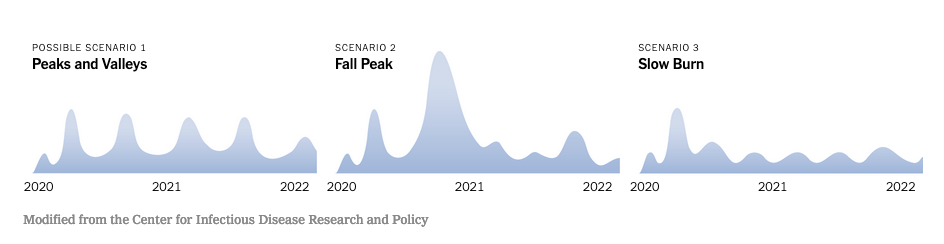
The Minnesota study describes three possibilities:

Scenario No. 1 depicts an initial wave of cases — the current one — followed by a consistently bumpy ride of “peaks and valleys” that will gradually diminish over a year or two.

Scenario No. 2 supposes that the current wave will be followed by a larger “fall peak,” or perhaps a winter peak, with subsequent smaller waves thereafter, similar to what transpired during the 1918-1919 flu pandemic.

Scenario No. 3 shows an intense spring peak followed by a “slow burn” with less-pronounced ups and downs.

The authors conclude that whichever reality materializes (assuming ongoing mitigation measures, as we await a vaccine), “we must be prepared for at least another 18 to 24 months of significant Covid-19 activity, with hot spots popping up periodically in diverse geographic areas.”

In the Science paper, the Harvard team — infectious-disease epidemiologist Yonatan Grad, his postdoctoral fellow Stephen Kissler, Dr. Lipsitch, his doctoral student Christine Tedijanto and their colleague Edward Goldstein — took a closer look at various scenarios by simulating the transmission dynamics using the latest Covid-19 data and data from related viruses.

The authors conveyed the results in a series of graphs — composed by Dr. Kissler and Ms. Tedijanto — that project a similarly wavy future characterized by peaks and valleys.

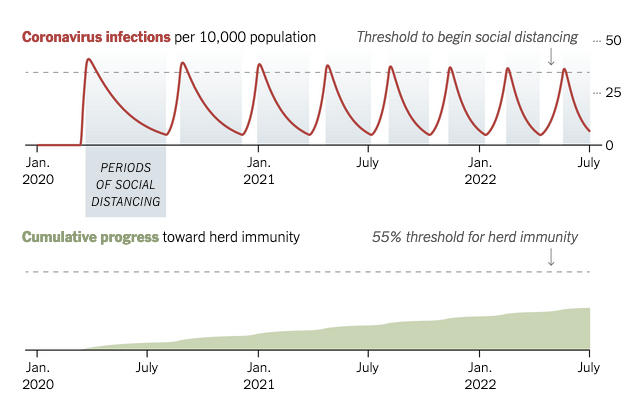
One figure from the paper, reinterpreted below, depicts possible scenarios (the details would differ geographically) and shows the red trajectory of Covid-19 infections in response to “intermittent social distancing” regimes represented by the blue bands.

Social distancing is turned “on” when the number of Covid-19 cases reaches a certain prevalence in the population — for instance, 35 cases per 10,000, although the thresholds would be set locally, monitored with widespread testing. It is turned “off” when cases drop to a lower threshold, perhaps 5 cases per 10,000. Because critical cases that require hospitalization lag behind the general prevalence, this strategy aims to prevent the health care system from being overwhelmed.

The green graph represents the corresponding, if very gradual, increase in population immunity.

“The ‘herd immunity threshold’ in the model is 55 percent of the population, or the level of immunity that would be needed for the disease to stop spreading in the population without other measures,” Dr. Kissler said.

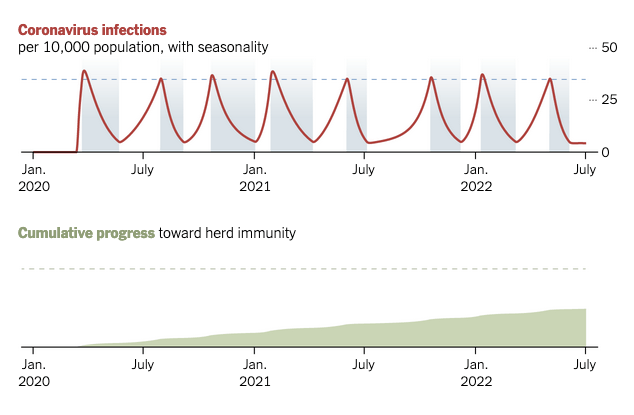
Another iteration shows the effects of seasonality — a slower spread of the virus during warmer months. Theoretically, seasonal effects allow for larger intervals between periods of social distancing.

This year, however, the seasonal effects will likely be minimal, since a large proportion of the population will still be susceptible to the virus come summer. And there are other unknowns, since the underlying mechanisms of seasonality — such as temperature, humidity and school schedules — have been studied for some respiratory infections, like influenza, but not for coronaviruses. So, alas, we cannot depend on seasonality alone to stave off another outbreak over the coming summer months.

Yet another scenario takes into account not only seasonality but also a doubling of the critical-care capacity in hospitals. This, in turn, allows for social distancing to kick in at a higher threshold — say, at a prevalence of 70 cases per 10,000 — and for even longer breaks between social distancing periods:

What is clear overall is that a one-time social distancing effort will not be sufficient to control the epidemic in the long term, and that it will take a long time to reach herd immunity.

“This is because when we are successful in doing social distancing — so that we don’t overwhelm the health care system — fewer people get the infection, which is exactly the goal,” said Ms. Tedijanto. “But if infection leads to immunity, successful social distancing also means that more people remain susceptible to the disease. As a result, once we lift the social distancing measures, the virus will quite possibly spread again as easily as it did before the lockdowns.”

So, lacking a vaccine, our pandemic state of mind may persist well into 2021 or 2022 — which surprised even the experts.

“We anticipated a prolonged period of social distancing would be necessary, but didn’t initially realize that it could be this long,” Dr. Kissler said.

Scientists Were Hunting for the Next Ebola. Now the U.S. Has Cut Off Their Funding (The New York Times)

By Donald G. McNeil Jr.

Oct. 25, 2019

Original article

Predict, a government research program, sought to identify animal viruses that might infect humans and to head off new pandemics.

Arlette Kavugho, 40, mother of six and an Ebola survivor, carries Kambale Eloge, 16 months old, whose mother died of the disease, in Katwa, near Butembo, Democratic Republic of Congo. USAID’s Predict project helped identify Ebola’s routes of transmission.
Arlette Kavugho, 40, mother of six and an Ebola survivor, carries Kambale Eloge, 16 months old, whose mother died of the disease, in Katwa, near Butembo, Democratic Republic of Congo. USAID’s Predict project helped identify Ebola’s routes of transmission. Credit Zohra Bensemra/Reuters

In a move that worries many public health experts, the federal government is quietly shutting down a surveillance program for dangerous animal viruses that someday may infect humans.

The United Nations Environment Program estimates that a new animal disease that can also infect humans is discovered every four months. Ending the program, experts fear, will leave the world more vulnerable to lethal pathogens like Ebola and MERS that emerge from unexpected places, such as bat-filled trees, gorilla carcasses and camel barns.

The program, known as Predict and run by the United States Agency for International Development, was inspired by the 2005 H5N1 bird flu scare. Launched 10 years ago, the project has cost about $207 million.

The initiative has collected over 140,000 biological samples from animals and found over 1,000 new viruses, including a new strain of Ebola. Predict also trained about 5,000 people in 30 African and Asian countries, and has built or strengthened 60 medical research laboratories, mostly in poor countries.

Dennis Carroll, the former director of USAID’s emerging threats division who helped design Predict, oversaw it for a decade and retired when it was shut down. The surveillance project is closing because of “the ascension of risk-averse bureaucrats,” he said.

Because USAID’s chief mission is economic aid, he added, some federal officials felt uncomfortable funding cutting-edge science like tracking exotic pathogens.

Congress, along with the administrations of George W. Bush and Barack Obama, were “enormously supportive,” said Dr. Carroll, who is now a fellow at Texas A&M’s Bush School of Government and Public Service.

“But things got complicated in the last two years, and by January, Predict was essentially collapsed into hibernation.”

The end of the program “is definitely a loss,” said Peter Daszak, president of the EcoHealth Alliance, a nonprofit global health organization that received funding from the program. “Predict was an approach to heading off pandemics, instead of sitting there waiting for them to emerge and then mobilizing. That’s expensive.”

“The United States spent $5 billion fighting Ebola in West Africa,” he added. “This costs far less.”

A civet cat in a meat market in Guangzhou, China, in 2004. Researchers isolated the lethal SARS virus in civet cats, suggesting that they were infecting humans.
A civet cat in a meat market in Guangzhou, China, in 2004. Researchers isolated the lethal SARS virus in civet cats, suggesting that they were infecting humans.Credit European Pressphoto Agency

The goal of Predict was to speed up and organize the previously haphazard hunt for zoonotic diseases — those that may jump from animals to humans. In recent years, scientists have discovered many lethal viruses lurking in wild and domestic animals.

It has long been known, of course, that AIDS originated in chimpanzees and probably was first contracted by bushmeat hunters. Ebola circulates in bats and apes, while SARS was found in captive civet cats in China.

In South Asia, Nipah virus reaches humans through pigs or date palm sap infected by bats carrying the virus. In Saudi Arabia, MERS also is carried by bats; they infect camels, which then infect humans. The virus can jump from human to human, especially in hospitals.

Novel influenza viruses originate in migratory ducks and geese. The viruses spread first to domestic poultry flocks, then to pigs and humans. Mutations picked up along that viral highway can render the viruses far more dangerous.

These discoveries led to new ways of preventing spillovers of infections into human populations: closing markets where wildlife is butchered for food,; putting bamboo skirts on sap-collection jars to keep bats out; or penning pigs and camels in places where they cannot eat fruit that bats have gnawed.

Predict teams have investigated mysterious disease outbreaks in many countries, including a die-off of 3,000 wild birds in a Mongolian lake. One team proved that endangered otters in a Cambodian zoo were killed by their feed — raw chickens infected with bird flu.

A Predict laboratory helped identify bat-borne viruses that a boys’ soccer team might have been exposed to while trapped for weeks in a cave in Thailand.

Camels for export at the sea port in Mogadishu, Somalia, in 2013. The MERS virus is passed from camels to humans, scientists discovered.
Camels for export at the sea port in Mogadishu, Somalia, in 2013. The MERS virus is passed from camels to humans, scientists discovered. Credit Feisal Omar/Reuters

Allowing Predict to end “is really unfortunate, and the opposite of what we’d like to see happening,” said Dr. Gro Harlem Brundtland, the former prime minister of Norway and former World Health Organization director-general.

She was co-chair of a panel that in September issued a report detailing the world’s failure to prepare for pandemics. “Americans need to understand how much their health security depends on that of other countries, often countries that have no capacity to do this themselves,” Dr. Brundtland said.

Even though USAID is “incredibly proud and happy over the work Predict has done,” the program is closing because it reached the end of a 10-year funding cycle, said Irene Koek, acting assistant administrator of the agency’s global health bureau.

“We typically do programs in five-year cycles, and it had two,” she said. Some similar research will be part of future budget requests, “but it’s still in the design-and-procurement cycle, so exactly what will continue is a bit of a black box.”

In mid-October, the agency said it would spend $85 million over the next five years helping universities in Africa and Asia teach the “one-health” approach that Predict used. (“One health” describes the nexus between animal, human and environmental medicine).

But it will not involve the daring fieldwork that Predict specialized in.

Among the institutions that worked on Predict projects are those staffed by wildlife veterinarians and disease-trackers like the University of California, Davis’s One Health Institute; the EcoHealth Alliance; the Wildlife Conservation Society, which runs the Bronx Zoo; the Smithsonian Institution, which manages the National Zoo in Washington; and Columbia University’s Center for Infection and Immunity.

Some Predict projects will be taken over by other government agencies, such as the Pentagon’s Defense Threat Reduction Agency or the National Institutes of Health. But those agencies have different missions, such as basic research or troop protection. They do not share USAID’s goal of training poor countries to do the work themselves.

A man prepares chickens for sale at the a market in Phnom Penh, Cambodia. Poultry may carry influenza viruses that are transmitted to humans.
A man prepares chickens for sale at the a market in Phnom Penh, Cambodia. Poultry may carry influenza viruses that are transmitted to humans. Credit Nicolas Axelrod/Getty Images

As an agency that gives money to countries, USAID often has a friendlier, more cooperative relationship with governments in poor nations than, for example, Pentagon-led efforts might.

“I’ve always been impressed with the way they were able to work with ministries of health,” said Dr. James M. Hughes, a former chief of infectious diseases at the Centers for Disease Control and Prevention who was on Predict’s advisory board. “They have a high level of trust, and they help countries comply with the International Health Regulations.”

(Those regulations, in force since 2007, require countries to report all major disease outbreaks to the World Health Organization and allow the W.H.O. to declare health emergencies.)

USAID still supports some health-related programs like the President’s Malaria Initiative and the President’s Emergency Plan for AIDS Relief. But Dr. Carroll described those as “cookbook portfolios.”

How to fight those diseases is well-known, he explained, so the agency just comes up with a budget for drugs, diagnostic kits, insecticides, mosquito nets, condoms or other long-established interventions.

Predict more often placed medical detectives in the field, training local doctors, veterinarians, wildlife rangers and others to collect samples from wild and domestic animals.

It can be highly specialized work. Getting blood samples from pigs or wild rodents is fairly routine, but catching birds, bats or monkeys alive is not. Gorillas are harder. (Scientists usually content themselves with just collecting gorilla feces.)

Predict also experimented with novel ways to catch and release animals unharmed, to transport samples without refrigeration and to use DNA testing that can scan for whole viral families instead of just known viruses, said Dr. Christine Kreuder Johnson, associate director of the One Health Institute at the University of California, Davis.

Predict sponsored epidemiological modeling to predict where outbreaks are likely to erupt. It also sought ways to curb practices, such as hunting for bushmeat or breeding racing camels, that encourage eruptions.

The Zaire strain was found in a bat that roosts in caves and mines, said Dr. Jonathan Epstein, an EcoHealth Alliance veterinarian, while the Bombali type was in a species that roosts in houses.

Distinctions like that are important for telling people — especially people who eat bats — which species are dangerous.

“We generated an illustrated book on how to keep bats out of houses by putting screens on windows or mesh below the roof thatch,” he said. “That’s the kind of thing Predict paid for.”

Predict served as a proof of concept for a much more ambitious idea that Dr. Carroll proposed several years ago: the Global Virome Project, which envisioned trying to compile a genetic atlas of all the viruses circulating in all animals. By some estimates, there are more than 800,000 such viruses waiting to be discovered.

Many scientists questioned the wisdom of spending as much as would be needed to do that — over $3 billion. But those experts also argued that Predict, which is focused on viruses dangerous to humans, was very much worth the relatively modest amounts of money it cost.

“Predict needed to go on for 20 years, not 10,” Dr. Epstein said. “We were getting to the point of having a trained work force that could gather animal samples and labs that could test for unknown viruses, not just known ones.”

“Once it stops, it’s going to be hard to maintain that level of proficiency.”

Theoretical tiger chases statistical sheep to probe immune system behavior (Science Daily)

Physicists update predator-prey model for more clues on how bacteria evade attack from killer cells

Date:
April 29, 2016
Source:
IOP Publishing
Summary:
Studying the way that solitary hunters such as tigers, bears or sea turtles chase down their prey turns out to be very useful in understanding the interaction between individual white blood cells and colonies of bacteria. Researchers have created a numerical model that explores this behavior in more detail.

Studying the way that solitary hunters such as tigers, bears or sea turtles chase down their prey turns out to be very useful in understanding the interaction between individual white blood cells and colonies of bacteria. Reporting their results in the Journal of Physics A: Mathematical and Theoretical, researchers in Europe have created a numerical model that explores this behaviour in more detail.

Using mathematical expressions, the group can examine the dynamics of a single predator hunting a herd of prey. The routine splits the hunter’s motion into a diffusive part and a ballistic part, which represent the search for prey and then the direct chase that follows.

“We would expect this to be a fairly good approximation for many animals,” explained Ralf Metzler, who led the work and is based at the University of Potsdam in Germany.

Obstructions included

To further improve its analysis, the group, which includes scientists from the National Institute of Chemistry in Slovenia, and Sorbonne University in France, has incorporated volume effects into the latest version of its model. The addition means that prey can now inadvertently get in each other’s way and endanger their survival by blocking potential escape routes.

Thanks to this update, the team can study not just animal behaviour, but also gain greater insight into the way that killer cells such as macrophages (large white blood cells patrolling the body) attack colonies of bacteria.

One of the key parameters determining the life expectancy of the prey is the so-called ‘sighting range’ — the distance at which the prey is able to spot the predator. Examining this in more detail, the researchers found that the hunter profits more from the poor eyesight of the prey than from the strength of its own vision.

Long tradition with a new dimension

The analysis of predator-prey systems has a long tradition in statistical physics and today offers many opportunities for cooperative research, particularly in fields such as biology, biochemistry and movement ecology.

“With the ever more detailed experimental study of systems ranging from molecular processes in living biological cells to the motion patterns of animal herds and humans, the need for cross-fertilisation between the life sciences and the quantitative mathematical approaches of the physical sciences has reached a new dimension,” Metzler comments.

To help support this cross-fertilisation, he heads up a new section of the Journal of Physics A: Mathematical and Theoretical that is dedicated to biological modelling and examines the use of numerical techniques to study problems in the interdisciplinary field connecting biology, biochemistry and physics.


Journal Reference:

  1. Maria Schwarzl, Aljaz Godec, Gleb Oshanin, Ralf Metzler. A single predator charging a herd of prey: effects of self volume and predator–prey decision-makingJournal of Physics A: Mathematical and Theoretical, 2016; 49 (22): 225601 DOI: 10.1088/1751-8113/49/22/225601

Researchers treat incarceration as a disease epidemic, discover small changes help (Science Daily)

Date: June 25, 2014

Source: Virginia Tech

Summary: By treating incarceration as an infectious disease, researchers show that small differences in prison sentences can lead to large differences in incarceration rates. The incarceration rate has nearly quadrupled since the U.S. declared a war on drugs, researchers say. Along with that, racial disparities abound. Incarceration rates for black Americans are more than six times higher than those for white Americans, according to the U.S. Bureau of Justice Statistics.

The incarceration rate has nearly quadrupled since the U.S. declared a war on drugs, researchers say. Along with that, racial disparities abound. Incarceration rates for black Americans are more than six times higher than those for white Americans, according to the U.S. Bureau of Justice Statistics.

To explain these growing racial disparities, researchers at Virginia Tech are using the same modeling techniques used for infectious disease outbreaks to take on the mass incarceration problem.

By treating incarceration as an infectious disease, the scientists demonstrated that small but significant differences in prison sentences can lead to large differences in incarceration rates. The research was published in June in the Journal of the Royal Society Interface.

Incarceration can be “transmitted” to others, the researchers say. For instance, incarceration can increase family members’ emotional and economic stress or expose family and friends to a network of criminals, and these factors can lead to criminal activity.

Alternatively, “official bias” leads police and the courts to pay more attention to the incarcerated person’s family and friends, thereby increasing the probability they will be caught, prosecuted and processed by the criminal justice system, researchers said.

“Regardless of the specific mechanisms involved,” said Kristian Lum, a former statistician at the Virginia Bioinformatics Institute now working for DataPad, “the incarceration of one family member increases the likelihood of other family members and friends being incarcerated.”

Building on this insight, incarceration is treated like a disease in the model and the incarcerated are infectious to their social contacts — their family members and friends most likely affected by their incarceration.

“Criminologists have long recognized that social networks play an important role in criminal behavior, the control of criminal behavior, and the re-entry of prisoners into society,” said James Hawdon, a professor of sociology in the College of Liberal Arts and Human Sciences. “We therefore thought we should test if networks also played a role in the incarceration epidemic. Our model suggests they do.”

Synthesizing publically available data from a variety of sources, the researchers generated a realistic, multi-generational synthetic population with contact networks, sentence lengths, and transmission probabilities.

The researchers’ model is comparable to real-world incarceration rates, reproducing many facets of incarceration in the United States.

Both the model and actual statistics show large discrepancies in incarceration rates between black and white Americans and, subsequently, the likelihood of becoming a repeat offender is high.

Comparisons such as these can be used to validate the assumption that incarceration is infectious.

“Research clearly shows that this epidemic has had devastating effects on individuals, families, and entire communities,” Lum said. “Since our model captures the emergent properties of the incarceration epidemic, we can use it to test policy options designed to reverse it.”

Harsher sentencing may actually result in higher levels of criminality. Examining the role of social influence is an important step in reducing the growing incarceration epidemic.

Journal Reference:

  1. K. Lum, S. Swarup, S. Eubank, J. Hawdon. The contagious nature of imprisonment: an agent-based model to explain racial disparities in incarceration ratesJournal of The Royal Society Interface, 2014; 11 (98): 20140409 DOI: 10.1098/rsif.2014.0409

Agora manteiga faz bem e carne faz mal? (Jornal da Ciência)

JC e-mail 4973, de 16 de junho de 2014

Artigo de Luís Maurício Trambaioli para o Jornal da Ciência

Está sendo amplamente divulgado na mídia um recente estudo em que os pesquisadores de Harvard, a partir de questionário de perguntas feito em 1991 a enfermeiras, inferiu que mulheres teriam 22 % de risco relativo aumentado de câncer de mama quando consumindo uma porção a mais de carne vermelha que mulheres que consomem menos.

Entretanto, risco relativo não é risco absoluto, o qual pode ser calculado pelos dados originais. A chance de desenvolver a doença seria vista em 1 em cada 100.000 mulheres, e não em 22 em cada 100 mulheres como tem sido noticiado pela falsa impressão que o ‘risco relativo’ nos dá. Mais, esta incidência é exatamente em grupos de mulheres que mais fumam.

É importante cuidado na forma que se divulga as notícias de estudos epidemiológicos e feitos por apenas um grupo. Melhor seria obter um parecer de especialistas na área e ainda preferencialmente resultados advindos de mais estudos obtidos por outros pesquisadores, evitando assim bias e viés na ciência. Sob risco de acontecer acusações levianas como ocorrido na década de 80 que levou a demonizar a gordura saturada há exatos 30 anos sem evidências científicas que suportassem tal idéia, o que direcionou a humanidade ao desespero de consumo de alimentos sem gordura e compensando com a ingestão de mais “carboidratos complexos” (amido) e baixos em micronutrientes. E o resultado foi a epidemia de diabetes e obesidade (chamado no exterior de diabesity), doenças cardiovasculares, câncer, dentre outras.

E agora, o que cortar do bacon: a gordura ou a carne ?

Luís Maurício Trambaioli é professor associado da Faculdade de Farmácia da UFRJ e pesquisador associado do INMETRO

Referências:

BMJ – “Dietary protein sources in early adulthood and breast cancer incidence: prospective cohort study” – http://dx.doi.org/10.1136/bmj.g3437

Resposta ao estudo: http://www.bmj.com/content/348/bmj.g3437?tab=responses

Time Magazine, 26/03/1984 – And Now the Bad News –
http://content.time.com/time/specials/2007/article/0,28804,1704183_1704257_1704499,00.html

Time Magazine, 23/06/2014 – Ending the War on Fat – http://time.com/2863227/ending-the-war-on-fat/
http://oglobo.globo.com/sociedade/saude/carne-vermelha-pode-aumentar-risco-de-cancer-de-mama-diz-estudo-de-harvard-12803653

One Percent of Population Responsible for 63% of Violent Crime, Swedish Study Reveals (Science Daily)

Dec. 6, 2013 — The majority of all violent crime in Sweden is committed by a small number of people. They are almost all male (92%) who early in life develops violent criminality, substance abuse problems, often diagnosed with personality disorders and commit large number non-violent crimes. These are the findings of researchers at Sahlgrenska Academy who have examined 2.5 million people in Swedish criminal and population registers.

In this study, the Gothenburg researchers matched all convictions for violent crime in Sweden between 1973 and 2004 with nation-wide population register for those born between 1958 to 1980 (2.5 million).

Of the 2.5 million individuals included in the study, 4 percent were convicted of at least one violent crime, 93,642 individuals in total. Of these convicted at least once, 26 percent were re-convicted three or more times, thus resulting in 1 percent of the population (23,342 individuals) accounting for 63 percent of all violent crime convictions during the study period.

“Our results show that 4 percent of those who have three or more violent crime convictions have psychotic disorders, such as schizophrenia and bipolar disorder. Psychotic disorders are twice as common among repeat offenders as in the general population, but despite this fact they constitute a very small proportion of the repeat offenders,” says Örjan Falk, researcher at Sahlgrenska Academy.

One finding the Gothenburg researchers present is that “acts of insanity” that receive a great deal of mass media coverage, committed by someone with a severe psychiatric disorder, are not responsible for the majority of violent crimes.

According to the researchers, the study’s results are important to crime prevention efforts.

“This helps us identify which individuals and groups in need of special attention and extra resources for intervention. A discussion on the efficacy of punishment (prison sentences) for this group is needed as well, and we would like to initiate a debate on what kind of criminological and medical action that could be meaningful to invest in,” says Örjan Falk.

Studies like this one are often used as arguments for more stringent sentences and US principles like “three strikes and you’re out.” What are your views on this?

“Just locking those who commit three or more violent crimes away for life is of course a compelling idea from a societal protective point of view, but could result in some undesirable consequences such as an escalation of serious violence in connection with police intervention and stronger motives for perpetrators of repeat violence to threaten and attack witnesses to avoid life sentences. It is also a fact that a large number of violent crimes are committed inside the penal system.”

“And from a moral standpoint it would mean that we give up on these, in many ways, broken individuals who most likely would be helped by intensive psychiatric treatments or other kind of interventions. There are also other plausible alternatives to prison for those who persistently relapse into violent crime, such as highly intensive monitoring, electronic monitoring and of course the continuing development of specially targeted treatment programs. This would initially entail a higher cost to society, but over a longer period of time would reduce the total number of violent crimes and thereby reduce a large part of the suffering and costs that result from violent crimes,” says Örjan Falk.

“I first and foremost advocate a greater focus on children and adolescents who exhibit signs of developing violent behavior and who are at the risk of later becoming repeat offenders of violent crime.”

Journal Reference:

  1. Örjan Falk, Märta Wallinius, Sebastian Lundström, Thomas Frisell, Henrik Anckarsäter, Nóra Kerekes. The 1 % of the population accountable for 63 % of all violent crime convictionsSocial Psychiatry and Psychiatric Epidemiology, 2013; DOI: 10.1007/s00127-013-0783-y

Mathematics Provides a Shortcut to Timely, Cost-Effective Interventions for HIV (Science Daily)

Apr. 15, 2013 — Mathematical estimates of treatment outcomes can cut costs and provide faster delivery of preventative measures.

South Africa is home to the largest HIV epidemic in the world with a total of 5.6 million people living with HIV. Large-scale clinical trials evaluating combination methods of prevention and treatment are often prohibitively expensive and take years to complete. In the absence of such trials, mathematical models can help assess the effectiveness of different HIV intervention combinations, as demonstrated in a new study by Elisa Long and Robert Stavert from Yale University in the US. Their findings appear in the Journal of General Internal Medicine, published by Springer.

Currently 60 percent of individuals in need of treatment for HIV in South Africa do not receive it. The allocation of scant resources to fight the HIV epidemic means each strategy must be measured in terms of cost versus benefit. A number of new clinical trials have presented evidence supporting a range of biomedical interventions that reduce transmission of HIV. These include voluntary male circumcision — now recommended by the World Health Organization and Joint United Nations Programme on HIV/AIDS as a preventive strategy — as well as vaginal microbicides and oral pre-exposure prophylaxis, all of which confer only partial protection against HIV. Long and Stavert show that a combination portfolio of multiple interventions could not only prevent up to two-thirds of future HIV infections, but is also cost-effective in a resource-limited setting such as South Africa.

The authors developed a mathematical model accounting for disease progression, mortality, morbidity and the heterosexual transmission of HIV to help forecast future trends in the disease. Using data specific for South Africa, the authors estimated the health benefits and cost-effectiveness of a “combination approach” using all three of the above methods in tandem with current levels of antiretroviral therapy, screening and counseling.

For each intervention, they calculated the HIV incidence and prevalence over 10 years. At present rates of screening and treatment, the researchers predict that HIV prevalence will decline from 19 percent to 14 percent of the population in the next 10 years. However, they calculate that their combination approach including male circumcision, vaginal microbicides and oral pre-exposure prophylaxis could further reduce HIV prevalence to 10 percent over that time scale — preventing 1.5 million HIV infection over 10 years — even if screening and antiretroviral therapy are kept at current levels. Increasing antiretroviral therapy use and HIV screening frequency in addition could avert more than 2 million HIV infections over 10 years, or 60 percent of the projected total.

The researchers also determined a hierarchy of effectiveness versus cost for these intervention strategies. Where budgets are limited, they suggest money should be allocated first to increasing male circumcision, then to more frequent HIV screening, use of vaginal microbicides and increasing antiretroviral therapy. Additionally, they calculate that omitting pre-exposure prophylaxis from their combination strategy could offer 90 percent of the benefits of treatment for less than 25 percent of the costs.

The authors conclude: “In the absence of multi-intervention randomized clinical or observational trials, a mathematical HIV epidemic model provides useful insights about the aggregate benefit of implementing a portfolio of biomedical, diagnostic and treatment programs. Allocating limited available resources for HIV control in South Africa is a key priority, and our study indicates that a multi-intervention HIV portfolio could avert nearly two-thirds of projected new HIV infections, and is a cost-effective use of resources.”

Journal Reference:

  1. Long, E.F. and Stavert, R.R. Portfolios of biomedical HIV interventions in South Africa: a cost-effectiveness analysisJournal of General Internal Medicine, 2013 DOI:10.1007/s11606-013-2417-1

Rooting out Rumors, Epidemics, and Crime — With Math (Science Daily)

ScienceDaily (Aug. 10, 2012) — A team of EPFL scientists has developed an algorithm that can identify the source of an epidemic or information circulating within a network, a method that could also be used to help with criminal investigations.

Investigators are well aware of how difficult it is to trace an unlawful act to its source. The job was arguably easier with old, Mafia-style criminal organizations, as their hierarchical structures more or less resembled predictable family trees.

In the Internet age, however, the networks used by organized criminals have changed. Innumerable nodes and connections escalate the complexity of these networks, making it ever more difficult to root out the guilty party. EPFL researcher Pedro Pinto of the Audiovisual Communications Laboratory and his colleagues have developed an algorithm that could become a valuable ally for investigators, criminal or otherwise, as long as a network is involved. The team’s research was published August 10, 2012, in the journal Physical Review Letters.

Finding the source of a Facebook rumor

“Using our method, we can find the source of all kinds of things circulating in a network just by ‘listening’ to a limited number of members of that network,” explains Pinto. Suppose you come across a rumor about yourself that has spread on Facebook and been sent to 500 people — your friends, or even friends of your friends. How do you find the person who started the rumor? “By looking at the messages received by just 15-20 of your friends, and taking into account the time factor, our algorithm can trace the path of that information back and find the source,” Pinto adds. This method can also be used to identify the origin of a spam message or a computer virus using only a limited number of sensors within the network.

Trace the propagation of an epidemic

Out in the real world, the algorithm can be employed to find the primary source of an infectious disease, such as cholera. “We tested our method with data on an epidemic in South Africa provided by EPFL professor Andrea Rinaldo’s Ecohydrology Laboratory,” says Pinto. “By modeling water networks, river networks, and human transport networks, we were able to find the spot where the first cases of infection appeared by monitoring only a small fraction of the villages.”

The method would also be useful in responding to terrorist attacks, such as the 1995 sarin gas attack in the Tokyo subway, in which poisonous gas released in the city’s subterranean tunnels killed 13 people and injured nearly 1,000 more. “Using this algorithm, it wouldn’t be necessary to equip every station with detectors. A sample would be sufficient to rapidly identify the origin of the attack, and action could be taken before it spreads too far,” says Pinto.

Identifying the brains behind a terrorist attack

Computer simulations of the telephone conversations that could have occurred during the terrorist attacks on September 11, 2001, were used to test Pinto’s system. “By reconstructing the message exchange inside the 9/11 terrorist network extracted from publicly released news, our system spit out the names of three potential suspects — one of whom was found to be the mastermind of the attacks, according to the official enquiry.”

The validity of this method thus has been proven a posteriori. But according to Pinto, it could also be used preventatively — for example, to understand an outbreak before it gets out of control. “By carefully selecting points in the network to test, we could more rapidly detect the spread of an epidemic,” he points out. It could also be a valuable tool for advertisers who use viral marketing strategies by leveraging the Internet and social networks to reach customers. For example, this algorithm would allow them to identify the specific Internet blogs that are the most influential for their target audience and to understand how in these articles spread throughout the online community.