Arquivo da tag: Seca

Europe to Suffer from More Severe and Persistent Droughts (Science Daily)

Jan. 9, 2014 — As Europe is battered by storms, new research reminds us of the other side of the coin. By the end of this century, droughts in Europe are expected to be more frequent and intense due to climate change and increased water use.

Dry river bed in a peat upland in Northern England. (Credit: Catherine Moody, distributed via imaggeo.egu.eu)

These results, by researchers from the European Commission’s Joint Research Centre (JRC) and the University of Kassel in Germany, are published today in Hydrology and Earth System Sciences, an open access journal of the European Geosciences Union (EGU).

“Our research shows that many river basins, especially in southern parts of Europe, are likely to become more prone to periods of reduced water supply due to climate change,” says Giovanni Forzieri, a researcher in climate risk management at the JRC and lead author of the study. “An increasing demand for water, following a growing population and intensive use of water for irrigation and industry, will result in even stronger reductions in river flow levels.”

Drought is a major natural disaster that can have considerable impacts on society, the environment and the economy. In Europe alone, the cost of drought over the past three decades has amounted to over 100 billion euros. In this study, the researchers wanted to find out if and where in Europe increasing temperatures and intensive water consumption could make future droughts more severe and long-lasting.

To do this, they analysed climate and hydrological models under different scenarios. “Scenarios are narratives of possible evolutions — up to 2100 in this study — of our society that we use to quantify future greenhouse gas emissions and water consumption by different sectors,” explains Luc Feyen, a hydrologist at JRC and co-author of the paper. “Climate and water-use models then translate the greenhouse gas concentrations and water requirement into future climate and water consumption projections.”

The scientists then used these projected conditions to drive a hydrological model that mimics the distribution and flow of water on Earth. By running this model until 2100 for all river basins in Europe, they could evaluate how drought conditions may change in magnitude and severity over the 21st century.

The research shows that southern parts of Europe will be the most affected. Stream and river minimum flow levels may be lowered by up to 40% and periods of water deficiency may increase up to 80% due to climate change alone in the Iberian Peninsula, south of France, Italy and the Balkans.

Higher temperatures not only result in more water being evaporated from soils, trees and bodies of water, but will also lead to more frequent and prolonged dry spells, reducing water supply and worsening droughts. The emission scenario used in the study predicts that average global temperature will increase by up to 3.4°C by 2100, relative to the period 1961-1990. But the authors warn that the warming projected for Europe, particularly its southern regions, is even stronger. “Over the Iberian Peninsula, for example, summer mean temperature is projected to increase by up to 5°C by the end of this century,” says Feyen.

In addition to climate warming, intensive water use will further aggravate drought conditions by 10-30% in southern Europe, as well as in the west and centre of the continent, and in some parts of the UK.

“The results of this study emphasise the urgency of sustainable water resource management that is able to adapt to these potential changes in the hydrological system to minimise the negative socio-economic and environmental impacts,” Forzieri concludes.

Journal Reference:

  1. G. Forzieri, L. Feyen, R. Rojas, M. Flörke, F. Wimmer, A. Bianchi. Ensemble projections of future streamflow droughts in EuropeHydrology and Earth System Sciences, 2014; 18 (1): 85 DOI: 10.5194/hess-18-85-2014

Drought and Climate Change: An Uncertain Future? (Science Daily)

Dec. 16, 2013 — Drought frequency may increase by more than 20% in some regions of the globe by the end of the 21st century, but it is difficult to be more precise as we don’t know yet how changes in climate will impact on the world’s rivers.

The results come from a study, published in Proceedings of the National Academy of Sciences (PNAS), which examined computer simulations from an ensemble of state of the art global hydrological models driven by the latest projections from five global climate models used for the fifth assessment report of the Intergovernmental Panel on Climate Change.

The research was led by Dr Christel Prudhomme from the UK’s Centre for Ecology & Hydrology working with colleagues from the UK, USA, the Netherlands, Germany and Japan.

Increasing concentrations of greenhouse gases in the atmosphere are widely expected to influence global climate over the coming century. The impact on drought is uncertain because of the complexity of the processes but can be estimated using outputs from an ensemble of global hydrological and climate models.

The new study concluded that an increase in global severity of hydrological drought — essentially the proportion of land under drought conditions — is likely by the end of the 21st century, with systematically greater increases if no climate change mitigation policy is implemented.

Under the ‘business as usual’ scenario (an energy-intensive world due to high population growth and slower rate of technological development), droughts exceeding 40% of analysed land area were projected by nearly half of the simulations carried out. This increase in drought severity has a strong signal to noise ratio at the global scale; this mean we are relatively confident that an increase in drought will happen but we don’t know exactly by how much.

Dr Prudhomme said, “Our study shows that the different representations of terrestrial water cycle processes in global hydrological models are responsible for a much larger uncertainty in the response of hydrological drought to climate change than previously thought. We don’t know how much changed climate patterns will affect the frequency of low flows in rivers.”

One important source of uncertainty depends on whether the models allow plants to adapt to enriched carbon dioxide atmosphere. If this is accounted for, the increase in droughts due to warmer climate and changes in precipitation is mitigated by reduced evaporation from plants, because they are more efficient at capturing carbon during photosynthesis. The process of plant adaptation under an enriched carbon dioxide atmosphere is currently absent from the majority of conceptual hydrological models and only considered on a few land surface and ecology models.

Dr Prudhomme added, “When assessing the impact of climate change on hydrology it is hence critical to consider a diverse range of hydrological models to better capture the uncertainty.”

Journal Reference:

  1. C. Prudhomme, I. Giuntoli, E. L. Robinson, D. B. Clark, N. W. Arnell, R. Dankers, B. M. Fekete, W. Franssen, D. Gerten, S. N. Gosling, S. Hagemann, D. M. Hannah, H. Kim, Y. Masaki, Y. Satoh, T. Stacke, Y. Wada, D. Wisser.Hydrological droughts in the 21st century, hotspots and uncertainties from a global multimodel ensemble experimentProceedings of the National Academy of Sciences, 2013; DOI: 10.1073/pnas.1222473110

How Vegetation Competes for Rainfall in Dry Regions (Science Daily)

Aug. 30, 2013 — The greater the plant density in a given area, the greater the amount of rainwater that seeps into the ground. This is due to a higher presence of dense roots and organic matter in the soil. Since water is a limited resource in many dry ecosystems, such as semi-arid environments and semi-deserts, there is a benefit to vegetation to adapt by forming closer networks with little space between plants. 

Vertical aerial view of a tiger bush plateau in Niger. Vegetation is dominated by Combretum micranthum and Guiera senegalensis. Image size : 5 x 5 km on the ground. Satellite image from the Declassified corona KH-4A national intelligence reconnaissance system, 1965-12-31. (Credit: Courtesy of the U.S. Geological Survey)

Hence, vegetation in semi-arid environments (or regions with low rainfall) self-organizes into patterns or “bands.” The pattern formation occurs where stripes of vegetation run parallel to the contours of a hill, and are interlaid with stripes of bare ground. Banded vegetation is common where there is low rainfall. In a paper published last month in the SIAM Journal on Applied Mathematics, author Jonathan A. Sherratt uses a mathematical model to determine the levels of precipitation within which such pattern formation occurs.

“Vegetation patterns are a common feature in semi-arid environments, occurring in Africa, Australia and North America,” explains Sherratt. “Field studies of these ecosystems are extremely difficult because of their remoteness and physical harshness; moreover there are no laboratory replicates. Therefore mathematical modeling has the potential to be an extremely valuable tool, enabling prediction of how pattern vegetation will respond to changes in external conditions.”

Several mathematical models have attempted to address banded vegetation in semi-arid environments, of which the oldest and most established is a system of partial differential equations, called the Klausmeier model.

The Klausmeier model is based on a water redistribution hypothesis, which assumes that rain falling on bare ground infiltrates only slightly; most of it runs downhill in the direction of the next vegetation band. It is here that rain water seeps into the soil and promotes growth of new foliage. This implies that moisture levels are higher on the uphill edge of the bands. Hence, as plants compete for water, bands move uphill with each generation. This uphill migration of bands occurs as new vegetation grows upslope of the bands and old vegetation dies on the downslope edge.

In this paper, the author uses the Klausmeier model, which is a system of reaction-diffusion-advection equations, to determine the critical rainfall level needed for pattern formation based on a variety of ecological parameters, such as rainfall, evaporation, plant uptake, downhill flow, and plant loss. He also investigates the uphill migration speeds of the bands. “My research focuses on the way in which patterns change as annual rainfall varies. In particular, I predict an abrupt shift in pattern formation as rainfall is decreased, which dramatically affects ecosystems,” says Sherratt. “The mathematical analysis enables me to derive a formula for the minimum level of annual rainfall for which banded vegetation is viable; below this, there is a transition to complete desert.”

The model has value in making resource decisions and addressing environmental concerns. “Since many semi-arid regions with banded vegetation are used for grazing and/or timber, this prediction has significant implications for land management,” Sherratt says. “Another issue for which mathematical modeling can be of value is the resilience of patterned vegetation to environmental change. This type of conclusion raises the possibility of using mathematical models as an early warning system that catastrophic changes in the ecosystem are imminent, enabling appropriate action (such as reduced grazing).”

The simplicity of the model allows the author to make detailed predictions, but more realistic models are required to further this work. “All mathematical models are a compromise between the complexity needed to adequately reflect real-world phenomena, and the simplicity that enables the application of mathematical methods. My paper concerns a relatively simple model for vegetation patterning, and I have been able to exploit this simplicity to obtain detailed mathematical predictions,” explains Sherratt. “A number of other researchers have proposed more realistic (and more complex) models, and corresponding study of these models is an important area for future work. The mathematical challenges are considerable, but the rewards would be great, with the potential to predict things such as critical levels of annual rainfall with a high degree of quantitative accuracy.”

Journal Reference:

  1. Jonathan A. Sherratt. Pattern Solutions of the Klausmeier Model for Banded Vegetation in Semiarid Environments V: The Transition from Patterns to DesertSIAM Journal on Applied Mathematics, 2013; 73 (4): 1347 DOI:10.1137/120899510

Segue o Seco (Rolling Stone)

Edição 77 – Fevereiro de 2013

Enquanto a Bahia sofre com “a pior seca dos últimos 50 anos”, os habitantes do sertão se desdobram para superar os percalços. A esperança persiste, mas é minguada como a água da chuva

Segue o SecoFoto: Flavio Forner

Por MAÍRA KUBÍK MANO

“Para o carro! para o carro! olha ali, em cima das pedras! Tá vendo?” Não, eu não via nada. A paisagem parecia exatamente a mesma da última meia hora. Toda cor de terra, com uma ou outra catingueira no horizonte e os mandacarus, sempre em maior número, acompanhando o traçado da estrada de chão. “Lembra da cena em que o Fabiano vai tentar pegar um preá? Olha ali!”, o interlocutor insiste, apontando. Vidro abaixado, olhos a postos. Dois bichos pequenos, amarronzados e amendoados, de focinho pontudo, se mexem e se fazem notar. Pronto, lá estão os preás. Júlio César Santos fica satisfeito. Afinal, ele fora parar no sertão justamente depois de ler Vidas Secas.

“Eu sou da Zona da Mata, mas quando li Graciliano Ramos quis vir para cá”, conta Santos, um engenheiro agrônomo que se encantou pela caatinga quando ainda era estudante da Universidade Federal do Recôncavo Baiano (UFRB). Hoje, é chefe do escritório da EBDA (Empresa Baiana de Desenvolvimento Agrícola) em Ipirá, um dos 258 municípios da Bahia em situação de emergência por causa da seca. Junto com outros 17 órgãos e secretarias do governo de Jaques Wagner (PT), a EDBA faz parte do Comitê Estadual de Ações de Convivência com a Seca.

Estamos a caminho da cidade vizinha, Pintadas, onde a estiagem é ainda mais crítica. No percurso, cruzamos quatro rios. Três deles, secos. O céu nublado ao longe parece o prenúncio da mudança. Um chuvisco havia caído naquela madrugada, algo que não acontecia há muito tempo. As marcas ainda estavam na terra, em alguns sulcos rasos que provavelmente abrigaram fios de água corrente. Santos parece aliviado. “Agora precisa chover mais”, diz.

Em uma curva à esquerda surge a casa de Messias e Ginalva Jesus Pereira. A plantação de palmas logo se destaca da monocromia – é verde-escura, com nenhum tom de marrom. Na seca, o vegetal tem sido fonte de alimento imprescindível para garantir a sobrevivência dos animais, que já não têm mais pasto. “O povo vem, visita, admira. Outros ficam com usura”, fala Ginalva, sobrancelhas levantadas, há cerca de 20 anos vivendo naquele roçado.

Como era de se esperar, a conversa envereda para o clima e as gotas que caíram à noite. “Choveu em Ipirá, foi? Ah, aqui foi só uma neblina”, rebate o pequeno Matheus, filho do meio de Ginalva. “Aqui não chove mesmo há três anos. Perdemos dois bezerros e dois umbuzeiros para a seca. Painho está pedindo a Deus para esse resto de palma pegar”, diz, referindo-se a uma área mais distante da casa, plantada há pouco, onde o verde já está quase desbotando.

O cálculo de Matheus não é exagerado. Geralmente, chove na caatinga entre janeiro e maio, justamente a época do plantio. Em 2012, porém, a água não caiu e um período de estiagem emendou no outro, fazendo desta a maior seca dos últimos 50 anos, segundo a Coordenação de Defesa Civil da Bahia (Cordec). A previsão é que ela se estenda por mais um ou dois anos. “Agora, com a chuva, vai ser outra coisa. Vai mudar tudo”, avalia uma experiente Ginalva. Assim como o protagonista Fabiano da obra de Graciliano Ramos, ela sabe que a caatinga ressuscita.

Na casa dela, canos estrategicamente posicionados aguardam a próxima precipitação para recolher a água em cisternas. Enquanto isso não ocorre, Ginalva mantém, por meio de irrigação artificial, a produção – que inclui também feijão de corda, cebolinha, coentro, mamão, batata-doce e quiabo, além da criação de ovinos, caprinos e bovinos. O poço, recém-construído, foi financiado via Pronaf (Programa Nacional de Fortalecimento da Agricultura Familiar) Emergencial.

Assim como Ginalva, outros 6 mil agricultores da região apresentaram projetos para acessar o Programa. Segundo o Banco do Nordeste do Brasil (BNB), foram liberados R$ 10 milhões do Pronaf Emergencial até janeiro de 2013 para os 17 municípios do entorno de Feira de Santana, entre eles Pintadas e Ipirá. “São pequenos agricultores que você vê aqui, solicitando financiamento para plantar palmas ou fazer aguada para recuperar o pasto”, diz José Wilson Junqueira Queiroz, gerente de negócios do BNB. Em todo o Brasil, entre maio e dezembro de 2012, o governo federal autorizou R$ 656,2 milhões em linhas de crédito emergenciais para atender os atingidos pela seca.

“São essas políticas públicas que estão segurando as famílias no campo”, avalia Jeane de Almeida Santiago. Agrônoma que trabalha em uma ONG chamada Fundação Apaeba, ela presta assistência técnica para os produtores de Pintadas, Ipirá, Riachão do Jacuípe, Pé de Serra, Baixa Grande e Nova Fátima, todas na Bahia. “Antes, tinha muito mais gente que ia para São Paulo e outros estados para fazer migração.”

O relato é de alguém que conhece de perto a situação. Jeane nasceu em Pintadas. Estudou na escola agrícola e saiu para fazer curso técnico em Juazeiro e faculdade no Recôncavo Baiano. Voltou quando se formou, querendo transmitir os conhecimentos aprendidos. Olhos vivos e atentos, ela muda o tom e reavalia sua afirmação: “É, mas este ano muitos jovens estão indo. Com a seca, a rentabilidade das propriedades está zero. E as pessoas não vão ficar aqui sem ter dinheiro. Infelizmente, são obrigadas a sair, de coração partido, para São Paulo em busca de trabalho, ver se conseguem mandar dinheiro para a família que ficou aqui manter o rebanho vivo”.

De fato, o ponto de ônibus de Pintadas estava cheio naquela manhã. A cidade ainda não tem rodoviária e o asfalto que a conecta com o resto do mundo foi inaugurado há apenas um ano, como avisam as placas do governo do estado logo na entrada. Todos aguardavam na calçada o próximo transporte para a capital paulista, malas e parentes em pé, sol a pino. Há cerca de três semanas, Ginalva se despedia ali mesmo do filho mais velho, de 18 anos, que decidiu tentar a vida fora dali. “Me ligou ontem dizendo que já arrumou um emprego numa fábrica. É temporário, mas é um emprego”, ela conta. É a famosa ponte aérea Pintadas-São Paulo.

“O pior é que não temos previsão boa para este ano”, lamenta Jeane. Ela conta que até a palma e o mandacaru, também usados para alimentar o rebanho, começaram a desaparecer, e que a maioria das terras da região está na mão de pequenos agricultores de subsistência ou pecuaristas. “Já faz mais de um ano que o município está dando ração aos animais porque não tem mais pasto. Mas agora a ração esgotou. Você procura e não acha. Quando acha, é um valor que não dá para colocar no orçamento.”

Jeane preocupa-se: “Tem produtores que estão pagando três ou quatro projetos. Vai chegar uma hora que ninguém vai conseguir pegar mais [crédito], de tanto que devem. E aí, não sei como vai ser. Porque a propriedade não está tendo rentabilidade para pagar os empréstimos que já deve. Sem crédito, eu acredito que na zona rural fica impossível.”

“A causa desta seca é a destruição do meio ambiente”, ela sentencia, citando uma pesquisa recente que constata que 90% da mata nativa da região havia desaparecido. “A natureza está respondendo. O território está descoberto. E a partir daí vêm as queimadas. Muitos solos já se perderam ou estão enfraquecidos. O pessoal não tem a cultura de adubar e vão explorando e explorando. Os rios que tínhamos morreram. As nascentes estão desmatadas.”

Em Ipirá, logo ao lado, a realidade é semelhante. No lugar da caatinga, estão os bois. A cena mais comum é ver o gado ou os cavalos amontoados embaixo das poucas árvores que restam para escapar do sol escaldante – cabeça na sombra, lombo de fora. “Ipirá era um município cheio de minifúndios”, explica Orlando Cintra, gerente de Agricultura e Cooperativismo da Prefeitura. “Os grandes criadores começaram a chegar nos anos 1960. Este pessoal comprou a terra barata e empurrou o homem que produzia a batata, a mandioca e a mamona para a periferia daqui ou para São Paulo, Mato Grosso e Paraná.” Outros tantos foram trabalhar no corte da cana-de-açúcar. “Aqui não tinha boi e os pequenos produtores não desmatavam”, continua. “O que criávamos mais era o bode. Foi com a chegada dos grandes fazendeiros que o clima em Ipirá começou a mudar mais rapidamente. Desmataram para plantar capim.”

“A caatinga não é uma área para agropecuária. É para criação de caprinos, ovinos, animais de médio porte. Trouxeram a cultura do Sul, de pecuarista, e todo mundo quis ter fazenda de boi aqui”, completa Meire Oliveira, assessora da Secretaria de Agricultura e Meio Ambiente de Ipirá.

Meire passou a infância na zona rural do município e ainda se lembra do cheiro dessa mata. Conta que, quando criança, fazia burros a partir de umbus: enfiava quatro pedaços de galhinhos na fruta, representando as quatro patas. “Pena que, muitas vezes, quando eu digo para não desmatar, nem meu pai me ouve”, lamenta. Ela parece conhecer todas as plantas da caatinga. Quando encontra um cacto coroa-de-frade, mostra que é possível comer seu fruto, pequenino e vermelho. Caminhando pelas propriedades da região, cruza as cercas de arame farpado com desenvoltura. Pega um punhado de maxixe ainda verde e explica como cozinhá-lo. “Igualzinho a quiabo, sabe?” No sertão, tudo pode ser aproveitado. “A caatinga tem um poder de regeneração incrível”, explica. “A solução seria deixá-la descansar. Algumas áreas no entorno do Rio do Peixe já estão em processo de desertificação.”

Um exemplo de preservação ambiental é o assentamento D. Mathias, que completou sete anos de existência. Ali, a caatinga aos poucos renasce entre bodes, cabras e ovelhas. As árvores são podadas apenas o suficiente para não machucarem os animais, que circulam livremente pelas aroeiras, xique-xiques e umbuzeiros. Organizado pelo Movimento Luta Camponesa (MLC), o símbolo do assentamento é uma família de retirantes desenhada em preto e vermelho. A fila é puxada por uma mulher com uma foice nas mãos. Em seguida vem um homem, com uma enxada nos ombros. Dois filhos, um menino e uma menina seguem-nos de mãos dadas. Por último, um cachorro que, quiçá, se chama Baleia.

Júlio César Santos, dirigente da EBDA, presta assistência aos assentados e explica que os camponeses estão muito atentos às políticas públicas e linhas de crédito oferecidas pelos governos estadual e federal. Com isso, já conseguiram construir casas, comprar uma resfriadeira de leite e ampliar a criação de ovelhas. Entre as últimas iniciativas no local está a plantação adensada de palmas, mais rentável do que a tradicional. Em um primeiro momento, os agricultores não confiaram na técnica e continuaram plantando os cactos distantes uns dos outros, como sempre fizeram. Para contornar as dificuldades, Santos utilizou o “método de Paulo Freire”. Plantou dois roçados: de um lado, as palmas, adensadas; de outro, as tradicionais. Agora, as duas estão crescendo e ele espera, em breve, provar sua teoria. “Tomara que a falta de chuva não queime elas”, diz.

O sucesso do assentamento motivou, há 11 meses, um acampamento no latifúndio vizinho. Leidinaura Souza Santana, ou simplesmente Leila, é uma das moradoras do acampamento Elenaldo Teixeira. “O problema maior aqui é a água para beber e cozinhar. Ficamos quase 15 dias sem água. O caminhão-pipa chegou só ontem”, reclama. “A Embasa [Empresa Baiana de Águas e Saneamento] suspendeu o pipa por causa do rio, que já estava muito baixo, e também porque deu um problema na bomba”, explica Meire, que acompanha a visita. “Tivemos que tomar uma água que não é boa para beber”, murmura Leila.

Leila nasceu em Coração de Maria, ao norte de Feira de Santana. O marido trabalhava como vaqueiro em Malhador, povoado no município de Ipirá, quando souberam dos boatos da ocupação. Vieram logo participar. “Estamos esperando chegar a hora para entrar dentro da fazenda e acabar com o sofrimento. A área já foi atestada como improdutiva. O assentamento aqui do lado é uma maravilha. Me animei de ver que esse pessoal era acampado como a gente. Não desisto, não”, afirma. Meire aproveita para dar uma injeção de ânimo: “Eu acompanhei o outro acampamento desde o começo e era igualzinho. Acho que era até mais quente que este. Este é mais fresco. E olha como estão hoje”.

A conversa acontece na escola do acampamento, onde jovens e adultos são alfabetizados. A pequena construção de palha e madeira da escola fica no início daquela que foi batizada de “Avenida Brasil”, uma sequência bem aprumada de cerca de 15 barracos de lona. Leila acabou de passar para a 4a série do ensino fundamental e soletra o nome para mim. “L-E-I-D-I-N-A-U-R-A.” “Não é com ‘l’, não?”, pergunta Meire. “Não, é com ‘u’ mesmo”, Leila responde.

Em Tamanduá, povoado do entorno de Ipirá, motos e jegues passam com gente e baldes na garupa. Tudo lembra a estiagem. Egecivaldo Oliveira Nunes está à beira da estrada, ao volante do caminhão-pipa estacionado em frente à casa azul e branca. “Só trabalho particular, não trabalho com Exército nem Prefeitura. Pegamos água das barragens porque os açudes estavam secos”, ele conta, afirmando que nos piores dias da seca não “acha tempo” para as entregas solicitadas. O pagamento é por distância, e a cada quilômetro rodado muda o valor: 5 quilômetros são equivalentes a 9 mil litros e custam R$ 80. Quem não puder pagar (como os acampados) pode esperar pela Defesa Civil estadual – que afirma ter investido R$ 4 milhões em caminhões-pipa – ou pelo Exército, que mensalmente abastece de água 137 municípios.

“A cada ano, a seca vem mais intensa e a tendência é sempre durar mais”, lamenta Orlando Cintra, gerente de Agricultura e Cooperativismo de Ipirá. “A perspectiva é a de que em cinco ou seis anos ninguém vá produzir mais nada aqui, na área da agricultura. O clima vem se transformando. A cada ano piora.”

“Já tivemos tantas previsões, e nada”, diz Jeane Santiago. “Passa a previsão de chuva no jornal e as pessoas dizem: ‘Não tenho mais fé, só acredito se eu vir’. O pessoal da zona rural tem simpatias, como ‘se a flor do mandacaru desabrochar é sinal de que vai chover’. Mas todas deram errado até agora. A fé está acabando.” Os mandacarus já florearam. O vermelho-forte chama atenção. Agora é esperar.

Seca no Nordeste afeta 10 milhões de pessoas (Agência Brasil)

JC e-mail 4677, de 05 de Março de 2013

A baixa temperatura dos oceanos Pacífico e Atlântico é a causa da falta de chuva em seis estados nordestinos

Seis estados do Nordeste brasileiro ainda sofrem com a seca, que afeta 10 milhões de pessoas. Na Bahia, em Alagoas, Sergipe, Pernambuco, na Paraíba e no Rio Grande do Norte chove apenas em pontos isolados, o que não resolve a situação, segundo o Instituto Nacional de Meteorologia (Inmet). A baixa temperatura dos oceanos Pacífico e Atlântico é a causa da falta de chuva na região.

No Recife, mesmo com a chuva na noite de domingo (3) o racionamento nas áreas planas começou na sexta-feira (1°) e 82 bairros da região metropolitana são afetados. De acordo com a Secretaria de Recursos Hídricos e Energéticos de Pernambuco, a medida foi adotada porque uma das barragens opera com apenas 19% da capacidade.

O sistema prevê que as áreas planas do Recife terão 20 horas com água e 28 horas sem. Nas áreas de morro, o racionamento já era a medida utilizada como prevenção. O rodízio foi adotado levando em consideração a situação dos principais reservatórios de água que abastecem a região, já que no mês de fevereiro choveu apenas 30% do esperado.

O índice de chuva abaixo da média nesses estados é 75%. O restante corresponde à quantidade igual ou acima da média. De acordo com o Inmet, não há previsão de chuva para os próximos cinco dias em Alagoas, Sergipe e na Bahia, que estão com o maior número de municípios ainda em situação de emergência.

No sul dos estados do Maranhão e do Piauí a chuva tem sido constante desde outubro. No Maranhão choveu 190 milímetros (mm) dos 230 mm esperados para todo o mês de fevereiro. Em Teresina, choveu mais que o esperado, 200 mm. Para o Inmet, esses dados indicam que “a situação nesses estados está se normalizando”. No litoral entre Natal e o Recife também chove, mas ainda é muito pouco para abastecer a população.

Understanding the Historical Probability of Drought (Science Daily)

Jan. 30, 2013 — Droughts can severely limit crop growth, causing yearly losses of around $8 billion in the United States. But it may be possible to minimize those losses if farmers can synchronize the growth of crops with periods of time when drought is less likely to occur. Researchers from Oklahoma State University are working to create a reliable “calendar” of seasonal drought patterns that could help farmers optimize crop production by avoiding days prone to drought.

Historical probabilities of drought, which can point to days on which crop water stress is likely, are often calculated using atmospheric data such as rainfall and temperatures. However, those measurements do not consider the soil properties of individual fields or sites.

“Atmospheric variables do not take into account soil moisture,” explains Tyson Ochsner, lead author of the study. “And soil moisture can provide an important buffer against short-term precipitation deficits.”

In an attempt to more accurately assess drought probabilities, Ochsner and co-authors, Guilherme Torres and Romulo Lollato, used 15 years of soil moisture measurements from eight locations across Oklahoma to calculate soil water deficits and determine the days on which dry conditions would be likely. Results of the study, which began as a student-led class research project, were published online Jan. 29 inAgronomy Journal. The researchers found that soil water deficits more successfully identified periods during which plants were likely to be water stressed than did traditional atmospheric measurements when used as proposed by previous research.

Soil water deficit is defined in the study as the difference between the capacity of the soil to hold water and the actual water content calculated from long-term soil moisture measurements. Researchers then compared that soil water deficit to a threshold at which plants would experience water stress and, therefore, drought conditions. The threshold was determined for each study site since available water, a factor used to calculate threshold, is affected by specific soil characteristics.

“The soil water contents differ across sites and depths depending on the sand, silt, and clay contents,” says Ochsner. “Readily available water is a site- and depth-specific parameter.”

Upon calculating soil water deficits and stress thresholds for the study sites, the research team compared their assessment of drought probability to assessments made using atmospheric data. They found that a previously developed method using atmospheric data often underestimated drought conditions, while soil water deficits measurements more accurately and consistently assessed drought probabilities. Therefore, the researchers suggest that soil water data be used whenever it is available to create a picture of the days on which drought conditions are likely.

If soil measurements are not available, however, the researchers recommend that the calculations used for atmospheric assessments be reconfigured to be more accurate. The authors made two such changes in their study. First, they decreased the threshold at which plants were deemed stressed, thus allowing a smaller deficit to be considered a drought condition. They also increased the number of days over which atmospheric deficits were summed. Those two changes provided estimates that better agreed with soil water deficit probabilities.

Further research is needed, says Ochsner, to optimize atmospheric calculations and provide accurate estimations for those without soil water data. “We are in a time of rapid increase in the availability of soil moisture data, but many users will still have to rely on the atmospheric water deficit method for locations where soil moisture data are insufficient.”

Regardless of the method used, Ochsner and his team hope that their research will help farmers better plan the cultivation of their crops and avoid costly losses to drought conditions.

Journal Reference:

  1. Guilherme M. Torres, Romulo P. Lollato, Tyson E. Ochsner.Comparison of Drought Probability Assessments Based on Atmospheric Water Deficit and Soil Water Deficit.Agronomy Journal, 2013; DOI: 10.2134/agronj2012.0295

Severe Climate Jeopardizing Amazon Forest, Study Finds (Science Daily)

Jan. 18, 2013 — An area of the Amazon rainforest twice the size of California continues to suffer from the effects of a megadrought that began in 2005, finds a new NASA-led study. These results, together with observed recurrences of droughts every few years and associated damage to the forests in southern and western Amazonia in the past decade, suggest these rainforests may be showing the first signs of potential large-scale degradation due to climate change.

At left, the extent of the 2005 megadrought in the western Amazon rainforests during the summer months of June, July and August as measured by NASA satellites. The most impacted areas are shown in shades of red and yellow. The circled area in the right panel shows the extent of the forests that experienced slow recovery from the 2005 drought, with areas in red and yellow shades experiencing the slowest recovery. (Credit: NASA/JPL-Caltech/GSFC)

An international research team led by Sassan Saatchi of NASA’s Jet Propulsion Laboratory, Pasadena, Calif., analyzed more than a decade of satellite microwave radar data collected between 2000 and 2009 over Amazonia. The observations included measurements of rainfall from NASA’s Tropical Rainfall Measuring Mission and measurements of the moisture content and structure of the forest canopy (top layer) from the Seawinds scatterometer on NASA’s QuikScat spacecraft.

The scientists found that during the summer of 2005, more than 270,000 square miles (700,000 square kilometers, or 70 million hectares) of pristine, old-growth forest in southwestern Amazonia experienced an extensive, severe drought. This megadrought caused widespread changes to the forest canopy that were detectable by satellite. The changes suggest dieback of branches and tree falls, especially among the older, larger, more vulnerable canopy trees that blanket the forest.

While rainfall levels gradually recovered in subsequent years, the damage to the forest canopy persisted all the way to the next major drought, which began in 2010. About half the forest affected by the 2005 drought — an area the size of California — did not recover by the time QuikScat stopped gathering global data in November 2009 and before the start of a more extensive drought in 2010.

“The biggest surprise for us was that the effects appeared to persist for years after the 2005 drought,” said study co-author Yadvinder Malhi of the University of Oxford, United Kingdom. “We had expected the forest canopy to bounce back after a year with a new flush of leaf growth, but the damage appeared to persist right up to the subsequent drought in 2010.”

Recent Amazonian droughts have drawn attention to the vulnerability of tropical forests to climate change. Satellite and ground data have shown an increase in wildfires during drought years and tree die-offs following severe droughts. Until now, there had been no satellite-based assessment of the multi-year impacts of these droughts across all of Amazonia. Large-scale droughts can lead to sustained releases of carbon dioxide from decaying wood, affecting ecosystems and Earth’s carbon cycle.

The researchers attribute the 2005 Amazonian drought to the long-term warming of tropical Atlantic sea surface temperatures. “In effect, the same climate phenomenon that helped form hurricanes Katrina and Rita along U.S. southern coasts in 2005 also likely caused the severe drought in southwest Amazonia,” Saatchi said. “An extreme climate event caused the drought, which subsequently damaged the Amazonian trees.”

Saatchi said such megadroughts can have long-lasting effects on rainforest ecosystems. “Our results suggest that if droughts continue at five- to 10-year intervals or increase in frequency due to climate change, large areas of the Amazon forest are likely to be exposed to persistent effects of droughts and corresponding slow forest recovery,” he said. “This may alter the structure and function of Amazonian rainforest ecosystems.”

The team found that the area affected by the 2005 drought was much larger than scientists had previously predicted. About 30 percent (656,370 square miles, or 1.7 million square kilometers) of the Amazon basin’s total current forest area was affected, with more than five percent of the forest experiencing severe drought conditions. The 2010 drought affected nearly half of the entire Amazon forest, with nearly a fifth of it experiencing severe drought. More than 231,660 square miles (600,000 square kilometers) of the area affected by the 2005 drought were also affected by the 2010 drought. This “double whammy” by successive droughts suggests a potentially long-lasting and widespread effect on forests in southern and western Amazonia.

The drought rate in Amazonia during the past decade is unprecedented over the past century. In addition to the two major droughts in 2005 and 2010, the area has experienced several localized mini-droughts in recent years. Observations from ground stations show that rainfall over the southern Amazon rainforest declined by almost 3.2 percent per year in the period from 1970 to 1998. Climate analyses for the period from 1995 to 2005 show a steady decline in water availability for plants in the region. Together, these data suggest a decade of moderate water stress led up to the 2005 drought, helping trigger the large-scale forest damage seen following the 2005 drought.

Saatchi said the new study sheds new light on a major controversy that existed about how the Amazon forest responded following the 2005 megadrought. Previous studies using conventional optical satellite data produced contradictory results, likely due to the difficulty of correcting the optical data for interference by clouds and other atmospheric conditions.

In contrast, QuikScat’s scatterometer radar was able to see through the clouds and penetrate into the top few meters of vegetation, providing daily measurements of the forest canopy structure and estimates of how much water the forest contains. Areas of drought-damaged forest produced a lower radar signal than the signals collected over healthy forest areas, indicating either that the forest canopy is drier or it is less “rough” due to damage to or the death of canopy trees.

Results of the study were published recently in the Proceedings of the National Academy of Sciences. Other participating institutions included UCLA; University of Oxford, United Kingdom; University of Exeter, Devon, United Kingdom; National Institute for Space Research, Sao Jose dos Campos, Sao Paulo, Brazil; Boston University, Mass.; and NASA’s Ames Research Center, Moffett Field, Calif.

For more on NASA’s scatterometry missions, visit:http://winds.jpl.nasa.gov/index.cfm . You can follow JPL News on Facebook at: http://www.facebook.com/nasajpl and on Twitter at: http://www.twitter.com/nasajpl . The California Institute of Technology in Pasadena manages JPL for NASA.

New Insights On Drought Predictions in East Africa (Science Daily)

Jan. 18, 2013 — With more than 40 million people living under exceptional drought conditions in East Africa, the ability to make accurate predictions of drought has never been more important. In the aftermath of widespread famine and a humanitarian crisis caused by the 2010-2011 drought in the Horn of Africa — possibly the worst drought in 60 years — researchers are striving to determine whether drying trends will continue.

Climate model simulations analyzed as part of the study revealed that the relationship between sea surface temperatures and atmospheric convection in the Indian Ocean changes rainfall in East Africa. Specifically, wet conditions in coastal East Africa are associated with cool sea surface temperatures in the eastern Indian Ocean and warm sea surface temperatures in the western Indian Ocean, which cause ascending atmospheric circulation over East Africa and enhanced rainfall. The opposite situation—cold sea surface temperatures in the western Indian Ocean and warmer in the East—causes drought. Such variations in sea-surface temperatures likely caused the historical fluctuations in rainfall seen in the paleorecord. (Credit: Courtesy Jessica Tierney, et al, 2013)

While it is clear that El Niño can affect precipitation in this region of East Africa, very little is known about the drivers of long-term shifts in rainfall. However, new research described in the journal Nature helps explain the mechanisms at work behind historical patterns of aridity in Eastern Africa over many decades, and the findings may help improve future predictions of drought and food security in the region.

“The problem is, instrumental records of temperature and rainfall, especially in East Africa, don’t go far enough in time to study climate variability over decades or more, since they are generally limited to the 20th century,” explains first author Jessica Tierney, a geologist at the Woods Hole Oceanographic Institution (WHOI). Tierney and her colleagues at WHOI and the Lamont-Doherty Earth Observatory of Columbia University used what is known as the paleoclimate record, which provides information on climate in the geologic past, to study East African climate change over a span of 700 years.

The paleoclimate record in East Africa consists of indicators of moisture balance — including pollen, water isotopes, charcoal, and evidence for run-off events — measured in lake sediment cores. Tierney and her colleagues synthesized these data, revealing a clear pattern wherein the easternmost sector of East Africa was relatively dry in medieval times (from 1300 to 1400 a.d.), wet during the “Little Ice Age” from approximately 1600 to 1800 a.d., and then drier again toward the present time.

Climate model simulations analyzed as part of the study revealed that the relationship between sea surface temperatures and atmospheric convection in the Indian Ocean changes rainfall in East Africa. Specifically, wet conditions in coastal East Africa are associated with cool sea surface temperatures in the eastern Indian Ocean and warm sea surface temperatures in the western Indian Ocean, which cause ascending atmospheric circulation over East Africa and enhanced rainfall. The opposite situation — cold sea surface temperatures in the western Indian Ocean and warmer in the East — causes drought. Such variations in sea-surface temperatures likely caused the historical fluctuations in rainfall seen in the paleorecord.

The central role of the Indian Ocean in long-term climate change in the region was a surprise. “While the Indian Ocean has long been thought of as a ‘little brother’ to the Pacific, it is clear that it is in charge when it comes to these decades-long changes in precipitation in East Africa,” says Tierney.

Many questions remain, though. “We still don’t understand exactly what causes the changes in sea surface temperatures in the Indian Ocean and the relationship between those changes and global changes in climate, like the cooling that occurred during the Little Ice Age or the global warming that is occurring now,” says Tierney. “We’ll need to do some more experiments with climate models to understand that better.”

In the past decade, the easternmost region of Africa has gotten drier, yet general circulation climate models predict that the region will become wetter in response to global warming. “Given the geopolitical significance of the region, it is very important to understand whether drying trends will continue, in which case the models will need to be revised, or if the models will eventually prove correct in their projections of increased precipitation in East Africa,” says co-author Jason Smerdon, of the Lamont-Doherty Earth Observatory.

While it’s currently unclear which theory is correct, the discovery of the importance of the Indian Ocean may help solve the mystery. “In terms of forecasting long-term patterns in drought and food security, we would recommend that researchers make use of patterns of sea surface temperature changes in the Indian Ocean rather than just looking at the shorter term El Niño events or the Pacific Ocean,” says Tierney.

In addition, Tierney and her colleagues lack paleoclimate data from the region that is most directly affected by the Indian Ocean — the Horn of Africa. The paleoclimate data featured in this study are limited to more equatorial and interior regions of East Africa. With support from National Science Foundation, Tierney and her colleagues are now developing a new record of both aridity and sea surface temperatures from the Gulf of Aden, at a site close to the Horn.

“This will give us the best picture of what’s happened to climate in the Horn, and in fact, it will be the first record of paleoclimate in the Horn that covers the last few millennia in detail. We’re working on those analyses now and should have results in the next year or so,” says Tierney.

This research was based on work supported by the National Science Foundation and the National Oceanic and Atmospheric Administration (NOAA).

Journal Reference:

  1. Jessica E. Tierney, Jason E. Smerdon, Kevin J. Anchukaitis, Richard Seager. Multidecadal variability in East African hydroclimate controlled by the Indian OceanNature, 2013; 493 (7432): 389 DOI:10.1038/nature11785

Water Resources Management and Policy in a Changing World: Where Do We Go from Here? (Science Daily)

Nov. 26, 2012 — Visualize a dusty place where stream beds are sand and lakes are flats of dried mud. Are we on Mars? In fact, we’re on arid parts of Earth, a planet where water covers some 70 percent of the surface.

How long will water be readily available to nourish life here?

Scientists funded by the National Science Foundation’s (NSF) Dynamics of Coupled Natural and Human Systems (CNH) program are finding new answers.

NSF-supported CNH researchers will address water resources management and policy in a changing world at the fall meeting of the American Geophysical Union (AGU), held in San Francisco from Dec. 3-7, 2012.

In the United States, more than 36 states face water shortages. Other parts of the world are faring no better.

What are the causes? Do the reasons lie in climate change, population growth or still other factors?

Among the topics to be covered at AGU are sociohydrology, patterns in coupled human-water resource systems and the resilience of coupled natural and human systems to global change.

Researchers will report, for example, that human population growth in the Andes outweighs climate change as the culprit in the region’s dwindling water supplies. Does the finding apply in other places, and perhaps around the globe?

Scientists presenting results are affiliated with CHANS-Net, an international network of researchers who study coupled natural and human systems.

NSF’s CNH program supports CHANS-Net, with coordination from the Center for Systems Integration and Sustainability at Michigan State University.

CHANS-Net facilitates communication and collaboration among scientists, engineers and educators striving to find sustainable solutions that benefit the environment while enabling people to thrive.

“For more than a decade, NSF’s CNH program has supported projects that explore the complex ways people and natural systems interact with each other,” says Tom Baerwald, NSF CNH program director.

“CHANS-Net and its investigators represent a broad range of projects. They’re developing a new, better understanding of how our planet works. CHANS-Net researchers are finding practical answers for how people can prosper while maintaining environmental quality.”

CNH and CHANS-Net are part of NSF’s Science, Engineering and Education for Sustainability (SEES) investment. NSF’s Directorates for Geosciences; Social, Behavioral and Economic Sciences; and Biological Sciences support the CNH program.

“CHANS-Net has grown to more than 1,000 members who span generations of natural and social scientists from around the world,” says Jianguo “Jack” Liu, principal investigator of CHANS-Net and Rachel Carson Chair in Sustainability at Michigan State University.

“CHANS-Net is very happy to support another 10 CHANS Fellows–outstanding young scientists–to attend AGU, give presentations there, and learn from leaders in CHANS research and build professional networks. We’re looking forward to these exciting annual CHANS-Net events.”

Speakers at AGU sessions organized by CHANS-Net will discuss such subjects as the importance of water conservation in the 21st century; the Gila River and whether its flows might reduce the risk of water shortages in the Colorado River Basin; and historical evolution of the hydrological functioning of the old Lake Xochimilco in the southern Mexico Basin.

Other topics to be addressed include water conflicts in a changing world; system modeling of the Great Salt Lake in Utah to improve the hydro-ecological performance of diked wetlands; and integrating economics into water resources systems analysis.

“Of all our natural resources, water has become the most precious,” wrote Rachel Carson in 1962 in Silent Spring. “By a strange paradox, most of the Earth’s abundant water is not usable for agriculture, industry, or human consumption because of its heavy load of sea salts, and so most of the world’s population is either experiencing or is threatened with critical shortages.”

Fifty years later, more than 100 scientists will present research reflecting Rachel Carson’s conviction that “seldom if ever does nature operate in closed and separate compartments, and she has not done so in distributing Earth’s water supply.”

Salamanders Display Survival Techniques in Period of Extreme Drought (Science Daily)

ScienceDaily (Sep. 5, 2012) — The stress of drought is acutely felt by aquatic animals such as salamanders. The extreme drought in the southeastern United States in 2007-2008 provided an opportunity to study how salamanders react and survive during such dry conditions. It also gave us clues as to how salamanders and other aquatic organisms may react to global warming.

The journal Herpetologica reports on a 5-year study of the Northern Dusky Salamander, common to eastern North America. From 2005 to 2009, including two severe drought years, the presence of salamanders was recorded at 17 first-order streams in the Piedmont region of North Carolina. Data on the amphibians’ presence were established by capturing, marking, and recapturing salamanders over the course of the study.

Researchers found that the adult salamanders had a high rate of survival over the course of the study, even during the drought years. The abundance of larval salamanders, however, decreased by an average of 30 percent during the drought. This differential mortality suggests a between-generation survival strategy, with the high survival rate of adults mitigating the effect of drought on the numbers of larvae.

During the extreme drought, water levels reached a 110-year low. Many streams were dry for periods of 2 to 3 months at a time, reduced to pools rather than flowing water. These conditions brought about another survival strategy, temporary migration of adult salamanders — at twice the rate of non-drought years. They moved from stream beds to underground or high-humidity refuges. Crayfish burrows and rocks provided shelter from the hot and dry conditions.

Because climate change is expected to bring warming trends and more drought, this study offers implications for the survival of stream-dwelling salamanders. An increase in the mortality of larvae, or early metamorphosis, could mean declines in salamander fitness and size.

Journal Reference:

  1. Steven J. Price, Robert A. Browne, and Michael E. Dorcas.Resistance and Resilience of A Stream Salamander To Supraseasonal DroughtHerpetologica:, September 2012; 68 (3): 312-323 DOI: 10.1655/HERPETOLOGICA-D-11-00084.1

Wild Weather A New Normal And Insurance Companies Must Act (Forbes)

GREEN TECH

Mindy Lubber, Contributor – President, Ceres and Director, Investor Network on Climate Risk (INCR)

8/30/2012 @ 9:01AM

Damage after Hurricane IreneSevere weather has been clobbering insurance companies, and the headlines just keep coming. “Drought to cost insurers billions in losses,” said the Financial Times a few days ago. “Many U.S. hurricanes would cause $10b or more in losses in 2012 dollars,” the Boston Globe said about the latest hurricane forecasts. “June’s severe weather losses near $2 billion in U.S.,” said the Insurance Journal earlier this year.

This year’s extreme events follow the world’s costliest year ever for natural catastrophe losses, including $32 billion in 2011 insured losses in the United States due to extreme weather events. This is no short-term uptick: insured losses due to extreme weather have been trending upward for 30 years, as the climate has changed and populations in coastal areas and other vulnerable places have grown.

The U.S. insurance industry continues to be “surprised” by extreme weather losses. But the truth is that weather extremes are no longer surprising. Back-to-back summers of devastating droughts, record heat waves and raging wildfires are clear evidence of this. Last year’s crazy weather triggered near record underwriting losses and numerous credit rating downgrades among U.S. property and casualty insurers.

And in the face of a changing climate, such events can be expected to increase in number, and severity.  It’s time for insurance companies to recognize this new normal, and incorporate it into their business planning—for the sake of their shareholders, their industry’s survival, and the stability of the U.S. economy.

Ceres, a business sustainability leadership organization, has been researching the effects of climate change and severe weather on the insurance sector. In a report to be released next month, titled Stormy Future for U.S. Property and Casualty Insurers, we will detail our recommendations for insurance companies, investors and regulators to help strengthen the insurance sector so it can better weather the challenges ahead.

For insurance companies, using catastrophe models that can better anticipate probable effects of climate change on extreme weather events are key. And especially in vulnerable markets, insurers’ guidance on insurability should inform decisions that communities make on land-use planning, infrastructure decisions, and building codes.

Insurers can also encourage the transition to a low-carbon economy—one built to forestall the worst effects of climate change—by offering products and services that encourage clean and efficient energy, encouraging customers to adopt climate-change mitigation plans, and encouraging policymakers to act to reduce carbon pollution.

This would not be the first time insurance companies have helped change American society. By making insurance contingent on smoke detectors, insurers cut down on deaths and losses from building fires. By backing seat belt laws and including seat belt violations in rate calculations, they helped save lives on the road.

By engaging fully on climate change and energy policy—inside and outside of the boardroom – insurance companies can lead the way once again. It would be the right thing to do, both for their business, and for our future.

Piauí: chantagem eleitoral para entregar água (Outras Mídias)

30 DE AGOSTO DE 2012

Chefes políticos aproveitam-se da seca e condicionam chegada de caminhões-pipa a eleição de seus candidatos

Por Tânia Martins, no Piauí Sempre Verde

[Título original: “No interior do Piauí só tem água quem vota no político que está no poder”]

Neste momento em que cerca de um milhão de pessoas do semiárido do Piauí, estão atravessando uma das mais longas secas já vista por essas bandas, denúncias apontam que políticos das regiões atingidas estão aproveitando a dor das famílias para se beneficiarem através da troca de água por voto. Os exemplos são muitos e ocorrem desde a área da Chapada do Araripe, próximo a divisa com o Ceará, na região de Picos e de São Raimundo Nonato, no Sudeste do Estado.

No município de Simões, a 470 quilometros de Teresina as entidades Cáritas Brasileira e Movimento dos Pequenos Agricultores do Estado-MPA. Garantem que cabos eleitorais conseguem manipular a distribuição da água, entregando a metade do tanque do carro-pipa deixando a outra metade para distribuir em troca de voto ou vendendo a preços exorbitantes.

As denúncias assim também ocorrem no Sul e Sudeste, onde milhares de famílias estão sem água a pelos menos dez meses. Segundo o coordenador da Cárita no Piauí, Carlos Humberto, na zona rural dos municípios da região de São Raimundo Nonato, trabalhadores rurais denunciaram que famílias que não apoiam políticos que estão no comando, ficam sem água. Segundo ele, embora o sertanejo tema denunciar os chefes políticos, alguns relataram o crime para o Correio Brasiliense, que esteve na região e publicou a denúncia. “A publicação da reportagem foi o que motivou a Cárita lançar a campanha “Não Toque Seu Voto Por Água”, em todo o semiárido nordestino.

Carlos Humberto lembra que o Comitê Estadual de Combate a Seca não tem representantes da sociedade civil, apenas instituições governamentais. Já Afonso Galvão, representante do MPA sustenta que a troca de voto por água está ocorrendo na região de Picos, porém, os trabalhadores preferem não denunciar pois temem não receberem o pouco de água que têm direito. “Existem comunidades que ficam distantes da água mais de 30 quilometros, se não for o carro-pipa, elas morrem de sede, como vem acontecendo com os animais., essas pessoas nunca que vão querer denunciar os políticos”, diz.

Ele conta que o Exército tem conhecimento da troca e venda, porém, como vem ocorrendo em muitos municípios não tem como dar conta. Já na Seção Operação Pipa no 25° Batalhão, em Teresina, a informação é que o controle de distribuição é rigoroso. Segundo um dos militares envolvido no trabalho, o comandante responsável, coronel Humberto Silva Marques, encontra-se em viagem para as regiões, apurando denúncias como as relatadas nas áreas atingidas.

Ele adianta que nos 70 municípios onde o Exercíto atua no Piauí, chefes políticos não têm acesso a fichas que dão direito a água sendo as mesmas entregues direto em mãos dos beneficiários. Na região de Simões e Socorro do Piauí, que, segunda as entidades estão vendendo água do carro-pipa por R$ 250, o trabalho é coordenado pelo o Batalhão de Cratéus-CE e que vai passar para o controle do 25° em data posterior. Os demais municípios, mais de 80, ficam sob a responsabilidade da Defesa Civil do Estado.

A Defesa da Defesa Civil também nega que esteja havendo manipulação da água. Segundo o Diretor de Unidade da Defesa Civil do Estado, Jerry Hebert, a instituição é dotada de dez fiscais que estão regularmente em campo fiscalizando a operação e até o momento não há registro de desvio de água por políticos. “Sabemos que não existe sistema seguro totalmente, mas, na medida do possível estamos trabalhando para evitar que ocorra”, assegura e diz que as Comissões da Defesa Civil dos Municípios, também fiscalizam a distribuição.
Lançamento da Campanha

No próximo dia 5, a Articulação no Semi-Árido (ASA) vai lançar a campanha Não Troque Seu Voto por Água. O objetivo é alertar, fiscalizar e denunciar os abusos no uso eleitoreiro da água, conforme denúncias de trabalhadores rurais. O evento será na Praça Rio Branco, na oportunidade será lançado também o Grito dos Excluídos.

Tânia Martins é Jornalista Ambiental

Climate change and the Syrian uprising (Bulletin of the Atomic Scientists)

BY SHAHRZAD MOHTADI | 16 AUGUST 2012

Article Highlights

  • A drought unparalleled in recent Syrian history lasted from 2006 to 2010 and led to an unprecedented mass migration of 1.5 million people from farms to urban centers.
  • Because the Assad regime’s economic policies had largely ignored water issues and sustainable agriculture, the drought destroyed many farming communities and placed great strain on urban populations.
  • Although not the leading cause of the Syrian rebellion, the drought-induced migration from farm to city clearly contributed to the uprising and serves as a warning of the potential impact of climate change on political stability.

Two days short of Egyptian leader Hosni Mubarak’s resignation, Al Jazeera published anarticle, headlined “A Kingdom of Silence,” that contended an uprising was unlikely in Syria. The article cited the country’s “popular president, dreaded security forces, and religious diversity” as reasons that the regime of Bashar al-Assad would not be challenged, despite the chaos and leadership changes already wrought by the so-called Arab Spring. Less than one month later, security forces arrested a group of schoolchildren in the Syrian city of Dara’a, the country’s southern agricultural hub, for scrawling anti-government slogans on city walls. Subsequent protests illustrated the chasm between the regime’s public image — encapsulated in the slogan “Unity, Freedom and Socialism” — and a reality of widespread public disillusion with Assad and his economic policies.

Among the many historical, political, and economic factors contributing to the Syrian uprising, one has been devastating to Syria, yet remains largely unnoticed by the outside world. That factor is the complex and subtle, yet powerful role that climate change has played in affecting the stability and longevity of the state.

The land now encompassed by Syria is widely credited as being the place where humans first experimented with agriculture and cattle herding, some 12,000 years ago. Today, the World Bank predicts the area will experience alarming effects of climate change, with the annual precipitation level shifting toward a permanently drier condition, increasing the severity and frequency of drought.

From 1900 until 2005, there were six droughts of significance in Syria; the average monthly level of winter precipitation during these dry periods was approximately one-third of normal. All but one of these droughts lasted only one season; the exception lasted two. Farming communities were thus able to withstand dry periods by falling back on government subsidies and secondary water resources. This most recent, the seventh drought, however, lasted from 2006 to 2010, an astounding four seasons — a true anomaly in the past century. Furthermore, the average level of precipitation in these four years was the lowest of any drought-ridden period in the last century.

While impossible to deem one instance of drought as a direct result of anthropogenic climate change, a 2011 report from the National Oceanic and Atmospheric Administration regarding this recent Syrian drought states: “Climate change from greenhouse gases explained roughly half the increased dryness of 1902-2010.” Martin Hoerling, the lead researcher of the study, explains: “The magnitude and frequency of the drying that has occurred is too great to be explained by natural variability alone. This is not encouraging news for a region that already experiences water stress, because it implies natural variability alone is unlikely to return the region’s climate to normal.” The Intergovernmental Panel on Climate Change predicts that global warming will induce droughts even more severe in this region in the coming decades.

It is estimated that the Syrian drought has displaced more than 1.5 million people; entire families of agricultural workers and small-scale farmers moved from the country’s breadbasket region in the northeast to urban peripheries of the south. The drought tipped the scale of an unbalanced agricultural system that was already feeling the weight of policy mismanagement and unsustainable environmental practices. Further, lack of contingency planning contributed to the inability of the system to cope with the aftermath of the drought. Decades of poorly planned agricultural policies now haunt Syria’s al-Assad regime.

An unsustainable history. Hafez al-Assad — the father of the current president, Bashar al-Assad — ruled Syria for three decades in a fairly non-religious and paradoxical way. To some degree, he modernized the nation’s economy and opened it to the outside world; at the same time, his regime was infamous for repression and the murder of citizens. The elder al-Assad relied on support from the rural masses to maintain his authority, and during his rule, the agricultural sector became one of the most important pillars of the economy. In a 1980 address to the nation, he said: “I am first and last — and of this I hope every Syrian citizen and every Arab outside of Syria will take cognizance — a peasant and the son of a peasant. To lie amidst the spikes of grain or on the threshing floor is, in my eyes, worth all the palaces in the world.” Hafez al-Assad assured the Syrian people of their right to food security and economic stability, granting subsidies to reduce the price of food, oil, and water. The regime emphasized food self-sufficiency, first achieved with wheat in the 1980s. Cotton, a water-intensive crop requiring irrigation, was heavily promoted as a “strategic crop,” at one point becoming Syria’s second-largest export, after oil. As agricultural production swelled, little to no attention was paid to the environmental effects of such short-term, unsustainable agricultural goals.

With a steadfast emphasis on quick agricultural and industrial advancements, the Baathist regime did little to promote the sustainable use of water. In the two decades before the current drought, the state invested heavily in irrigation systems — yet they remain underdeveloped, extremely inefficient, and insufficient. The majority of irrigation systems use groundwater as their main source, because the amount of water from rivers is inadequate. As of 2005, the government began requiring licenses to dig agricultural wells. There are claims that the regime wishes to keep the Kurdish-majority region in the northeast of the country underdeveloped and has denied licenses to some farmers in the region. Whatever the reasons, well licenses are generally difficult to obtain; as a result, more than half the country’s wells are dug illegally and are therefore unregulated. Groundwater reserves PDF in the years leading up to the drought were rapidly depleted.

Unheeded warnings. In 2001, the World Bank warned PDF, “The (Syrian) Government will need to recognize that achieving food security with respect to wheat and other cereals in the short-term as well as the encouragement of water-intensive cotton appear to be undermining Syria’s security over the long-term by depleting available groundwater resources.” With energy and water heavily subsidized by the state, farmers were further encouraged to increase production rather than set sustainable goals.

The price of wheat skyrocketed in 2005, and an overconfident Syrian government sold much of its emergency wheat reserve. In 2008, due to the drought, the Syrian government was forced to concede that its policy of self-sufficiency had failed, and for the first time in two decades it began importing wheat. Meanwhile, nearly 90 percent of the barley crop failed, doubling the price of animal feed in the first year of the drought alone. Small livestock herders in the northeast have lost 70 percent and more of their herds, and many have been forced to migrate. According to the UN Food and Agriculture Organization, one-fourth of the country’s herds were lost as a result of the drought.

In recent years, Assad’s promises of food security have vanished; the United Nationsreports that the diet of 80 percent of those severely affected by the drought now consists largely of bread and sugared tea. For those who have remained in the nearly deserted rural communities of Syria’s northeast, food prices have skyrocketed, and 80 percent of residents in the drought-stricken regions are living under the poverty threshold. In 2003, agriculture accounted for one-fourth of Syria’s gross domestic product; in 2008, a year into the drought, that fraction was just 17 percent. The government’s drought management has been reactive, untimely, poorly coordinated, and poorly targeted, according to the UN Office for Disaster Risk Reduction. PDF

The chaotic result. Since the drought began, temporary settlements composed largely of displaced rural people have formed on the outskirts of Damascus, Hama, Homs, Aleppo, and Dara’a — the latter city being the site of the first significant protest in the country in March 2011. This migration has exacerbated economic strains already caused by nearly two million refugees from neighboring Iraq and Palestine. A confidential cable from the American embassy in Damascus to the US State Department, written shortly after the drought began, warned of the unraveling social and economic fabric of Syria’s rural farming communities due to the drought. It noted that the mass migration “could act as a multiplier on social and economic pressures already at play and undermine stability in Syria.” Reporting during the uprising in late 2011, the late New York Times correspondent Anthony Shadid recounts: “There’s that sense of corruption in the society itself, that the society itself is falling apart, being pulled apart; that the countryside is miserable; that there’s nothing being done to make lives better there.” Reports show that the earliest points of unrest were those that were most economically devastated by the drought and served as migratory settlement points.

“The regime’s failure to put in place economic measures to alleviate the effects of drought was a critical driver in propelling such massive mobilizations of dissent,” concludes Suzanne Saleeby, a contributor to Jadaliyya, a digital magazine produced by the Arab Studies Institute. “In these recent months, Syrian cities have served as junctures where the grievances of displaced rural migrants and disenfranchised urban residents meet and come to question the very nature and distribution of power.”

The considerations that impel an individual to protest in streets that are known to be lined by armed security forces extend beyond an abstract desire for democracy. Only a sense of extreme desperation and hopelessness can constitute the need — rather than a mere desire — to bring change to a country’s economic, political, and social systems. A combination of stress factors resulting from policies of economic liberalization — including growing income disparities and the geographic limitations of the economic reforms — shattered the Syrian regime’s projected image of stability. Even if it was not the leading cause of the Syrian rebellion, the drought and resulting migration played an important role in triggering the civil unrest now underway in Syria.

The drought in Syria is one of the first modern events in which a climactic anomaly resulted in mass migration and contributed to state instability. This is a lesson and a warning for the greater catalyst that climate change will become in a region already under the strains of cultural polarity, political repression, and economic inequity.

USDA: Ongoing Drought Causes Significant Crop Yield Declines (Science Daily)

ScienceDaily (Aug. 10, 2012) — Corn production will drop 13 percent to a six-year low, the U.S. Agriculture Department said today (Aug. 10), confirming what many farmers already knew — they are having a very bad year, Ohio State University Extension economist Matt Roberts said.

Drought’s impact on corn. (Credit: Image courtesy of OSU Extension)

In its monthly crops report, USDA today cut its projected U.S. corn production to 10.8 billion bushels, down 17 percent from its forecast last month of nearly 13 billion bushels and 13 percent lower than last year. Soybean production is forecast to be down as well, to 2.69 billion bushels, which is 12 percent lower than last year, as well as lower than the 3.05 billion bushels the USDA forecast last month.

The projections mean this year’s corn production will be the lowest production since 2006, with soybeans at its lowest production rate since 2003, Roberts said. The USDA said it expects corn growers to average 123.4 bushels per acre, down 24 bushels from last year, while soybean growers are expected to average 36.1 bushels per acre, down 5.4 bushels from last year.

In Ohio, those numbers translate into a projected 126 bushels per acre yield, which is down 32 bushels per acre from last year for corn, he said. Soybeans are projected at 42 bushels per acre, down from last year’s 47.5 bushels per acre yield.

The impact on growers is going to be tough, Roberts said.

“I don’t think this is a surprise to anyone, especially growers,” he said. “For most farmers, this is the year that they will lose much of the profits they’ve made over five good years.

“I don’t expect to see a lot of bankruptcies, but certainly there will be a lot of belt-tightening among farmers this year. With crop insurance so widespread, it will help ensure that we don’t see a lot of bankruptcies and help farmers weather this storm.”

This as Ohioans have suffered through multiple days of record-setting temperatures of over 100 degrees this summer, with scant rainfall that has resulted in parched crop fields. In fact, with an average temperature of 77.6 degrees, July was the hottest month ever recorded nationwide, breaking a record set during the Dust Bowl of the 1930s, according to the National Climatic Data Center.

Most of Ohio except for some counties near the Kentucky, West Virginia and Pennsylvania borders is experiencing moderate drought, with some counties near the Indiana and Michigan borders experiencing severe and extreme drought as of Aug. 7, according to the most recent U.S. Drought Monitor. Nationwide, 80 percent of the U.S. is experiencing drought conditions, up from 40 percent in May, according to the monitor.

Currently, topsoil moisture in Ohio was rated 45 percent very short, 41 percent short and 14 percent adequate, with no surplus, according to the latest U.S. Department of Agriculture Weekly Crop Report.

The lack of rainfall has decimated many corn crops, which were damaged as a result of not enough rain during its crucial pollination period. So even though growers planted a record acreage of corn this year in anticipation of a strong year with record yields, the lack of enough rainfall has caused yield forecasts to continue to decline, Roberts said.

And while soybeans weren’t as negatively impacted by the lack of rain earlier in the growing season, ongoing drought conditions are taking a toll on crops, which are seeing yield estimates decline as well, he said, noting that further yield declines are likely as the growing season continues.

The corn and soybean forecasts are largely in line with market expectations, Roberts said.

Corn prices through yesterday increased 63 percent since mid-June, reaching an all-time high today (Aug. 10) of $8.49 a bushel on the Chicago Board of Trade.

“Most analysts in February expected a corn yield of 163, meaning there has now been a 40 bushel per acre yield cut from the beginning of the year, with many analysts expecting yields to go below 120 per bushels when it is all said and done,” he said. “That means there’s just a lot less corn around than what we expected.

“That leaves 2.3 billion fewer bushels of corn to be consumed than in 2011, which means that consumption has to be rationed out. And even though ethanol will be down about 10 percent and exports will be down by 25 percent from two years ago, we will still end up with extremely tight inventories.”

For livestock farmers, the situation is even worse, Roberts said.

“Livestock producers will feel more pain from higher feed prices and negative profit margins,” he said. “We will see a lot more stress on the entire livestock end, from poultry all the way up to cows.

“Cow/calf producers are in a very difficult situation because of poor pasture conditions and high hay costs as a result of this historic drought. Overall, it’s going to be a very bad year for the farm economy. While there will be pockets of growers that don’t feel it as bad, livestock farmers will feel it just all around because of the overall feed costs.”

Heatwave turns America’s waterways into rivers of death (The Independent)

Falling water levels are killing fish and harming exports

DAVID USBORNE

SUNDAY 05 AUGUST 2012

The cruel summer heat-wave that continues to scorch agricultural crops across much of the United States and which is prompting comparisons with the severe droughts of the 1930s and 1950s is also leading to record-breaking water temperatures in rivers and streams, including the Mississippi, as well as fast-falling navigation levels.

While in the northern reaches of the Mississippi, near Moline in Illinois, the temperature touched 90 degrees last week – warmer than the Gulf of Mexico around the Florida Keys – towards the river’s southern reaches the US Army Corps of Engineers is dredging around the clock to try to keep barges from grounding as water levels dive.

For scientists the impact of a long, hot summer that has plunged more than two-thirds of the country into drought conditions – sometimes extreme – has been particularly striking in the Great Lakes. According to the Great Lakes Environmental Research Laboratory, all are experiencing unusual spikes in water temperature this year. It is especially the case for Lake Superior, the northernmost, the deepest, and therefore the coolest.

“It’s pretty safe to say that what we’re seeing here is the warmest that we’ve seen in Lake Superior in a century,” said Jay Austin, a professor at the University of Minnesota at Duluth. The average temperature recorded for the lake last week was 68F (20C). That compares with 56F (13C) at this time last year.

It is a boon to shoreline residents who are finding normally chilly waters suddenly inviting for a dip. But the warming of the rivers, in particular, is taking a harsh toll on fish, which are dying in increasingly large numbers. Significant tolls of fresh-water species, from pike to trout, have been reported, most frequently in the Midwest.

“Most problems occur in ponds that are not deep enough for fish to retreat to cooler and more oxygen-rich water,” said Jake Allman of the Missouri Department of Conservation. “Hot water holds less oxygen than cool water. Shallow ponds get warmer than deeper ponds, and with little rain, area ponds are becoming shallower by the day. Evaporation rates are up to 11 inches per month in these conditions.”

In some instances, fish are simply left high and dry as rivers dry up entirely. It is the case of the normally rushing River Platte which has simply petered out over a 100-mile stretch in Nebraska, large parts of which are now federal disaster areas contending with so-called “exceptional drought” conditions.

“This is the worst I’ve ever seen it, and I’ve been on the river since I was a pup,” Dan Kneifel, owner of Geno’s Bait and Tackle Shop, told TheOmahaChannel.com. “The river was full of fish, and to see them all die is a travesty.”

As water levels in the Mississippi ebb, so barge operators are forced to offload cargo to keep their vessels moving. About 60 per cent of exported US corn is conveyed by the Mississippi, which is now 12ft below normal levels in some stretches. Navigation on the Mississippi has not been so severely threatened since the 1988 drought in the US. Few forget, meanwhile, that last summer towns up and down the Mississippi were battling flooding.

One welcome side-effect, however, is data showing that the so-called “dead zone” in the Gulf of Mexico around the Mississippi estuary is far less extensive this summer because the lack of rain and the slow running of the water has led to much less nitrate being washed off farmland and into the system than in normal years. The phenomenon occurs because the nitrates feed blooms of algae in Gulf waters which then decompose, stripping the water of oxygen.

Chronic 2000-04 drought, worst in 800 years, may be the ‘new normal’ (Oregon State Univ)

Public release date: 29-Jul-2012

By Beverly Law

Oregon State University

CORVALLIS, Ore. – The chronic drought that hit western North America from 2000 to 2004 left dying forests and depleted river basins in its wake and was the strongest in 800 years, scientists have concluded, but they say those conditions will become the “new normal” for most of the coming century.

Such climatic extremes have increased as a result of global warming, a group of 10 researchers reported today in Nature Geoscience. And as bad as conditions were during the 2000-04 drought, they may eventually be seen as the good old days.

Climate models and precipitation projections indicate this period will actually be closer to the “wet end” of a drier hydroclimate during the last half of the 21st century, scientists said.

Aside from its impact on forests, crops, rivers and water tables, the drought also cut carbon sequestration by an average of 51 percent in a massive region of the western United States, Canada and Mexico, although some areas were hit much harder than others. As vegetation withered, this released more carbon dioxide into the atmosphere, with the effect of amplifying global warming.

“Climatic extremes such as this will cause more large-scale droughts and forest mortality, and the ability of vegetation to sequester carbon is going to decline,” said Beverly Law, a co-author of the study, professor of global change biology and terrestrial systems science at Oregon State University, and former science director of AmeriFlux, an ecosystem observation network.

“During this drought, carbon sequestration from this region was reduced by half,” Law said. “That’s a huge drop. And if global carbon emissions don’t come down, the future will be even worse.”

This research was supported by the National Science Foundation, NASA, U.S. Department of Energy, and other agencies. The lead author was Christopher Schwalm at Northern Arizona University. Other collaborators were from the University of Colorado, University of California at Berkeley, University of British Columbia, San Diego State University, and other institutions.

It’s not clear whether or not the current drought in the Midwest, now being called one of the worst since the Dust Bowl, is related to these same forces, Law said. This study did not address that, and there are some climate mechanisms in western North America that affect that region more than other parts of the country.

But in the West, this multi-year drought was unlike anything seen in many centuries, based on tree ring data. The last two periods with drought events of similar severity were in the Middle Ages, from 977-981 and 1146-1151. The 2000-04 drought affected precipitation, soil moisture, river levels, crops, forests and grasslands.

Ordinarily, Law said, the land sink in North America is able to sequester the equivalent of about 30 percent of the carbon emitted into the atmosphere by the use of fossil fuels in the same region. However, based on projected changes in precipitation and drought severity, scientists said that this carbon sink, at least in western North America, could disappear by the end of the century.

“Areas that are already dry in the West are expected to get drier,” Law said. “We expect more extremes. And it’s these extreme periods that can really cause ecosystem damage, lead to climate-induced mortality of forests, and may cause some areas to convert from forest into shrublands or grassland.”

During the 2000-04 drought, runoff in the upper Colorado River basin was cut in half. Crop productivity in much of the West fell 5 percent. The productivity of forests and grasslands declined, along with snowpacks. Evapotranspiration decreased the most in evergreen needleleaf forests, about 33 percent.

The effects are driven by human-caused increases in temperature, with associated lower soil moisture and decreased runoff in all major water basins of the western U.S., researchers said in the study.

Although regional precipitations patterns are difficult to forecast, researchers in this report said that climate models are underestimating the extent and severity of drought, compared to actual observations. They say the situation will continue to worsen, and that 80 of the 95 years from 2006 to 2100 will have precipitation levels as low as, or lower than, this “turn of the century” drought from 2000-04.

“Towards the latter half of the 21st century the precipitation regime associated with the turn of the century drought will represent an outlier of extreme wetness,” the scientists wrote in this study.

These long-term trends are consistent with a 21st century “megadrought,” they said.

Climate models that predict more droughts win further scientific support (Washington Post)

The drought of 2012: It has been more than a half-century since a drought this extensive hit the United States, NOAA reported July 16. The effects are growing and may cost the U.S. economy $50 billion.

By Hristio Boytchev, Published: August 13

The United States will suffer a series of severe droughts in the next two decades, according to a new study published in the journal Nature Climate Change. Moreover, global warming will play an increasingly important role in their abundance and severity, claims Aiguo Dai, the study’s author.

His findings bolster conclusions from climate models used by researchers around the globe that have predicted severe and widespread droughts in coming decades over many land areas. Those models had been questioned because they did not fully reflect actual drought patterns when they were applied to conditions in the past. However, using a statistical method with data about sea surface temperatures, Dai, a climate researcher at the federally funded National Center for Atmospheric Research, found that the model accurately portrayed historic climate events.

“We can now be more confident that the models are correct,” Dai said, “but unfortunately, their predictions are dire.”

In the United States, the main culprit currently is a cold cycle in the surface temperature of the eastern Pacific Ocean. It decreases precipitation, especially over the western part of the country. “We had a similar situation in the Dust Bowl era of the 1930s,” said Dai, who works at the research center’s headquarters in Boulder, Colo.

While current models cannot predict the severity of a drought in a given year, they can assess its probability. “Considering the current trend, I was not surprised by the 2012 drought,” Dai said.

The Pacific cycle is expected to last for the next one or two decades, bringing more aridity. On top of that comes climate change. “Global warming has a subtle effect on drought at the moment,” Dai said, “but by the end of the cold cycle, global warming might take over and continue to cause dryness.”

While the variations in sea temperatures primarily influence precipitation, global warming is expected to bring droughts by increasing evaporation over land. Additionally, Dai predicts more dryness in South America, Southern Europe and Africa.

“The similarity between the observed droughts and the projections from climate models here is striking,” said Peter Cox, a professor of climate system dynamics at Britain’s University of Exeter, who was not involved in Dai’s research. He said he also agrees that the latest models suggest increasing drought to be consistent with man-made climate change.

Seca gera guerra por água no sertão do Nordeste (O Globo/Domtotal.com)

17/05/2012  |  domtotal.com
Estiagem já atinge população de 1.100 municípios da região, que já teve furtos e até morte.

Considerada a pior dos últimos 50 anos em alguns estados do Nordeste, a seca está provocando um confronto que só se imaginaria no futuro: a guerra pela água. Em Pernambuco, essa luta já começou com tiros, morte e exploração da miséria. Protestos desesperados são registrados não só lá, mas em várias regiões do semiárido, onde a estiagem já se alastra por 1.100 municípios. A população pede providências imediatas dos governos para amenizar os efeitos devastadores. A situação só não é pior já que as famílias contam com os programas sociais, como o Bolsa Família. Como observam agricultores, a preocupação no momento é maior com os animais, que estão morrendo de sede e fome, do que com as pessoas.

Na beira das estradas que conduzem ao sertão, o verde não mais existe. Ao longo das BRs 232 e 110, em Pernambuco, carroças puxadas a jumentos magros tomam conta das margens em busca de água. Nos 100 quilômetros de extensão da PE 360, que liga os municípios sertanejos de Ibimirim e Floresta, há 28 pontilhões sob os quais os córregos corriam fortes. Hoje, estão todos secos. Até mesmo o leito do Riacho do Navio – que ganhou fama na voz do cantor Luiz Gonzaga – esturricou. Na última quinta-feira, bois magros tentavam em vão matar a sede e tudo que encontravam era uma poça de lama escura naquele conhecido afluente do rio Pajeú.

Em Pernambuco, 66 municípios do sertão e do agreste estão em estado de emergência reconhecido. O quadro tende a se agravar já que a temporada de chuva está encerrada e os conflitos aumentam. Em Bodocó, no início do mês, o agricultor João Batista Cardoso foi cobrar abastecimento regular na sede local da Companhia Pernambucana de Saneamento (Compesa) e acabou morto. João Batista se desentendeu com o chefe do escritório da estatal, José Laércio Menezes Angelim, que disparou o tiro e hoje está foragido.

 “Pipeiros” distribuem água em troca de votos

Outra face cruel para as vítimas da seca é a exploração: se no passado eram os coronéis que manipulavam currais eleitorais distribuindo água, hoje as denúncias recaem sobre ‘pipeiros’, geralmente candidatos a vereador e seus cabos eleitorais, donos dos caminhões de água. A situação está tão grave que o governo decidiu rastrear todos os carros-pipa que circulam na caatinga. A Compesa começou a fazer operações para conter também o furto da água. Prevista para durar três meses, as ações contam até com helicóptero.

Até a última quinta-feira, foram detectados treze pontos suspeitos, com registro de desvio para campos irrigados. A água roubada do estado também abastecia reservatórios para carregar pipas e até mesmo um tanque com 50 mil peixes em Ouricuri. Segundo a Compesa, a perseguição aos furtos é para garantir água a 200 mil famílias.

— As barragens ficaram secas, o povo está com sede, mas o carro leva água para colher voto. Os donos dos caminhões ganham por dois lados: recebem do governo e o voto do povo. As pessoas prejudicadas não reclamam porque têm medo. Há culpa tanto do estado quanto do município – reclamou Francisco da Silva, sindicalista da região.

De acordo com o secretário de Agricultura, Ranilson Ramos, há 800 pipas rodando a caatinga, para atender as famílias.

Na Bahia, a seca é considerada a pior dos últimos 50 anos. A longa estiagem no estado já levou 234 dos 407 municípios baianos a decretar estado de emergência. O governo estadual já reconheceu a emergência em 220.

A seca está devastando as lavouras baianas e afetando a pecuária. Os preços dispararam: o quilo do feijão, por exemplo, aumentou 40% este ano. Em Salvador já custa R$ 8.

No Piauí, 152 municípios do semiárido, onde vivem 750 mil pessoas, estão sofrendo. No estado, um caminhão-pipa de até 15 mil litros de água não sai por menos de R$ 120 e as perdas das lavouras de milho, feijão e mandioca foram de 100% – contabilizou o presidente da Federação dos Trabalhadores na Agricultura (Fetag), Evandro Luz.

— A população padece de sede. Muita gente está há 40 dias sem água porque não tem dinheiro para comprar. Plantações inteiras foram perdidas – afirmou Luz.

Os presidentes dos Sindicatos dos Trabalhadores Rurais pediram à Central Nacional de Abastecimento cestas básicas para as famílias enfrentarem a fome.

No estado, não há chuva forte desde julho. Por falta de alimentos, pequenos criadores estão soltando o gado para que os animais procurem água e pasto.

— Vivemos a maior seca de nossa história — disse Wilson Martins, governador do Piauí, que em abril participou da reunião com a presidente Dilma Rousseff, que liberou R$2,7 bilhões para minorar os efeitos da estiagem e anunciou a Bolsa Seca de R$400. Segundo a Fetag, os recursos ainda não chegaram.

A reportagem é de Letícia Lins e Efrém Ribeiro e publicada pelo jornal O Globo, 12-05-2012.

Scientists Find Evidence of Ancient Megadrought in Southwestern U.S. (Science Daily)

ScienceDaily (Nov. 6, 2011) — A new study at the the University of Arizona’s Laboratory of Tree-Ring Research has revealed a previously unknown multi-decade drought period in the second century A.D. The findings give evidence that extended periods of aridity have occurred at intervals throughout our past.

A cross section of wood shows the annual growth rings trees add with each growing season. Dark bands of latewood form the boundary between each ring and the next. Counting backwards from the bark reveals a tree’s age. (Credit: Photo by Daniel Griffin/Laboratory of Tree-Ring Research)

Almost 900 years ago, in the mid-12th century, the southwestern U.S. was in the middle of a multi-decade megadrought. It was the most recent extended period of severe drought known for this region. But it was not the first.

The second century A.D. saw an extended dry period of more than 100 years characterized by a multi-decade drought lasting nearly 50 years, says a new study from scientists at the University of Arizona.

UA geoscientists Cody Routson, Connie Woodhouse and Jonathan Overpeck conducted a study of the southern San Juan Mountains in south-central Colorado. The region serves as a primary drainage site for the Rio Grande and San Juan rivers.

“These mountains are very important for both the San Juan River and the Rio Grande River,” said Routson, a doctoral candidate in the environmental studies laboratory of the UA’s department of geosciences and the primary author of the study, which is upcoming in Geophysical Research Letters.

The San Juan River is a tributary for the Colorado River, meaning any climate changes that affect the San Juan drainage also likely would affect the Colorado River and its watershed. Said Routson: “We wanted to develop as long a record as possible for that region.”

Dendrochronology is a precise science of using annual growth rings of trees to understand climate in the past. Because trees add a normally clearly defined growth ring around their trunk each year, counting the rings backwards from a tree’s bark allows scientists to determine not only the age of the tree, but which years were good for growth and which years were more difficult.

“If it’s a wet year, they grow a wide ring, and if it’s a dry year, they grow a narrow ring,” said Routson. “If you average that pattern across trees in a region you can develop a chronology that shows what years were drier or wetter for that particular region.”

Darker wood, referred to as latewood because it develops in the latter part of the year at the end of the growing season, forms a usually distinct boundary between one ring and the next. The latewood is darker because growth at the end of the growing season has slowed and the cells are more compact.

To develop their chronology, the researchers looked for indications of climate in the past in the growth rings of the oldest trees in the southern San Juan region. “We drove around and looked for old trees,” said Routson.

Literally nothing is older than a bristlecone pine tree: The oldest and longest-living species on the planet, these pine trees normally are found clinging to bare rocky landscapes of alpine or near-alpine mountain slopes. The trees, the oldest of which are more than 4,000 years old, are capable of withstanding extreme drought conditions.

“We did a lot of hiking and found a couple of sites of bristlecone pines, and one in particular that we honed in on,” said Routson.

To sample the trees without damaging them, the dendrochronologists used a tool like a metal screw that bores a tiny hole in the trunk of the tree and allows them to extract a sample, called a core. “We take a piece of wood about the size and shape of a pencil from the tree,” explained Routson.

“We also sampled dead wood that was lying about the land. We took our samples back to the lab where we used a visual, graphic technique to match where the annual growth patterns of the living trees overlap with the patterns in the dead wood. Once we have the pattern matched we measure the rings and average these values to generate a site chronology.”

“In our chronology for the south San Juan mountains we created a record that extends back 2,200 years,” said Routson. “It was pretty profound that we were able to get back that far.”

The chronology extends many years earlier than the medieval period, during which two major drought events in that region already were known from previous chronologies.

“The medieval period extends roughly from 800 to 1300 A.D.,” said Routson. “During that period there was a lot of evidence from previous studies for increased aridity, in particular two major droughts: one in the middle of the 12th century, and one at the end of the 13th century.”

“Very few records are long enough to assess the global conditions associated with these two periods of Southwestern aridity,” said Routson. “And the available records have uncertainties.”

But the chronology from the San Juan bristlecone pines showed something completely new:

“There was another period of increased aridity even earlier,” said Routson. “This new record shows that in addition to known droughts from the medieval period, there is also evidence for an earlier megadrought during the second century A.D.”

“What we can see from our record is that it was a period of basically 50 consecutive years of below-average growth,” said Routson. “And that’s within a much broader period that extends from around 124 A.D. to 210 A.D. — about a 100-year-long period of dry conditions.”

“We’re showing that there are multiple extreme drought events that happened during our past in this region,” said Routson. “These megadroughts lasted for decades, which is much longer than our current drought. And the climatic events behind these previous dry periods are really similar to what we’re experiencing today.”

The prolonged drought in the 12th century and the newly discovered event in the second century A.D. may both have been influenced by warmer-than-average Northern Hemisphere temperatures, Routson said: “The limited records indicate there may have been similar La Nina-like background conditions in the tropical Pacific Ocean, which are known to influence modern drought, during the two periods.”

Although natural climate variation has led to extended dry periods in the southwestern U.S. in the past, there is reason to believe that human-driven climate change will increase the frequency of extreme droughts in the future, said Routson. In other words, we should expect similar multi-decade droughts in a future predicted to be even warmer than the past.

Routson’s research is funded by fellowships from the National Science Foundation, the Science Foundation Arizona and the Climate Assessment of the Southwest. His advisors, Woodhouse of the School of Geography and Development and Overpeck of the department of geosciences and co-director of the UA’s Institute of the Environment, are co-authors of the study.

Seca de 2010 na Amazônia foi a mais drástica desde 1902 (Fapesp)

Constatação foi feita por pesquisadores do Inpe a partir da análise de série histórica de dados de pluviosidade na região da bacia amazônica (foto:Fapeam)

30/08/2011

Agência FAPESP – Cientistas do Instituto Nacional de Pesquisas Espaciais (Inpe) concluíram em um estudo, publicado na revista Geophysical Research Letters, que a seca de 2010 na Amazônia foi a mais drástica já registrada desde 1902, superando a de 2005, que até então era considerada a maior do século.

A constatação foi feita a partir da análise de uma série histórica de dados de pluviosidade na região da bacia amazônica, com medições desde 1902.

Os resultados do estudo apontam que o processo teve início no começo do verão, durante o El Niño (um processo natural de aquecimento das águas do Pacífico), mas foi intensificado pelo aquecimento das águas tropicais do Atlântico Norte. Em função disso, se originou uma estação seca que se estendeu por muitos meses, ocasionando alterações no ciclo hidrológico.

Como consequência desse processo, houve rebaixamento dos níveis de água e seca completa de cursos d’água e tributários de rios na bacia amazônica. A região sul foi a mais afetada. O fenômeno causou graves problemas socioambientais, especialmente às populações ribeirinhas, que ficaram isoladas por dependerem dos rios para seu deslocamento.

Em outro artigo recém-publicado na revista Theoretical Applied Climatology, pesquisadores do Inpe apresentaram os resultados de um amplo estudo sobre as inundações na Amazônia e Nordeste do Brasil, ocorridas no período de maio a julho de 2009. O fenômeno provocou mortes e deixou milhares de famílias desabrigadas. O trabalho demonstra que essas chuvas torrenciais foram as mais intensas e duradouras já registradas.

O rio Negro, principal tributário do rio Amazonas, atingiu seu maior nível em 107 anos. Os autores concluíram que o evento foi resultado de uma conjuntura de fatores meteorológicos, especialmente o aquecimento acima do normal das águas superficiais do Atlântico Sul – aspecto importante para a explicação das chuvas abundantes em vastas regiões do leste amazônico e Nordeste do país.

Os pesquisadores destacaram também que esses episódios extremos, assim como a seca duradoura ocorrida no ano de 2010 na bacia amazônica, reforçam a hipótese de que anomalias no regime pluviométrico e de temperatura serão mais frequentes em cenários futuros de mudanças climáticas.

Entre os autores dos estudos está José Antônio Marengo Orsini, chefe do Centro de Sistema Terrestre do Inpe.

O artigo The drought of 2010 in the context of historical droughts in the Amazon region(doi:10.1029/2011GL047436), de Orsini e outros, pode ser lido em www.inpe.br/noticias/arquivos/pdf/2011GL047436.pdf.

New York Times Publishes a Searing Drought Story, But Completely Misses the Climate Change Angle (Climate Central)

Published: July 12th, 2011, Last Updated: July 13th, 2011
By Andrew Freedman

In Monday’s New York Times, Kim Severson and Kirk Johnson wrote an eloquent story on the intense drought that is maintaining a tight grip on a broad swath of America’s southern tier, from Arizona to Florida. Reporting from Georgia, Severson and Johnson detailed the plight of farmers struggling to make ends meet as the parched soil makes it nearly impossible for them to grow crops and feed livestock.

Monday’s story from the New York Times on drought.

The piece is a great example of how emotionally moving storytelling from a local perspective can convey the consequences of broad issues and trends, in this case, a major drought that has enveloped 14 states. In that sense, it served Times readers extraordinarily well.

However, when it came to providing readers with a thorough understanding of the drought’s causes and aggravating factors, Severson and Johnson left out any mention of the elephant in the room — global climate change, and pinned the entire drought on one factor, La Niña. For this, it was overly simplistic, and even just downright inaccurate.

Here’s how the story framed the drought’s causes:

From a meteorological standpoint, the answer is fairly simple. “A strong La Niña shut off the southern pipeline of moisture,” said David Miskus, who monitors drought for the National Oceanic and Atmospheric Administration.

The La Niña “lone gunman” theory is problematic from a scientific standpoint. Just last week, Marty Hoerling, the federal government’s top researcher tasked with examining how climate change may be influencing extreme weather and climate events, told reporters that “we cannot reconcile it [the drought] with just the La Niña impact alone, at least not at this time.”

Instead, the causal factors are more nuanced than that, and they do include global warming, since it is changing the background conditions in which such extreme events occur.

During a press conference last week from a drought management meeting in the parched city of Austin, Texas, Hoerling made clear that climate change is already increasing average temperatures across the drought region, and is expected to lead to more frequent and intense droughts in the Southwest. Other research indicates the trend towards a drier Southwest is already taking place. “There are recent regional tendencies toward more severe droughts in the southwestern United States, parts of Canada and Alaska, and Mexico,” stated a 2008 report from the U.S. Global Change Research Program.

As is the case with any extreme weather or climate event now, one cannot truly separate climate change from the mix, considering that droughts, floods, and other extreme events now occur in an environment that has been profoundly altered by human emissions of greenhouse gases, such as carbon dioxide. This doesn’t mean that climate change is causing all of these extreme events, but it does mean that climate change may be increasing the likelihood that some types of events will occur, and may be changing the characteristics of some extreme events, such as by making heat waves more intense.

The fact that the Times story detailed both the drought and the record heat accompanying it, yet left out any mention of climate change, was a particularly puzzling error of omission. Hoerling, for one, pointed to the extreme heat seen during this drought as a possible sign of things to come, as climate change helps produce dangerous combinations of heat and drought.

“We haven’t necessarily dealt with drought and heat at the same time in such a persistent way, and that’s a new condition,” Hoerling said, noting that higher temperatures only hasten the drying of soils.

Many ponds in Texas, such as this one in Rusk County, were nearly dry by late June 2011. Credit: agrilifetoday/flickr.

Texas had its warmest June on record, for example, and on June 26th, Amarillo, Texas recorded its warmest temperature on record for any month, at 111°F. According to the Weather Channel, parts of Oklahoma and Texas have already exceeded their yearly average number of days at or above 100 degrees, including Oklahoma City, Dallas, and Austin. The heat is related to the drought, because when soil moisture is so low, more of the sun’s energy goes towards heating the air directly.

It’s unfortunate that the Times story, which was a searing portrayal of how a drought can impact communities that are already down on their luck due to economic troubles, did not include at least some discussion on climate change. As I’ve shown here, and climate blogger Joe Romm has also pointed out, there was sufficient evidence to justify raising the climate change topic in that story, and many others like it. After all, if the media doesn’t make an effort to evaluate the evidence on the links between extreme weather and climate change, then how can we expect the public to understand how global warming may affect their lives?

At Climate Central, our scientists are working to better understand whether and how climate change is increasing the likelihood of certain extreme weather events, such as heat waves, while at the same time, our journalists are covering the Southern drought and wildfire situation with the goal of making sure our readers understand what scientific studies show about global warming and extreme events.

This is not an easy task, but it need not be such a lonely one.

Update, July 13: The Times published an editorial on the drought today, which also blames the drought squarely on La Niña-related weather patterns, and makes no mention of climate change impacts or projections.

* * *

EDITORIAL (New York Times)
Suffering in the Parched South
Published: July 12, 2011

Right now, the official drought map of the United States looks as if it has been set on fire and scorched at the bottom edge. Scorched is how much of the Southeast and Southwest feel, in the midst of a drought that is the most extreme since the 1950s and possibly since the Dust Bowl of the 1930s. The government has classified much of this drought as D4, which means exceptional. The outlook through late September shows possible improvement in some places, but in most of Texas, Oklahoma, southern Arkansas, and northern Louisiana and Mississippi the drought is expected to worsen.

Dry conditions began last year and have only intensified as temperatures rose above 100 in many areas. Rain gauges have been empty for months, causing a region-wide search for new underground sources of water as streams and lakes dry up. The drought is produced by a pattern of cooling in the Pacific called La Niña. A cooler ocean means less moisture in the atmosphere, which shuts down the storms shuttling east across the region.

Droughts are measured in dollars as well as degrees. The prospects for cattle and wheat, corn and cotton crops across the South are dire. There is no way yet to estimate the ultimate cost of this drought because there is no realistic estimate of when it will end. Farmers have been using crop insurance payments, and federal relief is available in disaster areas, including much of Texas. But the only real relief will be the end of the dry, hot winds and the beginning of long, settled rains.

* * *

Drought Spreads Pain From Florida to Arizona
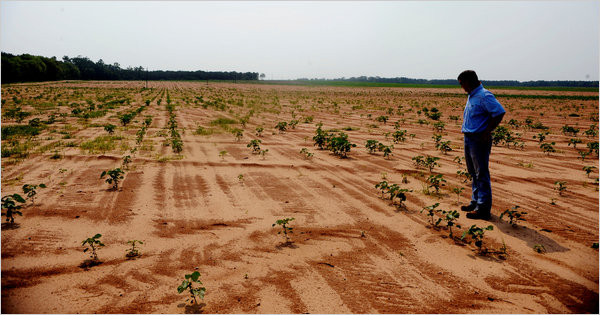
Grant Blankenship for The New York Times. Buster Haddock, an agricultural scientist at the University of Georgia, in a field where cotton never had the chance to grow.

By KIM SEVERSON and KIRK JOHNSON
Published: July 11, 2011

COLQUITT, Ga. — The heat and the drought are so bad in this southwest corner of Georgia that hogs can barely eat. Corn, a lucrative crop with a notorious thirst, is burning up in fields. Cotton plants are too weak to punch through soil so dry it might as well be pavement.
Waiting for Rain

Dangerously Dry – Nearly a fifth of the contiguous United States has been faced with the worst drought in recent years.

The Dry Season

OKLAHOMA A simple, if plaintive, message from the residents of Hough, in the panhandle, late last month. Shawn Yorks/The Guymon Daily Herald, via Associated Press

Farmers with the money and equipment to irrigate are running wells dry in the unseasonably early and particularly brutal national drought that some say could rival the Dust Bowl days.

“It’s horrible so far,” said Mike Newberry, a Georgia farmer who is trying grow cotton, corn and peanuts on a thousand acres. “There is no description for what we’ve been through since we started planting corn in March.”

The pain has spread across 14 states, from Florida, where severe water restrictions are in place, to Arizona, where ranchers could be forced to sell off entire herds of cattle because they simply cannot feed them.

In Texas, where the drought is the worst, virtually no part of the state has been untouched. City dwellers and ranchers have been tormented by excessive heat and high winds. In the Southwest, wildfires are chewing through millions of acres.

Last month, the United States Department of Agriculture designated all 254 counties in Texas natural disaster areas, qualifying them for varying levels of federal relief. More than 30 percent of the state’s wheat fields might be lost, adding pressure to a crop in short supply globally.

Even if weather patterns shift and relief-giving rain comes, losses will surely head past $3 billion in Texas alone, state agricultural officials said.

Most troubling is that the drought, which could go down as one of the nation’s worst, has come on extra hot and extra early. It has its roots in 2010 and continued through the winter. The five months from this February to June, for example, were so dry that they shattered a Texas record set in 1917, said Don Conlee, the acting state climatologist.

Oklahoma has had only 28 percent of its normal summer rainfall, and the heat has blasted past 90 degrees for a month.

“We’ve had a two- or three-week start on what is likely to be a disastrous summer,” said Kevin Kloesel, director of the Oklahoma Climatological Survey.

The question, of course, becomes why. In a spring and summer in which weather news has been dominated by epic floods and tornadoes, it is hard to imagine that more than a quarter of the country is facing an equally daunting but very different kind of natural disaster.

From a meteorological standpoint, the answer is fairly simple. “A strong La Niña shut off the southern pipeline of moisture,” said David Miskus, who monitors drought for the National Oceanic and Atmospheric Administration.

The weather pattern called La Niña is an abnormal cooling of Pacific waters. It usually follows El Niño, which is an abnormal warming of those same waters.

Although a new forecast from the National Weather Service’s Climate Prediction Center suggests that this dangerous weather pattern could revive in the fall, many in the parched regions find themselves in the unlikely position of hoping for a season of heavy tropical storms in the Southeast and drenching monsoons in the Southwest.

Climatologists say the great drought of 2011 is starting to look a lot like the one that hit the nation in the early to mid-1950s. That, too, dried a broad part of the southern tier of states into leather and remains a record breaker.

But this time, things are different in the drought belt. With states and towns short on cash and unemployment still high, the stress on the land and the people who rely on it for a living is being amplified by political and economic forces, state and local officials say. As a result, this drought is likely to have the cultural impact of the great 1930s drought, which hammered an already weakened nation.

“In the ’30s, you had the Depression and everything that happened with that, and drought on top,” said Donald A. Wilhite, director of the school of natural resources at the University of Nebraska in Lincoln and former director of the National Drought Mitigation Center. “The combination of those two things was devastating.”

Although today’s economy is not as bad, many Americans ground down by prolonged economic insecurity have little wiggle room to handle the effects of a prolonged drought. Government agencies are in the same boat.

“Because we overspent, the Legislature overspent, we’ve been cut back and then the drought comes along and we don’t have the resources and federal government doesn’t, and so we just tighten our belt and go on,” said Donald Butler, the director of the Arizona Department of Agriculture.

The drought is having some odd effects, economically and otherwise.

“One of the biggest impacts of the drought is going to be the shrinking of the cattle herd in the United States,” said Bruce A. Babcock, an agricultural economist at Iowa State University in Ames. And that will have a paradoxical but profound impact on the price of a steak.

Ranchers whose grass was killed by drought cannot afford to sustain cattle with hay or other feed, which is also climbing in price. Their response will most likely be to send animals to slaughter early. That glut of beef would lower prices temporarily.

But America’s cattle supply will ultimately be lower at a time when the global supply is already low, potentially resulting in much higher prices in the future.

There are other problems. Fishing tournaments have been canceled in Florida and Mississippi, just two of the states where low water levels have kept recreational users from lakes and rivers. In Texas, some cities are experiencing blackouts because airborne deposits of salt and chemicals are building up on power lines, triggering surges that shut down the system. In times of normal weather, rain usually washes away the environmental buildup. Instead, power company crews in cities like Houston are being dispatched to spray electrical lines.

In this corner of Georgia, where temperatures have been over 100 and rainfall has been off by more than half, fish and wildlife officials are worried over the health of the shinyrayed pocketbook and the oval pigtoe mussels, both freshwater species on the endangered species list.

The mussels live in Spring Creek, which is dangerously low and borders Terry Pickle’s 2,000-acre farm here. He pulls his irrigation from wells that tie into the water system of which Spring Creek is a part.

Whether nature or agriculture is to blame remains a debate in a state that for 20 years has been embroiled in a water war with Alabama and Florida. Meanwhile, Colquitt has allowed the state to drill a special well to pump water back into the creek to save the mussels from extinction.

Most farmers here are much more worried about the crops than the mussels. With cotton and corn prices high, they had high hopes for the season. But many have had to replant fields several times to get even one crop to survive. Others, like Mr. Pickle, have relied on irrigation so expensive that it threatens to eat into any profits.

The water is free, but the system used to get it from the ground runs on diesel fuel. His bill for May and June was an unheard of $88,442.

Thousands of small stories like that will all contribute to the ultimate financial impact of the drought, which will not be known until it is over. And no one knows when that will be.

The United States Department of Agriculture’s Farm Service Agency has already provided over $75 million in assistance to ranchers nationwide, with most of it going to Florida, New Mexico and Texas. An additional $62 million in crop insurance indemnities have already been provided to help other producers.

Economists say that adding up the effects of drought is far more complicated than, say, those of a hurricane or tornado, which destroy structures that have set values. With drought, a shattered wheat or corn crop is a loss to one farmer, and it has a specific price tag. But all those individual losses punch a hole in the food supply and drive prices up. That is good news for a farmer who manages to get a crop in. The final net costs down the line are thus dispersed, and mostly passed along.

That means grocery shoppers will feel the effects of the drought at the dinner table, where the cost of staples like meat and bread will most likely rise, said Michael J. Roberts, an associate professor of agricultural and resource economics at North Carolina State University in Raleigh, N.C. “The biggest losers are consumers,” he said.

Kim Severson reported from Colquitt, Ga., and Kirk Johnson from Denver. Dan Frosch contributed reporting from Denver.