Arquivo da tag: Redes sociais

Interview with Nobel prize winner Elinor Ostrom on climate change (Integrated Regional Information Networks)

Photo: Indiana University. Elinor Ostrom: A champion of people power

JOHANNESBURG, 25 April 2012 (IRIN) – The governance of natural resources like land, the oceans, rivers and the atmosphere, can affect the impact of some of the world’s biggest crises caused by natural events like droughts and floods. How best to manage those resources has been at the heart of the work by Nobel Prize winner (economics) Elinor Ostrom.

She has been looking at how communities across the world, from developing and rural economies like Nepal and Kenya to developed ones like the USA and Switzerland, manage their commonly shared resources such as fisheries, pasture land and water sustainably.

Ostrom’s faith in the ability of the individual and community to be able to trust each other, take the right course of action and not wait for governments to make the first move is pivotal to her thinking.

Ostrom works with the concept of “polycentrism”, which she developed with her husband Vincent Otsrom. She advocates vesting authority in individuals, communities, local governments, and local NGOs as opposed to concentrating power at global or national levels.

Ostrom recently suggested using this “polycentric approach” to address man-made climate change. She talked to IRIN by email about “polycentrism”, Rio+20, climate change, trust and the power of local action.

QYou have suggested a polycentric approach as opposed to single policies at a global level to reduce greenhouse gas emissions. Could you explain how that would work? Do you think a similar approach would work to get all countries and their people to believe in, and adopt, sustainable development?

A: We have modelled the impact of individual actions on climate change incorrectly and need to change the way we think about this problem. When individuals walk a distance rather than driving it, they produce better health for themselves. At the same time that they reduce the amount of greenhouse gas emissions that they are generating. There are benefits for the individual and small benefits for the globe. When a building owner re-does the way the building is insulated and the heating system, these actions can dramatically change the amount of greenhouse gas emissions made. This has an immediate impact on the neighbourhood of the building as well as on the globe.

When cities and counties decide to rehabilitate their energy systems so as to produce less greenhouse gas emissions, they are reducing the amount of pollution in the local region as well as greenhouse gas emissions on the globe. In other words, the key point is that there are multiple externalities involved for many actions related to greenhouse gas emissions. While in the past the literature has underplayed the importance of local effects, we need to recognize – as more and more individuals, families, communities, and states are seeing – that they will gain a benefit, as well as the globe, and that cumulatively a difference can be made at the global level if a number of small units start taking action. We have a much greater possibility of impacting global change problems if we start locally.

“the solutions that are evolved by local people have a chance of being more imaginative and better ways of solving these problems…”

Q: The earth is our common resource system – yet many countries including China and India feel they also have a right to grow, burn coal to get to where the developed world is – how do you get them out of that frame of mind without compromising the question of equity?

A: We may not be able to convince India and China of all of this. Part of my discouragement with the international negotiations is that we have gotten riveted into battles at the very big level over who caused global change in the first place and who is responsible for correcting [it]. It will take a long time to resolve some of these conflicts. Meanwhile, if we do not take action, the increase to greenhouse gas collection at a global level gets larger and larger. While we cannot solve all aspects of this problem by cumulatively taking action at local levels, we can make a difference, and we should.

Q: Do you think sustainable development did not gain much currency as it was directed at governments and a top-down approach? You think the world is about to repeat that mistake (if you would call it that?) at Rio+20? What would you do – would you ever call such a gathering of governments?

A: Yes, I do think that directing the question of climate change primarily at governments misses the point that actions that reduce greenhouse gas emissions must be taken by individuals, communities, cities, states, residents of entire nations, and the world. Yet, it is important that public officials recognize that there is a role for an international agreement and that they should be working very hard on getting an agreement that establishes international regimes that has a chance to reduce emissions across countries.

Q: You are a great believer in ordinary people’s ability to organize and use their commonly shared resources wisely, but I take it that does not work all the time? But ultimately collective action at the grassroots can force change at the top?

A: I am a believer of the capabilities of people to organize at a local level. That does not mean that they always do. There are a wide variety of collective action problems that exist at a small scale. The important thing is that people at a small scale, who know what the details of the problems are, organize, rather than calling on officials at a much larger scale.

Officials at a larger scale may have many collective-action problems of their own that they need to address. They do not have the detailed information about problems at a small scale that people who are confronting those every day do have. Thus, the solutions that are evolved by local people have a chance of being more imaginative and better ways of solving these problems than allowing them to go unsolved and eventually asking a much larger scale unit to solve it for them.

Q: This approach probably works better in a rural setting where there is a sense of community and of a shared responsibility to take care of their common resources. But how do you get that sense of ownership of the planet in an urban setting?

A: To solve these delicate problems at any scale requires individuals to trust that others are also going to contribute to their solution. Building trust is not something that can be done overnight. Thus, the crucial thing is that successful efforts at a local scale be advertised and well known throughout a developing country.

Developing associations of local communities, where very serious discussions can be held of the problems they are facing and creative ways that some communities, who have faced these problems, have adopted solutions that work. That does not mean that the solutions that work in one environment in a particular country will work in all others, but posing it as a solution that fits a local environment and that the challenge that everyone faces is to know enough about the social-ecological features of the problems they are facing that they can come up with good solutions that fit that local social-ecological system.

Q: I have been covering the recent drought in Niger – I came across people who were going to pack up and leave their village for good… Would that motivate people, countries, governments to take action to reduce emissions? But how do you make people in Europe, the US or Asia think about the people in Niger as their own?

A: There is no simple answer to this question. It is here that churches and NGOs can play a particular role in knowing about the problems being faced by villagers in Niger and other developing countries and trying to help. They can then also write stories about these problems in a way that people in Britain, Europe, and the US may understand better. It is a problem in some cases that officials in developing countries are corrupt, and direct aid to the country may only go into private bank accounts. We have to rethink how we organize governance at multiple scales so as to reduce the likelihood of some individuals having very strong powers and capability of using their public office primarily for private gain.

Q: Do you see the world moving in unison towards sustainability in the next five years? Do you think the world is prepared to take on this question and specially now when we are in a recession?

A: No, I do not see the world moving in unison. I do see some movements around the world that are very encouraging, but they are nowhere the same everywhere. We need to get out of thinking that we have to be moving the same everywhere. We need to be recognizing the complexity of the different problems being faced in a wide diversity of regions of the world. Thus, really great solutions that work in one environment do not work in others. We need to understand why, and figure out ways of helping to learn from good examples as well as bad examples of how to move ahead.
Charting Hybridised Realities (Tactical Media Files)

Posted on April 15, 2012 by 

This text was originally written for the Re-Public on-line journal, which focuses on innovative developments in contemporary political theory and practice, and is published from Greece. As the journal has ground to a (hopefully just temporary) halt under severe austerity pressures we decided to post the current first draft of the text on the Tactical Media Files blog. This posting is one of two, the second of which will follow shortly. Both texts build on my recent Network Notebook on the ‘Legacies of Tactical Media‘.

The second text is a collection of preliminary notes that expand on recent discussions following Marco Deseriis and Jodi Dean’s essay “A Movement Without Demands”. It is conceivable that both texts will merge into a more substantive essay in the future, but I haven’t made up my mind about that as yet.

Hope this will be of interest,
Eric

Charting Hybridised Realities

Tactical Cartographies for a densified present

In the midst of an enquiry into the legacies of Tactical Media – the fusion of art, politics, and media which had been recognised in the middle 1990s as a particularly productive mix for cultural, social and political activism [1], the year 2011 unfolded. The enquiry had started as an extension of the work on the Tactical Media Files, an on-line documentation resource for tactical media practices worldwide [2], which grew out of the physical archives of the infamous Next 5 Minutes festival series on tactical media (1993 – 2003) housed at the International Institute of Social History in Amsterdam. After making much of tactical media’s history accessible again on-line, our question, as editors of the resource, had been what the current significance of the term and the thinking and practices around it might be?

Prior to 2011 this was something emphatically under question. The Next 5 Minutes festival series had been ended with the 2003 edition, following a year that had started on September 11, 2002, convening local activists gatherings named as Tactical Media Labs across six continents. [3] Two questions were at the heart of the fourth and last edition of the Next 5 Minutes: How has the field of media activism diversified since it was first named ‘tactical media’ in the middle 1990s? And what could be significance and efficacy of tactical media’s symbolic interventions in the midst of the semiotic corruption of the media landscape after the 9/11 terrorist attacks?

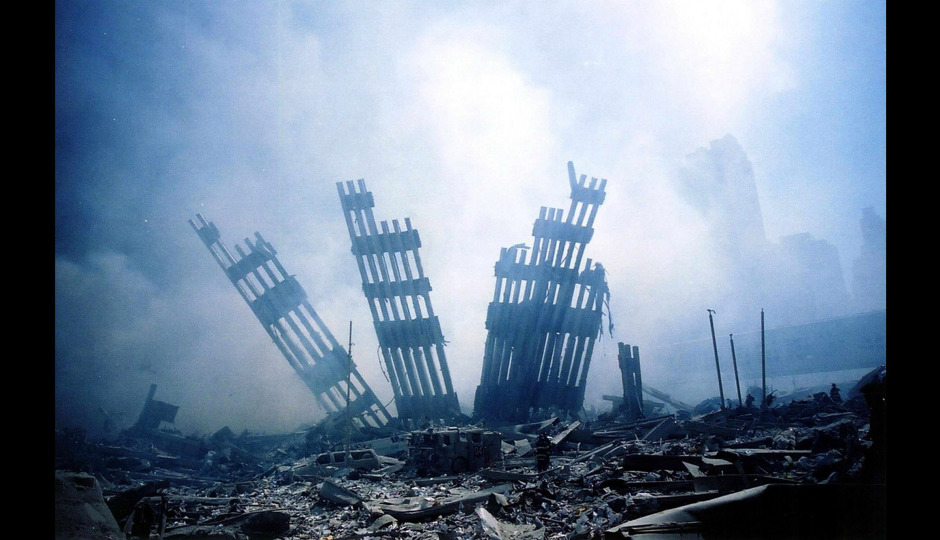
This ‘crash of symbols’ for obvious reasons took centre stage during this fourth and last edition of the festival. Naomi Klein had famously claimed in her speedy response to the horrific events of 9/11 that the activist lever of symbolic intervention had been contaminated and rendered useless in the face of the overpowering symbolic power of the terrorist attacks and their real-time mediation on a global scale. [4] The attacks left behind an “utterly transformed semiotic landscape” (Klein) in which the accustomed tactics of culture jammers had been ‘blown away’ by the symbolic power of the terrorist atrocities. Instead ‘we’ (Klein appealing to an imaginary community of social activists) should move from symbols to substance. What Klein overlooked in this response in ‘shock and awe’, however, was that while the semiotic landscape had indeed been dramatically transformed (and corrupted) in the wake of the 9/11 attacks, it still remained a semiotic landscape – symbols were still the only lever and entry point into the wider real-time mediated public domain.

Therefore, as unlikely as it may have seemed at the time, the question about the diversification of the terrain and the practices of media activism(s) was ultimately of far greater importance. What the 9/11 crash of symbols and the semiotic corruption debate contributed here was ‘merely’ an added layer of complexity. In a society permeated by media flows, social activism necessarily had to become media activism, and thus had to operate in a significantly more complex and contested environment. The diversification of the media and information landscape, however, also implied that a radical diversification of activist strategies was needed to address these increasingly hybridised conditions.

To name but a few of the emerging concerns: Witnessing of human rights abuses around the world, and creating public visibility and debate around them remained a pivotal concern for many tactical media practitioners, as it had been right from the early days of camcorder activism. But now new concerns over privacy in networked media environments, coupled with security and secrecy regimes of information control entered the scene. Critical media arts spread in different directions, claiming new terrains as diverse as life sciences and bio-engineering, as well as ‘contestational robotics’, interventions into the space of computer games, and even on-line role playing environments. Meanwhile the free software movement made its strides into developing more autonomous toolsets and infrastructures for a variety of social and cultural needs – adding a more strategic dimension to what had hitherto been mostly an interventionist practice. In a parallel movement on-line discussion groups, mailing lists, and activity on various social media platforms started to coalesce slowly into what media theorist Geert Lovink has described as ‘organised networks’. [5] Or finally the rapid development of wireless transmission technologies, smart phones and other wireless network clients, which introduced a paradoxical superimposition of mediated and embodied spatial logics, best be captured in the multilayered concept of Hybrid Space. [6]

Our question was therefore entirely justified, to ask how the term ‘tactical media’ could possibly bring together such a diversified, heterogeneous, and hybridised set of practices in a meaningful way? It had become clear that more sophisticated cartographies would be necessary to begin charting this intensely hybridised landscape.

A digital conversion of public space

If the events in 2011 have made one thing clear it is that the ominous claim of Critical Art Ensemble that “the streets are dead capital” [7] has been declared null and void by an astounding resurgence of street protest, whatever their longer term political significance and fallout might be. These protests staged in the streets and squares, ranging from anti-austerity protests in Southern Europe to the various uprisings in Arab countries in North Africa and the Middle East, to the Occupy protests in the US and Northern Europe, have by no means been staged in physical spaces out of a rejection of the semiotic corruption of the media space. Much rather the streets and squares have acted as a platform for the digital and networked multiplication of protest across a plethora of distribution channels, cutting right across the spectrum of alternative and mainstream, broadcast and networked media outlets.

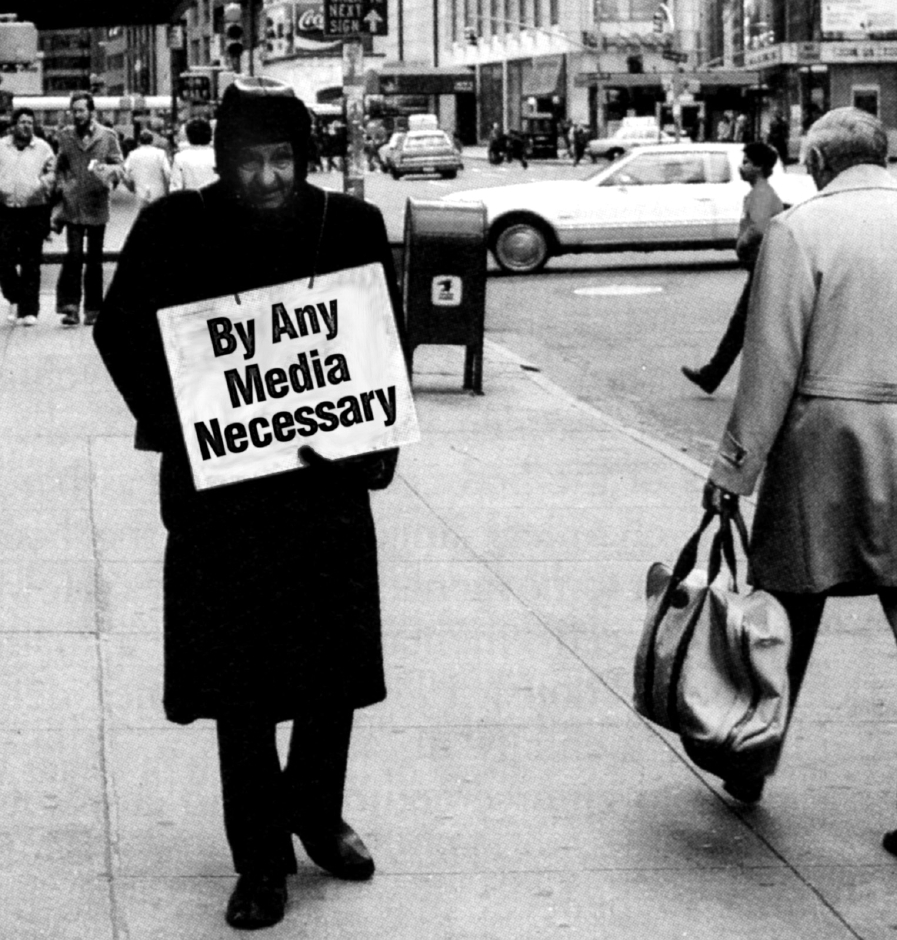
What remained true to the origin of the term ‘tactical media’ was to build on Michel de Certeau’s insight that the ‘tactics of the weak’ operate on the terrain of strategic power through highly agile displacements and temporary interventions [8], creating a continuous nomadic movement, giving voice to the voiceless by means of ‘any media necessary’ (Critical Art Ensemble). However, the radical dispersal of wireless and mobile media technologies meant that mediated and embodied public spaces increasingly started to coincide, creating a new hybridised logic for social contestation. As witnessed in the remarkable series of public square occupations in 2011, through the digital conversion of public space the streets have become networks and the squares the medium for collective expression in a transnationally interconnected but still highly discontinuous media network.

Horizontal networks / lateral connections

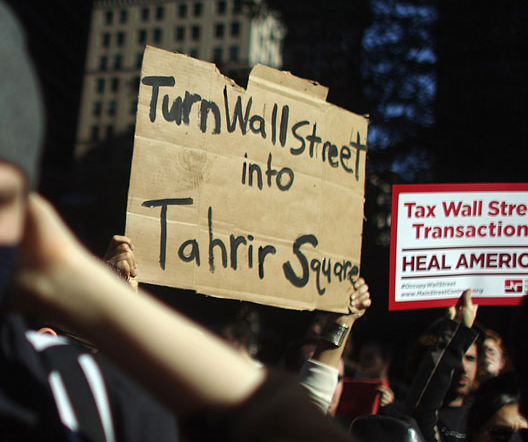
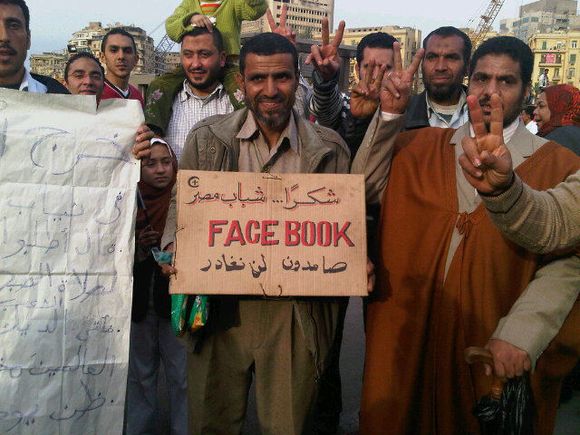
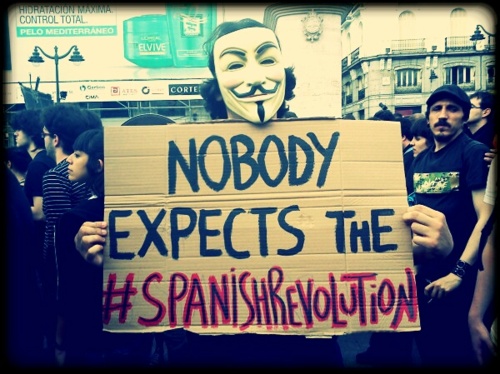
One of the remarkable characteristics of the various protests is not simply the adoption of similar tactics (most notably occupations of public city squares), but the conscious interlinking of events as they unfold. Italian activists of the Unicommons movement physically linked up with revolting students in Tunisia, Egyptian bloggers and occupiers of Tahrir Square linked up with the ‘take the square’ activists in Spain, who in turn expressed solidarity and even co-initiated transnational actions with #occupy activists in the United States and elsewhere. It is the first time that the new organisational logic of transnational horizontal networks that has been theorised for instance in the seminal work “Territory, Authority, Rights” by sociologist Saskia Sassen, has become so evidently visible in activists practices across a set of radically dispersed geographic assemblages.

Horizontal networks by-pass traditional vertically integrated hierarchies of the local / national / international to create specific spatio-temporal transnational linkages around common interests, but also around affective ties. By and large these ties and linkages are still extra-institutional, largely informal, and because of their radically dispersed make up and their ‘affective’ constitution highly unstable. Political institutions have not even begun assembling an adequate response to these new emergent political constellations (other than traditional repressive instruments of strategic power, i.e. evictions, arrests, prohibitions). Given the structural inequalities that fuel the different strands of protest the longer term effectiveness of these measures remains highly uncertain. The institutional linkages at the moment seem mostly limited to anti-institutional contestation on the part of protestors and repressive gestures of strategic authority. The truly challenging proposition these new transnational linkages suggest, however, is their movement to bypass the nested hierarchies of vertically integrated power structures in a horizontal configuration of social organisation. They link up a bewildering array of local groups, sites, networks, geographies, and cultural contexts and sensitivities, taking seriously for the first time the networked space as a new ‘frontier zone’ (Sassen) where the new constellations of lateral transnational politics are going to be constructed.

Charting the layered densities of hybrid space

Hybrid Space is discontinuous. It’s density is always variable, from place to place, from moment to moment. Presence of carrier signals can be interrupted or restored at any moment. Coverage is never guaranteed. The economics of the wireless network space is a matter of continuous contestation, and transmitters are always accompanied by their own forms of electromagnetic pollution (electrosmog). Charting and navigating this discontinuous and unstable space, certainly for social and political activists, is therefore always a challenge. Some prominent elements in this cartography are emerging more clearly, however:

– connectivity: presence or absence of the signal carrier wave is becoming an increasingly important factor in staging and mediating protest. Exclusive reliance on state and corporate controlled infrastructures thus becomes increasingly perilous.

– censorship: censorship these days comes in many guises. Besides the continued forms of overt repression (arrests, confiscations, closures) of media outlets, new forms are the excessive application of intellectual property rights regimes to weed out unwarranted voices from the media landscape, but also highly effective forms of  dis-information and information overflow, something that has called the political efficacy of a project like WikiLeaks emphatically into question.

– circumvention: Great Information Fire Walls and information blockages are obvious forms of censorship, widely used during the Arab protests and common practice in China, now also spreading throughout the EU (under the guise of anti-piracy laws). These necessitate an ever more sophisticated understanding and deployment of internet censorship circumvention techniques, an understanding that should become common practice for contemporary activists. [9]

– attention economies: attention is a sought after commodity in the informational society. It is also fleeting. (Media-) Activists need to become masters at seizing and displacing public attention. Agility and mobility are indispensable here.

– public imagination management: Strategic operators try to manage public opinion. Activists cannot rely on this strategy. They do not have the means to keep and maintain public opinion in favour of their temporary goals. Instead activists should focus on ‘public imagination management’ – the continuous remembrance that another world is possible.

Beyond semiotic corruption: A perverse subjectivity

The immersion in extended networks of affect that now permeate both embodied and mediated spaces introduces a new and inescapable corruption of subjectivity. Critical theory already taught us that we cannot trust subjectivity. However, the excessive self-mediation of protestors on the public square has shown that a deep desire for subjective articulation drives the manifestation in public. The dynamic is underscored further by upload statistics of video platforms such as youtube that continue to outpace the possibility for the global population to actually see and witness these materials.

Rather than dismissing subjectivity it should be embraced. This requires a new attitude ‘beyond good and evil’, beyond critique and submission. A new perverse subjectivity is able to straddle the seemingly impossible divide between willing submission to various forms of corporate, state and social coercion, and vital social and political critique and contestation. It’s maxim here: Relish your own commodification, embrace your perverse subjectivity, in order to escape the perversion of subjectivity.

Eric Kluitenberg
Amsterdam, April 15, 2012.

References:

1 – See: David Garcia & Geert Lovink, The ABC of Tactical Media, May 1997, a.o.:
www.tacticalmediafiles.net/article.jsp?objectnumber=37996

2 – www.tacticalmediafiles.net

3 – Documentation of the Tactical Media Labs events can be found at:
www.n5m4.org

4 – Naomi Klein – Signs of the Times, in The Nation, October 5, 2001.
Archived at: www.tacticalmediafiles.net/article.jsp?objectnumber=46632

5 – Geert Lovink and Ned Rossiter, Dawn of the Organised Networks, in; Fibreculture Journal, Issue 5, 2005.
http://five.fibreculturejournal.org/fcj-029-dawn-of-the-organised-networks/

6 – See my article The Network of Waves, and the theme issue Hybrid Space of Open – Journal for Art and the Public Domain, Amsterdam, 2006;
www.tacticalmediafiles.net/article.jsp?objectnumber=48405
(the complete issue is linked as pdf file to the article).

7 – Critical Art Ensemble, Digital Resistance, Autonomedia, New York, 2001.
www.critical-art.net/books/digital/

8 – Michel de Certeau, The Practice of Everyday Life, University of California Press, 1984.

9 – A useful manual can be found here: www.flossmanuals.net/bypassing-censorship/

A internet está cada vez mais política (Folha de S.Paulo)

JC e-mail 4464, de 27 de Março de 2012.

fonte: http://www.jornaldaciencia.org.br/Detalhe.jsp?id=81741

O advogado Marcel Leonardi foi um dos principais colaboradores na discussão pública que elaborou o Marco Civil da Internet, projeto de lei proposto pelo Ministério da Justiça para traçar princípios como neutralidade e privacidade na internet brasileira. Tempos depois, Leonardi foi chamado para assumir o posto de diretor de políticas públicas do Google no Brasil.

Em outras palavras, ele é o responsável por conversar com o governo, articular a defesa dos usuários em casos como o da cobrança do Escritório Central de Arrecadação e Distribuição (Ecad) sobre vídeos do YouTube embedados em blogs e levar à esfera pública princípios básicos da internet.

Tanto é que ele vive entre idas e vindas de Brasília e participa de audiências públicas para expor a opinião do Google – e a sua – sobre projetos de leis em discussão que afetam a maneira como as pessoas usam a internet, como o Código de Defesa do Consumidor, a Lei de Direitos Autorais e o próprio Marco Civil da Internet.

O advogado também responde questionamentos em nome do Google. Recentemente, o Ministério da Justiça exigiu explicações sobre as mudanças das regras de privacidade. A empresa, afinal, é custeada por publicidade – e neste modelo, os dados pessoais dos usuários têm muito valor. E é neste ponto em que os interesses da empresa e os dos usuários se distanciam. Leonardi diz que é uma questão de conscientização dos usuários sobre as novas regras.

Vestindo camiseta e calça jeans, sem o terno habitual, o articulador do Google deixa claro: hoje as empresas também fazem política. Cada vez mais.

O Ministério da Justiça questionou as mudanças na política de privacidade do Google. O que vocês responderam?

A gente está disposto a trabalhar com as autoridades. Há muita apreensão do que a gente faz em relação à privacidade, mas há pouca compreensão. Antes o Google tinha políticas separadas por produtos. Mas todas elas, com exceção de duas, já diziam que dados de um serviço poderiam ser utilizados em outros serviços. Então a unificação não alterou nada. Os dados que a gente coleta são os mesmos. As exceções eram o YouTube, que tinha uma política própria, e o histórico de buscas, que hoje expressamente pode ser usado em outros produtos do Google.

O que é preocupante.

A gente não considera assustador porque damos ao usuário as ferramentas para ele controlar isso. O usuário acessa o painel de controle e diz se quer ou não manter o histórico da busca. A pessoa pode desativar completamente. Seria assustador se acontecesse sem o usuário saber o que está acontecendo. Todas as empresas do setor adotam esse modelo.

Os dados pessoais são valiosos, e as pessoas não têm ideia do que é feito com as informações.

A mudança passou pelo maior esforço de notificação da história do Google. Anunciamos no dia 24 de janeiro, e elas só entraram em vigor no dia 1º de março. Durante todo esse período, tinha um aviso em todas as páginas. A lógica era reduzir o “legalês”, porque a indústria de internet sempre ouviu que as políticas e termos de uso tinham de ser mais claros. Enxugamos radicalmente, só que cai nesse problema: em que momento você consegue forçar alguém a ler? As pessoas sempre dizem que estão preocupadas com a privacidade, mas agem diferente.

O Google foi condenado recentemente por causa de uma postagem no Orkut. A responsabilização de empresas por conteúdo de usuários é recorrente?

É um debate antigo. Mundialmente existe o conceito de que a plataforma não é responsável. Nos EUA e na Europa a lei diz isso expressamente. O Brasil ainda não tem uma lei específica. Uma das propostas é o Marco Civil da Internet, que diz que a responsabilidade só será derivada do descumprimento de uma ordem judicial. Na ausência de leis, os tribunais analisam caso a caso. O Google sempre recorre para mostrar que, pela lógica e pelo bom senso, não existe responsabilidade da plataforma.

Como funciona o processo de remoção de conteúdo, por exemplo, um post de um blog?

Em casos de direito autoral, o Google recebe a notificação de alguém que demonstra que é titular daquele direito e que aquilo não foi autorizado, e existe a verificação se isso viola ou não. Mas existem alguns requisitos. Na lei americana, há os requisitos do DMCA (Digital Millenium Copyright Act, lei de direitos autorais sancionada em 1998). No Brasil, da lei autoral.

O próprio Google verifica?

Existem os times internos que avaliam. Se há infração, a remoção acontece sem intervenção judicial, porque está de acordo com a nossa política de não permitir violação de direito autoral.

Concorda com a proposta do Ministério da Cultura, na nova Lei de Direitos Autorais, de institucionalizar um mecanismo de notificação?

Ainda é controverso. Eles pretendiam incluir o mecanismo que transforma em lei uma prática que muitas empresas adotam. O problema desse modelo é que dá margem para muito abuso. A gente vê muito isso nos EUA. Todo mundo tenta enquadrar própria situação em uma violação para justificar uma remoção.

Por que vocês se posicionaram contra a cobrança do Ecad sobre vídeos do YouTube?

Percebemos uma distorção na postura do Ecad. Achamos importantíssimo deixar pública a nossa posição de que não compactuávamos com aquilo, de que a interpretação da lei estava errada. O grande problema é que os novos modelos de negócio querem florescer, mas eles vêem uma interpretação antiga da lei autoral e isso impede que eles cresçam. O Spotify é um exemplo. O sujeito paga 10 euros e tem acesso a milhões de músicas. Muitas vezes a pirataria nada mais é que uma demanda reprimida que o mercado não está cumprindo.

A reforma da lei de direitos autorais é um avanço?

É uma incógnita. Tenho a impressão de que a versão intermediária é um pouco mais aberta e amigável para esses modelos. Tinha a licença compulsória, que era interessante, e uma linguagem que permitiria um uso mais flexível.

Vocês opinaram nesse texto?

A gente participa dos debates, mas depois da consulta pública a coisa fica fechada. No Congresso dá para conversar. É importante. Inclusive, se não fossem os ativistas, muita coisa de regulação de internet no Brasil teria sido diferente. Toda a oposição à lei Azeredo, toda a pressão para o Marco Civil, é fruto do engajamento. Nos EUA, a o caso Sopa foi interessante. O fato da Wikipedia ter saído do ar apavorou muita gente. Foi só aí que houve conscientização sobre os riscos da lei.

Essa lei nos EUA provocou um movimento em defesa dos princípios da internet. As empresas estão assumindo uma postura política?

Não tem como a gente não pensar politicamente hoje. Não dá para olhar para o próprio umbigo e pensar que enquanto o negócio vai bem não é preciso conversar. Porque existem questões acima. Quando a gente pensa politicamente é isso, todas as empresas do setor tendem a conversar e entender melhor como isso funciona.

Há necessidade de uma lei atualizada de cibercrimes?

Existe a necessidade do juiz ou de quem trabalha com direito criminal entender melhor a internet. Porque a maior parte do que está na lei já funciona. Não podemos correr o risco de adotar um texto tão genérico ao ponto de você estar lá fuçando no celular, sem querer você invade um sistema e vão dizer que você cometeu um crime.

O Brasil ainda é líder nos pedidos de remoção de conteúdo?

Sim. No nosso relatório de transparência constam todas as requisições do governo ou da Justiça de remoção de conteúdo. O Brasil é líder em remoções porque aqui é fácil. Você pode ir sem custo e sem advogado a um tribunal de pequenas causas e pedir uma liminar para tirar um blog do ar. Além disso, muita gente está acostumada com a cultura de “na dúvida, vamos pedir para remover”.

O que pode instituir a censura.

É. A gente já se deparou com casos assustadores. Está crescendo o número de empresas criticadas por consumidores que entram com uma ação para remover qualquer referência negativa.

(Folha de São Paulo)

Community Media: A Good Practice Handbook (UNESCO)

Compiled and edited by Steve Buckley

Published by UNESCO and available free online at:
http://unesdoc.unesco.org/images/0021/002150/215097E.pdf

Among its activities to mark World Radio Day 2012, UNESCO has
launched a new good practice handbook with case studies of community
media from around the world. The publication draws on a diversity of
experiences to provide inspiration and support for those engaged in
community media practice and advocacy and to raise awareness and
understanding of community media among policy makers and other stakeholders.

13 February has been proclaimed by UNESCO as a date to celebrate
radio broadcast, improve international cooperation among radio
broadcasters and encourage decision-makers to create and provide
access to information through radio. Community Media: A Good Practice
Handbook is a compilation of 30 community radio and other community
media examples demonstrating successful approaches to strengthening
public voice.

“The value of this publication lies in the fact that it highlights
problems while at the same time offering possible solutions. It
presents a useful empirical basis for replicating time-tested
decisions about how community media can become an even more effective
element of a free, independent and pluralistic media system of any
democratic society. This book will be a useful reference to community
media practitioners, policy-makers, researchers, community
organizers, and other media development stakeholders.”

From the Foreword by Wijayananda Jayaweera, former Director,
Communication Development Division/IPDC, UNESCO, Paris

19 Climate Games that Could Change the Future (Climate Interactive Blog)

By 

March 9, 2012 – 10:13 a.m.

The prevalence of games in our culture provides an opportunity to increase the understanding of our global challenges. In 2008 the Pew Research Centerestimated that over half of American adults played video games and 80% of young Americans play video games. The vast majority of these games serve purely to entertain. There are a growing number of games that aim to make a difference, however. These games range from those that show players the complexity of creating adequate aid packages and delivering them to places in need to games thatrequire people to get out and work to improve their communities to do well in the game.

Looking at the climate change challenge there are a number of games and interactive tools to broaden our understanding of the dynamics involved.Climate Interactive, for one, has led the development of the role-playing game World Climate, which simulates the UN climate change negotiations and is being adopted from middle school all the way up to executive management-level classrooms. Many are recognizing the power of games and everyone from government agencies to NGOs to a group of teenagers is trying to launch a game to help address climate change. Below are some of the climate and sustainability-related games we’ve found. Let us know if you’ve found others.

Computer Games:

Climate Challenge

1. Climate Challenge: The player acts as a European leader who must make decisions for their nation to reduce CO2 emissions, but must also keep in mind public and international approval, energy, food, and financial needs.

2. Fate of the World: A PC game that challenges players to solve the crises facing the Earth from natural disasters and climate change to political uprisings and international relations.

3. CEO2: A game that puts players at the head of a company in one of four industries. The player must then make decisions to reduce the CO2 and maintain (and increase) the company’s value.

4. VGas: Users build a house and select the best furnishing and lifestyle choices to have the lowest carbon footprint.

5. CO2FX: A multi-player educational game, designed for students in high school, which explores the relationship of climate change to economic, political, and science policy decisions.

6. “Operation: Climate Control” Game: A multi-player computer game where the player’s role is to decide on local environmental policy for Europe through the 21st century.

My2050

7. My2050: An interactive game to determine a scenario for the UK to lower its CO2 emissions 20% below 1990 levels by 2050. The user can select from adjustments in sectors from energy to transit.

8. Plan it Green: Gamers act as the planners of a city to revitalize it to become a greener town through energy retrofits, clean energy jobs, and green building.

9. Logicity: A game that challenges players to reduce their carbon footprints by making decisions in a virtual city.

10. Electrocity: A game designed for school children in New Zealand to plan a city that balances the needs of energy, development, and the environment.

11. Climate Culture: A virtual social networking game based on players’ actual carbon footprints and lifestyle choices. Players compete to earn badges and awards for their decisions.

12. World Without Oil: An alternate reality game that was played out on blogs and other social media platforms for 32 weeks in 2007 by thousands of players to simulate what might happen if there was an oil crisis and oil became inaccessible. Participants wrote blogs and made videos about their experience as if it was real.

13. SimCity 5 (coming 2013): With over 20 years of experience and millions of players the SimCity series has captured imaginations by putting players in control of developing cities. Recently announced, SimCity 5 will add among other things the need to face sustainability challenges like climate change, limited natural resources, and urban walkability.

Role-playing Games:

14. World Climate Exercise: A role-playing game for groups that simulates the UN climate change negotiations by dividing the group into regional and national negotiating teams to negotiate a treaty to 2 degrees or less. 

15. “Stabilization Wedge” Game: A game to show participants the different ways to cut carbon emissions, through the concept of wedges.

Board Games:

16. Climate Catan: Building on the widely popular board game Settlers of Catan, this version adds oil as resource that spurs development but if too much is used it also instigates a climate related disaster which can ruin development.

17. Climate-Poker: A card game with the aim to have the largest climate conference in order to address climate change.

18. Keep Cool- Gambling with the Climate: Players take on the roles of national political leaders trying to address climate change and must make decisions about the type of growth and balance the desires of lobby groups and challenges of natural disasters.

19. Polar Eclipse Game: A game where players navigate different decisions in order to chart a path to future that avoids the worst temperature rise.

Lessons from Gaming for Climate Wonks and Leaders — Video

By 

Games can help us ensure that climate and energy analysis gets used to make a difference. Last week at the Climate Prediction Applications Science Workshopin Miami, Climate Interactive co-director Drew Jones, gave a keynote presentation to an audience of climate analysts, many who are working to communicate the massive amount of climate data to the public.

In Drew’s speech below, he draws out the key things that we are learning from games, like Angry Birds, Farmville, World of Warcraft, and the existing efforts to integrate climate change into games. Also included in this presentation, but left out of the video, was a condensed version of the World Climate Exercise, a game that Climate Interactive has developed to help people explore the complex dynamics encountered at the international climate change negotiations.

Chimpanzees Have Police Officers, Too (Science Daily)

Mostly high-ranking males or females intervene in a conflict. (Credit: Claudia Rudolf von Rohr)

ScienceDaily (Mar. 7, 2012) — Chimpanzees are interested in social cohesion and have various strategies to guarantee the stability of their group. Anthropologists now reveal that chimpanzees mediate conflicts between other group members, not for their own direct benefit, but rather to preserve the peace within the group. Their impartial intervention in a conflict — so-called “policing” — can be regarded as an early evolutionary form of moral behavior.

Conflicts are inevitable wherever there is cohabitation. This is no different with our closest relatives, the chimpanzees. Sound conflict management is crucial for group cohesion. Individuals in chimpanzee communities also ensure that there is peace and order in their group. This form of conflict management is called “policing” — the impartial intervention of a third party in a conflict. Until now, this morally motivated behavior in chimpanzees was only ever documented anecdotally.

However, primatologists from the University of Zurich can now confirm that chimpanzees intervene impartially in a conflict to guarantee the stability of their group. They therefore exhibit prosocial behavior based on an interest in community concern.

The more parties to a conflict there are, the more policing there is

The willingness of the arbitrators to intervene impartially is greatest if several quarrelers are involved in a dispute as such conflicts particularly jeopardize group peace. The researchers observed and compared the behavior of four different captive chimpanzee groups. At Walter Zoo in Gossau, they encountered special circumstances: “We were lucky enough to be able to observe a group of chimpanzees into which new females had recently been introduced and in which the ranking of the males was also being redefined. The stability of the group began to waver. This also occurs in the wild,” explains Claudia Rudolf von Rohr, the lead author of the study.

High-ranking arbitrators

Not every chimpanzee makes a suitable arbitrator. It is primarily high-ranking males or females or animals that are highly respected in the group that intervene in a conflict. Otherwise, the arbitrators are unable to end the conflict successfully. As with humans, there are also authorities among chimpanzees. “The interest in community concern that is highly developed in us humans and forms the basis for our moral behavior is deeply rooted. It can also be observed in our closest relatives,” concludes Rudolf von Rohr.

Number of U.S. Hate Groups Is Rising, Report Says (N.Y. Times)

By KIM SEVERSON – Published: March 7, 2012

ATLANTA — Fed by antagonism toward President Obama, resentment toward changing racial demographics and the economic rift between rich and poor, the number of so-called hate groups and antigovernment organizations in the nation has continued to grow, according to a report released Wednesday by the Southern Poverty Law Center.

The center, which has kept track of such groups for 30 years, recorded 1,018 hate groups operating last year.

The number of groups whose ideology is organized against specific racial, religious, sexual or other characteristics has risen steadily since 2000, when 602 were identified, the center said. Antigay groups, for example, have risen to 27 from 17 in 2010.

The report also described a “stunning” rise in the number of groups it identifies as part of the so-called patriot and militia movements, whose ideologies include deep distrust of the federal government.

In 2011, the center tracked 1,274 of those groups, up from 824 the year before.

“They represent both a kind of right-wing populist rage and a left-wing populist rage that has gotten all mixed up in anger toward the government,” said Mark Potok of the Southern Poverty Law Center and the author of the report.

The center, based in Montgomery, Ala., records only groups that are active, meaning that the groups are registering members, passing out fliers, protesting or showing other signs of activity beyond maintaining a Web site.

The Occupy movement is not on the list because its participants as a collective do not meet the center’s criteria for an extremist group, he said.

One of the groups that was moved from the “patriot” list to the hate group list this year is the Georgia Militia, some of whose members were indicted last year in a failed plot to blow up government buildings and spread poison along Atlanta freeways. They were reclassified because their speech includes anti-Semitism.

The far-right patriot movement gained steam in 1994 after the government used violence to shut down groups at Ruby Ridge, Idaho, and Waco, Tex. It peaked after the 1995 Oklahoma City bombing and began to fade. Its rise began anew in 2008, after the election of Mr. Obama and the beginning of the recession.

There have been declines in some hate groups, including native extremist groups like the Militiamen, which focused on illegal immigration. Chapters of the Ku Klux Klan fell to 152, from 221.

Among the states with the most active hate groups were California, Florida, Georgia, New Jersey and New York. The federal government does not focus on groups that engage in hate-based speech, but rather monitors paramilitary groups and others that have shown some indication of violence, said Daryl Johnson, a former senior domestic terrorism analyst for the Department of Homeland Security.

The Justice Department does not comment on the center’s annual report, but a spokeswoman said the agency had increased prosecution of hate crimes by 35 percent during the first three years of Mr. Obama’s presidency.

A version of this article appeared in print on March 8, 2012, on page A17 of the New York edition with the headline: Number of U.S. Hate Groups Is Rising, Report Says.

O futuro da ciência está na colaboração (Valor Econômico)

JC e-mail 4376, de 01 de Novembro de 2011.

Texto de Michael Nielsen publicado no The Wall Street Journal e divulgado pelo Valor Econômico.

Um matemático da Universidade de Cambridge chamado Tim Gowers decidiu em janeiro de 2009 usar seu blog para realizar um experimento social inusitado. Ele escolheu um problema matemático difícil e tentou resolvê-lo abertamente, usando o blog para apresentar suas ideias e como estava progredindo. Ele convidou todo mundo para contribuir com ideias, na esperança de que várias mentes unidas seriam mais poderosas que uma. Ele chamou o experimento de Projeto Polímata (“Polymath Project”).

Quinze minutos depois de Gowers abrir o blog para discussão, um matemático húngaro-canadense publicou um comentário. Quinze minutos depois, um professor de matemática do ensino médio dos Estados Unidos entrou na conversa. Três minutos depois disso, o matemático Terence Tao, da Universidade da Califórnia em Los Angeles, também comentou. A discussão pegou fogo e em apenas seis semanas o problema foi solucionado.

Embora tenham surgido outros desafios e os colaboradores dessa rede nem sempre tenham encontrado todas as soluções, eles conseguiram criar uma nova abordagem para solucionar problemas. O trabalho deles é um exemplo das experiências com ciência colaborativa que estão sendo feitas para estudar desde de galáxias até dinossauros.

Esses projetos usam a internet como ferramenta cognitiva para amplificar a inteligência coletiva. Essas ferramentas são um meio de conectar as pessoas certas com os problemas certos na hora certa, ativando o que é um conhecimento apenas latente.

A colaboração em rede tem o potencial de acelerar extraordinariamente o número de descobertas da ciência como um todo. É provável que assistiremos a uma mudança mais fundamental na pesquisa científica nas próximas décadas do que a ocorrida nos últimos três séculos.

Mas há obstáculos grandes para alcançar essa meta. Embora pareça natural que os cientistas adotem essas novas ferramentas de descobrimento, na verdade eles têm demonstrado uma inibição surpreendente. Iniciativas como o Projeto Polímata continuam sendo exceção, não regra.

Considere a simples ideia de compartilhar dados científicos on-line. O melhor exemplo disso é o projeto do genoma humano, cujos dados podem ser baixados por qualquer um. Quando se lê no noticiário que um certo gene foi associado a alguma doença, é praticamente certo que é uma descoberta possibilitada pela política do projeto de abrir os dados.

Apesar do valor enorme de divulgar abertamente os dados, a maioria dos laboratórios não faz um esforço sistemático para compartilhar suas informações com outros cientistas. Como me disse um biólogo, ele estava “sentado no genoma” de uma nova espécie inteira há mais de um ano. Uma espécie inteira! Imagine as descobertas cruciais que outros cientistas poderiam ter feito se esse genoma tivesse sido carregado num banco de dados aberto.

Por que os cientistas não gostam de compartilhar?

Se você é um cientista buscando um emprego ou financiamento de pesquisa, o maior fator para determinar seu sucesso será o número de publicações científicas que já conseguiu. Se o seu histórico for brilhante, você se dará bem. Se não for, terá problemas. Então você dedica seu cotidiano de trabalho à produção de artigos para revistas acadêmicas.

Mesmo que ache pessoalmente que seria muito melhor para a ciência como um todo se você organizasse e compartilhasse seus dados na internet, é um tempo que o afasta do “verdadeiro” trabalho de escrever os artigos. Compartilhar dados não é algo a que seus colegas vão dar crédito, exceto em poucas áreas.

Há outras áreas em que os cientistas ainda estão atrasados no uso das ferramentas on-line. Um exemplo são os “wikis” criadas por pioneiros corajosos em assuntos como computação quântica, teoria das cordas e genética (um wiki permite o compartilhamento e edição colaborativa de um conjunto de informações interligadas, e o site Wikipedia é o mais conhecido deles).

Os wikis especializados podem funcionar como obras de referência atualizadas sobre as pesquisas mais recentes de um campo, como se fossem livros didáticos que evoluem ultrarrápido. Eles podem incluir descrições de problemas científicos importantes que ainda não foram resolvidos e podem servir de ferramenta para encontrar soluções.

Mas a maioria desses wikis não deu certo. Eles têm o mesmo problema que o compartilhamento de dados: mesmo se os cientistas acreditarem no valor da colaboração, sabem que escrever um único artigo medíocre fará muito mais por suas carreiras. O incentivo está completamente errado.

Para a ciência em rede alcançar seu potencial, os cientistas precisam abraçar e recompensar o compartilhamento aberto de todos os conhecimentos científicos, não só o publicado nas revistas acadêmicas tradicionais. A ciência em rede precisa ser aberta.

Michael Nielsen é um dos pioneiros da computação quântica e escreveu o livro “Reinventing Discovery: The New Era of Networked Science” (Reinventando a Descoberta: A Nova Era da Ciência em Rede, sem tradução para o português), de onde esse texto foi adaptado.

After Pregnancy Loss, Internet Forums Help Women Understand They Are Not Alone (Science Daily)

ScienceDaily (Oct. 20, 2011) — Nearly one in six pregnancies end in miscarriage or stillbirth, but parents’ losses are frequently minimized or not acknowledged by friends, family or the community.

“Women who have not gone through a stillbirth don’t want to hear about my birth, or what my daughter looked like, or anything about my experience,” said one woman, responding in a University of Michigan Health System-led study that explored how Internet communities and message boards increasingly provide a place for women to share feelings about these life-altering experiences.

The anonymous survey of more than 1,000 women on 18 message boards opens a new window into who is using the forums and why. The findings will be published in Women’s Health Issues.

The researchers were surprised to find that only half of the women surveyed were in their first year of loss after a pregnancy. Many were still coping with the emotional impacts five, 10 and even 20 years later.

“To my family and most friends, the twins have been gone for nearly a year and are entirely a subject for the past,” another woman wrote.

A second unexpected finding was that only 2 percent of survey respondents were African American, despite nearly 60 percent of African Americans having internet access and despite black women having twice the risk of stillbirth as white women.

“This is the largest study to look at who uses Internet message boards after a pregnancy loss and it demonstrates a significant disparity between the women who experience loss and those who responded to the survey,” says lead study author Katherine J. Gold, M.D., M.S.W., M.S., assistant professor of family medicine at the U-M Medical School. “This suggests an important gap in support for African American parents that should be explored further.”

By far, the most common reason women gave for participating in the message boards was that it helped them to feel that their experience wasn’t unique.

One woman explained that the most important aspect of the forums was knowing “that I am not the only one this has happened to and that I am not alone in this horrible nightmare.” Another common theme was that the online environments provided a safe and validating space for the women to express themselves. Others appreciated the ease and convenience of the Internet and their ability to spend more time composing their thoughts than they would be able to in a face-to-face conversation.

Most participants agreed that boards should have a moderator or facilitator, and that health care professionals should participate. Of the 908 women who answered the question, 82 percent said they had learned new medical information from one of the forums.

“The fact that so many women learned new medical information from the message boards shows what an important resource they can be in this regard,” says study senior author Christie Palladino, M.D., M.Sc., an obstetrician/gynecologist with Georgia Health Sciences University’s Education Discovery Institute.

Gold and her colleagues are currently pursuing similar research with bereaved parents who attend in-person support groups and plan to compare and contrast the results.

Number of Facebook Friends Linked to Size of Brain Regions, Study Suggests (Science Daily)

ScienceDaily (Oct. 20, 2011) — Scientists funded by the Wellcome Trust have found a direct link between the number of ‘Facebook friends’ a person has and the size of particular brain regions. Researchers at University College London (UCL) also showed that the more Facebook friends a person has, the more ‘real-world’ friends they are likely to have.

The researchers are keen to stress that they have found a correlation and not a cause, however: in other words, it is not possible from the data to say whether having more Facebook friends makes the regions of the brain larger or whether some people are ‘hardwired’ to have more friends.

The social networking site Facebook has more than 800 million active users worldwide. Nearly 30 million of these are believed to be in the UK.

The site allows people to keep in touch online with a network of friends. The sizes of individual networks vary considerably, and some users have only a handful of online friends while others have over a thousand; however, whether this variability is reflected in the size of real-world social networks has not been clear.

Professor Geraint Rees, a Wellcome Trust Senior Clinical Research Fellow at UCL, said: “Online social networks are massively influential, yet we understand very little about the impact they have on our brains. This has led to a lot of unsupported speculation that the internet is somehow bad for us.

“Our study will help us begin to understand how our interactions with the world are mediated through social networks. This should allow us to start asking intelligent questions about the relationship between the internet and the brain — scientific questions, not political ones.”

Professor Rees and colleagues at the UCL Institute of Cognitive Neuroscience and the Wellcome Trust Centre for Neuroimaging studied brain scans of 125 university students — all active Facebook users — and compared them against the size of the students’ network of friends, both online and in the real world. Their findings, which they replicated in a further group of 40 students, are published October 20 in the journal Proceedings of the Royal Society B.

Professor Rees and colleagues found a strong connection between the number of Facebook friends an individual had and the amount of grey matter (the brain tissue where the processing is done) in several regions of the brain. One of these regions was the amygdala, a region associated with processing memory and emotional responses. A study published recently showed that the volume of grey matter in this area is larger in people with a larger network of real-world friends — the new study shows that the same is true for people with a larger network of online friends.
The size of three other regions — the right superior temporal sulcus, the left middle temporal gyrus and the right entorhinal cortex — also correlated with online social networks but did not appear to correlate with real-world networks.

The superior temporal sulcus has a role in our ability to perceive a moving object as biological, and structural defects in this region have been identified in some children with autism. The entorhinal cortex, meanwhile, has been linked to memory and navigation — including navigating through online social networks. Finally, the middle temporal gyrus has been shown to activate in response to the gaze of others and so is implicated in perception of social cues.

Dr Ryota Kanai, first author of the study, added: “We have found some interesting brain regions that seem to link to the number of friends we have — both ‘real’ and ‘virtual’. The exciting question now is whether these structures change over time — this will help us answer the question of whether the internet is changing our brains.”
As well as examining brain structure, the researchers also examined whether there was a link between the size of a person’s online network of friends and their real-world network. Previous studies have looked at this, but only in relatively small sample sizes.

The UCL researchers asked their volunteers questions such as ‘How many people would send a text message to you marking a celebratory event (e.g. birthday, new job, etc.)?’, ‘What is the total number of friends in your phonebook?’ and ‘How many friends have you kept from school and university that you could have a friendly conversation with now?’ The responses suggest that the size of their online networks also related to the size of their real world networks.

“Our findings support the idea that most Facebook users use the site to support their existing social relationships, maintaining or reinforcing these friendships, rather than just creating networks of entirely new, virtual friends,” adds Professor Rees.

Commenting on the study, Dr John Williams, Head of Neuroscience and Mental Health at the Wellcome Trust, said: “We cannot escape the ubiquity of the internet and its impact on our lives, yet we understand little of its impact on the brain, which we know is plastic and can change over time. This new study illustrates how well-designed investigations can help us begin to understand whether or not our brains are evolving as they adapt to the challenges posed by social media.”

Will the information superhighway turn into a cul-de-sac because of automated filters? (The Wall Street Journal)

BOOKSHELFMAY 20, 2011
Your Results May Vary

By PAUL BOUTIN

Last year Eli Pariser, president of the board of the liberal-activist site MoveOn.org, had a shocking realization. A heavy Facebook user, he had become friends—at least on Facebook—with an assortment of conservative thinkers and pundits. As a serious thinker, he wanted to have his opinions on current events challenged by those with opposing political ideologies.

But it struck Mr. Pariser one day that he hadn’t seen a single status update from any of the loyal opposition in a while. Had his sources of conservative thought stopped posting? Had they unfriended him? No, Facebook had quietly stopped inserting their updates into his news feed on the site. Had the social-networking giant figured out that he was a liberal?

It turned out that Facebook had changed the algorithm for its news feeds, in response to its users’ complaints that they were being overwhelmed by updates from “friends” whom they hardly knew. The 600-million-member social network now filters status updates so that, by default, users see only those from Facebook friends with whom they’ve recently interacted—say, by sending a message or commenting on a friend’s post.

For Mr. Pariser, the algorithm change meant that his news feed was filtered to let him know about only the mostly left-leaning people with whom he bantered, leaving out conservative voices that he simply monitored. Facebook’s algorithm has no political parameters, but for Mr. Pariser it effectively muffled the people he most disagreed with but wanted to hear.

This sifting-out of seemingly dead connections—which might strike many people as a wonderful service—spurred Mr. Pariser to undertake a months-long exploration of the growing trend of personalized content on websites. In “The Filter Bubble,” he recounts what he found. “I was struck by the degree to which personalization is already upon us. Not only on Facebook and Google, but on almost every major site on the Web.”

It’s no secret that Amazon, for example, customizes its pages to suggest products that are most likely to be of interest, based on shoppers’ past purchases. But most Google users don’t realize that, since 2009, their search results have been gradually personalized based on the user’s location, search history and other parameters. By tracking individual Web browsers with cookies, Google has been able to personalize results even for users who don’t create a personal Google account or are not logged into one. Mr. Pariser asked two friends to search for “BP” shortly after the Deepwater Horizon oil spill last year. The two were shown strikingly different pages—one full of news about the disaster, the other mostly investor information about the energy company.

Personalization is meant to make Internet users happy: It shows them information that mathematical calculations indicate is more likely than generalized content to be of interest. Google’s personalized search results track dozens of variables to deliver the links that a user is predicted to be most likely to click on. As a result, Google users click on more of the results that they get. That’s good for Google, good for its advertisers, good for other websites and presumably good for the user.

But Mr. Pariser worries that there’s a dark downside to giving people their own custom version of the Internet. “Personalization isn’t just shaping what we buy,” he writes. “Thirty-six percent of Americans under thirty get their news through social networking sites.” As we become increasingly dependent on the Internet for our view of the world, and as the Internet becomes more and more fine-tuned to show us only what we like, the would-be information superhighway risks becoming a land of cul-de-sacs, with each of its users living in an individualized bubble created by automated filters—of which the user is barely aware.

To Mr. Pariser, these well-intended filters pose a serious threat to democracy by undermining political debate. If partisans on either side of the issues seem uninterested in the opposition’s thinking nowadays, wait until Google’s helpful sorters really step up their game.

Through interviews with influential Internet experts including Google News chief Krishna Bharat, Search Engine Land editor Danny Sullivan and Microsoft researcher Danah Boyd, Mr. Pariser exposes the problem with personalization: It’s hard enough for an army of researchers to create algorithms that can match each of us with things we like. It’s nearly impossible, by contrast, to craft a formula that will show us something we wouldn’t seek out but really ought to read—and will be glad we did. Beyond throwing random links onto a screen, it’s hard to model serendipity on a computer.

And there’s another problem with filters: People like them. The Internet long ago became overwhelming. Filters help make it manageable without our having to do the work of sorting through its content entirely by ourselves.

What to do? Mr. Pariser’s opening argument in “The Filter Bubble” is a powerful indictment of the current system. But his closing chapters fumble around in search of a solution—from individuals, from companies like Google or from government oversight. How do you tell the Internet to back it off a bit on the custom content?

For now, the best Mr. Pariser can hope for is to educate readers who don’t want to live in a solipsistic subset of the Internet, especially regarding political matters. Just knowing that Google and Facebook personalize what you see, and that you can turn it off if you want—on Facebook, click Most Recent instead of Top News atop your feed; for Google, get instructions by searching “deleting Web history”—is a good start. “The Filter Bubble” is well-timed: The threat is real but not yet pandemic. Major news sites are toying with personalization but haven’t rolled it out en masse. And in a test I conducted myself, I enlisted a handful of heavy Google users across America to search for “Bin Laden raid” soon after the event. The search results that came back were all nearly identical. To tell the truth, we were kind of disappointed.

Mr. Boutin writes about Internet technology and culture for MIT Technology Review, Wired and the New York Times.

The Filter Bubble
By Eli Pariser
The Penguin Press, 294 pages, $25.95

The Revolution Begins at Home: An Open Letter to Join the Wall Street Occupation (The Independent)

Arun Gupta
September 28, 2011

(Photo courtesy of Flickr.com/pweiskel08). 

What is occurring on Wall Street right now is truly remarkable. For over 10 days, in the sanctum of the great cathedral of global capitalism, the dispossessed have liberated territory from the financial overlords and their police army.

They have created a unique opportunity to shift the tides of history in the tradition of other great peaceful occupations from the sit-down strikes of the 1930s to the lunch-counter sit-ins of the 1960s to the democratic uprisings across the Arab world and Europe today.

While the Wall Street occupation is growing, it needs an all-out commitment from everyone who cheered the Egyptians in Tahrir Square, said “We are all Wisconsin,” and stood in solidarity with the Greeks and Spaniards. This is a movement for anyone who lacks a job, housing or healthcare, or thinks they have no future.

Our system is broken at every level. More than 25 million Americans are unemployed. More than 50 million live without health insurance. And perhaps 100 million Americans are mired in poverty, using realistic measures. Yet the fat cats continue to get tax breaks and reap billions while politicians compete to turn the austerity screws on all of us.

At some point the number of people occupying Wall Street – whether that’s five thousand, ten thousand or fifty thousand – will force the powers that be to offer concessions. No one can say how many people it will take or even how things will change exactly, but there is a real potential for bypassing a corrupt political process and to begin realizing a society based on human needs not hedge fund profits.

After all, who would have imagined a year ago that Tunisians and Egyptians would oust their dictators?

At Liberty Park, the nerve center of the occupation, more than a thousand people gather every day to debate, discuss and organize what to do about our failed system that has allowed the 400 richest Americans at the top to amass more wealth than the 180 million Americans at the bottom.

It’s astonishing that this self-organized festival of democracy has sprouted on the turf of the masters of the universe, the men who play the tune that both political parties and the media dance to. The New York Police Department, which has deployed hundreds of officers at a time to surround and intimidate protesters, is capable of arresting everyone and clearing Liberty Plaza in minutes. But they haven’t, which is also astonishing.

That’s because assaulting peaceful crowds in a public square demanding real democracy – economic and not just political – would remind the world of the brittle autocrats who brutalized their people demanding justice before they were swept away by the Arab Spring. And the state violence has already backfired. After police attacked a Saturday afternoon march that started from Liberty Park the crowds only got bigger and media interest grew.

The Wall Street occupation has already succeeded in revealing the bankruptcy of the dominant powers – the economic, the political, media and security forces. They have nothing positive to offer humanity, not that they ever did for the Global South, but now their quest for endless profits means deepening the misery with a thousand austerity cuts.

Even their solutions are cruel jokes. They tell us that the “Buffett Rule” would spread the pain by asking the penthouse set to sacrifice a tin of caviar, which is what the proposed tax increase would amount to. Meanwhile, the rest of us will have to sacrifice healthcare, food, education, housing, jobs and perhaps our lives to sate the ferocious appetite of capital.

That’s why more and more people are joining the Wall Street occupation. They can tell you about their homes being foreclosed upon, months of grinding unemployment or minimum-wage dead-end jobs, staggering student debt loads, or trying to live without decent healthcare. It’s a whole generation of Americans with no prospects, but who are told to believe in a system that can only offer them Dancing With The Stars and pepper spray to the face.

Yet against every description of a generation derided as narcissistic, apathetic and hopeless they are staking a claim to a better future for all of us.

That’s why we all need to join in. Not just by liking it on Facebook, signing a petition at change.org or retweeting protest photos, but by going down to the occupation itself.

There is great potential here. Sure, it’s a far cry from Tahrir Square or even Wisconsin. But there is the nucleus of a revolt that could shake America’s power structure as much as the Arab world has been upended.

Instead of one to two thousand people a day joining in the occupation there needs to be tens of thousands of people protesting the fat cats driving Bentleys and drinking thousand-dollar bottles of champagne with money they looted from the financial crisis and then from the bailouts while Americans literally die on the streets.

To be fair, the scene in Liberty Plaza seems messy and chaotic. But it’s also a laboratory of possibility, and that’s the beauty of democracy. As opposed to our monoculture world, where political life is flipping a lever every four years, social life is being a consumer and economic life is being a timid cog, the Wall Street occupation is creating a polyculture of ideas, expression and art.

Yet while many people support the occupation, they hesitate to fully join in and are quick to offer criticism. It’s clear that the biggest obstacles to building a powerful movement are not the police or capital – it’s our own cynicism and despair.

Perhaps their views were colored by the New York Times article deriding protestors for wishing to “pantomime progressivism” and “Gunning for Wall Street with faulty aim.” Many of the criticisms boil down to “a lack of clear messaging.”

But what’s wrong with that? A fully formed movement is not going to spring from the ground. It has to be created. And who can say what exactly needs to be done? We are not talking about ousting a dictator; though some say we want to oust the dictatorship of capital.

There are plenty of sophisticated ideas out there: end corporate personhood; institute a “Tobin Tax” on stock purchases and currency trading; nationalize banks; socialize medicine; fully fund government jobs and genuine Keynesian stimulus; lift restrictions on labor organizing; allow cities to turn foreclosed homes into public housing; build a green energy infrastructure.

But how can we get broad agreement on any of these? If the protesters came into the square with a pre-determined set of demands it would have only limited their potential. They would have either been dismissed as pie in the sky – such as socialized medicine or nationalize banks – or if they went for weak demands such as the Buffett Rule their efforts would immediately be absorbed by a failed political system, thus undermining the movement.

That’s why the building of the movement has to go hand in hand with common struggle, debate and radical democracy. It’s how we will create genuine solutions that have legitimacy. And that is what is occurring down at Wall Street.

Now, there are endless objections one can make. But if we focus on the possibilities, and shed our despair, our hesitancy and our cynicism, and collectively come to Wall Street with critical thinking, ideas and solidarity we can change the world.

How many times in your life do you get a chance to watch history unfold, to actively participate in building a better society, to come together with thousands of people where genuine democracy is the reality and not a fantasy?

For too long our minds have been chained by fear, by division, by impotence. The one thing the elite fear most is a great awakening. That day is here. Together we can seize it.

Justiça processa estudante que ofendeu nordestinos no Twitter (FSP)

Folha de S.Paulo – 02/06/2011 – 18h09

DE SÃO PAULO

A denúncia do Ministério Público Federal contra Mayara Penteado Petruso foi aceita pela Justiça Federal de São Paulo, que abriu no dia 4 de maio um processo contra a estudante de Direito. Ela vai responder pelo crime de racismo por causa de uma mensagem que publicou em seu perfil no Twitter, em 31 de outubro de 2010.

No texto, ela disse: “Nordestisto (sic) não é gente. Faça um favor a Sp: mate um nordestino afogado!”

A informação sobre o processo foi divulgada na tarde desta quinta-feira pela assessoria de imprensa da procuradoria.

A declaração de Mayara teria sido motivada pela eleição de Dilma à Presidência, já que o Nordeste concentrou grande parte dos votos à petista. Uma série de perfis nas redes sociais lançaram ofensas contra nordestinos na época, mas a publicação da estudante foi a que repercutiu com mais intensidade.

Em nota, o MPF de São Paulo afirmou que, entre novembro de 2010 e abril deste ano, a investigação seguiu sob sigilo para que se pudesse constatar que a atualização do perfil havia sido feita por ela mesma.

A denúncia foi então apresentada à Justiça em 3 de maio e aceita no dia seguinte.

PRECONCEITO

Uma segunda denúncia da mesma investigação, referente a mensagem parecida à de Mayara, mas publicada por uma usuária do Twitter de Recife, teve o pedido de abertura de processo indeferido. No entanto, o Juiz pediu a abertura de uma investigação em Pernambuco para apurar a autoria do texto.

No perfil da internauta Natália Campello, uma mensagem parecida à da estudante de Direito paulista foi publicada. “o sudeste é um lixo, façam um favor ao Nordeste, mate um paulista de bala 🙂 VÃO SE FODER PAULISTAS FILHOS DA PUTA”, diz a publicação.

De acordo com a nota, a procuradoria avaliou que ambas as mensagens “possuem conteúdo semelhante e são nitidamente racistas”.

O crime de racismo está tipificado em uma lei de 1989 e prevê penas mais severas quando ele é cometido através de meios de comunicação social ou publicação de qualquer natureza. Nesse caso, que se aplica a Mayara, a pena pode variar de 2 a 5 anos de prisão, além de multa.

“A população não tem a quem recorrer para divulgar os seus problemas” (Envolverde/Adital)

25/5/2011 – 09h47

por Raquel Júnia*

1350 A população não tem a quem recorrer para divulgar os seus problemasEmerson Claudio dos Santos, mais conhecido como MC Fiell.

No dia Internacional da Liberdade de Expressão, os equipamentos de uma rádio comunitária localizada em uma favela do Rio de Janeiro foram apreendidos pela Polícia Federal e pela Anatel. Dois dos coordenadores da rádio foram levados para prestar depoimento. Nesta entrevista, Emerson Claudio dos Santos, mais conhecido como MC Fiell, presidente da Rádio Comunitária Santa Marta, fala sobre o exercício do direito à comunicação em um cenário de legislação restritiva e favorecedora dos interesses das mídias comerciais. Como o próprio nome já diz, a rádio se localiza na favela Santa Marta e atualmente, devido à apreensão dos equipamentos, está transmitindo apenas pela internet. Nesta entrevista, Fiell ajuda na reflexão sobre o papel das mídias que se pretendem contra-hegemônicas — comunitárias, alternativas, populares ou institucionais.

Que desafios as rádios comunitárias têm hoje?

A burocracia da lei de rádio é para você não ter rádio mesmo. Um dos maiores problemas dentro do capitalismo é grana. É uma armadilha, eles mesmos fazem os trâmites para o povo não ter o acesso. Mas sabemos dos problemas e vamos avançando. Em nossa rádio, por exemplo, fazemos festa para arrecadar grana, vendemos produtos como as camisetas da rádio, dando jeitos sem comercializar a rádio. Esta lei precisa ser mudada, senão o povo não terá acesso a esse direito. Só as rádios comunitárias não podem fazer propaganda. Enquanto isso a maioria das rádios comerciais está irregular, e tem as concessões renovadas automaticamente. Só o povo é punido e podado dos seus direitos.

Que mudanças na legislação você considera como mais fundamentais?

A Lei das Rádios Comunitárias tem que ser mudada em tudo, temos que fazer uma nova lei. Não tem como uma comunidade, por exemplo, no interior do Ceará, ter como exigência para uma rádio comunitária se legalizar uma associação formada por mais cinco instituições no raio de um quilômetro. Como vai fazer isso? Aqui já é difícil, imagine em outros lugares. É preciso outra lei construída com participação dos comunicadores e do povo.

E você vê alguma perspectiva de mudança da lei?

Se não tivermos perspectivas estamos mortos, temos que avançar. Um dos principais motivos pelos quais não avançamos é o desconhecimento. Quando você divulga alguma coisa, o povo fica sabendo e reage. A mesma coisa acontece com outros direitos, como o direito à saúde, à moradia. A comunicação hegemônica mantém o povo paralisado, engessado. As rádios comunitárias vêm para trocar ideias com o povo, mostrar seus direitos e deveres e tentar caminhar de outras formas, com escolhas. Há pouco interesse do poder público em mudar isso. Essa mudança se dará pela luta popular, das organizações em defesa da democratização da comunicação e de outros setores da sociedade que vão querer dialogar sobre isso e exigir que mude, que o povo tenha realmente acesso à comunicação, não só na teoria, mas na prática.

A rádio Santa Marta sofreu um fechamento pela polícia federal recentemente. Esta realidade se repete em todo o país?

A nossa rádio estava há oito meses no ar, cumpre tudo o que a legislação pede: não comercializamos, não vendemos programas, não temos partido, enfim, nós sempre buscamos exercer nossos deveres para conquistarmos nossos direitos. A rádio foi fechada de forma ilegal porque a Anatel, junto com a Polícia Federal, chegou aqui sem nenhum mandado, sem nenhum documento formal no nome da rádio Santa Marta, e mesmo assim confiscaram o transmissor e nos conduziram à delegacia para prestar depoimento. Se nós estamos ilegais porque não temos a outorga, eles estão ilegais por não terem mandado de busca e apreensão.

Infelizmente isto é corriqueiro no Brasil. No país todo está havendo uma grande criminalização das rádios comunitárias: a própria mídia hegemônica divulga que a rádio comunitária é pirata, que derruba avião, e isto é pura mentira. A gente costuma brincar que se rádio comunitária derrubasse avião, os terroristas montariam rádios comunitárias e não precisariam mais jogar bombas contra os aviões. E muitas pessoas, infelizmente sem informação política e sem visão crítica, acredita, mas esta é só uma forma de criminalizar para não termos acesso a essas ferramentas. Há dados que mostram que o governo Lula, infelizmente, foi o que mais fechou rádios. Mas temos que lutar mesmo porque nada será dado de forma voluntária aqui no Brasil, terá que ser conquistado na marra, de forma organizada. Isso tudo só vai mudar quando entendermos uma coisa: que os governantes precisam ser subordinados ao povo e não o povo subordinado ao governo. Quando entendermos isso, tudo mudará.

Como foi o depoimento que vocês deram na delegacia?

Eles perguntaram se a rádio é de pastor, se é de político, se existe comercialização, se eu tenho antecedentes criminais, se tenho marcas no corpo como tatuagem, se tenho bens materiais… Ter tatuagem não tem nada a ver com comunicação. Eu tenho tatuagem. Eu sou livre, eu faço o que eu quiser com o meu corpo. Eu falei: ‘se para vocês é crime, o único crime que eu faço é fazer rádio comunitária. O crime que eu cometo é prestar serviço à favela, de forma voluntária’. É surreal. E isso tudo aconteceu no dia 3 de maio, Dia Mundial da Liberdade de Expressão, e o que aconteceu só mostra que não temos liberdade de expressão.

Por que vocês acreditam que após oito meses de funcionamento da rádio a polícia e a Anatel foram até lá?

Temos diversas possibilidades para isso, mas temos pensado que é porque começamos a incomodar, temos feito um bom trabalho de alfabetização e de formação política para o povo. O povo está se apoderando de seus direitos. Infelizmente, no Brasil, quando você fala a verdade, é criminalizado e tirado de circulação. Quando você se organiza, alguma coisa acontece, e sempre terá repressões. Quando buscamos um coletivo, o poder para o coletivo, isto desagrada muita gente, e o próprio governo. Porque vivemos em um país capitalista onde a lógica é individual e da competição e conosco aqui a lógica é coletiva, todo mundo tem voz, todo mundo é igual e todo mundo pode fazer. Então, isto incomoda a quem não adere a essa filosofia. Por mais que tentem, nunca vão calar a voz do povo.

A mídia comercial esteve bastante presente no Santa Marta cobrindo a instalação e primeiras ações da Unidade de Polícia Pacificadora (UPP). Qual a diferença no enfoque dado ao Santa Marta antes e depois da UPP?

Desde a primeira favela, esses espaços sempre apareceram na mídia de uma forma ínfima, violenta, mostrando o povo da favela como mau e violento. O Santa Marta não é diferente, o seu povo sempre apareceu nas páginas da grande mídia sendo tratado como traficante, e o morro como um lugar de perigo. Depois, em 2009, com a entrada da UPP, essa mesma mídia que relacionava toda a população com o tráfico de drogas, agora fala que essa população tem voz. É uma jogada de interesses. Essa própria mídia, no caso a Globo, ineditamente fica 30 dias dentro do Santa Marta, cobrindo, fazendo link ao vivo, mas, na real, não deu voz ao povo. Esteve aqui para fazer uma jogada de marketing e mostrar o que ela queria, não mostrava os problemas da favela, não dava voz às lideranças críticas da favela, ela continua mostrando o que ela quer. E isto mostra que o poder está nas mãos deles.

A rádio comunitária Santa Marta também mostra o que quer, no entanto, sabemos que a construção do que sai na rádio é diferente. Qual é esta diferença?

A rádio Santa Marta mostra o direito do povo, ela é plural, isto é que é diferente. Uma rádio comunitária nasce para dar voz à população dessa favela; ela já começa diferente porque tem gestão, mas não tem dono, o dono é o povo. Quando o povo necessita, ela é acessível, fala dos problemas locais, da cidade, também do mundo. Mas as prioridades são os problemas, os projetos e os acontecimentos da localidade. O povo do Santa Marta nunca teve uma mídia que falasse dela como a Rádio Santa Marta faz. Este é o diferencial de uma rádio comunitária quando ela está a serviço do povo. Porque é importante salientar também que algumas outras rádios estão a serviço do lucro. A nossa, desde o princípio, está a serviço dos interesses do povo dessa favela.

Como isto se expressa na programação da rádio?

Nós temos uma programação plural, toda a diversidade cultural do Santa Marta está na rádio. São mais de 20 programas, começa às 6 horas e vai até meia noite. E tem programas jornalísticos, musicais, mas todos são informativos, porque a todo momento chegam notícias, e em todos eles a população tem linha direta: ela liga e participa e, se quer falar, é colocada ao vivo. Tem programas de entrevista sobre diversos assuntos – direito à moradia, alimentação, educação no Brasil, vida do trabalhador, programas que contam a história de imigrantes, como o Saudades da Minha Terra. Nós pedimos para as pessoas enviarem emails com críticas, ideias e fazemos nossa reunião quinzenal principalmente para isso, para ficar sabendo como estão os programas. A população pode participar da reunião, é aberta. Incluímos sempre o povo nas ações da rádio, não decidimos nada sozinhos, é tudo pelo interesse do povo.

Existe uma polêmica sobre a participação de partidos e religiões nas rádios comunitárias. Alguns acreditam que a rádio pode abrir espaços para essas instituições desde que seja contemplada a pluralidade local. Já outros acham que isto não deve acontecer. Como vocês pensam estas questões?

Aqui tem um programa gospel. O que pedimos é que o locutor não fique pregando e nem condicionando o povo. Partido político não tem mesmo, não queremos isso, cada um tem o seu e temos que usar o espaço da rádio para outras coisas. Agora, religião, se tiver várias, elas precisam ter espaço para que possam divulgar os seus eventos, por exemplo, mas sem pregar. No caso desse programa gospel, ele não é de nenhuma igreja, é um morador que é evangélico e faz o programa. As pessoas pedem músicas gospel, mas ele também fala o que está acontecendo no Santa Marta. É um programa igual ao de hip hop, só que é gospel, porque as pessoas também gostam desse tipo de música.

Como a rádio comunitária tenta responder a esse desafio de cativar um público já acostumado com a estética da mídia comercial para passar outro tipo de mensagem?

A população aprova a rádio, inclusive estamos numa campanha de um abaixo-assinado (em defesa da rádio) e a população vem assinar, traz a família. Por ser rádio comunitária, não se configura que seja uma rádio menor. A programação tem o mesmo potencial de qualquer outra rádio, tem vinhetas de qualidade, programadores de qualidade, porque também fazemos capacitação de locução, de jornalismo dentro da rádio. Então, ela não deixa nada a desejar, a única coisa diferente é que ela não abrange o Rio de Janeiro, mas apenas o raio de um quilômetro — Santa Marta e uma pequena parte de Botafogo —, com uma programação de altíssima qualidade.

O povo percebeu e aprovou que a rádio comunitária é ao mesmo tempo igual a qualquer outra e diferente porque fala dos nossos assuntos e do nosso povo e as outras não falam, a não ser quando é de interesse delas. Desde o início, não nos preocupamos em fazer uma réplica de programas das rádios comerciais, falamos em nossa linguagem coloquial, não somos acadêmicos e isso não tem nenhum problema, o que importa é o povo entender a mensagem. Trazemos mensalmente algum curso de comunicação comunitária, de operação de som, para todos nós avançarmos juntos, continuarmos melhorando a programação e a própria rádio, entendendo sempre que a intenção é falar para o nosso povo. Infelizmente nosso povo não está nos devidos lugares, como as faculdades e escolas, é um povo escravizado de carteira assinada. Então, avançamos, mas sabendo que tem que ser sem muros na linguagem. “O parceiro” e “a parceira” não podemos perder, a linguagem da favela não podemos esquecer, a Dona Maria não vai sair da nossa linguagem. Então, avançamos sem perder identidade.

Como a rádio consegue se manter e também garantir essa formação?

Por meio de parcerias com movimentos sociais, sindicatos, instituições, que fazem um trabalho voluntário. Vamos buscando juntos o entendimento de que a rádio é importante para os sete mil moradores do Santa Marta. Como a rádio não pode fazer propaganda, vender comercial, os amigos da rádio doam algum valor financeiro, os locutores todos doam também, porque todos têm um trabalho voluntário na rádio e outros trabalhos remunerados fora da rádio. Todos nós entendemos que juntos manteríamos a rádio para continuar com a nossa voz viva e calorosa no Santa Marta.

Como um dos coordenadores da rádio, você percebe a comunicação hoje de uma forma diferente?

Para nós há duas maneiras de entender a comunicação. Uma comunicação é a que a classe dominante usa, para poder educar e dominar um povo. E a nossa é a que usamos para esclarecer o povo, para levar mais informações sobre a sua realidade da vida. Sempre houve essas duas maneiras de comunicação, uma hegemônica e outra da classe popular, que tenta de alguma forma esclarecer o povo. Infelizmente nem todos os trabalhadores têm essa clareza, quando vamos participando de alguns momentos de formação política é que vamos percebendo. Eu pude perceber isso quando fiz um curso de comunicação comunitária com o Núcleo Piratininga de Comunicação: até então eu sabia que existia desigualdade também na comunicação, mas não da forma como eu entendo hoje.

* Raquel Júnia é da Escola Politécnica de Saúde Joaquim Venâncio (EPSJV), Fiocruz.

** Publicado originalmente no site Adital.

OAB diz que vai à Justiça contra ofensas a nordestinos no Twitter (FSP)

12/05/2011 – 14h18

Folha de S.Paulo – 12/05/2011 – 14h18

A OAB (Ordem dos Advogados do Brasil) no Ceará informou nesta quinta-feira que entrará, no fim da tarde, com notícia crime no Ministério Público Federal contra dois internautas suspeitos de injúria e discriminação. Na noite de ontem, no final da partida entre Flamengo e Ceará pelas quartas de final da Copa do Brasil, ambos postaram comentários ofensivos a nordestinos.

Por volta das 0h, uma torcedora que se identifica como Amanda Régis escreveu: “Esses nordestinos pardos, bugres, índios acham que tem moral, cambada de feios. Não é atoa que não gosto desse tipo de raça” [sic].

Outro usuário, que se identifica como Lucian Farah, também xingou nordestinos com palavrões, em três comentários. Um deles diz “Só vim no twitter falar o qnto os NORDESTINOS é a DESGRAÇA do brasil.. pqp! bando de gnt retardada qe acham que sabe de alguma coisa” [sic].

Em nota, o presidente da OAB-CE, Valdetário Andrade Monteiro, afirma que qualquer forma de preconceito deve ser combatida. “A Constituição Federal trata todos iguais, sem distinção de qualquer natureza. Não podemos permitir que a pessoa, com um certo grau de conhecimento, se utilize da internet para disseminar prática de racismo”.

Os tuítes provocaram uma onda de comentários desde a madrugada –a maior parte de reação contra os usuários. Com a repercussão, os comentários foram apagados pelos usuários.

Farah, nesta quinta, postou pedido de desculpas: “Como brasileiro, TORÇO sim! e quando torço, sou FANÁTICO! e qdo sou fanático, eu xingo msm! mas ontem me exaltei e fui alé disso! qdo me referi aos nordestinos, queria me referir inteiramente ao time do ceara. e tenho CERTEZA que nao fui o unico a xingar os nordestinos” [sic].

Amanda Régis também postou um pedido de desculpas: “meu deus gente, agi por impulso por causa do flamengo, não tenho nada contra nordestinos….desculpa ai galera.JAMAIS DEVERIA TER FEITO ISSO [sic]”.

A reportagem não conseguiu localizar os usuários para falar sobre os comentários.

12/05/2011 – 12h25

Comentários contra nordestinos causam revolta no Twitter

Atualizado às 13h32.

Comentários ofensivos a nordestinos provocaram uma onde de revolta entre usuários do serviço de microblogs Twitter nesta quinta-feira.

Por volta das 11h50, 3 dos 10 assuntos mais comentados na rede social no país eram relativos ao assunto. Dois dos assuntos também entraram na lista do “trending topics” mundial.

A revolta começou na noite de quarta-feira (11), no final da partida entre Flamengo e Ceará pelas quartas de final da Copa do Brasil, que acabou em um empate que eliminou o time carioca.

Por volta das 0h, uma torcedora que se identifica como Amanda Régis escreveu: “Esses nordestinos pardos, bugres, índios acham que tem moral, cambada de feios. Não é atoa que não gosto desse tipo de raça” [sic].

Reprodução
Comentário publicado por Lucian Farah em sua conta no Twitter
Comentário publicado por Amanda Régis em sua conta no Twitter

Outro usuário, que se identifica como Lucian Farah, também xingou nordestinos com palavrões, em três comentários. Um deles diz “Só vim no twitter falar o qnto os NORDESTINOS é a DESGRAÇA do brasil.. pqp! bando de gnt retardada qe acham que sabe de alguma coisa” [sic].

Reprodução
Comentário publicado por Lucian Farah em sua conta no Twitter

Imediatamente, os tuítes provocaram uma onda de comentários desde a madrugada –a maior parte de reação contra os usuários. As palavras-chave mais usadas, que estão entre os assuntos mais comentados, são: “Amanda Regis”, “#orgulhodesernordestino” e “Parabéns Ceará”.

Com a repercussão, os comentários foram apagados pelos usuários. Hoje, Farah postou pedido de desculpas: “Como brasileiro, TORÇO sim! e quando torço, sou FANÁTICO! e qdo sou fanático, eu xingo msm! mas ontem me exaltei e fui alé disso! qdo me referi aos nordestinos, queria me referir inteiramente ao time do ceara. e tenho CERTEZA que nao fui o unico a xingar os nordestinos” [sic].

A OAB (Ordem dos Advogados do Brasil) no Ceará informou que vai entrar no fim da tarde com uma notícia crime no Ministério Público Federal contra os dois usuários por injúria qualificada e discriminação.

A reportagem não conseguiu localizar os usuários para falar sobre os comentários. Nesta quinta, ambos publicaram pedidos de desculpas no microblog.

ELEIÇÕES

Nas eleições do ano passado, após a confirmação de Dilma Rousseff como a nova presidente da República, a estudante de direito Mayara Petruso escreveu em seu twitter: “Nordestino não é gente. Faça um favor a SP: mate um nordestino afogado!”

O comentário desencadeou uma onda de manifestações contrárias a nordestinos, que supostamente seriam os responsáveis pela vitória da petista.

Com a repercussão do caso, o escritório onde a estudante trabalhava divulgou comunicado em que lamentava a “infeliz opinião”.

A Polícia Civil de São Paulo abriu investigação contra a estudante e outras pessoas por suspeita de racismo.

A ONG SaferNet, que trata dos direitos humanos na internet, encaminhou mais de mil perfis de twitter que teriam feito comentários semelhantes ao Ministério Público Federal em São Paulo. A OAB (Ordem dos Advogados do Brasil) de Pernambuco também pediu providências à Procuradoria.

Study of Facebook Users Connects Narcissism and Low Self-Esteem (Scientific American)

If your status update was “I’m so glamorous,” you might not really think much of yourself

By John H. Tucker November 2, 2010

Image: Dan Saelinger Getty Images

Are you a narcissist? Check your recent Facebook activity.

Social-networking sites offer users easy ways to present idealized images of themselves, even if those ideals don’t always square with their real-world personalities. Psychology researcher Soraya Mehdizadeh has discovered a way to poke through the offline-online curtain: she has used Facebook to predict a person’s level of narcissism and self-esteem.

Mehdizadeh, who conducted the study as an undergraduate at Toronto’s York University, gained access to the Facebook accounts of 100 college students and measured activities like photo sharing, wall postings and status updates; she also studied how frequently users logged on and how often they remained online during each session. Her findings were published recently in Cyberpsychology, Behavior and Social Networking.

After measuring each subject using the Narcissism Personality Inventory and Rosenberg Self-Esteem Scale, Meh­dizadeh, who graduated from York this past spring, discovered narcissists and people with lower self-esteem were more likely to spend more than an hour a day on Facebook and were more prone to post self-promotional photos (striking a pose or using Photoshop, for example). Narcissists were also more likely to showcase themselves through status updates (using phrases like “I’m so glamorous I bleed glitter”) and wall activity (posting self-serving links like “My Celebrity Look-alikes”).

Self-esteem and narcissism are often interrelated but don’t always go hand in hand. Some psychologists believe that narcissists—those who have a pervasive pattern of grandiosity, a need for admiration, as well as a lack of empathy—unconsciously inflate their sense of self-importance as a defense against feeling inadequate. Not enough empirical research has been produced to confirm that link, although Mehdizadeh’s study seems to support it. Because narcissists have less capacity to sustain intimate or long-term relationships, Mehdizadeh thinks that they would be more drawn to the online world of virtual friends and emotionally detached communication.

Although it seems that Facebook can be used by narcissists to fuel their inflated egos, Mehdizadeh stops short of proclaiming that excessive time spent on Facebook can turn regular users into narcissists. She also notes that social-networking sites might ultimately be found to have positive effects when used by people with low self-esteem or depression.

“If individuals with lower self-esteem are more prone to using Facebook,” she says, “the question becomes, ‘Can Facebook help raise self-esteem by allowing patients to talk to each other and help each other in a socially interactive environment?’ I don’t think it’s necessarily a bad thing that people with low self-esteem use Facebook.”

Editor’s note: This article was published in the print issue with the title, “Status Update: ‘I’m So Glamorous’.”