Arquivo da tag: Opinião pública

Criminalizing Dissent and Punishing Occupy Protesters: Introduction to Henry Giroux’s “Youth in Revolt” (Truth Out)

Thursday, 31 January 2013 06:22By Henry A GirouxTruthout | Book Excerpt

Military-style command and control systems are now be­ing established to support “zero tolerance” policing and urban surveillance practices designed to exclude failed consumers or undesirable persons from the new enclaves of urban consumption and leisure.

—Stephen Graham

Youth in Revolt.(Image: Paradigm Publishers)

Young people are demonstrating all over the world against a variety of issues ranging from economic injustice and massive inequality to drastic cuts in education and public services.1 In the fall of 2011, on the tenth anniversary of September 11, as the United States revisited the tragic loss and celebrated the courage displayed on that torturous day, another kind of commemoration took place. The Occupy movement shone out like flame in the darkness—a beacon of the irrepressible spirit of democracy and a humane desire for justice. Unfortunately, the peacefully organized protests across America have often been met with derogatory commentaries in the mainstream media and, increasingly, state-sanctioned violence. The war against society has become a war against youthful protesters and in­creasingly bears a striking resemblance to the violence waged against Occupy movement protesters and the violence associ­ated with the contemporary war zone.2 Missing from both the dominant media and state and national politics is an attempt to critically engage the issues the protesters are raising, not to mention any attempt to dialogue with them over their strate­gies, tactics, and political concerns. That many young people have become “a new class of stateless individuals … cast into a threatening and faceless mass whose identities collapse into the language of debt, survival, and disposability” appears to have escaped the attention of the mainstream media.3 Matters of justice, human dignity, and social responsibility have given way to a double gesture that seeks to undercut democratic public spheres through the criminalization of dissent while also resorting to crude and violent forms of punishment as the only mediating tools to use with young people who are at­tempting to open a new conversation about politics, inequality, and social justice.

In the United States, the state monopoly on the use of violence has intensified since the 1980s and in the process has been di­rected disproportionately against young people, poor minorities, immigrants, women, and the elderly. Guided by the notion that unregulated, market-driven values and relations should shape every domain of human life, a business model of governance has eviscerated any viable notion of social responsibility and conscience, thereby furthering the dismissal of social problems and expanding cutbacks in basic social services.4 The examples are endless, but one in particular stands out. In March 2012, Texas governor Rick Perry7joined eight other states in passing legislation to ban funding for clinics, including Planned Parent­hood facilities, affiliated with abortion services for women.5 As a result, the federal government has stopped funding the Texas Women’s Health Program. Unfortunately, this attempt by Perry to punish all women because of his antiabortion stance means that more than 130,000 women in Texas will not have access to vital services ranging from mammograms to health care for their children. There is more at work here than a resurgent war on women and their children or “an insane bout of mass misogyny.”8 There is also a deep-seated religious and political authoritarianism that has become one of the fundamental pil­lars of what I call a neoliberal culture of cruelty. As the welfare state is hollowed out. a culture of compassion is replaced by a culture of violence, cruelty, waste, and disposability.7Banks, hedge funds, and finance capital as the contemporary registers of class power have a new visibility, and their spokespersons are unabashedly blunt in supporting a corporate culture in which “ruthlessness is prized and money is the ultimate measure.”Collective insurance policies and social protections have given way to the forces of economic deregulation, the transformation of the welfare state into punitive workfare programs, the privatiza­tion of public goods, and an appeal to individual culpability as a substitute for civic responsibility. At the same time, violence—or what Anne-Marie Cusac calls “American punishment”—travels from our prisons and schools to various aspects of our daily lives, “becoming omnipresent … [from] the shows we watch on television, [to] the way many of us treat children [to] some influential religious practices.”9

David Harvey has argued that neoliberalism is “a political proj­ect to re-establish the conditions for capital accumulation and to restore the power of economic elites” through the implementation of “an institutional framework characterized by strong private property rights, free markets, and free trade.”10 Neoliberalism is also a pedagogical project designed to create particular subjects, desires, and values defined largely by market considerations. National destiny becomes linked to a market-driven logic in which freedom is stripped down to freedom from government regulation, freedom to consume, and freedom to say anything one wants, regardless of how racist or toxic the consequences might be. This neoliberal notion of freedom is abstracted from any sense of civic responsibility or social cost. In fact, “neoliberalism is grounded in the idea of the ‘free, possessive individual,'” with the state cast “as tyrannical and oppressive.”11 The welfare state, in particular, becomes the archenemy of freedom. As Stuart Hall points out, according to apostles of free-market fundamentalism, ‘The state must never govern society, dictate to free individuals how to dispose of their private property, regulate a free-market economy or interfere with the God-given right to make profits and amass personal wealth.”12

Paradoxically, neoliberalism severely proscribes any vestige of social and civic agency through the figure of the isolated automaton for whom choice is reduced to the practice of end­less shopping, fleeing from any sense of civic obligation, and safeguarding a radically individualized existence. Neoliberal governance translates into a state that attempts to substitute individual security for social welfare but in doing so offers only the protection of gated communities for the privileged and incarceration for those considered flawed consumers or threats to the mythic ideal of a white Christian nation. Neoliberalism refuses to recognize how private troubles are connected to broader systemic issues, legitimating instead an ode to self-reliance in which the experience of personal misfortune becomes merely the just desserts delivered by the righteous hand of the free market—not a pernicious outcome of the social order being hijacked by an antisocial ruling elite and forced to serve a narrow set of interests. Critical thought and human agency are rendered impotent as neoliberal rationality “substitutes emotional and personal vocabularies for political ones in formulating solutions to political problems.”13 Within such a depoliticized discourse, youths are told that there is no dream of the collective, no viable social bonds, only the ac­tions of autonomous individuals who must rely on their own resources and who bear sole responsibility for the effects of larger systemic political and economic problems.

Under the regime of neoliberalism, no claims are recognized that call for compassion, justice, and social responsibility. No claims are recognized that demand youths have a future better than the present, and no claims are recognized in which young people assert the need to narrate themselves as part of a broader struggle for global justice and radical democracy. Parading as a species of democracy, neoliberal economics and ideology cancel out democracy “as the incommensurable sharing of existence that makes the political possible.”14 Symptoms of ethical, politi­cal, and economic impoverishment are all around us. And, as if that were not enough, at the current moment in history we are witnessing the merging of violence and governance along with a systemic disinvestment in and breakdown of institutions and public spheres that have provided the minimal conditions for democracy and the principles of communal responsibil­ity. Young people are particularly vulnerable. As Jean-Marie Durand points out, “Youth is no longer considered the world’s future, but as a threat to its present. [For] youth, there is no longer any political discourse except for a disciplinary one.”13

As young people make diverse claims on the promise of a radical democracy in the streets, on campuses, and at other occupied sites, articulating what a fair and just world might be, they are treated as criminal populations—rogue groups incapable of toeing the line, “prone to irrational, intemperate and unpredictable” behavior.16Moreover, they are increasingly subjected to orchestrated modes of control and containment, if not police violence. Such youths are now viewed as the enemy by the political and corporate establishment because they make visible the repressed images of the common good and the impor­tance of democratic public spheres, public services, the social state, and a society shaped by democratic values rather than market values. Youthful protesters and others are reclaiming the repressed memories of the Good Society and a social state that once, as Zygmunt Bauman has pointed out, “endorsed collective insurance against individual misfortune and its consequences.”17 Bauman explains that such a state “lifts members of society to the status of citizens—that is, makes them stake-holders in addition to being stock-holders, beneficiaries but also actors responsible for the benefits’ creation and availability, individuals with acute interest in the common good understood as the shared institutions that can be trusted to assure solidity and reliability of the state-issued ‘collective insurance policy.'”18 In an attempt to excavate the repressed memories of the welfare state, David Theo Goldberg spells out in detail the specific mechanisms and policies it produced in the name of the general welfare between the 1930s and 1970s in the United States. He writes,

From the 1930s through the 1970s, the liberal democratic state had offered a more or less robust set of institutional appara­tuses concerned in principle at least to advance the welfare of its citizens. This was the period of advancing social security, welfare safety nets, various forms of national health system, the expansion of and investment in public education, including higher education, in some states to the exclusion of private and religiously sponsored educational institutions. It saw the emer­gence of state bureaucracies as major employers especially in later years of historically excluded groups. And all this, in turn, offered optimism among a growing proportion of the populace for access to middle-class amenities, including those previously racially excluded within the state and new immigrants from the global south.19

Young people today are protesting against a strengthening global capitalist project that erases the benefits of the welfare state and the possibility of a radical notion of democracy. They are protesting against a neoliberal project of accumulation, dispossession, deregulation, privatization, and commodification that leaves them out of any viable notion of the future. They are rejecting and resisting a form of casino capitalism that has ushered in a permanent revolution marked by a massive project of depoliticization, on the one hand, and an aggressive, if not savage, practice of distributing upward wealth, income, and op­portunity for the 1 percent on the other. Under neoliberalism, every moment, space, practice, and social relation offers the possibility of financial investment, or what Ernst Bloch once called the “swindle of fulfillment.”20 Goods, services, and targeted human beings are ingested into its waste machine and dismissed and disposed of as excess. Flawed consumers are now assigned the status of damaged and defective human beings. Resistance to such oppressive policies and practices does not come easily, and many young people are paying a price for such resistance. According to OccupyArrests.com, “there have been at least 6705 arrests in over 112 different cities as of March 6, 2012.”21

Occupy movement protests and state-sponsored violence “have become a mirror”—and I would add a defining feature—”of the contemporary state.”22 Abandoned by the existing political system, young people in Oakland, California, New York City, and numerous other cities have placed their bodies on the line, protesting peacefully while trying to produce a new language, politics, and “community that manifests the values of equality and mutual respect that they see missing in a world that is structured by neoliberal principles.”23 Well aware that the spaces, sites, and spheres for the representation of their voices, desires, and concerns have collapsed, they have occupied a number of spaces ranging from public parks to college campuses in an effort to create a public forum where they can narrate themselves and their visions of the future while representing the misfortunes, suffering, and hopes of the unemployed, poor, incarcerated, and marginalized. This movement is not simply about reclaiming space but also about producing new ideas, generating a new conversation, and introducing a new political language.

Rejecting the notion that democracy and markets are the same, young people are calling for the termination of corporate control over the commanding institutions of politics, culture, and economics, an end to the suppression of dissent, and a shutting down of the permanent warfare state. Richard Lichtman is right to insist that the Occupy movement should be praised for its embrace of communal democracy as well as an emerging set of shared concerns, principles, and values articulated “by a demand for equality, or, at the very least, for a significant lessening of the horrid extent of inequality; for a working democracy; for the elimination of the moneyed foun­dation of politics; for the abolition of political domination by a dehumanized plutocracy; for the replacement of ubiquitous commodification by the reciprocal recognition of humanity in the actions of its agents.”24 As Arundhati Roy points out, what connects the protests in the United States to resistance move­ments all over the globe is that young people “know that their being excluded from the obscene amassing of wealth of U.S. corporations is part of the same system of the exclusion and war that is being waged by these corporations in places like India, Africa, and the Middle East.”25 Of course, Lichtman, Roy, and others believe that this is just the beginning of a movement and that much needs to be done, as Staughton Lynd argues, to build new strategies, a vast network of new institutions and public spheres, a community of trust, and political organiza­tion that invites poor people into its ranks.26 Stanley Aronowitz goes further and insists that the Occupy movement needs to bring together the fight for economic equality and security with the task of reshaping American institutions along genuinely democratic lines.27

All of these issues are important, but what must be addressed in the most immediate sense is the danger the emerging police state in the United States poses not just to the young protesters occupying a number of American cities but to democracy itself. This threat is particularly evident in the results of a merging of neoliberal modes of discipline and education with a warlike mentality in which it becomes nearly impossible to reclaim the language of obligation, compassion, community, social re­sponsibility, and civic engagement. And unless the actions of young protesters, however diverse they may be, are understood alongside a robust notion of the social, civic courage, com­munal bonds, and the imperatives of a vital democracy, it will be difficult for the American public to challenge state violence and the framing of protest, dissent, and civic engagement as un-American or, worse, as a species of criminal behavior.

Although considerable coverage has been given in the pro­gressive media to the violence being waged against the Occupy protesters, these analyses rarely go far enough. I want to build on these critiques by arguing that it is important to situate the growing police violence within a broader set of categories that both enables a critical understanding of the underlying social, economic, and political forces at work in such assaults and al­lows us to reflect critically on the distinctiveness of the current historical period in which they are taking place. For example, it is difficult to address such state-sponsored violence against young people and the Occupy movement without analyzing the devolution of the social state and the corresponding rise of the warfare and punishing state.’2b The notion of historical conjunc­ture is important here because it both provides an opening into the diverse forces shaping a particular moment and allows for a productive balance of theory and strategy to inform future interventions. That is. it helps us to address theoretically how youth protests are largely related to and might resist a histori­cally specific neoliberal project that promotes vast inequalities in income and wealth, creates the student-loan debt bomb, eliminates much-needed social programs, privileges profits and commodities over people, and eviscerates the social wage.

Within the United States, the often violent response to non­violent forms of youth protest must also be analyzed within the framework of a mammoth military-industrial state and its commitment to war and the militarization of the entire society. The merging of the military-industrial complex and unchecked finance capital points to the need for strategies that address what is specific about the current warfare state and the neo­liberal project that legitimates it. That is, what are the diverse practices, interests, modes of power, social relations, public pedagogies, and economic configurations that shape the poli­tics of the punishing state? Focusing on the specifics of the current historical conjuncture is invaluable politically in that such an approach makes visible the ideologies, policies, and modes of governance produced by the neoliberal warfare state. When neoliberal mechanisms of power and ideology are made visible, it becomes easier for the American public to challenge the common assumptions that legitimate these apparatuses of power. This type of interrogative strategy also reclaims the necessity of critical thought, civic engagement, and democratic politics by invoking the pedagogical imperative that humans not only make history but can alter its course and future direction.

For many young people today, human agency is denned as a mode of self-reflection and critical social engagement rather than a surrender to a paralyzing and unchallengeable fate. Likewise, democratic expression has become fundamental to their existence. Many young people are embracing democracy not merely as a mode of governance, but more importantly, as Bill Moyers points out, as a means of dignifying people “so they become fully free to claim their moral and political agency.”29 Human agency has become a vital force to struggle over as part of an ongoing project in which the future remains an open horizon that cannot be dismissed through appeals to the end of history or end of ideology.30 But to understand how politics refuses any guarantees and resistance becomes possible, we must first understand the present. Following Stuart Hall. I want to argue that the current historical moment, or what he calls the “long march of the Neoliberal Revolution,”31 has to be understood not only through the emergent power of finance capital and its institutions but also in terms of the growing forms of authoritarian violence that it deploys and reinforces. I want to address these antidemocratic pressures and their relationship to the rising protests of young people in the United States and abroad through the lens of two interrelated crises: the crisis of governing through violence and the crisis of what Alex Honneth has called “a failed sociality”32—which currently conjoin as a driving force to dismantle any viable notion of public pedagogy and civic education. If we are not to fall prey to a third crisis—”the crisis of negation”33—then it is imperative that we recognize the hope symbolized and embodied by young people across America and their attempt to remake society in order to ensure a better, more democratic future for us all.

The Crisis of Governing through Violence

The United States is addicted to violence, and this dependency is fueled increasingly by its willingness to wage war at home and abroad.34 As Andrew Bacevich rightly argues, “war has be­come a normal condition [matched by] Washington’s seemingly irrevocable abandonment of any semblance of self-restraint regarding the use of violence as an instrument of statecraft.”35 But war in this instance is not merely the outgrowth of policies designed ‘to protect the security- and well-being of the United States. It is also, as C. Wright Mills pointed out. part of a “mili­tary metaphysics”36—a complex of forces that includes corpora­tions, defense industries, politicians, financial institutions, and universities. The culture of war provides jobs, profits, political payoffs, research funds, and forms of political and economic power that reach into every aspect of society. War is also one of the nation’s most honored virtues. Its militaristic values now bear down on almost every aspect of American life.37 Similarly, as the governing-through-violence complex becomes normalized in the broader society, it continually works in a variety of ways to erode any distinction between war and peace.

Increasingly stoked by a moral arnd political hysteria, war­like values produce and endorse shared fears and organized violence as the primary registers of social relations. The con­ceptual merging of war and violence is evident in the ways in which the language of militarization is now used by politicians to address a range of policies as if they are operating on a battlefield or in a war zone. War becomes the adjective of choice as policymakers talk about waging war on drugs, poverty, and the underclass. There is more at work here than the prevalence of armed knowledge and a militarized discourse; there is also the emergence of a militarized society in which “the range of acceptable opinion inevitably shrinks.”38 And this choice of vocabulary and slow narrowing of democratic vision further enable the use of violence as an instrument of domestic policy.

How else to explain that the United States has become the punishing state par excellence, as indicated by the hideous fact that while it contains “5 percent of the Earth’s population, it is home to nearly a quarter of its prisoners”?39 Senator Lindsay Graham made this very clear in his rhetorical justification of the 2012 National Defense Authorization Act by stating “that under this Act the U.S. homeland is considered a ‘battlefield.'”40 The ominous implications behind this statement, especially for Oc­cupy movement protesters, became obvious in light of the fact that the act gives the US government the right to detain “U.S. citizens indefinitely without charge or trial if deemed necessary by the president…. Detentions can follow mere membership, past or present, in ‘suspect organizations.'”41

Since 9/11, the war on terror and the campaign for home­land security have increasingly mimicked the tactics of the enemies they sought to crush and as such have become a war on democracy. A new military urbanism has taken root the United States as state surveillance projects proliferate, signaling what Stephen Graham calls “the startling militariza­tion of civil society—the extension of military ideas of tracking, identification, and targeting into the quotidian spaces and circulations of everyday life.”42 This is partly evident in the ongoing militarization of police departments throughout the United States. Baton-wielding cops are now being supplied with the latest military equipment imported straight from the war zones of Iraq and Afghanistan. Military technologies once used exclusively on the battlefield are now being supplied to police units across the nation: drones, machine-gun-equipped armored trucks, SWAT-type vehicles, “digital communications equipment, and Kevlar helmets, like those used by soldiers used in foreign wars.”43The domestic war against “terrorists” (code for young protesters) provides new opportunities for major defense contractors and corporations to become “more a part of our domestic lives.”44 As Glenn Greenwald points out, the United States since 9/11

has aggressively paramilitarized the nation’s domestic police forces by lavishing them with countless military-style weapons and other war-like technologies, training them in war-zone mili­tary tactics, and generally imposing a war mentality on them. Arming domestic police forces with paramilitary weaponry will ensure their systematic use even in the absence of a terrorist attack on U.S. soil; they will simply find other, increasingly permissive uses for those weapons.45

These domestic paramilitary forces also undermine free speech and dissent through the sheer threat of violence while often wielding power that runs roughshod over civil liberties, human rights, and civic responsibilities.46 Given that “by age 23, almost a third of Americans are arrested for a crime,” it is not unreason­able to assume that in the new militarized state the perception of young people as predators, threats to corporate governance, and disposable objects will intensify, as will the growth of a punish­ing state that acts out against young protesters in increasingly unrestrained and savage ways.47 Young people, particularly poor minorities of color, have already become the targets of what David Theo Goldberg calls “extraordinary power in the name of securitization … [viewed as] unruly populations … [who] are to be subjected to necropolitical discipline through the threat of imprisonment or death, physical or social.”4

Shared fears and the media hysteria that promotes them pro­duce more than a culture of suspects and unbridled intimidation. Fear on a broad public scale serves the interests of policymakers who support a growing militarization of the police along with the corporations that supply high-tech scanners, surveillance cameras, riot extinguishers, and toxic chemicals—all of which are increasingly used with impunity on anyone who engages in peaceful protests against the warfare and corporate state.49 Im­ages abound in the mainstream media of such abuses. There is the now famous image of an eighty-four-year-old woman looking straight into a camera, her face drenched in a liquid spray used by the police after attending a protest rally. There is the image of a woman who is two months pregnant being carried to safety after being pepper-sprayed by the police. By now, the images of young people being dragged by their hair across a street to a waiting police van have become all too familiar.50 Some protesters have been seriously hurt, as in the case of Scott Olsen. an Iraq War veteran who was critically injured in a protest in Oakland in October 2011. Too much of this violence is reminiscent of the violence used against civil rights demonstrators by the enforcers of Jim Crow in the 1950s and 1960s.51

No longer restricted to a particular military ideology, the celebration and permeation of warlike values throughout the culture have hastened the militarization of the entire society. As Michael Geyer points out, militarization can be defined as “the contradictory and tense social process in which civil society organizes itself for the production of violence.”52 As the late Tony Judt put it, “The United States is becoming not just a militarized state but a military society: a country where armed power is the measure of national greatness, and war, or planning for war, is the exemplary (and only) common project.”55 But the prevailing intensification of American society’s permanent war status does more than embrace a set of unifying symbols that promote a survival-of-the-fittest ethic, conformity over dissent, the strong over the weak, and fear over responsibility. Such a move also gives rise to a “failed sociality” in which violence becomes the most important tool of power and the mediating force in shaping social relationships.

A state that embraces a policy of permanent war needs willing subjects to abide by its values, ideology, and narratives of fear and violence. Such legitimation is largely provided through people’s immersion in a market-driven society that appears increasingly addicted to consumerism, militarism, and the spectacles of violence endlessly circulated through popular culture.54 Examples of the violent fare on offer extend from the realm of high fashion and Hollywood movies to extreme sports, video games, and music concerts sponsored by the Pentagon.55 The market-driven celebration of a militaristic mind-set de­mands a culture of conformity, quiet intellectuals, and a largely passive republic of consumers. It also needs subjects who find intense pleasure in spectacles of violence.56

In a society saturated with hyperviolence and spectacular representations of cruelty, it becomes more difficult for the American public to respond politically and ethically to the violence as it is actually happening on the ground. In this in­stance, previously unfamiliar violence such as extreme images of torture and death become banally familiar, while familiar violence that occurs daily is barely recognized, relegated to the realm of the unnoticed and unnoticeable. How else to explain the public indifference to the violence inflicted on nonviolent youth protesters who are raising their voices against a state in which they have been excluded from any claim on hope, pros­perity, and democracy? While an increasing volume of brutal­ity is pumped into the culture, yesterday’s spine-chilling and nerve-wrenching displays of violence lose their shock value. As the demand for more intense images of violence accumulates, the moral indifference and desensitization to violence grow, while matters of savage cruelty and suffering are offered up as fodder for sports, entertainment, news media, and other pleasure-seeking outlets.

As American culture is more and more marked by exag­gerated aggression and a virulent notion of hard masculinity, state violence—particularly the use of torture, abductions, and targeted assassinations—wins public support and requires little or no justification as US exceptionalism becomes accepted by many Americans as a matter of common sense.57 The social impacts of a “political culture of hyper punitiveness”58 can be seen in how structures of discipline and punishment have in­filtrated the social order like a highly charged electric current. For example, the growing taste for violence can be seen in the criminalization of behaviors such as homelessness that once elicited compassion and social protection. We throw the home­less in jail instead of building houses, just as we increasingly send poor, semiliterate students to jail instead of providing them with a decent education. Similarly, instead of creating jobs for the unemployed, we allow banks to foreclose on their mortgages and in some cases put jobless people in debtors’ prisons. The prison in the twenty-first century7 becomes a way of making the effects of ruthless power invisible by making the victims of such power disappear. As Angela Davis points out, “According to this logic the prison becomes a way of disappearing people in the false hope of disappearing the underlying social problems they represent.”39 As the notion of the social is emptied out. criminality is now defined as an essential part of a person’s identity. As a rhetoric of punishment gains ground in American society, social problems are reduced to character flaws, insuf­ficient morality, or a eugenicist notion of being “born evil.”60

Another symptomatic example of the way in which violence has saturated everyday life and produced a “failed sociality” can be seen in the growing acceptance by the American pub­lic of modeling public schools after prisons and criminalizing the behavior of young people in public schools. Incidents that were traditionally handled by teachers, guidance counselors, and school administrators are now dealt with by the police and the criminal justice system. The consequences have been disastrous for young people. Not only do schools increasingly resemble the culture of prisons, but young children are being arrested and subjected to court appearances for behaviors that can only be called trivial. How else to explain the case of the five-year-old student in Florida who was put in handcuffs and taken to the local jail because she had a temper tantrum, or the case of Alexa Gonzales in New York, who was arrested for doodling on her desk? Or twelve-year-old Sarah Bustamatenes, who was pulled from a Texas classroom, charged with a crimi­nal misdemeanor, and hauled into court because she sprayed perfume on herself?61 How do we explain the arrest of a thirteen-year-old student in a Maryland school for refusing to say the pledge of allegiance?62 Or the case of a sixteen-year-old student with an IQ below 70 being pepper-sprayed because he did not understand a question asked by the police officer in his school? After being pepper-sprayed, the startled youth started swinging his arms and for that was charged with two counts of assault on a public servant and faces a possible prison sentence .63 In

The most extreme cases, children have been beaten, Tasered, and killed by the police.

These examples may still be unusual enough to shock, though they are becoming more commonplace. What must be recognized is that too many schools have become combat zones in which students are routinely subjected to metal detectors, surveillance cameras, uniformed security guards, weapons searches, and in some cases SWAT raids and police dogs sniffing for drugs.64 Under such circumstances, the purpose of school­ing becomes to contain and punish young people, especially those marginalized by race and class, rather than educate them. “Arrests and police interactions … disproportionately affect low-income schools with large African-American and Latino populations.”65 For the many disadvantaged students being funnelled into the “school-to-prison pipeline,” schools ensure that their futures look grim indeed as their educational experiences acclimatize them to forms of carceral treatment.66 There is more at work here than a flight from responsibility on the part of educators, parents, and politicians who support and maintain policies that fuel this expanding edifice of law enforce­ment against youth. Underlying the repeated decisions to turn away from helping young people is the growing sentiment that youths, particularly minorities of color and class, constitute a threat to adults and the only effective way to deal with them is to subject them to mind-crushing punishment. Students being miseducated, criminalized, and arrested through a form of pe­nal pedagogy in prison-type schools provides a grave reminder of the degree to which the ethos of containment and punishment now creeps into spheres of everyday life that were largely im­mune in the past to this type of state and institutional violence.

The era of failed sociality that Americans now inhabit reminds us that we live in a time that breaks young people, devalues justice, and saturates the minute details of everyday life with the constant threat, if not reality, of violence. The medieval turn to embracing forms of punishment that inflict pain on the psyches and bodies of young people is part of a larger immersion of society in public spectacles of violence. The control society67 is now the ultimate form of entertainment in America, as the pain of others, especially those considered disposable and pow­erless, is no longer a subject of compassion but one of ridicule and amusement. High-octane violence and human suffering are now considered consumer entertainment products designed to raise the collective pleasure quotient. Brute force and savage killing replayed over and over in the culture function as part of an anti-immune system that turns the economy of genuine pleasure into a mode of sadism that saps democracy of any political substance and moral vitality, even as the body politic appears engaged in a process of cannibalizing its own young. It is perhaps not far-fetched to imagine a reality TV show in which millions tune in to watch young kids being handcuffed, arrested, tried in the courts, and sent to juvenile detention centers. No society can make a claim to being a democracy as long as it defines itself through shared hatred and fears rather than shared responsibilities.

In the United States, society has been reconfigured to eliminate many young people’s access to the minimal condi­tions required for living a full, dignified, and productive life as well as the conditions necessary for sustaining and nurturing democratic structures and ideologies. The cruelty and violence infecting the culture are both a symptom and a cause of our collective failure to mobilize large-scale collective resistance against a growing police state and the massive suffering caused by the savagery of neoliberal capitalism. Unfortunately, even as expressions of authentic rage against Wall Street continue in the Occupy movement, the widespread hardship that young people and other marginalized populations face today “has not found resonance in the public space of articulation. “fs With the collapse of a market economy into a market society, democracy no longer makes a claim on the importance of the common good. As a mode of diseased sociality, the current version of market fundamentalism has turned the principle of freedom against itself, deforming a collective vision of democracy and social justice that once made equality a viable economic idea and political goal in the pursuit of one’s own freedom and civil liberties. As Zygmunt Bauman insists, one of the consequences of this market-driven sovereignty is “the progressive decomposi­tion and crumbling of social bonds and communal cohesion.”6

Neoliberalism creates a language of social magic in which the social either vaporizes into thin air or is utterly pathologized. Shared realities and effects of poverty, racism, inequality, and financial corruption disappear, but not the ideological and institutional mechanisms that make such scourges possible.70 And when the social is invoked favorably, the invocation is only ever used to recognize the claims and values of corporations, the ultrarich, banks, hedgefund managers, and other privileged groups comprising the 1 percent. Self-reliance and the image of the self-made man cancel out any viable notion of social relations, the common good, public values, and collective struggle.

The Occupy movements have recognized that what erodes under such conditions is not only an acknowledgment of the historical contexts, social and economic formations, relations of power, and systemic forms of discrimination that have pro­duced massive inequalities in wealth, income, and opportunity but also any claim to the promise of a substantive democracy. Increasingly, as both the public pedagogy and economic dic­tates of neoliberalism are contested by the Occupiers, the state responds with violence. But the challenges to militarism, in­equality, and political corruption with which young people have confronted American society are being met with a violence that encompasses more than isolated incidents of police brutality. It is a violence emanating from an ongoing wholesale transfor­mation of the United States into a warfare state, from a state that once embraced the social contract—at least minimally—to one that no longer has even a language for community, a state in which the bonds of fear and commodification have replaced the bonds of civic responsibility and democratic commitment. As a result, violence on the part of the state and corporations is not aimed just at youthful protesters. Through a range of visible and invisible mechanisms, an ever-expanding multitude of individuals and populations has been caught in a web of cruelty, dispossession, exclusion, and exploitation.

The predominance of violence in all aspects of social life suggests that young people and others marginalized by class, race, and ethnicity have been abandoned as American soci­ety’s claim on democracy gives way to the forces of militarism, market fundamentalism, and state terrorism. We must ad­dress how a metaphysics of war and violence has taken hold of American society, and the savage social costs it has entailed.

It is these very forms of social, political, and economic violence that young people have recognized and endured against their own minds and bodies, but they are using their indignation to inspire action rather than despair. The spreading imprint of violence throughout society suggests the need for a politics that riot only critiques the established order but imagines a new one—one informed by a radical vision in which the future does not imitate the present. Critique must emerge alongside a sense of realistic hope, and individual struggles must merge into larger social movements.

Occupy Wall Street surfaced in the wake of the 9/11 memori­als and global economic devastation rooted in market deregu­lation and financial corruption. It also developed in response to atrocities committed by the US military in the name of the war on terror, violent and racist extremism spreading through US politics and popular culture, a growing regime of discipline and punishment aimed at marginalized youth, retrograde edu­cation policies destructive of knowledge and critical learning, and the enactment of ruthless austerity policies that serve only to increase human suffering. With the democratic horizon in the United States increasingly darkened by the shadows of a looming authoritarianism and unprecedented levels of social and economic inequality, the Occupy movement and other global movements signify hope and renewal. The power of these movements to educate and act for change should not be under­estimated, particularly among youths, even as we collectively bear witness to the violent retaliation of official power against democratic protesters and the growing fury of the punishing state. In the book that follows, I present chapters that move from negation to hope, from critique to imagining otherwise in order to act otherwise.

The first chapter provides a retrospective on 9/11 that ac­knowledges the way in which the tragic events of 2001 were used to unleash brutal violence on a global scale and legitimate the expansion of the warfare state and unthinkable forms of torture against populations increasingly deemed disposable. In particular, the traumatic aftermath of 9/11 in the United States was distorted into a culture of fear: heightened domes­tic security; and accelerated disciplinary forces that targeted youth, particularly the most vulnerable marginalized by race and class, as potential threats to the social order. This chapter exposes some of the widespread impacts of an unchecked pun­ishing state and its apparatuses—most notably the escalating war on youth, the attack on the social state, and the growth of a “governing through crime” complex—while also paying tribute to the resilience and humanity of the victims of the 9/11 at­tacks and their families. It asserts that public recollection in the aftermath of those traumatic events—particularly the sense of common purpose and civic commitment that ensued—should serve as a source of collective hope for a different future than the one we have seen on display since September 2001.71

Chapter 2 discusses in further detail the cultural shift in the United States that has led to the inscription and normalization of cruelty and violence. In spring 2011, the role of the domi­nant media in sanctioning this culture of cruelty extended to its failure to provide a critical response when the “Kill Team” photographs were released. Even as young people around the world demonstrated against military power and authoritarian regimes, soldiers in the US military fighting in the “war on ter­ror” gleefully participated in horrifying injustices inflicted upon helpless others. The “Kill Team” photos—images of US soldiers smiling and posing with dead Afghan civilians and their des­ecrated bodies—serve as but one example signaling a broader shift in American culture away from compassion for the suffer­ing of other human beings toward a militarization of the culture and a sadistic pleasure in violent spectacles of pain and torture. Further discussion of American popular culture demonstrates how US society increasingly manifests a “depravity of aesthetics” through eagerly consuming displays of aggression, brutality, and death. Connecting this culture of cruelty to the growing influence of neoliberal policies across all sectors, I suggest that this disturbing new enjoyment of the humiliation of others—far from representing an individualized pathology—now infects US society as a whole in a way that portends the demise of the social state, if not any vestige of a real and substantive democ­racy. Recognizing the power of dominant culture to shape our thoughts, identities, and desires, we must struggle to uncover “instants of truth” that draw upon our compassion for others and rupture the hardened order of reality constructed by the media and other dominant cultural forces.

The third chapter suggests that even as US popular culture increasingly circulates images of mind-crushing brutality, American political culture in a similar fashion now functions like a theater of cruelty in which spectacles and public policies display gratuitous and unthinking violence toward the most vulnerable groups in the country, especially children. Despite persistent characterizations of terrorists as “other,” the greatest threat to US security lies in homegrown, right-wing extremism of a kind similar to that espoused by Anders Behring Breivik who in July 2011 bombed government buildings in Oslo, kill­ing eight people, and then went on a murderous shooting rampage in Norway, killing sixty-nine youths attending a Labor Party camp. The eruption of violent speech and racist rhetoric within US political discourse indicates a growing tolerance at the highest levels of government of extremist elements and the authoritarian views and racist hatred they deploy to advance their agenda—which includes dismantling the social state, legitimating a governing apparatus based on fear and punish­ment, undermining critical thought and education through ap­peals to conformity and authoritarian populism, and disposing of all populations deemed dangerous and threatening to the dominance of a white conservative nationalism. Bespeaking far more than a disturbing turn in US politics and the broader cul­ture, right-wing policymakers abetted by the dominant media are waging a campaign of domestic terrorism against children, the poor, and other vulnerable groups as part of a larger war against democracy and the democratic formative culture on which it depends for survival.

Continuing an exploration of the neoliberal mode of authori­tarianism that has infiltrated US politics, Chapter 4 discusses how anti-immigrant and racist political ideology couched in a discourse of patriotism is being translated into regressive educational policies and an attack on critical education. Remi­niscent of the book burnings conducted in Nazi Germany, the Arizona state legislature and school board in Tucson have systematically eliminated ethnic studies from elementary schools and banned books that: discuss racism and oppres­sion, including several books by Mexican American authors in a school district where more than 60 percent of the students are from a Mexican American background. Within a neoliberal regime that supports corporate hegemony, social and economic inequality, and antidemocratic forms of governance, racism is either privatized by encouraging individual solutions to socially produced problems or disavowed, appearing instead in the guise of a language of punishment that persecutes anyone who even raises the specter of ongoing racism. The censorship of ethnic studies in Arizona and of forms of pedagogy that give voice to oppression points to how ideas that engage people in a struggle for equality and democracy pose a threat to fundamentalist ideologues and their war against the bodies, histories, and modes of knowledge that could produce the critical conscious­ness and civic courage necessary for a just society.

Chapter 5 examines the politics of austerity in terms of how it releases corporations and the rich from responsibility for the global economic recession and instead inflicts vast amounts of pain and suffering upon the most vulnerable in society. As an extension of the culture of cruelty, austerity measures encode a fear and contempt for social and economic equality, leading not only to the weakening of social protections and tax breaks for the wealthy but also to the criminalization of social prob­lems. Austerity as a form of “trickle-down cruelty” symbolizes much more than neglect—it suggests a new mode of violence mobilized to address pervasive social ills that will only serve to hasten the emergence of punishing states and networks of global violence. Hope for preventing the escalation of human suffering must be situated in a concerted effort both to raise awareness about the damage wreaked by unchecked casino capitalism and to rethink the very nature of what democracy means and might look like in the United States. A capacity for critical thought, compassion, and informed judgment needs to be nurtured against the forms of bigotry, omission, and social irresponsibility that appear increasingly not only to sanction but also to revel in horror stories of inhumanity and destruc­tion.

Tracing the trajectory of class struggle and inequality in America up to the present day, Chapter 6 argues that a grow­ing concentration of wealth in the hands of the ruling elite means that the political system and mode of governance in the United States are no longer democratic, even as state power is subordinated to the interests of corporate sovereignty. In this chapter, an account of the political, social, and economic injus­tices confronting the vast majority of Americans—the result of a decades-long unchecked supremacy of corporate power, the reign of corrupt financiers, and a ruthless attack on the social state and social protections—sets the stage for what emerged as the Occupy Wall Street movement in September 2011. While making visible the ongoing significance of class as a political category, the Occupiers did much more than rehash the tired rhetoric of “class warfare” (marshaled by their opponents in an effort to position the ruling elites as victims of class resentment) Quite to the contrary, the Occupiers revealed the potential for a broad collective movement both to expose the material realities of inequality and injustice and to counter prevailing antidemocratic narratives while also fundamentally changing the terms of engagement by producing new images, stories, and memories that challenged the complacency of the public and the impoverished imagination of political and corporate leadership in America.

Chapter 7 concludes the book by reviewing the impact and legacy of the Occupy movement, particularly how it exposed the many ways in which US society has mortgaged the future of youth. The Occupiers have become the new public intellectu­als, and they are creating a newpedagogy and politics firmly rooted in democracy, social justice, and human dignity that increasingly occupies the terrain of public discourse and poses a fundamental challenge to the control of the public sphere by corporate elites and their teaching machines. At risk of losing ideological dominance, the authorities retaliated against Oc­cupy protesters by resorting to brutal forms of punishment. This police violence at once made visible the modes of au­thoritarianism and culture of cruelty that permeate American society—as was seen even at universities and colleges across the United States, institutions charged with contributing to the intellectual, social, and moral growth of society’s youth.

As I complete the writing of this introduction, the Occupy struggle for social and economic justice continues on American university campuses—where the influence of austerity mea­sures is increasingly being felt, although the working conditions for faculty and the quality of education for students began to deteriorate under the neoliberal ascendancy decades ago. The issues impacting higher education are undoubtedly symptom­atic of the accelerated pace with which the withering away of the public realm is happening. The book finishes, however, by suggesting that the Occupy movement is far from over— despite the shrinking of physical space in which it can protest. As it expands and spreads across the globe, the movement is producing a new public realm of ideas and making important connections between the deteriorating state of education, an­tidemocratic forces, and the savage inequalities produced by a market society. The response of young people as the new generation of public intellectuals offers us both critique and hope. It is a call to work collectively to foster new modes of thought and action—one that should be actively supported by higher education and other remaining public spheres in the United States, if American democracy is to have a future at all.


Notes for Introduction

1.   Clearly, there are many reasons for the various youthful pro­tests across the globe, ranging from the murder of young people and anger against financial corruption to the riots against cuts to social benefits and the rise of educational costs.

2.   Christopher McMichael, ‘The Shock-and-Awe of Mega Sports Events,” OpenDemocracy (January 30, 2012), online at: http://www.opendemocracy.net/christopher-mcmichael/shock-and-awe-of-mega-sports-events.

3.  Zygmunt Bauman, Wasted Lives (London: Polity, 2004), p. 76.

4.   See Loic Wacquant, Punishing the Poor: The Neoliberal Govern­ment of Social Insecurity (Durham, NC: Duke University Press, 2009).

5.  Amanda Peterson Beadle, “Obama Administration Ends Medicaid Funding for Texas Women’s Health Program,” Think-Progress (March 16, 2012), online at:http://thinkprogress.org/ health/2012/03/16/445894/funding-cut-for-texas-womens-health-program.

6.   Maureen Dowd, “Don’t Tread on Us,” New York Times (March 14, 2012), p. A25.

7.   See, for example, Daisy Grewal, “How Wealth Reduces Com­passion: As Riches Grow, Empathy for Others Seems to Decline,” Scientific American (Tuesday, April 10, 2012), online at: http:// http://www.scientificamerican.com/article.cfm?id=how-wealth-reduces-compassion&print=true.

8.  Azam Ahmed, “The Hunch, the Pounce and the Kill: How Boaz Weinstein and Hedge Funds Outsmarted JPMorgan,” New York Times (May 27, 2012), p. BUI.

9.  Anne-Marie Cusac, Cruel and Unusual: The Culture of Punish­ment in America (New Haven, CT: Yale University Press, 2009), p. 3.

10.   David Harvey, A Brief History of Neoliberalism (New York: Oxford University Press, 2007), p. 19.

11.   Stuart Hall, “The Neo-Liberal Revolution,” Cultural Studies 25:6 (November 2011): 706.

12.   Ibid.

13.  Wendy Brown, Regulating Aversion (Princeton, NJ: Princeton University Press, 2008), p. 16.

14.   Pascale-Anne Brault and Michael Naas, “Translators’ Note,” in Jean-Luc Nancy, The Truth of Democracy (New York: Fordham University Press, 2010), p. ix.

15.  Jean-Marie Durand, “For Youth: A Disciplinary Discourse Only,” TruthOut (November 15, 2009), trans. Leslie Thatcher, online at: http://www.truthout.0rg/l1190911.

16.   David Theo Goldberg, The Threat of Race: Reflections on Racial Neoliberalism (Maiden, MA: Wiley-Blackwell, 2009), p. 347.

17.   Zygmunt Bauman, “Has the Future a Left?” Soundings 35 (Spring 2007): 5-6.

18.   Ibid.

19.   Goldberg, The Threat of Race, p. 331.

20.   Cited in Anson Rabinach, “Unclaimed Heritage: Ernst Bloch’s Heritage of Our Times and the Theory of Fascism,” New German Cri­tique (Spring 1997): 8.

21.   See OccupyArreste.com, http://occupyarrests.moonfruit.com.

22.   Durand, “For Youth.”

23.   Kyle Bella, “Bodies in Alliance: Gender Theorist Judith Butler on the Occupy and SlutWalk Movements,” TruthOut (December 15, 2011), online at:http://www.truth-out.org/bodies-alliance-gender-theorist-judith-butler-occupy-and-slutwalk-movements/1323880210.

24.   Richard Lichtman, “Not a Revolution?” TruthOut (Decem­ber 14, 2011), online at: http://www.truth-out.org/not-revolu-tion/1323801994.

25.   Arun Gupta, “Arundhati Roy: The People Who Created the Crisis Will Not Be the Ones That Come up with a Solution,'” Guard­ian (November 30, 2011), online at:http://www.guardian.co.uk/ world/2011 /nov/30/arundhati-roy-interview.

26.   Staughton Lynd, “What Is to Be Done Next?” Counter-Punch (February 29, 2012), online at: http://www.counterpunch .org/2012/02/29/what-is-to-be-done-next.

27.   Stanley Aronowitz, “Notes on the Occupy Movement,” Logos (Fall 2011), online at: http://logosjournal.com/201 l/fall_aronowitz.

28.   On the rise of the punishing state, see Cusac, Cruel and Unusual; Wacquant, Punishing the Poor, Angela Y. Davis, Abolition Democracy: Beyond Empire, Prisons, and Torture (New York: Seven Stories Press, 2005).

29.   Bill Moyers, “Discovering What Democracy Means,” Tom-Paine (February 12, 2007), online at: http://www.tompaine.com/articles/2007/02/12/discovering_what_democracy_means.php.

30.   Daniel Bell, The End of Ideology: On the Exhaustion of Political Ideas in the Fifties (New York: Free Press, 1966); and the more recent Francis Fukuyama, The End of History and the Last Man (New York: Free Press, 2006).

31.   Stuart Hall, “The March of the Neoliberals,” Guardian (September 12, 2011), online at: http://www.guardian.co.uk/poli-tics/201 l/sep/12/march-of-the-neoliberals/.

32.  Alex Honneth, Pathologies of Reason (New York: Columbia University Press, 2009), p. 188.

33.   John Van Houdt, ‘The Crisis of Negation: An Interview with Alain Badiou,” Continent 1:4 (2011): 234-238, online at: http://con-tinentcontinent.cc/index.php/continent/article/viewArticle/65.

34.   See for instance, Noam Chomsky, Failed States: The Abuse of Power and the Assault on Democracy (New York: Holt Paperbacks, 2007).

35.   Andrew Bacevich, “After Iraq, War Is US,” Reader Supported News (December 20, 2011), online at: http://readersupportednews. org/opinion2/424-national-security/9007-after-iraq-war-is-us.

36.   C. Wright Mills, The Power Elite (New York: Oxford University Press, 2000), p. 222.

37.   See Gore Vidal, Imperial America: Reflections on the United States of Amnesia (New York: Nation Books, 2004); Gore Vidal, Perpetual War for Perpetual Peace (New York: Nation Books, 2002); Chris Hedges, War Is a Force That Gives Us Meaning (New York: Anchor Books, 2003); Chalmers Johnson, The Sorrows of Empire: Militarism, Secrecy, and the End of the Republic (New York: Metropolitan Books, 2004); Andrew Bacevich, The New American Militarism (New York: Oxford University Press, 2005); Chalmers Johnson, Nemesis: The Last Days of the Republic (New York: Metropolitan Books); Andrew J. Bacevich, Washington Rules: America’s Path to Permanent War (New York: Metropolitan Books, 2010); and Nick Turse, The Complex: How the Military Invades Our Everyday Lives (New York: Metropolitan Books, 2008).

38.   Tony Judt, “The New World Order,” New York Review of Books 11:2 (July 14, 2005): 17.

39.   Cusac, Cruel and Unusual, p. 2.

40.   Jim Garrison, “Obama’s Most Fateful Decision,” Huffington Post (December 12, 2011), online at: http://www.hufflngtonpost.com/ jim-garrison/obamas-most-fateful-decis_b_l 143005.html.

41.   Ibid.

42.   Stephen Graham, Cities under Siege: The New Military Urban-ism (London: Verso, 2010), p. xi.

43.  Andrew Becker and G. W. Schulz, “Cops Ready for War,” Reader Supported News (December 21, 2011), online at: http:// readersupportednews.org/news-section2/316-20/9023-focus-cops-ready-for-war.

44.   Ibid.

45.   Glenn Greenwald, “The Roots of the UC-Davis Pepper-Spraying,” Salon (November 20, 2011), online at: http://www.salon .com/2011/11 /20/the_roots_of_the_uc_davis_pepper_spraying.

46.   See, for instance, Steven Rosenfeld, “5 Freedom-Killing Tactics Police Will Use to Crack Down on Protests in 2012,” AlterNet (March 16, 2012), online at:http://www.alternet.org/story/154577/5_freedom-killing_tactics_police_will_use_to_crack_down_on_protests_in_2012.

47.   Erica Goode, “Many in U.S. Are Arrested by Age 23, Study Finds,” New York Times (December 19, 2011), p. A15.

48.   Goldberg, The Threat of Race, p. 334.

49.   Lauren Kelley, “Occupy Updates: Extreme Police Violence in Berkeley, with Calls for a Strike; Harvard Protesters Shut out of Harvard Yard,” AlterNet (November 14, 2011), online at: http://www.alternet.org/newsandviews/article/728865/occupy_updates%3A_ex-treme_police_violence_in_berkeley,_with_calls_for_a_strike%3B_har-vard_protesters_shut_out_of_harvard_yard; Conor Friedersdorf, “UC Berkeley Riot Police Use Batons to Clear Students from Sproul Plaza,” Atlantic (November 10, 2011), online at: http://www.theatlantic. com/national/print/2011/11 /uc-berkeley-riot-police-use-batons-to-clear-students-from-sproul-plaza/248228; Al Baker, “When the Police Go Military,” New York Times (December 3, 2011), p. SR6; and Rania Khalek, “Pepper-Spraying Protesters Is Just the Beginning: Here Are More Hypermilitarized Weapons Your Local Police Force Could Employ,” AlterNet (November 22, 2011), online at: http://www .alternet.org/story/153147/pepper-spraying_protesters_is_just_the_ beginning%3A_here_are_more_hypermilitarized_weapons_your_lo-caLpolice_force_could_employ.

50.   Philip Govrevitch, “Whose Police?” New Yorker (November 17, 2011), online at:http://www.newyorker.com/online/blogs/com-ment/2011/11/occupy-wall-street-police-bloomberg.html.

51.   Phil Rockstroh, “The Police State Makes Its Move: Re­taining One’s Humanity in the Face of Tyranny,” CommonDreams (November 15, 2011), online at:http://www.commondreams.org/ view/2011/11/15.

52.   Michael Geyer, ‘The Militarization of Europe, 1914-1945,” in John R. Gillis, ed. The Militarization of the Western World (New Brunswick, NJ: Rutgers University Press, 1989), p. 79.

53.  Judt, “The New World Order,” pp. 14-18.

54.   Geoff Martin and Erin Steuter, Pop Culture Goes to War: Enlisting and Resisting Militarism in the War on Terror (New York: Lexington Books, 2010).

55.   Carl Boggs and Tom Pollard, The Hollywood War Machine: U.S. Militarism and Popular Culture (Boulder, CO: Paradigm Publish­ers, 2006).

56.   Kostas Gouliamos and Christos Kassimeris, eds., The Market­ing of War in the Age of Neo-Militarism (New York: Routledge, 2011).

57.   David Cole, “An Executive Power to Kill?” New York Review of Books (March 6, 2012), online at: http://www.nybooks.com/blogs/ nyrblog/2012/mar/06/targeted-killings-holder-speech.

58.   Steve Herbert and Elizabeth Brown, “Conceptions of Space and Crime in the Punitive Neoliberal City,” Antipode (2006): 757.

59.   Davis, Abolition Democracy, p. 41.

60.   One classic example of this neoliberal screed can be found most recently in an unapologetic defense of social Darwinism by Charles Murray, Coming Apart: The State of White America, 1960-2010 (New York: Crown Forum, 2012). For a critique of this position, see David Garland, The Culture of Control: Crime and Social Order in Con­temporary Society (Chicago: University of Chicago Press, 2001); Philip Jenkins, Decade of Nightmares: The End of the Sixties and the Making of Eighties America (New York: Oxford University Press, 2006); and Jonathan Simon, Governing through Crime: How the War on Crime Transformed American Democracy and Created a Culture of Fear (New York: Oxford University Press, 2007).

61.   Chris McGreal, ‘The US Schools with Their Own Police,” Guardian (January 9, 2012), online at: http://www.guardian.co.uk/ world/2012/jan/09/texas-police-schools.

62.   Daniel Tancer, “Student Punished for Refusing to Cite the Pledge,” Psyche, Science, and Society (February 25, 2010), online at:http://psychoanalystsopposewar.org/blog/2010/02/25/student-punished-for-refusing-to-recite-the-pledge.

63.   McGreal, ‘The US Schools with Their Own Police.”

64.   Criminal Injustice Kos, “Criminal Injustice Kos: Interrupting the School to Prison Pipeline,” Daily Kos (March 30, 2011), online at:http://www.dailykos.com/story/2011/03/30/960807/-Criminal-InJustice-Kos:-Interruptlng-the-School-to-Prison-Pipeline.

65.   “A Failure of Imagination,” Smartypants (March 3, 2010), online at:http://immasmartypants.blogspot.com/2010/03/failure-of-imagination.html.

66.   See Mark P. Fancher, Reclaiming Michigan’s Throwaway Kids: Students Trapped in the School-to-Prison Pipeline (Michigan: ACLU, 2011), online at:http://www.njjn.org/uploads/digitaljibrary/ resource_1287.pdf; and Advancement Project, Test, Punish, and Push Out: How “Zero Tolerance” and High-Stakes Testing Funnel Youth into the School-to-Prison Pipeline (Washington, DC: Advancement Project, March 2010), online at: http://www.advancementproject.org/sites/default/flles/publications/rev_fln.pdf.

67.   Gilles Deleuze, “Postscript on the Societies of Control,” October 59 (Winter 1992): 3-7.

68.  Alex Honneth, Pathologies of Reason (New York: Columbia University Press, 2009), p. 188.

69.   Bauman, “Has the Future a Left?” p. 2.

70.   Barbara Ehrenreich, “How We Cured The Culture of Pov­erty,’ Not Poverty Itself,” Truthout (March 15, 2012), online at: http:// http://www.truth-out.org/how-we-cured-culture-poverty-not-poverty-itself/1331821823.

71.  This theme is taken up in great detail in Jonathan Simon, Governing through Crime: How the War on Crime Transformed American Democracy and Created a Culture of Fear (New York: Oxford University Press, 2007).

This piece was reprinted by Truthout with permission or license. It may not be reproduced in any form without permission or license from the source.

Make climate change a priority (Washington Post)

Graphic: A new report prepared for the World Bank finds that the planet is on a path to warming 4 degrees by the end of the century, with devastating consequences. Click on the infographic to go to the World Bank for more information.

By Jim Yong Kim, Published: January 24

Jim Yong Kim is president of the World Bank.

The weather in Washington has been like a roller coaster this January. Yes, there has been a deep freeze this week, but it was the sudden warmth earlier in the month that was truly alarming. Flocks of birds — robins, wrens, cardinals and even blue jays – swarmed bushes with berries, eating as much as they could. Runners and bikers wore shorts and T-shirts. People worked in their gardens as if it were spring.

The signs of global warming are becoming more obvious and more frequent. A glut of extreme weather conditions is appearing globally. And the average temperature in the United States last year was the highest ever recorded.

As economic leaders gathered in Davos this week for the World Economic Forum, much of the conversation was about finances. But climate change should also be at the top of our agendas, because global warming imperils all of the development gains we have made.If there is no action soon, the future will become bleak. The World Bank Groupreleased a reportin November that concluded that the world could warm by 7.2 degrees Fahrenheit (4 degrees Celsius) by the end of this century if concerted action is not taken now.

A world that warm means seas would rise 1.5 to 3 feet, putting at risk hundreds of millions of city dwellers globally. It would mean that storms once dubbed “once in a century” would become common, perhaps occurring every year. And it would mean that much of the United States, from Los Angeles to Kansas to the nation’s capital, would feel like an unbearable oven in the summer.

My wife and I have two sons, ages 12 and 3. When they grow old, this could be the world they inherit. That thought alone makes me want to be part of a global movement that acts now.

Even as global climate negotiations continue, there is a need for urgent action outside the conventions. People everywhere must focus on where we will get the most impact to reduce emissions and build resilience in cities, communities and countries.

Strong leadership must come from the six big economies that account for two-thirds of the energy sector’s global carbon dioxide emissions. President Obama’s reference in his inaugural address this week to addressing climate and energy could help reignite this critical conversation domestically and abroad.

The world’s top priority must be to get finance flowing and get prices right on all aspects of energy costs to support low-carbon growth. Achieving a predictable price on carbon that accurately reflects real environmental costs is key to delivering emission reductions at scale. Correct energy pricing can also provide incentives for investments in energy efficiency and cleaner energy technologies.

A second immediate step is to end harmful fuel subsidies globally, which could lead to a 5 percent fall in emissions by 2020. Countries spend more than $500 billion annually in fossil-fuel subsidies and an additional $500 billion in other subsidies, often related to agriculture and water, that are, ultimately, environmentally harmful. That trillion dollars could be put to better use for the jobs of the future, social safety nets or vaccines.

A third focus is on cities. The largest 100 cities that contribute 67 percent of energy-related emissions are both the center of innovation for green growth and the most vulnerable to climate change. We have seen great leadership, for example, in New York and Rio de Janeiro on low-carbon growth and tackling practices that fuel climate change.

At the World Bank Group, through the $7 billion-plus Climate Investment Funds, we are managing forests, spreading solar energy and promoting green expansion for cities, all with a goal of stopping global warming. We also are in the midst of a major reexamination of our own practices and policies.

Just as the Bretton Woods institutions were created to prevent a third world war, the world needs a bold global approach to help avoid the climate catastrophe it faces today. The World Bank Group is ready to work with others to meet this challenge. With every investment we make and every action we take, we should have in mind the threat of an even warmer world and the opportunity of inclusive green growth.

After the hottest year on record in the United States, a year in which Hurricane Sandycaused billions of dollars in damagerecord droughts scorched farmland in the Midwest and our organization reported that the planet could become more than 7 degrees warmer, what are we waiting for? We need to get serious fast. The planet, our home, can’t wait.

Climate Change Beliefs of Independent Voters Shift With the Weather (Science Daily)

Jan. 24, 2013 — There’s a well-known saying in New England that if you don’t like the weather here, wait a minute. When it comes to independent voters, those weather changes can just as quickly shift beliefs about climate change.

Predicted probability of “climate change is happening now, caused mainly by human activities” response as a function of temperature anomaly and political party. (Credit: Lawrence Hamilton and Mary Stampone/UNH)

New research from the University of New Hampshire finds that the climate change beliefs of independent voters are dramatically swayed by short-term weather conditions. The research was conducted by Lawrence Hamilton, professor of sociology and senior fellow at the Carsey Institute, and Mary Stampone, assistant professor of geography and the New Hampshire state climatologist.

“We find that over 10 surveys, Republicans and Democrats remain far apart and firm in their beliefs about climate change. Independents fall in between these extremes, but their beliefs appear weakly held — literally blowing in the wind. Interviewed on unseasonably warm days, independents tend to agree with the scientific consensus on human-caused climate change. On unseasonably cool days, they tend not to,” Hamilton and Stampone say.

Hamilton and Stampone used statewide data from about 5,000 random-sample telephone interviews conducted on 99 days over two and a half years (2010 to 2012) by the Granite State Poll. They combined the survey data with temperature and precipitation indicators derived from New Hampshire’s U.S. Historical Climatology Network (USHCN) station records. Survey respondents were asked whether they thought climate change is happening now, caused mainly by human activities. Alternatively, respondents could state that climate change is not happening, or that it is happening but mainly for natural reasons.

Unseasonably warm or cool temperatures on the interview day and previous day seemed to shift the odds of respondents believing that humans are changing the climate. However, when researchers broke these responses down by political affiliation (Democrat, Republican or independent), they found that temperature had a substantial effect on climate change views mainly among independent voters.

“Independent voters were less likely to believe that climate change was caused by humans on unseasonably cool days and more likely to believe that climate change was caused by humans on unseasonably warm days. The shift was dramatic. On the coolest days, belief in human-caused climate change dropped below 40 percent among independents. On the hottest days, it increased above 70 percent,” Hamilton says.

New Hampshire’s self-identified independents generally resemble their counterparts on a nationwide survey that asked the same questions, according to the researchers. Independents comprise 18 percent of the New Hampshire estimation sample, compared with 17 percent nationally. They are similar with respect to education, but slightly older, and more balanced with respect to gender.

In conducting their analysis, the researchers took into account other factors such as education, age, and sex. They also made adjustments for the seasons, and for random variation between surveys that might be caused by nontemperature events.

Journal Reference:

  1. Lawrence C. Hamilton, Mary D. Stampone. Blowin’ in the wind: Short-term weather and belief in anthropogenic climate changeWeather, Climate, and Society, 2013; : 130123150419007 DOI: 10.1175/WCAS-D-12-00048.1

Cacique Cobra Coral rompe parceria com a prefeitura (O Globo)

Governo teria deixado de entregar, nos prazos previstos, relatórios com um balanço dos investimentos em prevenção realizados ano passado na cidade

O GLOBO

Publicado:14/01/13 – 0h08

RIO — Em pleno verão carioca, o sistema de alerta e prevenção a enchentes do Rio perdeu um colaborador incomum. O porta-voz da Fundação Cacique Cobra Coral, Osmar Santos, anunciou no domingo que rompeu o convênio técnico-científico que mantinha com a prefeitura do Rio. O motivo é que a prefeitura deixou de entregar, nos prazos previstos, relatórios com um balanço dos investimentos em prevenção realizados ano passado na cidade. A ONG é comandada pela médium Adelaide Scritori, que afirma ter o poder de controlar o tempo. Desde a administração do ex-prefeito Cesar Maia, Adelaide esteve à disposição para prestar assistência espiritual a fim de tentar reduzir os estragos causados por temporais. Em janeiro de 2009, a prefeitura chegou a anunciar o fim da parceria, mas voltou atrás após uma forte chuva.

— Alguém da burocracia muito atarefado esqueceu da gente. Mas, caso a prefeitura queira continuar a receber nossa consultoria, que é gratuita, estamos à disposição — disse Osmar Santos.

Leia mais sobre esse assunto em http://oglobo.globo.com/rio/cacique-cobra-coral-rompe-parceria-com-prefeitura-7285402#ixzz2Il9blV38 © 1996 – 2013. Todos direitos reservados a Infoglobo Comunicação e Participações S.A. Este material não pode ser publicado, transmitido por broadcast, reescrito ou redistribuído sem autorização.

Heat, Flood or Icy Cold, Extreme Weather Rages Worldwide (N.Y.Times)

NY Times

January 10, 2013

By SARAH LYALL

WORCESTER, England — Britons may remember 2012 as the year the weather spun off its rails in a chaotic concoction of drought, deluge and flooding, but the unpredictability of it all turns out to have been all too predictable: Around the world, extreme has become the new commonplace.

Especially lately. China is enduring its coldest winter in nearly 30 years. Brazil is in the grip of a dreadful heat spell. Eastern Russia is so freezing — minus 50 degrees Fahrenheit, and counting — that the traffic lights recently stopped working in the city of Yakutsk.

Bush fires are raging across Australia, fueled by a record-shattering heat wave. Pakistan was inundated by unexpected flooding in September. A vicious storm bringing rain, snow and floods just struck the Middle East. And in the United States, scientists confirmed this week what people could have figured out simply by going outside: last year was the hottest since records began.

“Each year we have extreme weather, but it’s unusual to have so many extreme events around the world at once,” said Omar Baddour, chief of the data management applications division at the World Meteorological Organization, in Geneva. “The heat wave in Australia; the flooding in the U.K., and most recently the flooding and extensive snowstorm in the Middle East — it’s already a big year in terms of extreme weather calamity.”

Such events are increasing in intensity as well as frequency, Mr. Baddour said, a sign that climate change is not just about rising temperatures, but also about intense, unpleasant, anomalous weather of all kinds.

Here in Britain, people are used to thinking of rain as the wallpaper on life’s computer screen — an omnipresent, almost comforting background presence. But even the hardiest citizen was rattled by the near-biblical fierceness of the rains that bucketed down, and the floods that followed, three different times in 2012.

Rescuers plucked people by boat from their swamped homes in St. Asaph, North Wales. Whole areas of the country were cut off when roads and train tracks were inundated at Christmas. In Megavissey, Cornwall, a pub owner closed his business for good after it flooded 11 times in two months.

It was no anomaly: the floods of 2012 followed the floods of 2007 and also the floods of 2009, which all told have resulted in nearly $6.5 billion in insurance payouts. The Met Office, Britain’s weather service, declared 2012 the wettest year in England, and the second-wettest in Britain as a whole, since records began more than 100 years ago. Four of the five wettest years in the last century have come in the past decade (the fifth was in 1954).

The biggest change, said Charles Powell, a spokesman for the Met Office, is the frequency in Britain of “extreme weather events” — defined as rainfall reaching the top 1 percent of the average amount for that time of year. Fifty years ago, such episodes used to happen every 100 days; now they happen every 70 days, he said.

The same thing is true in Australia, where bush fires are raging across Tasmania and the current heat wave has come after two of the country’s wettest years ever. On Tuesday, Sydney experienced its fifth-hottest day since records began in 1910, with the temperature climbing to 108.1 degrees. The first eight days of 2013 were among the 20 hottest on record.

Every decade since the 1950s has been hotter in Australia than the one before, said Mark Stafford Smith, science director of the Climate Adaptation Flagship at the Commonwealth Scientific and Industrial Research Organization.

To the north, the extremes have swung the other way, with a band of cold settling across Russia and Northern Europe, bringing thick snow and howling winds to Stockholm, Helsinki and Moscow. (Incongruously, there were also severe snowstorms in Sicily and southern Italy for the first time since World War II; in December, tornadoes and waterspouts struck the Italian coast.)

In Siberia, thousands of people were left without heat when natural gas liquefied in its pipes and water mains burst. Officials canceled bus transportation between cities for fear that roadside breakdowns could lead to deaths from exposure, and motorists were advised not to venture far afield except in columns of two or three cars. In Altai, to the east, traffic officials warned drivers not to use poor-quality diesel, saying that it could become viscous in the cold and clog fuel lines.

Meanwhile, China is enduring its worst winter in recent memory, with frigid temperatures recorded in Harbin, in the northeast. In the western region of Xinjiang, more than 1,000 houses collapsed under a relentless onslaught of snow, while in Inner Mongolia, 180,000 livestock froze to death. The cold has wreaked havoc with crops, sending the price of vegetables soaring.

Way down in South America, energy analysts say that Brazil may face electricity rationing for the first time since 2002, as a heat wave and a lack of rain deplete the reservoirs for hydroelectric plants. The summer has been punishingly hot. The temperature in Rio de Janeiro climbed to 109.8 degrees on Dec. 26, the city’s highest temperature since official records began in 1915.

At the same time, in the Middle East, Jordan is battling a storm packing torrential rain, snow, hail and floods that are cascading through tunnels, sweeping away cars and spreading misery in Syrian refugee camps. Amman has been virtually paralyzed, with cars abandoned, roads impassable and government offices closed.

Israel and the Palestinian territories are grappling with similar conditions, after a week of intense rain and cold winds ushered in a snowstorm that dumped eight inches in Jerusalem alone.

Amir Givati, head of the surface water department at the Israel Hydrological Service, said the storm was truly unusual because of its duration, its intensity and its breadth. Snow and hail fell not just in the north, but as far south as the desert city of Dimona, best known for its nuclear reactor.

In Beirut on Wednesday night, towering waves crashed against the Corniche, the seaside promenade downtown, flinging water and foam dozens of feet in the air as lightning flickered across the dark sea at multiple points along the horizon. Many roads were flooded as hail pounded the city.

Several people died, including a baby boy in a family of shepherds who was swept out of his mother’s arms by floodwaters. The greatest concern was for the 160,000 Syrian refugees who have fled to Lebanon, taking shelter in schools, sheds and, where possible, with local families. Some refugees are living in farm outbuildings, which are particularly vulnerable to cold and rain.

Barry Lynn, who runs a forecasting business and is a lecturer at the Hebrew University’s department of earth science, said a striking aspect of the whole thing was the severe and prolonged cold in the upper atmosphere, a big-picture shift that indicated the Atlantic Ocean was no longer having the moderating effect on weather in the Middle East and Europe that it has historically.

“The intensity of the cold is unusual,” Mr. Lynn said. “It seems the weather is going to become more intense; there’s going to be more extremes.”

In Britain, where changes to the positioning of the jet stream — a ribbon of air high up in the atmosphere that helps steer weather systems — may be contributing to the topsy-turvy weather, people are still recovering from the December floods. In Worcester last week, the river Severn remained flooded after three weeks, with playing fields buried under water.

In the shop at the Worcester Cathedral, Julie Smith, 54, was struggling, she said, to adjust to the new uncertainty.

“For the past seven or eight years, there’s been a serious incident in a different part of the country,” Mrs. Smith said. “We don’t expect extremes. We don’t expect it to be like this.”

Reporting was contributed by Jodi Rudoren from Jerusalem; Irit Pazner Garshowitz from Tzur Hadassah, Israel; Fares Akram from Gaza City, Gaza; Ellen Barry and Andrew Roth from Moscow; Ranya Kadri from Amman, Jordan; Dan Levin from Harbin, China; Jim Yardley from New Delhi; Anne Barnard from Beirut, Lebanon; Matt Siegel from Sydney, Australia; Scott Sayare from Paris; and Simon Romero from Rio de Janeiro.

*   *   *

 It’s Official: 2012 Was Hottest Year Ever in U.S.

By JUSTIN GILLIS

NY Times, January 8, 2012

http://www.nytimes.com/2013/01/09/science/earth/2012-was-hottest-year-ever-in-us.html?hp&_r=0

The numbers are in: 2012, the year of a surreal March heat wave, a severe drought in the corn belt and a massive storm that caused broad devastation in the mid-Atlantic states, turns out to have been the hottest year ever recorded in the contiguous United States.

How hot was it? The temperature differences between years are usually measured in fractions of a degree, but last year blew away the previous record, set in 1998, by a full degree Fahrenheit.

If that does not sound sufficiently impressive, consider that 34,008 new daily high records were set at weather stations across the country, compared with only 6,664 new record lows, according to a count maintained by the Weather Channel meteorologist Guy Walton, using federal temperature records.

That ratio, which was roughly in balance as recently as the 1970s, has been out of whack for decades as the country has warmed, but never by as much as it was last year.

“The heat was remarkable,” said Jake Crouch, a scientist with the National Climatic Data Center in Asheville, N.C., which released the official climate compilation on Tuesday. “It was prolonged. That we beat the record by one degree is quite a big deal.”

Scientists said that natural variability almost certainly played a role in last year’s extreme heat and drought. But many of them expressed doubt that such a striking new record would have been set without the backdrop of global warming caused by the human release of greenhouse gases. And they warned that 2012 was likely a foretaste of things to come, as continuing warming makes heat extremes more likely.

Even so, the last year’s record for the United States is not expected to translate into a global temperature record when figures are released in coming weeks. The year featured a La Niña weather pattern, which tends to cool the global climate over all, and scientists expect it to be the world’s eighth or ninth warmest year on record.

Assuming that prediction holds up, it will mean that the 10 warmest years on record all fell within the past 15 years, a measure of how much the planet has warmed. Nobody who is under 28 has lived through a month of global temperatures that fell below the 20th-century average, because the last such month was February 1985.

Last year’s weather in the United States began with an unusually warm winter, with relatively little snow across much of the country, followed by a March that was so hot that trees burst into bloom and swimming pools opened early. The soil dried out in the March heat, helping to set the stage for a drought that peaked during the warmest July on record.

The drought engulfed 61 percent of the nation, killed corn and soybean crops and sent prices spiraling. It was comparable to a severe drought in the 1950s, Mr. Crouch said, but not quite as severe as the legendary Dust Bowl drought of the 1930s, which was exacerbated by poor farming practices that allowed topsoil to blow away.

Extensive records covering the lower 48 states go back to 1895; Alaska and Hawaii have shorter records and are generally not included in long-term climate comparisons for that reason.

Mr. Crouch pointed out that until last year, the coldest year in the historical record for the lower 48 states, 1917, was separated from the warmest year, 1998, by only 4.2 degrees Fahrenheit. That is why the 2012 record, and its one degree increase over 1998, strikes climatologists as so unusual.

“We’re taking quite a large step above what the period of record has shown for the contiguous United States,” he said.

In addition to being the nation’s warmest year, 2012 turned out to be the second-worst on a measure called the Climate Extremes Index, surpassed only by 1998.

Experts are still counting, but so far 11 disasters in 2012 have exceeded a threshold of $1 billion in damages, including several tornado outbreaks; Hurricane Isaac, which hit the Gulf Coast in August; and, late in the year, Hurricane Sandy, which caused damage likely to exceed $60 billion in nearly half the states, primarily in the mid-Atlantic region.

Among those big disasters was one bearing a label many people had never heard before: the derecho, a line of severe, fast-moving thunderstorms that struck central and eastern parts of the country starting on June 29, killing more than 20 people, toppling trees and knocking out power for millions of households.

For people who escaped both the derecho and Hurricane Sandy relatively unscathed, the year may be remembered most for the sheer breadth and oppressiveness of the summer heat wave. By the calculations of the climatic data center, a third of the nation’s population experienced 10 or more days of summer temperatures exceeding 100 degrees Fahrenheit.

Among the cities that set temperature records in 2012 were Nashville; Athens, Ga.; and Cairo, Ill., all of which hit 109 degrees on June 29; Greenville, S.C., which hit 107 degrees on July 1; and Lamar, Colo., which hit 112 degrees on June 27.

With the end of the growing season, coverage of the drought has waned, but the drought itself has not. Mr. Crouch pointed out that at the beginning of January, 61 percent of the country was still in moderate to severe drought conditions. “I foresee that it’s going to be a big story moving forward in 2013,” he said.

Your weatherman probably denies global warming (Salon)

FRIDAY, JAN 11, 2013 08:00 AM -0200

The good news: People can be persuaded climate change is real. The bad news: TV experts can’t

BY 

Your weatherman probably denies global warming

There’s a big reason climate change differs from so many public policy challenges: unlike other crises, addressing the planet’s major environmental crisis truly requires mass consensus. Indeed, because fixing the problem involves so many different societal changes — reducing carbon emissions, conserving energy, retrofitting infrastructure, altering a meat-centric diet, to name a few — we all need to at least agree on the basic fact that we are facing an emergency. This is especially the case in a nation where, thanks to the U.S. Senate filibuster, lawmakers representing just 11 percent of the population can kill almost any national legislation.

That’s why, as encouraging as it is to see a new Associated Press-GfK poll showing that 4 in 5 Americans now see climate change as a serious problem, it is also not so encouraging to see that after the hottest year on record, 1 in 5 still somehow do not acknowledge the crisis. Unfortunately, that 1 in 5 may be enough to prevent us from forging the all-hands-on-deck attitude necessary to halt a planetary disaster.

What, if anything, can be done? Short of eliminating the filibuster so that lawmakers representing this 20 percent don’t retain veto power over climate change legislation, America desperately needs a serious public education campaign.

The good news is that with such education, many of those who don’t yet believe climate change is a serious problem can, in fact, be reached — and convinced to accept obvious reality.

This is the conclusion of a new study by researchers at George Mason University and Yale University. It found that those with a “low engagement on the issue of global warming … are more likely to be influenced by their perceived personal experience of global warming than by their prior beliefs.” Summarizing the findings, Grist.org reporter David Roberts writes that “people who have made up their mind have made up their mind,” but for those in the “mushy middle,” personally facing severe weather — and being exposed to facts about what that weather really represents — “can make a real difference.”

The bad news is that this “mushy” group probably cannot be reached by the real experts, as 1 in 3 of those surveyed in the AP poll say they simply do not trust scientists. That leaves local television weather forecasters (many of whom are not actual scientists), national news outlets and Washington political leaders to the task — and up to this point, many of them have played the opposite of a constructive role in climate education.

For instance, when it comes to weather forecasters, a recent Rolling Stone magazine assessment of the local news scene found that “there’s a shockingly high chance that your friendly TV weatherman is a full-blown climate denier.” The report cited a 2010 survey finding that in the vast wasteland of Ron Burgundys, only half of all local weather forecasters believe climate change is even happening, and fewer than a third acknowledge the scientific evidence proving that it is “caused mostly by human activities.” Not surprisingly, their forecasts often omit any discussion of climate change’s effect on the weather systems, thus forfeiting a chance to properly contextualize severe weather events.

Similarly, an analysis in 2012 from the watchdog group Media Matters found that “the amount of climate coverage on both the Sunday shows and the nightly news has declined tremendously.” Meanwhile, the Columbia Journalism Review points out that the “presidential campaign was silent on the issue.”

In a nation that comprises just 5 percent of the world’s population but a whopping 18 percent of its carbon emissions, this situation is unacceptable.

If the first step toward solving a problem is getting past the denial stage, then it is long past time for news organizations and political leaders to end their climate denialism. Only then can we hope to reach the consensus on which our survival depends.

David Sirota is a nationally syndicated newspaper columnist, magazine journalist and the best-selling author of the books “Hostile Takeover,” “The Uprising” and “Back to Our Future.” E-mail him at ds@davidsirota.com, follow him on Twitter @davidsirota or visit his website at www.davidsirota.com.

Direitos humanos: um estorvo para as esquerdas? (Le Monde Diplomatique Brasil)

Sob a perspectiva da urgente retomada de um projeto de profunda e efetiva transformação social no Brasil, gostaríamos de discutir algumas interpretações e as principais objeções que uma parte das esquerdas brasileiras tem feito às reivindicações baseadas nos direitos humanos

por Deisy Ventura, Rossana Rocha Reis
07 de Janeiro de 2013

01181761(1)Mãe e filho dormem na rua em São Paulo ao lado do operário que opera britadeira. Renato Stockler/ Reuters

Entre os anos 1960 e 1980, numa América Latina esmagada por regimes ditatoriais, grande parte das esquerdas abraçou o discurso e a pauta dos direitos humanos. Em incontáveis casos, os direitos humanos foram o fulcro de movimentos e ações autoproclamadas esquerdistas. Retomada a democracia, o gozo dos direitos civis e políticos tornou possível que personagens, grupos e partidos identificados com esse campo chegassem ao governo em diversos Estados latino-americanos. Atualmente, o exercício do poder suscita questões sobre a concepção de direitos humanos tanto da esquerda que governacomo da esquerda que defende incondicionalmente esses governos, embora amiúde obnubilada em larguíssimas coalizões.

O objetivo deste artigo é refletir sobre a interação entre os direitos humanos e a política no Brasil de hoje. As críticas ao governo pautadas pelos direitos humanos têm merecido uma virulenta reação. Pululam as contradições não apenas entre discurso e prática, mas também dentro dos próprios discursos, e entre certas práticas. É como se um projeto de transformação social prescindisse ou, em alguns casos, fosse considerado até mesmo incompatível com a garantia de certos direitos, paulatinamente convertidos em estorvos. Quem cobra do governo federal o respeito aos direitos humanos é acusado de fazer o jogo da oposição, supostamente pondo em risco um “projeto maior”. Argumentos conjunturais como os de que faltam os meios ou o momento não é oportuno para sua efetivação, confundem-se, a cada dia mais, com a minimização da importância dos direitos humanos.

Em resposta a mobilizações como as relacionadas à hidrelétrica de Belo Monte e aos índios Guarani-Kaiowá, entre outros episódios recentes, um número inquietante de autoridades governamentais não tem hesitado em difundir argumentos gravemente equivocados sobre direitos humanos, com efeitos nefastos não apenas sobre a agenda política, mas também sobre a opinião pública. Sob a perspectiva da urgente retomada de um projeto de profunda e efetiva transformação social no Brasil, gostaríamos de discutir algumas interpretações e as principais objeções que uma parte das esquerdas brasileiras tem feito às reivindicações baseadas nos direitos humanos.

Os direitos humanos são burgueses. A relação entre a esquerda e os direitos humanos foi marcada pela interpretação oferecida por Karl Marx, principalmente em Sobre a questão judaica (1843),a propósito dos processos de construção da cidadania moderna. Para Marx, o reconhecimento da igualdade formal (jurídico-política) do indivíduo não é suficiente para a realização do ideal de emancipação humana almejado pelo socialismo. A afirmação de um direito natural tal qual expresso nas Declarações de Direitos Humanos seria, assim, a consagração do homem egoísta e do interesse privado. No entanto, avaliar a conjuntura atual pinçando da obra de Marx apenas sua concepção de direitos humanos, sem levar em conta sua crítica ao direito em geral, à política em si e, sobretudo, à existência do Estado, configura um reducionismo imperdoável, se não uma espécie de marxismo à la carte. Por outro lado, a emancipação humana, tal como imaginada por Marx, depende de mudanças estruturais, certamente inalcançáveis por meio de uma pauta adstrita aos direitos humanos. Contudo, essa constatação não diminui a importância histórica e tangível dos direitos humanos em processos emancipatórios. Se “o homem é um ser que esquece”, como diz um antigo provérbio, é preciso reiterar o que a história recente do Brasil e da América Latina nos ensina: a importância da emancipação civil e política na luta pela transformação da sociedade e da economia. É claro que os direitos humanos não são, nem devem ser, o objetivo final das esquerdas. Entretanto, nenhum sistema político pelo qual vale a pena lutar pode prescindir do respeito à dignidade humana e do feixe de direitos que dela deriva. Ademais, desafiada pela complexidade do presente, a esquerda não pode ser condenada a uma percepção de direitos humanos do século XIX.

Os direitos humanos são uma invenção ocidental, e a política de direitos humanos no plano internacional é uma forma de imperialismo. Embora a perspectiva do respeito à dignidade humana exista em diversas culturas e épocas, é indiscutível que a noção moderna de direitos humanos, base das normas internacionais nessa matéria, tem suas raízes intelectuais no Iluminismo, na Revolução Francesa e na independência norte-americana. Porém, o sentido de um conjunto de ideias não pode ser limitado ao contexto no qual ele foi produzido. Ao longo dos séculos, o conceito da igual dignidade dos indivíduos em liberdades e direitos mobilizou, no mundo inteiro, grupos e agendas muito diversificados. A revolução que levou à independência haitiana, por exemplo, não apenas reproduziu, mas reinterpretou e acrescentou direitos à Carta de Direitos do Homem e do Cidadão. Da mesma maneira, o movimento feminista, execrado pelos revolucionários franceses, valeu-se dos termos da Carta para formular suas demandas; e a Constituição mexicana de 1917 e os movimentos de libertação nacional e de reconhecimento de direitos coletivos apropriaram-se da ideia de direitos humanos e expandiram seu significado. Portanto, sua origem histórica e cultural não deve ser vista como um pecado original, já que não impediu a emergência de direitos que podem fundamentar a própria resistência às diferentes formas de imperialismo.

Incorporar a agenda de direitos humanos na política externa seria fazer o jogo dos Estados Unidos nas relações internacionais. Os Estados Unidos são grandes objetores e violadores do direito internacional. Por exemplo, lutaram contra a aprovação do Estatuto de Roma, que criou o Tribunal Penal Internacional; e, descumprindo promessas, mantêm aberta a base de Guantánamo, em Cuba. A instrumentalização do discurso dos direitos humanos por Washington, uma das marcas da Guerra Fria, confirmou sua atualidade, entre outros, nos casos das intervenções no Iraque e no Afeganistão. Na Líbia, em 2011, “a comunidade internacional” teria recorrido à intervenção militar a fim de “evitar o massacre” da população civil por um cruel ditador, um aliado do Ocidente frescamente descartado. O uso da força foi então autorizado pelo Conselho de Segurança da Organização das Nações Unidas, com base no princípio da “responsabilidade de proteger”. Trata-se de uma nova forma jurídica do antigo direito de ingerência, ampla o suficiente para derrubar o governo da Líbia e omitir-se diante do linchamento de Muamar Kadafi, ao mesmo tempo que dá guarida a graves violações de direitos humanos no Barein, na Síria e no Iêmen. Segundo o presidente Barack Obama, os Estados Unidos devem intervir, coletiva ou unilateralmente, quando seus “interesses e valores” forem ameaçados, sem preocupação com a coerência. O que prevalece é o interesse na preservação das zonas de influência, em detrimento de qualquer concepção de direitos humanos. Logo, para o Brasil, descartar o respeito aos direitos humanos como critério de sua política externa jamais constituiria uma forma de oposição à hegemonia dos Estados Unidos. É preciso opor-se aos atos, não aos pretextos.

A Organização dos Estados Americanos (OEA) praticou uma ingerência inaceitável nos assuntos internos brasileiros no caso Belo Monte. A oposição à construção da usina é promovida pelos Estados Unidos. O recente ataque do governo federal ao sistema interamericano de proteção dos direitos humanos foi um desserviço às gerações futuras. Não se pode confundir a OEA com a Comissão ou a Corte interamericanas, e ainda menos com os Estados Unidos, que jamais aceitaram a Convenção Americana dos Direitos do Homem. A oposição à hidrelétrica de Belo Monte é legítima e genuinamente brasileira, vinculada à luta histórica pelos direitos dos povos indígenas e pela preservação do meio ambiente. Ainda que imperfeitos, os mecanismos regionais de proteção aos direitos humanos são uma grande conquista dos povos, salvaguarda indispensável diante do autoritarismo que segue assombrando nosso continente. Os recentes golpes impunes em Honduras e no Paraguai, ambos avalizados pelos Estados Unidos, demonstram que os mecanismos regionais precisam ser valorizados.

Impor condicionalidades em termos de respeito aos direitos humanos e ao meio ambiente nos empréstimos concedidos pelo governo brasileiro a outros países é um tipo insuportável de interferência e uma forma de imperialismo. Na década de 1970, uma importante conquista da sociedade norte-americana foi a exigência de que os países beneficiados por empréstimos respeitassem determinados padrões de cumprimento de direitos humanos. Essa medida teve um impacto importante nas relações entre os Estados Unidos e as ditaduras latino-americanas, corroendo a sustentação interna da política norte-americana de apoio aos regimes autoritários e impondo constrangimentos ao Executivo. No contexto atual, em que bancos e agências do Estado brasileiro se tornam importantes fontes de financiamento de obras de infraestrutura na América Latina, é importante que os empréstimos concedidos e os acordos de cooperação incorporem a exigência de respeito aos direitos humanos. Longe de ser uma forma de ingerência, trata-se de garantir que o dinheiro dos contribuintes brasileiros não seja utilizado para financiar intervenções que comprometam a dignidade das populações envolvidas. Conceder financiamentos sem compromisso com a promoção de direitos é uma característica fundamental do mercado, não do Estado, necessariamente submetido ao interesse público.

Direitos civis e políticos são de direita, direitos econômicos e sociais são de esquerda. Os direitos humanos são, na verdade, indivisíveis. Longe de ser uma formalidade vazia, a afirmação da indivisibilidade é uma forma de proteção dos indivíduos contra a seletividade dos Estados. A identificação de alguns direitos com a direita e de outros com a esquerda, embora guarde relação com a geopolítica da Guerra Fria, aproxima-se perigosamente da justificativa apresentada pelos generais-presidentes brasileiros aos organismos internacionais, quando interpelados sobre as frequentes violações cometidas em nome da segurança nacional. Para eles, os avanços na área de saneamento básico, habitação e saúde constituíam a política brasileira de direitos humanos, enquanto as denúncias sobre torturas, prisões arbitrárias, assassinatos e desaparecimentos faziam parte de um complô comunista mundial.

O desenvolvimento é mais importante para as pessoas do que o respeito aos direitos humanos. Em um mundo com recursos materiais e humanos limitados, existem muitas escolhas difíceis a fazer. As exigências em relação a um governo vão muito além daquelas colocada pela pauta dos direitos humanos. No atual contexto de crise econômica mundial, com perspectivas de agravamento, o tema do desenvolvimento adquire importância renovada, e é natural que assim seja. Entretanto, o contexto econômico não pode servir de justificativa para o atropelamento de direitos humanos, sob pena de produzir, mais uma vez, um crescimento econômico que não se traduz em uma melhora real e equitativa do panorama social brasileiro. Nós já tivemos, no Brasil, desenvolvimento sem respeito aos direitos humanos. Não foi bom para as esquerdas.

O combate à miséria é a forma mais efetiva de combater a violação dos direitos humanos. O combate à miséria é parte fundamental de uma política de direitos humanos. Mais do que isso, podemos afirmar que, sem uma política de erradicação da miséria, a promoção dos direitos humanos está fadada ao fracasso. No entanto, ela não é suficiente para garantir a observância dos direitos humanos. Infelizmente, o conjunto de desigualdades que afetam a dignidade dos indivíduos em nosso país é muito mais amplo. Iniquidades e discriminações que envolvem questões de gênero, cor, orientação sexual, regionalismo e xenofobia exigem ações específicas. Uma sociedade menos desigual em termos econômicos não é sinônimo de uma sociedade que respeita igualmente os direitos humanos de todos os seus cidadãos. Quando a inclusão social se opera essencialmente pelo aumento do consumo, toda sorte de egoísmo pode ser favorecida.

O respeito aos direitos humanos é uma etapa já conquistada no Brasil. Atualmente, nosso problema seria a falta de meios, não a falta de consenso em relação aos princípios. Esperava-se que os direitos humanos alcançassem lugar de destaque na agenda política pós-redemocratização. Seria o momento de generalizar o acesso a esses direitos (prioridade de investimento em políticas sociais) e de afirmar a cultura dos direitos (os bens da vida não constituem privilégios de alguns, nem assistencialismo). Porém, grande parte da população brasileira acredita piamente que os direitos humanos são o maior obstáculo à sua segurança. A vulnerabilidade fala mais alto do que a cidadania. A erosão da perspectiva dos direitos é evidente em nosso tempo, e não apenas no Brasil. Cresce o respaldo eleitoral de grupos e partidos que militam abertamente contra direitos fundamentais já consagrados por lei. É chocante a maneira leviana com que temas como a tortura, o aborto ou a sexualidade, entre tantos outros, têm sido discutidos nos períodos eleitorais. Cresce também a estapafúrdia naturalização das alianças com esses grupos. É preciso reconhecer que a defesa incondicional dos direitos humanos está ameaçada nas campanhas e nos programas de governos de candidatos das esquerdas, mas, sobretudo, em suas gestões.

Por fim, um projeto de transformação da sociedade brasileira com vista à emancipação humana não pode prescindir da luta pelos direitos humanos. Há valores e parâmetros éticos – como o reconhecimento e o respeito pelas especificidades e pelas diferenças étnicas, de gênero e orientação sexual – que não podem ser negociados ou plebiscitados, seja em nome da democracia, do desenvolvimento ou de um suposto anti-imperialismo. Uma agenda positiva de direitos humanos deve estabelecer mínimos denominadores para a ação política. No momento em que os valores de mercado avançam sobre todos os governos, este talvez seja, ainda que temporariamente, nosso “projeto maior”.

Deisy Ventura
Professora do Instituto de Relações Internacionais da Universidade de São Paulo, IRI-USP

Rossana Rocha Reis
Professora do Departamento de Ciência Política e do Instituto de Relações Internacionais da Universidade de São Paulo

Quando o controle remoto não resolve (Carta Maior)

Durante muito tempo a crítica da mídia esteve restrita às universidades e a alguns sindicatos de jornalistas ou radialistas. Hoje a internet tem um papel importante na ampliação desse debate. Mas na academia houve um retrocesso.

Laurindo Lalo Leal Filho  – 14/12/2012

(*) Artigo publicado originalmente na Revista do Brasil, edição de dezembro de 2012.

Jornais, revistas, o rádio e a televisão tratam de inúmeros assuntos, quase sem restrição. Apenas um assunto é tabu: eles mesmos.

Durante muito tempo a crítica da mídia esteve restrita às universidades e a alguns sindicatos de jornalistas ou radialistas. Hoje a internet tem um papel importante na ampliação desse debate.

Mas na academia houve um retrocesso. O programa “Globo Universidade”, das Organizações Globo, tem parcela importante de responsabilidade nessa mudança. Surgiu com o objetivo de neutralizar aquela que era uma das poucas áreas onde se realizava uma análise crítica sistemática dos meios de comunicação.

Passou a financiar laboratórios de pesquisa e eventos científicos e, com isso, o objeto de investigação, no caso a própria Globo, tornou-se patrocinador do investigador, retirando da pesquisa a necessária isenção.

Fez na comunicação o que a indústria farmacêutica faz com a medicina há muito tempo, bancando viagens e congressos médicos para propagandear remédios.

O resultado prático pode ser visto no número crescente de trabalhos acadêmicos sobre o uso de novas tecnologias associadas à TV e as formas de aplicação dos seus resultados pelo mercado.

Enfatizam cada vez mais o papel do receptor como elemento capaz de selecionar, a seu critério, os conteúdos que lhe interessam.

Fazem, dessa forma, o jogo dos controladores dos meios, retirando deles a responsabilidade por aquilo que é veiculado. Fica tudo nas costas do pobre receptor, como se ele fosse dono de um livre-arbítrio midiático.

Esquecem o fenômeno da concentração dos meios que reduz o mundo a uma pauta única, com pouca diferenciação entre os veículos.

Dizem em linguagem empolada o que empresários de TV costumam expressar de modo simples: “o melhor controle é o controle remoto”. Como se ao mudar de canal fosse possível ver algo muito diferente.
Cresce também o número de empresas de comunicação oferecendo cursos até em universidades públicas retirando dessas instituições o espaço do debate e da critica.

Saem dos cursos de comunicação jovens adestrados para o mercado, capazes de se tornarem bons profissionais. No entanto, a débil formação geral recebida os impedirá de colocar os conhecimentos obtidos a serviço da cidadania e da transformação social.

O papel político desempenhado pelos meios de comunicação e a análise criteriosa dos conteúdos emitidos ficam em segundo plano, tanto na pesquisa como no ensino.

Foi-se o tempo em que, logo dos primeiros anos do curso, praticava-se a comunicação comparada com exercícios capazes de identificar as linhas político-editoriais adotadas pelos diferentes veículos.

Caso fosse aplicada hoje mostraria, com certeza, a uniformidade das pautas com jornais e telejornais reduzindo os acontecimentos a meia dúzia de fatos capazes de “render matéria”, no jargão das redações.

Mas poderia, em alguns momentos excepcionais, realçar diferenças significativas, imperceptíveis aos olhos do receptor comum.

Como no caso ocorrido logo após a condenação de José Dirceu pelo STF. Ao sair de uma reunião, o líder do PT na Câmara dos Deputados, Jilmar Tatto foi abordado por vários repórteres.

Queriam saber sua opinião sobre o veredicto do Supremo. Claro que ele deu apenas uma resposta mas para quem viu os telejornais da Rede TV e da Globo foram respostas diferentes.

Na primeira Tatto dizia: “a Corte tem autonomia soberana e pagamos alto preço por isso. E só espero que esta jurisprudência usada pelo STF continue e que tenha o mesmo tratamento com os acusados do PSDB”. Na Globo a frase sobre o “mensalão tucano” desapareceu.

Em casa o telespectador, mesmo vendo os dois jornais, dificilmente perceberia a diferença entre ambos, dada a seqüência rápida das imagens.

Mas para a universidade seria um excelente mote de pesquisa cujos resultados teriam uma importância sócio-política muito maior do que longos discursos sobre transmídias e receptores.

Laurindo Lalo Leal Filho, sociólogo e jornalista, é professor de Jornalismo da ECA-USP. É autor, entre outros, de “A TV sob controle – A resposta da sociedade ao poder da televisão” (Summus Editorial). Twitter: @lalolealfilho.

Renee Lertzman: the difficulty of knowledge

By Renee Lertzman / December 16, 2012

The notion that one can feel deeply, passionately about a particular issue – and not do anything in practically about it – seems to have flummoxed the broader environmental community.

Why else would we continue to design surveys and polls gauging public opinions about climate change (or other serious ecological threats)? Such surveys – even high profile, well funded mass surveys – continue to reproduce pernicious myths regarding both human subjectivity and the so-called gaps between values and actions.

It is no surprise that data surfacing in a survey or poll will stand in stark contrast to the ‘down and dirty’ world of actions. We all know that surveys invoke all sorts of complicated things like wanting to sound smart/good/moral, one’s own self-concept vs. actual feelings or thoughts, and being corralled into highly simplistic renderings of what are hugely complex topics or issues (“do you worry about climate change/support carbon tax/drive to work each day etc?”). So there is the obvious limitation right now. However, more important is this idea that the thoughts or ideas people hold will translate into their daily life. Reflect for a moment on an issue you care very deeply about. Now consider how much in alignment your practices are, in relation with this issue. It takes seconds to see that in fact, we can have multiple and competing desires and commitments, quite easily.

So why is it so hard for us to carry this over into how we research environmental values, perceptions or beliefs?

If we accept from the get-go that we are complicated beings living in hugely complicated contexts, woven into networks extending far beyond our immediate grasp, it makes a lot of sense that I can care deeply for my children’s future quality of life (and climatic conditions), and still carry on business as usual. I may experience deep conflict, guilt, shame and pain, which I can shove to the edges of consciousness. I may manage to not even think about these issues, or create nifty rationalizations for my consumptive behaviors.

However, this does not mean I don’t care, have deep concern, and even profound anxieties.

Until we realize this basic fact – that we are multiple selves in social contexts, and dynamic and fluid – our communications work will be limited. Why? Because we continue to speak with audiences, design messaging, and carry out research with the mythical unitary self in mind. We try to trick, cajole, seduce people into caring about our ecological treasures. This is simply the wrong track. Rather than trick, why not invite? Rather than overcome ‘barriers,’ why not presume dilemmas, and set out to understand them?

There is also the fact that some knowledge is just too difficult to bear.

The concept of “difficult knowledge” relates to the fact that when we learn, we also let go of cherished beliefs or concepts, and this can be often quite painful. How we handle knowledge, in other words, can and should be done with this recognition. How can we best support one another to bear difficult knowledge?

One of the tricks of the trade for gifted psychotherapists is the ability to listen and converse. The therapist listens; not only for the meaning, but where there may be resistance. The places that make us squirm or laugh nervously or change the topic. This is regarded as where the riches lie – where we may find ourselves stuck despite our best intentions. If we were to practice a bit of this in our own work in environmental communications, my guess is we’d see less rah-rah cheerleading engagement styles, and more ‘let’s be real and get down to business’ sort of work.

And this is what we need, desperately.

Visualizing The Way Americans Value Water (fastcoexist.com)

By Ariel Schwartz (accessed December 17, 2012)

It’s a pretty precious resource, considering that we need it to live. But do we actually care enough to change our behavior to make sure we have it in the future?

The aging water infrastructure in the U.S. is fragile, to say the least; every year, over 1.7 trillion gallons of water are lost due to leaks and breaks in the system. It’s never good to waste water, but that’s a staggeringly unacceptable figure at a time when the country is facing unprecedented droughts. But on a grassroots level, things may be starting to change. Water technology company Xylem’s new Value of Water Index, which examines American attitudes toward water, indicates that the public is finally realizing the magnitude of our water problem–and that everyone might need to pitch in to fix it.

According to the report–culled from a survey of 1,008 voters in the U.S.–79% of Americans realize we have a water scarcity problem. That may seem high, but 86% of respondents also say they have dealt with water shortages and contamination, meaning it takes a lot (or is just impossible) to convince some people. A whopping 88% of respondents think the country’s water structure needs reform.

Americans also think they have some personal responsibility for the crisis–specifically, 31% of respondents think they should have to pay a bit more on water bills for infrastructure improvements. If Americans upped their monthly water bill by just $7.70, we would see an extra $6.4 billion for water infrastructure investments.

In spite of everything, 69% of those polled say they take clean water for granted, and just 29% think problems with our water infrastructure will seriously affect them (remember: the vast majority of respondents have dealt with water shortages and contamination already). Water awareness still has a long way to go–but it will most likely be sped up as water shortages become more common.

Here’s the whole infographic

Doubling Down on Climate Change Denial (Slate)

By Phil Plait

Posted Monday, Dec. 3, 2012, at 8:00 AM ET

Graphic of Earth on fireOh, those wacky professional climate change deniers! Once again, they’ve banded together a passel of people, 90 percent of whom aren’t even climatologists, and had them sign a nearly fact-free opinion piece in the Financial Post, claiming global warming isn’t real. It’s an astonishing example of nonsense so ridiculous I would run out of synonyms for “bilge” before adequately describing it.
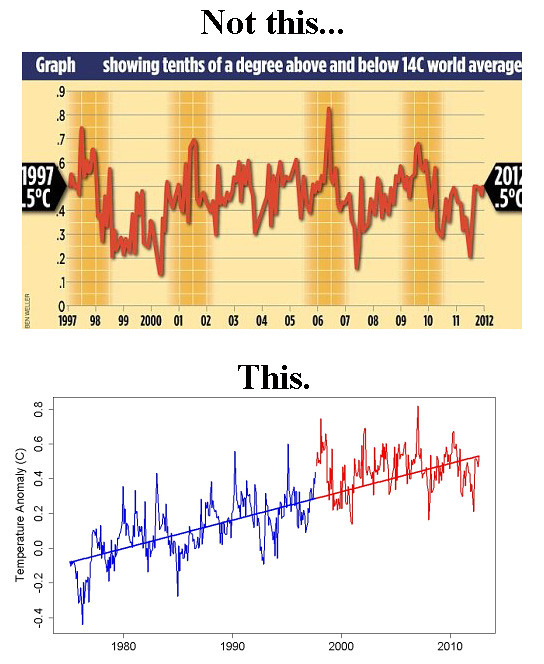
The Op-Ed is directed to U.N. Secretary General Ban Ki-Moon, who has recently, and thankfully, been vocal about the looming environmental catastrophe of global warming. The deniers’ letter takes him to task for this, but doesn’t come within a glancing blow of reality.

The letter itself is based on a single claim. So let’s be clear: If that claim is wrong, so is the rest of the letter.

Guess what? That claim is wrong. So blatantly wrong, in fact, it’s hard to imagine anyone could write it with a straight face. It says:

“The U.K. Met Office recently released data showing that there has been no statistically significant global warming for almost 16 years.”

This is simply, completely, and utterly false. The Met Office is the national weather service for the United Kingdom. In October 2012, they updated their database of global surface temperature measurements, a compendium of temperatures taken over time by weather stations around the planet. David Rose, a climate change denier who can charitably be said to have trouble with facts, cherry-picked this dataset and published a horrendously misleading graph in that bastion of scientific thought, the Daily Mail, saying the measurements show there’s been no global warming for the past 16 years.

But he did this by choosing a starting point on his graph that gave the result he wanted, a graph that looks like there’s been no warming since 1997. But if you show the data properly, you see there has been warming:

Graph showing how the Earth is warming up.Global surface temperatures from the Met Office data. Top: Fiction. Bottom: Fact.

Image credit: David Rose/Daily Mail (top), Tamino (bottom).

The top graph is from Rose’s article, but the bottom graph shows what happens when you display the data going back a few more years. See the difference? What he did is like measuring how tall you are when you’re 25, doing it again when you’re 30, then claiming human beings never grow. That’s a big no-no in science. You have to choose starting and ending points that fairly represent the data, as in the bottom graph. When you do, you very clearly see the trend that the Earth is getting warmer. In fact, hammering home how patently ridiculous this claims is, nine of the 10 hottest years on record have been since 2000. On top of that, Rose was using global surface temperatures, which don’t really represent global overall heat content well; most of the heating is going into ocean waters. So the data he’s displaying so awfully isn’t even the right data to make his claim anyway!

So the very first basis of this denial letter is total garbage, and was such an egregious manipulation of the U.K. Met Office data that the Met Office itself issued a debunking of it! Yet here were are, months later, with the deniers still ignoring facts.

The letter is chock full of more such falsehoods. If you want the rundown, please go readthe great article on Skeptical Science destroying this nonsense. Full disclosure: I had already written quite a bit more for this post before seeing the one at Skeptical Science, and decided it would be better to send readers there for more rather than debunk all the wrongness here. I’m pleased to note they found the same examples of misleading or outright false statements in the deniers’ article and debunked them the same way I had.

I do want to add something, though. I’ll note that it seems superficially impressive that they got 125 scientists, “qualified in climate-related matters” as they claim, to sign this letter.

Yeah, about that…

First, not everyone signing that letter is a scientist. Lord Monckton, for example, apparently has no formal scientific training, has some trouble with the truth, and oh, by the way, claims Obama’s birth certificate is a forgery. He’s the last guy I’d want signing a letter I was on. Yet he seems to pop up on every denialist list as a go-to guy.

Here’s another: The very first signatory, Hhabibullo Abdusamatov, claims that global warming is caused by the Sun, which is patently and provably false (see that Skeptical Science link for more). Many of the claims Abdusamatov makes (as listed on his Wikipedia page) are, um, not accepted by mainstream science, to be very charitable.

Going down the list of signatories I was struck by how many are not, in fact, climate scientists (again, for examples with references, see Skeptical Science); I counted a dozen who actually have climatology in their listed credentials. It’s kinda weird to write such a big letter and then only have fewer than 10 percent of the signers actually be credentialed in the field.

Of course, I’m not a climatologist either, though I am an astronomer classically trained in science, and that means I know enough to rely on the combined research of actual climate scientists from around the world. And when thousands upon thousands of such scientists— in fact, 98 percent of actual, bona fide climate scientists—say global warming is real, well then, that strikes me as being somewhat more credible than a hundred or so politically and ideologically driven non-climate-scientists.

I’ll note this isn’t the first time a laughably-wrong article has been printed by right-leaning venues and signed by multiple, similarly-inappropriate authors. The Wall Street Journalposted one in January 2012 (while turning down an article supporting the reality of global warming signed by 255 actual scientists), and in April 2012, another made the roundsthat was signed by 49 people, including some ex-NASA astronauts, but again, none who actually were climate scientists.

So we can expect to see more of this. Clearly, when you don’t have facts to support your claims, the best thing to do is make as much noise as possible to distract from reality. And that reality is that the world is getting hotter, and unless we do something, now, we’re facing a world of trouble.

Call to Modernize Antiquated Climate Negotiations (Science Daily)

ScienceDaily (Nov. 18, 2012) — The structure and processes of United Nations climate negotiations are “antiquated,” unfair and obstruct attempts to reach agreements, according to research published November 18.

The findings come ahead of the 18thUN Climate Change Summit, which starts in Doha on November 26.

The study, led by Dr Heike Schroeder from the University of East Anglia (UEA) and the Tyndall Centre for Climate Change Research, argues that the consensus-based decision making used by the United Nations Framework Convention on Climate Change (UNFCCC) stifles progress and contributes to negotiating deadlocks, which ultimately hurts poor countries more than rich countries.

It shows that delegations from some countries taking part have increased in size over the years, while others have decreased, limiting poor countries’ negotiating power and making their participation less effective.

Writing in the journal Nature Climate Change, Dr Schroeder, Dr Maxwell Boykoff of the University of Colorado and Laura Spiers of Pricewaterhouse Coopers, argue that changes are long overdue if demands for climate mitigation and adaptation agreements are to be met.

They recommend that countries consider capping delegation numbers at a level that allows broad representation across government departments and sectors of society, while maintaining a manageable overall size.

Dr Schroeder, of UEA’s School of International Development, will be attending COP18. She said: “The UN must recognize that these antiquated structures serve to constrain rather than compel co-operation on international climate policy. The time is long overdue for changes to institutions and structures that do not support decision-making and agreements.

“Poor countries cannot afford to send large delegations and their level of expertise usually remains significantly below that of wealthier countries. This limits poor countries’ negotiating power and makes their participation in each session less effective.”

The researchers found that attendance has changed in terms of the number and diversity of representatives. The number of delegates went from 757 representing 170 countries at the first COP in 1995 to 10,591 individuals from 194 countries attending COP15 in 2009 — a 1400 per cent increase. At COP15 there were also 13,500 delegates from 937 non-government Observer organisations.

Small developing countries have down-sized their delegations while G-7 and +5 countries (Brazil, China, India, Mexico, and South Africa) have increased theirs. The exception is the United States, which after withdrawing from the Kyoto Protocol started to send fewer delegates to COPs.

The study also looked at the make-up of the delegations and found an increase in participation by environmental, campaigning, academic and other non-Governmental organisations.

“Our work shows an increasing trend in the size of delegations on one side and a change in the intensity, profile and politicization of the negotiations on the other,” explained Dr Schroeder. “These variations suggest the climate change issue and its associated interests are framed quite differently across countries. NSAs are well represented on national delegations but clearly the government decides who is included and who is not, and what the official negotiating position of the country and its level of negotiating flexibility are.”

Some countries send large representations from business associations (Brazil), local government (Canada) orscience and academia (Russia). For small developing countries such as Bhutan and Gabon the majority of government representatives come from environment, forestry and agriculture. The UK has moved from mainly environment, forestry and agriculture to energy and natural resources. The US has shifted from these more conventional areas to an overwhelming representation from the US Congress at COP15.

Journal Reference:

  1. Heike Schroeder, Maxwell T. Boykoff, Laura Spiers. Equity and state representations in climate negotiations.Nature Climate Change, 2012; DOI: 10.1038/nclimate1742

Overwhelming Public Support for Whistleblowers (Science Daily)

ScienceDaily (Nov. 19, 2012) — New research by the University of Greenwich shows 4 out of 5 Britons think that people should be supported for revealing serious wrongdoing, even if it means revealing inside information. However, under half of the respondents (47%) thought whistleblowing is an acceptable thing to do in our society. Hence, people think society is less supportive of it than it should be.

Three quarters of respondents, who are employees or members of an organisation, also indicated that if they observed wrongdoing, they would feel personally obliged to report it to someone in their organisation. However, a smaller proportion were confident their organisation would stop wrongdoing if they reported it, and less than half thought management in their organisation were serious about protecting people who report wrongdong. Still, almost 9 out of 10 in Britain believe whistleblowers should be able to use the media to draw attention to wrongdoing (either as a first resort, when there become specific reasons to do so or as a last resort).

Dr Wim Vandekerckhove from the Work and Employment Relations Unit (WERU) at the University of Greenwich, who leads the research, believes that at a time where a change in the UK legislation on whistleblower protection is demanded by different actors and in different directions, it is important to take stock of how citizens feel about whistleblowing. Any changes to the legislation should be in line with attempts to close the gaps identified by this research.

Dr Vandekerckhove concludes that this research shows people will raise concern inside their organisation, but adds: ‘If we don’t make it safer for employees to speak up inside their organisations, people will support those who blow the whistle to the media.’ Political, business and community leaders must accept this new reality, and develop and implement legislation and policies that make it safe and effective to speak up about wrongdoing inside the organisation.

This research was funded by the University of Greenwich Business School. ComRes interviewed 2,000 adults online from 26th to 28th October 2012. Data were weighted to be demographically representative of all British adults aged 18+. ComRes is a member of the British Polling Council and abides by its rules. Full data tables are available at ComRes.co.uk.

Dr Wim Vandekerckhove is Senior Lecturer at the University of Greenwich where he researches and teaches on whistleblowing, business ethics, and organisational behaviour. He has published widely in academic journals and books, and is a regular international speaker at conferences and events on whistleblowing and business ethics.

The survey is part of an ongoing international project measuring public attitudes to whistleblowing. Findings in Australia show a similar thrust as these from Britain.

Working paper: http://ssrn.com/abstract=2176193

Kaiowá e Guarani denunciam Veja por racismo e exigem direito de resposta (CIMI)

Informe nº 1040: Kaiowá e Guarani denunciam Veja por racismo e exigem direito de resposta

Inserido por: Administrador em 14/11/2012.
Fonte da notícia: Campanha Guarani

Alvos de reportagem da Revista Veja no último dia 4, indígenas Guarani e Kaiowá lançaram nesta quarta-feira, 14, uma carta pública exigindo o direito de resposta na publicação. Afirmam, também, que irão encaminhar denúncia de racismo e estímulo ao ódio ao Ministério Público Federal do Mato Grosso do Sul (MPF-MS). A carta foi coassinada por cerca de cinquenta organizações.

A matéria, assinada por Leonardo Coutinho e Kalleo Coura epublicada nas versões impressa e virtual da revista, foi considerada discriminatória pelos indígenas. Segundo a carta, a Veja “não perdeu ‘a oportunidade de apresentar, mais uma vez, a imagem dos Guarani e Kaiowá como seres incapazes, como [se] nós indígenas não fossemos seres humanos pensantes. Fomos considerados como selvagens e truculentos'”, afirmam.

Um abaixo-assinado exigindo direito de resposta será enviado ao MPF-MS.

Leia o documento na íntegra:

Revista Veja: direito de resposta aos Guarani-Kaiowá já

“A escrita, quando você escreve errado, também mata um povo”. Assim afirmaram os professores Guarani-Kaiowá a respeito do que foi publicado na revista Veja, em 4 de novembro, sobre a luta de seu povo pelos seus territórios tradicionais.

Sob os títulos de “A ilusão de um paraíso” e “Visão medieval de antropólogos deixa índios na penúria” (nas versões impressa e virtual, respectivamente), a reportagem parte de uma visão: i) claramente parcial no que diz respeito à situação sociopolítica e territorial em Mato Grosso do Sul, pois afirma que os indígenas querem construir “uma grande nação guarani” na “zona mais produtiva do agronegócio em Mato Grosso do Sul”; ii) deliberadamente distorcida quanto à atuação política dos grupos indígenas supracitados e dos órgãos atuantes na região, desmoralizando os primeiros ao compará-los, ainda que indiretamente, a “massas de manobra” das organizações supostamente manipuladoras e com uma “percepção medieval do mundo”; iii) irresponsável e criminosa, por estimular medo, ódio e racismo, como se vê no seguinte trecho: “o resto do Brasil que reze para que os antropólogos não tenham planos de levar os caiovás (sic) para outros estados, pois em pouco tempo todo o território brasileiro poderia ser reclamado pelos tutores dos índios”.

A reportagem, assinada pelos jornalistas Leonardo Coutinho e Kalleo Coura, não perdeu “a oportunidade de apresentar, mais uma vez, a imagem dos Guarani e Kaiowá como seres incapazes, como [se] nós indígenas não fossemos seres humanos pensantes. Fomos considerados como selvagens e truculentos”, conforme escreveu o Conselho da Aty Guasu, a assembleia Guarani e Kaiowá,  em nota pública lançada no último dia 5.

O documento repudia “a divulgação e posição racista e discriminante” do texto e reafirma a autonomia organizativa e política Guarani e Kaiowá na luta pela recuperação dos territórios. “A Luta pelas terras tradicionais é exclusivamente nossa. Nós somos protagonistas e autores da luta pelas terras indígenas. [E] nós envolvemos os agentes dos órgãos do Estado Brasileiro, os agentes das ONGs e todos os cidadãos (ãs) do Brasil e de outros países do Mundo”, afirmou a Aty Guasu. Ali também denuncia o tratamento difamatório na reportagem, reiterada na nota da Comissão de Professores Guarani-Kaiowá ao indicar que, propagando o ódio contra os indígenas, “a matéria quer colocar um povo contra outro povo. Quer colocar os não-índios contra os indíos. Essa matéria não educa e desmotiva. Ao invés de dar vida, ela traz a morte”.

*

A conjuntura em que estão inseridos os Kaiowá e Guarani lhes é extremamente desfavorável. Num momento em que se procura gerar uma negociação que busque superar os conflitos entre indígenas e fazendeiros no Mato Grosso do Sul, a revista teima em incendiar os ânimos de seus leitores ruralistas. A matéria carrega em si uma série de falhas na apuração das informações, apresentando fatos falsos ou distorcidos:

1. A reportagem expõe e reforça uma imagem distorcida e estigmatizada dos indígenas como dependentes de órgãos púbicos e privados, usuários de drogas e reféns dos interesses de indivíduos ou organizações exógenas às comunidades. Essa imagem estimula o racismo, o ódio e preconceito contra indígenas, problema histórico no Brasil, em geral, e no Mato Grosso do Sul, em particular, podendo intensificar a tensão e a violência já sofrida pelo povo Guarani-Kaiowá.

2. Aciona, também, preconceito contra a sociedade não-indígena, quando afirma que a população apoiadora da causa é manipulada, conforme explicitado na nota da Aty Guasu: a “(…) REVISTA VEJA considera que esses cidadãos (ãs) manifestantes seriam ignorantes e não conheceriam as situações dos Guarani e Kaiowá, os tachando de ignorantes aos cidadãos (ãs) em manifestação”. Há também uma passagem de sexismo sugestivo no texto, citando mulheres que “não perderam a chance de protestar de peito aberto diante das câmeras”

3. Omite a verdade quando ignora de maneira retumbante os posicionamentos públicos dos indígenas Guarani-Kaiowá organizados em sua assembleia maior, a Aty Guasu

4. Deturpa de maneira generalizada o conteúdo da carta dos Kaiowá de Pyelito Kue, imputando suas denúncias a organizações exógenas e creditando ao Cimi sua autoria e divulgação. A reportagem, no mínimo, não atentou às datas de divulgação do carta, escrita de próprio punho por lideranças de Pyelito Kue e endereçada à Aty Guas no dia 9 de novembro. Deturpações como essa são usadas para corroborar a tese de que os Kaiowá são “manipulados” pelo Cimi, pelos antropólogos e pela Funai;

5. Não foram checadas informações e acusações. As organizações citadas no texto, notadamente o Conselho Indigenista Missionário, nunca foram questionadas pela reportagem sobre as informações e acusações;

6. Uso de fonte questionável. O antropólogo citado na matéria, Edward Luz, não é pesquisador dos Guarani e Kaiowá, sequer do Mato Grosso do Sul. É, sim, missionário evangélico, membro do Conselho Consultivo do Instituto Antropos, diretor da Associação das Missões Transculturais Brasileiras (AMTB), vinculada à Missão NovasTribos do Brasil, o braço brasileiro da ONG internacional New Tribes Mission, organização que já foi expulsa ou impedida de entrar em diversas aldeias indígenas pelo órgão indigenista oficial brasileiro, a Fundação Nacional do Índio. É a mesma fonte, também, de outras matérias na revista com o mesmo teor antiíndigena;

7. Houve ma-fé no uso de informações desmentidas há tempos. As informações destacadas no mapa sobre a dita “Nação Guarani” – que revisaria limites territoriais nacionais e internacionais – e a demarcação contínua das terras do sul do Estado do Mato Grosso do Sul já foram desmentidas por indígenas e posteriormente por antropólogos e pela própria Funai, e novamente pelos indígenas durante as agendas de audiências públicas no Congresso Nacional na última semana.

8. Uso de apenas uma linha de entrevista, de maneira descontextualizada, com um único indígena – mesma fonte da matéria anterior sobre os Kaiowá e Guarani – no sentido de sugerir concordância com o texto conclusivo da matéria.

9. Exposição indevida da imagem de crianças indígenas em fotografia utilizada para ilustrar reportagem preconceituosa, com contornos sensacionalistas, ofensivos e que faz juízo de valor depreciativo de sua comunidade.

Dessa forma, o Conselho da Aty Guasu, grande assembléia dos povos Guarani Kaiowá, em conjunto com as demais organizações signatárias, vem a público denunciar a postura criminosa da Revista Veja.

A Aty Guasu Guarani e Kaiowá e a Comissão de Professores Guarani e Kaiowá exigem a investigação rigorosa e punição cabível dos responsáveis, bem como o direito de resposta aos Guarani e Kaiowá na revista Veja. Tais demandas também farão parte de Representação ao Ministério Público Federal para que este, dentro de suas competências constitucionais, tome as medidas necessárias. A imprensa é livre para se posicionar da forma que bem entenda – no entanto, os “fatos” que norteiam a reportagem citada são falsos. Não se trata de uma questão de opinião, e, sim, de irresponsabilidade. Os povos Guarani e Kaiowá já foram vitimados suficientemente por irresponsabilidades.

Dourados, 14 de novembro de 2012

Conselho Aty Guasu (Grande Assembleia do povo Guarani e Kaiowá)

Comissão de Professores Kaiowá e Guarani

Campanha Guarani

Coassinam:

Articulação dos Povos e Organizações Indígenas do Nordeste, MG e ES (APOINME)

Articulação dos Povos Indígenas do Brasil (APIB)

Associação Brasileira de Etnomusicologia (ABET)

Associação de Advogados de Trabalhadores Rurais no Estado da Bahia (AATR)

Ação Nacional de Ação Indigenista (ANAÍ-BA)

Amigos da Terra Brasil

Associação Aritaguá

Associação de Moradores de Porto das Caixas

Associação Socioambiental Verdemar

Centro de Estudos da Mídia Alternativa Barão de Itararé

Comissão Pastoral da Terra (CPT)

Conselho Federal de Psicologia (CFP)

Conselho Indígenista Missionário (Cimi)

Centro de Documentação Eloy Ferreira da Silva (CEDEFES)

Central Única das Favelas (CUFA-CEARÁ)

Centro de Estudos e Defesa do Negro do Pará (CEDENPA)

Centro de Cultura Negra do Maranhão

Coordenação Nacional de Juventude Negra

Centro de Estudos e Pesquisas para o Desenvolvimento do Extremo Sul da Bahia (CEPEDES)

Centro de Estudos das Relações de Trabalho e Desigualdades (CEERT)

Conselho Pastoral dos Pescadores (CPP)

CRIOLA – RJ

EKOS – Instituto para a Justiça e a Equidade – São Luís – MA

Fórum da Amazônia Oriental (FAOR)

Fase Amazônia

Fase Nacional – Núcleo Brasil Sustentável

Frente em Defesa da Amazônia (FDA)

FIOCRUZ

Fórum Carajás – São Luís – MA

Fórum de Defesa da Zona Costeira do Ceará

FUNAGUAS – Terezina – PI

Federação Nacional dos Jornalistas (FENAJ)

Grupo Pesq. em Sustentabilidade, Impacto e Gestão Ambiental (UFPB)

Grupo Pesq. em Educação Ambiental da (GPEA/UFMT)

Grupo Pesq. Historicidade do Estado e do Direito (UFBA)

Justiça Global

IARA – RJ

Intervozes – Coletivo Brasil de Comunicação Social

Instituto Brasileiro de Análises Sociais e Econômicas (Ibase)

Instituto Socioambiental (ISA)

Instituto para a Justiça e a Equidade (EKOS)

Instituto da Mulher Negra (GELEDÉS)

Instituto Nacional de Estudos Sócio-Econômicos (INESC)

Instituto Búzios

Instituto Federal de Educação, Ciência e Tecnologia Fluminense

Instituto Terramar

Instituto Internacional de Educação do Brasil (IEB)

Inst. Nac. de Ciência e Tec. de Inclusão no Ensino Superior e na Pesquisa (INCTI)

Justiça Global

Mestrado Prof. em Sustentabilidade junto a Povos e Terras Indígenas (CDS/UnB)

Movimento Brasil pelas Florestas

Movimento Cultura de Rua (MCR) – Fortaleza – CE

Movimento de Mulheres Camponesas (MMC)

Movimento dos Trabalhadores Rurais Sem Terra (MST)

Movimento Cultura de Rua (MCR)

Movimento Inter-Religioso (MIR/Iser)

Movimento Popular de Saúde de Santo Amaro da Purificação (MOPS)

Movimento Wangari Maathai

Núcleo de Investigações em Justiça Ambiental (Universidade Federal de São João del-Rei) – São João del-Rei – MG

Núcleo TRAMAS (Trabalho Meio Ambiente e Saúde para Sustentabilidade/UFC) – Fortaleza – CE

Observatório Ambiental Alberto Ribeiro Lamego – Macaé – RJ

Omolaiyè (Sociedade de Estudos Étnicos, Políticos, Sociais e Culturais) – Aracajú – SE

ONG. GDASI – Grupo de Defesa Ambiental e Social de Itacuruçá – Mangaratiba – RJ

OcupaBelém

OcupaSampa

Opção Brasil – São Paulo – SP

Oriashé Sociedade Brasileira de Cultura e Arte Negra – São Paulo – SP

Plataforma Dhesca Brasil

Projeto Recriar – Ouro Preto – MG

Rede Axé Dudu – Cuiabá – MT

Rede Matogrossense de Educação Ambiental – Cuiabá – MT

Rede Jubileu Sul Brasil

Rede Nacional de Advogados Populares (RENAP)

Sociedade de Melhoramentos do São Manoel – São Manoel – SP

Sociedade Paraense de Defesa dos Direitos Humanos (SDDH)

Terra de Direitos – Organização de Direitos Humanos

TOXISPHERA – Associação de Saúde Ambiental – PR

Conhecimento não é fator determinante para formação de opinião sobre ciência (Fapesp)

Códigos morais e políticos podem influenciar muito mais as atitudes em relação a questões científicas e tecnológicas, aponta pesquisador (FAPESP)

14/11/2012

Por Elton Alisson

Agência FAPESP – As pesquisas sobre percepção pública da ciência e tecnologia realizadas em diferentes países, incluindo o Brasil, com o objetivo de avaliar a opinião dos cidadãos sobre temas científicos e tecnológicos deparam com o desafio de explicar quais fatores influenciam atitudes, interesse e engajamento em relação a esses assuntos.

Isso porque, do conjunto de indicadores utilizados nessas pesquisas para analisar quais fatores são mais relevantes na formação de interesses e atitudes dos cidadãos sobre ciência e tecnologia – como renda, educação, idade e escolaridade –, nenhum deles consegue explicar minimamente a variabilidade das respostas.

“Tem alguma outra variável que não estamos medindo que determina o tipo de atitude das pessoas sobre ciência e tecnologia em geral”, disse Juri Castelfranchi, professor do Departamento de Sociologia e Antropologia da Faculdade de Filosofia e Ciências Humanas (Fafich) da Universidade Federal de Minas Gerais (UFMG), durante conferência sobre os desafios interpretativos e metodológicos para o estudo da percepção pública da ciência e tecnologia que proferiu no dia 27 de outubro no 2º Seminário Internacional Empírika.

Realizado nos dias 26 e 27 de outubro no Instituto de Estudos da Linguagem (IEL) da Universidade Estadual de Campinas (Unicamp), o evento integrou a programação da Feira Ibero-americana de Ciência, Tecnologia e Inovação (Empírika).

De acordo com Castelfranchi, um dos fatores que contribuem para a dificuldade de as pesquisas sobre percepção pública da ciência e tecnologia determinarem qual ou quais processos contribuem para a construção da opinião pública sobre o tema é que elas estão “baseadas na hipótese mal fundada e fundamentada de que as atitudes das pessoas em relação aos assuntos científicos e tecnológicos são moduladas pelo conhecimento que têm sobre esses temas”.

Tradicionalmente, segundo Castelfranchi, a maioria dos estudos realizados sobre o que faz com que as pessoas aceitem ou rejeitem a realização de uma pesquisa científica ou uma nova tecnologia focalizou o interesse, o conhecimento e as atitudes dos entrevistados em relação à ciência e tecnologia, baseado na ideia de que esses três aspectos estariam relacionados.

Dessa forma, as pessoas não interessadas teriam baixo nível de informação e tenderiam, em geral, a ter atitudes mais negativas em relação à ciência e tecnologia. Por outro lado, ao estimular o interesse dessas pessoas por temas científicos e tecnológicos seria possível melhorar o nível de conhecimento delas sobre essas áreas e, consequentemente, suas atitudes em relação à ciência e tecnologia se tornariam mais positivas.

Entretanto, pesquisas de campo demonstraram que essas premissas são falsas e que a situação real é muito mais complexa do que a defendida por esse modelo, que foi derrubado.

Em geral, de acordo com os resultados de estudos recentes na área, existe um grande interesse de boa parte da população sobre os temas de ciência e tecnologia, mas que não corresponde à busca de informação.

“Há grupos de público com baixa escolaridade, principalmente em países em desenvolvimento, que não conhecem e não buscam informação sobre ciência e que têm atitudes bastante positivas em relação à ciência e tecnologia”, disse Castelfranchi.

“Em contrapartida, alguns estudos detectaram que não é verdade que, ao aumentar o conhecimento, a atitude das pessoas se torna mais positiva. Em alguns casos ocorre o contrário, elas tendem a ser mais cautelosas e críticas”, disse.

Paradoxo do conhecimento versus atitude

Segundo Castelfranchi, um dos exemplos que ilustram essa suposta contradição, batizada de “paradoxo do conhecimento versus atitude”, é a questão dos transgênicos na Europa.

O continente, que é um dos que mais investem em ciência e tecnologia, decretou no início dos anos 2000 uma moratória contra os alimentos transgênicos após intensos debates entre segmentos da sociedade favoráveis e outros contrários à tecnologia, baseados no apelo emocional e argumentos mais de cunho econômico e político do que científico.

Uma pesquisa realizada em 1998 e replicada em 2010 em toda a Comunidade Europeia sobre o conhecimento e atitudes dos europeus em relação a aplicações biotecnológicas, incluindo alimentos e vacinas transgênicas, apontou que o fator risco não era determinante para a rejeição ou não da população à nova tecnologia.

Em muitos casos, os entrevistados responderam que algumas aplicações biotecnológicas eram perigosas, mas que eram úteis, moralmente aceitáveis e que deveriam ser encorajadas. Em outros casos, os participantes da pesquisa apontaram determinadas aplicações biotecnológicas como não tão perigosas, mas politicamente e moralmente questionáveis – como os transgênicos –, o que fez com que a tecnologia fosse rejeitada.

“Não foi o risco o fator mais relevante que levou à rejeição dos transgênicos na Europa, mas considerações políticas como, entre elas, o fato de a tecnologia ser controlada por multinacionais, ser patenteada e porque os países europeus eram contrários a monoculturas”, avaliou Castelfranchi.

A pesquisa também apontou que os cidadãos europeus que tinham conhecimento mais baixo não rejeitavam os transgênicos, mas não tinham uma opinião formada sobre eles. Por outro lado, os participantes com maior escolaridade tinham opiniões favoráveis ou contrárias mais definidas.

“O conhecimento não mudou a atitude dos cidadãos europeus em relação aos transgênicos, mas sim o fato de terem uma atitude mais definida em relação à tecnologia, a exemplo do que também pode ser observado no Brasil e em outros países ibero-americanos onde foram realizadas pesquisas do gênero”, disse Castelfranchi.

Na mais recente pesquisa Percepção pública da ciência e tecnologia, realizada no fim de 2010 pelo Ministério da Ciência, Tecnologia e Inovação (MCTI) com mais de 2 mil pessoas em todo o país, nenhum dos grupos específicos, de diferentes níveis sociais e de escolaridade, respondeu que as tecnologias trazem mais malefícios do que benefícios, quando perguntados sobre isso.

Porém, os participantes que mais conheciam cientistas e instituições de pesquisa foram justamente os que declararam em maior proporção que os cientistas podem ser perigosos em função do conhecimento que possuem.

“Não há nenhuma associação entre baixa escolaridade e achar que a ciência é perigosa. Mas, pelo contrário: pessoas de alta escolaridade tendem a ter uma postura mais cautelosa tanto em relação aos benefícios como sobre os malefícios apresentados pela ciência e tecnologia”, afirmou Castelfranchi.

Valores morais e políticos

No caso do Brasil, um dos fatores relevantes que influenciam as atitudes dos brasileiros em relação à ciência e tecnologia, identificado por Castelfranchi e outros pesquisadores que analisaram os dados da pesquisa realizada pelo MCTI, é o porte das cidades onde os entrevistados moram.

Os pesquisadores constataram que os participantes da pesquisa que moram em cidades brasileiras de grande porte tendem a avaliar melhor os prós e contras do desenvolvimento tecnocientífico para responder se a ciência e tecnologia trazem só benefícios ou malefícios. Já as pessoas que residem em cidades pequenas têm uma chance ligeiramente maior de apontar que a ciência só traz benefícios.

Contudo, tanto essa variável como nenhuma outra, como o sexo dos entrevistados, não consegue explicar, por si só, a variabilidade das respostas se a ciência e a tecnologia trazem mais benefícios ou malefícios.

“Nenhum dos fatores analisados até agora implica as pessoas terem uma posição mais otimista ou pessimista sobre a ciência e a tecnologia. Tem outros pontos, que precisamos descobrir, que influenciam essa resposta”, avaliou Castelfranchi.

Uma das hipóteses levantadas pelo pesquisador é que os códigos morais e políticos das pessoas, como a religião, podem ser mais determinantes do que o conhecimento que elas possuem ou não para formar suas opiniões sobre aspectos específicos da ciência e da tecnologia.

Entre os participantes da pesquisa sobre percepção pública da ciência e tecnologia realizada pelo MCTI, os que se declararam católicos concordaram mais do que os evangélicos com uma das afirmações feitas durante o estudo de que por causa de seu conhecimento os cientistas têm poderes que os tornam perigosos e que a ciência tem que ser controlada socialmente.

“A trajetória e a orientação de vida e os valores morais das pessoas, provavelmente, exercem uma influência muito maior na modulação de suas atitudes em relação à ciência e tecnologia em geral e sobre aspectos específicos da pesquisa do que o nível de conhecimento que elas têm”, estima Castelfranchi.

Para comprovar essa hipótese, de acordo com o pesquisador, é preciso desenvolver novas metodologias qualitativas e quantitativas e grandes quantidades de observações etnográficas para verificar como as pessoas se posicionam em relação à ciência e tecnologia, abolindo a ideia de que isso está relacionado apenas ao nível de conhecimento.

“Precisamos renovar nossas metodologias de pesquisa e a forma como olhamos e interpretamos os dados das pesquisas de percepção pública da ciência e tecnologia para entender como as pessoas atribuem sentido e constroem suas opiniões sobre questões científicas e tecnológicas, para termos uma visão dinâmica de como formam suas atitudes”, afirmou Castelfranchi.

Pesquisa Datafolha/Confederação da Agricultura e Pecuária do Brasil (CNA) sobre a “integração” dos índios ao “modo de vida urbano”; Folha de S.Paulo e Veja + Carta do antrópologo Henyo Barretto à Ombudsman da Folha de SP

[A Folha se alinha com a Veja; não está claro se por má fé, interesse comercial, ou obtusidade. RT]

10/11/2012 – 04h00

MATHEUS LEITÃO

DE BRASÍLIA

Os índios brasileiros estão integrados ao modo de vida urbano. Televisão, DVD, geladeira, fogão a gás e celulares são bens de consumo que já foram incorporados à rotina de muitas aldeias. A formação universitária é um sonho da maioria deles.

Pesquisa inédita do Datafolha, encomendada pela Confederação da Agricultura e Pecuária do Brasil (CNA), revela esse perfil. Entre os dias 7 de junho e 11 de julho, foram realizadas 1.222 entrevistas, em 32 aldeias com cem habitantes ou mais, em todas as regiões do país.

Segundo a pesquisa, 63% dos índios têm televisão, 37% têm aparelho de DVD e 51%, geladeira, 66% usam o próprio fogão a gás e 36% já ligam do próprio celular.

Só 11% dos índios, no entanto, têm acesso à internet e apenas 6% são donos de um computador. O rádio é usado por 40% dos entrevistados.

Para o Cimi (Conselho Indigenista Missionário), “é evidente que essa novidade produz mudanças, mas isso não significa a instalação de um conflito cultural. Não é o fato de adquirir uma TV ou portar um celular que fará alguém ser menos indígena”.

De todo modo, os números ainda estão longe dos percentuais de acesso a bens de consumo da média da população. No Brasil como um todo, segundo o IBGE, 98% têm televisão; 82%, aparelho de DVD; e 79% têm celular.

A pesquisa teve ainda o intuito de avaliar as condições de vida dos indígenas.

Questionados sobre o principal problema enfrentado no Brasil, 29% dos entrevistados apontaram as dificuldades de acesso à saúde.

A situação territorial ficou em segundo lugar (24%), seguida da discriminação (16%), do acesso à educação (12%) e do emprego (9%).

Em relação ao principal problema enfrentado na vida pessoal, a saúde permaneceu em primeiro lugar para 30%. O emprego apareceu em segundo, com 16%, seguido de saneamento (16%). A questão territorial, nesse caso, desaparece.

A pesquisa mostra que o aumento de fontes de informação tem influenciado a vida familiar dos índios: 55% conhecem e 32% usam métodos anticoncepcionais como camisinha e pílula. Mais de 80% ouviram falar da Aids.

A maioria dos índios (67%) gostaria de ter uma formação universitária. Apesar de ser considerado muito importante para 79% dos entrevistados, o banheiro em casa só existe para 18% deles.

Algumas características das aldeias: 69% têm postos de saúde; 88%, escolas; 59%, igrejas; 19%, mercados; e 6%, farmácias.

Alex Argozino/Editoria de Arte/Folhapress

Dois terços dos indígenas recebem do Bolsa Família
Guaranis-caiovás reclamam da falta de recursos para plantar

*   *   *

Pois é… as reservas indígenas brasileiras ocupam 13% do território nacional. Se depender da Funai e de alguns antropólogos do miolo mole, chega-se a 20%. A questão não está no número em si. Poder-se-ia destinar até 50% — desde que houvesse índios para tanto e que eles conseguissem tirar das imensas extensões de terra que dominam ao menos o suficiente para a sua subsistência. Mas não acontece. Não é só isso: as reservas são concedidas na suposição — falsa como nota de R$ 3 — de que aqueles enormes vazios econômicos em torno da comunidade são essenciais para que ela preserve sua cultura. Procurem na Internet a poesia indianista em prosa do ministro Ayres Britto, relator do caso Raposa Serra do Sol. Ele apelou a um índio que acabou junto com a literatura romântica. Ainda volto a esse aspecto.

Muito bem: pesquisa Datafolha demonstra que a maioria dos índios brasileiros está integrada às práticas próprias da vida urbana. Uma boa parcela conta com televisão, DVD, geladeira, celular… Esse aparato, não obstante, convive com a pobreza, razão por que quase a metade recebe cesta básica. Isso quer dizer que eles nem plantam nem caçam o que comem: vivem da caridade estatal — e em condições precárias.

As reservas são santuários para lustrar as aspirações de certa antropologia mistificadora, que ainda quer mais. Leiam o que informa Matheus Leitão naFolha. Volto depois:
*
Os índios brasileiros estão integrados ao modo de vida urbano. Televisão, DVD, geladeira, fogão a gás e celulares são bens de consumo que já foram incorporados à rotina de muitas aldeias. A formação universitária é um sonho da maioria deles. Pesquisa inédita do Datafolha, encomendada pela Confederação da Agricultura e Pecuária do Brasil (CNA), revela esse perfil. Entre os dias 7 de junho e 11 de julho, foram realizadas 1.222 entrevistas, em 32 aldeias com cem habitantes ou mais, em todas as regiões do país.

Segundo a pesquisa, 63% dos índios têm televisão, 37% têm aparelho de DVD e 51%, geladeira, 66% usam o próprio fogão a gás e 36% já ligam do próprio celular. Só 11% dos índios, no entanto, têm acesso à internet e apenas 6% são donos de um computador. O rádio é usado por 40% dos entrevistados. Para o Cimi (Conselho Indigenista Missionário), “é evidente que essa novidade produz mudanças, mas isso não significa a instalação de um conflito cultural. Não é o fato de adquirir uma TV ou portar um celular que fará alguém ser menos indígena”.
(…)
Questionados sobre o principal problema enfrentado no Brasil, 29% dos entrevistados apontaram as dificuldades de acesso à saúde. A situação territorial ficou em segundo lugar (24%), seguida da discriminação (16%), do acesso à educação (12%) e do emprego (9%). Em relação ao principal problema enfrentado na vida pessoal, a saúde permaneceu em primeiro lugar para 30%. O emprego apareceu em segundo, com 16%, seguido de saneamento (16%). A questão territorial, nesse caso, desaparece.

A pesquisa mostra que o aumento de fontes de informação tem influenciado a vida familiar dos índios: 55% conhecem e 32% usam métodos anticoncepcionais como camisinha e pílula. Mais de 80% ouviram falar da Aids. A maioria dos índios (67%) gostaria de ter uma formação universitária. Apesar de ser considerado muito importante para 79% dos entrevistados, o banheiro em casa só existe para 18% deles.

Bolsa família e cesta básica
A pesquisa sobre o perfil indígena feita pelo Datafolha, encomendada pela Confederação da Agricultura e Pecuária do Brasil (CNA), revela que 64% dos índios são beneficiários do Programa Bolsa Família, recebendo em média R$ 153 por mês. A região Nordeste é a campeã do benefício: 76% dos índios recebem o programa social do governo. O Sul aparece em segundo com 71%; seguido do Centro-Oeste (63%), Norte (56%) e Sudeste (52%).

Mesmo com os benefícios, 36% afirmam ser insuficiente a quantidade de comida que consomem. A maioria dos índios (76%) bebe água que não é filtrada nem fervida. As doenças infectocontagiosas atingem 68% e os problemas estomacais, como diarreia e vômito, 45%. Os índios também afirmam que luz elétrica, água encanada, rede de esgoto e casa de alvenaria são muito importantes para eles.

Mais de 70% dos índios ouvidos atribuem muita relevância à atuação da Funai (Fundação Nacional do Índio) na sua aldeia. No entanto, 39% reprovam o desempenho do órgão, avaliando-o como ruim ou péssimo.

Cesta básica
Quase metade dos entrevistados (46%) relatou receber cesta básica da Funai ou da Funasa (Fundação Nacional da Saúde). Os índios da região Nordeste são os que mais recebem o benefício: 79%. Na região Norte apenas 7% ganham a cesta básica.

O acesso ao atendimento médico é considerado difícil por 63% dos índios; 69% deles foram atendidos em postos de saúde dentro da aldeia e 12% dentro de casa. Eles ainda usam mais os remédios naturais (66%) do que os farmacêuticos (34%). A maioria dos índios (66%) sabe ler, e 65% sabem escrever na língua portuguesa. Segundo a pesquisa, 30% exercem trabalho remunerado, mas somente 7% têm carteira assinada.

A agricultura é exercida por 94%, e 85% praticam a caça; 57% deles consideram que o tamanho das terras onde vivem é menor do que o necessário. Os índios também citaram algumas medidas governamentais que poderiam melhorar a vida dos indígenas no país: intervenções na área da saúde (25%), demarcação de terras (17%), reconhecimento dos direitos indígenas (16%), investimentos públicos (15%) e educação (15%).

Procurada anteontem, a Funai afirmou, pela assessoria de imprensa, que tinha muitas demandas e que não poderia responder às questões da reportagem até o encerramento desta edição. “A presidente [Marta Azevedo] está em viagem, sem disponibilidade de agenda. Ela seria a pessoa mais indicada para comentar a pesquisa”, afirmou, por e-mail.
(…)

Voltei
Viram só o que o modelo das reservas, que está em expansão (?!), provoca? Uma horda de miseráveis com celular, televisão e DVD. Prega-se a expansão das terras indígenas para que se produza ainda menos em um território maior… Com Raposa Serra do Sol, aconteceu o óbvio: os arrozeiros tiveram de ir embora, deixando atrás de si uma legião de desempregados. Na terra agora sob o controle de caciques ideológicos disfarçados de militantes indígenas, não se produz quase mais nada. Muitos dos índios foram viver como favelados em Boa Vista. A razão é simples: ser indígena não quer dizer ser… índio!

Leiam este trecho do voto de Ayres Britto (em vermelho):
(…) III – ter a chance de demonstrar que o seu tradicional habitat ora selvático ora em lavrados ou campos gerais é formador de um patrimônio imaterial que lhes dá uma consciência nativa de mundo e de vida que é de ser aproveitada como um componente da mais atualizada ideia de desenvolvimento,  que é o desenvolvimento como um crescer humanizado. Se se prefere, o desenvolvimento não só enquanto categoria econômica ou material, servida pelos mais avançados padrões de ciência, tecnologia e organização racional do trabalho e da produção, como  também permeado de valores que são a resultante de uma estrutura de personalidade ou modo pessoal indígena de ser mais obsequioso: a) da ideia de propriedade como um bem mais coletivo que individual; b) do não-enriquecimento pessoal à custa do empobrecimento alheio (inestimável componente ético de que a vida social brasileira tanto carece); c) de uma vida pessoal e familiar com simplicidade ou sem ostentação material e completamente avessa ao desvario consumista dos grandes centros urbanos; d) de um tipo não-predatoriamente competitivo de ocupação de espaços de trabalho, de sorte a desaguar na convergência de ações do mais coletivizado proveito e de uma vida social sem narsísicos desequilíbrios; e) da maximização de potencialidades sensórias que passam a responder pelo conhecimento direto das coisas presentes e pela premonição daquelas que a natureza ainda mantém em estado de germinação; f)de uma postura como que religiosa de respeito, agradecimento e louvor ao meio ambiente de que se retira o próprio sustento material e demais condições de sobrevivência telúrica, a significar a mais fina sintonia com a nossa monumental biodiversidade e mantença de um tipo de equilíbrio ecológico que hoje a Constituição brasileira rotula como “bem de uso comum do povo e essencial à sadia qualidade de vida” (art. 225,  caput), além de condição para todo desenvolvimento que mereça o qualificativo de sustentado.

Encerro
Esse índio acima descrito só existe na cabeça de Ayres Britto, como aqui falei tantas vezes. A tal integração “telúrica” com a natureza é uma fantasia. O desenvolvimento “sustentado” se faz com Bolsa Família e cesta básica — cedidas por nossa civilização tão egoísta…

Britto transformou os índios em grandes ecologistas, o que é uma piada até antropológica! Existissem realmente aos milhões, a Amazônia já seria uma savana. O ministro tem de descobrir que a ideia de preservação da natureza é um valor desta nossa triste civilização. Não tem nada a ver com índio, que não louva o meio ambiente nem retira da terra o sustento.

Com as terras de que dispõem, os índios poderiam estar é produzindo comida para os seus e para muitos outros brasileiros. Em vez disso, estão na fila do Bolsa Família e da cesta básica.

Por Reinaldo Azevedo


O que realmente querem os índios e o que alguns antropólogos querem que eles queiram…

11/11/2012

Já publiquei ontem um texto sobre a pesquisa Datafolha com índios brasileiros, encomendada pela CNA (Confederação da Agricultura e Pecuária do Brasil). A VEJA desta semana traz novos e impressionantes números. Mas, afinal, o que querem os índios, leitor amigo? Ora, o que queremos todos nós: bem-estar. Ocorre que uma boa parcela deles, sob a tutela da Funai e da antropologia do miolo mole, vive muito mal, dependente da caridade do estado.

Nada menos de 13% do território brasileiro são destinados a reservas indígenas. E se reivindica ainda mais terra — uma reivindicação de antropólogos, não dos índios propriamente, que têm outras necessidades e outras ambições.

Reproduzo abaixo trecho do texto de Leonardo Coutinho publicado na revista, entremeado com alguns dados da pesquisa.
*
Uma das principais reclamações dos índios é a de não serem ouvidos. De tempos em tempos, eles tingem o corpo de vermelho e negro em sinal de guerra e saem a brandir suas bordunas, arcos e flechas em frente a representantes do governo para chamar atenção para suas reivindicações. Na maioria das vezes, a sociedade brasileira só fica sabendo de suas demandas por meio de intermediários — padres marxistas ou ongueiros que fazem com que os moradores das cidades acreditem que os problemas indígenas consistem em falta de terras e em obras de infraestrutura nocivas ao ambiente.

Uma pesquisa realizada pelo Instituto Datafolha a pedido da Confederação da Agricultura e Pecuária do Brasil (CNA) pôs fim a essa lacuna. É o mais completo levantamento das opiniões dos índios brasileiros já realizado. Durante 55 dias, os pesquisadores visitaram 32 aldeias em todas as regiões do país e entrevistaram 1222 índios de vinte etnias. Trata-se de uma amostra robusta, maior, proporcionalmente, do que a que costuma ser usada nas sondagens eleitorais.

As respostas revelam que os índios têm aspirações semelhantes às da nova classe média nacional, ou seja, querem progredir socialmente por meio do trabalho e dos estudos. Eles sonham com os mesmos bens de consumo e confortos da vida moderna, sem deixar de valorizar sua cultura. Muito do que é apresentado pelos intermediários da causa indígena como prioridade nem sequer aparece na lista das preocupações cotidianas dos entrevistados. “A pesquisa libertará os índios da sua falsa imagem de anacronismo”, diz a presidente da CNA, a senadora Kátia Abreu (PSD/TO).

Nove em cada dez índios acham melhor morar em casa de alvenaria do que numa maloca. Oito em cada dez consideram muito importante ter um banheiro sob o teto em que vivem, um conforto desfrutado por uma minoria. Quase metade dos indígenas adoraria tomar uma ducha quentinha todos os dias. O grupo de índios donos de automóveis e seis vezes a média dos brasileiros de classes C e D. “Ninguém deixa de ser índio por querer viver bem. É inaceitável que as regras de como devemos ser continuem sendo ditadas de cima para baixo sem levar em consideração a nossa vontade”, diz Antônio Marcos Apurinã, coordenador-geral da Coordenação das Organizações Indígenas da Amazônia Brasileira, que representa 160 etnias. Segundo Apurinã, por causa da falta de condições adequadas nas áreas demarcadas, muitas aldeias passam por um êxodo sem precedentes.

Há quatro anos, 12 500 índios viviam na periferia de Manaus. Hoje, estima-se que mais de 30.000 vivam apinhados em construções precárias na cidade. Se a criação de reservas é alardeada como a demanda mais urgente dos povos indígenas, por que eles as estão abandonando para viver em favelas? Com a palavra, os índios. O problema mais citado é a precariedade dos serviços de saúde. Eles se queixam principalmente da falta de medicamentos farmacêuticos (que eles valorizam tanto quanto os remédios tradicionais) e de médicos. Em segundo lugar, está a falta de emprego. “Nós não vivemos mais como nos meus tempos de infância. A nova geração compreende a vantagem de ter um emprego, uma renda. Ela quer ter roupa de homem branco, celular e essas coisas de gente jovem. Os governantes precisam aprender que nossos filhos querem ter tudo o que os filhos do homem branco têm. Falar português, ir para a universidades e ser reconhecidos como brasileiros e índios”, diz o cacique Megaron Txucarramãe, um dos mais respeitados líderes caiapós, de Mato Grosso.
(…)


Por Reinaldo Azevedo

*   *   *

Carta do antrópologo Henyo Barretto à Ombudsman da Folha de SP

Por , 12/11/2012 19:29

Prezada Srª,

Lamentável e, porque não dizer, medíocre a matéria de Matheus Leitão que apresenta a “pesquisa inédita do Datafolha, encomendada pela Confederação da Agricultura e Pecuária do Brasil” sobre “o perfil indígena brasileiro”, publicada hoje [ontem] na Folha de São Paulo – “um jornal a serviço do Brasil”. A rigor não sei se os predicados se aplicam a matéria, ou a “pesquisa” que ela se propõe a descrever/relatar.

A começar pelo objeto/objetivo da enquete (palavra mais adequada para definir o que o Datafolha faz, pois “pesquisa” com dados agregados gerais sobre povos indígenas é uma outra coisa): o que é “o perfil indígena brasileiro”? A julgar pela matéria sobre a enquete – que não sei se é parâmetro (ou não) para emitir um juízo sobre a mesma (mas vamos em frente) – referido perfil corresponde ao processamento de respostas a um conjunto de
perguntas pretensamente factuais e opinativas sobre o acesso a bens, serviços e políticas públicas. Isso é suficiente para definir “um perfil” – indígena ou não? Ou, perguntando de outro modo, é assim que se define “um perfil” – indígena ou não? O meu perfil, o seu, o nosso?

O primeiro parágrafo da descrição da metodologia – os “critérios” – seria patético, se não fosse trágico – dadas as consequências potencialmente nefastas da conclusão a que chegou a enquete (chegarei a esta já, já). Diz-se que o sorteio das aldeias teria “lev[ado] em conta a região em que se localizam e o tamanho da população indígena residente”, mas não se explicita como: Quantas e quais regiões? Considerou-se o que na definição destas? São as áreas etnográficas da América do Sul (Melatti), as regiões das Coordenações Regionais da FUNAI, os Distritos Sanitários Especiais Indígenas, os Territórios Etnoeducacionais? Quais os distintos agregados demográficos considerados? Enfim, sem explicitar nada disso, a matéria (Ou seria a enquete? Ou seria a matéria como análise conclusiva dos dados  produzidos pela enquete?) afirma que: “os dados são representativos dos índios brasileiros” e “os índios brasileiros estão integrados ao modo de vida urbano”.

Ademais, ao indicar que “somente a população indígena brasileira que fala português” foi entrevistada, revela-se o completo descaso com a política linguística da enquete – aspecto fundamental em qualquer pesquisa com povos indígenas que almeje o predicado de “digna.” Quaisquer categorias nativas porventura existentes, que nos dariam os matizes como cada cultura interpreta a pergunta, processa o seu enunciado e a responde, foram – dada essa opção – solenemente ignoradas. Isso patenteia a abordagem geral etnocêntrica e colonial da enquete.

Sem entrar no mérito da imprecisão do termo “índios brasileiros” (com a teoria política e cultural e os preconceitos sobre os povos indígenas que lhe são subjacentes) e nem esperando – embora devesse esperar – que a FSP dialogasse com a vasta literatura antropológica e sociológica sobre: (i) mudança cultural (em especial a distinção entre “integração” e “assimilação”), parte da qual, inclusive, enfoca etnograficamente a situação de índios citadinos (veja-se, por exemplo, Urbanização e Tribalismo de Roberto Cardoso de Oliveira); e (ii) as redes de relação e os fluxos rural/urbano, aldeia/cidade, Terra Indígena/município; é espantosa a afirmação conclusiva, que, ao contrário do que supõem o autor da matéria e/ou o ideólogo da enquete, deveria ser não o ponto de chegada: “os índios brasileiros estão integrados ao modo de vida urbano” – mas, sim, o ponto de partida para uma reflexão sobre as distintas e variadas condições em que os diversos povos indígenas se situam no Brasil de hoje. Diversidade e multiplicidade essa que a enquete anula em prol de um “perfil indígena” genericamente definido, que desconsidera aquilo que deveria ser o seu ponto de partida: a diversidade de modos de viver e existir que marcam o Brasil de hoje – seja em sua face indígena, seja em qualquer outra.

Não é necessário ter uma formação em Ciências Sociais muito sólida para ler a enquete naquilo que ela não diz, nas suas entrelinhas, nos objetivos e interesses que ela dissimula – na condição de encomenda da CNA ao Grupo Folha. Embora a enquete sinalize que 94% das pessoas entrevistadas exerçam a agricultura, e que a situação territorial figure em segundo lugar entre os principais problemas enfrentados pelos entrevistados – “tecnicamente empatado” [sic] com “as dificuldades de acesso à saúde”, em primeiro lugar; a conclusão telegráfica da enquete (ou seria da matéria, já não sei mais) conspira em favor da manutenção de um dos mais perniciosos preconceitos que pesam sobre os povos indígenas: que estes seriam seres de um passado remoto (e não povos que coabitam e coexistem conosco contemporaneamente, em sua multiplicidade de jeitos de viver) e que a sua “modernização” e/ou “urbanização” seria como que uma patologia a conspirar contra a sua autenticidade (e não uma das várias dimensões das constantes transformações a que seus múltiplos jeitos de viver estão submetidos) – razão pela qual, concluir-se-ia o raciocínio, não deveriam ser objeto de nenhum regime de atenção e/ou proteção especial.

Eis o alvo que mira a enquete-matéria como dispositivo de formação de opinião: as questões territoriais são secundárias para os povos indígenas, já que têm também outras preocupações e aspirações, e se beneficiam de programas governamentais de transferência de renda, razão pela qual a terra deveria ser eliminada da equação dos povos indígenas no futuro do país. Ao contrário, a terra constitui um problema para a expansão do chamado “setor produtivo” agrário nacional, representado pela instituição que encomendou a – isto é, pagou pela – enquete, motivo suficiente para que esses povos não muito outros tenham suas relações com seus territórios desenraizadas em benefício daquela expansão.

A que “Brasil”, de fato, esse jornal está “a serviço”?

Cordialmente,

Henyo T. Barretto Fº

Carta da Aty Guasu Guarani e Kaiowá aos diversos movimentos sociais e atos nacionais em defesa do nosso povo

9 de novembro de 2012

NOTA/CARTA DA ATY GUASU GUARANI E KAIOWÁ PARA TODOS (AS), DIVULGUE EM VÁRIAS LÍNGUAS, CARTA DA ATY GUASU GUARANI E KAIOWÁ AOS DIVERSOS MOVIMENTOS SOCIAIS E ATOS NACIONAIS EM DEFESA DO NOSSO POVO.

“Saiam às ruas, pintem os rotos, ocupem as praças, ecoem o grito do nosso povo que luta pela vida, pelos territórios!”

Esta é uma carta das lideranças do Aty Guasu (Grande Assembleia) direcionada especialmente às diversas “mobilizações contra o genocídio do nosso povo Guarani e Kaiowá” previsto para o dia 09 de novembro em várias cidades do País e do Mundo. Queremos agradecer por todas estas iniciativas de solidariedade em defesa das nossas terras e nossas vidas.

Hoje somos 46 mil pessoas sobreviventes de um continuo e violento processo de extermínio físico e cultural acarretado principalmente pela invasão histórica de nossos territórios tradicionais (tekoha guasu) e por assassinatos de nossas lideranças e famílias. Por isso reafirmamos que o Estado Brasileiro é o principal responsável por este estado de genocídio, ora por participação, ora por omissão.

Nossa Aty Guasu é responsável nos últimos 35 anos pela organização política regional e internacional do nosso povo e por nossa luta na defesa e efetivação de nossos direitos fundamentais e constitucionais, de modo prioritário a retomada dos territórios tradicionais. Por esse motivo, nosso povo possui a maior quantidade de comunidades atacadas por pistoleiros e de lideranças assassinadas na luta pela terra do Brasil República.

Por isso, através desta carta queremos unir nossas vozes a de todos vocês e promover o mesmo grito pela vida de nosso povo com as seguintes prioridades:

– A imediata demarcação de nossos territórios tradicionais e a desintrusão dos territórios já declarados e homologados.
– Que a Funai publique, ainda este ano, os relatórios de identificação dos territórios em estudo.
– Que diante do processo legítimo de retomada de nossos territórios, nosso povo não seja despejados, uma vez que roubaram nossas terras por primeiro e nos confinaram em pequenas reservas.
– Que o Conselho Nacional de Justiça – CNJ crie mecanismos para que as ações judiciais envolvendo nossos territórios sejam julgados com prioridade máxima, de modo, a não se arrastarem por anos nas instância do judiciário, enquanto nosso povo passa fome à beira das estradas em Mato Grosso do Sul.
– Que haja uma efetiva ação de segurança de nossas comunidades e lideranças em área de conflito e ameaçadas.
– Que os fazendeiros e pistoleiros assassinos de nosso povo sejam julgados e condenados.
– A imediata revogação da inconstitucional portaria 303 da Advocacia Geral da União e o fim das iniciativas do Congresso Nacional em destruir nossos direitos garantidos na Constituição Federal de modo unânime as PECs 215, 38, 71, 415, 257, 579 e 133. Não aceitaremos mudança constitucional!

Por fim, que todas as manifestações não se encerrem em 9 de novembro, mas que esta data seja o inicio de um continuo engajamento da sociedade não indígena na defesa da vida de nosso povo e de pressão sobre o governo.

Junto com todos vocês, nosso Povo é mais forte e venceremos o poder desumano do agronegócio explorador e destruidor de nossas terras. A ganancia deste sistema não vencerá a partilha de nossos povos.

Vamos continuar a retomada de todas as nossas terras tradicionais! Somos todos Guarani e Kaiowá! Muito obrigado pela SUA VOZ SAGRADA PROTETORA: “TODOS POR GUARANI E KAIOWÁ!”

Dourados, 7 de novembro de 2012 –
Conselho do Aty Guasu Guarani e Kaiowá.

Insensatez (OESP)

JC e-mail 4617, de 05 de Novembro de 2012.

Por Denis Rosenfield

Denis Lerrer Rosenfield é professor de Filosofia na Universidade Federal do Rio Grande do Sul (UFRGS). Artigo publicado no jornal O Estado de São Paulo de hoje (5).

Quando tudo parece já ser conhecido, causa surpresa, se não espanto, observar que ministros e titulares de órgãos do Estado agem à revelia de si mesmos e de decisões maiores do Supremo Tribunal Federal (STF). Refiro-me, em particular, à edição e à suspensão da Portaria 303 da Advocacia-Geral da União (AGU), normatizando as condicionantes do STF relativas ao julgamento do caso da Raposa-Serra do Sol.

Na edição dessa portaria, a AGU nada mais fez do que regulamentar um acórdão do Supremo, seguindo suas determinações. Cumpriu um preceito constitucional. Em nota n.º 24/2012/DENOR/CGU/AGU, ao responder à solicitação da Funai pela revogação dessa Portaria 303, constam, no seu arrazoado, importantes considerações.

O texto da AGU, no inciso 3: “Seu texto segue rigorosamente o que foi determinado pelo STF no julgamento do caso Raposa-Serra do Sol, em 2009, pois é mera reprodução de sua decisão na Petição 3.388/RR”. Trata-se de decisão da mais Alta Corte do País sendo aplicada. É o Estado de Direito em funcionamento.

No inciso 5, frisa que seu principal objetivo, “ao publicar essa Portaria, é a promoção da estabilidade das relações jurídicas”. Observe-se que a segurança jurídica é o objetivo maior. Logo, há um marco a partir do qual os conflitos podem ser equacionados, no estrito cumprimento da lei.

Não obstante essas considerações, a AGU conclui pela suspensão da portaria, considerada tão necessária. A contradição é flagrante. Ela deixa de seguir o que foi fixado pelo STF, não mais se preocupa com a estabilidade jurídica apregoada, dissemina a insegurança jurídica e aumenta os conflitos existentes nessa área. O que era um marco constitucional deixa abruptamente de o ser.

A questão é a seguinte: o que levou a AGU a agir contra si mesma, na verdade, contra o próprio governo? Convém salientar que a suspensão dessa portaria atinge não somente agricultores (familiares, pequenos e médios) e o agronegócio, mas a construção de hidrelétricas, hidrovias e estradas, a mineração e, de modo mais geral, a soberania nacional e a presença das Forças Armadas, em particular o Exército, em todo o território nacional.

Para responder àquela questão é necessário remontar ao Ofício n.º 260/GAB/PRES-FUNAI, assinado por sua presidente, Marta Maria do Amaral Azevedo, e dirigido ao advogado-geral da União, ministro Luís Inácio Adams. Em sua consideração n.º 1 consta: “Em atenção às reivindicações apresentadas pelos povos indígenas e organizações da sociedade civil e considerando os compromissos e esforços do Estado brasileiro para a regulamentação e implementação do direito de consulta dos povos indígenas, previsto na Convenção 169 da OIT, solicito a suspensão temporária dos efeitos da Portaria AGU n.º 303/2012, que foi publicada no DOU de 17/07/2012”.

Posteriormente, em declarações publicadas em jornais, é advogada a suspensão definitiva dessa mesma portaria. Observe-se que uma decisão do Supremo, seguida pela AGU, deveria ser submetida à apreciação e aprovação dos povos indígenas e de organizações da sociedade civil. O STF não seria instância máxima do País na interpretação constitucional das leis, mas deveria ser referendada por outras instâncias. O Supremo deixaria de ser supremo!

Note-se o eufemismo “organizações da sociedade civil” para designar, na verdade, o Conselho Indigenista Missionário (Cimi), órgão da Igreja Católica, o Instituto Socioambiental e outras ONGs indigenistas, nacionais e internacionais, além dos ditos movimentos sociais. Eles se tornariam, então, a instância máxima para a decisão dessas questões. A insensatez é total.

O ofício ainda recorre à Convenção 169 da OIT, como se ela estivesse acima da Constituição nacional e da decisão do STF. De nova conta, nossa mais alta Corte aparece como instância subordinada. Ocorre aqui uma transferência de soberania.

Em sua consideração n.º 2 consta que “tal medida (de suspensão) se justifica em razão da repercussão negativa que a edição da Portaria causou em âmbito nacional e internacional, fato atestado, inclusive, pela Secretaria-Geral da Presidência da República”. Ora, ora! Uma portaria da AGU normatizando uma decisão do Supremo deveria estar condicionada às suas repercussões em ONGs nacionais e estrangeiras, graças às suas influências em certos jornais, revistas e meios de comunicação no País e em escala global. A mensagem é a seguinte: Brasil, não exerça sua soberania e siga essas ONGs e os movimentos sociais.

Mais estarrecedor ainda é o fato de o ministro da Justiça, José Eduardo Cardozo, assumir para si essa posição de um órgão de sua pasta, a Funai. Em seu aviso n.º 1744/2012/MJ, de 14/9/2012, endereçado ao advogado-geral da União, é dito ter ele recebido no ministério a presidente da Funai, o ministro substituto da AGU e vários representantes de etnias indígenas, que “solicitaram a revogação da Portaria n.º 303”. Ou seja, órgãos estatais e representantes de algumas etnias apregoam a revogação da portaria, o que significa dizer que a decisão do STF não deve ser normatizada, logo, seguida.

Que o ministro receba grupos com demandas insensatas, pode perfeitamente fazer parte do seu trabalho. Que ele assuma essa insensatez, é algo totalmente diferente. Assim, escreve após ter ouvido as lideranças: “Declarei de próprio punho” que encaminharia à AGU a proposta de “criação de um Grupo de Trabalho composto pelo Ministério da Justiça, AGU, Funai e representantes dos Povos Indígenas com o objetivo de discutir as condicionantes estabelecidas na Portaria n.º 303/2012 e outras formas de viabilização de processos de demarcação de Terras Indígenas, na conformidade com o estabelecido na Constituição Federal”.

Como assim? Agir em conformidade com o estabelecido na Constituição submetendo à consulta uma decisão do Supremo, como se essa Corte não tivesse seguido a nossa Lei Maior? A instância máxima do País tornou-se mínima?

It’s Global Warming, Stupid (Bloomberg)

By  on November 01, 2012

http://www.businessweek.com/articles/2012-11-01/its-global-warming-stupid

Yes, yes, it’s unsophisticated to blame any given storm on climate change. Men and women in white lab coats tell us—and they’re right—that many factors contribute to each severe weather episode. Climate deniers exploit scientific complexity to avoid any discussion at all.

Clarity, however, is not beyond reach. Hurricane Sandy demands it: At least 40 U.S. deaths. Economic losses expected to climb as high as $50 billion. Eight million homes without power. Hundreds of thousands of people evacuated. More than 15,000 flights grounded. Factories, stores, and hospitals shut. Lower Manhattan dark, silent, and underwater.

An unscientific survey of the social networking literature on Sandy reveals an illuminating tweet (you read that correctly) from Jonathan Foley, director of the Institute on the Environment at the University of Minnesota. On Oct. 29, Foley thumbed thusly: “Would this kind of storm happen without climate change? Yes. Fueled by many factors. Is storm stronger because of climate change? Yes.” Eric Pooley, senior vice president of the Environmental Defense Fund (and former deputy editor of Bloomberg Businessweek), offers a baseball analogy: “We can’t say that steroids caused any one home run by Barry Bonds, but steroids sure helped him hit more and hit them farther. Now we have weather on steroids.”

In an Oct. 30 blog post, Mark Fischetti of Scientific American took a spin through Ph.D.-land and found more and more credentialed experts willing to shrug off the climate caveats. The broadening consensus: “Climate change amps up other basic factors that contribute to big storms. For example, the oceans have warmed, providing more energy for storms. And the Earth’s atmosphere has warmed, so it retains more moisture, which is drawn into storms and is then dumped on us.” Even those of us who are science-phobic can get the gist of that.

Sandy featured a scary extra twist implicating climate change. An Atlantic hurricane moving up the East Coast crashed into cold air dipping south from Canada. The collision supercharged the storm’s energy level and extended its geographical reach. Pushing that cold air south was an atmospheric pattern, known as a blocking high, above the Arctic Ocean. Climate scientists Charles Greene and Bruce Monger of Cornell University, writing earlier this year in Oceanography, provided evidence that Arctic icemelts linked to global warming contribute to the very atmospheric pattern that sent the frigid burst down across Canada and the eastern U.S.

If all that doesn’t impress, forget the scientists ostensibly devoted to advancing knowledge and saving lives. Listen instead to corporate insurers committed to compiling statistics for profit.

On Oct. 17 the giant German reinsurance company Munich Re issued a prescient report titled Severe Weather in North America. Globally, the rate of extreme weather events is rising, and “nowhere in the world is the rising number of natural catastrophes more evident than in North America.” From 1980 through 2011, weather disasters caused losses totaling $1.06 trillion. Munich Re found “a nearly quintupled number of weather-related loss events in North America for the past three decades.” By contrast, there was “an increase factor of 4 in Asia, 2.5 in Africa, 2 in Europe, and 1.5 in South America.” Human-caused climate change “is believed to contribute to this trend,” the report said, “though it influences various perils in different ways.”

Global warming “particularly affects formation of heat waves, droughts, intense precipitation events, and in the long run most probably also tropical cyclone intensity,” Munich Re said. This July was the hottest month recorded in the U.S. since record-keeping began in 1895, according to the National Oceanic and Atmospheric Administration. The U.S. Drought Monitor reported that two-thirds of the continental U.S. suffered drought conditions this summer.

Granted, Munich Re wants to sell more reinsurance (backup policies purchased by other insurance companies), so maybe it has a selfish reason to stir anxiety. But it has no obvious motive for fingering global warming vs. other causes. “If the first effects of climate change are already perceptible,” said Peter Hoppe, the company’s chief of geo-risks research, “all alerts and measures against it have become even more pressing.”

Which raises the question of what alerts and measures to undertake. In his book The Conundrum, David Owen, a staff writer at theNew Yorker, contends that as long as the West places high and unquestioning value on economic growth and consumer gratification—with China and the rest of the developing world right behind—we will continue to burn the fossil fuels whose emissions trap heat in the atmosphere. Fast trains, hybrid cars, compact fluorescent light bulbs, carbon offsets—they’re just not enough, Owen writes.

Yet even he would surely agree that the only responsible first step is to put climate change back on the table for discussion. The issue was MIA during the presidential debates and, regardless of who wins on Nov. 6, is unlikely to appear on the near-term congressional calendar. After Sandy, that seems insane.

Mitt Romney has gone from being a supporter years ago of clean energy and emission caps to, more recently, a climate agnostic. On Aug. 30, he belittled his opponent’s vow to arrest climate change, made during the 2008 presidential campaign. “President Obama promised to begin to slow the rise of the oceans and heal the planet,” Romney told the Republican National Convention in storm-tossed Tampa. “My promise is to help you and your family.” Two months later, in the wake of Sandy, submerged families in New Jersey and New York urgently needed some help dealing with that rising-ocean stuff.

Obama and his strategists clearly decided that in a tight race during fragile economic times, he should compete with Romney by promising to mine more coal and drill more oil. On the campaign trail, when Obama refers to the environment, he does so only in the context of spurring “green jobs.” During his time in office, Obama has made modest progress on climate issues. His administration’s fuel-efficiency standards will reduce by half the amount of greenhouse gas emissions from new cars and trucks by 2025. His regulations and proposed rules to curb mercury, carbon, and other emissions from coal-fired power plants are forcing utilities to retire some of the dirtiest old facilities. And the country has doubled the generation of energy from renewable sources such as solar and wind.

Still, renewable energy accounts for less than 15 percent of the country’s electricity. The U.S. cannot shake its fossil fuel addiction by going cold turkey. Offices and factories can’t function in the dark. Shippers and drivers and air travelers will not abandon petroleum overnight. While scientists and entrepreneurs search for breakthrough technologies, the next president should push an energy plan that exploits plentiful domestic natural gas supplies. Burned for power, gas emits about half as much carbon as coal. That’s a trade-off already under way, and it’s worth expanding. Environmentalists taking a hard no-gas line are making a mistake.

Conservatives champion market forces—as do smart liberals—and financial incentives should be part of the climate agenda. In 2009 the House of Representatives passed cap-and-trade legislation that would have rewarded more nimble industrial players that figure out how to use cleaner energy. The bill died in the Senate in 2010, a victim of Tea Party-inspired Republican obstructionism and Obama’s decision to spend his political capital to push health-care reform.

Despite Republican fanaticism about all forms of government intervention in the economy, the idea of pricing carbon must remain a part of the national debate. One politically plausible way to tax carbon emissions is to transfer the revenue to individuals. Alaska, which pays dividends to its citizens from royalties imposed on oil companies, could provide inspiration (just as Romneycare in Massachusetts pointed the way to Obamacare).

Ultimately, the global warming crisis will require global solutions. Washington can become a credible advocate for moving the Chinese and Indian economies away from coal and toward alternatives only if the U.S. takes concerted political action. At the last United Nations conference on climate change in Durban, South Africa, the world’s governments agreed to seek a new legal agreement that binds signatories to reduce their carbon emissions. Negotiators agreed to come up with a new treaty by 2015, to be put in place by 2020. To work, the treaty will need to include a way to penalize countries that don’t meet emission-reduction targets—something the U.S. has until now refused to support.

If Hurricane Sandy does nothing else, it should suggest that we need to commit more to disaster preparation and response. As with climate change, Romney has displayed an alarmingly cavalier attitude on weather emergencies. During one Republican primary debate last year, he was asked point-blank whether the functions of the Federal Emergency Management Agency ought to be turned back to the states. “Absolutely,” he replied. Let the states fend for themselves or, better yet, put the private sector in charge. Pay-as-you-go rooftop rescue service may appeal to plutocrats; when the flood waters are rising, ordinary folks welcome the National Guard.

It’s possible Romney’s kill-FEMA remark was merely a pander to the Right, rather than a serious policy proposal. Still, the reconfirmed need for strong federal disaster capability—FEMA and Obama got glowing reviews from New Jersey Governor Chris Christie, a Romney supporter—makes the Republican presidential candidate’s campaign-trail statement all the more reprehensible.

The U.S. has allowed transportation and other infrastructure to grow obsolete and deteriorate, which poses a threat not just to public safety but also to the nation’s economic health. With once-in-a-century floods now occurring every few years, New York Governor Andrew Cuomo and New York City Mayor Michael Bloomberg said the country’s biggest city will need to consider building surge protectors and somehow waterproofing its enormous subway system. “It’s not prudent to sit here and say it’s not going to happen again,” Cuomo said. “I believe it is going to happen again.”

David Rothkopf, the chief executive and editor-at-large of Foreign Policy, noted in an Oct. 29 blog post that Sandy also brought his hometown, Washington, to a standstill, impeding affairs of state. To lessen future impact, he suggested burying urban and suburban power lines, an expensive but sensible improvement.

Where to get the money? Rothkopf proposed shifting funds from post-Sept. 11 bureaucratic leviathans such as the Department of Homeland Security, which he alleges is shot through with waste. In truth, what’s lacking in America’s approach to climate change is not the resources to act but the political will to do so. A Pew Research Center poll conducted in October found that two-thirds of Americans say there is “solid evidence” the earth is getting warmer. That’s down 10 points since 2006. Among Republicans, more than half say it’s either not a serious problem or not a problem at all.

Such numbers reflect the success of climate deniers in framing action on global warming as inimical to economic growth. This is both shortsighted and dangerous. The U.S. can’t afford regular Sandy-size disruptions in economic activity. To limit the costs of climate-related disasters, both politicians and the public need to accept how much they’re helping to cause them.

Mudança climática é tabu na campanha eleitoral dos Estados Unidos (Envolverde/IPS)

Por Becky Bergdahl, da IPS – 25/10/2012

sa12 300x198 Mudança climática é tabu na campanha eleitoral dos Estados Unidos

Nova York, Estados Unidos, 25/10/2012 – Os Estados Unidos sofreram este ano o verão mais quente de sua história, com secas e incêndios em diversas partes de seu território. E, segundo um informe da firma de resseguros Munich Re, as perdas com pagamentos de seguros devido a eventos climáticos extremos quase quadruplicaram desde 1980. Diante disto, alguns poderiam esperar que o aquecimento global fosse um dos temas mais importantes da campanha no país para as eleições presidenciais de 6 de novembro.

Entretanto, nos três debates eleitorais, transmitidos pela televisão para todo o país e boa parte do mundo, nem o presidente e candidato à reeleição, Barack Obama, do Partido Democrata, nem seu adversário, Mitt Romney, do Partido Republicano, sequer mencionaram o tema. Houve outro debate, entre os candidatos a vice-presidentes, no qual a mudança climática também foi omitida.

“Está se perdendo a oportunidade de se falar sobre um dos principais desafios que enfrentamos”, disse à IPS Bob Deans, assessor do ecologista e não governamental Conselho para a Defesa dos Recursos Naturais. “Segundo um novo estudo da Universidade do Texas, 73% da população norte-americana acredita que a mudança climática está efetivamente ocorrendo. Já em recente pesquisa da Universidade de Yale, 70% dos entrevistados deram a mesma resposta. As consultas foram feitas em setembro.

Assim, o que vemos é que sete em cada dez norte-americanos têm conhecimento do problema”, pontuou Deans, que também citou um informe da Munich Re, segundo o qual os desastres naturais aumentaram mais na América do Norte do que em qualquer outra parte do mundo desde 1980. As perdas asseguradas por catástrofes climáticas na região totalizaram US$ 510 bilhões entre 1980 e 2011, segundo a firma alemã, a maior multinacional de resseguros do mundo.

Isto mostra que a mudança climática não é apenas uma questão ambiental, mas também é financeira, segundo Deans, integrante de uma das organizações ecologistas mais poderosas dos Estados Unidos. “Conforme o clima vai ficando extremo, as pessoas vão entendendo que também se trata de um assunto econômico sério, não apenas uma questão de abraçar árvores”, afirmou o ativista.

“O aumento do nível do mar pode colocar em risco as casas, e se uma casa está ameaçada não se consegue obter uma hipoteca. Os produtores de milho não conseguem uma boa colheita em anos. Vemos famílias que tiveram fazendas durante anos e agora não podem mais sustentá-las”, destacou Deans. Durante os debates públicos, incluindo um centrado em política externa, no dia 22, tanto Obama quanto Romney mencionaram a necessidade de se reduzir os preços dos combustíveis. Porém, nenhum se manisfestou sobre a questão de se reduzir as emissões de gases-estufa responsáveis pela mudança climática.

“Fica cada vez mais óbvio que Obama e Romney não são diferentes. Ambos se equivocam em pensar que qualquer menção ao clima é uma desvantagem política”, disse à IPS a ativista Kyle Ash, do Greenpeace Estados Unidos. “Apesar de a última pesquisa ter demonstrando que a vasta maioria do público está muito preocupada pela mudança climática, os dois candidatos preferem atender os interesses dos combustíveis fósseis em lugar de investir em soluções para o problema do clima”, apontou.

“A maior diferença entre ambos está na plataforma da campanha republicana, que diretamente nega a mudança climática. Mas, os dois candidatos estão em cargos administrativos que adotaram políticas contra a contaminação”, disse Ash, para quem tanto Obama quanto Romney se arriscam a perder votos se continuarem ignorando este assunto tão importante. “Centenas de milhares de norte-americanos solicitaram a Obama e a Romney que expressem suas opiniões sobre política climática, já que é um tema grave e premente para a economia, e inclusive para nosso estilo de vida básico”, afirmou Ash.

Em uma tentativa de mobilizar a população e pressionar os líderes políticos, a seção norte-americana do grupo internacional de ação climática 350.org lançou uma nova campanha, denominada Do The Math Tour (Gire Faça os Cálculos), que começará em 7 de novembro, dia seguinte às eleições, e incluirá atividades em 20 cidades. Conta com apoio de celebridades, como a jornalista e ativista canadense Naomi Klein e o arcebispo anglicano sul-africano Desmond Tutu, prêmio Nobel da Paz.

“Se vamos enfrentar as campanhas pelos combustíveis fósseis, precisamos de um movimento. Elas têm todo o dinheiro, por isso precisamos testar algo diferente. Este giro está criado para gerar um movimento suficientemente forte para vencer”, disse à IPS o ativista Daniel Kessler, da 350. Org. “É um cálculo simples. Podemos queimar até mais 565 gigatoneladas de carbono e manter o aquecimento global abaixo dos dois graus. Qualquer coisa além disso colocará em risco a vida na Terra”, disse Kessler. “As corporações agora têm 2.795 gigatoneladas em suas reservas, cinco vezes mais do que a quantidade segura. E planejam queimar tudo isso, a menos que atuemos rapidamente para detê-las”, acrescentou.

Kessler também disse que, embora nenhum candidato fale abertamente sobre a mudança climática, há claras diferenças entre Obama e Romney. “Parece que Romney como presidente seria um desastre tanto para o meio ambiente quanto para o clima”, afirmou. “Disse que quer tirar da EPA (Agência de Proteção Ambiental) a autoridade para regular as emissões de carbono, acabar com os créditos fiscais para energia renovável e manter os enormes subsídios às firmas de petróleo e carvão, que já estão entre as mais lucrativas do mundo”, recordou Kessler.

“As políticas de Obama não são suficientemente fortes para enfrentar o problema da mudança climática, mas ele tem que lutar para proteger a EPA e fazer o maior investimento em energias limpas na história mundial”, enfatizou. Os comandos das campanhas dos candidatos não responderam aos pedidos da IPS para que comentassem este assunto. O aquecimento global “é completamente ignorado pelo presidente Obama e por Romney nos debates públicos”, disse Scott McLarty, coordenador de mídia para o Partido Verde. “Mas, nos debates alternativos, a candidata do Partido Verde, Jill Stein, falou sobre a mudança climática várias vezes. E continuará falando”, disse McLarty à IPS.

“Decretem nossa extinção e nos enterrem aqui” (Época)

ELIANE BRUM – 22/10/2012 10h22 – Atualizado em 23/10/2012 17h06

A declaração de morte coletiva feita por um grupo de Guaranis Caiovás demonstra a incompetência do Estado brasileiro para cumprir a Constituição de 1988 e mostra que somos todos cúmplices de genocídio – uma parte de nós por ação, outra por omissão

– Pedimos ao Governo e à Justiça Federal para não decretar a ordem de despejo/expulsão, mas decretar nossa morte coletiva e enterrar nós todos aqui. Pedimos, de uma vez por todas, para decretar nossa extinção/dizimação total, além de enviar vários tratores para cavar um grande buraco para jogar e enterrar nossos corpos. Este é o nosso pedido aos juízes federais.

O trecho pertence à carta de um grupo de 170 indígenas que vivem à beira de um rio no município de Iguatemi, no Mato Grosso do Sul, cercados por pistoleiros. As palavras foram ditadas em 8 de outubro ao conselho Aty Guasu (assembleia dos Guaranis Caiovás), após receberem a notícia de que a Justiça Federal decretou sua expulsão da terra. São 50 homens, 50 mulheres e 70 crianças. Decidiram ficar. E morrer como ato de resistência – morrer com tudo o que são, na terra que lhes pertence.

Há cartas, como a de Pero Vaz de Caminha, de 1º de maio de 1500, que são documentos de fundação do Brasil: fundam uma nação, ainda sequer imaginada, a partir do olhar estrangeiro do colonizador sobre a terra e sobre os habitantes que nela vivem. E há cartas, como a dos Guaranis Caiovás, escritas mais de 500 anos depois, que são documentos de falência. Não só no sentido da incapacidade do Estado-nação constituído nos últimos séculos de cumprir a lei estabelecida na Constituição hoje em vigor, mas também dos princípios mais elementares que forjaram nosso ideal de humanidade na formação do que se convencionou chamar de “o povo brasileiro”. A partir da carta dos Guaranis Caiovás, tornamo-nos cúmplices de genocídio. Sempre fomos, mas tornar-se é saber que se é.

Os Guaranis Caiovás avisam-nos por carta que, depois de tantas décadas de luta para viver, descobriram que agora só lhes resta morrer. Avisam a todos nós que morrerão como viveram: coletivamente, conjugados no plural.

Nos trechos mais pungentes de sua carta de morte, os indígenas afirmam:

– Queremos deixar evidente ao Governo e à Justiça Federal que, por fim, já perdemos a esperança de sobreviver dignamente e sem violência em nosso território antigo. Não acreditamos mais na Justiça Brasileira. A quem vamos denunciar as violências praticadas contra nossas vidas? Para qual Justiça do Brasil? Se a própria Justiça Federal está gerando e alimentando violências contra nós. Nós já avaliamos a nossa situação atual e concluímos que vamos morrer todos, mesmo, em pouco tempo. Não temos e nem teremos perspectiva de vida digna e justa tanto aqui na margem do rio quanto longe daqui. Estamos aqui acampados a 50 metros do rio Hovy, onde já ocorreram 4 mortes, sendo que 2 morreram por meio de suicídio, 2 em decorrência de espancamento e tortura de pistoleiros das fazendas. Moramos na margem deste rio Hovy há mais de um ano. Estamos sem assistência nenhuma, isolados, cercados de pistoleiros e resistimos até hoje. Comemos comida uma vez por dia. Tudo isso passamos dia a dia para recuperar o nosso território antigo Pyleito Kue/Mbarakay. De fato, sabemos muito bem que no centro desse nosso território antigo estão enterrados vários de nossos avôs e avós, bisavôs e bisavós, ali está o cemitérios de todos os nossos antepassados. Cientes desse fato histórico, nós já vamos e queremos ser mortos e enterrados junto aos nossos antepassados aqui mesmo onde estamos hoje. (…) Não temos outra opção, esta é a nossa última decisão unânime diante do despacho da Justiça Federal de Navirai-MS.

Como podemos alcançar o desespero de uma decisão de morte coletiva? Não podemos. Não sabemos o que é isso. Mas podemos conhecer quem morreu, morre e vai morrer por nossa ação – ou inação. E, assim, pelo menos aproximar nossos mundos, que até hoje têm na violência sua principal intersecção.

Desde o ínicio do século XX, com mais afinco a partir do Estado Novo (1937-45) de Getúlio Vargas, iniciou-se a ocupação pelos brancos da terra dos Guaranis Caiovás. Os indígenas, que sempre viveram lá, começaram a ser confinados em reservas pelo governo federal, para liberar suas terras para os colonos que chegavam, no que se chamou de “A Grande Marcha para o Oeste”. A visão era a mesma que até hoje persiste no senso comum: “terra desocupada” ou “não há ninguém lá, só índio”.

Era de gente que se tratava, mas o que se fez na época foi confiná-los como gado, num espaço de terra pequeno demais para que pudessem viver ao seu modo – ou, na palavra que é deles, Teko Porã (“o Bem Viver”). Com a chegada dos colonos, os indígenas passaram a ter três destinos: ou as reservas ou trabalhar nas fazendas como mão de obra semiescrava ou se aprofundar na mata. Quem se rebelou foi massacrado. Para os Guaranis Caiovás, a terra a qual pertencem é a terra onde estão sepultados seus antepassados. Para eles, a terra não é uma mercadoria – a terra é.

Na ditadura militar, nos anos 60 e 70, a colonização do Mato Grosso do Sul se intensificou. Um grande número de sulistas, gaúchos mais do que todos, migrou para o território para ocupar a terra dos índios. Outros despacharam peões e pistoleiros, administrando a matança de longe, bem acomodados em suas cidades de origem, onde viviam – e vivem até hoje – como “cidadãos de bem”, fingindo que não têm sangue nas mãos.

Com a redemocratização do país, a Constituição de 1988 representou uma mudança de olhar e uma esperança de justiça. Os territórios indígenas deveriam ser demarcados pelo Estado no prazo de cinco anos. Como sabemos, não foi. O processo de identificação, declaração, demarcação e homologação das terras indígenas tem sido lento, sensível a pressões dos grandes proprietários de terras e da parcela retrógrada do agronegócio. E, mesmo naquelas terras que já estão homologadas, em muitas o governo federal não completou a desintrusão – a retirada daqueles que ocupam a terra, como posseiros e fazendeiros –, aprofundando os conflitos.

Nestas últimas décadas testemunhamos o genocídio dos Guaranis Caiovás. Em geral, a situação dos indígenas brasileiros é vergonhosa. A dos 43 mil Guaranis Caiovás, o segundo grupo mais numeroso do país, é considerada a pior de todas. Confinados em reservas como a de Dourados, onde cerca de 14 mil, divididos em 43 grupos familiares, ocupam 3,5 mil hectares, eles encontram-se numa situação de colapso. Sem poder viver segundo a sua cultura, totalmente encurralados, imersos numa natureza degradada, corroídos pelo alcoolismo dos adultos e pela subnutrição das crianças, os índices de homicídio da reserva são maiores do que em zonas em estado de guerra.

A situação em Dourados é tão aterradora que provocou a seguinte afirmação da vice-procuradora-geral da República, Deborah Duprat: “A reserva de Dourados é talvez a maior tragédia conhecida da questão indígena em todo o mundo”. Segundo um relatório do Conselho Indigenista Missionário (CIMI), que analisou os dados de 2003 a 2010, o índice de assassinatos na Reserva de Dourados é de 145 para cada 100 mil habitantes – no Iraque, o índice é de 93 assassinatos para cada 100 mil. Comparado à média brasileira, o índice de homicídios da Reserva de Dourados é 495% maior.

A cada seis dias, um jovem Guarani Caiová se suicida. Desde 1980, cerca de 1500 tiraram a própria vida. A maioria deles enforcou-se num pé de árvore. Entre as várias causas elencadas pelos pesquisadores está o fato de que, neste período da vida, os jovens precisam formar sua família e as perspectivas de futuro são ou trabalhar na cana de açúcar ou virar mendigos. O futuro, portanto, é um não ser aquilo que se é. Algo que, talvez para muitos deles, seja pior do que a morte.

Um relatório do Ministério da Saúde mostrou, neste ano, o que chamou de “dados alarmantes, se destacando tanto no cenário nacional quanto internacional”. Desde 2000, foram 555 suicídios, 98% deles por enforcamento, 70% cometidos por homens, a maioria deles na faixa dos 15 aos 29 anos. No Brasil, o índice de suicídios em 2007 foi de 4,7 por 100 mil habitantes. Entre os indígenas, no mesmo ano, foi de 65,68 por 100 mil. Em 2008, o índice de suicídios entre os Guaranis Caiovás chegou a 87,97 por 100 mil, segundo dados oficiais. Os pesquisadores acreditam que os números devem ser ainda maiores, já que parte dos suicídios é escondida pelos grupos familiares por questões culturais.

As lideranças Guaranis Caiovás não permaneceram impassíveis diante deste presente sem futuro. Começaram a se organizar para denunciar o genocídio do seu povo e reivindicar o cumprimento da Constituição. Até hoje, mais de 20 delas morreram assassinadas por ferirem os interesses privados de fazendeiros da região, a começar por Marçal de Souza, em 1983, cujo assassinato ganhou repercussão internacional. Ao mesmo tempo, grupos de Guaranis Caiovás abandonaram o confinamento das reservas e passaram a buscar suas tekohá, terras originais, na luta pela retomada do território e do direito à vida. Alguns grupos ocuparam fundos de fazendas, outros montaram 30 acampamentos à beira da estrada, numa situação de absoluta indignidade. Tanto nas reservas quanto fora delas, a desnutrição infantil é avassaladora.

A trajetória dos Guaranis Caiovás que anunciaram sua morte coletiva ilustra bem o destino ao qual o Estado brasileiro os condenou. Homens, mulheres e crianças empreenderam um caminho em busca da terra tradicional, localizada às margens do Rio Hovy, no município de Iguatemi (MS). Acamparam em sua terra no dia 8 de agosto de 2011, nos fundos de fazendas. Em 23 de agosto foram atacados e cercados por pistoleiros, a mando dos fazendeiros. Em um ano, os pistoleiros já derrubaram dez vezes a ponte móvel feitas por eles para atravessar um rio com 30 metros de largura e três de fundura. Em um ano, dois indígenas foram torturados e mortos pelos pistoleiros, outros dois se suicidaram.

Em tentativas anteriores de recuperação desta mesma terra, os Guaranis Caiovás já tinham sido espancados e ameaçados com armas de fogo. Alguns deles tiveram seus olhos vendados e foram jogados na beira da estrada. Em outra ocasião, mulheres, velhos e crianças tiveram seus braços e pernas fraturados. O que a Justiça Federal fez? Deferiu uma ordem de despejo. Em nota, a FUNAI (Fundação Nacional do Índio) afirmou que “está trabalhando para reverter a decisão”.

Os Guaranis Caiovás estão sendo assassinados há muito tempo, de todas as formas disponíveis, as concretas e as simbólicas. “A impunidade é a maior agressão cometida contra eles”, afirma Flávio Machado, coordenador do CIMI no Mato Grosso do Sul. Nas últimas décadas, há pelo menos duas formas interligadas de violência no processo de recuperação da terra tradicional dos indígenas: uma privada, das milícias de pistoleiros organizadas pelos fazendeiros; outra do Estado, perpetrada pela Justiça Federal, na qual parte dos juízes, sem qualquer conhecimento da realidade vivida na região, toma decisões que não só compactuam com a violência , como a acirram.

“Quando os pistoleiros não conseguem consumar os despejos e massacres truculentos dos indígenas, os fazendeiros contratam advogados para conseguir a ordem de despejo na Justiça”, afirma Egon Heck, indigenista e cientista político, num artigo publicado em relatório do CIMI. “No momento em que ocorre a ordem de despejo, os agentes policiais agem de modo similar ao dos pistoleiros, visto que utilizam armas pesadas, queimam as ocas, ameaçam e assustam as crianças, mulheres e idosos.”

Ao fundo, o quadro maior: os sucessivos governos que se alternaram no poder após a Constituição de 1988 foram incompetentes para cumpri-la. Ao final de seus dois mandatos, Lula reconheceu que deixava o governo com essa dívida junto ao povo Guarani Caiová. Legava a tarefa à sua sucessora, Dilma Rousseff. Os indígenas escreveram, então, uma carta: “Presidente Dilma, a questão das nossas terras já era para ter sido resolvida há décadas. Mas todos os governos lavaram as mãos e foram deixando a situação se agravar. Por ultimo, o ex-presidente Lula prometeu, se comprometeu, mas não resolveu. Reconheceu que ficou com essa dívida para com nosso povo Guarani Caiová e passou a solução para suas mãos. E nós não podemos mais esperar. Não nos deixe sofrer e ficar chorando nossos mortos quase todos os dias. Não deixe que nossos filhos continuem enchendo as cadeias ou se suicidem por falta de esperança de futuro (…) Devolvam nossas condições de vida que são nossos tekohá, nossas terras tradicionais. Não estamos pedindo nada demais, apenas os nossos direitos que estão nas leis do Brasil e internacionais”.

A declaração de morte dos Guaranis Caiovás ecoou nas redes sociais na semana passada. Gerou uma comoção. Não é a primeira vez que indígenas anunciam seu desespero e seu genocídio. Em geral, quase ninguém escuta, para além dos mesmos de sempre, e o que era morte anunciada vira morte consumada. Talvez a diferença desta carta é o fato de ela ecoar algo que é repetido nas mais variadas esferas da sociedade brasileira, em ambientes os mais diversos, considerado até um comentário espirituoso em certos espaços intelectualizados: a ideia de que a sociedade brasileira estaria melhor sem os índios.

Desqualificar os índios, sua cultura e a situação de indignidade na qual vive boa parte das etnias é uma piada clássica em alguns meios, tão recorrente que se tornou quase um clichê. Para parte da elite escolarizada, apesar do esforço empreendido pelos antropólogos, entre eles Lévi-Strauss, as culturas indígenas ainda são vistas como “atrasadas”, numa cadeia evolutiva única e inescapável entre a pedra lascada e o Ipad – e não como uma escolha diversa e um caminho possível. Assim, essa parcela da elite descarta, em nome da ignorância, a imensa riqueza contida na linguagem, no conhecimento e nas visões de mundo das 230 etnias indígenas que ainda sobrevivem por aqui.

Toda a História do Brasil, a partir da “descoberta” e da colonização, é marcada pelo olhar de que o índio é um entrave no caminho do “progresso” ou do “desenvolvimento”. Entrave desde os primórdios – primeiro, porque teve a deselegância de estar aqui antes dos portugueses; em seguida, porque se rebelava ao ser escravizado pelos invasores europeus. A sociedade brasileira se constituiu com essa ideia e ainda que a própria sociedade tenha mudado em muitos aspectos, a concepção do índio como um entrave persiste. E persiste de forma impressionante, não só para uma parte significativa da população, mas para setores do Estado, tanto no governo atual quanto nas gestões passadas.

“Entraves” precisam ser removidos. E têm sido, de várias maneiras, como a História, a passada e a presente, nos mostra. Talvez essa seja uma das explicações possíveis para o impacto da carta de morte ter alcançado um universo maior de pessoas. Desta vez, são os índios que nos dizem algo que pode ser compreendido da seguinte forma: “É isso o que vocês querem? Nos matar a todos? Então nós decidimos: vamos morrer”. Ao devolver o desejo a quem o deseja, o impacto é grande.

É importante lembrar que carta é palavra. A declaração de morte coletiva surge como palavra dita. Por isso precisamos compreender, pelo menos um pouco, o que é a palavra para os Guaranis Caiovás. Em um texto muito bonito, intitulado Ñe’ẽ – a palavra alma, a antropóloga Graciela Chamorro, da Universidade Federal da Grande Dourados, nos dá algumas pistas:

“A palavra é a unidade mais densa que explica como se trama a vida para os povos chamados guarani e como eles imaginam o transcendente. As experiências da vida são experiências de palavra. Deus é palavra. (…) O nascimento, como o momento em que a palavra se senta ou provê para si um lugar no corpo da criança. A palavra circula pelo esqueleto humano. Ela é justamente o que nos mantém em pé, que nos humaniza. (…) Na cerimônia de nominação, o xamã revelará o nome da criança, marcando com isso a recepção oficial da nova palavra na comunidade. (…) As crises da vida – doenças, tristezas, inimizades etc. – são explicadas como um afastamento da pessoa de sua palavra divinizadora. Por isso, os rezadores e as rezadoras se esforçam para ‘trazer de volta’, ‘voltar a sentar’ a palavra na pessoa, devolvendo-lhe a saúde.(…) Quando a palavra não tem mais lugar ou assento, a pessoa morre e torna-se um devir, um não-ser, uma palavra-que-não-é-mais. (…) Ñe’ẽ e ayvu podem ser traduzidos tanto como ‘palavra’ como por ‘alma’, com o mesmo significado de ‘minha palavra sou eu’ ou ‘minha alma sou eu’. (…) Assim, alma e palavra podem adjetivar-se mutuamente, podendo-se falar em palavra-alma ou alma-palavra, sendo a alma não uma parte, mas a vida como um todo.”

A fala, diz o antropólogo Spensy Pimentel, pesquisador do Centro de Estudos Ameríndios da Universidade de São Paulo, é a parte mais sublime do ser humano para os Guaranis Caiovás. “A palavra é o cerne da resistência. Tem uma ação no mundo – é uma palavra que age. Faz as coisas acontecerem, faz o futuro. O limite entre o discurso e a profecia é tênue.”

Se a carta de Pero Vaz de Caminha marca o nascimento do Brasil pela palavra escrita, é interessante pensar o que marca a carta dos Guaranis Caiovás mais de 500 anos depois. Na carta-fundadora, é o invasor/colonizador/conquistador/estrangeiro quem estranha e olha para os índios, para sua cultura e para sua terra. Na dos Guaranis Caiovás, são os índios que olham para nós. O que nos dizem aqueles que nos veem? (Ou o que veem aqueles que nos dizem?)

A declaração de morte dos Guaranis Caiovás é “palavra que age”. Antes que o espasmo de nossa comoção de sofá migre para outra tragédia, talvez valha a pena uma última pergunta: para nós, o que é a palavra?

Eliane Brum escreve às segundas-feiras.

L’Aquila quake: Italy scientists guilty of manslaughter (BBC)

22 October 2012

The BBC’s Alan Johnston in Rome says the prosecution argued that the scientists were “just too reassuring”

Six Italian scientists and an ex-government official have been sentenced to six years in prison over the 2009 deadly earthquake in L’Aquila.

A regional court found them guilty of multiple manslaughter.

Prosecutors said the defendants gave a falsely reassuring statement before the quake, while the defence maintained there was no way to predict major quakes.

The 6.3 magnitude quake devastated the city and killed 309 people.

Many smaller tremors had rattled the area in the months before the quake that destroyed much of the historic centre.

It took Judge Marco Billi slightly more than four hours to reach the verdict in the trial, which had begun in September 2011.

Lawyers have said that they will appeal against the sentence. As convictions are not definitive until after at least one level of appeal in Italy, it is unlikely any of the defendants will immediately face prison.

‘Alarming’ case

The seven – all members of the National Commission for the Forecast and Prevention of Major Risks – were accused of having provided “inaccurate, incomplete and contradictory” information about the danger of the tremors felt ahead of 6 April 2009 quake, Italian media report.

In addition to their sentences, all have been barred from ever holding public office again, La Repubblica reports.

In the closing statement, the prosecution quoted one of its witnesses, whose father died in the earthquake.

It described how Guido Fioravanti had called his mother at about 11:00 on the night of the earthquake – straight after the first tremor.

“I remember the fear in her voice. On other occasions they would have fled but that night, with my father, they repeated to themselves what the risk commission had said. And they stayed.”

‘Hasty sentence’

The judge also ordered the defendants to pay court costs and damages.

Reacting to the verdict against him, Bernardo De Bernardinis said: “I believe myself to be innocent before God and men.”

“My life from tomorrow will change,” the former vice-president of the Civil Protection Agency’s technical department said, according to La Repubblica.

“But, if I am judged by all stages of the judicial process to be guilty, I will accept my responsibility.”

Another, Enzo Boschi, described himself as “dejected” and “desperate” after the verdict was read.

“I thought I would have been acquitted. I still don’t understand what I was convicted of.”

One of the lawyers for the defence, Marcello Petrelli, described the sentences as “hasty” and “incomprehensible”.

‘Inherently unpredictable’

The case has alarmed many in the scientific community, who feel science itself has been put on trial.

Some scientists have warned that the case might set a damaging precedent, deterring experts from sharing their knowledge with the public for fear of being targeted in lawsuits, the BBC’s Alan Johnston in Rome reports.

Among those convicted were some of Italy’s most prominent and internationally respected seismologists and geological experts.

Earlier, more than 5,000 scientists signed an open letter to Italian President Giorgio Napolitano in support of the group in the dock.

After the verdict was announced, David Rothery, of the UK’s Open University, said earthquakes were “inherently unpredictable”.

“The best estimate at the time was that the low-level seismicity was not likely to herald a bigger quake, but there are no certainties in this game,” he said.

Malcolm Sperrin, director of medical physics at the UK’s Royal Berkshire Hospital said that the sentence was surprising and could set a worrying precedent.

“If the scientific community is to be penalised for making predictions that turn out to be incorrect, or for not accurately predicting an event that subsequently occurs, then scientific endeavour will be restricted to certainties only and the benefits that are associated with findings from medicine to physics will be stalled.”

Analysis

by Jonathan Amos – Science correspondent

The Apennines, the belt of mountains that runs down through the centre of Italy, is riddled with faults, and the “Eagle” city of L’Aquila has been hammered time and time again by earthquakes. Its glorious old buildings have had to be patched up and re-built on numerous occasions.

Sadly, the issue is not “if” but “when” the next tremor will occur in L’Aquila. But it is simply not possible to be precise about the timing of future events. Science does not possess that power. The best it can do is talk in terms of risk and of probabilities, the likelihood that an event of a certain magnitude might occur at some point in the future.

The decision to prosecute some of Italy’s leading geophysicists drew condemnation from around the world. The scholarly bodies said it had been beyond anyone to predict exactly what would happen in L’Aquila on 6 April 2009.

But the authorities who pursued the seven defendants stressed that the case was never about the power of prediction – it was about what was interpreted to be an inadequate characterisation of the risks; of being misleadingly reassuring about the dangers that faced their city.

Nonetheless, the verdicts will come as a shock to all researchers in Italy whose expertise lies in the field of assessing natural hazards. Their pronouncements will be scrutinised as never before, and their fear will be that they too could find themselves embroiled in legal action over statements that are inherently uncertain.

THOSE CONVICTED

Bernardo De Bernardinis, former deputy chief of Italy's civil protection department

Franco Barberi, head of Serious Risks Commission

Enzo Boschi, former president of the National Institute of Geophysics

Giulio Selvaggi, director of National Earthquake Centre

Gian Michele Calvi, director of European Centre for Earthquake Engineering

Claudio Eva, physicist

Mauro Dolce, director of the the Civil Protection Agency’s earthquake risk office

Bernardo De Bernardinis, former vice-president of Civil Protection Agency’s technical department


*   *   *

Scientists in the dock over L’Aquila earthquake

By Susan Watts 

BBC Newsnight Science editor

20 September 2011

Next week six scientists and an official go on trial in Italy for manslaughter over the earthquake in L’Aquila that killed 309 people two years ago.

This extraordinary case has attracted international attention because science itself seemed to be on trial, with the seven defendants apparently charged for failing to predict the magnitude 6.3 earthquake that struck on the night of 6 April 2009.

Scientists cannot yet say when an earthquake is going to happen with any precision, even in a seismically active zone. And over 5,000 scientists from around the world have signed a letter supporting those on trial.

Quake damaged buildings in OnnaThe earthquake was felt throughout central Italy

“I’m afraid that like an earthquake, nothing in this case is predictable. Let’s not forget, this trial is happening in L’Aquila, where the entire population has been personally affected, and awaiting a sentence that should not happen, but could happen,” Marcello Milandri said.Yet the lawyer for one of the scientists, in an interview with Newsnight, said it is possible his client will be convicted:

Seismologists can assess only the probability that a quake may happen, and then with a large degree of uncertainty about its properties.

In some circumstances, they may be able to say that the likelihood of an event has gone up, to help authorities prepare for an emergency, perhaps by concentrating on particularly vulnerable buildings or sectors of the population, such as school-children.

Weighing the risks

The signatories to the letter say the authorities should focus on earthquake protection, instead of pursuing scientists in what some feel is a Galileo-style inquisition.

The Commission calmed the local population down following a number of earth tremors. After the quake, we heard people’s accounts and they told us they changed their behaviour following the advice of the commission 

Inspector Lorenzo Cavallo

Newsnight went to L’Aquila to find out why this case has come about.

The prosecution team said they never intended to put science on trial, that they know it is not possible to predict an earthquake.

What they are questioning is whether the six scientists and the official on trial, who together constitute Italy’s Commission of Grand Risks, did their jobs properly.

That is, did they weigh up all the risks, and communicate these clearly to the authorities seeking their advice?

The local investigator, Inspector Lorenzo Cavallo, said: “The Commission calmed the local population down following a number of earth tremors. After the quake, we heard people’s accounts and they told us they changed their behaviour following the advice of the commission.

“It is our duty to investigate what has been said in each case and pass it on to the legal authority.”

Radon gas claims

A local journalist, Giustino Parisse, who lived in Onna, a small hamlet outside L’Aquila at the time, is one of those bringing the case.

In the weeks leading up to the major quake there had been a series of tremors. On the night of 5 April, several large shocks kept his children awake.

They were anxious, but he told them to go back to bed, that there was no need to worry, the scientists had said so.

Rescuers carrying bodyThe quake was the deadliest to hit Italy since 1980

His 16-year-old daughter and 17-year-old son both died in the earthquake that night, along with his father, when the family home collapsed.

He told Newsnight that people had been becoming increasingly anxious, in part because of warnings from a local nuclear scientist, Giampaolo Giuliani, that raised levels of radon gas in the area suggested to him an earthquake might be imminent.

How valuable this is as an indicator is widely disputed, and most experts in this field believe it is unreliable.

At the time the head of Italy’s civil protection agency, Guido Bertolaso,took the unusual step of asking his Commission of Grand Risks to fly to L’Aquila to discuss the situation.

They held a meeting that lasted only an hour or so, then the official now on trial, Bernardo de Bernadinis, who was then deputy director of the civil protection department, held a hurried press briefing, in reassuring tones.

Two of those on trial are linked to Italy’s National institute of Geophysics and Volcanology (INGV).

The institute’s head of public affairs, Pasquale de Santis, told Newsnight that the trial is a distraction, that seismologists have been saying since 1998 that this is a high risk area, and that people should instead be focussing on those who failed properly to enforce building codes in L’Aquila.

Funding needed

We put this to the mayor of L’Aquila, Massimo Cialente. He hopes the trial will prompt a national debate, and make it easier for him to raise the funds and support he needs to protect people against future earthquakes.

He said six days before the major quake he moved local children from a school damaged in an earlier tremor. He said he had no official budget to do that, because prevention is not a national priority.

“We closed the school and we had to transfer 500 pupils. I needed money, but I started the work without the money. If the quake did not happen I would be charged for that.”

Those bringing the case say the people of L’Aquila have a right to know what happened. Many hope the trial will bring some peace of mind.

But some of those who signed the letter of support told Newsnight they fear the case will dissuade scientists from leaving their labs to engage with politicians and the public.

John McCloskey, professor of geophysics at Ulster University, said these scientists have spent their lives producing some of the most sophisticated seismic maps in the world.

He said it is an “outrage” that they are now on trial for manslaughter, adding that he signed the letter because “their peril is our peril”.

*   *   *

Can we predict when and where quakes will strike?

By Leila Battison – Science reporter

20 September 2011

l'Aquila earthquakeSeismologists try to manage the risk of building damage and loss of life

This week, six seismologists go on trial for the manslaughter of 309 people, who died as a result of the 2009 earthquake in l’Aquila, Italy.

The prosecution holds that the scientists should have advised the population of l’Aquila of the impending earthquake risk.

But is it possible to pinpoint the time and location of an earthquake with enough accuracy to guide an effective evacuation?

There are continuing calls for seismologists to predict where and when a large earthquake will occur, to allow complete evacuation of threatened areas.

Predicting an earthquake with this level of precision is extremely difficult, because of the variation in geology and other factors that are unique to each location.

Attempts have been made, however, to look for signals that indicate a large earthquake is about to happen, with variable success.

Historically, animals have been thought to be able to sense impending earthquakes.

Noticeably erratic behaviour of pets, and mass movement of wild animals like rats, snakes and toads have been observed prior to several large earthquakes in the past.

Following the l’Aquila quake, researchers published a study in the Journal of Zoology documenting the unusual movement of toads away from their breeding colony.

But scientists have been unable to use this anecdotal evidence to predict events.

The behaviour of animals is affected by too many factors, including hunger, territory and weather, and so their erratic movements can only be attributed to earthquakes in hindsight.

Precursor events

When a large amount of stress is built up in the Earth’s crust, it will mostly be released in a single large earthquake, but some smaller-scale cracking in the build-up to the break will result in precursor earthquakes.

“There is no scientific basis for making a prediction” – Richard Walker, University of Oxford

These small quakes precede around half of all large earthquakes, and can continue for days to months before the big break.

Some scientists have even gone so far as to try to predict the location of the large earthquake by mapping the small tremors.

The “Mogi Doughnut Hypothesis” suggests that a circular pattern of small precursor quakes will precede a large earthquake emanating from the centre of that circle.

While half of the large earthquakes have precursor tremors, only around 5% of small earthquakes are associated with a large quake.

So even if small tremors are felt, this cannot be a reliable prediction that a large, devastating earthquake will follow.

“There is no scientific basis for making a prediction”, said Dr Richard Walker of the University of Oxford.

In several cases, increased levels of radon gas have been observed in association with rock cracking that causes earthquakes.

Leaning buildingSmall ground movements sometimes precede a large quake

Radon is a natural and relatively harmless gas in the Earth’s crust that is released to dissolve into groundwater when the rock breaks.

Similarly, when rock cracks, it can create new spaces in the crust, into which groundwater can flow.

Measurements of groundwater levels around earthquake-prone areas see sudden changes in the level of the water table as a result of this invisible cracking.

Unfortunately for earthquake prediction, both the radon emissions and water level changes can occur before, during, or after an earthquake, or not at all, depending on the particular stresses a rock is put under.

Advance warning systems

The minute changes in the movement, tilt, and the water, gas and chemical content of the ground associated with earthquake activity can be monitored on a long term scale.

Measuring devices have been integrated into early warning systems that can trigger an alarm when a certain amount of activity is recorded.

Prediction will only become possible with a detailed knowledge of the earthquake process. Even then, it may still be impossible” – Dr Dan Faulkner, University of Liverpool

Such early warning systems have been installed in Japan, Mexico and Taiwan, where the population density and high earthquake risk pose a huge threat to people’s lives.

But because of the nature of all of these precursor reactions, the systems may only be able to provide up to 30 seconds’ advance warning.

“In the history of earthquake study, only one prediction has been successful”, explains Dr Walker.

The magnitude 7.3 earthquake in 1975 in Haicheng, North China was predicted one day before it struck, allowing authorities to order evacuation of the city, saving many lives.

But the pattern of seismic activity that this prediction was based on has not resulted in a large earthquake since, and just a year later in 1976 a completely unanticipated magnitude 7.8 earthquake struck nearby Tangshan causing the death of over a quarter of a million people.

The “prediction” of the Haicheng quake was therefore just a lucky unrepeatable coincidence.

A major problem in the prediction of earthquake events that will require evacuation is the threat of issuing false alarms.

Scientists could warn of a large earthquake every time a potential precursor event is observed, however this would result in huge numbers of false alarms which put a strain on public resources and might ultimately reduce the public’s trust in scientists.

“Earthquakes are complex natural processes with thousands of interacting factors, which makes accurate prediction of them virtually impossible,” said Dr Walker.

Seismologists agree that the best way to limit the damage and loss of life resulting from a large earthquake is to predict and manage the longer-term risks in an earthquake-prone area. These include the likelihood of building collapsing and implementing emergency plans.

“Detailed scientific research has told us that each earthquake displays almost unique characteristics, preceded by foreshocks or small tremors, whereas others occur without warning. There simply are no rules to utilise in order to predict earthquakes,” said Dr Dan Faulkner, senior lecturer in rock mechanics at the University of Liverpool.

“Earthquake prediction will only become possible with a detailed knowledge of the earthquake process. Even then, it may still be impossible.”

What causes an earthquake?

An earthquake is caused when rocks in the Earth’s crust fracture suddenly, releasing energy in the form of shaking and rolling, radiating out from the epicentre.

The rocks are put under stress mostly by friction during the slow, 1-10 cm per year shuffling of tectonic plates.

The release of this friction can happen at any time, either through small frequent fractures, or rarer breaks that release a lot more energy, causing larger earthquakes.

It is these large earthquakes that have devastating consequences when they strike in heavily populated areas.

Attempts to limit the destruction of buildings and the loss of life mostly focus on preventative measures and well-communicated emergency plans.

*   *   *

Long-range earthquake prediction – really?

By Megan Lane – BBC News

11 May 201

Model figures on shaky jigsaw

In Italy, Asia and New Zealand, long-range earthquake predictions from self-taught forecasters have recently had people on edge. But is it possible to pinpoint when a quake will strike?

It’s a quake prediction based on the movements of the moon, the sun and the planets, and made by a self-taught scientist who died in 1979.

But on 11 May 2011, many people planned to stay away from Rome, fearing a quake forecast by the late Raffaele Bendandi – even though his writings contained no geographical location, nor a day or month.

In New Zealand too, the quake predictions of a former magician who specialises in fishing weather forecasts have caused unease.

“The date is not there, nor is the place” – Paola Lagorio, of the foundation that honours Bendandi

After a 6.3 quake scored a direct hit on Christchurch in February, Ken Ring forecast another on 20 March, caused by a “moon-shot straight through the centre of the earth”. Rattled residents fled the city.

Predicting quakes is highly controversial, says Brian Baptie, head of seismology at the British Geological Survey. Many scientists believe it is impossible because of the quasi-random nature of earthquakes.

“Despite huge efforts and great advances in our understanding of earthquakes, there are no good examples of an earthquake being successfully predicted in terms of where, when and how big,” he says.

Many of the methods previously applied to earthquake prediction have been discredited, he says, adding that predictions such as that in Rome “have little basis and merely cause public alarm”.

Woman holding pet cat in a tsunami devastated street in JapanCan animals pick up quake signals?

Seismologists do monitor rock movements around fault lines to gauge where pressure is building up, and this can provide a last-minute warning in the literal sense, says BBC science correspondent Jonathan Amos.

“In Japan and California, there are scientists looking for pre-cursor signals in rocks. It is possible to get a warning up to 30 seconds before an earthquake strikes your location. That’s enough time to get the doors open on a fire station, so the engines can get out as soon as it is over.”

But any longer-range prediction is much harder.

“It’s like pouring sand on to a pile, and trying to predict which grain of sand on which side of the pile will cause it to collapse. It is a classic non-linear system, and people have been trying to model it for centuries,” says Amos.

In Japan, all eyes are on the faults that lace its shaky islands.

On Monday, Trade and Industry Minister Banri Kaieda urged that the Hamaoka nuclear plant near a fault line south-west of Tokyo be shut down, pending the construction of new tsunami defences.

Seismologists have long warned that a major earthquake is overdue in this region.

But overdue earthquakes can be decades, if not centuries, in coming. And this makes it hard to prepare, beyond precautions such as construction standards and urging the populace to lay in emergency supplies that may never be needed.

Later this year, a satellite is due to launch to test the as-yet unproven theory that there is a link between electrical disturbances on the edge of our atmosphere and impending quakes on the ground below.

Toad warning

Then there are the hypotheses that animals may be able to sense impending earthquakes.

Last year, the Journal of Zoology published a study into a population of toads that left their breeding colony three days before a 6.3 quake struck L’Aquila, Italy, in 2009. This was highly unusual behaviour.

But it is hard to objectively and quantifiably study how animals respond to seismic activity, in part because earthquakes are rare and strike without warning.

A man in Christchurch carrying a young girl through stricken streetsCountries in the Pacific’s “Ring of Fire”, like New Zealand, are regularly shaken by quakes

“At the moment, we know the parts of the world where earthquakes happen and how often they happen on average in these areas,” says Dr Baptie.

This allows seismologists to make statistical estimates of probable ground movements that can be use to plan for earthquakes and mitigate their effects. “However, this is still a long way from earthquake prediction,” he says.

And what of the “prophets” who claim to predict these natural disasters?

“Many regions, such as Indonesia and Japan, experience large earthquakes on a regular basis, so vague predictions of earthquakes in these places requires no great skill.”


Who was Raffaele Bendandi?

  • Born in 1893 in central Italy
  • In November 1923, he predicted a quake would strike on January 2, 1924
  • Two days after this date, it did, in Italian province of Le Marche
  • Mussolini made him a Knight of the Order of the Crown of Italy
  • But he also banned Bendandi from making public predictions, on pain of exile

British Met Office facing legal action over pessimistic forecasts (Independent.ie)

Wednesday October 03 2012

A tourist attraction is considering suing The Met Office after it claims a string of pessimistic forecasts kept visitors away.

Rick Turner owner of the Big Sheep in Abbotsham, Devon, said poor forecasting was to blame for lower attendance at his farm attraction business.

Mr Turner is so angry he says he’ll take the agency to court unless its forecasts improve.

He said: “The Met Office seems to come up with such pessimistic forecasts predicting chances of rain when we’re enjoying sunshine.

“We’ve had a lot rain – that’s why it’s nice and green.

“But it’s important for the tourist industry that when we do have sunshine we need to be shouting about it rather than saying there might be some chance of rain.

“The Met Office forecasters need to realise that everything they say has an impact on whether people go on holiday or go for a day out.”

The Met Office insists that forecasters have no reason to dampen spirits and are simply doing their best with the data available.

But the weather service admitted ‘No weather forecaster is going to get it 100 per cent right all the time.’

“We have to tell the weather as it is that’s what our job is. This summer has been thoroughly disappointing,” said forecaster Dave Britton.

“It’ll be hard to find someone who hasn’t found that. It’s been the wettest summer in 100 years.

“The UK is lucky enough to have one of the best weather forecasting services in the world – we should recognise that.

“We have to remember Devon is the third or fourth wettest county in England. The Met Office can’t stop it raining. We get it right 87 or 88 per cent of the time which is absolutely phenomenal.”

Malcolm Bell a tourism expert in the south west said forecasts needed to be more balanced: “The challenge is that in the forecasts the Met office says there could be showers here or there when in fact it could be dry for 90 per cent of the time.

“People just hear the word rain and that puts them off going somewhere for the day.

“There’s a difference between that goes on for two or three hours and rain that lasts ten minutes in a shower and then passes through.

“I know it’s an incredibly difficult task for the Met Office but I always advise people to look at the websites – you have to get quite local to get more accurate.”

In June Claire Jeavons, who runs the Beverley Park holiday site in Paignton, Devon, said “alarmist” forecasts which often proved groundless were having a major impact on bookings across the West Country.

Claire Jeavons, who runs the Beverley Park holiday site in Paignton, Devon, said “alarmist” forecasts which often proved groundless were having a major impact on bookings across the West Country.

“It is already causing holiday-makers to stay away,” she said. “Just a few days ago we were hearing that all caravan parks in the West Country were on flood alert, and this simply wasn’t the case.”

Tony Clish, director of Park Holidays UK which owns 700 caravans in Suffolk, said he believes weather forecasters are afraid of being caught out after recent predictions of a “barbecue summer” were proved to be inaccurate.

He said: “Coastal holiday parks in Suffolk often stay dry when it is raining inland, yet forecasters frequently tarnish the whole county with a single wet-weather symbol.

“We’re not asking them to bend the truth, but just to be more careful with phrasing. For example, they could say that while inland areas may have showers, coastal areas are expected to be dry.”