Arquivo da tag: Clima
Weathering Fights – Science: What’s It Up To? (The Daily Show with Jon Stewart)
http://media.mtvnservices.com/mgid:cms:video:thedailyshow.com:400760
Science claims it’s working to cure disease, save the planet and solve the greatest human mysteries, but Aasif Mandvi finds out what it’s really up to. (05:47) – Comedy Central
Global Warming May Worsen Effects of El Niño, La Niña Events (Climate Central)
Published: October 12th, 2011
By Michael D. Lemonick
Does this mean Texas is toast?
As just about everyone knows, El Niño is a periodic unusual warming of the surface water in the eastern and central tropical Pacific Ocean. Actually, that’s pretty much a lie. Most people don’t know the definition of El Niño or its mirror image, La Niña, and truthfully, most people don’t much care.
What you do care about if you’re a Texan suffering through the worst one-year drought on record, or a New Yorker who had to dig out from massive snowstorms last winter (tied in part to La Niña), or a Californian who has ever had to deal with the torrential rains that trigger catastrophic mudslides (linked to El Niño), is that these natural climate cycles can elevate the odds of natural disasters where you live.
At the moment, we’re now entering the second year of the La Niña part of the cycle. La Niña is one key reason why the Southwest was so dry last winter and through the spring and summer, and since La Niña is projected to continue through the coming winter, Texas and nearby states aren’t likely to get much relief.
 Precipitation outlook for winter 2011-12, showing the likelihood of below average precipitation in Texas and other drought-stricken states.
But Niñas and Niños (the broader cycle, for you weather/climate geeks, is known as the “El Niño-Southern Oscillation,” or “ENSO”) don’t just operate in isolation. They’re part of the broader climate system, which means that climate change could theoretically change how they operate — make them develop more frequently, for example, or less frequently, or be more or less pronounced. Climate change could also intensify the effects of El Niño and La Niña events.
Climate scientists have been wrestling with the first question for a while now, and they still don’t really have a definitive answer. Some climate models have suggested that global warming has already begun to cause subtle changes in ENSO cycles, and that the changes will become more pronounced later this century. But a new study, published in the Journal of Climate, doesn’t find much evidence for that.
But on the second question, the new study is a lot more definitive. “Due to a warmer and moister atmosphere,” said co-author Baylor Fox-Kemper, of the University of Colorado in a press release, “the impacts of El Niño are changing even though El Niño itself doesn’t change.”
That’s because global warming has begun to change the playing field on which El Niño and La Niña operate, just as it’s changing the background conditions that give rise to our everyday weather. The Texas drought is a prime example. Its most likely cause is reduced rainfall from La Niña-related weather patterns. But however dry Texas and Oklahoma might have been otherwise, the killer heat wave that plagued the region this past summer — the sort of heat wave global warming is already making more commonplace — baked much of the remaining moisture out of both the soil and vegetation. No wonder large parts of the Lone Star State have gone up in smoke.
 A map of sea surface temperature anomalies, showing a swath of cooler than average waters in the central and eastern tropical Pacific Ocean – a telltale sign La Niña conditions.
When the next El Niño occurs in a year or two, it will probably bring heavy rains to places like Southern California, whose unstable hillsides tend to slide when soggy. Except now, thanks to global warming, the typical El Niño-related storms that roll in off the Pacific may well be turbocharged, since a warmer atmosphere can hold more water. This is the reason, say many climate scientists, that downpours have become heavier in recent decades across broad geographical areas.
La Niña, plus the added moisture in the air from global warming, have also been partially implicated in the massive snowstorms that struck the Northeast and Mid-Atlantic states during the last two winters. Those could get worse as well, suggests the new analysis. “What we see,” says Fox-Kemper, “is that certain atmospheric patterns, such as the blocking high pressure south of Alaska typical of La Niña winters, strengthen…so, the cooling of North America expected in a La Niña winter would be stronger in future climates.” So to pre-answer the question that will inevitably be asked next winter: no, more snow does NOT contradict the idea that the planet is warming. Quite the contrary.
Finally, for those who really do want to know what El Niño and La Niña actually are, as opposed to what they do, you can go to NOAA’s El Niño page. But be warned: there will be a quiz, and the word “thermocline” will appear.
Comments
By Kirk Petersen (Maplewood, NJ 07040)
on October 13th, 2011
Seventh paragraph, third sentence should begin “Its most likely cause”—not “it’s”.
Vital Details of Global Warming Are Eluding Forecasters (Science)
Science 14 October 2011:
Vol. 334 no. 6053 pp. 173-174
DOI: 10.1126/science.334.6053.173
Vol. 334 no. 6053 pp. 173-174
DOI: 10.1126/science.334.6053.173
PREDICTING CLIMATE CHANGE
Richard A. Kerr
Decision-makers need to know how to prepare for inevitable climate change, but climate researchers are still struggling to sharpen their fuzzy picture of what the future holds.
Seattle Public Utilities officials had a question for meteorologist Clifford Mass. They were planning to install a quarter-billion dollars’ worth of storm-drain pipes that would serve the city for up to 75 years. “Their question was, what diameter should the pipe be? How will the intensity of extreme precipitation change?” Mass says. If global warming means that the past century’s rain records are no guide to how heavy future rains will be, he was asked, what could climate modeling say about adapting to future climate change? “I told them I couldn’t give them an answer,” says the University of Washington (UW), Seattle, researcher.
Climate researchers are quite comfortable with their projections for the world under a strengthening greenhouse, at least on the broadest scales. Relying heavily on climate modeling, they find that on average the globe will continue warming, more at high northern latitudes than elsewhere. Precipitation will tend to increase at high latitudes and decrease at low latitudes.
But ask researchers what’s in store for the Seattle area, the Pacific Northwest, or even the western half of the United States, and they’ll often demur. As Mass notes, “there’s tremendous uncertainty here,” and he’s not just talking about the Pacific Northwest. Switching from global models to models focusing on a single region creates a more detailed forecast, but it also “piles uncertainty on top of uncertainty,” says meteorologist David Battisti of UW Seattle.
First of all, there are the uncertainties inherent in the regional model itself. Then there are the global model’s uncertainties at the regional scale, which it feeds into the regional model. As the saying goes, if the global model gives you garbage, regional modeling will only give you more detailed garbage. And still more uncertainties are created as data are transferred from the global to the regional model.
Although uncertainties abound, “uncertainty tends to be downplayed in a lot of [regional] modeling for adaptation,” says global modeler Christopher Bretherton of UW Seattle. But help is on the way. Regional modelers are well into their first extensive comparison of global-regional model combinations to sort out the uncertainties, although that won’t help Seattle’s storm-drain builders.
Most humble origins
Policymakers have long asked for regional forecasts to help them adapt to climate change, some of which is now unavoidable. Even immediate, rather drastic action to curb emissions of greenhouse gases would not likely limit warming globally to 2°C, generally considered the threshold above which “dangerous” effects set in. And nothing at all can be done to reduce the global warming effects expected in the next several decades. They are already locked into climate change.
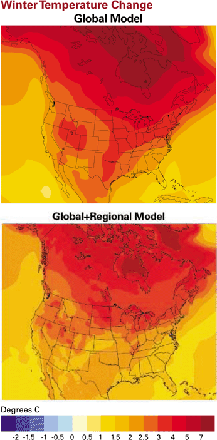 Sharp but true? Feeding a global climate model’s prediction for midcentury (top) into a regional model gives more details (bottom), but modelers aren’t sure how accurate the details are. CREDIT: NORTH AMERICAN REGIONAL CLIMATE CHANGE ASSESSMENT PROGRAM
So scientists have been doing what they can for decision-makers. Early on, it wasn’t much. A U.S. government assessment released in 2000, Climate Change Impacts on the United States, relied on the most rudimentary regional forecasting technique (Science, 23 June 2000, p. 2113). Expert committee members divided the country into eight regions and then considered what two of their best global climate models had to say about each region over the next century. The two models were somewhat consistent in the far southwest, where the report’s authors found it was likely that warmer and drier conditions would eliminate alpine ecosystems and shorten the ski season.
But elsewhere, there was far less consistency. Over the eastern two-thirds of the contiguous 48 states, for example, the two models couldn’t agree on how much moisture soils would hold in the summer. Kansas corn would either suffer severe droughts more frequently, as one model had it, or enjoy even more moisture than it currently does, as the other indicated. But at least the uncertainties were plain for all to see.
The uncertainties of regional projections nearly faded from view in the next U.S. effort, Global Climate Change Impacts in the United States. The 2009 study drew on not two but 15 global models melded into single projections. In a technique called statistical downscaling, its authors assumed that local changes would be proportional to changes on the larger scales. And they adjusted regional projections of future climate according to how well model simulations of past climate matched actual climate.
Statistical downscaling yielded a broad warming across the lower 48 states with less warming across the southeast and up the West Coast. Precipitation was mostly down, especially in the southwest. But discussion of uncertainties in the modeling fell largely to a footnote (number 110), in which the authors cite a half-dozen papers to support their assertion that statistical downscaling techniques are “well-documented” and thoroughly corroborated.
The other sort of downscaling, known as dynamical downscaling or regional modeling, has yet to be fully incorporated into a U.S. national assessment. But an example of state-of-the-art regional modeling appeared 30 June in Environmental Research Letters. To investigate what will happen in the U.S. wine industry, regional modeler Noah Diffenbaugh of Purdue University in West Lafayette, Indiana, and his colleagues embedded a detailed model that spanned the lower 48 states in a climate model that spanned the globe. The global model’s relatively fuzzy simulation of evolving climate from 1950 to 2039—calculated at points about 150 kilometers apart—then fed into the embedded regional model, which calculated a sharper picture of climate change at points only 25 kilometers apart.
Closely analyzing the regional model’s temperature projections on the West Coast, the group found that the projected warming would decrease the area suitable for production of premium wine grapes by 30% to 50% in parts of central and northern California. The loss in Washington state’s Columbia Valley would be more than 30%. But adaptation to the warming, such as the introduction of heat-tolerant varieties of grapes, could sharply reduce the losses in California and turn the Washington loss into a 150% gain.
Not so fast
A rapidly growing community of regional modelers is turning out increasingly detailed projections of future climate, but many researchers, mostly outside the downscaling community, have serious reservations. “Many regional modelers don’t do an adequate job of quantifying issues of uncertainty,” says Bretherton, who is chairing a National Academy of Sciences study committee on a national strategy for advancing climate modeling. “We’re not confident predicting the very things people are most interested in being predicted,” such as changes in precipitation.
Regional models produce strikingly detailed maps of changed climate, but they might be far off base. “The problem is that precision is often mistaken for accuracy,” Bretherton says. Battisti just doesn’t see the point of downscaling. “I would never use one of these products,” he says.
The problems start with the global models, as critics see it. Regional models must fill in the detail in the fuzzy picture of climate provided by global models, notes atmospheric scientist Edward Sarachik, professor emeritus at UW Seattle. But if the fuzzy picture of the region is wrong, the details will be wrong as well. And global models aren’t very good at painting regional pictures, he says. A glaring example, according to Sarachik, is the way global models place the cooler waters of the tropical Pacific farther west than they are in reality. Such ocean temperature differences drive weather and climate shifts in specific regions halfway around the world, but with the cold water in the wrong place, the global models drive climate change in the wrong regions.
Gregory Tripoli’s complaint about the global models is that they can’t create the medium-size weather systems that they should be sending into any embedded regional model. Tripoli, a meteorologist and modeler at the University of Wisconsin, Madison, cites the case of summertime weather disturbances that churn down off the Rocky Mountains and account for 80% of the Midwest’s summer rainfall. If a regional model forecasting for Wisconsin doesn’t extend to the Rockies, Wisconsin won’t get the major weather events that add up to be climate. And some atmospheric disturbances travel from as far away as Thailand to wreak havoc in the Midwest, he says, so they could never be included in the regional model.
 A tougher nut. Predicting the details of precipitation using a regional model (bottom) fed by a global model (top) is even more uncertain than projecting regional temperature change.
 CREDIT: NORTH AMERICAN REGIONAL CLIMATE CHANGE ASSESSMENT PROGRAM
Even the things the global models get right have a hard time getting into regional models, critics say. “There are a lot of problems matching regional and global models,” Tripoli says. In one problem area, global and regional models usually have different ways of accounting for atmospheric processes such as individual cloud development that neither model can simulate directly, creating further clashes. Even the different philosophies involved in building global models and regional models can lead to mismatches that create phantom atmospheric circulations, Tripoli says. “It’s not straightforward you’re going to get anything realistic,” he says.
Redeeming regional modeling
“You could say all the global and regional models are wrong; some people do say that,” notes regional modeler Filippo Giorgi of the Abdus Salam International Centre for Theoretical Physics in Trieste, Italy. “My personal opinion is we do know something now. A few reports ago, it was really very, very difficult to say anything about regional climate change.”
But Giorgi says that in recent years he has been seeing increasingly consistent regional projections coming from combinations of many different models and from successive generations of models. “This means the projections are more and more reliable,” he says. “I would be confident saying the Mediterranean area will see a general decrease in precipitation in the next decades. I’ve seen this in several generations of models, and we understand the processes underlying this phenomenon. This is fairly reliable information, qualitatively. Saying whether the decrease will be 10% or 50% is a different issue.”
The skill of regional climate forecasting also varies from region to region and with what is being forecast. “Temperature is much, much easier” than precipitation, Giorgi notes. Precipitation depends on processes like atmospheric convection that operate on scales too small for any model to render in detail. Trouble simulating convection also means that higher-latitude climate is easier to project than that of the tropics, where convection dominates.
Regional modeling does have a clear advantage in areas with complex terrain such as mountainous regions, notes UW’s Mass, who does regional forecasting of both weather and climate. In the Pacific Northwest, the mountains running parallel to the coast direct onshore winds upward, predictably wringing rain and snow from the air without much difficult-to-simulate convection.
The downscaling of climate projections should be getting a boost as the Coordinated Regional Climate Downscaling Experiment (CORDEX) gets up to speed. Begun in 2009, CORDEX “is really the first time we’ll get a handle on all these uncertainties,” Giorgi says. Various groups will take on each of the world’s continent-size regions. Multiple global models will be matched with multiple regional models and run multiple times to tease out the uncertainties in each. “It’s a landmark for the regional climate modeling community,” Giorgi says.
Science 23 June 2000:
Vol. 288 no. 5474 p. 2113
DOI: 10.1126/science.288.5474.2113
Vol. 288 no. 5474 p. 2113
DOI: 10.1126/science.288.5474.2113
GREENHOUSE WARMING
Dueling Models: Future U.S. Climate Uncertain
Richard A. Kerr
When Congress started funding a global climate change research program in 1990, it wanted to know what all this talk about greenhouse warming would mean for United States voters. Ten years later, a U.S. national assessment, drawing on the best available climate model predictions, concludes that the United States will indeed warm, affecting everything from the western snowpacks that supply California with water to New England’s fall foliage. But on a more detailed level, the assessment often draws a blank. Whether the cornfields of Kansas will be gripped by frequent, severe droughts, as one climate model has it, or blessed with more moisture than they now enjoy, as another predicts, the report can’t say. As much as policy-makers would like to know exactly what’s in store for Americans, the rudimentary state of regional climate science will not soon allow it, and the results of this 3-year effort brought the point home.
“This is the first time we’ve tried to take the physical [climate] system and see what effect it might have on ecosystems and socioeconomic systems,” says Thomas Karl, director of the National Oceanic and Atmospheric Administration’s (NOAA’s) National Climatic Data Center in Asheville, North Carolina, and a co-chair of the committee of experts that pulled together the assessment report “Climate Change Impacts on the United States” (available at http://www.nacc.usgcrp.gov/). “We don’t say we know there’s going to be catastrophic drought in Kansas,” he says. “What we do say is, ‘Here’s the range of our uncertainties.’ This document should get people to think.” If anything is certain, Karl says, it’s that “the past isn’t going to be a very good guide to future climate.”
By chance, the assessment had a handy way to convey the range of uncertainty that regional modeling serves up. The report, which divides the country into eight regions, is based on a pair of state-of-the-art climate models—one from the Canadian Climate Center and one from the U.K. Hadley Center for Climate Research and Prediction—that couple a simulated atmosphere and ocean. The two models solved the problems of simplifying a complex world in different ways, leading to very different predicted U.S. climates. “In terms of temperature, the Canadian model is at the upper end of the warming by 2100” predicted by a range of models, says modeler Eric Barron of Pennsylvania State University, University Park, and a member of the assessment team. “The Hadley model is toward the lower end. The Canadian model is on the dry side, and the Hadley model is on the wet side. We’re capturing a substantial portion of the range of simulations. We tried hard to convey that uncertainty.”
On a broad scale, the report can conclude: “Overall productivity of American agriculture will likely remain high, and is projected to increase throughout the 21st century,” although there will be winners and losers from place to place, and adapting agricultural practice to climate change will be key. Where the models are somewhat consistent, as in the far southwest, the report ventures what could be construed as predictions: “It is likely that some ecosystems, such as alpine ecosystems, will disappear entirely from the region,” or “Higher temperatures are likely to mean … a shorter season for winter activities, such as skiing.” Where the models clash, as on summer soil moisture over the eastern two-thirds of the lower 48 states, it explains the alternatives and suggests ways to adapt, such as switching crops.
The range of possible climate impacts laid out by the models “fairly reflects where we are in the science,” says Karl. But he notes that the effort did lack one important input: Congress mandated the assessment without funding it. “You get what you pay for,” says climatologist Kevin Trenberth of the National Center for Atmospheric Research in Boulder, Colorado. “A lot of it was done hastily.” Karl concedes that everyone involved would have liked to have had more funding delivered more reliably.
Even given more time and money, however, the assessment may not have come up with much better small-scale predictions, given the inherent limitations of the science. Even the best models today can say little that’s reliable about climate change at the regional level, never mind at the scale of a congressional district. Their picture of future climate is fuzzy—they might lump together San Francisco and Los Angeles because the models have such coarse geographic resolution—and the realism of such meteorological phenomena as clouds and precipitation is compromised by the inevitable simplifications of simulating the world in a computer.
“For the most part, these sorts of models give a warming,” says modeler Filippo Giorgi, “but they tend to give very different predictions, especially at the regional level, and there’s no way to say one should be believed over another.” Giorgi and his colleague Raquel Francisco of the Abdus Salam International Center for Theoretical Physics in Trieste, Italy, recently evaluated the uncertainties in five coupled climate models—including the two used in the national assessment—within 23 regions, the continental United States comprising roughly three regions. Giorgi concludes that as the scale of prediction shrinks, reliability drops until for small regions “the model data are not believable at all.”
Add in uncertainties external to the models, such as population and economic growth rates, says modeler Jerry D. Mahlman, director of NOAA’s Geophysical Fluid Dynamics Laboratory in Princeton, New Jersey, and the details of future climate recede toward unintelligibility. Some people in Congress and the policy community had “almost silly expectations there would be enormously useful, small-scale specifics, if you just got the right model. But the right model doesn’t exist,” says Mahlman.
Still, even though the national assessment does not offer the list of region-by-region impacts that Congress might have hoped for, it does show “where we are adaptable and where we are vulnerable,” says global change researcher Stephen Schneider of Stanford University. In 10 years, modelers say, they’ll do better.
The Post-Normal Seduction of Climate Science (Forbes)
William Pentland, 10/14/2011 @ 12:22AM |2,770 views
In early 2002, former U.S. Defense Secretary Donald Rumsfeld explained why the lack of evidence linking Saddam Hussein with terrorist groups did not mean there was no connection during a televised press conference.
“[T]here are known ‘knowns’ – there are things we know we know,” said Rumsfeld. “We also know there are known ‘unknowns’ – that is to say we know there are some things we do not know. But there are also unknown ‘unknowns’ – the ones we don’t know we don’t know . . . it is the latter category that tend to be the difficult ones.”
Rumsfeld turned out to be wrong about Hussein, but what if he had been talking about global warming? Well, he probably would have been on to something there. Unknowns of any ilk are a real pickle in climate science.
Indeed, uncertainty in climate science has induced a state of severe political paralysis. The trouble is that nobody really knows why. A rash of recent surveys and studies have exonerated most of the usual suspects – scientific illiteracy, industry distortions, skewed media coverage.
Now, the climate-science community is scrambling to crack the code on the “uncertainty” conundrum. Exhibit A: the October 2011 issue of the journal Climatic Change, the closest thing in climate science to gospel truth, which is devoted entirely to the subject of uncertainty.
While I have yet to digest all of the dozen or so essays, I suspect they are only the opening salvo in what is will soon become a robust debate about the significance of uncertainty in climate-change science. The first item up on the chopping block is called post-normal science (PNS).
PNS is a model of the scientific process pioneered by Jerome Ravetz and Silvio Funtowicz, which describes the peculiar challenges science encounters where “facts are uncertain, values in dispute, stakes high and decisions urgent.” Unlike “normal” science in the sense described by the philosopher of science Thomas Kuhn, post-normal science commonly crosses disciplinary lines and involves new methods, instruments and experimental systems.
Judith Curry, a professor at Georgia Tech, weighs the wisdom of taking the plunge on PNS in an excellent piece called “Reasoning about climate uncertainty.” Drawing on the work of Dutch wunderkind, Jeroen van der Sluijs, Curry calls on the Intergovernmental Panel on Climate Change to stop marginalizing uncertainty and get real about bias in the consensus building process. Curry writes:
The consensus approach being used by the IPCC has failed to produce a thorough portrayal of the complexities of the problem and the associated uncertainties in our understanding . . . Better characterization of uncertainty and ignorance and a more realistic portrayal of confidence levels could go a long way towards reducing the “noise” and animosity portrayed in the media that fuels the public distrust of climate science and acts to stymie the policy process.
PNS is especially seductive in the context of uncertainty. Not surprisingly, Curry suggests that instituting PNS-like strategies at the IPCC “could go a long way towards reducing the ‘noise’ and animosity” surrounding climate-change science.
While I personally believe PNS is persuasive, the PNS model provokes something closer to revulsion in many people. Last year, members of the U.S. House of Representatives filed a petition challenging the U.S. Environmental Protection Agency‘s Greenhouse Gas Endangerment seemed less sanguine about post-normal science:
. . . the conclusions of organizing bodies, especially the IPCC, cannot be said to reflect scientific “consensus” in any meaningful sense of that word. Instead, they reflect a political movement that has commandeered science to the service of its agenda. This is “post-normal science”: the long-dreaded arrival of deconstructionism to the natural sciences, according to which scientific quality is determined not by its fidelity to truth, but by its fidelity to the political agenda.
It seems unlikely that taking the PNS plunge would appreciably improve the U.S. public’s perception of the credibility, legitimacy and salience of climate-change assessments. This probably says more about Americans than it does about the analytic force of the PNS model.
Let’s face it. Americans do not agree on a whole hell of a lot. And they never have. Many U.S. institutions were deliberately designed to tolerate the coexistence of free states and slave-owning states. Ironically, Americans appear to agree more on climate-change science than other high-profile scientific controversies like the safety of genetically-modified organisms.

While it pains me to admit this, I am increasingly convinced that the IPCC’s role in assessing the science of climate change needs to be scaled back. The IPCC was an overly optimistic experiment in international governance designed for a world that never materialized. The U.N. General Assembly established the IPCC in the months immediately preceding the fall of the Berlin Wall. Only two few years later, the IPCC’s first assessment report and the creation of the U.N. Framework Convention on Climate Change coincided with the collapse of the Soviet Union and the end of the Cold War.
A new world order seemed to be dawning in those days, which is probably why it seemed like a good idea to ask scientists to tell us what constitutes “dangerous climate change.” Two decades and two world trade towers later, the world is a decidedly less hospitable place for institutions like the IPCC.
The proof is in the pudding – or, in this case, the atmosphere.
Climate Change Tumbles Down Europe’s Political Agenda as Economic Worries Take the Stage (N.Y. Times)
By JEREMY LOVELL of ClimateWire. Published: October 13, 2011
LONDON — Climate change has all but fallen off the political agenda across Europe as the resurging economic crisis empties national coffers and shakes economic confidence, and the public and the press turn their attention to more immediate issues of rising fuels bills and joblessness, analysts say.
Sputtering economies, a shift of attention to looming elections and the prospect of little or no movement in the December climate talks in Durban, South Africa, have combined to take the political momentum out of an issue that was a major cause in Europe.
“It is way down the agenda and will not feature in elections,” said Edward Cameron, director of the World Resources Institute think tank’s international climate initiative, on the sidelines of a meeting on climate change at London’s Chatham House think tank. “At a time of joblessness and fiscal crises, it is very difficult to advance the climate change issue.”
That is as true for next year’s presidential elections in the United States as it will be in France, despite the fact that there has been a series of environmental disasters, from the Texas drought this year to Russia’s heat wave and consequent steep rise in wheat prices last year.
According to acclaimed NASA scientist James Hansen, who has been warning of impending climatic doom for decades, the lack of focus on these events is in no small part due to the fact that scientists are poor communicators while the climate change skeptics have mounted a smoothly run campaign to capitalize on any mistakes and admissions of uncertainty.
“There is a strong campaign by those people who want to continue the fossil fuel business as usual. Climate contrarians … have managed in the public’s eye to muddy the waters enough that there is uncertainty why should we do anything yet,” he said on a visit to London’s Royal Society for a meeting on lessons to be learned from past climate change battles.
“They have been winning the argument in the last several years, even though the science has become clearer,” he added.
Nuclear power issue distracts Berlin
In Germany, where a generous feed-in tariff scheme has produced some 28 gigawatts of wind power capacity and more than 18 GW of solar photovoltaic capacity, Chancellor Angela Merkel’s coalition government was forced into an abrupt U-turn on a controversial move to extend the lives of the country’s fleet of nuclear power plants. There was a political revolt after the March 11 nuclear disaster at Fukushima in Japan.
The oldest seven of Germany’s nuclear plants were closed immediately after Fukushima and will now never reopen, while the remainder will close by 2022.
This has had the perverse effect in a country proud of its renewable energy efforts of increasing the use of coal-fired power plants and increasing the likelihood of new coal- or gas-fired plants being built. The price tag will include higher carbon emissions at exactly the time that the Germany along with the rest of the European Union is pledged to cut emissions.
While political observers believe the climate change issue will come back to the fore at some point in Germany — a country where the Greens have played a pivotal political role — the nuclear power issue is so politically charged that it is off the agenda for now.
Even in the United Kingdom, which has a huge wind energy program and where the Conservative-Liberal Democrat coalition came to power 15 months ago pledging to be the “greenest government ever,” there are major signs of backsliding. A long-awaited energy bill has been shelved, and renewable energy support costs and carbon emission reduction targets are either under review or about to be.
At the Conservative Party’s annual conference earlier this month, climate change was consigned to a brief debate on the opening Sunday, when delegates were mostly just arriving and finding their way around or still traveling to get there.
Damned by faint praise in London
Prime Minister David Cameron did not mention the issue in his speech to the conference — a performance that usually sets the broad agenda for the following year — and Chancellor of the Exchequer George Osborne caused environmental outrage but satisfaction to the party’s right wing by pledging that the United Kingdom would not go any faster than its E.U. neighbors on emission cuts.
This is despite the fact that the United Kingdom has a legal target to cut its carbon emissions by at least 80 percent below 1990 levels by 2050, with cuts of 35 percent by 2022 and 50 percent by 2025, whereas the European Union’s goal is 20 percent by 2020.
It was widely reported that the 2022 target was only agreed to after a major battle in the Cabinet between supporters of Conservative Osborne and those of Liberal Democrat Energy and Climate Change Minister Chris Huhne. It has since been announced that the carbon targets will be reviewed in 2014.
Even in London, where charismatic Conservative Mayor Boris Johnson came to power in 2008 in part on a green ticket, the issue has largely been parked and replaced by transport in the run-up to next year’s mayoral elections. The city’s aging transport system is feared likely to come under massive strain during the 2012 Olympic Games.
Then there is the strange case of a strategic plan on adapting London to climate change, the draft of which was launched with great fanfare and declarations of urgency in February 2010. It was on the brink of publication in September 2010, but after that, it appeared to have vanished without trace.
At the same time, most members of City Hall’s climate change team, set up under the previous Labour administration, have been moved to other jobs.
‘Too difficult — and not a vote winner’
“Political leaders get it, but the treasuries don’t. The men with the money don’t want to be first movers,” said Nick Mabey, co-founder of environmental think tank E3G. “But the political froth has gone. It has become too difficult — and not a vote winner.”
Compounding that problem, at least in the United Kingdom, has been a series of reports underscoring the likely high cost to households of green energy policies at a time when the prices of domestic electricity and gas are already rising sharply.
A recent opinion poll found that the climate change issue has been replaced by concerns over rising fuel bills and energy security.
But Mabey is not too concerned. While the subject may be off the immediate political agenda, behind the scenes, the more enlightened corporate leaders and investment fund managers have been making their own calculations. They are moving their money into the low-carbon economic transformation that in some cases is already profitable and in many eyes essential and inevitable.
The main danger, they say, is that if climate change as a driver of action is allowed to languish too long and become too invisible while energy becomes the main motivator, it will become far harder to resurrect climate change.
For Mabey and WRI’s Cameron, while the deep and seemingly returning global economic crisis has proved a serious distraction internationally as well as domestically, all is not lost.
For a number of reasons, including the rise of a new and major climate player — China — and a series of new scientific reports on climate change due over the next two or three years, 2015 will be the next pivotal moment for the world to take collective action, they say.
“Climate change doesn’t keep people awake at night. Our task for the next few years is to move it back up the political agenda again,” said WRI’s Cameron.
Copyright 2011 E&E Publishing. All Rights Reserved.
Group Urges Research Into Aggressive Efforts to Fight Climate Change (N.Y. Times)
By CORNELIA DEAN, Published: October 4, 2011
With political action on curbing greenhouse gases stalled, a bipartisan panel of scientists, former government officials and national security experts is recommending that the government begin researching a radical fix: directly manipulating the Earth’s climate to lower the temperature.
Members said they hoped that such extreme engineering techniques, which include scattering particles in the air to mimic the cooling effect of volcanoes or stationing orbiting mirrors in space to reflect sunlight, would never be needed. But in itsreport, to be released on Tuesday, the panel said it is time to begin researching and testing such ideas in case “the climate system reaches a ‘tipping point’ and swift remedial action is required.”
The 18-member panel was convened by the Bipartisan Policy Center, a research organization based in Washington founded by four senators — Democrats and Republicans — to offer policy advice to the government. In interviews, some of the panel members said they hoped that the mere discussion of such drastic steps would jolt the public and policy makers into meaningful action in reducing greenhouse gas emissions, which they called the highest priority.
The idea of engineering the planet is “fundamentally shocking,” David Keith, an energy expert at Harvard and the University of Calgary and a member of the panel, said. “It should be shocking.”
In fact, it is an idea that many environmental groups have rejected as misguided and potentially dangerous.
Jane Long, an associate director of the Lawrence Livermore National Laboratory and the panel’s co-chairwoman, said that by spewing greenhouse gases into the atmosphere, human activity was already engaged in climate modification. “We are doing it accidentally, but the Earth doesn’t know that,” she said, adding, “Going forward in ignorance is not an option.”
The panel, the Task Force on Climate Remediation Research, suggests that the White House Office of Science and Technology Policy begin coordinating research and estimates that a valuable effort could begin with a few million dollars in financing over the next few years.
One reason that the United States should embrace such research, the report suggests, is the threat of unilateral action by another country. Members say research is already under way in Britain, Germany and possibly other countries, as well as in the private sector.
“A conversation about this is going to go on with us or without us,” said David Goldston, a panel member who directs government affairs at the Natural Resources Defense Counciland is a former chief of staff of the House Committee on Science. “We have to understand what is at stake.”
In interviews, panelists said again and again that the continuing focus of policy makers and experts should be on reducing emissions of carbon dioxide and other greenhouse gases. But several acknowledged that significant action remained a political nonstarter. Last month, for example, the Obama administration told the federal Environmental Protection Agency to hold off on tightening ozone standards, citing complications related to the weak economy.
According to the United Nations Intergovernmental Panel on Climate Change, greenhouse gas emissions have contributed to raising the global average surface temperatures by about 1.3 degrees Fahrenheit in the past 100 years. It is impossible to predict how much impact the report will have. But given the panelists’ varied political and professional backgrounds, they seem likely to achieve one major goal: starting a broader conversation on the issue. Some climate experts have been working on it for years, but they have largely kept their discussions to themselves, saying they feared giving the impression that there might be quick fixes for climate change.
“Climate adaptation went through the same period of concern,” Mr. Goldston said, referring to the onetime reluctance of some researchers to discuss ways in which people, plants and animals might adjust to climate change. Now, he said, similar reluctance to discuss geoengineering is giving way, at least in part because “it’s possible we may have to do this no matter what.”
Although the techniques, which fall into two broad groups, are more widely known as geoengineering, the panel prefers “climate remediation.”
The first is carbon dioxide removal, in which the gas is absorbed by plants, trapped and stored underground or otherwise removed from the atmosphere. The methods are “generally uncontroversial and don’t introduce new global risks,” said Ken Caldeira, a climate expert at Stanford University and a panel member. “It’s mostly a question of how much do these things cost.”
Controversy arises more with the second group of techniques, solar radiation management, which involves increasing the amount of solar energy that bounces back into space before it can be absorbed by the Earth. They include seeding the atmosphere with reflective particles, launching giant mirrors above the earth or spewing ocean water into the air to form clouds.
These techniques are thought to pose a risk of upsetting earth’s natural rhythms. With them, Dr. Caldeira said, “the real question is what are the unknown unknowns: Are you creating more risk than you are alleviating?”
At the influential blog Climate Progress, Joe Romm, a fellow at the Center for American Progress, has made a similar point, likening geo-engineering to a dangerous course of chemotherapy and radiation to treat a condition curable through diet and exercise — or, in this case, emissions reduction.
The panel rejected any immediate application of climate remediation techniques, saying too little is known about them. In 2009, the Royal Society in Britain said much the same, assessing geoengineering technologies as “technically feasible” but adding that their potential costs, effectiveness and risks were unknown.
Similarly, in a 2010 review of federal research that might be relevant to climate remediation, the federal Government Accountability Office noted that “major uncertainties remain on the efficacy and potential consequences” of the approach. Its report also recommended that the White House Office of Science and Technology Policy “establish a clear strategy for geoengineering research.”
John P. Holdren, who heads that office, declined interview requests. He issued a statement reiterating the Obama administration’s focus on “taking steps to sensibly reduce pollution that is contributing to climate change.”
Yet in an interview with The Associated Press in 2009, Dr. Holdren said the possible risks and benefits of geoengineering should be studied very carefully because “we might get desperate enough to want to use it.”
In a draft plan made public on Friday, the U.S. Global Change Research Program, a coordinating effort administered by his office, outlined its own climate change research agenda, including studies of the impacts of rapid climate change.
The plan said that climate-related projections would be crucial to future studies of the “feasibility, effectiveness and unintended consequences of strategies for deliberate, large-scale manipulations of Earth’s environment,” including carbon dioxide removal and solar radiation management.
Many countries fault the United States for government inaction on climate change, especially given its longtime role as a chief contributor to the problem.
Frank Loy, a panelist and former chief climate negotiator for the United States, suggested that people around the world would see past those issues if the United States embraced geoengineering studies, provided that it was “very clear about what kind of research is undertaken and what the safeguards are.”
This article has been revised to reflect the following correction:
Correction: October 4, 2011
An earlier version of this article mistakenly referred to Frank Loy as the nation’s chief climate negotiator; he is a former chief climate negotiator. It also misstated the name of a federal agency that reported on the potential effectiveness of climate remediation. It is the Government Accountability Office, not the General Accountability Office.
The scientific finding that settles the climate-change debate (Washington Post)
By Eugene Robinson, Published: October 24
For the clueless or cynical diehards who deny global warming, it’s getting awfully cold out there.
The latest icy blast of reality comes from an eminent scientist whom the climate-change skeptics once lauded as one of their own. Richard Muller, a respected physicist at the University of California, Berkeley, used to dismiss alarmist climate research as being “polluted by political and activist frenzy.” Frustrated at what he considered shoddy science, Muller launched his own comprehensive study to set the record straight. Instead, the record set him straight.
“Global warming is real,” Muller wrote last week in The Wall Street Journal.
Rick Perry, Herman Cain, Michele Bachmann and the rest of the neo-Luddites who are turning the GOP into the anti-science party should pay attention.
“When we began our study, we felt that skeptics had raised legitimate issues, and we didn’t know what we’d find,” Muller wrote. “Our results turned out to be close to those published by prior groups. We think that means that those groups had truly been careful in their work, despite their inability to convince some skeptics of that.”
In other words, the deniers’ claims about the alleged sloppiness or fraudulence of climate science are wrong. Muller’s team, the Berkeley Earth Surface Temperature project, rigorously explored the specific objections raised by skeptics — and found them groundless.
Muller and his fellow researchers examined an enormous data set of observed temperatures from monitoring stations around the world and concluded that the average land temperature has risen 1 degree Celsius — or about 1.8 degrees Fahrenheit — since the mid-1950s.
This agrees with the increase estimated by the United Nations-sponsored Intergovernmental Panel on Climate Change. Muller’s figures also conform with the estimates of those British and American researchers whose catty e-mails were the basis for the alleged “Climategate” scandal, which was never a scandal in the first place.
The Berkeley group’s research even confirms the infamous “hockey stick” graph — showing a sharp recent temperature rise — that Muller once snarkily called “the poster child of the global warming community.” Muller’s new graph isn’t just similar, it’s identical.
Muller found that skeptics are wrong when they claim that a “heat island” effect from urbanization is skewing average temperature readings; monitoring instruments in rural areas show rapid warming, too. He found that skeptics are wrong to base their arguments on the fact that records from some sites seem to indicate a cooling trend, since records from at least twice as many sites clearly indicate warming. And he found that skeptics are wrong to accuse climate scientists of cherry-picking the data, since the readings that are often omitted — because they are judged unreliable — show the same warming trend.
Muller and his colleagues examined five times as many temperature readings as did other researchers — a total of 1.6 billion records — and now have put that merged database online. The results have not yet been subjected to peer review, so technically they are still preliminary. But Muller’s plain-spoken admonition that “you should not be a skeptic, at least not any longer” has reduced many deniers to incoherent grumbling or stunned silence.
Not so, I predict, with the blowhards such as Perry, Cain and Bachmann, who, out of ignorance or perceived self-interest, are willing to play politics with the Earth’s future. They may concede that warming is taking place, but they call it a natural phenomenon and deny that human activity is the cause.
It is true that Muller made no attempt to ascertain “how much of the warming is due to humans.” Still, the Berkeley group’s work should help lead all but the dimmest policymakers to the overwhelmingly probable answer.
We know that the rise in temperatures over the past five decades is abrupt and very large. We know it is consistent with models developed by other climate researchers that posit greenhouse gas emissions — the burning of fossil fuels by humans — as the cause. And now we know, thanks to Muller, that those other scientists have been both careful and honorable in their work.
Nobody’s fudging the numbers. Nobody’s manipulating data to win research grants, as Perry claims, or making an undue fuss over a “naturally occurring” warm-up, as Bachmann alleges. Contrary to what Cain says, the science is real.
It is the know-nothing politicians — not scientists — who are committing an unforgivable fraud.
Bleak Prospects for Avoiding Dangerous Global Warming (Science)
by Richard A. Kerr on 23 October 2011, 1:00 PM
The bad news just got worse: A new study finds that reining in greenhouse gas emissions in time to avert serious changes to Earth’s climate will be at best extremely difficult. Current goals for reducing emissions fall far short of what would be needed to keep warming below dangerous levels, the study suggests. To succeed, we would most likely have to reverse the rise in emissions immediately and follow through with steep reductions through the century. Starting later would be far more expensive and require unproven technology.
Published online today in Nature Climate Change, the new study merges model estimates of how much greenhouse gas society might put into the atmosphere by the end of the century with calculations of how climate might respond to those human emissions. Climate scientist Joeri Rogelj of ETH Zurich and his colleagues combed the published literature for model simulations that keep global warming below 2°C at the lowest cost. They found 193 examples. Modelers running such optimal-cost simulations tried to include every factor that might influence the amount of greenhouse gases society will produce —including the rate of technological progress in burning fuels efficiently, the amount of fossil fuels available, and the development of renewable fuels. The researchers then fed the full range of emissions from the scenarios into a simple climate model to estimate the odds of avoiding a dangerous warming.
The results suggest challenging times ahead for decision makers hoping to curb the greenhouse. Strategies that are both plausible and likely to succeed call for emissions to peak this decade and start dropping right away. They should be well into decline by 2020 and far less than half of current emissions by 2050. Only three of the 193 scenarios examined would be very likely to keep the warming below the danger level, and all of those require heavy use of energy systems that actually remove greenhouse gases from the atmosphere. That would require, for example, both creating biofuels and storing the carbon dioxide from their combustion in the ground.
“The alarming thing is very few scenarios give the kind of future we want,” says climate scientist Neil Edwards of The Open University in Milton Keynes, U.K. Both he and Rogelj emphasize the uncertainties inherent in the modeling, especially on the social and technological side, but the message seems clear to Edwards: “What we need is at the cutting edge. We need to be as innovative as we can be in every way.” And even then, success is far from guaranteed.
A skeptical physicist ends up confirming climate data (Washington Post)
Posted by Brad Plumer at 04:18 PM ET, 10/20/2011
Back in 2010, Richard Muller, a Berkeley physicist and self-proclaimed climate skeptic, decided to launch the Berkeley Earth Surface Temperature (BEST) project to review the temperature data that underpinned global-warming claims. Remember, this was not long after the Climategate affair had erupted, at a time when skeptics were griping that climatologists had based their claims on faulty temperature data. (Jonathan Hayward/AP)Muller’s stated aims were simple. He and his team would scour and re-analyze the climate data, putting all their calculations and methods online. Skeptics cheered the effort. “I’m prepared to accept whatever result they produce, even if it proves my premise wrong,” wrote Anthony Watts, a blogger who has criticized the quality of the weather stations in the United Statse that provide temperature data. The Charles G. Koch Foundation even gave Muller’s project $150,000 — and the Koch brothers, recall, are hardly fans of mainstream climate science.So what are the end results? Muller’s team appears to have confirmed the basic tenets of climate science. Back in March, Muller told the House Science and Technology Committee that, contrary to what he expected, the existing temperature data was “excellent.” He went on: “We see a global warming trend that is very similar to that previously reported by the other groups.” And, today, the BEST team has released a flurry of new papers that confirm that the planet is getting hotter. As the team’s two-page summary flatly concludes, “Global warming is real.”Here’s a chart comparing their findings with existing data:
 The BEST team tried to take a number of skeptic claims seriously, to see if they panned out. Take, for instance, their paper on the “urban heat island effect.” Watts has long argued that many weather stations collecting temperature data could be biased by being located in cities. Since cities are naturally warmer than rural areas (because building materials retain more heat), the uptick in recorded temperatures might be exaggerated, an illusion spawned by increased urbanization. So Muller’s team decided to compare overall temperature trends with only those weather stations based in rural areas. And, as it turns out the trends match up well. “Urban warming does not unduly bias estimates of recent global temperature change,” Muller’s group concluded.
That shouldn’t be so jaw-dropping. Previous analyses — like this one from the National Oceanic and Atmospheric Administration — have responded to Watts’ concerns by showing that a few flawed stations don’t warp the overall trend. But maybe Muller’s team can finally put this controversy to rest, right? Well, not yet. As Watts responds over at his site, the BEST papers still haven’t been peer-reviewed (an important caveat, to be sure). And Watts isn’t pleased with how much pre-publication hype the studies are getting. But so far, what we have is a prominent skeptic casting a critical eye at the data and finding, much to his own surprise, that the data holds up.
Estudo americano confirma aquecimento da superfície terrestre (BBC)
Richard Black
Da BBC News
 Grupo afirma que estações meteorológicas dão dados precisos sobre aquecimento
Uma nova análise de um grupo de cientistas dos Estados Unidos concluiu que a superfície da Terra está ficando mais quente.
Desde 1950, a temperatura média em terra aumentou em um grau centígrado, segundo as descobertas do grupo Berkeley Earth Project.
O Berkeley Earth Project usou novos métodos e novos dados, mas as descobertas do grupo seguem a mesma tendência climática vista pela Nasa e pelo Escritório de Meteorologia da Grã-Bretanha, por exemplo.
“Nossa maior surpresa foi que os novos resultados concordam com os valores de aquecimento publicados anteriormente por outras equipes nos Estados Unidos e Grã-Bretanha”, afirmou o professor Richard Muller, que estabeleceu o Berkeley Earth Project na Universidade da Califórnia reunindo dez cientistas renomados.
“Isto confirma que estes estudos foram feitos cuidadosamente e que o potencial de (estudos) tendenciosos, identificados pelos céticos em relação ao aquecimento global, não afetam seriamente as conclusões”, acrescentou.
O grupo de cientistas também relata que, apesar de o efeito de aumento de calor perto de cidades – o chamado efeito de ilha de calor urbana – ser real e já ter sido estabelecido, ele não é o responsável pelo aquecimento registrado pela maioria das estações climáticas no mundo todo.
Ceticismo
O grupo examinou as alegações de blogueiros “céticos” em relação ao fenômeno, que afirmam que os dados de estações meteorológicas não mostram uma tendência verdadeira de aquecimento global.
Eles dizem que muitas estações meteorológicas registraram aquecimento pois estão localizadas perto de cidades e as cidades crescem, aumentando o calor.
No entanto, o grupo de cientistas descobriu cerca de 40 mil estações meteorológicas no mundo todo cujas informações foram gravadas e armazenadas no formato digital.
Os pesquisadores então desenvolveram uma nova forma de analisar os dados para detectar a tendência das temperaturas globais em terra desde 1800.
O resultado foi um gráfico muito parecido com aqueles produzidos pelos grupos mais importantes do mundo, que tiveram seus trabalhos criticados pelos céticos.
Dois destes três registros são mantidos pelos Estados Unidos, na Administração Oceânica e Atmosférica Nacional (NOAA) e na Nasa. O terceiro é uma colaboração entre o Escritório de Meteorologia da Grã-Bretanha e o Centro de Pesquisa Climática da Universidade de East Anglia (UEA).
O professor Phil Jones, do Centro de Pesquisa Climática da UEA, encarou o trabalho do grupo com cautela e afirmou que espera ler “o relatório final”, quando for publicado.
“Estas descobertas iniciais são muito encorajadoras e ecoam nossos resultados e nossa conclusão de que o impacto das ilhas urbanas de calor na média global de temperatura é mínimo”, disse.
 Céticos dizem que proximidade de cidades alteram dados de estações
Phil Jones foi um dos cientistas britânicos acusados de manipular dados para exagerar a influência humana no aquecimento global. Os cientistas foram inocentados em 2010.
O caso teve início em 2009, com o vazamento de e-mails de Jones nos quais o cientista parecia sugerir que alguns dados de pesquisas sobre o aquecimento global fossem excluídos de apresentações que seriam realizadas na conferência da ONU sobre mudanças climáticas.
O episódio deu munição aos céticos em relação ao papel dos seres humanos nas alterações climáticas. Mas a sindicância da Universidade de East Anglia concluiu que não havia dúvidas sobre o rigor e a honestidade dos cientistas.
Sem publicação
Bob Ward, diretor de política e comunicações para o Instituto Graham de Mudança Climática e Meio Ambiente, de Londres, afirmou que o aquecimento global é claro.
“Os chamados céticos devem deixar de lado sua alegações de que o aumento na temperatura média global pode ser atribuído ao impacto do crescimento das cidades”, disse.
A equipe do Berkeley Earth Project decidiu divulgar os dados de suas pesquisas inicialmente em seu próprio website, ao invés de fazê-lo em uma publicação especializada.
Os pesquisadores estão pedindo para que os internautas comentem e forneçam suas opiniões antes de preparar os manuscritos para a publicação científica formal.
Richard Muller, que criou o grupo de pesquisa, afirmou que esta livre circulação de informações marca uma volta à forma como a ciência precisa ser feita, ao invés de apenas publicar o estudo em revistas científicas.
Rick Perry officials spark revolt after doctoring environment report (The Guardian)
Scientists ask for names to be removed after mentions of climate change and sea-level rise taken out by Texas officials
Suzanne Goldenberg, US environment correspondent
guardian.co.uk, Friday 14 October 2011 13.05 BST

Rick Perry’s administration deleted references to climate change and sea-level rise from the report. Photograph: Evan Vucci/AP
Officials in Rick Perry’s home state of Texas have set off a scientists’ revolt after purging mentions of climate change and sea-level rise from what was supposed to be a landmark environmental report. The scientists said they were disowning the report on the state of Galveston Bay because of political interference and censorship from Perry appointees at the state’s environmental agency.
By academic standards, the protest amounts to the beginnings of a rebellion: every single scientist associated with the 200-page report has demanded their names be struck from the document. “None of us can be party to scientific censorship so we would all have our names removed,” said Jim Lester, a co-author of the report and vice-president of the Houston Advanced Research Centre.
“To me it is simply a question of maintaining scientific credibility. This is simply antithetical to what a scientist does,” Lester said. “We can’t be censored.” Scientists see Texas as at high risk because of climate change, from the increased exposure to hurricanes and extreme weather on its long coastline to this summer’s season of wildfires and drought.
However, Perry, in his run for the Republican nomination, has elevated denial of science, from climate change to evolution, to an art form. He opposes any regulation of industry, and has repeatedly challenged the authority of the Environmental Protection Agency.
Texas is the only state to refuse to sign on to the federal government’s new regulations on greenhouse gas emissions. “I like to tell people we live in a state of denial in the state of Texas,” said John Anderson, an oceanography at Rice University, and author of the chapter targeted by the government censors.
That state of denial percolated down to the leadership of the Texas Commission on Environmental Quality. The agency chief, who was appointed by Perry, is known to doubt the science of climate change. “The current chair of the commission, Bryan Shaw, commonly talks about how human-induced climate change is a hoax,” said Anderson.
But scientists said they still hoped to avoid a clash by simply avoiding direct reference to human causes of climate change and by sticking to materials from peer-reviewed journals. However, that plan began to unravel when officials from the agency made numerous unauthorised changes to Anderson’s chapter, deleting references to climate change, sea-level rise and wetlands destruction.
“It is basically saying that the state of Texas doesn’t accept science results published in Science magazine,” Anderson said. “That’s going pretty far.”
Officials even deleted a reference to the sea level at Galveston Bay rising five times faster than the long-term average – 3mm a year compared to .5mm a year – which Anderson noted was a scientific fact. “They just simply went through and summarily struck out any reference to climate change, any reference to sea level rise, any reference to human influence – it was edited or eliminated,” said Anderson. “That’s not scientific review that’s just straight forward censorship.”
Mother Jones has tracked the changes. The agency has defended its actions. “It would be irresponsible to take whatever is sent to us and publish it,” Andrea Morrow, a spokeswoman said in an emailed statement. “Information was included in a report that we disagree with.”
She said Anderson’s report had been “inconsistent with current agency policy”, and that he had refused to change it. She refused to answer any questions. Campaigners said the censorship by the Texas state authorities was a throwback to the George Bush era when White House officials also interfered with scientific reports on climate change.
In the last few years, however, such politicisation of science has spread to the states. In the most notorious case, Virginia’s attorney general Ken Cuccinelli, who is a professed doubter of climate science, has spent a year investigating grants made to a prominent climate scientist Michael Mann, when he was at a state university in Virginia.
Several courts have rejected Cuccinelli’s demands for a subpoena for the emails. In Utah, meanwhile, Mike Noel, a Republican member of the Utah state legislature called on the state university to sack a physicist who had criticised climate science doubters.
The university rejected Noel’s demand, but the physicist, Robert Davies said such actions had had a chilling effect on the state of climate science. “We do have very accomplished scientists in this state who are quite fearful of retribution from lawmakers, and who consequently refuse to speak up on this very important topic. And the loser is the public,” Davies said in an email.
“By employing these intimidation tactics, these policymakers are, in fact, successful in censoring the message coming from the very institutions whose expertise we need.”
Expedição no Amazonas vai divulgar astronomia indígena na Semana Nacional de C&T (Jornal A Crítica, de Manaus)
JC e-mail 4365, de 17 de Outubro de 2011.
Calendário indígena do povo dessana associa constelações às mudanças do clima e ao ecossistema amazônico.
Surucucu não é apenas a mais perigosa serpente da Amazônia. Para os povos indígenas da etnia dessana, também é uma das inúmeras constelações que os ajudam a identificar o ciclo dos rios, o período da piracema, a formação de chuvas e sugere o momento ideal para a realização de rituais.
Na astronomia indígena, outubro é o mês do desaparecimento da constelação surucucu (añá em língua dessana) no horizonte oeste – o equivalente a escorpião na astronomia ocidental. O desaparecimento da figura da cobra está associado ao fim do período da vazante. Os dessana têm outras 13 constelações, sempre associadas às alterações climáticas.
Para divulgar a respeito da pouco conhecida astronomia indígena, um grupo de estudiosos promoverá no próximo dia 19 uma expedição de dois dias a uma aldeia da etnia dessana localizada na Reserva de Desenvolvimento Sustentável Tupé, em Manaus.
Expedição – A comunidade é composta por famílias dessana que se deslocaram da região do alto Rio Negro, no Norte do Amazonas, e ressignificaram suas tradições, cosmologias e rituais na comunidade onde se estabeleceram na zona rural de Manaus. O astrônomo Germano Afonso, do Museu da Amazônia (Musa), que desenvolve há 20 anos estudo sobre constelações indígenas no país, coordenará a expedição. Com os dessana, o trabalho de Germano Afonso é desenvolvimento há dois anos.
Ele descreve a programação como um “diálogo” entre a astronomia indígena e o conhecimento científico. “Será um diálogo entre os dois conhecimentos. Vamos escutar os indígenas e ao mesmo tempo levar uma pequena estação meteorológica que mede temperatura e velocidade. A ciência observa com equipamentos, o indígena vê isso empiricamente”, explicou.
Uma embarcação da Secretaria Municipal de Educação (Semed) levará as pessoas interessadas em participar da experiência. “Vamos fazer atividades de astronomia, meteorologia e química com os indígenas. Será uma atividade integrada à Semana de Ciência e Tecnologia”, explica Afonso.
O traço identificado como surucuru pelos indígenas é mais visível por volta de 19h, pelo lado oeste. Depois da surucuru, é a vez do tatu – outra espécie comum na fauna amazônica.
Desastres – Germano Afonso conta que os povos indígenas observam o céu, a lua, as constelações e sabem exatamente qual a época ideal para fazer o roçado, para se prevenir de uma cheia ou de uma seca. Também sabem qual o momento ideal para realizar um ritual.
A diferença em relação ao conhecimento científico, ocidental, é que não utilizam equipamentos e tecnologia para prever alterações do tempo e mudanças do clima. Mas há uma diferença mais significativa: os indígenas não caem vítimas de desmoronamentos, de grandes cheias ou de uma vazante extraordinária.
“Quem tem mais cuidado com o meio ambiente e evitar os desastres ambientais? Os índios sabem exatamente quando vai cair uma chuva forte e teremos uma grande enchente. Mas eles não morrem por causa disso”, destaca Afonso, que tem ascendência indígena guarani.
Secitece promove I Fórum “Ceará Faz Ciência” (Funcap)
POR ADMIN, EM 13/10/2011
Com a Assessoria de Comunicação da Secitece
O evento será realizado nos dias 17 e 18 de outubro, no auditório do Planetário do Centro Dragão do Mar de Arte e Cultura.
Nos dias 17 e 18 de outubro, a Secretaria da Ciência Tecnologia e Educação Superior (Secitece), realizará o “I Fórum Ceará Faz Ciência”, com o tema” Mudanças climáticas, desastres naturais e prevenção de riscos”. A iniciativa integra a programação estadual da Semana Nacional de Ciência e Tecnologia.
O secretário da Ciência e Tecnologia, René Barreira, fará a abertura do evento, dia 17, às 17h, no auditório do Planetário Rubens de Azevedo. Na ocasião, será prestada homenagem ao pesquisador cearense Expedito Parente, conhecido como o pai do biodiesel, que faleceu em setembro.
No dia 18, partir das 9h, as atividades serão retomadas com as seguintes palestras: “Onda gigante no litoral brasileiro. É possível?”, com o prof. Francisco Brandão, chefe do Laboratório de Sismologia da Coordenadoria Estadual de Defesa Civil, e “As quatro estações do ano no Ceará: perceba suas interferências na fisiologia e no meio ambiente”, ministrada por Dermeval Carneiro, prof. de Física e Astronomia, presidente da Sociedade Brasileira dos Amigos da Astronomia e diretor do Planetário Rubens de Azevedo – Dragão do Mar.
No período da tarde, a partir das 14h30, será a vez da palestra “Desastres Naturais: como prevenir e atuar em situações de risco”, com o Tenente Coronel Leandro Silva Nogueira, secretário Executivo da Coordenadoria Estadual de Defesa Civil. Para finalizar o Fórum, a engenheira agrônoma do Departamento de Recursos Hidricos e Meio Ambiente da Fundação Cearense de Meteorologia e Recursos Hídricos (Funceme), Sonia Barreto Perdigão, ministrará palestra sobre “Mudanças Climáticas e Desertificação no Ceará”, às 16h30.
Os interessados em participar do I Fórum “Ceará Faz Ciência”, a ser realizado nos dias 17 e 18/10, no Dragão do Mar, em Fortaleza, devem fazer sua pré-inscrição. O formulário a ser preenchido está disponível no site da Secitece. A participação é gratuita.
Serviço
I Fórum Ceará Faz Ciência
Data: 17 e 18 de outubro de 2011
Local: Auditório do Planetário Rubens de Azevedo
Informações: (85) 3101-6466
Inscrições gratuitas.
Tim Ingold: Projetando ambientes para a vida – um esboço (Blog Noquetange)
Projetando ambientes para a vida – um esboço*
Por Maycon Lopes
10/10/2011
Imbuído de pensar uma antropologia do vir-a-ser, uma antropologia do devir, quer dizer, aquela que não seja sobre as coisas, mas que se mova com elas, Ingold esboçou, no que os organizadores chamaram desde o início da série de conferências na UFMG de sua “grande conferência”, críticas e proposições para trilharmos o futuro. Trilhar não se trata de percorrer um caminho pré-definido; é deixar pegadas no seu percorrer, marcar com trilho, traçar. O traçado é como um desenho, um projeto, e o ato de fazê-lo já nos desloca da condição de “meros usuários” do design. Para Ingold, os designs têm de falhar, para que o futuro possa deles se apropriar, destruí-los. Eles poderiam ser pensados como previsões – e toda previsão é errada. Ou, seguindo a linha de análise deleuziana, o design poderia ser compreendido como uma tentativa de controlar o devir.
Tim Ingold propõe que ele (o design) seja concebido, no âmbito de um processo vital cuja essência é de abertura e improvisação, como um aspecto, menos como meta pré-determinada que como a continuidade de um andamento. Neste sentido, o design seria produção de futuros e não definição de. Essa ideia contudo contrasta – e esse é o ponto, creio eu, de Ingold e desse post – com a forma como tem sido predominantemente compreendida a natureza no discurso tecnocientífico: com objetivos precisos, o ambiente seria nada mais que um meio, uma coisa manipulável, vida sequestrada tendo em vista a atingir determinados fins. A natureza dos cientistas e dos criadores de política é conhecida através de cálculos, gráficos, imagens independentes daquelas do mundo que conhecemos (ou mundo fenomenal) e com o qual estamos familiarizados pelo próprio habitar. Essa dissociação artificial, que para nós aparece na figura do “globo”, espaço a que não sentimos pertencer, em contraposição com a terra, que de fato habitamos, é um modo nada adequado de abordar as constantes ameaças sofridas pela natureza. A mesma dissociação provoca uma lacuna entre o mundo diário e o mundo projetado pelos instrumentos de conhecimento a que me referi anteriormente, opondo conhecimento do habitante a conhecimento científico, como se os cientistas não habitassem mundo.
Uma expressão muito em voga como “desenvolvimento sustentável”, em geral usada tanto por políticos como por grandes corporações com intuito de proteger o lucro, é amparada por registros contábeis, ou pela perspectiva, segundo Tim Ingold do ex-habitante. Nós outros, habitantes, não temos acesso a essa linguagem contábil, e somos assim furtados da responsabilidade de cuidar do meio ambiente, sendo dele (verticalmente) expelidos, em vez de fazer do mesmo um projeto comum, pela via do que Ingold denominou de “projetar ambientes para a vida”. Repousaria pois na unidade da vida esse elo ontológico, unidade esta que nem o catálogo taxonômico “biodiversidade” e nem a concepção kantiana de superfície – palco das nossas habilidades – dão conta. Tim Ingold se esforça, em nome de uma vida social sempre indivisível da vida ecológica (se é que é possível já assim polarizá-las – ressalta Ingold), por uma genealogia da unidade da vida, uma partilha histórica entre sociedade e natureza, sendo a última em geral concebida como facticidade, coisa bruta do mundo.
Para Ingold os conceitos são inerentemente políticos, e deste modo é interessante para alguns distinguir humanos de inumanos, que, embora estejam num único mundo, apenas os primeiros, pelo viés da “ação humana”, são passíveis de construir. Seriam assim os humanos “menos naturais”, todavia envolvidos mutuamente ao longo do mundo orgânico. Que pensar a respeito do vento, do sol, das árvores e suas raízes (onde residiria o seu caminhar)? Ele propõe, a fim de evitar – e agravar – essa infeliz dicotomia, a concepção de ambiente como uma zona de envolvimento mútuo, cujo relacionamento entre os seres se dá justamente por feixes de linhas, como luz, como ar, e caminhos. Contra as tentativas coercitivas de suprimir o ambiente cobrindo-o de superfícies duras/impermeáveis, Ingold oferece o rolar sobre o mundo e não através do. Segundo ele, o rolar sobre significa o nosso envolvimento com o ambiente, a nossa própria experiência, que difere do global da tecnociência. Aqui se situa o design, mas não o design que inova, e sim o design que improvisa. A inovação seria oriunda de uma leitura de “trás pra frente”, já a improvisação uma leitura do ler para a frente, por onde o mundo se desdobra. Toda improvisação para o antropólogo consiste em criatividade, e criatividade implica já crescimento. O design não prevê, o design antecipa.
Assim a sua ideia é a de caminhar com o mundo, “crescer junto”, mas não num mundo pré-ordenado e sim um mundo incipiente. O design não é uma pré-figura, mas um traço, um desenho, uma linha para uma caminhada, no entanto sempre passível de fuga do enredo como personagens de um romance – com vida própria. Ingold então defende o projetar como um verbo intransitivo, responsável – ao contrário do que pensava o pintor Paul Klee, do julgamento da forma como morte – por atribuir vida. Para a proposta de Timothy Ingold, finalmente, seria necessário o aumento da flexibilidade dos habitantes de mundo, em que tensão seria convertida em conversa, em diálogo, em projeto.
O tempo da meteorologia (Tome Ciência)
A meteorologia é muito mais do que dar uma olhada na previsão do tempo quando se planeja uma viagem de fim de semana. No momento em que o aquecimento global é uma ameaça, e as grandes catástrofes climáticas tornam-se cada vez mais frequentes, ressalta-se a importância e a responsabilidade dos meteorologistas. O aumento do conhecimento e as inovações tecnológicas nessa área permitem hoje prever com certa antecedência e precisão os fenômenos do clima. E retirar rapidamente pessoas de áreas de risco pode salvar muitas vidas. O tema deste debate foi sugerido pela Sociedade Brasileira de Meteorologia, instituição vinculada à Sociedade Brasileira para o Progresso da Ciência – a SBPC.
Participantes:
Carlos Afonso Nobre, secretário de Políticas e Programas de Pesquisa e Desenvolvimento do Ministério da Ciência e Tecnologia (MCT), dirigiu por mais de 10 anos o Centro de Previsão de Tempo e Estudos Climáticos do Instituto Nacional de Pesquisas Espaciais (INPE) e participa da criação, em 2011, do Centro Nacional de Monitoramento e Alerta de Desastres Naturais.
Maria Gertrudes Justi da Silva, coordenadora do curso de meteorologia da Universidade Federal do Rio de Janeiro (UFRJ). Ex-presidente da Sociedade Brasileira de Meteorologia faz parte do Conselho de Coordenação das Atividades de Meteorologia, Climatologia e Hidrologia no Governo Federal.
José Marques é o presidente do Conselho Deliberativo da Sociedade Brasileira de Meteorologia. Foi da primeira turma de meteorologistas formados em universidade brasileira, graduado em 1967 pela UFRJ. Até então os cursos eram só no exterior, onde depois, na França, ele fez o pós-doutorado.
Ednaldo Oliveira dos Santos, professor adjunto do Departamento de Ciências Ambientais do Instituto de Florestas da Universidade Federal Rural do Rio de Janeiro(UFRRJ), é presidente da União Nacional dos Estudiosos em Meteorologia e representante da América do Sul no comitê internacional que estuda educação sem distância de meteorologia. É também pesquisador associado do Instituto Virtual Internacional de Mudanças Globais, da COPPE/UFRJ.
Making Funny with Climate Change (The Yale Forum on Climate Change & The Media)
Keith Kloor September 30, 2011
Comedy may be able to make inroads with audiences in ways that ‘serious journalism’ often cannot. With an issue as serious as climate science suggests, communicators should not shy from taking the risks of injecting humor as appropriate.
Last week, Colorado-based science journalist Michelle Nijhuis lamented the standard environmental news story. She wrote:
“Environmental journalists often feel married to the tragic narrative. Pollution, extinction, invasion: The stories are endless, and endlessly the same. Our editors see the pattern and bury us in the back pages; our readers see it and abandon us on the subway or in the dentist’s office.”
Commentary
A welcome exception to this rule, Nijhuis noted, was New Yorker writer Ian Frazier, who has injected humor into the many environmentally themed nonfiction pieces he’s penned over the years.
This might also be the key to the success of Carl Hiaasen‘s best-selling novels. There is nothing new about the sleazy politics and environmental destruction that are regular themes of his books. But it gets digested through wickedly funny scenes and lampooned characters. There are no sacred cows, either. Tree huggers and traditional eco-villains get equally caricatured.
Writers have had a harder time using humor to communicate global warming. In the non-fiction universe, there are no Ian Fraziers tackling the issue in a quirky, sideways manner. Journalists in mainstream media treat the topic somberly and dutifully. Exhaustion may be setting in for some. Recently NPR’s Robert Krulwich wrote:
“I got a call the other day from some producer I very much admire. They wanted to talk about a series next year on global warming and I thought, why does this subject make me instantly tired? Global warming is important, yes; controversial, certainly; complicated (OK by me); but somehow, even broaching this subject makes me feel like someone’s putting heavy stones in my head.”
But if reporters are getting jaded, TV writers and comedians are eagerly joining the fray. Recent satirical novels by acclaimed writers, such as Jonathan Franzen and Ian McEwan have also tackled climate change.
Whether any of these pop culture and high-minded literary endeavors is influencing attitudes is impossible to know. Still, some climate communicators see humor as their best chance to make climate issues resonate with the public at large, though the tact can be a double-edged sword, as one climate campaigner notes:
“Humor’s capacity for radical imagination creates a mental space for potential change but also comes with a loss of control as it breaks taboos and turns the order of reality upside down and inside out. Indeed, because of this ability to destabilize the established order, George Orwell stated that every joke is a tiny revolution. It denudes power of its authority, which is true of those that we oppose but also those that we cherish. Using humor to communicate on climate change means that scientists and environmentalists lose the monopoly on framing climate change and even risk becoming the butt of the joke. However uncomfortable, this may be necessary if we truly want the public at large to take ownership of the issue.”
That some attempts at humor can backfire has already been demonstrated. But if the stakes are as high as climate science suggests, then that’s a risk climate communicators should not be afraid to take.
A Map of Organized Climate Change Denial (Dot Earth, N.Y. Times)
October 2, 2011, 3:51 PM
By ANDREW C. REVKIN
 Oct. 3, 9:00 p.m. | Updated
 A chart of “key components of the climate change denial machine” has been produced by Riley E. Dunlap, regents professor of sociology at Oklahoma State University, and Aaron M. McCright, an associate professor of sociology at Michigan State University. The diagram below (reproduced here with permission) is from a chapter the two researchers wrote on organized opposition to efforts to curb greenhouse gases for the new Oxford Handbook of Climate Change and Society.
That there are such well-financed and coordinated efforts is not contentious. And this is not the first attempt to map them.
But it’s important to keep in mind that not everyone skeptical of worst-case predictions of human-driven climate disruption, or everyone opposed to certain climate policies, is part of this apparatus.
And there’s plenty to chart on the other edge of the climate debate — thosegroups and outlets pursuing a traditional pollution-style approach to greenhouse gases.
[Oct. 3, 9:00 p.m. | Updated As it happens, the blogger behind Australian Climate Madness has posted a skeptics’ map of “the climate alarmism machine.” (see below) I think some, though by no means all, aspects of the map are not bad. But, as with so much of the climate debate, it is an overdrawn, overblown caricature of reality.]
It’s also important to examine whether a world without such efforts — in which citizens had a clear view of both what is known, and uncertain, about the human factor in shaping climate-related risks — would appreciably change. Some insist the answer is yes. Given the deep-rooted human bias tothe near and now and other aspects of our “inconvenient mind,” I’m not nearly so sure (although this doesn’t stop me from working on this challenge, of course).

Some issues with an anthropology of climate change (Imponderabilia)
By Heid Jerstad
Imponderabilia
Spring ’10 – Issue 2
Introduction: Climate change is something everyone comes across in their personal and day-to-day lives. This article explores some of the possible reasons why anthropology has been slow in taking up this issue and analogies are drawn with the postcolonial and feminist critiques of anthropology.
Some issues with an anthropology of climate change
Is there a stigma in anthropology about climate issues? Do you see this title and think ‘well, I switch off my lights, but this has no place in academia?’ I would like to reflect a little on why this might be so. As students we learn about the ‘personal as political’ in gender theory. I think the issue of climate change (and the related, but not identical, issue of peak oil) may be a fairly close parallel to the attention given to gender issues in anthropology during the 1980s. Both feminism and the climate change movement are political movements in society, wanting to change the way people live their lives. So why is climate change only present on the margins of anthropological research?
Several scholars have issued calls to action, arguing that this area needs further research (Rayner 1989, Battersbury 2008, Crate and Nuttall 2009). So far, however, it has been hard for anthropologists to directly engage with the issue of climate change. I propose in the following to discuss and examine several reasons for this.
Firstly, anthropology has in the past few decades focused on subjectivities of difference (Moore 2009). That is to say on minorities, colonial power imbalances and sexualities, to give a few examples. The theory developed to deal with these identity and power issues is then perhaps badly suited to address phenomena that are affecting the entire globe. All human societies seem to be experiencing some impact, regardless of which categories of difference they might fall into. In some cases, the social, economic and ecological impact of other, non-climatic changes – for instance the effect of mining and tubewells on the groundwater in Rajasthan (Jerstad 2009) – combines with climatic effects to ‘exacerbate . . . existing problems’ (Crate and Nuttall 2009:11). To comprehend this interaction, socially oriented analysis is required. The ethnographic focus of the anthropologist, sharpened as it has been by highlighting issues of difference, can contribute to more complete understandings of the complex agricultural, linguistic, ritual, local-global, differentiated forces and effects operating on various scales and infrastructures. Such research – on the societal effects of climate change – can benefit from the theory base of anthropology, and subjectivities of difference would certainly have their place in such an analysis.
Secondly, the issue of climate change forces contact between academic anthropology and the ‘hard’ sciences and ‘development.’ Each of these points of contact proves problematic in its own way.
‘Science’ has been set aside by mainstream anthropology to the degree that there is a set of ‘replacement’ parallels within the discipline – such as medical anthropology and ethnobiology. But it is within western science that the majority of the research on climate change has been done. Here scientists have become activists and found their scientific material to have ethical relevance. What they lack is an understanding of how climatic effects will impact human societies around the world existing under very different ecological and social conditions.
‘Development’ – though sometimes the site of fruitful collaboration with anthropology – operates under very different assumptions from anthropology (Mosse 2006). The tendency in development is to use climate change as an excuse to deal with existing problems such as drought or extreme weather events. Yet here there is a risk that climate change will be sidelined by governments and other internal social institutions as ‘just another issue’ for the development agencies to deal with.
Thirdly, a reluctance to engage politically, which is not new in the discipline, seems to contribute to anthropologists’ reluctance to tackle climate change as an issue. Could doing fieldwork today while ignoring ecological issues be seen as equivalent to doing fieldwork in the 1930s while ignoring the colonial presence? Both situations are political, placing anthropologists between the countries that fund them and those that provide the data for their work – countries that are themselves caught up in global power relationships. In the colonial instance, the anthropologist was often from the country colonising their area of study. Today issues of power relations are far more complex, but this is all the more reason not to ignore them. I am suggesting not only to place climate change in the ethics or methodology section of a monograph with reference to political relationships and logistical issues, but also to reflect on cultural relationships with the ‘weather,’ how it is changing and how these relationships in turn may be affected. In Crates’ work with the Sakha people of Siberia (2008), she introduces her call for anthropologists to become advocates with a story of the ‘bull of winter’ losing its horns and hence its strength, signalling spring. This meteorological model no longer meshes with experienced reality for the Sakha, highlighting the cultural implications of climatic change beyond ‘mere’ agricultural or economic effects (Vedwan and Rhoades 2001).
Another analogy, touched on in the introduction, is with gender. Problematising the gendered dimension of societies is a political act, but a necessary one in order to avoid the passive politics of unquestioningly reinforcing the status quo. An anthropological study of Indian weddings without mention of the hijras – cross-dressing dancers (Nanda 1990) – for instance, might leave the reader with the general impression that gender/sexuality in India is uniformly dualistic. In the same way, leaving energy relations to economists and political scientists is itself a political act. The impacts of climate change on humans, though mediated by wind and weather, are as social as gender relations, and are products of a particular set of power relations (Hornborg 2008). By ignoring them, anthropologists risk becoming passive supporters of this system.
An anthropology of climate change is emerging (Grodzins Gold 1998, Rudiak-Gould 2009), and anthropologists must reflect on and orient themselves in relation to this. Villagers and other informants are affected by drought, floods, storms and more subtle meteorological changes that are hard to pinpoint as climate-change caused but can be assumed to be climate-change exacerbated. Would anthropological work in these areas and on these issues primarily benefit aid organisations? I don’t think so. Giving academic credibility to problems people are facing can allow governments, corporations and other bodies to act and change policy in a world where the word of a villager tends to carry very little weight.
Bibliography
Battersbury, Simon. 2008. Anthropology and Global Warming: The Need for Environmental Engagement. Australian Journal of Anthropology 19 (1)
Crate, S. A. and Nuttall, 2009. Anthropology and Climate Change: From encounters to actions. Walnut Creek, CA: Left Coast Press.
Crate, S. A. 2008. “Gone the Bull of Winter? Grappling with the Cultural Implications of and Anthropology’s Role(s) in Global Climate Change.” Current Anthropology, 49 (4), 569.
Gold, Ann Grodzins. 1998. “Sin and Rain: Moral Ecology in Rural North India.” In Lance E. Nelson ed. Purifying the Earthly Body of God: Religion and Ecology in Hindu India. Albany: State University of New York Press, 165-195.
Hornberg, A. 2008. Machine fetishism and the consumer’s burden. Anthropology Today, 24 (5).
Jerstad, H. 2009. Climate Change in the Jaisamand Catchment Area: Vulnerability and Adaptation. Unpublished report for SPWD.
Mosse, D. 2006. Anti-social anthropology? Objectivity, objection and the ethnography of public policy and professional communities. Journal of the Royal Anthropological Institute (N.S.). 12 (4), 935-956.
Moore, Henrietta 20th Oct 2009 SOAS departmental seminar.
Nanda, S. 1990. Neither man nor woman: the hijras of India. Wadsworth: Open University Press.
Rayner, S. 1989. Fiddling While the Globe Warms? Anthropology Today 5 (6)
Rudiak-Gould, P. 2009. The Fallen Palm: Climate Change and Culture Change in the Marshall Islands. VDM Verlag.
Vedwan and Rhoades, 2001 Climate change in the western Himalayas of India: a study of local perception and response. Climate research, 19, 109-117.
Heid Jerstad is a Norwegian-English MA Res student at SOAS. After completing a BA in arch and anth at Oxford, she went to India and worked on the impacts of climate change in southern Rajasthan. She is now attempting to pursue related issues in her dissertation. In her spare time she volunteers in a Red Cross shop, hosts dinner parties and fights with her sword.
Futures Impossible : a new methodology to study world events (Boingboing.net)
By Jacques Vallee at 11:36 am Thursday, Sep 15
 The study of the future, as a scientific and intellectual endeavor, used to be driven by the careful extrapolation of trends, as in Herman Kahn’s Year 2000, or the forecasting of complex interaction among many variables, as in the Club of Rome’s Limits to Growth and Paul Ehrlich’s Population Bomb. The technologies behind these studies relied on the mathematical tools of operations research developed during World War Two and on methods for the aggregation of expert opinion such as the Delphi Technique, developed at Rand and the Institute for the Future.
The scenarios and forecasts built on this technical base were supplemented by the study of a few extreme hypothetical situations known as “wild cards” or “black swans” (major earthquake in Tokyo, terrorist attack in New York, asteroid strike in Western Europe) designed to stretch the borders of the crisis management maps and to stimulate our collective thought process—while remaining within the domain of the Possible.
Such techniques for describing the future and anticipating its opportunities and dangers have largely become obsolete because of the acceleration of technology itself and the increasing vulnerability of our society to chaotic processes that are not well behaved under most classic models.
 In the world of the 21st century, the situations faced by decision-makers in government and industry are of a wholly different nature. In an economic environment where General Motors could go bankrupt in one week, and Lehman Brothers in one afternoon, the extrapolation of trends and the wisdom of experts are still relevant, but a new methodology is needed to deal with unforeseen discontinuities. Neither of the above catastrophes was a “wild card” in anyone’s scenario. No classical futurist could imagine such discontinuities because the tools to anticipate and describe them were not available: they were truly “impossible,” just as the Fukushima nuclear disaster was deemed “impossible” by the General Electric experts who built the plant and the Japanese authorities who managed it. Similarly, as a society, we seem to be incapable of imagining healthy, positive “impossibilities” such as reconciliation in Palestine, an end to terrorism, or a world without starvation.
At the Institute for the Future, a team headed up by Bob Johansen, Kathi Vian and myself has begun to develop a typology of Impossible Futures, starting from four classes of events:
A. Some futures are deemed impossible because they would require an extraordinary convergence of several scenarios, each of which has very low probability. The bankruptcy of General Motors (Fortune One!) in one week is a case in point.
B. Some futures are deemed impossible because they would require the convergence of several scenarios on time scales that violate our knowledge of reality. The failure of the Madoff funds, for example, was deemed impossible by his investors, all of whom were successful financial experts. It happened because two low-probability events converged: (1) regulatory authorities repeatedly refused to act every time the illegal scheme was brought to their attention, and (2) the subprime crisis dried up sources of funds overnight, exposing the fraudulent structure.
C. Some futures are deemed impossible because they would require the convergence of several scenarios, including forces or components that do not exist within accepted knowledge. In A.E.Van Vogt’s novel The World of null-A (for non-Aristotelian), a secret agent named Gosseyn is repeatedly assassinated. Each time, he is reincarnated in a new body held in reserve by his masters in special sarcophagi, endowed with increased abilities. A future when Gosseyn could exist lies outside the natural limits of our scientific knowledge and culture.
D. There are futures that are deemed impossible because we simply cannot imagine them. In Saddam Hussein’s culture there was no scenario in which U.S. forces could see the movement of his forces even at night, through clouds or through dust storms. Most nations still have no concept for devices that could detect underground cavities invisible from the air or from space. Even in modern American culture, the fact that remote classified facilities can be detected, visited, and accurately described by mental powers alone remains beyond accepted concepts.
To a decision-maker in business or government, simply describing such impossible future scenarios is not helpful in the absence of a methodology for detecting, understanding, and mitigating their practical effects. What is needed is a deeper grid that can be used as an overlay to highlight radical discontinuities in technology, geopolitics, social behavior or economic patterns. We believe that such a tool needs to be developed if we want to survive the new realities where worldviews collide at an accelerated pace.
The Folly of Prediction: Full Transcript (Freakonomics.com)
FREAKONOMICS
06/30/2011 | 4:58 pm
Stephen J. DUBNER: What does it mean to be a witch exactly in Romania? Are these people that we know here as psychics or fortunetellers, or are they different somehow?
Vlad MIXICH: I don’t know how is the fortuneteller in the United States. But here generally they are a woman of different ages. They can–they say they can cure some diseases. They can bring back your husband or your wife. Or they can predict your future.
DUBNER: Who is a typical client for a witch?
MIXICH: There are quite a lot of politicians who are going to witches. You know the French president, Nicolas Sarkozy, he went to witches last year. And our president in Romania, and very important politicians from different parties, they are going to witches. Some of them they were obliged to recognize they went to witches. Some of them it’s an off-the-record information. But me being a journalist, I know that information.
DUBNER: Vlad Mixich is a reporter in Bucharest, the capital of Romania. He knows a good bit about the witches there.
MIXICH: Quite a lot of them they are quite rich. They have very big houses with golden rooftops. A lot of the Romanians, they are living in small apartments in blocks. So, just going in such a building will give you a sense of majesty and respect.
DUBNER: But the Romanian witch industry has been under attack. First came a proposed law to regulate and tax the witches. It passed in one chamber of Parliament before stalling out. But then came another proposal arguing that witches should be penalized if the predictions they make don’t turn out to be true.
MIXICH: So if you are one of my clients, and if I’m a fortune teller, if I fail to predict your future, I pay a quite substantial fine to the state, or if this happens many times, I will even go to jail. The punishment is between six months and three years in jail.
DUBNER: What’s being proposed in Romania is revolutionary. It strikes me because we typically don’t hold anybody accountable for bad predictions. So, I’m wondering in Romania, let’s say, if a politician makes a bad prediction, do they get fined or penalized in any way?
MIXICH: No, not at all. In fact this is one of the hobbies of our president. He’s doing a lot of predictions, which are not coming true, of course. And after that he is reelected! Or his popularity is rising, like the sun in the morning, you know? No, anyone can do publicly a lot of predictions here in eastern Europe and not a single hair will move from his or her head.
DUBNER: C’mon people, that doesn’t seem fair, does it? I don’t care if you’re anti-witch or pro-witch or witch-agnostic. Why should witches be the only people held accountable for bad predictions? What about politicians and money managers and sports pundits? And what about you?
[THEME]
ANNOUNCER: From WNYC and APM, American Public Media, this is Freakonomics Radio. Today: The Folly of Prediction. Here’s your host, Stephen Dubner.
DUBNER: All of us are constantly predicting the future, whether we think about it or not. Right now, some small part of your brain is trying to predict what this show is going to be about. How do you do that? You factor in what you’ve heard so far. What you know about Freakonomics. Maybe you know a lot, maybe you’ve never heard of it, you might think it’s some kind of communicable disease! When you predict the future, you look for cognitive cues, for data, for guidance. Here’s where I go for guidance.
Steven LEVITT: I think to an economist, the best explanation for why there are so many predictions is that the incentives are set up in order to encourage predictions.
DUBNER: That’s Steve Levitt. He’s my Freakonomics friend and co-author, an economist at the University of Chicago.
LEVITT: So, most predictions we remember are ones which were fabulously, wildly unexpected and then came true. Now, the person who makes that prediction has a strong incentive to remind everyone that they made that crazy prediction which came true. If you look at all the people, the economists, who talked about the financial crisis ahead of time, those guys harp on it constantly. “I was right, I was right, I was right.” But if you’re wrong, there’s no person on the other side of the transaction who draws any real benefit from embarrassing you by bring up the bad prediction over and over. So there’s nobody who has a strong incentive, usually, to go back and say, Here’s the list of the 118 predictions that were false. I remember growing up, my mother, who is somewhat of a psychic–
DUBNER: Wait, somewhat of a psychic?
LEVITT: She’s a self-proclaimed psychic. And she would predict a stock market crash every single year.
DUBNER: And she’s been right a couple times.
LEVITT: And she has been. She’s been right twice in the last 15 years, and she would talk a lot about the times she was right. I would have to remind her about the 13 times that she was wrong. And without any sort of market mechanism or incentive for keeping the prediction makers honest, there’s lots of incentive to go out and to make these wild predictions. And those are the ones that are remembered and talked about. Think of about one of the predictions that you hear echoed more often than just about any one is Joe Namath’s famous pronouncement about how the Jets were going to win the Super Bowl. And it was unexpected. And it happened. And if the Jets had lost the Super Bowl, nobody would remember that Joe Namath made that pronouncement.
DUBNER: And conversely, you can probably find at least one player on every team that’s lost the Super Bowl in the last forty years that did predict that his team would win.
LEVITT: That’s probably right. That’s exactly right. Now, the flip side, which is perhaps surprising, is that in many cases the goal of prediction is to be completely within the pack. And so I see this a lot with pension fund managers, or endowment managers, which is if something goes wrong then as long as everybody else made the same prediction, you can’t be faulted very much.
DUBNER: Pension managers. Football players. Psychic moms. Romanian witches. Who doesn’t try to predict the future these days?
[SOUND MONTAGE OF PREDICTIONS]
DUBNER: And you know the worst thing? There’s almost nobody keeping track of all those predictions! Nobody … except for this guy …
Philip TETLOCK: Well, I’m a research psychologist, who …
DUBNER: Don’t forget your name, though.
TETLOCK: I’m Phil Tetlock and I’m a research psychologist. I spent most of career at the University of California, Berkeley, and I recently moved to the University of Pennsylvania where I’m cross- appointed in the Wharton School and the psychology department.
DUBNER: Philip Tetlock has done a lot of research on cognition and decision-making and bias, pretty standard stuff for an Ivy League psych PhD. But what really fascinates him is prediction.
TETLOCK: There are a lot of psychologists who believe that there is a hard-wired human need to believe that we live in a fundamentally predictable and controllable universe. There’s also a widespread belief among psychologists that people try hard to impose causal order on the world around them, even when those phenomena are random.
DUBNER: This hardwired human need, as Tetlock puts it, has created what he calls a prediction industry. Now, don’t sneer. You’re part of it, too.
TETLOCK: I think there are many players in what you might count the prediction industry. In some sense we’re all players in it. Whenever we go to a cocktail party, or a colloquium, or whatever where opinions are being shared, we frequently make likelihood judgments about possible futures. And the truth or falsity of particular claims about futures. The prediction business is a big business on Wall Street, and we have futures markets and so forth designed to regulate speculation in those areas. Obviously, government has great interest in prediction. They create large intelligence agency bureaucracies and systems to help them achieve some degree of predictability in a seemingly chaotic world.
DUBNER: Let me read something that you have said or written in the past. “This determination to ferret out order from chaos has served our species well. We’re all beneficiaries of our great collective successes in pursuit of deterministic regularities in messy phenomena — agriculture, antibiotics, and countless other inventions.” So talk to me for a moment about the value of prediction. Obviously there’s much has been gained, much to be gained. Do we overvalue prediction though, perhaps?
TETLOCK: I think there’s an asymmetry of supply and demand. I think there is an enormous demand for accurate predictions in many spheres of life in which we don’t have the requisite expertise to deliver. And when you have that kind of gap between demand and real supply you get the infusion of fake supply.
DUBNER: “Fake supply.” I like this guy, this Philip Tetlock. He’s not an economist, but he knows the laws of supply and demand can’t just be revoked. So if there’s big demand for prediction in all realms of life, and not enough real supply to satisfy it, what does this “fake supply” sound like?
[SOUND MONTAGE OF COULDS]
DUBNER: There’s a punditocracy out there, a class of people who predict ad nauseam, often on television. They can be pretty good at making their predictions tough to audit.
TETLOCK: It’s the art of appearing to go out on a limb without actually going out on a limb. For example, the word “could,” something “could” happen, the room you happen to be sitting in could be struck by a meteor in the next 23 seconds. That makes perfect sense, but the probability of course is point zero, zero, zero, zero, et cetera, one. It’s not zero, but it’s extremely low. In fact, the word “could,” the possible meanings people attach to it range from a 0.01 to a .6, which covers more than half the probability scale right there.
DUBNER: Look, nobody likes a weasel. So more than 20 years ago, Tetlock set out to conduct one of the largest empirical studies, ever, of predictions. He chose to focus on predictions about political developments around the world. He enlisted some of the world’s foremost experts — the kind of very smart people who have written definitive books, who show up on CNN or on the Times’s op-ed page.
TETLOCK: In the end we had close to three hundred participants. And they were very sophisticated political observers. Virtually all of them had some post-graduate education. Roughly two-thirds of them had PhDs. They were largely political scientists, but there were some economists and a variety of other professionals as well.
DUBNER: And they all participated in your study anonymously, correct?
TETLOCK: That was a very important condition for obtaining cooperation.
DUBNER: Now, if they were not anonymous then presumably we would recognize some of their names, these are prominent people at political science departments, economics departments at I’m guessing some of the better universities around the world, is that right?
TETLOCK: Well, I don’t want to say too much more, but I think you would recognize some of them, yes. I think some of them had substantial Google counts.
SJD NARR: The study became the basis of a book Tetlock published a few years ago, called “Expert Political Judgment.” There were two major rounds of data collection, the first beginning in 1988, the other in 1992. These nearly 300 experts were asked to make predictions about dozens of countries around the world. The questions were multiple choice. For instance: In Democracy X — let’s says it’s England — should we expect that after the next election, the current majority party will retain, lose, or strengthen its status? Or, for Undemocratic Country Y — Egypt, maybe — should we expect the basic character of the political regime to change in the next five years? In the next 10 years? and if so, in what direction? And to what effect? The experts made predictions within their areas of expertise, and outside; and they were asked to rate their confidence for their predictions. So after tracking the accuracy of about 80,000 predictions by some 300 experts over the course of 20 years, Philip Tetlock found:
TETLOCK: That experts thought they knew more than they knew.That there was a systematic gap between subjective probabilities that experts were assigning to possible futures and the objective likelihoods of those futures materializing.
DUBNER: Let me translate that for you. The experts were pretty awful. And you think: awful compared to what? Did they beat a monkey with a dartboard?
TETLOCK: Oh, the monkey with a dartboard comparison, that comes back to haunt me all the time. But with respect to how they did relative to, say, a baseline group of Berkeley undergraduates making predictions, they did somewhat better than that. Did they do better than an extrapolation algorithm? No, they did not. They did for the most part a little bit worse than that. How did they do relative to purely random guessing strategy? Well, they did a little bit better than that, but not as much as you might hope.
DUBNER: That “extrapolation algorithm” that Tetlock mentioned? That’s simply a computer programmed to predict “no change in current situation.” So it turned out these smart, experienced, confident experts predicted the political future about as well, if not slightly worse, than the average daily reader of The New York Times.
TETLOCK: I think the most important takeaway would be that the experts are, they think they know more than they do. They were systematically overconfident. Some experts were really massively overconfident. And we are able to identify those experts based on some of their characteristics of their belief system and their cognitive style, their thinking style.
DUBNER: OK. So now we’re getting into the nitty-gritty of what makes people predict well or predict poorly. What are the characteristics then of a poor predictor?
TETLOCK: Dogmatism.
DUBNER: It can be summed up that easily?
TETLOCK: I think so. I think an unwillingness to change one’s mind in a reasonably timely way in response to new evidence. A tendency, when asked to explain one’s predictions, to generate only reasons that favor your preferred prediction and not to generate reasons opposed to it.
DUBNER: And I guess what’s striking to me and I’d love to hear what you had to say about this is that it’s easy to provide one word, prediction, to many, many, many different realms in life. But those realms all operate very differently — so politics is different from economics, and predicting a sports outcome is different than predicting, you know, an agricultural outcome. It seems that we don’t distinguish so much necessarily and that there’s this modern sense almost that anything can be and should be able to be predicted. Am I kind of right on that, or no?
TETLOCK: I think there’s a great deal of truth to that. I think it is very useful in talking about the predictability of the modern world to distinguish those aspects of the world that show a great deal of linear regularity and those parts of the world that seems to be driven by complex systems that are decidedly nonlinear and decidedly difficult if not impossible to predict.
DUBNER: Talk to me about a few realms that generally are very, very hard to predict, and a few realms that generally are much easier.
TETLOCK: Predicting Scandinavian politics is a lot easier than predicting Middle Eastern politics.
DUBNER: Yes, that was the first one that came to my mind too! All right, but keep going.
TETLOCK: The thing about the radically unpredictable environments is that they often appear for long periods of time to be predictable. So, for example, if you had been a political forecaster predicting regime longevity in the Middle East, you would have done extremely well predicting in Egypt that Mubarak would continue to be the president of Egypt year after year after year in much the same way that if you had been a Sovietologist you would have done very well in the Brezhnev era predicting continuity. There’s an aphorism I quote in the “Expert Political Judgment” book from Karl Marx. I’m obviously not a Marxist but it’s a beautiful aphorism that he had which was that, “When the train of history hits a curve, the intellectuals fall off.”
DUBNER: Coming up: Who do you predict we’ll hear from next — a bunch of people who are awesomely good at predicting the future? Yeah, right. Maybe later. First, we’ll hear some more duds — from Wall Street, the NFL, and … the cornfield.
[UNDERWRITING]
ANNOUNCER: From American Public Media and WNYC, this is Freakonomics Radio. Here’s your host, Stephen Dubner.
DUBNER: So Phillip Tetlock has sized up the people who predict the future–geopolitical change, for instance–and determined that they’re not very good at predicting the future. He also tells us that their greatest flaw is dogmatism–sticking to their ideologies even when presented with evidence that they’re wrong. You buy that? I buy it. Politics is full of ideology; why shouldn’t the people who study politics be a least a little bit ideological? So let’s try a different set of people, people who make predictions that, theoretically at least, have nothing to do with ideology. Let’s go to Wall Street.
[SOUND EFFECT: WALL STREET MONTAGE]
Christina FANG: I’m Christina Fang, a Professor of Management at New York University’s business school.
DUBNER: Christina Fang, like Philip Tetlock, is fascinated with prediction:
FANG: Well, I guess generally forecasting about anything, about technology, about a product, whether it will be successful, about whether an idea, a venture idea could take off, a lot of things, not just economic but also business in general.
DUBNER: Fang wasn’t interested in just your street-level predictions, though. She wanted to know about the Big Dogs, the people who make bold economic predictions that carry price tags in the many millions or even billions of dollars. Along with a fellow researcher, Jerker Denrell, Fang gathered data from the Wall Street Journal’s Survey of Economic Forecasts. Every six months, the paper asked about 50 top economists to predict a set of macroeconomic numbers — unemployment, inflation, gross national product, things like that. Fang audited seven consecutive surveys, with an eye toward a particular question: when someone correctly predicts an extreme event — a market crash, maybe, or a sudden spike in inflation — what does that say about his overall forecasting ability?
FANG: In the Wall Street Journal survey if you look at the extreme outcomes, either extremely bad outcomes and extremely good outcomes, you see that those people who correctly predicted either extremely good or extremely bad outcomes, they’re likely to have overall lower level of accuracy. In other words, they’re doing poorer in general.
SJD NARR: Uh-oh. You catching this?
FANG: Those people who happen to predict accurately the extreme events, we also look at their–they happen to also have a lower overall level of accuracy.
DUBNER: So I can be right on the big one but if I’m right on the big one I generally will tend to be more often wrong than the average person.
FANG: On average–
DUBNER: On average.
FANG: Across everyday predictions as well. And our research suggests that for someone who has successfully predicted those events, we are going to predict that they are not likely to repeat their success very often. In other words, their overall capability is likely to be not as impressive as their apparent success seems to be.
DUBNER: So the people who make big, bold, correct predictions are in general worse than average at predicting the economic future. Now, why is this a problem? Maybe they’re just like home-run hitters — y’know, a lot of strikeouts but a lot of power too. All right, I’ll tell you why it’s a problem. Actually, I’ll have Steve Levitt tell you.
LEVITT: The incentives for prediction makers are to make either cataclysmic or utopian predictions, right? Because you don’t get attention if I say that what’s going to happen tomorrow is exactly as what’s going to happen today…
DUBNER: You don’t get on TV.
LEVITT: I don’t get on TV. If it happens to come true, who cares? I don’t get any credit for it coming true either.
DUBNER: There’s a strong incentive to make extreme predictions; because, seriously, who tunes in to hear some guy say that “Next year will be pretty much like last year”? And once you have been right on an extreme forecast — let’s say you predicted the 2008 market crash and the Great Recession — even if you were predicting it every year, like Steve Levitt’s mother — you’ll still be known as The Guy Who Called the Big One. And even if all your followup predictions are wrong, you still got the Big One right. Like Joe Namath.
All right, look. Predicting the economy? Predicting the political future? Those are hard. Those are big, complex systems with lots of moving parts. So how about football? If you’re an NFL expert, how hard can it be to forecast, say, who the best football teams will be in a given year? We asked Freakonomics researcher Hayes Davenport to run the numbers for us:
Hayes DAVENPORT: Well, I looked at the past three years of expert picking from the major NFL prediction outlets, which are USA Today, SportsIllustrated.com and ESPN.com. We looked at a hundred and five sets of picks total. They’re picking division winners for each year, as well as the wild card for that year. So they’re basically picking the whole playoff picture for that year.
DUBNER: So talk about just kind of generally the degree of difficulty of making this kind of a pick.
DAVENPORT: Well, if you’re sort of an untrained animal, making NFL picks, you’re going to have about a twenty-five percent chance of picking each division correctly because there are only four teams.
DUBNER: All right so Hayes, you’re saying that an untrained animal would be about twenty five percent accurate if you pick one out of four. But what about a trained animal, like a me, a casual fan? How do I do compared to the experts?
DAVENPORT: Right. So if you’re cutting off the worst team in each division, if you’re not picking among those you’ll be right, thirty-three percent of the time, one in three, and the experts are right about thirty-six percent of the time, so just a little better than that.
DUBNER: OK, so if you’re saying they’re picking about thirty-six percent accuracy, and I or someone by chance would pick at about thirty three-percent accuracy. So that’s a three percentage point improvement, or about a ten percent better, maybe we should say, you know, that’s not bad. If you beat the stock market by ten percent every year you’d be doing great. So are these NFL pundits being thirty-six percent right being really wonderful or–
DAVENPORT: I wouldn’t say that because there’s a specific fallacy these guys are operating from, which is they tend to rely much too heavily on the previous year’s standings in making their picks for the following year. They play it very conservatively. But there’s a very high level of parity in the NFL right now, so that’s not exactly how it works.
DUBNER: Tell me some of the pundits who whether by luck or brilliance and hard work turn out to be really, really good.
DAVENPORT: Sure. There are two guys from ESPN who are sort of far ahead of the field. One is Pat Yasinskas, and the other is John Clayton, who is pretty well known; he makes a lot of appearances on SportsCenter and he’s kind of a, nebbish-y professorial type. And they perform much better than everyone else because they’re excellent wild-card pickers. They’re the only people who have correctly predicted both wild card teams in a conference in a season. But they’re especially good because they actually play it much safer than everyone else.
DUBNER: Now you say that they are very good. Persuade me that they’re good and not lucky.
DAVENPORT: I can’t do that. There’s a luck factor involved in all of these predictions. For example, if you pick the Patriots in 2008 and Tom Brady gets injured, and they drop out of the playoffs, there’s very little you can do to predict that. So injuries will mess with prediction all the time. And other turnover rates in football that are sort of unpredictable. So there’s a luck factor to all of this.
DUBNER: So whether it’s football experts calling Sunday’s game or economists forecasting the economy, or political pundits looking for the next revolution, we’re talking about accuracy rates that barely beat a coin toss. But maybe all these guys deserve a break. Maybe it’s just inherently hard to predict the future of other human beings. They’re so malleable; so unpredictable! So how about a prediction where human beings are incidental to the main action?
Joe PRUSACKI: I’m Joe Prusacki and I am the Director of Statistics Division with USDA’s National Agricultural Statistics Service, or NASS for short.
DUBNER: You grew up on a farm, yeah?
PRUSACKI: Uh-huh: Yep, I grew up in–I always call it “deep southern” Illinois. I’m sitting here in Washington DC and where I grew up in Illinois is further south than where I’m sitting today. We raised…we had corn, soybeans and raised hogs.
DUBNER: You’ve heard of Anna Wintour, right? The fabled editor of Vogue magazine? Joe Prusacki is kinda like Anna Wintour for farmers. He puts out publications that are read by everyone who’s anyone in the industry — titles like “Acreage” and “Prospective Plantings” and “Crop Production.” Prusacki’s reports carry running forecasts of crop yields for cotton, soybeans, wheat and corn.
PRUSACKI: Most of the time our monthly forecasts are probably within I can guarantee you within five percent and most of the time I can say within two to three percent of the final. And someone would say that’s seems very good. But in the agricultural world, the users expect us to be much more precise in our forecasts.
DUBNER: So how does this work? How does the USDA forecast something as vast as the agricultural output of American farmers?
PRUSACKI: Like at the beginning of March, we will conduct a large survey of farmers and ranchers across the United States and sample size this time, this year was about 85,000.
DUBNER: The farmers are asked how many acres they plan to devote to each crop. Corn, let’s say. Then, in late July, the USDA sends out a small army of “enumerators” into roughly 1,900 cornfields in 10 states. These guys mark off plots of corn, 20 feet long by two rows across.
PRUSACKI: They’re randomly placed. We have randomly selected fields, in random location within field. So you may get a sample that’s maybe 20 paces into the field and 40 rows over and you may get one that’s 250 paces into the field and 100 rows over.
DUBNER: The enumerators look at every plant in that plot.
PRUSACKI: And then they’ll count what they see or anticipate to be ears based on looking at the plant.
DUBNER: A month later, they go back out again and check the cornstalks, check the ears.
PRUSACKI: Well, you could have animal loss, animal might chew the plant off, the plant may die. So all along we’re updating the number of plants, all along we’re updating the number of ears. The other thing we need, you need an estimate of ear weight or fruit weight.
DUBNER: So they go out again, cut off a bunch of ears and weigh them. But wait: still not done. After the harvest, there’s one more round of measurement.
PRUSACKI: Once the field is harvested, and the machine has gone through the field, the enumerator will go back out to the field, they’ll lay out another plot–just beyond the harvest area where we were–and they will go through and pick up off the ground any kernels that are left on the ground, pieces of ears of corn and such on the ground so we get a measure of harvest loss.
DUBNER: So this sounds pretty straightforward, right? Compared to predicting something like the political or economic future, estimating corn yield based on constant physical measurements of corn plants is pretty simple. Except for one thing. It’s called the weather. Weather remains so hard to predict in the long term that the USDA doesn’t even use forecasts; it uses historic averages instead.
DUBNER: So Joe, talk to me about what happened last year with the USDA corn forecast. You must have known this was coming from me. So the Wall Street Journal’s headline was: “USDA Flubs in Predicting Corn Crops.” Explain what happened.
PRUSACKI: Well, this is the weather factor that came into play. It turned out pretty hot and pretty dry in most of the growing region. And I had asked a few folks that are out and about in Iowa what happened. They said this is just a really strange year. We just don’t know. Now, when if someone says did we flub it? I don’t know. It was the forecast based on the information I had as for August 1. Now, September 1, I had a different set of information. October 1, I had a different set of information. Could we have did a better job?
DUBNER: A lot of people thought they could have. Last June, the USDA lowered its estimate of corn stockpiles; and in October, it cut its estimate of corn yield. After the first report, the price of corn spiked 9 percent. The second report? Another 6 percent. Joe Prusacki got quite a few e-mails:
PRUSACKI: OK, the first one is, this was: “Thanks a lot for collapsing the grain market today with your stupid…and the word is three letters, begins with an “a” and then it has two dollar signs … USDA report.
“As bad as the stench of dead bodies in Haiti must be, it can’t even compare to the foul stench of corruption emanating from our federal government in Washington DC.”
DUBNER: It strikes me that there’s room for trouble here in that your forecasts are used by a lot of different people who engage in a lot of different markets, and your research can move markets. I’m wondering what kind of bribes maybe come your way?
PRUSACKI: It’s interesting, I have people that call, we call them ‘fishers. They call maybe a day or two days before when we’re finishing our work and it’s like I tell them, I say, “Why do you do this? We’ve had this discussion before.” There’s a couple things, one I sign a confidentiality statement every year that says I shall not release any information before it’s due time or bad things happen. It’s a $100,000 fine or time in prison. It’s like the dollar fine, OK. It’s the prison part that bothers me!
DUBNER: But there’s got to be a certain price at which–so let’s say I offered you, I came to you and I said–Joe, $10 million for a 24-hour head start on the corn forecast.
PRUSACKI: I’m not going to do it. Trust me, somebody would track me down.
DUBNER: I hear you.
PRUSACKI: Again, the prison time, it bothers me.
DUBNER: All right, so Joe Prusacki probably can’t be bought. And the USDA is generally considered to do a pretty good job with crop forecasts. But: look how hard the agency has to work, measuring corn fields row by row, going back to look for animal loss and harvest loss. And still, its projection, which is looking only a few months into the future, can get thrown totally out of whack by a little stretch of hot, dry weather. That dry spell was essentially a random event, kind of like Tom Brady’s knee getting smashed. I hate to tell you this but the future is full of random events. That’s why it’s so hard to predict. That’s why it can be scary. Do we know this? Of course we know it. Do we believe it? Mmmmm.
Some scholars say that our need for prediction is getting worse — or, more accurately, that we get more upset now when the future surprises us. After all, as the world becomes more rational and routinized, we often know what to expect. I can get a Big Mac not only in New York but in Beijing, too — and they’ll taste pretty much the same. So when you’re used to that, and when things don’t go as expected — watch out.
Our species has been trying to foretell the future forever. Oracles and goat entrails and roosters pecking the dirt. The oldest religious texts are filled with prediction. I mean, look at the afterlife! What is that if not a prediction of the future? A prediction that, as far as I can tell, can never be categorically refuted or confirmed. A prediction so compelling that it remains all these years later a concept around which billions of people organize their lives. So what do you see when you gaze into the future? A yawning chasm of random events — or do you look for a neat pattern, even if no such pattern exists?
Nassim TALEB: It’s much more costly for someone to not detect a pattern.
DUBNER: That’s Nassim Taleb, the author of “Fooled By Randomness” and “The Black Swan.”
TALEB: It’s much costlier for us — as a race, to make the mistake of not seeing a leopard than having the illusion of pattern and imagining a leopard where there is none. And that error, in other words, mistaking the non-random for the random, which is what I call the “one-way bias.” Now that bias works extremely well, because what’s the big deal of getting out of trouble? It’s not costing you anything. But in the modern world, it is not quite harmless. Illusions of certainty makes you think that things that haven’t exhibited risk, for example the stock market, are riskless. We have the turkey problem — the butcher feeds the turkey for a certain number of days, and then the turkey imagines this is permanent.
DUBNER: “The butcher feeds the turkey and the turkey imagines this is permanent.” So you’ve got to ask yourself: who am I? The butcher? Or the turkey? Coming up: hedgehogs and foxes — and a prediction that does work. Here’s a hint: if you like this song, [MUSIC], you’ll probably like this one too: [MUSIC].
[UNDERWRITING]
ANNOUNCER: From American Public Media and WNYC, this is Freakonomics Radio.
DUBNER: Hey, guess what, Sunshine? Al Gore didn’t win Florida. Didn’t become president either. Try walking that one back. So we are congenital predictors, but our predictions are often wrong. What then? How do you defend your bad predictions? I asked Philip Tetlock what all those political experts said when he showed them their results. He had already stashed their excuses in a neat taxonomy:
TETLOCK: So, if you thought that Gorbachev for example, was a fluke, you might argue, well my understanding of the Soviet political system is fundamentally right, and the Soviet Politburo, but for some quirky statistical aberration of the Soviet Politburo would have gone for a more conservative candidate. Another argument might be, well I predicted that Canada would disintegrate, that Quebec would secede from Canada, and it didn’t secede, but the secession almost did succeed because there was a fifty point one percentage vote against secession, and that’s well within the margin of sampling error.
DUBNER: Are there others you want to name?
TETLOCK: Well another popular prediction is “off on timing.” That comes up quite frequently in the financial world as well. Many very sophisticated students of finance have commented on how hard it is, saying the market can stay irrational longer than you can stay liquid, I think is George Soros’s expression. So, “off on timing” is a fairly popular belief-system defense as well. And I predicted that Canada would be gone. And you know what? It’s not gone yet. But just hold on.
DUBNER: You answered very economically when I asked you what are the characteristics of a bad predictor; you used one word, dogmatismm. What are the characteristics, then, of a good one?
TETLOCK: Capacity for constructive self-criticism.
DUBNER: How does that self-criticism come into play and actually change the course of the prediction?
TETLOCK: Well, one sign that you’re capable of constructive self-criticism is that you’re not dumbfounded by the question: What would it take to convince you you’re wrong? If you can’t answer that question you can take that as a warning sign.
DUBNER: In his study, Tetlock found that one factor was more important than any other in someone’s predictive ability: cognitive style. You know the story about the fox and the hedgehog?
TETLOCK: Isaiah Berlin tells us that the quotation comes from the Greek warrior poet Archilichus 2,500 years ago. And the rough translation was the fox knows many things but the hedgehog knows one big thing.
DUBNER: So, talk to me about what the foxes do as predictors and what the hedgehogs do as predictors.
TETLOCK: Sure. The foxes tend to have a rather eclectic, opportunistic approach to forecasting. They’re very pragmatic. A famous aphorism by Deng Xiaoping was he “didn’t care if the cat was white or black as long as it caught mice.” And I think the attitude of many foxes is they really didn’t care whether ideas came from the left or the right, they tended to deploy them rather flexibly in deriving predictions. So they often borrowed ideas across schools of thought that hedgehogs viewed as more sacrosanct. There are many subspecies of hedgehog. But what they have in common is a tendency to approach forecasting as a deductive, top-down exercise. They start off with some abstract principles, and they apply those abstract principles to messy, real-world situations, and the fit is often decidedly imperfect.
DUBNER: So foxes tend to be less dogmatic than hedgehogs, which makes them better predictors. But, if you had to guess, who do you think more likely to show up TV or in an op-ed column, the pragmatic, nuanced fox or the know-it-all hedgehog?
[SOUND MONTAGE]
DUBNER: You got it!
TETLOCK: Hedgehogs, I think, are more likely to offer quotable sound bites, whereas foxes are more likely to offer rather complex, caveat-laden sound bites. They’re not sound bites anymore if they’re complex and caveat-laden.
DUBNER: So, if you were to gain control of let’s say a really big media outlet, New York Times, or NBC TV, and you said, you know, I want to dispense a different kind of news and analysis to the public, what would you do? How would you suggest building a mechanism to do a better job of keeping all this kind of poor expert prediction out of the, off the airwaves.
TETLOCK: I’m so glad you asked that question. I have some specific ideas about that. And I don’t think they would be all that difficult to implement. I think they should try to keep score more. I think there’s remarkably little effort in tracking accuracy. If you happen to be someone like Tom Friedman or Paul Krugman, or someone who’s at the top of the pundit pecking order, there’s very little incentive for you to want to have your accuracy tested because your followers are quite convinced that you’re extremely accurate, and it’s pretty much a game you can only lose.
DUBNER: Can you imagine? Every time a pundit appeared on TV, the network would list his batting average, right after his name and affiliation. You think that might cut down on blowhard predictions just a little bit? Looking back at what we’ve learned so far, it makes me wonder: maybe the first step toward predicting the future should be to acknowledge our limitations. Or–at the very least–let’s start small. For instance: if I could tell you what kind of music I like, and then you could predict for me some other music I’d want to hear. That actually already exists. It’s called Pandora Radio. Here’s co-founder Tim Westergren.
Tim WESTERGREN: So, what we’ve done is, we’ve broken down recordings into their basic components for every dimension of melody, harmony, and rhythm, and form, and instrumentation, down into kind of the musical equivalent of primary colors.
DUBNER: The Pandora database includes more than a million songs, across every genre that you or I could name. Each song is broken down into as many as 480 musical attributes, almost like genetic code. Pandora’s organizing system is in fact called the “Music Genome Project.” You tell the Pandora website a song you like, and it rummages through that massive genetic database to make an educated guess about what you want to hear next. If you like that song, you press the thumbs-up button, and Pandora takes note.
WESTERGREN: I wouldn’t make the claim that Pandora can map your emotional persona. And I also don’t think frankly that Pandora can predict a hit because I think it is very hard, it’s a bit of a magic, that’s what makes music so fantastic. So, I think that we know our limitations, but within those limitations I think that we make it much, much more likely that you’re going to find that song that just really touches you.
DUBNER: So Tim, you were good enough to set up a station for me here. It’s called “Train in Vain Radio.” So the song we gave you was “Train in Vain.” So let me open up my radio station here and I’ll hit play and see what you got for me.
[MUSIC PLAYS]
DUBNER: Oh yeah. Yeah I like them, that’s The Jam, so I’m going to give it a thumbs up I like “Town Called Malice.” .on my little window here. I think there are a couple more songs in my station here.
[MUSIC PLAYS]
“Television” by Tom Verlaine, he was always too cool for me. I can see why you would think that I would like them, and I appreciate your effort, Mr. Pandora. How about you, were you a “Television” fan?
WESTERGREN: Yeah, yeah. And you know, one thing of course is that the songs are all rooted in guitar riffs.
DUBNER: Yep.
WESTERGREN: There’s a repetitive motif played on the guitar. And a similar sound and they’ve got a little twang– and they’re played kind of rambly, a little bit rough, there’s a sort of punk element in there. The vocals have over twenty attributes just for the voice. In this case these are pretty unpolished vocal deliveries.
DUBNER: I got to tell you that even though when this song came up, and I’ve heard this song a few times, and I told you I didn’t like Television very much, this song, I’m kind of digging it now.
WESTERGREN: See, there you go, that’s exactly what we’re trying to do.
DUBNER: So, it’s a really great thing to do, but it’s not really predicting the future the way most people think of it as predicting the future, is it?
WESTERGREN: Well, I certainly wouldn’t have put our mission in the same category as predicting the economy, or, you know, geopolitical futures. But you know, the average American listens to 17 hours of music a week. So, they spend a lot of time doing it, and I think that if we can make that a more enjoyable experience and more personalized, I think maybe we’ll make some kind of meaningful contribution to culture.
DUBNER: So Pandora does a pretty good job of predicting the music you might want to hear, based on what you already know you like. But again, look how much effort that takes — 480 musical attributes! And it’s not really predicting the future, is it? All Pandora does is breaks down the confirmed musical preferences of one person today and comes up with some more music that’ll fulfill that same person’s preferences tomorrow. If we really want to know the future, we probably need to get much more ambitious. We probably need a whole new model. Like, how about prediction markets?
Robin HANSON: A prediction market is basically like a betting market or a speculative market, like orange juice futures or stock markets, things like that. The mechanics is that there’s a — an asset of some sort that pays off if something’s true, like whether a, a person wins the presidency or a team wins a sporting contest. And people trade that asset and the price of that asset becomes then a forecast of whether that claim is likely to be true.
DUBNER: That’s Robin Hanson, an economics professor at George Mason University and an admitted advocate of prediction markets. As Hanson sees it, a prediction market is far more reliable than other forecasting methods because it addresses the pesky incentive problems of the old-time prediction industry.
HANSON: So a prediction market gives people an incentive, a clear personal incentive to be right and not wrong. Equally important, it gives people an incentive to shut up when they don’t know, which is often a problem with many of our other institutions. So if you as a reporter call up almost any academic and and ask them vaguely related questions, they’ll typically try to answer them, just because they want to be heard. But in a prediction market most people don’t speak up. Every one of your listeners today had the right to go speak up on orange juice futures yesterday. Every one of you could have gone and said, orange juice futures forecasts are too low or too high, and almost no one did. Why? Because most of you don’t think you know. And that’s just the way we want it.So in most of these prediction markets what we want is the few people who know the best to speak up and everybody else to shut up.
DUBNER: Prediction markets are flourishing. Some of them are private — a multinational firm might set up an internal market to try to forecast when a big project will be done. And there are for-profit prediction markets like InTrade, based in Dublin, where you can place a bet on, say, whether any country that currently uses the Euro will drop the Euro by the end of the year. (As I speak, that bet has a 15% chance on InTrade.) Here’s another InTrade bet: whether there’ll be a successful WMD terrorist attack anywhere in the world by the end of 2013. (That’s got a 28% chance.) Now that’s starting to sound a little edgy, no? Betting on terrorism? Robin Hanson himself has a little experience in this area, on a U.S. government project he worked on.
HANSON: All right, so — back in 2000, DARPA, the Defense Advanced Research Projects Agency, had heard about prediction markets, and they decided to fund a research project. And they basically said, listen, we’ve heard this is useful for other things, we’d like you to show us that this can be useful for the kind of topics we are interested in. Our project was going to be forecasting geopolitical trends in the Middle East. We were going to show that prediction markets could tell you about economic growth, about riots, about perhaps wars, about whether the changes of heads of state… and how these things would interact with each other.
DUBNER: In 2003, just as the project was about to go live, the press heard about it.
HANSON: On Monday morning two senators had a press conference where they declared that the — DARPA, the — and the military were going to have a betting market on terrorism.
HANSON: And so, there was a sudden burst of media coverage and by the very next morning the head of the military basically declared before the Senate that this project was dead, and there was nothing more to worry about.
DUBNER: What do you think you — we collectively, you, in particular — would know now about that part of the world, let’s say, if this market had been allowed to take root?
HANSON: Well, I think we would have gotten much earlier warning about the revolutions we just had. And if we would have had participants from the Middle East forecasting those markets. Not only we would get advanced warning about which things might happen, but then how our actions could affect those. So, for example, the United States just came in on the side of the Libyan rebels, to support the Libya rebels against the Qaddafi regime. What’s the chances that will actually help the situation, as opposed to make it worse?
DUBNER: But give me an example of what you consider among the hardest problems that a prediction market could potentially help solve?
HANSON: Who should — not only who should we elect for president but whether we should go to war here or whether we should begin this initiative? Or should we approve this reform bill for medicine, etc.
DUBNER: So that sounds very logical, very appealing. How realistic is it?
HANSON: Well, it depends on there being a set of customers who want this product. So, you know, if prediction markets have an Achilles heel, it’s certainly the possibility that people don’t really want accurate forecasts.
DUBNER: Prediction markets put a price on accountability. If you’re wrong, you pay, simple as that. Just like the proposed law against the witches in Romania. Maybe that’s what we need more of. Here’s Steve Levitt again:
LEVITT: When there are big rewards to people who make predictions and get them right, and there are zero punishments for people who make bad predictions because they’re immediately forgotten, then economists would predict that’s a recipe for getting people to make predictions all the time.
DUBNER: Because the incentives are all encouraging you to make predictions.
LEVITT: Absolutely.
DUBNER: If you get it right there’s an upside, and if you get it wrong there’s almost no downside.
LEVITT: Right, if the flipside were that if I make a false prediction I’m immediately sent to prison for a one-year term, there would be almost no prediction.
DUBNER: And all those football pundits and political pundits and financial pundits wouldn’t be able to wriggle out of their bad calls — saying “My idea was right, but my timing was wrong.” Maybe that’s how everybody does it. That big storm the weatherman called but never showed up? “Oh, it happened all right,” he says, “but two states over.” Or how about those predictions for the End of the World — the Apocalypse, the Rapture, all that? “Well,” they say, “we prayed so hard that God decided to spare us.”
Remember back in May, when an 89-year-old preacher named Harold Camping declared that the Earth would be destroyed at 5:59 p.m. on a Saturday, and only the true believers would survive? I remember it very well because my 10-year-old son was petrified. I tried telling him that Camping was a kook — that anybody can say pretty much anything they want about the future. It didn’t help; he couldn’t get to sleep at night.
And then the 21st came and went and he was psyched. “I knew it all along, Dad,” he said.
Then I asked him what he thought should happen to Harold Camping, the false Doomsday prophet. “Oh, that’s easy,” he said. “Off with his head!”
My son is not a bloodthirsty type. But he’s not a turkey either.
Should Bad Predictions Be Punished? (Freakonomics.com)
SUZIE LECHTENBERG
08/09/2011 | 8:33 pm
 Government corn predictions are based on the work of people like Phil Friedrichs, gathering data in a corn field in Hiawatha, Kansas. (Photo: Stephen Koranda)
What do Wall Street forecasters and Romanian witches have in common? They usually get away, scot-free, with making bad predictions. Our world is awash in poor prediction — but for some reason, we can’t stop, even though accuracy rates often barely beat a coin toss.
But then there’s the U.S. Department of Agriculture’s crop forecasting. Predictions covering a big crop like corn (U.S. farmers have planted the second largest crop since WWII this year) usually fall within five percent of the actual yield. So how do they do it? Every year, the U.S.D.A. sends thousands of enumerators into cornfields across the country where they inspect the plants, the conditions, and even “animal loss.”
This week on Marketplace, Stephen J. Dubner and Kai Ryssdal talk about the supply and demand of predictions. You’ll hear from Joseph Prusacki, the head of U.S.D.A’s Statistics Division, who’s gearing up for his first major crop report of 2011 (the street is already “sweating” it); Phil Friedrichs, who collects cornfield data for the USDA; and our trusted economist and Freakonomics co-author Steven Levitt.
We’ll also hear from journalist Vlad Mixich in Bucharest, who tells us why those Romanian witchesmight not be getting away with bad fortune telling for much longer.
An Algorithm that Can Predict Weather a Year in Advance (Freakonomics.com)
MATTHEW PHILIPS
09/27/2011 | 3:51 pm
In our latest podcast, “The Folly of Prediction,” we poke fun at the whole notion of forecasting. The basic gist is: whether it’s Romanian witches or Wall Street quant wizards, though we love to predict things — we’re generally terrible at it. (You can download/subscribe at iTunes, get the RSS feed, or read the transcript here.)
But there is one emerging tool that’s greatly enhancing our ability to predict: algorithms. Toward the end of the podcast, Dubner talks to Tim Westergren, a co-founder of Pandora Radio, about how the company’s algorithm is able to predict what kind of music people want to hear, by breaking songs down to their basic components. We’ve written a lot about algorithms, and the potential they have to vastly change our life through customization, and perhaps satisfy our demand for predictions with some robust results.
One of the first things that comes to mind when people hear the word forecasting is the weather. Over the last few decades, we’ve gotten much better at predicting the weather. But what if through algorithms, we could extend our range of accuracy, and say, predict the weather up to a year in advance? That’d be pretty cool, right? And probably worth a bit of money too.
That’s essentially what the folks at a small company called Weather Trends International are doing. The private firm based in Bethlehem, PA, uses technology first developed in the early 1990s, to project temperature, precipitation and snowfall trends up to a year ahead, all around the world, with more than 80% accuracy. Translation: they gather up tons and tons of data, literally as much historical information on weather around the world as is out there, and then cram it into some 5.5 million lines of proprietary computer code (their algorithm) to spit out weather forecasts up to a year in advance. This is fairly different from what most meteorologists do by modeling the atmosphere. “Only about 15% of what we do is traditional forecast meteorology,” says CEO Bill Kirk, a former U.S. Air Force Captain with a degree from Rutgers in meteorology. Kirk began working on the WTI algorithm while in the Air Force.
Since launching in 2003, WTI has carved out a nice business for itself by marketing weather predictions to a range of clients, from commercial retailers and manufacturers (Wal-Mart, Target, Anheuser-Busch, Johnson & Johnson), to financial services firms and commodity traders– all of whom depend on the weather. Consumption of beer, for example, varies greatly with the temperature. “For every 1 degree hotter it is, Anheuser-Busch sells 1 percent more product,” says Kirk. And since beer is often made and bottled months in advance, the sooner they can know how hot it will be in May, the sooner they can plan accordingly. Unlike a lot of professional predictors, WTI’s business model has a built-in incentive structure: “Our clients are making multi-million dollar decisions based on our forecasts. If we’re not right, they’re not coming back.”
Though a trained meteorologist, Kirk says that over the last several years, he’s learned a lot about what really drives weather. He talks at length about the phenomenon known as Pacific decadal oscillation, which holds that the Pacific Ocean cycles through periods of warm and cold temperatures lasting about 30 years each. From 1976, to roughly 2006, the Pacific was in a warm phase, but is now cooling. Kirk believes that it’s this change that’s behind much of the bizarre weather we’ve seen over the last few years, from record snowfall and tornado activity, to droughts in the South, to floods in Australia. “The PDO cycles used to be a footnote in climate reports,” says Kirk. “Now we see them as playing a prominent role in determining weather patterns.”
Kirk is now trying to market his long-range forecasting to the private sector with a new website,Weathertrends360, as well as a new app. They both allow you to get a day-by-day forecast all the way through August 2012. Here’s his forecast for New York City over the next two months:


Just for kicks, I’ll check in from time to time to see how accurate the WTI forecasts end up being.
Freakonomics Poll: When It Comes to Predictions, Whom Do You Trust? (Freakonomics.com)
FREAKONOMICS
09/16/2011 | 11:27 am
Our latest Freakonomics Radio podcast, “The Folly of Prediction,” is built around the premise that humans love to predict the future, but are generally terrible at it. (You can download/subscribe at iTunes, get the RSS feed, listen live via the media player above, or read the transcript here.)
There are a host of professions built around predicting some future outcome: from predicting the score of a sports match, to forecasting the weather for the weekend, to being able to tell what the stock market is going to do tomorrow. But is anyone actually good at it?
From your experience, which experts do you trust for predictions?
- None of the Above (39%, 447 Votes)
- Meteorologists (37%, 414 Votes)
- Economists (14%, 158 Votes)
- Sports Experts (9%, 98 Votes)
- Political Pundits (1%, 16 Votes)
- Stock Market Analysts (1%, 10 Votes)
Total Voters: 1,132
 Uma (in)certa antropologia
Você precisa fazer login para comentar.