Arquivo da tag: Ciência como máquina de guerra

Consciousness theory slammed as ‘pseudoscience’ — sparking uproar (Nature)

nature.com

Researchers publicly call out theory that they say is not well supported by science, but that gets undue attention.

Mariana Lenharo

20 September 2023
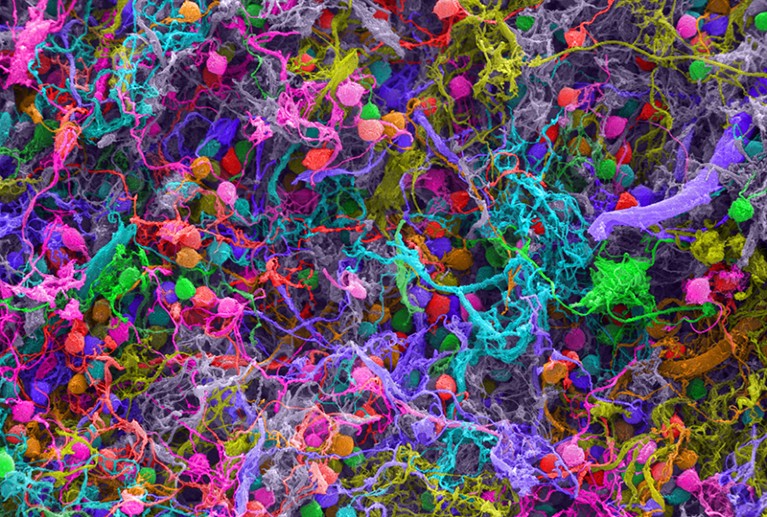

Scanning electron micrograph of human brain cells.
Some research has focused on how neurons (shown here in a false-colour scanning electron micrograph) are involved in consciousness.Credit: Ted Kinsman/Science Photo Library

A letter, signed by 124 scholars and posted online last week1, has caused an uproar in the consciousness research community. It claims that a prominent theory describing what makes someone or something conscious — called the integrated information theory (IIT) — should be labelled “pseudoscience”. Since its publication on 15 September in the preprint repository PsyArXiv, the letter has some researchers arguing over the label and others worried it will increase polarization in a field that has grappled with issues of credibility in the past.Decades-long bet on consciousness ends — and it’s philosopher 1, neuroscientist 0

“I think it’s inflammatory to describe IIT as pseudoscience,” says neuroscientist Anil Seth, director of the Centre for Consciousness Science at the University of Sussex near Brighton, UK, adding that he disagrees with the label. “IIT is a theory, of course, and therefore may be empirically wrong,” says neuroscientist Christof Koch, a meritorious investigator at the Allen Institute for Brain Science in Seattle, Washington, and a proponent of the theory. But he says that it makes its assumptions — for example, that consciousness has a physical basis and can be mathematically measured — very clear.

There are dozens of theories that seek to understand consciousness — everything that a human or non-human experiences, including what they feel, see and hear — as well as its underlying neural foundations. IIT has often been described as one of the central theories, alongside others, such as global neuronal workspace theory (GNW), higher-order thought theory and recurrent processing theory. It proposes that consciousness emerges from the way information is processed within a ‘system’ (for instance, networks of neurons or computer circuits), and that systems that are more interconnected, or integrated, have higher levels of consciousness.

A growing discomfort

Hakwan Lau, a neuroscientist at Riken Center for Brain Science in Wako, Japan, and one of the authors of the letter, says that some researchers in the consciousness field are uncomfortable with what they perceive as a discrepancy between IIT’s scientific merit and the considerable attention it receives from the popular media because of how it is promoted by advocates. “Has IIT become a leading theory because of academic acceptance first, or is it because of the popular noise that kind of forced the academics to give it acknowledgement?”, Lau asks.If AI becomes conscious: here’s how researchers will know

Negative feelings towards the theory intensified after it captured headlines in June. Media outlets, including Nature, reported the results of an ‘adversarial’ study that pitted IIT and GNW against one another. The experiments, which included brain scans, didn’t prove or completely disprove either theory, but some researchers found it problematic that IIT was highlighted as a leading theory of consciousness, prompting Lau and his co-authors to draft their letter.

But why label IIT as pseudoscience? Although the letter doesn’t clearly define pseudoscience, Lau notes that a “commonsensical definition” is that pseudoscience refers to “something that is not very scientifically supported, that masquerades as if it is already very scientifically established”. In this sense, he thinks that IIT fits the bill.

Is it testable?

Additionally, Lau says, some of his co-authors think that it’s not possible to empirically test IIT’s core assumptions, which they argue contributes to the theory’s status as pseudoscience.Decoding the neuroscience of consciousness

Seth, who is not a proponent of IIT, although he has worked on related ideas in the past, disagrees. “The core claims are harder to test than other theories because it’s a more ambitious theory,” he says. But there are some predictions stemming from the theory, about neural activity associated with consciousness, for instance, that can be tested, he adds. A 2022 review found 101 empirical studies involving IIT2.

Liad Mudrik, a neuroscientist at Tel Aviv University, in Israel, who co-led the adversarial study of IIT versus GNW, also defends IIT’s testability at the neural level. “Not only did we test it, we managed to falsify one of its predictions,” she says. “I think many people in the field don’t like IIT, and this is completely fine. Yet it is not clear to me what is the basis for claiming that it is not one of the leading theories.”

The same criticism about a lack of meaningful empirical tests could be made about other theories of consciousness, says Erik Hoel, a neuroscientist and writer who lives on Cape Cod, in Massachusetts, and who is a former student of Giulio Tononi, a neuroscientist at the University of Wisconsin-Madison who is a proponent of IIT. “Everyone who works in the field has to acknowledge that we don’t have perfect brain scans,” he says. “And yet, somehow, IIT is singled out in the letter as this being a problem that’s unique to it.”

Damaging effect

Lau says he doesn’t expect a consensus on the topic. “But I think if it is known that, let’s say, a significant minority of us are willing to [sign our names] that we think it is pseudoscience, knowing that some people may disagree, that’s still a good message.” He hopes that the letter reaches young researchers, policymakers, journal editors and funders. “All of them right now are very easily swayed by the media narrative.”

Mudrik, who emphasizes that she deeply respects the people who signed the letter, some of whom are close collaborators and friends, says that she worries about the effect it will have on the way the consciousness field is perceived. “Consciousness research has been struggling with scepticism from its inception, trying to establish itself as a legitimate scientific field,” she says. “In my opinion, the way to fight such scepticism is by conducting excellent and rigorous research”, rather than by publicly calling out certain people and ideas.

Hoel fears that the letter might discourage the development of other ambitious theories. “The most important thing for me is that we don’t make our hypotheses small and banal in order to avoid being tarred with the pseudoscience label.”
WHO’s first traditional medicine summit splits opinions (Nature)

The World Health Organization says the world-first summit will take an evidence-based approach — some are sceptical that much progress will be made.

Gayathri Vaidyanathan

18 August 2023

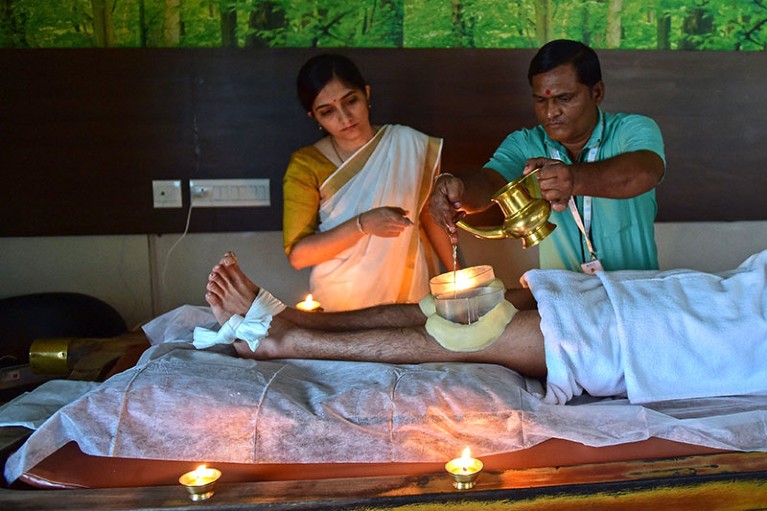
An ayurvedic doctor performs a traditional therapy for treatment of knee pain, at a hospital on the outskirts of Ahmedabad.
Traditional medicines such as Ayurvedic therapy are being considered at the WHO summit in Gandhinagar, India.Credit: Sam Panthaky/AFP via Getty

The World Health Organization (WHO) has convened its first summit dedicated to traditional medicine. The two-day meeting, co-hosted by the Indian government, began on 17 August in Gandhinagar, India. It comes after the WHO last year set up a Global Centre for Traditional Medicine in Jamnagar with US$250 million in funding from India, and in 2019 included some traditional medicines in its International Classification of Diseases-11, an influential compendium used by doctors to diagnose medical conditions.

With billions of people already using traditional medicines, the organization needs to explore how to integrate them into conventional healthcare and collaborate scientifically to understand their use more thoroughly, says Shyama Kuruvilla, WHO lead for the Global Centre for Traditional Medicine and the summit, who is based in Geneva, Switzerland. Many researchers who study traditional medicines agree — but some are not sure whether the summit will deliver.

“I fear that this meeting will result in the often-before voiced platitudes and wishful thinking,” says Edzard Ernst, a complementary-medicine researcher at the University of Exeter, UK, who has authored several books questioning alternative-medicine claims.

At present, the WHO considers traditional and complementary medicines to include disciplines as wide-ranging as Ayurveda, yoga, homeopathy and complementary therapies.

“For some people in some countries, it’s their only source of interventions or services for health and well-being,” says Kuruvilla.

The summit will bring together participants from all WHO regions, Indigenous communities, traditional-medicine practitioners and policy, data and science specialists.

The WHO only includes in its guidelines and policies those interventions or systems that are rigorously scientific and that have been validated with randomized control trials or systematic reviews — and it will continue this practice for traditional medicines, says Kuruvilla. Also there needs to be global standards for the multi-billion-dollar industries in natural cosmetics and herbal medicines, she says. For holistic interventions such as yoga, researchers will need to develop scientific methods to take into account culture and context, she says. “This requires us to use a multidisciplinary research approach,” she says.

Evidence and efficacy

Lisa Susan Wieland, director of Cochrane Complementary Medicine at the University of Maryland School of Medicine in Baltimore, and an external adviser for the summit, says that the participants will discuss ways to gather evidence for traditional healing systems.

Wieland says that the quality and quantity of research for traditional medicine needs to improve before conclusive statements can be made about its safety and efficacy. “A lot has changed over the past 15 years,” she says. “Where there was previously insufficient good-quality research to determine what does and doesn’t work, we are now seeing more and better research on some traditional medicine.”

The summit, which coincides with the 75th anniversary of both the WHO and Indian independence, is organized by an expert panel comprising of traditional medicine and public health experts from around the world. Some scientists are worried that it could result in the uncritical promotion of traditional medicine. The expert panel that organized the summit published an editorial in the Journal of Ayurveda and Integrative Medicine where they contrasted the “reductionist” approach of Western medicine, which breaks down a phenomenon into its constituent parts, with traditional medicine, which stresses “the interconnectedness of mind, body and spirit.”

But G.L. Krishna, an Ayurveda doctor based in Bengaluru, India, and a proponent of evidence-based traditional medicine, says that such a ‘reductionist’ approach to knowledge generation should be the basis for holistic care. “These systems took shape when the methods of evidence collection and evaluation were still nascent. So, prudence requires subjecting these systems to an evidence-based appraisal,” he says.

The Indian government has also expressed support for traditional medicine.

Kishor Patwardhan, an Ayurveda physiology researcher at Benares Hindu University in Varanasi, India, believes that research to show the clinical utility of traditional medicines is necessary. He hopes that the summit will lead to a “solid road map to address a lack of credible evidence for Ayurvedic practices, and also to address safety concerns of marketed products”.

Ricardo Ghelman, chair of the Brazil Academic Consortium for Integrative Health and an advisor to the summit, said the summit agenda will stress high quality research and evidence mapping of medical systems that “until a few years ago were considered fringe alternative medicine”.

“It does not at all mean being soft on science,” says Kuruvilla. “It actually means being hard on traditional medicine and hard on science, to say, do we have the right methods to understand more complex phenomena in the right way?”

doi: https://doi.org/10.1038/d41586-023-02636-z

Covid Fallout [2] (Synthetic Zero)

· by Patrick jennings

Solutions to Enable Your COVID-19 Research | BD Biosciences-CA

Throughout the Covid crisis, the use of the war metaphor, as means of persuasion and matrix of explanation, has become pervasive in politics and the popular media.

Both practices have been able to make use of such rhetoric because the discourse on war, attrition and the destruction of enemies is so deeply embedded in the structure of public discourse, from ubiquitous and seemingly benign tropes valorising competition, to the outright eulogising of violence as the natural mediator between individuals, groups, classes, ethnicities, cultures, and nation-states.

Moreover, it seems entirely plausible to extend the metaphor of war and struggle to our relation with the natural world, enabling a discourse in which natural processes, set in motion by bio-molecular mechanisms, are capable of being mastered by science.

Science just is, from this perspective, a series of feed-back loops in which the accumulation of knowledge and experimental know-how leads to mastery over nature and mastery over nature leads to more knowledge and know how,  ad infinitum.

This is a version of the Baconian trope in which nature is put to the wrack and interrogated for it’s secrets but one in which cybernetics, systems theory and big data allow for an expansion of the field of knowable objects to include the system of the interrogator and his acts of interrogation.

Defeated, abased, nature must yield.

In this war on nature, in which the war on Coronavirus is but one “theatre of operations”, the techno-scientific industrialised exploitation and extermination of non-human and human animals is it’s quintessential modus operandi.

What is good and true for science just is, necessarily, good and true for the human as such.  But human here is an image abstracted from and other than the human-animal and it’s symbiotic connection with the ecology of living entities. It is, rather, an excess of the human animal carried over after an operation in which experience is subsumed under a system of bifurcations. This excess is an illusory mode of transcendence.

The Covid crisis is most probably a dry run for what awaits us down the road as the climate crisis intensifies.

During the unfolding of the pandemic, it was notable that scientists and doctors remained, for the most part, wary of presumption in the face of the unknown, choosing to concentrate instead on the behaviour of the virus in particular human environments before attempting generalised pronouncements.

Grounded in observation, this was good science, a science in which anthropomorphic presumptions played only a small part. It was made possible by wide-scale testing and the correlation and analysis of data on the actual unfolding of the pandemic, which, for all science knew, could have included the annihilation of the species.

Here, for all to see, was an example of the difference between the actual practice of science, always localised contingent and rather anarchic in it’s evolution, and the ideology of mastery, control and expertise; an ideology enabled on a philosophical structure in which the real is bifurcated, producing a thought-complex of human subject-agents and a field of objects and processes subjected to a regime of mastery.

One productive way of looking at the ideology of mastery is as the explicit expression of an implicit or philosophically esoteric sufficiency in which science becomes the arbitrator of what is known and knowable and what is known and knowable just is scientific, in all but name.

Science, taken up into the ideology of mastery, arbitrarily sets it’s compass and draws, godlike, the arc of the world.

As with Covid, the evolution of the climate crisis will most probably unfold unevenly  across geographical regions as a series of local emergencies, each set on its own trajectory by the generation and replication of feedback loops in which human agency is only one strand in a complex of becomings.

As with Covid this “dance of agency” between human and non human entities will unfold inclusive of the decisions, actions and reactions of the presumed primary actors – those who are supposed to exercise control over outcomes by “managing” the crisis on our behalf.

The ideology of management and eventual mastery is a doubling in thought of the always and already immanent unfolding of the real, inclusive of the subject-object dichotomy which enables the illusion of transcendent knowing and techno-mastery.

Such a real never enters into the realm of the scientific or philosophical subject and it’s field of knowable objects and systems of objects.

Recent climate discourse has taken on board talk of the “Anthropocene” as evidence for the emergence of an epoch of human dominance over nature in which the human “footprint” is literally inscribed on geological strata.

The inscription of the human onto planetary geology is often accompanied by speculations about an acceleration in human technological prowess leading to a “singularity” at some time in the near future; at which point technological civilization will make a qualitative leap, establishing the dominance of the human over the planetary system and it’s myriad life forms as an accomplished fact.

Thus, a positivist rhetoric of acceleration, mastery and control sees the human take charge of the contingent, variable and complex earth-system to impose a consciously interested anthropomorphic regime on what is perceived as a complex of “mechanical” and therefore “manageable” processes.

Such rhetoric almost always includes a naturalization of capitalism in which acceleration is a spontaneous result of the free reign of market forces, an unruly energy domesticated by a corporate or state structure, more often than not presided over by a charismatic individual.

Under such a scenario democracy is optional at best, at worst a hindrance to the generation of what is conceived as the proper management and eventual mastery of the eco/social system.

It is still unclear how such a planetary wide consensus among ruling elites could be achieved, taking into account the resurgence of the ideology of the nation state and the discrediting of the idea of inter-state unions, international bodies and structures of trans-national governance.

The Covid crisis has intensified the contradiction between a strong version of nation-statehood and a neo-liberal valorisation of free markets, deregulation, free flow of labour and capital, international supply chains and minimal state interference.

The axioms of neo-liberal ideological orthodoxy have been, almost universally, unceremoniously abandoned, if only for the present.

More importantly Covid has driven an even bigger wedge between liberal, democratic and rights based ideologies of reform, “new deal” regeneration and green transition and the more authoritarian forms of “new nationalism”.

As we emerge from the first phase of the pandemic, the struggle between these two tendencies will probably intensify. Already, international bodies such as the U.N are aligning themselves with those who see the transition from lock-down as an opportunity to establish the structural changes necessary for a more ecologically sustainable economy.

Capitalism has, of course, always had to negotiate a balance between the model advocating for a strong public sector, fiscal and regulatory intervention, forward planning and a welfare state and the neo-liberal free market, anti-state and anti-regulatory model we have endured for the last thirty years.

In reality this ideological difference masks periodic shifts from one one extreme to the other as cycles of boom and bust override ideological preferences. Both the climate crisis and the Covid pandemic underscore the limitations of all existing capitalist models to adequately account for the real cost of the consumption driven economy.

The real cost has always been borne by the human and non human animal, that is by the ecological community of life forms.

As the pandemic has made clear, even something as unvarying in its constitution as a virus will have varied consequences as it interacts with local economies, social systems and cultures.

This “uneven development” is equally applicable to the spread of capital, which must negotiate local conditions as it expands and contracts, mutates and recalibrates according to the complex of human affordances of which it is a particular expression.

This network of relation extends beyond the economic, the social and the cultural and includes, ultimately, all of the extended complexities of the planetary eco-system. As a species we are dependent on a complex of ecological checks and balances all of which have been progressively undermined by human activity.

At a more fundamental level we are subject to entirely arbitrary events beyond our present understanding and indifferent to our interests.

The ideology of techno-mastery, management and expertise is based on a vision of control over the variable and the contingent. This fallacy is exposed time and again, even within the supposed confines of the social and economic system. Indeed, it is this very act of conceptual enclosure which makes possible the belief in some future state of absolute control over the social/ecological/planetary system.

Paradoxically, this very ideology of control, more often than not, acts as a top-down hindrance to the bottom-up exercise of a plurality of collective and individual responses. It is out of this anarchic mech of knowings and doings that forms of relative control arise as a collective orientation around workable solutions.

In a network of contingencies, in which our own agency forms only one strand in a myriad of becomings, it is this diversity of response which enables the sort of open-ended social, political, administrative and scientific plasticity necessary for our continued existence as a species.

The ideology of mastery, management and control, despite it’s claim to have transcended the particular and the local, is itself enabled on contingent processes and diverse responses. It’s claim is a reworking of the religious impulse on the secular plane, in which knowing has ascended to a level of sufficiency akin to godlike omniscience.

It’s undoing, likewise, will most likely proceed from the ground up, inclusive of the political, ethical and philosophical practices of those who consciously set themselves against the existing state of the situation.

This, of course, excludes the possibility of sheer bad luck and the unfolding of an unexpected disaster, against which our life would be seen to have been bracketed as a moment of contingent grace.

The struggle against Covid could have been our swan song. That possibility is the simple and absolute refutation of the theory and practice (the ideology) of mastery.

Addendum:

I use the term animal, human animal, becoming and the real interchangeably, as free floating placeholders, in the spirit expressed below by Deleuze and Guattari:

“Becoming is certainly not imitating, or identifying with something; neither is it regressing-progressing; neither is it corresponding, establishing corresponding relations; neither is it producing, producing a filiation or producing through filiation. Becoming is a verb with a consistency all its own; it does not reduce to, or lead back to, “appearing,” “being,” “equaling,” or “producing.””

This puts the series of terms in some sort of relation with Laruelle’s use of “The Real” or “Man-in-person” and distinguishes it from the forms of empirical knowledge which are taken up into ecological or systems theorising of a strictly scientific nature or into loose scientific/philosophical combinations.

NIH Cancels Funding for Bat Coronavirus Research Project (The Scientist)

The abrupt termination comes after the research drew President Trump’s attention for its ties to the Wuhan Institute of Virology.

NIH Cancels Funding for Bat Coronavirus Research Project
The canceled grant included money for surveillance of coronaviruses in Yunnan, China.
© ISTOCK.COM, REDTEA
Shawna Williams
Apr 28, 2020

A grant to a New York nonprofit aimed at detecting and preventing future outbreaks of coronaviruses from bats has been canceled by the National Institutes of Health, Politico reports, apparently at the direction of President Donald Trump because the research involved the Wuhan Institute of Virology in China. The virology institute has become a focal point for the idea that SARS-CoV-2 escaped from the laboratory and caused the current COVID-19 pandemic, a scenario experts say is not supported by evidence. Instead, virologists The Scientist has spoken to say the virus most likely jumped from infected animals to humans.

The grant, first awarded in fiscal year 2014 and most recently renewed last year, went to EcoHealth Alliance, which describes itself as “a global environmental health nonprofit organization dedicated to protecting wildlife and public health from the emergence of disease.” The aims of the funded project included characterizing coronaviruses present in bat populations in southern China and conducting surveillance to detect spillover events of such viruses to people. The project has resulted in 20 publications, most recently a March report on zoonotic risk factors in rural southern China.

EcoHealth Alliance’s partners on the project include researchers at the Wuhan Institute of Virology, a BSL-4 facility that has for months been a focus of conspiracy theories that SARS-CoV-2 escaped or was released from a lab. On April 14, the The Washington Post published a column highlighting State Department cables about concerns regarding safety at the institute. (Experts tell NPR that, even in light of the cables, accidental escape of the virus from a lab remains a far less likely scenario than a jump from animals.) 

Then, in an April 17 White House coronavirus briefing, a reporter, whom Politico identifies as being from Newsmax, falsely stated in a question that “US intelligence is saying this week that the coronavirus likely came from a level 4 lab in Wuhan,” and that the NIH had awarded a $3.7 million grant to the Wuhan lab. “Why would the US give a grant like that to China?” she asked. “We will end that grant very quickly,” Trump said in his answer.

An NIH official then wrote to EcoHealth Alliance to inquire about money sent to “China-based participants in this work,” Politico reports, and the organization’s head, Peter Daszak, responded that a complete response would take time, but that “I can categorically state that no fund from [the grant] have been sent to the Wuhan Institute of Virology, nor has any contract been signed.” Days later, NIH notified EcoHealth Alliance that future funding for the project was canceled, and that it must immediately “stop spending the $369,819 remaining from its 2020 grant”—an unusual move generally reserved for cases of scientific misconduct or financial improprieties, according to Politico.

In a statement about the cancellation, EcoHealth Alliance says the terminated research “aimed to analyze the risk of coronavirus emergence and help in designing vaccines and drugs to protect us from COVID-19 and other coronavirus threats,” and that it addresses “all four strategic research priorities of the NIH/NIAID Strategic Plan for COVID-19 Research, released just this week.” The organization will, it says, “continue our fight against this and other emerging diseases.”

See “Theory that Coronavirus Escaped from a Lab Lacks Evidence

To Tackle a Virus, Indian Officials Peddle Pseudoscience (Undark)

Original article

By Ruchi Kumar 04.19.2020

Blending nationalism and pseudoscience, the “cures” touted by an Indian ministry are raising public health concerns.

A government banner at Arogya, an Ayurvedic expo funded by the government of India, in December of 2010. Visual: Hari Prasad Nadig / flickr By Ruchi Kumar 04.19.2020

When it was announced in late March that Prince Charles, heir to the British throne, was well on his way to recovering from Covid-19, there was some celebration 4,000 miles away in India, a former British colony. But it was not colonial nostalgia that brought on the cheer, so much as the declaration a few days later by an Indian government minister that the Prince of Wales had been cured using Ayurveda — a blend of, among other things, herbal medicine, breathing exercises, and meditation.

At an April 2 press conference, Shripad Naik, India’s minister for alternative medicines, declared that the treatment’s supposed success “validates our age-old practice.” The British government swiftly issued a statement rejecting his claim. “This information is incorrect. The Prince of Wales followed the medical advice of the National Health Service in the U.K. and nothing more,” a spokesperson said the following day.

But this hasn’t deterred Naik’s Ministry of Ayurveda, Yoga & Naturopathy, Unani, Siddha, and Homeopathy — or AYUSH for short — from promoting Indian alternative medicines as treatments for Covid-19. Established in 2014, the goal of AYUSH is to develop and popularize these treatments, many of which have their historical roots in India. Ayurveda, for example, has been practiced in India for thousands of years.

Now, Naik said, the ministry aims to confirm that Prince Charles was cured using a combination of Ayurveda and the pseudoscience known as homeopathy, which has its roots in Germany, so that the treatment can be rolled out to the masses. This is in stark contrast to the position of mainstream medicine, which has not yet confirmed any evidence-based medicine for Covid-19, and is still highly cautious of giving experimental drugs to patients.

And yet for many, the actions of the right-wing Indian government don’t come as a surprise. Aside from the popularity of alternative medicine in India generally, the ruling Bharatiya Janata Party (BJP) is known for supporting Hindutva, a form of nationalism that seeks to transform India from being a secular nation into an openly Hindu one. This partly plays out in the field of health, where alternative therapies that have their roots in India, such as Ayurveda, are considered more “Hindu” or “Indian” than modern medicine. Supporting them becomes an opportunity to push forward this nationalist agenda.

In the early days of the epidemic, AYUSH heavily promoted therapies that lack an evidence base, said Sumaiya Shaikh, a neuroscientist based at the Center for Social and Affective Neuroscience at Linköping University Hospital in Sweden. Shaikh is also editor of science at Alt News, an Indian website that works to expose misinformation.

Examples of treatments pushed by AYUSH included a homeopathic medicine containing diluted arsenic, an Ayurvedic drug developed by the ministry to treat malaria, and dietary changes including drinking warm water, putting sesame oil inside the nose, or consuming holy basil, ginger, cloves, and turmeric. The ministry suggested these interventions could prevent people from developing Covid-19 as well as treat its symptoms.

“There was some amount of criticism to that,” said Shaikh. And so in response, the ministry provided a list of “scientific evidence” to bolster its claims. Aside from the fact that homeopathy has been repeatedly shown to have no biological effects, Shaikh said that when she and her team reviewed the list, the only actual research they could find was one analysis that examined the the same homeopathic treatment in bovines with gastric infections. Despite this, the ministry’s promotion of the therapy increased demand in many Indian states.

This isn’t the first time the ministry has faced criticism for promoting unscientific claims or backing research derived from religious myths and beliefs. One of its repeated focuses has been cow urine, which is believed by many Hindus to have healing properties given the sacred nature of cows in Hinduism. The urine has been touted as a treatment for many illnesses, including diabetes, epilepsy, and AIDS. Naik himself has made several comments in parliament about how cow urine can cure cancer. In reality, its use can be dangerous.

In fact, so widespread is the belief in cow urine that on March 17, an activist working for the BJP in Kolkata organized a “gomutra (cow urine) party” to ward off Covid-19. He believed that drinking the urine would protect them from the disease. Unfortunately, one of the volunteers fell seriously ill after ingesting the urine.

The Ministry of AYUSH’s research portal carries papers on the uses of panchagavya, the five products derived from a cow, of which urine is one, supporting its use as a medical product. However, Ipsita Mohanty, who co-wrote a paper listed there titled “Diversified Uses of Cow Urine,” said in an email that she couldn’t definitively answer whether cow urine fights off Covid-19, as “it has not been proven by independent researchers.”

This reflects how AYUSH researchers and doctors seek validation, explained Shaikh. “If a paper gets published anywhere — doesn’t matter what type of journal it is or how bad the statistics are — they take it as scientific proof,” she said, adding that the alternative medicine community also has a lot of journals of its own. These are regulated and edited by the same people who are published in them, Shaikh said.

Despite being an advocate of cow urine, Mohanty urges doctors to not spread misinformation. “It is misleading to spread the rumor about something so important when more than half of our world is engulfed by Covid-19,” she said. “There is no vaccine nor any treatment for it. At this point, promoting cow urine against Covid-19 can be very fatal, as people might resort to it for treatment as their only hope.”

The Ministry of AYUSH did not respond to requests for comments from Undark.

“Practitioners of such therapies get their clientele from two distinct groups,” said Aniket Sule, a science education researcher and astronomer at the Homi Bhabha Center for Science Education. He is part of a steadily growing rationalist movement in India that is encouraging dialogue and critical thinking to counter misinformation, including within the realm of alternative medicine.

The first group Sule identified is patients from impoverished communities and remote villages, “who don’t have access to doctors prescribing modern medicines.” The other set of clients is the “affluent and educated class in the cities, who have read half-baked internet posts and develop strong skepticism towards modern medicines,” he said.

“Pushing such a narrative to gullible masses is akin to actively spreading misinformation, and senior functionaries of government should take strict action against such baseless propaganda,” he urged.

The ministry has faced some institutional backlash. The Press Council of India, the statutory body responsible for maintaining good media standards, has issued an order asking print media to stop publicity and advertisements of AYUSH-related claims for Covid-19 treatments.

But despite that, the Ministry of AYUSH continues not only to receive political backing but also a large share of the annual health budget. From 2019 to 2020, the Indian government allotted approximately $250 million for study and promotion of alternative medicines, a 15 percent increase from the previous year. According to Shaikh, only the defense ministry saw a larger proportional increase to its budget last year.

Indian scientists fighting disinformation say there is an underlying nationalist agenda to this move. Certain radical groups affiliated with the government have dreams of spreading Hindu values beyond India’s borders to create an “Akhand Bharat,” or “consolidated Hindu nation,” which would include annexing a large part of the Indian subcontinent. One of these is Rashtriya Swayamsevak Sangh, a militant organization that has a long history of promoting Hindutva. Its leader recently said that Ayurveda is part of India’s “soft power” in the South Asian region, said Shaikh.

The Press Council of India, the statutory body responsible for maintaining good media standards, has issued an order asking print media to stop publicity and advertisements of AYUSH-related claims for Covid-19 treatments.

Since coming to power in 2014, India’s current government (BJP) has increasingly backed divisive policies that consolidate the power of the majoritarian Hindu population. “Overall, this government has made virtue out of extreme and thoughtless nationalism. Increased support to all these questionable therapies is a natural byproduct of that,” Sule said, adding there is also a distinct motivation among many people who believe in these claims. “There are people who are so completely blinded by ‘glorious ancient India’ that they willingly walk into any trap if it is presented as ‘this is what our great ancestors did,’” he said.

Sule also thinks that AYUSH exists, in part, to protect commercial interests. There are nearly 800,000 practitioners of alternative medicine in India, he said, and over 650 colleges teaching related courses. The Ayurveda industry alone in India is worth $4.4 billion and is expected to grow by 16 percent in the next five years.

Shaikh, Sule, and others have been critical of the Ministry of AYUSH for years, exposing and unmasking its questionable research and dubious medical advice. “It is very dangerous, especially now. We are the only country that has a parallel ministry for alternative systems,” Shaikh said. “Why not just have the one ministry and then have everything under it? Use whatever herbs you want, but run them through appropriate trials, and if they work then they should be in the mainstream and everybody should benefit from them,” she said.

Shaikh doesn’t call for closing the ministry but insists the way it works needs to change.

“Don’t start with a belief system, start with the hypothesis,” she advised. “Don’t start with the basis that this drug is going to work. Start with realizing that ‘we don’t know and we want to find out.’ That is unbiased research.”

Many experts say that statements like Naik’s are false and dangerous, particularly now that the country is struggling to control the spread of the novel coronavirus, SARS-CoV-2, among its 1.35 billion people. With a lack of testing and a shortage of physicians, many experts feel the Indian government is failing its people by directing attention and resources to unsubstantiated and unscientific practices — especially when these practices themselves can be harmful.

Related

In Germany, a Heated Debate Over Homeopathy

‘Estudos de neurociência superaram a psicanálise’, diz pesquisador brasileiro (Folha de S.Paulo)

Juliana Cunha, 18.06.2016

Com 60 anos de carreira, 22.794 citações em periódicos, 60 premiações e 710 artigos publicados, Ivan Izquierdo, 78, é o neurocientista mais citado e um dos mais respeitados da América Latina. Nascido na Argentina, ele mora no Brasil há 40 anos e foi naturalizado brasileiro em 1981. Hoje coordena o Centro de Memória do Instituto do Cérebro da PUC-RS.

Suas pesquisas ajudaram a entender os diferentes tipos de memória e a desmistificar a ideia de que áreas específicas do cérebro se dedicariam de maneira exclusiva a um tipo de atividade.

Ele falou à Folha durante o Congresso Mundial do Cérebro, Comportamento e Emoções, que aconteceu esta semana, em Buenos Aires. Izquierdo foi o homenageado desta edição do congresso.

Na entrevista, o cientista fala sobre a utilidade de memórias traumáticas, sua descrença em métodos que prometem apagar lembranças e diz que a psicanálise foi superada pelos estudos de neurociência e funciona hoje como mero exercício estético.

Bruno Todeschini
O neurocientista Ivan Izquierdo durante congresso em Buenos Aires

*

Folha – É possível apagar memórias?
Ivan Izquierdo – É possível evitar que uma memória se expresse, isso sim. É normal, é humano, inclusive, evitar a expressão de certas lembranças. A falta de uso de uma determinada memória implica em desuso daquela sinapse, que aos poucos se atrofia.

Fora disso, não dá. Não existe uma técnica para escolher lembranças e então apagá-las, até porque a mesma informação é salva várias vezes no cérebro, por um mecanismo que chamamos de plasticidade. Quando se fala em apagamento de memórias é pirotecnia, são coisas midiáticas e cinematográficas.

O senhor trabalha bastante com memória do medo. Não apagá-las é uma pena ou algo a ser comemorado?
A memória do medo é o que nos mantém vivos. É a que pode ser acessada mais rapidamente e é a mais útil. Toda vez que você passa por uma situação de ameaça, a informação fundamental que o cérebro precisa guardar é que aquilo é perigoso. As pessoas querem apagar memórias de medo porque muitas vezes são desconfortáveis, mas, se não estivessem ali, nos colocaríamos em situações ruins.

Claro que esse processo causa enorme estresse. Para me locomover numa cidade, meu cérebro aciona inúmeras memórias de medo. Entre tê-las e não tê-las, prefiro tê-las, foram elas que me trouxeram até aqui, mas se pudermos reduzir nossa exposição a riscos, melhor. O problema muitas vezes é o estímulo, não a resposta do medo.

Mas algumas memórias de medo são paralisantes, e podem ser mais arriscadas do que a situação que evitam. Como lidar com elas?
Antes parado do que morto. O cérebro atua para nos preservar, essa é a prioridade. Claro que esse mecanismo é sujeito a falhas. Se entendemos que a resposta a uma memória de medo é exagerada, podemos tentar fazer com que o cérebro ressignifique um estímulo. É possível, por exemplo, expor o paciente repetidas vezes aos estímulos que criaram aquela memória, mas sem o trauma. Isso dissocia a experiência do medo.

Isso não seria parecido com o que Freud tentava fazer com as fobias?
Sim, Freud foi um dos primeiros a usar a extinção no tratamento de fobias, embora ele não acreditasse exatamente em extinção. Com a extinção, a memória continua, não é apagada, mas o trauma não está mais lá.

Mas muitos neurocientistas consideram Freud datado.
Toda teoria envelhece. Freud é uma grande referência, deu contribuições importantes. Mas a psicanálise foi superada pelos estudos em neurociência, é coisa de quando não tínhamos condições de fazer testes, ver o que acontecia no cérebro. Hoje a pessoa vai me falar em inconsciente? Onde fica? Sou cientista, não posso acreditar em algo só porque é interessante.

Para mim, a psicanálise hoje é um exercício estético, não um tratamento de saúde. Se a pessoa gosta, tudo bem, não faz mal, mas é uma pena quando alguém que tem um problema real que poderia ser tratado deixa de buscar um tratamento médico achando que psicanálise seria uma alternativa.

E outros tipos de análise que não a freudiana?
Terapia cognitiva, seguramente. Há formas de fazer o sujeito mudar sua resposta a um estímulo.

O senhor veio para o Brasil com a ditadura na Argentina. Agora, vivemos um processo no Brasil que alguns chamam de golpe, é uma memória em disputa. O que o senhor acha disso enquanto cientista?
Eu vim por conta de uma ameaça. Não considero um golpe, mas é um processo muito esperto. Mudar uma palavra ressignifica toda uma memória. Há de fato uma disputa de como essa memória coletiva vai ser construída. A esquerda usa o termo golpe para evocar memórias de medo de um país que já passou por um golpe. Conforme essa palavra é repetida, isso cria um efeito poderoso. Ainda não sabemos como essa memória será consolidada, mas a estratégia é muito esperta.

A jornalista JULIANA CUNHA viajou a convite do Congresso Mundial do Cérebro, Comportamento e Emoções