Arquivo da tag: Capitalismo

In Rousseau’s footsteps: David Graeber and the anthropology of unequal society (The Memory Bank)

http://thememorybank.co.uk

By Keith Hart

July 4, 2012, 11:14 pm

A review of David Graeber Debt: The first 5,000 years (Melville House, New York, 2011, 534 pages)

Debt is everywhere today. What is “sovereign debt” and why must Greece pay up, but not the United States? Who decides that the national debt will be repaid through austerity programmes rather than job-creation schemes? Why do the banks get bailed out, while students and home-owners are forced to repay loans? The very word debt speaks of unequal power; and the world economic crisis since 2008 has exposed this inequality more than any other since the 1930s. David Graeber has written a searching book that aims to place our current concerns within the widest possible framework of anthropology and world history. He starts from a question: why do we feel that we must repay our debts? This is a moral issue, not an economic one. In market logic, the cost of bad loans should be met by creditors as a discipline on their lending practices. But paying back debts is good for the powerful few, whereas the mass of debtors have at times sought and won relief from them.

What is debt? According to Graeber, it is an obligation with a figure attached and hence debt is inseparable from money. This book devotes a lot of attention to where money comes from and what it does. States and markets each play a role in its creation, but money’s form has fluctuated historically between virtual credit and metal currency. Above all Graeber’s enquiry is framed by our unequal world as a whole. He resists the temptation to offer quick remedies for collective suffering, since this would be inconsistent with the timescale of his argument. Nevertheless, readers are offered a worldview that clearly takes the institutional pillars of our societies to be rotten and deserving of replacement. It is a timely and popular view. Debt: The first 5,000 years is an international best-seller. The German translation recently sold 30,000 copies in the first two weeks.

I place the book here in a classical tradition that I call “the anthropology of unequal society” (Hart 2006), before considering what makes David Graeber a unique figure in contemporary intellectual politics. A summary of the book’s main arguments is followed by a critical assessment, focusing on the notion of a “human economy”.

The anthropology of unequal society

Modern anthropology was born to serve the coming democratic revolution against the Old Regime. A government by the people for the people should be based on what they have in common, their “human nature” or “natural rights”. Writers from John Locke (1690) to Karl Marx (1867) identified the contemporary roots of inequality with money’s social dominance, a feature that we now routinely call “capitalism”. For Locke money was a store of wealth that allowed some individuals to accumulate property far beyond their own immediate needs. For Marx “capital” had become the driving force subordinating the work of the many to machines controlled by a few. In both cases, accumulation dissolved the old forms of society, but it also generated the conditions for its own replacement by a more just society, a “commonwealth” or “communism”. It was, however, the philosophers of the eighteenth-century liberal enlightenment who developed a systematic approach to anthropology as an intellectual source for remaking the modern world.

Following Locke’s example, they wanted to found democratic societies in place of the class system typical of agrarian civilizations. How could arbitrary social inequality be abolished and a more equal society founded on their common human nature? Anthropology was the means of answering that question. The great Victorian synthesizers, such as Morgan, Tylor and Frazer, stood on the shoulders of predecessors motivated by an urgent desire to make world society less unequal. Kant’s Anthropology from a Pragmatic Point of View, a best-seller when published in 1798, was the culmination of that Enlightenment project; but it played almost no part in the subsequent history of the discipline. The main source for nineteenth-century anthropology was rather Jean-Jacques Rousseau.  He revolutionized our understanding of politics, education, sexuality and the self in four books published in the 1760s: The Social ContractEmileJulie and The Confessions. He was forced to flee for his life from hit squads encouraged by the church. But he made his reputation earlier through two discourses of which the second, Discourse on the Origins and Foundations of Inequality among Men (1754), deserves to be seen as the source for an anthropology that combines the critique of unequal society with a revolutionary politics of democratic emancipation.

Rousseau was concerned here not with individual variations in natural endowments which we can do little about, but with the conventional inequalities of wealth, honour and the capacity to command obedience which can be changed. In order to construct a model of human equality, he imagined a pre-social state of nature, a sort of hominid phase of human evolution in which men were solitary, but healthy, happy and above all free. This freedom was metaphysical, anarchic and personal: original human beings had free will, they were not subject to rules of any kind and they had no superiors. At some point humanity made the transition to what Rousseau calls “nascent society”, a prolonged period whose economic base can best be summarized as hunter-gathering with huts. This second phase represents his ideal of life in society close to nature.

The rot set in with the invention of agriculture or, as Rousseau puts it, wheat and iron. Here he contradicted both Hobbes and Locke. The formation of a civil order (the state) was preceded by a war of all against all marked by the absence of law, which Rousseau insisted was the result of social development, not an original state of nature. Cultivation of the land led to incipient property institutions which, far from being natural, contained the seeds of entrenched inequality. Their culmination awaited the development of political society. He believed that this new social contract was probably arrived at by consensus, but it was a fraudulent one in that the rich thereby gained legal sanction for transmitting unequal property rights in perpetuity. From this inauspicious beginning, political society then usually moved, via a series of revolutions, through three stages:

The establishment of law and the right of property was the first stage, the institution of magistrates the second and the transformation of legitimate into arbitrary power the third and last stage. Thus the status of rich and poor was authorized by the first epoch, that of strong and weak by the second and by the third that of master and slave, which is the last degree of inequality and the stage to which all the others finally lead, until new revolutions dissolve the government altogether and bring it back to legitimacy (Rousseau 1984:131).

One-man-rule closes the circle. “It is here that all individuals become equal again because they are nothing, here where subjects have no longer any law but the will of the master”(Ibid: 134). For Rousseau, the growth of inequality was just one aspect of human alienation in civil society. We need to return from division of labour and dependence on the opinion of others to subjective self-sufficiency. His subversive parable ends with a ringing indictment of economic inequality which could well serve as a warning to our world. “It is manifestly contrary to the law of nature, however defined… that a handful of people should gorge themselves with superfluities while the hungry multitude goes in want of necessities” (Ibid: 137).

Lewis H. Morgan (1877) drew on Rousseau’s model for his own fiercely democratic synthesis of human history, Ancient Society, which likewise used an evolutionary classification that we now call bands, tribes and states, each stage more unequal than the one before.  Morgan’s work is normally seen as the launch of modern anthropology proper because of his ability to enrol contemporary ethnographic observations of the Iroquois in an analysis of the historical structures underlying western civilization’s origins in Greece and Rome. Marx and Engels enthusiastically took up Morgan’s work as confirmation of their own critique of the state and capitalism; and the latter, drawing on Marx’s extensive annotations ofAncient Society, made the argument more accessible as The Origin of the Family, Private Property and the State (1884). Engels’s greater emphasis on gender inequality made this a fertile source for the feminist movement in the 1960s and after.

The traditional home of inequality is supposed to be India and Andre Beteille, in Inequality among Men (1977) and other books, has made the subject his special domain, merging social anthropology with comparative sociology. In the United States, Leslie White at Michigan and Julian Steward at Columbia led teams, including Wolf, Sahlins, Service, Harris and Mintz, who took the evolution of the state and class society as their chief focus. Probably the single most impressive work coming out of this American school was Eric Wolf’s Europe and the People without History (1982). But one man tried to redo Morgan in a single book and that was Claude Lévi-Strauss in The Elementary Structures of Kinship (1949). In Tristes Tropiques (1955), Lévi-Strauss acknowledged Rousseau as his master. The aim of Elementary Structures was to revisit Morgan’s three-stage theory of social evolution, drawing on a new and impressive canvas, “the Siberia-Assam axis” and all points southeast as far as the Australian desert. Lévi-Strauss took as his motor of development the forms of marriage exchange and the logic of exogamy. The “restricted reciprocity” of egalitarian bands gave way to the unstable hierarchies of “generalized reciprocity” typical of the Highland Burma tribes. The stratified states of the region turned inwards to endogamy, to the reproduction of class differences and the negation of social reciprocity.

Jack Goody has tried to lift our profession out of a myopic ethnography into an engagement with world history that went out of fashion with the passing of the Victorian founders. Starting with Production and Reproduction (1976), he has produced a score of books over the last three decades investigating why Sub-Saharan Africa differs so strikingly from the pre-industrial societies of Europe and Asia, with a later focus on refuting the West’s claim to being exceptional, especially when compared with Asia (Hart 2006, 2011).  The common thread of Goody’s compendious work links him through the Marxist pre-historian Gordon Childe (1954) to Morgan-Engels and ultimately Rousseau. The key to understanding social forms lies in production, which for us means machine production. Civilization or human culture is largely shaped by the means of communication — once writing, now an array of mechanized forms. The site of social struggles is property, now principally conflicts over intellectual property. And his central issue of reproduction has never been more salient than at a time when the aging citizens of rich countries depend on the proliferating mass of young people out there. Kinship needs to be reinvented too.

David Graeber: the first 50 years

Graeber brings his own unique combination of interests and engagements to renewing this “anthropology of unequal society”. Who is he? He spent the 1960s as the child of working-class intellectuals and activists in New York and was a teenager in the 1970s, which turned out to be the hinge decade of our times, leading to a “neoliberal” counter-revolution against post-war social democracy. This decade was framed at one end by the US dollar being taken off the gold standard in 1971 and at the other by a massive interest rate increase in 1979 induced by a second oil price hike. The world economy has been depressed ever since, especially at its western core. Graeber says that he embraced anarchism at sixteen.

The debt crisis of the 1980s was triggered by irresponsible lending of the oil surplus by western banks to Third World kleptocrats (Hart 2000: 142-143) and by the new international regime of high interest rates. In market theory, bad loans are supposed to discipline lenders, but the IMF and World Bank insisted on every penny of added interest being repaid by the governments of poor countries. This was also the time when structural adjustment policies forced those governments to open up their national economies to the free flow of money and commodities, with terrible consequences for public welfare programmes and jobs. If the anti-colonial revolution inspired my generation in the 1960s, Graeber’s internationalism was shaped by this wholesale looting of the successor states. He took an active part in demonstrations against this new phase of “financial globalization”, a phenomenon now often referred to as the “alter-globalization movement” (Pleyers 2010), but he and his fellow activists call it the “global justice movement”. Its public impact peaked in the years following the financial crisis of 1997-98 (involving Southeast Asia, Russia, Brazil and the failure of a US hedge fund, Long-Term Capital Management), notably through mass mobilizations in Seattle, Genoa and elsewhere. In the Debt book, Graeber claims that they took on the IMF and won.

David Graeber received a doctorate in anthropology from the University of Chicago based on ethnographic and historical research on a former slave village in Madagascar. This was eventually published as a long and exemplary monograph, Lost People: Magic and the legacy of slavery in Madagascar (Graeber 2007a). The history of the slave trade, colonialism and the post-colony figure prominently in how he illustrates global inequality through a focus on debt. Before that, he published a strong collection of essays on value, Toward an Anthropological Theory of Value: The false coin of our own dreams (Graeber 2001), in which he sought to relate economic value (especially value as measured impersonally by money) and the values that shape our subjectivity in society. This hinged on revisiting both Karl Marx and Marcel Mauss, providing the main account in English of how the latter’s cooperative socialism shaped his famous work on the gift (Mauss 1925). A theme of both books is the role of magic and money fetishism in sustaining unequal society.

Politics forms a central strand of Graeber’s work, with four books published so far and more in the works: Fragments of an Anarchist Anthropology (2004), Possibilities: Essays on hierarchy, rebellion, and desire (2007b), Direct Action: An ethnography (2009a) and Revolutions in Reverse: Essays on politics, violence, art, and imagination (2011c). These titles reveal a range of political interests that take in violence, aesthetics and libido. He insists on the “elective affinity” between anthropological theory and method and an anarchist programme of resistance, rebellion and revolution; and this emphasis on “society against the state” makes him a worthy successor to Pierre Clastres (1974). Graeber’s academic career has been fitful, most notoriously when he was “let go” by Yale despite his obvious talent and productivity. This fed rumours about the academic consequences of his political activities. These have led to numerous brushes with the police, but so far not to prolonged incarceration, although his inability to find a job in American universities could be seen as a form of exile.

Debt: The first 5,000 years was published in summer 2011 and Graeber began a year’s sabbatical leave from his teaching job in London by moving to New York, where he became an ubiquitous presence in the print media, television and blogs. In August-September he helped form the first New York City General Assembly which spawned the Occupy Wall Street movement. He has been credited with being the author of that movement’s slogan, “We are the 99%”, and helped to give it an anarchist political style. OWS generated a wave of imitations in the United States and around the world, known collectively as “the Occupy movement”, inviting comparison with the “Arab Spring” and Madrid’s Los Indignados in what seemed then to be a global uprising. Some shared features of this series of political events, such as an emphasis on non-violence, consensual decision-making and the avoidance of sectarian division, evoke Jean-Jacques Rousseau’s idea of the “general will”; and it is not wholly fanciful to compare David Graeber’s career so far with his great predecessor’s.

Graeber and Rousseau both detested the mainstream institutions of the world they live in and devoted their intellectual efforts to building revolutionary alternatives. This means not being satisfied with reporting how the world is, but rather exploring the dialectic linking the actual to the possible. This in turn implies being willing to mix established genres of research and writing and to develop new ones. Both are prolific writers with an accessible prose style aimed at reaching a mass audience. Both achieved unusual fame for an intellectual and their political practice got them into trouble. Both suffered intimidation, neglect and exile for their beliefs. Both attract admiration and loathing in equal measure. Their originality is incontestable, yet each can at times be silly. There is no point in considering their relative significance. The personal parallels that I point to here reinforce my claim that Graeber’s Debt book should be seen as a specific continuation of that “anthropology of unequal society” begun by Rousseau two and a half centuries ago.

Debt: the argument

Much of the contemporary world revolves round the claims we make on each other and on things: ownership, obligations, contracts and payment of taxes, wages, rents, fees etc. David Graeber’s book, Debt: The first 5,000 years, aims to illuminate these questions through a focus on debt seen in very wide historical perspective. It is of course a central issue in global politics today, at every level of society. Every day sees another example of a class struggle between debtors and creditors to shape the distribution of costs after a long credit boom went dramatically bust.

We might be indebted to God, the sovereign or our parents for the gift of life, but Graeber rightly insists that the social logic of debt is revealed most clearly when money is involved. He cites approvingly an early twentieth-century writer who insisted that “money is debt”. This book of over 500 pages is rich in argument and knowledge. The notes and references are compendious, ranging over five millennia of the main Eurasian civilizations (ancient Mesopotamia, Egypt and the Mediterranean, medieval Europe, China, India and Islam) and the ethnography of stateless societies in Africa, the Americas and the Pacific. Its twelve chapters are framed by an introduction to our moral confusion concerning debt and a concluding sketch of the present rupture in world history that began in the early 1970s. Graeber’s case is founded on anthropological and historical comparison more than his grasp of contemporary political economy, although he has plenty to say in passing about that. There is also a current of populist culture running through the book and this is reinforced by a prose style aimed at closing the gap between author and reader that his formidable scholarship might otherwise open up.

Perhaps this aspect of the book may be illustrated by introducing a recent short film. Paul Grignon’s Money as Debt (2006, 47 minutes) — an underground hit in activist circles — seeks to explain where money comes from. Most of the money in circulation is issued by banks whenever they make a loan. The real basis of money, the film claims, is thus our signature whenever we promise to repay a debt. The banks create that money by a stroke of the pen and the promise is then bought and sold in increasingly complex ways. The total debt incurred by government, corporations, small businesses and consumers spirals continuously upwards since interest must be paid on it all. Although the general idea is an old one, it has taken on added salience at a time when the supply of money, which could once plausibly be represented as public currency in circulation, has been overtaken by the creation of private debt.

The film’s attempt to demystify money is admirable, but its message is misleading.  Debt and credit are two sides of the same coin, the one evoking passivity in the face of power, the other individual empowerment. The origin of money in France and Germany is considered to be debt, whereas in the United States and Britain it is traditionally conceived of as credit. Either term alone is loaded, missing the dialectical character of the relations involved. Money as Debt demonizes the banks and interest in particular, letting the audience off the hook by not showing the active role most of us play in sustaining the system. Money today is issued by a dispersed global network of economic institutions of many kinds; and the norm of economic growth is fed by a widespread desire for self-improvement, not just by bank interest.

David Graeber offers a lot more than this, of course; but his book also feeds off popular currents too, which is not surprising given how much time he spends outside the classroom and his study. His analytical framework is spelled out in great detail over six chapters. The first two tackle the origins of money in barter and “primordial debt” respectively. He shows, forcefully and elegantly, how implausible the standard liberal origin myth of money as a medium of exchange is; but he also rejects as a nationalist myth the main opposing theory that traces money’s origins as a means of payment and unit of account to state power. In the first case he follows Polanyi (1944), but by distancing himself from the second, he highlights the interdependence of states and markets in money’s origins.  A short chapter shows that money was always both a commodity and a debt-token (“the two sides of the coin”, Hart 1986), giving rise to a lot of political and moral contestation, especially in the ancient world. Following Nietzsche, Graeber argues that money introduced for the first time a measure of the unequal relations between buyer and seller, creditor and debtor. Whereas Rousseau traced inequality to the invention of property, he locates the roots of human bondage, slavery, tribute and organized violence in debt relations. The contradictions of indebtedness, fed by money and markets, led the first world religions to articulate notions of freedom and redemption in response to escalating class conflict between creditors and debtors, often involving calls for debt cancellation.

The author now lays out his positive story to counter the one advanced by mainstream liberal economics. “A brief treatise on the moral grounds of economic relations” makes explicit his critique of the attempt to construct “the economy” as a sphere separate from society in general. This owes something to Polanyi’s (1957) universal triad of distributive mechanisms – reciprocity, redistribution and market – here identified as “everyday communism”, hierarchy and reciprocity. By the first Graeber means a human capacity for sharing or “baseline sociality”; the second is sometimes confused with the third, since unequal relations are often represented as an exchange – you give me your crops in return for not being beaten up. The difference between hierarchy and reciprocity is that debt is permanent in the first case, but temporary in the second. The western middle classes train their children to say please and thank you as a way of limiting the debt incurred by being given something. All three principles are present everywhere, but their relative emphasis is coloured by dominant economic forms. Thus “communism” is indispensable to modern work practices, but capitalism is a lousy way of harnessing our human capacity for cooperation.

The next two chapters introduce what is for me the main idea of the book, the contrast between “human economies” and those dominated by money and markets (Graeber prefers to call them “commercial economies” and sometimes “capitalism”). First he identifies the independent characteristics of human economies and then shows what happens when they are forcefully incorporated into the economic orbit of larger “civilisations”, including our own. This is to some extent a great divide theory of history, although, as Mauss would insist, elements of human economy persist in capitalist societies. There is a sense in which “human economies” are a world we have lost, but might recover after the revolution. Graeber is at pains to point out that these societies are not necessarily more humane, just that “they are economic systems primarily concerned not with the accumulation of wealth, but with the creation, destruction, and rearranging of human beings” (2011a: 130). They use money, but mainly as “social currencies” whose aim is to maintain relations between people rather than to purchase things.

“In a human economy, each person is unique and of incomparable value, because each is a unique nexus of relations with others” (Ibid: 158). Yet their money forms make it possible to treat people as quantitatively identical in exchange and that requires a measure of violence. Brutality — not just conceptual, but physical too — is omnipresent, more in some cases than others. Violence is inseparable from money and debt, even in the most “human” of economies, where ripping people out of their familiar context is commonplace. This, however, gets taken to another level when they are drawn into systems like the Atlantic slave trade or the western colonial empires of yesteryear. The following extended reflection on slavery and freedom — a pair that Graeber sees as being driven by a culture of honour and indebtedness — culminates in the ultimate contradiction underpinning modern liberal economics, a worldview that conceives of individuals as being socially isolated in a way that could only be prepared for by a long history of enslaving conquered peoples. Since we cannot easily embrace this account of our own history, it is not surprising that we confuse morality and power when thinking about debt.

So far, Graeber has relied heavily on anthropological material, especially from African societies, to illustrate the world that the West transformed, although his account of money’s origins draws quite heavily on the example of ancient Mesopotamia. Now he formalizes his theory of money to organize a compendious review of world history in four stages. These are: the era from c.3000 BC that saw the first urban civilizations; the “Axial Age” which he, rather unusually, dates from 800BC to 600AD; the Middle Ages (600-1450AD); and the age of “the great capitalist empires”, from 1450AD to the US dollar’s symbolic rupture with the gold standard in 1971. As this last date suggests, the periodization relies heavily on historical oscillations between broad types of money. Graeber calls these “credit” and “bullion”, that is, money as a virtual measure of personal relations, like IOUs, and as currency or impersonal things made from precious metals for circulation.

Money started out as a unit of account, administered by institutions such as temples and banks, as well as states, largely as a way of measuring debt relations between people. Coinage was introduced in the first millennium as part of a complex linking warfare, mercenary soldiers, slavery, looting, mines, trade and the provisioning of armies on the move. Graeber calls this “the military-coinage-slavery complex” of which Alexander the Great, for example, was a master. Hence our word, “soldier”, refers to his pay. The so-called “dark ages” offered some relief from this regime and for most of the medieval period, metal currencies were in very short supply and money once again took the dominant form of virtual credit. India, China and the Islamic world are enlisted here to supplement what we know of Europe. But then the discovery of the new world opened up the phase we are familiar with from the last half-millennium, when western imperialism revived the earlier tradition of warfare and slavery lubricated by bullion.

The last four decades are obviously transitional, but the recent rise of virtual credit money suggests the possibility of another long swing of history away from the principles that underpinned the world the West made. It could be a multi-polar world, more like the middle ages than the last two centuries. It could offer more scope for “human economies” or at least “social currencies”. The debt crisis might provoke revolutions and then, who knows, debt cancellation along the lines of the ancient jubilee. Perhaps the whole institutional complex based on states, money and markets or capitalism will be replaced by forms of society more directly responsive to ordinary people and their capacity for “everyday communism”.

All of this is touched on in the final chapter. But Graeber leaves these “policy conclusions” deliberately vague. His aim in this book has been to draw his readers into a vision of human history that runs counter to what makes their social predicament supposedly inevitable. It is a vision inspired in part by his profession as an anthropologist, in part by his political engagement as an activist. Both commitments eschew drawing up programmes for others to follow. Occupy Wall Street has been criticized for its failure to enumerate a list of “demands”. No doubt much the same could be said of this book; but then readers, including this reviewer, will be inspired by it in concrete ways to imagine possibilities that its author could not have envisaged.

Towards a human economy

David Graeber and I came up with the term “human economy” independently during the last decade (Graeber 2009b, 2011a; Hart 2008, Hart, Laville and Cattani 2010). The editors of The Human Economy: A citizen’s guide distanced ourselves, in the introduction and our editorial approach, from any “revolutionary” eschatology that suggested society had reached the end of something and would soon be launched on a quite new trajectory. The idea of a “human economy” drew attention to the fact that people do a lot more for themselves than an exclusive focus on the dominant economic institutions would suggest. Against a singular notion of the economy as “capitalism”, we argued that all societies combine a plurality of economic forms and several of these are distributed across history, even if their combination is strongly coloured by the dominant economic form in particular times and places.

For example, in his famous essay on The Gift (1925), Marcel Mauss showed that other economic principles were present in capitalist societies and that understanding this would provide a sounder basis for building non-capitalist alternatives than the Bolshevik revolution’s attempt to break with markets and money entirely. Karl Polanyi too, in his various writings, insisted that the human economy throughout history combined a number of mechanisms of which the market was only one. We argued therefore that the idea of radical transformation of an economy conceived of monolithically as capitalism into its opposite was an inappropriate way to approach economic change. We should rather pay attention to the full range of what people are doing already and build economic initiatives around giving these a new direction and emphasis, instead of supposing that economic change has to be reinvented from scratch. Although this looks like a gradualist approach to economic improvement, its widespread adoption would have revolutionary consequences.

David Graeber’a anarchist politics inform his economic analysis; and he has always taken an anti-statist and anti-capitalist position, with markets and money usually being subsumed under the concept of capitalism. That is, he sees the future as being based on the opposite of our capitalist states. The core of his politics is “direct action” which he has practised and written about as an ethnographer (Graeber 2009a). In The Human Economy, we argued that people everywhere rely on a wide range of organizations in their economic lives: markets, nation-states, corporations, cities, voluntary associations, families, virtual networks, informal economies, crime. We should be looking for a more progressive mix of these things. We can’t afford to turn our backs on institutions that have helped humanity make the transition to modern world society. Large-scale bureaucracies co-exist with varieties of popular self-organization and we have to make them work together rather than at cross-purposes, as they often do now.

Graeber also believes, as we have seen, that economic life everywhere is based on a plural combination of moral principles which take on a different complexion when organized by dominant forms. Thus, helping each other as equals is essential to capitalist societies, but capitalism distorts and marginalizes this human propensity. Yet he appears to expect a radical rupture with capitalist states fairly soon and this is reflected in a stages theory of history, with categories to match. At first sight, these positions (let’s call them “reform” and “revolution”) are incompatible, but recent political developments (the “Arab Spring” and Occupy movements of 2011, however indeterminate their immediate outcomes) point to the need to transcend such an opposition.

The gap between our approaches to making the economy human is therefore narrowing. Even so, there are differences of theory and method that point to some residual reservations I have about the Debt book. The first of these concerns Graeber’s preference for lumping together states, money, markets, debt and capitalism, along with violence, war and slavery as their habitual bedfellows. Money and markets have redemptive qualities that in my view (Hart 2000) could be put to progressive economic ends in non-capitalist forms; nor do I imagine that modern institutions such as states, corporations and bureaucracy will soon die away. Anti-capitalism as a revolutionary strategy begs the question of the plurality of modern economic institutions. As Mauss showed (Hart 2007), human economies exist in the cracks of capitalist societies. David Graeber seems to agree, at least when it comes to finding “everyday communism” there and, by refusing to sanitize “human economies” in their pristine form, he modifies the categorical and historical division separating them and commercial economies. Revolutionary binaries seem to surface at various points in his book, but an underlying tendency to discern continuity in human economic practices is just as much a feature of David Graeber’s anthropological vision.

An argument of Debt’s scope hasn’t been made by a professional anthropologist for the best part of a century, certainly not one with as much contemporary relevance. The discipline largely abandoned “conjectural history” in the twentieth century in order to embrace the narrower local perspectives afforded by ethnographic fieldwork. Works of broad comparison such as Wolf’s and Goody’s were the exception to this trend. Inevitably Graeber’s methods will come under scrutiny, not just from fellow professionals, but from the general public too. (He tells me that academics don’t read footnotes any more, but laymen do). To this reader, the first half of the book – which relies heavily on ethnographic sources to spell out the argument — is more systematic, in terms of both analytical coherence and documentation, than the second, concerned as it is with fleshing out his cycles of history. In either case, little attempt is made to analyse contemporary political economy, although Graeber makes more explicit reference to this than, for example does Mauss in The Gift, where readers’ understanding of capitalist markets is taken for granted. Nowhere in the book is any reference made to the digital revolution in communications of our times and its scope to transform economies, whether human or commercial (Hart 2000, 2005).

Well, that is not quite true, for the author does occasionally introduce anecdotes based on common or his personal knowledge. The problem is that many readers who take on trust what he has to say about ancient Mesopotamia or the Tiv, may find these stories contradicted by their own knowledge. It is something akin to “Time magazine syndrome”: we accept what Time has to say about the world in general until it impinges on what we know ourselves and then its credibility dissolves. Thus:

Apple Computers is a famous example: it was founded by (mostly Republican) computer engineers who broke from IBM in Silicon Valley in the 1980s, forming little democratic circles of twenty to forty people with their laptops in each other’s garages (Graeber 2011a: 96).

The veracity of this anecdote has been challenged by numerous Californian bloggers and the author’s scholarship with it. Graeber is aware of the pitfalls of making contemporary allusions. In the final chapter (Ibid: 362-3), he cleverly introduces an urban myth he often heard about the gold stored under the World Trade Centre and then (almost) rehabilitates that myth using documented sources. Fortunately, David Graeber has not been deterred by the pedants from crossing the line between academic and general knowledge in this book and his readers benefit immensely as a result. I contributed to the publisher’s blurb for this book and said that he is “the finest anthropological scholar I know”. I stand by that. The very long essay he recently published on the divine kingship of the Shilluk (Graeber 2011c) covers the same ground as a number of famous anthropologists from Frazer onwards, but with an unsurpassed range of scholarship, as well as a democratic political perspective. Inevitably in a book like this one, the fact police will catch him out sometimes. But it is a work of immense erudition and deserves to be celebrated as such.

Our world is still massively unequal and we may be entering a period of war and revolution comparable to the “Second Thirty Years War” of 1914-1945 which came after the last time that several decades of financial imperialism went bust. Capitalism itself sometimes seems today to have reverted to a norm of rent-seeking that resembles the arbitrary inequality of the Old Regime more than Victorian industry. The pursuit of economic democracy is more elusive than ever; yet humanity has also devised universal means of communication at last adequate to the expression of universal ideas. Jean-Jacques Rousseau would have leapt at the chance to make use of this opportunity and several illustrious successors did so in their own way during the last two centuries. We need an anthropology that rises to the challenge posed by our common human predicament today. No-one has done more to meet that challenge than David Graeber, in his work as a whole, but especially in this book.

References

Beteille, Andre   1977   Inequality among Men. Blackwell: Oxford.

Childe, V. Gordon   1954   What Happened in History. Penguin: Harmondsworth.

Clastres, Pierre    1989 (1974)    Society against the state: Essays in political anthropology. Zone Books: New York.

Engels, Friedrich   1972 (1884)   The Origin of the Family, Private Property, and the State. Pathfinder: New York.

Goody, Jack   1976   Production and Reproduction: A Comparative Study of the Domestic Domain. Cambridge University Press: Cambridge.

Graeber, David   2001   Toward an Anthropological Theory of Value: The false coin of our own dreams. Palgrave: New York.

——    2004    Fragments of an Anarchist Anthropology. Prickly Paradigm: Chicago.

——    2007a   Lost People: Magic and the legacy of slavery in Madagascar. Indiana University Press: Bloomington IN.

——   2007b   Possibilities: Essays on hierarchy, rebellion, and desire . AK Press: Oakland CA.

——    2009a   Direct Action: An ethnography. AK Press: Baltimore MD.

——    2009b   Debt, Violence, and Impersonal Markets: Polanyian Meditations. In Chris Hann and K. Hart editors Market and Society: The Great Transformation today. Cambridge University Press: Cambridge, 106-132.

——   2011a    Debt: The first 5,000 years. Melville House: New York.

——   2011b   The divine kingship of the Shilluk: On violence, utopia, and the human condition or elements for an archaeology of sovereignty, Hau: Journal of Ethnographic Theory 1.1: 1-62.

——   2011c   Revolutions in Reverse: Essays on politics, violence, art, and imagination. Autonomedia: New York.

Hann, Chris and K. Hart   2011   Economic Anthropology: History, ethnography, critique. Polity: Cambridge.

Hart, Keith   1986   Heads or tails? Two sides of the coin. Man 21 (3): 637–56.

——   2000   The Memory Bank: Money in an unequal world. Profile: London; republished in 2001 as Money in an Unequal World. Texere: New York.

—— 2005 The Hit Man’s Dilemma: Or business personal and impersonal. Prickly Paradigm: Chicago.

——   2006   Agrarian civilization and world society. In D. Olson and M. Cole (eds.), Technology, Literacy and the Evolution of Society: Implications of the work of Jack Goody. Lawrence Erlbaum: Mahwah, NJ, 29–48.

——   2007   Marcel Mauss: in pursuit of the whole – a review essay. Comparative Studies in Society and History 49 (2): 473–85.

——   2008   The human economy. ASAonline 1. http://www.theasa.org/publications/asaonline/articles/asaonline_0101.htm

——   2011   Jack Goody’s vision of world history and African development today (Jack Goody Lecture 2011). Halle/Saale: Max Planck Institute for Social Anthropology, Department II.

Hart, Keith, J-L. Laville and A. Cattani editors   2010   The Human Economy: A citizen’s guide. Polity: Cambridge.

Kant, Immanuel   2006   Anthropology from a Pragmatic Point of View. Cambridge University Press: Cambridge.

Lévi-Strauss, Claude   1969 (1949)   The Elementary Structures of Kinship. Beacon: Boston.

——    1973 (1955) Tristes Tropiques. Cape: London.

Locke, John   1960 (1690)   Two Treatises of Government. Cambridge University Press: Cambridge.

Marx, Karl   1970 (1867)   Capital Volume 1. Lawrence and Wishart: London.

Mauss, Marcel   1990 (1925)  The Gift: The form and reason for exchange in archaic societies. Routledge: London.

Morgan, Lewis H. 1964 (1877) Ancient Society. Bellknapp: Cambridge MA.

Pleyers, Geoffrey   2010   Alter-globalization: Becoming actors in a global age. Polity: Cambridge.

Polanyi, Karl   2001 (1944)   The Great Transformation: The political and economic origins of our times. Beacon: Boston.

——   1957   The economy as instituted process. In K. Polanyi, C. Arensberg and H. Pearson editors Trade and Market in the early Empires. Free Press: Glencoe IL, 243-269.

Rousseau, Jean-Jacques   1984 (1754)   Discourse on Inequality. Penguin: Harmondsworth.

DECLARACION DE KARI-OCA 2012

DECLARACION DE KARI-OCA 2012

“CONFERENCIA MUNDIAL DE LOS PUEBLOS INDIGENAS

SOBRE RIO+20 Y LA MADRE TIERRA” 13 -22 Junio 2012

Nosotros, los Pueblos Indígenas de la Madre Tierra reunidos en la sede de Kari-Oca I Sacred Kari-Oka Púku en Rio de Janeiro para participar en la Conferencia de las Naciones Unidas sobre Desarrollo Sostenible Rio+20, agradecemos a los Pueblos Indígenas de Brasil por darnos la bienvenida a sus territorios. Reafirmamos nuestra responsabilidad para hablar para la protección y del bienestar de la Madre Tierra, la naturaleza y las futuras generaciones de nuestros Pueblos Indígenas y toda la humanidad y la vida. Reconocemos el significado de esta segunda convocatoria de los Pueblos Indígenas del mundo y reafirmamos la reunión histórica de 1992 de Kari-Oca I, donde los Pueblos Indígenas emitieron la Declaración de Kari-Oca y la Carta de la Tierra de los Pueblos Indígenas. La conferencia de Kari-Oca y la movilización de los Pueblos Indígenas durante la Cumbre de la Tierra, marcó un gran avance del movimiento internacional para los derechos de los Pueblos Indígenas y el papel importante que desempeñamos en la conservación y el desarrollo sostenible. Reafirmamos también la Declaración de Manaos sobre la convocatoria de Kari-Oca 2 como el encuentro internacional de los Pueblos Indígenas en Río+20.

La institucionalización del colonialismo

Consideramos que los objetivos de la Cumbre de las Naciones Unidas sobre Desarrollo Sostenible (UNCSD) Río+20, la “Economía Verde” y su premisa de que el mundo sólo puede “salvar” a la naturaleza por mercantilizar sus capacidades de dar vida y sostener la vida como una continuación del colonialismo que los Pueblos Indígenas y nuestra Madre Tierra han resistido durante 520 años. La “Economía Verde” se promete erradicar la pobreza, pero en realidad sólo va a favorecer y responder a las empresas multinacionales y el capitalismo. Se trata de una continuación de una economía global basada en los combustibles fósiles, la destrucción del medio ambiente mediante la explotación de la naturaleza a través de las industrias extractivas, tales como la minería, la explotación y producción petrolera, la agricultura intensiva de mono-cultivos y otras inversiones capitalistas. Todos estos esfuerzos están dirigidos hacia las ganancias y la acumulación de capital por unos pocos.

Desde Rio 1992, nosotros como Pueblos Indígenas vemos que el colonialismo se ha convertido en la base de la globalización del comercio y la hegemónica economía capitalista mundial. Se han intensificado la explotación y el saqueo de los ecosistemas y biodiversidad del mundo, así como la violación los derechos inherentes de los pueblos indígenas. Nuestro derecho a la libre determinación, a nuestra propia gobernanza y a nuestro desarrollo libremente determinado, nuestros derechos inherentes a nuestras tierras, territorios y recursos están cada vez más atacados por una colaboración de gobiernos y empresas transnacionales. Activistas y líderes indígenas que defienden sus territorios siguen sufriendo represión, militarización, incluyendo asesinatos, encarcelamientos, hostigamiento y calificación como “terroristas”. La violación de nuestros derechos colectivos enfrenta la misma impunidad. La reubicación forzosa o asimilación amenaza nuestras futuras generaciones, culturas, idiomas, espiritualidad y relación con la Madre Tierra, económica y políticamente.

Nosotros, pueblos indígenas de todas las regiones del mundo, hemos defendido a Nuestra Madre Tierra de las agresiones del desarrollo no sustentable y la sobreexplotación de nuestros recursos por minería, maderería, megarepresas hidroeléctricas, exploración y extracción petrolera. Nuestros bosques sufren por la producción de agrocombustibles, biomasa, plantaciones y otras imposiciones como las falsas soluciones al cambio climático y el desarrollo no sustentable y dañino.

La Economía Verde es nada menos que capitalismo de la naturaleza; un esfuerzo perverso de las grandes empresas, las industrias extractivas y los gobiernos para convertir en dinero toda la Creación mediante la privatización, mercantilización y venta de lo Sagrado y todas las formas de vida, así como el cielo, incluyendo el aire que respiramos, el agua que bebemos y todos los genes, plantas, semillas criollas, árboles, animales, peces, diversidad biológica y cultural, ecosistemas y conocimientos tradicionales que hacen posible y disfrutable la vida sobre la tierra.

Violaciónes graves de los derechos de los pueblos indígenas a la soberanía alimentaria continúan sin cesar lo que da lugar a la “inseguridad” alimentaria. Nuestra propia producción de alimentos, las plantas que nos reunimos, los animales que cazamos, nuestros campos y las cosechas, el agua que bebemos y el agua a nuestros campos, los peces que pescamos de nuestros ríos y arroyos, está disminuyendo a un ritmo alarmante. Proyectos de desarrollo no sostenibles, tales como mono-culturales plantaciones de soja químicamente intensiva, las industrias extractivas como la minería y otros proyectos destructivos del medioambiente y las inversiones con fines de lucro están destruyendo nuestra biodiversidad, envenenando nuestra agua, nuestros ríos, arroyos, y la tierra y su capacidad para mantener la vida. Esto se agrava aún más por el cambio climático y las represas hidroeléctricas y otras formas de producción de energía que afectan a todo el ecosistema y su capacidad para proveer la vida. La soberanía alimentaria es una expresión fundamental de nuestro derecho colectivo a la libre determinación y desarrollo sustentable. La soberanía alimentaria y el derecho a la alimentación deben ser reconocido y respetados: alimentación no debe ser mercancía que se utiliza, comercializada o especula con fines de lucro. Nutre nuestras identidades, nuestras culturas e idiomas, y nuestra capacidad para sobrevivir como pueblos indígenas.

La Madre Tierra es la fuente de la vida que se requiere proteger, no como un recurso para ser explotado y mercantilizado como “capital natural”. Tenemos nuestro lugar y nuestras responsabilidades dentro del orden sagrado de la Creación. Sentimos la alegría sustentadora cuando las cosas ocurren en armonía con la Tierra y con toda la vida que crea y sostiene. Sentimos el dolor de la falta de armonía cuando somos testigos de la deshonra del orden natural de la Creación y la colonización económica y continua y la degradación de la Madre Tierra y toda la vida en ella. Hasta que los derechos de los pueblos indígenas sean observados, velados y respetados, el desarrollo sustentable y la erradicación de la pobreza no se lograrán.

La Solución

La relación inseparable entre los seres humanos y la Tierra, inherente para los pueblos indígenas debe ser respetada por el bien de las generaciones futuras y toda la humanidad. Instamos a toda la humanidad a unirse con nosotros para transformar las estructuras sociales, las instituciones y relaciones de poder que son la base de nuestra pobreza, opresión y explotación. La globalización imperialista explota todo lo que sostiene la vida y daña la tierra. Necesitamos reorientar totalmente la producción y el consumo en base de las necesidades humanas en lugar de la acumulación desenfrenada de ganancia de para unos pocos. La sociedad debe tomar control colectivo de los recursos productivos para satisfacer las necesidades de desarrollo social sostenible y evitar la sobreproducción, el sobreconsumo y la sobreexplotación de las personas y la naturaleza que son inevitables bajo prevaleciente sistema capitalista monopólico. Debemos enfocar sobre comunidades sostenibles con base en conocimientos indígena sy no desarrollo capitalista.

Exigimos que las Naciones Unidas, los gobiernos y las empresas abandonen las falsas soluciones al cambio climático, tales como las grandes represas hidroeléctricas, los organismos genéticamente modificados, incluyendo los árboles transgénicos, las plantaciones, los agrocombustibles, el “carbón limpio”, la energía nuclear, el gas natural, el fracturamiento hidráulico, la nanotecnología, la biología sintética, la bioenergía, la biomasa, el biochar, la geo-ingeniería, los mercados de carbono, el Mecanismo de Desarrollo Limpio y REDD+ que ponen en peligro el futuro y la vida tal como la conocemos. En lugar de ayudar a reducir el calentamiento global, ellos envenenan y destruyen el medio ambiente y dejan que la crisis climática aumente exponencialmente, lo que puede dejar el planeta prácticamente inhabitable. No podemos permitir que las falsas soluciones destruyan el equilibrio de la Tierra, asesinen a las estaciones, desencadenen el caos del mal tiempo, privaticen la vida y amenacen la supervivencia de la humanidad. La Economía Verde es un crimen de lesa humanidad y contra la Tierra.

Para lograr el desarrollo sostenible los Estados deben reconocer los sistemas tradicionales de manejo de recursos de los pueblos indígenas que han existido por milenios, sosteniéndonos aún durante el colonialismo. Es fundamental asegurar la participación activa de los pueblos indígenas en los procesos de toma de decisiones que les afectan y su derecho al consentimiento libre, previo e informado. Los Estados también deben proporcionar apoyo a los pueblos indígenas que sea apropiada a su sustentabilidad y prioridades libremente determinadas, sin restricciones y directrices limitantes.

Seguiremos luchando contra la construcción de represas hidroeléctricas y todas las formas de producción de energía que afectan a nuestras aguas, nuestros peces, nuestra biodiversidad y los ecosistemas que contribuyen a nuestra soberanía alimentaria. Trabajaremos para preservar nuestros territorios contra el veneno de las plantaciones de monocultivos, de las industrias extractivas y otros proyectos destructivos del medioambiente, y continuar nuestras formas de vida, preservando nuestras culturas e identidades. Trabajaremos para preservar nuestras plantas y las semillas tradicionales, y mantener el equilibrio entre nuestras necesidades y las necesidades de nuestra Madre Tierra y su capacidad de sostener la vida. Demostraremos al mundo que se puede y se debe hacer. En todos estos asuntos recopilaremos y organizaremos la solidaridad de todos los pueblos indígenas de todas partes del mundo, y todas las demás fuentes de solidaridad con los no indígenas de buena voluntad a unirse a nuestra lucha por la soberanía alimentaria y la seguridad alimentaria. Rechazamos la privatización y el control corporativo de los recursos, tales como nuestras semillas tradicionales y de los alimentos. Por último, exigimos a los estados a defender nuestros derechos al control de nuestros sistemas de gestión tradicionales y ofreciendo un apoyo concreto, tales como las tecnologías apropiadas para que podamos desarrollar nuestra soberanía alimentaria.

Rechazamos las promesas falsas del desarrollo sostenible y soluciones al cambio climático que solamente sirven al orden económico dominante. Rechazamos REDD, REDD+ y otras soluciones basadas en el mercado que tienen como enfoque nuestros bosques, para seguir violando nuestros derechos inherentes a la libre determinación y el derecho a nuestras tierras, territorios, aguas y recursos, y el derecho de la Tierra a crear y sostener la vida. No existe tal cosa como “minería sostenible”. No hay tal cosa como “petróleo ético”.

Rechazamos la aplicación de derechos de propiedad intelectual sobre los recursos genéticos y el conocimiento tradicional de los pueblos indígenas que resulta en la enajenación y mercantilización de lo Sagrado esencial para nuestras vidas y culturas. Rechazamos las formas industriales de la producción alimentaria que promueve el uso de agrotóxicos, semillas y organismos transgénicos. Por lo tanto, afirmamos nuestro derecho a poseer, controlar, proteger y heredar las semillas criollas, plantas medicinales y los conocimientos tradicionales provenientes de nuestras tierras y territorios para el beneficio de nuestras futuras generaciones.

Nuestro Compromiso con el Futuro que Queremos

Debido a la falta de implementación verdadera del desarrollo sostenible el mundo está en múltiples crisis ecológicas, económicas y climáticas; incluyendo la pérdida de biodiversidad, desertificación, el derretimiento de los glaciares, escases de alimentos, agua y energía, una recesión económica mundial que se agudiza, la inestabilidad social y la crisis de valores. En ese sentido, reconocemos que queda mucho que hacer para que los acuerdos internacionales respondan adecuadamente a los derechos y necesidades de los pueblos indígenas. Las contribuciones actuales y potenciales de nuestros pueblos deben ser reconocidas como un desarrollo sostenible y verdadero para nuestras comunidades que permita que cada uno de nosotros alcancemos el Buen Vivir.

Como pueblos, reafirmamos nuestro derecho a la libre determinación y a poseer, controlar y manejar nuestras tierras y territorios tradicionales, aguas y otros recursos. Nuestras tierras y territorios son la parte medular de nuestra existencia -somos la Tierra y la Tierra es nosotros-; tenemos una relación espiritual y material con nuestras tierras y territorios y están intrínsecamente ligados a nuestra supervivencia y a la preservación y desarrollo de nuestros sistemas de conocimientos y culturas, la conservación y uso sostenible de la biodiversidad y el manejo de ecosistemas.

Ejerceremos el derecho a determinar y establecer nuestras prioridades y estrategias de autodesarrollo y para el uso de nuestras tierras, territorios y otros recursos. Exigimos que el consentimiento libre, previo e informado sea el principio de aprobación o rechazo de cualquier plan, proyecto o actividad que afecte nuestras tierras, territorios y otros recursos. Sin el derecho al consentimiento libre, previo e informado el modelo colonialista del dominio de la Tierra y sus recursos seguirá con la misma impunidad.

Seguiremos uniéndonos como pueblos indígenas y construyendo una solidaridad y alianza fuertes entre nosotros mismos, comunidades locales y verdaderos promotores no-indígenas de nuestros temas. Esta solidaridad avanzará la campaña mundial para los derechos de los pueblos indígenas a su tierra, vida y recursos y el logro de nuestra libre determinación y liberación.

Seguiremos retando y resistiendo los modelos colonialistas y capitalistas que promueven la dominación de la naturaleza, el crecimiento económico desenfrenado, la extracción de recursos sin límite para ganancias, el consumo y la producción insostenibles y las mercancías no reglamentadas y los mercados financieros. Los seres humanos son una parte integral del mundo natural y todos los derechos humanos, incluyendo los derechos de los pueblos indígenas que deben ser respetados y velados por el desarrollo.

Invitamos a toda la sociedad civil a proteger y promover nuestros derechos y cosmovisiones y respetar la ley de la naturaleza, nuestras espiritualidades y culturas y nuestros valores de reciprocidad, armonía con la naturaleza, la solidaridad y la colectividad. El cuidar y el compartir, entre otros valores, son cruciales para crear un mundo más justo, equitativo y sostenible. En este contexto, hacemos un llamado por la inclusión de la cultura como el cuarto pilar del desarrollo sostenible.

El reconocimiento jurídico y la protección de los derechos de los pueblos indígenas a la tierra, territorios, recursos y los conocimientos tradicionales deberían ser un requisito para el desarrollo y planificación de todos y cada uno de los tipos de adaptación y mitigación del cambio climático, conservación ambiental (incluyendo la creación de “áreas protegidas”), el uso sostenible de la biodiversidad y medidas a combatir desertificación. En todos los casos, tienen que haber consentimiento libre, previo e informado.

Continuamos dando seguimiento a los compromisos asumidos en la Cumbre de la Tierra tal como se refleja en esta declaración política. Hacemos un llamado a la ONU a comenzar su implementación, y asegurar la participación plena, formal y efectiva de los pueblos indígenas en todos los procesos y actividades de la Conferencia de Rio+20 y más allá, de acuerdo con la DNUDPI y el principio del consentimiento libre, previo e informado (CLPI). Seguimos habitando y manteniendo los últimos ecosistemas sostenibles y las más altas concentraciones de biodiversidad en el mundo. Podemos contribuir de una manera significativa al desarrollo sostenible pero creemos que el marco holístico de ecosistemas para el desarrollo se debe promover. Eso incluye la integración del enfoque de derechos humanos, el enfoque de ecosistemas y enfoques culturalmente sensibles y basados en conocimientos.

Caminamos al futuro en las huelles de nuestros antepasados.

Aprobado por aclamación, Aldea de Kari-Oca, en el sagrado Kari-Oca Púku.

Rio de Janeiro, Brasil, 18 de junio de 2012

Definição de economia verde, uma pedra no sapato da Rio+20 (IPS)

Envolverde Rio + 20
15/6/2012 – 09h58

por Thalif Deen, da IPS

Slide18 Definição de economia verde, uma pedra no sapato da Rio+20Nova York, Estados Unidos, 15/6/2012 (IPS/TerraViva) – A discussão central da Conferência das Nações Unidas sobre Desenvolvimento Sustentável, a Rio+20, que acontecerá na próxima semana no Rio de Janeiro, será em torno do conceito de “economia verde” e sobre a melhor forma de defini-la.

“Se a economia for definida claramente apontando para um desenvolvimento sustentável, sem recorrer a experimentos baseados no mercado ou em soluções técnicas, será um êxito”, disse Alex Scrivener, oficial de políticas do World Delepoment Movement (WDM – Movimento Mundial de Desenvolvimento), com sede em Londres. O secretário-geral da Organização das Nações Unidas (ONU), Ban Ki-moon, afirmou que a comunidade internacional deve chegar a um consenso sobre a economia verde inclusiva, “que tire as pessoas da pobreza e proteja o meio ambiente”. Isto, acrescentou, exige colaboração internacional. Contudo, também investimento, financiamento, experiências compartilhadas e transferência de tecnologia.

Um tema fundamental da Rio+20 será como integrar uma “economia verde” ao conceito mais amplo de desenvolvimento sustentável. Segundo o WDM, “uma verdadeira economia verde adotará a justiça econômica e o direito das comunidades pobres de definirem seu próprio caminho para sair da pobreza e acabar com as políticas perniciosas que priorizam o lucro em relação às pessoas e ao meio ambiente”. O WDM também diz que esta economia porá fim “à nossa obsessão pelo crescimento econômico e um consumo não sustentável, os quais reorientará insistindo em como cobrir as necessidades de todo o mundo de maneira verdadeiramente sustentável”.

O rascunho do plano de ação, documento a ser discutido na Rio+20, divulgado em janeiro, era vago e deixava de fora muitos dos compromissos concretos, diz a organização, mas as negociações seguintes parecem tê-lo diluído ainda mais. Sem declarações específicas, como a disponibilidade de fundos para facilitar para os países em desenvolvimento a implantação de políticas verdes ou um cronograma concreto para o fim dos subsídios aos combustíveis fósseis, o documento final da conferência corre o risco de ser uma declaração insossa de generalidades, destaca o WDM.

Esta organização observa que as nações industrializadas, como a Grã-Bretanha, além dos bancos e das companhias multinacionais, utilizam o termo “economia verde” como cortina de fumaça para esconder seus planos de privatizar bens globais e criar novos mercados para os serviços que a natureza fornece gratuitamente. “Deste cavalo de Troia surgirão novos mecanismos de mercado que permitirão ao setor financeiro obter maior controle sobre a gestão dos bens globais”, alerta a organização.

Em lugar de contribuir para o desenvolvimento sustentável e a justiça econômica, esta “economia verde corporativa” levará à privatização da terra e da natureza, as quais passarão a ser controladas por multinacionais que as afastarão das comunidades que delas dependem, prevê o WDM. Scrivener não acredita que o Fundo Verde para o Clima alcance o objetivo de reunir US$ 100 bilhões até 2020. “A falta de fundos públicos se tornou a desculpa dos países industrializados para justificar sua falta de colaboração econômica para o clima ou sua tentativa de utilizar fundos privados para cobrir o vazio”, afirmou.

“A realidade é que, apesar da crise de dívida soberana na Europa ter aumentando a pressão sobre a disponibilidade de fundos públicos, perdeu-se totalmente a oportunidade de explorar novas fontes”, apontou Scrivener. Como exemplo mencionou que a ideia de introduzir novos impostos em setores muito contaminantes, como são a aviação e os transportes, citada na cúpula de Copenhague no final de 2009, caiu no esquecimento, apesar de esse tipo de medida ser suficiente para cobrir a falta de fundos públicos.

“Quando se fala de escassez de fundos não devemos esquecer a dívida climática que o mundo industrializado tem com as nações em desenvolvimento”, ressaltou Scrivener. Esse dinheiro, que representaria uma ínfima proporção dos orçamentos das nações ricas, “não deveria ser considerado um compromisso discricionário e sua concessão deveria ser vista como prioritária”, considerou.

“Infelizmente, é pouco provável que no Rio de Janeiro seja anunciado um pacote com fundos públicos, e o rascunho preliminar do documento final não estabelece nada significativo além da tradicional assistência oficial ao desenvolvimento, de 0,7% do produto interno bruto”, lamentou Scrivener. “É ruim, mas creio que a principal batalha na cúpula girará em torno dos princípios para definir uma nova economia verde”, acrescentou.

A atual crise econômica deveria servir de lição para os governos sobre a inerente instabilidade, a falta de sustentabilidade de nosso sistema econômico e as razões pelas quais deve ser substituído. No entanto, os governos se concentram em regressar a um crescimento econômico que não é sustentável, e inclusive estudam destinar um valor monetário à natureza, o que poderia estender a influência dos instáveis mercados financeiros sobre o meio ambiente.

A crise também faz os governos não darem importância aos grandes desafios que representam a mudança climática, a redução da pobreza e a degradação ambiental. “Vemos que isso acontece em diferentes âmbitos como a falta de ambição do rascunho do documento final da Rio+20”, acrescentou Scrivener. Quanto à mudança climática, essa mentalidade ficou demonstrada com a retirada de Canadá, Japão e Rússia do Protocolo de Kyoto, bem como pela tentativa de considerar o gás natural como uma fonte de energia barata que emite pouco dióxido de carbono.

Envolverde/IPS

Sustainable water management through green economy? (DIE)

Houdret, Annabelle; Elke Herrfahrdt-Pähle Waltina Scheumann; Ines Dombrowsky(2012). Sustainable water management through green economy? Bonn: German Development Institute (DIE) – Briefing Paper 5/2012.

Summary

Twenty years after the international community meeting in Rio de Janeiro agreed on the triad of ecological, economic and social sustainability, the subject of the green economy is gaining ground in debates on the environment and development. Many international organisations have developed their own definitions and programmes designed to boost economic growth, create jobs and protect natural resources all at the same time. In view of the ecological, social and economic problems caused by the overuse of natural resources and the continued increase in greenhouse gas emissions, the question of a sustainable economic order is more urgent than ever. Even the United Nations Conference on Sustainable Development, or the Rio+20 Summit for short, is dominated by the green economy debate, which is almost threatening to supplant the established concept of sustainability. Although it is emphasised that sustainable development remains the contracting parties’ principal objective and that the achievement of the green economy is only a means to that end, most of the proposed measures and the debates have so far focused on strengthening environmentally compatible growth, with little attention paid to possible unintended effects on society and ecosystems.

For human development and ecosystems, however, the water sector plays a key role in the implementation of many green economy projects. This paper therefore analyses the extent to which the green economy may help the water sector to achieve sustainable development and to meet the major challenges. It reaches the conclusion that, while the attention paid to the water sector
that accompanies the debate on the green economy is good, the concept has serious weaknesses:

— On the whole, the green economy debate makes little reference to existing norms and discourses on sustainable water management. One result of this is that certain aspects of social sustainability and human development are frequently overlooked. Nor are many of the proposed measures adequately embedded in the overall ecological context, the postulated positive effects for sustainable water management thus being uncertain.

— Too little attention has so far been paid to conflicts of objectives between the implementation of the green economy agenda and the classical social and ecological aspects of sustainable water management.

— It is becoming clear that too much emphasis is being placed on the role of the private sector and too little on the responsibilities of the state as organiser of the sustainable use of natural resources. There is consequently a danger of measures / sectors in which the business community shows no interest being neglected.

Read the full paper here.

Michael Sandel: ‘We need to reason about how to value our bodies, human dignity, teaching and learning’ (The Guardian)

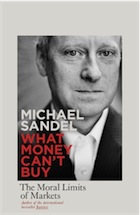
The political philosophy professor on his new book, What Money Can’t Buy, and why economics needs to be seen not as a science but a moral philosophy

Decca Aitkenhead
guardian.co.uk, Sunday 27 May 2012 20.01 BST
'What is a good hospital?' … Michael Sandel

‘What is a good hospital?’ … Michael Sandel Photograph: Felix Clay for the Guardian

Something curious happened when I tried to potty train my two-year-old recently. To begin with, he was very keen on the idea. I’d read that the trick was to reward him with a chocolate button every time he used the potty, and for the first day or two it went like a breeze – until he cottoned on that the buttons were basically a bribe, and began to smell a rat. By day three he refused point-blank to go anywhere near the potty, and invoking the chocolate button prize only seemed to make him all the more implacable. Even to a toddler’s mind, the logic of the transaction was evidently clear – if he had to be bribed, then the potty couldn’t be a good idea – and within a week he had grown so suspicious and upset that we had to abandon the whole enterprise.

It’s a pity I hadn’t read What Money Can’t Buybefore embarking, because the folly of the chocolate button policy lies at the heart of Michael Sandel‘s new book. “We live at a time when almost everything can be bought and sold,” the Harvard philosopher writes. “We have drifted from having a market economy, to beinga market society,” in which the solution to all manner of social and civic challenges is not a moral debate but the law of the market, on the assumption that cash incentives are always the appropriate mechanism by which good choices are made. Every application of human activity is priced and commodified, and all value judgments are replaced by the simple question: “How much?”

What Money Can’t Buy: The Moral Limits of Markets, by Michael Sandel

Sandel leads us through a dizzying array of examples, from schools paying children to read – $2 (£1.20) a book in Dallas – to commuters buying the right to drive solo in car pool lanes ($10 in many US cities), to lobbyists in Washington paying line-standers to hold their place in the queue for Congressional hearings; in effect, queue-jumping members of the public. Drug addicts in North Carolina can be paid $300 to be sterilised, immigrants can buy a green card for $500,000, best man’s speeches are for sale on the internet, and even body parts are openly traded in a financial market for kidneys, blood and surrogate wombs. Even the space on your forehead can be up for sale. Air New Zealand has paid people to shave their heads and walk around wearing temporary tattoos advertising the airline.

According to the logic of the market, the matter of whether these transactions are right or wrong is literally meaningless. They simply represent efficient arrangements, incentivising desirable behaviour and “improving social utility by making underpriced goods available to those most willing to pay for them”. To Sandel, however, the two important questions we should be asking in every instance are: Is it fair to buy and sell this activity or product? And does doing so degrade it? Almost invariably, his answers are no, and yes.

Sandel, 59, has been teaching political philosophy at Harvard for more than 30 years, and is often described as a rock star professor, such is the excitement his lectures command. In person there is nothing terribly rock star about him; he grew up in a middle-class Jewish family in Minneapolis, studied for his doctorate at Balliol college in Oxford as a Rhodes Scholar, and has been married for decades to a social scientist with whom he has two adult sons. His career, on the other hand, is stratospheric.

Sandel’s justice course is said to be the single most popular university class on the planet, taken by more than 15,000 students to date and televised for a worldwide audience that runs into millions. His 2009 book Justice, based upon the course, became a global bestseller, sparking a craze for moral philosophy in Japan and earning him the accolade “most influential foreign figure” from China Newsweek. If you heard a series of his lectures broadcast on Radio 4 in the spring you would have glimpsed a flavour of his wonderfully discursive approach to lecturing, which is not unlike an Oxbridge tutorial, only conducted with an auditorium full of students, whom he invites to think aloud.

In keeping with his rock star status, Sandel is currently embarked upon a mammoth world tour to promote his new book, and when we meet in London he has almost lost his voice. His next sleep, he croaks, half smiling, isn’t scheduled for another fortnight, and he looks quite weak with jetlag. Understandably, then, he isn’t quite as commanding as I had expected. But although I found his book fascinating – and in parts both confronting and deeply moving – in truth, until the very last pages I didn’t find it quite as persuasive as I had hoped.

This may, as we’ll come on to, have something to do with the fact that its central argument is harder to make in the US than it would be here. “It is a harder sell in America than in Europe,” he agrees. “It cuts against the grain in America.” This is truer today than ever before, he adds, for since he began teaching Sandel has observed in his students “a gradual shift over time, from the 80s to the present, in the direction of individualistic free-market assumptions”. The book’s rather detached, dispassionate line of inquiry into each instance of marketisation – is it fair, and does it degrade? – was devised as a deliberate strategy to “win over the very pro-market American audience” – and it certainly makes for a coolly elegant read, forgoing rhetoric for forensic examination in order to engage with free market economics in terms the discipline understands. But I’m just not entirely sure it works.

If, like me, you share Sandel’s view that moral values should not be replaced by market prices, the interesting way to read What Money Can’t Buy is through the eyes of a pro-market fundamentalist who regards such a notion as sentimental nonsense. Does he win you over then?

He certainly provides some fascinating examples of the market failing to do a better job than social norms or civic values, when it comes to making us do the right thing. For example, economists carried out a survey of villagers in Switzerland to see if they would accept a nuclear waste site in their community. While the site was obviously unwelcome, the villagers recognised its importance to their country, and voted 51% in favour. The economists then asked how they would vote if the government compensated them for accepting the site with an annual payment. Support promptly dropped to 25%. It was the potty-and-chocolate-buttons syndrome all over again. Likewise, a study comparing the British practice of blood donation with the American system whereby the poor can sell their blood found the voluntary approach worked far more effectively. Once again, civic duty turned out to be more powerful than money.

However, a true believer in the law of the market would surely argue that all this proves is that sometimes a particular marketisation device doesn’t work. For them it remains not a moral debate but simply one of efficacy. Sandel writes about the wrongness of a medical system in which the rich can pay for “concierge doctors” who will prioritise wealthy patients – but to anyone who believes in markets, Sandel’s objection would surely cut little ice. They would say it’s a question of whether or not the system is fulfilling its purpose. If the primary purpose of a particular hospital is to save lives, then if it treats a millionaire’s bruised toe while a poorer patient dies of a heart attack in the waiting room, the marketisation has clearly not worked. But if the function of the hospital is to maximise profits, then treating the millionaire’s sore toe first makes perfect sense, doesn’t it?

“I suspect that you have – we have – a certain idea of what a hospital is for, such that a purely profit-driven one misses the mark; it’s deficient in some way; it falls short of what hospitals are properly for. You would say, wouldn’t you, that that hospital – that market-driven one – is not a proper hospital. They’ve misidentified, really, what a hospital is for. Just as if they were a school that said: ‘Our purpose isn’t, really, primarily, to educate students, but to maximise revenue – and we maximise revenue by offering certain credentials, and so on,’ you’d say: ‘Well, that’s not a proper school; they’re deficient in some way.'”

I would, I agree. But a rabid rightwinger wouldn’t. They would say the profit motive is in itself blameless, and pursuing it by mending people’s bodies or expanding their minds is no different to making motor cars, as long as it works.

“My point is that the debate, or the argument, with someone who held that view of the purpose of the hospital would be a moral argument about how properly to understand the purpose of a hospital or a school. And, yes, there would be disagreement – but that disagreement, about purpose, would be, at the same time, a moral disagreement. I’d say ‘moral disagreement’, because it’s not just an empirical question: How did this hospital define its mission? It’s: What are hospitals properly for? What is a good hospital?”

I don’t think that would convince a hardliner at all. Similarly, I imagine a hardline rightwinger might read Sandel’s chapter about the practice in the US of corporations taking life insurance policies out on their staff, often unbeknown to the employees, and think: what’s the problem? Sandel writes about the “moral tawdriness” of companies having a financial interest in the death of an employee, but as he doesn’t suggest it would tempt them to start killing their staff, these policies would strike many on the right as a rational financial investment.

At this point Sandel begins to peer at me across the table with an expression of mild disgust and disbelief. Is this woman really, I think I can see him wondering, from the Guardian? So I explain hastily that I tried very hard to read his book wearing Thatcherite glasses.

“You tried a bit too hard,” he says wryly. “You shouldn’t have tried so hard. You should have gone with the flow a bit more.” Which feels like a disappointing answer.

The irony is that I think Sandel would have written a more powerful book had he not tried to argue the case on free-market economists’ own dry, dispassionate terms. It is, as he rightly points out, the language in which most modern political debate is conducted: “Between those who favour unfettered markets and those who maintain that market choices are free only when they’re made on a level playing field.” But it feels as if by engaging on their terms, he’s forcing himself to make an argument with one hand tied behind his back. Only in the final chapter does he throw caution to the wind, and make the case in the language of poetry.

“Consider the language employed by the critics of commercialisation,” he writes. “‘Debasement’, ‘defilement’, ‘coarsening’, ‘pollution’, the loss of the ‘sacred’. This is a spiritually charged language that gestures toward higher ways of living and being.” And it works, for the book suddenly makes sense to me. His closing elegy to what is lost by a society that surrenders all decisions to the market almost moved me to tears.

“Does that mean I should have just started and ended with the poetry, and forgotten about the argumentative and analytical part?” he asks. “I want to address people who are coming to this from different ideological directions.” But funnily enough, I think the poetry might well do a better job of persuading those very sceptics he’s trying to convert.

A fascinating question he addresses is why the financial crisis appears to have scarcely put a dent in public faith in market solutions. “One would have thought that this would be an occasion for critical reflection on the role of markets in our lives. I think the persistent hold of markets and market values – even in the face of the financial crisis – suggests that the source of that faith runs very deep; deeper than the conviction that markets deliver the goods. I don’t think that’s the most powerful allure of markets. One of the appeals of markets, as a public philosophy, is they seem to spare us the need to engage in public arguments about the meaning of goods. So markets seem to enable us to be non-judgmental about values. But I think that’s a mistake.”

Putting a price on a flat-screen TV or a toaster is, he says, quite sensible. “But how to value pregnancy, procreation, our bodies, human dignity, the value and meaning of teaching and learning – we do need to reason about the value of goods. The markets give us no framework for having that conversation. And we’re tempted to avoid that conversation, because we know we will disagree about how to value bodies, or pregnancy, or sex, or education, or military service; we know we will disagree. So letting markets decide seems to be a non-judgmental, neutral way. And that’s the deepest part of the allure; that it seems to provide a value-neutral, non-judgmental way of determining the value of all goods. But the folly of that promise is – though it may be true enough for toasters and flat-screen televisions – it’s not true for kidneys.”

Sandel makes the illuminating observation that what he calls the “market triumphalism” in western politics over the past 30 years has coincided with a “moral vacancy” at the heart of public discourse, which has been reduced in the media to meaningless shouting matches on cable TV – what might be called the Foxification of debate – and among elected politicians to disagreements so technocratic and timid that citizens despair of politics ever addressing the questions that matter most.

“There is an internal connection between the two, and the internal connection has to do with this flight from judgment in public discourse, or the aspiration to value neutrality in public discourse. And it’s connected to the way economics has cast itself as a value-neutral science when, in fact, it should probably be seen – as it once was – as a branch of moral and political philosophy.”

Sandel’s popularity would certainly indicate a public appetite for something more robust and enriching. I ask if he thinks academia could do with a few more professors with rock star status and he pauses for a polite while before smiling. “That’s a question I would rather have you answer than me, I would say.” That someone as unflashy and mild-mannered as Sandel can command more attention in the US than even a rightwing poster boy academic such as Niall Ferguson must, I would say, be some grounds for optimism. On a purely personal level, I ask, is there any downside to engaging with the world through the eyes of moral philosophy, rather than simple market logic?

“None but the burden of reflection and moral seriousness.”

Empresariado promove agenda paralela à Rio+20 (Mercado Ético)

Envolverde Rio + 20
31/5/2012 – 10h44

por Sucena Shkrada Resk, do Mercado Ético

Capa4 Empresariado promove agenda paralela à Rio+20A Conferência das Nações Unidas sobre Desenvolvimento Sustentável (Rio+20) não mobiliza somente os governos e a sociedade civil organizada, mas também o setor empresarial, que estará presente em eventos paralelos, no mês de junho, no Rio de Janeiro e em outras localidades do Brasil. Os temas centrais do evento – economia verde no contexto do desenvolvimento sustentável e da erradicação da pobreza, além da governança internacional da sustentabilidade – são o pano de fundo para a realização dos debates e propostas entre as organizações da iniciativa privada.

“Os eventos paralelos à conferência e à pré-conferência Rio+20 são uma forma de envolver a sociedade organizada, empresas e outras partes interessadas no processo de discussão dos rumos do acordo político que está sendo construído para fortalecer a inclusão dos princípios do desenvolvimento sustentável nas diversas instâncias de processos decisórios. Cada encontro lateral busca atingir algum público e algum ponto de vista”, explica Jorge Soto, diretor de Desenvolvimento Sustentável da Braskem, uma das corporações que terá atividades voltadas ao público presente na Rio+20.

Segundo ele, dessa forma, a soma de todos os encontros laterais cobrirá a diversidade, própria ao desenvolvimento sustentável. “Entendo que dessa ampla participação e discussão surgirão propostas que colocarão a energia e o apoio que os negociadores precisam para que o acordo político resultante seja contundente e à altura do desafio que a humanidade está enfrentando”, avalia.

Programação

A exemplo do evento oficial e da Cúpula dos Povos, a agenda ligada às corporações está bem diversificada. No período de 11 a 13 de junho, em São Paulo, será realizada a já tradicional Conferência Ethos 2012, cujo tema será A empresa e a nova economia: o que muda com a Rio + 20 (www.ethos.org.br/ci2012). Na ocasião também será lançada a versão em português da obra O Estado do Mundo 2012: Rumo à Prosperidade Sustentável, do World Watch Institute.

“Durante o evento, discutiremos e produziremos um documento em parceria com representantes de cerca de 40 organizações, com propostas em relação aos 10 temas (veja abaixo) que serão debatidos por representantes da sociedade civil nos Diálogos sobre Desenvolvimento Sustentável, que será organizados pelo governo brasileiro, de 16 a 19 de junho, na programação da Rio+20″, explica Paulo Itacarambi, vice-presidente executivo do Instituto Ethos.

Os temas são: Desenvolvimento Sustentável para o combate à pobreza; Como resposta às crises econômicas e financeiras; Desemprego, trabalho decente e migrações; A economia do Desenvolvimento Sustentável, incluindo padrões sustentáveis de produção e consumo; Florestas; Segurança alimentar e nutricional; Energia Sustentável para todos; Água; Cidades Sustentáveis e Inovação; Oceanos.

O material será entregue aos participantes dos Diálogos e ao comitê organizador da Rio+20, com o objetivo, segundo ele, de se propor alternativas a cenários futuros. “Durante a Conferência Ethos também avançaremos em um debate além da Rio+20, que refletirá sobre a construção de uma economia includente verde e responsável”. Para isso, será tratada a questão dos novos modelos de negócios, com a participação de John Elkington, criador do conceito do triple bottom line, entre outras personalidades.

No Forte de Copacabana, no Rio de Janeiro, ocorrerão mais eventos entre os dias 11 e 22 de junho. Ainda sem programa definido (a ser lançado no próximo dia 25), as atividades ali serão organizadas pela Federação das Indústrias do Estado de São Paulo (FIESP) e pela Federação das Indústrias do Estado do Rio (Firjan), em parceria com a Fundação Roberto Marinho e a Prefeitura do Rio de Janeiro.

O Conselho Empresarial Brasileiro de Desenvolvimento Sustentável (CEBDS) manterá um espaço institucional no Parque dos Atletas, no Rio de Janeiro, de 13 a 23 de junho, e também manterá eventos paralelos, no Rio Centro e no Forte de Copacana, quando será apresentado o lançamento do documentoVisão Brasil 2050, uma iniciativa “tropicalizada” do documento produzido pelo World Business Council for Sustainable Development – WBCSD (Conselho Mundial de Gestão para o Desenvolvimento Sustentável).

“Esse documento é considerado um dos mais importantes já lançados sobre o futuro da sustentabilidade e tem inspirado o planejamento estratégico de inúmeras empresas em todo o mundo. Visão Brasil 2050 é uma agenda para o desenvolvimento sustentável e a transição para a economia verde nos próximos 40 anos”, explica Marina Grossi, presidente executiva do CEBDS.

Outro projeto a ser divulgado é “Rio Cidade Sustentável“. A iniciativa, lançada, neste ano, tem sete eixos: turismo comunitário, desenvolvimento de empreendedores locais, sustentabilidade nas escolas e lares, infraestrutura urbana verde, agricultura urbana orgânica, gestão comunitária de resíduos e melhoria habitacional sustentável.

“Trata de infraestrutura urbana e transformação social com foco em sustentabilidade, que articula poder público, empresas e moradores para melhorar a qualidade de vida das comunidades. Desde janeiro deste ano, duas comunidades pacificadas da Zona Sul carioca, Babilônia e Chapéu Mangueira, acolhem as sete frentes de atuação do programa.”, diz ela.

Por fim, o Rio+20 Corporate Sustainability Forum: Innovation & Collaboration for the Future We Want (Rio+20 Fórum de Sustentabilidade Corporativa: inovação e colaboração para o futuro que queremos) será promovido pelo Pacto Global da ONU, entre 15 e 18 de junho, também no Rio de Janeiro (http://csf.compact4rio.org/events/rio-20-corporate-sustainability-forum/event-summary-251b87a2deaa4e56a3e00ca1d66e5bfd.aspx).

* Publicado originalmente no site Mercado Ético.

A corrupção acadêmica e a crise financeira (Guardian)

CHARLES FERGUSON

DO “GUARDIAN”

Muitas pessoas que viram meu documentário “Trabalho Interno” (2010) acharam que a parte mais perturbadora é a revelação sobre amplos conflitos de interesses em universidades e institutos de estudos e entre pesquisadores acadêmicos. Espectadores que assistiram às minhas entrevistas com eminentes professores universitários ficaram estarrecidos com o que saiu da boca deles.

Mas não deveríamos ter ficado surpresos. Nas duas últimas décadas, médicos já comprovaram de modo substancial a influência que o dinheiro pode exercer num campo supostamente objetivo e científico. De modo geral, as escolas de medicina e os periódicos médicos vêm reagindo bem, aderindo às exigências de transparência.

Os cursos de pós-graduação em economia, as faculdades de administração, as de direito e as de ciência política vêm reagindo de modo muito diferente. Nos últimos 30 anos, parcelas importantes do mundo acadêmico americano foram deterioradas, convertendo-se em atividades do tipo “pay to play” (pague para participar).Hoje em dia, se você vir um célebre professor de economia depondo no Congresso ou escrevendo um artigo, são boas as chances de ele ou ela ter sido pago por alguém com grande interesse no que está em debate. Na maior parte das vezes esses professores não revelam esses conflitos de interesse. Além disso, na maior parte do tempo suas universidades se fazem de desentendidas.

Meia dúzia de firmas de consultoria, vários birôs de palestrantes e diversos grupos de lobby de setores diferentes mantêm grandes redes de acadêmicos de aluguel, com o objetivo de defender os interesses desses grupos em discussões sobre políticas e regulamentação.

Os principais setores envolvidos são energia, telecomunicações, saúde, agronegócio e, sem dúvida, o setor de serviços financeiros.

Alguns exemplos: o economista Glenn Hubbard virou reitor da Columbia Business School em 2004, pouco depois de deixar o governo George W. Bush (2001-09), no qual trabalhou no Departamento do Tesouro e foi o primeiro presidente do Conselho de Assessores Econômicos do presidente, entre 2001 e 2003.

Boa parte de seu trabalho acadêmico é dedicado à política fiscal. Num resumo justo de suas posições intelectuais, pode-se dizer que ele jamais viu um imposto que tenha gostado de ver aprovado e em vigor. Em novembro de 2004, ele escreveu um artigo espantoso em coautoria com William C. Dudley, então economista-chefe do banco de investimentos Goldman Sachs.

O artigo em questão, “Como os Mercados de Capitais Elevam a Performance Econômica e Facilitam a Geração de Empregos”, merece ser citado. Vale lembrar que estamos em novembro de 2004, com a bolha já bem encaminhada:

“Os mercados de capital têm ajudado a tornar o mercado imobiliário menos volátil. ‘Arrochos de crédito’ do tipo que, periodicamente, fecharam a oferta de recursos aos compradores da casa própria […] são coisas do passado.”

Hubbard se negou a dizer se foi pago ou não para escrever o artigo. E se negou a me fornecer sua declaração mais recente de conflitos de interesse financeiros com o governo, documento que não pudemos obter de outra forma porque a Casa Branca o destruiu.

Hubbard recebeu US$ 100 mil para depor na defesa criminal dos dois gerentes do fundo hedge (de alto risco) Bear Stearns, processados por envolvimento com a bolha; eles foram absolvidos. No ano passado, Hubbard se tornou assessor econômico sênior da campanha presidencial de Mitt Romney, o pré-candidato republicano à Presidência dos EUA.

RABO PRESO

Outro economista, Larry Summers, já ocupou quase todos os cargos governamentais importantes na área econômica. Secretário do Tesouro sob o presidente Bill Clinton (1993-2001), em 2009 ele se tornou diretor do Conselho Econômico Nacional na administração Barack Obama.

Embora seja sensato em relação a muitas questões, Summers cometeu uma sucessão bem documentada de erros e concessões. E seus pontos de vista sobre o setor financeiro dificilmente seriam distinguidos dos de, digamos, Lloyd Blankfein (chefe do Goldman Sachs) ou Jamie Dimon (presidente do banco JPMorgan).A maior parte de nossas informações sobre Summers vem de sua declaração obrigatória de conflitos de interesse, exigida pelo governo. De acordo com a declaração dada em 2009 por Summers, sua fortuna líquida estava calculada entre US$ 17 milhões e US$ 39 milhões. Seus recebimentos totais no ano antes de ingressar no governo chegaram a quase US$ 8 milhões. O Goldman Sachs pagou a Summers US$ 135 mil por um discurso.

Larry Summers é um homem com o rabo preso, que deve a maior parte de sua fortuna e boa parte de seu sucesso político à indústria de serviços financeiros e que esteve envolvido em algumas das decisões de política econômica mais desastrosas da última metade de século. Na administração Obama, Summers se opôs à adoção de medidas fortes para punir banqueiros ou limitar a receita deles.

A universidade de Harvard ainda não exige que Larry Summers divulgue seus envolvimentos com o setor financeiro. Tanto Harvard quanto Summers negaram meus pedidos de informação.

O problema da corrupção acadêmica hoje está tão profundamente entrincheirado que essas disciplinas e essas universidades importantes estão gravemente comprometidas, e qualquer pessoa que pensasse em se opor à tendência ficaria racionalmente muito assustada.

COMEDIMENTO

Considere a seguinte situação: você é estudante de doutorado ou um membro júnior do corpo docente que estuda a possibilidade de fazer pesquisas sobre, digamos, as estruturas de pagamento aos profissionais que assumem riscos nos serviços financeiros, ou sobre o impacto potencial das exigências de divulgação pública de informações sobre o mercado de “credit default swaps” –instrumentos financeiros que funciona como um seguro contra calotes. O reitor de sua universidade é… Larry Summers. O chefe de seu departamento é… Glenn Hubbard.

Ou você está no MIT (Massachusetts Institute of Technology) e quer estudar o declínio dos pagamentos de impostos de pessoas jurídicas. A reitora do MIT é Susan Hockfield, que faz parte do conselho de direção da General Electric, uma empresa que vem conseguindo evitar o pagamento de quase todos os impostos corporativos há vários anos.

Até que ponto essas forças de fato afetam as pesquisas acadêmicas e as políticas das universidades? As evidências das quais dispomos sugerem que o efeito é grande.
Os comentários sobre a crise financeira proferidos por economistas na academia têm sido bastante comedidos. É verdade que existem algumas exceções notáveis. Na maior parte do tempo, porém, o silêncio tem sido ensurdecedor.

Como é possível que um setor inteiro seja estruturado de modo que funcionários sejam encorajados a saquear e destruir suas próprias firmas? Por que a desregulamentação e a teoria econômica fracassaram tão espetacularmente?

O lançamento do documentário “Trabalho Interno” claramente mexeu com sensibilidades que foram tocadas por essas questões. Fui contatado por estudantes e docentes em grande número, e houve debates em grande número.

Algumas escolas, incluindo a Columbia Business School, adotaram exigências de divulgação de informações pela primeira vez.

Mas a maioria das universidades ainda não faz essas exigências, e poucas ou nenhuma impõem qualquer limitação à existência de conflitos de interesse. O mesmo se aplica à maioria das publicações acadêmicas.

Repórteres de jornais são proibidos terminantemente de aceitar dinheiro de qualquer setor econômico ou organização sobre o qual escrevam matérias. O mesmo não acontece no mundo acadêmico.

Houve um avanço positivo importante. No início deste ano, a Associação Americana de Economia passou a exigir uma declaração de conflitos de interesse para os sete periódicos que edita.

Mas a maioria das instituições ainda se opõe à divulgação de mais informações, e, quando eu estava fazendo meu filme, se negou até mesmo a tratar do assunto.

Tradução de Clara Alain

Acre: In defence of life and the integrity of the peoples and their territories against REDD and the commodification of nature

Letter from the State of Acre

In defence of life and the integrity of the peoples and their territories against REDD and the commodification of nature

We gathered in Rio Branco, in the State of Acre, on 3-7 October 2011 for the workshop “Serviços Ambientais, REDD e Fundos Verdes do BNDES: Salvação da Amazônia ou Armadilha do Capitalismo Verde?” (Environmental Services, REDD and BNDES Green Funds: The Amazon’s Salvation or a Green Capitalism Trap?)

The participants included socio-environmental organizations, family agriculture associations, Extractive Reserve (RESEX) and Extractive Settlement organizations, human rights organizations (national and international), social pastoral organizations, professors, students, and members of civil society committed to the struggle of “the underdogs”.

We saw the emergence of a consensus around the belief that, since 1999 and the election of the Popular Front of Acre (FPA) government, initiatives have been adopted to establish a “new model” of development in the state. Since then, this model has been praised as a prime example of harmony between economic development and the preservation of forests, their natural resources and the way of life of their inhabitants. With strong support from the media, trade unions, NGOs that promote green capitalism in the Amazon region, multilateral banks, local oligarchies and international organizations, it is presented as a “successful model” to be emulated by other regions of Brazil and the world.

Over these past few days we have had the opportunity to learn first hand, in the field, about some of the initiatives in Acre that are considered as exemplary. We saw for ourselves the social and environmental impacts of the “sustainable development” underway in the state. We visited the Chico Mendes Agro-Extractive Settlement Project, the NATEX condom factory, and the Fazendas Ranchão I and II Sustainable Forest Management Project in Seringal São Bernardo (the São Bernardo rubber plantation). These field visits presented us with a reality that is rather far removed from the image portrayed nationally and internationally.

In Seringal São Bernardo, we were able to observe the priority placed on the interests of timber companies, to the detriment of the interests of local communities and nature conservation. Even the questionable rules of the forest management plans are not respected, and according to the local inhabitants, these violations are committed in collusion with the responsible state authorities. In the case of the Chico Mendes Agro-Extractive Settlement Project in Xapuri, we saw that the local population remains subjugated to monopoly control: they currently sell their timber to the company Laminados Triunfo at a rate of R$90 per cubic metre, when this same amount of wood can be sold for as much as R$1200 in the city. This is why we support the demands of various communities for the suspension of these famous forest management projects. We call for the investigation of all of the irregularities revealed, and we demand punishment for those guilty of the criminal destruction of natural resources.

During the course of the workshop we also analyzed the issues of environmental services, REDD and the BNDES (Brazilian Development Bank) Green Funds. We gained a greater understanding of the role of banks (World Bank, IMF, IDB and BNDES), of NGOs that promote green capitalism (e.g. WWF, TNC and CI) and other institutions such as the ITTO, FSC and USAID, and also sectors of civil society and the state and federal governments who have allied with international capital for the commodification of the natural heritage of the Amazon region.

It was stressed that, in addition to being anti-constitutional, Law Nº 2.308 of 22 October 2010, which regulates the State System of Incentives for Environmental Services, was created without the due debate with sectors of society directly impacted by the law, that is, the men and women of the countryside and forests. Slavishly repeating the arguments of the powerful countries, local state authorities present it as an effective means of contributing to climate equilibrium, protecting the forests and improving the quality of life of those who live in the forests. It should be noted, however, that this legislation generates “environmental assets” in order to negotiate natural resources on the “environmental services” market, such as the carbon market. It represents a reinforcement of the current phase of capitalism, whose defenders, in order to ensure its widespread expansion, utilize an environmental discourse to commodify life, privatize nature and plunder the inhabitants of the countryside and the cities. Under this law, the beauty of nature, pollination by insects, regulation of rainfall, culture, spiritual values, traditional knowledge, water, plants and even popular imagery are converted into merchandise. The current proposal to reform the Forest Code complements this new strategy of capital accumulation by authorizing the negotiation of forests on the financial market, through the issuing of “green bonds”, or so-called “Environmental Reserve Quota Certificates” (CCRAs). In this way, everything is placed in the sphere of the market, to be administered by banks and private corporations.

Although it is presented as a solution for global warming and climate change, the REDD proposal allows the powerful capitalist countries to maintain their current levels of production, consumption and, therefore, pollution. They will continue to consume energy generated by sources that produce more and more carbon emissions. Historically responsible for the creation of the problem, they now propose a “solution” that primarily serves their own interests. While making it possible to purchase the “right to pollute”, mechanisms like REDD strip “traditional” communities (riverine, indigenous and Afro-Brazilian communities, rubber tappers, women coconut gatherers, etc.) of their autonomy in the management of their territories.

As a result, roles are turned upside down. Capitalism, the most predatory civilization in the history of humankind, would not pose a danger; on the contrary, it would be the “solution”. The “destroyers” would now be those who fight to defend nature. And so those who have historically ensured the preservation of nature are now viewed as predators, and are therefore criminalized. It comes as no surprise then that the state has recently become more open in its repression, persecution and even the expulsion of local populations from their territories – all to ensure the free expansion of the natural resources market.

With undisguised state support, through this and other projects, capital is now promoting and combining two forms of re-territorialization in the Amazon region. On one hand, it is evicting peoples and communities from their territories (as in the case of mega projects like hydroelectric dams), stripping them of their means of survival. On the other hand, it is stripping those who remain on their territories of their relative autonomy, as in the case of environmental conservation areas. These populations may be allowed to remain on their land, but they are no longer able to use it in accordance with their ways of life. Their survival will no longer be guaranteed by subsistence farming – which has been transformed into a “threat” to the earth’s climate stability – but rather by a “bolsa verde” or “green allowance”, which in addition to being insufficient is paid in order to maintain the oil civilization.

Because we are fully aware of the risks posed by projects like these, we oppose the REDD agreement between California, Chiapas and Acre, which has already caused serious problems for indigenous and traditional communities such as those in the Amador Hernández region of Chiapas, Mexico. This is why we share our solidarity with the poor communities of California and Chiapas, who have already suffered from its consequences. We also share our solidarity with the indigenous peoples of the Isiboro Sécure National Park and Indigenous Territory (TIPNIS) in Bolivia, who are facing the threat of the violation of their territory by a highway linking Cochabamba and Beni, financed by the BNDES.

We are in a state which, in the 1970s and 1980s, was the stage for historical struggles against the predatory expansion of capital and in defence of territories inhabited by indigenous peoples and peasant communities of the forests. These struggles inspired many others in Brazil and around the world. In the late 1990s, however, Acre was converted into a laboratory for the IDB’s and World Bank’s experiments in the commodification and privatization of nature, and is now a state “intoxicated” by environmental discourse and victimized by the practice of “green capitalism”. Among the mechanisms used to legitimize this state of affairs, one of the most striking is the manipulation of the figure of Chico Mendes. To judge by what they present us with, we would have to consider him the patron saint of green capitalism. The name of this rubber tapper and environmental activist is used to defend oil exploitation, monoculture sugar cane plantations, large-scale logging activity and the sale of the air we breathe.

In view of this situation, we would have to ask if there is anything that could not be made to fit within this “sustainable development” model. Perhaps at no other time have cattle ranchers and logging companies met with a more favourable scenario. This is why we believe it is necessary and urgent to fight it, because under the guise of something new and virtuous, it merely reproduces the old and perverse strategies of the domination and exploitation of humans and nature.

Finally, we want to express here our support for the following demands: agrarian reform, official demarcation of indigenous lands, investments in agroecology and the solidarity economy, autonomous territorial management, health and education for all, and democratization of the media. In defence of the Amazon, of life, of the integrity of the peoples and their territories, and against REDD and the commodification of nature. Our struggle continues.

Rio Branco, Acre, 7 October 2011

Signed:

Assentamento de Produção Agro-Extrativista Limoeiro-Floresta Pública do Antimary (APAEPL)

Amazonlink

Cáritas – Manaus

Centro de Defesa dos Direitos Humanos e Educação Popular do Acre (CDDHEP/AC)

Centro de Estudos e Pesquisas para o Desenvolvimento do Extremo Sul da Bahia (CEPEDES)

Comissão Pastoral da Terra – CPT Acre

Conselho Indigenista Missionário – CIMI Regional Amazônia Ocidental

Conselho de Missão entre Índios – COMIN Assessoria Acre e Sul do Amazonas

Coordenação da União dos Povos Indígenas de Rondônia, Sul do Amazonas e Noroeste do Mato Grosso – CUNPIR

FERN

Fórum da Amazônia Ocidental (FAOC)

Global Justice Ecology Project

Grupo de Estudo sobre Fronteira e Identidade – Universidade Federal do Acre

Instituto Madeira Vivo (IMV-Rondônia)

Instituto Mais Democracia

Movimento Anticapitalista Amazônico – MACA

Movimento de Mulheres Camponesas (MMC – Roraima)

Nós Existimos – Roraima

Núcleo Amigos da Terra Brasil

Núcleo de Pesquisa Estado, Sociedade e Desenvolvimento na Amazônia Ocidental -Universidade Federal do Acre.

Oposição Sindical do STTR de Brasiléia

Rede Alerta Contra o Deserto Verde

Rede Brasil sobre Instituições Financeiras Multilaterais

Sindicato dos Trabalhadores Rurais de Bujarí (STTR – Bujarí)

Sindicato dos Trabalhadores Rurais de Xapuri (STTR- Xapuri)

Terra de Direitos

União de Mulheres Indígenas da Amazonia Brasileira

World Rainforest Movement (WRM)

Carta del Estado de Acre

En defensa de la vida, de la integridad de los pueblos y de sus territorios contra el REDD y la mercantilización de la naturaleza

Estuvimos reunidos en Rio Branco – Estado de Acre, entre los días 3 y 7 de octubre de 2011 en el Taller: “Serviços Ambientais, REDD e Fundos Verdes do BNDES: Salvação da Amazônia ou Armadilha do Capitalismo Verde?” (Servicios Ambientales, REDD y Fondos Verdes del BNDES: ¿Salvación de la Amazonia o Trampa del Capitalismo Verde? )

Estábamos presentes organizaciones socioambientales, de trabajadoras y trabajadores de la agricultura familiar, organizaciones de Resex (Reservas Extractivistas) y Asentamientos Extractivistas, de derechos humanos (nacionales e internacionales), organizaciones indígenas, organizaciones de mujeres, pastorales sociales, profesores, estudiantes y personas de la sociedad civil comprometidas con la lucha “de los de abajo”.

Percibimos la formación de un consenso en torno a la idea de que, desde 1999, con la elección del gobierno del Frente Popular de Acre (FPA), se tomaron iniciativas para la implantación de un “nuevo modelo” de desarrollo. Desde entonces, dicho modelo es celebrado como primor de armonía entre desarrollo económico y conservación del bosque, de sus bienes naturales y del modo de vida de sus habitantes. Con fuerte apoyo de los medios de comunicación, de sindicatos, de ONGs promotoras del capitalismo verde en la región amazónica, de bancos multilaterales, de oligarquías locales, de organizaciones internacionales, éste es presentado como “modelo exitoso” a ser seguido por otras regiones del Brasil y del mundo.

En estos días tuvimos la oportunidad de conocer, en el campo, algunas iniciativas consideradas como referencia en Acre. Vimos de cerca los impactos sociales y ambientales del “desarrollo sustentable” en curso en el estado. Visitamos el “Projeto de Assentamento Agroextrativista Chico Mendes”, “Fábrica de Preservativos NATEX” y el “Seringal São Bernardo” (“Projeto de Manejo Florestal Sustentável das Fazendas Ranchão I e II”). Las visitas nos colocaron frente a un escenario bastante distinto a aquello que es publicitado a nivel nacional e internacional.

En “Seringal São Bernardo” pudimos constatar que la atención de los intereses de las madereras se hace en detrimento de los intereses de las poblaciones locales y de la conservación de la naturaleza. Incluso las cuestionables reglas de los planes de manejo no son respetadas y, según dicen los pobladores, con connivencia de gestores estatales. En el caso del “Projeto de Assentamento Agroextrativista Chico Mendes Cachoeira” (en Xapuri), constatamos que los pobladores continúan subyugados al dominio monopolista, actualmente venden la madera a la empresa “Laminados Triunfo” a R$90,00 el m3, cuando la misma cantidad de madera llega a valer hasta R$1200 en la ciudad. Por ello, apoyamos la reivindicación de diversas comunidades por la suspensión de los célebres proyectos de manejo. Solicitamos la determinación de todas las irregularidades y exigimos la penalización de los culpables por la destrucción delictiva de los bienes naturales.

Los días en que estuvimos reunidos fueron dedicados asimismo al estudio sobre Servicios Ambientales, REDD y Fondos Verdes del BNDES. Comprendimos el papel de los Bancos (Banco Mundial, FMI, BID y BNDES), ONGs comprometidas con el capitalismo verde, tales como WWF, TNC y CI; así como el papel de otras instituciones como ITTO, FSC y USAID, sectores de la sociedad civil y Gobiernos de los Estados y Federal que se han aliado al capital internacional con la intención de mercantilizar el patrimonio natural de la Amazonia.

Destacamos que, además de desprovista de amparo constitucional, la Ley Nº 2.308 de fecha 22 de octubre de 2010, que reglamenta el Sistema del Estado de Incentivo a Servicios Ambientales, se creó sin el debido debate con los sectores de la sociedad directamente impactados por ella, esto es, los hombres y mujeres del campos y del bosque. Reproduciendo servilmente los argumentos de los países centrales, los gestores estatales locales la presentan como una forma eficaz de contribuir con el equilibrio del clima, proteger el bosque y mejorar la calidad de vida de aquellos que habitan en él. Debe decirse, sin embargo, que la referida ley genera “activos ambientales” para negociar los bienes naturales en el mercado de “servicios ambientales” como el mercado de carbono. Se trata de un desdoblamiento de la actual fase del capitalismo cuyos defensores, con el fin de asegurar su reproducción ampliada, recurren al discurso ambiental para mercantilizar la vida, privatizar la naturaleza y despojar a los pobladores del campo y de la ciudad. Por la ley, la belleza natural, la polinización de insectos, la regulación de lluvias, la cultura, los valores espirituales, los saberes tradicionales, el agua, las plantas y hasta el propio imaginario popular, todo pasa a ser mercadería. La actual propuesta de modificación del Código Forestal complementa esta nueva estrategia de acumulación del capital, al autorizar la negociación de los bosques en el mercado financiero, con la emisión de “papeles verdes”, el llamado “Certificado de Cuotas de Reserva Ambiental” (CCRA). De este modo, todo se coloca en el ámbito del mercado para ser administrado por bancos y empresas privadas.

Aunque sea presentada como solución para el calentamiento global y para los cambios climáticos, la propuesta REDD permite a los países centrales del capitalismo mantener sus estándares de producción, consumo y, por lo tanto, también de contaminación. Continuarán consumiendo energía de fuentes que producen más y más emisiones de carbono. Históricamente responsables de la creación del problema, ahora proponen una “solución” que atiende más a sus intereses. Posibilitando la compra del “derecho de contaminar”, mecanismos como REDD fuerzan a las “poblaciones tradicionales” (ribereños, indígenas, afrobrasileños, trabajadoras del coco, caucheros, etc.) a renunciar a la autonomía en la gestión de sus territorios.

Con esto, se confunden los papeles. El capitalismo, la civilización más predadora de la historia de la humanidad, no representaría ningún problema. Por lo contrario, sería la solución. Los destructores serían ahora los grandes defensores de la naturaleza. Y aquellos que históricamente garantizaron la conservación natural son, ahora, encarados como predadores y por eso mismo son criminalizados. No sorprende, por lo tanto, que recientemente el Estado haya vuelto más ostensiva la represión, la persecución y hasta la expulsión de las poblaciones locales de sus territorios. Todo para asegurar la libre expansión del mercado de los bienes naturales.

Con el indisfrazable apoyo estatal, por ese y otros proyectos, el capital hoy promueve y conjuga dos formas de reterritorialización en la región amazónica. Por una parte, expulsa pueblos y comunidades del territorio (como es el caso de los grandes proyectos como las hidroeléctricas), privándolos de las condiciones de supervivencia. Por otra parte, quita la relativa autonomía de aquellos que permanecen en sus territorios, como es el caso de las áreas de conservación ambiental. Tales poblaciones pueden incluso permanecer en la tierra, pero ya no pueden utilizarla según su modo de vida. Su supervivencia ya no sería más garantizada por el cultivo de subsistencia –convertido en amenaza al buen funcionamiento del clima del planeta-, sino por “bolsas verdes”, que, además de insuficientes, son pagadas para el mantenimiento de la civilización del petróleo.

Conscientes de los riesgos que dichos proyectos traen, rechazamos el acuerdo de REDD entre California, Chiapas, y Acre que ya ha causado serios problemas a comunidades indígenas y tradicionales, como en la región de Amador Hernández, en Chiapas, México. Por ello nos solidarizamos con las poblaciones pobres de California y Chiapas, que ya han sufrido con las consecuencias. También nos solidarizamos con los pueblos indígenas del TIPNIS, en Bolivia, bajo amenaza de que su territorio sea violado por la carretera que liga Cochabamba a Beni, financiada por el BNDES.

Estamos en un estado que, en los años 1970-80, fue escenario de luchas históricas contra la expansión predatoria del capital y por la defensa de los territorios ocupados por pueblos indígenas y poblaciones campesinas del bosque. Luchas que inspiraron muchas otras en el Brasil y en el mundo. Convertido, sin embargo, a partir de fines de los años 90 en laboratorio del BID y del Banco Mundial para experimentos de mercantilización y privatización de la naturaleza, Acre es hoy un estado “intoxicado” por el discurso verde y victimizado por la práctica del “capitalismo verde”. Entre los mecanismos utilizados con el fin de legitimar ese orden de cosas, adquiere relevancia la manipulación de la figura de Chico Mendes. A juzgar por lo que nos presentan, deberíamos considerarlo el patrono del capitalismo verde. En nombre del cauchero se defiende la explotación de petróleo, el monocultivo de la caña de azúcar, la explotación maderera en gran escala y la venta del aire que se respira.

Ante tal cuadro, cabe preguntar qué es lo que no cabría en este modelo de “desarrollo sustentable”. Tal vez en ningún otro momento los ganaderos y madereros hayan encontrado un escenario más favorable. Es por esa razón que creemos necesario y urgente combatirlo, puesto que, bajo la apariencia de algo nuevo y virtuoso, reproduce las viejas y perversas estrategias de dominación y explotación del hombre y de la naturaleza.

Finalmente dejamos aquí nuestra reivindicación por la atención de las siguientes demandas: reforma agraria, homologación de tierras indígenas, inversiones en agroecología y economía solidaria, autonomía de gestión de los territorios, salud y educación para todos, democratización de los medios de comunicación. En defensa de la Amazonia, de la vida, de la integridad de los pueblos y de sus territorios y contra el REDD y la mercantilización de la naturaleza. Estamos en lucha.

Rio Branco, Acre, 07 de octubre de 2011.

Firman esta carta:

Assentamento de Produção Agro-Extrativista Limoeiro-Floresta

Pública do Antimary (APAEPL)

Amazonlink

Cáritas – Manaus

Centro de Defesa dos Direitos Humanos e Educação Popular do Acre (CDDHEP/AC)

Centro de Estudos e Pesquisas para o Desenvolvimento do Extremo Sul da Bahia (CEPEDES)

Comissão Pastoral da Terra – CPT Acre

Conselho Indigenista Missionário – CIMI Regional Amazônia Ocidental

Conselho de Missão entre Índios – COMIN Assessoria Acre e Sul do Amazonas

Coordenação da União dos Povos Indígenas de Rondônia, Sul do Amazonas e Noroeste do Mato Grosso – CUNPIR

FERN

Fórum da Amazônia Ocidental (FAOC)

Global Justice Ecology Project

Grupo de Estudo sobre Fronteira e Identidade – Universidade Federal do Acre

Instituto Madeira Vivo (IMV-Rondônia)

Instituto Mais Democracia

Movimento Anticapitalista Amazônico – MACA

Movimento de Mulheres Camponesas (MMC – Roraima)

Nós Existimos – Roraima

Núcleo Amigos da Terra Brasil

Núcleo de Pesquisa Estado, Sociedade e Desenvolvimento na Amazônia Ocidental -Universidade Federal do Acre.

Oposição Sindical do STTR de Brasiléia

Rede Alerta Contra o Deserto Verde

Rede Brasil sobre Instituições Financeiras Multilaterais

Sindicato dos Trabalhadores Rurais de Bujarí (STTR – Bujarí)

Sindicato dos Trabalhadores Rurais de Xapuri (STTR- Xapuri)

Terra de Direitos

União de Mulheres Indígenas da Amazonia Brasileira

World Rainforest Movement (WRM)

20 mil escravos no País (Correio Braziliense)

JC e-mail 4372, de 26 de Outubro de 2011.

A Organização Internacional do Trabalho (OIT) divulgou ontem (25) um perfil do trabalho escravo rural no Brasil, indicando que 81% das pessoas que vivem em condições análogas à escravidão são negras, jovens e com baixa escolaridade.

O estudo foi feito a partir de entrevistas com pessoas libertadas, aliciadores e empregadores em fazendas do Pará, Mato Grosso, Bahia e Goiás entre 2006 e 2007.

Além da predominância da raça negra, o documento aponta que cerca de 93% dessas pessoas iniciaram a vida profissional antes dos 16 anos, o que configura trabalho infantil, e que quase 75% delas são analfabetas. O estudo identificou que a maioria dos empregadores e dos aliciadores, os chamados “gatos”, é branca.

Para o coordenador da área de combate ao trabalho escravo da OIT, Luiz Machado, o dado reflete a condição de vulnerabilidade da população mais pobre ao trabalho escravo, composta maioritariamente por negros. “Isso é um resquício da exploração colonial”, atestou. O fato de não terem frequentado escolas na infância também é destacado pelo coordenador como um indutor do problema. “O trabalho infantil tira as possibilidades futuras e facilita o caminho ao trabalho escravo. Pessoas sem escolaridade não têm oportunidades.”

O Ministério Público do Trabalho (MPT) estima que cerca de 20 mil pessoas estejam submetidas ao trabalho forçado ou degradante no Brasil hoje. Desde 1995, mais de 40 mil trabalhadores foram libertados no país, que assumiu um compromisso internacional para erradicar a prática até 2015. A coordenadora nacional de Combate ao Trabalho Escravo do MPT, Débora Tito, relata que as políticas sobre o tema têm se concentrado no que ela chama “pedagogia do bolso”.

A ideia é enfrentar o problema por meio de multas altas e da inserção de nomes de empregadores em cadastros negativos para que deixem de conseguir financiamentos de bancos. “Temos que tornar essa prática economicamente inviável, para que os fazendeiros parem de economizar à custa da dignidade do trabalhador”, disse a procuradora. Segundo ela, a pena para punir o empregador de trabalho análogo ao escravo é de dois a oito anos de prisão, mas existem poucas condenações no país.

Convenção – As centrais sindicais que representam os servidores públicos das três esferas do governo estão se debatendo para definir o projeto de lei que tratará de temas como direito de greve, negociação coletiva e liberação de dirigentes sindicais de bater o ponto para se dedicar aos assuntos das categorias, itens da Convenção 151 da Organização Internacional do Trabalho (OIT), que deverá ser regulamentada até o fim do ano. Em audiência pública na Câmara ontem, a queda de braço girou em torno da cobrança do imposto sindical, um desconto no contracheque de um dia de salário ao ano, a exemplo do que ocorre com os trabalhadores da iniciativa privada.

Brasil é país-modelo em PSA, mas precisa intensificar atuação (Valor Econômico)

JC e-mail 4370, de 24 de Outubro de 2011.

Ainda sem regulamentação nacional, o Pagamento por Serviços Ambientais (PSA) se expande no Brasil, mas a passos lentos.

O estudo Pagamento por Serviços Ambientais na Mata Atlântica, feito pela Agência de Cooperação Internacional Alemã (GIZ), levantou quase 80 programas de PSA na região. São 40 projetos de PSA de água, 33 de carbono e 5 em biodiversidade. “As iniciativas aqui estão se proliferando rapidamente. Mas ainda são projetos isolados, que precisam ganhar escala”, afirma Susan Seehusen, assessora técnica em Economia de Meio Ambiente da GIZ. Com 22% de sua área original, a Mata Atlântica fornece serviços ambientais para comunidades tradicionais e rurais de seu entorno e a comunidade global.

De maior abrangência, os projetos de água contam com fontes de recursos de orçamentos públicos e verba do Comitê de Bacias Hidrográficas lideradas por prefeituras municipais e empresas do setor. O programa Produtor de Água, da Agência Nacional de Água (ANA), remunera produtores rurais e impulsiona o desenvolvimento do setor. Com o pagamento desses recursos humanos mais ações de restauração e conservação florestal, o custo anual dos projetos vai de R$ 200 mil a R$ 2,5 milhões por ano. Hoje, programas em fase inicial envolvem cerca de 350 produtores e beneficiam 22,2 milhões de pessoas.

Ligados a projetos de neutralização de CO2, os PSA de carbono se concentram na região do Pontal de Paranapanema, na tríplice fronteira São Paulo, Paraná e Minas Gerais, em terras de 10 hectares e 50 hectares. Já proprietários de áreas de mais de 100 hectares aderem aos programas a fim de atrair investidores.

Já atividades de proteção à biodiversidade são as menos apoiadas. “Nessa área, há baixa disposição para pagar. As pessoas se aproveitam do serviço mas não pagam por eles, são os chamados caronistas”, ressalta Susan.

A ampliação dos programas de PSA esbarra em problemas de governança, nos altos investimentos e na falta de regulamentação – tramita no Congresso o projeto de lei nº 792/2007, que visa instituir uma política nacional e criar um programa nacional e um fundo de PSA. Restaurar 1 hectare de terra custa de R$ 10 mil a R$ 20 mil. Então, ganham pontos ações que visam diminuir a pobreza e melhorar a distribuição de renda, como o ICMS-Ecológico, em regiões do Paraná.

Ainda assim, o Brasil é um dos países mais avançados em PSA e serve como modelo para outros países, de acordo com Peter May, professor de pós-graduação em Desenvolvimento, Agricultura e Sociedade da Universidade Federal Rural do Rio de Janeiro. Membro da International Society for Ecological Economics (ISEE), May faz estudo comparativo global sobre Redução das Emissões do Desmatamento e Degradação Florestal (Redd) e divulga dados estratégicos para formuladores de políticas públicas. “Em relação a outros países, temos um mercado agropecuário maduro sem ilegalidades e donos de terras mais instruídos. Estados como Espírito Santo, São Paulo, Amazonas e Acre criaram leis próprias”, diz. Segundo ele, a Costa Rica é modelo clássico com legislação e PSA desenvolvidos. Já Colômbia, Peru, México e Equador têm políticas próprias, mas se espelham nos nossos moldes.

Para May, além de quadro regulatório, a política de PSA deve ser incorporada pelo Código Florestal. Ele alerta ainda que o Brasil carece de experiências mais concretas e resultados práticos. O que, no entanto, exige pesquisa e monitoramento que podem sair mais caros que o projeto.

Revealed – the capitalist network that runs the world (New Scientist)

19 October 2011 by Andy Coghlan and Debora MacKenzie

The 1318 transnational corporations that form the core of the economy. Superconnected companies are red, very connected companies are yellow. The size of the dot represents revenue (Image: PLoS One)

AS PROTESTS against financial power sweep the world this week, science may have confirmed the protesters’ worst fears. An analysis of the relationships between 43,000 transnational corporations has identified a relatively small group of companies, mainly banks, with disproportionate power over the global economy.

The study’s assumptions have attracted some criticism, but complex systems analysts contacted by New Scientist say it is a unique effort to untangle control in the global economy. Pushing the analysis further, they say, could help to identify ways of making global capitalism more stable.

The idea that a few bankers control a large chunk of the global economy might not seem like news to New York’s Occupy Wall Street movement and protesters elsewhere (see photo). But the study, by a trio of complex systems theorists at the Swiss Federal Institute of Technology in Zurich, is the first to go beyond ideology to empirically identify such a network of power. It combines the mathematics long used to model natural systems with comprehensive corporate data to map ownership among the world’s transnational corporations (TNCs).

“Reality is so complex, we must move away from dogma, whether it’s conspiracy theories or free-market,” says James Glattfelder. “Our analysis is reality-based.”

Previous studies have found that a few TNCs own large chunks of the world’s economy, but they included only a limited number of companies and omitted indirect ownerships, so could not say how this affected the global economy – whether it made it more or less stable, for instance.

The Zurich team can. From Orbis 2007, a database listing 37 million companies and investors worldwide, they pulled out all 43,060 TNCs and the share ownerships linking them. Then they constructed a model of which companies controlled others through shareholding networks, coupled with each company’s operating revenues, to map the structure of economic power.

The work, to be published in PloS One, revealed a core of 1318 companies with interlocking ownerships (see image). Each of the 1318 had ties to two or more other companies, and on average they were connected to 20. What’s more, although they represented 20 per cent of global operating revenues, the 1318 appeared to collectively own through their shares the majority of the world’s large blue chip and manufacturing firms – the “real” economy – representing a further 60 per cent of global revenues.

When the team further untangled the web of ownership, it found much of it tracked back to a “super-entity” of 147 even more tightly knit companies – all of their ownership was held by other members of the super-entity – that controlled 40 per cent of the total wealth in the network. “In effect, less than 1 per cent of the companies were able to control 40 per cent of the entire network,” says Glattfelder. Most were financial institutions. The top 20 included Barclays Bank, JPMorgan Chase & Co, and The Goldman Sachs Group.

John Driffill of the University of London, a macroeconomics expert, says the value of the analysis is not just to see if a small number of people controls the global economy, but rather its insights into economic stability.

Concentration of power is not good or bad in itself, says the Zurich team, but the core’s tight interconnections could be. As the world learned in 2008, such networks are unstable. “If one [company] suffers distress,” says Glattfelder, “this propagates.”

“It’s disconcerting to see how connected things really are,” agrees George Sugihara of the Scripps Institution of Oceanography in La Jolla, California, a complex systems expert who has advised Deutsche Bank.

Yaneer Bar-Yam, head of the New England Complex Systems Institute (NECSI), warns that the analysis assumes ownership equates to control, which is not always true. Most company shares are held by fund managers who may or may not control what the companies they part-own actually do. The impact of this on the system’s behaviour, he says, requires more analysis.

Crucially, by identifying the architecture of global economic power, the analysis could help make it more stable. By finding the vulnerable aspects of the system, economists can suggest measures to prevent future collapses spreading through the entire economy. Glattfelder says we may need global anti-trust rules, which now exist only at national level, to limit over-connection among TNCs. Bar-Yam says the analysis suggests one possible solution: firms should be taxed for excess interconnectivity to discourage this risk.

One thing won’t chime with some of the protesters’ claims: the super-entity is unlikely to be the intentional result of a conspiracy to rule the world. “Such structures are common in nature,” says Sugihara.

Newcomers to any network connect preferentially to highly connected members. TNCs buy shares in each other for business reasons, not for world domination. If connectedness clusters, so does wealth, says Dan Braha of NECSI: in similar models, money flows towards the most highly connected members. The Zurich study, says Sugihara, “is strong evidence that simple rules governing TNCs give rise spontaneously to highly connected groups”. Or as Braha puts it: “The Occupy Wall Street claim that 1 per cent of people have most of the wealth reflects a logical phase of the self-organising economy.”

So, the super-entity may not result from conspiracy. The real question, says the Zurich team, is whether it can exert concerted political power. Driffill feels 147 is too many to sustain collusion. Braha suspects they will compete in the market but act together on common interests. Resisting changes to the network structure may be one such common interest.

The top 50 of the 147 superconnected companies

1. Barclays plc
2. Capital Group Companies Inc
3. FMR Corporation
4. AXA
5. State Street Corporation
6. JP Morgan Chase & Co
7. Legal & General Group plc
8. Vanguard Group Inc
9. UBS AG
10. Merrill Lynch & Co Inc
11. Wellington Management Co LLP
12. Deutsche Bank AG
13. Franklin Resources Inc
14. Credit Suisse Group
15. Walton Enterprises LLC
16. Bank of New York Mellon Corp
17. Natixis
18. Goldman Sachs Group Inc
19. T Rowe Price Group Inc
20. Legg Mason Inc
21. Morgan Stanley
22. Mitsubishi UFJ Financial Group Inc
23. Northern Trust Corporation
24. Société Générale
25. Bank of America Corporation
26. Lloyds TSB Group plc
27. Invesco plc
28. Allianz SE 29. TIAA
30. Old Mutual Public Limited Company
31. Aviva plc
32. Schroders plc
33. Dodge & Cox
34. Lehman Brothers Holdings Inc*
35. Sun Life Financial Inc
36. Standard Life plc
37. CNCE
38. Nomura Holdings Inc
39. The Depository Trust Company
40. Massachusetts Mutual Life Insurance
41. ING Groep NV
42. Brandes Investment Partners LP
43. Unicredito Italiano SPA
44. Deposit Insurance Corporation of Japan
45. Vereniging Aegon
46. BNP Paribas
47. Affiliated Managers Group Inc
48. Resona Holdings Inc
49. Capital Group International Inc
50. China Petrochemical Group Company

* Lehman still existed in the 2007 dataset used

Graphic: The 1318 transnational corporations that form the core of the economy

(Data: PLoS One)  

Trading Knowledge As A Public Good: A Proposal For The WTO (Intellectual Property Watch)

Published on 14 October 2011 @ 2:23 pm

By Rachel Marusak Hermann for Intellectual Property Watch

Years of deadlock in the Doha Round of trade negotiations at the World Trade Organization (WTO) has prompted some to question the institution’s effectiveness, and even, its relevance. But for others, the stalemate seems to be favourable for new ideas and new ways to think about global trade.

During the 19-21 September WTO Public Forum 2011, Knowledge Ecology International (KEI) and IQsensato, both not-for-profit organisations, held a joint panel session on a proposal to the WTO entitled, “An Agreement on the Supply of Knowledge as a Global Public Good.” The 21 September session provided a space to debate the feasibility of adding the supply of public goods involving knowledge as a new category in negotiated binding commitments in international trade.

James Love, director of KEI, presented the idea. “The agreement,” he explained, “combines voluntary offers with binding commitments by governments to increase the supply of heterogeneous public goods. It would be analogous to existing WTO commitments to reducing tariffs, subsidies, or liberalising services.”

Limited access

The idea of “public goods” has been around for a while. A KEI 2008 paper on the proposal, John Kenneth Galbraith’s 1958 book, The Affluent Society, which created a stir about society’s over-supply of private goods versus a growing under-supply of public goods. The KEI paper also cites the contribution to the debate made by Joseph Stiglitz, who identified five global public good categories: international economic stability, international security (political stability), the international environment, international humanitarian assistance, and knowledge.

It’s this last category that KEI would like to see put up for negotiation. According to its 2008 paper, “In recent decades, an influential and controversial enclosure movement has vastly expanded the boundaries of what knowledge can be ‘owned,’ lengthened the legal terms of protection and enhanced the legal rights granted to owners of the collection of legal rights referred to as “intellectual property.”

Proposal advocates argue that in the wake of such knowledge protection, the global community faces an under-supply of public goods, including knowledge. Shandana Gulzar Khan, of the permanent mission of Pakistan to the WTO, seconds this sentiment. “I feel that an acute restriction of access to public goods and services is indeed a reality for the majority of the world’s population.”

Love argued that the WTO is the right international institutional to contribute to the solution. He cited a description of the WTO found on its website: “Above all, it’s a negotiating forum…Essentially, the WTO is a place where member governments go, to try to sort out the trade problems they face with each other…. Although negotiated and signed by governments, the goal is to help producers of goods and services, exporters, and importers conduct their business, while allowing governments to meet social and environmental objectives.”

Defining Good

When it comes to defining what qualifies as a global public good, Love mentioned how the International Task Force on Global Public Goods describes them as goods that “address issues that are deemed to be important to the international community; and that cannot, or will not, be adequately addressed by individual countries acting alone.” The list of such priorities is long and far-reaching.

Examples of potential ask/offers includes collaborative funding of inducement prizes to reward open source innovation in areas of climate change, sustainable agriculture and medicine; agreement to fund biomedical research in areas of great importance, such as new antibiotics, avian influenza, and the development of an AIDS vaccine; funding of projects to improve functionality and usability of free software; and new open public domain tools for distance education.

Some experts cautioned that deriving a universal definition of what constitutes global public goods is a tall task. Panel speaker Antony Taubman, director of the Intellectual Property Division at the WTO, cautioned that public goods do not bring with them an idea of prioritization. “One of the underlying challenges, of course, is how to multi-lateralise the concept of public goods…. What might be considered a high priority public good from one country’s perspective would possibly be even rejected by another country.”

Taubman mentioned hormones for beef or genetically modified crops as current examples of controversial public goods. “Would one country’s contribution of a new drought resistant genetically modified crop really be considered a valuable public good by countries that regarded that as an inappropriate technology?”

Another panellist, José Estanislau do Amaral from the permanent mission of Brazil to the WTO and other economic organisations in Geneva, suggested ways to take the proposal forward.

“There seems to be a double objective in the proposal,” he said. “One is to support the creation of certain public goods and the other one is to increase access to those goods. Both of course are interlinked and they are mutually reinforcing. But they are objectives in themselves…. I am inclined, at this stage, to suggest that there might be benefits in those two objectives being pursued separately. Access to existing knowledge must not be required to wait for the supply of new knowledge.”

The Brazilian official suggested that KEI construct a structured draft treaty of the proposal so there could be a more advanced debate on the idea. Love said that a draft agreement should be ready by the end of February 2012.

Rachel Marusak Hermann may be reached at rachel@rachels-ink.com.