Arquivo da tag: Antropologia

Interview with Nobel prize winner Elinor Ostrom on climate change (Integrated Regional Information Networks)

Photo: Indiana University. Elinor Ostrom: A champion of people power

JOHANNESBURG, 25 April 2012 (IRIN) – The governance of natural resources like land, the oceans, rivers and the atmosphere, can affect the impact of some of the world’s biggest crises caused by natural events like droughts and floods. How best to manage those resources has been at the heart of the work by Nobel Prize winner (economics) Elinor Ostrom.

She has been looking at how communities across the world, from developing and rural economies like Nepal and Kenya to developed ones like the USA and Switzerland, manage their commonly shared resources such as fisheries, pasture land and water sustainably.

Ostrom’s faith in the ability of the individual and community to be able to trust each other, take the right course of action and not wait for governments to make the first move is pivotal to her thinking.

Ostrom works with the concept of “polycentrism”, which she developed with her husband Vincent Otsrom. She advocates vesting authority in individuals, communities, local governments, and local NGOs as opposed to concentrating power at global or national levels.

Ostrom recently suggested using this “polycentric approach” to address man-made climate change. She talked to IRIN by email about “polycentrism”, Rio+20, climate change, trust and the power of local action.

QYou have suggested a polycentric approach as opposed to single policies at a global level to reduce greenhouse gas emissions. Could you explain how that would work? Do you think a similar approach would work to get all countries and their people to believe in, and adopt, sustainable development?

A: We have modelled the impact of individual actions on climate change incorrectly and need to change the way we think about this problem. When individuals walk a distance rather than driving it, they produce better health for themselves. At the same time that they reduce the amount of greenhouse gas emissions that they are generating. There are benefits for the individual and small benefits for the globe. When a building owner re-does the way the building is insulated and the heating system, these actions can dramatically change the amount of greenhouse gas emissions made. This has an immediate impact on the neighbourhood of the building as well as on the globe.

When cities and counties decide to rehabilitate their energy systems so as to produce less greenhouse gas emissions, they are reducing the amount of pollution in the local region as well as greenhouse gas emissions on the globe. In other words, the key point is that there are multiple externalities involved for many actions related to greenhouse gas emissions. While in the past the literature has underplayed the importance of local effects, we need to recognize – as more and more individuals, families, communities, and states are seeing – that they will gain a benefit, as well as the globe, and that cumulatively a difference can be made at the global level if a number of small units start taking action. We have a much greater possibility of impacting global change problems if we start locally.

“the solutions that are evolved by local people have a chance of being more imaginative and better ways of solving these problems…”

Q: The earth is our common resource system – yet many countries including China and India feel they also have a right to grow, burn coal to get to where the developed world is – how do you get them out of that frame of mind without compromising the question of equity?

A: We may not be able to convince India and China of all of this. Part of my discouragement with the international negotiations is that we have gotten riveted into battles at the very big level over who caused global change in the first place and who is responsible for correcting [it]. It will take a long time to resolve some of these conflicts. Meanwhile, if we do not take action, the increase to greenhouse gas collection at a global level gets larger and larger. While we cannot solve all aspects of this problem by cumulatively taking action at local levels, we can make a difference, and we should.

Q: Do you think sustainable development did not gain much currency as it was directed at governments and a top-down approach? You think the world is about to repeat that mistake (if you would call it that?) at Rio+20? What would you do – would you ever call such a gathering of governments?

A: Yes, I do think that directing the question of climate change primarily at governments misses the point that actions that reduce greenhouse gas emissions must be taken by individuals, communities, cities, states, residents of entire nations, and the world. Yet, it is important that public officials recognize that there is a role for an international agreement and that they should be working very hard on getting an agreement that establishes international regimes that has a chance to reduce emissions across countries.

Q: You are a great believer in ordinary people’s ability to organize and use their commonly shared resources wisely, but I take it that does not work all the time? But ultimately collective action at the grassroots can force change at the top?

A: I am a believer of the capabilities of people to organize at a local level. That does not mean that they always do. There are a wide variety of collective action problems that exist at a small scale. The important thing is that people at a small scale, who know what the details of the problems are, organize, rather than calling on officials at a much larger scale.

Officials at a larger scale may have many collective-action problems of their own that they need to address. They do not have the detailed information about problems at a small scale that people who are confronting those every day do have. Thus, the solutions that are evolved by local people have a chance of being more imaginative and better ways of solving these problems than allowing them to go unsolved and eventually asking a much larger scale unit to solve it for them.

Q: This approach probably works better in a rural setting where there is a sense of community and of a shared responsibility to take care of their common resources. But how do you get that sense of ownership of the planet in an urban setting?

A: To solve these delicate problems at any scale requires individuals to trust that others are also going to contribute to their solution. Building trust is not something that can be done overnight. Thus, the crucial thing is that successful efforts at a local scale be advertised and well known throughout a developing country.

Developing associations of local communities, where very serious discussions can be held of the problems they are facing and creative ways that some communities, who have faced these problems, have adopted solutions that work. That does not mean that the solutions that work in one environment in a particular country will work in all others, but posing it as a solution that fits a local environment and that the challenge that everyone faces is to know enough about the social-ecological features of the problems they are facing that they can come up with good solutions that fit that local social-ecological system.

Q: I have been covering the recent drought in Niger – I came across people who were going to pack up and leave their village for good… Would that motivate people, countries, governments to take action to reduce emissions? But how do you make people in Europe, the US or Asia think about the people in Niger as their own?

A: There is no simple answer to this question. It is here that churches and NGOs can play a particular role in knowing about the problems being faced by villagers in Niger and other developing countries and trying to help. They can then also write stories about these problems in a way that people in Britain, Europe, and the US may understand better. It is a problem in some cases that officials in developing countries are corrupt, and direct aid to the country may only go into private bank accounts. We have to rethink how we organize governance at multiple scales so as to reduce the likelihood of some individuals having very strong powers and capability of using their public office primarily for private gain.

Q: Do you see the world moving in unison towards sustainability in the next five years? Do you think the world is prepared to take on this question and specially now when we are in a recession?

A: No, I do not see the world moving in unison. I do see some movements around the world that are very encouraging, but they are nowhere the same everywhere. We need to get out of thinking that we have to be moving the same everywhere. We need to be recognizing the complexity of the different problems being faced in a wide diversity of regions of the world. Thus, really great solutions that work in one environment do not work in others. We need to understand why, and figure out ways of helping to learn from good examples as well as bad examples of how to move ahead.

Soldiers Who Desecrate the Dead See Themselves as Hunters (Science Daily)

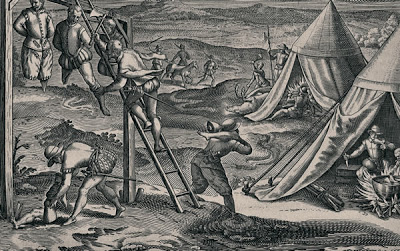
ScienceDaily (May 20, 2012) — Modern day soldiers who mutilate enemy corpses or take body-parts as trophies are usually thought to be suffering from the extreme stresses of battle. But, research funded by the Economic and Social Research Council (ESRC) shows that this sort of misconduct has most often been carried out by fighters who viewed the enemy as racially different from themselves and used images of the hunt to describe their actions.

“The roots of this behaviour lie not in individual psychological disorders,” says Professor Simon Harrison who carried out the study, “but in a social history of racism and in military traditions that use hunting metaphors for war. Although this misconduct is very rare, it has persisted in predictable patterns since the European Enlightenment. This was the period when the first ideologies of race began to appear, classifying some human populations as closer to animals than others.”

European and North American soldiers who have mutilated enemy corpses appear to have drawn racial distinctions of this sort between close and distant enemies. They ‘fought’ their close enemies, and bodies remained untouched after death, but they ‘hunted’ their distant enemies and such bodies became the trophies that demonstrate masculine skill.

Almost always, only enemies viewed as belonging to other ‘races’ have been treated in this way. “This is a specifically racialised form of violence,” suggest Professor Harrison, “and could be considered a type of racially-motivated hate crime specific to military personnel in wartime.”

People tend to associate head-hunting and other trophy-taking with ‘primitive’ warfare. They consider wars fought by professional militaries as rational and humane. However, such contrasts are misleading. The study shows that the symbolic associations between hunting and war that can give rise to abnormal behaviour such as trophy-taking in modern military organisations are remarkably close to those in certain indigenous societies where practices such as head-hunting were a recognised part of the culture.

In both cases, mutilation of the enemy dead occurs when enemies are represented as animals or prey. Parts of the corpse are removed like trophies at ‘the kill’. Metaphors of ‘war-as-hunting’ that lie at the root of such behaviour are still strong in some armed forces in Europe and North America — not only in military training but in the media and in soldiers’ own self-perception.

Professor Harrison gives the example of the Second World War and shows that trophy-taking was rare on the European battlefields but was relatively common in the war in the Pacific, where some Allied soldiers kept skulls of Japanese combatants as mementos or made gifts of their remains to friends back home.

The study also gives a more recent comparison: there have been incidents in Afghanistan in which NATO personnel have desecrated the dead bodies of Taliban combatants but there is no evidence of such misconduct occurring in the conflicts of the former Yugoslavia where NATO forces were much less likely to have considered their opponents racially ‘distant’.

But, it would be wrong to suggest that such behaviour amounts to a tradition. These practices are usually not explicitly taught. Indeed, they seem to be quickly forgotten after the end of wars and veterans often remain unaware of the extent to which they occurred.

Furthermore, attitudes towards the trophies themselves change as the enemy ceases to be the enemy. The study shows how human remains kept by Allied soldiers after the Pacific War became unwanted memory objects over time, which ex-servicemen or their families often donated to museums. In some cases, veterans have made great efforts to seek out the families of Japanese soldiers in order to return their remains and to disconnect themselves from a disturbing past.

Professor Harrison concludes that human trophy-taking is evidence of the power of metaphor in structuring and motivating human behaviour. “It will probably occur, in some form or other, whenever war, hunting and masculinity are conceptually linked,” he says. “Prohibition is clearly not enough to prevent it. We need to recognise the dangers of portraying war in terms of hunting imagery.”

Walter Neves: o pai de Luzia (Fapesp)

Arqueólogo e antropólogo da USP conta como formulou uma teoria sobre a chegada do homem às Américas

MARCOS PIVETTA e RICARDO ZORZETTO | Edição 195 – Maio de 2012

© LEO RAMOS

Ele é o pai de Luzia, um crânio humano de 11 mil anos, o mais antigo até agora encontrado nas Américas, que pertenceu a um extinto povo de caçadores-coletores da região de Lagoa Santa, nos arredores de Belo Horizonte. O arqueólogo e antropólogo Walter Neves, coordenador do Laboratório de Estudos Evolutivos Humanos do Instituto de Biociências da Universidade de São Paulo (USP), não foi o responsável por ter resgatado esse antigo esqueleto de um sítio pré-histórico, mas foi graças a seus estudos que Luzia, assim batizada por ele, tornou-se o símbolo de sua polêmica teo-ria de povoamento das Américas: o modelo dos dois componentes biológicos.Formulada há mais de duas décadas, a teoria advoga que nosso continente foi colonizado por duas levas de Homo sapiensvindas da Ásia. A primeira onda migratória teria ocorrido há uns 14 mil anos e fora composta por indivíduos parecidos com Luzia, com morfologia não mongoloide, semelhante à dos atuais australianos e africanos, mas que não deixaram descendentes. A segunda leva teria entrado aqui há uns 12 mil anos e seus membros apresentavam o tipo físico característico dos asiáticos, dos quais os índios modernos derivam.

Nesta entrevista, Neves, um cientista tão aguerrido como popular, que gosta de uma boa briga acadêmica, fala de Luzia e de sua carreira.

Como surgiu seu interesse por ciência?
Venho de uma família pobre, de Três Pontas, Minas Gerais. Por alguma razão, aos 8 anos, eu já sabia que queria ser cientista. As 12 anos, que queria trabalhar com evolução humana. Não tenho explicação para isso.

Quando você veio para São Paulo?
Foi em 1970, depois da Copa. Migramos para São Bernardo, onde morei grande parte da minha vida.

Como era sua vida?
Todo mundo em casa tinha que trabalhar. A família era pequena. Era meu pai, minha mãe, eu e meu irmão, três anos mais velho. Quando chegamos a São Paulo, meu pai era pedreiro e minha mãe vendia Yakult na rua. Eu tinha de 12 para 13 anos. Um ano depois de chegar aqui, comecei a trabalhar. Vendia massas uma vez por semana numa barraca de feirantes do meu bairro. Meu primeiro emprego fixo foi de ajudante-geral na Malas Primicia, para fazer fechadura de mala. E eu odiava. Era chato, não exigia qualificação. Durou pouco. Um mês depois fui contratado na fábrica de turbinas de avião da Rolls-Royce, em São Bernardo. Eu me beneficiei muito desse ambiente, que era refinado, cheio de regras e de valorização da hierarquia. Acho que desenvolvi minha excelente capacidade administrativa nos anos que passei na Rolls-Royce. Tive uma formação burocrática de primeira. Todos os dias, quando a gente chegava à fábrica, tinha um quadro da rainha da Inglaterra e a gente tinha que fazer mesura. Eu achava o máximo. Para quem vivia no mato, era um upgrade de glamour na vida. Tinha de 13 para 14 anos.

O que fazia?
Comecei como office-boy e quando saí era assistente da diretoria técnica. A Rolls-Royce no Brasil recebia as turbinas para fazer reparos e revisão geral. Meu chefe era diretor dessa parte e eu o ajudava em tudo. Trabalhava oito horas por dia e estudava à noite. Estudei em escola pública e entrei na USP, em biologia, em 1976. Tínhamos um ensino médio público de excelente nível.

Por que escolheu biologia?
Sempre achei que o caminho para estudar evolução humana era estudar história. Numa visita à USP no colegial, conheci o Instituto de Pré-história, que não existe mais. O instituto fora fundado por Paulo Duarte e funcionava no prédio da Zoo-logia, onde hoje fica a Ecologia. Nessa visita, fui ao prédio da História atrás de informação sobre o curso e me disseram que, se eu fizesse história, não aprenderia nada sobre evolução humana. Descendo a rua do Matão, vi numa plaquinha escrito Instituto de Pré-história, onde conheci a arqueó-loga Dorath Uchôa. Lá vi as réplicas de hominídeos fósseis e esqueletos pré-históricos escavados nos sambaquis da costa brasileira. Então disse para Dorath: “Quero fazer arqueologia e estudar esqueleto”. E ela disse: “Não faça história. Ou você faz biologia ou medicina”. Medicina não dava porque era em tempo integral. Optei por biologia. Foi um bom negócio. Em 1978 fui contratado, ainda na graduação, pelo Instituto de Pré-história como técnico.

Você estava em que ano da faculdade?
Do segundo para o terceiro, acho. Quando concluí a licenciatura em 1980, fui contratado como pesquisador e professor. Não tinha concurso. Era indicação.

Era um instituto independente?
Sim. Depois foi anexado ao Museu de Arqueologia e Etnologia, o MAE. Na época se fazia arqueologia em três lugares na USP: no Instituto de Pré-história, o mais antigo, no MAE e no setor de arqueologia do Museu Paulista, no Ipiranga. No final dos anos 1980, os três foram unidos em um só. Trabalhei no Instituto de Pré-história como pesquisador de 1980 a 1985. Em 1982 fui fazer doutorado sanduíche na Universidade Stanford. Eu era autodidata, porque não havia no Brasil especialista nessa área. No Instituto de Pré-história, o material estava lá, a biblioteca estava lá, mas não havia quem me orientasse.

Eles não trabalhavam com evolução humana?
O instituto era muito pequeno, tinha dois pesquisadores, que se achavam donos daquilo. Quando fui contratado, outra arqueóloga, a Solange Caldarelli, também foi contratada. Formamos um par muito produtivo. Trabalhamos no interior de São Paulo com grupos de caçadores-coletores, na faixa cronológica dos 3 mil aos 5 mil anos. Foi com ela que me tornei um arqueólogo. Minha transformação de biólogo para antropólogo físico foi autodidata. O crescimento do nosso grupo de pesquisa começou a expor a mediocridade do trabalho feito no Instituto de Pré-história e no Brasil. Isso levou a uma guerra entre nós e o establishment. Em 1985 fomos expulsos da universidade.

Como assim?
Expulsos. Demitidos sumariamente.

O que alegavam?
Nada. Não tínhamos estabilidade. A maior parte dos docentes era contratada a título precário e fomos chutados do Instituto de Pré-história pelo pessoal mais velho.

Qual a diferença do antropólogo físico e do arqueólogo? Você se considera o que hoje?
Me considero antropólogo e arqueólogo. Na verdade me considero uma categoria que tem nos Estados Unidos e se chama evolutionary anthopologyst, antropólogo evolutivo. Mesmo entre os antropólogos evolutivos são raros os que têm uma trajetória em antropologia física, arqueologia e antropologia sociocultural. Nesse sentido tenho uma carreira única, que os meus colegas no exterior não entendiam. Eu fazia antropologia física e antropologia biológica e tinha projetos de arqueologia. Quando fui para a Amazônia, trabalhei com antropologia ecológica. Sou uma das únicas pessoas no mundo que passou por todas as antropologias possíveis. Se por um lado não sou bom em nenhuma delas, por outro eu tenho uma compreensão do humano muito mais multifacetada do que meus colegas.

O arqueólogo faz o trabalho de campo e o antropólogo físico espera o material?
O antropólogo físico pode ir a campo, mas não vai. Espera os arqueólogos entregarem o material para ele estudar. Me rebelei contra isso no Brasil. Falei: quero ser arqueólogo também. Nos Estados Unidos, no final dos anos 1980, se definiu uma área chamada bioarqueologia, composta por antropólogos físicos que não aguentavam mais ficar na dependência dos arqueólogos. Aqui de maneira independente me rebelei contra essa situação. E a demissão do instituto em 1985 foi traumática porque tínhamos sete anos de pesquisa de campo e perdemos tudo. De uma hora para outra minha carreira foi zerada. A sorte é que àquela altura eu tinha defendido meu doutorado.

Aqui?
Aqui na Biologia, mas sobre paleogenética. Fui para Stanford por meio de uma bolsa sanduíche de seis meses do CNPq. Para me manter em Stanford e em Berkeley, eu contava com meu salário daqui, na época dava US$ 250, e o [Luigi Luca] Cavalli-Sforza, com quem trabalhei, me pagava no laboratório mais US$ 250.

Ele é um grande pesquisador, mas da genética de populações.
Me perguntam por que não fui trabalhar com um antropólogo físico, se eu era autodidata na parte osteológica. Não fui porque o que o Cavalli-Sforza faz é fascinante. Ele une várias áreas do conhecimento. Na época eu estava matriculado no mestrado na Biologia, quem me orientava aqui era o [Oswaldo] Frota-Pessoa.

Que também é da genética.
Da genética, mas com uma visão muito abrangente do ser humano. Se o Frota não existisse, eu não teria conseguido fazer o mestrado. Ele percebeu minha situação e foi muito generoso. Quando eu estava terminando o trabalho em Stanford, o Cavalli-Sforza descobriu que eu estava fazendo mestrado, e não doutorado. Ele olhava para mim e dizia: “Como você pode estar fazendo mestrado se já tem diversas publicações, coordena dois projetos de arqueologia e tem sete estudantes? Não tem sentido. Vou mandar uma correspondência para o Frota-Pessoa sugerindo que você faça direto o doutorado”. Hoje isso é comum. Foi o que me salvou. Defendi o doutorado em dezembro de 1984 e, meses depois, fui demitido. A Solange Caldarelli saiu tão enojada com a academia que nunca mais quis saber de carreira universitária. Eu queria voltar para a academia. Aí surgiram três possibilidades. Uma era fazer um pós-doc em Harvard; outra um pós-doc na Universidade Estadual da Pensilvânia e uma terceira coisa, inesperada. Quando eu fui demitido disse para o Frota que ia para o exterior. Sabia que a minha condição ia ser sempre conflituosa com a arqueologia brasileira. Nessa época existia o programa integrado de genética, do CNPq, importante para o desenvolvimento da genética no Brasil, e o Frota coordenava alguns cursos itinerantes. Aí o Frota disse: “Agora que a gente ia ter um especialista em evolução humana você vai embora. Eu entendo, mas eu vou te convidar para, antes de ir para o exterior, você dar um curso itinerante pelo Brasil sobre evolução humana”. Dei o curso na Universidade Federal da Bahia, na Federal do Rio Grande do Norte, no Museu Goeldi e na Universidade de Brasília. Fiquei muito bem impressionado com o Goeldi. No último dia de curso no Goeldi, o diretor quis me conhecer. Falei da minha trajetória e que estava indo para os Estados Unidos. Ele me perguntou: “Não tem nada que possa demover você dessa ideia?” Eu disse: “Olha, Guilherme”, o nome dele é Guilherme de La Penha, “a única coisa que me faria ficar no Brasil seria ter a oportunidade de criar meu próprio centro de estudos, que pudesse ser interdisciplinar e não estivesse ligado nem à antropologia, nem à arqueologia”. E ele me convidou para criar lá o que na época se chamou de núcleo de biologia e ecologia humana. Aconteceu também uma coisa no nível pessoal que me levou a optar por Belém.

Isso em 1985?
Ainda em 1985. Um pouco antes de eu dar esse curso pelo Brasil, eu me apaixonei profundamente pela primeira vez. Me apaixonei pelo Wagner, a melhor coisa que aconteceu na minha vida. Se fosse para os Estados Unidos, dificilmente conseguiria levá-lo. Em Belém, seria mais fácil arrumar um emprego para ele e continuar o relacionamento. Por isso aceitei a ida para o Goeldi. Só que tive de me afastar dos esqueletos. Na Amazônia a última coisa do mundo que se pode fazer é trabalhar com esqueletos, porque eles não se preservam.

O que você fazia?
Comecei a me dedicar à antropologia ecológica.

E o que é antropologia ecológica?
Ela estuda as adaptações de sociedades tradicionais ao ambiente. Até então, era uma linha que os americanos trabalhavam muito na Amazônia. Como a nossa antropologia aqui é eminentemente estruturalista, e tem urticária de alguma coisa que seja biológica, essa linha nunca progrediu no Brasil. Aí pensei: “Bárbaro, vou comprar outra briga. Vou formar uma primeira geração em antropologia ecológica”. Grande parte das pesquisas sobre antropologia ecológica na Amazônia era feita com indígenas. Então decidi estudar as populações caboclas tradicionais.

Vocês publicaram um livro, não?
Publicamos a primeira grande síntese sobre a adaptação cabocla na Amazônia, que saiu aqui e no exterior. Coloquei alunos que trabalharam comigo na Amazônia para fazer doutorado no exterior.

Quais conclusões você destaca dessa síntese?
Estudando essas populações amazônicas tradicionais, ficou claro que todo mundo que chega lá, as ONGs principalmente, acha que eles têm problema de nutrição. De fato, eles têm um déficit de crescimento em relação aos padrões internacionais. Mas nosso trabalho mostrou que na verdade eles não têm deficiência de ingestão de carboidratos e de proteínas. O problema é parasitose.

Como você retornou para a USP?
Em 1988, pouco depois de mudar para a Amazônia, o Wagner foi diagnosticado  com Aids, e fizemos um trato. Quando ele chegasse na fase terminal, voltaríamos para São Paulo. Vim fazer um pós-doc na antropologia. Quando o Wagner morreu, em 1992, eu não queria mais voltar para a Amazônia e prestei dois concursos.

Você fazia pós-doc em antropologia na USP?
Sim, na Faculdade de Filosofia, Letras e Ciências Humanas. Aí prestei dois concursos. Um na Federal de Santa Catarina, na área de antropologia ecológica, mas eu queria ficar em São Paulo. Como eu já tinha feito em 1989 a primeira descoberta do que se tornou o meu modelo de ocupação das Américas, pensei: “Tenho que ir para um lugar em que possa me dedicar a isso e voltar a me concentrar em esqueletos humanos”. Aí surgiu uma vaga aqui no departamento, na área de evolução. Passei em ambos os lugares, mas optei por aqui. Sabia que poderia criar um centro de estudos evolutivos humanos que tivesse arqueologia, antropologia física, antropologia ecológica.

Como teve a ideia de criar  um modelo alternativo de colonização das Américas?
Um dia, o Guilherme de La Penha, diretor do Goeldi, me chamou e disse: “Olha, Walter, daqui a uma semana tenho de ir a um congresso em Estocolmo sobre arqueologia de salvamento. Preciso que você me substitua”. Eu disse: “Mas assim, em cima da bucha?” Então lembrei que Copenhague fica na rota de Estocolmo. Negociei com ele a permissão para passar uns cinco dias em Copenhague e conhecer a coleção Lund. Fiz a viagem e não só conheci como medi os crânios de Lagoa Santa da coleção Lund. Quando voltei, falei com um pesquisador da Argentina que passava um tempo no Goeldi, o Hector Pucciarelli, meu maior parceiro de pesquisa e o mais importante bioantropólogo da América do Sul. Propus que fizéssemos um trabalhinho com esse material. Na época estavam surgindo os trabalhos de Niède Guidon com conclusões que me pareciam loucura, como dizer que o homem estava nas Américas havia 30 mil anos. Minha ideia no trabalho sobre os crânios de Lund era mostrar que os primeiros americanos não eram diferentes dos índios atuais. Bom, imagina nossa cara quando vimos que os crânios de Lagoa Santa eram mais parecidos com os australianos e os africanos do que com os asiáticos. Entramos em pânico. Vimos que precisávamos de um modelo para explicar isso.

O que vocês fizeram então?
Alguns autores clássicos, dos anos 1940 e 1950, como o antropólogo francês Paul Rivet, já haviam reconhecido uma similaridade entre o material de Lagoa Santa e o da Austrália. Só que o Rivet propôs uma migração direta da Austrália para a América do Sul para explicar a semelhança. Mais tarde, com o avanço dos estudos de genética indígena, principalmente com o trabalho do (Francisco) Salzano, ficou claro que todos os marcadores genéticos daqui apontavam para a Ásia. Não havia similaridade com os australianos. Pensamos então em criar um modelo que explorasse essa dualidade morfológica. Não queríamos cair em desgraça como o Rivet e começamos a estudar a ocupação da Ásia. Descobrimos que lá, no final do Pleistoceno, também havia uma dualidade morfológica. Havia os pré-mongoloides e os mongoloides. Nossas populações de Lagoa Santa eram parecidas com os pré-mongoloides. Os índios atuais são parecidos com os mongoloides. Foi daí que surgiu a ideia de que a América foi ocupada por duas levas distintas: uma com morfologia generalizada, parecida com os africanos e os australianos; e outra parecida com os asiáticos. Nosso primeiro trabalho foi publicado na revista Ciência e Cultura, em 1989. A partir de 1991 começamos a publicar no exterior.

Você então formulou esse modelo antes de examinar o crânio da Luzia.
Dez anos antes. No Brasil vários museus tinham acervos da região de Lagoa Santa. Mas, como eu era o enfant gâté da arqueologia brasileira, não me davam acesso às coleções. Por isso fui estudar a coleção Lund. Só passei a ter acesso às coleções no Brasil a partir de 1995, quando algumas das pessoas que colocavam barreiras morreram. Um dos crânios que eu tinha mais curiosidade de estudar era o da Luzia.

Já tinha esse nome?
Não. Eu é que dei. A gente conhecia como esqueleto da Lapa Vermelha IV, nome do sítio em que foi encontrado. O sítio foi escavado pela missão franco-brasileira, coordenada pela madame Annette Emperaire. O esqueleto da Luzia foi achado nas etapas de 1974 e 1975. Mas a madame Emperaire morreu inesperadamente. Com exceção de um artigo que ela publicou, não tinha mais nada escrito sobre a Lapa Vermelha.

No artigo ela falava que o crânio era antigo?
Madame Emperaire achava que havia dois esqueletos na Lapa Vermelha: um mais recente e outro mais antigo, datado de mais de 12 mil anos, antes da cultura Clovis, ao qual pertenceria o crânio da Luzia. Só que o André Prous (arqueólogo francês que participou da missão e hoje é professor da UFMG) revisou as anotações dela e percebeu que o crânio era do esqueleto mais recente, que estava cerca de um metro acima. Luzia não foi sepultada, foi depositada no chão do abrigo, numa fenda. Prous demonstrou que o crânio tinha rolado e caído num buraco de uma raiz de gameleira que tinha apodrecido. Portanto, o crânio pertencia a esses restos que estavam na faixa dos 11 mil anos de idade. Madame Emperaire morreu acreditando que tinha encontrado uma evidência pré-Clovis na América do Sul, o crânio que apelidei de Luzia.

Onde estava o crânio da Luzia quando você o examinou?
Sempre esteve no Museu Nacional do Rio de Janeiro, mas as informações não. O museu era a instituição parceira da missão francesa.

O povo de Luzia era restrito a Lagoa Santa?
Lagoa Santa é uma situação excepcional. No artigo síntese do meu trabalho, que publiquei em 2005 na revista PNAS, usamos 81 crânios da região. Para se ter uma ideia de como são raros os esqueletos com mais de 7 mil anos no nosso continente, os Estados Unidos e o Canadá, juntos, têm cinco. Temos o que chamamos de fossil powerno que se refere à questão da origem do homem americano. Estudei também algum material de outras partes do Brasil, do Chile, do México e da Flórida e demonstrei que a morfologia pré-mongoloide não era uma peculiaridade de Lagoa Santa. Acredito que os não mongoloides devem ter entrado lá em cima por volta de uns 14 mil anos e os mongoloides por volta de 10 ou 12 mil anos. Na verdade, a morfologia mongoloide na Ásia é muito recente. Imagino que, entre uma e outra, não deve ter mais do que 2 ou 3 mil anos de diferença. Mas é puro chute.

Dois ou 3 mil anos são o suficiente para mudar o fenótipo?
Foram o suficiente para mudar na Ásia. Hoje está mais ou menos claro que a morfologia mongoloide é resultado da exposição das populações que saíram da África, com uma morfologia tipicamente africana, e se submeteram ao frio extremo da Sibéria. Meu modelo não é totalmente aceito por alguns colegas, inclusive argentinos. Eles acham que o processo de mongolização ocorreu na Ásia e na América de forma paralela e independente. Não vamos resolver o assunto por falta de amostras. Mas, em evolução, a gente sempre opta pela lei da parcimônia. Você escolhe o modelo que envolve o menor número de passos evolutivos para explicar o que encontrou. Pela regra da parcimônia, meu modelo é melhor do que outros, que dependem de ter havido dois eventos evolutivos paralelos e independentes. Mas há oposição ao meu modelo.

De quem?
Dos geneticistas. Mas acho que não dá para enterrar o meu modelo com esse tipo de dado. Não há razão para o DNA mitocondrial, por exemplo, se comportar evolutivamente do mesmo jeito que a morfologia craniana. Onde geneticistas veem certa homogeneidade do ponto de vista do DNA, posso encontrar fenótipos diferentes.

Também tem o argumento de que teria havido uma só leva migratória para as Américas, já composta por uma população com tipos mongoloides e não mongoloides como Luzia.
Existe essa terceira possibilidade. Mas teria que ter havido uma taxa de deriva genética assombrosa para explicar a colonização dessa forma. Por que teria desaparecido um fenótipo e ficado apenas o outro? Das opções ao meu modelo, acho essa a mais fraca.

Mas como você explica o desaparecimento da morfologia de Luzia?
Na verdade, descobrimos nos últimos anos que ela não desapareceu. Quando propusemos o modelo, achávamos que uma população tinha substituído a outra. Mas em 2003 ou 2004 um colega argentino mostrou que uma tribo mexicana que viveu isolada do resto dos índios, num território hoje pertencente à Califórnia, manteve a morfologia não mongoloide até o século XVI, quando os europeus chegaram pelo mar. Estamos descobrindo também que os índios botocudos, do Brasil Central, mantiveram essa morfologia até o século XIX. Quando se estuda a etnografia dos botocudos, vê-se que eles se mantiveram como caçadores-coletores até o fim do século XIX. Estavam cercados por outros grupos indígenas, com os quais tinham relação belicosa. O cenário foi esse. Sobrou um pouquinho da morfologia não mongoloide até recentemente.

O que você acha do trabalho da arqueóloga Niède Guidon no Parque Nacional Serra da Capivara? Para ela, o homem chegou ao Piauí há 50 mil, talvez 100 mil anos.
Mas cadê as publicações? Ela publicou uma nota na Nature nos anos 1990 e estamos esperando as publicações. Eu e a Niède fomos inimigos mortais por 20 anos. Uns anos atrás, a gente fumou o cachimbo da paz. Já estive no Piauí algumas vezes e até publicamos trabalhos sobre esqueletos de lá. No parque havia as duas morfologias de crânio. É muito interessante. Tive uma boa formação em análise de indústria da pedra lascada. A Niède abriu toda a coleção lítica para mim e o Astolfo Araujo (hoje no MAE). Saí 99,9% convencido do fato de que houve ali uma ocupação humana com mais de 30 mil anos. Mas tenho esse 0,1% de dúvida, que é muito significativo.

O que seria preciso para acabar com a dúvida?
A Niède deveria convidar os melhores especialistas internacionais em tecnologia lítica para ver o material e publicar os resultados das análises. Se ela estiver certa, teremos de jogar tudo que sabemos fora. Meu trabalho não terá servido para nada. Mas, graças a Deus, não só o meu, o de todo mundo.

Bruno Latour: Love Your Monsters (Breakthrough)

Breakthrough Journal, No. 2, Fall 2011

Latour - crying baby - AP.jpg

In the summer of 1816, a young British woman by the name of Mary Godwin and her boyfriend Percy Shelley went to visit Lord Byron in Lake Geneva, Switzerland. They had planned to spend much of the summer outdoors, but the eruption of Mount Tambora in Indonesia the previous year had changed the climate of Europe. The weather was so bad that they spent most of their time indoors, discussing the latest popular writings on science and the supernatural.

After reading a book of German ghost stories, somebody suggested they each write their own. Byron’s physician, John Polidori, came up with the idea for The Vampyre, published in 1819,1 which was the first of the “vampire-as-seducer” novels. Godwin’s story came to her in a dream, during which she saw “the pale student of unhallowed arts kneeling beside the thing he had put together.”2 Soon after that fateful summer, Godwin and Shelley married, and in 1818, Mary Shelley’s horror story was published under the title, Frankenstein, Or, the Modern Prometheus.3

Frankenstein lives on in the popular imagination as a cautionary tale against technology. We use the monster as an all-purpose modifier to denote technological crimes against nature. When we fear genetically modified foods we call them “frankenfoods” and “frankenfish.” It is telling that even as we warn against such hybrids, we confuse the monster with its creator. We now mostly refer to Dr. Frankenstein’s monster as Frankenstein. And just as we have forgotten that Frankenstein was the man, not the monster, we have also forgotten Frankenstein’s real sin.

Dr. Frankenstein’s crime was not that he invented a creature through some combination of hubris and high technology, but rather that heabandoned the creature to itself. When Dr. Frankenstein meets his creation on a glacier in the Alps, the monster claims that it was notborn a monster, but that it became a criminal only after being left alone by his horrified creator, who fled the laboratory once the horrible thing twitched to life. “Remember, I am thy creature,” the monster protests, “I ought to be thy Adam; but I am rather the fallen angel, whom thou drivest from joy for no misdeed… I was benevolent and good; misery made me a fiend. Make me happy, and I shall again be virtuous.”

Written at the dawn of the great technological revolutions that would define the 19th and 20th centuries, Frankenstein foresees that the gigantic sins that were to be committed would hide a much greater sin. It is not the case that we have failed to care for Creation, but that we have failed to care for our technological creations. We confuse the monster for its creator and blame our sins against Nature upon our creations. But our sin is not that we created technologies but that we failed to love and care for them. It is as if we decided that we were unable to follow through with the education of our children.4

Let Dr. Frankenstein’s sin serve as a parable for political ecology. At a time when science, technology, and demography make clear that we can never separate ourselves from the nonhuman world — that we, our technologies, and nature can no more be disentangled than we can remember the distinction between Dr. Frankenstein and his monster — this is the moment chosen by millions of well-meaning souls to flagellate themselves for their earlier aspiration to dominion, to repent for their past hubris, to look for ways of diminishing the numbers of their fellow humans, and to swear to make their footprints invisible?

The goal of political ecology must not be to stop innovating, inventing, creating, and intervening. The real goal must be to have the same type of patience and commitment to our creations as God the Creator, Himself. And the comparison is not blasphemous: we have taken the whole of Creation on our shoulders and have become coextensive with the Earth.

What, then, should be the work of political ecology? It is, I believe, tomodernize modernization, to borrow an expression proposed by Ulrich Beck.5 
This challenge demands more of us than simply embracing technology and innovation. It requires exchanging the modernist notion of modernity for what I have called a “compositionist” one that sees the process of human development as neither liberation from Nature nor as a fall from it, but rather as a process of becoming ever-more attached to, and intimate with, a panoply of nonhuman natures.

1.
At the time of the plough we could only scratch the surface of the soil. Three centuries back, we could only dream, like Cyrano de Bergerac, of traveling to the moon. In the past, my Gallic ancestors were afraid of nothing except that the “sky will fall on their heads.”

Today we can fold ourselves into the molecular machinery of soil bacteria through our sciences and technologies. We run robots on Mars. We photograph and dream of further galaxies. And yet we fear that the climate could destroy us.

Everyday in our newspapers we read about more entanglements of all those things that were once imagined to be separable — science, morality, religion, law, technology, finance, and politics. But these things are tangled up together everywhere: in the Intergovernmental Panel on Climate Change, in the space shuttle, and in the Fukushima nuclear power plant.

If you envision a future in which there will be less and less of these entanglements thanks to Science, capital S, you are a modernist. But if you brace yourself for a future in which there will always be more of these imbroglios, mixing many more heterogeneous actors, at a greater and greater scale and at an ever-tinier level of intimacy requiring even more detailed care, then you are… what? A compositionist!

The dominant, peculiar story of modernity is of humankind’semancipation from Nature. Modernity is the thrusting-forward arrow of time — Progress — characterized by its juvenile enthusiasm, risk taking, frontier spirit, optimism, and indifference to the past. The spirit can be summarized in a single sentence: “Tomorrow, we will be able to separate more accurately what the world is really like from the subjective illusions we used to entertain about it.”

The very forward movement of the arrow of time and the frontier spirit associated with it (the modernizing front) is due to a certain conception of knowledge: “Tomorrow, we will be able to differentiate clearly what in the past was still mixed up, namely facts and values, thanks to Science.”

Science is the shibboleth that defines the right direction of the arrow of time because it, and only it, is able to cut into two well-separated parts what had, in the past, remained hopelessly confused: a morass of ideology, emotions, and values on the one hand, and, on the other, stark and naked matters of fact.

The notion of the past as an archaic and dangerous confusion arises directly from giving Science this role. A modernist, in this great narrative, is the one who expects from Science the revelation that Nature will finally be visible through the veils of subjectivity — and subjection — that hid it from our ancestors.

And here has been the great failure of political ecology. Just when all of the human and nonhuman associations are finally coming to the center of our consciousness, when science and nature and technology and politics become so confused and mixed up as to be impossible to untangle, just as these associations are beginning to be shaped in our political arenas and are triggering our most personal and deepest emotions, this is when a new apartheid is declared: leave Nature alone and let the humans retreat — as the English did on the beaches of Dunkirk in the 1940s.

Just at the moment when this fabulous dissonance inherent in the modernist project between what modernists say (emancipation from all attachments!) and what they do (create ever-more attachments!) is becoming apparent to all, along come those alleging to speak for Nature to say the problem lies in the violations and imbroglios — the attachments!

Instead of deciding that the great narrative of modernism (Emancipation) has always resulted in another history altogether (Attachments), the spirit of the age has interpreted the dissonance in quasi-apocalyptic terms: “We were wrong all along, let’s turn our back to progress, limit ourselves, and return to our narrow human confines, leaving the nonhumans alone in as pristine a Nature as possible, mea culpa, mea maxima culpa…

Nature, this great shortcut of due political process, is now used to forbid humans to encroach. Instead of realizing at last that the emancipation narrative is bunk, and that modernism was always about attachments, modernist greens have suddenly shifted gears and have begun to oppose the promises of modernization.

Why do we feel so frightened at the moment that our dreams of modernization finally come true? Why do we suddenly turn pale and wish to fall back on the other side of Hercules’s columns, thinking we are being punished for having transgressed the sign: “Thou shall not transgress?” Was not our slogan until now, as Nordhaus and Shellenberger note in Break Through, “We shall overcome!”?6

In the name of indisputable facts portraying a bleak future for the human race, green politics has succeeded in leaving citizens nothing but a gloomy asceticism, a terror of trespassing Nature, and a diffidence toward industry, innovation, technology, and science. No wonder that, while political ecology claims to embody the political power of the future, it is reduced everywhere to a tiny portion of electoral strap-hangers. Even in countries where political ecology is a little more powerful, it contributes only a supporting force.

Political ecology has remained marginal because it has not grasped either its own politics or its own ecology. It thinks it is speaking of Nature, System, a hierarchical totality, a world without man, an assured Science, but it is precisely these overly ordered pronouncements that marginalize it.

Set in contrast to the modernist narrative, this idea of political ecology could not possibly succeed. There is beauty and strength in the modernist story of emancipation. Its picture of the future is so attractive, especially when put against such a repellent past, that it makes one wish to run forward to break all the shackles of ancient existence.

To succeed, an ecological politics must manage to be at least as powerful as the modernizing story of emancipation without imagining that we are emancipating ourselves from Nature. What the emancipation narrative points to as proof of increasing human mastery over and freedom from Nature — agriculture, fossil energy, technology — can be redescribed as the increasing attachmentsbetween things and people at an ever-expanding scale. If the older narratives imagined humans either fell from Nature or freed themselves from it, the compositionist narrative describes our ever-increasing degree of intimacy with the new natures we are constantly creating. Only “out of Nature” may ecological politics start again and anew.

2.
The paradox of “the environment” is that it emerged in public parlance just when it was starting to disappear. During the heyday of modernism, no one seemed to care about “the environment” because there existed a huge unknown reserve on which to discharge all bad consequences of collective modernizing actions. The environment is what appeared when unwanted consequences came back to haunt the originators of such actions.

But if the originators are true modernists, they will see the return of “the environment” as incomprehensible since they believed they were finally free of it. The return of consequences, like global warming, is taken as a contradiction, or even as a monstrosity, which it is, of course, but only according to the modernist’s narrative of emancipation. In the compositionist’s narrative of attachments, unintended consequences are quite normal — indeed, the most expected things on earth!

Environmentalists, in the American sense of the word, never managed to extract themselves from the contradiction that the environment is precisely not “what lies beyond and should be left alone” — this was the contrary, the view of their worst enemies! The environment is exactly what should be even more managed, taken up, cared for, stewarded, in brief, integrated and internalized in the very fabric of the polity.

France, for its part, has never believed in the notion of a pristine Nature that has so confused the “defense of the environment” in other countries. What we call a “national park” is a rural ecosystem complete with post offices, well-tended roads, highly subsidized cows, and handsome villages.

Those who wish to protect natural ecosystems learn, to their stupefaction, that they have to work harder and harder — that is, to intervene even more, at always greater levels of detail, with ever more subtle care — to keep them “natural enough” for Nature-intoxicated tourists to remain happy.

Like France’s parks, all of Nature needs our constant care, our undivided attention, our costly instruments, our hundreds of thousands of scientists, our huge institutions, our careful funding. But though we have Nature, and we have nurture, we don’t know what it would mean for Nature itself to be nurtured.7

The word “environmentalism” thus designates this turning point in history when the unwanted consequences are suddenly considered to be such a monstrosity that the only logical step appears to be to abstain and repent: “We should not have committed so many crimes; now we should be good and limit ourselves.” Or at least this is what people felt and thought before the breakthrough, at the time when there was still an “environment.”

But what is the breakthrough itself then? If I am right, the breakthrough involves no longer seeing a contradiction between the spirit of emancipation and its catastrophic outcomes, but accepting it as the normal duty of continuing to care for unwanted consequences, even if this means going further and further down into the imbroglios. Environmentalists say: “From now on we should limit ourselves.” Postenvironmentalists exclaim: “From now on, we should stop flagellating ourselves and take up explicitly and seriously what we have been doing all along at an ever-increasing scale, namely, intervening, acting, wanting, caring.” For environmentalists, the return of unexpected consequences appears as a scandal (which it is for the modernist myth of mastery). For postenvironmentalists, the other, unintended consequences are part and parcel of any action.

3.
One way to seize upon the breakthrough from environmentalism to postenvironmentalism is to reshape the very definition of the “precautionary principle.” This strange moral, legal, epistemological monster has appeared in European and especially French politics after many scandals due to the misplaced belief by state authority in the certainties provided by Science.8

When action is supposed to be nothing but the logical consequence of reason and facts (which the French, of all people, still believe), it is quite normal to wait for the certainty of science before administrators and politicians spring to action. The problem begins when experts fail to agree on the reasons and facts that have been taken as the necessary premises of any action. Then the machinery of decision is stuck until experts come to an agreement. It was in such a situation that the great tainted blood catastrophe of the 1980s ensued: before agreement was produced, hundreds of patients were transfused with blood contaminated by the AIDS virus.9

The precautionary principle was introduced to break this odd connection between scientific certainty and political action, stating that even in the absence of certainty, decisions could be made. But of course, as soon as it was introduced, fierce debates began on its meaning. Is it an environmentalist notion that precludes action or a postenvironmentalist notion that finally follows action through to its consequences?

Not surprisingly, the enemies of the precautionary principle — which President Chirac enshrined in the French Constitution as if the French, having indulged so much in rationalism, had to be protected against it by the highest legal pronouncements — took it as proof that no action was possible any more. As good modernists, they claimed that if you had to take so many precautions in advance, to anticipate so many risks, to include the unexpected consequences even before they arrived, and worse, to be responsible for them, then it was a plea for impotence, despondency, and despair. The only way to innovate, they claimed, is to bounce forward, blissfully ignorant of the consequences or at least unconcerned by what lies outside your range of action. Their opponents largely agreed. Modernist environmentalists argued that the principle of precaution dictated no action, no new technology, no intervention unless it could be proven with certainty that no harm would result. Modernists we were, modernists we shall be!

But for its postenvironmental supporters (of which I am one) the principle of precaution, properly understood, is exactly the change ofzeitgeist needed: not a principle of abstention — as many have come to see it — but a change in the way any action is considered, a deep tidal change in the linkage modernism established between science and politics. From now on, thanks to this principle, unexpected consequences are attached to their initiators and have to be followed through all the way.

4.
The link between technology and theology hinges on the notion of mastery. Descartes exclaimed that we should be “maîtres et possesseurs de la nature.”10
But what does it mean to be a master? In the modernist narrative, mastery was supposed to require such total dominance by the master that he was emancipated entirely from any care and worry. This is the myth about mastery that was used to describe the technical, scientific, and economic dominion of Man over Nature.

But if you think about it according to the compositionist narrative, this myth is quite odd: where have we ever seen a master freed from any dependence on his dependents? The Christian God, at least, is not a master who is freed from dependents, but who, on the contrary, gets folded into, involved with, implicated with, and incarnated into His Creation. God is so attached and dependent upon His Creation that he is continually forced (convinced? willing?) to save it. Once again, the sin is not to wish to have dominion over Nature, but to believe that this dominion means emancipation and not attachment.

If God has not abandoned His Creation and has sent His Son to redeem it, why do you, a human, a creature, believe that you can invent, innovate, and proliferate — and then flee away in horror from what you have committed? Oh, you the hypocrite who confesses of one sin to hide a much graver, mortal one! Has God fled in horror after what humans made of His Creation? Then have at least the same forbearance that He has.

The dream of emancipation has not turned into a nightmare. It was simply too limited: it excluded nonhumans. It did not care about unexpected consequences; it was unable to follow through with its responsibilities; it entertained a wholly unrealistic notion of what science and technology had to offer; it relied on a rather impious definition of God, and a totally absurd notion of what creation, innovation, and mastery could provide.

Which God and which Creation should we be for, knowing that, contrary to Dr. Frankenstein, we cannot suddenly stop being involved and “go home?” Incarnated we are, incarnated we will be. In spite of a centuries-old misdirected metaphor, we should, without any blasphemy, reverse the Scripture and exclaim: “What good is it for a man to gain his soul yet forfeit the whole world?” /

1. Polidori, John, et al. 1819. The Vampyre: A Tale. Printed for Sherwood, Neely, and Jones.

2. Shelley, Mary W., 1823. Frankenstein: Or, The Modern Prometheus. Printed for G. and W.B. Whittaker.

3. Ibid.

4. This is also the theme of: Latour, Bruno. 1996. Aramis or the Love of Technology. Translated by Catherine Porter. Cambridge, Mass: Harvard University Press.

5. Beck, Ulrich. 1992. Risk Society: Towards a New Modernity. London: Sage.

6. Nordhaus, Ted, and Michael Shellenberger. 2007. Break Through: From the Death of Environmentalism to the Politics of Possibility. Boston: Houghton Mifflin Harcourt.

7. Descola, Philippe. 2005. Par dela nature et culture. Paris: Gallimard.

8. Sadeleer, Nicolas de, 2006. Implementing the Precautionary Principle: Approaches from Nordic Countries and the EU. Earthscan Publ. Ltd.

9. Hermitte, Marie-Angele. 1996. Le Sang Et Le Droit. Essai Sur La Transfusion Sanguine. Paris: Le Seuil.

10. Descartes, Rene. 1637. Discourse on Method in Discourse on Method and Related Writings. Translated by Desmond M. Clark. 1999. Part 6, 44. New York: Penguin.

Mixed Methods Should Be a Valued Practice in Anthropology (Anthropology News)

METHODS

By Thomas S Weisner

1 May 2012

Methods are systematic, socially agreed upon ways to represent the world. Mixed methods integrate qualitative and quantitative evidence through intentional efforts to focus “on research questions that call for real-life contextual understandings, multi-level perspectives, and cultural influences” (Cresswell, et al, 2011, Best Practices for Mixed Methods Research in the Health Sciences, p 4).

Good anthropology will always benefit from the widest variety of data. High quality examples of combining qualitative and quantitative methods abound in anthropology today and have done so throughout our history. Although ethnography and qualitative methods remain central, it has always been true that other methods are commonly used as well in every field of anthropology.

SOME EXAMPLES
Elinor Ochs and colleagues at UCLA assembled what is arguably the richest family database in the world today (combining video, sociolinguistic, ethnographic, questionnaire, daily diary, material possession, stress hormone and other evidence) in their study of the everyday lives of two-parent, middle class working Los Angeles families and their children (www.celf.ucla.edu). Robert LeVine and collaborators combined sociolinguistic, ethnographic, systematic observational, demographic, historical and child assessment methods in their study of the connections between women’s gains in literacy, lower completed family size, improved health and changes in maternal care in communities around the world (Literacy and Mothering: How Women’s Schooling Changes the Lives of the World’s Children, 2012). The New Hope community based work and family support study (Duncan, Huston and Weisner, Higher Ground: New Hope for the Working Poor and their Children, 2007) used a random-assignment social experiment, survey, questionnaire, child assessment and qualitative ethnographic fieldwork to discover why the program was successful in improving the well-being of parents and children, and yet why sometimes only selectively so.

Andrew Fuligni, Nancy Gonzalez and I currently collaborate on a study of the daily activities, family responsibilities and obligations, and academic and behavioral outcomes of 428 Mexican American immigrant teens and parents in Los Angeles (first, second and later generations, documented and not). Methods include 14-day consecutive daily diaries, survey and questionnaire data, and school and behavior assessments. In addition, a 10% nested random sample of parents and teens from this larger sample participate in a qualitative study in the homes of parents and children in addition. We gave cameras to adolescents in ninth and tenth grades with instructions to take 25 pictures of people, places, events and activities important to them. We plugged the cameras into our laptops and talked with the teens about their photos. We asked questions such as: Who are these friends; oh you have a boyfriend? Tell me more about your soccer team. That’s your Mom cooking; what do you do for chores? That’s one of your teachers? What class is it; how is school going? Teens take photos of other family members’ photos such as grandparents they cannot visit in Mexico; one took a photo of the moon, mentioning the film Under the Same Moon (La Misma Luna).

The narratives then can be recorded, transcribed and uploaded to a mixed methods software program such as Dedoose (www.Dedoose.com), a web-based mixed method software tool. Indexing and coding are a matter of dragging and dropping codes on the relevant portions of the text. Quantitative data from the larger study also are uploaded and linked to adolescent and parent narratives and photos. Narratives can be coded; patterns in quantitative data can be enriched qualitatively. The same fieldworkers who went to the homes and did interviews, also often worked on analyses of quantitative data.

STRENGTH OF INTEGRATED METHODS
Methods and research designs are languages understood across the social sciences. To the extent that we can speak those languages in our work, we more likely will draw in those in other disciplines into conversations with us. A study that creatively integrates quantitative and qualitative methods sends a positive message to those fluent in only qualitative or quantitative methods that we take their methods (and so their identities and ideas) seriously. The increased believability in our and others’ work which often results is itself a criterion for successful mixed methods research. The use of integrated methods is growing across the social sciences; psychology (eg, Yoshikawa, et al, Developmental Psychology 44[344–54]), sociology (eg, Mario Small in Annual Review of Sociology 37[57–86]), psychiatry (Palinkas, et al, Psychiatric Services 62 [3]), public health (Plano-Clark, Qualitative Inquiry16 [6]), political science, education, economics and other fields are benefitting and sometimes looking to anthropology for collaboration. Policy and practice research benefits hugely from integrating qualitative and quantitative methods. Funders increasingly see integrated methods as a strength in grant proposals.

The stark binary contrast of the “two Q’s”—qualitative vs quantitative—is not very useful; it restricts our thinking and limits our conversations. The two Q’s oversimplifies the debates and obscures important shared goals common to all methods. A better narrative and discourse about methods should use a richer conceptual framework. The actual contrast with quantitative levels of measurement (ordinal, interval, ratio scales) should be nominal or categorical levels (words, categories, narratives, themes, patterns); both are useful. The contrast with naturalistic research should not be experimental but research that is contrived or controlled in some systematic way to aid understanding. A useful framework for anthropology should distinguish person and experience-centered, or context-centered and variable-centered methods, not a qualitative/quantitative binary. Such a methods conversation could then focus on the most important Q—our common questions.

Many of us use ethnographic settings, events or activities as our units of analysis to be sure we do not bracket out context that provides essential meaning. However, inquiry across levels of analysis beyond settings and beyond projects often requires mixed methods. We often deal with suspicions about the “bias” of ethnographic and qualitative methods. Mixed methods do not necessarily lead to common findings; there is method variance just as there is expectable heterogeneity, conflict and inconsistency in cultural beliefs and practices themselves. A more useful question is whether our methods have been systematically context-examined or remain context-unexamined—since all methods (whether qualitative or quantitative) entail a context or a set of presumptions and methods effects of some kinds.

Quantitative methods and statistical analyses have guidelines and procedures (not uncontested of course) for deciding if they are done well—if they met accepted standards and should be published and disseminated for example. These include judgments of reliability, validity, sample size and representativeness or generalizability, power, and so forth. Qualitative and ethnographic work can and should have recognized criteria as well, such as breadth, depth, holism, veridicality, specificity of context, meaning centered, narrative and behavioral coherence, shared cognitions, interpretive richness, and others. These are of course more variable, and not so easy to define, yet they are valuable and defensible if carefully described. These should be in addition to explicit descriptions of sampling, setting, and so forth. Reasonable, flexible mixed methods criteria are being developed in these respects (Weisner and Fiese in Journal of Family Psychology 25[6]). Recent NIH guidelines have been developed for the use of mixed methods in health research and in applications for funding (Cresswell, et al, 2011).

METHODS PLURALISM IN ANTHROPOLOGY
I would guess—or at least hope—that most anthropologists are fairly tolerant pluralists regarding methods. Most of us appreciate the vast range of qualitative and ethnographic methods and their integration, as in Russ Bernard’s Research Methods in Anthropology. Qualitative and Quantitative Approaches (2011). I suspect many if not most of us generally agree with this view or use mixed methods in our own research and teaching, and regularly cite such work even if we don’t do this ourselves. If we don’t do quantitative research, we may have partnered with others who do and are interested in similar questions, or we may have taught courses using books and papers with quantitative evidence. And yet it is fair to say that those who critique quantitative methods, or dismiss systematic methods altogether, including mixed methods, sometimes, without justification in my view, seek to claim the dominant view. To the contrary: the future of our field and the social sciences is far more likely to be characterized by interdisciplinary methodological pluralism, often including integrated mixed methods. Anthropology should be at the forefront of such research and practice, not critiquing from the margins or simply ignoring important methodological and research design innovations.

Donald Campbell long ago described this more modest, pluralist, pragmatic, skeptical, empirically based approach to methods: he argued that all methods are valuable and important, but that all methods are also weak in the sense that they are incomplete representations of the incredibly complex world that we hope to understand. Hence we should use the widest range of methods, so that the weaknesses of one method can be complemented by the strengths of another, and so that phenomena in the world that are holistic qualities best or only to be represented by narrative, text, photos or sound are represented that way, and phenomena best or only to be represented with numbers, variables and models are represented quantitatively. As a result, we will get closer to understanding the world, and then persuading others of the truth of what we discover and believe.

Thomas S Weisner (www.tweisner.com) is anthropology professor in the departments of psychiatry and anthropology at UCLA, and director of Center for Culture & Health. His research and teaching interests are in culture and human development; medical, psychological and cultural studies of families and children at risk; mixed methods; and evidence-informed policy.

Pela primeira vez no Brasil, antropólogo Roy Wagner dialoga com indígenas da Amazônia (A Crítica)

Autor de “A Invenção da Cultura”, Roy Wagner conheceu, pela primeira vez, indígenas da América do Sul e participou de ritual

Manaus, 08 de Agosto de 2011
ELAÍZE FARIAS

Antropólogo Norte Americano dialoga com índios do Amazônia – FOTO: ALEXANDRE FONSECA/ACRITICA

Antropólogo norte-americano dialoga com índios da Amazônia. FOTO: ALEXANDRE FONSECA/ACRITICA

Antropólogo norte-americano dialoga com índios da Amazônia. FOTO: ALEXANDRE FONSECA/ACRITICA

Antropólogo norte-americano dialoga com índios da Amazônia. FOTO: ALEXANDRE FONSECA/ACRITICA

Antropólogo norte-americano dialoga com índios da Amazônia. FOTO: ALEXANDRE FONSECA/ACRITICA

“Todo entendimento de uma outra cultura é uma experiência com a sua própria”, diz o norte-americano Roy Wagner, um dos principais nomes da antropologia contemporânea mundial, no livro “A Invenção da Cultura”.

Foi exatamente essa equivalência entre culturas que Roy Wagner vivenciou em sua primeira visita à Amazônia, na semana passada.

Em Manaus, Wagner realizou aula magna de abertura de ano letivo, participou de uma mesa redonda com graduandos e pós-graduandos indígenas da Universidade Federal do Amazonas (Ufam), visitou duas malocas de grupos indígenas que vivem na zona rural da capital amazonense e testemunhou o que ele chamou de “multiperspectivos”.

Autor da teoria sobre “a invenção e a noção da cultura”, que resultou no conceito de “antropologia reversa”, Wagner notabilizou-se pelos estudos que desenvolveu desde os anos 60 na Melanésia e na Nova Guiné (Oceania). Mas, somente agora, aos 73 anos, é que teve oportunidade de conhecer os povos nativos da América do Sul.

No sábado (06), último dia em Manaus, Roy Wagner conheceu e participou de um ritual dos índios tukano, tuyuka e dessana, em uma maloca localizada a quatro horas de Manaus em viagem de barco de recreio.

Na maloca, o indígena tuyuka Higino Tuyuka, que veio de São Gabriel da Cachoeira (a 851 quilômetros de Manaus), cidade onde 90% da população é indígena, apenas para participar das atividades e dialogar nos eventos com Roy Wagner, fez uma demonstração de um ritual de iniciação e apresentou ao antropólogo uma bebida típica chamada kahpí, de efeito alucinógeno e que é destinada apenas aos homens.

Perspectivas

“São muitas perspectivas se encontrando. Não considero um encontro de uma cultura nativa com um antropólogo, mas entre culturas compartilhando os mesmos espaços”, disse Wagner ao portal acrítica.com, ao final da experiência com os indígenas.

Esta foi a primeira vez que Wagner teve contato com os povos nativos da América do Sul, desde que começou seu trabalho como etnográfico e antropólogo.

Nas atividades desenvolvidas em Manaus, ele participou “uma conversa intercambiada sobre as cosmologias” e identificou semelhanças entre os ameríndios e os povos que estudou na Oceania.

A principal delas refere-se à relação entre o humano e os animais. “Na Austrália, os aborígenes têm uma relação, em sua cosmologia, com os corvos. Os animais são incorporados no mundo dos humanos. Aqui, vemos que os indígenas tem uma associação com os peixes. São os peixe-gente”, disse.

No seu diálogo com os indígenas brasileiros, Wagner, contudo, conta que encontrou uma característica específica: a preferência pelas “origens”. “Os povos daqui falam muito sobre o início, sobre a origem, a estrela Dalva, em contraste, por exemplo, com os povos aborígenes, que falam mais do poente, para a morte”, descreveu.

Intelectuais

Roy Wagner veio a Manaus numa articulação do Instituto Brasil Plural, que vincula a Universidade Federal do Amazonas e a Universidade Federal de Santa Catarina.

Sua vinda ao Amazonas não estava prevista inicialmente. Convidado pelos professores do Programa de Pós-Graduação em Antropologia Social (PPGAS) da Ufam, ele aceitou o convite para dialogar com os intelectuais indígenas – professores e estudantes.

A agenda do antropológo inclui palestras em Florianópolis (SC), Brasília (DF), Rio de Janeiro (RJ) e São Paulo (SP).

“Os intelectuais indígenas são aqueles que detêm as suas formas específicas do conhecimento. Alguns não são necessariamente pessoas que passaram pela universidade, mas que detém um profundo conhecimento”, descreveu o professor Carlos Dias, do PPGAS.

Carlos Dias disse que Roy Wagner ficou muito impressionado com a experiência vivenciada no Amazonas, sobretudo pela interlocução com os indígenas com os quais teve oportunidade de conversar.

Dias contou que, no domingo (08), o orientando de Wagner entrou em contato com os professores da Ufam e contou que “o grande momento no Brasil do antropólogo foi sua vinda à Amazônia”.

Conforme Carlos, em seu contato com os indígenas, Wagner encontrou uma grande quantidade de paralelos em termos cosmológicos entre os ameríndios e os povos que estudou, no passado.

“O Roy Wagner cria uma nova teoria de noção da cultura quando leva a sério essas novas formas de pensar. Capturar o outro através de seu conhecimento.

João Paulo Barreto, indígena tukano e mestrando em antropologia da Ufam, comentou que Wagner ficou surpreso com a apresentação de perspectivas na visão indígena. Isto ocorreu quando o líder Higino Tuyuka, durante o ritual, relacionou o cocar utilizado por João Paulo com as estruturas da maloca.

Estévão Barreto, também tukano e mestre em Sociedade e Cultura da Amazônia, destacou que a presença de Roy Wagner indicou a necessidade de promover o diálogo “ciência indígena e o saber científico”.

Igualdade

Roy Wagner tem formação em literatura inglesa, história, astronomia e antropologia.

Seus trabalhos mais conhecidos foram realizados entre os Dabiri, na Nova Guiné, e entre os aborígenes, na Austrália. Sua obra mais conhecida, “A Invenção da Cultura”, foi lançada em 1975 e teve uma revisão em 1981. No Brasil, o livro foi traduzido apenas em 2010.

No Brasil, seu principal interlocutor é o antropólogo Eduardo Viveiros de Castro, autor do conceito de Perspectivismo.

No livro “A Invenção da Cultura”, Wagner diz que “o antropólogo usa sua própria cultura para investigar outras, e para estudar a cultura em geral”. Ou seja, “a idéia de cultura coloca o pesquisador em pé de igualdade com seus objetos de estudo: cada qual ‘pertence a uma cultura’.”.

Para Roy Wagner, “um antropólogo ‘experencia´de um modo ou de outro, seu objeto de estudo; ele o faz através do universo de seus próprios significados, e então se vale dessa experiência carregada de significados para comunicar uma compreensão aos membros de própria cultura”.

*  *  *

Antropólogo autor de “A Invenção da Cultura” ministra aula magna na Ufam nesta quinta

Roy Wagner é um dos maiores importantes antropólogos da atualidade. o norte-americano vem pela primeira vez ao Brasil

Manaus, 03 de Agosto de 2011

ACRITICA.COM

Um dos mais renomados antropólogos da atualidade, o norte-americano Roy Wagner, ministra aula magna de abertura do semestre do curso de mestrado em Antropologia da Universidade Federal do Amazonas (Ufam), nesta quinta-feira (04), às 9h, no auditório Rio Solimões do Instituto de Ciências Humanas e Letras (ICHL/Ufam).

O professor do Programa de Pós-Graduação em Antropologia Social (PPGAS), Gilton Mendes, disse que Roy Wagner interessou-se pelo convite de vir a Manaus estimulado pela ideia de conversar com “conhecedores sobre a antropologia indígena amazônica”.

Autor de “A Invenção da Cultura”, Roy Wagner estudou astronomia, literatura inglesa e história na Universidade de Harvard, e fez sua pós-graduação em antropologia na Universidade de Chicago.

O livro “A Invenção da Cultura” foi lançado em 1975, mas só teve edição no Brasil no ano passado. Era uma das obras mais esperadas pelo meio antropólogo nos últimos anos no país.

No dia 5 de agosto, Roy Wagner participará de uma mesa-redonda intitulada ‘Conversações Melanésias e Amazônia’, com os pesquisadores indígenas. Promovida pelo Programa de Pós-Graduação em Antropologia Social em conjunto com o Núcleo de Estudos da Amazônia Indígena (Neai).

O evento acontecerá às 15h,  na Rua Coronel Sérgio Pessoa, 147, na Praça dos Remédios, Centro de Manaus. A mesa-redonda contará com a participação especial de Justin Shaffner, da Universidade de Cambridge (EUA).

Indígenas

Roy Wagner iniciou seu trabalho de campo entre os Daribi no monte Karimui, na Nova Guiné, sobre quem escreveu e publicou sua monografia dedicada aos princípios daribi de definição de clã e aliança.

A partir da etnografia daribi, Wagner desenvolveu uma teoria geral sobre a invenção de significado e sobre a noção de cultura, publicada em “A invenção da cultura”, que ganhou nova edição revista e ampliada em 1981.

A obra radicaliza uma reflexão sobre o polêmico conceito de cultura em antropologia: a partir da consideração dos modos de conceitualização nativos, ela reformula a própria disciplina antropológica.

Para Wagner, não se trata de entender o que outros povos produzem como “cultura” a partir de um dado universal (a “natureza”), mas antes, o que é concebido como dado por outras populações. Com isto, a própria noção de “natureza” como dado universal e de “cultura” ficam sob suspeição.

Sua vinda ao Brasil faz parte das iniciativas programadas do Instituto Brasil Plural, uma rede de pesquisadores articulada pelos Programas de Pós-Graduação da Universidade de Santa Catarina (UFSC) e da Universidade Federal do Amazonas (Ufam), financiada pelo CNPq, a Fapesc e a Fapeam.

Lead Dust Is Linked to Violence, Study Suggests (Science Daily)

ScienceDaily (Apr. 17, 2012) — Childhood exposure to lead dust has been linked to lasting physical and behavioral effects, and now lead dust from vehicles using leaded gasoline has been linked to instances of aggravated assault two decades after exposure, says Tulane toxicologist Howard W. Mielke.

Vehicles using leaded gasoline that contaminated cities’ air decades ago have increased aggravated assault in urban areas, researchers say.

The new findings are published in the journal Environment International by Mielke, a research professor in the Department of Pharmacology at the Tulane University School of Medicine, and demographer Sammy Zahran at the Center for Disaster and Risk Analysis at Colorado State University.

The researchers compared the amount of lead released in six cities: Atlanta, Chicago, Indianapolis, Minneapolis, New Orleans and San Diego, during the years 1950-1985. This period saw an increase in airborne lead dust exposure due to the use of leaded gasoline. There were correlating spikes in the rates of aggravated assault approximately two decades later, after the exposed children grew up.

After controlling for other possible causes such as community and household income, education, policing effort and incarceration rates, Mielke and Zahran found that for every one percent increase in tonnages of environmental lead released 22 years earlier, the present rate of aggravated assault was raised by 0.46 percent.

“Children are extremely sensitive to lead dust, and lead exposure has latent neuroanatomical effects that severely impact future societal behavior and welfare,” says Mielke. “Up to 90 per cent of the variation in aggravated assault across the cities is explained by the amount of lead dust released 22 years earlier.” Tons of lead dust were released between 1950 and 1985 in urban areas by vehicles using leaded gasoline, and improper handling of lead-based paint also has contributed to contamination.

Violence in Men Caused by Unequal Wealth and Competition, Study Suggests (Science Daily)

ScienceDaily (Apr. 17, 2012) — Violence in men can be explained by traditional theories of sexual selection. In a review of the literature, Professor John Archer from the University of Central Lancashire, a Fellow of the British Psychological Society, points to a range of evidence that suggests that high rates of physical aggression and assaults in men are rooted in inter-male competition.

These findings are presented April 18 at the British Psychological Society Annual Conference held at the Grand Connaught Rooms, London (18-20 April).

Professor Archer describes evidence showing that differences between men and women in the use of physical aggression peak when men and women are in their twenties. In their twenties, men are more likely to report themselves as high in physical aggression, and to be arrested for engaging in assaults and the use of weapons, than at any other age. They also engage in these activities at a phenomenally higher rate than women.

Professor Archer highlights that sex differences in aggression are not observed in relation to indirect forms of aggression but become larger with the severity of violence. Indeed, at the extreme end of violence, there are a minimal number of female-female homicides in the face of a high male-male homicide rate. Interestingly, men are also much more likely to engage in risky behaviour in the presence of other men.

Professor Archer says that a range of male features that develop during adolescence arising from hormonal changes in testosterone accentuate aggressive behaviour. Examples include the growth of facial hair, voice pitch and facial changes such as brow ridge and chin size. He implicates height, weight and strength differences between men and women as further evidence of male adaptation to engage in fighting.

How does the environment influence aggression and violence? Professor Archer suggests there are two key principles — unequal wealth and a high ratio of sexually active men to women — that may increase physical aggression and violence in young men.

Professor Archer says: “The research evidence highlights that societal issues such as inequality of wealth and competition between males may contribute to the violence we see in today’s society.”

4th CIFAS Field School in Ethnographic Research Methods in Xalapa, Mexico

Summer Field School in Ethnographic Methods in Mexico

July 23 to August 10, 2012 – Xalapa, Mexico

The Comitas Institute for Anthropological Study (CIFAS) is pleased to announce the 4th CIFAS Field School in Ethnographic Research Methods, in Xalapa (Jalapa), Mexico.

The goal of the Field School is to offer training in the foundations and practice of ethnographic methods. The faculty works closely with participants to identify the required field methods needed to address their academic or professional needs. The Field School is designed for people with little or no experience in ethnographic research, or those who want a refresher course. It is suitable for graduate and undergraduate students in social sciences and other fields of study that use qualitative approaches (such as education, communication, cultural studies, health, social work, human ecology, development studies, consumer behavior, among others), applied social scientists, professionals, and researchers who have an interest in learning more about ethnographic methods and their applications.

Program:

·          Foundations of ethnographic research

·          Social theories in the field & research design

·          Planning the logistics of field research

·          Data collection techniques

·          Principles of organization and indexation of field data

·          Analyzing field data

·          Qualitative analysis softwares: basic principles

·          Individual, one-on-one discussion of research projects

·          Field trips

Coordinators:

Renzo Taddei (Assistant Professor, Federal University of Rio de Janeiro/Affiliated Researcher, Columbia University). CV: http://bit.ly/nueNbu.

Ana Laura Gamboggi (Postdoctoral fellow, University of Brasilia). CV: http://bit.ly/psuVyw.

Zulma Amador (Faculty member of the Centro de EcoAlfabetización y Diálogo de Saberes of Universidad Veracruzana, Mexico). CV: http://bit.ly/J1VGVA

Registration and other costs: Places are limited. The registration fee is US$900, which covers the full three weeks of program activities. The registration fee should be paid by July 1, though a deposit to the CIFAS bank account. Pre-registration should be completed online at the link http://bit.ly/Jr0kvU. The deadline for pre-registration is June 30, 2012.

The registration fee does not cover accommodation, meals or transportation. If needed, the organizers of the Field School can recommend reasonably priced hotels and places to eat during the program. In Xalapa, accommodation, meals and local transportation costs should be no more than US$100 per day in total.

Course venue: Classes will take place in the Centro de EcoAlfabetización y Diálogo de Saberes of Universidad Veracruzana (refer to http://www.uv.mx/transdisciplina). For more information on Xalapa, please see “Xalapa: Mexico’s best kept secret

Other information:

Language: The Field School activities will be carried out in English. Special sections of the Field School can be offered in Spanish, depending on the number of interested individuals.

Visa requirements: Citizens of the U.S. and some European and Latin American countries don’t need visas to enter Mexico, but do need valid passports. You can check whether you need a visa here: http://www.inm.gob.mx/index.php/page/Paises_Visa/en.html.

Insurance: Participants are required to have travel insurance that covers medical and repatriation costs. Proof of purchase of travel insurance must be presented at the first day of activities.

The average temperature in Xalapa in July is 25 ºC (77 ºF) during the day and 16 ºC (61 ºF) at night. Xalapa´s rainy season goes from June to November, so participants should expect some rain during the field school.

For more information, please see the link http://bit.ly/Jr0kvU or write to Renzo Taddei at taddei@iri.columbia.edu.

Are You Prepared for Zombies? (American Anthropological Association)

by Joslyn O.

 Today’s guest blog post is by cultural anthropologist and AAA member, Chad Huddleston. He is an Assistant Professor at St. Louis University in the Sociology, Anthropology and Criminal Justice department.

Recently, a host of new shows, such as Doomsday Preppers on NatGeo and Doomsday Bunkers on Discovery Channel, has focused on people with a wide array of concerns about possible events that may threaten their lives. Both of these shows focus on what are called ‘preppers.’ While the people that may have performed these behaviors in the past might have been called ‘survivalists,’ many ‘preppers’ have distanced themselves from that term, due to its cultural baggage: stereotypical anti-government, gun-loving, racist, extremists that are most often associated with the fundamentalist (politically and religiously) right side of the spectrum.

I’ve been doing fieldwork with preppers for the past two years, focusing on a group called Zombie Squad. It is ‘the nation’s premier non-stationary cadaver suppression task force,’ as well as a grassroots, 501(c)3 charity organization. Zombie Squad’s story is that while the zombie removal business is generally slow, there is no reason to be unprepared. So, while it is waiting for the “zombpacolpyse,” it focuses its time on disaster preparedness education for the membership and community.

The group’s position is that being prepared for zombies means that you are prepared for anything, especially those events that are much more likely than a zombie uprising – tornadoes, an interruption in services, ice storms, flooding, fires, and earthquakes.

For many in this group, Hurricane Katrina was the event that solidified their resolve to prep. They saw what we all saw – a natural disaster in which services were not available for most, leading to violence, death and chaos. Their argument is that the more prepared the public is before a disaster occurs, the less resources they will require from first responders and those agencies that come after them.

In fact, instead of being a victim of natural disaster, you can be an active responder yourself, if you are prepared. Prepare they do. Members are active in gaining knowledge of all sorts – first aid, communications, tactical training, self-defense, first responder disaster training, as well as many outdoor survival skills, like making fire, building shelters, hunting and filtering water.

This education is individual, feeding directly into the online forum they maintain (which has just under 30,000 active members from all over the world), and by monthly local meetings all over the country, as well as annual national gatherings in southern Missouri, where they socialize, learn survival skills and practice sharpshooting.

Sound like those survivalists of the past? Emphatically no. Zombie Squad’s message is one of public education and awareness, very successful charity drives for a wide array of organizations, and inclusion of all ethnicities, genders, religions and politics. Yet, the group is adamant on leaving politics and religion out of discussions on the group and prepping. You will not find exclusive language on their forum or in their media. That is not to say that the individuals in the group do not have opinions on one side or the other of these issues, but it is a fact that those issues are not to be discussed within the community of Zombie Squad.

Considering the focus on ‘future doom’ and the types of fears that are being pushed on the shows mentioned above, usually involve protecting yourself from disaster and then other people that have survived the disaster, Zombie Squad is a refreshing twist to the ‘prepper’ discourse. After all, if a natural disaster were to befall your region, whom would you rather be knocking at your door: ‘raiders’ or your neighborhood Zombie Squad member?

And the answer is no: they don’t really believe in zombies.

Karl Marx and the Iroquois (libcom.org)

By Franklin Rosemont

There are works that come down to us with question-marks blazing like sawed-off shotguns, scattering here and there and everywhere sparks that illuminate our own restless search for answers. Ralegh’s so-called Cynthia cycle, Sade’s 120 Days, Fourier’s New Amorous World, Lautremont’s Poesies, Lenin’s notes on Hegel, Randolph Bourne’s essay on The State Jacque Vaches War letters, Duchamp’s Green Box, the Samuel Greenberg manuscripts: These are only a few of the extraordinary fragments that have, for many of us, exerted a fascination greater than that of all but a very few “finished” works.

Karl Marx’s Ethnological Notebooks -notes for a major study he never lived to write, have something of the same fugitive ambiguity. These extensively annotated excerpts from works of Lewis Henry Morgan and others are a jigsaw puzzle for which we have to reinvent the missing pieces out of our own research and revery and above all, our own revolutionary activity. Typically although the existence of the notebooks has been know since Marx’s death in 1883, they were published integrally for the first time only eighty-nine years later, and then only in a highly priced edition aimed at specialists. A transcription of text exactly as Marx wrote it- the book presents the reader with all the difficulties of Finnegan’s Wake and more, with its curious mixture of English, German, French, Latin and Greek, and a smattering of words and phrases from many non-European languages, from Ojibwa to Sanskrit. Cryptic shorthand abbreviations, incomplete and run-on sentences, interpolated exclamations, erudite allusions to classical mythology, passing references to contemporary world affairs, generous doses of slang and vulgarity; irony and invective: All these the volume possesses aplenty, and they are not the ingredients of smooth reading. This is not a work of which it can be said, simply, that it was “not prepared by the author for publication”; indeed, it is very far from being even a “rough draft?’ Rather it is the raw substance of a work, a private jumble of jottings intended for no other eyes than Marx’s own-the spontaneous record of his “conversations” with the authors he was reading, with other authors whom they quoted, and, finally and especially, with himself. In view of the fact that Marx’s clearest, most refined texts have provoked so many contradictory interpretations, it is perhaps not so strange that his devoted students, seeking the most effective ways to propagate the message of the Master to the masses, have shied away from these hastily written, disturbingly unrefined and amorphous notes.

The neglect of the notebooks for nearly a century is even less surprising when one realizes the degree to which they challenge what has passed for Marxism all these years. In the lamentable excuse for a “socialist” press in the English-speaking world, this last great work from Marx’s pen has been largely ignored. Academic response, by anthropologists and others, has been practically nonexistent, and has never gone beyond Lawrence Krader’s lame assertion, at the end of his informative 85-page Introduction, that the Notebooks’ chief interest is that they indicate “the transition of Marx from the restriction of the abstract generic human being to the empirical study of particular peoples.” It would seem that even America’s most radical anthropologists have failed to come to grips with these troubling texts. The Notebooks are cited only once and in passing in Eleanor Leacock’s Myths of Male Dominance: Collected Articles on Women Cross-culturally. And Stanley Diamond, who Krader thanks for reading his Introduction, makes no reference to them at all in his admirable study, In Search of The Primitive: A critique of Civilization.

The most insightful commentary on these Notebooks has naturally come from writers far outside the mainstream – “Marxist” as well as academic. Historian, antiwar activist and Blake scholar E. P. Thompson, in his splendid polemic, The Poverty of Theory and Other Essay’s, was among the first to point out that “Marx, in his increasing preoccupation in his last years with anthropology, was resuming the projects of his Paris youth.” Raya Dunayevskaya, in herRosa Luxemburg,Women’s Liberation and Marx’s Philosophy of Revolution, is more explicit in her estimate of these “epoch-making Notebooks which rounded out Marx’s life work:’ these “profound writings that…summed up his life’s work and created new openings;’ and which therefore have “created a new vantage-point from which to view Marx’s oeuvre as a totality.” Dunayevskaya, a lifelong revolutionist and a pioneer in the revival of interest in the Hegelian roots of Marxism, argued further that “these Notebooks reveal, at one and the same time, the actual ground that led to the first projection of the possibility of revolution coming first in the underdeveloped countries like Russia; a reconnection and deepening of what was projected in the Grundrisse on the Asiatic mode of production; and a return to that most fundamental relationship of Man/Woman which had first been projected in the 1844 essays”.

The suggestion that the Ethnological Notebooks signify Marx’s return to the “projects of his Paris youth” might turn out to entail more far-‘reaching implications than anyone has yet realized. Marx’s Economic and Philosophical Manuscripts of 1844 arc unquestionably the brightest star of that heroic early period, but they should be seen as part of a whole constellation of interrelated activities and aspirations.

One of the first things that strikes us about Marx’s Paris youth is that this period precedes the great splits that later rent the revolutionary workers’ movement into so many warring factions. Marxists of all persuasions even though bitterly hostile to each other, have nonetheless tended to agree that these splits enhanced the proletariat’s organizational efficacy and theoretical clarity, and therefore should be viewed as positive gains for the movement as a whole. But isn’t it just possible -that, in at least some of these splits, something not necessarily horrible or worthless was lost at the same time? In any event, in 1844-45 we find Marx in a veritable euphoria of self-critical exploration and discovery: sorting out influences, puzzlling over a staggering range of problems, and “thinking out loud” in numerous manuscripts never published in his lifetime. In his Paris youth, and for several years thereafter, Karl Marx was no Marxist.

Early in 1845, for example, he and his young friend Engels were enthusiastically preparing an unfortunately-never-realized “Library of the Best Foreign Socialist Authors;’ which was to have included works by Theophile Leclerc and other enrages; as well as by Babeuf and Buonarroti, William Godwin, Fourier, Cabet and Proudhon-that is, representative figures from the entire spectrum of revolutionary thought out-side all sectarianism. They were especially taken with the prodigious work of the most inspired and daring of the utopians, Charles Fourier, who had died in 1837, and for whom they would retain a profound admiration all their lives. Proudhon on the other hand, influenced them not only through his books, but-at least in Marx’s case-personally as well, for he was a good friend in those days, with whom Marx later recalled having had “prolonged discussions” which often lasted “far into the night.”

It is too easily forgotten today that in 1844 Proudhon already enjoyed an international reputation; his What Is Property? (1840) had created an enormous scandal, and no writer was more hated by the French bourgeoisie. Marx, an unknown youth of 26, Still had much to learn from the ebullient journeyman printer who would come to be renowned as the “Father of Anarchism:’ In his first book, The Holy Family (1845), Marx hailed What is Property? as “the first resolute, -ruthless, and at the same time scientific investigation…of the basis of political economy, private property … an advance which revolutionizes political economy and for the first time makes a real science of political economy possible”.

In 1844 we find Engels writing sympathetically of American Shaker communities, which he argued, proved that “communism… is not only possible but has actually already been realized.” The same year he wrote a letter to Marx praising Max Stirner’s new work, The Ego and Its Own, urging that Stirner’s very egoism “can be built upon even as we invert it” and that “what is true in his principles we have to accept”; an article suggesting that the popularity of the German translation of Eugene Sue’s quasi-Gothic romance The Mysteries of Paris, proved that Germany was ripe for communist agitation;, and a letter to the editor defending an “author of several Communist books;’ -Abbe Constant, who, under the name he later adopted – EIiphas Levi-would become the most renowned of French occultists.

Constant was a close friend of pioneer socialist-feminist Flora Tristan, whose Union Ouvriere(Workers’ Union, 1842) was the first work to urge working men and women to form an international union to achieve their emancipation. One of the most fascinating personalities in early French socialism, Tristan was given a place of honor in The Holy Family, zealously defended by Marx from the stupid, sexist gibes of the various counter-revolutionary “Critical Critics” denounced throughout the book.

That Constant became a practicing occultist, and that he and Tristan were for several years closely associated with the mystical socialist and phrenologist Simon Ganneau, “messiah” of a revolutionary cult devoted to the worship of an androgynous divinity, reminds us that Paris in the 1830s and ’40s was the scene of a remark-able reawakening of interest in things occult, and that the milieux of occultists and revolutionists were by no means separated by a Chinese wall. A new interest in alchemy was especially evident, and important works on the subject date from that period, notably the elusive Cyliani’s Hermes devoile (1832)-reprinted in 1915, this became a key source for the Fulcanelli circle, which in turn inspired our own century’s hermetic revival-and Francois Cambriel’s Cours de Philosophie hermetique Ou d’Alchimie, en dir-neuf lecons (1843)

To what extent Marx and/or Engels encountered occultists or their literature is not known, and is certainly not a question that has interested any of their biographers. It cannot be said that the passing references to alchemy and the Philosophers’ Stone in their writings indicate any familiarity with original hermetic sources. We do know, however, that they shared Hegel’s high esteem for the sixteenth century German mystic and heretic Jacob Boehme, saluted by Marx in the Rheinische Zeitung in 1842 as “a great philosopher.” Four years earlier Engels had made a special study of Boehme, finding him “a dark but deep soul”,” very original” and “rich in poetic ideas.” Boehme is cited in The Holy Family and in several other writings of Marx and Engels over the years.

One of the things that may have attracted them to Boehme is the fact that he was very much a dialectical thinker. Dialectic abounds in the work of many mystical authors, not least in treatises on magic, alchemy and other “secret sciences” and it should astonish no one to discover that rebellious young students of Hegel had made surreptitious forays onto this uncharted terrain in their quest for knowledge. This was certainly the case with one of Marx’s close friends, a fellow Young Hegelian, Mikhail Bakunin, who often joined him for those all-night discussions at Proudhon’s. As a young man the future author of God and the State is known to have studied the works of the French mystic, Louis Claude de Saint-Martin, “The Unknown Philosopher” and “Lover of Secret things” as well as of the eccentric German romantic philosopher, Franz von Baader, author of a study of the mysterious eighteenth-century Portuguese-Jewish mage, Martinez de Pasqual, who is thought by some to have had a part in the formation of Haitian voodoo (he spent his last years on the island and died in Port-au-Prince in 1774), and whose Traite de la reintegration is one of the most influential occult writings of the last two centuries.

Mention of von Baader, whose romantic philosophy combined an odd Catholic mysticism and equally odd elements of a kind of magic-inspired utopianism that was all his own-interestingly, he was the first writer in German to use the word “proletariat”- highlights the fact that Boehme, Paracelsus, Meister Eckhart. Swedenborg, Saint-Martin and all manner of wayward and mystical thinkers contributed mightily to the centuries-old ferment that finally produced Romanticism, and that Romanticism in turn, especially in its most extreme and heterodox forms, left its indelible mark on the Left Hegelian/Feuerbachian milieu. Wasn’t it under the sign of poetry, after all that Marx came to recognize himself as an enemy of the bourgeois order? Everyone knows the famous thee components” of Marxism: German philosophy, English economics and French socialism. But what about the poets of the world: Aeschylus and Homer and Cervantes. Goethe and Shelley? To miss this fourth component is to miss a lot of Marx (and indeed, a lot of life). A whole critique of post-Marx Marxism could be based on this calamitous “oversight.” 1844, one does well to remember was also a year in which Marx was especially close to Heinrich Heine. Marx himself wrote numerous poems of romantic frenzy (two were published in 1841 under the title “Wild Songs”) and even tried his hand at a play and a bizarre satirical romance Scorpion and Felix. By 1844 he had renounced literary pursuits as such, but no philosopher, no political writer or activist and certainly no economist has ever used metaphor
with such exuberance and flair as the author of A Contribution to the Critique of Political Economy used throughout his life. To the last. Marx-and to a great extent this is also true of Engels-remained a fervent adept of “poetry’s magic fullness” (to quote one of his early translations of Ovid’s elegies). These ardent youths never ceased to pursue philosophy on their road to revolution, but it was poetry that, as often as not, inspired their daring and confirmed their advances.

***

That Marx, toward the end of his life, was returning to projects that had been dear to his heart in the days of his original and bold grappling with “naturalist anthropology” as a theory of communist revolution, the days in which he was most deeply preoccupied with the philosophical and practical legacy of Hegel and Fourier, the days of his friendship with Proudhon and Bakunin and Heine, is resonant with meanings for today-all the more so since here, too, at the end as at the beginning a crucial motivating impulse seems to have been provided by poetry.

In 1880 the publication of James Thomson’s City of Dreadful Night, and Other Poems – the title-piece of which is often called the most pessimistic poem in the English language-made a powerful impression on the author of Capital. Especially enthusiastic about Thomson’s’ “Attempts at Translations of Heine,” Marx wrote a warm letter to the poet, urging that the poems were “no translations, but a reproduction of the original, such as Heine himself, if master of the English language, would have given” Although Marx’s biographers have maintained an embarrassed silence on the subject, it is really not so difficult to discern how Thomson-this opium-addicted poet of haunting black lyricism, who was not only one of the most aggressive anti-religious agitators in English but also the translator of Leopardi and among the first to write intelligently about Blake—could have stimulated a revival of the dreams and desires of Marx’s own most Promethean days. And then, just think of it: while his brain is still reeling with visions inspired by a true poet, he plunges into the richest, most provocative work of the most brilliant anthropological thinker of his time. Such chances are the very stuff that revelations are made of!

It was not mere “anthropology,” however, that Marx found so appealing in lewis Henry Morgan’s Ancient Society but rather, as he hints in his notes and as Engels spelled out in hisOrigin of the Family, Private Property and the State (1884), the merciless critique and condemnation of capitalist civilization that so well complements that of Charles Fourier.

And yet these Ethnological Notebooks are much more than a compilation of new data confirming already existing criticism. It must be said, in this regard, that The Origin of the Family, which Engels says he wrote as “the fullfillment of a bequest’-‘ Marx having died before he was able to prepare his own presentation of Morgan’s researches-is, as Engels himself readily admitted, “but a meager substitute” for the work Marx’s notes suggest. Several generations of Marxists have mistaken The Origin of the Family for the definitive word on the subject, but in fact it reflects Engels’ reading of Morgan (and other authors) far more than it reflects Marx’s notes. Engels’ sweeping notion of “the “world-historic defeat of the female sex,” for example, was borrowed from the writings of J.J Bachofen, and is not well supported by Marx’s notes, while several important comments that Marx did make were not included in Engels’ little book.

Clearly intending The Origin of the family to be nothing more than a popular socialist digest of the major themes of Ancient Society – Morgan’s famous systems of consanguinity, his extensive data on “communism in living,” the evolution of property and the State – Engels emphasized Morgan’s broad agreement with Marx and ignored everything in Morgan and in Marx that lay outside this modest plan. That Engels did not write the book that Marx might have written is not really such shocking news, and any blame for possible damage done would seem to rest not with Engels but with all those who, since 1884, devoutly assumed that Engels’ book said all that Marx had to say and therefore all that had to be said. Of course, had Marx’s followers taken to heart his own favorite watchword, De omnibus dubitandum (doubt every-thing) the history of Marxism would have been rather different and probably much happier And as the blues-singer sang, “If a frog had wings. . .

The Notebooks include excerpts from, and Marx’s commentary on, other ethnological writers besides Morgan, but the section on Morgan is the most substantial by far, and of the greatest interest Reading this curious dialogue one can almost see Marx’s mind at work-sharpening, extending, challenging and now and then correcting Morgan’s interpretations, bringing out dialectical moments latent in Ancient Society but not always sufficiently developed, and sometimes wholly undeveloped, by Morgan himself. Marx also seemed to enjoy relating Morgan’s empirical data to the original sources of his (Marx’s) own critique, notably Fourier and (though his name does not figure in these notes) Hegel, generally with the purpose of clarifying some vital current problem. As Marx had said of an earlier unfinished work, theGrundrisse (1857-58), the Ethnological Notebooks contain “some nice developments”.

Some of the most interesting passages by Marx that did not find their ‘way into Engels’ book have to do with the transition from “archaic” to “civilized” society, a key problem for Marx in his last years. Questioning Morgan’s contention that “personal government” prevailed throughout primitive societies, Marx argued that long before the dissolution of the gens (clan), chiefs were “elected” only in theory, the office having become a transmissible on; controlled by a property-owning elite that had begun to emerge within the gens itself. Here Marx was pursuing a critical inquiry into the origins of the distinction between public and private spheres (and, by extension, between “official” and “unofficial” social reality and ideological fiction) that he had begun in his critique of Hegel’s philosophy of law in 1843. The close correlation Marx found between the development of property and the state, on the one hand, and religion, their chief ideological disguise, on the other-which led to his acute observation that religion grew as the gentile commonality shrank-also relates to his early critique of the Rechtphilosophie, in the famous introduction to which Marx’s attack on religion attained an impassioned lucidity worthy of the greatest poets.

The poetic spirit, in fact, makes its presence felt more than once in these Notebooks. Auspiciously, in this compendium of ethnological evidence, Marx duly noted Morgan’s insistence on the historical importance of “imagination, that great faculty so largely contributing to the elevation of mankind,” From cover to cover of these Notebooks we see how Marx’s encounter with “primitive cultures” stimulated his own imagination, and we begin to realize that there is much more here than Engels divulged.

On page after page Marx highlights passages wildly remote from what are usually regarded as the “standard themes” of his work. Thus we find him invoking the bell-shaped houses of the coastal tribes of Venezuela; the manufacture of Iroquois belts “using fine twine made of filaments of elm and basswood bark”‘ “the Peruvian legend of Manco Capac and Mama Oello, children of the sun”; burial customs of the Tuscarora; the Shawnee belief in metempsychosis; “unwritten” literature of myth’s, legends and traditions”; the “incipient sciences” of the village Indians of the Southwest; the Popul Vuh, sacred book of the ancient Quiche Maya; the use of porcupine quills in ornamentation; Indian games and “dancing (as a] form of worship.”

Carefully, and for one tribe after another, Marx lists each each the animals from which the various clans claim descent, No work of his is so full of such words as Wolf grizzly bear; opossum and turtle (in the pages on Australian aborigines we find emu, kangaroo and bandicoot). Again and again he copies words and names from tribal languages. Intrigued by the manner in which individual (personal) names indicate the gen, he notes these Sauk names from the Eagle gens: “Ka-po-na (‘Eagle drawing his nest’); Ja-ka-kwa-pe (‘Eagle sitting with his head up’); Pe-a-ta-na-ka-hok (‘Eagle flying over a limb’).” Repeatedly he attends to details so unusual that one cannot help wondering what he was thinking as he wrote them in his notebook Consider, for example, his word-for-word quotation from Morgan telling of a kind of “grace” said before an Indian tribal feast: “It “was a prolonged exclamation by a single person on a high shrill note, falling down in cadences into stillness, followed by a response in chorus by the people.” After the meal, he adds, “The evenings [are] devoted to dance?”

Especially voluminous are Marx’s notes on the Iroquois, the confederation of tribes with which Morgan was personally most familiar (in 1846 he was in fact “adopted” by one of its constituent tribes, the Seneca, as a warrior of the Hawk clan), and on which he had written a classic monograph. Clearly Marx shared Morgan’s passional attraction for the “League of the Ho-de-no-sau-nee?’ among whom “the state did not exist,” and “Liberty, Equality and Fraternity, though never formulated, were cardinal principles,” and whose sachems, moreover, had “none of the marks of a priesthood?’ One of his notes includes Morgan’s description of the formation of the Iroquois Confederation as “a masterpiece of Indian wisdom,” and it doubtless fascinated him to learn that, as far in advance of the revolution as 1755, the Iroquois had recommended to the “forefathers [of the] Americans, a union of the colonies similar so their own.”

Many passages of these Notebooks reflect Marx’s interest in Iroquois democracy as expressed in the Council of the Gens, that “democratic assembly where every adult male and female member had a voice upon all questions brought before it,” and he made special note of details regarding the active participation of women in tribal affairs, The relation of man to woman-a topic of Marx’s 1844 manuscripts-is also one of the recurring themes of his ethnological inquiries. Thus he quotes a letter sent to Morgan by a missionary among the Seneca: “The women were the great power among the clans, as everywhere else. They did not hesitate, when occasion required, ‘to knock off the horns,’ as it was technically called, from the head of a chief, and send him back to the ranks of the warriors. The original nomination of the chief also always rested with them” And a few pages later he highlights Morgan’s contention that the “present monogamian family… must…change as society changes…It is the creature of a social system… capable of still further improvement until the equality of the sexes is attained.” He similarly emphasizes Morgan’s conclusion, regarding monogamy, that “it is impossible to predict the nature of its successor?'”

In this area as elsewhere Marx discerned germs of social stratification within the gentile organization, again in terms of the separation of “public” and “private” spheres, which he saw in turn as the reflection of the gradual emergence of a propertied and privileged tribal caste. After copying Morgan’s observation that, in the Council of Chiefs, women were free to express their wishes and opinions “through a” orator of their own choosing?” he added, with emphasis, that the “Decision (was] made by the (all-male) Council” Marx was nonetheless unmistakably impressed by the fact that, among the Iroquois, women enjoyed a freedom and a degree of social involvement far beyond that of the women (or men!) of any civilized nation. The egalitarian tendency of all gentile societies is one of the qualities of these societies that most interested Marx, and his alertness to deviations from it did not lead him to reject Morgan’s basic hypothesis in this regard. Indeed, where Morgan, in his chapter on “The Monogamian Family?” deplored the treatment of women in ancient Greece as an anomalous and enigmatic departure from the egalitarian norm, Marx commented (perhaps here reflecting the influence of Bachofen): “But the relationship between the goddesses on Olympus reveals memories of women’s higher position?”

Marx’s passages from Morgan’s chapters on the Iroquois are proportionally much longer than his of his excerpts from Ancient Society, and in fact make up one of the largest sections of theNotebooks. It was not only Iroquois social organization, however, that appealed to him, but rather a whole way of life sharply counter-posed, all along the line, to modern industrial civilization. His overall admiration for North American Indian societies generally, and for the Iroquois in particular, is made clear throughout the text, perhaps most strongly in his highlighting of Morgan’s reference to their characteristic “sense of independence” and “personal dignity?’ qualities both men appreciated but found greatly diminished as humankind’s “property career” advanced. Whatever reservations Marx may have had regarding the universal applicability of the Iroquois “model” in the analysis of gentile societies, the painstaking care with which he copied out Morgan’s often meticulous descriptions of the various aspects of their culture shows how powerfully these people impressed him. Whole pages of the Notebooks recount, in marvelous detail, Iroquois Council procedures and ceremonies:

at a signal the sachems arose and marched 3 times around the Burning Circle, going as before by the North… Master of the ceremonies again rising to his feet, filled and lighted the pipe of peace from his own fire; drew 3 whiffs, the first toward the Zenith (which meant thanks to the Great Spirit…); the second toward the ground (means thanks to his Mother, the Earth. for the various productions which had ministered to his sustenance); third toward the Sun (means thanks for his never-failing light, ever shining upon all). Then he passed the pipe to the first upon his right toward the North…

This passage goes on in the same vein for some thirty lines, but I think this brief excerpt suffices to show that the Ethnological Notebooks are unlike anything else in the Marxian canon.

***

The record of Marx’s vision-quest through Morgan’s Ancient Society offers us a unique and amazing close-up of the final phase of what Raya Dunayevskaya has called Marx’s “never-ending search for new paths to revolution?’ The young Marx of the Economic and Philosophical Manuscripts of 1844 summed up revolution as “the supersession of private property.’ His starting-point was the critique of alienated labor which “alienates nature from man, man from himself. . [and man] from the species”-that is, labor dominated by the system ofprivate property, by capital, the “inhuman power” that “rules over everything:’ spreading its “infinite degradation” over the fundamental relation of man to woman and reducing all human beings to commodities. Thus the “supersession of private property” meant for Marx not only the “emancipation of the workers” (which of course involves “the emancipation of humanity as a whole”), but also “the emancipation of all the human qualities and senses” (the senses themselves having become directly, as he expressed it with characteristic humor; “theoreticians in practice”). This “positive abolition of private property, of human self-alienation” is also, at the same time, “the real appropriation of human nature’ -‘in other words,communism,

the definitive resolution of the antagonism between man and nature, and between man and man. It is the true solution of the conflict between existence and essence, between objectification and self-affirmation, between freedom and necessity, between individual and species. It is the solution of the riddle of history and knows itself to be this solution.

To such ways of seeing the old Marx seems to have returned as, in his mind’s eye, he took his three whiffs on the pipe of peace around the Iroquois council fire. But it was no self-indulgent nostalgia that led him to trace the perilous path of his youthful dreams and beyond, to the dawn of human society. A revolutionist to the end, Marx in 1880 no less than in 1844 envisioned a radically new society founded on a total transformation in human relationships, and sought new ways, to help bring this new society into being.

Ancient Society, and especially its detailed account of the Iroquois, for the first time gave Marx insights into the concrete possibilities of a free society as it had actually existed in historyMorgan’s conception of social and cultural evolution enabled him to pursue the problems he had taken up philosophically in 1844 in a new way, from a different angle, and with new revolutionary implications. Marx’s references, in these notes and elsewhere, to terms and phrases recognizable as Morgan’s, point toward his general acceptance of Morgan’s outline of the evolution of human society. Several times in the non-Morgan sections of the Notebooks, for example, he reproaches other writers for their ignorance of the character of the gens, or of the “Upper Status of Barbarism.” In drafts of a letter written shortly after reading Morgan he specified that “Primitive communities… form a series of social groups which, differing in both type and age, mark successive phases of evolution.”‘ But this does not mean that Marx adopted, in all its details, the so-called “unilinear” evolutionary plan usually attributed to Morgan-a plan which, after its uncritical endorsement by Engels in The Origin of the Family, has remained ever since a fixture of “Marxist” orthodoxy. Evidence scattered throughout theNotebooks suggests, rather, that Marx had grown markedly skeptical of fixed categories in attempts at historical reconstruction, and that he continued to affirm the multilinear character of human social development that he had advanced as far back as the Grundrisse in the 1850s.

Indeed, it is amusing, in view of the widespread misapprehension of Morgan as nothing but a mono-maniacal unilinearist, that Marx’s notes highlight various departures from unilinearity in Morgan’s own work. Morgan himself, in fact, more than once acknowledged the “provisional” character of his system, and especially of the “necessarily arbitrary” character of the boundary lines between the developmental stages he proposed; he nonetheless regarded his schemata as “convenient and useful” for comprehending such a large mass of data, and in any case specifically allowed for (and took note of) exceptions.

However, if our reading of Marx’s notes is right, he found things in Ancient Society infinitely more valuable to him than arguments for or against any mere classificatory system. The book’s sheer immensity of new information-new for Marx and for the entire scientific world, demonstrated conclusively the true complexity of “primitive” societies as welt as their grandeur, their essential superiority, in real human terms, to the degraded civilization founded on the fetishism of commodities. In a note written just after his conspectus of Morgan we find Marx arguing that “primitive communities had incomparably greater vitality than the Semitic, Greek, Roman and a fortiori the modern capitalist societies?” Thus Marx had come to realize that, measured according to the “wealth of subjective human sensuality,” as he had expressed it in the 1844 manuscripts, Iroquois society stood much higher than any of the societies “poisoned by the pestilential breath of civilization?’ Even more important, Morgan’s lively account of the Iroquois gave him a vivid awareness of the actuality of indigenous peoples, and perhaps even a glimpse of the then-undreamed of possibility that such peoples could make their owncontributions to the global struggle for human emancipation.

***

Hard hit as they had been by the European capitalist invasion and US, capitalism’s west-ward expansion, the Iroquois and other North American tribal cultures could not in the 1880s and cannot now, a hundred years later; be consigned to the museums of antiquity. When Marx was reading Ancient Society the “Indian wars” were still very much a current topic in these United States, and if by that time the military phase of this genocidal campaign was confined to the west, far from Iroquois territory; still the Iroquois, and every surviving tribal society, were engaged (as they are engaged today to one degree or another) in a continuous struggle against the system of private property and the State.

In a multitude of variants, the same basic conditions prevailed in Asia, Africa, parts of Eastern Europe, Russia, Canada, Australia, South America, the West Indies, Polynesia-wherever indigenous peoples had not wholly succumbed to the tyranny of capitalist development. After reading Morgan’s portrayal of primitive communism” at the height of its glory, Marx saw all this in a new light. In the last couple of years of his life, to a far greater degree than ever before, he focused his attention on people of color; the colonialized, peasants and “primitives?”.

That he was not reading Morgan exclusively or even primarily for historical purposes, but rather as part of his ongoing exploration of the processes of revolutionary social change, is suggested by numerous allusions in the Notebooks to contemporary social/political affairs. In the Notebooks, as Raya Dunayevskaya has argued, “Marx’s hostility to capitalism’s colonialism was intensifying…[He] returns to probe the origin of humanity, not for purposes of discovering new origins, but for perceiving new revolutionary forces, their reason, or as Marx called it, in emphasizing a sentence of Morgan, “powers of the mind?”

The vigorous attacks on racism and religion that recur throughout the Notebooks, especially in the often lengthy and sometimes splendidly vituperative notes on Maine and Lubbock, leave no doubt in this regard.

Again and again when these smirking apologists for imperialism direct their condescending ridicule at the “superstitious” beliefs and practices of Australian aborigines or other native peoples, Marx turns it back like a boomerang on the “civilized canaille?” He accepted-at least, he did not contradict-Lubbock’s hypothesis that the earliest human societies were atheist, but had only scorn for Lubbock’s specious reasoning: that the savage mind was not developed enough to recognize the “truths” of religion! No, Marx’s notes suggest, our “primitive” ancestors were atheists because the belief in gods and other priestly abominations entered the world only with the beginnings of class society. Relentlessly, in these notes, he follows the development of religion as an integral part of the repressive apparatus through its various permutations linked to the formation of caste, slavery, patriarchal monogamy and monarchy. The “poor religious element,” he remarks, becomes the main preoccupation of the gens precisely to the degree that real cooperation and common property decline, so that eventually, “only the smell of incense and holy water remains?’ The author of the Ethnological Notebooksmade no secret of the fact that he was solidly on the side of the atheistic savages.

After poring over Ancient Society at the end of 1880 and the first weeks of ’81, a large share of Marx’s reading focused on primitive’ societies and “backward” countries. Apart from the works of John Budd Phear, Henry Sumner Maine and John Lubbock that he excerpted and commented on in the Ethnological Notebooks he read books on India, China and Java, and several on Egypt (two and a half months before his death, in a letter to his daughter Eleanor; Marx denounced the “shameless Christian-hypocritical conquest” of Egypt). After he returned from a brief visit to Algiers in the spring of *82, his son-in-law Paul Lafargue wrote that “Marx has come back with his head full of Africa and Arabs. “When he received a query from the Russian radical Vera Zasulich. asking whether the Russian rural communes could become the basis for a new collective society or whether her homeland would have to pass through a capitalist stage, Marx intensified his already deep study of Russian social and economic history. His remarkable reply to Zasulich offers a measure of Marx’s creative audacity in his last years, and demonstrates too, that his reading of Morgan involved not only a new way of looking at pre-capitalist societies, but also a new way of looking at the latest practical problems lacing the revolutionary movement. Zasulich’s letter to Marx had more than a hint of urgency about it, for, as she explained,

Nowadays, we often hear it said that the rural commune is an archaic form condemned to perish by history, scientific socialism and, in short, everything above debate. Those who preach such a view call themselves your disciples…their strongest argument is often: ‘Marx said so’ But how do you derive that from Capital?’ others object. ‘He does not discuss the agrarian’ question, and says nothing about Russia.’ ‘He would have said as much if he had discussed our country,” your disciples retort…’

Just how seriously Marx pondered the question may be inferred from the tact that he wrote no less than four drafts of a reply in addition to the comparatively brief letter he actually sent – a grand total of some twenty-five book pages. His reply was a stunning blow to the self-assured, dogmatic smugness of the Russian “Marxists” who not only refused to publish the letter but pretended that it did not exist (it was Published for the first time in 1924).

Stressing that the “historical inevitability” of capitalist development as articulated in Capitalwas “expressly restricted to the countries of Western Europe,” he concluded that

The analysis in Capital therefore provides no reasons-either for or against the vitality of the Russian Commune. But the special study l have mode of it, including a search for original source-material, has convinced me that the commune is the fulcrum for social regeneration in Russia.

The Preface to the second Russian edition of the Communist Manifesto (1882) co-signed by Engels, closed with a somewhat qualified restatement of this new orientation:

Can the Russian obshchina [peasant commune] a form, albeit highly eroded, of the primitive communal ownership of the Land, pass directly into the higher, communist form of communal ownership?… Today there is only one possible answer. If the Russian revolution becomes the signal for proletarian revolution in the West, so that the two complement each other, then Russia’s peasant communal land-ownership may serve as the point departure for a communist development.

The bold suggestion that revolution in an underdeveloped country might precede and precipitate revolution in the industrialized West did not pop up out of Nowhere – every idea has its prehistory – but few, will deny that it contradicts9 uproariously, the overwhelming bulk of Marx’s anterior work It is in fact, a flagrantly “anti-Marxist” heresy, as Marx’s Russian disciples surely were aware. Just six years earlier, in 1875, a Russian Jacobin, Petr Tkachev’, brought down upon himself a good dose of Engel’s ridicule – evidently with Marx’s full approval-for having had the temerity to propose some such nonsense about skipping historically ordained stages, and even the appalling fantasy that peasant-riddled Russia could reach the revolutionary starting-line before the sophisticated proletariat of the West. Such “pure hot air:’ Engels felt obliged to counsel the poor Russian “schoolboy;’ proved only that Thachev had yet “to learn the ABC of Socialism?”

Marx’s growing preoccupation with revolutionary prospects in Russia during the last decade of his life is a subject scrutinized from many angles and with marvelous insight in Teodor Shanin’s Late Marx and the Russian Road, a book of impeccable scholarship that is also a major contribution to the clarification of revolutionary perspectives today. As Shanin and his collaborators have shown, Marx was hostile to Russian Populism in the I860s, but began to change his mind early in the next decade when he taught himself Russian and started reading Populist literature, including works by the movement’s major theorist, N. G. Chernyshevsky, for whom he quickly developed the deepest admiration. By 1880 Marx was a wholehearted supporter of the revolutionary Populist Narodnaya Volyna (People’s Will), even defending its terrorist activities (the group attempted to assassinate the Czar that year, and succeeded the next), while remaining highly critical of the “boring doctrines” of Plekhanov and other would-be Russian “Marxists” whom he -derided as “defenders of capitalism.” Throughout this period Marx read avidly in the field of Russian history and economics; a list he made of his Russian books in August 1881 included nearly 200 titles.

The iconoclastic reply to Zasulich then, was conditioned by many factors, including the formation of a new Russian revolutionary movement, personal meetings with Populists and others from Russia, and Marx’s wide reading of scholarly and popular literature, as well as radical and bourgeois newspapers.

Several provocative coincidences relate Ancient Society to this major shift in Marx’s thought. First, Marx originally borrowed a copy of the book from one of his Russian visitors, Maxim Kovalevsky, who had brought it back from a trip to the U.S. Whether this was the COPY Marx excerpted is not known; Engels did not find the book on Marx’s shelves after his death. But Morgan’s work aroused interest among other Russian revolutionary émigrés as well, for we know that Marx’s longtime friend Petr Lavrov, a First-Internationalist and one of the most important Populists, also owned a copy, which he had purchased at a London bookshop. These are the only two copies of the book known to have existed in Marx’s immediate milieu during his lifetime.’

Second, Marx’s Morgan excerpts include interpolated comments of his own on the Russian commune. The Notebooks also touch on other themes-most notably the skipping of stages by means of technological diffusion between peoples at different stages of development-that recur in the drafts of the letter to Zasulich.

Third, and more strikingly, Zasulich’s letter to Marx reached him just as he was in the midst of, or had just completed, making these annotated excerpts from Morgan’s work.

Fourth, and most important of all, Marx cited and even quoted-or rather paraphrased-Morgan in a highly significant passage in one of the drafts of his reply to Zasulich:

the rural, commune [in Russia] finds [capitalism in the West] in a State of crisis that will end only when the social system is eliminated through the return of modern societies to the “archaic” type of communal property In the words of an American writer who, supported in his work by the Washington government, is not at all to be suspected of revolutionary tendencies [here Marx refers to the fact that Morgan’s Systems of Consanguinity and Affinity was published by the Smithsonian Institution] “the new system” to which modern society is tending “will be a revival, in a superior form, of an archaic social type.” We should not then, be too frightened by the word archaic.”

Scattered through the drafts of his letter to Zasulich, moreover; are a half dozen other unmistakable allusions to Morgan’s researches. 

Thus we have ascertained that Zasulich’s letter arrived at a time when Ancient Society was very much on Marx’s mind. Taken together; the foregoing “coincidences” strongly urge upon us the conclusion that Marx’s reading of Morgan was an active factor in the qualitative leap in his thought on revolution in under-developed countries.
***

If America’s “radical intelligentsia” were something more than an academically domesticated sub-subculture of hyper-timid and ultra-respectable seekers of safe at-all cost careers, Marx’sEthnological Notebooks might have spearheaded, among other things, a revival of interest in Lewis Henry Morgan. But no, the Notebooks have been conveniently ignored and, notwithstanding a few faint glimmers of change in the 1960s, the near-universal contempt for the author of Ancient Society remains in hill force today.

Even so perceptive and sensitive a critic as Raya Dunayevsakaya did not entirely avoid the unfortunate Morgan-bashing that has been a compulsory ritual of American anthropology, and of U.S. intellectual life generally, since the First World War. In her case, of course, she was responding to rather different rituals on the opposite side of the ideological fence: to what one could call the pseudo-Marxists’ pseudo-respect for Morgan. In truth, however; the traditional rhetorical esteem for Morgan on the part of Stalinists and social-democrats is only another form of contempt, for with few exceptions it was not founded on a scrupulous reading of Morgan but an unscrupulous reading of Engels.

Caught in the welter of a politically motivated and therefore all the more highly emotional “debate” between equally careless would-be friends and automatic enemies, Morgan’s writings have been practically lost from sight for decades.

Marx’s enthusiasm for Morgan’s work, discernible on every page of these Notebooks, becomes obvious when one compares the Morgan notes to those on the other ethnological writers whose books Marx excerpted: Sir John Phear, Sir Henry Maine and Sir John Lubbock. The excerpts from Morgan are not only much longer, half again as long as all the others combined-showing how deeply interested Marx was in what Morgan had to say-but also are free of the numerous and sometimes lengthy sarcastic asides sprinkled so liberally throughout the other notes. More-over, while Marx’s disagreements with the others are many and thoroughgoing, his differences with Morgan, as Krader admits are “chiefly over details.” As a longtime “disciple of Hegel:’ Marx disapproved by means of a parenthetical question-mark and exclamation-point-an inexact use of the adjective “absolute.” He further disputed Morgan’s interpretation of a passage from the Iliad, and another by Plutarch, neither of them central to Morgan’s argument. Such differences do not smack of the insurmountable, Earlier I noted a few instances in which Marx’s views diverged from Morgan’s on somewhat larger questions, but even these are as nothing compared to his complete disagreement in principle with Maine and the others. Indeed, at several points where Marx gave the “block-head” and “philistine” Maine and the “civilized ass’, Lubbock a good pounding for their shabby scholar-ship, their Christian hypocrisy, their bourgeois ethno-centrism and racism, their inability to “free themselves of their own conventionalities;’ he specifically cited Morgan as a decisive authority against them.

Accepting Morgan’s data and most of his interpretations as readily as he rejected the inane ideological claptrap of England’s royal ethnologists, with their typically bourgeois mania for finding kings and capital in cultures where such things do not exist’ Marx was no doubt pleased to discover in Ancient Society an arsenal of arguments in support of his own decidedly anti-teleological revolutionary outlook. What matters, of course, is not so much that Marx found Morgan to be, in many respects, a kindred Spirit, or even that he learned from him, but that the things he learned from Morgan were so important to him.

However much his approach to Morgan may have differed from Engels’, Marx certainly agreed with the latter’s contention (in a letter to Karl Kautsky, 26 April 1884), that “Morgan makes it possible for us to look at things from entirely new points of view?” Reading Ancient Societyappreciably deepened his knowledge of many crucial questions, and qualitatively transformed his thinking on other. The British socialist M.Hyndman, recalling conversations he had with Marx during late 1880/early 1881, wrote in his memoirs that “when Lewis Morgan proved to Marx’s satisfaction that the gens and not the family was the social unit of the old tribal system and ancient society generally, Marx at once abandoned his previous opinions based upon Niebuhr and others, and accepted Morgan’s view?” Anyone capable of making Karl Marx, at the age of 63, abandon his previous opinions, is worthy of more than passing interest.

It was only after reading Morgan that anthropology, previously peripheral to Marx’s thought, became its vital center. His entire conception of historical development, and particularly of pre-capitalist societies, now gained immeasurably in depth and precision. Above all, his introduction to the Iroquois and other tribal societies sharpened his sense of the livingpresence of indigenous peoples in the world, and of their possible role in future revolutions.

Reading Morgan, therefore, added far more than a few stray bits and pieces to Marx’s thought-it added a whole new dimension, one that has been suppressed for more than a century and is only beginning to be developed today.

The careful re-evaluation of Morgan’s work-for which Marx’s notes on his magnum opusprovide such a stimulus-is surely a long-overdue project for those who are struggling, with the clarity that comes only with despair, for ways out of the manifold impasses to revolution in our time. Too often simply reduced to a one-dimensional determinism and a bourgeois biologism, taken to task ad nauseum for the alleged “rigidity” of his evolutionary system – which he, however, held to be only “Provisional” – Morgan is in fact a complex figure: subtle, far-ranging, many-sided, non-academic, passionately drawn toward poetry (his devotion to Shakespeare was as great as Marx’s), and in many ways more radical than even his relatively few sincere and knowledgeable admirers have been willing to admit.

His sympathetic diary-notes on the Paris Commune, made on his brief sojourn in that city in June lSfl, and his public defense of the Sioux during the anti-Indian “Red Scare” following “Custer’s Last Stand” in 1876-to cite only two expressions of his dissident views on major issues of the day – show that Morgan had little in common with the pedestrian image of the pious Presbyterian and conservative burgher customarily used to characterize him, The strong critical-utopian undercurrent in his work, especially evident in the many remarkable parallels between his thought and Fourier’s, but also in his vehement anti-clericalism and his veneration for heretics such as Jan Hus, has hardly been explored at all.

Let it not be forgotten, finally, that, apart from his epoch-making researches in the field of anthropology, Morgan also left us a wonderful monograph on The American Beaver and His Works (1868), a treatise pronounced “excellent” by Charles Darwin, who cited’ it several times in The Descent of Man, In its last chapter, Morgan bravely developed the notion of a “thinking principle” in animals and came out for animal rights:

Is it to be the prerogative of man to uproot and destroy not only the masses of the animal kingdom numerically, but also the great body of the species? If the human family maintains its present hostile attitude toward [animals], and increases in number: and in civilization at the present ratio. It is plain to be seen that many species of animals must be extirpated from the earth. An arrest of the progress of the human race can alone prevent the dismemberment and destruction of a large portion of the animal kingdom… The present attitude of man toward the (animals] is not such as befits his Superior wisdom. We deny [other species] all rights, and ravage their ranks with wanton and unmerciful cruelty The annual sacrifice of animal life to maintain human life is frightful… when we claim that the bear was made for man food, we forget that man was just as much made to be food for the bear. Morgan hoped that with the development of a friendlier, less prejudiced, more intimate study of the other creatures of this planet, “our relations to them “will appear to us in a different, and in a better light?’

***

In the 1950s and ’60s the revelations of “Early Marx” gave the lie alike to the oppressors of East and West. Early Marx, as millions discovered for themselves was the irreconcilable enemy not only of genocidal, capitalist, “free enterprise” wage-slavery, but also of institutionalized, “official,” bureaucratic state-capitalist “Marxism?” Against all forms of man’s inhumanity to man: Marx’s youthful revolutionary humanism helped inspire a worldwide resurgence of radical thought and action that became known as the “New-left” and gave the bosses and bureaucrats of all countries their biggest scare since the Spanish Revolution of 1936. In an intellectual atmosphere already bright with molotov cock-tails tossed at Russian tanks by young workers in Budapest in 1956, and at U.S. tanks by black youth in Chicago and dozens of other U.S. cities ten years later; Marx’s Economic and Philosophical Manuscripts of 1844 brought to the world exactly what revolutionary theory is supposed to bring: more light.

Early Marx was no Marxist, and never even had to pronounce himself on the matter, for Marxism hadn’t been invented yet. Late Marx was no Marxist, either; and said so himself, more than once. Lukewarm liberals and ex-radicals galore have genuflected endlessly on Marx’s jocular disclaimer, in vain attempts to convince themselves and the gullible that the author ofThe Civil War in France wound up on the side of the faint-hearted. But when Marx declared “I am no Marxist” he was certainly not renouncing his life’s work or his revolutionary passion)’ He was rejecting the reification and caricature of his work by “disciples” who preferred the study of scripture to the study of life, and mistook the quoting of chapter and verse and slogan for revolutionary theory and practice. Unlike these and legions of later “Marxists,” Marx refused to evaluate a constantly changing reality by means of exegeses of his own writings. For him, the study of texts-and he was a voracious reader if ever there was one – was part of a process of self-clarification and self-correction, a testing of his views against the arguments and evidence of others, a broadening of perspectives through an ongoing and open confrontation with the new and unexpected. For Late Marx, the motto doubt everything was no joke. Or at least it was not only a joke.

This is especially noticeable in the last decade of Marx’s life, and the Ethnological Notebooksare an especially revealing example of his readiness to revise previously held views in the light of new discoveries. At the very moment that his Russian “disciples” – those “admirers of capitalism,” as he ironically tagged them-were loudly proclaiming that the laws of historical development set forth in the first volume of Capital were universally mandatory, Marx himself was diving headlong into the study of (for him) new experiences of resistance and revolt against oppression – by North American Indians, Australian aborigines. Egyptians and Russian peasants. As we have seen, this study led him not only to dramatically and extensively alter his earlier views, but also to champion a movement in Russia that his “disciples” there and elsewhere scorned as “ahistorical,” “utopian’ “unrealistic” and “petty-bourgeois?’ Even today such epithets ate not unfamiliar to anyone who has ever dared to struggle against the existing order in a manner unprescribed by the “Marxist” Code of Law.

Late Marx also undercuts the several neo and anti-Marxisms that have, from time to time, held the spot-light in the intellectual fashion-shows of recent years-those hothouse hybrids concocted by specialists who seem to have persuaded themselves that they have gone “beyond Marx” by modifying his revolutionary project of “merciless criticism of everything in existence” into one or another specifically academic program of inoffensively mild and superficial criticism, not of everything, but only of whatever happens to fall within the four walls of their particular compartmentalized specialty. Not surprisingly, when the advocates of these neo-Marxisms’ finally get around to adopting a political position, it tends to be incurably reformist. Their sad fate in this regard serves to remind us that it is not by being less merciless in our criticism, less rigorous in, our research, or less revolutionary in our social activity that we are likely to go beyond Marx. Despite their pompous claims, ninety-seven percent of the neo- Marxists arc actually to the right of the crude and mechanical Marxists of the old sects, and the separation of their theory from their practice tends to be much larger. Certainly the Wobbly hobo of yesteryear, whose Marxist library consisted of little more than the IWW Preamble and the Little Red Song Book, had a far surer grasp of social reality – and indeed – of what Marx and even Hegel were talking about-than today’s professional phenomenologist-deconstructionist neo-Marxologist who, in addition to writing unreadable micro-analytical explications of Antonio Gramsci, insists on living in an all-white neighborhood, crosses the university clerical-workers’ picket line, and votes the straight Democratic ticket.

There is every reason to believe that “Late Marx” and the Ethnological Notebooks in particular; will provide for the next global revolutionary wave something of the illumination that Early Marx brought in the 60s. By helping to finish off what remains of the debilitating hegemony of the various “Marxist” orthodoxies a well as the evasive and confusional pretensions of the various “neo-Marxisms,” Late Marx will contribute to a new flowering ofaudacity, audacity and still more audacity that alone defines the terms of revolutionary theory and practice.

Late Marx emphasized as never before the subjective factor as the decisive force in revolution. His conclusion that revolutionary social transformation could proceed from different directions and in different (though not incompatible) ways was a logical extension of his multi-linear view of history into the present and future. This new pluralism turned out to b emphatically anti-reformist, however, and it is pleasant to discover that the proponents of gradualism, nationalization, Euro-communism, social-democracy, “liberation theology” and other sickeningly sentimental and fundamentally bourgeois aberrations will find no solace in Late Marx. On the contrary, the Ethnological Notebooks and Marx’s other Writings of the last period develop both the fierce anti-statism that became -a prime focus of his work” after the Paris Commune, and the merciless critique of religion that had provided the groundwork of his writings of 1843-45. Late Marx did not become an anarchist, but his last Writings establish a film basis for the historical reconciliation of revolutionary Marxists and anarchists that Andre Breton called for in his Legitime Defense in 1926.

Pivotal to all the excitement, playfulness, humor, discovery and diversity of Late Marx-so reminiscent of the mood of the 1844 texts-his anthropological investigations have a special relevance for today. If a century later, Marx’s “return to the projects of his Paris youth” still glows brightly with the colors of the future, it is because the possibilities of the revolutionary strategy suggested in these notebooks and related writings are far from being exhausted.

A gathering of the loose ends of a lifetime of revolutionary thought and action, theEthnological Notebooks embody the final deepening and expanding Of Marx’s historical perspectives, and therefore of his Perspectives for revolution, by Marx himself. They are, in a sense, the last will and testament of Marx’s own Marxism. In these notes the “philosophical anthropology” of 1844 is empirically filled in, made more concrete, theoretically rounded out and in the end qualitatively transformed for, as Hegel observed in the Phenomenology, “in the alteration of the knowledge, the object itself also…is altered”.

Fragmentary though they are, the Notebooks, together with the drafts of the letter to Vera Zasulich and a few other texts, reveal that Marx’s culminating revolutionary vision is not only coherent and unified, but a ringing challenge to all the manifold Marxism’s that still try to dominate the discussion”” of social change today, and to all truly revolutionary thought, all thought focused on the reconciliation of humankind and the planet ‘we live on. In this challenge lies the greatest importance of these texts’ A close, critical look back to the rise and fall of ancient pre-capitalist communities, Marx’s Ethnological Notebooks and his other last writings also look ahead to today’s most promising revolutionary movements in the Third World, and the Fourth, and our own.

Raya Dunayevskaya, to whom ‘we owe the best that has been written on the Notebooks, rightly pointed out that “there is no way for us to know what Marx intended to do with this intensive study?” One need not be a card-carrying prophet to know in advance that this undeveloped work on underdeveloped societies will be developed in many different ways in the coming years.

But here is something to think about, tonight and tomorrow: With his radical new focus on the primal peoples of the world; his heightened critique of civilization and its values and institutions; his new emphasis it on the subjective factor in revolution; his ever-deeper hostility to religion and State; his unequivocal affirmation of revolutionary pluralism; his growing sense of the unprecedented depth and scope of the communist revolution as a total revolution, vastly exceeding the categories of economics and politics; his bold new posing of such fundamental questions as the relation of Man and woman, humankind and nature, imagination and culture, myth and ritual and all the “passions and Powers of the mind.” Late Marx is sharply opposed to, and incomparably more radical than, almost all that we know today as Marxism. At the same time, and everyone who understands Blake and Lautreamont and Thelonious Monk will know that this is no mere coincidence, Marx’s culminating synthesis is very close to the point of departure of surrealism, the “communism of genius”.

Taken from the Antagonism website.

Q&A: The Anthropology of Searching for Aliens (Wired)

By   – April 4, 2012 |  2:50 pm

The Allen Telescope Array, an interferometry project dedicated to SETI and radio astronomy in Hat Creek, California, at sunset.

Before we can understand an alien civilization, it might be useful to understand our own.

To help in this task, anthropologist Kathryn Denning of York University in Toronto, Canada studies the very human way that scientists, engineers and members of the public think about space exploration and the search for alien life.

From Star Trek to SETI, our modern world is constantly imagining possible futures where we dart around the galaxy engaging with bizarre alien races. Denning points out that when people talk about these futures, they often invoke the past. But they frequently seem to have a poor understanding of history.

For instance, in September at the 100 Year Starship Conference — a symposium created by DARPA for thinking about long-term spaceflight goals — Denning noted that the conference was framed as an extension of old traditions of exploration, for example mentioning Ferdinand Magellan as an exemplary hero who circumnavigated the globe. Not only did Magellan not circumnavigate the globe (he was dismembered in the Philippines before finishing the task), his mission was not entirely laudable.

Anthropologist Kathryn Denning studies the very human way that scientists, engineers, and members of the public think about space exploration and the search for alien life.

“It’s easy to forget that it’s also a story of slavery, war, betrayal, hardship, violence, and death — not just to those who signed up for the journey, but a lot of innocent bystanders,” Denning said during a talk March 30 at the Contact Conference, an annual meeting dedicated to speculation about SETI and space exploration. The misuse of the past matters when thinking about the future, she added, because it deludes people, giving them a poor understanding of how history actually moves.

Wired spoke to Denning about contact with extraterrestrials, the rhetoric of the Space Age, and what it means to be human in the universe.

Wired: What does the field of anthropology bring to thinking about space exploration and SETI?

Kathryn Denning: Anthropologists are good at looking at discourses, and the stories that people tell to structure their lives and their behavior. So there are anthropologists working on the discourse surrounding interstellar flight. And anthropologists have always worked on the phenomenon of UFO abductions and aliens on Earth and that sort of stuff.

With respect to SETI, one of the main contributions is just grounding all of that speculation about other civilizations in actual physical data. In terms of civilization or civilizations, we only have one example — Earth.

And there’s a lot of data here, which has been very poorly mined so far. If people are drawing generalizations about civilizations elsewhere in the universe that don’t even hold here on Earth, then maybe we should throw them out.

Wired: What are some instances of wrong ideas about civilization that get invoked in talking about extraterrestrials?

Denning: I think one good example is the variable of L, the lifetime of civilizations, which dominates the Drake equation. [An estimate of the number of intelligent extraterrestrials that could exist in our galaxy.]

The speculation on this has been frankly goofy sometimes. I mean you can make up basically any value of L that you like and justify it in some way. So people say we should try to use Earth’s data to look at it. We should ask what really does cause civilizations to collapse or revert to a lower order of complexity or technological regime.

And, well, we’re still working that one out actually. We have so much work to do and I think that’s important for people to understand that our models of civilization here on Earth are not as solid as popular culture frequently assumes them to be.

Similarly, many people hold outdated ideas regarding scenarios of contact. We have our iconic case studies, such as Columbus landing in the Americas or Cortez and the Aztecs. But most of those have been revamped with additional historical work in even just the last 30 or 40 years.

So when I hear that standard model of Columbus or Cortez, frankly I want to roll my eyes. For example [Steven] Hawking says — interminably and repeatedly — that when Columbus showed up in the Americas, well, that didn’t turn out very well for the Native Americans. And therefore we should similarly be worried about trying to attract the attention of an alien civilization.

The problem is that it tends to misrepresent Earth’s history. These stories get invoked in models of contact with an alien society, but it’s a biased retelling of Earth’s history and it’s usually not a very good one.

The underlying narrative there is that it went poorly for the Native Americans because they were the inferior civilization. And, by extension, it would go poorly for us because the other party would be the superior civilization. But that simply wasn’t the case for the Native Americans.

One of the reasons I do the work I do is to try and have people get the history a little bit straighter.

Wired: There is an oft-heard narrative for alien contact: after we find a signal, it would revolutionize everything, and humanity would put aside their differences and come together as one. How do you take that narrative as an anthropologist?

Denning: One way to read that, in the most general sense, is that it’s a narrative that makes us feel better.

One of the things that astronomy and space exploration in the 20th century has done is force us to confront the universe in a way that we never did before. We had to start understanding that, yeah, asteroids impact the earth and can wipe out a vast proportion of life, and our planet is a fragile spaceship Earth.

I think this has given us this sort of kind of cosmic anxiety. And it would make us feel a whole lot better if we had neighbors and they were friendly and they could enlighten us.

One of the things that runs through the whole SETI discussion is our problems with technology. There is an inherent assumption that the equipment needed for communication across interstellar space would necessarily evolve in tandem with weapons of mass destruction. Therefore any society that survived long enough to make contact with us would have solved their technological problems.

I think that’s a very hopeful take on it. These stories of contact and what it would do for us, they’ve emerged in concert with these anxieties about the universe and questions about our technology. I think in some way it’s almost like a coping mechanism.

Wired: In terms of space exploration, you’ve said that it’s like we’re entering a new Space Age. Why do you say that and what does it mean?

Denning: I think the biggest difference from the past is the role of corporations. Obviously nation-states have always used contractors, but they’re now achieving a degree of independence that is unprecedented.

When you have private companies that are planning on flying not just to the moon but also to Mars, that’s new and that’s different. We don’t have the government systems in place to deal with that sort of stuff because the outer space treaty and all our international agreements are geared toward nation states.

There are new legal discourses emerging but nothing moves as fast as private enterprise. It’s been specifically set up to move quickly, so nothing moves as fast as, say, the X prize.

Wired: The 1950s/60s Space Age often invoked the rhetoric of colonization or frontierism in thinking about their goals. How do these ideas play out in modern space exploration?

Denning: The ideological stages of colonization are still well underway. As soon as you have technology on another world, that constitutes a de facto claim of some kind. So, in a way, everyone watching Spirit and Opportunity are watching Mars through these robot’s eyes.

That’s not just an interesting kind of little jaunt; it’s a way of making Mars not only human but also American. When you’re naming features on other worlds after people here, these things constitute claims.

For example, NASA renamed the Mars Pathfinder lander the “Carl Sagan Memorial Station.” Any archeologist or anthropologist will tell you that one of the most effective ways of colonizing territory, at least ideologically, is through your dead.

Wired: Is there something you’d like to see as the narrative of the new Space Age?

Denning: I’m going to borrow a term here from a scholar named Bill Kramer. He spoke at the 100-Year Starship Conference and he suggested that instead of boldly going, we humbly go.

To me that really encapsulates it. Instead of getting out there as quickly as possible and using the systems that we used here on Earth, like extracting resources as quickly as possible in order to fuel whatever it is that we’re trying to do. What if we went instead with a collaborative, conservationist stewardship in mind?

What if instead of making messes that we don’t know how to clean up, what if we slowed down a little bit? Because the urgency is manufactured. I mean, I want to see space continue to be explored. It’s cool, and there’s stuff out there that we would like to know.

It doesn’t have to be the answer to all of our needs. Sure, we can harvest sunlight from solar arrays in orbit around the Earth but that’s going to have its own technological problems and geopolitical implications.

But the main problem with energy and resources here on Earth isn’t always that we don’t have enough: it’s that the distribution is unequal, and simply harvesting more is not going to resolve that. Chances are it’s just going to continue to increase inequity, and that doesn’t work well for anyone.

I think what everybody should be learning is that these immense disparities cause profound instabilities, which you have to continue to have to deal with. So I just don’t see it as the answer.

Space colonization is held up as being the natural next stage in our social evolution. Not only that, it’s an absolute necessity for the survival of the species. But if we are our own existential threat, then how does that follow? Wherever we go, there we are.

So the suggestion that ever increasing technology is the solution to problems that have been created by our technology is barking mad.

Wired: In some sense, we have a deterministic view of history when it comes to space exploration: We will go from airplanes to spaceships to conquering the galaxy. Where does that narrative come from and what do you see as some of the downsides of it?

Denning: I think it comes from two places. One is a specific version of history that’s quite progressivist and techno-philic. It’s a version of history that says we just increase in our energy consumption, we increase in our complexity and we increase our goodness. It all ratchets up together, and it’s a kind of Singularity argument.

But it’s combined with this fundamentally apocalyptic view that the current order of things will one day be superseded by another. That’s kind of a Judeo-Christian thing. And it’s sort of a funny coincidence that the future is up there [points skyward]. In many popular space narratives, the heavens and Heaven really swap out. It sounds pretty glib but it’s so frequently suggested that it’s hard to dismiss.

The idea is that longevity – immortality, in fact — the future and our destiny are all up there. And there’s simply no logical reason that should be the case. We have no evidence suggesting we can live anywhere for long periods of time other than on this planet. In fact, the evidence is steadily accumulating that’s it’s going to be really hard to do anything else.

We have problems with bone loss and blindness. Plus we have no evidence that we can reproduce safely in space. These are fairly big stumbling blocks and so this vision of a happy shiny future in space, it’s just so mythic.

Wired: Do you see that as changing, do you think people are coming to understand the problems with the previous narratives?

Denning: I think some are and this is one of the glories of humanity. But we’ll always have a tremendous diversity of opinion.

You’re always going to have these people who think Heaven and the heavens are interchangeable. And they’re going to be looking toward the stars for all kinds of religious or quasi-religious purposes.

Then you’re going to have the extension of the planetary protection mode of thinking. The people who are fundamentally thinking about environmentalism and stewardship and inequity. And then you’re going to have the people interested in militarization, and so on.

You’re always going to have this diversity of viewpoints, of motivations, and behaviors, and I mean: Welcome to Earth.

Wired: You write in a paper (.pdf) that someone in “the physical sciences might say ‘aha, here you have X which, by analogy, means that you must have Y, which means you have Z.’” On the other hand, “a scholar in the human sciences will often not venture past X.”

Denning: Right, we rarely get as far as Z. Most of the time, anthropology is not working as explicitly with a predictive model, it’s a much more descriptive model.

Wired: How do you see that difference between the physical and social sciences play out in the SETI discourse?

Denning: I think there’s been a lot of interesting discussion around the question of whether or not decipherment of an extraterrestrial signal would be possible.

Anthropologists tend to assume the answer is, basically, no. Unless you’re in direct contact, it would be very difficult to establish enough common language. Whereas the physicists and mathematicians tend to say, ‘Well all you need is math.’

And then the anthropologists laugh and it goes on. Maybe that tells you more about the various disciplines than about whether or not contact is possible, but that’s an entertaining and interesting problem.

Wired: What do anthropologists say when they look at the enterprise of SETI? That is, what does it say about us as humans that we are searching for others like ourselves in the universe?

Denning: It’s an interesting question and you can look at it in different ways. In one sense, its just the extension of a long tradition on thinking about what might be out there, which has just gone through a new technological manifestation.

Some people ask me: When did we first start thinking that there might be extraterrestrial life? And my reply is: When did we start thinking that there might not be? The sky has always been very busy, and the default position has always been that it’s populated. That doesn’t mean anything but that ideological substrate has always been there.

Only 200 years ago, we thought there could be people on the moon. Then, we got a good look at the moon and saw, well there’s no Lunarians there. And then there were the Martians — Lowell and all that — and it wasn’t very long ago, less than 100 years ago. As our range of vision keeps on moving outwards, the aliens keep on moving outwards too. And that’s one way you can look at SETI; it’s the logical trajectory of an idea that’s always been around.

And, of course, you can look at it within a religious framework. Our 20th century western culture includes Christianity and beings populating the Heavens. But anthropologically speaking, SETI also could be seen as being a reaction to the collapse of traditional religion.

In a universe where you’re no longer expecting God to provide the order, we are forced to ask: where is the order? Where’s the sense to it all and what are we then a part of?

Image: Diana Goss

You can’t do the math without the words (University of Miami Press Release)

University of Miami anthropological linguist studies the anumeric language of an Amazonian tribe; the findings add new perspective to the way people acquire knowledge, perception and reasoning

Marie Guma Diaz
University of Miami

 VIDEO: Caleb Everett, assistant professor in the department of anthropology at the University of Miami College of Arts and Sciences, talks about the unique insight we gain about people by studying…

CORAL GABLES, FL (February 20, 2012)–Most people learn to count when they are children. Yet surprisingly, not all languages have words for numbers. A recent study published in the journal ofCognitive Science shows that a few tongues lack number words and as a result, people in these cultures have a difficult time performing common quantitative tasks. The findings add new insight to the way people acquire knowledge, perception and reasoning.

The Piraha people of the Amazon are a group of about 700 semi-nomadic people living in small villages of about 10-15 adults, along the Maici River, a tributary of the Amazon. According to University of Miami (UM) anthropological linguist Caleb Everett, the Piraha are surprisingly unable to represent exact amounts. Their language contains just three imprecise words for quantities: Hòi means “small size or amount,” hoì, means “somewhat larger amount,” and baàgiso indicates to “cause to come together, or many.” Linguists refer to languages that do not have number specific words as anumeric.

“The Piraha is a really fascinating group because they are really only one or two groups in the world that are totally anumeric,” says Everett, assistant professor in the Department of Anthropology at the UM College of Arts and Sciences. “This is maybe one of the most extreme cases of language actually restricting how people think.”

His study “Quantity Recognition Among speakers of an Anumeric Language” demonstrates that number words are essential tools of thought required to solve even the simplest quantitative problems, such as one-to-one correspondence.

“I’m interested in how the language you speak affects the way that you think,” says Everett. “The question here is what tools like number words really allows us to do and how they change the way we think about the world.”

The work was motivated by contradictory results on the numerical performance of the Piraha. An earlier article reported the people incapable of performing simple numeric tasks with quantities greater than three, while another showed they were capable of accomplishing such tasks.

Everett repeated all the field experiments of the two previous studies. The results indicated that the Piraha could not consistently perform simple mathematical tasks. For example, one test involved 14 adults in one village that were presented with lines of spools of thread and were asked to create a matching line of empty rubber balloons. The people were not able to do the one-to-one correspondence, when the numbers were greater than two or three.

The study provides a simple explanation for the controversy. Unbeknown to other researchers, the villagers that participated in one of the previous studies had received basic numerical training by Keren Madora, an American missionary that has worked with the indigenous people of the Amazon for 33 years, and co-author of this study. “Her knowledge of what had happened in that village was crucial. I understood then why they got the results that they did,” Everett says.

Madora used the Piraha language to create number words. For instance she used the words “all the sons of the hand,” to indicate the number four. The introduction of number words into the village provides a reasonable explanation for the disagreement in the previous studies.

The findings support the idea that language is a key component in processes of the mind. “When they’ve been introduced to those words, their performance improved, so it’s clearly a linguistic effect, rather than a generally cultural factor,” Everett says. The study highlights the unique insight we gain about people and society by studying mother languages.

“Preservation of mother tongues is important because languages can tell us about aspects of human history, human cognition, and human culture that we would not have access to if the languages are gone,” he says. “From a scientific perspective I think it’s important, but it’s most important from the perspective of the people, because they lose a lot of their cultural heritage when their languages die.”

Will one researcher’s discovery deep in the Amazon destroy the foundation of modern linguistics? (The Chronicle of Higher Education)

The Chronicle Review

By Tom Bartlett

March 20, 2012

Angry Words

chomsky everett

A Christian missionary sets out to convert a remote Amazonian tribe. He lives with them for years in primitive conditions, learns their extremely difficult language, risks his life battling malaria, giant anacondas, and sometimes the tribe itself. In a plot twist, instead of converting them he loses his faith, morphing from an evangelist trying to translate the Bible into an academic determined to understand the people he’s come to respect and love.

Along the way, the former missionary discovers that the language these people speak doesn’t follow one of the fundamental tenets of linguistics, a finding that would seem to turn the field on its head, undermine basic assumptions about how children learn to communicate, and dethrone the discipline’s long-reigning king, who also happens to be among the most well-known and influential intellectuals of the 20th century.

It feels like a movie, and it may in fact turn into one—there’s a script and producers on board. It’s already a documentary that will air in May on the Smithsonian Channel. A play is in the works in London. And the man who lived the story, Daniel Everett, has written two books about it. His 2008 memoir Don’t Sleep, There Are Snakes, is filled with Joseph Conrad-esque drama. The new book, Language: The Cultural Tool, which is lighter on jungle anecdotes, instead takes square aim at Noam Chomsky, who has remained the pre-eminent figure in linguistics since the 1960s, thanks to the brilliance of his ideas and the force of his personality.

But before any Hollywood premiere, it’s worth asking whether Everett actually has it right. Answering that question is not straightforward, in part because it hinges on a bit of grammar that no one except linguists ever thinks about. It’s also made tricky by the fact that Everett is the foremost expert on this language, called Pirahã, and one of only a handful of outsiders who can speak it, making it tough for others to weigh in and leading his critics to wonder aloud if he has somehow rigged the results.

More than any of that, though, his claim is difficult to verify because linguistics is populated by a deeply factionalized group of scholars who can’t agree on what they’re arguing about and who tend to dismiss their opponents as morons or frauds or both. Such divisions exist, to varying degrees, in all disciplines, but linguists seem uncommonly hostile. The word “brutal” comes up again and again, as do “spiteful,” “ridiculous,” and “childish.”

With that in mind, why should anyone care about the answer? Because it might hold the key to understanding what separates us from the rest of the animals.

Imagine a linguist from Mars lands on Earth to survey the planet’s languages (presumably after obtaining the necessary interplanetary funding). The alien would reasonably conclude that the languages of the world are mostly similar with interesting but relatively minor variations.

As science-fiction premises go it’s rather dull, but it roughly illustrates Chomsky’s view of linguistics, known as Universal Grammar, which has dominated the field for a half-century. Chomsky is fond of this hypothetical and has used it repeatedly for decades, including in a 1971 discussion with Michel Foucault, during which he added that “this Martian would, if he were rational, conclude that the structure of the knowledge that is acquired in the case of language is basically internal to the human mind.”

In his new book, Everett, now dean of arts and sciences at Bentley University, writes about hearing Chomsky bring up the Martian in a lecture he gave in the early 1990s. Everett noticed a group of graduate students in the back row laughing and exchanging money. After the talk, Everett asked them what was so funny, and they told him they had taken bets on precisely when Chomsky would once again cite the opinion of the linguist from Mars.

The somewhat unkind implication is that the distinguished scholar had become so predictable that his audiences had to search for ways to amuse themselves. Another Chomsky nugget is the way he responds when asked to give a definition of Universal Grammar. He will sometimes say that Universal Grammar is whatever made it possible for his granddaughter to learn to talk but left the world’s supply of kittens and rocks speechless—a less-than-precise answer. Say “kittens and rocks” to a cluster of linguists and eyes are likely to roll.

Chomsky’s detractors have said that Universal Grammar is whatever he needs it to be at that moment. By keeping it mysterious, they contend, he is able to dodge criticism and avoid those who are gunning for him. It’s hard to murder a phantom.

Everett’s book is an attempt to deliver, if not a fatal blow, then at least a solid right cross to Universal Grammar. He believes that the structure of language doesn’t spring from the mind but is instead largely formed by culture, and he points to the Amazonian tribe he studied for 30 years as evidence. It’s not that Everett thinks our brains don’t play a role—they obviously do. But he argues that just because we are capable of language does not mean it is necessarily prewired. As he writes in his book: “The discovery that humans are better at building human houses than porpoises tells us nothing about whether the architecture of human houses is innate.”

The language Everett has focused on, Pirahã, is spoken by just a few hundred members of a hunter-gatherer tribe in a remote part of Brazil. Everett got to know the Pirahã in the late 1970s as an American missionary. With his wife and kids, he lived among them for months at a time, learning their language from scratch. He would point to objects and ask their names. He would transcribe words that sounded identical to his ears but had completely different meanings. His progress was maddeningly slow, and he had to deal with the many challenges of jungle living. His story of taking his family, by boat, to get treatment for severe malaria is an epic in itself.

His initial goal was to translate the Bible. He got his Ph.D. in linguistics along the way and, in 1984, spent a year studying at the Massachusetts Institute of Technology in an office near Chomsky’s. He was a true-blue Chomskyan then, so much so that his kids grew up thinking Chomsky was more saint than professor. “All they ever heard about was how great Chomsky was,” he says. He was a linguist with a dual focus: studying the Pirahã language and trying to save the Pirahã from hell. The second part, he found, was tough because the Pirahã are rooted in the present. They don’t discuss the future or the distant past. They don’t have a belief in gods or an afterlife. And they have a strong cultural resistance to the influence of outsiders, dubbing all non-Pirahã “crooked heads.” They responded to Everett’s evangelism with indifference or ridicule.

As he puts it now, the Pirahã weren’t lost, and therefore they had no interest in being saved. They are a happy people. Living in the present has been an excellent strategy, and their lack of faith in the divine has not hindered them. Everett came to convert them, but over many years found that his own belief in God had melted away.

So did his belief in Chomsky, albeit for different reasons. The Pirahã language is remarkable in many respects. Entire conversations can be whistled, making it easier to communicate in the jungle while hunting. Also, the Pirahã don’t use numbers. They have words for amounts, like a lot or a little, but nothing for five or one hundred. Most significantly, for Everett’s argument, he says their language lacks what linguists call “recursion”—that is, the Pirahã don’t embed phrases in other phrases. They instead speak only in short, simple sentences.

In a recursive language, additional phrases and clauses can be inserted in a sentence, complicating the meaning, in theory indefinitely. For most of us, the lack of recursion in a little-known Brazilian language may not seem terribly interesting. But when Everett published a paper with that finding in 2005, the news created a stir. There were magazine articles and TV appearances. Fellow linguists weighed in, if only in some cases to scoff. Everett had put himself and the Pirahã on the map.

His paper might have received a shrug if Chomsky had not recently co-written a paper, published in 2002, that said (or seemed to say) that recursion was the single most important feature of human language. “In particular, animal communication systems lack the rich expressive and open-ended power of human language (based on humans’ capacity for recursion),” the authors wrote. Elsewhere in the paper, the authors wrote that the faculty of human language “at minimum” contains recursion. They also deemed it the “only uniquely human component of the faculty of language.”

In other words, Chomsky had finally issued what seemed like a concrete, definitive statement about what made human language unique, exposing a possible vulnerability. Before Everett’s paper was published, there had already been back and forth between Chomsky and the authors of a response to the 2002 paper, Ray Jackendoff and Steven Pinker. In the wake of that public disagreement, Everett’s paper had extra punch.

It’s been said that if you want to make a name for yourself in modern linguistics, you have to either align yourself with Chomsky or seek to destroy him. Either you are desirous of his approval or his downfall. With his 2005 paper, Everett opted for the latter course.

Because the pace of academic debate is just this side of glacial, it wasn’t until June 2009 that the next major chapter in the saga was written. Three scholars who are generally allies of Chomsky published a lengthy paper in the journal Language dissecting Everett’s claims one by one. What he considered unique features of Pirahã weren’t unique. What he considered “gaps” in the language weren’t gaps. They argued this in part by comparing Everett’s recent paper to work he published in the 1980s, calling it, slightly snidely, his earlier “rich material.” Everett wasn’t arguing with Chomsky, they claimed; he was arguing with himself. Young Everett thought Pirahã had recursion. Old Everett did not.

Everett’s defense was, in so many words, to agree. Yes, his earlier work was contradictory, but that’s because he was still under Chomsky’s sway when he wrote it. It’s natural, he argued, even when doing basic field work, cataloging the words of a language and the stories of a people, to be biased by your theoretical assumptions. Everett was a Chomskyan through and through, so much so that he had written the MSN Encarta encyclopedia entry on him. But now, after more years with the Pirahã, the scales had fallen from his eyes, and he saw the language on its own terms rather than those he was trying to impose on it.

David Pesetsky, a linguistics professor at MIT and one of the authors of the critical Languagepaper, thinks Everett was trying to gin up a “Star Wars-level battle between himself and the forces of Universal Grammar,” presumably with Everett as Luke Skywalker and Chomsky as Darth Vader.

Contradicting Everett meant getting into the weeds of the Pirahã language, a language that Everett knew intimately and his critics did not. “Most people took the attitude that this wasn’t worth taking on,” Pesetsky says. “There’s a junior-high-school corridor, two kids are having a fight, and everyone else stands back.” Everett wrote a lengthy reply that Pesetsky and his co-authors found unsatisfying and evasive. “The response could have been ‘Yeah, we need to do this more carefully,'” says Pesetsky. “But he’s had seven years to do it more carefully and he hasn’t.”

Critics haven’t just accused Everett of inaccurate analysis. He’s the sole authority on a language that he says changes everything. If he wanted to, they suggest, he could lie about his findings without getting caught. Some were willing to declare him essentially a fraud. That’s what one of the authors of the 2009 paper, Andrew Nevins, now at University College London, seems to believe. When I requested an interview with Nevins, his reply read, “I may be being glib, but it seems you’ve already analyzed this kind of case!” Below his message was a link to an article I had written about a Dutch social psychologist who had admitted to fabricating results, including creating data from studies that were never conducted. In another e-mail, after declining to expand on his apparent accusation, Nevins wrote that the “world does not need another article about Dan Everett.”

In 2007, Everett heard reports of a letter signed by Cilene Rodrigues, who is Brazilian, and who co-wrote the paper with Pesetsky and Nevins, that accuses him of racism. According to Everett, he got a call from a source informing him that Rodrigues, an honorary research fellow at University College London, had sent a letter to the organization in Brazil that grants permission for researchers to visit indigenous groups like the Pirahã. He then discovered that the organization, called FUNAI, the National Indian Foundation, would no longer grant him permission to visit the Pirahã, whom he had known for most of his adult life and who remain the focus of his research.

He still hasn’t been able to return. Rodrigues would not respond directly to questions about whether she had signed such a letter, nor would Nevins. Rodrigues forwarded an e-mail from another linguist who has worked in Brazil, which speculates that Everett was denied access to the Pirahã because he did not obtain the proper permits and flouted the law, accusations Everett calls “completely false” and “amazingly nasty lies.”

Whatever the reason for his being blocked, the question remains: Is Everett’s work racist? The accusation goes that because Everett says that the Pirahã do not have recursion, and that all human languages supposedly have recursion, Everett is asserting that the Pirahã are less than human. Part of this claim is based on an online summary, written by a former graduate student of Everett’s, that quotes traders in Brazil saying the Pirahã “talk like chickens and act like monkeys,” something Everett himself never said and condemns. The issue is sensitive because the Pirahã, who eschew the trappings of modern civilization and live the way their forebears lived for thousands of years, are regularly denigrated by their neighbors in the region as less than human. The fact that Everett is American, not Brazilian, lends the charge added symbolic weight.

When you read Everett’s two books about the Pirahã, it is nearly impossible to think that he believes they are inferior. In fact, he goes to great lengths not to condescend and offers defenses of practices that outsiders would probably find repugnant. In one instance he describes, a Pirahã woman died, leaving behind a baby that the rest of the tribe thought was too sick to live. Everett cared for the infant. One day, while he was away, members of the tribe killed the baby, telling him that it was in pain and wanted to die. He cried, but didn’t condemn, instead defending in the book their seemingly cruel logic.

Likewise, the Pirahã’s aversion to learning agriculture, or preserving meat, or the fact that they show no interest in producing artwork, is portrayed by Everett not as a shortcoming but as evidence of the Pirahã’s insistence on living in the present. Their nonhierarchical social system seems to Everett fair and sensible. He is critical of his own earlier attempts to convert the Pirahã to Christianity as a sort of “colonialism of the mind.” If anything, Everett is more open to a charge of romanticizing the Pirahã culture.

Other critics are more measured but equally suspicious. Mark Baker, a linguist at Rutgers University at New Brunswick, who considers himself part of Chomsky’s camp, mentions Everett’s “vested motive” in saying that the Pirahã don’t have recursion. “We always have to be a little careful when we have one person who has researched a language that isn’t accessible to other people,” Baker says. He is dubious of Everett’s claims. “I can’t believe it’s true as described,” he says.

Chomsky hasn’t exactly risen above the fray. He told a Brazilian newspaper that Everett was a “charlatan.” In the documentary about Everett, Chomsky raises the possibility, without saying he believes it, that Everett may have faked his results. Behind the scenes, he has been active as well. According to Pesetsky, Chomsky asked him to send an e-mail to David Papineau, a professor of philosophy at King’s College London, who had written a positive, or at least not negative, review of Don’t Sleep, There Are Snakes. The e-mail complained that Papineau had misunderstood recursion and was incorrectly siding with Everett. Papineau thought he had done nothing of the sort. “For people outside of linguistics, it’s rather surprising to find this kind of protection of orthodoxy,” Papineau says.

And what if the Pirahã don’t have recursion? Rather than ferreting out flaws in Everett’s work as Pesetsky did, Chomsky’s preferred response is to say that it doesn’t matter. In a lecture he gave last October at University College London, he referred to Everett’s work without mentioning his name, talking about those who believed that “exceptions to the generalizations are considered lethal.” He went on to say that a “rational reaction” to finding such exceptions “isn’t to say ‘Let’s throw out the field.'” Universal Grammar permits such exceptions. There is no problem. As Pesetsky puts it: “There’s nothing that says languages without subordinate clauses can’t exist.”

Except the 2002 paper on which Chomsky’s name appears. Pesetsky and others have backed away from that paper, arguing not that it was incorrect, but that it was “written in an unfortunate way” and that the authors were “trying to make certain things comprehensible about linguistics to a larger public, but they didn’t make it clear that they were simplifying.” Some say that Chomsky signed his name to the paper but that it was actually written by Marc Hauser, the former professor of psychology at Harvard University, who resigned after Harvard officials found him guilty of eight counts of research misconduct. (For the record, no one has suggested the alleged misconduct affected his work with Chomsky.)

Chomsky declined to grant me an interview. Those close to him say he sees Everett as seizing on a few stray, perhaps underexplained, lines from that 2002 paper and distorting them for his own purposes. And the truth, Chomsky has made clear, should be apparent to any rational person.

Ted Gibson has heard that one before. When Gibson, a professor of cognitive sciences at MIT, gave a paper on the topic at a January meeting of the Linguistic Society of America, held in Portland, Ore., Pesetsky stood up at the end to ask a question. “His first comment was that Chomsky never said that. I went back and found the slide,” he says. “Whenever I talk about this question in front of these people I have to put up the literal quote from Chomsky. Then I have to put it up again.”

Geoffrey Pullum, a professor of linguistics at the University of Edinburgh, is also vexed at how Chomsky and company have, in his view, played rhetorical sleight-of-hand to make their case. “They have retreated to such an extreme degree that it says really nothing,” he says. “If it has a sentence longer than three words then they’re claiming they were right. If that’s what they claim, then they weren’t claiming anything.” Pullum calls this move “grossly dishonest and deeply silly.”

Everett has been arguing about this for seven years. He says Pirahã undermines Universal Grammar. The other side says it doesn’t. In an effort to settle the dispute, Everett asked Gibson, who holds a joint appointment in linguistics at MIT, to look at the data and reach his own conclusions. He didn’t provide Gibson with data he had collected himself because he knows his critics suspect those data have been cooked. Instead he provided him with sentences and stories collected by his missionary predecessor. That way, no one could object that it was biased.

In the documentary about Everett, handing over the data to Gibson is given tremendous narrative importance. Everett is the bearded, safari-hatted field researcher boating down a river in the middle of nowhere, talking and eating with the natives. Meanwhile, Gibson is the nerd hunched over his keyboard back in Cambridge, crunching the data, examining it with his research assistants, to determine whether Everett really has discovered something. If you watch the documentary, you get the sense that what Gibson has found confirms Everett’s theory. And that’s the story you get from Everett, too. In our first interview, he encouraged me to call Gibson. “The evidence supports what I’m saying,” he told me, noting that he and Gibson had a few minor differences of interpretation.

But that’s not what Gibson thinks. Some of what he found does support Everett. For example, he’s confirmed that Pirahã lacks possessive recursion, phrases like “my brother’s mother’s house.” Also, there appear to be no conjunctions like “and” or “or.” In other instances, though, he’s found evidence that seems to undercut Everett’s claims—specifically, when it comes to noun phrases in sentences like “His mother, Itaha, spoke.”

That is a simple sentence, but inserting the mother’s name is a hallmark of recursion. Gibson’s paper, on which Everett is a co-author, states, “We have provided suggestive evidence that Pirahã may have sentences with recursive structures.”

If that turns out to be true, it would undermine the primary thesis of both of Everett’s books about the Pirahã. Rather than the hero who spent years in the Amazon emerging with evidence that demolished the field’s predominant theory, Everett would be the descriptive linguist who came back with a couple of books full of riveting anecdotes and cataloged a language that is remarkable, but hardly changes the game.

Everett only realized during the reporting of this article that Gibson disagreed with him so strongly. Until then, he had been saying that the results generally supported his theory. “I don’t know why he says that,” Gibson says. “Because it doesn’t. He wrote that our work corroborates it. A better word would be falsified. Suggestive evidence is against it right now and not for it.” Though, he points out, the verdict isn’t final. “It looks like it is recursive,” he says. “I wouldn’t bet my life on it.”

Another researcher, Ray Jackendoff, a linguist at Tufts University, was also provided the data and sees it slightly differently. “I think we decided there is some embedding but it is of limited depth,” he says. “It’s not recursive in the sense that you can have infinitely deep embedding.” Remember that in Chomsky’s paper, it was the idea that “open-ended” recursion was possible that separated human and animal communication. Whether the kind of limited recursion Gibson and Jackendoff have noted qualifies depends, like everything else in this debate, on the interpretation.

Everett thinks what Gibson has found is not recursion, but rather false starts, and he believes further research will back him up. “These are very short, extremely limited examples and they almost always are nouns clarifying other nouns,” he says. “You almost never see anything but that in these cases.” And he points out that there still doesn’t seem to be any evidence of infinite recursion. Says Everett: “There simply is no way, even if what I claim to be false starts are recursive instead, to say, “‘My mother, Susie, you know who I mean, you like her, is coming tonight.'”

The field has a history of theoretical disagreements that turn ugly. In the book The Linguistic Wars, published in 1995, Randy Allen Harris tells the story of another skirmish between Chomsky and a group of insurgent linguists called generative semanticists. Chomsky dismissed his opponents’ arguments as absurd. His opponents accused him of altering his theories when confronted and of general arrogance. “Chomsky has the impressive rhetorical talent of offering ideas which are at once tentative and fully endorsed, of appearing to take the if out of his arguments while nevertheless keeping it safely around,” writes Harris.

That rhetorical talent was on display in his lecture last October, in which he didn’t just disagree with other linguists, but treated their arguments as ridiculous and a mortal danger to the field. The style seems to be reflected in his political activism. Watch his 1969 debate on Firing Lineagainst William F. Buckley Jr., available on YouTube, and witness Chomsky tie his famous interlocutor in knots. It is a thorough, measured evisceration. Chomsky is willing to deploy those formidable skills in linguistic arguments as well.

Everett is far from the only current Chomsky challenger. Recently there’s been a rise in so-called corpus linguistics, a data-driven method of evaluating a language, using computer software to analyze sentences and phrases. The method produces detailed information and, for scholars like Gibson, finally provides scientific rigor for a field he believes has been mired in never-ending theoretical disputes. That, along with the brain-scanning technology that linguists are increasingly making use of, may be able to help resolve questions about how much of the structure of language is innate and how much is shaped by culture.

But Chomsky has little use for that method. In his lecture, he deemed corpus linguistics nonscientific, comparing it to doing physics by describing the swirl of leaves on a windy day rather than performing experiments. This was “just statistical modeling,” he said, evidence of a “kind of pathology in the cognitive sciences.” Referring to brain scans, Chomsky joked that the only way to get a grant was to propose an fMRI.

As for Universal Grammar, some are already writing its obituary. Michael Tomasello, co-director of the Max Planck Institute for Evolutionary Anthropology, has stated flatly that “Universal Grammar is dead.” Two linguists, Nicholas Evans and Stephen Levinson, published a paper in 2009 titled “The Myth of Language Universals,” arguing that the “claims of Universal Grammar … are either empirically false, unfalsifiable, or misleading in that they refer to tendencies rather than strict universals.” Pullum has a similar take: “There is no Universal Grammar now, not if you take Chomsky seriously about the things he says.”

Gibson puts it even more harshly. Just as Chomsky doesn’t think corpus linguistics is science, Gibson doesn’t think Universal Grammar is worthwhile. “The question is, ‘What is it?’ How much is built-in and what does it do? There are no details,” he says. “It’s crazy to say it’s dead. It was never alive.”

Such proclamations have been made before and Chomsky, now 83, has a history of outmaneuvering and outlasting his adversaries. Whether Everett will be yet another in a long line of would-be debunkers who turn into footnotes remains to be seen. “I probably do, despite my best intentions, hope that I turn out to be right,” he says. “I know that it is not scientific. But I would be a hypocrite if I didn’t admit it.”

Canibais? Nós? Imagine! (Revista Geo)

Canibais viveram na América do Sul ou na Nova Guiné – mas com certeza não na Europa! Que engano! Ainda no século 19, a antropofagia era praticada em Berlim ou Paris; embora não de forma tão grotesca como na gravura (à esquerda). Na Europa, partes do corpo humano eram consumidas por razões médicas…

Por Andreas Weiser

Edição 31 – 2011

No dia em que fui preso ainda navegávamos a cerca de sete milhas de distância de Bertioga, quando os selvagens tomaram o rumo de uma ilha. Eles puxaram as canoas para a terra e depois me arrastaram para fora. Eu não conseguia ver nada de tão machucado que estava meu rosto. Também não conseguia andar por causa da lesão na minha perna; portanto, fiquei caído na areia. Os selvagens me cercaram e indicaram com gestos ameaçadores que pretendiam me devorar.”

Hans Staden é o nome do infeliz tão gravemente ferido, caído em uma praia no litoral brasileiro naquela ensolarada tarde de dezembro de 1553. Ele é um “lansquenê” (do alemão Landsknecht, soldado mercenário alemão). Staden era procedente da região do atual estado de Hesse, na Alemanha, mas estava a serviço dos colonialistas portugueses comandando uma pequena fortificação não muito distante da atual cidade de São Paulo.

Levianamente, ele havia se afastado demais da área protegida pelo forte, caindo nas mãos dos índios tupinambá, que estavam em pé de guerra com os portugueses. Prisioneiros inimigos costumavam ser escravizados pelos índios litorâneos – ou eram devorados. “Quando nos aproximamos da aldeia chamada Ubatuba, vi sete cabanas. Perto da praia na qual eles tinham largado suas canoas havia mulheres trabalhando na roça… Fui forçado a lhes gritar de longe em sua língua Aju ne xe remiurama, que quer dizer: ‘Eu, vossa comida, estou chegando’.”

O lansquenê não estava destinado ao consumo imediato. Os tupinambá o reservariam para ser devorado durante uma festividade. Staden permaneceu em cativeiro durante nove meses.

Durante esse tempo ele foi obrigado a assistir como os índios matavam e comiam outros prisioneiros. Em seus diários, o alemão descreve o ritual nos mínimos detalhes – e de uma forma tão distante que é como se o medo de logo chegar a sua vez o tivesse feito sair de si mesmo e se transformado em um observador imparcial.

Uma crônica do século 16 ilustra como o lansquenê (do alemão Landsknecht, soldado mercenário alemão que, nos séculos 15 e 16 servia sob o comando de oficiais de sua nacionalidade) Hans Staden cai nas mãos dos “nus comedores de gente”

“Eles fazem borlas de plumas para a clava com o qual matam o prisioneiro”, escreveu o lansquenê. “Quando tudo está preparado, eles determinam o dia em que o infeliz morrerá e convidam índios de outras aldeias para essa celebração.”

Depois disso, o drama na mata Atlântica se aproxima de seu clímax: “Por fim, um dos homens pega a clava, se posiciona diante do prisioneiro e lhe mostra a arma de tal modo que a vítima é obrigada a olhar para ela. Enquanto isso, o índio que matará o prisioneiro sai em companhia de outros 13 ou 14. Eles pintam os corpos com cinzas antes de retornarem à praça onde está o cativo.”

Segue-se uma troca de palavras entre o prisioneiro e o índio que irá matá-lo. Depois disso, o guerreiro “o atinge com a clava por trás na cabeça”.

Imediatamente, as mulheres esfolam o cadáver sobre uma fogueira. Em seguida, Hans Staden descreve como o morto é esquartejado. Um homem “corta suas pernas acima do joelho e separa os braços do torso; então quatro mulheres pegam essas quatro partes e, com grande gritaria de alegria, correm com elas ao redor da cabana. Depois disso, eles separam as costas com o traseiro da parte dianteira do corpo. Eles comem as tripas e também a carne da cabeça. O cérebro, a língua e todo o resto comestível da cabeça são reservados para as crianças. Depois que tudo isso aconteceu, cada um volta para sua oca levando a sua parte”.

ISSO REALMENTE PODE ser verdade? Os relatos de Staden não lembram demais aquelas histórias em quadrinhos de canibais em que o homem branco cozinha no caldeirão de um cacique da selva todo enfeitado com plumas e ossos?

Atualmente, muitos cientistas acreditam que está provado que os tupinambá, bem como outras tribos indígenas, de fato eram canibais. Ao que tudo indica, aquela fração de antropólogos que queria categoricamente absolver “o bom selvagem” da acusação de antropofagia foi refutada: um patologista e bioquímico comprovou a existência de traços de proteínas humanas em restos de excrementos e em panelas centenárias dos índios anasazi norte-americanos – provas irrefutáveis de canibalismo. Na Amazônia, pesquisadores documentaram casos de antropofagia ritualística até o século 20. Os índios wari, por exemplo, não consumiam apenas seus inimigos mortos mas também parentes falecidos. A ideia de enterrar um ente querido na terra úmida e mofada da floresta lhes era repugnante.

Nos anos 90, o indianista Werner Hammer ainda presenciou como os índios yanomami misturavam as cinzas de seus mortos em uma papa de banana e depois a consumiam. Desse modo a comunidade internalizava seus falecidos.

Pergunta-se também o quanto Hans Staden foi verossímil como cronista. Sua obra Viagens e aventuras no Brasil (o título original é: História Verdadeira e Descrição de uma Terra de Selvagens Nus e Cruéis Comedores de Seres Humanos, Situada no Novo Mundo da América, Desconhecida antes e depois de Jesus Cristo nas Terras de Hessen até os Dois Últimos Anos, Visto que Hans Staden, de Homberg, em Hessen, a Conheceu por Experiência Própria e agora a Traz a Público com Essa Impressão”) foi publicada pela primeira vez em 1557, em Marburgo, Alemanha. Ela é um dos primeiros documentos detalhados de um mundo que já não existe mais. Muitos consideram o relato de Staden autêntico – e pesquisadores brasileiros também o utilizam como uma fonte valiosa de informação.

A antropofagia: (não) era um tabu na Europa

O canibalismo como expressão extrema de miséria também existiu na Europa: soldados espanhóis comem condenados à morte

Hans Staden descreve sem refletir sobre o que ocorre à sua volta. Ele não compreende que os tupinambá não matam e comem seus prisioneiros pelo puro prazer de matar. Ele é intelectualmente incapaz de conceber que o canibalismo praticado por eles brota de sua crença mágica de se apropriarem da força física e espiritual do inimigo por meio do ritual antropofágico.

De certa forma, a cerimônia era até uma homenagem à força do oponente: na Amazônia daquela época, ter um fim desses era considerado sofrer uma morte honrosa, explica Richard Sugg, da Universidade de Durham, na Inglaterra. Uma de suas áreas de pesquisa é o chamado “canibalismo medicinal”. Mas, para Staden, os indígenas não passavam de selvagens que comiam suas vítimas movidos apenas por um “grande ódio e inveja”.

ESTA ERA UMA OPINIÃO que certamente estava de acordo com o espírito de época vigente na Europa. Na Espanha do século 16, os habitantes nativos do Novo Mundo eram coletivamente demonizados – inclusive como justificativa para sua submissão e escravização. Para os europeus, o canibalismo era um fenômeno fora de seus próprios limites morais e geográficos. Um tabu, um ato de anomalia proibido por uma questão moral. Eram selvagens os que comiam a carne de sua própria espécie – algo impensável em uma sociedade civilizada. Ou pelo menos era nisso que os europeus queriam acreditar. Porém, eles estavam completamente equivocados.

Antropólogos distinguem três tipos básicos de comportamento antropofágico: o canibalismo por fome, o ritualístico e o medicinal. O primeiro é uma estratégia de sobrevivência na luta pela existência nua e crua, que ocorre em todas as sociedades a qualquer momento.

Cenas da vida cotidiana dos índios tupinambá, do ponto de vista de Hans Staden. O guerreiro à esquerda carrega a clava com a qual os presos eram abatidos antes de serem esquartejados

Na época em que Hans Staden aguardava seu próprio sacrifício na América do Sul, a Europa sofria com epidemias, atrocidades da guerra e fome. As cidades foram vitimadas pela peste; mais tarde a guerra dos Trinta Anos (1618-1648) devastou grandes áreas do continente e uma catastrófica mudança climática destruiu uma colheita atrás da outra. A Europa mergulhou em uma terrível fome.

Testemunhas da Alsácia de 1636 relataram, por exemplo, que as pessoas iam aos cemitérios e desenterravam cadáveres para comê-los, ou cortavam os enforcados do cadafalso para consumi-los. No mesmo ano, uma pastora de gado de Ruppertshofen, no sul da Alemanha, teria “arrancado a carne dos ossos de seu marido morto; cortando-a em pedaços, cozinhando e consumindo-a com seus filhos”.

NOS TEMPOS MODERNOS, a mais absoluta necessidade também pode transformar pessoas perfeitamente normais em canibais. Foi o que ocorreu com os membros de uma equipe de rúgbi do Uruguai, cujo avião caiu nos Andes, em 1972. Isolados durante 72 dias na gélida cordilheira, os sobreviventes se alimentaram da carne de seus colegas mortos. Sob o título Sobreviventes dos Andes, o trágico e sinistro episódio foi recriado em um filme de Hollywood.

O mesmo aconteceu no cerco a Leningrado, na União Soviética, entre 1941 e 1944, quando o exército alemão cortou todo e qualquer fornecimento de víveres à cidade. Desesperadas, as pessoas viram-se diante de duas alternativas: morrer de fome (o que aconteceu com centenas de milhares) ou fazer o impensável – o que centenas de fato fizeram.

Já o canibalismo ritualístico, como o praticado pelos índios tupinambá, não é um ato de necessidade ou desespero. Nem o canibalismo medicinal – a variante europeia de práticas antropofágicas.

Carne fresca da forca: particularmente cobiçada

Saque de cadáveres na guerra dos Trinta Anos: os famintos desenterravam até caixões. O canibalismo medicinal era a variante socialmente aceitável dessas ações repugnantes

Essas duas formas de antropofagia tinham suas raízes na idéia de que o corpo humano, mesmo depois de morto, ainda continha forças que podiam ser transferidas aos vivos – um conceito que sobreviveu até os primórdios da modernidade na cultura dos tupinambá, wari ou yanomami; bem como entre os povos das florestas tropicais da Nova Guiné, que ainda viviam na Idade da Pedra, e entre muitos cidadãos de Londres, Paris ou Berlim.

Os canibais europeus também consumiam partes do corpo humano para se beneficiar das forças obscuras do morto; contudo, eles não capturavam pessoas para consumi-las. Na Europa, aproveitavam-se os corpos de vítimas de execuções.

NO SÉCULO 16, quando Hans Staden ainda aguardava a sua morte na América do Sul –, médicos e farmacêuticos europeus acreditavam plenamente na energia mágica que, segundo eles, emanava dos corpos de recém-executados. A ingestão de carne humana não era, de forma alguma, um ritual secreto, realizado à luz bruxuleante de velas. Na Europa, os membros dos mortos ou as substâncias derivadas deles farão parte durante séculos do repertório do tratamento médico. O comércio de múmias e partes de cadáveres se transformou em um ramo altamente lucrativo da economia.

O famoso médico, alquimista, físico e astrólogo suíço Paracelso é considerado o representante mais conhecido do canibalismo medicinal – e ele deixou instruções precisas. No século 17, seu seguidor Johann Schroeder escreveu: “O ideal é você pegar o corpo de um homem ruivo, de cerca de 24 anos, que morreu de morte violenta”.

Cabelos ruivos eram sinal de “sangue mais leve” e de “uma carne melhor”. Era considerado particularmente importante que o cadáver não tivesse “dessangrado” – sangrado até a morte; pois, de acordo com a escola de pensamento dominante, um corpo sem sangue era um corpo sem alma.

Os tupinambá trazem o prisioneiro (a partir da esquerda); duas mulheres dançam ao redor da fogueira. A vítima é desmembrada. Sua cabeça é fervida; Staden está presente e reza

Todavia, o poder inerente ao cadáver era um produto altamente perecível. Era preciso captá-lo sem demora, para que não se esvaísse. De acordo com a imaginação da época, quando alguém morria, o vínculo entre a alma e o corpo se dissolvia em um prazo de 3 ou 4 dias. Portanto, somente quem se alimentasse de um cadáver fresco (ou de produtos derivados dele) podia ingerir também a sua alma e beneficiar- se de seus poderes.

Acreditava-se que era principalmente o sangue que continha aqueles “espíritos vitais” (Lebensgeister, em alemão) que uniriam a alma e o corpo. Dizem que quando o papa Inocêncio VIII estava à beira da morte, em 1492, os médicos teriam sangrado três meninos para ministrar ao seu proeminente paciente o sangue deles. Depois do procedimento, os meninos teriam morrido – e a intervenção aparentemente também não teria ajudado o Santo Padre.

NAQUELA ÉPOCA, os médicos papais também desconheciam o princípio que Paracelso postularia pouco mais tarde: “especialmente eficazes”, escreveu ele em sua Arte Necromantia, “são a carne e o sangue de criminosos executados”.

“Por que justamente os cadáveres de criminosos executados são considerados a melhor substância possível?”, pergunta a pesquisadora sociocultural Anna Bergman em seu livro Der entseelte Patient (“O paciente desalmado” – até onde pude verificar, sem tradução para o português), que descreve em detalhes as práticas do canibalismo medicinal. Uma parte da resposta parece ser puro pragmatismo: “Como, de que forma obter cadáveres jovens e frescos sem se tornar um assassino?” Para Bergman, a recomendação de Paracelso tem motivos mais profundos, que se enraízam nos mundos imaginários mágicos e nos rituais de execução cristãos – que hoje nos parecem tão bizarros quanto a crença tupinambá em espíritos.

De acordo com a convicção reinante na época, a alma do “pobre pecador” era purgada de todos os seus males (pecados) nos porões das câmaras de tortura da Justiça (significando que o pecador confessava sua culpa) – uma analogia à crucificação de Jesus Cristo. Estes corpos que, arrependidos e purificados pela Graça Divina, despedem-se deste mundo no cadafalso, são particularmente cobiçados pelos canibais da Europa.

Sangue dos decapitados: remédio para as massas
 

QUANDO O SANGUE esguicha e jorra das artérias e veias do delinquente decapitado, os espectadores se amontoam na cerca ao redor do cadafalso com recipientes coletores em punho. Os assistentes do carrasco coletam o sangue e devolvem os recipientes aos seus respectivos donos – que bebem avidamente o líquido. São epilépticos convencidos de que seu sofrimento pode ser curado com o sangue fresco de um executado. Eles querem incorporar sua alma – afinal, Hildegard von Bingen já havia explicado a epilepsia como uma “evasão da alma que sai do corpo”.

Essa cena no cadafalso não se passa na Idade Média, mas em Göttingen, na Alemanha, em 1858. Naquele ano, o primeiro cabo submarino entre Europa e América entrou em operação; Karl Marx escreveu sua Contribuição à crítica da Economia Política e Rudolf Virchow apresentou sua teoria, segundo a qual as doenças surgem em consequência de perturbações nas células do corpo – que substituiu o antigo conceito sobre o funcionamento dos fluidos corporais.

Para os adeptos do canibalismo medicinal, a coleta do sangue no cadafalso é apenas o começo do aproveitamento dos mortos. Médicos e anatomistas assediam os carrascos para obterem partes do corpo particularmente cobiçadas. O povo mais simples, por sua vez, tenta se apossar por conta própria das preciosas partes (sem passar pelo caminho da medicina, cara demais para eles) e começa a praticar saques tanto ao cadafalso como nos cemitérios. Frequentemente, os restos mortais dos executados são completamente dilacerados após poucos dias.

Hans Staden escapou com vida; os tupinambá o deixaram viver – talvez por que ele lhes parecesse covarde demais? Seus relatos tornaram-se uma fonte etnográfica

O QUE OCORREU NA EUROPA foi uma diversificação daquela prática que teve seu apogeu no século 17. Muitas receitas circulavam entre a população; transmitidas oralmente na medicina popular ou artisticamente impressas em tratados eruditos. O médico Johann Schröder, por exemplo, autor do manual de medicina mais importante do século 17, recomenda “cortar a carne humana em fatias, ou pedaços pequenos”, temperá-la, curti-la em aguardente de vinho e, por fim, secá-la.

A gordura corporal também é um produto muito desejado. Em 1675, o professor de medicina Tobias Andreae desmembra uma infanticida morta por afogamento, derrete sua carne e obtém 20 quilos da chamada “gordura do pecador pobre” (expressão que definia os criminosos condenados à morte). E, na Grande Enciclopédia Universal de Zedler, de 1739, pode-se ler como transformar essa gordura em um medicamento antropofágico para uso doméstico. Não seriam, portanto, os europeus que deveriam ser chamados de “selvagens ferozes comedores de gente”? Foi precisamente isso o que aconteceu entre os habitantes da África ao sul do Saara até o século 20: mesmo sem conhecimentos detalhados sobre o canibalismo praticado no hemisfério norte, os negros acreditavam que os brancos eram antropofágicos.

OS EUROPEUS JÁ HAVIAM levantado demasiado suspeitas perpetrando crimes colonialistas. Por volta de 1800, o explorador escocês Mungo Park, especializado no continente africano, relata que os escravos acorrentados tinham certeza de que os homens brancos os estavam levando ao abatedouro e não para realizar trabalhos forçados. No Peru, a primeira insurgência contra os espanhóis foi desencadeada pelo boato de que os senhores coloniais estavam matando os povos indígenas para obter gordura corporal.

O comércio de matérias-primas canibalescas na Europa assumiu proporções transcontinentais, envolvendo múmias. Entre 1500 e 1900, os médicos, os farmacêuticos e até os charlatães prescrevem a seus pacientes partes de cadáveres embalsamados, em pó ou forma esférica (comprimido), como remédio contra quase todos os males.

O negócio com a chamada mumia vera aegyptica (a “verdadeira múmia egípcia”) assume tais dimensões que em pouco tempo a demanda por exemplares autênticos do reino dos faraós não pode mais ser atendida. Comerciantes e farmacêuticos apelam para falsificações e corpos embalsamados de mendigos, leprosos e vítimas da peste. Fetos abortados também são secados e vendidos como múmias infantis.

As verdadeiras múmias egípcias são um artigo de luxo. O rei francês Francisco I (1494-1547) sempre carregava consigo uma pequena quantidade da preciosa substância para, no caso de uma queda do cavalo ou outro ferimento se medicar imediatamente. O filósofo inglês Francis Bacon (1561- 1626) apostava tanto no poder de cura das múmias quanto o poeta Léon Tolstoi, no final do século 19. Ainda em 1912, a empresa farmacêutica alemã Merck oferecia em seu catálogo a mumia vera aegyptica – “enquanto os estoques durassem”. O preço era citado por quilo: na época, o equivalente a 17,50 marcos alemães.

As vozes céticas eram escassas. Um dos críticos mais proeminentes foi o humanista francês Michel de Montaigne que em pleno século 16 rotulou a mania das múmias como comportamento canibal e chamaou a atenção para a “crítica hipócrita” dos europeus em relação à antropofagia indígena.

Com toda razão, julga o historiador de medicina britânico Richard Sugg. Segundo ele, o canibalismo do Velho Mundo possuiu uma dimensão muito mais abrangente do que o dos índios. O consumo de múmias não era uma cerimônia mágica, mas uma parte da cultura cotidiana e da vida econômica. Na Europa, médicos e farmacêuticos faziam bons negócios com o canibalismo. No topo dessa rentável cadeia comercial estavam os carrascos e os ladrões de túmulos. “A antropofagia europeia influiu nas mais diversas esferas e países”, resume Sugg. “Não se pode compará-la ao canibalismo limitado praticado, por exemplo, por uma tribo no Brasil.” Segundo o historiador, os verdadeiros canibais viviam na Europa.

DURANTE O SEU CATIVEIRO, Hans Staden observou, incrédulo, como os índios tupinambá tratavam bem aqueles que eles haviam reservado para suas festividades: “Eles lhe dão uma mulher que cuida dele, lhe dá de comer e também se deita com ele. Se ela engravidar, eles criam a criança… Alimentam muito bem o prisioneiro e o mantêm vivo por algum tempo, enquanto fazem todos os preparativos para a celebração. Eles fabricam muitos recipientes para as bebidas e outros mais especiais para as substâncias com as quais o pintam e decoram”.

Antes de ser abatida, a vítima desfruta do maior respeito; os tupinambá até permitem que ela gere descendentes – embora o venerado inimigo seja obrigado a provar que é digno de seu papel. Como?

Os sobreviventes da queda de um avião nos Andes, em 1972, alimentaram-se durante semanas da carne de seus companheiros de viagem mortos. Seu drama de sobrevivência se transformou em um filme de Hollywood

OS ASTECAS, por exemplo, torturavam seus prisioneiros para pôr à prova a sua coragem e assim determinar se eles eram ou não adequados para uma cerimônia antropofágica, explica Richard Sugg. Segundo ele, as vítimas cooperavam com seus torturadores – na certeza de estarem sendo criticamente observadas pelo deus sol.

Hans Staden relatou que os tupinambá também davam grande valor à força física e mental do inimigo. Afinal de contas, estas eram as características mais importantes que pretendiam incorporar ao devorá-lo. O lansquenê de Hesse, no entanto, foi um completo fracasso nesse sentido.

As regras desse jogo sinistro permaneceram incompreensíveis para ele. Em sua terra natal, a Europa do século 16, as pessoas que comerão e a que será comida não estabelecem nenhum tipo de relacionamento antes da morte da vítima. Staden havia perdido toda a sua coragem. Ele implorou, suplicou, chorou e rezou aos brados ao seu deus. E depois descreveu a reação dos tupinambá com as seguintes palavras: “Então eles disseram: ‘Ele é um verdadeiro português. Agora ele grita desse jeito porque está com horror da morte’… Eles zombaram cruelmente de mim; tanto os jovens como os velhos”.

A cientista cultural brasileira Vanete Santana Dezmann presume que o pânico de Hans Staden o tenha tornado indigno aos olhos dos índios. O que fazer com um pedaço de carne impregnado de covardia? Talvez tenha sido por essa razão que os tupinambá o libertaram novamente após nove meses de cativeiro.

O medo devora a alma: Staden teve a sorte do medroso. Ele voltou para Hesse e, juntamente com um médico, escreveu o seu livro sobre os comedores de gente.

Em Marburgo, o lansquenê abandonou o mercenarismo e foi trabalhar em uma jazida de salitre. Ele morreu em 1576.

A história não nos transmitiu o que aconteceu com o seu corpo.

How Do You Say ‘Disagreement’ in Pirahã? (N.Y.Times)

By JENNIFER SCHUESSLER. Published: March 21, 2012

Dan Everett. Essential Media & Entertainment/Smithsonian Channel

In his 2008 memoir, “Don’t Sleep, There Are Snakes,” the linguist Dan Everett recalled the night members of the Pirahã — the isolated Amazonian hunter-gatherers he first visited as a Christian missionary in the late 1970s — tried to kill him.

Dr. Everett survived, and his life among the Pirahã, a group of several hundred living in northwest Brazil, went on mostly peacefully as he established himself as a leading scholarly authority on the group and one of a handful of outsiders to master their difficult language.

His life among his fellow linguists, however, has been far less idyllic, and debate about his scholarship is poised to boil over anew, thanks to his ambitious new book, “Language: The Cultural Tool,” and a forthcoming television documentary that presents an admiring view of his research among the Pirahã along with a darkly conspiratorial view of some of his critics.

Members of the Pirahã people of Amazonian Brazil, who have an unusual language, as seen in “The Grammar of Happiness.” Essential Media & Entertainment/Smithsonian Channel

In 2005 Dr. Everett shot to international prominence with a paper claiming that he had identified some peculiar features of the Pirahã language that challenged Noam Chomsky’s influential theory, first proposed in the 1950s, that human language is governed by “universal grammar,” a genetically determined capacity that imposes the same fundamental shape on all the world’s tongues.

The paper, published in the journal Current Anthropology, turned him into something of a popular hero but a professional lightning rod, embraced in the press as a giant killer who had felled the mighty Chomsky but denounced by some fellow linguists as a fraud, an attention seeker or worse, promoting dubious ideas about a powerless indigenous group while refusing to release his data to skeptics.

The controversy has been simmering in journals and at conferences ever since, fed by a slow trickle of findings by researchers who have followed Dr. Everett’s path down to the Amazon. In a telephone interview Dr. Everett, 60, who is the dean of arts and sciences at Bentley University in Waltham, Mass., insisted that he’s not trying to pick a fresh fight, let alone present himself as a rival to the man he calls “the smartest person I’ve ever met.”

“I’m a small fish in the sea,” he said, adding, “I do not put myself at Chomsky’s level.”

Dan Everett in the Amazon region of Brazil with the Pirahã in 1981. Courtesy Daniel Everett

Still, he doesn’t shy from making big claims for “Language: The Cultural Tool,” published last week by Pantheon. “I am going beyond my work with Pirahã and systematically dismantling the evidence in favor of a language instinct,” he said. “I suspect it will be extremely controversial.”

Even some of Dr. Everett’s admirers fault him for representing himself as a lonely voice of truth against an all-powerful Chomskian orthodoxy bent on stopping his ideas dead. It’s certainly the view advanced in the documentary, “The Grammar of Happiness,” which accuses unnamed linguists of improperly influencing the Brazilian government to deny his request to return to Pirahã territory, either with the film crew or with a research team from M.I.T., led by Ted Gibson, a professor of cognitive science. (It’s scheduled to run on the Smithsonian Channel in May.)

A Pirahã man in the film “The Grammar of Happiness.” Essential Media & Entertainment/Smithsonian Channel

Dr. Everett acknowledged that he had no firsthand evidence of any intrigues against him. But Miguel Oliveira, an associate professor of linguistics at the Federal University of Alagoas and the M.I.T. expedition’s Brazilian sponsor, said in an interview that Dr. Everett is widely resented among scholars in Brazil for his missionary past, anti-Chomskian stance and ability to attract research money.

“This is politics, everybody knows that,” Dr. Oliveira said. “One of the arguments is that he’s stealing something from the indigenous people to become famous. It’s not said. But that’s the way they think.”

Claims of skullduggery certainly add juice to a debate that, to nonlinguists, can seem arcane. In a sense what Dr. Everett has taken from the Pirahã isn’t gold or rare medicinal plants but recursion, a property of language that allows speakers to embed phrases within phrases — for example, “The professor said Everett said Chomsky is wrong” — infinitely.

In a much-cited 2002 paper Professor Chomsky, an emeritus professor of linguistics at M.I.T., writing with Marc D. Hauser and W. Tecumseh Fitch, declared recursion to be the crucial feature of universal grammar and the only thing separating human language from its evolutionary forerunners. But Dr. Everett, who had been publishing quietly on the Pirahã for two decades, announced in his 2005 paper that their language lacked recursion, along with color terms, number terms, and other common properties of language. The Pirahã, Dr. Everett wrote, showed these linguistic gaps not because they were simple-minded, but because their culture — which emphasized concrete matters in the here and now and also lacked creation myths and traditions of art making — did not require it.

To Dr. Everett, Pirahã was a clear case of culture shaping grammar — an impossibility according to the theory of universal grammar. But to some of his critics the paper was really just a case of Dr. Everett — who said he began questioning his own Chomskian ideas in the early 1990s, around the time he began questioning his faith — fixing the facts around his new theories.

In 2009 the linguists Andrew Nevins, Cilene Rodrigues and David Pesetsky, three of the fiercest early critics of Dr. Everett’s paper, published their own in the journal Language, disputing his linguistic claims and expressing “discomfort” with his overall account of the Pirahã’s simple culture. Their main source was Dr. Everett himself, whose 1982 doctoral dissertation, they argued, showed clear evidence of recursion in Pirahã.

“He was right the first time,” Dr. Pesetsky, an M.I.T. professor, said in an interview. “The first time he had reasons. The second time he had no reasons.”

Some scholars say the debate remains stymied by a lack of fresh, independently gathered data. Three different research teams, including one led by Dr. Gibson that traveled to the Pirahã in 2007, have published papers supporting Dr. Everett’s claim that there are no numbers in the Pirahã language. But efforts to go recursion hunting in the jungle — using techniques that range from eliciting sentences to having the Pirahã play specially designed video games — have so far yielded no published results.

Still, some have tried to figure out ways to press ahead, even without direct access to the Pirahã. After Dr. Gibson’s team was denied permission to return to Brazil in 2010, its members devised a method that minimized reliance on Dr. Everett’s data by analyzing instead a corpus of 1,000 sentences from Pirahã stories transcribed by another missionary in the region.

Their analysis, presented at the Linguistic Society of America’s annual meeting in January, found no embedded clauses but did uncover “suggestive evidence” of recursion in a more obscure grammatical corner. It’s a result that is hardly satisfying to Dr. Everett, who questions it. But his critics, oddly, seem no more pleased.

Dr. Pesetsky, who heard the presentation, dismissed the whole effort as biased from the start by its reliance on Dr. Everett’s grammatical classifications and basic assumptions. “They were taking for granted the correctness of the hypothesis they were trying to disconfirm,” he said.

But to Dr. Gibson, who said he does not find Dr. Everett’s cultural theory of language persuasive, such responses reflect the gap between theoretical linguists and data-driven cognitive scientists, not to mention the strangely calcified state of the recursion debate.

“Chomskians and non-Chomskians are weirdly illogical at times,” he said. “It’s like they just don’t want to have a cogent argument. They just want to contradict what the other guy is saying.”

Dr. Everett’s critics fault him for failing to release his field data, even seven years after the controversy erupted. He countered that he is currently working to translate his decades’ worth of material and hopes to post some transcriptions online “over the next several months.” The bigger outrage, he insisted, is what he characterized as other scholars’ efforts to accuse him of “racist research” and interfere with his access to the Pirahã.

Dr. Rodrigues, a professor of linguistics at the Pontifical Catholic University in Rio de Janeiro, acknowledged by e-mail that in 2007 she wrote a letter to Funai, the Brazilian government agency in charge of indigenous affairs, detailing her objections to Dr. Everett’s linguistic research and to his broader description of Pirahã culture.

She declined to elaborate on the contents of the letter, which she said was written at Funai’s request and did not recommend any particular course of action. But asked about her overall opinion of Dr. Everett’s research, she said, “It does not meet the standards of scientific evidence in our field.”

Whatever the reasons for Dr. Everett’s being denied access, he’s enlisting the help of the Pirahã themselves, who are shown at the end of “The Grammar of Happiness” recording an emotional plea to the Brazilian government.

“We love Dan,” one man says into the camera. “Dan speaks our language.”

Chimpanzees Have Police Officers, Too (Science Daily)

Mostly high-ranking males or females intervene in a conflict. (Credit: Claudia Rudolf von Rohr)

ScienceDaily (Mar. 7, 2012) — Chimpanzees are interested in social cohesion and have various strategies to guarantee the stability of their group. Anthropologists now reveal that chimpanzees mediate conflicts between other group members, not for their own direct benefit, but rather to preserve the peace within the group. Their impartial intervention in a conflict — so-called “policing” — can be regarded as an early evolutionary form of moral behavior.

Conflicts are inevitable wherever there is cohabitation. This is no different with our closest relatives, the chimpanzees. Sound conflict management is crucial for group cohesion. Individuals in chimpanzee communities also ensure that there is peace and order in their group. This form of conflict management is called “policing” — the impartial intervention of a third party in a conflict. Until now, this morally motivated behavior in chimpanzees was only ever documented anecdotally.

However, primatologists from the University of Zurich can now confirm that chimpanzees intervene impartially in a conflict to guarantee the stability of their group. They therefore exhibit prosocial behavior based on an interest in community concern.

The more parties to a conflict there are, the more policing there is

The willingness of the arbitrators to intervene impartially is greatest if several quarrelers are involved in a dispute as such conflicts particularly jeopardize group peace. The researchers observed and compared the behavior of four different captive chimpanzee groups. At Walter Zoo in Gossau, they encountered special circumstances: “We were lucky enough to be able to observe a group of chimpanzees into which new females had recently been introduced and in which the ranking of the males was also being redefined. The stability of the group began to waver. This also occurs in the wild,” explains Claudia Rudolf von Rohr, the lead author of the study.

High-ranking arbitrators

Not every chimpanzee makes a suitable arbitrator. It is primarily high-ranking males or females or animals that are highly respected in the group that intervene in a conflict. Otherwise, the arbitrators are unable to end the conflict successfully. As with humans, there are also authorities among chimpanzees. “The interest in community concern that is highly developed in us humans and forms the basis for our moral behavior is deeply rooted. It can also be observed in our closest relatives,” concludes Rudolf von Rohr.

Entrevista con el antropólogo estadunidense James Scott: Los movimientos autónomos causan miedo a los movimientos sociales formales y al Estado (Desinformémonos)

“Los grandes cambios radicales no han sucedido como producto de una legislación o elecciones; han sucedido en las calles, en levantamientos que amenazan con salirse de control”.

ENTREVISTA DE MARINA DEMETRIADOU, ATZÉLBI HERNÁNDEZ E ISABEL SANGINÉS

Ciudad de México. James Scott es profesor de Ciencias Políticas y Antropología en la Universidad de Yale y director de estudios agrarios en la misma institución.

Su trabajo se ha centrado en la manera que la gente de abajo se opone a la dominación. En diversos libros como “Economía moral del campesino: subsistencia y rebelión en Asia suroriental” “Armas del débil: formas diarias de resistencia campesina” y “Los dominados y el arte de la resistencia”, Scott teoriza sobre la manera en que el pueblo resiste a la autoridad y trata de describir las interacciones entre dominados y opresores.

En la siguiente entrevista con Desinformémonos, el investigador y antropólogo habla sobre la forma en que las experiencias autónomas pueden funcionar alejadas del Estado y sobre el impacto que pueden tener a mediano y largo plazo los movimientos sociales que surgen espontáneamente y que no tienen jerarquía.

¿Cómo los movimientos y experiencias autónomas pueden ocupar espacios del Estado- nación?

Históricamente los movimientos sociales han pedido cosas concretas al Estado. Empiezan con la idea de que el Estado es algo dado.

Los movimientos autónomos deben ver cómo hacer para crear espacios autogestionados, como centros sociales de capacitación y de educación, que no sean una imitación del Estado. Y esto incluye también a las ocupaciones.

Un movimiento autónomo debe crear lo más posible, dentro de un espacio que esté fuera del Estado para poder crear algo distinto. Esto no es fácil, pero sólo pedir cosas al Estado, de acuerdo con sus leyes y sus reglas, no es estar creando autonomía.

La mayoría de los movimientos sociales en la historia han creado estructuras que son parecidas al Estado, son jerárquicas. Tienen un nombre, una organización, eligen representantes y copian la estructura del Estado. Son pequeños Estados.

Hablando de mi propio país, los Estados Unidos, creo que cada movimiento progresivo y radical que ha tenido éxito, ha sido producto de irrupciones masivas, no organizadas, que no llegan de los movimientos sociales existentes. Como los movimientos por los derechos civiles y por el voto de las mujeres que surgieron de manera espontánea, fuera de movimientos sociales organizados.

Estos movimientos radicales no tienen jerarquía, así que el Estado no tiene con quién hablar (negociar). No hay liderazgos. Son movimientos populares sin estructura jerárquica, así que no los pueden cooptar.

La paradoja de la democracia es que – supuestamente – debe crear un sistema para hacer posibles cambios sociales a gran escala, sin violencia y sin irrupciones, mediante un proceso legal en el que se eligen personas; pero el hecho es que los grandes cambios radicales no han sucedido como producto de una legislación o elecciones, sino que han sucedido en las calles, en levantamientos que amenazan con salirse de control y en los que las élites estaban asustadas, aterrorizadas y tomaron cartas en el asunto rápidamente para poder apagar la revuelta.

¿Qué experiencias organizativas comunitarias han logrado hacer cambios alternativos y radicales alejados de la estructura de Estado?

El autor uruguayo Raúl Zibechi habla de muchos ejemplos de movimientos autónomos en América Latina que, de acuerdo con él, han logrado organizarse alternativamente; Zibechi habla de comunidades de base que han construido interrelaciones con otras comunidades y que después pueden movilizarse juntas en movimientos sociales más grandes.

Otro ejemplo se ha dado en Estados Unidos. Se trata de Occupy Wall Street, un movimiento espontáneo, que empezó con 200 ó 300 personas, y luego mucha gente de Cleveland, San Francisco y muchas ciudades más comenzaron a imitarlos; ésta es la clase de cosas que nadie podía haber predicho, nadie puede organizar estas revueltas, pero cuando suceden se debe saber tomar ventaja de la situación. Estas cosas nacen de forma espontáneas y nadie de nosotros sabe qué forma tomarán; pero después, el rol de los movimientos sociales deberá ser ayudar a estas ocupaciones espontáneas a logar un calendario.

El hecho es que aunque haya capacidad para la movilización autónoma local y ésta sea el punto central de las resistencias, no importa tanto hasta qué punto estos grupos logren o no sus objetivos inmediatas, pues lo realmente importante es que están creando redes que son un muy valioso recurso para la movilización popular.

Si surgen ocupaciones espontáneas, hay que aprovechar la capacidad de los movimientos autónomos locales de crear redes sociales.

¿Qué impacto pueden tener en el largo plazo los movimientos espontáneos que no tienen organización, ni planeación, y que no se acercan al Estado ni lo golpean directamente?

Los movimientos sociales organizados y jerarquizados, la mayoría de los que conocemos, fueron creados por la base del levantamiento popular, pero estas organizaciones no crearon nada por sí mismas en términos de cambios en el Estado; sin embargo, todos los movimientos sociales formales, que son pequeños Estados, están aterrorizados también por las revueltas de los de abajo, así que si quieres cambiar un movimiento, hay que amenazarlo desde abajo, desde los movimientos espontáneos. Los movimientos autónomos causan mucho miedo a los movimientos sociales formales y al Estado.

Colombia prosecutors question ‘shaman rain payment’ (BBC)

18 January 2012 Last updated at 16:49 GMT

By Arturo Wallace
BBC Mundo, Bogota

The tournament, won by Brazil, was held across Colombia with the final in Bogota

Colombian prosecutors are investigating why organisers paid a “shaman” $2,000 (£1,400) to keep rain away from the closing ceremony of the Fifa U-20 World Cup held in the country last year.

The inquiry was launched after cost overruns totalling $1m came to light.

But the focus of their questions is a 64-year-old man who says he uses dowsing to stave off or attract rain.

The event’s organisers defended their decision to use him, noting that the final event was indeed rain-free.

The “rain-stopper” in question, Jorge Elias Gonzalez, has been dubbed a “shaman” or medicine man by the Colombian media.

A dark joke doing the rounds in the capital, Bogota, asks why the shaman was not also hired to minimise the impact of the last rainy season, which killed 477 people and affected some 2.6 million Colombians.

Yet more cynical voices have said that, given the corruption allegations involving the Bogota authorities in recent years, Mr Gonzalez should be praised as the only contractor to deliver what he promised.

The spectacular closing ceremony in Bogota’s El Campin stadium on 20 August last year remained dry – a stark contrast with the opening event in Barranquilla a month earlier that was drenched.

Ana Marta de Pizarro, the anthropologist and theatre director who was in charge of the ceremony, used this argument to defend the hiring of a rain stopper.

“Had it rained, the event would not have taken place. It didn’t rain on the ceremony, it was successful and I would use him again if I needed to,” she said.

And Ms Pizarro also said Mr Gonzalez had been hired in the past to ensure Bogota’s International Theatre Festival was rain-free.

In an interview with a local radio station on Wednesday, Mr Gonzalez also said he was also hired to keep the rain away from the swearing-in ceremony of President Juan Manuel Santos.

This has, as yet, neither been confirmed nor denied by the president’s office.

Respect

Prosecutors are adamant that Mr Gonzalez’s contract will be investigated.

The procurement law requires efficiency and professionalism in all service providers paid for by public funds “and that doesn’t include shamans”, a statement from the local comptroller’s office said.

“We’ll ask him to explain in which circumstances, how and where he can stop rain,” said the deputy prosecutor, Juan Carlos Forero.

The debate has also drawn in those who want to make sure no public funds are used to pay for any sort of religious rites, and those who want the traditions of indigenous Colombians to be treated with more respect.

In a bizarre twist to the dispute, Mr Gonzalez has always insisted that he is not a shaman.

“I’m not indigenous, so don’t call me a shaman, for I don’t even know what that is. Nor am I a wizard,” he told a local newspaper several years ago.

Mr Gonzalez has said that he can stop or attract rain using dowsing, although he also prays.

Anthropologist Mauricio Pardo believes that by describing him as a shaman, the Colombian media might end up belittling an important indigenous tradition.

“And those traditions deserve to be respected. Even our constitution demands so,” he told BBC Mundo.

Into the mind of a Neanderthal (New Scientist)

18 January 2012
Magazine issue 2847

Neanderthals shared about 99.84 per cent of their DNA with us <i>(Image: Action Press/Rex Features)</i>Neanderthals shared about 99.84 per cent of their DNA with us (Image: Action Press/Rex Features)

What would have made them laugh? Or cry? Did they love home more than we do? Meet the real Neanderthals

A NEANDERTHAL walks into a bar and says… well, not a lot, probably. Certainly he or she could never have delivered a full-blown joke of the type modern humans would recognise because a joke hinges on surprise juxtapositions of unexpected or impossible events. Cognitively, it requires quite an advanced theory of mind to put oneself in the position of one or more of the actors in that joke – and enough working memory (the ability to actively hold information in your mind and use it in various ways).

So does that mean our Neanderthal had no sense of humour? No: humans also recognise the physical humour used to mitigate painful episodes – tripping, hitting our heads and so on – which does not depend on language or symbols. So while we could have sat down with Neanderthals and enjoyed the slapstick of The Three Stooges or Lee Evans, the verbal complexities of Twelfth Night would have been lost on them.

Humour is just one aspect of Neanderthal life we have been plotting for some years in our mission to make sense of their cognitive life. So what was it like to be a Neanderthal? Did they feel the same way we do? Did they fall in love? Have a bad day? Palaeoanthropologists now know a great deal about these ice-age Europeans who flourished between 200,000 and 30,000 years ago. We know, for example, that Neanderthals shared about 99.84 per cent of their DNA with us, and that we and they evolved separately for several hundred thousand years. We also know Neanderthal brains were a bit larger than ours and were shaped a bit differently. And we know where they lived, what they ate and how they got it.

Skeletal evidence shows that Neanderthal men, women and children led very strenuous lives, preoccupied with hunting large mammals. They often made tactical use of terrain features to gain as much advantage as possible, but administered the coup de grace with thrusting spears. Based on their choice of stone for tools, we know they almost never travelled outside small home territories that were rarely over 1000 square kilometres.

The Neanderthal style of hunting often resulted in injuries, and the victims were often nursed back to health by others. But few would have survived serious lower body injuries, since individuals who could not walk might well have been abandoned. It looks as if Neanderthals had well-developed way-finding and tactical abilities, and empathy for group members, but also that they made pragmatic decisions when necessary.

Looking closely at the choices Neanderthals made when they manufactured and used tools shows that they organised their technical activities much as artisans, such as blacksmiths, organise their production. Like blacksmiths, they relied on “expert” cognition, a form of observational learning and practice acquired through apprenticeship that relies heavily on long-term procedural memory.

The only obvious difference between Neanderthal technical thinking and ours lay in innovation. Although Neanderthals invented the practice of hafting stone points onto spears, this was one of very few innovations over several hundred thousand years. Active invention relies on thinking by analogy and a good amount of working memory, implying they may have had a reduced capacity in these respects. Neanderthals may have relied more heavily than we do on well-learned procedures of expert cognition.

As for the neighbourhood, the size and distribution of archaeological sites shows that Neanderthals spent their lives mostly in small groups of five to 10 individuals. Several such groups would come together briefly after especially successful hunts, suggesting that Neanderthals also belonged to larger communities but that they seldom made contact with people outside those groupings.

Many Neanderthal sites have rare pieces of high-quality stone from more distant sources (more than 100 kilometres), but not enough to indicate trade or even regular contact with other communities. A more likely scenario is that an adolescent boy or girl carried the material with them when they attached themselves to a new community. The small size of Neanderthal territories would have made some form of “marrying out” essential.

We can also assume that Neanderthals had some form of marriage because pair-bonding between men and women, and joint provisioning for their offspring, had been a feature of hominin social life for over a million years. They also protected corpses by covering them with rocks or placing them in shallow pits, suggesting the kinds of intimate, embodied social and cognitive interaction typical of our own family life.

But the Neanderthals’ short lifespan – few lived past 35 – meant that other features of our more recent social past were absent: elders, for example, were rare. And they almost certainly lacked the cognitive abilities for dealing with strangers that evolved in modern humans, who lived in larger groups numbering in the scores and belonged to larger communities in the hundreds or more. They also established and maintained contacts with distant groups.

One cognitive ability that evolved in modern humans as a result was the “cheater detection” ability described by evolutionary psychologist Leda Cosmides, at the University of California, Santa Barbara. Another was an ability to judge the value of one commodity in terms of another, what anthropologist Alan Page Fiske at the University of California, Los Angeles, calls the “market pricing” ability. Both are key reasoning skills that evolved to allow interaction with acquaintances and strangers, neither of which was a regular feature of Neanderthal home life.

There are good circumstantial reasons for thinking that Neanderthals had language, with words and some kind of syntax; some of their technology and hunting tactics would have been difficult to learn and execute without it. Moreover, Neanderthal brains had a well-developed Broca’s area, and their DNA includes the FOXP2 gene carried by modern humans, which is involved in speech production. Unfortunately, none of this reveals anything specific about Neanderthal language. It could have been very or only slightly different, we just don’t know.

Having any sort of language could also have exposed Neanderthals to problems modern humans face, such as schizophrenia, says one theory which puts the disease down to coordination problems between the brain’s left and right hemispheres.

But while Neanderthals would have had a variety of personality types, just as we do, their way of life would have selected for an average profile quite different from ours. Jo or Joe Neanderthal would have been pragmatic, capable of leaving group members behind if necessary, and stoical, to deal with frequent injuries and lengthy convalescence. He or she had to be risk tolerant for hunting large beasts close up; they needed sympathy and empathy in their care of the injured and dead; and yet were neophobic, dogmatic and xenophobic.

So we could have recognised and interacted with Neanderthals, but we would have noticed these significant cognitive differences. They would have been better at well-learned, expert cognition than modern humans, but not as good at the development of novel solutions. They were adept at intimate, small-scale social cognition, but lacked the cognitive tools to interact with acquaintances and strangers, including the extensive use of symbols.

In the final count, when Neanderthals and modern humans found themselves competing across the European landscape 30,000 years ago, those cognitive differences may well have been decisive in seeing off the Neanderthals.

Profile
Thomas Wynn is a professor of anthropology and Frederick L. Coolidge is a professor of psychology at the University of Colorado, Colorado Springs. For the past decade they have worked on the evolution of cognition. Their new book is How to Think Like a Neandertal (Oxford University Press, 2012)

Antas dos brancos, veados grandes, onças de criação (ComCiência)

Artigo

Por Felipe Ferreira Vander Velden
10/12/2011

O antropólogo francês Philippe Descola argumentou certa vez que, se as Américas contribuíram de modo decisivo com produtos agrícolas, vegetais, para a economia e a culinária europeias, o traço distintivo do fluxo oposto – da Europa para terras americanas –bem poderia ter sido a introdução de numerosas espécies de animais domesticados no Novo Mundo: bois, cabras, ovelhas, cavalos, galinhas, porcos, e mesmo cães e patos, cujas populações nativas alcançavam apenas certas porções do continente (América do Norte e Central, Andes e a região do escudo das Guianas).

Pode-se afirmar, todavia, que o que de mais importante os europeus trouxeram para a América – e, aqui, passo a referir-me especificamente à América do Sul e, ainda mais precisamente, às terras baixas do continente, uma vez que a zona andina (as terras altas, montanhosas) possui características muito particulares quanto a essas questões – não foram os animais em si, mas a própria domesticidade enquanto critério definidor de certa relação entre seres humanos e animais. Com efeito, não havia animais domesticados, no sentido estrito do termo – populações animais mantidas em estreito contato com agrupamentos humanos por meio do controle reprodutivo e da seleção artificial – por estas plagas; havia, isto sim, e em abundância, animais que chamamos familiarizados, ou amansados (na tradução do inglês tamed, ou do francês apprivoisée), isto é, trazidos como filhotes da floresta e criados no convívio com humanos nas aldeias: aquilo que os povos Tupi costeiros denominavam xerimbabos.

Credito: Revista de Atualidade Indígena, ano II, nº 8, 1978. Funai. Primeiro contato com os Matis, no vale do Javari (AM): os índios pediram filhotes de cães aos funcionários da Funai

Essa domesticidade foi, evidentemente, transformada aqui, de modos diversos, processo que continua a se desenrolar hoje em dia. Não obstante, se a presença de animais de origem exógena nas aldeias indígenas na Amazônia e em outras partes das terras baixas sul-americanas despertou algum interesse (pouco, é verdade), este foi sobretudo anedótico ou, quando muito, impressionista: “abundam cães” em uma aldeia Tapirapé, ou os Parintintim “criam galinhas em quantidade” ou, ainda “os Bakairi adotaram a criação bovina no início do século XX”. Nada mais do que isso, carecemos de pesquisas detalhadas que compreendam o lugar ocupado por essas espécies alienígenas nos universos sociais, cosmológicos, técnico-econômicos e rituais das diferentes sociedades indígenas no continente, mesmo naqueles locais em que esses seres emergiram inequivocamente como de capital valor simbólico e de crucial importância no conjunto de práticas e conhecimentos nativos, tal o cavalo entre os Kadiweu (inclusive chamados, no período colonial, de “índios cavaleiros”) no Mato Grosso do Sul e os bovinos entre os Wayuu (também conhecidos como Guajiro) na fronteira venezuelana-colombiana.

Tal ausência dos animais domesticados de origem europeia nas reflexões de cientistas sociais contrasta fortemente com a ubiquidade desses seres nas aldeias, no passado e atualmente e, provavelmente, expressa uma faceta daquilo que a antropóloga Joanna Overing definiu como “um desinteresse antropológico pela domesticidade e pelo cotidiano”. Focada em uma interpretação que toma, como definidora das sociocosmologias nativas das terras baixas, a relação com a alteridade definida pelo idioma da afinidade (aliança) e atualizada em mecanismos de abertura violenta para o exterior como a caça, o canibalismo, o xamanismo e a guerra, a etnologia e a história indígenas da América do Sul têm deixado, tradicionalmente, de lado as dimensões “internas” das sociedades nativas, os modos por meio dos quais a sociedade é criada a partir das relações de consanguinidade, de filiação, de amizade, de companheirismo, de mutualismo, de confiança, de afeição. Ora, qualquer um que tenha animais de estimação, ou que se interesse minimamente pelo tema, sabe que este é o vocabulário absolutamente compreensível e corrente: falar de animais domésticos é falar em convivência (ou convivialidade, como a mesma Joanna Overing prefere dizer).

A afinidade, portanto, parece não servir bem como modelo para abordar as relações entre índios e animais domesticados. Serve para a caça, mas não para a domesticidade, melhor descrita pelos idiomas da familiarização e da consanguinidade. Os Karitiana – povo de língua Tupi-Arikém em Rondônia, com quem trabalho há dez anos, e entre os quais desenvolvi uma pesquisa sobre a presença desses seres exóticos – afirmam que “cachorro é como filho”, destacando, assim, a relação de familiaridade/consanguinidade que corta as fronteiras entre o humano e o não-humano. Como tal, os animais criados por eles assumem uma posição em tudo análoga à das crianças humanas: há um genuíno prazer na criação desses seres, no cuidado cotidiano com eles; prazer que, inclusive, porta dimensão estética, pois se diz que os animais de criação (como são chamados), como as crianças, “enfeitam a aldeia”, tornando-a agradável ao olhar de todos; há, ainda, a percepção de que esses seres cumprem um ciclo de vida tal qual o dos humanos: filhotes são mimados e protegidos, mas animais adultos devem portar-se como indivíduos autônomos e responsáveis, cuidando de suas próprias necessidades e desejos – da mesma forma que qualquer humano maduro; por fim, há de se frisar que o cuidado com os animais domésticos é, sobretudo, assunto de mulheres, competência de uma esfera de saberes e afetos propriamente femininos.

Como filhos, matar esses animais com quem se convive diuturnamente torna-se uma questão complexa e prenhe de implicações afetivas e emocionais. Há, nas aldeias Karitiana, sempre muitas galinhas, e os índios afirmam que as comem; entretanto, conforme relatado por outros autores, os Karitiana “dizem que comem, mas não comem”. Ao menos, não comem as galinhas de sua criação, pois não parece haver problema em deliciar-se com galinhas alheias, roubadas do vizinho, compradas na cidade ou cedidas para outrem. Apenas duas vezes vi pessoas terem de sacrificar suas próprias galinhas em função da necessidade de se ter carne para o almoço – e, como é amplamente sabido, na Amazônia uma refeição sem carne está lamentavelmente incompleta: nas duas ocasiões as aves foram perseguidas por homens armados de arco e flechas, numa perfeita simulação do ato de caçar. Assim, para que sejam tornadas alimento, as galinhas domésticas precisam, antes, ser convertidas em caça, des-familiarizadas violentamente, interpondo entre elas e a panela a ação das armas que buscam quebrar o vínculo forte entre os animais e as mulheres que as criam. O que não quer dizer que o consumo dessa carne seja, deste modo, tornado simples e desprovido de sentimentos: toda morte de um animal gera sentimentos ambíguos e, no caso dos animais de criação, genuína tristeza e raiva (contra o agressor), especialmente nas mulheres e nas crianças.

Para comer, pois, é necessário caçar: o termo Karitiana para (animal de) caça (himo) é, significativamente, o mesmo para carne. Os animais de criação, então, não são carne e, em certo sentido, não são mesmo animais, presos à convivência direta e contínua com seus pares humanos: o que define a animalidade propriamente dita – a intolerância à presença humana, a agressividade, a fuga, a timidez e, acima de tudo, a comestibilidade (pois caça é carne e é animal) – falta aos animais domésticos, comensais dos homens e mulheres, seus protegidos, seus filhos. Sua eventual conversão em carne, como visto acima, envolve operações simbólicas precisas não isentas, contudo, de fortes implicações afetivas.

O idioma da predação, portanto, não parece prestar-se à domesticidade. Isso, quanto aos animais introduzidos pelos brancos: este ser por definição doméstico não é familiarizado no sentido usual do termo – tornado familiar de um afim genérico, como acontece, por contraste, com o animal trazido do mato e amansado nas aldeias, conforme Carlos Fausto. Ele parece, desde já, portar uma familiaridade intrínseca, talvez por vir sempre acompanhado de humanos (brancos) e, em certo sentido, ser feito por eles: “criado”, na dupla acepção da palavra em português (fazer e cuidar). Talvez por isso os Karitiana sustentem uma diferença notável entre os animais nativos e aqueles introduzidos: estes, diz-se, “não têm história”, destacando-se que não existiam nos tempos míticos – o que denominam “tempo antigamente” – e não foram feitos pelos criadores do universo Karitiana, como aconteceu com os xerimbabos nativos. Vieram “pela mão dos brancos”, como contam as narrativas dos primeiros encontros de vários dos homens e mulheres mais idosos, que viram essas curiosas criaturas, pela primeira vez, na infância, lá pelos anos de 1940.

Assim, esses animais – exóticos, exógenos, introduzidos – portam uma dupla marca de estranheza, advinda do fato de terem se apresentado sempre na companhia dos colonizadores brancos: não partilham da história antiga do povo Karitiana, e não habitam a floresta (gopit), espaço por excelência dos animais criados pelo demiurgo Botyj no início de tudo. Estranheza que os Karitiana buscaram administrar por meio da designação dessas novas espécies de seres, feita a partir das criaturas que já conheciam: assim, cavalos viraram “veados grandes” (de ty), bois tornaram-se “antas dos brancos” (opoko irip’), cachorros, “onças de criação”, “onças domésticas” (obaky by’edna). Galinhas, denominadas opok ako, “o muito dos brancos”, quer seja, aquilo que os brancos possuem e carregam em abundância, sinaliza outro tema importante da percepção Karitiana não só desses animais, mas também dos brancos e de seus bens em geral: a multiplicidade, ou a capacidade de reproduzir-se de maneira descontrolada e exagerada. De fato, xerimbabos nativos só muito raramente reproduzem no interior das aldeias; galinhas, contudo, contrariam essa esterilidade aldeã de forma notável; assim fazendo, apontam na direção das formas de apropriação contemporânea desses animais entre numerosos povos indígenas nas terras baixas.

Mulher Tapuia, de Albert Eckhout (1643) pintada no período da ocupação holandesa do Nordeste. Símbolo da ferocidade e do caráter diabólico, a presença do cachorro está em consonância com a imagem que os europeus tinham dos índios do interior nordestino, selvagens e bárbaros em comparação com os Tupi da costa. A obra também pode sugerir a convivência e relação próxima existente entre índios e cães – introduzidos com a colonização – no sertão desde, pelo menos, o século XVII

O animal doméstico: história e antropologia

A introdução de animais domesticados de origem exógena em populações indígenas é uma constante na história do Brasil, intercâmbio inaugurado na própria certidão de nascimento do Brasil, a carta de Pero Vaz de Caminha, que narra o encontro entre índios e portugueses no litoral sul da Bahia em abril de 1500, e que conta como os índios reagiram à aproximação de cabras e galinhas trazidas nas embarcações europeias. Desde então, esses seres exóticos espalharam-se rapidamente pelo território nacional, naquilo que o biogeógrafo Alfred Crosby definiu como “imperialismo ecológico”: a paulatina transformação da biota nativa em paisagens cada vez mais parecidas com a Europa, colonização movida pela “pata do boi”, no dizer de Capistrano de Abreu. Conhecemos razoavelmente bem os mecanismos e os efeitos da “frente de ocupação pastoril” – conforme a definiu Darcy Ribeiro – mas apenas em suas linhas-mestras; o detalhe permanece-nos obscuro, e sabemos menos ainda dos modos como a ocupação do Brasil por esses animais estrangeiros impactou as múltiplas sociedades indígenas que habitavam, e habitam, a região. Menos ainda se sabe sobre como esses seres – bovinos, caprinos, suínos, equinos, caninos, galináceos – ocuparam a Amazônia, dado que, nas áreas de floresta densa, os animais não podem se mover livremente, dependendo da condução de seres humanos: dado para o qual atentam os Karitiana, que afirmam ter conhecido esses seres desde sempre “na companhia dos brancos”. Uma história da ocupação animal da floresta amazônica ainda está por ser escrita.

Ocupação cuja face perversa estamos vendo se agravar nos dias correntes, com o avanço da pecuária sobre a hileia, na última fronteira do processo que tornou o Brasil o dono do maior rebanho de bois e o maior exportador de carne bovina do planeta. Este processo de transformação do país em um gigante global do agronegócio tem sido feito às custas da brutal destruição da Amazônia e da sua transformação em extensas pastagens.

Vários povos indígenas na Amazônia – como os Karitiana – e alhures não escapam a essa febre agropastoril, e vêm, crescentemente, se interessando por projetos de implementação de criação animal em suas aldeias. Vinculando a introdução da pecuária a políticas de segurança alimentar e combate à fome e à desnutrição, os proponentes desses projetos – ligados a esferas estatais e a organizações não-governamentais – ignoram aspectos importantes da natureza das relações entre índios e animais. O mecanismo de familiarização – animais tratados como filhos – acima evocado, por exemplo, traz importantes implicações para a tripla relação entre animais, povos indígenas e esses novos agentes de formulação e implantação de políticas públicas. Com efeito, muitos dos projetos destinados às aldeias indígenas, em seus componentes geração de renda e economia, preconizam a instalação da criação animal em escalas ampliadas. Esses projetos desconsideram, ainda, a experiência, pois as perspectivas de sucesso têm se mostrado, em geral, pífias: colecionam-se fracassos – galinheiros destruídos, bois abandonados, gramíneas forrageiras invasoras espalhando-se descontroladamente, abate indiscriminado, desconhecimento técnico – mas as razões para eles ainda são pouco conhecidas.

Olhar para a introdução de animais domesticados em povos indígenas nas terras baixas da América do Sul implica, portanto, também estar atento às inflexões locais de processos macropolíticos e macroeconômicos. Ademais, questões de saúde pública (zoonoses) também se colocam, sem falar na reflexão – ainda por fazer, mas mais do que necessária – sobre a precária condição de muitos desses seres nas aldeias vis-à-vis à legislação ambiental e de proteção aos animais do país e os intensos debates, acadêmicos e leigos, acerca da defesa e da libertação animal.

A antropologia pode e deve, seguramente, ser uma ferramenta a contribuir com esse importante conjunto de debates públicos, ao olhar com cuidado para as modalidades indígenas de constituição das relações entre humanos e animais. O foco nos afetos, emoções e vínculos, contudo, sugere que um passo a mais deve ser dado na análise consagrada de taxonomias e de representações indígenas de seres e da relação com esses mesmos seres. Não o animal como signo, ou símbolo, mas – conforme defende o antropólogo John Knight – o animal como sujeito, como partícipe ativo e agente na construção e reconstrução das sociabilidades comunitárias. Animais e humanos como elementos de um conjunto de laços de natureza simbiótica, naturezaculturas, na inspirada sugestão de Donna Haraway. Só assim poderemos compreender melhor o que é o animal domesticado, esta figura ambígua e complexa entre a natureza e a cultura ou, como dizem os Karitiana, entre a casa e o mato e entre a aldeia e a cidade. Assim poderemos avaliar com justeza o papel central que tiveram esses seres não só na história geral do Novo Mundo, mas nas histórias particulares de cada um de seus povos nativos.

Para saber mais:

– “Rebanhos em aldeias: investigando a introdução de animais domesticados e formas de criação animal em povos indígenas na Amazônia (Rondônia)”, de Felipe Vander Velden. Espaço Ameríndio, vol. 5, no. 1, 2011, disponível em http://seer.ufrgs.br/EspacoAmerindio/article/view/16602)

– Número especial da Revista de História da Biblioteca Nacional (no. 60, setembro de 2010) dedicado a abordagens historiográficas sobre os animais, e que traz alguns artigos sobre a introdução de espécies no Brasil colonial. (disponível apenas para assinantes)

Felipe Vander Velden é professor do Departamento de Ciências Sociais e do Programa de Pós-Graduação em Antropologia Social da Universidade Federal de São Carlos (UFSCar). A tese de doutorado (Inquietas companhias: sobre os animais de criação entre os Karitiana, Campinas, Unicamp, 2010) de Felipe Vander Velden, na qual discute aprofundadamente os temas apenas evocados neste artigo, será publicada, em breve, pela Alameda Casa Editorial.

Great apes make sophisticated decisions (Max-Planck-Gesellschaft)

By Daniel Haun
Max-Planck-Gesellschaft

Chimpanzees, orangutans, gorillas and bonobos make more sophisticated decisions than was previously thought. Great apes weigh their chances of success, based on what they know and the likelihood to succeed when guessing, according to a study of MPI researcher Daniel Haun, published on December 21 in the online journal PLoS ONE. The findings may provide insight into human decision-making as well.

The authors of the study, led by Daniel Haun of the Max Planck Institutes for Psycholinguistics (Nijmegen) and Evolutionary Anthropology (Leipzig), investigated the behaviour of all four non-human great ape species. The apes were presented with two banana pieces: a smaller one, which was always reliably in the same place, and a larger one, which was hidden under one of multiple cups, and therefore the riskier choice.

The researchers found that the apes’ choices were regulated by their uncertainty and the probability of success for the risky choice, suggesting sophisticated decision-making. Apes chose the small piece more often when they where uncertain where the large piece was hidden. The lower their chances to guess correctly, the more often they chose the small piece.

Risky choices

The researchers also found that the apes went for the larger piece – and risked getting nothing at all – no less than 50% of the time. This risky decision-making increased to nearly 100% when the size difference between the two banana pieces was largest. While all four species demonstrated sophisticated decision making strategies, chimpanzees and orangutans were overall more likely to make risky choices relative to gorillas and bonobos. The precise reason for this discrepancy remains unknown.

Haun concludes: “Our study adds to the growing evidence that the mental life of the other great apes is much more sophisticated than is often assumed.”