WILD ECOLOGIES - Featured Post #3: Edmund Berger with an in-depth
analysis of Guattari's 'ecosophy' and possible points of connection,
overlap and divergence from anarchist thought.

How does one begin to broach the question of linkage, passage, and reflexivity to be found in the theories and practices of anarchism, the radical post-psychoanalysis of Felix Guattari, and the ontological framework that has been ushered in the necessity of acknowledging the forces that we label “the Anthropocene”? The overlaps between each are undeniable: in was ecological concerns that late in his life Guattari turned his mind to; the field that his work is commonly situated – the school of post-structuralism – is often affiliated with anarchism of the so-called “post-left” variety. That Guattari was closely aligned with the Italian Autonomia, which the post-left anarchists owe much of their discourse to, is no passing coincidence. We can also note the presence of “green anarchism” under the post-left label, alongside the controversial, anti-civilizational stance espoused by anarcho-primitivism. Yet we can see clearly that this triad of eco-ontology, Guattari, and anarchism have yet to really have the dialogue that they deserve.
On even a surface level reading the commonalities between each point is immediately clear: none points to a resolving synthesis in thought or being. The Anthropocene has brought us full circle and pried open what was also present but shunted aside by the progress of the West – that civilization and nature are not separate, and that civilization and culture exist entangled in the complex web of the ecology itself, defined as it is by various states of emergence. Anarchism, regardless of which of the many monikers it adapts, is at its core a program that is constantly evading and contesting the centralizing and homogenizing forms of the state itself. Guattari, meanwhile, shifts these focuses to the levels of individuals and group’s subjecthood, looking to move from fixed and stable states to ones far from equilibrium. Keeping in tune with the manner in which each point in this triad presents itself as an ongoing unfolding, this essay will attempt no resolute synthesis. I am more concerned in this moment with simply tracing out a constellation of convergences and patterns, looking for possibilities of a minor politics for the Anthropocene.
Schizo-Ecology
From beginning to end, Guattari’s work centered on the problems of psychology, even if his approach appeared – and continues to appear – utterly alien to the orthodox scriptures put forth by the orthodoxy of psychoanalysis. He can best be understood as playing the role not of a psychoanalytic atheist (denouncing the whole paradigm, as those of anti-psychiatry are oft to appear), or the agnostic, undecided and wavering back and forth, but the heretic, positioning himself within the discourse but enacting a virulent rebellion against the limitations and interpretations of the primary institutions. While psychoanalysis enacts a practice of steering, moving the divergent subjectivity back into the confines deemed acceptable by civilization (that is, the body as laboring force for productivity), Guattari offers instead a schizoanalysis that renounces steering and searches for ways to unleash the subjectivity in a way that moves against civilization and its regime of production. Each step in his work covers a different region in which outside forces are capable of opening up subjectivity. In Anti-Oedipus (co-authored with Gilles Deleuze in 1972) this took the form of a revolt against Freud psychoanalysis and capitalism, curtesy of Marx, Nietzsche, and a radicalized anthropology. In A Thousand Plateaus (co-authored again with Deleuze, in 1980) a schizoanalytic framework is shown that denies the difference between scales, disciplines, arts and sciences. After his encounter with the Autonomia and their pirate radio programs, media became situated front and center. In 1989 he published the Three Ecologies, turning to the complexity of nature and the cosmos to illustrate the full scope of his project. Much of this work is a natural progression from his work on media technologies, as clear in the book’s opening line: “The Earth is undergoing a period of intense techno-scientific transformations. If no remedy is found, the ecological disequilibrium this has generated will ultimately threaten the continuation of life on the planet’s surface.”[1]

For Guattari the remedy to this state of affairs is not to be found in the technocratic solutions offered by the state and the monoliths of capitalism. It will be found instead in what he calls a practice of ecosophy, that is, a shifting mediation between three intertwining registers: “the environment, social relations and human subjectivity.”[2] This affair, however, is not as simple as it initially appears. Each of these ecological registers, in turn, is largely contingent upon relations with the others. We can read of this entanglement right at the outset of his earliest work with Deleuze, Anti-Oedipus:
…we make no distinction between man and nature: the human essence of nature and the natural essence of man become one within nature in the form of production or industry, just as they do within the life of man as a species. Industry is then no longer considered from the extrinsic point of view of utility, but rather from the point of view of its fundamental identity with nature as production of man and by man… man and nature are not like two opposite terms confronting one another… rather, they are one and the same essential reality producer-product.[3]
Human subjectivity and the social too work in the manner of relationity and encounter. In what he would later call his schizoanalytic cartographies, Guattari maps out the way that subjectivity comes into being, through a series of becomings that emerge from assemblages and states of flows: the territories in which the bodies exist and their own relations to nature, the codification of these territories by state form and cultural constructs, the intimate interactions between bodies, media and technology, architecture and aesthetics, the flows of capital, so on and so forth. As Foucault would so eloquently illustrate, the state of the subject itself is a composition that is molded and enforced by the apparatuses of state and industry; the subject itself can operate as confinement, reproducing through the activities of daily life the demands of regimented production itself. The schizoanalytic cartographies themselves are designed to model (or better, meta-model), these assemblages and apparatuses that work upon the subject in order to find a point of exit, towards other ways of articulating life and existence. In other words, this particular heresy becomes one of mutation, in which subjectivity transforms into something revolutionary and imperceptible.

In his last work, Chaosmosis (1992), Guattari alludes to the schizoanalytic cartographies as an “ecosophic object”, illustrating that the two approaches (the three ecologies and the cartographies) are inseparable entities. This is further compounded by the fact that The Three Ecologies was originally slated to be a chapter in the book titled Schizoanalytic Cartographies, and was published separately at the urging of Paul Virilio.[4] While the prudent thing to do here might be to stop and look at the cartographies themselves,[5] and look at their alignment with the processes laid out within The Three Cartographies, I would like to stop and examine the way in which the schizoanalytic program itself developed at different stages in Guattari’s oeuvre, looking at the way in which it unfolded in different historic moments and terrains of leftist struggle.
Revolutionary Science
Schizoanalytic Cartographies, The Three Ecologies debuted against the escalation of what Guattari described as “integrated world capitalism”, a total planetary marketization that “tends increasingly to decentre its sites of power, moving away from structures producing goods and services towards structures producing signs, syntax and – in particular, through the control which it exercises over the media, advertising, opinion polls, etc. – subjectivity.”[6] Integrated world capitalism goes by many different names to be applied in different contexts: for the spread of markets, it is “globalization,” to describe the particularities of its govermentality the term “neoliberalism” is preferred. For the transnationalization of production itself, it is “post-Fordism”, for the role of signs, it is “semiocapitalism”. For the ascendancy of intellectual labor through the growth of the so-called ‘white collar’ jobs (primarily finance and I.T. work), it is “cognitive capitalism”. From the perspective of civil societies made global through information technologies, it is the rather ambiguous “network society”.
It is Deleuze and Guattari’s A Thousand Plateaus that is the great text of the network society, written right at the point in which this particular mode of production was first coming into existence. The schema of the network itself is found in the figure of the rhizome, which anticipates not only the eventual structuring of the internet but the way the social itself operates on a globalized level: “any point of the rhizome can be connected to any other, and must be… a rhizome ceaselessly establishes connections between semiotic chains, organizations of power, and circumstances relative to the arts, sciences, and social struggles.”[7] While this is the most commonly remember aspect of the book, it is, all in all, one of the lesser moments; the real purpose of A Thousand Plateaus is to show the central role of new technologies and cutting-edge sciences in bringing this science into fruition, and the ways in which these sciences and technologies can be repurposed towards revolutionary ends.
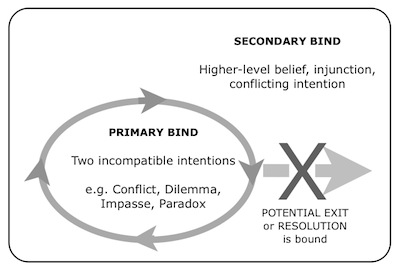
Looking backwards, we can find this same effort at work in Anti-Oedipus as well. As the title of the work implies, the target of attack here is Oedipus, understood as what Lacan would call the “symbolic order” – the rule of language and law, the ‘orderly conduct’ of civilizational affairs that becomes internalized within the subject and conflated with the state of nature. Elsewhere they remark that Oedipus is the operation of the double-bind, a theory of schizophrenia first identified by Gregory Bateson. As Deleuze and Guattari summarize:
Double bind is the term used by Gregory Bateson to describe the simultaneous transmission of two kinds of messages, one of which contradicts the other, for example the father who says to his son: go ahead, criticize me, but strongly hints that all effective criticism – at least a certain type of criticism – will be very unwelcome. Bateson sees in this phenomena a particularly schizophrenizing situation…[8]

Deleuze and Guattari hold Bateson up as an example of deterritorialization, a flight of becoming from the enforced territories of being and thought. Indeed, Bateson not only finds a theory of schizophrenia in the double-bind, but also a remarkable congruence with the Zen koans given to the pupil by the master. If the double-bind in Western civilization leads to psychosis, in the East it leads to Enlightenment: “We feel that the schizophrenic finds himself continually in the same situation as the pupil but he achieves something like disorientation rather than enlightenment.”[9] Bateson would go to find a variety of overlaps between experiences of madness and schizophrenia with initiation rites in other societies; following in these footsteps, R.D. Laing would build a differing school of psychoanalysis that points away the confines of civilization, indicating the direction that schizoanalysis would eventually take.
Through Deleuze and Guattari’s usage of Bateson we can discern in their text a reaction to a specific mode of machinic configuration or arrangement. The machine in question here is less a literal machine and more of a metaphor for systems: that of cybernetics, a sciences of feedback loops, first identified by Norbert Wiener but quickly applied throughout the military, industry, and governance. For Bateson, however, the realization that action derives from interacting agents in a system opened an ontological horizon that could only be described in cosmological terms: systems now could be understood as self-regulating, utilizing the dynamics of positive and negative feedback to reach homeostatic states, as well self-organizing, capable of shifting homeostatic states towards “new patterns” and complexity. An ecology, he reasons, acts as an aggregate of many subsystems bound up in interaction operating across a variety of scales. We shouldn’t think of this ecology strictly in terms of the environment, for the environment itself is one of these parts; it also includes culture, social bodies, and importantly for Bateson, the mind itself. The Cartesian foundation of Western thought, which posits the separation of the physical body from its essence – the mind or soul – becomes unglued in these systems. While the state sought to deploy systems thinking to reinforce its governmental apparatuses and capital looked to streamline its profit producing capabilities, Bateson was charting far-out territories where the boundaries between the human and the non-human dissolve, right down to the molecular level.
Bateson’s so-called “second-order cybernetics” foreshadowed a whole realm of scientific theorizing that would emerge across the 1970s and 80s, going by names such as chaos theory, complexity theory, and emergence. Returning to Deleuze and Guattari, we can draw a resemblance between his ecology of aggregates and the machinic ecologies of flows discussed in Anti-Oedipus: Oedipus, the symbolic order, is a force that blocks the flows, framing them in a way to produce the subject. As a double bind, it assumes the function of the homeostat and prevents or wards off attempts to organize to patterns different from this equilibrium. The openings towards complexity and emergence, however, provided schizoanalytic praxis will a new scientific vocabulary to draw upon, expressed most clearly in A Thousand Plateaus.

This influence is found primarily in the chapters of the book focusing on the war machine, that is, minotorian or nomadic bands that can be defined by their degrees of separation from the state. This, incidentally, is also the point in which Deleuze and Guattari appear at their most anarchist. These two points convergence on the acknowledgement that absolute control is an impossibility; as long as there are states, there will be war machines that flee from it. The state here, that Oedipal function, seeks homeostasis but the war machine can disrupt equilibria, triggering processes of self-organization towards new states. “From turba to turbo: in other words, from bands or packs of atoms to the great vortical organizations. The model is a vortical one; it operates in an open space throughout which things-flows are distributed, rather than plotting out a closed space for linear and solid things.”[10]
To further draw out their point, Deleuze and Guattari plot out a dialectic of royal sciences and nomad sciences. We can see how the developments from cybernetics onward can easily reflect both paradigms: for the military looking to maximize its command and control over an environment, managing feedback between movements on the territory and weaponry became paramount. For the government, cybernetics allowed new means to articulate the organizations of power and the constituency, while in the market, feedback systems allowed rapid developments in everything from pricing stock market options and derivatives to the management of logistics for global production chains. These royal applications find their nomadic compliment in cybernetic’s application in all sorts of far-off territories: Stafford Beer’s holism and the Chilean CyberSyn experiment, “cybernetic guerrilla warfare”, R.D. Laing and Gregory Bateson… “What we have… are two formally different conceptions of science, and, ontologically, a single field of interaction in which royal science continually appropriates the contents of vague or nomad science while nomad science continually cuts the contents of royal science loose. At the limit, all that counts is the constantly shifting borderlands.”[11]
Cosmos against Civilization
I must confess a strong suspicion for political discourse that relies heavily on a rhetoric of self-organization. It appears, particularly in the wake of the developments in the economy from the 1990s onward,that such discourse closely to the spectacular logic of neoliberal capitalism itself, which in the technological evolution of integrated world capitalism strives to be an ontological horizon in its own right – a self-organizing system of human interaction that corresponds to the activities of nature. This trajectory can trace its origins back to the economic theories of F.A. Hayek (if not earlier) and his extensive borrowings from early systems thinking. In his methodological individualism, Hayek conflates the self-organizing principles with an atomist understanding of the individual, where agency emerges from not only as a radical force from within (as opposed agency emerging from relations within assemblages and aggregates), but from a Cartesian split between the human and non-human, civilization and nature.
Another problem from a differing perspective is that Guattari seems to take the possibilities inherent in information technology a little too strongly at their face value, seeing the inevitably of critical mutations of subjectivity riding the wave of their development. He guiding points in this techno-optimism were the experiences of Radio Alice in Italy, the usage of the French Minitel system by activist networks, and the growth of online community message boards spring up around groups and interests that appeared marginal against the greater cultural backdrop. Such things were evident, he argued, that minotorian groups could shape the future deployment of media technologies in a way free from statecraft, unleashing a thousand subaltern subjectivities.
This techno-optimism was, however, a cautious one, as he expressed only several times over the course of his later books: “The post-mediatic revolution to come will have to be guided to an unprecedented degree by those minority groups which are still the only ones to have realized the mortal risk for humanity of questions such as: the nuclear arms race; world famine; irreversible ecological degradation; mass-mediatic pollution of collective subjectivities.”[12] Part of this minotorian becoming, he insisted, could come from within movements of capitalism across the globe. In this regard Japan’s unique culture, a collision of the archaic and the hypermodern, was held up as an exemplar of mutant subjectivity that contrasted sharply the capitalist vision of the west. “Might Japanese capitalism,” he posed, “be a mutation resulting from the monstrous crossing of animist powers inherited from feudalism during the ‘Baku-han’ and the machinic powers of modernity to which it appears everything here must revert?”[13]


While there much to say on this idiosyncratic fascination with Japan, it is on this broader point of animism that I now wish to focus. Guattari’s late writings are peppered with references to the possibility of machinic subjectivities that have more in common with those of archaic societies than the contemporary postmodern malaise. He maintained a strong interest in the cosmological belief systems of the Australian Aborigines, which had developed at the time he was preparing the materials for Schizoanalytic Cartographies. To quote anthropologist Barbara Glowczewski at length,
The message that I brought back from Australia after my first field trips in 1979 and 1980 related to the ancestral connections with the land, which Aboriginal people experienced as a moving network: a real ontology in which humans, animals, plants, water and the whole of social life are thought of as the actualization of virtualities that are constantly in feedback with the space-time of Jukurrpa, the itineraries of ancestral travelers called Kangaroo, Plum or Digging-Stick Dreaming. These beings and the tracks of their voyages are effectively defined as being in becoming: sleeping in hundreds of places, springs, rocks, and interacting with humans in their own dreams and rituals, which aim to reinforce the links between all living things. Dreaming was practised as a means of regenerating life. My 1981 thesis Le rapport au temps et à l’espace des Aborigènes d’Australie (The Relation of Australian Aborigines to Time and Space) aimed to demonstrate that this dynamic process – mistakenly described by most anthropologists as ‘out of time’ – was intrinsic to the traditional vision of the world. I also demonstrated the active role of women – whose power had been denied (and continues to be denied) – in these societies. I utilized Guattari’s conception of the flux of desires to account for the mythic networks and to analyse numerous rituals: including the circulation among allies of hair strings as women’s non-alienable possessions, or a secret cult which, dreamed following the wrecking of a ship (Koombanah) deporting Aboriginal people in 1912, had journeyed among different languages groups as a symbolic form of economic transformation producing a double law, including that of the White men. Two years after I defended my thesis, I received a surprise phone call from Guattari, whom I hadn’t yet met. He invited me to his seminar to discuss my thesis, a copy of which he had received from his friend the video-maker François Pain and which he had just read in one sitting.[14]
Shortly thereafter Glowczewski arrived at the La Borde clinic to present her thesis before the patients, who, she recounted, had “a surprisingly intuitive understanding of the Aboriginal aims and workings of these social games and rituals.”[15] For the Aboriginals, all things radiate from the Dreamtime; all social structure, by extension, becomes articulated in terms of a singular family – extremely different from the nuclear family so savagely critiqued all the way back in Anti-Oedipus. This unique form of animism indicates as well that the binary division between the human and the nonhuman elements that compose the territory are largely inseparable, since they come from and will return to the same place.

Glowczewski not only mentions that Guattari’s interest in the” Aborigines would foreshadow the politics of intertwining described in The Three Ecologies, but that his enthusiasm for the totemic paths and the use of dreams by the Warlpiri was stimulated, by, among other things, the fact that the kinship system – which extends to all the totems (Dreamings) and their associated places – seems to favour social strategies that prevent centralized structures of domination”[16] What Glowczewski is describing here is the influence of anthropologist Pierre Clastres, whose work on ‘primitive’ societies had greatly influenced Deleuze and Guattari. Focusing primarily on Amerindians and particularly those of Amazonia, Clastres illustrates that through kinship structures, the subpolitics of chieftanship, and war as social force the formal organization of the state is prevented at every point in which it could emerge. In his words these societies are, in fact, societies without states.
Using anthropological study to elucidate several key aspects in anarchist theory, Clastres argues that the state-form itself is indistinguishable, particularly where the Western state is involved, from ethnocidal practices of colonization: ethnocide, which is the elimination of the Other or difference to protection the interest of the same, “is clearly a part of the essence of the State…”[17] The state for Clastres is an extension of ethnocentric culture, formed with this culture becomes a property unto itself. It intrinsically forms itself against the Other, assembling itself higher on a hierarchical ladder and grants itself the enlightened goal of managing and correcting the Other’s perceived primitivism. In the case of Western civilization, the rapid expansion and deployment of both ethnocide and genocide under the colonialist banner is directly tied to the growth necessary for the reproduction of capitalist production, as so many Marxist theories of imperialism have waged. Clastres: “What differentiates the West is capitalism, as the impossibility of remaining within a frontier, as the passing beyond of all frontiers… Industrial society, the most formidable machines of production, is for that very reason the most terrifying machine of destruction. Races, societies, individuals; space, nature, forests, subsoils: everything is useful, everything must be used, everything must be productive, with productivity pushed to its maximum rate of intentsity.”[18]
In Anti-Oedipus (a book praised by Clastres), Deleuze and Guattari link this colonialist mentality to the relationship between capitalist production, the state, and Oedipus:
The colonizer… abolishes the chieftainship, or uses it to further his own ends (and he uses many other things besides: the chieftainship is only the beginning). The colonizer says: your father is your father and nothing else, or your maternal grandfather – don’t mistake them for chiefs; you can go have yourself triangulated in your corner, and place your house between those of your paternal and maternal kin; your family is your family and nothing else; sexual reproduction no longer passes through those points, although we rightly need your family to furnish a material that will be subjected to a new order of reproduction. Yes, then, an Oedipal framework is outlined for the dispossessed primitives: a shantytown Oedipus.[19]
Furthermore, they assert, the colonized continually resist Oedipus, fighting back at each turn, either in large, collective movements such as the anti-colonialist revolts of the 1960s, or the private moments of rebellion, as analyzed by Frantz Fanon in The Wretched of the Earth. Just as the schizo can retreat from the civilizing double-bind while the psychoanalyst attempts to ‘(re)colonize his or her mind, the resistance to the state on the part of the Others is “schizoanalysis in action.”[20]


In A Thousand Plateaus, the two take up again the question of Clastres’ anthropology in their discussion of the war machine. This time, archaic societies ability to evade the state composes the actions of the war machines themselves, nomad movements that constantly overflow the limits but are also sought to be captured by the state. “War machines take shape against the apparatuses that appropriate the war machine and make war their affair and their object: the bring connections to bear against the great conjunction of the apparatuses of capture and domination.”[21] We can now grasp the unification of the archaic and the (post)modern machinic in Guattari’s later work – in A Thousand Plateaus we see two functions of the war machine. On one hand, it is their relationship to these anarchic functions of the anti-state social formations, constantly deterritorializing away from centralization. On the other hand, it is the relationship (which we must acknowledge is only partly a metaphor) between the war machine and nomad science – the sciences of self-organization and emergence, particularly in the contexts in which they break through the boundaries that the apparatuses of Western civilization seek to impose on them. In the era of media-information technologies, intricately bound to these sciences as they are, it is the minor groups that act of the war machine, becoming visible and communicable through the powers of the network. All too unfortunately, the apparatus of capture has appeared to be wildly successful.
The reader might ask, what then of animism? What is the relationship between animist subjectivity and the societies that reject the state, the war machine? Here the writings of Guattari, with or without Deleue, cease to be as instructive as they have to do this point. This is by no means the end of our constellation – the way forward is by looking now to the thinkers who probe these similar areas, pushing thought into new divergent directions by drawing in equal measures the ontological ecologies generated by the nomad sciences and the perspectives articulated by non-Western societies, who to this day exist in extreme danger of disappearance from both capitalism’s insatiable thirst for resources for growth and the ecological reactions to this megamachine.
It is Eduardo Vivieros de Castro, an expert on Amerindians, who insists that “animism is the ontology of societies without a state.”[22] does he mean by this? The state, he holds, can be defined by interiority. For capitalism, all things can be made to be interior to its complex assemblages, while the modern liberal stateform, which seeks to pluralistically manage differences, seeks to act as the universal mediator of social relations within its territories, while seeking to make its outside assimilate to its scripture – in other words, following the spatial expansion of capital, the state too wants to bring the outside into its interior. On the molecular, the self too is defined as interiority, interior to the body in accordance with the Cartesian rationalization that separates body and mind. This molecular rendering, in turn, is plugged into the state-capitalist machine: it is the source of the atomist thought, retained by Hayek, that transformed the subjectivity into a rational actor, primed for the permanent utopia of the market.

In animism, however, this interior exists nowhere – all things are outside, or more properly, in the relationship between things in the outside. In Amerindian belief bodies “are not thought as given but rather as made.”[23] The primordial stuff in which the body and its soul – of which there is zero division – is the stuff of the world itself, limited not only to the physicality of matter but also to the substance of the spiritual. Here too we find zero lines demarcating the division of matter from spirit, as all things are forever being made – the body, culture, nature, all are perfomative and unfolding in a process of worlding. Neither subject nor object, but entanglement and unfolding.
Phillipe Descola argues that this worldview emerges precisely because of these cultures emergence from spaces of complex ecosystems – “Might the apparent inability to objectivize nature of many Amazonian peoples be a consequence of the properties of their environment?”[24] What’s at stake in this observation is representationalism, which aims to separate all things, make them objects, quantifiable, and subject to control via discursive practices. The linguistic turn in critical theory, which took aim at the power of discursivity, managed only to muddy these waters by trapping discourse at the level of the signifier. This turn, however, connects the discursive to matter, making matter matter. Maurizio Lazzarrato: “we must move beyond both language and semiotics.”[25]
de Castro insists that “Not only would Amerindians put a wide birth between themselves and the Great Cartesian Divide which seperates humanity from animality, but their views anticipate the fundamental lessons of ecology which we are now only in a position to assimilate.”[26] Furthermore, their eco-cosmological perspective “reveals itself as the universal admixture of subject and objects, humans and non-humans against modern hubris, the primitive and postmodern ‘hybrids’, to borrow a term from Latour. Next to Latour we could make a list of thinkers that either anticipated or are fully engaged with this posthuman, perfomative turn: Deleuze and Guattari, Donna Haraway, Andrew Pickering, Karen Barad, Timothy Morton, so on and so forth – in short, a roster of the new ontologies that have informed and shaped much critical contemporary critical debate. The key becomes, however, not isolating this debate away into the halls of the academy, which will simply serve to ‘Oedipalize’ and regulate their function at the level of circulating signs. Instead, it becomes imperative not to simply think of these texts, and debate it. The purpose is think alongside action, to see where they meet the infrastructural systems forming in the era of late neoliberalism.
For de Castro, the translation of performativity into anthropology goes by the label “perspectivism”, which he describes as a “cosmology against the state”.[27] While perspectivism is a practice of knowing the subaltern or those operating on what appears to us to be an outside, it also performs a dual political role by bringing to us realizations of being and becoming utterly foreign to our perception. It provides, in its own way, a blueprint for living in a way that differs from capitalist realism. For this reason perspectivist anthropology, in de Castro’s own words, is a nomad science, as described in A Thousand Plateaus. And like schizoanalysis, the purpose is one of decolonization, of restarting the flows that have been blocked in the name of civilized progress.
For me, anthropology is in fact the theory—to sound a bit like Trotsky—the theory of a permanent decolonization. A permanent decolonization of thought. That is anthropology for me. It is not a question of decolonizing society, but of decolonizing thought. How to decolonize thought? And how to do it permanently? Because thinking is constantly recolonized and reterritorialized… What does it mean to live in a society without a state, against the state? We don’t have any idea. You have to live there to see how things happen in a world without a state. In a society that is not only lacking the state but, as Clastres thought, is against the state because it is constituted precisely on the absence of the state. Not because of the lack of a state, but upon the absence of the state, so that the state cannot come into existence. And animism has to do with that.[28]
[1] Felix Guattari The Three Ecologies Athlone Press, 2000, pg. 27
[2] Ibid
[3] Gilles Deleuze and Felix Guattari Anti-Oedipus: Capitalism and Schizophrenia Penguin Classics, 2009, pgs. 4-5
[4] Francois Dosse Gilles Deleuze and Felix Guattari: Intersecting Lives Columbia University Press, 2010, pg. 391
[5] See Brian Holmes “Guattari’s Schizoanalytic Cartographies (or, the Pathic Core at the Heart of Cybernetics)” Three Crises http://threecrises.org/guattaris-schizoanalytic-cartographies/; as well as my own “How Does Schizoanalysis Work? (or, “how do you make a class function like a work of art?”) Deterritorial Investigations Unit, https://deterritorialinvestigations.wordpress.com/2013/05/15/how-does-schizoanalysis-work-or-how-do-you-make-a-class-operate-like-a-work-of-art/
[6] Guattari The Three Ecologies pg. 47
[7] Gilles Deleuze and Felix Guattari A Thousand Plateaus: Capitalism and Schizophrenia University of Minnesota Press, 1989, pg. 6-7
[8] Deleuze and Guattari Anti-Oedipus pg. 76
[9] Gregory Bateson, Don D. Jackson, Jay Haley, and John Weakland “Toward a Theory of Schizophrenia” Behavioral Science, 1956, pg. 5 http://solutions-centre.org/pdf/TOWARD-A-THEORY-OF-SCHIZOPHRENIA-2.pdf
[10] A Thousand Plateaus pg. 361
[11] Ibid, pg. 367
[12] quoted in Gary Genosko “The Promise of Post-Media” in Clemens Apprich, Josephine Berry Slater, Anthony Iles and Oliver Lerone Schultz (eds.) Provocative Alloys: A Post-Media Anthology Mute, 2013, pg. 20
[13] quoted in “Japanese Singularity”, in Gary Genosko Felix Guattari: An Aberrant Introduction Continuum, 2002, pg. 142
[14] Barbara Glowczewski “Guattari and Anthropology: Existential Territories among Indigenous Australians” in Eric Alliez and Andrew Goffey (eds.) The Guattari Effect Bloomsbury, 2011, pg. 102
[15] Ibid, pg. 103
[16] Ibid, pg. 102
[17] Pierre Clastres “On Ethnocide” in Archeology of Violence Semiotext(e), 2010, pg. 111
[18] Ibid, pg. 112
[19] Deleuze and Guattari Anti-Oedipus pg. 169
[20] Ibid, pg. 167
[21] Deleuze and Guattari, A Thousand Plateaus
[22] Angela Melitopoulos and Maurizio Lazzarato “Assemblages: Felix Guattari and Machinic Animism” e-Flux July, 2012 http://www.e-flux.com/journal/assemblages-felix-guattari-and-machinic-animism/
[23] Eduardo Viveiros de Castro Cosmological Perspectivism in Amazonia and Elsewhere: Four lectures given in the Department of Social Anthropology, Cambridge University, February-March 1998 Hau-Net, 2012, pg. 123
[24] Phillipe Descola Beyond Nature and Culture University of Chicago Press, 2013, pg. 11
[25] Maurizio Lazzarato Signs and Machines: Capitalism and the Production of SubjectivitySemiotext(e), 2014, pg. 17
[26] Eduardo Viveiros de Castro “Cosmological Deixis and the Amerindian Perspectivism” The Journal of the Royal Anthropological Institute, Vol. 4, No. 3 (Sep., 1998), pg. 475
[27] Eduardo Viveiros de Castro “The Untimely, Again” introduction to Clastres Archeology of Violencepg. 48
[28] Melitopouos and Lazzarato “Assemblages”




 Uma (in)certa antropologia
Você precisa fazer login para comentar.