Arquivo da tag: Previsão

The Human Cause of Climate Change: Where Does the Burden of Proof Lie? (Science Daily)

ScienceDaily (Nov. 3, 2011) — The debate may largely be drawn along political lines, but the human role in climate change remains one of the most controversial questions in 21st century science. Writing in WIREs Climate Change Dr Kevin Trenberth, from the National Center for Atmospheric Research, argues that the evidence for anthropogenic climate change is now so clear that the burden of proof should lie with research which seeks to disprove the human role.

Polar bear on melting ice. Experts argue that the evidence for anthropogenic climate change is now so clear that the burden of proof should lie with research which seeks to disprove the human role. (Credit: iStockphoto/Kristian Septimius Krogh)

In response to Trenberth’s argument a second review, by Dr Judith Curry, focuses on the concept of a ‘null hypothesis’ the default position which is taken when research is carried out. Currently the null hypothesis for climate change attribution research is that humans have no influence.

“Humans are changing our climate. There is no doubt whatsoever,” said Trenberth. “Questions remain as to the extent of our collective contribution, but it is clear that the effects are not small and have emerged from the noise of natural variability. So why does the science community continue to do attribution studies and assume that humans have no influence as a null hypothesis?”

To show precedent for his position Trenberth cites the 2007 report by the Intergovernmental Panel on Climate Change which states that global warming is “unequivocal,” and is “very likely” due to human activities.

Trenberth also focused on climate attribution studies which claim the lack of a human component, and suggested that the assumptions distort results in the direction of finding no human influence, resulting in misleading statements about the causes of climate change that can serve to grossly underestimate the role of humans in climate events.

“Scientists must challenge misconceptions in the difference between weather and climate while attribution studies must include a human component,” concluded Trenberth. “The question should no longer be is there a human component, but what is it?”

In a second paper Dr Judith Curry, from the Georgia Institute of Technology, questions this position, but argues that the discussion on the null hypothesis serves to highlight fuzziness surrounding the many hypotheses related to dangerous climate change.

“Regarding attribution studies, rather than trying to reject either hypothesis regardless of which is the null, there should be a debate over the significance of anthropogenic warming relative to forced and unforced natural climate variability,” said Curry.

Curry also suggested that the desire to reverse the null hypothesis may have the goal of seeking to marginalise the climate sceptic movement, a vocal group who have challenged the scientific orthodoxy on climate change.

“The proponents of reversing the null hypothesis should be careful of what they wish for,” concluded Curry. “One consequence may be that the scientific focus, and therefore funding, would also reverse to attempting to disprove dangerous anthropogenic climate change, which has been a position of many sceptics.”

“I doubt Trenberth’s suggestion will find much support in the scientific community,” said Professor Myles Allen from Oxford University, “but Curry’s counter proposal to abandon hypothesis tests is worse. We still have plenty of interesting hypotheses to test: did human influence on climate increase the risk of this event at all? Did it increase it by more than a factor of two?”

Ministro participa da inauguração de radar meteorológico do Ceará (Ascom do governo do Ceará)

JC e-mail 4378, de 04 de Novembro de 2011.

Aloizio Mercadante e o governador do Ceará, Cid Gomes, inauguraram o Radar Meteorológico Banda-S, em Quixeramobim (CE). Equipamento ajudará na previsão de secas e cheias.

Previsão de secas e cheias, mudanças climáticas e todos os eventos ligados a meteorologia passam a ser informados pela Fundação Cearense de Meteorologia e Recursos Hídricos (Funceme) com mais previsão, já que agora o órgão conta com um novo equipamento para captação dessas informações.

O novo Radar Meteorológico Banda-S foi inaugurado nesta quinta-feira (3) pelo governador Cid Gomes e o ministro da Ciência e Tecnologia, Aloizio Mercadante. Localizado no Morro de Santa Maria, em Quixeramobim, no Sertão Central, o equipamento vai funcionar como parte da Rede Cearense de Radares (RCR), por meio da integração com o Radar Doppler de Banda X instalado em Fortaleza. “Parece um equipamento aparentemente simples, mas por trás existe uma utilidade inimaginável. A tecnologia pode ser um aliado na melhoria da qualidade de vida da população, que é o nosso compromisso”, destacou Cid Gomes durante a inauguração.

Segundo explicou o governador, o novo equipamento pode informar condições climáticas bem específicas, como por exemplo “que no município de Nova Olinda, no Cariri, choveu cinco milímetros”, exemplificou. “Na medida que uma informação dessas é casada com outras, isso vai ajudar a diagnosticar por exemplo um período de seca ou de cheias. Somos um estado com quase 300 mil pequenos agricultores, e eles precisam de informações concretas para cuidar da colheita. E nisso o Radar vai ser bastante útil”, ressaltou Cid Gomes.

O Radar Banda-S tem capacidade para estimar uma precipitação dentro de um raio de 200 quilômetros. Além disso, pode fazer o monitoramento de sistemas meteorológicos que atuam em um alcance de até 400 quilômetros. Por sua capacidade e localização, também será possível obter informações não só do Ceará, como de vários estados nordestinos. “Esse é um instrumento de planejamento agrícola que vai beneficiar também muitos estados do Nordeste, como Paraíba, Pernambuco, Piauí e Rio Grande do Norte”, lembrou Aloizio Mercadante. O ministro também ressaltou sua importância na prevenção de desastres naturais, como longos períodos de seca ou chuvas bem acima da média. “Precisamos entender porque esses eventos acontecem e prevenir as ações que as mudanças climáticas podem causar”, explicou Mercadante.

Para a instalação do Radar Meteorológico Banda-S foram investidos R$ 14 milhões, sendo R$ 10 milhões partiram do Governo Federal, por meio do Ministério da Ciência e Tecnologia e Inovação (MCTI) e R$ 4 milhões do governo do estado do Ceará. Do total, R$ 12 milhões foram utilizados para a compra do equipamento e o restante (R$ 2 milhões) para a melhoria dos acessos ao local (construção de vias) e alimentação energética.

Segundo lembrou o secretário estadual da Ciência e Tecnologia, René Barreira, a instalação do Radar partiu de uma emenda de Ciro Gomes quando deputado federal, que aliado a sensibilidade do ex-presidente Lula, tornou possível a obra. “Com esse importante equipamento vamos ter um zoneamento agrícola e um controle mais efetivo e técnico dos eventos de grande risco”, ressaltou o secretário.

The Mental Time Travel Of Animals (NPR)

11:39 am

November 3, 2011

by BARBARA J KING

Don't underestimate the crow.

Arif Ali/AFP/Getty Images. Don’t underestimate the crow.

Without a trace of agitation, the male chimpanzee piles up stones in small caches within his enclosure. He does this in the morning, before zoo visitors arrive. Hours later, in an aroused state, the ape hurls the stones at people gathering to watch him.

detailed report by Mathias Osvath concluded that the ape had planned ahead strategically for the future. It is exactly this feat of mental time travel that psychologist Michael C. Corballis, in his book The Recursive Mind: The Origins of Human Language, Thought, and Civilization, claims is beyond the reach of nonhuman animals. Last week, my review of Corballis’s book appeared in the Times Literary Supplement.

Corballis suggests that mental time travel is one of two human ways of thinking that propelled our species into a unique cognitive status. (The other, theory of mind, I won’t deal with here.)

During mental time travel, we insert into our present consciousness an experience that we’ve had in the past or that we imagine for ourselves in the future. Corballis calls this ability mental recursion, and he’s right that we humans do it effortlessly. When we daydream at work about last weekend’s happy times with family and friends, or anticipate tonight’s quiet evening with a book, we engage in mental time travel.

Our highly elaborated ability to insert the past or future recursively into our thinking may play a role in the evolution of human civilization, as Corballis claims. But Corballis’s argument is weakened because he dismisses other animals’ mental capacities far too readily.

It’s not only one chimpanzee in a Swedish zoo who makes me think so.

When our pets grieve, as I wrote about in this space recently, they hold in their mind some memory of the past that causes them to miss a companion.

New research on the pattern of food storage by Eurasian jays indicates that these birds think ahead about what specific foods they will want in the future.

When apes (chimpanzees) and corvids (crows and ravens) make tools to obtain food, they too think ahead to a goal, even as they fashion a tool to solve the problem before them.

In the NATURE documentary film A Murder of Crows, a New Caledonian crow solves a three-part tool-using problem totally new to him (or to any other crow). As one researcher put it, the bird thinks “three chess moves into the future” as he finds one tool that allows him to get another tool that he uses finally to procure food.

Have a look at this crow’s stunning problem-solving here. The experimental footage begins at 16:30, but starting at 13:00 offers good context. And the entire film is a delight.

People Rationalize Situations They’re Stuck With, but Rebel When They Think There’s an out (Science Daily)

ScienceDaily (Nov. 1, 2011) — People who feel like they’re stuck with a rule or restriction are more likely to be content with it than people who think that the rule isn’t definite. The authors of a new study, which will be published in an upcoming issue of Psychological Science, a journal of the Association for Psychological Science, say this conclusion may help explain everything from unrequited love to the uprisings of the Arab Spring.

Psychological studies have found two contradictory results about how people respond to rules. Some research has found that, when there are new restrictions, you rationalize them; your brain comes up with a way to believe the restriction is a good idea. But other research has found that people react negatively against new restrictions, wanting the restricted thing more than ever.

Kristin Laurin of the University of Waterloo thought the difference might be absoluteness — how much the restriction is set in stone. “If it’s a restriction that I can’t really do anything about, then there’s really no point in hitting my head against the wall and trying to fight against it,” she says. “I’m better off if I just give up. But if there’s a chance I can beat it, then it makes sense for my brain to make me want the restricted thing even more, to motivate me to fight” Laurin wrote the new paper with Aaron Kay and Gavan Fitzsimons of Duke University.

In an experiment in the new study, participants read that lowering speed limits in cities would make people safer. Some read that government leaders had decided to reduce speed limits. Of those people, some were told that this legislation would definitely come into effect, and others read that it would probably happen, but that there was still a small chance government officials could vote it down.

People who thought the speed limit was definitely being lowered supported the change more than control subjects, but people who thought there was still a chance it wouldn’t happen supported it less than these control subjects. Laurin says this confirms what she suspected about absoluteness; if a restriction is definite, people find a way to live with it.

This could help explain how uprisings spread across the Arab world earlier this year. When people were living under dictatorships with power that appeared to be absolute, Laurin says, they may have been comfortable with it. But once Tunisia’s president fled, citizens of neighboring countries realized that their governments weren’t as absolute as they seemed — and they could have dropped whatever rationalizations they were using to make it possible to live under an authoritarian regime. Even more, the now non-absolute restriction their governments represented could have exacerbated their reaction, fueling their anger and motivating them to take action.

And how does this relate to unrequited love? It confirms people’s intuitive sense that leading someone can just make them fall for you more deeply, Laurin says. “If this person is telling me no, but I perceive that as not totally absolute, if I still think I have a shot, that’s just going to strengthen my desire and my feeling, that’s going to make me think I need to fight to win the person over,” she says. “If instead I believe no, I definitely don’t have a shot with this person, then I might rationalize it and decide that I don’t like them that much anyway.”

Mathematically Detecting Stock Market Bubbles Before They Burst (Science Daily)

ScienceDaily (Oct. 31, 2011) — From the dotcom bust in the late nineties to the housing crash in the run-up to the 2008 crisis, financial bubbles have been a topic of major concern. Identifying bubbles is important in order to prevent collapses that can severely impact nations and economies.

A paper published this month in the SIAM Journal on Financial Mathematics addresses just this issue. Opening fittingly with a quote from New York Federal Reserve President William Dudley emphasizing the importance of developing tools to identify and address bubbles in real time, authors Robert Jarrow, Younes Kchia, and Philip Protter propose a mathematical model to detect financial bubbles.

A financial bubble occurs when prices for assets, such as stocks, rise far above their actual value. Such an economic cycle is usually characterized by rapid expansion followed by a contraction, or sharp decline in prices.

“It has been hard not to notice that financial bubbles play an important role in our economy, and speculation as to whether a given risky asset is undergoing bubble pricing has approached the level of an armchair sport. But bubbles can have real and often negative consequences,” explains Protter, who has spent many years studying and analyzing financial markets.

“The ability to tell when an asset is or is not in a bubble could have important ramifications in the regulation of the capital reserves of banks as well as for individual investors and retirement funds holding assets for the long term. For banks, if their capital reserve holdings include large investments with unrealistic values due to bubbles, a shock to the bank could occur when the bubbles burst, potentially causing a run on the bank, as infamously happened with Lehman Brothers, and is currently happening with Dexia, a major European bank,” he goes on to explain, citing the significance of such inflated prices.

Using sophisticated mathematical methods, Protter and his co-authors answer the question of whether the price increase of a particular asset represents a bubble in real time. “[In this paper] we show that by using tick data and some statistical techniques, one is able to tell with a large degree of certainty, whether or not a given financial asset (or group of assets) is undergoing bubble pricing,” says Protter.

This question is answered by estimating an asset’s price volatility, which is stochastic or randomly determined. The authors define an asset’s price process in terms of a standard stochastic differential equation, which is driven by Brownian motion. Brownian motion, based on a natural process involving the erratic, random movement of small particles suspended in gas or liquid, has been widely used in mathematical finance. The concept is specifically used to model instances where previous change in the value of a variable is unrelated to past changes.

The key characteristic in determining a bubble is the volatility of an asset’s price, which, in the case of bubbles is very high. The authors estimate the volatility by applying state of the art estimators to real-time tick price data for a given stock. They then obtain the best possible extension of this data for large values using a technique called Reproducing Kernel Hilbert Spaces (RKHS), which is a widely used method for statistical learning.

“First, one uses tick price data to estimate the volatility of the asset in question for various levels of the asset’s price,” Protter explains. “Then, a special technique (RKHS with an optimization addition) is employed to extrapolate this estimated volatility function to large values for the asset’s price, where this information is not (and cannot be) available from tick data. Using this extrapolation, one can check the rate of increase of the volatility function as the asset price gets arbitrarily large. Whether or not there is a bubble depends on how fast this increase occurs (its asymptotic rate of increase).”

If it does not increase fast enough, there is no bubble within the model’s framework.

The authors test their methodology by applying the model to several stocks from the dot-com bubble of the nineties. They find fairly successful rates in their predictions, with higher accuracies in cases where market volatilities can be modeled more efficiently. This helps establish the strengths and weaknesses of the method.

The authors have also used the model to test more recent price increases to detect bubbles. “We have found, for example, that the IPO [initial public offering] of LinkedIn underwent bubble pricing at its debut, and that the recent rise in gold prices was not a bubble, according to our models,” Protter says.

It is encouraging to see that mathematical analysis can play a role in the diagnosis and detection of bubbles, which have significantly impacted economic upheavals in the past few decades.

Robert Jarrow is a professor at the Johnson Graduate School of Management at Cornell University in Ithaca, NY, and managing director of the Kamakura Corporation. Younes Kchia is a graduate student at Ecole Polytechnique in Paris, and Philip Protter is a professor in the Statistics Department at Columbia University in New York.

Professor Protter’s work was supported in part by NSF grant DMS-0906995.

Governo apresenta oficialmente oito propostas para a Rio+20 (Jornal da Ciência)

JC e-mail 4376, de 01 de Novembro de 2011.

O governo apresenta nesta terça-feira (1º) a versão oficial do documento com oito propostas para a Conferência das Nações Unidas sobre o Desenvolvimento Sustentável, conhecida como Rio+20, a ser realizada no Rio de Janeiro de 28 de maio a 6 de junho de 2012. O documento foi apresentado hoje pela ministra do Meio Ambiente, Izabella Teixeira e pelo Itamaraty, em coletiva de imprensa, em Brasília.

A primeira proposta é a criação de um programa de proteção socioambiental global, cujo objetivo é assegurar garantia de renda para superar a pobreza extrema no mundo e promover ações estruturantes que garantam qualidade ambiental, segurança alimentar, moradia adequada e acesso à água limpa para todos.

A ideia desse programa, conforme consta do documento, é fazer com que “toda estrutura multilateral opere” para facilitar o acesso a tecnologias, recursos financeiros, infraestrutura e capacitação, a fim de que todas as pessoas tenham a quantidade e qualidade mínima de alimento, água e ambiente saudável.

Pela proposta brasileira, esse programa teria como foco uma estratégia de garantia de renda adequada às condições de cada país, diante de um momento de crise internacional em que se mobilizam vastos recursos globais para a recuperação do sistema financeiro. “O programa seria uma aposta no componente social, importante na solução brasileira para o enfrentamento da crise”, destaca o documento. “Essa é uma plataforma de diálogo global que poderia ser um passo crucial rumo ao desenvolvimento sustentável, com potencial para reforçar o papel virtuoso do multilateralismo”, complementa.

Na segunda proposta, o governo sugere a implementação de “objetivos de desenvolvimento sustentável”, adotando um programa de economia verde inclusiva, em lugar “de negociações complexas que busquem o estabelecimento de metas restritivas vinculantes”. Dentre outros, esses objetivos poderiam estar associados a erradicação da pobreza extrema; a segurança alimentar e nutricional; acesso a empregos adequados (socialmente justos e ambientalmente corretos); acesso a fontes adequadas de energia; a microempreendedorismo e microcrédito; a inovação para a sustentabilidade; acesso a fontes adequadas de recursos hídricos; e adequação da pegada ecológica à capacidade de regeneração do planeta.

Compras públicas sustentáveis – Na terceira proposta, o Brasil sugere um pacto global para produção e consumo sustentáveis. Ou seja, um conjunto de iniciativas para promover mudanças nos padrões de produção e consumo em diversos setores. Dessa forma, poderiam ser adotadas, com caráter prioritário, iniciativas que ofereçam suporte político a compras públicas sustentáveis, já que essas representam parte significativa da economia internacional, de cerca de 15% do Produto Interno Bruto (PIB) mundial; a classificações de consumo e eficiência energética; e financiamento de estudos e pesquisas para o desenvolvimento sustentável (com o objetivo de qualificar recursos humanos de alto nível e apoiar projetos científicos, tecnológicos e inovadores).

A quarta proposta sugere estabelecer repositório de iniciativas para dinamizar os mecanismos nacionais e de cooperação internacional, inclusive a utilização de recursos dos organismos multilaterais. Já a quinta sugestão propõe a criação de protocolo internacional para a sustentabilidade do setor financeiro.

Na sexta proposta o governo sugere novos indicadores para mensuração do desenvolvimento. Hoje os mais importantes são o Índice de Desenvolvimento Humano (IDH) e o Produto Interno Bruto (PIB) que, como medida de desenvolvimento sustentável, “são claramente limitadas”, por não integrarem a grande diversidade de aspectos sociais e ambientais aos valores econômicos, o que induz, segundo o documento, a percepções errôneas do grau de desenvolvimento e de progresso dos países.

Na sétima proposta o governo sugere a implementação de um “pacto pela economia verde inclusiva. A ideia é estimular a divulgação de relatórios e de índices de sustentabilidade por empresas estatais, bancos de fomento, patrocinadoras de entidades de previdência privada, empresas de capital aberto e empresas de grande porte. Ou seja, além dos aspectos econômico-financeiros, essas instituições incluam nas divulgações, obrigatoriamente, e de acordo com padrões internacionalmente aceitos e comparáveis, informações sobre suas atuações em termos sociais, ambientais e de governança corporativa.

Por sua vez, a oitava proposta é ligada a “estrutura institucional do desenvolvimento sustentável. Essa aborda vários tópicos, dentre os quais a adoção de mecanismo de coordenação institucional para o desenvolvimento sustentável”; reforma do Conselho Econômico e Social das Nações Unidas (ECOSOC), transformando-o em Conselho de Desenvolvimento Sustentável das Nações Unidas; aperfeiçoamento da governança ambiental internacional; o lançamento de processo negociador para uma convenção global sobre acesso à informação, participação pública na tomada de decisões e acesso à justiça em temas ambientais; e a governança da água.

(Viviane Monteiro – Jornal da Ciência)

The world at seven billion (BBC)

27 October 2011 Last updated at 23:08 GMT

File photograph of newborn babies in Lucknow, India, in July 2009

As the world population reaches seven billion people, the BBC’s Mike Gallagher asks whether efforts to control population have been, as some critics claim, a form of authoritarian control over the world’s poorest citizens.

The temperature is some 30C. The humidity stifling, the noise unbearable. In a yard between two enormous tea-drying sheds, a number of dark-skinned women patiently sit, each accompanied by an unwieldy looking cloth sack. They are clad in colourful saris, but look tired and shabby. This is hardly surprising – they have spent most of the day in nearby plantation fields, picking tea that will net them around two cents a kilo – barely enough to feed their large families.

Vivek Baid thinks he knows how to help them. He runs the Mission for Population Control, a project in eastern India which aims to bring down high birth rates by encouraging local women to get sterilised after their second child.

As the world reaches an estimated seven billion people, people like Vivek say efforts to bring down the world’s population must continue if life on Earth is to be sustainable, and if poverty and even mass starvation are to be avoided.

There is no doubting their good intentions. Vivek, for instance, has spent his own money on the project, and is passionate about creating a brighter future for India.

But critics allege that campaigners like Vivek – a successful and wealthy male businessman – have tended to live very different lives from those they seek to help, who are mainly poor women.

These critics argue that rich people have imposed population control on the poor for decades. And, they say, such coercive attempts to control the world’s population often backfired and were sometimes harmful.

Population scare

Most historians of modern population control trace its roots back to the Reverend Thomas Malthus, an English clergyman born in the 18th Century who believed that humans would always reproduce faster than Earth’s capacity to feed them.

Giving succour to the resulting desperate masses would only imperil everyone else, he said. So the brutal reality was that it was better to let them starve.

‘Plenty is changed into scarcity’

Thomas Malthus

From Thomas Malthus’ Essay on Population, 1803 edition:

A man who is born into a world already possessed – if he cannot get subsistence from his parents on whom he has a just demand, and if the society do not want his labour, has no claim of right to the smallest portion of food.

At nature’s mighty feast there is no vacant cover for him. She tells him to be gone, and will quickly execute her own orders, if he does not work upon the compassion of some of her guests. If these guests get up and make room for him, other intruders immediately appear demanding the same favour. The plenty that before reigned is changed into scarcity; and the happiness of the guests is destroyed by the spectacle of misery and dependence in every part of the hall.

Rapid agricultural advances in the 19th Century proved his main premise wrong, because food production generally more than kept pace with the growing population.

But the idea that the rich are threatened by the desperately poor has cast a long shadow into the 20th Century.

From the 1960s, the World Bank, the UN and a host of independent American philanthropic foundations, such as the Ford and Rockefeller foundations, began to focus on what they saw as the problem of burgeoning Third World numbers.

The believed that overpopulation was the primary cause of environmental degradation, economic underdevelopment and political instability.

Massive populations in the Third World were seen as presenting a threat to Western capitalism and access to resources, says Professor Betsy Hartmann of Hampshire College, Massachusetts, in the US.

“The view of the south is very much put in this Malthusian framework. It becomes just this powerful ideology,” she says.

In 1966, President Lyndon Johnson warned that the US might be overwhelmed by desperate masses, and he made US foreign aid dependent on countries adopting family planning programmes.

Other wealthy countries such as Japan, Sweden and the UK also began to devote large amounts of money to reducing Third World birth rates.

‘Unmet need’

What virtually everyone agreed was that there was a massive demand for birth control among the world’s poorest people, and that if they could get their hands on reliable contraceptives, runaway population growth might be stopped.

But with the benefit of hindsight, some argue that this so-called unmet need theory put disproportionate emphasis on birth control and ignored other serious needs.

Graph of world population figures

“It was a top-down solution,” says Mohan Rao, a doctor and public health expert at Delhi’s Jawaharlal Nehru University.

“There was an unmet need for contraceptive services, of course. But there was also an unmet need for health services and all kinds of other services which did not get attention. The focus became contraception.”

Had the demographic experts worked at the grass-roots instead of imposing solutions from above, suggests Adrienne Germain, formerly of the Ford Foundation and then the International Women’s Health Coalition, they might have achieved a better picture of the dilemmas facing women in poor, rural communities.

“Not to have a full set of health services meant women were either unable to use family planning, or unwilling to – because they could still expect half their kids to die by the age of five,” she says.

India’s sterilisation ‘madness’

File photograph of Sanjay and Indira Gandhi in 1980

Indira Gandhi and her son Sanjay (above) presided over a mass sterilisation campaign. From the mid-1970s, Indian officials were set sterilisation quotas, and sought to ingratiate themselves with superiors by exceeding them. Stories abounded of men being accosted in the street and taken away for the operation. The head of the World Bank, Robert McNamara, congratulated the Indian government on “moving effectively” to deal with high birth rates. Funding was increased, and the sterilising went on.

In Delhi, some 700,000 slum dwellers were forcibly evicted, and given replacement housing plots far from the city centre, frequently on condition that they were either sterilised or produced someone else for the operation. In poorer agricultural areas, whole villages were rounded up for sterilisation. When residents of one village protested, an official is said to have threatened air strikes in retaliation.

“There was a certain madness,” recalls Nina Puri of the Family Planning Association of India. “All rationality was lost.”

Us and them

In 1968, the American biologist Paul Ehrlich caused a stir with his bestselling book, The Population Bomb, which suggested that it was already too late to save some countries from the dire effects of overpopulation, which would result in ecological disaster and the deaths of hundreds of millions of people in the 1970s.

Instead, governments should concentrate on drastically reducing population growth. He said financial assistance should be given only to those nations with a realistic chance of bringing birth rates down. Compulsory measures were not to be ruled out.

Western experts and local elites in the developing world soon imposed targets for reductions in family size, and used military analogies to drive home the urgency, says Matthew Connelly, a historian of population control at Columbia University in New York.

“They spoke of a war on population growth, fought with contraceptive weapons,” he says. “The war would entail sacrifices, and collateral damage.”

Such language betrayed a lack of empathy with their subjects, says Ms Germain: “People didn’t talk about people. They talked of acceptors and users of family planning.”

Emergency measures

Critics of population control had their say at the first ever UN population conference in 1974.

Karan Singh, India’s health minister at the time, declared that “development is the best contraceptive”.

But just a year later, Mr Singh’s government presided over one of the most notorious episodes in the history of population control.

In June 1975, the Indian premier, Indira Gandhi, declared a state of emergency after accusations of corruption threatened her government. Her son Sanjay used the measure to introduce radical population control measures targeted at the poor.

The Indian emergency lasted less than two years, but in 1975 alone, some eight million Indians – mainly poor men – were sterilised.

Yet, for all the official programmes and coercion, many poor women kept on having babies.

And where they did not, it arguably had less to do with coercive population control than with development, just as Karan Singh had argued in 1974, says historian Matt Connelly.

For example, in India, a disparity in birth rates could already be observed between the impoverished northern states and more developed southern regions like Kerala, where women were more likely to be literate and educated, and their offspring more likely to be healthy.

Women there realised that they could have fewer births and still expect to see their children survive into adulthood.

China: ‘We will not allow your baby to live’

Steven Mosher was a Stanford University anthropologist working in rural China who witnessed some of the early, disturbing moments of Beijing’s One Child Policy.

“I remember very well the evening of 8 March, 1980. The local Communist Party official in charge of my village came over waving a government document. He said: ‘The Party has decided to impose a cap of 1% on population growth this year.’ He said: ‘We’re going to decide who’s going to be allowed to continue their pregnancy and who’s going to be forced to terminate their pregnancy.’ And that’s exactly what they did.”

“These were women in the late second and third trimester of pregnancy. There were several women just days away from giving birth. And in my hearing, a party official said: ‘Do not think that you can simply wait until you go into labour and give birth, because we will not allow your baby to live. You will go home alone’.”

Total control

By now, this phenomenon could be observed in another country too – one that would nevertheless go on to impose the most draconian population control of all.

The One Child Policy is credited with preventing some 400 million births in China, and remains in place to this day. In 1983 alone, more than 16 million women and four million men were sterilised, and 14 million women received abortions.

Assessed by numbers alone, it is said to be by far the most successful population control initiative. Yet it remains deeply controversial, not only because of the human suffering it has caused.

A few years after its inception, the policy was relaxed slightly to allow rural couples two children if their first was not a boy. Boy children are prized, especially in the countryside where they provide labour and care for parents in old age.

But modern technology allows parents to discover the sex of the foetus, and many choose to abort if they are carrying a girl. In some regions, there is now a serious imbalance between men and women.

Moreover, since Chinese fertility was already in decline at the time the policy was implemented, some argue that it bears less responsibility for China’s falling birth rate than its supporters claim.

“I don’t think they needed to bring it down further,” says Indian demographer AR Nanda. “It would have happened at its own slow pace in another 10 years.”

Backlash

In the early 1980s, objections to the population control movement began to grow, especially in the United States.

In Washington, the new Reagan administration removed financial support for any programmes that involved abortion or sterilisation.

“If you give women the tools they need – education, employment, contraception, safe abortion – then they will make the choices that benefit society”

Adrienne Germain

The broad alliance to stem birth rates was beginning to dissolve and the debate become more polarised along political lines.

While some on the political right had moral objections to population control, some on the left saw it as neo-colonialism.

Faith groups condemned it as a Western attack on religious values, but women’s groups feared changes would mean poor women would be even less well-served.

By the time of a major UN conference on population and development in Cairo in 1994, women’s groups were ready to strike a blow for women’s rights, and they won.

The conference adopted a 20-year plan of action, known as the Cairo consensus, which called on countries to recognise that ordinary women’s needs – rather than demographers’ plans – should be at the heart of population strategies.

After Cairo

Today’s record-breaking global population hides a marked long-term trend towards lower birth rates, as urbanisation, better health care, education and access to family planning all affect women’s choices.

With the exception of sub-Saharan Africa and some of the poorest parts of India, we are now having fewer children than we once did – in some cases, failing even to replace ourselves in the next generation. And although total numbers are set to rise still further, the peak is now in sight.

Chinese poster from the 1960s of mother and baby, captioned: Practicing birth control is beneficial for the protection of the health of mother and childChina promoted birth control before implementing its one-child policy

Assuming that this trend continues, total numbers will one day level off, and even fall. As a result, some believe the sense of urgency that once surrounded population control has subsided.

The term population control itself has fallen out of fashion, as it was deemed to have authoritarian connotations. Post-Cairo, the talk is of women’s rights and reproductive rights, meaning the right to a free choice over whether or not to have children.

According to Adrienne Germain, that is the main lesson we should learn from the past 50 years.

“I have a profound conviction that if you give women the tools they need – education, employment, contraception, safe abortion – then they will make the choices that benefit society,” she says.

“If you don’t, then you’ll just be in an endless cycle of trying to exert control over fertility – to bring it up, to bring it down, to keep it stable. And it never comes out well. Never.”

Nevertheless, there remain to this day schemes to sterilise the less well-off, often in return for financial incentives. In effect, say critics, this amounts to coercion, since the very poor find it hard to reject cash.

“The people proposing this argue ‘Don’t worry, everything’ s fine now we have voluntary programmes on the Cairo model’,” says Betsy Hartmann.

“But what they don’t understand is the profound difference in power between rich and poor. The people who provide many services in poor areas are already prejudiced against the people they serve.”

Work in progress

For Mohan Rao, it is an example of how even the Cairo consensus fails to take account of the developing world.

“Cairo had some good things,” he says. “However Cairo was driven largely by First World feminist agendas. Reproductive rights are all very well, but [there needs to be] a whole lot of other kinds of enabling rights before women can access reproductive rights. You need rights to food, employment, water, justice and fair wages. Without all these you cannot have reproductive rights.”

Perhaps, then, the humanitarian ideals of Cairo are still a work in progress.

Meanwhile, Paul Ehrlich has also amended his view of the issue.

If he were to write his book today, “I wouldn’t focus on the poverty-stricken masses”, he told the BBC.

“I would focus on there being too many rich people. It’s crystal clear that we can’t support seven billion people in the style of the wealthier Americans.”

Mike Gallager is the producer of the radio programme Controlling People on BBC World Service

Where do you fit into 7 billion?

The world’s population is expected to hit seven billion in the next few weeks. After growing very slowly for most of human history, the number of people on Earth has more than doubled in the last 50 years. Where do you fit into this story of human life? Fill in your date of birth here to find out.

The world’s population will reach 7 billion at the end of October. Don’t panic (The Economist)

Demography

A tale of three islands

Oct 22nd 2011 | from the print edition


IN 1950 the whole population of the earth—2.5 billion—could have squeezed, shoulder to shoulder, onto the Isle of Wight, a 381-square-kilometre rock off southern England. By 1968 John Brunner, a British novelist, observed that the earth’s people—by then 3.5 billion—would have required the Isle of Man, 572 square kilometres in the Irish Sea, for its standing room. Brunner forecast that by 2010 the world’s population would have reached 7 billion, and would need a bigger island. Hence the title of his 1968 novel about over-population, “Stand on Zanzibar” (1,554 square kilometres off east Africa).

Brunner’s prediction was only a year out. The United Nations’ population division now says the world will reach 7 billion on October 31st 2011 (America’s Census Bureau delays the date until March 2012). The UN will even identify someone born that day as the world’s 7 billionth living person. The 6 billionth, Adnan Nevic, was born on October 12th 1999 in Sarajevo, in Bosnia. He will be just past his 12th birthday when the next billion clicks over.

That makes the world’s population look as if it is rising as fast as ever. It took 250,000 years to reach 1 billion, around 1800; over a century more to reach 2 billion (in 1927); and 32 years more to reach 3 billion. But to rise from 5 billion (in 1987) to 6 billion took only 12 years; and now, another 12 years later, it is at 7 billion (see chart 1). By 2050, the UN thinks, there will be 9.3 billion people, requiring an island the size of Tenerife or Maui to stand on.

Odd though it seems, however, the growth in the world’s population is actually slowing. The peak of population growth was in the late 1960s, when the total was rising by almost 2% a year. Now the rate is half that. The last time it was so low was in 1950, when the death rate was much higher. The result is that the next billion people, according to the UN, will take 14 years to arrive, the first time that a billion milestone has taken longer to reach than the one before. The billion after that will take 18 years.

Once upon a time, the passing of population milestones might have been cause for celebration. Now it gives rise to jeremiads. As Hillary Clinton’s science adviser, Nina Fedoroff, told the BBC in 2009, “There are probably already too many people on the planet.” But the notion of “too many” is more flexible than it seems. The earth could certainly not support 10 billion hunter-gatherers, who used much more land per head than modern farm-fed people do. But it does not have to. The earth might well not be able to support 10 billion people if they had exactly the same impact per person as 7 billion do today. But that does not necessarily spell Malthusian doom, because the impact humans have on the earth and on each other can change.

For most people, the big questions about population are: can the world feed 9 billion mouths by 2050? Are so many people ruining the environment? And will those billions, living cheek-by-jowl, go to war more often? On all three counts, surprising as it seems, reducing population growth any more quickly than it is falling anyway may not make much difference.

Start with the link between population and violence. It seems plausible that the more young men there are, the more likely they will be to fight. This is especially true when groups are competing for scarce resources. Some argue that the genocidal conflict in Darfur, western Sudan, was caused partly by high population growth, which led to unsustainable farming and conflicts over land and water. Land pressure also influenced the Rwandan genocide of 1994, as migrants in search of a livelihood in one of the world’s most densely populated countries moved into already settled areas, with catastrophic results.

But there is a difference between local conflicts and what is happening on a global scale. Although the number of sovereign states has increased almost as dramatically as the world’s population over the past half-century, the number of wars between states fell fairly continuously during the period. The number of civil wars rose, then fell. The number of deaths in battle fell by roughly three-quarters. These patterns do not seem to be influenced either by the relentless upward pressure of population, or by the slackening of that pressure as growth decelerates. The difference seems to have been caused by fewer post-colonial wars, the ending of cold-war alliances (and proxy wars) and, possibly, the increase in international peacekeepers.

More people, more damage?

Human activity has caused profound changes to the climate, biodiversity, oceanic acidity and greenhouse-gas levels in the atmosphere. But it does not automatically follow that the more people there are, the worse the damage. In 2007 Americans and Australians emitted almost 20 tonnes of carbon dioxide each. In contrast, more than 60 countries—including the vast majority of African ones—emitted less than 1 tonne per person.

This implies that population growth in poorer countries (where it is concentrated) has had a smaller impact on the climate in recent years than the rise in the population of the United States (up by over 50% in 1970-2010). Most of the world’s population growth in the next 20 years will occur in countries that make the smallest contribution to greenhouse gases. Global pollution will be more affected by the pattern of economic growth—and especially whether emerging nations become as energy-intensive as America, Australia and China.

Population growth does make a bigger difference to food. All things being equal, it is harder to feed 7 billion people than 6 billion. According to the World Bank, between 2005 and 2055 agricultural productivity will have to increase by two-thirds to keep pace with rising population and changing diets. Moreover, according to the bank, if the population stayed at 2005 levels, farm productivity would have to rise by only a quarter, so more future demand comes from a growing population than from consumption per person.

Increasing farm productivity by a quarter would obviously be easier than boosting it by two-thirds. But even a rise of two-thirds is not as much as it sounds. From 1970-2010 farm productivity rose far more than this, by over three-and-a-half times. The big problem for agriculture is not the number of people, but signs that farm productivity may be levelling out. The growth in agricultural yields seems to be slowing down. There is little new farmland available. Water shortages are chronic and fertilisers are over-used. All these—plus the yield-reductions that may come from climate change, and wastefulness in getting food to markets—mean that the big problems are to do with supply, not demand.

None of this means that population does not matter. But the main impact comes from relative changes—the growth of one part of the population compared with another, for example, or shifts in the average age of the population—rather than the absolute number of people. Of these relative changes, falling fertility is most important. The fertility rate is the number of children a woman can expect to have. At the moment, almost half the world’s population—3.2 billion—lives in countries with a fertility rate of 2.1 or less. That number, the so-called replacement rate, is usually taken to be the level at which the population eventually stops growing.

The world’s decline in fertility has been staggering (see chart 2). In 1970 the total fertility rate was 4.45 and the typical family in the world had four or five children. It is now 2.45 worldwide, and lower in some surprising places. Bangladesh’s rate is 2.16, having halved in 20 years. Iran’s fertility fell from 7 in 1984 to just 1.9 in 2006. Countries with below-replacement fertility include supposedly teeming Brazil, Tunisia and Thailand. Much of Europe and East Asia have fertility rates far below replacement levels.

The fertility fall is releasing wave upon wave of demographic change. It is the main influence behind the decline of population growth and, perhaps even more important, is shifting the balance of age groups within a population.

When gold turns to silver

A fall in fertility sends a sort of generational bulge surging through a society. The generation in question is the one before the fertility fall really begins to bite, which in Europe and America was the baby-boom generation that is just retiring, and in China and East Asia the generation now reaching adulthood. To begin with, the favoured generation is in its childhood; countries have lots of children and fewer surviving grandparents (who were born at a time when life expectancy was lower). That was the situation in Europe in the 1950s and in East Asia in the 1970s.

But as the select generation enters the labour force, a country starts to benefit from a so-called “demographic dividend”. This happens when there are relatively few children (because of the fall in fertility), relatively few older people (because of higher mortality previously), and lots of economically active adults, including, often, many women, who enter the labour force in large numbers for the first time. It is a period of smaller families, rising income, rising life expectancy and big social change, including divorce, postponed marriage and single-person households. This was the situation in Europe between 1945 and 1975 (“les trente glorieuses”) and in much of East Asia in 1980-2010.

But there is a third stage. At some point, the gilded generation turns silver and retires. Now the dividend becomes a liability. There are disproportionately more old people depending upon a smaller generation behind them. Population growth stops or goes into reverse, parts of a country are abandoned by the young and the social concerns of the aged grow in significance. This situation already exists in Japan. It is arriving fast in Europe and America, and soon after that will reach East Asia.

A demographic dividend tends to boost economic growth because a large number of working-age adults increases the labour force, keeps wages relatively low, boosts savings and increases demand for goods and services. Part of China’s phenomenal growth has come from its unprecedentedly low dependency ratio—just 38 (this is the number of dependents, children and people over 65, per 100 working adults; it implies the working-age group is almost twice as large as the rest of the population put together). One study by Australia’s central bank calculated that a third of East Asia’s GDP growth in 1965-90 came from its favourable demography. About a third of America’s GDP growth in 2000-10 also came from its increasing population.

The world as a whole reaped a demographic dividend in the 40 years to 2010. In 1970 there were 75 dependents for every 100 adults of working age. In 2010 the number of dependents dropped to just 52. Huge improvements were registered not only in China but also in South-East Asia and north Africa, where dependency ratios fell by 40 points. Even “ageing” Europe and America ended the period with fewer dependents than at the beginning.

A demographic dividend does not automatically generate growth. It depends on whether the country can put its growing labour force to productive use. In the 1980s Latin America and East Asia had similar demographic patterns. But while East Asia experienced a long boom, Latin America endured its “lost decade”. One of the biggest questions for Arab countries, which are beginning to reap their own demographic dividends, is whether they will follow East Asia or Latin America.

But even if demography guarantees nothing, it can make growth harder or easier. National demographic inheritances therefore matter. And they differ a lot.

Where China loses

Hania Zlotnik, the head of the UN’s Population Division, divides the world into three categories, according to levels of fertility (see map). About a fifth of the world lives in countries with high fertility—3 or more. Most are Africans. Sub-Saharan Africa, for example, is one of the fastest-growing parts of the world. In 1975 it had half the population of Europe. It overtook Europe in 2004, and by 2050 there will be just under 2 billion people there compared with 720m Europeans. About half of the 2.3 billion increase in the world’s population over the next 40 years will be in Africa.

The rest of the world is more or less equally divided between countries with below-replacement fertility (less than 2.1) and those with intermediate fertility (between 2.1 and 3). The first group consists of Europe, China and the rest of East Asia. The second comprises South and South-East Asia, the Middle East and the Americas (including the United States).

The low-fertility countries face the biggest demographic problems. The elderly share of Japan’s population is already the highest in the world. By 2050 the country will have almost as many dependents as working-age adults, and half the population will be over 52. This will make Japan the oldest society the world has ever known. Europe faces similar trends, less acutely. It has roughly half as many dependent children and retired people as working-age adults now. By 2050 it will have three dependents for every four adults, so will shoulder a large burden of ageing, which even sustained increases in fertility would fail to reverse for decades. This will cause disturbing policy implications in the provision of pensions and health care, which rely on continuing healthy tax revenues from the working population.

At least these countries are rich enough to make such provision. Not so China. With its fertility artificially suppressed by the one-child policy, it is ageing at an unprecedented rate. In 1980 China’s median age (the point where half the population is older and half younger) was 22 years, a developing-country figure. China will be older than America as early as 2020 and older than Europe by 2030. This will bring an abrupt end to its cheap-labour manufacturing. Its dependency ratio will rise from 38 to 64 by 2050, the sharpest rise in the world. Add in the country’s sexual imbalances—after a decade of sex-selective abortions, China will have 96.5m men in their 20s in 2025 but only 80.3m young women—and demography may become the gravest problem the Communist Party has to face.

Many countries with intermediate fertility—South-East Asia, Latin America, the United States—are better off. Their dependency ratios are not deteriorating so fast and their societies are ageing more slowly. America’s demographic profile is slowly tugging it away from Europe. Though its fertility rate may have fallen recently, it is still slightly higher than Europe’s. In 2010 the two sides of the Atlantic had similar dependency rates. By 2050 America’s could be nearly ten points lower.

But the biggest potential beneficiaries are the two other areas with intermediate fertility—India and the Middle East—and the high-fertility continent of Africa. These places have long been regarded as demographic time-bombs, with youth bulges, poverty and low levels of education and health. But that is because they are moving only slowly out of the early stage of high fertility into the one in which lower fertility begins to make an impact.

At the moment, Africa has larger families and more dependent children than India or Arab countries and is a few years younger (its median age is 20 compared with their 25). But all three areas will see their dependency ratios fall in the next 40 years, the only parts of the world to do so. And they will keep their median ages low—below 38 in 2050. If they can make their public institutions less corrupt, keep their economic policies outward-looking and invest more in education, as East Asia did, then Africa, the Middle East and India could become the fastest-growing parts of the world economy within a decade or so.

Here’s looking at you

Demography, though, is not only about economics. Most emerging countries have benefited from the sort of dividend that changed Europe and America in the 1960s. They are catching up with the West in terms of income, family size and middle-class formation. Most say they want to keep their cultures unsullied by the social trends—divorce, illegitimacy and so on—that also affected the West. But the growing number of never-married women in urban Asia suggests that this will be hard.

If you look at the overall size of the world’s population, then, the picture is one of falling fertility, decelerating growth and a gradual return to the flat population level of the 18th century. But below the surface societies are being churned up in ways not seen in the much more static pre-industrial world. The earth’s population may never need a larger island than Maui to stand on. But the way it arranges itself will go on shifting for centuries to come.

Brasil já pesquisa efeitos da mudança do clima (Valor Econômico)

JC e-mail 4373, de 27 de Outubro de 2011.

As pesquisas em mudança climática no Brasil começam a mudar de rumo. Se há alguns anos o foco estava nos esforços de redução das emissões dos gases-estufa, agora miram a adaptação ao fenômeno.

“Sabemos que nos próximos cinco ou dez anos não há perspectiva para que seja firmado internacionalmente um acordo de redução nas emissões de gases-estufa de grandes proporções, com cortes entre 70% a 80%”, diz o físico Paulo Artaxo, da USP, um estudioso da Amazônia. “Esse panorama é cada vez mais longínquo. Portanto é fundamental que se estudem estratégias de adaptação.”

Em outras palavras, as pesquisas devem se voltar para os efeitos da mudança do clima nos ecossistemas, em ambientes urbanos, em contextos sociais. “Não é uma questão de dinheiro, mas de direcionamento dos estudos”, diz Artaxo, membro do conselho diretor do Painel Brasileiro de Mudança Climática, órgão científico ligado aos ministérios da Ciência e Tecnologia e Ambiente. “O País precisa se preparar mais adequadamente para a mudança climática.”

“É preciso pesquisar mais, por exemplo, as alterações no ciclo hidrológico”, cita Reynaldo Victoria, coordenador do Programa Fapesp de Pesquisa sobre Mudanças Climáticas Globais. “Saber onde vai chover mais e onde vai chover menos”, explica. É um dos braços da pesquisa de Artaxo na Amazônia. “Porque não se quer construir uma hidrelétrica onde choverá muito menos nas próximas décadas”, ilustra o físico.

O programa de mudança climática da Fapesp já conta com investimentos de US$ 30 milhões em projetos na área. É um dos braços mais novos da fundação, mas já está ganhando musculatura. Tem 21 projetos em andamento, 14 contratos novos, dois outros em parceria com instituições estrangeiras, como o britânico Natural Environment Research Council (Nerc) ou a francesa Agence Nationale de la Recherche (ANR). Em dez anos, a previsão é de investimentos de mais de R$ 100 milhões.

As pesquisas começam a se voltar para campos pouco estudados. “Vamos analisar questões críticas para o Brasil”, diz Artaxo. Ele cita, por exemplo, o ciclo de carbono na Amazônia – algo muito mais complexo do que estudar a fotossíntese e a respiração das plantas.

Victoria, que também é professor do Centro de Energia Nuclear Aplicada à Agricultura (Cena-USP), diz que a intenção do programa é mirar campos novos, como entender qual o papel do Atlântico Sul no clima da região Sul do Brasil e Norte da Argentina. Outro exemplo é obter registros históricos na área de paleoclima.

Os impactos na área de saúde também serão mais estudados. Já se sabe que a mudança do clima faz com que doenças que não existiam em determinado lugar, passem a ocorrer. A dengue, por exemplo, encontra ambiente propício em regiões mais quentes. Entre as novas pesquisas de doenças emergentes há o estudo de um tipo de leishmaniose, comum na Bolívia e no Peru, que não existia no Brasil e agora ameaça surgir no Acre. Provocada por um mosquito, a doença causa uma infecção cutânea e pode ser mortal.

Os pesquisadores falaram sobre seus projetos durante a Fapesp Week, evento que faz parte da comemoração pelos 50 anos da Fundação de Amparo à Pesquisa do Estado de São Paulo e terminou ontem, em Washington.

Terra, que Tempo é Esse? (PUC)

Por Gabriela Caesar – Do Portal, 28/10/2011. Fotos: Eduardo de Holanda.

Embora a “soberania nacional e o mercado criem cenário conflitoso”, a população está consciente de que o estilo de vida precisa mudar, acredita o antropólogo Roberto da Matta. Já a jornalista Sônia Bridi pondera que “não adianta discutir ou culpar quem começou”, mas trocar o modelo de produção. Reunidos na PUC-Rio para o debate “Terra, que tempo é esse?” (assista às partes 1 e 2 abaixo), nesta segunda-feira (24), com mediação do professor Paulo Ferracioli, do Departamento de Economia, eles reforçaram a importância de um desenvolvimento mais alinhado às demandas ambientais.

O secretário estadual do Ambiente, Carlos Minc (PT-RJ), acrescentou que a negociação com grandes empresas, como a Companhia Siderúrgica Nacional (CSN), deve incluir o acompanhamento de tecnologias que possam não só diminuir as agressões ambientais, mas também resguardar a saúde dos trabalhadores. Ainda em relação a tecnologias “ecologicamente corretas”, Sônia Bridi afirmou que o estado do Rio “erra ao se decidir por ônibus, em vez de veículo leve sobre trilho”.

Diante dos aproximadamente cem estudantes que acompanhavam o debate no auditório do RDC, Roberto da Matta destacou que a mudança para um estilo de vida mais saudável e comprometido com o ambiente revela-se igualmente importante para combater outro problema, segundo ele, agravado pela globalização: a obesidade mórbida, que dá origem ao neologismo “globesidade”. Para diminuir o avanço da doença, que aumentou em um terço na China, o antropólogo é categórico ao propor um padrão social menos consumista.

Usina de contrastes e um dos principais lubrificantes do consumo mundial, a China encara o desafio de reduzir as faturas ambientais – alvo recorrente de críticas em foruns internacionais – e de saúde. Para Sônia Bridi, a locomotiva da economia global investe no longo prazo:

– Até 2020, a China terá 20 mil quilômetros de trem bala. Eles estão preocupados com isso, porque a qualidade da saúde deles está piorando muito.

O trilho do desenvolvimento responsável não passa necessariemente por grandes investimentos. O diretor do Núcleo Interdisciplinar do Meio Ambiente (Nima), Luiz Felipe Guanaes, lembrou que iniciativas como a coleta seletiva, implantada em junho deste ano no campus da PUC-Rio, também aproximam o cidadão de um maior compromisso ambiental e social. Outra oportunidade de a “comunidade se engajar na causa”, lembrou ele, será o encontro de pesquisadores e especialistas na universidade em 2012, para a Rio+20, em parceria com a ONU.

Sônia também contou bastidores da série de reportagem “Terra, que país é esse?” – que mostrou os avanços do aquecimento global e nomeou o debate. No Peru, ela e o repórter cinematográfico Paulo Zero notaram o impacto no cotidiano, até em rituais.

– Num determinado dia, próximo à festa do Corpus Christi, confrarias do país inteiro sobem certa montanha e colhem blocos de gelo. Tiveram de mudar o ritual, que vem do tempo dos incas, incorporado pelo cristianismo. Eles pararam de tirar gelo.

Paulo Zero admite que a produção jornalística, atrelada ao cumprimento de prazos “curtos”, dificulta o tratamento do assunto. Outra barreira, diz Paulo, pode ser a logística. Para a reportagem na Groelândia, por exemplo, ele e Sônia navegaram por seis horas até chegar à ilha. Se o trajeto atrapalhou, a sorte foi uma aliada.

– Chegamos à geleira e, em cinco minutos, caiu um grande bloco de gelo. Ficamos mais três horas lá e não caiu mais nenhum pedaço de gelo. Ou seja, estávamos na hora certa e no lugar certo – contou o cinegrafista.

Parte 1 (clique na imagem)

Parte 2 (clique na imagem)

Limite próximo (Fapesp)

Amazônia está muito próxima de um ponto de não retorno para sua sobrevivência, diz Thomas Lovejoy, da George Mason University, no simpósio internacional FAPESP Week (foto: JVInfante Photography/Wilson Center)

27/10/2011

Agência FAPESP – A Amazônia está muito próxima de um ponto de não retorno para sua sobrevivência, devido a uma combinação de fatores que incluem aquecimento global, desflorestamento e queimadas que minam seu sistema hidrogeológico.

A advertência foi feita por Thomas Lovejoy, atualmente professor da George Mason University, no Estado de Virgínia, EUA, no primeiro dia do simpósio internacional FAPESP Week, em Washington, nesta segunda-feira.

O biólogo Lovejoy, um dos mais importantes especialistas em Amazônia do mundo, começou a trabalhar na floresta brasileira em 1965, “apenas três anos depois da fundação da FAPESP”, lembrou.

Apesar de muita coisa positiva ter acontecido nestes 47 anos (“quando pisei pela primeira vez em Belém, só havia uma floresta nacional e uma área indígena demarcada e quase nenhum cientista brasileiro se interessava em estudar a Amazônia; hoje esse situação está totalmente invertida”), também apareceram no período diversos fatores de preocupação.

Lovejoy acredita que restam cinco anos para inverter as tendências em tempo de evitar problemas de maior gravidade. O aquecimento da temperatura média do planeta já está na casa de 0,8 grau centígrado. Ele acredita que o limite aceitável é de 2 graus centígrados e que ele pode ser alcançado até 2016 se nada for feito para efetivamente reduzi-lo.

O objetivo fixado nas mais recentes reuniões sobre o clima em Cancun e Copenhague de limitar o aumento médio da temperatura média global em 2 graus centígrados pode ser insuficiente, na opinião de Lovejoy, devido a essa conjugação de elementos.

De forma similar, Lovejoy crê que 20% de desflorestamento em relação ao tamanho original da Amazônia é o máximo que ela consegue suportar e o atual índice já é de 17% (em 1965, a taxa era de 3%).

A boa notícia, diz o biólogo, é que há bastante terra abandonada, sem nenhuma perspectiva de utilização econômica na Amazônia e que pode ser de alguma forma reflorestada, o que poderia proporcionar certa margem de segurança.

Em sua palestra, Lovejoy saudou vários cientistas brasileiros como exemplares em excelência em suas pesquisas. Entre outros, Eneas Salati, Carlos Nobre e Carlos Joly.

Weathering Fights – Science: What’s It Up To? (The Daily Show with Jon Stewart)

http://media.mtvnservices.com/mgid:cms:video:thedailyshow.com:400760

Science claims it’s working to cure disease, save the planet and solve the greatest human mysteries, but Aasif Mandvi finds out what it’s really up to. (05:47) – Comedy Central

Global Warming May Worsen Effects of El Niño, La Niña Events (Climate Central)

Published: October 12th, 2011

By Michael D. Lemonick

Does this mean Texas is toast?

As just about everyone knows, El Niño is a periodic unusual warming of the surface water in the eastern and central tropical Pacific Ocean. Actually, that’s pretty much a lie. Most people don’t know the definition of El Niño or its mirror image, La Niña, and truthfully, most people don’t much care.

What you do care about if you’re a Texan suffering through the worst one-year drought on record, or a New Yorker who had to dig out from massive snowstorms last winter (tied in part to La Niña), or a Californian who has ever had to deal with the torrential rains that trigger catastrophic mudslides (linked to El Niño), is that these natural climate cycles can elevate the odds of natural disasters where you live.

At the moment, we’re now entering the second year of the La Niña part of the cycle. La Niña is one key reason why the Southwest was so dry last winter and through the spring and summer, and since La Niña is projected to continue through the coming winter, Texas and nearby states aren’t likely to get much relief.

Precipitation outlook for winter 2011-12, showing the likelihood of below average precipitation in Texas and other drought-stricken states.

But Niñas and Niños (the broader cycle, for you weather/climate geeks, is known as the “El Niño-Southern Oscillation,” or “ENSO”) don’t just operate in isolation. They’re part of the broader climate system, which means that climate change could theoretically change how they operate — make them develop more frequently, for example, or less frequently, or be more or less pronounced. Climate change could also intensify the effects of El Niño and La Niña events.

Climate scientists have been wrestling with the first question for a while now, and they still don’t really have a definitive answer. Some climate models have suggested that global warming has already begun to cause subtle changes in ENSO cycles, and that the changes will become more pronounced later this century. But a new study, published in the Journal of Climate, doesn’t find much evidence for that.

But on the second question, the new study is a lot more definitive. “Due to a warmer and moister atmosphere,” said co-author Baylor Fox-Kemper, of the University of Colorado in a press release, “the impacts of El Niño are changing even though El Niño itself doesn’t change.”

That’s because global warming has begun to change the playing field on which El Niño and La Niña operate, just as it’s changing the background conditions that give rise to our everyday weather. The Texas drought is a prime example. Its most likely cause is reduced rainfall from La Niña-related weather patterns. But however dry Texas and Oklahoma might have been otherwise, the killer heat wave that plagued the region this past summer — the sort of heat wave global warming is already making more commonplace — baked much of the remaining moisture out of both the soil and vegetation. No wonder large parts of the Lone Star State have gone up in smoke.

A map of sea surface temperature anomalies, showing a swath of cooler than average waters in the central and eastern tropical Pacific Ocean – a telltale sign La Niña conditions.

When the next El Niño occurs in a year or two, it will probably bring heavy rains to places like Southern California, whose unstable hillsides tend to slide when soggy. Except now, thanks to global warming, the typical El Niño-related storms that roll in off the Pacific may well be turbocharged, since a warmer atmosphere can hold more water. This is the reason, say many climate scientists, that downpours have become heavier in recent decades across broad geographical areas.

La Niña, plus the added moisture in the air from global warming, have also been partially implicated in the massive snowstorms that struck the Northeast and Mid-Atlantic states during the last two winters. Those could get worse as well, suggests the new analysis. “What we see,” says Fox-Kemper, “is that certain atmospheric patterns, such as the blocking high pressure south of Alaska typical of La Niña winters, strengthen…so, the cooling of North America expected in a La Niña winter would be stronger in future climates.” So to pre-answer the question that will inevitably be asked next winter: no, more snow does NOT contradict the idea that the planet is warming. Quite the contrary.

Finally, for those who really do want to know what El Niño and La Niña actually are, as opposed to what they do, you can go to NOAA’s El Niño page. But be warned: there will be a quiz, and the word “thermocline” will appear.

Comments

By Kirk Petersen (Maplewood, NJ 07040)
on October 13th, 2011

Seventh paragraph, third sentence should begin “Its most likely cause”—not “it’s”.

Vital Details of Global Warming Are Eluding Forecasters (Science)

Science 14 October 2011:
Vol. 334 no. 6053 pp. 173-174
DOI: 10.1126/science.334.6053.173

PREDICTING CLIMATE CHANGE

Richard A. Kerr

Decision-makers need to know how to prepare for inevitable climate change, but climate researchers are still struggling to sharpen their fuzzy picture of what the future holds.

Seattle Public Utilities officials had a question for meteorologist Clifford Mass. They were planning to install a quarter-billion dollars’ worth of storm-drain pipes that would serve the city for up to 75 years. “Their question was, what diameter should the pipe be? How will the intensity of extreme precipitation change?” Mass says. If global warming means that the past century’s rain records are no guide to how heavy future rains will be, he was asked, what could climate modeling say about adapting to future climate change? “I told them I couldn’t give them an answer,” says the University of Washington (UW), Seattle, researcher.

Climate researchers are quite comfortable with their projections for the world under a strengthening greenhouse, at least on the broadest scales. Relying heavily on climate modeling, they find that on average the globe will continue warming, more at high northern latitudes than elsewhere. Precipitation will tend to increase at high latitudes and decrease at low latitudes.

But ask researchers what’s in store for the Seattle area, the Pacific Northwest, or even the western half of the United States, and they’ll often demur. As Mass notes, “there’s tremendous uncertainty here,” and he’s not just talking about the Pacific Northwest. Switching from global models to models focusing on a single region creates a more detailed forecast, but it also “piles uncertainty on top of uncertainty,” says meteorologist David Battisti of UW Seattle.

First of all, there are the uncertainties inherent in the regional model itself. Then there are the global model’s uncertainties at the regional scale, which it feeds into the regional model. As the saying goes, if the global model gives you garbage, regional modeling will only give you more detailed garbage. And still more uncertainties are created as data are transferred from the global to the regional model.

Although uncertainties abound, “uncertainty tends to be downplayed in a lot of [regional] modeling for adaptation,” says global modeler Christopher Bretherton of UW Seattle. But help is on the way. Regional modelers are well into their first extensive comparison of global-regional model combinations to sort out the uncertainties, although that won’t help Seattle’s storm-drain builders.

Most humble origins

Policymakers have long asked for regional forecasts to help them adapt to climate change, some of which is now unavoidable. Even immediate, rather drastic action to curb emissions of greenhouse gases would not likely limit warming globally to 2°C, generally considered the threshold above which “dangerous” effects set in. And nothing at all can be done to reduce the global warming effects expected in the next several decades. They are already locked into climate change.

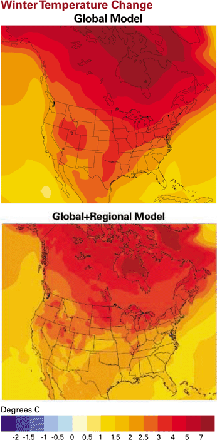
Sharp but true? Feeding a global climate model’s prediction for midcentury (top) into a regional model gives more details (bottom), but modelers aren’t sure how accurate the details are. CREDIT: NORTH AMERICAN REGIONAL CLIMATE CHANGE ASSESSMENT PROGRAM

So scientists have been doing what they can for decision-makers. Early on, it wasn’t much. A U.S. government assessment released in 2000, Climate Change Impacts on the United States, relied on the most rudimentary regional forecasting technique (Science, 23 June 2000, p. 2113). Expert committee members divided the country into eight regions and then considered what two of their best global climate models had to say about each region over the next century. The two models were somewhat consistent in the far southwest, where the report’s authors found it was likely that warmer and drier conditions would eliminate alpine ecosystems and shorten the ski season.

But elsewhere, there was far less consistency. Over the eastern two-thirds of the contiguous 48 states, for example, the two models couldn’t agree on how much moisture soils would hold in the summer. Kansas corn would either suffer severe droughts more frequently, as one model had it, or enjoy even more moisture than it currently does, as the other indicated. But at least the uncertainties were plain for all to see.

The uncertainties of regional projections nearly faded from view in the next U.S. effort, Global Climate Change Impacts in the United States. The 2009 study drew on not two but 15 global models melded into single projections. In a technique called statistical downscaling, its authors assumed that local changes would be proportional to changes on the larger scales. And they adjusted regional projections of future climate according to how well model simulations of past climate matched actual climate.

Statistical downscaling yielded a broad warming across the lower 48 states with less warming across the southeast and up the West Coast. Precipitation was mostly down, especially in the southwest. But discussion of uncertainties in the modeling fell largely to a footnote (number 110), in which the authors cite a half-dozen papers to support their assertion that statistical downscaling techniques are “well-documented” and thoroughly corroborated.

The other sort of downscaling, known as dynamical downscaling or regional modeling, has yet to be fully incorporated into a U.S. national assessment. But an example of state-of-the-art regional modeling appeared 30 June in Environmental Research Letters. To investigate what will happen in the U.S. wine industry, regional modeler Noah Diffenbaugh of Purdue University in West Lafayette, Indiana, and his colleagues embedded a detailed model that spanned the lower 48 states in a climate model that spanned the globe. The global model’s relatively fuzzy simulation of evolving climate from 1950 to 2039—calculated at points about 150 kilometers apart—then fed into the embedded regional model, which calculated a sharper picture of climate change at points only 25 kilometers apart.

Closely analyzing the regional model’s temperature projections on the West Coast, the group found that the projected warming would decrease the area suitable for production of premium wine grapes by 30% to 50% in parts of central and northern California. The loss in Washington state’s Columbia Valley would be more than 30%. But adaptation to the warming, such as the introduction of heat-tolerant varieties of grapes, could sharply reduce the losses in California and turn the Washington loss into a 150% gain.

Not so fast

A rapidly growing community of regional modelers is turning out increasingly detailed projections of future climate, but many researchers, mostly outside the downscaling community, have serious reservations. “Many regional modelers don’t do an adequate job of quantifying issues of uncertainty,” says Bretherton, who is chairing a National Academy of Sciences study committee on a national strategy for advancing climate modeling. “We’re not confident predicting the very things people are most interested in being predicted,” such as changes in precipitation.

Regional models produce strikingly detailed maps of changed climate, but they might be far off base. “The problem is that precision is often mistaken for accuracy,” Bretherton says. Battisti just doesn’t see the point of downscaling. “I would never use one of these products,” he says.

The problems start with the global models, as critics see it. Regional models must fill in the detail in the fuzzy picture of climate provided by global models, notes atmospheric scientist Edward Sarachik, professor emeritus at UW Seattle. But if the fuzzy picture of the region is wrong, the details will be wrong as well. And global models aren’t very good at painting regional pictures, he says. A glaring example, according to Sarachik, is the way global models place the cooler waters of the tropical Pacific farther west than they are in reality. Such ocean temperature differences drive weather and climate shifts in specific regions halfway around the world, but with the cold water in the wrong place, the global models drive climate change in the wrong regions.

Gregory Tripoli’s complaint about the global models is that they can’t create the medium-size weather systems that they should be sending into any embedded regional model. Tripoli, a meteorologist and modeler at the University of Wisconsin, Madison, cites the case of summertime weather disturbances that churn down off the Rocky Mountains and account for 80% of the Midwest’s summer rainfall. If a regional model forecasting for Wisconsin doesn’t extend to the Rockies, Wisconsin won’t get the major weather events that add up to be climate. And some atmospheric disturbances travel from as far away as Thailand to wreak havoc in the Midwest, he says, so they could never be included in the regional model.

A tougher nut. Predicting the details of precipitation using a regional model (bottom) fed by a global model (top) is even more uncertain than projecting regional temperature change. CREDIT: NORTH AMERICAN REGIONAL CLIMATE CHANGE ASSESSMENT PROGRAM

Even the things the global models get right have a hard time getting into regional models, critics say. “There are a lot of problems matching regional and global models,” Tripoli says. In one problem area, global and regional models usually have different ways of accounting for atmospheric processes such as individual cloud development that neither model can simulate directly, creating further clashes. Even the different philosophies involved in building global models and regional models can lead to mismatches that create phantom atmospheric circulations, Tripoli says. “It’s not straightforward you’re going to get anything realistic,” he says.

Redeeming regional modeling

“You could say all the global and regional models are wrong; some people do say that,” notes regional modeler Filippo Giorgi of the Abdus Salam International Centre for Theoretical Physics in Trieste, Italy. “My personal opinion is we do know something now. A few reports ago, it was really very, very difficult to say anything about regional climate change.”

But Giorgi says that in recent years he has been seeing increasingly consistent regional projections coming from combinations of many different models and from successive generations of models. “This means the projections are more and more reliable,” he says. “I would be confident saying the Mediterranean area will see a general decrease in precipitation in the next decades. I’ve seen this in several generations of models, and we understand the processes underlying this phenomenon. This is fairly reliable information, qualitatively. Saying whether the decrease will be 10% or 50% is a different issue.”

The skill of regional climate forecasting also varies from region to region and with what is being forecast. “Temperature is much, much easier” than precipitation, Giorgi notes. Precipitation depends on processes like atmospheric convection that operate on scales too small for any model to render in detail. Trouble simulating convection also means that higher-latitude climate is easier to project than that of the tropics, where convection dominates.

Regional modeling does have a clear advantage in areas with complex terrain such as mountainous regions, notes UW’s Mass, who does regional forecasting of both weather and climate. In the Pacific Northwest, the mountains running parallel to the coast direct onshore winds upward, predictably wringing rain and snow from the air without much difficult-to-simulate convection.

The downscaling of climate projections should be getting a boost as the Coordinated Regional Climate Downscaling Experiment (CORDEX) gets up to speed. Begun in 2009, CORDEX “is really the first time we’ll get a handle on all these uncertainties,” Giorgi says. Various groups will take on each of the world’s continent-size regions. Multiple global models will be matched with multiple regional models and run multiple times to tease out the uncertainties in each. “It’s a landmark for the regional climate modeling community,” Giorgi says.


Science 23 June 2000:
Vol. 288 no. 5474 p. 2113
DOI: 10.1126/science.288.5474.2113

GREENHOUSE WARMING

Dueling Models: Future U.S. Climate Uncertain

Richard A. Kerr

When Congress started funding a global climate change research program in 1990, it wanted to know what all this talk about greenhouse warming would mean for United States voters. Ten years later, a U.S. national assessment, drawing on the best available climate model predictions, concludes that the United States will indeed warm, affecting everything from the western snowpacks that supply California with water to New England’s fall foliage. But on a more detailed level, the assessment often draws a blank. Whether the cornfields of Kansas will be gripped by frequent, severe droughts, as one climate model has it, or blessed with more moisture than they now enjoy, as another predicts, the report can’t say. As much as policy-makers would like to know exactly what’s in store for Americans, the rudimentary state of regional climate science will not soon allow it, and the results of this 3-year effort brought the point home.

“This is the first time we’ve tried to take the physical [climate] system and see what effect it might have on ecosystems and socioeconomic systems,” says Thomas Karl, director of the National Oceanic and Atmospheric Administration’s (NOAA’s) National Climatic Data Center in Asheville, North Carolina, and a co-chair of the committee of experts that pulled together the assessment report “Climate Change Impacts on the United States” (available at http://www.nacc.usgcrp.gov/). “We don’t say we know there’s going to be catastrophic drought in Kansas,” he says. “What we do say is, ‘Here’s the range of our uncertainties.’ This document should get people to think.” If anything is certain, Karl says, it’s that “the past isn’t going to be a very good guide to future climate.”

By chance, the assessment had a handy way to convey the range of uncertainty that regional modeling serves up. The report, which divides the country into eight regions, is based on a pair of state-of-the-art climate models—one from the Canadian Climate Center and one from the U.K. Hadley Center for Climate Research and Prediction—that couple a simulated atmosphere and ocean. The two models solved the problems of simplifying a complex world in different ways, leading to very different predicted U.S. climates. “In terms of temperature, the Canadian model is at the upper end of the warming by 2100” predicted by a range of models, says modeler Eric Barron of Pennsylvania State University, University Park, and a member of the assessment team. “The Hadley model is toward the lower end. The Canadian model is on the dry side, and the Hadley model is on the wet side. We’re capturing a substantial portion of the range of simulations. We tried hard to convey that uncertainty.”

On a broad scale, the report can conclude: “Overall productivity of American agriculture will likely remain high, and is projected to increase throughout the 21st century,” although there will be winners and losers from place to place, and adapting agricultural practice to climate change will be key. Where the models are somewhat consistent, as in the far southwest, the report ventures what could be construed as predictions: “It is likely that some ecosystems, such as alpine ecosystems, will disappear entirely from the region,” or “Higher temperatures are likely to mean … a shorter season for winter activities, such as skiing.” Where the models clash, as on summer soil moisture over the eastern two-thirds of the lower 48 states, it explains the alternatives and suggests ways to adapt, such as switching crops.

The range of possible climate impacts laid out by the models “fairly reflects where we are in the science,” says Karl. But he notes that the effort did lack one important input: Congress mandated the assessment without funding it. “You get what you pay for,” says climatologist Kevin Trenberth of the National Center for Atmospheric Research in Boulder, Colorado. “A lot of it was done hastily.” Karl concedes that everyone involved would have liked to have had more funding delivered more reliably.

Even given more time and money, however, the assessment may not have come up with much better small-scale predictions, given the inherent limitations of the science. Even the best models today can say little that’s reliable about climate change at the regional level, never mind at the scale of a congressional district. Their picture of future climate is fuzzy—they might lump together San Francisco and Los Angeles because the models have such coarse geographic resolution—and the realism of such meteorological phenomena as clouds and precipitation is compromised by the inevitable simplifications of simulating the world in a computer.

“For the most part, these sorts of models give a warming,” says modeler Filippo Giorgi, “but they tend to give very different predictions, especially at the regional level, and there’s no way to say one should be believed over another.” Giorgi and his colleague Raquel Francisco of the Abdus Salam International Center for Theoretical Physics in Trieste, Italy, recently evaluated the uncertainties in five coupled climate models—including the two used in the national assessment—within 23 regions, the continental United States comprising roughly three regions. Giorgi concludes that as the scale of prediction shrinks, reliability drops until for small regions “the model data are not believable at all.”

Add in uncertainties external to the models, such as population and economic growth rates, says modeler Jerry D. Mahlman, director of NOAA’s Geophysical Fluid Dynamics Laboratory in Princeton, New Jersey, and the details of future climate recede toward unintelligibility. Some people in Congress and the policy community had “almost silly expectations there would be enormously useful, small-scale specifics, if you just got the right model. But the right model doesn’t exist,” says Mahlman.

Still, even though the national assessment does not offer the list of region-by-region impacts that Congress might have hoped for, it does show “where we are adaptable and where we are vulnerable,” says global change researcher Stephen Schneider of Stanford University. In 10 years, modelers say, they’ll do better.

The Post-Normal Seduction of Climate Science (Forbes)

William Pentland10/14/2011 @ 12:22AM |2,770 views

In early 2002, former U.S. Defense Secretary Donald Rumsfeld explained why the lack of evidence linking Saddam Hussein with terrorist groups did not mean there was no connection during a televised press conference.

“[T]here are known ‘knowns’ – there are things we know we know,” said Rumsfeld. “We also know there are known ‘unknowns’ – that is to say we know there are some things we do not know. But there are also unknown ‘unknowns’ – the ones we don’t know we don’t know . . . it is the latter category that tend to be the difficult ones.”

Rumsfeld turned out to be wrong about Hussein, but what if he had been talking about global warming?  Well, he probably would have been on to something there.  Unknowns of any ilk are a real pickle in climate science.

Indeed, uncertainty in climate science has induced a state of severe political paralysis. The trouble is that nobody really knows why. A rash of recent surveys and studies have exonerated most of the usual suspects – scientific illiteracy, industry distortions, skewed media coverage.

Now, the climate-science community is scrambling to crack the code on the “uncertainty” conundrum. Exhibit A: the October 2011 issue of the journal Climatic Change, the closest thing in climate science to gospel truth, which is devoted entirely to the subject of uncertainty.

While I have yet to digest all of the dozen or so essays, I suspect they are only the opening salvo in what is will soon become a robust debate about the significance of uncertainty in climate-change science. The first item up on the chopping block is called post-normal science (PNS).

PNS is a model of the scientific process pioneered by Jerome Ravetz and Silvio Funtowicz, which describes the peculiar challenges science encounters where “facts are uncertain, values in dispute, stakes high and decisions urgent.” Unlike “normal” science in the sense described by the philosopher of science Thomas Kuhn, post-normal science commonly crosses disciplinary lines and involves new methods, instruments and experimental systems.

Judith Curry, a professor at Georgia Tech, weighs the wisdom of taking the plunge on PNS in an excellent piece called “Reasoning about climate uncertainty.” Drawing on the work of Dutch wunderkind, Jeroen van der Sluijs, Curry calls on the Intergovernmental Panel on Climate Change to stop marginalizing uncertainty and get real about bias in the consensus building process. Curry writes:

The consensus approach being used by the IPCC has failed to produce a thorough portrayal of the complexities of the problem and the associated uncertainties in our understanding . . . Better characterization of uncertainty and ignorance and a more realistic portrayal of confidence levels could go a long way towards reducing the “noise” and animosity portrayed in the media that fuels the public distrust of climate science and acts to stymie the policy process.

PNS is especially seductive in the context of uncertainty. Not surprisingly, Curry suggests that instituting PNS-like strategies at the IPCC “could go a long way towards reducing the ‘noise’ and animosity” surrounding climate-change science.

While I personally believe PNS is persuasive, the PNS model provokes something closer to revulsion in many people. Last year, members of the U.S. House of Representatives filed a petition challenging the U.S. Environmental Protection Agency‘s Greenhouse Gas Endangerment seemed less sanguine about post-normal science:

. . . the conclusions of organizing bodies, especially the IPCC, cannot be said to reflect scientific “consensus” in any meaningful sense of that word. Instead, they reflect a political movement that has commandeered science to the service of its agenda. This is “post-normal science”: the long-dreaded arrival of deconstructionism to the natural sciences, according to which scientific quality is determined not by its fidelity to truth, but by its fidelity to the political agenda.

It seems unlikely that taking the PNS plunge would appreciably improve the U.S. public’s perception of the credibility, legitimacy and salience of climate-change assessments. This probably says more about Americans than it does about the analytic force of the PNS model.

Let’s face it. Americans do not agree on a whole hell of a lot. And they never have. Many U.S. institutions were deliberately designed to tolerate the coexistence of free states and slave-owning states. Ironically, Americans appear to agree more on climate-change science than other high-profile scientific controversies like the safety of genetically-modified organisms.

National Science Foundation

While it pains me to admit this, I am increasingly convinced that the IPCC’s role in assessing the science of climate change needs to be scaled back. The IPCC was an overly optimistic experiment in international governance designed for a world that never materialized.  The U.N. General Assembly established the IPCC in the months immediately preceding the fall of the Berlin Wall. Only two few years later, the IPCC’s first assessment report and the creation of the U.N. Framework Convention on Climate Change coincided with the collapse of the Soviet Union and the end of the Cold War.

A new world order seemed to be dawning in those days, which is probably why it seemed like a good idea to ask scientists to tell us what constitutes “dangerous climate change.”   Two decades and two world trade towers later, the world is a decidedly less hospitable place for institutions like the IPCC.

The proof is in the pudding – or, in this case, the atmosphere.

Climate Change Tumbles Down Europe’s Political Agenda as Economic Worries Take the Stage (N.Y. Times)

By JEREMY LOVELL of ClimateWire. Published: October 13, 2011

LONDON — Climate change has all but fallen off the political agenda across Europe as the resurging economic crisis empties national coffers and shakes economic confidence, and the public and the press turn their attention to more immediate issues of rising fuels bills and joblessness, analysts say.

Sputtering economies, a shift of attention to looming elections and the prospect of little or no movement in the December climate talks in Durban, South Africa, have combined to take the political momentum out of an issue that was a major cause in Europe.

“It is way down the agenda and will not feature in elections,” said Edward Cameron, director of the World Resources Institute think tank’s international climate initiative, on the sidelines of a meeting on climate change at London’s Chatham House think tank. “At a time of joblessness and fiscal crises, it is very difficult to advance the climate change issue.”

That is as true for next year’s presidential elections in the United States as it will be in France, despite the fact that there has been a series of environmental disasters, from the Texas drought this year to Russia’s heat wave and consequent steep rise in wheat prices last year.

According to acclaimed NASA scientist James Hansen, who has been warning of impending climatic doom for decades, the lack of focus on these events is in no small part due to the fact that scientists are poor communicators while the climate change skeptics have mounted a smoothly run campaign to capitalize on any mistakes and admissions of uncertainty.

“There is a strong campaign by those people who want to continue the fossil fuel business as usual. Climate contrarians … have managed in the public’s eye to muddy the waters enough that there is uncertainty why should we do anything yet,” he said on a visit to London’s Royal Society for a meeting on lessons to be learned from past climate change battles.

“They have been winning the argument in the last several years, even though the science has become clearer,” he added.

Nuclear power issue distracts Berlin

In Germany, where a generous feed-in tariff scheme has produced some 28 gigawatts of wind power capacity and more than 18 GW of solar photovoltaic capacity, Chancellor Angela Merkel’s coalition government was forced into an abrupt U-turn on a controversial move to extend the lives of the country’s fleet of nuclear power plants. There was a political revolt after the March 11 nuclear disaster at Fukushima in Japan.

The oldest seven of Germany’s nuclear plants were closed immediately after Fukushima and will now never reopen, while the remainder will close by 2022.

This has had the perverse effect in a country proud of its renewable energy efforts of increasing the use of coal-fired power plants and increasing the likelihood of new coal- or gas-fired plants being built. The price tag will include higher carbon emissions at exactly the time that the Germany along with the rest of the European Union is pledged to cut emissions.

While political observers believe the climate change issue will come back to the fore at some point in Germany — a country where the Greens have played a pivotal political role — the nuclear power issue is so politically charged that it is off the agenda for now.

Even in the United Kingdom, which has a huge wind energy program and where the Conservative-Liberal Democrat coalition came to power 15 months ago pledging to be the “greenest government ever,” there are major signs of backsliding. A long-awaited energy bill has been shelved, and renewable energy support costs and carbon emission reduction targets are either under review or about to be.

At the Conservative Party’s annual conference earlier this month, climate change was consigned to a brief debate on the opening Sunday, when delegates were mostly just arriving and finding their way around or still traveling to get there.

Damned by faint praise in London

Prime Minister David Cameron did not mention the issue in his speech to the conference — a performance that usually sets the broad agenda for the following year — and Chancellor of the Exchequer George Osborne caused environmental outrage but satisfaction to the party’s right wing by pledging that the United Kingdom would not go any faster than its E.U. neighbors on emission cuts.

This is despite the fact that the United Kingdom has a legal target to cut its carbon emissions by at least 80 percent below 1990 levels by 2050, with cuts of 35 percent by 2022 and 50 percent by 2025, whereas the European Union’s goal is 20 percent by 2020.

It was widely reported that the 2022 target was only agreed to after a major battle in the Cabinet between supporters of Conservative Osborne and those of Liberal Democrat Energy and Climate Change Minister Chris Huhne. It has since been announced that the carbon targets will be reviewed in 2014.

Even in London, where charismatic Conservative Mayor Boris Johnson came to power in 2008 in part on a green ticket, the issue has largely been parked and replaced by transport in the run-up to next year’s mayoral elections. The city’s aging transport system is feared likely to come under massive strain during the 2012 Olympic Games.

Then there is the strange case of a strategic plan on adapting London to climate change, the draft of which was launched with great fanfare and declarations of urgency in February 2010. It was on the brink of publication in September 2010, but after that, it appeared to have vanished without trace.

At the same time, most members of City Hall’s climate change team, set up under the previous Labour administration, have been moved to other jobs.

‘Too difficult — and not a vote winner’

“Political leaders get it, but the treasuries don’t. The men with the money don’t want to be first movers,” said Nick Mabey, co-founder of environmental think tank E3G. “But the political froth has gone. It has become too difficult — and not a vote winner.”

Compounding that problem, at least in the United Kingdom, has been a series of reports underscoring the likely high cost to households of green energy policies at a time when the prices of domestic electricity and gas are already rising sharply.

A recent opinion poll found that the climate change issue has been replaced by concerns over rising fuel bills and energy security.

But Mabey is not too concerned. While the subject may be off the immediate political agenda, behind the scenes, the more enlightened corporate leaders and investment fund managers have been making their own calculations. They are moving their money into the low-carbon economic transformation that in some cases is already profitable and in many eyes essential and inevitable.

The main danger, they say, is that if climate change as a driver of action is allowed to languish too long and become too invisible while energy becomes the main motivator, it will become far harder to resurrect climate change.

For Mabey and WRI’s Cameron, while the deep and seemingly returning global economic crisis has proved a serious distraction internationally as well as domestically, all is not lost.

For a number of reasons, including the rise of a new and major climate player — China — and a series of new scientific reports on climate change due over the next two or three years, 2015 will be the next pivotal moment for the world to take collective action, they say.

“Climate change doesn’t keep people awake at night. Our task for the next few years is to move it back up the political agenda again,” said WRI’s Cameron.

Copyright 2011 E&E Publishing. All Rights Reserved.

Group Urges Research Into Aggressive Efforts to Fight Climate Change (N.Y. Times)

By CORNELIA DEAN, Published: October 4, 2011

With political action on curbing greenhouse gases stalled, a bipartisan panel of scientists, former government officials and national security experts is recommending that the government begin researching a radical fix: directly manipulating the Earth’s climate to lower the temperature.

Members said they hoped that such extreme engineering techniques, which include scattering particles in the air to mimic the cooling effect of volcanoes or stationing orbiting mirrors in space to reflect sunlight, would never be needed. But in itsreport, to be released on Tuesday, the panel said it is time to begin researching and testing such ideas in case “the climate system reaches a ‘tipping point’ and swift remedial action is required.”

The 18-member panel was convened by the Bipartisan Policy Center, a research organization based in Washington founded by four senators — Democrats and Republicans — to offer policy advice to the government. In interviews, some of the panel members said they hoped that the mere discussion of such drastic steps would jolt the public and policy makers into meaningful action in reducing greenhouse gas emissions, which they called the highest priority.

The idea of engineering the planet is “fundamentally shocking,” David Keith, an energy expert at Harvard and the University of Calgary and a member of the panel, said. “It should be shocking.”

In fact, it is an idea that many environmental groups have rejected as misguided and potentially dangerous.

Jane Long, an associate director of the Lawrence Livermore National Laboratory and the panel’s co-chairwoman, said that by spewing greenhouse gases into the atmosphere, human activity was already engaged in climate modification. “We are doing it accidentally, but the Earth doesn’t know that,” she said, adding, “Going forward in ignorance is not an option.”

The panel, the Task Force on Climate Remediation Research, suggests that the White House Office of Science and Technology Policy begin coordinating research and estimates that a valuable effort could begin with a few million dollars in financing over the next few years.

One reason that the United States should embrace such research, the report suggests, is the threat of unilateral action by another country. Members say research is already under way in Britain, Germany and possibly other countries, as well as in the private sector.

“A conversation about this is going to go on with us or without us,” said David Goldston, a panel member who directs government affairs at the Natural Resources Defense Counciland is a former chief of staff of the House Committee on Science. “We have to understand what is at stake.”

In interviews, panelists said again and again that the continuing focus of policy makers and experts should be on reducing emissions of carbon dioxide and other greenhouse gases. But several acknowledged that significant action remained a political nonstarter. Last month, for example, the Obama administration told the federal Environmental Protection Agency to hold off on tightening ozone standards, citing complications related to the weak economy.

According to the United Nations Intergovernmental Panel on Climate Change, greenhouse gas emissions have contributed to raising the global average surface temperatures by about 1.3 degrees Fahrenheit in the past 100 years. It is impossible to predict how much impact the report will have. But given the panelists’ varied political and professional backgrounds, they seem likely to achieve one major goal: starting a broader conversation on the issue. Some climate experts have been working on it for years, but they have largely kept their discussions to themselves, saying they feared giving the impression that there might be quick fixes for climate change.

“Climate adaptation went through the same period of concern,” Mr. Goldston said, referring to the onetime reluctance of some researchers to discuss ways in which people, plants and animals might adjust to climate change. Now, he said, similar reluctance to discuss geoengineering is giving way, at least in part because “it’s possible we may have to do this no matter what.”

Although the techniques, which fall into two broad groups, are more widely known as geoengineering, the panel prefers “climate remediation.”

The first is carbon dioxide removal, in which the gas is absorbed by plants, trapped and stored underground or otherwise removed from the atmosphere. The methods are “generally uncontroversial and don’t introduce new global risks,” said Ken Caldeira, a climate expert at Stanford University and a panel member. “It’s mostly a question of how much do these things cost.”

Controversy arises more with the second group of techniques, solar radiation management, which involves increasing the amount of solar energy that bounces back into space before it can be absorbed by the Earth. They include seeding the atmosphere with reflective particles, launching giant mirrors above the earth or spewing ocean water into the air to form clouds.

These techniques are thought to pose a risk of upsetting earth’s natural rhythms. With them, Dr. Caldeira said, “the real question is what are the unknown unknowns: Are you creating more risk than you are alleviating?”

At the influential blog Climate Progress, Joe Romm, a fellow at the Center for American Progress, has made a similar point, likening geo-engineering to a dangerous course of chemotherapy and radiation to treat a condition curable through diet and exercise — or, in this case, emissions reduction.

The panel rejected any immediate application of climate remediation techniques, saying too little is known about them. In 2009, the Royal Society in Britain said much the same, assessing geoengineering technologies as “technically feasible” but adding that their potential costs, effectiveness and risks were unknown.

Similarly, in a 2010 review of federal research that might be relevant to climate remediation, the federal Government Accountability Office noted that “major uncertainties remain on the efficacy and potential consequences” of the approach. Its report also recommended that the White House Office of Science and Technology Policy “establish a clear strategy for geoengineering research.”

John P. Holdren, who heads that office, declined interview requests. He issued a statement reiterating the Obama administration’s focus on “taking steps to sensibly reduce pollution that is contributing to climate change.”

Yet in an interview with The Associated Press in 2009, Dr. Holdren said the possible risks and benefits of geoengineering should be studied very carefully because “we might get desperate enough to want to use it.”

In a draft plan made public on Friday, the U.S. Global Change Research Program, a coordinating effort administered by his office, outlined its own climate change research agenda, including studies of the impacts of rapid climate change.

The plan said that climate-related projections would be crucial to future studies of the “feasibility, effectiveness and unintended consequences of strategies for deliberate, large-scale manipulations of Earth’s environment,” including carbon dioxide removal and solar radiation management.

Many countries fault the United States for government inaction on climate change, especially given its longtime role as a chief contributor to the problem.

Frank Loy, a panelist and former chief climate negotiator for the United States, suggested that people around the world would see past those issues if the United States embraced geoengineering studies, provided that it was “very clear about what kind of research is undertaken and what the safeguards are.”

This article has been revised to reflect the following correction:

Correction: October 4, 2011

An earlier version of this article mistakenly referred to Frank Loy as the nation’s chief climate negotiator; he is a former chief climate negotiator. It also misstated the name of a federal agency that reported on the potential effectiveness of climate remediation. It is the Government Accountability Office, not the General Accountability Office.

More anthropologists on Wall Street please (The Economist)

Education policy

Oct 24th 2011, 20:58 by M.S.

APPARENTLY Rick Scott, the governor of Florida, called two weeks ago for reducing funding for liberal-arts disciplines at state universities and shifting the money to science, technology, engineering and math, which he abbreviates to STEM. (Amusingly, if you Google “Rick Scott STEM” you end up getting multiple references to Mr Scott’s apparently non-operative campaign pledge to ban stem-cell research in Florida. Between the two issues, you’ve got a sort of operatic treatment of the modern Republican love-hate relationship with science.) Mr Scott seems to have repeatedly singled out the discipline of anthropology for derision. On one occasion, he apparently told a right-wing radio host: “You know, we don’t need a lot more anthropologists in the state. It’s a great degree if people want to get it, but we don’t need them here. I want to spend our dollars giving people science, technology, engineering, math degrees…so when they get out of school, they can get a job.” On another occasion, he’s quoted as telling a business group in Tallahassee: “Do you want to use your tax dollars to educate more people who can’t get jobs in anthropology? I don’t.”

Few would defend deliberately educating more people who can’t get jobs in anthropology, as such. (Of course, giving people math degrees rather than anthropology degrees will render them even less able to get jobs in anthropology.) Many, however, would defend educating more people in anthropology, regardless of what they wind up getting jobs in. In Slate on Friday, Michael Crow, president of Arizona State University, gave the traditional and entirely accurate pitch:

[R]esolving the complex challenges that confront our nation and the world requires more than expertise in science and technology. We must also educate individuals capable of meaningful civic participation, creative expression, and communicating insights across borders. The potential for graduates in any field to achieve professional success and to contribute significantly to our economy depends on an education that entails more than calculus.

Curricula expressly tailored in response to the demands of the workforce must be balanced with opportunities for students to develop their capacity for critical thinking, analytical reasoning, creativity, and leadership—all of which we learn from the full spectrum of disciplines associated with a liberal arts education. Taken together with the rigorous training provided in the STEM fields, the opportunities for exploration and learning that Gov. Scott is intent on marginalizing are those that have defined our national approach to higher education.

This is a solid response. What it lacks are rhetorical oomph and concrete examples. So here’s a concrete example with a little oomph. Some of the best analysis of the 2007-2008 financial crisis, and of the ongoing follies on Wall Street these days, has been produced by the Financial Times‘ Gillian Tett. Ms Tett began warning that collateralised debt obligations and credit-default swaps were likely to lead to a major financial implosion in 2005 or so. The people who devise such complex derivatives are generally trained in physics or math. Ms Tett has a PhD in anthropology. Here’s a 2008 profile of Ms Tett by the Guardian’s Laurie Barton.

Tett began looking at the subject of credit five years ago. “Everyone was looking at the City and talking about M&A [mergers and acquisitions] and equity markets, and all the traditional high-glamour, high-status parts of the City. I got into this corner of the market because I passionately believed there was a revolution happening that had been almost entirely ignored. And I got really excited about trying to actually illustrate what was happening.”

Not that anyone particularly wanted to listen. “You could see everyone’s eyes glazing over … But my team, not just me, we very much warned of the dangers. Though I don’t think we expected the full scale of the disaster that’s unfolded.”

There is something exceedingly calm and thorough about Tett. She talks with the patient enthusiasm of a Tomorrow’s World presenter—a throwback, perhaps, to her days studying social anthropology, in which she has a PhD from Cambridge. “I happen to think anthropology is a brilliant background for looking at finance,” she reasons. “Firstly, you’re trained to look at how societies or cultures operate holistically, so you look at how all the bits move together. And most people in the City don’t do that. They are so specialised, so busy, that they just look at their own little silos. And one of the reasons we got into the mess we are in is because they were all so busy looking at their own little bit that they totally failed to understand how it interacted with the rest of society.

“But the other thing is, if you come from an anthropology background, you also try and put finance in a cultural context. Bankers like to imagine that money and the profit motive is as universal as gravity. They think it’s basically a given and they think it’s completely apersonal. And it’s not. What they do in finance is all about culture and interaction.”

Another person with an anthropology degree who’s been doing terrific work in recent years in a somewhat-related field is the Dutch journalist Joris Luyendijk, who produced a fantastic short book last year analysing the tribal culture of the Dutch parliament and the media circles that cover it. He’s currently working on a study of the City as well. Anyway, the general point is that while studying human behaviour through complex derivatives has its uses, there’s something to be said for the more rigorous and less egocentric analytical tools that anthropology brings to play, and it might be worth Mr Scott’s time to take a course or two. It’s never too late to learn.

The scientific finding that settles the climate-change debate (Washington Post)

By Eugene Robinson, Published: October 24

For the clueless or cynical diehards who deny global warming, it’s getting awfully cold out there.

The latest icy blast of reality comes from an eminent scientist whom the climate-change skeptics once lauded as one of their own. Richard Muller, a respected physicist at the University of California, Berkeley, used to dismiss alarmist climate research as being “polluted by political and activist frenzy.” Frustrated at what he considered shoddy science, Muller launched his own comprehensive study to set the record straight. Instead, the record set him straight.

“Global warming is real,” Muller wrote last week in The Wall Street Journal.

Rick Perry, Herman Cain, Michele Bachmann and the rest of the neo-Luddites who are turning the GOP into the anti-science party should pay attention.

“When we began our study, we felt that skeptics had raised legitimate issues, and we didn’t know what we’d find,” Muller wrote. “Our results turned out to be close to those published by prior groups. We think that means that those groups had truly been careful in their work, despite their inability to convince some skeptics of that.”

In other words, the deniers’ claims about the alleged sloppiness or fraudulence of climate science are wrong. Muller’s team, the Berkeley Earth Surface Temperature project, rigorously explored the specific objections raised by skeptics — and found them groundless.

Muller and his fellow researchers examined an enormous data set of observed temperatures from monitoring stations around the world and concluded that the average land temperature has risen 1 degree Celsius — or about 1.8 degrees Fahrenheit — since the mid-1950s.

This agrees with the increase estimated by the United Nations-sponsored Intergovernmental Panel on Climate Change. Muller’s figures also conform with the estimates of those British and American researchers whose catty e-mails were the basis for the alleged “Climategate” scandal, which was never a scandal in the first place.

The Berkeley group’s research even confirms the infamous “hockey stick” graph — showing a sharp recent temperature rise — that Muller once snarkily called “the poster child of the global warming community.” Muller’s new graph isn’t just similar, it’s identical.

Muller found that skeptics are wrong when they claim that a “heat island” effect from urbanization is skewing average temperature readings; monitoring instruments in rural areas show rapid warming, too. He found that skeptics are wrong to base their arguments on the fact that records from some sites seem to indicate a cooling trend, since records from at least twice as many sites clearly indicate warming. And he found that skeptics are wrong to accuse climate scientists of cherry-picking the data, since the readings that are often omitted — because they are judged unreliable — show the same warming trend.

Muller and his colleagues examined five times as many temperature readings as did other researchers — a total of 1.6 billion records — and now have put that merged database online. The results have not yet been subjected to peer review, so technically they are still preliminary. But Muller’s plain-spoken admonition that “you should not be a skeptic, at least not any longer” has reduced many deniers to incoherent grumbling or stunned silence.

Not so, I predict, with the blowhards such as Perry, Cain and Bachmann, who, out of ignorance or perceived self-interest, are willing to play politics with the Earth’s future. They may concede that warming is taking place, but they call it a natural phenomenon and deny that human activity is the cause.

It is true that Muller made no attempt to ascertain “how much of the warming is due to humans.” Still, the Berkeley group’s work should help lead all but the dimmest policymakers to the overwhelmingly probable answer.

We know that the rise in temperatures over the past five decades is abrupt and very large. We know it is consistent with models developed by other climate researchers that posit greenhouse gas emissions — the burning of fossil fuels by humans — as the cause. And now we know, thanks to Muller, that those other scientists have been both careful and honorable in their work.

Nobody’s fudging the numbers. Nobody’s manipulating data to win research grants, as Perry claims, or making an undue fuss over a “naturally occurring” warm-up, as Bachmann alleges. Contrary to what Cain says, the science is real.

It is the know-nothing politicians — not scientists — who are committing an unforgivable fraud.

Bleak Prospects for Avoiding Dangerous Global Warming (Science)

by Richard A. Kerr on 23 October 2011, 1:00 PM

The bad news just got worse: A new study finds that reining in greenhouse gas emissions in time to avert serious changes to Earth’s climate will be at best extremely difficult. Current goals for reducing emissions fall far short of what would be needed to keep warming below dangerous levels, the study suggests. To succeed, we would most likely have to reverse the rise in emissions immediately and follow through with steep reductions through the century. Starting later would be far more expensive and require unproven technology.

Published online today in Nature Climate Change, the new study merges model estimates of how much greenhouse gas society might put into the atmosphere by the end of the century with calculations of how climate might respond to those human emissions. Climate scientist Joeri Rogelj of ETH Zurich and his colleagues combed the published literature for model simulations that keep global warming below 2°C at the lowest cost. They found 193 examples. Modelers running such optimal-cost simulations tried to include every factor that might influence the amount of greenhouse gases society will produce —including the rate of technological progress in burning fuels efficiently, the amount of fossil fuels available, and the development of renewable fuels. The researchers then fed the full range of emissions from the scenarios into a simple climate model to estimate the odds of avoiding a dangerous warming.

The results suggest challenging times ahead for decision makers hoping to curb the greenhouse. Strategies that are both plausible and likely to succeed call for emissions to peak this decade and start dropping right away. They should be well into decline by 2020 and far less than half of current emissions by 2050. Only three of the 193 scenarios examined would be very likely to keep the warming below the danger level, and all of those require heavy use of energy systems that actually remove greenhouse gases from the atmosphere. That would require, for example, both creating biofuels and storing the carbon dioxide from their combustion in the ground.

“The alarming thing is very few scenarios give the kind of future we want,” says climate scientist Neil Edwards of The Open University in Milton Keynes, U.K. Both he and Rogelj emphasize the uncertainties inherent in the modeling, especially on the social and technological side, but the message seems clear to Edwards: “What we need is at the cutting edge. We need to be as innovative as we can be in every way.” And even then, success is far from guaranteed.

A skeptical physicist ends up confirming climate data (Washington Post)

Posted by Brad Plumer at 04:18 PM ET, 10/20/2011
Back in 2010, Richard Muller, a Berkeley physicist and self-proclaimed climate skeptic, decided to launch the Berkeley Earth Surface Temperature (BEST) project to review the temperature data that underpinned global-warming claims. Remember, this was not long after the Climategate affair had erupted, at a time when skeptics were griping that climatologists had based their claims on faulty temperature data.(Jonathan Hayward/AP)Muller’s stated aims were simple. He and his team would scour and re-analyze the climate data, putting all their calculations and methods online. Skeptics cheered the effort. “I’m prepared to accept whatever result they produce, even if it proves my premise wrong,” wrote Anthony Watts, a blogger who has criticized the quality of the weather stations in the United Statse that provide temperature data. The Charles G. Koch Foundation even gave Muller’s project $150,000 — and the Koch brothers, recall, are hardly fans of mainstream climate science.So what are the end results? Muller’s team appears to have confirmed the basic tenets of climate science. Back in March, Muller told the House Science and Technology Committee that, contrary to what he expected, the existing temperature data was “excellent.” He went on: “We see a global warming trend that is very similar to that previously reported by the other groups.” And, today, the BEST team has released a flurry of new papers that confirm that the planet is getting hotter. As the team’s two-page summary flatly concludes, “Global warming is real.”Here’s a chart comparing their findings with existing data:

The BEST team tried to take a number of skeptic claims seriously, to see if they panned out. Take, for instance, their paper on the “urban heat island effect.” Watts has long argued that many weather stations collecting temperature data could be biased by being located in cities. Since cities are naturally warmer than rural areas (because building materials retain more heat), the uptick in recorded temperatures might be exaggerated, an illusion spawned by increased urbanization. So Muller’s team decided to compare overall temperature trends with only those weather stations based in rural areas. And, as it turns out the trends match up well. “Urban warming does not unduly bias estimates of recent global temperature change,” Muller’s group concluded.

That shouldn’t be so jaw-dropping. Previous analyses — like this one from the National Oceanic and Atmospheric Administration — have responded to Watts’ concerns by showing that a few flawed stations don’t warp the overall trend. But maybe Muller’s team can finally put this controversy to rest, right? Well, not yet. As Watts responds over at his site, the BEST papers still haven’t been peer-reviewed (an important caveat, to be sure). And Watts isn’t pleased with how much pre-publication hype the studies are getting. But so far, what we have is a prominent skeptic casting a critical eye at the data and finding, much to his own surprise, that the data holds up.

Estudo americano confirma aquecimento da superfície terrestre (BBC)

Richard Black

Da BBC News

Estação meteorológica próxima de aeroporto.Grupo afirma que estações meteorológicas dão dados precisos sobre aquecimento

Uma nova análise de um grupo de cientistas dos Estados Unidos concluiu que a superfície da Terra está ficando mais quente.

Desde 1950, a temperatura média em terra aumentou em um grau centígrado, segundo as descobertas do grupo Berkeley Earth Project.

O Berkeley Earth Project usou novos métodos e novos dados, mas as descobertas do grupo seguem a mesma tendência climática vista pela Nasa e pelo Escritório de Meteorologia da Grã-Bretanha, por exemplo.

“Nossa maior surpresa foi que os novos resultados concordam com os valores de aquecimento publicados anteriormente por outras equipes nos Estados Unidos e Grã-Bretanha”, afirmou o professor Richard Muller, que estabeleceu o Berkeley Earth Project na Universidade da Califórnia reunindo dez cientistas renomados.

“Isto confirma que estes estudos foram feitos cuidadosamente e que o potencial de (estudos) tendenciosos, identificados pelos céticos em relação ao aquecimento global, não afetam seriamente as conclusões”, acrescentou.

O grupo de cientistas também relata que, apesar de o efeito de aumento de calor perto de cidades – o chamado efeito de ilha de calor urbana – ser real e já ter sido estabelecido, ele não é o responsável pelo aquecimento registrado pela maioria das estações climáticas no mundo todo.

Ceticismo

O grupo examinou as alegações de blogueiros “céticos” em relação ao fenômeno, que afirmam que os dados de estações meteorológicas não mostram uma tendência verdadeira de aquecimento global.

Eles dizem que muitas estações meteorológicas registraram aquecimento pois estão localizadas perto de cidades e as cidades crescem, aumentando o calor.

No entanto, o grupo de cientistas descobriu cerca de 40 mil estações meteorológicas no mundo todo cujas informações foram gravadas e armazenadas no formato digital.

Os pesquisadores então desenvolveram uma nova forma de analisar os dados para detectar a tendência das temperaturas globais em terra desde 1800.

O resultado foi um gráfico muito parecido com aqueles produzidos pelos grupos mais importantes do mundo, que tiveram seus trabalhos criticados pelos céticos.

Dois destes três registros são mantidos pelos Estados Unidos, na Administração Oceânica e Atmosférica Nacional (NOAA) e na Nasa. O terceiro é uma colaboração entre o Escritório de Meteorologia da Grã-Bretanha e o Centro de Pesquisa Climática da Universidade de East Anglia (UEA).

O professor Phil Jones, do Centro de Pesquisa Climática da UEA, encarou o trabalho do grupo com cautela e afirmou que espera ler “o relatório final”, quando for publicado.

“Estas descobertas iniciais são muito encorajadoras e ecoam nossos resultados e nossa conclusão de que o impacto das ilhas urbanas de calor na média global de temperatura é mínimo”, disse.

Trânsito e fumaça em rua da China (Reuters)Céticos dizem que proximidade de cidades alteram dados de estações

Phil Jones foi um dos cientistas britânicos acusados de manipular dados para exagerar a influência humana no aquecimento global. Os cientistas foram inocentados em 2010.

O caso teve início em 2009, com o vazamento de e-mails de Jones nos quais o cientista parecia sugerir que alguns dados de pesquisas sobre o aquecimento global fossem excluídos de apresentações que seriam realizadas na conferência da ONU sobre mudanças climáticas.

O episódio deu munição aos céticos em relação ao papel dos seres humanos nas alterações climáticas. Mas a sindicância da Universidade de East Anglia concluiu que não havia dúvidas sobre o rigor e a honestidade dos cientistas.

Sem publicação

Bob Ward, diretor de política e comunicações para o Instituto Graham de Mudança Climática e Meio Ambiente, de Londres, afirmou que o aquecimento global é claro.

“Os chamados céticos devem deixar de lado sua alegações de que o aumento na temperatura média global pode ser atribuído ao impacto do crescimento das cidades”, disse.

A equipe do Berkeley Earth Project decidiu divulgar os dados de suas pesquisas inicialmente em seu próprio website, ao invés de fazê-lo em uma publicação especializada.

Os pesquisadores estão pedindo para que os internautas comentem e forneçam suas opiniões antes de preparar os manuscritos para a publicação científica formal.

Richard Muller, que criou o grupo de pesquisa, afirmou que esta livre circulação de informações marca uma volta à forma como a ciência precisa ser feita, ao invés de apenas publicar o estudo em revistas científicas.

Radiação vaza em indústria nuclear no Rio (Correio Braziliense)

JC e-mail 4367, de 19 de Outubro de 2011.

Ocorreram três vazamentos dentro da Fábrica de Combustível Nuclear, pertencente ao governo federal, em Resende (RJ). Dois deles, envolvendo substâncias químicas. Outro, urânio enriquecido altamente radioativo. A empresa admite “falhas”, mas descarta danos a funcionários e ao meio ambiente

Produto radioativo vaza em indústria nuclear de Resende (RJ). A empresa, pertencente ao governo federal, confirma o caso, reconhece “falhas” em equipamentos, mas descarta danos aos funcionários e ao meio ambiente

Engenheiros e técnicos de segurança do trabalho detectaram três vazamentos dentro da Fábrica de Combustível Nuclear (FCN), em Resende (RJ), dois deles envolvendo substâncias químicas e um de urânio enriquecido (UO2), elemento altamente radioativo. A constatação dos vazamentos foi comunicada pelos engenheiros e técnicos a seus superiores por e-mails internos. O Correio teve acesso a cópias desses e-mails.

O pó de urânio vazou de um equipamento chamado homogeneizador e caiu no piso da sala. O episódio foi registrado em 14 de julho de 2009. Em janeiro de 2010, o alarme de atenção da fábrica foi acionado em razão do vazamento de gás liquefeito usado no forno que queima os excessos de gases resultantes da produção de pastilhas de urânio. E, em julho deste ano, um engenheiro suspeitou do vazamento de amônia e comunicou o ocorrido aos gerentes.

Os três casos não representaram riscos aos trabalhadores, ao meio ambiente e ao funcionamento da fábrica, garantem a diretoria da fábrica – pertencente ao governo federal – e a presidência da Comissão Nacional de Energia Nuclear (Cnen), órgão responsável pela fiscalização de atividades radioativas no Brasil. “O urânio ficou numa sala confinada, hermeticamente fechada, não foi para o meio ambiente”, diz o diretor de Produção de Combustível Nuclear da FCN, Samuel Fayad Filho. Ele reconhece “falhas” nos equipamentos e diz que “todos os procedimentos foram tomados” em relação aos problemas detectados. “Não há vazamento de material radioativo em Resende”, assegura.

O Correio consultou especialistas para saber o que significam as informações que circularam internamente na FCN. Para o engenheiro nuclear Aquilino Senra, “é evidente que houve uma falha”. “Não era para o pó de UO2 sair dessa prensa”, diz o engenheiro nuclear, vice-diretor do Instituto Alberto Luiz Coimbra de Pós-Graduação e Pesquisa de Engenharia (Coppe), da Universidade Federal do Rio de Janeiro. “É uma anormalidade clara o vazamento de UO2 da prensa e a presença da substância no solo.”

Em relação ao vazamento de gás liquefeito, Aquilino afirma que “gás vazado não é boa coisa”. “Detectores existem para isso, mas o ponto é por que o gás vazou.” O Correio ouviu também um técnico ligado à Presidência da República, sob a condição de anonimato: “Não me parece um problema grave, pois a Presidência não foi avisada”, diz.

Funções – A FCN é um conjunto de fábricas responsáveis pela montagem do elemento combustível, pela fabricação do pó e da pastilha de urânio e por uma pequena parte do enriquecimento de urânio. O mineral é extraído em Caetité (BA). O processo de enriquecimento é feito quase todo fora do país, mas parte dele já ocorre na FCN. Cabe à fábrica, além dessa pequena fatia do enriquecimento, produzir as pastilhas que serão utilizadas na geração de energia nuclear pelas usinas Angra 1 e Angra 2, em Angra dos Reis (RJ).

Hoje, a FCN é responsável pelo enriquecimento de 10% do urânio necessário para Angra 1 e de 5% para Angra 2, segundo Samuel Fayad. A FCN faz parte da estatal Indústrias Nucleares do Brasil (INB), subordinada ao Ministério de Ciência, Tecnologia e Inovação (MCT).

O episódio do vazamento de pó de urânio foi relatado por um técnico de segurança do trabalho às coordenações superiores. A Cnen confirmou ao Correio o alerta. “O fato é irrelevante em termos de segurança. O referido pó foi identificado em área controlada, dentro de ambiente com contenção para material radioativo, não afetando trabalhadores da unidade ou o meio ambiente”, sustenta o órgão, por meio da assessoria de imprensa.

Crise – O setor de geração de energia nuclear vive um conflito e uma crise dentro do governo federal. O presidente da Comissão Nacional de Energia Nuclear (Cnen), Angelo Padilha, assumiu o cargo em 7 de julho, depois de o ministro da Ciência e Tecnologia, Aloizio Mercadante, demitir Odair Dias Gonçalves. Odair perdeu o cargo após revelações de que a usina Angra 2 operou por 10 anos sem licença definitiva e de que o Brasil passou a importar urânio em razão de licenças travadas. Até agora, a Agência Reguladora de Energia Nuclear é apenas um projeto, em razão de conflitos dentro do setor. A agência vai retirar da Cnen – principal acionista das Indústrias Nucleares do Brasil – a função de regulação e fiscalização.