Arquivo da tag: Mudanças climáticas

Doubling Down on Climate Change Denial (Slate)

By Phil Plait

Posted Monday, Dec. 3, 2012, at 8:00 AM ET

Graphic of Earth on fireOh, those wacky professional climate change deniers! Once again, they’ve banded together a passel of people, 90 percent of whom aren’t even climatologists, and had them sign a nearly fact-free opinion piece in the Financial Post, claiming global warming isn’t real. It’s an astonishing example of nonsense so ridiculous I would run out of synonyms for “bilge” before adequately describing it.
The Op-Ed is directed to U.N. Secretary General Ban Ki-Moon, who has recently, and thankfully, been vocal about the looming environmental catastrophe of global warming. The deniers’ letter takes him to task for this, but doesn’t come within a glancing blow of reality.

The letter itself is based on a single claim. So let’s be clear: If that claim is wrong, so is the rest of the letter.

Guess what? That claim is wrong. So blatantly wrong, in fact, it’s hard to imagine anyone could write it with a straight face. It says:

“The U.K. Met Office recently released data showing that there has been no statistically significant global warming for almost 16 years.”

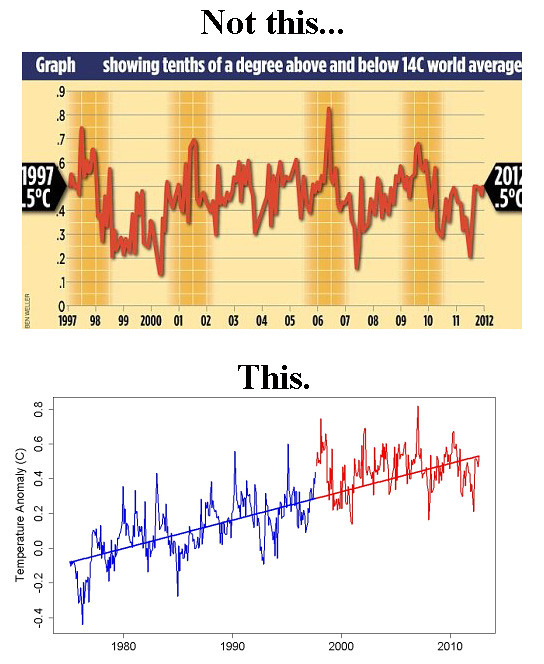
This is simply, completely, and utterly false. The Met Office is the national weather service for the United Kingdom. In October 2012, they updated their database of global surface temperature measurements, a compendium of temperatures taken over time by weather stations around the planet. David Rose, a climate change denier who can charitably be said to have trouble with facts, cherry-picked this dataset and published a horrendously misleading graph in that bastion of scientific thought, the Daily Mail, saying the measurements show there’s been no global warming for the past 16 years.

But he did this by choosing a starting point on his graph that gave the result he wanted, a graph that looks like there’s been no warming since 1997. But if you show the data properly, you see there has been warming:

Graph showing how the Earth is warming up.Global surface temperatures from the Met Office data. Top: Fiction. Bottom: Fact.

Image credit: David Rose/Daily Mail (top), Tamino (bottom).

The top graph is from Rose’s article, but the bottom graph shows what happens when you display the data going back a few more years. See the difference? What he did is like measuring how tall you are when you’re 25, doing it again when you’re 30, then claiming human beings never grow. That’s a big no-no in science. You have to choose starting and ending points that fairly represent the data, as in the bottom graph. When you do, you very clearly see the trend that the Earth is getting warmer. In fact, hammering home how patently ridiculous this claims is, nine of the 10 hottest years on record have been since 2000. On top of that, Rose was using global surface temperatures, which don’t really represent global overall heat content well; most of the heating is going into ocean waters. So the data he’s displaying so awfully isn’t even the right data to make his claim anyway!

So the very first basis of this denial letter is total garbage, and was such an egregious manipulation of the U.K. Met Office data that the Met Office itself issued a debunking of it! Yet here were are, months later, with the deniers still ignoring facts.

The letter is chock full of more such falsehoods. If you want the rundown, please go readthe great article on Skeptical Science destroying this nonsense. Full disclosure: I had already written quite a bit more for this post before seeing the one at Skeptical Science, and decided it would be better to send readers there for more rather than debunk all the wrongness here. I’m pleased to note they found the same examples of misleading or outright false statements in the deniers’ article and debunked them the same way I had.

I do want to add something, though. I’ll note that it seems superficially impressive that they got 125 scientists, “qualified in climate-related matters” as they claim, to sign this letter.

Yeah, about that…

First, not everyone signing that letter is a scientist. Lord Monckton, for example, apparently has no formal scientific training, has some trouble with the truth, and oh, by the way, claims Obama’s birth certificate is a forgery. He’s the last guy I’d want signing a letter I was on. Yet he seems to pop up on every denialist list as a go-to guy.

Here’s another: The very first signatory, Hhabibullo Abdusamatov, claims that global warming is caused by the Sun, which is patently and provably false (see that Skeptical Science link for more). Many of the claims Abdusamatov makes (as listed on his Wikipedia page) are, um, not accepted by mainstream science, to be very charitable.

Going down the list of signatories I was struck by how many are not, in fact, climate scientists (again, for examples with references, see Skeptical Science); I counted a dozen who actually have climatology in their listed credentials. It’s kinda weird to write such a big letter and then only have fewer than 10 percent of the signers actually be credentialed in the field.

Of course, I’m not a climatologist either, though I am an astronomer classically trained in science, and that means I know enough to rely on the combined research of actual climate scientists from around the world. And when thousands upon thousands of such scientists— in fact, 98 percent of actual, bona fide climate scientists—say global warming is real, well then, that strikes me as being somewhat more credible than a hundred or so politically and ideologically driven non-climate-scientists.

I’ll note this isn’t the first time a laughably-wrong article has been printed by right-leaning venues and signed by multiple, similarly-inappropriate authors. The Wall Street Journalposted one in January 2012 (while turning down an article supporting the reality of global warming signed by 255 actual scientists), and in April 2012, another made the roundsthat was signed by 49 people, including some ex-NASA astronauts, but again, none who actually were climate scientists.

So we can expect to see more of this. Clearly, when you don’t have facts to support your claims, the best thing to do is make as much noise as possible to distract from reality. And that reality is that the world is getting hotter, and unless we do something, now, we’re facing a world of trouble.

Current scientific knowledge does not substantiate Ban Ki-Moon assertions on weather and climate, say 125-plus scientists (Financial Post) + EANTH list reactions

OPEN CLIMATE LETTER TO UN SECRETARY-GENERAL: Current scientific knowledge does not substantiate Ban Ki-Moon assertions on weather and climate, say 125-plus scientists.

Special to Financial Post | Nov 29, 2012 8:36 PM ET | Last Updated:Nov 30, 2012 12:11 PM ET

Getty – UN Secretary-General Ban Ki-Moon

Policy actions that aim to reduce CO2 emissions are unlikely to influence future climate. Policies need to focus on preparation for, and adaptation to, all dangerous climatic events, however caused


Open Letter to the Secretary-General of the United Nations

H.E. Ban Ki-Moon, Secretary-General, United Nations. First Avenue and East 44th Street, New York, New York, U.S.A.

November 29, 2012

Mr. Secretary-General:

On November 9 this year you told the General Assembly: “Extreme weather due to climate change is the new normal … Our challenge remains, clear and urgent: to reduce greenhouse gas emissions, to strengthen adaptation to … even larger climate shocks … and to reach a legally binding climate agreement by 2015 … This should be one of the main lessons of Hurricane Sandy.”

On November 13 you said at Yale: “The science is clear; we should waste no more time on that debate.”

The following day, in Al Gore’s “Dirty Weather” Webcast, you spoke of “more severe storms, harsher droughts, greater floods”, concluding: “Two weeks ago, Hurricane Sandy struck the eastern seaboard of the United States. A nation saw the reality of climate change. The recovery will cost tens of billions of dollars. The cost of inaction will be even higher. We must reduce our dependence on carbon emissions.”

We the undersigned, qualified in climate-related matters, wish to state that current scientific knowledge does not substantiate your assertions.

The U.K. Met Office recently released data showing that there has been no statistically significant global warming for almost 16 years. During this period, according to the U.S. National Oceanic and Atmospheric Administration (NOAA), carbon dioxide (CO2) concentrations rose by nearly 9% to now constitute 0.039% of the atmosphere. Global warming that has not occurred cannot have caused the extreme weather of the past few years. Whether, when and how atmospheric warming will resume is unknown. The science is unclear. Some scientists point out that near-term natural cooling, linked to variations in solar output, is also a distinct possibility.

The “even larger climate shocks” you have mentioned would be worse if the world cooled than if it warmed. Climate changes naturally all the time, sometimes dramatically. The hypothesis that our emissions of CO2 have caused, or will cause, dangerous warming is not supported by the evidence.

The incidence and severity of extreme weather has not increased. There is little evidence that dangerous weather-related events will occur more often in the future. The U.N.’s own Intergovernmental Panel on Climate Change says in its Special Report on Extreme Weather (2012) that there is “an absence of an attributable climate change signal” in trends in extreme weather losses to date. The funds currently dedicated to trying to stop extreme weather should therefore be diverted to strengthening our infrastructure so as to be able to withstand these inevitable, natural events, and to helping communities rebuild after natural catastrophes such as tropical storm Sandy.

There is no sound reason for the costly, restrictive public policy decisions proposed at the U.N. climate conference in Qatar. Rigorous analysis of unbiased observational data does not support the projections of future global warming predicted by computer models now proven to exaggerate warming and its effects.

The NOAA “State of the Climate in 2008” report asserted that 15 years or more without any statistically-significant warming would indicate a discrepancy between observation and prediction. Sixteen years without warming have therefore now proven that the models are wrong by their creators’ own criterion.

Based upon these considerations, we ask that you desist from exploiting the misery of the families of those who lost their lives or properties in tropical storm Sandy by making unsupportable claims that human influences caused that storm. They did not. We also ask that you acknowledge that policy actions by the U.N., or by the signatory nations to the UNFCCC, that aim to reduce CO2 emissions are unlikely to exercise any significant influence on future climate. Climate policies therefore need to focus on preparation for, and adaptation to, all dangerous climatic events however caused.

Signed by:

  1. Habibullo I. Abdussamatov, Dr. Sci., mathematician and astrophysicist, Head of the Selenometria project on the Russian segment of the ISS, Head of Space Research of the Sun Sector at the Pulkovo Observatory of the Russian Academy of Sciences, St. Petersburg, Russia
  2. Syun-Ichi Akasofu, PhD, Professor of Physics, Emeritus and Founding Director, International Arctic Research Center of the University of Alaska, Fairbanks, Alaska, U.S.A.
  3. Bjarne Andresen, Dr. Scient., physicist, published and presents on the impossibility of a “global temperature”, Professor, Niels Bohr Institute (physics (thermodynamics) and chemistry), University of Copenhagen, Copenhagen, Denmark
  4. J. Scott Armstrong, PhD, Professor of Marketing, The Wharton School, University of Pennsylvania, Founder of the International Journal of Forecasting, focus on analyzing climate forecasts, Philadelphia, Pennsylvania, U.S.A.
  5. Timothy F. Ball, PhD, environmental consultant and former climatology professor, University of Winnipeg, Winnipeg, Manitoba, Canada
  6. James R. Barrante, Ph.D. (chemistry, Harvard University), Emeritus Professor of Physical Chemistry, Southern Connecticut State University, focus on studying the greenhouse gas behavior of CO2, Cheshire, Connecticut, U.S.A.
  7. Colin Barton, B.Sc., PhD (Earth Science, Birmingham, U.K.), FInstEng Aus Principal research scientist (ret.), Commonwealth Scientific and Industrial Research Organisation (CSIRO), Melbourne, Victoria, Australia
  8. Joe Bastardi, BSc, (Meteorology, Pennsylvania State), meteorologist, State College, Pennsylvania, U.S.A.
  9. Franco Battaglia, PhD (Chemical Physics), Professor of Physics and Environmental Chemistry, University of Modena, Italy
  10. Richard Becherer, BS (Physics, Boston College), MS (Physics, University of Illinois), PhD (Optics, University of Rochester), former Member of the Technical Staff – MIT Lincoln Laboratory, former Adjunct Professor – University of Connecticut, Areas of Specialization: optical radiation physics, coauthor – standard reference book Optical Radiation Measurements: Radiometry, Millis, MA, U.S.A.
  11. Edwin X. Berry, PhD (Atmospheric Physics, Nevada), MA (Physics, Dartmouth), BS (Engineering, Caltech), Certified Consulting Meteorologist, President, Climate Physics LLC, Bigfork, MT, U.S.A.
  12. Ian Bock, BSc, PhD, DSc, Biological sciences (retired), Ringkobing, Denmark
  13. Ahmed Boucenna, PhD, Professor of Physics (strong climate focus), Physics Department, Faculty of Science, Ferhat Abbas University, Setif, Algéria
  14. Antonio Brambati, PhD, Emeritus Professor (sedimentology), Department of Geological, Environmental and Marine Sciences (DiSGAM), University of Trieste (specialization: climate change as determined by Antarctic marine sediments), Trieste, Italy
  15. Stephen C. Brown, PhD (Environmental Science, State University of New York), District Agriculture Agent, Assistant Professor, University of Alaska Fairbanks, Ground Penetrating Radar Glacier research, Palmer, Alaska, U.S.A.
  16. Mark Lawrence Campbell, PhD (chemical physics; gas-phase kinetic research involving greenhouse gases (nitrous oxide, carbon dioxide)), Professor, United States Naval Academy, Annapolis, Maryland, U.S.A.
  17. Rudy Candler, PhD (Soil Chemistry, University of Alaska Fairbanks (UAF)), former agricultural laboratory manager, School of Agriculture and Land Resources Management, UAF, co-authored papers regarding humic substances and potential CO2 production in the Arctic due to decomposition, Union, Oregon, U.S.A.
  18. Alan Carlin, B.S. (California Institute of Technology), PhD (economics, Massachusetts Institute of Technology), retired senior analyst and manager, U.S. Environmental Protection Agency, Washington, DC, former Chairman of the Angeles Chapter of the Sierra Club (recipient of the Chapter’s Weldon Heald award for conservation work), U.S.A.
  19. Dan Carruthers, M.Sc., Arctic Animal Behavioural Ecologist, wildlife biology consultant specializing in animal ecology in Arctic and Subarctic regions, Turner Valley, Alberta, Canada
  20. Robert M. Carter, PhD, Professor, Marine Geophysical Laboratory, James Cook University, Townsville, Australia
  21. Uberto Crescenti, PhD, Full Professor of Applied Geology, Università G. d’Annunzio, Past President Società Geologica taliana, Chieti, Italy
  22. Arthur Chadwick, PhD (Molecular Biology), Research Professor of Geology, Department of Biology and Geology, Southwestern Adventist University, Climate Specialties: dendrochronology (determination of past climate states by tree ring analysis), palynology (same but using pollen as a climate proxy), paleobotany and botany; Keene, Texas, U.S.A.
  23. George V. Chilingar, PhD, Professor, Department of Civil and Environmental Engineering of Engineering (CO2/temp. focused research), University of Southern California, Los Angeles, California, U.S.A.
  24. Ian D. Clark, PhD, Professor (isotope hydrogeology and paleoclimatology), Dept. of Earth Sciences, University of Ottawa, Ottawa, Ontario, Canada
  25. Cornelia Codreanova, Diploma in Geography, Researcher (Areas of Specialization: formation of glacial lakes) at Liberec University, Czech Republic, Zwenkau, Germany
  26. Michael Coffman, PhD (Ecosystems Analysis and Climate Influences, University of Idaho), CEO of Sovereignty International, President of Environmental Perspectives, Inc., Bangor, Maine, U.S.A.
  27. Piers Corbyn, ARCS, MSc (Physics, Imperial College London)), FRAS, FRMetS, astrophysicist (Queen Mary College, London), consultant, founder WeatherAction long range weather and climate forecasters, American Thinker Climate Forecaster of The Year 2010, London, United Kingdom
  28. Richard S. Courtney, PhD, energy and environmental consultant, IPCC expert reviewer, Falmouth, Cornwall, United Kingdom
  29. Roger W. Cohen, B.S., M.S., PhD Physics, MIT and Rutgers University, Fellow, American Physical Society, initiated and managed for more than twenty years the only industrial basic research program in climate, Washington Crossing, Pennsylvania, U.S.A.
  30. Susan Crockford, PhD (Zoology/Evolutionary Biology/Archaeozoology), Adjunct Professor (Anthropology/Faculty of Graduate Studies), University of Victoria, Victoria, British Colombia, Canada
  31. Walter Cunningham, B.S., M.S. (Physics – Institute of Geophysics And Planetary Sciences,  UCLA), AMP – Harvard Graduate School of Business, Colonel (retired) U.S. Marine Corps, Apollo 7 Astronaut., Fellow – AAS, AIAA; Member AGU, Houston, Texas, U.S.A.
  32. Joseph D’Aleo, BS, MS (Meteorology, University of Wisconsin),  Doctoral Studies (NYU), CMM, AMS Fellow, Executive Director – ICECAP (International Climate and Environmental Change Assessment Project), College Professor Climatology/Meteorology, First Director of Meteorology The Weather Channel, Hudson, New Hampshire, U.S.A.
  33. David Deming, PhD (Geophysics), Professor of Arts and Sciences, University of Oklahoma, Norman, Oklahoma, U.S.A.
  34. James E. Dent; B.Sc., FCIWEM, C.Met, FRMetS, C.Env., Independent Consultant (hydrology & meteorology), Member of WMO OPACHE Group on Flood Warning, Hadleigh, Suffolk, England, United Kingdom
  35. Willem de Lange, MSc (Hons), DPhil (Computer and Earth Sciences), Senior Lecturer in Earth and Ocean Sciences, The University of Waikato, Hamilton, New Zealand
  36. Silvia Duhau, Ph.D. (physics), Solar Terrestrial Physics, Buenos Aires University, Buenos Aires, Argentina
  37. Geoff Duffy, DEng (Dr of Engineering), PhD (Chemical Engineering), BSc, ASTCDip. (first chemical engineer to be a Fellow of the Royal Society in NZ), FIChemE, wide experience in radiant heat transfer and drying, chemical equilibria, etc. Has reviewed, analysed, and written brief reports and papers on climate change, Auckland, New Zealand
  38. Don J. Easterbrook, PhD, Emeritus Professor of Geology, Western Washington, University, Bellingham, Washington, U.S.A.
  39. Ole Henrik Ellestad, former Research Director, applied chemistry SINTEF, Professor in physical chemistry, University of Oslo, Managing director Norsk Regnesentral and Director for Science and Technology, Norwegian Research Council, widely published in infrared spectroscopy, Oslo, Norway
  40. Per Engene, MSc, Biologist, Co-author – The Climate, Science and Politics (2009), Bø i Telemark, Norway
  41. Gordon Fulks, B.S., M.S., PhD (Physics, University of Chicago), cosmic radiation, solar wind, electromagnetic and geophysical phenomena, Portland, Oregon, U.S.A.
  42. Katya Georgieva, MSc (meteorology), PhD (solar-terrestrial climate physics), Professor, Space Research and Technologies Institute, Bulgarian Academy of Sciences, Sofia, Bulgaria
  43. Lee C. Gerhard, PhD, Senior Scientist Emeritus, University of Kansas, past director and state geologist, Kansas Geological Survey, U.S.A.
  44. Ivar Giaever PhD, Nobel Laureate in Physics 1973, professor emeritus at the Rensselaer Polytechnic Institute, a professor-at-large at the University of Oslo, Applied BioPhysics, Troy, New York, U.S.A.
  45. Albrecht Glatzle, PhD, ScAgr, Agro-Biologist and Gerente ejecutivo, Tropical pasture research and land use management, Director científico de INTTAS, Loma Plata, Paraguay
  46. Fred Goldberg, PhD, Adj Professor, Royal Institute of Technology (Mech, Eng.), Secretary General KTH International Climate Seminar 2006 and Climate analyst (NIPCC), Lidingö, Sweden
  47. Laurence I. Gould, PhD, Professor of Physics, University of Hartford, Past Chair (2004), New England Section of the American Physical Society, West Hartford, Connecticut, U.S.A.
  48. Vincent Gray, PhD, New Zealand Climate Coalition, expert reviewer for the IPCC, author of The Greenhouse Delusion: A Critique of Climate Change 2001, Wellington, New Zealand
  49. William M. Gray, PhD, Professor Emeritus, Dept. of Atmospheric Science, Colorado State University, Head of the Tropical Meteorology Project, Fort Collins, Colorado, U.S.A.
  50. Charles B. Hammons, PhD (Applied Mathematics), climate-related specialties: applied mathematics, modeling & simulation, software & systems engineering, Associate Professor, Graduate School of Management, University of Dallas; Assistant Professor, North Texas State University (Dr. Hammons found many serious flaws during a detailed study of the software, associated control files plus related email traffic of the Climate Research Unit temperature and other records and “adjustments” carried out in support of IPCC conclusions), Coyle, OK, U.S.A.
  51. William Happer, PhD, Professor, Department of Physics, Princeton University, Princeton, NJ, U.S.A.
  52. Hermann Harde, PhD, Professur f. Lasertechnik & Werkstoffkunde (specialized in molecular spectroscopy, development of gas sensors and CO2-climate sensitivity), Helmut-Schmidt-Universität, Universität der Bundeswehr Fakultät für Elektrotechnik, Hamburg, Germany
  53. Howard Hayden, PhD, Emeritus Professor (Physics), University of Connecticut, The Energy Advocate, Pueblo West, Colorado, U.S.A.
  54. Ross Hays, Meteorologist, atmospheric scientist, NASA Columbia Scientific Balloon Facility (currently working at McMurdo Station, Antarctica), Palestine, Texas, U.S.A.
  55. Martin Hovland, M.Sc. (meteorology, University of Bergen), PhD (Dr Philos, University of Tromsø), FGS, Emeritus Professor, Geophysics, Centre for Geobiology, University of Bergen, member of the expert panel: Environmental Protection and Safety Panel (EPSP) for the Ocean Drilling Program (ODP) and the Integrated ODP, Stavanger, Norway
  56. Ole Humlum, PhD, Professor of Physical Geography, Department of Physical Geography, Institute of Geosciences, University of Oslo, Oslo, Norway
  57. Craig D. Idso, PhD, Chairman of the Board of Directors of the Center for the Study of Carbon Dioxide and Global Change, Tempe, Arizona, U.S.A.
  58. Sherwood B. Idso, PhD, President, Center for the Study of Carbon Dioxide and Global Change, Tempe, Arizona, U.S.A.
  59. Larry Irons, BS (Geology), MS (Geology), Sr. Geophysicist at Fairfield Nodal (specialization: paleoclimate), Lakewood, Colorado, U.S.A.
  60. Terri Jackson, MSc (plasma physics), MPhil (energy economics), Director, Independent Climate Research Group, Northern Ireland and London (Founder of the energy/climate group at the Institute of Physics, London), United Kingdom
  61. Albert F. Jacobs, Geol.Drs., P. Geol., Calgary, Alberta, Canada
  62. Hans Jelbring, PhD Climatology, Stockholm University, MSc Electronic engineering, Royal Institute of Technology, BSc  Meteorology, Stockholm University, Sweden
  63. Bill Kappel, B.S. (Physical Science-Geology), B.S. (Meteorology), Storm Analysis, Climatology, Operation Forecasting, Vice President/Senior Meteorologist, Applied Weather Associates, LLC, University of Colorado, Colorado Springs, U.S.A.
  64. Olavi Kärner, Ph.D., Extraordinary Research Associate; Dept. of Atmospheric Physics, Tartu Observatory, Toravere, Estonia
  65. Leonid F. Khilyuk, PhD, Science Secretary, Russian Academy of Natural Sciences, Professor of Engineering (CO2/temp. focused research), University of Southern California, Los Angeles, California, U.S.A.
  66. William Kininmonth MSc, MAdmin, former head of Australia’s National Climate Centre and a consultant to the World Meteorological organization’s Commission for Climatology, Kew, Victoria, Australia
  67. Gerhard Kramm, Dr. rer. nat. (Theoretical Meteorology), Research Associate Professor, Geophysical Institute, Associate Faculty, College of Natural Science and Mathematics, University of Alaska Fairbanks, (climate specialties: Atmospheric energetics, physics of the atmospheric boundary layer, physical climatology – seeinteresting paper by Kramm et al), Fairbanks, Alaska, U.S.A.
  68. Leif Kullman, PhD (Physical geography, plant ecology, landscape ecology), Professor, Physical geography, Department of Ecology and Environmental science, Umeå University, Areas of Specialization: Paleoclimate (Holocene to the present), glaciology, vegetation history, impact of modern climate on the living landscape, Umeå, Sweden
  69. Hans H.J. Labohm, PhD, Independent economist, author specialised in climate issues, IPCC expert reviewer, author of Man-Made Global Warming: Unravelling a Dogma and climate science-related Blog, The Netherlands
  70. Rune Berg-Edland Larsen, PhD (Geology, Geochemistry), Professor, Dep. Geology and Geoengineering, Norwegian University of Science and Technology (NTNU), Trondheim, Norway
  71. C. (Kees) le Pair, PhD (Physics Leiden, Low Temperature Physics), former director of the Netherlands Research Organization FOM (fundamental physics) and subsequently founder and director of The Netherlands Technology Foundation STW.  Served the Dutch Government many years as member of its General Energy Council and of the National Defense Research Council. Royal Academy of Arts and Sciences Honorary Medal and honorary doctorate in all technical sciences of the Delft University of technology, Nieuwegein, The Netherlands
  72. Douglas Leahey, PhD, meteorologist and air-quality consultant, past President – Friends of Science, Calgary, Alberta, Canada
  73. Jay Lehr, B.Eng. (Princeton), PhD (environmental science and ground water hydrology), Science Director, The Heartland Institute, Chicago, Illinois, U.S.A.
  74. Bryan Leyland, M.Sc., FIEE, FIMechE, FIPENZ, MRSNZ, consulting engineer (power), Energy Issues Advisor – International Climate Science Coalition, Auckland, New Zealand
  75. Edward Liebsch, B.A. (Earth Science, St. Cloud State University); M.S. (Meteorology, The Pennsylvania State University), former Associate Scientist, Oak Ridge National Laboratory; former Adjunct Professor of Meteorology, St. Cloud State University, Environmental Consultant/Air Quality Scientist (Areas of Specialization: micrometeorology, greenhouse gas emissions), Maple Grove, Minnesota, U.S.A.
  76. William Lindqvist, PhD (Applied Geology), Independent Geologic Consultant, Areas of Specialization: Climate Variation in the recent geologic past, Tiburon, California, U.S.A.
  77. Horst-Joachim Lüdecke, Prof. Dr. , PhD (Physics), retired from university of appl. sciences HTW, Saarbrücken (Germany), atmospheric temperature research, speaker of the European Institute for Climate and Energy (EIKE), Heidelberg, Germany
  78. Anthony R. Lupo, Ph.D., Professor of Atmospheric Science, Department of Soil, Environmental, and Atmospheric Science, University of Missouri, Columbia, Missouri, U.S.A.
  79. Oliver Manuel, BS, MS, PhD, Post-Doc (Space Physics), Associate – Climate & Solar Science Institute, Emeritus Professor, College of Arts & Sciences University of Missouri-Rolla, previously Research Scientist (US Geological Survey) and NASA Principal Investigator for Apollo, Cape Girardeau, Missouri, U.S.A.
  80. Francis Massen, professeur-docteur en physique (PhD equivalent, Universities of Nancy (France) and Liège (Belgium), Manager of the Meteorological Station of the Lycée Classique de Diekirch, specialising in the measurement of solar radiation and atmospheric gases. Collaborator to the WOUDC (World Ozone and UV Radiation Data Center), Diekirch, Luxembourg
  81. Henri Masson, Prof. dr. ir., Emeritus Professor University of Antwerp (Energy & Environment Technology Management), Visiting professor Maastricht School of Management, specialist in dynamical (chaotic) complex system analysis, Antwerp, Belgium.
  82. Ferenc Mark Miskolczi, PhD, atmospheric physicist, formerly of NASA’s Langley Research Center, Hampton, Virginia, U.S.A.
  83. Viscount Monckton of Brenchley, Expert reviewer, IPCC Fifth Assessment Report, Quantification of Climate Sensitivity, Carie, Rannoch, Scotland
  84. Nils-Axel Mörner, PhD (Sea Level Changes and Climate), Emeritus Professor of Paleogeophysics & Geodynamics, Stockholm University, Stockholm, Sweden
  85. John Nicol, PhD (Physics, James Cook University), Chairman – Australian climate Science Coalition, Brisbane, Australia
  86. Ingemar Nordin, PhD, professor in philosophy of science (including a focus on “Climate research, philosophical and sociological aspects of a politicised research area”), Linköpings University, Sweden.
  87. David Nowell, M.Sc., Fellow of the Royal Meteorological Society, former chairman of the NATO Meteorological Group, Ottawa, Ontario, Canada
  88. Cliff Ollier, D.Sc., Professor Emeritus (School of Earth and Environment – see hisCopenhagen Climate Challenge sea level article here), Research Fellow, University of Western Australia, Nedlands, W.A., Australia
  89. Oleg M. Pokrovsky, BS, MS, PhD (mathematics and atmospheric physics – St. Petersburg State University, 1970), Dr. in Phys. and Math Sciences (1985), Professor in Geophysics (1995), principal scientist, Main Geophysical Observatory (RosHydroMet), Note: Dr. Pokrovsky analyzed long climates and concludes that anthropogenic CO2 impact is not the main contributor in climate change,St. Petersburg, Russia.
  90. Daniel Joseph Pounder, BS (Meteorology, University of Oklahoma), MS (Atmospheric Sciences, University of Illinois, Urbana-Champaign); Meteorological/Oceanographic Data Analyst for the National Data Buoy Center, formerly Meteorologist, WILL AM/FM/TV, Urbana, U.S.A.
  91. Brian Pratt, PhD, Professor of Geology (Sedimentology), University of Saskatchewan (see Professor Pratt’s article for a summary of his views), Saskatoon, Saskatchewan, Canada
  92. Harry N.A. Priem, PhD, Professore-emeritus isotope-geophysics and planetary geology, Utrecht University, past director ZWO/NOW Institute of Isotope Geophysical Research, Past-President Royal Netherlands Society of Geology and Mining, Amsterdam, The Netherlands
  93. Oleg Raspopov, Doctor of Science and Honored Scientist of the Russian Federation, Professor – Geophysics, Senior Scientist, St. Petersburg Filial (Branch) of N.V.Pushkov Institute of Terrestrial Magnetism, Ionosphere and Radiowaves Propagation of RAS (climate specialty: climate in the past, particularly the influence of solar variability), Editor-in-Chief of journal “Geomagnetism and Aeronomy” (published by Russian Academy of Sciences), St. Petersburg, Russia
  94. Curt G. Rose, BA, MA (University of Western Ontario), MA, PhD (Clark University), Professor Emeritus, Department of Environmental Studies and Geography, Bishop’s University, Sherbrooke, Quebec, Canada
  95. S. Jeevananda Reddy, M.Sc. (Geophysics), Post Graduate Diploma (Applied Statistics, Andhra University), PhD (Agricultural Meteorology, Australian University, Canberra), Formerly Chief Technical Advisor—United Nations World Meteorological Organization (WMO) & Expert-Food and Agriculture Organization (UN), Convener – Forum for a Sustainable Environment, author of 500 scientific articles and several books – here is one: “Climate Change – Myths & Realities“, Hyderabad, India
  96. Arthur Rorsch, PhD, Emeritus Professor, Molecular Genetics, Leiden University, former member of the board of management of the Netherlands Organization Applied Research TNO, Leiden, The Netherlands
  97. Rob Scagel, MSc (forest microclimate specialist), Principal Consultant – Pacific Phytometric Consultants, Surrey, British Columbia, Canada
  98. Chris Schoneveld, MSc (Structural Geology), PhD (Geology), retired exploration geologist and geophysicist, Australia and France
  99. Tom V. Segalstad, PhD (Geology/Geochemistry), Associate Professor of Resource and Environmental Geology, University of Oslo, former IPCC expert reviewer, former Head of the Geological Museum, and former head of the Natural History Museum and Botanical Garden (UO), Oslo, Norway
  100. John Shade, BS (Physics), MS (Atmospheric Physics), MS (Applied Statistics), Industrial Statistics Consultant, GDP, Dunfermline, Scotland, United Kingdom
  101. Thomas P. Sheahen, B.S., PhD (Physics, Massachusetts Institute of Technology), specialist in renewable energy, research and publication (applied optics) in modeling and measurement of absorption of infrared radiation by atmospheric CO2,  National Renewable Energy Laboratory (2005-2009); Argonne National Laboratory (1988-1992); Bell Telephone labs (1966-73), National Bureau of Standards (1975-83), Oakland, Maryland, U.S.A.
  102. S. Fred Singer, PhD, Professor Emeritus (Environmental Sciences), University of Virginia, former director, U.S. Weather Satellite Service, Science and Environmental Policy Project, Charlottesville, Virginia, U.S.A.
  103. Frans W. Sluijter, Prof. dr ir, Emeritus Professor of theoretical physics, Technical University Eindhoven, Chairman—Skepsis Foundation, former vice-president of the International Union of Pure and Applied Physics, former President of the Division on Plasma Physics of the European Physical Society and former bureau member of the Scientific Committee on Sun-Terrestrial Physics, Euvelwegen, the Netherlands
  104. Jan-Erik Solheim, MSc (Astrophysics), Professor, Institute of Physics, University of Tromsø, Norway (1971-2002), Professor (emeritus), Institute of Theoretical Astrophysics, University of Oslo, Norway (1965-1970, 2002- present), climate specialties: sun and periodic climate variations, scientific paper by Professor Solheim “Solen varsler et kaldere tiår“, Baerum, Norway
  105. H. Leighton Steward, Master of Science (Geology), Areas of Specialization: paleoclimates and empirical evidence that indicates CO2 is not a significant driver of climate change, Chairman, PlantsNeedCO2.org and CO2IsGreen.org, Chairman of the Institute for the Study of Earth and Man (geology, archeology & anthropology) at SMU in Dallas, Texas, Boerne, TX, U.S.A.
  106. Arlin B. Super, PhD (Meteorology – University of Wisconsin at Madison), former Professor of Meteorology at Montana State University, retired Research Meteorologist, U.S. Bureau of Reclamation, Saint Cloud, Minnesota, U.S.A.
  107. Edward (Ted) R. Swart, D.Sc. (physical chemistry, University of Pretoria), M.Sc. and Ph.D. (math/computer science, University of Witwatersrand). Formerly Director of the Gulbenkian Centre, Dean of the Faculty of Science, Professor and Head of the Department of Computer Science, University of Rhodesia and past President of the Rhodesia Scientific Association. Set up the first radiocarbon dating laboratory in Africa. Most recently, Professor in the Department of Combinatorics and Optimization at the University of Waterloo and Chair of Computing and Information Science and Acting Dean at the University of Guelph, Ontario, Canada, now retired in Kelowna British Columbia, Canada
  108. George H. Taylor, B.A. (Mathematics, U.C. Santa Barbara), M.S. (Meteorology, University of Utah), Certified Consulting Meteorologist, Applied Climate Services, LLC, Former State Climatologist (Oregon), President, American Association of State Climatologists (1998-2000), Corvallis, Oregon, U.S.A.
  109. J. E. Tilsley, P.Eng., BA Geol, Acadia University, 53 years of climate and paleoclimate studies related to development of economic mineral deposits, Aurora, Ontario, Canada
  110. Göran Tullberg, Civilingenjör i Kemi (equivalent to Masters of Chemical Engineering), Co-author – The Climate, Science and Politics (2009) (see here for a review), formerly instructor of Organic Chemistry (specialization in “Climate chemistry”), Environmental Control and Environmental Protection Engineering at University in Växjö; Falsterbo, Sweden
  111. Brian Gregory Valentine, PhD, Adjunct professor of engineering (aero and fluid dynamics specialization) at the University of Maryland, Technical manager at US Department of Energy, for large-scale modeling of atmospheric pollution, Technical referee for the US Department of Energy’s Office of Science programs in climate and atmospheric modeling conducted at American Universities and National Labs, Washington, DC, U.S.A.
  112. Bas van Geel, PhD, paleo-climatologist, Institute for Biodiversity and Ecosystem Dynamics, Research Group Paleoecology and Landscape Ecology, Faculty of Science, Universiteit van Amsterdam, Amsterdam, The Netherlands
  113. Gerrit J. van der Lingen, PhD (Utrecht University), geologist and paleoclimatologist, climate change consultant, Geoscience Research and Investigations, Nelson, New Zealand
  114. A.J. (Tom) van Loon, PhD, Professor of Geology (Quaternary Geologyspecialism: Glacial Geology), Adam Mickiewicz University, former President of the European Association of Science Editors Poznan, Poland
  115. Fritz Vahrenholt, B.S. (chemistry), PhD (chemistry), Prof. Dr., Professor of Chemistry, University of Hamburg, Former Senator for environmental affairs of the State of Hamburg, former CEO of REpower Systems AG (wind turbines), Author of the book Die kalte Sonne: warum die Klimakatastrophe nicht stattfindet (The Cold Sun: Why the Climate Crisis Isn’t Happening”, Hamburg, Germany
  116. Michael G. Vershovsky, Ph.D. in meteorology (macrometeorology, long-term forecasts, climatology), Senior Researcher, Russian State Hydrometeorological University, works with, as he writes, “Atmospheric Centers of Action (cyclones and anticyclones, such as Icelandic depression, the South Pacific subtropical anticyclone, etc.). Changes in key parameters of these centers strongly indicate that the global temperature is influenced by these natural factors (not exclusively but nevertheless)”, St. Petersburg, Russia
  117. Gösta Walin, PhD and Docent (theoretical Physics, University of Stockholm), Professor Emeritus in oceanografi, Earth Science Center, Göteborg University, Göteborg,  Sweden
  118. Anthony Watts, ItWorks/IntelliWeather, Founder, surfacestations.orgWatts Up With That, Chico, California, U.S.A.
  119. Carl Otto Weiss, Direktor und Professor at Physikalisch-Technische Bundesanstalt,  Visiting Professor at University of Copenhagen, Tokyo Institute of Technology, Coauthor of ”Multiperiodic Climate Dynamics: Spectral Analysis of…“, Braunschweig, Germany
  120. Forese-Carlo Wezel, PhD, Emeritus Professor of Stratigraphy (global and Mediterranean geology, mass biotic extinctions and paleoclimatology), University of Urbino, Urbino, Italy
  121. Boris Winterhalter, PhD, senior marine researcher (retired), Geological Survey of Finland, former professor in marine geology, University of Helsinki, Helsinki, Finland
  122. David E. Wojick, PhD,  PE, energy and environmental consultant, Technical Advisory Board member – Climate Science Coalition of America, Star Tannery, Virginia, U.S.A.
  123. George T. Wolff, Ph.D., Principal Atmospheric Scientist, Air Improvement Resource, Inc., Novi, Michigan, U.S.A.
  124. Thomas (Tom) Wysmuller –NASA (Ret) ARC, GSFC, Hdq. – Meteorologist, Ogunquit, ME, U.S.A.
  125. Bob Zybach, PhD (Environmental Sciences, Oregon State University), climate-related carbon sequestration research, MAIS, B.S., Director, Environmental Sciences Institute Peer review Institute, Cottage Grove, Oregon, U.S.A.
  126. Milap Chand Sharma, PhD, Associate Professor of Glacial Geomorphology, Centre fort the Study of Regional Development, Jawaharlal Nehru University, New Delhi, India
  127. Valentin A. Dergachev, PhD, Professor and Head of the Cosmic Ray Laboratory at Ioffe Physical-Technical Institute of Russian Academy of Sciences, St. Petersburg, Russia
  128. Vijay Kumar Raina, Ex-Deputy Director General, Geological Survey of India, Ex-Chairman Project Advisory and Monitoring Committee on Himalayan glacier, DST, Govt. of India and currently Member Expert Committee on Climate Change Programme, Dept. of Science & Technology, Govt. of India, author of 2010 MoEF Discussion Paper, “Himalayan Glaciers – State-of-Art Review of Glacial Studies, Glacial Retreat and Climate Change”, the first comprehensive study on the region.  Winner of the Indian Antarctica Award, Chandigarh, India
  129. Scott Chesner, B.S. (Meteorology, Penn State University), KETK Chief Meteorologist, KETK TV, previously Meteorologist with Accu Weather, Tyler, Texas, U.S.A

*   *   *

Reactions (I will not mention names here; all are from emails in the EANTH list)

1) “Hmm, I clicked on a few links, googled a few names. Found that when one is listed as “author of x book”, said book doesn’t appear on Amazon, etc.

Many non-PhDs.

Many “consultants”. Losts of “adjuncts”, lots of professor emeriti. someone listed as an “Extraordinary Research Associate”.

Little actual data. Few peer-reviewed research reports.

Didn’t recognize most of the names. Did recognize some “suspicious” ones (e.g., Tim Ball, a lovely [sic] Canadian).

Misrepresentation of the SREX report (quotation is a minor comment on a single point of many – page 280 of 594).

Link is to a letter published in the Financial Post, the business section of the National Post, the more rightward leaning of Canada’s 2 national papers. To give an indication, on the day in 2007 when the Nobel was awarded to IPCC and Gore, the headline on front page was “A Coup for Junk Science: Gaffe riddled work undeserving”.

Conclusion: don’t bother to click the link.”


2) “A few of the names on the list are also contained in table 3 of the 2012 Heartland Institute Proposed Budget (pages 7-8). Namely:

Craig D. Idso

Anthony Lupo

Susan Crockford

Joseph D’Aleo

Fred Singer

Robert Carter

Link:

http://www.desmogblog.com/sites/beta.desmogblog.com/files/(1-15-2012)%202012%20Heartland%20Budget.pdf


3) “Is it that bad guys without phd and associations with the wrong institutions nullify the legitimacy of the good guys with proper credentials? Suppose you could not look them up. Would you be unable to judge the contents (with links to data) of the letter? You seem to require a certain kind of authority (defined by political means especially) to allow you to decide whether ideas are valuable. How sad. If every scientist were that intellectually timid there would be no learning. Thank goodness for the Feynmans of the world.”


4) “Short of being able to read, review and test all the science, a person has to make judgements based on additional criteria. My criteria include, but are not limited to, some things such as peer-review, credentials, reputation, availability of cited sources/affiliation/expertise, guilt-by-association, and so on. They are only part of the judgement of credibility. I looked up a book listed in the credentials of one “expert” and could not find it; I followed links, and so on.

The endpoint was when I looked for the quotation in the cited source (SREX) and evaluated it as misrepresentation. Since the IPCC was called on as an expert source by the so-called experts, yet it claimed other than what they claimed it claimed, the credibility of the letters and listed experts is to be disparaged.

That’s the character of science, and process of knowledge. Yup, that is how one really, really does judge which ideas are valuable.”


5) “Thank you for drawing attention to this open letter. I suspect quite a number of the people named in this letter are members of naysayer groups. From an Australian perspective Prof Bob Carter is a member of the secretive  Lavoissier group. I have inside knowledge of this group as I was approached with my husband to write a film script about climate change many years ago and we pulled out eventually after being told what they wanted to say about the science of climate change, which required a distortion of the facts. We had the impression that the money for the film was coming from America and I wouldn’t mind betting that it was oil and mining interest finance ($6 million). The person who set out to recruit us was a glaciologist who was also a member of the Lavoissier group. For more information see the following:

Pearse, Guy , “High and Dry”, Viking/Penguin,Camberwell, Victoria, 2007.
Hamilton, Clive, “Scorcher: The Dirty Politics of Climate Change, Black Inc. Agenda, Melbourne, Victoria, 2007.”


6) “I read a short and entertaining book that laid out a good process for deciding what to believe about climate change (or any other complex issue with lots of scientific research swirling around). It’s by Greg Craven and it’s called What’s the Worst That Could Happen?

Besides providing a way to cut through all the chatter, the book offers sound fundamentals for people interested in how scientific information comes to be accepted. I think it’s a great book for students, especially because the author (a physics teacher) tackles tough subjects with humor.

Here’s a link to it: http://www.amazon.com/Whats-Worst-That-Could-Happen/dp/0399535012/

The State of Climate Science (scienceprogress.org)

CLIMATE SCIENCE

A Thorough Review of the Scientific Literature on Global Warming

By Dr. James Powell | Thursday, November 15th, 2012

Polls show that many members of the public believe that scientists substantially disagree about human-caused global warming. The gold standard of science is the peer-reviewed literature. If there is disagreement among scientists, based not on opinion but on hard evidence, it will be found in the peer-reviewed literature.

I searched the Web of Science, an online science publication tool, for peer-reviewed scientific articles published between January first 1991 and November 9th 2012 that have the keyword phrases “global warming” or “global climate change.” The search produced 13,950 articles. See methodology.

I read whatever combination of titles, abstracts, and entire articles was necessary to identify articles that “reject” human-caused global warming. To be classified as rejecting, an article had to clearly and explicitly state that the theory of global warming is false or, as happened in a few cases, that some other process better explains the observed warming. Articles that merely claimed to have found some discrepancy, some minor flaw, some reason for doubt, I did not classify as rejecting global warming.

Articles about methods, paleoclimatology, mitigation, adaptation, and effects at least implicitly accept human-caused global warming and were usually obvious from the title alone. John Cook and Dana Nuccitelli also reviewed and assigned some of these articles; John provided invaluable technical expertise.

This work follows that of Oreskes (Science, 2005) who searched for articles published between 1993 and 2003 with the keyword phrase “global climate change.” She found 928, read the abstracts of each and classified them. None rejected human-caused global warming. Using her criteria and time-span, I get the same result. Deniers attacked Oreskes and her findings, but they have held up.

Some articles on global warming may use other keywords, for example, “climate change” without the “global” prefix. But there is no reason to think that the proportion rejecting global warming would be any higher.

By my definition, 24 of the 13,950 articles, 0.17 percent or 1 in 581, clearly reject global warming or endorse a cause other than CO2 emissions for observed warming. The list of articles that reject global warming is here.

The 24 articles have been cited a total of 113 times over the nearly 21-year period, for an average of close to 5 citations each. That compares to an average of about 19 citations for articles answering to “global warming,” for example. Four of the rejecting articles have never been cited; four have citations in the double-digits. The most-cited has 17.

Of one thing we can be certain: had any of these articles presented the magic bullet that falsifies human-caused global warming, that article would be on its way to becoming one of the most-cited in the history of science.

The articles have a total of 33,690 individual authors. The top ten countries represented, in order, are USA, England, China, Germany, Japan, Canada, Australia, France, Spain, and Netherlands. (The chart shows results through November 9th, 2012.)

Global warming deniers often claim that bias prevents them from publishing in peer-reviewed journals. But 24 articles in 18 different journals, collectively making several different arguments against global warming, expose that claim as false. Articles rejecting global warming can be published, but those that have been have earned little support or notice, even from other deniers.

A few deniers have become well known from newspaper interviews, Congressional hearings, conferences of climate change critics, books, lectures, websites and the like. Their names are conspicuously rare among the authors of the rejecting articles. Like those authors, the prominent deniers must have no evidence that falsifies global warming.

Anyone can repeat this search and post their findings. Another reviewer would likely have slightly different standards than mine and get a different number of rejecting articles. But no one will be able to reach a different conclusion, for only one conclusion is possible: Within science, global warming denial has virtually no influence. Its influence is instead on a misguided media, politicians all-too-willing to deny science for their own gain, and a gullible public.

Scientists do not disagree about human-caused global warming. It is the ruling paradigm of climate science, in the same way that plate tectonics is the ruling paradigm of geology. We know that continents move. We know that the earth is warming and that human emissions of greenhouse gases are the primary cause. These are known facts about which virtually all publishing scientists agree.

James Lawrence Powell is the author of The Inquisition of Climate Science. Powell is also the executive director of the National Physical Science Consortium, a partnership among government agencies and laboratories, industry, and higher education dedicated to increasing the number of American citizens with graduate degrees in the physical sciences and related engineering fields. This article is cross-posted with permission with the Columbia University Press blog.

This article is a cross-post with our partners at DeSmogBlog.

Saúde mental, outra vítima da mudança climática (IPS)

23/11/2012 – 10h05

por Patricia Grogg, da IPS

clima Saúde mental, outra vítima da mudança climática

As tensões e angústias acompanham toda pessoa que sofre um desastre. Foto: Jorge Luis Baños/IPS

Santiago de Cuba, Cuba, 23/11/2012 – “A cidade parecia bombardeada. Caminho para meu escritório, cruzo com pessoas que levavam em seus rostos o mesmo – diria dramático – espanto que eu. Nos olhávamos e, sem nos conhecermos, nos perguntávamos: como foi com você? Aconteceu alguma coisa com sua casa? Foi uma solidariedade afetiva muito importante para mim”. Este testemunho dado à IPS, por uma jornalista de Santiago de Cuba, coloca na balança um dos lados bons da reação coletiva após um desastre como o sofrido por esta cidade na madrugada do dia 25 de outubro, quando o furacão Sandy, apesar do alerta meteorológico e das advertências oficiais, surpreendeu boa parte de seus habitantes.

O valor econômico dos prejuízos ainda são desconhecidos hoje, quando a parte mais oriental do país cura suas feridas, graves de todos os ângulos. Mas existe também o impacto psicológico, do qual se fala menos e se vê nos olhos das pessoas quando contam: “perdemos nossa casa com móveis, eletrodomésticos, até as lembranças”. “Tive muito medo, me enfiei no armário quando o vento levou o telhado do meu quarto. Meus vizinhos me tiraram de casa e me ajudaram a atravessar a rua até onde haviam se refugiado outras famílias cujas casas estavam em muito mau estado”, contou à IPS Isabel da Cruz, de 70 anos, moradora de Guantânamo, outra área afetada.

Depressão, tristeza, angústia, desespero, incerteza e agressividade, todas estas são manifestações que acompanham as pessoas depois de um desastre em qualquer parte do mundo. “Imagine, nos deitamos com a bela e acordamos com a fera”, comparou um trabalhador do setor turístico cujo hotel onde é empregado foi totalmente destruído. “As pessoas estão deprimidas e desorientadas. Em muitas nota-se o desequilíbrio psíquico pelas perdas sofridas”, disse à IPS o sacerdote católico Eugenio Castellanos, reitor do Santuário da Caridad del Cobre, virgem padroeira de Cuba. O padre estima que 90% das casas do Cobre, localidade vizinha a esta cidade, sofreram o impacto do Sandy.

Juan González Pérez, por sua vez, disse à IPS que dias antes do furacão houve focos de violência em alguns lugares, especialmente na hora de comprar artigos em falta. “Ficamos muitos dias sem energia elétrica e começaram a vender ‘luz brilhante’ (querosene) para cozinhar. Embora houvesse o suficiente para todos, aconteceram discussões e brigas na fila. Quando as pessoas se desesperam, costumam ficar agressivas”, observou Pérez, mais conhecido por Madelaine, líder do espiritismo cruzado “muertero”, uma expressão de religiosidade popular nesse lugar. Segundo contou, aconselha aos seus seguidores “unirem-se, se lavar bem, dar a quem não tem e não se desesperar”.

Em Mar Verde, a praia por onde o Sandy tocou o território cubano a 15 quilômetros de Santiago, a médica Elizabeth Martínez atende mais de cem pessoas, abrigadas em cabanas de veraneio que, por estarem mais afastadas do mar, se salvaram do desastre. “O impacto psicológico é grande, mas não houve mortes e nem temos pessoas doentes”, contou. Pouco mais de uma semana depois da passagem do furacão, os esforços em matéria de saúde se concentravam fundamentalmente em conter focos epidêmicos. “Estamos dando informações sanitárias aos moradores, ensinando como cuidar de doenças transmissíveis, sobre a importância de descontaminar a água antes de beber”, informou a médica.

Segundo meios especializados, estima-se que entre um terço e metade de uma população exposta a desastres sofre algum tipo de problema psicológico, embora na maioria dos casos se deva entender como reações normais diante de eventos extremos, que sob o impacto da mudança climática ameaçam aumentar em intensidade.

“Quando encontrei meus vizinhos no abrigo, estávamos em choque. Mas alguém disse: vamos limpar a entrada que está bloqueada por essas árvores caídas. Então, começamos a trabalhar, embora no começo ninguém falasse”, contou uma mulher do setor turístico. Nos primeiros dias era possível ver muitas pessoas recolhendo escombros e varrendo as ruas de suas vizinhanças.

Diante da frequência e da maior intensidade dos ciclones tropicais, as autoridades de saúde, desde a década de 1990, começaram a se preocupar com o impacto psicológico dos desastres causados por esses e outros fenômenos naturais. Em 2008, quando o país sofreu três furacões, uma indicação ministerial fortaleceu a inclusão do tema nos planos sanitários. Em um artigo sobre o assunto, o médico cubano Alexis Lorenzo Ruiz explica que os aspectos psicossociais dos desastres são considerados tanto na capacitação do pessoal como na organização dos programas que chegam a todo o país e enfatizam a atenção a setores mais vulneráveis, como menores de idade, adolescentes e idosos.

Do ponto de vista da saúde mental, nos desastres toda a população “sofre tensões e angústias em maior ou menor medida, direta ou indiretamente”, afirmaram Katia Villamil e Orlando Fleitas, que recomendaram não se esquecer que o impacto nessas circunstâncias é mais acentuado em populações de escassos recursos. Estes profissionais afirmam que as reações mais frequentes vão desde as consideradas normais, como ansiedade controlável, depressão leve ou quadros “histeriformes”, até estresse “peritraumático”, embotamento, redução do nível de atenção, descompensação de transtornos psiquiátricos pré-existentes, bem como “reação coletiva de agitação”.

O furacão Sandy causou estragos não apenas em Santiago de Cuba, mas também nas províncias de Guantânamo e Holguín, com saldo de 11 mortos. O governo de Raúl Castro ainda não divulgou as perdas econômicas, embora dados preliminares e incompletos dos primeiros dias indicassem uma estimativa de US$ 88 milhões.

Call to Modernize Antiquated Climate Negotiations (Science Daily)

ScienceDaily (Nov. 18, 2012) — The structure and processes of United Nations climate negotiations are “antiquated,” unfair and obstruct attempts to reach agreements, according to research published November 18.

The findings come ahead of the 18thUN Climate Change Summit, which starts in Doha on November 26.

The study, led by Dr Heike Schroeder from the University of East Anglia (UEA) and the Tyndall Centre for Climate Change Research, argues that the consensus-based decision making used by the United Nations Framework Convention on Climate Change (UNFCCC) stifles progress and contributes to negotiating deadlocks, which ultimately hurts poor countries more than rich countries.

It shows that delegations from some countries taking part have increased in size over the years, while others have decreased, limiting poor countries’ negotiating power and making their participation less effective.

Writing in the journal Nature Climate Change, Dr Schroeder, Dr Maxwell Boykoff of the University of Colorado and Laura Spiers of Pricewaterhouse Coopers, argue that changes are long overdue if demands for climate mitigation and adaptation agreements are to be met.

They recommend that countries consider capping delegation numbers at a level that allows broad representation across government departments and sectors of society, while maintaining a manageable overall size.

Dr Schroeder, of UEA’s School of International Development, will be attending COP18. She said: “The UN must recognize that these antiquated structures serve to constrain rather than compel co-operation on international climate policy. The time is long overdue for changes to institutions and structures that do not support decision-making and agreements.

“Poor countries cannot afford to send large delegations and their level of expertise usually remains significantly below that of wealthier countries. This limits poor countries’ negotiating power and makes their participation in each session less effective.”

The researchers found that attendance has changed in terms of the number and diversity of representatives. The number of delegates went from 757 representing 170 countries at the first COP in 1995 to 10,591 individuals from 194 countries attending COP15 in 2009 — a 1400 per cent increase. At COP15 there were also 13,500 delegates from 937 non-government Observer organisations.

Small developing countries have down-sized their delegations while G-7 and +5 countries (Brazil, China, India, Mexico, and South Africa) have increased theirs. The exception is the United States, which after withdrawing from the Kyoto Protocol started to send fewer delegates to COPs.

The study also looked at the make-up of the delegations and found an increase in participation by environmental, campaigning, academic and other non-Governmental organisations.

“Our work shows an increasing trend in the size of delegations on one side and a change in the intensity, profile and politicization of the negotiations on the other,” explained Dr Schroeder. “These variations suggest the climate change issue and its associated interests are framed quite differently across countries. NSAs are well represented on national delegations but clearly the government decides who is included and who is not, and what the official negotiating position of the country and its level of negotiating flexibility are.”

Some countries send large representations from business associations (Brazil), local government (Canada) orscience and academia (Russia). For small developing countries such as Bhutan and Gabon the majority of government representatives come from environment, forestry and agriculture. The UK has moved from mainly environment, forestry and agriculture to energy and natural resources. The US has shifted from these more conventional areas to an overwhelming representation from the US Congress at COP15.

Journal Reference:

  1. Heike Schroeder, Maxwell T. Boykoff, Laura Spiers. Equity and state representations in climate negotiations.Nature Climate Change, 2012; DOI: 10.1038/nclimate1742

Government, Industry Can Better Manage Risks of Very Rare Catastrophic Events, Experts Say (Science Daily)

ScienceDaily (Nov. 15, 2012) — Several potentially preventable disasters have occurred during the past decade, including the recent outbreak of rare fungal meningitis linked to steroid shots given to 13,000 patients to relieve back pain. Before that, the 9/11 terrorist attacks in 2001, the Space Shuttle Columbia explosion in 2003, the financial crisis that started in 2008, the Deepwater Horizon accident in the Gulf of Mexico in 2011, and the Fukushima tsunami and ensuing nuclear accident also in 2011 were among rare and unexpected disasters that were considered extremely unlikely or even unthinkable.

A Stanford University engineer and risk management expert has analyzed the phenomenon of government and industry waiting for rare catastrophes to happen before taking risk management steps. She concluded that a different approach to these events would go far towards anticipating them, preventing them or limiting the losses.

To examine the risk management failures discernible in several major catastrophes, the research draws upon the combination of systems analysis and probability as used, for example, in engineering risk analysis. When relevant statistics are not available, it discusses the powerful alternative of systemic risk analysis to try to anticipate and manage the risks of highly uncertain, rare events. The paper by Stanford University researcher Professor Elisabeth Paté-Cornell recommends “a systematic risk analysis anchored in history and fundamental knowledge” as opposed to both industry and regulators sometimes waiting until after a disaster occurs to take safety measures as was the case, for example, of the Deepwater Horizon accident in 2011. Her paper, “On ‘Black Swans’ and ‘Perfect Storms’: Risk Analysis and Management When Statistics Are Not Enough,” appears in the November 2012 issue of Risk Analysis, published by the Society for Risk Analysis.

Paté-Cornell’s paper draws upon two commonly cited images representing different types of uncertainty — “black swans” and “perfect storms” — that are used both to describe extremely unlikely but high-consequence events and often to justify inaction until after the fact. The uncertainty in “perfect storms” derives mainly from the randomness of rare but known events occurring together. The uncertainty in “black swans” stems from the limits of fundamental understanding of a phenomenon, including in extreme cases, a complete lack of knowledge about its very existence.

Given these two extreme types of uncertainties, Paté-Cornell asks what has been learned about rare events in engineering risk analysis that can be incorporated in other fields such as finance or medicine. She notes that risk management often requires “an in-depth analysis of the system, its functions, and the probabilities of its failure modes.” The discipline confronts uncertainties by systematic identification of failure “scenarios,” including rare ones, using “reasoned imagination,” signals (new intelligence information, medical alerts, near-misses and accident precursors) and a set of analytical tools to assess the chances of events that have not happened yet. A main emphasis of systemic risk analysis is on dependencies (of failures, human errors, etc.) and on the role of external factors, such as earthquakes and tsunamis that become common causes of failure.

The “risk of no risk analysis” is illustrated by the case of the 14 meter Fukushima tsunami resulting from a magnitude 9 earthquake. Historical records showed that large tsunamis had occurred at least twice before in the same area. The first time was the Sanriku earthquake in the year 869, which was estimated at magnitude 8.6 with a tsunami that penetrated 4 kilometers inland. The second was the Sanriku earthquake of 1611, estimated at magnitude 8.1 that caused a tsunami with an estimated maximum wave height of about 20 meters. Yet, those previous events were not factored into the design of the Fukushima Dai-ichi nuclear reactor, which was built for a maximum wave height of 5.7 meters, simply based on the tidal wave caused in that area by the 1960 earthquake in Chile. Similar failures to capture historical data and various “signals” occurred in the cases of the 9/11 attacks, the Columbia Space Shuttle explosion and other examples analyzed in the paper.

The risks of truly unimaginable events that have never been seen before (such as the AIDS epidemics) cannot be assessed a priori, but careful and systematic monitoring, signals observation and a concerted response are keys to limiting the losses. Other rare events that place heavy pressure on human or technical systems are the result of convergences of known events (“perfect storms”) that can and should be anticipated. Their probabilities can be assessed using a set of analytical tools that capture dependencies and dynamics in scenario analysis. Given the results of such models, there should be no excuse for failing to take measures against rare but predictable events that have damaging consequences, and to react to signals, even imperfect ones, that something new may be unfolding.

Journal Reference:

  1. Elisabeth Paté-Cornell. On “Black Swans” and “Perfect Storms”: Risk Analysis and Management When Statistics Are Not EnoughRisk Analysis, 2012; DOI:10.1111/j.1539-6924.2011.01787.x

Estudo aumenta precisão ao simular clima (Folha de São Paulo)

JC e-mail 4621, de 09 de Novembro de 2012.

Americanos conseguiram método indireto para levar em conta o papel das nuvens no aquecimento do planeta. Metodologia criada por eles indica que o mais provável neste século é que temperatura média aumente perto de 4º C.

Pesquisadores americanos acabam de achar um meio de determinar quais modelos da mudança climática parecem ser os mais precisos. E a má notícia: os melhores são os que predizem modificações mais drásticas no clima para as próximas décadas.

O segredo do trabalho, conduzido por John Fasullo e Kevin Trenberth, do Centro Nacional Para Pesquisa Atmosférica em Boulder, Colorado, foi se concentrar naquilo que se podia ver -no caso, a umidade relativa em regiões subtropicais- para compreender o que é muito mais difícil de medir: a dinâmica das nuvens.

As nuvens são um dos elementos-chave na interpretação do fenômeno do aquecimento global. Isso porque elas têm um efeito duplo. Por um lado, por serem claras, elas refletem a luz solar para o espaço, resultando em resfriamento. Por outro, o vapor d’água nelas é um poderoso gás do efeito estufa, podendo gerar aquecimento.

Os modelos de computador têm dificuldade em lidar com as nuvens e seu papel na evolução do clima.

Incerteza, em termos – Já é possível simular, ao menos em parte, o efeito delas, e existe um consenso mais ou menos claro de que a soma de tudo que elas fazem resulta em suave resfriamento. Entretanto, ainda há muita incerteza sobre o que isso significa para o futuro.

Tal incerteza é o grande mal a afetar a ciência do aquecimento global. Os detratores costumam apontá-la como a prova de que o medo da mudança climática é muito mais um movimento ideológico do que uma conclusão científica inescapável.

Ao que tudo indica, porém, a incerteza diz respeito ao nível de aquecimento para as próximas décadas, mas não ao fenômeno em si. Alguns modelos sugerem que, nos próximos cem anos, veremos um aumento da temperatura média da ordem de 4,5 graus Celsius. Já os mais modestos preveem que tudo não passará de uma variação de 1,5 grau Celsius.

Foi aí que entrou em cena o lampejo de Fasullo e Trenberth. Como é difícil observar diretamente as propriedades das nuvens e compará-las com o que os modelos oferecem, eles decidiram estudar a umidade relativa do ar, sobretudo nas regiões subtropicais, em geral mais secas.

A vantagem é que dados de umidade relativa são obtidos com confiança a partir de satélites, de forma que é possível contrastar as previsões dos modelos para o presente com observações reais. Também há forte correlação entre a umidade relativa e o processo de formação de nuvens, de forma que, a partir de um, é possível inferir o efeito de outro. O chato é que os modelos que parecem estar mais corretos são justamente aqueles que preveem mudanças mais fortes, da ordem de 4,5º C.

A questão das nuvens, porém, não é a única fonte de incertezas. “Esse trabalho é só uma das peças do quebra-cabeças da sensibilidade climática”, afirma Karen Shell, da Universidade Estadual do Oregon (EUA), que comentou a pesquisa na mesma edição da revista “Science” na qual os resultados saíram.

Cultural Dimensions of Climate Change Are Underestimated, Overlooked and Misunderstood (Science Daily)

ScienceDaily (Nov. 11, 2012) — The impact of climate change on many aspects of cultural life for people all over the world is not being sufficiently accounted for by scientists and policy-makers. University of Exeter-led research by an international team, published on 11th November in Nature Climate Change, shows that cultural factors are key to making climate change real to people and to motivating their responses.

From enjoying beaches or winter sports and visiting iconic natural spaces to using traditional methods of agriculture and construction in our daily lives, the research highlights the cultural experiences that bind our communities and are under threat as a result of climate change. The paper argues that governments’ programmes for dealing with the consequences of climate change do not give enough consideration to what really matters to individuals and communities.

Culture binds people together and helps them overcome threats to their environments and livelihoods. Some are already experiencing such threats and profound changes to their lives. For example, the Polynesian Island of Niue, which experiences cyclones, has a population of 1,500 with four times as many Niueans now living in New Zealand. The research shows that most people remaining on the island resist migrating because of a strong attachment to the island. There is strong evidence to suggest that it is important for people’s emotional well-being to have control over whether and where they move. The researchers argue that these psychological factors have not been addressed.

Lead researcher Professor Neil Adger of the University of Exeter said: “Governments have not yet addressed the cultural losses we are all facing as a result of global climate change and this could have catastrophic consequences. If the cultural dimensions of climate change continue to be ignored, it is likely that responses will fail to be effective because they simply do not connect with what matters to individuals and communities. It is vital that the cultural impact of climate change is considered, alongside plans to adapt our physical spaces to the changing environment.”

Professor Katrina Brown from the University of Exeter’s Environment and Sustainability Institute adds: “The evidence is clear; when people experience the impacts of climate change in places that matter to them, the problems become real and they are motivated to make their futures more sustainable. This is as true in coastal Cornwall as in Pacific Islands.”

Journal Reference:

  1. W. Neil Adger, Jon Barnett, Katrina Brown, Nadine Marshall, Karen O’Brien. Cultural dimensions of climate change impacts and adaptationNature Climate Change, 2012; DOI: 10.1038/nclimate1666

Anthropocene Continues to Spark Scientific Debate (The Geological Society of America)

GSA Annual Meeting Technical Session: “Geomorphology of the Anthropocene”

Boulder, Colorado, USA – How have humans influenced Earth? Can geoscientists measure when human impacts began overtaking those of Earth’s other inhabitants and that of the natural Earth system? Responding to increasing scientific recognition that humans have become the foremost agent of change at Earth’s surface, organizers of this GSA technical session have brought together speakers and poster presentations from a variety of sources in order to answer these questions and define the “Geomorphology of the Anthropocene.”

“Anthropocene” is a fairly new term (first used ca. 2002 by Paul Crutzen) now being applied to the current global environment and its domination by human activity (see J. Zalasiewicz et al.’s 2008 GSA Today article “Are we now living in the Anthropocene” [v. 18, no. 2, p. 4]). This “era” or “epoch” spans a yet-undetermined but so far brief (in geologic terms) time scale potentially marking the end of the Holocene epoch.

Session organizers Anne Jefferson of Kent State University, Karl Wegmann of North Carolina State University, and Anne Chin of the University of Colorado Denver have gathered presentations addressing human interactions with Earth’s systems. Research studies span a range of temporal and spatial scales and investigate a variety of influences, including the effects of indigenous culture as well as dams and cities.

Chin says that part of the research is spurred by “the difficulty of finding any place (no matter how ‘pristine’) where the landscape hasn’t been affected by human activities.” She cites the U.S. National Research Council’s “Grand Challenge” in Landscapes on the Edge: New Horizons for Research on Earth’s Surface (2010) to determine how Earth’s surface may evolve in the Anthropocene.

Chin also points to the intensification of debate over “Anthropocene” and the time frame it encompasses as scientists, policymakers, the media, and the public become increasingly aware of the term. A goal of this session is to address the debate and add a greater base of scientific understanding to round out the popularity of the idea.

Three Geological Society of American (GSA) specialty divisions cosponsor this session: the GSA Quaternary Geology and Geomorphology Division, the GSA Geology and Society Division, and the GSA Archaeological Geology Division, thus bringing to bear a multidisciplinary perspective to the problem. Talks include “An early Anthropocene analog: Ancient Maya impacts on the Earth’s surface”; “Removing streams from the landscape: Counting the buried streams beneath urban landscapes”; and Anthropogenic influences on rates of coastal change.”

Papers from this session will be compiled into a special issue of Anthropocene, a new journal launching in 2013 by Elsevier, devoted to addressing one of the grand challenges of our time.

Session 8: T24. Geomorphology of the Anthropocene: The Surficial Legacy of Past and Present Human Activities
Talks: https://gsa.confex.com/gsa/2012AM/webprogram/Session30644.html
When: Sunday, 4 Nov., 8 a.m. to noon
Where: Charlotte Convention Center, Room 207A
Poster Session: https://gsa.confex.com/gsa/2012AM/webprogram/Session31925.html
When: Sunday, 4 Nov., 9 a.m. to 6:30 p.m.
Where: Charlotte Convention Center Hall B

Contacts: 
Anne J. Jefferson: ajeffer9@kent.edu, +1-980-213-5933
Karl W. Wegmann: kwwegman@ncsu.edu
Anne Chin: anne.chin@ucdenver.edu, +1-979-492-0074

Find out what else is new and newsworthy by browsing the complete technical program schedule at https://gsa.confex.com/gsa/2012AM/finalprogram/.

To identify presentations in specific areas of interest, search topical sessions by discipline categories or sponsors using the drop-down menus atwww.geosociety.org/meetings/2012/sessions/topical.asp, or use your browser’s “find” feature to search for keywords or convener names.

Risk (Fractal Ontology)

http://fractalontology.wordpress.com/2012/11/01/risk/

Joseph Weissman | Thursday, November 1, 2012

Paul Klee, “Insula Dulcamara” (1938); Oil on newsprint, mounted on burlap

I began writing this before disaster struck very close to home; and so I finish it without finishing it. A disaster never really ends; it strikes and strikes continuously — and so even silence is insufficient. But yet there is also no expression of concern, no response which could address comprehensively the immense and widespread suffering of bodies and minds and spirits. I would want to emphasize my plea below upon the responsibility of thinkers and artists and writers to create new ways of thinking the disaster; if only to mitigate the possibility of their recurrence. (Is it not the case that the disaster increasingly has the characteristics of the accident; that the Earth and global techno-science are increasingly co-extensive Powers?) And yet despite these necessary new ways of thinking and feeling, I fear it will remain the case that nothing can be said about a disaster, if only because nothing can ultimately be thought about the disaster. But it cannot be simply passed over in silence; if nothing can be said, then perhaps everything may be said.

Inherent to the notion of risk is the multiple, or multiplicity. The distance between the many and the multiple is nearly infinite; every problem of the one and the many resolves to the perspective of the one, while multiplicity always singularizes, takes a line of pure variation or difference to its highest power. A multiplicity is already a life, the sea, time: a cosmos or style in terms of powers and forces; a melody or refrain in its fractured infinity.

The multiple is clear in its “being” only transitorily — as the survey of a fleet or swarm or network; the thought which grasps it climbs mountains, ascends vertiginously towards that infinite height which would finally reveal the substrate of the plane, the “truth” of its shadowy depths, the mysterious origins of its nomadic populations.

No telescopic lens could be large enough to approach this distance; and yet it is traversed instantaneously when the tragic arc of a becoming terminates in disaster; when a line of flight turns into a line of death, when one-or-several lines of organization and development reach a point beyond which avoiding self-destruction is impossible.

Chaos, boundless furnace of becoming! Fulminating entropy which compels even the cosmos itself upon a tragic arc of time; are birth and death not one in chaos or superfusion?

Schizophrenia is perhaps this harrowing recognition that there are only machines machining machines, without limit, bottomless.

In chaos, there is no longer disaster; but there are no longer subjects or situations or signifiers. Every subject, signifier and situation approaches its inevitable as the Disaster which would rend their very being from them; hence the nihilism of the sign, the emptiness of the subject, the void of the situation. Existence is farce — if loss is (permitted to become) tragedy, omnipresent, cosmic, deified.

There is an infinite tragedy at the heart of the disaster; a trauma which makes the truth of our fate impossible-to-utter; on the one hand because imbued with infinite meaning, because singular — and on the other, in turn, meaningless, because essentially nullified, without-reason. That the disaster is never simply pure incidental chaos, a purely an-historical interruption, is perhaps the key point: we start and end with a disaster that prevents us from establishing either end or beginning — a disaster which swiftly looms to cosmic and even ontological proportions…

Perhaps there is only a life after the crisis, after a breakthrough or breakdown; after an encounter with the outside. A life as strategy or risk, which is perhaps to say a multiplicity: a life, or the breakthrough of — and, perhaps inevitably, breakdown before — white walls, mediation, determinacy.

A life in any case is always-already a voice, a cosmos, a thought: it is light or free movement whose origin and destination cannot be identified as stable sites or moments, whose comings and goings are curiously intertwined and undetermined.

We cannot know the limits of a life’s power; but we know disaster. We know that multiplicities, surging flocks of actions and passions, are continually at risk.

The world presents itself unto a life as an inescapable gravity, monstrous fate, the contagion of space, time, organization. A life expresses itself as an openness which is lacerated by the Open.

A life is a cosmos within a cosmos — and so a life opens up closed systems; it struggles and learns not in spite of entropy but on account of it, through a kind of critical strategy, even a perversely recursive or fractal strategy; through the micro-cosmogenetic sieve of organic life, entropy perversely becomes a hyper-organizational principle.

A life enters into a perpetual and weightless ballet — in a defiance-which-is-not-a-defiance of stasis; a stasis which yet presents a grave and continuous danger to a life.

What is a life, apart from infinite movement or disaster? Time, a dream, the sea: but a life moves beyond rivers of time, or seas of dreaming, or the outer spaces of radical forgetting (and alien memories…)

A life is a silence which may become wise. A life — or that perverse machine which works only by breaking down — or through…

A life is intimacy through parasitism, already a desiring-machine-factory or a tensor-calculus of the unconscious.

A life lives in taut suspension from one or several lines of becoming, of flight or death — lines whose ultimate trajectories may not be known through any safe or even sure method.

A life is the torsion between dying and rebirth.

Superfusion between all potentialities, a life is infinite-becoming of the subjectless-subject. Superject.

Journeying and returning, without moving, from the infinity and chaos of the outside/inside. A stationary voyage in a non-dimensional cosmos, where everything flows, heats, grinds.

Phenomenology is a geology of the unconscious, a problem of the crystalline apparatus of time. Could there be at long last a technology of time which would abandon strip-mining the subsconscious?

A chrono-technics which ethico-aesthetically creates and transforms virtual and actual worlds, traces possibilities of living, thinking, thinking; diagnoses psychic, social and physical ecosystems simultaneously.

A communications-strategy, but one that could point beyond the vicious binary of coercion and conflation — but so therefore would not-communicate.

There is a a recursive problem surrounding the silence and darkness at the heart of a life; it is perhaps impossible to exhaust (at least clinically) the infinitely-deferred origin of those crystalline temporal dynamisms which in turn structure any-moment-whatsoever.

Is there a silence which would constitute that very singular machinic ‘sheaf’, the venerated crystalline paradise of the moved-unmoving?

Silence, wisdom.

The impossibility of this origin is also the interminability of the analysis; also the infinite movement attending any moment whatsoever. It is the history of disaster, of the devil.

There is only thinking when a thought becomes critically or clinically engaged with a world, a cosmos. This engagement discovers its bottomlessness in a disaster for thought itself. A disaster for life, thought, the world; but also perhaps their infinitely-deferred origins…

What happens in the physical, economic, social and psychic collapse of a world, a thought, a life? Is it only in this collapse, commensurate with the collision, interference of one cosmos with another…?

Collapse is never a final state. There is no closed system of causes but a kind of original fracture. The schizophrenic coexistence of many separate worlds in a kind of meta-stable superfusion.

A thought, a cosmos, a world, a life can have no other origin than the radical corruption and novel genesis of a pure substance of thinking, living, “worlding,” “cosmosing.” A becoming refracts within its own infinite history the history of a life, a world, a thought.

Although things doubtless seem discouraging, at any moment whatsoever a philosophy can be made possible. At any time and place, this cyclonic involution of the library of Babel can be reactivated, this golden ball propelled by comet-fire and dancing towards the future can be captured in a moment’s reflection…

The breakdown of the world, of thought, of life — the experience of absolute collapse, of the horror of the vacuum, is already close the infinite zero-point reached immediately and effortlessly by schizophrenia. Even in a joyous mode when it recognizes the properly affirmative component of the revelation of cosmos as production, production as multiplicity, multiplicity as it opens onto the infinite or the future. (Only the infinity of the future can become-equal to a life.)

That spirit which fixes a beginning in space and time, fixes it without fixing itself; it exemplifies the possibility of atemporality and the heresy of the asignifying, even while founding the possibility of piety and dogma.

The disaster presents thought and language with their cosmic doubles; thought encounters a disaster in the way a subject encounters a radical outside, a death.

Only selection answers to chaos, to the infinite horizon of a life — virtually mapping infinite potential planes of organization onto a singular line of development. Only selection, only the possibility of philosophy, points beyond the inevitability of disaster.

The disaster and its aversion is the basic orientation of critical thought; thinking the disaster: this impossible task is the critical cultural aim of art and writing. Speaking the truth of the disaster is perhaps impossible. A life encounters disaster as the annihilating of the code itself; not merely a decoding but the alienation from the essence of matter or speech or language. The means to thinking the disaster lie in poetic imagination, the possibility of the temporal retrojection of narrative elements; the disaster can be thought only through “unthinking” it: in the capacity of critical or poetic imagination to explore the means by which a disaster was retroactively averted. The counterfactual acquires a new and radical dimension: not the theological dimension of salvation, but a clinical dimension — the power to of think the transformation of the conditions of the disaster.

The repo girl is at the door (London Review of Books)

Mike Davis, 3 November 2012

http://www.lrb.co.uk

In the spirit of Donald Rumsfeld we might distinguish between natural inevitabilities and unnatural inevitabilities. Someday, for example, the precarious flank of the massive Cumbre Vieja volcano on La Palma in the Canary Islands will collapse and send a mega-tsunami across the Atlantic. The damage from Boston to New York City will dwarf last year’s disaster in Japan. It’s inevitable, but volcanologists don’t know whether the destabilising eruption will occur tomorrow or in five thousand years. So for now, it’s merely a titillating topic for NOVA or the National Geographic Channel.

Another, much more frequent example of natural inevitability is the pre-global-warming hurricane cycle. Two or three times each century a perfect storm has crashed into the US Atlantic seaboard and wreaked havoc as far as the Great Lakes. But a $20 billion disaster every few decades is why we have an insurance industry. And even the loss, now and then, of an entire city to nature (San Francisco in 1906 or New Orleans in 2005) is an affordable tragedy.

But the construction since 1960 of several trillion dollars’ worth of prime real estate on barrier islands, bay fill, recycled swamps and coastal lowlands has radically transformed the calculus of loss. Subtract every carbon dioxide molecule added to the atmosphere in the last thirty years and ‘ordinary’ storms would still collect ever larger tolls from certifiably insane coastal overdevelopment.

Carbon, however, has never been more prosperous. Global emissions, by the most optimistic estimate, conform to the Intergovernmental Panel on Climate Change’s ‘worst case’ scenario. The World Bank, for its part, now accepts the inevitability of a global temperature increase of at least 2 degrees Celsius – near the famous ‘red line’ of the last decade’s climate Cassandras. The Bank, moreover, is refocusing developmental aid from mitigation to adaptation.

This is the true meaning of Hurricane Sandy: the repo girl is at the door. Climate change adaptation is a synonym for a multi-trillion-dollar reconstruction of urban coastal infrastructure and land-use patterns. Imitate the Dutch or live in Waterworld.

How long will it take for this realisation to percolate through the tumoured brain of American politics? Until 2006, American public opinion was broadly in step with European concerns about global warming. Following Climategate, however, the energy-industry-subsidised right went on the offensive and polls recorded a dramatic decline in public perception of climate change as a scientific fact.

Even more surprisingly, opinion surveys tracking public reactions to extreme climate events, like the recent epic drought in the Great Plains, have failed to detect significant change in opinion. The presidential race, meanwhile, has largely been a contest about which candidate stoops lowest to administer oral sex to fossil fuel producers.

The business press exults in the brilliant future of shale gas and non-traditional oil. The USA, for the first time in 63 years, is a net exporter of oil products. And we are locked into fossil fuel dependence for another generation or two.

Alternatives are dissolving. Creating green jobs, the major industrial strategy of the Obama administration, has been a complete bust thanks to the shale gas revolution and China’s dumping of cheap solar energy cells on the world market. The meltdown of Europe’s carbon trading system, moreover, has hardly bolstered the credibility of ‘cap and trade’ in an American recession.

Hard rains and rising tides on the Jersey shore, alas, do not automatically translate into enthusiasm about renewable energy or an urgency to build dykes. Eventually, however, the change must come and Washington will start to pay the compound interest for failing to mitigate warming or reform land use.

But this isn’t the truly bad news. The grimmest reckoning is the inverse relationship between the costs of climate change adaptation in rich countries and the amount of aid available to poorer countries. The tropical and semi-tropical poor countries that are least responsible for creating a greenhouse planet will bear the greatest burden of coastal inundation, extreme weather, and agricultural water shortages. Not that it was ever likely that the emitters would ride to the rescue of the poor people downstream, but Sandy is the beginning of the race for the lifeboats on the Titanic.

De Sandy a Deus (FSP)

WALTER CENEVIVA

Algo me diz que a aproximação de Brasil, África do Sul e Austrália será boa para os três países

SE HOUVESSE um supremo tribunal interplanetário para julgar a culpa pelos efeitos dramáticos do furacão Sandy, gerados pelos habitantes da Terra contra a natureza, talvez a decisão fosse condenatória. As mortes e a destruição decorrentes do Sandy justificariam uma pergunta hoje de uso comum: como ficaria a dosimetria? Quem foi, e em que grau, responsável pelo mau uso da superfície, do ar e das entranhas do planeta no hemisfério norte?

O limite da pergunta se explica. Nós, do hemisfério sul, começamos a intervir na vida dos continentes há menos de 600 anos. Os do norte assinalaram sua presença há uns 12.000 anos -boa parte do hemisfério sul era desconhecida pelo menos até o século 16.

Esses 600 anos marcaram a ocupação de todo planeta. Mesmo assim, só no século 20 surgiram muitas das duas centenas de nações novas, com independência ao menos formal. Desapareceram colônias de países europeus e asiáticos nos cinco continentes.

O avanço dos conquistadores eurasiáticos nessa área marcou a história da Terra. O remanescente apenas alcançou o nível de vida civilizada, segundo os padrões ocidentais, quando conquistadores europeus se instalaram no México e nos Estados Unidos e igualmente com a verificação da terra que se sabia existir na latitude atingida por Pedro Álvares Cabral.

Percebo a pergunta do leitor: por qual a razão uma coluna jurídica precisa dar tantas referências geográficas? Simples: a Constituição brasileira enuncia princípios que, favorecendo relações internacionais, preservam, no art. 4º, a independência nacional; garantem regras de autodeterminação dos povos e de não intervenção. O mesmo resulta do art. 21, I (relações com outros Estados e organizações internacionais), colocando sob o presidente da República a condução do relacionamento externo.

O aprofundamento do exame impõe o conhecimento das áreas envolvidas. Existem três países de grande extensão territorial ao sul do Equador -Austrália, África do Sul e Brasil- com expressão bem marcada no cenário internacional. Os 50 milhões de sul-africanos ocupam 1,2 milhões de quilômetros quadrados, muito menos que os 7,7 milhões da amplitude australiana, mas de população rarefeita e modesta, na casa dos 21 milhões. Ambos menores que o Brasil nos dois quesitos, pois somos 192 milhões espalhados em 8,3 milhões de quilômetros quadrados, com milhares de cidades.

Dois outros pontos diferenciam os três países: hoje se pode dizer que o território brasileiro está inteiramente ocupado. Não a Austrália, nem tanto por ser o país mais plano do mundo, mas pelos seus quatro grandes desertos. A África do Sul ainda vive consequências da política da separação entre brancos a negros, até a segunda metade do século 20.

Dentre os três, se for o caso de composição uniforme dos interesses multinacionais, nosso país tem presença marcante, o que não obsta a associação dos três para percorrer caminho mais adequado para o futuro comum. A composição dos instrumentos legais para viabilizar a aproximação tem a vantagem de facilitar o acesso marítimo, pelo Oceano Atlântico e pelo Indico, só no hemisfério sul. Algo me diz que, de Sandy a Deus, a aproximação do sul será boa para os três na linha reta do trópico de Capricórnio.

It’s Global Warming, Stupid (Bloomberg)

By  on November 01, 2012

http://www.businessweek.com/articles/2012-11-01/its-global-warming-stupid

Yes, yes, it’s unsophisticated to blame any given storm on climate change. Men and women in white lab coats tell us—and they’re right—that many factors contribute to each severe weather episode. Climate deniers exploit scientific complexity to avoid any discussion at all.

Clarity, however, is not beyond reach. Hurricane Sandy demands it: At least 40 U.S. deaths. Economic losses expected to climb as high as $50 billion. Eight million homes without power. Hundreds of thousands of people evacuated. More than 15,000 flights grounded. Factories, stores, and hospitals shut. Lower Manhattan dark, silent, and underwater.

An unscientific survey of the social networking literature on Sandy reveals an illuminating tweet (you read that correctly) from Jonathan Foley, director of the Institute on the Environment at the University of Minnesota. On Oct. 29, Foley thumbed thusly: “Would this kind of storm happen without climate change? Yes. Fueled by many factors. Is storm stronger because of climate change? Yes.” Eric Pooley, senior vice president of the Environmental Defense Fund (and former deputy editor of Bloomberg Businessweek), offers a baseball analogy: “We can’t say that steroids caused any one home run by Barry Bonds, but steroids sure helped him hit more and hit them farther. Now we have weather on steroids.”

In an Oct. 30 blog post, Mark Fischetti of Scientific American took a spin through Ph.D.-land and found more and more credentialed experts willing to shrug off the climate caveats. The broadening consensus: “Climate change amps up other basic factors that contribute to big storms. For example, the oceans have warmed, providing more energy for storms. And the Earth’s atmosphere has warmed, so it retains more moisture, which is drawn into storms and is then dumped on us.” Even those of us who are science-phobic can get the gist of that.

Sandy featured a scary extra twist implicating climate change. An Atlantic hurricane moving up the East Coast crashed into cold air dipping south from Canada. The collision supercharged the storm’s energy level and extended its geographical reach. Pushing that cold air south was an atmospheric pattern, known as a blocking high, above the Arctic Ocean. Climate scientists Charles Greene and Bruce Monger of Cornell University, writing earlier this year in Oceanography, provided evidence that Arctic icemelts linked to global warming contribute to the very atmospheric pattern that sent the frigid burst down across Canada and the eastern U.S.

If all that doesn’t impress, forget the scientists ostensibly devoted to advancing knowledge and saving lives. Listen instead to corporate insurers committed to compiling statistics for profit.

On Oct. 17 the giant German reinsurance company Munich Re issued a prescient report titled Severe Weather in North America. Globally, the rate of extreme weather events is rising, and “nowhere in the world is the rising number of natural catastrophes more evident than in North America.” From 1980 through 2011, weather disasters caused losses totaling $1.06 trillion. Munich Re found “a nearly quintupled number of weather-related loss events in North America for the past three decades.” By contrast, there was “an increase factor of 4 in Asia, 2.5 in Africa, 2 in Europe, and 1.5 in South America.” Human-caused climate change “is believed to contribute to this trend,” the report said, “though it influences various perils in different ways.”

Global warming “particularly affects formation of heat waves, droughts, intense precipitation events, and in the long run most probably also tropical cyclone intensity,” Munich Re said. This July was the hottest month recorded in the U.S. since record-keeping began in 1895, according to the National Oceanic and Atmospheric Administration. The U.S. Drought Monitor reported that two-thirds of the continental U.S. suffered drought conditions this summer.

Granted, Munich Re wants to sell more reinsurance (backup policies purchased by other insurance companies), so maybe it has a selfish reason to stir anxiety. But it has no obvious motive for fingering global warming vs. other causes. “If the first effects of climate change are already perceptible,” said Peter Hoppe, the company’s chief of geo-risks research, “all alerts and measures against it have become even more pressing.”

Which raises the question of what alerts and measures to undertake. In his book The Conundrum, David Owen, a staff writer at theNew Yorker, contends that as long as the West places high and unquestioning value on economic growth and consumer gratification—with China and the rest of the developing world right behind—we will continue to burn the fossil fuels whose emissions trap heat in the atmosphere. Fast trains, hybrid cars, compact fluorescent light bulbs, carbon offsets—they’re just not enough, Owen writes.

Yet even he would surely agree that the only responsible first step is to put climate change back on the table for discussion. The issue was MIA during the presidential debates and, regardless of who wins on Nov. 6, is unlikely to appear on the near-term congressional calendar. After Sandy, that seems insane.

Mitt Romney has gone from being a supporter years ago of clean energy and emission caps to, more recently, a climate agnostic. On Aug. 30, he belittled his opponent’s vow to arrest climate change, made during the 2008 presidential campaign. “President Obama promised to begin to slow the rise of the oceans and heal the planet,” Romney told the Republican National Convention in storm-tossed Tampa. “My promise is to help you and your family.” Two months later, in the wake of Sandy, submerged families in New Jersey and New York urgently needed some help dealing with that rising-ocean stuff.

Obama and his strategists clearly decided that in a tight race during fragile economic times, he should compete with Romney by promising to mine more coal and drill more oil. On the campaign trail, when Obama refers to the environment, he does so only in the context of spurring “green jobs.” During his time in office, Obama has made modest progress on climate issues. His administration’s fuel-efficiency standards will reduce by half the amount of greenhouse gas emissions from new cars and trucks by 2025. His regulations and proposed rules to curb mercury, carbon, and other emissions from coal-fired power plants are forcing utilities to retire some of the dirtiest old facilities. And the country has doubled the generation of energy from renewable sources such as solar and wind.

Still, renewable energy accounts for less than 15 percent of the country’s electricity. The U.S. cannot shake its fossil fuel addiction by going cold turkey. Offices and factories can’t function in the dark. Shippers and drivers and air travelers will not abandon petroleum overnight. While scientists and entrepreneurs search for breakthrough technologies, the next president should push an energy plan that exploits plentiful domestic natural gas supplies. Burned for power, gas emits about half as much carbon as coal. That’s a trade-off already under way, and it’s worth expanding. Environmentalists taking a hard no-gas line are making a mistake.

Conservatives champion market forces—as do smart liberals—and financial incentives should be part of the climate agenda. In 2009 the House of Representatives passed cap-and-trade legislation that would have rewarded more nimble industrial players that figure out how to use cleaner energy. The bill died in the Senate in 2010, a victim of Tea Party-inspired Republican obstructionism and Obama’s decision to spend his political capital to push health-care reform.

Despite Republican fanaticism about all forms of government intervention in the economy, the idea of pricing carbon must remain a part of the national debate. One politically plausible way to tax carbon emissions is to transfer the revenue to individuals. Alaska, which pays dividends to its citizens from royalties imposed on oil companies, could provide inspiration (just as Romneycare in Massachusetts pointed the way to Obamacare).

Ultimately, the global warming crisis will require global solutions. Washington can become a credible advocate for moving the Chinese and Indian economies away from coal and toward alternatives only if the U.S. takes concerted political action. At the last United Nations conference on climate change in Durban, South Africa, the world’s governments agreed to seek a new legal agreement that binds signatories to reduce their carbon emissions. Negotiators agreed to come up with a new treaty by 2015, to be put in place by 2020. To work, the treaty will need to include a way to penalize countries that don’t meet emission-reduction targets—something the U.S. has until now refused to support.

If Hurricane Sandy does nothing else, it should suggest that we need to commit more to disaster preparation and response. As with climate change, Romney has displayed an alarmingly cavalier attitude on weather emergencies. During one Republican primary debate last year, he was asked point-blank whether the functions of the Federal Emergency Management Agency ought to be turned back to the states. “Absolutely,” he replied. Let the states fend for themselves or, better yet, put the private sector in charge. Pay-as-you-go rooftop rescue service may appeal to plutocrats; when the flood waters are rising, ordinary folks welcome the National Guard.

It’s possible Romney’s kill-FEMA remark was merely a pander to the Right, rather than a serious policy proposal. Still, the reconfirmed need for strong federal disaster capability—FEMA and Obama got glowing reviews from New Jersey Governor Chris Christie, a Romney supporter—makes the Republican presidential candidate’s campaign-trail statement all the more reprehensible.

The U.S. has allowed transportation and other infrastructure to grow obsolete and deteriorate, which poses a threat not just to public safety but also to the nation’s economic health. With once-in-a-century floods now occurring every few years, New York Governor Andrew Cuomo and New York City Mayor Michael Bloomberg said the country’s biggest city will need to consider building surge protectors and somehow waterproofing its enormous subway system. “It’s not prudent to sit here and say it’s not going to happen again,” Cuomo said. “I believe it is going to happen again.”

David Rothkopf, the chief executive and editor-at-large of Foreign Policy, noted in an Oct. 29 blog post that Sandy also brought his hometown, Washington, to a standstill, impeding affairs of state. To lessen future impact, he suggested burying urban and suburban power lines, an expensive but sensible improvement.

Where to get the money? Rothkopf proposed shifting funds from post-Sept. 11 bureaucratic leviathans such as the Department of Homeland Security, which he alleges is shot through with waste. In truth, what’s lacking in America’s approach to climate change is not the resources to act but the political will to do so. A Pew Research Center poll conducted in October found that two-thirds of Americans say there is “solid evidence” the earth is getting warmer. That’s down 10 points since 2006. Among Republicans, more than half say it’s either not a serious problem or not a problem at all.

Such numbers reflect the success of climate deniers in framing action on global warming as inimical to economic growth. This is both shortsighted and dangerous. The U.S. can’t afford regular Sandy-size disruptions in economic activity. To limit the costs of climate-related disasters, both politicians and the public need to accept how much they’re helping to cause them.

Mudança climática é tabu na campanha eleitoral dos Estados Unidos (Envolverde/IPS)

Por Becky Bergdahl, da IPS – 25/10/2012

sa12 300x198 Mudança climática é tabu na campanha eleitoral dos Estados Unidos

Nova York, Estados Unidos, 25/10/2012 – Os Estados Unidos sofreram este ano o verão mais quente de sua história, com secas e incêndios em diversas partes de seu território. E, segundo um informe da firma de resseguros Munich Re, as perdas com pagamentos de seguros devido a eventos climáticos extremos quase quadruplicaram desde 1980. Diante disto, alguns poderiam esperar que o aquecimento global fosse um dos temas mais importantes da campanha no país para as eleições presidenciais de 6 de novembro.

Entretanto, nos três debates eleitorais, transmitidos pela televisão para todo o país e boa parte do mundo, nem o presidente e candidato à reeleição, Barack Obama, do Partido Democrata, nem seu adversário, Mitt Romney, do Partido Republicano, sequer mencionaram o tema. Houve outro debate, entre os candidatos a vice-presidentes, no qual a mudança climática também foi omitida.

“Está se perdendo a oportunidade de se falar sobre um dos principais desafios que enfrentamos”, disse à IPS Bob Deans, assessor do ecologista e não governamental Conselho para a Defesa dos Recursos Naturais. “Segundo um novo estudo da Universidade do Texas, 73% da população norte-americana acredita que a mudança climática está efetivamente ocorrendo. Já em recente pesquisa da Universidade de Yale, 70% dos entrevistados deram a mesma resposta. As consultas foram feitas em setembro.

Assim, o que vemos é que sete em cada dez norte-americanos têm conhecimento do problema”, pontuou Deans, que também citou um informe da Munich Re, segundo o qual os desastres naturais aumentaram mais na América do Norte do que em qualquer outra parte do mundo desde 1980. As perdas asseguradas por catástrofes climáticas na região totalizaram US$ 510 bilhões entre 1980 e 2011, segundo a firma alemã, a maior multinacional de resseguros do mundo.

Isto mostra que a mudança climática não é apenas uma questão ambiental, mas também é financeira, segundo Deans, integrante de uma das organizações ecologistas mais poderosas dos Estados Unidos. “Conforme o clima vai ficando extremo, as pessoas vão entendendo que também se trata de um assunto econômico sério, não apenas uma questão de abraçar árvores”, afirmou o ativista.

“O aumento do nível do mar pode colocar em risco as casas, e se uma casa está ameaçada não se consegue obter uma hipoteca. Os produtores de milho não conseguem uma boa colheita em anos. Vemos famílias que tiveram fazendas durante anos e agora não podem mais sustentá-las”, destacou Deans. Durante os debates públicos, incluindo um centrado em política externa, no dia 22, tanto Obama quanto Romney mencionaram a necessidade de se reduzir os preços dos combustíveis. Porém, nenhum se manisfestou sobre a questão de se reduzir as emissões de gases-estufa responsáveis pela mudança climática.

“Fica cada vez mais óbvio que Obama e Romney não são diferentes. Ambos se equivocam em pensar que qualquer menção ao clima é uma desvantagem política”, disse à IPS a ativista Kyle Ash, do Greenpeace Estados Unidos. “Apesar de a última pesquisa ter demonstrando que a vasta maioria do público está muito preocupada pela mudança climática, os dois candidatos preferem atender os interesses dos combustíveis fósseis em lugar de investir em soluções para o problema do clima”, apontou.

“A maior diferença entre ambos está na plataforma da campanha republicana, que diretamente nega a mudança climática. Mas, os dois candidatos estão em cargos administrativos que adotaram políticas contra a contaminação”, disse Ash, para quem tanto Obama quanto Romney se arriscam a perder votos se continuarem ignorando este assunto tão importante. “Centenas de milhares de norte-americanos solicitaram a Obama e a Romney que expressem suas opiniões sobre política climática, já que é um tema grave e premente para a economia, e inclusive para nosso estilo de vida básico”, afirmou Ash.

Em uma tentativa de mobilizar a população e pressionar os líderes políticos, a seção norte-americana do grupo internacional de ação climática 350.org lançou uma nova campanha, denominada Do The Math Tour (Gire Faça os Cálculos), que começará em 7 de novembro, dia seguinte às eleições, e incluirá atividades em 20 cidades. Conta com apoio de celebridades, como a jornalista e ativista canadense Naomi Klein e o arcebispo anglicano sul-africano Desmond Tutu, prêmio Nobel da Paz.

“Se vamos enfrentar as campanhas pelos combustíveis fósseis, precisamos de um movimento. Elas têm todo o dinheiro, por isso precisamos testar algo diferente. Este giro está criado para gerar um movimento suficientemente forte para vencer”, disse à IPS o ativista Daniel Kessler, da 350. Org. “É um cálculo simples. Podemos queimar até mais 565 gigatoneladas de carbono e manter o aquecimento global abaixo dos dois graus. Qualquer coisa além disso colocará em risco a vida na Terra”, disse Kessler. “As corporações agora têm 2.795 gigatoneladas em suas reservas, cinco vezes mais do que a quantidade segura. E planejam queimar tudo isso, a menos que atuemos rapidamente para detê-las”, acrescentou.

Kessler também disse que, embora nenhum candidato fale abertamente sobre a mudança climática, há claras diferenças entre Obama e Romney. “Parece que Romney como presidente seria um desastre tanto para o meio ambiente quanto para o clima”, afirmou. “Disse que quer tirar da EPA (Agência de Proteção Ambiental) a autoridade para regular as emissões de carbono, acabar com os créditos fiscais para energia renovável e manter os enormes subsídios às firmas de petróleo e carvão, que já estão entre as mais lucrativas do mundo”, recordou Kessler.

“As políticas de Obama não são suficientemente fortes para enfrentar o problema da mudança climática, mas ele tem que lutar para proteger a EPA e fazer o maior investimento em energias limpas na história mundial”, enfatizou. Os comandos das campanhas dos candidatos não responderam aos pedidos da IPS para que comentassem este assunto. O aquecimento global “é completamente ignorado pelo presidente Obama e por Romney nos debates públicos”, disse Scott McLarty, coordenador de mídia para o Partido Verde. “Mas, nos debates alternativos, a candidata do Partido Verde, Jill Stein, falou sobre a mudança climática várias vezes. E continuará falando”, disse McLarty à IPS.

The Anthropocene? Planet Earth in the Age of Humans (AAA)

Posted on October 16, 2012 by Joslyn O.

Today’s guest blog post is by AAA member Shirley J Fiske. Fiske is an environmental anthropologist and Research Professor at University of Maryland’s College Park campus.  She is the Chair of the American Anthropological Association ’s task force on Global Climate Change. 

The first in a series of Grand Challenges symposia organized by the Smithsonian for the public (at least the highly educated, concerned public from what I could tell)—a full day with stellar speakers and response panels.  Invigorating discussion and ideas.  Kudos!  Many well-known names Charles Mann (1491, 1493 ), Richard Alley, Andrew Revkin, Senator Tim Wirth and incredibly moving & convincing presentation by photographer Chris Jordan whose images of “the infrastructure of our mass consumption” are familiar to many – as well as his photos of the stomach contents of dead baby Albatrosses on Midway Island, showing them starved with their bellies full of plastic debris.

Environmental humanities were well-represented and exciting, but the social sciences less so – disappointingly, economist Sabine O’Hara did nothing to illuminated the human aspects of the changes in the Anthropocene but chose to talk about “internalizing the economy.”  However, two archaeologists, both at the Smithsonian, did an excellent job as panelists-rapporteurs, ensuring that the audience kept the long dimension of human evolution and development in mind.  Rick Potts, (National Museum of Natural History, Human Origins Program Director), a paleo-anthropologist, offered a tantalizing insight, roughly paraphrased as a lot of change took place during periods of high climate variability (unstable periods)—such as innovations in lithic technology and other things.  He also stated that he’s in the process of getting a long core that will show us 500,000 years of climate change in East Africa during the time period of the development of our species.  Torben C. Rick (NMNH Director of the Program in Human Ecology and Archaeobiology)  focused on the “mid-term time frame”—the last 1,000 years!  and offered that sustainability rests on reconciling the short term developments with long term cycles.  The last 10,000 years has been a series of changes, re-organizations—not collapses.

The symposium was titled as a declarative, but there was a necessary and good discussion about whether naming it the Anthropocene showed abundant human hubris in our assumed agency in changing the world and the course of the earth .  In that vein, some concluded that whatever we do at this point won’t have any effect on the ‘big picture’ of the earth’s 4-billion year existence and that the Anthropocene is wrongly named.  Highlights and some familiar assumptions, brought to the fore, were that nature can no longer be studied in isolation from humans and human systems. (check!), that ‘homogenization’ of the planet started well before the industrial revolution (Mann), that we’re the first species that recognizes who recognizes that we’re having a global impact (compared with, say, cyanobacteria);  and that we need to move away from trying to “manage” the system and focus on monitoring and adapting;  the recognition that science-based decision have inherently imbedded values within them  (Revkin).

Richard Alley has re-focused his energy onto renewables, pointing out that is the direction we need to go, that all the easy oil is gone.  His talk made abundantly clear that the argument that encouraging renewable energy means loss of jobs is a blatant red herring; that the way to start such a massive transformation is to jettison the dirtiest and most dangerous (i.e. the work of coal mining is one of the most dangerous jobs in the US) of fossil fuel resources, coal, and develop the others.  He de-bunked the ‘myth of intermittency’ (my words) with wind and solar energy quite effectively.  One of the panelists aptly said Alley is a “radical center of an environmental view of the world.”  Glad to have him there.

The culture concept was constantly invoked, as it is almost universally these days.  “How do we change culture?”   (away from consumption, from “need,” from capitalism or communism)  The most insightful answers (although not necessarily action-oriented) came from photographer Chris Jordan, who argued that we should do essentially nothing, in the short term;  we should let our human-created disaster settle in and we should grieve.  It is only by grieving fully that we will reconnect with our spiritual side and with love, the fundamental emotion of humans.  The symposium was organized to begin a dialogue around the meaning of the Anthropocene, and it accomplished those goals.  The symposium led me to conclude, similar to one of the speakers (Alley?) who said that the meaning of the Anthropocene is ethical and moral – how do we want the future to look and what can we do with the knowledge we have?

‘Alternatives to development’: an interview with Arturo Escobar (transitionculture.org)

28 Sep 2012

At the 2012 Degrowth conference in Venice one of the highlights for me was the talk by Arturo Escobar(my notes from which can be found here). He is the author of Encountering Development and Territories of Difference, among others.  His talk looked at how Transition might look in the context of the Global South, and held many fascinating insights.  Here is the interview I did with him, first as an audio file, and below as a transcript.

So, Arturo, could you tell us a little bit about yourself please?

My name is Arturo Escobar, I was born and grew up in Colombia and I teach in the US, at the University of North Carolina in Chapel Hill. I teach anthropology and most of my work as an anthropologist is also in Colombia, especially the rainforest region, the Pacific region of Colombia, with African descendant movements and communities.

So Arturo, you gave a presentation yesterday about what Degrowth would look like in the context of the developed world and the developing world, the Global North, the Global South. Could you set out what you see as the prime motivation in each of those places – what’s distinct between those two?

OK.  One of the points that I was trying to make is a parallel between the Degrowth movement as a set of ideas and political projects and social projects for transformation or transition in the Global North, especially in Europe and the US, especially in Europe, the US is still way south as you probably know better than me.

The parallel movement in the US, in Latin America at least, maybe not so much for the Global South as a whole but for Latin America in particular, which is the region of the world that I know the best because I am from there and I’ve been working there for a long time as an anthropologist and ecologist, as an activist, is what I call ‘Alternatives to Development’.

When you talk about Degrowth, I think one of the speakers today referred to that, I think it was Marcelo the theologian who referred to that in our session. When he speaks about Degrowth in Brazil people laugh at him: “why do we need Degrowth with all this poverty and all these problems and all these possibilities for growing?  We Brazilians are growing like crazy, Degrowth doesn’t make any sense”.

I think that’s a mistaken perception of what Degrowth is in Latin America, because people who have looked at Degrowth and Transition Town initiatives in South America, including some environmentalists, they find it appealing and they find that it’s not sufficient for tackling issues in South America.

One of the main ones – and he might be a great person for you to also interview – if  I wanted to point you to one single source in the South American debates on Transition and alternatives to development andBuen Vivir, would be this Uruguayan ecologist whose name is Eduardo Gudynas. He knows about Transition Towns, he’s read your books, he has a great outfit in Montevideo, but he spends most of his time in the Andean region, specifically Nicaragua, Bolivia, Peru, Ecuador and Colombia.

Not Chile, not Brazil, not Venezuela, especially the four countries in the Andes. The other person who is really focussing on this is an Ecuadorian whose name is Alberto Acosta, who was the president of the constituent assembly that wrote the new constitution for Ecuador, where there is a huge section on Buen Vivir, and rights of nature, and both of them have been writing about alternatives to development and about the other concept that I didn’t get to explain yesterday which is transitions to post-extractivist model of society and economy.

What they find is that Degrowth – and they have some differences with Degrowth – they say here in Latin America we still have to grow in some ways. People’s livelihoods have to improve, and it’s difficult to do that without some growth. Health, education, housing – there are some sectors where the economy still has to grow.

But the second point they say is that growth has to be subordinated to a different vision of development, which is the Buen Vivir.

Could you tell us a bit more about what that is?

Yes, the Buen Vivir is a concept that has been coming out strongly over the past 10 years, especially in South America, in the context of the emergence of the left-leaning regimes in many South American countries, almost all South American countries with the exception of Colombia and Peru now, well it’s difficult to say what Peru’s current regime is.

In that context, it is the search for a different way of thinking about development and pushed by indigenous peoples and to some extent by peasants, by African descendents, and in collaboration with ecologists, sometimes feminists, sometimes activists from different social movements.  They started to say that for this model of development, this is the moment to change our development model, from a growth-oriented and extraction of natural resources oriented model to something that is more holistic, something that really speaks to the indigenous cosmo-visions of the people in which this notion of prosperity based on material well-being only and material consumption does not exist.  What has been traditionally cultivated among indigenous communities, is not even a notion of development, that is the key, because people are saying Buen Vivir is the new theory of development.

No, it’s not a theory of development. It’s a theory of something else that is not development. People translate it as ‘the good life’. I prefer to translate it as collective well-being. But it’s a collective well-being of both humans and non-humans. Humans, human communities and the natural world, all living beings.

And what does that look like in practice? What are the elements of it?

That’s the key question, the practice, the implementation of the Buen Vivir.  That’s the struggle, especially in Ecuador and Bolivia that have governments that have been put in power mostly by coalitions of social movements, especially indigenous movements, which over the past 6 years since they were elected in 2006, and they were elected with the promise that they were going to carry out this mandate of the Buen Vivir in the constitutions of both Bolivia and Ecuador, with different notions of Buen Vivir in both constitutions.

That said, the goal of state policies should be to promote Buen Vivir which involves social justice, a new notion of rights that includes the rights of nature, ecological sustainability, the elimination of poverty or the reduction of poverty. The reduction of poverty and the protection of nature are the two main dimensions of that.

So there are two sides to the Buen Vivir, which is the social and economic political side, and the rights of nature which is the ecological side. So the aims of the constitutions and development plans, I’ve looked at the development plans of both governments and they are very contradictory, because they say “we have to carry out this mandate”. But they keep falling back to the old ideas about growth and extraction of natural resources and planning as a top-down exercise, and we the experts have decided the plan for theBuen Vivir, but communities feel excluded.

So they clash now in both countries. This is like, so in southern Colombia, southern Mexico, Chiapas and Oaxaca is between indigenous, and peasant, and black movements on the one hand, movements that are for the Buen Vivir, that are for a different vision of development, and the state approach which still is what Gudynas and Acosta in particular call ‘neo-extractivists’.

They are neo-extractivit because they are still based on the extraction of natural resources: oil, natural gas, lithium, soy beans, sugar cane, agro-fuels of all kinds, gold, minerals.  They are Left regimes that are transacting with corporations, Canadian, American, European, South African, Chinese, corporations to take out natural resources. They are not traditional extractivism because, like the older Venezuelan regimes for instance, where there was so much oil, but the oil benefited only a small elite.

Now the idea of these Left regimes, which is a very good idea obviously, is they are going to be using the revenues which are far larger than in the previous regimes that basically gave everything to the corporations. They are going to use the revenues for social redistribution, to reduce poverty and to reduce inequality and to some extent they are doing it. But in the process, they have become this neo-developmentalist development models, pretty much the same as in the past but with a better social policy.

It’s interesting that the starting point was the idea of social justice and linked to environmental protection whereas in England at the moment, for example, the British government there are basically saying we have to go for economic growth at all costs, and environmental protection is optional. It’s interesting to see how with Buen Vivir, that’s been there from the beginning.

Exactly, and that is happening in the US as well, with policies like hydro-fracking which has been given carte blanche all over the place.

So in Transition we get asked about what Transition should look like in the Global South, and we say it’s about building resilience in both places, that the process of globalising food production has reduced food resilience in the Global North because we’ve become so dependent on imports and moving stuff around, and in the Global South it’s about the destruction of small farming and so on and so on. What’s your sense of that balance of how we build resilience in both places?  Also what Transition groups who are working in the Global North can do through their actions to support what’s happening in the South?

I think the concept of resilience is very good and I know that you emphasise it from the very first book, the concept of resilience.  I think it is a concept that could cut across Global North and Global South. I would have to go and look more carefully to see if it is being used now in Latin America, but it is a very fruitful concept, and actually that would be a very good question for Eduardo Gudynas who is a very good friend of mine, so I am going to ask him the question.

There are some parallels that I think could be thought about for both the Global North and the Global South in principle. In practice they would have their own specificities as you yourself said yesterday in your presentation on the first night, because every town basically has its own specificities. Local food, I think is a very important one in the Global North. It is increasingly important in the Global South, under a different umbrella.

The different umbrella is that of food sovereignty, food autonomy. In Colombia for instance, movements prefer to use autonomia alimentaria (food autonomy) which is somewhat different to food sovereignty.  Food sovereignty tends to put the emphasis on the national level, so a county might say we basically produce food for the population blah blah blah, that’s not good enough. There has to be food autonomy locally, regionally, nationally.

So peasant movements like Via Campesina that is a very important movement in Latin America and worldwide is focussing on food sovereignty, and food autonomy to a lesser extent. So the question of food is crucial as an entry point to Transition.

Energy?  Energy is so important to the Global North, I see it as less important to the Global South, and that doesn’t necessarily mean something good. We should be thinking more about energy, and that’s actually one of Gudynas’s co-workers now that I recall, who has a programme on energy, in particular for South America. He talks about the transformations that have to take place on the level of energy for transitions to take place.

The people in the Global North who say ‘oh, you can’t talk about local food because if you talk about local food you’re condemning farmers in Kenya and Chile to poverty and unemployment. How do you respond to that argument?

I don’t think it makes any sense! If you look carefully, sure, there’s a lot of food being grown in Africa, Asia and South America for the European and American markets, but who’s benefiting from that? Most times it’s not local peasants. It ceased to be local peasants at least two or three decades ago.

Even some of the agro-fuels that are touted as big solutions environmentally and so forth, like African palm which I know very well because it has been planted in Colombia all over the place. It’s being done at the expense of local communities, local ecosystems, by large Colombian capitalists or by large corporations.

I know that in parts of Africa and the Middle East it’s mostly German and European corporations that are planting food in these countries, with local cheap labour, to be exported to European markets. So on the contrary, I think local food in the north is going to be good for local food in the south. It’s going to stop this idea that the south will have to grow luxury crops for the Global North.

So if a Transition initiative in the Global North is actively working to localise its food supply, to reduce its carbon footprint, to put in place renewable energy infrastructure, localise it’s economy, is your sense that by default that that is helping the movement towards alternative development in the Global South or could they be doing something more mindfully, more intentionally to support that struggle at the same time?

I think that the first option that you outlined is the better way to think about it. That doesn’t mean that we shouldn’t do it thinking about the Global South as well, and how the Global South is affected. There might be cases in which particular groups in the Global South might be hurt by practices that emerge in the Global North around Transition initiatives, for instance one of the speakers this morning, Antonella Picchio, a feminist economist, who says we should always think from the perspective of women.

In principle that’s very good. How do we ask the question – how might our activities in Transition initiatives in the Global North benefit, or hurt, particular vulnerable groups in the Global South.  Women, indigenous peoples, black peoples, ethnic minorities and peasants in particular.  I think that’s always a very good question to ask. It’s not such a huge question to answer, you sort of follow the threads of the actions.

But as a whole I would tend to think Transition activities in the Global North would tend to contribute if not immediately, at least at some point, to alternatives to development and local autonomies in the Global South to the extent that they continue to erode corporate power, which is what unites and which is really screwing up everybody, including people in the Global North.

My Finnish and Canadian friends tell me that the same corporations that have been screwing up the Global South for so many decades are now doing the same in northern Canada and Finland. So it’s not even going to be the north that’s going to be spared anymore.  In that sense I think the alliances have to be built. The conversations between Transition activists in the north and Transition activists in the south have to be cultivated. They will be somewhat difficult conversations and I think the questions you are asking are the ones we have to start with.

The concept, the practice of Transition that we use for different parts of the world, we have to take into account that they will be inter-cultural conversations, inter-epistemic conversations, different knowledge is going to be involved, and those require translation.  Translation across knowledges, across cultures, across histories, across different ways of being negatively affected by globalisation, across levels of privilege and so forth.

Is just applying the concept of localisation, going to generate sufficient employment to create the kind of employment that these countries need?

Probably not. I think it has to be a level, certainly a lot of emphasis on local actions, local solutions, but there has to be also some degree of thinking and policy implementation at the regional level and at the national level. The state has to become more part of the solution than part of the problem that it is now. Now it is much more of the problem.

With some of these progressive regimes it has tried to become part of the solution as well in terms of connecting with social movements, but the give and take between social movements that are pushing more for the local autonomy, the protection of territories, the preservation of cultural and biological diversity on the one hand, and the state, who has the national or transnational level in mind, is going again really tight, and ruptures are beginning to happen, even in countries like Bolivia and Ecuador where there has been more closeness between the state and the movements.

What’s the role of technology here? There are some people who would say if we could do open-source genetic modification then that would have a role. There are all these technologies like nuclear power, these kinds of things.  In your take on alternatives to development what constitutes good technology and what constitutes a technology that doesn’t have a place?

I think technology is super important.  I think Buen Vivir indigenous communities, Afro-descendant communities, peasant communities, they are not opposed to technology per se. If they can be connected to the internet, if they can have technologies that improve the productivity of the land, if they can have technologies that improve their living standards, that’s all great.

What they are opposed to is having those technologies coming in at the expense of their autonomy, at the expense of their territories, at the expense of their cultural traditions, at the expense of their world-views and ways of living. But when you read – and I think this is a misconception – that the Buen Vivir, because it has been promoted mostly by indigenous movements and intellectuals is something about going back to the past  – it’s not at all. It’s not about going back.

Someone said that here today too, that Degrowth is not about going back, it’s about moving forwards. The same with indigenous communities, it’s about moving forwards, but how?  The difference is “how?”  The way in which we’re moving forwards today on the basis of growth and instructivism and profit and the dominance of one particular model which is capitalism and modernity, for many communities and in the movements, that is the end and that has to stop.

But it’s not anti-technology and it’s not anti-modern. For me the criteria is to weaken or lessen the dominance of the growth model, the hi-tech model, the conventional economic neo-liberal model and the dominance of one particular cultural framework which is the cultural framework of modernity, and to allow for many different world-views and frameworks.

Risco calculado (Fapesp)

Workshop sobre extremos do clima expõe o desafio de converter informação científica em prevenção de desastres

FABRÍCIO MARQUES | Edição 199 – Setembro de 2012

Inundação em parque de diversões de Nova Orleans após a passagem do furacão Katrina, em 2005: tragédia despertou a consciência norte-americana. © BOB MCMILLAN / FEMA PHOTO

É praticamente certo – a certeza, no caso, chega a 99% – que vá ocorrer até 2100 um aumento na frequência de dias e noites quentes em diferentes regiões do planeta. Já em relação à intensidade das chuvas, que efetivamente recrudesceram em diversas áreas, ainda há dúvidas se o fenômeno é global – os dados disponíveis indicam que as previsões nessa direção têm um grau de confiança de 66%. Divulgado em março passado, o Relatório Especial sobre Gestão dos Riscos de Extremos Climáticos e Desastres (SREX, na sigla em inglês) apontou essas tendências, entre várias outras, com base no conhecimento científico recente compilado pelo Painel Intergovernamental sobre Mudanças Climáticas (IPCC). Seus resultados foram discutidos numa reunião realizada no auditório Moise Safra, no Centro de Convenções Albert Einstein, em São Paulo, entre os dias 16 e 17 de agosto, na qual pesquisadores de vários países também debateram estratégias para o gerenciamento dos impactos e para levar o conhecimento aos tomadores de decisão. Oworkshop “Gestão dos riscos dos extremos climáticos e desastres na América Central e na América do Sul – o que podemos aprender com o Relatório Especial do IPCC sobre extremos?”, foi promovido pela FAPESP e pelo Instituto Nacional de Pesquisas Espaciais (Inpe).

“Ficou claro nas discussões que a interface dos cientistas com gestores e comunidades locais é um ponto crítico. Há muito ruído nessa comunicação”, disse à Agência FAPESPo climatologista José Marengo, coordenador do workshop e membro do comitê organizador do SREX. Talvez a recomendação mais importante extraída dos debates tenha sido essa: é preciso estabelecer novos canais de diálogo entre cientistas e autoridades para enfrentar os riscos de desastres resultantes de eventos climáticos extremos e reduzir os prejuízos que eles causam. A necessidade de participação mais ativa dos governos em decisões relacionadas a questões como vulnerabilidade às mudanças climáticas e estratégias de adaptação também foi destacada pelos pesquisadores presentes no workshop. “Os governos se mostram pouco preparados e continuam sendo pegos de surpresa por eventos meteorológicos que estão aumentando em frequência e intensidade, como mostram os relatórios, e deverão aumentar ainda mais no futuro”, disse Marengo, que é coordenador do Centro de Ciência do Sistema Terrestre do Inpe e lidera um projeto temático, no âmbito do Programa FAPESP de Pesquisa sobre Mudanças Climáticas Globais (PFPMCG), acerca do impacto dos extremos do clima nos ecossistemas e na saúde humana no Brasil.

Segundo o pesquisador, frequentemente existem recursos para mapeamento de risco e remoção de população em áreas vulneráveis, mas o dinheiro acaba sendo transferido para outras áreas. “Isso mostra uma falha no nosso diálogo com os governos locais. Não é segredo que o clima está mudando e todos os anos pessoas morrem por conta de desastres que poderiam ser evitados se esses recursos fossem aplicados”, afirmou.

A forma como a informação científica alcança a sociedade frequentemente é diversa da imaginada pelos pesquisadores.  
“Apareceram nos nossos debates discussões, por exemplo, sobre termos como ‘incerteza’, que é derivado da área de modelagem climática e cujo conceito nós cientistas compreendemos, mas que ainda não foi traduzido adequadamente para o público”, disse Marengo. Outra confusão envolve o próprio conceito de desastre. “Não são as chuvas que matam as pessoas. É a combinação delas com famílias morando em encostas e em residências precárias. Não dá para acabar com as chuvas intensas, mas, com planejamento, é possível reduzir o número de mortes”, afirmou o pesquisador. A percepção da sociedade sobre as mudanças climáticas obedece a uma lógica às vezes distinta da dos cientistas. Marengo cita como exemplo o furacão Katrina, que devastou o sul dos Estados Unidos em 2005 e inundou a cidade de Nova Orleans. “Não há como afirmar que o Katrina, analisado de forma isolada, seja resultado das mudanças globais. Mas foi esse evento que despertou a população norte-americana para o problema”, afirmou.

Escassez de dados

Uma das principais conclusões do relatório SREX, que foi elaborado pelo IPCC a pedido do governo da Noruega e da Estratégia Internacional para a Redução de Desastres (Eird), da Organização das Nações Unidas (ONU), é que vem ocorrendo um aumento na frequência de eventos climáticos extremos no mundo nas últimas décadas em razão das mudanças climáticas. Com base nas evidências presentes, o relatório indica que é altamente provável um aumento na frequência de dias e noites quentes nos próximos anos em diferentes regiões do planeta. Mas é incerto se alguns fenômenos climáticos extremos tendem a ocorrer em escala global, devido à escassez de dados. O documento aponta dúvidas em relação ao aumento da frequência de chuvas intensas em todo o mundo, indicando regiões que apresentam aumento e outras onde ocorreu redução do evento climático. Também faltam evidências de que ciclones tropicais tenham se tornado mais frequentes, embora as chuvas relacionadas com esses fenômenos, de fato,  estejam mais intensas. Da mesma forma, é possível que secas atinjam com mais frequência e intensidade certas regiões do planeta, como o Nordeste brasileiro ou o México, mas não representem um fenômeno generalizado no planeta.

© FOTOS 1 E 2 LÉO RAMOS 3 BIDGEE / WIKICOMMONS 4 NASA 5 TOMAS CASTELAZO

Para os pesquisadores que produziram o relatório, um dos principais desafios foi afinar os discursos entre especialistas de diversas áreas. “Foi o primeiro esforço para trocar conhecimento de maneira multidisciplinar”, disse a médica e professora da Universidad Nacional Autónoma de México (Unam), Úrsula Oswald Spring, que participou da elaboração do SREX e esteve noworkshop de São Paulo. “Sem construir uma linguagem comum, não é possível avançar nas soluções dos problemas colocados pelas mudanças climáticas.”

Apesar das incertezas sobre a extensão e a frequência dos fenômenos climáticos extremos no futuro, seu impacto, hoje, já é palpável. Dados apresentados por Úrsula Spring mostraram que mulheres e crianças são as maiores vítimas de furacões, terremotos, tsunamis, inundações e outros eventos extremos, climáticos ou não. Elas representam de 68% a 89% das mortes que ocorrem nesses fenômenos no mundo todo. As mulheres são 72% das pessoas que vivem em condições de extrema pobreza, o que as torna mais vulneráveis em situações de desastres. “O papel das mulheres é o de cuidar, então salvam filhos, pais e animais e não enxergam o risco que correm”, disse Úrsula, que pesquisa o tema há 10 anos. O prejuízo também é muito maior em países pobres: 95% das mortes por desastres naturais ocorrem em países em desenvolvimento. “Para que grandes desastres ocorram é necessário que a população esteja vulnerável e exposta”, afirmou o professor da Universidad Católica do Chile, Sebastián Vicuña.

Deslizamentos

O climatologista Carlos Nobre, que é secretário de Políticas e Programas de Pesquisa e Desenvolvimento do Ministério da Ciência, Tecnologia e Inovação (MCTI), membro da coordenação do Programa FAPESP de Pesquisa sobre Mudanças Climáticas Globais (PFPMCG) e do IPCC, enumerou estudos publicados por pesquisadores do estado de São Paulo que tratam dos riscos causados pela maior frequência de chuvas intensas. Um deles apontou um aumento do número de áreas suscetíveis a alagamentos e que apresentam risco maior de deslizamentos de terra na capital paulista. Outro estudo demonstrou que, com a urbanização, as áreas de chuva intensa se expandem e aumenta o risco de contaminação por leptospirose – doença transmitida principalmente pela urina de roedores. Já uma pesquisa feita no Departamento de Ecologia da Universidade Estadual Paulista (Unesp), campus de Rio Claro, em parceria com o Inpe, mostrou que Campinas e Ribeirão Preto são as duas regiões no estado de São Paulo mais vulneráveis às mudanças climáticas. A concentração populacional em Campinas potencializa as consequências de uma enchente. Já no caso de Ribeirão Preto, a região deverá registrar temperaturas mais altas nas próximas décadas. “Podemos discernir em algumas regiões os impactos socioeconômicos causados pela aceleração dos eventos climáticos, que estão associados a maior vulnerabilidade das populações em razão da crescente urbanização do mundo e, em particular, das cidades da América Latina, onde esse processo ocorreu nas últimas décadas de forma caótica”, disse Nobre à Agência FAPESP. No Brasil, os recursos para reconstrução de regiões assoladas por desastres causados por eventos climáticos extremos tiveram uma evolução muito rápida nos últimos 10 anos e ultrapassaram o patamar de R$ 1,6 bilhão em 2011, apontou Nobre. Se há incertezas sobre a tendência de aumento da frequência de chuva em escala global, no caso de São Paulo não restam dúvidas de que as chuvas intensas têm aumentado muito na cidade nos últimos 50 ou 70 anos, observou Nobre. “Hoje temos três vezes mais chuvas intensas do que há 70 anos. E as evidências de que esse tipo de evento ocorre com maior frequência na capital paulista estão muito bem documentadas”, afirmou.

Os resultados do relatório SREX serão aproveitados e atualizados nos próximos relatórios que o IPCC divulgará em 2013. Segundo Marengo, ainda há uma escassez de estudos sobre vulnerabilidade às mudanças climáticas em regiões brasileiras. Para produzir o SREX, pôs-se de lado a norma não escrita de que um bom estudo científico é apenas aquele publicado em revistas especializadas de língua inglesa. “Conseguimos atingir um nível bom em algumas publicações brasileiras, mas ainda falta mais literatura científica publicada no país”, afirmou o pesquisador.  Os pesquisadores detectaram a necessidade de aumentar o financiamento de estudos sobre mudanças climáticas, com apoio de instituições governamentais e não governamentais. Os grupos recomendaram ainda o fortalecimento das instituições locais de gerenciamento de risco. “Não é preciso criar novas instituições, mas fortalecer as que já existem”, afirmou Marengo.

IPCC enters new stage of Fifth Assessment Report review (IPCC)

GENEVA, 5 October – The Intergovernmental Panel on Climate Change (IPCC) is moving to a new stage in the preparation of its next major report, the Fifth Assessment Report, with the first of three government and expert reviews that will take place between now and May 2013.

The multi-stage review of draft reports is a key element of the IPCC assessment process. The main stages are the review of the first order draft by scientific experts, the review of the second order draft by Governments and experts, which starts today, and a final round of government comments on the draft Summary for Policymakers.

In the second stage of the review, IPCC member Governments are invited to review the second order drafts of the reports. Individuals with relevant expertise may also provide expert comments. The purpose of this government and expert review is to help ensure that the report represents the latest scientific and technical findings, provides a balanced and comprehensive assessment of the current information and is consistent with the mandate of the working groups and the outline of the Fifth Assessment Report that was approved by the Panel in October 2009.

  • For Working Group I, which covers the physical science basis of climate change, the government and expert review of the second order draft runs from 5 October to 30 November 2012. Further details are available at https://sod.ipcc.unibe.ch/registration/.
  • The government and expert review period for the second order draft of Working Group II, covering impacts, adaptation and vulnerability, will run from 29 March to 24 May 2013. More information will be available at www.ipcc-wg2.gov closer to that time.
  • Working Group III, which assesses the mitigation of climate change, will hold the government and expert review of its second order draft from 25 February to 22 April 2013. Further information will be available nearer the time at www.ipcc-wg3.de/ .

The number of experts involved in the review of the first order draft of the three IPCC working groups ranged from 563 to 659 for each working group, resulting in between 16,124 and 21,400 comments for each working group’s draft. Report authors must respond to each comment and they draw on the comments to produce the second order drafts. Experts who took part in this review are also invited to comment on the second order draft.

Following the multi-stage review, the Summary for Policymakers and the full report are submitted for approval and acceptance to the IPCC Plenary, its main decision-taking body. To ensure transparency, all review comments and author responses are made available on the IPCC website after the reports are accepted and finalized.

Working Group I will release its Summary for Policymakers in September 2013. Working Group II will release its Summary for Policymakers in March 2014, followed by Working Group III in April 2014. The Synthesis Report, that synthesizes key findings from the assessment reports of the IPCC’s three working groups and from recent Special Reports, is due to be released in October 2014, marking the end of the current assessment cycle.

NASA Scientists Use Unmanned Aircraft to Spy on Hurricanes (Wired)

By Jason Paur

September 21, 2012

Image: NASA

Hurricane researchers are gathering unprecedented data this month by using two NASA Global Hawk unmanned aircraft. The airplanes were originally developed for the military, but have been modified to aid in atmospheric research.

One of the Global Hawks was flown to its new base at NASA’s Wallops Island Flight Facility on Virginia’s Atlantic coast earlier this month and has already flown several missions over developing tropical storms giving atmospheric scientists the ability to watch and measure storms for up to three times as long as they could with manned aircraft, including NASA’s modified U-2 spyplane. The second Global Hawk is set to depart the Dryden Flight Research Center in California and join its hangar mate in the next week or so.

The airplanes were first used to observe storm development on a limited basis in 2010. The earlier missions were flown out of Dryden, which cut short the amount of time the planes could spend over Atlantic storms. Now based on the East Coast, the Global Hawks can spend up to six hours off the coast of Africa as storms develop, or 20 hours or more as the storms approach North America.

This long loiter capability is what has scientists excited to gain new insight into the life of a hurricane, says Scott Braun, principal investigator on NASA’s Hurricane and Severe Storm Sentinel (HS3) project.

“We’ve kind of gone from reconnaissance, which is short-term investigations” said Braun, “to more of surveillance where you can stay with a storm and move with it for a while.”

The path flown by Global Hawk AV-6 over tropical storm Nadine on Sept. 12. (NASA)

On Wednesday, the Global Hawk known as AV-6 departed Wallops Island and flew for nearly 25 hours observing tropical storm Nadine over the central Atlantic. It was the third time AV-6 had flown over the storm in the past 10 days. The airplane carries an “environmental payload” designed to gather big-picture data by flying around the entire storm (above). In addition to a high-resolution infrared sounder and cloud-physics LIDAR for measuring the structure and depth of clouds, AV-6 can make direct measurements by dropping out radiosondes that can measure temperature, humidity, wind speed and air pressure as they descend by parachute from as high as 60,000 feet.

The other airplane, AV-1 has a different suite of remote sensing instruments on board focused on the development of the inner core of the storms, measuring variables including wind profiles, rain rates and liquid water content of the clouds.

Researchers have learned a lot about predicting the path of hurricanes over the past several decades. But being able to predict the intensification of storms, especially early in their development has not been as successful. One of the aspects of storm and hurricane development Braun and the HS3 team are hoping to learn more about is the role dry, dusty air masses blowing off the Sahara play in the intensification process. It’s something debated in the research community, and until now scientists have had limited capabilities to watch the interaction for long periods of time.

“In some ways the Saharan air layer is essential,” Braun said. “The question is, once you develop these waves, to what extent can this dry and dusty air get into these disturbances to disrupt the ability of thunderstorms to get rotation organized on smaller scales to spin up a hurricane.”

Braun says most of the storms form from the air masses that come off Africa, but in manned aircraft they may only get a few hours at a time to watch and gather data. Satellites are also used extensively, but they offer a few snapshots a day and cannot make direct measurements. The Global Hawks provide the capability to watch the storms develop for up to a day at a time. And with two of them the researchers will eventually be able to watch storms continuously.

“We could potentially follow them all the way across the Atlantic, so you’re looking at the full life cycle of these storms.”

The Global Hawks will remain in Virginia through early October until hurricane season is over. The airplanes will be back on the East Coast for more long flights next year as well as in 2014.