Arquivo da tag: Mídia

Bob Stein vem ao Brasil para congresso em que analisa uma mudança nas narrativas a partir da revolução digital (O Globo, JC)

JC e-mail 4307, de 25 de Julho de 2011.

Formas completamente novas de narrativa surgirão a partir da revolução tecnológica. A previsão é de Bob Stein, editor de 65 anos que desde os anos 1980, bem antes do advento da internet, dedica-se à produção de conteúdo eletrônico.

Foi pioneiro ao lançar uma enciclopédia para computadores pessoais e como criador de CD-ROMs interativos e multimídias. Fundador do Institute for the Future of the Book, com pesquisadores sediados em Nova York e Londres, Stein promete abalar as convicções da plateia de editores do 2º Congresso Internacional do Livro Digital da Câmara Brasileira do Livro, que acontece amanhã e quarta-feira em São Paulo.

O futuro do livro, prevê o especialista, é se tornar uma praça pública virtual, um mundo no qual leitores se reúnem e criam suas próprias histórias, uma forma de contar histórias bem parecida com a dos games. A leitura como uma experiência solitária e silenciosa está com os dias contados, assim como o livro impresso, cujo futuro é sobreviver apenas como objeto de arte para consumo dos mais afortunados.

Como surgiu e qual foi a função do Institute for the Future of the Book?
BOB STEIN: Há sete anos, fui convidado pela MacArthur Foundation a voltar a ser editor. Mas naquela época, com a internet, eu acreditava que já não havia mais lugar para um editor, não entendia qual seria sua função. Relutei em aceitar o convite. Tive então a ideia de propor à fundação que financiasse uma pesquisa sobre o papel do editor nesta nova era. Eles foram extremamente generosos, doaram US$ 1 milhão para a criação do instituto. O instituto foi criado em 2004. A princípio, era um projeto de cinco anos de duração cujo objetivo era entender como as narrativas, o discurso, mudam ao deixar as páginas impressas rumo às mídias eletrônicas e à internet. Acredito que conseguimos entender como o mercado editorial vai evoluir. O livro será uma praça, um ponto de encontro e reunião de leitores. Não é algo que acontecerá da noite para o dia, mas chegaremos lá. Fundei recentemente uma nova empresa, a Social Books, e estamos criando plataformas para publicações eletrônicas e sociais.

A geração digital será capaz de ler um livro impresso como fazemos, sozinhos, concentrados, em silêncio por horas a fio ou ela não terá mais as habilidades cognitivas para tanto?
Ler da maneira que você descreveu é algo recente, não é uma prática tão tradicional e arraigada assim. No século XIX, o normal era as pessoas lerem em voz alta, em grupo. Uma biblioteca pessoal com estantes cheias de livros era raríssimo, privilégio dos ricos até depois da Segunda Guerra Mundial. Os comportamentos que envolvem a leitura solitária são recentes. Temos medo de perder algo se estes hábitos mudarem. Mas a Humanidade evoluiu durante muito tempo sem isso. As novas gerações encontrarão algo novo que será tão valioso quanto este tipo de leitura foi para nós.

Como a revolução digital está transformando o mercado editorial?
O mercado editorial sabia há muito tempo da iminência dos livros digitais. Mas, em vez de investir, permitiu que Amazon e Apple pilotassem o navio. Foi um erro grave. As editoras perderam a dianteira e agora têm de correr atrás do prejuízo. O problema é que estão acostumadas e se agarram a um modelo de negócios no qual vendem objetos impressos por uma quantidade justa de dinheiro. Agora todas estão convertendo e lançando seus livros em formatos eletrônicos e acreditam que assim será possível manter a mesma margem de lucro. Isto nunca vai acontecer. A verdadeira energia de transformação vem de fora do mercado editorial, principalmente do mundo dos games. As editoras terão de seguir este exemplo para aprender como integrar diferentes formas de mídia – não apenas adicionar fotos, vídeos e áudios aos textos -, e como lidar com comunidades de leitores. A indústria dos games já sabe muito bem como fazer isso. Um exemplo é “World of warcraft”, espécie de role-playing game on-line, com mais de 12 milhões de assinaturas por mês. É um conceito a ser estudado. Talvez o futuro da literatura esteja em autores que criam um mundo a ser habitado pelos leitores, que dentro deste universo escrevem suas próprias histórias. Não me surpreenderá se uma empresa de game comprar uma grande editora em algum momento dos próximos dez anos.

O mercado editorial vai passar pela mesma crise da indústria fonográfica?
Sim, é bem parecido. As editoras acreditam que o que aconteceu com as gravadoras e a indústria do cinema não acontecerá com elas. Infelizmente não é verdade. No Pirate Bay é possível encontrar milhares de livros, muito mais do que seremos capazes de ler a vida inteira.

Houve um momento em que o futuro parecia estar nos enhanced books (o primeiro foi uma adaptação interativa, com áudio e vídeo de “Alice no País das Maravilhas, lançada em 2010 como um aplicativo para iPad). Este formato já está ultrapassado?
Sim. Embora muito do meu trabalho seja aprimorar livros, filmes ou músicas adicionando conteúdo para que eles sejam mais bem compreendidos e apreciados, no fim do dia isto jamais será tão importante quanto criar uma maneira completamente nova de se consumir conteúdo. A revolução tecnológica propicia a criação de novas formas de narrativas. Algo como a invenção de um novo gênero literário, adequado aos novos tempos, a exemplo do que aconteceu quando Miguel de Cervantes inventou, com “Dom Quixote” o romance moderno.

Livros impressos vão sobreviver?
Sim. Mas irão se tornar uma espécie de objeto de arte. Só quem é muito rico será capaz de comprá-los. Algo como os livros para mesas de centro que compramos hoje em dia porque são bonitos, decorativos. No futuro, o livro como uma forma de transmitir ideias será eletrônico.

Articulista é condenado à prisão por crime de racismo contra indígenas (MPF)

Do MPF

por Sue Lizzie Viana Coitinho
14/07/2011 14:56

Condenação é inédita em MS e rara no país. Justiça considera que liberdade de expressão não pode ser usada para propagar racismo.

A Justiça aceitou os argumentos do Ministério Público Federal em Mato Grosso do Sul (MPF/MS) e condenou o advogado e articulista Isaac Duarte de Barros Júnior a dois anos de reclusão pelo crime de racismo contra etnia indígena. A sentença, de 6 de julho, é inédita em Mato Grosso do Sul, estado com a 2ª maior população indígena do país.

Ele escreveu um artigo, publicado no jornal O Progresso, de Dourados, com termos ofensivos aos indígenas da região. O MPF ajuizou duas ações na Justiça Federal contra o articulista, uma penal e outra por danos morais, em que é exigida reparação que pode passar de R$ 30 milhões. Com a presente decisão judicial, a ação por danos morais, que estava suspensa, deve voltar a tramitar.

Isaac foi condenado com base no artigo 20 da Lei 7.716/89, que define os crimes de preconceito de raça ou cor. Na sentença, o juiz afirma que a liberdade de expressão não é uma garantia absoluta. “A dignidade da pessoa humana, base do estado democrático de direito, prevalece sobre qualquer manifestação de pensamento que incite ao preconceito ou à discriminação racial, étnica e cultural”

Cultura indígena deve acabar

O artigo foi publicado em 27 e 28 de dezembro de 2008, sob o título “Índios e o Retrocesso”. Nele, o articulista utilizou os termos “bugrada” e “malandros e vadios” para referir-se aos indígenas. Afirmou, ainda, que eles “se assenhoram das terras como verdadeiros vândalos, cobrando nelas os pedágios e matando passantes”.

Em outro trecho, critica a cultura indígena: “A preservação de costumes que contrariem a modernidade são retrocessos e devem acabar. Quanto a uma civilização indígena que não deu certo e em detrimento disso foi conquistada pela inteligência cultural dos brancos, também é retrógrada a atitude de querer preservá-la”.

Também é contrário ao respeito à organização social, a cultura, crenças e tradições indígenas, mandamento constitucional confirmado como cláusula pétrea: “Em nome da razão e dos avanços culturais modernos civilizados, os palacianos parlamentares brasileiros deveriam retirar imediatamente a tutela constitucional exercida comodamente sobre os costumes ultrapassados dos índios aculturados”.

O articulista também se insurgiu contra o processo de demarcação de terras indígenas em Mato Grosso do Sul: “O que necessitamos, com maturidade responsável, é dar urgente finalidade social e produtiva a todos os quinhões brasileiros, inclusive aqueles ocupados por índios malandros e vadios”.

A culpa é da TV

Chamado a explicar-se perante a 1ª Vara da Justiça Federal de Dourados, o articulista negou o que havia escrito e atribuiu suas ideias a um avô e a programas de TV, afirmando que “os donos da terra são os silvícolas e deve haver uma distribuição de terras aos indígenas(…) que ao seu ver bugre é bandido, índio não”. As alegações não foram aceitas pela Justiça: “Observa-se a tentativa do acusado em ludibriar esse juízo (…) Como pode uma pessoa com formação intelectual, escrever sobre questões indígenas e desconhecer o real significado dos termos por ele próprio utilizados?”.

Referência processual na Justiça Federal de Dourados:

Processo penal: 2009.60.02.000481-5

Processo cível (indenização): 2009.60.02.004327-4

[Publicado no blog de Luis Nassif em 20/07/2011 – ver aqui]

Can a Candid Climate Modeler Convince Contrarians? (Scientific American)

Intrepid British climate scientist sets out to win over global warming doubters

By Jeremy Lovell and ClimateWire | July 19, 2011

CONVINCING CONTRARIANS: Scientists attempt to win over climate change doubters. Image: Courtesy of NOAA

LONDON — David Stainforth is a brave man. His mission is to try to remove some of the confusion over the climate debate by explaining why uncertainty has to be a part of the computerized climate models that scientists use to forecast the expected impacts of climate change, including more violent storms as well as more flooding and droughts.

Stainforth, a climate modeler and senior research fellow at the London School of Economics, hopes that by coming clean on the degree of difficulty in making such predictions, he and his fellow climate scientists will find it easier to make — and win — the argument that prompt action now is not only necessary but the far cheaper alternative to inaction.

“Governments and people want certainty about what will happen with climate change, so scientists tend to turn to climate modeling. But the models are wrong in so many ways because there are so many uncertainties and unknowns built into them,” Stainforth told ClimateWire here at the Royal Academy’s recent annual Summer Science Exhibition.

“The reason is that they are just that, models, not reality. The bottom line is that they give a quite useful message from science to the adaptation community. But it is all relative and hedged about with qualifications. They give likelihoods not certainties, ranges of probabilities, not absolutes. That is where the discussion then must start, not end,” he added.

It is a bold step to take at a time when the climate skeptics appear to be making the most of the continuing public confusion and denial over the issues shown in repeated polls in the United States and United Kingdom. Skeptics have taken advantage of the revelations of scientific infighting with the leaked emails from the United Kingdom’s University of East Anglia in late 2009. They have also pointed to evidence of some sloppy science by the Intergovernmental Panel on Climate Change to assert that the feared results of climate change may be more fiction than science.

Take that, add the diplomatic bickering and backsliding in international climate change talks, then fold in the news of the continuing global economic crisis and reports that renewable energy will drive up energy costs. You will get a sense that what Stainforth is attempting is a very hard sell.

The ‘trouble’ with climate models

“You can explain in five or 10 minutes why we need to do something about climate change — and do it without using climate models. But it is far harder to persuade people of the degree and speed of what needs to be done without the models, and that is where the trouble starts,” said Stainforth.

“Governments and the media demand certainty. They don’t want uncertainties and probabilities. For example, all our models predict wetter winters and warmer summers, but they are far less certain about wetter or drier summers, and that has major implications for the siting and size of flood defenses,” he explained, referring to dams and levees.

“Climate scientists have moved a long way beyond discussing whether climate change is a threat to our societies and economies. That is settled. But that is not to say they do not still disagree about a lot of things like the design of the models and the degree of change,” he added.

He remains hopeful that the non-scientific public will understand the strong consensus among climate scientists that makes the remaining bickering look small. “There is uncertainty, but there is also probability. By showing and discussing the degree of each in public and with the public, we hope to involve them and therefore get out of the loop and move forward.”

Stainforth’s mission is backed by an array of groups including the United Kingdom’s Natural Environment Research Council, the Economic and Social Research Council and the Centre for Climate Change Economics and Policy as well as the London School of Economics. There is also the Grantham Research Institute on Climate Change and the Environment — headed by Lord Nicholas Stern, whose report on the economics of climate change in 2006 electrified governments worldwide on the issue.

Trying some interactive games

Using literature and interactive games at the Confidence in Climate website, the project sets out to show how probabilities work and why different models may come up with quite widely differing predictions. It then applies this to a composite of theories and observations on the climate conundrum.

“When you make a decision about the future — whether it is based on theory or observation — it is a sort of gamble. You can never know what is going to happen. When we make decisions about how to tackle climate change it is no different,” the website says.

“Because of the uncertainty we can’t be sure exactly what degree of challenge we will face. None the less, some things are clear — uncertainty doesn’t mean ignorance. … We also know that bigger increases in atmospheric greenhouse gas levels are likely to lead to much bigger impacts; the impact of a 4 degree warming is likely to be more than twice the impact of a 2 degree warming,” it adds.

As for Stainforth, he thinks the debate urgently needs to be widened considerably from the rather restricted inner core of scientists, modelers, meteorologists and statisticians who have monopolized it to date.

“We need ecologists, farmers, doctors, anthropologists, sociologists, engineers, psychologists, hydrologists, social scientists. The climate change problem involves everyone and should therefore include everyone,” he said.

“We have to grasp the nettle here and communicate openly the uncertainty, to explain what is uncertain, where, why and to what degree. We don’t want it split into ‘believers’ and ‘unbelievers’; we want people to understand.”

Reprinted from Climatewire with permission from Environment & Energy Publishing, LLC. http://www.eenews.net, 202-628-6500

On Experts and Global Warming (N.Y. Times)

July 12, 2011, 4:01 PM
By GARY GUTTING

Experts have always posed a problem for democracies. Plato scorned democracy, rating it the worst form of government short of tyranny, largely because it gave power to the ignorant many rather than to knowledgeable experts (philosophers, as he saw it). But, if, as we insist, the people must ultimately decide, the question remains: How can we, nonexperts, take account of expert opinion when it is relevant to decisions about public policy?

Once we accept the expert authority of climate science, we have no basis for supporting the minority position.

To answer this question, we need to reflect on the logic of appeals to the authority of experts. First of all, such appeals require a decision about who the experts on a given topic are. Until there is agreement about this, expert opinion can have no persuasive role in our discussions. Another requirement is that there be a consensus among the experts about points relevant to our discussion. Precisely because we are not experts, we are in no position to adjudicate disputes among those who are. Finally, given a consensus on a claim among recognized experts, we nonexperts have no basis for rejecting the truth of the claim.

These requirements may seem trivially obvious, but they have serious consequences. Consider, for example, current discussions about climate change, specifically about whether there is long-term global warming caused primarily by human activities (anthropogenic global warming or A.G.W.). All creditable parties to this debate recognize a group of experts designated as “climate scientists,” whom they cite in either support or opposition to their claims about global warming. In contrast to enterprises such as astrology or homeopathy, there is no serious objection to the very project of climate science. The only questions are about the conclusions this project supports about global warming.

There is, moreover, no denying that there is a strong consensus among climate scientists on the existence of A.G.W. — in their view, human activities are warming the planet. There are climate scientists who doubt or deny this claim, but even they show a clear sense of opposing a view that is dominant in their discipline. Nonexpert opponents of A.G.W. usually base their case on various criticisms that a small minority of climate scientists have raised against the consensus view. But nonexperts are in no position to argue against the consensus of scientific experts. As long as they accept the expert authority of the discipline of climate science, they have no basis for supporting the minority position. Critics within the community of climate scientists may have a cogent case against A.G.W., but, given the overall consensus of that community, we nonexperts have no basis for concluding that this is so. It does no good to say that we find the consensus conclusions poorly supported. Since we are not experts on the subject, our judgment has no standing.

It follows that a nonexpert who wants to reject A.G.W. can do so only by arguing that climate science lacks the scientific status needed be taken seriously in our debates about public policy. There may well be areas of inquiry (e.g., various sub-disciplines of the social sciences) open to this sort of critique. But there does not seem to be a promising case against the scientific authority of climate science. As noted, opponents of the consensus on global warming themselves argue from results of the discipline, and there is no reason to think that they would have had any problem accepting a consensus of climate scientists against global warming, had this emerged.

Some nonexpert opponents of global warming have made much of a number of e-mails written and circulated among a handful of climate scientists that they see as evidence of bias toward global warming. But unless this group is willing to argue from this small (and questionable) sample to the general unreliability of climate science as a discipline, they have no alternative but to accept the consensus view of climate scientists that these e-mails do not undermine the core result of global warming.

I am not arguing the absolute authority of scientific conclusions in democratic debates. It is not a matter of replacing Plato’s philosopher-kings with scientist-kings in our polis. We the people still need to decide (perhaps through our elected representatives) which groups we accept as having cognitive authority in our policy deliberations. Nor am I denying that there may be a logical gap between established scientific results and specific policy decisions. The fact that there is significant global warming due to human activity does not of itself imply any particular response to this fact. There remain pressing questions, for example, about the likely long-term effects of various plans for limiting CO2 emissions, the more immediate economic effects of such plans, and, especially, the proper balance between actual present sacrifices and probable long-term gains. Here we still require the input of experts, but we must also make fundamental value judgments, a task that, pace Plato, we cannot turn over to experts.

The essential point, however, is that once we have accepted the authority of a particular scientific discipline, we cannot consistently reject its conclusions. To adapt Schopenhauer’s famous remark about causality, science is not a taxi-cab that we can get in and out of whenever we like. Once we board the train of climate science, there is no alternative to taking it wherever it may go.

New York Times Publishes a Searing Drought Story, But Completely Misses the Climate Change Angle (Climate Central)

Published: July 12th, 2011, Last Updated: July 13th, 2011
By Andrew Freedman

In Monday’s New York Times, Kim Severson and Kirk Johnson wrote an eloquent story on the intense drought that is maintaining a tight grip on a broad swath of America’s southern tier, from Arizona to Florida. Reporting from Georgia, Severson and Johnson detailed the plight of farmers struggling to make ends meet as the parched soil makes it nearly impossible for them to grow crops and feed livestock.

Monday’s story from the New York Times on drought.

The piece is a great example of how emotionally moving storytelling from a local perspective can convey the consequences of broad issues and trends, in this case, a major drought that has enveloped 14 states. In that sense, it served Times readers extraordinarily well.

However, when it came to providing readers with a thorough understanding of the drought’s causes and aggravating factors, Severson and Johnson left out any mention of the elephant in the room — global climate change, and pinned the entire drought on one factor, La Niña. For this, it was overly simplistic, and even just downright inaccurate.

Here’s how the story framed the drought’s causes:

From a meteorological standpoint, the answer is fairly simple. “A strong La Niña shut off the southern pipeline of moisture,” said David Miskus, who monitors drought for the National Oceanic and Atmospheric Administration.

The La Niña “lone gunman” theory is problematic from a scientific standpoint. Just last week, Marty Hoerling, the federal government’s top researcher tasked with examining how climate change may be influencing extreme weather and climate events, told reporters that “we cannot reconcile it [the drought] with just the La Niña impact alone, at least not at this time.”

Instead, the causal factors are more nuanced than that, and they do include global warming, since it is changing the background conditions in which such extreme events occur.

During a press conference last week from a drought management meeting in the parched city of Austin, Texas, Hoerling made clear that climate change is already increasing average temperatures across the drought region, and is expected to lead to more frequent and intense droughts in the Southwest. Other research indicates the trend towards a drier Southwest is already taking place. “There are recent regional tendencies toward more severe droughts in the southwestern United States, parts of Canada and Alaska, and Mexico,” stated a 2008 report from the U.S. Global Change Research Program.

As is the case with any extreme weather or climate event now, one cannot truly separate climate change from the mix, considering that droughts, floods, and other extreme events now occur in an environment that has been profoundly altered by human emissions of greenhouse gases, such as carbon dioxide. This doesn’t mean that climate change is causing all of these extreme events, but it does mean that climate change may be increasing the likelihood that some types of events will occur, and may be changing the characteristics of some extreme events, such as by making heat waves more intense.

The fact that the Times story detailed both the drought and the record heat accompanying it, yet left out any mention of climate change, was a particularly puzzling error of omission. Hoerling, for one, pointed to the extreme heat seen during this drought as a possible sign of things to come, as climate change helps produce dangerous combinations of heat and drought.

“We haven’t necessarily dealt with drought and heat at the same time in such a persistent way, and that’s a new condition,” Hoerling said, noting that higher temperatures only hasten the drying of soils.

Many ponds in Texas, such as this one in Rusk County, were nearly dry by late June 2011. Credit: agrilifetoday/flickr.

Texas had its warmest June on record, for example, and on June 26th, Amarillo, Texas recorded its warmest temperature on record for any month, at 111°F. According to the Weather Channel, parts of Oklahoma and Texas have already exceeded their yearly average number of days at or above 100 degrees, including Oklahoma City, Dallas, and Austin. The heat is related to the drought, because when soil moisture is so low, more of the sun’s energy goes towards heating the air directly.

It’s unfortunate that the Times story, which was a searing portrayal of how a drought can impact communities that are already down on their luck due to economic troubles, did not include at least some discussion on climate change. As I’ve shown here, and climate blogger Joe Romm has also pointed out, there was sufficient evidence to justify raising the climate change topic in that story, and many others like it. After all, if the media doesn’t make an effort to evaluate the evidence on the links between extreme weather and climate change, then how can we expect the public to understand how global warming may affect their lives?

At Climate Central, our scientists are working to better understand whether and how climate change is increasing the likelihood of certain extreme weather events, such as heat waves, while at the same time, our journalists are covering the Southern drought and wildfire situation with the goal of making sure our readers understand what scientific studies show about global warming and extreme events.

This is not an easy task, but it need not be such a lonely one.

Update, July 13: The Times published an editorial on the drought today, which also blames the drought squarely on La Niña-related weather patterns, and makes no mention of climate change impacts or projections.

* * *

EDITORIAL (New York Times)
Suffering in the Parched South
Published: July 12, 2011

Right now, the official drought map of the United States looks as if it has been set on fire and scorched at the bottom edge. Scorched is how much of the Southeast and Southwest feel, in the midst of a drought that is the most extreme since the 1950s and possibly since the Dust Bowl of the 1930s. The government has classified much of this drought as D4, which means exceptional. The outlook through late September shows possible improvement in some places, but in most of Texas, Oklahoma, southern Arkansas, and northern Louisiana and Mississippi the drought is expected to worsen.

Dry conditions began last year and have only intensified as temperatures rose above 100 in many areas. Rain gauges have been empty for months, causing a region-wide search for new underground sources of water as streams and lakes dry up. The drought is produced by a pattern of cooling in the Pacific called La Niña. A cooler ocean means less moisture in the atmosphere, which shuts down the storms shuttling east across the region.

Droughts are measured in dollars as well as degrees. The prospects for cattle and wheat, corn and cotton crops across the South are dire. There is no way yet to estimate the ultimate cost of this drought because there is no realistic estimate of when it will end. Farmers have been using crop insurance payments, and federal relief is available in disaster areas, including much of Texas. But the only real relief will be the end of the dry, hot winds and the beginning of long, settled rains.

* * *

Drought Spreads Pain From Florida to Arizona

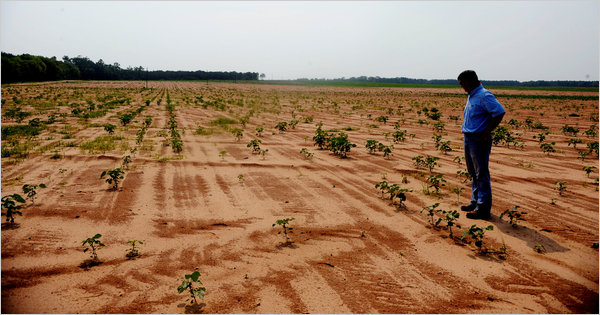
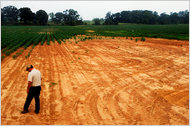
Grant Blankenship for The New York Times. Buster Haddock, an agricultural scientist at the University of Georgia, in a field where cotton never had the chance to grow.

By KIM SEVERSON and KIRK JOHNSON
Published: July 11, 2011

COLQUITT, Ga. — The heat and the drought are so bad in this southwest corner of Georgia that hogs can barely eat. Corn, a lucrative crop with a notorious thirst, is burning up in fields. Cotton plants are too weak to punch through soil so dry it might as well be pavement.

Waiting for Rain

Dangerously Dry – Nearly a fifth of the contiguous United States has been faced with the worst drought in recent years.

The Dry Season

OKLAHOMA A simple, if plaintive, message from the residents of Hough, in the panhandle, late last month. Shawn Yorks/The Guymon Daily Herald, via Associated Press

Farmers with the money and equipment to irrigate are running wells dry in the unseasonably early and particularly brutal national drought that some say could rival the Dust Bowl days.

“It’s horrible so far,” said Mike Newberry, a Georgia farmer who is trying grow cotton, corn and peanuts on a thousand acres. “There is no description for what we’ve been through since we started planting corn in March.”

The pain has spread across 14 states, from Florida, where severe water restrictions are in place, to Arizona, where ranchers could be forced to sell off entire herds of cattle because they simply cannot feed them.

In Texas, where the drought is the worst, virtually no part of the state has been untouched. City dwellers and ranchers have been tormented by excessive heat and high winds. In the Southwest, wildfires are chewing through millions of acres.

Last month, the United States Department of Agriculture designated all 254 counties in Texas natural disaster areas, qualifying them for varying levels of federal relief. More than 30 percent of the state’s wheat fields might be lost, adding pressure to a crop in short supply globally.

Even if weather patterns shift and relief-giving rain comes, losses will surely head past $3 billion in Texas alone, state agricultural officials said.

Most troubling is that the drought, which could go down as one of the nation’s worst, has come on extra hot and extra early. It has its roots in 2010 and continued through the winter. The five months from this February to June, for example, were so dry that they shattered a Texas record set in 1917, said Don Conlee, the acting state climatologist.

Oklahoma has had only 28 percent of its normal summer rainfall, and the heat has blasted past 90 degrees for a month.

“We’ve had a two- or three-week start on what is likely to be a disastrous summer,” said Kevin Kloesel, director of the Oklahoma Climatological Survey.

The question, of course, becomes why. In a spring and summer in which weather news has been dominated by epic floods and tornadoes, it is hard to imagine that more than a quarter of the country is facing an equally daunting but very different kind of natural disaster.

From a meteorological standpoint, the answer is fairly simple. “A strong La Niña shut off the southern pipeline of moisture,” said David Miskus, who monitors drought for the National Oceanic and Atmospheric Administration.

The weather pattern called La Niña is an abnormal cooling of Pacific waters. It usually follows El Niño, which is an abnormal warming of those same waters.

Although a new forecast from the National Weather Service’s Climate Prediction Center suggests that this dangerous weather pattern could revive in the fall, many in the parched regions find themselves in the unlikely position of hoping for a season of heavy tropical storms in the Southeast and drenching monsoons in the Southwest.

Climatologists say the great drought of 2011 is starting to look a lot like the one that hit the nation in the early to mid-1950s. That, too, dried a broad part of the southern tier of states into leather and remains a record breaker.

But this time, things are different in the drought belt. With states and towns short on cash and unemployment still high, the stress on the land and the people who rely on it for a living is being amplified by political and economic forces, state and local officials say. As a result, this drought is likely to have the cultural impact of the great 1930s drought, which hammered an already weakened nation.

“In the ’30s, you had the Depression and everything that happened with that, and drought on top,” said Donald A. Wilhite, director of the school of natural resources at the University of Nebraska in Lincoln and former director of the National Drought Mitigation Center. “The combination of those two things was devastating.”

Although today’s economy is not as bad, many Americans ground down by prolonged economic insecurity have little wiggle room to handle the effects of a prolonged drought. Government agencies are in the same boat.

“Because we overspent, the Legislature overspent, we’ve been cut back and then the drought comes along and we don’t have the resources and federal government doesn’t, and so we just tighten our belt and go on,” said Donald Butler, the director of the Arizona Department of Agriculture.

The drought is having some odd effects, economically and otherwise.

“One of the biggest impacts of the drought is going to be the shrinking of the cattle herd in the United States,” said Bruce A. Babcock, an agricultural economist at Iowa State University in Ames. And that will have a paradoxical but profound impact on the price of a steak.

Ranchers whose grass was killed by drought cannot afford to sustain cattle with hay or other feed, which is also climbing in price. Their response will most likely be to send animals to slaughter early. That glut of beef would lower prices temporarily.

But America’s cattle supply will ultimately be lower at a time when the global supply is already low, potentially resulting in much higher prices in the future.

There are other problems. Fishing tournaments have been canceled in Florida and Mississippi, just two of the states where low water levels have kept recreational users from lakes and rivers. In Texas, some cities are experiencing blackouts because airborne deposits of salt and chemicals are building up on power lines, triggering surges that shut down the system. In times of normal weather, rain usually washes away the environmental buildup. Instead, power company crews in cities like Houston are being dispatched to spray electrical lines.

In this corner of Georgia, where temperatures have been over 100 and rainfall has been off by more than half, fish and wildlife officials are worried over the health of the shinyrayed pocketbook and the oval pigtoe mussels, both freshwater species on the endangered species list.

The mussels live in Spring Creek, which is dangerously low and borders Terry Pickle’s 2,000-acre farm here. He pulls his irrigation from wells that tie into the water system of which Spring Creek is a part.

Whether nature or agriculture is to blame remains a debate in a state that for 20 years has been embroiled in a water war with Alabama and Florida. Meanwhile, Colquitt has allowed the state to drill a special well to pump water back into the creek to save the mussels from extinction.

Most farmers here are much more worried about the crops than the mussels. With cotton and corn prices high, they had high hopes for the season. But many have had to replant fields several times to get even one crop to survive. Others, like Mr. Pickle, have relied on irrigation so expensive that it threatens to eat into any profits.

The water is free, but the system used to get it from the ground runs on diesel fuel. His bill for May and June was an unheard of $88,442.

Thousands of small stories like that will all contribute to the ultimate financial impact of the drought, which will not be known until it is over. And no one knows when that will be.

The United States Department of Agriculture’s Farm Service Agency has already provided over $75 million in assistance to ranchers nationwide, with most of it going to Florida, New Mexico and Texas. An additional $62 million in crop insurance indemnities have already been provided to help other producers.

Economists say that adding up the effects of drought is far more complicated than, say, those of a hurricane or tornado, which destroy structures that have set values. With drought, a shattered wheat or corn crop is a loss to one farmer, and it has a specific price tag. But all those individual losses punch a hole in the food supply and drive prices up. That is good news for a farmer who manages to get a crop in. The final net costs down the line are thus dispersed, and mostly passed along.

That means grocery shoppers will feel the effects of the drought at the dinner table, where the cost of staples like meat and bread will most likely rise, said Michael J. Roberts, an associate professor of agricultural and resource economics at North Carolina State University in Raleigh, N.C. “The biggest losers are consumers,” he said.

Kim Severson reported from Colquitt, Ga., and Kirk Johnson from Denver. Dan Frosch contributed reporting from Denver.

Our Extreme Future: Predicting and Coping with the Effects of a Changing Climate (Scientific American)

Adapting to extreme weather calls for a combination of restoring wetland and building drains and sewers that can handle the water. But leaders and the public are slow to catch on. Final part of a three-part series

By John Carey | Thursday, June 30, 2011 | 97

Image: Fikret Onal/Flickr

Editor’s note: This article is the last of a three-part series by John Carey. Part 1, “Storm Warning: Extreme Weather Is a Product of Climate Change,” was posted on June 28. Part 2, “Global Warming and the Science of Extreme Weather,” was posted on June 29.

Extreme weather events have become both more common and more intense. And increasingly, scientists have been able to pin at least part of the blame on humankind’s alteration of the climate. What’s more, the growing success of this nascent science of climate attribution (finding the telltale fingerprints of climate change in extreme events) means that researchers have more confidence in their climate models—which predict that the future will be even more extreme.

Are we prepared for this future? Not yet. Indeed, the trend is in the other direction, especially in Washington, D.C., where a number of members of Congress even argue that climate change itself is a hoax.

Scientists hope that rigorously identifying climate change’s contribution to individual extreme events can indeed wake people up to the threat. As the research advances, it should be possible to say that two extra inches (five centimeters) of rain poured down in a Midwestern storm because of greenhouse gases, or that a California heat wave was 10 times more likely to occur thanks to humans’ impacts on climate. So researchers have set up rapid response teams to assess climate change’s contribution to extreme events while the events are still fresh in people’s minds. In addition, the Intergovernmental Panel on Climate Change (IPCC) is preparing a special report on extreme events and disasters, due out by the end of 2011. “It is important for us emphasize that climate change and its impacts are not off in the future, but are here and now,” explained Rajendra Pachauri, chair of the IPCC, during a briefing at United Nations climate talks in Cancún last December.

The message is beginning to sink in. The Russian government, for instance, used to doubt the existence of climate change, or argue that it might be beneficial for Russia. But now, government officials have realized that global warming will not bring a gradual and benign increase in temperatures. Instead, they’re likely to see more crippling heat waves. As Russian President Dmitry Medvedev told the Security Council of the Russian Federation last summer: “Everyone is talking about climate change now. Unfortunately, what is happening now in our central regions is evidence of this global climate change, because we have never in our history faced such weather conditions.”

Doubts persist despite evidence

Among the U.S. public, the feeling is different. Opinion pollsand anecdotal reports show that most Americans do not perceive a threat from climate change. And a sizable number of Americans, including many newly elected members of Congress, do not even believe that climate change exists. Extreme weather? Just part of nature, they say. After all, disastrous floods and droughts go back to the days of Noah and Moses. Why should today’s disasters be any different? Was the July 23, 2010, storm that spawned Les Scott’s record hailstone evidence of a changing climate, for instance? “Not really,” Scott says. “It was just another thunderstorm. We get awful bad blizzards that are a lot worse.”

And yes, 22 of Maryland’s 23 counties were declared natural disaster areas after record-setting heat and drought in 2010. “It was the worst corn crop I ever had,” says fourth-generation farmer Earl “Buddy” Hance. But was it a harbinger of a more worrisome future? Probably not, says Hance, the state’s secretary of agriculture. “As farmers we are skeptical, and we need to see a little more. And if it does turn out to be climate change, farmers would adapt.” By then, adaptation could be really difficult, frets Minnesota organic farmer Jack Hedin, whose efforts to raise the alarm are “falling on deaf ears,” he laments.

Many scientists share Hedin’s worry. “The real honest message is that while there is debate about how much extreme weather climate change is inducing now, there is very little debate about its effect in the future,” says Michael Wehner, staff scientist at Lawrence Berkeley National Laboratory and member of the lead author teams of the interagency U.S. Climate Change Science Program’s Synthesis and Assessment reports on climate extremes. For instance, climate models predict that by 2050 Russia will have warmed up so much that every summer will be as warm as the disastrous heat wave it just experienced, says Richard Seager of Columbia University’s Lamont–Doherty Earth Observatory. In other words, many of today’s extremes will become tomorrow’s everyday reality. “Climate change will throw some significant hardballs at us,” says Martin Hoerling, a research meteorologist at the National Oceanic and Atmospheric Administration’s Earth System Research Laboratory in Boulder, Colo. “There will be a lot of surprises that we are not adapted to.”

A dusty future

One of the clearest pictures of this future is emerging for the U.S. Southwest and a similar meteorological zone that stretches across Italy, Greece and Turkey. Work by Tim Barnett of the Scripps Institution of Oceanography, Seager and others predicts that these regions will get hotter and drier—and, perhaps more important, shows that the change has already begun. “The signal of a human influence on climate pops up in 1985, then marches on getting strong and stronger,” Barnett says. By the middle of the 21st century, the models predict, the climate will be as dry as the seven-year long Dust Bowl drought of the 1930s or the damaging 1950s drought centered in California and Mexico, Seager says: “In the future the drought won’t last just seven years. It will be the new norm.”

That spells trouble. In the Southwest the main worry is water—water that makes cities like Los Angeles and Las Vegas possible and that irrigates the enormously productive farms of California’s Central Valley. Supplies are already tight. During the current 11-year dry spell, the demand for water from the vast Colorado River system, which provides water to 30 million people and irrigates four million acres (1.6 million hectares) of cropland, has exceeded the supply. The result: water levels in the giant Lake Mead reservoir dropped to a record low in October (before climbing one foot, or 30 centimeters, after torrential winter rains in California reduced the demand for Colorado River water). Climate change will just make the problem worse. “The challenge will be great,” says Terry Fulp, deputy regional director of the U.S. Department of the Interior’s Bureau of Reclamation’s Lower Colorado Region. “I rank climate change as probably my largest concern. When I’m out on my boat on Lake Mead, it’s on my mind all the time.”

The Southwest is just a snapshot of the challenges ahead. Imagine the potential peril to regions around the world, scientists say. “Our civilization is based on a stable base climate—it doesn’t take very much change to raise hell,” Scripps’s Barnett says. And given the lag in the planet’s response to the greenhouse gases already in the atmosphere, many of these changes are coming whether we like them or not. “It’s sort of like that Kung Fu guy who said, ‘I’m going to kick your head off now, and there’s not a damn thing you can do about it,'” Barnett says.

Grassroots action

Although efforts to fight climate change are now stalled in Washington, many regions do see the threat and are taking action both to adapt to the future changes and to try to limit the amount of global warming itself. The Bureau of Reclamation’s Lower Colorado Region office, for instance, has developed a plan to make “manageable” cuts in the amounts of water that the river system supplies, which Fulp hopes will be enough to get the region through the next 15 years. In Canada, after experiencing eight extreme storms (of more than one-in-25-year intensity) between 1986 and 2006, Toronto has spent hundreds of millions of dollars to upgrade its sewer and storm water system for handling deluges. “Improved storm drains are the cornerstone of our climate adaptation policy,” explains Michael D’Andrea, Toronto’s director of water infrastructure management.

In Iowa, even without admitting that climate change is real, farmers are acting as if it is, spending millions of dollars to alter their practices. They are adding tile drainage to their fields to cope with increased floods, buying bigger machinery to move more quickly because their planting window has become shorter, planting a month earlier than they did 50 years ago, and sowing twice as many corn plants per acre to exploit the additional moisture, says Gene Takle, professor of meteorology at Iowa State University in Ames. “Iowa’s floods are in your face—and in your basement—evidence that the climate has changed, and the farmers are adapting,” he says.

Local officials have seen the connection, too. After the huge floods of 2008, the Iowa town of Cedar Falls passed an ordinance requiring that anyone who lives in the 500-year flood plain must have flood insurance—up from the previous 200-year flood requirement. State Sen. Robert Hogg wants to make the policy statewide. He also is pushing to restore wetlands that can help soak up floodwaters before they devastate cities. “Wetland restoration costs money, but it’s cheaper than rebuilding Cedar Rapids,” he says. “I like to say that dealing with climate change is not going to require the greatest sacrifices, but it is going to require the greatest foresight Americans have ever had.”

Right now, that foresight is more myopia, many scientists worry. So when and how will people finally understand that far more is needed? It may require more flooded basements, more searing heat waves, more water shortages or crop failures, more devastating hurricanes or other examples of the increases in extreme weather that climate change will bring. “I don’t want to root for bad things to happen, but that’s what it will take,” says one government scientist who asked not to be identified. Or as Nashville resident Rich Hays says about his own experience with the May 2010 deluge: “The flood was definitely a wake-up call. The question is: How many wake-up calls do we need?”

Reporting for this story was funded by the Pew Center on Global Climate Change.

Global Warming and the Science of Extreme Weather (Scientific American)

How rising temperatures change weather and produce fiercer, more frequent storms. Second of a three-part series

By John Carey | Wednesday, June 29, 2011 | 46

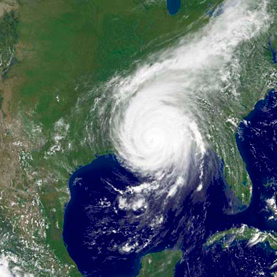
HURRICANE KATRINA battered New Orleans in 2005. Image: NOAA

Editor’s note: This article is the second of a three-part series by John Carey. Part 1, posted on June 28, is “Storm Warning: Extreme Weather Is a Product of Climate Change”.

Extreme floods, prolonged droughts, searing heat waves, massive rainstorms and the like don’t just seem like they’ve become the new normal in the last few years—they have become more common, according to data collected by reinsurance company Munich Re (see Part 1 of this series). But has this increase resulted from human-caused climate change or just from natural climatic variations? After all, recorded floods and droughts go back to the earliest days of mankind, before coal, oil and natural gas made the modern industrial world possible.

Until recently scientists had only been able to say that more extreme weather is “consistent” with climate change caused by greenhouse gases that humans are emitting into the atmosphere. Now, however, they can begin to say that the odds of having extreme weather have increased because of human-caused atmospheric changes—and that many individual events would not have happened in the same way without global warming. The reason: The signal of climate change is finally emerging from the “noise”—the huge amount of natural variability in weather.

Scientists compare the normal variation in weather with rolls of the dice. Adding greenhouse gases to the atmosphere loads the dice, increasing odds of such extreme weather events. It’s not just that the weather dice are altered, however. As Steve Sherwood, co-director of the Climate Change Research Center at the University of New South Wales in Australia, puts it, “it is more like painting an extra spot on each face of one of the dice, so that it goes from 2 to 7 instead of 1 to 6. This increases the odds of rolling 11 or 12, but also makes it possible to roll 13.”

Why? Basic physics is at work: The planet has already warmed roughly 1 degree Celsius since preindustrial times, thanks to CO2and other greenhouse gases emitted into the atmosphere. And for every 1-degree C (1.8 degrees Fahrenheit) rise in temperature, the amount of moisture that the atmosphere can contain rises by 7 percent, explains Peter Stott, head of climate monitoring and attribution at the U.K. Met Office’s Hadley Center for Climate Change. “That’s quite dramatic,” he says. In some places, the increase has been much larger. Data gathered by Gene Takle, professor of meteorology at Iowa State University in Ames, show a 13 percent rise in summer moisture over the past 50 years in the state capital, Des Moines.

The physics of too much rain

The increased moisture in the atmosphere inevitably means more rain. That’s obvious. But not just any kind of rain, the climate models predict. Because of the large-scale energy balance of the planet, “the upshot is that overall rainfall increases only 2 to 3 percent per degree of warming, whereas extreme rainfall increases 6 to 7 percent,” Stott says. The reason again comes from physics. Rain happens when the atmosphere cools enough for water vapor to condense into liquid. “However, because of the increasing amount of greenhouse gases in the troposphere, the radiative cooling is less efficient, as less radiation can escape to space,” Stott explains. “Therefore the global precipitation increases less, at about 2 to 3 percent per degree of warming.” But because of the extra moisture, when precipitation does occur (in both rain and snow), it’s more likely to be in bigger events.

Iowa is one of many places that fits the pattern. Takle documented a three- to seven-fold increase in high rainfall events in the state, including the 500-year Mississippi River flood in 1993, the 2008 Cedar Rapids flood as well as the 500-year event in 2010 in Ames, which inundated the Hilton Coliseum basketball court in eight feet (2.5 meters) of water . “We can’t say with confidence that the 2010 Ames flood was caused by climate change, but we can say that the dice are loaded to bring more of these events,” Takle says.

And more events seem to be in the news every month, from unprecedented floods in Riyadh, Saudi Arabia, to massive snowstorms that crippled the U.S. Northeast in early 2011, to the November 2010 to January 2011 torrents in Australia that flooded an area the size of Germany and France . This “disaster of biblical proportions,” as local Australian officials called it, even caused global economic shock waves: The flooding of the country’s enormously productive coal mines sent world coal prices soaring.

More stormy weather

More moisture and energy in the atmosphere, along with warmer ocean temperatures also mean more intense hurricanes, many scientists say. In fact, 2010 was the first year in decades in which two simultaneous category 4 hurricanes, Igor and Julia, formed in the Atlantic Ocean. In addition, the changed conditions bring an increased likelihood of more powerful thunderstorms with violent updrafts, like a July 23, 2010, tempest in Vivian, S.D., that produced hailstones that punched softball-size holes through roofs—and created a behemoth ball of ice measured at a U.S. record 8 inches (20 centimeters) in diameter even after it had partially melted. “I’ve never seen a storm like that before—and hope I’ll never go through anything like it,” says Les Scott, the Vivian farmer and rancher who found the hailstone .

Warming the planet alters large-scale circulation patterns as well. Scientists know that the sun heats moist air at the equator, causing the air to rise. As it rises, the air cools and sheds most of its moisture as tropical rain. Once six to 10 miles (9.5 to 16 kilometers) aloft, the now dry air travels toward the poles, descending when it reaches the subtropics, normally at the latitude of the Baja California peninsula. This circulation pattern, known as a Hadley cell, contributes to desertification, trade winds and the jet stream.

On a warmer planet, however, the dry air will travel farther north and south from the equator before it descends, climate models predict, making areas like the U.S. Southwest and the Mediterranean even drier. Such an expanded Hadley cell would also divert storms farther north. Are the models right? Richard Seager of Columbia University’s Lamont–Doherty Earth Observatory has been looking for a climate change–induced drying trend in the Southwest, “and there seems to be some tentative evidence that it is beginning to happen,” he says. “It gives us confidence in the models.” In fact, other studies show that the Hadley cells have not only expanded, they’ve expanded more than the models predicted.

Such a change in atmospheric circulation could explain both the current 11-year drought in the Southwest and Minnesota’s status as the number one U.S. state for tornadoes last year. On October 26, 2010, the Minneapolis area even experienced record low pressure in what Paul Douglas, founder and CEO of WeatherNation in Minnesota, dubbed a “landicane”—a hurricanelike storm that swept across the country. “I thought the windows of my home would blow in,” Douglas recalls. “I’ve chased tornados and flown into hurricanes but never experienced anything like this before.” Yet it makes sense in the context of climate change, he adds. “Every day, every week, another piece of the puzzle falls into place,” he says. “More extreme weather seems to have become the rule, not just in the U.S. but in Europe and Asia.”

The rise of climate attribution

Is humankind really responsible? That’s where the burgeoning field of climate attribution, pioneered by Hadley’s Peter Stott and other scientists, comes in. The idea is to look for trends in the temperature or precipitation data that provide evidence of overall changes in climate. When those trends exist, it then becomes possible to calculate how much climate change has contributed to extreme events. Or in more technical terms, the probability of a particular temperature or rainfall amount is shaped roughly like a bell curve. A change in climate shifts the whole curve. That, in turn, increases the likelihood of experiencing the more extreme weather at the tail end of the bell curve. Whereas day-to-day weather remains enormously variable, the underlying human-caused shift in climate increases the power and number of the events at the extreme. The National Oceanic and Atmospheric Administration’s (NOAA) Deke Arndt puts it more colorfully: “Weather throws the punches, but climate trains the boxer,” he says. By charting the overall shift, then, it’s possible to calculate the increased chances of extreme events due to global warming.

This idea was already in the air in 2003 when Stott traveled though the worst heat wave in recorded European history on a wedding anniversary trip to Italy and Switzerland. One of the striking consequences he noticed was that the Swiss mountains were missing their usual melodious tinkling of cowbells. “There was no water in the mountains, and the farmers had to take all their cows down in the valley,” he says. He decided to see if he could pin part of the blame on climate change after he returned to his office in Exeter, England. “I didn’t expect to get a positive result,” he says

But he did. In fact, the signal of a warming climate was quite clear in Europe, even using data up to only 2000. In a landmark paper in Nature Stott and colleagues concluded that the chances of a heat wave like the 2003 event have more than doubled because of climate change. (Scientific American is part of Nature Publishing Group.) Data collected since then show that the odds are at least four times higher compared with pre-industrial days. “We are very aware of the risks of misattribution,” Stott says. “We don’t want to point to specific events and say that they are part of climate change when they really are due to natural variability. But for some events, like the 2003 heat wave, we have the robust evidence to back it up.”

Case in point: Hurricane Katrina

Another event with a clear global warming component, says Kevin Trenberth, head of climate analysis at the National Center for Atmospheric Research (NCAR) in Boulder, Colo., was Hurricane Katrina. Trenberth calculated that the combination of overall planetary warming, elevated moisture in the atmosphere, and higher sea-surface temperatures meant that “4 to 6 percent of the precipitation—an extra inch [2.5 centimeters] of rain—in Katrina was due to global warming,” he says. “That may not sound like much, but it could be the straw that breaks the camel’s back or causes a levee to fail.” It was also a very conservative estimate. “The extra heat produced as moisture condenses can invigorate a storm, and at a certain point, the storm just takes off,” he says. “That would certainly apply to Nashville.” So climate change’s contribution to Katrina could have been twice as high as his calculations show, he says. Add in higher winds to the extra energy, and it is easy to see how storms can become more damaging.

This science of attribution is not without controversies. Another case in point: the 2010 Russian heat wave, which wiped out one quarter of the nation’s wheat crop and darkened the skies of Moscow with smoke from fires. The actual meteorological cause is not in doubt. “There was a blocking of the atmospheric circulation,” explains Martin Hoerling, a research meteorologist at the NOAA’s Earth System Research Laboratory, also in Boulder. “The jet stream shifted north, bringing a longer period of high pressure and stagnant weather conditions.” But what caused the blocking? Hoerling looked for an underlying long-term temperature trend in western Russia that might have increased the odds of a heat wave, as Stott had done for the 2003 European event. He found nothing. “The best explanation is a rogue black swan—something that came out of the blue,” he says.

Wrong, retorts NCAR’s Trenberth. He sees a clear expansion of the hot, dry Mediterranean climate into western Russia that is consistent with climate change predictions—and that also intensified the Pakistan monsoon. “I completely repudiate Marty—and it doesn’t help to have him saying you can’t attribute the heat wave to climate change,” he says. “What we can say is that, as with Katrina, this would not have happened the same way without global warming.”

Yet even this dispute is smaller than it first appears. What is not in doubt is that the Russian heat wave is a portent—a glimpse of the future predicted by climate models. Even Hoerling sees it as a preview of coming natural disasters. By 2080, such events are expected to happen, on average, once every five years, he says: “It’s a good wake-up call. This type of phenomenon will become radically more common.”

Reviewing the Nisbet ‘Climate Shift’ Report and Controversial Claims of Media Progress (Yale Forum on Climate Change & The Media)

by John Wihbey | July 11, 2011

Matt Nisbet’s ‘Climate Shift’ research report raised headline-grabbing points on fundraising successes by those advocating action on climate change. But it’s what lies behind those headlines — and relating specifically to media coverage — that also warrants further review and analysis.

Few pieces of recent academic research on climate change have stirred up as much controversy as American University professor Matthew Nisbet’s April 2011 report “Climate Shift: Clear Vision for the Next Decade of Public Debate.”

The report’s biggest headline-grabbing finding — that the environmental lobby is now holding its own in the money race with industry groups opposing carbon regulations — doubtless will generate further analysis, and one can imagine more such annual scorecards assessing this power struggle. And the questions “Climate Shift” raises about the relative political wisdom — or lack of same — in pushing the failed cap-and-trade bill in Congress may well be debated by historians for years to come.

Perhaps the most underappreciated facet of the scholarship that Nisbet put forth, however, involves his analysis of media coverage in the years 2009-2010, contained in his provocatively titled chapter 3, “The Death of a Norm: Evaluating False Balance in News Coverage.”

According to Nisbet’s story-by-story analysis that covers the vertiginous period involving Copenhagen, the so-called “climategate” hacked e-mails, and federal cap-and-trade, the mainstream media — represented in his analysis by The New York Times, CNN.com, The Wall Street Journal, Politico, and The Washington Post — basically moved past the oft-criticized journalistic mode of “he said, she said,” or “false balance.” In its place, those media generally reflected the “consensus science” as backed by organizations such as the U.N.’s IPCC and the National Academy of Sciences and most of its international counterparts. (The opinion pages of the Journal are bracketed as an exception, and Nisbet’s analysis shows that its editorials do indeed continue to cast doubt on climate science.)

Nisbet’s assertion is a profound one, with significant implications. His stated goal with “Climate Shift” is to help reorient the priorities of groups trying to combat global change through the promotion of science and smart messaging to the public. (See companion posting based on author’s extensive e-mail interview with Nisbet.)
“[I]f trend-setting national media have overwhelmingly portrayed the consensus views on the fundamentals of climate science (as the report’s findings indicate),” Nisbet wrote in a recent e-mail interview with The Yale Forum, “then we should be turning to other types of media organizations in our engagement efforts and focusing on other dimensions of coverage, including … subsidizing the ability of local and regional media to cover climate change and energy insecurity as these challenges relate to their region and communities.” These are ideas Nisbet has raised also in previous reports.

Lines of Criticism

Bloggers at Media Matters do criticize how Nisbet interprets his data around the “climategate” period — one of the few on-the-numbers critiques. Nisbet responds that changes in coverage since then are either not “statistically significant” or “not meaningful.”

Other than that, few have questioned the particulars of Nisbet’s labor-intensive analysis of how those five outlets performed. Their selection — and the exclusion of others — though, is the subject of debate.

Nisbet says he chose those specific news outlets because they set the news agenda and have high-volume traffic, as reflected in Nielsen-tabulated figures. CNN.com, the Post and the Times ranked numbers 4, 5 and 9, respectively, in terms of web traffic in 2009. But given that news aggregators such as Yahoo, AOL, and Google ranked 1, 3, and 6, respectively, one might think that Nisbet’s universe of analysis did not capture the true flow of public news information.

The combined traffic of the aggregators is nearly twice that of the news sites Nisbet focused on. Admittedly, though, these aggregators would be a moving target — and an empirical analysis of the quality of news linked to would be difficult — but that’s where some huge portion of the public gets its news and information, and therefore its impressions and opinions.

(One other quibble, about the selection of Politico: Nisbet calls it “the paper ‘the White House wakes up to,’ as memorably headlined in a profile at The New York Times.” In fact, the article he cites is really just a profile of Politico reporter Mike Allen and his important day calendar “Playbook” blog. Though Politico is powerful and prolific, what constitutes “the paper of record for members of Congress,” as Nisbet puts it, may be an issue of reasonable disagreement among media watchers.)

Climate communications expert and University of Colorado-Boulder professor Max Boykoff was one of the formal reviewers for the “Climate Shift” report. He told The Yale Forum in an e-mail interview, “Overall, I found [Nisbet’s] work in Chapter 3 to be good. As he assembled it I spoke with Matt multiple times. (Chapter 3 was the part of the report I most focused on). We discussed how to replicate the methods and approaches that I undertook in my work on empirically testing the accuracy of coverage about human contributions to climate change (aka, the ‘balance as bias’ thesis). His methods and findings (re: WSJ op-ed divergence etc.) appeared valid and reliable.”

Still, Boykoff stated a potentially striking limitation of this type of analysis in his reviewer comments submitted back to Nisbet: Such analysis “still isn’t equipped to gauge how one particular carefully/prominently/well- or ill-timed article or commentary could have a much greater influence on public perceptions and views than consistently inaccurate treatment. In other words, the sometimes haphazard nature of media consumption — from skimming articles to just hearing/watching portions of a segment — isn’t accounted for through this approach. At the end of the day, these studies … struggle to account for ‘selective listening’ or ‘selective reading’ that we actually engage in during our daily lives.”

Boykoff also said he told Nisbet that his (Nisbet’s) research had not provided sufficient support for the “Climate Shift” report’s contention that “even in a world of blogs and fragmented audiences, the coverage appearing at these outlets strongly shapes the news decisions made at the broadcast and cable networks and informs the decisions of policymakers.”

The Fox News Question

Other notable criticisms of Nisbet’s approach in Chapter 3 of his report have focused on his exclusion of television sources, particularly Fox News. Prolific blogger and energy/climate expert Joseph Romm, who leveled ferocious criticism of Nisbet on his “Climate Progress” blog, makes much of this point. This dispute is a tricky one, resting on a difficult-to-resolve social science debate about how “persuade-able” the Fox News audience is, and just how best to measure the impacts of its huge ratings and online readership as part of American political consciousness.

In his comments to The Yale Forum, Nisbet replied, “As I discuss in the report, the audience for Fox News and political talk radio tend to be strongly self-selecting with consumption of these media tending to reinforce the views of those already doubtful or dismissive of climate change (approximately 25 percent of Americans).” Moreover, he says it “is not clear how these unsurprising findings would help us to move forward since any level of engagement with Fox News producers or talk radio hosts is unlikely to lead to changes in their coverage patterns. We can complain about and criticize these outlets, but much of the criticism and anger, I would argue, often ends up distracting us from initiatives where we can make a difference with journalists, editors, and with different publics.”

This latter point, of course, highlights an important facet of Nisbet’s project, namely that it has a particular goal, an “agenda” even, that puts an emphasis on both utility, or making a “difference,” and on truth as criteria for inquiry. (It’s possible this is where he opens the door for controversy, as it leaves him open to criticisms that he is downplaying conservative media and thereby painting an unduly positive picture of the U.S. media as a whole on climate issues.)

Columbia Journalism Review science editor Curtis Brainard told The Yale Forum recently that he thinks the spirit of Nisbet’s report is basically right in Chapter 3, at least as it relates to “news reporters and news articles.” For Nisbet and Brainard both, broad accusations that public ignorance is the media’s “fault” are no longer well-founded.

“There is this conventional wisdom floating around out there that journalists are inept, rarely able to get their facts straight or explain or deliver an accurate account of events,” Brainard wrote in an e-mail. “They’re not. But it’s much easier for activists and other policy or program stakeholders to blame the media when things don’t go their way than to analyze the much more complicated interplay of multiple factors.”

(As an aside, Brainard notes that he wrote about precisely this dynamic in his recent article, “Tornadoes and Climate Change,” which pushes back against such charges leveled by environmental writer and activist Bill McKibben. Brainard says McKibben is too quick to condemn the media as a whole for not making connections between various extreme weather events.)

We’re past those earlier days, Brainard told The Yale Forum, when the basic questions about climate science are portrayed in most mainstream news media as being unsettled: “The coverage has become so much more sophisticated since then, delving into the specific consequences of climate change, from sea level rise, to changing precipitation and drought patterns, to consequences for flora and fauna. Many reporters struggle to accurately explain the highly uncertain and nuanced science underlying these phenomena, but the flaws in the coverage are quite different from the false balance that was on exhibit before, say, 2006. First of all, there is nowhere near as much scientific consensus about these finer points of climate science as there is about the fundamentals (i.e., the Earth is warming, and humans are most likely to blame), so today’s stories are really apples compared with yesterday’s oranges.”

Work Ahead for Media, Scholars

If Nisbet’s report has an underlying flaw, perhaps, it may be in its packaging, particularly in its “Move On”-style message and ambition to deliver a definitive verdict. Its real virtue is that it has just very effectively — whether or not one buys it all — started a different kind of conversation. And given that just five outlets were analyzed in the report, there is certainly much more conversation to be had.

As mentioned, Nisbet has said he is already carrying out new research and further study on local and regional media. (See his latest thoughts on this issue as they relate to Chicago.) It’s a cause on which all academics and media professionals and critics might agree, as the business model for such outlets continues to erode. Local information ecosystems are changing, shifting, and in many cases decaying. But many observers point out how essential they remain.

“It would also be good to look at the practically countless number of local TV network affiliates across the country since, collectively, they are where most Americans still get their news,” Brainard also noted.

“Local newspapers, as Pew has documented, remain at the center of the local media ecosystem, with the overwhelming number of regional/local issues covered by local TV news and at local blogs originating from local newspaper coverage,” Nisbet said. “In this sense, on climate change and energy, we should think about local and regional newspapers as being part of the central communication infrastructure that regions and communities need to learn, connect, plan and make collective choices on the issue.”

Perhaps, through further studies by Nisbet and others, this important work on local and regional media — their shortcomings and needs — can shed additional light.

John Wihbey is a regular contributor to the Yale Forum. He is a journalist and researcher, and he can be reached at jpwihb@yahoo.com.

Ensino americano abandona aos poucos a escrita em cursivo (Valor Econômico)

JC e-mail 4302, de 18 de Julho de 2011.

Maioria dos estados já não obriga o aprendizado; especialistas veem tendência.

O estado de Indiana, localizado no Meio-Oeste americano, acabou com a exigência de que as suas escolas ensinem a escrita cursiva, aquele estilo de escrever em que as palavras são formadas com letras emendadas pelas pontas. Com isso, juntou-se a uma onda crescente nos Estados Unidos de privilegiar no currículo outras habilidades hoje consideradas mais úteis, como digitar textos em teclados dos computadores.

Com a mudança, Indiana alinha-se a um padrão comum de ensino adotado por 46 Estados americanos. Nele, não há nenhuma menção à escrita cursiva, mas recomenda-se o ensino de digitação. É um reconhecimento de que, com as novas tecnologias, como computadores e telefones inteligentes, as pessoas cada vez menos precisam escrever de forma cursiva, seja no trabalho ou nas suas atividades do dia-a-dia. Basta aprender a escrever com a mão – exigência que ainda faz parte do currículo de Indiana e dos padrões comuns adotados pelos estados – seja com letras de forma, cursiva ou um misto dos dois estilos.

Também é um reflexo do que muitos nos Estados Unidos veem como uma sobrecarga no currículo escolar, com tempo sempre insuficiente para ensinar disciplinas consideradas fundamentais para passar nos testes usados para admissão nas faculdades, como matemática e leitura de textos. Pesquisas nacionais sobre como o tempo é gasto nas salas de aula mostram que 90% dos professores da 1ª a 3ª séries do ensino primário dedicam apenas 60 minutos por semana ao desenvolvimento da escrita com a mão.

A tendência de abandonar o ensino da escrita cursiva é vista com preocupação por parte dos americanos. Para alguns, as novas gerações terão mais dificuldades para fazer atividades básicas, como preencher e assinar cheques. Outros ponderam que os jovens não serão capazes de ler a declaração de independência no original, toda escrita de forma cursiva, num argumento que apela para o patriotismo americano.

Richard S. Christen, professor da Escola de Educação da Universidade de Portland, no Estado do Oregon, é um dos que dizem que as escolas devem pensar duas vezes antes de suspender o ensino da escrita cursiva, embora ele considere cada vez mais difícil defender a tese de que essa é uma habilidade com valor prático.

Divulgação – Richard Christen, professor da Escola de Educação da Universidade de Portland. “Se você voltar ao século XVII ou XIX, seria impossível fechar negócios sem os escrivãos, que foram cuidadosamente treinados na técnica de escrever com as mãos para registrar os fatos”, disse Christen ao Valor. “Mas hoje o valor prático disso é bem menor.”

Ele pondera, porém, que a escrita cursiva também tem um valor estético em si mesma e diz respeito a valores importantes como civilidade. “A escrita cursiva é um jeito de as pessoas se comunicarem com as outras de forma elegante, valorizando a beleza”, afirma. “Essa é uma chance para as crianças fazerem algo com suas mãos todos os dias, prestando atenção para os elementos de beleza, como formas, contornos e linhas”, afirma. Além disso, estimula as crianças a prestarem atenção na forma como se dirigem e se comunicam com as outras pessoas.

Para o professor Steve Graham, da Universidade de Vanderbilt, uma das maiores autoridades americanas no assunto, a questão central não é necessariamente a escrita cursiva, mas sim preservar o espaço para a escrita à mão de forma geral no currículo.

Apesar de todo o barulho em torno das novas tecnologias, a realidade, afirma ele ao Valor, é que hoje a maioria das crianças nas escolas americanas ainda faz os seus trabalhos em sala de aula com as mãos, pois de forma geral ainda não existe um computador para cada uma delas. Num ambiente como esse, a boa grafia é crucial para o bom aprendizado e para o sucesso na vida acadêmica, ainda que no mundo fora das salas de aula predominem computadores, iPads e telefones inteligentes.

Pesquisa recente conduzida por Graham mostra que, se trabalhos escolares ou provas são apresentados numa grafia sofrível, as notas tendem a ser mais baixas, a despeito do conteúdo. “As pessoas formam opiniões sobre a qualidade de suas ideias com base na sua qualidade de sua escrita”, afirma Graham.

Nesse estudo, alunos escreveram redações, que foram submetidas em seguida a avaliações com notas entre 0 e 100. O passo seguinte foi pegar redações medianas, que tiveram nota 50, e reproduzir seu conteúdo em duas versões, uma com grafia impecável e outra com grafia sofrível, embora legível. Submetidas a uma nova avaliação, a conclusão é que a mesma redação mediana ganhou notas muito boas quando escrita com letras caprichadas e notas inferiores quando escritas com garranchos.

A habilidade de escrever à mão também tem influência sobre a capacidade da criança de produzir bons conteúdos na escrita. Velocidade é crucial. Quando a escrita se torna um processo automático, afirma Graham, as ideias fluem mais rapidamente do cérebro para o papel e, portanto, não se perdem no meio do caminho. Pessoas bem treinadas para escrever com as mãos fazem tudo de forma automática e não precisam pensar sobre o que ocorre com o lápis – e sobram assim mais neurônios para serem dedicados a coisas mais importantes, como refletir sobre a mensagem, organizar as ideias e formar frases e parágrafos.

São bons argumentos para não se abandonar o ensino da escrita à mão pela digitação. Mas qual técnica é mais importante: a cursiva ou a simples escrita à mão? Graham diz que a escrita em letras de forma é em geral mais legível do que a cursiva, mas a escrita cursiva é mais rápida do que a escrita em letra de forma. “As diferenças não são grandes o suficiente para justificar muito debate”, disse. “O importante é ter um estilo de escrita à mão que seja ao mesmo tempo legível e rápido.”

Mas no futuro, reconhece ele, o ensino da escrita à mão pode se tornar menos importante, à medida que ter um computador para cada aluno se torne algo universal. O ensino de digitação, por outro lado, torna-se cada vez mais relevante. “Eles são muito bons com seus telefones, com o twitter, mas não com os computadores”, afirma Graham.

No Brasil, educadores se dividem sobre benefícios – Pais decepcionados com o aprendizado dos filhos poderiam dizer que tudo não passa de um debate bizantino sobre se é melhor tentar decifrar garranchos escritos com letra de médico ou torpedos criptografados numa novilíngua que aboliu as vogais. De qualquer forma, as opiniões se dividem também entre os educadores brasileiros quando se discute a validade de um abandono do ensino da escrita em cursivo.

Para Telma Weisz, doutora em psicologia da aprendizagem e do desenvolvimento pela Universidade de São Paulo (USP) e supervisora pedagógica do Programa Ler e Escrever, do governo do Estado de São Paulo, “a escrita manuscrita é um resto da Idade Média”. “Do ponto de vista da aprendizagem, não há perda em não usar a manuscrita”, afirma. Segundo ela, a escrita cursiva ajuda o aluno a memorizar a forma ortográfica das palavras, mas um programa de computador processador de texto tem a mesma eficiência, “com mais recursos, aliás”.

Weisz diz que o problema não é desprezar a escrita cursiva e mergulhar de vez na digitação, e sim que “no Brasil não há condições de se fazer isso. Temos escolas onde não há luz, que dirá escola onde todos os alunos tenham um computador”.

João Batista Araujo e Oliveira, doutor em pesquisa educacional pela Florida State University (EUA) e presidente do Instituto Alfa e Beto, ONG dedicada à alfabetização, discorda de Weisz. “Há pesquisas que comparam crianças que aprenderam com a letra cursiva e que aprenderam no teclado, e quem escreve mais à mão grava mais a forma ortográfica da palavra”, diz.

No entanto, Oliveira não tem uma posição radical contra a política adotada pela maioria dos Estados americanos, de não obrigar o ensino do cursivo. “Essas coisas mudam mesmo, é inevitável. Sempre que você tem uma tecnologia nova você procura um meio mais eficiente de avançar. A letra cursiva, por exemplo, é um grande avanço em relação à letra de forma, porque o aluno não tira o lápis do papel.”

Oliveira acredita que antes de se fazer uma mudança dessas é preciso pensar nos “efeitos colaterais”, dando como exemplo a tabuada e a máquina de calcular. “Para pagar o táxi, o cafezinho, você tem que fazer conta de cabeça. Quem só ensina usando a calculadora priva o cidadão de uma competência que dá uma eficiência social muito grande.”

Luis Marcio Barbosa, diretor-geral do colégio Equipe, de São Paulo, descarta adotar a política na sua escola. “Há um conjunto de aprendizado que vem junto com o aprendizado da escrita cursiva que é imprescindível para o desenvolvimento das crianças, que tem a ver com a motricidade, com a organização espacial.” E, além de tudo, diz, “as crianças podem aprender as duas coisas, não precisa ser uma em detrimento da outra.”

Paul Virilio: “Minha língua estrangeira é a velocidade, é a aceleração do real” (L.M. DIPLOMATIQUE Brasil)

03 de Junho de 2011

ENTREVISTA

“Minha língua estrangeira é a velocidade, é a aceleração do real”

por Guilherme Soares dos Santos

Uma das maiores personalidades da França atualmente, o filósofo e urbanista Paul Virilio ocupa um lugar de destaque na cena intelectual. Escritor prolífico, no seu currículo sucedem-se livros, exposições e artigos tais como Velocidade e política, Guerra e cinema, O espaço crítico, Máquina de visão e, recentemente, O grande acelerador [sem tradução ainda para o português] em que ele desenvolve uma cultura crítica, alguns dizem “catastrofista”, sobre as técnicas modernas, bem como seus efeitos de aceleração sobre nossos comportamentos e nossa percepção do mundo, no momento em que a economia mundial depende cada vez mais do investimento na tecnologia.

Paul Virilio recebe o filósofo brasileiro Guilherme Soares dos Santos em Paris, e fala com exclusividade ao Le Monde Diplomatique Brasil sobre suas teses, que tratam da corrida, da lógica da velocidade, ele que é visto por muitos como um reacionário ou um visionário, fala ytambém de sua biografia.

VIRILIO: Há uma coisa fundamental que explicará, talvez, o aspecto “catastrofista” do qual me acusam. Eu sou uma criança da guerra, um war baby, e é um elemento que não foi suficientemente compreendido, porque tentou-se fazer esquecer a guerra. Há dois momentos importantes na Segunda Guerra Mundial (eu a vivi, eu tinha 10 anos, eu nasci em 1932). Houve primeiramente a Guerra Relâmpago, a Blitzkrieg. Censurou-se esse aspecto, e alguns historiadores negam a blitz, isto é, o fato de que a velocidade esteve na base da grande ruína, primeiro da Polônia, e em seguida da França. E então essa Blitzkrieg se esgotou nos países do leste e na União Soviética, porque lá havia a profundidade de campo que permitia amortecer. Eu sou, portanto, uma criança da Blitzkrieg, eu diria mesmo que eu sou talvez o único, o único que desde então jamais cessou de ser marcado pelo poder da velocidade. Não é somente o poder dos transportes, os carros de assalto contra a cavalaria polonesa que desembainhava o sabre contra os panzers… Há também a guerra das ondas da qual eu sou o filho: “Pom, pom, pom, pom”… a rádio de Londres que eu escutava no escuro com o meu pai. Há dois momentos capitais: a Blitzkrieg e a deportação que vai, aliás, junto com o mesmo movimento de invasão. Se a guerra de 1914 foi uma guerra de posição em que os exércitos se exterminaram no mesmo lugar durante anos, com a deportação, conduziu-se à Shoah no curso da Segunda Guerra Mundial.

DIPLOMATIQUE: O senhor é muito sensibilizado pelas tragédias que ocorrem em nossa época. O senhor quis inclusive que fosse criado um “Museu dos Acidentes”, após a exposição feita sobre esse tema na Fundação Cartier para a Arte Contemporânea. O senhor já avançou essa ideia, mas por enquanto sem sucesso junto às instituições, e agora o senhor propõe a criação de uma “Universidade do Desastre”. De que se trata exatamente? Não se poderia pensar que a guerra terá sido, para o senhor, uma universidade do desastre?

VIRILIO: Com efeito. Quando eu falo de “Universidade do Desastre” não é de modo algum o desastre da universidade, é o contrário: eu quero dizer que “o pior provoca o melhor”. A universidade europeia apareceu em Bolonha e alhures aproximadamente em 1100, 1200, após o “grande medo” do ano 1000, em oposição à grande barbárie. E ela foi, essa universidade, um coletivo judeo-cristão, greco-latino e árabe. Alguns negam o grande medo do primeiro milênio, como alguns negam, hoje, a blitz. Há aí alguma coisa que, no meu entendimento, faz parte do segredo da velocidade. Se “o tempo é dinheiro”, a velocidade é poder. Eu lembro que para os banqueiros, para que haja mais-valia, é preciso que haja a velocidade de troca. A questão da velocidade é uma questão mascarada; não mascarada por um complô, mas mascarada por sua simplicidade. Riqueza e velocidade estão vinculadas. É conhecido o vínculo da riqueza e do poder como da lei do mais forte. Mas a lei do mais forte é a lei do mais rápido. A questão da “dromologia” é a questão da velocidade que, hoje, mudou de natureza. Na origem, a velocidade é o tesouro dos faraós; é a tesaurização, quer dizer, a acumulação e, então, muito rapidamente, tornar-se-á especulação. E aí o movimento de acumulação vai passar na aceleração. Os dois estão vinculados. Acumulação do tesouro que tornar-se-á tesouro público, em seguida especulação, e hoje financeirização com os sistemas de cotação automática em alta frequência que fazem explodir a bolsa de valores. Veja, estamos diante de algo extraordinário, é que nós não sabemos o que é a velocidade em nossos dias. As pessoas me dizem que é preciso uma economia política da velocidade, e, de fato, é preciso uma, mas é preciso primeiro uma dromologia, ou seja, revelar na vida política, no sentido amplo do poder, a natureza da velocidade em nosso tempo. Essa velocidade mudou de natureza. Essencialmente ela foi a revolução dos transportes. Até o século XX, até a blitz, vimos que a revolução das riquezas é uma revolução dos transportes: o cavalo, o navio, o trem, o avião, os sinais mecânicos.

DIPLOMATIQUE: No final do século XX, passa-se não mais à revolução dos transportes, mas à das transmissões instantâneas.

VIRILIO: Durante a guerra, ainda garotinho, eu participei da Resistência com os meus pais graças à guerra das ondas que já era uma guerra eletromagnética. Uma guerra da velocidade das ondas. Marconi e sua invenção era, também, uma revolução da velocidade. Começava-se a pôr em obra a velocidade das ondas eletromagnéticas, isto é, das ondas da velocidade da luz. E, claro, com a televisão, os computadores e a Internet, nós entramos numa fase que hoje atinge o seu limite; a velocidade da luz em que o tempo humano, o tempo da negociação, da especulação, em que a inteligência do homem, do especulador, dos cotadores é ultrapassada pelos automatismos. Aliás, quando a bolsa quebrou em 6 de maio do ano passado em Wall Street, em alguns milésimos de segundos houve 23.000 operações, o sistema entrou em pane e bilhões foram perdidos em dez minutos.

DIPLOMATIQUE: O que preocupa o senhor são os limites do tempo humano?

VIRILIO: Sim, é preciso trabalhar sobre a natureza do poder da velocidade atualmente, porque a velocidade da luz é um absoluto e é o limite do tempo humano. Nós estamos no “tempo-máquina”; o tempo humano é sacrificado como os escravos eram sacrificados no culto solar de antigamente. Eu o digo, nós estamos num novo Iluminismo em que a velocidade da luz é um culto. É um poder absoluto que se esconde atrás do progresso, e é por isso que eu afirmo que a velocidade é a propaganda do progresso. Eu não tenho nada contra o progresso. Quando eu digo que é preciso “ir mais devagar”, alguns zombam de mim. Pensam que eu condeno a revolução dos transportes, dos trens, dos carros, dos aviões, que eu sou contra os computadores e contra a Internet. Não é nesse nível que as coisas estão em jogo…

DIPLOMATIQUE: O que o senhor combate é a aceleração do real que põe em questão a percepção das aparências sensíveis e daquilo que a fenomenologia chama de “ser-no-mundo”?

VIRILLIO: Sim, o que a revolução dos transportes era para a aceleração da história e os movimentos migratórios, a revolução das transmissões instantâneas o é para a aceleração da realidade percebida. É um acontecimento alucinante, estupeficante. A velocidade é uma ebriedade. Uma embriaguez que pode ser “scópica” ou sonora – daí, aliás, a passagem do muro do som. Com as telecomunicações, utiliza-se a força de impacto da aceleração para fazer passar coisas que não estão na realidade pública, ou seja, no espaço real público, mas na realidade privada, ou antes transmitidas em tempo real por sociedades privadas. A tal ponto que a questão da imaginação, e aquela, filosófica, do “ser-no-mundo”, do aqui e do agora, tornam-se centrais. Nós estamos, assim, em plena crise da ciência, do que eu chamo de “acidente dos conhecimentos”, “acidente das substâncias” e “acidente das distâncias”. Essa questão da velocidade, desde Einstein, está no cerne da relatividade outrora especial, e hoje generalizada, que está em vias de se chocar contra um muro, o que eu chamo de “muro do tempo”. O que se passou em Wall Street me interessa muito porque as pessoas de Wall Street se chocaram contra o muro do tempo e o muro do dinheiro. É um fenômeno político maior no momento em que os algoritmos e os programas de computador dominam a vida econômica, e eu pretendo que a “relatividade especial” deveria ser um problema encarado pelo Estado. Se o século XX foi o século da conquista do ar e do espaço, eu penso que o século XXI deveria se questionar não somente sobre as nanotecnologias, mas, também, sobre as nanocronologias, isto é, sobre o tempo infinitesimal, sobre a conquista do “infinitamente pequeno do tempo”.

DIPLOMATIQUE: Parece-me que, nos textos do senhor, o estilo quer sempre ecoar o assunto estudado, e quando senhor pensa a velocidade, é a própria escrita que deve ir rápido.

VIRILIO: Absolutamente. E nesse sentido, como o mostra Proust, todo verdadeiro escritor escreve “numa espécie de língua estrangeira”. Minha língua estrangeira é a velocidade, é a aceleração do real. No que respeita à velocidade da minha escrita, trata-se da herança dos futuristas, e eu sinto a dromologia como uma musicologia. O problema não é nem de acelerar nem de desacelerar, mas de seguir uma linha melódica.

DIPLOMATIQUE: Há quem diga que o senhor pratica uma “escrita rapsódica”.

VIRILIO: Trata-se do ritmo. As sociedades antigas eram sociedades ritmológicas. Havia o calendário, a liturgia, as festas que estruturavam a linha melódica de tal ou qual sociedade. Os ritmos são muito importantes, você sabe, pois trata-se do sopro. Quando Bergson e Einstein se encontraram, eles não se compreenderam a esse respeito. O primeiro falava de “duração”, do vivo; o segundo, do vazio e do veloz. Saiba, no entanto, que será necessário conciliá-los, caso contrário o futuro do século XXI será um caos global pior que o nazismo ou o comunismo, que não tem nada a ver com a anarquia. Não, um caos global pior que tudo!

DIPLOMATIQUE: É por isso que o pensamento do senhor torna-se mais e mais dramático e religioso nos últimos tempos?

VIRILIO: Eu sou um católico que se converteu já adulto, isso é importante. Meu pai era comunista, e minha mãe, católica. Acontece que eu conheci o abade Pierre e padres operários. Mas eu permaneço sozinho sobre a minha senda.

DIPLOMATIQUE: Alguns criticam o senhor por descrever situações que seriam exagerações fantasistas, quando o senhor descreve este temor da solidão gerado pelas telecomunicações, notadamente pela Internet ou o celular. Não estaria o senhor realizando, talvez, uma especulação sobre “mundos possíveis”, seguindo uma espécie de método “transcendental” de investigação?

VIRILIO: Eu quero reunir o que foi separado, quero dizer, a filosofia e a física. Trata-se fundamentalmente de uma reinvenção filosófica para fazer frente a esta matematização do mundo, esta rapidez que ultrapassa a consciência. Eu me sinto no limiar de uma filosofia sem igual. Tal como Heráclito ou Parmênides, estamos aqui na origem – daí a Universidade do Desastre. Todo o trabalho desta seria um questionamento sobre o “desastre do êxito”. O que se acaba de descrever é o sucesso da tecnociência. Ora, é imperativo reconciliar e lançar a “filociência”. O que está aí em jogo é a vida ou a morte da humanidade. Se o homem não pode mais falar e se ele transfere o poder de enunciação a aparelhos, encontramo-nos, pois, diante de uma tirania sem igual. Físicos que são meus amigos estão conscientes disso, do que se perfila, um “acidente dos conhecimentos”. Isso nos conduz à árvore da vida que só tem referência na origem do Gênese, ou seja, o mito da vida… E aí eu o digo enquanto cristão e enquanto escritor: o acidente dos conhecimentos é o pecado original.

DIPLOMATIQUE: O que significa em nossa época “ser sábio”, quando nós somos forçados a uma especialização crescente e incessante, assim como à busca de uma “resposta automatizada” nos motores de pesquisa e nos bancos de dados que ultrapassam de longe o que a memória individual pode abarcar em uma vida? Como nós podemos cultivar nossa lucidez nesta maré enlouquecedora de informações?

VIRILIO: No que me toca mais diretamente, eu sou um urbanista, quer dizer que eu trabalho sobre o habitat. E o próprio de um urbanista é trabalhar sobre o habitar, o “ser-aqui”. O “ser-aqui-junto”. É isso o habitat: é o lugar de nossos hábitos. Os dois mantêm um vínculo muito estreito, isto é, a possibilidade de durar; o hábito é o que se reproduz. É o “ser-junto”. Não simplesmente o “ser-junto” do socius, mas o “ser-junto” da natureza no habitat comum com a nossa irmã, a chuva, e o nosso irmão, o sol, como diriam os franciscanos… É isso a arquitetura! É abrigar o vivente.

DIPLOMATIQUE: Perante o excesso contemporâneo de informações, e à velocidade sempre acelerada do desenrolar dos acontecimentos se desdobrando mundialmente nas imagens de nossas telas, não estamos testemunhando uma verdadeira desconstrução da cultura geral?

VIRILIO: Você utilizou na sua pergunta a palavra “desconstrução”. Eu creio que Derrida tinha razão para o fim do século XX. O início do século XX é a destruição pura e simplesmente através da ruína das cidades, através da ruína dos corpos. É a destruição; não se pode dizer que Auschiwtz ou Hiroshima sejam “desconstruções”… São puras destruições. Ora, eu creio – e eu o digo e o escrevo – que o século XXI será a desorientação, quer dizer, a perda de todas as referências – se a humanidade continuar desse jeito, e ela não continuará. Portanto, eu não creio de maneira alguma no fim do mundo. Mas o que eu quero dizer é a desorientação: não sabemos mais onde estamos nem no espaço nem no tempo. E aí, o geômetra que eu sou, o arquiteto que eu sou, sabe o que é a orientação. A arquitetura é primeira; ela é composição; ela é habitat comum entre os seres e as coisas. Pois ser é “ser-no-mundo”, e é o que eu digo: o problema não é de ser, mas de ser-no-mundo, em outras palavras, de ser-no-corpo-territorial. Isso não tem nada a ver com nacionalismo. Simplesmente não se pode ser sem “ser-no-mundo”. Em nossa época, todavia, o essencial se passa no vazio. Se você olhar hoje em dia, o poder não é mais geopolítico, religado ao solo, ele é aeropolítico: as ondas, os aviões e os foguetes traçam o porvir. A história se transferiu da terra ao céu, com toda a dimensão mística de adoração do cosmos, do grande vazio sideral, das ondas que se propagam etc. que isso supõe. As sociedades históricas eram sociedades geopolíticas, ou seja, inscritas nos lugares. O acontecimento, conforme com que eu digo, o acontecimento “tem lugar”; logo existe uma natureza do lugar que tange ao acontecimento. E essa relação com o “ter lugar” foi ocultada. É uma noção tão banal… Significa, portanto, que eu não posso ser sem ter lugar. Não é um problema de identidade – não, situado, orientado, in situ, hic et nunc, aqui e agora.

DIPLOMATIQUE: Uma última pergunta. O senhor pensa que o sistema econômico já está sendo transtornado pela ecologia?

VIRILIO: Doravante a economia e a ecologia devem fundir-se porque o mundo é finito, porque o mundo é demasiado pequeno para o progresso. Nós esgotamos a matéria do mundo, nós poluímos sua substância e nós poluímos suas distâncias. E nós estamos perante à fusão próxima da ecologia e da economia. Vê-se bem as dificuldades com o encontro do Grupo de Informação sobre o Clima em Copenhague. Vê-se bem a dificuldade que há em plena crise econômica, nos Estados Unidos e no mundo, a tomar medidas ecológicas. Portanto, inevitavelmente, o fato de que a Terra é muito pequena para a velocidade, para a velocidade do progresso, exige a fusão dos dois. Daí a importância de uma Universidade do Desastre e a reinvenção de um pensamento, de um intelectual coletivo, como o foi a universidade das origens. É indispensável. Até o momento ela não existe; nós estamos na origem de um novo mundo. E eu gostaria de ser mais jovem para poder viver esse Novo Mundo que vai nascer na dor do confronto. Mas que é indispensável. Nenhum homem, seja qual for a sua cor política, não está à altura desse acontecimento que se assemelha à Renascença italiana… E ao mesmo tempo é tão excitante! É maravilhoso! Como já dizia Karl Krauss: “que grande época”!

Guilherme Soares dos Santos – Filósofo, mestre em filosofia política e ética pela Universidade Paris Sorbonne e, atualmente, é doutorando em filosofia contemporânea pela Universidade Paris 8, onde estuda o pensamento de Gilles Deleuze.

Foto e tradução: Guilherme Soares dos Santos

Palavras chave: Paul Virilio, velocidade, transformação, corrida, cultura, teoria

Reveling in the Pain of Others: Moral Degeneracy and Violence in the “Kill Team” Photos (Truthout)

By Henry A. Giroux, Truthout | News Analysis
Monday, 20 June 2011

Cpl. Jeremy Morlock poses with the body of an unarmed Afghan boy named Gul Mudin in the village of La Mohammad Kalay. (Photo: US Army)

The inability to identify with others was unquestionably the most important psychological condition for the fact that something like Auschwitz could have occurred in the midst of more or less civilized and innocent people…. The coldness of the societal monad, the isolated competitor, was the precondition, as indifference to the fate of others…. Regressive tendencies, that is, people with repressed sadistic traits, are produced everywhere today by the global evolution of society…. Everywhere where it is mutilated, consciousness is reflected back upon the body and the sphere of the corporeal in an unfree form that tends toward violence. -Theodor Adorno

War, violence and death have become the organizing principle of governance and culture in the United States as we move into the second decade of the 21st century. Lacking a language for the social good, the very concept of the social as a space in which justice, equality, social protections and a responsibility to the other mediate everyday life is being refigured through a spectacle of violence and cruelty. Under such circumstances, ethical considerations and social costs are removed from market-driven policies and values just as images of human suffering are increasingly abstracted from not only their social and political contexts, but also the conditions that make such suffering possible. Moreover, as public issues collapse into privatized considerations, matters of agency, responsibility and ethics are now framed within the discourse of extreme individualism. Unexpected violence, aggression and the “‘masculine’ virtues of toughness, strength, decisiveness and determination … are accentuated,” along with the claims of vengeance, militarization and violence.(1) The collapse of the social and the formative culture that make human bonds possible is now outmatched by the rise of a Darwinian ethic of greed and self-interest in which violence, aggressiveness and sadism have become the primary metric for living and dying. As the social contract is replaced by social collapse, a culture of depravity has emerged in American society. The spectacle of violence permeates every aspect of the machinery of cultural production and screen culture – extending from television news and reality TV to the latest Hollywood fare. Of course, this is not new. What is new is that more and more people desire spectacles of high-intensity violence and images of death, mutilation and suffering and their desires should no longer be attributed to an individual aberration, but instead suggest an increasingly widespread social pathology.

Death and violence have become the mediating link between US domestic policy – the state’s treatment of its own citizens – and foreign policy, between the tedium of ever expanding workdays and the thrill of sadistic release. Disposable bodies now waste away in American prisons, schools and shelters just as they litter the battlefields of Iraq and Afghanistan. America has become a permanent warfare state, with a deep investment in a cultural politics and the corollary cultural apparatuses that legitimate and sanctify its machinery of death. The American public’s fascination with violence and death is evident in the recent popular obsession with high-octane action films, along with the ever-expanding volume of vampire and zombie films, TV shows and books. We also see death-dealing and violent acts accrue popularity with Hollywood films such as the 2010 academy-award winning “The Hurt Locker,” in which the American bomb disposal expert, William James (Jeremy Renner), repeatedly puts himself at risk in the face of defusing various bomb threats – thus to highlight the filmmaker’s concern with a growing “addiction” to war. As Mark Featherstone points out, there is more represented here than the reckless behavior of immature and hyper-masculine soldiers. He writes, “James takes unnecessary risks and lives for the limit experience…. [H]e feels most alive when he is closest to death … When James … throws the bomb suit away and stands before the bomb with no protection, he puts himself at the mercy of the bomb, the embodiment of the death drive.”(2)

“The Hurt Locker” is only one of a number of serious films that address, if not mirror, a psychological state in which the production of a virulent masculinity now augurs both a pathological relationship with the body, pain and violence and a disdain for compassion, human rights and social justice. The death drive in American society has become one of its fundamental characteristics and, undoubtedly, its most disabling pathology. More than a trace of this mode of aggression and moral indifference now dominates contemporary American life. Marked by a virulent notion of hardness and aggressive masculinity, a culture of depravity has become commonplace in a society in which pain, humiliation and abuse are condensed into digestible spectacles of violence endlessly circulated through extreme sports, reality TV, video games, YouTube postings and proliferating forms of the new and old media. But the ideology of hardness and the economy of pleasure it justifies are also present in the material relations of power that have intensified since the Reagan presidency, when a shift in government policies first took place and set the stage for the emergence of an unchecked regime of torture and state violence under the Bush-Cheney regime. Conservative and liberal politicians alike now spend millions waging wars around the globe, funding the largest military state in the world, providing huge tax benefits to the ultra-rich and major corporations, and all the while draining public coffers, increasing the scale of human poverty and misery and eliminating all viable public spheres – whether they be the social state, public schools, public transportation, or any other aspect of a formative culture that addresses the needs of the common good.

Mainstream politicians now call for cutbacks in public funding in order to address the pressing problems of the very deficit they not only created, but gladly embrace, since it provides an excuse either to drastically reduce funding for vital entitlements such as Medicare and early childhood education or to privatize public education, transportation, and other public services, while putting more money into the hands of the rich and powerful. The real deficit here is one of truth and morality. The politics of austerity has now become a discourse for eviscerating the social state and forcing upon cities, families and individuals previously unimaginable levels of precarity, suffering and insecurity. As Rania Khalek points out, conservatives want to “exploit the budget crisis in order to starve government…. The truth is that the economic crisis, sparked by decades of deregulation and greedy financial forms, caused high levels of unemployment that dramatically reduced state and local tax revenues. Add to that years of tax cuts for the wealthy and decades of corporate tax-dodging and you’ve got yourself a budget crisis.”(3) The discourse of “deficit porn” now justifies the shift in public policy and state funding further away from providing social protections and safeguarding civil liberties toward the establishment of legislative programs intent on promoting shared fears and increasing disciplinary modes of governance that rely on the criminalization of social problems.(4)

The broader cultural turn toward the death drive and the strange economy of desire it produces is also evident in the emergence of a culture of depravity in which the American public appears more and more amenable to deriving pleasure from images that portray gratuitous violence and calamity. As mentioned above, exaggerated violence now rules screen culture. The public pedagogy of entertainment includes extreme images of violence, human suffering and torture splashed across giant movie screens, some in 3D, offering viewers every imaginable portrayal of violent acts, each more shocking and brutal than the last. The growing taste for sadism can be seen in the recent fascination on the part of the media with Peter Moskos’ book “In Defense of Flogging,” in which the author seriously proposes that prisoners be given a choice between a standard sentence and a number of lashes administered in public.(5) In the name of reform, Moskos argues, without any irony, that public flogging is more honest and a sure-fire way of reducing the prison population. Not only is this book being given massive air time in the mainstream media, but its advocacy of corporal punishment and flogging is treated as if it is a legitimate proposal for reform. Mind-crushing punishment is presented as the only choice left for prisoners outside of serving their sentences. Moreover, this medieval type of punishment inflicts pain on the body as part of a public spectacle. Moskos seems to miss how the legacy of slavery informs his proposal, given that flogging was one of the preferred punishments handed out to slaves and that 70 percent of all current prisoners in the United States are people of color. Surely, the next step will be a reality TV franchise in which millions tune in to watch public floggings. This is not merely barbarism parading as reform – it is also a blatant indicator of the degree to which sadism and the infatuation with violence have become normalized in a society that seems to take delight in dehumanizing itself.

As the social is devalued along with rationality, ethics and any vestige of democracy, spectacles of violence and brutality now merge into forms of collective pleasure that constitute what I believe is an important and new symbiosis among visual pleasure, violence and suffering. As I have suggested, taking pleasure in violence can no longer be reduced to a matter of individual pathology, but registers a larger economy of pleasure across the broader culture and social landscape. The consumption of images of human pain as a matter of personal pleasure and taste has given way to representations of human suffering, humiliation and death that circulate across the culture as part of the collective indulgence in gross spectacles that persist in being called entertainment, news and knowledge sharing. What is more, privatized pleasures and violence translate increasingly into forms of structural violence that are mobilized by the death drive and use the spectacles of violence to generate a source of gratification and intense socially experienced pleasure. Amplified sadism and voyeurism are now characteristic of a contemporary society that has narrowed the range of social expression and values to the receipt of instant gratification and the pursuit of pleasure as one of its sole imperatives. As images of degradation and human suffering become more palatable and pleasurable, the body no longer becomes the privileged space of agency, but “the location of violence, crime and social pathology.”(6) Americans now find themselves in the midst of a brutal authoritarianism in which freedom is reduced to the narrow realm of individual needs, narcissistic pleasures and the removal of all forms of social responsibility, particularly those imposed by the government. Sovereignty and governance, under the guise of “personal choice,” are instead produced and defined by the market and the power of large corporations and financial institutions. As decadence and despair are normalized in the wider culture, people are increasingly exploited for their pleasure quotient, while any viable notion of the social is subordinated to the violence of a deregulated market economy and its ongoing production of a culture of cruelty.(7) For all intents and purposes, politics as a matter of public governance is dead in the United States.

How else to explain the insistent demand by many conservative and liberal pundits and the American public at large that the government release the grisly images of Osama bin Laden’s corpse, even though the fact of his assassination was never in doubt? How might we understand the growing support among the American populace for state-sanctioned torture and the rising indifference to images which reveal its horrible injustices? Just as torture is sanctioned by the state and becomes normalized for many Americans, the spectacle of violence spreads through the culture with ever-greater intensity. Whatever bleeds – now gratuitously and luxuriously – brings in box office profits and dominates media headlines, despite being often presented without any viable context for making sense of the imagery, or any critical commentary that might undercut or rupture the pleasure viewers are invited to derive from such images. Representations of violence and human tragedy now merge seamlessly with neoliberalism’s culture of depravity in which risk and mayhem reinforce shared fears rather than shared responsibilities and a Hobbesian war of all against all becomes the organizing principle for structuring a vast array of institutions and social relations.

As corporate capitalism translates into corporate fascism, prominent politicians such as Sarah Palin, radio hosts such as Rush Limbaugh and media monopoly moguls such as those who deliver Fox News repeatedly deploy the vocabulary of violence to attack the social state, labor unions, immigrants, young people, teachers and public-service employees. At the same time, the depravity of aesthetics gains popular currency in organs of the dominant media that reproduce an endless stream of denigrating images and narratives of people constrained by the forces of poverty, racism and disability. Their pain and suffering now become a source of delight for late-night comics, radio talk show hosts and TV programs that provide ample narratives and images of poor families, individuals and communities who become fodder for the “poverty porn” industry.(8) Programs such as the reality TV series “Jersey Shore,” the syndicated tabloid TV talk show series “The Jerry Springer Show” (and its endless imitators) and “The Biggest Loser” all exemplify what Gerry Mooney and Lynn Hancock claim is a massive “assault on people experiencing poverty [seizing] on any example of ‘dysfunctionality’ in poor working class communities … [exhibiting] expressions of middle-class fears and distrust, [while] also [displaying] a fascination with poverty and the supposedly deviant lifestyles of those affected – where viewers of moral outrage are encouraged to find the worst and weakest moments of people’s lives also funny and entertaining.”(9)Disconnected from any moral criteria, the search for ever more intense levels of sensation and excitation become the pedagogical and performative force par excellence in shaping the world of entertainment. Within this context, the pleasure of humiliation and violence is maximized and cruelty is elevated to a structuring principle of society.

What has led to this immunity and insensitivity to cruelty and prurient images of violence? Part of this process is due to the fact that the American public is bombarded by an unprecedented “huge volume of exposure to … images of human suffering.”(10)As Zygmunt Bauman argues, there are social costs that come with this immersion of the culture in staged violence. One consequence is that “the sheer numbers and monotony of images may have a ‘wearing off’ impact [and] to stave off the ‘viewing fatigue,’ they must be increasingly gory, shocking and otherwise ‘inventive’ to arouse any sentiments at all or indeed draw attention. The level of ‘familiar’ violence, below which the cruelty of cruel acts escapes attention, is constantly rising.”(11) Hyper-violence and spectacular representations of cruelty disrupt and block our ability to respond politically and ethically to the violence as it’s actually happening on the ground. In this instance, unfamiliar violence such as extreme images of torture and death becomes banally familiar, while familiar violence that occurs daily is barely recognized, becoming, if not boring, then relegated to the realm of the unnoticeable and unnoticed. An increasing volume of violence is pumped into the culture as yesterday’s spine-chilling and nerve-wrenching violence loses its shock value. As the need for more intense images of violence accumulates, the moral indifference and desensitization to violence grow, while matters of cruelty and suffering are offered up as fodder for sports, entertainment, news media, and other outlets for seeking pleasure.

Under the regime of neoliberal policies, relations and values, profit-making becomes the only legitimate mode of exchange; private interests replace public concerns; and unbridled individualism infects a society in which the vocabulary of fear, competition, war and punishment governs existing relationships. Within an economy of pleasure and commodification, freedom is subsumed by a calculated deficit that reduces agency to a regressive infantilism and degraded forms of gratification. What Leo Lowenthal called “the atomization of the individual” bespeaks a figure now terrorized by other human beings and reduced to living “in a state of stupor, in a moral coma.”(12) This type of depoliticized inward thinking – with its repudiation of the obligations of shared sociality, disengagement from moral responsibility and outright disdain for those who are disadvantaged by virtue of being poor, young or elderly – does more than fuel the harsh, militarized and ultra-masculine logic of the news and entertainment sector. This “atomization of the individual” also elevates death over life, selfishness over compassion and economics over politics. The spectrum of disdain and vulnerability has been extended at the current historical moment to contempt for life itself. Life reduced to “bare life” and the vulnerability it produces elicits imperviousness at best and a new kind of pleasure at worst. Precarity, uncertainty and misfortune no longer evoke compassion but disdain, while simultaneously opening up a space in which vulnerability offers a pretext for forms of pleasure that reinforce a culture of cruelty.(13) But even more so, it produces a kind of dysfunctional silence in American society in the face of widespread hardship and suffering – virtually wiping out society’s collective memories of moral decency and mutuality.

The merging of violence and pleasure has been on full display throughout American history, though images of such depravities have often been hidden. Exceptions can be found in the history of racism and the startling and disturbing images of the public lynching of African-Americans, the brutal murder of Emmett Till and the mass killings at My Lai depicted in photographs of American soldiers relaxing and smiling after the carnage. More recently, a number of photographs have once again surfaced which display grotesque acts of violence and murder by a select group of American soldiers stationed in Afghanistan. The images released by Rolling Stone magazine in the United States focused on the murderous actions of 12 US soldiers, who decided to kill Afghan civilians allegedly for sport. They used the moniker “The Kill Team” to refer to themselves, aptly registering both the group’s motivation and its monstrous actions. In the five months during which these soldiers went on a murderous rampage in Kandahar Province, writes one reporter, “they engaged in routine substance abuse and brutality toward Afghan locals that led to four premeditated murders of innocent civilians, the ritual mutilation of corpses (some of the soldiers reportedly severed fingers from their victims to keep as trophies) and the snapping of celebratory photographs alongside the deceased as if they were bagged deer.”(14) The soldiers’ actions exhibited their immersion in a death-driven culture that differs only in degree from the one I have been documenting throughout this article. Their actions were neither isolated nor individualized, but reflect their evident belief that killing for sport in such a culture could take place with impunity. Proudly bearing the title “Kill Team” registers “the pure depravity of the alleged crimes.”(15) In one particularly disturbing photo celebrating a kill, one of the soldiers, Jeremy Morlock, is shown posing with the body of Gul Mudin, a 15-year-old Afghan boy. With a grin on his face and a thumbs-up sign, Morlock is kneeling on the ground next to Mudin’s bloody and half-naked corpse, grabbing a handful of hair to lift up his bloodied face.

The platoon’s squad leader, Staff Sgt. Calvin Gibbs, was so pleased with the kill that he desecrated the young boy’s dead body by severing one of his fingers. Mark Boal quotes one soldier’s account of the incident: “‘It was like another day at the office for him’…. Gibbs started ‘messing around with the kid, moving his arms and mouth and acting like the kid was talking.'” Boal adds, “Then, using a pair of razor-sharp medic’s shears, [Gibbs] reportedly sliced off the dead boy’s pinky finger and gave it to [the soldier], as a trophy for killing his first Afghan.”(16)Gibbs’ instinct for barbarism appears utterly ruthless and lacking in any sense of ethical consideration or self-reflection – to say nothing of the political and social costs incurred by the US-led mission. The staff sergeant was so intent on killing Afghan civilians that he actually boasted about it, telling one soldier, “Come down to the line and we’ll find someone to kill.”(17)Revealing the depth of his inhumanity, Gibbs reportedly told his soldiers that all Afghans were savages, and talked to his squad about how they might be inventive in killing civilians. In one almost unbelievable scenario, the soldiers considered throwing “candy out of a Stryker vehicle as they drove through a village and shoot[ing] the children who came running to pick up the sweets. According to one soldier, they also talked about a second scenario in which they ‘would throw candy out in front and in the rear of the Stryker; the Stryker would then run the children over.'”(18)

Unlike the Abu Ghraib prison photos that were designed to humiliate detainees, the “Kill Team” photos suggest a deeper depravity, an intense pleasure in acts of violence that are preplanned and carried out with no impending threat, culminating in the sadistic collection of body parts of the slain victims as trophies. The “Kill Team” was after more than humiliation and the objectification of the other; it harbored a deep desire to feel intense excitement through pathological acts of murder and then captured the savagery in photos that served as mementos, so they could revisit and experience once again the delight that comes with descending into the sordid pornographic hell that connects violence, pleasure and death. The smiles on the faces of the young soldiers as they posed among their trophy killings are not the snapshots of privatized violence, but images of sadism that are symptoms of a social pathology in which shared pleasure in violence is now commonplace. As my colleague David L. Clark points out, the smiles on the faces of these soldiers suggest something perverse and alarming. He writes, “This isn’t Hannibal Lecter, after all, but G.I. Joe [and these photos appear as] symptomatic evidence of a certain public enjoyment of violence for the sake of violence, i.e., not the smile of shared pleasures between intimates (one form of the everyday), but a smile that marks a broader acceptance and affirmation of cruelty, killing for sport. Those smiles register a knowing pleasure in that violence and say that it is okay to kill and okay to take pleasure in that killing.”(19)

The “Kill Team” photographs are important because they signify a new register of what can be called a failed sociality. In this instance, the social does not disappear as much as it is overwritten by a sociality of shared violence – a sociality marked not by the injurious violence of the lone sociopath, but instead by a growing army of sociopaths. The “Kill Team” photographs offer a glimpse into a larger set of social conditions in a winner-take-all society in which it becomes difficult to imagine pleasure in any other terms except through the spectacle of violence buttressed by a market-driven culture and dominated by a survivalist ethic. What is it about these photos that reveals the smear of the pornographic, a titillation grounded in maximizing the pleasure of violence? What are the political, economic and social forces bearing down on American society that so easily undercut its potential to raise critical questions about war, violence, morality and human suffering? What forms of responsibility and what pedagogical strategies does one invoke in the face of a society that feeds off spectacles of violence and cruelty? What forms of witnessing and education might be called into play in which the feelings of pleasure mobilized by images of human suffering can be used as “a catalyst for critical inquiry and deep thought?”(20)Rather than being reduced to a mechanism for the cathartic release of pleasure, a society saturated in the claims of violence, war, aggression and poisonous modes of masculinity must serve as an indictment, a source of memory and evidence of the need to imagine otherwise.

In contrast to the “Kill Team” photos, we have seen images from Libya, Syria and Iran where the murder of young students and other protesters by state militia thugs have been captured on video and circulated the world over. Such images become a pedagogical tool, a critical mode of public pedagogy capable of forms of witnessing that allow people to imagine the unimaginable. What is emancipatory about these images, as Georges Didi-Huberman points out in a different context, is that they work to refuse what he calls the “disimagination machine”; that is, these are images that are “images in spite of all” – bearing witness to a different and critical sense of remembering, agency, ethics and collective resistance.(21) These images have ignited massive collective protests against repressive governments. Such images did not feed the basest of collective desires and pleasurable fantasies detached from any real consequences. To the contrary, such images of abuse and suffering have inflamed a society in which a formative culture exists that enables people to connect emotional investments and desires to a politics in which unthinkable acts of violence are confronted as part of a larger “commitment to political accountability, community and the importance of positive affect for both belonging and change.”(22)

America has lost the formative culture that would allow us to contest, challenge and transform the prevailing culture of unbridled individualism, consumerism, militarism and desire for instant pleasure. Both major political parties now impose harsh penalties on the poor, young people, the elderly, immigrants, and other groups considered disposable. We are on the brink of an authoritarianism in which war and violence not only cause unbearable hardship and suffering for the vast majority of the American people, but also produce a larger social pathology in which the actions of the “Kill Team” soldiers who sought out pleasure in the most vile and grotesque acts of violence are symptomatic of something that is becoming normalized and commonplace in American society. This is a violence being waged against democracy and the public good, one that feeds on mobilization of desires and collective pleasures in the face of the suffering of others.

Footnotes:

1. Richard J. Bernstein, The Abuse of Evil (London: Polity, 2005), p. 49.

2. Mark Featherstone, “The Hurt Locker: What is the Death Drive?” Sociology and Criminology at Keele University – Blogspot (February 25, 2010). Online here.

3. Rania Khalek, “Death by Budget Cut: Why Conservatives and Some Dems Have Blood on their Hands,” AlterNet (June 13, 2011). Online here.

4. See, for instance, Loic Wacquant, “Punishing the Poor: The Neoliberal Government of Social Insecurity,” (Durham: Duke University Press, 2009).

5. Peter Moskos, “In Defense of Flogging,” (New York: Basic Books, 2011).

6. Paul Gilroy, “‘After the Love Has Gone’: Bio-Politics and Ethepoetics in the Black Public Sphere,” Public Culture 7:1 (1994), p. 58.

7. I take up in great detail the notion of a culture of cruelty in Henry A. Giroux, “Zombie Politics and Culture in the Age of Casino Capitalism,” (New York: Peter Lang, 2011).

8. I have taken the term “poverty porn” from Gerry Mooney and Lynn Hancock, “Poverty Porn and the Broken Society,” Variant 39/40 (Winter 2010). Online here.

9. Ibid.

10. Zygmunt Bauman, “Life in Fragments,” (Malden: Blackwell, 1995), p. 149.

11. Zygmunt Bauman, “Life in Fragments,” (Malden: Blackwell, 1995), pp. 149-150.

12. Leo Lowenthal, “Atomization of Man,” False Prophets: Studies in Authoritarianism (New Brunswick, NJ: Transaction Books, 1987), p. 182.

13. Judith Butler touches on this issue in Judith Butler, “Precarious Life: The Powers of Mourning and Violence,” (London: Verso Press, 2004).

14. Jim Frederick, “Anatomy of a War Crime: Behind the Enabling of the ‘Kill Team,'” Time (March 29, 2011). Online here.

15. Ibid.

16. Mark Boal, “The Kill Team,” Rolling Stone, (March 27, 2011). Online here.

17. Ibid.

18. Ibid.

19. David L. Clark, personal correspondence, May 15, 2011.

20. Mieke Bal, “The Pain Of Images,” in “Beautiful Suffering,” ed. Mark Reinhardt, Holly Edwards and Erina Duganne (Chicago: University of Chicago Press, 2007), p. 111.

21. Georges Didi-Huberman, “Images in Spite of All: Four Photographs from Auschwitz,” trans. Shane B. Lillis (Chicago: University of Chicago Press, 2008), pp. 1-2.

22. Clare Hemmings, “Invoking Affect: Cultural Theory and the Ontological Turn,” Cultural Studies 19:5 (September 2005), pp. 557-558.

Henry A. Giroux currently holds the Global TV Network Chair Professorship at McMaster University in the English and Cultural Studies Department. His most recent books include: Youth in a Suspect Society (Palgrave, 2009); Politics After Hope: Obama and the Crisis of Youth, Race, and Democracy (Paradigm, 2010); Hearts of Darkness: Torturing Children in the War on Terror (Paradigm, 2010); The Mouse that Roared: Disney and the End of Innocence (co-authored with Grace Pollock, Rowman and Littlefield, 2010); Zombie Politics and Culture in the Age of Casino Capitalism (Peter Lang, 2011); Henry Giroux on Critical Pedagogy (Continuum, 2011). His newest books: Education and the Crisis of Public Values (Peter Lang) and Twilight of the Social: Resurgent Publics in the Age of Disposability (Paradigm Publishers) will be published in 2012. Giroux is also a member of Truthout’s Board of Directors. His website is www.henryagiroux.com.

A Amazônia da grande mídia (Mercado Ético)

16/06/2011 19:04:42 – http://mercadoetico.terra.com.br/arquivo/a-amazonia-da-grande-midia/

André Alves*

O programa Observatório da Imprensa da última terça-feira (14/06) transmitido pela TV Brasil e conduzido pelo jornalista Alberto Dines fez uma discussão sobre o estranhamento da grande mídia sobre a Amazônia. Participaram como convidados o cientista político Sérgio Abranches, o antropólogo Alfredo Wagner Almeida e a repórter de meio ambiente Afra Balazina, do Estado de S.Paulo. A tese do programa era a de mostrar as limitações da grande mídia (leia-se os veículos do sudeste) em cobrir o país em sua totalidade, sobretudo a Amazônia.

Os convidados deram uma grande contribuição à discussão mostrando que os problemas da região são muito mais complexos do que a mídia pressupõe. Wagner, coordenador do importantíssimo Projeto Nova Cartografia Social da Amazônia fez um paralelo sobre o aumento da violência no campo e a revisão no Congresso Nacional do Código Florestal. Abranches falou do enfraquecimento do interesse da mídia pelo tema e a jornalista do Estadão mostrou a dificuldade de se cobrir à distância assuntos delicados e urgentes.

No entanto, algumas abordagens sobre a Amazônia não foram consideradas como se deveria. Apesar do esforço do antropólogo em mostrar esses debates, Alberto Dines sempre voltava a questão da necessidade de mais profissionais dos maiores jornais distribuídos pelo país e em vários momentos criticou a cobertura dos veículos locais. Ainda que grande parte dos veículos pequenos mereça críticas e que o jornalista é um grande pensador brasileiro, seu enviesamento no programa deixou muitas abordagens interessantes sem serem discutidas.

Uma questão muito importante se refere ao fato de que a imprensa brasileira não conhece a Amazônia. Trata a região que abriga nove estados e mais de 60% do território brasileiro como se fosse uma coisa só, desconsiderando suas diferenças geográficas, econômicas, de biodiversidade, cultural, potencialidades e problemas. Essa limitação é ancorada num outro fator muito preponderante: o mito sobre a Amazônia. É do senso comum conceber a Amazônia como sendo uma grande floresta em que mesmo em capitais como Manaus, Belém ou Cuiabá é possível ver índios andando semi-nus nas ruas e não raro se deparar com uma onça pintada na esquina ou um jacaré saindo da beira do rio.

Mais do que isso, cria-se um imaginário quase onírico ou saído das páginas de José de Alencar sobre os povos que habitam a região. Já faz alguns anos que parei de contar as vezes que algum amigo, familiar ou jornalista fez considerações etnocêntricas sobre comunidades indígenas quando constatam, por exemplo, que em muitas (talvez a maioria das aldeias em Mato Grosso) existem escolas, telefone, televisão e seus moradores andem vestidos. “Nossa, eles deixaram de serem índios”, é o que mais escuto. Não necessariamente por maldade e sim por ignorância, mesmo. No sentido literal do termo.

É claro que a Amazônia tem que sair na mídia por conta do desmatamento que voltou a aumentar e a violência no campo que explodiu na mídia, embora aconteça sistematicamente desde antes da morte de Chico Mendes e Irmã Dorothy, em várias regiões. Mas também tem uma riqueza social, cultural, econômica e ambiental que tem que ser valorizada e discutida na mídia com intensidade parecida.

É muito fácil os jornalistas do sudeste criticarem as mídias do norte por não repercutirem tanto os descasos de sua região, embora sofram muito mais de carência de pessoal e infra-estrutura. E sim, e é claro que quase a totalidade das mídias locais pertence ou sofre severas influências de políticos locais que impedem a divulgação de determinados temas. Mas essa censura (às vezes velada, às vezes às claras) não é privilégio dos pequenos grupos.

As grandes corporações de comunicação também evitam assuntos ao máximo ou deturpam de tal maneira temas como Terras Indígenas, comunidades tradicionais e grandes obras de infra-estrutura que reforçam estereótipos e preconceitos de tal maneira que dificulta ainda mais que as vozes dos que precisam gritar sejam ouvidas. A grande mídia precisa descer do pedestal e de suas torres de marfins e ir mais a campo, contar com jornalistas locais e ouvir fontes mais diversas. Existe um mundo de organizações não-governamentais, associações de assentados, comunidades tradicionais e indígenas que sistematicamente divulgam suas lutas por sites, blogs e emails, que ajudam a diminuir a distância entre os fatos da Amazônia e os jornalistas do sudeste.

A mídia quando quer faz boa cobertura sobre qualquer assunto. E talvez seja esse o verbo que falte às redações!

* André Alves é jornalista em Mato Grosso e especialista em Antropologia

Remember Climate Change? (Huffington Post)

Posted: 05/09/11
By Peter Neill – The Huffington Post

Remember climate change? Remember Copenhagen, the climate summit, and half a million people in the streets? Remember the scientific reports? Remember the predictions? Remember the headlines? The campaign promises? The strategies to offset and mitigate the impact of CO2 emissions on human health, the atmosphere, and the ocean? How long ago was it? Six months? A year? More? It might never have been.

How can we meet challenges if we can’t remember what they are? As far as the news media is concerned, the story is archived behind any new urgency no matter what the data. The subject of climate is no more. The deniers have prevailed through shrill contradictions, corporate funded public relations, personal attacks on scientists, and indifference to reports and continuing data that still and again raise critical questions to fall on deaf ears.

In the US Congress, any bill or suggested appropriation that contains the keyword climate is eliminated, most probably without being read. There is no global warming; therefore there is no need for the pitiful American financial support of $2.3 million for the International Panel on Climate Change. There is no problem with greenhouse gases, so there is no need for legislation that enables the Environmental Protection Agency to measure further such impact on animal habitat or human health. There is no need for support for the research and development of alternative renewable energy technologies. There is no need to protect the marine environment from oil spill disaster. There is no need to protect watersheds and drinking water from industrial and mining pollution. There is no need to fund tsunami-warning systems off the American coast. There is no need to support any part of a World Bank program to prevent deforestation in the developing world. There is no need to maintain NOAA’s study of climate change implication for extreme weather. There is no need to fund further climate research sponsored by the National Science Foundation. There is no need to maintain EPA regulation of clean water; oh, and by the way, there is no need for the Environmental Protection Agency. Put it to vote today in the US House of Representatives, and they would blandly and blindly legislate that there is no need for the environment at all.

What do we need? Jobs, jobs, jobs, it is said. To that end, we can start by eliminating jobs that don’t advance our political agenda, by ignoring scientific demonstrations and measurable conditions that foreshadow future job destruction, by promoting and further subsidizing old technologies that make us sick and unable to work successfully in our present jobs, by building the unemployment roles so that the ranks of the jobless will reach levels unheard of since the Great Depression, and by compromising the educational system that is the only hope for those seeking training or re-training for whatever few new jobs may actually exist.

What does this have to do with the ocean?

The health of the ocean is a direct reflection of the health of the land. A nuclear accident in Japan allows radioactive material to seep into the sea. A collapse of shoreside fishery regulation enables the final depletion of species for everyone everywhere. Indifference to watershed protection, industrial pollution, waste control, and agricultural run-off poisons the streams and rivers and coasts and deep ocean and corrupts the food chain all along the way. Lack of understanding of changing weather compromises our response to storms and droughts that inundate our coastal communities and destroy our sustenance.

There is a reason for knowledge. It informs constructive behavior; it promotes employment and economic development; it makes for wise governance; it improves our lives. Are we drowning in debt? Or are we drowning in ignorance? I can’t remember.

Imprensa versus governo (Fapesp)


Imprensa versus governo
Rede da Democracia, formada por três grandes jornais, teve papel na queda de Jango
Carla Rodrigues
Edição Impressa 181 – Março 2011

© AGÊNCIA ESTADO
Tropas no comício da Central do Brasil

No jargão da imprensa escrita, “retranca” é a classificação do assunto contido em uma página, editoria ou em um conjunto de textos jornalísticos. Sob a retranca “Na Rede da Democracia”, entre outubro de 1963 e março de 1964, os três mais importantes jornais do país – O Jornal, dos Diários Associados, Jornal do Brasil, da família Nascimento Brito, e O Globo, da família Marinho – se uniram em torno de uma pauta em comum: a defesa do nacionalismo contra o comunismo, a crítica à ineficiência do Congresso, a falta de legitimidade do presidente João Goulart, o perigo de o governo ceder às pressões das manifestações de massa e dos movimentos populares. Diariamente publicada nos três diários e veiculada à noite nas suas respectivas emissoras de rádio, a Rede da Democracia ajudou a enfraquecer e derrubar o governo de Jango, deposto pelos militares que tomaram o poder em 1964.

Os acontecimentos políticos posteriores a esse momento da história brasileira têm sido muito registrados e debatidos. Mas sobre o consórcio formalizado pelos jornais sob a denominação de Rede da Democracia pouco se estudou. Foi nesse vazio que trabalhou o historiador Aloysio Castelo de Carvalho em sua pesquisa de pós-doutorado em história social na Universidade de São Paulo (USP), cujo resultado está sendo lançado no livro A Rede da Democracia: O Globo, O Jornal e Jornal do Brasil na queda do governo Goulart (1961-1964), coedição entre a NitPress e a Editora da UFF (Universidade Federal Fluminense), onde Carvalho também é professor.

“A Rede da Democracia está incluída num debate sobre a relação entre os jornais e o governo de João Goulart”, diz o pesquisador. Relação que evoluiu de maneira peculiar: em agosto de 1961, quando Jânio Quadros renunciou, os três jornais defenderam uma posição antigolpe, afirmando a legalidade da posse do vice João Goulart. Dois anos depois, a Rede da Democracia cerrava fileiras contra o presidente.

Em 1961 coube ao então governador do Rio Grande do Sul, Leonel Brizola, montar a chamada Rede da Legalidade, que transmitia, a partir do porão do Palácio Piratini, discursos do aliado de Jango reproduzidos em ondas curtas por dezenas de emissoras do interior e de outros estados. O modelo de resistência brizolista inspiraria, anos depois, o empresário Assis Chateaubriand, dono dos Diários Associados. As rádios Tupi, Globo e Jornal do Brasil passaram a transmitir em conjunto, a partir de 1963, pronunciamentos que no dia seguinte eram publicados nos jornais com a mesma retranca. Alguns títulos ilustram o conteúdo editorial da Rede: “União Nacional dos Estudantes é um antro de delinquentes políticos”, “O dispositivo chamado sindical é na realidade dispositivo comunista”, “Dias graves se aproximam se não for repelida a invasão marxista”, “Ministério do Trabalho comanda as greves que agitam nosso país”, “Nosso país não está só ameaçado, mas comprometido com o comunismo” são exemplos da tomada de posição da imprensa diante do governo de Jango. Entre os signatários estavam parlamentares da oposição e  donos de jornais que, na visão de Carvalho, se arvoraram na pretensão de se tornarem atores políticos.

© AGÊNCIA ESTADO
Tanques do Exército no Rio no dia do golpe militar

Padrão – Foi em busca de compreender qual foi o papel da imprensa na queda de Jango e na emergência do governo militar que Carvalho acabou encontrando um padrão discursivo formado por quatro principais eixos: uma concepção valorativa da própria imprensa, que se atribui o papel de porta-voz da opinião pública; o temor de que o ingresso das massas no sistema político seria um risco para o país; a falta de confiança no presidente da República quando ele conta com apoio popular; a falta de confiança nas instituições políticas, inclusive no Congresso e no Senado, contribuindo para reforçar a percepção do papel da imprensa como fiscal dessas mesmas instituições e afirmando a importância da liberdade de imprensa.

No período Jango, os três jornais unificados sob a Rede da Democracia viam a sociedade brasileira como uma emergente sociedade de massas, mas resistiam ao ingresso dessa massa na participação política, que passou a se dar pela via dos movimentos sociais e das manifestações populares. “Os jornais reagiram de forma conservadora, afirmando que a única participação política legítima era pelas formas institucionais”, lembra Carvalho.
No entanto, essas formas institucionais estavam fechadas à massa de trabalhadores que, no processo de urbanização e industrialização, chegava à vida política. O voto não era permitido aos analfabetos, por exemplo, e em 1963 metade da população brasileira não sabia ler nem escrever. Daí a grande importância da Rede da Democracia em veicular suas ideias no rádio, a fim de ganhar adesões também entre as massas como parte de um processo que, para Carvalho, faz parte da competição da imprensa para representar a opinião pública. “É uma visão publicista de opinião pública, que desvaloriza a expressão pela via do voto ou das instituições”, explica o professor.

Embora reconheça que há períodos muito negativos, Eugênio Bucci, professor de jornalismo da Escola Superior de Propaganda e Marketing (ESPM), considera que generalizações sobre a relação entre governo e imprensa enfrentam dois problemas: o primeiro, a dificuldade de caracterizar a imprensa como uma entidade de condutas unificadas. Há, lembra ele, pluralidade e diversidade. Que poderia ser maior, reconhece, mas que já avançou muito em relação aos anos 1960. No cenário atual, não apenas jornais, mas rádios, TVs, sites de internet formam um mosaico de veículos de comunicação com expressão de pontos de vista muito distintos entre si.

“Apesar do comportamento de certos veículos da chamada grande imprensa, há mais diversidade, mais pluralidade. Sobrevive entre nós uma mentalidade que tem repercussão na imprensa e rejeita tudo aquilo que emerge do povo iletrado, essa mistura de raça e cor considerada ruim”, argumenta Bucci. Para ele, é preciso ter muito cuidado para não cair num modelo linear, segundo o qual se pode classificar a imprensa de boa ou ruim.

Lua de mel – O que leva Bucci a discutir o segundo problema: como se tem visto no noticiário após a posse da presidente Dilma Rousseff, há períodos de verdadeira lua de mel entre jornais e governo. Foi assim, por exemplo, no início do primeiro mandato de Lula, lembra Bucci. Segundo ele, o tratamento que o governo Lula recebeu varia muito entre os períodos e entre os veículos. “A TV Record, por exemplo, compete com a TV Globo na cobertura crítica do governo”, exemplifica, lembrando que blogs e sites, como o IG, exercem papel importante em contrapontos ao discurso dos grandes jornais e também formam opinião.

© FOLHAPRESS
Goulart fala com multidão na Central do Brasil

O fato de a internet ainda não ser uma mídia de massa faz com que o cientista político Paulo Baía, professor da Universidade Estadual do Rio de Janeiro (UFRJ), discorde da capacidade desses novos meios de comunicação de democratizar a informação e se constituir numa via alternativa à grande imprensa. Para ele, o mecanismo fundamental que mantém a relação umbilical entre poder e imprensa é a lei das concessões de rádio e TV. Por isso, acredita que a única forma de alterar o que chama de “relação bilateral” entre Estado e meios de comunicação é uma revisão na lei das concessões. “É preciso assegurar que qualquer grupo social possa se expressar com autonomia”, defende Baía.

A autonomia da imprensa sempre esteve em debate em tempos de crise. Foi assim nos anos 1960, quando a Rede da Democracia pregava seu direito à liberdade de imprensa como forma de garantir a expressão de um determinado ponto de vista em relação ao governo Jango e compartilhado pelos três jornais que integravam o consórcio. O debate sobre liberdade de imprensa esteve novamente em pauta durante os dois mandatos do governo Lula, e com ele veio a discussão sobre mecanismos de controle social da informação. “A liberdade de imprensa é um eixo discursivo dos jornais quando eles querem se valorizar como único canal de expressão da opinião pública”, alega Carvalho. “Lula é um produto da liberdade de imprensa”, contrapõe Bucci, lembrando que foi a abertura política e, com ela, o fim da censura à imprensa que permitiram o contato entre o Partido dos Trabalhadores e o eleitorado.

Carvalho conclui que, quando se sentem ameaçados, os jornais formam alianças formais, como a Rede da Democracia, para fazer ecoar o discurso liberal e conservador. “Vai chegar o momento em que a imprensa será objeto de crítica das outras instituições. E os jornais não poderão mais ser irresponsáveis e manipuladores”, aposta Carvalho.


Desafios para a democratização da informação ambiental no Brasil (REBIA)

Por Vilmar Sidnei Demamam Berna*

Informação ambiental para que, e por quê? Estas parecem ser as primeiras questões a serem respondidas por quem tem interesse no assunto da democratização da informação ambiental no Brasil. Numa sociedade que se diz e se espera democrática e sustentável, o acesso à informação ambiental é fundamental para assegurar o fortalecimento da democracia. Para fazer escolhas no rumo da sustentabilidade, a sociedade precisa de informações para a sustentabilidade, diferentes das atuais. Se a população não recebe informações ambientais em quantidade e qualidade adequadas, tenderá a reproduzir as mesmas escolhas que trouxeram a humanidade à beira de um colapso ambiental.

Então, surge uma segunda questão, afinal, existe ou não falta de democratização da informação ambiental no Brasil? A questão é relevante e a resposta fundamental para se definir o tipo de esforço necessário e a direção deste esforço. O problema da resposta é que ela não é única, mas diferente em função do observador.

Existe uma diferença entre a informação que se busca, proativamente, e a informação que se recebe, passivamente. Para quem busca a informação ambiental e dispõe dos meios necessários, encontrá-la pode ser relativamente fácil. Entretanto, mesmo para esta parcela de público, que é incluída digitalmente, lê jornais e revistas, e tem um mínimo de conhecimentos de direitos e deveres ambientais, nem sempre a informação que se encontra é a que se quer. Como qualquer outra informação, a ambiental também não está livre da meia verdade, da mentira, da manipulação tendenciosa, da especulação, do exagero, da falta de base científica, do emocionalismo, etc.

Por exemplo, existem leis que asseguram o acesso da sociedade a informações ambientais legais, entretanto, conseguir tais informações não é nada fácil. Só querer e ter as condições e o acesso à internet não bastam. Se a intenção for obter informações, por exemplo, sobre licenças ambientais, TACs (Termo de Ajuste de Conduta), compensação ambiental, a dificuldade será enorme, e se quiser ir mais além, e obter informações sobre as condicionantes – onde estão listados os projetos e obrigações -, então a informação ambiental pode se tornar quase inacessível, sem algum QI (quem indica) bem posicionado, coisa para poucos iniciados. Existem licenças que chegam a ter mais de 100 condicionantes, e se a imprensa e a sociedade não conseguem acesso a esta informação, muito menos tem como saber o que foi ou não cumprido, e daí não tem como divulgar ou cobrar responsabilidades. Para quem tiver alguma dúvida, faca um teste, escolha uma única empresa e tente obter estas informações ambientais, e então compreenderá o quanto a democratização da informação ambiental no Brasil ainda é uma promessa. E se conseguir, tente descobrir, do que foi comprometido, o que foi efetivamente realizado, e descobrirá que a falta da democratização da informação ambiental não se dá por um acaso.

Veja os fatos. Segundo o Tribunal de Contas da União (TCU), entre janeiro de 2005 e outubro 2009, o IBAMA deixou de receber 99,4% do valor total das multas aplicadas contra crimes ambientais. Em quase cinco anos, foram R$ 14,6 bilhões não pagos por pessoas e empresas autuadas. Vivemos uma espécie de conto de fadas ambiental. O IBAMA finge que é capaz de exercer o Poder de Polícia, que tem estrutura e competência para isso, e todo mundo acredita. O que o TCU mostra é que, na prática, a verdade é outra. Falta estrutura e competência. Se acontece em relação a dinheiro vivo que o Governo Federal poderia estar recebendo, imagine o que acontece com as centenas de exigências condicionantes de licenças ambientais, ou dos Termos de Ajuste, ou de medidas compensatórias que deveriam se traduzir em projetos ambientais! Se acontece no nível federal, imagine o que acontece nos níveis estaduais e municipais!

Diante de um quadro como este, e preciso ter claro que a falta de falta de recursos ou prioridade para a democratização da informação ambiental não é fruto do acaso ou de alguma incompetência, mas trata-se de uma escolha deliberada pelo ´nada a declarar´ambiental. O desgaste que pode haver para infratores e órgãos ambientais ineptos na não informação é amplamente recompensado pelos benefícios da falta de transparência na informação ambiental, por que se a sociedade não sabe, então também não cobra. Já diz o ditado, o que os olhos não vêem o coração não sente! Manter a imprensa longe é uma maneira de se proteger e ganhar tempo. A falta de informação ambiental é o biombo onde algumas empresas e órgãos de governos se escondem da sociedade para fazer de conta que está tudo bem.

Outro exemplo está nos relatórios de sustentabilidade das empresas. Mesmo nos melhores casos, não existe empresa cem por cento correta, nem se espera isso de ninguém, pois a perfeição é utopia presente apenas nos sonhos, nos ideais, nas promessas. O problema é que os relatórios tenderão a divulgar o que acontece de bom e mascarar ou ocultar o que ainda não vai bem, e ainda tende a demonstrar como mérito próprio resultados ambientais que na verdade são obrigações em função de licenciamento ou termos de ajuste. A relação entre o que as empresas lucram retirando da natureza e o que devolvem na forma de projetos ambientais é absolutamente desproporcional. Alguém poderá dizer que isso é da natureza humana, e que mostrar o que vai mal é papel dos críticos. Entretanto, abre uma brecha enorme para a ficção literária, para palavras e promessas até bonitinhas, em papel reciclado, mas vazios de conteúdo e credibilidade. Quando uma empresa divulga, por exemplo, que reduziu em 30 por cento sua poluição, desperdício ou embalagens, na verdade confessa que repassa 70 por cento dos seus custos ambientais para a sociedade, enquanto segue capitalizando lucros. Informação depende de credibilidade, e isso se torna um problema para empresas responsáveis que fazem um trabalho sério, pois tenderão a ser niveladas com as demais, tornando seus relatórios no mínimo suspeitos. Não é à toa que as tiragens são limitadas, mais para o público interno e acionistas, e as empresas não convidem a mídia ambiental para seus lançamentos, muito menos a incluam em seus planos de mídia, para não correrem o risco de perguntinhas inoportunas e desagradáveis nessas horas quando tudo o que se espera é brilho e festa.

Quanto ao acesso da grande maioria da população brasileira à informação ambiental, este se limita ao interesse da mídia de massa pelo assunto que, importante que se diga, com o agravamento das mudanças climáticas, tem se dedicado bastante aos temas ambientais. Entretanto, existe uma tendência – sempre com as raras exceções -, de abordar o assunto mais pelo viés do paraíso perdido do qual fomos expulsos, ou da natureza exótica, violenta, e distante de nós, reforçando a idéia de como é bom estarmos separados da natureza, vivendo em cidades, pois assim também não temos de sentir culpa nem nos sentir ameaçados pelo que fizermos a ela. Ou então quando ocorre algum acidente ambiental. A prática demonstra que, assim que o problema deixa de ser visível, também tende a desaparecer das pautas. O mercado trata a comunicação como um negócio que só vale a pena se der lucro, então a informação ambiental estará presente na pauta enquanto der audiência ou vender jornais e revistas.

É preciso compreender a diferença entre a informação que o público quer – e que se dispõe a pagar por ela – da informação que ele precisa, e que nem sempre se dispõe a pagar para ter. A informação ambiental nem sempre é uma informação que o público se dispõe a pagar para ter. Uma rápida visita a qualquer banca mostrará a realidade. Existem publicações diversas sobre todos os assuntos, menos sobre meio ambiente, excetuando-se uma ou outra publicação sobre turismo e paisagismo. E, para o mercado, a solução é muito simples, se a sociedade não se dispõe a pagar pela informação ambiental, então ela não deve existir. Por outro lado, a falta de interesse do publico pela informação ambiental é compreensível, primeiro por que temos um leque de interesses muito mais amplo que só o ambiental, por que a vida é naturalmente complexa. Segundo, por que a informação ambiental nem sempre serve para entreter e mais incomoda que outra coisa, ao mostrar os abusos contra a natureza, denuncia a poluição e a agressão ambiental, questiona valores consumistas e desperdiçadores, e incomoda até mesmo quando mostra alternativas de tecnologias e atitudes, pois os que optaram por tecnologias e atitudes poluidoras e predatórias não poderão mais argumentar desconhecimento.

Para assegurar a existência e o acesso do público à informação ambiental, os governos deveriam assegurar políticas públicas e recursos, como, aliás, já fazem com a mídia de massa, através de mecanismos de repasse de verbas de publicidade. Mas os governos não são neutros e ainda estão muito mais comprometidos com um modelo de desenvolvimento comprometido com o gigantismo das escalas, com a exportação para gerar excedentes que equilibrem as contas, onde tradicionalmente a natureza teve e tem de ceder. A não ser no campo das idéias e das utopias, a sociedade brasileira ainda está longe de um modelo ambientalmente sustentável e socialmente justo de desenvolvimento, e naturalmente a informação ambiental reflete isso. Quanto mais crítica ela for, quanto mais apontar as contradições entre as práticas e as promessas, menos recursos e audiência terá de quem recebem as críticas. Entretanto, este é o seu papel, e por mais que não gostem de críticas, precisam delas para avançar e aumentar a velocidade das mudanças entre um modelo predatório e injusto de desenvolvimento e outro mais justo e sustentável.

Outra fonte de recursos deveria vir das empresas, entretanto, em vez de ajudar a financiar a informação ambiental, quando querem divulgar alguma coisa, preferem investir no envio de releases em massa na esperança de obter mídia ambiental espontânea. Mais ou menos como acreditar em almoço grátis ou em Papai Noel. Divulgação custa caro, é verdade, mais uma razão para não imaginar que uma mídia ambiental empobrecida vá dar de graça o que tem para vender! As empresas preferem editar folhetos ou publicações próprias, em ambiente controlado, onde não correm o risco de ser alvo de alguma crítica. E, para não se verem expostas a perguntinhas inoportunas sobre outros assuntos, contratam serviços de comunicação de terceiros e ocultam seus telefones e e-mails dos releases.

O tendão de Aquiles dos que negam recursos para a informação ambiental são os voluntários que conseguem manter a democratização da informação ambiental mesmo sem recurso algum, por que não se subordinam às regras do mercado, e teimam em oferecer a informação ambiental como uma espécie de apostolado ideológico, até mesmo para quem não quer pagar por ela. Claro que este trabalho voluntário tem limitações, sejam técnicas ou financeiras, mas ainda assim, presta um importante serviço de interesse público, onde o estado e a iniciativa privada estão falhando.

Como diz o ditado popular, sem povo não se cria nada de novo, por isso, o desafio pela democratização da informação ambiental continua mais desafiador do que nunca, tanto no sentido de falarmos uma linguagem que o povo entenda quanto encontrar os meios que assegurem que a informação ambiental possa ir além dos atuais nichos de publico especializado.

* Vilmar Sidnei Demamam Berna é escritor e jornalista, fundou a REBIA – Rede Brasileira de Informação Ambiental (www.rebia.org.br ) e edita deste janeiro de 1996 a Revista do Meio Ambiente (que substituiu o Jornal do Meio Ambiente) e o Portal do Meio Ambiente (www.portaldomeioambiente.org.br). Em 1999, recebeu no Japão o Prêmio Global 500 da ONU Para o Meio Ambiente e, em 2003, o Prêmio Verde das Américas – http://www.escritorvilmarberna.com.br

A RIO+20, o IV CBJA e a democratização da informação ambiental (REBIA)

Por Vilmar Sidnei Demamam Berna*

Durante a ECO 92, os países se comprometeram a encontrar alternativas para a democratização da informação ambiental sempre que existissem obstáculos como os que existem para a mídia ambiental no Brasil, e até assinaram o capitulo 40.18 da Agenda 21, com este compromisso. Entretanto, vinte anos depois, a promessa ainda esta no papel.

Em 2012, o Brasil estará sediando a RIO+20, de novo na Cidade do Rio de Janeiro, um novo encontro global para avaliar o que avançou das promessas feitas a 20 anos. Pode ser um momento oportuno para a união de forcas dos que estão conscientes sobre a importância estratégica da democratização da informação ambiental para que a sociedade possa fazer escolhas melhores no rumo da sustentabilidade.

Os jornalistas ambientais já saíram na frente e anteciparam seu congresso para outubro desde ano, entre os dias 12 e 15, na Cidade do Rio de Janeiro. O IV Congresso Brasileiro de Jornalismo Ambiental estará sendo realizado em paralelo a outros três eventos, o encontro da RedCalc – Rede Latino-Americana de Periodismo Ambiental, o Iº Encontro Nacional da REBIA – Rede Brasileira de Informação Ambiental e o Iº Encontro da ECOMIDIAS – Associação Brasileira de Mídias Ambientais, uma tentativa ao mesmo tempo de economizar esforços e recursos, e também uma estratégia para facilitar a aglutinação de forcas entre movimentos e organizações com objetivos comuns.

A organização do IV CBJA estará, ainda, identificando e convidando parceiros estratégicos como a FBOMS – Fórum Brasileiro de ONGs e Movimentos Sociais para o Meio Ambiente e o Desenvolvimento, a FENAJ – Federação Nacional dos Jornalistas, a ABI – Associação Brasileira de Imprensa, entre outros cuja missão inclua o compromisso com a democratização e a formação e fortalecimento da cidadania, para reforçar esta luta.

Detalhe: os eventos serão carbono negativo, ou seja, a OSCIP PRIMA estará plantando mais árvores que o necessário para a neutralização das emissões de carbono, além de adotar práticas ecoeficientes, pois os congressistas querem ser o exemplo que esperam ver na sociedade.

Entre os desafios a enfrentar, está o de formar uma Coalizão de organizações pela democratização da informação, com representação permanente em Brasília, capaz de ir além das promessas e reclamações, e pressionar de forma efetiva e constante por políticas publicas e financiamento público para a informação ambiental, por que existe uma diferença entre a informação que o público quer – e se dispõe a pagar por ela – e a informação que ele precisa.  O mercado consegue ser uma solução no primeiro caso, pois para ele a comunicação é vista como um negócio qualquer, precisa dar lucros, ou não terá razão para existir. Para o segundo caso, o país requer políticas públicas inclusive para o financiamento da informação ambiental que o público precisa.  No verão, por exemplo, o público dá audiência aos assuntos das catástrofes provocadas pelas chuvas, mas com o passar dos dias, o interesse vai diminuindo junto com as chuvas, até virar desinteresse e então o assunto some da mídia, como se o problema tivesse sido resolvido, para retornar com as catástrofes do verão seguinte. O mesmo acontece diante de algum acidente ambiental. Enquanto o problema permanecer visível ao interesse público estará na pauta da mídia de massa, mas assim que deixar de ser visível, desaparecerá também da mídia. Quem já acompanhou graves acidentes de vazamentos de petróleo ou de produtos químicos em rios e oceanos sabe bem disso. A informação ambiental precisa ir além apenas da dor. O quanto pior, melhor, é pior para todo mundo, ainda que assegure o interesse do público, e, portanto, da mídia em geral, por alguns breves momentos.

Uma rápida olhada nos títulos das revistas expostas nas bancas mostra a falta de oferta de informação ambiental, para este público, que freqüenta as bancas, em torno de 20% da população. Enquanto existem diversos títulos diferentes sobre a vida dos ricos e famosos, ou de mulheres nuas, ou sobre moda e beleza, automóveis, culinária, arquitetura, não existe nenhuma mídia específica sobre meio ambiente, educação e cidadania ambiental, consumo responsável, sustentabilidade, excetuando-se um ou outro título com viés mais para turismo ou paisagismo. O que não significa que a mídia ambiental não exista. Existe, só não consegue chegar ao Grande Publico, permanecendo como uma mídia marginal, mal conseguindo atender direito a uns poucos segmentos de interesse especializado.

O Governo Federal já dispõe de mecanismos para o repasse de dinheiro público para a iniciativa privada, através das verbas de publicidade, mas não existe uma política pública que priorize a informação que o público precisa, mas não se dispõe a pagar por ela. A maior parte desses recursos é destinada à mídia de massa – inclusive para os veículos de comunicação ligados à base aliada do Governo -, e acaba ajudando a financiar `realyts shows´e outras informações que o público quer. A mídia ambiental costuma ser contemplada com algumas poucas migalhas dessas verbas, mas o suficiente para não deixá-la morrer de inanição, e não o bastante para que chegue a incomodar nem ao próprio governo nem às empresas com suas críticas ao modelo predatório de desenvolvimento.

A mídia ambiental é uma mídia de resistência, e incomoda aos poderosos ao criticar o modelo predatório e injusto que avança sobre os limites e a capacidade de suporte da natureza. E incomoda até quando aponta soluções e caminhos que poderiam ajudar a nos tirar do rumo de um colapso ambiental cada vez mais visível, pois deixa claro que as escolhas pelas tecnologias sujas e predatórias não resultam do acaso ou da falta de opção. E incomoda e desagrada também ao próprio público em geral, ao criticar seus hábitos e atitudes consumistas e ambientalmente irresponsáveis. Então, não é de se estranhar que as pessoas não queiram a informação ambiental, embora precisem dela.

* Vilmar Sidnei Demamam Berna é escritor e jornalista, fundou a REBIA – Rede Brasileira de Informação Ambiental (www.rebia.org.br ) e edita deste janeiro de 1996 a Revista do Meio Ambiente (que substituiu o Jornal do Meio Ambiente) e o Portal do Meio Ambiente (www.portaldomeioambiente.org.br ).  Em 1999, recebeu no Japão o Prêmio Global 500 da ONU Para o Meio Ambiente e, em 2003, o Prêmio Verde das Américas – www.escritorvilmarberna.com.br.


Aplicativo de iPhone para confissão não substitui padre, diz Vaticano (BBC)

RELIGIÃO

BBC Online – 9 de fevereiro, 2011 – 13:26 (Brasília) 15:26 GMT

Representantes da Igreja aprovaram o novo aplicativo

O Vaticano alertou que um novo aplicativo para o iPhone, que ajuda fiéis a confessarem nunca poderá substituir o diálogo pessoal com um padre.

O programa, chamado Confissão, foi colocado à venda semana passada pela loja virtual da Apple, iTunes, por US$ 1,99 (aproximadamente R$ 3,32).

O aplicativo foi aprovado por representantes da Igreja Católica nos Estados Unidos e na Grã-Bretanha.

Mas, em entrevista à BBC, o porta-voz do Vaticano, Federico Lombardi, disse que o programa Confissão não serve como substituto para a confissão dos pecados a um sacerdote, como há séculos é feito.

Segundo ele, no passado, era comum que os católicos se preparassem para a confissão escrevendo sobre seus pecados e seus pensamentos, e é natural que na era digital eles substituam a escrita em papel por recursos de informática, como o aplicativo.

O comentário de Lombardi vem em um momento em que a prática da confissão entre os católicos está em queda.

Exame de consciência

O aplicativo guia os usuários no sacramento da confissão e permite que o fiel mantenha um registro de seus pecados.

Ele também facilita que os usuários façam um exame de consciência com base em fatores como idade, sexo e estado civil – mas afirma que não tem como objetivo substituir a confissão inteiramente.

De acordo com o fabricante do programa, a Little iApps, em vez de substituir a confissão inteiramente, o aplicativo procura incentivar os usuários a compreender suas ações e então buscar um padre para obter absolvição.

“Nosso desejo é convidar católicos a se envolverem com sua fé por meio da tecnologia digital”, disse Patrick Leinen, criador do Confissão.

O lançamento foi feito logo após o papa Bento 16 ter exortado católicos a usarem a comunicação digital e mostrarem-se presentes online.

Os criadores do aplicativo disseram ter levado em conta as palavras do papa enquanto preparavam a ferramenta para consumo público.


Rio contra o crime: o jornalismo veste a camisa (Observatório de Imprensa)

Por Sylvia Moretzsohn em 30/11/2010

Quando recebeu, no início de novembro, um prêmio de telejornalismo pelas entrevistas com os generais Leônidas Pires Gonçalves e Newton Cruz sobre os bastidores da ditadura no Brasil, Geneton Moraes Neto escreveu uma “pequena carta aos que gastam sola de sapato fazendo jornalismo” em que afirmava: “Fazer jornalismo é produzir memória”. E concluía com a seguinte definição:

“Fazer jornalismo é desconfiar, sempre, sempre e sempre. A lição de um editor inglês vale para todos: toda vez que estiver ouvindo um personagem – seja ele um delegado de polícia, um praticante de ioga ou um astro da música – pergunte sempre a si mesmo, intimamente: por que será que estes bastardos estão mentindo para mim?”

À parte a pequena derrapagem na tradução – seguramente, “bastardos” não seria uma palavra apropriada nesse contexto –, a definição é precisa. E, se assim é – ou deveria ser –, a cobertura da ocupação militar no Complexo do Alemão, sobretudo a cobertura televisiva, é tudo menos jornalismo. Seja porque desconhece a memória, seja porque adere desavergonhadamente à versão oficial.

Como apontou Alberto Dines em artigo neste Observatório da Imprensa (ver “Mídia teve medo de falar em intervenção“), o que houve no mais recente episódio no Alemão foi uma intervenção branca do governo federal, com a participação das Forças Armadas. Antes mesmo da invasão do morro, o Exército estava nas ruas, em resposta ao clima de terror espalhado pelos incêndios a carros em variados pontos da cidade. Não custava lembrar da Operação Rio, que em 1994 também resultou de uma intervenção branca – não fosse o Rio governado por Brizola, recém-licenciado para concorrer à presidência da República – e provocou as previsíveis cenas espetaculares de tanques circulando pelo asfalto, em direção às principais favelas da cidade, eternos “lugares do mal”, apontando seus canhões para as comunidades, soldados revistando moradores e avançando com seus uniformes camuflados e seus fuzis morro acima, ou patrulhando as ruas da Zona Sul.

Alemão, três anos antes

A lembrança seria importante, no mínimo, para negar o caráter inédito da ocupação de agora e, no máximo, para questionar o sucesso de intervenções militares em conflitos sociais de enorme gravidade como os que ocorrem no cotidiano das favelas. Na época, prometia-se a “asfixia” do tráfico. Não é preciso comentar o resultado.

Mais recentemente, entre maio e julho de 2007, uma aparatosa operação reuniu 1.350 homens das polícias militar e civil e soldados da Força Nacional de Segurança para nova asfixia, desta vez restrita ao Complexo do Alemão. O pretexto foi o assassinato de dois soldados do Batalhão de Rocha Miranda, mas é claro que se tratava de “limpar” pontos explosivos da cidade para os Jogos Pan-Americanos daquele ano. Na ocasião, a operação foi apresentada como “um ataque inovador”, um “marco no combate ao crime no Brasil” (revista Época, 28/6/2007), “um marco na luta contra a criminalidade”, apesar de sangrenta e de “todos os senões e suspeitas que deixou” (O Globo, editorial, 30/7/2007). O personagem-símbolo foi um policial que tem o hábito de fumar charuto após a missão cumprida: o inspetor Leonardo da Silva Torres, conhecido como “Trovão”, com cursos na Swat americana e no Centro de Inteligência da Marinha (antigo Cenimar, de trágica lembrança dos tempos da ditadura), cujo sonho – segundo declarou aos jornais – era atuar na Faixa de Gaza ou no Iraque.

Costuma-se falar em 19 mortos durante aquela ocupação. Não é verdade: este seria o número produzido no dia mais sangrento, 27 de junho. Pela sua magnitude, acabou associado ao total de mortes, que, entretanto, foram bem mais expressivas: segundo o relatório da Comissão de Direitos Humanos da OAB, teriam sido 44 mortos e 84 feridos, muitos deles sem armas nem antecedentes criminais.

Então, como hoje, as forças policiais-militares cantavam vitória sobre o tráfico. Se fosse verdade, não teria sido necessário retornar agora.

Inexplicável reviravolta

Em fins de 2009, o governo estadual inaugurava uma nova estratégia de ação policial: as Unidades de Polícia Pacificadora, começando no Dona Marta, uma pequena favela em Botafogo que em várias ocasiões frequentou os jornais com notícias sobre guerra entre traficantes. Ali, como em quase todas as demais comunidades eleitas para receber esse aparato, a polícia entrou sem disparar um tiro.

Este detalhe surpreendente foi ressaltado – melhor diria, exaltado – no espaço noticioso de jornais que, três anos antes, afirmavam não haver alternativa para o combate ao crime a não ser o enfrentamento: “Há bandidos […] que têm de ser tratados pela mão pesada do Estado. Não há assistencialismo e ação social que os recuperem” (O Globo, 26/10/2007).

O que teria provocado a mudança de discurso é algo que apenas os editores poderiam explicar. Sobretudo porque o governo é o mesmo e o secretário de Segurança, também. Se há até dois anos antes não havia alternativas, como é que de repente se descobriu uma via tão eficaz, a ponto de o megaempresário Eike Batista – este que, aos poucos, vai abocanhando os pedaços mais lucrativos da cidade – declarar que, se soubesse que era tão fácil “acabar” com a violência, já teria investido nisso há mais tempo?

Uma socióloga sempre consultada nessa matéria argumentou que “os traficantes varejistas entenderam que há um projeto de política pública de segurança e não adianta mais resistir”. Simples assim.

A causa da “vitória definitiva”

De repente, começam os atentados: um carro incendiado aqui, outro ali, junto com arrastões (ou assaltos, assim relatados pela imprensa) em determinadas ruas de áreas nobres da cidade. Então, em fins de novembro, detona-se a operação no Alemão, mais uma vez apontado como o local de concentração dos responsáveis pela desordem. Uma operação espetacular, com blindados da polícia e da Marinha, destinada a acabar de vez – mais uma vez – com o tráfico na região.

A série de incêndios a carros e vans seria uma reação do tráfico ao sucesso das UPPs, diz o governo. Entretanto, os jornais não indagam: a quem interessa esses atentados? Traficantes tão bem armados, esses que em dezembro de 2006 metralharam cabines policiais, delegacias e atacaram ônibus interestaduais, matando pelo menos 18 pessoas, fariam agora pequenas ações na base de coquetéis molotov? Sabendo que atrairiam a atenção e o ódio da polícia? Por quê?

Às vésperas da invasão americana ao Iraque, numa reunião na ONU, o secretário de Estado Colin Powell tentou convencer os presentes da existência de armas de destruição em massa produzidas naquele país, apenas mostrando, ampliadas num telão, imagens dos galpões fechados em que, com absoluta certeza – simplesmente porque ele afirmava –, as tais armas eram fabricadas. As contestações feitas à época, os movimentos de repúdio à guerra, os esforços diplomáticos, nada foi capaz de deter a ofensiva. Hoje se sabe, como alguns sempre souberam, que o Iraque não tinha as tais armas. Mas alguns dos principais jornais americanos, notadamente o New York Times, amparou a versão oficial, empenhado que estava, como tantos outros, no esforço patriótico de resposta contundente aos atentados de 11 de setembro de 2001.

Da mesma forma, nesta operação no Alemão – como em outras vezes –, a nossa imprensa assumiu a causa da “retomada de território” e da “vitória definitiva”.

“Vencemos. Devolvemos a paz para a comunidade”, declarou o comandante do Bope. Ao mesmo tempo, outra autoridade policial afirma que a operação continuará durante o tempo que for necessário. Que vitória, então?

A “casa de luxo” do chefe do tráfico

O recurso à memória é importante como antídoto ao triunfalismo que costuma prevalecer nesse momento. “É um dia histórico para o Rio de Janeiro”, diz o apresentador da TV. “Os policiais estão vibrando”, afirma o comandante do Bope antes do início da invasão. Um correspondente estrangeiro quis saber, com seu portunhol claudicante, se aquilo era um guerra ou um operação policial. O comandante não teve dúvidas: “Em alguns locais, o combate a traficantes com armamento de guerra se assemelha a uma guerra de baixa intensidade. Mas não estou preocupado com rótulos, isso é coisa para quem vai estudar depois. Estou preocupado com a ação”.

Nada surpreende: homens de ação são adestrados para agir, pensar é coisa de intelectuais… ou de quem define as estratégias de ação. E, para isso, definir se vivemos ou não uma guerra é fundamental.

Mas questionar, quem há de? Pelo contrário, os jornalistas se congratulam com os policiais, desejam-lhes sorte, dão-lhes os parabéns. Excitam-se com a exibição de traficantes e suspeitos presos, demonstram indignação ao mostrar a “casa de luxo” onde vivia um dos chefes do tráfico no local, com banheira redonda de hidromassagem e uma cama-box (?!) na suíte, mais um pequeno terraço com piscina, piso imitando o desenho ondulado das pedras portuguesas de Copacabana (disponível em qualquer loja de material de construção) e ampla vista da… favela.

A diferença da “guerra” na área nobre

Um dos símbolos de “retomada do território”, cena destacada na cobertura ao vivo dos telejornais, foi o hasteamento da bandeira brasileira ao lado da bandeira do estado do Rio de Janeiro no alto do teleférico. Na Globonews, a apresentadora comemorou: a região “voltou a ser território do povo brasileiro”.

Esqueceu de lembrar que o hasteamento de bandeiras também foi feito na Operação Rio, imitando o gesto dos pracinhas na tomada de Monte Castelo, nos estertores da Segunda Guerra Mundial. Esqueceu, principalmente, de lembrar que o teleférico, prestes a ser inaugurado, é obra do PAC, Programa de Aceleração do Crescimento, iniciado em fins de 2008 no Alemão. Seria o PAC obra de traficantes? Como, então, falar em retomada de território, se nesse mesmo território se realizava um projeto do governo federal?

“O Alemão era o coração do mal”, diz o secretário de segurança, José Mariano Beltrame, quem sabe a sugerir uma ilação com o “coração das trevas” do clássico da literatura de Joseph Conrad. Talvez não, não importa. Importa é o verbo no passado e a perspectiva de futuro: afinal, se traficantes podem ter fugido, ainda por cima armados, a Rocinha que se cuide. “Se chegamos no Alemão, vamos chegar na Rocinha e no Vidigal.”

Chegar à Rocinha pode ser um problema. Há exatamente três anos, quando a polícia desencadeou uma operação sangrenta na favela da Coreia, em Senador Camará (Zona Oeste do Rio), deixando 12 mortos, o mesmo secretário comentou que “um tiro em Copacabana é uma coisa, na Coreia é outra”. Algum jornalista lembrará disto? Ou estarão todos imbuídos do espírito patriótico que substitui perguntas incômodas ou “inadequadas” pela pura e simples propaganda?

Sylvia Moretzsohn: Jornalista, professora da Universidade Federal Fluminense, autora de Pensando contra os fatos. Jornalismo e cotidiano: do senso comum ao senso crítico(Editora Revan, 2007).

Manifesto em defesa do Conselho de Comunicação Social e da democracia no Ceará

As entidades abaixo assinadas manifestam publicamente seu total apoio à criação do Conselho de Comunicação Social do Estado do Ceará e repudia, de forma veemente, as tentativas de setores conservadores da sociedade de desqualificar a decisão da Assembleia Legislativa do Estado de propor ao governador Cid Gomes (PSB) a criação de um órgão que possibilitará a efetiva participação da sociedade cearense na criação de políticas públicas em comunicação do Estado.

Um Conselho tem como finalidade principal servir de instrumento para garantir a participação popular, o controle social e a gestão democrática das políticas e dos serviços públicos, envolvendo o planejamento e o acompanhamento da execução destas políticas e serviços públicos. Hoje, existem conselhos municipais, estaduais e nacionais, nas mais diversas áreas, seja na Educação, na Saúde, na Assistência Social, entre outros. Um Conselho de Comunicação Social é, assim como os demais Conselhos, um espaço para que a sociedade civil, em conjunto com o poder público, tenha o direito a participar ativamente na formulação de políticas públicas e a repensar os modelos que hoje estão instituídos.

Longe de ser uma tentativa de censura ou de cerceamento à liberdade de imprensa, como tenta fazer crer a grande mídia (nada mais que uma dúzia de famílias) e seus prepostos, o Conselho é uma reivindicação histórica dos movimentos sociais, organizações da sociedade civil, jornalistas brasileiros e setores progressistas do empresariado que atuam pela democratização da comunicação no Brasil e não uma construção de partido político A ou B. E mais, falta com a verdade quem diz ser inconstitucional o Conselho de Comunicação, pois este está previsto na Constituição, no Artigo 224, que diz “Para os efeitos do disposto neste capítulo, o Congresso Nacional instituirá, como seu órgão auxiliar, o Conselho de Comunicação Social, na forma da lei”, com direito a criação de órgãos correlatos nos estados, a exemplo dos demais conselhos nacionais.

Uma das 672 propostas democraticamente aprovadas pelos milhares de delegados e delegadas da sociedade civil empresarial, não-empresarial e do poder público, participantes da 1ª Conferência Nacional de Comunicação (Confecom), os Conselhos de Comunicação Social são a possibilidade concreta de a sociedade se manifestar contra arbitrariedades e abusos cometidos pelos veículos, cuja programação é contaminada por interesses comerciais, que muitas vezes violam a legislação vigente e desrespeitam os direitos e a dignidade da pessoa humana.

A desfaçatez com que o baronato da mídia e seus asseclas manipulam a opinião pública, na tentativa de camuflar a defesa de interesses econômicos e políticos que contrariam a responsabilidade social dos meios de comunicação e o interesse público, merece o mais amplo repúdio do povo brasileiro. Eles desrespeitam um princípio básico do jornalismo, que é ouvir diferentes versões dos acontecimentos, além de fugir do debate factual, plantando informação.

É chegada à hora de a sociedade dar um basta à manipulação da informação, se unindo aos trabalhadores, consumidores, produtores e difusores progressistas na defesa da criação, pelo poder público, dos Conselhos de Comunicação Social. Somente assim, o povo cearense evitará que o Governo do Estado sucumba à covarde pressão de radiodifusores e proprietários de veículos impressos que ainda acreditam na chantagem e na distorção da verdade como instrumento de barganha política.

Que venham os Conselhos de Comunicação Social, para garantir à sociedade brasileira o direito à informação plural, a liberdade de manifestação de pensamento, criação, e a consolidação da democracia nos meios de comunicação.

Federação Nacional dos Jornalistas – FENAJ

Sindicato dos Jornalistas Proissionais no Estado do Ceará – Sindjorce

Fórum Nacional pela Democratização da Comunicação – FNDC

Instituto de Juventude Contemporânea – IJC

Associação Brasileira de Rádios Comunitárias – Abraço-CE

Centro de Defesa da Criança e do Adolescente do Ceará – Cedeca-CE

UNIÃO DA JUVENTUDE SOCIALISTA- UJS

MOVIMENTO PRÓ-PARQUE RAQUEL DE QUEIROZ

ASSOCIAÇÃO COMUNITÁRIA DO BAIRRO ELLERY

Associação Comunitária do Bairro Monte Castelo

UNIÃO BRASILEIRA DE MULHERES- UBM

Agência de Informação Frei Tito para América Latina – Adital

ONG CATAVENTO COMUNICAÇÃO E EDUCAÇÃO

Fábrica de Imagens – ações educativas em cidadania e gênero (Fortaleza CE)

Rede de Adolescentes e Jovens Comunicadores e Comunicadoras do Brasil

Sindicato dos Operadores de Turismo do Ceará

Rede de Jovens do Nordeste

Cia. de Teatro Arte Amiga

Cia Tesouro Nordestino

Pastoral da Juventude do Canindezinho – PJ

Grupo Vida e Arte

Centro Cultural de Arte Capoeira na veia

Associação Zumbi Capoeira

Grupo Pensar Lutar e Cia. de Teatro arte amiga

Tesouro Nordestino

Pastoral da juventude (canindezinho)

Coral Vida e Arte

Futsal Caça e Pesca

Centro Cultural de Arte Capoeira na veia

Associação Zumbi Capoeira (Pirambu)

Grupo Pensar Lutar e Vencer (Pastoral da Juventude Maraponga)

Grupo Tapa (Temos amor pela arte)

Espaço Solidário (ESSO)

Juventude Negra Kalunga

Terreiro Capoeira

Grêmio estudantil Juventude Ativa

Vidas e Vozes da Juventude

Juventude Atitude (CDI)

Cine Rua

Centro de Apoio a Vida

Grupo Aprendizes de Papel

Grupo Budega Chic

Why trust a reporter? (The Scientist)

What science writers are looking for and why it behooves you to answer their calls.

By Edyta Zielinska

There was a time when the public saw newspaper reporters as heroic figures. In those days, “Men wore hats and pounded away on the typewriter with two fingers,” says neuroscientist Richard Ransohoff, whose father was a beat reporter at the Cincinnati Enquirer and Post and Times-Star through the early 1960s. His father “knew every cop in town,” recalls Ransohoff, who works today at the Cleveland Clinic’s Mellen Center for Multiple Sclerosis. “I was enamored with that persona.”

Even with his fond memories of journalism’s glory days, as a clinical neurologist, Ransohoff understands the frustration common to many scientists when their work is covered by the media. The effect of news coverage is immediate. His patients will visit his office with clips in hand, full of hopes and questions. “I’ve had thousands of conversations with patients,” he says. “You have a disease for which the cause is unknown and the course is variable,” and you have to explain that even the most promising research is years away from being tested, much less proven as a treatment, he says.

The public understands that if they “go to their niece’s third grade recital and the kid plays chopsticks, and plays the hell out of it,” he says, “no one in the audience is fooled into thinking that the next stop is Carnegie Hall.” That same appreciation is missing in the public’s understanding of the scientific enterprise, he says. That there is a slim chance for big findings in basic research, trumpeted by news stories, to make it through the long vetting process of drug development and clinical trials is a concept that the public rarely grasps.

And basic researchers can get burned by media coverage, as well, such as when years of bench work are cast incorrectly by a reporter who makes a factual mistake or misinterprets complex findings.

But there are many reasons why scientists should speak to reporters, and why doing so can help their careers. “I don’t think scientists are hesitant to speak to the press. I just don’t think they’re good at it,” Ransohoff says. “But in fairness it is difficult to talk about cellular processes to people who [sometimes] don’t know their bodies are made out of cells.” Of course, most journalists who write primarily about science these days are well versed in basic biology, physics, or whatever field they cover—many are even former scientists themselves.

Here are tips from leading science reporters, producers and other communications experts on how researchers can get the most out of interactions with the press, and why taking a call from a reporter is worth your time.

Why you should make time for reporters

It’s your duty

“I don’t think it’s important [to talk to reporters], I think it’s essential,” says Brandeis University’s Gregory Petsko, who served as past president of the American Society for Biochemistry and Molecular Biology. “The public puts us in the lab. They spend their money to allow us to do what we love to do.” Since taxpayers fund the majority of research, it’s scientists’ responsibility to communicate the science on which the money is spent, says Petsko.

It raises your profile with journal editors and funders

Editors of high-impact journals don’t just look for the best research, they also look for research they think will catch the eyes of editors at the New York Times. If they see that your lab publishes the kinds of studies that appear on the radar screens of science journalists, they may be more prone to look favorably on your next submission. The same is true of some granting agencies.

Your bosses will love it

“Our institutions love publicity,” says Ransohoff. “We get local credibility and a type of celebrity within our institution.” Having your research covered by media outlets can translate to recognition and validation within your department that may ultimately help you win departmental resources.

You may pick up grant-writing tips

Journalists have an eye for distilling the details—a skill that increasingly shorter grant applications place at a premium. “We’re in a completely new era of grant preparation and review,” says Ransohoff. With applications for National Institutes of Health grants recently trimmed from 25 pages to 12, researchers and reviewers must briefly emphasize a project’s significance and innovation—concepts that science writers routinely think about. Scientists will benefit from seeing how a seasoned journalist distills years of work and a long manuscript into a readable, 500-word article.

It gets the public excited about science

Robert Langer, Massachusetts Institute of Technology biomedical engineer, has more than 760 patents pending or awarded, and runs the largest academic biomedical engineering lab in the world. He is also something of a press darling for being approachable, despite the demands on his time. (He called this reporter within 20 minutes of receiving an email request.) “The future of our country and science depends on getting outstanding young people interested in science,” says Langer, and helping reporters publish stories that describe the achievements and possibilities of science is one way to do that.

It’s better you than someone else

If you care about how the science in your field will be described, the best thing to do is to respond to reporters’ calls, especially with hot-button topics like stem cells or climate change. “If no [expert scientists] talked, [reporters will] end up going to people who are less and less expert,” which can result in stories that are less accurate, says Ed Sykes, a press officer at the Science Media Centre, an organization that provides press support for the UK national media.

The Medium Matters

TV is different from print

When Vincent Liota, a senior series producer at NOVA scienceNOW, was working as a news cameraman for a local television station in Norfolk, Va. in 1985, he covered the hostage takeover of Flight 847. When the hostages were released, both TV and newspaper reporters swarmed around one hostage who was willing to speak. The man said that he had gotten off the plane, sat down and lit a cigarette. “He was telling this story and getting really emotional,” says Liota. At that moment, a newspaper reporter interrupted and asked “what brand of cigarettes were you smoking?” to the frustration of all of the television reporters who wanted the uninterrupted, first-hand account. Print reporters will often grill you for specific details and numbers that will help the reader visualize the story.

If it’s live, do pre-interview mental pushups

Most people who are interviewed on radio or TV usually experience a pre-interview, in which someone—either the on-air reporter or a producer—asks questions similar to those they’ll hear on-air, says Christopher Intagliata, one of the producers of Science Friday, a live public radio talk show hosted by Ira Flatow. Mooney, who’s been interviewed on radio about his work, says he usually spends 5 minutes before going on the air, thinking about what the audience is interested in, and how to explain those ideas in the clearest way. “If it’s live radio, you’ve only got one shot,” Mooney says.

For the news— no personality, no problem

Not everyone can be dynamic, funny, witty, engaging, dramatic,” says Petsko. But you do have to be clear, he adds. “Nothing is more important than that.” Personality is not as crucial to a news story as it is in a feature article or live interview. When Tom Clarke—who covers breaking science stories for Channel 4 News in the United Kingdom—hits the road for a story, he isn’t looking to find the perfect source. News reporters like Angier and Clarke will digest the science for their audience, using quotes or sound bites from scientists to give a story context. “It doesn’t matter what the scientist is like,” says Clarke. “We’ll find a way to get something we can use.”

Getting the most out of a press call

Understand what the journalist/outlet is looking for

You should always get a sense of the kind of story the reporter aims to write. It’s perfectly acceptable to ask a reporter about his or her intentions for an article. But keep in mind that the reporter may not always know, says Faye Flam, a science journalist at the Philadelphia Inquirer. “Sometimes I’m just fishing,” for an idea, she says. But asking the journalist for more information, or for a list of sample questions, can help you decide if you’d like to participate, and provide clues for how to prepare and “be more helpful,” says Flam. Another way to decide whether to participate is to try to imagine the headline that will appear with the story that you’re interviewing for, says Brad Phillips, president of Phillips Media Relations, and author of the blog mrmediatraining.com.

K.I.S.S.—Keep It Simple, Scientist

Sometimes, the simplest answer is the best one. “When you’re learning to drive a car, you want someone who’s going to answer your questions in a way that’s going to be fruitful to you,” says Liota. “When someone asks ‘how do you make the car go, you don’t want someone to say, ‘Well, there’s this thing called the carburetor… and that supplies gasoline into the manifold, where it is combusted. The valves adjust the fuel injected into the cylinder, and pistons compress it, and then they fire.’” While the information is all correct, viewers want a scientist who can simply say “you step on the gas and it goes.”

It’s okay to give personal details

While personal questions may seem like dangerous territory or off topic, they can be crucial to conveying the human face of science. “I want the audience to know that scientists aren’t bronzed figures that, with very little homework, come up with great pronouncements,” says Krulwich. If you’re uncomfortable with giving a particular personal detail, feel free to ask why the reporter thinks it’s important.

Be a go-to source

“My job is to get good people,” says Science Friday’s Intagliata. Come Friday’s deadline, “I want to know I have a failsafe solution,” he adds. If reporters can’t get the clarity they’re looking for, they simply search for another source. “One wonders why we turn to the same sources again and again,” says Angier. Some sources are simply good at drawing a caricature that captures the essence of an idea. “People who master that will get called again and again,” says Angier.

It’s all about significance

Reporters will want to know, “Is this something the rest of the public should care about?” adds Sykes. He says that scientists should come to the interviews “armed” with “the bottom line” and numbers that demonstrate the impact the science could have on humanity or on the field. “Journalists love the numbers, but they have to be in context.”

Prepare a plate of metaphors

Scientists should come to the interviews “armed” with “the bottom line” and numbers that demonstrate the impact the science could have on humanity or on the field.
—Ed Sykes

The goal of the science writer, says Angier, is to “bring the senses to bear—what it would look like, what it would feel like, smell like.” The shortest path to achieving this goal is the use of metaphors, and you can aid reporters in crafting these turns of phrase. For example, to describe RNA interference to a lay audience, Liota once constructed several layers of metaphor: Using animation, his team drew RNA as a recipe that a “monkish scribe” copies from the grand cookbook of DNA, which was kept locked in a tower (the nucleus). Those recipes were then chucked out of the nuclear “window” (a pore) and caught by a chef (a ribosome) floating in the cytoplasm, who would whip up proteins based on the instructions. While such extensive metaphors may seem excessive and loose, they give uninitiated readers a fighting chance to understand complex biological concepts.

Want coverage? Be available

Make yourself accessible to the press, and be sure not to book travel plans during the week before your new research is published. If a reporter can’t reach you or someone in your lab, they may choose not to cover the story.

Common press pitfalls, and how to avoid them

To avoid oversimplification, connect the dots

Good science reporters do their best not to tell an overly simplified story. That isn’t satisfying to anyone, says Angier. When using metaphors, make sure to think about and convey the limits of the metaphor. A journalist will try to convey the full complexity, but in the end, a story is “just a taste,” he notes. “It’s not the master class.” If you’re worried that a reporter won’t get all the most important parts of your science, prepare three main points you want to get across, making sure to convey how you came to those statements, and field-test them on a layperson to ensure that the message is clear.

To avoid errors, avoid jargon

When science writer Carl Zimmer teaches a course on science communication to budding researchers at Yale University, he often returns the assignment with loads of jargon words circled in red. “A scientist has spent years learning how to talk like a scientist,” he says, and often have a hard time distinguishing jargon from genuinely descriptive language. But every time a scientist uses a word that is meaningful only to that particular field, it increases the likelihood that the reporter will misunderstand the intended message when he sits down to write and translate that term for a general scientific or lay audience.

To avoid misquotes, take a pause

“The big issue is pausing properly,” says Petsko. When talking to a reporter, he always takes breaks to let the reporter “digest and see what kinds of questions come back at me.” Some reporters try to take down all of the words you say—especially unfamiliar scientific terms (so they can look them up later). The faster you talk, the more likely it is that they’ll miss something.

To avoid sensational stories, research the reporter

The majority of science reporters are quite conscientious about getting their stories right. “Most of us are trying to make an honest effort to get at the truth, and we’re genuinely interested in what [scientists] do,” says Flam. But general assignment reporters, who don’t usually cover science, may not be as adept at capturing scientific stories. It’s always a good idea to research reporters or outlets before you agree to speak with them to see whether you trust how—and if—they cover science. If a reporter calls first (without sending an email request), feel free to say that you’ll call back, and do a few Internet searches.

if it’s wrong, ask for a correction

Even the best science reporters do get it wrong sometimes. Don’t hesitate to get in touch with reporters or their editors to set the record straight. Most will be happy to oblige. But remember that many outlets have a policy only to correct factual errors, not omissions or changes in tone.

Definitions

Disclaimer: While the following represent widely held definitions in the field, not every reporter will interpret the rules in the same way. Your best bet is to either not say anything you don’t want to see in print or have an explicit conversation with the reporter about how your words will be used before the interview begins.

Off the record:

This is an agreement you make with a journalist before you say things that you do not want published. Here, nothing you say will be published or attributed to you. If you only want parts of the conversation to be “off the record,” make sure to tell the reporter when you’d like those parts to begin and end.

Not for attribution:

You can agree to speak to a reporter about a sensitive topic under the condition that your name will not be used. This information will be published, but attributed to an unnamed source. The reporter will then negotiate an attribution for your comments that demonstrates your expertise without revealing your identity.

Background:

When a reporter asks to speak “on background,” this indicates that your guidance and opinion are needed. Talk to the reporter ahead of time if you don’t want what you say used in the story.

Outside comment:

This is the journalist’s method for peer review. Reporters invite researchers who were not involved in the issue or study at hand to weigh in on the science and its potential impact on the field.

Take home message:

This is the most important point about the science or issue at hand, stripped of the details. A succinct sentence in summary usually suffices.

News story:

More timely, more focused, and written on a tighter deadline than features, news stories generally highlight one finding or event. In general, reporters have much less time to grasp the content of the science and fact check—so you may have only one chance to be understood.

Feature article:

These longer pieces posit a particular concept—a thesis—and support that concept with quotes and anecdotes from a much larger number of sources than a news story.

Profile:

These stories tell the science of a single person (and more rarely a place) through the recollections of people who have worked with, mentored, or inspired that scientist.

Fact checking:

Reporters will ask to read back (or email) the facts stated in the article to make sure they are accurately portrayed. This is not, however, an opportunity to change quotes, or the focus of a story.

The rules of engagement

You’re always on the record

“It is the responsibility of the scientists to know what the rules are.” —Natalie Angier, New York Times science columnist

If scientists choose to speak to a reporter, everything they say can be published, and it’s the journalist’s prerogative to choose which portions of the interview to include in a story. The law of free speech gives reporters the right to publish what they hear. This concept could be unfamiliar to many scientists, says David Mooney, a bioengineer at Harvard University. “Scientists routinely talk to each other off the record to kind of exchange ideas in a very informal way, where there’s no sense that these ideas will ever become public,” he says. “It’s an integral part of the scientific process.” Printable information can even include data divulged in conference presentations, but each meeting typically has a unique confidentiality policy, if members of the press will be present. This can vary widely, so it’s best to know the ground rules for the conference at which you’re presenting.

No, seriously—you’re on the record

It’s possible to ensure that some portion of an interview is off the record (see definitions), but scientists have to go about this a specific way. Simply saying, “it’s off the record,” isn’t enough, says Carolyn Foley, a lawyer who specializes in media and communications law at Davis Wright Tremaine LLP in New York. “You need to get the reporter’s agreement,” preferably in writing, but verbal agreements are okay. You must first say you want to speak off the record and obtain the reporter’s agreement, before sharing sensitive information. “It is the responsibility of the scientists to know what the rules are,” says New York Times science columnist Natalie Angier. You can’t talk to a reporter and then “suddenly negate the whole conversation,” by saying that it was off the record. The reporter is still allowed to use that information. Don’t “talk to a reporter like you’re talking to a friend,” says Foley. “Even if you have a good rapport with them, the journalist is free to use the information.”

Don’t hype or overstate

Every journalist’s primary objective is to entice the reader to care and to continue reading. Part of that equation with science stories is spelling out the major finding and implication of the research—either for the general public or for a general scientific audience. Take extra care when talking about the relevance of a finding. Be aware that, to the reporter, these may be the most important two sentences you say, so take care to include all of the relevant caveats. According to MIT’s Langer, “it’s natural to get excited about your science,” but it’s important to be conservative about your predictions for the human implications. “You don’t want to give false hope,” he says.

It’s your science, but it’s their story

You can try to guide reporters to the parts of your science that are most important, you can emphasize your main points, but in the end, “once I walk away with these notes, that’s my work product and it’s my job to come up with an account of this conversation,” says Robert Krulwich, cohost of Radiolab, a public radio show about science and philosophy. Some outlets allow scientists to read a draft of the piece to check for errors, while others have strict policies that prevent a reporter from showing any part of the draft. Except in the most extenuating circumstances, these policies are typically non-negotiable.

Have a comment? E-mail us at mail@the-scientist.com

Read more: Why Trust A Reporter? – The Scientist

Jornalismo e Ciência: "Mais que tradutores" (FAPESP)

Especiais

Mais que tradutores

31/8/2010

Por Fábio de Castro, de Itatiba (SP)

Agência FAPESP – O jornalismo voltado para a cobertura de ciência foi um dos temas debatidos por especialistas em Itatiba (SP), diante de uma plateia composta por alguns dos mais proeminentes cientistas do Brasil e do Reino Unido em diferentes áreas do conhecimento.

O debate ocorreu durante o UK-Brazil Frontiers of Science Symposium, evento que terminou nesta segunda-feira (30/8) e integra o programa Fronteiras da Ciência da Royal Society. A instituição britânica – que comemora 350 anos – e a FAPESP organizaram o evento em parceria com o Consulado Britânico em São Paulo, a Academia Brasileira de Ciências, a Academia Chilena de Ciências e a Cooperação Reino Unido-Brasil em Ciência e Inovação.

Com base em seus estudos sobre jornalismo científico e a percepção pública da ciência, o sociólogo Yurij Castelfranchi defendeu que o envolvimento do público com o universo científico é importante para a sociedade e fundamental para a própria ciência. De acordo com o professor da Universidade Federal de Minas Gerais (UFMG), o Brasil tem atualmente um ambiente favorável para essa aproximação entre ciência e sociedade.

“Quando aprofundamos os estudos sobre o tema, nos surpreendemos ao descobrir que o apoio do público à ciência no Brasil é imenso. Cerca de 80% das pessoas têm uma atitude positiva em relação à ciência. Isso não quer dizer que as pessoas compreendam a ciência. A questão que nos interessa é como transformar essa ‘confiança ignorante’ na ciência e na tecnologia em conhecimento real”, disse.

Segundo ele, não se trata apenas de transmitir informação de forma autoritária, trazendo “a luz do conhecimento” para o público. A tarefa consiste em mostrar ao público, por meio de um jornalismo crítico, como a ciência funciona do ponto de vista político e epistemológico. O jornalista não seria um vulgarizador, mas “uma ponte entre dois mundos”.

“Se transmitirmos a ideia da ciência como uma máquina de invenções maravilhosas, tentando conquistar o interesse do público com uma brilhante lista de descobertas, o efeito pode ser o inverso do desejado. Isso equivale a apresentar a ciência como uma solução mágica. Não temos que fazer marketing da ciência, mas mostrar como ela é feita a partir de um ponto de vista crítico”, afirmou.

A jornalista Mariluce Moura, diretora da revista Pesquisa FAPESP apresentou uma análise da evolução do jornalismo científico no Brasil nas últimas décadas. Segundo ela, nos últimos dez anos, o foco da mídia brasileira sobre o conhecimento científico tem se acentuado de forma extraordinária. A própria revista, derivada do boletim Notícias FAPESP, lançado em 1995, teve um papel central nessa evolução.

“A Pesquisa FAPESP é um exemplo de sucesso em relação à cooperação entre cientistas e jornalistas. A revista se tornou muito próxima da comunidade científica paulista, estabelecendo uma relação de confiança”, disse.

Essa cooperação, segundo Mariluce, é exercida por um procedimento particular adotado na produção da revista: antes de chegar ao público, a informação apurada pelos jornalistas é, em geral, revisada pelos entrevistados.

“Pertencendo a uma instituição pública, normalmente enviamos o texto final para os pesquisadores. Entretanto, há uma recomendação expressa: eles podem corrigir todo tipo de informação científica, mas o texto é a nossa área de excelência. A noção estética e a ideia de produto jornalístico cabem ao profissional da área”, afirmou.

O britânico Tim Hirsch comentou as dificuldades do jornalismo científico e destacou as diferenças marcantes das experiências de divulgação da ciência no Brasil e no Reino Unido. Hirsch foi correspondente da área de meio ambiente da BBC News entre 1997 e 2006 e hoje atua no Brasil como consultor e jornalista independente.

Segundo ele, a interação entre os cientistas e os meios de comunicação de massa é bastante difícil. “Há uma área de cooperação, mas nem sempre isso é possível. O limite entre a informação científica responsável e a liberdade da comunicação não é nada fácil de estabelecer. Não há respostas fáceis nesse terreno. É preciso unir talento e coragem para traduzir um processo de expertise em uma linguagem que seja acessível ao grande público”, afirmou.

Para contornar essas dificuldades, a saída seria desenvolver um relacionamento de confiança entre cientistas e jornalistas. “No Brasil, parece-me, a autocrítica em relação à cobertura jornalística da ciência é muito severa. Há bastante preocupação com a tensão entre jornalistas e cientistas e com a qualidade do material publicado, mas o fato é que grande parte do noticiário é muito bom”, afirmou.

Is it time to retire the term 'global warming'?

By Leo Hickman – Thursday 5 August 2010 – guardian.co.uk

As its 35th ‘birthday’ approaches, is it now time to drop the politically charged and scientifically limited term ‘global warming’ for something else?

Melting Icebergs, Ililussat, Greenland
Melting water streams from iceberg calved from Ilulissat Kangerlua Glacier in 2006 Photograph: Paul Souders/Corbis

Anniversaries are always a fairly arbitrary (yet media friendly) reason for discussing any subject. But given the fact that some people, such as the folk at RealClimate, are already “celebrating” the 35th anniversary of the coining of the term “global warming”, which is marked this Sunday, it seems as good a time as any to assess whether the term is still fit for purpose.

Names are important (just witness the “sceptic” vs “denier” hoo-ha), so it does seem a valid question to ask. I strongly doubt whether Wally Broecker realised that when his 1975 Science paper was titled “Are we on the brink of a pronounced global warming?” he knew that the term would go on to gain such international traction.

I doubt, therefore, that he gave it much thought whether it would withstand the rigours of intense scrutiny and debate that it would attract over the coming decades. (Some of the comments beneath the RealClimate piece do note that other earlier papers used the term “global warming trend”, such as this one from 1961.)

The term is still near-universally used in the US, whereas “climate change” is more commonly used here in the UK. I’m not too sure why this should be the case (reader thoughts most welcome, but it seems likely that James Hansen’s use of the term “global warming” during his famous 1988 testimony to the Senate influenced the US media, and perhaps Margaret Thatcher’s use of ‘climate change’ in her famous 1989 speech did the same here). But the two terms are largely interchangeable in common discussion, even though climate scientists will rightly argue there are subtle, but important distinctions.

One often-heard criticism is that “climate change” was invented by “warmists” to hide a perceived inconvenient truth that global temperatures aren’t actually warming. In other words, “climate change” is a clever sleight of hand that acts as a catch-all for a bevy of climactic phenomena. This ignores the inconvenient truth that the term “climate change” actually pre-dates “global warming”. After all, the full title of Broecker’s paper is “Climatic Change: Are We on the Brink of a Pronounced Global Warming?”

There’s a nicely turned history of the two terms’ usage here on the Nasa website written by Erik Conway, a historian at the Jet Propulsion Laboratory in Pasadena. It includes a paragraph on how, in the 1970s, the term “inadvertent climate modification” was common parlance. Thankfully, this was abandoned in 1979 when the National Academy of Science published its first decisive study of carbon dioxide’s impact on climate and chose to adopt the terms we still use today:

In place of inadvertent climate modification, Charney [MIT’s Jule Charney, the report’s chairman] adopted Broecker’s usage. When referring to surface temperature change, Charney used “global warming.” When discussing the many other changes that would be induced by increasing carbon dioxide, Charney used “climate change.” Within scientific journals, this is still how the two terms are used.

There have been some subtle tweaks made over the years, though. For example, on the blogosphere in particular, you will often see “AGW” used as shorthand, which adds the all-important clarifying prefix “Anthropogenic” to Global Warming.

There are also some prominent voices in the climate debate who do not particularly like the terms “global warming” or “climate change” because they don’t exude the urgency and reality of the subject they describe. For example, James Lovelock prefers the term “global heating”, whereas George Monbiot has argued that the term “climate breakdown” is a more accurate description.

Equally, on the other side of the fence, there are those who dismissively label the subject – or, rather, what they see as the mainstream reaction to the subject – as the “climate con”, “climate hoax”, “climate alarmism” or “climatism”.

Personally, I’ve never much taken to the term “global warming” (perhaps, it’s my British roots, or that, yes, it seems too narrow in its scope) so I’m happy to stick with “climate change”. I think we’ve reached a point now when we all know what we are talking about, even though the world will always be populated by the predictable pedants who love to crow that “the climate has always changed” when they know full well that what is being discussed is anthropogenic climate change. But, more importantly, to change the name now to something entirely new would only feed those conspiratorial minds that believe “climate change” is being intentionally used in some quarters in order to usurp “global warming”, in the way a corporation might undergo a rebranding to help dissociate itself from a previous mishap.

But what are you thoughts – which term do you prefer? Or perhaps you have a brand new moniker you wish to introduce to the world? And does anyone know when the term ‘climate change’ first emerged?

[Ver as mais de 400 respostas aqui]

Guarani é oficializado como segunda língua em município do Mato Grosso do Sul

Culturas Indígenas

Heli Espíndola
Comunicação – Secretaria da Identidade e da Diversidade Cultural do Ministério da Cultura

O guarani é a segunda língua oficial do município de Tacuru, no Mato Grosso do Sul. O município é o segundo do país a adotar um idioma indígena como língua oficial, depois da sanção, pelo presidente da República, Luiz Inácio Lula da Silva, no dia 24 de maio, do Projeto de lei que oficializa a língua guarani em Tacuru. Com a nova lei, os serviços públicos básicos na área de saúde e as campanhas de prevenção de doenças neste município devem, a partir de agora, prestar informações em guarani e em português.

O primeiro município do Brasil a adotar idioma indígena como língua oficial, além do português, foi São Gabriel da Cachoeira, localizado no extremo norte do Amazonas. Além do português, São Gabriel tem três línguas indígenas oficiais: o Nheengatu, o Tukano e o Baniwa.

Em Tacuru, pequeno município no cone sul do estado do Mato Grosso do Sul, próximo ao Paraguai formado por uma população de 9.554 habitantes, segundo estimativa do IBGE de 2009, 30% de seus habitantes são guarani residentes na aldeia de Jaguapiré, situada no município. A maioria dos 3.245 indígenas de Tacuru não é bilíngue, ou seja, fala somente o Guarani o que dificulta o acesso aos serviços públicos mais essenciais.

Com a nova lei, a Prefeitura de Tacuru se compromete a apoiar e a incentivar o ensino da língua guarani nas escolas e nos meios de comunicação do município. A lei estabelece também que nenhuma pessoa poderá ser discriminada em razão da língua oficial falada, devendo ser respeitada e valorizada as variedades da língua guarani, como o kaiowá, o ñandeva e o mbya.

O Ministério Público Federal do Mato Grosso do Sul (MPF-MS) elogiou a aprovação da medida e argumentou que o Brasil é multiétnico e que o português não pode ser considerado a única língua utilizada no país. O MPF lembrou que o Brasil é signatário do Pacto Internacional dos Direitos Civis e Políticos, que determina que, nos Estados onde haja minorias étnicas ou linguísticas, pessoas pertencentes a esses grupos não poderão ser privadas de usar sua própria língua.

A Convenção nº 169 da Organização Internacional do Trabalho (OIT) sobre os Povos Indígenas e Tribais determina, dentre outras coisas, que deverão ser adotadas medidas para garantir que os membros das minorias étnicas possam compreender e se fazer compreender em procedimentos legais, facilitando para eles, se for necessário, intérpretes ou outros meios eficazes.

Em Paranhos, também no Mato Grosso do Sul, tramita um projeto de lei semelhante ao aprovado em Tacuru, que propõe a oficialização do idioma guarani como segunda língua do município. Em Paranhos existem 4.250 indígenas guarani. Em todo o estado do Mato Grosso do Sul são 68.824 indígenas, divididos em 75 aldeias.

Para o secretário da Identidade e Diversidade Cultural/MinC, Américo Córdula, a oficialização da língua guarani em mais um município brasileiro vai de encontro à política cultural desenvolvida pelo Ministério da Cultura de proteção e proteção dos saberes tradicionais dos povos indígenas.

No mês de fevereiro (de 2 a 5), a SID/MinC realizou, juntamente com a Itaipu Binacional, o Encontro dos Povos Guarani da América do Sul – Aty Guasu Ñande Reko Resakã Yvy Rupa que reuniu cerca de 800 índios da etnia do Brasil, Bolívia, Paraguai e Argentina, em Diamante D”Oeste, no Paraná, para discutir formas de fortalecer o intercâmbio cultural entre as comunidades dos quatro países.

“Temos no Brasil uma comunidade de aproximadamente um milhão de indígenas, formada por 270 povos diferentes, falantes de mais de 180 línguas”, informa Córdula. Segundo ele, a população indígena brasileira é detentora de uma grande diversidade cultural, que deve ser protegida por seu caráter formador da nacionalidade brasileira. Com esse objetivo, a SID/MinC já realizou dois prêmios culturais (2006 e 2007) voltados para as comunidades tradicionais indígenas. Foram investidos R$ 3,6 milhões para a premiação de 182 projetos em todo o Brasil.

Este ano, no mês de março, foi criado o primeiro Colegiado de Culturas Indígenas, formado por 15 titulares e 15 suplentes representantes do segmento. No último dia 1º, foi eleito o conselheiro do Colegiado para o Plenário do Conselho Nacional de Políticas Culturais (CNPC).

Maria das Dores do Prado, da etnia Pankararu, foi escolhida para defender, junto ao CNPC, as políticas públicas voltadas para a valorização da cultura de todas as comunidades indígenas brasileiras. Um das reivindicações defendidas pelo segmento durante a Conferência Nacional de Cultural, realizada em março, quando se deu a eleição do Colegiado, é a manutenção de todas as línguas nativas.