Arquivo da tag: Clima

Global Warming Has Increased Monthly Heat Records Worldwide by a Factor of Five, Study Finds (Science Daily)

Jan. 14, 2013 — Monthly temperature extremes have become much more frequent, as measurements from around the world indicate. On average, there are now five times as many record-breaking hot months worldwide than could be expected without long-term global warming, shows a study now published in Climatic Change. In parts of Europe, Africa and southern Asia the number of monthly records has increased even by a factor of ten. 80 percent of observed monthly records would not have occurred without human influence on climate, concludes the authors-team of the Potsdam Institute for Climate Impact Research (PIK) and the Complutense University of Madrid.

Record-breaking hot months have become much more frequent. (Credit: PIK)

“The last decade brought unprecedented heat waves; for instance in the US in 2012, in Russia in 2010, in Australia in 2009, and in Europe in 2003,” lead-author Dim Coumou says. “Heat extremes are causing many deaths, major forest fires, and harvest losses — societies and ecosystems are not adapted to ever new record-breaking temperatures.” The new study relies on 131 years of monthly temperature data for more than 12,000 grid points around the world, provided by NASA. Comprehensive analysis reveals the increase in records.

The researchers developed a robust statistical model that explains the surge in the number of records to be a consequence of the long-term global warming trend. That surge has been particularly steep over the last 40 years, due to a steep global-warming trend over this period. Superimposed on this long-term rise, the data show the effect of natural variability, with especially high numbers of heat records during years with El Niño events. This natural variability, however, does not explain the overall development of record events, found the researchers.

Natural variability does not explain the overall development of record events

If global warming continues, the study projects that the number of new monthly records will be 12 times as high in 30 years as it would be without climate change. “Now this doesn’t mean there will be 12 times more hot summers in Europe than today — it actually is worse,” Coumou points out. For the new records set in the 2040s will not just be hot by today’s standards. “To count as new records, they actually have to beat heat records set in the 2020s and 2030s, which will already be hotter than anything we have experienced to date,” explains Coumou. “And this is just the global average — in some continental regions, the increase in new records will be even greater.”

“Statistics alone cannot tell us what the cause of any single heat wave is, but they show a large and systematic increase in the number of heat records due to global warming,” says Stefan Rahmstorf, a co-author of the study and co-chair of PIK’s research domain Earth System Analysis. “Today, this increase is already so large that by far most monthly heat records are due to climate change. The science is clear that only a small fraction would have occurred naturally.”

Journal Reference:

  1. Dim Coumou, Alexander Robinson, Stefan Rahmstorf.Global increase in record-breaking monthly-mean temperaturesClimatic Change, 2013; DOI:10.1007/s10584-012-0668-1

Severe Climate Jeopardizing Amazon Forest, Study Finds (Science Daily)

Jan. 18, 2013 — An area of the Amazon rainforest twice the size of California continues to suffer from the effects of a megadrought that began in 2005, finds a new NASA-led study. These results, together with observed recurrences of droughts every few years and associated damage to the forests in southern and western Amazonia in the past decade, suggest these rainforests may be showing the first signs of potential large-scale degradation due to climate change.

At left, the extent of the 2005 megadrought in the western Amazon rainforests during the summer months of June, July and August as measured by NASA satellites. The most impacted areas are shown in shades of red and yellow. The circled area in the right panel shows the extent of the forests that experienced slow recovery from the 2005 drought, with areas in red and yellow shades experiencing the slowest recovery. (Credit: NASA/JPL-Caltech/GSFC)

An international research team led by Sassan Saatchi of NASA’s Jet Propulsion Laboratory, Pasadena, Calif., analyzed more than a decade of satellite microwave radar data collected between 2000 and 2009 over Amazonia. The observations included measurements of rainfall from NASA’s Tropical Rainfall Measuring Mission and measurements of the moisture content and structure of the forest canopy (top layer) from the Seawinds scatterometer on NASA’s QuikScat spacecraft.

The scientists found that during the summer of 2005, more than 270,000 square miles (700,000 square kilometers, or 70 million hectares) of pristine, old-growth forest in southwestern Amazonia experienced an extensive, severe drought. This megadrought caused widespread changes to the forest canopy that were detectable by satellite. The changes suggest dieback of branches and tree falls, especially among the older, larger, more vulnerable canopy trees that blanket the forest.

While rainfall levels gradually recovered in subsequent years, the damage to the forest canopy persisted all the way to the next major drought, which began in 2010. About half the forest affected by the 2005 drought — an area the size of California — did not recover by the time QuikScat stopped gathering global data in November 2009 and before the start of a more extensive drought in 2010.

“The biggest surprise for us was that the effects appeared to persist for years after the 2005 drought,” said study co-author Yadvinder Malhi of the University of Oxford, United Kingdom. “We had expected the forest canopy to bounce back after a year with a new flush of leaf growth, but the damage appeared to persist right up to the subsequent drought in 2010.”

Recent Amazonian droughts have drawn attention to the vulnerability of tropical forests to climate change. Satellite and ground data have shown an increase in wildfires during drought years and tree die-offs following severe droughts. Until now, there had been no satellite-based assessment of the multi-year impacts of these droughts across all of Amazonia. Large-scale droughts can lead to sustained releases of carbon dioxide from decaying wood, affecting ecosystems and Earth’s carbon cycle.

The researchers attribute the 2005 Amazonian drought to the long-term warming of tropical Atlantic sea surface temperatures. “In effect, the same climate phenomenon that helped form hurricanes Katrina and Rita along U.S. southern coasts in 2005 also likely caused the severe drought in southwest Amazonia,” Saatchi said. “An extreme climate event caused the drought, which subsequently damaged the Amazonian trees.”

Saatchi said such megadroughts can have long-lasting effects on rainforest ecosystems. “Our results suggest that if droughts continue at five- to 10-year intervals or increase in frequency due to climate change, large areas of the Amazon forest are likely to be exposed to persistent effects of droughts and corresponding slow forest recovery,” he said. “This may alter the structure and function of Amazonian rainforest ecosystems.”

The team found that the area affected by the 2005 drought was much larger than scientists had previously predicted. About 30 percent (656,370 square miles, or 1.7 million square kilometers) of the Amazon basin’s total current forest area was affected, with more than five percent of the forest experiencing severe drought conditions. The 2010 drought affected nearly half of the entire Amazon forest, with nearly a fifth of it experiencing severe drought. More than 231,660 square miles (600,000 square kilometers) of the area affected by the 2005 drought were also affected by the 2010 drought. This “double whammy” by successive droughts suggests a potentially long-lasting and widespread effect on forests in southern and western Amazonia.

The drought rate in Amazonia during the past decade is unprecedented over the past century. In addition to the two major droughts in 2005 and 2010, the area has experienced several localized mini-droughts in recent years. Observations from ground stations show that rainfall over the southern Amazon rainforest declined by almost 3.2 percent per year in the period from 1970 to 1998. Climate analyses for the period from 1995 to 2005 show a steady decline in water availability for plants in the region. Together, these data suggest a decade of moderate water stress led up to the 2005 drought, helping trigger the large-scale forest damage seen following the 2005 drought.

Saatchi said the new study sheds new light on a major controversy that existed about how the Amazon forest responded following the 2005 megadrought. Previous studies using conventional optical satellite data produced contradictory results, likely due to the difficulty of correcting the optical data for interference by clouds and other atmospheric conditions.

In contrast, QuikScat’s scatterometer radar was able to see through the clouds and penetrate into the top few meters of vegetation, providing daily measurements of the forest canopy structure and estimates of how much water the forest contains. Areas of drought-damaged forest produced a lower radar signal than the signals collected over healthy forest areas, indicating either that the forest canopy is drier or it is less “rough” due to damage to or the death of canopy trees.

Results of the study were published recently in the Proceedings of the National Academy of Sciences. Other participating institutions included UCLA; University of Oxford, United Kingdom; University of Exeter, Devon, United Kingdom; National Institute for Space Research, Sao Jose dos Campos, Sao Paulo, Brazil; Boston University, Mass.; and NASA’s Ames Research Center, Moffett Field, Calif.

For more on NASA’s scatterometry missions, visit:http://winds.jpl.nasa.gov/index.cfm . You can follow JPL News on Facebook at: http://www.facebook.com/nasajpl and on Twitter at: http://www.twitter.com/nasajpl . The California Institute of Technology in Pasadena manages JPL for NASA.

New Insights On Drought Predictions in East Africa (Science Daily)

Jan. 18, 2013 — With more than 40 million people living under exceptional drought conditions in East Africa, the ability to make accurate predictions of drought has never been more important. In the aftermath of widespread famine and a humanitarian crisis caused by the 2010-2011 drought in the Horn of Africa — possibly the worst drought in 60 years — researchers are striving to determine whether drying trends will continue.

Climate model simulations analyzed as part of the study revealed that the relationship between sea surface temperatures and atmospheric convection in the Indian Ocean changes rainfall in East Africa. Specifically, wet conditions in coastal East Africa are associated with cool sea surface temperatures in the eastern Indian Ocean and warm sea surface temperatures in the western Indian Ocean, which cause ascending atmospheric circulation over East Africa and enhanced rainfall. The opposite situation—cold sea surface temperatures in the western Indian Ocean and warmer in the East—causes drought. Such variations in sea-surface temperatures likely caused the historical fluctuations in rainfall seen in the paleorecord. (Credit: Courtesy Jessica Tierney, et al, 2013)

While it is clear that El Niño can affect precipitation in this region of East Africa, very little is known about the drivers of long-term shifts in rainfall. However, new research described in the journal Nature helps explain the mechanisms at work behind historical patterns of aridity in Eastern Africa over many decades, and the findings may help improve future predictions of drought and food security in the region.

“The problem is, instrumental records of temperature and rainfall, especially in East Africa, don’t go far enough in time to study climate variability over decades or more, since they are generally limited to the 20th century,” explains first author Jessica Tierney, a geologist at the Woods Hole Oceanographic Institution (WHOI). Tierney and her colleagues at WHOI and the Lamont-Doherty Earth Observatory of Columbia University used what is known as the paleoclimate record, which provides information on climate in the geologic past, to study East African climate change over a span of 700 years.

The paleoclimate record in East Africa consists of indicators of moisture balance — including pollen, water isotopes, charcoal, and evidence for run-off events — measured in lake sediment cores. Tierney and her colleagues synthesized these data, revealing a clear pattern wherein the easternmost sector of East Africa was relatively dry in medieval times (from 1300 to 1400 a.d.), wet during the “Little Ice Age” from approximately 1600 to 1800 a.d., and then drier again toward the present time.

Climate model simulations analyzed as part of the study revealed that the relationship between sea surface temperatures and atmospheric convection in the Indian Ocean changes rainfall in East Africa. Specifically, wet conditions in coastal East Africa are associated with cool sea surface temperatures in the eastern Indian Ocean and warm sea surface temperatures in the western Indian Ocean, which cause ascending atmospheric circulation over East Africa and enhanced rainfall. The opposite situation — cold sea surface temperatures in the western Indian Ocean and warmer in the East — causes drought. Such variations in sea-surface temperatures likely caused the historical fluctuations in rainfall seen in the paleorecord.

The central role of the Indian Ocean in long-term climate change in the region was a surprise. “While the Indian Ocean has long been thought of as a ‘little brother’ to the Pacific, it is clear that it is in charge when it comes to these decades-long changes in precipitation in East Africa,” says Tierney.

Many questions remain, though. “We still don’t understand exactly what causes the changes in sea surface temperatures in the Indian Ocean and the relationship between those changes and global changes in climate, like the cooling that occurred during the Little Ice Age or the global warming that is occurring now,” says Tierney. “We’ll need to do some more experiments with climate models to understand that better.”

In the past decade, the easternmost region of Africa has gotten drier, yet general circulation climate models predict that the region will become wetter in response to global warming. “Given the geopolitical significance of the region, it is very important to understand whether drying trends will continue, in which case the models will need to be revised, or if the models will eventually prove correct in their projections of increased precipitation in East Africa,” says co-author Jason Smerdon, of the Lamont-Doherty Earth Observatory.

While it’s currently unclear which theory is correct, the discovery of the importance of the Indian Ocean may help solve the mystery. “In terms of forecasting long-term patterns in drought and food security, we would recommend that researchers make use of patterns of sea surface temperature changes in the Indian Ocean rather than just looking at the shorter term El Niño events or the Pacific Ocean,” says Tierney.

In addition, Tierney and her colleagues lack paleoclimate data from the region that is most directly affected by the Indian Ocean — the Horn of Africa. The paleoclimate data featured in this study are limited to more equatorial and interior regions of East Africa. With support from National Science Foundation, Tierney and her colleagues are now developing a new record of both aridity and sea surface temperatures from the Gulf of Aden, at a site close to the Horn.

“This will give us the best picture of what’s happened to climate in the Horn, and in fact, it will be the first record of paleoclimate in the Horn that covers the last few millennia in detail. We’re working on those analyses now and should have results in the next year or so,” says Tierney.

This research was based on work supported by the National Science Foundation and the National Oceanic and Atmospheric Administration (NOAA).

Journal Reference:

  1. Jessica E. Tierney, Jason E. Smerdon, Kevin J. Anchukaitis, Richard Seager. Multidecadal variability in East African hydroclimate controlled by the Indian OceanNature, 2013; 493 (7432): 389 DOI:10.1038/nature11785

Medo e tensão no Oeste (Rolling Stone)

Edição 49 – Outubro de 2010

Paraíso perdido na Amazônia, a região de Nova Olinda vive em conflito: de um lado, comunidades a favor da extração da madeira; de outro, aquelas que querem manter suas terras. O impasse continua

Medo e tensão no Oeste

Foto: GREENPEACE

por POR FELIPE MILANEZ

O excesso de céu e águas que se abre à minha frente a partir da proa do barco é deslumbrante. A floresta é uma linha verdejante suave no horizonte, que marca a distinção entre o azul cósmico e o azul mais escuro do rio. Nas margens, praias com areias brancas. Dinael Cardoso, liderança indígena e uma das personalidades mais ativas no Movimento, me acompanha. Chegando a uma pequena comunidade estendida na beira do rio Arapiuns, ele aponta para uma dessas margens paradisíacas, que poderiam estar no Caribe, escoltadas pelo verde da mata: “Foi ali, ano passado. Vai fazer um ano agora que as balsas queimaram”.

É apenas uma ponta de areia, chamada São Pedro, que marca uma confluência. A partir daqui, cada vez mais o Arapiuns, afluente do Tapajós, se fecha, até culminar em uma bifurcação. De um lado, o Maró. Do outro, o Aruã. Essa terra em frente, para onde sigo, se chama Gleba Nova Olinda. O fogo de um ano antes selou a ligação política entre a insurgência presente na Nova Olinda e as comunidades ribeirinhas ao longo do Arapiuns, criando o Movimento em Defesa da Vida e da Cultura do Rio Arapiuns. Em oposição estariam os empresários que comercializam madeira da região, as comunidades que são ligadas a esses empresários e os agentes econômicos com interesse mais amplo: a mineradora Alcoa, que explora bauxita e faz prospecção em toda a área, e os produtores de soja.

Não apenas pelo significado político, mas também pela dimensão social de unir as comunidades, o protesto e o fogo rebelde em balsas carregadas de madeira marcou definitivamente essa curva do Arapiuns.

O fogo explodiu em chamas gigantes pelo meio do rio, de um tamanho nunca antes visto, em um calor nunca antes sentido. As labaredas invadiram o breu, seguiram o outro dia e queimaram por mais duas noites. As comunidades da beira do rio estavam unidas na revolta.

O sindicato dos trabalhadores rurais, que convocou a manifestação, havia abandonado a luta. O Procurador Federal declarou que havia indícios de extração irregular da madeira. A Secretaria de Meio Ambiente (Sema) veio fiscalizar a origem das toras e disse que tudo era legal e dentro dos conformes. Ou seja, a madeira continuaria saindo. “Sendo saqueada”, pensaram as lideranças que estavam no local. Não houve ordem de ninguém para dar início ao fogo, mas uma reação coletiva, em assembleias. “O motivador maior da queima foi a conivência do Estado com a exploração madeireira. O Estado não quis discutir com as comunidades, mandou apenas um técnico para fiscalizar. Isso revoltou os manifestantes, que esperaram por um mês”, afirmou uma liderança que não quis ser identificada.

Quase um ano atrás, no dia 10 de novembro, cansada de uma manifestação que já durava um mês, a multidão queimou duas balsas carregadas de madeira, avaliadas em R$ 5 milhões. Se a região vivia tempos de medo e tensão, o ato tornou-se um divisor, o momento em que as comunidades que lutam contra os empresários perceberam que poderiam se insurgir.

Neste último ano, sem a demarcação da terra indígena pretendida pelos índios borari, sem a regularização dos assentamentos das comunidades ribeirinhas, mas com as autorizações de corte de madeira na área e o patrimônio florestal sendo assim comercializado, o ambiente na Gleba Nova Olinda está tomado de medo e tensão.

“O medo sempre existiu. Mas eu não fiquei com medo de abandonar a luta. Fiquei com mais vontade de lutar”, diz Odair José Alves de Sousa, o Dadá, 28 anos, segundo cacique da aldeia borari Novo Lugar (o primeiro cacique é seu tio Higino, mais velho e experiente). À noite, a água do rio é ainda mais escura. Reflete as estrelas tão nitidamente que a sensação é a de que o barco levita. A aldeia Novo Lugar dorme na terra firme onde atracamos. Há calma no ar. Nessa hora, Dadá pode ficar tranquilo para conversar. Em 2007 ele foi sequestrado e espancado. Desde então faz parte do programa de proteção à testemunha e anda com seguranças. Mas, depois que surgiu o Movimento, a confiança na capacidade de luta aumentou. “O movimento está forte. Nossa luta é justa”, afirma.

Antes do episódio do fogo, escorriam semanalmente pelo Arapiuns cerca de 40 balsas carregadas de toras. Cada uma com uma média de dois mil metros cúbicos de madeira. Agora, diz Dadá, se passarem três balsas por mês é muito. Foi o fogo? “Questão de amedrontamento”, analisa o jovem cacique. O fogo transferiu, ao menos em parte, o medo para o “outro lado”. “A gente está falando no canal de rádio que não tem hora nem momento para ter outra manifestação, para pegar outra balsa. Então eles reduziram a quantidade”, explica. O foco da pressão é a empacada regularização fundiária da Gleba, estacionada em gabinetes e negociada entre audiências públicas e lobbies políticos.

Nova Olinda se divide em duas posições antagônicas. Para entrar na Gleba, é preciso estar de um lado. “A gente vai ter que discutir com a comunidade.” Minha recepção na aldeia Novo Lugar é permeada de desconfiança. Poucas semanas antes, eles haviam recebido uma jornalista que se mostrou envolvida com o tal “outro lado”. Para ter acesso, era preciso explicar que minha presença não implicava em vínculos diretos com o “lado de lá”, os empresários madeireiros, identificados pelo apoio que recebem de comunidades como Fé em Deus, Repartimento e Vista Alegre. Em todas as outras comunidades, o procedimento de abordagem foi o mesmo. Como iniciei a viagem pelo lado da resistência aos empresários, que se encontrava antes pela logística do rio, as comunidades opostas fecharam as portas.

Um daqueles paraísos perdidos na Amazônia, lugar de floresta altamente preservada, onde um sonho de éden ainda parece persistir, a região de Nova Olinda é banhada por rios de águas escuras, que escorrem de forma sinuosa, de difícil acesso, praticamente isolando a área na seca do acesso de barcos maiores – com o rio cheio, leva-se pelo menos um dia para se chegar de barco até Santarém, percurso feito em semanas nas canoas tradicionais.

Com 182 mil hectares, a Gleba integra um mosaico de terras, no Oeste do Pará, parte em Santarém e outra em Juriti, que está em lento processo de regularização fundiária: o conjunto de glebas Mamuru-Arapiuns, com 1,2 milhão de hectares. Seria a primeira de cinco glebas de terras públicas nessa região a ter o problema de destinação do uso resolvido – para exploração, preservação ou uso tradicional. O processo, assim que concluído, poderia servir de modelo de resolução para as demais terras. Algumas áreas de assentamento já foram regularizadas. Falta definir a situação dos assentamentos de duas comunidades, Prainha e Vista Alegre, e a demarcação da terra indígena. A conclusão estacionou, e a tensão cresceu.

Há cerca de 15 comunidades na área. Pela lei, elas devem ser ouvidas sobre sua ocupação e o uso que fazem da terra, e as necessidades devem ser respeitadas na hora da concessão do título, seja na forma de projeto de assentamento, que pode ser coletivo ou em lotes individuais, seja na forma de uma reserva indígena. Mas as interferências externas, ou seja, dos novos migrantes, mudaram a relação pacífica que existia entre as comunidades, que hoje não se comunicam.

Seria natural imaginar que todas demandariam direitos semelhantes. Mas há aquelas que querem a presença dos empresários, e as que refutam. Permeada por essa disputa, surge uma batalha por identidades: para marcar suas diferenças e posições políticas assumem cada uma suas raízes. A grande batalha acontece entre as que reivindicam a identidade indígena, do povo Borari, e aquelas que querem se ver brasileiras e modernas.

Foram os gaúchos (termo genérico para forasteiros) que trouxeram o sonho do progresso e os conflitos. Empresários madeireiros transferidos pelo governo do Pará, eles ocupavam uma área pública que havia sido transformada em terra indígena de ocupação dos índios caiapós no Sul do Estado. O governo paraense decidiu, à época, fazer uma espécie de permuta com os empresários, transferindo-os para outra área administrada pelo Instituto de Terras do Pará (Iterpa). Com a transferência dos títulos, veio junto a grilagem da terra. A partir de 2002, começaram a surgir “laranjas” e milhares de novos madeireiros permutados. Na floresta, cortes de lotes sobrepunham-se, enquanto as populações locais observavam tudo cada vez mais esmagadas nas margens.

Para as comunidades a favor da chegada dos madeireiros, da pesquisa mineral de bauxita ou da instalação da agricultura mecanizada de soja, deixar a vida dura da exclusão em que vivem tornou-se um objetivo urgente. Ainda que tenham se dividido entre grupos que passaram a apoiar a entrada dos empresários, recebendo benfeitorias para isso, e os que os enfrentaram, recebendo ameaças, mas mantendo o sonho da autonomia. A comunidade Repartimento, no rio Aruã, foi a primeira a ceder. No rio Maró, o povoado de Fé em Deus tomou a frente, liderado por Manoel Benezildo Sousa, que passou a agrupar lideranças com ações financiadas pelos empresários. Os benefícios imediatos como um gerador mais potente, alguns salários e alguns empregos na extração da madeira, são de grande importância para quem vive na área. Mas podem ser considerados baixos se comparados ao valor em potencial das terras que estão em jogo. A contrapartida exigida para a chegada do progresso é a demanda por terras menores no processo fundiário em curso.

Contrárias aos madeireiros, as outras comunidades se organizaram com o sindicato dos trabalhadores rurais e os movimentos sociais da região. Decidiram lutar para garantir a terra de uso tradicional. Pelo menos, a maior fatia possível do bolo que estava sendo dividido. Esse é o lado do chamado Movimento no conflito instaurado na Nova Olinda.

Em uma terça-feira pela manhã, estive em Fé em Deus, para conhecer as reivindicações, demandas e os benefícios que têm sido distribuídos. Chovia, ventava, e o dia tinha um aspecto antipático. Eu havia sido informado de que poderia não ser recebido quando o barco que faz a linha de transporte até Santarém, o Crê em Deus, que levava as lideranças aliadas aos madeireiros para uma audiência pública na cidade, atracou junto ao que eu estava para me avisar: a minha presença na área não estava autorizada.

Não souberam informar do que se tratava a audiência pública para a qual haviam sido convocados – no caso, era para discutir a situação ambiental de um porto construído em Santarém, pela Cargill, para o escoamento da soja. Mas o transporte era pago.

Chegando em Fé em Deus, percebi um clima de tensão. Pessoas assustadas, conversas em voz baixa sobre a presença do forasteiro, olhares preocupados. Até que jovens líderes vieram informar que não seria realmente possível o diálogo na ausência de Benezildo de Souza e outras lideranças políticas. No pátio da escola vi tremularem bandeirinhas coloridas que anunciam a festa junina, marcada para o sábado seguinte. A comunidade borari Novo Lugar não vai ser convidada. Na festa deles tampouco alguém de Fé em Deus foi chamado. Sequer fui convidado para entrar na comunidade. A justificativa: eu estaria comprometido com o “outro lado”. Nova Olinda, dividida, vive uma guerra fria.

“Não queremos conversa. Vocês vieram aqui criar índio. Nós queremos ficar em paz e resolver os problemas”, disse um dos líderes da Fé em Deus. Atrás da roda de homens, gritou uma senhora: “A gente fala com vocês, depois vocês vão embora e a gente fica aqui, correndo perigo”. O temor que ela expressa representa alguma repressão interna que aquele povo vive e sobre a qual não quiseram falar.

Em Fé em Deus e nas demais comunidades que se comportam como se tivessem sido pressionadas, também se desconfia de jornalistas. Quando têm interesse de que algo seja publicado, convidam aqueles vistos como pertencentes a “seu lado”. Assim foi com um jornal local, de Santarém, o Impacto, e a revista Veja, que publicaram reportagens sob a égide de progresso e desenvolvimento. Ambos veículos de imprensa deixaram naquelas terras um rastro de desconforto que atinge qualquer jornalista que for para a Gleba, tornando infrutíferas qualquer tentativa de contato com os produtores rurais e os empresários.

Acompanhando um antropólogo de um instituto federal de pesquisa, interessado em compreender a relação das populações tradicionais com o Estado e sem nenhuma relação com questões étnicas, eu não havia sido levado por quaisquer dos dois lados do conflito por terras na região. Da mesma forma que os que desejam o progresso consideram terem “seus” jornalistas, também pensam disporem de antropólogos que os defendem. Nesse caso, eles contrataram Edward Luz, um antropólogo missionário, cuja missão é provar que nessa área não existem índios. Engajado de corpo e alma em acabar com o assunto, jovem líder evangélico na faixa de 30 anos, casado e pai de família, filho do pastor e presidente da Missão Novas Tribos do Brasil e formado em antropologia pela Universidade de Brasília, Edward Luz “nasceu e cresceu em berço missionário”, o próprio me diz numa linda manhã de sol em São Paulo. Era o primeiro dia da primavera de 2009, a mesma época em que tinham início as revoltas no Arapiuns. Estávamos em uma sala confortável na Universidade Mackenzie, junto de uns 15 alunos. Ele ministrava um curso para ensinar outros missionários a traduzirem a Bíblia para línguas indígenas. A missão, aqui, é levar a palavra da religião protestante para povos indígenas de pouco contato ou mesmo isolados. Um caso de proselitismo, que causou ao pai de Edward Luz (os dois têm o mesmo nome) a expulsão do território dos índios Zo’é, quando o filho ainda era criança. Além do proselitismo, também foram acusados de genocídio pela Funai, em razão de epidemias que podem ter provocado. Os Luz, desde então, foram proibidos de entrar em terras indígenas na posição de missionários.

Contratado pela Associação Comunitária dos Trabalhadores Rurais do Aruã e Maró (Acutarm), que é ligada aos empresários, foi solicitado a Luz, segundo ele escreveu em uma carta à qual tive acesso, “que se inteirasse dos fatos que vinham transcorrendo na região da mesopotâmia do Maró e o Aruan” para orientar a associação. Ele esteve nas três comunidades que “se autointitulam indígenas”, mas o acesso lhe foi negado. Ele quer analisar a situação étnica dos borari, que vivem em Cachoeira do Maró, Novo Lugar e São José. Essa demanda fundiária dos indígenas, dependendo dos cálculos da Funai, pode ficar entre 35 e 80 mil hectares. Edward sabe como funciona a Funai – ele já foi contratado pela própria para identificar terras indígenas do povo Kokama, na região do rio Solimões. Mas ele derrubou as pretensões da própria Funai e hoje responde a um processo.

A mais recente disputa de antropólogos sobre o tema ocorreu em meados de agosto, em Santarém, numa audiência pública. De um lado estavam Edward e Inácio Regis – intelectual local que também se apresenta como pesquisador e que também quer provar que aqueles índios, na verdade, não são índios, e que a terra deve ser destinada ao desenvolvimento. Em oposição estavam a antropóloga Manoela Carneiro da Cunha, professora aposentada da Universidade de Chicago, e Maria Rosário Carvalho, da Universidade Federal da Bahia.

Régis, que, procurado por e-mail, não respondeu a tentativas de entrevista, afirmou que os índios do Tapajós estão sendo induzidos a se assumirem indígenas. Luz disse que os vizinhos e parentes dos índios do Maró afirmam que eles não são índios. As duas mulheres foram polidas, e disseram que não estavam na área fazendo pesquisas de campo e, portanto, não poderiam opinar sobre o caso específico. Deixaram no ar, no entanto, que consideram essas comunidades indígenas sem colocar em questão a legitimidade da identidade.

Assim como minha presença na área foi notada com rapidez, o mesmo ocorre quando os órgãos públicos aportam para debates fundiários. De acordo com o relatório de um funcionário do Ibama que participou de uma fiscalização em 2007, a embarcação da equipe foi interceptada por uma lancha conduzida por Edson Taparello, na qual também estava Fernando Belusso, dono e gerente, respectivamente, da empresa Rondobel: “Indagaram para onde ia a equipe”, escreveu o funcionário.

Os empresários estavam acompanhados de Manoel Benezildo e da repórter Gerciene Belo, do jornal Impacto. Convocaram uma reunião-surpresa, sem programação oficial – burocracia que se faz necessária para ter a presença de representantes públicos. A equipe do Iterpa cedeu à pressão e deslocou-se na lancha do empresário. O técnico do Ibama preferiu não comparecer, pois, segundo ele, tratava-se de transporte oferecido por uma empresa que tinha interesse direto no problema e isso poderia causar interferência na fiscalização.

O relatório do Ibama, cujo integrante não compareceu à reunião, descreve o que a funcionária do Iterpa lhe contou: “Os participantes decidiram pela regularização fundiária dos lotes comunitários na modalidade individual, conforme era desejo, também, dos empresários”. A Terra Indígena Cachoeira do Maró está em processo de demarcação pela Funai. A última visita de funcionários do órgão ocorreu em setembro deste ano e buscava identificar fisicamente o local de ocupação. Para a Funai, não está em questão a autenticidade da reivindicação dos índios. “Não cabe ao Estado, ou à Funai, dizer quem é índio e quem não é”, afirma Márcio Meira, presidente da entidade

A lei e a antropologia, segundo Meira, definem a legitimidade da afirmação étnica pela autodeclaração. “Índio é qualquer membro de uma comunidade indígena, que se reconhece como tal e é reconhecido pela comunidade como um membro”, explica. É questão de afirmação social, histórica, econômica e cultural.

Na complexa teia de demandas por terras da Gleba Nova Olinda, a bola da vez é a criação do Projeto de Assentamento Estadual Agroextrativista (Peaex), que envolve as comunidades Vista Alegre e Prainha. Os títulos podem ser regularizados em cinco ou 25 mil hectares, em lotes individuais ou coletivos. E, para cada possibilidade, surge uma pressão contrária. É onde ocorrem os maiores achaques, já que a demanda dos boraris está nas mãos da Funai. Em Vista Alegre e Prainha também há divisão. Um lado, liderado por Márcio Crispim, na Prainha, e Sidiclei Fernandes dos Santos, na Vista Alegre, presidentes de associações locais montadas pelos empresários, pede ao Iterpa uma pequena área de cinco mil hectares e lotes individuais, de forma que vão poder seguir vendendo madeira para os empresários. A maioria se mostra contra esse posicionamento, mas não sabe como se manifestar oficialmente. Pedem um assentamento de lote coletivo, com cerca de 25 mil hectares – número próximo ao definido por uma pesquisa realizada pelo Museu Paraense Emilio Goeldi, e que identifica a área realmente ocupada pelo uso tradicional, incluindo reservas de caça e terras para plantações de mandioca, como entre 15 e 20 mil hectares.

Algumas associações comunitárias, como a Acutarm, estão unidas para a luta por uma terra menor. No dia 18 de junho ocorreu uma reunião com os empresários, os presidentes das associações, equipes do Iterpa e da Sema. “Os funcionários públicos não estavam capacitados juridicamente para a discussão fundiária. Estavam ali apenas para fazer vistorias dos planos de manejo de madeira”, relatou um funcionário do Ministério Público que não quis se identificar. Isso não foi um empecilho, pois a reunião ocorreu, de acordo com um relatório do MP, inclusive com a presença dos madeireiros Rosenil Vaz, Francisco Souza e Alfredo Sippert.

Laurimar dos santos, o guariba, 63 anos, vive na Prainha e mostrou-se revoltado com a situação que está vivendo quando nos encontramos. Simpático, ele afirmou que não gosta de ir à cidade: “Lá nos tratam que nem bicho, nos chamam de índio”. Santos não aceita um terreno de cinco mil hectares para toda sua família e comunidade. “Estão nos espremendo, vamos comer areia”, esbraveja.

Contrário à posição de Santos está o desejo de Márcio Crispim, que me recebeu de uma forma também simpática, ainda que um tanto desconfiada. Crispim é presidente da associação da sua comunidade, mas ele não se lembra do nome. Diz que não precisam dessa terra toda. Sobre a associação que preside (mais tarde descobri que se trata da Ainorma), Crispim afirmou que nunca houve uma reunião ou assembleia, assumiu sem desconforto que é ligado aos madeireiros, e que por isso recebe um salário com carteira assinada. Está certo de estar contribuindo para o desenvolvimento da região. Mas em outra roda de conversa comentaram que ele deseja partir para Manaus com o dinheiro que tem recebido.

Crispim é amigo de Sidiclei, pastor evangélico da Vista Alegre, que por sua vez é amigo de Edward Luz, o antropólogo missionário. Sidiclei também luta para convencer sua comunidade a aceitar um território menor, ajudar os empresários e receber benefícios e investimentos em troca. Só que Sidiclei deu uma derrapada no terreno da ética, logo após o episódio do fogo no Arapiuns. E foi obrigado a retratar-se publicamente de seus atos, acusado de achacar sua própria comunidade. Ele havia escrito uma carta, “impulsionado pela raiva da informação que foi repassada para nós”, em suas palavras, e resolveu escrever outra em seguida, para as autoridades, desmentindo-se da primeira. As duas cartas estão com o Ministério Público do Estado. A primeira é um abaixo-assinado organizado por ele, no qual a comunidade abria mão de 20 mil hectares em favor das empresas madeireiras e do desenvolvimento regional. Mas a história não foi bem assim, segundo Sidiclei. Em 7 de dezembro passado, ele assinou a segunda carta, direcionada ao Iterpa, na qual constava: “A lista foi feita como um abaixo-assinado das pessoas que queriam um gerador e não dos que queriam a ampliação da área da comunidade… quem foi coletar essas assinaturas fui eu… quando conversava com os moradores, explicava que era uma lista para conseguir o gerador”. Resumo: o abaixo-assinado que ele mesmo organizou foi feito para pedir a diminuição de terras, e não para ganhar um gerador elétrico.

Sidiclei abriu para o Iterpa o jogo para reduzir o território comunitário. Mas seguiu lutando ao lado daqueles que ofereciam o gerador em troca de madeira de lei. As doações têm sido feitas, e a comunidade tem se mostrado receptiva com as benfeitorias. De acordo com o que se ouviu numa recente visita do MP à Vista Alegre, disseram que “receberam doações de seu Francisco Souza, ganharam um grupo gerador, fiação elétrica, vão construir um templo”. Eles “preferem ficar com os cinco mil hectares e ter certeza de que terão os empregos com os empresários madeireiros”. A promotora de justiça também os ouviu dizer que “há pessoas empregadas de carteira assinada e que recebem direitinho e que a vida melhorou bastante e acham que pode melhorar ainda mais”.

Desde que a indústria madeireira passou a sofrer com a repressão à extração ilegal, a partir de 2008, o Oeste paraense foi alçado à posição de um dos grandes fornecedores do mercado. No último ano houve um crescimento de 76% das autorizações de manejo florestal, segundo o jornal Folha de S. Paulo. Operações de fiscalização têm sido realizadas – inclusive, contando com apoio logístico dos madeireiros. Por vezes são distribuídas multas. Os bens apreendidos, como carretas, motosserras, tratores, quando pegos em flagrante, têm sido liberados pela Justiça Federal de Santarém. E, por mais que os fiscais do Ibama percebam que há algo estranho no ar, eles não têm conseguido comprovar. E, em ano eleitoral, um dos setores mais importantes da economia do estado, o setor madeireiro passou a ter ainda mais influência política. “A gente sabe que tem coisa errada, que extraem madeira fora do plano. O problema é que é difícil provar”, afirma um ex-funcionário do Ibama local que também não quer se identificar.

No caso do incêndio das balsas, como nem o IBAMA nem a Sema conseguiam provar as ações ilegais na região, e a demanda fundiária não foi resolvida, surgiu a revolta. Para reagir contra a retirada da madeira e a falta de definição dos títulos de terras, os moradores da Gleba Nova Olinda se juntaram com os ribeirinhos e indígenas do Arapiuns e apreenderam as duas balsas.

Diversas lideranças comunitárias estavam presentes. Agiam de forma coletiva. Mas uma personalidade, já de destaque no movimento social de resistência, foi acusada de ser uma das responsáveis e responde judicialmente pelo ato, junto de um grupo de líderes. É Dadá, do Novo Lugar. “Sou perseguido”, ele diz. Tem sido assim desde que ele fez um curso de agente ambiental do Ibama, em 2003, época em que teria iniciado sua luta política.

Foi nos tempos do Ibama que Dadá, com acesso a relatórios de fiscalização e autorizações de manejo de madeira, descobriu a chegada dos madeireiros na área e passou a organizar a resistência. Com ele estavam Edil e Valnei, líderes de suas respectivas comunidades (Novo Lugar, Cachoeira do Maró e Sociedade dos Parentes). Esses dois tiveram de fugir da região, sob escolta do programa de proteção, para não serem mortos. Dadá ficou: “O que adianta eu ter uma proteção fora, se na aldeia vão ficar meus filhos, minha esposa, minha mãe, meus tios? Se querem me proteger, que seja na minha casa, na aldeia”.

José Heder Benatti, presidente do Iterpa, diz que está informado das negociações por terra que estão ocorrendo sob pressão e achaque. Justifica que o Estado está tomando providências para regularizar a região e consertar os erros anteriores. “As comunidades estão sendo ouvidas, com prioridade, sobre o uso tradicional da terra”, afirma, lembrando que isso não ocorreu quando transferiram os madeireiros.

Se insistirem em trocar um gerador por 20 mil hectares, Benatti diz que o instituto vai negar a titulação. “Essa pressão vai ser inócua”, garante. “A área vai ser formalizada, junto ao Ministério Público, com referência ao estudo do Museu Goeldi. Eles vão ter direito à área que ocupam e usufruem.” Se a programação correr da maneira que ele espera, em três anos o Oeste do Pará, que era uma área esquecida, terá regularizado 1,3 milhão de hectares. No entanto, “período eleitoral não é muito favorável para esse tipo de conversa”, pondera o presidente do Iterpa. Outro problema é que, enquanto isso, a valiosa madeira que pertence em parte às comunidades, e em parte ao patrimônio público, terá sido escoada por mãos privadas.

“Eu tenho medo”, relata a mãe de dadá. Dona Edite assistiu seu filho chegar em casa ferido após o espancamento, a casa dele ser queimada na aldeia, e, neste ano, o outro filho, Poró, também chegar em casa espancado, em maio último. “Dizem por aí que não tem conflito”, ela diz, em alusão a declarações de lideranças de Fé em Deus e Vista Alegre. “Isso é mentira! Aqui tem conflito, e temo por meus filhos. Eu fico muito preocupada. Tem noite que não durmo. Fico tensa quando vão à cidade. Sonho que meu filho pode estar sendo morto”, desabafa a senhora. “Eu tenho muito medo.”

Heat, Flood or Icy Cold, Extreme Weather Rages Worldwide (N.Y.Times)

NY Times

January 10, 2013

By SARAH LYALL

WORCESTER, England — Britons may remember 2012 as the year the weather spun off its rails in a chaotic concoction of drought, deluge and flooding, but the unpredictability of it all turns out to have been all too predictable: Around the world, extreme has become the new commonplace.

Especially lately. China is enduring its coldest winter in nearly 30 years. Brazil is in the grip of a dreadful heat spell. Eastern Russia is so freezing — minus 50 degrees Fahrenheit, and counting — that the traffic lights recently stopped working in the city of Yakutsk.

Bush fires are raging across Australia, fueled by a record-shattering heat wave. Pakistan was inundated by unexpected flooding in September. A vicious storm bringing rain, snow and floods just struck the Middle East. And in the United States, scientists confirmed this week what people could have figured out simply by going outside: last year was the hottest since records began.

“Each year we have extreme weather, but it’s unusual to have so many extreme events around the world at once,” said Omar Baddour, chief of the data management applications division at the World Meteorological Organization, in Geneva. “The heat wave in Australia; the flooding in the U.K., and most recently the flooding and extensive snowstorm in the Middle East — it’s already a big year in terms of extreme weather calamity.”

Such events are increasing in intensity as well as frequency, Mr. Baddour said, a sign that climate change is not just about rising temperatures, but also about intense, unpleasant, anomalous weather of all kinds.

Here in Britain, people are used to thinking of rain as the wallpaper on life’s computer screen — an omnipresent, almost comforting background presence. But even the hardiest citizen was rattled by the near-biblical fierceness of the rains that bucketed down, and the floods that followed, three different times in 2012.

Rescuers plucked people by boat from their swamped homes in St. Asaph, North Wales. Whole areas of the country were cut off when roads and train tracks were inundated at Christmas. In Megavissey, Cornwall, a pub owner closed his business for good after it flooded 11 times in two months.

It was no anomaly: the floods of 2012 followed the floods of 2007 and also the floods of 2009, which all told have resulted in nearly $6.5 billion in insurance payouts. The Met Office, Britain’s weather service, declared 2012 the wettest year in England, and the second-wettest in Britain as a whole, since records began more than 100 years ago. Four of the five wettest years in the last century have come in the past decade (the fifth was in 1954).

The biggest change, said Charles Powell, a spokesman for the Met Office, is the frequency in Britain of “extreme weather events” — defined as rainfall reaching the top 1 percent of the average amount for that time of year. Fifty years ago, such episodes used to happen every 100 days; now they happen every 70 days, he said.

The same thing is true in Australia, where bush fires are raging across Tasmania and the current heat wave has come after two of the country’s wettest years ever. On Tuesday, Sydney experienced its fifth-hottest day since records began in 1910, with the temperature climbing to 108.1 degrees. The first eight days of 2013 were among the 20 hottest on record.

Every decade since the 1950s has been hotter in Australia than the one before, said Mark Stafford Smith, science director of the Climate Adaptation Flagship at the Commonwealth Scientific and Industrial Research Organization.

To the north, the extremes have swung the other way, with a band of cold settling across Russia and Northern Europe, bringing thick snow and howling winds to Stockholm, Helsinki and Moscow. (Incongruously, there were also severe snowstorms in Sicily and southern Italy for the first time since World War II; in December, tornadoes and waterspouts struck the Italian coast.)

In Siberia, thousands of people were left without heat when natural gas liquefied in its pipes and water mains burst. Officials canceled bus transportation between cities for fear that roadside breakdowns could lead to deaths from exposure, and motorists were advised not to venture far afield except in columns of two or three cars. In Altai, to the east, traffic officials warned drivers not to use poor-quality diesel, saying that it could become viscous in the cold and clog fuel lines.

Meanwhile, China is enduring its worst winter in recent memory, with frigid temperatures recorded in Harbin, in the northeast. In the western region of Xinjiang, more than 1,000 houses collapsed under a relentless onslaught of snow, while in Inner Mongolia, 180,000 livestock froze to death. The cold has wreaked havoc with crops, sending the price of vegetables soaring.

Way down in South America, energy analysts say that Brazil may face electricity rationing for the first time since 2002, as a heat wave and a lack of rain deplete the reservoirs for hydroelectric plants. The summer has been punishingly hot. The temperature in Rio de Janeiro climbed to 109.8 degrees on Dec. 26, the city’s highest temperature since official records began in 1915.

At the same time, in the Middle East, Jordan is battling a storm packing torrential rain, snow, hail and floods that are cascading through tunnels, sweeping away cars and spreading misery in Syrian refugee camps. Amman has been virtually paralyzed, with cars abandoned, roads impassable and government offices closed.

Israel and the Palestinian territories are grappling with similar conditions, after a week of intense rain and cold winds ushered in a snowstorm that dumped eight inches in Jerusalem alone.

Amir Givati, head of the surface water department at the Israel Hydrological Service, said the storm was truly unusual because of its duration, its intensity and its breadth. Snow and hail fell not just in the north, but as far south as the desert city of Dimona, best known for its nuclear reactor.

In Beirut on Wednesday night, towering waves crashed against the Corniche, the seaside promenade downtown, flinging water and foam dozens of feet in the air as lightning flickered across the dark sea at multiple points along the horizon. Many roads were flooded as hail pounded the city.

Several people died, including a baby boy in a family of shepherds who was swept out of his mother’s arms by floodwaters. The greatest concern was for the 160,000 Syrian refugees who have fled to Lebanon, taking shelter in schools, sheds and, where possible, with local families. Some refugees are living in farm outbuildings, which are particularly vulnerable to cold and rain.

Barry Lynn, who runs a forecasting business and is a lecturer at the Hebrew University’s department of earth science, said a striking aspect of the whole thing was the severe and prolonged cold in the upper atmosphere, a big-picture shift that indicated the Atlantic Ocean was no longer having the moderating effect on weather in the Middle East and Europe that it has historically.

“The intensity of the cold is unusual,” Mr. Lynn said. “It seems the weather is going to become more intense; there’s going to be more extremes.”

In Britain, where changes to the positioning of the jet stream — a ribbon of air high up in the atmosphere that helps steer weather systems — may be contributing to the topsy-turvy weather, people are still recovering from the December floods. In Worcester last week, the river Severn remained flooded after three weeks, with playing fields buried under water.

In the shop at the Worcester Cathedral, Julie Smith, 54, was struggling, she said, to adjust to the new uncertainty.

“For the past seven or eight years, there’s been a serious incident in a different part of the country,” Mrs. Smith said. “We don’t expect extremes. We don’t expect it to be like this.”

Reporting was contributed by Jodi Rudoren from Jerusalem; Irit Pazner Garshowitz from Tzur Hadassah, Israel; Fares Akram from Gaza City, Gaza; Ellen Barry and Andrew Roth from Moscow; Ranya Kadri from Amman, Jordan; Dan Levin from Harbin, China; Jim Yardley from New Delhi; Anne Barnard from Beirut, Lebanon; Matt Siegel from Sydney, Australia; Scott Sayare from Paris; and Simon Romero from Rio de Janeiro.

*   *   *

 It’s Official: 2012 Was Hottest Year Ever in U.S.

By JUSTIN GILLIS

NY Times, January 8, 2012

http://www.nytimes.com/2013/01/09/science/earth/2012-was-hottest-year-ever-in-us.html?hp&_r=0

The numbers are in: 2012, the year of a surreal March heat wave, a severe drought in the corn belt and a massive storm that caused broad devastation in the mid-Atlantic states, turns out to have been the hottest year ever recorded in the contiguous United States.

How hot was it? The temperature differences between years are usually measured in fractions of a degree, but last year blew away the previous record, set in 1998, by a full degree Fahrenheit.

If that does not sound sufficiently impressive, consider that 34,008 new daily high records were set at weather stations across the country, compared with only 6,664 new record lows, according to a count maintained by the Weather Channel meteorologist Guy Walton, using federal temperature records.

That ratio, which was roughly in balance as recently as the 1970s, has been out of whack for decades as the country has warmed, but never by as much as it was last year.

“The heat was remarkable,” said Jake Crouch, a scientist with the National Climatic Data Center in Asheville, N.C., which released the official climate compilation on Tuesday. “It was prolonged. That we beat the record by one degree is quite a big deal.”

Scientists said that natural variability almost certainly played a role in last year’s extreme heat and drought. But many of them expressed doubt that such a striking new record would have been set without the backdrop of global warming caused by the human release of greenhouse gases. And they warned that 2012 was likely a foretaste of things to come, as continuing warming makes heat extremes more likely.

Even so, the last year’s record for the United States is not expected to translate into a global temperature record when figures are released in coming weeks. The year featured a La Niña weather pattern, which tends to cool the global climate over all, and scientists expect it to be the world’s eighth or ninth warmest year on record.

Assuming that prediction holds up, it will mean that the 10 warmest years on record all fell within the past 15 years, a measure of how much the planet has warmed. Nobody who is under 28 has lived through a month of global temperatures that fell below the 20th-century average, because the last such month was February 1985.

Last year’s weather in the United States began with an unusually warm winter, with relatively little snow across much of the country, followed by a March that was so hot that trees burst into bloom and swimming pools opened early. The soil dried out in the March heat, helping to set the stage for a drought that peaked during the warmest July on record.

The drought engulfed 61 percent of the nation, killed corn and soybean crops and sent prices spiraling. It was comparable to a severe drought in the 1950s, Mr. Crouch said, but not quite as severe as the legendary Dust Bowl drought of the 1930s, which was exacerbated by poor farming practices that allowed topsoil to blow away.

Extensive records covering the lower 48 states go back to 1895; Alaska and Hawaii have shorter records and are generally not included in long-term climate comparisons for that reason.

Mr. Crouch pointed out that until last year, the coldest year in the historical record for the lower 48 states, 1917, was separated from the warmest year, 1998, by only 4.2 degrees Fahrenheit. That is why the 2012 record, and its one degree increase over 1998, strikes climatologists as so unusual.

“We’re taking quite a large step above what the period of record has shown for the contiguous United States,” he said.

In addition to being the nation’s warmest year, 2012 turned out to be the second-worst on a measure called the Climate Extremes Index, surpassed only by 1998.

Experts are still counting, but so far 11 disasters in 2012 have exceeded a threshold of $1 billion in damages, including several tornado outbreaks; Hurricane Isaac, which hit the Gulf Coast in August; and, late in the year, Hurricane Sandy, which caused damage likely to exceed $60 billion in nearly half the states, primarily in the mid-Atlantic region.

Among those big disasters was one bearing a label many people had never heard before: the derecho, a line of severe, fast-moving thunderstorms that struck central and eastern parts of the country starting on June 29, killing more than 20 people, toppling trees and knocking out power for millions of households.

For people who escaped both the derecho and Hurricane Sandy relatively unscathed, the year may be remembered most for the sheer breadth and oppressiveness of the summer heat wave. By the calculations of the climatic data center, a third of the nation’s population experienced 10 or more days of summer temperatures exceeding 100 degrees Fahrenheit.

Among the cities that set temperature records in 2012 were Nashville; Athens, Ga.; and Cairo, Ill., all of which hit 109 degrees on June 29; Greenville, S.C., which hit 107 degrees on July 1; and Lamar, Colo., which hit 112 degrees on June 27.

With the end of the growing season, coverage of the drought has waned, but the drought itself has not. Mr. Crouch pointed out that at the beginning of January, 61 percent of the country was still in moderate to severe drought conditions. “I foresee that it’s going to be a big story moving forward in 2013,” he said.

Your weatherman probably denies global warming (Salon)

FRIDAY, JAN 11, 2013 08:00 AM -0200

The good news: People can be persuaded climate change is real. The bad news: TV experts can’t

BY 

Your weatherman probably denies global warming

There’s a big reason climate change differs from so many public policy challenges: unlike other crises, addressing the planet’s major environmental crisis truly requires mass consensus. Indeed, because fixing the problem involves so many different societal changes — reducing carbon emissions, conserving energy, retrofitting infrastructure, altering a meat-centric diet, to name a few — we all need to at least agree on the basic fact that we are facing an emergency. This is especially the case in a nation where, thanks to the U.S. Senate filibuster, lawmakers representing just 11 percent of the population can kill almost any national legislation.

That’s why, as encouraging as it is to see a new Associated Press-GfK poll showing that 4 in 5 Americans now see climate change as a serious problem, it is also not so encouraging to see that after the hottest year on record, 1 in 5 still somehow do not acknowledge the crisis. Unfortunately, that 1 in 5 may be enough to prevent us from forging the all-hands-on-deck attitude necessary to halt a planetary disaster.

What, if anything, can be done? Short of eliminating the filibuster so that lawmakers representing this 20 percent don’t retain veto power over climate change legislation, America desperately needs a serious public education campaign.

The good news is that with such education, many of those who don’t yet believe climate change is a serious problem can, in fact, be reached — and convinced to accept obvious reality.

This is the conclusion of a new study by researchers at George Mason University and Yale University. It found that those with a “low engagement on the issue of global warming … are more likely to be influenced by their perceived personal experience of global warming than by their prior beliefs.” Summarizing the findings, Grist.org reporter David Roberts writes that “people who have made up their mind have made up their mind,” but for those in the “mushy middle,” personally facing severe weather — and being exposed to facts about what that weather really represents — “can make a real difference.”

The bad news is that this “mushy” group probably cannot be reached by the real experts, as 1 in 3 of those surveyed in the AP poll say they simply do not trust scientists. That leaves local television weather forecasters (many of whom are not actual scientists), national news outlets and Washington political leaders to the task — and up to this point, many of them have played the opposite of a constructive role in climate education.

For instance, when it comes to weather forecasters, a recent Rolling Stone magazine assessment of the local news scene found that “there’s a shockingly high chance that your friendly TV weatherman is a full-blown climate denier.” The report cited a 2010 survey finding that in the vast wasteland of Ron Burgundys, only half of all local weather forecasters believe climate change is even happening, and fewer than a third acknowledge the scientific evidence proving that it is “caused mostly by human activities.” Not surprisingly, their forecasts often omit any discussion of climate change’s effect on the weather systems, thus forfeiting a chance to properly contextualize severe weather events.

Similarly, an analysis in 2012 from the watchdog group Media Matters found that “the amount of climate coverage on both the Sunday shows and the nightly news has declined tremendously.” Meanwhile, the Columbia Journalism Review points out that the “presidential campaign was silent on the issue.”

In a nation that comprises just 5 percent of the world’s population but a whopping 18 percent of its carbon emissions, this situation is unacceptable.

If the first step toward solving a problem is getting past the denial stage, then it is long past time for news organizations and political leaders to end their climate denialism. Only then can we hope to reach the consensus on which our survival depends.

David Sirota is a nationally syndicated newspaper columnist, magazine journalist and the best-selling author of the books “Hostile Takeover,” “The Uprising” and “Back to Our Future.” E-mail him at ds@davidsirota.com, follow him on Twitter @davidsirota or visit his website at www.davidsirota.com.

Renee Lertzman: the difficulty of knowledge

By Renee Lertzman / December 16, 2012

The notion that one can feel deeply, passionately about a particular issue – and not do anything in practically about it – seems to have flummoxed the broader environmental community.

Why else would we continue to design surveys and polls gauging public opinions about climate change (or other serious ecological threats)? Such surveys – even high profile, well funded mass surveys – continue to reproduce pernicious myths regarding both human subjectivity and the so-called gaps between values and actions.

It is no surprise that data surfacing in a survey or poll will stand in stark contrast to the ‘down and dirty’ world of actions. We all know that surveys invoke all sorts of complicated things like wanting to sound smart/good/moral, one’s own self-concept vs. actual feelings or thoughts, and being corralled into highly simplistic renderings of what are hugely complex topics or issues (“do you worry about climate change/support carbon tax/drive to work each day etc?”). So there is the obvious limitation right now. However, more important is this idea that the thoughts or ideas people hold will translate into their daily life. Reflect for a moment on an issue you care very deeply about. Now consider how much in alignment your practices are, in relation with this issue. It takes seconds to see that in fact, we can have multiple and competing desires and commitments, quite easily.

So why is it so hard for us to carry this over into how we research environmental values, perceptions or beliefs?

If we accept from the get-go that we are complicated beings living in hugely complicated contexts, woven into networks extending far beyond our immediate grasp, it makes a lot of sense that I can care deeply for my children’s future quality of life (and climatic conditions), and still carry on business as usual. I may experience deep conflict, guilt, shame and pain, which I can shove to the edges of consciousness. I may manage to not even think about these issues, or create nifty rationalizations for my consumptive behaviors.

However, this does not mean I don’t care, have deep concern, and even profound anxieties.

Until we realize this basic fact – that we are multiple selves in social contexts, and dynamic and fluid – our communications work will be limited. Why? Because we continue to speak with audiences, design messaging, and carry out research with the mythical unitary self in mind. We try to trick, cajole, seduce people into caring about our ecological treasures. This is simply the wrong track. Rather than trick, why not invite? Rather than overcome ‘barriers,’ why not presume dilemmas, and set out to understand them?

There is also the fact that some knowledge is just too difficult to bear.

The concept of “difficult knowledge” relates to the fact that when we learn, we also let go of cherished beliefs or concepts, and this can be often quite painful. How we handle knowledge, in other words, can and should be done with this recognition. How can we best support one another to bear difficult knowledge?

One of the tricks of the trade for gifted psychotherapists is the ability to listen and converse. The therapist listens; not only for the meaning, but where there may be resistance. The places that make us squirm or laugh nervously or change the topic. This is regarded as where the riches lie – where we may find ourselves stuck despite our best intentions. If we were to practice a bit of this in our own work in environmental communications, my guess is we’d see less rah-rah cheerleading engagement styles, and more ‘let’s be real and get down to business’ sort of work.

And this is what we need, desperately.

Eight examples of where the IPCC has missed the mark on its predictions and projections (The Daily Climate)

flooded-768

A “king tide” leaves parts of Sausalito, Calif., flooded in 2010. Disagreement over the impact of ice-sheet melting on sea-level rise has led the Intergovernmental Panel on Climate Change to omit their influence – and thus underestimate sea-level rise – in recent reports, a pattern the panel repeats with other key findings. Photo by Yanna B./flickr.

Dec. 6, 2012

Correction appended

By Glenn Scherer
The Daily Climate

Scientists will tell you: There are no perfect computer models. All are incomplete representations of nature, with uncertainty built into them. But one thing is certain: Several fundamental projections found in Intergovernmental Panel on Climate Change reports have consistently underestimated real-world observations, potentially leaving world governments at doubt as to how to guide climate policy.

emissions

Emissions

At the heart of all IPCC projections are “emission scenarios:” low-, mid-, and high-range estimates for future carbon emissions. From these “what if” estimates flow projections for temperature, sea-rise, and more.

Projection: In 2001, the IPCC offered a range of fossil fuel and industrial emissions trends, from a best-case scenario of 7.7 billion tons of carbon released each year by 2010 to a worst-case scenario of 9.7 billion tons.

Reality: In 2010, global emissions from fossil fuels alone totaled 9.1 billion tons of carbon, according to federal government’s Earth Systems Research Laboratory.

Why the miss? While technically within the range, scientists never expected emissions to rise so high so quickly, said IPCC scientist Christopher Fields. The IPCC, for instance, failed to anticipate China’s economic growth, or resistance by the United States and other nations to curbing greenhouse gases.

“We really haven’t explored a world in which the emissions growth rate is as rapid as we have actually seen happen,” Fields said.

Temperature

IPCC models use the emission scenarios discussed above to estimate average global temperature increases by the year 2100.

warming-300

Projection: The IPCC 2007 assessment projected a worst-case temperature rise of 4.3° to 11.5° Fahrenheit, with a high probability of 7.2°F.

Reality: We are currently on track for a rise of between 6.3° and 13.3°F, with a high probability of an increase of 9.4°F by 2100, according to the Massachusetts Institute of Technology. Other modelers are getting similar results, including a study published earlier this month by the Global Carbon Project consortium confirming the likelihood of a 9ºF rise.

Why the miss? IPCC emission scenarios underestimated global CO2 emission rates, which means temperature rates were underestimated too. And it could get worse: IPCC projections haven’t included likely feedbacks such as large-scale melting of Arctic permafrost and subsequent release of large quantities of CO2 and methane, a greenhouse gas 20 times more potent, albeit shorter lived, in the atmosphere than carbon dioxide.

Arctic Meltdown

Five years ago, the summer retreat of Arctic ice wildly outdistanced all 18 IPCC computer models, amazing IPCC scientists. It did so again in 2012.

ice-600

Projection: The IPCC has always confidently projected that the Arctic ice pack was safe at least until 2050 or well beyond 2100.

Reality: Summer ice is thinning faster than every climate projection, and today scientists predict an ice-free Arctic in years, not decades. Last summer, Arctic sea ice extent plummeted to 1.32 million square miles, the lowest level ever recorded – 50 percent below the long-term 1979 to 2000 average.

Why the miss? For scientists, it is increasingly clear that the models are under-predicting the rate of sea ice retreat because they are missing key real-world interactions.

“Sea ice modelers have speculated that the 2007 minimum was an aberration… a matter of random variability, noise in the system, that sea ice would recover.… That no longer looks tenable,” says IPCC scientist Michael Mann. “It is a stunning reminder that uncertainty doesn’t always act in our favor.”

Ice Sheets

Greenland and Antarctica are melting, even though IPCC said in 1995 that they wouldn’t be.

Projection: In 1995, IPCC projected “little change in the extent of the Greenland and Antarctic ice sheets… over the next 50-100 years.” In 2007 IPCC embraced a drastic revision: “New data… show[s] that losses from the ice sheets of Greenland and Antarctica have very likely contributed to sea level rise over 1993 to 2003.”

Today, ice loss in Greenland and Antarctica is trending at least 100 years ahead of projections compared to IPCC’s first three reports.

Reality: Today, ice loss in Greenland and Antarctica is trending at least 100 years ahead of projections compared to IPCC’s first three reports.

Why the miss? “After 2001, we began to realize there were complex dynamics at work – ice cracks, lubrication and sliding of ice sheets,” that were melting ice sheets quicker, said IPCC scientist Kevin Trenberth. New feedbacks unknown to past IPCC authors have also been found. A 2012 study, for example, showed that the reflectivity of Greenland’s ice sheet is decreasing, causing ice to absorb more heat, likely escalating melting.

Sea-Level Rise

The fate of the world’s coastlines has become a classic example of how the IPCC, when confronted with conflicting science, tends to go silent.

Projection: In the 2001 report, the IPCC projected a sea rise of 2 millimeters per year. The worst-case scenario in the 2007 report, which looked mostly at thermal expansion of the oceans as temperatures warmed, called for up to 1.9 feet of sea-level-rise by century’s end.

Today: Observed sea-level-rise has averaged 3.3 millimeters per year since 1990. By 2009, various studies that included ice-melt offered drastically higher projections of between 2.4 and 6.2 feet sea level rise by 2100.

Why the miss? IPCC scientists couldn’t agree on a value for the contribution melting Greenland and Antarctic ice sheets would add to sea-level rise. So they simply left out the data to reach consensus. Science historian Naomi Oreskes calls this – one of IPCC’s biggest underestimates – “consensus by omission.”

Ocean Acidification

To its credit, the IPCC admits to vast climate change unknowns. Ocean acidification is one such impact.

Projection: Unmentioned as a threat in the 1990, 1995 and 2001 IPCC reports. First recognized in 2007, when IPCC projected acidification of between 0.14 and 0.35 pH units by 2100. “While the effects of observed ocean acidification on the marine biosphere are as yet undocumented,” said the report, “the progressive acidification of oceans is expected to have negative impacts on marine shell-forming organisms (e.g. corals) and their dependent species.”

Reality: The world’s oceans absorb about a quarter of the carbon dioxide humans release annually into the atmosphere. Since the start of the Industrial Revolution, the pH of surface ocean waters has fallen by 0.1 pH units. Since the pH scale is logarithmic, this change represents a stunning 30 percent increase in acidity.

Why the miss? Scientists didn’t have the data. They began studying acidification by the late 1990s, but there weren’t many papers on the topic until mid-2000, missing the submission deadline for IPCC’s 2001 report. Especially alarming are new findings that ocean temperatures and currents are causing parts of the seas to become acidic far faster than expected, threatening oysters and other shellfish.

National Oceanic and Atmospheric Administration chief Jane Lubchenco has called acidification the “equally evil twin” to global warming.

Thawing Tundra

Some carbon-cycle feedbacks that could vastly amplify climate change – especially a massive release of carbon and methane from thawing permafrost – are extremely hard to model.

Projection: In 2007, IPCC reported with “high confidence” that “methane emissions from tundra… and permafrost have accelerated in the past two decades, and are likely to accelerate further.” However, the IPCC offered no projections regarding permafrost melt.

Reality: Scientists estimate that the world’s permafrost holds 1.5 trillion tons of frozen carbon. That worries scientists: The Arctic is warming faster than anywhere else on earth, and researchers are seeing soil temperatures climb rapidly, too. Some permafrost degradation is already occurring.

Large-scale tundra wildfires in 2012 added to the concern.

Why the miss? This is controversial science, with some researchers saying the Arctic tundra is stable, others saying it will defrost only over long periods of time, and still more convinced we are on the verge of a tipping point, where the tundra thaws rapidly and catastrophically. A major 2005 study, for instance, warned that the entire top 11 feet of global permafrost could disappear by century’s end, with potentially cataclysmic climate impacts.

The U.N. Environmental Programme revealed this week that IPCC’s fifth assessment, due for release starting in September, 2013, will again “not include the potential effects of the permafrost carbon feedback on global climate.”

Tipping points

The IPCC has been silent on tipping points – non-linear “light switch” moments when the climate system abruptly shifts from one paradigm to another.

The trouble with tipping points is they’re hard to spot until you’ve passed one.

Projection: IPCC has made no projections regarding tipping-point thresholds.

Reality: The scientific jury is still out as to whether we have reached any climate thresholds – a point of no return for, say, an ice-free Arctic, a Greenland meltdown, the slowing of the North Atlantic Ocean circulation, or permanent changes in large-scale weather patterns like the jet stream, El Niño or monsoons. The trouble with tipping points is they’re hard to spot until you’ve passed one.

Why the miss? Blame the computers: These non-linear events are notoriously hard to model. But with scientists recognizing the sizeable threat tipping points represent, they will be including some projections in the 2013-14 assessment.

Correction (Dec. 6, 2012): Earlier editions incorrectly compared global carbon dioxide emissions against carbon emissions scenarios. Carbon dioxide is heavier, incorrectly skewing the comparison. Global use of fossil fuels in 2010 produced about 30 billion tons of carbon dioxide but only 9.1 tons of carbon, putting emissions within the extreme end of IPCC scenarios. The story has been changed to reflect that.

© Glenn Scherer, 2012. All rights reserved.

Graphic of emissions scenario courtesy U.S. Global Change Research Program. Photo of activist warning of 6ºC warming © Adela Nistora. Graphic showing Arctic summer ice projections vs. observations by the Vancouver Observer.

Glenn Scherer is senior editor of Blue Ridge Press, a news service that has been providing environmental commentary and news to U.S. newspapers since 2007.

DailyClimate.org is a foundation-funded news service covering climate change. Contact editor Douglas Fischer at dfischer [at] dailyclimate.org

Scientists Pioneer Method to Predict Environmental Collapse (Science Daily)

Researcher Enlou Zhang takes a core sample from the bed of Lake Erhai in China. (Credit: University of Southampton)

Nov. 19, 2012 — Scientists at the University of Southampton are pioneering a technique to predict when an ecosystem is likely to collapse, which may also have potential for foretelling crises in agriculture, fisheries or even social systems.

The researchers have applied a mathematical model to a real world situation, the environmental collapse of a lake in China, to help prove a theory which suggests an ecosystem ‘flickers’, or fluctuates dramatically between healthy and unhealthy states, shortly before its eventual collapse.

Head of Geography at Southampton, Professor John Dearing explains: “We wanted to prove that this ‘flickering’ occurs just ahead of a dramatic change in a system — be it a social, ecological or climatic one — and that this method could potentially be used to predict future critical changes in other impacted systems in the world around us.”

A team led by Dr Rong Wang extracted core samples from sediment at the bottom of Lake Erhai in Yunnan province, China and charted the levels and variation of fossilised algae (diatoms) over a 125-year period. Analysis of the core sample data showed the algae communities remained relatively stable up until about 30 years before the lake’s collapse into a turbid or polluted state. However, the core samples for these last three decades showed much fluctuation, indicating there had been numerous dramatic changes in the types and concentrations of algae present in the water — evidence of the ‘flickering’ before the lake’s final definitive change of state.

Rong Wang comments: “By using the algae as a measure of the lake’s health, we have shown that its eco-system ‘wobbled’ before making a critical transition — in this instance, to a turbid state.

“Dramatic swings can be seen in other data, suggesting large external impacts on the lake over a long time period — for example, pollution from fertilisers, sewage from fields and changes in water levels — caused the system to switch back and forth rapidly between alternate states. Eventually, the lake’s ecosystem could no longer cope or recover — losing resilience and reaching what is called a ‘tipping point’ and collapsing altogether.”

The researchers hope the method they have trialled in China could be applied to other regions and landscapes.

Co-author Dr Pete Langdon comments: “In this case, we used algae as a marker of how the lake’s ecosystem was holding-up against external impacts — but who’s to say we couldn’t use this method in other ways? For example, perhaps we should look for ‘flickering’ signals in climate data to try and foretell impending crises?”

Journal Reference:

  1. Rong Wang, John A. Dearing, Peter G. Langdon, Enlou Zhang, Xiangdong Yang, Vasilis Dakos, Marten Scheffer.Flickering gives early warning signals of a critical transition to a eutrophic lake stateNature, 2012; DOI:10.1038/nature11655

‘Missing’ Polar Weather Systems Could Impact Climate Predictions (Science Daily)

Intense but small-scale polar storms could make a big difference to climate predictions according to new research. (Credit: NEODAAS / University of Dundee)

Dec. 16, 2012 — Intense but small-scale polar storms could make a big difference to climate predictions, according to new research from the University of East Anglia and the University of Massachusetts.

Difficult-to-forecast polar mesoscale storms occur frequently over the polar seas; however, they are missing in most climate models.

Research published Dec. 16 inNature Geoscience shows that their inclusion could paint a different picture of climate change in years to come.

Polar mesoscale storms are capable of producing hurricane-strength winds which cool the ocean and lead to changes in its circulation.

Prof Ian Renfrew, from UEA’s School of Environmental Sciences, said: “These polar lows are typically under 500 km in diameter and over within 24-36 hours. They’re difficult to predict, but we have shown they play an important role in driving large-scale ocean circulation.

“There are hundreds of them a year in the North Atlantic, and dozens of strong ones. They create a lot of stormy weather, strong winds and snowfall — particularly over Norway, Iceland, and Canada, and occasionally over Britain, such as in 2003 when a massive dump of snow brought the M11 to a standstill for 24 hours.

“We have shown that adding polar storms into computer-generated models of the ocean results in significant changes in ocean circulation — including an increase in heat travelling north in the Atlantic Ocean and more overturning in the Sub-polar seas.

“At present, climate models don’t have a high enough resolution to account for these small-scale polar lows.

“As Arctic Sea ice continues to retreat, polar lows are likely to migrate further north, which could have consequences for the ‘thermohaline’ or northward ocean circulation — potentially leading to it weakening.”

Alan Condron from the University of Massachusetts said: “By simulating polar lows, we find that the area of the ocean that becomes denser and sinks each year increases and causes the amount of heat being transported towards Europe to intensify.

“The fact that climate models are not simulating these storms is a real problem because these models will incorrectly predict how much heat is being moved northward towards the poles. This will make it very difficult to reliably predict how the climate of Europe and North America will change in the near-future.”

Prof Renfrew added: “Climate models are always improving, and there is a trade-off between the resolution of the model, the complexity of the model, and the number of simulations you can carry out. Our work suggests we should put some more effort into resolving such storms.”

‘The impact of polar mesoscale storms on Northeast Atlantic ocean circulation’ by Alan Condron from the University of Massachusetts (US) and Ian Renfrew from UEA (UK), is published in Nature Geoscience on December 16, 2012.

Journal Reference:

  1. Alan Condron, Ian A. Renfrew. The impact of polar mesoscale storms on northeast Atlantic Ocean circulationNature Geoscience, 2012; DOI:10.1038/ngeo1661

Physicist Happens Upon Rain Data Breakthrough (Science Daily)

John Lane looks over data recorded from his laser system as he refines his process and formula to calibrate measurements of raindrops. (Credit: NASA/Jim Grossmann)

Dec. 3, 2012 — A physicist and researcher who set out to develop a formula to protect Apollo sites on the moon from rocket exhaust may have happened upon a way to improve weather forecasting on Earth.

Working in his backyard during rain showers and storms, John Lane, a physicist at NASA’s Kennedy Space Center in Florida, found that the laser and reflector he was developing to track lunar dust also could determine accurately the size of raindrops, something weather radar and other meteorological systems estimate, but don’t measure.

The special quantity measured by the laser system is called the “second moment of the size distribution,” which results in the average cross-section area of raindrops passing through the laser beam.

“It’s not often that you’re studying lunar dust and it ends up producing benefits in weather forecasting,” said Phil Metzger, a physicist who leads the Granular Mechanics and Regolith Operations Lab, part of the Surface Systems Office at Kennedy.

Lane said the additional piece of information would be useful in filling out the complex computer calculations used to determine the current conditions and forecast the weather.

“We may be able to refine (computer weather) models to make them more accurate,” Lane said. “Weather radar data analysis makes assumptions about raindrop size, so I think this could improve the overall drop size distribution estimates.”

The breakthrough came because Metzger and Lane were looking for a way to calibrate a laser sensor to pick up the fine particles of blowing lunar dust and soil. It turns out that rain is a good stand-in for flying lunar soil.

“I was pretty skeptical in the beginning that the numbers would come out anywhere close,” Lane said. “Anytime you do something new, it’s a risk that you’re just wasting your time.”

The genesis of the research was the need to find out how much damage would be done by robotic landers getting too close to the six places on the moon where Apollo astronauts landed, lived and worked.

NASA fears that dust and soil particles thrown up by the rocket exhaust of a lander will scour and perhaps puncture the metal skin of the lunar module descent stages and experiment hardware left behind by the astronauts from 1969 to 1972.

“It’s like sandblasting, if you have something coming down like a rocket engine, and it lifts up this dust, there’s not air, so it just keeps going fast,” Lane said. “Some of the stuff can actually reach escape velocity and go into orbit.”

Such impacts to those materials could ruin their scientific value to researchers on Earth who want to know what happens to human-made materials left on another world for more than 40 years.

“The Apollo sites have value scientifically and from an engineering perspective because they are a record of how these materials on the moon have interacted with the solar system over 40 years,” Metzger said. “They are witness plates to the environment.”

There also are numerous bags of waste from the astronauts laying up there that biologists want to examine simply to see if living organisms can survive on the moon for almost five decades where there is no air and there is a constant bombardment of cosmic radiation.

“If anybody goes back and sprays stuff on the bags or touches the bags, they ruin the experiment,” Metzger said. “It’s not just the scientific and engineering value. They believe the Apollo sites are the most important archaeological sites in the human sphere, more important than the pyramids because it’s the first place humans stepped off the planet. And from a national point of view, these are symbols of our country and we don’t want them to be damaged by wanton ransacking.”

Current thinking anticipates placing a laser sensor on the bottom of one of the landers taking part in the Google X-Prize competition. The sensor should be able to pick up the blowing dust and soil and give researchers a clear set of results so they can formulate restrictions for other landers, such as how far away from the Apollo sites new landers can touch down.

As research continues into the laser sensor, Lane expects the work to continue on the weather forecasting side of the equation, too. Lane already presented some of his findings at a meteorological conference and is working on a research paper to detail the work. “This is one of those topics that span a lot of areas of science,” Lane said.

Moral Injuries and the Environment: Healing the Soul Wounds of the Body Politic (Science & Environmental Health Network)

By Carolyn Raffensperger – December 6th, 2012

I have a hypothesis about the lack of public support for environmental action. I suspect that many people suffer from a sense of moral failure over environmental matters. They know that we are in deep trouble, that their actions are part of it, but there is so little they or anyone can do individually. Anne Karpf writing about climate change in the Guardian said this: “I now recycle everything possible, drive a hybrid car and turn down the heating. Yet somewhere in my marrow I know that this is just a vain attempt to exculpate myself – it wasn’t me, guv.”

To fully acknowledge our complicity in the problem but to be unable to act at the scale of the problem creates cognitive dissonance. Renee Aron Lertzman describes this as “environmental melancholia”, a form of hopelessness.  It is not apathy.  It is sorrow. The moral failure and the inability to act leads to what some now identify in other spheres as a moral injury, which is at the root of some post-traumatic stress disorders or ptsd.

The US military has been investigating the causes of soldiers’ ptsd because the early interpretations of it being fear-based didn’t match what psychologists were hearing from the soldiers themselves. What psychologists heard wasn’t fear, but sorrow and loss. Soldiers suffering from ptsd expressed enormous grief over things like killing children and civilians or over not being able to save a fellow soldier. They discovered that at the core of much of ptsd was a moral injury, which author Ed Tick calls a soul wound.

According to the U.S. Department of Veterans Affairs, “[e]vents are considered morally injurious if they “transgress deeply held moral beliefs and expectations”. Thus, the key precondition for moral injury is an act of transgression, which shatters moral and ethical expectations that are rooted in religious or spiritual beliefs, or culture-based, organizational, and group-based rules about fairness, the value of life, and so forth.”

The moral injury stemming from our participation in destruction of the planet has two dimensions: knowledge of our role and an inability to act. We know that we are causing irreparable damage. We are both individually and collectively responsible. But we are individually unable to make systemic changes that actually matter. The moral injury isn’t so much a matter of the individual psyche, but a matter of the body politic. Our culture lacks the mechanisms for taking account of collective moral injuries and then finding the vision and creativity to address them.  The difference between a soldier’s moral injury and our environmental moral injuries is that environmental soul wounds aren’t a shattering of moral expectations but a steady, grinding erosion, a slow-motion relentless sorrow.

My environmental lawyer friend Bob Gough says that he suffers from pre-traumatic stress disorder. Pre-traumatic stress disorder is short hand for the fact that he is fully aware of the future trauma, the moral injury that we individually and collectively suffer, the effects on the Earth of that injury and our inability to act in time.  Essentially pre-traumatic stress disorder, the environmentalist’s malady, is a result of our inability to prevent harm.

James Hillman once wrote a book with Michael Ventura called “We’ve Had a Hundred Years of Psychotherapy and the World’s getting Worse.” In it Hillman said that for years people would go into a therapist and say “the traffic in L.A. is making me crazy” and the therapist would say “let’s deal with your mother issues.” Hillman said “deal with the traffic in L.A.”

So much of environmental or health messaging speaks to us as individuals.  “Stop smoking, get more exercise, change your light bulbs.”  We take on the individual responsibility for the moral failure.  Sure, we need to do all that we can as individuals–that is part of preventing any further damage to the planet or our own souls.  But that isn’t enough.  We all know it.  We have to overcome our assumption that the problem is our mother issues (or the equivalent) and deal with the traffic in L.A., climate change, the loss of the pollinators.  These are not things we can address individually.  We have to do them together.

Healing the moral injury we suffer individually and collectively from our participation in destruction of the planet will require strong intervention in all spheres of life. Actions like creating a cabinet level office of the guardian of future generations or 350.org’s campaign for colleges to divest of oil stocks, or revamping public transportation are beginning steps. Can we think of a hundred more bold moves to make reparations and give future generations a sporting chance? Our moral health, our sanity—and our survival—depend on it.

Doubling Down on Climate Change Denial (Slate)

By Phil Plait

Posted Monday, Dec. 3, 2012, at 8:00 AM ET

Graphic of Earth on fireOh, those wacky professional climate change deniers! Once again, they’ve banded together a passel of people, 90 percent of whom aren’t even climatologists, and had them sign a nearly fact-free opinion piece in the Financial Post, claiming global warming isn’t real. It’s an astonishing example of nonsense so ridiculous I would run out of synonyms for “bilge” before adequately describing it.
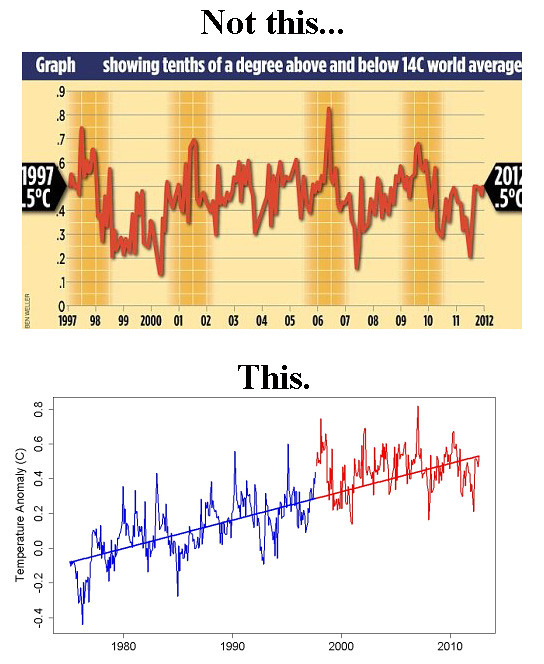
The Op-Ed is directed to U.N. Secretary General Ban Ki-Moon, who has recently, and thankfully, been vocal about the looming environmental catastrophe of global warming. The deniers’ letter takes him to task for this, but doesn’t come within a glancing blow of reality.

The letter itself is based on a single claim. So let’s be clear: If that claim is wrong, so is the rest of the letter.

Guess what? That claim is wrong. So blatantly wrong, in fact, it’s hard to imagine anyone could write it with a straight face. It says:

“The U.K. Met Office recently released data showing that there has been no statistically significant global warming for almost 16 years.”

This is simply, completely, and utterly false. The Met Office is the national weather service for the United Kingdom. In October 2012, they updated their database of global surface temperature measurements, a compendium of temperatures taken over time by weather stations around the planet. David Rose, a climate change denier who can charitably be said to have trouble with facts, cherry-picked this dataset and published a horrendously misleading graph in that bastion of scientific thought, the Daily Mail, saying the measurements show there’s been no global warming for the past 16 years.

But he did this by choosing a starting point on his graph that gave the result he wanted, a graph that looks like there’s been no warming since 1997. But if you show the data properly, you see there has been warming:

Graph showing how the Earth is warming up.Global surface temperatures from the Met Office data. Top: Fiction. Bottom: Fact.

Image credit: David Rose/Daily Mail (top), Tamino (bottom).

The top graph is from Rose’s article, but the bottom graph shows what happens when you display the data going back a few more years. See the difference? What he did is like measuring how tall you are when you’re 25, doing it again when you’re 30, then claiming human beings never grow. That’s a big no-no in science. You have to choose starting and ending points that fairly represent the data, as in the bottom graph. When you do, you very clearly see the trend that the Earth is getting warmer. In fact, hammering home how patently ridiculous this claims is, nine of the 10 hottest years on record have been since 2000. On top of that, Rose was using global surface temperatures, which don’t really represent global overall heat content well; most of the heating is going into ocean waters. So the data he’s displaying so awfully isn’t even the right data to make his claim anyway!

So the very first basis of this denial letter is total garbage, and was such an egregious manipulation of the U.K. Met Office data that the Met Office itself issued a debunking of it! Yet here were are, months later, with the deniers still ignoring facts.

The letter is chock full of more such falsehoods. If you want the rundown, please go readthe great article on Skeptical Science destroying this nonsense. Full disclosure: I had already written quite a bit more for this post before seeing the one at Skeptical Science, and decided it would be better to send readers there for more rather than debunk all the wrongness here. I’m pleased to note they found the same examples of misleading or outright false statements in the deniers’ article and debunked them the same way I had.

I do want to add something, though. I’ll note that it seems superficially impressive that they got 125 scientists, “qualified in climate-related matters” as they claim, to sign this letter.

Yeah, about that…

First, not everyone signing that letter is a scientist. Lord Monckton, for example, apparently has no formal scientific training, has some trouble with the truth, and oh, by the way, claims Obama’s birth certificate is a forgery. He’s the last guy I’d want signing a letter I was on. Yet he seems to pop up on every denialist list as a go-to guy.

Here’s another: The very first signatory, Hhabibullo Abdusamatov, claims that global warming is caused by the Sun, which is patently and provably false (see that Skeptical Science link for more). Many of the claims Abdusamatov makes (as listed on his Wikipedia page) are, um, not accepted by mainstream science, to be very charitable.

Going down the list of signatories I was struck by how many are not, in fact, climate scientists (again, for examples with references, see Skeptical Science); I counted a dozen who actually have climatology in their listed credentials. It’s kinda weird to write such a big letter and then only have fewer than 10 percent of the signers actually be credentialed in the field.

Of course, I’m not a climatologist either, though I am an astronomer classically trained in science, and that means I know enough to rely on the combined research of actual climate scientists from around the world. And when thousands upon thousands of such scientists— in fact, 98 percent of actual, bona fide climate scientists—say global warming is real, well then, that strikes me as being somewhat more credible than a hundred or so politically and ideologically driven non-climate-scientists.

I’ll note this isn’t the first time a laughably-wrong article has been printed by right-leaning venues and signed by multiple, similarly-inappropriate authors. The Wall Street Journalposted one in January 2012 (while turning down an article supporting the reality of global warming signed by 255 actual scientists), and in April 2012, another made the roundsthat was signed by 49 people, including some ex-NASA astronauts, but again, none who actually were climate scientists.

So we can expect to see more of this. Clearly, when you don’t have facts to support your claims, the best thing to do is make as much noise as possible to distract from reality. And that reality is that the world is getting hotter, and unless we do something, now, we’re facing a world of trouble.

Current scientific knowledge does not substantiate Ban Ki-Moon assertions on weather and climate, say 125-plus scientists (Financial Post) + EANTH list reactions

OPEN CLIMATE LETTER TO UN SECRETARY-GENERAL: Current scientific knowledge does not substantiate Ban Ki-Moon assertions on weather and climate, say 125-plus scientists.

Special to Financial Post | Nov 29, 2012 8:36 PM ET | Last Updated:Nov 30, 2012 12:11 PM ET

Getty – UN Secretary-General Ban Ki-Moon

Policy actions that aim to reduce CO2 emissions are unlikely to influence future climate. Policies need to focus on preparation for, and adaptation to, all dangerous climatic events, however caused


Open Letter to the Secretary-General of the United Nations

H.E. Ban Ki-Moon, Secretary-General, United Nations. First Avenue and East 44th Street, New York, New York, U.S.A.

November 29, 2012

Mr. Secretary-General:

On November 9 this year you told the General Assembly: “Extreme weather due to climate change is the new normal … Our challenge remains, clear and urgent: to reduce greenhouse gas emissions, to strengthen adaptation to … even larger climate shocks … and to reach a legally binding climate agreement by 2015 … This should be one of the main lessons of Hurricane Sandy.”

On November 13 you said at Yale: “The science is clear; we should waste no more time on that debate.”

The following day, in Al Gore’s “Dirty Weather” Webcast, you spoke of “more severe storms, harsher droughts, greater floods”, concluding: “Two weeks ago, Hurricane Sandy struck the eastern seaboard of the United States. A nation saw the reality of climate change. The recovery will cost tens of billions of dollars. The cost of inaction will be even higher. We must reduce our dependence on carbon emissions.”

We the undersigned, qualified in climate-related matters, wish to state that current scientific knowledge does not substantiate your assertions.

The U.K. Met Office recently released data showing that there has been no statistically significant global warming for almost 16 years. During this period, according to the U.S. National Oceanic and Atmospheric Administration (NOAA), carbon dioxide (CO2) concentrations rose by nearly 9% to now constitute 0.039% of the atmosphere. Global warming that has not occurred cannot have caused the extreme weather of the past few years. Whether, when and how atmospheric warming will resume is unknown. The science is unclear. Some scientists point out that near-term natural cooling, linked to variations in solar output, is also a distinct possibility.

The “even larger climate shocks” you have mentioned would be worse if the world cooled than if it warmed. Climate changes naturally all the time, sometimes dramatically. The hypothesis that our emissions of CO2 have caused, or will cause, dangerous warming is not supported by the evidence.

The incidence and severity of extreme weather has not increased. There is little evidence that dangerous weather-related events will occur more often in the future. The U.N.’s own Intergovernmental Panel on Climate Change says in its Special Report on Extreme Weather (2012) that there is “an absence of an attributable climate change signal” in trends in extreme weather losses to date. The funds currently dedicated to trying to stop extreme weather should therefore be diverted to strengthening our infrastructure so as to be able to withstand these inevitable, natural events, and to helping communities rebuild after natural catastrophes such as tropical storm Sandy.

There is no sound reason for the costly, restrictive public policy decisions proposed at the U.N. climate conference in Qatar. Rigorous analysis of unbiased observational data does not support the projections of future global warming predicted by computer models now proven to exaggerate warming and its effects.

The NOAA “State of the Climate in 2008” report asserted that 15 years or more without any statistically-significant warming would indicate a discrepancy between observation and prediction. Sixteen years without warming have therefore now proven that the models are wrong by their creators’ own criterion.

Based upon these considerations, we ask that you desist from exploiting the misery of the families of those who lost their lives or properties in tropical storm Sandy by making unsupportable claims that human influences caused that storm. They did not. We also ask that you acknowledge that policy actions by the U.N., or by the signatory nations to the UNFCCC, that aim to reduce CO2 emissions are unlikely to exercise any significant influence on future climate. Climate policies therefore need to focus on preparation for, and adaptation to, all dangerous climatic events however caused.

Signed by:

  1. Habibullo I. Abdussamatov, Dr. Sci., mathematician and astrophysicist, Head of the Selenometria project on the Russian segment of the ISS, Head of Space Research of the Sun Sector at the Pulkovo Observatory of the Russian Academy of Sciences, St. Petersburg, Russia
  2. Syun-Ichi Akasofu, PhD, Professor of Physics, Emeritus and Founding Director, International Arctic Research Center of the University of Alaska, Fairbanks, Alaska, U.S.A.
  3. Bjarne Andresen, Dr. Scient., physicist, published and presents on the impossibility of a “global temperature”, Professor, Niels Bohr Institute (physics (thermodynamics) and chemistry), University of Copenhagen, Copenhagen, Denmark
  4. J. Scott Armstrong, PhD, Professor of Marketing, The Wharton School, University of Pennsylvania, Founder of the International Journal of Forecasting, focus on analyzing climate forecasts, Philadelphia, Pennsylvania, U.S.A.
  5. Timothy F. Ball, PhD, environmental consultant and former climatology professor, University of Winnipeg, Winnipeg, Manitoba, Canada
  6. James R. Barrante, Ph.D. (chemistry, Harvard University), Emeritus Professor of Physical Chemistry, Southern Connecticut State University, focus on studying the greenhouse gas behavior of CO2, Cheshire, Connecticut, U.S.A.
  7. Colin Barton, B.Sc., PhD (Earth Science, Birmingham, U.K.), FInstEng Aus Principal research scientist (ret.), Commonwealth Scientific and Industrial Research Organisation (CSIRO), Melbourne, Victoria, Australia
  8. Joe Bastardi, BSc, (Meteorology, Pennsylvania State), meteorologist, State College, Pennsylvania, U.S.A.
  9. Franco Battaglia, PhD (Chemical Physics), Professor of Physics and Environmental Chemistry, University of Modena, Italy
  10. Richard Becherer, BS (Physics, Boston College), MS (Physics, University of Illinois), PhD (Optics, University of Rochester), former Member of the Technical Staff – MIT Lincoln Laboratory, former Adjunct Professor – University of Connecticut, Areas of Specialization: optical radiation physics, coauthor – standard reference book Optical Radiation Measurements: Radiometry, Millis, MA, U.S.A.
  11. Edwin X. Berry, PhD (Atmospheric Physics, Nevada), MA (Physics, Dartmouth), BS (Engineering, Caltech), Certified Consulting Meteorologist, President, Climate Physics LLC, Bigfork, MT, U.S.A.
  12. Ian Bock, BSc, PhD, DSc, Biological sciences (retired), Ringkobing, Denmark
  13. Ahmed Boucenna, PhD, Professor of Physics (strong climate focus), Physics Department, Faculty of Science, Ferhat Abbas University, Setif, Algéria
  14. Antonio Brambati, PhD, Emeritus Professor (sedimentology), Department of Geological, Environmental and Marine Sciences (DiSGAM), University of Trieste (specialization: climate change as determined by Antarctic marine sediments), Trieste, Italy
  15. Stephen C. Brown, PhD (Environmental Science, State University of New York), District Agriculture Agent, Assistant Professor, University of Alaska Fairbanks, Ground Penetrating Radar Glacier research, Palmer, Alaska, U.S.A.
  16. Mark Lawrence Campbell, PhD (chemical physics; gas-phase kinetic research involving greenhouse gases (nitrous oxide, carbon dioxide)), Professor, United States Naval Academy, Annapolis, Maryland, U.S.A.
  17. Rudy Candler, PhD (Soil Chemistry, University of Alaska Fairbanks (UAF)), former agricultural laboratory manager, School of Agriculture and Land Resources Management, UAF, co-authored papers regarding humic substances and potential CO2 production in the Arctic due to decomposition, Union, Oregon, U.S.A.
  18. Alan Carlin, B.S. (California Institute of Technology), PhD (economics, Massachusetts Institute of Technology), retired senior analyst and manager, U.S. Environmental Protection Agency, Washington, DC, former Chairman of the Angeles Chapter of the Sierra Club (recipient of the Chapter’s Weldon Heald award for conservation work), U.S.A.
  19. Dan Carruthers, M.Sc., Arctic Animal Behavioural Ecologist, wildlife biology consultant specializing in animal ecology in Arctic and Subarctic regions, Turner Valley, Alberta, Canada
  20. Robert M. Carter, PhD, Professor, Marine Geophysical Laboratory, James Cook University, Townsville, Australia
  21. Uberto Crescenti, PhD, Full Professor of Applied Geology, Università G. d’Annunzio, Past President Società Geologica taliana, Chieti, Italy
  22. Arthur Chadwick, PhD (Molecular Biology), Research Professor of Geology, Department of Biology and Geology, Southwestern Adventist University, Climate Specialties: dendrochronology (determination of past climate states by tree ring analysis), palynology (same but using pollen as a climate proxy), paleobotany and botany; Keene, Texas, U.S.A.
  23. George V. Chilingar, PhD, Professor, Department of Civil and Environmental Engineering of Engineering (CO2/temp. focused research), University of Southern California, Los Angeles, California, U.S.A.
  24. Ian D. Clark, PhD, Professor (isotope hydrogeology and paleoclimatology), Dept. of Earth Sciences, University of Ottawa, Ottawa, Ontario, Canada
  25. Cornelia Codreanova, Diploma in Geography, Researcher (Areas of Specialization: formation of glacial lakes) at Liberec University, Czech Republic, Zwenkau, Germany
  26. Michael Coffman, PhD (Ecosystems Analysis and Climate Influences, University of Idaho), CEO of Sovereignty International, President of Environmental Perspectives, Inc., Bangor, Maine, U.S.A.
  27. Piers Corbyn, ARCS, MSc (Physics, Imperial College London)), FRAS, FRMetS, astrophysicist (Queen Mary College, London), consultant, founder WeatherAction long range weather and climate forecasters, American Thinker Climate Forecaster of The Year 2010, London, United Kingdom
  28. Richard S. Courtney, PhD, energy and environmental consultant, IPCC expert reviewer, Falmouth, Cornwall, United Kingdom
  29. Roger W. Cohen, B.S., M.S., PhD Physics, MIT and Rutgers University, Fellow, American Physical Society, initiated and managed for more than twenty years the only industrial basic research program in climate, Washington Crossing, Pennsylvania, U.S.A.
  30. Susan Crockford, PhD (Zoology/Evolutionary Biology/Archaeozoology), Adjunct Professor (Anthropology/Faculty of Graduate Studies), University of Victoria, Victoria, British Colombia, Canada
  31. Walter Cunningham, B.S., M.S. (Physics – Institute of Geophysics And Planetary Sciences,  UCLA), AMP – Harvard Graduate School of Business, Colonel (retired) U.S. Marine Corps, Apollo 7 Astronaut., Fellow – AAS, AIAA; Member AGU, Houston, Texas, U.S.A.
  32. Joseph D’Aleo, BS, MS (Meteorology, University of Wisconsin),  Doctoral Studies (NYU), CMM, AMS Fellow, Executive Director – ICECAP (International Climate and Environmental Change Assessment Project), College Professor Climatology/Meteorology, First Director of Meteorology The Weather Channel, Hudson, New Hampshire, U.S.A.
  33. David Deming, PhD (Geophysics), Professor of Arts and Sciences, University of Oklahoma, Norman, Oklahoma, U.S.A.
  34. James E. Dent; B.Sc., FCIWEM, C.Met, FRMetS, C.Env., Independent Consultant (hydrology & meteorology), Member of WMO OPACHE Group on Flood Warning, Hadleigh, Suffolk, England, United Kingdom
  35. Willem de Lange, MSc (Hons), DPhil (Computer and Earth Sciences), Senior Lecturer in Earth and Ocean Sciences, The University of Waikato, Hamilton, New Zealand
  36. Silvia Duhau, Ph.D. (physics), Solar Terrestrial Physics, Buenos Aires University, Buenos Aires, Argentina
  37. Geoff Duffy, DEng (Dr of Engineering), PhD (Chemical Engineering), BSc, ASTCDip. (first chemical engineer to be a Fellow of the Royal Society in NZ), FIChemE, wide experience in radiant heat transfer and drying, chemical equilibria, etc. Has reviewed, analysed, and written brief reports and papers on climate change, Auckland, New Zealand
  38. Don J. Easterbrook, PhD, Emeritus Professor of Geology, Western Washington, University, Bellingham, Washington, U.S.A.
  39. Ole Henrik Ellestad, former Research Director, applied chemistry SINTEF, Professor in physical chemistry, University of Oslo, Managing director Norsk Regnesentral and Director for Science and Technology, Norwegian Research Council, widely published in infrared spectroscopy, Oslo, Norway
  40. Per Engene, MSc, Biologist, Co-author – The Climate, Science and Politics (2009), Bø i Telemark, Norway
  41. Gordon Fulks, B.S., M.S., PhD (Physics, University of Chicago), cosmic radiation, solar wind, electromagnetic and geophysical phenomena, Portland, Oregon, U.S.A.
  42. Katya Georgieva, MSc (meteorology), PhD (solar-terrestrial climate physics), Professor, Space Research and Technologies Institute, Bulgarian Academy of Sciences, Sofia, Bulgaria
  43. Lee C. Gerhard, PhD, Senior Scientist Emeritus, University of Kansas, past director and state geologist, Kansas Geological Survey, U.S.A.
  44. Ivar Giaever PhD, Nobel Laureate in Physics 1973, professor emeritus at the Rensselaer Polytechnic Institute, a professor-at-large at the University of Oslo, Applied BioPhysics, Troy, New York, U.S.A.
  45. Albrecht Glatzle, PhD, ScAgr, Agro-Biologist and Gerente ejecutivo, Tropical pasture research and land use management, Director científico de INTTAS, Loma Plata, Paraguay
  46. Fred Goldberg, PhD, Adj Professor, Royal Institute of Technology (Mech, Eng.), Secretary General KTH International Climate Seminar 2006 and Climate analyst (NIPCC), Lidingö, Sweden
  47. Laurence I. Gould, PhD, Professor of Physics, University of Hartford, Past Chair (2004), New England Section of the American Physical Society, West Hartford, Connecticut, U.S.A.
  48. Vincent Gray, PhD, New Zealand Climate Coalition, expert reviewer for the IPCC, author of The Greenhouse Delusion: A Critique of Climate Change 2001, Wellington, New Zealand
  49. William M. Gray, PhD, Professor Emeritus, Dept. of Atmospheric Science, Colorado State University, Head of the Tropical Meteorology Project, Fort Collins, Colorado, U.S.A.
  50. Charles B. Hammons, PhD (Applied Mathematics), climate-related specialties: applied mathematics, modeling & simulation, software & systems engineering, Associate Professor, Graduate School of Management, University of Dallas; Assistant Professor, North Texas State University (Dr. Hammons found many serious flaws during a detailed study of the software, associated control files plus related email traffic of the Climate Research Unit temperature and other records and “adjustments” carried out in support of IPCC conclusions), Coyle, OK, U.S.A.
  51. William Happer, PhD, Professor, Department of Physics, Princeton University, Princeton, NJ, U.S.A.
  52. Hermann Harde, PhD, Professur f. Lasertechnik & Werkstoffkunde (specialized in molecular spectroscopy, development of gas sensors and CO2-climate sensitivity), Helmut-Schmidt-Universität, Universität der Bundeswehr Fakultät für Elektrotechnik, Hamburg, Germany
  53. Howard Hayden, PhD, Emeritus Professor (Physics), University of Connecticut, The Energy Advocate, Pueblo West, Colorado, U.S.A.
  54. Ross Hays, Meteorologist, atmospheric scientist, NASA Columbia Scientific Balloon Facility (currently working at McMurdo Station, Antarctica), Palestine, Texas, U.S.A.
  55. Martin Hovland, M.Sc. (meteorology, University of Bergen), PhD (Dr Philos, University of Tromsø), FGS, Emeritus Professor, Geophysics, Centre for Geobiology, University of Bergen, member of the expert panel: Environmental Protection and Safety Panel (EPSP) for the Ocean Drilling Program (ODP) and the Integrated ODP, Stavanger, Norway
  56. Ole Humlum, PhD, Professor of Physical Geography, Department of Physical Geography, Institute of Geosciences, University of Oslo, Oslo, Norway
  57. Craig D. Idso, PhD, Chairman of the Board of Directors of the Center for the Study of Carbon Dioxide and Global Change, Tempe, Arizona, U.S.A.
  58. Sherwood B. Idso, PhD, President, Center for the Study of Carbon Dioxide and Global Change, Tempe, Arizona, U.S.A.
  59. Larry Irons, BS (Geology), MS (Geology), Sr. Geophysicist at Fairfield Nodal (specialization: paleoclimate), Lakewood, Colorado, U.S.A.
  60. Terri Jackson, MSc (plasma physics), MPhil (energy economics), Director, Independent Climate Research Group, Northern Ireland and London (Founder of the energy/climate group at the Institute of Physics, London), United Kingdom
  61. Albert F. Jacobs, Geol.Drs., P. Geol., Calgary, Alberta, Canada
  62. Hans Jelbring, PhD Climatology, Stockholm University, MSc Electronic engineering, Royal Institute of Technology, BSc  Meteorology, Stockholm University, Sweden
  63. Bill Kappel, B.S. (Physical Science-Geology), B.S. (Meteorology), Storm Analysis, Climatology, Operation Forecasting, Vice President/Senior Meteorologist, Applied Weather Associates, LLC, University of Colorado, Colorado Springs, U.S.A.
  64. Olavi Kärner, Ph.D., Extraordinary Research Associate; Dept. of Atmospheric Physics, Tartu Observatory, Toravere, Estonia
  65. Leonid F. Khilyuk, PhD, Science Secretary, Russian Academy of Natural Sciences, Professor of Engineering (CO2/temp. focused research), University of Southern California, Los Angeles, California, U.S.A.
  66. William Kininmonth MSc, MAdmin, former head of Australia’s National Climate Centre and a consultant to the World Meteorological organization’s Commission for Climatology, Kew, Victoria, Australia
  67. Gerhard Kramm, Dr. rer. nat. (Theoretical Meteorology), Research Associate Professor, Geophysical Institute, Associate Faculty, College of Natural Science and Mathematics, University of Alaska Fairbanks, (climate specialties: Atmospheric energetics, physics of the atmospheric boundary layer, physical climatology – seeinteresting paper by Kramm et al), Fairbanks, Alaska, U.S.A.
  68. Leif Kullman, PhD (Physical geography, plant ecology, landscape ecology), Professor, Physical geography, Department of Ecology and Environmental science, Umeå University, Areas of Specialization: Paleoclimate (Holocene to the present), glaciology, vegetation history, impact of modern climate on the living landscape, Umeå, Sweden
  69. Hans H.J. Labohm, PhD, Independent economist, author specialised in climate issues, IPCC expert reviewer, author of Man-Made Global Warming: Unravelling a Dogma and climate science-related Blog, The Netherlands
  70. Rune Berg-Edland Larsen, PhD (Geology, Geochemistry), Professor, Dep. Geology and Geoengineering, Norwegian University of Science and Technology (NTNU), Trondheim, Norway
  71. C. (Kees) le Pair, PhD (Physics Leiden, Low Temperature Physics), former director of the Netherlands Research Organization FOM (fundamental physics) and subsequently founder and director of The Netherlands Technology Foundation STW.  Served the Dutch Government many years as member of its General Energy Council and of the National Defense Research Council. Royal Academy of Arts and Sciences Honorary Medal and honorary doctorate in all technical sciences of the Delft University of technology, Nieuwegein, The Netherlands
  72. Douglas Leahey, PhD, meteorologist and air-quality consultant, past President – Friends of Science, Calgary, Alberta, Canada
  73. Jay Lehr, B.Eng. (Princeton), PhD (environmental science and ground water hydrology), Science Director, The Heartland Institute, Chicago, Illinois, U.S.A.
  74. Bryan Leyland, M.Sc., FIEE, FIMechE, FIPENZ, MRSNZ, consulting engineer (power), Energy Issues Advisor – International Climate Science Coalition, Auckland, New Zealand
  75. Edward Liebsch, B.A. (Earth Science, St. Cloud State University); M.S. (Meteorology, The Pennsylvania State University), former Associate Scientist, Oak Ridge National Laboratory; former Adjunct Professor of Meteorology, St. Cloud State University, Environmental Consultant/Air Quality Scientist (Areas of Specialization: micrometeorology, greenhouse gas emissions), Maple Grove, Minnesota, U.S.A.
  76. William Lindqvist, PhD (Applied Geology), Independent Geologic Consultant, Areas of Specialization: Climate Variation in the recent geologic past, Tiburon, California, U.S.A.
  77. Horst-Joachim Lüdecke, Prof. Dr. , PhD (Physics), retired from university of appl. sciences HTW, Saarbrücken (Germany), atmospheric temperature research, speaker of the European Institute for Climate and Energy (EIKE), Heidelberg, Germany
  78. Anthony R. Lupo, Ph.D., Professor of Atmospheric Science, Department of Soil, Environmental, and Atmospheric Science, University of Missouri, Columbia, Missouri, U.S.A.
  79. Oliver Manuel, BS, MS, PhD, Post-Doc (Space Physics), Associate – Climate & Solar Science Institute, Emeritus Professor, College of Arts & Sciences University of Missouri-Rolla, previously Research Scientist (US Geological Survey) and NASA Principal Investigator for Apollo, Cape Girardeau, Missouri, U.S.A.
  80. Francis Massen, professeur-docteur en physique (PhD equivalent, Universities of Nancy (France) and Liège (Belgium), Manager of the Meteorological Station of the Lycée Classique de Diekirch, specialising in the measurement of solar radiation and atmospheric gases. Collaborator to the WOUDC (World Ozone and UV Radiation Data Center), Diekirch, Luxembourg
  81. Henri Masson, Prof. dr. ir., Emeritus Professor University of Antwerp (Energy & Environment Technology Management), Visiting professor Maastricht School of Management, specialist in dynamical (chaotic) complex system analysis, Antwerp, Belgium.
  82. Ferenc Mark Miskolczi, PhD, atmospheric physicist, formerly of NASA’s Langley Research Center, Hampton, Virginia, U.S.A.
  83. Viscount Monckton of Brenchley, Expert reviewer, IPCC Fifth Assessment Report, Quantification of Climate Sensitivity, Carie, Rannoch, Scotland
  84. Nils-Axel Mörner, PhD (Sea Level Changes and Climate), Emeritus Professor of Paleogeophysics & Geodynamics, Stockholm University, Stockholm, Sweden
  85. John Nicol, PhD (Physics, James Cook University), Chairman – Australian climate Science Coalition, Brisbane, Australia
  86. Ingemar Nordin, PhD, professor in philosophy of science (including a focus on “Climate research, philosophical and sociological aspects of a politicised research area”), Linköpings University, Sweden.
  87. David Nowell, M.Sc., Fellow of the Royal Meteorological Society, former chairman of the NATO Meteorological Group, Ottawa, Ontario, Canada
  88. Cliff Ollier, D.Sc., Professor Emeritus (School of Earth and Environment – see hisCopenhagen Climate Challenge sea level article here), Research Fellow, University of Western Australia, Nedlands, W.A., Australia
  89. Oleg M. Pokrovsky, BS, MS, PhD (mathematics and atmospheric physics – St. Petersburg State University, 1970), Dr. in Phys. and Math Sciences (1985), Professor in Geophysics (1995), principal scientist, Main Geophysical Observatory (RosHydroMet), Note: Dr. Pokrovsky analyzed long climates and concludes that anthropogenic CO2 impact is not the main contributor in climate change,St. Petersburg, Russia.
  90. Daniel Joseph Pounder, BS (Meteorology, University of Oklahoma), MS (Atmospheric Sciences, University of Illinois, Urbana-Champaign); Meteorological/Oceanographic Data Analyst for the National Data Buoy Center, formerly Meteorologist, WILL AM/FM/TV, Urbana, U.S.A.
  91. Brian Pratt, PhD, Professor of Geology (Sedimentology), University of Saskatchewan (see Professor Pratt’s article for a summary of his views), Saskatoon, Saskatchewan, Canada
  92. Harry N.A. Priem, PhD, Professore-emeritus isotope-geophysics and planetary geology, Utrecht University, past director ZWO/NOW Institute of Isotope Geophysical Research, Past-President Royal Netherlands Society of Geology and Mining, Amsterdam, The Netherlands
  93. Oleg Raspopov, Doctor of Science and Honored Scientist of the Russian Federation, Professor – Geophysics, Senior Scientist, St. Petersburg Filial (Branch) of N.V.Pushkov Institute of Terrestrial Magnetism, Ionosphere and Radiowaves Propagation of RAS (climate specialty: climate in the past, particularly the influence of solar variability), Editor-in-Chief of journal “Geomagnetism and Aeronomy” (published by Russian Academy of Sciences), St. Petersburg, Russia
  94. Curt G. Rose, BA, MA (University of Western Ontario), MA, PhD (Clark University), Professor Emeritus, Department of Environmental Studies and Geography, Bishop’s University, Sherbrooke, Quebec, Canada
  95. S. Jeevananda Reddy, M.Sc. (Geophysics), Post Graduate Diploma (Applied Statistics, Andhra University), PhD (Agricultural Meteorology, Australian University, Canberra), Formerly Chief Technical Advisor—United Nations World Meteorological Organization (WMO) & Expert-Food and Agriculture Organization (UN), Convener – Forum for a Sustainable Environment, author of 500 scientific articles and several books – here is one: “Climate Change – Myths & Realities“, Hyderabad, India
  96. Arthur Rorsch, PhD, Emeritus Professor, Molecular Genetics, Leiden University, former member of the board of management of the Netherlands Organization Applied Research TNO, Leiden, The Netherlands
  97. Rob Scagel, MSc (forest microclimate specialist), Principal Consultant – Pacific Phytometric Consultants, Surrey, British Columbia, Canada
  98. Chris Schoneveld, MSc (Structural Geology), PhD (Geology), retired exploration geologist and geophysicist, Australia and France
  99. Tom V. Segalstad, PhD (Geology/Geochemistry), Associate Professor of Resource and Environmental Geology, University of Oslo, former IPCC expert reviewer, former Head of the Geological Museum, and former head of the Natural History Museum and Botanical Garden (UO), Oslo, Norway
  100. John Shade, BS (Physics), MS (Atmospheric Physics), MS (Applied Statistics), Industrial Statistics Consultant, GDP, Dunfermline, Scotland, United Kingdom
  101. Thomas P. Sheahen, B.S., PhD (Physics, Massachusetts Institute of Technology), specialist in renewable energy, research and publication (applied optics) in modeling and measurement of absorption of infrared radiation by atmospheric CO2,  National Renewable Energy Laboratory (2005-2009); Argonne National Laboratory (1988-1992); Bell Telephone labs (1966-73), National Bureau of Standards (1975-83), Oakland, Maryland, U.S.A.
  102. S. Fred Singer, PhD, Professor Emeritus (Environmental Sciences), University of Virginia, former director, U.S. Weather Satellite Service, Science and Environmental Policy Project, Charlottesville, Virginia, U.S.A.
  103. Frans W. Sluijter, Prof. dr ir, Emeritus Professor of theoretical physics, Technical University Eindhoven, Chairman—Skepsis Foundation, former vice-president of the International Union of Pure and Applied Physics, former President of the Division on Plasma Physics of the European Physical Society and former bureau member of the Scientific Committee on Sun-Terrestrial Physics, Euvelwegen, the Netherlands
  104. Jan-Erik Solheim, MSc (Astrophysics), Professor, Institute of Physics, University of Tromsø, Norway (1971-2002), Professor (emeritus), Institute of Theoretical Astrophysics, University of Oslo, Norway (1965-1970, 2002- present), climate specialties: sun and periodic climate variations, scientific paper by Professor Solheim “Solen varsler et kaldere tiår“, Baerum, Norway
  105. H. Leighton Steward, Master of Science (Geology), Areas of Specialization: paleoclimates and empirical evidence that indicates CO2 is not a significant driver of climate change, Chairman, PlantsNeedCO2.org and CO2IsGreen.org, Chairman of the Institute for the Study of Earth and Man (geology, archeology & anthropology) at SMU in Dallas, Texas, Boerne, TX, U.S.A.
  106. Arlin B. Super, PhD (Meteorology – University of Wisconsin at Madison), former Professor of Meteorology at Montana State University, retired Research Meteorologist, U.S. Bureau of Reclamation, Saint Cloud, Minnesota, U.S.A.
  107. Edward (Ted) R. Swart, D.Sc. (physical chemistry, University of Pretoria), M.Sc. and Ph.D. (math/computer science, University of Witwatersrand). Formerly Director of the Gulbenkian Centre, Dean of the Faculty of Science, Professor and Head of the Department of Computer Science, University of Rhodesia and past President of the Rhodesia Scientific Association. Set up the first radiocarbon dating laboratory in Africa. Most recently, Professor in the Department of Combinatorics and Optimization at the University of Waterloo and Chair of Computing and Information Science and Acting Dean at the University of Guelph, Ontario, Canada, now retired in Kelowna British Columbia, Canada
  108. George H. Taylor, B.A. (Mathematics, U.C. Santa Barbara), M.S. (Meteorology, University of Utah), Certified Consulting Meteorologist, Applied Climate Services, LLC, Former State Climatologist (Oregon), President, American Association of State Climatologists (1998-2000), Corvallis, Oregon, U.S.A.
  109. J. E. Tilsley, P.Eng., BA Geol, Acadia University, 53 years of climate and paleoclimate studies related to development of economic mineral deposits, Aurora, Ontario, Canada
  110. Göran Tullberg, Civilingenjör i Kemi (equivalent to Masters of Chemical Engineering), Co-author – The Climate, Science and Politics (2009) (see here for a review), formerly instructor of Organic Chemistry (specialization in “Climate chemistry”), Environmental Control and Environmental Protection Engineering at University in Växjö; Falsterbo, Sweden
  111. Brian Gregory Valentine, PhD, Adjunct professor of engineering (aero and fluid dynamics specialization) at the University of Maryland, Technical manager at US Department of Energy, for large-scale modeling of atmospheric pollution, Technical referee for the US Department of Energy’s Office of Science programs in climate and atmospheric modeling conducted at American Universities and National Labs, Washington, DC, U.S.A.
  112. Bas van Geel, PhD, paleo-climatologist, Institute for Biodiversity and Ecosystem Dynamics, Research Group Paleoecology and Landscape Ecology, Faculty of Science, Universiteit van Amsterdam, Amsterdam, The Netherlands
  113. Gerrit J. van der Lingen, PhD (Utrecht University), geologist and paleoclimatologist, climate change consultant, Geoscience Research and Investigations, Nelson, New Zealand
  114. A.J. (Tom) van Loon, PhD, Professor of Geology (Quaternary Geologyspecialism: Glacial Geology), Adam Mickiewicz University, former President of the European Association of Science Editors Poznan, Poland
  115. Fritz Vahrenholt, B.S. (chemistry), PhD (chemistry), Prof. Dr., Professor of Chemistry, University of Hamburg, Former Senator for environmental affairs of the State of Hamburg, former CEO of REpower Systems AG (wind turbines), Author of the book Die kalte Sonne: warum die Klimakatastrophe nicht stattfindet (The Cold Sun: Why the Climate Crisis Isn’t Happening”, Hamburg, Germany
  116. Michael G. Vershovsky, Ph.D. in meteorology (macrometeorology, long-term forecasts, climatology), Senior Researcher, Russian State Hydrometeorological University, works with, as he writes, “Atmospheric Centers of Action (cyclones and anticyclones, such as Icelandic depression, the South Pacific subtropical anticyclone, etc.). Changes in key parameters of these centers strongly indicate that the global temperature is influenced by these natural factors (not exclusively but nevertheless)”, St. Petersburg, Russia
  117. Gösta Walin, PhD and Docent (theoretical Physics, University of Stockholm), Professor Emeritus in oceanografi, Earth Science Center, Göteborg University, Göteborg,  Sweden
  118. Anthony Watts, ItWorks/IntelliWeather, Founder, surfacestations.orgWatts Up With That, Chico, California, U.S.A.
  119. Carl Otto Weiss, Direktor und Professor at Physikalisch-Technische Bundesanstalt,  Visiting Professor at University of Copenhagen, Tokyo Institute of Technology, Coauthor of ”Multiperiodic Climate Dynamics: Spectral Analysis of…“, Braunschweig, Germany
  120. Forese-Carlo Wezel, PhD, Emeritus Professor of Stratigraphy (global and Mediterranean geology, mass biotic extinctions and paleoclimatology), University of Urbino, Urbino, Italy
  121. Boris Winterhalter, PhD, senior marine researcher (retired), Geological Survey of Finland, former professor in marine geology, University of Helsinki, Helsinki, Finland
  122. David E. Wojick, PhD,  PE, energy and environmental consultant, Technical Advisory Board member – Climate Science Coalition of America, Star Tannery, Virginia, U.S.A.
  123. George T. Wolff, Ph.D., Principal Atmospheric Scientist, Air Improvement Resource, Inc., Novi, Michigan, U.S.A.
  124. Thomas (Tom) Wysmuller –NASA (Ret) ARC, GSFC, Hdq. – Meteorologist, Ogunquit, ME, U.S.A.
  125. Bob Zybach, PhD (Environmental Sciences, Oregon State University), climate-related carbon sequestration research, MAIS, B.S., Director, Environmental Sciences Institute Peer review Institute, Cottage Grove, Oregon, U.S.A.
  126. Milap Chand Sharma, PhD, Associate Professor of Glacial Geomorphology, Centre fort the Study of Regional Development, Jawaharlal Nehru University, New Delhi, India
  127. Valentin A. Dergachev, PhD, Professor and Head of the Cosmic Ray Laboratory at Ioffe Physical-Technical Institute of Russian Academy of Sciences, St. Petersburg, Russia
  128. Vijay Kumar Raina, Ex-Deputy Director General, Geological Survey of India, Ex-Chairman Project Advisory and Monitoring Committee on Himalayan glacier, DST, Govt. of India and currently Member Expert Committee on Climate Change Programme, Dept. of Science & Technology, Govt. of India, author of 2010 MoEF Discussion Paper, “Himalayan Glaciers – State-of-Art Review of Glacial Studies, Glacial Retreat and Climate Change”, the first comprehensive study on the region.  Winner of the Indian Antarctica Award, Chandigarh, India
  129. Scott Chesner, B.S. (Meteorology, Penn State University), KETK Chief Meteorologist, KETK TV, previously Meteorologist with Accu Weather, Tyler, Texas, U.S.A

*   *   *

Reactions (I will not mention names here; all are from emails in the EANTH list)

1) “Hmm, I clicked on a few links, googled a few names. Found that when one is listed as “author of x book”, said book doesn’t appear on Amazon, etc.

Many non-PhDs.

Many “consultants”. Losts of “adjuncts”, lots of professor emeriti. someone listed as an “Extraordinary Research Associate”.

Little actual data. Few peer-reviewed research reports.

Didn’t recognize most of the names. Did recognize some “suspicious” ones (e.g., Tim Ball, a lovely [sic] Canadian).

Misrepresentation of the SREX report (quotation is a minor comment on a single point of many – page 280 of 594).

Link is to a letter published in the Financial Post, the business section of the National Post, the more rightward leaning of Canada’s 2 national papers. To give an indication, on the day in 2007 when the Nobel was awarded to IPCC and Gore, the headline on front page was “A Coup for Junk Science: Gaffe riddled work undeserving”.

Conclusion: don’t bother to click the link.”


2) “A few of the names on the list are also contained in table 3 of the 2012 Heartland Institute Proposed Budget (pages 7-8). Namely:

Craig D. Idso

Anthony Lupo

Susan Crockford

Joseph D’Aleo

Fred Singer

Robert Carter

Link:

http://www.desmogblog.com/sites/beta.desmogblog.com/files/(1-15-2012)%202012%20Heartland%20Budget.pdf


3) “Is it that bad guys without phd and associations with the wrong institutions nullify the legitimacy of the good guys with proper credentials? Suppose you could not look them up. Would you be unable to judge the contents (with links to data) of the letter? You seem to require a certain kind of authority (defined by political means especially) to allow you to decide whether ideas are valuable. How sad. If every scientist were that intellectually timid there would be no learning. Thank goodness for the Feynmans of the world.”


4) “Short of being able to read, review and test all the science, a person has to make judgements based on additional criteria. My criteria include, but are not limited to, some things such as peer-review, credentials, reputation, availability of cited sources/affiliation/expertise, guilt-by-association, and so on. They are only part of the judgement of credibility. I looked up a book listed in the credentials of one “expert” and could not find it; I followed links, and so on.

The endpoint was when I looked for the quotation in the cited source (SREX) and evaluated it as misrepresentation. Since the IPCC was called on as an expert source by the so-called experts, yet it claimed other than what they claimed it claimed, the credibility of the letters and listed experts is to be disparaged.

That’s the character of science, and process of knowledge. Yup, that is how one really, really does judge which ideas are valuable.”


5) “Thank you for drawing attention to this open letter. I suspect quite a number of the people named in this letter are members of naysayer groups. From an Australian perspective Prof Bob Carter is a member of the secretive  Lavoissier group. I have inside knowledge of this group as I was approached with my husband to write a film script about climate change many years ago and we pulled out eventually after being told what they wanted to say about the science of climate change, which required a distortion of the facts. We had the impression that the money for the film was coming from America and I wouldn’t mind betting that it was oil and mining interest finance ($6 million). The person who set out to recruit us was a glaciologist who was also a member of the Lavoissier group. For more information see the following:

Pearse, Guy , “High and Dry”, Viking/Penguin,Camberwell, Victoria, 2007.
Hamilton, Clive, “Scorcher: The Dirty Politics of Climate Change, Black Inc. Agenda, Melbourne, Victoria, 2007.”


6) “I read a short and entertaining book that laid out a good process for deciding what to believe about climate change (or any other complex issue with lots of scientific research swirling around). It’s by Greg Craven and it’s called What’s the Worst That Could Happen?

Besides providing a way to cut through all the chatter, the book offers sound fundamentals for people interested in how scientific information comes to be accepted. I think it’s a great book for students, especially because the author (a physics teacher) tackles tough subjects with humor.

Here’s a link to it: http://www.amazon.com/Whats-Worst-That-Could-Happen/dp/0399535012/

The State of Climate Science (scienceprogress.org)

CLIMATE SCIENCE

A Thorough Review of the Scientific Literature on Global Warming

By Dr. James Powell | Thursday, November 15th, 2012

Polls show that many members of the public believe that scientists substantially disagree about human-caused global warming. The gold standard of science is the peer-reviewed literature. If there is disagreement among scientists, based not on opinion but on hard evidence, it will be found in the peer-reviewed literature.

I searched the Web of Science, an online science publication tool, for peer-reviewed scientific articles published between January first 1991 and November 9th 2012 that have the keyword phrases “global warming” or “global climate change.” The search produced 13,950 articles. See methodology.

I read whatever combination of titles, abstracts, and entire articles was necessary to identify articles that “reject” human-caused global warming. To be classified as rejecting, an article had to clearly and explicitly state that the theory of global warming is false or, as happened in a few cases, that some other process better explains the observed warming. Articles that merely claimed to have found some discrepancy, some minor flaw, some reason for doubt, I did not classify as rejecting global warming.

Articles about methods, paleoclimatology, mitigation, adaptation, and effects at least implicitly accept human-caused global warming and were usually obvious from the title alone. John Cook and Dana Nuccitelli also reviewed and assigned some of these articles; John provided invaluable technical expertise.

This work follows that of Oreskes (Science, 2005) who searched for articles published between 1993 and 2003 with the keyword phrase “global climate change.” She found 928, read the abstracts of each and classified them. None rejected human-caused global warming. Using her criteria and time-span, I get the same result. Deniers attacked Oreskes and her findings, but they have held up.

Some articles on global warming may use other keywords, for example, “climate change” without the “global” prefix. But there is no reason to think that the proportion rejecting global warming would be any higher.

By my definition, 24 of the 13,950 articles, 0.17 percent or 1 in 581, clearly reject global warming or endorse a cause other than CO2 emissions for observed warming. The list of articles that reject global warming is here.

The 24 articles have been cited a total of 113 times over the nearly 21-year period, for an average of close to 5 citations each. That compares to an average of about 19 citations for articles answering to “global warming,” for example. Four of the rejecting articles have never been cited; four have citations in the double-digits. The most-cited has 17.

Of one thing we can be certain: had any of these articles presented the magic bullet that falsifies human-caused global warming, that article would be on its way to becoming one of the most-cited in the history of science.

The articles have a total of 33,690 individual authors. The top ten countries represented, in order, are USA, England, China, Germany, Japan, Canada, Australia, France, Spain, and Netherlands. (The chart shows results through November 9th, 2012.)

Global warming deniers often claim that bias prevents them from publishing in peer-reviewed journals. But 24 articles in 18 different journals, collectively making several different arguments against global warming, expose that claim as false. Articles rejecting global warming can be published, but those that have been have earned little support or notice, even from other deniers.

A few deniers have become well known from newspaper interviews, Congressional hearings, conferences of climate change critics, books, lectures, websites and the like. Their names are conspicuously rare among the authors of the rejecting articles. Like those authors, the prominent deniers must have no evidence that falsifies global warming.

Anyone can repeat this search and post their findings. Another reviewer would likely have slightly different standards than mine and get a different number of rejecting articles. But no one will be able to reach a different conclusion, for only one conclusion is possible: Within science, global warming denial has virtually no influence. Its influence is instead on a misguided media, politicians all-too-willing to deny science for their own gain, and a gullible public.

Scientists do not disagree about human-caused global warming. It is the ruling paradigm of climate science, in the same way that plate tectonics is the ruling paradigm of geology. We know that continents move. We know that the earth is warming and that human emissions of greenhouse gases are the primary cause. These are known facts about which virtually all publishing scientists agree.

James Lawrence Powell is the author of The Inquisition of Climate Science. Powell is also the executive director of the National Physical Science Consortium, a partnership among government agencies and laboratories, industry, and higher education dedicated to increasing the number of American citizens with graduate degrees in the physical sciences and related engineering fields. This article is cross-posted with permission with the Columbia University Press blog.

This article is a cross-post with our partners at DeSmogBlog.

Saúde mental, outra vítima da mudança climática (IPS)

23/11/2012 – 10h05

por Patricia Grogg, da IPS

clima Saúde mental, outra vítima da mudança climática

As tensões e angústias acompanham toda pessoa que sofre um desastre. Foto: Jorge Luis Baños/IPS

Santiago de Cuba, Cuba, 23/11/2012 – “A cidade parecia bombardeada. Caminho para meu escritório, cruzo com pessoas que levavam em seus rostos o mesmo – diria dramático – espanto que eu. Nos olhávamos e, sem nos conhecermos, nos perguntávamos: como foi com você? Aconteceu alguma coisa com sua casa? Foi uma solidariedade afetiva muito importante para mim”. Este testemunho dado à IPS, por uma jornalista de Santiago de Cuba, coloca na balança um dos lados bons da reação coletiva após um desastre como o sofrido por esta cidade na madrugada do dia 25 de outubro, quando o furacão Sandy, apesar do alerta meteorológico e das advertências oficiais, surpreendeu boa parte de seus habitantes.

O valor econômico dos prejuízos ainda são desconhecidos hoje, quando a parte mais oriental do país cura suas feridas, graves de todos os ângulos. Mas existe também o impacto psicológico, do qual se fala menos e se vê nos olhos das pessoas quando contam: “perdemos nossa casa com móveis, eletrodomésticos, até as lembranças”. “Tive muito medo, me enfiei no armário quando o vento levou o telhado do meu quarto. Meus vizinhos me tiraram de casa e me ajudaram a atravessar a rua até onde haviam se refugiado outras famílias cujas casas estavam em muito mau estado”, contou à IPS Isabel da Cruz, de 70 anos, moradora de Guantânamo, outra área afetada.

Depressão, tristeza, angústia, desespero, incerteza e agressividade, todas estas são manifestações que acompanham as pessoas depois de um desastre em qualquer parte do mundo. “Imagine, nos deitamos com a bela e acordamos com a fera”, comparou um trabalhador do setor turístico cujo hotel onde é empregado foi totalmente destruído. “As pessoas estão deprimidas e desorientadas. Em muitas nota-se o desequilíbrio psíquico pelas perdas sofridas”, disse à IPS o sacerdote católico Eugenio Castellanos, reitor do Santuário da Caridad del Cobre, virgem padroeira de Cuba. O padre estima que 90% das casas do Cobre, localidade vizinha a esta cidade, sofreram o impacto do Sandy.

Juan González Pérez, por sua vez, disse à IPS que dias antes do furacão houve focos de violência em alguns lugares, especialmente na hora de comprar artigos em falta. “Ficamos muitos dias sem energia elétrica e começaram a vender ‘luz brilhante’ (querosene) para cozinhar. Embora houvesse o suficiente para todos, aconteceram discussões e brigas na fila. Quando as pessoas se desesperam, costumam ficar agressivas”, observou Pérez, mais conhecido por Madelaine, líder do espiritismo cruzado “muertero”, uma expressão de religiosidade popular nesse lugar. Segundo contou, aconselha aos seus seguidores “unirem-se, se lavar bem, dar a quem não tem e não se desesperar”.

Em Mar Verde, a praia por onde o Sandy tocou o território cubano a 15 quilômetros de Santiago, a médica Elizabeth Martínez atende mais de cem pessoas, abrigadas em cabanas de veraneio que, por estarem mais afastadas do mar, se salvaram do desastre. “O impacto psicológico é grande, mas não houve mortes e nem temos pessoas doentes”, contou. Pouco mais de uma semana depois da passagem do furacão, os esforços em matéria de saúde se concentravam fundamentalmente em conter focos epidêmicos. “Estamos dando informações sanitárias aos moradores, ensinando como cuidar de doenças transmissíveis, sobre a importância de descontaminar a água antes de beber”, informou a médica.

Segundo meios especializados, estima-se que entre um terço e metade de uma população exposta a desastres sofre algum tipo de problema psicológico, embora na maioria dos casos se deva entender como reações normais diante de eventos extremos, que sob o impacto da mudança climática ameaçam aumentar em intensidade.

“Quando encontrei meus vizinhos no abrigo, estávamos em choque. Mas alguém disse: vamos limpar a entrada que está bloqueada por essas árvores caídas. Então, começamos a trabalhar, embora no começo ninguém falasse”, contou uma mulher do setor turístico. Nos primeiros dias era possível ver muitas pessoas recolhendo escombros e varrendo as ruas de suas vizinhanças.

Diante da frequência e da maior intensidade dos ciclones tropicais, as autoridades de saúde, desde a década de 1990, começaram a se preocupar com o impacto psicológico dos desastres causados por esses e outros fenômenos naturais. Em 2008, quando o país sofreu três furacões, uma indicação ministerial fortaleceu a inclusão do tema nos planos sanitários. Em um artigo sobre o assunto, o médico cubano Alexis Lorenzo Ruiz explica que os aspectos psicossociais dos desastres são considerados tanto na capacitação do pessoal como na organização dos programas que chegam a todo o país e enfatizam a atenção a setores mais vulneráveis, como menores de idade, adolescentes e idosos.

Do ponto de vista da saúde mental, nos desastres toda a população “sofre tensões e angústias em maior ou menor medida, direta ou indiretamente”, afirmaram Katia Villamil e Orlando Fleitas, que recomendaram não se esquecer que o impacto nessas circunstâncias é mais acentuado em populações de escassos recursos. Estes profissionais afirmam que as reações mais frequentes vão desde as consideradas normais, como ansiedade controlável, depressão leve ou quadros “histeriformes”, até estresse “peritraumático”, embotamento, redução do nível de atenção, descompensação de transtornos psiquiátricos pré-existentes, bem como “reação coletiva de agitação”.

O furacão Sandy causou estragos não apenas em Santiago de Cuba, mas também nas províncias de Guantânamo e Holguín, com saldo de 11 mortos. O governo de Raúl Castro ainda não divulgou as perdas econômicas, embora dados preliminares e incompletos dos primeiros dias indicassem uma estimativa de US$ 88 milhões.

Call to Modernize Antiquated Climate Negotiations (Science Daily)

ScienceDaily (Nov. 18, 2012) — The structure and processes of United Nations climate negotiations are “antiquated,” unfair and obstruct attempts to reach agreements, according to research published November 18.

The findings come ahead of the 18thUN Climate Change Summit, which starts in Doha on November 26.

The study, led by Dr Heike Schroeder from the University of East Anglia (UEA) and the Tyndall Centre for Climate Change Research, argues that the consensus-based decision making used by the United Nations Framework Convention on Climate Change (UNFCCC) stifles progress and contributes to negotiating deadlocks, which ultimately hurts poor countries more than rich countries.

It shows that delegations from some countries taking part have increased in size over the years, while others have decreased, limiting poor countries’ negotiating power and making their participation less effective.

Writing in the journal Nature Climate Change, Dr Schroeder, Dr Maxwell Boykoff of the University of Colorado and Laura Spiers of Pricewaterhouse Coopers, argue that changes are long overdue if demands for climate mitigation and adaptation agreements are to be met.

They recommend that countries consider capping delegation numbers at a level that allows broad representation across government departments and sectors of society, while maintaining a manageable overall size.

Dr Schroeder, of UEA’s School of International Development, will be attending COP18. She said: “The UN must recognize that these antiquated structures serve to constrain rather than compel co-operation on international climate policy. The time is long overdue for changes to institutions and structures that do not support decision-making and agreements.

“Poor countries cannot afford to send large delegations and their level of expertise usually remains significantly below that of wealthier countries. This limits poor countries’ negotiating power and makes their participation in each session less effective.”

The researchers found that attendance has changed in terms of the number and diversity of representatives. The number of delegates went from 757 representing 170 countries at the first COP in 1995 to 10,591 individuals from 194 countries attending COP15 in 2009 — a 1400 per cent increase. At COP15 there were also 13,500 delegates from 937 non-government Observer organisations.

Small developing countries have down-sized their delegations while G-7 and +5 countries (Brazil, China, India, Mexico, and South Africa) have increased theirs. The exception is the United States, which after withdrawing from the Kyoto Protocol started to send fewer delegates to COPs.

The study also looked at the make-up of the delegations and found an increase in participation by environmental, campaigning, academic and other non-Governmental organisations.

“Our work shows an increasing trend in the size of delegations on one side and a change in the intensity, profile and politicization of the negotiations on the other,” explained Dr Schroeder. “These variations suggest the climate change issue and its associated interests are framed quite differently across countries. NSAs are well represented on national delegations but clearly the government decides who is included and who is not, and what the official negotiating position of the country and its level of negotiating flexibility are.”

Some countries send large representations from business associations (Brazil), local government (Canada) orscience and academia (Russia). For small developing countries such as Bhutan and Gabon the majority of government representatives come from environment, forestry and agriculture. The UK has moved from mainly environment, forestry and agriculture to energy and natural resources. The US has shifted from these more conventional areas to an overwhelming representation from the US Congress at COP15.

Journal Reference:

  1. Heike Schroeder, Maxwell T. Boykoff, Laura Spiers. Equity and state representations in climate negotiations.Nature Climate Change, 2012; DOI: 10.1038/nclimate1742

Estudo aumenta precisão ao simular clima (Folha de São Paulo)

JC e-mail 4621, de 09 de Novembro de 2012.

Americanos conseguiram método indireto para levar em conta o papel das nuvens no aquecimento do planeta. Metodologia criada por eles indica que o mais provável neste século é que temperatura média aumente perto de 4º C.

Pesquisadores americanos acabam de achar um meio de determinar quais modelos da mudança climática parecem ser os mais precisos. E a má notícia: os melhores são os que predizem modificações mais drásticas no clima para as próximas décadas.

O segredo do trabalho, conduzido por John Fasullo e Kevin Trenberth, do Centro Nacional Para Pesquisa Atmosférica em Boulder, Colorado, foi se concentrar naquilo que se podia ver -no caso, a umidade relativa em regiões subtropicais- para compreender o que é muito mais difícil de medir: a dinâmica das nuvens.

As nuvens são um dos elementos-chave na interpretação do fenômeno do aquecimento global. Isso porque elas têm um efeito duplo. Por um lado, por serem claras, elas refletem a luz solar para o espaço, resultando em resfriamento. Por outro, o vapor d’água nelas é um poderoso gás do efeito estufa, podendo gerar aquecimento.

Os modelos de computador têm dificuldade em lidar com as nuvens e seu papel na evolução do clima.

Incerteza, em termos – Já é possível simular, ao menos em parte, o efeito delas, e existe um consenso mais ou menos claro de que a soma de tudo que elas fazem resulta em suave resfriamento. Entretanto, ainda há muita incerteza sobre o que isso significa para o futuro.

Tal incerteza é o grande mal a afetar a ciência do aquecimento global. Os detratores costumam apontá-la como a prova de que o medo da mudança climática é muito mais um movimento ideológico do que uma conclusão científica inescapável.

Ao que tudo indica, porém, a incerteza diz respeito ao nível de aquecimento para as próximas décadas, mas não ao fenômeno em si. Alguns modelos sugerem que, nos próximos cem anos, veremos um aumento da temperatura média da ordem de 4,5 graus Celsius. Já os mais modestos preveem que tudo não passará de uma variação de 1,5 grau Celsius.

Foi aí que entrou em cena o lampejo de Fasullo e Trenberth. Como é difícil observar diretamente as propriedades das nuvens e compará-las com o que os modelos oferecem, eles decidiram estudar a umidade relativa do ar, sobretudo nas regiões subtropicais, em geral mais secas.

A vantagem é que dados de umidade relativa são obtidos com confiança a partir de satélites, de forma que é possível contrastar as previsões dos modelos para o presente com observações reais. Também há forte correlação entre a umidade relativa e o processo de formação de nuvens, de forma que, a partir de um, é possível inferir o efeito de outro. O chato é que os modelos que parecem estar mais corretos são justamente aqueles que preveem mudanças mais fortes, da ordem de 4,5º C.

A questão das nuvens, porém, não é a única fonte de incertezas. “Esse trabalho é só uma das peças do quebra-cabeças da sensibilidade climática”, afirma Karen Shell, da Universidade Estadual do Oregon (EUA), que comentou a pesquisa na mesma edição da revista “Science” na qual os resultados saíram.

Apenas 6,2% dos municípios do País têm plano de prevenção de catástrofes (O Estado de São Paulo)

JC e-mail 4624, de 14 de Novembro de 2012.

Levantamento do IBGE revela que, apesar do aumento no número de tragédias nos últimos anos causadas por fatores externos, como chuvas e deslizamentos, plano de redução de riscos só foi adotado em metade das cidades maiores, com mais de 500 mil habitantes.

Até o ano passado, apenas 6,2% das 5.565 cidades brasileiras tinham plano de redução de riscos relacionados a desastres naturais, segundo a Pesquisa de Informações Básicas Municipais (Munic), divulgada ontem (13) pelo Instituto Brasileiro de Geografia e Estatística (IBGE). Outros 10% informaram estar elaborando esses planos em 2011.

O estudo mostra que a preocupação é mais comum em cidades mais populosas. Entre os municípios com mais de 500 mil habitantes, 52,6% tinham plano de redução de riscos. Na divisão regional, o Sudeste apresentou a maior proporção de cidades com planos (9,6%) e a Região Sul, a menor (4,4%).

“O fato de o Brasil não ter terremoto nem furacão acaba causando uma impressão de que somos um país agraciado pela natureza, colocando a prevenção em segundo plano. A preocupação em relação a eventos extremos ainda é um assunto recente, que não faz parte de muitas agendas”, diz Valcler Rangel, vice-presidente da Fundação Oswaldo Cruz (Fiocruz) para a área de meio ambiente.

Segundo ele, o Centro de Estudos e Pesquisas em Desastres, vinculado à Fiocruz, mostra um crescimento das consequências provocadas por eventos extremos. “A tragédia que matou mais de 900 pessoas em 2011 na Região Serrana do Rio é suficiente para demonstrar que não estamos preparados. Além das casas destruídas, quase 80% das escolas e unidades de saúde estavam em áreas de risco, sinal da ocupação desordenada.”

Lançado pela presidente Dilma Rousseff em agosto, o Plano Nacional de Gestão de Riscos e Resposta a Desastres Naturais prevê que cada prefeitura tenha o seu plano para evitar danos causados por enchentes ou deslizamentos de terra, entre outros eventos. No entanto, ainda não há uma obrigatoriedade. Os planos municipais devem ter informações sobre ocupações irregulares, diagnósticos de áreas de risco e estratégias para remoção, entre outras.

É a primeira vez que o IBGE levanta essas informações na Munic. Os pesquisadores também perguntaram aos prefeitos se, independentemente da realização dos planos, haviam feito programas ou ações de gerenciamento de riscos de deslizamento e recuperação ambiental de caráter preventivo. Apenas 32% declararam realizá-los. As prefeituras que informaram realizar ações desse tipo se concentraram principalmente em drenagem urbana.

Para o levantamento de 2013, a Munic deverá verificar se municípios que sofreram danos causados por desastres naturais fizeram algo para evitá-los. A pesquisa também mostra que a maioria das prefeituras (84,6%) informou ter executado, nos dois anos anteriores, algum tipo programa no setor de habitação. A ação mais realizada foi a construção de unidades habitacionais (65,6%), seguida pela melhoria de unidades (44,3%).

Bolsa-aluguel na Bahia – Apesar de sofrer com grandes enchentes – pelo menos uma por ano desde 2001 – e deslizamentos de terras, o município de Lauro de Freitas (BA), na região metropolitana de Salvador, não tem uma política formal de prevenção de riscos na área habitacional. Mas, segundo a prefeitura, não há moradores nas áreas de risco catalogadas pelo município neste ano.

“Por mais que a gente planejasse e fizesse obras de infraestrutura contra desastres naturais, elas não dariam vazão ao grande volume de água que chega à cidade”, diz a prefeita Moema Gramacho (PT), lembrando que o município é cortado por seis rios. “Priorizamos a retirada das famílias que moravam nas áreas de risco”, explica.

Segundo a prefeita, um levantamento de 2005 mostrou que cerca de 10 mil pessoas (6,7% dos habitantes) moravam em áreas de “alto risco” para enchentes e deslizamentos. O estudo levou a uma lei municipal que garante a moradores de áreas de risco, cadastrados em programas sociais, como o Bolsa-Família, o pagamento mensal de aluguel em imóveis seguros, por parte da prefeitura.

O valor oferecido pela administração, no chamado “bolsa-aluguel”, é de R$ 150 a R$ 200 por mês, até que a prefeitura conceda ao beneficiário um imóvel – ou que ele deixe de se enquadrar no perfil. “Chegamos a ter 1.800 beneficiados pelo bolsa-aluguel; hoje são cerca de 600”, diz a prefeita.

A grande mudança veio com o Minha Casa, Minha Vida, do governo federal, e com programas similares da própria prefeitura e do governo da Bahia nos últimos anos. Pelos programas, foram contratadas cerca de sete mil unidades habitacionais para a cidade, das quais 3,7 mil foram entregues.

Nas áreas de risco desocupadas, os imóveis foram destruídos e estão sendo instalados parques, para desestimular invasões. “Monitoramos essas áreas com frequência”, diz a prefeita. Para Moema, o próximo passo é universalizar o sistema de saneamento básico. Hoje, apenas 9% dos imóveis contam com esgotamento sanitário.

Qualidade da água – Apenas 28% dos municípios brasileiros têm política de saneamento básico, quase metade (47,8%) não fiscaliza a qualidade da água fornecida à população e apenas um terço (32,3%) tem programa de coleta seletiva de lixo em atividade. É o que revela a Pesquisa de Informações Básicas Municipais (Munic) divulgada pelo IBGE. Em 2011, pela primeira vez foi abordada a questão do saneamento.

Cruzamento de dados com a última Pesquisa Nacional de Saneamento Básico (PNSB), de 2008, indica que não houve avanço significativo no período. Na Munic, as informações são levantadas com as prefeituras.

“Os municípios ainda não estão estruturados com ênfase para a questão do saneamento. Em relação à PNSB 2008, os dados são parecidos. Poderia ter havido um movimento melhor, por exemplo, na questão da coleta seletiva”, diz Daniela Santos Barreto, pesquisadora da coordenação de População e Indicadores Sociais do IBGE.

A Região Sul possuía a maior proporção de municípios com programas, projetos ou ações de coleta seletiva em atividade (55,8%), seguida pelo Sudeste, com 41,5%. Norte e Nordeste apresentaram as maiores proporções de municípios sem programas: 62,8% e 62,3%. Em Roraima, nenhum município tinha coleta seletiva em 2011.

A Munic também mostra que apenas um terço dos municípios brasileiros tinha estrutura única para cuidar do saneamento em 2011, apesar de o Plano Nacional de Saneamento Básico prever que todos deveriam ter. Além disso, 60% não realizavam nenhum acompanhamento das licenças relativas ao abastecimento de água, esgotamento sanitário e drenagem. De acordo com a pesquisa, as políticas de saneamento são fragmentadas. “Em relação à lei de saneamento, ainda é preciso uma sensibilização dos municípios, para que cumpram suas responsabilidades de fiscalizar e normatizar a execução de serviços”, acrescenta Daniela.

No caso da falta de órgão responsável pela fiscalização da qualidade da água, o índice chega a 58% dos municípios no Nordeste. O IBGE mostra que 30,7% das prefeituras tinham conhecimento da existência de cooperativas ou associações de catadores de materiais recicláveis, mas apenas 14,8% haviam realizado alguma parceria com esses trabalhadores.

Roraima expõe falta de política de lixo – Roraima é o melhor exemplo do descaso com tratamento de lixo no País. Nenhum dos 15 municípios do Estado tem programa de coleta seletiva. Apenas a capital, Boa Vista, dispõe de um aterro sanitário. Nos demais municípios, o lixo domiciliar e hospitalar é despejado em lixões a céu aberto.

No contrato que a prefeitura de Boa Vista mantém com a empresa Soma, por exemplo, há previsão de coleta seletiva, mas não há dinheiro para implementar a medida, informa o responsável pelo serviço de limpeza, Éder Jonas Coelho. A prefeitura paga R$ 900 mil pelo recolhimento do lixo e manutenção do aterro sanitário. “Com a coleta seletiva, o preço seria dobrado”, diz.

A coleta d elixo na capital foi prejudicada depois que o contrato com a Soma sofreu redução de 25%, por causa da queda nos valores do Fundo de Participação dos Municípios (FPM). Em muitas ruas da cidade a cena é de lixo acumulado nas calçadas.

Cultural Dimensions of Climate Change Are Underestimated, Overlooked and Misunderstood (Science Daily)

ScienceDaily (Nov. 11, 2012) — The impact of climate change on many aspects of cultural life for people all over the world is not being sufficiently accounted for by scientists and policy-makers. University of Exeter-led research by an international team, published on 11th November in Nature Climate Change, shows that cultural factors are key to making climate change real to people and to motivating their responses.

From enjoying beaches or winter sports and visiting iconic natural spaces to using traditional methods of agriculture and construction in our daily lives, the research highlights the cultural experiences that bind our communities and are under threat as a result of climate change. The paper argues that governments’ programmes for dealing with the consequences of climate change do not give enough consideration to what really matters to individuals and communities.

Culture binds people together and helps them overcome threats to their environments and livelihoods. Some are already experiencing such threats and profound changes to their lives. For example, the Polynesian Island of Niue, which experiences cyclones, has a population of 1,500 with four times as many Niueans now living in New Zealand. The research shows that most people remaining on the island resist migrating because of a strong attachment to the island. There is strong evidence to suggest that it is important for people’s emotional well-being to have control over whether and where they move. The researchers argue that these psychological factors have not been addressed.

Lead researcher Professor Neil Adger of the University of Exeter said: “Governments have not yet addressed the cultural losses we are all facing as a result of global climate change and this could have catastrophic consequences. If the cultural dimensions of climate change continue to be ignored, it is likely that responses will fail to be effective because they simply do not connect with what matters to individuals and communities. It is vital that the cultural impact of climate change is considered, alongside plans to adapt our physical spaces to the changing environment.”

Professor Katrina Brown from the University of Exeter’s Environment and Sustainability Institute adds: “The evidence is clear; when people experience the impacts of climate change in places that matter to them, the problems become real and they are motivated to make their futures more sustainable. This is as true in coastal Cornwall as in Pacific Islands.”

Journal Reference:

  1. W. Neil Adger, Jon Barnett, Katrina Brown, Nadine Marshall, Karen O’Brien. Cultural dimensions of climate change impacts and adaptationNature Climate Change, 2012; DOI: 10.1038/nclimate1666

Anthropocene Continues to Spark Scientific Debate (The Geological Society of America)

GSA Annual Meeting Technical Session: “Geomorphology of the Anthropocene”

Boulder, Colorado, USA – How have humans influenced Earth? Can geoscientists measure when human impacts began overtaking those of Earth’s other inhabitants and that of the natural Earth system? Responding to increasing scientific recognition that humans have become the foremost agent of change at Earth’s surface, organizers of this GSA technical session have brought together speakers and poster presentations from a variety of sources in order to answer these questions and define the “Geomorphology of the Anthropocene.”

“Anthropocene” is a fairly new term (first used ca. 2002 by Paul Crutzen) now being applied to the current global environment and its domination by human activity (see J. Zalasiewicz et al.’s 2008 GSA Today article “Are we now living in the Anthropocene” [v. 18, no. 2, p. 4]). This “era” or “epoch” spans a yet-undetermined but so far brief (in geologic terms) time scale potentially marking the end of the Holocene epoch.

Session organizers Anne Jefferson of Kent State University, Karl Wegmann of North Carolina State University, and Anne Chin of the University of Colorado Denver have gathered presentations addressing human interactions with Earth’s systems. Research studies span a range of temporal and spatial scales and investigate a variety of influences, including the effects of indigenous culture as well as dams and cities.

Chin says that part of the research is spurred by “the difficulty of finding any place (no matter how ‘pristine’) where the landscape hasn’t been affected by human activities.” She cites the U.S. National Research Council’s “Grand Challenge” in Landscapes on the Edge: New Horizons for Research on Earth’s Surface (2010) to determine how Earth’s surface may evolve in the Anthropocene.

Chin also points to the intensification of debate over “Anthropocene” and the time frame it encompasses as scientists, policymakers, the media, and the public become increasingly aware of the term. A goal of this session is to address the debate and add a greater base of scientific understanding to round out the popularity of the idea.

Three Geological Society of American (GSA) specialty divisions cosponsor this session: the GSA Quaternary Geology and Geomorphology Division, the GSA Geology and Society Division, and the GSA Archaeological Geology Division, thus bringing to bear a multidisciplinary perspective to the problem. Talks include “An early Anthropocene analog: Ancient Maya impacts on the Earth’s surface”; “Removing streams from the landscape: Counting the buried streams beneath urban landscapes”; and Anthropogenic influences on rates of coastal change.”

Papers from this session will be compiled into a special issue of Anthropocene, a new journal launching in 2013 by Elsevier, devoted to addressing one of the grand challenges of our time.

Session 8: T24. Geomorphology of the Anthropocene: The Surficial Legacy of Past and Present Human Activities
Talks: https://gsa.confex.com/gsa/2012AM/webprogram/Session30644.html
When: Sunday, 4 Nov., 8 a.m. to noon
Where: Charlotte Convention Center, Room 207A
Poster Session: https://gsa.confex.com/gsa/2012AM/webprogram/Session31925.html
When: Sunday, 4 Nov., 9 a.m. to 6:30 p.m.
Where: Charlotte Convention Center Hall B

Contacts: 
Anne J. Jefferson: ajeffer9@kent.edu, +1-980-213-5933
Karl W. Wegmann: kwwegman@ncsu.edu
Anne Chin: anne.chin@ucdenver.edu, +1-979-492-0074

Find out what else is new and newsworthy by browsing the complete technical program schedule at https://gsa.confex.com/gsa/2012AM/finalprogram/.

To identify presentations in specific areas of interest, search topical sessions by discipline categories or sponsors using the drop-down menus atwww.geosociety.org/meetings/2012/sessions/topical.asp, or use your browser’s “find” feature to search for keywords or convener names.

Risk (Fractal Ontology)

http://fractalontology.wordpress.com/2012/11/01/risk/

Joseph Weissman | Thursday, November 1, 2012

Paul Klee, “Insula Dulcamara” (1938); Oil on newsprint, mounted on burlap

I began writing this before disaster struck very close to home; and so I finish it without finishing it. A disaster never really ends; it strikes and strikes continuously — and so even silence is insufficient. But yet there is also no expression of concern, no response which could address comprehensively the immense and widespread suffering of bodies and minds and spirits. I would want to emphasize my plea below upon the responsibility of thinkers and artists and writers to create new ways of thinking the disaster; if only to mitigate the possibility of their recurrence. (Is it not the case that the disaster increasingly has the characteristics of the accident; that the Earth and global techno-science are increasingly co-extensive Powers?) And yet despite these necessary new ways of thinking and feeling, I fear it will remain the case that nothing can be said about a disaster, if only because nothing can ultimately be thought about the disaster. But it cannot be simply passed over in silence; if nothing can be said, then perhaps everything may be said.

Inherent to the notion of risk is the multiple, or multiplicity. The distance between the many and the multiple is nearly infinite; every problem of the one and the many resolves to the perspective of the one, while multiplicity always singularizes, takes a line of pure variation or difference to its highest power. A multiplicity is already a life, the sea, time: a cosmos or style in terms of powers and forces; a melody or refrain in its fractured infinity.

The multiple is clear in its “being” only transitorily — as the survey of a fleet or swarm or network; the thought which grasps it climbs mountains, ascends vertiginously towards that infinite height which would finally reveal the substrate of the plane, the “truth” of its shadowy depths, the mysterious origins of its nomadic populations.

No telescopic lens could be large enough to approach this distance; and yet it is traversed instantaneously when the tragic arc of a becoming terminates in disaster; when a line of flight turns into a line of death, when one-or-several lines of organization and development reach a point beyond which avoiding self-destruction is impossible.

Chaos, boundless furnace of becoming! Fulminating entropy which compels even the cosmos itself upon a tragic arc of time; are birth and death not one in chaos or superfusion?

Schizophrenia is perhaps this harrowing recognition that there are only machines machining machines, without limit, bottomless.

In chaos, there is no longer disaster; but there are no longer subjects or situations or signifiers. Every subject, signifier and situation approaches its inevitable as the Disaster which would rend their very being from them; hence the nihilism of the sign, the emptiness of the subject, the void of the situation. Existence is farce — if loss is (permitted to become) tragedy, omnipresent, cosmic, deified.

There is an infinite tragedy at the heart of the disaster; a trauma which makes the truth of our fate impossible-to-utter; on the one hand because imbued with infinite meaning, because singular — and on the other, in turn, meaningless, because essentially nullified, without-reason. That the disaster is never simply pure incidental chaos, a purely an-historical interruption, is perhaps the key point: we start and end with a disaster that prevents us from establishing either end or beginning — a disaster which swiftly looms to cosmic and even ontological proportions…

Perhaps there is only a life after the crisis, after a breakthrough or breakdown; after an encounter with the outside. A life as strategy or risk, which is perhaps to say a multiplicity: a life, or the breakthrough of — and, perhaps inevitably, breakdown before — white walls, mediation, determinacy.

A life in any case is always-already a voice, a cosmos, a thought: it is light or free movement whose origin and destination cannot be identified as stable sites or moments, whose comings and goings are curiously intertwined and undetermined.

We cannot know the limits of a life’s power; but we know disaster. We know that multiplicities, surging flocks of actions and passions, are continually at risk.

The world presents itself unto a life as an inescapable gravity, monstrous fate, the contagion of space, time, organization. A life expresses itself as an openness which is lacerated by the Open.

A life is a cosmos within a cosmos — and so a life opens up closed systems; it struggles and learns not in spite of entropy but on account of it, through a kind of critical strategy, even a perversely recursive or fractal strategy; through the micro-cosmogenetic sieve of organic life, entropy perversely becomes a hyper-organizational principle.

A life enters into a perpetual and weightless ballet — in a defiance-which-is-not-a-defiance of stasis; a stasis which yet presents a grave and continuous danger to a life.

What is a life, apart from infinite movement or disaster? Time, a dream, the sea: but a life moves beyond rivers of time, or seas of dreaming, or the outer spaces of radical forgetting (and alien memories…)

A life is a silence which may become wise. A life — or that perverse machine which works only by breaking down — or through…

A life is intimacy through parasitism, already a desiring-machine-factory or a tensor-calculus of the unconscious.

A life lives in taut suspension from one or several lines of becoming, of flight or death — lines whose ultimate trajectories may not be known through any safe or even sure method.

A life is the torsion between dying and rebirth.

Superfusion between all potentialities, a life is infinite-becoming of the subjectless-subject. Superject.

Journeying and returning, without moving, from the infinity and chaos of the outside/inside. A stationary voyage in a non-dimensional cosmos, where everything flows, heats, grinds.

Phenomenology is a geology of the unconscious, a problem of the crystalline apparatus of time. Could there be at long last a technology of time which would abandon strip-mining the subsconscious?

A chrono-technics which ethico-aesthetically creates and transforms virtual and actual worlds, traces possibilities of living, thinking, thinking; diagnoses psychic, social and physical ecosystems simultaneously.

A communications-strategy, but one that could point beyond the vicious binary of coercion and conflation — but so therefore would not-communicate.

There is a a recursive problem surrounding the silence and darkness at the heart of a life; it is perhaps impossible to exhaust (at least clinically) the infinitely-deferred origin of those crystalline temporal dynamisms which in turn structure any-moment-whatsoever.

Is there a silence which would constitute that very singular machinic ‘sheaf’, the venerated crystalline paradise of the moved-unmoving?

Silence, wisdom.

The impossibility of this origin is also the interminability of the analysis; also the infinite movement attending any moment whatsoever. It is the history of disaster, of the devil.

There is only thinking when a thought becomes critically or clinically engaged with a world, a cosmos. This engagement discovers its bottomlessness in a disaster for thought itself. A disaster for life, thought, the world; but also perhaps their infinitely-deferred origins…

What happens in the physical, economic, social and psychic collapse of a world, a thought, a life? Is it only in this collapse, commensurate with the collision, interference of one cosmos with another…?

Collapse is never a final state. There is no closed system of causes but a kind of original fracture. The schizophrenic coexistence of many separate worlds in a kind of meta-stable superfusion.

A thought, a cosmos, a world, a life can have no other origin than the radical corruption and novel genesis of a pure substance of thinking, living, “worlding,” “cosmosing.” A becoming refracts within its own infinite history the history of a life, a world, a thought.

Although things doubtless seem discouraging, at any moment whatsoever a philosophy can be made possible. At any time and place, this cyclonic involution of the library of Babel can be reactivated, this golden ball propelled by comet-fire and dancing towards the future can be captured in a moment’s reflection…

The breakdown of the world, of thought, of life — the experience of absolute collapse, of the horror of the vacuum, is already close the infinite zero-point reached immediately and effortlessly by schizophrenia. Even in a joyous mode when it recognizes the properly affirmative component of the revelation of cosmos as production, production as multiplicity, multiplicity as it opens onto the infinite or the future. (Only the infinity of the future can become-equal to a life.)

That spirit which fixes a beginning in space and time, fixes it without fixing itself; it exemplifies the possibility of atemporality and the heresy of the asignifying, even while founding the possibility of piety and dogma.

The disaster presents thought and language with their cosmic doubles; thought encounters a disaster in the way a subject encounters a radical outside, a death.

Only selection answers to chaos, to the infinite horizon of a life — virtually mapping infinite potential planes of organization onto a singular line of development. Only selection, only the possibility of philosophy, points beyond the inevitability of disaster.

The disaster and its aversion is the basic orientation of critical thought; thinking the disaster: this impossible task is the critical cultural aim of art and writing. Speaking the truth of the disaster is perhaps impossible. A life encounters disaster as the annihilating of the code itself; not merely a decoding but the alienation from the essence of matter or speech or language. The means to thinking the disaster lie in poetic imagination, the possibility of the temporal retrojection of narrative elements; the disaster can be thought only through “unthinking” it: in the capacity of critical or poetic imagination to explore the means by which a disaster was retroactively averted. The counterfactual acquires a new and radical dimension: not the theological dimension of salvation, but a clinical dimension — the power to of think the transformation of the conditions of the disaster.