>
Arquivo da categoria: mudança climática
>’Science as the Enemy’: The Traveling Salesmen of Climate Skepticism (Spiegel)
>
By Cordula Meyer
10/08/2010
A handful of US scientists have made names for themselves by casting doubt on global warming research. In the past, the same people have also downplayed the dangers of passive smoking, acid rain and the ozone hole. In all cases, the tactics are the same: Spread doubt and claim it’s too soon to take action.
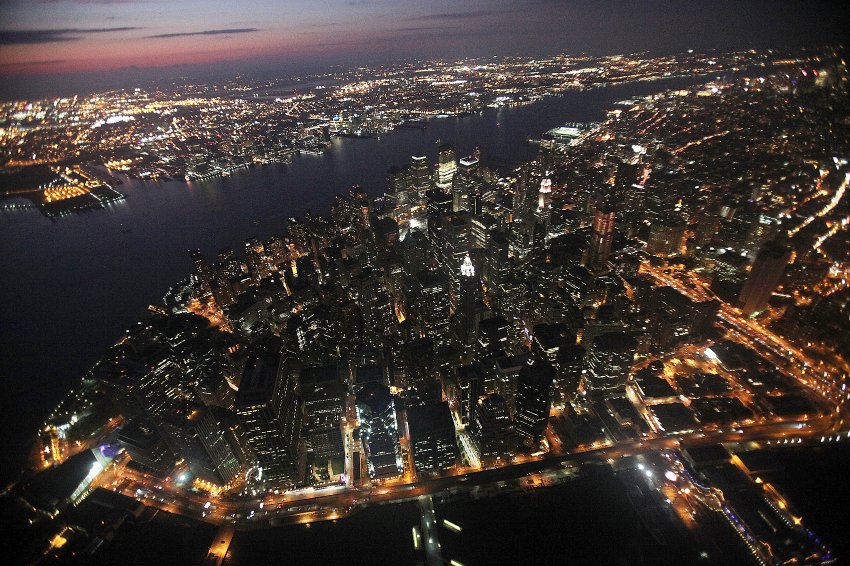
Photo: Manhattan by night: The skeptics are accused of having links to energy companies.
With his sonorous voice, Fred Singer, 86, sounded like a grandfather explaining the obvious to a dim-witted child. “Nature, not human activity, rules the climate,” the American physicist told a discussion attended by members of the German parliament for the business-friendly Free Democratic Party (FDP) three weeks ago.
Marie-Luise Dött, the environmental policy spokeswoman for the parliamentary group of Angela Merkel’s center-right Christian Democratic Union (CDU), also attended Singer’s presentation. She said afterwards that it was “extremely illuminating.” She later backpedaled, saying that her comments had been quoted out of context, and that of course she supports an ambitious climate protection policy — just like Chancellor Merkel.
Merkel, as it happens, was precisely the person Singer was trying to reach. “Our problem is not the climate. Our problem is politicians, who want to save the climate. They are the real problem,” he says. “My hope is that Merkel, who is not stupid, will see the light,” says Singer, who has since left for Paris. Noting that he liked the results of his talks, he adds: “I think I achieved something.”
Salesman of Skepticism
Singer is a traveling salesman of sorts for those who question climate change. On this year’s summer tour, he gave speeches to politicians in Rome, Paris and the Israeli port city of Haifa. Paul Friedhoff, the economic policy spokesman of the FDP’s parliamentary group, had invited him to Berlin. Singer and the FDP get along famously. The American scientist had already presented his contrary theories on the climate to FDP politicians at the Institute for Free Enterprise, a Berlin-based free-market think tank, last December.
Singer is one of the most influential deniers of climate change worldwide. In his world, respected climatologists are vilified as liars, people who are masquerading as environmentalists while, in reality, having only one goal in mind: to introduce socialism. Singer wants to save the world from this horror. For some, the fact that he made a name for himself as a brilliant atmospheric physicist after World War II lends weight to his words.
Born in Vienna, Singer fled to the United States in 1940 and soon became part of an elite group fighting the Cold War on the science front. After the collapse of the Soviet Union, Singer continued his struggle — mostly against environmentalists, and always against any form of regulation.
Whether it was the hole in the ozone layer, acid rain or climate change, Singer always had something critical to say, and he always knew better than the experts in their respective fields. But in doing so he strayed far away from the disciplines in which he himself was trained. For example, his testimony aided the tobacco lobby in its battle with health policy experts.
‘Science as the Enemy’
The Arlington, Virginia-based Marshall Institute took an approach very similar to Singer’s. Founded in 1984, its initial mission was to champion then US President Ronald Reagan’s Strategic Defense Initiative (SDI), better known as “Star Wars.” After the fall of the Iron Curtain, the founders abruptly transformed their institute into a stronghold for deniers of environmental problems.
“The skeptics thought, if you give up economic freedom, it will lead to losing political freedom. That was the underlying ideological current,” says Naomi Oreskes, a historian of science at the University of California, San Diego, who has studied Singer’s methods. As scientists uncovered more and more environmental problems, the skeptics “began to see science as the enemy.”
Oreskes is referring to only a handful of scientists and lobbyists, and yet they have managed to convince many ordinary people — and even some US presidents — that science is deeply divided over the causes of climate change. Former President George H.W. Bush even referred to the physicists at the Marshall Institute as “my scientists.”
Whatever the issue, Singer and his cohorts have always used the same basic argument: that the scientific community is still in disagreement and that scientists don’t have enough information. For instance, they say that genetics could be responsible for the cancers of people exposed to secondhand smoke, volcanoes for the hole in the ozone layer and the sun for climate change.
Cruel Nature
It almost seems as if Singer were trying to disguise himself as one of the people he is fighting. With his corduroy trousers, long white hair and a fish fossil hanging from a leather band around his neck, he comes across as an amiable old environmentalist. But the image he paints of nature is not at all friendly. “Nature is much to be feared, very cruel and very dangerous,” he says.
At conferences, Singer likes to introduce himself as a representative of the Nongovernmental International Panel on Climate Change (NIPCC). As impressive as this title sounds, the NIPCC is nothing but a collection of like-minded scientists Singer has gathered around himself. A German meteorologist in the group, Gerd Weber, has worked for the German Coal Association on and off for the last 25 years.
According to a US study, 97 percent of all climatologists worldwide assume that greenhouse gases produced by humans are warming the Earth. Nevertheless, one third of Germans and 40 percent of Americans doubt that the Earth is getting warmer. And many people are convinced that climatologists are divided into two opposing camps on the issue — which is untrue.
So how is it that people like Singer have been so effective in shaping public opinion?
Part 2: Experience Gained Defending Big Tobacco
Many scientists do not sufficiently explain the results of their research. Some climatologists have also been arrogant or have refused to turn over their data to critics. Some overlook inconsistencies or conjure up exaggerated horror scenarios that are not always backed by science. For example, sloppy work was responsible for a prediction in an Intergovernmental Panel on Climate Change (IPCC) report that all Himalayan glaciers would have melted by 2035. It was a grotesque mistake that plunged the IPCC into a credibility crisis.
Singer and his fellow combatants take advantage of such mistakes and utilize their experiences defending the tobacco industry. For decades, Big Tobacco managed to cast doubt on the idea that smoking kills. An internal document produced by tobacco maker Brown & Williamson states: “Doubt is our product since it is the best means of competing with the ‘body of fact’ that exists in the minds of the general public.”
In 1993, tobacco executives handed around a document titled “Bad Science — A Resource Book.” In the manual, PR professionals explain how to discredit inconvenient scientific results by labeling them “junk.” For example, the manual suggested pointing out that “too often science is manipulated to fulfill a political agenda.” According to the document: “Proposals that seek to improve indoor air quality by singling out tobacco smoke only enable bad science to become a poor excuse for enacting new laws and jeopardizing individual liberties.”
‘Junk Science’
In 1993, the US Environmental Protection Agency (EPA) published what was then the most comprehensive study on the effects of tobacco smoke on health, which stated that exposure to secondhand smoke was responsible for about 3,000 deaths a year in the United States. Singer promptly called it “junk science.” He warned that the EPA scientists were secretly pursuing a communist agenda. “If we do not carefully delineate the government’s role in regulating … dangers, there is essentially no limit to how much government can ultimately control our lives,” Singer wrote.
Reacting to the EPA study, the Philip Morris tobacco company spearheaded the establishment of “The Advancement of Sound Science Coalition” (TASSC). Its goal was to raise doubts about the risks of passive smoking and climate change, and its message was to be targeted at journalists — but only those with regional newspapers. Its express goal was “to avoid cynical reporters from major media.”
Singer, Marshall Institute founder Fred Seitz and Patrick Michaels, who is now one of the best known climate change skeptics, were all advisers to TASSC.
Not Proven
The Reagan administration also appointed Singer to a task force on acid rain. In that group, Singer insisted that it was too early to take action and that it hadn’t even been proven yet that sulfur emissions were in fact the cause. He also said that some plants even benefited from acid rain.
After acid rain, Singer turned his attention to a new topic: the “ozone scare.” Once again, he applied the same argumentative pattern, noting that although it was correct that the ozone concentration in the stratosphere was declining, the effect was only local. Besides, he added, it wasn’t clear yet whether chlorofluorocarbons (CFCs) from aerosol cans were even responsible for ozone depletion.
As recently as 1994, Singer claimed that evidence “suggested that stratospheric chlorine comes mostly from natural sources.” Testifying before the US Congress in 1996, he said there was “no scientific consensus on ozone depletion or its consequences” — even though in 1995 the Nobel Prize had been awarded to three chemists who had demonstrated the influence of CFCs on the ozone layer.
The Usual Suspects
Multinational oil companies also soon adopted the tried-and-true strategies of disinformation. Once again, lobbying groups were formed that were designed to look as scientific as possible. First there was the Global Climate Coalition, and then ExxonMobil established the Global Climate Science Team. One of its members was lobbyist Myron Ebell. Another one was a veteran of the TASCC tobacco lobby who already knew the ropes. According to a 1998 Global Climate Science Team memo: “Victory will be achieved when average citizens ‘understand’ (recognize) uncertainties in climate science.”
It soon looked as though there were a broad coalition opposing the science of climate change, supported by organizations like the National Center for Policy Analysis, the Heartland Institute and the Center for Science and Public Policy. In reality, these names were often little more than a front for the same handful of questionable scientists — and Exxon funded the whole illusion to the tune of millions of dollars.
It was an excellent investment.
In 2001, the administration of then-President George W. Bush reneged on previous climate commitments. After that, the head of the US delegation to the Kyoto negotiations met with the oil lobbyists from the Global Climate Coalition to thank them for their expertise, saying that President Bush had “rejected Kyoto in part based on input from you.”
Singer’s comrade-in-arms Patrick Michaels waged a particularly sharp-tongued campaign against the phalanx of climatologists. One of his books is called: “The Satanic Gases: Clearing the Air about Global Warming.” Michaels has managed to turn doubt into a lucrative business. The German Coal Association paid him a hefty fee for a study in the 1990s, and a US electric utility once donated $100,000 to his PR firm.
Inconsistent Arguments
Both Michaels and Ebell are members of the Cooler Heads Coalition. Unlike Singer and Seitz, they are not anti-communist crusaders from the Cold War era, but smooth communicators. Ebell, a historian, argues that life was not as comfortable for human beings in the Earth’s cold phases than in the warm ones. Besides, he adds, there are many indications that we are at the beginning of a cooling period.
The professional skeptics tend to use inconsistent arguments. Sometimes they say that there is no global warming. At other times, they point out that while global warming does exist, it is not the result of human activity. Some climate change deniers even concede that man could do something about the problem, but that it isn’t really much of a problem. There is only one common theme to all of their prognoses: Do nothing. Wait. We need more research.
People like Ebell cannot simply be dismissed as cranks. He has been called to testify before Congress eight times, and he unabashedly crows about his contacts at the White House, saying: “We knew whom to call.”
Ebell faces more of an uphill battle in Europe. In his experience, he says, Europe is controlled by elites who — unlike ordinary people — happen to believe in climate change.
Einstein on a Talk Show
But Fred Singer is doing his best to change that. He has joined forces with the European Institute for Climate and Energy (EIKE). The impressive-sounding name, however, is little more than a P.O. box address in the eastern German city of Jena. The group’s president, Holger Thuss, is a local politician with the conservative Christian Democratic Union (CDU).
Hans Joachim Schellnhuber, director of the respected Potsdam Institute for Climate Impact Research and an adviser to Chancellor Merkel on climate-related issues, says he has no objection to sharing ideas with the EIKE, as long as its representatives can stick to the rules of scientific practice. But he refuses to join EIKE representatives in a political panel discussion, noting that this is precisely what the group hopes to achieve, namely to create the impression among laypeople that experts are discussing the issues on a level playing field.
Ultimately, says Schellnhuber, science has become so complicated that large segments of the population can no longer keep up. The climate skeptics, on the other hand, are satisfied with “a desire for simple truths,” Schellnhuber says.
This is precisely the secret of their success, according to Schellnhuber, and unfortunately no amount of public debate can change that. “Imagine Einstein having to defend the theory of relativity on a German TV talk show,” he says. “He wouldn’t have a snowball’s chance in hell.”
Translated from the German by Christopher Sultan.
>52 Percent of Americans Flunk Climate 101 (NY Times)
>
By FELICITY BARRINGER
Green: Science
October 14, 2010, 4:25 pm
A new study by researchers at Yale University suggests that Americans’ knowledge of climate science is limited and scattershot, with some understanding of basic issues like the contribution of fossil fuels to global warming and some singular misconceptions as well.
For instance, more than two-thirds of those surveyed believe that reducing toxic waste or banning aerosol spray cans will curb climate change. And 43 percent believe that “if we stopped punching holes in the ozone layer with rockets, it would reduce global warming,” the survey’s authors write.
Overall, just 1 in 10 of those surveyed said they were “very well informed” about climate change and 45 percent said they were not very worried or not at all worried about it.
If letter grades were given by the survey’s authors (based on absolute scores, not grading on the curve), 1 percent would have received an A, 7 percent a B, 15 percent a C, 25 percent a D and 52 percent an F.
Researchers said that the results “reflect the unorganized and sometimes contradictory fragments of information Americans have absorbed from the mass media and other sources.”
“Most people don’t need to know about climate change in their daily life, thus it is not surprising that they have devoted little effort to learning these details,” they write.
Some of the findings seemed mutually exclusive. For instance, the researchers note that an online survey conducted by Knowledge Networks this summer shows that, despite a blast of negative publicity about controversial e-mails to and from climate scientists at Britain’s University of East Anglia, large majorities of Americans trust scientists (72 percent) and scientific institutions (National Oceanic and Atmospheric Administration, 78 percent, National Science Foundation 74 percent) to provide accurate information on the subject.
Three-quarters say they want more information on the issue, but 45 percent say they are not very or not at all worried about it.
But climate skeptics have made some specific inroads. As the report’s authors found, 42 percent of those surveyed “incorrectly believe that since scientists can’t predict the weather more than a few days in advance, they can’t possibly predict the climate of the future.” More than a third (37 percent) think climate models are too unreliable to predict the climate of the future. And one-third believe, incorrectly, that most scientists in the 1970s were predicting an ice age.
The interlacing of knowledge and ignorance was a hallmark of the study. About 73 percent of Americans understand, correctly, that the current climate is not colder than ever before. But 55 percent believe, incorrectly, that the Earth’s climate is now hotter than it has ever been before, and about two-thirds believe, incorrectly, that the climate has always oscillated gradually between eras of warmth and eras of cold.
About 57 percent of Americans have both heard of the greenhouse effect and understand how it works. But one-third believe that because the climate “has changed naturally in the past, humans are not the cause of global warming today.”
About 45 percent understand that carbon dioxide in the atmosphere traps heat, but only a quarter know that methane does the same. And more than half think, incorrectly, that aerosol cans, volcanic eruptions or the space program contribute to climate change.
Slightly more than half understand that energy in fossil fuels comes from photosynthesis by plants over millions of years; just 29 percent understand that the sun was the ultimate source of energy in these fuels. Almost half say that fossil fuels are the fossilized remains of dinosaurs.
Three-quarters of those polled had heard nothing about coral bleaching or ocean acidification.
Perhaps not surprisingly, given the spottiness of the participants’ knowledge, most said they needed a lot more, some more, or a little more information on the subject (25 percent, 26 percent and 25 percent, respectively.)
The authors — Anthony Leiserowitz and Nicholas Smith of the Yale Project on Climate Change Communications and Jennifer R. Marlon of the Geography Department at the University of Wisconsin, Madison — conclude that widespread misconceptions “lead some people to doubt that climate change is happening or that human activities are a major contributor, to misunderstand the causes and therefore the solutions, and to be unaware of the risks.”
“Thus many Americans lack some of the knowledge needed for informed decision-making about this issue in a democratic society,” they write.
* * *
Find the original Yale report here.
>Do the IPCC use alarmist language?
>
By James Wight
http://www.skepticalscience.com
Thursday, 14 October, 2010 – 06:42 AM
Graham Wayne has recently written rebuttals to “The IPCC consensus is phony” and “IPCC is alarmist”. But, you might say, that’s only half the story – do the IPCC present their conclusions in an alarmist way? There are many different ways you might look at this, but one of the more important ones is how the IPCC present probabilities (or “likelihoods”).
Thinking about probability does not come intuitively to the human mind. Our assessment of a risk often depends on how the probability is presented.
Suppose you are about to get on a plane and a reliable source tells you that there is a 1% chance that the plane will crash during your flight. Do you still want to get on the plane? I’m guessing you’d be having second thoughts about it.
What if the probability of a crash is 1 in 20? 1 in 10? 1 in 3? You’d probably run away screaming.
I’ll get to the point of all this shortly, but please bear with me and consider the following quote from the IPCC’s Fourth Assessment Report (AR4):
“It is very unlikely that [Atlantic Ocean circulation] will undergo a large abrupt transition during the 21st century.” [Source]
Are you alarmed yet? Is this an example of the IPCC using alarmist language in reporting its conclusions?
To answer this question, you first have to understand what the IPCC are trying to say. In the introduction to the AR4 Synthesis Report, there is a detailed description of how uncertainty is treated in IPCC reports, and I don’t think the public appreciates just how un-alarmist it is. A 1% chance scarcely rates a mention: anything with such a low probability is described as “exceptionally unlikely”. A probability of 1 in 20 is considered to be “extremely unlikely”; 1 in 10 is “very unlikely”, and even 1 in 3 is still “unlikely”. Conversely, 2 in 3 is “likely”, 9 in 10 is “very likely”, 19 in 20 is “extremely likely”, and 99% is “virtually certain”.
So if you asked the IPCC to do a report on your plane trip, and the probability of a crash was smaller than 1 in 10, about half a decade later they’d get back to you with something like: “It is very unlikely that this plane will crash.” (Except that it would probably be a lot wordier than that.)
And when the IPCC says an abrupt transition in Atlantic Ocean circulation is “very unlikely”, they mean the same thing: the chance is less than 1 in 10. Yet you’re probably not running away screaming.
Most of the IPCC’s main conclusions are given a high degree of likelihood. Probably the most quoted sentence from the entire AR4 is:
“Most of the observed increase in global average temperatures since the mid-20th century is very likely due to the observed increase in anthropogenic greenhouse gas concentrations.” [Source]
Translation: the likelihood that humanity’s greenhouse gas emissions are causing global warming is greater than 9 in 10.
Another important conclusion (though not particularly new to the AR4) is this:
“[T]he equilibrium global mean [surface air temperature] warming for a doubling of atmospheric carbon dioxide (CO2), or ‘equilibrium climate sensitivity’, is likely to lie in the range 2°C to 4.5°C, with a most likely value of about 3°C. Equilibrium climate sensitivity is very likely larger than 1.5°C.” [Source]
Translation: the chances are 2 out of 3 that a doubling of atmospheric CO2 will warm the planet by between 2 and 4.5 degrees; 9 out of 10 that it will be more than 1.5 degrees.
One more IPCC quote:
“It is very likely that hot extremes, heat waves and heavy precipitation events will continue to become more frequent.” [Source]
That is, the chances of more extreme weather are higher than 9 in 10. If you’re thinking that wilder weather is not exactly as serious as a plane crash, then consider that over 20 million people have been affected by the 2010 Pakistan floods. This sort of extreme weather event will become more frequent with global warming. Do we, does humanity, really want to get on this plane?
The IPCC are not alarmist in their conclusions, and they are no more alarmist in the way they report their conclusions.
>Políticas públicas para mudanças climáticas (FAPESP)
>
Especiais
Por Fabio Reynol, de Campinas (SP)
18/10/2010
Agência FAPESP – Se o Estado de São Paulo fosse um país estaria em 39º no ranking das nações que mais emitem dióxido de carbono (CO2) na atmosfera. Em 2003, foram 83 milhões de toneladas do gás, praticamente um quarto do montante brasileiro.
Esses números lançam ao estado um enorme desafio para reduzir as emissões e já estimularam a implantação de várias políticas públicas, entre as quais a ativação do Conselho Estadual de Mudanças Climáticas, ocorrida na sexta-feira (15/10).
O tema foi tratado em mesa durante o fórum “Mudanças Climáticas Globais – Desafios e oportunidades de pesquisa”, realizado na Universidade Estadual de Campinas (Unicamp) nos dias 14 e 15 de outubro. A mesa teve a participação do diretor-presidente da Companhia Ambiental do Estado de São Paulo (Cetesb), Fernando Rei, do diretor científico da FAPESP, Carlos Henrique de Brito Cruz, e do diretor do Instituto de Estudos Avançados da Faculdade de Economia e Administração da USP, Jacques Marcovitch.
“As emissões de CO2 em São Paulo são tímidas em relação aos países desenvolvidos, mas, ao se considerar o índice de ocupação do solo, são emissões superiores à média nacional”, disse Rei.
O executivo fez um histórico das políticas públicas paulistas desde o Programa Estadual de Mudanças Climáticas do Estado de São Paulo (Proclima), lançado em 1995, e destacou a participação paulista em organizações internacionais de estados subnacionais, que englobam regiões internas de países como estados e províncias. “São Paulo é copresidente pela segunda vez da rede de Governos Regionais para o Desenvolvimento Sustentável”, destacou.
O Conselho Estadual de Mudanças Climáticas estava previsto na Lei Estadual 13.798, assinada em novembro de 2009, e possui uma estrutura tripartite: um terço de representantes do governo estadual, um terço vindo de governos municipais e um terço de membros da sociedade civil.
São Paulo também iniciou o Registro Público de Emissões a fim de identificar, por setores e por empresas, os maiores emissores de gases de efeito estufa. Todas essas medidas têm como objetivo tentar alcançar uma redução de 20% do CO2 emitido até o ano de 2020 em relação aos valores de 2005, meta que o Estado se comprometeu a cumprir.
“Trata-se de um objetivo extremamente difícil e que exigirá a participação da sociedade civil”, salientou Rei. No ano de 2005, São Paulo lançou na atmosfera 122 milhões de toneladas de CO2, o que significa que em 2020 poderia lançar até 98 milhões de toneladas, de acordo com a meta.
A tarefa é ainda mais complexa ao considerar que São Paulo já substituiu quase a metade das fontes energéticas de origem fóssil para fontes renováveis na última década, como ressaltou Brito Cruz. “Cerca de 60% do consumo de energia do estado era de origem fóssil e hoje esse índice é de apenas 33%”, disse.
O diretor científico da FAPESP focou na contribuição que a ciência deu ao longo da história à questão do clima, desde o matemático francês Jean Jacques Baptiste Fourier, que em 1827 publicou um artigo no qual concebeu o conceito de efeito estufa, até as experiências do norte-americano Charles Kelling, que de 1957 a 1972 escalou periodicamente o vulcão inativo Mauna Loa, no Havaí, para coletar amostras de ar e medir o teor de carbono da atmosfera.
“Foram pesquisas que pareciam inúteis em suas épocas e que hoje se mostram extremamente pertinentes em relação aos problemas que estamos enfrentando”, disse, destacando que o Painel Intergovernamental de Mudanças Climáticas (IPCC) foi criado pela Organização das Nações Unidas para que as lideranças políticas pudessem entender a produção científica a respeito do clima.
Brito Cruz também apresentou os principais pontos abordados pelo Programa FAPESP de Pesquisa sobre Mudanças Climáticas Globais (PFPMCG), que tem procurado intensificar a produção científica nacional no clima e conta com projetos em andamento em áreas como agronomia, química, geociências, demografia e economia.
“Não queremos apenas aumentar a quantidade dos trabalhos científicos, mas também a sua qualidade para que ganhem visibilidade internacional”, disse. Nesse sentido, a FAPESP financiou a compra de um supercomputador em parceria com a Financiadora de Estudos e Projetos (Finep) do Ministério da Ciência e Tecnologia.
A máquina está sendo instalada no Instituto Nacional de Pesquisas Espaciais (Inpe) em Cachoeira Paulista (SP) e será dedicada a processar modelos de simulação do clima.
O supercomputador deverá colocar o Brasil entre os maiores do mundo em investigação do clima e poderá processar modelos que contemplem os sistemas climáticos nacionais, como a Floresta Amazônica, a Mata Atlântica e o Cerrado.
Além do computador, Brito Cruz anunciou que a FAPESP também está financiando a compra de um barco e de um navio oceanográfico que deverão auxiliar pesquisas sobre a temperatura, acidificação e nível dos oceanos, entre outras pesquisas.
Aprimorar incentivos e aumentar sanções
Marcovitch falou sobre os impactos econômicos e a participação do setor empresarial no esforço para mitigar as mudanças climáticas. O professor, que foi reitor da USP entre 1997 e 2001, afirmou que é preciso respeitar o tempo de ação de cada ator social para que o esforço conjunto funcione.
“As pautas de cada um são diferentes: membros do governo enfatizam o poder, cientistas se pautam na busca pela verdade, empresas focam no resultado e a sociedade civil trabalha com valores. É preciso enxergar isso para haver o diálogo e avançar”, disse.
No caso do setor empresarial, Marcovitch defende políticas públicas que promovam incentivos mais eficientes para as companhias que participarem e, ao mesmo tempo, sanções mais rigorosas para aquelas que não quiserem colaborar.
Por fim, o pesquisador apresentou partes do Estudo Econômico das Mudanças Climáticas no Brasil, que coordenou junto a 11 instituições.
O trabalho procurou identificar as vulnerabilidades que a economia e a sociedade brasileira possuem em relação às alterações do clima. “Os países que promoveram os maiores saltos da civilização foram os mais ousados e que enfrentaram grandes desafios, a área do clima é um deles”, disse.
>On Climate Models, the Case For Living with Uncertainty
>
Yale Environment 360
05 Oct 2010: Analysis
As climate science advances, predictions about the extent of future warming and its effects are likely to become less — not more — precise. That may make it more difficult to convince the public of the reality of climate change, but it hardly diminishes the urgency of taking action.
by Fred Pearce
I think I can predict right now the headlines that will follow publication of the next report from the Intergovernmental Panel on Climate Change (IPCC), due in 2013. “Climate scientists back off predicting rate of warming: ‘The more we know the less we can be sure of,’ says UN panel.”
That is almost bound to be the drift if two-time IPCC lead author Kevin Trenberth and others are right about what is happening to the new generation of climate models. And with public trust in climate science on the slide after the various scandals of the past year over e-mails and a mistaken forecast of Himalayan ice loss, it hardly seems likely scientists will be treated kindly.
It may not matter much who is in charge at the IPCC by then: Whether or not current chairman Rajendra Pachauri keeps his job, the reception will be rough. And if climate negotiators have still failed to do a deal to replace the Kyoto Protocol, which lapses at the end of 2012, the fallout will not be pretty, either diplomatically or climatically.
Clearly, concerns about how climate scientists handle complex issues of scientific uncertainty are set to escalate. They were highlighted in a report about IPCC procedures published in late August in response to growing criticism about IPCC errors. The report highlighted distortions and exaggerations in IPCC reports, many of which involved not correctly representing uncertainty about specific predictions.
“The latest climate modeling runs are trying to deal with a range of factors not dealt with in the past.”
But efforts to rectify the problems in the next IPCC climate-science assessment (AR5) are likely to further shake public confidence in the reliability of IPCC climate forecasts.
Last January, Trenberth, head of climate analysis at the National Center for Atmospheric Research in Boulder, Colo., published a little-noticed commentary in Nature online. Headlined “More Knowledge, Less Certainty,” it warned that “the uncertainty in AR5’s predictions and projections will be much greater than in previous IPCC reports.” He added that “this could present a major problem for public understanding of climate change.” He can say that again.
This plays out most obviously in the critical estimate of how much warming is likely between 1990, the baseline year for most IPCC work, and 2100. The current AR4 report says it will be between 1.8 and 4.0 degrees Celsius (3 to 7 degrees F). But the betting is now that the range offered next time will be wider, especially at the top end.
The public has a simple view about scientific uncertainty. It can accept that science doesn’t have all the answers, and that scientists try to encapsulate those uncertainties with devices like error bars and estimates of statistical significance. What even the wisest heads will have trouble with, though, is the notion that greater understanding results in wider errors bars than before.
Trenberth explained in his Nature commentary why a widening is all but certain. “While our knowledge of certain factors [responsible for climate change] does increase,” he wrote, “so does our understanding of factors we previously did not account for or even recognize.” The trouble is this sounds dangerously like what Donald Rumsfeld, in the midst of the chaos of the Iraq War, famously called “unknown unknowns.” I would guess that the IPCC will have even less luck than he did in explaining what it means by this.
The latest climate modeling runs are trying to come to grips with a range of factors ignored or only sketchily dealt with in the past. The most troubling is the role of clouds. Clouds have always been recognized as a ticking timebomb in climate models, because nobody can work out whether warming will change them in a way that amplifies or moderates warming — still less how much. And their influence could be very large. “Clouds remain one of the largest uncertainties in the climate system’s response to temperature changes,” says Bruce Wielicki, a scientist at NASA’s Langley Research Center who is investigating the impact of clouds on the Earth’s energy budget.
An added problem in understanding clouds is the role of aerosols from industrial smogs, which dramatically influence the radiation properties of clouds. “Aerosols are a mess,” says Thomas Charlock, a senior scientist at the Langley Research Center and co-investigator in a NASA project known as Clouds and the Earth’s Radiant Energy System (CERES). “We don’t know how much is out there. We just can’t estimate their influence with calculations alone.”
“Despite much handwringing, the IPCC has never worked out how to make sense of uncertainty.”
Trenberth noted in Nature, “Because different groups are using relatively new techniques for incorporating aerosol effects into the models, the spread of results will probably be much larger than before.”
A second problem for forecasting is the potential for warming to either enhance or destabilize existing natural sinks of carbon dioxide and methane in soils, forests, permafrost, and beneath the ocean. Again these could slow warming through negative feedbacks or — more likely, according to recent assessments — speed up warming, perhaps rather suddenly as the planetary system crosses critical thresholds.
The next models will be working hard to take these factors into better account. Whether they go as far as some preliminary runs published in 2005, which suggested potential warming of 10 degrees C (18 degrees F) or more is not clear. Of course, uncertainty is to be expected, given the range of potential feedbacks that have to be taken into account. But it is going to be hard to explain why, when you put more and better information into climate models, they do not home in on a more precise answer.
Yet it will be more honest, says Leonard Smith, a mathematician and statistician at the University of Oxford, England, who warns about the “naive realism” of past climate modeling. In the past, he says, models have been “over-interpreted and misinterpreted. We need to drop the pretense that they are nearly perfect. They are getting better. But as we change our predictions, how do we maintain the credibility of the science?”
The only logical conclusion for a confused and increasingly wary public may be that if the error bars were wrong before, they cannot be trusted now. If they do not in some way encapsulate the “unknowns,” what purpose do they have?
Despite much handwringing, the IPCC has never worked out how to make sense of uncertainty. Take the progress of those errors bars in assessing warming between 1990 and 2100.
The panel’s first assessment, published back in 1990, predicted a warming of 3 degrees C by 2100, with no error bars. The second assessment, in 1995, suggested a warming of between 1 and 3.5 degrees C. The third, in 2001, widened the bars to project a warming of 1.4 to 5.8 degrees C. The fourth assessment in 2007 contracted them again, from 1.8 to 4.0 degrees C. I don’t think the public will be so understanding if they are widened again, but that now seems likely.
Trenberth is nobody’s idea of someone anxious to rock the IPCC boat. He is an IPCC insider, having been lead author on key chapters in both 2001 and 2007, and recently appointed as a review editor for AR5. Back in 2005 he made waves by directly linking Hurricane Katrina to global warming. But in the past couple of years he has taken a growing interest in highlighting uncertainties in the climate science.
Late last year, bloggers investigating the “climategate” emails highlighted a message he sent to colleagues in which he said it was a “travesty” that scientists could not explain cool years like 2008. His point, made earlier in the journal Current Opinion in Environmental Stability, was that “it is not a sufficient explanation to say that a cool year is due to natural variability.” Such explanations, he said, “do not provide the physical mechanisms involved.” He wanted scientists to do better.
“Trenberth questioned if the IPCC wouldn’t be better off getting out of the prediction business.”
In his Nature commentary, Trenberth wondered aloud whether the IPCC wouldn’t be better off getting out of the prediction business. “Performing cutting edge science in public could easily lead to misinterpretation,” he wrote. But the lesson of climategate is that efforts to keep such discussion away from the public have a habit of backfiring spectacularly.
All scientific assessments have to grapple with how to present uncertainties. Inevitably they make compromises between the desire to convey complexity and the need to impart clear and understandable messages to a wider public. But the IPCC is caught on a particular dilemma because its founding purpose, in the late 1980s, was to reach consensus on climate science and report back to the world in a form that would allow momentous decisions to be taken. So the IPCC has always been under pressure to try to find consensus even where none exists. And critics argue that that has sometimes compromised its assessments of uncertainty.
The last assessment was replete with terms like “extremely likely” and “high confidence.” Critics charged that they often lacked credibility. And last August’s blue-chip review of the IPCC’s performance, by the InterAcademy Council, seemed to side with the critics.
The council’s chairman, Harold Shapiro of Princeton, said existing IPCC guidelines on presenting uncertainty “have not been consistently followed.” In particular, its analysis of the likely impacts of climate change “contains many statements that were assigned high confidence but for which there is little evidence.” The predictions were not plucked from the air. But the charge against the IPCC is that its authors did not always correctly portray the uncertainty surrounding the predictions or present alternative scenarios.
“We need to get used to greater uncertainty in imagining exactly how climate change will play out.”
The most notorious failure was the claim that the Himalayan glaciers could all have melted by 2035. This was an egregious error resulting from cut-and-pasting a non-peer reviewed claim from a report by a non-governmental organization. So was a claim that 55 percent of the Netherlands lies below sea level. But other errors were failures to articulate uncertainties. The study highlighted a claim that even a mild loss of rainfall over the Amazon could destroy 40 percent of the rainforest, though only one modeling study has predicted this.
Another headline claim in the report, in a chapter on Africa, was that “projected reductions in [crop] yield in some countries could be as much as 50 percent by 2020.” The only source was an 11-page paper by a Moroccan named Ali Agoumi that covered only three of Africa’s 53 countries (Morocco, Tunisia, and Algeria) and had not gone through peer review. It simply asserted that “studies on the future of vital agriculture in the region have shown… deficient yields from rain-based agriculture of up to 50 percent during the 2000-2020 period.” No studies were named. And even Agoumi did not claim the changes were necessarily caused by climate change. In fact, harvests in North Africa already differ by 50 percent or more from one year to the next, depending on rainfall. In other words, Agoumi’s paper said nothing at all about how climate change might or might not change farm yields across Africa. None of this was conveyed by the report.
In general, the InterAcademy Council’s report noted a tendency to “emphasise the negative impacts of climate change,” many of which were “not supported sufficiently in the literature, not put into perspective, or not expressed clearly.” Efforts to eliminate these failings will necessarily widen the error bars on a range of predictions in the next assessment.
We are all — authors and readers of IPCC reports alike — going to have to get used to greater caution in IPCC reports and greater uncertainty in imagining exactly how climate change will play out. This is probably healthy. It is certainly more honest. But it in no way undermines the case that we are already observing ample evidence that the world is on the threshold of profound and potentially catastrophic warming. And it in no way undermines the urgent need to do something to halt the forces behind the warming.
Some argue that scientific uncertainty should make us refrain from action to slow climate change. The more rational response, given the scale of what we could face, is the precise opposite.
POSTED ON 05 Oct 2010 IN Biodiversity Climate Climate Policy & Politics Science & Technology Australia
>As the World Burns (The New Yorker)
>
The Political Scene
How the Senate and the White House missed their best chance to deal with climate change.
by Ryan Lizza October 11, 2010
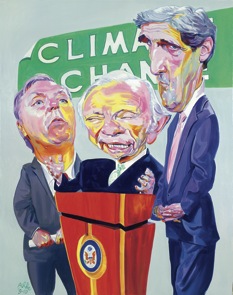
Lindsey Graham, Joseph Lieberman, and John Kerry each sought a kind of redemption through climate-change legislation.
On April 20, 2010, Senators John Kerry, Lindsey Graham, and Joseph Lieberman, along with three aides, visited Rahm Emanuel, President Obama’s chief of staff, at the White House. The legislators had spent seven months writing a comprehensive bill that promised to transform the nation’s approach to energy and climate change, and they were planning a press conference in six days to unveil their work.
Kerry, of Massachusetts, Graham, of South Carolina, and Lieberman, of Connecticut, had become known on Capitol Hill as the Three Amigos, for the Steve Martin comedy in which three unemployed actors stumble their way into defending a Mexican village from an armed gang. All had powerful personal motivations to make the initiative work. Kerry, who has been a senator for twenty-five years and has a long record of launching major investigations, had never written a landmark law. Lieberman, an Independent who had endorsed John McCain for President, had deeply irritated his liberal colleagues by helping the Republicans weaken Obama’s health-care bill. Graham, a Republican, had a reputation as a Senate maverick—but not one who actually got things done. This bill offered the chance for all three men to transform their reputations.
The senators had cobbled together an unusual coalition of environmentalists and industries to support a bill that would shift the economy away from carbon consumption and toward environmentally sound sources of energy. They had the support both of the major green groups and of the biggest polluters. No previous climate-change legislation had come so far. Now they needed the full support of the White House.
The senators sat around the conference table in the corner of Emanuel’s office. In addition to the chief of staff, they were joined by David Axelrod, the President’s political adviser, and Carol Browner, the assistant to the President for Energy and Climate Change. Lieberman introduced his aide, Danielle Rosengarten, to Emanuel.
“Rosengarten working for Lieberman,” Emanuel said. “Shocker!”
Kerry, Graham, and Lieberman knew that Obama’s advisers disagreed about climate-change legislation. Browner was passionate about the issue, but she didn’t have much influence. Axelrod, though influential, was not particularly committed. Emanuel prized victory above all, and he made it clear that, if there weren’t sixty votes to pass the bill in the Senate, the White House would not expend much effort on the matter. The Democrats had fifty-nine members in their caucus, but several would oppose the bill.
“You’ve had all these conversations, you’ve been talking with industry,” Emanuel said. “How many Republicans did you bring on?”
Kerry, the de-facto leader of the triumvirate, assured him that there were five Republicans prepared to vote for the bill. One of them, Lindsey Graham, was sitting at the table. Kerry listed four more: Susan Collins, Olympia Snowe, Scott Brown, and George LeMieux. With five Republicans, getting sixty votes would be relatively easy. The Obama White House and the Three Amigos would be known for having passed a bill that would fundamentally change the American economy and slow the emission of gases that are causing the inexorable, and potentially catastrophic, warming of the planet.
The Senate coalition that introduced the bill started to form in early 2009, when Lieberman instructed Rosengarten to work with the office of John McCain, Lieberman’s longtime partner on the issue. As the newest member of Lieberman’s staff, she was in charge of his climate portfolio, and Lieberman made a simple and oft-repeated demand: “Get me in the room.”
Lieberman had worked on climate change since the nineteen-eighties, and in recent years he had introduced three global-warming bills. He also had long been interested in a pollution-control mechanism called cap-and-trade. The government would set an over-all limit on emissions and auction off permission slips that individual polluters could then buy and sell.
By late January, 2009, the details of the Lieberman-McCain bill had been almost entirely worked out, and Lieberman began showing it to other Senate offices in anticipation of a February press conference. The goal was to be the centrist alternative to a separate effort, initiated by Barbara Boxer, a liberal from California and the chair of the Environment and Public Works Committee.
But the negotiations stalled as the bill moved forward. In Arizona, a right-wing radio host and former congressman, J. D. Hayworth, announced that he was considering challenging McCain in the primary. McCain had never faced a serious primary opponent for his Senate seat, and now he was going to have to defend his position on global warming to hard-core conservative voters. The Republican Party had grown increasingly hostile to the science of global warming and to cap-and-trade, associating the latter with a tax on energy and more government regulation. Sponsoring the bill wasn’t going to help McCain defeat an opponent to his right.
By the end of February, McCain was starting to back away from his commitment to Lieberman. At first, he insisted that he and Lieberman announce a set of climate-change “principles” instead of a bill. Then, three days before a scheduled press conference to announce those principles, the two senators had a heated conversation on the Senate floor. Lieberman turned and walked away. “That’s it,” he told an aide. “He can’t do it this year.”
In Barack Obama’s primary-campaign victory speech, in St. Paul, Minnesota, he said that his election would be a historical turning point on two pressing issues: health care and climate change. “We will be able to look back and tell our children that this was the moment when we began to provide care for the sick,” he said. “When the rise of the oceans began to slow and our planet began to heal.” During the campaign, he often argued that climate change was an essential part of a national energy strategy. “Energy we have to deal with today,” Obama said in a debate with McCain. “Health care is priority No. 2.”
After the election, Obama decided to work on both issues simultaneously. Representative Henry Waxman moved climate change through the House, while Max Baucus, of Montana, moved health care in the Senate. “The plan was to throw two things against the wall, and see which one looks more promising,” a senior Administration official said. Obama, in a February, 2009, address to Congress, said, “To truly transform our economy, protect our security, and save our planet from the ravages of climate change, we need to ultimately make clean, renewable energy the profitable kind of energy. So I ask this Congress to send me legislation that places a market-based cap on carbon pollution.”
In March of 2009, a senior White House official outlined a strategy for a “grand bargain,” in which Democrats would capitulate to Republicans on some long-cherished environmental beliefs in exchange for a cap on carbon emissions. “You need to have something like T. Boone Pickens and Al Gore holding hands,” the White House official told me. In exchange for setting a cap on emissions, Democrats would agree to an increase in the production of natural gas (the only thing that Pickens, the Texas oil-and-gas billionaire, cared about), nuclear power, and offshore oil. If Republicans didn’t respond to the proposed deals, the White House could push them to the table by making a threat through the Environmental Protection Agency, which had recently been granted power to regulate carbon, just as it regulates many other air pollutants.
The strategy had risks, including the possibility that expanded drilling off America’s coast could lead to a dangerous spill. But Browner, the head of the E.P.A. for eight years under Clinton, seemed to think the odds of that were limited. “Carol Browner says the fact of the matter is that the technology is so good that after Katrina there was less spillage from those platforms than the amount you spill in a year filling up your car with gasoline,” the White House official said. “So, given that, she says realistically you could expand offshore drilling.”
The day after the confrontation with McCain, Lieberman met with Browner in his office to discuss strategy. Perhaps sensing that Boxer would have a hard time gaining Republican support, Browner assured Lieberman that he would be “absolutely central” to passing a climate bill. Lieberman was flattered. As Waxman moved cap-and-trade through the House that spring and summer and Boxer prepared to write her version of the bill, Lieberman and his aides met with forty senators or their staffs, to assess their concerns and to develop ideas about his role in Browner’s strategy.
Lieberman knew that the issue was almost as much regional as ideological. When he went to lobby Evan Bayh, of Indiana, Bayh held up a map of the United States showing, in varying shades of red, the percentage of electricity that each state derived from burning coal, the main source of greenhouse-gas emissions in the United States. The more coal used, the redder the state and the more it would be affected by a cap on carbon. The Northeast, the West Coast, and the upper Northwest of the country were pale. But the broad middle of the country—Pennsylvania, West Virginia, Ohio, Kentucky, Indiana, Illinois—was crimson. (Indiana, for example, derives ninety-four per cent of its electricity from coal). “Every time Senator Lieberman would open his mouth, Bayh would show him the map,” a Lieberman aide said.
It often took some work to figure out what, above all else, each senator cared about. In Senate parlance, this is known as the “top ask,” and after every meeting Rosengarten compiled a list for Lieberman. The top ask of Senator Debbie Stabenow, of Michigan, was to insure that incentives given to farmers for emissions-reducing projects—known as “offsets”—would be decided in part by the U.S.D.A., and not just the E.P.A. “Ultimately, farmers aren’t crazy about letting hippies tell them how to make money,” Rosengarten said. Blanche Lincoln, of Arkansas, told Lieberman that she had a major oil refiner in her state—Murphy Oil—and she wanted to make sure that any cap-and-trade bill protected it.
Lieberman knew that he would need a Republican for every Democrat he lost. Like the White House, he concluded that significant subsidies for the nuclear-power industry could win Republican support. Lieberman coaxed nine Republicans into forming a group to write nuclear legislation that could be merged with whatever climate bill emerged from Boxer’s committee. By not automatically resisting everything connected to Obama, these senators risked angering Mitch McConnell, the Republican leader and architect of the strategy to oppose every part of Obama’s agenda, and the Tea Party movement, which seemed to be gaining power every day. The senators also knew, however, that they could exercise enormous influence on the legislation—and that their top asks would be granted.
George Voinovich, of Ohio, told both Harry Reid, the Senate Majority Leader, and Lieberman that the right nuclear language could win his vote, so Lieberman used a nuclear bill that Voinovich’s staff was drafting as the framework for the group. Lindsey Graham, who grew up in Central, South Carolina, near a nuclear plant, wanted tax incentives and loan guarantees to help the nuclear industry.
Meanwhile, the House bill, known as Waxman-Markey (for Edward J. Markey, of Massachusetts), passed on June 26, 2009, by a vote of 219-212. Eight Republicans supported it. But there were omens for the Senate. The White House and Waxman spent the final days before the vote negotiating with members of the House representing two crucial interest groups: coal and agriculture. Despite cutting generous deals, they ended up with only limited support. Worse, several members who had promised House Speaker Nancy Pelosi their votes reneged. One of them, Ciro Rodriguez, of Texas, ducked into the chamber, quickly cast a no vote, and then sprinted out. Anthony Weiner, a Brooklyn Democrat and one of Pelosi’s whips, chased after him, yelling, “Ciro! Ciro!”
As the scene unfolded on the floor, Rosengarten and other Senate aides watched from the gallery. Rosengarten turned to a colleague and said, “Now it’s our turn. We’ve got to go pass this thing in the Senate.”
When the Obama era began, John Kerry was looking for a new political identity. Like Lieberman, he had a strained relationship with the new President. Kerry had been scheduled to endorse Obama the day after Obama’s presumed victory in the New Hampshire primary. But Obama lost, and that night he nervously called Kerry and asked, “Are you still on board?” Kerry said he was. “Ninety-nine per cent of politicians would have walked away at that moment, because our odds of winning the primaries were quite low,” Dan Pfeiffer, now Obama’s communications director, told me in a 2008 interview. “It was a huge moment.” Kerry and his aides believed that, if Obama was the President, Kerry’s endorsement would give him the inside track in the competition for the job as Secretary of State. But Obama passed him over.
Kerry, as the chairman of the Foreign Relations Committee, could help steer the Administration’s foreign policy, but he wanted to play a big role in shaping Obama’s domestic agenda. In 2007, he had written a book about environmental activism, “This Moment on Earth,” and the issue was a rare one in which the junior senator from Massachusetts had a deeper interest than the senior senator, Ted Kennedy. For most of their quarter century together in the Senate, Kennedy was the legislator (the Americans with Disabilities Act, State Children’s Health Insurance Program, No Child Left Behind), and Kerry was the investigator (P.O.W.s in Vietnam, B.C.C.I., Iran-Contra). Now that could change. “This was Kerry’s opportunity to prove that he could be in a major, really historic piece of legislation,” Lieberman said.
At first, Kerry joined forces with Barbara Boxer, and spent months trying to find a Republican co-sponsor for her bill, which was almost a carbon copy of Waxman-Markey. In August, Rosengarten was eating lunch with Kerry’s climate-policy aide, Kathleen Frangione, at Sonoma, a Capitol Hill wine bar. Rosengarten said she had spent hours working on the nuclear legislation with Graham’s policy aide, Matthew Rimkunas, and she was shocked by something he had recently told her: Graham would have backed a climate-change bill that Lieberman had co-sponsored in 2007 if it had included the language supportive of nuclear power that they had just worked out. Kerry and Graham had to talk. Perhaps Kerry could split off from Boxer and try to work with Graham on a bipartisan bill.
Within days, Kerry and Graham were meeting in Kerry’s office to negotiate the language of a Times Op-Ed piece announcing their partnership. As they talked, Kerry suddenly found himself having to reassess his convictions on oil drilling, nuclear energy, and environmental regulations with someone he barely knew and whom he had reason not to like. In 2004, Graham had gratuitously told the Times that Kerry “has no charisma” and “doesn’t relate well to average people.” But the two men agreed that their eventual bill would have to help the nuclear industry and expand oil drilling. As they wrote the article, Graham introduced a third issue: revoking the E.P.A.’s authority to regulate greenhouse gases. Kerry was furious, but he eventually relented. The Op-Ed would include language signalling to insiders that E.P.A. authority would be curtailed: “Industry needs the certainty that comes with congressional action.”
The article ran on October 11th. The next day, Graham was holding a town-hall meeting in the gym of a high school in Greenville, South Carolina. His constituents were not happy. One man accused him of “making a pact with the Devil.” Another shouted, “No principled compromise!” One audience member asked, “Why do you think it’s necessary to get in bed with people like John Kerry?” Graham, dressed in a blue blazer and khakis, paced the floor, explaining that there were only forty Republicans in the Senate, which meant that he had to work with the sixty Democrats. A man in the bleachers shouted, “You’re a traitor, Mr. Graham! You’ve betrayed this nation and you’ve betrayed this state!”
Soon afterward, Graham called Lieberman. He was concerned that Kerry might drag him too far to the left, and he knew that Lieberman, a close friend with whom he had travelled during McCain’s Presidential campaign, could serve as a moderating force. Graham may not have remembered that Kerry and Lieberman had, according to a Senate aide, “a tense personal relationship.” (Lieberman and Kerry ran against each other for President in 2004. In 2006, Kerry endorsed and campaigned for Lieberman’s Democratic opponent in his Senate race.) “I’m happy to try and negotiate a bill with Kerry,” Graham told Lieberman. “But I really want you in the room.”
On October 28, 2009, Graham was eating dinner at the Capital Grille, an expense-account steakhouse on Pennsylvania Avenue, with Fred Krupp, the president of the Environmental Defense Fund, and Rick Davis, a Republican consultant who had managed McCain’s two Presidential campaigns. The E.D.F., virtually alone among green groups in trying to form bonds with Republicans, prides itself on being the most politically sophisticated environmental organization in Washington. Krupp, who has short gray hair and a Brooks Brothers look that announces his disdain for hemp-wearing environmental activists, had helped to educate McCain on climate change, and the two men became close. Now he wanted to do the same for Graham. He called Davis, who was an E.D.F. board member, and arranged the dinner.
Graham came to the issue strictly as a dealmaker. He saw the Democrats’ interest in capping carbon emissions as an opportunity to boost the nuclear industry and to expand oil drilling. But now Krupp explained the basics of global-warming science and policy: how carbon trading worked, how farmers could use offsets to earn an income from growing trees, and how different lobbyists would affect the debate. Krupp told Graham that the crucial feature of the policy was the hard cap on emissions. The House bill required American carbon emissions to be seventeen per cent below 2005 levels by 2020. As long as that number held, environmentalists would show flexibility on most other issues. The dinner lasted three hours. The next day, Kerry, Graham, and Lieberman held their first meeting as the triumvirate that became known to everyone following the debate as K.G.L.
Heckled at home, Graham began to enjoy a new life as a Beltway macher. “Every lobbyist working on the issue wanted time with him, because suddenly it became clear that he could be the central person in the process,” Krupp recalled. All sectors of the economy would be affected by putting a price on carbon, and Graham’s campaign account started to grow. In 2009, he raised nothing from the electric-utility PACs and just fourteen thousand four hundred and fifty dollars from all PACs. In the first quarter of 2010 alone, the utilities sent him forty-nine thousand dollars. Krupp introduced Graham to donors in New York connected to the E.D.F. On December 7th, Julian Robertson, an E.D.F. board member and a hedge-fund billionaire, hosted Graham at a small gathering in his Manhattan apartment. Some New York guests gave money directly to Graham’s campaign account. Others, at Krupp’s suggestion, donated to a new group called South Carolina Conservatives for Energy Independence, which ran ads praising Graham in his home state.
For years, Graham had lived in McCain’s shadow. But, as the rebellious politics of 2010 transformed McCain into a harsh partisan, Graham adopted McCain’s old identity as the Senate’s happy moderate. To Graham’s delight, on December 23rd Time posted an online article headlined “LINDSEY GRAHAM: NEW GOP MAVERICK IN THE SENATE.” The photograph showed Graham standing at a lectern with Lieberman and Kerry.
McCain, worried about his reëlection, had been throwing rocks from the sidelines as the cap-and-trade debate progressed. When Waxman-Markey passed, he Tweeted that it was a “1400 page monstrosity.” A month after K.G.L. was formed, McCain told Politico, “Their start has been horrendous. Obviously, they’re going nowhere.” After the Time piece appeared, he was enraged. Graham told colleagues that McCain had called him and yelled at him, incensed that he was stealing the maverick mantle. “After that Graham story came out, McCain completely stopped talking to me,” Jay Newton-Small, the author of the Time piece, said.
Other Republican colleagues taunted Graham. “Hey, Lindsey,” they would ask, “how many times have you talked to Rahm today?,” and the criticisms in South Carolina became more intense. But Graham gave every indication to Lieberman and Kerry that he could deal with the pressure. He wasn’t up for reëlection until 2014, and his conversations with them, and with Krupp, the White House, and the Manhattan environmentalists, seemed to be having an impact. At a climate-change conference in South Carolina on January 5, 2010, Graham started to sound a little like Al Gore. “I have come to conclude that greenhouse gases and carbon pollution” are “not a good thing,” Graham said. He insisted that nobody could convince him that “all the cars and trucks and plants that have been in existence since the Industrial Revolution, spewing out carbon day in and day out,” could be “a good thing for your children and the future of the planet.” Environmentalists swooned. “Graham was the most inspirational part of that triumvirate throughout the fall and winter,” Michael Brune, the executive director of the Sierra Club, said. “He was advocating for strong action on climate change from an ethical and a moral perspective.”
But, back in Washington, Graham warned Lieberman and Kerry that they needed to get as far as they could in negotiating the bill “before Fox News got wind of the fact that this was a serious process,” one of the people involved in the negotiations said. “He would say, ‘The second they focus on us, it’s gonna be all cap-and-tax all the time, and it’s gonna become just a disaster for me on the airwaves. We have to move this along as quickly as possible.’ ”
In early December of 2009, Lieberman’s office approached Jay Heimbach, the White House official in charge of monitoring the Senate climate debate. For Obama, health care had become the legislation that stuck to the wall. As a consequence of the long debate over that issue, climate change became, according to a senior White House official, Obama’s “stepchild.” Carol Browner had just three aides working directly for her. “Hey, change the entire economy, and here are three staffers to do it!” a former Lieberman adviser noted bitterly. “It’s a bit of a joke.” Heimbach attended meetings with the K.G.L. staffers but almost never expressed a policy preference or revealed White House thinking. “It’s a drum circle,” one Senate aide lamented. “They come by, ‘How are you feeling? Where do you think the votes are? What do you think we should do?’ It’s never ‘Here’s the plan, here’s what we’re doing.’ ”
Lieberman’s office proposed to Heimbach that the first element of the bill to negotiate was the language about oil drilling. Lieberman and Graham believed it would send a clear message to Republicans and moderate Democrats that there were parts of the bill they would support. Heimbach favored doing anything to attract Republicans, and, though he wouldn’t take any specific actions, he generally supported the strategy.
Graham asked Senator Lisa Murkowski, of Alaska, to write the drilling language. Murkowski was up for reëlection and would soon be facing a primary against a Sarah Palin-backed Tea Party candidate. Her price for considering a climate-change bill with John Kerry’s name attached to it was high: she handed over a set of ideas for drastically expanding drilling, which included a provision to open the Arctic National Wildlife Refuge to oil companies. Democrats had spent decades protecting ANWR, and even Graham didn’t support drilling there. But he passed the Murkowski language on to his colleagues to see how they would react.
The K.G.L. coalition had two theories about how to win over Republicans and moderate Democrats. One was to negotiate directly with them and offer them something specific for their support. After a year of that method, the coalition had one Republican, and its next most likely target wanted to drill in ANWR. Other Republicans were slipping away. Shortly before Thanksgiving, George LeMieux, of Florida, approached Graham in the Senate gym and expressed interest in joining K.G.L. “Let me teach you something about this town,” Graham told him. “You can’t come that easy.” Graham was trying to give the new senator some advice, according to aides involved with the negotiations: LeMieux would be foolish to join the effort without extracting something for himself.
But LeMieux didn’t have the chance to try that, as he soon became another casualty of Republican primary politics. He had been appointed by the Florida governor, Charlie Crist, who was then running in a tight Republican primary for the seat against another Tea Party favorite, Marco Rubio. LeMieux couldn’t do anything that would complicate Crist’s life. In a private meeting with the three senators in December, he told them that he couldn’t publicly associate himself with the bill. But, according to someone who was present, he added, “My heart’s with you.”
As for Olympia Snowe, the moderate Republican from Maine, who was known for stringing Democrats along for months with vague promises of joining their legislative efforts, she seemed to have a new demand every time Kerry, Graham, and Lieberman sat down with her. She also made it clear that granting her wishes—everything from exempting home heating oil from greenhouse-gas regulations and permanently protecting Georges Bank, a Maine fishery, from drilling—would not guarantee her support. She had used similar tactics to win concessions in Obama’s health-care bill, which she eventually voted against. “She would always say that she was interested in working on it,” a person involved in the negotiations said, “but she would never say she was with us.”
Another prospect was Susan Collins, the other Republican from Maine. She was the co-sponsor of a separate climate bill, with Maria Cantwell, a Democrat from Washington. Their bill, known as “cap-and-dividend”—the government would cap carbon emissions and use revenue from polluters to compensate taxpayers for energy-rate hikes—gained some environmental support. Kerry, Graham, and Lieberman believed that the bill was unworkable and was stealing valuable attention from their effort. They spent months trying to figure out how to kill it and win over Collins. Eventually, Graham and Lieberman’s offices devised a ruse: they would adopt a crucial part of the Cantwell-Collins bill on market regulation in the official bill. Then they would quietly swap it out as the legislation made its way to the Senate floor. Collins, however, never budged.
The second theory about how to win the Republicans’ support was to go straight to their industry backers. If the oil companies and the nuclear industry and the utilities could be persuaded to support the legislation, then they would lobby Republicans. Rosengarten called the strategy “If you build it, they will come.” This was the strategy Obama used to pass health care. He sent his toughest political operatives—like Rahm Emanuel and Jim Messina—to cut deals with the pharmaceutical industry and hospitals, which at key points refrained from attacking the bill. (The pharmaceutical industry actually ran ads thanking Harry Reid for passing the bill.) In early 2010, K.G.L. shifted its focus from the Senate to industry.
On January 20, 2010, the three senators sat down in Kerry’s office with Tom Donohue, the president of the Chamber of Commerce, perhaps the most influential interest group in Washington. Donohue, who has headed the Chamber since 1997, had in that period helped kill several attempts to pass climate-change legislation.
In most K.G.L. meetings, Kerry led off with some lengthy remarks. “He opened every meeting we had with a ten- to thirty-minute monologue on climate change,” one of the aides involved said. “Just whatever was on his mind. There were slight variations. But never did the variations depend on the person we were meeting with.”
That day, Kerry had something specific to offer: preëmption from carbon being regulated by the E.P.A. under the Clean Air Act, with few strings attached. Kerry asked Donohue if that was enough to get the Chamber to the table. “We’ll start working with you guys right now,” Donohue said. It was a promising beginning. Soon afterward, Rosengarten and two of Donohue’s lobbyists worked out the legislative text on preëmption. The Chamber was allowed to write the language of its top ask into the bill. It turned out that working with Washington interest groups was far simpler than dealing with Republican senators navigating a populist conservative uprising.
Three weeks later, Kerry and some aides were in his office discussing the progress of their bill. Someone mentioned T. Boone Pickens, the author of the so-called Pickens Plan, an energy-independence proposal centered on enormous government subsidies for natural gas, which is abundant, cleaner-burning than other fossil fuels, and sold by a Pickens-controlled corporation at some two hundred natural-gas fuelling stations across North America. Back in 2004, Pickens had helped to fund the Swift Boat Veterans for Truth, a group that ran a sleazy—and inaccurate—ad campaign proclaiming, among other things, that Kerry had lied about the circumstances that led to his Bronze Star and Purple Hearts.
Kerry had an inspiration. “I’m going to call T. Boone,” he said. Frangione was surprised. “You really want to call that guy?” she asked. Kerry told an aide to get Pickens on the phone. Minutes later, Kerry was inviting Pickens to Washington to talk. Rosengarten, who watched Kerry make the call, thought it was “a show of extraordinary leadership.” The following week, Pickens and Kerry sat in two upholstered chairs in the Senator’s office. Between them loomed a giant model of Kerry’s Vietnam swift boat. Kerry walked Pickens through the components of the bill that he and his colleagues were writing, but Pickens seemed uninterested. He had just one request: include in the climate legislation parts of a bill that Pickens had written, called the Natural Gas Act, a series of tax incentives to encourage the use of natural-gas vehicles and the installation of natural-gas fuelling stations. In exchange, Pickens would publicly endorse the bill. At the end of the meeting, the Senator shook hands with the man who had probably cost him the Presidency. Afterward, staffers in one of the K.G.L. offices started telling a joke: “What do you call a climate bill that gives Pickens everything he ever dreamed of?” “A Boonedoggle!”
The hardest choices involved the oil industry, which, by powering our transportation, is responsible for almost a third of all carbon emissions in the U.S. Under Waxman-Markey, oil companies would have to buy government permission slips, known as allowances, to cover all the greenhouse gases emitted by cars, trucks, and other vehicles. The oil companies argued that having to buy permits on the carbon market, where the price fluctuated daily, would wreck America’s fragile domestic refining industry. Instead, three major oil refiners—Shell, B.P., and ConocoPhillips—proposed that they pay a fee based on the total number of gallons of gasoline they sold linked to the average price of carbon over the previous three months. The oil companies called the idea “a linked fee.”
On March 23rd, the three senators met to discuss the linked fee, which they had been arguing about for weeks. The environmental community and the White House, which rarely weighed in on its policy preferences, thought the linked fee was disastrous because it would inevitably be labelled a “gas tax.” At one meeting, Joe Aldy, a staffer on Obama’s National Economic Council, advised Kerry, Graham, and Lieberman’s staffers to kill it. According to a person involved in the negotiations, Kerry told his colleagues that the Democrats might lose their congressional majority over the issue. But Lieberman, who had first proposed the linked fee, and Graham supported it.
Kerry, despite his hesitations, wanted the oil companies, which had already spent millions attacking Waxman-Markey, to support his bill. So the senators proposed a deal: the oil companies would get the policy they desired if they agreed to a ceasefire. According to someone present, Kerry told his colleagues at the March meeting, “Shell, B.P., and Conoco are going to need to silence the rest of the industry.” The deal was specific. The ceasefire would last from the day of the bill’s introduction until the E.P.A. released its economic analysis of the legislation, approximately six weeks later. Afterward, the industry could say whatever it wanted. “This was the grand bargain that we struck with the refiners,” one of the people involved said. “We would work with them to engineer this separate mechanism in exchange for the American Petroleum Institute being quiet. They would not run ads, they would not lobby members of Congress, and they would not refer to our bill as a carbon tax.” At another meeting, the three senators and the heads of the three oil companies discussed a phrase they could all use to market the policy: a “fee on polluters.”
On March 31st, Obama announced that large portions of U.S. waters in the Gulf of Mexico, the Arctic Ocean, and off the East Coast—from the mid-Atlantic to central Florida—would be newly available for oil and gas drilling. Two days later, he said, “It turns out, by the way, that oil rigs today generally don’t cause spills. They are technologically very advanced. Even during Katrina, the spills didn’t come from the oil rigs, they came from the refineries onshore.” From the outside, it looked as if the Obama Administration were coördinating closely with Democrats in the Senate. Republicans and the oil industry wanted more domestic drilling, and Obama had just given it to them. He seemed to be delivering on the grand bargain that his aides had talked about at the start of the Administration.
But there had been no communication with the senators actually writing the bill, and they felt betrayed. When Graham’s energy staffer learned of the announcement, the night before, he was “apoplectic,” according to a colleague. The group had dispensed with the idea of drilling in ANWR, but it was prepared to open up vast portions of the Gulf and the East Coast. Obama had now given away what the senators were planning to trade.
This was the third time that the White House had blundered. In February, the President’s budget proposal included $54.5 billion in new nuclear loan guarantees. Graham was also trying to use the promise of more loan guarantees to lure Republicans to the bill, but now the White House had simply handed the money over. Later that month, a group of eight moderate Democrats sent the E.P.A. a letter asking the agency to slow down its plans to regulate carbon, and the agency promised to delay any implementation until 2011. Again, that was a promise Kerry, Graham, and Lieberman wanted to negotiate with their colleagues. Obama had served the dessert before the children even promised to eat their spinach. Graham was the only Republican negotiating on the climate bill, and now he had virtually nothing left to take to his Republican colleagues.
But the Administration had grown wary of cutting the kind of deals that the senators needed to pass cap-and-trade. The long and brutal health-care fight had caused a rift in the White House over legislative strategy. One camp, led by Phil Schiliro, Obama’s top congressional liaison, was composed of former congressional aides who argued that Obama needed to insert himself in the legislative process if he was going to pass the ambitious agenda that he had campaigned on. The other group, led by David Axelrod, believed that being closely associated with the messiness of congressional horse-trading was destroying Obama’s reputation.
“We ran as an outsider and then decided to be an insider to get things done,” a senior White House official said. According to the official, Schiliro and the insiders argued, “You’ve got to own Congress,” while Axelrod and the outsiders argued, “Fuck whatever Congress wants, we’re not for them.” The official added, “We probably did lose part of our brand. Obama turned into exactly what we promised ourselves he wasn’t going to be, which is the leader of parliament. We became the majority leader of both houses, and we ceded the Presidency.” Schiliro’s side won the debate over how the White House should approach health care, but in 2010, when the Senate took up cap-and-trade, Axelrod’s side was ascendant. Emanuel, for example, called Reid’s office in March and suggested that the Senate abandon cap-and-trade in favor of a modest bill that would simply require utilities to generate more electricity from clean sources.
In early April, according to two K.G.L. aides, someone at the Congressional Budget Office told Kerry that its economists, when analyzing the bill, would describe the linked fee as a tax. After learning that, the three senators met with lobbyists for the big oil firms, and Kerry offered a new proposal: the refiners would have to buy permits, but the government would sell them at a stable price outside the regular trading system. This arrangement would make no economic difference to consumers: the oil companies would pass the costs on to drivers whether they paid a linked fee or bought special permits. But Kerry thought that the phraseology could determine whether the bill survived or died. The refiners surprised everyone by readily agreeing to the new terms. The linked fee was dead, and so, it seemed, was the threat of Kerry, Graham, and Lieberman’s bill being brought down by opponents attacking it as a gas tax.
Two days later, on April 15th, Emanuel and Browner hosted a group of prominent environmentalists at the White House for an 11 A.M. meeting. For weeks, the linked fee had been a hot topic among Washington climate-change geeks. Now the two groups that hated the policy the most were in the same room. According to people at the meeting, the White House aides and some of the environmentalists, including Carl Pope, the chairman of the Sierra Club, expressed their contempt for the linked fee: even if it was a fine idea on the merits, it was political poison. The White House aides and the environmentalists either didn’t know that the fee had been dropped from the bill or didn’t think the change was significant. The meeting lasted about thirty minutes.
Just after noon, Rimkunas, Graham’s climate-policy adviser, sent Rosengarten an e-mail. The subject was “Go to Fox website and look at gas tax article asap.” She clicked on Foxnews.com: “WH Opposes Higher Gas Taxes Floated by S.C. GOP Sen. Graham in Emerging Senate Energy Bill.” The White House double-crossed us, she thought. The report, by Major Garrett, then the Fox News White House correspondent, cited “senior administration sources” and said that the “Obama White House opposes a move in the Senate, led by South Carolina Republican Lindsey Graham, to raise federal gasoline taxes within still-developing legislation to reduce green house gas emissions.” Including two updates to his original story, Garrett used the word “tax” thirty-four times.
“This is horrific,” Rosengarten e-mailed Rimkunas.
“It needs to be fixed,” he responded. “Never seen lg this pissed.”
“We’re calling Schiliro and getting the WH to publicly correct.”
Graham was “screaming profanities,” one of the K.G.L. staffers said. In addition to climate change, he was working with Democrats on immigration and on resolving the status of the prison at Guantánamo Bay. He was one of only nine Republicans to vote for Obama’s first Supreme Court nominee, Sonia Sotomayor. Now Obama aides were accusing him of backing a gas tax, which wasn’t his idea and wasn’t even in the draft bill. Worst of all, the leakers went to Fox News, a move which they knew would cause Graham the most damage. He called one of his policy advisers that day and asked, “Did you see what they just did to me?” The adviser said, “It made him question, ‘Do they really want to get this done or are they just posturing here? Because why would they do something like this if they wanted to get it done?’ It was more than an attempt to kill the idea. It was also an attempt to tag him with the idea, and, if you want him to be an ally on the issue, why would you do that?” Graham’s legislative director, Jennifer Olson, argued that he should withdraw from K.G.L. that day.
Kerry called Browner and yelled, “It wasn’t his idea!” He added, “It’s not a gas tax. You’ve got to defend our guy. We’ve been negotiating in good faith, and how can you go and turn on him like this?” After talking to Graham, Lieberman walked into the office of his legislative director, Todd Stein. “If we don’t fix this,” the Senator said, “this could be the death of the bill.”
On April 17th, two days after the Fox story, an activist named William Gheen, speaking at a Tea Party event in Greenville, South Carolina, told the crowd, “I’m a tolerant person. I don’t care about your private life, Lindsey, but as our U.S. senator I need to figure out why you’re trying to sell out your own countrymen, and I need to make sure you being gay isn’t it.” The question, with its false assertion that Graham is gay, turned into a viral video on the Web. Then Newt Gingrich’s group, American Solutions, whose largest donors include coal and electric-utility interests, began targeting Graham with a flurry of online articles about the “Kerry-Graham-Lieberman gas tax bill.” That week, the group launched a campaign in South Carolina urging conservatives to call Graham’s office “and ask him not to introduce new gas taxes.”
Kerry and Lieberman spent hours alone with Graham, trying to placate him. They forced the White House to issue a statement, which said that “the Senators don’t support a gas tax.” Graham had talked to Emanuel and was satisfied that the chief of staff wasn’t the source of the leak. Eventually, the people involved believed that they had mollified him. By the time Graham showed up at the conference table in Emanuel’s White House office on April 20th, he had calmed down. But, if he was going to suffer a ferocious backlash back home, he needed the White House to be as committed as he was. He was not encouraged when Axelrod, speaking about Democrats in Congress, noted, “The horse has been ridden hard this year and just wants to go back to the barn.”
That evening, hours after the meeting ended, a bubble of methane gas blasted out of a well of the Deepwater Horizon oil rig, in the Gulf of Mexico, setting the rig on fire and killing eleven men. At the time, it seemed like a tragic accident, far away and of little consequence.
Kerry and Lieberman were desperate to accommodate Graham’s every request. The dynamics within the group changed. Aides marvelled at how Kerry and Lieberman would walk down the hallway with their arms around each other, while Lieberman and Graham’s relationship was tested by Graham’s escalating demands. The day after the White House meeting, the three senators and their aides gathered to discuss the status of the bill.
After the Fox News leak, a rumor had circulated that Congress wouldn’t pass a highway bill because of the Lindsey Graham gas-tax hike; Graham had to appease truckers in South Carolina. Now he insisted on eight billion dollars for the Highway Trust Fund, saying it was his price for staying. Frangione, Kerry’s aide, was “heartbroken,” a colleague said. It was an enormous amount of money within the confines of the bill, and spending anything on highways increased greenhouse-gas emissions. “Senator, please, just give me five minutes,” Rosengarten told Graham. “I’ll find your eight billion!” She and another Lieberman aide retrieved a spreadsheet they used to track all the spending and revenues in the bill. They fiddled with some numbers and—presto!—Graham had his money. (Later that day, Lieberman figured that, if they were going to spend eight billion dollars on highways, he might as well get some credit, too. He called the American Trucking Association to tell its officials the good news. They responded that they wanted twice that amount.)
Kerry, Lieberman, and their aides needed to keep Graham satisfied for five more days. If they persuaded him to attend the press conference unveiling the bill, he wouldn’t be able to turn back. All the other pieces were falling into place. The legislators met with the Chamber of Commerce to be sure that it would support the bill. Donohue, the Chamber president, said that he wouldn’t stand up with them at the press conference but that the Chamber wouldn’t oppose them, either.
There was just one more deal to make. The Edison Electric Institute represents the biggest electric utilities, and its president, Thomas Kuhn, was another grandee in Republican circles. The E.E.I. already had almost everything it wanted: preëmption, nuclear loan guarantees, an assurance that the cost of carbon would never rise above a certain level, and billions of dollars’ worth of free allowances through 2030 to help smooth the transition into the program. Now the E.E.I. had two new requests: it wanted a billion dollars more in free allowances, and it wanted the start date of the cap-and-trade regime pushed back from 2012 to 2015.
Within minutes, the senators had agreed to almost everything that Kuhn and his lobbyists were asking for. Their three staffers were dumbfounded. The K.G.L. side huddled near a water cooler and the aides staged a mini-rebellion against their bosses. “We were, like, ‘I can’t believe you just gave them all of that! You’ve got to be kidding, this can’t be the deal!’ ” one of them said. “And they were, like, ‘Well, we did it!’ You can’t put that amount of allowances on the table and take it back. You’ve dangled it. The baby’s already eating the candy.” In return for the candy, Kuhn promised that the E.E.I. would provide “a very supportive statement” when the bill was released.
In Lieberman’s office, staffers likened the E.E.I. meeting to the song “Dayenu,” which means “It would have been enough for us,” and is sung at Passover to celebrate the miraculous things God did for the Jews. “If He had brought us out from Egypt, and had not carried out judgments against them—Dayenu! If He had carried out judgments against them, and not against their idols—Dayenu!” Rosengarten imagined an E.E.I.-specific version of the song: “If they had given us the nuclear title, but not the cost collar, Dayenu! If they had given us the cost collar, but not pushed back the start date, Dayenu!” But at least the bill was essentially finished.
What became known as the Dayenu meeting took place on Thursday, April 22nd, Earth Day. A few hours before the meeting, the Deepwater Horizon drilling rig had sunk to the bottom of the Gulf. The spill began to spread; soon it would show signs of becoming one of the worst environmental disasters in history. Then, suddenly, there was a new problem: Harry Reid, the Senate Majority Leader, said that he wanted to pass immigration reform before the climate-change bill. It was a cynical ploy. Everyone in the Senate knew that there was no immigration bill. Reid was in a tough reëlection, and immigration activists, influential in his home state of Nevada, were pressuring him.
Senior aides at the White House were shocked by Reid’s statement. “We were doing well until Reid gave a speech and said it was immigration first. News to us!” a senior Administration official said. “It was kind of like, ‘Whoa, what do we do now? Where did that come from?’ ” Reid’s office seemed to be embarking on a rogue operation. In a three-day period, Reid’s office and unnamed Senate Democrats leaked to Roll Call, The Hill, the Associated Press, Politico, and the Wall Street Journal that the phantom immigration bill would be considered before the climate bill. Graham once again said that he felt betrayed. “This comes out of left field,” he told reporters. “I’m working as earnestly as I can to craft climate and energy independence, clean air and jobs, and now we’re being told that we’re going to immigration. This destroys the ability to do something on energy and climate.”
Graham didn’t tell the press that immigration was mostly just an excuse for his anger. That day, he had urged Reid to release a statement supporting the modified linked fee that Kerry, Graham, and Lieberman had used in negotiating with the refiners. Reid’s office greeted the request with suspicion. Reid and Graham didn’t trust each other. Reid’s aides thought the Republican leadership was trying to trick Reid into supporting something that sounded like a gas tax. The fact that Kerry and Lieberman were also supporters of the proposal did little to allay Reid’s fears. His aides drafted a pro-forma statement for Graham that promised simply that Reid would review the legislation. Graham dismissed the statement as meaningless. During one phone call, Graham shouted some vulgarities at Reid and the line went dead. The Majority Leader had hung up the phone.
At 10 P.M. the next day, Rimkunas sent Rosengarten an e-mail. They had worked together for seven months on the bill. Rosengarten had postponed her honeymoon—twice—to finish the project. They had travelled to Copenhagen together for the international climate conference and often teamed up to oppose Kerry’s office during internal debates. “Sorry buddy” is all the e-mail said. It was devastating. “Matt’s e-mail was a life low point,” she said. “It was actually soul-crushing.”
The next morning, a Saturday, Graham abandoned the talks. Lieberman was observing Shabbat and thus couldn’t work, use electrical devices, or talk on the phone. When his aides explained what was happening, he invoked a Talmudic exception allowing an Orthodox Jew to violate the Shabbat commandments “for the good of the community.” Kerry was in Massachusetts and immediately flew to Washington. The two men spent the morning trying to persuade Graham to stay. At about noon, Graham had a final conversation with Reid, who had nothing more to offer. Graham was out. He wrote a statement, and Olson, his legislative director, e-mailed a copy to Lieberman’s office. The public statement cited immigration as the issue, but attached was a note from Olson explaining that Graham was never going to receive the cover he needed from Reid on how they dealt with the oil refiners.
Rosengarten got the message on her BlackBerry while she was on the phone with Pickens’s policy people, who had no idea about the unfolding drama and wanted to make sure that their natural-gas goodies had survived the final draft of the bill. K.G.L., perhaps the last best chance to deal with global warming in the Obama era, was officially dead. As she read Graham’s definitive goodbye letter, tears streamed down her face.
By the end of April, about sixty thousand barrels of oil a day were flowing into the Gulf of Mexico. To many environmentalists, the Deepwater Horizon catastrophe was a potential turning point, a disaster that might resurrect the climate legislation. But in Washington the oil spill had the opposite effect. Kerry and Lieberman were left sponsoring a bill with a sweeping expansion of offshore drilling at a moment when the newspapers were filled with photographs of birds soaking in oil. Even worse, the lone Republican, who had written the oil-drilling section to appeal to his Republican colleagues, was gone. The White House’s “grand bargain” of oil drilling in exchange for a cap on carbon had backfired spectacularly.
For three months, a period of record-high temperatures in Washington, what was now called the Kerry-Lieberman bill was debated and discussed as if it were a viable piece of legislation, but no Republican stepped forward to support it. During one speech in early June, Obama said that he knew “the votes may not be there right now, but I intend to find them in the coming months.” He never found them, and he didn’t appear to be looking very hard.
Kerry and Lieberman abandoned their attempt to cap the emissions of the oil industry and heavy manufacturers and pared the bill back so that it would cover only the utility industry. The E.E.I. wanted even more if utilities were to be the only guinea pigs for cap-and-trade. This time, the electric companies demanded regulatory relief from non-greenhouse-gas emissions, like mercury and other poisons, as well as more free allowances. Kerry refused to discuss those pollutants, but, in what was probably the nadir of the twenty-month effort, he responded, “Well, what if we gave you more time to comply and decreased the rigor of the reduction targets?” The cap was supposed to be sacrosanct, but Kerry had put it on the table. As a participant said afterward, “The poster child of this bill is its seventeen-per-cent-reduction target. It’s the President’s position in Copenhagen. It’s equal to the House bill.” Now Kerry was saying they could go lower.
As hopes for any kind of bill faded, Kerry and Lieberman kept fighting. They met with Olympia Snowe, who, like Tantalus’ fruit tree, always seemed to be almost within their grasp. She had started talking to them about the utility-only bill, and the two senators begged her to allow them to mention her name publicly to reporters. “Can we please just say that you’re willing to have a conversation about options?” Kerry asked. “No, do not say that,” Snowe responded. Still, Kerry could not resist telling reporters that day, “Even this morning, Senator Lieberman and I had a meeting with one Republican who has indicated a willingness to begin working towards something.”
Meanwhile, there was someone who, like Snowe, was in favor of the bill but was not prepared to do more: Barack Obama. After the K.G.L. failure, environmentalists and congressional aides who work on climate change were critical of the White House. Many of them believe that Obama made an epic blunder by not pursuing climate change first when he was sworn into office. The stimulus failed to reduce unemployment to an acceptable level. The health-care law, while significant, only raised the percentage of people with insurance from eighty-five per cent to ninety-five per cent. Meanwhile, the amount of carbon dioxide in the atmosphere is already above the level that scientists say risks causing runaway global warming. According to the argument, Obama was correct when he said during the campaign that placing a price on carbon in order to transform the economy and begin the process of halting climate change was his more pressing priority.
No diagnosis of the failure of Obama to tackle climate change would be complete without taking into account public opinion. In January, the Pew Research Center asked Americans to rank the importance of twenty-one issues. Climate change came in last. After winning the fight over health care, another issue for which polling showed lukewarm support, Obama moved on to the safer issue of financial regulatory reform.
In September, I asked Al Gore why he thought climate legislation had failed. He cited several reasons, including Republican partisanship, which had prevented moderates from becoming part of the coalition in favor of the bill. The Great Recession made the effort even more difficult, he added. “The forces wedded to the old patterns still have enough influence that they were able to use the fear of the economic downturn as a way of slowing the progress toward this big transition that we have to make.”
A third explanation pinpointed how Kerry, Graham, and Lieberman approached the issue. “The influence of special interests is now at an extremely unhealthy level,” Gore said. “And it’s to the point where it’s virtually impossible for participants in the current political system to enact any significant change without first seeking and gaining permission from the largest commercial interests who are most affected by the proposed change.”
Kerry, Graham, and Lieberman were not alone in their belief that transforming the economy required coöperation, rather than confrontation, with industry. American Presidents who have attempted large-scale economic transformation have always had their efforts tempered—and sometimes neutered—by powerful economic interests. Obama knew that, too, and his Administration had led the effort to find workable compromises in the case of the bank bailouts, health-care legislation, and Wall Street reform. But on climate change Obama grew timid and gave up, leaving the dysfunctional Senate to figure out the issue on its own.
As the Senate debate expired this summer, a longtime environmental lobbyist told me that he believed the “real tragedy” surrounding the issue was that Obama understood it profoundly. “I believe Barack Obama understands that fifty years from now no one’s going to know about health care,” the lobbyist said. “Economic historians will know that we had a recession at this time. Everybody is going to be thinking about whether Barack Obama was the James Buchanan of climate change.” ♦
Read more http://www.newyorker.com/reporting/2010/10/11/101011fa_fact_lizza?currentPage=all#ixzz11iJj9kn4
>America’s Climate Choices: Advancing the Science of Climate Change
>
>Negar para não mudar (Pesquisa Fapesp)
>
Política de C & T | Mudanças climáticas
Livro mostra como um trio de físicos se dedicou a combater a ideia do aquecimento global nos EUA
Marcos Pivetta, de San Diego*
Edição Impressa 175 – Setembro 2010
Nos tribunais, quando as evidências são enormes contra o réu e a condenação parece questão de tempo, os advogados de defesa sempre podem recorrer a uma derradeira tática: fomentar uma dúvida qualquer, às vezes sobre um aspecto secundário do delito, para turvar o raciocínio dos membros do júri e, assim, evitar ou ao menos postergar o quanto for possível a sentença. A partir do final dos anos 1980, uma versão desse clássico estratagema judicial – que, dentro e fora das cortes, fora usado eficazmente pela indústria do cigarro durante décadas para negar e minimizar os conhecidos malefícios do tabagismo – passou a ser empregada nos Estados Unidos para questionar a existência do aquecimento global e a contribuição das atividades humanas, em especial a queima de combustíveis fósseis emissores de gases de efeito estufa, no desencadeamento das mudanças climáticas.
Sempre que era divulgado um novo estudo de peso sobre a natureza do aquecimento global, três veteranos pesquisadores de enorme prestígio, abrigados numa entidade privada em Washington, o George C. Marshall Institute, saíam a campo para questionar os novos dados. “Primeiro, eles disseram que as mudanças climáticas não existiam, depois afirmaram que as variações de temperatura eram um fenômeno natural (tentaram atribuir a culpa a alterações na atividade solar) e então passaram a argumentar que, havendo as mudanças e mesmo sendo culpa nossa, isso não importava porque nós sempre poderíamos nos adaptar a elas”, afirmou a historiadora da ciência Naomi Oreskes, da Universidade da Califórnia em San Diego (UCSD), numa palestra realizada para jornalistas latino-americanos durante o 7o Taller Jack F. Ealy de Periodismo Científico, que ocorreu em julho nessa universidade. “Em todos os casos, eles negavam que havia um consenso científico sobre a questão, apesar de serem essencialmente eles mesmos os únicos que estavam contra.”
Ao lado do também historiador da ciência Erik Conway, que trabalha no Instituto de Tecnologia da Califórnia (Caltech), Naomi lançou em maio nos Estados Unidos o livro Merchants of doubt – How a handful of scientists obscured the thuth on issues from tobacco smoke to global warming (“Mercadores da dúvida – Como uns poucos cientistas ocultaram a verdade em temas que vão do cigarro ao aquecimento global”, numa tradução livre para o português). Na obra, muito bem documentada e que recebeu elogios na imprensa leiga e nas revistas científicas, Naomi e Conway, um especialista na história da exploração do espaço, mostram que já existe, e não é de hoje, um consenso científico sobre o aquecimento global, detalham a trajetória dos líderes do instituto e suas táticas de negação das mudanças climáticas.
Nos Estados Unidos, país que historicamente é o maior emissor de gases de efeito estufa e também o maior refratário a adotar políticas para mitigar as mudanças climáticas, a ação dos céticos do aquecimento global foi encabeçada nas duas últimas décadas por uma trinca de influentes físicos aposentados ou semiaposentados, todos hoje mortos: o especialista em física da matéria sólida Frederick Seitz (1911-2008), que participou do projeto da construção da bomba atômica durante a Segunda Guerra Mundial e foi presidente da Academia Nacional de Ciências dos Estados Unidos na década de 1960; o astrofísico Robert Jastrow (1925-2008), fundador e diretor do God-dard Institute for Space Studies da Nasa nos anos 1960 e uma figura importante na condução de vários projetos da agência espacial; e William Nierenberg (1919-2000), pesquisador apaixonado pelo mar que foi durante mais de 20 anos diretor do prestigioso Scripps Institution of Oceanography. Nenhum deles era um especialista em modelos climáticos, mas esse detalhe não diminuía sua influência na mídia e na administração norte-americana, sobretudo em governos republicanos.
Em 1984 os três fundaram o George C. Marshall Institute, cujo slogan era (e é) “ciência para uma política pública melhor”. O think tank, expressão em inglês usada para denominar esse tipo de instituto, tinha como objetivo original fazer lobby a favor do polêmico projeto de construção de um escudo espacial capaz de defender os Estados Unidos de um eventual ataque de mísseis balísticos disparados pela União Soviética. Apelidada de Guerra nas Estrelas, a iniciativa de defesa, concebida durante a administração de Ronald Reagan, nunca saiu do papel. Com a derrocada do império soviético entre o fim dos anos 1980 e o início dos 1990, o projeto do escudo espacial foi arquivado e Seitz, Jastrow e Nierenberg redirecionaram a atuação do instituto para um tema mais atual: o combate ao ambientalismo em geral e à negação do aquecimento global. “Eles tinham aquela ideia de que os ambientalistas eram como melancias: verdes por fora e vermelhos por dentro”, disse Naomi.
Ozônio e DDT – A dupla que escreveu o livro se conheceu numa conferência sobre história da meteorologia em 2004 na Alemanha e logo ambos perceberam que haviam chegado à mesma constatação: os cientistas que mais ativamente combatiam nos Estados Unidos a ideia de que a temperatura global do planeta estava aumentando eram os mesmos que, no passado recente, tinham negado ou ainda negavam a existência do buraco na camada de ozônio, os perigos da chuva ácida, os malefícios do pesticida DDT e os problemas de saúde causados pelo tabaco em fumantes passivos. “Em todos esses temas científicos, eles sempre estiveram do lado errado”, afirmou Naomi, que já deu aulas em Harvard, em Stanford, na New York University e hoje dirige o Sixth College da UCSD. “Quando descobrimos que Seitz tinha coordenado entre 1979 e 1985 o programa de pesquisa da R.J. Reynolds Tobacco Company, que investiu US$ 45 milhões em estudos científicos, vimos que tínhamos uma boa história.”
A atuação dos membros do instituto visava (e visa) mostrar que não havia consenso científico sobre a existência das mudanças climáticas e muito menos certeza sobre quais seriam as suas causas. Logo, diziam os cientistas do George C. Marshall Institute, o debate nesse campo da ciência estava totalmente aberto e não fazia sentido os Estados Unidos adotarem qualquer medida legal ou prática para diminuir o consumo de combustíveis fósseis. Exatamente a mesma tática foi empregada durante décadas por pesquisadores e médicos ligados ou patrocinados pela indústria do cigarro, que, a despeito das crescentes evidências dos malefícios do tabaco, negavam e minimizavam as conclusões dos estudos científicos.
Posta dessa maneira, a negação do aquecimento global parece ter sido alvo de uma conspiração encabeçada por um grupo de cientistas conservadores. Os autores do livro, no entanto, se apressam em descartar qualquer insinuação nessa linha. Eles dizem que não encontraram nada de ilegal na atuação de Seitz, Jastrow e Nierenberg e que tudo foi feito mais ou menos às claras. Entre os estratagemas do instituto, estava o de invocar um princípio clássico da imprensa norte-americana e ocidental: lembrar os jornalistas de que eles sempre têm de ouvir e dar espaço equivalente a visões contrárias às dominantes. Nas reportagens sobre mudanças climáticas, os dirigentes do George C. Marshall Institute e outros céticos do aquecimento global eram com frequência o outro lado.
Merchants of doubt apresenta Seitz, Jastrow e Nierenberg como fervorosos defensores da desregulamentação da economia, anticomunistas convictos, “falcões” a serviço da indústria dos combustíveis fósseis e de interesses conservadores. “O lobby deles foi muito eficiente porque a cultura americana da finada Guerra Fria era permeada pela crença no fundamentalismo dos mercados, na ideia de que os mercados eram, sempre e em todo o lugar, bons e que a regulamentação é sempre ruim”, diz Conway. “Essa ideia permitiu que a negação do aquecimento global funcionasse tão bem. A propaganda é mais eficiente quando se assenta em algo que as pessoas já acreditam.”
Reação ao livro – A publicação do livro levou a uma reação dos atuais comandantes do George C. Marshall Institute. Num artigo divulgado em junho no site do think tank, William O’Keefe e Jeff Kueter, respectivamente CEO e presidente do instituto, dizem que a obra carece de fundamentação científica e distorce a realidade. Eles defendem os bons serviços prestados à ciência pelos fundadores do instituto, dizem que Seitz, Jastrow e Nierenberg sempre foram anticomunistas e defensores do livre mercado – e que isso está longe de ser um defeito nos Estados Unidos.
De concreto, a resposta não desmente nenhum dos fatos centrais relatados no livro. Por exempo, O’ Keefe e Kueter admitem que Seitz realmente chefiou o programa de pesquisas da R.J. Reynolds depois de ter se aposentado do cargo de presidente da Universidade Rockefeller, algo que, segundo eles, não era segredo e estava na autobiografia do físico. Mas dizem que o intuito do programa não era gerar dados que questionassem os malefícios do cigarro. Pelo menos esse não era o objetivo de Seitz, ainda que pudesse ser o da indústria do tabaco.
Sobre a questão das mudanças climáticas, as respostas dos atuais dirigentes do instituto parecem dar mais razão a Naomi e Conway do que contradizê-los. “Na verdade, o único consenso (sobre o aquecimento global) que existe é entre aqueles que escrevem (o relatório do Painel Intergovernamental de Mudanças Climáticas, o IPCC, na sigla em inglês)”, afirmam O’Keefe, ex-vice presidente do Instituto Americano do Petróleo, e Kueter. Por isso, eles advogam mais pesquisas científicas sobre o tema e nenhuma ação imediata para diminuir as emissões de gases de efeito estufa: “Somos contra as políticas de reduções das emissões de poluentes e de mecanismos semelhantes ao Protocolo de Kyoto? Sim. Elas são caras e vão trazer pouco retorno ambiental”.
Para o climatologista Carlos Nobre, coordenador do Programa FAPESP de Pesquisa sobre Mudanças Climáticas Globais e do Centro de Ciência do Sistema Terrestre (CCST) do Instituto Nacional de Pesquisas Espaciais (Inpe), a atuação de lobbies conservadores ligados à indústria dos combustíveis fósseis, como o realizado pelo George C. Marshall Institute, atrasa a obtenção de um grande acordo mundial para a redução das emissões de gases de efeito estufa. “Eles sabem que estão numa batalha perdida, a exemplo do que ocorreu com o debate em torno dos malefícios do tabaco”, argumenta Nobre, que faz parte do time de 600 cientistas de mais de 40 países que compõem o IPCC. “O que eles querem é atrasar o máximo possível a adoção de medidas que forcem a indústria americana a reduzir suas emissões de poluentes.”
O físico Paulo Artaxo, professor da Universidade de São Paulo (USP), outro representante do Brasil no IPCC, pensa de forma semelhante. “Eles querem ganhar tempo”, afirma Artaxo. “Em ciência, nunca há 100% de certeza. Mas os dados compilados pelo IPCC representam a melhor ciência disponível sobre a questão do aquecimento global.” Em seu último relatório, o IPCC atribuiu, com um grau de 95% de confiabilidade, as mudanças climáticas ao aumento das atividades humanas no planeta. Criado em 1988, o IPPC não é perfeito e está corrigindo suas imprecisões e a forma de trabalhar. Mas seus dados, diz a maior parte dos pesquisadores, são uma razão para agir – e não para o imobilismo como defendem os céticos das mudanças climáticas.
A visão de Washington sobre o aquecimento global mudou com a chegada do democrata Barack Obama à Casa Branca? Para Conway, a atual administração parece aceitar a realidade de que as mudanças climáticas são reais e decorrem essencialmente das atividades humanas. “Mas os Estados Unidos não têm sido muito pró-ativos nessa questão”, reconhece Conway. “Somos os líderes mundiais em ciência do clima. No entanto, em termos práticos, de medidas mitigadoras do aquecimento, os países escandinavos estão muito na nossa frente.”
* O jornalista Marcos Pivetta participou do 7o Taller Jack F. Ealy de Periodismo Científico a convite do Institute of the Americas.
>Women more likely than men to accept global warming
>
Published: Sept. 14, 2010 E-mail Editor ShareThis
Aaron M. McCright, associate professor of sociology
Michigan State University – News
EAST LANSING, Mich. — Women tend to believe the scientific consensus on global warming more than men, according to a study by a Michigan State University researcher.
The findings, published in the September issue of the journal Population and Environment, challenge common perceptions that men are more scientifically literate, said sociologist Aaron M. McCright.
“Men still claim they have a better understanding of global warming than women, even though women’s beliefs align much more closely with the scientific consensus,” said McCright, an associate professor with appointments in MSU’s Department of Sociology, Lyman Briggs College and Environmental Science and Policy Program.
The study is one of the first to focus in-depth on how the genders think about climate change. The findings also reinforce past research that suggests women lack confidence in their science comprehension.
“Here is yet another study finding that women underestimate their scientific knowledge – a troubling pattern that inhibits many young women from pursuing scientific careers,” McCright said.
Understanding how the genders think about the environment is important on several fronts, said McCright, who calls climate change “the most expansive environmental problem facing humanity.”
“Does this mean women are more likely to buy energy-efficient appliances and hybrid vehicles than men?” he said. “Do they vote for different political candidates? Do they talk to their children differently about global warming?”
McCright analyzed eight years of data from Gallup’s annual environment poll that asked fairly basic questions about climate change knowledge and concern. He said the gender divide on concern about climate change was not explained by the roles that men and women perform such as whether they were homemakers, parents or employed full time.
Instead, he said the gender divide likely is explained by “gender socialization.” According to this theory, boys in the United States learn that masculinity emphasizes detachment, control and mastery. A feminine identity, on the other hand, stresses attachment, empathy and care – traits that may make it easier to feel concern about the potential dire consequences of global warming, McCright said.
“Women and men think about climate change differently,” he said. “And when scientists or policymakers are communicating about climate change with the general public, they should consider this rather than treating the public as one big monolithic audience.”
>Science Scorned (Nature)
>
Nature, Volume 467:133 (09 September 2010)
The anti-science strain pervading the right wing in the United States is the last thing the country needs in a time of economic challenge.
“The four corners of deceit: government, academia, science and media. Those institutions are now corrupt and exist by virtue of deceit. That’s how they promulgate themselves; it is how they prosper.” It is tempting to laugh off this and other rhetoric broadcast by Rush Limbaugh, a conservative US radio host, but Limbaugh and similar voices are no laughing matter.
There is a growing anti-science streak on the American right that could have tangible societal and political impacts on many fronts — including regulation of environmental and other issues and stem-cell research. Take the surprise ousting last week of Lisa Murkowski, the incumbent Republican senator for Alaska, by political unknown Joe Miller in the Republican primary for the 2 November midterm congressional elections. Miller, who is backed by the conservative ‘Tea Party movement’, called his opponent’s acknowledgement of the reality of global warming “exhibit ‘A’ for why she needs to go”.
“The country’s future crucially depends on education, science and technology.”
The right-wing populism that is flourishing in the current climate of economic insecurity echoes many traditional conservative themes, such as opposition to taxes, regulation and immigration. But the Tea Party and its cheerleaders, who include Limbaugh, Fox News television host Glenn Beck and Sarah Palin (who famously decried fruitfly research as a waste of public money), are also tapping an age-old US political impulse — a suspicion of elites and expertise.
Denialism over global warming has become a scientific cause célèbre within the movement. Limbaugh, for instance, who has told his listeners that “science has become a home for displaced socialists and communists”, has called climate-change science “the biggest scam in the history of the world”. The Tea Party’s leanings encompass religious opposition to Darwinian evolution and to stem-cell and embryo research — which Beck has equated with eugenics. The movement is also averse to science-based regulation, which it sees as an excuse for intrusive government. Under the administration of George W. Bush, science in policy had already taken knocks from both neglect and ideology. Yet President Barack Obama’s promise to “restore science to its rightful place” seems to have linked science to liberal politics, making it even more of a target of the right.
US citizens face economic problems that are all too real, and the country’s future crucially depends on education, science and technology as it faces increasing competition from China and other emerging science powers. Last month’s recall of hundreds of millions of US eggs because of the risk of salmonella poisoning, and the Deepwater Horizon oil spill, are timely reminders of why the US government needs to serve the people better by developing and enforcing improved science-based regulations. Yet the public often buys into anti-science, anti-regulation agendas that are orchestrated by business interests and their sponsored think tanks and front groups.
In the current poisoned political atmosphere, the defenders of science have few easy remedies. Reassuringly, polls continue to show that the overwhelming majority of the US public sees science as a force for good, and the anti-science rumblings may be ephemeral. As educators, scientists should redouble their efforts to promote rationalism, scholarship and critical thought among the young, and engage with both the media and politicians to help illuminate the pressing science-based issues of our time.
>Climate shifts ‘not to blame’ for African civil wars (BBC)
>
By Mark Kinver
Science and environment reporter, BBC News
6 September 2010

The Darfur conflict in Sudan was linked to climate shifts. Members of the Sudanese Liberation Army (Getty Images)
Climate change is not responsible for civil wars in Africa, a study suggests.
It challenges previous assumptions that environmental disasters, such as drought and prolonged heat waves, had played a part in triggering unrest.
Instead, it says, traditional factors – such as poverty and social tensions – were often the main factors behind the outbreak of conflicts.
The findings have been published in the Proceedings of the National Academy of Sciences (PNAS) in the United States.
“Climate variability in Africa does not seem to have a significant impact on the risk of civil war,” said author Halvard Buhaug, senior researcher at the Peace Research Institute Oslo’s (Prio) Centre for the Study of Civil War.
“If you apply a number of different definitions of conflict and various different ways to measure climate variability, most of these measurements will turn out not to be associated with each other.
He added that it was not too hard to find examples of where politicians were publicly making the link between the projected impact of climate change and the associated security risks.
Margaret Beckett, when she held the post of British Foreign Secretary, tabled a debate on climate change at the UN Security Council in 2007.
Ahead of the gathering, the British delegation circulated a document that warned of “major changes to the world’s physical landmass during this century”, which would trigger border and maritime disputes.
In his paper, Dr Buhaug questioned the findings of research that appeared in PNAS in November last year.
The 2009 paper suggested that climate had been a major driver of armed conflict in Africa, and that future warming was likely to increase the number of deaths from war.
US researchers found that across the continent, conflict was about 50% more likely in unusually warm years.
‘Lack of research’
Dr Buhaug said it was too early to make such assertions.
Politicians and policymakers have often linked the threat of climate change to security. UN Security Council (Image: AP)
“It is not a misunderstanding as such, more a case of the research still being in its infancy – we still don’t know enough yet,” he told BBC News.
“My article points to the fact that there has been too much emphasis on single definitions of conflict and single definitions of climate.
“Even if you found that conflict, defined in a particular way, appeared to be associated with climate, if you applied a number of complementary measures – which you should do in order to determine the robustness of the apparent connection – then you would find, in almost all cases, the two were actually unrelated.”
Dr Buhaug explained that there were a variety of ways to define what constituted a civil war.
One methods requires the conflict to claim 1,000 lives overall. Another method says unrest can only be categorised as a civil war if it results in 1,000 deaths each year.
Other definitions have much lower thresholds, ranging between one casualty and 25 casualties per year.
“I tried quite a few different and complementary definitions of conflict,” said Dr Buhaug.
He found that that there was a strong correlation between civil wars and traditional factors, such as economic disparity, ethnic tensions, and historic political and economic instability.
“These factors seemed to matter, not so when it came to climate variability,” he observed.
He says that it will take a while yet, even taking into account his own paper, for academic research to converge on an agreed position.
‘Action still needed’
When it came to politicians and policymakers, many of the adopted positions were “speculative”, he added.
“It is partly a result of a lack of solid evidence in the first place,” the researcher explained.
“If you do not have any solid scientific evidence to base your assumptions, then you are going to have to speculate.”
He also said that the end of the Cold War also seemed to have had a impact on civil unrest in African nations.
“You did see a shift in the focus of quite a few conflicts during the 1990s, when the ending of the supply of arms saw some groups lay down their arms, while others sought alternative forms of funding, such as diamonds.”
However, he concluded, the uncertainty about the link between conflict and climate did not mean that global climate mitigation and adaptation measures did not matter.
“Targeted climate adaptation initiatives, such as those outlined in various UN (strategies), can have significant positive implications for social well-being and human security.
“But these initiatives should not be considered a replacement for traditional peace-building strategies.
“The challenges imposed by future global warming are too daunting to let the debate… be sidetracked by atypical, non-robust scientific findings and actors with vested interests.”
BBC News has approached a number of co-authors on the PNAS November 2009 paper, but we have yet to receive a response.
* * *
Climate ‘is a major cause’ of conflict in Africa
By Richard Black
Environment correspondent, BBC News website
 Climate has been cited as a factor behind civil conflict in Darfur
Climate has been a major driver of armed conflict in Africa, research shows – and future warming is likely to increase the number of deaths from war.
US researchers found that across the continent, conflict was about 50% more likely in unusually warm years.
Writing in Proceedings of the National Academy of Sciences (PNAS), they suggest strife arises when the food supply is scarce in warm conditions.
Climatic factors have been cited as a reason for several recent conflicts.
One is the fighting in Darfur in Sudan that according to UN figures has killed 200,000 people and forced two million more from their homes.
“We need to do something around climate change, but more fundamentally we need to resolve the conflicts in the first place”. Professor Nana Poku, Bradford University
Previous research has shown an association between lack of rain and conflict, but this is thought to be the first clear evidence of a temperature link.
The researchers used databases of temperatures across sub-Saharan Africa for the period between 1981 and 2002, and looked for correlations between above average warmth and civil conflict in the same country that left at least 1,000 people dead.
Warm years increased the likelihood of conflict by about 50% – and food seems to be the reason why.
“Studies show that crop yields in the region are really sensitive to small shifts in temperature, even of half a degree (Celsius) or so,” research leader Marshall Burke, from the University of California at Berkeley, told BBC News.
“If the sub-Saharan climate continues to warm and little is done to help its countries better adapt to high temperatures, the human costs are likely to be staggering.”
Conflicting outcomes
If temperatures rise across the continent as computer models project, future conflicts are likely to become more common, researchers suggest.

Northwestern Kenya’s drought has brought conflict between pastoralists.
Their study shows an increase of about 50% over the next 20 years.
When projections of social trends such as population increase and economic development were included in their model of a future Africa, temperature rise still emerged as a likely major cause of increasing armed conflict.
“We were very surprised to find that when you put things like economic growth and better governance into the mix, the temperature effect remains strong,” said Dr Burke.
At next month’s UN climate summit in Copenhagen, governments are due to debate how much money to put into helping African countries prepare for and adapt to impacts of climate change.
“Our findings provide strong impetus to ramp up investments in African adaptation to climate change by such steps as developing crop varieties less sensitive to extreme heat and promoting insurance plans to help protect farmers from adverse effects of the hotter climate,” said Dr Burke.
Nana Poku, Professor of African Studies at the UK’s Bradford University, suggested that it also pointed up the need to improve mechanisms for avoiding and resolving conflict in the continent.
“I think it strengthens the argument for ensuring we compensate the developing world for climate change, especially Africa, and to begin looking at how we link environmental issues to governance,” he said.
“If the argument is that the trend towards rising temperatures will increase conflict, then yes we need to do something around climate change, but more fundamentally we need to resolve the conflicts in the first place.”
Richard.Black-INTERNET@bbc.co.uk
>What is Climate Risk Management?
>
by Stephen Zebiak
As I wrote in the previous installment, climate risk management is a process that informs decision making through the application of climate knowledge and information. IRI’s approach to climate risk management consists of four components. The first is identifying vulnerabilities and potential opportunities posed by climate variability or change in a given part of the world and in a given sector. For example, an extended drought or a delayed rainy season could have serious impacts on farmers who grow rain-fed crops. On the other hand, there might be periods of above-normal rainfall they could take advantage of, if they had access to information about the likelihood of when and where those rains would occur.
The second component involves assessing the relevant climate risks. Relevance here is determined by the problem at hand. For example, are wheat farmers in Ethiopia more concerned about the predicted timing of the rainy season–how early or late it starts–or how much total rain is predicted to fall? Perhaps instead they are most interested in the predicted total number of dry days or dry spells. Using the best science and available data, we try to assess the range of possible future conditions for whatever climate parameters are targeted. This typically involves gleaning information from historical records, assessing the skill of climate forecast products and estimating the uncertainties in monitored information. It also requires us to understand the nature of climate variability at the different time scales defined by stakeholders. Farmers and health workers might need information at seasonal to interannual scales–three months to a year ahead of time. Development banks, foresters and dam builders may need decade-level outlooks; national authorities negotiating in the United Nations Framework Convention on Climate Change may require climate scenarios for the next 50-100 years. Each satisfies a set group of stakeholders, and each comes with its own set of uncertainties and limitations.
The third component is identifying technologies and practices that optimize results in normal or favorable years as well as those that can reduce vulnerabilities during unfavorable years or during extreme events such as droughts and floods. Farmers could decide whether to invest in fertilizers and improved seeds or switch crops altogether, if they had access to seasonal forecasts and understood how to interpret them. Forecasts could also help food-security agencies determine if, when, and where to preposition food aid in anticipation of a crisis. Some crop failures may not be avoidable, but every famine is. In the water sector, engineers using good quality decade-scale climate information can optimize the design of dams. For existing reservoirs, they can use the information to make better decisions on how to allocate the water, or better quantify the chances that extremely low or extremely high reservoir levels will occur.
Once we’ve identified the best technologies and practices, the fourth and final step is finding the “real world” arrangements that enable their implementation. Using the example of an early-warning system for food crises, we can ask: what are the actual mechanisms to have in place for hunger relief? Who are the key decision makers to identify? What specific types of climate information do they need in order to take action and who will supply it? How do we make this sustainable?
The fact that climate risk management can be effective doesn’t make it easy. Because the process is inherently interdisciplinary, it requires a detailed understanding of complex, context-specific interactions between physical, natural and social systems. It also involves collaboration among experts who must work together on cross-disciplinary problems. Although developing the proper strategies is a complicated task, climate risk management can be applied to agricultural, water, health or any other sector, on spatial scales that range from local to global, and on time scales from near- to long-term.
While the science of climate risk management is still in its infancy, strategies already exist for every sector. For instance, an effort to address deepening drought in Western Australia created a constructive engagement between water managers and climate scientists that improved practice in both fields and contributed to better policy (see relevant links below). In the realm of public health, a group of partners developed an integrated malaria epidemic early warning and response system that is being implemented in conjunction with the Roll Back Malaria campaign. The system includes seasonal forecasts, climate monitoring, vulnerability assessments, case surveillance and response planning.
Similarly, an IRI project in the Southern Cone of South America manages agriculture related climate risk through a series of technological and policy interventions. It also works to reduce the uncertainty associated with the impacts of climate variability on agriculture. Our project partners are currently developing information and decision support systems that include long-term climate and agricultural impact information, continuous monitoring of climate and vegetation, and seasonal climate forecasts.
We’ve also been involved on innovative weather-risk transfer solutions such as index insurance, which provides a way to minimize the livelihood impacts of ‘bad years’ associated with extreme events. This has the benefit of setting people free to invest in production during good years. In the future, it may be possible to combine index insurance with climate forecast information, providing insurance against the uncertainty of the forecast. At the same time, drought index insurance allows relief agencies to respond quickly as droughts unfold, thus avoiding catastrophes that may otherwise destroy livelihoods and force farmers into poverty traps.
Obstacles to effective climate risk management
The practice of climate risk management as described above is rare throughout the world today. Communities are therefore left exposed to a great deal of climate-related risk. This happens despite the increased interest in climate, evidenced by the resources invested in climate-related science, unprecedented discussions on climate policy and increasing support for disaster-risk reduction and climate-smart development.
Very few development organizations use climate knowledge, information products, or related management strategies as part of their overall toolkit. Practitioner communities in health, water, agriculture, finance and other key sectors have not yet begun to incorporate climate risk management into their day-to-day programs. Many climate service providers do not provide information on scales that are relevant to policy and management decisions, or that can be easily incorporated into their decision-making process.
A recent study by the IRI characterized the current situation as one of market atrophy–negligible demand coupled with inadequate supply of climate services for development decisions. In this sense, the main obstacle to the widespread implementation of climate risk management is the lack of engagement and communication between communities, and the lack of investment to foster these critical interactions. Climate researcher and service communities develop knowledge and related information products from a disciplinary research perspective–often uninformed about stakeholder needs. Meanwhile stakeholders in development, policy and planning are not capable of assimilating relevant climate information that is available. As a result, research is not being taken up, while stakeholders increasingly worry about climate but remain largely at a loss about what to do in practice.
The solution to this dilemma requires a focus at the nexus of these communities. It also requires the cooperation of relevant communities on global and local scales. The extent to which we can meet this challenge will, in large measure, determine the benefit that can be realized from major ongoing investments in research, observations, assessments, international policy and climate-sensitive development programs in years to come.
In the next and final installment, I’ll provide a path forward for the improvement and uptake of climate risk management practices.
The web version of this story offers recommended readings on issues discussed above:
http://iri.columbia.edu/features/2010/what_is_climate_risk_management.html
>UN climate experts ‘overstated dangers’: Keep your noses out of politics, scientists told (Mail Online)
>
By Fiona Macrae
Mail Online – 31st August 2010
UN climate change experts have been accused of making ‘imprecise and vague’ statements and over-egging the evidence.
A scathing report into the Intergovernmental Panel on Climate Change called for it to avoid politics and stick instead to predictions based on solid science.
The probe, by representatives of the Royal Society and foreign scientific academies, took a thinly-veiled swipe at Rajendra Pachauri, the panel’s chairman for the past eight years.

Exaggerated? Science academies say the Intergovernmental Panel on Climate Change relied on ‘vague’ predictions in making its reports
It recommended a new leader be appointed to bring a ‘fresh approach’ with the term of office cut from 12 years to six.
The IPCC is important because its reports are used by governments to set environmental policy.
The review, which focused on the day-to-day running of the panel, rather than its science, was commissioned after the UN body was accused of making glaring mistakes.
These included the claim that the Himalayan glaciers would vanish within 25 years – and that 55 per cent of the Netherlands was prone to flooding because it was below sea level.
An email scandal involving experts at the University of East Anglia had already fuelled fears that global warming was being exaggerated.
The report demanded a more rigorous conflict of interest policy and said executives should have formal qualifications.
It said: ‘Because the IPCC chair is both the leader and the face of the organisation, he or she must have strong credentials (including high professional standing in an area covered by IPCC assessments), international stature, a broad vision, strong leadership skills, considerable management experience at a senior level, and experience relevant to the assessment task.’
Dr Pachauri has a background in railway engineering rather than science and in recent months has been forced to deny profiting from his role at the IPCC.
When asked yesterday if he would consider resigning, he said he intended to continue working on the panel’s next report on climate change but would abide by any decision the IPCC made.
‘We’ve listened to and learnt from our critics,’ he said.
‘Now that the review has been carried out I believe I have a responsibility to help to implement the changes.
‘I see this as a mission that I cannot shirk or walk away from. It’s now up to the world’s governments to decide when they want to implement the recommendations and which ones they want to implement.’
Dr Benny Peiser, Director of The Global Warming Policy Foundation, said: ‘I interpret the review as an indirect call for Dr Pachauri to step down. That is what it says between the lines, whether or not he understands it.
‘It is clearly a very, very strong criticism of his management and of him personally.
‘The problem is that many in the international community regard him as damaged goods.’
The investigation said the IPCC’s mandate calls for it to be ‘policy relevant’ without ‘straying into advocacy’ which would hurt its credibility.
The scientists charged with writing the IPCC assessments were criticised for saying they were ‘highly confident’ about statements without having the evidence.
One of the summary documents prepared for government use ‘contains many such statements that are not supported sufficiently by the literature, not put into perspective or not expressed clearly’.
Achim Steiner, head of the UN’s environmental programme, said the review of the IPCC ‘re-affirms the integrity, the importance and validity of the IPCC’s work while recognising areas for improvement in a rapidly evolving field’.
MAN IN THE HOT SEAT
Arrogant? Dr Rajendra Pachauri
To his admirers, Rajendra Pachauri is a tireless champion of the perils of climate change. To his critics, he is flamboyant and arrogant.
The Indian-born mechanical engineer worked in the railway industry before entering academia.
He taught in the U.S. and then joined a think-tank promoting sustainable development. He became involved with the UN in the 1990s and was elected chairman of its IPCC climate panel in 2002.
The 70-year-old lives in an exclusive district of New Delhi and is said to enjoy a lavish personal lifestyle with a taste for expensive suits.
He has dismissed claims he profited from his links to green energy firms, saying he gave away all the money earned from directorships.
Despite having full use of an eco-friendly vehicle, he uses a chauffeur-driven car to make the one-mile journey to his office.
He raised eyebrows earlier this year with the publication of a raunchy novel about the life and times of an ageing environmentalist and former engineer.
And he made powerful enemies by refusing to apologise for the false claim that Himalayan glaciers would vanish in 25 years.
SCEPTIC CHANGES HIS MIND ON CLIMATE CHANGE

Bjorn Lomborg, author and political scientist
The world’s most high-profile climate change sceptic has changed his mind and now believes that global warming is ‘a challenge humanity must confront’.
The influential economist Bjorn Lomborg (pictured), who has been compared to Adolf Hitler by the UN’s climate chief, is calling for tens of billions of dollars to be invested into tackling climate change.
He described the current rise in temperatures as ‘undoubtedly one of the chief concerns facing the world today.’
Mr Lomborg proposes taxing people on their carbon emissions to pay for the research and improving green energy.
>Stricter controls urged for the UN’s climate body (BBC)
>
By Paul Rincon Science reporter, BBC News
30 August 2010

Himalayan herdsman on glacier The IPCC came under fire after using the wrong date for Himalayan glacier melt
The UN’s climate science body needs stricter checks to prevent damage to the organisation’s credibility, an independent review has concluded.
The Intergovernmental Panel on Climate Change (IPCC) has faced mounting pressure over errors in its last major assessment of climate science in 2007.
The review said guidelines were needed to ensure IPCC leaders were not seen as advocating specific climate policies.
It also urges transparency and suggests changes to the management of the body.
The IPCC has admitted it made a mistake in its 2007 assessment in asserting that Himalayan glaciers could disappear by 2035. But it says this error did not change the broad picture of man-made climate change.
The review committee stressed that previous IPCC science assessments had been successful overall, but it said the body’s response to revelations of errors in its 2007 report had been “slow and inadequate”.
Critics have previously called on the IPCC’s chair, Dr Rajendra Pachauri, to resign. Responding to the report, Dr Pachauri said he wanted to stay to implement changes at the organisation.
He stressed that none of the reviews set up in the wake of recent climate controversies found flaws with the fundamental science of climate change.
In the past year, climate science and political negotiations aimed at dealing with global warming, such as the Copenhagen summit, have come under unprecedented scrutiny.
In February, the UN panel suggested setting up an independent review, feeling that its 20-year-old rules might need an overhaul. It was overseen by the Inter-Academy Council (IAC), an international umbrella body for science academies.
There was also a sense the UN body might have been ill-equipped to handle the attention in the wake of “Glaciergate” and the release of e-mails hacked from the Climatic Research Unit (CRU) and the the University of East Anglia, UK.
The e-mails issue came to light in November last year, when hundreds of messages between CRU scientists and their peers around the world were posted on the internet, along with other documents.
Critics said the e-mail exchanges revealed an attempt by the researchers to manipulate data and three independent reviews were initiated into the affair.
This review of the IPCC’s workings was released at a news conference in New York on Monday. Among the committee’s recommendations was that the UN body should appoint an executive director to handle day-to-day operations and speak on behalf of the panel.
It also said the current limit of two six-year terms for the chair of the organisation was too long.
The report favoured the post of IPCC chair and that of the executive director being limited to the term of one climate science assessment.
Dr Pachauri became head of the organisation in 2002 and was re-elected for his second term in 2008.
A conflict of interest charge has also been levelled at Dr Pachauri over his business interests. The IPCC chair has vigorously defended himself over these charges, but the report said the UN organisation needed a robust conflict of interest policy.
Speaking in New York, Harold Shapiro, who led the IAC review, said that although the IPCC’s assessment process had “served society well”, fundamental changes would help the IPCC continue to perform successfully under a “public microscope”.
Dr Shapiro conceded that controversy over errors in climate science assessments had dented the credibility of the process.
‘Slow’ response
The IAC report concentrates on review processes at the UN body, including the use of non-peer reviewed sources, and quality control on data.
It said the IPCC should establish an executive committee that could include individuals from outside the climate science community in order to enhance credibility and independence.
The IAC committee said processes used by the UN panel to review material in its assessment reports were thorough.
Continue reading the main story
But it said procedures needed tightening to minimise errors. And the IAC urged editors to ensure genuine controversies were reflected and alternative views were accounted for.
Speaking to the BBC, Dr Benny Peiser, director of the Global Warming Policy Foundation, a “sceptical” climate think-tank, welcomed the recommendations, but added: “We really want the IPCC to accept these recommendations and implement them not in 2015, but now. Otherwise, their next report will not be credible.”
Mike Hulme, professor of climate science at the University of East Anglia, called the reforms radical and far-reaching.
“If the recommendations are fully implemented, the way the IPCC reports and communicates its findings will be very different in future,” he told the BBC.
The IAC says part of the IPCC 2007 report contained statements that were based on little evidence, and urges IPCC authors to make future projections only when there is sufficient support for them.
The use by the IPCC of so-called “grey literature” – that which has not been peer-reviewed or published in scientific journals – has sparked controversy, partly because this type of material was behind the glacier error.
The committee said such literature was often appropriate for inclusion in the IPCC’s assessment reports. But it said authors needed to follow the IPCC’s guidelines more closely and that the guidelines themselves were too vague.
The report’s recommendations are likely to be considered at the IPCC’s next plenary meeting in South Korea in October.
Paul.Rincon-INTERNET@bbc.co.uk
Review’s terms of reference
* Analyse the IPCC process, including links with other UN agencies
* Review the use of non-peer reviewed sources, and quality control on data
* Assess how procedures handle “the full range of scientific views”
* Review how the IPCC communicates with the public and the media
Analysis
Roger Harrabin Environment analyst
The Inter-Academy Council (IAC) is actually complimentary about much of the IPCC’s work, praising it for creating a “remarkable international conversation on climate research both among scientists and policymakers”.
When you see this sort of accolade you remember what an extraordinary and unprecedented intellectual venture the IPCC represents.
But in many ways the IAC report looks like more of a triumph for those “outsider” critics sometimes seen as enemies by “insider” climate scientists.
This is because the IAC has accepted many of what the outsider critics have said about the way official climate science is governed.
And when you see those criticisms spelled out in the way the IAC has done, you might wonder why the IPCC has not been more able to reform itself.
>Review Finds Flaws in U.N. Climate Panel Structure (N.Y. Times)
>
Review Finds Flaws in U.N. Climate Panel Structure
By NEIL MacFARQUHAR
August 30, 2010
UNITED NATIONS — The United Nations needs to revise the way it manages its assessments of climate change, with the scientists involved more open to alternative views, more transparent about possible conflicts of interest and more careful to avoid making policy prescriptions, an independent review panel said Monday.

A review has been interpreted as hinting that Rajendra K. Pachauri, chairman of a climate change panel, step down. Attila Kisbenedek/Agence France-Presse — Getty Images
The review panel also recommended that the senior officials involved in producing the periodic assessments serve in their voluntary positions for only one report — a statement interpreted to suggest that the current chairman of the climate panel, Rajendra K. Pachauri, step down.
Ban Ki-moon, the secretary general of the United Nations, has been struggling to make the United Nations the main stage for addressing climate change. Errors in the 2007 assessment report, including a prediction that the Himalayan glaciers could disappear by 2035, have threatened to overshadow the United Nations’ message that climate change is a significant threat requiring urgent collective action.
“I think the errors made did dent the credibility of the process,” said Harold T. Shapiro, a former president of Princeton University and professor of economic and public affairs there. Being more open about the process will help the report withstand the public scrutiny it now endures, Mr. Shapiro, the chairman of the review committee, told a news conference.
Although there is widespread scientific consensus that human activity is heating the planet, critics used the mistakes — which emerged at the same time as the unauthorized release of hundreds of e-mails from a climate research center in Britain — to question all the science involved. The e-mails opened prominent climate scientists to charges that they had manipulated some data. Numerous investigations have largely cleared the scientists.
The review committee, which did not evaluate the scientific conclusions made by the United Nations panel, said the way the panel went about its work was “successful over all.”
The review committee’s major recommendation is that, after nearly 20 years of periodic reports produced by scientists volunteering their time, the Intergovernmental Panel on Climate Change should become a more professional organization, paying salaries to its top management. The panel shared the Nobel Peace Prize with former Vice President Al Gore in 2007.
The committee noted that some climate panel leaders had been criticized for public statements perceived as advocating specific policies. “Straying into advocacy can only hurt I.P.C.C.’s credibility,” the report said.
It also suggested that the panel revise the way it rates doubts about some of the science, that the process of choosing the scientists who write the report be more open and that the panel require that any possible conflicts of interest be revealed.
Mr. Pachauri himself has been accused by two British newspapers of profiting from his position by accepting large consulting fees. An independent assessment by KPMG auditors released this month showed that he had, as he claimed, turned over all such fees to a nonprofit organization he founded, the Energy and Resources Institute. The Sunday Telegraph has since apologized to him for the allegations.
The review committee suggested that the top eight officials involved in producing the assessments step down every eight years, hinting that Mr. Pachauri, who has served since 2002, should not direct the fifth assessment report, due in 2013-14.
Asked if he would resign, Mr. Pachauri said that he wanted to see through the reforms but that the ultimate decision lay with the member states. Representatives of the 194 such states that control the panel are scheduled to meet in South Korea in October.
Initial reaction from scientists to the review by the InterAcademy Council, a multinational organization of science academies, was positive. “These are solid recommendations that people would agree with,” said Andrew Weaver, a climatologist at the University of Victoria and longtime panel author.
In the review process for the 2007 report, some 90,000 comments were submitted. The overwhelming number contributed to the fact that a scientist’s offhand remark in an interview about the Himalayan glaciers made it into the final report, Mr. Shapiro said.
Hans von Storch, a climate researcher at the Institute of Meteorology at the University of Hamburg and a frequent critic of the climate panel who has called on Mr. Pachauri to resign, said past mistakes tended to dramatize the effects of climate change.
Carrying out the recommendations would make the climate panel much less aloof and help the climate change debate, Dr. von Storch said. He added, “I am pretty optimistic that all this will lead to a much more rational and cooled-down exchange.”
>Comitê propõe mudanças fundamentais no funcionamento do IPCC (FAPESP)
>
Especiais
31/8/2010

Entre as conclusões da análise sobre o Painel Intergovernamental de Mudanças Climáticas estão que o IPCC precisa reformar sua estrutura gerencial, fortalecer procedimentos, ser mais transparente e destacar a base científica e até mesmo as discordâncias em seus relatórios (foto: Nasa)
Agência FAPESP – Os processos empregados pelo Painel Intergovernamental de Mudanças Climáticas (IPCC) para produzir seus relatórios periódicos têm sido, de modo geral, bem sucedidos. Entretanto, o IPCC precisa reformar fundamentalmente sua estrutura gerencial e fortalecer seus procedimentos, para que possa lidar com avaliações climáticas cada vez mais complexas, bem como com uma intensa demanda pública a respeito dos efeitos das mudanças climáticas globais.
A conclusão é de um comitê independente de especialistas reunido pelo InterAcademy Council (IAC), organização que reúne academias de ciências de diversos países, e está em relatório entregue nesta segunda-feira (30/8), na sede da Organização das Nações Unidas (ONU), em Nova York, ao secretário-geral da ONU, Ban Ki-moon, e ao presidente do conselho do IPCC, Rajendra Pachauri.
O relatório, intitulado Climate change assessments: review of the processes and procedures of the IPCC, foi produzido por 12 especialistas coordenados pelo economista Harold Shapiro, ex-reitor das universidades Princeton e de Michigan, nos Estados Unidos. Carlos Henrique de Brito Cruz, diretor científico da FAPESP, integra o comitê indicado pela Academia Brasileira de Ciências (ABC), uma das academias de ciência que aprovaram o relatório.
“O comitê fez recomendações sobre a governança do IPCC, funções e limites dos mandatos de dirigentes do painel e enfatizou o debate e a valorização de ideias contraditórias. A análise feita trata de como lidar com as incertezas e recomenda cuidado com a avaliação de impactos”, disse Brito Cruz.
A revisão do IPCC foi solicitada pelas Nações Unidas. O comitê revisou os procedimentos empregados pelo painel na preparação de seus relatórios. Entre os assuntos analisados estão o controle e a qualidade dos dados utilizados e a forma como os relatórios lidaram com diferentes pontos de vista científicos.
“Operar sob o foco do microscópio do público da forma como o IPCC faz exige liderança firme, a participação contínua e entusiástica de cientistas destacados, capacidade de adaptação e um comprometimento com a transparência”, disse Shapiro.
O IPCC foi estabelecido em 1988 pela Organização Meteorológica Mundial e pelo Programa das Nações Unidas para o Meio Ambiente com o objetivo de auxiliar na formulação de políticas públicas a partir da divulgação de relatórios sobre os aspectos científicos conhecidos sobre as mudanças climáticas, os impactos globais e regionais dessas mudanças e as alternativas de adaptação e mitigação.
Após a divulgação de seu primeiro relatório, em 1990, o IPCC passou a ganhar a atenção e o respeito do público, a ponto de ter sido premiado com o Nobel da Paz de 2007. No entanto, com a divulgação do relatório de 2007, o painel de especialistas passou a ser alvo de questionamentos a respeito de suas conclusões.
O crescente debate público sobre a acurácia dos relatórios levou a ONU a solicitar ao IAC uma revisão do IPCC e recomendações sobre como fortalecer os procedimentos e processos do painel para os próximos relatórios.
A análise do IAC faz diversas recomendações para que o IPCC melhore sua estrutura gerencial, entre as quais estabelecer um comitê executivo que atue em nome do painel e garanta a manutenção de sua capacidade de tomar decisões.
“Para aumentar sua credibilidade e a independência, esse comitê executivo deveria incluir especialistas externos, não ligados ao IPCC e nem mesmo à comunidade mundial dos cientistas climáticos”, disse Shapiro.
O IPCC também deveria ter um diretor executivo que liderasse o secretariado do painel. Esse diretor seria o responsável pelas operações diárias e falaria em nome do IPCC. Segundo a análise do IAC, o atual secretário do IPCC não tem os níveis de autonomia e responsabilidade equivalentes aos dos diretores executivos de outras organizações.
Os mandatos do presidente do conselho e do novo diretor executivo também deveriam ser menores do que os dos atuais coordenadores do IPCC, limitando-se ao período de produção e divulgação de cada relatório, de modo a manter a variedade de perspectivas e o frescor das abordagens em cada relatório – o mandato atual do presidente do conselho é de até 12 anos.
A análise do IAC também recomenda que o IPCC adote uma política rigorosa para evitar conflitos de interesse entre as lideranças do painel, autores, revisores e responsáveis pela publicação dos relatórios.
Para a produção de sua análise, o comitê de especialistas consultou não apenas o próprio IPCC, mas também pesquisadores de diversos países que participaram na produção dos relatórios, bem como cientistas que criticaram os procedimentos adotados pelo painel em suas conclusões.
O público em geral participou da avaliação, por meio de questionários publicados na internet. O comitê também realizou diversas reuniões, inclusive no Brasil, para chegar às suas considerações.
Abordagem de controvérsias
Como a análise do comitê de especialistas convocado pelo IAC foi solicitada em parte por problemas no mais recente relatório do IPCC, o comitê também examinou os processos de revisão adotados pelo painel.
A conclusão é que o processo é eficaz, mas o comitê sugere que os procedimentos de revisão empregados atualmente sejam fortalecidos de modo a minimizar o número de erros. Para isso, o IPCC deveria encorajar seus editores a exercer sua autoridade de modo que todas as conclusões fossem consideradas adequadamente.
Os editores também deveriam garantir que os relatórios abordem controvérsias genuínas e que a consideração devida seja dada a pontos de vista conflitantes e propriamente bem documentados. Os autores principais deveriam documentar explicitamente que a mais completa gama de abordagens científicas foi considerada.
O uso da chamada “literatura cinza” (de trabalhos científicos não publicados ou não revisados por pares) tem sido bastante discutido, mas a análise do IAC destaca que frequentemente tais fontes de dados e informações são relevantes e apropriadas para utilização nos relatórios do IPCC.
“O IPCC já tem uma norma sobre uso criterioso de fontes de informação sem revisão por pares. O relatório do comitê de revisão confirma que esse tipo de fonte pode ser usado, desde que sejam seguidas as normas estritas já existentes e que protegem a qualidade científica das conclusões”, disse Brito Cruz.
Os problemas ocorrem quando os autores não seguem as normas do painel para a avaliação de tais fontes ou porque tais normas são muito vagas. O comitê recomenda que as normas sejam revisadas de modo a se tornarem mais claras e específicas, principalmente na orientação de que dados do tipo sejam destacados nos relatórios.
O comitê também sugere que os três grupos de trabalho do IPCC sejam mais consistentes nos momentos de caracterizar as incertezas. No relatório de 2007, o comitê identificou que cada grupo usou uma variação diferente das normas do painel sobre incertezas e que as próprias normas não foram sempre seguidas.
O relatório do grupo de trabalho 2, por exemplo, continha conclusões consideradas como de “alta confiança”, mas para as quais havia pouca evidência. O comitê recomenda que os grupos de trabalho descrevam a quantidade de evidência disponível bem como as discordâncias entre os especialistas.
“O relatório do comitê sugere atenção para levar em consideração as diferentes opiniões baseadas em fatos com base científica e para considerar atentamente o uso da literatura científica revisada por pares em línguas que não a inglesa. A intenção é tornar o relatório o mais abrangente possível”, disse Brito Cruz.
A demora do IPCC em responder a críticas sobre as conclusões de seu relatório de 2007 faz da comunicação um assunto crítico para o painel, de acordo com o comitê de revisão.
Os 12 especialistas recomendam que o IPCC complete e implemente a estratégia de comunicação que está em desenvolvimento. Essa estratégia deve se pautar na transparência e incluir um plano de contingência para respostas rápidas e eficazes em momentos de crise.
Segundo o comitê, como o escrutínio intenso por parte dos responsáveis pela formação de políticas públicas, bem como do público em geral, deverá continuar, o IPCC precisa ser “o mais transparente possível no detalhamento de seus processos, particularmente nos seus critérios de seleção de participantes e no tipo de informação científica e técnica utilizado”, disse Shapiro.
O relatório do comitê do IAC e mais informações podem ser lidos em: http://reviewipcc.interacademycouncil.net.
Mais informações sobre o IPCC: http://www.ipcc.ch
>Bjørn Lomborg: $100bn a year needed to fight climate change (Guardian)
>
Exclusive: ‘Sceptical environmentalist’ and critic of climate scientists to declare global warming a chief concern facing world

Danish professor Bjorn Lomborg. Photograph: Adrian Dennis/AFP/Getty Images
The world’s most high-profile climate change sceptic is to declare that global warming is “undoubtedly one of the chief concerns facing the world today” and “a challenge humanity must confront”, in an apparent U-turn that will give a huge boost to the embattled environmental lobby.
Bjørn Lomborg, the self-styled “sceptical environmentalist” once compared to Adolf Hitler by the UN’s climate chief, is famous for attacking climate scientists, campaigners, the media and others for exaggerating the rate of global warming and its effects on humans, and the costly waste of policies to stop the problem.
But in a new book to be published next month, Lomborg will call for tens of billions of dollars a year to be invested in tackling climate change. “Investing $100bn annually would mean that we could essentially resolve the climate change problem by the end of this century,” the book concludes.
Examining eight methods to reduce or stop global warming, Lomborg and his fellow economists recommend pouring money into researching and developing clean energy sources such as wind, wave, solar and nuclear power, and more work on climate engineering ideas such as “cloud whitening” to reflect the sun’s heat back into the outer atmosphere.
In a Guardian interview, he said he would finance investment through a tax on carbon emissions that would also raise $50bn to mitigate the effect of climate change, for example by building better sea defences, and $100bn for global healthcare.
His declaration about the importance of action on climate change comes at a crucial point in the debate, with international efforts to agree a global deal on emissions stalled amid a resurgence in scepticism caused by rows over the reliability of the scientific evidence for global warming.
The fallout from those rows continued yesterday when Rajendra Pachauri, head of the UN Intergovernmental Panel on Climate Change, came under new pressure to step down after an independent review of the panel’s work called for tighter term limits for its senior executives and greater transparency in its workings. The IPCC has come under fire in recent months following revelations of inaccuracies in the last assessment of global warming, provided to governments in 2007 – for which it won the Nobel peace prize with former the US vice-president Al Gore. The mistakes, including a claim that the Himalayan glaciers could melt by 2035, prompted a review of the IPCC’s processes and procedures by the InterAcademy Council (IAC), an organisation of world science bodies.
The IAC said the IPCC needed to be as transparent as possible in how it worked, how it selected people to participate in assessments and its choice of scientific information to assess.
Although Pachauri once compared Lomborg to Hitler, he has now given an unlikely endorsement to the new book, Smart Solutions to Climate Change. In a quote for the launch, Pachauri said: “This book provides not only a reservoir of information on the reality of human-induced climate change, but raises vital questions and examines viable options on what can be done.”
Lomborg denies he has performed a volte face, pointing out that even in his first book he accepted the existence of man-made global warming. “The point I’ve always been making is it’s not the end of the world,” he told the Guardian. “That’s why we should be measuring up to what everybody else says, which is we should be spending our money well.”
But he said the crucial turning point in his argument was the Copenhagen Consensus project, in which a group of economists were asked to consider how best to spend $50bn. The first results, in 2004, put global warming near the bottom of the list, arguing instead for policies such as fighting malaria and HIV/Aids. But a repeat analysis in 2008 included new ideas for reducing the temperature rise, some of which emerged about halfway up the ranking. Lomborg said he then decided to consider a much wider variety of policies to reduce global warming, “so it wouldn’t end up at the bottom”.
The difference was made by examining not just the dominant international policy to cut carbon emissions, but also seven other “solutions” including more investment in technology, climate engineering, and planting more trees and reducing soot and methane, also significant contributors to climate change, said Lomborg.
“If the world is going to spend hundreds of millions to treat climate, where could you get the most bang for your buck?” was the question posed, he added.After the analyses, five economists were asked to rank the 15 possible policies which emerged. Current policies to cut carbon emissions through taxes – of which Lomborg has long been critical – were ranked largely at the bottom of four of the lists. At the top were more direct public investment in research and development rather than spending money on low carbon energy now, and climate engineering.
Lomborg acknowledged trust was a problem when committing to long term R&D, but said politicians were already reneging on promises to cut emissions, and spending on R&D would be easier to monitor. Although many believe private companies are better at R&D than governments, Lomborg said low carbon energy was a special case comparable to massive public investment in computers from the 1950s, which later precpitated the commercial IT revolution.
Lomborg also admitted climate engineering could cause “really bad stuff” to happen, but argued if it could be a cheap and quick way to reduce the worst impacts of climate change and thus there was an “obligation to at least look at it”.
He added: “This is not about ‘we have all got to live with less, wear hair-shirts and cut our carbon emissions’. It’s about technologies, about realising there’s a vast array of solutions.”
Despite his change of tack, however, Lomborg is likely to continue to have trenchant critics. Writing for today’s Guardian, Howard Friel, author of the book The Lomborg Deception, said: “If Lomborg were really looking for smart solutions, he would push for an end to perpetual and brutal war, which diverts scarce resources from nearly everything that Lomborg legitimately says needs more money.”
>Paquistão e as mudanças climáticas: “Se isto não é a ira de Deus, o que é?”
>
Inundações reavivam debate sobre mudança climática
Por Zofeen Ebrahim, da IPS

Crianças paquistanesas afetadas pelas inundações. Shabbir Hussain Imam/IPS.
Karachi, Paquistão, 18/8/2010 – “Se isto não é a ira de Deus, o que é?”, perguntou o taxista paquistanês Bakht Zada, de 40 anos, com relação às inundações que acabaram com todos os seus bens. No diálogo com a IPS, da cidade de Madyan, em Khyber Pakhtunkhwa (ex-província da Fronteira Nordeste), Bakht culpou as forças sobrenaturais pelas piores inundações no país em 80 anos, mas os especialistas em meio ambiente debatem se estas estão vinculadas a um fenômeno muito mais terreno, a mudança climática.
As inundações, que começaram no dia 12 de julho com chuvas excepcionalmente fortes, já afetaram cerca de 20 milhões de paquistaneses, segundo o governo, e mataram 1.600, além de causar danos a enormes áreas de terras agrícolas, base da economia. O governo, as agências humanitárias internacionais e organizações beneméritas locais continuam enfrentando o desastre, que primeiro atingiu a região nordeste deste país asiático e agora afeta as províncias de Punjab, no leste, e Sindh, no sul.
A Organização das Nações Unidas (ONU) solicitou US$ 459 milhões para enfrentar esta situação, mas conseguiu compromissos de apenas 27% dessa quantia. Neste contexto, os especialistas tentam compreender instâncias recentes de eventos climáticos extremos. Na China, as inundações também mataram mais de 1.100 pessoas, enquanto uma onda de calor, com seca e incêndios, açoita a Rússia. Todos estes sinais parecem consistentes com o aquecimento global devido ao acúmulo na atmosfera de enormes quantidades de gases-estufa, como o dióxido de carbono.
“O aquecimento global causa eventos meteorológicos catastróficos. As recentes inundações são, sem dúvida, resultado da mudança climática”, insistiu Simi Kamal, geógrafa e especialista em água. “Temperaturas superiores às normais no Oceano Índico causam aumento das precipitações. No norte do Paquistão, quando correntes de ventos carregados de umidade se chocam com as montanhas e são impulsionados para altitudes mais frias, a umidade é liberada na forma de explosões de nuvens”, acrescentou Khalid Rashid, matemático e físico que estuda as mudanças nos padrões meteorológicos mundiais. “Isto é o que parece estar ocorrendo este ano”, afirmou.
Outros já se mostram cautelosos na hora de tirar conclusões categóricas sobre a ligação com a mudança climática, mas concordam que os padrões meteorológicos se alteraram, tornando-se mais extremos e imprevisíveis. “Os cientistas climáticos não podem estar seguros se as atuais inundações são um evento meteorológico extremo do atual padrão climático ou uma mudança nele”, destacou Ayub Qutub, especialista em manejo hídrico, radicado em Islamabad.
Inclusive Rajendra Kumar Pachauri, presidente do Grupo Intergovernamental de Especialistas sobre a Mudança Climática (IPCC), disse que é cientificamente incorreto vincular qualquer série particular de eventos com a mudança climática induzida pelos homens. Contudo, concordou que há evidências suficientes que mostram aumento na frequência e intensidade de inundações, secas e precipitações extremas em todo o mundo. “Inundações como as do Paquistão podem se tornar mais comuns e intensas no futuro, nesta e em outras partes do mundo”, disse à IPS.
Danish Mustafa, especialista paquistanês em temas hídricos e professor de geografia no King’s College, em Londres, reconheceu que padrões de monções “bastante incomuns” estão se tornando mais frequentes. Ejaz Ahmad, subdiretor do capítulo paquistanês do Fundo Mundial para a Natureza (WWF), vinculou as mudanças meteorológicas à “mudança nos padrões de uso da terra, ao forte desmatamento no norte do Paquistão e aos conflitos”, mais do que à mudança climática. De todo modo, concordou que ultimamente houve mais eventos meteorológicos “estranhos”.
“O Paquistão experimentou um período seco em março, praticamente sem chuvas, e a produção de trigo foi seriamente prejudicada. Depois, choveu em áreas que geralmente não são afetadas pelas monções, como Gilgit-Baltistão e Broghil. E a frequência dos ciclones também aumentou”, explicou Ejaz. Em 2007, “o ciclone Yemyin atingiu o país, e este ano tivemos o Phet. No passado, sofríamos ciclones” a cada década, disse.
Simi acrescentou que o aumento das temperaturas ajuda a acelerar o derretimento de geleiras como as do Himalaia, ao norte do Paquistão, que são o terceiro maior depósito mundial de gelo e neve. “Nossa região (Ásia meridional) está entre os principais pontos da mudança climática, e especialistas internacionais prevêem inundações e secas”, destacou.
O Himalaia tem origem na bacia tibetana, e também alimenta a bacia do Rio Indo. Este, que agora transbordou devido às inundações, atravessa o Paquistão antes de desembocar no Mar Arábico. Seu trajeto é de aproximadamente 3.180 quilômetros. “O aquecimento global planetário está muito mais rápido, causando eventos climáticos extremos. Não estou segura de que isto possa ser detido agora. Nem mesmo estou certa de que podemos nos adaptar tão rapidamente”, disse Simi.
O fato de o Paquistão não estar preparado para estes acontecimentos deixou pior as consequências das inundações, acrescentou Simi. A bacia do Indo sempre foi propensa a inundar, então, “porque simplesmente nos pegam de surpresa?”, perguntou. No entanto, Maurizio Giuliano, porta-voz do Escritório das Nações Unidas para a Coordenação de Assuntos Humanitários em Islamabad, disse que o governo implementou alguns projetos, e que, do contrário, os efeitos teriam sido muito piores.
De todo modo, há lições a se aprender. “Precisamos que funcione o sistema telemétrico sobre o Rio Indo, que também terá de ser estendido para controlar as inundações em tempo real”, disse Danish. “A capacidade local deve ser fortalecida para estar na primeira linha de defesa na proteção e alívio em caso de inundações. O distante governo central não pode fazê-lo”, acrescentou. Envolverde/IPS
>What cap? Dems’ climate word war
>
By Darren Samuelsohn
Politico.com, Capitol News Company
July 18, 2010 07:12
Senate Majority Leader Harry Reid played dumb last week when a reporter asked him if the energy and climate bill headed to the floor would come with a “cap” on greenhouse gas emissions.
“I don’t use that,” the Nevada Democrat replied. “Those words are not in my vocabulary. We’re going to work on pollution.”
Moments earlier, Reid had confirmed he was trying to craft legislation targeting the heat-trapping pollution that comes from power plants. But he’s determined to win the war of words when it comes to a carbon cap — and that means losing the lexicon attached to past climate battles.
Gone, in the Democrat’s mind, are the terms “cap” and “cap and trade,” which are synonymous with last June’s House-passed climate bill as well as other existing environmental policies for curbing traditional air pollutants. In their place are new slogans recommended by prominent pollsters (and even a neuroscientist) that Reid and allies hope they can use to overcome the long-shot prospects for passing climate legislation.
But they’ve got a difficult job ahead. Already, Republican-led attacks during the past year have crushed the Democrats in the message war over a very complex piece of legislation. GOP opponents have exploited public angst over record unemployment levels, higher taxes and the creation of a new carbon market that’s potentially worth trillions of dollars, a reminder for voters of the recent Wall Street collapse.
“There’s been a communication battle that’s been very much one-sided up to this point,” said Anthony Leiserowitz, director of the Yale Project on Climate Change and an expert on public opinion surrounding global warming science and policy.
In January, Leiserowitz published a study that found that fewer than a third of Americans had ever heard of the term “cap and trade” — not exactly fertile ground to be passing legislation with such a program at its core.
“That’s an enormous indictment of how little Democrats and environmental advocates, all of the stakeholders, how poorly they’d laid the groundwork among the public to actually get something done,” he said.
“And that left a giant vacuum in which opponents of legislation have been very quick … to call it ‘cap and tax’ and a ‘national energy tax.’”
Enter the rebranding strategy — a controversial overhaul that many Republicans still see as spin. Some Democrats remain dubious, too. Last week, Reid’s office brought in Drew Westen, an Emory University neuroscience professor, to explain the best messaging practices to about 30 Democratic Senate chiefs of staff and communications directors.
A Senate Democratic aide in the room said Westen covered a lot of ground, starting with a call to “get us out of acronym land, get us out of Senate-speak and [get] it down to regular terminology of what’s effective and what’s not.”
That means no longer referring to climate legislation by any one particular author, such as Sen. John Kerry (D-Mass.) or Sen. Joe Lieberman (I-Conn.). It’s also about playing up the patriotism angle, including the prospect of losing out to the Chinese on development of clean energy technologies. And then Westen urged them to go for the political jugular by associating Democrats with new ideas for clean fuels while labeling GOP opponents as “trying to go backward with dirty fuels.”
“Being aspirational but also drawing clear contrasts,” the Senate Democratic staffer said.
In fact, climate bill advocates have been trying to implement ideas from Westen and other well-known wordsmiths over the past year.
Just before President Barack Obama’s State of the Union speech, Environmental Defense Fund President Fred Krupp and GOP pollster Frank Luntz, who had famously done work for climate change opponents during the George W. Bush administration, released a study showing that the best way to sell greenhouse gas legislation was by talking about national security and “energy independence,” while avoiding debate over the science of climate change.
Then there’s Sen. Lindsey Graham (R-S.C.), who worked from October 2009 until April 2010 in closed-door talks with Kerry and Lieberman on a climate bill and became arguably the issue’s best spokesman. Earlier this year, Graham declared “cap and trade economywide is dead,” even as Senate staff worked on a plan that placed the economy’s three biggest polluting sectors (power plants, manufacturers and transportation) into their own regulatory schemes.
Graham also has tried to appeal to climate bill opponents by arguing the measure isn’t about global warming. “There’s nowhere near 60 votes to save the polar bear,” he said last month.
While the South Carolina Republican remains on the sidelines when it comes to brass-tack negotiations before the floor, he told POLITICO last week that he still believes in the message.
“Controlling smokestack emissions as part of an energy independence, job creation plan has some resonance with me,” he said. “Cap and trade is associated with a solution to global warming. Again, carbon pollution is bad for people, bad for the environment. But you’re not going to turn the economy upside down based on that theory.”
Many Republicans said they aren’t buying the rhetorical shift, and they say they will pound away on the bill as a new tax increase if and when the legislation hits the floor.
“It’s cap and trade,” said New Hampshire Sen. Judd Gregg, one of a handful of Republicans Democrats still consider swing votes on the legislation. “If it looks like a duck, walks like a duck, swims like a duck, it’s a duck.”
“That’s just an exercise in spin,” said Robert Dillon, a spokesman for Energy and Natural Resources Committee Chairman Lisa Murkowski (R-Alaska). “The bottom line is, it’s legislation that will raise energy prices for Americans.”
“Why has Sen. Reid engaged in semantics in trying to change the wording, if not because he knows that raising energy prices in a time of economic woe is a nonstarter?” Dillon added.
Climate bill advocates look at the historical record and scratch their heads. They recall that free-market Republicans are the original source of the “cap-and-trade” concept, after they went looking for alternatives to the “command-and-control” system of the 1970s, when direct limits went on tailpipes and smokestacks.
President George H.W. Bush proposed and signed into law the 1990 Clean Air Act Amendments that set up a cap-and-trade system to reduce acid rain. Climate critics of the second President Bush hounded him whenever he talked about the issue without bending in his opposition to mandatory caps. And Sen. John McCain (R-Ariz.) even embraced an economywide climate cap-and-trade bill to distinguish himself from the Bush administration.
“Cap and trade has certainly been demonized,” said Sen. Ben Cardin (D-Md.). “I think that’s unfortunate. … So we’ll just call it something different.”
Mark Mellman, a Washington-based Democratic pollster, said Republicans are misleading the public when they smack a “tax” label on a policy that forces companies, rather than individual citizens, to clean up their pollution.
“They’re stretching the meaning of these words so far that they have no meaning at all,” said Mellman, who has given more than a dozen briefings to House and Senate Democrats and their staffs on the lingo of climate change legislation. “And there’s a definition for that. It’s called the ‘big lie’ technique.”
Yet some advocates for climate legislation still concede that their messaging campaign isn’t working — especially not so late in the game.
“Rebranded strategies rarely work when people say, ‘I’m not going to use those words anymore,’” said an environmental advocate close to the debate. “They usually require a different, more subtle approach.”
“The problem with a rebranding strategy is, the other side has to go along, too. This is a mature, 10-year debate, and I don’t think you can change the paint job the day before the sale.
>O Nordeste e as mudanças climáticas (FAPESP)
>
Especiais
Por Fabio Reynol, de Natal (RN)
27/7/2010
Agência FAPESP – O primeiro quadrimestre de 2010 foi o mais quente já registrado, de acordo com dados de satélite da National Oceanic and Atmospheric Administration (NOAA), dos Estados Unidos.
No Brasil, a situação não foi diferente. Entre 1980 e 2005, as temperaturas máximas medidas no Estado de Pernambuco, por exemplo, subiram 3ºC. Modelos climáticos apontam que, nesse ritmo, o número de dias ininterruptos de estiagem irá aumentar e envolver uma faixa que vai do norte do Nordeste do país até o Amapá, na região Amazônica.
Os dados foram apresentados pelo pesquisador Paulo Nobre, do Instituto Nacional de Pesquisas Espaciais (Inpe), durante a 62ª Reunião da Sociedade Brasileira para o Progresso da Ciência (SBPC) que começou no domingo (25) e vai até a sexta-feira (30), em Natal, no campus da Universidade Federal do Rio Grande do Norte (UFRN).
Além da expansão da seca, o pesquisador frisou que o Nordeste deverá sofrer também com as alterações nos oceanos, cujos níveis vêm subindo devido ao aumento da temperatura do planeta. Isso ocorre não somente pelo derretimento das geleiras, mas também devido à expansão natural da água quando aquecida.
Cidades que possuem relevos mais baixos, como Recife (PE), sentirão mais o aumento do nível dos oceanos. E Nobre alerta que a capital pernambucana já está sofrendo as alterações no clima. “Com o aumento do volume de chuva, Recife tem inundado com mais facilidade, pois não possui uma rede de drenagem pluvial adequada para um volume maior”, disse.
Um dos grandes obstáculos ao desenvolvimento da região Nordeste seria a constante associação entre seca e pobreza. A pobreza, segundo o pesquisador, vem de atividades não apropriadas ao clima local e que vêm sendo praticadas ao longo dos anos na região. Plantações de milho e feijão e outras culturas praticadas no Nordeste não são bem-sucedidas por não serem adequadas à caatinga, segundo Nobre.
“A agricultura de subsistência é difícil hoje e ficará inviável em breve. Para que o sertanejo prospere, teremos que mudar sua atividade econômica”, disse.
O cientista citou um estudo feito na Universidade Federal de Minas Gerais e na Fundação Oswaldo Cruz (Fiocruz), que indicou que o desemprego no Nordeste tenderá a aumentar caso as atividades econômicas praticadas no interior continuem.
Nobre sugere a instalação de usinas de energia solar como alternativa. “A Europa está investindo US$ 495 bilhões em produção de energia captada de raios solares a partir do deserto do Saara, no norte da África. O mercado de energia solar tem o Brasil como um de seus potenciais produtores devido à sua localização geográfica e clima, e o Nordeste é a região mais adequada a receber essas usinas”, indicou.
“Ficar sem chuva durante longos períodos é motivo de comemoração para um produtor de energia solar”, disse Nobre, que ressaltou a importância dessa fonte energética na mitigação do aquecimento, pois, além de não liberar carbono, ainda economiza custos de transmissão por ser produzida localmente.
Mais eventos extremos
O potencial do Nordeste para a geração de energia eólica também foi destacado pelo pesquisador do Inpe. Devido aos ventos alísios que sopram do oceano Atlântico, o Nordeste tem em seu litoral um constante fluxo de vento que poderia alimentar uma vasta rede de turbinas.
Além da economia, Nobre chamou a atenção para as atividades que visam a mitigar os efeitos das mudanças climáticas, que seriam importantes também para o Nordeste. “Os efeitos dessas mudanças são locais e cada lugar as sofre de um modo diferente”, disse.
Um dos efeitos dessas alterações é o aumento dos eventos extremos como tempestades, furacões e tsunamis. Em Pernambuco, as chuvas de volume superior a 100 milímetros em um período de 24 horas aumentaram em quantidade nos últimos anos.
“Isso é terrível, pois as culturas agrícolas precisam de uma precipitação regular. Uma chuva intensa e rápida leva os nutrientes da terra, não alimenta os aquíferos e ainda provoca assoreamento dos rios, reduzindo ainda mais a capacidade de armazenamento dos açudes”, disse.
Nobre propõe que os governos dos Estados do Nordeste poderiam empregar ex-agricultores sertanejos em projetos de reflorestamento da caatinga com espécies nativas. A reconstrução dessa vegetação e das matas ciliares ajudaria a proteger o ecossistema das alterações climáticas e ainda contribuiria para mitigá-las.
O cientista defendeu também o acesso à educação de qualidade a toda a população, uma vez que a porção mais afetada é aquela que menos tem acesso a recursos financeiros e educacionais.
A implantação de uma indústria de fruticultura para exportação é outra sugestão de Nobre para preparar o Nordeste para as mudanças no clima e que poderia fortalecer a sua economia.
“A relação seca-pobreza é um ciclo vicioso de escravidão e que precisa ser rompido. Isso se manterá enquanto nossas crianças não souberem ler, não aprenderem inglês ou não conseguirem programar um celular, por exemplo”, disse.
>The Climate Majority (N.Y. Times)
>
Op-Ed Contributor
By JON A. KROSNICK
Published: June 8, 2010
ON Thursday, the Senate will vote on a resolution proposed by Lisa Murkowski, Republican of Alaska, that would scuttle the Environmental Protection Agency’s plans to limit emissions of greenhouse gases by American businesses.
Passing the resolution might seem to be exactly what Americans want. After all, national surveys released during the last eight months have been interpreted as showing that fewer and fewer Americans believe that climate change is real, human-caused and threatening to people.
But a closer look at these polls and a new survey by my Political Psychology Research Group show just the opposite: huge majorities of Americans still believe the earth has been gradually warming as the result of human activity and want the government to institute regulations to stop it.
In our survey, which was financed by a grant to Stanford from the National Science Foundation, 1,000 randomly selected American adults were interviewed by phone between June 1 and Monday. When respondents were asked if they thought that the earth’s temperature probably had been heating up over the last 100 years, 74 percent answered affirmatively. And 75 percent of respondents said that human behavior was substantially responsible for any warming that has occurred.
For many issues, any such consensus about the existence of a problem quickly falls apart when the conversation turns to carrying out specific solutions that will be costly. But not so here.
Fully 86 percent of our respondents said they wanted the federal government to limit the amount of air pollution that businesses emit, and 76 percent favored government limiting business’s emissions of greenhouse gases in particular. Not a majority of 55 or 60 percent — but 76 percent.
Large majorities opposed taxes on electricity (78 percent) and gasoline (72 percent) to reduce consumption. But 84 percent favored the federal government offering tax breaks to encourage utilities to make more electricity from water, wind and solar power.
And huge majorities favored government requiring, or offering tax breaks to encourage, each of the following: manufacturing cars that use less gasoline (81 percent); manufacturing appliances that use less electricity (80 percent); and building homes and office buildings that require less energy to heat and cool (80 percent).
Thus, there is plenty of agreement about what people do and do not want government to do.
Our poll also indicated that some of the principal arguments against remedial efforts have been failing to take hold. Only 18 percent of respondents said they thought that policies to reduce global warming would increase unemployment and only 20 percent said they thought such initiatives would hurt the nation’s economy. Furthermore, just 14 percent said the United States should not take action to combat global warming unless other major industrial countries like China and India do so as well.
Our findings might seem implausible in light of recent polls that purport to show that Americans are increasingly skeptical about the very existence of climate change. But in fact, those polls did not produce conflicting evidence at all.
Consider, for example, the most publicized question from a 2009 Pew Research Center poll: “From what you’ve read and heard, is there solid evidence that the average temperature on earth has been getting warmer over the past few decades, or not?” This question measured perceptions of scientific evidence that the respondent has read or heard about, not the respondents’ personal opinions about whether the earth has been warming. Someone who has had no exposure to scientific evidence or who perceives the evidence to be equivocal may nonetheless be convinced that the earth has been heating up by, say, the early blossoming of plants in his garden.
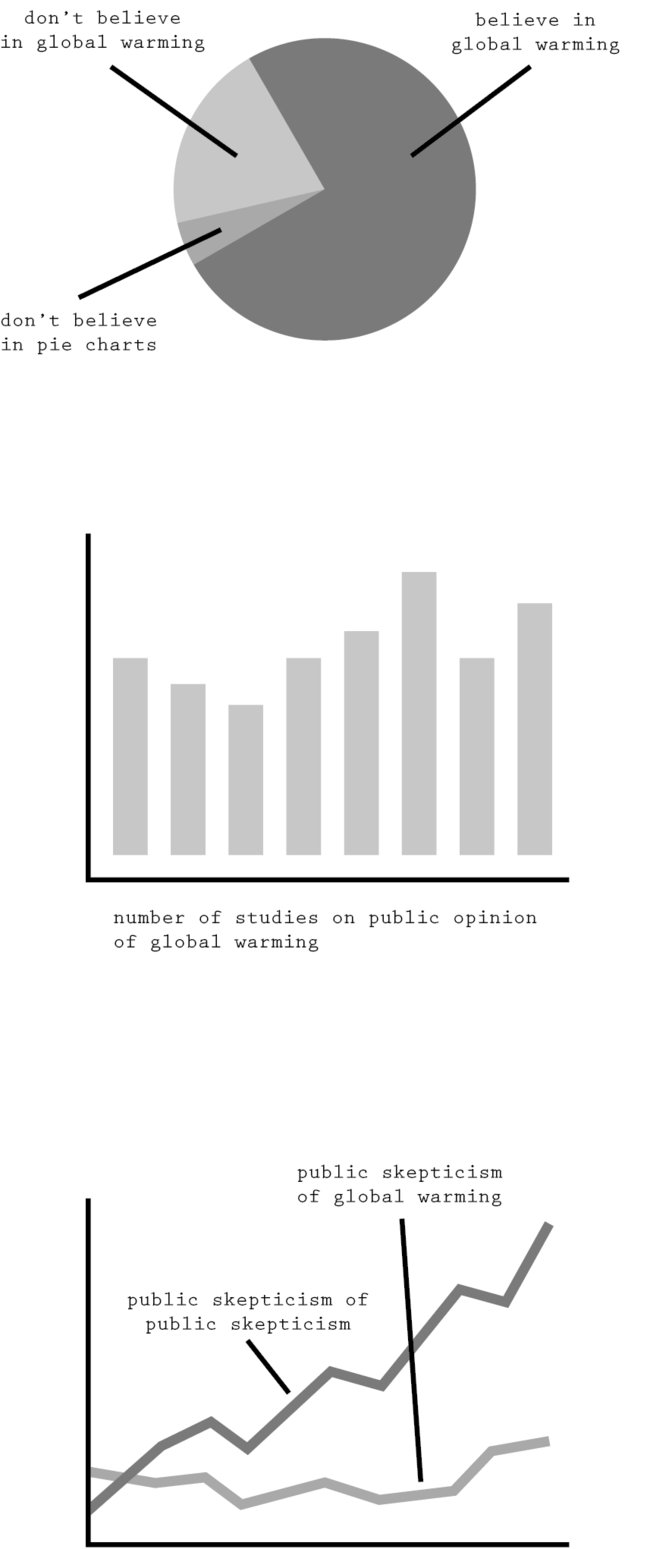
Or consider a widely publicized Gallup question: “Thinking about what is said in the news, in your view, is the seriousness of global warming generally exaggerated, generally correct or is it generally underestimated?” This question asked about respondents’ perceptions of the news, not the respondents’ perception of warming. A person who believes climate change has been happening might also feel that news media coverage of it has been exaggerated.
Questions in other polls that sought to tap respondents’ personal beliefs about the existence and causes of warming violated two of the cardinal rules of good survey question design: ask about only one thing at a time, and choose language that makes it easy for respondents to understand and answer each question.
Imagine being asked this, from a poll by CNN: “Which of the following statements comes closest to your view of global warming: Global warming is a proven fact and is mostly caused by emissions from cars and industrial facilities like power plants and factories; global warming is a proven fact and is mostly caused by natural changes that have nothing to do with emissions from cars and industrial facilities; or, global warming is a theory that has not yet been proven.”
Notice that the question didn’t even offer the opportunity for respondents to say they believe global warming is definitely not happening — not the sort of question that will provide the most valid measurements.
When surveys other than ours have asked simple and direct questions, they have produced results similar to ours. For example, in November, an ABC News/Washington Post survey found that 72 percent of respondents said the earth has been heating up, and a December poll by Ipsos/McClatchy found this proportion to be 70 percent.
Our surveys did reveal a small recent decline in the proportion of people who believe global warming has been happening, from 84 percent in 2007 to 80 percent in 2008 to 74 percent today. Statistical analysis of our data revealed that this decline is attributable to perceptions of recent weather changes by the minority of Americans who have been skeptical about climate scientists.
In terms of average earth temperature, 2008 was the coldest year since 2000. Scientists say that such year-to-year fluctuations are uninformative, and people who trust scientists therefore ignore this information when forming opinions about global warming’s existence. Citizens who do not trust climate scientists, however, base their conclusions on their personal observations of nature. These low-trust individuals were especially aware of the recent decline in average world temperatures; they were the ones in our survey whose doubts about global warming have increased since 2007.
This explanation is especially significant, because it suggests that the small recent decline in the proportion of people who believe in global warming is likely to be temporary. If the earth’s temperature begins to rise again, these individuals may reverse course and rejoin the large majority who still think warming is real.
Growing public skepticism has, in recent months, been attributed to news reports about e-mail messages hacked from the computer system at the University of East Anglia in Britain (characterized as showing climate scientists colluding to silence unconvinced colleagues) and by the discoveries of alleged flaws in reports by the Intergovernmental Panel on Climate Change.
Our new survey discredited this claim in multiple ways. First, we found no decline in Americans’ trust in environmental scientists: 71 percent of respondents said they trust these scientists a moderate amount, a lot or completely, a figure that was 68 percent in 2008 and 70 percent in 2009. Only 9 percent said they knew about the East Anglia e-mail messages and believed they indicated that climate scientists should not be trusted, and only 13 percent of respondents said so about the I.P.C.C. reports’ alleged flaws.
Interestingly, Americans are not alone in having their views portrayed inaccurately. A February BBC News survey asked Britons, “From what you know and have heard, do you think that the earth’s climate is changing and global warming is taking place?” Seventy-five percent of respondents answered affirmatively, down a somewhat improbable eight percentage points from 83 percent in November. A BBC headline blared, “Climate Skepticism on the Rise,” when it should have proclaimed that a huge majority of Britons still share common ground with one another and with Americans on this issue.
GLOBAL warming has attracted what political scientists dub an “issue public”: millions of Americans who are passionate about this subject and put pressure on government to follow their wishes. For over a decade, this group has been of typical issue-public size, about 15 percent of American adults.
Although issue publics usually divide about equally on opposing sides — think of abortion or immigration — 88 percent of the climate change issue public in our survey believed that global warming has been happening; 88 percent attributed responsibility for it to human action; 92 percent wanted the federal government to limit the amount of greenhouse gases that businesses can emit. Put simply, the people whose votes are most powerfully shaped by this issue are sending a nearly unanimous signal to their elected representatives.
All this makes global warming a singular issue in American politics. Even as we are told that Americans are about equally divided into red and blue, a huge majority shares a common vision of climate change. This creates a unique opportunity for elected representatives to satisfy a lot of voters.
When senators vote on emissions limits on Thursday, there is one other number they might want to keep in mind: 72 percent of Americans think that most business leaders do not want the federal government to take steps to stop global warming. A vote to eliminate greenhouse gas regulation is likely to be perceived by the nation as a vote for industry, and against the will of the people.
Jon A. Krosnick is a professor of communication, political science and psychology at Stanford.
>Blame: the hidden (and difficult) side of the climate change debate
>
By Renzo Taddei (State University of Campinas, Brazil)
Anthropology News – November 2008
Between 1877 and 1879, Northeast Brazil was crippled by one of the region’s most historically significant droughts. Around half million people may have died due to drought-related famine and epidemic outbreaks. Many of the region’s Catholic-majority inhabitants believed the drought was a form of divine punishment for the moral corruption of society, an idea reinforced in an epistle issued by the local bishop. More than a century later, in January 2004, when I was carrying out fieldwork in the region, extremely intense rains flooded the region, displacing over 100 thousand people. During interviews, some of the impacted echoed earlier beliefs that the disaster was the result of divine punishment. This time they pointed to television headlines — animal cloning, NASA’s expedition to Mars, the war in Iraq, among other things – as causes for divine discontent. Humans were going beyond their proper sphere of action, they said.
This research called my attention to the role of blame in cultural models about climate. The main international debates on climate change focus almost exclusively on the phenomenon’s physical causes, while at the same time there is an enormous ethnographic literature that reveals “blame” to be integral to how societies deal with crises in general (and climate related ones in particular). This reveals a conceptual gap where anthropology can effectively make critical contributions.
Indeed, it seems that the association between climate events and supposed human misdeeds is culturally pervasive and enduring. Of course in some places these beliefs may not to be the dominant, but they tend to reappear as a strong paradigm in moments of crisis. For instance, Mary Douglas, in Risk and Blame, provides ample evidence that this way of dealing with crises is not restricted to tribal and traditional societies, but marks Western societies alike. If she is right (and I believe she is), it makes the topic of blame politically relevant to our analyses of societal reactions to climate events and uncertainties.
One example of how blame is associated with climate can be seen in the rejection of climate modeling in water management. As Steve Rayner and his collaborators demonstrated in California and as I witnessed in Brazil, water managers resist incorporating new technologies that increase uncertainty, even if in the aggregate there are gains in efficiency. As an illustration, imagine a situation where two individuals are in conflict for the water stored in a reservoir: both want the water, but they also want to keep a certain volume saved for future needs. If a climate forecast predicts high probability of heavy rains in the upcoming rainy season, they may use more water in the present, thus resolving the conflict. But since climate forecasts are probabilistic, due to the extreme complexity of the atmosphere, the hydrological models will also become probabilistic. In the long run, a forecast will fail resulting in a water crisis. The public and most politicians don’t see the inherent uncertainties of modeling, and in a situation of crisis, there is a general expectation that someone is accountable. Not unlike the search for divine causation, the inherent uncertainty of climate modeling may produce an atmosphere where blame is politically expedient (and water managers risk losing their jobs). This context means that it is extremely difficult to convince water managers to use climate-based technologies.
Understanding how blame is present in cultural models about climate, in climate politics, and in the local institutionalized ways of addressing crises is, from an anthropological perspective, necessary if the discipline is to make effective contributions to the international debate on climate change. While international debates discuss how much certainty we need to enable political action, a second, equally important question, is how much uncertainty our political systems can take before triggering blaming and scapegoating rituals. Similarly, if culturally embedded models frame the idea of climate change as a situation where nature is “punishing” humanity for its misdeeds – carbon emissions, pollution, destruction of forests, reduction of biodiversity, and the like -individuals may take this punishment as deserved, which may induce them to assume a posture of resignation and inaction. Naturally, this is a hypothesis to be tested ethnographically.
>Essay Review: The Climate Change Debates (Science)
>
Philip Kitcher
Department of Philosophy, Columbia University
E-mail: psk16@columbia.edu
Originally published in Science Express on 27 May 2010
Science 4 June 2010: Vol. 328. no. 5983, pp. 1230 – 1234 – DOI: 10.1126/science.1189312
In one of the earliest and most eloquent pleas for open discussion and debate, John Milton wrote:
And though all the winds of doctrine were let loose to play upon the earth, so Truth be in the field, we do injuriously, by licensing and prohibiting, to misdoubt her strength. Let her and Falsehood grapple; who ever knew Truth put to the worse, in a free and open encounter. (1)
Two centuries after Milton, in the same year in which Charles Darwin published the Origin, John Stuart Mill’s essay On Liberty (2) added further arguments for the free exchange of ideas, suggesting that such exchange is vital for intellectual and social health. Although both Milton and Mill stand behind our current acquiescence in the value of extensive free discussion, both of them knew that they were opposing ancient suspicions about the viability of democracy. The political theorists and philosophers of the Greco-Roman world viewed ordinary folk as vulnerable to deception and exploitation. Allowed to determine the direction of the state, the folk would be easily seduced into believing falsehoods aligned with the interests of charismatic leaders, so that the popular voice would enthusiastically clamor for disastrous policies. Better, then, to entrust the ship of state to wise navigators, whose wisdom embraced both depth of understanding and moral integrity.
The contrast between these two perspectives on public discussion and policy bears on our own times, although the risks may affect our species as a whole and the stakes may be far higher. For three decades, prominent climate scientists have been warning of the dangerous effects of the continual emission of greenhouse gases into Earth’s atmosphere. They have been attempting to identify and to explain just what those effects are likely to be—for ourselves, our children, and our more remote descendants. And they have been urging a variety of measures that might prevent some of the disasters whose possibility they claim to foresee. Yet it is evident that substantial disagreement remains about the consequences for humans and for other species. This is so even in those countries where citizens have largely accepted the conclusions that anthropogenic global warming exists and is likely to raise the average temperature on our planet at least 2°C by the end of the century. In the United States, the state of discussion is less advanced: Denying the reality of human-caused climate change continues to figure as a serious possibility in public debates. And a large fraction of the populace believes that scientists’ warnings about the impact of any increases in global temperatures are exaggerated.
For those who play the role of Cassandra in this drama, such as climatologists James Hansen (NASA Goddard Institute for Space Studies) and Stephen Schneider (Stanford University), a 30-year effort to alert policy-makers, politicians, and the public to what they perceive as significant dangers can only be seen as frustrating. They have been moved to write books, accessible to a general readership, that will record the ways in which their warnings have been ignored—and their voices sometimes muffled. In Storms of My Grandchildren, Hansen attempts to combine the story of his own efforts with (yet another) attempt to explain the pertinent parts of climate science as clearly as he can. Science as a Contact Sport presents Schneider’s insider account of the struggles to understand and moderate human-induced atmospheric changes. Other climate scientists, like Mike Hulme (University of East Anglia), who live in societies where the level of discussion has usually been more informed, are inclined to see matters differently. They hold that continued debate reflects the genuine difficulties of the underlying issues and sometimes explicitly chide their colleagues (as Hulme does in Why We Disagree About Climate Change) for a tendency to “apocalyptic” pronouncements. So, in reflections on the debates of the past decades, there opens up a genuine dispute about the role of scientists in influencing public policy, with some urging a stronger voice for expert testimony and others recommending reticence and even quietism.
In part, the differences between Hansen and Schneider, on the one hand, and Hulme, on the other, stem from their concerns with rather different controversies. It is useful to differentiate three questions. First is the issue of whether human activities, specifically actions that increase the emission of greenhouse gases, are contributing to a significant average warming of Earth. (As all the expert authors point out very clearly, there is no suggestion that the temperature of every region will rise during the next decades.) Second are questions about the probabilities with which various phenomena (complete melting of ice sheets, for example) will occur and about their consequences for human beings and other species. Third are considerations about what might be done to halt (or even reverse) the warming and to limit the damaging consequences. Hulme emphasizes the complexity of the third set of issues. He notes how they are intertwined with difficulties about understanding economic trends and changes, about global justice, about the values assigned to things that are hard to assess in economic terms (ecosystems, the continuation of particular forms of human social life), about practical geopolitics, and even about religious perspectives. Focusing on this intricate web of problems, he elaborates an extensive case for the naturalness of continued disagreement.
For Hansen and Schneider, however, the first two questions are primary (although Hansen ventures some proposals about the third as well). Both contributed to repeated attempts to persuade successive American administrations of the existence and importance of anthropogenic global warming, and Schneider participated in lengthy discussions during the preparation of Intergovernmental Panel on Climate Change (IPCC) reports—discussions in which voices representing political interests seem to have forced compromising the eventual presentation of the pertinent scientific ideas. Their experiences incline them to emphasize the importance of expert judgment, effectively renewing the ancient worries about the dangers of democracy. Both believe that genuine democratic participation in the issues can only begin when citizens are in a position to understand what kinds of policies promote their interests. To achieve that requires a far clearer and unmistakable communication of the consensus views of climate scientists, with respect to the existence of anthropogenic global warming and to the chances of various effects, than has hitherto been available. In his choice of title, Hansen implicitly questions the frequent assumption that effects on future generations are subject to some “deep discount.” He explicitly notes that people’s common concern for the fates of their children and grandchildren provides a shared starting point for responding to the changes that might threaten them. Consequently, if citizens are to be able to express their views about things that matter most to them, they need informed views about the planet on which their descendants will live. Serious democracy requires reliance on expert opinion.
It is all too easy to be beguiled by an opposite thought: that democracy demands that there be extensive public discussion, even on technical matters, discussion in which all participants operate as equals. Those in the grip of this idea will view Hansen and Schneider as hysterical and arrogant people who aim to short-circuit the proper airing of alternative views. (Although sympathetic critics might also ponder the fact that these two eminent scientists have been rebutting the same “alternatives” for decades). Perhaps continued discussion could be tolerated, were there no urgency about the issue under debate. If they saw no compulsion to act soon—and if they were convinced that the fight were fair—Hansen and Schneider might share Milton’s confidence that truth would ultimately emerge as victor. Yet the stories they tell in their gripping narratives reveal all too many points at which messages have been distorted and suppressed because of the short-term interests of economic and political agents. They also demonstrate many ways in which the arena of public discussion has been set up to block the widespread acceptance of conclusions based on an increasing body of evidence.
The insiders’ stories of ways in which crucial information has effectively been withheld from voters, particularly in the United States, should give us pause about the functioning of our democracy. Even more powerful is the account provided by two outstanding historians who have reviewed a sequence of controversies around topics of public concern. In their fascinating and important study, Merchants of Doubt, Naomi Oreskes and Erik M. Conway offer convincing evidence for a surprising and disturbing thesis. Opposition to scientifically well-supported claims about the dangers of cigarette smoking, the difficulties of the Strategic Defense Initiative (“Star Wars”), the effects of acid rain, the existence of the ozone hole, the problems caused by secondhand smoke, and—ultimately—the existence of anthropogenic climate change was used in “the service of political goals and commercial interests” to obstruct the transmission to the American public of important information. Amazingly, the same small cadre of obfuscators figured in all these episodes.
Oreskes (University of California, San Diego) and Conway (NASA’s Jet Propulsion Laboratory) painstakingly trace the ways in which a few scientists, with strong ties to particular industries and with conservative political connections, have played a disproportionate role in debates about controversial questions, influencing policy-makers and the general public alike. Typically, these scientists have obtained their stature in fields other than those most pertinent to the debated question. Yet they have been able to cast enough doubt on the consensus views arrived at by scientists within the relevant disciplines to delay, often for a substantial period, widespread public acceptance of consequential hypotheses. They have used their stature in whatever areas of science they originally distinguished themselves to pose as experts who express an “alternative view” to the genuinely expert conclusions that seem problematic to the industries that support them or that threaten the ideological directions in which their political allies hope to lead.
The extraordinary story of deliberate obfuscation that Oreskes and Conway document begins with the delight of the tobacco companies in recruiting Fred Seitz and with Seitz’s own connections to “scientists in their twilight years who had turned to fields in which they had no training or experience.” It moves through the forging of a network of industrial and political alliances, and the creation of a variety of institutes and think-tanks devoted to challenging various forms of expert consensus, to a brilliant chapter in which the authors analyze the reasons why, as of 2009, a significant percentage of Americans (43%) continued to dissent from the minimal claim that there is “solid evidence the Earth is warming.” As Oreskes and Conway conclude:
There are many reasons why the United States has failed to act on global warming, but at least one is the confusion raised by Bill Nierenberg, Fred Seitz, and Fred Singer.
This apparently harsh claim is thoroughly justified through a powerful dissection of the ways in which prominent climate scientists, such as Roger Revelle and Ben Santer, were exploited or viciously attacked in the press.
None of this would have been possible without a web of connections among aging scientists, conservative politicians, and executives of companies (particularly those involved in fossil fuels) with a short-term economic interest in denying the impact of the emission of carbon into the atmosphere. But it also could not have produced the broad public skepticism about climate change without help from the media. As Oreskes and Conway point out, “balanced coverage” has become the norm in the dissemination of scientific information. Pitting adversaries against one another for a few minutes has proven an appealing strategy for television news programs to pursue in attracting and retaining viewers. Nor is the idea of “fair and balanced” coverage, in which the viewer (or reader) is allowed to decide, confined to Fox News. Competing “experts” have become common on almost all American radio and television programs, the Internet is awash in adversarial exchanges among those who claim to know, and newspapers, too, “sell” science by framing it as a sport (preferably as much of a contact sport as possible). Oreskes and Conway identify the ways in which the Washington Times and the Wall Street Journal have nourished the public sense that anthropogenic climate change is a matter of dispute, how they have given disproportionately large space to articles and opinion pieces from the “merchants of doubt,” and how they have sometimes censored the attempts of serious climate scientists to set the record straight. Even the New York Times, the American newspaper that takes science reporting most seriously, typically “markets” scientific research by imposing a narrative based on competition among dissenting scientists.
Media contributions to public confusion—what Schneider labels “mediarology”—are elaborated in a number of these books. There is a serious question as to whether American science journalists have conspicuously failed to discharge what might have seemed their central function: to enlighten the public about topics of concern, in areas where an expert consensus has been reached. Howard Friel’s The Lomborg Deception offers a careful analysis of the ways in which the “skeptical environmentalist,” Bjørn Lomborg, has selectively used (and sometimes distorted) the available evidence. Friel (an independent scholar whose previous books have critiqued the foreign and Middle East coverage of the New York Times) shows how Lomborg’s claims and his status as an expert were uncritically accepted. Apparently, the idea of framing environmental science in terms of a duel between rival “expert perspectives” was too seductive to resist.
For half a century, since the pioneering work of Thomas Kuhn (3), scholars who study the resolution of major scientific debates have understood how complex and difficult judgments about the probative value of data or the significance of unresolved problems can be. The major transitions in the history of the sciences, from the 16th and 17th centuries to the present, have involved intricate debates among competing research programs, among well-informed scientists who gave different weight to particular sorts of evidence. It is an absurd fantasy to believe that citizens who have scant backgrounds in the pertinent field can make responsible decisions about complex technical matters, on the basis of a few five-minute exchanges among more-or-less articulate speakers or a small number of articles outlining alternative points of view. Democratic ideals have their place in the conduct of inquiry, for it is arguable that there should be more communication between scientists and outsiders in the construction of research agendas, in the discussion of standards of acceptable risk, and in the articulation of policies based on scientific consensus. Genuine democracy, however, requires a division of labor, in which particular groups are charged with the responsibility of resolving questions that bear on the interests of individuals and societies. Other groups, those covering such questions in the media, have the duty to convey the results so that citizens can cast their votes as an enlightened expression of freedom, justifiably aimed at the outcomes for which they hope. Staging a brief disagreement between speakers with supposedly equal credentials, especially when it is not disclosed that one of them is answering to the economic aspirations of a very small segment of the society, is a cynical abnegation of that duty.
Because it is so thorough in disclosing how major policy decisions have been delayed or distorted, Merchants of Doubt deserves a wide readership. It is tempting to require that all those engaged in the business of conveying scientific information to the general public should read it. And that science journalists should abandon the obfuscating practice of presenting alternatives with inferior justification as if they were on a par with the scientific consensus.
* * *
Even if American public opinion were reformed overnight, so that virtually all citizens were convinced that anthropogenic global warming is likely to raise the average temperature of the planet by at least 2°C, that would be only the beginning. Beyond that minimal acceptance lie the difficult issues of deciding just what the consequences of a warmer planet will be and what can be done about them. Here, too, denial can easily be induced. Those who want to resist regulatory actions contend that the difficulties that are likely to arise for our descendants have been greatly exaggerated, that whatever problems arise will be addressed by people in a better economic position than we are today, that human beings have shown an admirable ability to adapt to changing environments, and so on and on and on. In countries that have long taken anthropogenic climate change as a settled question, agreeing on the expected consequences and the appropriate response has not proved easy. American discussions are likely to be haunted by the long denial, so that suspicions about alarmism linger. As psychologists have repeatedly discovered, those who are misinformed and later corrected often lapse into versions of their original error.
Scientists who believe that there are grave consequences for Earth and its future inhabitants face a difficult dilemma. They can talk in probabilistic terms—typically very imprecise probabilistic terms—about possible scenarios. If those potential futures are to be made vivid in ways that might engage citizens and inspire them to action, then the scenarios need to be given in some detail. Yet, as they become more specific, the precision about probabilities goes down, even to the extent that it is only responsible to declare that some outcome lies within the range of possibilities. Occasionally, those who raise the alarm are more definite. If the Arctic ice (including the Greenland ice sheet) melts, polar bears will lose their habitat and the species will go extinct; if sea levels rise in the most probable ways, low-lying islands (and many coastal areas, such as the Ganges delta) will be submerged. Outcomes like these are often met with an uncomfortable shrug. They are to be regretted, of course, but if avoiding them really requires a serious modification of civilized life, then it seems better to adapt: relocate some polar bears to artificially cooled preserves; transport the unfortunate flood victims to higher ground.
Concentration on scenarios that can be presented in detail and also justified as likely entails a serious cost. For it encourages a public perception that these are the only outcomes the Cassandras of climate science fear. A stereotype easily follows. The movement toward action derives from an ideology, one centered in a dislike of competitive market capitalism, a fondness for regulation, a tendency to give priority to the needs of the poor, and an overemphasis on environmental conservation. Global warming is a device used by Birkenstock-wearing, tree-hugging, business-hating liberal intellectuals for advancing their political aims.
“Ideology” is a word that appears relatively frequently in Hulme’s Why We Disagree About Climate Change (although he never explains what he means by it). A climatologist who has devoted some serious time to studying history and social studies of science, Hulme aims to offer a broader perspective on the debates that arise once the initial question of the reality of human-caused global warming has been settled. His book is valuable for its diagnosis of the many different levels at which disagreement can arise and the variety of political stances and value judgments that can incline people to divergent conclusions about what is likely to happen and what might be done. In delineating that diversity, he moves the discussion beyond any appeal to polarized stereotypes: on this side, the captains of industry, their tools, and their dupes; on the other, the flower children in sandals.
Yet Hulme’s book invites misreading. His immersion in the language of various domains of social studies leads him to write as if the theoretical conceptions he deploys in classifying various positions were as reliably grounded as the scientific findings he so clearly and concisely explains. Sometimes, there is even a fashionable indulgence in skeptical distancing, the use of inverted commas (scare quotes) to raise a knowing eyebrow. He announces, for example, that he will tell the story of “how we ‘discovered’ that physical climates could change,” before going on to give a lucid account of how the discovery (real discovery) occurred. In a similar vein, he tells us that the “‘post-normal’ character of climate change” requires a wider range of expert voices, that scientists must concede ground to “other ways of knowing,” and that climate change can become “a mirror into which we can look and see exposed both our individual selves and our collective societies.” The concerned environmentalist who presses on through Hulme’s discussions of the “opportunities” provided for “us” by climate change may eventually give up when he tells his readers to “change our position and examine climate change as an idea of the imagination rather than as a problem to be solved.” Tell it to the Maldives!
That response, however, is too impatient. Hulme’s ideas are more subtle than the (often maladroit) jargon in which he expresses them. If his book more explicitly differentiated areas in which particular groups of people might have greater authority, it would be possible to recognize the value of his diagnoses of the difficulties that attend debates about climate change without supposing that he is advocating the narcissistic quietism his words often suggest. He could accept, for example, the judgment common to Hansen, Schneider, and Oreskes and Conway: that conclusions about the reality of anthropogenic climate change and about the risks that attend some scenarios for the future are matters that can be—and have been—authoritatively decided by a scientific community to which he himself belongs. He should then agree with the implication that, in this domain, it would be foolish to introduce “other ways of knowing.” Hulme could reasonably suppose that the public becomes properly engaged at the moment when risks have been specified—to the extent that they can be specified—and that citizens’ judgments are crucial to decisions about what risks count as acceptable. He could emphasize, as he comments in one of his best discussions, that any decision as to whether a possible future can be tolerated (or even welcomed) should be informed by economic considerations, even though ethical values are crucial to any serious assessment. Finally, his apparently passive recommendation to see ourselves in “the mirror” of climate change—like his Kennedyesque injunction to ask “what climate change can do for us”—can be interpreted more sympathetically as a call for a more systematic investigation of the global challenges that confront us today and those that our descendants will face, one that formulates strategies for safeguarding the future without sacrificing the interests of those currently living.
To make progress on these issues, there will be a need for generally accessible accounts of the likely impact that various levels of global warming will produce. Both Hansen and Schneider describe potential futures, with Schneider being particularly insistent on the important point that scientists owe the public a specification of probabilities (to the extent that that is possible). Two other recent books—The Climate Solutions Consensus from the National Council for Science and the Environment and Climate Change Science and Policy (for which Schneider served as one of its editors)—offer some helpful and relatively nontechnical information for concerned citizens. The organization of Climate Change Science and Policy is particularly valuable, because of the volume’s focus on specific types of changes that would affect the lives of future people. It breaks free of the stereotypical concerns about marooned polar bears and dispossessed islanders to emphasize facts about rising sea levels and melting glaciers that are not sufficiently appreciated. Thus Peter Gleick’s chapter on water concisely identifies the likely disruption of water supplies and the serious chances of flood-induced pollution. Similarly, Kristie Ebi delivers a useful summary of a variety of ways in which our descendants will probably be more vulnerable to infectious diseases and respiratory conditions. (Although she omits concerns about the possible effects of environmental change on the evolution of disease vectors and cross-species transmission—perhaps because, in assessing these events, the chances are unspecifiable.)
Even though discussions of the predicaments people will face in the future do not exhaust the relevant considerations for deciding what actions we should take now, it is wise to bring them to the fore. Citizens need to understand the challenges with respect to shelter, food supply, water supply, and disease that are likely to arise for their descendants. Hansen’s clear perception that an overwhelming majority of the world’s population can share a concern about the kinds of lives that will be available to their children and grandchildren is echoed in the decision by the distinguished social theorist Anthony Giddens (London School of Economics) to ground his recommendations in the thesis that “objects in nature can only have value through us” (4). Although some environmentalists would demur, Giddens’s approach in The Politics of Climate Change has the advantage of increasing the chances for consensus. Like Hulme, he is much concerned to recognize the connections among global problems, insisting, from the beginning, that the challenges of responding to climate change and of meeting the energy needs of the human population must be faced in tandem. He differs from Hulme in not attempting any wide survey of sources of disagreement, and, as readers of his previous works might expect, he is lucid and precise in outlining potential courses of social action. If his book, conceived as a guide for the perplexed citizen, has a flaw, that lies in the breadth and number of the ideas he explores. Those ideas are offered in response to threats he views as profoundly serious:
It will be a colossal task to turn around a society whose whole way of life is constructed around mobility and a ‘natural right’ to consume energy in a profligate way. Yet it isn’t as hopeless an endeavour as it looks.
* * *
All the books reviewed here were written before climate change deniers exultantly exposed the mistakes made by the IPCC in announcing the imminent demise of the Himalayan glaciers and the “conspiratorial e-mails” from the East Anglia climate center. In the wake of these “important revelations,” the merchants of doubt were back in business. In December 2009, Reuters published a discussion by Singer in which he claimed that the IPCC report was based on “distorted raw data” and algorithms that were not shared with other scientists (5). Few readers of Singer’s presentation, or those given by other longstanding climate-change deniers, learned that there is significant independent evidence for Himalayan glacier melt, although not as rapid as the erroneous sentence implied. Probably still fewer understood that the competitive-cooperative interactions among scientists often involve unguarded remarks about the work of rival “teams,” and that references to “tricks” frequently advert to strategies for simplifying complicated mathematical problems or (as in this case) graphical methods of presenting a conclusion perspicuously, rather than to stratagems for deceiving the public. Captured by a naïve and oversimplified image of what “objective science” is like, it is easy for citizens to reject claims of scientific authority when they discover that scientific work is carried out by human beings.
These revelations probably retarded any serious American consensus even on the minimal judgment that is the preliminary to the longer and more difficult debate. Meanwhile, the disappointment at Copenhagen can be seen as evidence that the world is lapsing into a state of resignation. The emissions, of course, do not take a break from the hard decisions.
Nevertheless, there are grounds for the hope expressed by Giddens. Among them is the fact that serious scholars from a variety of crucial disciplines have written valuable books on which future deliberations can build. Those deliberations will require a new synthesis that involves scientists, social scientists, historians—and others, too. It is an embarrassment (at least for me) that philosophers have not contributed more to this necessary conversation. We might clarify some of the methodological issues—for instance, those concerning the variety of risks involved in model-building. Perhaps more important, we could use recent ethical work on responsibilities to future generations and to distant people to articulate a detailed ethical framework that might help a planet’s worth of policy-makers find their way to consensus. With luck, a broader group of dedicated scholars may be galvanized by the books discussed here, so that the potential disasters Hansen and Schneider have been warning us about for 30 years will be averted. Perhaps, in the end, truth—and wisdom—will prevail.
References and Notes
* 1. J. Milton, Areopagitica (London, 1644); http://www.gutenberg.org/etext/608.
* 2. J. S. Mill, On Liberty (London, 1859); http://ebooks.adelaide.edu.au/m/mill/john_stuart/m645o/.
* 3. T. S. Kuhn, The Structure of Scientific Revolutions (Univ. Chicago Press, Chicago, 1962).
* 4. Giddens derives this view about values from the political philosopher Robert Goodin [see, for example, (6)].
* 5. http://blogs.reuters.com/great-debate/tag/climate-change-conference/.
* 6. R. Goodin, Green Political Theory (Polity, Cambridge, 1992).
Books Discussed
Merchants of Doubt: How a Handful of Scientists Obscured the Truth on Issues from Tobacco Smoke to Global Warming
By Naomi Oreskes and Erik M. Conway. Bloomsbury, New York, 2010. 365 pp. $27, £25. ISBN 9781596916104.
Why We Disagree About Climate Change: Understanding Controversy, Inaction and Opportunity
By Mike Hulme. Cambridge University Press, Cambridge, 2009. 432 pp. $80, £45. ISBN 9780521898690. Paper, $29.99, £15.99. ISBN 9780521727327.
Storms of My Grandchildren: The Truth About the Coming Climate Catastrophe and Our Last Chance to Save Humanity
By James Hansen. Bloomsbury, New York, 2009. 320 pp. $25, £18. ISBN 9781608192007.
Science as a Contact Sport: Inside the Battle to Save Earth’s Climate
By Stephen H. Schneider. National Geographic, Washington, DC, 2009. 303 pp. $28, C$35, £16.99. ISBN 9781426205408.
The Lomborg Deception: Setting the Record Straight About Global Warming
By Howard Friel. Yale University Press, New Haven, CT, 2010. 270 pp. $28, £18.99. ISBN 9780300161038.
The Climate Solutions Consensus
By David E. Blockstein and Leo Wiegman. Island Press, Washington, DC, 2010. 328 pp. $50, £31. ISBN 9781597266369. Paper, $30, £18.99. ISBN 9781597266741.
Climate Change Science and Policy
Stephen H. Schneider, Armin Rosencranz, Michael D. Mastrandrea, and Kristin Kuntz-Duriseti, Eds. Island Press, Washington, DC, 2010. 542 pp. $95, £59. ISBN 9781597265669. Paper, $49.50, £37. ISBN 9781597265676.
The Politics of Climate Change
By Anthony Giddens. Polity, Cambridge, 2009. 272 pp. $69.95, £55. ISBN 9780745646923. Paper, $22.95, £12.99. ISBN 9780745646930.
Comments posted on the essay review here.
 Uma (in)certa antropologia
Você precisa fazer login para comentar.