Arquivo anual: 2012

Will one researcher’s discovery deep in the Amazon destroy the foundation of modern linguistics? (The Chronicle of Higher Education)

The Chronicle Review

By Tom Bartlett

March 20, 2012

Angry Words

chomsky everett

A Christian missionary sets out to convert a remote Amazonian tribe. He lives with them for years in primitive conditions, learns their extremely difficult language, risks his life battling malaria, giant anacondas, and sometimes the tribe itself. In a plot twist, instead of converting them he loses his faith, morphing from an evangelist trying to translate the Bible into an academic determined to understand the people he’s come to respect and love.

Along the way, the former missionary discovers that the language these people speak doesn’t follow one of the fundamental tenets of linguistics, a finding that would seem to turn the field on its head, undermine basic assumptions about how children learn to communicate, and dethrone the discipline’s long-reigning king, who also happens to be among the most well-known and influential intellectuals of the 20th century.

It feels like a movie, and it may in fact turn into one—there’s a script and producers on board. It’s already a documentary that will air in May on the Smithsonian Channel. A play is in the works in London. And the man who lived the story, Daniel Everett, has written two books about it. His 2008 memoir Don’t Sleep, There Are Snakes, is filled with Joseph Conrad-esque drama. The new book, Language: The Cultural Tool, which is lighter on jungle anecdotes, instead takes square aim at Noam Chomsky, who has remained the pre-eminent figure in linguistics since the 1960s, thanks to the brilliance of his ideas and the force of his personality.

But before any Hollywood premiere, it’s worth asking whether Everett actually has it right. Answering that question is not straightforward, in part because it hinges on a bit of grammar that no one except linguists ever thinks about. It’s also made tricky by the fact that Everett is the foremost expert on this language, called Pirahã, and one of only a handful of outsiders who can speak it, making it tough for others to weigh in and leading his critics to wonder aloud if he has somehow rigged the results.

More than any of that, though, his claim is difficult to verify because linguistics is populated by a deeply factionalized group of scholars who can’t agree on what they’re arguing about and who tend to dismiss their opponents as morons or frauds or both. Such divisions exist, to varying degrees, in all disciplines, but linguists seem uncommonly hostile. The word “brutal” comes up again and again, as do “spiteful,” “ridiculous,” and “childish.”

With that in mind, why should anyone care about the answer? Because it might hold the key to understanding what separates us from the rest of the animals.

Imagine a linguist from Mars lands on Earth to survey the planet’s languages (presumably after obtaining the necessary interplanetary funding). The alien would reasonably conclude that the languages of the world are mostly similar with interesting but relatively minor variations.

As science-fiction premises go it’s rather dull, but it roughly illustrates Chomsky’s view of linguistics, known as Universal Grammar, which has dominated the field for a half-century. Chomsky is fond of this hypothetical and has used it repeatedly for decades, including in a 1971 discussion with Michel Foucault, during which he added that “this Martian would, if he were rational, conclude that the structure of the knowledge that is acquired in the case of language is basically internal to the human mind.”

In his new book, Everett, now dean of arts and sciences at Bentley University, writes about hearing Chomsky bring up the Martian in a lecture he gave in the early 1990s. Everett noticed a group of graduate students in the back row laughing and exchanging money. After the talk, Everett asked them what was so funny, and they told him they had taken bets on precisely when Chomsky would once again cite the opinion of the linguist from Mars.

The somewhat unkind implication is that the distinguished scholar had become so predictable that his audiences had to search for ways to amuse themselves. Another Chomsky nugget is the way he responds when asked to give a definition of Universal Grammar. He will sometimes say that Universal Grammar is whatever made it possible for his granddaughter to learn to talk but left the world’s supply of kittens and rocks speechless—a less-than-precise answer. Say “kittens and rocks” to a cluster of linguists and eyes are likely to roll.

Chomsky’s detractors have said that Universal Grammar is whatever he needs it to be at that moment. By keeping it mysterious, they contend, he is able to dodge criticism and avoid those who are gunning for him. It’s hard to murder a phantom.

Everett’s book is an attempt to deliver, if not a fatal blow, then at least a solid right cross to Universal Grammar. He believes that the structure of language doesn’t spring from the mind but is instead largely formed by culture, and he points to the Amazonian tribe he studied for 30 years as evidence. It’s not that Everett thinks our brains don’t play a role—they obviously do. But he argues that just because we are capable of language does not mean it is necessarily prewired. As he writes in his book: “The discovery that humans are better at building human houses than porpoises tells us nothing about whether the architecture of human houses is innate.”

The language Everett has focused on, Pirahã, is spoken by just a few hundred members of a hunter-gatherer tribe in a remote part of Brazil. Everett got to know the Pirahã in the late 1970s as an American missionary. With his wife and kids, he lived among them for months at a time, learning their language from scratch. He would point to objects and ask their names. He would transcribe words that sounded identical to his ears but had completely different meanings. His progress was maddeningly slow, and he had to deal with the many challenges of jungle living. His story of taking his family, by boat, to get treatment for severe malaria is an epic in itself.

His initial goal was to translate the Bible. He got his Ph.D. in linguistics along the way and, in 1984, spent a year studying at the Massachusetts Institute of Technology in an office near Chomsky’s. He was a true-blue Chomskyan then, so much so that his kids grew up thinking Chomsky was more saint than professor. “All they ever heard about was how great Chomsky was,” he says. He was a linguist with a dual focus: studying the Pirahã language and trying to save the Pirahã from hell. The second part, he found, was tough because the Pirahã are rooted in the present. They don’t discuss the future or the distant past. They don’t have a belief in gods or an afterlife. And they have a strong cultural resistance to the influence of outsiders, dubbing all non-Pirahã “crooked heads.” They responded to Everett’s evangelism with indifference or ridicule.

As he puts it now, the Pirahã weren’t lost, and therefore they had no interest in being saved. They are a happy people. Living in the present has been an excellent strategy, and their lack of faith in the divine has not hindered them. Everett came to convert them, but over many years found that his own belief in God had melted away.

So did his belief in Chomsky, albeit for different reasons. The Pirahã language is remarkable in many respects. Entire conversations can be whistled, making it easier to communicate in the jungle while hunting. Also, the Pirahã don’t use numbers. They have words for amounts, like a lot or a little, but nothing for five or one hundred. Most significantly, for Everett’s argument, he says their language lacks what linguists call “recursion”—that is, the Pirahã don’t embed phrases in other phrases. They instead speak only in short, simple sentences.

In a recursive language, additional phrases and clauses can be inserted in a sentence, complicating the meaning, in theory indefinitely. For most of us, the lack of recursion in a little-known Brazilian language may not seem terribly interesting. But when Everett published a paper with that finding in 2005, the news created a stir. There were magazine articles and TV appearances. Fellow linguists weighed in, if only in some cases to scoff. Everett had put himself and the Pirahã on the map.

His paper might have received a shrug if Chomsky had not recently co-written a paper, published in 2002, that said (or seemed to say) that recursion was the single most important feature of human language. “In particular, animal communication systems lack the rich expressive and open-ended power of human language (based on humans’ capacity for recursion),” the authors wrote. Elsewhere in the paper, the authors wrote that the faculty of human language “at minimum” contains recursion. They also deemed it the “only uniquely human component of the faculty of language.”

In other words, Chomsky had finally issued what seemed like a concrete, definitive statement about what made human language unique, exposing a possible vulnerability. Before Everett’s paper was published, there had already been back and forth between Chomsky and the authors of a response to the 2002 paper, Ray Jackendoff and Steven Pinker. In the wake of that public disagreement, Everett’s paper had extra punch.

It’s been said that if you want to make a name for yourself in modern linguistics, you have to either align yourself with Chomsky or seek to destroy him. Either you are desirous of his approval or his downfall. With his 2005 paper, Everett opted for the latter course.

Because the pace of academic debate is just this side of glacial, it wasn’t until June 2009 that the next major chapter in the saga was written. Three scholars who are generally allies of Chomsky published a lengthy paper in the journal Language dissecting Everett’s claims one by one. What he considered unique features of Pirahã weren’t unique. What he considered “gaps” in the language weren’t gaps. They argued this in part by comparing Everett’s recent paper to work he published in the 1980s, calling it, slightly snidely, his earlier “rich material.” Everett wasn’t arguing with Chomsky, they claimed; he was arguing with himself. Young Everett thought Pirahã had recursion. Old Everett did not.

Everett’s defense was, in so many words, to agree. Yes, his earlier work was contradictory, but that’s because he was still under Chomsky’s sway when he wrote it. It’s natural, he argued, even when doing basic field work, cataloging the words of a language and the stories of a people, to be biased by your theoretical assumptions. Everett was a Chomskyan through and through, so much so that he had written the MSN Encarta encyclopedia entry on him. But now, after more years with the Pirahã, the scales had fallen from his eyes, and he saw the language on its own terms rather than those he was trying to impose on it.

David Pesetsky, a linguistics professor at MIT and one of the authors of the critical Languagepaper, thinks Everett was trying to gin up a “Star Wars-level battle between himself and the forces of Universal Grammar,” presumably with Everett as Luke Skywalker and Chomsky as Darth Vader.

Contradicting Everett meant getting into the weeds of the Pirahã language, a language that Everett knew intimately and his critics did not. “Most people took the attitude that this wasn’t worth taking on,” Pesetsky says. “There’s a junior-high-school corridor, two kids are having a fight, and everyone else stands back.” Everett wrote a lengthy reply that Pesetsky and his co-authors found unsatisfying and evasive. “The response could have been ‘Yeah, we need to do this more carefully,'” says Pesetsky. “But he’s had seven years to do it more carefully and he hasn’t.”

Critics haven’t just accused Everett of inaccurate analysis. He’s the sole authority on a language that he says changes everything. If he wanted to, they suggest, he could lie about his findings without getting caught. Some were willing to declare him essentially a fraud. That’s what one of the authors of the 2009 paper, Andrew Nevins, now at University College London, seems to believe. When I requested an interview with Nevins, his reply read, “I may be being glib, but it seems you’ve already analyzed this kind of case!” Below his message was a link to an article I had written about a Dutch social psychologist who had admitted to fabricating results, including creating data from studies that were never conducted. In another e-mail, after declining to expand on his apparent accusation, Nevins wrote that the “world does not need another article about Dan Everett.”

In 2007, Everett heard reports of a letter signed by Cilene Rodrigues, who is Brazilian, and who co-wrote the paper with Pesetsky and Nevins, that accuses him of racism. According to Everett, he got a call from a source informing him that Rodrigues, an honorary research fellow at University College London, had sent a letter to the organization in Brazil that grants permission for researchers to visit indigenous groups like the Pirahã. He then discovered that the organization, called FUNAI, the National Indian Foundation, would no longer grant him permission to visit the Pirahã, whom he had known for most of his adult life and who remain the focus of his research.

He still hasn’t been able to return. Rodrigues would not respond directly to questions about whether she had signed such a letter, nor would Nevins. Rodrigues forwarded an e-mail from another linguist who has worked in Brazil, which speculates that Everett was denied access to the Pirahã because he did not obtain the proper permits and flouted the law, accusations Everett calls “completely false” and “amazingly nasty lies.”

Whatever the reason for his being blocked, the question remains: Is Everett’s work racist? The accusation goes that because Everett says that the Pirahã do not have recursion, and that all human languages supposedly have recursion, Everett is asserting that the Pirahã are less than human. Part of this claim is based on an online summary, written by a former graduate student of Everett’s, that quotes traders in Brazil saying the Pirahã “talk like chickens and act like monkeys,” something Everett himself never said and condemns. The issue is sensitive because the Pirahã, who eschew the trappings of modern civilization and live the way their forebears lived for thousands of years, are regularly denigrated by their neighbors in the region as less than human. The fact that Everett is American, not Brazilian, lends the charge added symbolic weight.

When you read Everett’s two books about the Pirahã, it is nearly impossible to think that he believes they are inferior. In fact, he goes to great lengths not to condescend and offers defenses of practices that outsiders would probably find repugnant. In one instance he describes, a Pirahã woman died, leaving behind a baby that the rest of the tribe thought was too sick to live. Everett cared for the infant. One day, while he was away, members of the tribe killed the baby, telling him that it was in pain and wanted to die. He cried, but didn’t condemn, instead defending in the book their seemingly cruel logic.

Likewise, the Pirahã’s aversion to learning agriculture, or preserving meat, or the fact that they show no interest in producing artwork, is portrayed by Everett not as a shortcoming but as evidence of the Pirahã’s insistence on living in the present. Their nonhierarchical social system seems to Everett fair and sensible. He is critical of his own earlier attempts to convert the Pirahã to Christianity as a sort of “colonialism of the mind.” If anything, Everett is more open to a charge of romanticizing the Pirahã culture.

Other critics are more measured but equally suspicious. Mark Baker, a linguist at Rutgers University at New Brunswick, who considers himself part of Chomsky’s camp, mentions Everett’s “vested motive” in saying that the Pirahã don’t have recursion. “We always have to be a little careful when we have one person who has researched a language that isn’t accessible to other people,” Baker says. He is dubious of Everett’s claims. “I can’t believe it’s true as described,” he says.

Chomsky hasn’t exactly risen above the fray. He told a Brazilian newspaper that Everett was a “charlatan.” In the documentary about Everett, Chomsky raises the possibility, without saying he believes it, that Everett may have faked his results. Behind the scenes, he has been active as well. According to Pesetsky, Chomsky asked him to send an e-mail to David Papineau, a professor of philosophy at King’s College London, who had written a positive, or at least not negative, review of Don’t Sleep, There Are Snakes. The e-mail complained that Papineau had misunderstood recursion and was incorrectly siding with Everett. Papineau thought he had done nothing of the sort. “For people outside of linguistics, it’s rather surprising to find this kind of protection of orthodoxy,” Papineau says.

And what if the Pirahã don’t have recursion? Rather than ferreting out flaws in Everett’s work as Pesetsky did, Chomsky’s preferred response is to say that it doesn’t matter. In a lecture he gave last October at University College London, he referred to Everett’s work without mentioning his name, talking about those who believed that “exceptions to the generalizations are considered lethal.” He went on to say that a “rational reaction” to finding such exceptions “isn’t to say ‘Let’s throw out the field.'” Universal Grammar permits such exceptions. There is no problem. As Pesetsky puts it: “There’s nothing that says languages without subordinate clauses can’t exist.”

Except the 2002 paper on which Chomsky’s name appears. Pesetsky and others have backed away from that paper, arguing not that it was incorrect, but that it was “written in an unfortunate way” and that the authors were “trying to make certain things comprehensible about linguistics to a larger public, but they didn’t make it clear that they were simplifying.” Some say that Chomsky signed his name to the paper but that it was actually written by Marc Hauser, the former professor of psychology at Harvard University, who resigned after Harvard officials found him guilty of eight counts of research misconduct. (For the record, no one has suggested the alleged misconduct affected his work with Chomsky.)

Chomsky declined to grant me an interview. Those close to him say he sees Everett as seizing on a few stray, perhaps underexplained, lines from that 2002 paper and distorting them for his own purposes. And the truth, Chomsky has made clear, should be apparent to any rational person.

Ted Gibson has heard that one before. When Gibson, a professor of cognitive sciences at MIT, gave a paper on the topic at a January meeting of the Linguistic Society of America, held in Portland, Ore., Pesetsky stood up at the end to ask a question. “His first comment was that Chomsky never said that. I went back and found the slide,” he says. “Whenever I talk about this question in front of these people I have to put up the literal quote from Chomsky. Then I have to put it up again.”

Geoffrey Pullum, a professor of linguistics at the University of Edinburgh, is also vexed at how Chomsky and company have, in his view, played rhetorical sleight-of-hand to make their case. “They have retreated to such an extreme degree that it says really nothing,” he says. “If it has a sentence longer than three words then they’re claiming they were right. If that’s what they claim, then they weren’t claiming anything.” Pullum calls this move “grossly dishonest and deeply silly.”

Everett has been arguing about this for seven years. He says Pirahã undermines Universal Grammar. The other side says it doesn’t. In an effort to settle the dispute, Everett asked Gibson, who holds a joint appointment in linguistics at MIT, to look at the data and reach his own conclusions. He didn’t provide Gibson with data he had collected himself because he knows his critics suspect those data have been cooked. Instead he provided him with sentences and stories collected by his missionary predecessor. That way, no one could object that it was biased.

In the documentary about Everett, handing over the data to Gibson is given tremendous narrative importance. Everett is the bearded, safari-hatted field researcher boating down a river in the middle of nowhere, talking and eating with the natives. Meanwhile, Gibson is the nerd hunched over his keyboard back in Cambridge, crunching the data, examining it with his research assistants, to determine whether Everett really has discovered something. If you watch the documentary, you get the sense that what Gibson has found confirms Everett’s theory. And that’s the story you get from Everett, too. In our first interview, he encouraged me to call Gibson. “The evidence supports what I’m saying,” he told me, noting that he and Gibson had a few minor differences of interpretation.

But that’s not what Gibson thinks. Some of what he found does support Everett. For example, he’s confirmed that Pirahã lacks possessive recursion, phrases like “my brother’s mother’s house.” Also, there appear to be no conjunctions like “and” or “or.” In other instances, though, he’s found evidence that seems to undercut Everett’s claims—specifically, when it comes to noun phrases in sentences like “His mother, Itaha, spoke.”

That is a simple sentence, but inserting the mother’s name is a hallmark of recursion. Gibson’s paper, on which Everett is a co-author, states, “We have provided suggestive evidence that Pirahã may have sentences with recursive structures.”

If that turns out to be true, it would undermine the primary thesis of both of Everett’s books about the Pirahã. Rather than the hero who spent years in the Amazon emerging with evidence that demolished the field’s predominant theory, Everett would be the descriptive linguist who came back with a couple of books full of riveting anecdotes and cataloged a language that is remarkable, but hardly changes the game.

Everett only realized during the reporting of this article that Gibson disagreed with him so strongly. Until then, he had been saying that the results generally supported his theory. “I don’t know why he says that,” Gibson says. “Because it doesn’t. He wrote that our work corroborates it. A better word would be falsified. Suggestive evidence is against it right now and not for it.” Though, he points out, the verdict isn’t final. “It looks like it is recursive,” he says. “I wouldn’t bet my life on it.”

Another researcher, Ray Jackendoff, a linguist at Tufts University, was also provided the data and sees it slightly differently. “I think we decided there is some embedding but it is of limited depth,” he says. “It’s not recursive in the sense that you can have infinitely deep embedding.” Remember that in Chomsky’s paper, it was the idea that “open-ended” recursion was possible that separated human and animal communication. Whether the kind of limited recursion Gibson and Jackendoff have noted qualifies depends, like everything else in this debate, on the interpretation.

Everett thinks what Gibson has found is not recursion, but rather false starts, and he believes further research will back him up. “These are very short, extremely limited examples and they almost always are nouns clarifying other nouns,” he says. “You almost never see anything but that in these cases.” And he points out that there still doesn’t seem to be any evidence of infinite recursion. Says Everett: “There simply is no way, even if what I claim to be false starts are recursive instead, to say, “‘My mother, Susie, you know who I mean, you like her, is coming tonight.'”

The field has a history of theoretical disagreements that turn ugly. In the book The Linguistic Wars, published in 1995, Randy Allen Harris tells the story of another skirmish between Chomsky and a group of insurgent linguists called generative semanticists. Chomsky dismissed his opponents’ arguments as absurd. His opponents accused him of altering his theories when confronted and of general arrogance. “Chomsky has the impressive rhetorical talent of offering ideas which are at once tentative and fully endorsed, of appearing to take the if out of his arguments while nevertheless keeping it safely around,” writes Harris.

That rhetorical talent was on display in his lecture last October, in which he didn’t just disagree with other linguists, but treated their arguments as ridiculous and a mortal danger to the field. The style seems to be reflected in his political activism. Watch his 1969 debate on Firing Lineagainst William F. Buckley Jr., available on YouTube, and witness Chomsky tie his famous interlocutor in knots. It is a thorough, measured evisceration. Chomsky is willing to deploy those formidable skills in linguistic arguments as well.

Everett is far from the only current Chomsky challenger. Recently there’s been a rise in so-called corpus linguistics, a data-driven method of evaluating a language, using computer software to analyze sentences and phrases. The method produces detailed information and, for scholars like Gibson, finally provides scientific rigor for a field he believes has been mired in never-ending theoretical disputes. That, along with the brain-scanning technology that linguists are increasingly making use of, may be able to help resolve questions about how much of the structure of language is innate and how much is shaped by culture.

But Chomsky has little use for that method. In his lecture, he deemed corpus linguistics nonscientific, comparing it to doing physics by describing the swirl of leaves on a windy day rather than performing experiments. This was “just statistical modeling,” he said, evidence of a “kind of pathology in the cognitive sciences.” Referring to brain scans, Chomsky joked that the only way to get a grant was to propose an fMRI.

As for Universal Grammar, some are already writing its obituary. Michael Tomasello, co-director of the Max Planck Institute for Evolutionary Anthropology, has stated flatly that “Universal Grammar is dead.” Two linguists, Nicholas Evans and Stephen Levinson, published a paper in 2009 titled “The Myth of Language Universals,” arguing that the “claims of Universal Grammar … are either empirically false, unfalsifiable, or misleading in that they refer to tendencies rather than strict universals.” Pullum has a similar take: “There is no Universal Grammar now, not if you take Chomsky seriously about the things he says.”

Gibson puts it even more harshly. Just as Chomsky doesn’t think corpus linguistics is science, Gibson doesn’t think Universal Grammar is worthwhile. “The question is, ‘What is it?’ How much is built-in and what does it do? There are no details,” he says. “It’s crazy to say it’s dead. It was never alive.”

Such proclamations have been made before and Chomsky, now 83, has a history of outmaneuvering and outlasting his adversaries. Whether Everett will be yet another in a long line of would-be debunkers who turn into footnotes remains to be seen. “I probably do, despite my best intentions, hope that I turn out to be right,” he says. “I know that it is not scientific. But I would be a hypocrite if I didn’t admit it.”

Canibais? Nós? Imagine! (Revista Geo)

Canibais viveram na América do Sul ou na Nova Guiné – mas com certeza não na Europa! Que engano! Ainda no século 19, a antropofagia era praticada em Berlim ou Paris; embora não de forma tão grotesca como na gravura (à esquerda). Na Europa, partes do corpo humano eram consumidas por razões médicas…

Por Andreas Weiser

Edição 31 – 2011

No dia em que fui preso ainda navegávamos a cerca de sete milhas de distância de Bertioga, quando os selvagens tomaram o rumo de uma ilha. Eles puxaram as canoas para a terra e depois me arrastaram para fora. Eu não conseguia ver nada de tão machucado que estava meu rosto. Também não conseguia andar por causa da lesão na minha perna; portanto, fiquei caído na areia. Os selvagens me cercaram e indicaram com gestos ameaçadores que pretendiam me devorar.”

Hans Staden é o nome do infeliz tão gravemente ferido, caído em uma praia no litoral brasileiro naquela ensolarada tarde de dezembro de 1553. Ele é um “lansquenê” (do alemão Landsknecht, soldado mercenário alemão). Staden era procedente da região do atual estado de Hesse, na Alemanha, mas estava a serviço dos colonialistas portugueses comandando uma pequena fortificação não muito distante da atual cidade de São Paulo.

Levianamente, ele havia se afastado demais da área protegida pelo forte, caindo nas mãos dos índios tupinambá, que estavam em pé de guerra com os portugueses. Prisioneiros inimigos costumavam ser escravizados pelos índios litorâneos – ou eram devorados. “Quando nos aproximamos da aldeia chamada Ubatuba, vi sete cabanas. Perto da praia na qual eles tinham largado suas canoas havia mulheres trabalhando na roça… Fui forçado a lhes gritar de longe em sua língua Aju ne xe remiurama, que quer dizer: ‘Eu, vossa comida, estou chegando’.”

O lansquenê não estava destinado ao consumo imediato. Os tupinambá o reservariam para ser devorado durante uma festividade. Staden permaneceu em cativeiro durante nove meses.

Durante esse tempo ele foi obrigado a assistir como os índios matavam e comiam outros prisioneiros. Em seus diários, o alemão descreve o ritual nos mínimos detalhes – e de uma forma tão distante que é como se o medo de logo chegar a sua vez o tivesse feito sair de si mesmo e se transformado em um observador imparcial.

Uma crônica do século 16 ilustra como o lansquenê (do alemão Landsknecht, soldado mercenário alemão que, nos séculos 15 e 16 servia sob o comando de oficiais de sua nacionalidade) Hans Staden cai nas mãos dos “nus comedores de gente”

“Eles fazem borlas de plumas para a clava com o qual matam o prisioneiro”, escreveu o lansquenê. “Quando tudo está preparado, eles determinam o dia em que o infeliz morrerá e convidam índios de outras aldeias para essa celebração.”

Depois disso, o drama na mata Atlântica se aproxima de seu clímax: “Por fim, um dos homens pega a clava, se posiciona diante do prisioneiro e lhe mostra a arma de tal modo que a vítima é obrigada a olhar para ela. Enquanto isso, o índio que matará o prisioneiro sai em companhia de outros 13 ou 14. Eles pintam os corpos com cinzas antes de retornarem à praça onde está o cativo.”

Segue-se uma troca de palavras entre o prisioneiro e o índio que irá matá-lo. Depois disso, o guerreiro “o atinge com a clava por trás na cabeça”.

Imediatamente, as mulheres esfolam o cadáver sobre uma fogueira. Em seguida, Hans Staden descreve como o morto é esquartejado. Um homem “corta suas pernas acima do joelho e separa os braços do torso; então quatro mulheres pegam essas quatro partes e, com grande gritaria de alegria, correm com elas ao redor da cabana. Depois disso, eles separam as costas com o traseiro da parte dianteira do corpo. Eles comem as tripas e também a carne da cabeça. O cérebro, a língua e todo o resto comestível da cabeça são reservados para as crianças. Depois que tudo isso aconteceu, cada um volta para sua oca levando a sua parte”.

ISSO REALMENTE PODE ser verdade? Os relatos de Staden não lembram demais aquelas histórias em quadrinhos de canibais em que o homem branco cozinha no caldeirão de um cacique da selva todo enfeitado com plumas e ossos?

Atualmente, muitos cientistas acreditam que está provado que os tupinambá, bem como outras tribos indígenas, de fato eram canibais. Ao que tudo indica, aquela fração de antropólogos que queria categoricamente absolver “o bom selvagem” da acusação de antropofagia foi refutada: um patologista e bioquímico comprovou a existência de traços de proteínas humanas em restos de excrementos e em panelas centenárias dos índios anasazi norte-americanos – provas irrefutáveis de canibalismo. Na Amazônia, pesquisadores documentaram casos de antropofagia ritualística até o século 20. Os índios wari, por exemplo, não consumiam apenas seus inimigos mortos mas também parentes falecidos. A ideia de enterrar um ente querido na terra úmida e mofada da floresta lhes era repugnante.

Nos anos 90, o indianista Werner Hammer ainda presenciou como os índios yanomami misturavam as cinzas de seus mortos em uma papa de banana e depois a consumiam. Desse modo a comunidade internalizava seus falecidos.

Pergunta-se também o quanto Hans Staden foi verossímil como cronista. Sua obra Viagens e aventuras no Brasil (o título original é: História Verdadeira e Descrição de uma Terra de Selvagens Nus e Cruéis Comedores de Seres Humanos, Situada no Novo Mundo da América, Desconhecida antes e depois de Jesus Cristo nas Terras de Hessen até os Dois Últimos Anos, Visto que Hans Staden, de Homberg, em Hessen, a Conheceu por Experiência Própria e agora a Traz a Público com Essa Impressão”) foi publicada pela primeira vez em 1557, em Marburgo, Alemanha. Ela é um dos primeiros documentos detalhados de um mundo que já não existe mais. Muitos consideram o relato de Staden autêntico – e pesquisadores brasileiros também o utilizam como uma fonte valiosa de informação.

A antropofagia: (não) era um tabu na Europa

O canibalismo como expressão extrema de miséria também existiu na Europa: soldados espanhóis comem condenados à morte

Hans Staden descreve sem refletir sobre o que ocorre à sua volta. Ele não compreende que os tupinambá não matam e comem seus prisioneiros pelo puro prazer de matar. Ele é intelectualmente incapaz de conceber que o canibalismo praticado por eles brota de sua crença mágica de se apropriarem da força física e espiritual do inimigo por meio do ritual antropofágico.

De certa forma, a cerimônia era até uma homenagem à força do oponente: na Amazônia daquela época, ter um fim desses era considerado sofrer uma morte honrosa, explica Richard Sugg, da Universidade de Durham, na Inglaterra. Uma de suas áreas de pesquisa é o chamado “canibalismo medicinal”. Mas, para Staden, os indígenas não passavam de selvagens que comiam suas vítimas movidos apenas por um “grande ódio e inveja”.

ESTA ERA UMA OPINIÃO que certamente estava de acordo com o espírito de época vigente na Europa. Na Espanha do século 16, os habitantes nativos do Novo Mundo eram coletivamente demonizados – inclusive como justificativa para sua submissão e escravização. Para os europeus, o canibalismo era um fenômeno fora de seus próprios limites morais e geográficos. Um tabu, um ato de anomalia proibido por uma questão moral. Eram selvagens os que comiam a carne de sua própria espécie – algo impensável em uma sociedade civilizada. Ou pelo menos era nisso que os europeus queriam acreditar. Porém, eles estavam completamente equivocados.

Antropólogos distinguem três tipos básicos de comportamento antropofágico: o canibalismo por fome, o ritualístico e o medicinal. O primeiro é uma estratégia de sobrevivência na luta pela existência nua e crua, que ocorre em todas as sociedades a qualquer momento.

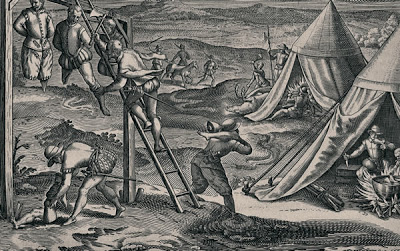
Cenas da vida cotidiana dos índios tupinambá, do ponto de vista de Hans Staden. O guerreiro à esquerda carrega a clava com a qual os presos eram abatidos antes de serem esquartejados

Na época em que Hans Staden aguardava seu próprio sacrifício na América do Sul, a Europa sofria com epidemias, atrocidades da guerra e fome. As cidades foram vitimadas pela peste; mais tarde a guerra dos Trinta Anos (1618-1648) devastou grandes áreas do continente e uma catastrófica mudança climática destruiu uma colheita atrás da outra. A Europa mergulhou em uma terrível fome.

Testemunhas da Alsácia de 1636 relataram, por exemplo, que as pessoas iam aos cemitérios e desenterravam cadáveres para comê-los, ou cortavam os enforcados do cadafalso para consumi-los. No mesmo ano, uma pastora de gado de Ruppertshofen, no sul da Alemanha, teria “arrancado a carne dos ossos de seu marido morto; cortando-a em pedaços, cozinhando e consumindo-a com seus filhos”.

NOS TEMPOS MODERNOS, a mais absoluta necessidade também pode transformar pessoas perfeitamente normais em canibais. Foi o que ocorreu com os membros de uma equipe de rúgbi do Uruguai, cujo avião caiu nos Andes, em 1972. Isolados durante 72 dias na gélida cordilheira, os sobreviventes se alimentaram da carne de seus colegas mortos. Sob o título Sobreviventes dos Andes, o trágico e sinistro episódio foi recriado em um filme de Hollywood.

O mesmo aconteceu no cerco a Leningrado, na União Soviética, entre 1941 e 1944, quando o exército alemão cortou todo e qualquer fornecimento de víveres à cidade. Desesperadas, as pessoas viram-se diante de duas alternativas: morrer de fome (o que aconteceu com centenas de milhares) ou fazer o impensável – o que centenas de fato fizeram.

Já o canibalismo ritualístico, como o praticado pelos índios tupinambá, não é um ato de necessidade ou desespero. Nem o canibalismo medicinal – a variante europeia de práticas antropofágicas.

Carne fresca da forca: particularmente cobiçada

Saque de cadáveres na guerra dos Trinta Anos: os famintos desenterravam até caixões. O canibalismo medicinal era a variante socialmente aceitável dessas ações repugnantes

Essas duas formas de antropofagia tinham suas raízes na idéia de que o corpo humano, mesmo depois de morto, ainda continha forças que podiam ser transferidas aos vivos – um conceito que sobreviveu até os primórdios da modernidade na cultura dos tupinambá, wari ou yanomami; bem como entre os povos das florestas tropicais da Nova Guiné, que ainda viviam na Idade da Pedra, e entre muitos cidadãos de Londres, Paris ou Berlim.

Os canibais europeus também consumiam partes do corpo humano para se beneficiar das forças obscuras do morto; contudo, eles não capturavam pessoas para consumi-las. Na Europa, aproveitavam-se os corpos de vítimas de execuções.

NO SÉCULO 16, quando Hans Staden ainda aguardava a sua morte na América do Sul –, médicos e farmacêuticos europeus acreditavam plenamente na energia mágica que, segundo eles, emanava dos corpos de recém-executados. A ingestão de carne humana não era, de forma alguma, um ritual secreto, realizado à luz bruxuleante de velas. Na Europa, os membros dos mortos ou as substâncias derivadas deles farão parte durante séculos do repertório do tratamento médico. O comércio de múmias e partes de cadáveres se transformou em um ramo altamente lucrativo da economia.

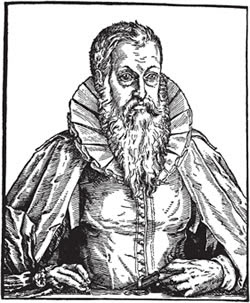
O famoso médico, alquimista, físico e astrólogo suíço Paracelso é considerado o representante mais conhecido do canibalismo medicinal – e ele deixou instruções precisas. No século 17, seu seguidor Johann Schroeder escreveu: “O ideal é você pegar o corpo de um homem ruivo, de cerca de 24 anos, que morreu de morte violenta”.

Cabelos ruivos eram sinal de “sangue mais leve” e de “uma carne melhor”. Era considerado particularmente importante que o cadáver não tivesse “dessangrado” – sangrado até a morte; pois, de acordo com a escola de pensamento dominante, um corpo sem sangue era um corpo sem alma.

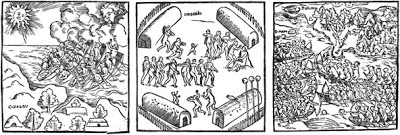
Os tupinambá trazem o prisioneiro (a partir da esquerda); duas mulheres dançam ao redor da fogueira. A vítima é desmembrada. Sua cabeça é fervida; Staden está presente e reza

Todavia, o poder inerente ao cadáver era um produto altamente perecível. Era preciso captá-lo sem demora, para que não se esvaísse. De acordo com a imaginação da época, quando alguém morria, o vínculo entre a alma e o corpo se dissolvia em um prazo de 3 ou 4 dias. Portanto, somente quem se alimentasse de um cadáver fresco (ou de produtos derivados dele) podia ingerir também a sua alma e beneficiar- se de seus poderes.

Acreditava-se que era principalmente o sangue que continha aqueles “espíritos vitais” (Lebensgeister, em alemão) que uniriam a alma e o corpo. Dizem que quando o papa Inocêncio VIII estava à beira da morte, em 1492, os médicos teriam sangrado três meninos para ministrar ao seu proeminente paciente o sangue deles. Depois do procedimento, os meninos teriam morrido – e a intervenção aparentemente também não teria ajudado o Santo Padre.

NAQUELA ÉPOCA, os médicos papais também desconheciam o princípio que Paracelso postularia pouco mais tarde: “especialmente eficazes”, escreveu ele em sua Arte Necromantia, “são a carne e o sangue de criminosos executados”.

“Por que justamente os cadáveres de criminosos executados são considerados a melhor substância possível?”, pergunta a pesquisadora sociocultural Anna Bergman em seu livro Der entseelte Patient (“O paciente desalmado” – até onde pude verificar, sem tradução para o português), que descreve em detalhes as práticas do canibalismo medicinal. Uma parte da resposta parece ser puro pragmatismo: “Como, de que forma obter cadáveres jovens e frescos sem se tornar um assassino?” Para Bergman, a recomendação de Paracelso tem motivos mais profundos, que se enraízam nos mundos imaginários mágicos e nos rituais de execução cristãos – que hoje nos parecem tão bizarros quanto a crença tupinambá em espíritos.

De acordo com a convicção reinante na época, a alma do “pobre pecador” era purgada de todos os seus males (pecados) nos porões das câmaras de tortura da Justiça (significando que o pecador confessava sua culpa) – uma analogia à crucificação de Jesus Cristo. Estes corpos que, arrependidos e purificados pela Graça Divina, despedem-se deste mundo no cadafalso, são particularmente cobiçados pelos canibais da Europa.

Sangue dos decapitados: remédio para as massas
 

QUANDO O SANGUE esguicha e jorra das artérias e veias do delinquente decapitado, os espectadores se amontoam na cerca ao redor do cadafalso com recipientes coletores em punho. Os assistentes do carrasco coletam o sangue e devolvem os recipientes aos seus respectivos donos – que bebem avidamente o líquido. São epilépticos convencidos de que seu sofrimento pode ser curado com o sangue fresco de um executado. Eles querem incorporar sua alma – afinal, Hildegard von Bingen já havia explicado a epilepsia como uma “evasão da alma que sai do corpo”.

Essa cena no cadafalso não se passa na Idade Média, mas em Göttingen, na Alemanha, em 1858. Naquele ano, o primeiro cabo submarino entre Europa e América entrou em operação; Karl Marx escreveu sua Contribuição à crítica da Economia Política e Rudolf Virchow apresentou sua teoria, segundo a qual as doenças surgem em consequência de perturbações nas células do corpo – que substituiu o antigo conceito sobre o funcionamento dos fluidos corporais.

Para os adeptos do canibalismo medicinal, a coleta do sangue no cadafalso é apenas o começo do aproveitamento dos mortos. Médicos e anatomistas assediam os carrascos para obterem partes do corpo particularmente cobiçadas. O povo mais simples, por sua vez, tenta se apossar por conta própria das preciosas partes (sem passar pelo caminho da medicina, cara demais para eles) e começa a praticar saques tanto ao cadafalso como nos cemitérios. Frequentemente, os restos mortais dos executados são completamente dilacerados após poucos dias.

Hans Staden escapou com vida; os tupinambá o deixaram viver – talvez por que ele lhes parecesse covarde demais? Seus relatos tornaram-se uma fonte etnográfica

O QUE OCORREU NA EUROPA foi uma diversificação daquela prática que teve seu apogeu no século 17. Muitas receitas circulavam entre a população; transmitidas oralmente na medicina popular ou artisticamente impressas em tratados eruditos. O médico Johann Schröder, por exemplo, autor do manual de medicina mais importante do século 17, recomenda “cortar a carne humana em fatias, ou pedaços pequenos”, temperá-la, curti-la em aguardente de vinho e, por fim, secá-la.

A gordura corporal também é um produto muito desejado. Em 1675, o professor de medicina Tobias Andreae desmembra uma infanticida morta por afogamento, derrete sua carne e obtém 20 quilos da chamada “gordura do pecador pobre” (expressão que definia os criminosos condenados à morte). E, na Grande Enciclopédia Universal de Zedler, de 1739, pode-se ler como transformar essa gordura em um medicamento antropofágico para uso doméstico. Não seriam, portanto, os europeus que deveriam ser chamados de “selvagens ferozes comedores de gente”? Foi precisamente isso o que aconteceu entre os habitantes da África ao sul do Saara até o século 20: mesmo sem conhecimentos detalhados sobre o canibalismo praticado no hemisfério norte, os negros acreditavam que os brancos eram antropofágicos.

OS EUROPEUS JÁ HAVIAM levantado demasiado suspeitas perpetrando crimes colonialistas. Por volta de 1800, o explorador escocês Mungo Park, especializado no continente africano, relata que os escravos acorrentados tinham certeza de que os homens brancos os estavam levando ao abatedouro e não para realizar trabalhos forçados. No Peru, a primeira insurgência contra os espanhóis foi desencadeada pelo boato de que os senhores coloniais estavam matando os povos indígenas para obter gordura corporal.

O comércio de matérias-primas canibalescas na Europa assumiu proporções transcontinentais, envolvendo múmias. Entre 1500 e 1900, os médicos, os farmacêuticos e até os charlatães prescrevem a seus pacientes partes de cadáveres embalsamados, em pó ou forma esférica (comprimido), como remédio contra quase todos os males.

O negócio com a chamada mumia vera aegyptica (a “verdadeira múmia egípcia”) assume tais dimensões que em pouco tempo a demanda por exemplares autênticos do reino dos faraós não pode mais ser atendida. Comerciantes e farmacêuticos apelam para falsificações e corpos embalsamados de mendigos, leprosos e vítimas da peste. Fetos abortados também são secados e vendidos como múmias infantis.

As verdadeiras múmias egípcias são um artigo de luxo. O rei francês Francisco I (1494-1547) sempre carregava consigo uma pequena quantidade da preciosa substância para, no caso de uma queda do cavalo ou outro ferimento se medicar imediatamente. O filósofo inglês Francis Bacon (1561- 1626) apostava tanto no poder de cura das múmias quanto o poeta Léon Tolstoi, no final do século 19. Ainda em 1912, a empresa farmacêutica alemã Merck oferecia em seu catálogo a mumia vera aegyptica – “enquanto os estoques durassem”. O preço era citado por quilo: na época, o equivalente a 17,50 marcos alemães.

As vozes céticas eram escassas. Um dos críticos mais proeminentes foi o humanista francês Michel de Montaigne que em pleno século 16 rotulou a mania das múmias como comportamento canibal e chamaou a atenção para a “crítica hipócrita” dos europeus em relação à antropofagia indígena.

Com toda razão, julga o historiador de medicina britânico Richard Sugg. Segundo ele, o canibalismo do Velho Mundo possuiu uma dimensão muito mais abrangente do que o dos índios. O consumo de múmias não era uma cerimônia mágica, mas uma parte da cultura cotidiana e da vida econômica. Na Europa, médicos e farmacêuticos faziam bons negócios com o canibalismo. No topo dessa rentável cadeia comercial estavam os carrascos e os ladrões de túmulos. “A antropofagia europeia influiu nas mais diversas esferas e países”, resume Sugg. “Não se pode compará-la ao canibalismo limitado praticado, por exemplo, por uma tribo no Brasil.” Segundo o historiador, os verdadeiros canibais viviam na Europa.

DURANTE O SEU CATIVEIRO, Hans Staden observou, incrédulo, como os índios tupinambá tratavam bem aqueles que eles haviam reservado para suas festividades: “Eles lhe dão uma mulher que cuida dele, lhe dá de comer e também se deita com ele. Se ela engravidar, eles criam a criança… Alimentam muito bem o prisioneiro e o mantêm vivo por algum tempo, enquanto fazem todos os preparativos para a celebração. Eles fabricam muitos recipientes para as bebidas e outros mais especiais para as substâncias com as quais o pintam e decoram”.

Antes de ser abatida, a vítima desfruta do maior respeito; os tupinambá até permitem que ela gere descendentes – embora o venerado inimigo seja obrigado a provar que é digno de seu papel. Como?

Os sobreviventes da queda de um avião nos Andes, em 1972, alimentaram-se durante semanas da carne de seus companheiros de viagem mortos. Seu drama de sobrevivência se transformou em um filme de Hollywood

OS ASTECAS, por exemplo, torturavam seus prisioneiros para pôr à prova a sua coragem e assim determinar se eles eram ou não adequados para uma cerimônia antropofágica, explica Richard Sugg. Segundo ele, as vítimas cooperavam com seus torturadores – na certeza de estarem sendo criticamente observadas pelo deus sol.

Hans Staden relatou que os tupinambá também davam grande valor à força física e mental do inimigo. Afinal de contas, estas eram as características mais importantes que pretendiam incorporar ao devorá-lo. O lansquenê de Hesse, no entanto, foi um completo fracasso nesse sentido.

As regras desse jogo sinistro permaneceram incompreensíveis para ele. Em sua terra natal, a Europa do século 16, as pessoas que comerão e a que será comida não estabelecem nenhum tipo de relacionamento antes da morte da vítima. Staden havia perdido toda a sua coragem. Ele implorou, suplicou, chorou e rezou aos brados ao seu deus. E depois descreveu a reação dos tupinambá com as seguintes palavras: “Então eles disseram: ‘Ele é um verdadeiro português. Agora ele grita desse jeito porque está com horror da morte’… Eles zombaram cruelmente de mim; tanto os jovens como os velhos”.

A cientista cultural brasileira Vanete Santana Dezmann presume que o pânico de Hans Staden o tenha tornado indigno aos olhos dos índios. O que fazer com um pedaço de carne impregnado de covardia? Talvez tenha sido por essa razão que os tupinambá o libertaram novamente após nove meses de cativeiro.

O medo devora a alma: Staden teve a sorte do medroso. Ele voltou para Hesse e, juntamente com um médico, escreveu o seu livro sobre os comedores de gente.

Em Marburgo, o lansquenê abandonou o mercenarismo e foi trabalhar em uma jazida de salitre. Ele morreu em 1576.

A história não nos transmitiu o que aconteceu com o seu corpo.

How Do You Say ‘Disagreement’ in Pirahã? (N.Y.Times)

By JENNIFER SCHUESSLER. Published: March 21, 2012

Dan Everett. Essential Media & Entertainment/Smithsonian Channel

In his 2008 memoir, “Don’t Sleep, There Are Snakes,” the linguist Dan Everett recalled the night members of the Pirahã — the isolated Amazonian hunter-gatherers he first visited as a Christian missionary in the late 1970s — tried to kill him.

Dr. Everett survived, and his life among the Pirahã, a group of several hundred living in northwest Brazil, went on mostly peacefully as he established himself as a leading scholarly authority on the group and one of a handful of outsiders to master their difficult language.

His life among his fellow linguists, however, has been far less idyllic, and debate about his scholarship is poised to boil over anew, thanks to his ambitious new book, “Language: The Cultural Tool,” and a forthcoming television documentary that presents an admiring view of his research among the Pirahã along with a darkly conspiratorial view of some of his critics.

Members of the Pirahã people of Amazonian Brazil, who have an unusual language, as seen in “The Grammar of Happiness.” Essential Media & Entertainment/Smithsonian Channel

In 2005 Dr. Everett shot to international prominence with a paper claiming that he had identified some peculiar features of the Pirahã language that challenged Noam Chomsky’s influential theory, first proposed in the 1950s, that human language is governed by “universal grammar,” a genetically determined capacity that imposes the same fundamental shape on all the world’s tongues.

The paper, published in the journal Current Anthropology, turned him into something of a popular hero but a professional lightning rod, embraced in the press as a giant killer who had felled the mighty Chomsky but denounced by some fellow linguists as a fraud, an attention seeker or worse, promoting dubious ideas about a powerless indigenous group while refusing to release his data to skeptics.

The controversy has been simmering in journals and at conferences ever since, fed by a slow trickle of findings by researchers who have followed Dr. Everett’s path down to the Amazon. In a telephone interview Dr. Everett, 60, who is the dean of arts and sciences at Bentley University in Waltham, Mass., insisted that he’s not trying to pick a fresh fight, let alone present himself as a rival to the man he calls “the smartest person I’ve ever met.”

“I’m a small fish in the sea,” he said, adding, “I do not put myself at Chomsky’s level.”

Dan Everett in the Amazon region of Brazil with the Pirahã in 1981. Courtesy Daniel Everett

Still, he doesn’t shy from making big claims for “Language: The Cultural Tool,” published last week by Pantheon. “I am going beyond my work with Pirahã and systematically dismantling the evidence in favor of a language instinct,” he said. “I suspect it will be extremely controversial.”

Even some of Dr. Everett’s admirers fault him for representing himself as a lonely voice of truth against an all-powerful Chomskian orthodoxy bent on stopping his ideas dead. It’s certainly the view advanced in the documentary, “The Grammar of Happiness,” which accuses unnamed linguists of improperly influencing the Brazilian government to deny his request to return to Pirahã territory, either with the film crew or with a research team from M.I.T., led by Ted Gibson, a professor of cognitive science. (It’s scheduled to run on the Smithsonian Channel in May.)

A Pirahã man in the film “The Grammar of Happiness.” Essential Media & Entertainment/Smithsonian Channel

Dr. Everett acknowledged that he had no firsthand evidence of any intrigues against him. But Miguel Oliveira, an associate professor of linguistics at the Federal University of Alagoas and the M.I.T. expedition’s Brazilian sponsor, said in an interview that Dr. Everett is widely resented among scholars in Brazil for his missionary past, anti-Chomskian stance and ability to attract research money.

“This is politics, everybody knows that,” Dr. Oliveira said. “One of the arguments is that he’s stealing something from the indigenous people to become famous. It’s not said. But that’s the way they think.”

Claims of skullduggery certainly add juice to a debate that, to nonlinguists, can seem arcane. In a sense what Dr. Everett has taken from the Pirahã isn’t gold or rare medicinal plants but recursion, a property of language that allows speakers to embed phrases within phrases — for example, “The professor said Everett said Chomsky is wrong” — infinitely.

In a much-cited 2002 paper Professor Chomsky, an emeritus professor of linguistics at M.I.T., writing with Marc D. Hauser and W. Tecumseh Fitch, declared recursion to be the crucial feature of universal grammar and the only thing separating human language from its evolutionary forerunners. But Dr. Everett, who had been publishing quietly on the Pirahã for two decades, announced in his 2005 paper that their language lacked recursion, along with color terms, number terms, and other common properties of language. The Pirahã, Dr. Everett wrote, showed these linguistic gaps not because they were simple-minded, but because their culture — which emphasized concrete matters in the here and now and also lacked creation myths and traditions of art making — did not require it.

To Dr. Everett, Pirahã was a clear case of culture shaping grammar — an impossibility according to the theory of universal grammar. But to some of his critics the paper was really just a case of Dr. Everett — who said he began questioning his own Chomskian ideas in the early 1990s, around the time he began questioning his faith — fixing the facts around his new theories.

In 2009 the linguists Andrew Nevins, Cilene Rodrigues and David Pesetsky, three of the fiercest early critics of Dr. Everett’s paper, published their own in the journal Language, disputing his linguistic claims and expressing “discomfort” with his overall account of the Pirahã’s simple culture. Their main source was Dr. Everett himself, whose 1982 doctoral dissertation, they argued, showed clear evidence of recursion in Pirahã.

“He was right the first time,” Dr. Pesetsky, an M.I.T. professor, said in an interview. “The first time he had reasons. The second time he had no reasons.”

Some scholars say the debate remains stymied by a lack of fresh, independently gathered data. Three different research teams, including one led by Dr. Gibson that traveled to the Pirahã in 2007, have published papers supporting Dr. Everett’s claim that there are no numbers in the Pirahã language. But efforts to go recursion hunting in the jungle — using techniques that range from eliciting sentences to having the Pirahã play specially designed video games — have so far yielded no published results.

Still, some have tried to figure out ways to press ahead, even without direct access to the Pirahã. After Dr. Gibson’s team was denied permission to return to Brazil in 2010, its members devised a method that minimized reliance on Dr. Everett’s data by analyzing instead a corpus of 1,000 sentences from Pirahã stories transcribed by another missionary in the region.

Their analysis, presented at the Linguistic Society of America’s annual meeting in January, found no embedded clauses but did uncover “suggestive evidence” of recursion in a more obscure grammatical corner. It’s a result that is hardly satisfying to Dr. Everett, who questions it. But his critics, oddly, seem no more pleased.

Dr. Pesetsky, who heard the presentation, dismissed the whole effort as biased from the start by its reliance on Dr. Everett’s grammatical classifications and basic assumptions. “They were taking for granted the correctness of the hypothesis they were trying to disconfirm,” he said.

But to Dr. Gibson, who said he does not find Dr. Everett’s cultural theory of language persuasive, such responses reflect the gap between theoretical linguists and data-driven cognitive scientists, not to mention the strangely calcified state of the recursion debate.

“Chomskians and non-Chomskians are weirdly illogical at times,” he said. “It’s like they just don’t want to have a cogent argument. They just want to contradict what the other guy is saying.”

Dr. Everett’s critics fault him for failing to release his field data, even seven years after the controversy erupted. He countered that he is currently working to translate his decades’ worth of material and hopes to post some transcriptions online “over the next several months.” The bigger outrage, he insisted, is what he characterized as other scholars’ efforts to accuse him of “racist research” and interfere with his access to the Pirahã.

Dr. Rodrigues, a professor of linguistics at the Pontifical Catholic University in Rio de Janeiro, acknowledged by e-mail that in 2007 she wrote a letter to Funai, the Brazilian government agency in charge of indigenous affairs, detailing her objections to Dr. Everett’s linguistic research and to his broader description of Pirahã culture.

She declined to elaborate on the contents of the letter, which she said was written at Funai’s request and did not recommend any particular course of action. But asked about her overall opinion of Dr. Everett’s research, she said, “It does not meet the standards of scientific evidence in our field.”

Whatever the reasons for Dr. Everett’s being denied access, he’s enlisting the help of the Pirahã themselves, who are shown at the end of “The Grammar of Happiness” recording an emotional plea to the Brazilian government.

“We love Dan,” one man says into the camera. “Dan speaks our language.”

Books Without Borders (N.Y. Times)

EDITORIAL

Published: March 15, 2012

When we reached Tony Diaz, novelist and novice smuggler, by phone this week, he was in West Texas, 500 miles from his home in Houston and about a third of the way through a journey with three dozen comrades and serious contraband. That is, a busload of books.

“The Aztec muse is manifesting right now!” Mr. Diaz said, which was a gleeful way of saying: Watch out, Tucson. Dangerous literature on the way.

Mr. Diaz is the impresario behind an inspiring act of indignation and cultural pride. His bus-and-car caravan is “smuggling” books by Latino authors into Arizona. It’s a response to an educational mugging by right-wing politicians, who enacted a state law in 2010 outlawing curriculums that “advocate ethnic solidarity,” among other imagined evils. That led to the banning of Mexican-American studies in Tucson’s public schools last year.

School officials say the books are not technically banned, just redistributed to the library. But what good is having works from thereading list — like “Los Tucsonenses: The Mexican Community in Tucson, 1854-1941” and “The House on Mango Street,” by Sandra Cisneros — on the shelves if they can’t be taught? Indeed, the point of dismantling the curriculum was to end classroom discussions about these books.

That’s where Mr. Diaz’s “librotraficantes,” or book traffickers, come in. “Arizona tried to erase our history,” he says. “So we’re making more.” They left Houston on Monday. On the way, they’ve held readings with “banned” authors at galleries, bookshops and youth centers. After leaving El Paso on Wednesday, they followed the Rio Grande to Albuquerque, to meet with Rudolfo Anaya, a godfather of Chicano literature. They also planned to wrap some volumes in plastic and carry the “wetbooks” across the river. At the Arizona border, there will be a crossing ceremony. They expect to be in Tucson, singing, dancing and handing out books, by the weekend.

“Translações etnográficas: reposicionando ciência e antropologia”- palestra do Prof. Dr. Guilherme José da Silva Sá

Encontro de abertura das atividades de 2012

Data: 23/03, sexta-feira, às 14h30

Local: Instituto de Filosofia e Ciências Sociais da Universidade Federal do Rio de Janeiro (IFCS/UFRJ), sala 403 (4o. Andar)

Programação:

Palestra “Translações etnográficas: reposicionando ciência e antropologia” (Prof. Dr. Guilherme José da Silva Sá – DAN/UNB).

Apresentação do grupo e da programação de leituras e encontros em 2012.


Sobre o GEACT

O Grupo de Estudos de Antropologia da Ciência e Tecnologia (GEACT) foi inicialmente concebido por alunos do PPGAS/Museu Nacional, e atualmente é composto por pesquisadores de diversas instituições: PPGAS/MN, IMS/Uerj, IFCS/UFRJ, ECO/UFRJ, UFF, entre outros. O objetivo do GEACT é consolidar um espaço de debates no campo da Antropologia da Ciência e da Tecnologia. O coletivo congrega pesquisadores de diferentes formações, interessados nas abordagens antropológicas e nas reflexões filosóficas, epistemológicas, sociológicas e historiográficas acerca do tema. Recentemente tem se dedicado a discussões de questões como ciência e ficção; interfaces humano-máquina; gênero, saúde e tecnociência; relações interespecíficas; e embates entre práticas de conhecimentos científico e minoritário.

New report reveals how corporations undermine science with fake bloggers and bribes (io9)

BY ANNALEE NEWITZ

MAR 9, 2012 2:22 PM

You’ve probably heard about how the tobacco industry tried to suppress scientific evidence that smoking causes cancer by publishing shady research, bribing politicians, and pressuring researchers. But you may not have realized that tabacco’s dirty tricks are just the tip of the iceberg. In a disturbing new report published by the Union of Concerned Scientists about corporate corruption of the sciences, you’ll learn about how Monsanto hired a public relations team to invent fake people who harassed a scientific journal online, how Coca Cola offers bribes to suppress evidence that soft drinks harm kids’ teeth, and more. Here are some of the most egregious recent examples of corruption from this must-read report.

The report is a meaty assessment of corporate corruption in science that stretches back to incidents with Big Tobacco in the 1960s, up through contemporary examples. Here are just a few of those.

One way that corporations prevent negative information about their products from getting out is by harassing scientists and the journals that publish them. Here’s how Monsanto did it:

Dr. Ingacio Chapela of the University of California–Berkeley and graduate student David Quist published an article in Nature showing that DNA from genetically modified corn was contaminating native Mexican corn. The research spurred immediate backlash.Nature received a number of letters to the editor, including several comments on the Internet from “Mary Murphy” and “Andura Smetacek” accusing the scientists of bias. The backlash prompted Nature to publish an editorial agreeing that the report should not have been published. However, investigators eventually discovered that the comments from Murphy and Smetacek originated with The Bivings Group, a public relations firm that specializes in online communications and had worked for Monstanto. Mary Murphy and Andura Smetacek were found to be fictional names.

Corporations also form front organizations to hide their efforts to undermine science. That’s what happened when producers of unhealthy food got together to cast doubt on the FDA’s recommended health guidelines:

The Center for Consumer Freedom is a nonprofit that targets dietary guidelines recommended by the FDA, other government agencies, medical associations, and consumer advocacy organizations. The center has run ads and owns a website that accuses government agencies of overregulation, and has published articles claiming to refute evidence that high salt intake and other dietary guidelines are based on inadequate science. The center was founded with a $600,000 grant from Philip Morris, but has also received funding from Cargill, National Steak and Poultry, Monsanto, Coca-Cola, and Sutter Home Winery.

Sometimes corporations just go for it and buy off legit organizations, as Coca Cola did when they appear to have paid dentists to stop saying kids shouldn’t drink Coke:

In 2003, the American Academy of Pediatric Dentistry accepted a $1 million donation from Coca-Cola. That year, the group claimed that “scientific evidence is certainly not clear on the exact role that soft drinks play in terms of children’s oral disease.” The statement directly contradicted the group’s previous stance that “consumption of sugars in any beverage can be a significant factor…that contributes to the initiation and progression of dental caries.”

Corporations can also unduly influence federal agencies, as ReGen did when they wanted their device approved for trials by the FDA, despite serious medical problems:

ReGen Biologics attempted to gain FDA approval for clinical trials of Menaflex, a device it developed to replace knee cartilage. After an FDA panel rejected the device, the company enlisted four members of Congress from its home state of New Jersey to influence the evaluation process. In December 2007, Senator Frank Lautenberg, Senator Robert Menendez, and Representative Steve Rothman wrote to FDA Commissioner Andrew von Eschenbach asking him to personally look into Menaflex. Soon thereafter, the commissioner met with ReGen executives and heeded the company’s advice to have Dr. Daniel Shultz, head of the FDA’s medical devices division, oversee a new review. The FDA fast-tracked and approved the product despite serious concerns from the scientific community.

If bribery doesn’t work, you can always censor negative results, the way pharmaceutical company Boots did:

Boots commissioned Dr. Betty Dong, a scientist at the University of California–San Francisco, to test the effects of Synthroid, a replacement for thyroid hormone. Boots hoped to reveal that despite its high price, Synthroid was more effective than similar drugs. The company closely monitored the research, and when Dong found that the drug was no more effective than its competitors, instructed her not to publish the results. When she refused to comply, Boots threatened to sue. The company relented only after several years, during which consumers continued to pay for the costly product.

You can also try “refuting” scientific results with bad evidence, the way the formaldehyde industry did:

To counter a study that found that formaldehyde caused cancer in rats, a formaldehyde company commissioned its own study. That study-which found no association between the chemical and cancer-exposed only one-third the number of rats to formaldehyde for half as long as the original study. A formaldehyde association quickly publicized the results and argued before the Consumer Product Safety Commission (CPSC) that they indicated “no chronic health effects from exposure to the level of formaldehyde normally encountered in the home”

And then, if you’re Pfizer, you can just generate as much favorable research as you like to bolster sales of a drug, despite your discovery that the drug increases risk of suicide:

From 1998 to 2007, Pfizer discreetly facilitated the publication of 15 case studies, six case reports, and nine letters to the editor to boost off-label use of Neurontin, a drug prescribed to treat seizures in people who have epilepsy and nerve pain. The number of patients taking the drug rose from 430,000 to 6 million, making it one of Pfizer’s most profitable products. An investigation found that Pfizer had failed to publish negative results, selectively reported outcomes, and excluded specific patients from analysis. [Most importantly] Pfizer failed to note that the drug increased the risk of suicide.

Read the full report here, which includes sources for these stories, as well as an extensive section devoted to reforming scientific practices. There are ways we can avoid this kind of corruption, and they involve everything from federal reforms to corporate transparency.

[via Union of Concerned Scientists]

Science, Journalism, and the Hype Cycle: My piece in tomorrow’s Wall Street Journal (Discovery Magazine)

I think one of the biggest struggles a science writer faces is how to accurately describe the promise of new research. If we start promising that a preliminary experiment is going to lead to a cure for cancer, we are treating our readers cruelly–especially the readers who have cancer. On the other hand, scoffing at everything is not a sensible alternative, because sometimes preliminary experiments really do lead to great advances. In the 1950s, scientists discovered that bacteria can slice up virus DNA to avoid getting sick. That discovery led, some 30 years later, to biotechnology–to an industry that enabled, among other things, bacteria to produce human insulin.

This challenge was very much on my mind as I recently read two books, which I review in tomorrow’s Wall Street Journal. One is on gene therapy–a treatment that inspired wild expectations in the 1990s, then crashed, and now is coming back. The other is epigenetics, which seems to me to be in the early stages of the hype cycle. You can read the essay in full here. [see post below]

March 9th, 2012 5:33 PM by Carl Zimmer

Hope, Hype and Genetic Breakthroughs (Wall Street Journal)

By CARL ZIMMER

I talk to scientists for a living, and one of my most memorable conversations took place a couple of years ago with an engineer who put electrodes in bird brains. The electrodes were implanted into the song-generating region of the brain, and he could control them with a wireless remote. When he pressed a button, a bird singing in a cage across the lab would fall silent. Press again, and it would resume its song.

I could instantly see a future in which this technology brought happiness to millions of people. Imagine a girl blind from birth. You could implant a future version of these wireless electrodes in the back of her brain and then feed it images from a video camera.

As a journalist, I tried to get the engineer to explore what seemed to me to be the inevitable benefits of his research. To his great credit, he wouldn’t. He wasn’t even sure his design would ever see the inside of a human skull. There were just too many ways for it to go wrong. He wanted to be very sure that I understood that and that I wouldn’t claim otherwise. “False hope,” he warned me, “is a sinful thing.”

EPEGINE1

Stephen Voss. Gene therapy allowed this once-blind dog to see again.

Over the past two centuries, medical research has yielded some awesome treatments: smallpox wiped out with vaccines, deadly bacteria thwarted by antibiotics, face transplants. But when we look back across history, we forget the many years of failure and struggle behind each of these advances.

This foreshortened view distorts our expectations for research taking place today. We want to believe that every successful experiment means that another grand victory is weeks away. Big stories appear in the press about the next big thing. And then, as the years pass, the next big thing often fails to materialize. We are left with false hope, and the next big thing gets a reputation as the next big lie.

In 1995, a business analyst named Jackie Fenn captured this intellectual whiplash in a simple graph. Again and again, she had seen new advances burst on the scene and generate ridiculous excitement. Eventually they would reach what she dubbed the Peak of Inflated Expectations. Unable to satisfy their promise fast enough, many of them plunged into the Trough of Disillusionment. Their fall didn’t necessarily mean that these technologies were failures. The successful ones slowly emerged again and climbed the Slope of Enlightenment.

When Ms. Fenn drew the Hype Cycle, she had in mind dot-com-bubble technologies like cellphones and broadband. Yet it’s a good model for medical advances too. I could point to many examples of the medical hype cycle, but it’s hard to think of a better one than the subject of Ricki Lewis’s well-researched new book, “The Forever Fix”: gene therapy.

The concept of gene therapy is beguilingly simple. Many devastating disorders are the result of mutant genes. The disease phenylketonuria, for example, is caused by a mutation to a gene involved in breaking down a molecule called phenylalanine. The phenylalanine builds up in the bloodstream, causing brain damage. One solution is to eat a low-phenylalanine diet for your entire life. A much more appealing alternative would be to somehow fix the broken gene, restoring a person’s metabolism to normal.

In “The Forever Fix,” Ms. Lewis chronicles gene therapy’s climb toward the Peak of Inflated Expectations over the course of the 1990s. A geneticist and the author of a widely used textbook, she demonstrates a mastery of the history, even if her narrative sometimes meanders and becomes burdened by clichés. She explains how scientists learned how to identify the particular genes behind genetic disorders. They figured out how to load genes into viruses and then to use those viruses to insert the genes into human cells.

EPEGINE2

Stephen Voss. Alisha Bacoccini is tested on her ability to read letters, at UPenn Hospital, in Philadelphia, PA on Monday, June 23, 2008. Bacoccini is undergoing an experimental gene therapy trial to improve her sight.

By 1999, scientists had enjoyed some promising successes treating people—removing white blood cells from leukemia patients, for example, inserting working genes, and then returning the cells to their bodies. Gene therapy seemed as if it was on the verge of becoming standard medical practice. “Within the next decade, there will be an exponential increase in the use of gene therapy,” Helen M. Blau, the then-director of the gene-therapy technology program at Stanford University, told Business Week.

Within a few weeks of Ms. Blau’s promise, however, gene therapy started falling straight into the Trough. An 18-year-old man named Jesse Gelsinger who suffered from a metabolic disorder had enrolled in a gene-therapy trial. University of Pennsylvania scientists loaded a virus with a working version of an enzyme he needed and injected it into his body. The virus triggered an overwhelming reaction from his immune system and within four days Gelsinger was dead.

Gene therapy nearly came to a halt after his death. An investigation revealed errors and oversights in the design of Gelsinger’s trial. The breathless articles disappeared. Fortunately, research did not stop altogether. Scientists developed new ways of delivering genes without triggering fatal side effects. And they directed their efforts at one part of the body in particular: the eye. The eye is so delicate that inflammation could destroy it. As a result, it has evolved physical barriers that keep the body’s regular immune cells out, as well as a separate battalion of immune cells that are more cautious in their handling of infection.

It occurred to a number of gene-therapy researchers that they could try to treat genetic vision disorders with a very low risk of triggering horrendous side effects of the sort that had claimed Gelsinger’s life. If they injected genes into the eye, they would be unlikely to produce a devastating immune reaction, and any harmful effects would not be able to spread to the rest of the body.

Their hunch paid off. In 2009 scientists reported their first success with gene therapy for a congenital disorder. They treated a rare form of blindness known as Leber’s congenital amaurosis. Children who were once blind can now see.

As “The Forever Fix” shows, gene therapy is now starting its climb up the Slope of Enlightenment. Hundreds of clinical trials are under way to see if gene therapy can treat other diseases, both in and beyond the eye. It still costs a million dollars a patient, but that cost is likely to fall. It’s not yet clear how many other diseases gene therapy will help or how much it will help them, but it is clearly not a false hope.

Gene therapy produced so much excitement because it appealed to the popular idea that genes are software for our bodies. The metaphor only goes so far, though. DNA does not float in isolation. It is intricately wound around spool-like proteins called histones. It is studded with caps made of carbon, hydrogen and oxygen atoms, known as methyl groups. This coiling and capping of DNA allows individual genes to be turned on and off during our lifetimes.

The study of this extra layer of control on our genes is known as epigenetics. In “The Epigenetics Revolution,” molecular biologist Nessa Carey offers an enlightening introduction to what scientists have learned in the past decade about those caps and coils. While she delves into a fair amount of biological detail, she writes clearly and compellingly. As Ms. Carey explains, we depend for our very existence as functioning humans on epigenetics. We begin life as blobs of undifferentiated cells, but epigenetic changes allow some cells to become neurons, others muscle cells and so on.

Epigenetics also plays an important role in many diseases. In cancer cells, genes that are normally only active in embryos can reawaken after decades of slumber. A number of brain disorders, such as autism and schizophrenia, appear to involve the faulty epigenetic programming of genes in neurons.

Scientists got their first inklings about epigenetics decades ago, but in the past few years the field has become hot. In 2008 the National Institutes of Health pledged $190 million to map the epigenetic “marks” on the human genome. New biotech start-ups are trying to carry epigenetic discoveries into the doctor’s office. The FDA has approved cancer drugs that alter the pattern of caps on tumor-cell DNA. Some studies on mice hint that it may be possible to treat depression by taking a pill that adjusts the coils of DNA in neurons.

People seem to be getting giddy about the power of epigenetics in the same way they got giddy about gene therapy in the 1990s. No longer is our destiny written in our DNA: It can be completely overwritten with epigenetics. The excitement is moving far ahead of what the science warrants—or can ever deliver. Last June, an article on the Huffington Post eagerly seized on epigenetics, woefully mangling two biological facts: one, that experiences can alter the epigenetic patterns in the brain; and two, that sometimes epigenetic patterns can be passed down from parents to offspring. The article made a ridiculous leap to claim that we can use meditation to change our own brains and the brains of our children—and thereby alter the course of evolution: “We can jump-start evolution and leverage it on our own terms. We can literally rewire our brains toward greater compassion and cooperation.” You couldn’t ask for a better sign that epigenetics is climbing the Peak of Inflated Expectations at top speed.

The title “The Epigenetics Revolution” unfortunately adds to this unmoored excitement, but in Ms. Carey’s defense, the book itself is careful and measured. Still, epigenetics will probably be plunging soon into the Trough of Disillusionment. It will take years to see whether we can really improve our health with epigenetics or whether this hope will prove to be a false one.

The Forever Fix

By Ricki LewisSt. Martin’s, 323 pages, $25.99

The Epigenetics Revolution

By Nessa CareyColumbia, 339 pages, $26.95

—Mr. Zimmer’s books include “A Planet of Viruses and Evolution: Making Sense of Life,” co-authored with Doug Emlen, to be published in July.

Nature journal criticizes Canadian ‘muzzling’ (CBC News)

Time for Canadian government to set its scientists free, magazine says

The Canadian Press

Posted: Mar 2, 2012 7:08 AM ET

Last Updated: Mar 2, 2012 12:54 PM ET

One of the world's leading scientific journals is criticizing the Harper government for 'muzzling' federal scientists

One of the world’s leading scientific journals is accusing the Harper government of limiting its scientists from speaking publicly about their research.

The journal, Nature, says in an editorial in this week’s issue that it’s time for the Canadian government to set its scientists free.

Nature says Canada is headed in the wrong direction in not letting its scientists speak out freely.Nature says Canada is headed in the wrong direction in not letting its scientists speak out freely. (Nature)It notes that Canada and the United States have undergone role reversals in the past six years.

It says the U.S. has adopted more open practices since the end of George W. Bush’s presidency, while Canada has gone in the opposite direction.

Nature says policy directives on government communications released through access to information requests reveal the Harper government has little understanding of the importance of the free flow of scientific knowledge.

Two weeks ago, the Canadian Science Writers’ Association, the World Federation of Science Journalists and several other groups sent an open letter to Harper, calling on him to unmuzzle federal scientists.

The letter cited a couple of high-profile examples, including one last fall when Environment Canada barred Dr. David Tarasick from speaking to journalists about his ozone layer research when it was published in Nature.

O que você não quer ser quando crescer (Revista Fapesp)

HUMANIDADES | PERCEPÇÃO DA CIÊNCIA

Pesquisa mostra que menos de 3% dos adolescentes latino-americanos desejam seguir uma carreira científica
Carlos Haag
Edição Impressa 192 – Fevereiro de 2012

Boneco de Albert Einstein na Estação Ciência, em São Paulo. © EDUARDO CESAR

Mesmo vivendo num mundo imerso em tecnologia, o jovem, ao se deparar com a célebre pergunta “o que você quer ser quando crescer?”, dificilmente responderá “cientista”. Segundo a pesquisa Los estudiantes y la ciência, projeto do Observatório Ibero-americano de Ciência, Tecnologia e Sociedade (Ryct/Cyted), organizado pelo argentino Carmelo Polino, apenas 2,7% dos estudantes secundaristas (de 15 a 19 anos) da América Latina e Espanha pensam em seguir uma carreira nas áreas de ciências exatas ou naturais, como biologia, química, física, e matemática (as ciências agrícolas mal aparecem). Realizada entre 2008 e 2010, foram consultadas cerca de 9 mil escolas, privadas e particulares, em sete capitais: Assunção, São Paulo, Buenos Aires, Lima, Montevidéu, Bogotá e Madri. Curiosamente, 56% dos entrevistados se disseram interessados em se profissionalizar em ciências sociais e um quinto deles optou pelas engenharias. A equipe brasileira participante do projeto veio do Laboratório de Jornalismo da Unicamp (Labjor), coordenado pelo linguista Carlos Vogt, responsável pelo capítulo “Hábitos informativos sobre ciência e tecnologia” do livro, lançado em espanhol e disponível apenas para download pelo link www.oei.es/salactsi/libro-estudiantes.pdf.
“São dados preocupantes para sociedades em cujas economias há uma intensa necessidade de cientistas e engenheiros, mas há um baixo interesse dos jovens por essas profissões. E as razões alegadas igualmente são desanimadoras: 78% dos estudantes explicam sua opção por achar que as ciências exatas e as naturais são ‘muito difíceis’, quase metade dos alunos as considera ‘chatas’, enquanto um quarto deles afirma que esses campos oferecem oportunidades limitadas de emprego”, afirma Polino. “O número de alunos de ciências já está num patamar insuficiente para as necessidades da economia e indústria e, acima de tudo, para lidar com os problemas a serem enfrentados pelas sociedades no futuro.” Ainda segundo os entrevistados, o desânimo em face do desafio das ciências está ligado, em boa parte, à forma como elas são ensinadas, e reclamam que os recursos utilizados em sala de aula são limitados. Metade dos adolescentes tampouco acredita que as matérias científicas tenham aumentado sua apreciação pela natureza, nem que sejam fontes de solução para problemas de vida cotidiana.

“Há barreiras culturais, porque os jovens de hoje acham que para ter êxito na vida, ter dinheiro, não é preciso estudar muito. É possível escolher uma carreira de resultados econômicos mais rápidos. A cultura do esforço, que é a cultura da ciência, vem perdendo espaço. Temos a necessidade urgente de uma política pública de educação e comunicação da ciência”, avisa Polino. Em alguns pontos a nova pesquisa reforça algumas tendências observadas no estudo anterior do grupo, Percepção pública da ciência (ver “Imagens da ciência” na edição 95 de Pesquisa FAPESP; Leitores esquivos”, na 188; e “Avanços e desafios”, na 185), de 2004, mas a pesquisa recente, com o foco nos jovens, traz novos e preocupantes dados. “Num país como o nosso, cujo futuro depende dos avanços de ciência e tecnologia, e onde há uma grande carência de profissionais técnicos e engenheiros, esses números demandam atenção das autoridades e da sociedade em geral para despertar nesses jovens o interesse pelas carreiras científicas. Acima de tudo, é um paradoxo, porque vivemos num mundo estruturado pela presença da tecnologia em todos os espaços da vida das pessoas”, analisa Vogt. “Apreciamos as benesses do esforço científico, mas não nos interessamos em continuar esse trabalho. As facilidades são ofertadas, mas são ilusórias, porque se quisermos tomar posse dessas conquistas é preciso capacitação científica, capacidade de abstração, mesmo com todas essas dificuldades que advêm do estudo das ciências exatas e naturais.”

“Já existem obstáculos grandes para os jovens adentrarem o mundo das ciências, visto como hermético, uma coisa de iniciados com linguagem própria que pouco tem a ver com o mundo sensível em que vivemos, exigindo um alto grau de abstração, e nem sempre se pode encontrar com facilidade analogias na vida pessoal dos estudantes”, observa Vogt. “Imagine tudo isso num país como o nosso em que apenas 2% dos formados desejam seguir uma carreira no magistério. A situação de ensino é lamentável e, na maioria dos casos, quem dá aulas de ciências vem de campos alternativos, como engenheiros ou médicos, pouco interessados em facilitar ou renovar a maneira de ensinar.”

São, portanto, sutis as razões que levam um estudante a optar pela carreira científica. Segundo a pesquisa, 4 em cada 10 estudantes seguiriam a profissão por dois motivos: viajar muito e trabalhar com novas tecnologias. Para um terço dos interessados, o salário, que consideram atrativo, é também uma variável a ser levada em conta para essa escolha. Bem atrás, com menos de 18%, estão motivos como: descobrir coisas novas, solucionar problemas da humanidade e avançar o conhecimento. Bem abaixo, com menos de 5%, estão razões como exercer uma profissão socialmente prestigiada ou trabalhar com pessoas qualificadas. No campo dos fatores que desanimam os jovens, o grande “vilão” é a didática das ciências nas aulas, que afasta da cabeça dos estudantes o desejo de uma carreira científica ou um futuro laboratorial. Em seguida, para 6 em cada 10 alunos, a dificuldade em entender as matérias é um filtro negativo. O “tédio” assola metade dos jovens. Daí, outro fator que os desanima é a ideia de que escolher a área científica é seguir estudando “indefinidamente” algo que consideram “chato”. Em quarto lugar, com 24%, está o receio de que existam poucas oportunidades de conseguir um emprego na área.

Isso não impede os jovens de ver aqueles que escolheram a ciência para profissão como figuras socialmente prestigiadas, cujo trabalho está associado a fins altruístas e ao progresso, e a imagem dos cientistas que predomina é a de apaixonados pelo seu trabalho, com mentes abertas e um pensamento lógico, não vigorando mais o estereótipo do cientista “solitário” e “distante da realidade”. Há, porém, um ponto controverso: os jovens estão convencidos, em sua maioria, de que os cientistas são donos de uma inteligência superior, que embora possa ser vista como uma característica positiva e atrativa afugenta os jovens, que não se consideram capazes de alcançar os patamares dessas “figuras excepcionais”, afetando negativamente a escolha pela carreira científica. “É preciso analisar esses dados a partir do seu potencial, pois é possível mudar esse paradigma atual que reverta a situação, trazendo não apenas mais jovens para as carreiras científicas, como também melhorando a experiência de aprendizagem da educação secundária”, observa Polino.

Diante da afirmação “que a ciência traz mais benefícios do que riscos à vida das pessoas”, 7 em cada 10 entrevistados concordaram com a premissa. Mas diante da assertiva “a ciência e a tecnologia estão produzindo um estilo de vida artificial e desumanizado”, as posições são menos definidas e a resposta mais recorrente (21,5%) foi “não concordo, nem discordo”. O contexto social revelou aspectos interessantes: os jovens de escolas públicas são menos entusiastas das comodidades oferecidas pela tecnologia. “Não é de estranhar que os que têm menos acesso a ela percebam menos a sua importância em facilitar a vida das pessoas”, nota Polino. Diante das afirmações “contraditórias” de que a ciência está “tirando postos de trabalho” e que “a ciência trará mais chances de trabalho para as gerações futuras” os resultados revelam que mais jovens (37%) têm medo de perder seu emprego por causa da ciência do que são otimistas com o futuro (32%). Segundo os pesquisadores, as respostas seguem o padrão da juventude latino-americana, para quem a “meritocracia” no trabalho é mais mito do que realidade. Quando o meio ambiente entra em cena, tudo piora.

Em face das assertivas “ciência e tecnologia eliminarão a pobreza e a fome do mundo” e “a ciência e a tecnologia são responsáveis pela maior parte dos problemas ambientais”, 3 em cada 10 estudantes não acreditam no poder de “cura” científico e a cifra se repete na certeza de que a ciência está afetando o meio ambiente negativamente. Aqui também as mulheres mostram sua visão: elas são as mais céticas, com 5 em cada 10 rejeitando a capacidade da tecnologia em pôr fim às mazelas globais. No cômputo total, porém, há certo otimismo juvenil: 52% dos adolescentes estão abertos e favoráveis ao que a ciência e a tecnologia possam realizar em nossas sociedades, mostrando que não vigora mais a fé cega e absoluta diante de seus resultados, sendo bem mais moderados e conscientes dos riscos do que os adultos, o que, dizem os pesquisadores, se bem aproveitado pode servir de base a uma cidadania mais crítica e responsável. “Instalar uma usina em Angra sem consultar a sociedade é, hoje, algo impensável. Os jovens pressupõem que exista um sistema que enfatiza a democratização nos processos científicos, o que não implica votar em quem vai ou não para um laboratório”, observa Vogt. “Eles aceitam uma cultura científica que realize uma ligação entre razão e humanidade, entre ciência e sociedade.”

Isso talvez explique um dado curioso descoberto na pesquisa realizada pelo Labjor. Se o caminho do conhecimento científico principal continua a ser a televisão, seguida pela internet, a ficção científica, em livros, filmes, HQs ou games, ganhou um honroso terceiro lugar como fonte de informação sobre ciências para os jovens. “Ao lado da internet, esses meios diferenciados oferecem um grande potencial de atrair jovens para a ciência de forma lúdica e interessante, uma forma estratégica de atingir essa camada da população para a divulgação de assuntos científicos”, nota Vogt. Até porque em vários lugares pesquisados as instituições oficiais são pouco conhecidas ou mesmo ignoradas, assim como os locais onde se pode informar sobre ciência, como museus ou zoológicos. Assim, curiosamente, uma cidade como São Paulo, onde há uma concentração de centros de pesquisa, universidades, e onde o acesso à informação científica é favorecido pela presença de museus e uma oferta midiática rica, mostrou índices de consumo informativo da população abaixo da média.

Veja infográficos:
Evolução dos universitários formados por área do conhecimentoFrequência com que os jovens se informam sobre ciênciaO que afasta os jovens da ciência

Chimpanzees Have Police Officers, Too (Science Daily)

Mostly high-ranking males or females intervene in a conflict. (Credit: Claudia Rudolf von Rohr)

ScienceDaily (Mar. 7, 2012) — Chimpanzees are interested in social cohesion and have various strategies to guarantee the stability of their group. Anthropologists now reveal that chimpanzees mediate conflicts between other group members, not for their own direct benefit, but rather to preserve the peace within the group. Their impartial intervention in a conflict — so-called “policing” — can be regarded as an early evolutionary form of moral behavior.

Conflicts are inevitable wherever there is cohabitation. This is no different with our closest relatives, the chimpanzees. Sound conflict management is crucial for group cohesion. Individuals in chimpanzee communities also ensure that there is peace and order in their group. This form of conflict management is called “policing” — the impartial intervention of a third party in a conflict. Until now, this morally motivated behavior in chimpanzees was only ever documented anecdotally.

However, primatologists from the University of Zurich can now confirm that chimpanzees intervene impartially in a conflict to guarantee the stability of their group. They therefore exhibit prosocial behavior based on an interest in community concern.

The more parties to a conflict there are, the more policing there is

The willingness of the arbitrators to intervene impartially is greatest if several quarrelers are involved in a dispute as such conflicts particularly jeopardize group peace. The researchers observed and compared the behavior of four different captive chimpanzee groups. At Walter Zoo in Gossau, they encountered special circumstances: “We were lucky enough to be able to observe a group of chimpanzees into which new females had recently been introduced and in which the ranking of the males was also being redefined. The stability of the group began to waver. This also occurs in the wild,” explains Claudia Rudolf von Rohr, the lead author of the study.

High-ranking arbitrators

Not every chimpanzee makes a suitable arbitrator. It is primarily high-ranking males or females or animals that are highly respected in the group that intervene in a conflict. Otherwise, the arbitrators are unable to end the conflict successfully. As with humans, there are also authorities among chimpanzees. “The interest in community concern that is highly developed in us humans and forms the basis for our moral behavior is deeply rooted. It can also be observed in our closest relatives,” concludes Rudolf von Rohr.

Do neighborhood conditions affect school performance? (The University of Chicago Urban Network)

March 1, 2012

A recent report issued by the Center on Education Policy predicted that 48 percent of US public school students would not meet reading and math standards by 2014, as legally mandated by the decade-old No Child Left Behind Act (NCLB). The law was originally established to address the comparatively low test scores of low-income students. With the limited success of NCLB, the discussion about school performance has again grabbed the headlines.  While social scientists have always been interested in the dynamics behind the low achievement of students living in disadvantaged urban neighborhoods, in recent years researchers have been trying to establish precisely the extent to which neighborhood conditions, net of other factors, influence educational achievement.

Better neighborhoods, higher test scores

Social scientists Jens LudwigHelen Ladd, and Greg Duncan used data from the Moving to Opportunity (MTO) experiment to investigate the impact of neighborhood environment on educational outcomes. The MTO experiment was conducted in five cities: Baltimore, Boston, Chicago, Los Angeles, and New York. Families who volunteered were randomly assigned to different treatment groups. Whereas the experimental group received counseling and vouchers to move into low-poverty neighborhoods, the second group simply received regular Section 8 subsidies without being encouraged to move out of high-poverty areas. A third group functioned as a control group and received no subsidies at all. Using data from the Baltimore site, Ludwig, Ladd, and Duncan found that elementary school students in the experimental group who had moved to better neighborhoods scored about one-quarter of a standard deviation higher in reading and math tests than children in the control group. Robert SampsonPatrick Sharkey, and Stephen Raudenbush foundsimilar results when they investigated the impact of neighborhood disadvantage on the verbal ability of African American children.  Based on intelligence tests administered within the framework of the Human Development in Chicago Neighborhoods project, they found that children who live in disadvantaged neighborhoods on average score four points lower than children living in better-off areas—a result that is almost equal to missing a year of schooling.

Better neighborhoods, no improvement?

A more recent analysis of MTO data from all five cities generated very different results. Social scientists Lisa SanbonmatsuJeffrey KlingGreg Duncan, and Jeanne Brooks-Gunnfound that math as well as reading scores did not significantly improve for children aged between six and twenty. The children were assessed four to six years after they had moved to a low-poverty neighborhood. Sanbonmatsu and her colleagues also revisited the children in the Ludwig Baltimore sample and found that the Baltimore elementary school children did not sustain their educational gains. In the final results of the MTO experiment, published in October 2011, Sanbonmatsu and her colleagues confirmed that there are few significant improvements in test scores ten to fifteen years after children had moved to less disadvantaged neighborhoods. There was no significant difference in achievement between those children who stayed in high-poverty areas and those who had moved away. The researchers suggested that the results may be related to the segregated, low-quality schools the children continued to attend even though they had moved to low-poverty areas.

In a review of neighborhood-effects studies and a reanalysis of the MTO data, sociologistJulia Burdick-Will and her colleagues challenged this null finding. They argued that the results of MTO, the Project on Human Development in Chicago Neighborhoods, and other studies showed that neighborhood effects may work in nonlinear ways. The size of the effect visible may be contingent on other factors, such as exposure to violence or the relative disadvantage of the neighborhood the child lives in. Children who come from very disadvantaged neighborhoods may experience larger neighborhood effects than those living in moderately disadvantaged areas. Consequently, the size of the neighborhood effect depends on the city. In high-poverty areas of Chicago and Baltimore, the MTO data showed an improvement in test scores. In Boston, Los Angeles, and New York, where neighborhoods are comparatively less disadvantaged, the researchers did not find clear test-score improvements.

Cultural factors

Sociologist David Harding argued that neighborhood effects mainly work through cultural pathways. Children living in disadvantaged neighborhoods are exposed to a greater variety of educational choices than their peers in other areas. He suggested that living in a culturally heterogeneous neighborhood has a negative impact on educational achievement. Using the National Longitudinal Study of Adolescence (AddHealth), he showed that inner-city children observe educational behavior ranging from dropping out of high school to graduating from college. This greater variety of educational models seems to be affecting children’s own educational aspirations, by forcing them to decide among too many competing alternatives. Analyzing the same data set in another recent article, Harding also found that high levels of neighborhood violence may have a detrimental effect on high school graduation rates. He found that living in neighborhoods with high rates of violence was associated with significantly lower chances of high school graduation, regardless of family structure, income, and language spoken in the household.

Multigenerational effects

Sharkey and sociologist Felix Elwert have recently argued that neighborhood poverty has a cumulative effect across generations. Relying on data from the Panel Study of Income Dynamics (PSID), they showed that children who were raised in poor neighborhoods by parents who had grown up in similarly disadvantaged communities had cognitive ability scores more than half a standard deviation below their peers. The children scored on average 9.27 points lower on the reading test and 8.36 points lower on the problem-solving test than children who were raised in non-poor neighborhoods by parents who had grown up in similarly non-poor areas. Though the authors demonstrated the presence of multigenerational effects through advanced statistical models, they explained that disentangling the precise interactions underlying the complex web of mechanisms at work over generations was impossible.

While researchers try to disentangle the impact of neighborhoods and generational effects on schooling, policy makers are beginning to consider alternatives to NCLB. In September of 2011, President Obama announced that states may now opt out of the program under certain conditions. With schools failing to meet the test score standards of NCLB, the government is rethinking its approach to helping the most disadvantaged students.

The QWERTY Effect: The Keyboards Are Changing Our Language! (The Atlantic)

MAR 8 2012, 1:30 PM ET

Could the layout of letters on a keyboard be shaping how we feel about certain words?

UnderwoodKeyboard1.jpg

It’s long been thought that how a word sounds — its very phonemes — can be related in some ways to what that word means. But language is no longer solely oral. Much of our word production happens not in our throats and mouths but on our keyboards. Could that process shape a word’s meaning as well?

That’s the contention of an intriguing new paper by linguists Kyle Jasmin and Daniel Casasanto. They argue that because of the QWERTY keyboard’s asymmetrical shape (more letters on the left than the right), words dominated by right-side letters “acquire more positive valences” — that is to say, they become more likable. Their argument is that because its easier for your fingers to find the correct letters for typing right-side dominated words, the words subtly gain favor in your mind.

As Dave Mosher of Wired explains:

In their first experiment, the researchers analyzed 1,000-word indexes from English, Spanish and Dutch, comparing their perceived positivity with their location on the QWERTY keyboard. The effect was slight but significant: Right-sided words scored more positively than left-sided words.

With newer words, the correlation was stronger. When the researchers analyzed words coined after the QWERTY keyboard’s invention, they found that right-sided words had more positive associations than left-sided words.

In another experiment, 800 typists recruited through Amazon.com’s Mechanical Turk service rated whether made-up words felt positive or negative. A QWERTY effect also emerged in those words.

Jasmin cautioned that words’ literal meanings almost certainly outweigh their QWERTY-inflected associations, and said the study only shows a correlation rather than clear cause-and-effect. Also, while a typist’s left- or right-handedness didn’t seem to matter, Jasmin said there’s not yet enough data to be certain.

Jasmin and Casasanto leave open the question whether the effect may also be the result of subtle cultural preferences for things on the right-hand side. Additionally, they say, “There is about a 90 percent chance that the QWERTY inventor was right-handed,” so it’s possible that biases he carried, may have subconsciously place more likable sounds on the right. However, they say, “such implicit associations would be based on the peculiar roles these letters play in English words or sounds. The finding of similar QWERTYeffects across languages suggests that, even if English-based [biases] influenced QWERTY’s design, QWERTY has now ‘infected’ typers of other languages with similar associations.”

How did the KKK lose nearly one-third of its chapters in one year? (Slate)

Ku Klux Kontraction

By |Posted Thursday, March 8, 2012, at 4:55 PM ET

57886367

Members of the Fraternal White Knights of the Ku Klux Klan participate in the 11th Annual Nathan Bedford Forrest Birthday march July 11, 2009 in Pulaski, Tenn.Spencer Platt/Getty Images

The number of hate groups in the United States is on the rise, but the Ku Klux Klan is losing chapters, according to data released on Wednesday by the Southern Poverty Law Center. The number of KKK chapters dropped from 221 to 152 in just one year. Why is the Klan shrinking?

Consolidation and defections. The Klan is not a stable organization. There’s no real national leadership, and chapters are constantly appearing, disappearing, splitting, and merging. In 2010, to take one example, the True Invisible Empire Knights of Pulaski, Tenn., merged with the Traditional American Knights from Potosi, Mo. to form the True Invisible Empire Traditionalist American Knights of the Ku Klux Klan. (Note: this link, like others in this article, leads to an extremist website.) Such mergers decrease the number of chapters without necessarily changing membership totals. Not all the Klan’s losses are just on paper, though. Jeremy Parker, who led the Ohio-based Brotherhood of Klans, left the KKK for the Aryan Nations in 2010 and likely took a significant number of members with him. The Brotherhood of Klans was the second-largest Klan association in the country, with 38 chapters.

Membership totals are hard to track, because the Klan doesn’t willingly release member lists. Over the long term, the KKK is clearly contracting, since its rolls have shrunk from millions in the 1920s to between 3,000 and 5,000 today. But no one knows how membership has changed in the last few years.

Klan-watchers, however, suspect that the nation’s oldest domestic terrorist organization is indeed struggling to keep pace with other racist hate groups. Young racists tend to think of the Klan as their grandfathers’ hate group, and of its members as rural, uneducated, and technologically unsophisticated. The Klan doesn’t seem to have used the web and social media as well as its competitors. The group’s failure to effectively deploy technology is a bit of an irony, since one of those newfangled motion pictures, The Birth of a Nation, launched the KKK’s second era in 1915.

The Klan’s history of violence is another challenge to recruitment. The organization will always be associated with the lynching of innocent African-Americans in the 20th century, which puts off more moderate racists.

The KKK is also suffering from a proliferation of competitors. People who wanted to join a white supremacist movement back in the 1920s didn’t have a lot of choices. Today, there are countless options, enabling an extremist to find a group that matches his personal brand of intolerance. The more extreme groups in the burgeoning patriot movement cater to anti-Muslim, homophobic, and xenophobic sentiment, with less animosity toward African-Americans and Jews. Aryan Nations offers a heavy focus on Christian identity. Some groups preach more violence, while others offer a veneer of intellectualism.American Renaissance, for example, caters to “suit-and-tie” racists, offering pseudo-scientific papers on white supremacy. The group even holds conferences at a hotel near Dulles airport in Virginia.

Many young racist activists aren’t bothering to join groups at all anymore, further hampering the Klan’s recruitment efforts. Former KKK Grand Wizard Don Black in 1995 launched the website Stormfront, which enables individuals in the white supremacist movement to share ideas and read news stories reported from a racist perspective. The community-building site, and others like it, lessens the need for racists to socialize at Klan barbecues or introduce their children to Klanta Klaus at the KKK Christmas rally.

Number of U.S. Hate Groups Is Rising, Report Says (N.Y. Times)

By KIM SEVERSON – Published: March 7, 2012

ATLANTA — Fed by antagonism toward President Obama, resentment toward changing racial demographics and the economic rift between rich and poor, the number of so-called hate groups and antigovernment organizations in the nation has continued to grow, according to a report released Wednesday by the Southern Poverty Law Center.

The center, which has kept track of such groups for 30 years, recorded 1,018 hate groups operating last year.

The number of groups whose ideology is organized against specific racial, religious, sexual or other characteristics has risen steadily since 2000, when 602 were identified, the center said. Antigay groups, for example, have risen to 27 from 17 in 2010.

The report also described a “stunning” rise in the number of groups it identifies as part of the so-called patriot and militia movements, whose ideologies include deep distrust of the federal government.

In 2011, the center tracked 1,274 of those groups, up from 824 the year before.

“They represent both a kind of right-wing populist rage and a left-wing populist rage that has gotten all mixed up in anger toward the government,” said Mark Potok of the Southern Poverty Law Center and the author of the report.

The center, based in Montgomery, Ala., records only groups that are active, meaning that the groups are registering members, passing out fliers, protesting or showing other signs of activity beyond maintaining a Web site.

The Occupy movement is not on the list because its participants as a collective do not meet the center’s criteria for an extremist group, he said.

One of the groups that was moved from the “patriot” list to the hate group list this year is the Georgia Militia, some of whose members were indicted last year in a failed plot to blow up government buildings and spread poison along Atlanta freeways. They were reclassified because their speech includes anti-Semitism.

The far-right patriot movement gained steam in 1994 after the government used violence to shut down groups at Ruby Ridge, Idaho, and Waco, Tex. It peaked after the 1995 Oklahoma City bombing and began to fade. Its rise began anew in 2008, after the election of Mr. Obama and the beginning of the recession.

There have been declines in some hate groups, including native extremist groups like the Militiamen, which focused on illegal immigration. Chapters of the Ku Klux Klan fell to 152, from 221.

Among the states with the most active hate groups were California, Florida, Georgia, New Jersey and New York. The federal government does not focus on groups that engage in hate-based speech, but rather monitors paramilitary groups and others that have shown some indication of violence, said Daryl Johnson, a former senior domestic terrorism analyst for the Department of Homeland Security.

The Justice Department does not comment on the center’s annual report, but a spokeswoman said the agency had increased prosecution of hate crimes by 35 percent during the first three years of Mr. Obama’s presidency.

A version of this article appeared in print on March 8, 2012, on page A17 of the New York edition with the headline: Number of U.S. Hate Groups Is Rising, Report Says.

Could Many Universities Follow Borders Bookstores Into Oblivion? (The Chronicle of Higher Education)

March 7, 2012, 7:44 pm
By Marc Parry

Atlanta — Higher education’s spin on the Silicon Valley garage. That was the vision laid out in September, when the Georgia Institute of Technology announced a new lab for disruptive ideas, the Center for 21st Century Universities. During a visit to Atlanta last week, I checked in to see how things were going, sitting down with Richard A. DeMillo, the center’s director and Georgia Tech’s former dean of computing, and Paul M.A. Baker, the center’s associate director. We talked about challenges and opportunities facing colleges at a time of economic pain and technological change—among them the chance that many universities might follow Borders Bookstores into oblivion.

Q. You recently wrote that universities are “bystanders” at the revolution happening around them, even as they think they’re at the center of it. How so?

Mr. DeMillo: It’s the same idea as the news industry. Local newspapers survived most of the last century on profits from classified ads. And what happened? Craigslist drove profits out of classified ads for local newspapers. If you think that it’s all revolving around you, and you’re going to be able to impose your value system on this train that’s leaving the station, that’s going to lead you to one set of decisions. Think of Carnegie Mellon, with its “Four Courses, Millions of Users” idea [which became the Open Learning Initiative], or Yale with the humanities courses, thinking that what the market really wants is universal access to these four courses at the highest quality. And really what the market is doing is something completely different. The higher-education market is reinventing what a university is, what a course is, what a student is, what the value is. I don’t know why anyone would think that the online revolution is about reproducing the classroom experience.

Q. So what is the revolution about?

Mr. DeMillo: You don’t know where events are going to take higher education. But if you want to be an important institution 20 years from now, you have to position yourself so that you can adapt to whatever those technology changes are. Whenever you have this kind of technological change, where there’s a large incumbency, the incumbents are inherently at a disadvantage. And we’re the incumbents.

Q. What are some of the most important changes happening now?

Mr. DeMillo: What you’re seeing, for example, is technology enabling a single master teacher to reach students on an individualized basis on a scale that is unprecedented. So when Sebastian Thrun offers his Intro to Robotics course and gets 150,000 students—that’s a big deal.

Why is it a big deal? Well, because people who want to learn robotics want to learn from the master. And there’s something about the medium that he uses that makes that connection intimate. It’s not the same kind of connection that you get by pointing a camera at the front of the room and letting someone write on a whiteboard. These guys have figured out how to design a way of explaining the material that connects with people at scale. So Stanford all of a sudden becomes a place with a network of stakeholders that’s several orders of magnitude larger than it was 10 years ago. Every one of those students in India that wants to connect to Stanford now—connect to a mentor—now has a way to connect by bypassing their local institutions. Every institution that can’t offer a robotics course now has a way of offering a robotics course.

I think what you see happening now with the massive open courses is going to fundamentally change the business models. It’s going to put the notion of value front and center. Why would I want a credential from this university? Why would I want to pay tuition to this university? It really ups the stakes.

Mr. Baker: There used to be something called Borders, you may remember. Think of Borders, the bookstore, “X, Y, Z University,” the bookstore. If you’ve got Amazon as an analogue for these massively open courses, there is still a model where people actually go into bookstores because sometimes they want to touch, or they like hanging out, or there’s other value offered by that. What it means is that the university needs to rethink what it’s doing, how it’s doing it.

And how it innovates in a way of surviving in the face of this. If I can do the Amazon equivalent of this open course, why should I come here? Well, maybe you shouldn’t. And that’s a client that is lost.

Mr. DeMillo: All you have to do is add up the amount of money spent on courses. Just take an introduction to computer science. Add up the amount of money that’s spent nationwide on introductory programming courses. It’s a big number, I’ll bet. What is the value received for that spend? If, in fact, there’s a large student population that can be served by a higher-quality course, what’s the argument for spending all that money on 6,000 introduction to programming courses?

Q. You really think that many universities could go the way of Borders?

Mr. DeMillo: Yeah. Well, you can see it already. We lost, in this university system, four institutions this year.

Mr. Baker: The University System of Georgia merged four institutions into other ones that were geographically within 50 miles. The programs essentially were replicated. And in an environment in which you’ve got reduced resources, you can’t afford to have essentially identical programs 50 miles apart.

Q. So what sort of learning landscape do you think might emerge?

Mr. DeMillo: One thing that you might see is highly tuned curricula, students being able to select from a range of things that they want to learn and a range of mentors that they want to interact with, whether you think of it as hacking degrees or pulling assessments from a menu of different universities. What does that mean for the individual university? It means that a university has to figure out where its true value sits in that landscape.

Mr. Baker: Another thing we’re looking at is development of a value index to try to calculate, to be vulgar, the return on investment. Our idea is to try to figure out ways of determining what constitutes value for a student, based on four or five personas. So for, let’s say, a mom returning at 50 who wants an education—she’s going to value certain things differently than a 17-year-old rocket scientist coming to Tech who wants to get through in three years and knows exactly what she wants to do.

Mr. Demillo: Jeff Selingo wrote a column about this, having one place to go to figure out the economic value of a degree from a university. It’s a great idea, but why focus only on the paycheck as an economic value? There are lots of indicators of value. Do students from this university go to graduate school by a disproportionately large number? Do they get fellowships? Are they people who stay in their profession for a long period of time? You start to build up a picture of what students tell you, of what alumni tell you, was the value of that education. Can we pull these metrics together and then say something interesting about our institution and by extension others?

Q. What other projects is your center working on right now?

Mr. DeMillo: The Khan Academy—small bursts of knowledge that may or may not be included in a curriculum—was a really interesting idea.

Can students generate this kind of material in a way that’s useful for other students? That’s the genesis of our TechBurstcompetition [in which students create short videos that explain a single topic].

It turns out there’s a lot of interest on the part of the students at Georgia Tech in teaching what they know to their peers. The interesting part of the project is the unexpected things that you get. We had a discussion yesterday about mistakes. This is student-generated stuff, so is it right? Not all the time. Which causes great angst on the part of traditionalists, because now we have Georgia Tech TechBurst video that has errors in it. If these were instructional videos that we were marketing, that would be a very big deal. But they’re not. They’re the start of a thread of conversation among students. There’s one on gerrymandering. So it’s a political-science video, it’s cutely produced, but in some sense it’s not exactly right. And so what you would expect is now other students will come along and annotate that video, and say, well, that’s not exactly what gerrymandering is. And you’ll start to see this students-teaching-students peer-tutoring process taking place in real time.

Q. What about the massive open online course Georgia Tech will run in the fall?

Mr. DeMillo: The idea of a massive open course is something that people normally apply to introductory courses. What happens when you look at a massive open advanced seminar? A seminar room with 10,000 students, 50,000 students—what does that even mean? We’ve got some people here that have been blogging for quite a while about advanced topics. In fact, one of the blogs—Godel’s Lost Letter, by Professor Dick Lipton of Georgia Tech, and Ken Regan of the University at Buffalo—is about advanced computer theory, so it’s a very mathematical blog. It’s in the top 0.1 percent of WordPress blogs. A typical day is 5,000 to 10,000 page views. A hot day is 100,000. The question is can we take this blogging format and turn it into an online seminar.

Q. How would that work?

Mr. DeMillo: The blog is essentially an expression of a master teacher’s understanding of a field to people that want to learn about it. We think that there are some very simple layers that can be built under the existing blogging format that can essentially turn it into a massive open online seminar. It’s also a way of conducting scientific research. When you think about what happens in this blog, it celebrates the process of scientific discovery. I’ll just give you one example. Last year about this time some industrial scientist claimed that he had solved one of the outstanding problems in this area. In the normal course of events, the scientist would have written up the paper, would have sent it to a conference. It would have been refereed. Nine months later the paper would have been presented at the conference. People would have talked about it. It would have been written up to submit to a journal. Refereeing would have taken a couple of years for that. Well, the paper got submitted to Lipton’s blog. It just caused a flurry of activity. So thousands and thousands of scientists flocked to this paper, and essentially speeded up the refereeing of the paper, shortening the time from five years to a couple of weeks. It turns out that people came to believe that the claim was not valid, and the paper was incorrect. But what an education for future research students. You get to see the process of scientific discovery in action.

This is an interesting bookend to the idea of a massive open course. Because the people that are thinking about the massive open online courses for introductory material have a set of considerations. Students are at different levels of achievement. Assessment is very important. The credentialing process is dictated by whether or not you want credit. If you go to the other end of the curriculum, and say, well, what happens when we try to do these advanced courses at scale, credentialing is completely different. Assessment is completely different. You can’t rely on the same automation that you could in the introductory courses. Social networks become extremely important if you’re going to do this stuff at scale, because one professor can’t deal with 100,000 readers. He has to have a network of trusted people who would be able to answer questions. The anticipation is that a whole new set of problems would come up with these kinds of courses.

This conversation has been edited and shortened.

Vídeo da Comissão Europeia tem circulação suspensa (Opinião e Notícia)

XENOFOBIA

Peça publicitária mostra Europa atacada por chineses, brasileiros e indianos.

Por Felipe Varne – 8/03/2012

Uma bela mulher (usando o macacão amarelo imortalizado nas telas do cinema por Bruce Lee em O Jogo da Morte, e homenageado por Quentin Tarantino emKill Bill) caminha sozinha por um galpão abandonado. Subitamente ela é ameaçada pela presença de três homens. O primeiro, um ninja com traços orientais. O segundo, um homem de turbante e portando uma ameaçadora espada. O terceiro é um capoeirista acrobático e musculoso. Sem se intimidar, a mulher se concentra, e se multiplica em vários clones que formam um círculo ao redor do trio. As três figuras se tornam menos ameaçadoras, e os clones se sentam em posição de lótus, antes de se transformarem na bandeira da União Europeia.

O final do comercial que promove a expansão da União Europeia termina com a seguinte mensagem: “quanto maiores formos, mais fortes seremos”. A mensagem pode até ser verdadeira, mas o comercial foi retirado do ar às pressas, graças a uma enxurrada de comentários que acusaram a Comunidade Europeia de racismo e xenofobia.

Recebemos muitas mensagens sobre nosso último vídeo, incluindo algumas que se mostraram preocupadas com a mensagem que estava sendo passada.

O vídeo era uma experiência viral, visando atingir por meio de redes sociais e novas mídias, jovens entre 26 e 24 anos, familiarizados com artes marciais e vídeo games. As reações dentro dessa faixa etária foram positivas, assim como as dos grupos de testes nos quais o vídeo foi testado.

O vídeo apresenta personagens típicos do gênero das artes marciais: mestres de kung fu, kalripayattu e capoeira. Tudo começa com uma demonstração de suas habilidades e termina com todos os personagens demonstrando seu respeito mútuo, numa posição de paz e harmonia. O gênero foi escolhido para atrair os jovens e aumentar sua curiosidade a respeito de uma importante política da União Europeia.

O vídeo não tinha intenção alguma de promover o racismo, e nós obviamente lamentamos que ele tenha sido encarado desta maneira. Pedimos desculpas a qualquer um que tenha se ofendido. Por causa da polêmica, decidimos interromper a campanha imediatamente, e retirar o vídeo de circulação.

A mensagem acima é assinada por Stefano Sannino, diretor-geral do programa de expansão da Comissão Europeia. Nos tempos de crise, é natural que a União Europeia queira se fortalecer, e nada mais natural do que vender essa ideia aos jovens. Artes marciais e vídeo games são uma boa forma de atrair essa faixa etária, além de serem uma linguagem universal (algo importante quando o bloco em questão concentra um número gigantesco de idiomas e dialetos).

No entanto, a mensagem de Sannino se não é mentirosa, é, no mínimo, ingênua. Os três mestres, embora sejam muito habilidosos, não estão apenas demonstrando suas habilidades, e sim ameaçando a pobre mulher indefesa. Ou será que há algum outro motivo para que ela se multiplique em dez, formando um círculo ao redor do trio? E não é preciso ser nenhum gênio para ver que os mestres também não são apenas mestres, mas sim um chinês, um indiano e um brasileiro. China, índia e Brasil são integrantes do grupo dos BRICs, os países emergentes da economia mundial, que estão prosperando e crescendo, enquanto a Europa atravessa maus bocados. O quarto país do grupo, a Rússia, não apareceu no vídeo. Para isso existem duas explicações. Ou não foi possível encontrar um mestre de sambo (a mais famosa arte marcial da Rússia) a tempo, ou ironicamente, o país de Putin e Medvedev pode fazer parte dos planos de expansão da União Europeia. Ambas as opções soam absurdas, mas nada é impossível.

A Europa atravessa uma crise criada por ela mesma, e que apenas ela pode resolver. Ao buscar nos países emergentes um bode expiatório, a Comissão Europeia deu o primeiro tiro no pé. E ao apresentar desculpas esfarrapadas e subestimar a inteligência dos espectadores do vídeo, pode ter dado o segundo.

The Importance Of Mistakes (NPR)

February 28, 2012
by ADAM FRANK

It takes a lot of cabling to make the Oscillation Project with Emulsion-Racking Apparatus (OPERA) run at the Gran Sasso National Laboratory (LNGS) in Italy.Alberto Pizzoli/AFP/Getty Images. It takes a lot of cabling to make the Oscillation Project with Emulsion-Racking Apparatus (OPERA) run at the Gran Sasso National Laboratory (LNGS) in Italy.

How do people handle the discovery of their own mistake? Some folks might shrug it off. Some folks might minimize its effect. Some folks might even step in with a lie. Most people, we hope, would admit the mistake. But how often do we expect them to announce it to the world from a hilltop. How often do we expect them to tell us — in the clearest language possible — that they screwed up, providing every detail possible about the nature of the mistake?

That’s exactly what’s required in science. As embarrassing as it might seem to most people, admitting a mistake is really the essence of scientific heroism.

Which brings us, first, to faster-than-light neutrinos and then to climate science.

Last week rumors began to circulate that the (potential) discovery of neutrinos traveling faster than the speed of light may get swept into the dustbin of scientific history. The news (rumors really) first circulated via Science Insider.

“According to sources familiar with the experiment, the 60 nanoseconds discrepancy appears to come from a bad connection between a fiber optic cable that connects to the GPS receiver used to correct the timing of the neutrinos’ flight and an electronic card in a computer.”

Oops.

The story goes on to say that once the cable was tightened the Einstein-busting result disappeared. While “sources familiar with the experiment” might not seem enough to start singing funeral dirges, (who was the source, Deep Neutrino?), CERN released its own statement that points in a similar direction. No one can say for sure yet, but it appears that the faster-than-light hoopla is likely to go away.

So what are we to make of this? A loose cable seems pretty lame on the face of it. “Dude, Everybody with a cable box and a 32-inch flat screen knows you got to check the cable!”

There is no doubt that, as mistakes go, researchers running the neutrino experiments would rather have something a bit more sexy to offer if their result was disproven. (How about tiny corrections due to seismic effects?) Still, I’m betting the OPERA experiment had a heck of a lot more cables than your TV so, perhaps, we should be more understanding.

More importantly, no matter how it happens making mistakes is exactly what scientists are supposed to do. “Our whole problem is to make mistakes as fast possible,” John Wheeler once said.

What make science so powerful is not just the admission of mistakes but also the detailing of mistakes. While the OPERA group might now wish they had waited a bit longer to make their announcement, there is no shame in the mistake in-and-of itself. If they step into the spotlight and tell the world what happened, then they deserve to be counted as heroes just as much as if they’d broken Einstein’s theory.

And that is where we can see the connection to climate, evolution and all the other fronts in the ever-expanding war on science. Last week at the AAAS meeting in Vancouver, Nina Fedoroff, a distinguished agricultural scientist and president of that body, made a bold and frightening statement (especially for someone in such a position of authority). Fedoroff told her audience, as The Guardian reported:

“‘We are sliding back into a dark era,’ she said. ‘And there seems little we can do about it. I am profoundly depressed at just how difficult it has become merely to get a realistic conversation started on issues such as climate change or genetically modified organisms.'”

See video: http://bcove.me/ajmi39pd

The spectacle of watching politicians fall over each other to distance themselves from research validated by armies of scientists is more than depressing. Our current understanding of climate, for example, represents the work of thousands of human beings all working to make mistakes as fast possible, all working to root out error as fast as possible. There is no difference between what happens in climate science or evolutionary biology and any other branch of science.

Honest people asking the best of themselves push forward in their own fields. They watch their work and those of their colleagues closely, always looking for mistakes, cracks in reasoning, subtle flaws in logic. When they are found, the process is set in motion: critique, defend, critique, root out. When science deniers trot out the same tired talking points, talking points with no scientific validity, they ignore (or fail to understand) their argument’s lack of credibility.

Eventually, science always finds its mistakes. Eventually we find some kind of truth, unless, of course, mistakes are forced on us from outside of science. That, however, is an error of another kind entirely.

Stadium ban for EU hooligans undermines civil rights (The Limping Messenger blog)

February 3, 2012 by Tjebbe van Tijen

EUROPEAN FOOTBALL STADIUM BAN FOR HOOLIGANS… Ahmed Aboutaleb major of the City of Rotterdam rejoices today the European Parliament initiative for an European level implementation of banning locally convicted football hooligans from all EU stadiums. (1) This law initiative has been long in the making. An earlier document by the Council of the European Union “Resolution of the Council on preventing and restraining football hooliganism through the exchange of experience, exclusion from stadiums and media policy” dates back to the year 1997:

The responsible Ministers invite their national sports associations to examine, in accordance with national law, how stadium exclusions imposed under civil law could also apply to football matches in a European context.

However much I dislike football hooligans this is a juridical precedent which will have far reaching negative consequences for civil rights in general. Not only does it create yet another centrally managed person database that can be accessed by all EU police forces (like data on persons DNA, illegal migrants and so on) it is a further step in constructing a ‘central EU police force’ with all its inherent dangers. Such an EU-wide anti-hooligan law also means multiplied condemnation – for a big part of the European continent – on the basis of a local conviction.

Together with actual proposals (in the Netherlands) for ‘whole sale mass arrests’, not only hooligan “leaders”, but also of their “followers” (‘meeloophooligens’ is the Dutch term), we can be certain that such an extra-national banning and black-listing power, will be abused in ways beyond our imagination. Once such a law and its enforcement has been put into effect, other ‘social distinct groups’ whose behaviour is classified as unruly can get the same routine treatment in the future. The Council of Europe document of 1997 cited above speaks of “preventing and containing of disorder”, so one need not to be surprised when other forms of ”disorder” will be handled in the long run in the same way. For instance, when we take in account the frequent attempts by politicians – defending employers interest – to criminalise strike actions, trade union activists could be databased and blacklisted with the same ‘anti-hooligan routine’.

—-
(1) It is interesting to note that the ‘hooligan-ban’ proposals in the European Parliament plenary session of February 2. 2012, was part of a bundle of all kind of measures related to sport listed in this order: – Promote sport for girls; – Blacklist hooligans; – Make doping a criminal offence; – Regulate sport agents; -Combine learning and training. The resolution – thus packaged – has been passed with 550 votes in favour, 73 against and 7 abstentions. In the section of hooligans is also this sentence: “MEPs also call on Member States and sports governing bodies to commit to tackling homophobia and racism against athletes.” Something problematic in the sense of ‘civil rights’ has been hidden inside a package of mostly emancipatory proposals.

When It Comes to Accepting Evolution, Gut Feelings Trump Facts (Science Daily)

ScienceDaily (Jan. 19, 2012) — For students to accept the theory of evolution, an intuitive “gut feeling” may be just as important as understanding the facts, according to a new study.

In an analysis of the beliefs of biology teachers, researchers found that a quick intuitive notion of how right an idea feels was a powerful driver of whether or not students accepted evolution — often trumping factors such as knowledge level or religion.

“The whole idea behind acceptance of evolution has been the assumption that if people understood it — if they really knew it — they would see the logic and accept it,” said David Haury, co-author of the new study and associate professor of education at Ohio State University.

“But among all the scientific studies on the matter, the most consistent finding was inconsistency. One study would find a strong relationship between knowledge level and acceptance, and others would find no relationship. Some would find a strong relationship between religious identity and acceptance, and others would find less of a relationship.”

“So our notion was, there is clearly some factor that we’re not looking at,” he continued. “We’re assuming that people accept something or don’t accept it on a completely rational basis. Or, they’re part of a belief community that as a group accept or don’t accept. But the findings just made those simple answers untenable.”

Haury and his colleagues tapped into cognitive science research showing that our brains don’t just process ideas logically — we also rely on how true something feels when judging an idea.

“Research in neuroscience has shown that when there’s a conflict between facts and feeling in the brain, feeling wins,” he says.

The researchers framed a study to determine whether intuitive reasoning could help explain why some people are more accepting of evolution than others. The study, published in the Journal of Research in Science Teaching, included 124 pre-service biology teachers at different stages in a standard teacher preparation program at two Korean universities.

First, the students answered a standard set of questions designed to measure their overall acceptance of evolution. These questions probed whether students generally believed in the main concepts and scientific findings that underpin the theory.

Then the students took a test on the specific details of evolutionary science. To show their level of factual knowledge, students answered multiple-choice and free-response questions about processes such as natural selection. To gauge their “gut” feelings about these ideas, students wrote down how certain they felt that their factually correct answers were actually true.

The researchers then analyzed statistical correlations to see whether knowledge level or feeling of certainty best predicted students’ overall acceptance of evolution. They also considered factors such as academic year and religion as potential predictors.

“What we found is that intuitive cognition has a significant impact on what people end up accepting, no matter how much they know,” said Haury. The results show that even students with greater knowledge of evolutionary facts weren’t likelier to accept the theory, unless they also had a strong “gut” feeling about those facts.

When trying to explain the patterns of whether people believe in evolution or not, “the results show that if we consider both feeling and knowledge level, we can explain much more than with knowledge level alone,” said Minsu Ha, lead author on the paper and a Ph.D. candidate in the School of Teaching and Learning.

In particular, the research shows that it may not be accurate to portray religion and science education as competing factors in determining beliefs about evolution. For the subjects of this study, belonging to a religion had almost no additional impact on beliefs about evolution, beyond subjects’ feelings of certainty.

These results also provide a useful way of looking at the perceived conflict between religion and science when it comes to teaching evolution, according to Haury. “Intuitive cognition not only opens a new door to approach the issue,” he said, “it also gives us a way of addressing that issue without directly questioning religious views.”

When choosing a setting for their study, the team found that Korean teacher preparation programs were ideal. “In Korea, people all take the same classes over the same time period and are all about the same age, so it takes out a lot of extraneous factors,” said Haury. “We wouldn’t be able to find a sample group like this in the United States.”

Unlike in the U.S., about half of Koreans do not identify themselves as belonging to any particular religion. But according to Ha, who is from Korea, certain religious groups consider the topic of evolution just as controversial as in the U.S.

To ensure that their results were relevant to U.S. settings, the researchers compared how the Korean students did on the knowledge tests with previous studies of U.S. students. “We found that the both groups were comparable in terms of the overall performance,” said Haury.

For teaching evolution, the researchers suggest using exercises that allow students to become aware of their brains’ dual processing. Knowing that sometimes what their “gut” says is in conflict with what their “head” knows may help students judge ideas on their merits.

“Educationally, we think that’s a place to start,” said Haury. “It’s a concrete way to show them, look — you can be fooled and make a bad decision, because you just can’t deny your gut.”

Ha and Haury collaborated on this study with Ross Nehm, associate professor of education at the Ohio State University. The research was funded by the National Science Foundation.

The right’s stupidity spreads, enabled by a too-polite left (Guardian)

Conservativism may be the refuge of the dim. But the room for rightwing ideas is made by those too timid to properly object

by George Monbiot, The Guardian

Self-deprecating, too liberal for their own good, today’s progressives stand back and watch, hands over their mouths, as the social vivisectionists of the right slice up a living society to see if its component parts can survive in isolation. Tied up in knots of reticence and self-doubt, they will not shout stop. Doing so requires an act of interruption, of presumption, for which they no longer possess a vocabulary.

Perhaps it is in the same spirit of liberal constipation that, with the exception of Charlie Brooker, we have been too polite to mention the Canadian study published last month in the journal Psychological Science, which revealed that people with conservative beliefs are likely to be of low intelligence. Paradoxically it was the Daily Mail that brought it to the attention of British readers last week. It feels crude, illiberal to point out that the other side is, on average, more stupid than our own. But this, the study suggests, is not unfounded generalisation but empirical fact.

It is by no means the first such paper. There is plenty of research showing that low general intelligence in childhood predicts greater prejudice towards people of different ethnicity or sexuality in adulthood. Open-mindedness, flexibility, trust in other people: all these require certain cognitive abilities. Understanding and accepting others – particularly “different” others – requires an enhanced capacity for abstract thinking.

But, drawing on a sample size of several thousand, correcting for both education and socioeconomic status, the new study looks embarrassingly robust. Importantly, it shows that prejudice tends not to arise directly from low intelligence but from the conservative ideologies to which people of low intelligence are drawn. Conservative ideology is the “critical pathway” from low intelligence to racism. Those with low cognitive abilities are attracted to “rightwing ideologies that promote coherence and order” and “emphasise the maintenance of the status quo”. Even for someone not yet renowned for liberal reticence, this feels hard to write.

This is not to suggest that all conservatives are stupid. There are some very clever people in government, advising politicians, running thinktanks and writing for newspapers, who have acquired power and influence by promoting rightwing ideologies.

But what we now see among their parties – however intelligent their guiding spirits may be – is the abandonment of any pretence of high-minded conservatism. On both sides of the Atlantic, conservative strategists have discovered that there is no pool so shallow that several million people won’t drown in it. Whether they are promoting the idea that Barack Obama was not born in the US, that man-made climate change is an eco-fascist-communist-anarchist conspiracy, or that the deficit results from the greed of the poor, they now appeal to the basest, stupidest impulses, and find that it does them no harm in the polls.

Don’t take my word for it. Listen to what two former Republican ideologues, David Frum and Mike Lofgren, have been saying. Frum warns that “conservatives have built a whole alternative knowledge system, with its own facts, its own history, its own laws of economics”. The result is a “shift to ever more extreme, ever more fantasy-based ideology” which has “ominous real-world consequences for American society”.

Lofgren complains that “the crackpot outliers of two decades ago have become the vital centre today”. The Republican party, with its “prevailing anti-intellectualism and hostility to science” is appealing to what he calls the “low-information voter”, or the “misinformation voter”. While most office holders probably don’t believe the “reactionary and paranoid claptrap” they peddle, “they cynically feed the worst instincts of their fearful and angry low-information political base”.

The madness hasn’t gone as far in the UK, but the effects of the Conservative appeal to stupidity are making themselves felt. This week the Guardian reported that recipients of disability benefits, scapegoated by the government as scroungers, blamed for the deficit, now find themselves subject to a new level of hostility and threats from other people.

These are the perfect conditions for a billionaires’ feeding frenzy. Any party elected by misinformed, suggestible voters becomes a vehicle for undisclosed interests. A tax break for the 1% is dressed up as freedom for the 99%. The regulation that prevents big banks and corporations exploiting us becomes an assault on the working man and woman. Those of us who discuss man-made climate change are cast as elitists by people who happily embrace the claims of Lord Monckton, Lord Lawson or thinktanks funded by ExxonMobil or the Koch brothers: now the authentic voices of the working class.

But when I survey this wreckage I wonder who the real idiots are. Confronted with mass discontent, the once-progressive major parties, as Thomas Frank laments in his latest book Pity the Billionaire, triangulate and accommodate, hesitate and prevaricate, muzzled by what he calls “terminal niceness”. They fail to produce a coherent analysis of what has gone wrong and why, or to make an uncluttered case for social justice, redistribution and regulation. The conceptual stupidities of conservatism are matched by the strategic stupidities of liberalism.

Yes, conservatism thrives on low intelligence and poor information. But the liberals in politics on both sides of the Atlantic continue to back off, yielding to the supremacy of the stupid. It’s turkeys all the way down.

Twitter: @georgemonbiot

Climate and the culture war (The Washington Post)

By Michael Gerson, Published: January 16, 2012

The Washington Post

The attempt by Newt Gingrich to cover his tracks on climate change has been one of the shabbier little episodes of the 2012 presidential campaign. His forthcoming sequel to “A Contract with the Earth” was to feature a chapter by Katharine Hayhoe, a young professor of atmospheric sciences at Texas Tech University. Hayhoe is a scientist, an evangelical Christian and a moderate voice warning of climate disruption.

Then conservative media got wind. Rush Limbaugh dismissed Hayhoe as a “climate babe.” An Iowa voter pressed Gingrich on the topic. “That’s not going to be in the book,” he responded. “We told them to kill it.” Hayhoe learned this news just as she was passing under the bus.

A theory about the role of carbon dioxide in climate patterns has joined abortion and gay marriage as a culture war controversy. Climate scientists are attacked as greenshirts and watermelons (green on the outside, red on the inside). Skeptics are derided as flat-earthers. Reputations are assaulted and the e-mails of scientists hacked.

A few years ago, the intensity of this argument would have been difficult to predict. In 2005, then-Gov. Mitt Romney joined a regional agreement to limit carbon emissions. In 2007, Gingrich publicly endorsed a cap-and-trade system for carbon.

What explains the recent, bench-clearing climate brawl? A scientific debate has been sucked into a broader national argument about the role of government. Many political liberals have seized on climate disruption as an excuse for policies they supported long before climate science became compelling — greater federal regulation and mandated lifestyle changes. Conservatives have also tended to equate climate science with liberal policies and therefore reject both.

The result is a contest of questioned motives. In the conservative view, the real liberal goal is to undermine free markets and national sovereignty (through international environmental agreements). In the liberal view, the real conservative goal is to conduct a war on science and defend fossil fuel interests. On the margin of each movement, the critique is accurate, supplying partisans with plenty of ammunition.

No cause has been more effectively sabotaged by its political advocates. Climate scientists, in my experience, are generally careful, well-intentioned and confused to be at the center of a global controversy. Investigations of hacked e-mails have revealed evidence of frustration — and perhaps of fudging but not of fraud. It is their political defenders who often discredit their work through hyperbole and arrogance. As environmental writer Michael Shellenberger points out, “The rise in the number of Americans telling pollsters that news of global warming was being exaggerated began virtually concurrently with the release of Al Gore’s movie, ‘An Inconvenient Truth.’”

The resistance of many conservatives to arguments about climate disruption is magnified by class and religion. Tea Party types are predisposed to question self-important elites. Evangelicals have long been suspicious of secular science, which has traditionally been suspicious of religious influence. Among some groups, skepticism about global warming has become a symbol of social identity — the cultural equivalent of a gun rack or an ichthus.

But however interesting this sociology may be, it has nothing to do with the science at issue. Even if all environmentalists were socialists and secularists and insufferable and partisan to the core, it would not alter the reality of the Earth’s temperature.

Since the 1950s, global temperatures have increased about nine-tenths of a degree Celsius — the recent conclusion of the Berkeley Earth Surface Temperature Project — which coincides with a large increase in greenhouse gasses produced by humans. This explanation is most consistent with the location of warming in the atmosphere. It best accounts for changing crop zones, declining species, thinning sea ice and rising sea levels. Scientists are not certain about the pace of future warming — estimates range from 2 degrees C to 5 degrees C over the next century. But warming is already proceeding faster than many plants and animals can adapt to.

These facts do not dictate a specific political response. With Japan, Canada and Russia withdrawing from the Kyoto process, the construction of a global regulatory regime for carbon emissions seems unlikely and may have never been possible. The broader use of nuclear power, the preservation of carbon-consuming rain forests and the encouragement of new energy technologies are more promising.

But any rational approach requires some distance between science and ideology. The extraction and burning of dead plant matter is not a moral good — or the proper cause for a culture war.

michaelgerson@washpost.com

The Top 10 Worst Things About Working in a Lab (Science)

By Adam Ruben

January 27, 2012

I have found that, no matter what the context, I will click on nearly any article with a number and a superlative in the title. I don’t really need to know anything about cheeseburgers that I don’t already know, but call an article “The Eight Best Cheeseburgers You’ve Never Heard Of” or “The Five Largest Cheeseburgers That Appeared in Films,” and suddenly I’ve got a bit of required reading to do.

And now, so do you.

Maybe you’re an ordinary person, not a scientist (we call you “Non-scis” behind your backs), and you’ve just clicked here for some light lunchtime reading. But if you’re a scientist, perhaps you can relate as we identify … drumroll please …

The top 10 worst aspects of working in a lab.

10. Your non-scientist friends don’t understand what you do.
Even when talking about their jobs to outsiders, your friends in other professions can summarize their recent accomplishments in understandable ways. For example, they can say, “I built an object,” or “I pleased a client,” or, if your friend works on Wall Street, “I ate a peasant.” But what can you say? “I cured … um, well, I didn’t really cure it, but I discovered … well, ‘discovered’ is too strong a word, so let’s just say I tested … well, the tests are ongoing and are causing new questions to arise, so … yeah. Stop looking at me.” At least you’re doing better than your friends with Ph.D.s in the humanities, who would answer, “I put sheets on my mom’s basement couch.”

9. The scientist who is already the most successful gets credit for everything anyone does.
If you discover something, your principal investigator (PI) gets credit. If you write a paper, your PI gets credit. If you submit a successful grant proposal, your PI gets credit (and money). And what do you get? If you’re lucky, you get to write more papers and grant proposals to bolster your PI’s curriculum vitae.

8. Lab equipment is expensive and delicate. And you, you’re not so coordinated. Nope. Not so much.
Oops! You could pay to replace this one broken piece, or you could hire another postdoc.

7. Sometimes experiments fail for a reason. Sometimes experiments fail for no reason.
As anyone who works in a lab knows, things that work perfectly for months or years can suddenly stop working, offering no explanation for the change. (In this way, lab experiments are like Internet Explorer®.) This abrupt and inexplicable failure changes your work to meta-work, as you stop asking questions about science and start asking questions about the consistency of your technique. You can waste years saying things like, “When I created the sample that worked, I flared my nostril in a weird way. So this week, I’ll try to repeat what I did last week but with more nostrils flarin’!”

6. Your schedule is dictated by intangible things.
Freaking cell lines, needing to be tended on a regular basis regardless of your dinner plans. Freaking galaxies visible only in the middle of the night. If it weren’t for your lab work you’d have such a vivacious social life! Sure. That’s why you have no social life. It’s the lab work.

5. Science on television has conditioned you to expect daily or weekly breakthroughs.
Have you ever had a breakthrough in the lab? Yeah, me neither. Sure, I’ve had successful experiments, which usually means that the controls worked and no one was injured. But a real, eureka, run-down-the-hallway-carrying-a-printout, burst-into-a-room-full-of-military-personnel-and-call-the-President-even-though-it’s-three-in-the-morning breakthrough? Not yet. Unless you count the programmable coffee maker that, after much cajoling, made decent coffee at the appropriate time. Maybe I should publish that.

4. Your work is dangerous.
People say their jobs are killing them, but you work with things that could actually kill you — things like caustic chemicals, infectious agents, highly electrified instruments, and angry PIs.

CREDIT: Hal Mayforth

3. Labs are not conducive to sex.
Unless you work in a sex lab, which may or may not be a real thing, it’s unlikely you can convince anyone to crawl under your lab bench with you (“Just ignore the discarded pipette tips, baby”) and, as protein biophysicists say, put their zinc fingers in your leucine zipper. But hey, prove me wrong, people.

2. You have to dress like a scientist.
When I worked at an amusement park, I had to wear a purple polo shirt tucked into khaki shorts with giant white sneakers, so I suppose things could be worse. But some of our (scientists’) uniform choices are pretty unflattering. Disposable shoe covers look like you stepped in two shower caps. Safety goggles trap humidity as though you’re cultivating a rainforest on your face. And white lab coats with collars and lapels make men look like nerds and women look like men who look like nerds.

1. You can feel time creeping inexorably toward your own death.
If you think I’m being melodramatic, you were obviously never a grad student or postdoc. As a grad student or postdoc, you spend longer than you’ve planned working on something less interesting than you’d believed, all while earning less money than you assumed reasonable with an endpoint that’s less tangible and less probable than you thought possible.

If this was the kind of article with a “Comments” section, you’d scroll there and see people berating the spoiled scientist for complaining about his work when there are far worse jobs in the world. You’d also see anonymous nastiness, blatant ignorance, and a rant about Ron Paul.

Luckily, there is no “Comments” section (thanks, Science!), so I can preemptively tell you that yes, I know there are worse jobs than “scientist” — “baby thrower,” for example, or “cow exploder.” But this is Science, so if you want to read about the top 10 worst aspects of being a cow exploder, go borrow a copy of Cow Exploder Digest. And wash your hands after reading it.

And yes, I know that there are great aspects of working in a lab as well. You get to work with your hands. You experience the beauty of a well-designed experiment. You can even ask questions about the universe and, occasionally, answer them. But since these last points were neither in list format nor preceded by an overreaching superlative, I’ll understand if you’ve already stopped reading.

Adam Ruben, Ph.D., is a practicing scientist and the author of Surviving Your Stupid, Stupid Decision to Go to Grad School.