Arquivo da tag: Previsão

Mental illness rise linked to climate (Sydney Morning Herald)

Erik Jensen Health

August 29, 2011
Climate change“Emotional injury, stress and despair” … the impact of climate change on health. Photo: Reuter

RATES of mental illnesses including depression and post-traumatic stress will increase as a result of climate change, a report to be released today says.

The paper, prepared for the Climate Institute, says loss of social cohesion in the wake of severe weather events related to climate change could be linked to increased rates of anxiety, depression, post-traumatic stress and substance abuse.

As many as one in five people reported ”emotional injury, stress and despair” in the wake of these events.

The report, A Climate of Suffering: The Real Cost of Living with Inaction on Climate Change, called the past 15 years a ”preview of life under unrestrained global warming”.

”While cyclones, drought, bushfires and floods are all a normal part of Australian life, there is no doubt our climate is changing,” the report says.

”For instance, the intensity and frequency of bushfires is greater. This is a ‘new normal’, for which the past provides little guidance …

”Moreover, recent conditions are entirely consistent with the best scientific predictions: as the world warms so the weather becomes wilder, with big consequences for people’s health and well-being.”

The paper suggests a possible link between Australia’s recent decade-long drought and climate change. It points to a breakdown of social cohesion caused by loss of work and associated stability, adding that the suicide rate in rural communities rose by 8 per cent.

The report also looks at mental health in the aftermath of major weather events possibly linked to climate change.

It shows that one in 10 primary school children reported symptoms of post-traumatic stress disorder in the wake of cyclone Larry in 2006. More than one in 10 reported symptoms more than three months after the cyclone.

”There’s really clear evidence around severe weather events,” the executive director of the Brain and Mind Research Institute, Professor Ian Hickie, said.

”We’re now more sophisticated in understanding the mental health effects and these effects are one of the major factors.

”What we have seriously underestimated is the effects on social cohesion. That is very hard to rebuild and they are critical to the mental health of an individual.”

Professor Hickie, who is launching the report today, said climate change and particularly severe weather events were likely to be a major factor influencing mental health in the future.

”When we talk about the next 50 years and what are going to be the big drivers at the community level of mental health costs, one we need to factor in are severe weather events, catastrophic weather events,” he said.

Read more: http://www.smh.com.au/environment/mental-illness-rise-linked-to-climate-20110828-1jger.html#ixzz1WeAsre00

Climate Cycles Are Driving Wars: When El Nino Warmth Hits, Tropical Conflicts Double (Science Daily)

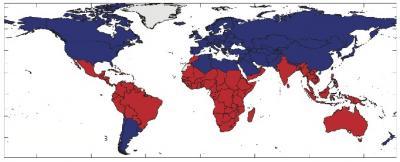
ScienceDaily (Aug. 24, 2011) — In the first study of its kind, researchers have linked a natural global climate cycle to periodic increases in warfare. The arrival of El Niño, which every three to seven years boosts temperatures and cuts rainfall, doubles the risk of civil wars across 90 affected tropical countries, and may help account for a fifth of worldwide conflicts during the past half-century, say the authors.

El Nino drought cycles heavily affecting some 90 countries (red) appear to be helping drive modern civil wars. (Credit: Courtesy Hsiang et al./Nature)

The paper, written by an interdisciplinary team at Columbia University’s Earth Institute, appears in the current issue of the leading scientific journal Nature.

In recent years, historians and climatologists have built evidence that past societies suffered and fell due in connection with heat or droughts that damaged agriculture and shook governments. This is the first study to make the case for such destabilization in the present day, using statistics to link global weather observations and well-documented outbreaks of violence. The study does not blame specific wars on El Niño, nor does it directly address the issue of long-term climate change. However, it raises potent questions, as many scientists think natural weather cycles will become more extreme with warming climate, and some suggest ongoing chaos in places like Somalia are already being stoked by warming climate.

“The most important thing is that this looks at modern times, and it’s done on a global scale,” said Solomon M. Hsiang, the study’s lead author, a graduate of the Earth Institute’s Ph.D. in sustainable development. “We can speculate that a long-ago Egyptian dynasty was overthrown during a drought. That’s a specific time and place, that may be very different from today, so people might say, ‘OK, we’re immune to that now.’ This study shows a systematic pattern of global climate affecting conflict, and shows it right now.”

The cycle known as the El Niño-Southern Oscillation, or ENSO, is a periodic warming and cooling of the tropical Pacific Ocean. This affects weather patterns across much of Africa, the Mideast, India, southeast Asia, Australia, and the Americas, where half the world’s people live. During the cool, or La Niña, phase, rain may be relatively plentiful in tropical areas; during the warmer El Niño, land temperatures rise, and rainfall declines in most affected places. Interacting with other factors including wind and temperature cycles over the other oceans, El Niño can vary dramatically in power and length. At its most intense, it brings scorching heat and multi-year droughts. (In higher latitudes, effects weaken, disappear or reverse; La Niña conditions earlier this year helped dry the U.S. Southwest and parts of east Africa.)

The scientists tracked ENSO from 1950 to 2004 and correlated it with onsets of civil conflicts that killed more than 25 people in a given year. The data included 175 countries and 234 conflicts, over half of which each caused more than 1,000 battle-related deaths. For nations whose weather is controlled by ENSO, they found that during La Niña, the chance of civil war breaking out was about 3 percent; during El Niño, the chance doubled, to 6 percent. Countries not affected by the cycle remained at 2 percent no matter what. Overall, the team calculated that El Niño may have played a role in 21 percent of civil wars worldwide — and nearly 30 percent in those countries affected by El Niño.

Coauthor Mark Cane, a climate scientist at Columbia’s Lamont-Doherty Earth Observatory, said that the study does not show that weather alone starts wars. “No one should take this to say that climate is our fate. Rather, this is compelling evidence that it has a measurable influence on how much people fight overall,” he said. “It is not the only factor–you have to consider politics, economics, all kinds of other things.” Cane, a climate modeler, was among the first to elucidate the mechanisms of El Niño, showing in the 1980s that its larger swings can be predicted — knowledge now used by organizations around the world to plan agriculture and relief services.

The authors say they do not know exactly why climate feeds conflict. “But if you have social inequality, people are poor, and there are underlying tensions, it seems possible that climate can deliver the knockout punch,” said Hsiang. When crops fail, people may take up a gun simply to make a living, he said. Kyle C. Meng, a sustainable-development Ph.D. candidate and the study’s other author, pointed out that social scientists have shown that individuals often become more aggressive when temperatures rise, but he said that whether that applies to whole societies is only speculative.

Bad weather does appear to tip poorer countries into chaos more easily; rich Australia, for instance, is controlled by ENSO, but has never seen a civil war. On the other side, Hsiang said at least two countries “jump out of the data.” In 1982, a powerful El Niño struck impoverished highland Peru, destroying crops; that year, simmering guerrilla attacks by the revolutionary Shining Path movement turned into a full-scale 20-year civil war that still sputters today. Separately, forces in southern Sudan were already facing off with the domineering north, when intense warfare broke out in the El Niño year of 1963. The insurrection abated, but flared again in 1976, another El Niño year. Then, 1983 saw a major El Niño–and the cataclysmic outbreak of more than 20 years of fighting that killed 2 million people, arguably the world’s bloodiest conflict since World War II. It culminated only this summer, when South Sudan became a separate nation; fighting continues in border areas. Hsiang said some other countries where festering conflicts have tended to blow up during El Niños include El Salvador, the Philippines and Uganda (1972); Angola, Haiti and Myanmar (1991); and Congo, Eritrea, Indonesia and Rwanda (1997).

The idea that environment fuels violence has gained currency in the past decade, with popular books by authors like Jared Diamond, Brian Fagan and Mike Davis. Academic studies have drawn links between droughts and social collapses, including the end of the Persian Gulf’s Akkadian empire (the world’s first superpower), 6,000 years ago; the AD 800-900 fall of Mexico’s Maya civilization; centuries-long cycles of warfare within Chinese dynasties; and recent insurgencies in sub-Saharan Africa. Last year, tree-ring specialists at Lamont-Doherty Earth Observatory published a 1,000-year atlas of El Niño-related droughts; data from this pinpoints droughts coinciding with the downfall of the Angkor civilization of Cambodia around AD 1400, and the later dissolution of kingdoms in China, Vietnam, Myanmar and Thailand.

Some scientists and historians remain unconvinced of connections between climate and violence. “The study fails to improve on our understanding of the causes of armed conflicts, as it makes no attempt to explain the reported association between ENSO cycles and conflict risk,” said Halvard Buhaug, a political scientist with the Peace Research Institute Oslo in Norway who studies the issue. “Correlation without explanation can only lead to speculation.” Another expert, economist Marshall Burke of the University of California, Berkeley, said the authors gave “very convincing evidence” of a connection. But, he said, the question of how overall climate change might play out remains. “People may respond differently to short-run shocks than they do to longer-run changes in average temperature and precipitation,” he said. He called the study “a useful and illuminating basis for future work.”

The above story is reprinted (with editorial adaptations by ScienceDaily staff) from materials provided by The Earth Institute at Columbia University.

Journal Reference:
Solomon M. Hsiang, Kyle C. Meng, Mark A. Cane. Civil conflicts are associated with the global climate. Nature, 2011; 476 (7361): 438 DOI: 10.1038/nature10311

Seca de 2010 na Amazônia foi a mais drástica desde 1902 (Fapesp)

Constatação foi feita por pesquisadores do Inpe a partir da análise de série histórica de dados de pluviosidade na região da bacia amazônica (foto:Fapeam)

30/08/2011

Agência FAPESP – Cientistas do Instituto Nacional de Pesquisas Espaciais (Inpe) concluíram em um estudo, publicado na revista Geophysical Research Letters, que a seca de 2010 na Amazônia foi a mais drástica já registrada desde 1902, superando a de 2005, que até então era considerada a maior do século.

A constatação foi feita a partir da análise de uma série histórica de dados de pluviosidade na região da bacia amazônica, com medições desde 1902.

Os resultados do estudo apontam que o processo teve início no começo do verão, durante o El Niño (um processo natural de aquecimento das águas do Pacífico), mas foi intensificado pelo aquecimento das águas tropicais do Atlântico Norte. Em função disso, se originou uma estação seca que se estendeu por muitos meses, ocasionando alterações no ciclo hidrológico.

Como consequência desse processo, houve rebaixamento dos níveis de água e seca completa de cursos d’água e tributários de rios na bacia amazônica. A região sul foi a mais afetada. O fenômeno causou graves problemas socioambientais, especialmente às populações ribeirinhas, que ficaram isoladas por dependerem dos rios para seu deslocamento.

Em outro artigo recém-publicado na revista Theoretical Applied Climatology, pesquisadores do Inpe apresentaram os resultados de um amplo estudo sobre as inundações na Amazônia e Nordeste do Brasil, ocorridas no período de maio a julho de 2009. O fenômeno provocou mortes e deixou milhares de famílias desabrigadas. O trabalho demonstra que essas chuvas torrenciais foram as mais intensas e duradouras já registradas.

O rio Negro, principal tributário do rio Amazonas, atingiu seu maior nível em 107 anos. Os autores concluíram que o evento foi resultado de uma conjuntura de fatores meteorológicos, especialmente o aquecimento acima do normal das águas superficiais do Atlântico Sul – aspecto importante para a explicação das chuvas abundantes em vastas regiões do leste amazônico e Nordeste do país.

Os pesquisadores destacaram também que esses episódios extremos, assim como a seca duradoura ocorrida no ano de 2010 na bacia amazônica, reforçam a hipótese de que anomalias no regime pluviométrico e de temperatura serão mais frequentes em cenários futuros de mudanças climáticas.

Entre os autores dos estudos está José Antônio Marengo Orsini, chefe do Centro de Sistema Terrestre do Inpe.

O artigo The drought of 2010 in the context of historical droughts in the Amazon region(doi:10.1029/2011GL047436), de Orsini e outros, pode ser lido em www.inpe.br/noticias/arquivos/pdf/2011GL047436.pdf.

O partido anticiência (JC, O Globo)

JC e-mail 4333, de 30 de Agosto de 2011.

Artigo de Paul Krugman publicado no O Globo de hoje (30).

John Huntsman Jr., ex-governador de Utah e embaixador na China, não é um forte pré-candidato à indicação do Partido Republicano para concorrer à Presidência. E isto é muito ruim porque o desejo de Huntsman é dizer o indizível sobre o partido – especialmente que ele está se tornando o “partido anticiência”. Isto é algo enormemente importante. E deveria nos aterrorizar.

Para entender o que Huntsman defende, considere declarações recentes dos dois mais fortes pretendentes à indicação republicana: Rick Perry e Mitt Romney.

Perry, governador do Texas, fez manchetes recentemente ao fazer pouco da evolução humana como uma “simples teoria”, que tem “algumas lacunas” – uma observação que soaria como novidade para a vasta maioria dos biólogos. Mas o que mais chamou a atenção foi o que ele disse sobre mudança climática: “Penso que há um número substancial de cientistas que manipulou dados para obter dólares para seus projetos. E penso que estamos vendo, quase toda semana, ou todo dia, cientistas questionando a ideia original de que o aquecimento global provocado pelo homem é a causa da mudança climática.” É uma declaração extraordinária – ou talvez o adjetivo correto seja “vil”.

A segunda parte da declaração de Perry é falsa: o consenso científico sobre a interferência humana no aquecimento global – que inclui 97% a 98% dos pesquisadores de campo, segundo a Academia Nacional de Ciências – está se tornando mais forte à medida que aumentam as evidências sobre a mudança do clima.

De fato, se você acompanha a ciência climática sabe que o principal aspecto nos últimos anos tem sido a preocupação crescente de que as projeções sobre o futuro do clima estejam subestimando o provável aumento da temperatura. Advertências de que poderemos enfrentar mudanças cimáticas capazes de ameaçar a civilização no fim do século, antes consideradas estranhas, partem agora dos principais grupos de pesquisa.

Mas não se preocupe, sugere Perry; os cientistas estão apenas atrás de dinheiro, “manipulando dados” para criar uma falsa ameaça. Em seu livro “Fed Up”, ele despreza a ciência do clima como “uma bagunça falsa e artificial que está se desmanchando”.

Eu poderia dizer que Perry está tirando isso de uma teoria conspiratória verdadeiramente louca, que afirma que milhares de cientistas de todo o mundo estão levando dinheiro, sem que nenhum deseje quebrar o código de silêncio. Poderia apontar que múltiplas investigações em acusações de falsidade intelectual da parte dos cientistas climáticos acabaram com a absolvição dos pesquisadores de todas as acusações. Mas não se preocupe: Perry e os que pensam como ele sabem em que desejam acreditar e sua resposta a qualquer um que os contradiga é iniciar uma caça às bruxas.

Então de que modo Romney, o outro forte concorrente à indicação republicana, respondeu ao desafio de Perry? Correndo dele. No passado, Romney, ex-governador de Massachusetts, endossou fortemente a noção de que a mudança climática provocada pelo homem é uma real preocupação. Mas, na semana passada, ele suavizou isso e disse pensar que o mundo está realmente esquentando, mas “eu não conheço isto” e “não sei se isso é causado principalmente pelo homem”. Que coragem moral!

É claro, sabemos o que está motivando a súbita falta de convicção de Romney. Segundo o Public Policy Polling, somente 21% dos eleitores republicanos de Iowa acreditam no Aquecimento Global (e somente 35% creem na evolução). Dentro do Partido Republicano, ignorância deliberada tornou-se um teste decisivo para os candidatos, no qual Romney está determinado a passar a qualquer custo.

Então, é agora altamente provável que o candidato presidencial de um de nossos dois grandes partidos políticos será ou um homem que acredita no que quer acreditar, ou um homem que finge acreditar em qualquer coisa que ele ache que a base do partido quer que ele acredite.

E o caráter crescentemente anti-intelectual da direita, tanto dentro do Partido Republicano como fora dele, se estende além da questão da mudança climática.

Ultimamente, por exemplo, a seção editorial do “Wall Street Journal” passou da antiga preferência pelas ideias econômicas de “charlatães e maníacos” — pela definição famosa de um dos principais conselheiros econômicos do ex-presidente George W. Bush – para um descrédito geral do pensamento árduo sobre questões econômicas. Não prestem atenção a “teorias fantasiosas” que conflitam com o “senso comum”, diz-nos o “Journal”. Por que deveria alguém imaginar que se precisa mais do que estômago para analisar coisas como crises financeiras e recessões?

Agora, não se sabe quem ganhará a eleição presidencial do próximo ano. Mas há chances de que, mais dia menos dia, a maior nação do mundo será dirigida por um partido que é agressivamente anticiência, mesmo anticonhecimento. E, numa era de grandes desafios – ambiental, econômico e outros – é uma terrível perspectiva.

Paul Krugman é colunista do “New York Times”.

Os donos da chuva (Fapesp)

Pesquisa FAPESP
Edição 186 – Agosto 2011
Política de C & T > Polêmica

Intervenções no clima global podem já ser viáveis, mas têm enormes riscos 
Por Carlos Fioravanti

Duas novas expressões – gerenciamento do clima e geoengenharia – estão aparecendo com mais frequência nos debates internacionais sobre a ciência e a política das mudanças climáticas. Uma das razões é o fracasso nas tentativas de implementação de políticas efetivas de redução de emissões de gases estufa. O que há de novo é que não é mais utópico pensar em intervir no clima regional ou mundial para evitar a contínua elevação da temperatura média global, as secas ou inundações intensas que se tornam mais frequentes à medida que as alterações climáticas se intensificam. Já pode ser viável usar aviões, balões ou canhões para espalhar partículas de aerossóis na estratosfera ou aumentar a nebulosidade do planeta semeando nuvens. Essas intervenções poderiam refletir parte da radiação solar de volta para o espaço e resfriar o planeta como forma de reduzir os efeitos das crescentes concentrações de gases do efeito estufa como o dióxido de carbono (CO2).

Os especialistas alertam, porém, que pode ser bastante perigoso – e não só porque os efeitos dessas intervenções no clima global são imprevisíveis. “Um só país ou um só milionário pode tentar mudar o clima na Terra, com consequências imprevisíveis”, observou o físico Paulo Artaxo, professor da Universidade de São Paulo (USP), em um debate realizado em junho no Instituto de Relações Internacionais da USP. “Espero que não comece uma competição entre países, grandes empresas ou bilionários dos Estados Unidos, da Inglaterra ou do mundo árabe que queiram salvar o mundo mudando o clima de propósito. A possibilidade já existe, basta uma decisão.”

Estima-se que despejar toneladas de enxofre na alta atmosfera para produzir partículas de aerossóis custaria US$ 10 bilhões ao ano, bem menos do que o US$ 1 trilhão previsto para reduzir as emissões de CO2. A geoengenharia ou engenharia climática, como é chamada a intervenção deliberada e de ampla escala no clima, oferece outras possibilidades. As mais simples incluem o aumento da refletividade das superfícies das construções e o reflorestamento em larga escala, já que as plantas absorvem muito CO2 enquanto crescem. Possibilidades mais refinadas consistem no espalhamento de íons de ferro no oceano para aumentar a fertilidade de algas marinhas, que sequestrariam CO2 e o levariam para o fundo dos oceanos.

Debatida no mundo acadêmico desde os anos 1960, a geoengenharia ganhou visibilidade pública com George W. Bush, presidente dos Estados Unidos de 2001 a 2009. Bush preferia apostar em estratégias desse tipo para lidar com os efeitos dos problemas provocados pelo aquecimento global em vez de reduzir as emissões, prevenindo os impactos. Os adeptos da geoengenharia – um grupo que inclui a indústria de combustíveis fósseis e alguns cientistas que acham que o problema climático é tão urgente que requer intervenções drásticas – argumentam que existe a possibilidade de reduzir a temperatura do planeta de propósito, não como panaceia, mas como medida paliativa, enquanto outras medidas mais demoradas são colocadas em prática.

Riscos – Alan Robock, pesquisador da Universidade Rutgers, Estados Unidos, tem alertado que os riscos podem superar os benefícios, mesmo que a geoengenharia funcione como esperado. Segundo ele, mudanças propositais no clima global poderiam amenizar a pressão social pela adoção de medidas de redução da emissão de gases do efeito estufa, além de descontrolar o clima ainda mais – um dos efeitos previstos é a redução das chuvas anuais – as monções – sobre a Ásia e a África, ameaçando a produção de alimentos para centenas de milhões de pessoas.

Em 2008, na Science, Robock afirmou que a geoengenharia poderia ser usada como arma de guerra de um país contra povos inimigos, causando secas ou inundações de consequências catastróficas em territórios hostis. Emergem também perguntas ainda sem respostas: quem vai controlar o clima e dizer que é hora de parar? Robock propõe a seguinte situação: e se a Rússia quisesse a temperatura global um pouco mais alta e a Índia um pouco mais baixa? O sociólogo da Universidade de Brasília (UnB) Eduardo Viola, que participou do debate na USP, teme que os países mais poderosos, como China, Rússia, Estados Unidos, tomem unilateralmente decisões que possam beneficiá-los, mas prejudicar muitos outros.

“Não temos governança global para lidar com esses problemas. O que um presidente dos Estados Unidos como Sarah Palin faria?”, indagou Jason Blackstock, pesquisador do Center for International Governance Innovation (Cigi), Canadá, em sua apresentação na USP. “Temos de ter um entendimento claro de todas as implicações.” Cada estratégia traz fortes efeitos colaterais. Segundo ele, aumentar a quantidade de enxofre na atmosfera pode esfriar a Terra, mas também alterar a precipitação e o balanço de radiação direta e difusa, com fortes efeitos sobre o funcionamento dos ecossistemas. Inversamente, a proposta de reduzir em 0,5% o teor de enxofre do combustível usado em navios até 2020, cogitada como forma de evitar 35 mil mortes de pessoas, principalmente nas proximidades de portos, poderia aumentar a incidência de luz solar na superfície – e o planeta esquentaria um pouco mais.

“Os cientistas em geral são favoráveis à pesquisa de geoengenharia e podem planejar experimentos em pequena escala nos próximos anos”, diz Artaxo, com base nas reuniões internacionais de que tem participado. “O problema é que não há efeito apenas local.” Por causa dos ventos, parte de uma carga de enxofre lançada, por exemplo, na região central dos Estados Unidos facilmente em apenas um dia iria para o Atlântico ou para o Pacífico, com consequências imprevisíveis sobre o equilíbrio do clima terrestre.

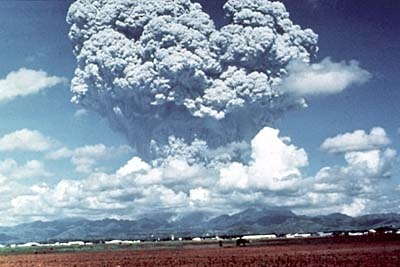
As descargas intencionais de partículas aerossóis teriam um efeito similar ao das supererupções vulcânicas. O exemplo mais citado é o Pinatubo, vulcão das Filipinas que entrou em erupção em junho de 1991. Em poucos dias, ele liberou 20 megatoneladas (cada megatonelada equivale a 1 bilhão de quilogramas) de dióxido de enxofre. As partículas se espalharam pela atmosfera e a temperatura do ar na superfície dos continentes do hemisfério Norte caiu dois graus. Depois de um ano, as partículas assentaram e a temperatura voltou a aumentar.

Em 2002, na Science, Robock observou que o espalhamento de partículas vindas de erupção vulcânica não é um fenômeno inócuo: pode reduzir a radiação solar e, consequentemente, a evaporação e a chuva por um ou dois anos. Artaxo aponta outra consequência do acúmulo de aerossóis na atmosfera: “Nunca mais teremos céus azuis como hoje, e os telescópios ópticos na superfície terrestre seriam inúteis”.

Para ele, a melhor solução contra os impactos do aquecimento global é reduzir rapidamente o consumo de combustíveis fósseis e as emissões de gases do efeito estufa e mudar o modo pelo qual usamos os recursos naturais do planeta. “Se formos inteligentes”, diz ele, “podemos usar os recursos naturais do planeta de modo mais eficiente e sustentável, sem precisar de experiências mirabolantes que colocam ainda mais em risco nosso frágil ecossistema terrestre”.

A vida na estação meteorológica (OESP)

JC e-mail 4321, de 12 de Agosto de 2011.

Saiba como funcionam os dois principais pontos de medição de umidade, vento e temperatura na capital: o Mirante de Santana e o tradicional IAG.

Os trabalhos nas duas principais estações meteorológicas da cidade de São Paulo não param em fins de semana, feriados, dias chuvosos, frios ou secos. Até porque é desses lugares que vem parte das informações que o paulistano usa todos os dias para decidir se pega o casaco ou o guarda-chuva. Tanto na estação do Mirante de Santana, a oficial da cidade, quanto na do Instituto de Astronomia, Geofísica e Ciências Atmosféricas (IAG) da USP – a mais antiga em atividade na capital, desde 1933 -, os trabalhos estão a cargo de gente apaixonada pelo que faz.

Evocado diariamente nos boletins de clima, o Mirante de Santana dá nome à estação meteorológica usada como parâmetro para os índices históricos da cidade, com o recordes de baixa umidade e temperatura e comparações de índices de chuvas. São três medições diárias, às 9h, 15h e 21h. “Os horários são definidos por padrões internacionais. Atarefa é coletar no abrigo temperaturas, umidade relativa do ar, evaporação e demais variáveis”, explica Marise Basilio Amadei, de 52 anos, que há 33 trabalha como observadora no Mirante.

Após a coleta, tudo é registrado em planilhas, codificado e, por telefone, repassado ao Instituto Nacional de Meteorologia (Inmet), órgão ligado ao Ministério da Agricultura. A estação está no mesmo lugar desde 1945. E é fácil chegar lá: o Mirante fica na Praça Vaz Guaçu, no Jardim São Paulo, zona norte da cidade. É uma praça gramada, de onde é possível ter boa vista da capital. No meio da grama, um cercadinho protege a estação meteorológica, onde estão equipamentos convencionais como termômetros, higrômetro – que mede a umidade relativa do ar -, além de pluviógrafo, que registra a chuva, e anemômetro, que mede o vento. Há também uma estação eletrônica, que envia os dados automaticamente -mas não é levada em conta nos números históricos.

No alto da praça, uma construção serve de escritório aos três observadores que atualmente se revezam na estação. “Já houve época sem que fiquei sozinha e fazia todos os horários. Mas sei que faço um serviço de utilidade pública, sempre vesti a camisa”, diz Marise. Já disseram que ela tem um “caso” com o Mirante, tal seu comprometimento – a brincadeira ganha força quando, no meio de uma festa, por exemplo, ela precisa sair para fazer medições.

Pudera. Marise nasceu no Mirante. A casa do pai, o aposentado Mario Basilio Silva, de 83 anos, fica na praça. Quando ele se mudou para o local, em1962, não havia nem asfalto, mas a vista compensava. Aos 18 anos, Marise recebeu em casa o convite de trabalho de uma senhora que fazia a observação na estação. Começou e não parou mais. Eat é o marido acabou envolvido no trabalho – o administrador Luiz Carlos Amadei, de 56 anos, tornou-se companhia diária nas medições. De tanto acompanhar, acabou virando observador no mirante, em 1999, onde permaneceu até 2008.

IAG. Do outro lado da cidade, na Água Funda, zona sul, a estação meteorológica do IAG também tem seu diletomorador. O professor Frederico Luiz Funari, de 74 anos, confere as medições e o funcionamento dos equipamentos de segunda a segunda -mesmo já estando aposentado há 3. Ele mora desde 1971 em uma casa dentro do Parque Ciência e Tecnologia da USP (Cientec), onde fica a estação.

“Já fiquei 40 dias de licença compilando dados meteorológicos. Eu mando bala, não paro no serviço.” Nas férias é a mesma coisa, garante ele, que começou como observador, foi pesquisador, lecionou na universidade e, mesmo aposentado, ingressou no pós-doutorado no ano passado. A estação pertence à USP desde 1947 e o parque foi criado só em 2001. Em 2002, as aulas do IAG foram transferidas para a Cidade Universitária, mas algumas disciplinas ainda são dadas na Água Funda. Quase nada na estação do IAG precisa de energia e os equipamentos pouco mudaram em termos de tecnologia nos últimos tempos. No IAG, entretanto, há medições de temperatura do solo. Além disso, as observações são anotadas de hora em hora, entre 7h e meia-noite. Cinco técnicos se revezam no trabalho.

“Assim, temos mais confiabilidade e precisão. E, se houver problema em algum aparelho, perdemos um intervalo pequeno”, explica a meteorologista Samantha Martins, desde 2009 no local. O professor Mario Festa, desde 1969 por ali e responsável pela estação, explica que o equipamento remonta os primórdios das observações meteorológicas no Estado. Funcionou na Avenida Paulista a partir de 1927 e depois, em 1932, foi para o local onde permanece ainda hoje, vizinho do zoológico. As medições começaram em 1933. Dos mais de dez prédios que compõem o complexo, pelo menos cinco datam dos anos 1940, em estilo art déco. Dois têm cúpula de aço típica de observadores. “A estação é uma instituição dentro do IAG”, explica Festa. “Fazemos
trabalhos de observação, mas também ensino, pesquisa e extensão.”

Museu. Festa reúne equipamentos meteorológicos históricos, além de documentos e móveis da antiga Comissão Geographica e Geológica, de 1886. Ele trabalha há quatro anos na elaboração do projeto do Museu da Meteorologia na estação. “Temos muita coisa e queremos resgatar essa história.” Neste mês, o local vai ganhar um planetário em um dos prédios históricos, que foi reformado.
(O Estado de São Paulo)

Confronting the ‘Paradox of Progress’ (Yale Forum on Climate Change & The Media)

A First-Hand Perspective
Google’s Science Communication Fellows

Paul Higgins August 2, 2011

The ‘paradox of progress’ illustrated by climate change prompts a first-hand participant in a recent Google fellowship program to ponder how best to combine scientific and technological advances with improved public understanding for the benefit of society overall.

Scientific and technological advances are creating a challenging paradox for society, a paradox of progress.

Advances in the sciences and technical fields provide our society with tremendous capacity to overcome the numerous challenges we face. But those challenges in many cases are driven by the rapidly expanding scale of human activities, which are made possible in the first place by advances in science and technology.

Circumventing this paradox of progress — reaping the benefits that science and technology bring us, while avoiding the unintended negative consequences — will depend on using those advances more effectively throughout all of society.

Climate change illustrates the paradox of progress extremely well. The social and technological advances that powered the Industrial Revolution vastly improve our quality of life and well-being, but also drive our global disruption of the climate system. All the while, scientific and technological advances help us understand the causes, consequences, and potential risk management solutions to climate change.

It’s a serious concern that these massive advances in scientific knowledge have had little impact on public understanding of climate science, its implications, or society’s risk management efforts.

Given the importance of circumventing the paradox of progress, for climate change and more broadly, I was pleased to learn that Google was initiating a Science Communication Fellowship Program and thrilled to be named a member of the inaugural class of 21 fellows. Still, the question, to me, is this: Can the combination of the technological capabilities of one of the world’s leading IT companies and the expertise of the scientific community transform scientific communication for climate change and, more broadly, for all socially-relevant scientific disciplines?

The fellowship program centered on a workshop held in June at Google’s headquarters in Mountain View, California. There were, in my view, three specific goals of the workshop and the fellowship:

– to promote collaboration among the fellows;

– to develop transformative project ideas that could harness new media and information technology (IT) for more effective communication of the science of climate change; and

– to help develop communication approaches that would be broadly and generally transferable to other scientific disciplines.

The workshop included perspectives from outside experts, presentations from Googlers (the internal moniker for Google staff) on new media and advances in IT, and brainstorming activities designed to generate new ideas.

The Googlers’ presentations were impressive, perhaps even a little daunting. They brought home, in a way I hadn’t realized before (despite my heavy reliance on new technology), how rapidly the IT world is advancing and how much potential IT has to transform society. At times, seeing what these Googlers could do with information technology left me questioning what was left for me to contribute. Fortunately, the brainstorming provided an answer.

I had gone to Google with two ideas for climate science communication and I had two more ideas while there. That seemed fairly standard among the fellows so by the end we were awash in new, interesting, and potentially transformative ideas for communicating climate science.

Of course, with so many ideas and a need to winnow them to a tractable number of actual project proposals, everyone was bound to see some of their favorite ideas end up forlorn and abandoned on the bottom of a white board. I had two ideas that I was sorry to see stall during the vetting but that I intend to pursue separately nonetheless. (At this stage it is appropriate and consistent with the workshop protocol, in my view, to discuss only those ideas that were both my own and that are not moving forward formally within the fellowship program).

The first is a multi-media show featuring leading climate experts. Each show will follow a one-on-one interview format and will showcase the expert’s knowledge and understanding. The discussion will explore what the expert does, why their work is important, what the current state of knowledge is (what is known and understood and with what level of confidence), what key questions remain unresolved or contentious, and the broader implications of their work to society.

The show would meet three critical needs: 1) it would help educate the public about climate change; 2) it would provide a new venue for rapid responses to important events (e.g., ground-breaking research findings and public controversies and misunderstandings), and 3) it would help develop the communication skills of climate experts.

The second idea involves development of an interactive game that would give users a chance to assess and manage climate change risks for themselves. Subjective preferences have major implications, good and bad, for policy choices, and this tool could help reveal and encourage reflection over those opinions. Are you risk averse? If so, how do you balance your risk aversion between policy choices that are too aggressive (e.g., that risk excessive increases in energy and transportation prices) or too weak (i.e., that risk disruption of key life-support services)? How do your answers change as you learn more about the nature of the risk management problem (i.e., with additional information from the physical, natural, and social sciences)?

Breakthroughs in Science and Public Understanding

Over the next few weeks, the 21 fellows will refine project ideas and submit proposals to Google for possible seed funding. Whether these ideas can ultimately transform science communication will take time to determine. Regardless, the process of generating new ideas during the workshop was profoundly successful. That’s a good first step because resolving the paradox of progress will depend on achieving breakthroughs not only in science but also in how society uses the knowledge and understanding that results.

With more effective use of scientific knowledge and understanding, we can make choices with the greatest chance to benefit society overall. So far the massive advances in scientific understanding of climate change appear to have little impact on public understanding of climate science, its implications, or society’s risk management efforts. But perhaps Google’s Science Communication Fellowship Program over time can do for civic engagement of science what Google has done for information technology.

Championing Ideas … Your Own and Those of Others

The combination of talks and brainstorming made for an invigorating three days but also a grueling workshop experience. By the end of each day, many participants were clearly spent and more than a little confused about best paths forward. That is what happens when people’s horizons are expanding and they are confronting new challenges.

Fortunately, by the following morning, I had integrated what I’d learned the day before and found what I thought would be a good path forward.

For me, the most critical breakthrough was to recognize and accommodate two complementary approaches: 1) to champion the idea(s) that I thought most promising, regardless of whether others at the workshop liked my vision or not; and 2) to help, however possible, champions of other ideas successfully implement their visions.

This two-pronged approach for me captures the nature of scientific pursuit at its best. Science relies on personal autonomy, individual incentives, and unique contributions, but also depends on collaboration and cooperation to help make everyone’s work more effective. The first component reflects the importance of individual insight and ability, the second the importance of staying focused on broader, shared goals: the pursuit of knowledge and understanding in the case of scientific research, increased public understanding in the case of science communication.

Author
Paul Higgins is the Associate Director of the American Meteorological Society’s Policy Program in Washington, D.C.

Climate Change Sparks Battles in Classroom (Science)

Science 5 August 2011: Vol. 333 no. 6043 pp. 688-689 DOI: 10.1126/science.333.6043.688

SCIENCE EDUCATION
Sara Reardon

The U.S. political debate over climate change is seeping into K-12 science classrooms, and teachers are feeling the heat.

Growth potential. Students gather acorns for a middle school science project. CREDIT: JEFF CASALE/AP IMAGES

This Spring, when the science department of Los Alamitos High School in southern California proposed an advanced class in environmental science, members of the elected school board for the small district in Orange County thought the course was a great idea. Then they read the syllabus and saw a mention of climate change.

The topic, the board decided, is a “controversial issue.” Its next step was a new policy requiring teachers to explain to the school board how they are handling such topics in class in a “balanced” fashion. And the new environmental science course, which starts this fall, will be the first affected.

Local teachers immediately deplored the board’s actions. “It’s very difficult when we, as science teachers, are just trying to present scientific facts,” says Kathryn Currie, head of the high school’s science department. And science educators around the country say such attacks are becoming all too familiar. They see climate science now joining evolution as an inviting target for those who accuse “liberal” teachers of forcing their “beliefs” upon a captive audience of impressionable children.

“Evolution is still the big one, but climate change is catching up,” says Roberta Johnson, executive director of the National Earth Science Teachers Association (NESTA) in Boulder, Colorado. An informal survey this spring of 800 NESTA members (see word cloud) found that climate change was second only to evolution in triggering protests from parents and school administrators. One teacher reported being told by school administrators not to teach climate change after a parent threatened to come to class and make a scene. Online message boards for science teachers tell similar tales.

Hot topic. Teachers can bone up on climate science in workshops and classes. CREDIT: SOURCE: ROBERTA KILLEEN JOHNSON, NATIONAL EARTH SCIENCE TEACHERS ASSOCIATION

Unlike those biology teachers who have borne the brunt of the century-long assault on evolution, however, today’s earth science teachers won’t have the protection of the First Amendment’s language about religion if climate change deniers decide to take their cause to court. But the teachers feel their arguments are equally compelling: Science courses should reflect the best scientific knowledge of the day, and offering opposing views amounts to teaching poor science.

Most science teachers don’t relish having to engage this latest threat to their profession. “They want to teach the science,” says Susan Buhr, education director at the Cooperative Institute for Research in Environmental Sciences (CIRES) in Boulder. “They’re struggling to be on top of the science in the first place.”

CIRES and NESTA offer workshops and online resources for educators seeking more information on climate change. But teachers also say that they resent devoting any of their precious classroom time to a discussion of an alleged “controversy.” And they believe that politics has no place in a science classroom.

Even so, some are being dragged against their will into a conflict they fear could turn ugly. “There seems to be a lynch-mob hate against any teacher trying to teach climate change,” says Andrew Milbauer, an environmental sciences teacher at Conserve School, a private boarding school in Land O’Lakes, Wisconsin.

Milbauer felt that wrath after receiving an invitation to participate in a public debate about climate change. The event, put on last year by Tea Party activists, proposed to pit high school teachers against professors and climate change deniers David Legates and Willie Soon in front of students from 200 high schools. Organizers said the format was designed “to expand knowledge of the global warming debate to the youth of our state.” When Milbauer and his colleagues declined to participate, organizer Kim Simac complained to the local papers about their “suspicious” behavior. Milbauer corresponded for a time on the organization’s blog until Simac wrote that Milbauer, “in his role as science teacher, is passing on to our youth this monstrous hoax as being the gospel truth.”

Milbauer regards the episode as an unfortunate but telling example of misguided science and uses it in class discussions. “I explain this is the trap the [other side] is building,” he says.

Some teachers would disagree, however. In comments in the NESTA survey, a handful of teachers called climate change “just a theory like evolution” or said they firmly believed that opposing views should be presented with equal weight.

Sowing confusion

Given the ongoing and noisy national debate over climate change, it’s not surprising that those disagreements are seeping into K-12 schools, too. Science educators are scrambling to figure out how to deliver top-quality instruction without being sucked into the maelstrom. The issue is acute in Louisiana, which enacted a law in 2008 that lists climate change along with evolution as “controversial” subjects that teachers and students alike can challenge in the classroom without fear of reprisal.

A hotter climate? The phrase “climate change” came up often when NESTA asked its teacher members what classroom concepts trigger outside concerns. SOURCE: ROBERTA KILLEEN JOHNSON, NATIONAL EARTH SCIENCE TEACHERS ASSOCIATION

When a state law suggests that established scientific theories are controversial, says Ian Binns, a science education researcher at Louisiana State University in Baton Rouge, “it tells our students and teachers that there are problems that there aren’t.” That ambiguity, he and others fear, can distort a student’s understanding of the nature of scientific inquiry. “Science is not about providing balance to every viewpoint that’s out there,” says Joshua Rosenau of the National Center for Science Education, a nonprofit organization in Oakland, California, that has begun to monitor controversies regarding climate change in addition to battles over evolution. To Rosenau, staging debates over science in schools or on the floors of Congress “is madness.”

In Los Alamitos, the course will follow the curriculum laid out by the nonprofit College Board for its Advanced Placement (AP) course in environmental science, which presents the scientific evidence for climate change. This curriculum, which prepares students to take an end-of-year test for college credit, is what irritated Jeffrey Barke, a Los Alamitos school board member and physician who led the push to revise the district’s policies after learning about the course. Barke has spoken publicly about his concern that “liberal faculty” members would use the course to present global warming as “dogma.”

Science department head Currie criticizes the board’s new policy and feels that it may confuse students when they answer multiple-choice questions relating to climate change on the final AP exam. “When a kid comes across that on the AP test, what are they supposed to bubble?” she asks. “The fact, or [Barke’s] belief that it’s not a fact?” The school board, however, has said that the new policy is simply a way to prevent political bias from entering the classroom.

Currie and her colleagues are spending the summer working up a lesson plan for the new course, but she isn’t sure what will satisfy the board. “I’m going to fight for scientific facts being presented in the classroom,” she says. “I want to keep politics out.”

Arming for battle

The extent to which politics is affecting geoscience courses around the country is hard to measure, Rosenau says: “Just like with evolution, it’s difficult to know what a given teacher in a given classroom is teaching.”

To improve the quality of that instruction, both CIRES and NESTA are trying to put up-to-date, data-rich climate science materials into the hands of teachers and students to supplement textbooks. They’re not the only ones; even government agencies such as the National Oceanic and Atmospheric Administration, spurred by language in the 2007 America COMPETES Act about their role in improving science education, have beefed up their teacher training programs.

But it’s not enough to say that “you just need to teach people more,” Rosenau says. Teachers also have to learn how to defend themselves against parents or administrators wearing “ideological blinders,” he says. CIRES has analyzed the strategies that teachers used in the creationism debates and repurposed them for discussions about climate change. That includes citing state science standards—30 states include climate science in their description of what should be taught—and enlisting the support of administrators before tackling the subject in class.

Those who have taught geoscience or environmental science may feel more confident than colleagues who teach general physical science in managing a classroom discussion. Parents and students trying to poke holes in what they are being taught often “can’t articulate what the opposing view even is,” says Karen Lionberger, director of curriculum and content development for AP Environmental Science in Duluth, Georgia.

Of course, some attacks on climate change come from well-heeled sources. In 2009, the Heartland Institute, which has received significant funding from Exxon-Mobil, expanded its audience beyond teachers and students with a pamphlet, called The Skeptic’s Handbook, mailed to the presidents of the country’s 14,000 public school boards.

Heartland Institute senior fellow James Taylor, who sent out the pamphlet, says the underlying message is that educators need “to understand that there is quite a bit that remains to be learned” about climate change. Taylor also applauds the actions of the Los Alamitos school board, saying that “if the science is unsettled on any topic, of course you should present all points of view.”

The AP course itself doesn’t take a position on the issue, Lionberger says. The handful of multiple-choice questions on the final exam relating to climate change are not “slanted in any way,” she says, and none explicitly asks whether climate change is occurring. But because AP courses can be taken for college credit, she says, “we’re going to follow what colleges and universities are doing” by teaching students about the factors that contribute to climate change and its effects on the planet. Although researchers are always adding to that pool of knowledge, she says “for now, we will fall on the side of consensus science.”

VOCÊ SABE COM QUEM ESTÁ FALANDO? (TRIP)

Roberto da Matta reflete sobre como limites são as maiores conquistas e os maiores riscos

TRIP 196 – 14.02.2011 | Texto por Roberto da Matta
Fotos http://www.flickr.com/commons

Não deixa de ser curioso que o ser vivo mais consciente da própria morte, o animal mais certo de que sua única certeza é um limite final e definitivo — a morte —, seja o bicho que mais inventa e questiona limites. Os seus limites e os dos outros. Mais os dos outros que os seus.

A reflexão sobre os limites, sobre o que é suficiente ou bastante para cada um de nós (e consequentemente para os outros), é o resultado de mais igualdade, liberdade, oportunidade, poder de consumo e daquilo que se chama de “modernidade”: de mercado e competição eleitoral e de democracia. Da operação consistente de um sistema que tem no centro o indivíduo-cidadão livre e igual perante a lei. Todas as sociedades que passaram por uma aguda transformação no sentido de maior igualdade, acoplada a uma consciência mais aguda de liberdade, vivem um aparente paradoxo. Como usufruir a liberdade e a igualdade sem ofender os outros e, mais que isso, sem levar o sistema a uma anarquia e a um caos no qual alguns podem fazer tudo, o outro não existe e — como consequência — quem ocupa cargos importantes sobretudo no governo e do Estado acaba virando um mandão (ou mandona) de modo que, em vez de igualdade e limite, temos o justo oposto: uma hierarquia e o enriquecimento dos poderosos por meio daquilo que é o teste mais claro do limite e da igualdade: o sistema eleitoral que os elegeu.

— II —

http://www.flickr.com/commons

Neste momento em que o Brasil consolida sua democracia e torna-se um ator global, é crucial discutir esse equilíbrio entre o que aspiramos construir como coletividade mais justa e humana e as leis e normas que agindo sobre todos nós e governando por assim dizer esse jogo democrático que vem sendo jogado faz um tempo considerável, considerando nossa história republicana, limitam os nossos movimentos indicando o que é correto e ético realizar.

Não nos parece uma tarefa fácil conciliar desejos (que geralmente são ilimitados e odeiam controles) e a questão fundamental de cumprir regras, seguir leis e construir espaços públicos seguros e igualitários, válidos para todos, numa sociedade que também tem o seu lado claramente aristocrático e hierárquico. Um sistema que ama a democracia, mas também gosta de usar o “Você sabe com quem está falando?”, que é justamente a prova, conforme disse em Carnavais, malandros e heróis, um livro publicado, imagine, em 1979!

Ali, eu descobri o nosso amor simultâneo pela igualdade e, a seu lado, o nosso afeto pelo familismo e pelo partidarismo governados pela ética de condescendência tão nossa conhecida, que diz: nós somos diferentes e temos biografia; para os amigos tudo, aos inimigos (e estranhos, os que não conhecemos) a lei!

Não há nada mais claro da nossa aversão aos limites do que essa recusa de obedecer a lei, o cargo público para o qual fomos eleitos ou o sinal de trânsito. Uma pessoa, como digo no citado ensaio, que não foi criada para pensar em limites, porque todos somos (ou fomos) filhinhos de mamãe e criados em ambientes onde sabíamos perfeitamente bem quem era superior, quem era subordinado, quem mandava e quem obedecia, não pode funcionar igualitariamente na rua, onde ninguém é de ninguém ou sabe quem são os outros.

http://www.flickr.com/commons

A dificuldade em usar com tranquilidade o “Você sabe com quem está falando?” decorre da massificação da sociedade brasileira, que, com o aumento de renda e dos mecanismos destinados a melhorar o consumo das camadas mais pobres, torna todo mundo muito mais parecido e de certo modo obriga tanto o milionário filho de família tradicional quanto o pedreiro, o padeiro, o garçom, o estudante, o operário e o empregado doméstico a entrar numa fila. E, nela, a pensar que somos todos realmente iguais em certas situações públicas porque o limite do outro garante o meu limite.

O resultado dessa tomada de posição, básica numa democracia, é simples, mas muitas vezes ignorado entre nós: a minha liberdade teoricamente ilimitada tem que se ajustar à sua e as duas acabam promovendo uma conformidade voluntária com limites, com fronteiras cívicas que não podem ser ultrapassadas, como a de furar a fila ou a de dar uma carteirada.

Na sua simplicidade, a fila é um dos melhores, se não for o melhor, exemplos de como operam os limites numa democracia. Seus princípios são simples e reveladores: quem chega primeiro é atendido em primeiro lugar. Numa fila, portanto, não vale o oculto. Ou temos uma clara linha de pessoas, umas atrás das outras, ou a vaca vai para o brejo. Quando eu era menino, lembro-me bem como era impossível ter uma fila no Brasil. As velhas senhoras e as pessoas importantes (sobretudo os políticos) não se conformavam com suas regras e traziam como argumento para serem atendidos, passando na frente dos outros, ou a idade, ou o cargo, ou conhecimento com quem estava atendendo, ou algum laço de família. Afinal quem vai deixar a vovó esperando para depois tomar uma bronca em casa? Hoje, sabemos que idosos e deficientes não entram em fila. Mas estamos igualmente alertas para o fato de que um cargo ou um laço de amizade não faz de alguém um supercidadão com poderes ilimitados junto aos que estão penando numa fila por algumas horas. O princípio do quem primeiro chega é primeiro atendido revela uma outra dimensão da democracia e dos limites que deve ser igualmente discutida.

Refiro-me ao fato de que a fila anda (ou deve andar!). Ela é construída, como tudo que é governado por regras simples e conhecidas de todos, pelo princípio da rotatividade. Se “a fila anda”, ela faz com que o último acabe em primeiro e quem estava na frente seja obrigado a sair depois de ter sido atendido. Mais: se ele (ou ela) quiser voltar, vai para o “fim da fila”. Ora, isso não é um belo exemplo dos limites que tornam todos iguais, fazendo-os primeiros ou últimos e, consequentemente, tornando o primeiro e o último relativos? Numa hora e em dado lugar sou o primeiro, noutro sou um cara comum e apenas sigo as normas gerais da cidadania. Mas sei — e esse é um ponto capital — que, mesmo em primeiro lugar ou no último, tenho limites, tolerâncias, direitos sem dúvida, mas um monte de deveres. Uma vez atendido, cedo lugar a um outro que faz o mesmo com o seguinte e assim, meus amigos, a fila da democracia anda!

Tal como num jogo de futebol ou numa disputa política liberal e competitiva, a fila requer conformidade com as regras, com os limites impostos pela disputa, bem como um mínimo de honradez diante delas. Se entro na fila, espero que todos honrem o meu e os seus lugares. Isto é: o meu senso de limites é despertado pelo senso de limites dos outros. Se, numa disputa política, um partido não segue as regras e compra políticos e votos, então o sistema de disputa fica abalado ou deixa de existir. Todo jogador quer vencer, todo atacante quer o gol da vitória, mas ele não pode vencer quebrando as pernas dos seus adversários.

http://www.flickr.com/commons

Do mesmo modo e pela mesma lógica, ninguém pode ser sempre o primeiro da fila (e nem o último), como ninguém pode ser campeão para sempre. Se isso acontece, ou seja, se um time campeão mudar as regras para ser campeão para sempre, então o futebol vai pros quintos dos infernos. Ele simplesmente acaba com o jogo como uma disputa. Na disputa, o adversário não é um inimigo, do mesmo modo que, numa fila, quem está na frente não é um superior. O poder ilimitado e congelado ou fixo em pessoas ou partidos, como ocorre nas ditaduras, liquida a democracia justamente porque ele usurpa os limites nos quais se baseia a fila. Justamente porque ele acaba com a disputa e a esperança banal, mas básica, de que a fila anda e que amanhã podemos ser campeões! O fim do rodízio do poder que obriga o respeito aos limites de todos é a raiz dos autoritarismos que são hoje impensáveis no Brasil. Sem ele, a oposição e a esquerda não estariam no poder honrando e ajudando a provar que, onde há disputa, alguém vai perder ou ganhar.

— III —

Termino com uma história que é, de fato, uma parábola que fala tanto de democracia quanto de capitalismo, com seu poder de despertar inveja e aristocratizar pelo dinheiro.

Conta-se que, numa reunião na mansão de um milhardário americano, o escritor Kurt Vonnegut Jr. (autor, entre outros, do incrível Matadouro 5) perguntou ao seu colega Joseph Heller (autor do não menos perturbador Ardil 22): “Joe, você não fica chateado sabendo que esse cara ganha mais num dia do que você jamais ganhou com a venda de Ardil 22 no mundo todo?”. Heller respondeu: “Não, porque eu tenho alguma coisa que esse cara não tem”. Vonnegut olhou firme para ele e disse: “E o que é que você pode ter que esse sujeito já não tenha?”. Resposta do Heller: “Eu conheço o significado da palavra suficiente”.

Ora, é justamente esse suficiente que nos torna resistentes tanto ao poder do dinheiro como fim valor absoluto, capaz de suspender limites numa sociedade de iguais, quanto a uma dimensão muito importante da vida. É ele que permite valorizar o que somos e temos, o modo como vivemos, os nossos prazeres e escolhas. É essa reflexão sobre o que nos basta que nos faz ver a olho nu que ninguém pode ter (ou tem) tudo. E, se ninguém pode ter tudo, todos temos alguma coisa.

http://www.flickr.com/commons

A ideia de suficiência e de limite, portanto, traz de volta uma dimensão humana importante e não conformista. A dimensão que assegura por linhas tortas, é certo, que nenhum ser humano pode ser belo, bonito, rico, saudável e feliz ao mesmo tempo. Os reveses da vida, que nos fazem estar sempre no fim ou no início da fila, que nos dão a impressão de impotência ou onipotência, têm muito a ver com essa reflexão que pouco fazemos no Brasil. A saber: o que queremos do nosso país e deste mundo? O que precisamos e em que quantidade ou escala? Será que sendo quem sou eu não tenho mais do que o mais rico dos ricos ou o mais poderoso dos poderosos? Afinal de contas, a igualdade na diferença é uma alternativa para estilos de ser. Não se pode negar o valor do dinheiro, mas não se pode aceitar que o dinheiro seja tudo e que o amor, a compaixão, a honestidade, a honradez e a alegria de viver em harmonia consigo mesmo sejam inferiores à riqueza ou ao poder. Afinal de contas, o que seria da vida sem esses pequenos-grandes prazeres e gozos que são de fato o seu sal e a sua pimenta? Vale a pena ser infeliz com uma grande conta bancária, ou ser feliz com uma conta bancária? Ou, quem sabe, viver sem ir ao banco?

Porque, afinal de contas, o limite não está apenas nas coisas externas, ele está em todos nós — mortais complexos destinados ao gozo e ao sofrimento neste maravilhoso e único vale de lágrimas, nesta interminável fila que, andando, nos obriga a dialogar com os nossos limites e com o lado ilimitado de cada um de nós.

*Antropólogo, escritor e professor da PUC-RJ. Autor de vários ensaios sobre sociedades tribais e o Brasil, como Um Mundo Dividido; Carnavais, malandros e heróis; O que faz o Brasil, Brasil; Relativizando: uma introdução à antropologia social, todos editados pela Rocco. Seu último livro, Fé em Deus e pé na tábua, é um ensaio sobre o trânsito no Brasil. DaMatta tem uma coluna semanal nos jornais O Estado de São Paulo, no Globo e Diário de Fortaleza

The Mathematics of Changing Your Mind (N.Y. Times)

By JOHN ALLEN PAULOS
Published: August 5, 2011

Sharon Bertsch McGrayne introduces Bayes’s theorem in her new book with a remark by John Maynard Keynes: “When the facts change, I change my opinion. What do you do, sir?”

Illustration by Shannon May

THE THEORY THAT WOULD NOT DIE. How Bayes’ Rule Cracked the Enigma Code, Hunted Down Russian Submarines and Emerged Triumphant From Two Centuries of Controversy. By Sharon Bertsch McGrayne, 320 pp. Yale University Press. $27.50.

Bayes’s theorem, named after the 18th-century Presbyterian minister Thomas Bayes, addresses this selfsame essential task: How should we modify our beliefs in the light of additional information? Do we cling to old assumptions long after they’ve become untenable, or abandon them too readily at the first whisper of doubt? Bayesian reasoning promises to bring our views gradually into line with reality and so has become an invaluable tool for scientists of all sorts and, indeed, for anyone who wants, putting it grandiloquently, to sync up with the universe. If you are not thinking like a Bayesian, perhaps you should be.

At its core, Bayes’s theorem depends upon an ingenious turnabout: If you want to assess the strength of your hypothesis given the evidence, you must also assess the strength of the evidence given your hypothesis. In the face of uncertainty, a Bayesian asks three questions: How confident am I in the truth of my initial belief? On the assumption that my original belief is true, how confident am I that the new evidence is accurate? And whether or not my original belief is true, how confident am I that the new evidence is accurate? One proto-Bayesian, David Hume, underlined the importance of considering evidentiary probability properly when he questioned the authority of religious hearsay: one shouldn’t trust the supposed evidence for a miracle, he argued, unless it would be even more miraculous if the report were untrue.

The theorem has a long and surprisingly convoluted history, and McGrayne chronicles it in detail. It was Bayes’s friend Richard Price, an amateur mathematician, who developed Bayes’s ideas and probably deserves the glory that would have resulted from a Bayes-Price theorem. After Price, however, Bayes’s theorem lapsed into obscurity until the illustrious French mathematician Pierre Simon Laplace extended and applied it in clever, nontrivial ways in the early 19th century. Thereafter it went in and out of fashion, was applied in one field after another only to be later condemned for being vague, subjective or unscientific, and became a bone of contention between rival camps of mathematicians before enjoying a revival in recent years.

The theorem itself can be stated simply. Beginning with a provisional hypothesis about the world (there are, of course, no other kinds), we assign to it an initial probability called the prior probability or simply the prior. After actively collecting or happening upon some potentially relevant evidence, we use Bayes’s theorem to recalculate the probability of the hypothesis in light of the new evidence. This revised probability is called the posterior probability or simply the posterior. Specifically Bayes’s theorem states (trumpets sound here) that the posterior probability of a hypothesis is equal to the product of (a) the prior probability of the hypothesis and (b) the conditional probability of the evidence given the hypothesis, divided by (c) the probability of the new evidence.

Consider a concrete example. Assume that you’re presented with three coins, two of them fair and the other a counterfeit that always lands heads. If you randomly pick one of the three coins, the probability that it’s the counterfeit is 1 in 3. This is the prior probability of the hypothesis that the coin is counterfeit. Now after picking the coin, you flip it three times and observe that it lands heads each time. Seeing this new evidence that your chosen coin has landed heads three times in a row, you want to know the revised posterior probability that it is the counterfeit. The answer to this question, found using Bayes’s theorem (calculation mercifully omitted), is 4 in 5. You thus revise your probability estimate of the coin’s being counterfeit upward from 1 in 3 to 4 in 5.

A serious problem arises, however, when you apply Bayes’s theorem to real life: it’s often unclear what initial probability to assign to a hypothesis. Our intuitions are embedded in countless narratives and arguments, and so new evidence can be filtered and factored into the Bayes probability revision machine in many idiosyncratic and incommensurable ways. The question is how to assign prior probabilities and evaluate evidence in situations much more complicated than the tossing of coins, situations like global warming or autism. In the latter case, for example, some might have assigned a high prior probability to the hypothesis that the thimerosal in vaccines causes autism. But then came new evidence — studies showing that permanent removal of the compound from these vaccines did not lead to a decline in autism. The conditional probability of this evidence given the thimerosal hypothesis is tiny at best and thus a convincing reason to drastically lower the posterior probability of the hypothesis. Of course, people wedded to their priors can always try to rescue them from the evidence by introducing all sorts of dodges. Witness die-hard birthers and truthers, for example.

McGrayne devotes much of her book to Bayes’s theorem’s many remarkable contributions to history: she discusses how it was used to search for nuclear weapons, devise actuarial tables, demonstrate that a document seemingly incriminating Colonel Dreyfus was most likely a forgery, improve low-resolution computer images, judge the authorship of the disputed Federalist papers and determine the false positive rate of mammograms. She also tells the story of Alan Turing and others whose pivotal crypto-analytic work unscrambling German codes may have helped shorten World War II.

Statistics is an imperialist discipline that can be applied to almost any area of science or life, and this litany of applications is intended to be the unifying thread that sews the book into a coherent whole. It does so, but at the cost of giving it a list-like, formulaic feel. More successful are McGrayne’s vivifying sketches of the statisticians who devoted themselves to Bayesian polemics and counterpolemics. As McGrayne amply shows, orthodox Bayesians have long been opposed, sometimes vehemently, by so-called frequentists, who have objected to their tolerance for subjectivity. The nub of the differences between them is that for Bayesians the prior can be a subjective expression of the degree of belief in a hypothesis, even one about a unique event or one that has as yet never occurred. For frequentists the prior must have a more objective foundation; ideally that is the relative frequency of events in repeatable, well-defined experiments. McGrayne’s statisticians exhibit many differences, and she cites the quip that you can nevertheless always tell them apart by their posteriors, a good word on which to end.

John Allen Paulos, a professor of mathematics at Temple University, is the author of several books, including “Innumeracy” and, most recently, “Irreligion.”

A saúde em 2021 (Fapesp)

JC e-mail 4315, de 04 de Agosto de 2011.

Um dos grandes desafios a serem enfrentados pelo setor de saúde no Brasil em 2021 será o crescimento no número de idosos com o consequente aumento que se pode esperar nos quadros gerais de diversas doenças.

A constatação foi feita por especialistas de diversas áreas durante o Fórum Internacional Saúde em 2021, realizado nos dias 2 e 3 de agosto, em São Paulo, pela Associação Paulista pelo Desenvolvimento da Medicina (SPDM).

Dividido em seis módulos, “Brasil no mundo em 2021”, “O sistema de saúde brasileiro em 2021”, “Profissionais da saúde em 2021”, “Informação, comunicação e saúde”, “Ética na saúde” e “Mercado e complexo industrial da saúde em 2021”, o evento teve por objetivo identificar prováveis cenários do setor, assim como debater possíveis estratégias para a próxima década.

“O envelhecimento é inevitável e essa geração de idosos já nasceu”, disse Rubens Ricupero, diretor da Faculdade de Economia da Fundação Armando Álvares Penteado (FAAP), em palestra no fórum.

Ricupero citou dados do Instituto Brasileiro de Geografia e Estatística (IBGE) para destacar o envelhecimento populacional no país. Em 2001, 14,5 milhões de brasileiros (ou 9,1% do total) tinham acima de 60 anos. Em 2009, já eram 21,6 milhões (11,3%). Em 2025, a estimativa é que os idosos serão mais de 30 milhões (ou 15% do total). “Isso promoverá um grande impacto na economia do país”, disse.

De acordo com Maurício Lima Barreto, professor titular do Instituto de Saúde Coletiva da Universidade Federal da Bahia (UFBA), problemas como diabetes e obesidade se tornarão ainda mais crônicos nas próximas décadas e, junto a novas doenças, poderão levar a um “estresse” no sistema de saúde brasileiro. “Temos de resolver os velhos problemas para podermos lidar com os novos no futuro”, ressaltou.

Para isso, o Brasil terá de investir ainda mais em ciência, tecnologia e inovação no setor. Isso tem ocorrido no Estado de São Paulo, por exemplo, em que a área de saúde é a maior destinatária dos recursos destinados pela FAPESP ao apoio à pesquisa.

“Em 2010, a Fapesp investiu R$ 215,3 milhões em pesquisas na área de saúde, o que representa 27,61% do total investido pela Fundação”, destacou Celso Lafer, presidente da Fapesp, no Fórum Internacional Saúde em 2021.

O desembolso da Fapesp com a Linha Regular – que compreende todas as modalidades de Bolsas e de Auxílios Regulares, excluindo as bolsas e os auxílios concedidos no âmbito dos Programas Especiais e dos Programas de Pesquisa para Inovação Tecnológica – totalizou R$ 595,91 milhões em 2010, correspondendo a 76,4% de todo o valor gasto pela Fundação. A área do conhecimento que recebeu maior volume de recursos dentro da Linha Regular foi saúde, com R$ 186,81 milhões (31,35%).

Glaucius Oliva, presidente do Conselho Nacional de Desenvolvimento Científico e Tecnológico (CNPq) e coordenador do Centro de Biotecnologia Molecular Estrutural, um dos Centros de Pesquisa, Inovação e Difusão (CEPIDs) da Fapesp, reforçou essa necessidade de investimentos no setor de saúde.

Segundo ele, o País também precisa superar a pequena presença de doutores no setor industrial. “Em 2008, 80% dos doutores atuavam em educação. Isso, dois anos após o doutoramento. O restante estava na administração pública e menos de 1% atuava com pesquisas em empresas”, ressaltou.

Para que a pesquisa avance para além do universo acadêmico, Oliva destacou a necessidade de internacionalizar ainda mais a ciência brasileira, assim como avanços na multi, inter e transdisciplinaridade. “O maior desafio é traduzir o conhecimento científico para a sociedade. E, para isso, precisamos de mais doutores nas empresas”, disse.

Mais informações: http://www.spdm.org.br/site/forum.
(Agência Fapesp)

Stuff white people like: denying climate change (Grist)

CLIMATE SKEPTICS

BY DAVID ROBERTS
2 AUG 2011 4:11 PM

There’s a study running soon in the journalGlobal Environmental Change called “Cool dudes: The denial of climate change among conservative white males in the United States.” It analyzes poll and survey data from the last 10 years and finds that … are you sitting down? … conservative white men are far more likely to deny the threat of climate change than other people.

OK, that’s no surprise to anyone who’s been awake over the last decade. But the paper goes beyond that to put forward some theories aboutwhy conservative white men (CWM) are so loathe to accept climate change. The explanation is some mix of the following, all of which overlap in various ways:

    • First there’s the “white male effect” — generally speaking, white males are less concerned with a variety of risks. This probably has to do with the fact that they are less exposed to risk than other demographics, what with running things and all.
    • Then, as Chris Mooney notes, there’s the “social dominance orientation” of conservatives, who see social life as following the law of the jungle. One’s choice is to dominate or be dominated; that is the natural order of things. Such folk are leery of climate change solutions premised on fairness or egalitarianism.
  • Then there are the well-understood “system-justifying tendencies” of conservatives. The authors explain that conservatives …

    … strongly display tendencies to justify and defend the current social and economic system. Conservatives dislike change and uncertainty and attempt to simplify complexity. Further, conservative white males have disproportionately occupied positions of power within our economic system. Given the expansive challenge that climate change poses to the industrial capitalist economic system, it should not be surprising that conservative white males’ strong system-justifying attitudes would be triggered to deny climate change.

  • Finally, there’s “identity-protective cognition,” a notion borrowed from Dan Kahan at Yale. (See this PDF.) Here’s how Kahan and colleagues sum it up:

    We propose that variance in risk perceptions — across persons generally, and across race and gender in particular — reflects a form of motivated cognition through which people seek to deflect threats to identities they hold, and roles they occupy, by virtue of contested cultural norms.

    “Motivated cognition” refers to reasoning done in service of justifying an already held belief or goal. It helps explain why the CWM who know the most about climate science are the most likely to reject it; they learn about it in order to reject it. See Chris Mooney’s great piece on that. Point being: when facts (or the implications of those facts) threaten people’s social identities, they tend to dismiss the facts rather than the identity.

To all these reasons, I’d add “epistemic closure,” the extraordinary way that the modern right has constructed a self-contained, hermetically sealed media environment in which conservatives can be protected from ever encountering a contrary view. It’s an accelerant to all the tendencies described above.

Anyway, as you can see, the rejection of climate science among CWM is basically overdetermined. Climate change threatens their values, their privileges, and their worldview. They are reacting as one would expect them to react.

TV 10 weather forecasts worse than a crap shoot (City Pulse)

Media Muckraker
November 12, 2002

The surprise 3.1-inch snowfall last Monday, Dec. 2, resulted in more than 100 Lansing area accidents. Little did I know, as I chugged my car on U.S. 127 that morning, that over 20 of those accidents were taking place at the I-96 exchange just up around the bend. Fortunately, before I arrived at the ice-slick, my instincts got the better of me and I averted a possible accident by turning off I-127 early.

No thanks to the weathermen of WILX-10 (who share double duty as the forecasters for the Lansing State Journal). They had forecast snow, but had never said how much, hinting at just an inch or so.

Then it happened again. On Tuesday, Rockcole, Provenzano and Drummond predicted a low temperature “near 10.” In fact the mercury fell to 18 degrees below zero, the day’s lowest temperature since 1869!

How could the weathermen be so wrong? I decided to do a little weather muckraking.

In Britain, earlier this year, Ben Magoo wondered about the accuracy of the BBC’s weather reporting after the sunny vacation day they predicted for him turned out soggy. “Is the super computer in the [BBC] office accurately modeling the world’s climate, or is it resting its brain and picking out sun and rain symbols at random? We will find the answer!” Magoo developed a computer program to automatically analyze their weather data at 10 sites, including York, the Tower of London and Cambridge. Here’s what he found at Cambridge:

Cambridge, England | Days Monitored: 126
Days Ahead
1
2
3
4
Accuracy
55%
50%
43%
35%

Incredibly, the chance of the next day’s forecast being right was just 55 percent. Note that Magoo ignored the same-day predictions, making “the assumption that predicting today’s weather is dead simple, so the BBC couldn’t possibly get this wrong.” Really now?

Turning to Lansing, I analyzed 14 days of WILX-LSJ forecasts between Nov. 24 and Dec. 7. I determined a forecast to be in error if at least one of the following occurred: 1) the predicted temperature was incorrect by 5 degrees or more (for either the high or low); 2) precipitation did not occur as predicted (e.g… they predicted snow, but there was none, or the converse), or 3) the precipitation prediction was off by 100% or more (e.g.,. they predicted 1 inch of snow, but it snowed 3 inches, a 200 percent difference).

Lansing, MI | Days Monitored: 14
Days Ahead
Same Day
1
2
3
4
Accuracy
50%
38%
50%
55%
20%

Remarkably, my analysis demonstrated that the WILX-LSJ forecasters were unable to predict the day’s weather – for the same day – a full seven of 14 days (50 percent)! The British chap had evidently presumed way too much. Distant predictions tended to be about 50/50, with fifth day a poor 20 percent.

You’d figure that predicting the weather a few hours hence would be a breeze. But they missed 3.1 inches of snow on Dec. 2 and were off by 28 degrees on Dec. 3. On Nov 29, the LSJ predicted that day’s weather would have a high in “the upper 30s,” which was significantly lower than the actual high of 46. And on Dec. 4, the LSJ predicted a low temp in the “low teens,” which was a far cry (for the freezing news carriers delivering the newspaper to your doorstep) from the actual low of 4 degrees below zero.

All tolled, of 60 days forecast, the accuracy rate was just 43 percent. Don’t believe it? Check it out for yourself, the evidence is in the library (the other TV weathermen do not have evidence so accessible). Lansing’s numbers are remarkably close to the Cambridge study, suggesting that this level of miscalculation might be consistent over the entire year.

One moral is to not rely on the forecasts to plan time off work.

At the very least, weathermen should humbly state the truth; there is a 50/50 chance that our forecasts will be wrong in at least one important area.Incompetence? Arrogance? It goes much deeper than that.

In Oscar Wilde’s “The Importance of Being Earnest,” Jack comments on the weather thus, “Charming day it has been, Miss Fairfax.” To which Gwendolen Fairfax replies, “Pray don’t talk to me about the weather, Mr. Worthing. Whenever people talk to me about the weather, I always feel quite certain that they mean something else. And that makes me so nervous.”

It’s true. Weather forecasts are less about the weather than about cementing social relations – telling you who has authority. While weather seems so bloody innocuous, in fact, culturally speaking, the weather forecast is a covert agent of social control.

It doesn’t matter to the mainstream media bosses that weathermen are wrong most of the time (if they even know it). What’s important is that weathermen exude an aura of certainty (precision numbers) while expressing an undercurrent of fear (of the possible storm). Just like the IRS, the traffic cop or your boss, no matter how wrong, he’s the person in charge – with certainty. There’s no way out. That’s one hidden message.

The good news is that they’re wrong!

Here’s what needs to be done. Lose the “Stormtracker” and hire a muckraker. Don’t circumvent serious issues like the amount of PCBs in the morning’s snowfall, or the amount of soot in a Lansing fog. And tell the viewers/readers where the historic danger spots are (like I-127& I-96) before the next snowstorm.

Here’s my forecast. Under the current corporate structure, they’ll never do it.

Alex Peter Zenger is the pen name for the Media Muckraker. It is inspired by the work of John Peter Zenger, one of the founding fighters for press freedom in the United States.

Some People’s Climate Beliefs Shift With Weather (Columbia University)

Study Shows Daily Malleability on a Long-Term Question

2011-04-06
ThermometerPhoto by domediart, Flickr

Social scientists are struggling with a perplexing earth-science question: as the power of evidence showing manmade global warming is rising, why do opinion polls suggest public belief in the findings is wavering? Part of the answer may be that some people are too easily swayed by the easiest, most irrational piece of evidence at hand: their own estimation of the day’s temperature.

In three separate studies, researchers affiliated with Columbia University’s Center for Research on Environmental Decisions (CRED) surveyed about 1,200 people in the United States and Australia, and found that those who thought the current day was warmer than usual were more likely to believe in and feel concern about global warming than those who thought the day was unusually cold. A new paper describing the studies appears in the current issue of the journal Psychological Science.

“Global warming is so complex, it appears some people are ready to be persuaded by whether their own day is warmer or cooler than usual, rather than think about whether the entire world is becoming warmer or cooler,” said lead author Ye Li, a postdoctoral researcher at the Columbia Business School’s Center for Decision Sciences, which is aligned with CRED. “It is striking that society has spent so much money, time and effort educating people about this issue, yet people are still so easily influenced.”  The study says that “these results join a growing body of work show that irrelevant environmental information, such as the current weather, can affect judgments. … By way of analogy, when asked about the state of the national economy, someone might look at the amount of money in his or her wallet, a factor with only trivial relevance.”

Ongoing studies by other researchers have already provided strong evidence that opinions on climate and other issues can hinge on factors unrelated to scientific observations. Most pointedly, repeated polls have shown that voters identifying themselves as political liberals or Democrats are far more likely to believe in human-influenced climate change than those who identify themselves as conservatives or Republicans. Women believe more than men, and younger people more than older ones. Other, yet-to-be published studies at four other universities have looked at the effects of actual temperature—either the natural one outside, or within a room manipulated by researchers—and show that real-time thermometer readings can affect people’s beliefs as well. These other studies involve researchers at New York University, Temple University, the University of Chicago and the University of California, Berkeley.

In the current paper, respondents were fairly good at knowing if it was unusually hot or cold–perceptions correlated with reality three quarters of the time—and that the perception exerted a powerful control on their attitude. As expected, politics, gender and age all had the predicted influences: for instance, on the researchers’ 1-to-4 scale of belief in global warming, Democrats were 1.5 points higher than Republicans. On the whole though, after controlling for the other factors, the researchers found that perceived temperatures still had nearly two-thirds the power as political belief, and six times the power as gender, to push someone one way or the other a notch along the scale. (The coming NYU/Temple study suggests that those with no strong political beliefs and lower education are the most easily swayed.)

In one of the studies described in the paper, the researchers tried to test the earnestness of the responses by seeing how many of those getting paid $8 for the survey were willing to donate to a real-life charity, Clean Air-Cool Planet. The correlation was strong; those who said it was warmer donated an average of about $2; those who felt it was cooler gave an average of 48 cents.

The researchers say the study not only points to how individuals’ beliefs can change literally with the wind. Li says it is possible that weather may have influenced recent large-scale public opinion polls showing declining faith in climate science. Administered at different times, future ones might turn out differently, he said. These polls, he pointed out, include the national elections, which always take place in November, when things are getting chilly and thus may be empowering conservative forces at a time when climate has become a far more contentious issue than in the past. (Some politicians subsequently played up the heavy snows and cold of winter 2009-2010 as showing global warming was a hoax—even though scientists pointed out that such weather was probably controlled by short-term atmospheric mechanisms, and consistent with long-term warming.) “I’m not sure I’d say that people are manipulated by the weather. But for some percentage of people, it’s certainly pushing them around.” said Li.

The other authors are Eric J. Johnson, co-director of the Center for Decision Sciences; and Lisa Zaval, a Columbia graduate student in psychology.

Original link: http://www.earth.columbia.edu/articles/view/2794

Climate Chaos (Against the Grain)

Tues 6.28.11| Climate Chaos

Christian Parenti speaking at a KPFA benefit on July 14th, on Tropic of Chaos: Climate Change and the New Geography of Violence, Nation Books, 2011

Listen to this Program here.

Download program audio (mp3, 49.82 Mbytes)

Residents of the Global North may be justly wringing their hands about flooding, droughts, and freak weather, but the most worrying effects of climate change are expected to hit the countries of the Global South, especially those in the broad regions on either side of the equator. Christian Parenti has reported from that vast area and discusses the shape that climate-related social dislocation is already taking, as well as the militarized plans of the rich countries to keep poor climate refugees out.

© Against the Grain, a program of KPFA Radio, 94.1fm Berkeley CA and online at KPFA.org.

Why Global Warming Slowed in the 2000’s: Another Possible Explanation (Climate Central)

Published: July 21st, 2011
By Michael D. Lemonick

The world is getting progressively warmer, and the vast majority of evidence points to greenhouse gases spewed into the atmosphere by humans — carbon dioxide (CO2), especially — as the main culprit. But while the buildup of greenhouse gases has been steadily increasing, the warming goes in fits and starts. From one year to the next it might get a little warmer or a lot warmer, or even cooler.

That’s because greenhouse gases aren’t the whole story. Natural variations in sunlight and ocean currents; concentrations of particles in the air, manmade and otherwise; and even plain old weather variations can speed the warming up or slow it down, even as the underlying temperature trend continues upward. And while none of those factors is likely to change that trend over the long haul, scientists really want to understand how they affect projections of where our climate is heading.

The latest attempt to do so just appeared in Science Express, the online counterpart of the journal Science, where a team of climate scientists is reporting on their investigations of airborne particles, or aerosols, in the stratosphere. It’s well known, says co-author John Daniel, of the National Oceanic and Atmospheric Administration’s Earth System Research Laboratory in Boulder, Colo., that these particles have a cooling effect, since they reflect sunlight that would otherwise warm the planet.

Mt. Pinatubo’s erruption in the Philippines, in 1991. Credit: USGS.

It’s also well known that major volcanic eruptions, like Mt. Pinatubo’s in the Philippines in 1991, can pump lots of aerosols into the stratosphere — and indeed, Pinatubo alone temporarily cooled the planet for about two years. The explosion of Mt. Tambora in 1815 had even more catastrophic effects, which you can imagine given that 1816 came to be known as “the year without a summer.” But what lots of people thought, says Daniel, “is that since there haven’t been any eruptions on that scale recently, aerosols have become relatively unimportant for climate.”

That, says the study, is not true: even without major eruptions, aerosols in the stratosphere increased by about 7 percent per year from 2000 to 2010. Plug that figure into climate models, and they predict a reduction in the warming you’d otherwise expect from the rise in greenhouse gases by up to 20 percent.

In the real world, as it happens, the rise in temperature slowed during that same decade. “That,” says Daniel, “was the motivation for doing this research. It could have just been natural climate variability, but we wondered if it could be something else.” Some climate scientists attribute the slowdown to heat being temporarily stored in the deep oceans, but stratospheric aerosols could clearly be part of the answer as well.

Whether these aerosols are natural or manmade, however, is something the scientists didn’t address. Just last week, a paper in Proceedings of the National Academy of Sciences (PNAS) suggested the cause was a construction boom of coal-fired power plants in China over the same decade. The new study doesn’t necessarily contradict that. “Human emissions could play a role,” says Daniel, although the PNAS study was talking about aerosols in the lower atmosphere, not the stratosphere. “But even in the absences of colossal volcanic eruptions,” he says, “smaller eruptions could still add up.”

The other difference between the two studies is that the one from last week looked at the relatively slow temperature rise over the most recent decade and tried to tease out what might have changed since the previous decades, when the warming was faster. The new one took actual observations of aerosols and tried to predict what the temperature rise should be. That sort of approach tends to produce more credible results, since an incorrect prediction would stick out like a sore thumb.

Where the two studies emphatically agree is that if the level of aerosols goes down — due to a lull in eruptions, or a reduction in coal-plant pollution, or both — the pace of warming would likely pick up. That would mean that current projections for up to a 4.5°C increase in global average surface temperatures by the end of the century might turn out to be an underestimate. And if aerosol levels increase, the temperature in 2100 could be lower than everyone expects.

80 Percent of World Climate Data Are Not Computerized and Readily Available (Science Daily)

Science News

ScienceDaily (July 20, 2011) — In order to gain a better knowledge of climate variations, such as those caused by global warming, and be able to tackle them, we need to understand what happened in the recent past. This is the conclusion of a research study led by the Rovira i Virgili University (URV), which shows that the scientific community today is only able to access and analyse 20% of the recorded climate information held. The remaining data are not accessible in digital format.

Some climate data in Europe go back to the 17th Century, but “not even 20% of the information recorded in the past is available to the scientific community,” Manola Brunet, lead author of the study and a researcher at the URV’s Centre for Climate Change, said.

This situation is even worse in continents such as Africa and South America, where weather observations did not begin until the middle of the 19th Century. These are the results of a study published in Climate Research, which highlights the need to urgently recover all the information recorded in perishable formats.

“Failure to decipher the messages in the climate records of the past will result in socioeconomic problems, because we will be unable to deal with the current and future impacts of climate change and a hotter world,” says Brunet.

Spain, along with the USA, Canada, Holland and Norway, is one of a small number of countries which allows partial access to its historic climate data. The rest of the world does not make these data available to the scientific community or the general public, despite recommendations to this effect by the World Meteorological Organization (WMO).

In order to overcome the political and legal hurdles posed by this currently poor access, “governments should adopt a resolution within the United Nations on opening up their historical climate data,” the researcher suggests.

Predicting heat waves

Weather services in all countries are faced with the overwhelming job of converting all their paper-based historical climate information, which is stored in archives, libraries and research centres, into digital format. The wide range of forms in which the information is held makes access harder, as do the purposes for which the meteorological service itself was actually created.

“The main objective is to provide a weather service to public, who want to know what the weather will be like the next day,” explains Brunet. This has led to climate science (which studies the range of atmospheric conditions characterising a region rather than focusing on weather forecasting) becoming the great ‘victim’, receiving fewer funds with which to digitise, develop and standardise data.

However, climate services do play a significant role in some European countries, the United States and Canada. It was these services that were able to explain last summer’s heat wave in Eastern Europe and put it into context, as well as the high temperatures recorded on the Old Continent in 2003.

“If we had access to all the historical data recorded, we would be able to evaluate the frequency with which these phenomena are likely to occur in the future with a higher degree of certainty,” the expert explains.

This kind of information is of scientific, social and economic interest, with insurance companies setting their premiums according to expected climate changes, for example. City councils and governments also “want to understand climate conditions and how these will change in future in order to improve land zoning and prevent urban development from taking place in areas likely to be affected by flooding,” concludes Brunet.

Science and truth have been cast aside by our desire for controversy (Guardian)

Last week’s report into media science coverage highlighted an over-reliance on pointless dispute

Robin McKie
The Observer, Sunday 24 July 2011

Thomas Huxley, the British biologist who so vociferously, and effectively, defended Darwin’s theory of natural selection in the 19th century, had a basic view of science. “It is simply common sense at its best – rigidly accurate in observation and merciless to fallacy in logic.”

It is as neat a description as you can get and well worth remembering when considering how science is treated by the UK media and by the BBC in particular. Last week, a study, written by geneticist Steve Jones, warned that far too often the corporation had failed to appreciate the nature of science and to make a distinction “between well-established fact and opinion”. In doing so, the corporation had given free publicity to marginal belief, he said.

Jones was referring to climate change deniers, anti-MMR activists, GM crop opponents and other fringe groups who have benefited from wide coverage despite the paucity of evidence that supports their beliefs. By contrast, scientists, as purveyors of common sense, have found themselves sidelined because producers wanted to create controversy and so skewed discussions to hide researchers’ near unanimity of views in these fields. In this way, the British public has been misled into thinking there is a basic division among scientists over global warming or MMR.

It is a problem that can be blamed on the media that believe, with some justification, that adversarial dispute is the best way to cover democracy in action. It serves us well with politics and legal affairs, but falls down badly when it comes to science because its basic processes, which rely heavily on internal criticism and disproof, are so widely misunderstood.

Yet there is nothing complicated about the business, says Robert May, the former UK government science adviser. “In the early stages of research, ideas are like hillocks on a landscape. So you design experiments to discriminate among them. Most hillocks shrink and disappear until, in the end, you are left with a single towering pinnacle of virtual certitude.”

The case of manmade climate change is a good example, adds May. “A hundred years ago, scientists realised carbon dioxide emissions could affect climate. Twenty years ago, we thought they were now having an impact. Today, after taking more and more measurements, we can see there is no other explanation for the behaviour of the climate. Humans are changing it. Of course, deniers disagree, but that’s because they hold fixed positions that have nothing to do with science.”

It is the scientist, not the denier, who is the real sceptic, adds Paul Nurse, president of the Royal Society. “When you carry out research, you cannot afford to cherry-pick data or ignore inconvenient facts. You have to be brutal. You also have to be sceptical about your own ideas and attack them. If you don’t, others will.”

When an idea reaches the stage where it’s almost ready to become a paper, it has therefore been subjected to savage scrutiny by its own authors and by their colleagues – and that is before writing has started. Afterwards, the paper goes to peer review where there is a further round of critical appraisal by a separate group of researchers. What emerges is a piece of work that has already been robustly tested – a point that is again lost in the media.

Over the centuries, this process has been honed to near perfection. By proposing and then attacking ideas and by making observations to test them, humanity has built up a remarkable understanding of the universe. The accuracy of Einstein’s theories of relativity, Crick and Watson’s double helix structure of DNA and plate tectonics were all revealed this way, though no scientist would admit these discoveries are the last word, as the palaeontologist Stephen Jay Gould once pointed out: “In science, ‘fact’ can only mean ‘confirmed to such a degree that it would be perverse to withhold provisional assent’,” he admitted.

Certainly, things can go wrong, as Huxley acknowledged. Science may be organised common sense but all too often a beautiful theory created this way has been skewered by “a single ugly fact”, as he put it. Think of Fred Hoyle’s elegant concept of a steady state universe that is gently expanding and eternal. The idea was at one time considered to be philosophically superior to its rival, the big bang theory that proposed the cosmos erupted into existence billions of years ago. The latter idea explained the expansion of the universe by recourse to a vast explosion. The former accounted for this expansion in more delicate, intriguing terms.

The steady state theory continued to hold its own until, in 1964, radio-astronomers Arno Penzias and Robert Woodrow Wilson noted interference on their radio telescope at the Bell Labs in New Jersey and tried to eliminate it. The pair went as far as shovelling out the pigeon droppings in the telescope and had the guilty pigeons shot (each blamed the other for giving the order). Yet the noise persisted. Only later did the two scientists realise what they were observing. The static hiss they were picking up was caused by a microwave radiation echo that had been set off when the universe erupted into existence after its big bang birth.

That very ugly fact certainly ruined Hoyle’s beautiful theory and, no doubt, his breakfast when he read about it in his newspaper. But then the pursuit of truth has always been a tricky and cruel business. “It is true that some things come along like that to throw scientists into a tizz but it doesn’t happen very often,” adds Jones. “The trouble is, the BBC thinks it happens every day.”

And this takes us to the nub of the issue: how should science be reported and recorded? How can you take a topic such as climate change, about which there is virtual unanimity of views among scientists, and keep it in the public’s eye. The dangers of rising greenhouse gas emissions have dramatic implications after all. But simply reporting every tiny shrinkage in polar ice sheets or rise in sea levels will only alienate readers or viewers, a point acknowledged by May. “Newspapers, radio and TV have a duty to engage and there is no point in doing a lot of excellent reporting on a scientific issue if it is boring or trivial. The alternative is to trivialise or distort, thus subordinating substance in the name of attraction. It is a paradox for which I can see no answer.”

Jones agrees. “What we don’t want to do is go back to the days when fawning reporters asked great figures to declaim on scientific issues – or political ones, for that matter. On the other hand, we cannot continue to distort views in the name balance,” It is a tricky business, but as former Times editor Charlie Wilson once told a member of staff upset at a task’s complexity: “Of course, it’s hard. If it was easy we would get an orang-utan to do it.”

Jones, in highlighting a specific problem for the BBC, has opened up a far wider, far more important issue – the need to find ways to understand how science works and to appreciate its insights and complexities. It certainly won’t be easy.

Can a Candid Climate Modeler Convince Contrarians? (Scientific American)

Intrepid British climate scientist sets out to win over global warming doubters

By Jeremy Lovell and ClimateWire | July 19, 2011

CONVINCING CONTRARIANS: Scientists attempt to win over climate change doubters. Image: Courtesy of NOAA

LONDON — David Stainforth is a brave man. His mission is to try to remove some of the confusion over the climate debate by explaining why uncertainty has to be a part of the computerized climate models that scientists use to forecast the expected impacts of climate change, including more violent storms as well as more flooding and droughts.

Stainforth, a climate modeler and senior research fellow at the London School of Economics, hopes that by coming clean on the degree of difficulty in making such predictions, he and his fellow climate scientists will find it easier to make — and win — the argument that prompt action now is not only necessary but the far cheaper alternative to inaction.

“Governments and people want certainty about what will happen with climate change, so scientists tend to turn to climate modeling. But the models are wrong in so many ways because there are so many uncertainties and unknowns built into them,” Stainforth told ClimateWire here at the Royal Academy’s recent annual Summer Science Exhibition.

“The reason is that they are just that, models, not reality. The bottom line is that they give a quite useful message from science to the adaptation community. But it is all relative and hedged about with qualifications. They give likelihoods not certainties, ranges of probabilities, not absolutes. That is where the discussion then must start, not end,” he added.

It is a bold step to take at a time when the climate skeptics appear to be making the most of the continuing public confusion and denial over the issues shown in repeated polls in the United States and United Kingdom. Skeptics have taken advantage of the revelations of scientific infighting with the leaked emails from the United Kingdom’s University of East Anglia in late 2009. They have also pointed to evidence of some sloppy science by the Intergovernmental Panel on Climate Change to assert that the feared results of climate change may be more fiction than science.

Take that, add the diplomatic bickering and backsliding in international climate change talks, then fold in the news of the continuing global economic crisis and reports that renewable energy will drive up energy costs. You will get a sense that what Stainforth is attempting is a very hard sell.

The ‘trouble’ with climate models

“You can explain in five or 10 minutes why we need to do something about climate change — and do it without using climate models. But it is far harder to persuade people of the degree and speed of what needs to be done without the models, and that is where the trouble starts,” said Stainforth.

“Governments and the media demand certainty. They don’t want uncertainties and probabilities. For example, all our models predict wetter winters and warmer summers, but they are far less certain about wetter or drier summers, and that has major implications for the siting and size of flood defenses,” he explained, referring to dams and levees.

“Climate scientists have moved a long way beyond discussing whether climate change is a threat to our societies and economies. That is settled. But that is not to say they do not still disagree about a lot of things like the design of the models and the degree of change,” he added.

He remains hopeful that the non-scientific public will understand the strong consensus among climate scientists that makes the remaining bickering look small. “There is uncertainty, but there is also probability. By showing and discussing the degree of each in public and with the public, we hope to involve them and therefore get out of the loop and move forward.”

Stainforth’s mission is backed by an array of groups including the United Kingdom’s Natural Environment Research Council, the Economic and Social Research Council and the Centre for Climate Change Economics and Policy as well as the London School of Economics. There is also the Grantham Research Institute on Climate Change and the Environment — headed by Lord Nicholas Stern, whose report on the economics of climate change in 2006 electrified governments worldwide on the issue.

Trying some interactive games

Using literature and interactive games at the Confidence in Climate website, the project sets out to show how probabilities work and why different models may come up with quite widely differing predictions. It then applies this to a composite of theories and observations on the climate conundrum.

“When you make a decision about the future — whether it is based on theory or observation — it is a sort of gamble. You can never know what is going to happen. When we make decisions about how to tackle climate change it is no different,” the website says.

“Because of the uncertainty we can’t be sure exactly what degree of challenge we will face. None the less, some things are clear — uncertainty doesn’t mean ignorance. … We also know that bigger increases in atmospheric greenhouse gas levels are likely to lead to much bigger impacts; the impact of a 4 degree warming is likely to be more than twice the impact of a 2 degree warming,” it adds.

As for Stainforth, he thinks the debate urgently needs to be widened considerably from the rather restricted inner core of scientists, modelers, meteorologists and statisticians who have monopolized it to date.

“We need ecologists, farmers, doctors, anthropologists, sociologists, engineers, psychologists, hydrologists, social scientists. The climate change problem involves everyone and should therefore include everyone,” he said.

“We have to grasp the nettle here and communicate openly the uncertainty, to explain what is uncertain, where, why and to what degree. We don’t want it split into ‘believers’ and ‘unbelievers’; we want people to understand.”

Reprinted from Climatewire with permission from Environment & Energy Publishing, LLC. http://www.eenews.net, 202-628-6500

On Experts and Global Warming (N.Y. Times)

July 12, 2011, 4:01 PM
By GARY GUTTING

Experts have always posed a problem for democracies. Plato scorned democracy, rating it the worst form of government short of tyranny, largely because it gave power to the ignorant many rather than to knowledgeable experts (philosophers, as he saw it). But, if, as we insist, the people must ultimately decide, the question remains: How can we, nonexperts, take account of expert opinion when it is relevant to decisions about public policy?

Once we accept the expert authority of climate science, we have no basis for supporting the minority position.

To answer this question, we need to reflect on the logic of appeals to the authority of experts. First of all, such appeals require a decision about who the experts on a given topic are. Until there is agreement about this, expert opinion can have no persuasive role in our discussions. Another requirement is that there be a consensus among the experts about points relevant to our discussion. Precisely because we are not experts, we are in no position to adjudicate disputes among those who are. Finally, given a consensus on a claim among recognized experts, we nonexperts have no basis for rejecting the truth of the claim.

These requirements may seem trivially obvious, but they have serious consequences. Consider, for example, current discussions about climate change, specifically about whether there is long-term global warming caused primarily by human activities (anthropogenic global warming or A.G.W.). All creditable parties to this debate recognize a group of experts designated as “climate scientists,” whom they cite in either support or opposition to their claims about global warming. In contrast to enterprises such as astrology or homeopathy, there is no serious objection to the very project of climate science. The only questions are about the conclusions this project supports about global warming.

There is, moreover, no denying that there is a strong consensus among climate scientists on the existence of A.G.W. — in their view, human activities are warming the planet. There are climate scientists who doubt or deny this claim, but even they show a clear sense of opposing a view that is dominant in their discipline. Nonexpert opponents of A.G.W. usually base their case on various criticisms that a small minority of climate scientists have raised against the consensus view. But nonexperts are in no position to argue against the consensus of scientific experts. As long as they accept the expert authority of the discipline of climate science, they have no basis for supporting the minority position. Critics within the community of climate scientists may have a cogent case against A.G.W., but, given the overall consensus of that community, we nonexperts have no basis for concluding that this is so. It does no good to say that we find the consensus conclusions poorly supported. Since we are not experts on the subject, our judgment has no standing.

It follows that a nonexpert who wants to reject A.G.W. can do so only by arguing that climate science lacks the scientific status needed be taken seriously in our debates about public policy. There may well be areas of inquiry (e.g., various sub-disciplines of the social sciences) open to this sort of critique. But there does not seem to be a promising case against the scientific authority of climate science. As noted, opponents of the consensus on global warming themselves argue from results of the discipline, and there is no reason to think that they would have had any problem accepting a consensus of climate scientists against global warming, had this emerged.

Some nonexpert opponents of global warming have made much of a number of e-mails written and circulated among a handful of climate scientists that they see as evidence of bias toward global warming. But unless this group is willing to argue from this small (and questionable) sample to the general unreliability of climate science as a discipline, they have no alternative but to accept the consensus view of climate scientists that these e-mails do not undermine the core result of global warming.

I am not arguing the absolute authority of scientific conclusions in democratic debates. It is not a matter of replacing Plato’s philosopher-kings with scientist-kings in our polis. We the people still need to decide (perhaps through our elected representatives) which groups we accept as having cognitive authority in our policy deliberations. Nor am I denying that there may be a logical gap between established scientific results and specific policy decisions. The fact that there is significant global warming due to human activity does not of itself imply any particular response to this fact. There remain pressing questions, for example, about the likely long-term effects of various plans for limiting CO2 emissions, the more immediate economic effects of such plans, and, especially, the proper balance between actual present sacrifices and probable long-term gains. Here we still require the input of experts, but we must also make fundamental value judgments, a task that, pace Plato, we cannot turn over to experts.

The essential point, however, is that once we have accepted the authority of a particular scientific discipline, we cannot consistently reject its conclusions. To adapt Schopenhauer’s famous remark about causality, science is not a taxi-cab that we can get in and out of whenever we like. Once we board the train of climate science, there is no alternative to taking it wherever it may go.