Arquivo da tag: Orientalismo

El espíritu que promete evitar que el mal tiempo arruine un show en Brasil y firma contratos oficiales (El País)

elpais.com

Los organizadores de eventos como el Carnaval o Rock in Río recurren a la fundación Cobra Cacique Cobra para evitar que llueva en fechas clave

Joan Royo Gual

20 de septiembre de 2023
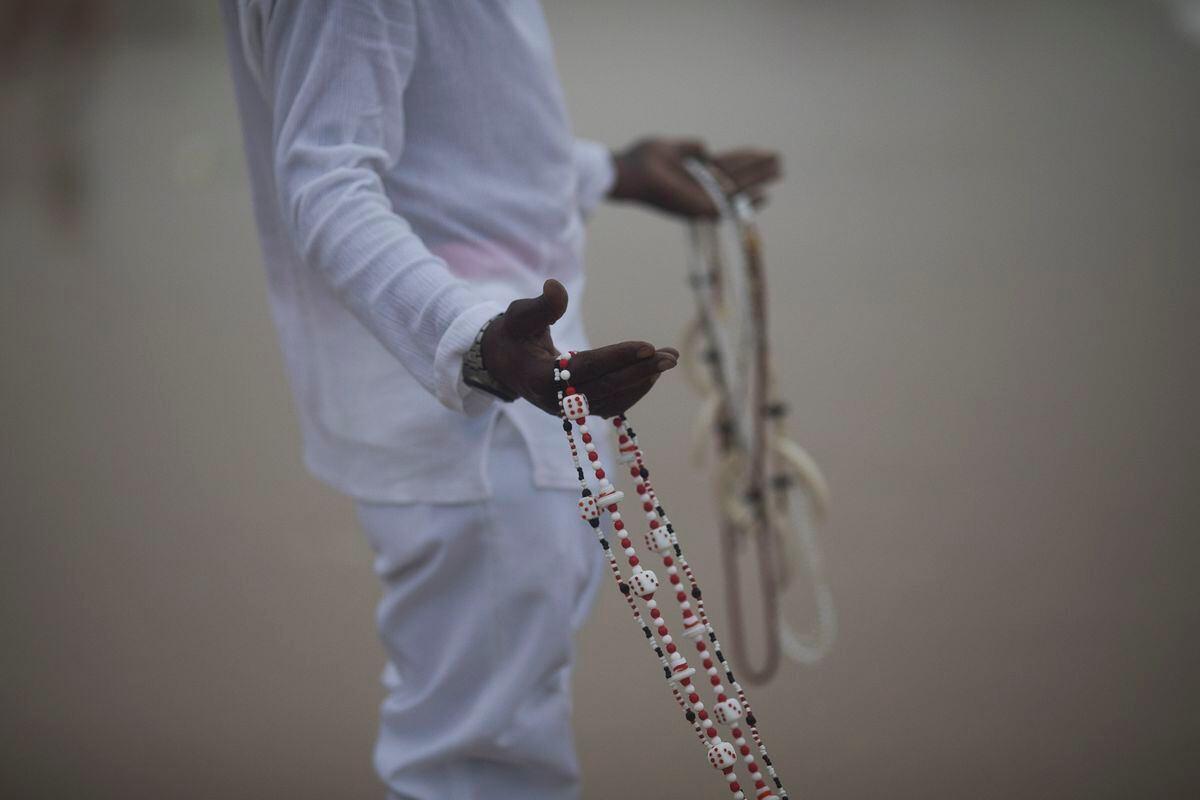

Un hombre reza durante una ceremonia para Yemanjá, que forma parte de las tradiciones en Río de Janeiro (Brasil). Leo Correa (AP)

Recientemente se celebró en São Paulo el festival de música The Town, de los mismos organizadores del Rock in Río. La noche de la puesta de largo, con cerca de 100.000 personas ansiosas por ver a Iggy Azalea, Post Malone o Demi Lovato, quedó deslucida por una persistente lluvia que provocó colas y aglomeraciones. Rápidamente surgieron algunas voces que achacaron el caos a la falta de un acuerdo de colaboración con la Fundación Cacique Cobra Coral, que representa a un espíritu a través del que promete controlar la meteorología. Es uno de los ejemplos de realismo mágico más conocidos entre los brasileños: si quieres que tu evento sea un éxito hay que contactar con Cobra Coral para garantizar que no llueva. Y no se trata de una curiosa superstición para parejas ansiosas porque luzca el sol el día de su boda. Detrás de esta creencia popular hay contratos, algo opacos, con empresas, Ayuntamientos y hasta ministerios.

El cacique Cobra Coral es un espíritu de la umbanda, una religión brasileña que mezcla elementos religiosos de tradición africana, indígena y católica. Quien la incorpora en sus carnes es Adelaide Scritori, que actúa como médium desde niña. Su marido y mano derecha, Osmar Santos, recibe peticiones de Gobiernos o empresas para promover cambios meteorológicos.

Una vez se firma el acuerdo, la médium recibe en su cuerpo a este indígena que, a pesar de ser norteamericano, se expresa en perfecto portugués. “Habla poco, va al grano. Cuando termina, ella [Scritori] no sabe nada de lo que ha dicho, no está consciente cuando habla”, explica su marido por teléfono. El también portavoz de la fundación resalta que el espíritu puede cambiar el tiempo, pero siempre que perciba que se debe a “un bien mayor”, no a un capricho. Si evita que llueva durante un festival, tendrá que desviar esas precipitaciones hacia algún lugar relativamente cercano que las necesite, por ejemplo.

El Ayuntamiento de Río está entre sus clientes más conocidos, sobre todo para asegurar el cielo limpio en las dos fechas marcadas en rojo en el calendario local: el fin de año, que congrega a cientos de miles de personas en la playa de Copacabana, y el aún más masivo Carnaval.

La colaboración entre el Ayuntamiento y la fundación Cobra Coral es pública y notoria, y de vez en cuando aparece en el Diario Oficial del municipio. El Ministerio de Minas y Energía recurrió hace dos años al cacique en medio de una grave sequía que llegó a poner en riesgo el suministro eléctrico en todo el país.

La mayoría de acuerdos se dan entre bambalinas y no queda muy claro cómo funcionan ni cuánto cuestan. Santos asegura tajantemente que no aceptan un céntimo de dinero público. Lo que se exige como contrapartida, dice, son obras de prevención de inundaciones, recuperación de manantiales, reforestación de la ribera de los ríos, etc. “El [espíritu del] cacique suele decir que no podemos ayudar a los hombres de manera permanente si hacemos por ellos lo que pueden hacer por sí mismos”, recalca. El espíritu tiene mucha conciencia ambiental y lleva décadas alertando, sin éxito, de los peligros del calentamiento global, lamenta Santos.

Con las empresas privadas los acuerdos funcionan de otra forma. La fundación se mantiene a través de Tunikito, un conglomerado familiar de seguros. Santos suele ofrecer asegurar a las empresas que buscan la actuación del cacique. En Río es conocida la fe que tiene en sus poderes Roberto Medina, el magnate creador del festival Rock in Río, aunque en los últimos años, con la empresa en manos de su hija Roberta, la colaboración espiritual parece haber quedado en un segundo plano.

Aun así, la fama del cacique permanece imbatible entre los organizadores de eventos al aire libre. Desde una de las principales productoras de la ciudad afirman de forma anónima: “Todos protegen a la entidad. Son muchos años de acuerdos. Los grandes productores de eventos no renuncian a su ayuda, es casi omnipresente”.

Santos confirma que prácticamente tiene el don de la ubicuidad. Explica que él, como interlocutor con el espíritu del cacique, se desplaza por Brasil y por medio mundo al encuentro de quienes requieren de su actuación. Con perfil discreto y escondido tras unas gafas oscuras, se posiciona en el lugar del evento y mira al cielo. Identifica las condiciones meteorológicas (presión atmosférica, humedad, viento, etc) y dialoga con los asesores científicos de la fundación para elaborar un informe para el espíritu, para que sepa cuál es el panorama y decida cómo actuar.

Los asesores de Cobra Coral incluyen a un técnico del estatal Instituto Nacional de Investigaciones Espaciales (INPE) y Rubens Villela, meteorólogo y profesor de la Universidad de São Paulo (USP). Esta colaboración entre la ciencia y una supuesta entidad sobrenatural, que quizá pondría los pelos de punta a muchos académicos del norte global, se vive en Brasil sin estridencias, más allá de alguna polémica puntual.

Hace 30 años, la Sociedad Brasileña de Meteorología procesó a la fundación por ejercicio ilegal de la profesión, pero la causa fue archivada. Al final, para evitar más problemas, Santos y Scritori crearon la agencia La Niña, inscrita en el consejo profesional y con permiso para firmar contratos.

Para Renzo Taddei, antropólogo de la Universidad Federal de São Paulo (Unifesp) y autor del libro Meteorólogos y profetas de la lluvia, en estas latitudes la dicotomía ciencia versus religión se queda pequeña. “A Brasil le gusta imaginarse y pensarse a sí mismo de una forma que no refleja mucho la realidad, sobre todo en eso de verse como un país occidental”, dice.

Taddei recuerda la huella que dejaron millones de africanos esclavizados y la fusión o convivencia de sus prácticas con creencias chamánicas, católicas, kardecistas o espíritas. “La espiritualidad brasileña no tiene nada que ver con la manera en que el mundo europeo imagina la religión. La pelea entre religión y ciencia de la época de Darwin en Inglaterra no se replica en Brasil. Quizá ahora está empezando un poco porque los evangélicos están creciendo muy rápido”, señala por teléfono.

El trabajo del cacique Cobra Coral es el caso más conocido por haber dado el salto al mundo empresarial e institucional, pero este especialista resalta que en la cosmovisión indígena, por ejemplo, es común dialogar con los espíritus para dominar las fuerzas de la naturaleza. En 1998 un incendio devastador devoraba la selva amazónica en el estado de Roraima. Brasil incluso recibió ayuda internacional, pero al final, las autoridades, desesperadas, recurrieron a dos chamanes de la etnia Kayapó. Tras dos días de rituales, casualidad o no, una lluvia torrencial logró frenar las llamas.

What do some Afro-Brazilian religions actually believe? (Washington Post)

 February 6 at 3:30 AM

Video

Candomblé is a Brazilian religion developed from animist beliefs, imported by African slaves. But the quasi-respectability gained in recent decades is now under attack from radical Evangelical Christians – a growing force in Catholic Brazil – who regard it as the devil’s work. (The Washington Post)

RIO DE JANEIRO — In its contemporary form, Brazil’s Candomblé religion looks about as removed from Western Christianity as could be imagined. It must have seemed positively diabolical, then, to the brutal Portuguese overlords whose slaves imported it from Africa, and whom they believed had been converted. Those slaves may have cleverly “synchronized” their own deities with Catholic saints to be able to continue worshiping, but they did not synchronize their beliefs.

This does not make Candomblé the devil’s work. It does not have the concept of heaven and hell, nor a rigid moral code in the sense that Christians would understand it. Instead, believers are supposed to fulfill their destiny, whatever that might be. Both men and women can become priests. Homosexuality is accepted, secretive animal sacrifices play an important role and the sexual lives of devotees are their own business when they are outside the walls of the Candomblé “house,” or center.

Decorative body paint, jewelry and costumes are part in a Candomble ceremony in Rio de Janeiro on Jan. 23. (Lianne Milton for The Washington Post)

There are elaborate theatrical rituals, with costumes and accessories that can include robes, small swords and shields, a mini archer’s bow, and even as witnessed in one ceremony in Rio, an elaborate silver helmet with a tiny figure on a plinth on top that looked like something a 19th-century Prussian army officer might have sported.

But these accoutrements are no more outlandish than a Catholic Mass might have appeared to an 19th-century African who had just been enslaved. Candomblé is a religion like any other, with its own rules, hierarchies and sense of the spiritual. This is true especially in Brazil, where the existence of spirituality and an afterlife is regarded as an incontestable truth by the majority of the population — be they Catholics, or followers of more esoteric, yet tolerated religions, such as the spiritualist sect that follows the teachings of 19th-century French writer Hippolyte Léon Denizard Rivail, who wrote the Spiritist Codification under the pseudonym Allan Kardec.

Or followers of both, because many Catholics have no problem also being spiritualists. Religious duality is popular in Brazil, one reason why some estimates put followers of Candomblé and its sister religion, Umbanda, in the tens of millions, not the official half a million or so who admitted to it in the 2010 government census.

Candomblé is an oral culture with no sacred text. There are seven Candomblé nations — or variations – such as Ketu and Angola, depending on which Brazilian state it developed in, and where in Africa the slaves practicing it came from. They believe in a supreme being, called Olódùmarè (whose name can be spelled with or without the accents). Beneath this god are 16 Orixás — deities, or entities — many of whom have characteristics that are distinctly human in nature.

Yemanjá, the sea goddess, is given gifts like flowers or champagne by millions of Brazilians every New Year’s Eve. She is sometimes associated with the Virgin Mary, but she is also famously vain.

The warrior Ogum is linked to Saint George — courageous and persistent, and popular in Brazil for these qualities.

Then there is a female Orixá of the wind, Iansã, who is — as might be expected in Brazil — a more sensual deity.

Nature is perhaps the single most important factor in Candomblé, and each Orixá is connected to an element. “All of them are responsible for a part of nature,” said Rodrigo Silva, “father-of-saint,” or priest of the Logun Edé Palace Candomblé center. It is not uncommon to see Candomblé being practiced on beaches, or in waterfalls. “Our gods are ecological gods,” said Beatriz Moreira Costa, 84, a revered priestess called Mother Beatá.

In its sister religion, Umbanda, invented in Rio in the early 20th century, both the Catholic God and reincarnation also play a part. “It is a Christian doctrine,” said Tábata Lugao, 27, a recent convert. Orixás and Catholic saints are synchronized — but Umbanda also has its own holy figures, such as Preto Velho, or “Old Black Man,” a wily old slave figure who smokes a pipe.

The mostly female, middle-age worshippers being “incorporated” by Preto Velho at a recent Umbanda ceremony in São Gonçalo, near Rio, drank beer and smoked cigars and appeared to be enjoying themselves enormously, but they also took their ceremony extremely seriously — another kind of quintessentially Brazilian religious duality.

Unlike Umbanda, Candomblé initiates spend 21 days in seclusion living in the center, before being initiated as Yaô (this can also be spelled in different ways). Then they can be “incorporated” by Orixás — and initiates have individual Orixás they must follow.

After seven years as a Yaô, they become an Egbomi, and can then decide if they want to progress to the highest stage, that of father-of-saint or mother-of-saint.

The musicians who play percussion and sing the songs in African languages at Candomblé ceremonies that aim to honor and conjure up the Orixás are another kind of Yaô, called Ogá.

This does not necessarily involve being righteous, and it is here, perhaps, that Candomblé is most controversial. Those priests who sell curses or spells, via lower-level spirits called Exús, prompt some of the prejudice that surrounds the religion. “There are those who have pleasure in doing bad, others who like to help,” said Silva.

His center, he emphasized, does not get involved in the darker side of Candomblé’s neighborhood witchcraft, pejoratively called Macumba in Brazil. “It was made to protect and help people who need this help,” he said. “We fight for peace.”

The World Cup 2014 in Brazil: better organised than the Olympics in London 2012? (FREE)

JUNE 26, 2014

Football Research in an Enlarged Europe (FREE)

Yesterday, I was quoted in a number of French newspapers as saying that the World Cup 2014 has been, so far, better organised than the London Olympics 2012. It is my duty to report that this does not in any way whatsoever misrepresent my views.
I stand by what I said.

There have been months, if not years, of negative reports on the 2014 World Cup. Before the event started, comments from all quarters (Western media, FIFA, patrons and waiters at the pub alike) promised absolute doom and gloom in Brazil. The stadia would not be ready in time, spectators would be prevented from travelling to the venues because the infrastructures would not be ready in time or because Brazilians would be protesting to no end. Most commentators were very short of saying ‘those lazy, unpatriotic and unreliable Brazilians’ – when they did not actually say it…

Unless I am mistaken, so far none of this has actually happened. All the stadia are ready and used for the Cup. Brazilians are exercising their democratic right to protest and there are isolated reports of Pelé or other football celebrities not making it to the venue. Yet, stadia are not only ready. They are full at every game! Even when South Korea is playing Algeria, in a game where the sporting stakes are not high.

Compare this with the London Olympics which were marred by a number of controversies:

We could add to the list of ‘things that went pearshaped at London 2012’: for example, the gatecrasher at the parade of nations which shocked many people in India, LOCOG displaying a South-Korean flag instead of North-Korea (logically the North-Korean team refused to warm up and play until the right flag was displayed, prompting the game to be very much delayed…) but the point is not to criticise otherwise relatively well organised Olympics. I don’t want to be unfair with the Brits either as there are often controversies surrounding the organisation of a mega event. Let’s just recall that, to my knowledge, the only international sporting event that had to change country because a stadium was not built in time, is the 2007 Athletics World Championship, planned in Wembley, London and which finally happened in Oslo. Once more, let’s be fair with Britain: construction delays are common in every country, and construction budgets almost invariably go overboard.

The point, instead, is to show the gap between reality and perception. Whenever an event is organised in a Southern country, the discourse, and the memory, is of potential fiascos, that have usually not materialised. Whenever an event is organised in a Northern country, the discourse, and the memory, is of success, even when there were actual fiascos.

Following Edward Said, we can call this ‘orientalisation’, and say that in a world where the East/West divide was replaced in the 1990s by a North-South divide,  this is the result of a distorted view that the Western/Northern media have of the Orient/South.

Let’s say things much more clearly: this is a xenophobic, or even racist, discourse.

David Ranc