Arquivo da tag: Geologia

First global study of the extraordinary role of animals as architects of Earth (Anthropocene Magazine)

First global study of the extraordinary role of animals as architects of Earth

Original article

Researchers calculated that creatures large and small rival the landscape reshaping power of half a million major floods each year.

By Warren Cornwall

February 26, 2025

The little red and brown termite Syntermes dirus might be less than an inch long. But it can literally move mountains.

The Brazilian insect as the chief architect of earthen mounds as much as four meters tall that carpet a section of eastern Brazil the size of Virginia. There, 90 million mounds represent earth moving equal to 900 of Egypt’s Great Pyramid. Their discovery prompted scientists in 2015 to declare it “ the greatest example of insect … ecosystem engineering at a landscape scale.”

The termite is a dramatic illustration of how organisms besides humans can reshape the earth’s surface, much like forces such as wind and water. But it’s not the only one. And their collective capacity to literally move the Earth is greater than previously known.

“The role of animals in shaping Earth’s landscapes is much more significant than previously recognized,” said Gemma Harvey, a scientist at Queen Mary University of London who studies how organisms interact with the Earth’s surface.

Harvey led research that recently unveiled an eye-popping estimate for just how much wild animals are influencing the planet’s soil and rocks. By their calculations, every year it’s at least equivalent to hundreds of thousands of major floods that sweep rocks and sediment downstream. And that, they say, is a conservative number. “These estimates,” the authors write, “are astounding.”

It’s not just termites getting into the act. There are some of the best known and most charismatic examples: beavers that dam entire valleys; salmon that dredge river bottoms for their nests; grizzly bears that excavate hillsides in search of roots.

But that, it turns out, is just a tiny fraction of all the critters busily moving earth to and fro. Harvey and colleagues counted nearly 500 wild species and five domesticated livestock where scientists have documented their ability to influence the shape of the landscape, from the lowly ant to the African elephant. In many cases, they amplify erosion. Hippopotamus trails, for instance, can become the seed for networks of creeks. In others, such as the termites, they can collect soil together to build structures. In many cases, it’s as simple as a creature such as a tortoise digging an underground burrow, which then paves the way for mice and crickets to add their little burrows to the maze. Don’t forget the roughly 20 quadrillion ants, many moving one grain of soil at a time. Add them all up, and it can become a subtle, planet-spanning, never-ending earthquake.

Adding them up is what Harvey and company did. The scientists tracked down studies for all the land and freshwater organisms whose earth-shaping powers had been measured. Then they used estimates of the global biomass of different types of animals, and factors such as the abundance of earth-moving species within those groups, to calculate the total biomass of the earth shapers (my terms, not theirs). They converted this biomass into calories to come up with their total energy content. Then the scientists made what they considered a conservative estimate that 1% of the organisms’ total energy was spent somehow influencing earth movement. They emerged from this mathematical thicket with the following pronouncement: These wild animals expend roughly 76,000 gigajoules per year shaping the Earth, the equivalent of more than half a million major river floods, a much more widely recognized force carving away at the Earth. “From beavers creating wetlands to ants building mounds of soil, these diverse natural processes are crucial, yet we risk losing them as biodiversity declines,” said Harvey.

And that’s just a fraction of the overall picture. By Harvey’s estimates, the effect of livestock – all those cows, goats, sheep and other hoofed creatures – dwarf the wild animals. Their land-moving power is roughly 450 times greater – 34.5 million gigajoules.

Then there are humans. The paper’s authors don’t calculate that. But when you add up our own biomass, plus all the energy we extract from the planet to drive bulldozers and other earth-moving machines, well … how big do you think that number is?

Harvey, et. al. “Global diversity and energy of animals shaping the Earth’s surface.” Proceedings of the National Academy of Sciences. Feb. 18, 2025.

Image: by ayeshafernando/Envato Elements

[For comparison: according to the graphic below, the energy related to human activity in 2023 was 619 exajoules. That means 619.000.000.000 gigajoules. The energy used in human activity is, therefore, around 10 million times higher than what is mentioned in the article. RT]

Ditching ‘Anthropocene’: why ecologists say the term still matters (Nature)

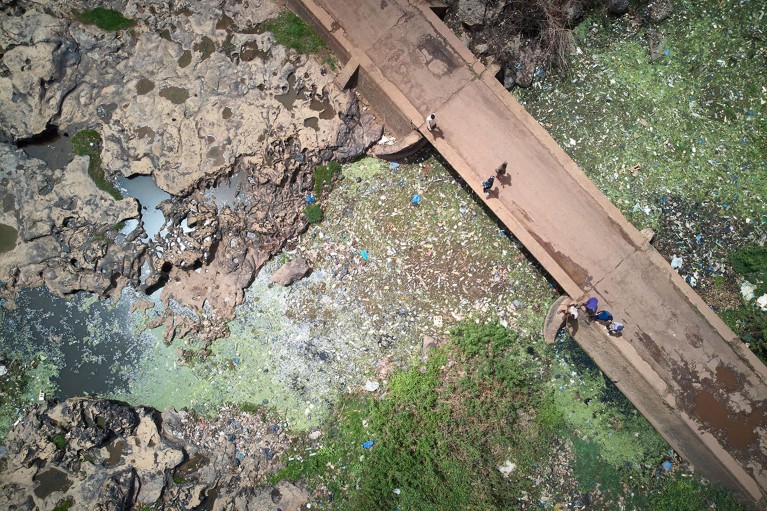
A aerial view of a section of the Niger river in Bamako clogged with plastic waste and other polluting materials.
Plastic waste is clogging the Niger River in Bamako, Mali. After it sediments, plastic will become part of the geological record of human impacts on the planet. Credit: Michele Cattani/AFP via Getty

Original article

Beyond stratigraphic definitions, the name has broader significance for understanding humans’ place on Earth.

David Adam

14 March 2024

After 15 years of discussion, geologists last week decided that the Anthropocene — generally understood to be the age of irreversible human impacts on the planet — will not become an official epoch in Earth’s geological timeline.

The rejected proposal would have codified the end of the current Holocene epoch, which has been in place since the end of the last ice age 11,700 years ago. It suggested that the Anthropocene started in 1952, when plutonium from hydrogen-bomb tests showed up in the sediment of Crawford Lake near Toronto, Canada.

The vote has drawn controversy over procedural details, and debate about its legitimacy continues. But whether or not it’s formally approved as a stratigraphic term, the idea of the Anthropocene is now firmly rooted in research. So, how are scientists using the term, and what does it mean to them and their fields?

‘It’s a term that belongs to everyone’

As head of the Leverhulme Centre for Anthropocene Biodiversity at the University of York, UK, Chris Thomas has perhaps more riding on the term than most. “When the news of this — what sounds like a slightly dodgy vote — happened, I sort of wondered, is it the end of us? But I think not,” he says.

For Thomas, the word Anthropocene neatly summarizes the sense that humans are part of Earth’s system and integral to its processes — what he calls indivisible connectedness. “That helps move us away from the notion that somehow humanity is apart from the rest of nature and natural systems,” he says. “It’s undoable — the change is everywhere.”

The concept of an era of human-driven change also provides convenient common ground for him to collaborate with researchers from other disciplines. “This is something that people in the arts and humanities and the social sciences have picked up as well,” he says. “It is a means of enabling communication about the extent to which we are living in a truly unprecedented and human-altered world.”

Seen through that lens, the fact that the Anthropocene has been formally rejected because scientists can’t agree on when it began seems immaterial. “Many people in the humanities who are using the phrase find the concept of the articulation of a particular year, based on a deposit in a particular lake, a ridiculous way of framing the concept of a human-altered planet.”

Jacquelyn Gill, a palaeoecologist at the University of Maine in Orono, agrees. “It’s a term that belongs to everyone. To people working in philosophy and literary criticism, in the arts, in the humanities, the sciences,” she says. “I think it’s far more meaningful in the way that it is currently being used, than in any attempts that stratigraphers could have made to restrict or define it in some narrow sense.”

She adds: “It serves humanity best as a loose concept that we can use to define something that we all widely understand, which is that we live in an era where humans are the dominant force on ecological and geological processes.”

Capturing human influences

The idea of the Anthropocene is especially helpful to make clear that humans have been shaping the planet for thousands of years, and that not all of those changes have been bad, Gill says. “We could do a better job of thinking about human–environment relationships in ways that are not inherently negative all the time,” she says. “People are not a monolith, and neither are our attitudes or relationships to nature.”

Some 80% of biodiversity is currently stewarded on Indigenous lands, Gill points out. “Which should tell you something, right? That it’s not the presence of people that’s the problem,” she says. “The solution to those problems is changing the way that many dominant cultures relate to the natural world.”

The concept of the Anthropocene is owned by many fields, Gill says. “This reiterates the importance of understanding that the role of people on our planet requires many different ways of knowing and many different disciplines.”

In a world in which the threat of climate change dominates environmental debates, the term Anthropocene can help to broaden the discussion, says Yadvinder Malhi, a biodiversity researcher at the University of Oxford, UK.

“I use it all the time. For me, it captures the time where human influence has a global planetary effect, and it’s multidimensional. It’s much more than just climate change,” he says. “It’s what we’re doing. The oceans, the resources we are extracting, habitats changing.”

He adds: “I need that term when I’m trying to capture this idea of humans affecting the planet in multiple ways because of the size of our activity.”

The looseness of the term is popular, but would a formal definition help in any way? Malhi thinks it would. “There’s no other term available that captures the global multidimensional impacts on the planet,” he says. “But there is a problem in not having a formal definition if people are using it in different terms, in different ways.”

Although the word ‘Anthropocene’ makes some researchers think of processes that began 10,000 years ago, others consider it to mean those of the past century. “I think a formal adoption, like a definition, would actually help to clarify that.”

doi: https://doi.org/10.1038/d41586-024-00786-2

The Anthropocene is dead. Long live the Anthropocene (Science)

Panel rejects a proposed geologic time division reflecting human influence, but the concept is here to stay

Original article

5 MAR 20244:00 PM ET

BY PAUL VOOSEN

A mushroom cloud rises in the night sky
A 1953 nuclear weapons test in Nevada was among the human activities that could have marked the Anthropocene. NNSA/NEVADA FIELD OFFICE/SCIENCE SOURCE

For now, we’re still in the Holocene.

Science has confirmed that a panel of two dozen geologists has voted down a proposal to end the Holocene—our current span of geologic time, which began 11,700 years ago at the end of the last ice age—and inaugurate a new epoch, the Anthropocene. Starting in the 1950s, it would have marked a time when humanity’s influence on the planet became overwhelming. The vote, first reported by The New York Times, is a stunning—though not unexpected—rebuke for the proposal, which has been working its way through a formal approval process for more than a decade.

“The decision is definitive,” says Philip Gibbard, a geologist at the University of Cambridge who is on the panel and serves as secretary-general of the International Commission on Stratigraphy (ICS), the body that governs the geologic timescale. “There are no outstanding issues to be resolved. Case closed.”

The leaders of the Anthropocene Working Group (AWG), which developed the proposal for consideration by ICS’s Subcommission on Quaternary Stratigraphy, are not yet ready to admit defeat. They note that the online tally, in which 12 out of 18 subcommission members voted against the proposal, was leaked to the press without approval of the panel’s chair. “There remain several issues that need to be resolved about the validity of the vote and the circumstances surrounding it,” says Colin Waters, a geologist at the University of Leicester who chaired AWG.

Few opponents of the Anthropocene proposal doubted the enormous impact that human influence, including climate change, is having on the planet. But some felt the proposed marker of the epoch—some 10 centimeters of mud from Canada’s Crawford Lake that captures the global surge in fossil fuel burning, fertilizer use, and atomic bomb fallout that began in the 1950s—isn’t definitive enough.

Others questioned whether it’s even possible to affix one date to the start of humanity’s broad planetary influence: Why not the rise of agriculture? Why not the vast changes that followed European encroachment on the New World? “The Anthropocene epoch was never deep enough to understand human transformation of this planet,” says Erle Ellis, a geographer at the University of Maryland, Baltimore County who resigned last year in protest from AWG.

Opponents also felt AWG made too many announcements to the press over the years while being slow to submit a proposal to the subcommission. “The Anthropocene epoch was pushed through the media from the beginning—a publicity drive,” says Stanley Finney, a stratigrapher at California State University Long Beach and head of the International Union of Geological Sciences, which would have had final approval of the proposal.

Finney also complains that from the start, AWG was determined to secure an “epoch” categorization, and ignored or countered proposals for a less formal Anthropocene designation. If they had only made their formal proposal sooner, they could have avoided much lost time, Finney adds. “It would have been rejected 10 years earlier if they had not avoided presenting it to the stratigraphic community for careful consideration.”

The Anthropocene backers will now have to wait for a decade before their proposal can be considered again. ICS has long instituted this mandatory cooling-off period, given how furious debates can turn, for example, over the boundary between the Pliocene and Pleistocene, and whether the Quaternary—our current geologic period, a category above epochs—should exist at all.

Even if it is not formally recognized by geologists, the Anthropocene is here to stay. It is used in art exhibits, journal titles, and endless books. And Gibbard, Ellis, and others have advanced the view that it can remain an informal geologic term, calling it the “Anthropocene event.” Like the Great Oxygenation Event, in which cyanobacteria flushed the atmosphere with oxygen billions of years ago, the Anthropocene marks a huge transition, but one without an exact date. “Let us work together to ensure the creation of a far deeper and more inclusive Anthropocene event,” Ellis says.

Waters and his colleagues will continue to press that the Anthropocene is worthy of recognition in the geologic timescale, even if that advocacy has to continue in an informal capacity, he says. Although small in size, Anthropocene strata such as the 10 centimeters of lake mud are distinct and can be traced using more than 100 durable geochemical signals, he says. And there is no going back to where the planet was 100 years ago, he says. “The Earth system changes that mark the Anthropocene are collectively irreversible.”


doi: 10.1126/science.z3wcw7b

Are We in the ‘Anthropocene,’ the Human Age? Nope, Scientists Say. (New York Times)

A panel of experts voted down a proposal to officially declare the start of a new interval of geologic time, one defined by humanity’s changes to the planet.

Four people standing on the deck of a ship face a large, white mushroom cloud in the distance.
In weighing their decision, scientists considered the effect on the world of nuclear activity. A 1946 test blast over Bikini atoll. Credit: Jack Rice/Associated Press

Original article

By Raymond Zhong

March 5, 2024

The Triassic was the dawn of the dinosaurs. The Paleogene saw the rise of mammals. The Pleistocene included the last ice ages.

Is it time to mark humankind’s transformation of the planet with its own chapter in Earth history, the “Anthropocene,” or the human age?

Not yet, scientists have decided, after a debate that has spanned nearly 15 years. Or the blink of an eye, depending on how you look at it.

A committee of roughly two dozen scholars has, by a large majority, voted down a proposal to declare the start of the Anthropocene, a newly created epoch of geologic time, according to an internal announcement of the voting results seen by The New York Times.

By geologists’ current timeline of Earth’s 4.6-billion-year history, our world right now is in the Holocene, which began 11,700 years ago with the most recent retreat of the great glaciers. Amending the chronology to say we had moved on to the Anthropocene would represent an acknowledgment that recent, human-induced changes to geological conditions had been profound enough to bring the Holocene to a close.

The declaration would shape terminology in textbooks, research articles and museums worldwide. It would guide scientists in their understanding of our still-unfolding present for generations, perhaps even millenniums, to come.

In the end, though, the members of the committee that voted on the Anthropocene over the past month were not only weighing how consequential this period had been for the planet. They also had to consider when, precisely, it began.

By the definition that an earlier panel of experts spent nearly a decade and a half debating and crafting, the Anthropocene started in the mid-20th century, when nuclear bomb tests scattered radioactive fallout across our world. To several members of the scientific committee that considered the panel’s proposal in recent weeks, this definition was too limited, too awkwardly recent, to be a fitting signpost of Homo sapiens’s reshaping of planet Earth.

“It constrains, it confines, it narrows down the whole importance of the Anthropocene,” said Jan A. Piotrowski, a committee member and geologist at Aarhus University in Denmark. “What was going on during the onset of agriculture? How about the Industrial Revolution? How about the colonizing of the Americas, of Australia?”

“Human impact goes much deeper into geological time,” said another committee member, Mike Walker, an earth scientist and professor emeritus at the University of Wales Trinity Saint David. “If we ignore that, we are ignoring the true impact, the real impact, that humans have on our planet.”

Hours after the voting results were circulated within the committee early Tuesday, some members said they were surprised at the margin of votes against the Anthropocene proposal compared with those in favor: 12 to four, with two abstentions. (Another three committee members neither voted nor formally abstained.)

Even so, it was unclear on Tuesday whether the results stood as a conclusive rejection or whether they might still be challenged or appealed. In an email to The Times, the committee’s chair, Jan A. Zalasiewicz, said there were “some procedural issues to consider” but declined to discuss them further. Dr. Zalasiewicz, a geologist at the University of Leicester, has expressed support for canonizing the Anthropocene.

This question of how to situate our time in the narrative arc of Earth history has thrust the rarefied world of geological timekeepers into an unfamiliar limelight.

The grandly named chapters of our planet’s history are governed by a body of scientists, the International Union of Geological Sciences. The organization uses rigorous criteria to decide when each chapter started and which characteristics defined it. The aim is to uphold common global standards for expressing the planet’s history.

A man stands next to a machine with tubing and lines of plastic that end up in a shallow pool of water.
Polyethylene being extruded and fed into a cooling bath during plastics manufacture, circa 1950. Credit: Hulton Archive, via Getty Images

Geoscientists don’t deny our era stands out within that long history. Radionuclides from nuclear tests. Plastics and industrial ash. Concrete and metal pollutants. Rapid greenhouse warming. Sharply increased species extinctions. These and other products of modern civilization are leaving unmistakable remnants in the mineral record, particularly since the mid-20th century.

Still, to qualify for its own entry on the geologic time scale, the Anthropocene would have to be defined in a very particular way, one that would meet the needs of geologists and not necessarily those of the anthropologists, artists and others who are already using the term.

That’s why several experts who have voiced skepticism about enshrining the Anthropocene emphasized that the vote against it shouldn’t be read as a referendum among scientists on the broad state of the Earth. “This was a narrow, technical matter for geologists, for the most part,” said one of those skeptics, Erle C. Ellis, an environmental scientist at the University of Maryland, Baltimore County. “This has nothing to do with the evidence that people are changing the planet,” Dr. Ellis said. “The evidence just keeps growing.”

Francine M.G. McCarthy, a micropaleontologist at Brock University in St. Catharines, Ontario, is the opposite of a skeptic: She helped lead some of the research to support ratifying the new epoch.

“We are in the Anthropocene, irrespective of a line on the time scale,” Dr. McCarthy said. “And behaving accordingly is our only path forward.”

The Anthropocene proposal got its start in 2009, when a working group was convened to investigate whether recent planetary changes merited a place on the geologic timeline. After years of deliberation, the group, which came to include Dr. McCarthy, Dr. Ellis and some three dozen others, decided that they did. The group also decided that the best start date for the new period was around 1950.

The group then had to choose a physical site that would most clearly show a definitive break between the Holocene and the Anthropocene. They settled on Crawford Lake, in Ontario, where the deep waters have preserved detailed records of geochemical change within the sediments at the bottom.

Last fall, the working group submitted its Anthropocene proposal to the first of three governing committees under the International Union of Geological Sciences. Sixty percent of each committee has to approve the proposal for it to advance to the next.

The members of the first one, the Subcommission on Quaternary Stratigraphy, submitted their votes starting in early February. (Stratigraphy is the branch of geology concerned with rock layers and how they relate in time. The Quaternary is the ongoing geologic period that began 2.6 million years ago.)

Under the rules of stratigraphy, each interval of Earth time needs a clear, objective starting point, one that applies worldwide. The Anthropocene working group proposed the mid-20th century because it bracketed the postwar explosion of economic growth, globalization, urbanization and energy use. But several members of the subcommission said humankind’s upending of Earth was a far more sprawling story, one that might not even have a single start date across every part of the planet.

Two cooling towers, a square building and a larger building behind it with smokestacks and industrial staircases on the outside.
The world’s first full-scale atomic power station in Britain in 1956. Credit: Hulton Archive, via Getty Images

This is why Dr. Walker, Dr. Piotrowski and others prefer to describe the Anthropocene as an “event,” not an “epoch.” In the language of geology, events are a looser term. They don’t appear on the official timeline, and no committees need to approve their start dates.

Yet many of the planet’s most significant happenings are called events, including mass extinctions, rapid expansions of biodiversity and the filling of Earth’s skies with oxygen 2.1 to 2.4 billion years ago.

Even if the subcommission’s vote is upheld and the Anthropocene proposal is rebuffed, the new epoch could still be added to the timeline at some later point. It would, however, have to go through the whole process of discussion and voting all over again.

Time will march on. Evidence of our civilization’s effects on Earth will continue accumulating in the rocks. The task of interpreting what it all means, and how it fits into the grand sweep of history, might fall to the future inheritors of our world.

“Our impact is here to stay and to be recognizable in the future in the geological record — there is absolutely no question about this,” Dr. Piotrowski said. “It will be up to the people that will be coming after us to decide how to rank it.”

Raymond Zhong reports on climate and environmental issues for The Times.

Latest News on Climate Change and the Environment

Protecting groundwater. After years of decline in the nation’s groundwater, a series of developments indicate that U.S. state and federal officials may begin tightening protections for the dwindling resource. In Nevada, Idaho and Montana, court decisions have strengthened states’ ability to restrict overpumping. California is considering penalizing officials for draining aquifers. And the White House has asked scientists to advise how the federal government can help.

Weather-related disasters. An estimated 2.5 million people were forced from their homes in the United States by weather-related disasters in 2023, according to new data from the Census Bureau. The numbers paint a more complete picture than ever before of the lives of people affected by such events as climate change supercharges extreme weather.

Amazon rainforest. Up to half of the Amazon rainforest could transform into grasslands or weakened ecosystems in the coming decades, a new study found, as climate change, deforestation and severe droughts damage huge areas beyond their ability to recover. Those stresses in the most vulnerable parts of the rainforest could eventually drive the entire forest ecosystem past a tipping point that would trigger a forest-wide collapse, researchers said.

A significant threshold. Over the past 12 months, the average temperature worldwide was more than 1.5 degrees Celsius, or 2.7 degrees Fahrenheit, higher than it was at the dawn of the industrial age. That number carries special significance, as nations agreed under the 2015 Paris Agreement to try to keep the difference between average temperatures today and in preindustrial times to 1.5 degrees Celsius, or at least below 2 degrees Celsius.

New highs. The exceptional warmth that first enveloped the planet last summer is continuing strong into 2024: Last month clocked in as the hottest January ever measured, and the hottest January on record for the oceans, too. Sea surface temperatures were just slightly lower than in August 2023, the oceans’ warmest month on the books.

Polémica con el Antropoceno: la humanidad todavía no sabe en qué época geológica vive (El País)

elpais.com

Un comité de expertos ha tumbado la propuesta de declarar un nuevo momento geológico, pero el propio presidente denuncia irregularidades en la votación

Manuel Ansede

Madrid –

Extracción de un testigo de sedimentos del fondo del lago Crawford, a las afueras de Toronto (Canadá). TIM PATTERSON / UNIVERSIDAD DE CARLETON

La idea del Antropoceno —que la humanidad vive desde 1950 en una nueva época geológica caracterizada por la contaminación humana— se ha hecho tan popular en los últimos años que hasta la Real Academia Española adoptó el término en el Diccionario de la Lengua en 2021. Los académicos se dieron esta vez demasiada prisa. El concepto sigue en el aire, en medio de una vehemente polémica entre especialistas. Miembros del comité de expertos que debe tomar la decisión en la Unión Internacional de Ciencias Geológicas (UICG) —la Subcomisión de Estratigrafía del Cuaternario— han filtrado este martes al diario The New York Times que han votado mayoritariamente en contra de reconocer la existencia del Antropoceno. Sin embargo, el presidente de la Subcomisión, el geólogo Jan Zalasiewicz, explica a EL PAÍS que el resultado preliminar de la votación se ha anunciado sin su autorización y que todavía quedan “algunos asuntos pendientes con los votos que hay que resolver”. La humanidad todavía no sabe en qué época geológica vive.

El químico holandés Paul Crutzen, ganador del Nobel de Química por iluminar el agujero de la capa de ozono, planteó en el año 2000 que el planeta había entrado en una nueva época, provocada por el impacto brutal de los seres humanos. Un equipo internacional de especialistas, el Grupo de Trabajo del Antropoceno, ha analizado los hechos científicos desde 2009 y el año pasado presentó una propuesta para proclamar oficialmente esta nueva época geológica, marcada por la radiactividad de las bombas atómicas y los contaminantes procedentes de la quema de carbón y petróleo. El diminuto lago Crawford, a las afueras de Toronto (Canadá), era el lugar indicado para ejemplificar el inicio del Antropoceno, gracias a los sedimentos de su fondo, imperturbados desde hace siglos.

La mayoría de los miembros de la Subcomisión de Estratigrafía del Cuaternario de la UICG ha votado en contra de la propuesta, según el periódico estadounidense. El geólogo británico Colin Waters, líder del Grupo de Trabajo del Antropoceno, explica a EL PAÍS que se ha enterado por la prensa. “Todavía no hemos recibido una confirmación oficial directamente del secretario de la Subcomisión de Estratigrafía del Cuaternario. Parece que The New York Times recibe los resultados antes que nosotros, es muy decepcionante”, lamenta Waters.

El geólogo reconoce que el dictamen, si se confirma, sería el fin de su propuesta actual, pero no se rinde. “Tenemos muchos investigadores eminentes que desean continuar como grupo, de manera informal, defendiendo las evidencias de que el Antropoceno debería ser formalizado como una época”, afirma. A su juicio, los estratos geológicos actuales —contaminados por isótopos radiactivos, microplásticos, cenizas y pesticidas— han cambiado de manera irreversible respecto a los del Holoceno, la época geológica iniciada hace más de 10.000 años, tras la última glaciación. “Dadas las pruebas existentes, que siguen aumentando, no me sorprendería un futuro llamamiento a reconsiderar nuestra propuesta”, opina Waters, de la Universidad de Leicester.

El jefe del Grupo de Trabajo del Antropoceno sostiene que hay “algunas cuestiones de procedimiento” que ponen en duda la validez de la votación. La geóloga italiana Silvia Peppoloni, jefa de la Comisión de Geoética de la UICG, confirma que su equipo ha realizado un informe sobre esta pelea entre la Subcomisión de Estratigrafía del Cuaternario y el Grupo de Trabajo del Antropoceno. El documento está sobre la mesa del presidente de la UICG, el británico John Ludden.

La geóloga canadiense Francine McCarthy estaba convencida de que el lago Crawford convencería a los escépticos. Desde fuera parece pequeño, con apenas 250 metros de largo, pero su profundidad roza los 25 metros. Sus aguas superficiales no se mezclan con las de su lecho, por lo que el suelo del fondo se puede analizar como una lasaña, en la que cada capa acumula sedimentos procedentes de la atmósfera. Ese calendario subacuático del lago Crawford revela la denominada Gran Aceleración, el momento alrededor de 1950 en el que la humanidad empezó a dejar una huella cada vez más evidente, con el lanzamiento de bombas atómicas, la quema masiva de petróleo y carbón y la extinción de especies.

“Ignorar el enorme impacto de los humanos en nuestro planeta desde mediados del siglo XX tiene potencialmente consecuencias dañinas, al minimizar la importancia de los datos científicos para hacer frente al evidente cambio en el sistema de la Tierra, como ya señaló Paul Crutzen hace casi 25 años”, advierte McCarthy.

Em votação, cientistas negam que estejamos no Antropoceno, a época geológica dos humanos (Folha de S.Paulo)

www1.folha.uol.com.br

Grupo rejeitou que mudanças sejam profundas o bastante para encerrar o Holoceno

Raymond Zhong

5 de março de 2024


O Triássico foi o amanhecer dos dinossauros. O Paleogeno viu a ascensão dos mamíferos. O Pleistoceno incluiu as últimas eras glaciais.

Está na hora de marcar a transformação da humanidade no planeta com seu próprio capítulo na história da Terra, o “Antropoceno”, ou a época humana?

Ainda não, decidiram os cientistas, após um debate que durou quase 15 anos. Ou um piscar de olhos, dependendo do ângulo pelo qual você olha.

Um comitê de cerca de duas dezenas de estudiosos votou, em grande maioria, contra uma proposta de declarar o início do Antropoceno, uma época recém-criada do tempo geológico, de acordo com um anúncio interno dos resultados da votação visto pelo The New York Times.

Pela linha do tempo atual dos geólogos da história de 4,6 bilhões de anos da Terra, nosso mundo agora está no Holoceno, que começou há 11,7 mil anos com o recuo mais recente dos grandes glaciares.

Alterar a cronologia para dizer que avançamos para o Antropoceno representaria um reconhecimento de que as mudanças recentes induzidas pelo homem nas condições geológicas foram profundas o suficiente para encerrar o Holoceno.

A declaração moldaria a terminologia em livros didáticos, artigos de pesquisa e museus em todo o mundo. Orientaria os cientistas em sua compreensão do nosso presente ainda em desenvolvimento por gerações, talvez até por milênios.

No fim das contas, porém, os membros do comitê que votaram sobre o Antropoceno nas últimas semanas não estavam apenas considerando o quão determinante esse período havia sido para o planeta. Eles também tiveram que considerar quando, precisamente, ele começou.

Pela definição que um painel anterior de especialistas passou quase uma década e meia debatendo e elaborando, o Antropoceno começou na metade do século 20, quando testes de bombas nucleares espalharam material radioativo por todo o nosso mundo.

Para vários membros do comitê científico que avaliaram a proposta do painel nas últimas semanas, essa definição era muito limitada, muito recente e inadequada para ser um marco adequado da remodelação do Homo sapiens no planeta Terra.

“Isso restringe, confina, estreita toda a importância do Antropoceno”, disse Jan A. Piotrowski, membro do comitê e geólogo da Universidade de Aarhus, na Dinamarca. “O que estava acontecendo durante o início da agricultura? E a Revolução Industrial? E a colonização das Américas, da Austrália?”

“O impacto humano vai muito mais fundo no tempo geológico”, disse outro membro do comitê, Mike Walker, cientista da Terra e professor emérito da Universidade de Gales Trinity Saint David. “Se ignorarmos isso, estamos ignorando o verdadeiro impacto que os humanos têm em nosso planeta.”

Horas após a circulação dos resultados da votação dentro do comitê nesta terça-feira (5) de manhã, alguns membros disseram que ficaram surpresos com a margem de votos contra a proposta do Antropoceno em comparação com os a favor: 12 a 4, com 2 abstenções.

Mesmo assim, nesta terça de manhã não ficou claro se os resultados representavam uma rejeição conclusiva ou se ainda poderiam ser contestados ou apelados. Em um e-mail para o Times, o presidente do comitê, Jan A. Zalasiewicz, disse que havia “algumas questões procedimentais a considerar”, mas se recusou a discuti-las mais a fundo.

Zalasiewicz, geólogo da Universidade de Leicester, expressou apoio à canonização do Antropoceno.

Essa questão de como situar nosso tempo na narrativa da história da Terra colocou o mundo dos guardiões do tempo geológico sob uma luz desconhecida.

Os capítulos grandiosamente nomeados da história de nosso planeta são governados por um grupo de cientistas, a União Internacional de Ciências Geológicas. A organização usa critérios rigorosos para decidir quando cada capítulo começou e quais características o definiram. O objetivo é manter padrões globais comuns para expressar a história do planeta.

Os geocientistas não negam que nossa era se destaca dentro dessa longa história. Radionuclídeos de testes nucleares. Plásticos e cinzas industriais. Poluentes de concreto e metal. Aquecimento global rápido. Aumento acentuado de extinções de espécies. Esses e outros produtos da civilização moderna estão deixando vestígios inconfundíveis no registro mineral, especialmente desde meados do século 20.

Ainda assim, para se qualificar para a entrada na escala de tempo geológico, o Antropoceno teria que ser definido de uma maneira muito específica, que atendesse às necessidades dos geólogos e não necessariamente dos antropólogos, artistas e outros que já estão usando o termo.

Por isso, vários especialistas que expressaram ceticismo quanto à consagração do Antropoceno enfatizaram que o voto contra não deve ser interpretado como um referendo entre cientistas sobre o amplo estado da Terra.

“Este é um assunto específico e técnico para os geólogos, em sua maioria”, disse um desses céticos, Erle C. Ellis, um cientista ambiental da Universidade de Maryland. “Isso não tem nada a ver com a evidência de que as pessoas estão mudando o planeta”, afirmou Ellis. “A evidência continua crescendo.”

Francine M.G. McCarthy, micropaleontóloga da Universidade Brock em St. Catharines, Ontário (Canadá), é tem visão oposta: ela ajudou a liderar algumas das pesquisas para apoiar a ratificação da nova época.

“Estamos no Antropoceno, independentemente de uma linha na escala de tempo”, disse McCarthy. “E agir de acordo é o nosso único caminho a seguir.”

A proposta do Antropoceno teve início em 2009, quando um grupo de trabalho foi convocado para investigar se as recentes mudanças planetárias mereciam um lugar na linha do tempo geológica.

Após anos de deliberação, o grupo, que passou a incluir McCarthy, Ellis e cerca de três dezenas de outros, decidiu que sim. O grupo também decidiu que a melhor data de início para o novo período era por volta de 1950.

O grupo então teve que escolher um local físico que mostrasse de forma mais clara uma quebra definitiva entre o Holoceno e o Antropoceno. Eles escolheram o Lago Crawford, em Ontário, no Canadá, onde as águas profundas preservaram registros detalhados de mudanças geoquímicas nos sedimentos do fundo.

No outono passado, o grupo de trabalho enviou sua proposta do Antropoceno para o primeiro dos três comitês governantes da União Internacional de Ciências Geológicas —60% de cada comitê precisam aprovar a proposta para que ela avance para o próximo.

Os membros do primeiro comitê, a Subcomissão de Estratigrafia do Quaternário, enviaram seus votos a partir do início de fevereiro. (Estratigrafia é o ramo da geologia que se dedica ao estudo das camadas de rocha e como elas se relacionam no tempo. O Quaternário é o período geológico em curso que começou há 2,6 milhões de anos.)

De acordo com as regras da estratigrafia, cada intervalo de tempo da Terra precisa de um ponto de partida claro e objetivo, que se aplique em todo o mundo. O grupo de trabalho do Antropoceno propôs meados do século 20 porque isso abrangia a explosão do crescimento econômico pós-guerra, a globalização, a urbanização e o uso de energia.

Mas vários membros da subcomissão disseram que a transformação da humanidade na Terra era uma história muito mais abrangente, que talvez nem tenha uma única data de início em todas as partes do planeta.

Por isso, Walker, Piotrowski e outros preferem descrever o Antropoceno como um “evento”, não como uma “época”. Na linguagem da geologia, eventos são um termo mais amplo. Eles não aparecem na linha do tempo oficial, e nenhum comitê precisa aprovar suas datas de início.

No entanto, muitos dos acontecimentos mais significativos do planeta são chamados de eventos, incluindo extinções em massa, expansões rápidas da biodiversidade e o preenchimento dos céus da Terra com oxigênio há 2,1 bilhões a 2,4 bilhões de anos.

Mesmo que o voto da subcomissão seja mantido e a proposta do Antropoceno seja rejeitada, a nova época ainda poderá ser adicionada à linha do tempo em algum momento posterior. No entanto, terá que passar por todo o processo de discussão e votação novamente.

Transição para energias renováveis também terá impacto no planeta, diz cientista (Folha de S.Paulo)

www1.folha.uol.com.br

Lucas Lacerda

9.mai.2023 às 18h54


A busca por energias mais limpas, um dos principais desafios para reduzir emissões de gases-estufa e enfrentar as mudanças climáticas, também vai custar recursos ao planeta. Oito bilhões de seres humanos detêm, juntos, um poder de impacto que vai deixar as marcas dessa decisão —seja ela tomada ou não.

É o que afirma o geólogo Colin Waters, secretário do AWG, sigla em inglês para Grupo de Trabalho do Antropoceno. Formado por 40 cientistas, o coletivo se prepara para apresentar, em junho, uma proposta para o “golden spike”, ponto em algum lugar da Terra que servirá de base para a definição do Antropoceno, a chamada “época dos humanos”.

Para os cientistas do AWG, a nova época geológica da Terra é marcada pela atividade humana, com a expansão da produção industrial e a elevação do consumo em cadeia global. Seu ponto de início é debatido desde 2009 pelos pesquisadores do grupo.

Waters, professor na Universidade de Leicester, no Reino Unido, tem sido o porta-voz do AWG para traduzir as implicações de uma nova época no planeta e por que isso é importante. Nesta semana, ele visita o Brasil pela primeira vez, para participar da reunião magna de 2023 da Academia Brasileira de Ciências, no Rio de Janeiro.

O evento acontece no Museu do Amanhã, com entrada grátis. Waters dará palestra às 11h30 desta quarta (10).

“Nosso pequeno grupo de trabalho sabe que há evidência científica [do Antropoceno]. Tudo que podemos fazer é usar isso para guiar nossas decisões. Como isso vai ser usado pelas pessoas é papel de políticos”, afirma Waters, em entrevista exclusiva à Folha. “Mas você começa a se perguntar: como lidamos com esse planeta que está mudando?”

Popularizado no início dos anos 2000 pelo vencedor do Nobel Paul Crutzen, o Antropoceno seria uma nova época geológica, que substituiria o atual Holoceno, iniciado após a última era do gelo, há 11,7 mil anos.

A década de 1950 se firmou nas discussões como o ponto de início do Antropoceno em razão do aumento generalizado da queima de combustíveis fósseis, da realização de testes nucleares feitos a céu aberto, espalhando quantidades de plutônio pelo mundo, além das detonações de bombas de hidrogênio.

A ideia inicial de Crutzen sobre o começo do Antropoceno apontava para a revolução industrial, na Inglaterra, no século 18. Mas, naquela etapa, diz Waters, a revolução acontecia na Europa, e para se espalhar levaria boa parte de um século.

“Quanto mais investigamos, mais perto chegamos da década de 1950. Todos passavam por grandes mudanças na economia e no grau de industrialização. Temos a China decolando entre os anos 1950 e 1960”, explica. “E mesmo a Amazônia estaria ao alcance da contaminação atmosférica por partículas da queima de combustíveis fósseis.”

E por que não em 1949? “Porque há uma gradação”, diz o geólogo. “As evidências apontam para uma mudança drástica no meio do século 20.”

Além de pesquisar o marco temporal, é preciso achar um lugar no planeta —o chamado “golden spike”— que possa ser comparado a outros locais para identificar os sedimentos de poluição deixados pela atividade humana.

A proposta para a definição desse marcador, que deve ser feita em junho, vai escolher um entre 12 locais, que incluem lagos, gelo no Ártico ou corais. Os últimos, segundo o pesquisador, são bons candidatos porque permitem a visualização anual da mudança de partículas.

Após a decisão do grupo, o tema será votado em outras três instâncias. A última, que vai ratificar a decisão, é a União Internacional de Ciências Geológicas.

O desafio atual consiste no fato de que definir uma época geológica sempre foi uma tarefa de olhar para o passado —e continua sendo, já que geólogos analisam sedimentos e fósseis—, mas agora há uma outra escala temporal em questão.

“Uma das boas coisas é que a ciência de hoje permite monitorar esses efeitos quase em tempo real”, diz Waters.

E esses efeitos dizem respeito a como o planeta se calibra após eventos geológicos como um degelo em larga escala. “Erupções vulcânicas massivas, por exemplo, lançam uma quantidade enorme de gases estufa na atmosfera, com alta rápida, num tempo geológico, de temperatura.”

A partir daí, o planeta passa por um período de adaptação, com o equilíbrio de temperatura e do nível de oceanos. “Esses níveis se recuperam, mas a biologia, não. As espécies, nessa mudança dramática, se perdem, enquanto o planeta pode voltar a se parecer com o que era 100 mil anos antes”, destaca.

Para exemplificar os riscos que vivemos hoje, Waters relembra que a mudança desde a última glaciação, que definiu a passagem do Pleistoceno (iniciado há cerca de 1,8 milhão de anos), era gradual até que se tornou intensa a ponto de extinguir espécies e redesenhar o mundo.

No entanto, na visão do geólogo, a humanidade tem hoje capacidades tecnológicas que podem ser usadas para reduzir a emissão de gases que levam às mudanças climáticas.

“O problema é saber como manejar o destino dessa trajetória, porque temos poderes para isso. Sabemos quais são os problemas.

O pesquisador alerta ainda para o custo dessas decisões. “Temos oito bilhões de pessoas que vivem e buscam um certo padrão de vida. Mesmo se fizermos isso com recursos mais sustentáveis, vamos precisar de materiais cuja extração, como a de minérios, terá um efeito verificável no planeta.

O projeto Planeta em Transe é apoiado pela Open Society Foundations.

Cientistas vão sugerir local de referência para o Antropoceno nesta terça-feira (Folha de S.Paulo)

www1.folha.uol.com.br

11.jul.2023 às 9h01

3–4 minutes


A ideia de que humanos já teriam causado um impacto suficiente para marcar uma diferença geológica no planeta está mais perto de se concretizar. Nesta terça-feira (11), um grupo de geólogos vai apresentar sua sugestão de ponto de referência para o Antropoceno, o chamado “golden spike”.

Esse ponto será usado para comparar as diferenças entre os sedimentos e, no caso do Antropoceno, concentrações distintas de poluentes produzidos pela atividade humana.

Em relação ao tempo, o marco mais aceito até o momento pelos pesquisadores é o dos anos 1950. O período tem sido sugerido, após mais de uma década de debates, por causa do aumento, em escala mundial, da produção industrial e da elevação do consumo, além de testes nucleares que espalharam partículas plutônio pelo mundo.

Como o plutônio não ocorre naturalmente nessas quantidades, identificar sua presença no fundo de lagos, por exemplo, é visto como um bom referencial para estudos.

Esse marco temporal é proposto para retratar a passagem do Holoceno —até agora tido como a nossa época geológica atual, iniciada período da última glaciação, há 11,7 mil anos— para o Antropoceno.

As muitas localidades possíveis para o “golden spike” foram sendo gradativamente reduzidas, até sobrarem nove, que incluem lagos, gelo no Ártico ou corais. Os últimos, por exemplo, seriam bons candidatos porque seu crescimento é anual, e permitiriam a visualização também anual da mudança de partículas.

Definir uma época parte de evidências científicas, mas há também uma dimensão simbólica nessa decisão. Segundo especialistas, ela pode ajudar a promover reflexão sobre como queremos lidar com um planeta que está sofrendo efeitos de mudanças climáticas e um aquecimento generalizado, por exemplo.

Outro ponto de atenção é como a nossa “pegada” sempre vai se manifestar no planeta. Mudar as matrizes de energia para reduzir o uso de combustíveis fósseis também terá um impacto relevante no planeta.

O processo não termina nesta terça. Após a apresentação da proposta, a sugestão do AWG (sigla em inglês para o Grupo de Trabalho do Antropoceno) precisa ser validada pela Comissão Internacional de Estratigrafia, antes de ser votada na União Internacional de Ciências Geológicas.

Para a nova época ser aprovada, é necessário haver ao menos 60% de aprovação em cada instância.

Ciência Fundamental: O Antropoceno dá um passo à frente (Folha de S.Paulo)

www1.folha.uol.com.br

Ciência Fundamental

11 de julho de 2023


Uma revolução fervilha, em fogo baixo, no mundo da geologia. E um anúncio dessa terça-feira, 11 de julho, acaba de aumentar a intensidade da chama: pesquisadores do Grupo de Trabalho do Antropoceno (AWG, na sigla em inglês) elegeram um ponto de referência geológica para demonstrar o advento da “época dos humanos”, ou Antropoceno.

Na prática, é um avanço na decisão sobre se o Antropoceno deve entrar ou não na escala de tempo geológico que demarca oficialmente eras, períodos, épocas e outros intervalos da idade da Terra como conhecemos.

Ilustração: Clarice Wenzel, Instituto Serrapilheira

De uma lista de 12 sítios geológicos que poderiam comprovar o surgimento da nova época, pesquisadores do AWG escolheram o lago Crawford — situado numa reserva natural ao sul de Ontário, no Canadá — como representante físico da mudança.

Com base em amostras coletadas em 2019 e 2022, um grupo de pesquisadores fez uma importante descoberta: as águas no fundo daquele lago continham oxigênio. Segundo a paleoclimatóloga Francine McCarthy — pesquisadora da Brock University, no Canadá, e coordenadora dos estudos no local —, encontrar oxigênio lá foi importante porque, assim, as camadas de rocha no leito do lago “conseguiram gravar, muito claramente, traços de plutônio liberado na detonação de bombas nucleares no início dos anos 1950” — marco temporal proposto como ponto de partida para o Antropoceno.

Para cravar um marco novo na cronologia geológica, os cientistas devem, antes de mais nada, recolher diversas amostras de rocha — e elas precisam espelhar uma grande mudança que tenha acontecido simultaneamente em escala global. No caso do Antropoceno, a explosão de bombas de hidrogênio poderia ser esse grande evento, já que nenhum continente escapou da radioatividade dessas explosões.

Uma vez eleita a amostra mais significativa, a discussão muda de patamar e é encaminhada para instâncias superiores. Agora a proposta do AWG precisa ser aprovada pela União Internacional de Ciências Geológicas, quando então a nomenclatura se tornará oficial. “A exigência de passar por três níveis de votação obriga a proposta a ser muito sólida. É um processo muito conservador, e há uma razão para tanto: não se pode formalizar uma unidade [estratigráfica] sem o apoio de evidências robustas,” diz o geólogo Colin Waters, coordenador do AWG.

Popularizado em 2000 pelo biólogo Eugene Stoermer e pelo Nobel de Química Paul Crutzen, o termo Antropoceno deriva do grego — combinação de anthropos (humano) e ceno (novo) — e batiza uma nova divisão geológica, na qual as atividades humanas tiveram um impacto decisivo na mudança ambiental. Assim a Terra deixa para trás o Holoceno, iniciado no fim da última glaciação, há cerca de 11.700 anos.

Foi no Holoceno que a humanidade conseguiu seus maiores avanços, da criação de sistemas de agricultura a progressos no âmbito da política e da economia, passando pelo surgimento da escrita e da ciência. “Como o clima no Holoceno se manteve extraordinariamente estável, a Europa, sobretudo no Renascimento, se deu o luxo de criar uma filosofia que não levava a natureza em conta, como se apenas a relação entre humanos fosse decisiva,” diz Renzo Taddei, professor de antropologia da Universidade Federal de São Paulo (Unifesp).

Por isso Taddei, que vem se debruçando sobre o tema há quase duas décadas, considera o Antropoceno uma “virada de chave” dramática, já que confere protagonismo à natureza na esfera do pensamento humano. “O Antropoceno nos mostra que o otimismo renascentista com relação à técnica, ao domínio da natureza e posteriormente ao capitalismo industrial era uma ilusão”, ele acrescenta.

Para o físico e historiador da ciência Jürgen Renn, diretor do Instituto Max Planck para a História da Ciência, em Berlim, um dos grandes desafios que a possível nova época propõe é fazer “uma geologia do presente”: abrir um novo capítulo no livro geológico enquanto testemunhamos a escrita dessa nova página — ou camada estratigráfica. Além disso, pelas perguntas filosóficas e questionamentos que suscita, a nova época “cria uma ponte entre as ciências naturais e as humanidades”.

Taddei observa que, enquanto a geologia decide se oficializa o termo ou não, disciplinas como a filosofia e a própria antropologia adotaram-no imediatamente. O conceito não é perfeito, ele diz, “mas consegue encapsular nossa relação disfuncional com o planeta em múltiplas dimensões”. Não porque tomamos consciência de que a reflexão era necessária, mas porque a natureza a impôs, com seu equilíbrio alterado e eventos extremos cada vez mais frequentes e intensos.

“O Antropoceno nos pegou desavisados. Vejo essa época como um imenso ‘tapa na cara’ da arrogância ocidental moderna, que efetivamente julgava estar resolvendo todos os problemas históricos,” conclui o antropólogo.

*

Meghie Rodrigues é jornalista de ciência.

O blog Ciência Fundamental é editado pelo Serrapilheira, um instituto privado, sem fins lucrativos, que promove a ciência no Brasil. Inscreva-se na newsletter do Serrapilheira para acompanhar as novidades do instituto e do blog.

When Did the Anthropocene Start? Scientists Closer to Saying When. (N.Y. Times)

nytimes.com


Image credits: Alamy; David Guttenfelder for The New York Times; Getty Images; Ashley Gilbertson for The New York Times; Michael Probst/Associated Press; Getty Images; NASA

A panel of experts has spent more than a decade deliberating on how, and whether, to mark a momentous new epoch in geologic time: our own.

Raymond Zhong

Dec. 17, 2022

The official timeline of Earth’s history — from the oldest rocks to the‌ dinosaurs to the rise of primates, from the Paleozoic to the Jurassic and all points before and since — could soon include the age of nuclear weapons, human-caused climate change and the proliferation of plastics, garbage and concrete across the planet.

In short, the present.

Ten thousand years after our species began forming primitive agrarian societies, a panel of scientists on Saturday took a big step toward declaring a new interval of geologic time: the Anthropocene, the age of humans.

Our current geologic epoch, the Holocene, began 11,700 years ago with the end of the last big ice age. The panel’s roughly three dozen scholars appear close to recommending that, actually, we have spent the past few decades in a brand-new time unit, one characterized by human-induced, planetary-scale changes that are unfinished but very much underway.

“If you were around in 1920, your attitude would have been, ‘Nature’s too big for humans to influence,’” said Colin N. Waters, a geologist and chair of the Anthropocene Working Group, the panel that has been deliberating on the issue since 2009. The past century has upended that thinking, Dr. Waters said. “It’s been a shock event, a bit like an asteroid hitting the planet.”

The working group’s members on Saturday completed the first in a series of internal votes on details including when exactly they believe the Anthropocene began. Once these votes are finished, which could be by spring, the panel will submit its final proposal to three other committees of geologists whose votes will either make the Anthropocene official or reject it.

Sixty percent of each committee will need to approve the group’s proposal for it to advance to the next. If it fails in any of them, the Anthropocene might not have another chance to be ratified for years.

If it makes it all the way, though, geology’s amended timeline would officially recognize that humankind’s effects on the planet had been so consequential as to bring the previous chapter of Earth’s history to a close. It would acknowledge that these effects will be discernible in the rocks for millenniums.

Source: Syvitski, et al. (2020)
By Mira Rojanasakul/The New York Times

“I teach the history of science — you know, Copernicus, Kepler, Galileo,” said Francine McCarthy, an earth scientist at Brock University in Canada and member of the working group. “We’re actually doing it,” she said. “We’re living the history of science.”

Still, the knives are out for the Anthropocene, even though, or maybe because, we all have such firsthand familiarity with it.

Stanley C. Finney, the secretary general of the International Union of Geological Sciences, fears the Anthropocene has become a way for geologists to make a “political statement.”

Within the vast expanse of geologic time, he notes, the Anthropocene would be a blip of a blip of a blip. Other geologic time units are useful because they orient scientists in stretches of deep time that left no written records and sparse scientific observations. The Anthropocene, by contrast, would be a time in Earth’s history that humans have already been documenting extensively.

“For the human transformation, we don’t need those terminologies — we have exact years,” said Dr. Finney, whose committee would be the last to vote on the working group’s proposal if it gets that far.

Martin J. Head, a working group member and earth scientist at Brock University, argues declining to recognize the Anthropocene would have political reverberations, too.

“People would say, ‘Well, does that then mean the geological community is denying that we have changed the planet drastically?’” he said. “We would have to justify our decision either way.”

Philip L. Gibbard, a geologist at the University of Cambridge, is secretary general of another of the committees that will vote on the working group’s proposal. He has serious concerns about how the proposal is shaping up, concerns he believes the wider geological community shares.

“It won’t get an easy ride,” he said.

A 19th century black-and-white print of five men in what appears to be a cave. One stands about knee-deep in a hole. The other four are examining a dinosaur skull.
Nineteenth-century fossil hunters. The rock record is full of gaps, “a jigsaw puzzle with many of the parts missing,” one geologist said. Credit: Oxford Science Archive/Print Collector, via Getty Images

Like the zoologists who regulate the names of animal species or the astronomers who decide what counts as a planet, geology’s timekeepers work conservatively, by design. They set classifications that will be reflected in academic studies, museums and textbooks for generations to come.

“Everybody picks on the Anthropocene Working Group because they’ve taken so long,” said Lucy E. Edwards, a retired scientist with the United States Geological Survey. “In geologic time, this isn’t long.”

The geologic time scale divides Earth’s 4.6 billion-year story into grandly named chapters. Like nesting dolls, the chapters contain sub-chapters, which themselves contain sub-sub-chapters. From largest to smallest, the chapters are called eons, eras, periods, epochs and ages.

Right now, according to the current timeline, we are in — deep breath — the Meghalayan Age of the Holocene Epoch of the Quaternary Period of the Cenozoic Era of the Phanerozoic Eon, and have been for 4,200 years.

Drawing lines in Earth time has never been easy. The rock record is full of gaps, “a jigsaw puzzle with many of the parts missing,” as Dr. Gibbard puts it. And most global-scale changes happen gradually, making it tricky to pinpoint when one chapter ended and the next one began. There haven’t been many moments when the entire planet changed at once.

“If a meteor hits the Yucatán Peninsula, that’s a pretty good marker,” Dr. Edwards said. “But other than that, there’s practically nothing out there in the geologic world that’s the best line.”

The early Cambrian Period, around 540 million years ago, saw Earth explode with an astonishing diversity of animal life, but its precise starting point has been contested for decades. A long controversy led to the redrawing of our current geologic period, the Quaternary, in 2009.

“It’s a messy and disputatious business,” said Jan A. Zalasiewicz, a geologist at the University of Leicester. “And of course, the Anthropocene brings a whole new range of dimensions to the messiness and disputatiousness.”

A nuclear test near the Marshall Islands in 1958. A working group proposed the mid-20th century as the beginning of the Anthropocene, in part because of the plutonium isotopes left by bombs. Credit: Corbis, via Getty Images

It took a decade of debate — in emails, academic articles and meetings in London, Berlin, Oslo and beyond — for the Anthropocene Working Group to nail down a key aspect of its proposal.

In a 29-to-4 vote in 2019, the group agreed to recommend that the Anthropocene began in the mid-20th century. That’s when human populations, economic activity and greenhouse gas emissions began skyrocketing worldwide, leaving indelible traces: plutonium isotopes from nuclear explosions, nitrogen from fertilizers, ash from power plants.

The Anthropocene, like nearly all other geologic time intervals, needs to be defined by a specific physical site, known as a “golden spike,” where the rock record clearly sets it off from the interval before it.

After a yearslong hunt, the working group on Saturday finished voting on nine candidate sites for the Anthropocene. They represent the range of environments into which human effects are etched: a peat bog in Poland, the ice of the Antarctic Peninsula, a bay in Japan, a coral reef off the Louisiana coast.

One site — Crawford Lake in Ontario, Canada — is small enough to walk around in 10 minutes. But it is so deep that the bottom layer of water rarely mixes with the upper layers. Whatever sinks to the floor remains undisturbed, gradually accumulating into a tree-ring-like record of geochemical change.

The working group’s members also voted this month on what rank the Anthropocene should have in the timeline: an epoch, an age of the Holocene, or something else.

The group isn’t disclosing the results of these or the other votes to be held in the coming months until they are all complete and it has finalized its proposal for the next level of timekeepers to ponder. It is then that a far more contentious debate about the Anthropocene could begin.

Many scholars still aren’t sure the mid-20th century cutoff makes sense. It is awkwardly recent, especially for archaeologists and anthropologists who would have to start referring to World War II artifacts as “pre-Anthropocene.”

Crawford Lake, near Milton, Ontario. Its depth makes it a prime site for scientific research. Credit: Conservation Halton

And using nuclear bombs to mark a geologic interval strikes some scientists as abhorrent, or at least beside the point. Radionuclides are a convenient global marker, but they say nothing about climate change or other human effects, said Erle C. Ellis, an ecologist at the University of Maryland, Baltimore County.

Using the Industrial Revolution might help. But that definition would still leave out millenniums of planet-warping changes from farming and deforestation.

Canonizing the Anthropocene is a call to attention, said Naomi Oreskes, a member of the working group. For geology, but also the wider world.

“I was raised in a generation where we were taught that geology ended when people showed up,” said Dr. Oreskes, a historian of science at Harvard. The Anthropocene announces that “actually, the human impact is part of geology as a science,” she said. It demands we recognize that our influence on the planet is more than surface level.

But Dr. Gibbard of Cambridge fears that, by trying to add the Anthropocene to the geologic time scale, the working group might actually be diminishing the concept’s significance. The timeline’s strict rules force the group to impose a single starting point on a sprawling story, one that has unspooled over different times in different places.

He and others argue the Anthropocene deserves a looser geologic label: an event. Events don’t appear on the timeline; no bureaucracy of scientists regulates them. But they have been transformative for the planet.

Late-Holocene human footprints, at least 2,000 years old, in volcanic ash and mud in Nicaragua. The Anthropocene could mark an official end to the 11,700-year-old Holocene Epoch. Credit: Carl Frank/Science Source

The filling of Earth’s skies with oxygen, roughly 2.1 to 2.4 billion years ago — geologists call that the Great Oxidation Event. Mass extinctions are events, as is the burst of diversity in marine life 460 to 485 million years ago.

The term Anthropocene is already in such wide use by researchers across scientific disciplines that geologists shouldn’t force it into too narrow a definition, said Emlyn Koster, a geologist and former director of the North Carolina Museum of Natural Sciences.

“I always saw it not as an internal geological undertaking,” he said of the Anthropocene panel’s work, “but rather one that could be greatly beneficial to the world at large.”

Raymond Zhong is a climate reporter. He joined The Times in 2017 and was part of the team that won the 2021 Pulitzer Prize in public service for coverage of the coronavirus pandemic. @zhonggg

A version of this article appears in print on Dec. 18, 2022, Section A, Page 1 of the New York edition with the headline: The Next Epoch Of Planet Earth Might Be Today. Order Reprints | Today’s Paper | Subscribe

Are we in the Anthropocene? Geologists could define new epoch for Earth (Nature)

Original article

Researchers have zeroed in on nine sites that could describe a new geological time, marked by pollution and other signs of human activity.

McKenzie Prillaman

13 December 2022


Geologists could soon decide which spot on Earth marks the first clear evidence of the Anthropocene — which many of them think is a new geological epoch that began when humans started altering the planet with various forms of industrial and radioactive materials in the 1950s. They have so far whittled their choices down to nine candidate sites worldwide (see ‘Defining the Anthropocene’), each being considered for how reliably its layers of mud, ice or other matter tell the story of people’s influence on a timeline that extends billions of years into the past.

If the nearly two dozen voting members of the Anthropocene Working Group (AWG), a committee of scientists formed by the International Commission on Stratigraphy (ICS), agree on a site, the decision could usher in the end of the roughly 12,000-year-old Holocene epoch. And it would officially acknowledge that humans have had a profound influence on Earth.

Geologists could soon decide which spot on Earth marks the first clear evidence of the Anthropocene — which many of them think is a new geological epoch that began when humans started altering the planet with various forms of industrial and radioactive materials in the 1950s. They have so far whittled their choices down to nine candidate sites worldwide (see ‘Defining the Anthropocene’), each being considered for how reliably its layers of mud, ice or other matter tell the story of people’s influence on a timeline that extends billions of years into the past.Humans versus Earth: the quest to define the Anthropocene

“We’re pointing to something in the rock record that shows we’ve changed the planet,” says Kristine DeLong, a palaeoclimatologist at Louisiana State University in Baton Rouge who studies the West Flower Garden Bank, a candidate site in the Gulf of Mexico.

The Anthropocene site will join 79 others that physically define stages of Earth’s geological timescale — that is, if it’s approved. Even if the AWG agrees on a final candidate, several other committees of geologists must vote on the selection before it is made official. And not all scientists agree that it should be.

Here, Nature examines what it will take to formally define the Anthropocene epoch.

Why do some geologists want an Anthropocene marker?

Scientists coined the term Anthropocene in 2000, and researchers from several fields now use it informally to refer to the current geological time interval, in which human activity is driving Earth’s conditions and processes. Formalizing the Anthropocene would unite efforts to study people’s influence on Earth’s systems, in fields including climatology and geology, researchers say. Transitioning to a new epoch might also coax policymakers to take into account the impact of humans on the environment during decision-making.

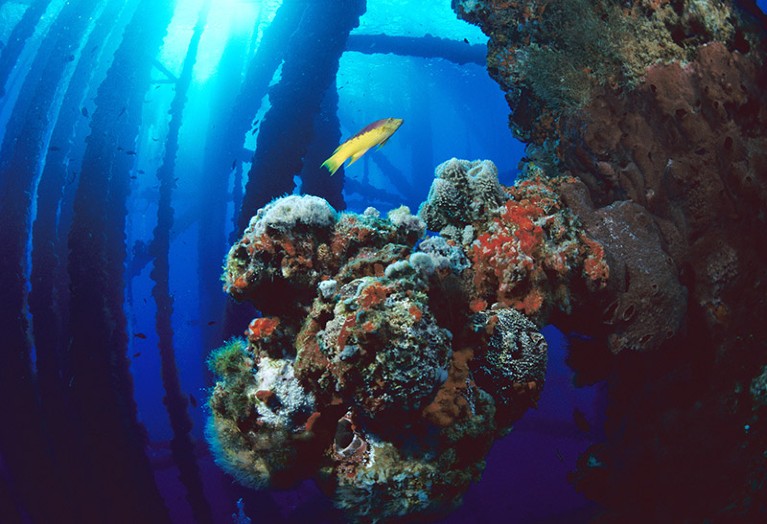
Coral growing on oil rig, Flower Garden Banks National Marine Sanctuary, Texas
Coral grows on an oil rig in Flower Garden Banks National Marine Sanctuary, in the Gulf of Mexico.Credit: Flip Nicklin/Minden Pictures/Alamy

“It’s a label,” says Colin Waters, who chairs the AWG and is a geologist at the University of Leicester, UK. “It’s a great way of summarizing a lot of concepts into one word.”

Mentioning the Jurassic period, for instance, helps scientists to picture plants and animals that were alive during that time, he says. “The Anthropocene represents an umbrella for all of these different changes that humans have made to the planet,” he adds.

How do scientists usually choose sites that define the geological timeline?

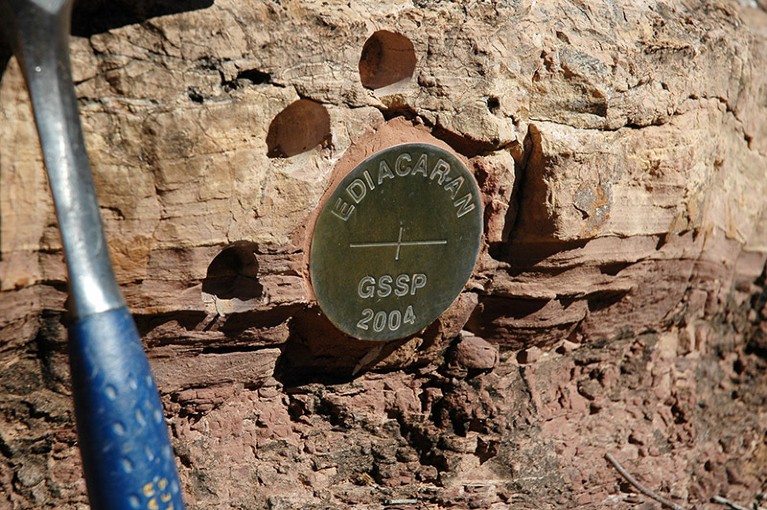
Typically, researchers will agree that a specific change in Earth’s geology must be captured in the official timeline. The ICS will then determine which set of rock layers, called strata, best illustrates that change, and it will choose which layer marks its lower boundary. This is called the Global Stratotype Section and Point (GSSP), and it is defined by a signal, such as the first appearance of a fossil species, trapped in the rock, mud or other material. One location is chosen to represent the boundary, and researchers mark this site physically with a golden spike, to commemorate it.

But the Anthropocene has posed problems. Geologists want to capture it in the timeline, but its beginning isn’t obvious in Earth’s strata, and signs of human activity have never before been part of the defining process. The AWG was established in 2009 to explore whether the Anthropocene should enter the geological timescale and, if so, how to define its start.

“We were starting from scratch,” says Jan Zalasiewicz, a geologist at the University of Leicester who formerly chaired the AWG and remains a voting member. “We had a vague idea about what it might be, [but] we didn’t know what kind of hard evidence would go into it.”

Years of debate among the group’s multidisciplinary members led them to identify a host of signals — radioactive isotopes from nuclear-bomb tests, ash from fossil-fuel combustion, microplastics, pesticides — that would be trapped in the strata of an Anthropocene-defining site. These began to appear in the early 1950s, when a booming human population started consuming materials and creating new ones faster than ever.

Cryogenian-Ediacaran geological boundary in rock strata marked by a brass plate, Flinders Ranges, South Australia
This golden spike in the Flinders Ranges of South Australia was approved by geologists in 2004, to mark strata exemplifying the Ediacaran period.Credit: James St. John (CC BY 2.0)

During a review that took place a few months ago, the AWG narrowed its list from 12 to 9 candidate sites, tossing out certain locations because their layers weren’t ideal. Among the sites remaining is Crawford Lake in Ontario, Canada, which is described as a sinkhole by Francine McCarthy, a geologist at Brock University in St Catharines, Canada, who studies the location. “The lake itself isn’t very big in area, but it’s very, very deep,” she says. Particles that fall into the lake settle at the bottom and accumulate into undisturbed layers.

Another site on the shortlist is West Flower Garden Bank. Corals here could become a living golden spike because they constantly build new exoskeletons that capture chemicals and particles from the water, DeLong says. “The skeleton has layers in it, kind of like tree rings,” she adds.

Why do some geologists oppose the Anthropocene as a new epoch?

“It misrepresents what we do” in the ICS, says Stanley Finney, a stratigrapher at California State University, Long Beach, and secretary-general for the International Union of Geological Sciences (IUGS). The AWG is working backwards, Finney says: normally, geologists identify strata that should enter the geological timescale before considering a golden spike; in this case, they’re seeking out the lower boundary of an undefined set of geological layers.Involve social scientists in defining the Anthropocene

Lucy Edwards, a palaeontologist who retired in 2008 from the Florence Bascom Geoscience Center in Reston, Virginia, agrees. For her, the strata that might define the Anthropocene do not yet exist because the proposed epoch is so young. “There is no geologic record of tomorrow,” she says.

Edwards, Finney and other researchers have instead proposed calling the Anthropocene a geological ‘event’, a flexible term that can stretch in time, depending on human impact. “It’s all-encompassing,” Edwards says.

Zalasiewicz disagrees. “The word ‘event’ has been used and stretched to mean all kinds of things,” he says. “So simply calling something an event doesn’t give it any wider meaning.”

What happens next?

In a recent Perspective article in Science, Waters and AWG secretary Simon Turner at University College London wrote that the committee would vote to choose a single site by the end of this year1. But 60% of the group’s voting members must agree on a final candidate — and, with several sites under consideration, Waters isn’t sure that a consensus can be reached anytime soon. If no clear winner emerges this month, more voting will be needed to narrow the candidate list, delaying a decision possibly until May 2023.Anthropocene now: influential panel votes to recognize Earth’s new epoch

And that’s not the end of the process. After selecting a finalist, the AWG will present its findings to the ICS’s Subcommission on Quaternary Stratigraphy. Favourable votes from this group would move the proposal to another ICS committee, and subsequent approval would push it to the final stage: ratification by the IUGS.

But the motion could fail at any of those points. And if it does, the AWG will have to revamp its proposal before it can try again — and possibly nominate a new golden-spike site.

Regardless of the outcome, Zalasiewicz thinks that the AWG’s work to define the Anthropocene has been useful. What everybody wants to know is how humans are changing the planet’s geology, he says. “That is the underlying reality that we’re trying to describe.”

Humanity Now Lives in The Anthropocene. But What Does That Actually Mean? (Science Alert)

sciencealert.com

Carly Cassella, 24 April 2021


Robert Landau/Getty Images

In the last two decades, the Anthropocene has become an informal buzzword to describe the numerous and unprecedented ways humans have come to modify the planet. 

As the concept has become more widely adopted, however, definitions have begun to blur. Today, the very meaning of the Anthropocene and its timeline differs considerably depending on who is doing the talking.

To geologists and Earth system scientists, the Industrial Revolution is often considered the dawn of the Anthropocene – when human influence on Earth’s systems became predominant worldwide. 

Many anthropologists, historians, and archaeologists, however, consider the 18th century as more of a sunrise, when the era of humans truly began to heat up in some regions. Before that, there were already glimmers of human domination.

Since the Late Pleistocene, right through to the Holocene (our current epoch), humans have been producing “distinct, detectable and unprecedented transformations of Earth’s environments,” states a new paper on the subject.

And while these changes might not be enough to be technically defined as a new geological epoch, we need terms to describe this earlier influence, too. Because right now, people from various disciplines are using the term with subtly different meanings.

“Dissecting the many interpretations of the Anthropocene suggests that a range of quite distinct, but variably overlapping, concepts are in play,” says geologist Colin Waters from the University of Leicester in the UK.

Thousands of years before the boom of industrialization, globalization, nuclear bombs, and modern climate change, humans were already in the first stages of becoming a dominant planetary force.

The rise of crop domestication and hunting, the spread of livestock and mining, and the move to urbanization, for instance, have all caused great changes to Earth’s soil signature and its fossil record, setting us on a course to the modern day. 

As far back as 3400 BCE, for instance, people in China were already smelting copper, and 3,000 years ago, most of the planet was already transformed by hunter-gatherers and farmers. 

While these smaller and slower regional changes did not destabilize Earth’s entire system as more modern actions have, some researchers think we are underestimating the climate effects of these earlier land-use changes.

As such, some have considered using the terms “pre-Anthropocene” or “proto‐Anthropocene” to describe significant human impacts before the mid‐twentieth century.

Others argue a capitalized “Anthropocene” should represent the tightly defined geological concept of an epoch, while the uncapitalized version should be used for broader interpretations.

Even after the Industrial Revolution, when human influence is clear to see, some argue we need to define further advances of the Anthropocene.

The “Great Acceleration” of the mid-twentieth century, for instance, has been proposed as a “second stage” to the Anthropocene, when human enterprise and influence began growing exponentially. 

This second stage not only encompasses rapid geological changes, but it also refers to socioeconomic factors and modern biophysical processes that humans have also begun to alter with our actions.

“This shows an exemplar of ways in which ideas and terms move between disciplines, as is true for the Anthropocene,” researchers write.

It’s unclear what the next stage of the Anthropocene will look like, but many of the changes we have made are currently irreversible and may continue long after our species is gone. 

Still, the authors argue, one thing is clear. The exceptionally rapid transformations humans have made to our planet since the Great Acceleration “vastly outweigh” earlier climactic events of the Holocene.

“Given both the rate and scale of change marking the onset of the chronostratigraphic Anthropocene, it would be difficult to justify a rank lower than series/epoch,” the authors conclude.

The study was published in Earth’s Future.

How can I become a fossil? (BBC Future)

How to be fossilized (Credit: Getty) Less than one-10th of 1% of all species that have ever lived became fossils. But from skipping a coffin to avoiding Iran, there are ways to up your chances of lasting forever.

By John Pickrell

15 February 2018

Every fossil is a small miracle. As author Bill Bryson notes in his book A Short History of Nearly Everything, only an estimated one bone in a billion gets fossilised. By that calculation the entire fossil legacy of the 320-odd million people alive in the US today will equate to approximately 60 bones – or a little over a quarter of a human skeleton.

But that’s just the chance of getting fossilised in the first place. Assuming this handful of bones could be buried anywhere in the US’s 9.8 million sq km (3.8 million square miles), then the chances of anyone finding these bones in the future are almost non-existent.

Fossilisation is so unlikely that scientists estimate that less one-tenth of 1% of all the animal species that have ever lived have become fossils. Far fewer of them have been found.

As humans, we have a couple of things going for us: we have hard skeletons and we’re relatively large. So we’re much more likely to make it than a jellyfish or a worm. There are things, however, you can do to increase your chances of success.

Taphonomy is the study of burial, decay and preservation – the entire process of what happens after an organism dies and eventually becomes a fossil. To answer the question of how to become a fossil, BBC Future spoke with some of the world’s top taphonomists.

1. Get buried, and quickly

“It’s really a question of maintaining a good condition of the body after death – long enough to be buried under sediment and then altered physically and chemically deep underground to become a fossil,” says Sue Beardmore, a taphonomist and collections assistant at the Oxford University Museum of Natural History.

“To be preserved for millions of years, you must also survive the first hours, days, seasons, decades, centuries, and thousands of years,” adds Susan Kidwell, a professor at the University of Chicago. “That is, you must survive the initial transition from the ‘taphonomically active zone’… to a zone of permanent burial, where your remains are unlikely to be exhumed.”

There are almost endless ways that fossilisation can fail. Many of these happen at, or down to 20-50cm below, the soil or seafloor surface. You don’t want your remains to be eaten and scattered by scavengers, for example, or exposed to the elements for too long. And you don’t want them to be bored into or shifted around by burrowing animals.

The sand and mud deposits of Canada’s Badlands quickly buried bones The sand and mud deposits of Canada’s Badlands quickly buried bones, making the area one of the world’s richest hunting grounds for dinosaur fossils (Credit: Getty)

When it comes to rapid burial, sometimes natural disasters can help – such as floods that dump huge amounts of sediment or volcanic eruptions that smother things in mud and ash. “One theory for the occurrence of dinosaur bone beds is firstly drought conditions, that killed the dinosaurs, followed by floods that moved the sediments to bury them,” Beardmore says.

Of course, the fact that human bodies are typically buried six feet under (unless cremated) gives you another leg up here. But that isn’t enough on its own.

2. Find some water

Obviously the first step is dying, but you can’t die just anywhere. Picking the perfect environment is key. Water is one important thing to consider. If you die in a dry environment, once you’ve been picked over by scavengers, your bones will probably weather away at the surface. Instead, most experts agree you need to get swiftly smothered in sand, mud and sediments – and the best places for that are lakes, floodplains and rivers, or the bottom of the sea.

“The palaeoenvironments that we often see the best fossils come out of are lake and river systems,” says Caitlin Syme, a taphonomist at the University of Queensland in Brisbane, Australia. The important thing is the rate at which fresh sediments are burying things. She recommends rivers flowing from mountains which cause erosion and therefore carry a lot of sediment. Another option is a coastal delta or floodplain, where river sediment is rapidly dumped as the water heads out to sea.

Ideally, you also want an ‘anoxic’ environment: one very low in oxygen, where animals and microorganisms that would digest and disturb your remains can’t survive.

Kidwell recommends avoiding about 50cm below the seafloor, “the maximum burrowing depth of shrimp, crabs and worms that might irrigate the sediments with oxygenated water”, which would promote decomposition and stir up the body.

“You want to end up quickly after death in a spot that is relatively low elevation, so that it is a sink for sediment, and preferably with standing water – a pond, lake, estuary or ocean – so that anoxic conditions might develop,” she says.

A 150 million year old archaeopteryx (Credit: Getty)

Choose the right conditions and you, too, could be preserved for as long as this 150 million year old archaeopteryx (Credit: Getty)

In rare cases, fossils created in these kind of still, anoxic conditions preserve their soft tissues like skin, feathers and internal organs. Examples include the many exquisite feathered dinosaurs from China or the Bavarian quarries that produced the fossils of the earliest bird, archaeopteryx.

Once your fossil gets below the biologically active surface layer, then it’s stable and will continue to be buried more deeply as further sediments accumulate, Kidwell says. “The risk for destruction then shifts to a completely different geological timescale, namely that of tectonism.”

The question, then, is how long before the sediments encasing the corpse are turned to more permanent stone… and are lifted by geological activity to a height where erosion can expose the remains.

3. Skip the coffin

Now we come to the thorny technicality of what a fossil actually is – and what kind of fossil you want your body to be.

Very generally, anything up to around 50,000 years old is what’s known as a ‘subfossil’. These are largely still made up of the original tissues of the organism. Extinct Pleistocene megafauna found in caves – such as giant ground sloths in South America, cave bears in Europe, and marsupial lions in Australia – are good examples.

However, if you want your remains to become a fossil that lasts for millions of years, then you really want minerals to seep through your bones and replace them with harder substances. This process, known as ‘permineralisation’, is what typically creates a fully-fledged fossil. It can take millions of years.

As a result, you might skip the coffin. Bones permineralise most rapidly when mineral-rich water can flow through them, imbuing them with things like iron and calcium. A coffin might keep the skeleton nicely together, but it would interfere with this process.

There is a way a coffin might work, though. Mike Archer, a palaeontologist at the University of New South Wales, suggests burial in a concrete coffin filled with sand and with hundreds of 5mm holes drilled into the sides. This then needs to be buried deep enough that groundwater can pass through.

“If you want to be a classic bony fossil, a bit like something from Dinosaur Provincial Park in Canada, then something like a [coarse] river sand would be pretty good,” says Syme. “All the soft tissues would be destroyed and you’d be left with this beautifully articulated skeleton.”

In terms of the minerals, calcium ions which can precipitate into calcite, a form of calcium carbonate, are especially good. “These can start to cement or cover the body which will protect it in the long run, because given time it will most likely be buried at a greater depth,” Syme says.

Deliberately seeding your corpse with the appropriate minerals, such as calcite or gypsum, might be a way to accelerate this. Encouraging the growth of tough iron-rich minerals would also be sensible as they withstand weathering well in the long run.

If you want to personalise your fossil further, add colour with some copper

If you want to personalise your fossil further, add colour with some copper (Credit: Alamy)

Silicates, from the sand, are also a nice durable mineral to have incorporated. Archer even suggests getting buried with copper strips and nickel pellets if you fancy fossilised bones and teeth with a nice blue-green colour to them.

4. Avoid the edges of tectonic plates

If you made it through the first few hundred thousand years and minerals begin to replace your bones, congratulations! You’ve successfully become a fossil. As sediments build up on top and you get pushed deeper into Earth’s crust, the heat and pressure will aid the process further.

But it’s not a done deal yet. Your fossil might still shift to such depths that it could be melted by the Earth’s heat and pressure.

Don’t want that to happen? Steer clear of the edges of tectonic plates, where the crust is going to eventually get sucked under the surface. One such subduction zone is Iran, where the Eurasian Plate is rising over the Iranian Plate.

5. Get discovered

Now you need to think about the potential for rediscovery.

If you want somebody to chance upon your carefully preserved fossil one day, you need to plan for burial in a spot that currently is low enough to accumulate the necessary sediments for deep burial – but that will eventually be pushed up again. In other words, you need a place with uplift where weathering and erosion will eventually scour off the surface layers, exposing you.

The Dead Sea may be a good place to preserve your fossil

Good for more than floating, the Dead Sea may be a good place to preserve your fossil (Credit: Getty)

One good spot might be the Mediterranean Sea, Syme says; it’s getting shallower as Africa is pushed towards Europe. Other small, inland seas that will fill with sediment are good bets, too.

“Perhaps the Dead Sea,” she says. “The high salt would preserve and pickle you.”

6. Or go rogue

We’ve covered the standard method for hard, durable fossils with bone largely replaced by rock. But there are some oddball methods to consider, too.

Top of the list is amber. There are astounding fossils perfectly preserved in this gemstone made of tree resin – such as recent finds of birds, lizards and even a feathered dinosaur tail in Myanmar. “If you can find a large enough amount of tree sap and get covered in amber, that’s going to be the best way to preserve your soft tissues as well as your bones,” Syme says. “But it’s obviously pretty difficult for such a large animal.”

Can’t find enough amber? The next option is tar pits of the kind that have preserved sabre-toothed cats and mammoths at La Brea in Los Angeles. Although here you would mostly likely end up disarticulated, your bones jumbled in with other animals. There’s also freezing on a mountain or in a glacier, like Ötzi the iceman, found in the European Alps in 1991.

Where Ötzi the iceman met his fate

Where Ötzi the iceman met his fate may not seem very comfortable, but it proved key for preserving his remains (Credit: Alamy)

Another route might be natural mummification, with your body left to dry in a cave system. “There are a lot of cave system remains that get covered with calcium from groundwater, which also forms stalactites and stalagmites,” Syme says. “People like caving and so if the cave systems still exist in the future, they might happen upon you.”

One final method to preserve your corpse almost indefinitely, though not in the form of a fossil, would be launching you into space – or leaving you on the surface of a geologically inert celestial body with no atmosphere, such as the Moon.

“The vacuum of space would be very good if you want your body to remain perpetually non-decaying,” Syme says. She adds that you could attach a radio beacon if you want to get found again in the distant future.

7. Leave a little something extra

Assuming you are found millions of years hence, what else might be preserved alongside you?

Plastics (fidget spinners, anyone?), other oil-derived products that don’t biodegrade and inert metals, like alloys, gold and rare metals of the kind found in mobile phones, all might last as long.

Will mobile phones be one of the artefacts we leave for future generations?

Will mobile phones be one of the artefacts we leave for generations far in the future? (Credit: Getty)

Glass is durable too, and can withstand high temperatures and pressures. You can imagine finding the “outlines or shape of smartphones,” Syme says. Archer notes that the durability of glass means you could chisel ‘ENJOY!’ on a small sheet of glass in a concrete coffin with your body and it would be there to find with your fossil.

“To be 100% sure I would use diamond,” Syme adds – it’s immensely stable. Using a laser, you could etch a letter explaining the lengths you went to to get fossilised.

If you also want to pre-plan your archaeological context, Syme believes bitumen highways and the foundations of skyscrapers are contenders. “We’ve dug down deep into the ground to build these things. You’ll be able to see… the layouts of cities still there,” she says.

Remember, the words you write will fade and your deeds will be forgotten. But a fossil? That, perhaps, could last forever.

California drought causing valley land to sink (Science Daily)

Date:
August 20, 2015
Source:
NASA/Jet Propulsion Laboratory
Summary:
As Californians continue pumping groundwater in response to the historic drought, the California Department of Water Resources has released a new NASA report showing land in the San Joaquin Valley is sinking faster than ever before, nearly 2 inches (5 centimeters) per month in some locations.

Total subsidence in California’s San Joaquin Valley for the period May 3, 2014 to Jan. 22, 2015, as measured by Canada’s Radarsat-2 satellite. Two large subsidence bowls are evident, centered on Corcoran and south of El Nido. Credit: Canadian Space Agency/NASA/JPL-Caltech

As Californians continue pumping groundwater in response to the historic drought, the California Department of Water Resources has released a new NASA report showing land in the San Joaquin Valley is sinking faster than ever before, nearly 2 inches (5 centimeters) per month in some locations.

“Because of increased pumping, groundwater levels are reaching record lows — up to 100 feet (30 meters) lower than previous records,” said Department of Water Resources Director Mark Cowin. “As extensive groundwater pumping continues, the land is sinking more rapidly and this puts nearby infrastructure at greater risk of costly damage.”

Sinking land, known as subsidence, has occurred for decades in California because of excessive groundwater pumping during drought conditions, but the new NASA data show the sinking is happening faster, putting infrastructure on the surface at growing risk of damage.

NASA obtained the subsidence data by comparing satellite images of Earth’s surface over time. Over the last few years, interferometric synthetic aperture radar (InSAR) observations from satellite and aircraft platforms have been used to produce maps of subsidence with approximately centimeter-level accuracy. For this study, JPL researchers analyzed satellite data from Japan’s PALSAR (2006 to 2010); and Canada’s Radarsat-2 (May 2014 to January 2015), and then produced subsidence maps for those periods. High-resolution InSAR data were also acquired along the California Aqueduct by NASA’s Uninhabited Aerial Vehicle Synthetic Aperture Radar (UAVSAR) (2013 to 2015) to identify and quantify new, highly localized areas of accelerated subsidence along the aqueduct that occurred in 2014. The California Aqueduct is a system of canals, pipelines and tunnels that carries water collected from the Sierra Nevada Mountains and Northern and Central California valleys to Southern California.

Using multiple scenes acquired by these systems, the JPL researchers were able to produce time histories of subsidence at selected locations, as well as profiles showing how subsidence varies over space and time.

“This study represents an unprecedented use of multiple satellites and aircraft to map subsidence in California and address a practical problem we’re all facing,” said JPL research scientist and report co-author Tom Farr. “We’re pleased to supply the California DWR with information they can use to better manage California’s groundwater. It’s like the old saying: ‘you can’t manage what you don’t measure’.”

Land near Corcoran in the Tulare basin sank 13 inches (33 centimeters) in just eight months — about 1.6 inches (4 centimeters) per month. One area in the Sacramento Valley was sinking approximately half-an-inch (1.3 centimeters) per month, faster than previous measurements.

Using the UAVSAR data, NASA also found areas near the California Aqueduct sank up to 12.5 inches (32 centimeters), with 8 inches (20 centimeters) of that occurring in just four months of 2014.

“Subsidence is directly impacting the California Aqueduct, and this NASA technology is ideal for identifying which areas are subsiding the most in order to focus monitoring and repair efforts,” said JPL research scientist and study co-author Cathleen Jones. “Knowledge is power, and in this case knowledge can save water and help the state better maintain this critical element of the state’s water delivery system.” UAVSAR flies on a C-20A research aircraft based at NASA’s Armstrong Flight Research Center facility in Palmdale, California.

The increased subsidence rates have the potential to damage local, state and federal infrastructure, including aqueducts, bridges, roads and flood control structures. Long-term subsidence has already destroyed thousands of public and private groundwater well casings in the San Joaquin Valley. Over time, subsidence can permanently reduce the underground aquifer’s water storage capacity.

“Groundwater acts as a savings account to provide supplies during drought, but the NASA report shows the consequences of excessive withdrawals as we head into the fifth year of historic drought,” Director Cowin said. “We will work together with counties, local water districts, and affected communities to identify ways to slow the rate of subsidence and protect vital infrastructure such as canals, pumping stations, bridges and wells.”

NASA will also continue its subsidence monitoring, using data from the European Space Agency’s recently launched Sentinel-1 mission to cover a broader area and identify more vulnerable locations.

DWR also completed a recent land survey along the Aqueduct — which found 70-plus miles (113-plus kilometers) in Fresno, Kings and Kern counties sank more than 1.25 feet (0.4 meters) in two years — and will now conduct a system-wide evaluation of subsidence along the California Aqueduct and the condition of State Water Project facilities. The evaluation will help the department develop a capital improvement program to repair damage from subsidence. Past evaluations found that segments of the Aqueduct from Los Banos to Lost Hills sank more than 5 feet (1.5 meters) since construction.

NASA and the Indian Space Research Organisation are jointly developing the NASA-ISRO Synthetic Aperture Radar (NISAR) mission. Targeted to launch in 2020, NISAR will make global measurements of the causes and consequences of land surface changes. Potential areas of research include ecosystem disturbances, ice sheet collapse and natural hazards. The NISAR mission is optimized to measure subtle changes of Earth’s surface associated with motions of the crust and ice surfaces. NISAR will improve our understanding of key impacts of climate change and advance our knowledge of natural hazards.

The report, Progress Report: Subsidence in the Central Valley, California, prepared for DWR by researchers at NASA’s Jet Propulsion Laboratory, Pasadena, California, is available at: http://water.ca.gov/groundwater/docs/NASA_REPORT.pdf (14 MB)

Previsão do clima: terremotos intermitentes (Folha de S.Paulo)

Marcelo Leite, 03/05/2015  01h57

Depois de Katmandu, o terremoto no Nepal sacudiu também uma noção preconcebida comum entre jornalistas de ciência – esta coluna, por exemplo, foi abalada por um tuíte de Matthew Shirts, que levava para uma reportagem da revista “Newsweek”.

A leitura do texto, “Mais Terremotos Fatais Virão, Alertam Cientistas da Mudança do Clima”, trouxe à memória um momento constrangedor. Que o relato sirva para desencorajar nossa tendência a acreditar em verdades estabelecidas.

Certa vez um colega de redação perguntou se eu poderia escrever para explicar por que tsunamis estavam se tornando mais frequentes e qual era a relação disso com o aquecimento global. Segurei a vontade de rir e expliquei, condescendente, que processos climáticos não tinham o poder de desencadear eventos geológicos.

Não é bem assim. Há pesquisadores respeitáveis investigando a hipótese de que a mudança climática deflagrada pelo aquecimento global possa, sim, tornar terremotos e erupções vulcânicas mais frequentes.

Não seria nada inédito na história da Terra. Um exemplo recentíssimo na escala geológica (o planeta tem mais de 4 bilhões de anos) ocorreu entre 20 mil e 12 mil anos atrás, ao término do último período glacial.

A retração de geleiras continentais com quilômetros de espessura aliviou a pressão sobre a crosta terrestre o bastante para desencadear intensa atividade vulcânica. Há boas evidências disso em lugares como a Islândia.

O geólogo britânico Bill McGuire tem uma teoria ainda mais preocupante. Ele acha que a elevação dos mares em 100 m, causada pelo derretimento das calotas de gelo, teria deflagrado também terremotos e tsunamis (o que poderia repetir-se a partir de agora, com o aquecimento da atmosfera).

O imenso volume de água adicionado aos oceanos, ao pressionar suas bordas, teria desestabilizado as falhas geológicas próximas da costa, causando os tremores e colapsos submarinos que levantam ondas colossais. Mas a hipótese de McGuire, detalhada no livro “Acordando o Gigante”, ainda carece de medições e dados para ser aceita.

No caso do terremoto de Katmandu, o mecanismo pressuposto para pôr a culpa no clima é outro: chuva. Não uma pancada qualquer, mas as poderosas monções que castigam Índia e Nepal de junho a agosto.

Tamanho volume de água, que perde só para o movimentado na bacia Amazônica, seria capaz de alterar o balanço do estresse entre as placas Indo-Australiana e Asiática. O geólogo argelino Pierre Bettinelli, então no CalTech, mostrou que a atividade sísmica nos Himalaias é duas vezes mais intensa no inverno e atribuiu isso à gangorra de pressões entre os dois lados da falha tectônica.

Falta provar, claro. Mas que é instigante, isso é.

Quanto a terremotos causados pelo aquecimento global, ninguém precisa sair comprando kits de sobrevivência. O degelo da última glaciação demorou milhares de anos, e as piores previsões para a subida no nível dos oceanos indicam não muito mais que 1 m ou 2 m até o final deste século.

Ninguém está a salvo de tsunamis, porém. Há alguma chance – uma vez a cada 10 mil anos, talvez – de que o litoral brasileiro seja atingido por um deles, como pode ter ocorrido com São Vicente em 1541, após cataclisma nalgum ponto do Atlântico.

Imagining the Anthropocene (AEON)

The Anthropocene idea has been embraced by Earth scientists and English professors alike. But how useful is it?

Jedediah Purdy is Professor of Law at Duke University in North Carolina. His forthcoming book is After Nature: A Politics for the Anthropocene.

Edited by Ross Andersen

Officially, for the past 11,700 years we have been living in the Holocene epoch. From the Greek for ‘totally new’, the Holocene is an eyeblink in geological time. In its nearly 12,000 years, plate tectonics has driven the continents a little more than half a mile: a reasonably fit person could cover the scale of planetary change in a brisk eight-minute walk. It has been a warm time, when temperature has mattered as much as tectonics. Sea levels rose 115 feet from ice melt, and northern landscapes rose almost 600 feet, as they shrugged off the weight of their glaciers.

But the real news in the Holocene has been people. Estimates put the global human population between 1 million and 10 million at the start of the Holocene, and keep it in that range until after the agricultural revolution, some 5,000 years ago. Since then, we have made the world our anthill: the geological layers we are now laying down on the Earth’s surface are marked by our chemicals and industrial waste, the pollens of our crops, and the absence of the many species we have driven to extinction. Rising sea levels are now our doing. As a driver of global change, humanity has outstripped geology.

This is why, from the earth sciences to English departments, there’s a veritable academic stampede to declare that we live in a new era, the Anthropocene – the age of humans. Coined by the ecologist Eugene Stoermer in the 1980s and brought to public attention in 2000 by the Nobel Prize-winning atmospheric scientist Paul Crutzen, the term remains officially under consideration at the Stratigraphy Commission of the Geological Society of London.

The lack of an official decision has set up the Anthropocene as a Rorschach blot for discerning what commentators think is the epochal change in the human/nature relationship. The rise of agriculture in China and the Middle East? The industrial revolution and worldwide spread of farming in the Age of Empire? The Atomic bomb? From methane levels to carbon concentration, from pollen residue to fallout, each of these changes leaves its mark in the Earth’s geological record. Each is also a symbol of a new set of human powers and a new way of living on Earth.

The most radical thought identified with the Anthropocene is this: the familiar contrast between people and the natural world no longer holds. There is no more nature that stands apart from human beings. There is no place or living thing that we haven’t changed. Our mark is on the cycle of weather and seasons, the global map of bioregions, and the DNA that organises matter into life. The question is no longer how to preserve a wild world from human intrusion; it is what shape we will give to a world we can’t help changing.

The discovery that nature is henceforth partly a human creation makes the Anthropocene the latest of three great revolutions: three kinds of order once thought to be given and self-sustaining have proved instead to be fragile human creations. The first to fall was politics. Long seen as part of divine design, with kings serving as the human equivalents of eagles in the sky and oaks in the forest, politics proved instead a dangerous but inescapable form of architecture – a blueprint for peaceful co‑existence, built with crooked materials. Second came economics. Once presented as a gift of providence or an outgrowth of human nature, economic life, like politics, turned out to be a deliberate and artificial achievement. (We are still debating the range of shapes it can take, from Washington to Greece to China.) Now, in the Anthropocene, nature itself has joined the list of those things that are not natural. The world we inhabit will henceforth be the world we have made.

The revolution in ideas that the Anthropocene represents is rooted in hundreds of eminently practical problems. The conversation about climate change has shifted from whether we can keep greenhouse-gas concentrations below key thresholds to how we are going to adapt when they cross those thresholds. Geo‑engineering, deliberately intervening in planetary systems, used to be the unspeakable proposal in climate policy. Now it is in the mix and almost sure to grow more prominent. As climate change shifts ecological boundaries, issues such as habitat preservation come to resemble landscape architecture. We can’t just pen in animals to save them; they need landscape-scale corridors and other help in migrating as their habitats move. There is open talk in law-and-policy circles about triage in species preservation – asking what we can save, and what we most want to save.

What work is this idea of the Anthropocene doing in culture and politics? As much as a scientific concept, the Anthropocene is a political and ethical gambit. Saying that we live in the Anthropocene is a way of saying that we cannot avoid responsibility for the world we are making. So far so good. The trouble starts when this charismatic, all-encompassing idea of the Anthropocene becomes an all-purpose projection screen and amplifier for one’s preferred version of ‘taking responsibility for the planet’.

Peter Kareiva, the controversial chief scientist of the Nature Conservancy, uses the theme ‘Conservation in the Anthropocene’ to trash environmentalism as philosophically naïve and politically backward. Kareiva urges conservationists to give up on wilderness and embrace what the writer Emma Marris calls the ‘rambunctious garden’. Specifically, Kareiva wants to rank ecosystems by the quality of ‘ecosystem services’ they provide for human beings instead of ‘pursuing the protection of biodiversity for biodiversity’s sake’. He wants a pro‑development stance that assumes that ‘nature is resilient rather than fragile’. He insists that: ‘Instead of scolding capitalism, conservationists should partner with corporations in a science-based effort to integrate the value of nature’s benefits into their operations and cultures.’ In other words, the end of nature is the signal to carry on with green-branded business as usual, and the business of business is business, as the Nature Conservancy’s partnerships with Dow, Monsanto, Coca-Cola, Pepsi, J P Morgan, Goldman Sachs and the mining giant Rio Tinto remind us.

Kareiva is a favourite of Andrew Revkin, the roving environmental maven of The New York Times Magazine, who touts him as a paragon of responsibility-taking, a leader among ‘scholars and doers who see that new models for thinking and acting are required in this time of the Anthropocene’. This pair and their friends at the Breakthrough Institute in California can be read as making a persistent effort to ‘rebrand’ environmentalism as humanitarian and development-friendly (and capture speaking and consultancy fees, which often seem to be the major ecosystem services of the Anthropocene). This is itself a branding strategy, an opportunity to slosh around old plonk in an ostentatiously shiny bottle.

Elsewhere in The New York Times Magazine, you can enjoy the other end of the Anthropocene projection screen, from business-as-usual to this-changes-everything. In his essay ‘Learning How to Die in the Anthropocene’ (2013), the Princeton scholar and former soldier Roy Scranton writes: ‘this civilisation is already dead’ (emphasis original) and insists that the only way forward is ‘to realise there’s nothing we can do to save ourselves’ and therefore ‘get down to the hard work … without attachment or fear’. He concludes: ‘If we want to learn to live in the Anthropocene, we must first learn how to die.’

Other humanists bring their own preoccupations to a sense of gathering apocalypse. In his influential essay ‘The Climate of History’ (2008), Dipesh Chakrabarty, a theory-minded historian at the University of Chicago, proposes that the Anthropocene throws into question all received accounts of human history, from Whiggish optimism to his own post-colonial postmodernism. He asks anxiously: ‘Has the period from 1750 to the present been one of freedom or that of the Anthropocene?’ and concludes that the age requires a new paradigm of thought, a ‘negative universal history’.

In their introduction to Ecocriticism (2012), a special issue of American Literature, the English scholars Monique Allewaert of the University of Wisconsin-Madison and Michael Ziser of the University of California Davis describe the Anthropocene as best captured in ‘a snapshot of the anxious affect of the modern world as it destroys itself – and denies even its own traces’.

The Anthropocene does not seem to change many minds. But it does turn them up to 11

All of these people (except for the branding opportunists) are trying, with more or less success, to ask how the Anthropocene changes the projects to which they’ve given chunks of their lives. Some far-ranging speculation and sweeping summaries are to be expected, and forgiven. Nonetheless, something in the Anthropocene idea seems to provoke heroic thinking, a mood and rhetoric of high stakes, of the human mind pressed up against the wall of apocalypse or arrived at the end of nature and history.

In this provocative defect, Anthropocene talk is a discourse of responsibility, to borrow a term from Mark Greif’s study of mid-20th-century American thought, The Age of the Crisis of Man (2015). Greif argues that a high-minded (but often middle-brow) strain of rhetoric responded to the horrors of the world wars and the global struggles thereafter with a blend of urgent language and sweeping concepts (or pseudo-concepts): responsibility, the fate of man, the urgency of now. Greif describes discourses of responsibility as attempts to turn words and thoughts, uttered in tones of utmost seriousness, into a high form of action. All of this is recognisable in Anthropocene talk. The Anthropocene does not seem to change many minds, strictly speaking, on point of their cherished convictions. But it does turn them up to 11.

On the whole, this is the inevitable and often productive messiness that accompanies a new way of seeing, one that unites many disparate events into a single pattern. As an offer to unify what might seem unrelated, ‘the Anthropocene’ is an attempt to do the same work that ‘the environment’ did in the 1960s and early ’70s: meld problems as far-flung as extinction, sprawl, litter, national parks policy, and the atom bomb into a single phenomenon called ‘the ecological crisis’. Such a classification is always somewhat arbitrary, though often only in the trivial sense that there are many ways to carve up the world. However arbitrary, it becomes real if people treat it as real, by forming movements, proposing changes, and passing laws aimed at ‘the environment’.

We know what the concept ‘the environment’ has wrought but what will the Anthropocene be like? To put this over-dramatised idea in the least heroic garb possible, what will the weather be like in the Anthropocene? And how will we talk about the weather there?

For all the talk of crisis that swirls around the Anthropocene, it is unlikely that a changing Earth will feel catastrophic or apocalyptic. Some environmentalists still warn of apocalypse to motivate could-be, should-be activists; but geologic time remains far slower than political time, even when human powers add a wobble to the planet. Instead, the Anthropocene will be like today, only more so: many systems, from weather to soil to your local ecosystem, will be in a slow-perennial crisis. And where apocalyptic change is a rupture in time, a slow crisis feels normal. It feels, in fact, natural.

So the Anthropocene will feel natural. I say this not so much because of the controversial empirics-cum-mathematics of the climate-forecasting models as because of a basic insight of modernity that goes back to Rousseau: humanity is the adaptable species. What would have been unimaginable or seemed all but unintelligible 100 years ago, let alone 500 (a sliver of time in the evolutionary life of a species), can become ordinary in a generation. That is how long it took to produce ‘digital natives’, to accustom people to electricity and television, and so on for each revolution in our material and technological world. It takes a great deal of change to break through this kind of adaptability.

This is all the more so because rich-country humanity already lives in a constant technological wrestling match with exogenous shocks, which are going to get more frequent and more intense in the Anthropocene. Large parts of North America regularly experience droughts and heat waves that would devastate a simpler society than today’s US. Because the continent is thoroughly engineered, from the water canals of the West to the irrigation systems of the Great Plains to air conditioning nearly everywhere, these are experienced as inconvenience, as mere ‘news’. The same events, in poorer places, are catastrophes.

Planetary changes will amplify the inequalities that sort out those who get news from those who get catastrophes; but these inequalities, arising as they do from a post-natural nature, will feel as if they were built into the world itself. Indeed, nature has always served to launder the inequalities that humans produce. Are enslaved people kept illiterate and punished brutally when they are not servile? Then ignorance and servility must be in their nature, an idea that goes back in a continuous line to Aristotle. The same goes for women, with some edits to their nature: docile, nurturing, delicate, hysterical, etc. It was not until Harriet Taylor and John Stuart Mill worked together on The Subjection of Women (published under his name alone in 1869), that English-language philosophy produced a basic challenge to millennia of nature-talk about sexual difference.

The expulsion of Native Americans was ‘justified’ on several versions of nature. Maybe they were racially different. Maybe their climate made them weak and irrational, unable to cultivate the land or resist European settlement. (Colonists briefly embraced this idea, then grew uneasy when they realised that the North American climate was now theirs; by the time of American independence, they raced to reject climatic theories of racial character.) Maybe Native Americans had simply failed to fulfil the natural duty of all mankind, to clear and plant the wilderness and make it bloom like an English garden, an idea that many theorists of natural law advanced in the 17th and 18th centuries. One way or another, nature was a kind of ontological insurance policy for human injustice.

And now? Well, it’s common wisdom that rising sea levels will first affect some of the world’s poorest people, notably in Bangladesh and coastal India. But it’s much worse than that grim geographic coincidence. Wealth has always meant some protection from nature’s cruel measures. In fact, that is the first spur to technology and development of all kinds: not to be killed. Tropical diseases with changing range will find some populations well-equipped with vaccination and medicine, others struggling with bad government and derelict health systems. When seas rise fast, even the feckless but rich US will begin adapting fast, and coastal flooding will be classified in the rich-world mind as a catastrophe of the poor.

So will starvation. A legal regime of unequal Anthropocene vulnerability is well underway. Take the vast, long-term leases that Chinese companies have entered into for some of Africa’s richest farmland. When drought, soil exhaustion or crop crisis puts a pinch on global food supply, contracts and commerce will pull trillions of calories to fat-and-happy Beijing. This is, of course, only the latest chapter in centuries of imperialism and post-imperial, officially voluntary global inequality. But it is the chapter that we the living are writing.

Neoliberal environmentalism aims to bring nature fully into the market, merging ecology and economy

For the moment, Anthropocene inequality has a special affinity with neoliberalism, the global extension of a dogmatic market logic and increasingly homogenous market forms, along with an accompanying ideology insisting that, if the market is not beyond reproach, it is at least beyond reform: there is no alternative. Where previous episodes of global ecological inequality took place under direct imperial administration – witness the Indian famines of the late 19th century, suffered under British rule – ours is emerging under the sign of free contract. Anthropocene inequality is thus being doubly laundered: first as natural, second as the voluntary (and presumptively efficient) product of markets. Because human activity now shapes the ‘natural’ world at every point, it is especially convenient for that world-shaping activity to proceed in its own pseudo-natural market.

But Anthropocene problems also put pressure on the authority of economics. Much of environmental economics has been built on the concept of the externality, economist-speak for a side-effect, a harm or benefit that has no price tag, and so is ignored in market decisions. Air pollution – free to the polluter – is the classic bad side-effect, or ‘negative externality’. Wetlands – not valued on the real-estate market, but great sources of filtration, purification and fertility, which would otherwise cost a lot to replicate – are the model positive externality. So neoliberal environmentalism, which Kareiva’s Nature Conservancy has been cultivating, aims to bring nature fully into the market, finding a place in the bottom line for all former side-effects, and fully merging ecology and economy.

In a climate-changed Anthropocene, the side-effects overwhelm the ‘regular’ market in scale and consequence. And there is no ‘neutral’, purely market-based way to put a value on side-effects. Take the example of carbon emissions. It is possible to create a market for emissions, as Europe, California and other jurisdictions have done; but at the base of that market is a political decision about how to value the economic activity that emits carbon against all the (uncertain and even speculative) effects of the emissions. The same point holds for every (post-)natural system on an Anthropocene planet. Ultimately, the question is the value of life, and ways of life. There is no correct technocratic answer.

The shape of the Anthropocene is a political, ethical and aesthetic question. It will answer questions about what life is worth, what people owe one another, and what in the world is awesome or beautiful enough to preserve or (re)create. Either the answers will reproduce and amplify existing inequality or they will set in motion a different logic of power. Either the Anthropocene will be democratic or it will be horrible.

A democratic Anthropocene would start from a famous observation of the economics Nobel Prize laureate Amartya Sen: no minimally democratic society has ever suffered a famine. Natural catastrophes are the joint products of natural and human systems. Your vulnerability to disaster is often a direct expression of your standing in a political (and economic) order. The Anthropocene stands for the intensifying merger of ecology, economics and politics, and one’s standing in those systems will increasingly be a single question.

But talk of democracy here is – like much about the Anthropocene – in danger of becoming abstract and moralising. Reflecting on a democratic Anthropocene becomes an inadvertent meditation on the devastating absence of any agent – a state, or even a movement – that could act on the scale of the problem. Indeed, it reveals that there is no agent that could even define the problem. If the Anthropocene is about the relationship between humanity and the planet, well, there is no ‘humanity’ that agrees on any particular meaning and imperative of climate change, extinction, toxification, etc. To think about the Anthropocene is to think about being able to do nothing about everything. No wonder the topic inspires compensatory fantasies that the solution lies in refining the bottom line or honing personal enlightenment – always, to be sure, in the name of some fictive ‘we’.

This returns us to the basic problem that the Anthropocene drives home: as Hannah Arendt observed in The Origins of Totalitarianism (1951), the idea of human rights – such as the right to democratic standing in planetary change – is a chimera and a cruel taunt without a political community that can make it good through robust institutions and practices. The Anthropocene shows how far the world is from being such a polity, or a federation of such polities, and how much is at stake in that absence. The world is too much with us. Worse, there is no ‘we’ to be with it.

In the face of all these barriers, what could all this talk about the Anthropocene possibly accomplish? Ironically, a useful comparison lies in Arendt’s target, the mere idea of human rights. While mere ideas are in fact sorry comforts in an unmanageable situation, they can be the beginning of demands, projects, even utopias, that enable people to organise in new ways to pursue them. The idea of human rights has gained much of its force this way, as a prism through which many efforts are focused and/or refracted.

A democratic Anthropocene is just a thought for now, but it can also be a tool that activists, thinkers and leaders use to craft challenges and invitations that bring some of us a little closer to a better possible world, or a worse one. The idea that the world people get to inhabit will only be the one they make is, in fact, imperative to the development of a political and institutional programme, even if the idea itself does not tell anyone how to do that. There might not be a world to win, or even save, but there is a humanity to be shaped and reshaped, freely and always in partial and provisional ways, that can begin intending the world it shapes.

31 March 2015

Popular now

Anthropocene: The human age (Nature)

Momentum is building to establish a new geological epoch that recognizes humanity’s impact on the planet. But there is fierce debate behind the scenes.

Richard Monastersky

11 March 2015

Illustration by Jessica Fortner

Almost all the dinosaurs have vanished from the National Museum of Natural History in Washington DC. The fossil hall is now mostly empty and painted in deep shadows as palaeobiologist Scott Wing wanders through the cavernous room.

Wing is part of a team carrying out a radical, US$45-million redesign of the exhibition space, which is part of the Smithsonian Institution. And when it opens again in 2019, the hall will do more than revisit Earth’s distant past. Alongside the typical displays of Tyrannosaurus rex and Triceratops, there will be a new section that forces visitors to consider the species that is currently dominating the planet.

“We want to help people imagine their role in the world, which is maybe more important than many of them realize,” says Wing.

This provocative exhibit will focus on the Anthropocene — the slice of Earth’s history during which people have become a major geological force. Through mining activities alone, humans move more sediment than all the world’s rivers combined. Homo sapiens has also warmed the planet, raised sea levels, eroded the ozone layer and acidified the oceans.

Given the magnitude of these changes, many researchers propose that the Anthropocene represents a new division of geological time. The concept has gained traction, especially in the past few years — and not just among geoscientists. The word has been invoked by archaeologists, historians and even gender-studies researchers; several museums around the world have exhibited art inspired by the Anthropocene; and the media have heartily adopted the idea. “Welcome to the Anthropocene,” The Economist announced in 2011.

The greeting was a tad premature. Although the term is trending, the Anthropocene is still an amorphous notion — an unofficial name that has yet to be accepted as part of the geological timescale. That may change soon. A committee of researchers is currently hashing out whether to codify the Anthropocene as a formal geological unit, and when to define its starting point.

But critics worry that important arguments against the proposal have been drowned out by popular enthusiasm, driven in part by environmentally minded researchers who want to highlight how destructive humans have become. Some supporters of the Anthropocene idea have even been likened to zealots. “There’s a similarity to certain religious groups who are extremely keen on their religion — to the extent that they think everybody who doesn’t practise their religion is some kind of barbarian,” says one geologist who asked not to be named.

The debate has shone a spotlight on the typically unnoticed process by which geologists carve up Earth’s 4.5 billion years of history. Normally, decisions about the geological timescale are made solely on the basis of stratigraphy — the evidence contained in layers of rock, ocean sediments, ice cores and other geological deposits. But the issue of the Anthropocene “is an order of magnitude more complicated than the stratigraphy”, says Jan Zalasiewicz, a geologist at the University of Leicester, UK, and the chair of the Anthropocene Working Group that is evaluating the issue for the International Commission on Stratigraphy (ICS).

Written in stone

For geoscientists, the timescale of Earth’s history rivals the periodic table in terms of scientific importance. It has taken centuries of painstaking stratigraphic work — matching up major rock units around the world and placing them in order of formation — to provide an organizing scaffold that supports all studies of the planet’s past. “The geologic timescale, in my view, is one of the great achievements of humanity,” says Michael Walker, a Quaternary scientist at the University of Wales Trinity St David in Lampeter, UK.

Walker’s work sits at the top of the timescale. He led a group that helped to define the most recent unit of geological time, the Holocene epoch, which began about 11,700 years ago.

Sources: Dams/Water/Fertilizer, IGBP; Fallout, Ref. 5; Map, E. C. Ellis Phil. Trans. R. Soc. A 369, 1010–1035 (2011); Methane, Ref. 4

The decision to formalize the Holocene in 2008 was one of the most recent major actions by the ICS, which oversees the timescale. The commission has segmented Earth’s history into a series of nested blocks, much like the years, months and days of a calendar. In geological time, the 66 million years since the death of the dinosaurs is known as the Cenozoic era. Within that, the Quaternary period occupies the past 2.58 million years — during which Earth has cycled in and out of a few dozen ice ages. The vast bulk of the Quaternary consists of the Pleistocene epoch, with the Holocene occupying the thin sliver of time since the end of the last ice age.

When Walker and his group defined the beginning of the Holocene, they had to pick a spot on the planet that had a signal to mark that boundary. Most geological units are identified by a specific change recorded in rocks — often the first appearance of a ubiquitous fossil. But the Holocene is so young, geologically speaking, that it permits an unusual level of precision. Walker and his colleagues selected a climatic change — the end of the last ice age’s final cold snap — and identified a chemical signature of that warming at a depth of 1,492.45 metres in a core of ice drilled near the centre of Greenland1. A similar fingerprint of warming can be seen in lake and marine sediments around the world, allowing geologists to precisely identify the start of the Holocene elsewhere.

“The geologic timescale, in my view, is one of the great achievements of humanity.”

Even as the ICS was finalizing its decision on the start of the Holocene, discussion was already building about whether it was time to end that epoch and replace it with the Anthropocene. This idea has a long history. In the mid-nineteenth century, several geologists sought to recognize the growing power of humankind by referring to the present as the ‘anthropozoic era’, and others have since made similar proposals, sometimes with different names. The idea has gained traction only in the past few years, however, in part because of rapid changes in the environment, as well as the influence of Paul Crutzen, a chemist at the Max Plank Institute for Chemistry in Mainz, Germany.

Crutzen has first-hand experience of how human actions are altering the planet. In the 1970s and 1980s, he made major discoveries about the ozone layer and how pollution from humans could damage it — work that eventually earned him a share of a Nobel prize. In 2000, he and Eugene Stoermer of the University of Michigan in Ann Arbor argued that the global population has gained so much influence over planetary processes that the current geological epoch should be called the Anthropocene2. As an atmospheric chemist, Crutzen was not part of the community that adjudicates changes to the geological timescale. But the idea inspired many geologists, particularly Zalasiewicz and other members of the Geological Society of London. In 2008, they wrote a position paper urging their community to consider the idea3.

Those authors had the power to make things happen. Zalasiewicz happened to be a member of the Quaternary subcommission of the ICS, the body that would be responsible for officially considering the suggestion. One of his co-authors, geologist Phil Gibbard of the University of Cambridge, UK, chaired the subcommission at the time.

Although sceptical of the idea, Gibbard says, “I could see it was important, something we should not be turning our backs on.” The next year, he tasked Zalasiewicz with forming the Anthropocene Working Group to look into the matter.

A new beginning

Since then, the working group has been busy. It has published two large reports (“They would each hurt you if they dropped on your toe,” says Zalasiewicz) and dozens of other papers.

The group has several issues to tackle: whether it makes sense to establish the Anthropocene as a formal part of the geological timescale; when to start it; and what status it should have in the hierarchy of the geological time — if it is adopted.

When Crutzen proposed the term Anthropocene, he gave it the suffix appropriate for an epoch and argued for a starting date in the late eighteenth century, at the beginning of the Industrial Revolution. Between then and the start of the new millennium, he noted, humans had chewed a hole in the ozone layer over Antarctica, doubled the amount of methane in the atmosphere and driven up carbon dioxide concentrations by 30%, to a level not seen in 400,000 years.

When the Anthropocene Working Group started investigating, it compiled a much longer long list of the changes wrought by humans. Agriculture, construction and the damming of rivers is stripping away sediment at least ten times as fast as the natural forces of erosion. Along some coastlines, the flood of nutrients from fertilizers has created oxygen-poor ‘dead zones’, and the extra CO2 from fossil-fuel burning has acidified the surface waters of the ocean by 0.1 pH units. The fingerprint of humans is clear in global temperatures, the rate of species extinctions and the loss of Arctic ice.

The group, which includes Crutzen, initially leaned towards his idea of choosing the Industrial Revolution as the beginning of the Anthropocene. But other options were on the table.

Some researchers have argued for a starting time that coincides with an expansion of agriculture and livestock cultivation more than 5,000 years ago4, or a surge in mining more than 3,000 years ago (see ‘Humans at the helm’). But neither the Industrial Revolution nor those earlier changes have left unambiguous geological signals of human activity that are synchronous around the globe (see ‘Landscape architecture’).

This week in Nature, two researchers propose that a potential marker for the start of the Anthropocene could be a noticeable drop in atmospheric CO2 concentrations between 1570 and 1620, which is recorded in ice cores (see page 171). They link this change to the deaths of some 50 million indigenous people in the Americas, triggered by the arrival of Europeans. In the aftermath, forests took over 65 million hectares of abandoned agricultural fields — a surge of regrowth that reduced global CO2.

Landscape architecture

A model of land use, based on human-population estimates, suggests that people modified substantial parts of the continents even thousands of years ago.

Land used intensively by humans.

8,000 years before present (bp)

8,000 years before present (bp)

1,000 years before present (bp)

anthropocene-slideshow-5

Present

anthropocene-slideshow-10

Source: E. C. Ellis Phil. Trans. R. Soc. A 369, 1010–1035 (2011).

In the working group, Zalasiewicz and others have been talking increasingly about another option — using the geological marks left by the atomic age. Between 1945 and 1963, when the Limited Nuclear Test Ban Treaty took effect, nations conducted some 500 above-ground nuclear blasts. Debris from those explosions circled the globe and created an identifiable layer of radioactive elements in sediments. At the same time, humans were making geological impressions in a number of other ways — all part of what has been called the Great Acceleration of the modern world. Plastics started flooding the environment, along with aluminium, artificial fertilizers, concrete and leaded petrol, all of which have left signals in the sedimentary record.

In January, the majority of the 37-person working group offered its first tentative conclusion. Zalasiewicz and 25 other members reported5 that the geological markers available from the mid-twentieth century make this time “stratigraphically optimal” for picking the start of the Anthropocene, whether or not it is formally defined. Zalasiewicz calls it “a candidate for the least-worst boundary”.

The group even proposed a precise date: 16 July 1945, the day of the first atomic-bomb blast. Geologists thousands of years in the future would be able to identify the boundary by looking in the sediments for the signature of long-lived plutonium from mid-century bomb blasts or many of the other global markers from that time.

A many-layered debate

The push to formalize the Anthropocene upsets some stratigraphers. In 2012, a commentary published by the Geological Society of America6 asked: “Is the Anthropocene an issue of stratigraphy or pop culture?” Some complain that the working group has generated a stream of publicity in support of the concept. “I’m frustrated because any time they do anything, there are newspaper articles,” says Stan Finney, a stratigraphic palaeontologist at California State University in Long Beach and the chair of the ICS, which would eventually vote on any proposal put forward by the working group. “What you see here is, it’s become a political statement. That’s what so many people want.”

Finney laid out some of his concerns in a paper7 published in 2013. One major question is whether there really are significant records of the Anthropocene in global stratigraphy. In the deep sea, he notes, the layer of sediments representing the past 70 years would be thinner than 1 millimetre. An even larger issue, he says, is whether it is appropriate to name something that exists mainly in the present and the future as part of the geological timescale.

“It’s become a political statement. That’s what so many people want.”

Some researchers argue that it is too soon to make a decision — it will take centuries or longer to know what lasting impact humans are having on the planet. One member of the working group, Erle Ellis, a geographer at the University of Maryland, Baltimore County, says that he raised the idea of holding off with fellow members of the group. “We should set a time, perhaps 1,000 years from now, in which we would officially investigate this,” he says. “Making a decision before that would be premature.”

That does not seem likely, given that the working group plans to present initial recommendations by 2016.

Some members with different views from the majority have dropped out of the discussion. Walker and others contend that human activities have already been recognized in the geological timescale: the only difference between the current warm period, the Holocene, and all the interglacial times during the Pleistocene is the presence of human societies in the modern one. “You’ve played the human card in defining the Holocene. It’s very difficult to play the human card again,” he says.

Walker resigned from the group a year ago, when it became clear that he had little to add. He has nothing but respect for its members, he says, but he has heard concern that the Anthropocene movement is picking up speed. “There’s a sense in some quarters that this is something of a juggernaut,” he says. “Within the geologic community, particularly within the stratigraphic community, there is a sense of disquiet.”

Zalasiewicz takes pains to make it clear that the working group has not yet reached any firm conclusions.“We need to discuss the utility of the Anthropocene. If one is to formalize it, who would that help, and to whom it might be a nuisance?” he says. “There is lots of work still to do.”

Any proposal that the group did make would still need to pass a series of hurdles. First, it would need to receive a supermajority — 60% support — in a vote by members of the Quaternary subcommission. Then it would need to reach the same margin in a second vote by the leadership of the full ICS, which includes chairs from groups that study the major time blocks. Finally, the executive committee of the International Union of Geological Sciences must approve the request.

At each step, proposals are often sent back for revision, and they sometimes die altogether. It is an inherently conservative process, says Martin Head, a marine stratigrapher at Brock University in St Catharines, Canada, and the current head of the Quaternary subcommission. “You are messing around with a timescale that is used by millions of people around the world. So if you’re making changes, they have to be made on the basis of something for which there is overwhelming support.”

Some voting members of the Quaternary subcommission have told Nature that they have not been persuaded by the arguments raised so far in favour of the Anthropocene. Gibbard, a friend of Zalasiewicz’s, says that defining this new epoch will not help most Quaternary geologists, especially those working in the Holocene, because they tend not to study material from the past few decades or centuries. But, he adds: “I don’t want to be the person who ruins the party, because a lot of useful stuff is coming out as a consequence of people thinking about this in a systematic way.”

If a proposal does not pass, researchers could continue to use the name Anthropocene on an informal basis, in much the same way as archaeological terms such as the Neolithic era and the Bronze Age are used today. Regardless of the outcome, the Anthropocene has already taken on a life of its own. Three Anthropocene journals have started up in the past two years, and the number of papers on the topic is rising sharply, with more than 200 published in 2014.

By 2019, when the new fossil hall opens at the Smithsonian’s natural history museum, it will probably be clear whether the Anthropocene exhibition depicts an official time unit or not. Wing, a member of the working group, says that he does not want the stratigraphic debate to overshadow the bigger issues. “There is certainly a broader point about human effects on Earth systems, which is way more important and also more scientifically interesting.”

As he walks through the closed palaeontology hall, he points out how much work has yet to be done to refashion the exhibits and modernize the museum, which opened more than a century ago. A hundred years is a heartbeat to a geologist. But in that span, the human population has more than tripled. Wing wants museum visitors to think, however briefly, about the planetary power that people now wield, and how that fits into the context of Earth’s history. “If you look back from 10 million years in the future,” he says, “you’ll be able to see what we were doing today.”

Nature 519, 144–147 (12 March 2015), doi:10.1038/519144a

References

  1. Walker, M. et alJ. Quat. Sci. 24317 (2009).
  2. Crutzen, P. J. & Stoermer, E. F. IGBP Newsletter 411718 (2000).
  3. Zalasiewicz. J. et alGSA Today 18(2), 48 (2008).
  4. Ruddiman, W. F. Ann. Rev. Earth. Planet. Sci. 414568 (2013).
  5. Zalasiewicz, J. et alQuatern. Int. http://dx.doi.org/10.1016/j.quaint.2014.11.045 (2015).
  6. Autin, W. J. & Holbrook, J. M. GSA Today 22(7), 6061 (2012).
  7. Finney, S. C. Geol. Soc. Spec. Publ. 3952328 (2013).

Coping with the anthropocene: How we became nature (Science Daily)

Date: March 17, 2015

Source: De Gruyter

Summary: Overpopulation, the greenhouse effect, warming temperatures and overall climate disruption are all well recognized as a major threat to the ecology and biodiversity of the Earth.  The issue of humankind’s negative impact on the environment, albeit hotly debated and continuously present in the public eye, still only leads to limited policy action.


Overpopulation, the greenhouse effect, warming temperatures and overall climate disruption are all well recognized as a major threat to the ecology and biodiversity of the Earth. The issue of mankind’s negative impact on the environment, albeit hotly debated and continuously present in the public eye, still only leads to limited policy action. Urgent action is required, insist Paul Cruzten and Stanislaw Waclawek, the authors of “Atmospheric Chemistry and Climate in the Anthropocene,” published in open access in the new Chemistry-Didactics-Ecology-Metrology.

In their sobering review, Crutzen, the 1995 Nobel Laureate in Chemistry, and Waclawek, outline the development of a new geological epoch — the Anthropocene, where human actions become a global geophysical force, surpassing that of nature itself.

Anthropocene, which relates to the present geological epoch, in which human actions determine the behavior of the planet Earth to a greater degree than other natural processes. The term, coined by American ecologist Eugene F. Stoermer and popularized by Crutzen, introduced the epoch succeeding the Holocene, which is the official term for the present epoch on Geological Time Scale, covering the last 11, 500 years.

Although Anthropocene is not a new concept, it is only now that the authors present stunning evidence in support of their claim. The article describes the negative impact of the human footprint, which ensues a gradual destruction of the Earth. Highlighting different data elements — it yields overwhelming evidence that “man, the eroder” now transforms the atmospheric, geologic, hydrologic, biospheric, and other earth system processes.

The list is long and unforgiving:

· Excessively rapid climate change, so that ecosystems cannot adapt

· The Arctic ocean ice cover is thinner by approximately 40% compared to 20-40 years ago

· Ice loss and the growing sea levels

· Overpopulation (fourfold increase in the 20th century alone)

· Increasing demand for freshwater

· Releases of NO into the atmosphere, resulting in high surface ozone layers

· Loss of agricultural soil through erosion

· Loss of phosphorus. Dangerous depletion in agricultural regions

· Melting supplies of phosphate reserves (leading to serious reduction in crop yield)

Describing the negative impact of human activities on the environment, the authors identify planetary boundaries, as means to attaining global sustainability. It is “a well-documented summary of all humankind actions affecting the environment on all scales. According to Crutzen, we live in a new era, Anthropocene, and our survival fully depends on us. I strongly recommend this unusual publication in the form of highly informative compressed slides and graphs.” says Marina Frontasyeva from the Joint Institute for Nuclear Research in Dubna, Russia. Nature is us, and responding to the Anthropocene means building a culture that grows with the Earth’s biological wealth instead of depleting it.


Journal Reference:

  1. Paul J. Crutzen, Stanisław Wacławek. Atmospheric Chemistry and Climate in the AnthropoceneChemistry-Didactics-Ecology-Metrology, 2015 DOI: 10.1515/cdem-2014-0001

Did a Volcanic Cataclysm 40,000 Years Ago Trigger the Final Demise of the Neanderthals? (Geological Society of America)

19 March 2015

Boulder, Colo., USA – The Campanian Ignimbrite (CI) eruption in Italy 40,000 years ago was one of the largest volcanic cataclysms in Europe and injected a significant amount of sulfur-dioxide (SO2) into the stratosphere. Scientists have long debated whether this eruption contributed to the final extinction of the Neanderthals. This new study by Benjamin A. Black and colleagues tests this hypothesis with a sophisticated climate model.

Black and colleagues write that the CI eruption approximately coincided with the final decline of Neanderthals as well as with dramatic territorial and cultural advances among anatomically modern humans. Because of this, the roles of climate, hominin competition, and volcanic sulfur cooling and acid deposition have been vigorously debated as causes of Neanderthal extinction.

They point out, however, that the decline of Neanderthals in Europe began well before the CI eruption: “Radiocarbon dating has shown that at the time of the CI eruption, anatomically modern humans had already arrived in Europe, and the range of Neanderthals had steadily diminished. Work at five sites in the Mediterranean indicates that anatomically modern humans were established in these locations by then as well.”

“While the precise implications of the CI eruption for cultures and livelihoods are best understood in the context of archaeological data sets,” write Black and colleagues, the results of their study quantitatively describe the magnitude and distribution of the volcanic cooling and acid deposition that ancient hominin communities experienced coincident with the final decline of the Neanderthals.

In their climate simulations, Black and colleagues found that the largest temperature decreases after the eruption occurred in Eastern Europe and Asia and sidestepped the areas where the final Neanderthal populations were living (Western Europe). Therefore, the authors conclude that the eruption was probably insufficient to trigger Neanderthal extinction.

However, the abrupt cold spell that followed the eruption would still have significantly impacted day-to-day life for Neanderthals and early humans in Europe. Black and colleagues point out that temperatures in Western Europe would have decreased by an average of 2 to 4 degrees Celsius during the year following the eruption. These unusual conditions, they write, may have directly influenced survival and day-to-day life for Neanderthals and anatomically modern humans alike, and emphasize the resilience of anatomically modern humans in the face of abrupt and adverse changes in the environment.

FEATURED ARTICLE
Campanian Ignimbrite volcanism, climate, and the final decline of the Neanderthals
Benjamin A. Black et al., University of California, Berkeley, California, USA. Published online ahead of print on 19 March 2015; http://dx.doi.org/10.1130/G36514.1.

Baylor Researcher Finds First-Ever Evidence of Climate Change of Northern China Region Dating Back Thousands of Years (Baylor Univ.)

China's Hunshandake Sandy Lands

China’s Hunshandake Sandy Lands (Courtesy of Steve Forman)

Feb. 16, 2015

By Tonya B. Lewis

Study Sheds Light on How Populations Respond and Adapt to Climate Change

WACO, Texas (Feb. 16, 2015) — Using a relatively new scientific dating technique, a Baylor University geologist and a team of international researchers were able to document—for the first time—a drastic climate change 4,200 years ago in northern China that affected vegetation and led to mass migration from the area.

Steve Forman, Ph.D., professor of geology in the College of Arts & Sciences, and researchers—using a dating technique called Optically Stimulated Luminescence—uncovered the first evidence of a severe decrease in precipitation on the freshwater lake system in China’s Hunshandake Sandy Lands. The impact of this extreme climate change led to desertification—or drying of the region—and the mass migration of northern China’s Neolithic cultures.

Their research findings appear in the January 2015 issue of the Proceedings of the National Academy of Sciences and are available online.

“With our unique scientific capabilities, we are able to assert with confidence that a quick change in climate drastically changed precipitation in this area, although, further study needs to be conducted to understand why this change occurred,” Forman said.

Between 2001 and 2014, the researchers investigated sediment sections throughout the Hunshandake and were able to determine that a sudden and irreversible shift in the monsoon system led to the abrupt drying of the Hunshandake resulting in complications for the population.

“This disruption of the water flow significantly impacted human activities in the region and limited water availability. The consequences of a rapid climatic shift on the Hunshandake herding and agricultural cultures were likely catastrophic,” Forman said.

He said these climatic changes and drying of the Hunshandake continue to adversely impact the current population today. The Hunshandake remains arid and even with massive rehabilitation efforts will unlikely regrow dense vegetation.

“This study has far-reaching implications for understanding how populations respond and adapt to drastic climate change,” Forman said.

Forman is the director of the Geoluminescence Dating Research Lab in the department of geology.

Study co-authors include: Xiaoping Yang, Ph.D., of the Chinese Academy of Sciences; Louis A. Scuderi, Ph.D., of the University of New Mexico; Xulong Wang, Ph.D., of Chinese Academy of Sciences; Louis J. Scuderi, Ph.D., of the University of Hawaii; Deguo Zhang, Ph.D., of the Chinese Academy of Sciences; Hongwei Li, Ph.D., of the Chinese Academy of Sciences; Qinghai Xu, Ph.D., of Hebei Normal University; Ruichang Wang, Ph.D., of the Chinese Academy of Social Sciences; Weiwen Huang, Ph.D., of the Institute of Vertebrate Paleontology and Paleoanthropology and Shixia Yang, Ph.D., of the Institute of Vertebrate Paleontology and Paleoanthropology.

The West without Water: What Can Past Droughts Tell Us About Tomorrow? (Origins)

vol. 8, issue 6 – march 2015

by  B. LYNN INGRAM

Editor’s Note:
Almost as soon as European settlers arrived in California they began advertising the place as the American Garden of Eden. And just as quickly people realized it was a garden with a very precarious water supply. Currently, California is in the middle of a years-long drought and the water crisis is threatening the region’s vital agricultural economy, not to mention the quality of life of its people, plants, and animals. This month B. Lynn Ingram, Professor of Geography and Earth & Planetary Science, examines how a deep historical account of California’s water patterns can help us plan for the future.


The state of California is beginning its fourth year of a serious drought, with no end in sight.

The majority of water in the western United States is delivered by winter storms from the Pacific, and over the past year, those storms were largely blocked by an enormous ridge of high pressure. A relatively wet December has given way to the driest January on record, and currently over 90 percent of California is in severe to exceptional drought.

The southwestern states are also experiencing moderate to severe drought, and this comes on the heels of a very dry decade. This long drought has crept up on the region, partly because droughts encroach slowly and they lack the visual and visceral effects of other, more immediate natural disasters such as earthquakes, floods, or tsunamis.

Meteorologists define drought as an abnormally long period of insufficient rainfall adversely affecting growing or living conditions. But this bland definition belies the devastation wrought by these natural disasters. Drought can lead to failed crops, desiccated landscapes, wildfires, dehydrated livestock, and in severe cases, water wars, famine, and mass migration.

Although the situation in the West has not yet reached such epic proportions, the fear is that if it continues much longer, it could.

Lake Powell, in 2009, showing a white calcium carbonate “bathtub ring” exposed after a decade of drought lowered the level of the reservoir to 60 percent of its capacity. (Photo courtesy of U.S. Bureau of Reclamation.)

In California, reservoirs are currently at only 38 percent of capacity, and the snowpack is only 25 percent of normal for late January. Elsewhere in the Southwest, Lake Powell, the largest reservoir on the Colorado River, is at 44 percent of capacity.

The amount of water transported through irrigation systems to California’s Central Valley—the most productive agricultural region in the world—has been reduced to only 20 percent of customary quantities, forcing farmers to deepen groundwater wells and drill new ones.

Over the past year, 410,000 acres have been fallowed in this vast agricultural region that provides 30 percent of all the produce grown in the United States and virtually all of the world’s almonds, walnuts, and pistachios. As California dries up, food prices might well rise across the nation.

The question on everyone’s mind is when will this dry period finally come to an end and rainfall return to normal—and just what is normal for the U.S. Southwest when it comes to rain?

And with a growing and more urban population and an ever-changing climate, will we ever be free from the threat of long dry periods, with their disruptive effects on food production and the plants and animals that rely on water to survive?

A glance into the history of the Southwest reminds us that the climate and rainfall patterns have varied tremendously over time, with stretches of drought many decades longer than the one we are experiencing now.

Long dry stretches during the Medieval centuries (especially between 900 and 1350 CE) had dramatic effects on the native peoples of the Southwest (the ancestral Pueblo, Hohokam, and Sinagua), including civilizational collapse, violence, malnutrition, and forced social dislocation.

These earlier Americans are a warning to us.

The past 150 years, which we have used as our baseline for assumptions about rainfall patterns, water availability for agriculture, water laws, and infrastructure planning, may in fact be an unusually wet period.

Let’s look at the past few hundred years first and then explore the region’s climate in geological time.

Recent Droughts and the Arid Regions of the United States

John Wesley Powell stands as one of the most extraordinary scientists and explorers in America in the second half of the 19th century.

In 1869 he became the first white man to lead an expedition down the Colorado River and through the Grand Canyon, a feat all the more remarkable considering Powell had lost most of his right arm during the Civil War.

Ten years later, Powell published Report on the Lands of the Arid Regions of the United States, a careful assessment of the region’s capacity to be developed.

In it, Powell argued that very little of the West could sustain agriculture. In fact, his calculations suggested that even if all the water in western streams were harnessed, only a tiny fraction of the land could be irrigated.

Further, Powell believed that growth and development ought to be carefully planned and managed, and that boundaries drawn for new western states ought to follow watersheds to avoid inter-state fighting over precious water resources.

When Powell presented his findings to Congress, politicians howled. Powell found himself denounced by pro-development forces, including railroads and agricultural interests.

Prescient as Powell’s study has proved to be, it was almost entirely ignored at the time.

Instead, those development boosters responded to Powell’s data about the aridity of the west with a novel climatological theory: “Rain follows the plow.” They insisted that agriculture could cause the rains to fall, so like magic the more acres brought under cultivation the more rain farmers would enjoy.

The years surrounding the turn of the 20th century turned out to be unusually wet across much of the region. Hopeful pioneers continued to flock to the West, despite the visible signs of aridity.

They still do. The past century and a half in California and the West has been a period of steady population growth. And today the U.S. Southwest is the fastest-growing region in the United States (which itself is the world’s fourth-fastest-growing nation).

The Dirty Thirties and Beyond

The relatively wet period of the late nineteenth and early twentieth centuries gave way to drought in the late 1920s with the start of the Dust Bowl—now considered to be the United States’ worst climate tragedy.

The years between 1928 and 1939 were among the driest of the 20th century in the American West. This drought had particularly severe effects on California’s developing agricultural industry that were only mitigated by the extensive pumping of groundwater that eventually caused the ground surface in California’s Central Valley to drop by several feet.

Donner Lake, Sierra Nevada Range, California (Photo taken by B. Lynn Ingram).

In the 20th century, the single driest year (rivaling the 2013-2014 water year) was the drought of 1976-1977, extending across the entire state of California and into the Northwest, the Midwest, and the Canadian Prairie region north of Montana.

In California, precipitation levels dropped to less than a quarter of average. Reservoirs dropped to one-third their normal levels, and 7.5 million trees in the Sierra Nevada weakened by drought succumbed to insect related diseases, fueling massive wildfires. Snowfall was extremely sparse, forcing ski areas to close.

The following decade, another six-year drought occurred from 1987 to 1992, and while no single year was as severe as the drought of 1976-1977, the cumulative effects were ultimately more devastating. Annual precipitation attained only 50 percent of the 20th century average, with far-ranging impacts.

In the Sierra Nevada, water-stressed trees suffered widespread mortality from pine bark beetle infestations. Reduced stream flow caused major declines in fish populations, affecting commercial and recreational fisheries by lowering populations of Chinook salmon and striped bass.

By the fourth year of the drought, reservoir storage statewide was down 60 percent, causing a decline in hydroelectric power generation and the imposition of water restrictions including a decrease in agricultural water delivery by 75 percent.

Farmers relied more on groundwater, with private well owners deepening existing wells or drilling new ones. In the San Joaquin Valley, 11 million acre-feet more groundwater was extracted than could be replenished naturally, further lowering already low groundwater levels.

Measuring Droughts over Geological Time

As bad and worrisome as these more recent historical droughts in California and the West were, they pale in comparison to events uncovered in the geological record.

In recent years, earth scientists have been discovering that the climate and weather in the West over the past 100 to 150 years represents only a narrow part of the full range of climate in the region.

By peering deeper into Earth’s history—the past centuries and millennia—the frequency and magnitude of extreme climate events like drought can be better understood.

The evidence comes in various forms, such as mud from the bottom of lakes and ponds, microscopic organisms living in the oceans, bubbles frozen in glaciers, pencil-thin wood cores drilled from trees, and salts precipitating in dried-up lake bottoms.

A cut section of a Giant Sequoia trunk from Tuolumne Grove, Yosemite National Park, California, showing AD dates of fires (photo courtesy of Thomas Swetnam, Laboratory of Tree-Ring Research, University of Arizona).

One of the earliest records of past climate change comes from the rings of the long-lived Douglas fir. Trees are particularly effective recorders of climate because they respond every year to conditions of temperature and precipitation, responses recorded in the growth rings of their trunks.

In a landmark study during the early 1940s, a 600-year record of Colorado River flow using Douglas firs revealed several sustained periods of low water flow and these periods recurred with some regularity.

The reconstruction showed a particularly severe drought in the late 1500s, a drought lasting over a decade that has since shown up in multiple records from throughout the West.

These records also reveal that the driest single year over the past millennium (even drier than the parched 1976-1977 drought) occurred in 1580 CE. Trees across the West either had a narrow ring, or even a missing ring, that year.

Looking at an even broader picture, evidence from the past 10 millennia—a relatively warm era since the last Ice Age, which we call the Holocene—informs us that the severity of past extreme events (including droughts and floods) far exceeds those experienced over the past century and a half.

One of the longest dry periods for California and the West occurred during what is known as the mid-Holocene climatic optimum, a time when much of the earth experienced warmer than average conditions from about 4,500 to 7,500 years ago.

In the American West, there are numerous clues showing that this time period was drier than average for upwards of 1,400 years. These climate extremes caused significant human dislocations and forced native populations to migrate from the desert interiors of the West to the coastal regions.

The Tools for Uncovering Climate History

One of the most vivid clues for understanding the patterns of past drought in the West was revealed in Lake Tahoe toward the end of the Great Dust Bowl of the mid-1930s. At that time, Tahoe’s water level dropped fourteen inches, exposing a mysterious clustering of tree stumps sticking up from the water’s surface along the lake’s southern shore.

These trees attracted the attention of Samuel Harding, an engineering Professor from the University of California, Berkeley. Harding discovered that the trees were large, with trunks as wide as three feet in diameter, and appeared to be firmly rooted in the lake bottom.

Harding reasoned that the trees had grown in this location for a long time to attain such sizes, and since they were now submerged in over twelve feet of water, he surmised that at some time in the past the lake level had been much lower.

Frances Malamud-Roam, B. Lynn Ingram, and Christina Brady coring a small oxbow lake in the Sacramento Valley, California. (Photo taken by Anders Noren, University of Minnesota, LaCore curator.)

After collecting cores through their trunks, he counted up to 150 rings, concluding that it was a dry spell of over a century that caused the lake level to drop, allowing the trees to grow along the former shoreline.

Harding had to wait two decades before he could date this drought, after the invention of radiocarbon dating in the 1950s. Radiocarbon measurements of the outermost rings of the tree stumps showed that these trees died approximately 4,800 years ago.

Decades later, more evidence emerged from Lake Tahoe during another of California’s droughts in the late 1980s, when the lake’s surface dropped again, exposing even more tree stumps.

This time, it was an archaeologist, Susan Lindstrom, who noticed the tops of trees sticking out of the water along Tahoe’s southern shore. Donning scuba gear, Lindstrom was able to find fifteen submerged tree stumps that had escaped Harding’s attention, some measuring up to three and a half feet in diameter.

The radiocarbon dates from this much larger population of trees refined and extended the boundaries of the mid-Holocene drought, moving the beginning to as early as 6,290 years ago, and the ending to 4,840 years ago.

These stumps, located deeper in the lake, showed that the lake level had dropped by even more than Harding originally thought – by more than 20 feet. Lindstrom and other researchers have since located tree stumps in more places around the shores of Lake Tahoe and in other Sierran lakes.

Sediment core taken by Frances Malamud-Roam and B. Lynn Ingram from beneath San Francisco Bay, California. (Photo taken by B. Lynn Ingram.)

Geologists have also discovered more evidence from sediment cores taken from beneath lakes revealing the wide extent of this drought—across California and the Great Basin.

The archaeological records show that native populations migrated from the inland desert regions to the California coast at this time, likely in search of water and other resources during this prolonged drought.

Another dry millennium began about 3,000 years after the mid-Holocene drought ended. Evidence for this prolonged drought was found throughout California and the West.

One study, conducted in my laboratory at UC Berkeley, examined sediments accumulating beneath the San Francisco Bay estuary. These sediments contain information about precipitation over the entire drainage basin of the Sacramento and San Joaquin Rivers—an area that covers 40 percent of California.

Frances Malamud-Roam and Anders Noren coring marsh sediments adjacent to San Francisco Bay (Photo taken by B. Lynn Ingram)

Rivers draining the Sierra Nevada Range and Central Valley flow through San Francisco Bay and out the Golden Gate to the Pacific Ocean. In the Bay, fresh river water meets and mixes with the incoming ocean water, producing a range of salinity: fresh at the Delta, saline in the Central bay near the Golden Gate, and brackish in between.

Organisms growing in the Bay record the salinity in their shells, which then sink to the bottom and are preserved in the sediments. We took sediment cores from beneath the Bay and analyzed the chemistry of the fossil shells, allowing us to reconstruct past salinity, and therefore past river flow.

These studies showed that droughts lasting over a decade occurred regularly over the past two millennia, at intervals of 50 to 90 years. The cores also revealed a period of high salinity that began about 1,700 years ago and ending about 700 years ago, suggesting another prolonged drought.

We conducted a related study with Professor Roger Byrne in the Geography Department at UC Berkeley, coring the tidal marshlands surrounding the bay to assess the impact of this drought on this ecosystem.

These marshes have grown up around the edges of San Francisco Bay for the past 5,000 years or so, forming peat. The marsh peats contain fossil plants and chemical evidence for past periods of wetter and drier conditions in the watershed.

A drought in the watershed, if prolonged and severe, can cause higher salinity downstream in the estuary as the inflow of fresh water drops. In response, salt-tolerant species in the marshes expand further inland toward the Delta and the fresh water species retreat. Conversely, unusually wet winters generate fresher conditions in the estuary, leading to an expansion of freshwater-adapted species.

We analyzed the pollen and plant remains, carbon chemistry of the peats, and diatoms—the microscopic phytoplankton that grow in the marshes and produce tiny silica shells.

All of this evidence showed that the average freshwater inflow to San Francisco Bay was significantly lower than today’s levels for a thousand years, between 1,750 and 750 years ago.

The peak of this low-inflow interval, with freshwater flows 40 percent below average levels, occurred approximately 900 to 1,200 years ago, during a time when global temperatures were high, known as the Medieval Warm Period.

Mono Lake, showing calcium carbonate “tufa tower” formations that originally formed beneath the lake but are now exposed after the water level dropped. The eastern flank of the Sierra Nevada range is shown in the background. (Photo by D. J. DePaolo.)

Evidence for this drought was also discovered in an ancient lake situated east of the Sierra Nevada. Geography Professor Scott Stine analyzed the sedimentary sequences in Mono Lake, delineating patterns of alternately higher and lower lake levels for the past 4,000 years.

Mono Lake experienced an extended low stand that began about 1,600 years ago, dropping to an even lower level 700 to 1,200 years ago. During the 1980s drought, Stine also discovered large tree stumps submerged in Mono Lake.

Much like the tree stumps discovered in Lake Tahoe, these submerged trees indicated that at one time the lake was so small that its shoreline was several tens of feet lower than the present shoreline, when the trees now underwater could grow on dry ground. Stine went on to discover similar submerged tree stumps in lakes, marshes, and rivers throughout the central and southern Sierra Nevada Range.

By counting their growth rings, Stine determined that they had lived up to 160 years. Based on the amount the lake level dropped, he calculated that the average annual river flows in the region were only 40 to 60 percent of what they were in the late 20th century.

Radiocarbon dates of the outer growth layers of these tree stumps revealed that these trees clustered around two distinct periods, now known as the “Medieval Megadroughts”: CE 900 to 1100 and CE 1200 to 1350.

An ancient tree stump submerged in the West Walker River, eastern Sierra Nevada. (Photo courtesy of D. J. DePaolo.)

Across North America, tree-ring studies indicate that climate conditions over the past two millennia became steadily more variable (shifting between drier and wetter periods), with especially severe droughts between CE 900 and 1400.

These records show that over half the American West suffered severe drought between CE 1021 and CE 1051, and from CE 1130-1170, CE1240-1265 and CE 1360-1382.

The warm and dry conditions of the Medieval period spawned larger and more frequent wildfires, as recorded in the trunks of Giant sequoias—the massive redwoods growing in about 75 distinct groves along the mid-elevations of the western Sierra Nevada. These spectacular trees can live up to 3,200 years or more, and have exceeded 250 feet in height and 35 feet in diameter.

Thomas Swetnam, the current Director of the Laboratory of Tree Ring Research at the University of Arizona, discovered that the trees carry scars on their annual growth rings that indicate past fires in the region.

Swetnam sampled giant sequoias from five groves between Yosemite National Park and Sequoia National Park, far enough apart that individual fires could not have spread from one grove to the next. He dated the trees using ring-width patterns, and recorded the fire scars contained within annual rings.

His analysis reveals that during the Medieval period, from 1,200 to 700 years ago, an average of thirty-six fires burned every century.

During the centuries preceding the Medieval period (from about 1,500 to 1,200 years ago) and immediately following it (from about 700 years ago to the current century), the fire frequency was substantially lower, with an average of 21 fires per century.

The Human Costs of Droughts Then and Now

The archaeological record suggests that the extended periods of drought in the Medieval era caused severe hardship for both coastal and inland peoples— particularly the ancestral Pueblo communities—as dwindling resources increased disease, malnutrition, and warfare. Long inhabited sites were abandoned as the desperate populations wandered in search of new water sources.

Ancient pueblo cliff dwelling at Mesa Verde, southwestern Colorado. (Photo taken by B. Lynn Ingram)

Much of what archaeologists know about the ancestral Pueblo comes from pueblo and cliff dwellings from the four corners region, including Chaco Canyon in northwestern New Mexico, Mesa Verde in southwestern Colorado, and Canyon de Chelly in northeastern Arizona.

Chaco Canyon in New Mexico was the site of one of the most extensive of the ancestral Pueblo settlements. At its peak, during the 11th and early 12th centuries CE, Chaco Canyon had great pueblos the size of apartment blocks housing hundreds of residents in large, high-ceilinged rooms.

These settlements were supported by agriculture, allowing people to settle in one place year-round. Most of the farming depended on annual rains, supplemented by water from nearby streams and groundwater.

But over time, the climate became increasingly arid and unpredictable. The ancestral Pueblo farmers were forced to build an extensive system of diversion dams and canals, directing rainwater from the mesa tops to fields on the canyon floor, allowing them to expand the area of arable land.

The population in the four corners region swelled throughout the 11th and 12th centuries CE—but then collapsed.

Another ancient society, the Hohokam, lived in central Arizona near the confluence of Arizona’s only three rivers, the Gila, Verde, and Salt. The Hohokam civilization thrived in central Arizona for a thousand years, building an extensive network of integrated canal systems, capable of transporting large volumes of water long distances.

At their peak, an estimated 40,000 Hohokam lived in Arizona, but they suddenly vanished in the mid-15th century.

Montezuma’s Castle, a cliff dwelling occupied by the Sinagua, located just north of Camp Verde in central Arizona. (Photo by B. Lynn Ingram.)

In northern Arizona, between Phoenix and Flagstaff, the Sinagua culture also thrived during this period. As the climate turned drier, they built cliff dwellings in central Arizona, suggesting that resources became scarce, forcing them to build fortified dwellings with hidden food storage areas. The Sinagua also disappeared about the same time as the Hohokam.

All of these societies were flourishing prior to a rather abrupt collapse. The archaeological record of the last decades of the ancestral Pueblo in Chaco Canyon abounds with signs of suffering.

Skeletal remains show signs of malnutrition, starvation and disease; life spans declined and infant mortality rates increased. Evidence of violence, possibly warfare, was found in mass graves containing bones penetrated with arrowheads and teeth marks, and skulls bearing the scars of scalping.

Piles of belongings were found, apparently left behind as the people abandoned their settlements and fled, some to live in fortified hideouts carved in the cliff faces, protecting their hoarded food from enemies.

The unusually dry climate of the Medieval period also appeared to have tested the endurance and coping strategies of even the well-adapted native populations in California.

The skeletal remains show that life in the interior of California was particularly difficult, as the drought severely reduced sources of food (nuts, plants, deer, and other game). Settlements along rivers were abandoned, and trade between inland and coastal groups broke down. As water supplies dried up, conflicts – even battles – between groups arose over territory and food and water resources.

The Watery Lessons of the Past

The “Medieval Drought” serves as a model for what can happen in the West. It also provides an important impetus for water sustainability planning. And the hardships suffered by the first human inhabitants in the West provide important lessons.

For instance, during extended periods of abundant moisture, some societies experienced rapid population growth, leaving them vulnerable to collapse when the climate inevitably turned dry again.

Modern societies in the West have followed a similar path over the past century— after a century of fairly abundant moisture, the population in this region has exploded (and become more urbanized).

Modern engineering has allowed the exploitation of all available water sources for human use, and western water policy has favored water development for power, cities, and farms over sustainability of the environment and ecosystems.

These policies have allowed populations to grow to the limit that this region can support, leaving us vulnerable during extended drier conditions.

The longest six-year droughts experienced by the West over the past century are meager by comparison, despite the extreme hardship they brought to the region.

In fact, in the context of the longer-term climate history, the 20th century actually stands out as one of the wettest over the past 1,300 years, yet the droughts of the mid-1920s, 1977 and the late 1980s caused immense hardship for our society, based as it is upon heavy water usage.

In addition, future changes in the global climate will interact with the natural cycles of drought in California and the West in ways that are difficult to predict. Climate models predict that warming will likely make the extreme events, particularly floods and droughts, even larger and more frequent.

Some of these impacts have already begun. Over the past two decades, warming and an earlier start of the spring season have caused forest fires to become more frequent and intense.

A warmer climate will also bring less precipitation that falls as snow. The American West depends on snow-bearing winter storms for a natural water reservoir. This snow begins melting in the late spring, and continues into the summer, filling streams, lakes, and reservoirs that sustain natural ecosystems throughout the dry summer months.

The snow pack supports cities and irrigated agriculture, providing up to 80 percent of the year’s water supply across the West. As the region warms, the snow that does fall will melt faster and earlier in the spring, rather than melting during the late spring and summer, when it is so critically needed.

The message of past climates is that the range of “normal” climate is enormous—and we have experienced only a relatively benign portion of it in recent history. The region’s climate over the past decade has been dry when compared to the 20th century average, suggesting a return to a drier period.

This past year was also the warmest on record in the American West, and the ten hottest years on record occurred since 1997. The position of inhabitants of the West is precarious now and growing more so.

As we continue with an unsustainable pattern of water use, we become more vulnerable each year to a future we cannot control. It is time for policy makers in the West to begin taking action toward preparing for drier conditions and decreased water availability.


Read more from Origins on Water and the Environment: The World Water CrisisThe River JordanWho Owns the Nile?The Changing ArcticOver-Fishing in American WatersClimate Change and Human Population; and the Global Food Crisis.


Suggested Reading

Benson, L., Kashgarian, M., Rye, R., Lund, S., Paillet, F., Smoot, J., Kester, C., Mensing, S., Meko, D. and Lindstrom, S., 2002. “Holocene Multidecadal and Multi-centennial Droughts Affecting Northern California and Nevada.” Quaternary Science Reviews 21, 659-682.

Bradley, R.S., Briffa, K.R., Cole, J., Hughes, M.K., and Osborn, T.J., 2003. “The climate of the last millennium.” In: Alverson, K, Bradley, R.S., and Pedersen, T.F. (Eds.), Paleoclimate, Global Change and the Future, Springer Verlag, Berlin, pp. 105-49.

Brunelle, A. and Anderson, R.S., 2003. “Sedimentary charcoal as an indicator of late-Holocene drought in the Sierra Nevada, California, and its relevance to the future. “ The Holocene 13(1), 21-28.

Cayan, D. R., S. A. Kammerdiener, M. D. Dettinger, J. M. Caprio, and D. H. Peterson, 2001. “Changes in the onset of spring in the Western United States.” Bull. Am. Met. Soc., 82, 399-415.

Fagan, B., 2003. Before California: an Archaeologist Looks at Our Earliest Inhabitants. Rowman and Littlefield Publishers, Inc, Lanham, MD. 400 p.

Gleick, P.H. and E.L. Chalecki. 1999.” The impacts of climatic changes for water resources of the Colorado and Sacramento-San Joaquin river basins.” Journal of the American Water Resources Association, Vol. 35, No. 6, pp.

Hughes, M.K. and Brown, P.M., 1992. “Drought frequency in central California since 101 B.C. recorded in giant sequoia tree rings.” Climate Dynamics 6,161-197

Ingram, B. Lynn and Malamud-Roam, F. (2013) The West without Water: What past floods, droughts, and other climatic clues tell us about tomorrow. UC Press, 256 pages.

Ingram, B. L., Conrad, M.E., and Ingle, J.C., 1996. “A 2000-yr record of Sacramento-San Joaquin River inflow to San Francisco Bay estuary, California.” Geology 24, 331-334.

Lightfoot, K., 1997. “Cultural construction of coastal landscapes: A middle Holocene perspective from San Francisco Bay.” In: Erlandson, J. and Glassow, M. (eds), Archaeology of the California Coast during the Middle Holocene, 129-141. Series, Perspectives in California Archaeology 4, Institute of Archaeology, Univ. of California.

Malamud-Roam, F. and B.L. Ingram. 2004. “Late Holocene d13C and pollen records of paleosalinity from tidal marshes in the San Francisco estuary.” Quaternary Research 62, 134-145.

Stahle, D. W., Cook, E. R., Cleaveland, M. K., Therrell, M. D., Meko, D. M., Grissino-Mayer, H. D., Watson, E., and Luckman, B., 2000. “Tree-ring data document 16th century megadrought over North America.” EOS Transactions of the American Geophysical Union 81 (12), 121-125.

Stine, S., 1990. “Past Climate At Mono Lake.” Nature 345: 391.

Stine, S., 1994. “Extreme and persistent drought in California and Patagonia during mediaeval time.” Nature 369: 546-549.

Swetnam, T.W. 1993. “Fire history and climate change in Giant Sequoia groves.” Science 262, 885.

Do we need “the Anthropocene?” (Inhabiting the Anthropocene)

Zev Trachtenberg | January 5, 2015 at 7:00 am

As 2014 came to a close I received a wonderfully provocative e-mail from my friend and colleague in the Environmental Political Theory community John Meyer. He wrote that he has been led to

ask — out loud — a question that may seem either naive or cynical, but is not meant as either: so what’s the big deal about the Anthropocene? . . . To be clear, I get why it’s a big deal in geological terms. But what I’m wondering is: in what ways does it alter our understanding/approach/argument as philosophers, political theorists, political ecologists, environmental humanists, etc., that have already been working on environmental/sustainability concerns?

Does it add to or modify established critiques of “nature”? Does it convey an urgency that might otherwise be lacking? Does it alter our sense of human/more-than-human relations? Is it primarily a vehicle that might convey a set of concerns to a broader public? I know that none of these questions are original, but I pose them b/c I’m fascinated with the explosion of attention to the concept over the past couple years and yet genuinely struggling to make sense of the impetus/es for it.

This strikes me as a really good question. So as 2015 begins, here are some (I hope) seasonally appropriate reflections–not direct answers to John–on whether speaking about the Anthropocene adds some distinctive value to preexisting conversations about anthropogenic environmental change.

An immediate issue has to do with the status of the word as a term in Geology; in that context of course the Anthropocene is a proposed period in the geological time-scale, and it is an open question as to whether or not it will be formally adopted by the International Commission on Stratigraphy (the “ICS”—the decision is anticipated in 2016; here is the website for the working group handling the proposal). But the “explosion of attention” John mentions is due to the usage of the term in an informal way to refer to the massive transformation of Earth systems by human beings. Reference to the Anthropocene lends a kind of scientific prestige; it may be that work in the Humanities (my own area) is particularly prone to the urge to bolster its relevance and credibility by affiliating itself with a scientific endorsement of the project of discussing human-induced environmental change. And that appeal (made explicitly or implicitly) to Geology seems to vindicate the sense that anthropogenic change is really happening.

There is, no doubt, a degree of “wow factor” to the idea that humanity has become a force of nature, akin to geological phenomena like volcanoes and earthquakes, and potentially just as cataclysmic. Reference to the Anthropocene seems to ground this amazing thought in the sober authority of dispassionate geologists attuned to processes that shape the Earth itself. To speak of the Anthropocene is thus to hitch one’s claims to a fundamental understanding of nature, which can help justify one’s own demands on one’s audience for belief, and for action. It is not impossible, therefore, that we are experiencing a bandwagon effect–that the term “Anthropocene” is functioning as a buzzword in what will turn out to be a passing wave of academic fashion. Its passage might be accelerated if people find that, after all, adding the term to studies of particular examples of anthropogenic environmental change does not in fact add any value. And I can’t help but wonder what would happen if the ICS ends up rejecting the term next year. Will that deflate an academic bubble? Or will there be an intensification of C.P. Snow’s split between two cultures?

My own sense is that the “buzzier” sense of “Anthropocene” in fact does have some value—though I want to acknowledge that it is probably not be the best word for the job I want to approve. As a geological term “Anthropocene” refers to a hypothesized condition or set of facts about the Earth; it is the task of the ICS to decide whether that hypothesis is, in it sbest scientific judgment, true. But the informal usage of the word seems to connote a meaning over and above the idea that the present condition of the Earth has been profoundly shaped by human activity. On this additional meaning the word refers not to a condition, but to a broad intellectual approach. In this sense “Anthropocene” can be taken to name something like a paradigm: an intellectual framework which provides a consistent way for understanding diverse phenomena. The framework brings together a range of ideas and outlooks which harmonize around the theme that human activity has led to a distinctive condition of the Earth; it might therefore be called “Anthropocenism.” Thankfully I’ve not see that word before—and hope never to again. But the absence of a viable name leaves the imprecise usage—of the name for the condition—in place as the label for the approach, i.e. for the cluster of views that overlap by attending to anthropogenic environmental change.

In other words, the recent “explosion of attention” to the Anthropocene John notices might reflect the emergence of a consensus across a fairly wide range of disciplines on how to think about the relationship between human beings and the physical environment. The concept may not add any new information to any given field—many of which have well established traditions of examining that relationship. But, by redescribing ideas that are already available it facilitates the recognition that disparate fields indeed address a common theme. The shared term holds out at least the potential that researchers with profoundly different interests can see in each other’s work ideas that can advance their own. At the risk of sounding Pollyannaish, I believe that the possibility that the Anthropocene proposal might facilitate disciplinary cross-fertilization means that the value it adds to existing work is not negligible.

What I’ve said so far is pretty general; I have not given much detail about the content of the “paradigm” I’ve suggested the term the Anthropocene should be taken to name. One hope for this blog is that that content might emerge out the readings we are presenting in our reading posts. But I will conclude with a highly compressed (and too general) statement of what I take to be the core notions.

As the name of an outlook, the Anthropocene articulates the idea that human beings are natural: human life is embedded in the natural world. I draw two key implications from this starting point. First, while it is a commonplace of environmental thinking that our embeddedness means that human beings are essentially dependent on the causal processes at work in natural world, embeddedness equally means that human actions have effects in the natural world; this fact is also essential to our status as natural beings. The causal continuity here points to a systemic understanding, whereby there is no clear conceptual distinction between human and natural domains. Second, the humancharacter of the causal processes by which human beings affect the world is associated with technology. An image from the beginning of Stanley Kubrick’s 2001 conveys my point here. The proto-human creature becomes human by using a tool—the bone it uses as a weapon. It then tosses the bone in the air, and we next see a space craft. But the human character of human causality is at the same time social—and technology can only be understood in terms of the social and economic structures and processes through which it is developed and deployed.

As a matter of shorthand I interpret the Anthropocene (in the precise sense of a condition of the Earth) as the consequence of these two implications of naturalism: the socially organized deployment of technology so amplifies and concentrates human causal power that human activity can redirect or disrupt planetary-scale Earth system processes, yielding a state of the system best characterized by reference to human influence. But I am suggesting that we also use the term Anthropocene in a less precise way, to point to something like a paradigm. In that sense it gathers together empirical research that describes and explains the socially and technologically mediated effects human beings have on the world. Within this paradigm the project of understanding observations involves interpreting them in terms of the traces of human causal influence they might reveal. And that is why, I believe, this paradigm can successfully link normative inquiries to descriptive ones. For, by attending centrally to the structure and dynamics of human causal power within the natural world, it keeps in clear focus the issue of moral responsibility.

Antropoceno, Capitaloceno, Cthulhuceno: o que caracteriza uma nova época? (ClimaCom)

28/10/2014

A proposta de formalização de uma nova época da Terra levanta questões sobre utilidade, responsabilidade e formas alternativas de narrar a história do mundo em que vivemos

Por Daniela Klebis

Os impactos das ações humanas sobre o planeta nos últimos 200 anos têm sido tão profundos que podem justificar a definição de nova época para a Terra, o Antropoceno. No último dia 17 de outubro, a Comissão Internacional sobre Estratigrafia (ICS, na sigla inglês), reuniu-se em Berlim para dar continuidade às discussões sobre a formalização dessa nova época terrena, cuja decisão final será votada somente em 2016. A despeito dos processos burocráticos, o termo já foi informalmente assimilado por filósofos, arqueólogos, historiadores, ambientalistas e cientistas do clima e, nesse meio, o debate segue, para além da reunião de evidências físicas, no sentido de compreender sua utilidade: estamos prontos para assumir a época dos humanos?

A história da Terra se divide em escalas de tempo geológicas, que são definidas pela ICS, com sede em Paris, na França. Essas escalas de tempo começam com grandes espaços de tempos chamados éons, que se dividem em eras (como a Mezozóica), e então em períodos (Jurássico, Neogeno),  épocas e por fim, em idades. Quem acenou pela primeira vez a necessidade de definir uma nova época, baseada nos impactos indeléveis das ações humanas sobre a paisagem terrestre foi o químico atmosférico Paul J. Crutzen, prêmio Nobel de química em 1995. Cutzen sugeriu o termo Antropoceno durante o encontro  do Programa Internacional de Geofera e Biosfera (IGBP, na sigla em inglês), no México, em 2000. O evento tinha por objetivo discutir os problemas do Holoceno, a época em que nos encontramos há cerca de 11700 anos,desde o fim da era glacial.

A hipótese sustentada pelos defensores da nova denominação baseia-se nas observações sobre as mudanças iniciadas pelo homem sobre o ambiente desde 1800, cujas evidências geológicas  possuem impacto a  longo prazo na história da Terra.  E quais são as evidências que podem justificar a adoção do termo Antropoceno?  “O que nós humanos mais fizemos nesses dois séculos foi criar coisas que não existiram pelos 4,5 bilhões de anos da história da Terra”, denuncia o geólogo Jan Zalasiewicz, presidente do grupo de trabalho sobre o Antropoceno da ICS, em colóquio em Sidney, na Autrália, em março deste ano.

antropoceno1

Minerais sintéticos, fibras de carbono, plásticos, concreto, são alguns exemplos de novos elementos criados pelo homem. O concreto, um material produzido pela mistura de cimento, areia, pedra e água, vem se espalhando na superfície de nosso planeta a uma velocidade de 2 bilhões de quilômetros por ano, conforme aponta o geólogo.  Abaixo da superfície, escavações em busca de minérios e petróleo já abriram mais de 50 milhões de quilômetros em buracos subterrâneos.

Além das mudanças físicas, a emissão exagerada de dióxido de carbono e outros gases de efeito estufa, resultantes da ação humana, provocam mudanças químicas na atmosfera, como aquecimento global, descongelamento de calotas polares e acifidificação dos oceanos. A biosfera é também analisada, já que mudanças resultantes da perda de habitats, atividades predatórias e invasão de especies também provocam mudanças na composição química e física dos ambientes.

As evidências do impacto da ação humana,que vêm sendo consistentemente apontadas em estudos climáticos, foram reforçadas pelo 5º. Relatório do Painel Intercontinental de Mudanças Climáticas (IPCC), publicado no início do ano, com um consenso de 97% dos cientistas. Mais recentemente, no dia 30 de setembro, um relatório publicado no publicado pela WWF (World Wildlife Fund, em inglês), em parceria com a Sociedade Zoológica de Londres, apontou ainda que, nos últimos 40 anos, 52% da população de animais vertebrados na Terra desapareceu. Ao mesmo tempo, os seres humanos dobraram em quantidade. “Estamos empurrando a biosfera para a sua 6ª. extinção em massa”, alerta Hans-Otto Pörtner, do Instituto Alfred Wegener de Pesquisa Marinha e Polar, em Bremerhaven, Alemanha, e co-autor do capítulo sobre ecossistema do relatório do IPCC publicado nesse ano. Pörtner refere-se às cinco grandes extinções em massa registradas nos últimos 540 milhões de anos, caracterizadas por palentólogos como períodos em que mais de 75% das espécies foram extintas do planeta em um curto intervalo geológico.

“Há 200 anos, a coisas começaram a mudar o suficiente para visivelmente impactar o planeta: a população cresceu, assim como as emissões de CO2”, destaca Zalasiwicz. Segundo ele, o uso de energia cresceu 90 vezes entre 1800 e 2010, e já queimamos cerca de 200 milhões de anos de fósseis, entre carvão, óleo e gás. “Os humanos correspondem a 1/3 de todos os vertebrados da terra. Mas a dominação sem precedentes sobre todos os outros seres vivos, faz dessa a er a humana”, conclui.

Eileen Crist pesquisadora do Departamento de Ciências e Tecnologia na Sociedade, no Virginia Tech, no EUA, desafia a escolha do termo, defendendo que o discurso do Antropoceno deixa de questionar a soberania humana para propor, ao contrário, abordagens tecnológicas que poderiam tornar o domínio humano sustentável. “Ao afirmar a centralidade do homem – tanto como uma força causal quanto como objeto de preocupação – o Antropoceno encolhe o espaço discursivo para desafiar a dominação da biosfera, oferecendo, ao invés disso, um campo técnico-científico para a sua racionalização e um apelo pragmático para nos resignarmos à sua atualidade”, argumenta a pesquidadora em um artigo publicado em 2013.

O Antropoceno, dessa forma, entrelaça uma série de temas na formatação de seu discurso, como, por exemplo, o aumento acelerado da população que chegará a superar os 10 bilhões de habitantes; o crescimento econômico e a cultura de consumo enquanto modelo social dominante; a tecnologia como destino inescapável e, ao mesmo tempo, salvação da vida humana na Terra; e, ainda, o pressuposto de que o impacto humano é natural e contingente da nossa condição de seres providos de inteligência superior. Crist aponta que esse discurso mascara a opção de racionalizar o regime totalitátio do humano no planeta. “Como discurso coeso, ele bloqueia formas alternativas de vida humana na Terra”, indica.

antropoceno2

Relacionalidade

Donna Haraway, professora emérita da Universidade da Califórina em Santa Cruz, EUA, comentou, em participação no Colóquio Os Mil Nomes de Gaia, em setembro, que essa discussão é um dos “modos de buscar palavras que soam muito grandes, porém, não são grandes o suficiente para compreender a continuidade e a precariedade de viver e morrer nessa Terra”. Haraway é também umas das críticas do termo Antropoceno. Segundo ela, o Antropoceno implica um homem individual, que se desenvolve, e desenvolve uma nova paisagem de mundo, estranho a todas as outras formas de vida: uma percepção equivocada de um ser que seria capaz existir sem se relacionar com o resto do planeta. “Devemos compreender que para ser um, devemos ser muitos. Nos tornamos com outros seres”, comenta.

Para Haraway, épreciso, problematizar essa percepção, e endereçar a responsabilidade pelas mudanças, que está justamente no sistema capitalista que criamos. Este sim tem impulsionado a exploração, pelos homens, da Terra: “A história inteira poderia ser Capitaloceno, e não Antropoceno”, diz. Tal percepção, de acordo com a filósofa, pemite-nos resistir ao senso inescapabilidade presente nesse discurso, como Crist mencionou acima. “Estamos cercados pelo perigo de assumir que tudo está acabado, que nada pode acontecer”, diz.

Haraway aponta, entretanto, que é necessário evocar um senso de continuidade (ongoingness,em inglês),a partir de outras possibilidades narrativas e de pensamento.Uma delas, seria o Cthulhuceno, criado pela filósofa. A expressão vem de um conto de H.P.Lovecraft, O chamado de Cthulhu, que fala sobre humanos que têm suas mentes deterioradas quando, em rituais ao deus Cthulhu – uma mistura de homem, dragão e polvo que vive adormecido sob as águas do Pacífico Sul – conseguem vislumbrar uma realidade diferente da que conheciam.  No início da história, o autor norte-americano descreve o seguinte: “A coisa mais misericordiosa do mundo, acho eu, é a incapacidade da mente humana de correlacionar tudo que ela contém”.  A partir desse contexto, Donna Haraway explica que é necessário “desestabilizar mundos de pensamentos, com mundos de pensamentos”. O Cthulhuceno não é sobre adotar uma transcendência, uma ideia de vida ou morte: “trata-se de abraçar a continuidade sinuosa do mundo terreno, no seu passado​​, presente e futuro. Entretanto, tal continuidade implica em assumir que existe um problema muito grande e que ele precisa ser enfrentado. Devemos lamentar o que aconteceu, pois não deveria ter ocorrido. Mas não temos que continuar no mesmo caminho”, sugere.

“Forum: Archaeology of the Anthropocene” (AAA Blog)

“Forum: Archaeology of the Anthropocene”

by Asa Randall

CITATION:

Edgeworth, M., Benjamin, J., Clarke, B., Crossland, Z., Domanska, E., Gorman, A. C., Graves-Brown, P., Harris, E. C., Hudson, M. J., Kelley, J. M., Paz, V. J., Salerno, M. A., Witmore, C. & Zarankin, A. 2014. Forum: Archaeology of the Anthropocene. Journal of Contemporary Archaeology, 1,1, pp. 73-132.

ON-LINE AVAILABILITY:

 DOI: 10.1558/jca.v1i1.73

ABSTRACT:

What role will archaeology play in the Anthropocene – the proposed new geological epoch marked by human impact on Earth systems? That is the question discussed by thirteen archaeologists and other scholars from five continents in this thought-provoking forum. Their responses are diverse and wide-ranging. While Edward Harris looks to archaeological stratigraphy for a material paradigm of the Anthropocene, Alice Gorman explores the extent of human impact on orbital space and lunar surfaces – challenging the assumption that the Anthropocene is confined to Earth. Jeff Benjamin investigates the sounds of the Anthropocene. Paul Graves-Brown questions the idea that the epoch had its onset with the invention of the steam engine, while Mark Hudson uses Timothy Morton’s concept of hyperobjects to imagine the dark artefacts of the future. Victor Paz doubts the practical relevance of the concept to archaeological chronologies, and Bruce Clarke warns archaeologists to steer clear of the Anthropocene altogether, on the grounds of the overbearing hubris of the very idea of the Age of Humans. Others like Jason Kelly and Ewa Domanska regard the Anthropocene debate as an opportunity to reach new forms of understanding of Earth systems. André Zarankin and Melisa Salerno ground significant issues in the archaeology of Antarctica. And Zoe Crossland explores the vital links between the known past and the imagined future. As a discipline orientated to the future and contemporary world as well as the past, Chris Witmore concludes, archaeology in the Anthropocene will have more work than it can handle.

The archaeological imagination is the ability to conceive of a past through encounters with old objects, substances, or places (Thomas, 1996, p. 63-64). In a sense, the archaeological imagination meshes the past with the present, as ancient objects are animated with contemporary concerns. Imagining a past and even empathizing with ancient actors likely has its roots in early modern humans (Gamble, 2008, p. 1-2). That is, everyone has an archaeological imagination.  Archaeologists in particular have spent a fair amount of time honing their scientific toolkits and theoretical frameworks to create informed narratives about the past. Much archaeological effort has been oriented towards elucidating patterns and processes in deep time, although archaeologies of modern rubbish disposal or ruination (e.g. Rathje and Murphy, 2001, p, Dawdy, 2010, p.) have coexisted with studies of the more ancient. Indeed, archaeology’s focus on the material world—or human entanglements with it—provides relevant viewpoint in which to engage with, critique, or document the Anthropocene.

In the inaugural issue of the Journal of Contemporary Archaeology, Edgeworth and colleagues turn their archaeological imagination towards the “anthropocene” and ask what does an archaeology of the Anthropocene look like, how do today’s practices create tangible (or even acoustic) traces, and what might the Anthropocene’s archaeological record look like in the future? The collection of short papers emerged from the 2013 Theoretical Archaeology Group meeting, and there is much to digest here. Of the contributions in the forum, those by Edgeworth (“Introduction”) and Witmore (“Archaeology, the Anthropocene, and the Hypanthropocene”) provide useful discussions of the themes, controversies, and contributions. Broadly speaking, the forum participants engage with the ways in which the Anthropocene destabilizes disciplinary boundaries and makes complex the relationship between time scales (human versus geological) and the spatial scale(s) of human activity in the world. These same sorts of themes echo ongoing debate regarding the Anthropocene as a precise “thing” whose identity is controlled by Geologists, or one that invokes or necessitates many viewpoints.

Of particular interest to me were those contributions that highlighted ways in which aspects of Anthropocenic habitation extend or unsettle traditional archaeological imaginations. For example, Hudson (“Dark Artifacts: Hyperobjects and the Archaeology of the Anthropocene”) considers from an archaeological perspective what Morton (2010, p.) refers to as “hyperobjects.” Paraphrasing Hudson, hyperobjects are characterized as massively distributed such that they are physically and conceptually viscous, of a particular phase but of great durability, nonlocal (i.e. not typical of any one place), formed from interactions, and often “dangerous”.  Cited examples include Styrofoam, radionuclides, or plastiglomerate (so, too, the rebounding landscapes described by Ingo Schlupp may qualify); the spatial distribution, small size, or virtual character of hyperobjects makes them difficult to visualize or even comprehend. Not only do hyperobjects resist easy interpretation due to their lack of being of a particular place, their durability means that they lack life-cycles that are intelligible within a human framework of hundreds or thousands of years (that is, they will co-exist with many different kinds of societies in the future). While hyperobjects are of human agency, they reside in a strange state between cultural and natural whose ubiquity does not neatly sit in the localized or humanized imagined pasts that we are accustomed to thinking through, and which may ultimately lead to indifference towards them.

In a related vein, Crossland (“Anthropocene: Locating Agency, Imagining the Future”) considers the ways in which narratives about the Anthropocene can warp time and agency. To paraphrase Crossland, by restricting the Anthropocene to the industrial era (replete with dangerous hyperobjects), a teological arrow is held fast between the past and the present, such that only a dystopic future is possible. On the other hand, relocating the Anthropocene to the ancient world (the so-called Paleoanthropocene) may promote continuity between present and past (and redistribute the responsibility for it globally), but “the power of the imagery is undercut, and the ability of the concept to shock people and governments into change seems to be weakened” (p. 125). Crossland suggests a third route for our archaeological imaginations in the Anthropocene, which is to accept that at any point in time futures are open ended, and that “traces of the past therefore provide the ground for imagining the future” (p. 127). While preexisting conditions are important, traces of the past are really collaborations between the past and the present. We can avoid historical narratives that are arranged as progressive change with dystopian futures by envisioning that presents (in the past and our own) had many potential futures.  Kenneth Sassaman (2012, p.) has similarly argued that the relationships between past/present/future are never stable, and that communities in the past likely planned for their own alternative futures.

I’m not certain that the concept of hyperobject does anything for us, particularly as a marker of the Anthropocene. It is likely that other “pre-modern” objects or technologies have been equally influential but we do not reflect on them either. Furthermore, the time and space bending properties of the archaeological imagination are not easily translated into a world dominated by progressive thinking.  But, Hudson and other papers in this contribution challenges us to think about how the categories of objects and substances we are creating today—and the methods we use to interrogate them—can influence how we think about time, culture, and even social justice. In this regard, I suspect the upcoming “Anthropocene Slam: A Cabinet of Curiosities” forum (which will apparently be streamed live) will provide much food for thought. According to the forum’s description, each contributor has provided an object of study, ranging from substances such as concrete to room thermostats, through which we might visualize or imagine the relations between pasts and futures and different ecologies.

What will a future archaeological imagination make of the anthropocene? Time will certainly tell.  Yet, perhaps thinking about how we are creating an archaeological record of our own may make us more keenly future oriented.

FURTHER READING:

Dawdy, S. L. 2010. Clockpunk Anthropology and the Ruins of Modernity. Current Anthropology, 51, 761-793. DOI 10.1086/657626. Dawdy explores the ways in which creative uses of  and experiences with the past in contemporary times undermines easy separations between modern and premodern.

Gamble, C. 2008. Archaeology: the basics, New York, Routledge. This is an easy to read introductory text on Archaeology and interpretation.

Morton, T. 2010. The ecological thought, Cambridge, Mass., Harvard University Press. Morton considers what interconnectedness means, particularly when we acknowledge that all things have relations.

Rathje, W. L. & Murphy, C. 2001. Rubbish!: the archaeology of garbage, Tucson, AZ, University of Arizona Press. This popular book provides insights from archaeological examinations of modern refuse disposal practices.

Sassaman, K. E. 2012. Futurologists Look Back. Archaeologies, 10.1007/s11759-012-9205-0, 1–19. 10.1007/s11759-012-9205-0. Sassaman argues that the wall that is often erected between modern and premodern communities is minimized if we allow ancient communities to have imagined and acted upon their own futures (so called futures past).

Thomas, J. 1996. Time, Culture and Identity: An Interpretive Archaeology, London, Routledge. Thomas introduces the concept of the archaeological imagination.