Arquivo da categoria: Incerteza

>Brasileiro se preocupa com aquecimento global, mas muda pouco

>
Mudança latente

Por Ricardo Voltolini*, da Revista Ideia Socioambienltal
28/04/2010 – 11h04

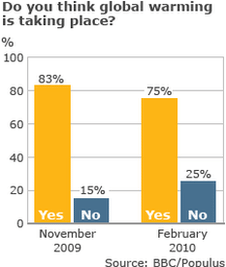
Pesquisa do Datafolha divulgada no último dia 21 de abril revela que pouco mais de nove entre 10 brasileiros acreditam no fenômeno do aquecimento global. Três quartos dos entrevistados acham que a ação humana é a grande responsável pelas mudanças climáticas.

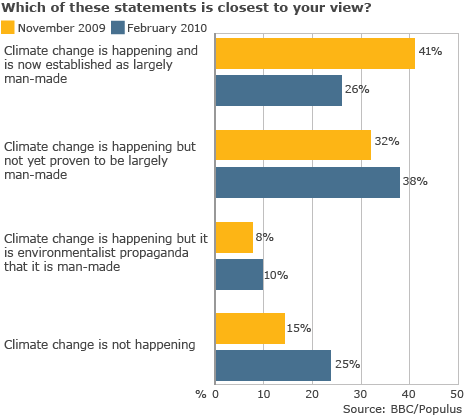
Os números diferem muito dos registrados em estudos com americanos e ingleses. Nos EUA, metade dos cidadãos não crê na responsabilidade do homem pelo aquecimento global. Na Inglaterra, são 25%. Nesses países, mais do que aqui, o recente ataque dos negacionistas climáticos –que tem confrontado duramente as pesquisas do painel de cientistas do clima das Nações Unidas – fez crescer o número de céticos.

Especialmente no caso dos Estados Unidos, ideias que contestam ou atenuam o impacto humano nas mudanças climáticas costumam ter boa aceitação seja porque oferecem salvo-conduto para não deixar de lançar gases de efeito estufa seja porque reduzem a culpa por um estilo de vida considerado perdulário para o planeta muito conveniente. O país é, como se sabe, o maior emissor de CO2. E, em dezembro último, seu presidente, Barack Obama, ajudou a desandar o acordo do clima justamente por não aceitar metas de redução de emissões mais ambiciosas. Para os EUA e –também para a China, sua grande concorrente no mercado global– diminuir emissões significa abrir mão de crescimento, coisa que causa arrepios no norte-americano médio e seus representantes políticos no senado.

Outros números do estudo do Datafolha merecem atenção. Segundo os dados, o número de brasileiros que se consideram bem informados sobre o tema saltou de 20% (em 2009) para 34%. Isso é bom, claro. Talvez signifique um primeiro passo. Mas sentir-se bem informado não quer dizer estar preparado para fazer as mudanças individuais necessárias visando a reduzir o impacto ao planeta.

Nesse sentido, apenas para estimular uma reflexão, lembro de uma pesquisa feita pela Market Analysis, em 2007, em 18 países. Aquele estudo, o primeiro do gênero no País, revelou que os brasileiros estavam entre os mais preocupados do mundo com as mudanças climáticas. No entanto, 46% achavam que um indivíduo pode fazer muito pouco diante de um problema tão grave.

Considerando as variáveis competência e capacidade para mudar o quadro, o estudo identificou quatro grupos. O mais numeroso (40%) seria formado por pessoas com bom nível de informação sobre o aquecimento global, alinhadas com a atuação das ONG´s, críticas em relação às empresas, mas que não necessariamente fazem algo para mudar seu dia a dia. Apenas um em cada seis integrantes desse grupo, no entanto, mostrava-se consciente e mobilizado.

O segundo grupo reunia 38% de brasileiros bem informados sobre o problema, dispostos a adotar mudanças em seu estilo de vida e sensíveis à idéia de que é possível conciliar crescimento econômico com respeito ao meio ambiente. Eles acreditavam que, individualmente, podiam dar uma resposta mais clara do que a sociedade como um todo. O terceiro grupo (12%) confiava mais na sociedade do que em sua própria capacidade de mudar a situação. E o quarto (10%) não acreditava nem no potencial do indivíduo nem no da sociedade. Ambos se caracterizavam por uma postura desinformada e acrítica.

A considerar que esses dados seguem atuais –e penso honestamente que sim- são grandes os desafios brasileiros. O mais importante é mobilizar os indivíduos, fazendo com que percebam que pequenas ações de redução de pegada ecológica somadas a outras ações de consumo consciente no dia a dia podem fazer diferença na luta para esfriar o planeta. Como já foi dito logo após o fracasso de Copenhague, o aquecimento global é um tema importante demais para esperar que as soluções venham apenas de líderes de estado comprometidos mais com a sua política doméstica do que com o futuro saudável da grande casa que habitamos.

*Ricardo Voltolini é publisher da revista Idéia Socioambiental e diretor da consultoria Idéia Sustentável: Estratégia e Inteligência em Sustentabilidade.

http://www.topblog.com.br/sustentabilidade

(Envolverde/Idéia Socioambiental)

>Mudanças climáticas: "caça às bruxas" direcionada a cientistas na Virginia (EUA)

>
An unwelcome ‘climate’ for scientists?

By Paul Guinnessy, Physics Today on May 11, 2010 6:34 PM

Virginia Attorney General Ken Cuccinelli, in a blatantly political move to help strengthen his support among the right wing for his bid to become the next governor, is causing uproar in the science community by investigating climate scientist and former University of Virginia professor Michael Mann.

Cuccinelli is accusing Mann of defrauding Virginia taxpayers by receiving research grants to study global temperatures. Mann, who is now based at the Pennsylvania State University, hasn’t worked in Virginia since 2005.

The subpoena, which currently isn’t attached to any lawsuit, requires the University of Virginia to provide Cuccinelli with thousands of documents and e-mails dating from 1999 to 2005 regarding Mann’s research. The accusation is tied to Mann and coworkers’ “hockey stick” graph that was included in a 2001 United Nations Intergovernmental Panel on Climate Change report. The graph displays annual global average temperatures by merging a wide variety of data sources that were used in some private e-mails made public when the University of East Anglia’s Climate Research Unit e-mail server got hacked.

Not answering the question

When Cuccinelli appeared on the Kojo Nnamdi Show on WAMU radio on Friday, he claimed the investigation was not into Mann’s academic work, but instead was “directed at the expenditure of dollars. Whether he does a good job, bad job or I don’t like the outcome—and I think everybody already knows his position on some of this is one that I question. But that is not what that’s about.”

However, the letter demanding materials gives a different impression. It asks, along with Mann’s correspondence with 39 other climate scientists, for “any and all computer algorithms, programs, source code, or the like created or edited by … Mann.”

This was emphasized when Cuccinelli spoke to the Washington Post, stating “in light of the Climategate e-mails, there does seem to at least be an argument to be made that a course was undertaken by some of the individuals involved, including potentially Michael Mann, where they were steering a course to reach a conclusion. Our act, frankly, just requires honesty.”

There hasn’t been an investigation by Virginia’s attorney general’s office into the funding of research grants of this nature before. Moreover, only one of the five grants under suspicion was funded by Virginia taxpayers through the university; the others were federal grants from the National Oceanic and Atmospheric Administration and the National Science Foundation.

No backbone?

The University of Virginia was originally going to succumb to Cuccinelli’s request. In a statement released to the press last Thursday the university said it was “required by law to comply.”

Shortly afterward, the University of Virginia Faculty Senate Executive Council issued its own statement, which ends:

We maintain that peer review by the scientific community is the appropriate means by which to identify error in the generation, presentation and interpretation of scientific data. The Attorney General’s use of his power to issue a CID under the provisions of Virginia’s FATA is an inappropriate way to engage with the process of scientific inquiry. His action and the potential threat of legal prosecution of scientific endeavor that has satisfied peer-review standards send a chilling message to scientists engaged in basic research involving Earth’s climate and indeed to scholars in any discipline. Such actions directly threaten academic freedom and, thus, our ability to generate the knowledge upon which informed public policy relies.

This was shortly followed by a joint letter to the university from the American Civil Liberties Union and the American Association of University Professors asking the University of Virginia to follow procedures to appeal the subpoena.

The letters seem to have had some effect: The Washington Post reported that the university is now “considering” its options before the Friday deadline to appeal is up.

State Senator Donald McEachin issued a statement, in which he stated he will submit a bill so that in the future the attorney general cannot issue a subpoena without also issuing a lawsuit.

“This is not only ludicrous and frivolous, wasting more taxpayer dollars and trampling on academic freedom, but the Attorney General has deprived Mr. Mann of his constitutional rights,” said McEachin.

Part of a bigger trend

On Friday, although it was put together before Cuccinelli issued his subpoena, Science published a letter by 255 members of the National Academy of Sciences, decrying “political assaults” against climate scientists and “McCarthy-like threats of criminal prosecution” and spelling out again the basic facts of what we know about the changing climate.

The letter was triggered by veiled threats from Senator James Inhofe, a well-known climate-change denier, to criminally investigate scientists over their research, and the political response to the CRU e-mails.

According to Peter Gleick, president of the Pacific Institute, a research center in Oakland, California—who spoke with New York Times reporter Sindya N. Bhanoo—before the NAS members gave the letter to Science, the group had first submitted it to the Wall Street Journal, the New York Times, and the Washington Post, all of whom declined to run it.

>Marcelo Leite: Águas turvas (FSP)

>
“Preconceitos, estridência, falácias, invenções e estatísticas, aliás, transformam todo o debate público numa bacia amazônica de turbidez. Não é privilégio da questão indígena. Tome a usina hidrelétrica de Belo Monte. Ou o tema explosivo da disponibilidade de terras para o agronegócio”

Marcelo Leite
Folha de S.Paulo, 09/05/2010 – reproduzido no Jornal de Ciência (JC e-mail 4006)

Por uma dessas coincidências sintomáticas que a época produz, duas frases que abrem a reportagem de capa da presente edição do caderno Mais! – “No Brasil todo mundo é índio, exceto quem não é” e “Só é índio quem se garante” – estão no centro de um bate-boca entre seu autor, o antropólogo Eduardo Viveiros de Castro, e a revista “Veja”.

A abertura foi escrita antes do quiproquó, mas pouco importa. Se ela e todo o texto sobre educação indígena forem recebidos como tomada de posição, tanto melhor.

De qualquer maneira, é instrutivo ler a reportagem da revista que deu origem a tudo, assim como as réplicas e tréplicas que se seguiram. Permite vislumbrar a profundidade dos preconceitos anti-indígenas e da estridência jornalística que turvam essa vertente de discussão no país.

Preconceitos, estridência, falácias, invenções e estatísticas, aliás, transformam todo o debate público numa bacia amazônica de turbidez. Não é privilégio da questão indígena. Tome a usina hidrelétrica de Belo Monte. Ou o tema explosivo da disponibilidade de terras para o agronegócio, epicentro da indigitada reportagem da revista “Veja”.

“Áreas de preservação ecológica, reservas indígenas e supostos antigos quilombos abarcam, hoje, 77,6% da extensão do Brasil”, afirmam seus autores, sem citar a fonte. “Se a conta incluir também os assentamentos de reforma agrária, as cidades, os portos, as estradas e outras obras de infraestrutura, o total alcança 90,6% do território nacional.”

É provável que a origem omitida seja o estudo “Alcance Territorial da Legislação Ambiental e Indigenista”, encomendado à Embrapa Monitoramento por Satélite pela Presidência da República e encampado pela Confederação Nacional da Agricultura e Pecuária do Brasil (CNA, leia-se senadora Kátia Abreu, DEM-TO). Seu coordenador foi o então chefe da unidade da Embrapa, Evaristo Eduardo de Miranda. A estimativa terminou bombardeada por vários especialistas, inclusive do Instituto Nacional de Pesquisas Espaciais (Inpe).

Nesta semana veio à luz, graças às repórteres Afra Balazina e Andrea Vialli, mais um levantamento que contradiz a projeção alarmante. O novo estudo foi realizado por Gerd Sparovek, da Escola Superior de Agricultura Luiz de Queiroz (Esalq-USP), em colaboração com a Universidade de Chalmers (Suécia).

Para Miranda, se toda a legislação ambiental, fundiária e indigenista fosse cumprida à risca, faltariam 334 mil km2 – 4% do território do Brasil – para satisfazer todas as suas exigências. O valor dá quase um Mato Grosso do Sul de deficit.

Para Sparovek, mesmo que houvesse completa obediência ao Código Florestal ora sob bombardeio de ruralistas, sobraria ainda 1 milhão de km2, além de 600 mil km2 de pastagens poucos produtivas usadas para pecuária extensiva (um boi por hectare). Dá 4,5 Mato Grosso do Sul de superavit.

A disparidade abissal entre as cifras deveria bastar para ensopar as barbas de quem acredita em neutralidade científica, ou a reivindica. Premissas, interpretações da lei e fontes de dados diversas decerto explicam o hiato.

Mas quem as examina a fundo, entrando no mérito e extraindo conclusões úteis para o esclarecimento do público e a tomada de decisão? Faltam pessoas e instituições, no Brasil, com autoridade para decantar espuma e detritos, clarificando as águas para que se possa enxergar o fundo. De blogueiros e bucaneiros já estamos cheios.

>Quase ganhador

>
Agência FAPESP – 17/5/2010

Quase. Passou muito perto. Na próxima vez está no papo. Segundo uma pesquisa feita na Universidade de Cambridge, no Reino Unido, o cérebro do apostador contumaz reage diferentemente na hora de encarar uma derrota.

Para quem não costuma jogar, perder é algo normal e sinaliza a hora de parar. Mas para quem tem no jogo de apostas o seu vício, não é bem assim. De acordo com o estudo, o cérebro desses apostadores reage de modo muito mais intenso a ocasiões em que a vitória esteve muito próxima do que ocorre nos demais.

Essa particularidade poderia explicar por que os jogadores obstinados continuam a apostar mesmo quando estão perdendo sem parar. No estudo, os pesquisadores analisaram os cérebros de 20 apostadores por meio de ressonância magnética funcional enquanto eles jogavam em uma máquina caça-níqueis.

Os pesquisadores observaram que as partes do cérebro envolvidos no processamento de recompensas – chamadas de centros de dopamina – eram mais ativos em pessoas com problemas de apostas do que em pessoas que apostavam socialmente (dois grupos nos quais os voluntários foram divididos).

Durante o experimento, os participantes jogaram uma máquina com duas rodas e ganhavam 50 pences a cada vez que o resultado eram dois ícones iguais. Duas figuras diferentes era considerado uma derrota, mas quando o resultado ficava a um ícone de um par (antes ou depois, na sequência do movimento), o resultado era considerado um “perdeu por pouco”.

Os pesquisadores observaram que esses últimos casos ativaram os mesmos caminhos cerebrais do que as vitórias, mesmo que não houvesse recompensa monetária. Verificaram também que a reação ao resultado era muito mais forte entre os apostadores contumazes.

“Os resultados são interessantes por que sugerem que as ‘derrotas por pouco’ podem estimular uma resposta dopamínica nos jogadores mais frequentes, mesmo quando isso não resulta em um prêmio. Se esses fluxos de dopamina estão direcionando o comportamento aditivo, isso poderá ajudar a explicar por que aqueles que têm nas apostas o seu problema acham tão difícil parar de jogar”, disse Luke Clark, um dos autores do estudo, que foi publicado no Journal of Neuroscience.

O artigo Gambling severity predicts midbrain response to near-miss outcomes (DOI:10.1523/jneurosci.5758-09.2010), de Luke Clark e Henry Chase, pode ser lido por assinantes do Journal of Neuroscience em http://www.jneurosci.org/cgi/content/abstract/30/18/6180.

>Acelerador de gente (FSP)

>
Entrevista com Karin Knorr Cetina

José Galisi-Filho
Folha de SP, 2/5/2010 – reproduzido no Jornal da Ciência (JC e-mail 4001)

Socióloga que estudou os pesquisadores do LHC diz que experimento elimina noções tradicionais de autoria e prestígio

Ao visitar o LHC (Grande Colisor de Hádrons) em abril de 2008, o físico escocês Peter Higgs pôde contrastar sua dimensão humana com a escala gigantesca da maior máquina já construída pela humanidade.

Se a hipótese de Higgs estiver correta, os dados que começaram a jorrar nas últimas semanas do LHC fornecerão a última peça no quebra-cabeças do modelo padrão, a teoria da física que explica a matéria. Mas a saga do LHC é resultado do trabalho de gerações de pesquisadores, cujos nomes finalmente se diluirão na “simbiose homem-máquina” de um novo paradigma, pela primeira vez realmente global, de cooperação cientifica.

Para Karin Knorr Cetina, professora de sociologia do conhecimento da Universidade de Konstanz, Alemanha, o experimento é, antes de tudo, um “laboratório humano” numa escala sem precedentes na história da ciência moderna.

Cetina passou 30 anos observando os pesquisadores do Cern (Centro Europeu de Física Nuclear), laboratório na Suíça que abriga o LHC, numa espécie de estudo “etnológico” da tribo dos físicos, seus usos e costumes. Segundo ela, noções tradicionais na ciência, como carreira, prestigio e autoria, deixam de ter qualquer significado no modelo de produção de conhecimento do Cern.

Da Universidade de Chicago, EUA, onde é pesquisadora visitante, Cetina falou à Folha:

– O que há de novo na forma de produzir conhecimento no Cern, e como isso se compara com as humanidades?

O novo é a dimensão, a duração e o caráter global do experimento. A estrutura dos experimentos é um experimento em si mesmo, com um caráter antecipatório de um tempo global e de uma sociedade do conhecimento. Poderíamos, talvez, fazer uma comparação com aquele espírito arrojado e inovador no desenvolvimento do supersônico Concorde nos anos 1960, que sinalizou uma ruptura de época. Mas não se pode responder com uma simples frase ao “como” esse experimento é coordenado.

Há muitos mecanismos particulares que sustentam o projeto e o transformam numa espécie de “superorganismo”, na íntima colaboração de mais de 2.000 físicos com o gigantesco LHC, que eles mesmo projetaram e no qual, finalmente, trabalham juntos. Um mecanismo muito importante são as publicações coletivas em ordem alfabética. Quem é privilegiado não é o “gênio”, o autor, ou pesquisadores destacados em suas áreas. Um outro mecanismo é que o experimento mesmo, e não os autores, é “convidado” para as conferências internacionais.

Os atores individuais são apenas os representantes daquilo que produziram em conjunto. Um outro mecanismo é que os participantes se encontram, por exemplo, durante toda uma semana no Cern, e esses encontros são organizados de tal maneira que todos possam e devam ser informados sobre tudo que ocorre. Estabelece-se, assim, uma espécie de consciência coletiva do “conhecimento compartilhado”.

Como poderíamos comparar isso com as ciências humanas? Alguns diagnósticos de época importantes, de historiadores e filósofos, por exemplo, ainda encontram ressonância na opinião pública, mas, infelizmente, a estrutura e a segmentação da pesquisa nesse campo do conhecimento não tem mais nada de interessante a oferecer. A sociologia tradicional não sinaliza mais para a frente.

– Depois de muitos anos de pesquisa de campo em laboratórios como uma etnógrafa da ciência, como se diferenciam as culturas científicas diante do papel do indivíduo?

A biologia molecular, que acompanhei por muitos anos, é uma ciência “de bancada”, na qual, por regra, poucos pesquisadores trabalham juntos, na qual também se produz e publica em coletivo, mas não em ordem alfabética. O papel do pesquisador individual ainda permanece importante. Isso leva, como sabemos, a conflitos em torno de autoria e quem está em que posição na publicação. A física de altas energias procura, em contrapartida, liberar a cooperação, na qual é o conjunto que está no ponto central. O fio condutor não é mais a carreira, mas o resultado cientifico. O acelerador é o elemento dominante, pois ele somente pode ser construído e avaliado por muitos.

– Seria a natureza mesma do projeto incompatível com um novo “insight” individual que poderia mudar tudo de forma imprevisível?

É bem mais provável, no caso do Cern, que a pesquisa em equipe deva produzir excelentes resultados empíricos. Muitos pesquisadores em sociologia e nas humanidades, de maneira geral, produzem resultados parciais, fragmentados, que não se agregam dentro de um sistema numa perspectiva cumulativa -não porque a natureza do social seja fragmentada, mas porque nossa maneira de conduzir pesquisas, nossas convenções de pesquisa, não se agregam. Em muitas ciências empíricas devemos investigar no processo cooperativo -já que na natureza todas as partes de uma sistema se interrelacionam- ou todo o sistema ou saber qual é, realmente, a parte central desse sistema que deve ser isolada e destacada. Esse reducionismo experimental não pode ser levado a cabo na ciência social por motivos éticos, por se tratar de pessoas em sua integridade, que não podemos reduzir a células de cultura. Para tanto, seria necessário muito mais cooperação e pesquisa.

>Testes genéticos e a compreensão popular dos fenômenos probabilísticos

>
Teste genético chega à farmácia

Fernando Eichenberg
O Globo, 13/5/2010 – reproduzido no Jornal da Ciência (JC e-mail 4009)

EUA começam a vender polêmicos exames para detectar risco de doenças

A partir de na sexta-feira (14/5), além de aspirina, vitamina C ou pasta de dente, os americanos poderão comprar na farmácia da esquina testes genéticos personalizados, que prometem indicar o risco de contrair 23 doenças, como os males de Alzheimer e Parkinson, câncer de mama, leucemia ou diabetes.

Isso será possível em cerca de 6 mil das 7,5 mil lojas da rede Walgreens, uma das duas maiores dos EUA. É a primeira vez que testes de análise de DNA estarão disponíveis para consumo de massa.

A iniciativa é da Pathway Genomics, uma empresa de San Diego. Os kits, chamados de Insight Saliva Collection, ao preço unitário entre US$ 20 e US$ 30, têm um recipiente de plástico e um envelope padrão, pelo qual a saliva coletada é enviada a um dos laboratórios para análise. Após a remessa, é necessário pagar um valor adicional, no site da empresa, pelos tipos de testes de DNA desejados.

Por US$ 79, são avaliadas as reações do organismo a substâncias como cafeína, drogas de redução do colesterol ou tamoxifeno, usado no tratamento do câncer de mama. Por US$ 179, futuros pais poderão conhecer a probabilidade de serem portadores de 23 problemas genéticos, como diabetes ou talassemia beta (um tipo de anemia), passíveis de transmissão aos seus filhos. Pelo mesmo preço, são testados riscos pessoais referentes a ataques cardíacos, câncer do pulmão, leucemia ou esclerose múltipla. Para aqueles dispostos a desembolsar ainda mais, por US$ 249 é possível fazer todos os testes disponíveis.

Especialista diz que testes são nocivos

A chegada dos testes genéticos às farmácias causou polêmica. A Pathway Genomics alega que, embora não sejam definitivos, os resultados fornecidos pelas análises poderão estimular as pessoas a mudar de hábitos e a adotar atitudes mais saudáveis em suas vidas. Nem todos concordam. Para Hank Greely, diretor do Centro de Direito e de Biociências da Universidade de Stanford, trata-se de uma péssima ideia. Segundo ele, para a grande maioria das pessoas, as informações genéticas não serão de grande valia e poderão, inclusive, ser mal interpretadas, provocando sérios riscos. Ele dá o exemplo de uma mulher que descobre, pelos testes, não ter a mutação nos genes relacionada ao câncer de mama.

– Ela pode concluir que está salva. Mas o que isso significa? Que você não tem 70% de chances de ter câncer de mama, mas ainda está acima da média de risco de 12%. Ela poderá decidir parar de fazer exames, o que será um enorme erro – explica.

Greely cita também o caso de alguém que é informado possuir o dobro de propensão para sofrer da doença de Alzheimer.

– Talvez essa pessoa não vá cometer suicídio, mas poderá ter sua vida alterada com esse dado. Ela não irá perceber o fato de que ter 20% em vez de 10% de possibilidade de sofrer de Alzheimer significa que em 80% do tempo ela viverá como alguém que não terá a doença – pondera.

Para o especialista, um dos maiores perigos dessa nova iniciativa é a falta de aconselhamento médico na hora de fornecer os resultados.

– Por US$ 99 a hora, você pode telefonar para um número que está no site da empresa para fazer consultas sobre o seu teste, mas é claro que a maioria das pessoas não vai pagar por isso – ressalta.

Por essa razão, embutida em sua legislação, o Estado de Nova York não permitirá que os kits sejam vendidos nas farmácias locais. O FDA, órgão do governo americano que regulamenta o mercado de remédios e alimentos, anunciou que está avaliando o caso e dará um parecer em breve. Mas a ideia já inspirou a CVS, cadeia de farmácias concorrente da Walgreens, que promete também vender seus kits genéticos a partir de agosto.

>The delicate wine grape has become our best early-warning system for the effects of global warming (Slate)

>
climate desk – In Vino Veritas

The delicate wine grape has become our best early-warning system for the effects of global warming.

By Mark Hertsgaard
Posted Monday, April 26, 2010, at 11:01 AM ET

John Williams has been making wine in California’s Napa Valley for nearly 30 years, and he farms so ecologically that his peers call him Mr. Green. But if you ask him how climate change will affect Napa’s world-famous wines, he gets irritated, almost insulted. “You know, I’ve been getting that question a lot recently, and I feel we need to keep this issue in perspective,” he told me. “When I hear about global warming in the news, I hear that it’s going to melt the Arctic, inundate coastal cities, displace millions and millions of people, spread tropical diseases and bring lots of other horrible effects. Then I get calls from wine writers and all they want to know is, ‘How is the character of cabernet sauvignon going to change under global warming?’ I worry about global warming, but I worry about it at the humanity scale, not the vineyard scale.”

Williams is the founder of Frog’s Leap, one of the most ecologically minded wineries in Napa and, for that matter, the world. Electricity for the operation comes from 1,000 solar panels erected along the merlot vines; the heating and cooling are supplied by a geothermal system that taps into the Earth’s heat. The vineyards are 100 percent organic and—most radical of all, considering Napa’s dry summers—there is no irrigation.

Yet despite his environmental fervor, Williams dismisses questions about preparing Frog’s Leap for the impacts of climate change. “We have no idea what effects global warming will have on the conditions that affect Napa Valley wines, so to prepare for those changes seems to me to be whistling past the cemetery,” he says, a note of irritation in his voice. “All I know is, there are things I can do to stop, or at least slow down, global warming, and those are things I should do.”

Williams has a point about keeping things in perspective. At a time when climate change is already making it harder for people in Bangladesh to find enough drinking water, it seems callous to fret about what might happen to premium wines. But there is much more to the question of wine and climate change than the character of pinot noir. Because wine grapes are extraordinarily sensitive to temperature, the industry amounts to an early-warning system for problems that all food crops—and all industries—will confront as global warming intensifies. In vino veritas, the Romans said: In wine there is truth. The truth now is that the Earth’s climate is changing much faster than the wine business, and virtually every other business on Earth, is preparing for.

All crops need favorable climates, but few are as vulnerable to temperature and other extremes as wine grapes. “There is a fifteenfold difference in the price of cabernet sauvignon grapes that are grown in Napa Valley and cabernet sauvignon grapes grown in Fresno,” in California’s hot Central Valley, says Kim Cahill, a consultant to the Napa Valley Vintners’ Association. “Cab grapes grown in Napa sold [in 2006] for $4,100 a ton. In Fresno the price was $260 a ton. The difference in average temperature between Napa and Fresno was 5 degrees Fahrenheit.”

Numbers like that help explain why climate change is poised to clobber the global wine industry, a multibillion-dollar business whose decline would also damage the much larger industries of food, restaurants, and tourism. Every business on Earth will feel the effects of global warming, but only the ski industry—which appears doomed in its current form—is more visibly targeted by the hot, erratic weather that lies in store over the next 50 years. In France, the rise in temperatures may render the Champagne region too hot to produce fine champagne. The same is true for the legendary reds of Châteauneuf du Pape, where the stony white soil’s ability to retain heat, once considered a virtue, may now become a curse. The world’s other major wine-producing regions—California, Italy, Spain, Australia—are also at risk.

If current trends continue, the “premium wine grape production area [in the United States] … could decline by up to 81 percent by the late 21st century,” a team of scientists wrote in a study published in the Proceedings of the National Academy of Sciences in 2006. The culprit was not so much the rise in average temperatures but an increased frequency of extremely hot days, defined as above 35 degrees Celsius (95 degrees Fahrenheit). If no adaptation measures were taken, these increased heat spikes would “eliminate wine grape production in many areas of the United States,” the scientists wrote.

In theory, winemakers can defuse the threat by simply shifting production to more congenial locations. Indeed, Champagne grapes have already been planted in England and some respectable vintages harvested. But there are limits to this strategy. After all, temperature is not the sole determinant of a wine’s taste. What the French call terroir—a term that refers to the soil of a given region but also includes the cultural knowledge of the people who grow and process grapes—is crucial. “Wine is tied to place more than any other form of agriculture, in the sense that the names of the place are on the bottle,” says David Graves, the co-founder of the Saintsbury wine company in the Napa Valley. “If traditional sugar-beet growing regions in eastern Colorado had to move north, nobody would care. But if wine grapes can’t grow in the Napa Valley anymore—which is an extreme statement, but let’s say so for the sake of argument—suddenly you have a global warming poster child right up there with the polar bears.”

A handful of climate-savvy winemakers such as Graves are trying to rouse their colleagues to action before it is too late, but to little avail. Indeed, some winemakers are actually rejoicing in the higher temperatures of recent years. “Some of the most expensive wines in Spain come from the Rioja Alta and Rioja Alavesa regions,” Pancho Campo, the founder and president of the Wine Academy of Spain, says. “They are getting almost perfect ripeness every year now for Tempranillo. This makes the winemakers say, ‘Who cares about climate change? We are getting perfect vintages.’ The same thing has happened in Bordeaux. It is very difficult to tell someone, ‘This is only going to be the case for another few years.’ “

The irony is, the wine business is better situated than most to adapt to global warming. Many of the people in the industry followed in their parents’ footsteps and hope to pass the business on to their kids and grandkids someday. This should lead them to think further ahead than the average corporation, with its obsessive focus on this quarter’s financial results. But I found little evidence this is happening.

The exception: Alois Lageder’s family has made wine in Alto Adige, the northernmost province in Italy, since 1855. The setting, at the foot of the Alps, is majestic. Looming over the vines are massive outcroppings of black and gray granite interspersed with flower-strewn meadows and wooded hills that inevitably call to mind The Sound of Music. Locals admire Lageder for having led Alto Adige’s evolution from producing jug wine to boasting some of the best whites in Italy. In October 2005, Lageder hosted the world’s first conference on the future of wine under climate change. “We must recognize that climate change is not a problem of the future,” Lageder told his colleagues. “It is here today and we must adapt now.”

As it happens, Alto Adige is the location of one of the most dramatic expressions of modern global warming: the discovery of the so-called Iceman—the frozen remains of a herder who lived in the region 5,300 years ago. The corpse was found in 1991 in a mountain gully, almost perfectly preserved—even the skin was intact—because it had lain beneath mounds of snow and ice since shortly after his death (a murder, forensic investigators later concluded from studying the trajectory of an arrowhead lodged in his left shoulder). He would not have been found were it not for global warming, says Hans Glauber, the director of the Alto Adige Ecological Institute: “Temperatures have been rising in the Alps about twice as fast as in the rest of the world,” he notes.

Lageder heard about global warming in the early 1990s and felt compelled to take action. It wasn’t easy—”I had incredible fights with my architect about wanting good insulation,” he says—but by 1996 he had installed the first completely privately financed solar-energy system in Italy. He added a geothermal energy system as well. Care was taken to integrate these cutting-edge technologies into the existing site; during a tour, I emerged from a dark fermentation cellar with its own wind turbine into the bright sunlight of a gorgeous courtyard dating to the 15th century. Going green did make the renovation cost 30 percent more, Lageder says, “but that just means there is a slightly longer amortization period. In fact, we made up the cost difference through increased revenue, because when people heard about what we were doing, they came to see it and they ended up buying our wines.”

The record summer heat that struck Italy and the rest of Europe in 2003, killing tens of thousands, made Lageder even more alarmed. “When I was a kid, the harvest was always after Nov. 1, which was a cardinal date,” he told me. “Nowadays, we start between the 5th and 10th of September and finish in October.” Excess heat raises the sugar level of grapes to potentially ruinous levels. Too much sugar can result in wine that is unbalanced and too alcoholic—wine known as “cooked” or “jammy.” Higher temperatures may also increase the risk of pests and parasites, because fewer will die off during the winter. White wines, whose skins are less tolerant of heat, face particular difficulties as global warming intensifies. “In 2003, we ended up with wines that had between 14 and 16 percent alcohol,” Lageder recalled, “whereas normally they are between 12 and 14 percent. The character of our wine was changing.”

A 2 percent increase in alcohol may sound like a tiny difference, but the effect on a wine’s character and potency is considerable. “In California, your style of wine is bigger, with alcohol levels of 14 and 15, even 16 percent,” Lageder continued. “I like some of those wines a lot. But the alcohol level is so high that you have one glass and then”—he slashed his hand across his throat—”you’re done; any more and you will be drunk. In Europe, we prefer to drink wine throughout the evening, so we favor wines with less alcohol. Very hot weather makes that harder to achieve.”

There are tricks grape growers and winemakers can use to lower alcohol levels. The leaves surrounding the grapes can be allowed to grow bushier, providing more shade. Vines can be replaced with different clones or rootstocks. Growing grapes at higher altitudes, where the air is cooler, is another option. So is changing the type of grapes being grown.

But laws and cultural traditions currently stand in the way of such adaptations. So-called AOC laws (Appellation d’Origine Côntrollée) govern wine-grape production throughout France, and in parts of Italy and Spain, as well. As temperatures rise further, these AOC laws and kindred regulations are certain to face increased challenge. “I was just in Burgundy,” Pancho Campo told me in March 2008, “and producers there are very concerned, because they know that chardonnay and pinot noir are cool-weather wines, and climate change is bringing totally the contrary. Some of the producers were even considering starting to study Syrah and other varieties. At the moment, they are not allowed to plant other grapes, but these are questions people are asking.”

The greatest resistance, however, may come from the industry itself. “Some of my colleagues may admire my views on this subject, but few have done much,” says Lageder. “People are trying to push the problem away, saying, ‘Let’s do our job today and wait and see in the future if climate change becomes a real problem.’ But by then it will be too late to save ourselves.”

If the wine industry does not adapt to climate change, life will go on—with less conviviality and pleasure, perhaps, but it will go on. Fine wine will still be produced, most likely by early adapters such as Lageder, but there will be less of it. By the law of supply and demand, that suggests the best wines of tomorrow will cost even more than the ridiculous amounts they fetch today. White wine may well disappear from some regions. Climate-sensitive reds such as pinot noir are also in trouble. It’s not too late for winemakers to save themselves through adaptation. But it’s disconcerting to see so much dawdling in an industry with so much incentive to act. If winemakers aren’t motivated to adapt to climate change, what businesses will be?

The answer seems to be very few. Even in Britain, where the government is vigorously championing adaptation, the private sector lags in understanding the adaptation imperative, much less implementing it. “I bet if I rang up 100 small businesses in the U.K. and mentioned adaptation, 90 of them wouldn’t know what I was talking about,” says Gareth Williams, who works with the organization Business in the Community, helping firms in northeast England prepare for the storms and other extreme weather events that scientists project for the region. “When I started this job, I gave a presentation to heads of businesses,” said Williams, who spent most of his career in the private sector. “I presented the case for adaptation, and in the question-and-answer period, one executive said, ‘We’re doing quite a lot on adaptation already.’ I said, ‘Oh, what’s that?’ He said, ‘We’re recycling, and we’re looking at improving our energy efficiency.’ I thought to myself, ‘Oh, my, he really didn’t get it at all. This is going to be a struggle.’ “

“Most of us are not very good at recognizing our risks until we are hit by them,” explains Chris West, the director of the U.K. government’s Climate Impact Program. “People who run companies are no different.” Before joining UKCIP in 1999, West had spent most of his career working to protect endangered species. Now, the species he is trying to save is his own, and the insights of a zoologist turn out to be quite useful. Adapting to changing circumstances is, after all, the essence of evolution—and of success in the modern economic marketplace. West is fond of quoting Darwin: “It is not the strongest of the species that survives … nor the most intelligent that survives. It is the one that is the most adaptable to change.”

This story comes from the Climate Desk collaboration.

Article URL: http://www.slate.com/id/2251870/

>Weathermen, and other climate change skeptics (The New Yorker)

>
Comment
Up in the Air

by Elizabeth Kolbert – April 12, 2010

Joe Bastardi, who goes by the title “expert senior forecaster” at AccuWeather, has a modest proposal. Virtually every major scientific body in the world has concluded that the planet is warming, and that greenhouse-gas emissions are the main cause. Bastardi, who holds a bachelor’s degree in meteorology, disagrees. His theory, which mixes volcanism, sunspots, and a sea-temperature trend known as the Pacific Decadal Oscillation, is that the earth is actually cooling. Why don’t we just wait twenty or thirty years, he proposes, and see who’s right? This is “the greatest lab experiment ever,” he said recently on Bill O’Reilly’s Fox News show.

Bastardi’s position is ridiculous (which is no doubt why he’s often asked to air it on Fox News). Yet there it was on the front page of the Times last week. Among weathermen, it turns out, views like Bastardi’s are typical. A survey released by researchers at George Mason University found that more than a quarter of television weathercasters agree with the statement “Global warming is a scam,” and nearly two-thirds believe that, if warming is occurring, it is caused “mostly by natural changes.” (The survey also found that more than eighty per cent of weathercasters don’t trust “mainstream news media sources,” though they are presumably included in this category.)

Why, with global warming, is it always one step forward, two, maybe three steps back? A year ago, it looked as if the so-called climate debate might finally be over, and the business of actually addressing the problem about to begin. In April, the Obama Administration designated CO2 a dangerous pollutant, thus taking the first critical step toward regulating carbon emissions. The following month, the Administration announced new fuel-efficiency standards for cars. (These rules were finalized last week.) In June, the House of Representatives passed a bill, named for its co-sponsors, Edward Markey and Henry Waxman, that called for reducing emissions seventeen per cent by 2020. Speaking in September at the United Nations, the President said that a “new era” had dawned. “We understand the gravity of the climate threat,” he declared. “We are determined to act.”

Then, much like the Arctic ice cap, that “new era” started to fall to pieces. The U.N. climate summit in Copenhagen in December broke up without agreement even on a possible outline for a future treaty. A Senate version of the Markey-Waxman bill failed to materialize and, it’s now clear, won’t be materializing anytime this year. (Indeed, the one thing that seems certain not to be in a Senate energy bill is the economy-wide emissions reduction required by the House bill.) Last week, despite the Senate’s inaction, President Obama announced that he was opening huge swaths of the Atlantic and Alaskan coasts to oil drilling. The White House billed the move as part of a “comprehensive energy strategy,” a characterization that, as many commentators pointed out, made no sense, since comprehensiveness is precisely what the President’s strategy lacks. As Josh Nelson put it on the blog EnviroKnow, “Obama is either an exceptionally bad negotiator, or he actually believes in some truly awful policy ideas. Neither of these possibilities bodes well.”

As lawmakers dither, public support for action melts away. In a Gallup poll taken last month, forty-eight per cent of respondents said that they believe the threat of global warming to be “generally exaggerated.” This figure was up from thirty-five per cent just two years ago. According to the same poll, only fifty-two per cent of Americans believe that “most scientists believe that global warming is occurring,” down from sixty-five per cent in 2008.

The most immediate explanation for this disturbing trend is the mess that’s come to be known as Climategate. Here the situation is the reverse of what’s going on in the troposphere: Climategate really is a hyped-up media phenomenon. Late last year, hackers broke into the computer system at the Climatic Research Unit of Britain’s University of East Anglia and posted online hundreds of private e-mails from scientists. In the e-mails, C.R.U. researchers often express irritation with their critics—the death of one detractor is described as “cheering news”—and discuss ways to dodge a slew of what they consider to be nuisance Freedom of Information requests. The e-mails were widely portrayed in the press and in the blogosphere as evidence of a conspiracy to misrepresent the data. But, as a parliamentary committee appointed to investigate the matter concluded last week, this charge is so off base that it is difficult even to respond to: “Insofar as the committee was able to consider accusations of dishonesty against CRU, the committee considers that there is no case to answer.”

The e-mail brouhaha was followed by—and immediately confused with—another overblown controversy, about a mistake in the second volume of the U.N. Intergovernmental Panel on Climate Change’s Fourth Assessment Report, from 2007. On page 493 of the nine-hundred-and-seventy-six-page document, it is asserted, incorrectly, that the Himalayan glaciers could disappear by 2035. (The report cites as a source for this erroneous information a report by the World Wildlife Fund.) The screw-up, which was soon acknowledged by the I.P.C.C. and the W.W.F., was somehow transformed by commentators into a reason to doubt everything in the three-volume assessment, including, by implication, the basic laws of thermodynamics. The “new scandal (already awarded the unimaginative name of ‘Glaciergate’) raises further challenges for a scientific theory that is steadily losing credibility,” James Heiser wrote on the Web site of the right-wing magazine New American.

No one has ever offered a plausible account of why thousands of scientists at hundreds of universities in dozens of countries would bother to engineer a climate hoax. Nor has anyone been able to explain why Mother Nature would keep playing along; despite what it might have felt like in the Northeast these past few months, globally it was one of the warmest winters on record.

The message from scientists at this point couldn’t be clearer: the world’s emissions trajectory is extremely dangerous. Goofball weathermen, Climategate, conspiracy theories—these are all a distraction from what’s really happening. Which, apparently, is what we’re looking for. ♦

Read more: http://www.newyorker.com/talk/comment/2010/04/12/100412taco_talk_kolbert#ixzz0lBqmFCnu

>Referência em previsões climáticas

>
Agência FAPESP – 26/3/2010

O Centro de Previsão de Tempo e Estudos Climáticos (CPTEC), do Instituto Nacional de Pesquisas Espaciais (Inpe), passará a integrar um seleto grupo de centros mundiais de previsão climática sazonal.

O centro foi recomendado pela Comissão para Sistemas Básicos da Organização Meteorológica Mundial (OMM) como um Global Producing Center (GPC) ou Centro Produtor Global de previsões de longo prazo.

Após confirmação da OMM – prevista para junho deste ano – o CPTEC receberá um selo de qualidade para suas previsões climáticas sazonais. Segundo avaliação dos especialistas da OMM, o CPTEC atende a vários critérios, com destaque para a metodologia empregada, disseminação de produtos de previsão na internet e existência de um ciclo operacional fixo de previsão climática sazonal.

Em contrapartida, o centro passará a participar de atividades internacionais da OMM, contribuindo com o Centro de Verificação de Previsão de Longo Prazo. Desde 2006, a OMM, por meio do Programa Global de Processamento de Dados e Sistemas de Previsão, passou a atestar a qualidade dos centros de pesquisa e de previsão climática que atendam a determinados quesitos, intitulando-os GPCs de previsões de longo prazo.

Com a recomendação, o CPTEC passará também a integrar um grupo de centros mundiais de previsão climática sazonal, como os National Centers for Environmental Prediction (Estados Unidos), o European Centre for Medium-Range Weather Forecasts (União Europeia), o UK Met Office (Reino Unido), o Meteo-France, o Metorological Service of Canada, o Bureau of Meteorology da Austrália e o Japan Meteorological Agency, entre outros.

>The beginning of modern tornado forecasting

>
Fawbush and Miller

By Bill Murray
Whatever-weather.com, March 20, 2010

The Californian had little experience with forecasting Midwestern weather. He had been at Tinker Air Force Base in Oklahoma less than three weeks. When World War II broke out, he left his classes at Occidental College where he was enrolled, and enlisted in the Army Air Corps. He ended up in the weather forecaster school in Grand Rapids, Michigan. The demand was so great that new forecasters were put to work after a hurried nine month course in meteorology. His tours of duty were mainly in the South Pacific, forecasting weather for the forces that were battling the Axis. He was eventually promoted to the rank of Captain.

At the end of the war, he was assigned to Fort Benning in Georgia, where he honed his ability to map out the details of weather at different altitudes and visualize those details. This ability to understand a three dimensional picture of the atmosphere is critical to weather forecasting. On the afternoon of March 20, 1948, he plotted the weather at the surface and aloft across the vast and flat terrain of the American Plains. There was nothing on the charts out of the ordinary It looked like a dry and boring forecast with just some gusty winds through the evening hours.

He settled in to get acquainted with the backup forecaster, who was also from California. About 9 p.m., much to the forecasters’ surprise, they began to see surface reports of lightning from stations just to the southwest and west of Oklahoma City. Echoes appeared on their weather radar, less than twenty minutes away. The backup forecaster, a Staff Sergeant, sat down to type up a warning that thunderstorms were approaching. To their horror, at 9:52 p.m., a report streamed across the teletype from Will Rogers Airport, just seven miles to their southwest that a tornado was on the ground, visible from the airport. Sure enough, illuminated by lightning, a huge funnel was visible almost immediately. It roared across the base, doing $10 million worth of damage and injuring several personnel.

There were recriminations immediately. A panel of investigators from Washington flew in the next morning. The nervous weather officer and his superior answered questions. The board of inquiry listened to the facts and quickly rendered a decision. The event was not forecastable given the state of the art in meteorology. But later that day, Colonel Robert Miller and Major Ernest Fawbush were summoned to the Commanding General’s office. He directed Fawbush and Miller to investigate the possibility of forecasting tornadoes.

They reviewed the weather charts from the day before, as well as those from other tornadic events. They identified that tornadoes seemed to occur in warm, moist airmasses, with strong winds aloft. But the difficulty lay in delineating the areas which were most likely to experience the destructive storms. Issuing a tornado forecast for a single point seemed improbable.

But less than a week later on the 25th, Fawbush and Miller looked at their weather charts and then at each other. The weather pattern looked nearly identical to that of the 20th. What were the odds that another tornado would strike the base? Infinitesimal. They went to the General and told him what they saw. The General ordered the base secured. They reconvened with the General at early afternoon. It was then that they issued the first tornado forecast. Sure enough, a tornado moved across the well-prepared base that evening.

It was the beginning of modern tornado forecasting.

[This is one more historical example of the fact that unpredictability raises the specter of blame and accountability to forecasters. RT]

>Understanding Scientific Terms About Climate Change

>
Certainty vs. Uncertainty

Union of Concerned Scientists – http://www.ucsusa.org
Last Revised: 03/17/10

Uncertainty is ubiquitous in our daily lives. We are uncertain about where to go to college, when and if to get married, who will play in the World Series, and so on.

To most of us, uncertainty means not knowing. To scientists, however, uncertainty is how well something is known. And, therein lies an important difference, especially when trying to understand what is known about climate change.

In science, there’s no such thing as absolute certainty. But, research reduces uncertainty. In many cases, theories have been tested and analyzed and examined so thoroughly that their chance of being wrong is infinitesimal. Other times, uncertainties linger despite lengthy research. In those cases, scientists make it their job to explain how well something is known. When gaps in knowledge exist, scientists qualify the evidence to ensure others don’t form conclusions that go beyond what is known.

Even though it may seem counterintuitive, scientists like to point out the level of uncertainty. Why? Because they want to be as transparent as possible and it shows how well certain phenomena are understood. Scientists have even developed their own phrasing regarding uncertainty, such as “very high confidence” (9 out of 10 chances of being correct) about a certain fact and “very likely” (90 chances out of 100) to describe the chance of an outcome.

Decision makers in our society use scientific input all the time. But they could make a critically wrong choice if the unknowns aren’t taken into account. For instance, city planners could build a levee too low or not evacuate enough coastal communities along an expected landfall zone of a hurricane if uncertainty is understated. For these reasons, uncertainty plays a key role in informing public policy.

However, this culture of transparency has caused problems for climate change science. Climate change deniers link certainty projections with not knowing anything. The truth is, science knows much about climate change. We have learned, for example, that the burning of fossil fuels and the clearing or burning of land creates carbon dioxide (CO2), which is released into the atmosphere. There is no uncertainty about this. We have learned that carbon dioxide and other greenhouse gases build up in the atmosphere and trap heat through the greenhouse effect.

Again, there is no uncertainty about this. Earth is warming, and scientists are very certain that humans are the main reason for the world’s temperature increase in the past 50 years.

Scientists know with very high confidence, or even greater certainty, that:

  • Human-induced warming influences physical and biological systems throughout the world
  • Sea levels are rising
  • Glaciers and permafrost are shrinking
  • Oceans are becoming more acidic
  • Ranges of plants and animals are shifting

Scientists are uncertain, however, about how much global warming will occur in the future (between 2.1 degrees and 11 degrees Fahrenheit by 2100). They are also uncertain how soon the sea ice habitat where the ringed seal lives will disappear. Curiously, much of this uncertainty has to do with—are you ready?—humans. The choices we make in the next decade, or so, to reduce emissions of heat-trapping gasses could prevent catastrophic climate change.

So, what’s the bottom line? Science has learned much about climate change. Science tells us what is more or less likely to be true. The latest climate science underscores that there’s an urgent need to reduce heat-trapping emissions. And that is certain.

Table: Language to describe confidence about facts and the likelihood of an outcome.  SOURCE: IPCC WGI (2007).

Terminology for describing confidence about facts
Very High confidence At least 9 out of 10 chance of being correct
High confidence About 8 out of 10 chance
Medium confidence About 5 out of 10 chance
Low confidence About 2 out of 10 chance
Very low confidence Less than 1 out of 10 chance

Terminology for describing likelihood of an outcome
Virtually certain More than 99 chances out of 100
Extremely likely More than 95 chances out of 100
Very likely More than 90 chances out of 100
Likely More than 65 chances out of 100
More likely than not More than 50 chances out of 100


>The clouds of unknowing (The Economist)

>
The science of climate change

There are lots of uncertainties in climate science. But that does not mean it is fundamentally wrong

Mar 18th 2010 | From The Economist print edition

FOR anyone who thinks that climate science must be unimpeachable to be useful, the past few months have been a depressing time. A large stash of e-mails from and to investigators at the Climatic Research Unit of the University of East Anglia provided more than enough evidence for concern about the way some climate science is done. That the picture they painted, when seen in the round—or as much of the round as the incomplete selection available allows—was not as alarming as the most damning quotes taken out of context is little comfort. They offered plenty of grounds for both shame and blame.

At about the same time, glaciologists pointed out that a statement concerning Himalayan glaciers in the most recent report of the Intergovernmental Panel on Climate Change (IPCC) was wrong. This led to the discovery of other poorly worded or poorly sourced claims made by the IPCC, which seeks to create a scientific consensus for the world’s politicians, and to more general worries about the panel’s partiality, transparency and leadership. Taken together, and buttressed by previous criticisms, these two revelations have raised levels of scepticism about the consensus on climate change to new heights.

Increased antsiness about action on climate change can also be traced to the recession, the unedifying spectacle of last December’s climate-change summit in Copenhagen, the political realities of the American Senate and an abnormally cold winter in much of the northern hemisphere. The new doubts about the science, though, are clearly also a part of that story. Should they be?

In any complex scientific picture of the world there will be gaps, misperceptions and mistakes. Whether your impression is dominated by the whole or the holes will depend on your attitude to the project at hand. You might say that some see a jigsaw where others see a house of cards. Jigsaw types have in mind an overall picture and are open to bits being taken out, moved around or abandoned should they not fit. Those who see houses of cards think that if any piece is removed, the whole lot falls down. When it comes to climate, academic scientists are jigsaw types, dissenters from their view house-of-cards-ists.

The defenders of the consensus tend to stress the general consilience of their efforts—the way that data, theory and modelling back each other up. Doubters see this as a thoroughgoing version of “confirmation bias”, the tendency people have to select the evidence that agrees with their original outlook. But although there is undoubtedly some degree of that (the errors in the IPCC, such as they are, all make the problem look worse, not better) there is still genuine power to the way different arguments and datasets in climate science tend to reinforce each other.

The doubters tend to focus on specific bits of empirical evidence, not on the whole picture. This is worthwhile—facts do need to be well grounded—but it can make the doubts seem more fundamental than they are. People often assume that data are simple, graspable and trustworthy, whereas theory is complex, recondite and slippery, and so give the former priority. In the case of climate change, as in much of science, the reverse is at least as fair a picture. Data are vexatious; theory is quite straightforward. Constructing a set of data that tells you about the temperature of the Earth over time is much harder than putting together the basic theoretical story of how the temperature should be changing, given what else is known about the universe in general.

Absorb and reflect

The most relevant part of that universal what-else is the requirement laid down by thermodynamics that, for a planet at a constant temperature, the amount of energy absorbed as sunlight and the amount emitted back to space in the longer wavelengths of the infra-red must be the same. In the case of the Earth, the amount of sunlight absorbed is 239 watts per square metre. According to the laws of thermodynamics, a simple body emitting energy at that rate should have a temperature of about –18ºC. You do not need a comprehensive set of surface-temperature data to notice that this is not the average temperature at which humanity goes about its business. The discrepancy is due to greenhouse gases in the atmosphere, which absorb and re-emit infra-red radiation, and thus keep the lower atmosphere, and the surface, warm (see the diagram below). The radiation that gets out to the cosmos comes mostly from above the bulk of the greenhouse gases, where the air temperature is indeed around –18ºC.

Adding to those greenhouse gases in the atmosphere makes it harder still for the energy to get out. As a result, the surface and the lower atmosphere warm up. This changes the average temperature, the way energy moves from the planet’s surface to the atmosphere above it and the way that energy flows from equator to poles, thus changing the patterns of the weather.

No one doubts that carbon dioxide is a greenhouse gas, good at absorbing infra-red radiation. It is also well established that human activity is putting more of it into the atmosphere than natural processes can currently remove. Measurements made since the 1950s show the level of carbon dioxide rising year on year, from 316 parts per million (ppm) in 1959 to 387ppm in 2009. Less direct records show that the rise began about 1750, and that the level was stable at around 280ppm for about 10,000 years before that. This fits with human history: in the middle of the 18th century people started to burn fossil fuels in order to power industrial machinery. Analysis of carbon isotopes, among other things, shows that the carbon dioxide from industry accounts for most of the build-up in the atmosphere.

The serious disagreements start when discussion turns to the level of warming associated with that rise in carbon dioxide. For various reasons, scientists would not expect temperatures simply to rise in step with the carbon dioxide (and other greenhouse gases). The climate is a noisy thing, with ups and downs of its own that can make trends hard to detect. What’s more, the oceans can absorb a great deal of heat—and there is evidence that they have done so—and in storing heat away, they add inertia to the system. This means that the atmosphere will warm more slowly than a given level of greenhouse gas would lead you to expect.

There are three records of land-surface temperature put together from thermometer readings in common use by climatologists, one of which is compiled at the Climatic Research Unit of e-mail infamy. They all show warming, and, within academia, their reliability is widely accepted. Various industrious bloggers are not so convinced. They think that adjustments made to the raw data introduce a warming bias. They also think the effects of urbanisation have confused the data because towns, which are sources of heat, have grown up near weather stations. Anthony Watts, a retired weather forecaster who blogs on climate, has set up a site, surfacestations.org, where volunteers can help record the actual sites of weather instruments used to provide climate data, showing whether they are situated close to asphalt or affected by sources of bias.

Those who compile the data are aware of this urban heat-island effect, and try in various ways to compensate for it. Their efforts may be insufficient, but various lines of evidence suggest that any errors it is inserting are not too bad. The heat-island effect is likely to be strongest on still nights, for example, yet trends from data recorded on still nights are not that different from those from windy ones. And the temperature of waters at the surface of the seas shows similar trends to that on land over the past century, as does the record of air temperature over the oceans as measured at night (see chart 1).
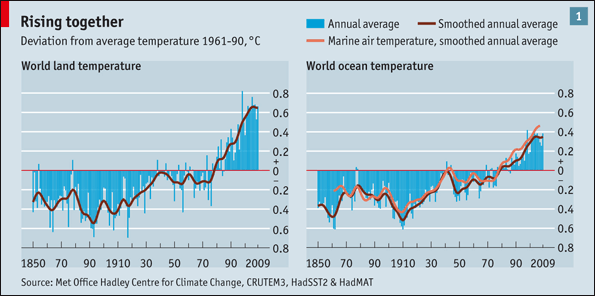
A recent analysis by Matthew Menne and his colleagues at America’s National Oceanic and Atmospheric Administration, published in the Journal of Geophysical Research, argued that trends calculated from climate stations that surfacestation.org found to be poorly sited and from those it found well sited were more or less indistinguishable. Mr Watts has problems with that analysis, and promises a thorough study of the project’s findings later.

There is undoubtedly room for improvement in the surface-temperature record—not least because, at the moment, it provides only monthly mean temperatures, and there are other things people would like to know about. (When worrying about future heatwaves, for example, hot days and nights, not hot months, are the figures of most interest.) In February Britain’s Met (ie, meteorological) Office called for the creation of a new set of temperature databases compiled in rigorously transparent ways and open to analysis and interpretation by all and sundry. Such an initiative would serve science well, help restore the credibility of land-surface records, and demonstrate an openness on the part of climate science which has not always been evident in the past.

Simplify and amplify

For many, the facts that an increase in carbon dioxide should produce warming, and that warming is observed in a number of different indicators and measurements, add up to a primafacie case for accepting that greenhouse gases are warming the Earth and that the higher levels of greenhouse gases that business as usual would bring over the course of this century would warm it a lot further.

The warming caused by a given increase in carbon dioxide can be calculated on the basis of laboratory measurements which show how much infra-red radiation at which specific wavelengths carbon dioxide molecules absorb. This sort of work shows that if you double the carbon dioxide level you get about 1ºC of warming. So the shift from the pre-industrial 280ppm to 560ppm, a level which on current trends might be reached around 2070, makes the world a degree warmer. If the level were to double again, to 1,100ppm, which seems unlikely, you would get another degree.

The amount of warming expected for a doubling of carbon dioxide has become known as the “climate sensitivity”—and a climate sensitivity of one degree would be small enough to end most climate-related worries. But carbon dioxide’s direct effect is not the only thing to worry about. Several types of feedback can amplify its effect. The most important involve water vapour, which is now quite well understood, and clouds, which are not. It is on these areas that academic doubters tend to focus.

As carbon dioxide warms the air it also moistens it, and because water vapour is a powerful greenhouse gas, that will provide further warming. Other things people do—such as clearing land for farms, and irrigating them—also change water vapour levels, and these can be significant on a regional level. But the effects are not as large.

Climate doubters raise various questions about water vapour, some trivial, some serious. A trivial one is to argue that because water vapour is such a powerful greenhouse gas, carbon dioxide is unimportant. But this ignores the fact that the level of water vapour depends on temperature. A higher level of carbon dioxide, by contrast, governs temperature, and can endure for centuries.

A more serious doubting point has to do with the manner of the moistening. In the 1990s Richard Lindzen, a professor of meteorology at the Massachusetts Institute of Technology, pointed out that there were ways in which moistening might not greatly enhance warming. The subsequent two decades have seen much observational and theoretical work aimed at this problem. New satellites can now track water vapour in the atmosphere far better than before (see chart 2). As a result preliminary estimates based on simplifications have been shown to be reasonably robust, with water-vapour feedbacks increasing the warming to be expected from a doubling of carbon dioxide from 1ºC without water vapour to about 1.7ºC. Dr Lindzen agrees that for parts of the atmosphere without clouds this is probably about right.
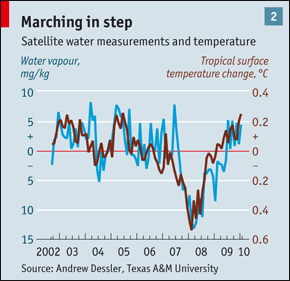
This moistening offers a helpful way to see what sort of climate change is going on. When water vapour condenses into cloud droplets it gives up energy and warms the surrounding air. This means that in a world where greenhouse warming is wetting the atmosphere, the lower parts of the atmosphere should warm at a greater rate than the surface, most notably in the tropics. At the same time, in an effect that does not depend on water vapour, an increase in carbon dioxide will cause the upper stratosphere to cool. This pattern of warming down below and cooling up on top is expected from greenhouse warming, but would not be expected if something other than the greenhouse effect was warming the world: a hotter sun would heat the stratosphere more, not less.

During the 1990s this was a point on which doubters laid considerable weight, because satellite measurements did not show the warming in the lower atmosphere that theory would predict. Over the past ten years, though, this picture has changed. To begin with, only one team was turning data from the relevant instruments that have flown on weather satellites since the 1970s into a temperature record resolved by altitude. Now others have joined them, and identified errors in the way that the calculations (which are complex and depend on a number of finicky details) were carried out. Though different teams still get different amounts and rates of warming in the lower atmosphere, there is no longer any denying that warming is seen. Stratospheric cooling is complicated by the effects of ozone depletion, but those do not seem large enough to account for the degree of cooling that has been seen there, further strengthening the case for warming by the greenhouse effect and not some other form of climate perturbation.

On top of the effect of water vapour, though, the clouds that form from it provide a further and greater source of uncertainty. On the one hand, the droplets of water of which these are made also have a strong greenhouse effect. On the other, water vapour is transparent, whereas clouds reflect light. In particular, they reflect sunlight back into space, stopping it from being absorbed by the Earth. Clouds can thus have a marked cooling effect and also a marked warming effect. Which will grow more in a greenhouse world?

Model maze

It is at this point that detailed computer models of the climate need to be called into play. These models slice the atmosphere and oceans into stacks of three-dimensional cells. The state of the air (temperature, pressure, etc) within each cell is continuously updated on the basis of what its state used to be, what is going on in adjacent cells and the greenhousing and other properties of its contents.

These models are phenomenally complex. They are also gross oversimplifications. The size of the cells stops them from explicitly capturing processes that take place at scales smaller than a hundred kilometres or so, which includes the processes that create clouds.

Despite their limitations, climate models do capture various aspects of the real world’s climate: seasons, trade winds, monsoons and the like. They also put clouds in the places where they are seen. When used to explore the effect of an increase in atmospheric greenhouse gases on the climate these models, which have been developed by different teams, all predict more warming than greenhouse gases and water-vapour feedback can supply unaided. The models assessed for the IPCC’s fourth report had sensitivities ranging from 2.1ºC to 4.4ºC. The IPCC estimated that if clouds were not included, the range would be more like 1.7ºC to 2.1ºC. So in all the models clouds amplify warming, and in some the amplification is large.

However, there are so far no compelling data on how clouds are affecting warming in fact, as opposed to in models. Ray Pierrehumbert, a climate scientist at the University of Chicago who generally has a strong way with sceptics, is happy to agree that there might be processes by which clouds rein in, rather than exaggerate, greenhouse-warming effects, but adds that, so far, few have been suggested in any way that makes sense.

Dr Lindzen and a colleague suggested a plausible mechanism in 2001. They proposed that tropical clouds in an atmosphere with more greenhouse gas might dry out neighbouring parts of the sky, making them more transparent to outgoing infra-red. The evidence Dr Lindzen brought to bear in support of this was criticised in ways convincing enough to discourage other scientists from taking the idea further. A subsequent paper by Dr Lindzen on observations that would be compatible with his ideas about low sensitivity has also suffered significant criticisms, and he accepts many of them. But having taken them on board has not, he thinks, invalidated his line of research.

Arguments based on past climates also suggest that sensitivity is unlikely to be low. Much of the cooling during the ice ages was maintained by the presence of a large northern hemisphere ice cap reflecting away a lot of sunlight, but carbon dioxide levels were lower, too. To account for all of the cooling, especially in the southern hemisphere, is most easily done with a sensitivity of temperature to carbon dioxide higher than Dr Lindzen would have it.

Before the ice age, the Earth had a little more carbon dioxide and was a good bit warmer than today—which suggests a fairly high sensitivity. More recently, the dip in global temperatures after the eruption of Mt Pinatubo in the Philippines in 1991, which inserted a layer of sunlight-diffusing sulphur particles into the stratosphere, also bolsters the case for a sensitivity near the centre of the model range—although sensitivity to a transient event and the warming that follows a slow doubling of carbon dioxide are not exactly the same sort of thing.

Logs and blogs

Moving into data from the past, though, brings the argument to one of the areas that blog-based doubters have chosen as a preferred battleground: the temperature record of the past millennium, as construed from natural records that are both sensitive to temperature and capable of precise dating. Tree rings are the obvious, and most controversial, example. Their best known use has been in a reconstruction of temperatures over the past millennium published in Nature in 1998 and widely known as the hockey stick, because it was mostly flat but had a blade sticking up at the 20th-century end. Stephen McIntyre, a retired Canadian mining consultant, was struck by the very clear message of this graph and delved into the science behind it, a process that left him and followers of his blog, Climate Audit, intensely sceptical about its value.

In 2006 a review by America’s National Research Council endorsed points Mr McIntyre and his colleagues made on some methods used to make the hockey stick, and on doubts over a specific set of tree rings. Despite this it sided with the hockey stick’s overall conclusion, which did little to stem the criticism. The fact that tree-ring records do not capture recent warming adds to the scepticism about the value of such records.

For many of Mr McIntyre’s fans (though it is not, he says, his central concern) the important thing about this work is that the hockey stick seemed to abolish the “medieval warm period”. This is a time when temperatures are held to have been as high as or higher than today’s—a warmth associated with the Norse settlement of Greenland and vineyards in England. Many climate scientists suspect this phenomenon was given undue prominence by climatologists of earlier generations with an unduly Eurocentric view of the world. There is evidence for cooling at the time in parts of the Pacific.

Doubters for the most part are big fans of the medieval warm period, and see in the climate scientists’ arguments an attempt to rewrite history so as to maximise the drama of today’s warming and minimise the possibility that natural variation might explain the 20th-century record. The possibility of more climatic variability, though, does not, in itself, mean that greenhouse warming is not happening too. And if the medieval warmth were due to some external factor, such as a slightly brighter sun, that would suggest that the climate was indeed quite sensitive.

Looking at the more recent record, logged as it has been by thermometers, you might hope it could shed light on which of the climate models is closest to being right, and thus what the sensitivity actually is. Unfortunately, other confounding factors make this difficult. Greenhouse gases are not the only climatically active ingredients that industry, farming and land clearance add to the atmosphere. There are also aerosols—particles of pollution floating in the wind. Some aerosols cool the atmosphere. Other, sootier, ones warm it. The aggregate effect, globally, is thought to be a cooling, possibly a quite strong one. But the overall history of aerosols, which are mostly short-lived, is nothing like as well known as that of greenhouse gases, and it is unlikely that any of the models are properly capturing their chemistry or their effects on clouds.

Taking aerosols into account, climate models do a pretty good job of emulating the climate trends of the 20th century. This seems odd, since the models have different sensitivities. In practice, it appears that the way the aerosols are dealt with in the models and the sensitivity of those models tend to go hand in hand; sensitive models also have strong cooling aerosol effects.

Reto Knutti of ETH Zurich, an expert on climate sensitivity, sees this as evidence that, consciously or unconsciously, aerosols are used as counterweights to sensitivity to ensure that the trends look right. This is not evidence of dishonesty, and it is not necessarily a bad thing. Since the models need to be able to capture the 20th century, putting them together in such a way that they end up doing so makes sense. But it does mean that looking at how well various models match the 20th century does not give a good indication of the climate’s actual sensitivity to greenhouse gas.

Adding the uncertainties about sensitivity to uncertainties about how much greenhouse gas will be emitted, the IPCC expects the temperature to have increased by 1.1ºC to 6.4ºC over the course of the 21st century. That low figure would sit fairly well with the sort of picture that doubters think science is ignoring or covering up. In this account, the climate has natural fluctuations larger in scale and longer in duration (such as that of the medieval warm period) than climate science normally allows, and the Earth’s recent warming is caused mostly by such a fluctuation, the effects of which have been exaggerated by a contaminated surface-temperature record. Greenhouse warming has been comparatively minor, this argument would continue, because the Earth’s sensitivity to increased levels of carbon dioxide is lower than that seen in models, which have an inbuilt bias towards high sensitivities. As a result subsequent warming, even if emissions continue full bore, will be muted too.

It seems unlikely that the errors, misprisions and sloppiness in a number of different types of climate science might all favour such a minimised effect. That said, the doubters tend to assume that climate scientists are not acting in good faith, and so are happy to believe exactly that. Climategate and the IPCC’s problems have reinforced this position.

Using the IPCC’s assessment of probabilities, the sensitivity to a doubling of carbon dioxide of less than 1.5ºC in such a scenario has perhaps one chance in ten of being correct. But if the IPCC were underestimating things by a factor of five or so, that would still leave only a 50:50 chance of such a desirable outcome. The fact that the uncertainties allow you to construct a relatively benign future does not allow you to ignore futures in which climate change is large, and in some of which it is very dangerous indeed. The doubters are right that uncertainties are rife in climate science. They are wrong when they present that as a reason for inaction.

Comments to this article here.

>What is the best way to provide people with information about climate change?

>
Nov 7th, 2009
Climate Central

There are many ways that people can benefit from having information about climate change, including being able to make informed policy and management decisions. This is one reason why people are talking about creating a national climate service. So, what functions would a national climate service provide?

A good place to start is with an organization that has a similar name and purpose—the National Weather Service, a government agency that was established in the late 1800s. The importance of the Weather Service is almost too obvious to mention. Without accurate reports about the current weather and predictions of future weather, planes would fly into thunderstorms unawares, ships would plow directly into hurricanes and typhoons, and people wouldn’t know about blizzards barreling down on them. Also, planning for pretty much any outdoor activity would become a lot more difficult. Without good weather forecasts, the losses in economic terms and in human lives would be huge.

Climate change unfolds on a slower scale—over decades rather than in hours. But now that we know it is happening, the need for forecasting how climate change will impact us has become clear as well. Knowing how much sea level is likely to rise, and how quickly, is crucial to knowing how to protect coastal areas from increased damage. Knowing how hurricane frequency and strength might change could affect building codes and evacuation strategies. Knowing how the intensity and frequency of droughts and heat waves might change would help city and regional planners manage water resources and mitigate threats to local economies.

The knowledge that these changes will come mostly from an increase in atmospheric levels of greenhouse gases could inform decisions about how to produce and use energy, and whether to develop alternative energy and other green technologies. If the world decides that limiting climate change is a priority, then this green technology could be an economic boon to the countries that perfect it.

Realizing that businesses, local governments, and individuals need the most reliable forecasts possible of how, when, and where the climate is likely to change, and what the impacts might be, universities, government agencies, and private companies have come together over the past year or so to figure out how such an entity might operate—how it would organize information and how it would deliver that information in the most useful way.

>Rumo a uma pedagogia da incerteza: Keats e a "negative capability"

>
Negative capability

From Wikipedia (15 mar 2010)

Negative capability is a theory of the poet John Keats describing the capacity for accepting uncertainty and the unresolved.

Theory

Keats’ theory of “negative capability” was expressed in his letter to his brother dated Sunday, 21 December 1817. He says [1]

I had not a dispute but a disquisition with Dilke, on various subjects; several things dovetailed in my mind, & at once it struck me, what quality went to form a Man of Achievement especially in literature & which Shakespeare possessed so enormously – I mean Negative Capability, that is when man is capable of being in uncertainties, Mysteries, doubts without any irritable reaching after fact & reason.

Keats believed that great people (especially poets) have the ability to accept that not everything can be resolved. Keats, as a Romantic, believed that the truths found in the imagination access holy authority. Such authority cannot otherwise be understood, and thus he writes of “uncertainties.” This “being in uncertaint[y]” is a place between the mundane, ready reality and the multiple potentials of a more fully understood existence. It relates to his metaphor of the Mansion of Many Apartments.

It could be argued that Keats explored this idea in several of his poems:
La Belle Dame sans Merci: A Ballad (1819)
Ode to a Nightingale (1819)
The Fall of Hyperion: A Dream (1819)
Ode on a Grecian Urn (1819)

Negative capability is a state of intentional open-mindedness paralleled in the literary and philosophic stances of other writers. In the 1930s, the American philosopher John Dewey cited Keatsian negative capability as having influenced his own philosophical pragmatism, and said of Keats’ letter that it “contains more of the psychology of productive thought than many treatises.” [2] [3] Nathan Scott, in his book Negative capability; studies in the new literature and the religious situation [4], notes that negative capability has been compared to Heidegger’s concept of Gelassenheit, “the spirit of disponibilité before What-Is which permits us simply to let things be in whatever may be their uncertainty and their mystery.” Walter Jackson Bate, Keats’s biographer, explored the approach in detail in his 1968 work Negative Capability: The Intuitive Approach in Keats.

Author Philip Pullman excerpts from Keats’s letter and prominently incorporates the concept in his fantasy novel The Subtle Knife.

Notes
1. Romanticism: an anthology, By Duncan Wu, Duncan Wu Edition: 3, illustrated Published by Blackwell, 2005 p.1351
2. Dewey, John. Art as Experience. New York: Penguin Perigree (2005):33-4.
3. Kestenbaum, Victor. The Grace and the Severity of the Ideal: John Dewey and the Transcendent. Chicago: University of Chicago Press (2002): 225.
4. Scott. Negative capability; studies in the new literature and the religious situation. Yale University Press (New Haven), 1969

>U.S. Scientists Urge Action on Climate Change

>
On March 11, 2000 U.S. scientists and economists signed on to a statement imploring the Senate to move swiftly and comprehensively on the issue of climate change. The signatories are all experts in relevant fields of study on climate change. The statement is the first time leading U.S. scientists and economists have come together to issue a joint message of concern on climate change. The list of signatories included eight Nobel laureates, 32 members of the National Academy of Sciences, 10 members from the National Academy of Engineering, and more than 100 members of the Intergovernmental Panel on Climate Change, who shared a 2007 Nobel Peace Prize.

“If anything, the climate problem is actually worse than reported earlier,” wrote Leon Lederman, Director Emeritus of the Fermi National Accelerator Laboratory in Batavia, Illinois, and a Nobel Prize-winning physicist, in an individual statement in the letter to the Senate. “Physicists tend to be super critical of strong conclusions, but the data on global warming now indicate the conclusions are not nearly strong enough.”

Read the statement here.

>Austrália reconhece pessoa sem sexo pela 1ª vez (BBC Brasil)

>
BBC Brasil – 15 de março de 2010

Foto: Norrie foi registrado homem ao nascer mas tentou trocar de sexo.

Uma pessoa que mora na Austrália pode ser a primeira no mundo reconhecida oficialmente como não pertencendo a nenhum dos sexos, segundo a imprensa australiana.

O governo do Estado de New South Wales emitiu uma certidão de “Gênero Não-Específico” a Norrie May-Welby. Isso significa que o governo não reconhece Norrie como homem ou mulher.

Norrie se considera andrógino e é ativista do grupo Sex and Gender Education (Sage, na sigla em inglês), que faz campanha por direitos de pessoas com diferentes identidades sexuais.

Norrie, de 48 anos, nasceu na Escócia e foi registrado como homem. Aos 23 anos, ele passou por um tratamento hormonal e cirurgias para mudar de sexo, e foi registrado na Austrália como mulher.

No entanto, Norrie ficou insatisfeito com a mudança e interrompeu seu tratamento, preferindo denominar-se “neutro”.

‘Gaiola’ dos gêneros

“Esses conceitos de homem e mulher simplesmente não se encaixam no meu caso, eles não são a realidade e, se aplicados a mim, são fictícios”, afirma Norrie em um artigo publicado no site The Scavenger na semana passada.

Norrie assina seu nome como “norrie mAy-Welby”, um trocadilho com “may well be”, que em inglês significa “pode ser”.

Em e-mail à BBC Brasil, Norrie comemorou a decisão do governo australiano. “Liberdade da gaiola do gênero!”, escreveu.

Segundo a notícia publicada no The Scavenger, os médicos declararam em janeiro deste ano que não conseguiram determinar o sexo de Norrie – nem fisicamente nem em função do seu comportamento.

A certidão de gênero não-específico foi dada de acordo com uma recomendação de 2009 de um relatório da Comissão de Direitos Humanos da Austrália, segundo o portal. A certidão foi publicada na capa do jornal australiano Sydney Morning Herald.

Uma porta-voz da Procuradoria do governo da Austrália disse ao jornal que esta foi a primeira certidão do tipo.

A porta-voz do Sage, Tracie O’Keefe, disse ao Scavenger que a decisão tem impacto importante na vida de pessoas que não se identificam nem como homens ou mulheres.

Em entrevista ao jornal britânico Daily Telegraph, o porta-voz do grupo britânico Gender Trust, que ajuda pessoas com problemas de identidade sexual, saudou a decisão do governo de New South Wales.

>Living on Earth: Climate Confusion and the "Climategate"

>
Air Date: March 5, 2010
http://www.loe.org

Link to the audio file.

“Climategate” has damaged the credentials of the Intergovernmental Panel on Climate Change, and decades of science on global warming. But as scientists push back against efforts to dismiss the threat of global warming, some media watchers say journalists aren’t balancing their coverage of climate change with the scientifically-sound other side of the story – that the impacts of a warming world could be worse than the IPCC predicts. Host Jeff Young talks with media experts and scientists about the fallout of the hacked email scandal, and how to repair damage. (12:00)

>Climate scientists to fight back at skeptics (The Washington Times)

>
By Stephen Dinan
The Washington Times – Friday, March 5, 2010

Undaunted by a rash of scandals over the science underpinning climate change, top climate researchers are plotting to respond with what one scientist involved said needs to be “an outlandishly aggressively partisan approach” to gut the credibility of skeptics.

In private e-mails obtained by The Washington Times, climate scientists at the National Academy of Sciences say they are tired of “being treated like political pawns” and need to fight back in kind. Their strategy includes forming a nonprofit group to organize researchers and use their donations to challenge critics by running a back-page ad in the New York Times.

“Most of our colleagues don’t seem to grasp that we’re not in a gentlepersons’ debate, we’re in a street fight against well-funded, merciless enemies who play by entirely different rules,” Paul R. Ehrlich, a Stanford University researcher, said in one of the e-mails.

Some scientists question the tactic and say they should focus instead on perfecting their science, but the researchers who are organizing the effort say the political battle is eroding confidence in their work.

“This was an outpouring of angry frustration on the part of normally very staid scientists who said, ‘God, can’t we have a civil dialogue here and discuss the truth without spinning everything,'” said Stephen H. Schneider, a Stanford professor and senior fellow at the Woods Institute for the Environment who was part of the e-mail discussion but wants the scientists to take a slightly different approach.

The scientists have been under siege since late last year when e-mails leaked from a British climate research institute seemed to show top researchers talking about skewing data to push predetermined outcomes. Meanwhile, the Intergovernmental Panel on Climate Change, the authoritative body on the matter, has suffered defections of members after it had to retract claims that Himalayan glaciers will melt over the next 25 years.

Last month, President Obama announced that he would create a U.S. agency to arbitrate research on climate change.

Sen. James M. Inhofe, Oklahoma Republican and a chief skeptic of global-warming claims, is considering asking the Justice Department to investigate whether climate scientists who receive taxpayer-funded grants falsified data. He lists 17 people he said have been key players in the controversy.

That news has enraged scientists. Mr. Schneider said Mr. Inhofe is showing “McCarthyesque” behavior in the mold of the Cold War-era senator who was accused of stifling political debate through accusations of communism.

In a phone interview, Mr. Schneider, who is one of the key players Mr. Inhofe cites, said he disagrees with trying to engage in an ad battle. He said the scientists will never be able to compete with energy companies.

“They’re not going to win short-term battles playing the game against big-monied interests because they can’t beat them,” he said.

He said the “social contract” between scientists and policymakers is broken and must be reforged, and he urged colleagues to try to recruit members of Congress to take up their case. He also said the press and nongovernmental organizations must be prodded.

“What I am trying to do is head off something that will be truly ugly,” he said. “I don’t want to see a repeat of McCarthyesque behavior and I’m already personally very dismayed by the horrible state of this topic, in which the political debate has almost no resemblance to the scientific debate.”

Not all climate scientists agree with forcing a political fight.

“Sounds like this group wants to step up the warfare, continue to circle the wagons, continue to appeal to their own authority, etc.,” said Judith A. Curry, a climate scientist at the Georgia Institute of Technology. “Surprising, since these strategies haven’t worked well for them at all so far.”

She said scientists should downplay their catastrophic predictions, which she said are premature, and instead shore up and defend their research. She said scientists and institutions that have been pushing for policy changes “need to push the disconnect button for now,” because it will be difficult to take action until public confidence in the science is restored.

“Hinging all of these policies on global climate change with its substantial element of uncertainty is unnecessary and is bad politics, not to mention having created a toxic environment for climate research,” she said.

Ms. Curry also said that more engagement between scientists and the public would help – something that the NAS researchers also proposed.

Paul G. Falkowski, a professor at Rutgers University who started the effort, said in the e-mails that he is seeking a $1,000 donation from as many as 50 scientists to pay for an ad to run in the New York Times. He said in one e-mail that commitments were already arriving.

The e-mail discussion began late last week and continued into this week.

Mr. Falkowski didn’t respond to an e-mail seeking comment, and an effort to reach Mr. Ehrlich was unsuccessful.

But one of those scientists forwarded The Times’ request to the National Academy of Sciences, whose e-mail system the scientists used as their forum to plan their effort.

An NAS spokesman sought to make clear that the organization itself is not involved in the effort.

“These scientists are elected members of the National Academy of Sciences, but the discussants themselves realized their efforts would require private support since the National Academy of Sciences never considered placing such an ad or creating a nonprofit group concerning these issues,” said William Kearney, chief spokesman for NAS.

The e-mails emerged months after another set of e-mails from a leading British climate research group seemed to show scientists shading data to try to bolster their claims, and are likely to feed the impression among skeptics that researchers are pursuing political goals as much as they are disseminating science.

George Woodwell, founder of the Woods Hole Research Center, said in one e-mail that researchers have been ceding too much ground. He blasted Pennsylvania State University for pursuing an academic investigation against professor Michael E. Mann, who wrote many of the e-mails leaked from the British climate research facility.

An initial investigation cleared Mr. Mann of falsifying data but referred one charge, that he “deviated from accepted practices within the academic community,” to a committee for a more complete review.

In his e-mail, Mr. Woodwell acknowledged that he is advocating taking “an outlandishly aggressively partisan approach” but said scientists have had their “classical reasonableness” turned against them.

“We are dealing with an opposition that is not going to yield to facts or appeals from people who hold themselves in high regard and think their assertions and data are obvious truths,” he wrote.

>Scientists Taking Steps to Defend Work on Climate (N. Y. Times)

>
By JOHN M. BRODER
New York Times, March 2, 2010

WASHINGTON — For months, climate scientists have taken a vicious beating in the media and on the Internet, accused of hiding data, covering up errors and suppressing alternate views. Their response until now has been largely to assert the legitimacy of the vast body of climate science and to mock their critics as cranks and know-nothings.

Photo: Brendan Smialowski for The New York Times.
Ralph J. Cicerone of the National Academy of Sciences says scientists must try to be heard.

But the volume of criticism and the depth of doubt have only grown, and many scientists now realize they are facing a crisis of public confidence and have to fight back. Tentatively and grudgingly, they are beginning to engage their critics, admit mistakes, open up their data and reshape the way they conduct their work.

The unauthorized release last fall of hundreds of e-mail messages from a major climate research center in England, and more recent revelations of a handful of errors in a supposedly authoritative United Nations report on climate change, have created what a number of top scientists say is a major breach of faith in their research. They say the uproar threatens to undermine decades of work and has badly damaged public trust in the scientific enterprise.

The e-mail episode, dubbed “climategate” by critics, revealed arrogance and what one top climate researcher called “tribalism” among some scientists. The correspondence appears to show efforts to limit publication of contrary opinion and to evade Freedom of Information Act requests. The content of the messages opened some well-known scientists to charges of concealing temperature data from rival researchers and manipulating results to conform to precooked conclusions.

“I have obviously written some very awful e-mails,” Phil Jones, the British climate scientist at the center of the controversy, confessed to a special committee of Parliament on Monday. But he sharply disputed charges that he had hidden data or faked results.

Some of the most serious allegations against Dr. Jones, director of the climate research unit at the University of East Anglia, and other researchers have been debunked, while several investigations are still under way to determine whether others hold up.

But serious damage has already been done. A survey conducted in late December by Yale University and George Mason University found that the number of Americans who believed that climate change was a hoax or scientific conspiracy had more than doubled since 2008, to 16 percent of the population from 7 percent. An additional 13 percent of Americans said they thought that even if the planet was warming, it was a result solely of natural factors and was not a significant concern.

Climate scientists have been shaken by the criticism and are beginning to look for ways to recover their reputation. They are learning a little humility and trying to make sure they avoid crossing a line into policy advocacy.

“It’s clear that the climate science community was just not prepared for the scale and ferocity of the attacks and they simply have not responded swiftly and appropriately,” said Peter C. Frumhoff, an ecologist and chief scientist at the Union of Concerned Scientists. “We need to acknowledge the errors and help turn attention from what’s happening in the blogosphere to what’s happening in the atmosphere.”

A number of institutions are beginning efforts to improve the quality of their science and to make their work more transparent. The official British climate agency is undertaking a complete review of its temperature data and will make its records and analysis fully public for the first time, allowing outside scrutiny of methods and conclusions. The United Nations panel on climate change will accept external oversight of its research practices, also for the first time.

Two universities are investigating the work of top climate scientists to determine whether they have violated academic standards and undermined faith in science. The National Academy of Sciences is preparing to publish a nontechnical paper outlining what is known — and not known — about changes to the global climate. And a vigorous debate is under way among climate scientists on how to make their work more transparent and regain public confidence.

Some critics think these are merely cosmetic efforts that do not address the real problem, however.

“I’ll let you in on a very dark, ugly secret — I don’t want trust in climate science to be restored,” Willis Eschenbach, an engineer and climate contrarian who posts frequently on climate skeptic blogs, wrote in response to one climate scientist’s proposal to share more research. “I don’t want you learning better ways to propagandize for shoddy science. I don’t want you to figure out how to inspire trust by camouflaging your unethical practices in new and innovative ways.”

“The solution,” he concluded, “is for you to stop trying to pass off garbage as science.”

Ralph J. Cicerone, president of the National Academy of Sciences, the most prestigious scientific body in the United States, said that there was a danger that the distrust of climate science could mushroom into doubts about scientific inquiry more broadly. He said that scientists must do a better job of policing themselves and trying to be heard over the loudest voices on cable news, talk radio and the Internet.

“This is a pursuit that scientists have not had much experience in,” said Dr. Cicerone, a specialist in atmospheric chemistry.

The battle is asymmetric, in the sense that scientists feel compelled to support their findings with careful observation and replicable analysis, while their critics are free to make sweeping statements condemning their work as fraudulent.

“We have to do a better job of explaining that there is always more to learn, always uncertainties to be addressed,” said John P. Holdren, an environmental scientist and the White House science adviser. “But we also need to remind people that the occasions where a large consensus is overturned by a scientific heretic are very, very rare.”

No scientific body is under more hostile scrutiny than the United Nations Intergovernmental Panel on Climate Change, which compiles the climate research of hundreds of scientists around the globe into periodic reports intended to be the definitive statement of the science and a guide for policy makers. Critics, citing several relatively minor errors in its most recent report and charges of conflict of interest against its leader, Rajendra K. Pachauri, are calling for the I.P.C.C. to be disbanded or radically reformed.

On Saturday, after weeks of refusing to engage critics, the I.P.C.C. announced that it was asking for the creation of an independent panel to review its research procedures to try to eliminate bias and errors from future reports. But even while allowing for some external oversight, Dr. Pachauri insisted that panel stood behind its previous work.

“Scientists must continually earn the public’s trust or we risk descending into a new Dark Age where ideology trumps reason,” Dr. Pachauri said in an e-mail message.

But some scientists said that responding to climate change skeptics was a fool’s errand.

“Climate scientists are paid to do climate science,” said Gavin A. Schmidt, a senior climatologist with the National Aeronautics and Space Administration’s Goddard Institute of Space Studies. “Their job is not persuading the public.”

He said that the recent flurry of hostility to climate science had been driven as much by the cold winter as by any real or perceived scientific sins.

“There have always been people accusing us of being fraudulent criminals, of the I.P.C.C. being corrupt,” Dr. Schmidt said. “What is new is this paranoia combined with a spell of cold weather in the United States and the ‘climategate’ release. It’s a perfect storm that has allowed the nutters to control the agenda.”

The answer is simple, he said.

“Good science,” he said, “is the best revenge.”

>Climate scepticism ‘on the rise’, BBC poll shows

>
The number of British people who are sceptical about climate change is rising, a poll for BBC News suggests.

BBC News, Sunday, 7 February 2010

The Populus poll of 1,001 adults found 25% did not think global warming was happening, an increase of 10% since a similar poll was conducted in November.

The percentage of respondents who said climate change was a reality had fallen from 83% in November to 75% this month.

And only 26% of those asked believed climate change was happening and “now established as largely man-made”.

The findings are based on interviews carried out on 3-4 February.

In November 2009, a similar poll by Populus – commissioned by the Times newspaper – showed that 41% agreed that climate change was happening and it was largely the result of human activities.

“It is very unusual indeed to see such a dramatic shift in opinion in such a short period,” Populus managing director Michael Simmonds told BBC News.

“The British public are sceptical about man’s contribution to climate change – and becoming more so,” he added.

“More people are now doubters than firm believers.”

The Department for Environment, Food and Rural Affairs’ (Defra) chief scientific adviser, Professor Bob Watson, called the findings “very disappointing”.

“The fact that there has been a very significant drop in the number of people that believe that we humans are changing the Earth’s climate is serious,” he told BBC News.

“Action is urgently needed,” Professor Watson warned.

“We need the public to understand that climate change is serious so they will change their habits and help us move towards a low carbon economy.”

‘Exaggerated risks’

Of the 75% of respondents who agreed that climate change was happening, one-in-three people felt that the potential consequences of living in a warming world had been exaggerated, up from one-in-five people in November.

The number of people who felt the risks of climate change had been understated dropped from 38% in November to 25% in the latest poll.

During the intervening period between the two polls, there was a series of high profile climate-related stories, some of which made grim reading for climate scientists and policymakers.

In November, the contents of emails stolen from a leading climate science unit led to accusations that a number of researchers had manipulated data.

And in January, the Intergovernmental Panel on Climate Change (IPCC) admitted that it had made a mistake in asserting that Himalayan glaciers could disappear by 2035.

All of this happened against the backdrop of many parts of the northern hemisphere being gripped by a prolonged period of sub-zero temperatures.

However, 73% of the people who said that they were aware of the “science flaws” stories stated that the media coverage had not changed their views about the risks of climate change.

“People tend to make judgements over time based on a whole range of different sources,” Mr Simmonds explained.

He added that it was very unusual for single events to have a dramatic impact on public opinion.

“Normally, people make their minds up over a longer period and are influenced by all the voices they hear, what they read and what people they know are talking about.”

>Climate change scientists losing ‘PR war’ (BBC)

>
A Nobel peace prize-winning Welsh physicist says climate change scientists are losing “a PR war” against sceptics with vested interests.

BBC News, Thursday, 11 February 2010

Sir John Houghton said there were millions of internet references to a comment he never made which appears to to show him “hyping up” global warming.

A poll for BBC news suggests the number of British people who are sceptical about climate change is rising.

Sir John believes recent news stories may have contributed to scepticism.

He told BBC Wales’ Dragon’s Eye programme: “If you Google my name on the web and look for a quote, the quote you will find is one that goes like this.

“It says ‘unless we announce disasters, no-one will listen’.

“I have never said that. The origin of the quote according to some of the people who write about it… [they] say it comes from the first edition of my global warming book, published in 1994.

“It does not appear in that book in any shape or form.”

Sir John, who co-chaired the UN Intergovernmental Panel on Climate Change’s (IPCC) scientific assessment group for 14 years, received the Nobel peace prize in 2007 as part of an IPCC delegation.

He said most scientists were not very good at public relations and just wanted to get on with their work.

Asked if he believed climate change scientists were now in a “PR war” with sceptics, he said: “We are in a way and we’re losing that war because we’re not good at PR.

“Your average scientist is not a good PR person because he wants to get on with his science.

Stolen e-mails

“So we need to look, I suppose, for some good PR people to help us get our messages across in an honest and open and sensible way, without causing the sort of furore, the sort of polarisation that has occurred because of the people who are trying to deny it, and trying to deny it so vehemently that the media is taking so much notice of them.”

The number of British people who are sceptical about climate change is rising, according to a new poll.

The Populus poll of 1,001 adults found 25% did not think global warming was happening, an increase of 10% since a similar poll in November.

Stolen e-mails from the University of East Anglia led to accusations, since denied, that climate change data was being manipulated.

Last month, the IPCC had to admit it had been mistaken in claiming Himalayan glaciers could disappear by 2035.

Sir John said some reporting of these stories had given mistakes undue significance and deliberately misrepresented other information.

‘Vested interests’

He believes some sceptics are influenced by concerns other than scientific truth, comparing them to now discredited lobbyists who argued smoking did not cause cancer.

He said: “A lot of it comes from the United States, from vested interests, coal and oil interests in the United States which are very strong and which employ thousands of lobbyists in Washington to try and influence members of Congress that climate change is not happening.

“So it’s a major problem in the United States and it does spill over to this country too.”