Arquivo anual: 2011

It’s Even Less in Your Genes (The New York Review of Books)

MAY 26, 2011
Richard C. Lewontin

The Mirage of a Space Between Nature and Nurture
by Evelyn Fox Keller
Duke University Press, 107 pp., $64.95; $18.95 (paper)

In trying to analyze the natural world, scientists are seldom aware of the degree to which their ideas are influenced both by their way of perceiving the everyday world and by the constraints that our cognitive development puts on our formulations. At every moment of perception of the world around us, we isolate objects as discrete entities with clear boundaries while we relegate the rest to a background in which the objects exist.

That tendency, as Evelyn Fox Keller’s new book suggests, is one of the most powerful influences on our scientific understanding. As we change our intent, also we identify anew what is object and what is background. When I glance out the window as I write these lines I notice my neighbor’s car, its size, its shape, its color, and I note that it is parked in a snow bank. My interest then changes to the results of the recent storm and it is the snow that becomes my object of attention with the car relegated to the background of shapes embedded in the snow. What is an object as opposed to background is a mental construct and requires the identification of clear boundaries. As one of my children’s favorite songs reminded them:

You gotta have skin.
All you really need is skin.
Skin’s the thing that if you’ve got it outside,
It helps keep your insides in.
Organisms have skin, but their total environments do not. It is by no means clear how to delineate the effective environment of an organism.

One of the complications is that the effective environment is defined by the life activities of the organism itself. “Fish gotta swim and birds gotta fly,” as we are reminded by yet another popular lyric. Thus, as organisms evolve, their environments necessarily evolve with them. Although classic Darwinism is framed by referring to organisms adapting to environments, the actual process of evolution involves the creation of new “ecological niches” as new life forms come into existence. Part of the ecological niche of an earthworm is the tunnel excavated by the worm and part of the ecological niche of a tree is the assemblage of fungi associated with the tree’s root system that provide it with nutrients.

The vulgarization of Darwinism that sees the “struggle for existence” as nothing but the competition for some environmental resource in short supply ignores the large body of evidence about the actual complexity of the relationship between organisms and their resources. First, despite the standard models created by ecologists in which survivorship decreases with increasing population density, the survival of individuals in a population is often greatest not when their “competitors” are at their lowest density but at an intermediate one. That is because organisms are involved not only in the consumption of resources, but in their creation as well. For example, in fruit flies, which live on yeast, the worm-like immature stages of the fly tunnel into rotting fruit, creating more surface on which the yeast can grow, so that, up to a point, the more larvae, the greater the amount of food available. Fruit flies are not only consumers but also farmers.

Second, the presence in close proximity of individual organisms that are genetically different can increase the growth rate of a given type, presumably since they exude growth-promoting substances into the soil. If a rice plant of a particular type is planted so that it is surrounded by rice plants of a different type, it will give a higher yield than if surrounded by its own type. This phenomenon, known for more than a half-century, is the basis of a common practice of mixed-variety rice cultivation in China, and mixed-crop planting has become a method used by practitioners of organic agriculture.

Despite the evidence that organisms do not simply use resources present in the environment but, through their life activities, produce such resources and manufacture their environments, the distinction between organisms and their environments remains deeply embedded in our consciousness. Partly this is due to the inertia of educational institutions and materials. As a coauthor of a widely used college textbook of genetics,(1) I have had to engage in a constant struggle with my coauthors over the course of thirty years in order to introduce students to the notion that the relative reproductive fitness of organisms with different genetic makeups may be sensitive to their frequency in the population.

But the problem is deeper than simply intellectual inertia. It goes back, ultimately, to the unconsidered differentiations we make—at every moment when we distinguish among objects—between those in the foreground of our consciousness and the background places in which the objects happen to be situated. Moreover, this distinction creates a hierarchy of objects. We are conscious not only of the skin that encloses and defines the object, but of bits and pieces of that object, each of which must have its own “skin.” That is the problem of anatomization. A car has a motor and brakes and a transmission and an outer body that, at appropriate moments, become separate objects of our consciousness, objects that at least some knowledgeable person recognizes as coherent entities.

It has been an agony of biology to find boundaries between parts of organisms that are appropriate for an understanding of particular questions. We murder to dissect. The realization of the complex functional interactions and feedbacks that occur between different metabolic pathways has been a slow and difficult process. We do not have simply an “endocrine system” and a “nervous system” and a “circulatory system,” but “neurosecretory” and “neurocirculatory” systems that become the objects of inquiry because of strong forces connecting them. We may indeed stir a flower without troubling a star, but we cannot stir up a hornet’s nest without troubling our hormones. One of the ironies of language is that we use the term “organic” to imply a complex functional feedback and interaction of parts characteristic of living “organisms.” But musical organs, from which the word was adopted, have none of the complex feedback interactions that organisms possess. Indeed the most complex musical organ has multiple keyboards, pedal arrays, and a huge array of stops precisely so that different notes with different timbres can be played simultaneously and independently.

Evelyn Fox Keller sees “The Mirage of a Space Between Nature and Nurture” as a consequence of our false division of the world into living objects without sufficient consideration of the external milieu in which they are embedded, since organisms help create effective environments through their own life activities. Fox Keller is one of the most sophisticated and intelligent analysts of the social and psychological forces that operate in intellectual life and, in particular, of the relation of gender in our society both to the creation and acceptance of scientific ideas. The central point of her analysis has been that gender itself (as opposed to sex) is socially constructed, and that construction has influenced the development of science:

If there is a single point on which all feminist scholarship…has converged, it is the importance of recognizing the social construction of gender…. All of my work on gender and science proceeds from this basic recognition. My endeavor has been to call attention to the ways in which the social construction of a binary opposition between “masculine” and “feminine” has influenced the social construction of science.(2)

Beginning with her consciousness of the role of gender in influencing the construction of scientific ideas, she has, over the last twenty-five years, considered how language, models, and metaphors have had a determinative role in the construction of scientific explanation in biology.

A major critical concern of Fox Keller’s present book is the widespread attempt to partition in some quantitative way the contribution made to human variation by differences in biological inheritance, that is, differences in genes, as opposed to differences in life experience. She wants to make clear a distinction between analyzing the relative strength of the causes of variation among individuals and groups, an analysis that is coherent in principle, and simply assigning the relative contributions of biological and environmental causes to the value of some character in an individual.

It is, for example, all very well to say that genetic variation is responsible for 76 percent of the observed variation in adult height among American women while the remaining 24 percent is a consequence of differences in nutrition. The implication is that if all variation in nutrition were abolished then 24 percent of the observed height variation among individuals in the population in the next generation would disappear. To say, however, that 76 percent of Evelyn Fox Keller’s height was caused by her genes and 24 percent by her nutrition does not make sense. The nonsensical implication of trying to partition the causes of her individual height would be that if she never ate anything she would still be three quarters as tall as she is.

In fact, Keller is too optimistic about the assignment of causes of variation even when considering variation in a population. As she herself notes parenthetically, the assignment of relative proportions of population variation to different causes in a population depends on there being no specific interaction between the causes. She gives as a simple example the sound of two different drummers playing at a distance from us. If each drummer plays each drum for us, we should be able to tell the effect of different drummers as opposed to differences between drums. But she admits that is only true if the drummers themselves do not change their ways of playing when they change drums.

Keller’s rather casual treatment of the interaction between causal factors in the case of the drummers, despite her very great sophistication in analyzing the meaning of variation, is a symptom of a fault that is deeply embedded in the analytic training and thinking of both natural and social scientists. If there are several variable factors influencing some phenomenon, how are we to assign the relative importance to each in determining total variation? Let us take an extreme example. Suppose that we plant seeds of each of two different varieties of corn in two different locations with the following results measured in bushels of corn produced (see Table 1).
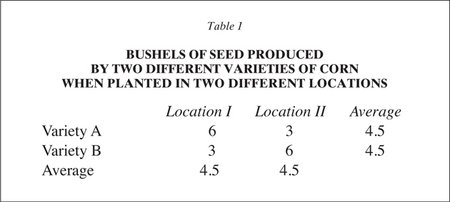
There are differences between the varieties in their yield from location to location and there are differences between locations from variety to variety. So, both variety and location matter. But there is no average variation between locations when averaged over varieties or between varieties when averaged over locations. Just by knowing the variation in yield associated with location and variety separately does not tell us which factor is the more important source of variation; nor do the facts of location and variety exhaust the description of that variation.

There is a third source of variation called the “interaction,” the variation that cannot be accounted for simply by the separate average effects of location and variety. There is no difference that appears between the average of different varieties or average of different locations, suggesting that neither location or variety matters to yield. Yet the yields of corn were different when different particular combinations of variety and location are observed. These effects of particular combinations of factors, not accounted for by the average effects of each factor separately, are thrown into an unanalyzed category called “interaction” with no concrete physical model made explicit.

In real life there will be some difference between the varieties when averaged over locations and some variation between locations when averaged over varieties; but there will also be some interaction variation accounting for the failure of the separately identified main effects to add up to the total variation. In an extreme case, as for example our jungle drummers with a common consciousness of what drums should sound like, it may turn out to be all interaction.

The Mirage of a Space Between Nature and Nurture appears in an era when biological—and specifically, genetic—causation is taken as the preferred explanation for all human physical differences. Although the early and mid-twentieth century was a period of immense popularity of genetic explanations for class and race differences in mental ability and temperament, especially among social scientists, such theories have now virtually disappeared from public view, largely as a result of a considerable effort of biologists to explain the errors of those claims.

The genes for IQ have never been found. Ironically, at the same time that genetics has ceased to be a popular explanation for human intellectual and temperamental differences, genetic theories for the causation of virtually every physical disorder have become the mode. “DNA” has replaced “IQ” as the abbreviation of social import. The announcement in February 2001 that two groups of investigators had sequenced the entire human genome was taken as the beginning of a new era in medicine, an era in which all diseases would be treated and cured by the replacement of faulty DNA. William Haseltine, the chairman of the board of the private company Human Genome Sciences, which participated in the genome project, assured us that “death is a series of preventable diseases.” Immortality, it appeared, was around the corner. For nearly ten years announcements of yet more genetic differences between diseased and healthy individuals were a regular occurrence in the pages of The New York Times and in leading general scientific publications like Science and Nature.

Then, on April 15, 2009, there appeared in The New York Times an article by the influential science reporter and fan of DNA research Nicholas Wade, under the headline “Study of Genes and Diseases at an Impasse.” In the same week the journal Science reported that DNA studies of disease causation had a “relatively low impact.” Both of these articles were instigated by several articles in The New England Journal of Medicine, which had come to the conclusion that the search for genes underlying common causes of mortality had so far yielded virtually nothing useful. The failure to find such genes continues and it seems likely that the search for the genes causing most common diseases will go the way of the search for the genes for IQ.

A major problem in understanding what geneticists have found out about the relation between genes and manifest characteristics of organisms is an overly flexible use of language that creates ambiguities of meaning. In particular, their use of the terms “heritable” and “heritability” is so confusing that an attempt at its clarification occupies the last two chapters of The Mirage of a Space Between Nature and Nurture. When a biological characteristic is said to be “heritable,” it means that it is capable of being transmitted from parents to offspring, just as money may be inherited, although neither is inevitable. In contrast, “heritability” is a statistical concept, the proportion of variation of a characteristic in a population that is attributable to genetic variation among individuals. The implication of “heritability” is that some proportion of the next generation will possess it.

The move from “heritable” to “heritability” is a switch from a qualitative property at the level of an individual to a statistical characterization of a population. Of course, to have a nonzero heritability in a population, a trait must be heritable at the individual level. But it is important to note that even a trait that is perfectly heritable at the individual level might have essentially zero heritability at the population level. If I possess a unique genetic variant that enables me with no effort at all to perform a task that many other people have learned to do only after great effort, then that ability is heritable in me and may possibly be passed on to my children, but it may also be of zero heritability in the population.

One of the problems of exploring an intellectual discipline from the outside is that the importance of certain basic methodological considerations is not always apparent to the observer, considerations that mold the entire intellectual structure that characterizes the field. So, in her first chapter, “Nature and Nurture as Alternatives,” Fox Keller writes that “my concern is with the tendency to think of nature and nurture as separable and hence as comparable, as forces to which relative strength can be assigned.” That concern is entirely appropriate for an external critic, and especially one who, like Fox Keller, comes from theoretical physics rather than experimental biology. Experimental geneticists, however, find environmental effects a serious distraction from the study of genetic and molecular mechanisms that are at the center of their interest, so they do their best to work with cases in which environmental effects are at a minimum or in which those effects can be manipulated at will. If the machine model of organisms that underlies our entire approach to the study of biology is to work for us, we must restrict our objects of study to those in which we can observe and manipulate all the gears and levers.

For much of the history of experimental genetics the chief organism of study was the fruit fly, Drosophila melanogaster, in which very large numbers of different gene mutations with visible effects on the form and behavior of the flies had been discovered. The catalog of these mutations described, in addition to genetic information, a description of the way in which mutant flies differed from normal (“wild type”) and assigned each mutation a “Rank” between 1 and 4. Rank 1 mutations were the most reliable for genetic study because every individual with the mutant genetic type could be easily and reliably recognized by the observer, whereas some proportion of individuals carrying mutations of other ranks could be indistinguishable from normal, depending on the environmental conditions in which they developed. Geneticists, if they could, avoided depending on poorer-rank mutations for their experiments. Only about 20 percent of known mutations were of Rank 1.

With the recent shift from the study of classical genes in controlled breeding experiments to the sequencing of DNA as the standard method of genetic study, the situation has gotten much worse. On the one hand, about 99 percent of the DNA in a cell is of completely unknown functional significance and any two unrelated individuals will differ from each other at large numbers of DNA positions. On the other hand, the attempt to assign the causes of particular diseases and metabolic malfunctions in humans to specific mutations has been a failure, with the exception of a few classical cases like sickle-cell anemia. The study of genes for specific diseases has indeed been of limited value. The reason for that limited value is in the very nature of genetics as a way of studying organisms.

Genetics, from its very beginning, has been a “subtractive” science. That is, it is based on the analysis of the difference between natural or “wild-type” organisms and those with some genetic defect that may interfere in some observable way with regular function. But to carry out such comparison it is necessary that the organisms being studied are, to the extent possible, identical in all other respects, and that the comparison is carried out in an environment that does not, itself, generate atypical responses yet allows the possible effect of the genetic perturbation to be observed. We must face the possibility that such a subtractive approach will never be able to reveal the way in which nature and nurture interact in normal circumstances.

An alternative to the standard subtractive method of genetic perturbations would be a synthetic approach in which living systems would be constructed ab initio from their molecular elements. It is now clear that most of the DNA in an organism is not contained in genes in the usual sense. That is, 98–99 percent of the DNA is not a code for a sequence of amino acids that will be assembled into long chains that will fold up to become the proteins that are essential to the formation of organisms; yet that nongenic DNA is transmitted faithfully from generation to generation just like the genic DNA.

It appears that the sequence of this nongenic DNA, which used to be called “junk-DNA,” is concerned with regulating how often, when, and in which cells the DNA of genes is read in order to produce the long strings of amino acids that will be folded into proteins and which of the many alternative possible foldings will occur. As the understanding and possibility of control of the synthesis of the bits and pieces of living cells become more complete, the temptation to create living systems from elementary bits and pieces will become greater and greater. Molecular biologists, already intoxicated with their ability to manipulate life at its molecular roots, are driven by the ambition to create it. The enterprise of “Synthetic Biology” is already in existence.

In May 2010 the consortium originally created by J. Craig Venter to sequence the human genome gave birth to a new organization, Synthetic Genomics, which announced that it had created an organism by implanting a synthetic genome in a bacterial cell whose own original genome had been removed. The cell then proceeded to carry out the functions of a living organism, including reproduction. One may argue that the hardest work, putting together all the rest of the cell from bits and pieces, is still to be done before it can be said that life has been manufactured, but even Victor Frankenstein started with a dead body. We all know what the consequences of that may be.

1. Anthony J.F. Griffiths, Susan R. Wessler, Sean B. Carroll, and Richard C. Lewontin, Introduction to Genetic Analysis , ninth edition (W.H. Freeman, 2008).

2. The Scientist , Vol. 5, No. 1 (January 7, 1991

Remember Climate Change? (Huffington Post)

Posted: 05/09/11
By Peter Neill – The Huffington Post

Remember climate change? Remember Copenhagen, the climate summit, and half a million people in the streets? Remember the scientific reports? Remember the predictions? Remember the headlines? The campaign promises? The strategies to offset and mitigate the impact of CO2 emissions on human health, the atmosphere, and the ocean? How long ago was it? Six months? A year? More? It might never have been.

How can we meet challenges if we can’t remember what they are? As far as the news media is concerned, the story is archived behind any new urgency no matter what the data. The subject of climate is no more. The deniers have prevailed through shrill contradictions, corporate funded public relations, personal attacks on scientists, and indifference to reports and continuing data that still and again raise critical questions to fall on deaf ears.

In the US Congress, any bill or suggested appropriation that contains the keyword climate is eliminated, most probably without being read. There is no global warming; therefore there is no need for the pitiful American financial support of $2.3 million for the International Panel on Climate Change. There is no problem with greenhouse gases, so there is no need for legislation that enables the Environmental Protection Agency to measure further such impact on animal habitat or human health. There is no need for support for the research and development of alternative renewable energy technologies. There is no need to protect the marine environment from oil spill disaster. There is no need to protect watersheds and drinking water from industrial and mining pollution. There is no need to fund tsunami-warning systems off the American coast. There is no need to support any part of a World Bank program to prevent deforestation in the developing world. There is no need to maintain NOAA’s study of climate change implication for extreme weather. There is no need to fund further climate research sponsored by the National Science Foundation. There is no need to maintain EPA regulation of clean water; oh, and by the way, there is no need for the Environmental Protection Agency. Put it to vote today in the US House of Representatives, and they would blandly and blindly legislate that there is no need for the environment at all.

What do we need? Jobs, jobs, jobs, it is said. To that end, we can start by eliminating jobs that don’t advance our political agenda, by ignoring scientific demonstrations and measurable conditions that foreshadow future job destruction, by promoting and further subsidizing old technologies that make us sick and unable to work successfully in our present jobs, by building the unemployment roles so that the ranks of the jobless will reach levels unheard of since the Great Depression, and by compromising the educational system that is the only hope for those seeking training or re-training for whatever few new jobs may actually exist.

What does this have to do with the ocean?

The health of the ocean is a direct reflection of the health of the land. A nuclear accident in Japan allows radioactive material to seep into the sea. A collapse of shoreside fishery regulation enables the final depletion of species for everyone everywhere. Indifference to watershed protection, industrial pollution, waste control, and agricultural run-off poisons the streams and rivers and coasts and deep ocean and corrupts the food chain all along the way. Lack of understanding of changing weather compromises our response to storms and droughts that inundate our coastal communities and destroy our sustenance.

There is a reason for knowledge. It informs constructive behavior; it promotes employment and economic development; it makes for wise governance; it improves our lives. Are we drowning in debt? Or are we drowning in ignorance? I can’t remember.

Confronting the ‘Anthropocene’ (N.Y. Times)

May 11, 2011, 9:39 AM
By ANDREW C. REVKIN
N.Y. Times, Dot Earth

NASA. Donald R. Pettit, an astronaut, took this photograph of London while living in the International Space Station.

LONDON — I’m participating in a one-day meeting at the Geological Society of London exploring the evidence for, and meaning of, the Anthropocene. This is the proposed epoch of Earth history that, proponents say, has begun with the rise of the human species as a globally potent biogeophysical force, capable of leaving a durable imprint in the geological record.

This recent TEDx video presentation by Will Steffen, the executive director of the Australian National University’s Climate Change Institute, lays out the basic idea:

There’s more on the basic concept in National Geographic and from the BBC. Paul Crutzen, the Nobel laureate in chemistry who, with others, proposed the term in 2000, and Christian Schwägerl, the author of “The Age of Man” (German), described the value of this new framing for current Earth history in January in Yale Environment 360:

Students in school are still taught that we are living in the Holocence, an era that began roughly 12,000 years ago at the end of the last Ice Age. But teaching students that we are living in the Anthropocene, the Age of Men, could be of great help. Rather than representing yet another sign of human hubris, this name change would stress the enormity of humanity’s responsibility as stewards of the Earth. It would highlight the immense power of our intellect and our creativity, and the opportunities they offer for shaping the future. [Read the rest.]

I’m attending because of a quirky role I played almost 20 years ago in laying the groundwork for this concept of humans as a geological force. A new paper from Steffen and three coauthors reviewing the conceptual and historic basis for the Anthropocene includes an appropriately amusing description of my role:

Biologist Eugene F. Stoermer wrote: ‘I began using the term “anthropocene” in the 1980s, but never formalized it until Paul [Crutzen] contacted me’. About this time other authors were exploring the concept of the Anthropocene, although not using the term. More curiously, a popular book about Global Warming, published in 1992 by Andrew C. Revkin, contained the following prophetic words: ‘Perhaps earth scientists of the future will name this new post-Holocene period for its causative element—for us. We are entering an age that might someday be referred to as, say, the Anthrocene [sic]. After all, it is a geological age of our own making’. Perhaps many readers ignored the minor linguistic difference and have read the new term as Anthro(po)cene!

If you’ve been tracking my work for a while, you’re aware of my focus on the extraordinary nature of this moment in both Earth and human history. As far as science can tell, there’s never, until now, been a point when a species became a planetary powerhouse and also became aware of that situation.

As I first wrote in 1992, cyanobacteria are credited with oxygenating the atmosphere some 2 billion years ago. That was clearly a more profound influence on a central component of the planetary system than humans raising the concentration of carbon dioxide 40 percent since the start of the industrial revolution. But, as far as we know, cyanobacteria (let alone any other life form from that period) were neither bemoaning nor celebrating that achievement.

It was easier to be in a teen-style resource binge before science began to delineate an edge to our petri dish.

We no longer have the luxury of ignorance.

We’re essentially in a race between our potency, our awareness of the expressed and potential ramifications of our actions and our growing awareness of the deeply embedded perceptual and behavioral traits that shape how we do, or don’t, address certain kinds of risks. (Explore “Boombustology” and “Disasters by Design” to be reminded how this habit is not restricted to environmental risks.)

This meeting in London is two-pronged. It is in part focused on deepening basic inquiry into stratigraphy and other branches of earth science and clarifying how this human era could qualify as a formal chapter in Earth’s physical biography. As Erle C. Ellis, an ecologist at the University of Maryland, Baltimore County, put it in his talk, it’s unclear for the moment whether humanity’s impact will be long enough to represent an epoch, or will more resemble “an event.” Ellis’s presentation was a mesmerizing tour of the planet’s profoundly humanized ecosystems, which he said would be better described as “anthromes” than “biomes.”

Ellis said it was important to approach this reality not as a woeful situation, but an opportunity to foster a new appreciation of the lack of separation of people and their planet and a bright prospect for enriching that relationship. In this his views resonate powerfully with those of Rene Dubos, someone I’ll be writing about here again soon.

Through the talks by Ellis and others, it was clear that the scientific effort to define a new geological epoch, while important, paled beside the broader significance of this juncture in human history.

In my opening comments at the meeting, I stressed the need to expand the discussion from the physical and environmental sciences into disciplines ranging from sociology to history, philosophy to the arts.

I noted that while the “great acceleration” described by Steffen and others is already well under way, it’s entirely possible for humans to design their future, at least in a soft way, boosting odds that the geological record will have two phases — perhaps a “lesser” and “greater” Anthropocene, as someone in the audience for my recent talk with Brad Allenby at Arizona State University put it.

I also noted that the term “Anthropocene,” like phrases such as “global warming,” is sufficiently vague to guarantee it will be interpreted in profoundly different ways by people with different world views. (As I explained, this is as true for Nobel laureates in physics as it is for the rest of us.)

Some will see this period as a “shame on us” moment. Others will deride this effort as a hubristic overstatement of human powers. Some will argue for the importance of living smaller and leaving no scars. Others will revel in human dominion as a normal and natural part of our journey as a species.

A useful trait will be to get comfortable with that diversity.

Before the day is done I also plan on pushing Randy Olson’s notion of moving beyond the “nerd loop” and making sure this conversation spills across all disciplinary and cultural boundaries from the get-go.

There’s much more to explore of course, and I’ll post updates as time allows. You might track the meeting hash tag, #anthrop11, on Twitter.

Scientist says listen to pope on climate change (U.S. Catholic)

Thursday, May 12, 2011
By Online Editor
Guest blog post by Dan DiLeo

Religion and science comes together in urging action on climate change.

The Pontifical Academy of Sciences sees climate change as an urgent matter, member Veerabhadran (Ram) Ramanathan, Ph.D., told Dan Misleh, Executive Director of the Catholic Coalition on Climate Change, in an interview on the academy’s report coming out of its meeting at the Vatican April 2-4, 2011.

While written, public reports are not the norm following such meetings, the working group was motivated by a sense of the urgency of the issue and the adverse social, political, economic and ecological impacts of climate change, said Ramanathan, who is the co-chair of the working group that produced the report and has been a member of the Pontifical Academy of Sciences since 2004. He is also Distinguished Professor of Atmospheric and Climate Sciences and Director of the National Science Foundation funded Center for Clouds, Chemistry, and Climate at Scripps Institution of Oceanography.

The Vatican’s recent report focuses on the impacts to humans due to global glacier retreat—one of the most obvious indicators of anthropogenic climate change. Ramanathan noted that climate change is already being experienced by many, especially in developing countries, and is likely to continue unless significant global actions to curtail human produced greenhouse gases are not begun soon.

Ramanathan said the working group focused glaciers and not other climate change impacts for three reasons: These impacts have not been sufficiently studied and discussed; shrinking glaciers offer the most visible example of how climate change is adversely affecting the planet; and the disappearance of mountain glaciers—which act as huge freshwater reservoirs for billions of people especially in Central Asia—could have catastrophic impacts.

Throughout his remarks, Ramanathan echoed the church’s call to exercise prudence in confronting climate change, confirming that the grave—and potentially irreversible—nature of climate change impacts obligate action based on what we already know now. He also emphasized the crucial role which the church must continue to play in the face of climate change: while the science community can present the facts, it is the church which has the moral authority necessary to inspire individuals and institutions to change environmentally—and socially—destructive patterns of behaviors.

Ramanathan also shared his personal inspiration for working on the issue of climate change, and in particular the contribution of black carbon. Growing up in a village in India, he saw how the burning of biomass not only created tremendous air pollution but also severely impacted the health of his family. The experience helped him see the interconnectedness of health, poverty, and environment, and reaffirmed that individual choices can have widespread affects—both positive and negative.

Ramanathan closed by noting that if the world’s more than 1 billion Catholics chose to heed the Holy Father and address climate change as a matter of faith, their individual actions and choices would go a long way in caring for God’s good gift of Creation and the poor who are most impacted by environmental degradation.

Dan DiLeo is Project Manager for the Catholic Coalition on Climate Change.

Could Carbon Labeling Combat Climate Change? (Scientific American)

Experts argue that carbon labeling might promote energy efficiency and other efforts to reduce greenhouse gas emissions
By Joey Peters and ClimateWire | May 9, 2011

Some experts argue that revealing the carbon content of appliances and other items might help combat climate change. Image: Federal Trade Commission.

While large-scale efforts to curb greenhouse gases aren’t likely to happen in the near future, advocates are thinking of smaller ways to reduce emissions in the meantime.

Recently, Vanderbilt University professor Michael Vandenbergh and two others proposed the idea of voluntarily labeling carbon footprints on products in the journal Nature Climate Change.

“We know from other areas of labeling that labels do have some effect on behavior,” said Vandenbergh, an environmental law professor and director of the Climate Change Research Network. “They don’t drive all behavior but are certainly effective.”

He’s quick to point out that private measures like this can’t solve climate change alone but says they still help. Vandenbergh estimates it could take years before any type of international cap-and-trade system fully develops. Any emissions between now and whenever, or if ever, that happens will likely stick around for a long time. “The emissions we don’t reduce now will be in the atmosphere for a long time. This is a measure that would help fill the gap,” Vanderbergh said.

The paper, written with Thomas Dietz at Michigan State University and Paul Stern at the National Research Council, doesn’t precisely identify a label. It does, however, cite one by the London-based Carbon Trust, which certifies items in the United Kingdom like potato chips and hand dryers by adding up their amount of greenhouse gas emissions in kilograms.

But what’s lacking is an internationally recognized certification encompassing a broad range of products.

Developing a label
Vandenbergh envisions a nonprofit or non-governmental organization developing a label of this type, similar to what the Marine Stewardship Council does for fish. MSC has certifications for fish caught wild and fisheries that are sustainable. Although not mandatory, the labels have caught on in grocery stores. Walmart Canada recently pledged to sell only MSC-certified fish by 2013.

Another example he points to is the dolphin-safe label on tuna, explaining that it was very hard to sell without the label once controversies over tuna fisheries harming and sometimes killing dolphins became known. Other labels, like nutrition ones, for example, have had mixed results. Green labels also sometimes leave out things. Recent carbon footprint calculations of Brazilian beef left out the amount of deforestation caused by raising the cattle, according to a study in Environmental Science and Technology.

Vandenberg admits labeling isn’t perfect. “It’s likely there are weaknesses in this system,” he said. “The question is whether it’s viable as an alternative. And if government can’t act and we are getting some sustainability as result of that step, then it’s important.”

Apart from the Carbon Trust label, organizations like Toronto-based CarbonCounted and Bethesda, Md.-based CarbonFund.org have also developed carbon certifications.

In Madison, Wis., one organization is attempting to develop a smartphone application that scans food products to reveal their carbon footprints. The technology is there for it. The information is not.

Not enough information to work with
To develop the app, SnowShoeFood CEO Claus Moberg worked with three University of Wisconsin graduate students to find all the carbon footprint information they could on two brands of locally made ice cream.

“It’s taken us four months and a lot of legwork to assemble our best bet of a carbon footprint for the two types of ice cream,” Moberg said. And he still doesn’t think what they ended up with is enough to be acceptable in an academic evaluation of a food item’s carbon footprint. “It’s almost impossible to do this as an outsider,” he added.

If food companies made all carbon footprint data of their items available, the SnowShoe app would be able to rank them from smallest carbon footprints to largest. But until they come forward, it can’t.

Food manufacturers need to be shown that releasing such information would bring more benefits than costs, Moberg said. He’s optimistic that such a thing will happen, pointing to carbon labeling trends in Europe as a positive sign.

In the meantime, SnowShoe is promoting its “True Local” application, which can scan items to tell if they originated in Wisconsin or not. For now, it works at Fresh Madison Market, but he’s in talks with other groceries around the area.

The “True Local” app is a small start, but it may lead the way for this kind of labeling. With it, manufacturers will be able to tell which items are scanned and which are bought. Such consumer actions are hard to correlate with a simple label on a can.

But Vandenberg contends that buying locally is not enough, and the type of labels he envisions would have a wide range of factors considered. In the case of local vs. imported food, it’s important to look into the energy used to raise or grow it on top of the energy used to import it, he said. Another example he brings up is buying fresh vegetables in season versus buying vegetables raised in a hothouse.

Vandenburg adds that some items might be better for labeling than others. He’s currently developing a shortlist of promising products. Food, cars and household supplies come to mind as potential candidates, Vandenberg said, but he hasn’t listed any just yet.

Reprinted from Climatewire with permission from Environment & Energy Publishing, LLC. http://www.eenews.net, 202-628-6500

Is a Human “Here and Now” Bias Clouding Climate Reasoning? (N.Y. Times)

By ANDREW C. REVKIN
N.Y. Times, Dot Earth – May 8, 2011, 7:36 AM

Here’s a “Your Dot” contribution from Jacob Tanenbaum, a computer technology teacher from Tappan, N.Y., who sent the following thoughts after reading “On Birth Certificates, Climate Risk and an Inconvenient Mind“:

Our lack of ability to perceive and react to climate is not just simply a problem rooted in social norms. It goes far deeper into the evolutionary structure of the human mind. We are an animal that evolved over time somewhere in southern Africa. Our minds are set up to quickly and effectively assess an environment and perceive danger in it. This is what Macolm Gladwell calls “thin slicing” and it is very effective in many situations. What we consider higher thought processes appeared far later in our evolutionary path. When we are facing danger, it makes sense that we rely on those higher processes far less than we rely on our “gut instinct” –- those older processes that kept us safe for so much longer in our species’ history. So how does this help us understand our reactions to something like climate?

Consider this:

1. Once we are accustomed to something, change is very difficult. An animal that understands its environment can pick out subtle changes that indicate danger more effectively. An animal in new environment perceives difference, and so danger, everywhere it looks. Our reaction to climate must involve significant change in how we live our lives. This is difficult for any animal. Even us.

2. Our understanding of danger is event driven. The presence of a predator, or a fire or a storm or flood are all events. Climate is not an event, it is a trend. Weather is an event. To understand climate, you must suspend the belief that what you see outside your window is all that can be a threat to you. To understand climate you must look at the numbers over a long time and a large geographical space. That is how you can “see” a trend. This, unfortunately, may be antithetical to the way that the human animal understands danger since the threat is not immediately in front of us in a way that causes our lower thought processes to perceive a threat, pump us full of adrenalin, and push us to react.

3. Since our understanding of danger is event driven, it makes sense that our understanding of danger is also temporally driven. We are best wired to react to events that are immediate in nature and short in duration. We are wired to react to an event quickly and to make whatever adjustments are needed so that things return to what we perceive as normal. We want a short burst of adrenalin to help us get away from the threat and back to our “comfort zone.” Climate, again, asks us to suspend this part of our understanding of danger and may, again, be antithetical to the way in which we are wired to think about danger. We must react now to avoid a threat that may be several decades away. We must suspend our belief that what we perceive as normal may not be OK. We do, after all, live in an environment that has already undergone change, and our normal way of life is causing that change.

If you couple those facts with a media campaign that encourages denial as well as a media and political structure that largely reflects the way that we are wired and you have a perfect storm. So what we are really being asked to do as a species is evolve. We must evolve the ability to rely on more recent brain constructs, rather than our more primitive ones, to assess and react to danger This means we must evolve in our understanding of danger, of risk, of time, and in our ability control what we have created. But, of course, about half the U.S. does not believe in evolution, so asking us to continue the process may be beyond us. These are the things that keep me up at night.

Tanenbaum’s commentary on climate risk and response, or lack thereof, leads back to the recent Edge.org question: Do we need to bolster our cognitive toolkit?

What’s Missing From Our ‘Cognitive Toolkit’?

By ANDREW C. REVKIN
N.Y. Times, Dot Earth – January 17, 2011, 1:18 PM

This is your brain on words:

It’s clearly a pretty hard-wired system. But can we find ways to use what’s locked in our skulls to better effect? I’ll be writing more soon on that broad question, with a hint of my thoughts provided in a recent Tweet. Some variant on noosphere is clearly nigh.

In the meantime, there’s a rich discussion of aspects of this question on Edge.org, a forum for all manner of minds, curated by the agent and intellectual impressario John Brockman. Once or twice a year since 1998, Edge has tossed provocative questions to variegated batches of scientists, writers, artists and innovators.

Some examples: How is the Internet changing the way you think? What have you changed your mind about? Why? What do you believe is true even though you cannot prove it?

This year’s question, proposed by Steven Pinker and shaped with input from Daniel Kahneman, has been addressed by more than 150 people so far:

What scientific concept would improve everybody’s cognitive toolkit? (The phrase “scientific concept” has a very broad meaning, explained at the link.)

You can read my Edge contribution, centering on a concept I call anthropophilia, below, with links to relevant context added (the Edge format is straight text).

I’m in the early stages of reading the other contributions. There’s much to chew on and enjoy. Here are a few highlights:

Gerd Gigrenzer, a psychologist and director of the Center for Adaptive Behavior and Cognition at the Max Planck Institute for Human Development, is one of several contributors who focus on the need for broader, and better, appreciation of risk:

[M]any parents are unaware that one million U.S. children have unnecessary CT scans annually and that a full body scan can deliver one thousand times the radiation dose of a mammogram, resulting in an estimated 29,000 cancers per year.

I believe that the answer to modern crises is not simply more laws, more bureaucracy, or more money, but, first and foremost, more citizens who are risk literate. This can be achieved by cultivating statistical thinking. [Read on.]

He seems to be endorsing a notion explored on Dot Earth not long ago — that we find a way to go to “risk school.”

Gary Marcus, an associate professor of psychology at New York University, chooses “cognitive humility,” noting, among other things:

[H]uman beings tend almost invariably to be better at remembering evidence that is consistent with their beliefs than evidence that might disconfirm them. [Read on.]

Helen Fisher, an author and anthropologist at Rutgers University, focuses on the opportunities that would arise from a deeper awareness of the four dimensions that shape a human personality — particularly the “temperament dimension.”

We are capable of acting “out of character,” but doing so is tiring. People are biologically inclined to think and act in specific patterns — temperament dimensions. But why would this concept of temperament dimensions be useful in our human cognitive tool kit? Because we are social creatures, and a deeper understanding of who we (and others) are can provide a valuable tool for understanding, pleasing, cajoling, reprimanding, rewarding and loving others — from friends and relatives to world leaders…. [Read on.]

Maybe there’s a research opportunity in Dot Earth’s comment string — a comparative psychological deconstruction of blog commenters’ character?

Haim Harari, a physicist and former president of the Weizmann Institute of Science, writes of the “edge of the circle” in referring to today’s polarized, and largely nonproductive, policy fights:

Societies, preaching for absolute equality among their citizens, always end up with the largest economic gaps. Fanatic extremist proponents of developing only renewable energy sources, with no nuclear power, delay or prevent acceptable interim solutions to global energy issues, just as much as the oil producers. Misuse of animals in biology research is as damaging as the objections of fanatic animal right groups. One can go on and on with illustrations, which are more visible now than they were a decade or two ago. We live on the verge of an age of extremism… [Read on.]

Jay Rosen, an associate professor of journalism at New York University, provides a nice take on normalizing society’s approach to “wicked” problems. (The climate challenge, as as been discussed here before is “beyond super wicked.) Here’s an excerpt:

If we could designate some problems as wicked we might realize that “normal” approaches to problem-solving don’t work. We can’t define the problem, evaluate possible solutions, pick the best one, hire the experts and implement. No matter how much we may want to follow a routine like that, it won’t succeed. Institutions may require it, habit may favor it, the boss may order it, but wicked problems don’t care.

Presidential debates that divided wicked from tame problems would be very different debates. Better, I think. Journalists who covered wicked problems differently than they covered normal problems would be smarter journalists. Institutions that knew when how to distinguish wicked problems from the other kind would eventually learn the limits of command and control.

Wicked problems demand people who are creative, pragmatic, flexible and collaborative. They never invest too much in their ideas because they know they are going to have to alter them. They know there’s no right place to start so they simply start somewhere and see what happens. They accept the fact that they’re more likely to understand the problem after its “solved” than before. They don’t expect to get a good solution; they keep working until they’ve found something that’s good enough. They’re never convinced that they know enough to solve the problem, so they are constantly testing their ideas on different stakeholders. [Read on.]

Hmm. That last section kind of sounds like Dot Earth, or at least some variant on this process. There’s much, much more to read and discuss.

Edge doesn’t have a comment string, so I encourage you to weigh in here with your own answer to the question and evaluation of others.

As promised, here’s what I wrote for Edge (filed on deadline Friday night):

Anthropophilia

To sustain progress on a finite planet that is increasingly under human sway, but also full of surprises, what is needed is a strong dose of anthropophilia. I propose this word as shorthand for a rigorous and dispassionate kind of self regard, even self appreciation, to be employed when individuals or communities face consequential decisions attended by substantial uncertainty and polarizing disagreement.

The term is an intentional echo of Ed Wilson’s valuable effort to nurture biophilia, the part of humanness that values and cares for the facets of the non-human world we call nature. What’s been missing too long is an effort to fully consider, even embrace, the human role within nature and — perhaps more important still — to consider our own inner nature, as well.

Historically, many efforts to propel a durable human approach to advancement were shaped around two organizing ideas: “woe is me” and “shame on us,” with a good dose of “shame on you” thrown in.

The problem?

Woe is paralytic, while blame is both divisive and often misses the real target. (Who’s the bad guy, BP or those of us who drive and heat with oil?)

Discourse framed around those concepts too often produces policy debates that someone once described to me, in the context of climate, as “blah, blah, blah bang.” The same phenomenon can as easily be seen in the unheeded warnings leading to the most recent financial implosion and the attack on the World Trade Center.

More fully considering our nature — both the “divine and felonious” sides, as Bill Bryson has summed us up — could help identify certain kinds of challenges that we know we’ll tend to get wrong.

The simple act of recognizing such tendencies could help refine how choices are made — at least giving slightly better odds of getting things a little less wrong the next time. At the personal level, I know when I cruise into the kitchen tonight I’ll tend to prefer to reach for a cookie instead of an apple. By pre-considering that trait, I might have a slightly better chance of avoiding a couple of hundred unnecessary calories.

Here are a few instances where this concept is relevant on larger scales.

There’s a persistent human pattern of not taking broad lessons from localized disasters. When China’s Sichuan province was rocked by a severe earthquake, tens of thousands of students (and their teachers) died in collapsed schools. Yet the American state of Oregon, where more than a thousand schools are already known to be similarly vulnerable when the great Cascadia fault off the Northwest Coast next heaves, still lags terribly in speeding investments in retrofitting.

Sociologists understand with quite a bit of empirical backing why this disconnect exists even though the example was horrifying and the risk in Oregon is about as clear as any scientific assessment can be. But does that knowledge of human biases toward the “near and now” get taken seriously in the realms where policies are shaped and the money to carry them out is authorized? Rarely, it seems.

Social scientists also know, with decent rigor, that the fight over human-driven global warming — both over the science and policy choices — is largely cultural. As in many other disputes (consider health care) the battle is between two quite fundamental subsets of human communities — communitarians (aka, liberals) and individualists (aka, libertarians). In such situations, a compelling body of research has emerged showing how information is fairly meaningless. Each group selects information to reinforce a position and there are scant instances where information ends up shifting a position.

That’s why no one should expect the next review of climate science from the Intergovernmental Panel on Climate Change to suddenly create a harmonious path forward.

The more such realities are recognized, the more likely it is that innovative approaches to negotiation can build from the middle, instead of arguing endlessly from the edge. The same body of research on climate attitudes, for example, shows far less disagreement on the need for advancing the world’s limited menu of affordable energy choices.

Murray Gell-Mann has spoken often of the need, when faced with multi-dimensional problems, to take a “crude look at the whole” — a process he has even given an acronym, CLAW. It’s imperative, where possible, for that look to include an honest analysis of the species doing the looking, as well.

There will never be a way to invent a replacement for, say, the United Nations or the House of Representatives. But there is a ripe opportunity to try new approaches to constructive discourse and problem solving, with the first step being an acceptance of our humanness, for better and worse.

That’s anthropophilia.

Jesse Ausubel of Rockefeller University has long been fond of saying, “Because the human brain does not change, technology must.”

But many analysts now see the need to consciously intensify efforts to foster innovation — technological, social, and otherwise — to limit regrets in the next few generations.

So far, it’s not clear to me that our existing “cognitive toolkit” has allowed societies to absorb this reality. (A case in point is our “shock to trance” energy policies.)

Whether you embrace Ausubel’s technology imperative or seek ways to shift human values and norms to fit infinite aspirations on a finite planet (or both, as I do), a thorough look in the mirror appears worthwhile.

This leads back the value of the question posed on Edge, and a sustained exploration of the answers.

[Original post here.]

Major reform for climate body (Nature)

Intergovernmental panel aims to become more responsive.

By Quirin Schiermeier
Published online 16 May 2011 | Nature 473, 261 (2011)

IPCC chairman Rajendra Pachauri faced calls to quit after errors were
found in a key report.

After months of soul-searching, the Intergovernmental Panel on Climate
Change (IPCC) has agreed on reforms intended to restore confidence in
its integrity and its assessments of climate science.

Created as a United Nations body in 1988 to analyse the latest
knowledge about Earth’s changing climate, it has worked with thousands
of scientists and shared the Nobel Peace Prize in 2007. But its
reputation crumbled when its leadership failed to respond effectively
to mistakes — including a notorious error about the rate of Himalayan
glacier melting — that had slipped into its most recent assessment
report (see Nature 463, 276–277; 2010).

That discovery coincided with the furore over leaked e-mails from the
University of East Anglia’s Climatic Research Unit in Norwich, UK (see
Nature 462, 397; 2009). Some e-mails seemed to show that leading
climate scientists, who had contributed key findings to previous IPCC
reports, had tried to stifle critics. This put the panel — especially
its chairman, Rajendra Pachauri — under intense pressure. The
InterAcademy Council, a consortium of national science academies, was
commissioned to review the structure and procedures of the IPCC and to
suggest improvements to its operations (see Nature 467, 14; 2010).

The council identified the lack of an executive body as a key factor
in the IPCC’s failure to respond to the crisis. It also urged the
panel to improve the transparency of its assessments and to make its
communication and outreach activities more professional. The IPCC
adopted several minor changes at a meeting last October (see Nature
467, 891–892; 2010).

More substantial reforms were signed off last week in Abu Dhabi at a
meeting of delegates from IPCC member states. An executive committee
will be created to oversee the body’s daily operations and to act on
issues that cannot wait for full plenary meetings. The 13-strong
committee will be led by the chairman, and includes the vice-chairs
and co-chairs of its working groups and technical support units.

A new conflict-of-interest policy will require all IPCC officials and
authors to disclose financial and other interests relevant to their
work (Pachauri had been harshly criticized in 2009 for alleged
conflicts of interest.) The meeting also adopted a detailed protocol
for addressing errors in existing and future IPCC reports, along with
guidelines to ensure that descriptions of scientific uncertainties
remain consistent across reports. “This is a heartening and
encouraging outcome of the review we started one year ago,” Pachauri
told Nature. “It will strengthen the IPCC and help restore public
trust in the climate sciences.”

The first major test of these changes will be towards the end of this
year, with the release of a report assessing whether climate change is
increasing the likelihood of extreme weather events. Despite much
speculation, there is scant scientific evidence for such a link —
particularly between climate warming, storm frequency and economic
losses — and the report is expected to spark renewed controversy.
“It’ll be interesting to see how the IPCC will handle this hot potato
where stakes are high but solid peer-reviewed results are few,” says
Silke Beck, a policy expert at the Helmholtz Centre for Environmental
Research in Leipzig, Germany.

The IPCC overhaul is not yet complete. Delegates postponed a decision
about the exact terms of office of the group’s chairman and head of
the secretariat. Critics say that these terms should be strictly
limited to the time it takes to produce a single assessment report,
about six or seven years. With no clear decision on that issue,
Pachauri could theoretically remain in office beyond 2014, when the
next full report is due for release.

But the Indian economist says he has not considered staying on that
long. “My job is to successfully complete the next assessment,” he
says. “That’s what I’m solely focused on.”

Read more on climate controversy at: nature.com/climategate

Como a Linguagem Modela o Pensamento (Scientific American Brasil)

Diferentes idiomas afetam de maneiras distintas a percepção do mundo

por Lera Boroditsky
Scientific American Brasil – edição 106 – Março 2011

Estou diante de uma menina de 5 anos em pormpuraaw, uma pequena comunidade aborígene na borda oeste do Cabo York, no norte da Austrália Quando peço para ela me mostrar o norte, ela aponta com precisão e sem hesitação. A bússola confirma que ela está certa. Mais tarde, de volta a uma sala de conferências na Stanford University, faço o mesmo pedido a um público de ilustres acadêmicos, ganhadores de medalhas de ciência e prêmios de gênios. Peço-lhes para fechar os olhos (para que não nos enganem) e apontem o norte. Muitos se recusam por não saberem a resposta. Aqueles que fazem questão de se demorar um pouco para refletir sobre o assunto, em seguida apontam em todas as direções possíveis. Venho repetindo esse exercício em Harvard e Princeton e em Moscou, Londres e Pequim, sempre com os mesmos resultados.

Uma criança de cinco anos de idade em uma cultura pode fazer algo com facilidade que cientistas eminentes de outras culturas lutam para conseguir. O que poderia explicar isso? Parece que a resposta surpreendente é a linguagem.

A noção de que diferentes idiomas possam transmitir diferentes habilidades cognitivas remonta a séculos. Desde 1930, essa associação foi indicada pelos linguistas americanos Edward Sapir e Benjamin Lee Whorf, que estudaram como as línguas variam, e propuseram maneiras pelas quais os falantes de idiomas distintos podem pensar de forma diferente. Na década de 70, muitos cientistas ficaram decepcionados com a hipótese de Sapir-Whorf, e ela foi praticamente abandonada. Mas agora, décadas depois, um sólido corpo de evidências empíricas demonstrando como os diferentes idiomas modelam o pensamento finalmente emergiu. As evidências derrubam o dogma de longa data sobre a universalidade e rendem visões fascinantes sobre as origens do conhecimento e a construção da realidade. Os resultados têm implicações relevantes para o direito, a política e a educação.

Ao redor do mundo, as pessoas se comunicam usando uma deslumbrante variedade de idiomas – mais ou menos 7 mil ao todo –, e cada um deles exige condições muito diferentes de seus falantes. Suponha, por exemplo, que eu queira dizer que vi a peça Tio Vânia na Rua 42. Em mian, língua falada em Papua, Nova Guiné, o verbo que usei revelaria se o evento acabou de acontecer, aconteceu ontem ou em passado remoto, enquanto na Indonésia, o verbo não denotaria sequer se o evento já aconteceu ou ainda está para acontecer. Em russo, o verbo revelaria o meu gênero. Em mandarim, eu teria de especificar se o tio do título é materno ou paterno e se ele está relacionado por laços de sangue ou de casamento, porque há vocábulos diferentes para todos esses tipos diferentes de tios e assim por diante (ele é irmão da mãe, como a tradução chinesa claramente expressa). E em pirarrã, língua falada no Amazonas, eu não poderia dizer “42”, porque não há palavras que expressem números exatos, apenas vocábulos para “poucos” e “muitos”.

Pesquisas em meu laboratório e em vários outros vêm descobrindo como a linguagem molda até mesmo as dimensões mais fundamentais da experiência humana: espaço, tempo, causalidade e relacionamentos com os outros.

Voltemos a Pormpuraaw. Ao contrário do inglês, o kuuk thaayorre, idioma falado em Pormpuraaw não usa termos relativos ao espaço como esquerda e direita. Em vez disso, os falantes de kuuk thaayorre conversam em termos de pontos cardeais absolutos (norte, sul, leste, oeste, e assim por diante). Claro que, em inglês também há termos designando os pontos cardeais, mas apenas em grandes escalas espaciais. Não diríamos, por exemplo: “Eles colocaram os garfos de sobremesa a sudeste dos garfos grandes.” Mas em kuuk thaayorre os pontos cardeais são usados em todas as escalas. Isso significa que acaba se dizendo coisas como “o copo está a sudeste do prato” ou “o menino em pé ao sul de Mary é meu irmão”. Em Pormpuraaw, deve-se estar permanentemente orientado, apenas para conseguir falar corretamente.

Além disso, o trabalho inovador realizado por Stephen C. Levinson, do Instituto Max Planck de Psicolinguística, em Nijmegen, na Holanda, e John B. Haviland, da University of California em San Diego, durante as duas últimas décadas têm demonstrado que falantes de idiomas que se valem de direções absolutas são especialmente bons em manter o registro de onde estão, mesmo em paisagens desconhecidas ou no interior de edifícios estranhos. Eles fazem isso melhor que quem vive nos mesmos ambientes, mas não falam essas línguas.

Pessoas que pensam de modo diferente sobre o espaço também são suscetíveis a pensar de forma diferente sobre o tempo. Por exemplo, minha colega Alice Gaby, da University of California em Berkeley e eu demos aos falantes de kuuk thaayorre conjuntos de fotos que mostravam progressões temporais: o envelhecimento de um homem, o crescimento de um crocodilo, uma banana sendo consumida. Em seguida, pedimos que organizassem as imagens embaralhadas no chão para indicar a sequência temporal correta.

Testamos cada pessoa duas vezes, cada vez elas olhavam para um ponto cardeal diferente. Os falantes de inglês que recebem esta tarefa vão organizar as cartas de modo que o passar do tempo seja da esquerda para a direita. Os de língua hebraica tenderão a colocar as cartas da direita para a esquerda. Isso mostra que a direção da escrita em uma linguagem influencia a forma como organizamos o tempo. Os kuuk thaayorre, porém, rotineiramente não organizam as cartas da esquerda para a direita ou da direita para a esquerda. Eles as arrumaram de leste para o oeste. Isto é, quando estavam sentados de frente para o sul, as cartas ficaram da esquerda para a direita. Quando encaravam o norte, as cartas ficaram da direita para a esquerda. Quando olhavam para o leste, as cartas vinham na direção do corpo, e assim por diante. Nunca dissemos a ninguém que direção eles estavam encarando – os thaayorre kuuk já sabiam disso e espontaneamente usaram essa orientação espacial para construir suas representações do tempo.

As representações do tempo variam de muitas outras maneiras pelo mundo. Por exemplo, os falantes de inglês consideram que o futuro fica “adiante” e o passado “para trás”. Em 2010, Lynden Miles da University of Aberdeen, na Escócia, e seus colegas descobriram que os falantes de inglês, inconscientemente, balançam seus corpos para a frente, ao pensar no futuro, e, para trás, ao considerar o passado. Mas em aimará, um idioma falado na cordilheira dos Andes, dizem que o passado está à frente e o futuro atrás. E a linguagem corporal dos falantes de aimará corresponde ao seu modo de falar: em 2006, Rafael Núñez, da University of Califórnia em San Diego e Eve Sweetser, da mesmo universidade, no campus de Berkeley, descobriram que os aimarás gesticulam na frente deles quando falam do passado, e atrás deles
quando discutem o futuro.

Lembrando “quem fez o quê?”
Os falantes de línguas diferentes também diferem na forma como descrevem os eventos e podem se lembrar bem de quem fez o quê. Todos os acontecimentos, mesmo os acidentes ocorridos em frações de segundos, são complexos e exigem que analisemos e interpretemos o que aconteceu. Tomemos, por exemplo, o caso do ex-vice- presidente Dick Cheney na caça de codornas, na qual, ele atirou em Harry Whittington, por acidente. Pode-se dizer que “Cheney atirou em Whittington” (em que Cheney é a causa direta), ou “Whittington foi baleado por Cheney” (distanciando Cheney do resultado), ou “Whittington levou um bom chumbinho” (deixando Cheney totalmente de fora). O próprio Cheney disse: “Resumindo, eu sou o cara que puxou o gatilho que disparou a bala que atingiu Harry”, interpondo uma longa cadeia de ações entre ele e o resultado. A fala do então presidente George Bush: “Ele ouviu um movimento de pássaro, virou-se, puxou o gatilho e viu seu amigo se ferir”, foi uma desculpa ainda mais magistral, transformando Cheney de agente a mera testemunha em menos de uma frase.

Minha aluna Caitlin M. Fausey e eu descobrimos que diferenças linguísticas influenciam o modo pelo qual as pessoas analisam o que aconteceu e exercem consequências na memória de testemunhas. Em nossos estudos, publicados em 2010, falantes de inglês, espanhol e japonês assistiram a vídeos de dois rapazes estourando balões, quebrando ovos e derramando bebidas intencionalmente, ou sem querer. Mais tarde, passamos aos participantes um teste de memória pelo qual tinham de dizer qual sujeito havia feito a ação, exatamente como numa fileira diante da polícia. Outro grupo de falantes de inglês, espanhol e japonês descreveu os mesmos acontecimentos. Quando olhamos para as informações da memória, encontramos exatamente as diferenças na memória de testemunhas oculares previstas pelos padrões de linguagem. Os falantes de todos os três idiomas descreveram as ações intencionais usando o agente, dizendo coisas como “Ele estourou o balão”, e todos os três grupos lembraram igualmente bem de quem fizera essas ações intencionais. Entretanto, quando passaram para os acidentais, surgiram diferenças interessantes. Os falantes de espanhol e japonês foram menos propensos a descrever os acidentes que os que falavam inglês. E, da mesma forma, lembraram- se menos do agente que os que falavam inglês. Isso não aconteceu por terem pior memória global – eles se lembraram dos agentes de eventos intencionais (para os quais seus idiomas naturalmente mencionariam os agentes), da mesma forma que fizeram os indivíduos de língua inglesa.

Não apenas as línguas influenciam o que lembramos, mas as estruturas dos idiomas podem facilitar ou dificultar o nosso aprendizado de coisas novas. Por exemplo, pelo fato de as palavras correspondentes a número em alguns idiomas revelarem a base decimal implícita mais claramente que em inglês (não há adolescentes problemáticos, com 11 ou 13 anos, em mandarim, por exemplo), as crianças que aprendem essas línguas são capazes de interiorizar mais rapidamente a base decimal. E, dependendo de quantas sílabas as palavras relativas a números têm, será mais fácil ou mais difícil memorizar um número de telefone ou fazer cálculo mental. A linguagem pode até afetar a rapidez com que as crianças descobrem se pertencem ao sexo masculino ou feminino.

O QUE MODELA O QUÊ?
Essas são apenas algumas das fascinantes descobertas das diferenças translinguísticas em cognição. Mas, como saber se as diferenças na linguagem criam diferenças em pensamento, ou se é o contrário? Parece que a resposta inclui os dois: a maneira como pensamos influencia a maneira de falar, mas a influência também age na direção contrária. Durante a década anterior, vimos uma infinidade de demonstrações engenhosas estabelecendo que a linguagem realmente desempenha papel causal na formação da cognição. Estudos demonstraram que ao mudar o modo de falar, mudamos a maneira de pensar. O ensino de novas denominações de cores, por exemplo, muda a capacidade de as pessoas as discriminarem. Pessoas bilíngues mudam o modo de enxergar o mundo dependendo do idioma que falam. Duas descobertas publicadas em 2010 demonstram que mesmo algo tão fundamental quanto de quem você gosta e não gosta depende do idioma em que é feita a pergunta.

Esses estudos, um de Oludamini Ogunnaike e seus colegas de Harvard e outro de Shai Danziger e seus colegas da Universidade Ben-Gurion de Negev, Israel, observaram bilíngues nos idiomas árabe e francês em Marrocos, espanhol e inglês nos Estados Unidos, e árabe e hebraico em Israel, em cada caso foram testadas as tendências implícitas dos participantes. Por exemplo, pediram às pessoass bilíngues em árabe e hebraico que apertassem rapidamente botões em resposta a palavras, mediante várias situações. Em uma delas, foram instruídos para, ao verem um nome hebreu como “Yair”, ou uma característica positiva como “bom” ou “forte”, pressionarem “M”; se vissem um nome árabe como “Ahmed” ou um aspecto negativo como “mesquinho” ou “fraco”, deveriam pressionar “X”. Em outra situação, a paridade foi revertida, de modo que os nomes judaicos e características negativas partilhavam um botão e nomes árabes e aspectos positivos correspondiam a um só botão. Os pesquisadores mediram a rapidez com que os indivíduos foram capazes de responder nas duas condições. Essa tarefa tem sido amplamente utilizada para medir tendências involuntárias ou automáticas – com que naturalidade coisas como características positivas e grupos étnicos parecem se corresponder na mente das pessoas.

Surpreendentemente, os pesquisadores verificaram grandes mudanças nessas tendências involuntárias automáticas em indivíduos bilíngues, dependendo do idioma em que foram testadas. Os bilíngues em árabe e hebraico mostraram atitudes implícitas mais positivas em relação aos judeus quando testados em hebraico que quando testados em árabe.

A linguagem também parece estar envolvida em muitos mais aspectos de nossa vida mental que os cientistas previamente supunham. As pessoas confiam na língua, mesmo quando fazem coisas simples como distinguir manchas de cor, contar pontos em uma tela ou se orientar em uma pequena sala: meus colegas e eu descobrimos que, ao limitar a capacidade de acesso às faculdades linguísticas fluentes de um indivíduo, dando-lhe uma tarefa verbal que exige competição, como repetir uma notícia, prejudica a capacidade de executá-la. Isso significa que as categorias e as distinções que existem em determinados idiomas interferem amplamente em nossa vida mental. O que os pesquisadores vêm chamando de “pensamento” esse tempo todo na verdade parece ser uma reunião de ambos: processos linguísticos e não linguísticos. Assim, pode não existir grande quantidade de pensamento humano adulto quando a linguagem não desempenha um papel significativo.

Uma característica marcante da inteligência humana é a sua adaptabilidade, a capacidade de inventar e reorganizar os conceitos do mundo de modo a se adequar às mudanças de metas e ambientes. Uma consequência dessa flexibilidade é a enorme diversidade de idiomas que surgiu ao redor do mundo. Cada um oferece o seu próprio conjunto de ferramentas cognitivas e engloba o conhecimento e a visão de mundo desenvolvidos ao longo de milhares de anos dentro de uma cultura. Cada um tem uma forma de perceber, classificar e fazer sentido no mundo, um guia inestimável desenvolvido e aperfeiçoado por nossos antepassados. A investigação sobre a forma como o idioma que falamos molda a nossa forma de pensar está ajudando os cientistas a desvendar o modo como criamos o conhecimento e construímos a realidade e como conseguimos ser tão inteligentes e sofisticados. E essa percepção ajuda- nos a compreender exatamente a essência daquilo que nos faz humanos.

Lera Boroditsky é professora-assistente de psicologia cognitiva da Stanford University e editora-chefe de Frontiers in Cultural Psychology. Seu laboratório faz experimentos em todo o mundo, concentrando-se em representações mentais e nos efeitos do idioma na cognição.

© Duetto Editorial. Todos os direitos reservados. Link original aqui.

Como não poderia deixar de ser, aí vem a tropa de choque do policiamento linguístico

MPF prevê ações contra o uso de livro com erros pelo MEC

Para a procuradora da República Janice Ascari, os responsáveis pela edição e pela distribuição do livro “estão cometendo um crime” contra a educação brasileira.

Diante da denúncia de que o livro “Por uma vida melhor”, da professora Heloísa Ramos – que foi distribuído a 485 mil estudantes jovens e adultos pelo Programa Nacional do Livro Didático, do Ministério da Educação -, defende o uso da linguagem popular e admite erros gramaticais grosseiros como “nós pega o peixe”, a procuradora da República Janice Ascari, do Ministério Público Federal, previu que haverá ações na Justiça. Para ela, os responsáveis pela edição e pela distribuição do livro “estão cometendo um crime” contra a educação brasileira.

– Vocês estão cometendo um crime contra os nossos jovens, prestando um desserviço à educação já deficientíssima do País e desperdiçando dinheiro público com material que emburrece em vez de instruir. Essa conduta não cidadã é inadmissível, inconcebível e, certamente, sofrerá ações do Ministério Público – protestou a procuradora da República em seu blog.

No domingo, o livro já tinha sido duramente criticado por educadores e escritores. O MEC confirmou que não pretende retirar a publicação das escolas, alegando que não tem ingerência sobre o conteúdo das obras. Afirmando que se manifestava como mãe e sem analisar o aspecto jurídico da questão, Janice disse que ficou chocada com as notícias sobre o livro com erros aprovado e distribuído pelo MEC. Os autores defendem que essa linguagem coloquial não poderia ser classificada de certa ou errada, mas de adequada ou inadequada.

– Ainda não estou refeita do choque sofrido com as notícias sobre o conteúdo do livro aprovado pelo MEC, no qual consta autorização expressa para que os alunos falem “Nós pega o peixe”, “Os livro mais interessante estão emprestado” e por aí vai. Não, MEC e autores do livro, definitivamente isso não é certo e nem adequado – disse Janice Ascari.

Para o MEC, o debate é nas universidades – O MEC confirmou nesta segunda-feira que não cogita alterar o processo de seleção e avaliação de livros didáticos. As obras são lidas por professores de universidades públicas, a quem cabe selecionar os títulos que farão parte do catálogo nacional de livros. É com base nesse catálogo que escolas de todo o país escolhem as coleções que receberão gratuitamente, distribuídas pelo Programa Nacional do Livro Didático.

O MEC diz que o debate sobre a adequação ou não de uma obra didática deve ocorrer nas universidades, como é no sistema atual, e não dentro do ministério. Do contrário, segundo o MEC, haveria o risco de direcionamento político na escolha das obras a serem aprovadas para uso em sala de aula.

A professora Heloísa Ramos, autora do livro, discorda de que seja preciso modificar qualquer trecho. Ela argumenta que a frase discutida em seu livro trata de linguagem oral, e não escrita. E que a norma popular da língua é diferente da norma culta, mas não necessariamente errada, no caso da linguagem oral.

– Eu não admito mais que alguém escreva que o nosso livro ensina a falar errado ou que não se dedica a ensinar a norma culta – disse Heloísa. – Por que, em educação, todo mundo acha que conhece os assuntos e pode falar com propriedade? Este assunto é complexo, é para especialistas.

Professora aposentada de língua portuguesa da rede estadual de São Paulo, Heloísa presta serviços de consultoria e escreve uma coluna na revista “Nova Escola”, dedicada a tirar dúvidas de professores. Segundo ela, o livro “Por uma vida melhor” é pioneiro ao destacar a importância da norma popular da língua, o que considera um avanço, no sentido de não menosprezar a fala da população menos instruída.

Responsável por livro com erros admite mudar texto – Responsável pela produção do livro didático “Por uma vida melhor”, da Editora Global, a ONG Ação Educativa admite que poderá mudar o texto, numa eventual nova edição. É o que disse nesta segunda-feira a coordenadora-geral da ONG, Vera Masagão. Ela classificou como infeliz a frase que considera correto, em certos contextos, falar com erros de concordância:

– Não acho que seja necessário recolher os livros, de forma nenhuma. Eventualmente, numa próxima vez, a gente pode colocar uma frase que não gere mal-entendidos. Concordo que a frase é infeliz, ainda mais destacada do contexto.

“Você pode estar se perguntando: ‘Mas eu posso falar os livro?’. Claro que pode. Mas fique atento porque, dependendo da situação, você corre o risco de ser vítima de preconceito linguístico”, diz a frase criticada por ela.

Para Vera, a leitura integral do capítulo deixa claro que o foco é o ensino da norma culta da língua. O capítulo se chama “Escrever é diferente de falar”. O professor Marcos Bagno, da Universidade de Brasília (UnB), disse que não há motivo para polêmica, porque já faz mais de 15 anos que os livros didáticos de língua portuguesa aprovados pelo MEC abordam o tema da variação linguística:

– Não é coisa de petista. Já no governo Fernando Henrique, sob a gestão do ministro Paulo Renato, os livros didáticos de português avaliados pelo MEC começavam a abordar os fenômenos da variação linguística, o caráter inevitavelmente heterogêneo de qualquer língua viva falada no mundo transforma qualquer idioma usado por uma comunidade humana.
(O Globo)

ABL critica livro distribuído pelo MEC que defende erro em fala

Segundo a Academia, professor deve ensinar a língua-padrão.

A Academia Brasileira de Letras divulgou ontem uma nota criticando o MEC (Ministério da Educação) e os autores do livro didático “Por uma Vida Melhor”, distribuído pelo ministério a 4.236 escolas do País.
Ao tratar da diferença entre a língua oral e a escrita, o livro didático afirma que é possível dizer “Os livro ilustrado mais interessante estão emprestado” em determinados contextos. “A Casa de Machado de Assis vem estranhar certas posições teóricas dos autores de livros que chegam às mãos de alunos dos cursos fundamental e médio com a chancela do Ministério da Educação, órgão que se vem empenhando em melhorar o nível do ensino escolar no Brasil”, diz a nota.

A ABL argumenta que não cabe ao professor de língua portuguesa em sala de aula ensinar outras variedades da língua que não seja a padrão. “[O professor] espera encontrar no livro didático o respaldo dos usos da língua-padrão que ministra a seus discípulos, variedade que eles deverão conhecer e praticar no exercício da efetiva ascensão social que a escola lhes proporciona.”

O MEC afirmou na semana passada que o livro está em acordo com os Parâmetros Curriculares Nacionais, que servem como orientação para escolas e professores. Sobre a nota da ABL, o MEC afirma que o programa de aquisição e seleção dos livros didáticos -em que há uma avaliação das obras e liberdade para as escolas escolherem os livros com que trabalharão- foi discutido e aprovado por várias associações, entre elas a ABL.

O livro em questão, elaborado pela ONG Ação Educativa, no capítulo em que trata das diferenças entre escrever e falar e das variações na linguagem oral, afirma: “Você pode estar se perguntando: “Mas eu posso falar os livro?”. Claro que pode. Mas fique atento porque, dependendo da situação, você corre o risco de ser vítima de preconceito linguístico”.

A coordenadora da Ação Educativa, Vera Masagão Ribeiro, diz que a frase foi tirada de contexto e que o livro deixa claro que há uma norma culta da língua. De acordo com Ribeiro, não há o risco de um aluno entender que pode escrever dessa forma num concurso público ou falar assim numa entrevista de emprego.
(Folha de São Paulo)

Coluna de Merval Pereira no O Globo desta terça-feira (17)

Há um aspecto perverso nessa crise do livro didático de português, que o MEC insiste em manter em circulação, que ultrapassa qualquer medida do bom-senso de um governo, qualquer governo.

A pretexto de defender a fala popular como alternativa válida à norma culta do português, o Ministério da Educação está estimulando os alunos brasileiros a cultivarem seus erros, que terão efeito direto na sua vida na sociedade e nos resultados de exames, nacionais e internacionais, que avaliam a situação de aprendizado dos alunos, debilitando mais ainda a competitividade do país.

O ministro Fernando Haddad, que já protagonizou diversas confusões administrativas, agora se cala diante dessa “pedagogia da ignorância” que apresenta aos alunos da rede pública a defesa de erros de português, como se fossem corretas ou aceitáveis expressões populares como “nós pega o peixe” ou “dois real”.

(Aliás, cada vez que escrevo essas frases, o corretor de texto teima em sublinhá-las em verde, como se estivessem erradas. Esse computador ainda não passou pelo crivo do MEC).

Mas é o próprio MEC que veicula anúncios exaltando supostos avanços dos alunos brasileiros no Pisa (Programa Internacional de Avaliação de Alunos).

O País registrou crescimento em todas as notas, embora continue muito abaixo da média dos países da Organização para a Cooperação e Desenvolvimento Econômico (OCDE), e mesmo de alguns da América Latina.

Ora, se o próprio governo baliza sua atuação pela régua do Pisa, como justificar que a defesa de uma alternativa da fala correta seja uma política oficial do Estado brasileiro?

A professora Heloísa Ramos, autora do livro “Por uma vida melhor”, da Coleção Viver, Aprender (Editora Global) acredita ser “importante que o falante de português domine as duas variantes e escolha a que julgar adequada à sua situação de fala”.

Seria preciso então que as escolas e faculdades ensinassem o português popular para os que foram alfabetizados pela norma culta, numa radicalização esdrúxula que esse raciocínio estimula.

O caráter ideológico de certos livros didáticos utilizados pelo MEC, especialmente de história contemporânea, ganha assim uma nova vertente, mais danosa que a primeira, ou melhor, mais prejudicial para a vida do cidadão-aluno.

Enquanto distorções políticas que afetem posições pessoais do aluno podem ser revertidas no decorrer de sua vida, por outros conhecimentos e vivências, distorções didáticas afetam a perspectiva desse aluno, que permanecerá analfabeto, sem condições de melhorar de vida.

Fosse o livro uma obra de linguística da professora Heloísa Ramos, nada a opor quanto à sua existência, embora seus métodos e conclusões rasteiras do que seja preconceito contra a fala popular possam, sim, ser refutados como uma mera mistificação política.

Se fosse um romance, não haveria problema algum em reproduzir a maneira de falar de uma região, ou os erros de português de um personagem.

Mas o livro didático não pode aceitar como certo o erro de português. Didática, pelo dicionário (?) é “a arte de transmitir conhecimento, técnica de ensinar” ou “que proporciona instrução e informação”.

O fato de falarem de certa maneira em algumas regiões não quer dizer que este ou aquele linguajar represente o português correto.

A visão deturpada do que seja ensinar aparece na declaração de um assessor anônimo do MEC no Globo de ontem, alegando que não cabe ao ministério dizer “o que é certo e o que errado”, e nem mesmo fazer a análise do conteúdo dos livros didáticos.

Se não exerce esses deveres básicos, o que faz o MEC em relação ao ensino do País?

Seria um equívoco lamentável e perigoso se o MEC, com essa postura, estivesse pretendendo fazer uma política a favor dos analfabetos, dos ignorantes, como se ela fosse a defesa dos que não tiveram condições de estudar. Na verdade, está é agravando as condições precárias do cidadão-aluno que busca na escola melhorar de vida, limitando, se não impossibilitando, que atinjam esse objetivo.

Se, porém, a base da teoria for uma tentativa de querer justificar a maneira como o presidente Lula fala, aí então teremos um agravante ao ato criminoso de manter os estudantes na ignorância.

Querer transformar um defeito, uma falha da educação formal do presidente-operário, em uma coisa meritória é um desserviço à população.

Os erros de português de Lula não têm mérito nenhum, ele os explora para fazer política, é um clássico do populismo, cuja consequência é deseducar a população.

Mas ele nunca teve a coragem de defender a fala errada, embora goste de ironizar palavras ou expressões que considera rebuscadas.

Ele desvaloriza o estudo, com frases como “não sei por que estudou tanto, e eu fiz mais do que ele”, ou quando se mostra como exemplo de que é possível subir na vida sem estudar.

Mas em outras ocasiões, estimula que a universidade seja acessível a todos, numa atitude que parece paradoxal, mas que ganha coerência quando se analisam os objetivos políticos de cada uma das atitudes.

Se, no entanto, o desdém pela norma culta do português transformou-se em política de Estado, aí teremos a certeza de termos chegado ao fundo do poço.

UFRN aprova obra que defende fala popular

Segundo o MEC, o aval ao livro que admite uso de linguagem oral com erros para estabelecer comunicação partiu de comissão de docentes potiguares.

Uma comissão formada por professores da Universidade Federal do Rio Grande do Norte (UFRN) aprovou o livro Por uma Vida Melhor, da Coleção Viver e Aprender. O livro, que chegou a 484.195 alunos de todo o País, defende que a forma de falar não precisa necessariamente seguir a norma culta. “Você pode estar se perguntando: ‘Mas eu posso falar os livro?’. Claro que pode”, diz um trecho.

Por uma Vida Melhor, de autoria de Heloísa Ramos, afirma que o uso da língua popular – ainda que com seus erros gramaticais – é válido na tentativa de estabelecer comunicação. O livro lembra que, caso deixem de usar a norma culta, os alunos podem sofrer “preconceito linguístico”. “Fique atento porque, dependendo da situação, você corre o risco de ser vítima de preconceito linguístico. Muita gente diz o que se deve e o que não se deve falar e escrever, tomando as regras estabelecidas para a norma culta como padrão de correção de todas as formas linguísticas.”

O livro foi escolhido por um total de 4.236 escolas que definiram a obra “mais apropriada a cada contexto”, considerando as “propostas pedagógicas e curriculares desenvolvidas”, informou o Ministério da Educação. O MEC não comenta o mérito do livro – ressalta que coube a docentes da UFRN aprovar a obra e a cada escola a decisão de adotá-la ou não nas salas.

Padrões – Em nota divulgada pelo MEC, a autora defendeu que a ideia de “correto e incorreto no uso da língua deve ser substituída pela ideia de uso da língua adequado e inadequado, dependendo da situação comunicativa”. Cercado pela polêmica que o livro levantou, o MEC observa que a seleção do conteúdo didático não coube ao ministério.

Os livros do Programa Nacional do Livro Didático para a Educação de Jovens e Adultos (PNLDEJA) são encaminhados para uma comissão, responsável pela avaliação e seleção das coleções didáticas. No caso de Por uma Vida Melhor, o debate ficou entre um grupo de docentes da UFRN. Depois de aprovadas, as obras são colocadas à disposição no Guia do Livro Didático, que funciona como uma ferramenta de orientação
na definição dos títulos.O ministério arca com as despesas dos livros.

Programa – Ao tratar dos componentes curriculares, o edital do programa do Ministério da Educação previa que os alunos do segundo segmento – do 6.º ao 9.º ano do ensino fundamental, que receberam a obra – “demandam novos tipos de reflexão sobre o funcionamento e as propriedades da linguagem em uso” e “a sistematização dos conhecimentos linguísticos correlatos mais relevantes”.

O edital também diz que “cabe ao ensino de língua materna, nesse nível de ensino-aprendizagem, aprofundar o processo de inserção qualificada do aluno na cultura da escrita”. O MEC afirmou que até ontem não havia pedidos de devolução dos exemplares. A Editora Global informou, por meio de sua assessoria de imprensa, que é responsável pela comercialização e pela produção do livro, mas não pelo seu conteúdo. Procurada, a assessoria da UFRN disse que não se pronunciaria.

‘O livro é fruto da minha carreira. Escrevi o que já havia praticado’
Entrevista com Heloisa Cerri Ramos, coautora do livro “Por uma vida melhor”.

● Foi um mal entendido?
Pegaram uma frase sem contexto. Dentro do capítulo que trata de concordância nominal e verbal, explico que, na língua oral, quando se diz “os livro é popular”, entende-se que é plural. Mas, na verdade, acho que houve uma falta de aceitação. A mídia diz que a escola não produz aprendizagem, mas quando se mostra um aspecto pedagógico ou didático, ela tem posição conservadora, trata com ironia.

● A discussão, então, é antiga?
Sim. Há pelo menos 30 anos se fala disso entre os que se preocupam em democratizar o ensino. Talvez em um tempo em que só a elite ia para escola, a normal culta bastasse. Hoje, com o acesso da classe popular, a formação tem de ser mais ampla. E nosso livro é direcionado ao Ensino de Jovens e Adultos. Foi feito para aquele que pode ter sido discriminado por falar errado. Não defendo uma escola que fique parada na linguagem popular. Com o aprendizado, o estudante se vê como um falante da sua língua e sabe que, sem a norma culta, não terá acesso a bens culturais e conhecimentos científicos.

● O espanto, então, é por que você escreveu, colocou no papel, o que já se discute há tempos?
Sim. Acho que nenhum livro didático falou diretamente disso. Nosso livro tem a linguagem voltada para o aluno. Por isso, explicito essa questão da concordância. Recebi elogios de colegas. Muitos deles disseram que eu fui corajosa.

● E como é receber críticas de professores e de membros da Academia Brasileira de Letras?
Estou muito tranquila. Não cometi nenhum erro conceitual. O livro é fruto da minha carreira. O que eu escrevi, já havia praticado com meus alunos. E o livro também recebeu pareceres antes da publicação. Os outros dois autores da coleção e eu sempre falamos: se ninguém quiser os nossos livros, nós queremos.
(O Estado de São Paulo)

>A town called Bygdaby (Nature Climate Change)

>
Mike Hulme
Nature Climate Change 1, 83 (2011) doi:10.1038/nclimate1085
Published online 10 April 2011
Subject terms:Sociology

Living in Denial: Climate Change, Emotions, and Everyday Life
by Kari Marie Norgaard
MIT Press: 2011. 288 pp. $25.00 / £18.25

The charge of ‘denialist’ has the potential to raise the temperature of any discussion of climate change by a few degrees. It is usually invoked by those who are frustrated either with criticisms of the trustworthiness of climate science or else with obfuscation about the desirability of taking action on climate change. It is also a claim that often triggers equally vehement claims of climate change ‘alarmism’, the result being a collapse of discussion into the simplistic binary trope of good versus evil.

It is therefore refreshing to read an account that treats climate change denial as an object of serious study. In Living in Denial, American academic Kari Marie Norgaard explores the sociological dimensions of denialism. She does so by moving the spotlight away from the overheated polemics of American or European media discourse, and instead turns it on a small rural Norwegian town that goes by the pseudonym of Bygdaby. This backwater community of 10,000 Norwegians becomes Norgaard’s laboratory in which she explores the ways scientific evidence, personal experience, collective belief and cultural practice interact to lead to what she calls the social organization of climate change denial.

Norgaard’s approach is radically different to the trite moralizing that characterizes many of the exchanges that commonly take place on blogs about denialism and alarmism. As with all good systematic enquiries, she engages both with theory (in this case sociological and psychological) and with empirical evidence, allowing theory to shape evidence and evidence to re-shape theory. Her ethnographic evidence is gathered during a year — one that includes the mild and snow-poor winter of 2000 to 2001 — in which she lives as a member of Bygdaby town. She observes and participates in cultural activities such as sheep slaughtering and collective story-telling, and listens to the hopes and fears expressed in this unassuming community. She paints a picture of how a modest rural Norwegian society engages with the idea of climate change and how its people interpret it through their individual and collective world-views.

Through her direct observations, Norgaard helps us to better understand the cultural constraints that lead to quietism concerning climate change — the absence of social activism and public action. Norgaard attributes this lack of response to the phenomenon of socially organized denial, in other words the fact that information about climate science is known in the abstract, but is disconnected from political, social and private life.

Living in Denial adds to the small but rapidly growing body of anthropological and sociological work on human-induced climate change. Collectively, this work is starting to reveal how citizens in diverse cultures make sense of climate change for themselves, rather than simply imbibe what scientists say climate change is and means. Norgaard’s study adds to this literature a rich and textured illustration of two important truths about how the idea of anthropogenic climate change works in the human world.

The first is that science alone cannot impose meaning on any physical phenomenon. Scientific evidence — whether about climate change or about the human genome — is always contextualized and interpreted through cultural filters. The meaning of a scientific fact is not for science to define. The second truth is that with our psychological and cultural heritage we find it very hard to engage imaginatively and emotionally with largely invisible and globally mediated risks such as anthropogenic climate change. In this respect, Norgaard’s study is valuable for her deep emphasis on “the feelings that people have about climate change and the ways in which these feelings shape social outcomes”.

Living in Denial is not for those who are looking for some secret key to unlock social action on climate change in the industrialized world. Norgaard has no time for the deficit model of communication in which people are bullied into action by sheer weight of information. Instead she offers an almost compassionate view of denialism as emerging from what Yale law professor Dan Kahan, and before him anthropologist Mary Douglas, has called the cultural cognition of risk. Norgaard moves the analysis of denialism to another level. The problem of climate change is not really about climate change at all; rather “[climate change] provides a window into a wholly new and profound aspect of the experience of modern life”. When engaging with the idea of anthropogenic climate change, people find new contradictions emerging between knowledge, values and actions — and they also find that there are no easy ways of resolving them.

Yet from this vantage point of understanding, Norgaard’s own prognosis for climate change seems surprisingly parochial. Her call for a “fierce return to the local” and for bottom-up community mobilization seems inadequate for the task in hand. Although such responses may account for the community sensibilities and individual emotions Norgaard has astutely observed in Bygdaby, they leave untouched the much larger political and macroeconomic structures by which the lives of twenty-first-century humans are constrained.

One paradox of Living in Denial is that it reveals a distinctive local culture that seems resilient to the narrated threat of climate change. Cultural practices and collective beliefs in Bygdaby stabilize community life rather than unsettle it. They allow the social organization of denial to emerge as a form of resistance to external global-scale challenges. This perspective challenges the positive valency that has recently been attached to the idea of resilience. Rather than being a desirable property of communities, cultural resilience may in fact become subversive by disabling radical forms of social and political change.

Here is where the real challenge of climate change rests, for denialists and activists alike: deciding who is culturally authorized to lead the charge for re-thinking and re-inventing social life in what is now inescapably a globalized and deeply interconnected world. It used to be kings and priests. Modernity then tried politicians and scientists. We now seem to be trying celebrities and bloggers. But who would the citizens of Bygdaby trust to lead them out of the land of slavery and denial?

Índios serão atendidos por pajés em hospital do RS (OESP)

Por Elder Ogliari

Agência Estado – sex, 13 de mai de 2011

Os índios mbyá-guarani de São Miguel das Missões serão atendidos pelos médicos e também pelos pajés da tribo no Hospital São Miguel Arcanjo, principal casa de saúde do município do noroeste do Rio Grande do Sul.

O acordo entre a comunidade, representada pelo cacique Ariel Ortega, e o diretor da Associação Hospitalar São Miguel Arcanjo, Inácio Müller, foi assinado no fim de abril, a pedido do Ministério Público Federal.

Segundo a crença guarani, a medicina tradicional do homem branco não é suficiente para tratar todos os males, porque é mais voltada para o corpo do que para o espírito. O hospital destinou uma sala com banheiro privativo e espaço para três leitos, na qual é permitido o uso de cachimbo e eventuais manifestações sonoras do ritual, ao contrário do restante das dependências, onde se proíbe o fumo e se recomenda silêncio.

>Weekend Plans? World to End (N.Y. Times)

>
New York Times, May 14, 2011

The last time he predicted the world would end (on Sept. 6, 1994, to be specific) his research was flawed, Harold Camping acknowledges. Not this time, he says. Mr. Camping, a retired civil engineer and the leader of Family Radio Worldwide, an independent Christian ministry, says he is convinced, based on a close reading of the Bible, that the end will begin on Saturday, heralded by huge earthquakes. His group has erected billboards across the country urging people to repent. Volunteers have traveled the country and the world spreading the same message. One of them, Lincoln Ropp, a medical student in Florida, went to Bulgaria. “We definitely see a lot of scoffing and mocking,” Mr. Ropp told the South Florida Sun-Sentinel. “But really, we take this as expected. Jesus said when you speak the truth, you’ll be hated.

>Biomassa incerta (Agência Fapesp)

>
JC e-mail 4258, de 16 de Maio de 2011

Tema foi debatido no Workshop do Programa Fapesp de Pesquisa em Mudanças Climáticas Globais (PFPMCG), na semana passada, em São Paulo.

“As estimativas anuais de áreas desmatadas em florestas tropicais são precisas e altamente confiáveis – pelo menos no Brasil. Mas a utilização desses dados para avaliar as emissões de carbono provenientes de mudanças de uso do solo traz grandes incertezas, principalmente porque o mapeamento da biomassa das florestas é precário.”

A avaliação foi feita por Shaun Quegan, diretor do Centro de Dinâmica do Carbono Terrestre e professor do departamento de Matemática Aplicada da Universidade de Sheffield (Reino Unido), na abertura do Workshop do Programa Fapesp de Pesquisa em Mudanças Climáticas Globais, na quarta-feira (11).

O evento de dois dias se destinou aos coordenadores, pesquisadores principais, colaboradores e estudantes dos 17 projetos em andamento do PFPMCG e teve ainda a participação de coordenadores e equipes dos projetos de pesquisa dos programas Biota-Fapesp e Programa Fapesp de Pesquisa em Bioenergia (Bioen).

Quegan explicou que fazer estimativas das emissões produzidas por mudanças do uso da terra é uma tarefa extremamente difícil, especialmente porque não existem mapas consistentes de biomassa das florestas. Em sua apresentação, ele comparou sete diferentes mapas produzidos por grupos de pesquisa distintos.

“Os mapas são tão diferentes que é impossível pensar até mesmo em uma estimativa em termos de médias. Comparando esses sete mapas de biomassa da Amazônia, que mostram a maneira como a biomassa está distribuída no espaço, efetivamente constatamos que a correlação é zero. Temos a impressão de olhar para algo completamente aleatório”, disse à Agência Fapesp.

Segundo ele, sem mapas mais precisos é impossível avaliar com exatidão as emissões causadas por mudanças no uso da terra e compreender integralmente os fluxos de carbono responsáveis pelo aquecimento global e por outras mudanças climáticas.

“As fontes das emissões continuam sendo um grande problema para a ciência. A biomassa representa o material na árvore, que vai parar em algum lugar quando a floresta é substituída. No que diz respeito ao clima, a questão é que uma parte significativa desse material vai parar na atmosfera”, disse.

Sem saber quanta biomassa é perdida com a queima de uma determinada área de floresta, só obtemos estimativas muito pobres sobre qual é a quantidade de carbono que vai para a atmosfera.

“Se não conhecemos essa quantidade, não sabemos o quanto precisamos reduzir de emissões. Em segundo lugar, sem essas estimativas, não podemos avaliar qual é o teto para permitir mudanças no uso da terra, em termos de área. Saber estimar a biomassa é importante tanto economicamente como cientificamente”, afirmou.

De acordo com Quegan, as tecnologias com base no espaço são importantes para realizar essas estimativas. “Trabalhamos para desenvolver tecnologias de base espacial para realizar as medidas reduzindo esses erros nas estimativas. Temos técnicas já bastante desenvolvidas, com uso de satélites, que têm o objetivo de fornecer mapas de biomassa que sejam globais, imparciais e em escala de metros”, afirmou.

Para que os dados sejam aplicáveis na ciência do clima, além das técnicas de estimativa de biomassa, há necessidade também de desenvolver sistemas de satélites capazes de estimar o desmatamento. Segundo Quegan, o Brasil é uma exceção positiva em relação a esses sistemas.

“Nos países onde há florestas tropicais, o Brasil é a única exceção. O país é o único que possui infraestrutura para medir os dados e fazer os cálculos. A razão para isso é que há mais de 20 anos o país tem sistemas avançados para monitorar o que ocorre na Amazônia”, disse.

Os sistemas do Instituto Nacional de Pesquisas Espaciais (Inpe), segundo Quegan, são um exemplo para todo o mundo. “São os mais ambiciosos e importantes programas existentes para monitorar a superfície terrestre em todo o mundo. Outra coisa realmente admirável é que esses dados estão disponíveis gratuitamente na internet. Isso é extraordinário e exemplar”, destacou.

Programa integrado – A abertura do workshop foi conduzida pelo diretor científico da Fapesp, Carlos Henrique de Brito Cruz, e pelo presidente da coordenação do PFPMCG, Reynaldo Luiz Victoria. De acordo com Brito Cruz, trata-se do primeiro workshop realizado desde que foram contratados os projetos da primeira rodada do programa. O objetivo, segundo ele, é criar oportunidades para uma boa integração entre os vários projetos de pesquisa que compõem o PFPMCG.

“Essa integração é justamente o que justifica a existência de um programa. O workshop, portanto, não é um fato acessório da atividade de pesquisa. É uma atividade essencial das mais importantes, que vai nos ajudar a ter um programa integrado, estabelecendo o diálogo entre os responsáveis por cada projeto. A ciência só avança em ambientes onde há debate e discussão”, afirmou Brito Cruz.

O PFPMCG foi organizado pela Fapesp a partir de uma proposta da comunidade científica. O objetivo é que o programa tenha duração mínima de dez anos. Os projetos avulsos, segundo Brito Cruz, ainda são bem-vindos. “Os novos projetos relacionados com mudanças climáticas que são submetidos ajudam a indicar quais temas poderão ser contemplados em futuras chamadas do programa”, disse.

Há ainda projetos avulsos que podem ser incorporados ao programa. Foi o que ocorreu com o projeto que permitiu, em parceria com o Ministério da Ciência e Tecnologia (MCT), adquirir o supercomputador Tupã, em uso no Inpe para desenvolver novos modelos climáticos. Outro exemplo é a aquisição do novo navio oceanográfico da Universidade de São Paulo (USP).

Victoria destacou que o PFPMCG envolve não só pesquisadores, mas alunos e pós-doutorandos e que, a partir de agora, os workshops serão realizados pelo menos uma vez por ano.

“Os alunos e pós-doutorandos são importantes para a sinergia do programa, pois estão efetivamente com a mão na massa. Queremos que esse sinergismo nos ajude a detectar novos rumos a tomar, além de indicar possíveis falhas e limitações, revelando novas frentes que poderão ser atacadas em chamadas posteriores”, afirmou.

Mais informações sobre o programa: http://www.fapesp.br/pfpmcg.

Contra a tirania da norma culta

É mais importante ensinar os alunos a navegar o universo linguístico do Brasil e valorizar as falar regionais, do que impor a norma culta como única manifestação linguística legítima. A norma culta é importante como espécie de língua franca, e nada mais. Os estudantes têm que sabê-la, mas com maior consciência política a respeito do que ela é (como diria Paulo Freire). Palmas para o MEC. Abaixo as estúpidas reformas ortográficas.

MEC não vai recolher livro que aceita erro de português (O Globo)

JC e-mail 4258, de 16 de Maio de 2011

O Ministério da Educação informou que não se envolverá na polêmica sobre o livro com erros gramaticais distribuído pelo Programa Nacional do Livro Didático, do próprio MEC, a 485 mil estudantes jovens e adultos. O livro “Por uma vida melhor”, da professora Heloísa Ramos, defende uma suposta supremacia da linguagem oral sobre a linguagem escrita, admitindo a troca dos conceitos “certo e errado” por “adequado ou inadequado”. A partir daí, frases com erros de português como “nós pega o peixe” poderiam ser consideradas corretas em certos contextos.

– Não somos o Ministério da Verdade. O ministro não faz análise dos livros didáticos, não interfere no conteúdo. Já pensou se tivéssemos que dizer o que é certo ou errado?
Aí, sim, o ministro seria um tirano – afirmou ontem um auxiliar do ministro Fernando Haddad, pedindo para não ser identificado.

Escritores e educadores criticaram ontem a decisão de distribuir o livro, tomada pelos responsáveis pelo Programa Nacional do Livro Didático. Para Mírian Paura, professora do Programa de Pós-Graduação em Educação da Uerj, as obras distribuídas pelo MEC deveriam conter a norma culta:

-Não tem que se fazer livros com erros. O professor pode falar na sala de aula que temos outra linguagem, a popular, não erudita, como se fosse um dialeto. Os livros servem para os alunos aprenderem o conhecimento erudito. Na obra “Por uma vida melhor”, da coleção “Viver, aprender”, a autora afirma num trecho: “Posso falar ‘os livro?’ Claro que pode, mas, dependendo da situação, a pessoa pode ser vítima de preconceito linguístico.” Em outro, cita como válidas asfrases: “nós pega o peixe” e “os menino pega o peixe”. Autor de dezenas de livros infantis e sobre Machado de Assis, o escritor Luiz Antônio Aguiar também é contra a novidade:

– Está valendo tudo. Mais uma vez, no lugar de ensinar, vão rebaixar tudo à ignorância. Estão jogando a toalha. Isso demonstra falta de competência para ensinar. Segundo ele, o que estabelece as regras é a gramática.

– Imagina um jogo de futebol sem as linhas do campo. Como vão jogar futebol sem saber se a bola vai sair ou não? O que determina as regras é a gramática. Faltam critérios. É um decréscimo da capacidade de comunicação – observou Aguiar , também professor do curso “Formação de leitores e jovens leitores”, da Secretaria municipal de Educação do Rio.

>GOP Assault on Truth: Why Do Conservatives Pretend They Know More About Science Than Scientists? (AlterNet)

>
Who needs the careful application of the scientific method when congressmen with absolutely no scientific training are making decisions?

May 5, 2011 – AlterNet / By Daniel Denvir

Earlier this year, Rep. Fred Upton (R-Mich.) and Sen. James Inhofe (R-Okla.) introduced legislation “repealing the…[EPA’s] scientific finding that carbon dioxide and other heat-trapping gases are endangering human health and the environment.” That’s right, politicians voted to repeal a scientific finding. It failed in the Senate. But if Republicans were to take control of the White House and Senate, the bill would undoubtedly become law.

“Politicians overruling scientists on a scientific question,” cautioned EPA Secretary Lisa Jackson on February 8, “would become part of this Committee’s legacy.”

It’s too late now, Secretary Jackson. Two months after the global warming hearing, Congress for the first time ever voted to delist a species from the Endangered Species Act. Politicians have determined that the grey wolf is not, contrary to all scientific evidence, an endangered species in need of protection.

“It’s a political move,” says Joanne Padrón Carney, director of the Center for Science, Technology and Congress at the American Association for the Advancement of Science. “Congress is not a scientific body. They’re not a peer-reviewed body.”

Who needs the careful application of the scientific method when you have congressmen with absolutely no scientific training making these decisions? Scientists and environmentalists are worried that the wolf’s delisting could set a bad precedent, encouraging Congress to do more science by decree amidst ongoing legislative wrangling. It appears that science has joined health care for the elderly and poor on the list of things Republicans and business-friendly Democrats can hold hostage to the budget and revenue crises.

The conservative attack on science is old and driven by many factors: religious opposition to reason, Barry Goldwater-style anti-intellectualism, corporate muscle, and straight-up Nixonian lies. Nixon liked to play the role of philosopher king, privately conceding that the Vietnam War was unwinnable but declaring the American people unworthy of knowing so. There are some who resist science because of sincere if misguided religious belief, and others who consciously manipulate facts for economic gain. The result, however, is always the same: a stupider America less well-prepared to make good decisions.

“Once you allow the majority to define what science is, all kinds of possibilities open up,” says Arthur McCalla, professor of religious studies at Mount Saint Vincent University. “When religiously inspired populism meets corporate power, things can get really bad.”

In the United States, a campaign against the teaching of evolutionary biology has been the fulcrum of anti-science conservatism. What began as “creationism” — the simple and unadorned assertion that the Biblical description of the history of the earth and the creation of species as understood by fundamentalist Christians was historically factual — has come to mimic scientific language, posturing as “creation science” and now “intelligent design.” Science, in this case, is something we all have the right to make up on our own.

“It goes right back to those basic fundamentalist points. We say what science is. It doesn’t matter what scientists say science is. We know what science is,” says McCalla. “To what extent are today’s Republicans doing the same thing, except instead of defending the Bible, they are also defending industry?”

Everyone has their own truth. Whichever rendition has the most powerful patron wins. “Facts” get made up about everything: science, abortion, the budget, and Iraq.

>Povo vê nos grilos o castigo de seus erros (Jornal do Brasil)

>
Outubro de 1971
Dos enviados especiais Ricardo Noblat e Josenildo Tenório

Altinho, agreste de Pernambuco – Parece um filme de ficção ou conto de terror: uma cidade ocupada por milhares de grilos que se multiplicam numa velocidade alucinante e que alteram os hábitos e regem agora a vida de quase 6 mil pessoas. Dez famílias abandonaram suas casas. O mercado e o açougue públicos fecharam. Uma velha enlouqueceu. O povo faz procissão, penitência, promessa e acha que é castigo de Deus, sinal do fim do mundo.

Há oito dias que, todas as manhãs, 10 homens contratados pela Prefeitura de Altinho enchem um caminhão de grilos mortos. Mesmo assim, cai a noite e milhares de outros grilos começam a chegar. Dá, sinceramente, a impressão de chuva grossa nos telhados. As casas cheiram a inseticida e o seu uso despreparado está provocando casos de intoxicação e alergia, principalmente entre as crianças.

José Brasil, dono de um dos maiores armazéns de Altinho, foi embora da cidade porque não suportou mais os grilos. Chiquinho Félix, mascate, mudou-se para um sítio longe de Altinho. Dona Claíde Peri passou uns dias dormindo com seu filho de dois meses na casa do compadre Adolfo mas, anteontem, foi embora para Caruaru e levou seu menino intoxicado.

A viúva Antônia Cambira teve um ataque de loucura e tem a impressão de que milhares de grilos cantam no seu ouvido e.correm sabre o seu corpo. Dona Estela Barros, venerável senhora da cidade de Altinho, está doente com alergia a inseticida. A filha, de criação da beata Maria da Conceição vomita tudo quê come. Mulheres menos ilustres enchem as poucas farmácias da cidade atrás de comprimidos e remédios, em gotas.

António Severino, 81 anos, se exalta e grita aos homens e mulheres que encontra pelas ruas:

— Gente sem memória. Meu padim Pade Ciço disse que nos anos 70 ia enlouquecer tanta gente que não haveria corrente para prender a todos. É castigo dos céus, é sinal de que o fim do mundo está perto. É uma das sete pragas do Egito antigo.

Dona Senhorinha, 97 anos, a pessoa mais velha de Altinho, é da mesma opinião. Cega, ouvindo mal; ela conta como foi que os grilos chegaram e ocuparam a cidade:

— Menino, eles chegaram primeiro de pouquinho. Faz quase um mês. Mas há uma semana, tarde da noite, parecia que chovia grosso. Logo depois da zuadeira nos telhados, começou a cantoria infernal dos grilos e não parou ainda.

À noite ninguém sai às ruas de Altinho, com medo de ser atacado pelos grilos. Os animais pequenos são guardados porque muitos já morreram atacados pelos insetos. As portas são cerradas cedo. E tem início a interminável batalha entre os grilos e a humanidade de Altinho, armada de todo tipo de inseticida.

Em uma semana, a Cooperativa Agropecuária de Altinho vendeu 150 latas de inseticida, 320 quilos e 70 pulverizadores. Apurou Cr$ 1.200,00, o que representa pouco menos da metade da média de lucro a cada mês. Tem estocados 451 quilos e a quase certeza de vendê-los todos dentro de mais 10 dias.

Véspera de pânico

Durante o dia a cidade é quase deserta. O movimento caiu. Os homens negociam fora o feijão, o algodão, o milho e os bois de Altinho. Os grilos já destruíram mil sacos de feijão. As mulheres varrem os insetos das ruas das suas casas até pelas 10 horas da manhã. Prendem os meninos e passam o resto do dia entre as ocupações caseiras, antigas, e o costume novo de matar grilo que cai constantemente do telhado.

Percebe-se perfeitamente o nervosismo da população. A mansidão desses homens e mulheres está dando lugar a uma certa agressividade, a um certo pavor, a um possível início de pânico, talvez. Os homens que ficam na cidade, principalmente os mais velhos, olham aqueles tapetes marrons de grilos pelas calçadas e pelo meio das ruas.

Ouvem o estalo dos insetos esmagados pelos pés de gente ou pelas rodas dos poucos carros que passam pela cidade e se aquietam quando se lembram das profecias do padre Cícero ou das advertências de frei Damião:

— Os pecadores receberão castigos terríveis.

Os grilos cantam dia e noite. Preferem os lugares de maior claridade, mas fogem do sol forte para não morrer. Se o canto ou o ruído de um, dentro de uma casa, é intolerável, imaginem o canto de milhares, nas casas, por toda parte.

O prefeito e o padre

O prefeito Júlio Rodrigues garante que faz o que pode. Gastou mais de Cr$ 1 mil em inseticidas, o que é despesa grande para o pequeno orçamento da Prefeitura, enviou telegramas às autoridades, pediu providências e paga a diária de dois guardas sanitários que, pulverizam as casas do centro da cidade.

— É quase impossível convencer as pessoas que estão longe de que tudo isso é a pura verdade. Quem acredita, sem ver, que enchemos um caminhão todos os dias com grilos mortos? E que muitas vezes eles são tirados de dentro das casas em carrocinhas de mão? E que eles chegam todas as noites em grandes nuvens e fazem um barulho danado nos telhados?

O prefeito luta ainda com outro problema, também multo importante para sua condição de político: as sistemáticas e duras críticas que lhe faz o padre Pedro Solano. Padre Pedro, de 57 anos e que dorme com algodão nos ouvidos para não ouvir os grilos, reuniu duas vezes o povo de Altinho e lançou duas proclamações.

Na primeira, depois de alertar para os perigos de uma possível epidemia, fez um pedido ao prefeito e uma crítica:

— Seu Júlio, seja mais amigo do povo, não seja amigo dos grilos que estão prejudicando sua administração. Apague as luzes da cidade todas as noites que eles vão embora. Fique conosco, não fique com os grilos.

O prefeito apagou a luz mas os grilos não foram embora e a metade da população ficou revoltada porque nessa noite houve muito roubo em Altinho. Na segunda proclamação, a mais dramática, padre Pedro traçou um quadro terrível da situação e convocou o povo para procissões diárias a São Sebastião:

— Minha gente, os grilos continuam em todo canto. A gente vê na televisão dizerem que Altinho está se acabando com a praga dos grilos. Outros garantem que estão chegando homens com metralhadoras, canhões, bomba atômica, para acabar com á peste. Vamos fazer procissão todo fim de tarde.

Invasores no cinema

O sino da matriz toca toda tarde às 4h. De terço na mão, véu na cabeça, as velhas senhoras de Altinho enchem as ruas em procissão, os homens, de chapéu na mão muito sérios seguem atrás. As mocinhas, descalças em penitência, vão na frente, juntamente com as crianças. Padre Pedro vai perto, do andor do santo. De vez em quando, formula uma súplica em voz alta:

— Leva os grilos embora, meu Sebastião.

A beata Maria da Conceição reza toda noite em casa um rosário. Dona Maria Beatriz de Andrade faz o mesmo. Dona Maria Patrocínio prometeu comungar três sextas-feiras seguidas se os grilos desaparecerem. Dona Olindina da Conceição garantiu da São João da Montanha um retrato do crucificado se a praga acabar.

O único cinema da cidade, diversão de todo fim de semana, ainda funciona por pura teimosia do seu dono: é um dos lugares preferidos dos grilos, porque suas velhas cadeiras oferecem esconderijos inexpugnáveis. O baile A Noite do Seu Love Story está ameaçado de não se realizar porque até os jovens de Altinho andam desanimados.

As notícias de outras cidades aumentam ainda mais o desespero do povo de Altinho: os grilos estão chegando em grandes quantidades às cidades de Lajeado, Ibirajatuba, Cachoeirinha, Jurema, Panelas, Lagoa do Ouro e até Caruaru, onde já ocuparam a Faculdade de Direito.

Além de São Sebastião a outra esperança dos moradores de Altinho é de que os focos de proliferação dos grilos sejam descobertos e pulverizados. Mas, para isso, eles têm de ser acreditados em sua desgraça e ainda não o são.

>Tokyo mayor: Tsunami was “divine punishment” (asiancorrespondent.com)

>
By Andy Jackson Mar 15, 2011

Tokyo Governor Shintaro Ishihara told reporters March 14 that the March 11 earthquake and tsunami was “punishment from heaven” because the Japanese people had become greedy.

Ishihara is a follower of Buddhism and Shinto.

Video still of Tokyo mayor Shintaro Ishihara at a March 14 news conference in Tokyo

Ishihara also told Tokyo residents not to panic about the danger of radiation exposure from the Fukushima nuclear power plants:

“Due to radioactive discharge at the plants, the words “radiation exposure” are being overly emphasized and unduly arousing fear among people…

“I would like to request that all Tokyoites conduct themselves in a composed manner, and not be misled by any baseless gossip or rumors.”

In another development, Kanagawa Gov. Shigefumi Matsuzawa announced on March 14 that he would not run against Ishihara, who is seeking a fourth term as mayor of Tokyo. Matsuzawa will instead back Ishihara’s reelection attempt. Matsuzaw gave the rationale for his decision in a joint news conference with Ishihara at the Tokyo Metropolitan Government building, indicating that the heads of two areas hard hit by the March 11 earthquake should not face a change of government during the resulting crisis:

“I will not run for the Tokyo governor election. And I have made my decision to step back and cooperate entirely (with Ishihara) so that the metropolitan area alliance will develop…

“The entire nation is at a loss amid the state crisis. Will it be tolerated for the top of the (Kanagawa) government to campaign for the Tokyo governor’s election and desert his prefectural office?”

Tokyo and Kanagawa are members of a developing inter-government cooperative among prefectorates in the Tokyo metropolitan area.

The announcement takes the person who would most likely have been Ishihara’s strongest challenger out of the race, leaving only businessman Miki Watanabe and communist Upper House lawmaker Akira Koike to face him in the April 10 election.

*Here is a translation of Ishihara’s statement from Otaku Who News Radio:

The identity of the Japanese people is selfishness. The Japanese people must take advantage of this tsunami as means of washing away their selfish greed. I really do think this is divine punishment.

>Nigeria: Citizens See Climate Change As an Act of God (BBC Survey)

>
By Etim Imisim (“This Day,” March 11, 2009)
World Religious News

Abuja, Nigeria – A British Broadcasting Corporation (BBC) World Service Trust research has revealed that many Nigerians think that climate change is caused by God. The reason cited for this view was that divine punishment was being meted out for the basket of sins of the world.

The finding shows the pervasive influence of religion on the perception of the environment. It will be recalled that Pope John Paul was progressively ‘green’. His successor, Pope Benedict, has been speaking up for environmental protection. The Vatican under him has hosted a scientific conference and discussed global warming and climate change, which are blamed on human use of fossil fuels.

The findings of the BBC survey fitted into the ‘God-frame’ thinking. Religious leaders and groups as well as local people said since change in the whether pattern had been ordained. The logic of what had been planned and set on course by divine agency naturally led to an iron-cast fatalism. People saw themselves as powerlessness and could do little or nothing to change events.

Outside the God-frame, the report also notes that the understanding of climate change is hazy among every segment of society. The knowledge of private sector people spoken to linked impacts from their own activities on the environment only in terms of waste disposal and pollutions. They did not link climate change to carbon emission.

In general, Nigerians understood climate change in terms of change in weather pattern. And this was limited to their sensual awareness of abnormal increase in the level of heat and effect it had on farm yield in a rain-fed agriculture.

However, Nigerians are taking actions to actions to address its effects although such measures are not taken as conscious and direct attempts to fight climate change. “Respondents from local religious and community associations are actively addressing weather-related impacts affecting their communities,” the report noted. “They are not linking these impacts to global climate change.”

The survey noted that the awareness of climate change was highest at the federal level. This dropped sharply at the state and local government levels, where real action is needed. This meant that governmental action was ahead of individual action, which also reflected the findings of the research. A federal official was cited as summing the total level of awareness of, and perhaps action on, climate change as around a minuscule one per cent.

The survey, done in collaboration with the British Council in Nigeria, sampled the perception of Nigerians on climate change. It was done by communication experts and not by scientists to determine on the level of national preparedness and capability on climate-change related issues. The public presentation of the survey in Abuja last week was made before a panel of experts and scientists and other stakeholders.

Director of programmes of the British Council, Mr. Ben Fisher, said at the presentation that climate was bringing unprecedented changes to the international environment. “Climate change is pervasive and will impact on all sectors of society globally,” he said. “Human activities are responsible for this. The effects are already here.”

Special assistant to the President on external communication, Mr. Ken Saro-Wiwa, said that the main work in climate change was creating awareness. He said the President has a better awareness of the challenges after his international pronouncements on them, including an address at the UN General Assembly in September 2007.

According to him, President Umaru Musa Yar’Adua was a scientist and hailed from Katsina State; so understood the danger climate change posed to the nation. Katsina is one of the northern states that are threatened by an encroaching Sahara Desert. Entire villages are buried in sand dunes and with this comes a slow but steady stream of internally displaced persons.

Southern Nigeria is not immune to the claws of the wrath that has come. The Atlantic Ocean is washing away the shores of the commercial city of Lagos and a great part of the hydro-carbon drenched Niger Delta. It is as the poet said: the sea is eating our land. Meanwhile, erosion has changed the topography of the eastern states forever.

Therefore report was right in identifying Nigeria as both a victim and a villain of climate change. The global energy sector is estimated to contribute 60 per cent of greenhouse gas that contribute to climate change. Without any check or control, gas flaring in Nigeria is contributing to this pool on auto-pilot.

Speaker of the House of Representatives, Mr. Dimeji Bankole, said recently that the house will fix a ‘final’ deadline for gas flaring in the country. He spoke when he inaugurated the House Committee on Climate Change in the National Assembly in Abuja. He directed the committee, headed by Mr. Eziuche Ubani, to work to ending the flaring of gas in the country.

The speaker said that the provision in the 2009 budget was not enough to tackle the challenges of climate change. He promised to secure more money in the supplementary budget to fight climate change.

Also, Environment Minister John Odey said climate change will not only take a toll on the country. Measures being taken worldwide to fight it such as the introduction of consumption tax will affect the country’s earning from oil and gas exports.

British High Commissioner, Mr. Bob Dewar, said at the launch that Nigeria needed to get an administrative and legal structure in place urgently to fight climate change. The country could in this way gain from the adaptation funding and technology transfer.

Mr. Peter Krogh Sorensen, a climate change counselor for the government of Denmark, praised the house for setting up the committee. In his view, if countries waited for others to take action on climate change, the world will be seriously endangered. The UN conference on climate change is taking place this year at Copenhagen, Denmark.

Nigeria’s response to climate change is still at the elementary stage. A bill to establish a commission, sponsored by Senator John Shagaya, is in the Senate. A corresponding bill is also being pushed at the House of Representatives. Both have gone through the second reading.

>Africans ‘take blame for climate change’ (Village Aid)

>
Home » News & Media » Blog » African Carbon Emissions too high?

Many Africans blame themselves for climate change even though fossil fuel emissions there are less than 4% of the global total, a new survey suggests.

Tuesday, 6th April, 2010

The report, the most extensive survey ever conducted on public understanding of the issue, found that others blamed God for changes in weather patterns.

It suggests dealing with climate change poses similar challenges to HIV and Aids, as people lack key information.

It was carried out for the BBC World Service trust and the British Council.

It has become a well-worn truism of international climate politics that those that did the least to cause climate change are those set to suffer the most from it.

However the Africa Talks Climate Report indicates that this message hasn’t got through to many of those bearing the heaviest consequences of rising temperatures across the continent.

Over 1,000 citizens in 10 countries took part in discussions to ascertain what Africans really know and understand about the climate.

Divine punishment

The report found a near-universal sense that what people call “weather” is changing and affecting lives.

But most of those interviewed did not connect these changes with global causes such as emissions of carbon dioxide.

Instead people tend to blame themselves or their peers for local environmental degradation and some see the changes as a form of divine punishment.

Anna Godfrey, research manager for the BBC World Service Trust, says this religious perspective could help in climate education.

“One of the big stumbling blocks is language with many people not understanding the terminology of climate change, and often there are no words for these concepts in local languages,” said Ms Godfrey.

Some 200 opinion leaders were also interviewed for the report.

Some argued that the lack of appropriate information about rising temperatures is comparable to the early days of HIV/Aids where ignorance helped the rapid spread of the infection.

Often local government leaders were among those least informed about global climate change.

Taken from BBC website 17th March 2010 [original article here].

Proposta de alteração do Código Florestal provoca corrida ao desmatamento em Mato Grosso (ICV)

03/05/2011 – Laurent Micol, Ricardo Abad e Sérgio Guimarães / ICV
Novos desmatamentos detectados no município de Nova Ubiratã, Mato Grosso, entre agosto/2010 e abril/2011 Fonte: ICV

Nas últimas semanas acumularam-se provas de que está ocorrendo uma forte retomada do desmatamento no estado de Mato Grosso. Dados do Sistema de Alerta do Desmatamento (SAD), do Imazon, já indicavam uma tendência de alta de 22% do desmatamento e de 225% na degradação florestal entre agosto/2010 e março/2011, com relação ao mesmo período do ano anterior. No mês de abril, operações de fiscalização realizadas pelo Ibama e divulgadas na mídia local e nacional revelaram o reaparecimento de casos de megadesmatamentos (desmatamentos acima de 1.000 hectares), que haviam praticamente desaparecido em Mato Grosso nos últimos três anos. O ICV mapeou o desmatamento recente em três municípios do centro-norte do estado, confirmando a tendência.
Nos meses de agosto/2010 a abril/2011, identificamos 66 novos desmatamentos no município de Nova Ubiratã, totalizando cerca de 37 mil hectares (Figura 1).

Clique aqui para ver o mapa em alta resolução.

No mesmo período, no município de Santa Carmem foram 24 novos desmatamentos totalizando 9 mil hectares e, no município de Cláudia, 22 novos desmatamentos totalizando também 9 mil hectares. No período de agosto/2009 a julho/2010, o desmatamento nesses municípios havia sido de 2.300, 1.200 e 700 hectares, respectivamente. O aumento nesses três municípios, somente até o mês de abril, já foi de mais de 1.200%.
Até o momento, a maior parte dos grandes desmatamentos detectados foi na região centro-norte do estado, que é a primeira a ter abertura da cobertura de nuvens. Nessa região predomina o plantio de grãos em grande escala. No entanto, com o final da estação chuvosa, podem aparecer grandes desmatamentos também nas regiões norte e noroeste. Com base nessas informações, alertamos que a taxa de desmatamento no estado de Mato Grosso, que havia caído abaixo de 100 mil hectares em 2010, pode voltar nesse ano aos níveis do período de pico, de 2001 a 2005, quando a média foi de 900 mil hectares por ano (Figura 2).

Clique aqui para ver a tabela do desmatamento.

Segundo informações de campo, o que está acontecendo é uma corrida para desmatar grandes áreas o quanto antes, visando aproveitar-se da anistia do desmatamento ilegal prometida pela proposta de alteração do Código Florestal. Essas ações estão sendo realizadas à revelia da lei em vigor, com a expectativa de impunidade, mesmo sabendo que certamente haverá fiscalização do órgão ambiental. Como demonstrado por várias análises, nas autuações por desmatamento ilegal, apenas um percentual ínfimo das multas são pagas.

Essa retomada dos desmatamentos em Mato Grosso baseada na aposta da alteração do Código Florestal também ecoa a atuação do próprio governador do estado, Silval Barbosa, que, em 20 de abril do corrente ano, sancionou uma lei do zoneamento estadual que prevê a possibilidade de regularização ambiental para áreas desmatadas até a data de sua publicação e, ainda, pretende isentar de reserva legal propriedades abaixo de 400 hectares, em franca contradição com a legislação federal.

Essa situação pode gerar consequências dramáticas não somente em termos ambientais, mas também políticos e possivelmente econômicos para Mato Grosso e para o Brasil. Mato Grosso vinha sendo responsável por mais de 60% da redução do desmatamento na Amazônia desde 2005, fator primordial para o cumprimento das metas de redução das emissões de gases de efeito estufa contidas na Política Nacional de Mudanças Climáticas. Nesse contexto, a retomada do desmatamento constitui um retrocesso inaceitável e uma demonstração concreta de que a proposta de alteração do código florestal atualmente em tramitação no congresso nacional é extremamente nefasta, assim como foi a sanção da lei do zoneamento de Mato Grosso. É fundamental que o governo federal atue com a máxima urgência, tomando as atitudes necessárias, inclusive junto ao congresso nacional, para reverter essa situação e assim evitar maiores prejuízos à natureza e à sociedade brasileira.

Clique aqui para baixar pdf da análise.

Link original aqui.

OAB diz que vai à Justiça contra ofensas a nordestinos no Twitter (FSP)

12/05/2011 – 14h18

Folha de S.Paulo – 12/05/2011 – 14h18

A OAB (Ordem dos Advogados do Brasil) no Ceará informou nesta quinta-feira que entrará, no fim da tarde, com notícia crime no Ministério Público Federal contra dois internautas suspeitos de injúria e discriminação. Na noite de ontem, no final da partida entre Flamengo e Ceará pelas quartas de final da Copa do Brasil, ambos postaram comentários ofensivos a nordestinos.

Por volta das 0h, uma torcedora que se identifica como Amanda Régis escreveu: “Esses nordestinos pardos, bugres, índios acham que tem moral, cambada de feios. Não é atoa que não gosto desse tipo de raça” [sic].

Outro usuário, que se identifica como Lucian Farah, também xingou nordestinos com palavrões, em três comentários. Um deles diz “Só vim no twitter falar o qnto os NORDESTINOS é a DESGRAÇA do brasil.. pqp! bando de gnt retardada qe acham que sabe de alguma coisa” [sic].

Em nota, o presidente da OAB-CE, Valdetário Andrade Monteiro, afirma que qualquer forma de preconceito deve ser combatida. “A Constituição Federal trata todos iguais, sem distinção de qualquer natureza. Não podemos permitir que a pessoa, com um certo grau de conhecimento, se utilize da internet para disseminar prática de racismo”.

Os tuítes provocaram uma onda de comentários desde a madrugada –a maior parte de reação contra os usuários. Com a repercussão, os comentários foram apagados pelos usuários.

Farah, nesta quinta, postou pedido de desculpas: “Como brasileiro, TORÇO sim! e quando torço, sou FANÁTICO! e qdo sou fanático, eu xingo msm! mas ontem me exaltei e fui alé disso! qdo me referi aos nordestinos, queria me referir inteiramente ao time do ceara. e tenho CERTEZA que nao fui o unico a xingar os nordestinos” [sic].

Amanda Régis também postou um pedido de desculpas: “meu deus gente, agi por impulso por causa do flamengo, não tenho nada contra nordestinos….desculpa ai galera.JAMAIS DEVERIA TER FEITO ISSO [sic]”.

A reportagem não conseguiu localizar os usuários para falar sobre os comentários.

12/05/2011 – 12h25

Comentários contra nordestinos causam revolta no Twitter

Atualizado às 13h32.

Comentários ofensivos a nordestinos provocaram uma onde de revolta entre usuários do serviço de microblogs Twitter nesta quinta-feira.

Por volta das 11h50, 3 dos 10 assuntos mais comentados na rede social no país eram relativos ao assunto. Dois dos assuntos também entraram na lista do “trending topics” mundial.

A revolta começou na noite de quarta-feira (11), no final da partida entre Flamengo e Ceará pelas quartas de final da Copa do Brasil, que acabou em um empate que eliminou o time carioca.

Por volta das 0h, uma torcedora que se identifica como Amanda Régis escreveu: “Esses nordestinos pardos, bugres, índios acham que tem moral, cambada de feios. Não é atoa que não gosto desse tipo de raça” [sic].

Reprodução
Comentário publicado por Lucian Farah em sua conta no Twitter
Comentário publicado por Amanda Régis em sua conta no Twitter

Outro usuário, que se identifica como Lucian Farah, também xingou nordestinos com palavrões, em três comentários. Um deles diz “Só vim no twitter falar o qnto os NORDESTINOS é a DESGRAÇA do brasil.. pqp! bando de gnt retardada qe acham que sabe de alguma coisa” [sic].

Reprodução
Comentário publicado por Lucian Farah em sua conta no Twitter

Imediatamente, os tuítes provocaram uma onda de comentários desde a madrugada –a maior parte de reação contra os usuários. As palavras-chave mais usadas, que estão entre os assuntos mais comentados, são: “Amanda Regis”, “#orgulhodesernordestino” e “Parabéns Ceará”.

Com a repercussão, os comentários foram apagados pelos usuários. Hoje, Farah postou pedido de desculpas: “Como brasileiro, TORÇO sim! e quando torço, sou FANÁTICO! e qdo sou fanático, eu xingo msm! mas ontem me exaltei e fui alé disso! qdo me referi aos nordestinos, queria me referir inteiramente ao time do ceara. e tenho CERTEZA que nao fui o unico a xingar os nordestinos” [sic].

A OAB (Ordem dos Advogados do Brasil) no Ceará informou que vai entrar no fim da tarde com uma notícia crime no Ministério Público Federal contra os dois usuários por injúria qualificada e discriminação.

A reportagem não conseguiu localizar os usuários para falar sobre os comentários. Nesta quinta, ambos publicaram pedidos de desculpas no microblog.

ELEIÇÕES

Nas eleições do ano passado, após a confirmação de Dilma Rousseff como a nova presidente da República, a estudante de direito Mayara Petruso escreveu em seu twitter: “Nordestino não é gente. Faça um favor a SP: mate um nordestino afogado!”

O comentário desencadeou uma onda de manifestações contrárias a nordestinos, que supostamente seriam os responsáveis pela vitória da petista.

Com a repercussão do caso, o escritório onde a estudante trabalhava divulgou comunicado em que lamentava a “infeliz opinião”.

A Polícia Civil de São Paulo abriu investigação contra a estudante e outras pessoas por suspeita de racismo.

A ONG SaferNet, que trata dos direitos humanos na internet, encaminhou mais de mil perfis de twitter que teriam feito comentários semelhantes ao Ministério Público Federal em São Paulo. A OAB (Ordem dos Advogados do Brasil) de Pernambuco também pediu providências à Procuradoria.

>Giddens: The mistakes about green growth (World Climate Solutions 2010)

>
Apresentação de Anthony Giddens no World Climate Solutions 2010. Sumário:

1. Não sabemos como será uma economia de baixo carbono. Há certa tendência de se pensar que uma “economia verde” é apenas a mesma economia com uma base energética renovável. Isso é uma ilusão. Não há um modelo macroeconômico ligado á idéia de economia com baixos níveis de emissão de carbono, e isso deve ser desenvolvido;

2. Inovação e criatividade nas áreas social, política e econômica são mais importantes do que inovação tecnológica. Inovações na indústria dos seguros, por exemplo, são tão necessárias quanto desenvolvimento tecnológico;

3. Energia limpa, por si só, não será suficiente para reduzir emissões. A Espanha é um caso de país com alto índice de energia limpa e com crescimento de emissões de carbono. Desta forma, não basta falar de produção; é preciso falar de consumo, coisa que se tem evitado de forma geral. E esse debate tem que ser internacional. Se for contabilizada a quantidade de produção industrial que a Inglaterra transferiu para a China, por exemplo, o cálculo de emissão de carbono da Inglaterra cresce marcadamente.

4. A criação de empregos não deve vir de onde a maioria das pessoas imagina, em uma economia verde. A idéia de “emprego verde” (green job) é incoerente. A questão não é a criação de tais empregos, mas a transformação de áreas importantes da indústria. A diferença virá da transformação de hábitos e estilos de vida, e da forma como isso alavancará novas áreas da economia. Giddens cita o exemplo da Starbucks, que explora a união das novas tecnologias com espaços de sociabilidade [Interessante contrastar com a visão de Slavoj Zizek sobre a mesma empresa aqui].

5. A inovação será mais importante que a regulação. Ao mesmo tempo, novos modelos políticos serão necessários. É preciso trazer a utopia de volta para a política, temperada com realismo – caminhos realistas em direção a futuros utópicos. É preciso abandonar o sistema de transporte baseado em automóveis, por exemplo.