Arquivo da tag: Visualidade

Cresce número de negros em universidades particulares (Folha de S.Paulo)

JC e-mail 4288, de 28 de Junho de 2011

Após dez anos de cotas, crescimento de pretos e pardos foi menor nas públicas.

Dez anos após a implantação das primeiras leis de cotas no país – no Rio de Janeiro e no Rio Grande do Sul -, ao menos ou 23% das vagas em universidades públicas são reservadas para políticas de ação afirmativa.

O dado é de um estudo do Grupo de Estudos Multidisciplinares de Ações Afirmativas (da Universidade do Estado do Rio de Janeiro).

Isso representa cerca de 54 mil vagas. Porém, foram as instituições privadas as principais responsáveis pelo aumento da proporção de pretos e pardos no ensino superior.

Dados tabulados pela Folha a partir da Pesquisa Nacional por Amostra de Domicílios do IBGE mostram que, no ensino superior, a proporção de auto declarados pretos e pardos cresceu de 21% para 35% de 2001 a 2009.

No ensino superior público, o aumento foi de 314 mil para 530 mil, uma variação de 69%. No privado, o crescimento foi de 264%, de 447 mil para 1,6 milhão. No total da população, a proporção desses grupos variou de 46% para 51%.

O sociólogo Simon Schwartzman, presidente do Instituto de Estudos do Trabalho e Sociedade, lembra que o aumento da proporção de pretos e pardos já havia acontecido no ensino médio por causa da expansão das matrículas nesse setor.

“No caso do ensino superior, como foi o setor privado que mais cresceu, foi nele também que ocorreu o maior aumento de pretos e pardos”, afirma.

Públicas – Entre as 98 universidades públicas do País, 70 adotam alguma ação afirmativa, segundo o estudo da Uerj. Uma dessas vagas foi ocupada pela médica recém-formada Mariana Ribeiro, 27, na Uerj. “Na minha turma, não vi grandes disparidades entre os que passaram via cotas e os demais”, afirma ela.

“É um processo que leva tempo. Corrigir tudo pela política de cotas é difícil, mas ela é melhor do que o que tínhamos antes, que era nada”, afirma João Feres, um dos autores do estudo.

Hoje, ao menos 18 universidades públicas já formaram cotistas. Sete delas fizeram avaliações.

Na UnB e nas universidades do estado do Rio de Janeiro, da Bahia e Estadual de Londrina os alunos cotistas tiveram resultados quase iguais aos dos não cotistas.

Na Federal de Juiz de Fora (na área de ciência e tecnologia) e estadual de Montes Claros o desempenho dos não cotistas foi superior. Já na Universidade Federal da Bahia, eles tiveram avanço superior aos demais durante os cursos.

Reveling in the Pain of Others: Moral Degeneracy and Violence in the “Kill Team” Photos (Truthout)

By Henry A. Giroux, Truthout | News Analysis
Monday, 20 June 2011

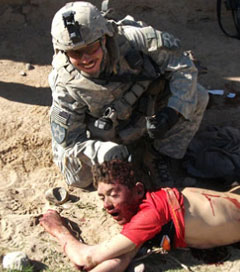
Cpl. Jeremy Morlock poses with the body of an unarmed Afghan boy named Gul Mudin in the village of La Mohammad Kalay. (Photo: US Army)

The inability to identify with others was unquestionably the most important psychological condition for the fact that something like Auschwitz could have occurred in the midst of more or less civilized and innocent people…. The coldness of the societal monad, the isolated competitor, was the precondition, as indifference to the fate of others…. Regressive tendencies, that is, people with repressed sadistic traits, are produced everywhere today by the global evolution of society…. Everywhere where it is mutilated, consciousness is reflected back upon the body and the sphere of the corporeal in an unfree form that tends toward violence. -Theodor Adorno

War, violence and death have become the organizing principle of governance and culture in the United States as we move into the second decade of the 21st century. Lacking a language for the social good, the very concept of the social as a space in which justice, equality, social protections and a responsibility to the other mediate everyday life is being refigured through a spectacle of violence and cruelty. Under such circumstances, ethical considerations and social costs are removed from market-driven policies and values just as images of human suffering are increasingly abstracted from not only their social and political contexts, but also the conditions that make such suffering possible. Moreover, as public issues collapse into privatized considerations, matters of agency, responsibility and ethics are now framed within the discourse of extreme individualism. Unexpected violence, aggression and the “‘masculine’ virtues of toughness, strength, decisiveness and determination … are accentuated,” along with the claims of vengeance, militarization and violence.(1) The collapse of the social and the formative culture that make human bonds possible is now outmatched by the rise of a Darwinian ethic of greed and self-interest in which violence, aggressiveness and sadism have become the primary metric for living and dying. As the social contract is replaced by social collapse, a culture of depravity has emerged in American society. The spectacle of violence permeates every aspect of the machinery of cultural production and screen culture – extending from television news and reality TV to the latest Hollywood fare. Of course, this is not new. What is new is that more and more people desire spectacles of high-intensity violence and images of death, mutilation and suffering and their desires should no longer be attributed to an individual aberration, but instead suggest an increasingly widespread social pathology.

Death and violence have become the mediating link between US domestic policy – the state’s treatment of its own citizens – and foreign policy, between the tedium of ever expanding workdays and the thrill of sadistic release. Disposable bodies now waste away in American prisons, schools and shelters just as they litter the battlefields of Iraq and Afghanistan. America has become a permanent warfare state, with a deep investment in a cultural politics and the corollary cultural apparatuses that legitimate and sanctify its machinery of death. The American public’s fascination with violence and death is evident in the recent popular obsession with high-octane action films, along with the ever-expanding volume of vampire and zombie films, TV shows and books. We also see death-dealing and violent acts accrue popularity with Hollywood films such as the 2010 academy-award winning “The Hurt Locker,” in which the American bomb disposal expert, William James (Jeremy Renner), repeatedly puts himself at risk in the face of defusing various bomb threats – thus to highlight the filmmaker’s concern with a growing “addiction” to war. As Mark Featherstone points out, there is more represented here than the reckless behavior of immature and hyper-masculine soldiers. He writes, “James takes unnecessary risks and lives for the limit experience…. [H]e feels most alive when he is closest to death … When James … throws the bomb suit away and stands before the bomb with no protection, he puts himself at the mercy of the bomb, the embodiment of the death drive.”(2)

“The Hurt Locker” is only one of a number of serious films that address, if not mirror, a psychological state in which the production of a virulent masculinity now augurs both a pathological relationship with the body, pain and violence and a disdain for compassion, human rights and social justice. The death drive in American society has become one of its fundamental characteristics and, undoubtedly, its most disabling pathology. More than a trace of this mode of aggression and moral indifference now dominates contemporary American life. Marked by a virulent notion of hardness and aggressive masculinity, a culture of depravity has become commonplace in a society in which pain, humiliation and abuse are condensed into digestible spectacles of violence endlessly circulated through extreme sports, reality TV, video games, YouTube postings and proliferating forms of the new and old media. But the ideology of hardness and the economy of pleasure it justifies are also present in the material relations of power that have intensified since the Reagan presidency, when a shift in government policies first took place and set the stage for the emergence of an unchecked regime of torture and state violence under the Bush-Cheney regime. Conservative and liberal politicians alike now spend millions waging wars around the globe, funding the largest military state in the world, providing huge tax benefits to the ultra-rich and major corporations, and all the while draining public coffers, increasing the scale of human poverty and misery and eliminating all viable public spheres – whether they be the social state, public schools, public transportation, or any other aspect of a formative culture that addresses the needs of the common good.

Mainstream politicians now call for cutbacks in public funding in order to address the pressing problems of the very deficit they not only created, but gladly embrace, since it provides an excuse either to drastically reduce funding for vital entitlements such as Medicare and early childhood education or to privatize public education, transportation, and other public services, while putting more money into the hands of the rich and powerful. The real deficit here is one of truth and morality. The politics of austerity has now become a discourse for eviscerating the social state and forcing upon cities, families and individuals previously unimaginable levels of precarity, suffering and insecurity. As Rania Khalek points out, conservatives want to “exploit the budget crisis in order to starve government…. The truth is that the economic crisis, sparked by decades of deregulation and greedy financial forms, caused high levels of unemployment that dramatically reduced state and local tax revenues. Add to that years of tax cuts for the wealthy and decades of corporate tax-dodging and you’ve got yourself a budget crisis.”(3) The discourse of “deficit porn” now justifies the shift in public policy and state funding further away from providing social protections and safeguarding civil liberties toward the establishment of legislative programs intent on promoting shared fears and increasing disciplinary modes of governance that rely on the criminalization of social problems.(4)

The broader cultural turn toward the death drive and the strange economy of desire it produces is also evident in the emergence of a culture of depravity in which the American public appears more and more amenable to deriving pleasure from images that portray gratuitous violence and calamity. As mentioned above, exaggerated violence now rules screen culture. The public pedagogy of entertainment includes extreme images of violence, human suffering and torture splashed across giant movie screens, some in 3D, offering viewers every imaginable portrayal of violent acts, each more shocking and brutal than the last. The growing taste for sadism can be seen in the recent fascination on the part of the media with Peter Moskos’ book “In Defense of Flogging,” in which the author seriously proposes that prisoners be given a choice between a standard sentence and a number of lashes administered in public.(5) In the name of reform, Moskos argues, without any irony, that public flogging is more honest and a sure-fire way of reducing the prison population. Not only is this book being given massive air time in the mainstream media, but its advocacy of corporal punishment and flogging is treated as if it is a legitimate proposal for reform. Mind-crushing punishment is presented as the only choice left for prisoners outside of serving their sentences. Moreover, this medieval type of punishment inflicts pain on the body as part of a public spectacle. Moskos seems to miss how the legacy of slavery informs his proposal, given that flogging was one of the preferred punishments handed out to slaves and that 70 percent of all current prisoners in the United States are people of color. Surely, the next step will be a reality TV franchise in which millions tune in to watch public floggings. This is not merely barbarism parading as reform – it is also a blatant indicator of the degree to which sadism and the infatuation with violence have become normalized in a society that seems to take delight in dehumanizing itself.

As the social is devalued along with rationality, ethics and any vestige of democracy, spectacles of violence and brutality now merge into forms of collective pleasure that constitute what I believe is an important and new symbiosis among visual pleasure, violence and suffering. As I have suggested, taking pleasure in violence can no longer be reduced to a matter of individual pathology, but registers a larger economy of pleasure across the broader culture and social landscape. The consumption of images of human pain as a matter of personal pleasure and taste has given way to representations of human suffering, humiliation and death that circulate across the culture as part of the collective indulgence in gross spectacles that persist in being called entertainment, news and knowledge sharing. What is more, privatized pleasures and violence translate increasingly into forms of structural violence that are mobilized by the death drive and use the spectacles of violence to generate a source of gratification and intense socially experienced pleasure. Amplified sadism and voyeurism are now characteristic of a contemporary society that has narrowed the range of social expression and values to the receipt of instant gratification and the pursuit of pleasure as one of its sole imperatives. As images of degradation and human suffering become more palatable and pleasurable, the body no longer becomes the privileged space of agency, but “the location of violence, crime and social pathology.”(6) Americans now find themselves in the midst of a brutal authoritarianism in which freedom is reduced to the narrow realm of individual needs, narcissistic pleasures and the removal of all forms of social responsibility, particularly those imposed by the government. Sovereignty and governance, under the guise of “personal choice,” are instead produced and defined by the market and the power of large corporations and financial institutions. As decadence and despair are normalized in the wider culture, people are increasingly exploited for their pleasure quotient, while any viable notion of the social is subordinated to the violence of a deregulated market economy and its ongoing production of a culture of cruelty.(7) For all intents and purposes, politics as a matter of public governance is dead in the United States.

How else to explain the insistent demand by many conservative and liberal pundits and the American public at large that the government release the grisly images of Osama bin Laden’s corpse, even though the fact of his assassination was never in doubt? How might we understand the growing support among the American populace for state-sanctioned torture and the rising indifference to images which reveal its horrible injustices? Just as torture is sanctioned by the state and becomes normalized for many Americans, the spectacle of violence spreads through the culture with ever-greater intensity. Whatever bleeds – now gratuitously and luxuriously – brings in box office profits and dominates media headlines, despite being often presented without any viable context for making sense of the imagery, or any critical commentary that might undercut or rupture the pleasure viewers are invited to derive from such images. Representations of violence and human tragedy now merge seamlessly with neoliberalism’s culture of depravity in which risk and mayhem reinforce shared fears rather than shared responsibilities and a Hobbesian war of all against all becomes the organizing principle for structuring a vast array of institutions and social relations.

As corporate capitalism translates into corporate fascism, prominent politicians such as Sarah Palin, radio hosts such as Rush Limbaugh and media monopoly moguls such as those who deliver Fox News repeatedly deploy the vocabulary of violence to attack the social state, labor unions, immigrants, young people, teachers and public-service employees. At the same time, the depravity of aesthetics gains popular currency in organs of the dominant media that reproduce an endless stream of denigrating images and narratives of people constrained by the forces of poverty, racism and disability. Their pain and suffering now become a source of delight for late-night comics, radio talk show hosts and TV programs that provide ample narratives and images of poor families, individuals and communities who become fodder for the “poverty porn” industry.(8) Programs such as the reality TV series “Jersey Shore,” the syndicated tabloid TV talk show series “The Jerry Springer Show” (and its endless imitators) and “The Biggest Loser” all exemplify what Gerry Mooney and Lynn Hancock claim is a massive “assault on people experiencing poverty [seizing] on any example of ‘dysfunctionality’ in poor working class communities … [exhibiting] expressions of middle-class fears and distrust, [while] also [displaying] a fascination with poverty and the supposedly deviant lifestyles of those affected – where viewers of moral outrage are encouraged to find the worst and weakest moments of people’s lives also funny and entertaining.”(9)Disconnected from any moral criteria, the search for ever more intense levels of sensation and excitation become the pedagogical and performative force par excellence in shaping the world of entertainment. Within this context, the pleasure of humiliation and violence is maximized and cruelty is elevated to a structuring principle of society.

What has led to this immunity and insensitivity to cruelty and prurient images of violence? Part of this process is due to the fact that the American public is bombarded by an unprecedented “huge volume of exposure to … images of human suffering.”(10)As Zygmunt Bauman argues, there are social costs that come with this immersion of the culture in staged violence. One consequence is that “the sheer numbers and monotony of images may have a ‘wearing off’ impact [and] to stave off the ‘viewing fatigue,’ they must be increasingly gory, shocking and otherwise ‘inventive’ to arouse any sentiments at all or indeed draw attention. The level of ‘familiar’ violence, below which the cruelty of cruel acts escapes attention, is constantly rising.”(11) Hyper-violence and spectacular representations of cruelty disrupt and block our ability to respond politically and ethically to the violence as it’s actually happening on the ground. In this instance, unfamiliar violence such as extreme images of torture and death becomes banally familiar, while familiar violence that occurs daily is barely recognized, becoming, if not boring, then relegated to the realm of the unnoticeable and unnoticed. An increasing volume of violence is pumped into the culture as yesterday’s spine-chilling and nerve-wrenching violence loses its shock value. As the need for more intense images of violence accumulates, the moral indifference and desensitization to violence grow, while matters of cruelty and suffering are offered up as fodder for sports, entertainment, news media, and other outlets for seeking pleasure.

Under the regime of neoliberal policies, relations and values, profit-making becomes the only legitimate mode of exchange; private interests replace public concerns; and unbridled individualism infects a society in which the vocabulary of fear, competition, war and punishment governs existing relationships. Within an economy of pleasure and commodification, freedom is subsumed by a calculated deficit that reduces agency to a regressive infantilism and degraded forms of gratification. What Leo Lowenthal called “the atomization of the individual” bespeaks a figure now terrorized by other human beings and reduced to living “in a state of stupor, in a moral coma.”(12) This type of depoliticized inward thinking – with its repudiation of the obligations of shared sociality, disengagement from moral responsibility and outright disdain for those who are disadvantaged by virtue of being poor, young or elderly – does more than fuel the harsh, militarized and ultra-masculine logic of the news and entertainment sector. This “atomization of the individual” also elevates death over life, selfishness over compassion and economics over politics. The spectrum of disdain and vulnerability has been extended at the current historical moment to contempt for life itself. Life reduced to “bare life” and the vulnerability it produces elicits imperviousness at best and a new kind of pleasure at worst. Precarity, uncertainty and misfortune no longer evoke compassion but disdain, while simultaneously opening up a space in which vulnerability offers a pretext for forms of pleasure that reinforce a culture of cruelty.(13) But even more so, it produces a kind of dysfunctional silence in American society in the face of widespread hardship and suffering – virtually wiping out society’s collective memories of moral decency and mutuality.

The merging of violence and pleasure has been on full display throughout American history, though images of such depravities have often been hidden. Exceptions can be found in the history of racism and the startling and disturbing images of the public lynching of African-Americans, the brutal murder of Emmett Till and the mass killings at My Lai depicted in photographs of American soldiers relaxing and smiling after the carnage. More recently, a number of photographs have once again surfaced which display grotesque acts of violence and murder by a select group of American soldiers stationed in Afghanistan. The images released by Rolling Stone magazine in the United States focused on the murderous actions of 12 US soldiers, who decided to kill Afghan civilians allegedly for sport. They used the moniker “The Kill Team” to refer to themselves, aptly registering both the group’s motivation and its monstrous actions. In the five months during which these soldiers went on a murderous rampage in Kandahar Province, writes one reporter, “they engaged in routine substance abuse and brutality toward Afghan locals that led to four premeditated murders of innocent civilians, the ritual mutilation of corpses (some of the soldiers reportedly severed fingers from their victims to keep as trophies) and the snapping of celebratory photographs alongside the deceased as if they were bagged deer.”(14) The soldiers’ actions exhibited their immersion in a death-driven culture that differs only in degree from the one I have been documenting throughout this article. Their actions were neither isolated nor individualized, but reflect their evident belief that killing for sport in such a culture could take place with impunity. Proudly bearing the title “Kill Team” registers “the pure depravity of the alleged crimes.”(15) In one particularly disturbing photo celebrating a kill, one of the soldiers, Jeremy Morlock, is shown posing with the body of Gul Mudin, a 15-year-old Afghan boy. With a grin on his face and a thumbs-up sign, Morlock is kneeling on the ground next to Mudin’s bloody and half-naked corpse, grabbing a handful of hair to lift up his bloodied face.

The platoon’s squad leader, Staff Sgt. Calvin Gibbs, was so pleased with the kill that he desecrated the young boy’s dead body by severing one of his fingers. Mark Boal quotes one soldier’s account of the incident: “‘It was like another day at the office for him’…. Gibbs started ‘messing around with the kid, moving his arms and mouth and acting like the kid was talking.'” Boal adds, “Then, using a pair of razor-sharp medic’s shears, [Gibbs] reportedly sliced off the dead boy’s pinky finger and gave it to [the soldier], as a trophy for killing his first Afghan.”(16)Gibbs’ instinct for barbarism appears utterly ruthless and lacking in any sense of ethical consideration or self-reflection – to say nothing of the political and social costs incurred by the US-led mission. The staff sergeant was so intent on killing Afghan civilians that he actually boasted about it, telling one soldier, “Come down to the line and we’ll find someone to kill.”(17)Revealing the depth of his inhumanity, Gibbs reportedly told his soldiers that all Afghans were savages, and talked to his squad about how they might be inventive in killing civilians. In one almost unbelievable scenario, the soldiers considered throwing “candy out of a Stryker vehicle as they drove through a village and shoot[ing] the children who came running to pick up the sweets. According to one soldier, they also talked about a second scenario in which they ‘would throw candy out in front and in the rear of the Stryker; the Stryker would then run the children over.'”(18)

Unlike the Abu Ghraib prison photos that were designed to humiliate detainees, the “Kill Team” photos suggest a deeper depravity, an intense pleasure in acts of violence that are preplanned and carried out with no impending threat, culminating in the sadistic collection of body parts of the slain victims as trophies. The “Kill Team” was after more than humiliation and the objectification of the other; it harbored a deep desire to feel intense excitement through pathological acts of murder and then captured the savagery in photos that served as mementos, so they could revisit and experience once again the delight that comes with descending into the sordid pornographic hell that connects violence, pleasure and death. The smiles on the faces of the young soldiers as they posed among their trophy killings are not the snapshots of privatized violence, but images of sadism that are symptoms of a social pathology in which shared pleasure in violence is now commonplace. As my colleague David L. Clark points out, the smiles on the faces of these soldiers suggest something perverse and alarming. He writes, “This isn’t Hannibal Lecter, after all, but G.I. Joe [and these photos appear as] symptomatic evidence of a certain public enjoyment of violence for the sake of violence, i.e., not the smile of shared pleasures between intimates (one form of the everyday), but a smile that marks a broader acceptance and affirmation of cruelty, killing for sport. Those smiles register a knowing pleasure in that violence and say that it is okay to kill and okay to take pleasure in that killing.”(19)

The “Kill Team” photographs are important because they signify a new register of what can be called a failed sociality. In this instance, the social does not disappear as much as it is overwritten by a sociality of shared violence – a sociality marked not by the injurious violence of the lone sociopath, but instead by a growing army of sociopaths. The “Kill Team” photographs offer a glimpse into a larger set of social conditions in a winner-take-all society in which it becomes difficult to imagine pleasure in any other terms except through the spectacle of violence buttressed by a market-driven culture and dominated by a survivalist ethic. What is it about these photos that reveals the smear of the pornographic, a titillation grounded in maximizing the pleasure of violence? What are the political, economic and social forces bearing down on American society that so easily undercut its potential to raise critical questions about war, violence, morality and human suffering? What forms of responsibility and what pedagogical strategies does one invoke in the face of a society that feeds off spectacles of violence and cruelty? What forms of witnessing and education might be called into play in which the feelings of pleasure mobilized by images of human suffering can be used as “a catalyst for critical inquiry and deep thought?”(20)Rather than being reduced to a mechanism for the cathartic release of pleasure, a society saturated in the claims of violence, war, aggression and poisonous modes of masculinity must serve as an indictment, a source of memory and evidence of the need to imagine otherwise.

In contrast to the “Kill Team” photos, we have seen images from Libya, Syria and Iran where the murder of young students and other protesters by state militia thugs have been captured on video and circulated the world over. Such images become a pedagogical tool, a critical mode of public pedagogy capable of forms of witnessing that allow people to imagine the unimaginable. What is emancipatory about these images, as Georges Didi-Huberman points out in a different context, is that they work to refuse what he calls the “disimagination machine”; that is, these are images that are “images in spite of all” – bearing witness to a different and critical sense of remembering, agency, ethics and collective resistance.(21) These images have ignited massive collective protests against repressive governments. Such images did not feed the basest of collective desires and pleasurable fantasies detached from any real consequences. To the contrary, such images of abuse and suffering have inflamed a society in which a formative culture exists that enables people to connect emotional investments and desires to a politics in which unthinkable acts of violence are confronted as part of a larger “commitment to political accountability, community and the importance of positive affect for both belonging and change.”(22)

America has lost the formative culture that would allow us to contest, challenge and transform the prevailing culture of unbridled individualism, consumerism, militarism and desire for instant pleasure. Both major political parties now impose harsh penalties on the poor, young people, the elderly, immigrants, and other groups considered disposable. We are on the brink of an authoritarianism in which war and violence not only cause unbearable hardship and suffering for the vast majority of the American people, but also produce a larger social pathology in which the actions of the “Kill Team” soldiers who sought out pleasure in the most vile and grotesque acts of violence are symptomatic of something that is becoming normalized and commonplace in American society. This is a violence being waged against democracy and the public good, one that feeds on mobilization of desires and collective pleasures in the face of the suffering of others.

Footnotes:

1. Richard J. Bernstein, The Abuse of Evil (London: Polity, 2005), p. 49.

2. Mark Featherstone, “The Hurt Locker: What is the Death Drive?” Sociology and Criminology at Keele University – Blogspot (February 25, 2010). Online here.

3. Rania Khalek, “Death by Budget Cut: Why Conservatives and Some Dems Have Blood on their Hands,” AlterNet (June 13, 2011). Online here.

4. See, for instance, Loic Wacquant, “Punishing the Poor: The Neoliberal Government of Social Insecurity,” (Durham: Duke University Press, 2009).

5. Peter Moskos, “In Defense of Flogging,” (New York: Basic Books, 2011).

6. Paul Gilroy, “‘After the Love Has Gone’: Bio-Politics and Ethepoetics in the Black Public Sphere,” Public Culture 7:1 (1994), p. 58.

7. I take up in great detail the notion of a culture of cruelty in Henry A. Giroux, “Zombie Politics and Culture in the Age of Casino Capitalism,” (New York: Peter Lang, 2011).

8. I have taken the term “poverty porn” from Gerry Mooney and Lynn Hancock, “Poverty Porn and the Broken Society,” Variant 39/40 (Winter 2010). Online here.

9. Ibid.

10. Zygmunt Bauman, “Life in Fragments,” (Malden: Blackwell, 1995), p. 149.

11. Zygmunt Bauman, “Life in Fragments,” (Malden: Blackwell, 1995), pp. 149-150.

12. Leo Lowenthal, “Atomization of Man,” False Prophets: Studies in Authoritarianism (New Brunswick, NJ: Transaction Books, 1987), p. 182.

13. Judith Butler touches on this issue in Judith Butler, “Precarious Life: The Powers of Mourning and Violence,” (London: Verso Press, 2004).

14. Jim Frederick, “Anatomy of a War Crime: Behind the Enabling of the ‘Kill Team,'” Time (March 29, 2011). Online here.

15. Ibid.

16. Mark Boal, “The Kill Team,” Rolling Stone, (March 27, 2011). Online here.

17. Ibid.

18. Ibid.

19. David L. Clark, personal correspondence, May 15, 2011.

20. Mieke Bal, “The Pain Of Images,” in “Beautiful Suffering,” ed. Mark Reinhardt, Holly Edwards and Erina Duganne (Chicago: University of Chicago Press, 2007), p. 111.

21. Georges Didi-Huberman, “Images in Spite of All: Four Photographs from Auschwitz,” trans. Shane B. Lillis (Chicago: University of Chicago Press, 2008), pp. 1-2.

22. Clare Hemmings, “Invoking Affect: Cultural Theory and the Ontological Turn,” Cultural Studies 19:5 (September 2005), pp. 557-558.

Henry A. Giroux currently holds the Global TV Network Chair Professorship at McMaster University in the English and Cultural Studies Department. His most recent books include: Youth in a Suspect Society (Palgrave, 2009); Politics After Hope: Obama and the Crisis of Youth, Race, and Democracy (Paradigm, 2010); Hearts of Darkness: Torturing Children in the War on Terror (Paradigm, 2010); The Mouse that Roared: Disney and the End of Innocence (co-authored with Grace Pollock, Rowman and Littlefield, 2010); Zombie Politics and Culture in the Age of Casino Capitalism (Peter Lang, 2011); Henry Giroux on Critical Pedagogy (Continuum, 2011). His newest books: Education and the Crisis of Public Values (Peter Lang) and Twilight of the Social: Resurgent Publics in the Age of Disposability (Paradigm Publishers) will be published in 2012. Giroux is also a member of Truthout’s Board of Directors. His website is www.henryagiroux.com.

The Controversy about Hypothesis Testing

From an interesting call for papers:

“Scientists spend a lot of time testing a hypothesis, and classifying experimental results as (in)significant evidence. But even after a century of hot debate, there is no consensus on what this concept of significance implies, how the results of hypothesis tests should be interpreted, and which practical pitfalls have to be avoided. Take the fierce criticisms of significance testing in economics, take the endless debate about statistical reform in psychology, take the foundational disagreement between frequentists and Bayesians about what constitutes statistical evidence.”

(Link to the conference here).

Material cartográfico revela imaginário colonial português (FAPESP)

HUMANIDADES
| BIBLIOTECA DIGITAL
A mina dos mapas
Márcio Ferrari
Edição Impressa 183 – Maio de 2011

Visão do Brasil que revela a exploração. © DIVULGAÇÃO

Um precioso material cartográfico vem ganhando visibilidade irrestrita graças ao trabalho do grupo de pesquisadores da Universidade de São Paulo (USP) responsável pela construção da Biblioteca Digital de Cartografia Histórica. O acesso on-line é livre. Fruto de um conceito desenvolvido pelo Laboratório de Estudos de Cartografia Histórica (Lech), o site não só oferece a apreciação de um acervo de mapas raros impressos entre os séculos XVI e XIX, mas também torna possível uma série de referências cruzadas, comparações e chaves interpretativas com a pluralidade e a rapidez da internet. Afinal, “um mapa sozinho não faz verão”, como diz uma das coordenadoras do projeto, Iris Kantor, professora do Departamento de História da USP. O conjunto revela muito mais do que informações geográficas. Permite também perceber a elaboração de um imaginário ao longo do tempo, revelado por visões do Brasil concebidas fora do país. O trabalho se inseriu num grande projeto temático, denominadoDimensões do Império português e coordenado pela professora Laura de Mello e Souza, que teve apoio da Fapesp.

Até agora o acervo teve duas fontes principais. A primeira foi o conjunto de anotações realizadas ao longo de 60 anos pelo almirante Max Justo Lopes, um dos principais especialistas em cartografia do Brasil. A segunda foi a coleção particular do Banco Santos, recolhida à guarda do Estado durante o processo de intervenção no patrimônio do banqueiro Edemar Cid Ferreira, em 2005. Uma decisão judicial transferiu a custódia dos mapas ao Instituto de Estudos Brasileiros (IEB) da USP – iniciativa louvável, uma vez que esse acervo, segundo Iris Kantor, “estava guardado em condições muito precárias num galpão, sem nenhuma preocupação de acondicionamento adequado”. Foram recolhidos cerca de 300 mapas. Sabe-se que o número total da coleção original era muito maior, mas ignora-se onde se encontram os demais.

O primeiro passo foi recuperar e restaurar os itens recolhidos. Eles chegaram à USP “totalmente nus”, sendo necessário todo o trabalho de identificação, datação, atribuição de autoria etc. Durante os anos de 2007 e 2008, o Laboratório de Reprodução Digital do IEB pesquisou, adquiriu e utilizou a tecnologia adequada para reproduzir em alta resolução o acervo de mapas. Foram necessárias várias tentativas até se atingir a precisão de traços e cores desejada. Em seguida, o Centro de Informática do campus da USP em São Carlos (Cisc/USP) desenvolveu um software específico, tornando possível construir uma base de dados capaz de interagir com o catálogo geral da biblioteca da USP (Dedalus), assim como colher e transferir dados de outras bases disponíveis na internet. Uma das fontes inspiradoras dos pesquisadores foi o site do colecionador e artista gráfico inglês David Rumsey, que abriga 17 mil mapas. Outra foi a pioneira Biblioteca Virtual da Cartografia Histórica, da Biblioteca Nacional, que reúne 22 mil documentos digitalizados. Futuramente, o acervo cartográfico da USP deverá integrar a Biblioteca Digital de Cartografia Histórica. Foi dada prioridade aos mapas do Banco Santos porque eles não pertencem à universidade, podendo a qualquer momento ser requisitados judicialmente para quitar dívidas.

Hoje estão disponíveis na Biblioteca Digital “informações cartobibliográficas, biográficas, dados de natureza técnica e editorial, assim como verbetes explicativos que procuram contextualizar o processo de produção, circulação e apropriação das imagens cartográficas”. “Não existe mapa ingênuo”, diz Iris Kantor, indicando a necessidade dessa reunião de informações para o entendimento do que está oculto sob a superfície dos contornos geográficos e da toponímia. “O pressuposto do historiador é que todos os mapas mentem; a manipulação é um dado importante a qualquer peça cartográfica.”

Fizeram parte dessa manipulação os interesses geopolíticos e comerciais da época determinada e daqueles que produziram ou encomendaram o mapa. O historiador Paulo Miceli, da Universidade Estadual de Campinas (Unicamp), que no início da década passada havia sido chamado pelo Banco Santos para dar consultoria sobre a organização do acervo, lembra que o primeiro registro cartográfico daquilo que hoje se chama Brasil foi um mapa do navegador espanhol Juan de la Cosa (1460-1510), datado de 1506, que mostra “a linha demarcatória do Tratado de Tordesilhas, a África muito bem desenhada e, à sua esquerda, um triângulo bem pequeno para indicar a América do Sul”. “O Brasil foi surgindo de uma espécie de nevoeiro de documentos, condicionado, entre outras coisas, pelo rigor da coroa portuguesa sobre o trabalho dos cartógrafos, que estavam sujeitos até a pena de morte.” Essa “aparição” gradual do Brasil no esquema geopolítico imperial é o tema da tese de livre-docência de Miceli, intitulada, apropriadamente, de O desenho do Brasil no mapa do mundo, que sairá em livro ainda este ano pela editora da Unicamp. O título se refere aoTheatrum orbis terrarum (Teatro do mundo), do geógrafo flamengo Abraham Ortelius (1527-1598), considerado o primeiro atlas moderno.

Navegadores – Ao contrário do que se pode imaginar, os mapas antigos não tinham a função principal, e prática, de orientar exploradores e navegadores. Estes, até o século XIX, se valiam de roteiros escritos, as “cartas de marear”, registrados em “pergaminhos sem beleza nem ambiguidade, perfurados por compassos e outros instrumentos, e que viraram invólucros de pastas de documentos em acervos cartográficos”, segundo Miceli. “Os mapas eram objetos de ostentação e prestígio, com valor de fruição e ornamentação, para nobres e eruditos”, diz Iris Kantor. “Um dos tesouros do Vaticano era sua coleção cartográfica.” Já os roteiros de navegação eram apenas manuscritos e não impressos, processo que dava aos mapas status de documentos privilegiados. As chapas originais de metal, com as alterações ao longo do tempo, duravam até 200 anos, sempre nas mãos de “famílias” de cartógrafos, editores e livreiros. Às vezes essas famílias eram mesmo grupos consanguíneos com funções hereditárias, outras vezes eram ateliês altamente especializados. Os artistas, com experiência acumulada ao longo de décadas, não viajavam e recolhiam suas informações de “navegadores muitas vezes analfabetos”, segundo Miceli. Para dar uma ideia do prestígio atribuído à cartografia, ele lembra que o Atlas maior, do holandês Willem Blaue (1571-1638), pintado com tinta de ouro, foi considerado o livro mais caro do Renascimento.

Um dos critérios de busca da Biblioteca Digital de Cartografia Histórica é justamente por “escolas” de cartógrafos, entre elas a flamenga, a francesa e a veneziana – sempre lembrando que o saber fundamental veio dos navegadores e cosmógrafos portugueses. Iris Kantor considera que elas se interpenetram e planeja, futuramente, substituir a palavra “escola” por “estilo”. Também está nos planos da equipe reconstituir a genealogia da produção de mapas ao longo do período coberto. No estudo desses documentos se inclui a identificação daqueles que contêm erros voluntários como parte de um esforço de contrainformação, chamado por Miceli de “adulteração patriótica”. Como os mapas que falsificam a localização de recursos naturais, como rios, para favorecer portugueses ou espanhóis na divisão do Tratado de Tordesilhas.

Uma evidência da função quase propagandística da cartografia está no mapa Brasil, de 1565, produzido pela escola veneziana, que ilustra a abertura desta reportagem. Nele não se destaca exatamente a precisão geográfica. “A toponímia não é muito intensa, embora toda a costa já estivesse nomeada nessa época”, diz Iris Kantor. “É uma obra voltada para o público leigo, talvez mais para os comerciantes, como indicam os barquinhos com os brasões das coroas da França e de Portugal. Vemos o comércio do pau-brasil, ainda sem identificação da soberania política. Parece uma região de franco acesso. A representação dos indígenas e seu contato com o estrangeiro transmite cordialidade e reciprocidade.”

“No fundo, os mapas servem como representação de nós mesmos”, prossegue a professora da USP. “Pelo estudo da cartografia brasileira pós-independência, por exemplo, chama a atenção nossa visão de identidade nacional baseada numa cultura geográfica romântica, liberal e naturalista, que representa o país como um contínuo geográfico entre a Amazônia e o Prata. No mesmo período, a ideia do povo não era tão homogênea. Não é por acaso que os homens que fizeram a independência e constituíram o arcabouço legal do país fossem ligados às ciências naturais, à cartografia etc. A questão geográfica foi imperativa na criação da identidade nacional.”

Um exemplo bem diferente de utilização de recursos digitais na pesquisa com mapas está em andamento na Unicamp, derivado do projeto Trabalhadores no Brasil: identidades, direitos e política, coordenado pela professora Silvia Hunold Lara e apoiado pela Fapesp. Trata-se do estudo Mapas temáticos de Santana e Bexiga, sobre o cotidiano dos trabalhadores urbanos entre 1870 e 1930. Segundo a professora, pode-se reconstituir o cotidiano dos moradores dos bairros, “não  dissociados de seu modo de trabalho e de suas reivindicações por direitos”.

Confronting the ‘Anthropocene’ (N.Y. Times)

May 11, 2011, 9:39 AM
By ANDREW C. REVKIN
N.Y. Times, Dot Earth

NASA. Donald R. Pettit, an astronaut, took this photograph of London while living in the International Space Station.

LONDON — I’m participating in a one-day meeting at the Geological Society of London exploring the evidence for, and meaning of, the Anthropocene. This is the proposed epoch of Earth history that, proponents say, has begun with the rise of the human species as a globally potent biogeophysical force, capable of leaving a durable imprint in the geological record.

This recent TEDx video presentation by Will Steffen, the executive director of the Australian National University’s Climate Change Institute, lays out the basic idea:

There’s more on the basic concept in National Geographic and from the BBC. Paul Crutzen, the Nobel laureate in chemistry who, with others, proposed the term in 2000, and Christian Schwägerl, the author of “The Age of Man” (German), described the value of this new framing for current Earth history in January in Yale Environment 360:

Students in school are still taught that we are living in the Holocence, an era that began roughly 12,000 years ago at the end of the last Ice Age. But teaching students that we are living in the Anthropocene, the Age of Men, could be of great help. Rather than representing yet another sign of human hubris, this name change would stress the enormity of humanity’s responsibility as stewards of the Earth. It would highlight the immense power of our intellect and our creativity, and the opportunities they offer for shaping the future. [Read the rest.]

I’m attending because of a quirky role I played almost 20 years ago in laying the groundwork for this concept of humans as a geological force. A new paper from Steffen and three coauthors reviewing the conceptual and historic basis for the Anthropocene includes an appropriately amusing description of my role:

Biologist Eugene F. Stoermer wrote: ‘I began using the term “anthropocene” in the 1980s, but never formalized it until Paul [Crutzen] contacted me’. About this time other authors were exploring the concept of the Anthropocene, although not using the term. More curiously, a popular book about Global Warming, published in 1992 by Andrew C. Revkin, contained the following prophetic words: ‘Perhaps earth scientists of the future will name this new post-Holocene period for its causative element—for us. We are entering an age that might someday be referred to as, say, the Anthrocene [sic]. After all, it is a geological age of our own making’. Perhaps many readers ignored the minor linguistic difference and have read the new term as Anthro(po)cene!

If you’ve been tracking my work for a while, you’re aware of my focus on the extraordinary nature of this moment in both Earth and human history. As far as science can tell, there’s never, until now, been a point when a species became a planetary powerhouse and also became aware of that situation.

As I first wrote in 1992, cyanobacteria are credited with oxygenating the atmosphere some 2 billion years ago. That was clearly a more profound influence on a central component of the planetary system than humans raising the concentration of carbon dioxide 40 percent since the start of the industrial revolution. But, as far as we know, cyanobacteria (let alone any other life form from that period) were neither bemoaning nor celebrating that achievement.

It was easier to be in a teen-style resource binge before science began to delineate an edge to our petri dish.

We no longer have the luxury of ignorance.

We’re essentially in a race between our potency, our awareness of the expressed and potential ramifications of our actions and our growing awareness of the deeply embedded perceptual and behavioral traits that shape how we do, or don’t, address certain kinds of risks. (Explore “Boombustology” and “Disasters by Design” to be reminded how this habit is not restricted to environmental risks.)

This meeting in London is two-pronged. It is in part focused on deepening basic inquiry into stratigraphy and other branches of earth science and clarifying how this human era could qualify as a formal chapter in Earth’s physical biography. As Erle C. Ellis, an ecologist at the University of Maryland, Baltimore County, put it in his talk, it’s unclear for the moment whether humanity’s impact will be long enough to represent an epoch, or will more resemble “an event.” Ellis’s presentation was a mesmerizing tour of the planet’s profoundly humanized ecosystems, which he said would be better described as “anthromes” than “biomes.”

Ellis said it was important to approach this reality not as a woeful situation, but an opportunity to foster a new appreciation of the lack of separation of people and their planet and a bright prospect for enriching that relationship. In this his views resonate powerfully with those of Rene Dubos, someone I’ll be writing about here again soon.

Through the talks by Ellis and others, it was clear that the scientific effort to define a new geological epoch, while important, paled beside the broader significance of this juncture in human history.

In my opening comments at the meeting, I stressed the need to expand the discussion from the physical and environmental sciences into disciplines ranging from sociology to history, philosophy to the arts.

I noted that while the “great acceleration” described by Steffen and others is already well under way, it’s entirely possible for humans to design their future, at least in a soft way, boosting odds that the geological record will have two phases — perhaps a “lesser” and “greater” Anthropocene, as someone in the audience for my recent talk with Brad Allenby at Arizona State University put it.

I also noted that the term “Anthropocene,” like phrases such as “global warming,” is sufficiently vague to guarantee it will be interpreted in profoundly different ways by people with different world views. (As I explained, this is as true for Nobel laureates in physics as it is for the rest of us.)

Some will see this period as a “shame on us” moment. Others will deride this effort as a hubristic overstatement of human powers. Some will argue for the importance of living smaller and leaving no scars. Others will revel in human dominion as a normal and natural part of our journey as a species.

A useful trait will be to get comfortable with that diversity.

Before the day is done I also plan on pushing Randy Olson’s notion of moving beyond the “nerd loop” and making sure this conversation spills across all disciplinary and cultural boundaries from the get-go.

There’s much more to explore of course, and I’ll post updates as time allows. You might track the meeting hash tag, #anthrop11, on Twitter.

Could Carbon Labeling Combat Climate Change? (Scientific American)

Experts argue that carbon labeling might promote energy efficiency and other efforts to reduce greenhouse gas emissions
By Joey Peters and ClimateWire | May 9, 2011

Some experts argue that revealing the carbon content of appliances and other items might help combat climate change. Image: Federal Trade Commission.

While large-scale efforts to curb greenhouse gases aren’t likely to happen in the near future, advocates are thinking of smaller ways to reduce emissions in the meantime.

Recently, Vanderbilt University professor Michael Vandenbergh and two others proposed the idea of voluntarily labeling carbon footprints on products in the journal Nature Climate Change.

“We know from other areas of labeling that labels do have some effect on behavior,” said Vandenbergh, an environmental law professor and director of the Climate Change Research Network. “They don’t drive all behavior but are certainly effective.”

He’s quick to point out that private measures like this can’t solve climate change alone but says they still help. Vandenbergh estimates it could take years before any type of international cap-and-trade system fully develops. Any emissions between now and whenever, or if ever, that happens will likely stick around for a long time. “The emissions we don’t reduce now will be in the atmosphere for a long time. This is a measure that would help fill the gap,” Vanderbergh said.

The paper, written with Thomas Dietz at Michigan State University and Paul Stern at the National Research Council, doesn’t precisely identify a label. It does, however, cite one by the London-based Carbon Trust, which certifies items in the United Kingdom like potato chips and hand dryers by adding up their amount of greenhouse gas emissions in kilograms.

But what’s lacking is an internationally recognized certification encompassing a broad range of products.

Developing a label
Vandenbergh envisions a nonprofit or non-governmental organization developing a label of this type, similar to what the Marine Stewardship Council does for fish. MSC has certifications for fish caught wild and fisheries that are sustainable. Although not mandatory, the labels have caught on in grocery stores. Walmart Canada recently pledged to sell only MSC-certified fish by 2013.

Another example he points to is the dolphin-safe label on tuna, explaining that it was very hard to sell without the label once controversies over tuna fisheries harming and sometimes killing dolphins became known. Other labels, like nutrition ones, for example, have had mixed results. Green labels also sometimes leave out things. Recent carbon footprint calculations of Brazilian beef left out the amount of deforestation caused by raising the cattle, according to a study in Environmental Science and Technology.

Vandenberg admits labeling isn’t perfect. “It’s likely there are weaknesses in this system,” he said. “The question is whether it’s viable as an alternative. And if government can’t act and we are getting some sustainability as result of that step, then it’s important.”

Apart from the Carbon Trust label, organizations like Toronto-based CarbonCounted and Bethesda, Md.-based CarbonFund.org have also developed carbon certifications.

In Madison, Wis., one organization is attempting to develop a smartphone application that scans food products to reveal their carbon footprints. The technology is there for it. The information is not.

Not enough information to work with
To develop the app, SnowShoeFood CEO Claus Moberg worked with three University of Wisconsin graduate students to find all the carbon footprint information they could on two brands of locally made ice cream.

“It’s taken us four months and a lot of legwork to assemble our best bet of a carbon footprint for the two types of ice cream,” Moberg said. And he still doesn’t think what they ended up with is enough to be acceptable in an academic evaluation of a food item’s carbon footprint. “It’s almost impossible to do this as an outsider,” he added.

If food companies made all carbon footprint data of their items available, the SnowShoe app would be able to rank them from smallest carbon footprints to largest. But until they come forward, it can’t.

Food manufacturers need to be shown that releasing such information would bring more benefits than costs, Moberg said. He’s optimistic that such a thing will happen, pointing to carbon labeling trends in Europe as a positive sign.

In the meantime, SnowShoe is promoting its “True Local” application, which can scan items to tell if they originated in Wisconsin or not. For now, it works at Fresh Madison Market, but he’s in talks with other groceries around the area.

The “True Local” app is a small start, but it may lead the way for this kind of labeling. With it, manufacturers will be able to tell which items are scanned and which are bought. Such consumer actions are hard to correlate with a simple label on a can.

But Vandenberg contends that buying locally is not enough, and the type of labels he envisions would have a wide range of factors considered. In the case of local vs. imported food, it’s important to look into the energy used to raise or grow it on top of the energy used to import it, he said. Another example he brings up is buying fresh vegetables in season versus buying vegetables raised in a hothouse.

Vandenburg adds that some items might be better for labeling than others. He’s currently developing a shortlist of promising products. Food, cars and household supplies come to mind as potential candidates, Vandenberg said, but he hasn’t listed any just yet.

Reprinted from Climatewire with permission from Environment & Energy Publishing, LLC. http://www.eenews.net, 202-628-6500

Brasileiros são mais europeus do que se imaginava (O Globo, JC)

JC e-mail 4203, de 18 de Fevereiro de 2011.

As conclusões estão na pesquisa coordenada pelo geneticista Sérgio Danilo Pena, da Universidade Federal de Minas Gerais, e publicada na revista científica “PLoS”

Os brasileiros são bem mais europeus do que africanos. Esqueça todas as análises já feitas com base em conceitos como raça e cor da pele. O primeiro grande estudo a medir a ancestralidade da população do País a partir de sua genética revela uma participação europeia muito maior do que se imaginava preponderante em todo o território, inclusive nas regiões Norte e Nordeste. As conclusões estão na pesquisa coordenada pelo geneticista Sérgio Danilo Pena, da Universidade Federal de Minas Gerais, e publicada na revista científica “PLoS”.

O trabalho revelou que, em todas as regiões, a ancestralidade europeia é dominante, com percentuais que variam de 60,6% no Nordeste a 77,7% no Sul. Mesmo as pessoas que se denominam negras pelos critérios do Instituto Brasileiro de Geografia e Estatística (IBGE) apresentam, na verdade, uma alta ancestralidade branca. Para se ter uma ideia, na Bahia, os negros tem 53,9% de raízes europeias. Na análise dos especialistas envolvidos no trabalho, a “europeização” do Brasil se deu a partir do fim do século 19, com o fim do tráfico negreiro e da escravidão e o início do fluxo migratório de aproximadamente 6 milhões de trabalhadores europeus.

Para além do impacto histórico e antropológico que os resultados do novo estudo podem ter, Sérgio Pena ressalta ainda a sua importância do ponto de vista médico: os tratamentos podem ser mais homogêneos do que se imaginava.

Formada por três diferentes raízes ancestrais, indígena, europeia e africana, a população brasileira sempre se acreditou muito heterogênea. Mas o estudo conclui que, independentemente de eventuais classificações baseadas na cor da pele, os brasileiros são muito homogêneos do ponto de vista de sua ancestralidade.
(Roberta Jansen de O Globo)

[Para uma discussão mais sofisticada da questão, ver: Santos, Ricardo Ventura, Peter H. Fry, Simone Monteiro, Marcos Chor Maio, José Carlos Rodrigues, Luciana Bastos‐Rodrigues, and Sérgio D. J. Pena. Color, Race, and Genomic Ancestry in Brazil: Dialogues between Anthropology and Genetics. Current Anthropology Volume 50, Number 6, 2009, pp. 787‐819.]

Petrobras vira nome de dinossauro na Argentina (FSP, JC)


JC e-mail 4199, de 14 de Fevereiro de 2011

Titanossauro recém-descoberto no país se chamará “Petrobrasaurus”. Animais “patrocinados” estão ficando comuns, e mesmo pessoas podem pagar para colocar seu nome em espécies

Sinal dos tempos: hoje em dia até dinossauro tem “naming rights” – o termo que se usa quando uma empresa coloca o seu nome em um estádio de futebol ou em uma sala de cinema, por exemplo.

O caso de merchandising paleontológico mais recente é o de um titanossauro argentino herbívoro e quadrúpede com 85 milhões de anos de idade, 22 metros e até 35 toneladas que ganhou o nome da Petrobras, descoberto por pesquisadores de lá.

Casos parecidos aconteceram recentemente com outras empresas do ramo da Petrobras. O dino Futalognkosaurus dukei, de 2007, por exemplo, tem esse nome por causa da Duke Energy. O Panamericansaurus, de 2010, refere-se à Pan American Energy.

A homenagem dos hermanos não é, claro, só um gesto de camaradagem latino-americana: a Petrobras, que hoje tem vários poços pelo país, dá suporte logístico (como alojamento e alimentação) a paleontólogos do país que tentam encontrar fósseis perto das perfurações.

Segundo Leonardo Filippi, paleontólogo do Museo Municipal Argentino Urquiza e autor do artigo científico, não é bem, então, que a Petrobras tenha “comprado” o nome do bicho. Nas palavras dele, é um “reconhecimento da colaboração constante” da empresa brasileira.

Involuntariamente, os argentinos acabaram revivendo a crítica de que a Petrobras, supostamente gigante e lenta, seria um dinossauro. Ao menos não deram ao bicho o famigerado apelido de “Petrossauro”, mas sim o nome de Petrobrasaurus puestohernandezi – o segundo nome por causa de Puesto Hernández, na Patagônia, local onde o animal foi achado.

“De um tempo para cá, dar a empresas e instituições que financiam pesquisas os animais recém-descobertos tem se tornado muito comum. Nos EUA, é prática. A National Geographic, por exemplo, é bastante lembrada”, diz Mario Cozzuol, paleontólogo da Universidade Federal de Minas Gerais.

Espécies grandes e chamativas como dinossauros, claro, são consideradas mais valiosas. Quem não é uma gigante do setor petrolífero, porém, pode se contentar em nomear espécies de menor destaque – e há um vasto mercado de nomenclatura científica se consolidando.

Uma ONG europeia chamada Biopat se especializou em intermediar a venda de nomes de espécies recém-descobertas. Qualquer um pode colocar o nome que quiser em um bicho ou planta, basta pagar. É caro: eternizar o seu nome em um beija-flor, por exemplo, chega a custar mais de R$ 20 mil.

O problema é que empresas e pessoas só querem mesmo nomear espécies carismáticas como beija-flores ou orquídeas – mesmo que o pessoal da Biopat faça um bom desconto, ninguém se interessa por uma coitada de uma baratinha, digamos.

O fato de ninguém querer dar nome para insetos é tão sério que a empresa achou estranho quando um cliente alemão quis pagar para isso. Entrou em contato com ele e descobriu que o nome que ele queria colocar no bicho era… bom, era o da sua sogra.

O caso da sogra-inseto chegou a ser assunto nas páginas da normalmente sisuda revista acadêmica Science em março de 2005, em um texto que desejava justamente chamar a atenção para a grave desigualdade que a preferência por bichos e plantas fofas estava criando.

Tinha-se receio que os milhares de dólares estimulando a descoberta de espécies bonitas acabassem minando a busca por espécies na ala desprezada que natureza -vamos lá, não é porque os bichos são feios que não tem o seu valor científico.

No Brasil, esse capitalismo todo ainda não chegou à nomeação de espécies.

Homenagens são mais comuns. Foi assim que o jornalista José Hamilton Ribeiro, por votação na internet, passou a nomear um antúrio-mirim, planta ornamental de nome científico Aceae anthurium hamiltoni, encontrada em uma reserva da Vale no Espírito Santo. (Folha de São Paulo)

Astonishing Photos of One of Earth's Last Uncontacted Tribes (Fox News)

February 01, 2011 | FoxNews.com


Tribe members painted with red and black vegetable dye watch a Brazilian government plane overhead.

Gleison Miranda/FUNAI/Survival International

Tribe members painted with red and black vegetable dye watch a Brazilian government plane overhead.

Stunning new photos taken over a jungle in Brazil reveal new images of one of the last uncontacted tribal groups on the planet.

The photos reveal a thriving, healthy community living in Brazil near the Peruvian border, with baskets full of manioc and papaya fresh from their gardens, said Survival International, a rights organization working to preserve tribal communities and organizations worldwide.

Survival International created a stir in 2008, when it released similar images of the same tribal groups — images that sparked widespread allegations that the pictures were a hoax. Peru’s President Garcia has publicly suggested uncontacted tribes have been ‘invented’ by ‘environmentalists’ opposed to oil exploration in the Amazon, while another spokesperson compared them to the Loch Ness monster, the group explains on its site.

Survival International strongly disputes those allegations, however. A spokeswoman for the group told FoxNews.com that the Brazilian government has an entire division dedicated to helping out uncontacted tribes.

“In fact, there are more than one hundred uncontacted tribes around the world,” the group explains.

Peru has yet to make a statement about the newly released pictures, which were taken by Brazil’s Indian Affairs Department, the group said. Survival International is using them as part of its campaign to protect the tribe’s survival — they are in serious jeopardy, the organization argues, due to an influx of illegal loggers invading the Peru side of the border.

Brazilian authorities believe the influx of loggers is pushing isolated Indians from Peru into Brazil, and the two groups are likely to come into conflict. Marcos Apurina, coordinator of Brazil’s Amazon Indian organization COIAB said in a statement that releasing the images was necessary to prove the logging was going on — and to protect the native groups.

“It is necessary to reaffirm that these peoples exist, so we support the use of images that prove these facts. These peoples have had their most fundamental rights, particularly their right to life, ignored … it is therefore crucial that we protect them,” he said.

“The illegal loggers will destroy this tribe,” agreed Survival International’s director Stephen Corry. “It’s vital that the Peruvian government stop them before time runs out. The people in these photos are self-evidently healthy and thriving. What they need from us is their territory protected, so that they can make their own choices about their future.”

Read more: http://www.foxnews.com/scitech/2011/02/01/astonishing-photos-reveal-earths-uncontacted-tribes/#ixzz1DKZgWVgW