Arquivo da tag: Espiritualismo

Médiuns têm alterações genéticas, mostra estudo coordenado pela USP (Folha de S.Paulo)

www1.folha.uol.com.br

Pesquisa comparou pessoas identificadas com o dom com parentes de primeiro grau sem nenhuma habilidade do tipo

Anna Virginia Balloussier

18 de fevereiro de 2025


Ser médium não é necessariamente coisa do outro mundo. Pode estar nos genes, inclusive.

É o que sustenta um estudo que investiga as bases genéticas da mediunidade, publicado pelo Brazilian Journal of Psychiatry, revista científica em que os artigos são revisados por pares acadêmicos. A coordenação ficou a cargo de Wagner Farid Gattaz, professor do Instituto de Psiquiatria do Hospital das Clínicas da FMUSP (Faculdade de Medicina da Universidade de São Paulo) e à frente do Laboratório de Neurociências na universidade.

A pesquisa de campo, realizada entre 2020 e 2021, comparou 54 pessoas identificadas como médiuns com 53 parentes de primeiro grau delas, sem nenhuma habilidade do tipo. Umbanda e espiritismo foram as principais fontes religiosas do grupo.

“O estudo desvendou alguns genes que estão presentes em médiuns, mas não em pessoas que não o são e têm o mesmo background cultural, nutritivo e religioso”, diz Gattaz. “Isso significa que alguns desses genes poderiam estar ligados ao dom da mediunidade.”

A seleção dos participantes seguiu os seguintes critérios: recrutar médiuns reconhecidos pelo grau de acerto de suas predições, que praticavam pelo menos uma vez por semana a mediunidade e que não ganhavam dinheiro com ela, ou seja, não cobravam por consultas.

Os resultados revelaram quase 16 mil variantes genéticas encontradas exclusivamente neles, “que provavelmente impactam a função de 7.269 genes”. Conclui o texto publicado: “Esses genes surgem como possíveis candidatos para futuras investigações das bases biológicas que permitem experiências espirituais como a mediunidade”.

“Esses genes estão em grande parte ligados ao sistema imune e inflamatório. Um deles, de maneira interessante, está ligado à glândula pineal, que foi tida por muitos filósofos e pesquisadores do passado como a glândula responsável pela conexão entre o cérebro e a mente”, afirma o coordenador da pesquisa. Ele frisa, contudo, que essa hipótese precisaria ser confirmada experimentalmente.

Coautor do estudo e diretor do Nupes (Núcleo de Pesquisas em Espiritualidade e Saúde), da Universidade Federal de Juiz de Fora, Alexander Moreira-Almeida justifica a opção por contrastar os médiuns com seus familiares. “Se eu pegasse um grupo de controle que fosse uma outra pessoa qualquer, aleatória, poderia ter muita diferença sociocultural, econômica e também da própria genética. Quando a gente pega um parente, vai ter uma genética muito mais parecida e um background sociocultural muito mais próximo.”

Os pesquisadores analisaram o exoma dos voluntários, que contém os genes que vão codificar as proteínas. Muitas partes do genoma, que é a sequência completa do DNA, não têm função muito clara. “Já o exoma é aquela que provavelmente é mais ativa funcionalmente, com maior impacto sobre a formação do corpo da pessoa”, explica Almeida-Moreira.

Darcy Neves Moreira, 82, serviu de objeto de estudo para a trupe da ciência. Ela é professora aposentada e coordena reuniões num centro espírita na zona norte carioca.

Descreve o dom que lhe atribuem como a capacidade de “sentir a influência dos espíritos”. Tinha 18 anos quando detectou a sua, conta. “Senti uma presença do meu lado. Comecei a pensar algumas coisas sobre o nosso trabalho. Percebi que não eram propriamente minhas ideias, mas ideias sugeridas pelo amigo que estava ali pertinho de mim.”

São mais de seis décadas “tentando aprimorar esse canal de comunicação com os espíritos, o que me traz muita alegria”, ela afirma. “É a certeza de que continuamos a viver em outro plano.”

Roberto Lúcio Vieira de Souza, 66, também cedeu uma amostra de sua saliva para a pesquisa. Diz que compreendeu seu potencial mediúnico na adolescência, quando apresentava sintomas que os médicos não conseguiam explicar. Tinha câimbras dolorosas durante o sono, “acompanhadas da sensação iminente de morte, o que me desequilibrava emocionalmente”.

Integrava um movimento católico para jovens na época e queria inclusive virar padre. Acabou numa casa de umbanda para entender as agruras físicas. “Lá fui informado sobre a mediunidade e comecei a desenvolvê-la.”

Souza diz que mais tarde descobriu por que se sentia tão mal. Numa vida passada, fora um senhor de escravizados que, irritado com um deles, mandou amarrá-lo no pátio da casa e passar uma carroça sobre suas pernas. Ele foi deixado por dias ali, até morrer.

O próprio espírito do homem assassinado teria lhe contado essa versão. “Ele gritava que queria as suas pernas de volta e que eu deveria morrer com muita dor nas pernas, como ele. Segundo um amigo espiritual, essa era uma atitude comum da minha pessoa naquela encarnação. Eu teria sido um homem muito irascível, orgulhoso e cruel.”

Psiquiatra e autor de livros psicografados, Souza é diretor de uma instituição espírita em Belo Horizonte que se diz especializada em saúde mental e dependência química.

Gattaz, no comando da turma que esquadrinhou sua genética, afirma que não é preciso ter um determinado combo de genes para ser um médium. “O nosso estudo mostra apenas que alguns desses genes são candidatos para serem estudados em novas pesquisas e podem contribuir para o desenvolvimento do dom da mediunidade.”

Ele já havia liderado outro front do estudo, que apura a saúde mental nos ditos médiuns. Saldo: eles não se diferenciam de seus parentes na prevalência de transtornos mentais. Não apresentaram, por exemplo, sintomas de quadros psicóticos, como desorganização cognitiva ou paranoia.

Pontuaram mais, contudo, nos itens que avaliaram alterações na sensopercepção —como ver ou ouvir o que outros não percebem.
‘They called her a crazy witch’: did medium Hilma af Klint invent abstract art? (The Guardian)

theguardian.com

Stuart Jeffries

Tue 6 Oct 2020 15.53 BST Last modified on Tue 6 Oct 2020 16.45 BST


In 1971, the art critic Linda Nochlin wrote an essay called Why have there been no great women artists? The question may be based on a false premise: there have been, we just didn’t get to see their work.

The visionary Swedish artist Hilma af Klint exemplifies this clearly, argues Halina Dyrschka, the German film-maker, whose beautiful film Beyond the Visible, about the painter’s astonishing work, is released on Friday. When I ask her why af Klint has been largely ignored since her death in 1944, Dyrschka tells me over video link from Berlin: “It’s easier to make a woman into a crazy witch than change art history to accommodate her. We still see a woman who is spiritual as a witch, while we celebrate spiritual male artists as geniuses.”

When Dyrschka first saw Hilma af Klint’s paintings seven years ago, “they spoke to me more profoundly than any art I have ever seen”. She was beguiled by the grids and intersecting circles, schematic flower forms, painted numbers, looping lines, pyramids and sunbursts.“It felt like a personal insult that those paintings had been hidden from me for so long.”

Af Klint had three strikes against her. She was a woman, she had no contacts in the art world, and, worst of all, she was a medium who believed her art flowed through her unmediated by ego. She worked for many years in quiet obscurity on a Swedish island where she cared for her mother as the latter went blind. Today, her work is being appreciated, but not bought up, by collectors because it is held by her descendants. As Ulla af Klint, widow of the nephew who inherited the artist’s work, says in the film: “You can’t make money out of Hilma.”

Af Klint’s mysticism hobbled her reputation long after her death. In the 1970s, her grand nephew Johan af Klint offered paintings to Sweden’s leading modern art museum, the Moderna Museet. The then-director turned them down. “When he heard that she was a medium, there was no discussion. He didn’t even look at the pictures.” Only in 2013 did the museum redeem itself with a retrospective.

“For some it’s very provocative when someone says, ‘I did this physically but it’s not by me. I was in contract with energies greater than me,’” says Iris Müller-Westermann, who curated that show. But, she adds, Kandinsky, Mondrian and Malevich were all influenced by contemporary spiritual movements such as theosophy and anthroposophy too, as they sought to transcend the physical world and the constraints of representational art.

It’s striking that many female artists have been mediums but, unlike, say, the late British pianist and dinner lady Rosemary Brown, who claimed to have transcribed new works from the beyond by Rachmaninov, Beethoven and Liszt, Hilma af Klint was directed not to transcribe new works by dead artists but by forces from a higher realm. In one notebook, she described how she was inspired. “I registered their magnitude within me. Above the easel I saw the Jupiter symbol which [shone] brightly and persisted for several seconds, brightly. I started the work immediately proceeding in such a way that the pictures were painted directly through me with great power.”

When she died, Af Klint left more than 1,300 works, which had only been seen by a handful of people. She also left 125 notebooks, in one of which she stipulated that her work should not be publicly displayed until 20 years after her death. The “Higher Ones” she was in contact with through seances told Af Klint that the world was not ready yet for her work. Maybe they had a point.

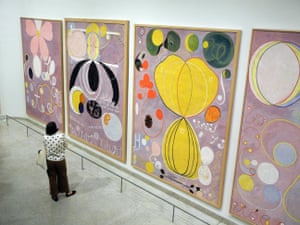
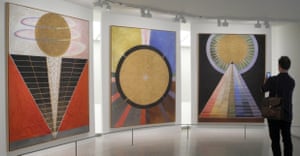
Group X, No 2, Altarpiece, Group X, No 3, Altarpiece and Group X, No 1, Altarpiece (left to right) by painter Hilma af Klint (1862-1944) hanging in the Guggenheim.
Group X, No 2, Altarpiece, Group X, No 3, Altarpiece and Group X, No 1, Altarpiece (left to right) by painter Hilma af Klint (1862-1944) hanging in the Guggenheim. Photograph: Dpa Picture Alliance/Alamy Stock Photo

In 1944, three great pioneers of abstract art died: Wassily Kandinsky, Piet Mondrian and af Klint. Kandinsky claimed to have created the first abstract painting in 1911. And when in 2012 New York’s Museum of Modern Art staged their show Inventing Abstraction 1910-1925, Af Klint was not even included as a footnote. And yet, as Frankfurter Allgemeine Zweitung art critic Julia Voss argues in the film, the Swedish artist had the jump on Kandinsky by five years in producing the first abstract painting in 1906.

For her film, Dyrschka contracted MoMA to find out why Af Klint had been erased from art history and was told “they weren’t so sure Hilma af Klint’s art worked as abstract art. After all, she hadn’t exhibited in her lifetime so how could one tell?” In the film, Dyrschka tries to answer that question by juxtaposing paintings by Af Klint with those of famous 20th-century male artists. Her golden square from 1916 is placed alongside a similar image by Josef Albers from 1971; her automatic writing doodles from 1896 are pitted against Cy Twombly’s 1967 squiggles. They make the rhetorical point strongly: whatever the men were doing, af Klint had probably done it first.

Hilma af Klint was born in Stockholm in 1862. Thanks to the family fortune she was able to study at the Royal Academy in Stockholm from which she graduated in 1887. She went on to support herself by painting landscapes and portraits as well as very beautiful botanical works. She joined the Theosophical Society in 1889 and in 1896 established a group of female artists called the Five, who each Friday met to pray, make automatic writing and attempt to communicate with other worlds through seances. Theosophists believe that all forms of life are part of the same cosmic whole. “It was a women’s liberation philosophy,” argues Voss. “It said: ‘Sure you can be priestesses.’”

But Af Klint was not just a conduit for occult spirits. She was also attuned to the scientific developments of the day. As Dyrschka argues in her film, the years in which the artist was creatively active was a time in which science was discovering worlds beyond the visible – including subatomic particles and electromagnetic radiation. Af Klint’s art involved making the invisible visible, be it that which science disclosed or that which the Higher Powers commissioned her to depict.

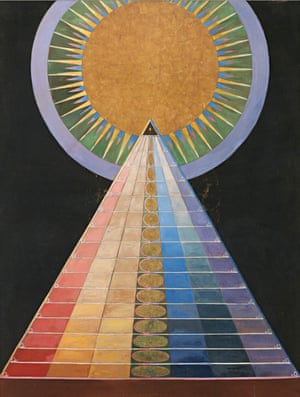
Wonderful energy … Hilma af Klint’s Altarbild, 1915.
Wonderful energy … Hilma af Klint’s Altarbild, 1915. Photograph: Albin Dahlström/© Stiftelsen Hilma af Klints Verk

But on those Friday meetings, she encountered supernatural beings beyond science’s remit. The Five claimed to receive messages from other worlds. Af Klint recorded one message in her notebook: “‘Accept,’ says the angel ‘that a wonderful energy follows from the heavenly to the earthly.’” The Five called these spirit guides High Masters and gave them names: Amaliel, Ananda, Clemens, Esther, Georg and Gregor. In 1904, these High Masters called for a temple to be built, filled with paintings that the Five would make. Only Af Klint accepted this strange commission and in November 1906 set to work on what grew over the next 11 years to become a series of of 193 paintings.

The philosopher and occultist Rudolf Steiner, whose anthroposophical society she would join, saw the early paintings in this series in 1908 but was uncomprehending. Strikingly, in the next four years Af Klint did little painting, but retreated to the obscure island of Munsö in Lake Mälaren, near her family’s estate on neighbouring Adelsö – in part because she was caring for her ailing mother, but also because Steiner’s patriarchal dismissal stung.

“She was treated locally as a crazy witch,” says Dyrschka. “The locals used to wonder what she did with all the eggs that were delivered to her studio.” They were used for her favoured material, tempera, which critics have noted gives her work on paper a luminous quality.

In a sense this retreat from the world was creatively sensible. Surrounded by water and spirits, Af Klint worked at the service of her occult beliefs. She had great hopes that Steiner would help her build a temple to house her art on a Swedish island that would glorify his philosophy. In 1932 she wrote to him: “Should the paintings which I created between 1902 and 1920, some of which you saw for yourself, be destroyed. Or can one do something with them?”

It sounds like a threat; happily, she didn’t destroy the work even though nothing came of her dream temple. Af Klint did sketch out what the temple should look like – it should be made of alabaster and have an astronomical tower with an internal spiral staircase. Poignantly, in her film Dyrschka juxtaposes this description with images of the Guggenheim in New York where Af Klint’s oeuvre was belatedly given pride of place last year. The skylight and the ramps look like the temple that Hilma af Klint died without seeing realised.

Sensation … the 2018 exhibition at the Guggenheim, New York.
Sensation … the 2018 exhibition at the Guggenheim, New York. Photograph: Dpa Picture Alliance/Alamy Stock Photo

True, the 1986 touring exhibition The Spiritual in Art: Abstract Paintings 1890–1985 exhibition at LACMA in Los Angeles marked the beginning of Af Klint’s international recognition. But it was the Guggenheim exhibition that, more than a century after Af Klint arguably invented abstract and painted some of the most beguiling if neglected canvases in art history, really got what she deserved.

For science historian Ernst Peter Ficsher quoted in the film, it is us rather than Af Klint who require reviving. We need her vision in our disenchanted age. “We know that the universe is made up of 95% dark matter but the strange thing is nobody gets excited about this. I think our world has become blurred stupid dulled unless somewhere out there there’s a Hilma af Klint painting it all so in a hundred years we will see what we’ve missed. In 1900 we still knew how to marvel. Today we sit in front of our iPhones and media and are bored.” Hilma af Klint’s paintings, just maybe, gives us the opportunity to escape the everyday and marvel anew.

  • Beyond the Visible – Hilma af Klint is released on 9 October.

What if this Coronavirus is Nature’s way of Eliminating the Human Virus? (Elephant Journal)

Elyane Youssef

Editor’s note: We are not a virus, unless we act like one. Read: Basic Goodness. ~ Waylon, ed.

Renowned Indian spiritual teacher, Preethaji, spoke of the coronavirus a few weeks back.

What she said in her Facebook video might not be what we want to hear, but it’s absolutely what we need to understand.

For millions of years, every single species has had its role in the universe. However, we are the species who has done the most damage on Earth and, unfortunately, continues to do so. Preethaji eloquently explains how we kill other species for pleasure and superiority rather than survival.

Throughout all our undesirable actions, we forget the consequence. But it would seem that nature’s living intelligence does not. Perhaps, as Preethaji puts it, the coronavirus—like many natural disasters and diseases—is eliminating what doesn’t support the whole.

The death toll from the coronavirus is increasing by the day. It’s sad to see how many families and nations are affected by this tragedy. Nevertheless, in order to live a brighter future on earth, we must examine our contribution to life’s continuity.

Ask yourself today:

How are my actions affecting me and others?

Do I understand that I’m part of the whole and not a separate entity?

What can I do to create a more awakened and conscious future?”

~

It’s time to change our toxic habits and patterns. May this virus outbreak help us forge a healthier lifestyle and an awakened state of mind.

author: Elyane Youssef

Editor: Marisa Zocco