Arquivo da tag: Clima

Climatic fluctuations drove key events in human evolution (University of Liverpool)

21-Sep-2011 – University of Liverpool

Research at the University of Liverpool has found that periods of rapid fluctuation in temperature coincided with the emergence of the first distant relatives of human beings and the appearance and spread of stone tools.

Dr Matt Grove from the School of Archaeology, Classics and Egyptology reconstructed likely responses of human ancestors to the climate of the past five million years using genetic modelling techniques. When results were mapped against the timeline of human evolution, Dr Grove found that key events coincided with periods of high variability in recorded temperatures.

Dr Grove said: “The study confirmed that a major human adaptive radiation – a pattern whereby the number of coexisting species increases rapidly before crashing again to near previous levels – coincided with an extended period of climatic fluctuation. Following the onset of high climatic variability around 2.7 million years ago a number of new species appear in the fossil record, with most disappearing by 1.5 million years ago. The first stone tools appear at around 2.6 million years ago, and doubtless assisted some of these species in responding to the rapidly changing climatic conditions.

“By 1.5 million years ago we are left with a single human ancestor – Homo erectus. The key to the survival of Homo erectus appears to be its behavioural flexibility – it is the most geographically widespread species of the period, and endures for over one and a half million years. Whilst other species may have specialized in environments that subsequently disappeared – causing their extinction – Homo erectus appears to have been a generalist, able to deal with many climatic and environmental contingencies.”

Dr Grove’s research is the first to explicitly model ‘Variability Selection’, an evolutionary process proposed by Professor Rick Potts in the late 1990s, and supports the pervasive influence of this process during human evolution. Variability selection suggests that evolution, when faced with rapid climatic fluctuation, should respond to the range of habitats encountered rather than to each individual habitat in turn; the timeline of variability selection established by Dr Grove suggests that Homo erectus could be a product of exactly this process.

Linking climatic fluctuation to the evolutionary process has implications for the current global climate change debate. Dr Grove said: “Though often discussed under the banner term of ‘global warming’, what we see in many areas of the world today is in fact an increased annual range of temperatures and conditions; this means in particular that third world human populations, many living in what are already marginal environments, will face ever more difficult situations. The current pattern of human-induced climate change is unlike anything we have seen before, and is disproportionately affecting areas whose inhabitants do not have the technology required to deal with it.”

The research is published in The Journal of Human Evolution and The Journal of Archaeological Science.

Few insurers planning for climate change (Reuters)

By Ben Berkowitz

NEW YORK, Sept 1 (Reuters) – Only one in eight insurers has a formal policy in place to manage climate risk, despite rising evidence that environmental changes are exacerbating insurers’ disaster losses, according to a coalition of public interest groups.

The coalition, Ceres, looked at 88 filings from six states by insurance companies, using a form developed by the National Association of Insurance Commissioners. Ceres said it was the first-ever effort to quantify how U.S. insurers manage climate risk in their day-to-day operations.

Despite the broad lack of a formal policy, Ceres said insurers generally acknowledge the problem of climate change and the effect it can have on their business.

“Even those insurers with no formal climate policy, no climate risk management structure and a stated belief that the company is not vulnerable to the effects of climate change still name perils that may be affected by climate change 20 percent of the time,” Ceres said in its report.

Of the 11 companies with formal climate policies, two — Prudential Financial (PRU.N) and Genworth Financial (GNW.N) — are life insurers. The rest are mostly multi-line insurers or reinsurers. Among them are ACE Ltd (ACE.N), AIG’s (AIG.N) Chartis unit.

(For an Insider interview with the author of the Ceres report, click here: link.reuters.com/myk53s)

The Ceres report comes as insurers start paying claims for last week’s Hurricane Irene, which broke flood records across the U.S. Northeast, and as they look to the Atlantic for the approach of what may become Hurricane Katia.

Because of the potential for hurricanes to cause sudden and huge losses in the United States, Ceres said the insurance industry is especially focused on how climate change will affect hurricane exposure, potentially at the expense of studying the impact on other common perils.

Some insurance companies have taken a public stand on climate issues, particularly home and auto insurer Allstate (ALL.N), which has warned that recent severe weather is part of a permanent change in the environment, and German reinsurance heavyweight Munich Re (MUVGn.DE).

Ceres recommended that all states make the National Association of Insurance Commissioners disclosure form mandatory and public, and that they adopt the model of California insurance regulators, who put together detailed guidelines on how to fill out the form.

Ceres describes itself is a national coalition of investors, environmental organizations and public interest groups. (Reporting by Ben Berkowitz; editing by John Wallace)

Shooting the messenger (The Miami Herald)

Environment
Posted on Monday, 08.29.11
BY ANDREW DESSLER

Texas Gov. Rick Perry stirred up controversy on the campaign trail recently when he dismissed the problem of climate change and accused scientists of basically making up the problem.

As a born-and-bred Texan, it’s especially disturbing to hear this now, when our state is getting absolutely hammered by heat and drought. I’ve got to wonder how any resident of Texas – and particularly the governor who not so long ago was asking us to pray for rain – can be so cavalier about climate change.

As a climate scientist at Texas A&M University, I can also tell you from the data that the current heat wave and drought in Texas is so bad that calling it “extreme weather” does not do it justice. July was the single hottest month in the observational record, and the 12 months that ended in July were drier than any corresponding period in the record. I know that climate change does not cause any specific weather event. But I also know that humans have warmed the climate over the last century, and that this warming has almost certainly made the heat wave and drought more extreme than it would have otherwise been.

I am not alone in these views. There are dozens of atmospheric scientists at Texas institutions like Rice, the University of Texas, and Texas A&M, and none of them dispute the mainstream scientific view of climate change. This is not surprising, since there are only a handful of atmospheric scientists in the entire world who dispute the essential facts – and their ranks are not increasing, as Gov. Perry claimed.

And I can assure Gov. Perry that scientists are not just another special interest looking to line their own pockets. I left a job as an investment banker on Wall Street in 1988 to go to graduate school in chemistry. I certainly didn’t make that choice to get rich, and I didn’t do it to exert influence in the international arena either.

I went into science because I wanted to devote my life to the search for scientific knowledge. and to make the world a better place. That’s the same noble goal that motivates most scientists. The ultimate dream is to make a discovery so profound and revolutionary that it catapults one into the pantheon of the greatest scientific minds of history: Newton, Einstein, Maxwell, Planck, etc.

This is just one of the many reasons it is inconceivable for an entire scientific community to conspire en masse to mislead the public. In fact, if climate scientists truly wanted to maximize funding, we would be claiming that we had no idea why the climate is changing – a position that would certainly attract bipartisan support for increased research.

The economic costs of the Texas heat wave and drought are enormous. The cost to Texas alone will be many billion dollars (hundreds of dollars for every resident), and these costs will ripple through the economy so that everyone will eventually pay for it. Gov. Perry needs to squarely face the choice confronting us; either we pay to reduce emissions of greenhouse gases, or we pay for the impacts of a changing climate. There is no free lunch.

Economists have looked at this problem repeatedly over the last two decades, and virtually every mainstream economist has concluded that the costs of reducing emissions are less than the costs of unchecked climate change. The only disagreement is on the optimal level of emissions reductions.

I suppose it should not be surprising when politicians like Gov. Perry choose to shoot the messenger rather than face this hard choice. He may view this as a legitimate policy on climate change, but it’s not one that the facts support.

Read more here.

A Reality Check on Clouds and Climate (N.Y. Times)

September 6, 2011, 5:44 PM

Dot Earth

By ANDREW C. REVKIN

I am often in awe of clouds, as was the case when I shot this video of a remarkable thunderhead somewhere over the Midwest. But I’m tired of the recent burst of over-interpretation of a couple of papers examining aspects of clouds in the context of a changing climate.

I’ve long pointed out that anyone trumpeting a conclusion about greenhouse-driven climate change on the basis of a single paper should be treated with skepticism or outright suspicion. I trust climate science as an enterprise because — despite its flaws — it is a self-correcting process in which trajectory matters far more than individual steps in the road.

There is always a temptation, particularly for those with an agenda and for media in search of the “front-page thought,” to overemphasize studies that fit some template, no matter how tentative, or flawed.

The flood of celebratory coverage that followed publication of a recent paper by Roy Spencer and Danny Braswell — proposing a big reduction in the sensitivity of the climate to greenhouse gases — was far more about pushing an agenda than providing guidance on the state of climate science. There’s a lot more on this below.

The same goes for the stampede on clouds and climate following publication of an important, but preliminary, laboratory finding from the European Organization for Nuclear Research (better known by its acronym, CERN) about how cosmic rays can stimulate the formation of atmospheric particles(an ingredient in cloud formation). It’s a long road from that conclusion to an argument that variations in cosmic rays can explain a meaningful portion of recent climate change.

There’s a long history of assertions that clouds can be a substantial driver of climate change, distinct from their clear potential to amplify or blunt(depending on the type of cloud) a change set in motion by some other force. But there’s still scant evidence to back up such assertions.

In weighing the new results on cosmic rays and the atmosphere, I find a lot of merit in Hank Campbell’s conclusion at Science 2.0:

[I]t isn’t evidence that the Sun’s magnetic field is controlling cosmic rays and therefore our temperature far more than mankind and pollution are doing.

It is simply science at work – finally, after a decade and a half of circling the wagons, hypotheses that were dismissed as conspiratorial nonsense by zealots get a chance to live or die by the scientific method and not by aggressive posturing.

new paper by Andrew Dessler of Texas A&M University bolsters the established view of clouds’ role as a feedback mechanism — but not driver — in climate dynamics through a decade of observation and analysis of El Nino and La Nina events (periodic warm and cool phases of the Pacific Ocean).

The paper directly challenges conclusions of Spencer and Braswell and anearlier paper positing a role of clouds in driving climate change.

Dessler, setting his findings and other work on clouds and climate in broader context, offered this observation this morning about the polarized, and distorted, public discourse:

To me, the real story here is that, every month, dozens if not hundreds of papers are published that are in agreement with the mainstream theory of climate science.

[ACR: I did a quick Google Scholar search for “CO2 climate change greenhouse” to put a rough upper bound on this and got ~9,000 papers so far in 2011.]

But, every year, one or two skeptical papers get published, and these are then trumpeted by sympathetic media outlets as if they’d discovered the wheel. It therefore appears to the general public that there’s a debate.

Here’s more from Dessler on his new paper:

A separate question has emerged around the Spencer-Braswell paper. Should it have been published in the first place?

As Retraction Watch (a fascinating and worthwhile blog) chronicled last week, the editor of Remote Sensing, the journal in which the paper appeared, emphatically — if after the fact — said no, emphasizing his view by very publicly resigning.

This move was hailed by defenders of the climate status quo in a piece run inThe Daily Climate and Climate Progress. Peter Gleick of the Pacific Institute, remarkably given space in Forbes, called the resignation “staggering news.”

But others, including the folks at Retraction Watch, wondered why the editor at Remote Sensing, Wolfgang Wagner, didn’t simply seek to have the paper retracted?

Roger A. Pielke, Jr., whose focus at the University of Colorado is climate in the context of political science, echoed that question, urging the new team at the journal to initiate retraction proceedings, adding:

If the charges of “error” and “false claims” are upheld the paper should certainly be retracted.  If the charges are not upheld then the authors have every right to have such a judgment announced publicly.

Absent such an adjudication we are left with climate science played out as political theater in the media and on blogs — with each side claiming the righteousness of their views, while everyone else just sees the peer review process in climate science getting another black eye.

Over the weekend, I asked Kerry Emanuel at the Massachusetts Institute of Technology for his thoughts both on the Spencer-Braswell paper and the histrionic resignation by the editor. Here’s Emanuel:

About the paper: I read it when it first came out, and thought that some of their findings were significant and important. Basically, it presented evidence that feedbacks inferred from short-period and/or local climate change observations might not be relevant to long-period global change. I suppose I thought that rather obvious, but not everyone agrees. The one statement in the paper, to the effect that climate models might be overestimating positive feedback, struck me as unsubstantiated, but the authors themselves phrased it as speculative.

But the interesting and unusual thing about this is that that what pundits said about the paper, and indeed what Spencer said about it in press releases, etc., in my view had very little to do with the paper itself. I have seldom seen such a degree of disconnect between the substance of a paper and what has been said about it.

Gavin Schmidt of Real Climate and NASA has posted a thorough and useful dissection of the situation, “Resignations, retractions and the process of science,” that comes to what I see as the right conclusion:

I think (rightly) that people feel that the best way to deal with these papers is within the literature itself, and in this case it is happening this week in GRL (Dessler, 2011) [the Dessler paper discussed above], and in Remote Sensing in a few months. That’s the way it should be, and neither resignations nor retractions are likely to become more dominant – despite the amount of popcorn being passed around.

There’s more useful context and analysis from Keith Kloor, who notes the role played by the Drudge Report in amping up the story (blogging at the Yale Forum on Climate Change and the Media), Mike LemonickJudith Curry and many others.

As always happens after such episodes, the one clear finding is that clouds remain a complicating component in efforts to project warming from the building greenhouse effect.

Joni Mitchell’s classic, with a bit of mangling, sums things up well:


They’ve looked at clouds from all sides now, as feedback and forcing, and still somehow, it’s clouds’ illusions most often recalled. More work is needed to know clouds at all.

8:52 p.m. | Postscript |
There’s more coverage of the Spencer-Braswell paper at Knight Science Journalism Tracker and the blogs of Roger Pielke, Sr. and William M. Briggs. Roy Spencer has posted a piece titled “More Thoughts on the War Being Waged Against Us.”

In the Land of Denial (N.Y. Times)

NY Times editorial
September 6, 2011

The Republican presidential contenders regard global warming as a hoax or, at best, underplay its importance. The most vocal denier is Rick Perry, the Texas governor and longtime friend of the oil industry, who insists that climate change is an unproven theory created by “a substantial number of scientists who have manipulated data so that they will have dollars rolling into their projects.”

Never mind that nearly all the world’s scientists regard global warming as a serious threat to the planet, with human activities like the burning of fossil fuels a major cause. Never mind that multiple investigations have found no evidence of scientific manipulation. Never mind that America needs a national policy. Mr. Perry has a big soapbox, and what he says, however fallacious, reaches a bigger audience than any scientist can command.

With one exception — make that one-and-one-half — the rest of the Republican presidential field also rejects the scientific consensus. The exception is Jon Huntsman Jr., a former ambassador to China and former governor of Utah, who recently wrote on Twitter: “I believe in evolution and trust scientists on global warming. Call me crazy.” The one-half exception is Mitt Romney, who accepted the science when he was governor of Massachusetts and argued for reducing emissions. Lately, he’s retreated into mush: “Do I think the world’s getting hotter? Yeah, I don’t know that, but I think that it is.” As for the human contribution: “It could be a little. It could be a lot.”

The others flatly repudiate the science. Ron Paul of Texas calls global warming “the greatest hoax I think that has been around for many, many years.” Michele Bachmann of Minnesota once said that carbon dioxide was nothing to fear because it is a “natural byproduct of nature” and has complained of “manufactured science.” Rick Santorum, a former senator from Pennsylvania, has called climate change “a beautifully concocted scheme” that is “just an excuse for more government control of your life.”

Newt Gingrich’s full record on climate change has been a series of epic flip-flops. In 2008, he appeared on television with Nancy Pelosi, the former House speaker, to say that “our country must take action to address climate change.” He now says the appearance was a mistake.

None of the candidates endorse a mandatory limit on emissions or, for that matter, a truly robust clean energy program. This includes Mr. Huntsman. In 2007, as Utah governor, he joined with Arnold Schwarzenegger, then the governor of California, in creating the Western Climate Initiative, a market-based cap-and-trade program aimed at reducing emissions in Western states. Cap-and-trade has since acquired a toxic political reputation, especially among Republicans, and Mr. Huntsman has backed away.

The economic downturn has made addressing climate change less urgent for voters. But the issue is not going away. The nation badly needs a candidate with a coherent, disciplined national strategy. So far, there is no Republican who fits that description.

Mental illness rise linked to climate (Sydney Morning Herald)

Erik Jensen Health

August 29, 2011
Climate change“Emotional injury, stress and despair” … the impact of climate change on health. Photo: Reuter

RATES of mental illnesses including depression and post-traumatic stress will increase as a result of climate change, a report to be released today says.

The paper, prepared for the Climate Institute, says loss of social cohesion in the wake of severe weather events related to climate change could be linked to increased rates of anxiety, depression, post-traumatic stress and substance abuse.

As many as one in five people reported ”emotional injury, stress and despair” in the wake of these events.

The report, A Climate of Suffering: The Real Cost of Living with Inaction on Climate Change, called the past 15 years a ”preview of life under unrestrained global warming”.

”While cyclones, drought, bushfires and floods are all a normal part of Australian life, there is no doubt our climate is changing,” the report says.

”For instance, the intensity and frequency of bushfires is greater. This is a ‘new normal’, for which the past provides little guidance …

”Moreover, recent conditions are entirely consistent with the best scientific predictions: as the world warms so the weather becomes wilder, with big consequences for people’s health and well-being.”

The paper suggests a possible link between Australia’s recent decade-long drought and climate change. It points to a breakdown of social cohesion caused by loss of work and associated stability, adding that the suicide rate in rural communities rose by 8 per cent.

The report also looks at mental health in the aftermath of major weather events possibly linked to climate change.

It shows that one in 10 primary school children reported symptoms of post-traumatic stress disorder in the wake of cyclone Larry in 2006. More than one in 10 reported symptoms more than three months after the cyclone.

”There’s really clear evidence around severe weather events,” the executive director of the Brain and Mind Research Institute, Professor Ian Hickie, said.

”We’re now more sophisticated in understanding the mental health effects and these effects are one of the major factors.

”What we have seriously underestimated is the effects on social cohesion. That is very hard to rebuild and they are critical to the mental health of an individual.”

Professor Hickie, who is launching the report today, said climate change and particularly severe weather events were likely to be a major factor influencing mental health in the future.

”When we talk about the next 50 years and what are going to be the big drivers at the community level of mental health costs, one we need to factor in are severe weather events, catastrophic weather events,” he said.

Read more: http://www.smh.com.au/environment/mental-illness-rise-linked-to-climate-20110828-1jger.html#ixzz1WeAsre00

Climate Cycles Are Driving Wars: When El Nino Warmth Hits, Tropical Conflicts Double (Science Daily)

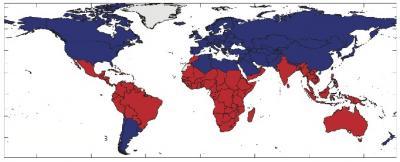
ScienceDaily (Aug. 24, 2011) — In the first study of its kind, researchers have linked a natural global climate cycle to periodic increases in warfare. The arrival of El Niño, which every three to seven years boosts temperatures and cuts rainfall, doubles the risk of civil wars across 90 affected tropical countries, and may help account for a fifth of worldwide conflicts during the past half-century, say the authors.

El Nino drought cycles heavily affecting some 90 countries (red) appear to be helping drive modern civil wars. (Credit: Courtesy Hsiang et al./Nature)

The paper, written by an interdisciplinary team at Columbia University’s Earth Institute, appears in the current issue of the leading scientific journal Nature.

In recent years, historians and climatologists have built evidence that past societies suffered and fell due in connection with heat or droughts that damaged agriculture and shook governments. This is the first study to make the case for such destabilization in the present day, using statistics to link global weather observations and well-documented outbreaks of violence. The study does not blame specific wars on El Niño, nor does it directly address the issue of long-term climate change. However, it raises potent questions, as many scientists think natural weather cycles will become more extreme with warming climate, and some suggest ongoing chaos in places like Somalia are already being stoked by warming climate.

“The most important thing is that this looks at modern times, and it’s done on a global scale,” said Solomon M. Hsiang, the study’s lead author, a graduate of the Earth Institute’s Ph.D. in sustainable development. “We can speculate that a long-ago Egyptian dynasty was overthrown during a drought. That’s a specific time and place, that may be very different from today, so people might say, ‘OK, we’re immune to that now.’ This study shows a systematic pattern of global climate affecting conflict, and shows it right now.”

The cycle known as the El Niño-Southern Oscillation, or ENSO, is a periodic warming and cooling of the tropical Pacific Ocean. This affects weather patterns across much of Africa, the Mideast, India, southeast Asia, Australia, and the Americas, where half the world’s people live. During the cool, or La Niña, phase, rain may be relatively plentiful in tropical areas; during the warmer El Niño, land temperatures rise, and rainfall declines in most affected places. Interacting with other factors including wind and temperature cycles over the other oceans, El Niño can vary dramatically in power and length. At its most intense, it brings scorching heat and multi-year droughts. (In higher latitudes, effects weaken, disappear or reverse; La Niña conditions earlier this year helped dry the U.S. Southwest and parts of east Africa.)

The scientists tracked ENSO from 1950 to 2004 and correlated it with onsets of civil conflicts that killed more than 25 people in a given year. The data included 175 countries and 234 conflicts, over half of which each caused more than 1,000 battle-related deaths. For nations whose weather is controlled by ENSO, they found that during La Niña, the chance of civil war breaking out was about 3 percent; during El Niño, the chance doubled, to 6 percent. Countries not affected by the cycle remained at 2 percent no matter what. Overall, the team calculated that El Niño may have played a role in 21 percent of civil wars worldwide — and nearly 30 percent in those countries affected by El Niño.

Coauthor Mark Cane, a climate scientist at Columbia’s Lamont-Doherty Earth Observatory, said that the study does not show that weather alone starts wars. “No one should take this to say that climate is our fate. Rather, this is compelling evidence that it has a measurable influence on how much people fight overall,” he said. “It is not the only factor–you have to consider politics, economics, all kinds of other things.” Cane, a climate modeler, was among the first to elucidate the mechanisms of El Niño, showing in the 1980s that its larger swings can be predicted — knowledge now used by organizations around the world to plan agriculture and relief services.

The authors say they do not know exactly why climate feeds conflict. “But if you have social inequality, people are poor, and there are underlying tensions, it seems possible that climate can deliver the knockout punch,” said Hsiang. When crops fail, people may take up a gun simply to make a living, he said. Kyle C. Meng, a sustainable-development Ph.D. candidate and the study’s other author, pointed out that social scientists have shown that individuals often become more aggressive when temperatures rise, but he said that whether that applies to whole societies is only speculative.

Bad weather does appear to tip poorer countries into chaos more easily; rich Australia, for instance, is controlled by ENSO, but has never seen a civil war. On the other side, Hsiang said at least two countries “jump out of the data.” In 1982, a powerful El Niño struck impoverished highland Peru, destroying crops; that year, simmering guerrilla attacks by the revolutionary Shining Path movement turned into a full-scale 20-year civil war that still sputters today. Separately, forces in southern Sudan were already facing off with the domineering north, when intense warfare broke out in the El Niño year of 1963. The insurrection abated, but flared again in 1976, another El Niño year. Then, 1983 saw a major El Niño–and the cataclysmic outbreak of more than 20 years of fighting that killed 2 million people, arguably the world’s bloodiest conflict since World War II. It culminated only this summer, when South Sudan became a separate nation; fighting continues in border areas. Hsiang said some other countries where festering conflicts have tended to blow up during El Niños include El Salvador, the Philippines and Uganda (1972); Angola, Haiti and Myanmar (1991); and Congo, Eritrea, Indonesia and Rwanda (1997).

The idea that environment fuels violence has gained currency in the past decade, with popular books by authors like Jared Diamond, Brian Fagan and Mike Davis. Academic studies have drawn links between droughts and social collapses, including the end of the Persian Gulf’s Akkadian empire (the world’s first superpower), 6,000 years ago; the AD 800-900 fall of Mexico’s Maya civilization; centuries-long cycles of warfare within Chinese dynasties; and recent insurgencies in sub-Saharan Africa. Last year, tree-ring specialists at Lamont-Doherty Earth Observatory published a 1,000-year atlas of El Niño-related droughts; data from this pinpoints droughts coinciding with the downfall of the Angkor civilization of Cambodia around AD 1400, and the later dissolution of kingdoms in China, Vietnam, Myanmar and Thailand.

Some scientists and historians remain unconvinced of connections between climate and violence. “The study fails to improve on our understanding of the causes of armed conflicts, as it makes no attempt to explain the reported association between ENSO cycles and conflict risk,” said Halvard Buhaug, a political scientist with the Peace Research Institute Oslo in Norway who studies the issue. “Correlation without explanation can only lead to speculation.” Another expert, economist Marshall Burke of the University of California, Berkeley, said the authors gave “very convincing evidence” of a connection. But, he said, the question of how overall climate change might play out remains. “People may respond differently to short-run shocks than they do to longer-run changes in average temperature and precipitation,” he said. He called the study “a useful and illuminating basis for future work.”

The above story is reprinted (with editorial adaptations by ScienceDaily staff) from materials provided by The Earth Institute at Columbia University.

Journal Reference:
Solomon M. Hsiang, Kyle C. Meng, Mark A. Cane. Civil conflicts are associated with the global climate. Nature, 2011; 476 (7361): 438 DOI: 10.1038/nature10311

Seca de 2010 na Amazônia foi a mais drástica desde 1902 (Fapesp)

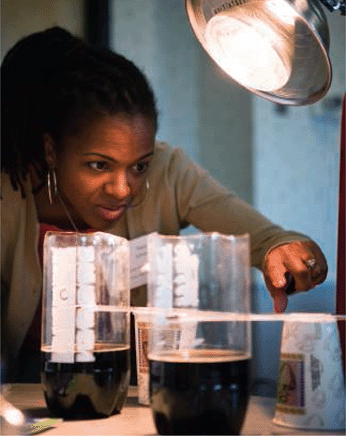
Constatação foi feita por pesquisadores do Inpe a partir da análise de série histórica de dados de pluviosidade na região da bacia amazônica (foto:Fapeam)

30/08/2011

Agência FAPESP – Cientistas do Instituto Nacional de Pesquisas Espaciais (Inpe) concluíram em um estudo, publicado na revista Geophysical Research Letters, que a seca de 2010 na Amazônia foi a mais drástica já registrada desde 1902, superando a de 2005, que até então era considerada a maior do século.

A constatação foi feita a partir da análise de uma série histórica de dados de pluviosidade na região da bacia amazônica, com medições desde 1902.

Os resultados do estudo apontam que o processo teve início no começo do verão, durante o El Niño (um processo natural de aquecimento das águas do Pacífico), mas foi intensificado pelo aquecimento das águas tropicais do Atlântico Norte. Em função disso, se originou uma estação seca que se estendeu por muitos meses, ocasionando alterações no ciclo hidrológico.

Como consequência desse processo, houve rebaixamento dos níveis de água e seca completa de cursos d’água e tributários de rios na bacia amazônica. A região sul foi a mais afetada. O fenômeno causou graves problemas socioambientais, especialmente às populações ribeirinhas, que ficaram isoladas por dependerem dos rios para seu deslocamento.

Em outro artigo recém-publicado na revista Theoretical Applied Climatology, pesquisadores do Inpe apresentaram os resultados de um amplo estudo sobre as inundações na Amazônia e Nordeste do Brasil, ocorridas no período de maio a julho de 2009. O fenômeno provocou mortes e deixou milhares de famílias desabrigadas. O trabalho demonstra que essas chuvas torrenciais foram as mais intensas e duradouras já registradas.

O rio Negro, principal tributário do rio Amazonas, atingiu seu maior nível em 107 anos. Os autores concluíram que o evento foi resultado de uma conjuntura de fatores meteorológicos, especialmente o aquecimento acima do normal das águas superficiais do Atlântico Sul – aspecto importante para a explicação das chuvas abundantes em vastas regiões do leste amazônico e Nordeste do país.

Os pesquisadores destacaram também que esses episódios extremos, assim como a seca duradoura ocorrida no ano de 2010 na bacia amazônica, reforçam a hipótese de que anomalias no regime pluviométrico e de temperatura serão mais frequentes em cenários futuros de mudanças climáticas.

Entre os autores dos estudos está José Antônio Marengo Orsini, chefe do Centro de Sistema Terrestre do Inpe.

O artigo The drought of 2010 in the context of historical droughts in the Amazon region(doi:10.1029/2011GL047436), de Orsini e outros, pode ser lido em www.inpe.br/noticias/arquivos/pdf/2011GL047436.pdf.

O partido anticiência (JC, O Globo)

JC e-mail 4333, de 30 de Agosto de 2011.

Artigo de Paul Krugman publicado no O Globo de hoje (30).

John Huntsman Jr., ex-governador de Utah e embaixador na China, não é um forte pré-candidato à indicação do Partido Republicano para concorrer à Presidência. E isto é muito ruim porque o desejo de Huntsman é dizer o indizível sobre o partido – especialmente que ele está se tornando o “partido anticiência”. Isto é algo enormemente importante. E deveria nos aterrorizar.

Para entender o que Huntsman defende, considere declarações recentes dos dois mais fortes pretendentes à indicação republicana: Rick Perry e Mitt Romney.

Perry, governador do Texas, fez manchetes recentemente ao fazer pouco da evolução humana como uma “simples teoria”, que tem “algumas lacunas” – uma observação que soaria como novidade para a vasta maioria dos biólogos. Mas o que mais chamou a atenção foi o que ele disse sobre mudança climática: “Penso que há um número substancial de cientistas que manipulou dados para obter dólares para seus projetos. E penso que estamos vendo, quase toda semana, ou todo dia, cientistas questionando a ideia original de que o aquecimento global provocado pelo homem é a causa da mudança climática.” É uma declaração extraordinária – ou talvez o adjetivo correto seja “vil”.

A segunda parte da declaração de Perry é falsa: o consenso científico sobre a interferência humana no aquecimento global – que inclui 97% a 98% dos pesquisadores de campo, segundo a Academia Nacional de Ciências – está se tornando mais forte à medida que aumentam as evidências sobre a mudança do clima.

De fato, se você acompanha a ciência climática sabe que o principal aspecto nos últimos anos tem sido a preocupação crescente de que as projeções sobre o futuro do clima estejam subestimando o provável aumento da temperatura. Advertências de que poderemos enfrentar mudanças cimáticas capazes de ameaçar a civilização no fim do século, antes consideradas estranhas, partem agora dos principais grupos de pesquisa.

Mas não se preocupe, sugere Perry; os cientistas estão apenas atrás de dinheiro, “manipulando dados” para criar uma falsa ameaça. Em seu livro “Fed Up”, ele despreza a ciência do clima como “uma bagunça falsa e artificial que está se desmanchando”.

Eu poderia dizer que Perry está tirando isso de uma teoria conspiratória verdadeiramente louca, que afirma que milhares de cientistas de todo o mundo estão levando dinheiro, sem que nenhum deseje quebrar o código de silêncio. Poderia apontar que múltiplas investigações em acusações de falsidade intelectual da parte dos cientistas climáticos acabaram com a absolvição dos pesquisadores de todas as acusações. Mas não se preocupe: Perry e os que pensam como ele sabem em que desejam acreditar e sua resposta a qualquer um que os contradiga é iniciar uma caça às bruxas.

Então de que modo Romney, o outro forte concorrente à indicação republicana, respondeu ao desafio de Perry? Correndo dele. No passado, Romney, ex-governador de Massachusetts, endossou fortemente a noção de que a mudança climática provocada pelo homem é uma real preocupação. Mas, na semana passada, ele suavizou isso e disse pensar que o mundo está realmente esquentando, mas “eu não conheço isto” e “não sei se isso é causado principalmente pelo homem”. Que coragem moral!

É claro, sabemos o que está motivando a súbita falta de convicção de Romney. Segundo o Public Policy Polling, somente 21% dos eleitores republicanos de Iowa acreditam no Aquecimento Global (e somente 35% creem na evolução). Dentro do Partido Republicano, ignorância deliberada tornou-se um teste decisivo para os candidatos, no qual Romney está determinado a passar a qualquer custo.

Então, é agora altamente provável que o candidato presidencial de um de nossos dois grandes partidos políticos será ou um homem que acredita no que quer acreditar, ou um homem que finge acreditar em qualquer coisa que ele ache que a base do partido quer que ele acredite.

E o caráter crescentemente anti-intelectual da direita, tanto dentro do Partido Republicano como fora dele, se estende além da questão da mudança climática.

Ultimamente, por exemplo, a seção editorial do “Wall Street Journal” passou da antiga preferência pelas ideias econômicas de “charlatães e maníacos” — pela definição famosa de um dos principais conselheiros econômicos do ex-presidente George W. Bush – para um descrédito geral do pensamento árduo sobre questões econômicas. Não prestem atenção a “teorias fantasiosas” que conflitam com o “senso comum”, diz-nos o “Journal”. Por que deveria alguém imaginar que se precisa mais do que estômago para analisar coisas como crises financeiras e recessões?

Agora, não se sabe quem ganhará a eleição presidencial do próximo ano. Mas há chances de que, mais dia menos dia, a maior nação do mundo será dirigida por um partido que é agressivamente anticiência, mesmo anticonhecimento. E, numa era de grandes desafios – ambiental, econômico e outros – é uma terrível perspectiva.

Paul Krugman é colunista do “New York Times”.

Os donos da chuva (Fapesp)

Pesquisa FAPESP
Edição 186 – Agosto 2011
Política de C & T > Polêmica

Intervenções no clima global podem já ser viáveis, mas têm enormes riscos 
Por Carlos Fioravanti

Duas novas expressões – gerenciamento do clima e geoengenharia – estão aparecendo com mais frequência nos debates internacionais sobre a ciência e a política das mudanças climáticas. Uma das razões é o fracasso nas tentativas de implementação de políticas efetivas de redução de emissões de gases estufa. O que há de novo é que não é mais utópico pensar em intervir no clima regional ou mundial para evitar a contínua elevação da temperatura média global, as secas ou inundações intensas que se tornam mais frequentes à medida que as alterações climáticas se intensificam. Já pode ser viável usar aviões, balões ou canhões para espalhar partículas de aerossóis na estratosfera ou aumentar a nebulosidade do planeta semeando nuvens. Essas intervenções poderiam refletir parte da radiação solar de volta para o espaço e resfriar o planeta como forma de reduzir os efeitos das crescentes concentrações de gases do efeito estufa como o dióxido de carbono (CO2).

Os especialistas alertam, porém, que pode ser bastante perigoso – e não só porque os efeitos dessas intervenções no clima global são imprevisíveis. “Um só país ou um só milionário pode tentar mudar o clima na Terra, com consequências imprevisíveis”, observou o físico Paulo Artaxo, professor da Universidade de São Paulo (USP), em um debate realizado em junho no Instituto de Relações Internacionais da USP. “Espero que não comece uma competição entre países, grandes empresas ou bilionários dos Estados Unidos, da Inglaterra ou do mundo árabe que queiram salvar o mundo mudando o clima de propósito. A possibilidade já existe, basta uma decisão.”

Estima-se que despejar toneladas de enxofre na alta atmosfera para produzir partículas de aerossóis custaria US$ 10 bilhões ao ano, bem menos do que o US$ 1 trilhão previsto para reduzir as emissões de CO2. A geoengenharia ou engenharia climática, como é chamada a intervenção deliberada e de ampla escala no clima, oferece outras possibilidades. As mais simples incluem o aumento da refletividade das superfícies das construções e o reflorestamento em larga escala, já que as plantas absorvem muito CO2 enquanto crescem. Possibilidades mais refinadas consistem no espalhamento de íons de ferro no oceano para aumentar a fertilidade de algas marinhas, que sequestrariam CO2 e o levariam para o fundo dos oceanos.

Debatida no mundo acadêmico desde os anos 1960, a geoengenharia ganhou visibilidade pública com George W. Bush, presidente dos Estados Unidos de 2001 a 2009. Bush preferia apostar em estratégias desse tipo para lidar com os efeitos dos problemas provocados pelo aquecimento global em vez de reduzir as emissões, prevenindo os impactos. Os adeptos da geoengenharia – um grupo que inclui a indústria de combustíveis fósseis e alguns cientistas que acham que o problema climático é tão urgente que requer intervenções drásticas – argumentam que existe a possibilidade de reduzir a temperatura do planeta de propósito, não como panaceia, mas como medida paliativa, enquanto outras medidas mais demoradas são colocadas em prática.

Riscos – Alan Robock, pesquisador da Universidade Rutgers, Estados Unidos, tem alertado que os riscos podem superar os benefícios, mesmo que a geoengenharia funcione como esperado. Segundo ele, mudanças propositais no clima global poderiam amenizar a pressão social pela adoção de medidas de redução da emissão de gases do efeito estufa, além de descontrolar o clima ainda mais – um dos efeitos previstos é a redução das chuvas anuais – as monções – sobre a Ásia e a África, ameaçando a produção de alimentos para centenas de milhões de pessoas.

Em 2008, na Science, Robock afirmou que a geoengenharia poderia ser usada como arma de guerra de um país contra povos inimigos, causando secas ou inundações de consequências catastróficas em territórios hostis. Emergem também perguntas ainda sem respostas: quem vai controlar o clima e dizer que é hora de parar? Robock propõe a seguinte situação: e se a Rússia quisesse a temperatura global um pouco mais alta e a Índia um pouco mais baixa? O sociólogo da Universidade de Brasília (UnB) Eduardo Viola, que participou do debate na USP, teme que os países mais poderosos, como China, Rússia, Estados Unidos, tomem unilateralmente decisões que possam beneficiá-los, mas prejudicar muitos outros.

“Não temos governança global para lidar com esses problemas. O que um presidente dos Estados Unidos como Sarah Palin faria?”, indagou Jason Blackstock, pesquisador do Center for International Governance Innovation (Cigi), Canadá, em sua apresentação na USP. “Temos de ter um entendimento claro de todas as implicações.” Cada estratégia traz fortes efeitos colaterais. Segundo ele, aumentar a quantidade de enxofre na atmosfera pode esfriar a Terra, mas também alterar a precipitação e o balanço de radiação direta e difusa, com fortes efeitos sobre o funcionamento dos ecossistemas. Inversamente, a proposta de reduzir em 0,5% o teor de enxofre do combustível usado em navios até 2020, cogitada como forma de evitar 35 mil mortes de pessoas, principalmente nas proximidades de portos, poderia aumentar a incidência de luz solar na superfície – e o planeta esquentaria um pouco mais.

“Os cientistas em geral são favoráveis à pesquisa de geoengenharia e podem planejar experimentos em pequena escala nos próximos anos”, diz Artaxo, com base nas reuniões internacionais de que tem participado. “O problema é que não há efeito apenas local.” Por causa dos ventos, parte de uma carga de enxofre lançada, por exemplo, na região central dos Estados Unidos facilmente em apenas um dia iria para o Atlântico ou para o Pacífico, com consequências imprevisíveis sobre o equilíbrio do clima terrestre.

As descargas intencionais de partículas aerossóis teriam um efeito similar ao das supererupções vulcânicas. O exemplo mais citado é o Pinatubo, vulcão das Filipinas que entrou em erupção em junho de 1991. Em poucos dias, ele liberou 20 megatoneladas (cada megatonelada equivale a 1 bilhão de quilogramas) de dióxido de enxofre. As partículas se espalharam pela atmosfera e a temperatura do ar na superfície dos continentes do hemisfério Norte caiu dois graus. Depois de um ano, as partículas assentaram e a temperatura voltou a aumentar.

Em 2002, na Science, Robock observou que o espalhamento de partículas vindas de erupção vulcânica não é um fenômeno inócuo: pode reduzir a radiação solar e, consequentemente, a evaporação e a chuva por um ou dois anos. Artaxo aponta outra consequência do acúmulo de aerossóis na atmosfera: “Nunca mais teremos céus azuis como hoje, e os telescópios ópticos na superfície terrestre seriam inúteis”.

Para ele, a melhor solução contra os impactos do aquecimento global é reduzir rapidamente o consumo de combustíveis fósseis e as emissões de gases do efeito estufa e mudar o modo pelo qual usamos os recursos naturais do planeta. “Se formos inteligentes”, diz ele, “podemos usar os recursos naturais do planeta de modo mais eficiente e sustentável, sem precisar de experiências mirabolantes que colocam ainda mais em risco nosso frágil ecossistema terrestre”.

Climate Change Sparks Battles in Classroom (Science)

Science 5 August 2011: Vol. 333 no. 6043 pp. 688-689 DOI: 10.1126/science.333.6043.688

SCIENCE EDUCATION
Sara Reardon

The U.S. political debate over climate change is seeping into K-12 science classrooms, and teachers are feeling the heat.

Growth potential. Students gather acorns for a middle school science project. CREDIT: JEFF CASALE/AP IMAGES

This Spring, when the science department of Los Alamitos High School in southern California proposed an advanced class in environmental science, members of the elected school board for the small district in Orange County thought the course was a great idea. Then they read the syllabus and saw a mention of climate change.

The topic, the board decided, is a “controversial issue.” Its next step was a new policy requiring teachers to explain to the school board how they are handling such topics in class in a “balanced” fashion. And the new environmental science course, which starts this fall, will be the first affected.

Local teachers immediately deplored the board’s actions. “It’s very difficult when we, as science teachers, are just trying to present scientific facts,” says Kathryn Currie, head of the high school’s science department. And science educators around the country say such attacks are becoming all too familiar. They see climate science now joining evolution as an inviting target for those who accuse “liberal” teachers of forcing their “beliefs” upon a captive audience of impressionable children.

“Evolution is still the big one, but climate change is catching up,” says Roberta Johnson, executive director of the National Earth Science Teachers Association (NESTA) in Boulder, Colorado. An informal survey this spring of 800 NESTA members (see word cloud) found that climate change was second only to evolution in triggering protests from parents and school administrators. One teacher reported being told by school administrators not to teach climate change after a parent threatened to come to class and make a scene. Online message boards for science teachers tell similar tales.

Hot topic. Teachers can bone up on climate science in workshops and classes. CREDIT: SOURCE: ROBERTA KILLEEN JOHNSON, NATIONAL EARTH SCIENCE TEACHERS ASSOCIATION

Unlike those biology teachers who have borne the brunt of the century-long assault on evolution, however, today’s earth science teachers won’t have the protection of the First Amendment’s language about religion if climate change deniers decide to take their cause to court. But the teachers feel their arguments are equally compelling: Science courses should reflect the best scientific knowledge of the day, and offering opposing views amounts to teaching poor science.

Most science teachers don’t relish having to engage this latest threat to their profession. “They want to teach the science,” says Susan Buhr, education director at the Cooperative Institute for Research in Environmental Sciences (CIRES) in Boulder. “They’re struggling to be on top of the science in the first place.”

CIRES and NESTA offer workshops and online resources for educators seeking more information on climate change. But teachers also say that they resent devoting any of their precious classroom time to a discussion of an alleged “controversy.” And they believe that politics has no place in a science classroom.

Even so, some are being dragged against their will into a conflict they fear could turn ugly. “There seems to be a lynch-mob hate against any teacher trying to teach climate change,” says Andrew Milbauer, an environmental sciences teacher at Conserve School, a private boarding school in Land O’Lakes, Wisconsin.

Milbauer felt that wrath after receiving an invitation to participate in a public debate about climate change. The event, put on last year by Tea Party activists, proposed to pit high school teachers against professors and climate change deniers David Legates and Willie Soon in front of students from 200 high schools. Organizers said the format was designed “to expand knowledge of the global warming debate to the youth of our state.” When Milbauer and his colleagues declined to participate, organizer Kim Simac complained to the local papers about their “suspicious” behavior. Milbauer corresponded for a time on the organization’s blog until Simac wrote that Milbauer, “in his role as science teacher, is passing on to our youth this monstrous hoax as being the gospel truth.”

Milbauer regards the episode as an unfortunate but telling example of misguided science and uses it in class discussions. “I explain this is the trap the [other side] is building,” he says.

Some teachers would disagree, however. In comments in the NESTA survey, a handful of teachers called climate change “just a theory like evolution” or said they firmly believed that opposing views should be presented with equal weight.

Sowing confusion

Given the ongoing and noisy national debate over climate change, it’s not surprising that those disagreements are seeping into K-12 schools, too. Science educators are scrambling to figure out how to deliver top-quality instruction without being sucked into the maelstrom. The issue is acute in Louisiana, which enacted a law in 2008 that lists climate change along with evolution as “controversial” subjects that teachers and students alike can challenge in the classroom without fear of reprisal.

A hotter climate? The phrase “climate change” came up often when NESTA asked its teacher members what classroom concepts trigger outside concerns. SOURCE: ROBERTA KILLEEN JOHNSON, NATIONAL EARTH SCIENCE TEACHERS ASSOCIATION

When a state law suggests that established scientific theories are controversial, says Ian Binns, a science education researcher at Louisiana State University in Baton Rouge, “it tells our students and teachers that there are problems that there aren’t.” That ambiguity, he and others fear, can distort a student’s understanding of the nature of scientific inquiry. “Science is not about providing balance to every viewpoint that’s out there,” says Joshua Rosenau of the National Center for Science Education, a nonprofit organization in Oakland, California, that has begun to monitor controversies regarding climate change in addition to battles over evolution. To Rosenau, staging debates over science in schools or on the floors of Congress “is madness.”

In Los Alamitos, the course will follow the curriculum laid out by the nonprofit College Board for its Advanced Placement (AP) course in environmental science, which presents the scientific evidence for climate change. This curriculum, which prepares students to take an end-of-year test for college credit, is what irritated Jeffrey Barke, a Los Alamitos school board member and physician who led the push to revise the district’s policies after learning about the course. Barke has spoken publicly about his concern that “liberal faculty” members would use the course to present global warming as “dogma.”

Science department head Currie criticizes the board’s new policy and feels that it may confuse students when they answer multiple-choice questions relating to climate change on the final AP exam. “When a kid comes across that on the AP test, what are they supposed to bubble?” she asks. “The fact, or [Barke’s] belief that it’s not a fact?” The school board, however, has said that the new policy is simply a way to prevent political bias from entering the classroom.

Currie and her colleagues are spending the summer working up a lesson plan for the new course, but she isn’t sure what will satisfy the board. “I’m going to fight for scientific facts being presented in the classroom,” she says. “I want to keep politics out.”

Arming for battle

The extent to which politics is affecting geoscience courses around the country is hard to measure, Rosenau says: “Just like with evolution, it’s difficult to know what a given teacher in a given classroom is teaching.”

To improve the quality of that instruction, both CIRES and NESTA are trying to put up-to-date, data-rich climate science materials into the hands of teachers and students to supplement textbooks. They’re not the only ones; even government agencies such as the National Oceanic and Atmospheric Administration, spurred by language in the 2007 America COMPETES Act about their role in improving science education, have beefed up their teacher training programs.

But it’s not enough to say that “you just need to teach people more,” Rosenau says. Teachers also have to learn how to defend themselves against parents or administrators wearing “ideological blinders,” he says. CIRES has analyzed the strategies that teachers used in the creationism debates and repurposed them for discussions about climate change. That includes citing state science standards—30 states include climate science in their description of what should be taught—and enlisting the support of administrators before tackling the subject in class.

Those who have taught geoscience or environmental science may feel more confident than colleagues who teach general physical science in managing a classroom discussion. Parents and students trying to poke holes in what they are being taught often “can’t articulate what the opposing view even is,” says Karen Lionberger, director of curriculum and content development for AP Environmental Science in Duluth, Georgia.

Of course, some attacks on climate change come from well-heeled sources. In 2009, the Heartland Institute, which has received significant funding from Exxon-Mobil, expanded its audience beyond teachers and students with a pamphlet, called The Skeptic’s Handbook, mailed to the presidents of the country’s 14,000 public school boards.

Heartland Institute senior fellow James Taylor, who sent out the pamphlet, says the underlying message is that educators need “to understand that there is quite a bit that remains to be learned” about climate change. Taylor also applauds the actions of the Los Alamitos school board, saying that “if the science is unsettled on any topic, of course you should present all points of view.”

The AP course itself doesn’t take a position on the issue, Lionberger says. The handful of multiple-choice questions on the final exam relating to climate change are not “slanted in any way,” she says, and none explicitly asks whether climate change is occurring. But because AP courses can be taken for college credit, she says, “we’re going to follow what colleges and universities are doing” by teaching students about the factors that contribute to climate change and its effects on the planet. Although researchers are always adding to that pool of knowledge, she says “for now, we will fall on the side of consensus science.”

Stuff white people like: denying climate change (Grist)

CLIMATE SKEPTICS

BY DAVID ROBERTS
2 AUG 2011 4:11 PM

There’s a study running soon in the journalGlobal Environmental Change called “Cool dudes: The denial of climate change among conservative white males in the United States.” It analyzes poll and survey data from the last 10 years and finds that … are you sitting down? … conservative white men are far more likely to deny the threat of climate change than other people.

OK, that’s no surprise to anyone who’s been awake over the last decade. But the paper goes beyond that to put forward some theories aboutwhy conservative white men (CWM) are so loathe to accept climate change. The explanation is some mix of the following, all of which overlap in various ways:

    • First there’s the “white male effect” — generally speaking, white males are less concerned with a variety of risks. This probably has to do with the fact that they are less exposed to risk than other demographics, what with running things and all.
    • Then, as Chris Mooney notes, there’s the “social dominance orientation” of conservatives, who see social life as following the law of the jungle. One’s choice is to dominate or be dominated; that is the natural order of things. Such folk are leery of climate change solutions premised on fairness or egalitarianism.
  • Then there are the well-understood “system-justifying tendencies” of conservatives. The authors explain that conservatives …

    … strongly display tendencies to justify and defend the current social and economic system. Conservatives dislike change and uncertainty and attempt to simplify complexity. Further, conservative white males have disproportionately occupied positions of power within our economic system. Given the expansive challenge that climate change poses to the industrial capitalist economic system, it should not be surprising that conservative white males’ strong system-justifying attitudes would be triggered to deny climate change.

  • Finally, there’s “identity-protective cognition,” a notion borrowed from Dan Kahan at Yale. (See this PDF.) Here’s how Kahan and colleagues sum it up:

    We propose that variance in risk perceptions — across persons generally, and across race and gender in particular — reflects a form of motivated cognition through which people seek to deflect threats to identities they hold, and roles they occupy, by virtue of contested cultural norms.

    “Motivated cognition” refers to reasoning done in service of justifying an already held belief or goal. It helps explain why the CWM who know the most about climate science are the most likely to reject it; they learn about it in order to reject it. See Chris Mooney’s great piece on that. Point being: when facts (or the implications of those facts) threaten people’s social identities, they tend to dismiss the facts rather than the identity.

To all these reasons, I’d add “epistemic closure,” the extraordinary way that the modern right has constructed a self-contained, hermetically sealed media environment in which conservatives can be protected from ever encountering a contrary view. It’s an accelerant to all the tendencies described above.

Anyway, as you can see, the rejection of climate science among CWM is basically overdetermined. Climate change threatens their values, their privileges, and their worldview. They are reacting as one would expect them to react.

Some People’s Climate Beliefs Shift With Weather (Columbia University)

Study Shows Daily Malleability on a Long-Term Question

2011-04-06
ThermometerPhoto by domediart, Flickr

Social scientists are struggling with a perplexing earth-science question: as the power of evidence showing manmade global warming is rising, why do opinion polls suggest public belief in the findings is wavering? Part of the answer may be that some people are too easily swayed by the easiest, most irrational piece of evidence at hand: their own estimation of the day’s temperature.

In three separate studies, researchers affiliated with Columbia University’s Center for Research on Environmental Decisions (CRED) surveyed about 1,200 people in the United States and Australia, and found that those who thought the current day was warmer than usual were more likely to believe in and feel concern about global warming than those who thought the day was unusually cold. A new paper describing the studies appears in the current issue of the journal Psychological Science.

“Global warming is so complex, it appears some people are ready to be persuaded by whether their own day is warmer or cooler than usual, rather than think about whether the entire world is becoming warmer or cooler,” said lead author Ye Li, a postdoctoral researcher at the Columbia Business School’s Center for Decision Sciences, which is aligned with CRED. “It is striking that society has spent so much money, time and effort educating people about this issue, yet people are still so easily influenced.”  The study says that “these results join a growing body of work show that irrelevant environmental information, such as the current weather, can affect judgments. … By way of analogy, when asked about the state of the national economy, someone might look at the amount of money in his or her wallet, a factor with only trivial relevance.”

Ongoing studies by other researchers have already provided strong evidence that opinions on climate and other issues can hinge on factors unrelated to scientific observations. Most pointedly, repeated polls have shown that voters identifying themselves as political liberals or Democrats are far more likely to believe in human-influenced climate change than those who identify themselves as conservatives or Republicans. Women believe more than men, and younger people more than older ones. Other, yet-to-be published studies at four other universities have looked at the effects of actual temperature—either the natural one outside, or within a room manipulated by researchers—and show that real-time thermometer readings can affect people’s beliefs as well. These other studies involve researchers at New York University, Temple University, the University of Chicago and the University of California, Berkeley.

In the current paper, respondents were fairly good at knowing if it was unusually hot or cold–perceptions correlated with reality three quarters of the time—and that the perception exerted a powerful control on their attitude. As expected, politics, gender and age all had the predicted influences: for instance, on the researchers’ 1-to-4 scale of belief in global warming, Democrats were 1.5 points higher than Republicans. On the whole though, after controlling for the other factors, the researchers found that perceived temperatures still had nearly two-thirds the power as political belief, and six times the power as gender, to push someone one way or the other a notch along the scale. (The coming NYU/Temple study suggests that those with no strong political beliefs and lower education are the most easily swayed.)

In one of the studies described in the paper, the researchers tried to test the earnestness of the responses by seeing how many of those getting paid $8 for the survey were willing to donate to a real-life charity, Clean Air-Cool Planet. The correlation was strong; those who said it was warmer donated an average of about $2; those who felt it was cooler gave an average of 48 cents.

The researchers say the study not only points to how individuals’ beliefs can change literally with the wind. Li says it is possible that weather may have influenced recent large-scale public opinion polls showing declining faith in climate science. Administered at different times, future ones might turn out differently, he said. These polls, he pointed out, include the national elections, which always take place in November, when things are getting chilly and thus may be empowering conservative forces at a time when climate has become a far more contentious issue than in the past. (Some politicians subsequently played up the heavy snows and cold of winter 2009-2010 as showing global warming was a hoax—even though scientists pointed out that such weather was probably controlled by short-term atmospheric mechanisms, and consistent with long-term warming.) “I’m not sure I’d say that people are manipulated by the weather. But for some percentage of people, it’s certainly pushing them around.” said Li.

The other authors are Eric J. Johnson, co-director of the Center for Decision Sciences; and Lisa Zaval, a Columbia graduate student in psychology.

Original link: http://www.earth.columbia.edu/articles/view/2794

Climate Chaos (Against the Grain)

Tues 6.28.11| Climate Chaos

Christian Parenti speaking at a KPFA benefit on July 14th, on Tropic of Chaos: Climate Change and the New Geography of Violence, Nation Books, 2011

Listen to this Program here.

Download program audio (mp3, 49.82 Mbytes)

Residents of the Global North may be justly wringing their hands about flooding, droughts, and freak weather, but the most worrying effects of climate change are expected to hit the countries of the Global South, especially those in the broad regions on either side of the equator. Christian Parenti has reported from that vast area and discusses the shape that climate-related social dislocation is already taking, as well as the militarized plans of the rich countries to keep poor climate refugees out.

© Against the Grain, a program of KPFA Radio, 94.1fm Berkeley CA and online at KPFA.org.

She’s Alive… Beautiful… Finite… Hurting… Worth Dying for.

This is a non-commercial attempt to highlight the fact that world leaders, irresponsible corporates and mindless ‘consumers’ are combining to destroy life on earth. It is dedicated to all who died fighting for the planet and those whose lives are on the line today. The cut was put together by Vivek Chauhan, a young film maker, together with naturalists working with the Sanctuary Asia network (www.sanctuaryasia.com).

Dancing, Climate Change, and Human Perseverence

Posted by Douglas Joseph La Rose at the EANTH list. 23/07/2011 12:20

“This Wednesday, I had one of the most powerful experiences of my life. I went to a small village in the Upper West Region of Ghana named Bakbamba to help conduct research on climate change and social-cultural adaptations to a changing environment. I have been doing this work for a few weeks now, beginning in coastal eastern Ghana and moving north. But what I experienced today was a life-changing experience. I will do my best to convey my feelings here, but no words would ever be ample to describe the emotion, compassion, and appreciation I felt in this community.

The Upper West Region of Ghana is the poorest region in the country. Outside of the regional capital, Wa, there is really nothing else but vast savanna covered with Shea and baobab trees. The people are primarily subsistence farmers and fishers. The farmers plant guinea corn, maize, yams, beans, bambara beans, millet, groundnuts, and some other crops. Fishers set traps and mobilize nets in the black Volta river that separates Ghana from Burkina Faso. Women also gather Shea nuts and sell them to foreign buyers who process them into cosmetics and edibles. Over the past ten years, rainfall has become sporadic, inconsistent, unpredictable, and unreliable. In these Wala, Fulani, and Lobi communities that have been surviving for centuries, people are beginning to give up and move out. They are suffering from observable climate change and often becoming climate change refugees.

In the course of doing interviews with rural farmers, fishers, and gatherers I heard many stories about failed crops, declining catches in fish, and even lack of fruits from Shea trees, which have been a productive alternative economic resource for decades. Their story is a bleak one. Most crops fail and the only foods Wala and Lobi people can depend on are fish and maize, which takes three months to grow and can be opportunistically planted. Though they plant other crops, many of them are failing because rains are becoming increasingly unpredictable and deluges and floods more common. There is no source of potable water, so people in the village drink from stagnant, muddy ponds. Guinea worm is still a widespread problem. There is no other option. Most of the people we were able to interview were only in their 30s and 40s – because that is about as old as they live. In this village of 300 people, 20 have already died this year. One particular woman I interviewed was 30 years old, but she looked like she was 60. Poor nutrition, hard work, and no access to clean water are taking their toll.

At the end of the day, the women in the town gathered in a circle and began a traditional dance. The women around the circle were clapping poly-rhythmically and singing with beautifully sculpted, angelic voices. I watched as, one by one, the women would enter the circle and do an energetic, stomping dance. At the end of the dance they would throw themselves into the surrounding circle and be caught by the other women. This went on for almost 45 minutes. I asked one of our local research assistants what they were singing and he explained that the dance was about a fighting couple, and they were saying that if the husband no longer loved the wife he should leave her. The women who were catching each other represented the community. “We should support each other,” a woman told me. I sat down and watched the dance, how the women were moving around in passionate whirls, heaving themselves into the boundaries of the circle to be caught by other community members. In this poor village of hunger, desperation, and confusion about a changing environment they were finding the energy to remember and celebrate the perseverance of the human spirit. It was an overwhelming experience to watch frustration and unity translated into cultural performance.

Throughout our interviews and participation in the community, I felt both alarmed and reassured. Alarmed that the situation in this part of upper Ghana is much worse than I expected, and reassured that people are forging ways to adapt.”