Arquivo da tag: Outliers

AI Is Changing the Way We Predict the Weather. It’s More Perilous Than We Think (Gizmodo)

AI forecast models offer some clear benefits over traditional physical models, but they are ill-equipped to handle the increasing volatility of a warming climate.

By Ellyn Lapointe

Published April 27, 2026, 6:00 am ET

Original article

 On November 12, 1970, the Bhola cyclone slammed into the coast of what was then East Pakistan. The storm brought maximum sustained wind speeds of 130 miles per hour (205 kilometers per hour) and a 35-foot (10.5-meter) storm surge, killing an estimated 300,000 to 500,000 people.

Today, the Bhola cyclone remains the deadliest tropical storm on record. But if it had struck a decade later, it might not have been so devastating. Weather forecasting changed dramatically in the 1970s as meteorologists adopted physics-based computer models that improved storm prediction. With the rise of AI, forecasting is evolving again—but this time, experts worry the new models may be less reliable when it comes to predicting unprecedented weather events.

Researchers are calling this the “gray swan” problem. Gray swan weather extremes are physically plausible but so rare that they are poorly represented in training datasets. The trouble is, climate change is leading to more first-of-their-kind weather extremes. Think: the 2021 Pacific Northwest heatwave. This event was so severe that it would have been virtually impossible without climate change.

Physical forecast models can simulate gray swan events like the Pacific Northwest heatwave, though they are labeled extremely rare. They can do that because they are built on the laws of physics. AI models are trained on past weather data, wherein gray swans are practically nonexistent.

“They fail on gray swans,” Pedram Hassanzadeh, an associate professor of geophysical sciences at the University of Chicago, told Gizmodo. He and his colleagues published a study last April that removed all Category 3 through 5 hurricanes from an AI model’s training dataset, then tested it on Category 5 storms. The results showed that AI models cannot accurately forecast previously unseen events, as this would require extrapolation.

“The concern isn’t occasional misses. It’s that AI models can miss silently, producing confident forecasts of unremarkable weather while a record-breaking event is unfolding,” Rose Yu, an associate professor of computer science and engineering at the University of California San Diego, told Gizmodo in an email.

“Other risks matter too,” she said. “AI models can violate conservation laws in subtle ways that don’t show up in standard metrics. When they bust a forecast, diagnosing why is harder. They depend on stable observing systems, which is a real concern given current pressure on satellite programs. And institutionally, if we consolidate around AI too quickly and let physics-based infrastructure atrophy, we lose the redundancy that currently catches AI’s failures.”

The case for AI forecasting

Despite these pitfalls, meteorologists are rapidly adopting AI forecast models, and it’s actually easy to understand why. They’re faster, cheaper, and require far less computational infrastructure than physical models. When it comes to predicting typical weather patterns and events (not gray swans), their accuracy is comparable and improving rapidly.

“The typical rate of progress for most state-of-the-art physical models has been something like a day more accurate per decade, which doesn’t sound like a lot, but that’s consequential,” Andrew Charlton-Perez, a professor of meteorology and head of the School of Mathematical, Physical, and Computational Sciences at the University of Reading, told Gizmodo.

“The rate of accuracy growth for machine learning models has vastly exceeded that,” he said. “They are now competitive, and two-three years ago, they were not even in the same ballpark.”

During the 2025 Atlantic hurricane season, for example, Google DeepMind’s model outperformed nearly every physical model on storm track and intensity. In fact, since 2023, leading AI models such as GraphCast, Pangu-Weather, and the ECMWF’s AIFS have matched or outperformed the best physical models on medium-range forecasting metrics, according to Yu.

AI models are proving especially valuable in parts of the world that lack traditional forecasting resources—regions that are often on the frontlines of climate change. Hassanzadeh co-directed an initiative that provided 38 million farmers across India with AI-based monsoon forecasts, giving them up to four weeks’ advance notice of the rainy season’s onset.

“​​A lot of countries were left behind in that first revolution of weather forecasting, because [traditional] weather forecasting requires a supercomputer, hundreds of millions of dollars, various fields, workforce, and experts,” Hassanzadeh explained. AI models, by comparison, are far more accessible to lower-income countries.

Filling the knowledge gaps

Still, rapidly adopting these models without addressing the risks would be dangerous, especially in parts of the world highly vulnerable to the impacts of climate change. Shruti Nath, a postdoctoral research associate at the University of Oxford, recently co-authored an editorial calling for more rigorous testing of AI forecast models before public agencies widely adopt them.

“There is still a lot of work to be done in understanding the limits of these models, alongside where they could supplement physical models and why,” she told Gizmodo in an email.

Nath’s editorial outlines a framework for testing AI forecast models that would deliberately withhold a designated set of “iconic” extreme events (like the Pacific Northwest heat wave, for example) from the training dataset. These events would be reserved solely for testing in order to assess the models’ ability to extrapolate unprecedented weather extremes, or gray swans.

Actually implementing this AI Retraining Without Iconic Events (AIRWIE) protocol “would require the meteorological community to agree on which high-impact events constitute a rigorous benchmark,” the editorial states. This would be a great undertaking, but Nath believes most researchers agree that there is an urgent need for this kind of testing.

“We need to be a bit more organized, however, in ensuring that proper protocols can be followed and that robust safeguards are put in place and maintained by the community,” Nath said. “This is difficult when things are in such a hype phase and no one wants to miss out on the bandwagon.”

Other researchers, like Hassanzadeh, are developing ways to teach AI forecast models to predict gray swans. He and his colleagues are investigating whether combining AI systems with “relevant sampling” methods—which allow them to generate samples of gray swan events—can improve the models’ ability to extrapolate unprecedented extremes.

Efforts to understand and address the limitations of AI forecasting will be critical, because there’s no turning back now. AI is already reshaping the way we predict the weather, and as the climate becomes increasingly volatile, meteorologists will need every tool in their arsenal to be sharp and reliable. Despite their current limitations, there is much to gain from continuing to push these systems forward and figuring out how to best integrate them with physical forecasting.

“The research agenda is about making AI models physically consistent, well-calibrated, and robust to distribution shift,” Yu said. “Abandoning this approach because of the gray swan problem means giving up the biggest improvement in forecasting in a generation.”
Bizarre Particles Keep Flying Out of Antarctica’s Ice, and They Might Shatter Modern Physics (Live Science)

By Rafi Letzter September 27, 2018

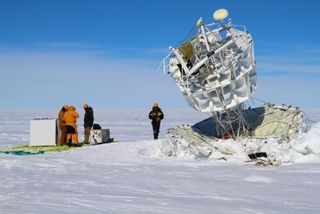
A team recovers NASA's Antarctic Impulsive Transient Antenna (ANITA) after a successful flight.

A team recovers NASA’s Antarctic Impulsive Transient Antenna (ANITA) after a successful flight. (Image: © Australian Antarctic Division)

There’s something mysterious coming up from the frozen ground in Antarctica, and it could break physics as we know it.

Physicists don’t know what it is exactly. But they do know it’s some sort of cosmic ray — a high-energy particle that’s blasted its way through space, into the Earth, and back out again. But the particles physicists know about — the collection of particles that make up what scientists call the Standard Model (SM) of particle physics — shouldn’t be able to do that. Sure, there are low-energy neutrinos that can pierce through miles upon miles of rock unaffected. But high-energy neutrinos, as well as other high-energy particles, have “large cross-sections.” That means that they’ll almost always crash into something soon after zipping into the Earth and never make it out the other side.

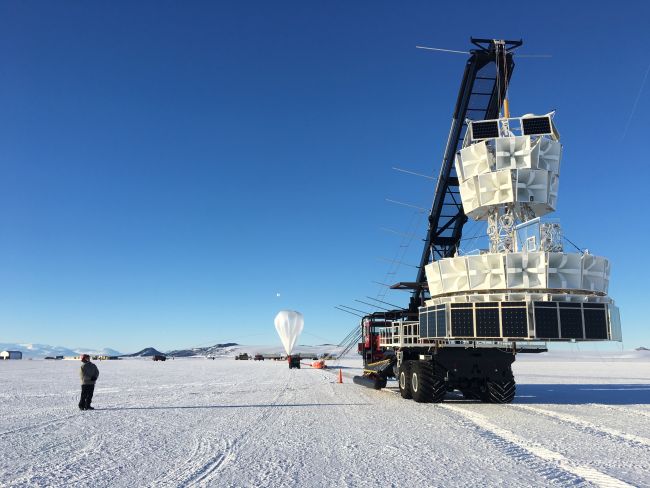
And yet, since March 2016, researchers have been puzzling over two events in Antarctica where cosmic rays did burst out from the Earth, and were detected by NASA’s Antarctic Impulsive Transient Antenna (ANITA) — a balloon-borne antenna drifting over the southern continent.

ANITA is designed to hunt cosmic rays from outer space, so the high-energy neutrino community was buzzing with excitement when the instrument detected particles that seemed to be blasting up from Earth instead of zooming down from space. Because cosmic rays shouldn’t do that, scientists began to wonder whether these mysterious beams are made of particles never seen before.

Since then, physicists have proposed all sorts of explanations for these “upward going” cosmic rays, from sterile neutrinos (neutrinos that rarely ever bang into matter) to “atypical dark matter distributions inside the Earth,” referencing the mysterious form of matter that doesn’t interact with light.

All the explanations were intriguing, and suggested that ANITA might have detected a particle not accounted for in the Standard Model. But none of the explanations demonstrated conclusively that something more ordinary couldn’t have caused the signal at ANITA.

A new paper uploaded today (Sept. 26) to the preprint server arXiv changes that. In it, a team of astrophysicists from Penn State University showed that there have been more upward-going high-energy particles than those detected during the two ANITA events. Three times, they wrote, IceCube (another, larger neutrino observatory in Antarctica) detected similar particles, though no one had yet connected those events to the mystery at ANITA. And, combining the IceCube and ANITA data sets, the Penn State researchers calculated that, whatever particle is bursting up from the Earth, it has much less than a 1-in-3.5 million chance of being part of the Standard Model. (In technical, statistical terms, their results had confidences of 5.8 and 7.0 sigma, depending on which of their calculations you’re looking at.)

Breaking physics

Derek Fox, the lead author on the new paper, said that he first came across the ANITA events in May 2018, in one of the earlier papers attempting to explain them.

“I was like, ‘Well this model doesn’t make much sense,'” Fox told Live Science, “but the [ANITA] result is very intriguing, so I started checking up on it. I started talking to my office neighbor Steinn Sigurdsson [the second author on the paper, who is also at Penn State] about whether maybe we could gin up some more plausible explanations than the papers that have been published to date.”

Fox, Sigurdsson and their colleagues started looking for similar events in data collected by other detectors. When they came across possible upward-going events in IceCube data, he said, he realized that he might have come across something really game-changing for physics.

The surface facility for the IceCube experiment, which is located under nearly 1 mile (1.6 kilometers) of ice in Antarctica. IceCube suggests ghostly neutrinos don't exist, but a new experiment says they do.
The surface facility for the IceCube experiment, which is located under nearly 1 mile (1.6 kilometers) of ice in Antarctica. IceCube suggests ghostly neutrinos don’t exist, but a new experiment says they do. (Image credit: Courtesy of IceCube Neutrino Observatory)

“That’s what really got me going, and looking at the ANITA events with the utmost seriousness,” he said, later adding, “This is what physicists live for. Breaking models, setting new constraints [on reality], learning things about the universe we didn’t know.”

As Live Science has previously reported, experimental, high-energy particle physics has been at a standstill for the last several years. When the 17-mile (27 kilometers), $10 billion Large Hadron Collider (LHC) was completed on the border between France and Switzerland in 2009, scientists thought it would unlock the mysteries of supersymmetry — the mysterious, theoretical class of particles that scientists suspect might exist outside of current physics, but had never detected. According to supersymmetry, every existing particle in the Standard Model has a supersymmetric partner. Researchers suspect these partners exist because the masses of known particles are out of wack — not symmetric with one another.

“Even though the SM works very well in explaining a plethora of phenomena, it still has many handicaps,” said Seyda Ipek, a particle physicist at UC Irvine, who was not involved in the current research. “For example, it cannot account for the existence of dark matter, [explain  mathematical weirdness in] neutrino masses, or the matter-antimatter asymmetry of the universe.”

Instead, the LHC confirmed the Higgs boson, the final undetected part of the Standard Model, in 2012. And then it stopped detecting anything else that important or interesting. Researchers began to question whether any existing physics experiment could ever detect a supersymmetric particle.

“We need new ideas,” Jessie Shelton, a theoretical physicist at the University of Illinois at Urbana-Champaign, told Live Science in May, around the same time that Fox first became interested in the ANITA data.

Now, several scientists not involved in the Penn State paper told Live Science that it offers solid (if incomplete) evidence that something new has really arrived.

“It was clear from the start that if the ANITA anomalous events are due to particles that had propagated through thousands of kilometers of Earth, then those particles were very likely not SM particles,” said Mauricio Bustamante, an astrophysicist at the Niels Bohr Institute at the University of Copenhagen, who was not an author on the new paper.Advertisement

“The paper that appeared today is the first systematic calculation of how unlikely is that these events were due to SM neutrinos,” he added. “Their result strongly disfavors a SM explanation.”

“I think it’s very compelling,” said Bill Louis, a neutrino physicist at Los Alamos National Laboratory who was not involved in the paper and has been following research into the ANITA events for several months.

If standard model particle created these anomalies, they should have been neutrinos. Researchers know that both because of the particles they decayed into, and because no other standard model particle would even have a fragment of a chance in a million of making it through the Earth.

But neutrinos of this energy, Louis said, just shouldn’t make it through the Earth often enough for ANITA or IceCube to detect. It’s not how they work. But neutrino detectors like ANITA and IceCube don’t detect neutrinos directly. Instead, they detect the particles that neutrinos decay into after smashing into Earth’s atmosphere or Antarctic ice. And there are other events that can generate those particles, triggering the detectors. This paper strongly suggests that those events must have been supersymmetric, Louis said, though he added that more data is necessary.

Fox and his colleagues went on to argue that the particles are most likely to be a sort of theoretical supersymmetric particle called “stau sleptons.” Stau sleptons are supersymmetric versions of a Standard Model particle called the tau lepton. The “S” is for “supersymmetric” (really). [Sparticles to Neutrinos: The Coolest Little Particles in the Universe]

Louis said that at this stage he thinks that level of specificity is “a bit of a stretch.”

The authors make a strong statistical case that no conventional particle would be likely to travel through the Earth in this way, he said, but there isn’t yet enough data to be certain. And there’s certainly not enough that they could definitively figure out what particle made the trip.

Fox didn’t dispute that.

“As an observer, there’s no way that I can know that this is a stau,” he said. “From my perspective, I go trawling around trying to discover new things about the universe, I come upon some really bizarre phenomenon, and then with my colleagues, we do a little literature search to see if anybody has ever thought that this might happen. And then if we find papers in the literature, including one from 14 years ago that predict something just like this phenomenon, then that gets really high weight from me.”

He and his colleagues did find a long chain of papers from theorists predicting that stau sleptons might turn up like this in neutrino observatories. And because those papers were written before the ANITA anomaly, Fox said, that suggests strongly to him that those theorists were onto something.

But there remains a lot of uncertainty on that front, he said. Right now, researchers just know that whatever this particle is, it interacts very weakly with other particles, or else it would have never survived the trip through the planet’s dense mass. 

What’s next

Every physicist who spoke with Live Science agreed that researchers need to collect more data to verify that ANITA and IceCube have cracked supersymmetry. It’s possible, Fox said, that when IceCube researchers dig into their data archives they’ll find more, similar events that had previously gone unnoticed. Louis and Bustamante both said that NASA should run more ANITA flights to see if similar upward-going particles turn up.

“For us to be certain that these events are not due to unknown unknowns — say, unmapped properties of the Antarctic ice — we would like other instruments to also detect these sort of events,” Bustamante said.

A team prepares ANITA for flight over the Antarctic ice. (Image credit: NASA)

Over the long-term, if these results are confirmed and the details of what particle is causing them are nailed down, several researchers said that the ANITA anomaly might unlock even more new physics at the LHC.

“Any observation a non-SM particle would be a game changer, because it would tell us which path we should take after the SM,” Ipek said. “The type of [supersymmetric] particle they claim to have produced the signals of, sleptons, are very hard to produce and detect at LHC.”

“So, it is very interesting if they can be observed by other types of experiments. Of course, if this is true, then we will expect a ladder of other [supersymmetric] particles to be observed at the LHC, which would be a complementary test of the claims.”Advertisement

In other words, the ANITA anomalies could offer scientists the key information necessary to properly tune the LHC to unlock more of supersymmetry. Those experiments might even turn up an explanation for dark matter.

Right now, Fox said, he’s just hungry for more data.

Originally published on Live Science.