Arquivo da categoria: meteorologia

>Tensions Grow Between Tornado Scientists and Storm Chasers

>
By Jeffrey R. Young
Boulder, Colo.
The Chronicle of Higher Education
June 17, 2010

A long line of storm chasers gets in the way of scientists studying severe weather. Photo: Carlye Calvin

There is a crowd under the funnel cloud.

Researchers wrapping up one of the largest-ever scientific field studies of tornadoes say that amateur storm chasers hindered their research and created dangerous traffic jams. Storm chasers, for their part, say that they have just as much right to observe storms as Ph.D.’s.

Hundreds of camera-toting amateurs in cars ended up chasing the same storms as a fleet of scientific vehicles during the high-profile research project, called Vortex2, which wrapped up data collection this week. At times the line of traffic caused the Midwestern roads to look like the freeways of Los Angeles, said Roger Wakimoto, director of the National Center for Atmospheric Research, during a briefing for reporters this week.

“I worry about this as a safety hazard,” Mr. Wakimoto said. “These people were blocking our escape routes because of the sheer number of cars.”

Researchers refer to their own fleet as an “armada,” and it was made up of about 40 vehicles, several of them carrying radar gear. The research goal is to understand how tornadoes form, to discover why some big storms generate deadly tornadoes and others don’t, and to improve forecasters’ ability to warn people of the severe weather events.

“It’s embarrassing to say, but we still do not understand what triggers tornado genesis,” Mr. Wakimoto said. “It’s got to be one of the most fundamental things we don’t understand today, but maybe we captured the data [during this study] to answer the question.”

At times amateur storm chasers kept the armada of science trucks from even getting to a budding tornado. One example was on May 19 in Oklahoma, when the number of storm chasers reached about 200 to 300 cars, according to Joshua Wurman, president of the Center for Severe Weather Research, in Boulder.

“The chasers basically made a rolling roadblock,” he said in a phone interview Thursday, while preparing to head out for his last day of data collection. He said that many of the amateur chasers were trying to roll along parallel to the storm to shoot video, but the researchers wanted to get ahead of the storm to set up their radar equipment. Mr. Wurman said that most of the chasers refused to move aside to let the research vehicles pass. While people have no legal obligation to yield to radar trucks, he said that he felt the amateurs should have given way as a courtesy.

“Just like you open the door for a guy with crutches—it’s not required by law, it’s just polite,” he said. “Nobody let us by, and I was really disappointed by that. It basically crippled our science mission that day.”

One veteran storm chaser pointed out on his blog, however, that some of the scientists involved in Vortex2 have been on major television programs that have led to an increase in amateur storm chasers. “Dr. Wurman’s research has benefited financially from his previous affiliation with the Discovery Channel program Storm Chasers—this program implicitly is encouraging viewers to engage in storm-chasing by glamorizing it,” wrote Chuck Doswell.”Dr. Wurman is a well-respected researcher, but he’s not Moses. Nor is he a first responder going about his duties—law enforcement officers are authorized to break laws in the performance of their jobs. I know of no researcher/storm chaser who has that particular blank check.”

Citizen Scientists?

Storm chasers argue that they offer a valuable service because some call in reports and observations to the National Weather Service.

“Storm chasers are out there to save lives—we’re out there to give warnings faster than the early warning systems,” said Aaron Estman, who has been chasing storms for a few years and runs a Web site called TexasChaser.com, in an interview.

But Mr. Wurman said that amateur storm chasers rarely offer useful information because, by the time they call in their reports, officials are already aware of the storms, thanks to radar equipment. And even the few storm chasers who equip their cars with scientific instruments do not properly calibrate their equipment to aid scientific literature, he said.

“They haven’t done the boring stuff—the tedious stuff of doing good science,” he said.

Some researchers say there is hope that storm chasers can become valuable citizen scientists, as has happened in other fields, such as astronomy.

“Right now there’s no coordination,” said Brian M. Argrow, a professor of aerospace engineering sciences and associate dean for education at the University of Colorado at Boulder. “That’s an important thing that Vortex2 brings to the table—a coordinated effort.”
The Next Step

This is the final year of the two-year Vortex2 project, which cost about $13-million and is supported by the National Science Foundation and the National Oceanic and Atmospheric Administration, and involves about 20 teams of scientists from universities and federal laboratories. The endeavor is a sequel to the original Vortex project, a similar effort in 1994 and 1995. (It became one of the inspirations for the Hollywood film “Twister,” which, like the television shows cited by bloggers, helped increase interest in storm-chasing.)

The scientists will now analyze the terabytes of data—the equivalent of thousands of filled hard drives from typical laptops—including images of the storms they observed. The first papers from the project are expected to be presented at a severe-weather conference in Boulder in October.

>The Climate Majority (N.Y. Times)

>
Op-Ed Contributor

By JON A. KROSNICK
Published: June 8, 2010

ON Thursday, the Senate will vote on a resolution proposed by Lisa Murkowski, Republican of Alaska, that would scuttle the Environmental Protection Agency’s plans to limit emissions of greenhouse gases by American businesses.

Passing the resolution might seem to be exactly what Americans want. After all, national surveys released during the last eight months have been interpreted as showing that fewer and fewer Americans believe that climate change is real, human-caused and threatening to people.

But a closer look at these polls and a new survey by my Political Psychology Research Group show just the opposite: huge majorities of Americans still believe the earth has been gradually warming as the result of human activity and want the government to institute regulations to stop it.

In our survey, which was financed by a grant to Stanford from the National Science Foundation, 1,000 randomly selected American adults were interviewed by phone between June 1 and Monday. When respondents were asked if they thought that the earth’s temperature probably had been heating up over the last 100 years, 74 percent answered affirmatively. And 75 percent of respondents said that human behavior was substantially responsible for any warming that has occurred.

For many issues, any such consensus about the existence of a problem quickly falls apart when the conversation turns to carrying out specific solutions that will be costly. But not so here.

Fully 86 percent of our respondents said they wanted the federal government to limit the amount of air pollution that businesses emit, and 76 percent favored government limiting business’s emissions of greenhouse gases in particular. Not a majority of 55 or 60 percent — but 76 percent.

Large majorities opposed taxes on electricity (78 percent) and gasoline (72 percent) to reduce consumption. But 84 percent favored the federal government offering tax breaks to encourage utilities to make more electricity from water, wind and solar power.

And huge majorities favored government requiring, or offering tax breaks to encourage, each of the following: manufacturing cars that use less gasoline (81 percent); manufacturing appliances that use less electricity (80 percent); and building homes and office buildings that require less energy to heat and cool (80 percent).

Thus, there is plenty of agreement about what people do and do not want government to do.

Our poll also indicated that some of the principal arguments against remedial efforts have been failing to take hold. Only 18 percent of respondents said they thought that policies to reduce global warming would increase unemployment and only 20 percent said they thought such initiatives would hurt the nation’s economy. Furthermore, just 14 percent said the United States should not take action to combat global warming unless other major industrial countries like China and India do so as well.

Our findings might seem implausible in light of recent polls that purport to show that Americans are increasingly skeptical about the very existence of climate change. But in fact, those polls did not produce conflicting evidence at all.

Consider, for example, the most publicized question from a 2009 Pew Research Center poll: “From what you’ve read and heard, is there solid evidence that the average temperature on earth has been getting warmer over the past few decades, or not?” This question measured perceptions of scientific evidence that the respondent has read or heard about, not the respondents’ personal opinions about whether the earth has been warming. Someone who has had no exposure to scientific evidence or who perceives the evidence to be equivocal may nonetheless be convinced that the earth has been heating up by, say, the early blossoming of plants in his garden.

Or consider a widely publicized Gallup question: “Thinking about what is said in the news, in your view, is the seriousness of global warming generally exaggerated, generally correct or is it generally underestimated?” This question asked about respondents’ perceptions of the news, not the respondents’ perception of warming. A person who believes climate change has been happening might also feel that news media coverage of it has been exaggerated.

Questions in other polls that sought to tap respondents’ personal beliefs about the existence and causes of warming violated two of the cardinal rules of good survey question design: ask about only one thing at a time, and choose language that makes it easy for respondents to understand and answer each question.

Imagine being asked this, from a poll by CNN: “Which of the following statements comes closest to your view of global warming: Global warming is a proven fact and is mostly caused by emissions from cars and industrial facilities like power plants and factories; global warming is a proven fact and is mostly caused by natural changes that have nothing to do with emissions from cars and industrial facilities; or, global warming is a theory that has not yet been proven.”

Notice that the question didn’t even offer the opportunity for respondents to say they believe global warming is definitely not happening — not the sort of question that will provide the most valid measurements.

When surveys other than ours have asked simple and direct questions, they have produced results similar to ours. For example, in November, an ABC News/Washington Post survey found that 72 percent of respondents said the earth has been heating up, and a December poll by Ipsos/McClatchy found this proportion to be 70 percent.

Our surveys did reveal a small recent decline in the proportion of people who believe global warming has been happening, from 84 percent in 2007 to 80 percent in 2008 to 74 percent today. Statistical analysis of our data revealed that this decline is attributable to perceptions of recent weather changes by the minority of Americans who have been skeptical about climate scientists.

In terms of average earth temperature, 2008 was the coldest year since 2000. Scientists say that such year-to-year fluctuations are uninformative, and people who trust scientists therefore ignore this information when forming opinions about global warming’s existence. Citizens who do not trust climate scientists, however, base their conclusions on their personal observations of nature. These low-trust individuals were especially aware of the recent decline in average world temperatures; they were the ones in our survey whose doubts about global warming have increased since 2007.

This explanation is especially significant, because it suggests that the small recent decline in the proportion of people who believe in global warming is likely to be temporary. If the earth’s temperature begins to rise again, these individuals may reverse course and rejoin the large majority who still think warming is real.

Growing public skepticism has, in recent months, been attributed to news reports about e-mail messages hacked from the computer system at the University of East Anglia in Britain (characterized as showing climate scientists colluding to silence unconvinced colleagues) and by the discoveries of alleged flaws in reports by the Intergovernmental Panel on Climate Change.

Our new survey discredited this claim in multiple ways. First, we found no decline in Americans’ trust in environmental scientists: 71 percent of respondents said they trust these scientists a moderate amount, a lot or completely, a figure that was 68 percent in 2008 and 70 percent in 2009. Only 9 percent said they knew about the East Anglia e-mail messages and believed they indicated that climate scientists should not be trusted, and only 13 percent of respondents said so about the I.P.C.C. reports’ alleged flaws.

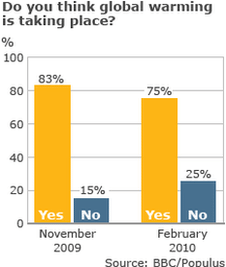
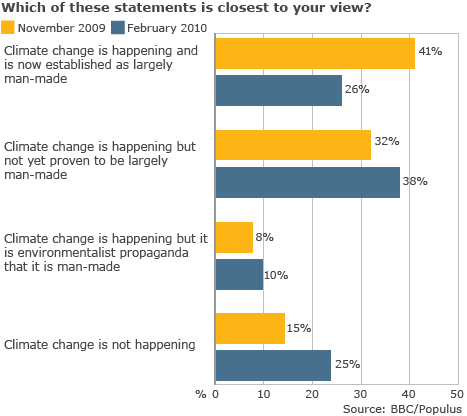
Interestingly, Americans are not alone in having their views portrayed inaccurately. A February BBC News survey asked Britons, “From what you know and have heard, do you think that the earth’s climate is changing and global warming is taking place?” Seventy-five percent of respondents answered affirmatively, down a somewhat improbable eight percentage points from 83 percent in November. A BBC headline blared, “Climate Skepticism on the Rise,” when it should have proclaimed that a huge majority of Britons still share common ground with one another and with Americans on this issue.

GLOBAL warming has attracted what political scientists dub an “issue public”: millions of Americans who are passionate about this subject and put pressure on government to follow their wishes. For over a decade, this group has been of typical issue-public size, about 15 percent of American adults.

Although issue publics usually divide about equally on opposing sides — think of abortion or immigration — 88 percent of the climate change issue public in our survey believed that global warming has been happening; 88 percent attributed responsibility for it to human action; 92 percent wanted the federal government to limit the amount of greenhouse gases that businesses can emit. Put simply, the people whose votes are most powerfully shaped by this issue are sending a nearly unanimous signal to their elected representatives.

All this makes global warming a singular issue in American politics. Even as we are told that Americans are about equally divided into red and blue, a huge majority shares a common vision of climate change. This creates a unique opportunity for elected representatives to satisfy a lot of voters.

When senators vote on emissions limits on Thursday, there is one other number they might want to keep in mind: 72 percent of Americans think that most business leaders do not want the federal government to take steps to stop global warming. A vote to eliminate greenhouse gas regulation is likely to be perceived by the nation as a vote for industry, and against the will of the people.

Jon A. Krosnick is a professor of communication, political science and psychology at Stanford.

>Active Hurricane Season Predicted (IRI)

>

The Atlantic hurricane season has officially started, and the International Research Institute for Climate and Society has issued its updated seasonal hurricane forecast for the region. The results continue to indicate that an above-normal season is very likely. This could spell trouble for highly vulnerable Caribbean nations such as Haiti, still reeling from the effects of a 7.0 magnitude earthquake on January 12, 2010. On top of this, other forecasts point to increased thunderstorm activity for the region as well.
The IRI’s hurricane forecast probabilities are the strongest the institution has ever issued at this point in the season, eclipsed only by a late-season forecast during record-setting 2005. The latest numbers call for a 50% chance of above-normal activity, 35% chance of near-normal activity and a 15% chance for below-normal activity. Put in simpler terms, this means that the chance of having an above-normal year is more than three times the chance of having a below-normal one.

The hurricane forecast issued last week by the National Oceanic and Atmospheric Administration is even stronger, calling for an 85% chance of an above-normal season.
Although the forecast calls for an active season, this doesn’t guarantee that devastation will occur. The seasonal forecasts don’t tell us where, when or if the hurricanes will hit land. They just tell us that we’ll likely see more of them this season, increasing the odds that some inhabited areas will get hit.
Because of the potentially destructive nature of hurricanes and tropical storms, the higher odds are a cause for concern. “Hurricanes can devastate the economies of the Caribbean and Central America,” says Walter Baethgen, who runs IRI’s regional program for Latin America and the Caribbean. “Our hope is that seasonal forecasts and other types of climate information will feed into emergency networks and early-warning systems currently operating in the region.”
To facilitate this, the IRI helped develop a website focused on supplying government staff, relief workers and development agents located in Haiti with the most up-to-date weather and climate forecasts for the country. By making this information available through its ongoing partnerships with the United Nations Office for the Coordination of Humanitarian Affairs and the International Federation of Red Cross and Red Crescent Societies, the IRI hopes to alleviate some of these elevated storm risks for Haiti and ultimately help save lives this hurricane season….
You can read the rest of this story here:

>Blame: the hidden (and difficult) side of the climate change debate

>
By Renzo Taddei (State University of Campinas, Brazil)
Anthropology News – November 2008

Between 1877 and 1879, Northeast Brazil was crippled by one of the region’s most historically significant droughts. Around half million people may have died due to drought-related famine and epidemic outbreaks. Many of the region’s Catholic-majority inhabitants believed the drought was a form of divine punishment for the moral corruption of society, an idea reinforced in an epistle issued by the local bishop. More than a century later, in January 2004, when I was carrying out fieldwork in the region, extremely intense rains flooded the region, displacing over 100 thousand people. During interviews, some of the impacted echoed earlier beliefs that the disaster was the result of divine punishment. This time they pointed to television headlines — animal cloning, NASA’s expedition to Mars, the war in Iraq, among other things – as causes for divine discontent. Humans were going beyond their proper sphere of action, they said.

This research called my attention to the role of blame in cultural models about climate. The main international debates on climate change focus almost exclusively on the phenomenon’s physical causes, while at the same time there is an enormous ethnographic literature that reveals “blame” to be integral to how societies deal with crises in general (and climate related ones in particular). This reveals a conceptual gap where anthropology can effectively make critical contributions.

Indeed, it seems that the association between climate events and supposed human misdeeds is culturally pervasive and enduring. Of course in some places these beliefs may not to be the dominant, but they tend to reappear as a strong paradigm in moments of crisis. For instance, Mary Douglas, in Risk and Blame, provides ample evidence that this way of dealing with crises is not restricted to tribal and traditional societies, but marks Western societies alike. If she is right (and I believe she is), it makes the topic of blame politically relevant to our analyses of societal reactions to climate events and uncertainties.

One example of how blame is associated with climate can be seen in the rejection of climate modeling in water management. As Steve Rayner and his collaborators demonstrated in California and as I witnessed in Brazil, water managers resist incorporating new technologies that increase uncertainty, even if in the aggregate there are gains in efficiency. As an illustration, imagine a situation where two individuals are in conflict for the water stored in a reservoir: both want the water, but they also want to keep a certain volume saved for future needs. If a climate forecast predicts high probability of heavy rains in the upcoming rainy season, they may use more water in the present, thus resolving the conflict. But since climate forecasts are probabilistic, due to the extreme complexity of the atmosphere, the hydrological models will also become probabilistic. In the long run, a forecast will fail resulting in a water crisis. The public and most politicians don’t see the inherent uncertainties of modeling, and in a situation of crisis, there is a general expectation that someone is accountable. Not unlike the search for divine causation, the inherent uncertainty of climate modeling may produce an atmosphere where blame is politically expedient (and water managers risk losing their jobs). This context means that it is extremely difficult to convince water managers to use climate-based technologies.

Understanding how blame is present in cultural models about climate, in climate politics, and in the local institutionalized ways of addressing crises is, from an anthropological perspective, necessary if the discipline is to make effective contributions to the international debate on climate change. While international debates discuss how much certainty we need to enable political action, a second, equally important question, is how much uncertainty our political systems can take before triggering blaming and scapegoating rituals. Similarly, if culturally embedded models frame the idea of climate change as a situation where nature is “punishing” humanity for its misdeeds – carbon emissions, pollution, destruction of forests, reduction of biodiversity, and the like -individuals may take this punishment as deserved, which may induce them to assume a posture of resignation and inaction. Naturally, this is a hypothesis to be tested ethnographically.

>Essay Review: The Climate Change Debates (Science)

>
Philip Kitcher
Department of Philosophy, Columbia University
E-mail: psk16@columbia.edu

Originally published in Science Express on 27 May 2010
Science 4 June 2010: Vol. 328. no. 5983, pp. 1230 – 1234 – DOI: 10.1126/science.1189312

In one of the earliest and most eloquent pleas for open discussion and debate, John Milton wrote:

And though all the winds of doctrine were let loose to play upon the earth, so Truth be in the field, we do injuriously, by licensing and prohibiting, to misdoubt her strength. Let her and Falsehood grapple; who ever knew Truth put to the worse, in a free and open encounter. (1)

Two centuries after Milton, in the same year in which Charles Darwin published the Origin, John Stuart Mill’s essay On Liberty (2) added further arguments for the free exchange of ideas, suggesting that such exchange is vital for intellectual and social health. Although both Milton and Mill stand behind our current acquiescence in the value of extensive free discussion, both of them knew that they were opposing ancient suspicions about the viability of democracy. The political theorists and philosophers of the Greco-Roman world viewed ordinary folk as vulnerable to deception and exploitation. Allowed to determine the direction of the state, the folk would be easily seduced into believing falsehoods aligned with the interests of charismatic leaders, so that the popular voice would enthusiastically clamor for disastrous policies. Better, then, to entrust the ship of state to wise navigators, whose wisdom embraced both depth of understanding and moral integrity.

The contrast between these two perspectives on public discussion and policy bears on our own times, although the risks may affect our species as a whole and the stakes may be far higher. For three decades, prominent climate scientists have been warning of the dangerous effects of the continual emission of greenhouse gases into Earth’s atmosphere. They have been attempting to identify and to explain just what those effects are likely to be—for ourselves, our children, and our more remote descendants. And they have been urging a variety of measures that might prevent some of the disasters whose possibility they claim to foresee. Yet it is evident that substantial disagreement remains about the consequences for humans and for other species. This is so even in those countries where citizens have largely accepted the conclusions that anthropogenic global warming exists and is likely to raise the average temperature on our planet at least 2°C by the end of the century. In the United States, the state of discussion is less advanced: Denying the reality of human-caused climate change continues to figure as a serious possibility in public debates. And a large fraction of the populace believes that scientists’ warnings about the impact of any increases in global temperatures are exaggerated.

For those who play the role of Cassandra in this drama, such as climatologists James Hansen (NASA Goddard Institute for Space Studies) and Stephen Schneider (Stanford University), a 30-year effort to alert policy-makers, politicians, and the public to what they perceive as significant dangers can only be seen as frustrating. They have been moved to write books, accessible to a general readership, that will record the ways in which their warnings have been ignored—and their voices sometimes muffled. In Storms of My Grandchildren, Hansen attempts to combine the story of his own efforts with (yet another) attempt to explain the pertinent parts of climate science as clearly as he can. Science as a Contact Sport presents Schneider’s insider account of the struggles to understand and moderate human-induced atmospheric changes. Other climate scientists, like Mike Hulme (University of East Anglia), who live in societies where the level of discussion has usually been more informed, are inclined to see matters differently. They hold that continued debate reflects the genuine difficulties of the underlying issues and sometimes explicitly chide their colleagues (as Hulme does in Why We Disagree About Climate Change) for a tendency to “apocalyptic” pronouncements. So, in reflections on the debates of the past decades, there opens up a genuine dispute about the role of scientists in influencing public policy, with some urging a stronger voice for expert testimony and others recommending reticence and even quietism.

In part, the differences between Hansen and Schneider, on the one hand, and Hulme, on the other, stem from their concerns with rather different controversies. It is useful to differentiate three questions. First is the issue of whether human activities, specifically actions that increase the emission of greenhouse gases, are contributing to a significant average warming of Earth. (As all the expert authors point out very clearly, there is no suggestion that the temperature of every region will rise during the next decades.) Second are questions about the probabilities with which various phenomena (complete melting of ice sheets, for example) will occur and about their consequences for human beings and other species. Third are considerations about what might be done to halt (or even reverse) the warming and to limit the damaging consequences. Hulme emphasizes the complexity of the third set of issues. He notes how they are intertwined with difficulties about understanding economic trends and changes, about global justice, about the values assigned to things that are hard to assess in economic terms (ecosystems, the continuation of particular forms of human social life), about practical geopolitics, and even about religious perspectives. Focusing on this intricate web of problems, he elaborates an extensive case for the naturalness of continued disagreement.

For Hansen and Schneider, however, the first two questions are primary (although Hansen ventures some proposals about the third as well). Both contributed to repeated attempts to persuade successive American administrations of the existence and importance of anthropogenic global warming, and Schneider participated in lengthy discussions during the preparation of Intergovernmental Panel on Climate Change (IPCC) reports—discussions in which voices representing political interests seem to have forced compromising the eventual presentation of the pertinent scientific ideas. Their experiences incline them to emphasize the importance of expert judgment, effectively renewing the ancient worries about the dangers of democracy. Both believe that genuine democratic participation in the issues can only begin when citizens are in a position to understand what kinds of policies promote their interests. To achieve that requires a far clearer and unmistakable communication of the consensus views of climate scientists, with respect to the existence of anthropogenic global warming and to the chances of various effects, than has hitherto been available. In his choice of title, Hansen implicitly questions the frequent assumption that effects on future generations are subject to some “deep discount.” He explicitly notes that people’s common concern for the fates of their children and grandchildren provides a shared starting point for responding to the changes that might threaten them. Consequently, if citizens are to be able to express their views about things that matter most to them, they need informed views about the planet on which their descendants will live. Serious democracy requires reliance on expert opinion.

It is all too easy to be beguiled by an opposite thought: that democracy demands that there be extensive public discussion, even on technical matters, discussion in which all participants operate as equals. Those in the grip of this idea will view Hansen and Schneider as hysterical and arrogant people who aim to short-circuit the proper airing of alternative views. (Although sympathetic critics might also ponder the fact that these two eminent scientists have been rebutting the same “alternatives” for decades). Perhaps continued discussion could be tolerated, were there no urgency about the issue under debate. If they saw no compulsion to act soon—and if they were convinced that the fight were fair—Hansen and Schneider might share Milton’s confidence that truth would ultimately emerge as victor. Yet the stories they tell in their gripping narratives reveal all too many points at which messages have been distorted and suppressed because of the short-term interests of economic and political agents. They also demonstrate many ways in which the arena of public discussion has been set up to block the widespread acceptance of conclusions based on an increasing body of evidence.

The insiders’ stories of ways in which crucial information has effectively been withheld from voters, particularly in the United States, should give us pause about the functioning of our democracy. Even more powerful is the account provided by two outstanding historians who have reviewed a sequence of controversies around topics of public concern. In their fascinating and important study, Merchants of Doubt, Naomi Oreskes and Erik M. Conway offer convincing evidence for a surprising and disturbing thesis. Opposition to scientifically well-supported claims about the dangers of cigarette smoking, the difficulties of the Strategic Defense Initiative (“Star Wars”), the effects of acid rain, the existence of the ozone hole, the problems caused by secondhand smoke, and—ultimately—the existence of anthropogenic climate change was used in “the service of political goals and commercial interests” to obstruct the transmission to the American public of important information. Amazingly, the same small cadre of obfuscators figured in all these episodes.

Oreskes (University of California, San Diego) and Conway (NASA’s Jet Propulsion Laboratory) painstakingly trace the ways in which a few scientists, with strong ties to particular industries and with conservative political connections, have played a disproportionate role in debates about controversial questions, influencing policy-makers and the general public alike. Typically, these scientists have obtained their stature in fields other than those most pertinent to the debated question. Yet they have been able to cast enough doubt on the consensus views arrived at by scientists within the relevant disciplines to delay, often for a substantial period, widespread public acceptance of consequential hypotheses. They have used their stature in whatever areas of science they originally distinguished themselves to pose as experts who express an “alternative view” to the genuinely expert conclusions that seem problematic to the industries that support them or that threaten the ideological directions in which their political allies hope to lead.

The extraordinary story of deliberate obfuscation that Oreskes and Conway document begins with the delight of the tobacco companies in recruiting Fred Seitz and with Seitz’s own connections to “scientists in their twilight years who had turned to fields in which they had no training or experience.” It moves through the forging of a network of industrial and political alliances, and the creation of a variety of institutes and think-tanks devoted to challenging various forms of expert consensus, to a brilliant chapter in which the authors analyze the reasons why, as of 2009, a significant percentage of Americans (43%) continued to dissent from the minimal claim that there is “solid evidence the Earth is warming.” As Oreskes and Conway conclude:

There are many reasons why the United States has failed to act on global warming, but at least one is the confusion raised by Bill Nierenberg, Fred Seitz, and Fred Singer.

This apparently harsh claim is thoroughly justified through a powerful dissection of the ways in which prominent climate scientists, such as Roger Revelle and Ben Santer, were exploited or viciously attacked in the press.

None of this would have been possible without a web of connections among aging scientists, conservative politicians, and executives of companies (particularly those involved in fossil fuels) with a short-term economic interest in denying the impact of the emission of carbon into the atmosphere. But it also could not have produced the broad public skepticism about climate change without help from the media. As Oreskes and Conway point out, “balanced coverage” has become the norm in the dissemination of scientific information. Pitting adversaries against one another for a few minutes has proven an appealing strategy for television news programs to pursue in attracting and retaining viewers. Nor is the idea of “fair and balanced” coverage, in which the viewer (or reader) is allowed to decide, confined to Fox News. Competing “experts” have become common on almost all American radio and television programs, the Internet is awash in adversarial exchanges among those who claim to know, and newspapers, too, “sell” science by framing it as a sport (preferably as much of a contact sport as possible). Oreskes and Conway identify the ways in which the Washington Times and the Wall Street Journal have nourished the public sense that anthropogenic climate change is a matter of dispute, how they have given disproportionately large space to articles and opinion pieces from the “merchants of doubt,” and how they have sometimes censored the attempts of serious climate scientists to set the record straight. Even the New York Times, the American newspaper that takes science reporting most seriously, typically “markets” scientific research by imposing a narrative based on competition among dissenting scientists.

Media contributions to public confusion—what Schneider labels “mediarology”—are elaborated in a number of these books. There is a serious question as to whether American science journalists have conspicuously failed to discharge what might have seemed their central function: to enlighten the public about topics of concern, in areas where an expert consensus has been reached. Howard Friel’s The Lomborg Deception offers a careful analysis of the ways in which the “skeptical environmentalist,” Bjørn Lomborg, has selectively used (and sometimes distorted) the available evidence. Friel (an independent scholar whose previous books have critiqued the foreign and Middle East coverage of the New York Times) shows how Lomborg’s claims and his status as an expert were uncritically accepted. Apparently, the idea of framing environmental science in terms of a duel between rival “expert perspectives” was too seductive to resist.

For half a century, since the pioneering work of Thomas Kuhn (3), scholars who study the resolution of major scientific debates have understood how complex and difficult judgments about the probative value of data or the significance of unresolved problems can be. The major transitions in the history of the sciences, from the 16th and 17th centuries to the present, have involved intricate debates among competing research programs, among well-informed scientists who gave different weight to particular sorts of evidence. It is an absurd fantasy to believe that citizens who have scant backgrounds in the pertinent field can make responsible decisions about complex technical matters, on the basis of a few five-minute exchanges among more-or-less articulate speakers or a small number of articles outlining alternative points of view. Democratic ideals have their place in the conduct of inquiry, for it is arguable that there should be more communication between scientists and outsiders in the construction of research agendas, in the discussion of standards of acceptable risk, and in the articulation of policies based on scientific consensus. Genuine democracy, however, requires a division of labor, in which particular groups are charged with the responsibility of resolving questions that bear on the interests of individuals and societies. Other groups, those covering such questions in the media, have the duty to convey the results so that citizens can cast their votes as an enlightened expression of freedom, justifiably aimed at the outcomes for which they hope. Staging a brief disagreement between speakers with supposedly equal credentials, especially when it is not disclosed that one of them is answering to the economic aspirations of a very small segment of the society, is a cynical abnegation of that duty.

Because it is so thorough in disclosing how major policy decisions have been delayed or distorted, Merchants of Doubt deserves a wide readership. It is tempting to require that all those engaged in the business of conveying scientific information to the general public should read it. And that science journalists should abandon the obfuscating practice of presenting alternatives with inferior justification as if they were on a par with the scientific consensus.

* * *

Even if American public opinion were reformed overnight, so that virtually all citizens were convinced that anthropogenic global warming is likely to raise the average temperature of the planet by at least 2°C, that would be only the beginning. Beyond that minimal acceptance lie the difficult issues of deciding just what the consequences of a warmer planet will be and what can be done about them. Here, too, denial can easily be induced. Those who want to resist regulatory actions contend that the difficulties that are likely to arise for our descendants have been greatly exaggerated, that whatever problems arise will be addressed by people in a better economic position than we are today, that human beings have shown an admirable ability to adapt to changing environments, and so on and on and on. In countries that have long taken anthropogenic climate change as a settled question, agreeing on the expected consequences and the appropriate response has not proved easy. American discussions are likely to be haunted by the long denial, so that suspicions about alarmism linger. As psychologists have repeatedly discovered, those who are misinformed and later corrected often lapse into versions of their original error.

Scientists who believe that there are grave consequences for Earth and its future inhabitants face a difficult dilemma. They can talk in probabilistic terms—typically very imprecise probabilistic terms—about possible scenarios. If those potential futures are to be made vivid in ways that might engage citizens and inspire them to action, then the scenarios need to be given in some detail. Yet, as they become more specific, the precision about probabilities goes down, even to the extent that it is only responsible to declare that some outcome lies within the range of possibilities. Occasionally, those who raise the alarm are more definite. If the Arctic ice (including the Greenland ice sheet) melts, polar bears will lose their habitat and the species will go extinct; if sea levels rise in the most probable ways, low-lying islands (and many coastal areas, such as the Ganges delta) will be submerged. Outcomes like these are often met with an uncomfortable shrug. They are to be regretted, of course, but if avoiding them really requires a serious modification of civilized life, then it seems better to adapt: relocate some polar bears to artificially cooled preserves; transport the unfortunate flood victims to higher ground.

Concentration on scenarios that can be presented in detail and also justified as likely entails a serious cost. For it encourages a public perception that these are the only outcomes the Cassandras of climate science fear. A stereotype easily follows. The movement toward action derives from an ideology, one centered in a dislike of competitive market capitalism, a fondness for regulation, a tendency to give priority to the needs of the poor, and an overemphasis on environmental conservation. Global warming is a device used by Birkenstock-wearing, tree-hugging, business-hating liberal intellectuals for advancing their political aims.

“Ideology” is a word that appears relatively frequently in Hulme’s Why We Disagree About Climate Change (although he never explains what he means by it). A climatologist who has devoted some serious time to studying history and social studies of science, Hulme aims to offer a broader perspective on the debates that arise once the initial question of the reality of human-caused global warming has been settled. His book is valuable for its diagnosis of the many different levels at which disagreement can arise and the variety of political stances and value judgments that can incline people to divergent conclusions about what is likely to happen and what might be done. In delineating that diversity, he moves the discussion beyond any appeal to polarized stereotypes: on this side, the captains of industry, their tools, and their dupes; on the other, the flower children in sandals.

Yet Hulme’s book invites misreading. His immersion in the language of various domains of social studies leads him to write as if the theoretical conceptions he deploys in classifying various positions were as reliably grounded as the scientific findings he so clearly and concisely explains. Sometimes, there is even a fashionable indulgence in skeptical distancing, the use of inverted commas (scare quotes) to raise a knowing eyebrow. He announces, for example, that he will tell the story of “how we ‘discovered’ that physical climates could change,” before going on to give a lucid account of how the discovery (real discovery) occurred. In a similar vein, he tells us that the “‘post-normal’ character of climate change” requires a wider range of expert voices, that scientists must concede ground to “other ways of knowing,” and that climate change can become “a mirror into which we can look and see exposed both our individual selves and our collective societies.” The concerned environmentalist who presses on through Hulme’s discussions of the “opportunities” provided for “us” by climate change may eventually give up when he tells his readers to “change our position and examine climate change as an idea of the imagination rather than as a problem to be solved.” Tell it to the Maldives!

That response, however, is too impatient. Hulme’s ideas are more subtle than the (often maladroit) jargon in which he expresses them. If his book more explicitly differentiated areas in which particular groups of people might have greater authority, it would be possible to recognize the value of his diagnoses of the difficulties that attend debates about climate change without supposing that he is advocating the narcissistic quietism his words often suggest. He could accept, for example, the judgment common to Hansen, Schneider, and Oreskes and Conway: that conclusions about the reality of anthropogenic climate change and about the risks that attend some scenarios for the future are matters that can be—and have been—authoritatively decided by a scientific community to which he himself belongs. He should then agree with the implication that, in this domain, it would be foolish to introduce “other ways of knowing.” Hulme could reasonably suppose that the public becomes properly engaged at the moment when risks have been specified—to the extent that they can be specified—and that citizens’ judgments are crucial to decisions about what risks count as acceptable. He could emphasize, as he comments in one of his best discussions, that any decision as to whether a possible future can be tolerated (or even welcomed) should be informed by economic considerations, even though ethical values are crucial to any serious assessment. Finally, his apparently passive recommendation to see ourselves in “the mirror” of climate change—like his Kennedyesque injunction to ask “what climate change can do for us”—can be interpreted more sympathetically as a call for a more systematic investigation of the global challenges that confront us today and those that our descendants will face, one that formulates strategies for safeguarding the future without sacrificing the interests of those currently living.

To make progress on these issues, there will be a need for generally accessible accounts of the likely impact that various levels of global warming will produce. Both Hansen and Schneider describe potential futures, with Schneider being particularly insistent on the important point that scientists owe the public a specification of probabilities (to the extent that that is possible). Two other recent books—The Climate Solutions Consensus from the National Council for Science and the Environment and Climate Change Science and Policy (for which Schneider served as one of its editors)—offer some helpful and relatively nontechnical information for concerned citizens. The organization of Climate Change Science and Policy is particularly valuable, because of the volume’s focus on specific types of changes that would affect the lives of future people. It breaks free of the stereotypical concerns about marooned polar bears and dispossessed islanders to emphasize facts about rising sea levels and melting glaciers that are not sufficiently appreciated. Thus Peter Gleick’s chapter on water concisely identifies the likely disruption of water supplies and the serious chances of flood-induced pollution. Similarly, Kristie Ebi delivers a useful summary of a variety of ways in which our descendants will probably be more vulnerable to infectious diseases and respiratory conditions. (Although she omits concerns about the possible effects of environmental change on the evolution of disease vectors and cross-species transmission—perhaps because, in assessing these events, the chances are unspecifiable.)

Even though discussions of the predicaments people will face in the future do not exhaust the relevant considerations for deciding what actions we should take now, it is wise to bring them to the fore. Citizens need to understand the challenges with respect to shelter, food supply, water supply, and disease that are likely to arise for their descendants. Hansen’s clear perception that an overwhelming majority of the world’s population can share a concern about the kinds of lives that will be available to their children and grandchildren is echoed in the decision by the distinguished social theorist Anthony Giddens (London School of Economics) to ground his recommendations in the thesis that “objects in nature can only have value through us” (4). Although some environmentalists would demur, Giddens’s approach in The Politics of Climate Change has the advantage of increasing the chances for consensus. Like Hulme, he is much concerned to recognize the connections among global problems, insisting, from the beginning, that the challenges of responding to climate change and of meeting the energy needs of the human population must be faced in tandem. He differs from Hulme in not attempting any wide survey of sources of disagreement, and, as readers of his previous works might expect, he is lucid and precise in outlining potential courses of social action. If his book, conceived as a guide for the perplexed citizen, has a flaw, that lies in the breadth and number of the ideas he explores. Those ideas are offered in response to threats he views as profoundly serious:

It will be a colossal task to turn around a society whose whole way of life is constructed around mobility and a ‘natural right’ to consume energy in a profligate way. Yet it isn’t as hopeless an endeavour as it looks.

* * *

All the books reviewed here were written before climate change deniers exultantly exposed the mistakes made by the IPCC in announcing the imminent demise of the Himalayan glaciers and the “conspiratorial e-mails” from the East Anglia climate center. In the wake of these “important revelations,” the merchants of doubt were back in business. In December 2009, Reuters published a discussion by Singer in which he claimed that the IPCC report was based on “distorted raw data” and algorithms that were not shared with other scientists (5). Few readers of Singer’s presentation, or those given by other longstanding climate-change deniers, learned that there is significant independent evidence for Himalayan glacier melt, although not as rapid as the erroneous sentence implied. Probably still fewer understood that the competitive-cooperative interactions among scientists often involve unguarded remarks about the work of rival “teams,” and that references to “tricks” frequently advert to strategies for simplifying complicated mathematical problems or (as in this case) graphical methods of presenting a conclusion perspicuously, rather than to stratagems for deceiving the public. Captured by a naïve and oversimplified image of what “objective science” is like, it is easy for citizens to reject claims of scientific authority when they discover that scientific work is carried out by human beings.

These revelations probably retarded any serious American consensus even on the minimal judgment that is the preliminary to the longer and more difficult debate. Meanwhile, the disappointment at Copenhagen can be seen as evidence that the world is lapsing into a state of resignation. The emissions, of course, do not take a break from the hard decisions.

Nevertheless, there are grounds for the hope expressed by Giddens. Among them is the fact that serious scholars from a variety of crucial disciplines have written valuable books on which future deliberations can build. Those deliberations will require a new synthesis that involves scientists, social scientists, historians—and others, too. It is an embarrassment (at least for me) that philosophers have not contributed more to this necessary conversation. We might clarify some of the methodological issues—for instance, those concerning the variety of risks involved in model-building. Perhaps more important, we could use recent ethical work on responsibilities to future generations and to distant people to articulate a detailed ethical framework that might help a planet’s worth of policy-makers find their way to consensus. With luck, a broader group of dedicated scholars may be galvanized by the books discussed here, so that the potential disasters Hansen and Schneider have been warning us about for 30 years will be averted. Perhaps, in the end, truth—and wisdom—will prevail.

References and Notes

* 1. J. Milton, Areopagitica (London, 1644); http://www.gutenberg.org/etext/608.
* 2. J. S. Mill, On Liberty (London, 1859); http://ebooks.adelaide.edu.au/m/mill/john_stuart/m645o/.
* 3. T. S. Kuhn, The Structure of Scientific Revolutions (Univ. Chicago Press, Chicago, 1962).
* 4. Giddens derives this view about values from the political philosopher Robert Goodin [see, for example, (6)].
* 5. http://blogs.reuters.com/great-debate/tag/climate-change-conference/.
* 6. R. Goodin, Green Political Theory (Polity, Cambridge, 1992).

Books Discussed

Merchants of Doubt: How a Handful of Scientists Obscured the Truth on Issues from Tobacco Smoke to Global Warming
By Naomi Oreskes and Erik M. Conway. Bloomsbury, New York, 2010. 365 pp. $27, £25. ISBN 9781596916104.

Why We Disagree About Climate Change: Understanding Controversy, Inaction and Opportunity
By Mike Hulme. Cambridge University Press, Cambridge, 2009. 432 pp. $80, £45. ISBN 9780521898690. Paper, $29.99, £15.99. ISBN 9780521727327.

Storms of My Grandchildren: The Truth About the Coming Climate Catastrophe and Our Last Chance to Save Humanity
By James Hansen. Bloomsbury, New York, 2009. 320 pp. $25, £18. ISBN 9781608192007.

Science as a Contact Sport: Inside the Battle to Save Earth’s Climate
By Stephen H. Schneider. National Geographic, Washington, DC, 2009. 303 pp. $28, C$35, £16.99. ISBN 9781426205408.

The Lomborg Deception: Setting the Record Straight About Global Warming
By Howard Friel. Yale University Press, New Haven, CT, 2010. 270 pp. $28, £18.99. ISBN 9780300161038.

The Climate Solutions Consensus
By David E. Blockstein and Leo Wiegman. Island Press, Washington, DC, 2010. 328 pp. $50, £31. ISBN 9781597266369. Paper, $30, £18.99. ISBN 9781597266741.

Climate Change Science and Policy
Stephen H. Schneider, Armin Rosencranz, Michael D. Mastrandrea, and Kristin Kuntz-Duriseti, Eds. Island Press, Washington, DC, 2010. 542 pp. $95, £59. ISBN 9781597265669. Paper, $49.50, £37. ISBN 9781597265676.

The Politics of Climate Change
By Anthony Giddens. Polity, Cambridge, 2009. 272 pp. $69.95, £55. ISBN 9780745646923. Paper, $22.95, £12.99. ISBN 9780745646930.

Comments posted on the essay review here.

>Society to review climate message

>
By Roger Harrabin
Environment analyst, BBC News
27 May 2010

The UK’s Royal Society is reviewing its public statements on climate change after 43 Fellows complained that it had oversimplified its messages.

They said the communications did not properly distinguish between what was widely agreed on climate science and what is not fully understood.

The society’s ruling council has responded by setting up a panel to produce a consensus document.

The panel should report in July and the report is to be published in September.

It is chaired by physicist John Pethica, vice-president of the Royal Society.

Its deliberations are reviewed by two critical sub-groups, each believed to comprise seven members.

Each of these groups contains a number of society Fellows who are doubtful in some way about the received view of the risks of rising CO2 levels.
Continue reading the main story

It’s not clear to me how we are going to get precise agreement on the wording – Review member

One panel member told me: “The timetable is very tough – one draft has already been rejected as completely inadequate.”

The review member said it might not be possible for the document to be agreed at all. “This is a very serious challenge to the way the society operates,” I was told. “In the past we have been able to give advice to governments as a society without having to seek consensus of all the members.

“There is very clear evidence that governments are right to be very worried about climate change. But in any society like this there will inevitably be people who disagree about anything – and my fear is that the society may become paralysed on this issue.”

Another review member told me: “The sceptics have been very strident and well-organised. It’s not clear to me how we are going to get precise agreement on the wording – we are scientists and we’re being asked to do a job of public communication that is more like journalism.”

But both members said they agreed that some of the previous communications of the organisation in the past were poorly judged.

Question everything

A Royal Society pamphlet Climate Change Controversies is the main focus of the criticism. A version of it is on the organisation’s website. It was written in response to attacks on mainstream science which the Royal Society considered scurrilous.

It reads: “This is not intended to provide exhaustive answers to every contentious argument that has been put forward by those who seek to distort and undermine the science of climate change…”

One Fellow who said he was not absolutely convinced of the dangers of CO2 told me: “This appears to suggest that anyone who questions climate science is malicious. But in science everything is there to be questioned – that should be the very essence of the Royal Society. Some of us were very upset about that.

“I can understand why this has happened – there is so much politically and economically riding on climate science that the society would find it very hard to say ‘well, we are still fairly sure that greenhouse gases are changing the climate’ but the politicians simply wouldn’t accept that level of honest doubt.”

Another society protester said he wanted to be called a climate agnostic rather than a sceptic. He said he wanted the society’s website to “do more to question the accuracy of the science on climate feedbacks” (in which a warming world is believed to make itself warmer still through natural processes).

“We sent an e-mail round our friends, mainly in physical sciences,” he said.

“Then when we had got 43 names we approached the council in January asking for the website entry on climate to be re-written. I don’t think they were very pleased. I don’t think this sort of thing has been done before in the history of the society.

“But we won the day, and the work is underway to re-write it. I am very hopeful that we will find a form of words on which we can agree.

“I know it looks like a tiny fraction of the total membership (1,314) but remember we only emailed our friends – we didn’t raise a general petition.”

Precautionary principle

He said the agnostics were also demanding a “more even-handed” bibliography.

The first “climate agnostic” also said he was angry at previous comments from the previous president Lord May who declared: “The debate on climate change is over.”

Lord May was once quoted as saying: “‘On one hand, you have the entire scientific community and on the other you have a handful of people, half of them crackpots.”

One source strongly criticised the remarks.

Lord May’s comments were made at a time when world scientists were reaching a consensus (not unanimity) that CO2 had warmed the planet and would probably warm it more – maybe dangerously so.

Lobbyists funded by the fossil fuel industry were fighting to undermine that consensus and science academies were concerned that public doubt might deter governments from taking precautionary action to reduce emissions of CO2.

Climate change doubters among the society’s Fellows say that in their anxiety to support government action, the academies failed to distinguish between “hired guns” and genuine scientific agnostics wanting to explore other potential causes of climate change.

The remit of the society panel is to produce a new public-facing document on what scientists know, what they think they know and which aspects they do not fully understand. The task is to make the document strong and robust.

It should answer the complaint that previous communications have failed to properly explain uncertainties in climate science.

Language of risk

At the Heartland Institute climate sceptics conference in Chicago, Richard Lindzen, professor of meteorology at Massachusetts Institute of Technology (MIT), criticised the current society president Lord Rees for what he described as exaggerating the certainty in a joint public letter with Ralph Cicerone, president of the US National Academy of Sciences.

The letter, published by the Financial Times newspaper, states: “Something unprecedented is now happening. The concentration of carbon dioxide in the atmosphere is rising and climate change is occurring, both due to human actions…. Uncertainties in the future rate of (temperature) rise, stemming largely from the ‘feedback’ effects on water vapour and clouds, are topics of current research.”

Professor Lindzen says the “unprecedented” statement is misleading because neither the current warming nor the CO2 level are unprecedented. He complains that the statement on uncertainties is also misleading because it does not reveal that uncertainties about future climate projections are, in his view, immense.

A spokesman for the society defended the letter, saying that the rise in man-made CO2 was indeed unprecedented. But Professor Lindzen told me: “This is part of an inflation of a scientific position which has sadly become rather routine for spokesmen for scientific bodies.”

The forthcoming Royal Society publication – if it can be agreed by the review panel – will be scrutinised closely because the society carries huge weight in global science. Under Lord May it was prime mover of a joint letter of international academies stating that climate change was a major concern.

The comments from the current president Lord Rees in his first Reith lecture next week are rather carefully measured and couched in the language of risk rather than certainty – but even in this speech, critics are likely to say that in some particulars he does not sufficiently distinguish between what is certain and what is very widely believed.

>Naomi Oreskes on Merchants of Doubt (WNYC Radio)

>
Science and Speech
Wednesday, May 26, 2010

http://beta.wnyc.org/media/audioplayer/red_progress_player_no_pop.swf(function(){var s=function(){__flash__removeCallback=function(i,n){if(i)i[n]=null;};window.setTimeout(s,10);};s();})();

Naomi Oreskes reveals how a small but powerful group of scientists has managed to obscure the truth about issues from the dangers of smoking to the causes of climate change. And we’ll hear about the origins of the New York accent and how the accent is changing.

Anthropology and Climate Science Controversies

Brad Walters (Mount Allison U.)
Anthropology News (American Association of Anthropology), vol. 51(5):36-37 (May 2010)

Enormous research effort has been invested in the study of climate change. Many scientists reveled in the acclaim that followed last-year’s awarding of the Nobel Peace Prize to the Inter-governmental Panel on Climate Change (IPCC). This year, some of these same scientists have faced an onslaught of criticism as a result of a few mistakes found in published reports of the IPCC and leaked emails from an eminent, UK-based science group that revealed an all-too-human side of the scientific endeavor (so-called “climate-gate”).

The editors of the pre-eminent science journal Nature commented that these supposedly explosive revelations would be laughable were it not for their policy consequences. Like many, they recognize that the real scandal has little to do with climate change science, but everything to do with its political ramifications.

The scientific consensus on climate change is rock solid on the most critical issues: greenhouse gas emissions from human activity are now warming the earth’s climate at a rate that is extremely rapid by historical and recent geological standards and this poses increasingly serious risks our well being (Union of Concerned Scientists, March 2010, “U.S. scientists and economists’ call for swift and deep cuts in greenhouse gas emissions,” http://www.ucsusa.org). The evidence for this general conclusion is so broad, diverse and compelling that virtually no reputable scientist doubts it.

Yet, large swaths of the American public and many opinion leaders continue to doubt the reality of climate change. A major reason for this is that the controversies over the credibility of climate science are to a large degree intentionally contrived by people and organizations with vested interests in the economic status-quo and fear of government regulation, particularly members of the oil, gas and coal industries. What we are witnessing today, according to authors James Hoggan and Richard Littlemore (Climate Cover-Up: The Crusade to Deny Global Warming) and George Monbiot (Heat), is a similar but much more ambitious replay of the tobacco industries’ campaign in the 1980s and 1990s to sew doubt about the scientific consensus on the health risks of smoking. These climate deniers understand what many social scientists do: where there is uncertainty in the minds of the electorate, the political cost of inaction falls while the cost of decisive action rises.

These climate controversies raise intriguing questions for anthropologists who may have interests in issues of public knowledge formation, risk perception, and the application of expert and non-expert knowledge in policy making. But, what motivated me to write this column is a different question: do many anthropologists also not trust the credibility of the scientific “experts” on the matter of climate change?

I came to this question as a result of recent exchanges on the Environmental Anthropology (E-Anth) List-serve that revealed a far less solid consensus on the matter than is found within the mainstream climate science community, which is dominated by natural scientists. Specifically, postings by some list members revealed a surprising lack of trust in the credibility of scientific bodies like the IPCC and the National Academy of Sciences. Even more troubling was their referencing of scientifically un-credible sources—climate skeptics’ blogs, for example—as the basis for their opinions on the status of climate science.

Anthropologists are not alone in having within their ranks credentialed scientists who espouse views on climate change that are totally unsupportable in any reasonable scientific sense. But is it possible that anthropologists are particularly vulnerable to this kind of anti-scientific way of thinking about the issue? Has the disciplines’ deep emersion in subjects like the social construction of knowledge produced social scientists with so little trust and respect for the work of natural scientists that they won’t (or can’t!) distinguish between peer-reviewed research and politically-motivated blog postings?

There is a point reached—and we are now well passed it in climate science—where theoretical arguments and empirical evidence are so overwhelmingly compelling that positions contrary to the scientific consensus are simply untenable. Perhaps it is time for the AAA to step-up as a body and officially state their position on this most critical of issues.

>The Climategate Chronicle (Spiegel Online)

>
How the Science of Global Warming Was Compromised

By Axel Bojanowski
14 May 2010 – Spiegel Online

To what extent is climate change actually occuring? Late last year, climate researchers were accused of exaggerating study results. SPIEGEL ONLINE has since analyzed the hacked “Climategate” e-mails and provided insights into one of the most unprecedented spats in recent scientific history.

Is our planet warming up by 1 degree Celsius, 2 degrees, or more? Is climate change entirely man made? And what can be done to counteract it? There are myriad possible answers to these questions, as well as scientific studies, measurements, debates and plans of action. Even most skeptics now concede that mankind — with its factories, heating systems and cars — contributes to the warming up of our atmosphere.

But the consequences of climate change are still hotly contested. It was therefore something of a political bombshell when unknown hackers stole more than 1,000 e-mails written by British climate researchers, and published some of them on the Internet. A scandal of gigantic proportions seemed about to break, and the media dubbed the affair “Climategate” in reference to the Watergate scandal that led to the resignation of US President Richard Nixon. Critics claimed the e-mails would show that climate change predictions were based on unsound calculations.

Although a British parliamentary inquiry soon confirmed that this was definitely not a conspiracy, the leaked correspondence provided in-depth insight into the mechanisms, fronts and battles within the climate-research community. SPIEGEL ONLINE has analyzed the more than 1,000 Climategate e-mails spanning a period of 15 years, e-mails that are freely available over the Internet and which, when printed out, fill five thick files. What emerges is that leading researchers have been subjected to sometimes brutal attacks by outsiders and become bogged down in a bitter and far-reaching trench war that has also sucked in the media, environmental groups and politicians.

SPIEGEL ONLINE reveals how the war between climate researchers and climate skeptics broke out, the tricks the two sides used to outmaneuver each other and how the conflict could be resolved.

Part 2: From Staged Scandal to the Kyoto Triumph

The fronts in the climate debate have long been etched in the sand. On the one side there is a handful of highly influential climate researchers, on the other a powerful lobby of industrial associations determined to trivialize the dangers of global warming. This latter group is supported by the conservative wing of the American political spectrum, conspiracy theorists as well as critical scientists.

But that alone would not suffice to divide the roles so neatly into good and evil. Most climate researchers were somewhere between the two extremes. They often had difficulty drawing clear conclusions from their findings. After all, scientific facts are often ambiguous. Although it is generally accepted that there is good evidence to back forecasts of coming global warming, there is still considerable uncertainty about the consequences it will have.

Both sides — the leading climate researchers on the one hand and their opponents in industry and smaller groups of naysayers on the other — played hardball from the very beginning. It all started in 1986, when German physicists issued a dramatic public appeal, the first of its kind. They warned about what they saw as a “climatic disaster.” However, their avowed goal was to promote nuclear power over carbon dioxide-belching coal-fired power stations.

The First Scandal

At the time, there was certainly clear scientific evidence of a dangerous increase in temperatures, prompting the United Nations to form the Intergovernmental Panel on Climate Change (IPCC) in 1988 to look into the matter. However, the idea didn’t take hold in the United States until the country was hit by an unusually severe drought in the summer of 1988. Politicians in Congress used the dry spell to listen to NASA scientist James Hansen, who had been publishing articles in trade journals for years warning about the threat of man-made climate change.

When Washington instructed Hansen to put more emphasis on the uncertainties in his theory, Senator and later Vice President Al Gore cried foul. Gore notified the media about the government’s alleged attempted cover-up, forcing the government’s hand on the matter.

The oil companies reacted with alarm and forged alliances with companies in other sectors who were worried about a possible rise in the price of fossil fuels. They even managed to rope in a few shrewd climate researchers like Patrick Michaels of the University of Virginia.

The aim of the industrial lobby was to focus as much as possible on the doubts about the scientific findings. According to a strategy paper by the Global Climate Science Team, a crude-oil lobby group, “Victory will be achieved when average citizens recognize uncertainties in climate science.” In the meantime, scientists found themselves on the defensive, having to convince the public time and again that their warnings were indeed well-founded.

Industrial Propaganda for the ‘Less Educated’

A dangerous dynamic had been set in motion: Any climate researcher who expressed doubts about findings risked playing into the hands of the industrial lobby. The leaked e-mails show how leading scientists reacted to the PR barrage by the so-called “skeptics lobby.” Out of fear that their opponents could take advantage of ambiguous findings, many researchers tried to simply hide the weaknesses of their findings from the public.

The lobby spent millions on propaganda campaigns. In 1991, the Information Council on the Environment (ICE) issued a strategy paper aimed at what it called “less-educated people.” This proposed a campaign that would “reposition global warming as a theory (not fact).” However, the skeptics also wanted to address better educated sectors of society. The Global Climate Coalition, for example, an alliance of energy companies, specifically tried to influence UN delegates. The advice of skeptical scientists was also given considerable credence in the US Congress.

Nonetheless, the lobbyists had less success on the international stage. In 1997, the international community agreed on the first-ever climate protection treaty: the Kyoto Protocol. “Scientists had issued a warning, the media amplified it and the politicians reacted,” recalls Peter Weingart, a science sociologist at Bielefeld University in Germany, who researched the climate debate.

But just as numerous industrial firms began to acknowledge the need for climate protection and left the Global Climate Coalition, some scientists began getting too cozy with environmental organizations.

Part 3: How Climate Researchers Plotted with Interest Groups

Even before the UN climate conference in Kyoto in 1997, environmentalist groups and leading climate researchers began joining forces to put pressure on industry and politicians. In August 1997, Greenpeace sent a letter to The Times newspaper in London, appealing on behalf of British researchers. All the climatologists had to do was sign on the dotted line. In October of that year, other climate researchers — ostensibly acting on behalf of the World Wildlife Fund, or WWF — e-mailed hundreds of colleagues calling on them to sign an appeal to the politicians in connection with the Kyoto conference.

The tactic was controversial. Whereas German scientists immediately put their names on the list, others had their doubts. In a leaked e-mail dated Nov. 25, 1997, renowned American paleoclimatologist Tom Wigley told a colleague he was worried that such appeals were almost as “dishonest ” as the propaganda employed by the skeptics’ lobby. Personal views, Wigley said, should not be confused with scientific facts.

Researchers ‘Beef Up’ Appeals by Environmental Groups
 
Wigley’s calls fell on deaf ears, and many of his colleagues unthinkingly fell in line with the environmental lobby. Asked to comment by WWF, climate researchers in Australia and Britain, for example, made particularly pessimistic predictions. What’s more, the experts said they had been fully aware that the WWF wanted to have the warnings “beefed up,” as it had stated in an e-mail dated July 1999. One Australian climatologist wrote to colleagues on July 28, 1999, that he would be “very concerned” if environmental protection literature contained data that might suggest “large areas of the world will have negligible climate change.”

Two years later, German climate researchers at the Potsdam Institute for Climate Impact Research (PIK) and from the Hamburg-based Max Planck Institute for Meteorology also drew up a position paper together with WWF. Germany’s Wuppertal Institute for Climate, Environment and Energy scientific research institute was a pioneer in this respect. It was very open about working together with the environmental group BUND, the German chapter of Friends of the Earth, in developing climate protection strategy recommendations in the mid-1990s.

Part 4: Industry and Researchers Fight for Media Supremacy

From then on, the battle was all about dominance of the media. The media are often accused of giving climate-change skeptics too much attention. Indeed theories that cast doubt over global warming with little scientific backing regularly appeared in the press. These included so-called “information brochures” sent to journalists by oil industry lobbyists.

This is partly because the US media, in particular, are extremely keen to ensure what they see as balanced reporting — in other words, giving both sides in a debate a chance to air their views. This has meant that even more outlandish theories by climate-change skeptics have been given just as much airtime as the findings of established experts.

Media researchers believe the phenomenon of newsworthiness is another reason why anti-climate-change theories are reported so widely. The more unambiguous the warnings about an impending disaster, the more interesting critical viewpoints become. The media debate about the issue also focused on the potentially scandalous question of whether climatologists had speculated about nightmare scenarios simply in order to obtain access to research grants.

Renowned climate researcher Klaus Hasselmann of the Max Planck Institute for Meteorology rebuffed these accusations in a much-quoted article in the German newspaper Die Zeit in 1997. Hasselmann pointed out that scientific findings suggest that there is an extremely high likelihood that man was indeed responsible for climate change. “If we wait until the very last doubts have been overcome, it will be too late to do anything about it,” he wrote.

‘Climatologists Tend Not to Mention their More Extreme Suspicions’
 
Hasselmann blamed the media for all the hype. In fact, sociologists have identified “one-up debates” in the media in which darker and darker pictures were painted of the possible consequences of global warming. “Many journalists don’t want to hear about uncertainty in the research findings,” Max Planck Institute researcher Martin Claussen complains. Sociologist Peter Weingart criticizes not just journalists but also scientists. “Climatologists tend not to mention their more extreme suspicions,” he bemoans.
Whereas the debate flared up time and again in the US, “the skeptics in Germany were quickly marginalized again,” recalls sociologist Hans Peter Peters of the Forschungszentrum Jülich research center, who analyzed climate-related reporting in Germany. Peters believes that the communication strategy of leading researchers has proven successful in the long run. “The announced climate problem has been taken seriously by the media,” he says. He even sees signs of a “strong alignment of scientists and journalists in reporting about climate change.”

Nonetheless, scientists have tried to apply pressure on the media if they disagreed with the way stories were reported. Editorial offices have been inundated with protest letters whenever news stories said that the dangers of runaway climate change appeared to be diminishing. E-mails show that climate researchers coordinated their protests, targeting specific journalists to vent their fury on. For instance, when an article entitled “What Happened to Global Warming?” appeared on the BBC website in October 2009, British scientists first discussed the matter among themselves by e-mail before demanding that an apparently balanced editor explain what was going on.

Social scientists are well aware that good press can do wonders for a person’s career. David Philips, a sociologist at the University of San Diego, suggests that the battle for supremacy in the mass media is not only a means to mobilize public support, but also a great way to gain kudos within the scientific community.

Part 5: Scientific Opinion Becomes Entrenched

The leaked e-mails show that some researchers use tactics that are every bit as ruthless as those employed by critics outside the scientific community. Under attack from global-warming skeptics, the climatologists took to the barricades. Indeed, the criticism only seemed to increase the scientists’ resolve. And worried that any uncertainties in their findings might be pounced upon, the scientists desperately tried to conceal such uncertainties.

“Don’t leave anything for the skeptics to cling on to,” wrote renowned British climatologist Phil Jones of the University of East Anglia (UEA) in a leaked e-mail dated Oct. 4, 2000. Jones, who heads UEA’s Climate Research Unit (CRU), is at the heart of the e-mail scandal. But there have always been plenty of studies that critics could quote because the research findings continue to be ambiguous.

At times scientists have been warned by their own colleagues that they may be playing into the enemy’s hands. Kevin Trenberth from the National Center for Atmospheric Research in the US, for example, came under enormous pressure from oil-producing nations while he was drawing up the IPCC’s second report in 1995. In January 2001, he wrote an e-mail to his colleague John Christy at the University of Alabama complaining that representatives from Saudi Arabia had quoted from one of Christy’s studies during the negotiations over the third IPCC climate report. “We are under no gag rule to keep our thoughts to ourselves,” Christy replied.

‘Effective Long-Term Strategies’
 
Paleoclimatologist Michael Mann from Pennsylvania State University also tried to rein in his colleagues. In an e-mail dated Sept. 17, 1998, he urged them to form a “united front” in order to be able to develop “effective long-term strategies.” Paleoclimatologists try to reconstruct the climate of the past. Their primary source of data is found in old tree trunks whose annual rings give clues about the weather in years gone by.

No one knows better than the researchers themselves that tree data can be very unreliable, and an exchange of e-mails shows that they discussed the problems at length. Even so, meaningful climate reconstructions can be made if the data are analyzed carefully. The only problem is that you get different climate change graphs depending on which data you use.

Mann and his colleagues were pioneers in this field. They were the first to draw up a graph of average temperatures in the Northern Hemisphere over the past 1,000 years. That is indisputably an impressive achievement. Because of its shape, his diagram was dubbed the “hockey stick graph.” According to this, the climate changed little for about 850 years, then temperatures rose dramatically (the blade of the stick). However, a few years later, it turned out that the graph was not as accurate as first assumed.

‘I’d Hate to Give It Fodder’
 
In 1999, CRU chief Phil Jones and fellow British researcher Keith Briffa drew up a second climate graph. Perhaps not surprisingly, this led to a row between the two groups about which graph should be published in the summary for politicians at the front of the IPCC report.

The hockey stick graph was appealing on account of its convincing shape. After all, the unique temperature rise of the last 150 years appeared to provide clear proof of man’s influence on our climate. But Briffa cautioned about overestimating the significance of the hockey stick. In an e-mail to his colleagues in September 1999, Briffa said that Mann’s graph “should not be taken as read,” even though it presented “a nice tidy story.”

In contrast to Mann et al’s hockey stick, Briffa’s graph contained a warm period in the High Middle Ages. “I believe that the recent warmth was probably matched about 1,000 years ago,” he wrote. Fortunately for the researchers, the hefty dispute that followed was quickly defused when they realized they were better served by joining forces against the common

. Climate-change skeptics use Briffa’s graph to cast doubt over the assertion that man’s activities have affected our climate. They claim that if our atmosphere is as warm now as it was in the Middle Ages — when there was no man-made pollution — carbon dioxide emissions can’t possibly be responsible for the rise in temperatures.

“I don’t think that doubt is scientifically justified, and I’d hate to be the one to have to give it fodder,” Mann wrote to his colleagues. The tactic proved a successful one. Mann’s hockey stick graph ended up at the front of the UN climate report of 2001. In fact it became the report’s defining element.

An Innocent Phrase Seized by Republicans
 
In order to get unambiguous graphs, the researchers had to tweak their data slightly. In probably the most infamous of the Climategate e-mails, Phil Jones wrote that he had used Mann’s “trick” to “hide the decline” in temperatures. Following the leaking of the e-mails, the expression “hide the decline” was turned into a song about the alleged scandal and seized upon by Republican politicians in the US, who quoted it endlessly in an attempt to discredit the climate experts.

But what appeared at first glance to be fraud was actually merely a face-saving fudge: Tree-ring data indicates no global warming since the mid-20th century, and therefore contradicts the temperature measurements. The clearly erroneous tree data was thus corrected by the so-called “trick” with the temperature graphs.

The row grew more and more bitter as the years passed, as the leaked e-mails between researchers shows. Since the late 1990s, several climate-change skeptics have repeatedly asked Jones and Mann for their tree-ring data and calculation models, citing the legal right to access scientific data.

‘I Think I’ll Delete the File’
 
In 2003, mineralogist Stephen McIntyre and economist Ross McKitrick published a paper that highlighted systematic errors in the statistics underlying the hockey stick graph. However Michael Mann rejected the paper, which he saw as part of a “highly orchestrated, heavily funded corporate attack campaign,” as he wrote in September 2009.

More and more, Mann and his colleagues refused to hand out their data to “the contrarians,” as skeptical researchers were referred to in a number of e-mails. On Feb. 2, 2005, Jones went so far as to write, “I think I’ll delete the file rather than send it to anyone.”

Today, Mann defends himself by saying his university has looked into the e-mails and decided that he had not suppressed data at any time. However, an inquiry conducted by the British parliament came to a very different conclusion. “The leaked e-mails appear to show a culture of non-disclosure at CRU and instances where information may have been deleted to avoid disclosure,” the House of Commons’ Science and Technology Committee announced in its findings on March 31.

Sociologist Peter Weingart believes that the damage could be irreparable. “A loss of credibility is the biggest risk inherent in scientific communication,” he said, adding that trust can only be regained through complete transparency.

Part 6: From Deserved Reputations to Illegitimate Power

The two sides became increasingly hostile toward one another. They debated about whom they could trust, who was a part of their “team” — and who among them might secretly be a skeptic. All those who were between the two extremes or even tried to maintain links with both sides soon found themselves under suspicion.

This distrust helped foster a system of favoritism, as the hacked e-mails show. According to these, Jones and Mann had a huge influence over what was published in the trade press. Those who controlled the journals also controlled what entered the public arena — and therefore what was perceived as scientific reality.

All journal articles are checked anonymously by colleagues before publication as part of what is known as the “peer review” process. Behind closed doors, researchers complained for years that Mann, who is a sought-after reviewer, acted as a kind of “gatekeeper” in relation to magazine articles on paleoclimatology. It’s well-known that renowned scientists can gain influence within journals. But it’s a risky business. “The danger that deserved reputations become illegitimate power is the greatest risk that science faces,” Weingart says.

From Peer Review to Connivance
 
In an e-mail to SPIEGEL ONLINE, Mann rejected the claims that he exercised undue influence. He said the editors of scientific journals — not he — chose the reviewers. However, as Weingart points out, in specialist areas like paleoclimatology, which have only a handful of experts, certain scientists can gain considerable power — provided they have a good connection to the publishers of the relevant journals.

The “hockey team,” as the group around Mann and Jones liked to call itself, undoubtedly had good connections to the journals. The colleagues coordinated and discussed their reviews among themselves. “Rejected two papers from people saying CRU has it wrong over Siberia,” CRU head Jones wrote to Mann in March 2004. The articles he was referring to were about tree data from Siberia, a basis of the climate graphs. In fact, it later turned out that Jones’ CRU group probably misinterpreted the Siberian data, and the findings of the study rejected by Jones in March 2004 were actually correct.

However, Jones and Mann had the backing of the majority of the scientific community in another case. A study published in Climate Research in 2003 looked into findings on the current warm period and the medieval one, concluding that the 20th century was “probably not the warmest nor a uniquely extreme climactic period of the last millennium.” Although climate skeptics were thrilled, most experts thought the study was methodologically flawed. But if the pro-climate-change camp controlled the peer review process, then why was it ever published?

Plugging the Leak
 
In an e-mail dated March 11, 2003, Michael Mann said there was only one possibility: Skeptics had taken over the journal. He therefore demanded that the enemy be stopped in its tracks. The “hockey team” launched a powerful counterattack that shook Climate Research magazine to its foundations. Several of its editors resigned. Vociferous as they were, though, the skeptics did not have that much influence. If it turned out that alarmist climate studies were flawed — and this was the case on several occasions — the consequences of the climate catastrophe would not be as dire as had been predicted.

Yet there were also limits to the influence had by Mann and Jones, as became apparent in 2005, when relentless hockey stick critics Ross McKitrick and Stephen McIntyre were able to publish studies in the most important geophysical journal, Geophysical Research Letters (GRL). “Apparently, the contrarians now have an ‘in’ with GRL,” Mann wrote to his colleagues in a leaked e-mail. “We can’t afford to lose GRL.”

Mann discovered that one of the editors of GRL had once worked at the same university as the feared climate skeptic Patrick Michaels. He therefore put two and two together: “I think we now know how various papers have gotten published in GRL,” he wrote on January 20, 2005. At the same time, the scientists discussed how to get rid of GRL editor James Saiers, himself a climate researcher. Saiers quit his post a year later — allegedly of his own accord. “The GRL leak may have been plugged up now,” a relieved Mann wrote in an e-mail to the “hockey team.”

Internal Conflict and the External Façade
 
Climategate appears to confirm the criticism that scientific systems always benefit cartels. However, Sociologist Hans Peter Peters cautions against over-interpreting the affair. He says alliances are commonplace in every area of the scientific world. “Internal communication within all groups differs from the facade,” Peters says.

Weingart also believes the inner workings of a group should not be judged by the criteria of the outside world. After all, controversy is the very basis of science, and “demarcation and personal conflict are inevitable.” Even so, he says the extent to which camps have built up in climate research is certainly unusual.

Part 7: Conclusive Proof Is Impossible

Weingart says the political ramifications only fuelled the battle between the two sides in the global warming debate. He believes that the more an issue is politicized, the deeper the rifts between opposing stances.

Immense public scrutiny made life extremely difficult for the scientists. On May 2, 2001, paleoclimatologist Edward Cook of the Lamont Doherty Earth Observatory complained in an e-mail: “This global change stuff is so politicized by both sides of the issue that it is difficult to do the science in a dispassionate environment.” The need to summarize complex findings for a UN report appears only to have exacerbated the problem. “I tried hard to balance the needs of the science and the IPCC, which were not always the same,” Keith Briffa wrote in 2007. Max Planck researcher Martin Claussen says too much emphasis was put on consensus in an attempt to satisfy politicians’ demands.

And even scientists are not always interested solely in the actual truth of the matter. Weingart notes that public debate is mostly “only superficially about enlightenment.” Rather, it is more about “deciding on and resolving conflicts through general social agreement.” That’s why it helps to present unambiguous findings.

The Time for Clear Answers Is Over
 
However, it seems all but impossible to provide conclusive proof in climate research. Scientific philosopher Silvio Funtovicz foresaw this dilemma as early as 1990. He described climate research as a “postnormal science.” On account of its high complexity, he said it was subject to great uncertainty while, at the same time, harboring huge risks.

The experts therefore face a dilemma: They have little chance of giving the right advice. If they don’t sound the alarm, they are accused of not fulfilling their moral obligations. However, alarmist predictions are criticized if the predicted changes fail to materialize quickly.

Climatological findings will probably remain ambiguous even if further progress is made. Weingart says it’s now up to scientists and society to learn to come to terms with this. In particular, he warns, politicians must understand that there is no such thing as clear results. “Politicians should stop listening to scientists who promise simple answers,” Weingart says.

Translated from the German by Jan Liebelt

A colorful oracle: A visitor watches an animation demonstrating oceanic acidity levels at the UN Climate Change Conference in Copenhagen in December.

Red colors equals a warmer future: Climate prognoses forecast a noticeable warming of the planet if greenhouse-gas emissions are not curtailed.

Several climate researchers are calling for the resignation of Rajendra Pachauri, a Nobel Peace Prize winner and chairman of the UN’s Intergovernmental Panel on Climate Change, because he took too long to acknowledge that the panel published inaccurate research on climate change.

The German Climate Computing Center (DKRZ) in Hamburg uses supercomputers to predict future climates.

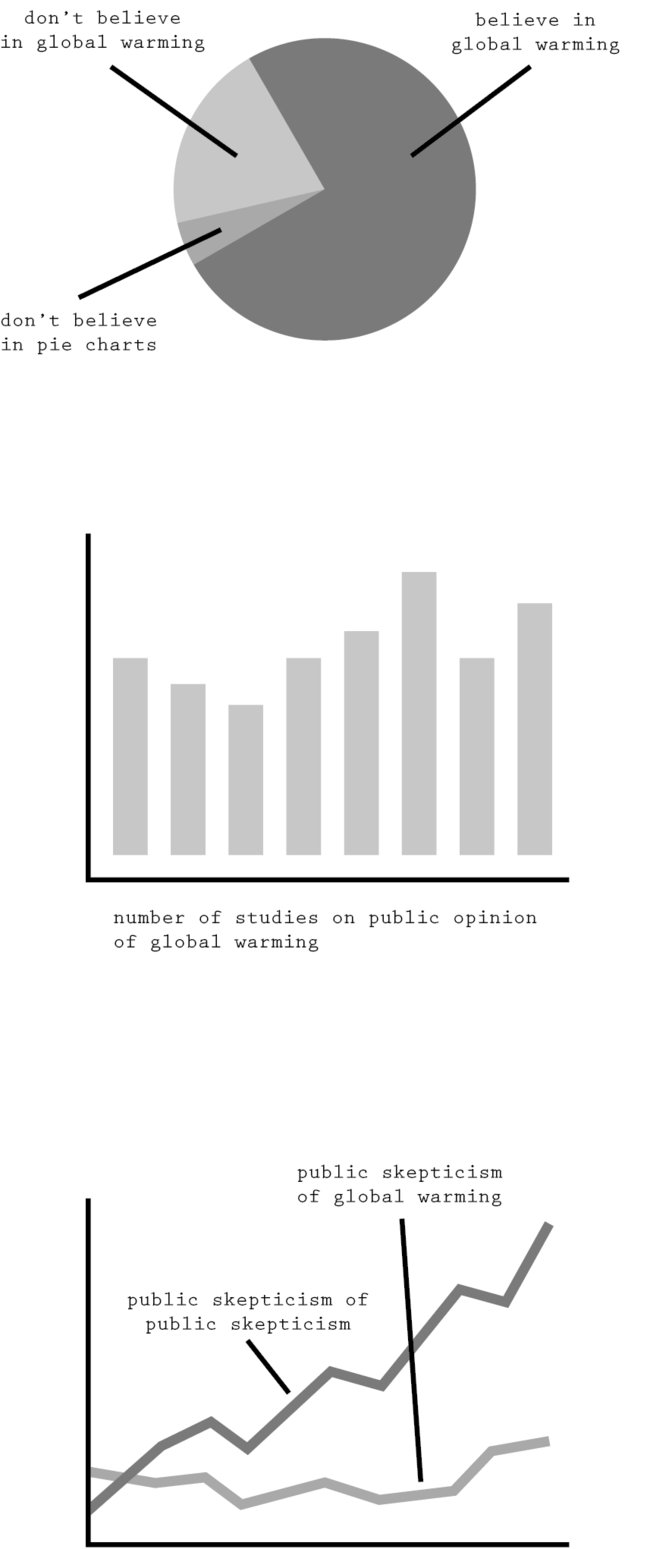
>Climate Fears Turn to Doubts Among Britons (N.Y. Times)

>
By ELISABETH ROSENTHAL
Published: May 24, 2010

LONDON — Last month hundreds of environmental activists crammed into an auditorium here to ponder an anguished question: If the scientific consensus on climate change has not changed, why have so many people turned away from the idea that human activity is warming the planet?

Nowhere has this shift in public opinion been more striking than in Britain, where climate change was until this year such a popular priority that in 2008 Parliament enshrined targets for emissions cuts as national law. But since then, the country has evolved into a home base for a thriving group of climate skeptics who have dominated news reports in recent months, apparently convincing many that the threat of warming is vastly exaggerated.

A survey in February by the BBC found that only 26 percent of Britons believed that “climate change is happening and is now established as largely manmade,” down from 41 percent in November 2009. A poll conducted for the German magazine Der Spiegel found that 42 percent of Germans feared global warming, down from 62 percent four years earlier.

And London’s Science Museum recently announced that a permanent exhibit scheduled to open later this year would be called the Climate Science Gallery — not the Climate Change Gallery as had previously been planned.

“Before, I thought, ‘Oh my God, this climate change problem is just dreadful,’ ” said Jillian Leddra, 50, a musician who was shopping in London on a recent lunch hour. “But now I have my doubts, and I’m wondering if it’s been overhyped.”

Perhaps sensing that climate is now a political nonstarter, David Cameron, Britain’s new Conservative prime minister, was “strangely muted” on the issue in a recent pre-election debate, as The Daily Telegraph put it, though it had previously been one of his passions.

And a poll in January of the personal priorities of 141 Conservative Party candidates deemed capable of victory in the recent election found that “reducing Britain’s carbon footprint” was the least important of the 19 issues presented to them.

Politicians and activists say such attitudes will make it harder to pass legislation like a fuel tax increase and to persuade people to make sacrifices to reduce greenhouse gas emissions.

“Legitimacy has shifted to the side of the climate skeptics, and that is a big, big problem,” Ben Stewart, a spokesman for Greenpeace, said at the meeting of environmentalists here. “This is happening in the context of overwhelming scientific agreement that climate change is real and a threat. But the poll figures are going through the floor.”

The lack of fervor about climate change is also true of the United States, where action on climate and emissions reduction is still very much a work in progress, and concern about global warming was never as strong as in Europe. A March Gallup poll found that 48 percent of Americans believed that the seriousness of global warming was “generally exaggerated,” up from 41 percent a year ago.

Here in Britain, the change has been driven by the news media’s intensive coverage of a series of climate science controversies unearthed and highlighted by skeptics since November. These include the unauthorized release of e-mail messages from prominent British climate scientists at the University of East Anglia that skeptics cited as evidence that researchers were overstating the evidence for global warming and the discovery of errors in a United Nations climate report.

Two independent reviews later found no evidence that the East Anglia researchers had actively distorted climate data, but heavy press coverage had already left an impression that the scientists had schemed to repress data. Then there was the unusually cold winter in Northern Europe and the United States, which may have reinforced a perception that the Earth was not warming. (Data from the National Oceanic and Atmospheric Administration, a United States agency, show that globally, this winter was the fifth warmest in history.)

Asked about his views on global warming on a recent evening, Brian George, a 30-year-old builder from southeast London, mused, “It was extremely cold in January, wasn’t it?”

In a telephone interview, Nicholas Stern, a former chief economist at the World Bank and a climate change expert, said that the shift in opinion “hadn’t helped” efforts to come up with strong policy in a number of countries. But he predicted that it would be overcome, not least because the science was so clear on the warming trend.

“I don’t think it will be problematic in the long run,” he said, adding that in Britain, at least, politicians “are ahead of the public anyway.” Indeed, once Mr. Cameron became prime minister, he vowed to run “the greenest government in our history” and proposed projects like a more efficient national electricity grid.

Scientists have meanwhile awakened to the public’s misgivings and are increasingly fighting back. An editorial in the prestigious journal Nature said climate deniers were using “every means at their disposal to undermine science and scientists” and urged scientists to counterattack. Scientists in France, the Netherlands and the United States have signed open letters affirming their trust in climate change evidence, including one published on May 7 in the journal Science.

In March, Simon L. Lewis, an expert on rain forests at the University of Leeds in Britain, filed a 30-page complaint with the nation’s Press Complaints Commission against The Times of London, accusing it of publishing “inaccurate, misleading or distorted information” about climate change, his own research and remarks he had made to a reporter.

“I was most annoyed that there seemed to be a pattern of pushing the idea that there were a number of serious mistakes in the I.P.C.C. report, when most were fairly innocuous, or not mistakes at all,” said Dr. Lewis, referring to the report by the United Nations Intergovernmental Panel on Climate Change.

Meanwhile, groups like the wildlife organization WWF have posted articles like “How to Talk to a Climate Skeptic,” providing stock answers to doubting friends and relatives, on their Web sites.

It is unclear whether such actions are enough to win back a segment of the public that has eagerly consumed a series of revelations that were published prominently in right-leaning newspapers like The Times of London and The Telegraph and then repeated around the world.

In January, for example, The Times chastised the United Nations climate panel for an errant and unsupported projection that glaciers in the Himalayas could disappear by 2035. The United Nations ultimately apologized for including the estimate, which was mentioned in passing within a 3,000-page report in 2007.

Then came articles contending that the 2007 report was inaccurate on a host of other issues, including African drought, the portion of the Netherlands below sea level, and the economic impact of severe storms. Officials from the climate panel said the articles’ claims either were false or reflected minor errors like faulty citations that in no way diluted the evidence that climate change is real and caused by human activity.

Stefan Rahmstorf, a professor at the Potsdam Institute for Climate Impact Research, successfully demanded in February that some German newspapers remove misleading articles from their Web sites. But such reports have become so common that he “wouldn’t bother” to pursue most cases now, he added.

The public is left to struggle with the salvos between the two sides. “I’m still concerned about climate change, but it’s become very confusing,” said Sandra Lawson, 32, as she ran errands near Hyde Park.

*   *   *

A response to the article above appeared at the Climate progress blog: “Brulle: ‘The NY Times doesn’t need to go to European conferences to find out why public opinion on climate change has shifted…. Just look in the mirror.‘” Access the post here.

>Climate sceptics rally to expose ‘myth’ (BBC)

>
By Roger Harrabin
Environment analyst, BBC News
21 May 2010

In the Grand Ballroom Of Chicago’s Magnificent Mile Hotel, dinner was over.

Beef, of course. A great pink hunk of it from the American Mid-West.

At the world’s biggest gathering of climate change sceptics, organised by the right-wing Heartland Institute, vegetarians were an endangered species.

Wine flowed and blood coursed during a rousing address from Heartland’s libertarian president Joseph Bast. Climate change is being used by governments to oppress the people, he believes.

After years of opposing government rules on smoking and the environment, Mr Bast now aims to forge a global movement of climate sceptics to end the “myth” that humans are endangering the atmosphere.

He urged the audience to spread the word among their families, friends and work colleagues that climate science is too uncertain to guide government policy, and that plans for climate laws in the US would bankrupt the nation.

“We just didn’t realise in those days how important and controversial this would all become” – Professor Roy Spencer, University of Alabama

In turn, he introduced an all-American hero, Harrison Schmitt, one of the last people to walk on the Moon and still going strong.

Mr Schmitt trained as a geologist and like some other geologists believes that climate change is part of a natural fluctuation. He’s also a former Republican Senator and he made the case that the American constitution contains no powers for government to legislate CO2.

The audience, containing some international faces, but mostly American libertarians and Republicans, loved the small-government message.

They cheered when a member of the audience demanded that the “Climategate criminals” – the scientists behind the University of East Anglia (UEA) hacked emails – should be jailed for fraud.

‘Anti-climax’

And the fervour reached a peak when the reluctant hero, Steve McIntyre, shambled on to the stage.

Mr McIntyre is the retired mining engineer who started enquiring into climate statistics as a hobby and whose requests for raw data from the UEA led to a chain of events which have thrown climate science into turmoil.

The crowd rose to applaud him to the stage in recognition of his extraordinary statistical battle to disprove the “Hockey Stick” graph that had become an emblem of man-made global warming.

There was a moment of anticipation as Mr McIntyre stood nervously before the podium – a lugubrious bear of a man resembling a character from Garrison Keillor’s Lake Wobegon.

Steve McIntyre has worked to “break” the hockey stick

“I’m not used to speaking in front of such big crowds,” he mumbled. And he winced a little when one emotional admirer blurted that he had travelled 10,000 miles from South Africa for the thrill of hearing him speak.

But then came a sudden and unexpected anti-climax. Mr McIntyre urged the audience to support the battle for open source data on climate change – but then he counselled them to stop clamouring for the blood of the e-mailers. McIntyre does not want them jailed, or even punished. He just wants them to say they are sorry.

The audience disappointment was tangible – like a houndpack denied the kill.

Mr McIntyre then advised sceptics to stop insisting that the Hockey Stick is a fraud. It is understandable for scientists to present their data in a graphic way to “sell” their message, he said. He understood why they had done it. But their motives were irrelevant.

The standard of evidence required to prove fraud over the Hockey Stick was needlessly high, he said. All that was needed was an acknowledgement by the science authorities that the Hockey Stick was wrong.


Political associations

This was clearly not the sort of emollient message the sceptics expected from one of their heavy hitters. And the speech slipped further into climate pacifism when Mr McIntyre confessed that he did not share the libertarian tendencies of many in the ballroom.

As a Canadian, he said, he was brought up to believe that governments should govern on behalf of the people – so if CO2 were reckoned to be dangerous, it would be the duty of politicians to make laws to cut emissions.

The quiet man said he thought that the work of his climate-statistical website was probably done. He sat down to one-handed applause.

Not so much of a call to arms as a whispered advice to the adversary to lay down his weapons and depart the battlefield.

His message of climate conciliation was reinforced by Tom Harris, founder of the International Climate Science Coalition.

He says he’s not a right-winger, and he told the conference that many scientists sharing his political views had misgivings about establishment climate theory, but would not speak out for fear of being associated with their political opponents or with the fossil fuel industry.

Indeed some moderate climate sceptics told me they have shunned this conference for fear of being publicly associated with a highly-politicised group.

And Sonia Boehmer Christiansen, the British-based climate agnostic (her term), brought to a juddering halt an impassioned anti-government breakfast discussion with a warning to libertarians that they would never win the policy argument on climate unless they could carry people from the Left with them.

Governments needed taxes, she said – and energy taxes – were an efficient way of gathering them.

Cloud effect

Even some right-wingers agreed the need to review the language of scam and fraud. Professor Roy Spencer, for instance, is a climate sceptic scientist from the University of Alabama in Huntsville.

But when I asked him about the future of Professor Phil Jones, the man of the heart of the UEA e-mail affair, he said he had some sympathy.

“He says he’s not very organised. I’m not very organised myself,” said Professor Spencer. “If you asked me to find original data from 20 years ago I’d have great difficulty too.

“We just didn’t realise in those days how important and controversial this would all become – now it would just all be stored on computer. Phil Jones has been looking at climate records for a very long time. Frankly our data set agrees with his, so unless we are all making the same mistake we’re not likely to find out anything new from the data anyway.”

Professor Spencer admits that he is regarded by orthodox climate scientists as a renegade. But as a very conservative Christian he is at home here, and his views carry weight at this meeting.

Like most climate sceptic scientists, he accepts that CO2 is a warming gas – this is basic physics, he says, and very hard to dispute.

But he says his studies on incoming and outgoing Earth radiation measured by satellites suggest that changes in cloudiness are mitigating warming caused by CO2.

He thinks all the world’s climate modellers are wrong to assume that the Earth’s natural systems will augment warming from CO2, and he hopes that a forthcoming paper will prove his case.

He admits that he has been wrong often enough to know it’s easy to be wrong on a subject as complex as the climate. But he says that means the modellers can all be wrong, too.

The key question for the future, he said, was the one that has been asked for the past 30 years with inconclusive answers – how sensitive will the climate be to a doubling of CO2?

‘Climate resilience’

The godfather of climate scepticism Richard Lindzen, professor of meteorology at Massachusetts Institute of Technology (MIT), has been pre-occupied with this question for decades.

He is a member of the US National Academy of Sciences and a former lead author for the IPCC. But he is immensely controversial and his views run directly counter to those of his institute, which, he says, is looking forward to his retirement.

He has been accused of ignoring recent developments in science.

He believes CO2 is probably keeping the Earth warmer than it would otherwise be, but says he is more convinced than ever that the climate will prove increasingly resilient to extra CO2.

He thinks that this greenhouse gas will not increase temperature much more than 1C in total because the positive feedbacks predicted by computer models will not occur.

The final word of this conference – part counter-orthodox science brainstorm, part political rally – was left to a man who is not a scientist at all, Christopher Monckton, former adviser to Mrs Thatcher, now the darling of climate sceptics worldwide.

In a bravura performance he had the audience roaring at his mocking impersonation of “railway engineer Rajendra Pachauri – the Casey Jones of climate change”; hissing with pantomime fury at the “scandal” of Climategate, then emotionally applauding the American troops who have given their lives for the freedom that their political masters are surrendering to the global socialist tyranny of global warming.

His closing words were delivered in a weeping whisper, a soft prayer of praise to the American constitution and individual liberty.

As the ecstatic crowd filtered out I pointed one delegate to a copy of the Wall Street Journal on the table. A front page paragraph noted that April had been the warmest on record.

“So what?” he shrugged. “So what?”

>Política incerta, economia incerta, clima incerto

>
A sucessão de catástrofes é casual ou causal?

Por Mario Soares*
IPS/Envolverde – 21/05/2010 – 10h05

Lisboa, maio/2010 – Até o próprio Pangloss, famoso personagem de Candide de Voltaire, apesar de seu imperturbável otimismo, se veria em dificuldades para enfrentar o mundo contemporâneo. A natureza e a humanidade deram rédeas aos seus respectivos demônios e ninguém pode detê-los. Em diferentes lugares, a Terra reage e nos assesta, sucessivamente: ciclones, maremotos, terremotos, inundações e, ultimamente, a erupção vulcânica na insular Islândia, que paralisou os aeroportos do norte e centro da Europa. Um espetáculo triste e jamais visto.

Trata-se de fenômenos naturais normais, dirão alguns, os menos avisados. Contudo, para aqueles que têm mais de oito décadas vividas, como é meu caso, e nunca viram nem tiveram conhecimento de nada semelhante a esta conjugação sucessiva de catástrofes, é prudente expor a dúvida: será que a mão inconsciente e imprevista do homem, que agride e maltrata o planeta e compromete seu equilíbrio natural, não tem uma boa dose de responsabilidade nestes fatos?

A recente Conferência de Cúpula sobre Mudança Climática em Copenhague, em dezembro passado, que deveria condenar e enfrentar o aquecimento global, resultou em fracasso devido ao suspeito acordo traçado na última hora por China e Estados Unidos. Por uma coincidência – ou talvez não –, estas duas grandes potências são os maiores contaminadores da Terra. A verdade é que conseguiram paralisar o grupo europeu – ao qual não deram a menor importância – e várias delegações procedentes de outros continentes, que esperavam resultados positivos da Conferência Mundial.

Talvez seja mais preocupante a aparição de alguns cientistas que adotam posturas abertamente contrárias ao pensamento e às advertências da esmagadora maioria dos ecologistas, já que afirmam que o aquecimento global não é causado pelas atividades humanas nem pelo abusivo emprego de combustíveis derivados dos hidrocarbonos. Afirmam e reiteram que se trata de um fato natural. Isto me faz pensar que há pessoas capazes de perseguir a todo custo a ganância e sobrepor a qualquer outra consideração a defesa de seus interesses imediatos sem que isso afete suas boas consciências… Se é que as têm.

Estou convencido de que na próxima Conferência Mundial sobre Mudança Climática a verdade científica prevalecerá e que as grandes potências serão obrigadas a respeitar as regras que objetivam conter radicalmente o aquecimento global.

Os riscos que pairam sobre o planeta não são apenas as catástrofes consideradas naturais que se sucedem com inquestionável e preocupante frequência. O terrorismo global continua causando estragos desde 2001, e atualmente são numerosas (excessivas, segundo meu ponto de vista) as nações que dispõem de armamento nuclear. É indispensável colocar um limite a isto. Neste sentido, o acordo que o presidente norte-americano, Barack Obama, conseguiu estabelecer com Rússia e China para reduzir os respectivos arsenais atômicos e obstruir a proliferação por parte de nações que ainda não os possuem – como é o caso do Irã – é um acontecimento notável e de projeções políticas e geoestratégicas extremamente positivas.

Em um mundo tão perigoso como o que nos cabe viver – basta pensar em todos os conflitos armados não resolvidos em todos os continentes –, é preciso reduzir drasticamente a venda livre de armas e propagar a Cultura de Paz, da qual é incansável promotor o ex-diretor-geral da Unesco, Federico Mayor Zaragoza. Ao mesmo tempo, deve-se evitar e controlar até onde for possível todas as formas de incitação à violência que os meios de comunicação, as televisões em particular, propagam constantemente (inconscientemente, ou não), no que não é exagerado qualificar como uma escalada inaceitável.

Todos os governos do mundo que se consideram Estados de Direito e que, portanto, devem respeitar e proteger os direitos humanos têm a consequente obrigação de adotar políticas e medidas para difundir a Cultura de Paz e repudiar, pedagógica e sistematicamente, todas as formas de violência que entram todos os dias em nossas casas para o bem de nossos descendentes e do futuro da humanidade.

Realmente, as ameaças que enfrentamos em nossa época provêm de diversas fontes: de uma política incerta e sem rumo claro, de uma economia sem regras e à espera de melhores dias – não sabemos quantos – para superar a crise, de uma sucessão de calamidades. Já é hora de a cidadania global abrir os olhos, reagir e exigir soluções. IPS/Envolverde

* Mário Soares é ex-presidente e ex-primeiro-ministro de Portugal.

>Bringing Clouds into Focus: A New Global Climate Model May Reduce the Uncertainty of Climate Forecasting

>
John Hules, Berkeley Lab Computing Sciences
May 11, 2010

Clouds exert two competing effects on the Earth’s temperature: they cool the planet by reflecting solar radiation back to space, but they also warm the planet by trapping heat near the surface. These two effects coexist in a delicate balance.

In our current climate, clouds have an overall cooling effect on the Earth. But as global warming progresses, the cooling effect of clouds might be enhanced or weakened—global climate models are evenly divided on this issue. In fact, inter-model differences in cloud feedbacks are considered the principal reason why various models disagree on how much the average global temperature will increase in response to greenhouse gas emissions, when it will happen, and how it will affect specific regions.

The large data sets generated by the GCRM require new analysis and visualization capabilities. This 3D plot of vorticity isosurfaces was developed using VisIt, a 3D visualization tool with a parallel distributed architecture, which is being extended to support the geodesic grid used by the GCRM.
(Image Courtesy of the NERSC Analytics Team)

Clouds also affect climate in other ways, such as transporting heat and moisture from lower to higher altitudes, producing precipitation, and many other interrelated mechanisms. Current global climate models are unable to directly simulate individual cloud systems from physical principles, because the size and speed of supercomputers place a limit on the number of grid cells that can practically be included in the model. As a result, global models do not have fine enough horizontal resolution to represent large clouds.

Instead, global climate models must rely on parameterizations, which are statistical representations of phenomena, such as cloud cover or precipitation rates, that cannot be directly modeled. Different models use different parameterizations, which is an important reason why their results differ. Cloud parameterizations are the greatest source of uncertainty in today’s climate models.

David Randall, a Professor Atmospheric Science at Colorado State University, is working to clear up that uncertainty by developing and testing a new kind of global climate model, called a global cloud resolving model (GCRM)—a model that’s designed to take advantage of the extreme-scale computers expected in the near future.

Randall is the principal investigator of the “Global Cloud Modeling” project that computes at NERSC, and was one of two coordinating lead authors of Chapter 8, “Climate Models and Their Evaluation,” in the Intergovernmental Panel on Climate Change’s (IPCC’s) Fourth Assessment Report, which was honored with the 2007 Nobel Peace Prize. He also directs the Center for Multiscale Modeling of Atmospheric Processes, sponsored by the National Science Foundation.


From a single thunderstorm to the whole earth

“The GCRM is a computer model that simulates the motions of the atmosphere on scales from a single thunderstorm all the way up to the size of the entire earth,” Randall explains. “It has about a billion little grid cells to represent the three-dimensional structure of the air. Each grid cell has a wind, a temperature, a humidity, and some other things that are needed. So the number of numbers involved is in the tens of billions, just as a snapshot of what’s going on at a given second.”

Small grids made up of equilateral triangles, squares, and hexagons. The hexagonal grid has the highest symmetry because all neighboring cells of a given hexagonal cell are located across cell walls. In contrast, with either triangles or squares, some neighbors are across walls, while others are across corners.

Large thunderstorms play an important role in global atmospheric circulation. They pack a lot of energy in the form of updrafts that move, in extreme cases, 30 to 40 meters a second—”scary fast,” Randall says. They “lift air from near Earth’s surface to way up near the stratosphere in just a few minutes.” In this way, thunderstorms carry moisture, momentum, carbon dioxide, and other chemical species through great depths of the atmosphere very quickly.

Cumulus clouds, Randall says, make the upper troposphere wet by transporting water from its source, the oceans. “A lot of it will rain out along the way, but some of it is still left, and it gets spread out up there and makes cirrus clouds, comprised largely of ice, which are very important for climate. We’re especially interested to see how storms that create cirrus affect the climate.” Cirrus clouds block Earth’s infrared radiation from flowing out to space, and that tends to warm the climate. “If we have more cirrus in the future, that will enhance warming. If we have less, it will reduce the warming.”

The GCRM also will give scientists new insights into tropical cyclones, which, Randall says, “are much bigger than thunderstorms, and in fact they contain many thunderstorms simultaneously. They affect the climate in part by cooling the sea surface as they move over the ocean.”

A spherical geodesic grid (a) can be cut into logically rectangular panels (b), which offers a convenient way to organize the data in a computer’s memory. For visual clarity, this depiction shows a very low resolution grid.

The GCRM, supported by the Department of Energy’s Scientific Discovery through Advanced Computing (SciDAC) program, is built on a geodesic grid that consists of about 100 million mostly hexagonal columns, each with 128 levels, representing layers of atmosphere that reach 50 kilometers above the Earth. For each of these grid cells, the model predicts the wind, temperature, and humidity at points just 4 kilometers apart (with a goal of 2 kilometers on the next generation of supercomputers). That’s an unprecedented resolution—most global atmospheric models provide detail at a 100-kilometer scale.

“No one has done this before in quite this manner, and it’s our hope that our project will point the way to future generations of models,” says Randall.

The geodesic grid used in the GCRM, also developed with SciDAC support, is itself quite innovative. If you want to tile a plane with regular polygons, you have only three choices: triangles, squares, or hexagons. Most climate models use some form of square (or rectangular) grid; but the geometry of the grid complicates the calculations, because each square has two different kinds of neighbors—four wall neighbors and four corner neighbors—which require different treatment in the equations. In addition, a square grid poses complications in modeling the Earth’s polar regions, where grid cells lose symmetry because of longitudinal convergence. There are solutions to these problems, but they are computationally expensive.

The GCRM, in contrast, uses a geodesic, hexagonal grid. In a hexagonal grid, all neighbors of a given cell lie across cell walls; there are no corner neighbors. A geodesic grid on a sphere has twelve pentagonal cells in addition to the many hexagonal cells; but each cell still has only wall neighbors, and all cells are roughly the same size. This type of grid also eliminates the pole problem.

As a result, equations constructed on hexagonal grids treat all neighboring cells in the same way, reducing the complexity and increasing the speed, productivity, and accuracy of the code. The number of cells (both grid columns and levels) can easily be changed for a particular computer run, depending on what the researchers want to simulate. Models based on geodesic grids are now being used by several major weather and climate modeling groups around the world.

Vorticity: Where the action is

Climate models are systems of partial differential equations that simulate how the atmosphere and oceans move and change over time, based on the laws of physics, fluid motion, and chemistry. Since the equations are all interrelated, the dynamical core of the model has to solve these equations simultaneously for every grid cell at each time step—which is why climate models require massive computing power.

Because the GCRM has such high resolution, Randall’s research team knew they needed to use equations that reproduce accurate motions at a wide range of scales to get the most realistic results; so team members Akio Arakawa of the University of California, Los Angeles (UCLA), and Celal Konor of Colorado State University (CSU) developed the Unified System of governing equations (so called because it unifies the quasi-hydrostatic compressible system with the nonhydrostatic anelastic system). The Unified System can cover a wide range of horizontal scales, from turbulence to planetary waves. It also filters out vertically propagating sound waves of all scales, without excluding relevant waves such as inertia-gravity waves, Lamb waves, and Rossby waves.

“This project could not have happened without a lot of support from the federal government… We’ve been computing at NERSC for more than a decade, and it’s been an excellent experience. We have a lot of respect for and gratitude to everyone at NERSC for all the excellent support they have given us over the years,”

—David Randall, Professor Atmospheric Science at Colorado State University

“The atmosphere can make lots of different kinds of waves” Randall says, “but in choosing equations we knew we wanted to avoid those that include sound waves, because sound waves are completely irrelevant to weather and climate. Because sound moves too fast, if you include sound waves in your model, you have to take very small time steps. If you eliminate sound waves completely, then you can take much longer time steps. There have been other ways to get rid of them in the past, but they’ve been considerably less accurate. The new method that we’ve developed does involve approximations, because you’re leaving something out, but it has much smaller errors that are, we believe, quite acceptable.”

Another key feature of the Unified System is that it solves the three-dimensional vector vorticity equation rather than the vector momentum equation. Vorticity, or spinning motion, “is really at the core of much of the important fluid dynamics in the atmosphere,” Randall says. “Vortices move around and maintain their identities and live a life, like little animals. Sometimes two vortices will merge and make a bigger one. Almost everything that is interesting and important in the motion of the atmosphere predominantly involves the spinning part.”

Most climate models use the momentum equation because it is easier to solve than the vorticity equation, and vorticity can be derived from momentum. But Akio Arakawa of UCLA and Joon-Hee Jung of CSU found a more efficient way of solving the vorticity equation that represents the important spinning motions much more directly and explicitly than the momentum equation does. “You really have to get that spinning part right, because that’s where most of the action is,” Randall explains. “Working with the vorticity equation directly means focusing in on the part of the physics that is most important to what we care about.

The component algorithms in the GCRM were selected for their good scaling properties, so the model scales linearly with the number of grid cells used. “Depending on the details of the configuration, we can do a few simulated days per wall clock day on 40,000 processors of Franklin,” Randall says. “Which means that doing a whole year is a very big calculation—it might be like a hundred days continuously around the clock on 40,000 processors or more—a big chunk of a very expensive machine. So what we’re doing is just barely doable now.”

“But in ten more years,” he adds, “we expect computers to be a hundred times faster, whether it’s Green Flash or some other system. Then we’ll be getting, say, a simulated year for a wall-clock day. That’s a big improvement. You can start thinking about doing simulated decades or even longer. You’re almost getting into the climate regime of about a century. So that’s exciting.”

“This project could not have happened without a lot of support from the federal government, especially the Department of Energy. We have to use the very fastest, most powerful machines in the world, and DOE, of course, is where you go for that. They’re ‘Supercomputing Central.’ We’ve been computing at NERSC for more than a decade, and it’s been an excellent experience. We have a lot of respect for and gratitude to everyone at NERSC for all the excellent support they have given us over the years.”

Further computational challenges

The development of a geodesic dynamical core with a unique system of equations was the major, but not the only computational challenge. Other challenges include parallel input/output (I/O), including storage, management, and distribution of the voluminous output, and visualization of the results. The SciDAC Scientific Application Partnership titled “Community Access to Global Cloud Resolving Model and Data,” led by Karen Schuchardt of Pacific Northwest National Laboratory, has been working to address those issues (see sidebar).

As for Randall’s group, they are now adding parameterizations of various physical processes, such as cloud microphysics, to the dynamical core of the GCRM, and they are also working on a method to include topography in the model, which will add vertically propagating waves produced by air flow over mountains. While continuing to run various tests on Franklin at NERSC, including numerical accuracy, stability, and parallel scaling performance, they are also running larger tests on up to 80,000 cores of Jaguar, a Cray XT system at the Oak Ridge Leadership Computing Facility (OLCF).

Early tests of the model will span just a few simulated days and will focus on short-range global weather prediction, starting from high-resolution analyses produced by working weather prediction centers. Tropical cyclones and other extreme weather events will be particular areas of focus. By 2011, the researchers plan to use the GCRM to perform two or more annual-cycle simulations, at least one of which will be coupled to the geodesic ocean general circulation model that they developed under SciDAC Phase 1.

Within the next ten years or so, models similar to the GCRM will be used for operational weather prediction, and eventually GCRMs will be used for multi-century climate simulations. The Green Flash project may make this possible sooner rather than later. The long-term target resolution for a Green Flash system is a horizontal grid spacing of about 1 km, which will require approximately 671 million grid columns, each with about 100 layers.

About NERSC and Berkeley Lab

The National Energy Research Scientific Computing Center (NERSC) is the primary high-performance computing facility for scientific research sponsored by the U.S. Department of Energy’s Office of Science. Berkeley Lab is a U.S. Department of Energy national laboratory located in Berkeley, California. It conducts unclassified scientific research and is managed by the University of California for the DOE Office of Science.

For more information about computing sciences at Berkeley Lab, please visit: http://www.lbl.gov/cs

>The root of the climate email fiasco (The Guardian)

>
Learning forced into silos of humanities and science has created closed worlds of specialists who just don’t understand each other

George Monbiot
The Guardian, Tuesday 6 April 2010

The MPs were kind to Professor Phil Jones. During its hearings, the Commons science and technology committee didn’t even ask the man at the centre of the hacked climate emails crisis about the central charge he faces: that he urged other scientists to delete material subject to a freedom of information request. Last week the committee published its report, and blamed his university for the “culture of non-disclosure” over which Jones presided.

Perhaps the MPs were swayed by the disastrous performance of his boss at the hearings. Edward Acton, the vice-chancellor of the University of East Anglia, came across as flamboyant, slippery and insincere. Jones, on the other hand, seemed both deathly dull and painfully honest. How could this decent, nerdy man have messed up so badly?

None of it made sense: the intolerant dismissal of requests for information, the utter failure to engage when the hacked emails were made public, the refusal by other scientists to accept that anything was wrong. Then I read an article by the computer scientist Steve Easterbrook, and for the first time the light began to dawn.

Easterbrook, seeking to defend Jones and his colleagues, describes a closed culture in which the rest of the world is a tedious and incomprehensible distraction. “Scientists normally only interact with other scientists. We live rather sheltered lives … to a scientist, anyone stupid enough to try to get scientific data through repeated FoI requests quite clearly deserves our utter contempt. Jones was merely expressing (in private) a sentiment that most scientists would share – and extreme frustration with people who clearly don’t get it.”

When I read that, I was struck by the gulf between our worlds. To those of us who clamoured for freedom of information laws in Britain, FoI requests are almost sacred. The passing of these laws was a rare democratic victory; they’re among the few means we possess of ensuring that politicians and public servants are answerable to the public. What scientists might regard as trivial and annoying, journalists and democracy campaigners see as central and irreducible. We speak in different tongues and inhabit different worlds.

I know how it happens. Like most people with a science degree, I left university with a store of recondite knowledge that I could share with almost no one. Ill-equipped to understand any subject but my own, I felt cut off from the rest of the planet. The temptation to retreat into a safe place was almost irresistible. Only the extreme specialisation demanded by a PhD, which would have walled me in like an anchorite, dissuaded me.

I hated this isolation. I had a passionate interest in literature, history, foreign languages and the arts, but at the age of 15 I’d been forced, like all students, to decide whether to study science or humanities. From that point we divided into two cultures, and the process made idiots of us all. Perhaps eventually we’ll split into two species. Reproducing only with each other, scientists will soon become so genetically isolated that they’ll no longer be able to breed with other humans.

We all detest closed worlds: the Vatican and its dismissal of the paedophilia scandals as “idle chatter”; the Palace of Westminster, whose members couldn’t understand the public outrage about their expenses; the police forces that refuse to discipline errant officers. Most of us would endorse George Bernard Shaw’s opinion that all professions are conspiracies against the laity. Much of the public hostility to science arises from the perception that it’s owned by a race to which we don’t belong.

But science happens to be the closed world with one of the most effective forms of self-regulation: the peer review process. It is also intensely competitive, and the competition consists of seeking to knock each other down. The greatest scientific triumph is to falsify a dominant theory. It happens very rarely, as only those theories which have withstood constant battery still stand. If anyone succeeded in overturning the canon of climate science, they would soon become as celebrated as Newton or Einstein. There are no rewards for agreeing with your colleagues, tremendous incentives to prove them wrong. These are the last circumstances in which a genuine conspiracy could be hatched.

But it is no longer sufficient for scientists to speak only to each other. Painful and disorienting as it is, they must engage with that irritating distraction called the rest of the world. Everyone owes something to the laity, and science would die if it were not for the billions we spend on it. Scientists need make no intellectual concessions, but they have a duty to understand the context in which they operate. It is no longer acceptable for climate researchers to wall themselves off and leave the defence of their profession to other people.

There are signs that this is changing. The prominent climate change scientist Simon Lewis has just sent a long submission to the Press Complaints Commission about misrepresentation in the Sunday Times. The paper claimed that the Intergovernmental Panel on Climate Change’s contention that global warming could destroy up to 40% of the Amazon rainforest “was based on an unsubstantiated claim by green campaigners who had little scientific expertise”. It quoted Lewis to suggest he supported the story. The article and its claims were reproduced all over the world.

But the claims were wrong: there is solid scientific research showing damage on this scale is plausible in the Amazon. Lewis claims that the Sunday Times falsely represented his views. He left a comment on the website but it was deleted. He sent a letter to the paper but it wasn’t published. Only after he submitted his complaint to the PCC did the Sunday Times respond to him. The paper left a message on his answerphone, which he has made public: “It’s been recognised that the story was flawed.” After seven weeks of stonewalling him, the Sunday Times offered to run his letter. But it has neither taken down the flawed article nor published a correction.

Good luck to Lewis, but as the PCC’s treatment of the News of the World phone-hacking scandal suggests, he’s likely to find himself shut out of another closed world – journalism – in which self-regulation manifestly doesn’t work. Here’s a profession that looks like a conspiracy against the laity even from the inside.

The incomprehension with which science and humanities students regard each other is a tragedy of lost opportunities. Early specialisation might allow us to compete in the ever more specialised labour market, but it equips us for nothing else. As Professor Don Nutbeam, the vice-chancellor of Southampton University, complains: “Young people learn more and more about less and less.”

We are deprived by our stupid schooling system of most of the wonders of the world, of the skills and knowledge required to navigate it, above all of the ability to understand each other. Our narrow, antiquated education is forcing us apart like the characters in a Francis Bacon painting, each locked in our boxes, unable to communicate.

>Should geoengineering tests be governed by the principles of medical ethics?

>
Rules for Planet Hackers

By Eli Kintisch
Thu Apr. 22, 2010 1:00 AM PDT

[Image: Flickr/indigoprime (Creative Commons)]

Nearly 200 scientists from 14 countries met last month at the famed Asilomar retreat center outside Monterey, California, in a very deliberate bid to make history. Their five-day meeting focused on setting up voluntary ground rules for research into giant algae blooms, cloud-brightening, and other massive-scale interventions to cool the planet. It’s unclear how significant the meeting will turn out to be, but the intent of its organizers was unmistakable: By choosing Asilomar, they hoped to summon the spirit of a groundbreaking meeting of biologists that took place on the same site in 1975. Back then, scientists with bushy sideburns and split collars—the forefathers of the molecular revolution, it turned out—established principles for the safe and ethical study of deadly pathogens.

The planners of Asilomar II, as they called it, hoped to accomplish much the same for potentially dangerous experiments in geoengineering. Instead of devising new medical treatments for people, the scientists involved in planet-hacking research are after novel ways to treat the Earth. The analogy of global warming to a curable disease was central to the discussions at the meeting. Climate scientist Steve Schneider of Stanford talked about administering “planetary methadone to get over our carbon addiction.” Others debated what “doses” of geoengineering would be necessary. Most crucially, the thinkers at Asilomar focused on the idea that medical ethics might provide a framework for balancing the risks and benefits of all this new research.

What would it mean to apply the established principles of biomedical research to the nascent field of geoengineering? The ethicists at Asilomar—particularly David Winickoff from Berkeley and David Morrow from the University of Chicago—began with three pillars laid out in the landmark 1979 Belmont Report. The first, respect for persons, says that biomedical scientists should obtain “informed consent” from their test subjects. The second, beneficence, requires that scientists assess the risks and benefits of a given test before they start. The third, justice, invokes the rights of research subjects to whatever medical advances result from the testing. (The people who are placed at risk should be the same ones who might benefit from a successful result.)

Then Winickoff and Morrow proposed applying the Belmont principles to the study of the most aggressive forms of geoengineering—the ones that would block the sun, like a volcanic eruption does, with a spray of sulfur or other particles into the stratosphere. Before we could embark on a radical intervention like that, we’d need to run smaller-scale tests that might themselves pose a risk to the environment. In much the way that a clinical drug trial might produce adverse reactions, so might a real-world trial of, say, the Pinatubo Option. Instead of causing organ failure or death in its subjects, a botched course of geoengineering might damage the ozone layer or reduce rainfall.

The problem, admitted the ethicists, is how to go about applying the Belmont rules outside of medicine. In clinical drug trials, researchers obtain consent from individuals, and they can precisely define the worse-case outcome (like death). But a trial run of hazing up the stratosphere wouldn’t affect specific, identifiable people in any one town, city, or state. The climate is interconnected in many ways, some still mysterious to scientists, and so the risks of even a small-scale test in a particular location might apply across the globe. If everyone on Earth could be affected, how do you figure out whom to ask for informed consent?

One possibility would be to require that all nations of the world agree ahead of time on any tests of consequence. To many gathered at Asilomar, however, this seemed naive; speakers repeatedly invoked the failure of all-inclusive talks to cut global carbon emissions, and it would presumably be much tougher to secure an agreement on work that might damage crop yields or open a hole in the ozone. A more pragmatic approach would be to set up something like a United Nations Planet Hacking Security Council, comprising 15 or so powerful nations whose oversight of research tests would take into account the concerns of a broad swath of countries. But that undemocratic approach would surely face howls of protest.

The principle of beneficence may be just as difficult to follow. Under the Belmont guidelines, doctors must balance the particular risks of a clinical trial with the potential benefit to any individual who might participate. Since it would be impossible to make such a calculation for every person on Earth, planet hackers could at best choose the experiments that minimize harm to the most vulnerable communities—like people living on the coasts of Southeast Asia. But we may not know enough about the risks of geoengineering to make any such credible calculation when the time comes. Consider the Pinatubo Option, by which scientists would mimic the cooling effect of volcanoes. Putting particles in the stratosphere could reduce the total amount of energy that strikes the Earth. Some climate modelers say this would disrupt rainfall by reducing moisture in the atmosphere obtained by evaporation. Others say that geoengineering’s droughts and famines would be less harmful than those caused by unchecked warming. Right now, no one can agree on the nature of the risks, let alone the degree to which they would apply to particular communities.

And what about justice? Among the disruptions that could result from testing the Pinatubo Option is a weakening of the Asian monsoon, a source of water for hundreds of millions of people in India. Those in developing countries will “eat the risk” of geoengineering trials, shouted one of the Asilomar speakers. If representatives from just a small set of countries were appointed as doctors to the planet, then the less powerful nations might end up as the world’s guinea pigs. Of course, the citizens of those nations also would seem to have the most to lose from uninterrupted global warming. These two dangers would have to be measured one against the other—and compensation as part of the experimental program could be one way of making tests more fair.

If medical ethics aren’t quite up to the task of guiding our forays into geoengineering, what other sort of principles should we keep in mind? One important danger to be aware of is the moral hazard that might come with successful trials. That’s the idea that protective circumstances or actions can encourage people to take undue risks—government insurance of banks led to risky investments that caused the savings-and-loan crisis in the 1980s, for example. Moral hazard looms particularly large for geoengineering studies since medium-scale field tests could prematurely give us the sense that we have a low-cost technical fix for global warming, no emissions cuts needed. (Moral hazard isn’t quite as potent in medical research. The availability of cholesterol-lowering drugs may well discourage people from maintaining healthy diets, but it’s unlikely that mere clinical trials would have the same effect.)

Another ethical principle that might apply to geoengineering is minimization—the idea that, a priori, it’s better to tinker at the smallest possible scale necessary to answer vital scientific questions. This notion comes from the ethics of animal experimentation; now we might apply it to planetary systems and the environment more broadly. Up until now, the medical ethics frame for geoengineering has guided discussions of how geoengineering might affect people in various countries. Perhaps we should be talking about how it affects the planet itself.

By that token, we might gain something by thinking of the Earth as a patient on its own terms. The rules and regulations we come up with for tests of geoengineering should take into account the way those experiments might affect ecosystems and nonhuman animals, both under threat from warming. And so maybe the most famous piece of medical ethics ought to apply: the Hippocratic Oath. “First, do no harm” is the crux of the original, but an updated version exhorts doctors to avoid “the twin traps of overtreatment and therapeutic nihilism.” The climate crisis may force us to act despite myriad ethical challenges, for our benefit and for the planet’s.

This piece was produced by Slate as part of the Climate Desk collaboration.

Eli Kintisch is a reporter at Science and author of a new book on geoengineering, Hack the Planet.

>Mudanças climáticas: "caça às bruxas" direcionada a cientistas na Virginia (EUA)

>
An unwelcome ‘climate’ for scientists?

By Paul Guinnessy, Physics Today on May 11, 2010 6:34 PM

Virginia Attorney General Ken Cuccinelli, in a blatantly political move to help strengthen his support among the right wing for his bid to become the next governor, is causing uproar in the science community by investigating climate scientist and former University of Virginia professor Michael Mann.

Cuccinelli is accusing Mann of defrauding Virginia taxpayers by receiving research grants to study global temperatures. Mann, who is now based at the Pennsylvania State University, hasn’t worked in Virginia since 2005.

The subpoena, which currently isn’t attached to any lawsuit, requires the University of Virginia to provide Cuccinelli with thousands of documents and e-mails dating from 1999 to 2005 regarding Mann’s research. The accusation is tied to Mann and coworkers’ “hockey stick” graph that was included in a 2001 United Nations Intergovernmental Panel on Climate Change report. The graph displays annual global average temperatures by merging a wide variety of data sources that were used in some private e-mails made public when the University of East Anglia’s Climate Research Unit e-mail server got hacked.

Not answering the question

When Cuccinelli appeared on the Kojo Nnamdi Show on WAMU radio on Friday, he claimed the investigation was not into Mann’s academic work, but instead was “directed at the expenditure of dollars. Whether he does a good job, bad job or I don’t like the outcome—and I think everybody already knows his position on some of this is one that I question. But that is not what that’s about.”

However, the letter demanding materials gives a different impression. It asks, along with Mann’s correspondence with 39 other climate scientists, for “any and all computer algorithms, programs, source code, or the like created or edited by … Mann.”

This was emphasized when Cuccinelli spoke to the Washington Post, stating “in light of the Climategate e-mails, there does seem to at least be an argument to be made that a course was undertaken by some of the individuals involved, including potentially Michael Mann, where they were steering a course to reach a conclusion. Our act, frankly, just requires honesty.”

There hasn’t been an investigation by Virginia’s attorney general’s office into the funding of research grants of this nature before. Moreover, only one of the five grants under suspicion was funded by Virginia taxpayers through the university; the others were federal grants from the National Oceanic and Atmospheric Administration and the National Science Foundation.

No backbone?

The University of Virginia was originally going to succumb to Cuccinelli’s request. In a statement released to the press last Thursday the university said it was “required by law to comply.”

Shortly afterward, the University of Virginia Faculty Senate Executive Council issued its own statement, which ends:

We maintain that peer review by the scientific community is the appropriate means by which to identify error in the generation, presentation and interpretation of scientific data. The Attorney General’s use of his power to issue a CID under the provisions of Virginia’s FATA is an inappropriate way to engage with the process of scientific inquiry. His action and the potential threat of legal prosecution of scientific endeavor that has satisfied peer-review standards send a chilling message to scientists engaged in basic research involving Earth’s climate and indeed to scholars in any discipline. Such actions directly threaten academic freedom and, thus, our ability to generate the knowledge upon which informed public policy relies.

This was shortly followed by a joint letter to the university from the American Civil Liberties Union and the American Association of University Professors asking the University of Virginia to follow procedures to appeal the subpoena.

The letters seem to have had some effect: The Washington Post reported that the university is now “considering” its options before the Friday deadline to appeal is up.

State Senator Donald McEachin issued a statement, in which he stated he will submit a bill so that in the future the attorney general cannot issue a subpoena without also issuing a lawsuit.

“This is not only ludicrous and frivolous, wasting more taxpayer dollars and trampling on academic freedom, but the Attorney General has deprived Mr. Mann of his constitutional rights,” said McEachin.

Part of a bigger trend

On Friday, although it was put together before Cuccinelli issued his subpoena, Science published a letter by 255 members of the National Academy of Sciences, decrying “political assaults” against climate scientists and “McCarthy-like threats of criminal prosecution” and spelling out again the basic facts of what we know about the changing climate.

The letter was triggered by veiled threats from Senator James Inhofe, a well-known climate-change denier, to criminally investigate scientists over their research, and the political response to the CRU e-mails.

According to Peter Gleick, president of the Pacific Institute, a research center in Oakland, California—who spoke with New York Times reporter Sindya N. Bhanoo—before the NAS members gave the letter to Science, the group had first submitted it to the Wall Street Journal, the New York Times, and the Washington Post, all of whom declined to run it.

>The delicate wine grape has become our best early-warning system for the effects of global warming (Slate)

>
climate desk – In Vino Veritas

The delicate wine grape has become our best early-warning system for the effects of global warming.

By Mark Hertsgaard
Posted Monday, April 26, 2010, at 11:01 AM ET

John Williams has been making wine in California’s Napa Valley for nearly 30 years, and he farms so ecologically that his peers call him Mr. Green. But if you ask him how climate change will affect Napa’s world-famous wines, he gets irritated, almost insulted. “You know, I’ve been getting that question a lot recently, and I feel we need to keep this issue in perspective,” he told me. “When I hear about global warming in the news, I hear that it’s going to melt the Arctic, inundate coastal cities, displace millions and millions of people, spread tropical diseases and bring lots of other horrible effects. Then I get calls from wine writers and all they want to know is, ‘How is the character of cabernet sauvignon going to change under global warming?’ I worry about global warming, but I worry about it at the humanity scale, not the vineyard scale.”

Williams is the founder of Frog’s Leap, one of the most ecologically minded wineries in Napa and, for that matter, the world. Electricity for the operation comes from 1,000 solar panels erected along the merlot vines; the heating and cooling are supplied by a geothermal system that taps into the Earth’s heat. The vineyards are 100 percent organic and—most radical of all, considering Napa’s dry summers—there is no irrigation.

Yet despite his environmental fervor, Williams dismisses questions about preparing Frog’s Leap for the impacts of climate change. “We have no idea what effects global warming will have on the conditions that affect Napa Valley wines, so to prepare for those changes seems to me to be whistling past the cemetery,” he says, a note of irritation in his voice. “All I know is, there are things I can do to stop, or at least slow down, global warming, and those are things I should do.”

Williams has a point about keeping things in perspective. At a time when climate change is already making it harder for people in Bangladesh to find enough drinking water, it seems callous to fret about what might happen to premium wines. But there is much more to the question of wine and climate change than the character of pinot noir. Because wine grapes are extraordinarily sensitive to temperature, the industry amounts to an early-warning system for problems that all food crops—and all industries—will confront as global warming intensifies. In vino veritas, the Romans said: In wine there is truth. The truth now is that the Earth’s climate is changing much faster than the wine business, and virtually every other business on Earth, is preparing for.

All crops need favorable climates, but few are as vulnerable to temperature and other extremes as wine grapes. “There is a fifteenfold difference in the price of cabernet sauvignon grapes that are grown in Napa Valley and cabernet sauvignon grapes grown in Fresno,” in California’s hot Central Valley, says Kim Cahill, a consultant to the Napa Valley Vintners’ Association. “Cab grapes grown in Napa sold [in 2006] for $4,100 a ton. In Fresno the price was $260 a ton. The difference in average temperature between Napa and Fresno was 5 degrees Fahrenheit.”

Numbers like that help explain why climate change is poised to clobber the global wine industry, a multibillion-dollar business whose decline would also damage the much larger industries of food, restaurants, and tourism. Every business on Earth will feel the effects of global warming, but only the ski industry—which appears doomed in its current form—is more visibly targeted by the hot, erratic weather that lies in store over the next 50 years. In France, the rise in temperatures may render the Champagne region too hot to produce fine champagne. The same is true for the legendary reds of Châteauneuf du Pape, where the stony white soil’s ability to retain heat, once considered a virtue, may now become a curse. The world’s other major wine-producing regions—California, Italy, Spain, Australia—are also at risk.

If current trends continue, the “premium wine grape production area [in the United States] … could decline by up to 81 percent by the late 21st century,” a team of scientists wrote in a study published in the Proceedings of the National Academy of Sciences in 2006. The culprit was not so much the rise in average temperatures but an increased frequency of extremely hot days, defined as above 35 degrees Celsius (95 degrees Fahrenheit). If no adaptation measures were taken, these increased heat spikes would “eliminate wine grape production in many areas of the United States,” the scientists wrote.

In theory, winemakers can defuse the threat by simply shifting production to more congenial locations. Indeed, Champagne grapes have already been planted in England and some respectable vintages harvested. But there are limits to this strategy. After all, temperature is not the sole determinant of a wine’s taste. What the French call terroir—a term that refers to the soil of a given region but also includes the cultural knowledge of the people who grow and process grapes—is crucial. “Wine is tied to place more than any other form of agriculture, in the sense that the names of the place are on the bottle,” says David Graves, the co-founder of the Saintsbury wine company in the Napa Valley. “If traditional sugar-beet growing regions in eastern Colorado had to move north, nobody would care. But if wine grapes can’t grow in the Napa Valley anymore—which is an extreme statement, but let’s say so for the sake of argument—suddenly you have a global warming poster child right up there with the polar bears.”

A handful of climate-savvy winemakers such as Graves are trying to rouse their colleagues to action before it is too late, but to little avail. Indeed, some winemakers are actually rejoicing in the higher temperatures of recent years. “Some of the most expensive wines in Spain come from the Rioja Alta and Rioja Alavesa regions,” Pancho Campo, the founder and president of the Wine Academy of Spain, says. “They are getting almost perfect ripeness every year now for Tempranillo. This makes the winemakers say, ‘Who cares about climate change? We are getting perfect vintages.’ The same thing has happened in Bordeaux. It is very difficult to tell someone, ‘This is only going to be the case for another few years.’ “

The irony is, the wine business is better situated than most to adapt to global warming. Many of the people in the industry followed in their parents’ footsteps and hope to pass the business on to their kids and grandkids someday. This should lead them to think further ahead than the average corporation, with its obsessive focus on this quarter’s financial results. But I found little evidence this is happening.

The exception: Alois Lageder’s family has made wine in Alto Adige, the northernmost province in Italy, since 1855. The setting, at the foot of the Alps, is majestic. Looming over the vines are massive outcroppings of black and gray granite interspersed with flower-strewn meadows and wooded hills that inevitably call to mind The Sound of Music. Locals admire Lageder for having led Alto Adige’s evolution from producing jug wine to boasting some of the best whites in Italy. In October 2005, Lageder hosted the world’s first conference on the future of wine under climate change. “We must recognize that climate change is not a problem of the future,” Lageder told his colleagues. “It is here today and we must adapt now.”

As it happens, Alto Adige is the location of one of the most dramatic expressions of modern global warming: the discovery of the so-called Iceman—the frozen remains of a herder who lived in the region 5,300 years ago. The corpse was found in 1991 in a mountain gully, almost perfectly preserved—even the skin was intact—because it had lain beneath mounds of snow and ice since shortly after his death (a murder, forensic investigators later concluded from studying the trajectory of an arrowhead lodged in his left shoulder). He would not have been found were it not for global warming, says Hans Glauber, the director of the Alto Adige Ecological Institute: “Temperatures have been rising in the Alps about twice as fast as in the rest of the world,” he notes.

Lageder heard about global warming in the early 1990s and felt compelled to take action. It wasn’t easy—”I had incredible fights with my architect about wanting good insulation,” he says—but by 1996 he had installed the first completely privately financed solar-energy system in Italy. He added a geothermal energy system as well. Care was taken to integrate these cutting-edge technologies into the existing site; during a tour, I emerged from a dark fermentation cellar with its own wind turbine into the bright sunlight of a gorgeous courtyard dating to the 15th century. Going green did make the renovation cost 30 percent more, Lageder says, “but that just means there is a slightly longer amortization period. In fact, we made up the cost difference through increased revenue, because when people heard about what we were doing, they came to see it and they ended up buying our wines.”

The record summer heat that struck Italy and the rest of Europe in 2003, killing tens of thousands, made Lageder even more alarmed. “When I was a kid, the harvest was always after Nov. 1, which was a cardinal date,” he told me. “Nowadays, we start between the 5th and 10th of September and finish in October.” Excess heat raises the sugar level of grapes to potentially ruinous levels. Too much sugar can result in wine that is unbalanced and too alcoholic—wine known as “cooked” or “jammy.” Higher temperatures may also increase the risk of pests and parasites, because fewer will die off during the winter. White wines, whose skins are less tolerant of heat, face particular difficulties as global warming intensifies. “In 2003, we ended up with wines that had between 14 and 16 percent alcohol,” Lageder recalled, “whereas normally they are between 12 and 14 percent. The character of our wine was changing.”

A 2 percent increase in alcohol may sound like a tiny difference, but the effect on a wine’s character and potency is considerable. “In California, your style of wine is bigger, with alcohol levels of 14 and 15, even 16 percent,” Lageder continued. “I like some of those wines a lot. But the alcohol level is so high that you have one glass and then”—he slashed his hand across his throat—”you’re done; any more and you will be drunk. In Europe, we prefer to drink wine throughout the evening, so we favor wines with less alcohol. Very hot weather makes that harder to achieve.”

There are tricks grape growers and winemakers can use to lower alcohol levels. The leaves surrounding the grapes can be allowed to grow bushier, providing more shade. Vines can be replaced with different clones or rootstocks. Growing grapes at higher altitudes, where the air is cooler, is another option. So is changing the type of grapes being grown.

But laws and cultural traditions currently stand in the way of such adaptations. So-called AOC laws (Appellation d’Origine Côntrollée) govern wine-grape production throughout France, and in parts of Italy and Spain, as well. As temperatures rise further, these AOC laws and kindred regulations are certain to face increased challenge. “I was just in Burgundy,” Pancho Campo told me in March 2008, “and producers there are very concerned, because they know that chardonnay and pinot noir are cool-weather wines, and climate change is bringing totally the contrary. Some of the producers were even considering starting to study Syrah and other varieties. At the moment, they are not allowed to plant other grapes, but these are questions people are asking.”

The greatest resistance, however, may come from the industry itself. “Some of my colleagues may admire my views on this subject, but few have done much,” says Lageder. “People are trying to push the problem away, saying, ‘Let’s do our job today and wait and see in the future if climate change becomes a real problem.’ But by then it will be too late to save ourselves.”

If the wine industry does not adapt to climate change, life will go on—with less conviviality and pleasure, perhaps, but it will go on. Fine wine will still be produced, most likely by early adapters such as Lageder, but there will be less of it. By the law of supply and demand, that suggests the best wines of tomorrow will cost even more than the ridiculous amounts they fetch today. White wine may well disappear from some regions. Climate-sensitive reds such as pinot noir are also in trouble. It’s not too late for winemakers to save themselves through adaptation. But it’s disconcerting to see so much dawdling in an industry with so much incentive to act. If winemakers aren’t motivated to adapt to climate change, what businesses will be?

The answer seems to be very few. Even in Britain, where the government is vigorously championing adaptation, the private sector lags in understanding the adaptation imperative, much less implementing it. “I bet if I rang up 100 small businesses in the U.K. and mentioned adaptation, 90 of them wouldn’t know what I was talking about,” says Gareth Williams, who works with the organization Business in the Community, helping firms in northeast England prepare for the storms and other extreme weather events that scientists project for the region. “When I started this job, I gave a presentation to heads of businesses,” said Williams, who spent most of his career in the private sector. “I presented the case for adaptation, and in the question-and-answer period, one executive said, ‘We’re doing quite a lot on adaptation already.’ I said, ‘Oh, what’s that?’ He said, ‘We’re recycling, and we’re looking at improving our energy efficiency.’ I thought to myself, ‘Oh, my, he really didn’t get it at all. This is going to be a struggle.’ “

“Most of us are not very good at recognizing our risks until we are hit by them,” explains Chris West, the director of the U.K. government’s Climate Impact Program. “People who run companies are no different.” Before joining UKCIP in 1999, West had spent most of his career working to protect endangered species. Now, the species he is trying to save is his own, and the insights of a zoologist turn out to be quite useful. Adapting to changing circumstances is, after all, the essence of evolution—and of success in the modern economic marketplace. West is fond of quoting Darwin: “It is not the strongest of the species that survives … nor the most intelligent that survives. It is the one that is the most adaptable to change.”

This story comes from the Climate Desk collaboration.

Article URL: http://www.slate.com/id/2251870/

>Climate scepticism ‘on the rise’, BBC poll shows

>
The number of British people who are sceptical about climate change is rising, a poll for BBC News suggests.

BBC News, Sunday, 7 February 2010

The Populus poll of 1,001 adults found 25% did not think global warming was happening, an increase of 10% since a similar poll was conducted in November.

The percentage of respondents who said climate change was a reality had fallen from 83% in November to 75% this month.

And only 26% of those asked believed climate change was happening and “now established as largely man-made”.

The findings are based on interviews carried out on 3-4 February.

In November 2009, a similar poll by Populus – commissioned by the Times newspaper – showed that 41% agreed that climate change was happening and it was largely the result of human activities.

“It is very unusual indeed to see such a dramatic shift in opinion in such a short period,” Populus managing director Michael Simmonds told BBC News.

“The British public are sceptical about man’s contribution to climate change – and becoming more so,” he added.

“More people are now doubters than firm believers.”

The Department for Environment, Food and Rural Affairs’ (Defra) chief scientific adviser, Professor Bob Watson, called the findings “very disappointing”.

“The fact that there has been a very significant drop in the number of people that believe that we humans are changing the Earth’s climate is serious,” he told BBC News.

“Action is urgently needed,” Professor Watson warned.

“We need the public to understand that climate change is serious so they will change their habits and help us move towards a low carbon economy.”

‘Exaggerated risks’

Of the 75% of respondents who agreed that climate change was happening, one-in-three people felt that the potential consequences of living in a warming world had been exaggerated, up from one-in-five people in November.

The number of people who felt the risks of climate change had been understated dropped from 38% in November to 25% in the latest poll.

During the intervening period between the two polls, there was a series of high profile climate-related stories, some of which made grim reading for climate scientists and policymakers.

In November, the contents of emails stolen from a leading climate science unit led to accusations that a number of researchers had manipulated data.

And in January, the Intergovernmental Panel on Climate Change (IPCC) admitted that it had made a mistake in asserting that Himalayan glaciers could disappear by 2035.

All of this happened against the backdrop of many parts of the northern hemisphere being gripped by a prolonged period of sub-zero temperatures.

However, 73% of the people who said that they were aware of the “science flaws” stories stated that the media coverage had not changed their views about the risks of climate change.

“People tend to make judgements over time based on a whole range of different sources,” Mr Simmonds explained.

He added that it was very unusual for single events to have a dramatic impact on public opinion.

“Normally, people make their minds up over a longer period and are influenced by all the voices they hear, what they read and what people they know are talking about.”

>Climate change scientists losing ‘PR war’ (BBC)

>
A Nobel peace prize-winning Welsh physicist says climate change scientists are losing “a PR war” against sceptics with vested interests.

BBC News, Thursday, 11 February 2010

Sir John Houghton said there were millions of internet references to a comment he never made which appears to to show him “hyping up” global warming.

A poll for BBC news suggests the number of British people who are sceptical about climate change is rising.

Sir John believes recent news stories may have contributed to scepticism.

He told BBC Wales’ Dragon’s Eye programme: “If you Google my name on the web and look for a quote, the quote you will find is one that goes like this.

“It says ‘unless we announce disasters, no-one will listen’.

“I have never said that. The origin of the quote according to some of the people who write about it… [they] say it comes from the first edition of my global warming book, published in 1994.

“It does not appear in that book in any shape or form.”

Sir John, who co-chaired the UN Intergovernmental Panel on Climate Change’s (IPCC) scientific assessment group for 14 years, received the Nobel peace prize in 2007 as part of an IPCC delegation.

He said most scientists were not very good at public relations and just wanted to get on with their work.

Asked if he believed climate change scientists were now in a “PR war” with sceptics, he said: “We are in a way and we’re losing that war because we’re not good at PR.

“Your average scientist is not a good PR person because he wants to get on with his science.

Stolen e-mails

“So we need to look, I suppose, for some good PR people to help us get our messages across in an honest and open and sensible way, without causing the sort of furore, the sort of polarisation that has occurred because of the people who are trying to deny it, and trying to deny it so vehemently that the media is taking so much notice of them.”

The number of British people who are sceptical about climate change is rising, according to a new poll.

The Populus poll of 1,001 adults found 25% did not think global warming was happening, an increase of 10% since a similar poll in November.

Stolen e-mails from the University of East Anglia led to accusations, since denied, that climate change data was being manipulated.

Last month, the IPCC had to admit it had been mistaken in claiming Himalayan glaciers could disappear by 2035.

Sir John said some reporting of these stories had given mistakes undue significance and deliberately misrepresented other information.

‘Vested interests’

He believes some sceptics are influenced by concerns other than scientific truth, comparing them to now discredited lobbyists who argued smoking did not cause cancer.

He said: “A lot of it comes from the United States, from vested interests, coal and oil interests in the United States which are very strong and which employ thousands of lobbyists in Washington to try and influence members of Congress that climate change is not happening.

“So it’s a major problem in the United States and it does spill over to this country too.”

>Profetas das chuvas preveem inverno rigoroso

>
Os três profetas populares que mais acertam em previsões de chuvas, prenunciam forte quadra invernosa

Diário do Nordeste, Caderno Regional – 08/01/2010

Quixadá. Cientistas populares de todo o Estado se reúnem neste município do Sertão Central, amanhã, para divulgar seus prognósticos sobre a quadra invernosa deste ano. O XIV Encontro dos Profetas da Chuva ocorre neste sábado no antigo Clube dos Agrônomos, no entorno do Açude do Cedro. Segundo o presidente do Instituto de Pesquisa de Violas e Poesia Cultural Popular do Sertão Central, João Soares, são esperados, no mínimo, 30 profetas e dezenas de convidados. Ontem, alguns deles anteciparam, com exclusividade, para o Diário do Nordeste, as suas previsões.

Responsáveis pelo maior número de acertos na última década, Chico Leiteiro, Paulo Costa e Antônio Lima tem praticamente as mesmas previsões para o inverno deste ano. Deve chover muito. No levantamento efetuado pela reportagem, o trio tem percentual de acerto, avaliado o quadro geral no Ceará, superior a 80%. No segundo sábado de janeiro de 2009, Francisco Quintino dos Santos, o Chico Leito, previu diante do público inundações no Estado. Fato que se confirmou em muitos municípios cearense no Interior.

Leiteiro observa as “carregações” do tempo, as plantas, abelhas para fazer seu prognóstico. Diz que, quando os inchuís ou colmeias de marimbondos, também conhecidos como capuxus ou vespas do papel, estão novinhos, no início do ano, é sinal de bom inverno. Associando essas observações ao movimento de outros isentos, do vento, das nuvens e dos astros, tira suas conclusões para o período invernoso a seguir. Ele começou a se familiarizar com esses sinais aos 11 anos de idade e, desde então, foi aumentando sua sensibilidade para os sinais da natureza.

Cantoria dos pássaros

Tendo no cupim seu principal parceiro na hora de prever a próxima estação chuvosa, Antônio Tavares da Silva – o Lima vem dos avós – também encontra na cantoria do sabiá, da cuã e da mãe-de-lua, motivo para animação. Para ele, as árvores também falam ou carregam suas ramagens de esperança para o lavrador. Afirma, categórico: “Se os homens são atingidos por inundações é porque não respeitam a natureza. Os pássaros tem como se proteger, ganharam asas para voar”.

Um pouco mais alto observa Paulo Costa, o único com formação acadêmica no grupo de profetas populares e um dos participantes dos encontros da categoria desde a primeira edição, em 1997. Associando o movimento dos astros a numerologia, complementando seus estudos com um ritual místico herdado do avô, denominado por ele “Arca de Noé”, em matéria de diagnóstico invernoso só perde para Chico Leiteiro. São apenas 3% a menos de percentual de acerto entre um e outro.

Aposentado, poeta popular por amor a arte dos versos, o profeta Erasmo Barreira tem como certa a chegada de inverno observando a árvore do juazeiro carregada e na casa do João-de-barro. Curiosamente, a natureza deu a esse pássaro o dom de construir seu ninho em forma de forno com a porta virada para o poente quando vem chuva, no nascente. No ano passado, ele expôs um ninho de João-de-barro ao público. Dessa vez pretende levar um bagaço de formigueiro, outra prova de chuvarada por vir. Aprendeu tudo com o pai, José Pergentino Barreira, que hoje completa 102 anos. No início, o poeta levava as previsões do pai para o Encontro. Chegou a receber o título de “Profeta de Procuração”. Para ele a cerimônia que reúne os sábios populares é um dos momentos mais importantes já experimentados em sua vida.

Homenagens especiais

Na cerimônia de apresentação dos “mestres da chuva” um deles, João Ferreira de Lima, receberá uma homenagem especial, póstuma. Ele morreu no início do ano. Completaria 81 anos em abril próximo. Nas suas experiências o profeta popular, conhecido por sua seriedade, se baseava principalmente na barra de Natal. João Ferreira nasceu em Choró, quando o município ainda pertencia a Quixadá.

Além dele, o presidente da Assembleia Legislativa, Domingos Filho, o diretor regional do Sebrae, Alci Porto, o secretário de Cultura do Estado, Auto Filho, o secretário de Desenvolvimento Econômico de Quixadá, Nascimento Marques, a presidenta da Fundação Cultural Rachel de Queiroz, Sandra Venâncio, o radialista Jonas Sousa e o cantor Raimundo Fagner serão homenageados.

Fagner não poderá comparecer ao Encontro. Ele faz show no Rio. A comenda será entregue a um representante. João Soares e Helder Cortez, idealizadores e organizadores do evento, explicam: Ele tem uma identificação peculiar com a simplicidade sertaneja, procura na natureza os sinais da esperança.

MAIS INFORMAÇÕES
XIV Encontro de Profetas da Chuva
Amanhã, às 9h – Clube do Agrônomo / Aç. do Cedro / Quixadá, V Encanta Quixadá, hoje, às 19h, (88) 9635.0828

O QUE ELES PENSAM

Sinais da natureza orientam prognóstico no CE

Com certeza teremos inverno grosso este ano novamente. Eu não queria prever coisa assim, mas será meio perigoso. Se a quadra da Lua Cheia não me enganar, vai acontecer isso mesmo. Até o mar cresce quando ela aparece. Esses estudiosos falam desse tal de “Ninho”, mas pelo jeito até os pássaros vão ter de procurar lugar mais seguro pra ficar, principalmente se construíram casa dentro de rio. O inverno deve ser grande a partir do fim de março.
Chico Leiteiro
Leiteiro

O nosso povo pode esperar muita chuva este ano. Nas minhas observações, o inverno se configura mesmo a partir de março, com chuvas pesadas. A tendência é ser, inclusive, superior ao do ano passado. Os ciclos se completam de fevereiro para março e de abril para julho, onde a expectativa é de aguaceiro. Os números dos meses provam isso. Os dias das semanas de fevereiro são os mesmos de março e os de abril são iguais aos de julho. As chuvas devem continuar até o mês de outubro.
Paulo Costa
Odontólogo

O inverno começa firme ainda no fim do mês de fevereiro para o início de março e se segura firme até maio. A chuvarada deve ser na mesma proporção do ano passado, mas em áreas isoladas do Interior do Estado. Além dos sinais dos bichos e dos insetos, os ventos do Aracati anunciam isso. Vem muita chuva por ai, com ventos fortes e muita trovoada. Formiga não é satélite, mas tem antena, e as delas tão alvoroçadas, indicando que vem muita água por ai no Estado.
Antônio Lima
Agricultor

V ENCANTA QUIXADÁ

Cantadores de viola abrem encontro

Noitada cultural ao som de violas e repentes marca a abertura, hoje, do encontro dos profetas das chuvas

Quixadá. Quem também rende tributo à tradição nordestina e aos observadores do tempo são os cantadores de viola. Seis duplas se apresentam na véspera do Encontro, na noitada cultural do V Encanta Quixadá, no Centro Cultural Rachel de Queiroz, hoje à noite. Geraldo Amâncio comanda a peleja de repente. Além dos repentistas, está programada a apresentação do espetáculo teatral “Profetas da Chuva”. Chico Mariano e Paroara contam para o público suas experiências. O curioso da encenação são os intérpretes. Os dois profetas de Quixadá são vividos por duas atrizes: Clara Colin e Paula Cavalcanti. Elas já apresentam a peça desde 2007 no Sul do País. Simples e narrativo o prólogo, intercalado com cantos de modas sertanejos, envolve o público à linguagem peculiar e observações dos protagonistas sobre a quadra invernosa no sertão. “Acontece muita prosa enquanto o céu se prepara para ficar bonito de chover”.

As duas atrações, o Encontro dos Profetas da Chuva e o Encanta Quixadá são abertas ao público. A entrada é franca. Parcerias com o Sebrae, Banco do Brasil e Caixa Econômica e mais de uma dezena de patrocinadores garantem o acesso gratuito e a realização dos dois eventos.

Quando o comerciário João Soares de Freitas e o agrônomo Hélder dos Santos Cortez resolveram reunir um grupo de observadores da natureza, a buscarem nela os sinais de probabilidade invernosa no Interior do Ceará, não imaginavam quão importante papel científico e cultural protagonizavam a partir de 1997. No pequeno auditório da Câmara de Dirigentes Lojistas (CDL) de Quixadá, reuniram Antão Mendes, Antônio Lima, Antônio Alexandre dos Santos, Antônio Anastácio da Silva (Paroara), Expedito Epifânio da Silva, Francisco Mariano e Joaquim Ferreira Santiago, o Joaquim Muqueca, Paulo Costa, Raimundo Mota Silva e Ribamar Lima.

João Soares recorda do I Encontro. O inverno daquele ano foi considerado bom. Observado o registro efetuado por ele e o parceiro idealizador, então gerente regional da Cagece, Hélder Cortez, houve divergências entre os prognósticos dos profetas da chuva.

Cinco deles estimaram inverno fraco. Outros cinco avaliaram como regular. Apenas as observações de Antônio Alexandre dos Santos se enquadram nas perspectivas. Ele foi curto e objetivo: bom inverno. Este ano não será diferente. Quem souber melhor interpretar a natureza, acerta mais.

ORIGEM

1997 foi o ano de início da promoção do Encontro de Profetas das Chuvas, evento idealizado pelo comerciário João Soares de Freitas e o engenheiro agrônomo Hélder dos Santos Cortez

ALEX PIMENTEL
Colaborador

>Manipular la lluvia no es la solución [El Pais, Espanha]

>
Más de 40 países usan técnicas para generar precipitaciones – Dominar la atmósfera de todos en beneficio propio genera dudas

JOSEP GARRIGA 10/12/2009

El 30 de septiembre los cielos de Pekín pesaban oscuros y la niebla ahogaba la ciudad con una nube densa, que amenazaba con aguar el gigantesco desfile militar previsto el día siguiente en la plaza Tiananmen para conmemorar el 60 aniversario de la fundación de la República Popular China. Hubo lluvia. Pero cayó toda esa noche, y el 1 de octubre amaneció radiante y de un azul que parecía imposible. No fue casualidad. Un total de 18 aviones del Ejército Popular de Liberación volaron sobre la ciudad disparando yoduro de plata contra las nubes para forzar las precipitaciones antes de la parada militar.

* * *
En Lleida se usó yoduro de plata contra el granizo durante 20 años
En España sólo se utilizan técnicas de modificación en Teruel y Zaragoza
El 1 de noviembre se provocó una gran nevada en Pekín que colapsó la ciudad
Israel ha logrado aumentar la lluvia en algunas zonas alrededor del 10%
* * *

Desde que, en 1947, Bernard Vonnegut descubriera que el yoduro de plata puede romper los equilibrios internos de las nubes y modificar las precipitaciones, cerca de 40 países siguen utilizando la misma tecnología para tratar de modificar el tiempo. Aunque hubo intentos más audaces durante el siglo pasado -Estados Unidos se atrevió a apaciguar la fuerza de los huracanes-, en la actualidad esta técnica sólo se ha demostrado eficaz para incrementar o detener la lluvia, provocar nevadas y minimizar los daños del granizo. Pero como la imaginación carece de límites, algunos científicos ya piensan en cambiar el rumbo de tornados, calmar los vientos o alterar la dirección de los relámpagos.

A la modificación del clima se le denomina geoingeniería, pero este término se utiliza generalmente para designar las prácticas que tienen como objetivo paliar los efectos negativos del calentamiento global. Sin embargo, existe otra acepción: la destinada en concreto a manipular las condiciones atmosféricas de forma artificial para provocar lluvia o nieve en periodos prolongados de sequía o impedir precipitaciones cuando los nubarrones amenazan con aguar la fiesta, como sucedió durante los Juegos Olímpicos de Pekín.

“Estas prácticas me producen un cierto temor porque justamente lo que estamos intentando es no modificar la química de la atmósfera para frenar el cambio climático. Tengo un espíritu contrario a modificar las pautas atmosféricas y creo que la Organización Meteorológica Mundial debería adoptar una actitud más expeditiva”, advierte Jorge Olcina, investigador del clima en la Facultad de Geografía de Alicante.

Pero ni el tiempo se ha demostrado tan sencillo de manipular ni tampoco existen evidencias -comentan sus valedores- de que estas prácticas sean tan perniciosas para el medio ambiente, aunque sobre todas ellas pesa un componente ético que, como siempre, tiene partidarios y detractores.

Primero, se necesita la materia prima: como no haya nubes -y, por tanto, vapor de agua- es imposible obtener lluvia. En física, nadie posee una varita mágica. Y si lo que se pretende es atenuar las precipitaciones, los resultados pueden defraudar porque en el interior de una nube se producen unos procesos termodinámicos que se desconocen en toda su amplitud. “No podemos hacer que desaparezcan las nubes. Una muy normalita, por ejemplo, tiene unos 20 kilómetros de largo, 10 de ancho y 10 de altura. Es decir, unos 2.000 kilómetros cúbicos. Eso no se puede hacer desaparecer, pero podemos reducir su energía y minimizar los daños. Y respecto a las supercélulas, ni acercarse”. Quien así habla es José Luis Sánchez, catedrático de Meteorología de la Universidad de León, y el mayor experto español en esta materia. Sánchez ha dirigido los programas de lucha contra el granizo que se llevaron a cabo desde 1986 a 2005 en Lleida y ahora mismo asesora a los agricultores de la zona de Alcañiz (Teruel) y Cariñena (Zaragoza).

En Lleida, durante casi 20 años se utilizaron calentadores para sembrar las nubes con un compuesto de yoduro de plata y acetona y conseguir, de esta forma, frenar la energía cinética (masa y velocidad) de las piedras de granizo y minimizar sus efectos negativos sobre las cosechas. En 2005 se anuló la campaña, no por problemas técnicos, sino por los movimientos ciudadanos en contra que atribuían a estas técnicas la prolongada sequía en la zona. Los agricultores tenían que pagar unos ocho euros al año para proteger cerca de 200.000 hectáreas. Maite Torà, de la Asociación de Defensa Vegetal de Lleida, sostiene que los daños se redujeron entre el 30% y el 40%. Un porcentaje bastante significativo para unas personas que podían perder buena parte de su cosecha en unos minutos por culpa de una devastadora tempestad.

Para impregnar las nubes con sales de yoduro de plata se utilizaban en Lleida cerca de 50 calentadores en tierra, pues las avionetas se dejaron de usar en 1984 a pesar de la multitud de leyendas rurales que aseguran haberlas escuchado minutos antes de la evaporación de alguna tormenta. Los calentadores son más efectivos que los aviones porque éstos dependen de la celeridad con que asaltan la tormenta. Si las corrientes internas de aire son desfavorables, la nube no absorbe el yoduro de plata. Por este motivo, China echa mano de los aviones militares con mucha más estabilidad y maniobrabilidad.

El Ejército chino lleva estudiando los métodos de modificación del tiempo desde la década de 1950, pero ha sido en los últimos años cuando se han llevado a cabo las mayores experiencias forzadas de lluvia. El principal objetivo es aliviar, dentro de lo posible, la persistente sequía que sufren muchas zonas del país y, cuando el Gobierno lo considera conveniente, evitar la caída del agua en grandes ceremonias.
El pasado 1 de noviembre recurrieron de nuevo al yoduro de plata y contribuyeron a la primera nevada artificial hecha pública que ha vivido la capital. Fue la más temprana desde hace 22 años. Nueve días después, la nieve inducida volvió a caer sobre Pekín durante la noche, entre truenos y relámpagos, con tal intensidad que en algunas calles el manto blanco llegó a los 20 centímetros. Al amanecer, la ciudad fue un caos.

En ambas ocasiones, se produjeron numerosos accidentes de tráfico y cortes de electricidad, y cientos de vuelos sufrieron retrasos o fueron cancelados. Los efectos de la nieve provocaron críticas de muchos ciudadanos e incluso de algunos periódicos oficiales, que se preguntaban por qué no se había avisado antes.
Los meteorólogos chinos aseguran que sólo es posible modificar el tiempo hasta cierto punto, y algunos, como Xiao Gang, del Instituto de Física Atmosférica de la Academia de Ciencias China, han recomendado no abusar de esta práctica por su posible efecto a largo plazo. “Nadie puede decir de qué forma la manipulación del tiempo cambiará el cielo. Experimentos pasados han mostrado que puede aportar entre el 10% y el 20% adicional de lluvia o nieve. No deberíamos depender demasiado de medidas artificiales para la lluvia y la nieve, porque hay demasiadas incertidumbres en el cielo”, ha dicho.

José Miguel Viñas, físico experto en Meteorología y creador de la página web Divulgameteo, también expresa sus dudas sobre estos métodos inducidos porque pueden ser utilizados por algún Gobierno como medida de coacción o guerra larvada contra otros países. “Si se provoca lluvia en zonas fronterizas se le está privando al país vecino de un bien como puede ser el vapor de agua. A mí también me plantea problemas éticos”, sostiene. Viñas pone un ejemplo más ilustrativo. “El vapor de agua viene a ser como un río. ¿Qué derecho tiene un país a cortar o reducir el caudal de un río que circula después por otro país o el de manejar a su antojo el vapor de agua de la atmósfera?”, se pregunta. Sin embargo, ante posibles conflictos, los convenios internacionales prohíben el uso de estas técnicas en enfrentamientos bélico.

Jeroni Lorente, del departamento de Astronomía y Meteorología de la Universidad de Barcelona, apunta: “Hay que tener mucho cuidado con este tipo de actuaciones a causa de los posibles perjuicios y conflictos socio-políticos entre comunidades y Estados que pueden producir, dejando para la ciencia ficción las denominadas guerras meteorológicas”. Y subraya que la modificación del tiempo atmosférico todavía es una realidad poco discutida.

El debate es escaso, no sólo por los efectos sobre el medio ambiente sino también por el rendimiento y eficacia de estas técnicas. “Tenemos estadísticas que demuestran un aumento de las lluvias del 10% al 12%. Pero es muy difícil demostrarlo fehacientemente porque es complicado controlar los experimentos. Nunca podrá demostrarse que la lluvia ha sido provocada y jamás podremos comparar entre dos nubes iguales”, asegura Daniel Rosenfeld, profesor de Ciencias de la Tierra en la Universidad Hebrea de Jerusalén, y uno de los expertos mundiales en esta materia. “Mediante la siembra de las nubes el precio del agua que se genera no llega a los cinco céntimos de dólar (3,4 céntimos de euro) por metro cúbico, 10 veces más barato que la desalinización”, defiende Rosenfeld.

En 2006, la Comunidad de Madrid intentó importar esta tecnología para abastecer la ciudad y el Canal de Isabel II pero, finalmente, desechó la idea. Israel destina entre 1,5 y 2 millones de dólares al año (entre 1 y 1,35 millones de euros) a la investigación en este campo.

Estados Unidos, por su parte, congeló en 1973 un programa destinado a apaciguar la fuerza de los huracanes que cada año asolan el país. El proyecto se inició en los años sesenta, pero se suspendió 13 años después por falta de presupuesto y eso que la experiencia demostró que en cuatro huracanes los vientos decrecieron entre el 10% y el 30%.

El programa quedó bautizado como Project Stormfury (Proyecto furia de la tormenta) y el avión que dispersaba el yoduro de plata recibió el nombre de Hurricane Hunter (Cazador de huracanes). Pero el proyecto no volvió a ofrecer resultados y en los libros de ciencia ha quedado en duda si la reducción de la velocidad de los vientos de Debbie fue algo causado por el hombre o, en realidad, una deceleración natural provocada por el avance del propio huracán.

Con información de David Alandete (Washington), Juan Miguel Muñoz (Jerusalén) y José Reinoso (Pekín).

Algunas experiencias

– España. Desde 1986 a 2005 se llevaron a cabo campañas de lucha antigranizo en Lleida que redujeron el daño entre el 30% y el 40%. En la actualidad estas técnicas sólo se aplican en la zona de Alcañiz (Teruel) y Cariñena (Zaragoza). En 2006 la Comunidad de Madrid intentó importar tecnología israelí para incrementar las precipitaciones y abastecer el Canal de Isabel II, pero ha descartado el proyecto.

– Rusia. En 1986, tras el accidente de Chernóbil, las autoridades rusas estimularon la lluvia de bandas nubosas, cargadas con partículas radiactivas, antes de que llegaran a Moscú.

– ‘Operación Popeye’. Durante la guerra del Vietnam, Estados Unidos tenía previsto prolongar la época de los monzones para inundar las zonas del Vietcong. La operación fracasó.

– Provocar nevadas. Algunos estados como California, Nevada, Wisconsin o Utah tienen programas para incentivar las nevadas, al igual que en Australia en la zona de las Snowy Mountain.

– China. Las autoridades chinas provocaron lluvia días antes de los Juegos Olímpicos de Pekín para limpiar la atmósfera. Durante la celebración no hubo ningún día lluvioso. El pasado 1 de noviembre cayó una gran nevada en la capital provocada artificialmente.

– Israel. Junto a China, es el país con la tecnología más avanzada para provocar lluvia en algunas zonas desérticas o con escasas precipitaciones. Sin embargo, en otras zonas del país han obtenido resultados negativos.