Cientistas esperam que ferramenta ajude agricultores a melhorar o bem-estar animal.
Jacob Gronholt-Pedersen
25 de outubro de 2024
Cientistas europeus desenvolveram um algoritmo de inteligência artificial (IA) capaz de interpretar sons de porcos, com o objetivo de criar uma ferramenta que possa ajudar agricultores a melhorar o bem-estar animal.
O algoritmo poderia alertar os agricultores sobre emoções negativas em porcos, de acordo com Elodie Mandel-Briefer, bióloga comportamental da Universidade de Copenhague que é uma das líderes do estudo.
Os cientistas, de universidades na Dinamarca, Alemanha, Suíça, França, Noruega e República Tcheca, usaram milhares de sons de porcos gravados em diferentes cenários, incluindo brincadeira, isolamento e competição por comida, para descobrir quais grunhidos, guinchos e roncos revelam emoções positivas ou negativas.
Embora muitos agricultores já tenham um bom entendimento do bem-estar de seus animais ao observá-los no curral, as ferramentas existentes em sua maioria medem a condição física dos animais, segundo Mandel-Briefer.
“As emoções dos animais são fundamentais para o seu bem-estar, mas não medimos muito isso nas fazendas”, disse a bióloga.
O algoritmo demonstrou que os porcos mantidos em fazendas ao ar livre, de criação livre ou orgânicas, com liberdade para vagar e cavar na terra, produziram menos chamadas de estresse do que aqueles criados convencionalmente.
Os pesquisadores disseram acreditar que esse método, uma vez totalmente desenvolvido, também poderia ser usado para rotular as fazendas, ajudando os consumidores a fazer escolhas com base na forma como elas tratam os bichos.
“Uma vez que tenhamos a ferramenta funcionando, os agricultores podem ter um aplicativo em seu telefone que pode traduzir o que seus porcos estão dizendo em termos de emoções”, afirmou Mandel-Briefer.
Grunhidos curtos geralmente indicam emoções positivas, enquanto longos frequentemente sinalizam desconforto, como quando os porcos se empurram junto ao cocho. Sons de alta frequência, como guinchos, geralmente significam que os animais estão estressados, quando estão com dor, brigam ou são separados uns dos outros, por exemplo.
Os cientistas usaram essas descobertas para criar um algoritmo que emprega IA. “A inteligência artificial nos ajuda a processar a enorme quantidade de sons que obtemos e a classificá-los automaticamente”, disse Mandel-Briefer.
This coverage is made possible through a partnership betweenGrist and WBEZ, a public radio station serving the Chicago metropolitan region.
A row of executives from grain-processing behemoth Archer Daniels Midland watched as Verlyn Rosenberger, 88, took the podium at a Decatur City Council meeting last week. It was the first meeting since she and the rest of her central Illinois community learned of a second leak at ADM’s carbon dioxide sequestration well beneath Lake Decatur, their primary source of drinking water.
“Just because CO2 sequestration can be done doesn’t mean it should be done,” the retired elementary school teacher told the city council. “Pipes eventually leak.”
ADM’s facility in central Illinois was the first permitted commercial carbon sequestration operation in the country, and it’s on the forefront of a booming, multibillion-dollar carbon capture and storage, or CCS, industry that promises to permanently sequester planet-warming carbon dioxide deep underground.
The emerging technology has become a cornerstone of government strategies to slash fossil fuel emissions and meet climate goals. Meanwhile, the Biden administration’s signature climate legislation, the Inflation Reduction Act, has supercharged industry subsidies and tax credits and set off a CCS gold rush.
There are now only four carbon sequestration wells operating in the United States — two each in Illinois and Indiana — but many more are on the way. Three proposed pipelines and 22 wells are up for review by state and federal regulators in Illinois, where the geography makes the landscape especially well suited for CCS. Nationwide, the U.S. Environmental Protection Agency is reviewing 150 different applications.
But if CCS operations leak, they can pose significant risks to water resources. That’s because pressurized CO2 stored underground can escape or propel brine trapped in the saline reservoirs typically used for permanent storage. The leaks can lead to heavy metal contamination and potentially lower pH levels, all of which can make drinking water undrinkable. This is what bothers critics of carbon capture, who worry that it’s solving one problem by creating another.
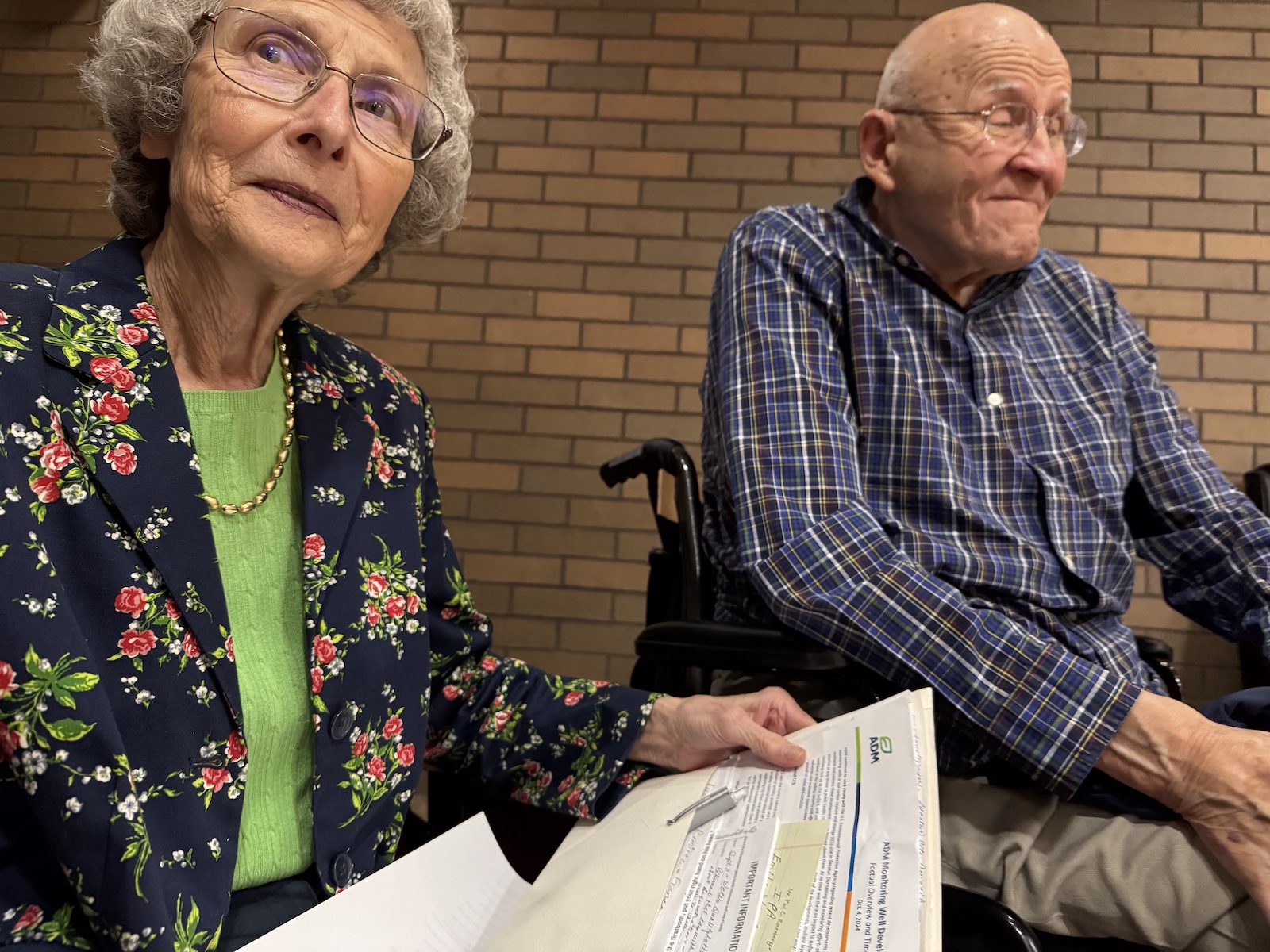
Verlyn Rosenberger sits by her husband, Paul Rosenberger, at a city council meeting in Decatur, Illinois, earlier this month. They are both concerned about leaks from the commercial carbon sequestration plant in their town. Juanpablo Ramirez-Franco / Grist
In September, the public learned of a leak at ADM’s Decatur site after it was reported by E&E News, which covers energy and environmental issues. Additional testing mandated by the EPA turned up a second leak later that month. The EPA has confirmed these leaks posed no threat to water sources. Still, they raise concern about whether more leaks are likely, whether the public has any right to know when leaks occur, and if CCS technology is really a viable climate solution.
Officials with Chicago-based ADM spoke at the Decatur City Council meeting immediately after Rosenberger. They tried to assuage her concerns. “We simply wouldn’t do this if we didn’t believe that it was safe,” said Greg Webb, ADM’s vice president of state-government relations.
But ADM kept local and state officials in the dark for months about the first leak. They detected it back in March, five months after discovering corrosion in the tubing in the sequestration well. However, neither leak was disclosed as the company this spring petitioned the city of Decatur for an easement to expand its operations. The company also remained tight-lipped about the leak as it took part in major negotiations over the state’s first CCS regulations, the SAFE CCS Act, between April and May, according to several parties involved.
As a result, when Illinois Governor J.B. Pritzker signed those CCS regulations into law at ADM’s Decatur facility in July, he was unaware of the leak that had occurred more than 5,000 feet below his seat, his office confirmed.
“I thought we were negotiating in good faith with ADM,” bill sponsor and state Senator Laura Fine, a Democrat, said in a statement. “When negotiating complex legislation, we expect all parties to be forthcoming and transparent in order to ensure we enact effective legislation.”
It’s unclear whether ADM was required by law to report the leaks any sooner than it did. According to the company’s permits, it only has to notify state and local officials if there are “major” or “serious” emergencies. The EPA wouldn’t comment on whether ADM was required to disclose, and neither the EPA nor ADM would confirm if the two leaks in Decatur qualified as “minor” emergencies.
In a statement, an ADM spokesperson said “the developments occurred at a depth of approximately 5,000 feet. They posed no threat to the surface or groundwater, nor to public health. It is for those reasons that additional notifications were not made.”
That’s little comfort to Jenny Cassel, a senior attorney with Earthjustice, a nonprofit environmental law firm.
“It’s a little terrifying,” Cassel said. “Because if the operator, in fact, made the wrong decision, and there is in fact a major problem, then not only will local officials not know about it, EPA is not going to know about it, which is indeed what appears to have happened here.”
The Illinois Clean Jobs Coalition, which applauded the signing of the regulatory bill earlier this summer, called ADM’s decision to keep the March 2024 leak from the public “unacceptable and dangerous.”
David Horn, a city councilman and professor of biology at Decatur’s Millikin University, said the city was blindsided. “This information was substantive, relevant information that could have influenced the terms of the easement that was ultimately signed in May of 2024,” he said, adding that the delay in disclosure calls into question the long-term safety of CCS and the ability of the EPA to protect water in the face of future CCS mishaps.
ADM waited until July 31 to notify the EPA of the leak, more than three months after it was discovered. The EPA alerted a small number of local and state officials and ordered the company to conduct further tests. They also issued a notice for alleged violations, citing the movement of CO2 and other fluids beyond “authorized zones” and the failure of the company to comply with its own monitoring, emergency response, and remediation plans.
But the infractions weren’t made public until September 13, when E&E News first reported the leak.
Two weeks later, ADM notified the EPA that it had discovered a second suspected leak. Only then did they temporarily pause CO2 injections into the well.
Councilman Horn says that isn’t good enough.
“The ADM company was aware of the leak in March, and we were not aware of it until September,” Horn said. “So really the city of Decatur, its residents, the decision-makers have been on the back foot for months.”
Meanwhile, the city of Decatur has contracted with an environmental attorney. They have yet to pursue any legal action.
Central Illinois is becoming a hotspot nationwide for the nascent CCS industry because of the Mt. Simon Sandstone, a deep saline formation of porous rock especially suitable for CO2 storage. It underlies the majority of Illinois and spills into parts of Indiana and Kentucky. It has an estimated storage capacity of up to 150 billion tons of CO2, making it the largest reservoir of its kind anywhere in the Midwest.
However, there is concern that pumping CO2 into saline reservoirs near subsurface water risks pushing pressurized CO2 and brine toward those resources, which would pose additional contamination risks. “Brine is pretty nasty stuff,” said Dominic Diguilio, a retired geoscientist from the EPA Office of Research and Development. “It has a very high concentration of salts, heavy metals, sometimes volatile organic compounds and radionuclides like radium.”
Horn says with so many more wells planned for Illinois, the Decatur leaks should be a wakeup call not just to the city, but to the region. He is particularly concerned about any future wells near east central Illinois’ primary drinking water source, the Mahomet aquifer, which lies above the Mt. Simon Sandstone formation.
Close to a million people rely on the Mahomet aquifer for drinking water, according to the Prairie Research Institute. In 2015, the EPA designated the underground reservoir a “sole source,” meaning there are no other feasible drinking water alternatives should the groundwater be contaminated. When it comes to the Mahomet aquifer, “there is no room for error if there is a mistake,” said Horn.
In light of the CCS boom headed their way, rural Illinois counties are stepping up to protect themselves from future carbon leaks, said Andrew Renh, the director of climate policy at Prairie Rivers Network, a Champaign-based environmental protection organization.
DeWitt County, half an hour north of Decatur, passed a carbon sequestration ban last year. To Decatur’s west, Sangamon County previously expanded an existing moratorium on transporting or storing CO2 underground. And just last week, Champaign County, directly east of Decatur, advanced an ordinance to consider a 12-month moratorium on CCS.
Rehn said his organization would like to see all 14 counties that overlap the Mahomet aquifer impose such bans.
In the meantime, his hope is that state legislators finish what the Illinois counties have started. Two companion bills introduced earlier this year would patch up the regulatory gaps left by the CCS bill Pritzker signed into law this summer. The bills would outright prohibit carbon sequestration immediately in and around the Mahomet Aquifer.
“My community, as well as many surrounding areas, depend on the Mahomet Aquifer to provide clean drinking water, support our agriculture, and sustain industrial operations,” bill sponsor and state Senator Paul Faraci, a Democrat, said in a statement. “Protecting the health and livelihood of our residents and industries that rely on the aquifer must remain our top priority.
As the Decatur City Council meeting adjourned last week, Rosenberger helped her husband, Paul Rosenberger, put on his coat. The row of ADM officials behind her walked past and then lingered in the council chamber. “I’m not afraid of them,” Rosenberger said as she wheeled her husband out.
“We haven’t changed anything yet,” Rosenberger said. “But I think maybe we can.”
Though they live only a few hours before dividing, bacteria can anticipate the approach of cold weather and prepare for it. The discovery suggests that seasonal tracking is fundamental to life.
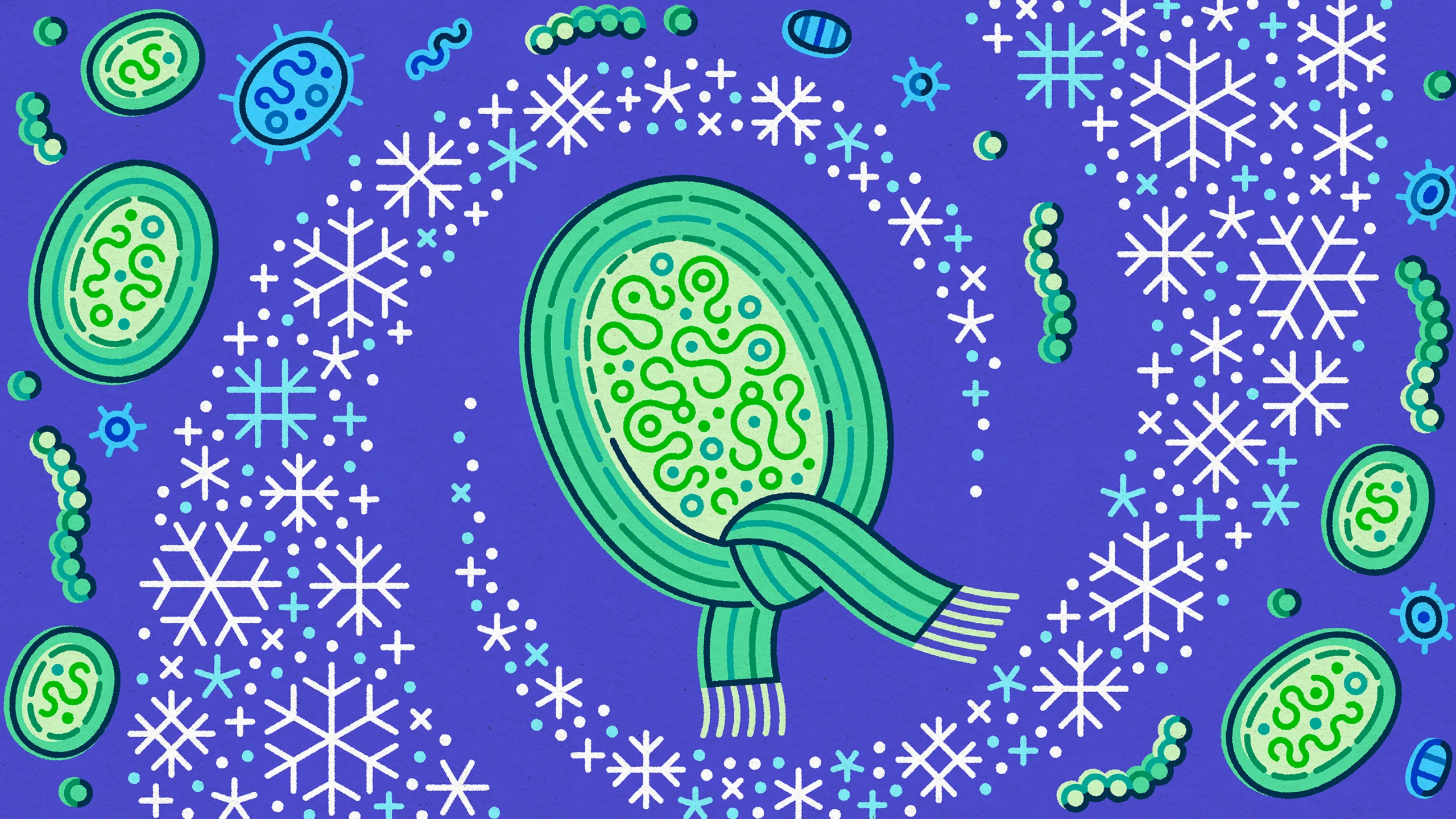
Cyanobacteria can connect the experience of shorter days, like those that encroach in fall, to the onset of winter — and prepare for cold weather.Carlos Arrojo for Quanta Magazine
Every year, in latitudes far enough north or south, a huge swath of life on Earth senses that winter is coming. Leaves fall from trees, sparrows fly to the tropics, raccoons grow thick winter coats, and we unpack our sweaters from storage. Now scientists have shown that this ability to anticipate shorter days and colder temperatures is more fundamental to life than anyone thought: Even short-lived, single-celled organisms can sense day length and get themselves ready for winter.
Lab experiments, recently published in Science, show that cyanobacteria — a type of bacteria that produces energy from sunlight through photosynthesis — anticipate the change(opens a new tab) by bundling up in their own way. They turn on a set of seasonal genes, including some that adjust the molecular composition of their cell membranes, to improve their odds of survival.
The study authors were amazed to find this season-sensing ability in an organism that lives for only about five hours in the lab before dividing. “It seemed like a very nonsensical idea to think that bacteria would care about something that’s happening on a scale that’s so much bigger than their lifetime,” said Luísa Jabbur(opens a new tab), a microbial chronobiologist at the John Innes Center in Norwich, England, and lead author of the new paper.
But cyanobacteria have an evolutionary incentive to pass on relevant information to their progeny: Each cell divides into two identical clones, and each of those does as well, ad infinitum. Carl Johnson(opens a new tab), the senior paper author at Vanderbilt University, likened it to the way monarch butterflies migrate south for the winter but never make the return journey north — their offspring do that. “When you start thinking about more of a lineage, or as the colony or population,” he said, “then that kind of thing makes perfect sense.”
The discovery connects cyanobacteria to a plethora of much more complex organisms with seasonal rhythms, and it indicates that anticipating seasons may have emerged early in life’s evolution. It may have even predated the internal clocks that give an organism a sense of day and night. “This issue of dealing with seasonality may be very fundamental to why [biological] clocks exist in the first place,” said the cell biologist Mike Rust(opens a new tab), who studies cyanobacteria’s internal rhythms at the University of Chicago and was not involved in the new research. Staying in sync with the seasons could be more ancient and more elemental to life than anyone suspected.
How Cells Keep Time
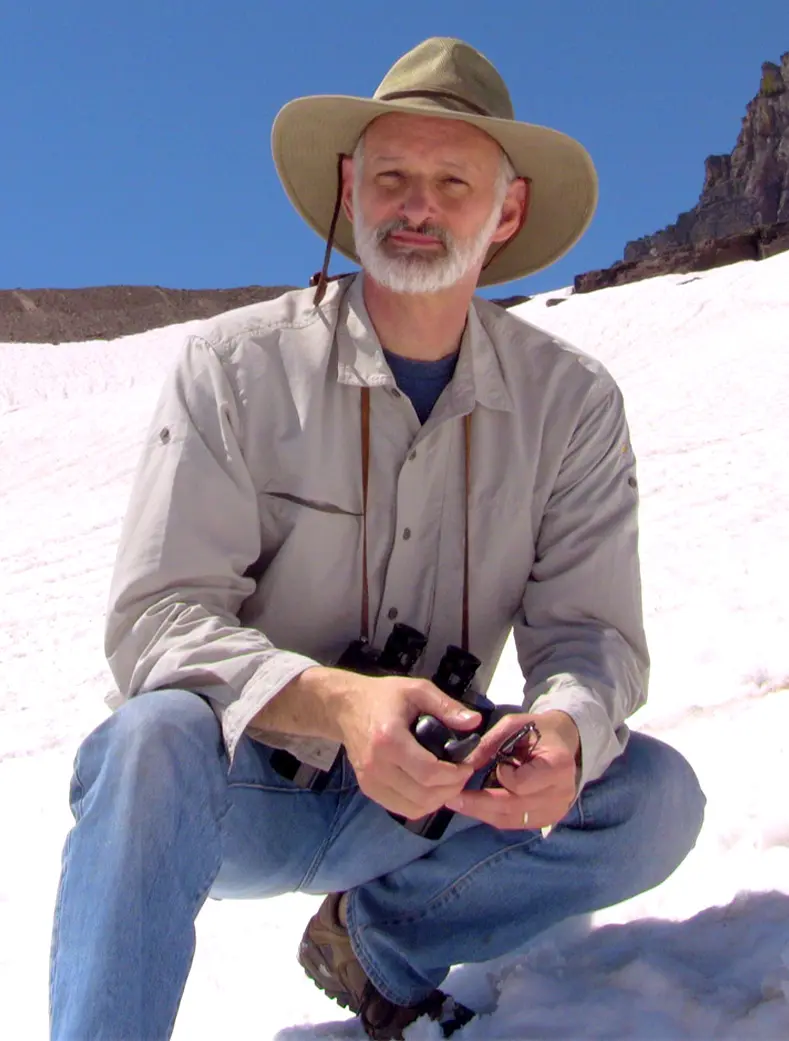
In the 1990s, the chronobiologist Carl Johnson identified the genes and proteins involved in the circadian clock of cyanobacteria — the first single-celled organism known to track day-night cycles. Courtesy of Carl Johnson
When Johnson entered graduate school in the 1970s, scientists knew that circadian clocks — organisms’ internal timekeepers for the day-night cycle — are ubiquitous in multicellular plants and animals. These molecular devices choreograph delicate dances, such as plants unfolding their leaves in the morning and closing them at night. (They’re also the reason why humans have definitive sleeping and waking hours, as well as disjointed sensations when traveling between time zones or pulling an all-nighter.)
But the idea that simple organisms such as bacteria could have daily clocks as well was deemed controversial. Johnson looked into the possibility in graduate school, to no avail. Then, in 1986, evidence emerged that cyanobacteria do indeed have daily rhythms. When the South African plant physiologist Nathanaël Grobbelaar exposed cyanobacteria to light and dark periods, he observed that the cells processed nitrogen, a key nutrient, only during the simulated night(opens a new tab). It was the first record of a day-night internal rhythm in any single-celled organism.
The discovery gave Johnson an idea: If cyanobacteria have daily rhythms, maybe he could identify the molecules that, like gears in a watch, make the organisms’ circadian clock run. In papers published in 1993(opens a new tab) and 1998(opens a new tab), with collaborators in Japan and Texas, he identified three genes and their corresponding proteins — KaiA, KaiB and KaiC (kai is Japanese for “cycle”) — involved with the cyanobacterial circadian clock. Interactions between KaiA and KaiB create a reaction in which KaiC acquires an extra phosphate group and then sheds it rhythmically, in sync with day and night. Astonishingly, the scientists also found that the whole loop can happen outside a cell, among loose molecules in a test tube.
Cyanobacterial colonies pulse through a day-night cycle as a gene involved in the circadian clock cycles on and off. Biologists attached a bioluminescent reporter gene to the clock gene to visualize the rhythm of the cells’ circadian clocks. The brighter color indicates higher expression of the clock gene.
Courtesy of Carl Johnson
Since then, researchers have learned a lot about the cell biology underlying these rhythms. But it would take another quarter of a century to connect those same genes to an ability stretching over a longer time frame, one that is more calendar than clock.
Winter Is Coming
One day in 2018, as Jabbur scoured the literature on cyanobacteria’s circadian clock, she realized something was missing. She could not find any explorations of the relationship between the circadian clock, which follows Earth’s axial, day-night rotation, and a seasonal rhythm linked to how the Earth’s axis is tilted, wherein summer happens in a hemisphere that tilts toward the sun.
“That was a bit shocking,” Jabbur recalled, because cyanobacteria’s circadian clock is the best studied of any organism. She wondered whether the same proteins might lead to what’s known as a photoperiodic response — the ability to react to the length of a day and “use the information to change their physiology, metabolism or behavior in anticipation of upcoming seasons,” she said.
She brought the idea to Johnson, her doctoral adviser. Initially he laughed at it. Cyanobacteria make food from light, so it seemed obvious that the cells would thrive during longer days and suffer when the periods of light grew shorter. But he told Jabbur to try the experiment anyway because, as a sticky note on his office door states, “progress is made by young scientists who carry out experiments that old scientists say would not work.”
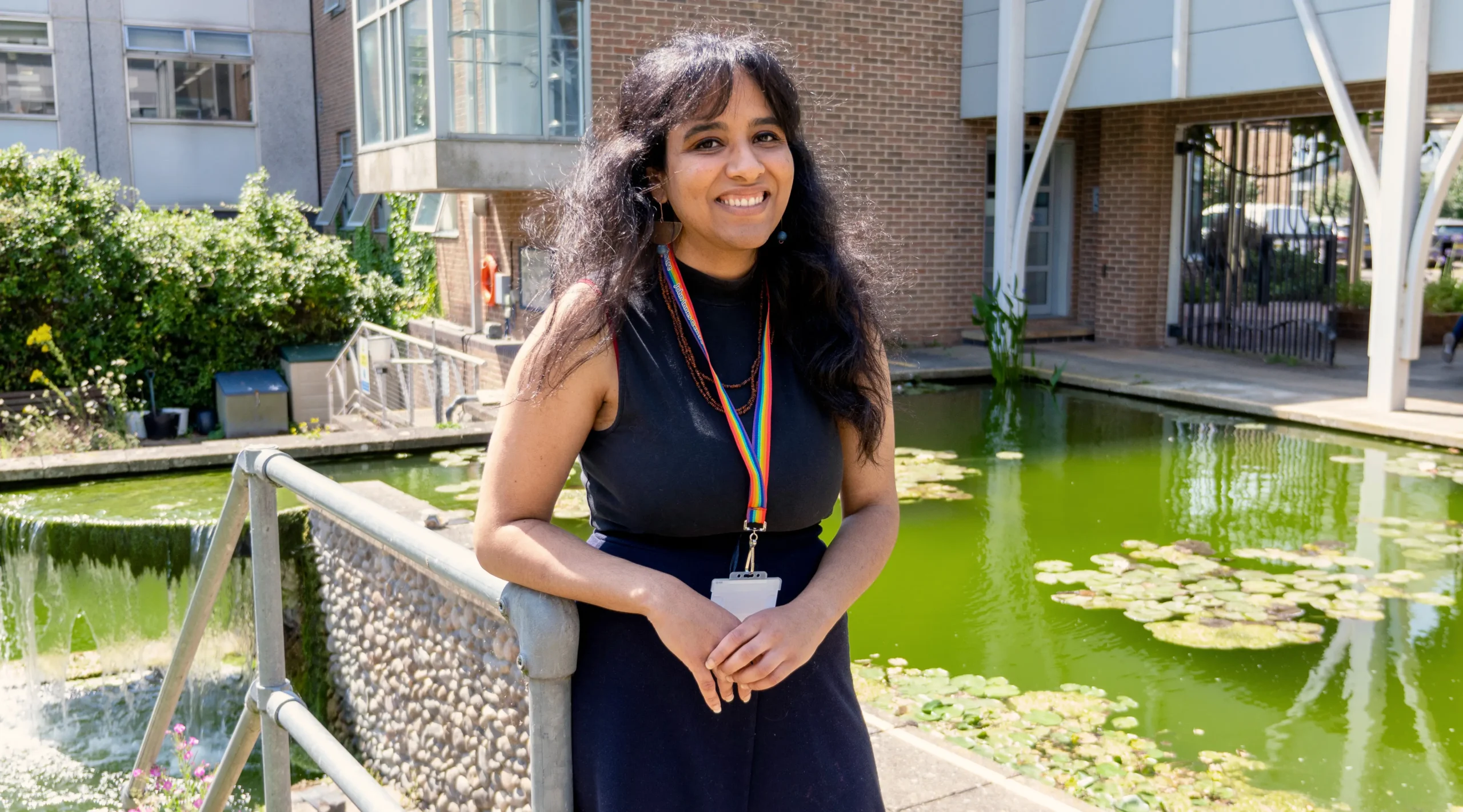
The chronobiologist Luísa Jabbur, here standing in front of a pond at the John Innes Center, discovered that even simple cyanobacteria can anticipate the approach of winter and cold weather by tracking day length.Revel Studios
She proved her mentor wrong, and the note right, almost immediately. Within a week, she appeared in Johnson’s office with two bacterial plates. Both had been plunged into ice water to simulate the onset of winter. But one hosted more visibly green cyanobacteria than the other. The bacteria that thrived had been exposed to longer dark periods beforehand — they’d had an opportunity to anticipate what was coming.
In an expanded experimental protocol, reported in the new Science paper, Jabbur exposed three groups of cyanobacteria to different periods of light and darkness for eight days, representing winter (eight hours of light and 16 hours of darkness), equinox (12 hours of light and 12 hours of darkness) or summer (16 hours of light and eight hours of darkness). Then she dunked them in the ice water, sampled bacteria from each chilled tube and watched for colonies to grow from live cells.
Despite growing at warm temperatures, the cells that experienced short, winterlike light durations seemed to know that cold was coming and were able to prepare for it. They survived up to three times better after the frigid bath than either the summer or equinox cells. But how?
Jabbur compared the genes activated in the different groups of cells. The winter-condition cells expressed more genes related to metabolism, while the summer-condition cells expressed genes related to heat and ultraviolet light, suggesting that they had adapted for a different season. She looked at one change more closely: the molecular composition of their cell membranes.
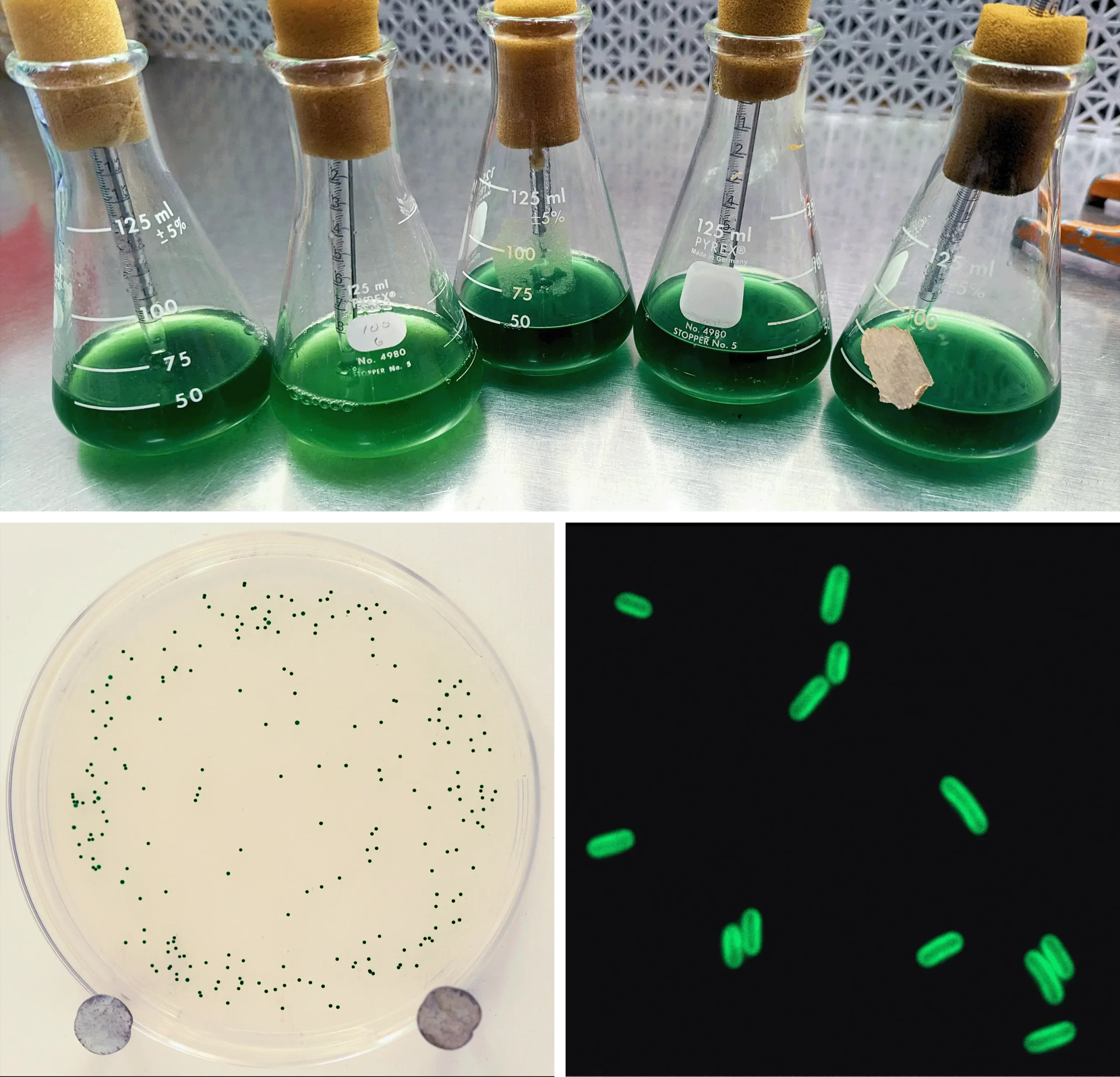
The green-colored cyanobacteria Synechococcus elongatus (bottom right) produce energy from sunlight through photosynthesis. In the lab, researchers grow the cells on petri dishes (bottom left) or in flasks of liquid (top).Courtesy of Luísa Jabbur
It is well known that cell membranes, including those that encircle cyanobacteria, are sensitive to temperature. Like butter, the lipids that compose membranes become more rigid in cold conditions and more fluid in heat. Many organisms can adjust their membranes — a process known as desaturation — to keep molecules moving freely across the membrane in a range of temperatures. Jabbur wondered if her cyanobacteria were doing the same thing. Indeed, further experiments showed that her winter-primed cyanobacteria had more desaturated lipids that kept their cell membranes from gumming up as the temperature dropped.
Finally, she wanted to know if these photoperiodic adaptations were tied to the circadian clock or driven by a separate mechanism. When the researchers deleted the genes that encode the KaiA, KaiB and KaiC proteins, the winter-condition cells survived no better than summer-condition cells. They had failed to adjust their lipids. The daily molecular clock might be driving the seasonal calendar as well.
“We still don’t know if the clock is the one that is actually encoding the day length,” Jabbur said. “But it appears to be necessary for the response.”
An Ancient Talent
Cyanobacteria are the most ancient known life form that still lives on Earth, encompassing billions of years of history. About 2.4 billion years ago, they transformed the chemistry of our atmosphere to the oxygen-rich mix we enjoy today. It is humbling to think that something so ancient and small may contain the seeds of the complex seasonal anticipation behaviors we see today, from the migration of shorebirds and songbirds, to hibernating grizzly bears, to the human craving for pumpkin spice lattes.
“It is truthfully impressive that organisms as old as cyanobacteria could have this kind of response,” Jabbur said. “It makes one really wonder about when [photoperiodism] first emerged, and what Earth looked like back then.”
Because organisms go through daily cycles more frequently than seasonal ones, scientists have generally assumed that circadian clocks evolved before photoperiodism. But the new research suggests another possibility. “Photoperiodic measurement could have been the first thing [to evolve],” Johnson said. Perhaps our oldest ancestors needed to invent an internal clock to survive the stresses of seasonal weather — and then daily cycles were built on top of that.
What remains puzzling, however, is how such a short-lived organism could evolve a mechanism to track time through entire seasons, which stretch hundreds of times longer than its own lifetime. “One intriguing issue is whether or how these signals are passed on through cell generations, since seasonal changes happen much more slowly compared to the generation time of these cells,” said Devaki Bhaya(opens a new tab), a senior staff scientist at Carnegie Science who was not involved in the research. No matter how it happens, the mechanisms wouldn’t have been selected for individual survival, but for the welfare of the entire genetic line, encompassing many generations of cyanobacteria.
Still, these ideas remain speculative as long as photoperiodism is identified in only a single species of cyanobacteria. In her new role as a research fellow at the John Innes Center, Jabbur plans to explore the photoperiodic responses of more bacteria to better understand when this ability to anticipate seasons might have evolved. Other strains of bacteria have circadian clock genes that drive mechanisms markedly different from those of cyanobacteria. They may reveal more secrets about internal rhythms and seasonal adaptations. Only time will tell.
Sineia Bezerra do Vale, indígena do povo Wapichana, atua há ao menos três décadas com discussões sobre a emergência do clima e defende que cientistas incluam as experiências dos povos tradicionais nos estudos sobre o assunto.
Sineia Bezerra do Vale, lidernaça indígena do povo Wapichana, ao receber o prêmio “Cientista indígena do Brasil”, em São Paulo — Foto: Patricia Zuppi/Rede RCA/Cristiane Júlião/Divulvação
Referência em Roraima por estudos sobre a crise climática em comunidades indígenas, a gestora ambiental Sineia Bezerra do Vale agora também é “cientista indígena do Brasil” reconhecida pelo Planetary Guardians, iniciativa que discute a emergência do clima em todo o mundo e tem como foco restaurar a estabilidade da Terra.
Indígena do povo Wapichana, Sineia do Vale recebeu o título no último dia 25 em São Paulo, no mesmo evento em que o cientista brasileiro Carlos Nobre, referência global nos efeitos das mudanças climáticas na Amazônia, foi anunciado com novo membro dos Planetary Guardians – guardiões planetários, em português.
Sineia do Vale tem como principal atuação o foco sobre a crise do clima, que impacta em consequências devastadoras em todo o mundo. Foi dela o primeiro estudo ambiental sobre as transformações do clima ao longo dos anos na vida dos povos tradicionais em Roraima.
Ao receber o prêmio de “cientista indígena do Brasil” das mãos de Carlos Nobre, a defensora ambiental destacou que quando se trata da crise climática, a ciência também precisa levar em conta a experiência de vida que os indígenas vivenciam no dia a dia – discurso que ela sempre defende nos debates sobre o assunto.
“Esse é um momento muito importante para os povos indígenas. Neste momento em que a gente se coloca junto com a ciência que chamamos de ciência universal, a ciência indígena tem uma importância tanto quanto a que os cientistas traduzem para nós, principalmente na questão do clima”, disse Sineia do Vale.
Sineia do Vale (terceira mulher da direira para a esquerda) atua há anos com foco na crise climática e os povos indígenas — Foto: Patricia Zuppi/Rede RCA/Cristiane Júlião/Divulvação
No evento em São Paulo, ela exemplificou como a crise climática é percebida nas comunidades. “Os indígenas já colocaram em seus planos de enfrentamento às mudanças climáticas que as águas já aqueceram, que os peixes já sumiram e que não estamos mais vivendo o período de adaptação, mas o de crise climática.”
“Precisamos de resposta rápidas. Não podemos mais deixar que os países não cumpram seus acordos porque à medida que o globo terrestre vai aquecendo, os povos indígenas sofrem nas suas terras com grandes catástrofes ambientais”, destacou a gestora.
A indicação para que Sineia recebesse o título ocorreu após indicação da ativista ambiental e geógrafa Hindou Oumarou, que é co-presidente do Fórum Internacional de Povos Indígenas sobre Mudanças do Clima e presidente do Fórum Permanente da ONU sobre questões indígenas chadiana.
Além da roraimense, também receberam a honraria de “cientista indígena do Brasil”: as antropólogas indígenas Braulina Baniwa e Cristiane Julião, do povo Pankararu, confundadoras da Articulação Nacional das Mulheres Guerreiras da Ancestralidade (Anmiga), e o antropólogo e escritor Francisco Apurinã, que pesquisa mudanças ecológicas na perspectiva indígena pela Universidade de Helsinki, na Finlândia.
Mais sobre Sineia do Vale
Sineia do Vale participa desde 2011 da Conferência das Nações Unidas sobre as Mudanças Climáticas – COP, em inglês, e promove junto às lideranças indígenas a avaliação climática a partir do conhecimento ancestral.
Ela também participa ativamente das discussões internacionais sobre mudanças climáticas há mais de 20 anos, entre elas, a Conferência de Bonn sobre Mudanças Climáticas – chamada de SB60, que ocorre todos os anos em Bonn, na Alemanha. Este ano, a COP29 ocorrerá de 11 a 24 de novembro em Baku, capital do Azerbaijão.
No ano passado, ela foi recebeu o “Troféu Romy – Mulheres do Ano“, honraria concedida a mulheres que se destacaram em suas áreas de atuação em 2023.
Gestora ambiental de formação, Sineia cursa mestrado em Sustentabilidade junto a Povos e Territórios Tradicionais na Universidade de Brasília (UnB), coordena o Departamento de Gestão Territorial e Ambiental do Conselho Indígena de Roraima (CIR), e integra a Convenção-Quadro das Nações Unidas sobre a Mudança do Clima (UNFCCC), focada na agenda indígena e a implementação de ações em nível local.
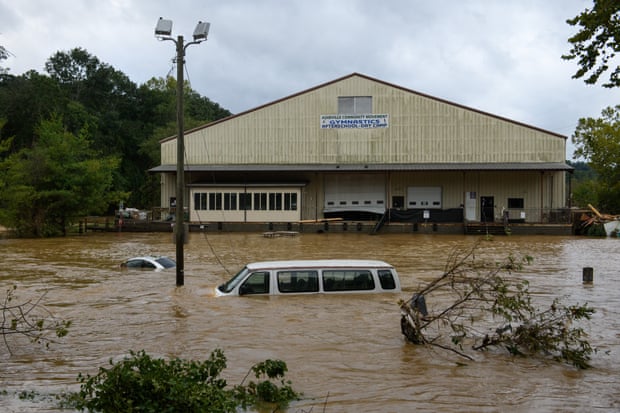
Flooding from Hurricane Helene in Asheville, North Carolina, on Saturday. Photograph: Melissa Sue Gerrits/Getty Images
Nestled in the bucolic Blue Ridge mountains of western North Carolina and far from any coast, Asheville was touted as a climate “haven” from extreme weather. Now the historic city has been devastated and cut off by Hurricane Helene’s catastrophic floodwaters, in a stunning display of the climate crisis’s unlimited reach in the United States.
Helene, which crunched into the western Florida coast as a category 4 hurricane on Thursday, brought darkly familiar carnage to a stretch of that state that has experienced three such storms in the past 13 months, flattening coastal homes and tossing boats inland.
But as the storm, with winds peaking at 140mph (225 km/h), carved a path northwards, it mangled places in multiple states that have never seen such impacts, obliterating small towns, hurling trees on to homes, unmooring houses that then floated in the floodwater, plunging millions of people into power blackouts and turning major roads into rivers.
In all, about 100 people have died across five states, with nearly a third of these deaths occurring in the county containing Asheville, a city of historic architecture where new residents have flocked amid boasts by real estate agents of a place that offers a reprieve from “crazy” extreme weather.
Now, major highways into Asheville have been severed by flooding from surging rainfall, its mud-caked and debris-strewn center turned into a place where access to cellphone reception, gasoline and food is scarce. The water supply, as well as the roads, is expected to be affected for weeks. It is, according to Roy Cooper, North Carolina’s governor, an “unprecedented tragedy”.
“Everyone thought this was a safe place, somewhere you could move with your kids for the long term, so this is just unimaginable, it’s catastrophic,” said Anna Jane Joyner, a climate campaigner who grew up in the area and whose family still lives in Black Mountain, near Asheville. Several of her friends narrowly avoided being swept away by the floodwater.
“I never, ever considered the idea that Asheville would be wiped out,” she said. “It was our backup plan to move there, so the irony is stark and scary and it’s hard for me to emotionally process. I’ve been working in the climate movement for 20 years and feel like I’m now living in a movie I imagined in my head when I started. Nowhere is safe now.”
The damage wrought by Helene is “a staggering and horrific reminder of the ways that the climate crisis can turbocharge extreme weather”, according to Al Gore, the former US vice-president. Hurricanes gain strength from heat in the ocean and atmosphere and Helene, one of the largest ever documented, sped across a record-hot Gulf, quickly turning from a category 1 to a category 4 storm within a day.
Extra heat not only helps storms spin faster, it also holds more atmospheric moisture that is then unleashed in torrents upon places such as western North Carolina, which got a month’s rain in just a couple of days. Helene was the eighth category 4 or 5 hurricane to strike the US since 2017 – the same number of such extreme storms to hit the country in the previous 57 years.
“This storm has the fingerprints of climate change all over it,” said Kathie Dello, North Carolina’s state climatologist. “The ocean was warm and it grew and grew and there was a lot of water in the atmosphere. Unfortunately, our worst fears came true. Helene was supercharged by climate change and we should expect more storms like this going forward.”
Dello said that it would take months or even years for communities, particularly in the poorer, more rural areas of the state that have been cut off completely by the storm, to recover, compounding the impacts of previous storms such as Florence, in 2018, and Fred, in 2021, that pose major questions over how, if at all, to rebuild.
“I don’t know where you run to escape climate change. Everywhere has some sort of risk,” she said. “It’s really been quite rattling to see these places which you love be devastated, knowing they have been changed forever. We can’t just rebuild like before.”
Heavy rains from Hurricane Helene caused record flooding and damage in Asheville, North Carolina. Photograph: Melissa Sue Gerrits/Getty Images
In Asheville, the historic area of Biltmore Village has been submerged underwater while, in a gloomy irony, the US’s premier climate data center has been knocked offline.
The storm has been “devastating for our folks in Asheville”, said a spokesperson for the National Oceanic and Atmospheric Administration, who said the National Centers for Environmental Information facility had lost its water supply and had shut down.
“Even those who are physically safe are generally without power, water or connectivity,” the spokesperson said of the effort to contact the center’s marooned staff.
The destruction may cast a shadow over the climate-haven reputation of Asheville, much like how Vermont’s apparent distance from the climate crisis has been rethought in the wake of recentfloods, but it probably won’t defy a broader trend where Americans are flocking to some of the places most at risk from heatwaves, storms and other climate impacts due to the ready availability of housing and jobs.
“This flood will likely accelerate development,” said Jesse Keenan, an expert in climate adaptation at Tulane University, who noted that for every one person who moves away from Asheville, three people move to the city, one of the highest such ratios in the US.
“Some people will not be inclined or unable to rebuild and their properties will be bought up by wealthy people who can afford to build private infrastructure and buildings that have the engineering resilience to withstand floods.”
“There is no truly safe place,” Keenan, who previously listed Asheville as one of the better places to move amid the climate crisis, acknowledged. But the city will “see a post-disaster boom”, he said. “This is a cycle that has happened over and over again in America.”
/i.s3.glbimg.com/v1/AUTH_59edd422c0c84a879bd37670ae4f538a/internal_photos/bs/2024/X/M/Dl1Xb3TGWoLV5ut4v8AA/sineia.jpeg)
/i.s3.glbimg.com/v1/AUTH_59edd422c0c84a879bd37670ae4f538a/internal_photos/bs/2024/0/w/XEeo2dSceTVoGURwBlfQ/planetary.jpeg)
 Uma (in)certa antropologia