Arquivo da tag: Sabotagem

How This Climate Activist Justifies Political Violence (New York Times)

Talk Original article

Jan. 14, 2024

By David Marchese Photo Illustration by Bráulio Amado

With the 2021 publication of his unsettling book, “How to Blow Up a Pipeline,” Andreas Malm established himself as a leading thinker of climate radicalism. The provocatively titled manifesto, which, to be clear, does not actually provide instructions for destroying anything, functioned both as a question — why has climate activism remained so steadfastly peaceful in the face of minimal results? — and as a call for the escalation of protest tactics like sabotage. The book found an audience far beyond that of texts typically published by relatively obscure Marxist-influenced Swedish academics, earning thoughtful coverage in The New Yorker, The Economist, The Nation, The New Republic and a host of other decidedly nonradical publications, including this one. (In another sign of the book’s presumed popular appeal, it was even adapted into a well-reviewed movie thriller.) Malm’s follow-up, “Overshoot: How the World Surrendered to Climate Breakdown,” written with Wim Carton and scheduled to be published this year, examines the all-consuming pursuit of fossil-fuel profits and what the authors identify as the highly dubious and hugely dangerous new justifications for that pursuit. But, says Malm, who is 46, “the hope is that humanity is not going to let everything go down the drain without putting up a fight.”

It’s hard for me to think of a realm outside of climate where mainstream publications would be engaging with someone, like you, who advocates political violence.1 Why are people open to this conversation? 

If you know something about the climate crisis, this means that you are aware of the desperation that people feel. It is quite likely that you feel it yourself. With this desperation comes an openness to the idea that what we’ve done so far isn’t enough. But the logic of the situation fundamentally drives this conversation: All attempts to rein in this problem have failed miserably. Which means that, virtually by definition, we have to try something more than we’ve tried.

How confident are you that when you open the door to political violence, it stays at the level of property and not people? You’ve written about the need to be careful, but the emotions that come with violence are not careful emotions. 

Political history is replete with movements that have conducted sabotage without taking the next step. But the risk is there. One driver of that risk is that the climate crisis itself is exacerbating all the time. It’s hard-wired to get worse. So people might well get more desperate. Now, in the current situation, in every instance that I know of, climate movements that experiment with sabotage steer clear of deliberately targeting people. We might smash things, which people are doing here and there,2 but no one is seriously considering that you should get a gun and shoot people. Everyone knows that would be completely disastrous. The point that’s important to make is that the reason that people contemplate escalation is that there are no risk-free options left.

I know you’re saying historically this is not the case, but it’s hard to think that deaths don’t become inevitable if there is more sabotage. 

Sure, if you have a thousand pipeline explosions per year, if it takes on that extreme scale. But we are some distance from that, unfortunately.

Don’t say “unfortunately.” 

Well, I want sabotage to happen on a much larger scale than it does now. I can’t guarantee that it won’t come with accidents. But what do I know? I haven’t personally blown up a pipeline, and I can’t foretell the future.

The prospect of even accidental violence against people — 

But the thing we need to keep in mind is that existing pipelines, new pipelines, new infrastructure for extracting fossil fuels are not potentially, possibly — they are killing people as we speak. The more saturated the atmosphere is with CO2, putting more CO2 into the atmosphere causes more destruction and death. In Libya in September, in the city of Derna, you had thousands of people killed in floods in one night. Scientists could conclude that global warming made these floods 50 times as likely as if there hadn’t been such warming.3 We need to start seeing these people as victims of the violence of the climate crisis. In the light of this, the idea of attacking infrastructure and closing down new pipelines is a disarmament. It’s about taking down a machine that actually kills people.

I’m curious: How do you communicate with your kids4 about climate? 

I’m not sure that I’ve had any deliberate plan, but it has been inevitable, with my 9-year-old at least, that we’ve had conversations.

Do you anticipate having the conversation where you explain the radical nature of your ideas? 

Well, yeah. Both of them have watched the film, “How to Blow Up a Pipeline.”5

Your 4-year-old? 

Yes. There were a couple of scenes that stayed with them, particularly when people were wounded. They found this fascinating. They know that their father is a little politically crazy, if I can put it that way.

A scene from the film “How to Blow Up a Pipeline."

Generally we teach kids that violence or breaking people’s things is bad. Do you feel you can honestly give your kids the same message? 

I hope that I communicate through my parenting that generally you shouldn’t break things. But I hope that they get the impression that I consider there to be exceptions to this rule. My 4-year-old, for instance, when we were biking around Malmo,6 where we live, he would be on the lookout for S.U.V.s. He knows these are the bad cars. I think they have an awareness of the tactic of deflating S.U.V. tires.7

Is there not a risk that smashing things would cause a backlash that would actually impede progress on climate? 

I fundamentally disagree with the idea that there is progress happening and that we might ruin it by escalating. In 2022, we had the largest windfall of profits in the fossil-fuel industry8 ever. These profits are reinvested into expanded production of fossil fuels. The progress that people talk about is often cast in terms of investment in renewables and expansion in the capacity of solar and wind power around the world. However, that is not a transition. That is an addition of one kind of energy on top of another. It doesn’t matter how many solar panels we build if we also keep building more coal power plants, more oil pipelines, and on that crucial metric there simply is no progress. I struggle to see how anyone could interpret the trends as pointing in the right direction. Now, on the question of what kind of reaction would we get from society if we as a climate movement radicalized: There might be more repression of the movement. There might be more aggressive defense of fossil-fuel interests. We also see signs that radical forms of climate protest alienate popular audiences. But the kind of tactic that mostly pisses people off, and I’m talking about the European context, is random targeting of commuters by means of road blockades. Sabotage of particular installations for fossil-fuel extraction can gain more support from people because these actions make sense. The target is obviously the source of the problem, and it doesn’t necessarily hurt ordinary people in their daily lives. We have to be careful about not doing things that alienate the target audience, which is ordinary working people.

Don’t you think, with companies as wealthy as the oil giants, if activists smash their stuff, they’ll just fix it and get back to business? 

Here’s a big problem that we deal with quite extensively in the “Overshoot” book: stranded assets. ExxonMobil and Aramco and these giants exude this worry that a transition would destroy their capital and that this shift could happen quickly. So in this context, the rationale of sabotage is to bring home the message to these companies: Yes, your assets are at risk of destruction. When something happens that makes the threat of stranded assets credible, investors will suddenly realize, there’s a real risk that if I invest a lot of money, I might lose everything.

Explain the term “overshoot.” 

The simplest definition of “overshoot” is that you shoot past the limits that you have set for global warming. So you go over 1.5 or 2 degrees. But the term has come to mean something more in climate science and policy discourse, which is that you can go over and then go back down. So you shoot past 1.5 or 2, but then you return to 1.5 or 2, primarily by means of carbon-dioxide removal. I think this is extremely implausible. But the idea is that you can exceed a temperature limit but respect it at a later point by rolling out technologies for taking it down.

And your argument is that overshoot just provides a cover for business as usual? 

Yes. What’s happening now is that you see ExxonMobil or Occidental or ADNOC9 — these companies are at the forefront of expanding DAC10 capacity. What Al Jaber11 is talking about all the time is that the problem isn’t fossil fuels; the problem is emissions. So we can continue to have fossil fuels; we’re just going to take down the CO2 that we emit by DAC. It isn’t a reality. It’s like an ideological promise that we’re going to be able to clean up the mess while continuing to create the same mess.

A few minutes ago, you said you’ve never blown up a pipeline. If that’s what you think is necessary, why haven’t you? 

I have engaged in as much militant climate activism as I have had access to in my activist communities and contexts. I’ve done things that I can’t tell you or that I wouldn’t tell others publicly. I live my life in Malmo, pretty isolated from activist communities. Let’s put it this way: If I were part of a group where something like blowing up a pipeline was perceived as a tactic that could be useful for our struggle, then I would gladly participate. But this is not where I am in my life.

I don’t want to encourage you, but if people did only the activism that was congruent with where they were at in their life, hardly anybody who lives a comfortable life would do anything. 

Like I said, I’ve participated in things that I can’t tell you about because they’ve been illegal and they’ve been militant. I’ve done it recently. But I can do that only as part of a collective of people who do something that they have decided on together. We shouldn’t think of activism as something that is invented out of thin air, deduced from abstract principles, and then you just shoot off and do something crazy. I can’t tell you what things I have done, but the things that I do and that any other climate activist should be doing cannot be an individual project.

Greta Thunberg went by herself and sat in front of a building instead of going to school.12

Sure, sure, sure, and she became the person she became thanks to the millions who joined her. Maybe I should do something similar.

In “Overshoot,” you write this about the very wealthy: “There is no escaping the conclusion that the worst mass killers in this rapidly warming world are the billionaires, merely by dint of their lifestyles.” That doesn’t feel like a bathetic overstatement when we live in a world of terrorist violence and Putin turning Ukraine into a charnel house? Why is that a useful way of framing the problem? 

Precisely for the reason I tried to outline previously, which is that spewing CO2 into the atmosphere at an excessive scale — and when it comes to luxury emissions, it is completely excessive — is an act that leads to the death of people.

But by that logic, unless we live a carbon-neutral lifestyle, we should all be looking in the mirror and saying, I am a killer. 

I don’t live a zero-carbon lifestyle. No one who lives in a capitalist society can do so. But the people on top, they are the ones who have power when it comes to investment. Are they going to invest the money in fossil fuels or in renewables? The overwhelming decision they make is to invest it in fossil fuels. They belong to a class that shapes the structure, and in their own private consumption habits, they engage in completely extravagant acts of combustion of fossil fuels.13 On the level of private morals: Do I practice what I preach? I try to avoid flying. I don’t have a car. I should be vegan, but I’m just a vegetarian. I’m not claiming to be any climate angel in my private consumption, and that’s problematic. But I don’t think that is the issue — that each of us in the middle strata or working class in advanced capitalist countries, through our private consumption choices, decide what’s going to happen with this society. This is not how it works.

A protester wearing goggles and a mask holds a bottle up. There is a vehicle on fire in the background.

We live in representative democracies where certain liberties are respected. We vote for the policies and the people we want to represent us. And if we don’t get the things we want, it doesn’t give us license to then say, “We’re now engaging in destructive behavior.” Right? Either we’re against political violence or not. We can’t say we’re for it when it’s something we care about and against it when it’s something we think is wrong. 

Of course we can. Why not?

That is moral hypocrisy. 

I disagree.

Why? 

The idea that if you object to your enemy’s use of a method, you therefore also have to reject your own use of this method would lead to absurd conclusions. The far right is very good at running electoral campaigns. Should we thereby conclude that we shouldn’t run electoral campaigns? This goes for political violence too, unless you’re a pacifist and you reject every form of political violence — that’s a reasonably coherent philosophical position. Slavery was a system of violence. The Haitian revolution was the violent overthrow of that system. It is never the case that you defeat an enemy by renouncing every kind of method that enemy is using.

But I’m specifically thinking about our liberal democracy, however debased it may be. How do you rationalize advocacy for violence within what are supposed to be the ideals of our system? 

Imagine you have a Trump victory in the next election — doesn’t seem unimaginable — and you get a climate denialist back in charge of the White House and he rolls back whatever good things President Biden has done. What should the climate movement do then? Should it accept this as the outcome of a democratic election and protest in the mildest of forms? Or should it radicalize and consider something like property destruction? I admit that this is a difficult question, but I imagine that a measured response to it would need to take into account how democracy works in a country like the United States and whether allowing fossil-fuel companies to wreck the planet because they profit from it can count as a form of democracy and should therefore be respected.

Could you give me a reason to live?14

What do you mean?

Your work is crushing. But I have optimism about the human project. 

I’m not an optimist about the human project.

So give me a reason to live. 

Well, here’s where we enter the virgin territories of metaphysics.

Those are my favorite territories. 

Wonderful.

I’m not joking. 

Yeah, I’m not sure that I have the qualifications to give people advice about reasons to live. My daily affective state is one of great despair about the incredible destructive forces at work in this world — not only at the level of climate. What has been going on in the Middle East just adds to this feeling of destructive forces completely out of control. The situation in the world, as far as I can tell, is incredibly bleak. So how do we live with what we know about the climate crisis? Sometimes I think that the meaning of life is to not give up, to keep the resistance going even though the forces stacked against you are overwhelmingly strong. This often requires some kind of religious conviction, because sometimes it seems irrational.

I think all you need to do is look at your children. 

Yes, but I have to admit to some kind of cognitive dissonance, because, rationally, when you think about children and their future, you have to be dismal. Children are fundamentally a source of joy, and psychologically you want to keep them that way. I try to keep my children in the category of the nonapocalyptic. I’m quite happy to go and swim with my son and be in that moment and not think, Ah, 30 years from now he’s going to lie dead on some inundated beach. You know what I mean?

Which of your arguments are you most unsure of? 

I cannot claim to have a good explanation for what is essentially a mystery, namely that humanity is allowing the climate catastrophe to spiral on. One of my personal intellectual journeys in recent years has been psychoanalysis. Once you start looking into the psychic dimensions of a problem like the climate crisis, you have to open yourself to the fundamental difficulty in understanding what’s happening.

Is it possible for you to summarize your psychoanalytic understanding of the climate crisis? 

Not simply, because it’s so complex. On the far right, you see this aggressive defense of cars and fossil fuels that verges on a desire for destruction, which of course is part of Freud’s latent theory of the two categories of drives: eros and thanatos.15 Another fundamental category in the psychic dimension of the climate crisis is denial. Denial is as central to the development of the climate crisis as the greenhouse effect.

What about you, psychoanalytically speaking? 

I have my weekly therapy on Thursday.

But what’s your deal? 

You mean in my private life?

Yeah. 

On a deeper level, the point for the psychoanalysis is that you go back to your childhood and try to process your relation to your parents and how they have constituted you. Do you really want me to go there?

Yes. 

I have to try to figure out how this ties in with my climate activism. I guess this is some sort of a superego part of it: a strong sense of duty or obligation; that I have to try to do what I can to intervene in this situation. That’s a very strong affective mechanism. For instance, I constantly give up on an intellectual project that would be far more satisfying, a nerdy historical project,16 because I feel that I cannot with good conscience do this when the world is on fire.

But I’m asking what caused your impulses. 

Now we’re into the deep psychoanalytic stuff. I had a vicious Oedipal conflict with my father. One way that this came to express itself was that in the preteen years, I clashed with my father — even more violently during my teenage years. My way to defend myself against what I perceived as his tyranny was to become as proficient as he was in arguing and beat him in his own game by rhetorically defeating him. I think I did. I think he accepted that I’m his superior when it comes to writing and arguing. Psychoanalytically, of course, the things that I’ve continued to do can be understood as an extension of my formative rebellion against my authoritarian father in a classically Oedipal setting, if you see what I mean.17

I asked why you aren’t blowing up pipelines, and you gave this answer about how action has to happen in the context of a community and “Oh, but I have done very serious stuff” — there’s something fishy. You have actually engaged in property destruction? Or are you just scared of somebody calling you a hypocrite? 

There are things that I have done when it comes to militant activism recently that I, as a matter of principle and political expediency, do not reveal. Part of the whole point of it is to not reveal it. Sure, someone could accuse me of being a hypocrite because I don’t offer evidence that I have done anything militant. But those close to me know. That’s good enough for me.

I also said, “Give me a reason to live.” 

I will always remember this. No one ever asked me this before.

And I said that one of the reasons to keep going is kids. But you said their future is rationally going to be terrible. If you think your children’s future is going to be terrible, why keep going? 

One of the arguments in this “Overshoot” book is that the technical possibilities are all there. It’s a matter of the political trends. This feeling that my kids will face a terrible future isn’t based on the idea that it’s impossible to save us by technical means. It’s just, to quote Walter Benjamin, the enemy has never ceased to be victorious18 — and it’s more victorious than ever. That’s how it feels.

Opening illustration: Source photograph by Jeremy Chan/Getty Images

This interview has been edited and condensed for clarity from two conversations.

Notes

1. Just to be explicit about this: Malm does not endorse or advocate any political violence that targets people. His aim is violence against property.

2. To cite one example, last March in western France, thousands of people arrived at a site of a “megabasin” water reservoir for agricultural use and sabotaged a pump. The action was against what the protesters believe is water hoarding. Malm has been particularly influential in France, where the authorities have questioned arrested activists about their feelings on his work.

3. To reach this conclusion, scientists working with the World Weather Attribution research group employed computer simulations to compare weather events today, including the Syrian flooding, with the weather that was most likely to have occurred if the climate had not already warmed, as it has, by 1.2 degrees Celsius above the average preindustrial temperature.

4. I knew Malm had children because in setting up our discussions, he explained that we had to talk in the evening on Swedish time, after he had put his kids to bed.

5. The film, directed by Daniel Goldhaber, uses Malm’s book as a launching pad for a story about young radicals who plan to blow up a pipeline in Texas. From The Times’s review: “A truly radical film wouldn’t go out of its way to concoct sympathetic motives, or to keep its plotting so clean.”

6. Malm teaches at Lund University, near Malmo, where he’s an associate professor of human geography.

7. Malm was among a group of activists who used this protest tactic in Stockholm in 2007. Deflating S.U.V. tires in protest has not been uncommon in Europe. In 2022, the tires of roughly 900 S.U.V.s were deflated in a single night of coordinated protest, according to the protesters.

8. For 2022, the Saudi state-controlled Aramco reported a record profit of $161.1 billion; Exxon reported a record profit of $56 billion; BP reported a record profit of nearly $28 billion. (Full 2023 profits have not been reported yet.)

9. The Abu Dhabi National Oil Company.

10. Direct air capture, a technology to remove carbon dioxide from the air.

11. Sultan Ahmed Al Jaber, the chief executive of ADNOC, who somewhat counterintuitively was president of the recent COP28 climate conference. (Where, it must be said, more than 200 countries agreed to a pact that calls for “transitioning away from fossil fuels.”) Al Jaber was criticized for saying, shortly before COP28, that “there is no science out there, or no scenario out there, that says that the phaseout of fossil fuel is what’s going to achieve 1.5.”

12. In 2018, rather than go to school, Greta Thunberg, then 15, sat alone in front of the Swedish Parliament with a sign announcing that she was on a school strike for the climate. The act is widely credited for kicking off a global wave of peaceful climate activism.

13. According to a 2023 report by Oxfam, The Guardian and the Stockholm Environment Institute, the richest 1 percent of humanity is responsible for more carbon emissions than the poorest two-thirds. The report drew on data from 2019.

14. I just blurted this out. I don’t even think Malm’s pessimism is wrong, but I find it suffocating. People need hope.

15. In Freud’s writings, he argued that individuals wrestle with the desire to live, eros, and the desire to die, widely known as thanatos.

16. That project is about what Malm calls a “people’s histories of wilderness,” with a focus on how some have withdrawn “into the wild to get away from oppression and potentially fight back.”

17. Malm also wanted to point out the following: “My father and I have generally been on good terms and have become quite close in our worldview — with remaining differences — over the past decade or two.”

18. This is a paraphrase of a line from the visionary German-Jewish cultural critic’s 1940 essay “On the Concept of History.” Benjamin died from suicide that same year.
The Machine Breaker (Harper’s Magazine)

Illustrations by Nicole Rifkin

[Report]

by Christopher Ketcham

Inside the mind of an “ecoterrorist”

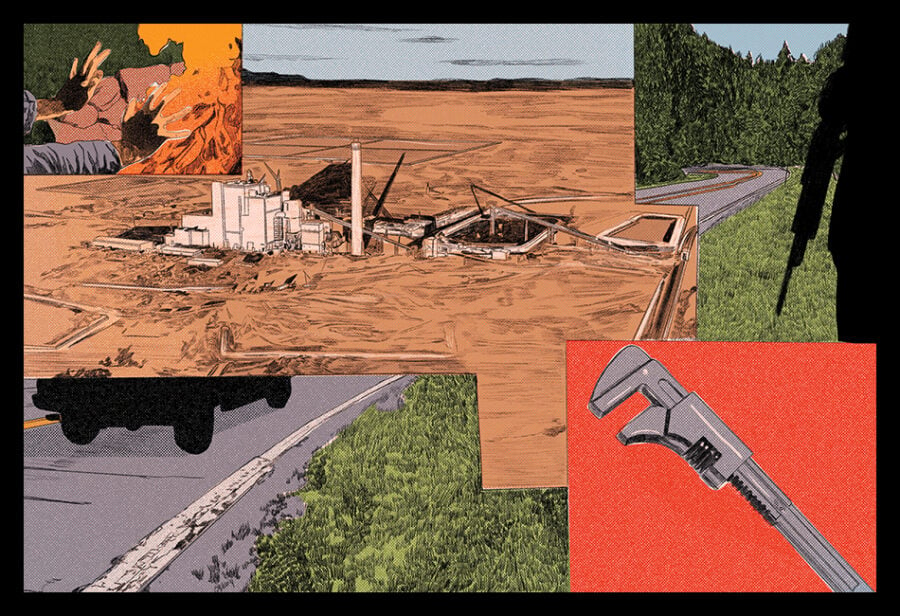
In the summer of 2016, a fifty-seven-year-old Texan named Stephen McRae drove east out of the rainforests of Oregon and into the vast expanse of the Great Basin. His plan was to commit sabotage. First up was a coal-burning power plant near Carlin, Nevada, a 242-megawatt facility owned by the Newmont Corporation that existed to service two nearby gold mines, also owned by Newmont.

McRae hated coal-burning power plants with a passion, but even more he hated gold mines. Gold represented most everything frivolous, wanton, and destructive. Love of gold was for McRae a form of civilizational degeneracy, because of the pollution associated with it, the catastrophic disruption of soil, the poisoning of water and air, and because it set people against one another.

Gold mines needed to die, McRae told me years later, around a campfire in the wilderness, when he felt that he could finally share his story. “And the power plant too. I wanted it all to go down. But it was only that summer I got up the balls to finally do it.”

He was compelled at last to act because of what he had seen in the conifer forests of Washington and Oregon that summer. They were hot and dry when they should have been cool and lush, rich with rain. He saw few of the birds that he had thought of as his companions in the Pacific Northwest—the flycatchers and vireos, the hermit warbler, the Pacific wren, the varied thrush. Even the most common birds, say the dark-eyed junco with its flashing white tail and sharp trilling, were nowhere to be found. Living out of the back of his car, camping on public lands, he stomped about at night before his fire with fists clenched, enraged at the loss.

As far as authorities know, McRae had committed industrial sabotage only once before, in San Juan County, Utah, on April Fools’ Day 2015. It was an attack on an electrical substation, a crime for which, had he been caught and convicted, he could have faced imprisonment under terrorism enhancement statutes for as many as twenty years, even though no human life had been endangered by the act. This was an essential point for McRae. “They called me a terrorist with anarchist intentions,” he would later explain. “But my hatred is for machines, not people.” He referred to the complex of machines and its technocratic tenders as the “megamachine,” after the formulation of the social historian Lewis Mumford, who warned against the takeover of society by technologies that would make us its dependents and, at long last, its servants—technologies that have now deranged the climate because they are fueled by burning carbon. “Down with the megamachine” was McRae’s motto.

Now he struck as opportunity arose, on his way across northern Nevada, headed east on I-80, bound for the Newmont power plant and mines. On the evening of August 30, 2016, while driving down a dirt road to his campsite in the foothills of the Montana Mountains in Humboldt County, some hundred and fifty miles northwest of the Newmont site in Carlin, he happened upon the Quinn River substation, a 115-kilovolt node of the sort that typically serves large industrial customers.

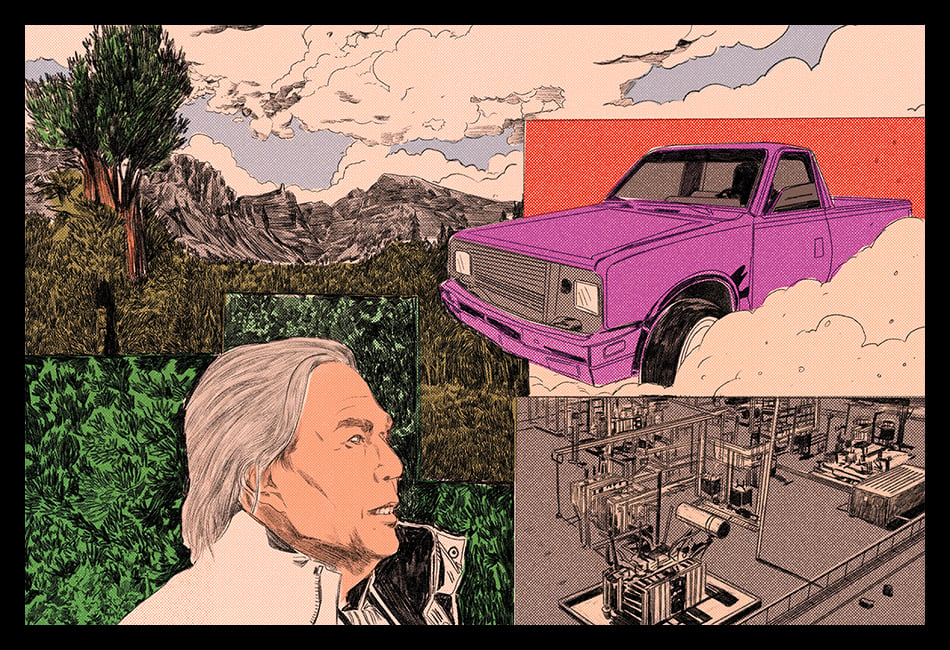
At 8 am the next day, he pulled up near the substation in his rickety purple Isuzu truck. The long shadows of the Nevada morning stretched across the desert. McRae scanned the horizon for traffic or pedestrians. Seeing no one, he raised his .30–40 Krag, a rifle known for its power and accuracy, and fired a single round from inside the truck. The bullet pierced the cooling fins of the transformer, as intended, causing mineral oil to gush onto the sagebrush.

The noise of the shot was tremendous, and for a moment it stunned him. He looked around as though finally awake to what he was doing. It was then that he asked himself something he would end up asking a lot, which was how it had come to this, how had he stooped so low.

McRae had once been a successful entrepreneur, the head of a high-end carpentry business in Dallas that catered to wealthy clients and brought him a six-figure income. At the height of his success, he oversaw ten journeymen, but the 2008 financial crash killed the business. Now he no longer had a cell phone, credit card, or bank account. He lived hand to mouth, working odd jobs. He had been married and in love, his wife a backpacker like him, smitten with wild places. But she was long gone, like everything else that had been stable and orderly in his life.

For one at the bottom of society’s rungs, who had given up on the doomed American dream, nomadism in the wide-open West was the way to go. He relieved his anger and despair and sadness in the solace of his campsites, where at least there were trees to talk to, stars immense and cosmic, and, if he was lucky, a purling stream running down from snowmelt high in the mountains, above the burning desert. There was room to be a bum with a degree of dignity, to disappear in the enormous backcountry, beyond the eyes of the cops and the reach of what McRae called in his diary “the Corporate Police State.” Here he declared himself a “madly matriarchal, tree-hugging, godless feminist with a gun.”

He ejected a single cartridge as he shot the Quinn River substation, and he noted where it fell in the truck so that he could quickly dispose of the evidence. (Always shoot from inside the truck, he advised, so there are no ballistics or shoe prints at the site.) Satisfied that the transformer would fail within the hour, he turned east into the sun on Nevada State Route 140, bound for the Newmont power plant.

But the Newmont attack never happened, for the stupidest of reasons: he got a flat. He knew he would have to drive on a spare over many dirt roads to escape, and he didn’t dare attempt taking out the facility on three good tires alone.

I first met McRae—and first appeared in his FBI case records—not long after the aborted assault on the Newmont site. On October 7 that same year, I stopped by the home of a friend in Escalante, Utah, where I was living that fall. The friend was Mark Austin, a sixty-five-year-old contractor who built homes for wealthy transplants. He could see I was rattled, and welcomed me in for a drink. A deer—a large buck—had charged across a field as I motored slowly into town and had rammed its antlers into my driver’s side window, shattering glass in my face and hair before fleeing. McRae was at Austin’s house for dinner when I arrived, and he thought my story was funny. The beasts of the earth are coming for you, he said. “It’s your New York plates.”

I was in no mood for joking. McRae seemed to be a big, aggressive, silver-haired Southerner, above six feet in height, with enormous shoulders, hands about the size of my head, and a broad smile that revealed a hollow space of molars gone from lack of care. A steak-fed Fort Worth or Dallas specimen, I figured, who made up with body mass what’s lacking in mind. This first impression, needless to say, was all wrong.

We ended up drinking a lot of wine, then tequila. We bonded over his love of English literature and Russian despair, the Brontës and Dostoevsky. He seemed quick to hate and quick to love, his disposition a mix of mania and menace. He said he was a follower of Native American cultures, enamored especially of the Apache, their chiefs Geronimo and Cochise, the last and fiercest of indigenous leaders in the lower forty-eight to resist white invasion. He fancied himself their ally, and he soon declared with adolescent glee his intention to destroy the white man’s industrial civilization. His most important targets were fossil fuel infrastructure and the energy grid. We discussed taking down the enemy—the Fortune 500 CEOs, say—and how the world would be a better place if they were all beheaded. “Would you really have a problem with me killing the Koch brothers?” he asked.

His eyes gleamed. He shouted over us. (The other participants in the conversation were Viva Fraser, my girlfriend; Erica Walz, publisher of the local newspaper; and Mark.) We talked about animals getting vengeance on Homo sapiens, attacking our cars en masse, cars that had killed so many of them. “Organize the animals!” cried McRae. He stood up and paced and sat down and stood up again. We drank more, and I mentioned to him that I had been a writer for this magazine. He hooted and smiled a half-toothless smile and said, “Harper’s! Goddamn!”

I have a copy of the FBI’s recording of this conversation courtesy of the Department of Justice. It goes on for another four or so hours. Much of it is garbled, the sound quality so lousy it’s unintelligible. There’s a dramatic moment around hour three, when McRae and I, barely acquainted, consider heading out the next morning to target the “infrastructure that makes industrial capitalism work,” because, he said, it “is very weak at certain points.” He harangued us, saying, “I hate everything about this culture.” We listened. I tried to get a word in. He shouted me down. According to the FBI transcript, which I’ve distilled slightly, the conversation went as follows:

McRae: I’m willing to die for what I believe. I’ve committed fifty fucking felonies against the corporate state in the last sixty days.

Ketcham: Really?

McRae: Yeah, that are called terrorism. Because I hate ’em.

Austin: I hope to God that you haven’t been killing people, dude.

McRae: I don’t have to kill people.

Ketcham: If you actually have been committing such felonies, you should be quiet about it.

McRae: I don’t care.

Ketcham: In fact, I’m inclined to think that because of your bloviating about it, that you haven’t been doing any of it.

McRae: You think I’m a fuckin liar? You’re gonna call me a fuckin liar? Come on, come get in my fuckin truck! In an hour we’ll commit five felonies.

(McRae starts yelling and cursing.)

Austin: Steve, Steve, relax!

McRae: Come get in my truck with me, in one hour, we can make five felonies. I’m not fuckin scared of the Goddamn NSA, the FBI, or any of those motherfuckers.

Walz: But Steve, what’s the point?

McRae: To teach the world how to destroy industrial capitalism. I have a political agenda to destroy industrial capitalism. I don’t want to hurt people. I’ve never hurt people. And I will try to avoid that at all costs. I know how to shut down huge mining operations costing millions and millions of dollars, by myself, for weeks. I know how to shut them down. Do I need to go on? I’m serious as a fuckin heart attack. Think I’m lying?

Ketcham: Let’s go out and do it.

McRae: You think I’m full of shit. You don’t believe me. Okay, we’ll go tomorrow, okay, is that cool? I’ll do it in broad daylight, that’s when they don’t expect it . . . You question my integrity, man.

Walz: You know what, I don’t want to hear this conversation. I prefer you not have this conversation in front of me at all.

McRae: Relax, I’m a fuckin liar, okay, fuckin lies. So anyway, do you want to meet me here in the morning?—well then, just tell me when and where.

Ketcham: We’ll talk tomorrow.

McRae: I’ll be around tomorrow . . . And if you really are a journalist you could help out my political cause. I think we can beat them. Enough of us can beat them.

Tomorrow never came, of course, because I thought he was a blowhard and a liar. I figured he’d read The Monkey Wrench Gang too many times. (He had.) The 1975 novel by Edward Abbey—the literary father of ecological sabotage—features a quartet of citizen defenders of the sandstone wilderness in southern Utah, so-called monkey wrenchers, who, like their hero Ned Ludd, the mythical eighteenth-century English weaver who rebelled against the machines overtaking the textile industry, vow to throw a spanner in the works. (Ludd’s forebears in fourteenth-century Holland are said to have used wooden shoes called sabots to smash the weaving machines that were putting them out of business.) Armed with gasoline, explosives, and rifles, Abbey’s saboteurs burn bulldozers and other road-building equipment, blow up bridges, and send coal trains into canyons, all the while pursued by local authorities. McRae, it seemed to me, was playacting in some cartoonish Abbeyite pulp fiction.

After that encounter, I had no contact with McRae for several weeks. We met again at a raucous Halloween party in Escalante, where I was dressed as a terrorist. McRae sat motionless in a chair, without a costume, alone and apart. He cast me a dour look. My face was mostly hidden in a balaclava and a kaffiyeh, and I pulled away the covering and smiled at him in what I imagine now was a dismissive way. Later he told me that it hurt his feelings to be doubted by a journalist from his favorite magazine. He had been serious about taking me along to commit felonies.

Measured against the march of machine civilization, the history of ecological sabotage has been one of petty local victories, scorched-earth retreats, and, ultimately, abject failure. The movement dates to the Seventies, when Abbey’s fictional monkey wrenchers inspired a generation of young Americans to coalesce into the direct-action group Earth First! “It is time for women and men, individually and in small groups, to act heroically and admittedly illegally in defense of the wild, to put a monkeywrench into the gears of the machine,” wrote Dave Foreman, a former Wilderness Society lobbyist and co-founder of Earth First!, and Bill Haywood in their 1985 how-to book Ecodefense. “We will not make political compromises,” the group had earlier announced in a 1980 newsletter. Saboteurs using their methods, they promised, could be “effective in stopping timber cutting, road building, overgrazing, oil & gas exploration, mining, dam building, powerline construction.” Members of Earth First! organized to defend old growth forests in the Northwest, spiking trees with sixty-penny nails to ward off chainsaw crews, blockading roads to stop logging trucks, and sitting in the crowns of ancient fir and pine to prevent their felling. They were occasionally successful, but mostly not.

The Earth Liberation Front, ideological heirs to Earth First!, arrived on the scene in the Nineties with new and improved acts of ecodefense. The elves, as they called themselves, set fire to ski resorts, SUVs on dealer lots, and labs where animals were believed to be abused. Their stated intent was to harm no living being, and to their credit, they maintained that standard. The rising militancy of the ELF produced consternation in U.S. law enforcement circles, and enough financial trouble to turn the heads of a few corporate leaders. Their crowning achievement was the daring and intricate 1998 arson of the Vail Ski Resort, undertaken with the Animal Liberation Front, which caused an estimated $24 million in damage. This led the FBI to call the two groups “the most active criminal extremist elements in the United States.” By 2006, dozens of ELF members had ratted one another out under the tremendous pressure of terrorism statutes enacted in the wake of 9/11. The FBI proclaimed victory, but writ large the government’s work was much ado about very little. The sum of the damages from arson, vandalism, and animal releases over decades of activity totaled a mere $45 million.

The growing understanding of ecosabotage as a serious endeavor coincided with an era of expansive plunder and spoliation, referred to by some historians as the Great Acceleration, a period in which human enterprise under capitalism kicked into overdrive, taxing the earth in unprecedented ways. Almost every measure of ecological health suggested decline. The problem was the seeming inevitability of the juggernaut, the constancy of its forward motion, and the inefficacy of mere individuals in the face of such odds.

Given these trends, it’s unsurprising that the movement would turn to catastrophism. At the vanguard of this shift was a group called Deep Green Resistance, the brainchild of the authors Derrick Jensen, Lierre Keith, and Aric McBay, self-described ecophilosophers and activists who had published numerous books of remonstrance against industrial society. The three asserted that our civilization was untenable and would render the earth uninhabitable. Jensen in particular exhorted his readers to

put our bodies and our lives between the industrial system and life on this planet. We must start to fight back. Those who come after, who inherit whatever’s left of the world once this culture has been stopped . . . are going to judge us by the health of the landbase, by what we leave behind. They’re not going to care how you or I lived our lives. They’re not going to care how hard we tried. They’re not going to care whether we were nice people.

His was an apocalyptic vision: the longer we waited to dismantle the machine, the more its progress would undermine the planet’s carrying capacity, and the greater our ultimate suffering would be. The American public had encountered this thinking before, of course, as it was popularized in the Nineties by the homicidal maniac Theodore Kaczynski, whose manifesto inveighed against industrial society and called for its violent overthrow. “In order to get our message before the public,” Kaczynski wrote, “we’ve had to kill people.” He addressed himself to those

who will be opposed to the industrial system on a rational, thought-out basis, with full appreciation of the problems and ambiguities involved, and of the price that has to be paid for getting rid of the system.

A majority of people will appreciate, on a rational basis, that the price is too high. As unsustainable as the megamachine may be, we must maintain it because hundreds of millions, perhaps billions, of people would likely suffer without its provisioning. To his credit, Jensen, who has Crohn’s disease and depends on high-tech drug treatments, admits that he’ll be among the first to go. (“I am also aware,” he writes, “that the fact that these drugs will probably save my life is not a good enough reason to not take down civilization.”) McRae likened our state of affairs to life on the Death Star. The Death Star succors, energizes, feeds, clothes, medicates, houses, warms, and cools us with its throbbing complexity—woe to the planets in the way of its progress. There are jobs galore paying good money to make sure the Death Star is oiled and functioning. “More money for more gadgets, gizmos, gewgaws, baubles,” McRae told me in an email. “The endless fascination with more, more, more shiny objects to continue a life of tending machines.”

After abandoning the attack on the Newmont gold mine, McRae pulled off I-80 into Carlin to get his flat fixed. He was paranoid to the point of delirium. Traffic cameras might catch his truck, cops might take random notice of him. Then there was the awfulness of visiting a Nevada town, the hideous, twisted faces of the people, the heat bearing down, the sky a burning chromium white, every interaction a kind of torture.

From Carlin he headed south in a zigzag on rough dirt roads, avoiding cops and people, feeling the pit in his gut grow. He had his eye on a substation in White Pine County two hundred miles away, not far from a favorite place replete with good memories, Great Basin National Park. As a young man he had climbed the mountain meadows with his wife. They slept under whispering bristlecone pines on a midsummer night. When he shot the Baker substation in White Pine County on September 14, 2016, he had expected, naïvely he now realized, that at some point he would have experienced an affirmation similar to the feeling he got when he climbed a mountain or smelled pines in the breeze, that is, a sense of joy, purpose, a vision of truth and beauty and meaning. But this never came. And it never would.

Every lesson from his good middle-class upbringing told him there was something wrong with what he was doing. He looked for rationalizations in the perpetual muttering of troubled people on the verge of breakdown. He spoke aloud before a lonely campfire. He thought of the peace-loving water defenders in the Dakotas, the Native Americans at Standing Rock who hoped to block the Dakota Access Pipeline, and who were attacked and beaten that summer by hired thugs from the oil companies. What had the togetherness of locked hands accomplished in defense of Mother Earth?

He had tried peaceful resistance for most of his life, volunteering for conservation groups and contributing what he could. But it was nonsense, a waste of time and money and, worse, spirit. It felt like a Ponzi scheme. He supported the right candidate, he thought: the Democrats, Hillary Clinton in particular. (He told friends and family that he was “gonna support a woman, because a woman is the only person who can lead us out of this mess.”) He tried to follow the example of his father, Jack, a civics teacher who taught in Dallas public schools for thirty years. Jack had been a socialist and later an LBJ Democrat. He believed in civic discourse, civil disobedience if necessary—but never rage and riot, never violence. When McRae was five years old, in 1964, his father traveled to Mississippi to join the Freedom Summer black voter drives.

McRae spent his late forties as caretaker to his ailing father, who died in 2008, at eighty-six, of congestive heart failure. He once told his dad that to be a pacifist was to be a fool. Jack had served in World War II, in the bloody campaigns in North Africa and Italy, so he knew violence. He was a quiet man who rarely raised his voice. But he became angry with his son. They argued for hours. McRae figured his father would be ashamed at what he had become.

It took him more than a week to cross Nevada, crawling on rutted back roads in his crummy old car, through the dust and tumbleweeds and the vast scorched salt basins and over the spines of mountains. He was heading toward the high country of the Colorado Plateau, the Canyonlands, where he found some carpentry work from Mark Austin. When McRae had visited Escalante in 2015 and first met Austin, he thought he had found a friend, a rare person he could trust. Their worldviews had seemed to align.

As the two got to know each other, Austin expressed sympathy with certain small acts of sabotage, such as toppling roadside commercial billboards. This delighted McRae. Better still, Austin was a fan of Abbey’s writing and a close friend of Doug Peacock, the Vietnam War veteran on whom Abbey based his wild-eyed saboteur George Hayduke in The Monkey Wrench Gang. McRae adored Hayduke, and was impressed that Austin knew the man who’d been the inspiration for him. He confided in Austin about Deep Green Resistance and spoke vaguely of sabotage he may or may not have committed. McRae also described, in what Austin said was an obsessive manner, taking down the energy grid. “He was maniacal,” Austin recalled. “There’s a big difference between cutting down illegal billboards and taking out infrastructure.” McRae worked several months on Austin’s job sites, drew a paycheck, hit the road, and Austin, who was mildly frightened by the man’s rhetoric, expected never to hear from him again.

On September 25, 2016, the power in Escalante went out for several hours. It had gone out, in fact, across much of southwestern Utah. It was a Sunday, and I was in Escalante at the time. The townsfolk wandered into the streets with wide eyes, wondering what had happened, as power tended to fail only in big winter storms. When Austin heard that the cause was rifle fire on a substation, he immediately suspected McRae. By the time McRae showed up to ask Austin for work two days later, Austin had already called the Garfield County sheriff to share his suspicions.

Sheriffs in White Pine and Humboldt counties had been mulling the similarities of the attacks in their jurisdictions, and now they reached out to Garfield County. Perhaps this suspect was tied to the 2014 strikes on the California electrical grid, including a rifle attack in Silicon Valley described by the New York Times as “mysterious and sophisticated.” The FBI also took an interest. The bureau suggested that Austin engage with the suspect and record their conversations. Within a few weeks of taking a job with Austin, McRae was revealing details of his recent crimes. He also began hinting at a grand plan that he was hatching for the fall. It involved taking out so many substations across the Southwest that a blackout would stretch from Las Vegas to the coast.

Though Austin considered the prospect alarming, ecosabotage now appears, in some circles, a reasonable response to the mad trajectory of the carbon machine. Even the conformist bozos in Hollywood have hinted at sympathy, with the film How to Blow Up a Pipeline, which takes after a book of the same name by Andreas Malm, a human ecologist at Lund University. Malm has advocated for organized attacks on fossil fuel infrastructure and the disruption of oil supplies. He says that he is inspired by the suffragettes of England, whose militancy centered on property destruction.

The suffragettes specialized in the “argument of the broken pane,” their enraged crews of well-dressed women mobbing central London to shatter storefronts and tear down statues and paintings with hammers and axes. Following the defeat of legislation that would have given them the vote, in 1913 the women embarked on “a systematic campaign of arson,” Malm writes, burning or blowing up “villas, tea pavilions, boathouses, hotels, haystacks, churches, post offices, aqueducts, theatres.” They burned cars and sank yachts. Over the course of a year and a half, they claimed responsibility for at least 337 attacks, which resulted in several deaths. So it should be, argues Malm, with the fight against fossil fuels: we need a critical mass of saboteurs willing to move beyond non-violence.

Or consider Kim Stanley Robinson’s 2020 novel The Ministry for the Future, in which a character clubs to death a wealthy man on a beach off of Lake Maggiore, and gets away with it, his murderous rage driven by having witnessed a heat wave in India that killed more people “than in the entirety of the First World War.” The book spans decades of climatic unraveling to chronicle the rise of the Children of Kali, a cabal that kills thousands of innocent people on Crash Day, sometime in the 2030s, by flying drones into the engines of dozens of commercial airliners. It’s a ruthless act of terrorism that Robinson’s omniscient narrator celebrates for causing the end of global aviation as we know it. No literary justice here: the saboteurs live on to fight another day, unpunished.

Here’s a novelist of no small renown—Barack Obama has endorsed Robinson’s book—who envisions an effective sabotage campaign by cells that operate in large numbers, coordinate on a global scale, and act with fanatical devotion and a code of absolute secrecy. “The War for the Earth is often said to have begun on Crash Day,” he writes. Thereafter, campaigns to sink container ships, poison the meat supply, and, not least, take out power plants and substations result in electricity outages, stock market crashes, and the end of globalization. The upside of Crash Day is that the many commercial flights felled “had been mostly occupied by business travelers.”

In the twenty-two hours of recordings that Mark Austin produced for the FBI, McRae does most of the talking. He is by turns irate, preacherly, vulgar, lyrical, sanctimonious, and cynical, but always inflamed with the belief that he can change the world. He glories in the abiding solitude of the Escalante canyons, with their curvaceous walls and hanging gardens, where in his youth he wandered for days on end. He hates that his only means of income is building homes for the rich.

McCrae, who was at one time a methamphetamine addict, also reveals that he did time in jail as a young man—imprisoned in Texas on felony charges of burglary and drug possession. Mostly he goes on tirades about the things and people he hates. These include roads, cars, fences, ranchers, cities, computers, cell phones, the rich but also the ignorant poor (most of all, white-trash Trump voters), Nazis, NPR’s Kai Ryssdal, technocrats, Apple, the internet, and monotheism. Austin listens to all this with seeming sympathy, and he chimes in at strategic moments to urge him on.

Most of the recordings were made in Austin’s pickup truck while the men drove to and from work sites, hauling construction materials across the canyons and plateaus of southwest Utah. It was during these winding sojourns that McRae began to speak in code, describing the “work” and “research” he had pursued in Nevada and his more recent “activities” in Utah.

After a long drive from Escalante to Kanab, Utah, in the third week of October, he and Austin visited a company that cut sandstone for home decor, and then drove east on Highway 89, familiar to McRae as the road he had traveled when he attacked the Buckskin substation three weeks earlier. Edward Abbey had considered this highway to be holy territory: there were the deep, remote canyons of the Paria River, and its tributaries that cut through the nearby wilderness to areas that no machine could reach. McRae, too, thought it sacred.

A construction crew was laying fiberglass cable along the highway. “What the hell is this right here?” asked Austin.

“They’re working on, that’s microfiber ca—God, now I’m tell—” said McRae, catching himself. Then he let go. “I know what all this shit is and exactly what they’re doing and I’ve got my eye on it, and I really want to fuck it up. How about that?”

He and Austin muttered back and forth. “This is Abbey’s country,” McRae went on. “Is there nothing sacred, nothing, fucking nothing? I bet you could take a gallon of gasoline and put it on that cable and burn it.”

On and on their conversations go for nearly four weeks, as Austin baits McRae and McRae bites, until at last he all but admits that he shot the Buckskin substation with his rifle. Still, Austin prods. He notes that McRae issued no communiqués, which made his effort meaningless. The Earth Liberation Front, by contrast, publicized every attack with well-written and occasionally charming statements. Austin goes on to wonder about McRae’s bizarre candor with “the journalist,” McRae’s term for me. Why risk exposing himself to a relative stranger? “I thought Ketcham was an anarchist bomb thrower,” he says. “Now I see he’s a coward.”

As the FBI prepared for an arrest, McRae described his plans for “putting Las Vegas in darkness.” He gloried in the vision of the death of the Luxor Hotel & Casino (the largest single source of light pollution on the planet) and of Caesars Palace (a monument to empire), and the quieting of the noise and febrile lights of the Strip. The air-conditioned, sunless tunnels of bright malls, the sprawl and traffic and smog, the whorehouses and strip clubs, the doomed Sodom in the desert—shut off the power and it would come to an end. Las Vegas once meant “the meadows,” but that sweet oasis was long gone, dried up and pounded under concrete. Of all the cities of the West, Vegas was most deserving of destruction.

Austin listened and nudged McRae for more information. McRae described “the grandmomma” of attacks, “five substations in a row,” by which he could produce a cascading and catastrophic energy failure across the southern regions of Nevada and California. The key was a substation facility near the town of Moapa. He expected to do $20 million in damage to the transformers alone. “If I had all the money and time, I would bring the world to its knees by myself,” he told Austin.

“This is the culmination of four years for me this week,” McRae said in a recording dated November 2, 2016. “I’m going to meet my destiny.” The next day, he awoke at 7 am to load his purple Isuzu with the camping gear he had stored in the basement of Austin’s house, where he had also stored his .30–40 Krag, a testament to how much he trusted Austin. He was headed to finish the job at Newmont and then hit Moapa. It was a lovely blue-sky day. As he emerged from the basement, seven FBI agents surrounded him. A SWAT team told him to put his hands up, which he did without resistance or complaint. He thought it laughable. Why would anybody point a gun at poor empty-handed Stephen Plato McRae? They cuffed him, and as he was being hauled away he looked over to Austin, who was also being cuffed. McRae knew instantly that Austin had betrayed him.

He was held first in Iron County in Utah, then in Salt Lake City, then put on a plane and transported to a federal pretrial holding facility in North Carolina. When three separate psychiatrists working with the U.S. Bureau of Prisons examined McRae in the years following his arrest, one concluded that he was not fit to stand trial and another questioned his fitness. McRae showed “psychotic symptoms,” including “thought disorganization, and pre-occupying persecutory delusions,” along with “depressive symptoms meeting criteria for a major depressive episode.” He also displayed “symptoms of mania.” The psychiatrists believed that he may have had bipolar disorder, possibly schizoaffective disorder, and also narcissistic personality disorder—which “makes him difficult to work with.”

While he awaited trial in the two years after his arrest, McRae and I spoke often on the phone and exchanged letters. Sometimes he shouted at me, demanding that I “do the right thing” by immediately publishing an article that came to his defense. His plan was to tell the prosecutors “to go fuck themselves,” as he would never take a plea deal. Sometimes his voice was resigned and trembled with sadness and fear. As the trial date approached, McRae’s lawyer, Robert Steele, informed me that I might be called as a witness for the defense. At the last minute, at Steele’s urging, McRae pleaded guilty to one count of industrial sabotage, the attack on the Buckskin facility in Utah, and admitted to three other attacks, against the substations in Humboldt County and White Pine County, Nevada, and in San Juan County, Utah, for which he was not prosecuted.

He was sentenced to eight years and placed in one of the nastiest institutions in the federal system, a medium-security facility in Florence, Colorado, near the supermax where the Unabomber was held until his death earlier this year. McRae saw cellmates get murdered and commit suicide. He was nearly killed in a race riot. His health, poor to begin with, took a dive with the stress of incarceration. He was infected three times with COVID-19, and was chronically infected with MRSA. Given time served, McRae wasn’t expected to get out a day before his sixty-third birthday. He suddenly felt very old.

There were few people McRae felt he could call who would answer, and often he spent hours waiting in line to spend his fifteen minutes of allotted daily phone time talking with me. His calls arrived randomly. Once, when I was with my daughter Josie, who was then nine years old, I put him on speakerphone; I had told her his story and she wanted to hear his voice.

“McRae, Josie is here, so you know,” I said.

“H-hi, Josie,” he stammered.

“Hi, McRae,” said Josie.

Then a long pause—rare for this motormouth. He knew that I’d told her what he had done, why he was in prison. “Josie, I just wanna . . . I just wanna say . . . I was thinking about . . . the youth when I did what I did. About you. I want nine-year-old girls to still be able to see a grizzly when they are grown up.”

“I want to see a grizzly, too,” replied Josie. It was the natural thing to say. Then his fifteen minutes were up and the line went dead.

Psychologists have come up with a term—solastalgia—for the feeling that occurs with the disappearance of what’s perceived as the normal, stable, healthy, natural world. The Australian philosopher Glenn Albrecht, who coined the term, identifies it as a suffering at the loss of solace, “a deep emotional response to the desolation of a loved home environment.” The condition of solastalgia, then, is primarily one of grief, environmental grief, mourning for the death of home, which is the place of solace. (“Stephen McRae seems to be a man who refused to ignore such emotion,” Albrecht told me.)

It may be that hypersensitivity to the ecological unraveling of the only home on earth we know, will ever know, is the necessary condition of an attuned few who can awaken the rest of us to the existential nature of the ecological crisis we face. If Steve McRae sounds to some like a madman, I’d suggest he’s ahead of the curve in feeling deeply the pain of solastalgia. Perhaps those of us who deny the seriousness of the crisis have had our senses dulled, our hearts hardened, and are not feeling enough.

I went to see McRae last December, two months after he got out of prison. An elderly Mormon couple who lived on a homestead in the remote Gila National Forest of southwestern New Mexico had taken him in. McRae worked as the caretaker of a little cabin they rented to elk hunters. In his emails to me, he was grateful that the family had welcomed him, but he was also deeply depressed. During my visit, I confronted him with the fact that his attacks on substations had not in any way altered the course of industrial civilization. He shattered a glass, stood up, and screamed at me. I thought he was ready to kill.

I stayed awhile in the cabin with him. We went camping in the Gila Wilderness. No machines are allowed in the protected area, no mechanized transport of any kind. We built a towering fire of pinyon and juniper and oak. It was the only time I saw him relax, happy that we were together in this sacred redoubt, beyond the reach of what he called Machine World. He spent most of the time talking about the forest. “When I walk these forests, I feel the trees’ antiquity and their beingness,” he said. He told me of the giant ponderosa pines in the high-elevation ciénaga wetlands unique to the region, where they mingle with pinnacles of rock and Gambel oaks and gray oaks as gray as the lichen-engulfed rocks that surround them. Fiery red blooming cactus at eight thousand feet—“Gorgeous!” he cried. He told me of cliff rose, and mountain mahogany, and wild yellow pea in green meadows with joyous miniature flowers of varied brilliance painting the broken land. And about the twisted, bleached, and sun-scorched ancient bonsai alligator juniper that cluster on steep cliffs. “No anthropo-meddling needed for those bonsai, praise Jesus! I’ll show you some really beautiful ones tomorrow,” McRae said. And in the morning he did.

From the

November 2023 issue

Christopher Ketcham’s most recent article for Harper’s Magazine, “The Business of Scenery,” appeared in the April 2021 issue.

Jamil Chade – Como diplomatas tentaram, de dentro do Itamaraty, conter atos de Bolsonaro (UOL)

noticias.uol.com.br

REPORTAGEM

Jamil Chade

Colunista do UOL

07/12/2022 04h00 – Atualizada em 07/12/2022 14h06


Dois diplomatas entram em um café em uma capital europeia. Um deles é brasileiro e carrega informações ultrassecretas. Sua missão é desarmar uma bomba. Parece filme de espionagem, mas a cena é real e se repetiu no governo Bolsonaro.

Uma rede de resistência clandestina foi criada no Itamaraty para conter a política externa bolsonarista.

Temas como mudanças climáticas, direitos humanos, a questão palestina ou mesmo a Guerra da Ucrânia foram tratados nesses encontros sigilosos, confirmados pelo UOL com 13 funcionários do Itamaraty, incluindo embaixadores e servidores administrativos, e em um amplo e ainda inédito estudo de pesquisadoras da FGV e de Oxford. A rede não envolveria apenas alguns poucos nomes e, de fato, teria se espalhado por alguns dos principais departamentos da chancelaria.

Os objetivos da rede clandestina eram:

  • Permitir que o outro país tivesse tempo para reagir a mudanças na política externa do Brasil, sem que uma crise fosse estabelecida
  • Preservar a credibilidade do Brasil no exterior e salvar décadas de uma construção da diplomacia nacional

Para diplomatas, a palavra correta seria resistência, que existiu “em nome da democracia e da soberania”, e sempre ocorreu dentro de parâmetros da legalidade. No fundo, tais atos não eram nada mais que uma tentativa de “equalizar posições” diante daqueles que estavam destruindo as estruturas do Estado. A verdadeira sabotagem, neste sentido, era o que estava ocorrendo com o sequestro de décadas da diplomacia brasileira para atender aos objetivos da extrema direita.

Os encontros clandestinos eram apenas uma das táticas da resistência, que também:

  1. Montou um esquema de contatos diretos com governos estrangeiros, sem ter de passar pela cúpula do Itamaraty e com o objetivo de desarmar crises diplomáticas.
  2. Limitou-se a ler “a instrução que chegou de Brasília”, em reuniões na ONU, OMS ou OEA, sem uma atuação de empenho para convencer os demais países a seguir o Brasil em suas posições.
  3. Copiou documentos que poderiam ser usados para defender um diplomata contra acusações e registrar a ilegalidade de certos atos do Planalto.
  4. Gravou reuniões de forma clandestina nas quais a cúpula bolsonarista ordenou a suspensão de termos de documentos ou o veto a determinadas resoluções que citassem a palavra “gênero” ou outros temas delicados.
  5. Vazou informações para a sociedade civil sobre o posicionamento do Brasil na esperança de que uma pressão pública fosse feita para impedir que um determinado ato fosse concretizado.
  6. Publicou artigos sob o nome de outra pessoa ou de um acadêmico.
  7. “Arrastou o pé”, diminuindo o ritmo de trabalho na implementação de instruções estabelecidas pela cúpula bolsonarista.
  8. Enganou a chefia ou informou o que era absolutamente necessário, ocultando da cúpula situações ou posições por parte de outros governos.
  9. Realizou reuniões sem registros na agenda oficial, impedindo que certos temas ou debates entrassem no radar da direção.
Itamaraty - tradição - Arte/UOL - Arte/UOL
Itamaraty – Diplomacia Brasileira Imagem: Arte/UOL

Um clima de medo, represálias e perseguição se instalou no Itamaraty nos quatro anos do governo de Jair Bolsonaro.

Saíram de cena a tradição e as nomeações técnicas, que sempre guiaram de forma explícita desde a promoção de diplomatas até as posições do Brasil no exterior, e entraram as indicações políticas e o alinhamento ideológico compulsório ao núcleo bolsonarista.

As mesmas condições foram identificadas na pesquisa coordenada pela professora da FGV Gabriela Lotta, em parceria com Izabela Corrêa, de Oxford, e Mariana Costa, também da FGV.

As pesquisadoras entrevistaram diplomatas em diferentes posições na carreira e que estão alocados em distintos países e setores do Itamaraty.

Todo o levantamento é feito de forma sigilosa e anônima, para preservar a identidade dos entrevistados.

Segundo os funcionários ouvidos a gestão Bolsonaro promoveu:

  • Monitoramento de diplomatas sobre o que curtiam nas redes sociais, se eram membros de partidos políticos ou até com quem eram casados. Uma funcionária relatou que não foi promovida depois que “foi descoberto” que seu marido trabalhou em um governo anterior.
  • Substituição de funcionários que se dedicavam a estudos de temas contrários à agenda de Bolsonaro como clima, meio ambiente, gênero e direitos humanos, por pessoas leais ao governo.
  • Promoções e transferências para o exterior foram transformadas em moeda de troca e instrumento de ameaça.
  • Palavras como “gênero”, “Cuba” e “mudanças climáticas” foram vetadas, evitadas ou até apagadas de documentos oficiais do passado. Uma servidora admitiu que teve como função modificar portarias, discursos, informações no site oficial e telegramas.

Mulheres e homossexuais foram especialmente alvo dessa nova fase. “Há uma masculinização e a volta de certas práticas, como piadas no corredor”, contou Gabriela Lotta, a pesquisadora da FGV.

O que mais escutava nas entrevistas era: O tio da Sukita se normalizou

O que diz o Itamaraty sobre as denúncias?

Nada. Procurado para comentar a reportagem, o Ministério das Relações Exteriores se manteve em silêncio.

O número de pessoas removidas de seus cargos chegou a tal ponto que consolidou-se o apelido informal usado para designar diplomatas loteados em locais onde não faziam nada: “Departamento de Escadas e Corredores”.

Um exemplo emblemático aconteceu logo nos primeiros meses da gestão do ex-chanceler Ernesto Araújo, que decidiu isolar e deixar sem função o diplomata Audo Faleiro. A justificativa: ele teria trabalhado para os governos do PT.

Itamaraty - Clima de medo e represálias - Arte/UOL - Arte/UOL
Itamaraty – represálias Imagem: Arte/UOL

Em meados de 2019, Faleiro deixou seu posto em Paris para voltar ao Itamaraty. Foi nomeado como chefe da Divisão da Europa e, dois dias depois, o gabinete de Araújo informou que o cargo teria de ser retirado.

O diplomata ficou por seis meses na biblioteca do Itamaraty, aguardando um novo cargo. Foi apenas em março de 2020 que ele foi colocado no Departamento Financeiro. Ainda assim, sem o direito de ir a algumas reuniões e com o compromisso de que, na ausência da chefia, não assumiria o departamento.

Para muitos, Faleiro foi usado como exemplo:

Olha o que pode ocorrer contigo. Não faça isso se não quiser virar o próximo Audo

O tamanho do estrago

Os relatos coincidem com quatro anos que transformaram o Brasil em um pária internacional.

Para a professora da FGV Gabriela Lotta, o impacto não se limitou aos muros do Palácio do Itamaraty.

“A diplomacia brasileira tem sua moral e influência construídas na tradição e expertise. O governo negou isso, prejudicou a política externa e enfraqueceu a diplomacia e a imagem do Brasil.”

Na opinião da pesquisadora e dos embaixadores e diplomatas ouvidos pelo UOL, resistir foi a saída encontrada para sobreviver a um dos momentos mais tenebrosos da democracia brasileira.

Muitos, porém, pagaram um preço elevado, tanto profissionalmente como em relação à saúde mental.

O uso de tarja preta foi disseminado.